Sound quality alone can't cut it
JVC's pricey HA-S100N headphones deliver solid audio performance, but that alone doesn't make up for their iffy control panel and merely decent noise cancellation.
The premium price of JVC’s HA-S100N noise-cancelling headphones ($299.95) reveals their high-end ambitions. And, on one hand, the pair delivers a powerful, bass-forward sound signature (with three EQ preset options) and supports a strong array of Bluetooth codecs. On the other, however, their active noise cancellation (ANC) simply isn’t competitive with top options from Bose and Sony. We’re not fans of their poor on-ear control scheme, either. For only a bit more money, the Editors’ Choice-winning Bose QuietComfort 45 headphones ($329) offer far superior noise cancellation, better controls, and an app with an adjustable EQ.
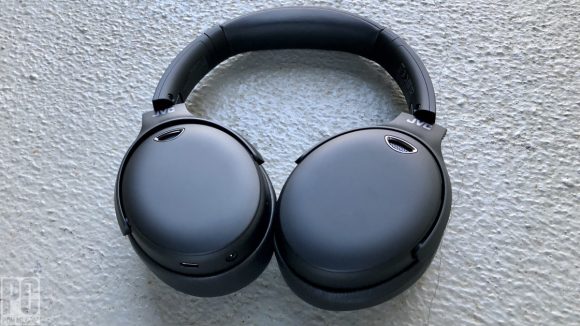
Available in black with a semi-matte finish, the HA-S100N’s headband and earpads feature generous cushioning, making them comfortable to wear for long listening sessions. Internally, 40mm neodymium dynamic drivers deliver the audio. The headphones are compatible with Bluetooth 5.1, and support the AAC, AptX, AptX HD, and SBC codecs. This is excellent codec support, although the high-end LDAC option is missing.
The exterior design is simple yet sophisticated, and all of the outer panels are smooth. JVC eschews physical buttons and knobs for capacitive touch panels. Although this minimalist aesthetic looks pleasing, the lack of buttons creates usability issues. Take the omission of a power button, for example. You turn the headphones on by putting them in a normal, wearable position and off by twisting the earcups flat. Aside from the sheer strangeness of this setup, it’s also not very effective. We were able to power the headphones on and off with just slight adjustments, which could lead to a lot of accidental activations.
The capacitive touch controls live entirely on the right earcup and are quite sensitive, which is usually a good thing. JVC, though, overloads this panel with several touch-sensitive areas that perform various tasks, thus making them prone to misfires.
Tap once to control playback (play/pause); swipe up or down to adjust the volume; and swipe forward or backward to navigate tracks. To cycle through the ANC and Ambient modes, you must tap two fingers simultaneously on the back panel—a gesture that is particularly tough to perform. And the control layout only gets more complicated from there. For example, to activate transparency mode (which allows you to hear your surroundings without removing the headphones), you must tap the outer edge of the panels. And to cycle through the three EQ modes (Bass, Clear, and Normal), you need to tap this same side panel three times (this works only when music is playing).
We wish that the outer side panels weren’t active, because it’s easy to tap them by accident when you adjust the fit of headphones. It’s also easy to play or pause music when you intend to adjust the ANC mode. Furthermore, the vocal prompts you’re supposed to hear when you switch between ANC or EQ modes don’t always play. Another oddity: Android users can hold a finger in place to summon Google Assistant, but the same gesture doesn’t work for Siri on iOS.
Ultimately, the controls didn’t become more intuitive the more time I spent with the headphones. Part of the problem is that the panel doesn’t register multi-tap gestures very quickly and the vocal prompts are a bit delayed. An app could take some of the pressure off the control panel to do everything, though the addition of physical buttons for at least some tasks seems like a more obvious solution.
Aside from the control panel, the right earcup features a USB-C charging port, a 3.5mm headphone jack, and an LED status indicator. Although wired listening is possible, passive listening isn’t an option because of the way you turn the pair on and off: wearing them means they are on and using battery power.
JVC estimates that the headphones can last up to 25 hours on a charge, but your results will vary based on your typical listening volume level and use of ANC. Charging time takes about three hours.
The pair ships with a hard-shell, zip-up case that the headphones fold down flat into, a 3.5mm audio cable, and a USB-C-to-USB-A cable for charging.
JVC doesn’t offer an app for these headphones, which means you can’t make any changes to the sound signature via an EQ or easily perform firmware updates. For models in this price range, we expect an app with EQ options.
The headphones deliver decent noise cancellation, though their is more consistent with models in the sub-$200 range. They cut back powerful low-frequency rumble (like from airplanes and trains) quite a bit, but a recording of a busy restaurant with clanging dishes and boisterous conversation bested them. They let through plenty of the higher frequencies and also added a notable amount of high-frequency hiss to the signal. This is a relatively common indicator of less effective ANC circuitry, and disappointing for headphones that cost this much.
The QuietComfort 45 headphones from Bose are leagues ahead in terms of noise cancellation. For example, they dial back deep rumble far more effectively, let through a lot less high-frequency noise, and don’t suffer from the obvious hiss issue.
I also don’t like that there’s no simple way to tell which ANC mode is active without listening to the voice prompts as you cycle through them. The Ambient mode works effectively, but we’re not sure why both it and the Transparency mode are available, as they both perform the same basic function (letting in environmental noise).
On tracks with intense sub-bass content, like The Knife’s “Silent Shout,” the headphones deliver powerful low-frequency response in the Normal EQ mode. They don’t distort at high volumes and still pack robust bass power at more moderate ones. The Bass EQ mode substantially dials up the lows if that’s what you’re after, but most listeners should be happy with the bass-forward-but-balanced Normal EQ mode.
Bill Callahan’s “Drover,” a track with far less deep bass in the mix, provides a better sense of the sound signature. In Normal EQ mode, the drums on this track sound natural and round. In the Bass EQ mode, they become thunderous; you might prefer this emphasis, but again, the Normal EQ mode offers much better balance. Callahan’s baritone vocals benefit from some additional low-mid richness in Normal EQ mode, too. Here, JVC sculpts the high-mids to match the lows. As a result, his vocals get some treble edge, while the acoustic strums and higher-register percussive hits get a bit more detail.
On Jay-Z and Kanye West’s “No Church in the Wild,” the kick drum loop receives an ideal amount of high-mid presence, allowing its attack to remain sharp. The sub-bass synth hits that punctuate the beat come across with powerful depth—the Bass EQ mode only ups the ante. The vocals on this track sound clean and free of sibilance.
Orchestral tracks, like the opening scene from John Adams’ The Gospel According to the Other Mary, sound overly bass-forward in most of the sound modes. The Clear EQ mode dials back the lows a bit and accentuates the highs, so it’s likely the best option of the three for this type of music.
None of these modes sound terrible, but we would have preferred an app with an adjustable EQ. Switching between modes gets old quickly, especially because you can only do so when music is playing and there’s no way to know which mode you’re in other than to cycle through them.
The mic offers excellent intelligibility, and every word in our test recording from an iPhone sounded very clear. We didn’t notice any Bluetooth audio artifacts, either.
The JVC HA-S100N headphones look slick and sound relatively strong, but operational issues overshadow these positive aspects. Middling ANC performance doesn’t do much to help matters, because the pair costs almost as much as many top-performing models on the market. The aforementioned Bose QuietComfort 45 headphones offer best-in-class ANC and cost only $30 more, for example. And if you can stretch your budget, Sony’s WH-1000XM5 headphones ($399.99) pair top-notch noise cancellation paired with even better audio performance. JVC does well on the audio front, but either of these alternatives are worth the increase in price.
JVC's pricey HA-S100N headphones deliver solid audio performance, but that alone doesn't make up for their iffy control panel and merely decent noise cancellation.
Sign up for Lab Report to get the latest reviews and top product advice delivered right to your inbox.
This newsletter may contain advertising, deals, or affiliate links. Subscribing to a newsletter indicates your consent to our Terms of Use and Privacy Policy. You may unsubscribe from the newsletters at any time.
Your subscription has been confirmed. Keep an eye on your inbox!
Advertisement
I’ve been a contributing editor for PCMag since 2011. Before that, I was PCMag’s lead audio analyst from 2006 to 2011. Even though I’m a freelancer now, PCMag has been my home for well over a decade, and audio gear reviews are still my primary focus. Prior to my career in reviewing tech, I worked as an audio engineer—my love of recording audio eventually led me to writing about audio gear.
Headphones and earphones
Wireless and computer speakers
USB mics
Bluetooth headsets
Probably because of their prevalence in the recording studios I worked in a long time ago, I am most comfortable on Macs—I’m writing this on the 2019 iMac I use for testing. I also have a MacBook Pro that gets plenty of similar use.
My workspace has a mini recording studio setup, and the the gear I work with there is a mix of items I’ve used forever (Paradigm Mini Monitors and a McIntosh stereo receiver) and newer gear I use for recording and review testing (such as the Universal Audio Apollo x16).
I’m obsessed with modern boutique analog synths—some of my favorites instruments in this realm are the Landscape Audio Stereo Field and HC-TT, the Soma Enner, the Koma Field Kit, and the Lorre Mill Keyed Mosstone.
From my studio days, I’m comfortable using Pro Tools, and in recent years have branched out to other realms of creative software, like Adobe Premiere and After Effects.
I stream music, but I also still buy albums, digitally or on vinyl, and encourage anyone who wants fair compensation for musicians and engineers to do the same.
I also play lots of Wordle.
PCMag.com is a leading authority on technology, delivering lab-based, independent reviews of the latest products and services. Our expert industry analysis and practical solutions help you make better buying decisions and get more from technology.
© 1996-2022 Ziff Davis. PCMag Digital Group
PCMag, PCMag.com and PC Magazine are among the federally registered trademarks of Ziff Davis and may not be used by third parties without explicit permission. The display of third-party trademarks and trade names on this site does not necessarily indicate any affiliation or the endorsement of PCMag. If you click an affiliate link and buy a product or service, we may be paid a fee by that merchant.