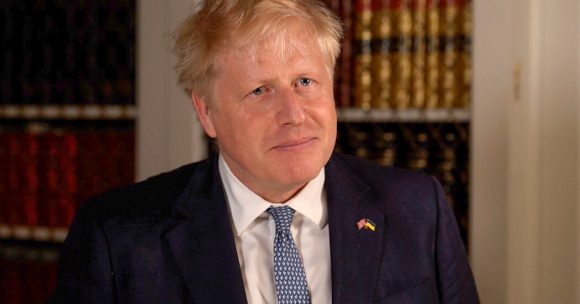
Despite surviving a no-confidence vote in Parliament, Britain’s prime minister must now weather a risky Parliamentary by-election this month and, potentially, even a rebellion by his fellow Conservative lawmakers.
Britain’s prime minister faces potential pitfalls even after victory in a no-confidence vote over lockdown parties.
Rival Conservatives could yet plot to push Johnson out.
Johnson urges his cabinet to ‘draw a line’ and move on to other issues.
The prime minister will also have to grapple with an economy at risk of recession.
Britain’s opposition will test the Conservatives’ strength this month.
Other U.K. prime ministers didn’t last long in office after surviving no-confidence votes.
Front pages point to a prime minister ‘clinging’ to power.
LONDON — Britain faced a reshaped political landscape on Tuesday, even if its prime minister remained in place. Boris Johnson’s less-than-convincing victory in a no-confidence vote by his own party on Monday leaves him badly damaged, with few obvious ways to resurrect his fortunes and plenty of opportunities for coup plotters.
With a potentially devastating Parliamentary by-election in two weeks and a drumbeat of woeful economic news, Mr. Johnson’s political position could well deteriorate even further. Some rebels in his Conservative Party may wonder whether they acted prematurely in forcing a vote now rather than waiting a few more weeks.
Political analysts said that reflected the inchoate nature of this rebellion. It was less a tightly managed coup attempt than an organic movement of Tory lawmakers, frustrated after months of disclosures about illicit social gatherings at 10 Downing Street at a time when the rest of the country was in isolating pandemic lockdowns.
Among the post-mortems, the most stinging may have come from William Hague, a former Conservative Party leader who has been relatively restrained in his criticism of Mr. Johnson. He bluntly told the prime minister to resign.
“Votes have been cast that show a greater level of rejection than any Tory leader has ever endured and survived,” Mr. Hague wrote in The Times of London. “Deep inside, he should recognize that, and turn his mind to getting out in a way that spares party and country such agonies and uncertainties.”
Nothing in Mr. Johnson’s manner suggests that he plans to do that. On Tuesday morning, he told a cabinet meeting that it was time to put internal divisions over his status aside and “get on with talking about the issues I think the people in this country want to talk about.”
Later this week, he is expected to make a series of policy announcements that are calculated to turn the page on the recent upheaval and attempt to reset his government. There is, inevitably, talk of another cabinet reshuffle.
The government may also roll out legislation to overhaul the post-Brexit trade rules that govern Northern Ireland. That could please the hard-core Brexiteers in the party, some of whom voted against Mr. Johnson on Monday. But it would antagonize the European Union at a time when Britain can ill afford further turmoil.
The bigger question facing Mr. Johnson is how he will pass difficult legislation when more than 40 percent of his lawmakers voted to oust him. Having to rely on the opposition Labour Party to enact policy proposals would be an embarrassing path for a prime minister known for his swagger.
With food and fuel prices soaring, the government faces hard decisions on taxes and public spending. How it will confront them with a bitterly divided party is far from clear.
Mark Landler and
In theory, victory for Boris Johnson in Monday’s vote means he cannot face another no-confidence motion for a year, securing his position in Downing Street. In reality, his position is different.
Weakened prime ministers are vulnerable to plotting, and their authority can be further undermined by rebellions among lawmakers in Parliament that make it impossible to get key legislation through.
Resignations by ministers — particularly senior ones — can deal serious damage to leaders, particularly if they are orchestrated. Mr. Johnson’s cabinet is heavily made up of his supporters, making this less likely, but it is not impossible. For example, there were rumors this year that Rishi Sunak, the chancellor of the Exchequer, might quit; and if Mr. Johnson were to try to demote him in a reshuffle, such speculation could return.
The rule that there can be no repeat of a no-confidence motion for a year could also be changed by the senior hierarchy of the Conservative Party in Parliament.
Even a threat to do so has been enough to persuade a prime minister that her or his time in Downing Street is coming to an end. That was the case for the previous prime minister, Theresa May, who survived a no-confidence vote in December 2018 but announced her resignation within six months of her victory after relentless pressure.
So if enough Conservative lawmakers conclude that they want to ditch Mr. Johnson, there are still ways to force him out.
Prime Minister Boris Johnson sought to rally his Conservative Party and move on from the bruising no-confidence vote on Tuesday morning as he met with members of his cabinet.
“We are able now to draw a line under the issues that our opponents want to talk about, and we are able to get on with talking about the issues I think the people in this country want to talk about, which is what we are doing to help them and to take the country forward,” Mr. Johnson said during opening remarks that were filmed and made available to broadcasters, an uncommon move.
“And that is what we are going to do,” he added. “We are going to focus exclusively on that.”
Although Mr. Johnson survived the confidence vote on Monday — at 211 to 148, it fell short of the majority of Tory lawmakers needed to oust him — the unexpectedly large rebellion showed a deep divide within the party.
But Mr. Johnson has vowed to stay on, and on Tuesday he turned his attention to plans for dealing with an economy that is facing aftershocks of the coronavirus pandemic and Brexit, as well as touting a recently announced windfall tax to fund direct payments to people in the country to help them deal with rising energy prices.
“Why are we able to do this?” Mr. Johnson asked. “Because we took the right decisions during Covid and we came out of that pandemic in a very strong economic position; unemployment at the lowest level since 1974, as I never tire of telling you.”
He also reminded his cabinet of the decisive election victory that solidified the Conservatives’ control of the government three years ago. “We are going to get on with the massive agenda that we were elected to deliver in 2019,” he said.
As Boris Johnson hangs on as Britain’s prime minister, the hurdles he faces include a cost-of-living crisis. This year is set to be painful for millions of households as food prices and energy bills soar higher. Inflation, which is already accelerating at its fastest pace in four decades, is forecast to rise into the double digits, and wage growth is not keeping up.
The Bank of England has predicted a sharp decline in disposable household income adjusted for inflation, saying it will be one of the worst years since the mid-1960s. Already there are signs of people tightening their belts. More than a third of people in Britain are cutting back on buying clothes, eating out or ordering takeout food to save money, according to a YouGov survey from late May. In May, credit and debit card spending declined.
The pressures are mounting for businesses, which are worrying about their own spiraling expenses for energy and commodities like metals and cooking oil. Half of small and medium-sized businesses in Britain are concerned that rising costs will negatively affect consumer spending, according to a recent survey by Barclays.
The government will try to insulate people from some of these rising costs later in the year by giving every household 400 pounds ($500) off their energy bills and grants worth more than £1,000 to millions of people on low incomes.
But activists still warn of hardship, pointing out that food bank usage had already grown during the pandemic. People on limited income, who spend a larger portion of their money on essentials like heat, electricity, rent and food, are facing particularly harsh inflation. Prices for basic food items are rising quickly. Pasta increased in price 50 percent in April from a year earlier, and bread prices rose 16 percent.
British households are also going to have to navigate rising interest rates, which will affect their mortgages, savings and other loans. As inflation rises and spreads to more goods and services, the Bank of England is trying to address the issue by quickly raising interest rates. At the central bank’s last meeting, policymakers raised the benchmark interest rate to 1 percent, the highest since 2009, and more increases are on the horizon.
But the bank has warned that it is on a “narrow path” as it tries to tackle inflation without cooling the economy too much and worsening the risk of recession. The squeeze on household budgets is expected to slow down consumer spending and arrest economic growth. The bank forecasts that the economy will contract almost 1 percent in the fourth quarter of this year, when the next round of higher energy bills are in force, and then contract across the course of 2023.
For opposition parties, the scale of Monday’s rebellion against Prime Minister Boris Johnson among his own lawmakers is a political gift. Taking advantage of it will not be easy, but they have an opportunity this month to make a start.
The parties have no way of forcing a general election, which does not need to take place until January 2025, though Mr. Johnson is expected to call it earlier. But a mini electoral test will take place this month in the form of contests in two regions of the country to replace Conservative lawmakers who have been forced to resign.
On June 23, voters will cast ballots in Wakefield, in the north of England, where Imran Ahmad Khan quit after being convicted of sexually assaulting a teenager. This is a “red wall” region — one of the former industrial areas of England’s north and Midlands that traditionally voted for the opposition Labour Party but that Mr. Johnson’s Conservatives narrowly won in the 2019 general election.
Winning in Wakefield would be an important signal that Labour is starting to win back some of its old heartlands under the leadership of Keir Starmer, and that Mr. Johnson’s appeal in these areas has waned.
On the same day, the Conservatives are defending a much bigger majority in one of their traditional strongholds at Tiverton and Honiton, in the southwest of England, where the lawmaker Neil Parish quit after admitting having watched pornography on his cellphone in Parliament. Here the smaller, centrist Liberal Democrats are the main challengers. If they win, that would send shock waves through the Conservative Party, signaling to many of its lawmakers in the south that they, too, are at risk of losing their seats when the next general election comes.
A double defeat for the Conservatives would stoke their internal crisis and stir more discontent among Mr. Johnson’s fractious lawmakers.
That would not necessarily prompt the ouster of the prime minister, but for the opposition parties that may not matter. Some analysts believe that Mr. Johnson is now so politically damaged and unpopular that it would be better for the opposition parties if he clings to power and leads the Conservatives into the next election.
And one golden rule of British politics is that voters rarely warm to parties that are divided. So the longer the Conservatives plot, feud and undermine their leader, the better in particular for Labour, which hopes to lead the next government.
Boris Johnson may have won a no-confidence vote on Monday night, but history suggests that his political future remains precarious. Among the three other Conservative British prime ministers who faced similar votes in recent decades, two were ultimately forced out. One survived, but lost in a landslide election two years later.
Theresa May, who was prime minister from 2016 to 2019, faced a no-confidence vote in December 2018 over opposition to her Brexit agreement with the European Union. She prevailed 200 to 117 — a higher share than Mr. Johnson — but only after promising her fellow Conservatives that she would step down before the next general election.
A few months later, after repeatedly failing to get her Brexit plan through Parliament, Mrs. May said she would step down as leader of the Conservative Party and as prime minister.
More than 20 years before, John Major, Britain’s prime minister from 1990 to 1997, triggered a party leadership election in 1995 to try to quiet Conservative critics, securing 218 votes against 89 for his opposer — also a higher share than Mr. Johnson. Mr. Major continued as leader of the Conservatives and prime minister until he lost in the 1997 general election to Tony Blair’s Labour Party.
In 1989, Margaret Thatcher, who had been prime minister for 10 years and leader of the Conservative Party for 14, was challenged in a party leadership vote in part over her increasingly resistant attitude toward the European Community’s further political and economic integration and leadership style. She won a robust majority, but her popularity had been weakened — also by a highly unpopular household tax that she refused to abandon — and the next year, her leadership was put up for a vote again.
She won narrowly in a first round of voting against Michael Heseltine — 204 to 152 — but failed to achieve the 15 percent margin necessary to win outright. She decided not to stand for a second round of voting, and stepped down a few days later.
The front pages of Britain’s newspapers on Tuesday portrayed Prime Minister Boris Johnson as barely holding on to power, despite his survival of a no-confidence vote late the night before.
The Times of London led with the headline “A Wounded Victor,” featuring a photo of Mr. Johnson staring off into the distance as he left Parliament on Monday night. The Telegraph proclaimed: “Hollow victory tears Tories apart.”
The front page of tomorrow's Daily Telegraph:
'Hollow victory tears Tories apart'#TomorrowsPapersTodayhttps://t.co/x8AV4Oomry
Sign up for the Front Page newsletter pic.twitter.com/GXzmtp9Zct
The Guardian put it more bluntly: “PM clinging to power after vote humiliation.”
Guardian front page, Tuesday 7 June 2022: PM clinging to power after vote humiliation pic.twitter.com/cTLgWf6NZT
Britain’s freewheeling tabloids took a combative tone. The Daily Mail said, “Boris Vows: I’ll Bash On,” in capital letters while the Daily Express described him as “Defiant and Unbowed.” The Sun called the preceding evening’s vote “Night of the Blond Knives,” and suggested that Mr. Johnson had been “stabbed in the back by 148 MPs.”
The Metro, a free daily tabloid, may have framed it the most succinctly. Nodding to the Downing Street parties that have nearly been Mr. Johnson’s undoing, it said: “The Party Is Over Boris.”
Tomorrow's Paper Today 📰
THE PARTY IS OVER BORIS 🎉
🔴He survives confidence ballot…but blow as 41% say it's time for him to go
🔴 Fears he is left a lame-duck premier like predecessor may ahead of crucial by-elections pic.twitter.com/7fYT62cZOJ
News ANALYSIS
LONDON — When Boris Johnson won a landslide election victory for his Conservative Party in 2019, he loomed as a colossus over British politics, the man who had redrawn the country’s political map with a vow to “get Brexit done.”
With an 80-seat majority in Parliament, the greatest amassed by a Conservative leader since Margaret Thatcher in 1987, Mr. Johnson seemed assured of five years in power. Some analysts predicted a comfortable decade in 10 Downing Street for Mr. Johnson, the most reliable vote-getter in British politics.
Now, just two and a half years after that triumph, Mr. Johnson’s political invincibility has been shattered. Rebels in his party fell short of ousting him in a tense no-confidence vote on Monday. But with 148 of 359 Tory lawmakers voting against him, he has been damaged, perhaps irretrievably, as an effective, credible leader. Though he remains prime minister, he may be living on borrowed time.
It is one of the most head-spinning reversals of fortune in modern British political history.
What happened?
To some extent, Mr. Johnson’s standing crumbled because of the same confounding mix of strengths and foibles that propelled his rise: rare political intuition offset by breathtaking personal recklessness; a sense of history not matched by a corresponding sense of how he should conduct himself as a leader; uncanny people skills vitiated by a transactional style that earned him few allies and left him isolated at dangerous moments.
It is that last quality, analysts say, that made Mr. Johnson so vulnerable to the setbacks he has suffered. With no underlying ideology beyond Brexit and no network of political friends, the prime minister lost the support of lawmakers in his party when it became clear they could not count on him to win the next election.
Monday night’s no-confidence vote for Prime Minister Boris Johnson returned Britain to bare-knuckled political infighting after a decidedly apolitical weekend, when Britons celebrated Queen Elizabeth’s Platinum Jubilee, and her unifying role as the popular and symbolic head of state.
But during the four-day celebration of the queen’s 70 years on the throne, Mr. Johnson’s troubles were on full display, highlighting national discontent with the prime minister, and putting his public persona in stark relief with that of the queen.
Throughout the weekend, as Mr. Johnson took part in the jubilee celebrations, members of the public — and even participants — made their contempt known.
Mr. Johnson and his wife, Carrie Johnson, were booed as they walked up the steps of St. Paul’s Cathedral on Friday ahead of a service of thanksgiving. Videos circulated showing a similar response as they attended a Saturday night concert outside Buckingham Palace. And during the concert two actors, Lee Mack and Stephen Fry, made digs at Mr. Johnson on the national stage.
But it was the revelers who crowded London streets during the long weekend who remarked — unprompted and often — about their distrust of the government, even as they reflected on their admiration for the queen, providing an insight into how the public at large viewed their leader.
Marian Argent, 77, who had gathered with three generations of her family on the Mall outside Buckingham Palace for the Trooping the Color parade on Thursday, remarked that the Queen was a unifying force, “unlike politicians.”
She rolled her eyes as she remarked “Boris,” with a sigh, before quickly shifting her focus back to the festivities.
In Hyde Park on Friday, Marina Burns, 60, said of the celebrations for the Queen: “It’s all apolitical, that’s why it’s so unifying.”
“Meanwhile, politics is a mess,” Ms. Burns added. “It is absolutely dreadful at the minute with Boris and Partygate.”
She said she considered the jubilee celebrations as one of the first post-Covid moments that the nation could actually find joy in, amid the “doom and gloom” of failing leaders, economic hardship and pandemic losses.
A few park benches away, Erwin Kunnen, 60, who was visiting from the Netherlands and waiting to depart for his flight home, also pointed to the “mess with the prime minister” as one of the many difficulties Britain was currently facing, and why so many people were excited for the positivity of the jubilee.
Catherine Cooke, 48, who works for the National Health Service, also tucked an exasperated comment about the failings of the government into an otherwise glowing account of the festivities.
Ms. Cooke, when reflecting on the “great respect” for the Queen because of her sense of duty to the country, adding, “Our politicians, like Boris, not so much.”
The comments on the streets of London may be indicative of a greater national sentiment, with Mr. Johnson’s approval rating in a YouGov poll dropping to just 26 percent by the start of May. On the heels of the Sue Gray report late last month that highlighted the government’s failure of leadership during coronavirus lockdowns, some 60 percent of people surveyed by YouGov said that Mr. Johnson should no longer be the leader of the Conservative Party.
A snap poll from Opinium on Monday morning, hours after the vote was announced, found that 28 percent of voters think that Conservative lawmakers should vote to keep Mr. Johnson, while 59 percent believed they should vote to remove him.