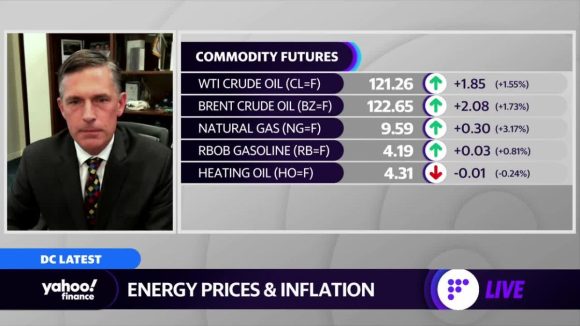
New Mexico Sen. Martin Heinrich (D-NM) joins Yahoo Finance Live to discuss solar panel tariffs, immigration, and the outlook for gun control reform.
AKIKO FUJITA: Hundreds of solar energy projects are set to resume across the country, after the president waived new tariffs for certain panels manufactured abroad. The White House move came after heavy opposition from the solar industry over a Commerce Department investigation into potential violations by Chinese manufacturers circumventing existing tariffs.
Let’s bring in New Mexico Senator Martin Heinrich, who’s been a leading voice on this issue. Senator, it’s great to talk to you today. You put out a statement on the back of the White House move earlier this week, applauding the president for his actions. And yet, I have to wonder if this action only increases the reliance on these key components coming in from China, just given how significant a market share they have. How should we be looking at it?
MARTIN HEINRICH: No, I think what the president’s plan does is it keeps the jobs that we already have in the US, in US manufacturing of things like racking and tracking, inverters, all of those trade jobs installing existing panels, and the installers who do rooftop solar. And then it builds a bridge to more US manufacturing of actual panels. So rather than pitting one set of jobs against another domestically, in the US, what the president really said is, we’re going to come up with a plan to make sure we have both. And we’re going to build a bridge to more domestic manufacturing of solar panels themselves.
AKIKO FUJITA: In many ways, this debate over the Commerce Department’s investigation has kind of exposed a big divide within the industry, those like Oxen Solar, First Solar, who are very focused on manufacturing in the US. And those developers were saying, look, we just can’t continue to build that at the rate that’s necessary without parts being imported. I mean, is that kind of the reality right now?
MARTIN HEINRICH: Well, and you just have to realize that Oxen and First Solar really represent such a small supply, that a huge amount of the existing jobs in creating utility scale projects, as well as creating distributed rooftop projects, couldn’t exist over the course of the next couple of years. We need to about triple our domestic capacity to really have the kind of impact that we want.
And the president’s plan does that. I mean, he was able to really garner private capital to scale up domestic manufacturing of solar panels. And you can’t ask people who are working in those fields to just wait two years to start working in their jobs again. They need to be continually building capacity for the next two years, which is why the two-year waiver is so important.
AKIKO FUJITA: Let’s talk about the larger issue of inflation. You’ve got your Democratic colleagues over in the House urging Democratic leaders to move on inflation, laying out a number of steps, including lifting tariffs, including immigration reform as well. Notably missing here is a push for a federal gas tax holiday. Where do you stand on that?
MARTIN HEINRICH: Well, I think it would make more sense to have some sort of inflation rebate directly to consumers. If– there are many folks who are in high income brackets who I don’t really think need a gas tax holiday. But I think it would be more useful, especially for people feeling the most pressure, the folks under the most economic strain, to have a rebate directly to them, rather than hoping that gasoline retailers would pass something like that on to consumers.
AKIKO FUJITA: What about on the issue of tariffs? I mean, it does feel like there is a divide within the administration, specifically on these tariffs for Chinese imports coming in. I’ve heard the argument about keeping tariffs in place for something like steel, but maybe more consumer-facing goods, tariffs should be lifted on that front. What do you think is a good compromise?
MARTIN HEINRICH: Oh, I actually think tariffs are probably not the place we should be looking to ease inflation pressure. We really need to look to the labor market. And immigration reform is the fastest, most efficient way to really get at what is driving a large portion of our inflationary pressure.
AKIKO FUJITA: What specifically on immigration? We’ve heard, for example, a number of tech companies who’ve spoken out, saying that they want more, the green card processing accelerated. But in terms of any kind of reform, I mean, that would take a little longer than something like tariffs where that can be an immediate impact, no?
MARTIN HEINRICH: Well, I do think the administration needs to realize that across the board, the previous administration throttled down immigration everyplace they could. And they have the power to, within the existing legal framework, increase immigration again, really upscale our staffing of all those places where we can ease labor pressures right now. And that would have a huge impact on inflation. And so much of our inflation has been tied to fossil fuel commodity prices. And so the faster we can make this transition to clean energy, the more we ease inflationary pressures there as well.
AKIKO FUJITA: Finally, senator, I do want to ask you about the debate around gun control legislation. It appears, at least what we’ve heard publicly, that these negotiations are not likely to yield any significant progress on an assault ban– assault weapons ban, expanded background checks.
But I wonder how you’re thinking about the role that businesses can play in this conversation. Some have suggested that banks, for example, just like the debate over climate, should not necessarily be financing some of these gun manufacturers. That credit card companies potentially could be stepping in to be looking at assault weapons purchases. I mean, what do you think is the role of business in all this in the absence of key legislation?
MARTIN HEINRICH: Well, first off, I’m not going to accept that we need– that we are not going to come out with a product on this. I see a willingness right now on the Republican side of the aisle to really talk about tough issues that hasn’t been there historically. And so, I’m not going to accept defeat out of the gate because the American people are focused on this in a way that really feels different this time. That doesn’t guarantee that we’re going to get there. But I do think these negotiations have been genuine on the part of many of my Republican colleagues.
Now, whether we can get to 60 is an open question. But I do think there is an opportunity here that has not existed in the past. And businesses are going to have to be part of this conversation, too. What role they choose to play has an impact. It’s not a substitute for policy, but it definitely sends messages, especially economic signals, to all of the manufacturers in this space.
AKIKO FUJITA: New Mexico Senator Martin Heinrich, it’s great to have you on today. Really appreciate the time.
MARTIN HEINRICH: Yeah, thank you for having me.
Marijuana cultivation and possession in Thailand was decriminalized Thursday, like a dream come true for an aging generation of pot smokers who recall the kick the legendary Thai Stick variety delivered. The stated intention of the country’s public health minister to distribute 1 million marijuana seedlings for cultivation has added to the impression that Thailand is turning into a weed wonderland. Thailand has become the first nation in Asia to decriminalize marijuana — also known as cannabis, or ganja in the local lingo — but it is not following the examples of Uruguay and Canada, the only two countries so far that have legalized recreational marijuana on a national basis.
Ukraine resistance blows up cafe used by Russian leaders Russia returns bodies of Mariupol martyrs to Ukraine UK missiles help to chase Russian navy fleet from Black Sea coast British fighters face death penalty in Russian-backed court Listen to the latest episode of our daily Ukraine podcast
Kimberly Rubio, mom of a Uvalde victim, said leaving her daughter at school on May 24 was a decision that would haunt her for the rest of her life.
Mexican President Andrés Manuel López Obrador skipped out on the Summit of the Americas after Biden refused to invite Cuba, Venezuela and Nicaragua.
(Bloomberg) — Chinese President Xi Jinping reviewed efforts to boost domestic grain production in Sichuan province, as Russia’s war in Ukraine continues to destabilize global food security.Most Read from BloombergTarget Tries to Save Itself by Putting Everything on SaleAmazon’s Stock Split Delivers More Than Bargained ForHedge Fund D1 Borrowed Billions for a Hot Bet That Now Faces ReckoningTarget's Oversupply Problem Should Scare All RetailersThese Are the World’s 20 Most Expensive Cities for E
Pakistan and India have fought three wars and countless skirmishes, but as summers get hotter with climate change, their peoples are united by love for a cooling 115-year-old pink libation with a secret recipe.
(Bloomberg) — US Secretary of State Antony Blinken blamed Russia’s invasion of Ukraine for exacerbating global hunger, saying food insecurity globally is reaching historic levels due to the President Vladimir Putin’s war that has upended grain markets.Most Read from BloombergTarget Tries to Save Itself by Putting Everything on SaleAmazon’s Stock Split Delivers More Than Bargained ForHedge Fund D1 Borrowed Billions for a Hot Bet That Now Faces ReckoningTarget's Oversupply Problem Should Scare Al
In a hall in the Ecuadoran capital, a group of men raise their arms up high, draw a deep breath, and release it in tandem with a resounding "aaah!"
House passes gun control legislation
In 2020, the death rate from drug overdose among Black people surpassed that of white people in the United States for the first time since 1999, according to a study published this year.
Lorando Duncan wears long-sleeved shirts because his arms bear scars he doesn't like to show: those of the drugs he has been injecting into his veins for decades.
An ancient lake-side fortress once used by jihadists to launch attacks is slowly regaining its status as a key cultural destination, attracting visitors from across war-torn Syria.
Death threats, accusations of betrayal and censure by their local parties: for the six Republicans running for re-election after voting to impeach Donald Trump, the last 17 months have been a painful lesson in the perils of opposing an unforgiving leader.
Seventeen months after the US Capitol assault, Donald Trump's crusade to overturn the 2020 election has morphed into a rallying cry for Republicans seeking an edge at the polls and to drive more of their supporters to vote.
The Casper, Wyoming, incident comes as abortion-rights advocates say they have seen a rise in violent acts against clinics in the U.S.
Military officials said the aircraft was carrying 5 Marines, but there was no immediate information about injuries or fatalities.
ReutersThe Jan. 6 Committee begins its highly anticipated national reckoning Thursday night by calling attention to the brutality Capitol Police officers faced 18 months ago and diving into details about one of the gangs leading the violence on that dark day.While it’s doubtful the hearings will meet the sky-high expectations of those who believed the committee would expose open-and-shut wrongdoing from some of the nation’s top officials, the prime-time hearings will deliver one thing: evidence
R. Kelly, the R&B superstar known for his anthem “I Believe I Can Fly,” deserves at least 25 years behind bars for sexually abusing women and girls, prosecutors said in a memo filed Wednesday in advance of his sentencing later this month. A New York City jury found Kelly guilty of racketeering and multiple other counts last year at a sex-trafficking trial that was seen as a signature moment in the #MeToo movement. Prosecutors alleged that the entourage of managers and aides who helped Kelly meet girls — and keep them obedient — amounted to a criminal enterprise. Several accusers testified in lurid detail during the trial, alleging that Kelly subjected his victims to perverse and sadistic whims when they were underage.
(Bloomberg) — President Joe Biden called on state and local governments to spend more money fighting crime and gun violence after voters on Tuesday “sent a clear message” about their public-safety concerns, including in California Democratic primaries.Most Read from BloombergTarget Tries to Save Itself by Putting Everything on SaleAmazon’s Stock Split Delivers More Than Bargained ForHedge Fund D1 Borrowed Billions for a Hot Bet That Now Faces ReckoningTarget's Oversupply Problem Should Scare Al
California is a Democratic fortress, but Tuesday’s primary election may have revealed some cracks. Gov. Gavin Newsom and other top-tier Democrats emerged safely from contested statewide races in which they will be strongly favored this fall, and the Legislature appears on track to stay firmly in Democratic control.