Blog

2022 Mercedes-Benz EQS580 4Matic Tested: More IQ Than EQ – Car and Driver

Our car experts choose every product we feature. We may earn money from the links on this page.
Though impressive, Mercedes’s grandest EV sedan might be too clever for its own good.
From the July/August 2022 issue of Car and Driver.
Perhaps Mercedes should rename its EQ subbrand IQ, because the 2022 Mercedes-Benz EQS580 feels as if it were developed to appeal to individuals with the emotional quotient of Mark Zuckerberg and the intelligence quotient of Albert Einstein.
Although its two electric motors (one at each axle) produce a healthy 516 horsepower, the all-wheel-drive EQS580 is an aloof machine that offers minimal engagement when driven vigorously. All of that grunt pushed the EQS580 to 60 mph in 3.7 seconds and rocketed it from 30 to 50 mph in 1.5 ticks. But a 489-hp Tesla Model S Long Range Plus hit these same marks in 3.5 and 1.4 seconds, respectively. Blame the 982 pounds of extra mass the Mercedes carries for its lesser straight-line performance.

HIGHS: Hyperscreen lives up to the hype, cavernous cargo hold, quiet cabin.

At 5806 pounds, the EQS’s near-G-class curb weight is an anchor on efficiency, which surely explains the jelly-bean styling that favors function over form. Though aesthetically unfortunate, the ’90s-era cab-forward look is a wise decision. It contributes to a coefficient of drag of 0.20 and helped the 580, with its 107.8-kWh battery pack, travel 350 miles on our 75-mph range test—one of few EVs that beat its EPA range. The shape also helps limit noise inside the cabin to 64 decibels during 70-mph cruising, the same level recorded in the S580.
Unfortunately, this battery-powered sedan lacks the cosseting rear seat of its gas-powered Benz kin. The plunging roofline limits headroom back there, a situation exacerbated by the fixed seatback’s upright angle. The EQS’s hatchback configuration, however, provides more cargo space than even the GLC-class SUV.

LOWS: Dimwitted brake pedal, limited rear-seat headroom, exceptionally heavy.

The driver and front passenger suffer from no such compromises on space or comfort. They also gaze at a massive infotainment system that houses three separate display screens under a 56.0-inch glass panel. Dubbed the Hyperscreen, the setup smartly incorporates high-resolution graphics and reacts quickly to inputs (by touch or via the car’s capacitive buttons), making it reasonably easy to operate, even if we wish Mercedes included at least a few redundant hard buttons.
More irksome, however, is the brake-pedal operation. Applying pressure to the unsettlingly disconnected-feeling left pedal is akin to pushing Play-Doh through a mold. Switching the regenerative braking system to its strongest setting limits the need to interact with the brakes, as it enables the one-pedal driving mode, which also actively moves the brake pedal as the regen function decelerates the car (mimicking the pedal’s position had you actually stepped on it). Besides the strangeness of all of this, the variability of the pedal’s phantom motions makes it difficult for the driver to quickly apply the brakes when additional stopping power is required. It’s a surprisingly low-IQ feature in a car that otherwise ought to appeal to high-IQ buyers.
Specifications
2022 Mercedes-Benz EQS580 4Matic
Vehicle Type: front- and mid-motor, all-wheel-drive, 5-passenger, 4-door hatchback
PRICE
Base/As Tested: $126,895/$141,585
Options: nappa leather upholstery, $4450; Exclusive trim package (massaging and rapid heating front seats, 4-zone climate control), $3475; augmented reality head-up display, $2000; natural grain dashboard and door trim, $1515; laminated safety glass, $1010; active ambient lighting, $590; air control plus with HEPA filtration, $450; illuminated seat belt buckles, $300; heated steering wheel, $250; 110-volt home charging cord, $250; integrated toll payment system, $200; dashcam, $200
POWERTRAIN
Front Motor: permanent-magnet synchronous AC
Mid Motor: permanent-magnet synchronous AC
Combined Power: 516 hp
Combined Torque: 631 lb-ft
Battery Pack: liquid-cooled lithium-ion, 107.8 kWh
Onboard Charger: 9.6 kW
Transmissions, F/R: direct-drive
CHASSIS
Suspension, F/R: multilink/multilink
Brakes, F/R: 15.4-in vented disc/14.9-in vented disc
Tires: Goodyear Eagle F1 Asymmetric 5
265/40R-21 105H MO
DIMENSIONS
Wheelbase: 126.4 in
Length: 207.3 in
Width: 75.8 in
Height: 59.6 in
Cargo Volume: 22 ft3
Curb Weight: 5806 lb
C/D TEST RESULTS
60 mph: 3.7 sec
100 mph: 9.1 sec
1/4-Mile: 12.1 sec @ 114 mph
130 mph: 16.6 sec
Results above omit 1-ft rollout of 0.3 sec.
Rolling Start, 5–60 mph: 3.8 sec
Top Gear, 30–50 mph: 1.5 sec
Top Gear, 50–70 mph: 2.1 sec
Top Speed (gov ltd): 131 mph
Braking, 70–0 mph: 177 ft
Braking, 100–0 mph: 366 ft
Roadholding, 300-ft Skidpad: 0.88 g
C/D FUEL ECONOMY
Observed: 84 MPGe
75-mph Highway Range: 350 mi
EPA FUEL ECONOMY
Combined/City/Highway: 95/92/99 MPGe
Range: 340 mi
C/D TESTING EXPLAINED

source

Mr Eazi, Black Coffee and Ajebutter22: The African music artists backing startups – TechCrunch

This April, Black Coffee, the famed South African DJ and record producer whose real name is Nkosinathi Maphumulo, made history at the Grammys. With his seventh studio album “Subconsciously,” he became the first African act to win an award in the Best Dance/Electronic Album category.
His win came when the global appetite for Amapiano, a style of house music that emerged in South Africa, and Afrobeats, a popular music genre that originated from Western Africa, had increased exponentially. It was a much-needed success for the African music scene, and though it didn’t appear so, it was a boost for its tech scene.
Over the past couple of years, there’s been an overlap between tech and art, fueling a growing interest of movie, music and sports stars investing in tech startups. Some of them — including Grammy Award-winning artists such as Jay-Z, The Chainsmokers, Nas and others like Snoop Dogg — have launched various funds to invest in startups in the U.S., Europe and globally.
Thus, for Black Coffee, who backed Andela, a tech talent incubator and unicorn launched from Lagos in 2015, his win meant Africa’s tech scene could, for the first time, brag about having a homegrown Grammy Award-winning artist as an investor in its startups.
Before Jay-Z (Shawn Carter) co-founded Marcy Ventures in 2018, he was involved with other businesses such as the legacy entertainment company Roc Nation and champagne brand Armand de Brignac. His music career gave him the resources and access to diversify his financial interests, including in startups, despite the lifestyle contrasts between the tech and entertainment worlds.
One African artist that hasn’t hidden his love for Jay-Z’s entrepreneurial moves, and seems to be adopting the billionaire’s playbook, is Mr. Eazi (real name Oluwatosin Ajibade).
“The main driver for me to go into music was reading a book called ‘Empire State of Mind’ about Jay-Z,” Mr. Eazi told TechCrunch on a call. “I had a passion for music and realized early that the music business would give me access to where I wanted to be. It’s like a way for me to have all the freedom I wanted and still get to the destination of financial independence by making several investments.”
Last August, the popular Afrobeats singer and songwriter made headlines in Africa’s tech circles following his investment in pawaPay, a U.K.-based and Africa-focused mobile payments company through Zagadat Capital. But unlike Jay-Z, Mr Eazi had a tech background before captivating audiences with hit songs like “Skin Tight,” “Hollup,” and “Leg Over” and producing three mixtapes and two EPs during his long music career.
In 2014, Mr. Eazi launched Phonetrader, an online used phone marketplace backed by a now-defunct startup incubator, 440NG, which was run by two investment firms, L5Lab and 88mph. While Mr Eazi learned the ropes of starting a company and scaling products during his time at Phonetrader, he also got to understand investment dynamics from Chika Nwobi, the founder of L5Lab and current chief executive of Decagon, an engineering talent recruitment platform, after attending several investor meetings.
These lessons would prove helpful in 2019 as Mr. Eazi — after building his presence overseas and connections in the U.S., the U.K. and Europe — launched EmPawa Africa, an outfit to accelerate the music careers of young artists. “When I started emPawa Africa, I wanted to experiment with the VC model by investing in many artists,” said the artist who recently completed a program at Harvard Business School.

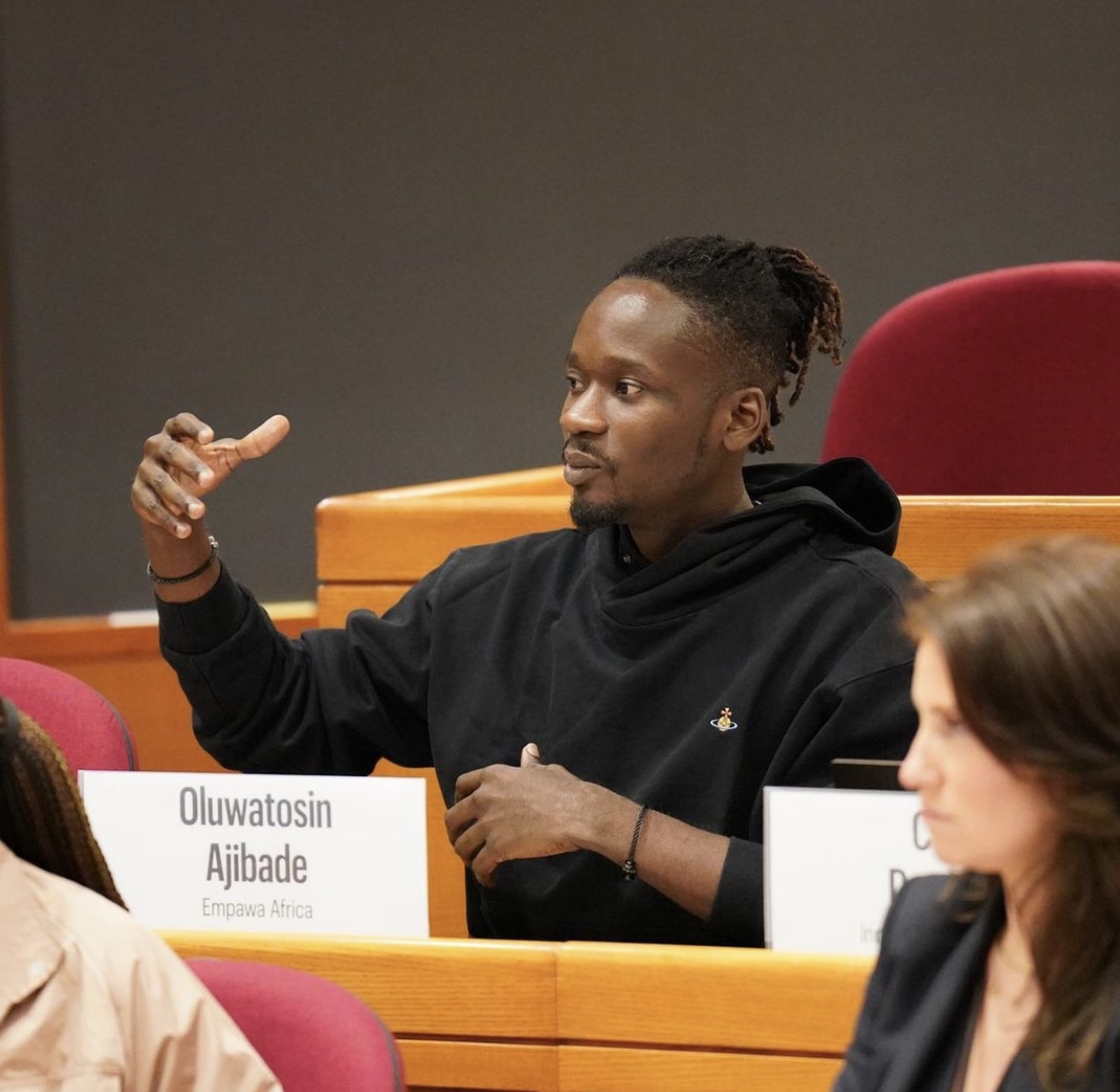
Mr. Eazi (founder of Empawa Africa and investor in PawaPay). Image Credits: Mr. Eazi

Mr. Eazi (founder of Empawa Africa and investor in PawaPay). Image Credits: Mr. Eazi
The agency — which has spun out the likes of Nigerian artiste Joeboy and Ghanaian artiste Kwesi Arthur — now has its tentacles spread in marketing, distribution, publishing, management and finance services for independent artists and record labels. It also white-labels its platform for interested parties that want to invest in African music; for instance, the $20 million African Music Fund (AMF) project in 2020.
Ajebutter22, a Nigerian-based music artist and rapper whose real name is Akitoye Balogun, agrees with Mr Eazi’s philosophy of investing in creatives. According to him, powering artists and people in the creative space should be done in a startup/VC manner. “Some of the investments I’ve made in the music space have been through that mentality of seeing an artist or project as a fast-growing vehicle,” said Ajebutter22 in an interview with TechCrunch.
Like Mr Eazi, the songwriter, well known within the Lagos party scene with hit singles like “Tungba,” grew up interested in tech. In 2013, he flirted with an idea for a platform that could help people pay for songs on their phones. Though it never took off due to lack of funding, the process of getting the project off the ground and reading books like “Zero to One” and “Hard Things About Hard Things” opened the artiste’s mind to the possibilities around tech.
Ajebutter22 would work at Gamsole, a gaming startup, and Cisco before venturing into angel investments in 2020. “It was about owning something bigger than myself, which can be great someday. That was behind deciding to invest in tech,” said the artist who has invested in AltSchool, a talent-matching platform, and Nestcoin, an Africa-focused web3 startup.
Personal relationships built over the years have been vital to how Ajebutter22 has made investments, a method ideal for a very early angel investor. For instance, he is a longtime friend of Nestcoin chief executive Yele Bademosi, and he knew Adewale Yusuf, the co-founder and CEO of AltSchool, from his time at Gamsole. The AltSchool investment also recorded participation from another music artist and collaborator, Falz (real name Folarin Falana).
“I think the most important thing when you want to invest is to know the team you’re backing because anything can change at any time. The market size, of course, is extremely important too, but for me, who you’re backing is key,” he said.
If Ajebutter22 plans to change his strategy as he makes more angel investments, setting up a formal structure like Zagadat Capital — which Mr Eazi references as a collective — will be essential.
Super excited to announce that I have invested in @AltSchoolAfrica after one meeting with @AdewaleYusuf_ I was sold! The team is doing a great job skilling-up Africans for the future of work. Big up to @hackSultan @opeawo and the rest of the team! Let’s make magic! pic.twitter.com/emzPQXZxA3
— yoruba shakespeare (@ajebutter22) January 28, 2022

As a collective, Zagadat Capital comprises “like-minded people who are young, African and see investing in African tech companies as exciting,” said Mr Eazi. Family offices are part of this collective in addition to founders like Shola Akinlade, the co-founder and CEO of Stripe-owned Paystack, and Iyinoluwa Aboyeji, co-founder of Talent City.
Talent City, the urban development startup that plans to create charter cities across Africa, is one of the most audacious projects on the continent and is a portfolio company of Zagadat Capital. Others are not as complicated: Eden Life, a concierge startup, and betPawa, an online betting company. This deal coverage shows variety in Mr Eazi’s picks; the artist also points out that his collective provides a unique advantage for portfolio companies in that its members, consisting of a few celebrities, can double as shareholders and influencers.
“It’s not just money or to get some meetings. We can also help the team to scale when we advertise. You’d see me advertising betPawa, for instance. I’m getting paid, but I’m an investor and a shareholder,” he said. “At the end of the day, we have more leaning toward investing in companies where the flywheel can be enhanced. It’s an ecosystem that keeps feeding itself and growing to the point where it’s sustainable.”
Outside Africa, Mr Eazi has cut checks in Mexican fintech Paisa and Irish-based fraud prevention provider Apata. He also has other entertainment investments aside from EmPawa Africa: YC events company Shoobs and U.S.-based music startup Vydia. These two investments emphasize the artists’ play to expand the interest of Africans in global entertainment spheres, particularly as music from the continent gets popularized. “The reason I’m investing in music tech is to make sure we have African equity in the structures that are integral to the ecosystem because that’s where the real power and value lies,” remarked Mr. Eazi.
Overall, it’s a sizable portfolio for an artiste-cum-investor with only one year of active investment history under his belt. With time, Mr Eazi acknowledges that he’ll go all out to raise a fund and invest more extensive checks, just like his mentor, Jay-Z, did in 2018. “For now, we’re going to still stay at a collective. But when it’s time to grow, I’ll need nobody to tell me. It’s going to be a gradual process.”
Black Coffee handles his deals through Flightmode Digital, a venture capital firm he set up in 2017, according to PitchBook. The firm — which says it seeks to invest in early-stage businesses operating in video content creation and production and software development — has backed several startups, including Yoco, a South African payments startup that has raised over $100 million in VC funding; SweepSouth, a cleaning and home service startup; and Rensource, a renewable energy company.
Go team @Yoco_ZA go 👏🏿👏🏿👏🏿👏🏿👏🏿 https://t.co/SSU8PKAIOs
— Black Coffee (@RealBlackCoffee) July 27, 2021

It’s unclear whether Black Coffee raised a set capital to invest through Flightmode Digital because, judging by its online presence, it appears more like an investment holding company than a traditional VC firm. However, the effort displayed by Ajebutter22, Black Coffee, Mr Eazi, Falz and a few under the radar suggests that it’s only a matter of time before local artists, regardless of their technical backgrounds, launch VC firms and funds like their global counterparts as the continent’s tech scene — which has received $3 billion worth of venture capital funding in the first half of this year — continues to explode and more exits happen.
“Why it seems artists aren’t interested in startup investing is because some still need to take care of their immediate needs; some people might not understand some of the problems being solved,” Ajebutter22 said. “But I also think that more and more artists will be in that space over time. I think African artists are becoming more evolved and exposed, and if one or two success stories happen, it will inspire them to go all in.”
Nestcoin raises $6.45M pre-seed to accelerate crypto and web3 adoption in Africa and frontier markets

Nigeria’s AltSchool raises $1M pre-seed to build an alternative school for Africans

PawaPay raises $9M seed backed by MSA, 88mph and Mr Eazi’s Zagadat Capital

source

LIVE NOW: Watch Liverpool v Manchester United – Liverpool FC

LIVE NOW: Watch Liverpool v Manchester United  Liverpool FC
source

Ventura County to announce plans to ditch Camarillo Airport Master Plan update – VC Star

Ventura County Department of Airports is abandoning its Camarillo Airport Master Plan update in response to community opposition. 
Airports Director Keith Freitas will present plans to transition away from a master plan and instead update the airport layout plan at the Wednesday Camarillo City Council meeting.
The master plan explores future possibilities for the airport while the layout plan focuses on maintenance and other near-term projects, he said.
Freitas said Monday the decision to do away with the update was due to negative feedback from the city and residents. 
While updating the master plan last year, the county began the process to amend a 1976 agreement with Camarillo.
Read more:NTSB report details fatal plane crash near Camarillo Airport
Public opposition to the update started almost immediately after it was presented last year and stemmed from concern the 46-year-old agreement would be altered to allow cargo and large commercial passenger flights into the general aviation airport. 
The county suspended its plans to update the document in May 2021, as a result.
Then in January, Camarillo released results of a survey that showed two-thirds of the 600 residents surveyed were against changing the agreement.
As the county updates the layout plan, it won’t introduce plans to bring in cargo and commercial passenger flights nor to extend the runway, Freitas said. 
“There are no changes to the airport use,” he said. “It will stay a general aviation airport.”
Freitas will give his presentation in the first half of Wednesday’s council meeting, which begins at 5 p.m. in City Hall.
Brian J. Varela covers Oxnard, Port Hueneme and Camarillo. He can be reached at [email protected] or 805-477-8014. You can also find him on Twitter @BrianVarela805.

source

Art lovers invited to Make a Bid – LincolnshireWorld

The NTKO Gallery will be running the Make a Bid Art Exhibition from Saturday (July 16) to July 30, which is tailored to anyone looking to add some new art to their repertoire.
Designed with both new and established collectors in mind, this exhibition will feature exclusive one-off works from local and national artists for sale to the public.
Artwork will be displayed throughout the gallery with a lot number and reserve price, and interested buyers can make their offer by placing a sealed bid in the nearby box.
The highest bidder on a piece of art will then be announced, and the highest bid takes the piece home.
A special private preview evening will take place on Friday from 7pm to 9pm for serious collectors, featuring a fully staffed bar and live music by notorious Miami-based DJ SPACEBOY EQ – whose musical resumé includes venues from the US East Coast and beach raves in the Bahamas to headline-making party crashes in the UK.
NTKO Gallery was opened in March 2022 by Dale Tyler-Lodge and Matt Lodge to give artists that haven’t been accepted at other galleries for being too out of the ordinary somewhere to display their art.
To find out more, visit the NTKO Gallery website at
https://ntkogallery.co.uk/

source

Master Gardner: Everyone can garden in a container – Steamboat Pilot & Today

News News |
Most people think of a garden as a space of cultivation in a backyard, along a fence or sidewalk or some other piece of land. But everyone can garden in a container regardless of where you live.
Advantages to container gardening:
• You can grow flowers, herbs, veggies, vines, even small shrubs;
• Excellent for beginners as well as advanced gardeners;
• Add a “garden” at any time including now;
• You can change looks, style, and fragrance easily and quickly.
Drawbacks to container gardening:
• Not all plants are suited for containers;
• Plants need more frequent watering and fertilization.
Just about any container can be used as long as the container has never held toxic materials. 
Regardless of what container you select, it must be able to drain excess water. If it doesn’t have drainage holes, you need to either drill some in, or plant in a smaller container with drainage holes, then insert that container into the decorative container, setting it on bricks or rocks where water can drain.
If the container will be moved throughout the summer, plan to put it on a dollie as it will be much heavier with all the soil. Tall plants will need larger containers to avoid tipping over. A rule of thumb is that plants need a container that is at least as deep as the plant is high. In general, the smaller the pot, the more frequent the watering and fertilizing.  
Never use native soil because it usually has a high percentage of clay that easily compacts and reduces oxygen to the roots. Potting soil is a good choice.  
Container gardens need more frequent watering than “in-ground” gardens because the exposed sides of the containers result in more evaporation. Even plastic containers may require daily or twice-daily watering as plants grow.
Do not allow containers to dry completely or fine roots will die. Salt buildup may occur, especially if you are using well water. By over-watering until about 10% of the water added drains out of the container, that reduces salt buildup.
The rapid growth of many container plants quickly depletes the fertilizer in the soil. To provide the right amount of fertilizer, mix controlled-release fertilizer granules into the soil mix at planting. Diluted soluble fertilizers may be used with every watering, or at full strength on a weekly or every two-week basis, depending on the type of plants being grown.
The light considerations for container gardening are the same as in landscape; choose the location that matches what the plants need. One good thing about containers is that if the location proves to be undesirable, you can move the container to a better location. Note that reflected sunlight off lightly colored buildings and paving may cause sun scald and result in more evaporation.
It’s difficult to overwinter container plants outside, but you can move containers with perennials to an unheated location and water it monthly.  Many porous containers will crack if left outside, so they should be brought in as well. Finally, tempting though it is, never reuse potting soil from year to year as it may contain disease organisms. 
Gwen Swenson-Hale is a CSU Master Gardener from the class of 2021 and loves experimenting with flower containers.

For much more detailed information about container gardening, consider checking out the following resources.

• Container gardening including design, color and plant selections: Extension.ColoState.edu/topic-areas/yard-garden/container-gardens-7-238/.

• Container vegetables: CMG.Extension.ColoState.edu/Gardennotes/724.pdf

• Salad Bowl Container Garden: Extension.ColoState.edu/topic-areas/nutrition-food-safety-health/growing-container-salad-greens-9-378/


|

|
|
|
|
Readers around Steamboat and Routt County make the Steamboat Pilot & Today’s work possible. Your financial contribution supports our efforts to deliver quality, locally relevant journalism.
Now more than ever, your support is critical to help us keep our community informed about the evolving coronavirus pandemic and the impact it is having locally. Every contribution, however large or small, will make a difference.
Each donation will be used exclusively for the development and creation of increased news coverage.
Start a dialogue, stay on topic and be civil.
If you don’t follow the rules, your comment may be deleted.
User Legend: iconModerator iconTrusted User

Classifieds
Jobs
Real Estate
Rentals
Autos
Pets
Recreation
Merchandise
Legals
Place Legal Ad
Search Legal Ads
Contact Us
Become a Carrier
Submissions
Advertise
Archives
Special Sections
About Us
Newsletters
Submit an Obituary
Commercial Print Sales
RSS
E-edition
E-edition archive
Cookie List
Do not sell my personal information
Aspen – Snowmass
Craig – Moffat County
Glenwood Springs – Rifle
Park City – Utah
Breckenridge – Summit County
Vail – Eagle County
Winter Park – Granby – Grand County
Printing Press Jobs
©2005 – 2022 Swift Communications, Inc.

source

Jan 6 hearings – live: Trump election probe in Georgia gets a win as Lindsey Graham ordered to testify – The Independent

Please refresh the page or navigate to another page on the site to be automatically logged inPlease refresh your browser to be logged in
Follow live for latest news and updates on January 6 hearings in Congress
Find your bookmarks in your Independent Premium section, under my profile
Liz Cheney on Donald Trump’s Jan 6 behaviour
Yesterday’s January 6 committee hearing featured the testimony of an admitted Capitol rioter who personally apologised to several police officers who were attacked by Trump supporters – but at least one of them has refused to accept his apology just yet.
Harry Dunn told The Independent afterwards that he was conflicted about Stephen Ayres’s gesture. “It just seemed kind of seemed like the right thing to do,” he said. “But I don’t know if I accept that. It is hard to extend sympathy to an individual like that yet, maybe, but that’s all I got.”
The hearing also featured a bombshell revelation from Liz Cheney, who revealed that the select committee has reported Donald Trump to the Department of Justice for alleged witness tampering.
Ms Cheney explained that after the panel’s last hearing, Mr Trump tried to call a witness who has so far not appeared in public. “That person declined to answer or respond to President Trump’s call”, she said, “and instead alerted their lawyer to the call. Their lawyer alerted us and this committee has supplied that information to the Department of Justice.”
A Maryland man who used a lacrosse stick attached to a Confederate battle flag to shove a police officer during the U.S. Capitol riot was sentenced on Wednesday to five months in prison, according to a Justice Department spokesman.
US District Judge Christopher Cooper also sentenced David Alan Blair, to 18 months of supervised release after his prison term and ordered him to pay $2,000 in restitution, said William Miller, a spokesman for the US Attorney’s office for the District of Columbia.
A Maryland man who shoved a police officer with a lacrosse stick attached to a Confederate battle flag during the U.S. Capitol riot has been sentenced to five months in prison
Former President Donald Trump has weighed in on the latest inflation numbers.
In a post on Truth Social he wrote:
Inflation just hit ANOTHER 40-year high of 9.1%, which is terrible for our Country. Fuel prices up 60%, Airfare up 34%, Eggs up 33% — how can people survive this? How can businesses survive this? Our Country is so weak right now because the Radical Left Democrats have no clue what they are doing. All they want to do is “get Trump,” and they are willing to destroy our Nation to do it. America will not allow this to go on for much longer. Don’t vote for the Radical Left Democrats, vote for America First Republicans — Save America!
Fox News legal analyst Jonathan Turley said that the seventh hearing of the January 6 committee was “breathtaking”.
Mr Turley shared his sense of shock at the revelations concerning former President Donald Trump and his December 18 2020 meeting at the White House discussing how to overturn the election with his allies.
“It’s … damaging,” Mr Turley said in reaction to the pre-recorded deposition with Trump White House Counsel Pat Cipollone. “The account of that meeting in the [Oval] Office is really breathtaking. It’s very disturbing.”
Gustaf Kilander has the latest reaction to the latest stunning public hearing.
‘It’s almost like this is Dr Strangelove and the president is saying there is no fighting in the war room. It was just a bizarre moment’
Donald Trump is reportedly impatient to be done with the January 6 hearings in Congress, watching each session live on TV and repeatedly question aides when they will be over.
“One thing that I’ve heard from sources is that Trump has been asking people in recent days is when these hearings are going to come to an end. They have been more effective than many people in his orbit expected,” reported CNN’s Kaitlan Collins on Tuesday.
Josh Marcus reports.
Next hearing planned for Thursday
People close to former president Donald Trump are concerned that his final White House chief of staff, ex-North Carolina congressman Mark Meadows, could face indictment for his role in helping the defeated ex-president try to remain in office against the will of voters.
According to Rolling Stone, the House January 6 select committee has been “quietly” looking into Mr Meadows’ financial dealings in addition to investigating his involvement in the Trumpworld scheming that led to the attack on the US Capitol.
Andrew Feinberg reports.
‘Everyone is strategising around the likelihood that Mark is in a lot of trouble’
Presidential physician turned GOP congressman Ronny Jackson’s unfounded campaign attacks on then-presidential candidate Joe Biden’s mental state drew a sharp rebuke from one of his former patients: Barack Obama.
Andrew Feinberg reports.
Dr Jackson served as a physician in the White House Medical Unit from 2006 to 2018
During his interview with Israel’s Channel 12 at the start of his Middle Eastern tour, President Joe Biden was asked if he was predicting a rematch with Donald Trump in the 2024 election.
Mr Biden responded: “I’m not predicting, but I would not be disappointed.”
January 6 committee member Jamie Raskin has promised a “profound moment of reckoning for America” at his panel’s hearing next week, a session that will unveil more testimony from Trump White House counsel Pat Cipollone.
Committee vice chair Liz Cheney also previewed the committee’s next meeting in her closing remarks to viewers on Tuesday, showing a video of Mr Cipollone answering questions about Mr Trump’s actions and remarks during the attack itself.
John Bowden reports from Washington, DC.
The House select committee played video testimony from multiple former Trump administration officials – including late Supreme Court Justice Antonin Scalia’s son and former president Donald Trump’s daughter Ivanka – who urged him to concede, but were ignored.
The then-president’s daughter Ivanka Trump was shown being asked whether the 14 December 2020 vote from the Electoral College made her realise that the administration would come to an end.
“I think so. I think it was my my sentiment probably prior as well,” she said.
Multiple other members of the administration echoed this sentiment, including Judd Deere, who was the deputy White House press secretary.
Eric Garcia has more:
The video footage comes during the select committee’s most recent hearing.
Writing for Rolling Stone, Noah Shachtman reports that former Trump chief of staff Mark Meadows – who has refused to cooperate with the 6 January select committee – is increasingly thought to be at risk of legal action over his personal affairs as well as his behaviour after the 2020 election:
Trump’s inner circle increasingly views Meadows as a likely fall guy for the former president’s attempts to overturn the 2020 election. Members of Trump’s legal team are actively planning certain strategies around Meadows’ downfall — including possible criminal charges. Trump has himself begun the process of distancing himself from some of his onetime senior aide’s alleged actions around Jan. 6.
Meadows’ already bleak legal prospects could get even worse. Rolling Stone has learned that the Jan. 6 committee has been quietly probing his financial dealings, and any new revelations would add to an already long list of unethical and potential illegal actions he’s accused of taking on behalf of Donald Trump.
Read the full report below.
Registration is a free and easy way to support our truly independent journalism
By registering, you will also enjoy limited access to Premium articles, exclusive newsletters, commenting, and virtual events with our leading journalists
{{#verifyErrors}} {{message}} {{/verifyErrors}} {{^verifyErrors}} {{message}} {{/verifyErrors}}

By clicking ‘Create my account’ you confirm that your data has been entered correctly and you have read and agree to our Terms of use, Cookie policy and Privacy notice.
This site is protected by reCAPTCHA and the Google Privacy policy and Terms of service apply.
Already have an account? sign in
By clicking ‘Register’ you confirm that your data has been entered correctly and you have read and agree to our Terms of use, Cookie policy and Privacy notice.
This site is protected by reCAPTCHA and the Google Privacy policy and Terms of service apply.
Join thought-provoking conversations, follow other Independent readers and see their replies
U.S. House holds public hearings on Jan. 6, 2021 assault on Capitol
REUTERS
Want to bookmark your favourite articles and stories to read or reference later? Start your Independent Premium subscription today.
Please refresh the page or navigate to another page on the site to be automatically logged inPlease refresh your browser to be logged in
Log in
New to The Independent?
Or if you would prefer:
Want an ad-free experience?

source

Jackson Youth Film Camp Introduces Teens to Career Opportunities in the Industry – Mississippi Free Press

FOCUS: Abortion • JFP Acquisition • 2022 Elections • LGBTQ • Medicaid • Immigration • COVID-19 •  Race & Racism • Food Security • Voting • Policing • Prisons
Karley Newell held her director’s notes, reading lines from the infamous throne-room scene in Marvel’s 2018 superhero film “Black Panther.” In the scene, Wakandan soldiers escorted Eric Killmonger into the throne room, with the antagonist revealing his ancestry and the fact that he and T’Challa, Black Panther, are cousins with the line, “Hey Auntie.”
An hour had already passed since the rehearsal began at 9 a.m. in the Smith Robertson Museum and Cultural Center in downtown Jackson.
“Tell me what the scene says,” Camp Facilitator Maximus Wright asked Newell, the student directing her fellow campers during the inaugural Jackson Youth Film Camp.
The camp introduced 20 students ages 13 to 18 to creative and technical career opportunities in the film industry. Campers learned various aspects of the filmmaking process from experts in the industry. Classes ran from June 13 to July 8, 2022, Monday through Friday, and sometimes Saturday, from 9 a.m. to 2 p.m. inside the Smith Robertson Museum and Cultural Center (528 Bloom St., Jackson).
Do you think our journalism is essential? Give today and support our work.
As part of the program, the students adopted a number of roles including actor, director, wardrobe, hair and makeup, and more. They set to work on preparing for the filming that began in early July 2022, wherein they recreated scenes from popular movies. The culmination of their efforts will be screened at the Jackson Film Festival on July 27 and July 28, 2022.
“So like you said, T’Challa sits on his throne surrounded by tribal elders: Romanda, Shuri, Okeye and the Dora (Milaje),” Newell said in reply to Wright’s instruction.
“OK, so what does that tell you? If he’s sitting here, what does that tell you? He’s surrounded by tribal elders, so what does that mean?” Wright prodded.
“That means that they should be surrounding him,” Newell answered.
This part of the filmmaking process is what the industry calls “blocking,” the placement and movement of actors in relation to the camera. In simpler terms, the practice is the scene choreography. Intentional placement and movement tell the story by staging a character’s actions to mirror the subtext of what occurs on screen.
Actor Malcolm Butler sat on the steps of a mini stage, the lights above honing in on him in his role as the pretend T’Challa. Wright pulled chairs from the audience and positioned them in a semicircle around Butler, simulating the original version.
“Alright, what happens next?” Wright asked.
“Kilmonger and W’kabi walk in,” Newell said.
“Show me what happens,” Wright asked her.
Newell walked to the middle aisle, explaining how she would like the actors to proceed from this direction in a replica of Kilmonger and W’kabi walking into the throne room. She wanted the actor playing W’kabi to walk behind Kilmonger as he escorted him into the room, she explained.
“So, they should be talking, and when this person comes in the room, what is that going to do to the room?” the facilitator asked Newell.
“Silence,” Butler whispered, while Newell echoed, “It’s gonna be silent.”
“It’s going to interrupt the room, right?” Wright confirmed. “So when they come in, they’re going to all be talking amongst themselves and then they open this door at this strange presence that’s being brought in in chains, right? Alright, what else do we see?”
Last year, the Jackson Film Festival engaged students from Canton 9th Grade Academy and the Mississippi School of the Arts to commemorate and discuss the 25th anniversary of “A Time To Kill,” which was filmed in Canton, Miss.
The Jackson Film Festival celebrates independent filmmaking and provides educational training and master classes with industry professionals, in addition to its community-outreach efforts, the festival’s website says.
“We always wanted to make sure that we are engaging young people in this process because (for) Mr. Wright, myself and others, this is our second life,” Program Director Candice Jackson told the Mississippi Free Press. “We don’t want these young people to think that they can’t achieve those dreams, even have those dreams or know what those dreams are because Hollywood happens ‘out there’ (and) not here.”
Jackson said the organization wants young people to feel like they can start now and get workforce training that is not limited to just acting. The program also covers craft services, wardrobe, set design, lighting and other behind-the-scenes careers in the industry, she explained.
“If you are pursuing a trade as an electrician, you can do set design, and you can light a set,” the director said. “The possibility is there for young people much earlier to have that training, so that as these productions pick up, we have a new generation of filmmakers, of tradesmen, craftsmen ready for this new challenge.”
During the commemoration of “A Time to Kill”, the organization gave students the opportunity to write their own scripts. Students from the Mississippi School of the Arts created a short film titled “A Time to Heal,” which focused on a character named Tonya Hailey and her response in the wake of her assault.
Last year’s experience led to this year’s youth film camp in Jackson, which was made possible through a collaborative effort between the City of Jackson’s Human and Cultural Services and PEG Network, in partnership with Maximus Wright Productions and Mighty Mississippi Films.
“We said, ‘Let’s see about doing a film camp and bringing these students from Jackson to get them engaged in all aspects of filmmaking,’” Jackson said. “Some (are) on camera, director, wardrobe and styling, so all of those aspects, not just in front of the camera. They had to do location scouting.”
“We had about 50 to 60 applications. We were limited to students in the city of Jackson for the most part because this is a city partnership, but that also lets us know that there are kids in this tri-county area who are interested in film and production,” Jackson said.
On the first day of camp, everyone got a chance to mingle and get to know one another, she said, but afterward, the real training began. The program brought in teachers to have what they call masterclasses that offered hands-on experience. Phil Washington, a camera operator, editor and actor, taught the students about camera work. Director of Photography Dreka Shevon of Prime Stone Media talked to students about lighting.
Chirvona Frank covered hair and makeup, and Ashiunna Ingram, who is self-taught, came in to teach the campers how to do special-effects make-up. Campers were in the pre-production stage when the Mississippi Free Press visited the program. Last week was the filming stage.
“They get these opportunities to meet people who are actually doing this in their fields and having good lives,” the program director said. “These are people who are living in their becoming (finding their passion), and that’s what’s important.”
The Jackson Film Festival, which will take place from July 24 to July 29, 2022, this year, will screen the campers’ project along with other independent projects at the Malco Grandview movie theater in Madison, Miss. Film screenings will span two days: Wednesday, July 27, and Thursday, July 28, both from 6 p.m. to 8 p.m.
At the time the Mississippi Free Press visited the program, campers were working on a new scene—one from the film, “Hidden Figures,” where Katherine Johnson stands face-to-face with her white supervisor, who confronts her for being gone for long periods of time. She had been leaving the building to use the restroom, but with no bathrooms for “colored” folks in the building, Johnson had to walk half a mile to use one.
Karley Newell, the student director, went over the scene with actress Kennita Littleton before she and her acting partner, Khai Hart, rehearsed.
“So you’re going to walk in down here and then–”
“Hold up. Trust your instincts, you hear me?” Wright interjected. “The worst thing you can do by being the director is not being sure of yourself and your commands. Because if the crew starts to see that there’s insecurity in you or seeing that you’re not sure, it’s going to make them feel like they need to talk. (There) only needs to be one voice on set. One voice. That’s yours. Trust your power. Trust your instincts.”
They began again, and Newell seemed more sure of herself than beforehand. Her voice resounded with more authority as she told her fellow actress how she wanted her to enter the room, the emotions she wanted her to convey in the scene.
“You’re going to walk in, and then, obviously, you’re frustrated because you have to walk for so long,” Newell explained to Littleton. “So he’s going to be mad and say his first line, and then you’re already going to be irritated because he’s getting mad at you, but he doesn’t know what you had to go through to get here.”
“OK, let me tell you this,” Wright interjected again. “Your job is to give an overview, not give them every detail because you’ve got to give them space to interpret and deliver the lines themselves. You want to give them an overview of the direction, not all the acting cues they want to do. It’s only when they do something that you don’t want them to do, you come back and give notes,” he advised.
“You’re trying to over-explain,” he continued. “You want to know why you’re trying to over-explain?”
“Why?”
“Why do you think?”
“Maybe I’m not as confident.”
“Because you don’t want to make a mistake, right? Trust yourself,” Wright repeated.
“You got this. You’re a great director,” Littleton complimented her.
“This is what your crewmate is saying. Stop trying to over-explain. Trust. This is all image. You are here to calm this set, to let them know I got y’all,” the facilitator assured.
At the new boost of confidence from her crew and the instructor, Newell adjusted her approach and tried again. She told Littleton what she wanted from the scene, succinctly, and moved aside to let the scene play out.
“And ACTION!” Newell yelled.
Camp Facilitator Maximus Wright is an director, writer, producer and owner of Maximus Wright Productions. His daughter, Jamie Wright, told him she wanted to leave the state to become an actress. So he bought some equipment to film for promos that involved his daughter and discovered a love for filmmaking, he told the Mississippi Free Press.
“It was a blessing because I found my passion,” he said. “It just kind of started encouraging people my age to say, ‘Well, what can I do? To see you doing this, what can I do?’” he said.
Under his film company, he has written, directed and produced two films, “Soul Damage” in 2017 and a short film, “My Name is Lola,” in 2018. Wright said the campers didn’t surprise him with the talent they showcased and that he is grateful the program was able to help them find some passion in their chosen roles.
Wright said he found out one of the students liked music and suggested he work on the film’s score, original music that accompanies a film. The student told him he couldn’t hear.
“There’s not much music here,” the student told him.
“But are you listening for the other sounds?” Wright asked in return.
“He’s talking about listening for the ambient sounds. I (thought), ‘Did he say ambient sound?’ And I realized then, ‘(He’s) just bored,’” Wright later told the Mississippi Free Press. “(He’s) smart. (He was) just bored. So, I immediately said, ‘You’re my AD (assistant director), so you check on everybody’s department and tell them what’s wrong,’ and everything changed.”
Another young camper admitted that he only attended camp because his mother made him attend. However, once Wright found out he was interested in clothes, he assigned the student to the wardrobe department as the head stylist, and it changed his outlook, Wright said.
“I’ve always said the greatest amount of talent comes from Mississippi. I have never seen any greater talent than ours,” the camp facilitator said. “What we are trying to do is bring the opportunity and the resources and give them a chance to just compete against everyone else and realize they don’t have to leave here to do it.”
“How has your experience been so far throughout this week’s long process?” this reporter asked the group of middle and high schoolers.
“It’s been very informative,” director and actress Karley Newell answered.
“Elaborate.”
“I’ve been learning the different aspects of different actors and actresses,” she said. “Certain people can only do so much, so you have to be willing to work with them differently.”
Kennita Littleton, who works in the wardrobe department and is also an actress, said it has not been difficult for her to balance both roles, as doing so is something she really likes putting her effort into.
“I like to style them, especially when we went to the African shop. We did it for ‘Black Panther.’ It was really fun,” she said. “I can just tell how the characters would match with how their personality came out with their clothing. Acting, for me, is just something I’m willing to do for my career.”
“I agree with what she said. It’s like when you’re really passionate about something, you really go for it and give it your all,” Aaliyah Omari, who works in the hair department and also acts, said.
The campers at large explained that they learned of the camp either through Facebook or the news and were immediately interested in applying. Most of their summers entail hanging with friends, working or playing sports. The camp gave them an opportunity to do something different than what they normally would, they answered.
“I like it better because I’m actually doing something instead of staying at home,” Bianca Omari, an actress and location scout, said.
The campers were in the pre-production phase, which includes memorizing lines, running through scenes off script, blocking, and finalizing wardrobe, makeup and hair. They were one week away from filming at the time, and though the campers were excited, they were also nervous.
“It’s a lot to think about. It’s not the process; it’s more of the result, of what I want the result to be. Top tier,” Newell expressed.
“What do you think about your facilitators and the people that have been teaching you so far?” this reporter asked them.
“They taught us a lot. They tell us more than what we knew before,” Bianca Omari answered.
“They push us to go ahead and get it out the way. Don’t be procrastinating and just go ahead and learn your lines and strive to do your best in whatever you’ve done,” Littleton said.
“They want the best for us. During work, it’s more like ‘Work now, talk and play later,’ and I like how that is. If you’re not (working) hard and you don’t come through from the beginning, then we’re gonna lose a lot of people. It’s good to just come hard from the jump,” Newell, the director, added.
“What has been your favorite aspect about filmmaking that you’ve learned so far?”
“I really like the behind-the-scenes (elements) because I didn’t know that there were so many different aspects of it before coming to this,” Tierra Kelly, who works in wardrobe and as an actress, said. “Through the master classes, like last week, we got to learn about different things we didn’t before, so I think that’s really cool.”
“Like we learned about makeup, sound, lighting, how the camera works, zooming in, zooming out, the close-ups,” Kelly added.
“Each of us got to actually do some of that. Someone would be camera opps (operator), someone would be a gaffer, someone would be a director, all of that,” Newell added.
Most of the day was spent with the characters learning their lines, which is not as difficult as the task may sound, Breanna Omari said. “It’s really about practicing it a lot. But when you practice them and get to know them, then it’s not as hard as you thought it was going to be,” the actress, makeup artist and hair stylist said.
Newell said the hardest part for her is not learning the lines, but rather putting the character into the lines and making the role your own.
“As well as leaving yourself outside of the room,” Aaliyah Omari added. “You have to step into that character.”
“Make that character feel like it’s you now. Be in that body. Even when you’re off set, you still need to be inside that character, so you can really know how this character is emotionally feeling, so that’s really good too,” Littleton chimed in.
When Karley Newell felt pressure from serving in the role of director for the student film, she said she just had to get out of her own head.  She has always wanted to be in the entertainment industry as an actress, but her interests switched to more behind-the-scenes aspects once camp began, she said.
“You have to be that person to be mentally prepared for it,” Newell added. “You have to be willing to take extra steps.”
Mighty Mississippi Films owner and camp manager Sekou McGlothin said his experience in film has shown him that people from all endeavors and skill work on the production of a film.
“You’ve never seen one name at the end of a credit roll. You see multiple names,” McGlothin told the Mississippi Free Press. “You have painters, carpenters, makeup artists, hair stylists, electricians—all these people are on the crew, and all those people are in my community.”
If he can help build a film industry in the state, then Mississippi will have an opportunity to build a lot of revenue for the state through the arts, he said. He pointed to Atlanta and Tyler Perry’s studio there and the impact it has had on telling African American stories and reworking the narrative that aspiring creatives have to fly to Los Angeles to make it in the industry.
“You don’t have to leave the South now in order to be a part of Hollywood. There are no stories in the United States like the Mississippi stories,” McGlothin said.
As a producer, McGlothin said he wants to create jobs for other people and that nothing fulfills him more than seeing young people who are shy come out of their shells.
“And now they’re just independent thinkers. They’re ambitious. They have a professional focus on how to structure their thoughts to make films, so this camp was designed for that purpose,” the camp manager said.
McGlothin and his partner had a project through Mississippi Public Broadcasting that was similar to the Jackson Film Youth Camp around 10 years ago called “Can I Kick It?.” The Black Caucus asked them to create a program for dropout prevention, and the success stories that came from that program were phenomenal, he reflected.
“My little brother is one of the success stories,” he said. “(He) was a part of a 48-hour challenge that our students did. The hosting city was (Washington), D.C., and it was basically a national competition, and they created the topics. Our students chose the topics and did films in 48 “hours based on those topics.”
The Jackson students placed second and third, and they were able to attend the award ceremony in Washington, D.C. For a lot of the youths, the experience was their first time flying, and they were flying because of their own talents and minds, McGlothin said.
“And for a lot of them, their testimonies were, ‘I didn’t know that people would pay you to be smart. I didn’t know that my mind could get me out of my community to see another place,’” he added.
The City of Jackson does not have enough opportunities for the youth, McGlothin says, so his hope is that the Jackson film program will continue for as long as the City allows. In the future,  he also wants to bring incentives to the young people, such as compensation for their work, and produce a film out of the program.
“We hope to have an incentive for them because that’s my main belief,” the producer said. “I look at the young people; they outnumber us, so they’re the mob. And if you don’t want the mob to hurt you, you pay the mob. I believe that I never made honor roll until my grandmother started paying me for my grades. Personally and professionally, I believe in incentivizing,” the producer said.
McGlothin said young people are more brilliant than the credit adults often afford them reflects. Taking students out of a lecture situation and giving them authority over themselves can lead them to surpass the expectations placed on them, he explained.
“We want the next Tyler Perry, the next Spike Lee, the next John Singleton, the next Taraji (P. Henson). We want these leaders. The next Denzel is in there,” he said.
The Jackson Film Festival will include pitch camps, masterclasses, film screenings and a gala at the Jackson Convention Complex (105 E. Pascagoula St., Jackson) from July 24 to July 29, 2022. To learn more about the festival and the event schedule, visit jxnfilmfestival.com.
 The Mississippi Free Press is nonprofit, solutions-driven journalism for Mississippians and others who care about the state. 
Mississippi Journalism and Education Group is a a 501(c)(3) nonprofit media organization (EIN 85-1403937) for the state, devoted to going beyond partisanship and publishing solutions journalism for the Magnolia State and all of its people.
125 S. Congress Street #1324A Jackson, MS  39201 [email protected] [email protected]
(601) 301-2021
The Mississippi Free Press is a project of the Mississippi Journalism and Education Group, a 501(c)(3) nonprofit journalism organization (EIN 85-1403937).

source

North Beach Music Festival Returns with HUGE 3-Day Lineup • MUSICFESTNEWS – Music Fest News

By Scott Hopkins on July 13, 2022
Last year’s inaugural North Beach Band Festival in Miami Beach was a spectacular success, so GMP Live has doubled down, expanding the fest to three days with a staggering lineup set to blow the lid off the Miami Beach Bandshell (yes, its name was recently changed from North Beach Bandshell, and yes, it looks like it could fly off!).
Three headliners and another baker’s dozen of musical gifts are on tap for NBMF2, scheduled for December 9-11. As currently configured, they will utilize the bandshell and a second stage on the property. Although it seems almost too small, the ticket sales cap kept last year’s event intimate and not too crowded — Bravo to GMP Live for that.
Friday, moe. will play two sets. Lotus take the premier slot Saturday, and Lettuce get the final word on Sunday. If that were all the music for the weekend, it would be enough.
But, of course, there are 13 more amazing bands and performers on the schedule, beginning with Karl Denson’s Tiny Universe, Dopapod, Antibalas, Keller Williams, and the incredible Doom Flamingo. Brandon “TAZ” Niederauer is back for his second NBMF!
On the undercard, some great additions, starting with Melt, a soulful New York group; and Neighbor, new jam favorites. 
South Florida represents three times. Lemon City Trio are an outstanding jazz fusion trio. Afrobeta are an amazing avant-dance duo from Miami.
And Guavatron might just be the best jamtronica, prog rock, trance-dance quartet you haven’t heard… yet.
Last, but absolutely not least, two amazing collectives. Trouble No More are a premier Allman Brothers tribute band featuring Brandon ‘Taz’ Niederauer, guitar, vocals; Daniel Donato, guitar, vocals; Dylan Niederauer, bass guitar; Jack Ryan, drums; Lamar Williams Jr., vocals; Nikki Glaspie, drums, vocals; Peter Levin, keyboards; and Roosevelt ‘The Dr.’ Collier, pedal steel guitar, lap steel guitar.
Shira Elias is back from the first NBMF. She has a set. Also back arethe three members of The Horn Section, who were everywhere last year. Also in the house (well, the bandshell), three more of their former Turkuaz bandmates. Cool Cool Cool are Broadhead, Brouwers, Carubba, Elias, Garett, Sanderson, and Schwartz, with a bass player to be named later!
Believe that this will sell out almost immediately. Grab those ducats ASAP! On sale to the public Friday.


You must be logged in to post a comment.
© 2022 MusicFestNews | All Rights Reserved

source

‘Stranger Things 4’: Watch Joseph Quinn Rehearse Metallica’s ‘Master Of Puppets’ For Epic Finale Moment – Deadline

By Lynette Rice
Senior TV Writer/TV Editor, Awards
Thrum the hell out of that six string, Eddie!
The writers from Stranger Things paid tribute to Joseph Quinn’s fine work on the guitar by posting footage on him rehearsing Metallica’s “Master of Puppets” on Twitter. In one of the last moments from Season 4, Volume 2, Quinn’s Eddie Munson (Quinn) shreds his electric guitar in an effort to lure the demo-bats away from the Creel house and his newfound buddies.
Quinn wasn’t expected to do all the heavy lifting with the Metallica tune. Bassist Tye Trujillo, the son of Metallica bassist Robert Trujillo, helped with the solo.
practice makes perfect pic.twitter.com/yjv63A1pfp
— stranger writers (@strangerwriters) July 10, 2022

Quinn’s performance and the use of the song in the Netflix drama got a big thumbs up from Metallica.

“The way the Duffer Brothers have incorporated music into Stranger Things has always been next level, so we were beyond psyched for them to not only include ‘Master of Puppets’ in the show, but to have such a pivotal scene built around it,” the band recently wrote on Instagram. “We were all stoked to see the final result and when we did we were totally blown away. It’s so extremely well done, so much so, that some folks were able to guess the song just by seeing a few seconds of Joseph Quinn’s hands in the trailer!! How crazy cool is that? It’s an incredible honor to be such a big part of Eddie’s journey and to once again be keeping company with all of the other amazing artists featured in the show.”
In the fourth season, Quinn played a metalhead-cum-small-time-drug-dealer who runs the Hellfire Club and participates in a band called Corroded Coffin. The Dungeons and Dragons enthusiast was also wrongly suspected of murder.

Netflix Teaming With Microsoft On New Ad-Supported Streaming Tier

“It’s something we’ve always wanted to do but we teed it up at the end of Season Three,” Matt Duffer told Deadline’s Mike Fleming. “We wanted to explore the idea of “satanic panic” because we have our kids playing Dungeons & Dragons. It was just this fascinating period that seems ridiculous now looking back, but it was very serious at the time. It was like major media. We have Eddie reading Newsweek and we’re demonizing this game and people believe that it was a really bad influence on kids. Bad to the point of causing them to commit murder and all these other heinous acts.”
“We felt like because D&D was such a core part of our show and we’re set in the 80s that it was something that we needed to explore,” continued Matt Duffer. “It seemed to go really nicely hand in hand with what we thought was going to be kind of our darker horror driven sequence. When you talk about satanic panic, Damien Echols was not 80s, but we thought he was caught up in something very similar, this mass hysteria. Obviously, Damien is alive now, but his is a tragic story we’ve been obsessed with. I think we saw the HBO documentary Paradise Lost. We were in high school when we first caught those, and then, of course we saw West of Memphis. It seemed like a really great character and a means to explore satanic panic, and that’s why that character kind of had tragedy etched all over him. Even had he survived the season, you know it wouldn’t have ended well for him. He would have been demonized and blamed for all this. The minute that Chrissy died in his trailer, it was the end for a character like that. He either ends up dead or in jail, and that’s the tragedy ultimately of Eddie Munson, and there was nothing really our kids would have been able to do for him.”
Prior to Stranger Things, Quinn was best known for his work in Dickensian, Howard’s End and Les Miserables. He also played Helen Mirren’s son in Catherine the Great.

Subscribe to Deadline Breaking News Alerts and keep your inbox happy.
Broadcast networks’ fall lineups and schedules
New and returning series on broadcast, cable and streaming
Series that made it or didn’t make it in 2021-22
Signup for Breaking News Alerts & Newsletters
Get our latest storiesin the feed of your favorite networks
We want to hear from you! Send us a tip using our annonymous form.
Sign up for our breaking news alerts
Deadline is a part of Penske Media Corporation. © 2022 Deadline Hollywood, LLC. All Rights Reserved.

source

Tencent Music Entertainment Group Introduces the First Producers Alliance in China's Music Industry to Promote Music Production Quality – PR Newswire

Searching for your content…
In-Language News
Contact Us
888-776-0942
from 8 AM – 10 PM ET
News provided by
Jul 11, 2022, 23:00 ET
Share this article
SHENZHEN, China, July 11, 2022 /PRNewswire/ — Tencent Music Entertainment Group ("TME," or the "Company") (NYSE: TME), the leading online music and audio entertainment platform in China, today announced the initiation of TME Producers Alliance, the first producer alliance in China’s music industry to support full-circle high-quality music production, empowering talented producers to realize both artistic and commercial value.
The TME Producers Alliance has adopted a partnership structure to integrate resources at every stage, from music production, to promotion and distribution. Based on a professional content creation system and a healthy commercialization system, the TME Producers Alliance provides more opportunities for music producers and supports their career advancement and professional growth. It also connects producers with industry partners to create high-quality popular singles and maximize music exposure among music lovers.
In order to help producers with common challenges, such as a lack of resources or weak commercial distribution, the TME Producers Alliance has implemented financial incentives to support the career development of different types of producers.
As of the release time, around 90 talented producers from China, Malaysia, Singapore and other countries and regions have joined the TME Producers Alliance, including recent award winners of The 33rd Golden Melody Awards, such as Chris Hou, Huang Shao Yong, and Howe Chen. The alliance is now planning several initiatives, targeting to bring more superior music works from producers of different generations to all music lovers.
Going forward, TME will continue its efforts to provide platform resources to support the growth of producers and high-quality music creation, bringing music professionals a better stage and promoting the development of the original Chinese music market.
About Tencent Music Entertainment
Tencent Music Entertainment Group (NYSE: TME) is the leading online music and audio entertainment platform in China, operating the country’s highly popular and innovative music apps: QQ Music, Kugou Music, Kuwo Music and WeSing. TME’s mission is to use technology to elevate the role of music in people’s lives by enabling them to create, enjoy, share and interact with music. TME’s platform comprises online music, online audio, online karaoke, music-centric live streaming and online concert services, enabling music fans to discover, listen, sing, watch, perform and socialize around music. For more information, please visit ir.tencentmusic.com.
Media Contact
[email protected]
+1 (646) 992-2986
SOURCE Tencent Music Entertainment Group
Cision Distribution 888-776-0942
from 8 AM – 9 PM ET

source

"I have never seen that before"- xQc is shocked as Twitch age-restricts him while streaming FL Studio – Sportskeeda

While streaming FL studio on Twitch, xQc realized that the stream was age-restricted. The streamer has been trying to get better at the software since he started to get the hang of it a couple of days ago, but viewers soon alerted him to the fact that they were getting an age-restriction prompt if they tried to join his stream. Many have seen a similar prompt pop up for streamers who play a lot of gambling games such as Slots on stream:
Some in the chat even said they had seen the mature warning for other famous gambling streamers such as TrainwrecksTV. Gambling on stream has been a point of contention for a lot of people, and xQc, being one of the top streamers on the platform, is often criticized for his “gamba” streams.
Felix “xQc” is one of the top streamers on Twitch and regularly pulls over 50-70k concurrent viewers to his content. As per the latest statistics, he is currently the most-watched variety streamer on the purple platform. For this reason, many have denounced his gambling streams.
(Timestamp 15:53:01)
Being a big streamer, Felix’s audience is bound to have a lot of young viewers, and the anti-gambling advocates feel that the streams may have adverse effects on young impressionable minds. As he stopped FL studio to figure out the problem, many in the chat pointed out that this is what happens to gambling streamers. He asked them:
He then asks his viewers to take a screenshot of the popup and send it to him:
Pokelawls, who was on a call with him on stream, confirmed this too:
xQc was stunned when he saw the screenshots:
Upon hearing that it is a common thing that happens to gambling streams, xQc was annoyed because he was not gambling at the time. His fellow streamers pointed it out too:
xQc even checked other streams to see if the problem was only happening to him and found that only his channel was affected by the age restrictions. When someone in the chat pointed out that people don’t want kids to watch gambling streams, this is what he had to say:
The streamer then came up with another theory, thinking there was some beta testing going on:
However, the problem appeared to have been resolved in an hour or so.
His chat was having fun as most joked about xQc losing his viewer count and teased him about how this would hurt his streaming career. Many also joked about how people could easily fool the prompt by lying about their birthdate:
The subreddit r/LiveStreamFail also pitched in with their opinions. Many supported the mature warning as they considered Felix’s content to be for adults but remained skeptical of how much it would help moderate the streams. Some even thought that it was a pathetic attempt by Twitch to shift the blame onto streamers:
Streamers like Rothstein, Trainwreckstv, and xQc earn huge amounts of money from gambling sponsors, and they are also famous for losing large wagers on stream. There have been critics who question the ethics of showing gambling on stream, but unless Twitch takes more drastic measures, gamba is here to stay.

Quick Links:

source

Savannah GA events: Howard Jones performs new album at District Live – Savannah Morning News

Nearly 40 years after the debut of his first single, “New Song,” 80’s synth-pop icon Howard Jones is still producing incredibly moving and forward thinking music with his latest electronic album, “Dialogue.”
Having recently come off of an acoustic trio tour with his friends Nick Beggs (chapman stick, bass) and Robin Boult (guitar), Jones is now embarking on an electronic tour in support of the new record, including a highly anticipated stop at District Live on July 21.
Throughout the 80’s Jones released a steady string of chart-topping songs from his first two hit albums — “Humans Lib” (1983) and “Dream into Action” (1985) — including “Things Can Only Get Better,” “What is Love?”, “Pearl in the Shell,” and “Like to Get to Know You Well.” His songs stood out from the pack for their infectious pop melodies, thought provoking lyrics, and boundless optimism.
Recent shows:The Chameleon’s Mark Burgess performs a rare acoustic gig at Lodge of Sorrows in Savannah
Local acts:Synth-based rock band Pink Peugeot stands out with Chew at Lodge of Sorrows
For the Birds:Country-tinged indie band Neighbor Lady celebrate new album at El Rocko Lounge
Jones is considered a synth pioneer for successfully embracing new technologies in a music cultural climate that was often skeptical, or downright hostile, towards synthesizers and their legitimacy in music.
“It was painful having to defend that position at the time because it was just born out of terrible narrow mindedness and conservative thinking,” said Jones in a Zoom interview.
“It was painful having to defend it especially from things like if you used electronic instruments you could never express human emotion. I would say to people, ‘Well, have you heard of the piano? It’s got a series of switches on it and when you press the switch you get a sound. A hundred people can play that piano and they will all sound different, and some of them will sound horrible, and then one person will be playing it and you’ll cry and you will be in a state of joy.’ It was like having to explain to people the basic meaning of music.
Local musicians:You’ve seen her playing around Savannah, but you need to pay attention to Susanna Kennedy
“Now, of course, people get it, but it was painful having to explain that to practically every interview that I did. You just have to keep going, don’t you.”
Jones shutdown many naysayers when he performed his song, “Hide and Seek,” in front of the whole world at Live Aid in 1985 with only himself and a piano.
“I thought it would surprise people because they thought I was just a button pusher,” Jones said with a laugh. “Also, I thought the song was the most appropriate, because it was a song about hope, and it’s the most spiritual song from that first album. I thought that would be the bravest and the best thing to do.”
Catch her in town:Savannah-raised country singer Natalie Goodman is bringing the hits weekly to Plant Riverside
A classically trained pianist, Jones was first taken in by synthesizers when he saw Emerson, Lake & Palmer perform live.
“I was a huge Keith Emerson fan from his days in Nice,” recalled Jones. “It was at the Isle of Wight Festival I saw their first major show, and he had the big wardrobe Moog on stage, so as well as playing piano and organ, he had this incredible synthesizer as part of his arsenal and that was it for me. I could see that that’s what I wanted to do. It was two things — one, he was the frontman of the band and keyboard player, and also he was using this brand new instrument of the time, and that’s me. He grew up classically trained, so did I. I just related to him so much.”
When Jones was in his first band, the prog-rock outfit Warrior, his drummer built him a wooden synthesizer from an electronic kit magazine. Sure, it went out of tune all of the time, but Jones made it an important part of his arsenal.
Later, when his wife received a settlement from an auto accident, she purchased him his first professional synthesizer. The store accidentally sent him two, but Jones enjoyed the possibilities of playing both at the same time so much that he offered to pay for the other one, earning the nickname “Honest Howard” from the shop owners.
The Ultimate Bar Band:Savannah’s The Intracoastal Playboys make their debut
Today, you could say that Jones has entered the “I told you so” phase of his career. Synthesizers and music software are an accepted part of songwriting and music production, not to mention more accessible than ever. I mentioned to Jones that my 11-year-old son created seven “albums” worth of music playing around with a midi keyboard and Reason software with no prior training.
“When I started my career, I did predict that would happen,” said Jones. “That you would be able to create amazing music on your laptop and do it in your bedroom. Then it would be a big revolution in making music available to everyone, whereas when we started you had to go into a studio. You had to be signed to a label to be able to have access to a studio and make records. Now all those barriers have been broken down — which has it’s good points.”
“Dialogue” is the third part of a four part album cycle that Jones conceived during the pandemic lockdown. The final part, “Global Communication” is due next year.
Jones’ concept was to describe how human beings can evolve. The first album, 2015’s “Engage,” is about deciding not to be a bystander and engaging with the world around you. 2019’s “Transform” suggests that before you try to change the world, you need to work on yourself first and learn to respect other people.
‘I want to be part of music!’:Savannah singer-songwriter Anna Kellam is making music accessible
“We go on to ‘Dialogue’ where the next step is to fully communicate with people,” explained Jones. “We we as human beings can uniquely do is communicate, and talk, and express ideas. And exchange ideas. Through that we discover that we have things in common, our common humanity. I guess, ‘Global Citizen’ is putting all of that into practice and realizing we’re all totally connected, and what each person does affects everyone else. Realizing we’re all responsible for the world, we need to act accordingly.”
Jones’ new music carries many of the hallmarks of his 80s heyday, but with shimmery, beefed up modern production. “The challenge now is everyone has access to everything,” explained Jones. “If you want to create something a bit unusual, a bit different, you’ve got to put the time in, which I’m happy to do if I’ve got it.”
Much of Jones’ song ideas are inspired by Buddhism, which he has practiced for nearly three decades.
Local shows:Eastern Wharf brings a party to the park with Savannah bands Donna Savage, Little Gracie
“It’s helped me so much to really realize that it’s our actions that create the future,” said Jones. “What we do now will affect what happens tomorrow and that we’re all incredibly connected. When the spiderweb is plucked everything is affected. It’s really helped me stay in that frame of mind of make your work very hopeful and positive so that when people hear it they can get a bit of a boost of energy so that they can get through whatever difficulty or problems are coming their way.”
“Buddhism really teaches to not worry about when things go wrong. They will go wrong for everyone and difficult things will happen right up to the end of our lives, but don’t worry because hidden within that difficulty is a great silver lining. Just find what that silver lining is. I think that really helped me to power my life and career with an always forward momentum.”
Although he is best known for his synthesizer work, Jones is also a brilliant pianist and has released several solo-piano works. Even when he is just playing piano, Jones finds interesting ways to explore technology. Next year, Jones plans to release a collection of piano pieces that he wrote and edited on a computer and then will record being played back by his Steinway Spirio piano.
“It enables me to create pieces that you can’t actually play as a human being,” said Jones. “I like instrument that really push the boundaries of what’s been done in the past. The piano is sitting there at home and I can’t wait to get back to play it.”
More:From New York to Savannah, actor Bill Irwin is still waiting on Godot with ‘On Beckett’
Jones will be joined on tour by his good friend and industry legend Midge Ure. Ure has had an incredible career including playing in Silk, Thin Lizzy, Visage, fronting new wave band Ultra Vox, co-founding Band-Aid and Live-Aid with Bob Geldof, and co-writing the holiday classic, “Do They Know It’s Christmas?”
“I don’t have many famous artist friends, it’s quite hard to do that, but Midge is definitely one of them,” said Jones.
“He lives quite close to me in the southwest and comes to our house and we know his kids, our families know each other. He played on records of mine, and we’ve actually got quite a big history together, so I was so pleased when he said he would do this tour with me because he’s a proper legend with an incredible legacy”
What: Howard Jones with Midge Ure
When: Thursday, July 21 at 8 p.m.
Where: District Live, 400 W. River St.
Cost: $59.50 general admission; $184.50 for a meet and greet experience package
Info: plantriverside.com/district-live/

source

Building a Pro Mixing 5.1 Setup on a Budget – Part 1 (Choosing Equipment)

'Jane the Virgin' writer recounts growing up undocumented in 'Illegally Yours' – NPR

DAVE DAVIES, HOST:
This is FRESH AIR. I’m Dave Davies in today for Terry Gross. Our guest, Rafael Agustin, is a successful TV writer and producer, but that’s not the subject of his new memoir. It’s about his experience growing up as an undocumented immigrant in the United States. Agustin was born in Ecuador, and when he came to the United States with his parents as a 7-year-old, he was so young and naive that he thought the Fourth of July fireworks over the Los Angeles airport were there to herald his family’s arrival.
His book tells the story of his parents leaving their middle-class existence in Ecuador and working for menial jobs in America and his life of learning English, constantly moving from school to school and figuring out how to apply to college with a strong high school record but no Social Security number. There are moments of heartbreak and humor, like his dad’s exhilaration upon getting a Publishers Clearing House notice from a man named Ed McMahon that he may have won a million dollars. Rafael Agustin was a writer for the CW network show “Jane The Virgin” and is now CEO of the Latino Film Institute, where he oversees the Youth Cinema Project and the Los Angeles Latino International Film Festival. He co-created and co-starred in an autobiographical comedy stage show which toured nationally for three years. His new book is “Illegally Yours: A Memoir.”
Well, Rafael Agustin, welcome to FRESH AIR.
RAFAEL AGUSTIN: Thank you so much for having me.
DAVIES: You know, a lot of immigrants come to the United States these days from pretty desperate circumstances, you know, driven by poverty or violence or persecution. Your story is different. Tell us about your life in Ecuador.
AGUSTIN: Yeah. You know, it is different but not too different. So I had a little privileged upbringing, right? My grandfather was well known in his city of Guayaquil, Ecuador. I come from a long line of lawyers and politicians. But my mom and my dad were doctors, you know, a pediatric surgeon and an anesthesiologist who came to this country to work at a car wash and work at a Kmart. I didn’t understand why we would leave, like, our cushy existence for the hardships of Los Angeles, Calif. But when I look back, you know, as an older man and try to understand why they would make this crazy, insane journey – why would they sacrifice so much, why would they leave their livelihoods behind – I look back at, you know, when I was born, like, the democratically elected socialist president of Ecuador, his plane just miraculously blew up midair when he was trying to nationalize the country’s petroleum.
Again, this is a comedic book, but I had to really look into the hardships of what has U.S. foreign policy been doing all over Latin America that has forced these immigrants to come to this country? And while I barely touch on it in the book, conversely we get asked, like, you know, what was Eisenhower doing in Guatemala or Nixon doing in Chile or even, you know, Reagan all over Central America? I hear a lot of Americans say things like, you know, we don’t like refugees, and we don’t like undocumented workers. But, I mean, the truth is that we need to stop creating them.
DAVIES: Yeah, there’s certainly at least a 150-year history of intervention in Latin America. I mean, I’m sure you talked a lot to your parents in researching this book. Did they cite those issues as part of what made them think of coming to the United States? Were they troubled by the instability of the country?
AGUSTIN: They did, and it is the political and economic turmoil. So they came here thinking that things would be calmer, would be better, that their work can get them ahead in life. But little did they know that they would be cut up and the menial jobs and try to learn the language and the hard realization that medical licenses don’t transfer from country to country.
DAVIES: Tell us a little more about your parents’ medical careers in Ecuador, what they did.
AGUSTIN: Yeah, so my father was a pediatric surgeon, and my mother was an anesthesiologist. And one of the earliest memories I have – I must have been, like, 6 years old, 7 at most. And my mom was at the hospital operating, and my dad gets a call, like, close to midnight. And, you know, they didn’t have money for a babysitter, so my dad just took me with him to the hospital. And I remember one of the nurses put me in, like, medical scrubs and put covers on my feet, gave me a surgical mask, walked me down a long corridor and shoved me inside an operating room. And there I was watching my dad operating on a little girl my age. Her chest was completely opened by metal tongs. And she had been shot in the back with a rifle, and my dad was the only surgeon that could operate in – this very complicated surgery and hopefully save this child’s life.
And I noticed just by her kind eyes that my mom was the doctor applying the anesthesiology in the surgery. So there I was, like 6, 7 years old, watching my parents save a child’s life, which they did. And to me, it felt like 20 minutes. But when we – when my mom talks to me about it today, she’s like, I can’t believe you stood there for seven hours during one of the most complicated surgeries we ever had. That is so crazy to me.
DAVIES: Yeah. And you remember that?
AGUSTIN: Vividly. Yeah, you don’t forget something like that.
DAVIES: So when you left, as you tell the story in the book, your parents didn’t even tell you that you were moving to stay. It was just kind of for a vacation. You get there, and, you know, things are different. I mean, there’s no maid to make your lunch. I mean, you’re living in the garage apartment of some relatives who were there. You had relatives in the States already. Did you resent it? Did you – I don’t know. What was it like?
AGUSTIN: Well, you know, they did lie to me. They said we were going on vacation. And after several months, going into a year, I was like, wait, when are we – (laughter) how long is this vacation lasting? And, you know, when you pointed out at the top, I did grow up in this, you know, cushiony existence with, like, maids and chauffeurs, and then we come to the United States, and I’m like, oh, wait a minute – here, we’re the maids and chauffeurs. What’s happening?
DAVIES: Well, you know, one of the things that occurred to me was that it was clearly, you know, a different standard of living for you and a loss of income. But it’s also a loss of status. I mean, your parents were people who – you know, they saved lives in hospitals and were treated with respect as doctors. And, I mean, I certainly hold no disrespect for anybody that works in a car wash. I mean, I come from a working-class family and honor hourly work. But for them, it must have been so different to gone – to being sort of an anonymous sort of helper at so many jobs. Were you aware of that, or did they talk about it at all?
AGUSTIN: I did carry their sacrifice close to my heart ’cause I did see them be doctors, you know, one week and then work these menial jobs the next week. But the beauty of our story is how – no matter how hard things got, they tried to shield the reality of our documentation from me so that I wouldn’t have to experience that. Yeah, it was hard to come to a new country and make new friends, learn a new language. And we moved a lot, right? I didn’t know why we moved so much – because, you know, every time someone discovered their immigration problems, we had to pack up and leave and go to a different town to try to find a different job. But all of that, they withheld from me. So I was able to grow up an oblivious, stupid American kid.
And I loved my life. I loved the United States. And it was in those late nights, after my parents got from – home from work, from long days of work, and you’re just so exhausted and want to disconnect that we would start watching, like, American TV shows and American movies together. That’s where my love for the entertainment industry began. I was wow, this is the one thing I can share with my parents in this country. We didn’t have time for each other in this country. They were too busy working all the time. But we always connected late at night watching a movie or a TV show to escape our realities. And that’s when I was like, oh, I think I want to do this for a living.
DAVIES: Yeah. It’s interesting how a kid, you know, kind of takes their surroundings for granted most of the time, and you can kind of sell them for a while on a different idea. Like, your dad…
AGUSTIN: (Laughter) Only for a while though.
DAVIES: …Your dad’s special meals on Sunday – tell us about that.
AGUSTIN: OK. So my parents worked, like, seven days a week. We really didn’t see each other. They worked through holidays, too. But every Sunday, we would get together to go to ampm, which is like a convenience store attached to, like, a gas station here in the West Coast in Southern California. And it’s kind of like a 7-Eleven. And so we would go into the ampm, and it would always be the three of us – my mom and dad and me – and we would get burgers together.
And I was in love with, like, American burgers. I mean, ketchup? I had never tasted anything as good in my life. There’s no ketchup this good outside of the United States, let me tell you. They have to put some kind of drugs or crack in it ’cause it’s so freaking amazing. And then, we would go to ampm, and I would eat these burgers. And it was, like, the time of my life.
And then, a few years later – not a few years later, many years later, I asked my dad, what were your lowest points in the United States? And he said, when I had to take you and your mom to ampm ’cause I had no money then, and all I could afford was that special that they had – two burgers for 99 cents. And that nearly broke my heart. I was like, that’s, like, the highlight of my childhood. And those were his worst moments in this country.
DAVIES: We talked about how, when your parents came to the United States, they lost that status they had as medical professionals and worked other jobs. I wonder if they would offer medical advice or treatment just to friends and family. And that was a way to sort of get some of that feeling and stature back.
AGUSTIN: Well, the – because everyone in the family knew who they were, my parents became the family doctors. Everyone came to my parents for a diagnosis. Or if one of my cousins broke their arms, my dad would put a cast on them. I mean, it’s what immigrant families have to do in – when we have a health care system that doesn’t take care of everybody. I remember one of my cousins. He got injured in a snowboarding accident – snapped his arm in half and had to get a metal plate to keep his arm together. He didn’t have insurance, so he came to live with us so that my parents could heal him back to health.
That’s how my parents gave back, at least to the family and to close friends who knew them, trusted them, and searched for their medical guidance when they didn’t have money to go to the hospital. I mean, I remember one job – my dad got fired for giving a janitor’s wife a flu shot ’cause he wasn’t allowed to be giving shots.
DAVIES: Let me reintroduce you. We’re going to take a break here. We are speaking with Rafael Agustin. He is a television writer and producer. His new memoir is called “Illegally Yours.” We’ll continue our conversation in just a moment. This is FRESH AIR.
(SOUNDBITE OF DANILO PEREZ AND CLAUS OGERMAN’S “RAYS AND SHADOWS”)
DAVIES: This is FRESH AIR, and we’re speaking with Rafael Agustin, a TV producer and writer and CEO of the Latino Film Institute. He has a new memoir about growing up undocumented in the United States after emigrating with his parents from Ecuador. The book is called “Illegally Yours.”
You know, it’s interesting that you write that you never thought of yourself as having an ethnic identity. You were a white kid in Ecuador like so many others.
AGUSTIN: A white kid with a beautiful olive tan.
DAVIES: Oh, with an olive tan.
AGUSTIN: (Laughter).
DAVIES: Yeah. Yeah. So when you got to the States – I don’t know – did you become aware of ethnic and racial differences among the students? Did that kind of hit you at all?
AGUSTIN: Immediately. Immediately. And that’s, to me, more shocking than discovering that I was undocumented. It was discovering that I wasn’t white. I internalized so much of the film and TV shows that I saw from the United States as a child that I thought I looked like the people on the TV screens.
But when I get to public school here in the United States, I was surrounded by the great American diversity, right? I see the Asian American students, the African American students, and I’m like, what is this? I’ve never seen this in film and TV before. And then I saw them, the Mexican American and Central American students. That’s when I realized, oh, my God, I look more like them than the white students. So I guess I’m not white. And I’m, like, in third grade trying to figure all this out in my head.
DAVIES: You know, you write that you didn’t know it, but your parents had come on tourist visas and overstayed, which is a common experience for immigrants who end up undocumented. But they had kept this from you. They didn’t want you worrying about it. Looking back on it, I mean, did you see them behaving with exaggerated caution, that their lives were, in some ways, circumscribed because of their status?
AGUSTIN: Yeah. I mean, my dad went out of his way to make sure that he always paid his taxes ’cause he wanted to make sure that this country knew that he was a patriot, that he loved it, and he gave back. He never took, and he always gave back. And I know this because he would (laughter) – my mom and dad were always happiest when we got our tax refund checks in the mail.
And for them to hide this from me and to live a normal American existence minus one thing – and that’s our documentation and our legality – that’s what made me realize, oh, my God, like, we are American. No matter what, we are American. Like, we make our economy stronger, our workforce younger. And you can’t deny that we make our food taste better.
(LAUGHTER)
DAVIES: Right. But then there were moments that you saw things. I mean, your dad was going to get a job once. And there was an immigration raid at the place where he was going to work, which he ended up, actually, eventually working at. And then there was a moment where, I think, you were with him, and you saw some agents chase down a guy and tackle him. And your dad – you asked her dad in Spanish, you know, what’s happening here? And he said, hey, hey, don’t speak Spanish, right?
AGUSTIN: Oof. Yeah, the first story was actually a federal raid. It wasn’t even an immigration raid. It was, someone had tried to hire my dad to do some medical insurance claims but wasn’t being legit about it. And then he held my dad’s undocumented status against him so he wouldn’t say anything. But then the second story, the immigration raid at the beach, I must have been, like, fourth-grade or fifth-grade at most. And I’m walking down the beach with my parents in San Clemente, Calif., which San Clemente, by the way, has an immigration checkpoint. I don’t know how smart it was for us to go move over there. But that’s where the work was, so that’s where we went.
And when – I remember what appeared to be an undocumented worker ran past us. And then immigration officers chased him and tackled him. I turned to my dad. And in Spanish I said, (speaking Spanish) – like, what’s happening? And he turned to me with, like, fear in his eyes. And he said, don’t speak Spanish. And I had never seen my dad afraid before. So this moment really shook me to my core. And because whatever was happening put this much fear in my dad, I internalized it and thought he meant, don’t speak Spanish ever again. Looking back, I know he said, don’t speak Spanish for that moment in time until the immigration officials went away. But I didn’t speak Spanish again for several years. Like, even my parents would speak to me in Spanish, but I would reply in English. And I didn’t realize this for – until I got to, like, late in high school. And my mom told me what happened. And I was like, oh, wow. I had no idea that that was, like, the inciting incident for the fact that I was turning my back on my native tongue.
DAVIES: You got a little older and you got to high school. West Covina High, I think, right?
AGUSTIN: Correct.
DAVIES: There was diversity in the school, you say. I don’t know. What were the different cliques or crews and how did you find yours?
AGUSTIN: (Laughter) Well, the wonderful thing about growing up in San Gabriel Valley is that it is truly one of the most diverse regions in the entire United States. So I like to point out that the Asian American kids were the cool kids. And the African American kids were the nerds. And the Latin American kids were the surfers. And I was always looking for my group. I didn’t know where I belonged. I was previous – you know, I was an immigrant boy that was a wannabe little gangster. But I was studious. And I loved my mother (laughter). And I loved listening to punk rock and Spanish music. There wasn’t, like, a clique for me. And for a while, I – not knowing my place, the way that changes is when I discover that I was undocumented because when that news hits me, I mean, first, I get depressed. But then I realize, I want to become the most popular kid at school.
DAVIES: Well, now, how did you find out?
AGUSTIN: Well, all of my friends are starting to drive. And they’re starting to apply to go to colleges. So I do the same thing. And I, you know, filled out my DMV driver’s permit paperwork without telling my parents. And then I was told I needed them to sign off on it. So I come home. And I’m like, hey, I need you to sign this. And that’s when they looked at each other. And they were like, well, you need to sit down. And we had the talk. It wasn’t about the birds and the bees. It was about Uncle Sam and the United States.
Essentially, they told me that I was undocumented. They told me that they had Social Security numbers, but I didn’t. And, you know, I write that it’s like – it was, essentially, an end-of-the-world comet hitting my frosted-tipped head because I grew up watching and admiring, like, Zack Morris. I know it sounds dumb. But as a first-generation American, I felt I had no guide in the United States. So I started watching “Saved By The Bell.” And I was like, huh, that’s what I want. I don’t want to live in this broke, poor, little Hispanic barrio. I want to turn West Covina High into Bayside High.
DAVIES: Yeah. So Zack Morris is this totally cool, handsome star of the show, right? “Saved By The Bell,” right?
AGUSTIN: He is, like, not just cool, but he has that ease that white privilege gives you and that charm. And he has, like, bleached blonde hair. I mean, so I bleached my hair blond. I joined the band so I can have my own hit – “Friends Forever,” Zack Attack, if anyone remembers that. But when I discover I’m undocumented, I don’t know how to deal with it because there’s no episode of “Saved By The Bell” where Zack gets deported. So I feel all alone and completely confused by my new reality. I jokingly say that I told my parents, like, how am I supposed to join the campus Republicans now if I’m undocumented?
DAVIES: (Laughter) Let me reintroduce you. We’re going to take another break here. We are speaking with Rafael Agustin. He is a television writer and producer and CEO of the Latino Film Institute. His new memoir is titled “Illegally Yours.” He’ll be back to talk more after this short break. I’m Dave Davies, and this is FRESH AIR.
(SOUNDBITE OF DAVE HOLLAND AND PEPE HABICHUELA’S “JOYRIDE”)
DAVIES: This is FRESH AIR. I’m Dave Davies in for Terry Gross. Our guest is Rafael Agustin, a TV producer and writer and CEO of the Latino Film Institute. He has a new memoir about growing up undocumented in the United States after emigrating with his parents from Ecuador as a child. The book is called “Illegally Yours.”
You know, it’s interesting. At the end of your book, in the acknowledgements, you make the point – you tell us some interesting stories about your romantic encounters with girls in junior high and high school. But – and you’ve changed the names – because why bring them into this stuff? But in the acknowledgments, you thank a woman who you say was willing to marry you after high school to help with your immigration problem. I assume this marriage did not actually happen, right?
AGUSTIN: The marriage didn’t happen. And I – man, I’m getting teary-eyed just listening to you talk to me about it. Yeah, Jane Besara (ph) was a girlfriend at the time, and she knew – I mean, I told her my secret, and she was willing to marry me to help me. But we didn’t because it was around this time that we finally received our permanent residency paperwork. And it took nearly 13, 14 years to process. But we applied. We were just waiting. My parents had hoped that all of this would have been taken care of before I got out of high school, but it took longer than that.
DAVIES: Right. I was going to mention this, that they had, without telling you, applied for permanent residency. And so that happens. Were it not for that, you might have married her, huh?
AGUSTIN: Yes.
(LAUGHTER)
DAVIES: So you went to college, and you were in forensics debate, did really well at this. But you also got the acting bug. You – you know, you started doing plays and eventually applied to and were accepted to the UCLA School of Theater, Film and Television, majoring in theater. And when you tried out for class plays, I’m wondering what kind of roles you got and whether you felt that there was – you know, were there ethnic profiles that people were looking for for roles?
AGUSTIN: Well, it’s funny that you mention the acting part of my life because I had been acting like an American for most of it. So being on stage felt natural to me. I had been – I felt like I’ve been playing a role my whole life. And again, you can’t make this stuff up because if I write this in the script, turn it in, my producer or showrunner would be like, that’s not realistic. But I received my acceptance to UCLA and my acceptance from my permanent residency on the same day.
DAVIES: Wow.
AGUSTIN: Oh, my God. When we opened those (laughter) – that mail together, my mom, dad and I just hugged each other and cried on the floor. It was, like, 14 years of pain all gone and the promise of a new American future. So I end up at UCLA, like, on an acting scholarship. And I think, OK, this is going to be – this is it. This is my path. This is my career. But I quickly realized that there are no roles for people of color, you know, let alone, like, Latinos and Latinas. So I quickly realized that for me to have a career doing this, I had to write myself into existence. And that’s how I became – begrudgingly, became a writer.
DAVIES: So even though you, as you say, were acting white (laughter) for years and years and had dyed your hair blonde at times, you still didn’t get roles that were thought of as mainstream, slash – you know, “white,” quote-unquote, roles.
AGUSTIN: No. And I thought it was me. I was like, I’m terrible. I should switch my major to sociology or something. But then there was a production of a play called “Short Eyes,” which was a prison drama, and I got the lead role. And I was like, wait, hold on (laughter). Wait, what’s happening right now? Because I didn’t want to play stereotypical roles. I didn’t want to buy into, like, negative stereotypes just to make a paycheck. That’s why I wrote the show that I wrote, which I can’t really say the title of it, but it stands for three derogatory terms. It’s called “NWC,” and it starred my best friend, Miles Gregley, who’s African American, my other best friend, Allan Axibal, who’s Asian American, and myself.
And this little show, which was simply supposed to be a showcase for our talents because as Black and Asian American, they were feeling the same problem – they weren’t being seen, and they couldn’t get roles that can fully highlight the complexity of their existence. So we create the show. It’s supposed to be simply a showcase. And it catches fire. It becomes, like, this cult phenomenon at UCLA. Even the LA Times came and wrote about it. So we became, like, campus famous real quick. And we go from a student show to a professional run in downtown Los Angeles, thanks to the Latino Theater Company at the Los Angeles Theater Center, to a national tour in just three months. It was a crazy trajectory.
And we were selling out every night in downtown. And the only reason we put an end to the run was because we had a finals, and we were going to be, like, the first in our families to graduate from college in this country, and that meant a lot to us.
DAVIES: You know, let’s just talk a little bit more about the show. I mean, as you mentioned, it’s not a title we can say because it’s three words – the N-word and then a word – a derogatory term for Asian Americans and a derogatory term for Hispanics. And people can find this on YouTube. It’s – as you said, the abbreviation of it is “NWC.” You want to just tell us a little bit about it – about kind of what happens, what’s the feel of it, what’s the message?
AGUSTIN: Yeah. So because Miles was so big into stand-up and Allan was so big into slam poetry and I was the theater nerd, it became, like, this hybrid of a show that felt like a sketch comedy show. But because we were working with Steve and Liesel, who were professional writers, it was a three-act structured play. But the comedy of it – and because we’re such great friends, and we’re – there’s a familiarity on stage – it felt like a fresh improv every night. The LA Times compared it to the comedy of, like, Chris Rock and early Culture Clash. It was slash political statement, slash social satire, but full-on comedy.
So in the – in LA, where we first premiered, it’s strictly a comedy. But when we started performing in Ohio, in Kentucky, in Pennsylvania, it becomes so much more than just a comedy. It became known as the race show because whenever there was social unrest or a racist incident, people would pick up the phone and call us, and we would have to show up like racial superheroes and be like, OK, what’s the problem here? We’re here to clean up the mess.
DAVIES: So you would perform the show and then hold a discussion? Or is that – what…
AGUSTIN: So, well, that was it. People would bring us in not just for the show, but for the Q&A’s that we would have and for the residencies that we would do with the community, which was, at times, more powerful than the show. It was being able to bring people together through comedy – right? – ’cause laughter builds community. So we toured the show for five to six years. We went to, like, 44 states. We were famous in, like, Casper, Wyo., but in LA, no one knew who we were.
AGUSTIN: You said sometimes people would bring you and the show in when there had been an incident of racial conflict – right? – ’cause they needed to have something to address it in a hopefully constructive way. And while it’s true – comedy can bring people together – often, circumstances like that, you know, are filled with a lot of tension and sometimes hatred. And I wonder if you found situations where people weren’t ready to reconcile or really see each other and it was tense.
AGUSTIN: It – you know, I’m sorry to say that it wasn’t at first, but it got – you know when it changed, if I can be so blunt? When Obama became president. The hatred was different. The white students we dealt with were starting to feel oppressed, but they didn’t understand why they were feeling that way. To me, that was – during our tour, the first Black president of the United States in addressing the original sin of slavery in this country, that’s when things changed.
DAVIES: You know, you spent years writing for the CW series “Jane The Virgin.” What was the experience like for you? Did you feel like your experience was valued?
AGUSTIN: On “Jane The Virgin,” what I will say is that the showrunner, Jennie Snyder Urman, was really forward-thinking. I mean, she had no business embracing (laughter) a writer with no TV credits from a marginalized community. She really mentored me and took a chance on me, and I hope that I added as much authenticity to the show as she wanted. There’s a big sense of imposter syndrome for me in that room, feeling like I didn’t belong, like I didn’t fight hard enough, that I knew many other people that were more worthy to be in there than I was.
I’m in the room with these TV writers that had been doing it for 10, 20 – some even 30 years. What can I do that’s going to beat them at any TV pitch or TV idea? That’s when I had to lean in towards my cultural identity, my background. Then, when I started pitching stories about, you know, Catholic guilt or my immigration problems that I had, that’s when I started getting stories on the board, and that’s when I started feeling like I was making an impact or contributing to the show itself. But it took me a minute to get there because I still had this sense of imposter syndrome.
DAVIES: Let me reintroduce you. We’re going to take a break here. Then, we’ll talk some more. We are speaking with Rafael Agustin. He’s a television writer and producer and CEO of the Latino Film Institute. His new memoir is titled “Illegally Yours.” We’ll talk more after this break. This is FRESH AIR.
(SOUNDBITE OF ALLEN TOUSSAINT’S “EGYPTIAN FANTASY”)
DAVIES: This is FRESH AIR, and we’re speaking with Rafael Agustin. He is a television writer and producer, also CEO of the Latino Film Institute. He has a new memoir titled “Illegally Yours.”
You know, I want to bring the story back around to your parents before we say goodbye. You know, they came to the States hoping to build bright futures and eventually practice medicine. How do you think they came to view the experience? And tell us what happened later after you went to college.
AGUSTIN: My parents are a tale of two different people. My dad was a little resentful of me because I was able to dream freely and wildly while he wasn’t. And he was so prepared and so educated and so brilliant, but he could not overcome the immigration problems that we had in this country. My mom was just an optimist who always wanted to do what was best for the family. And she wanted to support my dad, and she wanted to support me.
And I didn’t know, but there were several times when my dad was like, OK, this American experiment is not working. Let’s go back. And my mom put her foot down, and she said, we’re not. We’re not going to go back until Rafa graduates. We’re not going to go back until he has accomplished everything he started here. And once I did, once they saw me become a small business owner, have a successful touring company, that – they both turned to me and said, we’re going back to Ecuador. We’re going to go back to do what God put us on this world to do, and that’s to save children’s lives.
And when they left, I like to think that they left still searching for their American dream just in a different part of America – right? – in South America. And I stayed behind to accomplish everything they set out to do. That’s how I became the American citizen that I am today.
DAVIES: You also tell us in the book that, you know, they eventually separated, and your mom returned to LA. Is that right? Are you all in touch and…
AGUSTIN: Yeah. The big secret was that I sold this book, and I got the book deal, and then, my parents got a divorce. And it just crushed me. So my mom, you know, (laughter) separated from her husband of 35 years, got COVID-19 at the start of the pandemic. And this – and Ecuador was ground zero for COVID-19 in South America. I mean, we were literally leaving our dead relatives on the street because the hospital and the morgues were overran. And my mom was fired from her work at the American consulate of over 10 years, all within three-month period. And I told my mom, no. No, no, no, no. It’s over. There’s a global pandemic happening. We cannot be separated by a continent still. I need you to come back. I’m in a good place in my life, and I want to be able to achieve this one dream I’ve had since we came to this country. And that was buying my mom a house. Oh, man, you’re getting me emotional. So I bought my mom a house, and I was able to move her back to California.
DAVIES: You know, maybe we could end with a smile here.
AGUSTIN: (Laughter).
DAVIES: You want to tell me the story of your grandmother’s ointment from Ecuador that had such healing properties?
AGUSTIN: (Laughter) Yes, yes. When my parents moved back, I realized, OK, I’m going to go back and be at the childhood home I grew up in. I’m going to see my grandparents home again. And when I get there, I have this memory of my mom and my grandmother, essentially, bringing me back to health, like, carrying me back to health. My mom was a young doctor, so she was about, like, what medicine I should take, what shots she should give me. But my grandmother, she’s a traditionalist, right? She grabbed this little container with this clear, magical ointment and started rubbing it on my chest. And I remember it so vividly as a little kid. And all my life, I was like, what was that ointment that she rubbed on me? It must be like Inca or Indigenous somehow. Maybe it was, like, somewhere in the Quechua language. I can find, like, what this magical word of Vivaporu (ph) meant because I remember she said it was Vivaporu.
So fast-forward, I’m an adult. I’m going to go get some Vivaporu in Ecuador, South America, again. And when I asked my grandma to take me on this journey to – I didn’t know if we had to go to the mountains or to some local shaman or is, like, some close friend of hers was doing brujeria in the neighborhood? But I needed to get some Vivaporu. My grandma and I leave her house. We walk down the street. We go to the local pharmacy. So I was like, OK, maybe she’s getting, like, some calcium pills or something. She waves me down the aisle and gives me the container, the same container I remember from my childhood. And when I look at it, my life came to a complete stop. When I look at this ointment and realize that Vivaporu was really Vicks VapoRub.
DAVIES: (Laughter).
AGUSTIN: And I just couldn’t believe it. I never hated my people’s lack of enunciation and pronunciation more in my life. I was like, Vicks VapoRub is Vivaporu. I had it down the street from me for nearly 20 years, and I never got it because I didn’t know it was the same thing.
DAVIES: Well, Rafael Agustin, thank you so much for speaking with us.
AGUSTIN: Thank you so much for having me. This was amazing.
DAVIES: Rafael Agustin is a television writer and producer and CEO of the Latino Film Institute. His memoir is titled “Illegally Yours.” After we take a short break, rock critic Ken Tucker will review the new album “Beatopia” by beabadoobee. This is FRESH AIR.
(SOUNDBITE OF CHARLIE HUNTER QUINTET’S “MESTRE TATA”)
Copyright © 2022 NPR. All rights reserved. Visit our website terms of use and permissions pages at www.npr.org for further information.
NPR transcripts are created on a rush deadline by an NPR contractor. This text may not be in its final form and may be updated or revised in the future. Accuracy and availability may vary. The authoritative record of NPR’s programming is the audio record.
Sponsor Message
Become an NPR sponsor

source

IN CONVERSATION : Stealing Sheep "to Be Feminist And Emotional Is A Daring Act" – God Is In The TV – God Is In The TV

Stealing Sheep’s new record Wow Machine is a conceptual computer-based work, exploring and experimenting deeper into the world of electronics than previous, honing the threesome’s sampling, splicing, looping and reversing skills. It serves as a companion piece to an audio installation created as part of the Great Exhibition of the North in Newcastle way back in 2018.

The Sheep’s – Becky Hawley, Emily Lansley, Lucie Mercer – contribution to the exhibition was part of The Hexagon Experiment, put together by Manchester equalities charity Brighter Sound. The trio thought big for the project – because why the hell not – creating a dream cake stage with flavours of Busby Berkeley, three tiers in the shape of hexagons forming a giant cog. They used robotic-style dancers too. ‘We’d been doing some residencies with dancers, creating music specifically for movement. So yeah, we just sort of went with this machine,’ says Becky.
Around the same time, the three women had been working with BBC Radiophonic Workshop, custodians of electronic pioneer Delia Derbyshire’s posthumously discovered tapes. Everything not archived by the BBC was passed it over to the Sheep, and what a curious mix of exciting oddities they were presented with – sci-fi soundscapes and sound effects, machine sounds like a car engine starting up or a laser zapper gun. In 1970, Derbyshire herself noted, ‘people seem to think I’m just working with funny noises, that it isn’t quite serious or something’. Just goes to show, you shouldn’t listen to people – the wonders she conjured up back then have inspired a plethora of artists since, from Aphex Twin, Chemical Brothers, Orbital and more – and fed into what eventually became Wow Machine.

‘Our machine is Delia Derbyshire,’ enthuses Becky. ‘She’s this Wow Machine. She was a machine. She died young but within her lifetime, she just was obsessed with making sounds. And then also we’re the Wow Machine because we’re also continuing this kind of passage of making electronic music as women. We had a resonance with her story as women.’
The black and white photo of Derbyshire we see more often than not is of a quiet, serious faced woman with lacquered 1960s hair fully engrossed in a reel-to-reel tape machine, with a suited and booted man with a clipboard looking on.  She is best known for her work on the Dr Who theme tune – although of course her contribution to electronic music is far wider reaching – and this image, as understated as it may be, subtly emphasizes an ‘if you can see it you can be it’ ethos. If women and girls can see successful respected women confidently creating in a traditionally male dominated area – in this case electronic music, boasting technical skills – it has an effect.
‘The Radiophonic Workshop was based in Maida Vale and she used to literally stay up all night making those sounds on her own, on hundreds of metres of tape. She would slice tiny sounds out of the tape and then stick them back together to make what became that the earliest form of techno music, the repetitive beats out of these sounds. A pretty incredible, unusual character. Like you say, that photograph doesn’t fully explain that story,’ says Becky, reeling off a list of inspirational women feeding into Stealing Sheep’s own confidence – Laurie Anderson, Suzanne Ciani, Daphne Oram. ‘These really resonated with us when we were younger. We were like, oh, synthesizers, oh tape machines. Let’s have a play around with those. So, it definitely has had an effect.’
The Anchoress and Jane Weaver are amongst contemporary female artists who have spoken out about personal frustrations at their own production skills and musicianship assumed bit parts in comparison to contributions from male peers. Their own creativity and innovation is they say, commonly reduced. And it’s, as Becky says, as if having any man involved at all is seen as an admittance of failure somehow.

‘People are also often disappointed if there is a man involved because they then assume that the man’s done the main bulk of the work. It’s a weird predicament. Because we like working with men, it’s a different experience. We are already three women, sometimes it’s nice to have a mixture.’

 Everyone has a different kind of offering a contribution because of their experience and their cultural bias, she adds.
‘If a man has been involved, what does it actually mean? We like the mixture, but we have been positively discriminating because we know that more women need to be involved and need more power.’

There’s a well worn trope that women create to express emotions and men create for artistic reasons and expression. What does she think of that?

‘It is a trope and in some ways we fall into that trope because we’re emotional, but I feel to be feminist and be emotional is almost like a more a daring act. Because you have to be, “yeah, I am sensitive and I am emotional and I want the music to be feminine sometimes” – our interpretation of feminine.’ It’s a common thought and somewhat of a cliché, for feminism in music being abrasive and angry – you don’t have to be The Slits for example to express yourself in an authentically feminist manner. ‘But when we have a gentle piece of music, I see a lot of bravery in it. Because it flies in the face of the trope in some sense. It’s not just punk music in feminsim is it?’
Wow Machine the record was created remotely, each Sheep in their individual home taking roughly 15 minutes or so of the album and working independently.

‘….so it sounds quite eclectic!’ Becky laughs.

It’s been on quite a journey she admits, created as it was during lockdown. She imagined the tracks floating around on hard drives wondering if they would remain there, unreleased and alone. The band unashamedly summoned the spirit of Delia Derbyshire for it, and mirrored the methods their shero used – albeit with 21st century technology. Because let’s face it, this is what Derbyshire herself would do in contemporary times, had she been around today. Made full use of what was on offer.

‘What she does with tape, cutting up and using these repetitions is what we were mirroring in our software. It was a lot easier for us because obviously we have this shortcut, the software is emulating that process.’ Where Derbyshire had tape in one hand and a razor blade in the other, they had software. ‘So I feel like the music that we made is like the modern day version of what she would have made. We definitely tried to stay true to her and did a lot of research into her methods and the effects that she was making and how we could emulate them. Within the software, you would get a plugin of like, a cassette delay, and then you customize that delay in the way that she would customize it. You fiddle with it within the software, if that makes sense.’
Can you imagine how long it would have taken if you’d done manually?
‘I know, can you imagine? And it took us a long time anyway!’

Becky describes the album as a ‘de-roading‘ in that it isn’t a continuation of their first three studio releases. But its inclusion in Stealing Sheep’s discography builds a realistic archive of the band’s trajectory and history. ‘It might be confusing for the audience because they go “oh, this band that just released a krautrock album and now electric but we’re like, well, no, we were fully electric back then. But now we’re playing guitars!” It does muddle maybe with outside perception, it’s not a steady curve of instrumentation and arrangement and process. Maybe you know, interviews like this will help people get the full story.’

Wow Machine is still unmistakably Stealing Sheep though. The fifteen-minute long ‘Don’t Think, Just Do‘ a contribution by Lucie, carries an empowering message.
‘Her art teacher used to say that to her. So I imagine it has I mean, it has lots of meanings in some senses, but I think the art teacher was sort of trying to say just yeah just let it happen.’
One can’t help but picture the spirit of Delia Derbyshire being summoned to create the track ‘Disco Italo‘. It’s proper science fiction, disco trip.

‘In that era, when Italo disco first came about in the late 70s that’s when people first got vocoders and more synthesizers. So what was hip-hop and disco melded, then became this italo disco but like with real bass, guitars and funk, so it’s sort of like, “Oh, here’s where we’ve ended up by doing this process of working on stuff in this way that this woman did in the 60s and then also merging it with our disco pop”.’
Stealing Sheep are described in so many ways – experimental pop trio, electronic modernists, electropop trio, alt pop trio all thrown at them. How do they describe themselves, with Wow Machine thrown in the mix?

‘Our constant identity crisis of what we are is the beauty and the beast of the project,’ she laughs. ‘I think it kind of works against us. After the years that we’ve been doing it and the changes that we’ve had, I think it’s a form of psychedelic music. It takes on not the stereotypes that you put with psychedelia, but what we often intend is a mind bending experience that’s immersive for the listener when we’re doing it live, enhanced often by these theatrical elements. But also the music itself, we put a lot of sound effects in, things that transport the listener. It’s visual music in some senses. I think it’s psychedelic, even when it’s not your krauty sort of psychedelic. It is a psychedelic experience. That’s what we kind of tend to imagine when we’re trying to think about the listener.’
Stealing Sheep supported OMD on a UK tour last year and Becky sees playing in historic theatres with the legendary synth pop pioneers, the perfect post-pandemic re-introduction into the real world. Last August the FestEVOL all dayer at Liverpool’s Invisible Wind Factory was a home from home. Listening to all three Stealing Sheep early one morn describing their studio at the IWF to 6 Music’s Chris Hawkins, they painted a verbal picture of rooms full of creativity and colour, from ‘haberdashery explosion’ and playground of curious instruments and oddities. They’ve kept all sort of stuff in there from their early days.  ‘So you just go down memory lane and find all of the all of the mad things like all of our memorabilia from Japan or like our old club shows or at the Kazimier. That was like mythical creatures and costumes that are on that mythical spectrum. Then there was like the pagan pop era with massive 70s dresses…’

The thing is about Stealing Sheep, they’re always up to somethin’. Whether Suffragette-themed processions or dance formations, theatrical displays, soundtracks, or organising women-friendly events. They’re back onstage at IWF in September for the one-day Sheeptopia Festival. During lockdown, they carried out the Infinite Visions music industry ecology research and development projects, collaborating with other women artists to discuss how they were going to reshape the music industry from the inside out. What’s the Sheep collective vision for utopia in the music industry? they asked themselves. Sheeptopia is the first step to finding out.
‘And also the music scene in Liverpool which we were so integral to and so engrossed in, it just seems to, like dissipated. And maybe we’re just out of touch with it. Maybe we’re also not fueling it anymore. We needed to do something that had real meaning behind it.’

Although the story and struggles of Delia Derbyshire and female trailblazers from years past might be different from those making their way in the world now, there are definite similarities. Even now women experience stumbling blocks and glass ceilings cracked but not yet smashed through.  In Derbyshire’s own words, ‘I did rebel against a lot of…ah hah. Yes, I did. I did all sorts of things I was told I couldn’t do and yes, I think I’ve always been a very independent thinker.. I think that’s a very healthy thing to do, for anyone.’
Wise advice indeed. What challenges have Becky, and Emily and Lucie faced and overcome as artists, especially when you were starting out, that you could apply to the Sheeptopia vision?
‘Part of that is getting industry attention and that would be bringing the industry to Liverpool. We’ve got contacts and bringing A&R people to the show in a kind of organic way and not in an industry festival kind of way. Just friends that might want to put their put an ear to the ground as to what’s going on. London’s where it’s at with the music scene. That’s where label people generally are and so we needed to make those connections and that’s how we started. So we’re continuing it and giving it back and asked, well, who are the new voices in Liverpool and let’s bring them together!’
In the band’s early days and since, they experienced operating in male-dominated environments, which Becky freely admits was intimidating and dropped confidence levels. Women producers, mixers, sound engineers, lighting techs, are underseen and the Sheep’s aim is to try and shine a light on them. ‘We hope that other people go “oh, there’s women doing that job. Let’s do that. I could do that job.” We’re paying attention to the environment, the space for people who are working on it, sowing new seeds of what we want the experience to be for new artists. And that applies to the audience and who we’re trying to cater for. How do we think about getting more women at gigs and feeling safe at gigs? Because women are put off by going to gigs, it’s generally just a load of blokes. And so we need to do a lot of work on how we make people feel comfortable at shows.’
It’s difficult for women to go on their own sometimes, not because all gigs are dangerous for women but perhaps of preconceptions we ourselves have.  A lot of women find the thought of heading off to a show solo, terrifying.
‘I think so. And that’s why we’ve got to kind of adjust the environment to help with that. And it’s going to be maybe a slow process. It might not be “Oh, right, we’ve nailed it” after one show. It might be a bit of an evolution. But we’re, why not? Why not? Why not? Us? Why not? Why don’t we?’

Wow Machine by Stealing Sheep is out now on Brighter Sounds’ Both Sides label.

Live dates:
21 July Bluedot
10 Sept Sheeptopia at Invisible Wind Factory Liverpool


I consent to the terms and conditions
This site uses Akismet to reduce spam. Learn how your comment data is processed.
God is in the TV is an online music and culture fanzine founded in Cardiff by the editor Bill Cummings in 2003. GIITTV Bill has developed the site with the aid of a team of sub-editors and writers from across Britain, covering a wide range of music from unsigned and independent artists to major releases.


I consent to the terms and conditions

source

Maverick Fitness, Orange Theory, to host Special Olympic Athletes – Blue Ribbon News

By on Comments Off on Maverick Fitness, Orange Theory, to host Special Olympic Athletes
90-Minute Fundraiser Class to Benefit Special Olympics Texas 
Dallas, Texas – July 12, 2022 – Maverick Fitness Holdings, owner of 34 Orangetheory® Fitness studios in North Texas, along with Orangetheory Fitness studios across the state of Texas, will host Special Olympics Texas athletes during an exclusive 90-minute class at their studios on July 23 & 24, 2022. Orangetheory members will pay $25 to participate in the class with all proceeds going to Special Olympics Texas. Normal classes at Orangetheory are 60 minutes so this class will be an extra challenge for members. They also have the option to donate money to Special Olympics Texas if they cannot make the class. 

“We are extremely excited to continue our partnership with the Special Olympics for a second year in a row and are privileged to partner on such an incredible community and health focused weekend across the Dallas – Fort Worth metroplex. Inclusivity and community are part of our core values at Maverick, and we feel honored to be a part of these athletes’ journey and look forward to our continued partnership.”, says Michael Piermarini, Chief Product Officer, Maverick Fitness Holdings. 
Since the beginning of 2020 Orangetheory Fitness has continued to expand their partnership and support of Special Olympics Texas and their athletes. What started as a way for Orangetheory employees to get involved in their local community by volunteering at different events transformed during the Pandemic as a way to keep Special Olympics athletes across the state engaged in social activities and focused on health and wellness during an extremely difficult time for everyone. 
In 2021, as more in-person began to take place again, Orangetheory expanded their partnership with Special Olympics Texas by doing more for the athletes and getting Orangetheory members involved across the entire Dallas-Fort Worth metroplex. They are continuing that initiative today. 

“We are thrilled to continue this partnership with Orangetheory again for year 2. Not only across DFW but across the entire state of Texas, thanks to Maverick Fitness. Both organizations are continuously expanding their focus on Health and Wellness and how to make fitness more accessible to all, which is exactly what we get to see from this partnership. Special Olympics athletes will be at every OTF location across the state participating in a 90-minute class with other OTF members, not only showing what quality exercise looks like, but accessibility and inclusion in every community.”, says Dalton Hill, Associate Executive Director-North Region. 
Maverick Fitness, who owns 34 Orangetheory® Fitness studios in North Texas, makes it a priority to give back to the communities they serve. In 2018, Maverick Fitness created OrangeLove, their non-profit initiative where one charity is chosen monthly to be the recipient of a cash donation. Orangetheory Fitness members are encouraged at the end of each class to check in on social media, tagging the charity. Maverick Fitness then donates up to $5,000 to the charity of choice. 
In addition, Maverick Fitness Executive office is dedicated to doing quarterly Days of Service working with local non-profits such as Habit for Humanity, The Birthday Party Project, The Salvation Army, and Irving Cares. 
Headquartered in Frisco, TX, Maverick is the second-largest franchisee for Orangetheory® Fitness, with 34 studios, over 18,000 members. 
Orangetheory® Fitness launched its first studio in Fort Lauderdale, FL in March 2010, and has transformed into one of the world’s top fitness franchises, with more than 1,300 studios in 50 states and 22 countries. The 60-minute, five zone heartrate monitored interval training concept combines a unique trifecta of science, coaching, and technology to give members More Life.
For more information on Orangetheory® Fitness, studio locations and membership packages, please visit OrangetheoryFitness.com. Follow Orangetheory Fitness on Facebook, Twitter and Instagram for the latest news and trends.
About Orangetheory® Fitness 
Orangetheory® (www.orangetheoryfitness.com) makes it simple to get More Life from your workout. One of the world’s fastest-growing franchise companies, Orangetheory has developed a unique approach to fitness that blends a unique trifecta of science, coaching and technology that work together seamlessly to elevate participants’ heart rates to help burn more calories. Orangetheory workouts incorporate endurance, strength and power to generate the “Orange Effect,” whereby participants keep burning calories for up to 36 hours after a 60-minute workout. Orangetheory franchisees have opened over 1,500 studios in all 50 U.S. states and over 23 countries. The company was ranked #60 in Inc. magazine’s Fastest Growing Private Companies list and was listed as #25 on the 2019 Entrepreneur Franchise 500 list. 
About Special Olympics Texas 
Special Olympics Texas (SOTX) is a privately funded non-profit organization that changes lives through the power of sport by encouraging and empowering people with intellectual disabilities, promoting acceptance for all, and fostering communities of understanding and respect. SOTX provides continuing opportunities for more than 58,800 children and adults with intellectual disabilities throughout the Lone Star State to realize their potential, develop physical fitness, demonstrate courage, and experience joy and friendship. To learn more, visit www.specialolympicstexas.org or call 800.876.5646. Engage with us on: Twitter @SOTexas; fb.com/SpecialOlympicsTX; youtube.com/specialolympicstexas. 
About Maverick Fitness Holdings, LLC 
Created in December 2019 due to the investment of the Halifax Group into 16 Capital Investments. Maverick Fitness is located in Frisco, TX and currently operates 34 Orangetheory® Fitness studios in the Dallas-Fort Worth area. The company vision is to provide a studio that contributes to members of the community while assisting them with accomplishing their fitness goals. Their employees strive to deliver proven fitness results for a healthier world. For more information on Maverick Fitness Holdings, please visit www.maverickfitnessholdings.com.
About The Halifax Group
Founded in 1999, The Halifax Group is a private equity firm that partners with managers and entrepreneurs to recapitalize and grow lower middle-market businesses with total enterprise values generally between $50 million and $300 million. Halifax specializes in equity recapitalizations, corporate carve-outs and management buyouts and invests across a variety of industries, including outsourced business services, health and wellness and franchising. The firm is headquartered in Washington, D.C. For more information, please visit www.thehalifaxgroup.com. 
Submitted press release and photos. 


  , ,

Maverick Fitness, Orange Theory, to host Special Olympic Athletes added by on
View all posts by Editor →

source

Lead plane and air tanker avoid falling tree branch – Wildfire Today

Wildfire Today
News and opinion about wildland fire
This article was first published at Fire Aviation
Yesterday July 9 a lead plane and a large air tanker had a close call while on a retardant dropping sortie on the Washburn Fire in Yosemite National Park.
There was virtually no wind over the fire most of the day and the area was smoked in causing very poor visibility making it impossible for air tankers to drop on the fire. But by 6 p.m. conditions had improved and at about 6:10 p.m. a lead plane was leading Tanker 103, an MD-87, over a target when they saw a falling tree branch above the lead plane. It fell between the two aircraft, in front of the tanker.
Twitter user Robert, @Rob_on_sisukas, captured an audio recording of the radio conversation. We’re not sure who the lead plane pilot was talking to, but we’ll call it “dispatcher” for now:
LEAD PLANE: Hey I just want to let you know that a branch went right over the top of us, pretty good size, probably 50 feet above us coming down and fell right in between Tanker 103 and myself.
DISPATCHER: OK. Copy. So it’s repeat of yesterday’s (unintelligible) 
LEAD PLANE: That’s exactly what I’m getting at. So if we keep seeing that we might have to knock it off. I don’t want to take a chance on busting a window in an airplane or hurting an aircraft for this. 
DISPATCHER: Absolutely. Keep me updated on this.
#WashburnFire interesting little chat. Near miss with a tree branch and Air Attack and Tanker 103. As civilians, we just see planes dropping loads. But listen to this choreography that goes on behind the scenes of fire. pic.twitter.com/Dn2CcTZ7qV
— Robert (@Rob_on_sisukas) July 10, 2022

When a fire is burning intensely in an unstable atmosphere the convection in the rising smoke column can be powered by a tremendous amount of energy. As air at ground level rushes in to take the place of the rising column, the developing horizontal wind and the fresh oxygen feed the fire, causing an even higher level of intensity. The horizontal and then vertical movement of air can sometimes transport unexpectedly large objects up into the sky. Large columns may rotate as they rise and in extreme cases can actually become a fire tornado. You don’t want to be nearby when that happens. Fire tornados are not to be confused with small dust devils or fire whirls.
What is surprising about the incident yesterday is that the fire was smoked in most of the day, and tankers could not fly until about 6 p.m. I looked at various AlertWildfire cameras a few times and did not see any smoke columns. Maybe the cameras I saw were not able to see all of the fire, but I remember that late in the afternoon fire activity increased at the Sierra Fire Watch camera below, and columns may have developed.
Firefighting aircraft being damaged by debris being lofted into the air over a fire is not unheard of. Here’s part of an article I wrote for Wildfire Today in 2018:
During the large vegetation fires in southern California in 2003 some of the convection columns were so powerful that the windshields on six air tankers were cracked by chunks of debris that were being hurled into the air (page D-6 in 2003 California Governor’s Blue Ribbon Report; huge 20 Mb file). One pilot saw a four by eight sheet of plywood sail past at 1,500 feet.
As of late morning today, July 10, the Washburn Fire has burned about 1,800 acres in Yosemite National Park. About 300 of those acres are in the Mariposa Grove of giant sequoia trees, some of them 3,000 years old.
Thanks and a tip of the hat go out to Kelly.
Typos, let us know HERE, and specify which article. Please keep in mind our commenting ground rules before you post a comment.
After working full time in wildland fire for 33 years, he continues to learn, and strives to be a Student of Fire.
i want to see a video of them dropping that low!!! that would be impressive
wIt seems that a rotating column would be necessary to lift such material into the convection column although I can imagine that branches might be lifted by ridge convection or airflow. Reviews of the flight recorders and interviews of the pilots might be revealing. The pilots’ senses would ordinarily feel red and green air changes, but they might have been too distracted to remember even significant G-forces. I’ve experienced mountain wave wind shear jolts and being lifted and dropped by ascending and descending air at in the realm of 1500 fpm despite my efforts to the contrary. Is anyone aware of any research on this? Even some hangar tales might be useful. An understanding of the total context–all contributing forces seems possible.
This is not that uncommon folks.
You are very correct.
Nobody else has said it, so…
When the complexity of managing a fire increases it is sometimes necessary for the Operations Section to expand the span of control. Maybe in this case the position of “Branch Director” should have been established.
Or the AOBD could have taken charge…
Ha Ha, yes that would have been more appropriate !
Your email address will not be published.


Have a wildland fire news tip? Click here
Enter your email address to subscribe and receive notifications of new articles by email. There is no cost, and in case you change your mind each email has an unsubscribe button.

source

Instagram tests a ‘Live Producer’ tool that lets you go live from a desktop using streaming software – TechCrunch

Instagram is testing a new Live Producer tool that allows broadcasters to go live from a desktop using streaming software, such as OBS, Streamyard and Streamlabs. The Meta-owned company told TechCrunch that the tool is still in the testing phase and is not fully rolled out yet.
“We are always working on ways to make Instagram Live a meaningful place for shared experiences,” a spokesperson for Meta said in an email. “We’re now testing a way to allow broadcasters to go Live using streaming software with a small group of partners.”
Instagram says the new integration opens up production features outside the traditional phone camera, including additional cameras, external microphones and graphics.
To use the new tool, you need to first select which streaming software you’ll be using for your live event. You can start by opening your streaming software interface and locating where to input your URL and stream key. Instagram says the URL and stream key will allow you to broadcast your streaming software setup directly to Instagram Live. Next, you need to open the desktop version of Instagram and click the “Add post” button and select “Live” from the dropdown menu.

Instagram Live Producer

Image Credits: Instagram

Image Credits: Instagram
You can then enter the title of your live video within the “Go Live” screen and select your audience. If you select “Practice,” your live video will not broadcast to anyone. If you select “Public,” you will broadcast to your followers as a normal live video would. You will then see a screen that contains your unique URL and stream key, with instructions on how to use them.
Within the Live Producer viewer on instagram.com, you’ll see a preview of what your stream will look like. The Live Producer preview should mirror what you’ve set up on the streaming software.
Instagram notes that if you end your stream in the streaming software before you end your Live Producer broadcast, the live video will continue while displaying the last frame received from the streaming software. The company encourages users to end the broadcast on Live Producer first before ending the stream on the streaming software in order to ensure their live video ends smoothly.
In addition, broadcasters will only be able to view and respond to comments within Live Producer. Other Live features, including Live Rooms, Shopping, Fundraisers, comment pinning and Q&A, are not supported by Live Producer. Moderation also isn’t supported by Live Producer at this time, the company says.
Instagram notes that you can view, share and download your completed broadcast within the Live Archive. However, you can only share and download a completed live video from within the Live Archive if you have it enabled. The Live Archive can be accessed on Instagram mobile from your profile.
The company didn’t say when it plans to roll out the tool to all users.
Instagram tests ditching video posts in favor of Reels

source

The Galaxy A73 5G Takes Multi-faceted Singer-Songwriter on an Awesome Rhythmic Journey – Samsung Newsroom Malaysia

The Galaxy A73 5G Takes Multi-faceted Singer-Songwriter on an Awesome Rhythmic Journey  Samsung Newsroom Malaysia
source

‹ Previous Next ›