Don’t have your own account? click below link to register Sara is steadily working on cryptocurrency evaluations, news, and fluctuations in digital currency prices. She is guest author associated with many cryptocurrencies admin and contributes as an active guide to readers about recent updates on virtual currencies. Jul 8, 2022 Equilibrium, a Polkadot cross-chain DeFi app utilizing high leverage, partners with Republic Crypto, a Web3.0 investment firm, to accelerate the first-ever public offering of its native EQ token. Equilibrium is a software service with a consensus-based governance system and is an integral part of the Polkadot ecosystem. Equilibrium is a parachain on Polkadot facilitating borrowing and trading with high leverage, and is a one-stop decentralized finance (DeFi) platform. It is the first to combine a money market with an orderbook decentralized exchange (DEX). Equilibrium’s innovative financial mechanism on the backend enables the lowest collateral and margin requirements for its users, allowing borrowers to set interest rates on their loans. The company offers a full array of DeFi services including a decentralized exchange (DEX), money market, insurance, an automated market maker (AMM) for DOT vs DOT wrappers, and insurance. “Our token distribution event with Republic Crypto is a major milestone for Equilibrium and it comes on the heels of our successful money market launch,” says Alex Melikhov, Equilibrium’s CEO. “This is a major step towards solidifying ourselves as the premier DeFi platform in the Polkadot ecosystem and pushing the blockchain space toward a NPoS model.” Phase 1 of the offering began on June 28 and will close on July 9 at 6:59 a.m. UTC. The extended first phase is available for everyone. A limited hard cap of 500,000 USD was set for Phase 1, and all participants are eligible for a special airdrop. Phase 2 is split into two phases: early access and public access. Early access is reserved for an overflow of Phase 1 participants who registered for the Reg D whitelist prior to June 12, while public access is open to all. Equilibrium’s interoperable money market combines a comprehensive lending platform and a professional-grade cross-chain DEX, allowing for high-leverage borrowing and trading thanks to an innovative financial engineering mechanism on the backend. The platform marries a money market with an orderbook DEX to facilitate an all-encompassing DeFi platform. Republic Crypto is an investment firm supporting the most ambitious builders and investors in the Web3.0 space.
DFG is an early investor and strategic partner of Equilibrium and leading institutional support of the Polkadot ecosystem. DFG’s portfolio has included equity holdings in Circle, LedgerX, Chainsafe, Bloq, Brave, Ripio, and Bitso, among others, and DFG was the lead investor in the development and launch of USDC. “This is amazing news for the Polkadot ecosystem we have been focusing on since 2020.” James Wo, the founder and CEO of DFG comments. “We are very delighted to witness this breakthrough of Equilibrium. Their native token EQ has a tremendous potential to offer more features and better values to investors. The success of the initial offering on Republic also indicates a brand new chapter for Equilibrium.”
Advertisement× Advertisement× Feed your Mind with Finance Building Ethics and Play Smart. Quick Updates on latest trends in financial services, fintech, digital strategy and more with our industry leading Fintech Channel. Follow These Accounts for inspiring Posts And Stories The market for #cryptocurrencies is currently at $952.6 billion, an improvement from past weeks. The overall size o… https://t.co/LwcOcmi1oF
Filed under: Here’s a place to check results and comment along with a new episode of AEW Rampage, airing tonight at 10 pm ET on TNT. The latest edition of AEW’s Friday night show comes our way on tape from Blue Cross Arena at the War Memorial in Rochester, New York (spoilers are here, if you’re interested – and if you are and chose to discuss them in the comments, please use the spoiler tag). Tonight’s episode features Orange Cassidy vs. Tony Nese in the main event. Also set for tonight: Eddie Kingston vs. Konosuke Takeshita, Jonathan Gresham & Lee Moriarty vs. Gates of Agony (with Tully Blanchard), Serena Deeb & Mercedes Martinez in tag team action, and more! Come right back here at 10 pm ET when Rampage kicks off on TNT. We’ll update the post with everything that happens on the show below the line. Enjoy the show!
The (golf) revolution will not be televised. LIV Golf will debut in America this week in Portland, Ore., where major PGA Tour defectors such as Brooks Koepka, Bryson DeChambeau, Patrick Reed, Abraham Ancer and Pat Perez will make their first appearances on the start-up tour. For better or worse — it depends on who you ask — LIV Golf has shaken the established order of the golf world. Objectors to the tour have expressed frustrations that its biggest draws have betrayed the PGA Tour, where they originally made names for themselves. Others have expressed disdain for playing on a tour backed by Saudi Arabian investors, considering the country’s history of human rights violations. But those who have joined LIV Golf claim it can change how golf operates for the better; PGA defectors also scoff at the notion they have betrayed anyone by simply playing under a new tour. MORE: LIV Golf Portland tee times, TV coverage, live streams & more to watch Rounds 1-3 Perfect drama for American audiences. But how, exactly, can they tune in to watch the tour’s second-ever tournament? The Sporting News has you covered: Currently, LIV Golf is not on TV. It has no TV rights deals in place, and its biggest competitor, the PGA Tour, recently signed nine-year deals with CBS, NBC and ESPN+ to broadcast coverage of events through 2030. Though no numbers associated with the deal have been publicized, it is reported to be worth $700 million per year, amounting to over $6 billion over the course of the deal. LIV Golf’s most likely avenue to securing a TV rights deal in America is with Fox, which hasn’t exactly shown an interest in broadcasting the sport. In June 2020, the network opted out of the seven remaining years on its contract to broadcast USGA events, including the U.S. Open. It sold the rights to NBC. It appears to be a long-term goal for LIV Golf to secure some type of broadcast partner, starting with the 2023 calendar year. Here is what one anonymous LIV executive said of the tour’s aim to secure a broadcast partner, per the Sports Business Journal: The chances that LIV Golf events will be broadcast on either linear or OTT/streaming platforms in 2023, a LIV executive said, is ‘very high. We absolutely know we need TV partners.’ MORE: LIV Golf Portland purse, payout breakdown: How much prize money will the winner make? So then, how will audiences watch LIV Golf in the U.S.? Directly from LIV Golf. The tour will stream coverage of its event directly through LIVGolf.com and YouTube and Facebook pages. The LIV Golf Portland event runs from Thursday, June 30 through Saturday, July 2, and play begins each day at 4 p.m. ET (1 p.m. PT). Coverage of the event will also begin at that time.
The LIV Golf Portland event is the second of eight LIV Tour events through the end of the calendar year. South African Charl Schwartzel won the inaugural event outside London. The 2022 LIV Tour ends in Miami at the Trump National Golf Club Doral from October 27-30.
Thank you for visiting nature.com. You are using a browser version with limited support for CSS. To obtain the best experience, we recommend you use a more up to date browser (or turn off compatibility mode in Internet Explorer). In the meantime, to ensure continued support, we are displaying the site without styles and JavaScript. Advertisement Nutrition and Health (including climate and ecological aspects) European Journal of Clinical Nutrition (2022)Cite this article 6 Accesses 1 Altmetric Metrics details In nutrition research, sample size calculations for continuous outcomes are important for the planning phase of many randomized trials and could also be relevant for some observational studies such as cohort and cross-sectional studies. However, only little literature dedicated to this topic exists within nutritional science. This article reviews the most common methods for sample size calculations in nutrition research. Approximate formulas are used for explaining concepts and requirements and for working through examples from the literature. Sample size calculations for the various study designs, which are covered, may all be seen as extensions of the sample size calculation for the basic two-group comparison through the application of suitable scaling factors and, possibly, modification of the significance level. The latter is needed for sample size calculations for multi-group designs and designs involving multiple primary outcomes. Like cluster-randomized designs, these types of study designs may be more challenging than standard sample size calculations. In such non-standard scenarios, there may be a need for consulting a biostatistician. Finally, it should be stressed that there may be many ways to plan a study. The final sample size calculation provided for a grant applicant, study protocol, or publication will often not only depend on considerations and input information as described in this article but will also involve restrictions in terms of logistics and/or resources. This is a preview of subscription content
Subscribe to Journal Get full journal access for 1 year $119.00 only $9.92 per issue All prices are NET prices. VAT will be added later in the checkout. Tax calculation will be finalised during checkout. Buy article Get time limited or full article access on ReadCube. $32.00 All prices are NET prices. All data used are provided in the paper. Bacchetti P, Wolf LE, Segal MR, McCulloch CE. Ethics and Sample Size. Am J Epidemiol. 2005;161:105–10. PubMedArticle Google Scholar Nelson M, Margetts BM. Design, planning, and evaluation of nutritional epidemiological studies. 2nd ed. In: Margetts BM, Nelson M, editors. Design Concepts in Nutritional Epidemiology. Oxford:Oxford University Press;1997. Cole TJ. Sampling, study, and power. 2nd ed. In: Margetts BM, Nelson M, editors. Design Concepts in Nutritional Epidemiology. Oxford: Oxford University Press; 1997. Zhang W, Liu A, Zhang Z, Nansel T, Halabi S. Best (but oft-forgotten) practices: sample size and power calculation for a dietary intervention trial with episodically consumed foods. Am J Clin Nutr. 2020;112:920–5. PubMedPubMed CentralArticle Google Scholar Saracino G, Jennings LW, Hasse JM. Basic statistical concepts in nutrition research. Nutr Clin Pract. 2013;28:182–93. PubMedArticle Google Scholar Harris JE, Raynor HA. Crossover Designs in Nutrition and Dietetics Research. J Acad Nutr Dietetics. 2017;117:1023–30. Article Google Scholar Chow S-C, Shao J, Wang H, Lokhnygina Y. Sample Size Calculations in Clinical Research. 3rd ed. Boca Raton:CRC Press; 2018. Tukey JW. Tightening the clinical trial. Controlled Clin Trials. 1993;14:266–85. CASPubMedArticle Google Scholar Hoenig JM, Heisey DM. The Abuse of Power: The Pervasive Fallacy of Power Calculations for Data Analysis. Am Statistician. 2001;55:19–24. Article Google Scholar Fabiansen C, Yamééogo CW, Iuel-Brockdorf A-S, Cichon B, Rytter MJH, Kurpad A, et al. Effectiveness of food supplements in increasing fat-free tissue accretion in children with moderate acute malnutrition: a randomised 2 × 2 × 3 factorial trial in Burkina Faso. PLoS Med. 2017;14:e1002387. PubMedPubMed CentralArticle Google Scholar Kehlet U, Kofod J, Holst JJ, Ritz C, Aaslyng MD, Raben A. Addition of Rye Bran and Pea Fiber to Pork Meatballs Enhances Subjective Satiety in Healthy Men, but Does Not Change Glycemic or Hormonal Responses: a Randomized Crossover Meal Test Study. J Nutr. 2017;147:1700–8. CASPubMed Google Scholar Brown T, Ross L, Jones L, Hughes B, Banks M. Nutrition outcomes following implementation of validated swallowing and nutrition guidelines for patients with head and neck cancer. Supportive Care Cancer. 2014;22:2381–91. Article Google Scholar Kiefer E, Hoover DR, Shi Q, Dusingize JC, Cohen M, Mutimura E, et al. Association of pre-treatment nutritional status with change in CD4 count after antiretroviral therapy at 6, 12, and 24 months in Rwandan women. PloS ONE. 2011;6:e29625. CASPubMedPubMed CentralArticle Google Scholar Laursen R, Larnkjær A, Ritz C, Hauger H, Michaelsen KF, Mølgaard C. Probiotics and Child Care Absence Due to Infections: A Randomized Controlled Trial. Pediatrics. 2017;140:e20170735. PubMedArticle Google Scholar Raben A, Vestentoft PS, Brand-Miller J, Jalo E, Drummen M, Simpson L, et al. PREVIEW – Results from a 3-year randomised 2 x 2 factorial multinational trial investigating the role of protein, glycemic index and physical activity for prevention of type-2 diabetes. Diabetes Obes Metab. 2021;23:324–37. CASPubMedArticle Google Scholar Julious SA. Sample sizes for clinical trials with Normal data. Stat Med. 2004;23:1921–86. PubMedArticle Google Scholar Hsieh FY, Lavori PW, Cohen HJ, Feussner JR. An overview of variance inflation factors for sample-size calculation. Eval Health Prof. 2003;26:239–57. CASPubMedArticle Google Scholar R Core Team (2021). (2020). R: A language and environment for statistical computing. Vienna:R Foundation for Statistical Computing. https://www.R-project.org/. Rutterford C, Copas A, Eldridge S. Methods for sample size determination in cluster randomized trials. Int J Epidemiol. 2015;44:1051–67. PubMedPubMed CentralArticle Google Scholar Raziani F, Tholstrup T, Kristensen MD, Svanegaard ML, Ritz C, Astrup A, et al. High intake of regular-fat cheese compared with reduced-fat cheese does not affect LDL cholesterol or risk markers of the metabolic syndrome: a randomized controlled trial. Am J Clin Nutr. 2016;104:973–81. CASPubMedArticle Google Scholar Hothorn T, Bretz F, Westfall P. Simultaneous inference in general parametric models. Biometrical J. 2008;50:346–63. Article Google Scholar Große Ruse M, Ritz C, Hothorn LA. Simultaneous inference of a binary composite endpoint and its components. J Biopharmaceutical Stat. 2017;27:56–69. Article Google Scholar Friis H, Mwaniki D, Omondi B, Muniu E, Thiong’o F, Ouma J, et al. Effects on haemoglobin of multi-micronutrient supplementation and multi-helminth chemotherapy: a randomized, controlled trial in Kenyan school children. Eur J Clin Nutr. 2003;57:573–9. CASPubMedArticle Google Scholar Leon AC, Heo M. Sample sizes required to detect interactions between two binary fixed-effects in a mixed-effects linear regression model. Comput Stat Data Anal. 2009;53:603–8. PubMedPubMed CentralArticle Google Scholar Hongisto SM, Paajanen L, Saxelin M, Korpela R. A combination of fibre-rich rye bread and yoghurt containing Lactobacillus GG improves bowel function in women with self-reported constipation. Eur J Clin Nutr. 2006;60:319–24. CASPubMedArticle Google Scholar Jones B, Kenward MG. Design and Analysis of Cross-Over Trials. 3rd ed. Boca Raton:CRC Press; 2015. Donner A, Klar N. Design and Analysis of Cluster Randomization Trials in Health Research. Chichester:John Wiley & Sons; 2000. Hemming K, Eldridge S, Forbes G, Weijer C, Taljaard M. How to design efficient cluster randomised trials. BMJ. 2017;358:j3064. CASPubMedPubMed CentralArticle Google Scholar Thompson DM, Fernald DH, Mold JW. Intraclass correlation coefficients typical of cluster-randomized studies: estimates from the Robert Wood Johnson Prescription for Health projects. Ann Fam Med. 2012;10:235–40. PubMedPubMed CentralArticle Google Scholar van Breukelen GJ, Candel MJJM. Calculating sample sizes for cluster randomized trials: we can keep it simple and efficient! J Clin Epidemiol. 2012;65:1212–8. PubMedArticle Google Scholar Kerry SM, Bland JM. Statistics notes: Sample size in cluster randomisation. BMJ. 1998;316:549. CASPubMedPubMed CentralArticle Google Scholar Arnup SJ, McKenzie JE, Hemming K, Pilcher D, Forbes AB. Understanding the cluster randomised crossover design: a graphical illustration of the components of variation and a sample size tutorial. Trials. 2017;18:381. PubMedPubMed CentralArticle Google Scholar Gupta A, Kant S, Ramakrishnan L, Pandey RM, Khandelwal R, Kapil U, et al. Impact of daily-supervised administration of a package of iron and folic acid and vitamin B12 on hemoglobin levels among adolescent girls (12−19 years): a cluster randomized control trial. Eur J Clin Nutr. 2021;75:1588–97. CASPubMedArticle Google Scholar Kramer MS, Chalmers B, Hodnett ED, Sevkovskaya Z, Dzikovich I, Shapiro S, et al. PROBIT Study Group (Promotion of Breastfeeding Intervention Trial). Promotion of Breastfeeding Intervention Trial (PROBIT): a randomized trial in the Republic of Belarus. JAMA 2001;285:413–20. CASPubMedArticle Google Scholar Senn S, Bretz F. Power and sample size when multiple endpoints are considered. Pharm Stat. 2007;6:161–70. PubMedArticle Google Scholar Sugimoto T, Sozu T, Hamasaki T. A convenient formula for sample size calculations in clinical trials with multiple co-primary continuous endpoints. Pharm Stat. 2012;11:118–28. PubMedArticle Google Scholar Yang J, Li J, Wang S, Luo L, Liu P. Comparison of three sample size calculation methods for non-inferiority vaccine trials with multiple continuous co-primary endpoints. Hum Vaccines Immunother. 2019;15:256–63. Article Google Scholar Damsgaard CT, Lauritzen L, Hauger H, Vuholm S, Teisen MN, Ritz C, et al. Effects of oily fish intake on cardiovascular risk markers, cognitive function, and behavior in school-aged children: study protocol for a randomized controlled trial. Trials. 2016;17:510. PubMedPubMed CentralArticle Google Scholar Geiker NR, Ritz C, Pedersen SD, Larsen TM, Hill JO, Astrup A. A weight-loss program adapted to the menstrual cycle increases weight loss in healthy, overweight, premenopausal women: a 6-mo randomized controlled trial. Am J Clin Nutr. 2016;104:15–20. CASPubMedArticle Google Scholar Sahu SK, Smith TMF. A Bayesian method of sample size determination with practical applications. J R Stat Soc: Ser A. 2006;169:235–53. Article Google Scholar Noordzij M, Tripepi G, Dekker FW, Zoccali C, Tanck MW, Jager KJ. Sample size calculations: basic principles and common pitfalls. Nephrol Dialysis Transplant. 2010;25:1388–93. Article Google Scholar Hemming K, Girling AJ, Sitch AJ, Marsh J, Lilford RJ. Sample size calculations for cluster randomised controlled trials with a fixed number of clusters. BMC Med Res Methodol. 2011;11:102. PubMedPubMed CentralArticle Google Scholar Kangas S, Salpéteur C, Nikièma V, Talley L, Ritz C, Friis, et al. Impact of reduced dose of ready-to-use therapeutic foods in children with uncomplicated severe acute malnutrition: a randomised non-inferiority trial in Burkina Faso. PLOS Med. 2019;16:e1002887. PubMedPubMed CentralArticle Google Scholar Julious SA, Campbell MJ. Tutorial in biostatistics: sample sizes for parallel group clinical trials with binary data. Stat Med. 2012;31:2904–36. PubMedArticle Google Scholar Ritz C. Statistical analysis of continuous outcomes from parallel-arm randomized controlled trials in nutrition – a tutorial. Eur J Clin Nutr. 2021;75:161–70. Google Scholar Download references National Institute of Public Health, University of Southern Denmark, Studiestræde 6, DK-1455, Copenhagen K, Denmark Christian Ritz Department of Nutrition, Exercise and Sports, University of Copenhagen, Rolighedsvej 26, DK-1958, Frederiksberg C, Denmark Mette Frahm Olsen, Benedikte Grenov & Henrik Friis You can also search for this author in PubMedGoogle Scholar You can also search for this author in PubMedGoogle Scholar You can also search for this author in PubMedGoogle Scholar You can also search for this author in PubMedGoogle Scholar CR wrote the initial draft of the paper. MFO, BG, and HF commented on and revised the paper. Correspondence to Christian Ritz. CR, MFO, BG, and HF declare no competing interests. Publisher’s note Springer Nature remains neutral with regard to jurisdictional claims in published maps and institutional affiliations. Reprints and Permissions Ritz, C., Olsen, M.F., Grenov, B. et al. Sample size calculations for continuous outcomes in clinical nutrition. Eur J Clin Nutr (2022). https://doi.org/10.1038/s41430-022-01169-4 Download citation Received: Revised: Accepted: Published: DOI: https://doi.org/10.1038/s41430-022-01169-4 Anyone you share the following link with will be able to read this content: Sorry, a shareable link is not currently available for this article.
Provided by the Springer Nature SharedIt content-sharing initiative
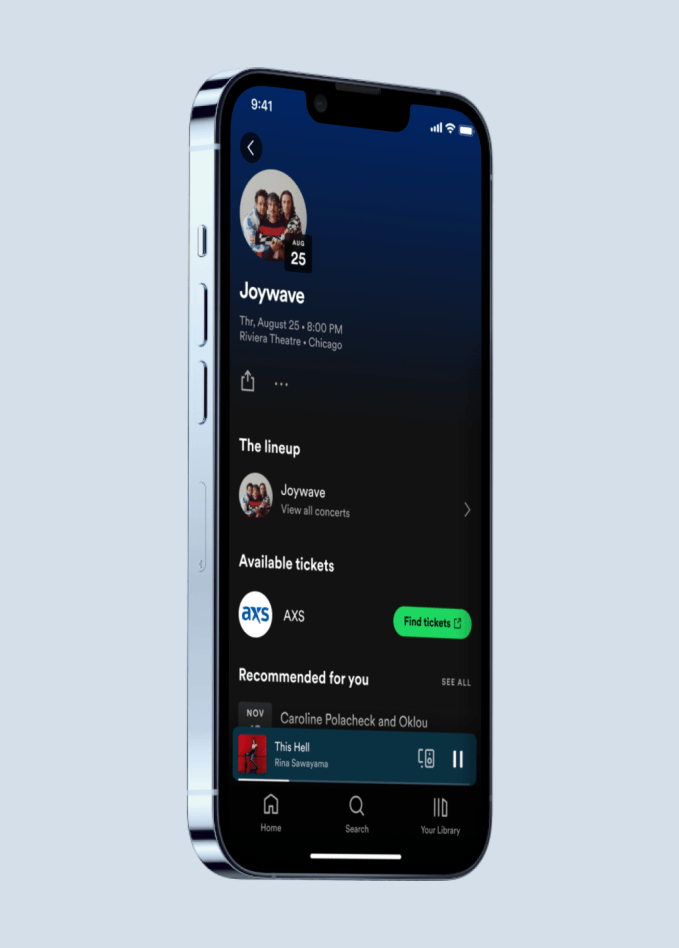
Spotify is introducing a new feature that will allow users to better discover nearby events and concerts. The streaming service today announced it’s replacing its in-app Concert Hub with a new Live Events Feed that will allow you to find favorite artists’ events in your area in a way that’s personalized to your own interests. The update is only the first step toward a reimagined strategy around live events, Spotify says. The company notes it’s aiming to further integrate event discovery into the app in the future, which could see in introducing new search tools, playlist formats and other integrations into the app that will make event discovery an even larger part of the overall Spotify listening experience. The company has been invested in concert discovery features for many years, as it first introduced a concert discovery feature back in 2015. Though Spotify doesn’t sell event tickets directly, it’s able to leverage its listening data and knowledge of a user’s location to suggest concerts to fans who may be interested in attending. The new Live Events Feed continues to be powered by Spotify’s existing ticketing partnerships, which had earlier fed listings into the Concert Hub. The company works with Ticketmaster, AXS, DICE, Eventbrite, See Tickets and others to help source the event listings and direct users to purchase their tickets.
Image Credits: Spotify
Image Credits: Spotify But this system wasn’t working as well as it should have been, it seems. In an interview published to the corporate blog, Spotify’s product manager for Live Events Discovery Sam Sheridan, admitted that music fans would engage with artists on its platform but would leave the Spotify app when they wanted to buy tickets or follow the artists on social media in order to get event updates. That indicates Spotify’s product wasn’t doing enough to retain the users interested in live events from using its own app to make their ticket purchases. Though Spotify doesn’t disclose the details of its partnership agreements, this impacted its bottom line as Spotify earns affiliate commissions on the sale of tickets initiated in the app. The updated Live Events Feed looks a bit different from the Concert Hub, the company notes. It now includes artist imagery, instead of just the calendar icon that showed the date and show information, as before. When you tap into a particular show, you can also see the concert lineup along with other event details, a link to purchase tickets and other music recommendations. Spotify says it’s also introduced a new messaging tool, which will alert fans to personalized recommendations about live events based on their listening habits. Fans can control this experience by setting their notification preferences. In addition, when users are streaming an artist in the Spotify app who has a show coming up, this information will now be displayed in the app while listening. This will help to surface live events even to those who don’t visit the Live Events Feed itself. The company had to shift its live events strategy during the pandemic when it shifted focus to virtual events instead. But Spotify now believes the time is right to refocus on live concerts and events, as listeners are now excited to see their favorite artists perform live again. “Ultimately, our goal is to ensure that fans are aware of all of the upcoming events by the creators they love and creators they may come to love,” said René Volker, senior director of Live Events, in the announcement. “We believe if we get that right, then we can get more fans to more shows and help artists and venues have better-filled rooms. We’d love to be a part of helping the live music industry recover and, even more importantly to us, helping to grow it in the years to come.”
Wimbledon 2022 is finally, with the world’s best tennis players currently battling it out at the year’s third Grand Slam held at the famous All England Lawn Tennis & Croquet Club. Rafael Nadal has won the first two men’s majors of the year – Australian Open and French Open – but won’t be favourite on the grasscourts, with reigning champion Novak Djokovic taking that honour as he aims for his seventh Wimbledon title. World no.1 Iga Swiatek will be hot favourite to win her first Wimbledon title after sweeping all before her at the French Open, with the likes of Ons Jabeur, Maria Sakkari and Coco Gauff hoping to upset the Polish superstar and win their first Grand Slams. The Sporting News has all the details on how to watch Wimbledon if you’re Down Under. MORE: Wimbledon 2022 final live: Nick Kyrgios vs. Novak Djokovic score updates and highlights from Centre Court The main draw singles for Wimbledon 2022 commenced on Monday, June 27 and will conclude with the men’s final on Sunday, July 10. Play on the outside courts will commence at 8pm (AEST), while Court One’s action begins at 10pm (AEST) and Centre Court will host matches from 10.30pm (AEST). Channel 9 will host the free-to-air component of Wimbledon with select matches available via digital television and their Nine Now app. If you want to have access to watch EVERY Wimbledon match you will need to , before adding on Stan Sport as an additional package. There are many ways Stan can be watched, with the most common via apps on Smart TV’s such as Hisense, Sony, Samsung or LG. The service also has apps for computer, phone and tablet that can be downloaded, and you can either watch content there, or you can use a media streaming device such as Chromecast, Apple TV, Fetch TV or Telstra TV 3 to project Stan to your television. You can also watch via the Stan website on phones, tablets or computer via web browser.
Get the best experience and stay connected to your community with our Spectrum News app. Learn More Continue in Browser Get hyperlocal forecasts, radar and weather alerts. Please enter a valid zipcode. Save TOKYO (AP) — The shooting sent shudders through low-crime, orderly Japan: A high-profile politician gets killed by a man emerging from a crowd, wielding a handmade firearm so roughly made it’s wrapped up in tape. The 40-centimeter-long (16-inch) firearm that was used to kill former Prime Minister Shinzo Abe on Friday as he campaigned for his ruling party in Nara, western Japan, looked crude, more like a propellant made of pipes taped together and filled with explosives. A raid of the suspect’s home, a one-room apartment in Nara, turned up several such guns, police said. Unlike standard weapons, handmade guns are practically impossible to trace, making an investigation difficult. Such weapons are rarely used in Japan, where most attacks involve stabbings or dousing a place with gasoline and setting it ablaze, or running haywire on the street in a vehicle. Strict gun control laws likely made the suspect choose a handcrafted weapon. Tetsuya Yamagami, who was arrested on the spot, was a former member of Japan’s navy, and knew how to handle and assemble weapons. Crime experts say instructions on how to make guns are floating around on the internet, and guns can be made with a 3D printer. Some analysts characterized the attack on Abe as “lone-wolf terrorism." In such cases, the perpetrator acts alone, often in sympathy with certain political views, making the crime very difficult to detect in advance. The motive for Abe’s assassination remains unclear. Japanese media reported that the suspect had developed hatred toward a religious group that his mother was obsessed about and that caused his family financial problems. The reports did not specify the group. Japan has seen attacks on politicians in the past. In 1960, Abe’s grandfather, then-Prime Minister Nobusuke Kishi, was stabbed but survived. In 1975, when then-Prime Minister Takeo Miki was assaulted at the funeral for former Prime Minister Eisaku Sato, Abe’s great-uncle, Japan set up a security team modeled after the American Secret Service. Hideto Ted Osanai, chief executive at the International Bodyguard Association in Japan, and other experts believe that the Japanese may have merely learned superficial things like escort formation rather than the prevention mindset critical to security. “Japanese are so used to leading peaceful lives, the security guards were caught asleep,” says Yasuhiro Sasaki, president of Safety-Pro, a Tokyo-based security company. Sasaki said he couldn’t believe that no one moved to protect Abe in the seconds between the first and the second shot, a scene shown over and over on national TV. Guards should have acted by physically pulling Abe away from danger, Sasaki said. More critically, he wondered why weren’t they aware of a suspicious person approaching, drawing what could be a weapon from a bag? Isao Itabashi, chief of the research division at the Council for Public Policy, which oversees such risks, said that providing security during an election campaign was challenging when the whole point is for politicians to get close to people. Unlike the U.S., the use of bulletproof glass is relatively scant in Japan, and security officials rarely resort to shooting potential attackers. “The presumption here is that people are not armed,” Itabashi said. Osanai worried that more people may use handcrafted guns like the one used in Abe’s assassination in “copycat crimes.” He noted a trend of disgruntled people turning to random crimes, indiscriminately targeting victims. “Japan’s conformist culture makes it difficult for some people to live freely, and they put great pressure on themselves. When they blame themselves, they turn to suicide. When they blame others, they turn to indiscriminate crimes,” he said. Last year, a man wearing a Joker costume brandished a knife and started a fire on a Tokyo train, injuring 17 people. In December 2021, arson at a clinic in Osaka killed 25 people. In 2019, another arson in a Kyoto animation studio killed 36 people. ___ Yuri Kageyama is on Twitter https://twitter.com/yurikageyama Copyright 2022 The Associated Press. All rights reserved. This material may not be published, broadcast, rewritten or redistributed without permission.
Filed under: He is the latest star comedian to pursue legal action against the streaming service Hot Pod is The Verge’s premier audio industry newsletter, delivering news, analysis, and opinions on how the audio world is changing. Subscribe here. Comedian Lewis Black filed suit against SiriusXM-owned audio streamer Pandora on Thursday, arguing that the company ran recordings of his performances without obtaining the copyright to his written work. It is the latest escalation in the messy fight between comedians, streamers, and the performing rights organizations that have recently stepped in to standardize spoken-word copyright in the digital age. This suit, along with several others filed against Pandora, seeks back pay for millions of dollars worth of publishing royalties and to fundamentally change the way copyright for comedy functions. If the comedians win, it could have major ramifications for Pandora, Spotify, and other audio streamers. Black, who rose to national prominence with his regular appearances on The Daily Show, is suing for a total of $10.2 million. “One would think that entertainment giants like Pandora would honor the legacy of such an amazing talent, but instead it chose to illegally profit from the creative mind and literary/comedic works of Lewis Black,” the suit says. Black and Pandora were not immediately available for comment. The suit is based on the idea that, like in music, comedy albums have two copyrights for which streamers must pay royalties: one for the recording and one for the publishing, or the written work of the material that was recorded. Although comedians and their labels are normally paid royalties for their recording rights, publishing rights for spoken-word content (like comedy) have been largely ignored, and sometimes outright denied, by the streamers. Black’s lawsuit follows a slew of similar legal actions from comedians like Andrew Dice Clay and Nick Di Paolo as well as the estates of Robin Williams and George Carlin, which are represented by the performing rights organization Word Collections. Those suits, initially filed in February, were consolidated into one lawsuit by the judge in March. Black is represented by another performing rights organization, Spoken Giants, though it is not party to the suit. “The comedy community stands firm in their belief that their written work has value. Without the written work, there would be no recordings and no live performances,” said Spoken Giants CEO Jim King in a statement. “The staggering costs of this battle would be better spent simply paying for the intellectual property they stream to their millions of subscribers.” Black first publicly entered the fray in December when Spotify removed disputed comedy albums from its platform by comedians like John Mulaney and Tiffany Haddish after negotiations between Spoken Giants and the streamer broke down. He asked that his albums be removed in solidarity. “It has taken a long time for comedy to be recognized as an art form,” he said at the time. “Therefore, Spotify should recognize that a joke is as powerful as a lyric of a song, which they do pay for.” The spat with Spotify has not yet resulted in a lawsuit. And part of the reason why the Pandora suit is moving more quickly (even if it is not as big a player as Spotify) could be because of language the company used in a financial filing predating its acquisition by SiriusXM. In 2017, Pandora listed among its liabilities that it streamed comedy without obtaining publishing rights. “Third parties could assert copyright claims against us as a result,” the company wrote. In its response to the combined lawsuits in May, the company argued that it has been correct in doing so because publishing rights for spoken-word content have not been the industry custom, comedians benefit from the exposure they get on Pandora, and Pandora is not profitable while the comedy record labels are. The company is also countersuing for damages. Pandora’s arguments may not be strong enough to ward off the suits. “They’re saying that it would be hard to pay out the royalties. That’s unimpeachable — it will be hard,” said intellectual property litigator Terence Ross, who is a partner at Katten Muchin Rosenman. “Unfortunately, that’s not a cognizable defense to a copyright charge.” Losing is a very, very expensive proposition for Pandora. The comedians are suing for $150,000 for each allegedly infringed work for a total of more than $70 million. It could also set a precedent for other comedians to sue streamers for similar damages. Aside from the immediate financial damage, a change in the way spoken-word copyright functions could also fundamentally change the way streamers do business. Spotify, in particular, has been leaning hard on talk content like podcasts and, soon, audiobooks because they are so much less expensive to stream than music. If those works are also entitled to publishing royalties, then that is another cost that Spotify and other streamers will have to take on. Every Tuesday receive analysis, insights, and commentary on the growing audio industry. Check your inbox for a welcome email. Subscribe to get the best Verge-approved tech deals of the week. Please confirm your subscription to Verge Deals via the verification email we just sent you.
“Pump Up the Jam” with neon colors, leg warmers, big hair and party tunes from the 1980s at Glowga. Unlike the calming sights and sounds of a traditional yoga practice, Day Yoga Studio’s ‘80s Glowga is a glow-in-the-dark yoga class created for fun as much as fitness – maybe more. The vinyasa flow class – designed for all abilities and experience levels – will be held on Thursday, July 28 at 8:45 p.m. at the Beavercreek studio. “The ‘80s are a fun multi-generational theme that connects with everybody in a fun, let-loose way,” instructor Krista Colter said. “We’ve even added time to just dance and move the way your body wants to.” While the ‘80s theme is a new twist, it’s not the first time the Beavercreek yoga studio has held a glow-in-the-dark practice. Previous events have been so well received that the Glowga sessions will likely become a regular offering at Day Yoga. “We’re trying to offer lots of opportunities to get your foot in the door,” said Maggie Kiedrowski of Day Yoga. “What I love about our studio is that it’s accessible for everybody. It’s so important to move your body intentionally and this is such a fun way to do that.”
With Cyndi Lauper, The Go-Go’s and Bananarama on the playlist, it’s sure to be a party – one anyone can join. “Some people think you need to be able to do a headstand to do yoga and that’s not the case,” Colter said. “Yoga can be completely restorative if that’s what you prefer.” Or, in the case of Glowga, it can be a nostalgic night of fun. “If you’re looking for something fun to do with your friends while also being active, this is it,” Kiedrowski said. Practicing with blacklights also means no one will notice if your poses are less than perfect. “And there are modifications offered if there is something that is too challenging,” Kiedrowski said. Wearing white or neon colors is suggested but there will be glow-in-the-dark jewelry and body paint on hand for the finishing touches before you get your yoga on. ‘80s Glowga: Glow in the Dark Yoga What: A vinyasa flow class that is all about having fun. The practice will be done under black lights with ‘80s music. Glow-in-the-dark clothing is encouraged, and body paint and glow-in-the-dark jewelry will be provided. When: Thursday, July 28 from 8:45 p.m. to 10 p.m. Where: Day Yoga Studio, 2440 Dayton Xenia Road, Beavercreek Tickets: Visit www.dayyogastudio.com/80s-glowga-glow-dark-yoga
No matching results Try a different filter or a new search keyword. Search all Bandcamp artists, tracks, and albums Brendan Gillen (aka BMG) grew up listening to Detroit techno as it evolved on the radio. He was entranced as a child by the prosody and mythology of Detroit radio legend The Electrifying Mojo and the fast, wild mixes of Underground Resistance co-founder Jeff Mills when he was “The Wizard,” before techno and house had even begun to creep into his mixes. By the late 80s, mix shows by Juan Atkins, Derrick May, and Kevin Saunderson—the Belleville Three credited with pioneering techno—made it enormously clear to Gillen that another world was possible. When he made it to the world’s first techno club The Music Institute in 1989, his life was changed forever. “There were people there who had a dance that included running up the wall: the participation with the music was another level,” Gillen recalls. “When I heard Parliament’s ‘Flashlight’ deconstructed on that system within the context of advanced techno, everything clicked. I had another similar experience in Berlin in 1991 on the dance floor of Tresor, when I realized this was the new global music. The wall had fallen, and to escape the Tower of Babel, we had this instrumental music with short English (common language) samples. The magic of seeing Detroit techno evolve in 1989-1992 was astonishing: there were so many incredible characters, some still barely known. The ideas were so fresh, such a unique response to the world.” Gillen’s love for and belief in the future of music activated here led him to Ann Arbor’s WCBN, where he became a Music Director and ran a show called Crush Collision. Future Interdimensional Transmissions co-founder Erika Sherman met him there as a student and later became Program Director. Immersive installation artist and visual artistic director at Interdimensional Transmissions Amber Gillen (who Gillen would marry) met both of them when she came to WCBN to visit her older sister, a good friend of Sherman’s. When she later came to the University of Michigan as a student, she also volunteered at WCBN and had her own show; her future husband called in when she played one of his favorite Liquid Liquid songs. Between working at WCBN, buying imports and indie 45s for the Dance Room at Record Time with Mike Huckaby, and attending parties around Detroit, Gillen organically developed friendships with almost everyone who would be involved with his distro Star 67 and the Interdimensional Transmissions label. “When I joined WCBN, I was immediately around people with deep knowledge of jazz, people in space rock bands, making noise art, who loved country music and klezmer and reggae and classical and everything in between,” Sherman says. “I had unlimited access to explore everything myself through the station’s massive library collection. My experience at WCBN taught me that genre is a mythical construct, something that journalists and marketers invented to commodify music. It’s not about genre. All of these expressions, all of this art and music is a continuum that we feel a myriad of different connections to. Because we all met and came from this time period of WCBN, we all feel this, and strive to bring many sides of genre together in the events.” While it’s not all Detroit music or all of the city’s parties and promoters, there has always been a strain within Detroit music that is unbound to genre, going back to bands like the Dirtbombs and Parliament-Funkadelic. It can be hard for Detroit artists to be fully understood by a world that is accustomed to perceiving music through narrow genres and definitions, but it’s very normal in Detroit for music heads to be open-minded: rock kids going to raves, synth nerds hitting up the jazz festival. Interdimensional Transmissions exists to preserve and expand that spirit: the label was inspired equally by Sun Ra’s El Saturn Records, independent rock labels of the ‘80s and early ‘90s, and underground European electronic records, especially from the UK, Germany, Holland, and Belgium. As Detroit techno began to see success in the outside world, however, its futuristic vision appeared to have gotten hijacked by the American dream. The original innovators and hometown heroes shifted focus to making music for Europe, were perpetually on tour, and were essentially “leaving Detroit to rot,” according to Gillen. “I felt the most important thing was to take the inspiration of this revolution and infuse it with the true underground ideals I saw in things like Liquid Liquid or Dischord [Records] or Underground Resistance and take my own lens that incorporated experimental music like [Iannis] Xenakis and [Karlheinz] Stockhausen and the music of Mika Vainio, Dan Bell, Drexciya, and share this new fusion with Detroit. Detroit music for Detroit, but respecting its incredibly advanced and high-concept history, adding to that history by offering a more fascinating, mysterious future, a new place to go with your mind,” he says. “Our early records show this with the lock grooves, backwards mastering, groove notes, and unique vinyl colors. The records themselves were a statement.” As the Kraftwerkian vision of the future died, Interdimensional Transmissions charted out a new future in the mid-’90s guided by dreams, allowing the subconscious mind to direct us where we need to go and beyond where the prevailing rules tell us to go. “This is not the music of the world you are in, that dying world subject to cruel crony capitalism, destroying itself before your very eyes,” Gillen says. “This is the music of other tangential dimensions, where the higher planes of consciousness are valued, where the mind and pure thought come together to take the body to another plane. These are interdimensional transmissions received with the intention of allowing your spirit to be truly free, to enjoy things that aren’t supposed to collide, where we can enjoy the aural moire patterns of where things overlap and connect and take new form.” Eventually, it became clear that they needed to throw events if they wanted people to truly understand their vision: to not just sow the seeds of concepts through the albums they released, but give those seeds a fertile place to gather and grow. Between 1998 and 2000, they began experimenting with events in different contexts and venues. This eventually evolved into their annual Samhain events, first held at the Blind Pig in Ann Arbor. Ectomorph performed live as the central event with performance art and full space transformation: the need to cover all the beer mirrors there led to an on-going practice of wrapping spaces. Gillen made it clear in the beginning they would keep having these parties until everyone in the crew was a household name getting regular gigs, but it took repeated attempts over many years in various venues for it to finally come together and be fully realized. “The first No Way Back was thrown in a dilapidated leaky bank building on December 1, 2007,” Sherman recalls. “It was a snowy cold winter night, with about 150 Detroiters. The event was conceived to be a 12-hour party, an immersive experience like the warehouse and loft parties we’d enjoyed 10-plus years ago, that were no longer happening in the city, with long sets from Derek Plaslaiko, Carlos Souffront, Patrick Russell, and Gillen, who became the party’s first residents. That venue was a one-off, and No Way Back returned the following May, becoming a part of [Detroit’s annual dance music celebration] Memorial Day weekend.” The party moved around Detroit for the next few years, with evolving lineups designed to fit into many different spaces: Tangent Gallery, Oslo, Bohemian National Home, and eventually to 1515 Broadway, where it seemed to catch on the most. 1515 Broadway had hosted events in the ‘80s and approximated well the unfettered and unfancy vibe of warehouse parties, but after a few years, it was so packed and dangerously hot, they had to find a new home in a new incarnation of the Tangent Gallery. “The full vision for No Way Back has always been about long events, a full exploration of music, and an immersive environment. Tangent has allowed us to take this concept and expand it into a full weekend,” Sherman explains. “We can now realize the concept of Return to the Source, not just as one party or event, but as a full statement.” It’s clear that their decades of work haven’t been in vain. Detroit’s scene is enormously vibrant, fresh, and thriving in a way that is inspiring and truly diverse by any metric. The work has gone far beyond creating periodic events that captivate locals to national and international recognition as one of the greatest scenes for proper underground dance music, but more importantly: it’s now an incredible time to experience Detroit any time of the year, with consistently magical crowds and more local event crews taking inspiration from Amber Gillen’s immersive space transformations at International Transmissions events. Visual art has become a major part of nightlife. “Some of the stranger sides of what we’ve presented have also made a major impact, like the Scott Zacharias set that happens at dawn in the Outer Space Room at No Way Back has affected our scene for the positive,” Gillen says. “And Scott is touring now, which is so great to see, and good for the world, because there is nobody else like him.” Here are 10 releases to get you acquainted with this home for deep-listening and forward-thinking sonic voyagers, those who are always pushing the culture and the music forward with what Gillen dubs “the pure and sometimes nasty essence of raw creativity.” This is the record that launched both the Ectomorph project and the International Transmissions label in 1995. In 2018, it was re-pressed for the first time in over a decade using the original masters complete with three lock grooves cut by Ron Murphy. “The first song on the B side was the first thing we ever did, the beginning of the collaboration, with my 606 for drums. In this era, there is borrowed equipment on every song,” Gillen says. “The lock grooves were inspired by Cycle 30 by Jeff Mills. Ron Murphy told us the math. I applied that in the studio and we did multiple takes in mastering to get them just right. Ron was really sweating, but got it just right with the overcut of the loop, making that crazy bass whoomp. The rhythm lock groove became a Detroit street jock and radio staple, often mixed with the acapellas.” It was an early milestone: when the title track was used for the top “urban” station in Detroit WJLB’s own NYE show advertisement, Gillen really felt like they had made it. The record was popular at Record Time and all around Detroit, introducing a sound both abstract and experimental, yet into the groove enough to become a major street jam and part of a sound that was to become popular later through the stylistic developments of DJ Assault and DJ Godfather. Making this EP was a dream for Gillen, as Liquid Liquid are one of his all-time favorite groups. They first met performing on the same stage at Detroit Electronic Music Festival in 2003 and Gillen even got to write about them for the MetroTimes; Sal P told him it was the first article on the group he wanted to keep a copy of. A chance second encounter at the Red Bull Music Academy in CapeTown, South Africa where Gillen was teaching about creating computer music led to an impromptu performance with Sal P and Patrick Pulsinger. From that evolved this project, which Gillen describes as “coming out of thin air, from parts Sal and Crispy [Christopher Fachini] had written separately, and it worked like magic.” They toured and did shows as Electric Skin and then BMG & Sal P, plus a collaborative Electric Skin tour that brought Ectomorph and Sal P together in the mid-’00s, featuring “fascinating fusions on stage with Sal’s live percussion and voices and the electronics from Erika and myself,” Gillen says. “This project took years to complete, because as an electronic musician, I had no idea how to use a recording studio. Crispy helped bridge that gap, and we got to do the final mix down on a desk that Pete Townshend and Billy Corgan were bidding for, that had been used by Led Zeppelin. I learned so much in the production of this: it didn’t come out when it should have, but I learned techniques that I use to this day.” Erika [Sherman] had been a member of Ectomorph for a long time, touring with the group and performing as a synthesist, before her debut solo album came out. When she showed Gillen the demos for this material, they had been planning to make an EP, but the sheer volume of great tunes demanded a full-length. “Technically we aligned using the same mixer, monitors, sound card, and software,” Gillen says. “She recorded all these keyboard lines at her house, recorded demo arrangements and drums. I produced the record: arranging the songs, mixing the whole thing, re-recording the drums, and in some cases, writing new rhythms in the spirit of her music. Her music is so cosmic, so pure sci-fi, but also deeply like an Audubon Society book, or Darwin’s field drawings, very free and organic. So I did my best to highlight how she thinks and back it up with tones and rhythm that would push her ideas to the fore. I still mix her records–classic audio engineer mixing, not remixing.” They screened the covers by hand at a place that was so toxic the environment was negatively affecting the person who ran it so only the front cover was printed, and even that was a miraculous feat. The art was hand drawn by Sherman, and the associated remix record has the color versions of the art, part of a series she was doing. As a result, this release communicates many aspects of Sherman’s process in addition to her unique sound. The Interdimensional Transmissions crew has known Andy Toth since even before his days in the Detroit Grand Pubahs, but this connection came together at the wake of Greg Mudge, a pillar of the techno community and mutual friend who helped with leads on the original No Way Back location and who was also constantly bugging Toth to release his solo tracks. “We heard these tracks after Andy had been working on them for a very long time. He DJed the wake and it turned out that every song he played was his own production,” Gillen says. “Erika and I had our jaws on the ground, just blown away by how incredible the music was. Derek Plaslaiko was there too. We were all losing it to just what an original blend of electro, techno, and acid these were—and then all the Star Trek references. But just how mature the music was: it was such a refined vision of the original Detroit rave spirit, a new form of flawlessly perfect No Way Back music produced by someone who masters, mixes, and engineers audio professionally, which put these in a new sonic realm. The kind of deep thought that goes into these dense, multi-layered, but ultimately hypnotic tunes just blows my mind. You can listen so many times and always keep discovering new things.” After seeing Jamal Moss perform live and enjoying the “history of house he was referencing, but with such an avant-garde angle,” Gillen says the crew started talking about a release on Interdimensional Transmissions. Gillen and Carlos Souffront were obsessed with one song he played that they were never able to locate in Moss’s archive, as well as a few others that they were able to find. Thus began many years searching through his archives, Moss coming to Gillen’s house with shoeboxes full of cassette tapes, minidiscs, CDs, and videotapes of sound recordings. “Carlos was so fast on the cassette deck: identifying songs, marking the spots on the tape externally so we could find them again… and I spent time carefully recording them all in and then getting them mastered. It was a long, arduous process that took me many years to complete,” Gillen says. “We went through a few mastering guys to get the oldest, rawest ones to be of a sound that not just pure freaks could listen to. Melvin Oliphant [Traxx] once played a raw original of one of these at a party in Montreal and they kicked him off the decks, which is beyond insulting, but I wanted to make sure this music had the effect it should—taking the mind into new dimensions. Jamal kept delivering more and more tracks and we finally ended up with Kill Bill, which was kind of the apex of this sound, a jacking apocalypse complete with Gabriel’s trumpets.” Gillen first met Armando Martinez through some friends in Miami, when he would go to the Winter Music Conference and related gatherings. They organized some parties down there, and Martinez played alongside Patrick Russell and Sal Principato. “Alpha 606 was originally three people but ended up with just Armando, kind of a reclusive genius. Starting with the original EP, we expanded to this album, full of amazing concepts,” Gillen says. “I worked hard on engineering it so that it could work on more sound systems around the world, and I’m really happy with the edit/remix I did of ‘Armambo’ that killed in sets for years. Cuban music is a huge influence on the development of funk, which is one of my main influences, so it was wonderful to show this from another perspective.” The late Jasen Loveland (born Andrew Smith) met Gillen on the dance floor at No Way Back. “He created so much music, so fast—it just kept multiplying to the point where I created a sub-label for him called Infinite Refractions, named after the way I saw his music,” Gillen says. This EP was created and recorded by Loveland in his home studio in different places around the world, which he then brought to the Interdimensional Transmissions studio to mix. They mixed eight songs in two days, deciding ultimately on these four and having a real blast doing it. Infusing his tracks with production techniques to help the sounds stand out and have compelling emotional textures was an extremely fast, pleasurable, and easy process. “It was a high we never came down from, the sharing of these ideas and really fleshing them out and finishing them in this way: we were meant to do this many more times,” Gillen says. The Interdimensional Transmissions crew came to know Eris Drew through her work with Hugo Ball, a Chicago collective with a similar mission in the last decade [full disclosure: this author was also involved with this collective]. They started having her perform in Detroit at their parties: initially as a giant home studio live show “featuring so many layers of sound, with influences ranging from synth-pop to Sun Records,” Gillen says. “As her [gender] transition continued, a new DJ style emerged and the energy coming from it just blew me away.” Gillen started booking her in Detroit as much as possible and asking her for demos, specifically of songs that referenced her DJ style more, and Interdimensional Transmissions had the great fortune of developing her debut record. Once they’d selected the songs, the label had her stay another week after a New Year’s Eve show to mix these songs down together in Gillen’s studio. “I wanted to share some of what I’d learned about engineering, so her future productions would elevate, and really I wanted her to understand how to create this bass weight that her DJ style implies,” he explains. “I think it really clicked: we went through her music in such close detail, and I’m so proud of what emerged since it still retains its gentleness, raw details, imperfections, sonic power, and emotional purity.” Gillen and Arthur also met on the dancefloor at No Way Back; Arthur was dancing right in front of Gillen during his set. Arthur then invited Gillen to play his house in Memphis on his Funktion One sound system. When he played that set at Arthur’s house, Gillen noticed house pioneer Larry Heard [Mr. Fingers] and Chad White [Mr. White] dancing in the crowd. Arthur built a huge Buchla system to create his own music, resulting in these tracks that feel somewhere between dreaming and waking—a space he deals in professionally as an anesthesiologist. “We talked about sound cards, monitors, hardware compressors, and what it takes to get your music to where it needs to be,” BMG says. “He did all of that and more, a truly unique character now living in rural Arkansas.” He continues to record music with his massive Buchla, like his stunning ambient performance following Suzanne Ciani at No Way Back 2021. Israel Vines is one of the most formidable but slept-on artists in the game. Gillen describes him as being “somewhere in the future with this brilliant fusion of Detroit electro, Birmingham techno, and post-jungle Bristol sounds.” Following a series of extraordinary 12” records on Interdimensional Transmissions’ Eye Teeth imprint (devoted to pure, experimental, and entirely contemporary techno explorations), Vines put out this powerful double LP in late 2020. This album developed with a great focus and is a rare release on the label designed by a graphic artist besides Gillen—Ken Meier, the brother of Karl Meier (Talker), another criminally underrated “underdog lifer ultrahead” who Vines’s debut track on Eye Teeth was named after—“WWKD.” This was the final release from Eye Teeth. Now Interdimensional Transmissions feel the separate imprint is no longer necessary. It is natural in the outer limits for boundaries to dissolve.
After the pandemic forced the Cadogan hotel in London to temporarily shut down, general manager Xavier Lablaude and his team began thinking of ways to bring guests back in. With reports of insomnia on the rise, they decided to lean into one of a hotel’s key functions: providing a place to get a good night’s sleep. The hotel launched its Sleep Concierge service in early 2021, assisting guests with all things slumber through a range of services and amenities, from hypnotherapy to calming tea. “A lot of people were quite stressed just by leaving their homes,” Lablaude said. “They’d been in their homes so much, that it was quite an adventure to get out of their cocoon, and I think it was the right timing to reassure people when they left their home, to have this offer at the same time.” The hotel is one of many to invest more heavily in sleep-themed services, with offerings across numerous properties aimed at helping guests get the most out of their shut-eye. How to re-create the magic of a hotel bed at home The Cadogan partnered with hypnotherapist Malminder Gill to create a meditation audio recording, and it also offers a pillow menu, a weighted blanket, a lavender pillow mist and more, all included in the room price. Guests also can book a private in-room session with Gill in advance for around $375. Other hotels have designated spaces designed to help guests rest. When Hotel Figueroa in Los Angeles initially launched its Rest & Recovery Suite last year, it was expected to be a summer promotion for National Relaxation Day. “We were expecting it to run for about three months, and then it just kept booking,” managing director Connie Wang said. The 870-square-foot suite features a mattress from Eight Sleep that adjusts its temperature during the night and a custom Pluto Pillow that you can take home. The suite, which runs about $500 per night, also has a FORME fitness mirror — part of a holistic approach to helping guests sleep well, starting before they hit the sheets. Hotels have gone to the robots Wang said the idea came about after guests sought respite at the hotel as people worked from home during the pandemic and the boundaries between personal and professional blurred. Many locals flocked there to get away from their work-from-home space, she said. “We were already noticing this trend with hotel guests coming to stay in the hotel to find that really restful night of sleep, away from their emails and away from the stresses of home life and the stresses and the rigors of the pandemic, and just have an escape,” she said. Tanner Saunders, senior hotels reporter at the Points Guy, said sleep-focused offerings at hotels are not new, but that “it’s just another thing that’s been exacerbated by the pandemic in a lot of ways.” As the pandemic wanes, wellness is key for many hospitality brands, he said, with sleep emerging as a particular area of focus. “As the pandemic changed so many parts of our lives, we realized that sleep is so much more important because we had that time at home to regroup … and I think hotels are starting to capitalize on that,” he said. In general, hotels try to create brand loyalty, said Jamie Larounis, a travel industry analyst with UpgradedPoints.com. The overnight part of a guest’s stay is especially important. “They want to associate you traveling … to certain brands, certain hotels, because you know you’re going to get an excellent night of sleep,” he said. The completely correct guide to getting over jetlag A sleep-themed offering can also provide “an ancillary revenue stream” for the hotel that does not cost them much. Larounis added that travelers can primarily expect to see special services of that kind at mid- to high-end hotels. The offerings can range depending on the property. The Lotte New York Palace decked out its Hästens Ultimate Sleep Suite with a $200,000 bed from the Swedish company and signature pajamas, while Equinox Hotel in Hudson Yards designed its rooms with “regeneration” top of mind, including blackout blinds and soundproofing. Some offerings are particularly immersive: The Royal Livingstone Victoria Falls Zambia Hotel by Anantara is holding a three-day Sophrology Sleep Retreat. While some are more elaborate, Saunders noted that in other cases, hotels are “just kind of reframing the services that they already offer and tying it together with this little bow that says ‘sleep experience.’” He recommended travelers that are looking for specialized packages do some investigating “because there are some that are really different from the others.” Wang said she expects Hotel Figueroa will continue to offer its suite until the end of the year and gauge demand again then. For the time being, though, guests can rest easy. “I think that as long as it’s helpful to people and that people are seeking out that experience, we’ll be able to keep it,” she said. Safety: Mask advice | Travel after covid recovery | Entry test rules | Maskalorian | CDC travel advisories | Kids and masks | Traveling while trans Airlines: What to expect in 2022 | Confronting unruly passengers | Buses as flights | Goodie bags | Fare sales | Unruly passenger no-fly list | It’s physically impossible to open a plane door | Refund battles | Disruptive behavior | Wheelchair damage Destinations: Florida v. Disney | Disney boycott | Texas, Florida travel ban | Obama’s national parks show | Top vacation spots | Disney prices | Australia reopens | Passport-free travel | Mexico shooting | Moving to Rome Airbnb: Accidental break-in | Ukrainian refugee housing |Pet-friendly additions | Vacation rental startups | Cleaning fees On the road: Pricey summer travel | Labor shortages | Hertz police reports | Rental car woes | How environmentalists travel | Road trips with pets | Road trips with babies
ST. PETERSBURG, FL — Photographer Lucky Cole discovered the Florida Everglades as a child in the 1950s. Now, his biker speakeasy, supply shop and artist haven deep in Ochopee on scenic Loop Road is a South Florida destination and everyone who crosses his path marvels at his tales about life in the swamps. Those in the St. Petersburg area will have the chance to hear some of these tales live Saturday evening. Cole is the featured storyteller at the Second Saturday Storytellers Open Mic hosted by the Storytellers of Old Tampa Bay in the library room of The Factory at 2622 Fairfield Ave. from 5 to 6:45 p.m. His love affair with the Everglades started in 1950, when his family moved from North Carolina to Miami Springs. His uncle was an avid sportsman who loved the outdoors and took Cole — his “favorite nephew” — with him, the artist told Patch. He became interested in photography through his aunt, who ran a modeling agency. “She had me in cute little boy outfits modeling,” he said. “I grew up in that modeling agency.” He appeared in ads for department stores like Sears, J.C. Penney’s and Burdines. During one photo shoot in his teens, Cole pretended to be a photographer, joking around with some of the women models. “I was standing like I had a camera taking pictures with me and my aunt saw how comfortable the girls were with me,” he said. “She knew that the girls that were friendliest with the photographers got the best pictures. She had one of her hired photographers take her camera and show me how to click it.” Since then, he’s built a storied career as a glamour photographer who takes images of women who travel to South Florida to see him from around the world. “I take their picture in exotic, natural settings,” Cole said. And though his subjects frequently get nude, “I won’t do anything close to porn,” he added. “(The nudity) is all depending on what they’re looking for. The photo shoot isn’t about me. It’s about what they want. I don’t care if they’re wearing a suit of armor.” He works closely with Maureen, his wife of more than 40 years, who directs, schedules and interview the women for these photo shoots. “The only thing I do is I stand behind the camera and take all the credit,” he said. “I’d be lost without her.” In 1990, the couple purchased their current Loop Road property, which sits on three acres. There “was basically nothing” on the land when they bought it, though it did have water, a well, a septic tank and a small trailer, he said. “Everything we needed to get started. It was a work in progress. It’s still a work in progress.” Cole added, “It’s our home. It’s our photo studio. It’s our biker speakeasy. We have an RV hookup and a pool.” Over the years, they’ve built numerous sets for photo shoots, “like a movie set,” he said. Though the speakeasy portion of the land has been open more frequently in the past, this summer, it’s open only on the last Sunday of each month. It won’t reopen regularly until October. Over the years, he’s gotten used to people traveling through the swamps stopping by to have a beer and to hear a story from Lucky Cole. “I have been here in the swamps for so long that I have people that come here just to hear me tell a story,” he said. Even artists, filmmakers and authors, such as Tim Dorsey — who named a character after Cole — stop in to record him telling a tale. He plans to tell the story of how he met Dorsey and became a character in the author’s books — a fictionalized version of himself, also named Lucky Cole — at Saturday afternoon’s storytelling event in St. Petersburg. Ross Tarr, founder of the Storytellers of Old Tampa Bay, had long heard of Lucky Cole and after connecting with him on Facebook, convinced him to give storytelling on stage a try. “I caught him in a YouTube clip of a Glades documentary sitting, having a beer and telling a swamp story, and knew he had talent, tales, and charisma,” Tarr told Patch. “We started going back and forth in 2015 to get him to be a teller for St. Pete StoryFest 2016. It was fun getting him to learn about storytelling on stage as opposed to sitting at a bar or campfire with time and language limits (too many local terms snowbirds had never heard).” Cole “was a hit” at this event, Tarr said, and returned the following year, when he and his wife, together, told the story about how they met. “Telling that love story” was a pivotal moment for him, Cole said. Since then, he’s enjoyed exploring his creativity and storytelling for larger audiences. And Tarr is always happy to welcome the photographer back to the stage in St. Petersburg. Learn more about the Second Saturday Storytellers Open Mic here.
Adelina Mitchell (Marian Paroo) and James Caverly (Harold Hill) “The Music Man” at Olney Theatre Center. Photo by Teresa Castracane Photography. “The Music Man” is considered by many to be the epitome of Americana in musical theatre. With lyrics, music, and book by Meredith Willson and story by Willson and Franklin Lacey, Olney’s current iteration is co-directed by Michael Baron and Sandra Mae Frank. This production had many bumps in the road to its opening. The idea was first conceived by James Caverly, who plays the lead role of Harold Hill, and Jason Loewith, Artistic Director of Olney Theatre Center. Caverly, who is himself deaf, had seen a musical on Broadway that used hearing and deaf actors and suggested “The Music Man” in 2017. It took some time to work out the logistics and then there was the pandemic. Recently, Covid again impacted the original opening date. The show was finally able to begin its run on June 29, 2022. Even then, several of the cast members still wore masks. …a thunderous success. Don’t miss this most amazing production. It’s a summertime must and perfect for all ages. At first, I was not sure how I would enjoy a musical where many in the cast would not be speaking but using American Sign Language (ASL). Then I recalled seeing a Broadway production of the Theater of the Deaf in the 1970s. It took only a few minutes to sit back and enjoy every moment of this production. It was like watching a great, foreign language film. After awhile, you don’t care that you have to read the subtitles and you become absorbed in the story. There are times when ASL is used even when one of the actors is not Deaf. Because the supertitles are projected well over the performers’ heads, I had to make a choice of following the dialogue or watching the performances. I wish they had been able to have the words closer to the performers to be able to do both. However, that may be how those who are dependent on sign language interpreters may feel when they go to a “normal” show. They can watch the interpreter, usually relegated to below the stage or to one side, or watch the performers. The placement of the supertitles did not affect the overall enjoyment of the show at all due to the wonderful performances. Caverly is magnificent as Harold Hill. Hill is a con man who fools the small, Iowa town of River City into buying instruments and uniforms for a kid’s band to keep the children from the corrupting influences of playing pool. Caverly helps us visualize Hill’s ingenious ways of beguiling the townsfolk with the aid of his old buddy and former con artist, Marcellus (Vaidya). All of the wonderful Willson songs are still here and handled in a very inventive way— the two performers are meticulously interwoven not only as characters, but vocally because Vaidya is the singing voice for Caverly. He has a marvelous voice and with Caverly’s signing, it makes the music more meaningful. They were exceptionally integrated in the number “You Got Trouble.” Hill’s scheme also involves winning over the local librarian and piano teacher, Marian Paroo, played by Adelina Mitchell. Of course, the two fall in love but their relationship has some surprises. Mitchell also has a wonderfully trained voice. Though not deaf, she also signs either with vocalizations or just by signing her lines. (She does sing her songs.) Mitchell and Caverly have great chemistry, and when they sing “Till There Was You”—one with words and one in ASL— it was a great theatrical moment. The supporting cast all give performances that help electrify the production. Nicki Runge plays Mrs. Paroo, Marian’s mother, and Christopher Tester plays her brother, Winthrop. Both are Deaf actors and bring a genuineness to the characters. Andrew Morrill has just the right stuffiness as Mayor George Shinn and Amelia Hensley is perfectly self-absorbed and righteous as his wife, Eulalie Mackenknie Shinn. The latter is hysterical as she runs her ladies’ dance group. Other standouts in the cast were Florrie Bagel as Ethel Toffelmier, Marcellus’ girl, and Jay Frisby as Charlie Cowell (later Jacey Squires). There are three amazing younger performers in the show—Anjel Piñero as Zaneeta Shinn, Matthew August as Tommy Djilas, and Sophia Early as Amaryllis (Note: Early is the understudy for Sarah Anne Sillers). The first two are very young lovers who meet behind the backs of Zaneeta’s parents. Early’s rendition of the complicated tongue twister, “Pick-a-Little, Talk-a-Little” is perfection and her vocalization for Winthrop in “Gary, Indiana” is delightful. The rest of the dazzling ensemble includes Mervin Primeaux-O’Bryant, Gregor Lopes, Dylan Toms, and Heather Beck. The fact that a production as ambitious as this works and runs so smoothly is due to the two directors Baron and Frank. Like the Caverly and Vaidya, their direction blends together to create many memorable moments. Karma Camp’s choreography not only helps the show keep moving but shows off the talents of the performers. Christopher Youstra does an incredible job. He is not only the music director but is also one of the singers in the opening number as well as the barbershop quartet. There is an extra challenge as the singing and signing have to be perfectly synced, making sure that the timing is perfect. Everyone does a marvelous job. The on-stage orchestra enriches the musical numbers and manages to sound like a full, seventy-six-piece band. The musicians include Youstra on the piano; Pam Wilt on keyboard; Lee Lachman on piccolo, flute, clarinet, and soprano sax; Roger Garza on clarinet and bassoon; Joseph Herrera on trumpet; Joe Jackson on trombone; Andrea Vercoe on violin; Matt Trimboli on guitar/banjo; Max Murray on bass/tuba; and Mark Carson on percussion. Ethan Sinnott’s scenic designs are very clever and Rosemary Pardee’s costumes designs are period and reflect each character. Matt Rowe’s sound design helps give the impression that every cast member is singing. Jesse W. Belsky’s lighting design illuminates the actors—particularly important when they are signing. Michelle Banks directed the ASL and Sean Preston was the projection designer. “The Music Man” is a thunderous success. Don’t miss this most amazing production. It’s a summertime must and perfect for all ages. Running Time: Two hours and 40 minutes with one intermission. Note: Performed in ASL and English with English Supertitles. “The Music Man” runs through July 22, 2022 at Olney Theatre Center, 2001 Olney Sandy Spring Road, Olney MD 20832. For tickets and information, call the box office at 301.924.3400, open Wednesday – Saturday: 12:00 – 6:00 pm or go to this link. For Information on Covid safety protocols, click here. Ms. Brall is a graduate of the City College of New York with a B.A. in Theater. She has an M.A. in Theater from the State University of New York in Binghamton with a concentration in Directing. Growing up in New York City gave her a chance to see many Broadway and Off-Broadway productions. After college she worked as a Recreational Therapist and Activities Director. In that capacity she edited several house newsletters. Although not directly employed in Theater, Ms. Brall worked in community theater in this area as well as New Jersey and central Pennsylvania as a director, assistant director, stage manager and other behind the scenes jobs. She also served as president of the former Columbia Community Players. Ms. Brall also teaches improv at a local Sunday School. Weekly email with links to latest posts. (Be sure to answer confirmation email.) Name
Email
Copyright by MD Theatre Guide, LLC. Privacy Policy Reprint Policy: Our content may not be reprinted in full. Excerpts may be used if a credit and link is provided to our website.
The GRAMMY Museum® announced today that 81 talented high school students from 69 U.S. cities across 18 states have been selected as participants in the 18th annual GRAMMY Camp® program. Reyna Roberts, Silversun Pickups, and Lauren Spencer-Smith will be this year’s guest artists; they will discuss their career paths and help students prepare for the music industry. “GRAMMY Camp is a prime example of the GRAMMY Museum‘s mission and education initiatives,” said Michael Sticka, President/CEO of the GRAMMY Museum. “We’re thrilled that the program is back in person and will continue to be one of the most immersive summer camps for high school students interested in a career in music and continues to give young people the opportunity to study with music industry professionals, resulting in a genuine learning experience about life in the music industry.” This GRAMMY In The Schools® program is presented by the GRAMMY Museum. Additional program support is provided by the Bruno Mars Scholarship Fund, Chuck Lorre Family Foundation, Ella Fitzgerald Charitable Foundation, Mama Bernadette Memorial Fund of the Hawai’i Community Foundation, Natalie Cole Foundation, Pacific Bridge Arts Foundation, and the Recording Academy®. GRAMMY Camp will focus on all aspects of commercial music and provide instruction by industry professionals in an immersive and creative environment. The program features seven music career tracks: Audio Engineering, Electronic Music Production, Music Business, Music Journalism, Songwriting, Vocal Performance, and Instrumental Performance. All tracks culminate in virtual media projects, recordings and/or performances. Applications for GRAMMY Camp 2023 will be available online in September at www.grammycamp.com. 2022 GRAMMY Camp Selectees and Tracks (In Alpha Order by First Name) Adam Sondik Culver City, Calif. Music Business Alexander He Glendora, Calif. Instrument – Trombone Allyn Matheson Culver City, Calif. Music Journalism Althea Aguel Long Beach, Calif. Songwriting Ava Claire Henson Brentwood, Tenn. Songwriting Ben Brannock San Juan Capistrano, Calif. Instrument – Bass Bianca Flores Camas, Wash. Electronic Music Production Brandon Goldman Alhambra, Calif. Instrument – Drums Callie Beard Franklin, Tenn. Music Business Chiara Hertsgaard San Francisco, Calif. Music Business Chloe Wong Torrance, Calif. Songwriting Connor Wootton Pacific Palisades, Calif. Audio Engineering Danielle Adcock Westwood, N.J. Instrument – Keyboard Da’Vine Yancy Missouri City, Texas Music Business Dexter Griffin Oakland, Calif. Electronic Music Production Diego Brown Inglewood, Calif. Electronic Music Production Dylan Humphrey Orlando, Fla. Vocal Performance Dylan Kang Newport Coast, Calif. Audio Engineering Dylan Wels Irvington, N.Y. Audio Engineering Elijah Small Los Angeles Electronic Music Production Elizabeth Keegan Kirkland, Wash. Music Journalism Ella Gibson Rochester, Ill. Songwriting Ella Wicks Hockessin, Del. Vocal Performance Emma Fann San Clemente, Calif. Music Business Ethan De Jesus Palm Desert, Calif. Audio Engineering Evan Wazac Fairfax, Iowa Instrument – Keyboard Ezekiel Solidum Culver City, Calif. Electronic Music Production Fallon O’Donnell Franklin, Tenn. Music Business Gabriella Pasqua Woodstown, N.J. Songwriting Gavi Shohet Zabin Evanston, Ill. Audio Engineering Grace Chandler Sterling, Va. Music Journalism Hal Sufrin Pittsburgh, Pa. Audio Engineering Harrison Le Tampa, Fla. Electronic Music Production Isabel Santana Franklin Square, N.Y. Music Business Isadora Lewis Mt. Pleasant, S.C. Vocal Performance Jack Higginbotham Greenville, S.C. Electronic Music Production Jack Fowler Memphis, Tenn. Music Business Jacob Brusseau Thousand Oaks, Calif. Electronic Music Production Jad Maluf Los Altos, Calif. Electronic Music Production James Ignacio Roseland, N.J. Audio Engineering Jaq Adelman Santa Monica, Calif. Instrument – Keyboard Jasani Pitts Culver City, Calif. Electronic Music Production Jason Takao Honolulu, Hawaii Songwriting Joan Park Buena Park, Calif. Vocal Performance Kamal Givens Los Angeles Electronic Music Production Katherine Wang Trumbull, Conn. Electronic Music Production Katie Poole Flowood, Miss. Music Business Kethan Kalavar Houston, Texas Instrument – Guitar Lexi Anand Naples, Fla. Music Business Lila Holler Ocean View, Del. Songwriting Lily Koen Los Angeles Vocal Performance Lily Zager West Hollywood, Calif. Vocal Performance Luke Sonderman Rancho Mirage, Calif. Audio Engineering Luna Day San Diego, Calif. Songwriting Mackenzie Weber Manhattan Beach, Calif. Music Business Matthew Ludwig La Jolla, Calif. Instrument – Drums Mia Perrin Kalamazoo, Mich. Songwriting Mila Northrup Los Angeles Songwriting Miles Connor Keller, Texas Instrument – Guitar Milo Chang Sigel Palos Verdes Peninsula, Calif. Electronic Music Production Neil Nayyar Elk Grove, Calif. Audio Engineering Peyton Price Austin Music Journalism Richard Heller Chicago Instrument – Guitar Rijah Banerjee Jersey City, N.J. Songwriting Ryann Barnes Atherton, Calif. Songwriting Samantha Berman Los Angeles Instrument – Bass Savannah Blandino Torrance, Calif. Songwriting Shannae Erin Bernales Anaheim, Calif. Vocal Performance Shaylee Guerrero Los Angeles Music Journalism Shohini Chakraborty Folsom, Calif. Audio Engineering Sofia Erskine Pleasanton, Calif. Vocal Performance Sophia Rabin Newport Beach, Calif. Songwriting Sophie Ward Los Angeles Music Business Taylor Aaronson Richmond, Va. Music Business Terrell Hardge St. Peters, Mo. Electronic Music Production Whitney Enenstein Los Angeles Music Business William Ellis Eads, Tenn. Instrument – Guitar William Faust El Macero, Calif. Music Business Zachary Fryer San Anselmo, Calif. Instrument – Drums Zachary Marcus Westfield, N.J. Instrument – Bass Zoe Gossa River Edge, N.J. Music Business
This is a carousel. Use Next and Previous buttons to navigate NEW YORK (AP) — Chad Hugo is a man of very few words. But helping craft some of the biggest songs of the early 2000s, his music may have spoken louder than he ever could. “It’s always just been gratifying to see people enjoy the music when it’s played out loud and you’re cultivating moments or opportunities for moments to share,” said the two-time Grammy winner. “When music is playing out, it’s a sound. And if we can share that understanding with what we hear, then hopefully we’ll be able to understand each other’s soul and our intents in this world.” The legendary producing duo The Neptunes, comprised of Hugo and Pharrell Williams, will be formally inducted into the Songwriters Hall of Fame on Thursday. The hit-makers are part of the pandemic-delayed 2020 class which includes other icons like The Isley Brothers, Annie Lennox and Mariah Carey. A songwriter becomes eligible for selection 20 years after the first commercial release of a song and must have a notable catalog. According to the Hall, out of the tens of thousands of songwriters of this era, there are only around 400 who have been inducted into this prestigious group which boasts names like Bob Dylan, Joni Mitchell, Jay-Z, Marvin Gaye, Burt Bacharach, Bruce Springsteen and Curtis Mayfield. Lil Nas X will get a special award. “Never thought I (would) be considered a songwriter. You know, sometimes it’s just cranking up the reverb,” the 48-year-old joked. “It’s awesome to be a part of making records and being an instrumental part in creating music.” Much like his personality, the genius producer undersells his musical impact. The production pair’s futuristic sound became so recognizable that it earned the moniker “The Neptunes Sound.” Their sonic creations dominated radio during the early part of the millennium with megahits like Britney Spears’ “I’m a Slave 4 U,” Nelly’s “Hot in Herre,” Snoop Dogg’s “Drop It Like It’s Hot,” Gwen Stefani’s “Hollaback Girl” and “Rock Your Body” by Justin Timberlake. They also crafted the Jay-Z-Pharrell collaborations “Excuse Me Miss” and “Frontin’,” as well as were architects of the iconic beat for The Clipse’s “Grindin’.” Hugo, whose parents immigrated from the Philippines, met Pharrell at band camp as young students, forming a tight friendship through music. The Virginia Beach natives eventually caught the eye of R&B legend and New Jack Swing innovator Teddy Riley who signed them as a band before they morphed to a production team. They’d also eventually form the popular rock band N.E.R.D. with high school friend Shay Haley. The ying to Pharrell’s flamboyant, media-savvy yang, it’s easy for the soft-spoken producer be overlooked. But when asked if the public properly acknowledges his contributions, Hugo deflects the praise. “I learned a lot from Pharrell and his music. He would bring records over, and we would go through the records and be inspired by the records,” said Hugo, who along with Pharrell won the 2003 Grammy non-classical producer of the year award. But when pushed on if he specifically gets the credit he deserves, he says that’s not why he creates. “This is about the records and the experience when people hear the records.” Although they don’t collaborate as frequently, The Neptunes have maintained a foothold in the current era by working with some of today’s stars such as Rosalia, Summer Walker, Snoh Alegra, Brent Faiyaz and the late Pop Smoke. Independently, Hugo has been in the studio with M.I.A., rising artist The BLSSM, and he’s working with fellow Filipino American Jo Koy on the soundtrack for the comic’s upcoming “Easter Sunday” special. Hugo is also currently deep-diving into jazz which he grew up playing. He says he wants to be a constant learner of music — the same type of attitude that has led him to one of songwriting’s most exclusive clubs. “It’s just awesome that we were able to come up with those records and DJs taking note of it and playing the songs,” said Hugo. “I’m just really thankful that we’re able to move people and be a part of people’s lives and be inspiring at the same time for the next generation or other musicians alike.” ___ Follow Associated Press entertainment journalist Gary Gerard Hamilton with his handle @GaryGHamilton on social media.
WILLIAMS, Ariz. — Arizona GOP Senate candidate Blake Masters is not afraid to talk about what kind of senator he would be, and if he wins he plans to team up with Sens. Tom Cotton of Arkansas and Josh Hawley of Missouri to change things. “This can’t be Paul Ryan’s Republican Party,” Masters said, referring to the Wisconsin Republican who served as speaker of the House at the start of Donald Trump’s administration. Endorsed last month by Trump, Masters doesn’t shy away from going after the Senate minority leader, who is a frequent target of the former president’s ire. “Mitch McConnell is not bad at everything. He’s good at judges. He’s good at playing defense. He’s wildly smart. He’s the master tactician, but again, he only wants to play defense. We need to go on offense,” Masters told a small crowd here Wednesday night. “We need to fight the left. We need to fight and win against the left. We need to legislate an affirmative America First agenda, and as far as I can tell, Mitch McConnell doesn’t want to do that.” Masters said after the event that he would support a viable challenger to McConnell for GOP leader, but he says that more likely than not, McConnell will have another term leading the conference. He praised the Kentuckian for blocking confirmation of Merrick B. Garland as an associate justice in 2016, opening the door for Trump to ultimately nominate three justices to the Supreme Court. “I think, you know as well as I do, probably no one’s going to challenge McConnell. He’s going to get another term,” Masters said. Masters made personal wealth in the technology startup world and then worked in leadership for billionaire venture capitalist Peter Thiel, who has put $10 million into a super PAC backing the campaign. But Masters is not relying on the air cover that can come from having outside support. He’s keeping a full schedule on the campaign trail, criss-crossing Arizona. Wednesday’s schedule took Masters across the northern portion of the state, landing here at a town hall-style event with an audience of Republican faithfuls at Miss Kitty’s Steak House. It’s the home venue of John Moore, the longtime mayor of the town best known as the last point on Route 66 to be bypassed by the interstate highway. Moore himself is a candidate in the crowded House primary vying to take on Democratic Rep. Tom O’Halleran. Moore, who you can’t walk down the street in Williams without running into, urged the audience to support Masters in the Senate primary, something he said he doesn’t always do in a venue that is a frequent gathering place for Republicans in Coconino County. Masters is one of the three top candidates in the Aug. 2 primary to take on incumbent Democratic Sen. Mark Kelly. The most recent public polling has shown Masters ahead of both businessman Jim Lamon and state Attorney General Mark Brnovich, although polling has been limited and Lamon’s campaign in particular has dismissed the most recent numbers from Public Policy Polling. Among myriad topics that Masters discussed over about an hour was his support for impeaching both President Joe Biden and Homeland Security Secretary Alejandro Mayorkas over the administration’s border enforcement policies. He predicted that a GOP-led House in the next Congress could do just that (though, of course, the Senate would not convict, given the two-thirds majority needed for removal from office). “I don’t think we should just be impeaching someone because they’re a Democrat. And when I say Biden deserves to be impeached, like, I take that seriously,” Masters said in an interview with three journalists present. “I don’t think Barack Obama deserved to be impeached. I don’t think he committed high crimes and misdemeanors, but I do think [there’s a] very arguable case that what Biden has done with the southern border is a dereliction of duty that rises to the level of high crimes and misdemeanors.” Masters argued that if he is elected along with like-minded Republicans, including friend and fellow Thiel-backed candidate JD Vance in Ohio’s Senate race, the Senate would have a “young and dynamic America First Caucus.” He suggested that Cotton, Hawley, Vance, himself and like-minded senators would be engaging in investigations of National Institute of Allergy and Infectious Diseases Director Anthony Fauci, Facebook founder Mark Zuckerberg and others while trying to lay the groundwork for a more conservative turn with a Republican president after the 2024 elections. “I think that’s how it starts. We’ll investigate Fauci, we’ll investigate Zuckerberg, we will prepare and use those two years until January 2025, when we will once again inaugurate a strong Republican president,” Masters said. “I hope it’s President Trump; if he runs again, I think he’ll crush it. If he chooses not to, I think it’ll be President [Ron] DeSantis, who is also going to be pretty good.”