The Johnny in Austin will total 76 units upon completion next January. AUSTIN, TEXAS — Locally based developer The Geyser Group is underway on construction of The Johnny, a 76-unit multifamily project in East Austin. Geyser Group is developing the project in partnership with The Sephira Group. Units will come in studio, one- and two-bedroom formats and will be furnished with quartz countertops, stainless steel appliances and individual washers and dryers. In addition, 16 of the residences will be reserved for renters earning 60 percent or less of the area median income. Communal amenities will include a fitness center, and a rooftop deck with an outdoor kitchen. Construction began last November, and completion is slated for January 2023.
Baraka Shekanena made Canyon Worship 2022 as a freshman with his song, “Burdens to Bear.” (Photo by Elizabeth Tinajero) Third in a series By Rick Vacek GCU News Bureau For a guy who insists he doesn’t like to talk, Baraka Shekanena sure has a lot to say. About his faith in God. About the Worship Arts program at Grand Canyon University. And about how he quickly found his place in it even though he has considered it overwhelming at times. Shekanena downplays it, but he brought a lot of musical talent with him from Wyoming, Michigan – so much so that his song, “Burdens to Bear,” was chosen for the Canyon Worship 2022 album even though he was only a freshman. “Man, he is just one of those mega-talented individuals,” said Dr. Randall Downs, the Worship Arts Coordinator. But Shekanena would rather talk about the talent around him. “I’m really impressed by how much the students knew before they were taught by the professors and teachers,” he said. One of those students is Colter Bonaroti. Shekanena heard him playing the piano in the Recording Studio one day and, on a whim, sat down and played right alongside him. A friendship was born. “It was crazy,” Shekanena said. “Music is the language, so once you understand that language, it builds the community.” And yet, despite his crazy talent, he refuses to let it go to his head. He prefers to look up to his elders in the Worship Arts community, including the Canyon Worship producers, Geoff Hunker and Dave Willey. Shekanena expressed his admiration for producers Dave Willey (left) and Geoff Hunker. “This whole experience is way too much for a freshman just to come in here and think he’s big stuff,” he said. “I have no reputation, really. But with the help of juniors and seniors like Colter and of Geoff and Dave, it gives me that confidence and gives me the ability to say that even though I am young and I have little or no experience in this realm, I still have a place to say what I’m going to say and room to do what I want to do.” Shekanena’s talent runs in the family. His mother and grandmother both are singers, and all but one of his five siblings are musically inclined. He also says Mom is a “prayer warrior, always singing about God,” so it’s easy to see how he wound up writing and performing worship music. Finding his way to GCU isn’t that much of a mystery, either. “I really liked the program that they had for Worship Arts, and it’s very warm over here, too,” he said. “I like the weather here a lot.” He found the inspiration for “Burdens to Bear” during a trip to South Korea with gospel singers from his high school. A friend was talking about Christ’s declaration that His yoke is easy and His burden is light (Matthew 11:30), and Shekanena took it to heart. “Whatever problem you have in life, it’s not going to be bigger than God,” he said. “God is going to always be there to carry whatever burden you have, and He’ll give you beauty for your ashes and your joy for mourning.” Note Shekanena’s eloquence. Recording Studio Manager Eric Johnson certainly saw it right away when the freshman started using the studio’s rehearsal rooms. “When you hear his music and hear this song, you hear this amazing spirit and this amazing talent,” Johnson said. “But when you meet him in person, he’s just humble and shy. He doesn’t talk about himself. But I also get this strong sense of character in that he knows who he is – he knows who he is in Christ.” Said Downs, “I love the fact that the song’s a reminder that we’re not meant to walk through the burdens of life alone. Through a lot of the album, I think you see a theme that abundant life is happening here and the Lord walks with us and carries our burdens for us. His yoke is easy.” That belief helped Shekanena feel unburdened as a freshman. He appreciates what God has instilled in him. “For my entire life, I’ve been told, ‘You are talented,’” he said. “It’s not like I should receive this, but I understand why I’m here.” And it’s why he’s on Canyon Worship 2022. Contact Rick Vacek at (602) 639-8203 or [email protected]. **** Related content: GCU Today: Canyon Worship 2022 is in step with collaboration GCU Today: Fearlessness propelled ascent to Canyon Worship GCU Today:Students make their voices heard in Showcase GCU Today:Songwriters Showcase returns with range of voices
Output Inc. and Reason Studios have partnered together to create the Arcade & Reason+ Bundle, which they describe as a complete package of instruments, effects and samples for music creators. They say that this package pairs two of the most exciting plugin collections on the market for music makers. Gregg Lehrman, CEO at Output Inc. told us, “We are thrilled to partner with Reason to create our first-ever bundle of this kind, allowing music makers even easier access to the tools they need to get creative in the studio.” Niklas Agevik, CEO at Reason Studios, said, “Both Reason+ and Arcade have the same goal: helping music producers to focus on their creativity and ideation. The pairing of Reason’s virtual studio rack of innovative synthesizers, drum machines, players and audio effects with Arcade’s inspiration machine of samples and playable instruments is the complete creative bundle for music producers, and at an unbeatable price too.”
Here’s more from the two companies… Every new song idea starts with a spark, and music creators have been relying on Output Arcade and Reason+ as two of the best production bundles to help generate musical ideas. Output and Reason Studios have teamed up to pair these two powerful plugins together, offering access to hundreds of instantly playable, mind-blowing instruments–the perfect starting points for the next idea. Both the Reason Rack Plugin and Arcade support all plugin formats (VST/AU/AAX) and can be used in any DAW, whether it be Ableton Live, Pro Tools, Logic Pro, FL Studio or any other major DAW. Pricing and Availability: The bundle includes two annual subscriptions–one to Reason+ and one to Arcade. The package costs $249/year (saving producers 17% if they would purchase both annual subscriptions separately), but through July 14 users can snap up this deal for just $149 for the first year. More information:
Thank you for visiting nature.com. You are using a browser version with limited support for CSS. To obtain the best experience, we recommend you use a more up to date browser (or turn off compatibility mode in Internet Explorer). In the meantime, to ensure continued support, we are displaying the site without styles and JavaScript. Advertisement Scientific Reportsvolume 12, Article number: 10931 (2022) Cite this article Metrics details We investigate the evolution of coupled optical solitons in a multilayer graphene medium. The considered graphene medium is subjected to microwave voltage biasing. The coupled two optical solitons emerge through the electrical (i.e., microwave voltage) perturbation of the effective permittivity of the graphene multilayer. We show that the coupled solitons are electrically adjustable by controlling the amplitude and frequency of the biasing microwave voltage. Importantly, this proposed regime of electrically controlled optical solitons offers a modality to generate entangled optical solitons and two-mode squeezed solitons. Furthermore, the hybrid interaction that includes both the driving microwave voltage and the optical solitons yields a platform to combine the two worlds of quantum photonics and quantum superconducting systems. Over the past years, the scientific community has devoted significant efforts to studying the nonlinear Schrödinger equation while considering generalized multicomponent schemes1,2,3. In particular, solitons have attracted a lot of attention due to their significant propagating distances while shapes are preserved4,5,6,7,8,9. One of the most fundamental and ubiquitous phenomena in nonlinear systems is the Modulation Instability10, that occurs due to the interplay between dispersion and nonlinearity. Since the pioneering research of Manakov11 on vector solitons in coupled nonlinear Schrödinger equations, intense theoretical efforts have been devoted to the study of bright-dark12,13, dark-dark14 and bright-bright solitons15,16. We also note that soliton stability has been studied by investigating the externally (or parametric) driven damped nonlinear Schrodinger equation17,18. The coupled interactions play an important role to observe the collision dynamics in the system. Such models have attracted much attention in recent years, e.g., waveguides19,20 and optical fiber21,22. On the other hand, an appealing property of graphene as a photonic medium lies in leveraging the possibility of tuning its conductivity by controlling the chemical doping or applying an external gate voltage23,24. For instance, recently, a novel approach of microwave-to-optical conversion has been introduced in graphene multilayer structure based on electrically perturbing the graphene conductivity25,26,27. Motivated by this approach, the present work aims to investigate the soliton formation of coupled nonlinear Schrödinger equations in a multilayer graphene structure. Enabled by the microwave voltage perturbation and by controlling the phase matching condition (e.g., by changing the period length of the multilayers), we show that coupled propagating solitons can be attained. As a result, we compute the dependence of soliton propagation on microwave parameters, i.e., amplitude (nu) and frequency (omega _m), and determine the significant propagation distances of coupled solitons by varying the medium’s period length and the intrinsic electron density. In “Theoretical model” section, the problem statement is introduced, and the Manakov-type cross-coupled nonlinear Schrödinger equations (with self and cross phase modulation coefficients) are derived. Also, the numerical results are presented and explained. The conclusion is discussed in “Conclusion” section. The studied medium is a multilayer graphene structure (closely related to Ref.25,26,27), shown in Fig. 1. The graphene layers are electrically connected in an interdigital model forming a parallel plate capacitors configuration. The medium is of a length L, the microwave signal biasing is with frequency (omega _m), and the two optical fields have distinct frequencies (omega _1) and (omega _2). Importantly, the electro-optic interaction is enabled by satisfying the condition (omega _1-omega _2=omega _m). We note that having this condition fulfilled allows the perturbed effective permittivity to couple the optical solitons with the driving microwave field (see25,26,27 for more details ). It then follows that for proper medium parameters, the electrically controlled optical solitons are attained (as demonstrated in the remaining part of this work). To illustrate the nonlinear soliton formation in a multilayer graphene structure, we employ the generic method formulated in term of Helmholtz’s equation5,28,29, given by: where (E_j(x,z,t)) is the electric field, (jin {1,2}), (epsilon _0) is the free space permittivity, (epsilon) denotes the filling material permittivity, and c remarks the speed of light. Here, (P_{nl}(x,z,t)=epsilon _{nl} E_j(x,z,t)) denotes the nonlinear polarization density, and (epsilon _{nl}=epsilon _{0}chi ^{(3)}|E^i_{nl}(x,z,t)|^2) is the nonlinear graphene permittivity. The optical field in the multilayer graphene is defined as: where (A_j(z,x)) indicates the slow varying amplitude, and (omega _j) represents the distinct frequencies of the optical field. The optical propagation constant (beta _j) is obtained from the dispersion relation30: where a is the period length, and (eta _0=377Omega) is the free space impedance. The graphene conductivity (sigma ^j_s) is given by31: where e is the elementary electric charge, (hbar) represents the Planck constant, T is the temperature and (Gamma =1/tau) is the loss factor in graphene. Here, (mu _c=hbar v_Fsqrt{pi n_0+2C_T V_m/e}) denotes the chemical potential of graphene with the driving microwave voltage (V_m=nu e^{-iomega _m t})+c.c, and (C_T=4(N-1)epsilon epsilon _0/a) is the electrical capacitance of the graphene layers. By employing the approximation (sqrt{1+A}simeq 1+A/2), for (All 1), the chemical potential (mu _c) can be expanded to the first order, yielding (mu _c=mu ‘_c+nu mu ”_c e^{-iomega _m t}+c.c.) Consequently, the graphene’s conductivity approximated to the first order is given by25,26,27: Here, (nu sigma ”_s ll sigma ‘_s), (sigma ‘^j_s=sigma ^j_s), and The unperturbed graphene chemical potential is given by (mu ‘_c=hbar v_F sqrt{pi n_0}), and the perturbation of graphene chemical potential is given by (mu ”_c=hbar v_F c_T/(esqrt{pi n_0})). By considering (C_T nu ll epi n_o), the effective permittivity (epsilon _{eff}) and the propagation coefficient (beta) can be decomposed, similar to Eq. (5), as: where (epsilon ‘^j_{eff}=beta ‘_j/k_j), (epsilon ”^j_{eff}=2beta ‘_jbeta ”_j/k^2_j) and and (beta ‘_j) can be obtained from Eq. (3). It is relevant to note here that the present work aims to provide a rigorous theoretical foundation to illustrate the feasibility of electrically controlling optical solitons utilizing a multilayer graphene system. Furthermore, the presented modality includes hybrid interaction involving microwave and optical fields. Hence, offering a promising potential to integrate the two domains of quantum photonics and quantum superconducting systems. Additionally, achieving re-configurable devices based on the illustrated feature of electrically adjustable coupled solitons is another promising property. By employing Eqs. (2) and (7) with the slowly varying envelope approximation (partial ^2 A_j/partial z^2 ll 2 i beta _j partial A_j /partial z) (i.e., slow envelope variations with negligibly small second z-derivative), one can derive a simplified coupled equations for amplitude (A_j) as follows: where (kappa) denotes the coupling parameter, (chi ^{(3)}=W{ 1+inu left( 1+omega _m/omega _1right) ^2 mu _{c}”/mu _c’}/(mu _c’)) is the graphene third-order nonlinear susceptibility (which is a Kerr-like type), and (W=3e^4v_F^2/(16pi ^2hbar ^2omega _1^4 d))32,33,34. The equation in (9) are obtained under the conditions (nu mu ”_cll mu ‘_c) and (mathrm{Im}[beta ”_j] ll mathrm{Re}[beta ”_j])34. For simplification, an auxiliary function (Psi _{i}= Lambda _0 k_1sqrt{chi ^{(3)}} A_i e^{- i alpha _i z}/sqrt{2}) is defined with the normalization parameters (xi =z/ beta _1 Lambda _0^2) and (zeta =x /Lambda _0), where (alpha _i=beta ”_i (1+omega _m/omega _i)^2 nu _i) and (Lambda _0) denotes the beam width. In what follows, Eq. (9) simplifies to: with (delta =beta _2/beta _1) and (alpha = k_2^2/k_1^2). First, before analyzing the solution of Eqs. (10) and (11), the case of two separated waves can be considered by neglecting the cross coupling terms, which leads to a well known bright soliton solution (Psi =mathrm{Sech}(zeta )e^{ixi /2})35. Qasymeh in30 has proposed a novel terahertz amplification technique utilizing a similar graphene layered medium with two optical waves implemented. He has considered the evolution of the parameter (beta) versus the optical frequency for different period lengths (see Fig. (2) of Ref.30) and depicted that the optical frequencies (omega _1) and (omega _2) can be chosen symmetrically above and below the medium resonance to satisfy the phase matching condition (beta _1-beta _2=0). Thanks to this property of the multilayer graphene system, we employ the same approach to simplify Eqs. (10) and (11) by considering (delta =beta _2/beta _1=1). Furthermore, Raul in36 has investigated solitons in an optical Kerr medium. He considered the case of superimposing two solitons that co-propagate while accommodating self-phase and cross-phase modulation terms. By comparing Eqs. (10) and (11) of the present investigation with Eq. (5) of Ref.36, we can see that the current scheme possesses the novel effect of microwave voltage controlling property while the parameter (alpha) varies as (0.5<alpha <2) ((alpha ne 1)). Consequently, by following the procedure outlined in Ref.36, we have depicted the solution of Eq. (10) by direct substitution, where the amplitudes are given by: Schematic representation of the electrically driven graphene multilayer medium. Figure 2 depicts the soliton formation for the normalized solution (Eq. (12)) of coupled equation (10), which can also be numerically verified using Eq. (9). The soliton power can be described by (P_{1,2}=4U_{1,2}/k_{1,2}^2 Lambda _0 chi)37. It is worth mentioning here that the spatial soliton in Eq. (12) can be compared to the temporal soliton in Eq. (5.11) of Ref.38 by having proper transformation (e.g. (U_i rightarrow 1/sqrt{3}), (zeta rightarrow X) and (xi /2 rightarrow T)). It then follows that we can borrow the procedure outlined in the Ref.38 and characterize the soliton stability. On the other hand, the spatial solitons considered in the current work always satisfy the condition (omega _1-omega _2=omega _m) ( which is needed to enable the interaction of the optical and microwave fields). Hence, it not possible to have (alpha =k_2^2/k_1^2=1) or (omega _1=omega _2). Interesting research directions include solitons interactions with different external potential configurations and other forms of generalized coupled NLSE. We plan to address these aspects in our future work. Normalized solitons spatial profile of Eq. (12). Here, (omega _1/2pi =195.6 ; mathrm{THz}) and (omega _2/2pi =185.6 ; mathrm{THz}). Solitons profile considering different microwave voltages amplitude (i.e., (nu)). The solitons profile are displayed for (nu =1;text{mV}) (a,b), (nu =0.1 ; text{mV}) (c,d) and (nu =1 ;upmu text{V}) (e,f), respectively. The solitons profiles are preserved for significant propagation distance (sim 5 ; {upmu text{m}}) in (e,f), while distorted even for a relatively short propagation distance (sim 1{-}2; {upmu text{m}}) in (a,c or b,d). The other parameters are (omega _1=2pi times 193; mathrm{THz}), (omega _2=2pi times 192.88 ; mathrm{THz}) and (omega _m=2pi times 120 ; mathrm{GHz}), the period length (a=1 ; ; {upmu text{m}}), the number of graphene layers (N=10), the intrinsic electron density (n_0=2times 10^{14};text{m}^{-2}), the susceptibility (chi =2.095 ;f), loss factor (Gamma =1;mathrm{THz}) and the permittivity (epsilon =(3.5)^2). Although we have analytical results with the procedure outlined in Ref.36, we investigate Eq. (9) numerically to observe the role of the microwave voltage parameters on the optical soliton dynamics. In the panels (a,c) and (b,d) in Fig. 3, the coupled solitons are subjected to microwave biasing with amplitudes 1 mV and 0.1 mV, respectively. It can be seen the the soliton profiles are severely distorted even for a very short propagation distance ((1 ; {upmu text{m}}) and (2 ; {upmu text{m}}), respectively). On the other hand, in the panels (e,f) of the same figure, the microwave voltage amplitude is altered to be (nu =1 ; {upmu text{V}}). As a result, the coupled solitons are shown to be stable and preserve their shapes even after large propagation distance((sim 5 ; {upmu text{m}})). This is very interesting observation illustrating the optical control over the propagating optical solitons. Figure 4 displays the effect of varying the microwave frequency (omega _m) on the soliton profile formation (while the phase matching condition is always fulfilled). It is depicted that changing the microwave frequency from its optimized value results in reducing the soliton propagation distance, as shown in Fig. 4a,b. Nonetheless, thanks to the geometry of the graphene layered structure, the soliton can be reestablished for large propagating distances by properly adjusting the period length of the graphene multilayers, as demonstrated in Fig. 4c,d. The variation of the soliton structure with the number of the graphene layers is presented in Fig. 5. Basically, the number of graphene layers determines the propagation distance at which the amplitude of the coupled solitons decreases and the profiles get distorted for a large number of graphene layers (see Fig. 5e,f). However, the soliton propagation can be reestablished by modifying the period length (see Fig. 6). Solitons profile considering the microwave field (omega _m/2pi =90 ; mathrm{GHz}). In (a,b) the solitons profile are severely distorted. In (c,d), the solitons profile can be re-establishes for significant propagation distances by altering the period length to be (a= 10; {upmu text{m}}) ((N=100)). Here, (omega _1=2pi times 193 ; mathrm{THz}), (omega _2=2pi times 192.91 ; mathrm{THz}) and other parameters are same as in Fig. 3. Solitons profile for different number of graphene layers. The number of graphene layers are (N=5) for (a,b), (hbox {N}=30) for (c,d), and N = 100 for (e,f). Here, (omega _1=2pi times 193.09 ; mathrm{THz}), (omega _2=2pi times 193 ; mathrm{THz}), the period length (a=1 ; {upmu text{m}}), the susceptibility (chi =2.095; f), the intrinsic electron density (n_0=2times 10^{14};text{m}^{-2}), (nu =1 ; {upmu text{V}}), the temperature (T=30;mathrm{K}), the loss factor (Gamma =1;mathrm{THz}) and the permittivity (epsilon =(3.5)^2). Solitons profile considering period length (a=10 ; {upmu text{m}}) and (N=100). Other parameters are the same as in Fig. 5. Finally, we give here a brief discussion on some crucial differences between our scheme and others. In the literature, the self-phase modulated (SPM) spatial solitons are reported in graphene based structures39,40,41,42. The present investigation (scheme) describes the novel configuration of biased microwave voltage to propose the self and cross-phase modulated spatial solitons. Furthermore, the phase matching condition (beta _1=beta _2)34 allows to obtain the Manakov type equation. As a result, we get a functional control of soliton propagation through adjusting the biasing microwave parameters. It is worth noting that the two coupled solitons have the potential to provide novel functionalities in both conventional and quantum technology. One possible domain is the error corrections in a classical communication system. Likewise, entangled and squeezed two-mode solitons can be established based on the proposed coupled solitons, promising future quantum advances and applications. In conclusion, we have investigated a novel approach of coupled soliton formation in multilayer graphene structure with optical and microwave field parameters. We have taken the self and cross phase-modulated coefficients into account and simplified the governing coupled nonlinear Schrödinger equations by designing the layers’ periodicity length to satisfy the phase-matching condition. Furthermore, the propagation of these coupled solitons for a large number of graphene layers can be attained by varying the microwave biasing and the intrinsic electron density. The coupled solitons appear as a result of the proposed microwave-optical fields interaction. This interaction is accomplished through electrically perturbing the graphene conductivity. It is also shown that these coupled solitons possess novel electrically enabling features by which the solitons can be switched on and off. This electronic control feature (which can be seized to attain tunable functionality) is only possible by accommodating two coupled solitons (since the interaction is enabled by setting the frequency difference between the two solitons equal the driving microwave frequency). Potential future applications of the proposed scheme have been highlighted and discussed. The datasets generated during and/or analysed during the current study are available from the corresponding author on reasonable request. Ablowitz, M. J., Prinari, B. & Trubatch, A. D. Discrete and Continuous Nonlinear Schrodinger Systems (Cambridge University Press, 2004). MATH Google Scholar Hisakado, M. & Wadati, M. Integrable multi-component hybrid nonlinear Schrödinger equations. J. Phys. Soc. Jpn.64, 408–413 (1995). ADSCASArticle Google Scholar Cada, M., Qasymeh, M. & Pistora, J. Electrically and optically controlled crosspolarized wave conversion. Opt. Express16(5), 3083–3100 (2008). ADSArticle Google Scholar Akhmediev, N. & Ankiewicz, A. Solitons: Nonlinear Pulses and Beams (Chapman and Hall, 1997). MATH Google Scholar Kivshar, Y. & Agrawal, G. Nonlinear Fiber Optics (Academic Press, 2001). Google Scholar Khawaja, U. A., Eleuch, H. & Bahlouli, H. Analytical analysis of soliton propagation in microcavity wires. Results Phys.12, 471–474 (2019). ADSArticle Google Scholar Boutabba, N., Eleuch, H. & Bouchriha, H. Thermal bath effect on soliton propagation in three-level atomic system. Synth. Metals159(13), 1239–1243 (2009). CASArticle Google Scholar Wang, Z., Wang, B., Wang, K., Long, H. & Lu, P. Vector plasmonic lattice solitons in nonlinear graphene-pair arrays. Opt. Lett.41, 3619 (2016). ADSCASArticle Google Scholar Wang, Z. Q., Wang, B., Long, H., Wang, K. & Lu, P. X. Surface plasmonic lattice solitons in semi-infinite graphene sheet arrays. J. Lightwave Technol.35, 2960–2965 (2017). ADSCASArticle Google Scholar Zhang, Ll. & Wang, X. M. Soliton solutions for coupled nonlinear Schrödinger equations with linear self and cross coupling terms. Superlattices Microstruct.111, 722 (2017). ADSCASArticle Google Scholar Manakov, S. V. On the theory of two-dimensional stationary self-focusing of electromagnetic waves. Zh. Eksp. Teor. Fiz.65, 505 (1973) (Sov. Phys. JETP 38, 248 (1974)). ADS Google Scholar Radhakrishnan, R. & Aravinthan, K. A dark-bright optical soliton solution to the coupled nonlinear Schrodinger equation. J. Phys. A Math. Theor.40, 13023 (2007). ADSMathSciNetArticle Google Scholar Manikandan, N., Radhakrishnan, R. & Aravinthan, K. Generalized dark-bright vector soliton solution to the mixed coupled nonlinear Schrodinger equations. Phys. Rev. E90, 022902 (2014). ADSCASArticle Google Scholar Sheppard, A. P. & Kivshar, Y. S. Polarized dark solitons in isotropic Kerr media. Phys. Rev. E55, 4773 (1997). ADSMathSciNetCASArticle Google Scholar Belanger, N., Villeneuve, A. & Aitchison, J. S. Soliton like pulses in self-defocusing AlGaAs waveguides. J. Opt. Soc. Am. B14, 3003 (1997). ADSCASArticle Google Scholar Kanna, T., Vijayajayanthi, M. & Lakshmanan, M. Periodic energy switching of bright solitons in mixed coupled nonlinear Schrodinger equations with linear self-coupling and cross-coupling terms. Phys. Rev. A76, 013808 (2007). ADSArticle Google Scholar Barashenkov, I. V. & Smirnov, Yu. S. Existence and stability chart for the ac-driven, damped nonlinear Schrodinger solitons. Phy. Rev. E54, 5 (1996). Article Google Scholar Barashenkov, I. V., Bogdan, M. M. & Korobo, V. I. Stability diagram of the phase-locked solitons in the parametrically driven, damped nonlinear Schrodinger equation. Eur. Phys. Lett.15, 113 (1991). ADSArticle Google Scholar Zezyulin, D. A., Kartashov, Y. V. & Konotop, V. V. CPT—symmetric coupler with intermodal dispersion. Opt. Lett.42, 1273–1276 (2017). ADSArticle Google Scholar Li, M., Ponomarenk, S., Qasymeh, M. & Cada, M. Electronic control of soliton power transfer in silicon nanocrystal waveguides. Opt. Express16(13), 9587–9594 (2008). ADSArticle Google Scholar Guo, R., Liu, Y. F., Hao, H. Q. & Qi, F. H. Coherently coupled solitons, breathers and rogue waves for polarized optical waves in an isotropic medium. Nonlinear Dyn.80, 1221–1230 (2015). MathSciNetArticle Google Scholar Ogren, M., Abdullaev, F. K. & Konotop, V. V. Solitons in a PT-symmetric (chi ^{(2)}) coupler. Opt. Lett.42, 4079–4082 (2017). ADSArticle Google Scholar Qasymeh, M. & Eleuch, H. Hybrid two-mode squeezing of microwave and optical fields using optically pumped graphene layers. Sci. Rep.10, 16676 (2020). CASArticle Google Scholar Qasymeh, M. & Eleuch, H. Entanglement of microwave and optical fields using electrical capacitor loaded with plasmonic graphene waveguide. IEEE Photonics J.12, 2 (2020). Article Google Scholar Qasymeh, M. & Eleuch, H. Quantum microwave-to-optical conversion in electrically driven multilayer graphene. Opt. Express27, 5 (2019). Article Google Scholar Qasymeh, M. & Eleuch, H. Patent No.: US 10,824,048 B2; 3rd November 2020. Qasymeh, M. & Eleuch, H. Entanglement of microwave and optical fields using electrical capacitor loaded with plasmonic graphene waveguide. IEEE Photon. J.12, 2 (2020). Article Google Scholar Kivshar, Y. & Agrawal, G. Optical Solitons (Academic Press, 2003). Google Scholar Boyd, R. W. Nonlinear Optics (Academic Press, 1992). Google Scholar Qasymeh, M. Giant Amplification of Terahertz Waves in a Nonlinear Graphene Layered Medium. IEEE Photonics Technology Lett.30, 35–38 (2018). ADSCASArticle Google Scholar Fan, Y. et al. Photoexcited graphene metasurfaces: Significantly enhanced and tunable magnetic resonance. ACS Photon.5, 1612 (2018). CASArticle Google Scholar Dai, X., Jiang, L. & Xiang, Y. Low threshold optical bistability at terahertz frequency with graphene surface plasmons. Sci. Rep.5, 12271 (2015). ADSCASArticle Google Scholar Goncalves, P. A. D. & Peres, N. M. R. An Introduction to Graphene Plasmonics (World Scientific, 2016). Book Google Scholar Qasymeh, M. Phase-matched coupling and frequency conversion of terahertz waves in a nonlinear graphene waveguide. J. Lightwave Technol.35, 9 (2017). Article Google Scholar Zakharov, V. E. & Shabat, A. B. Sov. Phys. JETP34, 62 (1972). ADS Google Scholar Fuente, R. D. L. Spatial solitons pairing by cross phase modulation. Opt. Commun.88, 419 (1992). ADSArticle Google Scholar Zeng, L., Shi, J., Lu, X., Cai, Y., Zhu, Q., Chen, H., Long, H. & Li, J. Stable and oscillating solitons of PT-symmetric couplers with gain and loss in fractional dimension. Nonlinear Dyn.57, (2021). Barashenkov, I. V., Suchkov, S. V., Sukhorukov, A. A., Dmitriev, S. V. & Kivshar, Y. S. Breathers in PT -symmetric optical couplers. Phys. Rev. A86, 053809 (2012). ADSArticle Google Scholar Smirnova, D. A., Shadrivov, I. V., Smirnov, A. I. & Kivshar, Y. S. Dissipative plasmon-solitons in multiplayer graphene. Laser Photon. Rev.8, 291–296 (2014). ADSCASArticle Google Scholar Gorbach, A. V. Nonlinear graphene plasmonics: Amplitude equation for surface plasmons. Phys. Rev. A87, 013830 (2013). ADSArticle Google Scholar Huang, C., Ye, F., Sun, Z. & Chen, X. Tunable subwavelength photonic lattices and solitons in periodically patterned graphene monolayer. Opt. Express22, 30108 (2014). ADSCASArticle Google Scholar Nesterov, M. L., Abad, J. B., Nikitin, AYu., Vidal, F. J. G. & Moreno, L. M. Graphene supports the propagation of subwavelength optial solitons. Laser Photon. Rev.7, 2 (2013). Article Google Scholar Download references This research is supported by Abu Dhabi Award for Research Excellence under ASPIRE/Advanced Technology Research Council (AARE19-062) 2019. Electrical and Computer Engineering Department, Abu Dhabi University, 59911, Abu Dhabi, United Arab Emirates Muzzamal Iqbal Shaukat & Montasir Qasymeh School of Natural Sciences, National University of Sciences and Technology, H-12, Islamabad, Pakistan Muzzamal Iqbal Shaukat Department of Applied Physics and Astronomy, University of Sharjah, Sharjah, United Arab Emirates Hichem Eleuch Institute for Quantum Science and Engineering, Texas AM University, College Station, TX, 77843, USA Hichem Eleuch You can also search for this author in PubMedGoogle Scholar You can also search for this author in PubMedGoogle Scholar You can also search for this author in PubMedGoogle Scholar All authors contributed equally. Correspondence to Montasir Qasymeh. The authors declare no competing interests. Springer Nature remains neutral with regard to jurisdictional claims in published maps and institutional affiliations. Open Access This article is licensed under a Creative Commons Attribution 4.0 International License, which permits use, sharing, adaptation, distribution and reproduction in any medium or format, as long as you give appropriate credit to the original author(s) and the source, provide a link to the Creative Commons licence, and indicate if changes were made. The images or other third party material in this article are included in the article’s Creative Commons licence, unless indicated otherwise in a credit line to the material. If material is not included in the article’s Creative Commons licence and your intended use is not permitted by statutory regulation or exceeds the permitted use, you will need to obtain permission directly from the copyright holder. To view a copy of this licence, visit http://creativecommons.org/licenses/by/4.0/. Reprints and Permissions Shaukat, M.I., Qasymeh, M. & Eleuch, H. Spatial solitons in an electrically driven graphene multilayer medium. Sci Rep12, 10931 (2022). https://doi.org/10.1038/s41598-022-15179-6 Download citation Received: Accepted: Published: DOI: https://doi.org/10.1038/s41598-022-15179-6 Anyone you share the following link with will be able to read this content: Sorry, a shareable link is not currently available for this article.
Sign In Sign In The Star Edition CHANGE LOCATION This copy is for your personal non-commercial use only. To order presentation-ready copies of Toronto Star content for distribution to colleagues, clients or customers, or inquire about permissions/licensing, please go to: www.TorontoStarReprints.com More than 25 years since Blackie & the Rodeo Kings formed for a one-off tribute record, the spirit and the camaraderie behind this roots-rock group of misfits remains the same. There is no map telling Blackie where to go. Rather, whenever these three amigos — Colin Linden, Tom Wilson and Stephen Fearing — gather to create, magic happens; it is more about the process and having fun than about chasing hits or selling records. “You just let the music take you where it’s going to go,” explained the Grammy Award-winning Linden over Zoom from his Nashville home. “Blackie has always been like a shield for us; it’s our refuge.” Added Fearing: “It’s family, with all the dynamics that brings into the conversation.” Catching up with Wilson earlier that day at his Hamilton home, on his 63rd birthday over a cup of coffee, the artist painted a commissioned miniature paddle at the kitchen table. The birthday boy captured the raison d’être of the band of musical brothers best: “Blackie & the Rodeo Kings is something we go to when we are hungry … it’s something that is completely a labour of lust and as a result we have a great time doing it. If I was to liken ourselves to anybody we are like a hyperactive Grateful Dead and are the most Buddhist band in our genre!” Blackie formed in 1996 when Linden, Fearing and Wilson came together over a mutual love of an unheralded Canadian singer-songwriter to record a one-off tribute album. “High or Hurtin’: The Songs of Willie P. Bennett” was released in 1996 on True North Records and the band’s moniker was appropriated from one of Bennett’s songs. At the time, all three members had successful solo careers, so the idea this band might take on a life of its own was unfathomable. Rounding out Blackie’s sound in the studio and live is the long-time rhythm section of industry veterans Gary Craig on drums and John Dymond on bass. A quarter of a century and 10 albums later (including a Juno Award in 2000 for “Kings of Love” in the Best Roots and Traditional Album Group category) these aging anarchists return on July 8 with “O Glory.” The record features 13 contemplative songs that linger. The album showcases three talented songwriters growing older gracefully, still with something of substance to say. The resulting art is about best friends picking up where they last left off despite the distance that physically separates them. “This record aims for a different nerve, spiritually and politically,” Linden said. The nerve “O Glory” hits in all its glory and the accompanying obscurity captures the spirit of our times. A lot of that is due to the age of Blackies’ principal players, all either approaching or now in their early 60s and also their current states of mind. “As you get older, you feel less self-conscious about saying what you really feel,” Linden explained. For Wilson, who possesses an acidic tongue that never minces words, his search to reclaim his identity and lost Mohawk heritage has been well documented in recent years, both in his memoir “Beautiful Scars” (2017) and the accompanying movie of the same name released earlier this year. It was inevitable this ongoing search for reconciliation and a desire to share the plight of his Indigenous brethren would find its way into “O Glory’s” songs. “To me, this is Tom’s record,” said Fearing. “We all wrote and sung on it, but Tom’s recent journey discovering his Mohawk heritage definitely surrounds the record’s spirit from start to finish.” This is captured most beautifully in the song “Grand River.” Fearing, who lives in Victoria, B.C., sings lead on one of the record’s most politically charged songs, “Far From the Middle,” inspired after touring with Adrian Sutherland right before the pandemic hit and learning how this first-time Juno nominee still lives in Ontario’s far north without safe drinking water. During the first six to eight months of the pandemic, Linden was working on new material with T. Bone Burnett. These sessions with the Grammy-winning producer turned him on to new musicians and new musical styles that resonated, setting the tone for the direction of “O Glory.” For example, the first song on the record (“Stop & Listen”) arrived as a direct result of Linden’s work with Burnett. It is an adaptation of a Sam Chatmon and the Mississippi Sheiks song Linden first learned when he was 14. “In the wake of the George Floyd killing and everything that was going on in the U.S. with the Black Lives Matter movement, I felt what the Sheiks were singing about in their own way back in the 1930s was just as relevant today,” Linden said. “I played ‘Stop & Listen’ for our long-time manager, Allen Moy, and for Tom and they both agreed that from here was where the new Blackie record had to begin.” Due to the pandemic, plans to gather for in-person sessions at Linden’s home studio (Pinhead Recorders), where they recorded “King of This Town” (2020), were not feasible. Instead, the band found a way to connect and collaborate virtually despite lockdowns and limitations. Linden used Audiomovers, a ProTools plug-in, to record “O Glory” remotely. The songs were written piece by piece. Song sketches and ideas were shared electronically. Wilson would record a song demo on his phone and send it to Linden, who would listen and then add his take: write a bridge or a chorus or, at other times, take the song in a completely different direction. “When Warner gave us the green light in 2021, I was so jazzed,” Linden recalled. “Tommy would send me a voice memo with a verse, or a verse and a chorus, and he was pitching strike after strike. The songs were so great I could not let a day end without finishing these songs and recording them … those songs are the backbone of this new record.” “O Glory,” the band’s 11th studio record, follows “King of This Town,” the group’s first release on Warner Music Canada. At 54 minutes, the 13 well-crafted songs feature the trademark three-part harmony for which Blackie is known. Each member takes lead on several songs. As our conversation closed, Wilson stressed that Blackie is not about chasing hits — or even misses. “We are here to inspire just a small dark corner of the people who decide they want to listen to our music and if that’s the job then ain’t no hit going to do that!” he said. Reflecting on their quarter-century journey that shows no signs of ending soon, Linden simply said: “It’s been incredible! It’s exceeded our dreams in so many ways. We never thought we would do a gig let alone talk about staying together for more than 25 years.”
Anyone can read Conversations, but to contribute, you should be registered Torstar account holder. If you do not yet have a Torstar account, you can create one now (it is free) Sign In Register Copyright owned or licensed by Toronto Star Newspapers Limited. All rights reserved. Republication or distribution of this content is expressly prohibited without the prior written consent of Toronto Star Newspapers Limited and/or its licensors. To order copies of Toronto Star articles, please go to: www.TorontoStarReprints.com
Image Credit: Strymon Strymon’s new generation pedals include new and improved pedals include upgraded versions of blueSky, El Capistan, Flint, Deco, DIG, and Lex. And the rumours were true, at least where MIDI functionality was concerned. Each next-generation pedal includes added controls for full MIDI implementation. Each pedal is an upgraded version of a Strymon favourite, and all have a USB-C connection for MIDI communication and updating firmware. Now, you’ll have control over all parameters with MIDI control, and 300 bundled presets via onboard storage allow you to jump right in. A 5-DIN MIDI jack allows for bidirectional MIDI communication, and “robust” MIDI implementation allows MIDI clock sync too. More hardware upgrades include an external Input switch for selecting between mono or TRS stereo inputs, to analog JFET circuit JFET input circuit for increased touch response and dynamic feel. Moreover, each pedal’s user interface has been upgraded. Now, they provide deeper control of parameters that are easier to navigate. As a result, you can get to your favourite sounds faster and easier than ever before. Finally, a powerful new ARM processor provides more power than the previous models while it consumes less energy too. A lush and majestic reverb that can transform one dry note or chord into an encapsulating atmosphere. Long reverb tails and an emulated spring splash with a vintage vibe await. Lose track of time and space as you interact with deep and expansive new Shimmer sounds never heard anywhere before. The pedal that revolutionized compact reverb pedals has evolved. El Capistan gives you three different types of tape machines in a singular pedal. Each has three unique modes and offers you control over tape quality, machine health and tone shaping. Whether full-range sonic stability or a heavily fluctuating sound, El Capistan can do it all. Flint is two pedals in one, with tremolo on one half and reverb on the other. Based on Strymon’s favourite classic tremolo and reverb circuits, Flint “faithfully accounts” the sonic complexities and details of classic circuits. Capable of instantly transporting you to some of the warmest tones of yesteryear. Deco’s is a tape saturation pedal that will smoothen your sound with familiarly delicious tape compression and saturation. Meanwhile, it will fatten your tone with subtle tape-driven transparent overdrive. The Doubletracker provides the power to shift your sound which allows you to achieve syrupy slapback tape echoes, psychedelic tape flanging, and gorgeous tape chorusing sounds. DIG consist of two simultaneous delays with captivating rack delay voicings from the 1980s and today, for incredible expressive potential. Effortlessly create your own world of intricate and synchronized echoes, along with hypnotic and atmospheric repeats that blur the line between delay and reverb. Five musically satisfying rhythmic subdivisions and three dual delay routing options. Go from syncopated, pulsating delay patterns, to evocative, spaced-out echo trails, all in a compact, pedalboard-friendly format. Finally, Lex emulates a complete rotary speaker system with a low-frequency bass rotor, a rotating treble horn, a tube-driven amplifier, finely tuned microphone placement, and all the complex sonic interactions between these elements. The result? Your output signal is “spread” as if it were playing through a rotating speaker. The nextgen Strymon pedals are available now doe £379 each. K-Devices TATAT offers an abundance of creative inspiration, all based on mood. TATAT by K-Devices will create a never-ending stream of notes and sequences based on the “mood” that you dial in! SSL X-Gate features SSL’s renowned advanced workflow, suited for musicians, mix engineers and content creators. Sign up to our newsletter and make sure you don’t miss a thing ! Officially launched in 2007, RouteNote began as a digital music distribution platform for independent artists and labels to get their music online, free! Designed and built to take advantage of the shift towards independent and self-publication through online and mobile music or video outlets. RouteNote is partnered with some of the biggest retailers on the web to give artists massive and immediate availability for their products. RouteNote has since grown into a full digital media management service providing artists, labels and creators instant access to a large proportion of the online market. Onsite, artists, labels and creators can upload content to the RouteNote catalogue and enter into a non-exclusive agreement permitting us to distribute their music to a worldwide audience. Our rates for providing a distribution service are currently the best in the market and our ever expanding catalogue gives us increasing muscle with which to negotiate deals from which everyone, artists, clients and distribution partners included will all benefit.
Few clouds. Few clouds Updated: June 30, 2022 @ 3:25 pm Hercy Miller, left, and Master P, right, speak to TMZ Sports. (Photo courtesy of TMZ Sports)
Sports Reporter
Hercy Miller, left, and Master P, right, speak to TMZ Sports. (Photo courtesy of TMZ Sports) LOUISVILLE, Ky. (WDRB) — Way back in the day, young Percy Miller’s high school basketball team faced a team led by then-prep phenom Kenny Payne. Payne, Miller would remember in a phone conversation, “was a monster back then. We couldn’t beat Kenny. The only way we could beat him was I had to try to hurt Kenny. So the only way that Kenny remembered me was I was the kid who tried to take him out.” Miller grew up to be hip-hop mogul Master P, who relocated to Louisville after Hurricane Katrina and has become an important philanthropist and community leader here. Payne, of course, now is head coach of the University of Louisville. And Master P’s son, Hercy Miller, was a recent addition to the NCAA’s transfer portal after the coach who brought him to Xavier University was fired. The family takes its basketball seriously. Percy Miller spent some time with the CBA’s Fort Wayne Fury and made a couple of NBA training camp rosters. Hercy Miller was looking at several mid-major options but was intrigued by Louisville. Master P knew a conversation with Payne was coming, and given their brief competitive history so many years ago, he wondered how it would go. “It was good that we laughed about it,” Master P said. “I didn’t even know how it was going to go. But we ended up laughing about it and enjoying that from our childhood and talking about where we’re at now and being friends. Wow.” And now, Master P’s son is a member of Louisville’s basketball team, having made the decision to walk on to the Louisville roster. Miller is a 6-3 point guard who made headlines with a $2 million Name, Image and Likeness deal after signing with Tennessee State. He played in only 6 games, though, before an injury sidelined him. Complications from that kept him from playing at Xavier after the transfer. At Louisville, he’s hoping for a new start, and perhaps a chance to play given the program’s need at the guard spot. “There were a lot of medium Division I schools Hercy could have gone to whether it was Davidson, whether it was school son the West Coast,” his father said. “If you look at what Steph Curry was able to do at a smaller Division I school or Dame (Lillard) at Weber State. But you know Hercy has put so much work in and been around champions. Him and Chet Holmgren and Jalen Suggs won a national title in high school and a state championship in Minnesota (Minnehaha Academy in Minneapolis). They sold out the NBA Arena in Minnesota when they played Lebron James’ son. So, I mean, Louisville is about to get a diamond in the rough.” The elder Miller said that Payne’s involvement in the Louisville community also was a plus when settling on a new basketball destination. Master P has been active in Louisville’s inner city, working with community organizer Christopher 2X to advance the Game Changers organization. He said Hercy has been with him meeting people out in the community, including a recent visit to the home of a young vision-impaired girl. “When my son came to Louisville and went to visit her, he said, ‘Dad, this feels right here,'” Master P said. “Because of this little girl, and the feeling of giving back, and Kenny giving back and us giving back. We want to change this community and Hercy wants the same thing, so I just think this is going to be a win-win for everybody. Because Coach is in the community. And I just love that part of it. That’s what I’m about and what I’ve taught my kids. The more we get, the more we can give back. We’re humble people people. And Louisville took care of me and my family after Hurricane Katrina, and ever since, 12 years later, I’ve been in Louisville doing my part.” He said the message from Payne to his son was that if he was willing to work, he could achieve what he’s hoping to achieve. “I loved what Kenny told him,” Miller said. “He said, ‘Look, you want to go to one of those smaller schools and be the big man on campus? Or do you want to come here and do what you need to do to grow into a pro athlete? I’m going to teach you how to work.’ I just love that. If you look at the practices they’ve had, you know Kenny Payne is serious about bringing Louisville Cardinals basketball back. And those kids are buying into it. My son bought into it. And I just think it’s going to be an exciting season. I’ve never seen a coach in the community like Kenny Payne is. I’ve been here 12 years. There’s an excitement.” What kind of player does the son of Master P hope to be in Louisville? “What I love about him is that he constantly wants to get better,” the father said. “He’s willing to work to get better. He lives in the gym. I think he’s like a Patrick Beverly with a jump shot, someone that’s willing to get out there and play hard. He’s smart, good academically, knows the game. Plays hard, tough on defense. . . . He knows he’s not where he needs to be right now. But he wants to get better, and I think Kenny Payne’s guidance will help him. His attitude is right. And he’s going to be pushed.” Copyright 2022 WDRB Media. All Rights Reserved. Sports Reporter {{description}} Email notifications are only sent once a day, and only if there are new matching items.
Image Credit: K-Devices And we don’t mean your mood. More specifically, TATAT by K-Devices will create a never-ending stream of notes and sequences based on the “mood” that you dial in! TATAT by K-Devices is a creative plugin designed to provide you with inspiration as to where your melodies and chords can go. By playing with the parameters in the plugin, you can expect an endless stream of sequences that always change. K-Devices state that the plugin has 3 main purposes: “to create always-changing sequences, to quickly sketch and store music ideas, and to add unexpected events to fixed patterns.” A set of settings labelled as the “mood” determines how TATAT will behave. More specifically, layer and combine a total of three different time signatures for polyrhythmic patterns! And you can define probabilities for four different notes in the Pitch section, and you can randomize the notes themselves too. The Bichords section determines the chance of TATAT’s internal engine triggering particular intervals too. Then the Process section allows you to experiment with MIDI velocities, note lengths, and delays – all with randomisation too. As a result, you’ll get a sequence of notes based on musical parameters you have defined. From here, you can freeze the buffer content as a static pattern, and then mix between that and the live stream. And the export feature is as simple as can be: Simply export as many variations as you like by dragging and dropping them to tracks, clip slots, or folders in your favorite DAW software. Once you have a “mood” you like, you can: TATAT is already available as a Max For Live Device, but it’s now available to all DAW users for an introductory price of $19 until July 30th when the price will rise to $19. Available in VST3 and AU formats, TATAT is combatible with macOS (including M1 support) and Windows. Ready to earn money from your music? With 95% market coverage, RouteNote will distribute your music globally for free, and you keep 85% of total revenue. More users can now create TikTok playlists from their videos! Read on to learn how to make playlists on TikTok. “Harry’s House” is so popular it broke a vinyl sales record in its first week. Sign up to our newsletter and make sure you don’t miss a thing ! Officially launched in 2007, RouteNote began as a digital music distribution platform for independent artists and labels to get their music online, free! Designed and built to take advantage of the shift towards independent and self-publication through online and mobile music or video outlets. RouteNote is partnered with some of the biggest retailers on the web to give artists massive and immediate availability for their products. RouteNote has since grown into a full digital media management service providing artists, labels and creators instant access to a large proportion of the online market. Onsite, artists, labels and creators can upload content to the RouteNote catalogue and enter into a non-exclusive agreement permitting us to distribute their music to a worldwide audience. Our rates for providing a distribution service are currently the best in the market and our ever expanding catalogue gives us increasing muscle with which to negotiate deals from which everyone, artists, clients and distribution partners included will all benefit.
These columns are contributed by the KCR Community Resources If you are a creative, young or old, looking to join a community and share and grow your artistic gifts, the new AesthetiKs LAB Society in downtown Kelowna may be the perfect option for you to volunteer, or to join as a member. Erikka Moojelsky, CEO and founder of AesthetiKs, opened the space in November 2021 but actually drafted the business plan a decade ago when she was fresh out of design school. “We are an affordable for all, all-ages Fashion, Music and Art Creative Centre,” says Erikka. “We offer a membership in exchange for volunteer hours. We have created a safe space, a community, a place where people can truly be themselves. Creativity can solve almost any problem. The creative act, the defeat of habit by originality, overcomes everything.” Memberships include full LAB access and unlimited drop-ins during regular business hours, Tuesday-Sunday 11- 8 pm. There is also the option of adult-only events Tuesday-Sunday, 8 pm – midnight. Recently the LAB ran a special Hip Hop Helps Fundraiser that raised $222 for KCR Community’s Crisis Line. The LAB features different spaces for different forms of art. The Sewing Room features sewing and embroidery machines as well as a serger and a heat press for silk screening t-shirts. Materials and supplies are also available and included. There is a full recording studio which offers guitar, Ableton (music production software) and DJ lessons. The Art space has both digital options, including Adobe Creative Cloud, and traditional paints, pastels, charcoals, brushes, easels and canvases, along with other art supplies. For photographers, they offer a Canon Eos Rebel camera, lighting, diffusers, green screen with projector and black/white backdrops. Members are also able to sell their creations in the AesthetiKs Boutique. There are Membership Levels for individual, students, families, professionals and groups and as a volunteer, you are invited to be a member for free. Erikka’s passion for creativity and inclusiveness embodies her and the community space she has created and it is easy to see why people are drawn to be a part of this movement. The project is also a family affair, with members of her family joining and supporting the effort. “I think it is the serendipitous reveal of a volunteer’s skill needed at the moment,” says Erikka enthusiastically when asked about a favourite volunteer moment. “I never ask a volunteer for anything specific, I just ask they contribute what they can in the time it’s needed. It always flows organically.” “Our organization would be nothing without the incredible volunteers who help make The LAB such a welcoming and creative environment,” continues Erikka. “Volunteers make an impact by bringing their authenticity & life lessons to the members of our community.” To join the AesthetiKs LAB community, send an email to [email protected] or you can find them on the VolunteerConnector (www.volunteerconnector.org). Dorothee Birker is the communications and development coordinator for KCR Community Resources. If you are interested in sharing your volunteer or organizational news, please contact Dorothee at [email protected]. tag CommmunityKelowna Be Among The First To Know Sign up for a free account today, and receive top headlines in your inbox Monday to Saturday.
CHARLESTON, S.C. (WCSC) – A state Democratic lawmaker hoping to unseat Republican U.S. Sen. Tim Scott in November is responding to a recording of a phone call released just before Tuesday’s primary runoff. State Rep. Krystle Matthews (D-Berkeley) said Tuesday the phone call was released intentionally to hurt her politically. “It should also not be lost on anyone that this doctored audio from February, leaking this close to the runoff, is nothing more than a political hit job,” Matthews said. In the recorded call, Matthews discusses several things, including using drug money to find political campaigns. “This, however, was a private call that was between two Black adults. Nothing I said was untrue and everything I said are also things that I’ve already talked about throughout my campaign,” Matthews said. “I don’t run from anything and anyone who knows me knows that I will face things head-on.” Matthews is facing fellow Democrat Catherine Fleming Bruce in Tuesday’s primary runoff election. The winner of that runoff will face Scott in November’s general election. Copyright 2022 WCSC. All rights reserved.
Equus Capital Partners has sold a nearly fully occupied community in the Philadelphia suburb of Lansdale, Penn. The company sold Madison Lansdale Station for an undisclosed price to Sentinel Real Estate Corp. The transaction was brokered by JLL’s Mark Thomson, Fran Coyne and Riley Raposa. Equus Development, the development arm of Equus Capital, completed the community in May 2019. The community was then managed by Equus’ property management arm Madison Apartment Group and has since reached 98 percent occupancy at the time of the sale, according to Equus Capital. Madison Lansdale Station offers 186 units in studio, one- and two-bedroom floorplans that average 903 square feet. The units were built with 9-foot ceilings, in-unit washer and dryers, and energy efficient features. The community’s amenities include a fitness center, clubhouse, business center, lounge, demonstration kitchen, billiard room, pet spa, package concierge system and outdoor living spaces. Madison Lansdale Station also was built with 11,901 square feet of ground-floor retail space. Located at 325 Madison St., the community is a short walk away from the SEPTA Lansdale station, which connects it to downtown Philadelphia roughly 35 miles away. Andrew Holloway, portfolio asset manager for Madison Apartment Group, said in prepared remarks that property saw a successful lease-up despite being in the early stage of the pandemic. Holloway added in his prepared remarks that Madison Lansdale Station has since seen resident retention above 60 percent and recent lease trade-outs in the double digits. While Equus successfully disposed of its community in Lansdale, Penn., the company is still building out several projects in other parts of the Philadelphia metro. Equus is currently working on a 252-unit community in Newtown Square and a 348-unit community in Conshohocken, Joseph Mullen, president of Madison Apartment Group, said in a previous interview. Outside Philadelphia, the company has developments across the country with a range of uses including, office, industrial, retail and residential. Of the approximately six million square feet of developed or redeveloped projects, Equus Capital has built out 1,000 residential units. The latest multifamily news, delivered every morning.
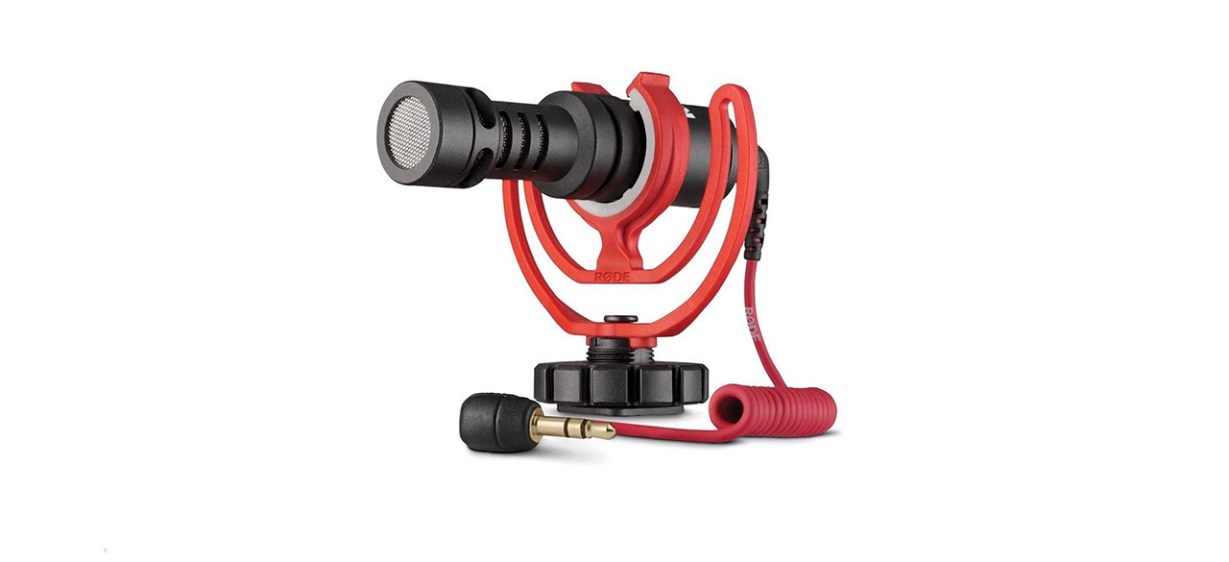
WBOY.com Please enter a search term. Please enter a search term. by: Charlie Fripp, BestReviews Staff Posted: Updated: by: Charlie Fripp, BestReviews Staff Posted: Updated: Mobile phones let everybody have a camera in their pocket to quickly capture photos or record short videos. But while the technology has advanced at a blistering pace, mobile gadgets can’t keep up with a traditional digital camera. Digital single-lens reflex cameras are not only excellent photography tools, they are also amazing for videos. But there is an obvious drawback. The factory-fitted microphone is often of poor quality, susceptible to the slightest breezes or just failing to record the full audio spectrum. If you’re serious about the sounds that go with your sights, then you must add a DSLR microphone to your photography arsenal. But which microphone is the best for you? A significant factor in choosing the right DSLR microphone is what you want to record. There are different kinds of microphones for various situations, and if you don’t use the appropriate mic, the audio won’t be great. You might have a certain microphone in mind, but you’ll be quickly disappointed if it doesn’t fit on your camera. The mounting where a flash goes is called the hot shoe, and that is where the microphone will attach to your camera — if it supports it. Not all microphones use the hot shoe, but it’s a convenient spot, ensuring that the mic and the camera’s lens are always focused on the same object. Other microphones connect to the camera through a 3.5-millimeter jack. But if you need the hot shoe for lighting at night, you’ll need to make a different plan for the microphone, such as a hot shoe extender or adapter. Some microphones use the mount for positioning only and don’t draw power through the plate. This is called a cold shoe. Just like your camera and flash battery, your microphone needs a power source. Look for a mic with a built-in battery that supports your shooting style. Ensure that you can easily recharge it or change batteries when needed. Keep in mind that some microphones can draw power directly from the camera, which drains its battery faster than usual. One thing to note is that condenser microphones require a power source, while dynamic microphones don’t. Rode VideoMicro Compact On-Camera Microphone with Rycote Lyre Shock Mount This shotgun mic is one of the most compact around, as it is only 3 inches long and weighs just over an ounce. It draws power directly from the camera and comes with a Rycote Lyre shock mount and a deluxe furry windshield that keeps out wind noise. Sold by Amazon Movo VXR10 Universal Video Microphone with Shock Mount Mounted on the DSLR’s hot shoe, this shotgun unidirectional microphone doesn’t require a separate battery source. It’s perfect for capturing audio in most situations and comes with a windshield, carrying case and a 3.5-millimeter cable. Sold by Amazon Comica CVM-VM20 Shotgun Microphone It is easy to keep track of battery usage with this shotgun mic. It has an OLED display for power monitoring and levels of the built-in battery. It has a 10-level adjustable gain knob and the battery can last for around 60 hours on standby. Sold by Amazon D Debra Audio Series UHF Wireless Lavalier Microphone Perfect for recording audio during an interview or speech, this lavalier microphone connects to a DSLR camera through a wireless transmitter. It has 30 channels to minimize interference, an LED display to monitor battery levels and comes with lapel clips. Sold by Amazon Shure VP83 LensHopper Camera-Mounted Condenser Microphone This condenser microphone screws onto a DSLR through the hot shoe mount, and the battery lasts for about 125 hours. It’s excellent at recording audio that is directly in front of it, and it comes with a windshield. Sold by Amazon Takstar SGC-598 Photography Interview Shotgun Microphone Great for interviews, this high-sensitivity condenser microphone has a cardioid unidirectional pickup. It focuses on audio straight ahead and rejects any sounds from the surroundings. The replaceable battery lasts for up to 100 hours and it comes with a padded windshield. Sold by Amazon Saramonic WM4CA Professional Portable Wireless VHF Handheld Microphone System The handheld microphone connects wirelessly to the DSLR camera through a VHF transmitter, which has a range of 200 feet. The transmitter has a detachable antenna that can rotate 360 degrees for the best signal. The microphone has a manual on/off switch. Sold by Amazon Maono Clip-on Lapel Mic with Omnidirectional Condenser To get up close and personal with your audio, this lavalier microphone easily clips onto a collar. It connects to the DSLR camera through a 3.5-millimeter cable, which is also compatible with mobile phones. It comes with a small windshield, two batteries and a carry pouch. Sold by Amazon Sennheiser Professional MKE 200 Directional On-Camera Microphone An excellent option for professional audio recording, this directional microphone from Sennheiser connects to a DSLR and mobile devices through a 3.5-millimeter cable. It has built-in wind protection and an internal suspension mount to minimize handling noise. It doesn’t have a battery and works on a cold shoe instead. Sold by Amazon Want to shop the best products at the best prices? Check out Daily Deals from BestReviews. Sign up here to receive the BestReviews weekly newsletter for useful advice on new products and noteworthy deals. Charlie Fripp writes for BestReviews. BestReviews has helped millions of consumers simplify their purchasing decisions, saving them time and money.
Copyright 2022 BestReviews, a Nexstar company. All rights reserved.
SESAC Finance returns with a $335 million securitization that will issue notes secured by a pool of music affiliate agreements, existing and future license agreements, and certain equity interests and intellectual property. SESAC Finance’s collateral includes existing and future music affiliate agreements, existing and future license agreements, plus certain equity interests and intellectual property. The current transaction, SESAC Finance, Series 2022-1, will add collateral related to collections from Audio Network, a production music company that SESAC bought in July 2021. Audio Network creates original music that can be licensed to other creators—such as television and music production companies—and used on multiple platforms, according to Kroll Bond Rating Agency. SESAC will use the proceeds from the deal to repay an existing credit facility of Audio Network, KBRA said. The rating agency added that it expects to affirm the ratings on the Master Issuer’s outstanding class A-2 notes, and withdrawing the ratings on the series 2019-1 class A-1 notes. The pending deal follows up on a transaction from 2019, which itself followed a corporate transaction in 2017, when private equity funds affiliated with Blackstone bought SESAC from Rizvi Traverse Management. SESAC Finance, one of the largest performing rights organizations in the U.S., and CCLI Finance, are co-issuers. Guggenheim Securities will be the sole structuring advisor and sole bookrunning manager, according to KBRA. SESAC Rights Management is on as the manager, with FTI Consulting as the backup manager. KBRA expects to assign ratings ranging from ‘BBB-’ on the $30 million, 2022-1, A-1 notes, to ‘BB-’ on the series 2022-1, M notes. Among the deal’s credit positives, KBRA noted, the performing rights organization has an experienced management team in an industry with extensive barriers to entry. Only four performing rights organizations representing songwriters and music publishers have been formed in the U.S. since 1914. SESAC itself contributed to the consolidation of the industry when it acquired Audio Network. Audio Network focuses on musical composition and sound recordings for licensing from content creators, such as movie and television producers, according to KBRA. Other aspects of the deal involved a more nuanced, or mixed, credit outlook. For instance, SESAC Music Affiliate agreements are shorter term—initially three years with automatic renewals, which doesn’t evenly match up with the duration of the notes. Yet the firm does offer renewal terms, and switching performing rights organizations can be costly and complicated for artists.
Some firms are undergoing their second or third rounds of terminations since the beginning of the year. Utilities had to buy electricity from ERCOT for their customers at wholesale prices as a result of widespread power outages in February 2021. Investors in the senior classes of the capital structure will receive principal and interest payments sequentially, beginning with class A, until class E2 receives all of its principal and interest. About 79% of the loans in the collateral pool were made to borrowers without full documentation, while 34% of the loans in the pool were underwritten to bank statements. The move builds on the government-sponsored enterprise’s previous program that facilitated the collection of more rent payment records from tenants who work with its multifamily borrowers. SESAC Finance, Series 2022-1, will add collateral related to collections from Audio Network, a production music company that SESAC bought in July 2021. The Tokyo-based company has named Masatoshi Komoriya executive chairman of the board of directors for MUFG Americas Holdings Corp. and its U.S. banking subsidiary. He begins his new role on June 30 while retaining existing executive duties. Given the significant amounts of energy needed for lighting and climate control, data centers involve more environmental risks than other property types. Business owners are seeing their cash flow strained by the highest inflation in 40 years and mounting costs to borrow money. PACE sponsors are raising capital and promoting plans to retroactively fund stalled CRE projects amid the COVID-19 outbreak – a potential boost for what has been a shrinking assets class in ABS
After 35 miles of fields and farmland outside the southern tip of Indianapolis, the small town of Hope appears suddenly with a sign that proclaims “A surprising little town.” Town manager Jason Eckart recently introduced one of the newest surprises in the community known for hot-rod parades, barbecue cookoffs, bluegrass music on the bandstand and classic car cruise-ins: two electric vehicle charging ports on the town square. “Hope is pretty rich in tradition,” he told a smattering of councilors and laypeople gathered for the unveiling. “We’re proud of our rural heritage. But yet, we’re able to adapt to the future.” The new charging stations are a “big wink,” Eckart said, not just the future of Hope, but the state as a whole. Indiana, historically a crossroads of transformational transportation innovation, is racing toward an electrified automotive future. “Maybe not today, but very quickly, every community will need EV [electric vehicle] infrastructure,” said Rep. Carey Hamilton, D-Indianapolis, who has worked closely on electric vehicle efforts in the state. Indiana already trails its Midwest neighbors in the adoption of electric vehicles and charging infrastructure, and lingers in the middle of the pack across the country. The prep work, for the most part, has been happening behind the scenes in research silos for decades. But now, market forces — including hundreds of millions in federal dollars and rapidly approaching deadlines — are coming to bear all at once, driving an accelerated push toward transformation. In a matter of months, the state must come up with a deployment plan for $100 million for electric vehicle infrastructure. “We have to look forward and invest these dollars now,” said Hamilton. “If we don’t, it will be an incredible lost opportunity and a real travesty for Hoosiers.” And it’s not just state officials under the gun. Stakeholders like utility companies, manufacturers and advocacy groups are forging new and unfamiliar partnerships. On the product side, a consortium of industry leaders have given themselves a similar deadline to report the current state of production and labor capability. And from the energy perspective, Indiana’s utilities are deliberating how to ensure the grid will be ready to meet the growing fuel needs. But one critical aspect of the transition — public engagement — is struggling to keep pace. Surveys have been circulated and public webinars scheduled, but some communities and advocacy groups say it’s all moving so fast and worry they will be left behind. To truly make a difference, they say, the transformation must touch every corner of the state: urban, rural, low-income and communities of color. State officials acknowledge there is a lot to do in a short amount of time, but it’s confident it will get there. “Right now it’s pandemonium,” said Carl Lisek, executive director of Drive Clean Indiana, a nonprofit focused on alternative fuels. “But it’s good pandemonium.” At some point in the next decade or two, it’s possible — if not likely — that electric vehicle charging ports will rival or outnumber traditional gasoline pumps. Beyond the wires, these pit stops will require new behaviors and infrastructure of a different kind: restaurants, shops, and the unhurried mindset that refueling will take more than five minutes. Like parking spots, charging ports will become part of the building code for new apartments, homes and office buildings. But virtually none of that exists now. In a state of more than 5 million adults, there were 7,000 registered electric vehicle owners as of 2020, the latest data available, according to the U.S. Department of Energy. They have access to only 900 public charging ports — think, single gasoline pumps — spread among 320 stations throughout the state. The federal government’s goal, as outlined in the new National Electric Vehicle Infrastructure program created by President Joe Biden’s infrastructure law, is to have 500,000 public charging stations placed along the country’s interstates by 2030. In theory, there will be charging stations every 50 miles, at least, which must be less than one mile off the highway. Each of these stations must have at least four ports supporting the kind of power that charges in about 30 minutes, known as DC Fast. In Indiana, only five existing public stations meet that criteria. “We’re really kind of going from 0 to 1,” said Adam Berry, vice president of economic development and technology at the Indiana Chamber of Commerce, referencing investor Peter Thiel’s book. “We’re starting with nothing and we have to go to full accommodation.” One of those five stations is in Indianapolis, at the Walmart off South Emerson Avenue. It’s never difficult to get a spot, said 22-year-old Emma Pate, filling up her 2017 Chevy Bolt on a recent sunny morning. But she still has to plan her week around this particular station, aligning her grocery trips with fuel-ups, since she doesn’t have a plug in her apartment complex located a 15-minute drive away. “There really needs to be more chargers,” she said. “It needs to be more popular, I guess.” Even California, the state leading the nation with hundreds of thousands of EV owners and tens of thousands of ports, has fewer than 200 stations that fit the bill for the ambitious federal plan released in February. The Indiana Department of Transportation — accustomed to timelines on major projects that usually span years — now has just weeks to lay out Indiana’s EV future and how it plans to catch up. By August, the agency must submit a plan detailing where and how it would spend $100 million over the next five years to build a network that meets the federal requirements — and doesn’t leave behind Indiana’s swaths of disenfranchised communities. “It’s an aggressive timeline,” said Scott Manning, INDOT deputy chief of staff, “but manageable.” Manageable, he said, because INDOT started researching the issue in partnership with Purdue University about five years ago. Purdue researchers are soon publishing a strategic needs assessment of Indiana’s electric vehicle infrastructure landscape. It is mainly focusing on long-distance trips and what’s known as “range anxiety” — the worry that there won’t be enough charging stations available to get from point A to point B. Right now, Indiana’s infrastructure — or lack of — has electric vehicle drivers quite anxious. Marion County residents would have no issue traveling within the county or just outside. “You want to go to Columbus, Ohio? That’s where you got to think about it a little bit,” said Darcy Bullock, director of Purdue’s Joint Transportation Research Program. Based on Indiana’s current setup, long-distance trips across the state tend to have high failure rates in Marion and Hendricks counties, based on these counties’ central location and their population demands. Charging deserts persist almost everywhere outside Marion County and the South Bend area. Having more stations can encourage more people to consider and buy electric vehicles, the researchers said, but only to an extent. The team is also working on research to determine where drivers already tend to stop and fuel up, so that the incoming EV infrastructure can line up with some degree of existing demand. “Wherever those investments are made, we want them to be fully utilized,” said Nadia Gkritza, principal investigator on the Purdue project. The questions around EV adoption are endless. The first meeting of the Electric Vehicle Product Commission last fall consisted of a string of these questions and thoughts, none followed to completion. The commission is a group of industry leaders and lawmakers convened by legislation in early 2021. Berry was there taking notes for the chamber. “I was truly nervous,” he said. “After that first meeting, I walked out frustrated and confused and just bewildered that they weren’t focused on the statutory obligations they had.” Their task is to evaluate the existing inventory of electric vehicle product manufacturing capabilities, including the skills and size of the workforce and opportunities for growth. The goal is to complete a report by September, in time for lawmakers to digest the state of things before the 2023 legislative session, a budget year. After that first meeting, however, momentum is now rolling. The commission has met seven times this year, and has divvied up research and writing responsibilities among the members. It represents another group project of unlikely partners — competitors like Stellantis, formerly Fiat Chrysler, and General Motors — racing to meet a deadline. “I feel more confident,” Berry said, “than I did before.” Nearly every major automaker is supportive of the forward momentum, as evidenced by their announcements that they’ll produce fully electric fleets in the next five to eight years, said Andrianna Hji-Avgoustis, director of governmental affairs for the Indiana Manufacturers Association. The potential in Indiana is immense, and pivotal, for the legacy auto industry. The state is a manufacturing powerhouse and one of the nation’s leading automotive producers with five assembly plants. Stellantis also just announced it was partnering on a multi-billion dollar battery manufacturing plant in the state. While none of Indiana’s auto plants are currently producing a purely electric vehicle, their parent companies are taking big strides in that direction. Right now, however, Rep. Hamilton worries that many of the parts and cars produced in Indiana would head outside the state. “Many auto manufacturers are moving quickly to mostly electrification, and we need to be ready to support that if we hope to have transportation continue to flow through our state,” she said. “There is an urgency to build out what is absolutely coming and to not drag our feet as we so often have in these areas.” One question that the state legislature hasn’t yet tackled is the implications of an EV transition for the state’s roads and infrastructure, which are heavily funded by gasoline taxes. If nothing changes in the state’s funding mechanism for roads, the projected loss of fuel tax revenue, based on predictions of EV adoption rates, could amount to $2.1 billion by 2035, the Purdue researchers found. Beneath the fray of Critical Race Theory and permitless carry, a key piece of electric-vehicle-related legislation did make it to Gov. Eric Holcomb’s desk this year. It’s one that stakeholders see as integral to a very practical hurdle in the EV transition: Who can actually sell and pay for electricity for vehicles? “We don’t know what we don’t know,” State Rep. Ed Soliday, R-Valparaiso, said in a January committee hearing on his House Bill 1221. “And any bill we do on EV is going to have to be iterative.” The Indiana Utility Regulatory Commission asked lawmakers to start tackling some basic questions, he said — which the bill, now law, starts answering. It allows private companies, such as gas stations and convenience stores, to buy and sell electricity from the utilities that service their area for the purpose of electric vehicle charging. Under the law, doing so would not reclassify that gas station or convenience store into a public utility, thus opening the door for countless new sites to host charging stations. Not only does this clear mom-and-pop convenience stores from having to be regulated by the IURC, but it creates a path for them to pursue a new source of revenue, said Greg Ellis, the chamber’s vice president of energy and environmental policy. If President Biden’s vision comes to fruition, electric fuel may increasingly outpace traditional gas sales. “It was simple,” Ellis said of the legislation, “but it was a big deal.” The law also allows electric utilities to create pilot programs deploying charging infrastructure for “public use” electric vehicles — such as public transit, school buses and emergency vehicles — and recover the cost of those programs by charging higher public rates. If approved by the IURC, the extra ratepayer dollars would go only toward those public vehicles within their utility’s service area. “Nowhere are we going to have grandma subsidizing fancy cars up where I live,” Soliday said. That’s what the federal funding is for: to help fund charging stations for EV drivers across the state. Still, the owners and operators of the stations will work to set the “price at the pump,” or the cost of electricity when charging. Having more charging stations won’t mean anything, however, without the electricity to power them. That is another looming question — and concern: Will there be enough fuel, in the form of electrons moving through wires? “The power availability,” said Manning with INDOT, “is probably the biggest consideration for Indiana.” As such, utilities are a key part of the infrastructure and transition process. The state is working closely with Indiana’s power providers, as well as Purdue researchers, to map out the corridors in need of EV charging stations and how that overlaps with where the necessary level of power is available. They are also looking at what it would take to provide adequate electricity where it is not available. It will be different for every utility based on charging stations being considered in their service territory, according to Danielle McGrath, president of the Indiana Energy Association. Finding the right spot could be something as simple as moving the charger across the street or down a block, where it would require significantly less upgrades or work to the wires, said Cory Gordon, Duke Energy’s director of transportation electrification. That’s why the utility wants to coordinate early with the private businesses that plan to sell the electricity. The utilities have some practice as they are in the process of building dozens of chargers across Indiana that they will own and operate. Just last year, a group of eight utilities was awarded roughly $5.5 million from the Volkswagen Settlement Fund, which resulted from the company installing defective emissions-control devices in hundreds of thousands of diesel-powered vehicles. With that money, the utilities are building 61 of the DC Fast chargers — those that charge within about a half hour — along Indiana’s major roadways. They hope many of them will be operational next year. “That’s pretty exponential growth,” said Shawn Seals, a senior environmental manager with the Indiana Department of Environmental Management that oversees the VW fund. “Then factor in what is likely to follow from the federal program and the scale of that, and the state should be seeing some really significant coverage for EV charging.” It’s unclear at this time just how many chargers will come from the $100 million in federal funding, but Seals said “It’s safe to presume we would expect a lot” — potentially in the range of a couple hundred DC fast chargers. This comes at the same time businesses and towns, like Hope, are adding slower charging stations and homeowners are installing chargers in their garages. So can the grid handle the impending “exponential” growth? Experts say it comes down to how it’s managed. Zac Elliot with AES Indiana said they don’t expect any near-term adverse impacts to grid reliability. He points to the 1950s during a time of widespread adoption of central air and heating, which created massive new demand. “We’ve been accommodating load growth for more than 100 years now, so it’s not new,” said Elliot, the electrification portfolio lead. “There will definitely be a learning process over time, but simplistically the impact will be new load in areas where DC Fast charging is installed.” To manage that load, both Gordon and Elliot said the utilities are exploring new paradigms — including different rate structures — that would incentivize EV drivers to charge during off-peak times when it is the most efficient for the grid and maintains its reliability. AES Indiana said it is forecasting around 175,000 electric vehicles in its service territory, or roughly 35% of its 500,000 customers in the Indianapolis area, by 2030. “The future is electric,” Elliott said. “We feel with public policy trends, public and private infrastructure investment, and manufacturer goals — these are all tailwinds.” The Rev. David Greene said his predominantly Black neighborhood could really use an EV charger. He thinks his church, Purpose of Life Ministries, could be the perfect spot. It has about 10 acres, it’s right off an I-65 exit on 38th Street, and it’s a place that feels safe in the community. But he has no clue where to start. Greene said he is raising his hand to show interest, but he’s not sure if anyone is listening. “I’m not even sure how to plug in right now,” he said. “We can’t address disparity issues without putting forward the energy and effort.” Part of the federal plan requires states to think about rural and low-income areas. A separate, $2.5 billion grant program will be available specifically to help deploy chargers in disadvantaged communities. Equitable public engagement is “a major component” of this process, Manning told attendees of a recent webinar on the EV infrastructure plan. INDOT’s public engagement plan is a “living document,” he said, and will continue throughout the five years of the federal infrastructure deployment process. But Denise Abdul-Rahman, the Indiana state chair of environmental and climate justice for the NAACP, said the engagement process thus far raises some serious concerns for her. “Has it been equitable? I think I have to say it’s still unfolding, and I think it will depend,” she said. In April, INDOT put out a request for information, or an RFI, from all interested stakeholders, hoping to gain insight into the market, funding opportunities, and the needs of underserved communities. It has hosted online webinars and three in-person public meetings, one each in Indianapolis, Plymouth and Seymour — the latter two are both in rural areas where more than 80% of the population is white, according to the latest census data. The meetings were limited to 50 attendees. Abdul-Rahman said she didn’t learn about the state’s efforts until just a couple weeks ago. From her own outreach, she said many constituents and communities “weren’t even aware” the public engagement process was taking place or that they could submit comments as part of the RFI. That shows the state needs to do more to actually identify and reach Black and brown communities so they can fairly participate, Abdul-Rahman said. These communities also stand to benefit substantially from the build out of EV infrastructure, she added. Station hosts could see additional revenue from drivers using their chargers, and neighboring businesses could see more foot traffic as those drivers look for something to do while fueling up. Those communities also could see the creation of skilled jobs to help operate and maintain the chargers, Abdul-Rahman said. Beyond the economic opportunities, the environmental gains could also be considerable. “Most Black and brown folks live close to highways and roads that are frequently driven, so we know if we can electrify vehicles then our air quality and breathing will be better,” she said. “But if the charging stations aren’t in ethnically diverse communities, then that means no EVs are coming through and there will continue to be that pollution in the community.” Greene said he sees the environmental benefits and the additional funds it could bring for the church’s outreach initiatives. He also sees the importance of showing his parishioners and the surrounding community that EVs are for everyone, including them. Having a charging station at the church would not only help passersby on the highway, Greene said, but also the many apartment renters in the area who don’t have the ability or option to access chargers at home. Creating infrastructure in low-income and minority communities is a way to promote and encourage using EVs — an easier argument to make as EV prices come down and gas prices rise. “This could be transformational, for everyone,” Greene said. “But we can’t speak to it if it isn’t in our neighborhoods, otherwise, people will say ‘this isn’t in our communities, this isn’t for us.’” Hope, population 2,100, decided not to wait for the feds. The town council voted earlier this year to invest $6,000 to buy the two charging ports, which output enough energy to charge a car in a couple hours. It’s not the level charger the federal plan desires, but Eckart, the town manager, believes it’s sufficient for Hope, where he can only think of a handful of people in town who might have an electric vehicle. One of them is the town marshal. But this is as much for them as it is for outside electric vehicle drivers in a future where they need a quaint place to stop, charge up and grab a bite. “If we could just get them to stop in our tiny little town,” Eckart said, “they might come back.” In this small town, the politics are such that a self-described “motor-head” like councilor Ohmer Miller also voted for the proposal. He cited a concept called “the greater good,” despite his personal misgivings about electric vehicles. “I don’t think you’re going to see an electric vehicle at a cruise-in,” he said. Even INDOT and Purdue are only using a 5% adoption rate figure by 2030, among personal automobiles, in their modeling. Major changes are often difficult to imagine before they really start to come to fruition. The weekend of Hope’s charging station unveiling, former resident Bonnie Miller Smith happened to be in town for a 50-year class reunion. Her eyes welled up as she took in the old and the new. Some things are the same: the funeral parlor on the corner, the playground where she played as a kid and her own children after her. Others are new and improved, like the winding sidewalks and upgraded facilities through the square. And the two new parking spots with the bright green EV insignia. Of all the changes, that last part was not what she expected for her little hometown of 62 years. “I never thought it would happen — I never even thought about it,” she said. Contact IndyStar transportation reporter Kayla Dwyer at [email protected] or follow her on Twitter @kayla_dwyer17. Call IndyStar reporter Sarah Bowman at 317-444-6129 or email at [email protected]. Follow her on Twitter and Facebook: @IndyStarSarah. Connect with IndyStar’s environmental reporters: Join The Scrub on Facebook.
For updated information on coronavirus/COVID-19, visit orlando.gov/covid19. In observance of Independence Day, City Hall and all city offices will be closed Monday, July 4, 2022. Residential trash pick up will occur as usual. Specific Parcel Master Plan (SPMP) for RoseArts Phase 1, to consist of 1,594 units (160 affordable) and 150,000 sq ft to be divided among four multi-story apartment buildings with attached parking garages on 38.46 acres. The buildings will be aligned along a central spine road that splits to form a “Y” around a signature pond with the eastern branch the main through road. Subject property is located on the southeast side of Rosamond Dr., extending south to the north side of Lake Breeze Dr., west of Dunwoody Place Condos and east of existing single family homes on the east side of N. Lake Orlando Pkwy., all west of N OBT and N. John Young Pkwy. 5155 Rosamond Dr., Orlando, FL 32808 View Map 5155 Rosamond Dr. , Orlando, FL 32808 Once cases are set for a hearing they will appear on the Board’s agenda. The information presented may be based on the staff’s preliminary review of the submitted application and is subject to change. Contact the Project Planner for the latest project information. If you wish to review the complete file for this project, please make a Public Records Request. City Hall 400 South Orange Avenue Orlando, Florida 32801 407.246.2121 Monday – Friday 8 a.m. to 5 p.m. Observed holidays Contact Us City Directory Subscribe to City News Downtownorlando.com Information Locator News and Information




 Shekanena downplays it, but he brought a lot of musical talent with him from Wyoming, Michigan – so much so that his song, “Burdens to Bear,” was chosen for the Canyon Worship 2022 album even though he was only a freshman.