Blog

Canada Silver Cobalt Intersects 0.89 % Nickel EQ over 5.80 Meters in Zone of Massive Sulphides at Graal – TheNewswire.ca

In addition, the remainder of all pending assays from the 2021-2022 winter drill program have been received; this will allow completion of a technical report at the Graal property.
Coquitlam, BC, June 27, 2022 – TheNewswire –  Canada Silver Cobalt Works Inc. (TSXV:CCW) (OTC:CCWOF) (Frankfurt:4T9B) (the "Company" or "Canada Silver Cobalt") is pleased to provide the latest exploration results at its Graal nickel-copper-cobalt discovery in the Lac St-Jean region of Quebec.
Drilling Highlights:
NRC-22-26 intersected 5.80 meters of massive to disseminated sulphides with assay results grading 0.89% Ni Eq, 0.57% Ni, 0.41% Cu, and 0.08% Co from 135.00m to 140.80m.  
Select assays within the composite graded up to 1.45% Ni Eq, 1.05% Ni, 0.43% Cu, and 0.11% Co over 1.00m from 139.10m to 140.10m.  
An additional intersection further down the hole from 148.80m to 159.30m graded 0.19% Ni Eq, 0.10% Ni, 0.13% Cu, and 0.02% Co.  
The drill hole is located approximately 100m from drill hole NRC-22-24 (News Release of April 4, 2022) where the Company intersected 1.20% Ni Eq, 0.72% Ni, 0.86% Cu, and 0.09% Co over 9.30m from 142.80m to 152.10m.  
These two drill holes are located approximately 5km southeast from the area where the massive sulphides were first discovered in 2021.  
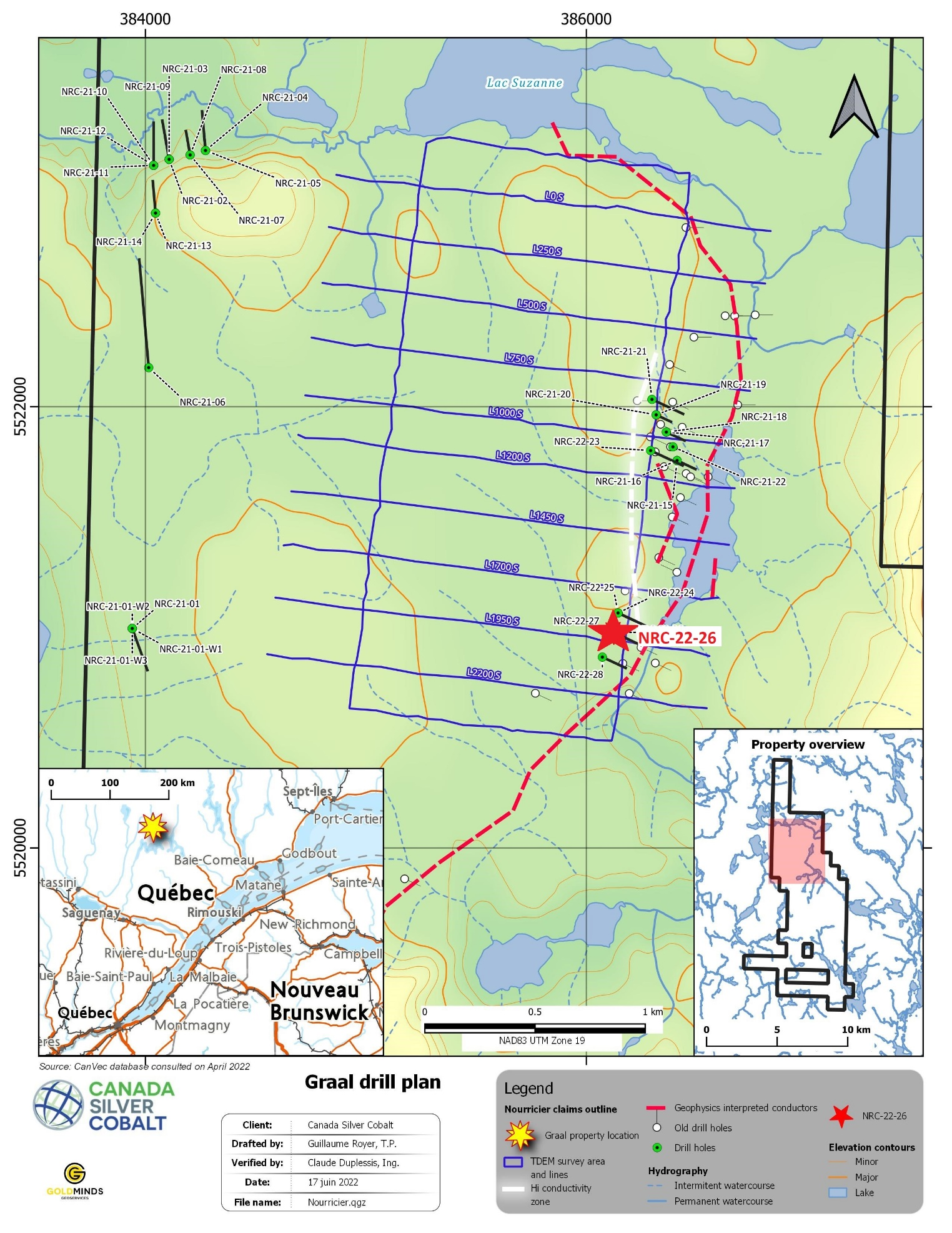
The current drill campaign is still on-going and has been designed to test high-priority anomalies discovered from the most recent geophysical surveys. See Table 1 below for the assay data, Figure 1 for a core photo, and Figure 2 for a map of the drill hole location with respect to the recent TDEM geophysics grid.
“We’re happy to finally receive all the pending assays from the previous drill campaign. This will allow us to move forward with the Technical Report for this property. Almost every drill hole has intersected disseminated to massive sulphides with nickel-copper-cobalt mineralization. We will continue exploration at Graal and plan to determine the extent of this nickel-copper-cobalt deposit. This property aligns with our vision of being an important supplier of battery metals for the EV market, and we are excited to see it develop,” stated Matt Halliday, P.Geo., President, and COO.
The 6,113-hectare Graal property is one of 14 properties recently acquired in northern Quebec covering 31,201 hectares that are prospective for EV battery metals such as nickel, copper, and cobalt. (See February 16, April 21, July 22, November 15, 2021 and January 31, 2022 news releases). The drill program is currently being managed by Laurentia Exploration in association with GoldMinds Geoservices Inc.
Table 1: Key sample and assay details for drill hole NRC-22-26
HOLE ID
From (m)
To (m)
Length (m)
Ni (%)
Cu (%)
Co (%)
% Ni Eq (1)
NRC-22-26
135.00
140.80
5.80
0.57
0.41
0.08
0.89
Including
137.00
137.70
0.70
1.02
0.66
0.13
1.54
Including
139.10
140.10
1.00
1.05
0.43
0.11
1.45
NRC-22-26
148.80
159.30
10.50
0.10
0.13
0.02
0.19
Including
158.50
159.30
0.80
0.38
0.59
0.05
0.68
Please note: Intervals are core length and is presumed to be close to true thickness, with no capping applied, and using quartered core split. Bolded intervals are grade composites. NRC-22-26 was drilled at an azimuth of 115 degrees, dip of -50 degrees, and is located at UTM 386123E, 5520977N.
Note (1): %Ni Eq = %Ni+(%Cu X Cu Price/ Ni Price) + %Co X Co Price/ Ni Price) where Nickel is 33,000USD/t, Copper is 10,000USD/t and Cobalt is 81,500USD/t; source LME March 30, 2022.


Click Image To View Full Size
Figure 1: Core photo of NRC-22-26 with massive sulfides highlighted from 135.00m to 140.80m


Click Image To View Full Size
Figure 2:  Location of drill hole NRC-22-26 within the TDEM geophysics grid
QA/QC
The core samples have been split in two with a rock saw. Half was sent to ALS laboratory in Val d’Or and the other half kept as witness core. Blank and standard were inserted in the sequence and are in line with expected values allowing the disclosure of the assay results.
Qualified person
The technical information in this news release has been reviewed by Claude Duplessis, P.Eng., GoldMinds Geoservices Inc. member of Québec Order of Engineers and a qualified person in accordance with National Instrument 43-101 standards.
About Canada Silver Cobalt Works Inc.
Canada Silver Cobalt Works Inc. recently discovered a major high-grade silver vein system at Castle East located 1.5 km from its 100%-owned, past-producing Castle Mine near Gowganda in the prolific and world-class silver-cobalt mining district of Northern Ontario. The Company has completed a 60,000m drill program aimed at expanding the size of the deposit with an update to the resource estimate underway.
In May 2020, based on a small initial drill program, the Company published the region’s first 43-101 resource estimate that contained a total of 7.56 million ounces of silver in Inferred resources, comprising very high-grade silver (8,582 grams per tonne un-cut or 250.2 oz/ton) in 27,400 tonnes of material from two sections (1A and 1B) of the Castle East Robinson Zone, beginning at a vertical depth of approximately 400 meters. Note that mineral resources that are not mineral reserves do not have demonstrated economic viability. Please refer to Canada Silver Cobalt Works Press Release May 28, 2020, for the resource estimate. Report reference: Rachidi, M. 2020, NI 43-101 Technical Report Mineral Resource Estimate for Castle East, Robinson Zone, Ontario, Canada, with an effective date of May 28, 2020, and a signature date of July 13, 2020.
The Company also has: (1) 14 battery metals properties in Northern Quebec where it has recently completed a nearly 10,000-metre drill program on the Graal property and an airborne VTEM geophysical survey is being conducted at it Lowney-Lac Edouard property; and (2) the prospective 1,000-hectare Eby-Otto gold property close to Agnico Eagle’s high-grade Macassa Mine near Kirkland Lake, Ontario where it will be exploring in 2022.
Canada Silver Cobalt’s flagship silver-cobalt Castle mine and 78 sq. km Castle Property feature strong exploration upside for silver, cobalt, nickel, gold, and copper. With underground access at the fully owned Castle Mine, an exceptional high-grade silver discovery at Castle East, a pilot plant to produce cobalt-rich gravity concentrates, a processing facility (TTL Laboratories) in the town of Cobalt, and a proprietary hydrometallurgical process known as Re-2Ox (for the creation of technical-grade cobalt sulphate as well as nickel-manganese-cobalt (NMC) formulations), Canada Silver Cobalt is strategically positioned to become a Canadian leader in the silver-cobalt space. More information at www.canadasilvercobaltworks.com
“Frank J. Basa”
Frank J. Basa, P. Eng.
Chief Executive Officer
For further information, contact:
Frank J. Basa, P.Eng.
Chief Executive Officer
416-625-2342
Neither the TSX Venture Exchange nor its Regulation Service Provider (as that term is defined in the policies of the TSX Venture Exchange) accepts responsibility for the adequacy or accuracy of this release.
Caution Regarding Forward-Looking Statements
This news release may contain forward-looking statements which include, but are not limited to, comments regarding future financings, if any, pursuant to the short form base shelf prospectus referred to above, and comments that involve future events and conditions, which are subject to various risks and uncertainties. Except for statements of historical facts, comments that address resource potential, upcoming work programs, geological interpretations, receipt and security of mineral property titles, future financings, availability of funds, and others are forward-looking. Forward-looking statements are not guarantees of future performance and actual results may vary materially from those statements. General business conditions are factors that could cause actual results to vary materially from forward-looking statements. A detailed discussion of the risk factors encountered by Canada Silver Cobalt is available in the Company’s Annual Information Form dated July 19, 2021 for the fiscal year ended December 31, 2020 available under the Company’s profile on SEDAR at www.sedar.com.
Corporate Head Office:
PO Box 1971
Cochrane, AB T4C1B7
(877) 456 6241
© Copyright TheNewswire 2020 – . All Rights Reserved.

source

William Orbit: "Pro Tools is a lot better than drugs, that's for sure!" – MusicRadar

MusicRadar is supported by its audience. When you purchase through links on our site, we may earn an affiliate commission. Here’s why you can trust us
By ( , , ) published
Super-producer William Orbit’s career went on hold as he battled drugs and lost his confidence. The joy of painting and a beginner’s guide to Pro Tools got his mojo back, and now he’s releasing his first new album in eight years…
William Orbit has produced and collaborated with some of the biggest names in pop, including Madonna, U2, Blur, Pink, Robbie and Britney to name but a very few.
He’s won countless awards and sold millions of records, not to mention becoming a leading figure in the electronic music scene with his incredible Strange Cargo series and the classical reinterpretation album Pieces In A Modern Style.
But, as mighty as all of these achievements have been, it’s the parts of his life in between that are often more incredible.

There were the times when Orbit was a “seasoned squatter”, busking his way around Europe in the early days. Then, in the ‘80s, and after he’d been a model in Japan (as you do), his first band Torch Sing was signed to Miles (Stewart’s dad) Copeland’s IRS Records – the first life changer.
Once I got started, it started to flow and then it was a torrent and it felt like I was in 1997.
With the proceeds from that, Orbit created Guerrilla Studios, where he honed his production skills while the likes of The Cocteau Twins, Erasure, Gary Numan and, yes, Ricky Gervais made use of the facility. Then there was the first hit single: not the ambient/electronic masterpiece you might expect but Harry Enfield’s legendary Loadsamoney (Doin’ Up The House).

This all led to Orbit’s successful solo career and production work on era-defining records – Madonna’s greatest album, Ray Of Light, and Blur’s 13 – and collaborations with Beck, No Doubt, Ricky Martin, Queen, All Saints and many more.
But just as most of us would consider retirement after such an eventful career, Orbit’s life took an unexpected turn. He started taking drugs in his early 60s, eventually succumbing to their dark side and becoming so psychotic that he once believed he was going to be assassinated by the Church of England and that he worked for the Royal Family.
Luckily, a spell in rehab eventually cleared his mind, but by this time – and after a series of less well-received releases – he had lost his confidence and the will to work with anyone, or release any new music.

Which makes this year’s new album, The Painter, even more extraordinary. Better still, it’s a real return to form – there are some stunning collaborations with Beth Orton, Georgia, Katie Melua and Polly Scattergood – but you have to ask how it happened.
The answers are typically Orbit: becoming a painter gave the album its name but it was a beginner’s course in Pro Tools which reopened the floodgates. “It was inspiring,” he says. “Once I got started, it started to flow and then it was a torrent and it felt like I was in 1997. It was a release, you know?”
New album The Painter has some extraordinary vocal talent on it. Was it easy to get them all involved?
“It was wonderful because I haven’t been doing this for a long time, and coming back wasn’t  difficult. It almost felt like it fell into my hands. The singers all gave me their most passionate and wonderful vocals. I couldn’t have asked for better.”
Did you record the vocalists remotely or did they come into your studio?
“A couple of times I already had the vocal and built a track around it, like Beth’s that was recorded at the beginning of the ‘90s. With Katie we did it in a Las Vegas casino called Palms. The rest were all long distance because of Covid. Natalie [Walker] was in Colorado, Lido [Pimienta] is in Canada, and various other people were singing it in. Normally they would hear a track that I had started and then send me their vocal. It was a bit basic as some people recorded theirs in a kitchen, but it doesn’t matter.”
Did you ask Madonna to appear?
“No, both of us are doing our thing. She’s firmly attached to a project which is going well and I’m firmly attached to this, so we didn’t, but I wouldn’t rule it out in the future.
“I did unearth a track called Cuidado Con Mi Corazon, a track she and I did for Ricky Martin. I’d done a reworking of it just with some of her Spanish vocals. We did think about putting that on the record, but with albums it is often what you leave off, you know? I did discover a lot of unreleased material I did with her and maybe it will see the light of day one day.”William OrbitThe album comes after a fallow music period. What happened?
“I couldn’t face music, look at my equipment or even open a laptop. I had got into the ‘songwriting for hire’ game and found that didn’t really work so well. I felt I wasn’t getting a response and nobody gave a toss. I lost confidence in my own abilities and I had the perfect storm of personal issues building so music was the last thing on my mind.”
We hear that a Pro Tools beginner’s course helped bring it back, so why ‘beginner’s’ after so many years of using it?
“I wanted to know about some of the features that I’ve always worked around. I’m pretty fly but was like ‘what does this one do that has been staring me in the face for yonks?’. And then I realised how much I didn’t know. As you race along and never read the manual you leave stuff behind
“I took this very good online course and it was marvellous. Every day you learned a new trick and it’s never too late to learn. And that is also key to inspiration, because you find a new thing and you think ‘I must apply that to something’.”
You did have a struggle with drugs a few years back, so a lesser website might say that ‘Pro Tools saved you from drugs’…
“Goodness me I have to de-compact that! Pro Tools is an immersive application that I particularly love. My favourite apps are Pro Tools, Photoshop and Final Cut Pro: immersive, creative worlds that you make your own. So, creativity saved me from drugs.
“I got into drugs belatedly in my life. My first druggy period was when I was 14 and I stopped when I was 17. And then my next one was when I was about 61! Pro Tools is certainly a lot better than drugs, that’s for sure!”William OrbitThe new album certainly has many trademark William Orbit sounds. Did you use a lot of old gear?
“I did use some old gear – I have a lockup full of synths but I’d actually lent them all out as they were not getting used. I used multitrack tape [to record] from ’83 to ’97 then, with the Madonna album, I went over to America and went ‘Pro Tools’. So over this 14-year period I had amassed about 110 two-inch multitracks, so I had them all digitised, a vast archive of material that’s never been released. I used some of it as sound sources [for the new album] – almost like a synth patch, as a starting point. So the album took 15 months to make or 15 years, and it was all done ‘in the box’ but before ‘the box’ was invented!”
So now you are in the box, what are your favourite plugins?
“The prosaic ones like EQ, compression and filters. I use a Focusrite three-band EQ, the Red one, for everything. It’s always been my way: find one EQ I really like and I’ll use it for everything. Ditto reverbs. People think I have an array of reverbs but it’s just one or two. I just have a set of handy plugins that just shape a sound like a palette knife or a chisel.”
What about favourite instrument plugins?
“Some of the sound-crafting ones are awesome. I do like [Native Instruments] Massive, but they have to fix this thing where notes just hang. I like a library like the next man. If I haven’t got a real string section I use libraries. Kontakt is awesome and I love Melodyne as a remedial tool as well as a creative tool. A really good tool is fabulous for a little invisible mending but you can also use it to rock out on some wild areas.”
Which hardware synthesizers have been your favourites over the years?
“The Korg MS-20: wildly unpredictable and if you get a good sound you need to get it down onto tape ASAP. The Roland Juno-106: I’ve been into Junos since the Juno-6 back in about 1980. Then I had the 60, then the 106. Ray Of Light, all the Strange Cargo records, half of it is the Juno-106.
I’d love to do something with Shakira, she’s my favourite. I think she’s a genius, actually.
“I also love the Roland JD-800 for its sonics although it is not as intuitive. It’s big and takes up a lot of room but it is so rewarding to use. I’ve always liked Roland stuff and old analogue synthesizers, ones with the traditional controls. There are certain things to control and sculpt sound and you have to have easy access to them. You don’t want to go through pages and pages of stuff.”
You have obviously worked with many artists. Any favourites?
“A lot of them. I loved working with Bono; what a joy to be working with a singer like that. Also Beth Orton. We’ve always clicked and there are so many things I love about working with her. I’ve loved working with Madonna: moments of just musical magic. The session I did with Beck, we wrote a tune for Pink, and that was brilliant, we had such a laugh.
“Working with Blur for the first time, they had this tiny little studio that Damon [Albarn] had at the time. It was at the peak of a heatwave and we were all crammed in. Dave [Rowntree] was in the mix room drumming. Graham [Coxon] and Alex [James] had their guitars kicking off and Damon picked up the mic and it was like ‘oh I love bands, I love that collective sound, oh yes’. There was something that was just gorgeous.
“So I’ve had great times and it’s very hard to pick one. There are these fun, crazy sessions where everyone’s wild and probably drinking too much and something comes out of it and then there are ones that are a struggle and suddenly there’s a breakthrough. I just enjoy them all.”
Would you like to get back to producing other artists again?
“Yes I would. I feel confident I’ve got something to offer. Sometimes working with artists, they are so perfect as they are that I think ‘there’s nothing I can contribute’. But there are a lot of artists where I think I could do something really cool if they are up for a bit of musical adventure. I’d love to do something with Shakira, she’s my favourite. I think she’s a genius, actually.”

What else do you have planned with the new album?
“There will be an Atmos version and all of the tracks will have a painting and an animated version. I’m planning an art exhibition as well. And collaborating with some great artists and singers; yeah I love that. There’s nothing I like more than to work with an artist to help make their vocal sound like heaven, so if you want me to help you, I’m ready to go. Here I am everybody, I’m at your service!” 
William Orbit’s album The Painter will be released on 26 August and can be pre-ordered now (opens in new tab).
Andy has been writing about music production and technology for 30 years having started out on Music Technology magazine back in 1992. He has edited Future Music, Keyboard Review, MusicTech magazines and currently runs Computer Music which he helped launch back in 1998. He owns way too many synthesizers.
Don’t miss the latest deals, news, reviews, features and tutorials
Thank you for signing up to Musicradar. You will receive a verification email shortly.
There was a problem. Please refresh the page and try again.
MusicRadar is part of Future plc, an international media group and leading digital publisher. Visit our corporate site (opens in new tab).
© Future Publishing Limited Quay House, The Ambury, Bath BA1 1UA. All rights reserved. England and Wales company registration number 2008885.

source

In conversation with Anand Bhaskar on the musical world of Masoom – Entertainment News , Firstpost – Firstpost

“Bollywood and OTT space are quite different; OTT is aimed at the newer audience and allows you to experiment”, says singer and composer Anand Bhaskar.
Playback singer and composer Anand Bhaskar
Playback singer and composer Anand Bhaskar’s magical transition into the world of music from advertising, to feature films, to web series is a dream come true. Bhaskar quit his corporate job a few years ago to create his own independent music. His career as a professional, full-time musician started with singing and composing for ad campaigns, then going on to singing songs in films like Baaghi 2 and Mission Mangal and his first project of repute, as a composer, came with highly acclaimed web series Mirzapur followed by Bombay Begums and most recently the psychological thriller Masoom on Amazon Prime. Bhaskar, a trained musician in various genres, is hugely inspired by A R Rahman and Amit Trivedi and he is also the founder of the band, ‘Anand Bhaskar Collective’. Together they deliver perfectly blended Hindi rock songs that have elements of Indian classical, rock, metal and electronica. In a candid conversation with Firstpost, the musician talks about how independent and Bollywood music work, changing scenarios in Hindi and popular film music, future of indie music and more.
Excerpts from the interview:
How did you decide the musical world for a story like Masoom?
I first look at where the story is based, what are the surroundings, what are the emotions. In Masoom it is Punjab and that is how it is decided upon the tone. Before I begin scoring I read the script, then I sit with the director. I sat with Mihir (Desai) and discussed the musical references. Then we narrowed down the instruments that will bring out the flavour of the locale, scenes, then it is like marrying the traditional instruments with the non-traditional ones to create a score that is universally palatable. Both of us synced on the whole world cinema look, feel and sound for the score. Then Mihir went on a recce and by that time I was ready with a bunch of themes for him to listen to and one of them was the title sequence. And because I had read the script I had in mind the kind of musical directions the theme will take. I am a huge fan of subtle, sombre, intense storyline kind of shows, I love shows like Ozark and Dark (both on Netflix). These are slow paced shows. I wanted to create something similar but also contextualise it for the Indian audience. What is happening in the Indian OTT space is that a lot of shows that are being made across all platforms are very fast paced, I haven’t seen a show like Masoom where it is so subtle and also fast paced at the same time. There is a sombre speed to it and I think that is something I really liked about it and that inspired me and my team to write the score.
You have composed for big OTT shows like Mirzapur, Bombay Begum and now Masoom, and you have also worked in Bollywood, what is the difference that you find between films and digital?
Working in Bollywood and working in OTT space are quite different in a sense that OTT allows you to experiment. It is aimed at this newer audience that doesn’t necessarily only consume traditional forms of entertainment. They want newer story lines; they want darker themes. That is where for filmmakers and musicians like me there is an opportunity to bring in new influences and new sounds whereas when I am working for a Bollywood film there is this mind-set that whatever we make has to be a banger. It is a very song centric industry not so much a music centric industry; OTT is a more music centric industry. For example, in Bollywood films songs get a lot more importance than the background score. That is also interesting in a way that if I am working with a film producer, they will come with the brief that this is the situation, this is the song and, of course the song needs to be catchy enough to be popular. That puts a constraint on you and sometimes you thrive under that constraint. It teaches you how to work under restrictions, whereas in OTT you are given a free hand. The experimentation is limitless. These days web series title tracks have their own audiences, people are putting that music as ringtones and caller tunes. Background score as an aspect of films and shows was in the background until the OTT wave came in. Now we can really go the whole nine yards in composing music for OTT.
You quit your corporate job to create music, how has your experience in corporate set-up helping you in your music?
I have been inclined towards music since I was a child. My mother identified that in me and she pushed me towards it but there was this pressure to have a backup career in case music doesn’t work out. But the problem is your backup career many times becomes your primary career. In 2014 I decided that if I don’t do music now I don’t think I will ever do it and I took the plunge. I feel all experiences accumulate and culminate into what we are today. I am able to articulate and express what I feel because I worked with some of the best talents in the advertising industry and the corporate world. I can write my emails really well and that I feel is a bonus when you come from a corporate experience. It has also disciplined me in a way that I am an excel sheet person. What theme of music needs to be ready by which date is all very documented for me.
How did OTT happen?
I have always wanted to be a composer and when I quit my job to take up music full time I had a strategy in mind. Because I am also a singer my first priority was to build a singer’s portfolio, so I started with ads. Slowly I started singing for films and then getting into OTT space. I was simultaneously releasing original music with my band Anand Bhaskar Collective which is Hindi alternative rock and it is all original music. Every time somebody asks me how you got this project, I tell them that every composition project that I have today is because of my original music. Somehow that original music found its audience and that audience started growing big. Today we have crossed five million streams on our discography only on Spotify and that is just one streaming platform. It is all original music not backed by any label, we don’t have huge promotional budgets but somehow it has found its way to people who make decisions. Ankur Tiwari, who was the musician supervisor for Gehraiyaan and Gully Boy, recommended my name to Excel, the producers of Mirzapur who were looking for a new composer. Ankur is an icon for indie musicians because he is making a lot of efforts at a larger level to inject independent music into commercial cinema. That was the first time I was working on somebody else’s brief and I realised that I am not bad at it. That led to Mirzapur season 2, Bombay Begums and now Monsoon.
During the pandemic I was working on a lot of ads from home and alongside I acquired knowledge on music production, mixing and sound engineering principles and that really contributed towards my skills as a composer. I wrote a lot of new music which I would constantly share with my filmmaker and musician friends just to get their feedback. One thing led to another and I was approached for Masoom. In due course of time I gravitated from being a singer to composer.
How has the advertising industry helped you in your journey of music?  
When I was working as a strategy and planning guy in advertising I understood how business works technically. That understanding a lot of young musicians who straightaway go into music lack because a lot of times artists enter the art business with a lot of passion but don’t have an understanding about how it works as a business. I feel I had that understanding and my first goal was that I had sustainable income through music. The first three years I was relentlessly singing ads which paid my bills. I learnt how to work with production houses, how to network, how to expand yourself in terms of adding more skills to your repertoire… Advertising industry helped me see how to see music as a business and not just get carried away by the emotion of it all. I made sure that I get paid for my efforts. Artists are given that picture, ‘Oh, we are giving you an opportunity, why are you expecting money?’, or they get paid very less and that leads to financial stress. Once your finances are taken care of you have the mental and emotional bandwidth, you are comfortable and you can focus on other aspects of your art and for me that was music composition, music production, learning new instruments and getting back to learning classical vocals.
It is seen that independent music usually doesn’t get a proper launch, it doesn’t get promoted as compared to popular film music. In such a scenario how do you look at the growth of independent music?
There is a very slow change in the mind-set of the music consumers. Independent music has definitely grown a lot but it is not enough for an ecosystem to really compete with the likes of Bollywood, or Punjabi industry which is the biggest independent industry. They are not driven by films or labels and there needs to be that level of clarity and coherence in other non-label independent music industries. A lot of time independent musicians get caught up in creating the perfect release. The mix, the production and the music video has to be perfect and due to which release suffers. They end up delaying release and by the time they are ready to release the track that sound has already become passé. If your album is ready, think of smart ways of releasing music and developing assets. Independent music is not backed by a label, there is less of marketing, less of directly pointing the music to consumers which means it will grow slowly but it will surely grow for a longer period of time. But if you are an independent musician you need to keep working at your music and be consistent at releasing it, at least every alternate month one track should come out if not an album. If one track gets picked up and it gets played, or becomes popular, or it gets viral, it back channels all that attention and traffic into your existing discography. It always happens to us, our monthly listeners go up every time we release a new song.
What next ?
We are working on a project called Dr Arora, a web series which is created by Imtiaz Ali. Then, I have got a bunch of films and maybe another web series, and of course, we will be writing new music for our band, right now we are taking a break from all the commercial projects. I have sung quite a lot of film songs this year but as playback singers we can never reveal which film we have sung for unless and until you see the film on screen because sometimes singers are changed at the last minute and you can’t really do anything about it. But I have worked for some really brilliant composers. I have sung for other composers in the OTT space as well. I have done scores for a couple of short films, so a lot of music will be released this year. I will be singing and composing everywhere now be it ads, OTT, films. I have done a film called Rat on a Highway starring Randeep Hooda. It was unveiled at the Cannes film festival this year.
Is Bollywood thinking differently now as compared to when you were working on films earlier?
Now I am meeting more of the new school of filmmakers and their sensibilities are similar to mine which means they will also have a producer on board who has similar sensibilities. In my journey as a composer I have finished a series for Amazon Prime before I finished Masoom and in that series the music was completely retro and funk. We actually got R D Burman’s trumpet player Kishore Soda to come and play for us. That was a very different style for me. Mirzapur, Masoom is very world cinema. Dr Arora is going to be quirky and it is going to be a mix of rock and folk elements. When all this work comes out filmmakers become a little confident that this guy can handle different genres and I am fortunate to meet filmmakers who are open-minded. There are filmmakers who usually work with one composer for one type, one genre of music, for world cinema, commercial cinema, humorous music… but I can handle beats well no matter what world they belong to and that is the confidence I inspire in the filmmakers who I work with and they are comfortable working with me because of that. Things are changing because of this new school of filmmaking and new themes being explored in terms of storytelling which is leading to new and fresh work. That is what matters to us.
Seema Sinha is a Mumbai-based mainstream entertainment journalist who has been covering Bollywood and television industry for over two decades. Her forte is candid tell-all interviews, news reporting and newsbreaks, investigative journalism and more. She believes in dismissing what is gossipy, casual, frivolous and fluff.
Read all the Latest News, Trending News and Entertainment News here. Follow us on Facebook, Twitter and Instagram.
 
Updated Date:
TAGS:
Don’t forget to tune in to 154 to watch it on Tata Play, and 117 on Dish TV and D2H on June 28, 2022 at 7pm for the Indian Television premiere of Baaghi.
After Love Aaj Kal 2, Aarushi Sharma will be next seen in Netflix's upcoming film 'Jaadugar'.
'I made a lot of mistakes. But I've always told the truth," said Amber Heard in her first post-verdict interview about Johnny Depp.
Sign up for a weekly curated briefing of the most important strategic affairs stories from across the world.
Firstpost
Section
Plus
Tools
Apps
Network18 sites
Copyright © 2022. Firstpost – All Rights Reserved.

source

High-tech JBM Studio launches in Dubai for TV, film, music and stage production – The National

High-tech JBM Studio launches in Dubai for TV, film, music and stage production  The National
source

Muna Interview: On 'Kind of Girl' Lyrics and 'Muna' Album – Vulture

Muna Interview: On ‘Kind of Girl’ Lyrics and ‘Muna’ Album  Vulture
source

SMACK 2: design unique percussion with unrivalled detail – RouteNote

Image Credit: Big Fish Audio
SMACK is a body percussion plugin where you can design your own percussion sounds with impressive precision. Now, SMACK 2 is here to add to the reputation of the original plugin with ever more epicness.
SMACK 2: Claps, Snaps & Stomps is a sample set of body percussion sounds that offers an unrivalled level of detail.
“[We] set out to design and record a worthy sequel that not only captures the same magic of the first library”, state Big Fish Audio, “but also improves on it in several ways”.
As a result of this ambition, all of the body percussion sounds were recorded with three different customizable microphone positions – close, stereo, and room.
And the developer added further depth to the sample set in order to make every production as realistic as they could. To do so, they recorded every sound evenly from different positions and at several different velocity layers!
And you have total control over every sound too as you’ll have access to over seventy articulation patches. These give you immediate access to each individually recorded sample on the keyboard.
Big Fish captured every performance in small, medium, and large rooms to add more dynamics to every sound.
For further versatility, Big Fish explored a variety of new clapping techniques and stomping surfaces. “We sampled a single person stomping on a guitar case with a tambourine on top”, they say, “and also a small group stomping on plastic packing materials”.
You’ll also be able to utilise unique electronic sounds that complement the body percussion sounds too. “This patch includes electronic toms, kicks, snaps, claps, and other percussion instruments”. state Big Fish. “While these samples sound great on their own, they also blend beautifully with the acoustic samples”.
38 articulations
Recorded in 3 environments
3 mixable mic positions
43 effect presets
83 total patches
11 round robins
Up to 7 velocity layers
Over 12,000 samples
Full Komplete Kontrol & Maschine integration
Total size: 3.2GB
Finally, Big FIsh has developed SMACK 2 for “seamless integration” with Komplete Kontrol and Maschine interfaces. This means you can get fully hands on with your sound crafting, and manipulate the plugin interface using the controls of compatible hardware.
SMACK 2 is now available for an introductory price of $79.95 until July 8th. Furthermore, SMACK 1 owners get SMACK 2 for only $69.95 through July 8th by using their original serial number as a checkout coupon. The regular price will be $99.95.
The SMACK 2 sound library requires approx 3.2GB of free hard drive space, 4GB RAM, Kontakt 6 Player (Included) or Kontakt 6 (Version 6.7.1).
The plugin is compatible with Windows 7+(32 or 64 bit) & OSX 10.13+ (64 bit).
After numerous rumours, Strymon’s next-generation guitar pedals are here. Strymon’s new generation pedals include new and improved pedals include upgraded versions of blueSky, El Capistan, Flint, Deco, DIG, and Lex.
SSL X-Gate features SSL’s renowned advanced workflow, suited for musicians, mix engineers and content creators.
Sign up to our newsletter and make sure you don’t miss a thing !
Officially launched in 2007, RouteNote began as a digital music distribution platform for independent artists and labels to get their music online,
free!
Designed and built to take advantage of the shift towards independent and self-publication through online and mobile music or video outlets.
RouteNote is partnered with some of the biggest retailers on the web to give artists massive and immediate availability for their products.
RouteNote has since grown into a full digital media management service providing artists, labels and creators instant access to a large proportion of the online market.
Onsite, artists, labels and creators can upload content to the RouteNote catalogue and enter into a non-exclusive agreement permitting us to distribute their music to a worldwide audience.
Our rates for providing a distribution service are currently the best in the market and our ever expanding catalogue gives us increasing muscle with which to negotiate deals from which everyone, artists, clients and distribution partners included will all benefit.

source

Billy Kametz Obituary (1987 – 2022) – Middletown, PA – Patriot-News – Patriot-News Obituaries

Billy Kametz Obituary (1987 – 2022) – Middletown, PA – Patriot-News  Patriot-News Obituaries
source

Opinion: It's possible to be a journalist and a human – Poynter

This column originally appeared in The Cohort, Poynter’s newsletter that centers conversations about gender in media. Subscribe here to join the community.
There’s a moment from the 2016 Democratic National Convention that I don’t talk about.
I was there with The Washington Post’s social team. Even though I was thrilled at the prospect of electing the first female president, I didn’t dare let my emotions show on my face when I had my press credentials around my neck. The convention that year was tense because there was a perception, both from the right and the left, that journalists were unanimously in support of Hillary Clinton and putting their fingers on the scales in favor of her over Bernie Sanders and Donald Trump. A photo of me laughing, crying, or displaying any other kind of visible emotion could circulate on Twitter and do so much damage, both to my professional credibility and my employer’s.
It was the third night of the convention, when the roll call of delegates would confirm Clinton as the Democratic nominee. She had already clinched the nomination, and I was sitting on low risers near the Alaska delegation, waiting for the famous confetti to fall.
A video rolled on the giant screens around the convention hall. It flashed George Washington’s presidential portrait, and then John Adams’, and then all of the presidents until they lined up in a mosaic of the 44 men this country has elected to lead us. Then the mosaic shattered like, well, glass, to reveal a live video of Clinton from New York, where she was surrounded by women.
The sensory shock of it — the loud shatter, the thunderous applause, the music — shook something loose in me. I slipped into the emotion of the moment. I let myself drift on the experience while Clinton thanked the delegation for helping her put the “biggest crack in that glass ceiling yet.” The camera panned away and showed a little girl at her side.
“And if there are any little girls out there who stayed up late to watch, let me just say: I may become the first woman president, but one of you is next.”
I already had tears in my eyes, but that’s when I broke. I ripped off my lanyard, stuffed it into my tote bag, sat down on the bleacher, and sobbed.
It was less about Clinton and more about what her nomination symbolized — about what the moment symbolized. When I watch the video back, I’m less moved by her presence than the images of the crowd responding to her and absorbing the enormity of what they’d accomplished. After the grueling campaign season watching Trump glide closer and closer to the Republican nomination by speaking to what felt like America’s cruelest natures, to be in a room filled with women of all ages, queer people, and people of color who were interested in working together to protect my rights and the rights of people I loved was a powerful reminder that a plural and liberal coalition could exist, and that it did exist. It was a moment of optimism after months of horror.
Removing my credentials was a risk. Security on the convention floor was tight and I would be asked to leave if anyone saw me without a lanyard.
But in that moment, I knew I had a choice to make between professionalism and humanity. Maybe it was the exhaustion, or the lack of food I’d had to eat, or the swelling music. I couldn’t pretend not to be moved. I lost access to all objectivity, if I had had any to begin with.
After the Supreme Court released its opinion overturning Roe v. Wade last week, several newsrooms sent emails reminding workers to avoid tweeting anything that may give a perception of bias.
The emails were sent in service of newsrooms’ desire to uphold the journalistic value of objectivity — or at least the appearance of it. When, according to Gallup, only 36% of the country has a “great deal” or “fair” amount of trust in the mass media, I understand why the need for legacy newsrooms to be perceived as “unbiased” seems critical.
But the pursuit of the appearance of objectivity (as opposed to focusing on truthful and contextual reporting of the news) has always been a cynical public relations tactic, one that came to prominence at a time when the industry — and who works in it — looked very different than it does today. Performing objectivity is outdated, and if we want to preserve public trust in media institutions, the best thing we can do is to tell the truth.
To be a journalist is to absorb reality and filter the most necessary, useful information for our audiences. We contextualize. We choose facts.
The American press has always been inherently political. The country’s oldest continuously published newspaper, The Hartford Courant, was founded in 1764 and “was an influential backer of the rebel cause” during the American Revolution. The New York Post was founded in 1801 by Alexander Hamilton and funded by Federalists in response to Thomas Jefferson’s election to the presidency. In the New York Daily-Times’ (now The New York Times) inaugural issue, it published: “We shall be Conservative, in all cases where we think Conservatism essential to the public good;—and we shall be Radical in everything which may seem to us to require radical treatment and radical reform.” And The Atlantic, originally the Atlantic Monthly, was founded in 1857 as an abolitionist paper.
In fact, according to Lewis Raven Wallace’s “The View from Somewhere,” it wasn’t until the 1920s, after World War I, that journalistic institutions started to pursue the appearance of objectivity as a core value. This shift corresponded with an era of increased professionalism, when journalism became a discipline one could learn in school, similar to science or law (and similarly in the worlds of STEM and the law, there is a tradition and expectation that they interpret facts in the most neutral way possible, as if they could be detached from the political reality in which they exist). Wallace cites New Republic co-founder Walter Lippmann as an outspoken proponent of professionalizing the industry and introducing the performance of objectivity as a tenet in journalism. Wallace says Lippmann’s concerns arose in the postwar years after he saw how easy it was to tilt public opinion using propaganda.
The New York Times, The Atlantic and those other publications have changed significantly in the centuries since they were founded. They have new goals and missions, but what they do at their cores is the same: They contextualize information about the world to help readers make informed decisions in a democratic society.
“No one can know all the available facts, so we need people to translate and tell the story, to distill and explain the knowable world,” Wallace writes. To pretend that such an act isn’t inherently political or shaped by the biases of a person’s background and experience is absurd.
The appearance of objectivity as a core value of the journalism industry is only about a hundred years old, and yet we cling to it as if it were a bedrock value. One hundred years ago, women couldn’t open bank accounts in their own names. Interracial marriage was illegal. And because of the prevalence of Jim Crow laws, according to many political measures, the U.S. did not meet the definition of a democracy until the Civil Rights Act of 1964 and the Voting Rights Act of 1965.
To illustrate how much media has changed in the last hundred years, here is a brief list of developments that have fundamentally changed how journalists do their jobs: audio recording (first on tapes, then digital), radio (the WHOLE radio), pagers, ballpoint pens, typewriters, answering machines, television, the 24-hour news cycle, the internet (the WHOLE internet), laser printing, Wi-Fi, email, personal computers, Google Docs, social media, Slack, livestreaming, and podcasting.
Rather than adapting to the rhetorical needs of an unprecedented period of democratic destabilization, legacy newsrooms are clinging to outdated values while conceding only when public opinion demands it, or when the Overton Window shifts so an issue becomes mainstream.
Women and people of color are allowed to work and even ascend to leadership roles, even when they are — gasp! — pregnant. Queer people can generally feel safe to be open about their partners and families. Interns are paid.
Of course, none of these norms is perfectly enforced, but public opinion has shifted so much on them that these are at least valid issues to criticize workplaces over when they fall short. The majority of newsrooms just observed Juneteenth, which only became a federally recognized holiday last year due, in part, to the worldwide protests in the aftermath of George Floyd’s murder by police. Newsrooms also widely condone employee participation in Pride events, as if any of these decisions are apolitical.
Wallace also cites Columbia journalism professor and sociologist Michael Schudson’s argument that “anxiety about objectivity was often a response on the part of privileged white men, realizing for the first time that theirs were not the only voices, their truths not the only truths.”
Even The Washington Post’s slogan, “Democracy Dies in Darkness,” which was put into place during the Trump presidency, is not an expression of neutral or apolitical intent. During those four years, the paper — as well as all other mainstream legacy newsrooms — took an adversarial position against the White House because the realities of the situation demanded it. A certain decorum enshrined by one hundred years of careful relations between the government and the free press fell apart when the president and his administration told lies and attacked the press for reporting them as such. Unprecedented times called for a change in tack.
Joe Biden is in the White House, but it doesn’t mean we return to normal. The actions put in motion between 2016 and 2020 are still very much realities.To pretend they are not is to be naive at best and deliberately dense and avoidant at worst.
This revisiting of objectivity is not a matter of being overly emotional on social media. This is about the thousands of media workers who kept straight faces as they reported on Trump’s attacks on the press throughout his campaign, who snuck out the back door of the newsroom while cars were lit on fire outside their offices, who watched security of their workplaces increase while they faced coordinated harassment campaigns online, who watched countless uncensored videos of Black people being killed by police, who watched travel bans go up on the basis of religion — not to mention the mass shootings, the violence toward Asian Americans and the queer community, the ICE raids, the wildfires and the blistering cold for which no one was prepared, a pandemic where more than 6 million people have died and continue to die and 35% of the U.S. population believes the government is exaggerating the dangers of the virus, an insurrection at the U.S. Capitol to disrupt the counting of electoral votes to confirm the results of the 2020 election, and attacks on the rights of trans people around the country.
And despite credible claims of histories of sexual assault, despite hundreds of years of precedent that would suggest otherwise, we watched as one Supreme Court justice nomination was filibustered until after a presidential election, and then watched justice after justice sail through confirmation, knowing that we would end up exactly here.
We can do the important work of witnessing the world, verifying truth, and contextualizing it for our readers while acknowledging our humanity and telling the truth about how these decisions will affect us personally.
That night that Clinton became the Democratic nominee for president was the first time I made a choice to honor my humanity in a historic moment over perceptions of journalistic objectivity.
People around me began to file out and I kept crying. I couldn’t put my credentials back on until I’d composed myself. Then I noticed someone in front of me. I looked up and saw a woman in her sixties, in all white, smiling at me through tears and nodding. She hugged me and when she pulled back, she dabbed at my cheeks with the end of her white scarf.
“We’ve been waiting for this for a long time,” she said. I nodded, grateful to be considered part of a “we.” I stayed for a few more minutes, sniffling while I watched giddy women in white make plans for hotel bar wine and then bed.
Once I stopped crying, I reached into my bag and slipped my lanyard back around my neck. I joined the crowd, no longer a “we,” but an impartial observer, a dispassionate eye with a job to do. I checked in with my team back at the media tent, and then went back to the hotel to file my story.
The authors deem it ‘a crisis for our democracy and our society,’ but offer an exploration of promising solutions.
18 tips for newsrooms hiring interns, from recruitment to staying in touch
The media sometimes uses strong words to describe events that don’t deserve them. Cassidy Hutchinson’s testimony deserves them.
What video game studios and media should do to increase Black representation
Plus, why some drugstores are limiting sales of Plan B pills, companies worry about controversial abortion conversations at work, and more.
You must be logged in to post a comment.
This site uses Akismet to reduce spam. Learn how your comment data is processed.
Get the Poynter newsletter that’s right for you.
Support responsible news and fact-based information today!

source

Texas Master Naturalist astronaut space downlink June 14 – AgriLife Today

June 9, 2022
Kjell Lindgren, NASA astronaut and Texas Master Naturalist who commanded the SpaceX Crew-4 shuttle journey to the International Space Station, ISS, in late April, is offering a once-in-a-lifetime experience for the Texas Master Naturalist program.
The Texas Master Naturalist program is a collaborative volunteer program of Texas A&M AgriLife Extension Service and Texas Parks and Wildlife Department.
Lindgren, who is on the ISS and will remain there until at least late summer or early fall, is providing the opportunity to “downlink” with the Texas Master Naturalist program June 14.
The downlink is scheduled for 3:30-3:55 p.m. with the set-up starting at 3 p.m. It will be live-streamed on the Texas Master Naturalist programs YouTube Channel, with more details on how to watch at https://tx.ag/TMNinSpace.
Those interested are requested to stay tuned to the Texas Master Naturalist website as final tech is set up for this event, said Mary Pearl Meuth, AgriLife Extension’s Texas Master Naturalist assistant state coordinator, Bryan-College Station. Please also anticipate that the final times for the downlink must remain flexible based on mission priorities on the ISS.
“Kjell, who is a member of the Gulf Coast Chapter, is the first Texas Master Naturalist to go into space,” Meuth said. “The astronauts get their choice to do a private or public downlink event from space, and he has chosen to communicate with his fellow Texas Master Naturalists while in space.”  
Meuth said during the downlink, Lindgren will connect the work he is doing as part of his mission on the ISS to the service Texas Master Naturalists provide and answer questions his fellow naturalist volunteers may have.
“In preparation for this downlink, we have collected questions from fellow Texas Master Naturalists,” Meuth said. “We will review and synthesize the questions collected, get them approved via the NASA astronaut team, and then submit them to Kjell to review and prep for his downlink discussion.”
She noted that not every question submitted or even approved for Kjell’s response will have a chance to be answered.
“The event is a 20-minute discussion between the TMN state office and Kjell on the ISS, with those questions being the source for discussion,” Meuth said.
The ability for Master Naturalists to connect with one of their own in space is an exciting and unique opportunity, Meuth said, but the downlink is also open to the public.
“We’ll get a chance to learn about his experience with the Texas Master Naturalist program from space and ask questions about his research on the ISS,” she said.
The Texas Master Naturalist program’s mission is to develop a corps of well-informed volunteers to provide education, outreach and service dedicated to the beneficial management of natural resources and natural areas within their communities. Learn more about joining the program and find your local chapter at https://tx.ag/BeATexasMasterNaturalist.
Lindgren has also been invited to be the keynote speaker for the Texas Master Naturalist annual meeting in October.    
-30-
Category:

source

ACT Louisville Productions to perform 'The Sound of Music' at Iroquois – Courier Journal

Fans will get to watch one of the most beloved musicals of all time, “The Sound of Music,” comes to life when it’s presented by a group focused on giving youth in Louisville a chance to work with some of the top professionals in the theatre and entertainment industry.
Founded by director and producer Beth Craig Hall and entrepreneur and producer Randy Blevins, ARTS at the AMPITHEATER, created by ACT Louisville Productions, develops young talent in Louisville in professional musical theatre productions.
“Our mission is to provide opportunity and access,” Blevins told The Courier Journal. “We’re getting our feet wet cause we’re new producers, and we learned a lot last year and we continue to learn … I don’t see any reason why our company couldn’t be giving opportunities to new voices and new musicals and new plays.”
These young professionals will showcase their talent in “The Sound of Music” with seven performances at the Iroquois Amphitheater, 1080 Amphitheater Road, from July 15-19. “The Sound of Music,” is ACT Louisville Productions’ second show. It staged “The Wizard of Oz” at the Iroquois Amphitheater in the summer of 2021. 
Featuring legendary director William P. Bradford II and rising Broadway Star Caroline Glazier in her professional debut, tickets to all seven performances are on sale now and can be purchased at actlouisville.com and at iroquoisamphitheater.com.
“We have assembled a cast and creative team of incredible talent and professionalism including a local and national directing legend. In our second season, we continue our mission to allow young performers and aspiring theatre professionals to experience firsthand how a professional musical production is rehearsed and constructed,” Hall, who runs Actors Center for Training and Performing Arts Louisville, said in a press release. 
“It is another step to providing true access and opportunity to this level of performing arts for our performers and our community — especially in the South End where I grew up.”
Background:This group is bringing musical theatre back to Iroquois Amphitheater. Here’s what to know
During the audition process, if ALP leadership sees outstanding talent that would benefit from additional training, that performer will be awarded a scholarship to one of the ALP summer camps. 
At the camps, which  will not be in session this year but will resume in 2023, students are grouped based on age and ability and are trained in areas of singing, acting and dancing.
ALP is committed to providing opportunities to young talent who may not otherwise have access to training for a variety of reasons, including socioeconomic.
And the young talent is taking that training seriously.
T Russell, who plays Friedrich Von Trapp in the production of “The Sound of Music,” said they have seen some of the most focused children during training and rehearsals. 
“When I was younger, at all the other summer camps we would goof around and things like that but in this professional space, there’s really no time for that and I’ve learned a lot of different methods about anything and everything in this professional space,” Russell said. 
This “The Sound of Music” production features actors from under 10 to 60 years old and seeks to thrill audiences with its Tony, Grammy and Academy Award-winning Best Score, including “My Favorite Things,” “Do-Re-Mi,” “Climb Ev’ry Mountain,” “Edelweiss” and the title song.
Based on “The Von Trapp Singers” book, “The Sound of Music” takes place in the 1930s as Nazism takes hold of Austria, yet it’s a story of hope and love for many. Hall said it’s interesting to see modern situations on the news coincide with the story of the musical. 
“It’s interesting how timely things can be, and in the news right now you have what’s going on in Ukraine, an outside force that’s coming in and taking over a country which is exactly what is happening in the storyline,” Hall said. 
You may like:Your guide to 25+ best things to do this summer in Louisville and Kentucky
Following the productions this summer, ACT Louisville Productions will continue to provide training opportunities for area youth and encourage them to continue the pursuit of the arts. 
“There are so many opportunities and so many roads you can take when it comes to performing arts, and they get to see all aspects from behind-the-stage people and front house people and see all aspects of being involved in the industry,” Hall said of the benefits of performing in an ACT Louisville Productions show.
“In keeping with ALP’s mission of opportunity and access to the arts, and after feedback from our patrons last summer, we are extremely proud to offer $15 general admission tickets for the entire uncovered seating section at Iroquois Amphitheater,” Blevins said. 
For more information about ACT Louisville Productions, visit actlouisville.com.
Reach Features Reporter Genesis Malone at [email protected].
WHAT: ACT Louisville Productions presents “The Sound of Music.” The beloved musical story of Maria and the von Trapp Family will once again thrill audiences with its Tony, Grammy and Academy Award winning Best Score, including “My Favorite Things,” “Do-Re-Mi,” “Climb Ev’ry Mountain,” “Edelweiss” and the title song. “The Sound of Music” features music by Richard Rodgers, lyrics by Oscar Hammerstein II, book by Howard Lindsay and Russel Crouse, suggested by “The Trapp Family Singers” by Maria Augusta Trapp.
WHERE: Iroquois Amiptheater, 1080 Amiptheater Road
WHEN: July 15-19
COST: General admission tickets are $15. Reserved seats are available at $30, $49, and $65 depending on seat location
MORE INFORMATION: actlouisville.com; iroquoisamphitheater.com

source

Meet Zayson, The Musical Genius Behind Your Favorite K-pop Hits – Rolling Stone India

The Malaysian producer opens up about starting his journey in K-pop, working with NCT Taeyong, Suran and Baekhyun, and how he plans on growing in the multi-billion dollar industry
Producer-songwriter Zayson. Photographed by KG Dongho Kang
When fondness for K-pop manifests into genuine admiration, you’ll find yourself digging into the creative minds working behind the scenes. Knowing the industry’s go-to producers and songwriters gives you an upper hand, equipping you with the necessary information to make an educated guess about the general style a track will embody even before the label releases the highlight medley. If you’ve got Yoo Youngjin credited on a track, you know it will challenge the limits of your musical sensibilities (in a good way, of course). American producer Dem Jointz? An absolute soaring party anthem with a hook so catchy that you’ll come back for more. And if it’s Malaysian producer-songwriter Zayson, you can bet that the song will not fall off your ‘on-repeat’ playlist.
Born in Malaysia, Zayson’s artistry roots itself in reinvention, meshing different influences and sounds. This perhaps has a lot to do with his upbringing, which saw the producer growing up in Malaysia, Guangzhou, China and finally Los Angeles for his higher education. Equipped with formal education in business administration, audio engineering and music production, there’s so much to learn about the young producer on the rise; making his journey one every K-pop fan or music lover must follow. 
You may know Zayson from NCT Taeyong’s Instagram stories or recently from the NCT leader’s vlog. But there’s more to the producer on the rise. He has enriched Taeyong’s creative vision across projects, be it through intimate demos on SoundCloud or official releases under SM Entertainment. “Overall, I think we usually take a serious-yet-chill approach to our music creation process regardless of the project. We do it because we love it and at the same time, we want to get better and ‘grow up’ together through each songwriting experience,” Zayson explains about his experience working alongside Taeyong. 
Recently the duo – alongside South Korean rapper Wonstein – released the pop single “Love Theory.” Bright, spirited and zestful, the track roots its production in rhythmic percussion and bouncy sounds, giving “Love Theory” an exuberant and perky edge, befitting the coyish romance theme. “I think one point that makes our songs stand out is that we don’t really consider whether or not SM Entertainment will like it or let us release it. Except until we get feedback – then we have to try,” the Malaysian rapper elucidates on why the duo works exceptionally well together. “I think listeners can tell that we are just exploring what we want with a lot of freedom of expression. That is very precious to us.” 
Though Zayson has been active in the K-pop industry for a little over three years, the young producer has established a work ethic that allows him to function as a seasoned producer. Wanting to further the vision of the artist, Zayson believes in the power of collaboration: “Taeyong has so many crazy dope ideas and as a producer on these songs, I’m really just trying to execute his [Taeyong’s] vision without getting in the way of his artistic expression. He can pull off so many different concepts and that just really opens up the possibilities for what we can explore musically too. Working with him has been very rewarding and fun for me, and I’m very grateful for it.”
Spreading his artistic vision wider, Zayson’s musical contributions are not limited to his close friend alone. In just three years, the producer has played a crucial role in bringing some of the greatest hits by NCT DREAM, EXO’s Baekhyun and Suran to life. 
While Zayson is still finding his feet in the industry, pursuing creative projects with utmost passion, the producer’s relationship with music bloomed very early on. “My earliest memory of music is sitting in between my two siblings at the back of my parents’ car, listening to whatever my parents put on,” he recalls. “The song that’s stuck with me as the earliest memory is ‘Yesterday Once More’ by The Carpenters and I still love that track.”
A post shared by Zayson (@zayson_w)
The music industry is as diverse as it gets and once the musical bug bites you, there’s no going back. From singing to composing, arranging, producing, audio engineering or songwriting, every role within this industry promises a home to the creative side in you. “I’ve always loved music and worked around different roles within music until I realized that I just want to create it,” Zayson reveals. “It took years of exploring other aspects within music such as playing in a band, studying audio engineering, interning at different studios and taking music-industry classes before finding the courage to realize what I actually wanted to pursue.”
With his vision set in stone, it was finally time to pursue the right opportunities to fulfill his dreams. “In 2017, I decided to be a music producer and I set my producer name as ‘Zayson.’ Prior to that, I was always working on other people’s music, whether as an assistant or as an audio engineer or intern,” the producer explains. “I decided it was time to do my own thing and build my name, so I started making songs on my own.” 
Putting himself and his craft out into the world was the first pivotal point in his journey, helping him build the right connections to further his career. “Soon enough, a producer called Lawrence Lee hit me up to do some collaborations for K-pop, and he gave me a lot of advice and direction about being a producer in the K-pop world. When we sold a couple of songs together through his publisher [Jihu Kim] B2J Publishing, they invited me to sign with their publishing [house] as well and I agreed. Looking back, I think that’s how this ‘career’ started forming.”

Entering an exclusive contract with B2J Publishing unlocked exciting opportunities for the young producer, including an invitation to a songwriting camp at SM Entertainment, the ‘founders’ of K-pop. Home to the Hallyu wave, SM Entertainment’s songwriting camps have been the ground zero for some of the greatest hits for their illustrious roster of artists, which includes BoA, Red Velvet, EXO and NCT to name a few. “Yes, what a camp!” Zayson fondly recalls his first songwriting camp at the entertainment giant. “That’s where I first met two of my best producer friends, Royal Dive [a producer-duo comprising Raider and Milden], Louise Frick Sveen and Ellen Berg, as well as other great friends and writers and producers who have since made amazing achievements in the industry.” 
Harboring a collaborative space where ideas blossom, songwriting camps are a great way to forge relationships with the right creative minds. With a mix of enthusiasm and nervousness pumping through his veins, Zayson spared no efforts at his first camp: “I remember being really nervous and feeling that I had to try my absolute best, especially since it hadn’t been that long since I started being a producer. Thankfully, everyone was so kind and amazing. I am so thankful to Jihu Kim from B2J Publishing for many things, but especially for inviting me to this camp.”
The writing camp was intense, yet fulfilling. As a young, wide-eyed producer, Zayson absorbed learnings like a sponge. Hyper-focused on demonstrating how much the creative side in him has to offer, he eventually found himself sacrificing his sleep for the bigger picture. “Honestly, I felt like a zombie after because I probably overworked myself and didn’t get enough sleep,” Zayson confesses about his state of mind after leaving the camp. “But after I traveled home [Los Angeles] and rested, I felt really inspired by all the great songs I’d heard and all the talented writers/producers I’d met. That’s when I channeled all this inspiration and passion into writing new songs.” One of the first tracks that he worked on after the camp was Baekhyun’s “Psycho.” Created alongside Megan Lee, “Psycho” was first heard at the EXO member’s solo concert and later on his debut EP, City Lights. 
Creative inspiration was one of the many factors that persuaded Zayson to take a leap of faith and move to Seoul to pursue music production. The second was some good old pep talk from those in the business. “I’d say it was more Royal Dive who encouraged the move,” Zayson opens up, painting a vivid picture of the difference in an unfiltered conversation with someone who shares the same creative wavelength as you can. “Jomalxne was there too, we met for the first time on Venice Beach. When they visited Los Angeles in early 2019, we hung out and they stayed over at my place. We talked a lot since it was our first time seeing each other since the SM camp and it was really a great time. Really chill guys and great memories.” 

“To give some context, this was when my song ‘Psycho’ was bought by SM [Entertainment] for Baekhyun’s concert stage but without any plans of using it on an album yet,” he dives deeper into the final moments before he made the big decision to move bases. “On the one hand, I felt like I had achieved some kind of important first step. On the other hand, it wasn’t released on an official album yet, so I couldn’t make use of it for the visa situation. With this in mind, Royal Dive told me that I should move to Seoul and keep pursuing music production there, and then maybe rechallenge Los Angeles someday.” 
Zayson’s ties with his industry peers are a solid example of just how crucial these early relationships can be in framing the career trajectory of young producers. “They said ‘we got your back’ and I believed them because we could already tell that we would be lifelong friends since meeting at the SM [Entertainment] songwriting camp. I thought that it made more sense than moving back to Malaysia, so a few months after they visited me, I actually made the move to Seoul.” 
With the looming fear of an impending U.S. visa expiration hovering over him, Zayson moved to South Korea, and as fate would have it, this transition propelled the producer towards some of his most exciting projects with Suran, NCT Dream, Taeyong, GOT7 and more. “I remember he [JAY B] would lightly tell me to try writing and submitting songs for GOT7 and that gave me strength,” Zayson expresses. “I still remember the Offshore guys were all so kind-hearted and encouraging and I will never forget it.”
Zayson is very receptive to his surroundings and it reflects beautifully in his work. He approaches projects without any prejudices and trusts his creative instincts when working on music. It is this mix of sensibilities that largely constitutes the sense of fluidity and freshness we experience when listening to the tracks he’s worked on. Not only this, but as a composer and producer, Zayson realizes the power of music and emotes the predominant Korean lyrics through a mix of sounds that echo the emotional quotient. Be it the tear-jerking R&B ballad “Never Goodbye” by NCT Dream that discusses waiting to be in the same place like a Polaris, or Taeyong and Wonstein’s nerdy romance epic “Love Theory”; Zayson is more than comfortable making music his language to convey these innate emotions. 

Above all, Zayson has cracked the code of what it takes to become K-pop’s next big producer. You see, teamwork cannot be instructed, rather it’s a trait that is cultivated and in Zayson’s case, he knows the value of a collaborative environment. In a recent interview with Rolling Stone India, Suran opened up about working with Zayson, praising him for understanding her artistry and vision. When asked about the importance of picking the right producer, Suran’s response perfectly encapsulated what Zayson brings to the table: “Finding the right producer is very difficult and extremely important,” she explained. “You have to consider many facts, including capability, chemistry, and a good eye for the artist. There is no right answer for a perfect partner or right producer, but it is important to win the producer’s heart as an artist. If you become best friends with the producer, even if it’s only for making music, it’ll be the best solution.” Synergy, unparalleled support, strong work ethic and a distinctive music approach; this is what makes Zayson a brilliant producer. Ask anyone in the industry and they’ll tell you just how valuable having an anchor disguised as a producer can be. 
In an exclusive conversation with Rolling Stone India, Zayson breaks down his creative process, working with K-pop A-listers and what it takes to be a producer in a multi-billion dollar industry.
How did you manage to build a network to get where you are now? 
Even though I recognize it is a ‘network,’ I honestly never looked at it that way. My philosophy is to always be genuine in my work and my relationships with others, and I think that is why I had the privilege of meeting and working with some amazing people over the years. I think trying to be genuine in every situation probably helped people feel comfortable with me and it probably built trust that then developed into positive relationships and recommendations.
What does a day in your life look like? How much time do you spend working on projects?
For my first year in Seoul, I actually lived in my studio [I had a convertible sofa] so I was basically working and being around music all the time. I still remember times when I would wake up at 3 am for some reason and I would just hop on the computer and keep making music. A lot of inspiration comes in the late hours. Thankfully, I eventually saved up enough to afford the ‘key deposit’ in Seoul and moved into an apartment one minute away from the studio. It changes all the time but these days, I hit the studio in the afternoon/evening and work until sometime in the morning, like 8 or 10 am. Then I go home and sleep and probably repeat the same thing the next day. It is kind of unhealthy, so I am trying to fix it.
Where do you draw your inspiration from?
I draw my inspiration from anything and everything that I can. Life, conversations, other artists, you never know where it could come from. 
Could you please describe your creative process? How do you usually approach fresh projects?
Since I’m not the artist, I usually start by trying to understand what a company or artist is really looking for. Then, I mentally make some sort of balance or ‘compromise’ with myself in terms of what I feel like creating. That is important because I have to believe that I am able to make what they might want and do it well. Then I sketch out a track/instrumental and it depends on the situation. If I’m making a song to send to a company, then I contact a topliner friend or friends to help make the melody and sing the demo. Sometimes, I try to make the melody and sing the demo myself too. If it is a song for an artist friend, then I just send or play them my sketch directly and they will try to write their ideas and melodies on it if they like my sketch. Regardless, I think I just try to approach everything with an open mind. I don’t want to get boxed into any routines or patterns. 

How do you know when to stop tweaking a track and that it’s ready for mastering?
That is a great question because sometimes you really can’t be sure. You could think it is ready one day and then you listen with fresh ears after a couple of days and suddenly you hear things you want to adjust. So, I think it best to at least give yourself the chance to listen with fresh ears before deciding you are finished. If you listen in a couple of days and it still sounds great the way it is, then maybe you’re done.
How has your experience been producing for Suran? What are some of the things you’ve learned about your artistry along the way?
It has been a very rewarding experience and meaningful challenge in my music career. Suran has such a sensitive ear and sense for music, and I think I have learned and grown so much from working on her songs. She really taught me how to take responsibility for a song from beginning to end and it still amazes me because she is just as much of a producer as she is an artist. She pays attention to all the little details while constantly keeping a pulse on the bigger picture and vibe, it’s just crazy and I have so much respect for her. There have been a few times where I couldn’t even hear what she was talking about, until I finally did and my mind was blown. She just really, really cares about her art. And that is so important, you know? That’s what we really need at the end of the day – people who actually care and put love into this. That is probably one of the most impactful things I learned from her and I’m eternally grateful for it.
What is the most challenging project you’ve worked on to date?
The most challenging project I’ve worked on so far would be Suran’s EP Flyin’ (Part1) because it was my first time working on a full EP for an artist [except for one song] and I definitely felt that it was a new type of challenge. We wanted to make a fresh-yet-pop fantasy R&B sound/experience for both her Korean and global listeners, and that is not an easy thing to do. For each of the songs, we put a lot of effort into the sound design and made sure the final mix and master quality lived up to our ideals. Even though this EP was a big challenge and came with a lot of new responsibilities, I think we definitely achieved our vision and I am so proud of it. Maybe some listeners might not ‘get it’ but I’m pretty sure those who do… really get it. Those are the people we did it for. A shoutout to those listeners!
Is there any project from your career that was a truly enriching experience, i.e. it taught you a lot about the industry, your artistry and to a certain extent, changed your perception about how you want to grow as a producer?
My answer is the same as the previous question because the scope of that project was very wide and I learned so many new things from it. This project reminded me to be serious and thorough about my craft, and to be sincere and genuine in my approach to making songs and creating music. In the past, sometimes I used to feel like songs were ‘just another song’ but working with Suran quickly snapped me out of that type of thinking. Songs need that magic touch and you have to give it your all to try to achieve that. At the same time, as a team member of Suran’s new label S-TASY, I got to see a lot of things behind the scenes that I just wasn’t exposed to or involved with at all before. 
How did the theme for “Love Theory” come about? I reckon reading it is the result of a conversation you, Taeyong and Wonstein had about the meaning of love? Is that the source of inspiration?
If I recall correctly, Taeyong came to my studio to hang out/work and he mentioned wanting to make a song with a nerdy vibe. I think he watched Big Bang Theory or something and had this idea to make a fun, nerdy song about trying to understand love. That’s how it first started and I tried sketching out a beat that would fit. In my experience, Taeyong usually freestyles and comes up with different catch phrases/topics/melodies while writing. Then, we pick the things we like the most and start forming a more coherent song and theme. After we developed a sketch of the demo, we set up a session with Wonstein to officially collaborate on the song and finish it together. That’s when we got together to really discuss how to execute this concept with their synergy and charms/wit. Personally, I think both Wonstein and Taeyong have a very cute side to their personalities, so it was really fun to watch them exploring this concept. Also, a huge thank you and shoutout to Suran for introducing Wonstein to both Taeyong and me!
Any behind-the-scenes stories you’d like to share from the recording session?
The narration/skit at the end of the song in the music video was actually a somewhat last-minute suggestion from the SM Station A&R team. That’s why even during the final recording, Taeyong and Wonstein were still sort of revising and playing with the lines/delivery of the skit. I think that added a fun challenge for both artists during the recording and it really wraps up the song nicely. Thank you to the SM A&R for the great suggestion! Besides that, I recall Wonstein wearing some really hip butterfly glasses to the recording. And Taeyong was riding a scooter at some point. Now that I’m saying this, it sounds so strange and I’m wondering if I am making this up?
You’ve worked on some of my favorite tracks such as “Privacy,” “Blue,” “Sunny” and “Never Goodbye” – each track is distinctly different from the other. Would you mind breaking down your creative processes for these tracks?
Thank you so much for liking these songs! 
For “Privacy” my studio brother and friend Brian Cho came to me with this crazy piano riff. We knew we wanted to make this a song for Baekhyun, and Brian wanted me to do ‘my thing’ with it. Brian’s piano was already this vintage, choppy kind of trip that I really loved so at first I really had to think hard about what to do. If I recall correctly, I think I developed the drums and swung it to give it more lo-fi vibes and added this hype build-up in the pre-chorus. I remember getting into the zone late one night, making the drop part by chopping his piano and adding synths and 808s and somehow got the idea to incorporate a door knock and door-closing sound at the end. Funny story/coincidence – we wanted to ask the topliners/lyricist to incorporate that somehow in the lyrics, but in the end we didn’t make any specific requests. When they sent us back their melodies and lyrics and the concept was “Privacy,” I was just the happiest person in the world. It was like we communicated through music and understood each other without words.
For “Blue” Taeyong told me one day he wanted to make a stripped-down, minimal kind of song with guitar. I prepared a sketch of the guitar you hear in the released version and he tried many melodies over it together at my studio. His energy, tone and versatility is just crazy. He comes up with lyrics really quickly too so I’m always amazed at how many ideas he creates. After a couple of sessions we decided on which melodies we wanted to keep and what kind of structure we wanted for the song. At this point, the song was still somewhat minimal so Taeyong suggested we develop it with his friend SQUAR. I had listened to many of SQUAR’s demos with Taeyong and love his sound – I used to ask Taeyong what SQUAR eats as a joke because his production and drops are crazy! Anyway, I was happy and thankful to develop it further with him and I’m glad Taeyong’s fans love it too! I think Taeyong really spoke his mind and heart with his songwriting and that’s powerful because it resonates more with people when they can feel it is genuine. Even though it was for release on SoundCloud, the SM A&R team gave us their feedback before the release and helped us make it even better.
For “Sunny” Suran had written the melody and lyrics with her friend Charming Lips on guitar. It was a very chill sound and I loved the song. Suran’s singing and tone are just out of this world. She hit me up to do the arrangement, so I tried a different twist to it – I used some of the original chords from their demo but also changed up some of the chords to make it more dramatic. In my mind at the time, “Sunny” was not just a sunny day – I was picturing the magnificent sun that shines glory upon our world from outer space [lol]. What I mean is something more mystical and dramatic, yet soothing and beautiful. I started with the synths you now hear in the song, which sound really spacey especially with that chord progression. Then I tried developing some hard-hitting drums that simultaneously float/groove and smack you in the right places. In my opinion, the combination of this arrangement with Suran’s vocals just hits different in a really new and fresh way. It’s almost as if the cultural soul of K-ballads meets Frank Ocean. Throughout the process, Suran was producing this with me and making sure everything from the sound design to the individual sources of each sound was just right. She then hit up Juk Jae for guitars and that was amazing too. 
For “Never Goodbye,” I was actually trying to write a pop-ballad [something I don’t do often] with my big bro Jihu Kim who is the first publisher I ever signed to and a great songwriter/producer as well. It was 2019, a few months after I moved to Korea, and we were actually imagining it for EXO though we thought it could be a flexible song as pop ballads usually are. The whole track is quite minimal – once we settled on the percussive rhythm sound and the chord progression we wanted, we sort of stumbled upon a starry synth sound that arpeggiates throughout the song and we loved it so much. It reminded me of Bazzi in the best way and from there, it was mostly about making a great melody together. After that, I wrote the English lyrics and recorded my vocals for the demo and we submitted it. Little did we know, it would finally get picked up for NCT DREAM more than two years later. Life is crazy!
Say you hit a creative block while arranging or producing a track. How do you usually tackle such situations?
I try to take a break when that happens. There are times I can fight through it and keep trying until something sticks, but sometimes it is better to step away and go outside and live life for a while. That and listening to some new music for some new inspiration. My studio bros inspire me a lot too. Shoutout to Brian Cho, Royal Dive, Saimon, HRDR from GGB1!
How do you wish to grow as a producer? Where do you see yourself in, say, the next five to 10 years?
I think in many ways I am at just about 20 percent of my full potential. I have a long way to go and I want to keep improving songwriting and producing and making music that really hits people or moves people. I want to grow with results too – I hope more and more people get to listen to and love the music I help create. In five to 10 years, I honestly have no idea what life will be like but I hope I can be a producer that listeners trust and look forward to.
Currently, K-pop is the biggest genre worldwide. Oftentimes, music critics and fans cite the production and high-budgeted music videos for the genre’s mass appeal. As a producer who has worked with some of the biggest K-pop acts, what is it about K-pop music that makes it such a hit amongst millions of listeners globally?
I think it is the energy and the full-package effect of having eye-catching visuals, energetic and advanced/addictive choreographies and music that is sonically competitive with modern production/audio engineering standards. Of course, the high-budgeted music videos probably help a lot too. K-pop dares to be whatever it chooses to be in the moment with 100-percent conviction, and that can be really addictive or charming in many ways. K-pop also has all kinds of genres and styles, so there really is something for everyone. 
Musically speaking, K-pop has some really fresh and groundbreaking moves from a songwriting/music production angle. It’s gotten to a point where some of the best producers and songwriters in the world are sending demos for K-pop and competing for spots on albums. That means these songs that are being released are pretty much top-tier and world-class.
A post shared by Zayson (@zayson_w)
What are some of the things you’ve had to unlearn to become a better producer and songwriter?
When I was first starting out, I focused a lot on the track/instrumental. That was necessary and cool for my growth as a producer, but I think I sort of ‘leveled up’ when I started focusing more on the final song – the vocals, the melody, the lyrics, the feeling and what the song is really trying to say. At the end of the day, I think making great songs is the top priority and the track/instrumental is just one key ingredient [and a very important one] towards achieving that goal.
What advice would you give to someone who wants to pursue a career in K-pop?
I honestly think that it is incredibly difficult to do this for a living. I’m still shocked to have done what I’ve done so far. It takes a lot of failure, patience, perseverance and luck for even just a chance to make it work. It takes a lot of mental healthcare too. So I would say please don’t pursue this lightly. Think twice before quitting that day job because it is a long-term battle. However, if your heart is in the right place and you have the skills to back it up with good songs and demos that can show others what you’re capable of creating, then good luck and I am cheering for you!

View Complete List

source

Studio 10 Lansing Airport Ticket Giveaway Official Terms of Use & Privacy Policy – WILX

LANSING, Mich. (WILX) –
Model Contest Rules
STUDIO 10 FLY LANSING TICKET GIVEAWAY 2022
NO PURCHASE NECESSARY TO ENTER OR WIN. A PURCHASE WILL NOT INCREASE YOUR CHANCE OF WINNING.
1. PROMOTION DATES
a. The Studio 10 Ticket Giveaway (“Promotion”) will begin on JULY 11TH and end on JULY 15, 2022.
b. The deadline for entries is 5PM ON JULY 15, 2022
2. ELIGIBILITY RESTRICTIONS
a. The Promotion is open to all legal residents of the United States and the District of Columbia (except NY and FL) who are 18 years of age or older at the time of entry and who live in THE WLX DMA VIEWING AREA. Employees of WILX (the “Station”), its parent, subsidiary, and affiliated entities, its advertising agencies, participating sponsors/promotional partners, other broadcasting stations in the LANSING/JACKSON DMA VIEWING AREA, and the members of their immediate families (spouse, parents, siblings or children) or households (whether related or not) are ineligible to participate or win. This Promotion is subject to all applicable federal, state, and local laws and regulations. Void outside the United States, in NY and FL, as applicable, and where prohibited.
b. “Only one winner per household is permitted.”
C. Entrants are required to provide truthful information and the Station will reject and delete any entry that it discovers to be false or fraudulent. The Station will disqualify any entry from any individual who does not meet the eligibility requirements, and will also delete any entry as required by law.
3. ENTRY
a. To participate in the Promotion, you may enter via the following method(s):
OR VIA EMAIL – Enter by emailing [email protected].
4. PRIZES AND ODDS OF WINNING
a. 4X $500 FLYING VOUCHERS AND 1X FAMLY 4 PACK FLYING VOUCHER (VALUED AT $2,500). WINNER CAN MAKE RESERVATIONS WITH ANY SERVICE OR ONLINE BUT MUST LEAVE FROM LANSING ON AMERICAN OR DELTA FLIGHTS. WINNER MUST TAKE FIRST LEG OF TRIP BEFORE AUGUST 31, 2022. WINNER MUST SUBMIT THEIR RECIEPTS AND WILL BE REIMBURSED IN 30 DAYS.
b. THE ODDS OF WINNING DEPEND UPON THE NUMBER OF ENTRIES RECEIVED.
d. WINNERS WILL BE CONTACTED BY WILX AND DO NOT HAVE TO BE PRESENT TO WIN.
e. There is no substitution, transfer, or cash equivalent for prizes, except that the Station may, at its sole discretion and to the extent permitted by law, substitute prizes of comparable value or cash. The prizes are expressly limited to the item(s) listed above and do not include taxes, gratuities or any other expenses. Any tickets awarded as part of a prize will be subject to the terms and conditions set forth by the issuer and are valid only on the date(s) printed on the tickets. Other restrictions may apply.
5. WINNER SELECTION AND NOTIFICATION
a. Decisions of Station management with respect to the Promotion are final.
b. WINNERS WILL BE SELECTED AT RANDOM. TICKETS CAN BE PICKED UP AT WILX STUDIOS, 500 AMERICAN ROAD, LANSING ONCE CONTACTED.
c. WINNERS WILL BE CONTACTED BY WILX. Winner(s) (or their parents or legal guardians if under the age of majority) must execute and return any required affidavit of eligibility and release, publicity release, and/or guest/traveling companion release within ten (10) days of notification attempt or winner will be disqualified and the prize will be forfeited and an alternate winner(s) may be chosen by RANDOM. If a potential winner(s) cannot be contacted, fails to complete, sign and return any required affidavit of eligibility and release, publicity release, and/or guest/traveling companion release within the required time period, or if a prize or prize notification is returned as undeliverable, the potential winner(s) will be disqualified and will forfeit the prize. An entrant who provides a mobile wireless number to the Station in connection with a promotion, including by entering via text message or providing a mobile number for winner notification purposes, is responsible for informing the Station if his or her number is reassigned to another person at any time before the end of the Promotion set forth in Section I.a. of these rules, and for providing an alternative number where he or she may be reached.
d. Unless otherwise specified in the prize notification, all prizes or prize certificates may be picked up at the office of the Station at the address below. The winner(s) will forfeit any prize or prize certificate not claimed within thirty (30) days of winning. Prize or prize certificates will not be mailed to the winner(s) without the winner’s or winners’ prior written consent in which the winner(s) shall agree to assume its risk of loss. The Station, its sponsor(s), or promotional partner(s) are not responsible for the safe arrival of a prize or prize certificate.
6. CONDITIONS
a. Payments of all federal, state and local taxes are solely the responsibility of the winner(s). Winner(s) will be required to complete and submit an IRS Form W-9 or the equivalent including a winner’s full Social Security Number for receipt of any prize valued at $600 or more or for any prizes awarded by the Station (in combination with any prizes won in Promotions run by any other Gray television station) in a calendar year with an aggregate value of $600 or more. Failure to submit a complete W-9 or equivalent will result in disqualification and forfeiture of the prize.
b. Participating in the Promotion and acceptance of a prize constitutes a winner’s and guest’s (where applicable) permission for the Station or its agents to photograph, film and record each winner, and to use his/her name, address (city and state), likeness, photograph, voice, biographical information and/or any statements made by him/her regarding the Promotion or its sponsors for purposes of trade, publicity or promotion without additional financial or other compensation, and, the Station may, where legal, require a winner (and guest or travel companion, where applicable) to sign a publicity release confirming such consent prior to acceptance of the prize. It is the responsibility of the winner(s) to ensure that their guest(s) or travel companion(s) sign and return to the Station any required release.
c. To the fullest extent permitted by law, by participating in the Promotion, you:
i. agree to grant the Station a non-exclusive, perpetual, worldwide license to edit, telecast, exhibit, rerun, reproduce, use, syndicate, license, print, distribute and otherwise exploit any items (including any photos, videos, audio, or written material) submitted as part of your contest entry (the “Materials”), or any portion thereof, in any manner and in any and all formats and media now known or hereafter devised, without payment to you or any third party;
ii. acknowledge that the Station reserves the right, in its sole discretion, not to use the Materials at all; and
iii. represent and warrant that: you are 18 years of age or older; you have the full legal right, power and authority to grant to the Station the license provided for herein; you own or control the complete exhibition and other rights to the Materials you submitted for the purposes contemplated in this license; you are either the parent (or legal guardian) of any minor featured in the Materials or have received the express consent of the parent (or legal guardian) for any such minor to appear in the Materials and to enter the minor’s likeness in the Materials in the contest; and neither the Materials nor the exercise of the rights granted herein shall infringe upon or violate the right of privacy or right of publicity of, or constitute a libel or slander against, or violate any common law or any other right of, any person or entity.
d. Prior to awarding any prize or prize certificate and depending on the nature of the prize and eligibility requirements of the Promotion, the Station in its sole discretion may require verification of Promotion winner’s or winners’ identification by a showing of valid government-issued photo identification.
e. To the fullest extent permitted by law, by participating and/or accepting a prize, entrants, winner(s) and guests (if applicable) agree to release and hold harmless the Station, its sponsor(s) and promotional partner(s), its advertising and promotion agencies, any social media platform utilized in the conduct of the Promotion (including but not limited to Facebook, Inc.) and each of their respective parent, subsidiary and affiliated entities, and the officers, shareholders, directors, employees, agents, representatives, successors, and assigns of each of them (collectively, the “Released Parties”) against any and all claims or liability arising directly or indirectly from the prize or participation in the Promotion. The Station may also require eligible Promotion winner(s) and their guests or travel companions, if any (as well as each of their parent(s) or legal guardian(s), if winner(s), guest(s) or travel companion(s) are under the age of majority in their state of residence), to sign a liability release confirming such consent. It is the responsibility of the winner(s) to ensure that their guest(s) or travel companion(s) sign and return to the Station any required release.
f. The Station, in its sole discretion, reserves the right to disqualify any person (and all of their entries) from this Promotion if he or she tampers with the entry process, the operation of the Promotion, or the operation of the Station’s website, Facebook Page, and/or any other social networking site used in the Promotion, or is otherwise in violation of the rules. The Station further reserves the right, at its sole discretion, to modify, cancel, terminate or suspend the Promotion, or any part of it, if it is not capable of completion as planned or if any fraud, technical failures or any factor beyond the Station’s control, including infection by computer virus, bugs, tampering, unauthorized intervention or technical failures of any sort, corrupt or affect the administration, security, fairness, integrity or proper conduct of the Promotion as determined by the Station in is sole discretion. Any attempt by an entrant or any person to deliberately damage any station website, Facebook Page, and/or any other social networking site used in the Promotion or to undermine the legitimate operation of this Promotion may be a violation of criminal and civil laws. Should such an attempt be made, the Station reserves the right to seek full prosecution and/or damages from any such individual to the fullest extent permitted by law. The Station’s failure to enforce any term of these Official Rules shall not constitute a waiver of this provision. If due to circumstances beyond the control of the Station, any competition or prize-related event or travel is delayed, rescheduled, postponed or cancelled, the Station reserves the right, but not the obligation, to modify, terminate, suspend or cancel the Promotion and shall not be required to award a substitute prize.
g. The Released Parties are not responsible for (i) typographical or other errors in the printing, the offering or the administration of the Promotion, or in the announcement of a prize; (ii) entries not received due to difficulty accessing the internet, service outage or delays, computer difficulties, malfunctions, disconnections, other technological failures, telephone service outages, delays, dropped calls, or busy signals, or any other difficulties that may prevent an individual from sending or receiving a text message; or (iii) lost, stolen, mangled, misdirected, postage due, illegible, incomplete, incorrect, or late entries. Due to online streaming delays, online viewers of station programming may have difficulty participating in on-air contests. Further, the Released Parties are not responsible if any part of a Promotion prize that cannot be awarded due to acts of god, acts of war, natural disasters, weather, acts of terrorism or other factors beyond the Station’s control.
h. To the fullest extent permitted by law, by participating in the Promotion, you understand and agree that:
i. the Federal Arbitration Act applies to this agreement, and if the parties are unable to resolve their dispute amicably, it shall be resolved by means of binding arbitration (not in a court of law);
ii. any and all disputes, claims, and causes of action arising out of or in connection with this Promotion, or any prizes awarded, shall be resolved individually, without resort to any form of class action (even if the rules and procedures of the arbitration tribunal allow class arbitrations);
iii. any and all claims, judgments, and awards shall be limited to actual out-of-pocket costs incurred, including costs associated with entering this Promotion, but in no event and under no circumstances will entrants or winners be permitted to obtain awards for attorneys’ fees, and you hereby waive all rights to claim punitive, incidental, or consequential damages, or any other form of damages, other than actual out-of-pocket expenses, and any and all rights to have damages multiplied or otherwise increased;
iv. any claim or dispute regarding the Promotion or these Official Rules will be resolved pursuant to the laws of the State or Commonwealth in which the Station is located, without regard to the conflicts of laws and rules of that State or Commonwealth;
v. any claim or dispute regarding the Promotion or these Official Rules will be resolved in a tribunal within the State or Commonwealth in which the Station is located, and you submit to the jurisdiction of, and waive all objections to the jurisdiction or venue of, such tribunal; and
vi. if for any reason a claim or dispute regarding the Promotion or these Official Rules proceeds in court rather than through arbitration, there will not be a jury trial.
i. The invalidity or unenforceability of any provision of these Official Rules, including but not limited to the agreement to arbitrate, shall not affect the validity or enforceability of any other provision. If any such provision is determined to be invalid or otherwise unenforceable, these rules shall be construed in accordance with their terms as if the invalid or unenforceable provision was not contained herein.
j. To obtain a copy of the Official Rules or a list of winner(s) following completion of the Promotion (please specify which), send a self-addressed, stamped envelope (VT residents may omit return postage) specifying “Official Rules” or “Winner List” to STUDIO 10 TICKET GIVEAWAY Winner List or Official Rules Request, WILX, 500 AMERICAN ROAD, LANSING, MI 48911. A copy of the Official Rules and a list of winner(s) (when complete) are also available during regular business hours at the main studio of WILX. All such requests must be received within thirty (30) days following completion of the Promotion.
7. OFFICIAL RULES, TERMS OF USE AGREEMENT & PRIVACY POLICY
By entering this Promotion, you agree to be bound by these Official Rules and the Station’s Terms of Use Agreement and to the use of your personal information as described in the Privacy Policy located athttps://gray.tv/terms.pdf (Terms of Use) and https://gray.tv/previousprivacypolicy (Privacy Policy) or at the main studio of WILX TV 10.
Sponsor(s): LANSING CAPITAL REGION INTERNATIONAL AIRPORT
Copyright 2022 WILX. All rights reserved.
Subscribe to our News 10 newsletter and receive the latest local news and weather straight to your email every morning.

source

Lincoln musicians beat to their own drum – Gold Country Media

source

Effective Interviewing and Interrogation in the Insurance Claims Process – Legal Talk Network

Adjuster addresses the effective interview process in handling insurance claims.
Your user agent does not support the HTML5 Audio element.
James Barbieri obtained a Bachelors Degree in Criminal Justice from Bryant University. After graduating from Bryant University,…
John Czuba has 28 years experience in the publishing industry. Since 1994 he has worked for the…
John Czuba of Best’s Insurance Professional Resources interviews Jim Barbieri from Claims Advantage, Inc. on the purpose and preparation of the interview process when handling insurance claims.
Special thanks to our sponsor Best’s Insurance Law Podcast.
John Czuba: Welcome to “Best’s Insurance Law Podcast,” the broadcast about timely and important legal issues affecting the insurance industry. I’m John Czuba, Managing Editor of Best’s Insurance Professional Resources.
We’re pleased to have with us today James Barbieri, from independent adjusting and investigation company, Claims Advantage, Inc., in Georgia. Jim is the president and CEO of Claims Advantage. He’s a former police officer and has a BS degree in criminal justice.
Mr. Barbieri is a certified insurance fraud investigator adjuster and has been conducting SIU investigations for over 30 years. Jim, thank you very much for joining us again this morning.
John: Today’s discussion is the importance of effective interviewing and interrogation in the insurance claims process. For our first question today, Jim, what is the purpose of an interview versus an interrogation when handling a potentially fraudulent insurance claim?
Jim: John, the interview is basically an informal conversation, with the main purpose of gathering information. As I mentioned in other AM Best podcasts, it’s imperative that the investigator prepare for the interview and conduct an extensive background investigation of the subject. You need to do your homework before any interview is conducted.
During the interview stage, you have to let the subject talk, and don’t interrupt. Let them get the story out, and ask general questions, like, “Tell me what happened in the accident.” Whatever, slip and fall, automobile accident. Obtaining information is the essential goal of any investigation.
Interviews are the most important stage of an investigation, because it is when you establish a rapport with the subject and gather information about the claim. For example, if I’m taking your statement, John. Small talk, I say, “Hey, John, I like your tie. Where did you get it?”
If you’re from, say, Princeton, New Jersey, as an example, I talk about the beautiful farmlands in that area. Do you really think I care about John’s tie or the beautiful farmland in Princeton, New Jersey? No. I’m just trying to establish some common interests with the interviewee, which helps them to relax and establish a feeling of trust.
The interview is generally non-confrontational. As you establish a rapport with the subject, he or she will likely be more cooperative in providing information that is essential in the investigation of the case.
You all heard the expression that you get more with sugar and water than with vinegar and baking soda. If you approach the interviewee aggressively and evade his or her personal space, the subject will become closed off and defensive, and it will be very difficult to gather the pertinent information.
Once the interview is completed, and you uncover inconsistencies, then the investigator can transition into an interrogation if the investigator suspects that the interviewee perpetrated a fraud. The main purpose of an interrogation is to get a confession.
While maintaining a professional demeanor, the interrogation becomes more confrontational and direct questions are asked. In past interviews and interrogations that I have conducted on fraudulent insurance claims, I have always focused on the minute details of the incident.
For example in a staged collision, the fraud participants will rehearse the most basic details of the collision. The investigator needs to ask detailed questions about seating positions in the vehicle. In several cases, the alleged passengers gave different stories of where people were sitting in the vehicle. John may say, “I was sitting in the right front passenger seat,” while Frank said that John was sitting in the left rear seat.
Also, the investigators should ask questions about the accident scene, as many of the jump in passengers, which as you know from previous podcasts, a jump in is a person that was not in the vehicle. They were never on the scene, and they’ll give different descriptions of the area.
I always ask, “Was the vehicle moved to the side of the road after the accident? Did they stand in the street while they were exchanging information, or were they standing behind a certain vehicle?” 9 times out of 10, they will provide different answers.
John: Jim, what type of preparation goes into an initial interview?
Jim: John, as I previously said, the investigator needs to do his or her homework and get background material on the interviewee. Knowledge of the subject’s past claims or criminal history can be used to assess his or her credibility during the interview.
Once your homework is done, then you need to choose a place to conduct the interview that is convenient. Could be a quiet coffee shop, a local Dunkin’ Donuts, a Starbucks near the subject’s home that is not threatening to the interviewee.
Again, your goal is to make the individual as comfortable as possible so that the subject will talk freely without interruption. The investigator needs to be receptive and not take any notes initially. During the interview phase, listen intently to show that you are interested in what the subject has to say.
I violated one of these rules a couple weeks ago. I was taking a statement on an auto theft claim from the insured. I was asking too many rapid fired questions, and the insured says, “Hey, let me answer the question.” It’s important to let them talk freely.
The investigator needs to be friendly. Do not cross your arms, which suggests that you are guarded or uninterested in what he or she has to say. The investigator needs to show the interviewee what he has to say is very important to get the pertinent information to reach a conclusion to the case.
John: Jim, at what point do you move into the interrogation?
Jim: After you let the interviewee finish telling the story and you lock them into a story, then the investigator can transition into direct questions. Direct questions are necessary to focus on the inconsistencies or to clarify the information that the subject provided.
The interrogation should be conducted like an interview, as the subject should be allowed to speak freely. Direct questions, we use to clarify inconsistent statements. However, during the interrogation, the interviewer is more aggressive and intense. That’s the difference between an interview and an interrogation.
Interview is more friendly. It’s more conversational, whereas an interrogation is more intense and aggressive. The investigator may ask the same question several different ways to see if the subject provides different answers.
Again, the investigator is more adversarial and he or she may bluff the subject to elicit a confession. In a previous podcast, I mentioned the case in Massachusetts, where I obtained a confession from our insured at a district court.
The insured was involved in a staged collision with a major fraud ringleader, and the insured was at the district court for a hearing regarding a stolen vehicle. I went to the district court and I was able to secure a conference room in the probation department.
During the interrogation, I placed several mugshots on the table. One of them was the fraud ringleader. As he’s looking at the mugshot you can see he’s getting nervous. I was reading his body language there. I told the insured that the police had the ringleader in custody, which they did, and he’s starting to sing, which means talk.
He is basically saying that the interviewee set up the accident. I told him I’m not trying to jam him up, that I know that the ringleader is lying, and it’ll be in his best interest to tell me exactly what happened in this staged accident. He eventually became nervous and he confessed.
Some investigators may use other techniques as getting physically close to the subject or making them uncomfortable during an interrogation. I even heard of some situations where you do an interrogation, where they turn up the heat if it’s a warm day.
It’s important to do the interrogation in a quiet area, like a conference room or an office as compared to a donut shop in an interview. Some investigators may change the tone of their voice when asking hard hitting questions.
John: Jim, what’s the best method to record a confession?
Jim: The best method, John, is obviously to use a digital recorder. As a supplement, I always wear a body camera, because it protects the investigator, where he can prove the confession is made voluntarily and of their own free will.
Of course, the investigator needs to know the state laws regarding obtaining a video as to whether the state is a one party consent, where only one party, who is the investigator, needs to consent. Or, if it’s a two party consent, where both parties need to consent to the recording.
Of course, when we use a digital recorder in a statement, we always ask permission to record the interview. I like the fact that video shows the body movements or facial expressions that can be an indication of deception. Videotape statements are more difficult to challenge as compared to signed or audio recorded statements.
The main reason why I wear a body camera always is to protect myself against allegations of coercion to provide a confession. Also, there are times when it’s necessary to pause the audio recording. If somebody needs to use the bathroom or some unexpected event occurs, but the video continues to run. If the claimant, insured, or witness makes a false allegation while the recorder is off, we have the video as protection against such allegations.
John: Jim, one final question today. How do you know when the interviewee is not being truthful or they’re being deceptive?
Jim: Again, you have to read the body language. I just did a statement on an auto theft in the Atlanta area. When I started asking the tough questions, the insured, when he would answer, he wouldn’t look at me. He would look away. He was squirming in his seat when I asked certain questions. These are signs of deception.
There’s other behaviors like nervous laughter when you ask a question that isn’t funny, and then all of a sudden, they start laughing. There’s nervous tics. Again, as I mentioned about when I’m doing a statement, I don’t cross my arms, which shows that you’re being closed off.
That’s also an indicator of deception when the interviewee does that. Is the subject’s behavior appropriate for the situation? You know when you hit a nerve, so to speak, when an interviewee gets defensive. A lot of people ask when I take statements, “Why do you need that information?” Especially, when I’m asking a pertinent question.
I usually ask financial questions to see if the interviewee is experiencing any financial problems, which would be a motive to stage an insurance claim. Usually, when they get defensive, that means they’re hiding something. They also tend to turn questions into questions.
Again, getting back to that auto theft case in Atlanta, when I got the claim, the police got a hit on the Flock. I don’t know if you would know what that means. It’s F L O C K. It’s a camera system that law enforcement has access to, and it’s a license plate reader.
When a vehicle goes by, the Flock camera takes a picture of the license plate, and then it searches the plate to see if it’s stolen or if it’s wanted for a kidnapping, murder, all hosts of crimes. In this particular case, two Flock cameras got a hit on the stolen vehicle’s license plate after the theft. It was only a couple of hours later.
The Flock system also showed that this insured travels the same route every day, and this is significant, because this route is 25 minutes away from the insured’s house. When I asked him how to get to a specific address, the insured turned that question into a question and asked me, “What is the shortest distance between two points?”
He was basically dodging the question. Another tell-tale sign is rapid eye movement, fidgeting in the chair. If it’s a female or male, playing with their hair. Those are all signs of deception. You also look for speech patterns. One telltale sign that someone may not be telling the whole truth is irregular speech. That is why when I do the non-confrontational interview, I determine the person’s normal speech patterns, and how he speaks, and how he answers simple questions, like, “What vehicle do you drive daily? What is your name, your date of birth?”
When interviewee’s mannerisms in speech, tone, or patterns change when interrogated, they usually suggest deception. Other signs of deception would be when the interviewee provides a very basic description of the accident. “We got rear ended at the stop sign, and that’s about it.”
Again, as I mentioned previously, they rehearse the most basic details of the incident. On the flip side, you may get a claimant or an insured who may be trying to be convincing, or maybe they’re trying to convince their self about the story and provide too many details about an accident that normally would not be provided by an insured or claimant when you’re doing an interview.
I had one insured tell me that he left 37 feet of skid mark prior to rear ending the claimant. It’s like, “What, did you get out of your vehicle and go measure the skid marks?” Sometimes, they provide too much information.
John, finally, the takeaway in this podcast when you’re doing interviews is to first establish a rapport. That’s the most important thing, to get the interviewee to trust you. Then, as I said, let them talk freely without interruption during the interview to get as much information as possible. Then, if appropriate, transition into an interrogation if you suspect fraud, and focus on the inconsistencies.
John: Jim, thank you very much for joining us again this morning.
Jim: John, thank you for having me.
John: You’ve just listened to Jim Barbieri from independent adjusting and investigation company, Claims Advantage, Inc., in Georgia. Special thanks to today’s producer, Frank Vowinkel. Thank you all for joining us for “Best’s Insurance Law Podcast.”
To subscribe to this audio program, go to our web page, www.ambest.com/claimsresource. If you have any suggestions for a future topic regarding an insurance law case or issue, please email us at [email protected].
I’m John Czuba, and now this message.
Notify me when there’s a new episode!
Best’s Insurance Law Podcast features discussions with leading insurance attorneys about timely industry issues.
Legal Talk Network
Subscribe to our newsletter, and never miss another episode.
  Newsletter Signup
Listen to your favorite podcasts anywhere, anytime.
  iPhone   Android

source

BrainDagger Films [USA] Partners with One Blood Records [CR] to Promote "Arte Pura Vida" Music Festival in – EIN News

There were 954 press releases posted in the last 24 hours and 198,324 in the last 365 days.
Arte Pura Vida Flyer
B-One Kultive with Ky-mani Marley
BrainDagger Films logo
Bar & Restaurante Orange Will Host DJMC B-One Kultive, Macho LXIII, Sheko, Treizy, King Pride, and Many More, on August 27, 2022. Doors Open @ 8PM.
HEREDIA, COSTA RICA, June 27, 2022 /EINPresswire.com/ — To announce the beginning of a strategic partnership between the US-based studio, BrainDagger Films, and Costa Rica's own One Blood Records, the two companies are teaming up to make this new concert series a reality. They hope to give a regular platform to up-and-coming artists where they can perform next to some of the biggest names in Costa Rica and Venezuela. Arte Pura Vida is proud to welcome Bwaylan Feet, MD Paul, Don Hoppe Music, and Canton 7 rap from Belen to open its premiere show.
One Blood Records is an independent label created by Jonathan Morales, A.K.A. B-One Kultive. He is a producer, writer, and composer of urban music, "Bajo Mundo". With more than 15 years of experience, he has managed to propagate his music throughout Europe, Africa, and a large section of Latin America. He is also the creator of the new project Arte Pura Vida. This is the first show of many where emerging talents from Costa Rica and other parts of Latin America can get their music out to larger audiences next to some of the best Latin Artists today. B-One has shared the stage with several world-class artists such as the sons of Bob Marley, and many others. Today, through his music, he promotes unity and a big NO to racism with lyrics of conscience.
BrainDagger Films is a multi-national Film and Music Production Studio with offices in Cleveland, Ohio, and Jaco, Costa Rica founded and run by Moe Taylor. Their films have won over 40 film festivals around the world and share a similar message as One Blood Records. BDF's biggest hit so far is "As Organism". In this groundbreaking film, Rachel Sellers and Alan Watts take a journey in scale from the subatomic world to the edge of the cosmos as they open their eyes to the possibilities of the universe as a single organism. With this understanding of the world, people may be able to better comprehend their perceived enemies' point of view and hopefully treat their fellow man a little better.
The two studios will be working on a new style of American Punk Rock/ Latino Hip-Hop and footage from the concert will be used in their premiere video which will debut at film festivals across the globe.
Johnathan Morales Searles
One Blood Records
+506 8978 4360
email us here
Visit us on social media:
Facebook
Other
B ONE-KULTIVE- DOBLE CLIP (BAMBU RECORDS) (MITI ESTUDIO) 4K VIDEO

You just read:

EIN Presswire’s priority is source transparency. We do not allow opaque clients, and our editors try to be careful about weeding out false and misleading content. As a user, if you see something we have missed, please do bring it to our attention. Your help is welcome. EIN Presswire, Everyone’s Internet News Presswire™, tries to define some of the boundaries that are reasonable in today’s world. Please see our Editorial Guidelines for more information.

Follow EIN Presswire
© 1995-2022 Newsmatics Inc. dba EIN Presswire All Right Reserved.

source

The Breakdown: Goodboys on how they treat vocals in-the-box – MusicRadar

MusicRadar is supported by its audience. When you purchase through links on our site, we may earn an affiliate commission. Here’s why you can trust us
By ( , , ) published
The Grammy-nominated production duo talk vocal processing and open up their DAW to show us how they made “This Feeling”
In the latest edition of our video series The Breakdown, we visited Grammy-nominated production duo Goodboys in the studio to hear more about how they record and produce their platinum-selling pop-house tracks.
In the video above, the pair break down their in-the-box approach to vocal treatment, running us through several plugins that help them achieve their signature sound. Logic Pro XStep 1: The first step is to comp vocal takes. Josh does this in Logic Pro, selecting the best moments of each take. Next he applies Auto-Tune (opens in new tab). “I don’t record with Auto-Tune active,” he explains. “I like to have a bit more control to take it off afterwards.”Logic Pro XStep 2: “We record all of our vocals two semitones above the track’s pitch,” Josh explains. “We then pitch it down with [SoundToys] Little AlterBoy.” Josh uses both the formant and pitchshift parameters to capture their signature tone. “It can be long and very confusing, but that’s how we like to do it,” Ethan adds.Logic Pro XStep 3: That lead vocal is then processed using iZotope Nectar (opens in new tab). “If you don’t really know what you’re doing with vocals, like me, this is great,” Josh tells us. Nectar’s Vocal Assistant adds a gate, EQ and de-esser to help tidy up the recording.Logic Pro XStep 4: The next processor is Soundtheory’s Gullfoss (opens in new tab) intelligent EQ, applying dynamic processing. After this, Xfer’s much-loved freebie OTT applies some parallel multiband compression. “I only use it at around 10%,” Josh explains.Logic Pro XStep 5: The next stage is to layer additional vocals in. Josh uses VocAlign (opens in new tab) to get several vocal takes in time ready for processing. “This is honestly the GOAT,” he tells us. “It saves so much time getting everything in sync.”Logic Pro XStep 6: Doubled vocals are spread into the left and right stereo channels. Josh also records high doubled versions of the vocal line and octave above the original. “They don’t sound very good on their own,” he admits, “but all together it really brings them to life.”
In our final video, Goodboys open up their DAW to breakdown a recent collaborative project with Vintage Culture, walking us through several key elements of their arrangement. Check out the track below, or visit Goodboys on YouTube (opens in new tab) and Instagram (opens in new tab) to find out more.
Future Music is the number one magazine for today’s producers. Packed with technique and technology we’ll help you make great new music. All-access artist interviews, in-depth gear reviews, essential production tutorials and much more. Every marvellous monthly edition features reliable reviews of the latest and greatest hardware and software technology and techniques, unparalleled advice, in-depth interviews, sensational free samples and so much more to improve the experience and outcome of your music-making.
Don’t miss the latest deals, news, reviews, features and tutorials
Thank you for signing up to Musicradar. You will receive a verification email shortly.
There was a problem. Please refresh the page and try again.
MusicRadar is part of Future plc, an international media group and leading digital publisher. Visit our corporate site (opens in new tab).
© Future Publishing Limited Quay House, The Ambury, Bath BA1 1UA. All rights reserved. England and Wales company registration number 2008885.

source

Cinematic Capture of Protists Using the BMPCC 6K – YMCinema Magazine

Here is another intriguing BMPCC 6K setup. This time the Blackmagic Pocket Cinema Camera 6K was paired with a microscope to film protists in BRAW. All that beauty was graded on Resolve. Add some music to it, and you’ll get a micro-scientific thriller.
It seems that BMPCC (Blackmagic Pocket Cinema Camera) shooters are the most creative. For instance, we’ve shown two case-studies where the BMPCC was utilized in unconventional way. Capturing the moon (telescope pairing), and micro filmmaking with attached microscope lenses. This time, a production company called Protist Lab Films has used the BMPCC 6K to shoot protists, to bring the fascinating world of the Protists to the awareness of the general public through engaging films and documentaries.
Protist Lab Films built an innovative 6K camera setup mounted to a microscope using a Blackmagic Pocket Cinema Camera 6K digital film camera to shoot microscopic single-celled protists, some of the Earth’s smallest creatures. The videos are edited and graded using DaVinci Resolve editing, color grading, visual effects (VFX) and audio post production software. Protist Lab Films is run by former water lab technician and sound engineer Fabian Weston, who started Protist Lab Films a few years ago with only a microscope and his phone camera. He was familiar with Blackmagic Design from his years in the music and entertainment industry.
Most of the BMPCC shooters are indie filmmakers who own maximum creativity, vision, and innovative spirit. And that leads to unconventional projects like those in the article.
The end goal of Protist Lab Films is to generate awareness of the protist kingdom, protists being single-celled eukaryotic organisms that are not animals, plants, fungus, bacteria, or viruses. Most people know them as algae and protozoa. “I was familiar with Blackmagic Design from when I was working on live stream audio mixing at the Sydney jazz club The Basement some years back. We used to do live streams of shows from the production studio one floor above the venue straight to YouTube. It was all run with Blackmagic, the cameras in the venue and switchers upstairs, and via a MADI connection for a separate live audio mix in the studio,” Weston said.
Since the beginning of 2022, Weston has been using the Pocket Cinema Camera 6K to capture the amazing world of these tiny creatures. Relying on the camera’s ability to work with a number of different high-quality microscope objective lens types and its ease to build onto the design, Weston created a unique custom setup to connect his microscope directly to the Pocket Cinema Camera 6K. After capturing the images in Blackmagic RAW, the footage was edited and then graded using DaVinci Resolve. For the final touch, drawing on his talent as a musician and music producer, he adds a custom-built soundtrack to some of the films before publishing the videos on the Protist Lab Films YouTube channel. “It’s an unbroken end-to-end process, and it’s just great to work within the single domain. Plus, the tech support is lightning fast. Blackmagic Design has definitely made the whole workflow very easy and smooth,” Weston said.
Check out Weston’s video below. The main settings are:


From filming the moon with the help of a microscope to capturing the small details of insects, to shooting bacteria via microscope lenses, the Blackmagic Cinema cameras seem like the ideal solution for scientific curiosity. However, it’s not the camera alone, but the artists behind it. Most of the BMPCC shooters are indie filmmakers who own maximum creativity, vision, and innovative spirit. And that leads to unconventional projects like those in the article. Now, let’s wait for some ARRIRAW footage of viruses 🙂
Here’re the products mentioned in the article, and the links to purchase them from authorized dealers. 

Yossy is a filmmaker who specializes mainly in action sports cinematography. Yossy also lectures about the art of independent filmmaking in leading educational institutes, academic programs, and festivals, and his independent films have garnered international awards and recognition.
Yossy is the founder of Y.M.Cinema Magazine.
Thanks for the awesome write-up. It was interesting to see this applied to viruses, as we did something similar to capture the inside of gemstones using a RED Helium & Microscope: https://www.lambdafilms.co.uk/macro-photography/
Viruses next!
Your email address will not be published.


Get updated with News & Insights on Digital Cinema!


Get updated with News & Insights on Digital Cinema!


FPV drone specialist Ross Beck shares with us ultra-valuable tips & tricks in order to transform…
Explore this behind-the-lens mitigation, defined by RED as “Glare Guard”. It looks like a flat matte…
Cinematographer Brook Willard (SEAL TEAM) has tested the ARRI ALEXA 35 in various shooting environments while…
This touching spot for dementia, Loneliness Is Invisible, looks like a painting. The project was shot…
The Y.M.CINEMA 65 is a one-of-a-kind stainless steel piece of jewelry that was designed as a…
© 2018-2022. All Rights Reserved. Y.M.Cinema Magazine

source

Master P's Daughter Tytyana Miller: Cops Suspect Fatal Overdose – BET

June 1, 2022
10:22 AM
(Photo by Paul Archuleta/Getty Images)
Master P is vowing to help others who are battling addiction after cops suspect that the No Limit Records founder’s daughter, Tytyana Miller, reportedly died from a possible overdose.
According to TMZ, law enforcement shared that the initial evidence found at the scene of the 29-year-old’s death included drug paraphernalia. No substances were present on the scene.
The outlet did confirm that an autopsy has been completed, but the toxicology report results will take weeks.
BET previously reported that Master P shared the news of the death of his daughter, who he shares with his Sonya C, over Memorial Day weekend.
RELATED: Master P Mourns Death Of His Daughter Tytyana Miller At 29
“Mental illness & substance abuse is a real issue that we can’t be afraid to talk about. With God, we will get through this. #MyAngel,” he shared in his official Instagram statement in part.
Romeo Miller shared a follow-up IG post to say that while his family is going through “overwhelming grief” his little sister is “finally at peace.”
RELATED: Romeo Miller Mourns Sister Tytyana’s Death, Says She’s “Finally At Peace”
“We appreciate all of the prayers, love, and support, and although this is sad times, I’m forever grateful for the memories I did have with my amazing sister,” he added. “Love on your loved ones, life is short.”
Before concluding, “The silver lining, I know she’s in a way better place and finally at peace and free. God Bless. -RM 😞🤍🕊.”
In 2016, Tytyana appeared on “Growing Up Hip-Hop” and addressed her past struggle with substance abuse. Master P and Sonya C also are parents to Romeo, Hercy Miller, Veno Miller, Itali Miller, Mercy Miller, and Vercy Miller. Master P is also the father of Cymphonique Miller.
If you or someone you know is struggling with substance abuse, please contact the SAMHSA helpline at 1-800-662-HELP.
Trending Now
Select the types of notification you would like to receive from us. Please note, you must choose at least one.
By clicking subscribe, I consent to receiving newsletters and other marketing emails. Newsletters are subject to our Privacy Policy and Terms of Use. Users can unsubscribe at any time.
© 2022 BET Interactive, LLC, a wholly owned subsidiary of Black Entertainment Television LLC. All rights reserved.

source

What You Need to Know About Rebounding, a Popular Trampoline Fitness Trend – Sarasota

Sarasota Magazine
1255 N. Gulfstream Avenue, Suite 101, Sarasota, FL 34236
Phone: (941) 487-1100
By Allison Forsyth June 29, 2022
Image: Kari Perrin
If you were that kid in the neighborhood, the one who was jealous of every other kid’s backyard trampoline, rebounding—a cardio workout in which you jump on a mini trampoline—is exactly what your inner child needs.
Rebounding became popular at the beginning of the Covid-19 pandemic, when many tried to stay fit within the confines of their living quarters. With limited space and convenience in mind, many people purchased fitness products to up their home workout game.
But besides just being super fun, is jumping on a trampoline actually good for your health?
The motion of bouncing can improve bone density, muscle strength, digestion and circulation. It can also help those recovering from injuries, surgeries or giving birth. Even NASA proved rebounding’s effectiveness in a study for The Journal of Applied Physiology, finding it 68 percent more efficient than running.
Want to try it out? The Sand Barre in Naples offers bounce classes in all varieties. Studio owner Erika Carter shares more about the workout.
“It’s a fun, convenient workout that’s perfect for all ages,” says Carter. She recalls her mother using her own mini trampoline at home throughout her life. Like step or water aerobics, past generations have known the benefits of low-impact exercises like bouncing.
Carter, who began offering bounce classes at Sand Barre in 2018, says women and men in metropolitan cities have modernized the trend. Now, she hopes people in Southwest Florida will recognize that bouncing—while easy-looking—is actually a challenging and effective form of cardiovascular exercise.
When you go to a Sand Barre class, you don’t even need shoes. Carter says this helps bouncers connect with the trampoline and feel their movement. Mini trampolines, which are smaller and firmer than outdoor trampolines, can be purchased online.
Rebounding trampolines typically have bungees that can be adjusted for various intensities. That way, if you are recovering from an injury, dealing with pain or just want a lighter workout, you can loosen the firmness.
Beside strengthening bones, building muscle and improving balance and coordination, rebounding is also great for your insides. Carter says it can boost your immunity, and is also great for digestion and for strengthening pelvic floor muscles that become weakened after pregnancy or as people age.
“It also gets your endorphins going, because it’s an intense workout, but also because it’s really fun,” says Carter. “There’s even a move called the clothes chain bounce that most similarly mimics babies bouncing, so it’s kind of like a natural instinct for us.”
Carter adds that bouncing can healthily aid weight loss efforts, as bouncers can burn 300-600 calories per session. “This is more than running eight miles,” she says.
“Start by shifting your weight back and forth between your feet, and focus on bouncing down rather than up,” says Carter. “This helps you maintain balance and engage major muscle groups in your legs and abdomen.” Then you can move to slightly bigger bounces, raising heart rate. Other moves include jumping jacks, jumping feet in and out and scissor or star jumps.
Carter says as long as you keep moving, you are benefiting.
While anyone can benefit from rebounding, there are particular groups who may see graeter health benefits. Carter says she has clients who have needed hip replacements and used bouncing for both pre- and post-surgery care. She says stroke victims can use gentle rebounding as a part of their rehabilitative care and those who suffer from osteoarthritis find that gentle exercise relieves joint pain.
Classes typically last 30-55 minutes, but if bouncing at home, just 10 minutes per day can be beneficial. Since the workout is low-impact, you can bounce every day. Carter says some of her clients will attend beginner bouncing classes one day and then high intensity classes the next. There is no strict regimen you must follow.
1. Start with the most basic movements, like shifting your weight side to side, Carter says.
2. “Listen to some upbeat workout music while you bounce,” says Carter. “Anything with a fast tempo that gets you pumped up will do.”
3. Watch TV or a movie or listen to a podcast while bouncing, if music’s not your jam. “I have clients who put their trampolines in front of the TV so they can bounce while relaxing their mind,” says Carter.
4. Join an online class. The Sand Barre offers virtual classes you can tune into. Carter says there are also many guided videos on YouTube to choose from.
The Sand Barre is located at 3375 Pine Ridge Road, #202, Naples. For more information, click here or call (239) 572-8189.
Your Health Questions Answered
03/24/2021 By Allison Forsyth
Your Health Questions Answered
04/21/2021 By Allison Forsyth
Workout Win
05/12/2022 By Allison Forsyth
Fit For Funds
05/10/2022 By Allison Forsyth

source

Pope gives master class in ministry at World Meeting of Families – National Catholic Reporter

Jump to navigation
Free Newsletters
Advertisement
Advertisement
The World Meeting of Families concluded yesterday, June 26, in Rome. This year’s four-day gathering was both more modest and more ambitious than previous iterations of the event. There was less spectacle and more focus on actual ministry to families.
Pope John Paul II, who started the world meetings, liked the spectacle — the open-air Masses in large arenas, tens of thousands of people stretching down the boulevards of a Philadelphia or Denver as they hosted the meeting or World Youth Day. I remember camping out on the Mall in Washington the night before the Holy Father said Mass there in 1979. It was fun. But it is not clear what those gatherings achieved. What they made up in size seemed diminished in depth.
“We have to ask ourselves, why are we bringing people from different parts of the world instead of having a national, decentralized gathering of families in the different countries?” said Cardinal Kevin Farrell, prefect of the Dicastery for Laity, the Family and Life, in an interview last week with America magazine. Farrell emphasized that this year’s meeting gathered together those diocesan leaders who work in family life ministries.
One of the testimonies at the opening session came from a couple, Serena Zangla and Luigi Franco, who had lived together for 10 years before getting married, what we used to call “living in sin.” They related that they had difficulty finding a parish that would accept them and their three children. Finally they found a community that welcomed them and they plan to get married soon.
Another testimony came from Zakia Seddiki, the widow of Luca Attanasio, the Italian ambassador to the Democratic Republic of the Congo, who was killed in an ambush in 2021. Seddiki, a Muslim, spoke about the way she and her husband, who was Catholic, raised their children, instructing them in both religious traditions and how the love that sustained her married life continued even after the tragedy of her husband’s death. It was very powerful.
In his talk, the pope invoked the parable of the good Samaritan, as he did in the 2020 encyclical Fratelli Tutti, as the ground from which the church’s ministry should spring, and the standard by which it should be guided and judged.
“I think of the parable of the good Samaritan who meets someone wounded and in need,” the pope said. “He draws near to him, cares for him and helps him to resume his journey. That is what I want the church to be for all of you! A good Samaritan that draws near to you and helps you to continue your journey and to take a step forward, however small. Never forget that closeness is the ‘style’ of God, closeness and tender love.”
Advertisement
Advertisement
The pope mentioned all the families which had offered testimonies, and gave a kind of master class for priests the world over who want to understand what accompaniment means.
In replying to Zangla and Franco, the pope first apologized that they had difficulty finding a parish that would welcome them. He went on to say:
I was greatly consoled when you explained the reason that led you to baptize your children. You said something very beautiful: “Despite our noblest human efforts, we are not sufficient unto ourselves.” It is true, we can have the loveliest dreams, the loftiest ideals, but in the end, we also discover – and this is wisdom – our own limitations, which we cannot overcome by ourselves but by opening ourselves to the Father, to his love and to his grace. That is the meaning of the sacraments of baptism and of matrimony: they are the concrete helps that God gives us in order not to leave us alone, precisely because “we are not sufficient unto ourselves.” It was good to hear those words: “we are not sufficient unto ourselves.”
It is good to hear this. It points us past the competing reductionistic ecclesiologies of our time, those on the right which reduce the Catholic faith to a rite, and those on the left which reduce Catholicism to “a certain idea of the Church today with an emphasis on social justice,” about which Villanova theologian Massimo Faggioli recently wrote. Ours is a God who absconds, who transcends. You can’t capture him in ritual nor activism.
Of all the varied subjects I have written about over the years, one of the most consistent concerns has been the reduction of religion to ethics: the inability of American Catholics to recognize that our Catholic ethical teachings are rooted in dogmatic and doctrinal claims. One of the most obvious points of consistency among the post-conciliar popes is the refusal to do this, and their insistence that our beliefs demand a certain anthropology which, in turn, grounds and shapes our ethics.
Matrimony and family need ethics, to be sure, but they need more than ethics. Grace abounds (cf. Romans 5:20) not in our finer moments but in our more sinful ones. Francis, who is so attuned to human suffering, has such a knack for reminding us of God’s closeness, and of the need for the Church’s ministers to mimic that closeness. It is that which makes this World Meeting of Families so special.
Michael Sean Winters covers the nexus of religion and politics for NCR.
Get Michael Sean Winters’ email in your inbox.
Send your thoughts and reactions to Letters to the Editor. Learn more here
Advertisement
Advertisement
Advertisement
Advertisement
Advertisement
Print + eNCR.png
Join now
Advertisement
Advertisement
Copyright © The National Catholic Reporter Publishing Company | 115 E. Armour Blvd., Kansas City, MO 64111 | 1-800-444-8910

source

‹ Previous Next ›