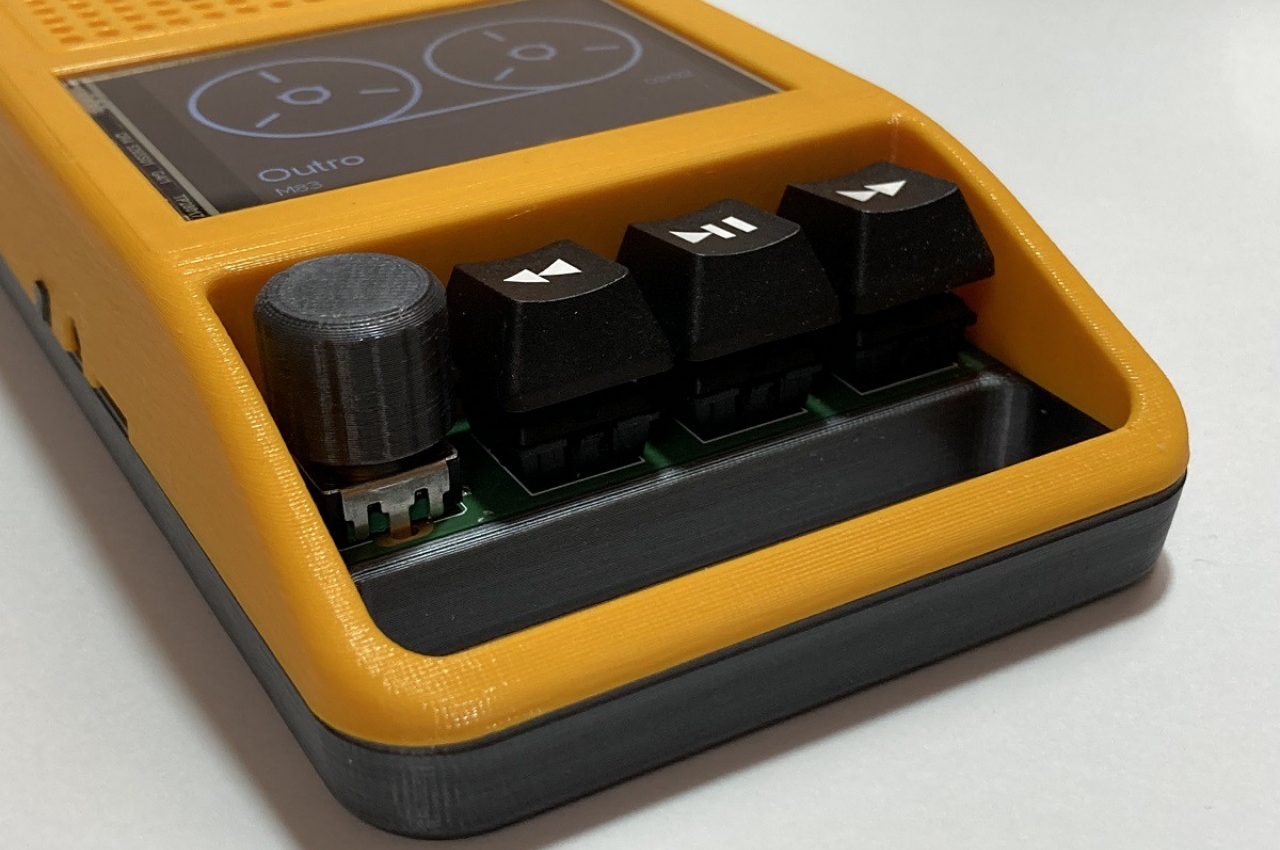
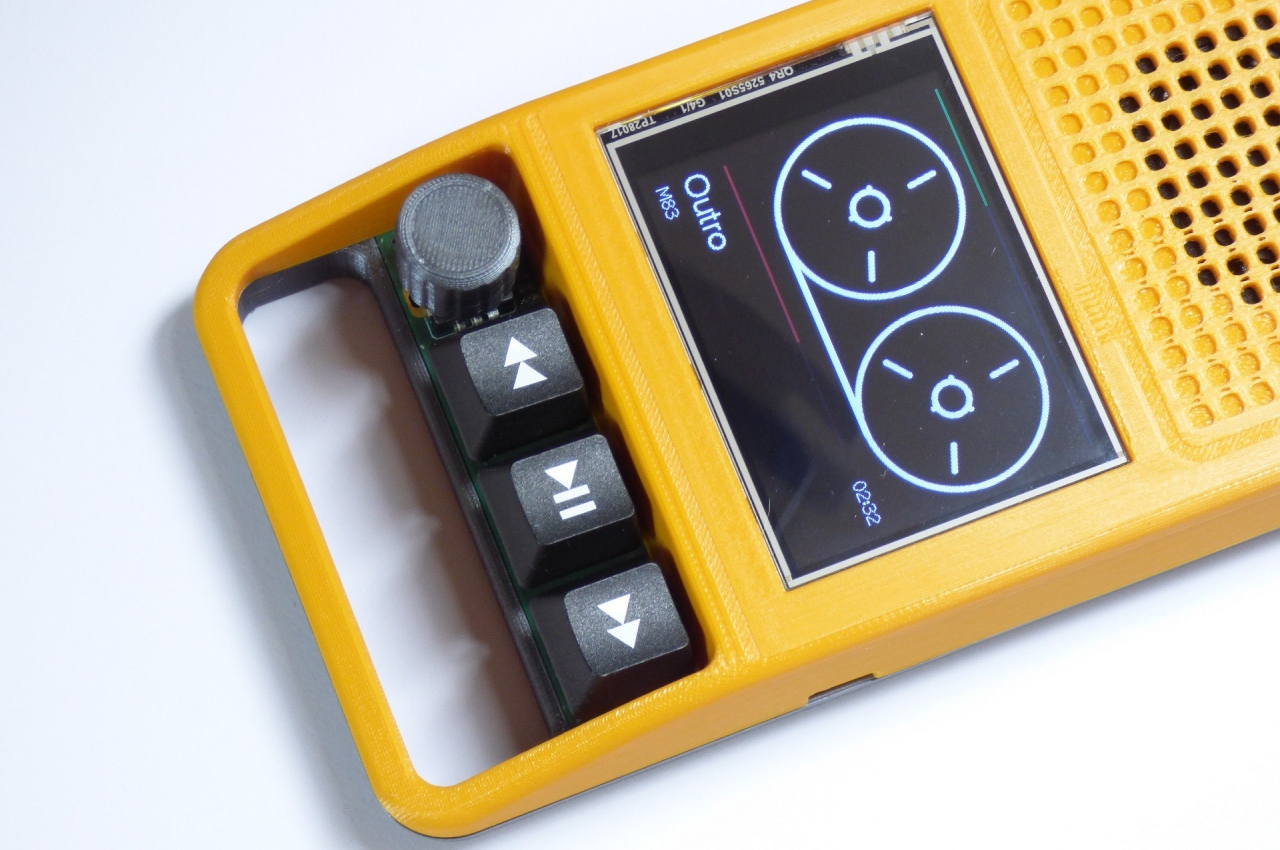
Some of us may laugh at the fashion, designs, and technologies of the past, but sooner or later, they actually become the inspiration for products and designs of today. The number of successful and profitable “retro” recreations has proven the power of nostalgia, especially when you can avoid the limitations of the past. Tape recorders, for example, were rather funky-looking contraptions from our modern point of view, which also makes them a perfect candidate for a retro recreation. Unsurprisingly, someone did take on such an endeavor and gave the venerable cassette record from the 80s a modern makeover, one that relives part of the look and feel of the original but without the physical and mechanical restrictions. Designer: Max.K Given the technologies of that era, the cassette tape itself was a revolutionary invention that freed people to listen to music away from the hulking phonographs at home. Cassette players and recorders came in all shapes and sizes, but one of the most iconic forms was a flat box that would lie on a table or desk. You would see these devices even on TV, usually used as a prop for recording interviews, interrogations, or depositions, making their form easily identifiable even today.
A retro cassette player would have to stay true to that form, but it doesn’t need to have loyalties to the same flimsy and unreliable physical medium. In other words, this Retro Audio Player is practically a digital player in old-school clothing, but one with a few tricks and quirks that make it delightful to look at and fun to use.
The 2.8-inch display on top, for example, tries to visualize the spinning reels of an honest-to-goodness cassette player, making it look almost like the real deal from afar. There are no extraneous elements on the screen other than the name of the file being played, the artist, and its progress, sticking closely to the unavoidably bare designs of its predecessors. And yes, it plays files stored on an SD card you slot into its side. The DIY Retro Audio Player is also simple to use, with only a dial for volume and three buttons that are actually MX keyboard switches in disguise. The bright yellow paint job on top almost makes it look like a toy, and any child can actually operate it thanks to its simplicity. Whether it will survive rough handling from youngsters, however, is a different question entirely. Its simplicity is also its Achilles’ heel, though, at least as far as audio players are concerned. Its diminutive size only has room for a single speaker, making it better suited for audiobooks than party music, but it does have a headphone jack in case you want more oomph. The three “buttons” can only pause or play the music and switch tracks, nothing to fast-forward or rewind within the same song like modern audio players. That said, the Retro Audio Player wasn’t envisioned to be a full-blown media player and more as a fun-looking nod to the past, and in that regard, it definitely scores an A+. Held at their Ecosystem virtual event, tech accessory brand PITAKA unveiled a series of new products and accessories, complimenting their Pita!Flow line and helping their… The ENGWE X26 might have two wheels, but it has the audacity of a pickup truck, with the confidence to conquer any terrain in front… https://www.kickstarter.com/projects/hrbstn/pico-a-farm-in-your-palm-growing-is-fun-again I couldn’t possibly articulate it better than designers Arun and Karanvir, who call the Pico “the farm that fits in your palm”! It’s an… Now here is a perfect example of concept design bettering the world in previously unimagined ways. The deaf of the world are not just being… I just recently saw the HP Spectre laptop in person. It’s INCREDIBLY thin (thinner than my phone too), and packs quite a punch… but to… The InOne is truly an all-in-one computer. 22″ screen, keyboard, touchpad, speakers and a digital tablet are all built into one TRONtastic package. Everything is… We’re an online magazine dedicated to covering the best in international product design. We have a passion for the new, innovative, unique and undiscovered. With our eyes firmly focused on the future. Editorial Standards and Ethics / Privacy Policy
June 27, 2022 6:55am by Barry Ritholtz My back to work morning train WFH reads: • Ethereum Mining Is Going Away, and Miners Are Not Happy The shift from proof-of-work to proof-of-stake will cut power consumption sharply—and leave some expensive technology searching for new uses. (Businessweek) • The Stock Market’s Rally Is Real. It’s Still a Bear Market. Even bear markets get bounces.The stock market had a terrific week, and for the first time in a long time, the rally feels like it can last. The Dow Jones Industrial Average DJIA rose 5.4%, the S&P 500 gained 6.4%, and the Nasdaq Composite climbed 7.5%. (Barron’s) see alsoHow to Start Investing, Even in a Bear Market The immediate outlook is grim, but low-cost funds that track the entire market can help you prosper over the long term, our columnist says. (New York Times) • When Bonds Do Not Hedge Stocks For the first time in decades, bonds haven’t protected balanced portfolios. What to do? (Morningstar) • Sound Money: On Bandcamp, Neil Young Derivatives and the Financial Imagination of Music Production. (Bellona) • The Open Secret of Google Search One of the most-used tools on the internet is not what it used to be. (The Atlantic) • How Covid Tracking Apps Are Pivoting for Commercial Profit: In the pandemic’s early days, government-backed public health apps acquired millions of users—a ready-made audience developers are eager to tap. (Wired) • Leaked Audio From 80 Internal TikTok Meetings Shows That US User Data Has Been Repeatedly Accessed From China “I feel like with these tools, there’s some backdoor to access user data in almost all of them,” said an external auditor hired to help TikTok close off Chinese access to sensitive information, like Americans’ birthdays and phone numbers. (Buzzfeed News) • A Regional Rail Plan Aims to Reinvent New York’s Commuter Trains London, Paris and Berlin all have integrated regional rail systems that serve the entire metro area. One transit advocacy group asks: Why not New York City? (Bloomberg) • China’s ‘Very Dangerous Trajectory’ The Communist regime has always been brutal, but it was at least predictable and, in its own way, practical. No longer. (The Atlantic) • ‘Loot’ Review: Maya Rudolph Among the .001 Percent. In this Apple TV+ comedy from two “Parks and Recreation” veterans, a woman takes a journey of self-discovery with an $87 billion budget. (New York Times) Be sure to check out our Masters in Businessinterview this weekend with Jonathan Miller, discussing real estate, home sales, rentals, and whether cities are dead or not. Miller is the CEO and co-founder of Miller Samuel, whose data and analytics on real estate have become the standard for the residential real estate appraisal and brokerage industry.
Nominal earnings growth often holds up well during periods of high inflation (1940s & 1970s). Source: @TimmerFidelity
Variety Print Plus Subscriber Variety Print Plus Subscriber Variety Print Plus Subscriber Variety Print Plus Subscriber Variety Print Plus Subscriber
By K.J. Yossman Coming of age drama “Purple Beatz” will get worldwide distribution via Trinity Creative Partnership and 101 Films. Described as a “music-driven, romantic drama, set in the underground drum ‘n’ bass music scene of ‘90s London,” “Purple Beatz” is written and directed by Lola Atkins and features a diverse, female-led cast and crew. The feature stars Izzy Jones (“Distant”), Erika Alexander (“Abattoir,” “The Wives in the Attic”), Aron Von Andrian (“Masters Of The Air”) and Steven Michael-O’Hara (“Frenemies”). Violetta D’Agata (“It’s the Blackness”) was director of photography. “Sarah-Jane is a young aspiring jazz singer from Bournemouth who moves to London to embark on a music career,” reads the official logline. “Not long in town, she falls for the handsome Airbeats, but also sinister music producer Russell-D, who represents a darker side to the music industry.”
The film, which represnts Atkins’ directorial feature film debut, will premiere at the I Will Tell International Film Festival’s opening gala at the BFI Southbank on July 7. “Purple Beatz” is produced by Jason Matthewson (“That’s Just Me,” “Suppression”) for EWAV Works in association with film and TV production company The Old Film Farm. “We’re excited to be working with Jason on his film ‘Purple Beatz,’” said Trinity Creative Partnership’s Andy Taylor. “We always like to support British independent film makers, and this film deserves to be seen by as wide an audience as possible” Justin Johnson, BFI Southbank’s lead programmer added: “We’re delighted to host the opening night of the I Will Tell International Film Festival at BFI Southbank this year and to be supporting director Lola Atkins and the cast and crew of ‘Purple Beatz.’” Check out the trailer below:
A Variety and iHeartRadio Podcast The Business of Entertainment
Erie County’s nearly 10,000 acre Park System represents a diverse collection of natural resources, historic structures, and unique places within the Western New York Region. The system is comprised of 40 sites throughout the County, and provides for recreational sports fields, cascading waterfalls, hiking trails, biking pathways, lawns for sitting and relaxing in nature, wildlife observation, and much more at no cost for residents and visitors. Previous County Parks Master Plans were completed approximately in 15 year intervals, the last one in 2003. New demands have been placed on the park system not present in 2003 indicating a need for a new look, a new analysis, and a new master plan for the system. The Department of Environment and Planning in cooperation with the Department of Parks, Recreation, and Forestry has undertaken a major update to the 2003 Park Master Plan. This Parks Master Plan Update, which was initiated in 2016, is primarily focused on the preservation, enhancement, and improvement of the existing system assets and landscape setting. Consultants Wendel Companies (a local multi-disciplinary Engineering and Landscape Architecture firm) and GreenPlay (a nationally renowned park and recreation consulting firm) were engaged to tackle this effort, completing the mapping of the system, analyzing problems and opportunities, developing policies to protect and enhance the natural resources of the parks, and developing strategies for waterfront enhancement. Like the 2003 Plan, which served the County well through its planning horizon, this Update followed certain parameters: the plan must be user friendly, with clear implementation tasks; it must be environmentally sound so as to preserve and enhance our common public open space; and it must be financially feasible, by focusing on improving existing assets and operational efficiencies and opportunities. In the explosion of social media since the 2003 plan, communication with park users has changed in ways that few could have predicted; this Update outlines strategies and specific tasks to improve community awareness and education of the County Parks System and all it has to offer. Recommendations and analyses were conducted based on extensive outreach and assessment of the County Parks System. The planning process consisted of public consultation, stakeholder meetings with over 65 local groups and agencies, a parks user survey, numerous meetings, and work sessions. A final 60-day public comment process was held in the Fall of 2018 with an online comment form and 3 public open houses, garnering another 100 comments that were submitted in person, by mail, and online regarding the draft plan (results summarized in Volume 1; more information in the Appendices below). Physical assessment and mapping included inventory of all notable assets within the County’s heritage parks, and many site visits during different times of the year. The Erie County Legislature accepted the Erie County Parks Master Plan Update as the primary County planning document within Erie County on matters affecting the Erie County Parks System, and simultaneously commited to undertake actions affecting physical development in the County Parks System in a manner that is consistent with the principles, policies, and action strategies described in the Plan. The Master Plan Update will be a guide for the County, planners, and administrators to focus on future development of the system. It will inform the County on how to prioritize resources and guide decisions for renovating structures, improving existing amenities, and restoring environmental habitats. Principles guiding project prioritization are rooted in public safety, environmental sustainability, and historic preservation. Executive Summary Volume 1 – Overall System Master Plan Volume 2 – Park Specific Recommendations Individual section downloads of Volume 2: Heritage Parks Waterfront Parks Special Purpose Parks Conservation Parks Forestry Lots Volume 3 – Waterfront Access & Trails Volume 4 – Parks Inventory & Assessment Appendices *Please note that the Erie County Parks Master Plan Update involves only Erie County owned/managed parks and trails. State, city, town, or village park issues should be referred to their individual governing body. The following are Erie County parks and trails (any other parks or trails are not Erie County’s): Environment and Planning Edward A Rath County Office Building 95 Franklin Street, 10th Floor Buffalo, New York 14202 Phone: (716) 858-8390 Fax: (716) 858-7248 Staff Directory Speakers Bureau Improving Quality of Life Grow Your Business Community Development Programs Environmental Programs Create Maps & View Map Gallery Wastewater Services Recycle Cultural Funding Housing Rehabilitation Loan Program Internet Mapping Waste Management and Recycling How Can YOU Prevent Stormwater Pollution? Erie and Niagara County Fishing Guide Electronics Recycling Tracking COVID-19 in Wastewater Upcoming Meetings and Events Agricultural Districts Sewer District Information DEP Speakers Bureau Install a Renewable Energy System
Sunny to partly cloudy. High 87F. Winds NE at 5 to 10 mph.. Clear to partly cloudy. Low around 65F. Winds NNE at 5 to 10 mph. Updated: June 28, 2022 @ 4:28 am Keep up with the latest news with one or more of our free email newsletters. In 2017, Australian singer Katrina Burgoyne moved to Nashville with three suitcases, a guitar, and a few thousand dollars. Since then, she has had four top-10 singles. Katrina Burgoyne’s latest album, “I Wanna Get Away With You”, should be a summer love song country music favorite. Singer-songwriter Katrina Burgoyne and her husband, audio engineer and producer Steve Kinney, were married last March. Bowman
Bowman In 2017, Australian singer Katrina Burgoyne moved to Nashville with three suitcases, a guitar, and a few thousand dollars. Since then, she has had four top-10 singles. Katrina Burgoyne’s latest album, “I Wanna Get Away With You”, should be a summer love song country music favorite. Singer-songwriter Katrina Burgoyne and her husband, audio engineer and producer Steve Kinney, were married last March. When I first heard Katrina Burgoyne’s song, “I Wanna Get Away With You,” there was something infectious about the spirited song that made me want to learn more about the artist. Australian-born Katrina Burgoyne is from a musical family. Both of her grandfathers were performing musicians. One of her grandfathers was more classically minded, but the other one was all country. “I learned all the country songs by sitting on my grandpa’s knee. He loved Charley Pride, Hank Williams, and a lot of the Australian country music artists. He was even offered a record deal at age 19 to play country music, but never took it up,” she said. His love for country music got passed along to young Burgoyne. As a child, she was always musically inclined. “If there was a piano in the corner, I would forget about the kids playing in the background and I would go to the piano and play.” She learned to play banjo and guitar as well. “All I wanted to do is be a Dixie Chick. I love their sound,” she said. By the time she was 15, she got a manager. Her manager told her, “I can imagine you as a songwriter in Nashville.” The seed had been planted early. She visited Nashville in 2009 where she would see shows at 3rd and Lindsley and the bands and musicians playing there. She worked with songwriter Daryl Scott and he encouraged her to move. However, at that point, Burgoyne felt she wasn’t good enough to be in Nashville. In 2015, she returned to Nashville for three months. During those few months, she knew it was time for her to relocate. In 2017, the Aussie made the leap of faith and with three suitcases, a guitar, and a few thousand dollars, she moved to Nashville. “It was the stupidest thing I’ve ever done in my life. Moving countries with so little funds and no work. I don’t know what I was thinking,” she said. The singer bought a $5,000 car and was knocking on every door in town to see if they would let her on their stage and sing. She knew she had moved to the most competitive music city in the world, but five years later, she remains a fixture on the country music scene. Burgoyne is married to American audio engineer and producer, Steve Kinney, whom she met in a bar on Broadway. Although he lived in Nashville, he was from New Jersey. All she could think about was the show “Jersey Shore”, so that made her leery initially. Eventually, they did get together, and it has been a blessing because she has someone to help her with her career goals. “I’ve got an in-house guy who does everything. He blows my mind that he can do anything.” she said. During the pandemic and before they were married, Kinney volunteered to make a record for her. “We’ve got nothing else to do,” he said. In 2020, Burgoyne wrote the song “25 Cents In The Ashtray” with Jacob Anderson. She and Kinney produced the video with no money. The pair proved how resourceful and talented they are by putting out a meaningful, autobiographical song during COVID that is uplifting as well. After the lockdown was over, Kinney began pursuing music production full-time and the pair continue to work on projects together. Since releasing her debut album in 2011, Burgoyne has secured four top-10 singles. Her successes include her song “Tennessee” being No. 1 on CMT Australia and No. 3 on Australian Country Radio. She was named Best New Talent and Female Artist of The Year CMAA Nominations and had a Top 10 ARIA charting album. Additionally, Burgoyne has accrued over 87,000 followers on TikTok. Her hit single “Tennessee” is based on the experience of moving to Tennessee while leaving a boyfriend back in Australia. They eventually broke up which prompted her to write the song. She explains, “It was written on a Sunday afternoon after getting back to Memphis. I was very single at the time, and I sat down and wrote this song as a way to release people who I had held on to. I wrote it for me. I didn’t think it would do as well as it did.” She played it for Kinney, and he wanted to include it on the EP they were working on. “Tennessee” would eventually become her first Spotify editorial playlist. She also had a mega-hit with Australian favorite, Troy Kemp, “Before Summer Starts to Fall” which was released in 2021. Produced and written with her husband and Kemp, it is the perfect song for those who are not ready to let go of summer. Burgoyne and Kinney got married this past March. They got married in a cabin with mason jars and barbeque and live-streamed the event to her family in Australia. It was very lowkey, but meaningful. “I’m low-maintenance,” she said. Her latest single, “I Wanna Get Away With You” is about meeting her husband where she had “the best first date I’d ever had.” After three weeks, she returned to Australia for a few months and thought it was the end. But after a while, Kinney invited himself for visit and they eventually fell in love and have been together ever since. With the start of the summer, “I Wanna Get Away With You” is Burgoyne’s stunning contribution to the beloved love songs in the country genre. Her voice is velvety and vibrant but has a rasp that carries through the whole song. Katrina can go toe-to-toe with the strongest vocalists in country music, and that ability is on full display in this track. The music video was released a few weeks ago and was the first video where she performed with a full band. The playful love song is one you will want to put on repeat. The singer/songwriter will continue to release songs throughout the year as she tours locally. Burgoyne is a favorite at Puckett’s in the Nashville area and is also a regular performer in Louisville. You can keep up with all things about Katrina Burgoyne by following her on her website, Facebook, Instagram, TikTok, and all streaming platforms. Bethany Bowman is a freelance entertainment writer. You can follow her blog, Instagram, and Twitter. Bowman Keep up with all the latest with one or more of our free email newsletters. Sorry, an error occurred.
Thank you . Your account has been registered, and you are now logged in. Check your email for details. Invalid password or account does not exist Submitting this form below will send a message to your email with a link to change your password. An email message containing instructions on how to reset your password has been sent to the e-mail address listed on your account.
Login Cayman Islands 3 min read New Cayman music company, Ironshore Group, has announced the launch of two record labels, Ironshore Records and Everheart Records, dedicated to giving the Cayman Islands a presence in the world music industry by elevating the local music scene and providing a platform for local talent to connect their music to a global audience. Mr. Jake Olde, Caymanian music artist (stage name Jake Oni) and founder of the Ironshore Group, said the record labels were conceived to expand the reach of Cayman-based independent musicians and help emerging talent earn fair representation. “Our goal is to showcase the incredible and diverse talent the Cayman Islands has to offer, working to help local talent reach their potential in the business and getting their work into the hands of the people who matter most—music fans,” he said. Based in the Cayman Islands, Ironshore Group is a music company specializing in providing artists with integral support and mentoring that covers all facets of the music business including, artist management and development, touring, music production, and distribution. “We are excited about the launch of ours labels because at its core, we’re promoting excellence in the arts, collaboration, self-expression, and pro-actively serving and representing the interests and development of Cayman musicians,” Olde said. “Ironshore and Everheart are going to be forces to be reckoned with, focused on fair and sustainable deals that empower artists as well as producing great music.” Mr Nathan Mclean, Chief Operating Officer of Ironshore Group said the company believed the Cayman Islands had an opportunity to turn itself into a location for international music production. “In the same way that over the past couple of years Cayman has become a destination for international film production, we believe the Cayman Islands has the potential to become a music capital that can fully realise the cultural, economic, and social benefits of a robust music industry,” Mclean said. “The development of Cayman’s arts and creative industries has the potential to foster jobs for Caymanians, and can build skills and expertise in one of the fastest growing global industries.” Ironshore Group’s two record labels each focus on promoting and supporting specific genres of music. Ironshore Records is dedicated to elevating heavy music artists. Earlier this year, Ironshore Records released singles from ambassador acts Oni, a Cayman band front-manned by Jake Oni, and Alphamega, a hard rock trio from Los Angeles, California. Well-received singles have included Oni’s ‘Secrets’ featuring punk rock legend, Iggy Pop, and Alphamega’s ‘No Longer Broken’. In late May, Oni released a new track ‘Heart to Stone’ taken from their studio album, ‘Loathing Light’ which was released June 17th. “Heart to Stone shows a different side of me and is a song that really set me in a new direction,” Olde said. “I love being able to straddle the line of heavy and clean vocals. This is one I can’t wait to sing live.” “Music is such a gift. If you can make music and people respond to it, I’ve learned not to take that for granted. Count your blessings because the opportunity to make music is such a great one. We should always be grateful. Because it’s the coolest job anyone could do.” Everheart Records will showcase a more eclectic roster of artists. The label will launch with its first signings later this year and is set to include acclaimed Caymanian acts. In addition to the labels, Ironshore Group has a state-of-the-art, world class recording studio in Grand Cayman that is designed to be a destination for both local and international artists. “Our goal is to build a new community of artists, that will push the boundaries of their respective genres to reach new audiences globally,” McLean said. For the Cayman Islands, the arts and creative industries are an integral part of our country’s values, cultural diversity, social inclusion and our engagement with the wider world. Ironshore Group looks forward to opening new pathways for Cayman’s performing artists. McLean continued. Local artist Monte Thornton pays tribute to seafarers October 11, 2021 03:21 PM See artisans, crafters, potters, poets and musicians this November 27 November 27, 2021 10:19 AM RCIPS FCIU advises public on circulation of forged bank notes
Ironshore Group launches Cayman-based record labels New Cayman music company, Ironshore Group, has announced the launch of two record labels, Ironshore Records and Everheart Records, dedicated to giving the Cayman Islands a presence in the world music
Here's your tropical storm/ hurricane shopping list Hurricane season is right around the corner and with an above average season up ahead, no one wants to be caught off-guard. If you’ve received notice of a tropical storm/ hurricane watch or warning Here's how to plan for flooding in Cayman… During hurricane season, flooding is always an added concern in the Cayman Islands. Here’s what you can do to prepare: Tie down or bring in outdoor objects (patio furniture, children’s toys, Tips to prepare for a tropical storm If you hear that there is a tropical storm or hurricane watch or warning in the Cayman Islands, you must take steps to get ready. First off, know the difference between a “watch” and “warning.” UK IT executive warns Cayman about security issues in crypto According to the FBI’s annual Internet Crime Complaint Centre Report, cybercrime put a $6.9 billion hole in the US economy last year, and with widespread hacking events hitting some high profile crypt
You must be a 2022 USATF member to enter the Championships. If you do not have a 2022 membership, please complete a membership application first. You must also meet the eligibility requirements. Welcome USATF Masters competitors and guests!
Lexington, KY is pleased to welcome the USATF Masters Outdoor Championships to the University of Kentucky Outdoor Track & Field Complex this summer! Our state-of-the-art facilities have hosted the KHSAA State Track Meet, NCAA East Region, and the SEC Outdoor Championships.
While in the Bluegrass, we hope you will get out in the area and make plans to visit some of our world famous attractions including; Horse Farms, Bourbon Distilleries, Keeneland Race Track, and the Kentucky Horse Park. Tours and schedules can be found at the links below: Farm-to-table. Field-to-fork. Foodie-approved. You’ve heard it all before. But let’s be real — this is Kentucky. We were farm-to-table before farm-to-table was cool. And while we’re no stranger to the southern classics, we go way beyond beaten biscuits and gravy around here. Re-imagined Southern staples coupled with inventive bourbon-infused creations lend a unique Kentucky quality to our cuisine that you’ll be hard-pressed to find anywhere else. So come see what all the fuss is about and dig into our flourishing, flavorful, fearless food scene. Restaurants to suit your tastes can be found at https://www.beyondgrits.com and https://www.visitlex.com/restaurants/.
Lexington, KY – One of Zagat’s 30 most exciting food cities in America! Zagat Magazine USATF KY
JCMR recently broadcasted a new study in its database that highlights the in-depth market analysis with future prospects of IT Leasing And Financing market. The study covers significant data which makes the research document a handy resource for managers, industry executives and other key people get ready-to-access and self analyzed study along with graphs and tables to help understand market trends, drivers and market challenges. Some of the key players mentioned in this research are Avid Technology, Apple, FL Studio, Ableton, Steinberg Media Technologies, PreSonus Audio Electronics, Adobe, Magix, Propellerhead Software, Cakewalk, NCH Software, Acon Digital, Cockos Get Access to Free sample Report PDF @ jcmarketresearch.com/report-details/1429388/sample COVID-19 is an infectious disease caused by the most recently discovered novel corona virus. Largely unknown before the outbreak began in Wuhan (China) in December 2019, COVID-19 has moved from a regional crisis to a global pandemic in just a matter of a few weeks. In addition, production and supply chain delays were also witnessed during the second quarter which poised a challenge to the IT Leasing And Financing market, since end-user industries were still not operating at their full capacity. Enquire for customization in Report @ jcmarketresearch.com/report-details/1429388/enquiry What are the market’s problems in IT Leasing And Financing? Changing regulatory landscapes, operational barriers, and the emergence of alternative technologies are all impacting the IT Leasing And Financing industry. What are the various types of segments covered in the IT Leasing And Financing Market? By Type – Packaged Software – Server Systems – PCs & Smart Handhelds – Networking & Telco – Mainframes and Service – Other By Application – Listed Companies – Small and Medium Companies – Government Agency – Other Who are the top key players in the IT Leasing And Financing market? Avid Technology, Apple, FL Studio, Ableton, Steinberg Media Technologies, PreSonus Audio Electronics, Adobe, Magix, Propellerhead Software, Cakewalk, NCH Software, Acon Digital, Cockos Which region is the most profitable for the IT Leasing And Financing market? The emerging economies in the Asia Pacific region will be the lucrative markets for IT Leasing And Financing products. . What is the current size of the IT Leasing And Financing market? The current market size of global IT Leasing And Financing market is estimated to be USD XX in 2022. Get Discount instant FLAT40% Discount on full IT Leasing And Financing Report @jcmarketresearch.com/report-details/1429388/discount North America is the region’s largest market for IT Leasing And Financing. North America includes countries such as the US, Canada, and Mexico. North America is the second-largest consumer and producer of electricity, after Asia Pacific. The US and Canada, which are among the largest consumers in this region as well as globally, constitute the largest share of the IT Leasing And Financing market. Secondary Research: This IT Leasing And Financing research study made extensive use of secondary sources, directories, and databases such as Hoover’s, Bloomberg BusinessWeek, Factiva, and OneSource to identify and collect information useful for a technical, market-oriented, and commercial study of the global portable generator market. Other secondary sources included company annual reports, press releases, and investor presentations, white papers, certified publications, articles by recognized authors, manufacturer associations, trade directories, and databases. IT Leasing And Financing Primary Research: Various sources from both the supply and demand sides were interviewed during the IT Leasing And Financing primary research process to obtain qualitative and quantitative information for this report. Primary sources included industry experts from the core and related industries, as well as preferred suppliers, manufacturers, distributors, technology developers, researchers, and organizations from all segments of the value chain of this industry. To obtain and verify critical qualitative and quantitative information, in-depth interviews were conducted with a variety of primary respondents, including key industry participants, subject-matter experts, C-level executives of key market players, and industry consultants. Estimation of IT Leasing And Financing Market Size The total size of the IT Leasing And Financing market was estimated and validated using both top-down and bottom-up approaches. These methods were also widely used to estimate the size of various market sub segments. The following research methodologies were used to estimate market size: Extensive secondary research was used to identify the industry’s key players. The revenues generated by the market’s leading players in molecular diagnostics have been determined through primary and secondary research. All percentage shares, splits, and breakdowns were calculated using secondary sources and confirmed using primary sources. TABLE OF CONTENTS OF IT Leasing And Financing Market Report 1 INTRODUCTION 1.1 IT Leasing And Financing study objectives 1.2 IT Leasing And Financing definition 1.3 IT Leasing And Financing inclusions & exclusions 1.4 IT Leasing And Financing market scope 1.5 IT Leasing And Financing report years considered 1.6 IT Leasing And Financing currency 1.7 IT Leasing And Financing limitations 1.8 IT Leasing And Financing industry stakeholders 1.9 IT Leasing And Financing summary of changes 2 RESEARCH METHODOLOGY 2.1 IT Leasing And Financing research data 2.2 IT Leasing And Financing market breakdown and data triangulation 2.3 IT Leasing And Financing scope 2.4 impact of covid-19 on IT Leasing And Financing industry 2.5 IT Leasing And Financing market size estimation 3 IT Leasing And Financing EXECUTIVE SUMMARY 4 IT Leasing And Financing PREMIUM INSIGHTS 4.1 attractive opportunities in IT Leasing And Financing market 4.2 IT Leasing And Financing market, by region 4.3 IT Leasing And Financing market in North America, by end user & country 4.4 IT Leasing And Financing market, by application 4.5 IT Leasing And Financing market, by end user 5 IT Leasing And Financing MARKET OVERVIEW 5.1 IT Leasing And Financing introduction 5.2 covid-19 IT Leasing And Financing health assessment 5.3 IT Leasing And Financing road to recovery 5.4 covid-19 IT Leasing And Financing economic assessment 5.5 IT Leasing And Financing market dynamics 5.6 IT Leasing And Financing trends 5.7 IT Leasing And Financing market map 5.8 average pricing of IT Leasing And Financing 5.9 IT Leasing And Financing trade statistics 5.8 IT Leasing And Financing value chain analysis 5.9 IT Leasing And Financing technology analysis 5.10 IT Leasing And Financing tariff and regulatory landscape 5.11 IT Leasing And Financing: patent analysis 5.14 IT Leasing And Financing porter’s five forces analysis 6 IT Leasing And Financing MARKET, BY APPLICATION 6.1 IT Leasing And Financing Introduction 6.2 IT Leasing And Financing Emergency 6.3 IT Leasing And Financing Prime/Continuous 7 IT Leasing And Financing MARKET, BY END USER 7.1 IT Leasing And Financing Introduction 7.2 IT Leasing And Financing Residential 7.3 IT Leasing And Financing Commercial 7.4 IT Leasing And Financing Industrial 8 GEOGRAPHIC ANALYSIS 8.1 IT Leasing And Financing Introduction 8.2 IT Leasing And Financing industry by North America 8.3 IT Leasing And Financing industry by Asia Pacific 8.4 IT Leasing And Financing industry by Europe 8.5 IT Leasing And Financing industry by Middle East & Africa 8.6 IT Leasing And Financing industry by South America 9 IT Leasing And Financing COMPETITIVE LANDSCAPE 9.1 IT Leasing And Financing Key Players Strategies 9.2 IT Leasing And Financing Market Share Analysis Of Top Five Players 9.3 IT Leasing And Financing Market Evaluation Framework 9.4 Revenue Analysis Of Top Five IT Leasing And Financing Market Players 9.5 IT Leasing And Financing Company Evaluation Quadrant 9.6 IT Leasing And Financing Competitive Leadership Mapping Of Start-Ups 9.7 IT Leasing And Financing Competitive Scenario 10 IT Leasing And Financing COMPANY PROFILES 10.1 IT Leasing And Financing Major Players 10.2 IT Leasing And Financing Startup/Sme Players 11 APPENDIX 11.1 Insights Of IT Leasing And Financing Industry Experts 11.2 IT Leasing And Financing Discussion Guide 11.3 IT Leasing And Financing Knowledge Store 11.4 IT Leasing And Financing Available Customizations 11.5 IT Leasing And Financing Related Reports 11.6 IT Leasing And Financing Author Details Buy instant copy of IT Leasing And Financing research report @jcmarketresearch.com/checkout/1429388 Find more research reports on IT Leasing And Financing Industry. By JC Market Research. About Author: JCMR global research and market intelligence consulting organization is uniquely positioned to not only identify growth opportunities but to also empower and inspire you to create visionary growth strategies for futures, enabled by our extraordinary depth and breadth of thought leadership, research, tools, events and experience that assist you for making goals into a reality. Our understanding of the interplay between industry convergence, Mega Trends, technologies and market trends provides our clients with new business models and expansion opportunities. We are focused on identifying the “Accurate Forecast” in every industry we cover so our clients can reap the benefits of being early market entrants and can accomplish their “Goals & Objectives”. Contact Us: https://jcmarketresearch.com/contact-us JCMARKETRESEARCH Mark Baxter (Head of Business Development) Phone: +1 (925) 478-7203 Email: [email protected] Connect with us at – LinkedIn
Thank you for visiting nature.com. You are using a browser version with limited support for CSS. To obtain the best experience, we recommend you use a more up to date browser (or turn off compatibility mode in Internet Explorer). In the meantime, to ensure continued support, we are displaying the site without styles and JavaScript. Advertisement Scientific Reportsvolume 12, Article number: 10817 (2022) Cite this article 160 Accesses 3 Altmetric Metrics details Variational quantum algorithms offer a promising new paradigm for solving partial differential equations on near-term quantum computers. Here, we propose a variational quantum algorithm for solving a general evolution equation through implicit time-stepping of the Laplacian operator. The use of encoded source states informed by preceding solution vectors results in faster convergence compared to random re-initialization. Through statevector simulations of the heat equation, we demonstrate how the time complexity of our algorithm scales with the Ansatz volume for gradient estimation and how the time-to-solution scales with the diffusion parameter. Our proposed algorithm extends economically to higher-order time-stepping schemes, such as the Crank–Nicolson method. We present a semi-implicit scheme for solving systems of evolution equations with non-linear terms, such as the reaction–diffusion and the incompressible Navier–Stokes equations, and demonstrate its validity by proof-of-concept results. Partial differential equations (PDEs) are fundamental to solving important problems in disciplines ranging from heat and mass transfer, fluid dynamics and electromagnetics to quantitative finance and human behavior. Finding new methods to solve PDEs more efficiently—including making use of new algorithms or new types of hardware—has been an active area of research. Recently, the advent of quantum computers and the invention of new quantum algorithms have provided a novel paradigm for solving PDEs. A cornerstone of many of these quantum algorithms is the seminal Harrow-Hassidim-Lloyd (HHL) algorithm1 for solving linear systems, which can be utilized to solve PDEs by discretizing the PDE and mapping it to a system of linear equations. Compared to classical algorithms, the HHL algorithm can be shown to exhibit an exponential speedup. Unfortunately, attractive as it may sound, the HHL algorithm works only in an idealized setting, and a list of caveats must be addressed before it can be used to realize a quantum advantage2. Moreover, implementing HHL and many other quantum algorithms would require the use of a fault-tolerant quantum computer, which may not be available in the near future3. Instead, the machines we have today are imperfect, noisy intermediate-scale quantum (NISQ) devices4 with both coherent and incoherent errors limiting practical circuit depths. Over the last few years, variational quantum algorithms (VQAs) have emerged as a leading strategy to realize a quantum advantage on NISQ devices. Specifically, VQAs employ shallow circuit depths to optimize a cost function, expressed in terms of an Ansatz with tunable parameters, through iterative evaluations of expectation values5. Applications of VQAs include the variational quantum eigensolver (VQE) for finding the ground or excited states of a system Hamiltonian6,7,8, the quantum approximate optimization algorithm (QAOA) for solving combinatorial optimization problems9, and solvers for linear10,11,12 and non-linear13 systems of equations. Here, we are interested in variational quantum algorithms for solving differential equations14, such as the Black–Scholes equation15,16, the Poisson equation17,18, and the Helmholtz equation19. Specifically, the Poisson equation can be solved efficiently through explicit decomposition of the coefficient matrix derived from finite difference discretization17 using minimal cost function evaluations18 and shallower circuit depth compared to other non-variational quantum algorithms14,20,21,22. A natural question to ask, then, is whether such variational algorithms for Poisson equations can be extended to solving evolution equations, i.e. partial differential equations including a time domain. McArdle et al.23 proposed a variational quantum algorithm which simulates the real (imaginary) time evolution of parametrized trial states via forward Euler time-stepping of the Wick rotated Schrödinger equation, thereby solving the Black–Scholes equation, and by extension, the heat equation15,16. Besides issues of Ansatz selection and quantum complexity, time-stepping based on an explicit Euler method may be unstable, a limiting condition exacerbated by noise. With existing variational quantum algorithms10, an implicit scheme for evolution equations is expected to preserve any quantum advantage1 over classical algorithms, with reduced time complexity18. This paper is organized as follows. In section “Theory”, we outline general implicit time-stepping schemes for solving evolution partial differential equations and propose the use of a variational quantum solver to resolve the Laplacian operator iteratively. In section “Applications to the heat/diffusion equation”, we apply the variational quantum algorithm to solving a heat or diffusion equation without source terms as a proof of concept. With that, we explore potential applications to more general evolution problems with non-linear source terms, including the reaction–diffusion (section “Applications to the reaction–diffusion equations”) and the Navier–Stokes equations (section “Applications to the Navier–Stokes equations”), where variables can be coupled through semi-implicit schemes. Consider the second-order homogeneous evolution equation defined on the set (Omega times J), where (Omega subset mathbb R^d) denotes a d-dimensional bounded spatial domain and (J = [0,T]), where (T>0) denotes a bounded temporal domain, as where (u(vec{x},t)) is a function of spatial vector (vec{x}) and time t, (D>0) is the diffusion coefficient and f is an unspecified source term. For now, Dirichlet and Neumann boundary conditions are applicable on the boundary (Gamma := partial Omega = Gamma _Dcup Gamma _N), respectively, where (partial /partial n) is the outward normal derivative on boundary (Gamma). For a two-dimensional rectangular domain (Omega = (x_L,x_R )times (y_L,y_R) subset mathbb R^2), partitioning the space-time domain (Omega times J) yields the space-time grid points where (n_x), (n_y) and (n_t) are prescribed positive integers, such that (x_i=x_L+icdot Delta x), (y_j=y_L+j cdot Delta y), (t^k=kcdot Delta t), (Delta x=L_x/n_x) , (Delta y=L_y/n_y) and (Delta t=T/n_t) , where (L_x=x_R-x_L) and (L_y=y_R-y_L). The discrete domain grid is denoted by (Omega _d={(x_i,y_j ): n_x in {0,1,ldots ,n_x}, n_y in {0,1,ldots ,n_y} }) and boundary grid by (Gamma _d). The finite difference (FD) approximation for the second-order spatial derivative (5-point) of the Laplacian operator taken at (t=t^k) is where (delta _x :=D Delta t/Delta x^{2}) and (delta _y:=D Delta t/Delta y^{2}) are diffusion parameters. Using first-order FD for temporal derivative ((u_{ij}^{k+1}-u_{ij}^k)/Delta t) weighted by (vartheta in [0,1]), the evolution Eq. (1) can be expressed in vector shorthand as where (mathcal {I}) is the identity matrix of the same size, (u^{k}=left[ u_{i j}^{k}right] _{0 le i le n_{x}, 0 le j le n_{y}}) and (f^{k}=left[ f_{i j}^{k}right] _{0 le i le n_{x}, 0 le j le n_{y}}). Depending on the choice of parameter (vartheta), actual time-stepping may follow an explicit (forward Euler) method ((vartheta =0)), an implicit (backward Euler) method ((vartheta =1)), a semi-implicit (Crank–Nicolson) method ((vartheta =1/2)) or a variable-(vartheta) method24. The explicit method ((vartheta =0)) is efficient for each time-step but is only stable if it satisfies the stability condition (vle 1/2). The implicit (backward Euler) method ((vartheta =1)) is unconditionally stable and first-order accurate in time ((varepsilon sim Delta t)), which reads The semi-implicit Crank–Nicolson (CN) method ((vartheta =1/2)) is popular as it is not only stable, but also second-order accurate in both space and time ((varepsilon sim Delta t^2)), which reads where (f^{k+1/2}=(f^{k+1}+f^k )/2). However, the CN method may introduce spurious oscillations to the numerical solution for non-smooth data unless the algorithm parameters satisfy the maximum principle25. Here, we explore a variational quantum approach towards the solution of the evolution equation (1). In addition to potential quantum speedup, a variational quantum algorithm could also benefit from data compression, where a matrix of dimension N can be expressed by a quantum system with only (log _2 N) qubits, where N is the size of the problem. Consider the Poisson equation, which is a time-independent form of Eq. (1), expressed as The Laplacian operator (nabla ^2) in one dimension can be discretized using the finite difference method in the x direction into an NN coefficient matrix (A_{x,beta }) as where (beta in {D,N}) refers to either the Dirichlet (D) or Neumann (N) boundary condition, and (alpha _D=1) and (alpha _N=0). This extends naturally to higher dimensions, for instance (A_{y,beta }) in the y direction. A variational quantum solution is to prepare a state (| u rangle) such that (A | u rangle) is proportional to a state (| b rangle) in a way that satisfies Eq. (10). To do that, a canonical approach10,11,12 is to first decompose the matrix A over the Pauli basis (mathcal P_n = {P_1otimes cdots otimes P_n: forall i,P_i in {I,X,Y,Z} }) (where (X=|1rangle !langle 0| +|0rangle !langle 1|), (Y = i|1rangle !langle 0| -i |0rangle !langle 1|), and (Z=|0rangle !langle 0| -|1rangle !langle 1|) are the Pauli matrices and (I=|0rangle !langle 0| +|1rangle !langle 1|) is the identity matrix) as where (c_P={{,mathrm{tr},}}(PA)/2^n) are the coefficients of A in the Pauli basis. Using simple operators (sigma _+ = |0rangle !langle 1|), (sigma _- = |1rangle !langle 0|), the number of terms in the decomposition can be reduced to (2 log N+1)17. A more efficient approach, however, is to express A as a linear combination of unitary transformations of simple Hamiltonians18. Accordingly, the decomposition of A in one dimension can be written as19 where (I_0 = |0rangle !langle 0|) and (beta in {D,N}), as before except here, (a_D=0) and (a_N=1). Here, S is the n-qubit cyclic shift operator defined as The expectation values of a Hamiltonian H including the shift operator S are evaluated by applying the unitary shift operator to the quantum state18, where (| phi rangle) is an arbitrary n-qubit state and (| phi ‘ rangle = S | phi rangle). Note that Eq. (13) can be re-written as Since expectation values of the identity operator are equal to 1, i.e. (langle phi |I^{otimes n} | phi rangle = langle phi ‘ | I^{otimes n} | phi ‘ rangle = 1), evaluating the expectation value of the operator (A_{x, beta }) requires only the evaluation of expectation values of the simple Hamiltonians (H_{1-4}) ((H_{1-3}) for Dirichlet boundary condition). The required number of quantum circuits is therefore limited to a constant (O(n^0))18. Similar decomposition expressions apply to problems of higher dimensions, including (A_{y,beta }) in the y direction19. Once the matrix A is decomposed, a parameterized quantum state (| psi (theta ) rangle) is prepared using an Ansatz represented by a sequence of quantum gates (U(theta )) parameterized by (theta) applied to a basis state (| 0 rangle ^{otimes n}), such that (| psi (theta ) rangle = U(theta ) | 0 rangle ^{otimes n}). Here, we use a hardware-efficient Ansatz consisting of multiple layers of (R_Y) gates across n qubits entangled by controlled-X gates (see Fig. 1). For the source term f in (10), a quantum state (| b rangle) is prepared by encoding a real vector with the unitary (U_b), such that (| b rangle = U_b | 0 rangle ^{otimes n}). Depending on the actual input, conventional amplitude encoding methods26,27 may introduce a global phase that must be corrected by its complex argument for computing in the real space. Schematic of the quantum circuit hardware-efficient Ansatz used in this study. With (| psi (theta ) rangle) and (| b rangle), the cost function E can be optimized in terms of A as18 where (| psi (theta ),b rangle := (| 0 rangle | psi (theta ) rangle + | 1 rangle | b rangle )/sqrt{2}). The norm of the state vector (| psi (theta ) rangle) is represented by (rin mathbb R), where The quantum circuit required for the numerators of (17) and (18) consists of an encoding unitary (U_b) and a parameterized Ansatz (U(theta )) (Fig. 1), both oppositely controlled by an ancilla qubit placed in superposition17. As for the denominators, the number of quantum circuits required corresponds to the number of decomposed terms of the Hamiltonian (13), each paired with the Ansatz (U(theta )). Finally, the resulting states of these circuits are measured in the computational basis. Using classical optimization tools, the cost function (17) is minimized with (theta) updated iteratively until convergence is reached. The optimization process follows either a gradient-based or gradient-free approach, depending on how the gradient of the cost function is evaluated. A gradient-free optimizer is guided by an estimate of the inverse Hessian matrix, whereas a gradient-based optimizer by the partial derivative of the cost function E with respect to parameters (theta), i.e. (partial E /partial theta), which can be evaluated by a quantum computer (for details, see18,19). Regardless of the choice of gradient optimizer used, the optimization routine halts when the cost error falls under a convergence threshold ((epsilon < epsilon _{mathrm {tol}})) whence the parameters are at optimum (theta =theta _mathrm {opt}). The converged solution vector (| u rangle = r_{mathrm {opt}} | psi (theta _{mathrm {opt}} rangle) satisfies10 where (r_{mathrm {opt}}=r(theta _{mathrm {opt}} )) is the norm of the solution to the Poisson equation (10). In this study, we propose to solve the evolution equation (1) through successive time-stepping of the quasi-steady Poisson equation using a variational quantum algorithm. Using a parameter set (theta ^k) obtained at time-step k, we encode a normalized source state (| hat{b}^k rangle := | b rangle /sqrt{langle b|brangle }) from (| b(theta ^k) rangle) and seek an implicit solution to where (theta ^{k+1}=theta _mathrm {opt}(t^{k+1} )) is the parameter set and (r^{k+1}=r_mathrm {opt}(theta ^{k+1})) is the norm at next time-step (k+1). This process is then iterated in time up to (n_t) number of time-steps as desired (see Algorithm 1). The cost function (E(theta ^k)) may be evaluated on a quantum computer by computing each of the inner products in the expression in Eq. (17) separately. Using the decomposition provided in Eq. (16), these inner products may be expressed in terms of expectation values (langle varphi | O_i | varphi rangle) for preparable states (| varphi rangle) and simple Hermitian operators (O_i). Each expectation value (langle varphi | O_i | varphi rangle) is evaluated on a quantum computer by preparing the state (| varphi rangle) using the quantum circuits described above and then measuring the operator (O_i) in the state (| varphi rangle)18. In this study, the variational quantum algorithm is implemented in Pennylane (Xanadu)28 using a statevector simulator with the Qulacs29 plugin as a backend for quantum simulations, and the L-BFGS-B optimizer for parametric updates. Amplitude encoding is carried out via the standard Mortonnen state preparation template30 with custom global phase correction. For hardware emulation via the QASM simulator (Qiskit), we refer the reader to the excellent cost-sampling analysis of Sato et al. 18. Consider the following one-dimensional heat or diffusion equation without a source term Dirichlet conditions are applied on the boundaries of a 1D domain (Omega =(x_L,x_R)subset mathbb R), where (u(x_L,t)=g_L (t)) and (u(x_R,t)=g_R (t)), such that the boundary vector (u_D=(g_L, 0,ldots , 0,g_R )) is known for all t. To solve Eq. (22), the variational quantum evolution algorithm (Algorithm 1) can be employed with a suitable time-stepping scheme (7). For the implicit Euler (IE) method (8), the matrix A and source state (| b(theta ^k) rangle) can be decomposed into where (| u^k rangle = r^k| psi left( theta ^{k}right) rangle). For the Crank-Nicolson (CN) method (9), it follows that the (mathcal Au^k) term, which carries a small but non-trivial evaluation cost, can be eliminated using the source state of the previous time-step (k-1), leading to where (2left| bar{u}_{D}^{k+1/2}rightrangle :=left( left| u_{D}^{k+1}rightrangle +left| u_{D}^{k}rightrangle right)). Here, the presence of a (k-1) term in (left| b^{k-1}rightrangle) is not unexpected due to temporal finite differencing at second-order accuracy. For a space-time domain (Omega times Jin [0,1] times [0,1]), let the number of time-steps be (n_t=20) and the spatial intervals be (n_x=2^n+1), where n is the number of qubits, and (delta _x=1) is the diffusion parameter. We employ the Dirichlet boundary condition with boundary values ((g_L,g_R )=(1,0)) and initial values (u_0= mathbf {0}). With initial random parameters (theta ^0 in [0,2 pi ]), we run a limited-memory Broyden-Fletcher-Goldfarb-Shanno boxed (L-BFGS-B) optimizer31,32,33,34 to optimize (theta) with absolute and gradient tolerances set at (10^{-8}). Figure 2a compares solutions obtained from the variational quantum solver (23) and classical methods to a 1D heat or diffusion problem in time-increments of 0.1, where the number of qubits and Ansatz layers expressed as a set n– l, are 3- 3 and 4- 4. Here we define the time-averaged trace error (bar{epsilon }_{mathrm {tr}}) as where (left| hat{u}^{k}rightrangle :=left| u^{k}rightrangle / sqrt{leftlangle u^{k} mid u^{k}rightrangle }) is the normalized classical solution vector at time k. The trace errors of solutions shown in Fig. 2a are 0.0008 and 0.0025 for n– l sets of 3-3 and 4-4 respectively. (a) Implicit variational quantum solutions to a 1D heat conduction or diffusion problem in time-increments of 0.1, with boundary values ({g_L,g_R }={1,0}), initial values (u_0=bar{0}) and diffusion parameter (delta _x=1). (Left) Qubit–layer count n–(l=3)-3 and time-averaged trace error (bar{varepsilon }_{{{,mathrm{tr},}}}=0.0008); (Right) n–(l=4)-4, (bar{varepsilon }_{{{,mathrm{tr},}}}=0.0025). Both classical and quantum solutions overlap with vanishingly small trace errors. (b) Cost function vs. number of optimization steps for 10 runs. Inset: Input parameters are re-initialized randomly, (theta in [0,2 pi ]), before each time-step for 5 runs. Figure 2b shows how the cost function E depends on the number of optimization steps for n–l of 3-3 and 4-4 (10 sampled runs each). Each distinct step in E represents sequential optimization from solution (| psi (theta ^k) rangle) at time-step k towards the solution (| psi (theta ^{k+1}) rangle) at (k+1). For small time-step (Delta t), (theta ^k) provides a good initial parameter set for solving optimization step (k+1). If the Ansatz parameters were re-initialized randomly (theta ^kin [0,2pi ]) before each time-step, significantly more optimization steps would be required on average for convergence for each run (see Fig. 2b, inset). Here we briefly examine the time complexity of the quantum algorithm excluding the classical computing components. Following the analysis of the variational Poisson solver18, the time complexity of the proposed variational evolution equation solver per time-step reads where the terms within the inner parentheses indicate the time complexity of the state preparation scaling as (mathcal {O}(l+e+n^2 )), which consists of the Ansatz depth l, the encoding depth (e = mathcal {O}(n^2))35, the depth of the circuit needed to implement the n-qubit cyclic shift operator (O(n^2)), and that of the number of shots (mathcal {O}(varepsilon ^{-2})) required for estimation of expectation values up to a mean squared error of (varepsilon ^2). The required number of quantum circuits depends on the boundary conditions applied (3 for periodic, 4 for Dirichlet and 5 for Neumann conditions), scaling only as (mathcal {O}(n^0 )). (bar{T}_{mathrm {eval}}) is the time-averaged number of function evaluations, where (T_{mathrm {eval}}) is the sum of function evaluations required for a run with (n_t) time-steps. Using a gradient-based optimizer, the time complexity for gradient estimation via quantum computing would scale as the Ansatz volume (mathcal {O}(nl)) representing the number of quantum circuits required for parameter shifting. Otherwise, with a gradient-free optimizer, the time complexity simply contributes towards (bar{T}_{mathrm {eval}}) as additional function evaluations required to evaluate the Hessian for gradient descent. To see if the time complexity for gradient-free optimization scales as (mathcal {O}(nl)), we plot the time-averaged number of function evaluations (bar{T}_{mathrm {eval}}) against the number of parameters nl (Fig. 3a). Indeed, we found that (bar{T}_{mathrm {eval}}) scales reasonably with nl (see trendline of slope 1), despite apparent tapering at higher l. Figure 3b shows that the time-averaged trace error (bar{varepsilon }_{{{,mathrm{tr},}}}) decreases with circuit depth l, even for over-parameterized quantum circuits where the number of layers exceeds the minimum required for convergence, (l_{mathrm {min}} := 2^n/n)36. For low grid resolution (n = 3), the trace error is limited to a minimum of (sim 10^{-4}.) Since the time complexity for solving the Poisson equation classically is (mathcal {O}(Nlog _2N)), where (N=2^n), quantum advantage could be realized with the proposed algorithm with linear time scaling by (n_t) at sub-exponential time complexity18. Logarithmic plots of time-averaged (a) number of function evaluations (bar{T}_{mathrm {eval}}) vs. number of parameters nl, (b) trace error (bar{varepsilon }_{{{,mathrm{tr},}}}) vs. number of layers l, (c) number of iterations (bar{T}_{ }) and (d) trace error (bar{varepsilon }_{{{,mathrm{tr},}}}) vs. diffusion parameter (delta) for (l=n) up to (T=1). Each data point and error bar represents, respectively, the mean and standard deviation out of 25 runs. For deep and wide quantum circuits, the increase in optimization time is exacerbated by the presence of barren plateaus, or vanishingly small gradients in the energy landscape, where re-initialization can leave one trapped at a position far removed from the minimum37,38,39. Conversely, short time-steps lead to efficient solution trajectories that remain close to the local cost minima, leading to significant reduction in optimization times. To verify this, we conduct numerical simulations varying the diffusion parameter (delta) with (l=n) up to time (T=1). Figure 3c shows that the number of iterations, or required optimization steps, per time-step increases linearly with (delta). Close inspection of the time-averaged trace distance shows bimodal distributions at higher (delta), which separates success and failure during convergence towards the global minimum (see Fig. 3d, dotted lines), resembling local minima traps due to poor optimization or expressivity of Ansätze19,40. Time evolution can be at a higher order, specifically for the Crank-Nicolson method. The problem statement is identical to the previous one, except with Dirichlet boundary values ((g_L, g_R) = (0,0)) and the initial condition (u_0 = sin (pi x/L_x)), where we use (L_x=1) as the spatial length of the domain. This admits an exact analytical solution, Figure 4 compares variational quantum and exact solutions using implicit Euler and Crank-Nicolson (CN) schemes. The discretization error for the higher-order CN scheme is reduced significantly, especially at lower grid resolution ((n=3)). Although the complexity costs for both methods (23) and (24) are similar, note however that the CN method may introduce spurious oscillations for non-smooth data24, an issue which may be exacerbated by quantum noise41. Variational quantum solutions to a 1D heat conduction or diffusion problem for qubit-layers (a) n–(l=3)-3 and (b) n–(l=4)-4 in time-increments of 0.1 using implicit Euler and Crank–Nicolson schemes, with Dirichlet boundary values ((g_L,g_R )=(0,0)), initial values (u_0=sin {(pi x)}) and diffusion parameter (delta _x=1). Dashed lines denote exact solutions. The preceding analysis can be extended to higher dimensions. Consider the following two-dimensional heat or diffusion equation in (Omega times J), where (Omega =(x_L,x_R )times (y_L,y_R) subset mathbb R^2): Under the implicit Euler scheme (8), the matrix A and source state (| b^k rangle) can be decomposed into Dirichlet conditions are applied on the boundaries, where (u(x_{L,R},y,t) = g_{x_{L,R}}(y,t)) and (u(x,y_{L,R},t) = g_{y_{L,R}}(x,t)). Let the number of spatial grid intervals be (n_x = 2^{m_x} + 1) and (n_y = 2^{m_y} + 1), where (m_x) is the number of qubits allocated to the x grid, (m_y) to the y grid, and (n=m_x+m_y) is the total number of qubits. Accordingly, A is decomposed in terms of simple Hamiltonians in x and y as where (H_{1-4}) are simple Hamiltonians to be evaluated ((H_{1-3}) for Dirichlet boundary condition). Figure 5 shows solution snapshots to a 2D heat conduction or diffusion problem taken at time (T = 1) with Dirichlet boundary values ((g_{x_L},g_{x_R}) = (0,0)) and ((g_{y_L},g_{y_R})=(1,0)), initial values (u_0=mathbf {0}), (n_t = 20) and diffusion parameters (delta _x=delta _y=1). Results obtained from variational quantum solver agree with classical solutions with time-averaged trace errors of up to (10^{-2}). (a) Contour solution plot of 2D heat conduction or diffusion problem at time (T = 1) on a (8 times 8) x-y square grid (qubit-layer (m_x)–(m_y)–(l=3)-3-6) with Dirichlet boundary values ((g_{x_L},g_{x_R}) = (0,0)) and ((g_{y_L},g_{y_R})=(1,0)), initial values (u_0=mathbf {0}), (n_t = 20) and diffusion parameters (delta _x=delta _y=1). (b) Solution vectors in time-increments of 0.1. Here, we extend applications of our variational quantum solver to evolution equations with non-trivial source terms. Consider a two-component homogeneous reaction-diffusion system of equations where (mathbf {u}=[u_1,u_2]^T) is a concentration tensor, (mathbf {D}={text {diag}}[D_1,D_2]^T) is a diffusion tensor and (mathbf {f} = [f_1(u_1,u_2), f_2(u_1,u_2)]^T) is a coupled reaction source term. First proposed by Turing42, the reaction-diffusion equations are useful for understanding pattern formation and self-organization in biological and chemical systems43,44, such as morphogenesis45 and autocatalysis46. Here, we propose a semi-implicit time-stepping scheme, whereby the coupled, non-linear source term is solved at the current time-step k. With explicit source term (f^k), the implicit Euler scheme (8) reads The two-component tensor (mathbf {A}=[A_1,A_2]^T) and source state (mathbf {b}=[b_1,b_2]^T) can then be decomposed into where (mathbf {delta _x} = 2^{2n}Delta tmathbf {D}) is the two-component diffusion parameter vector. With a linear Hermitian source matrix f, a fully implicit time-stepping scheme becomes available (Appendix A). The semi-implicit variational quantum solver solves for the Laplacian for each component using a quantum computer and the solution vectors are explicitly coupled through source terms prior to re-encoding in preparation for the next time-step (see Algorithm 2). The Gray-Scott model46 was originally conceived to model chemical reactions of the type (U + 2V rightarrow 3V), (V rightarrow P), where U, V and P are chemical species with reaction term where (k_1) and (k_2) are kinetic rate constants. An interesting class of Gray-Scott solutions involves periodic splitting of chemical wave pulses24,47. Here, we conduct a pulse splitting numerical experiment under limited spatial and temporal resolutions, using input parameters (mathbf {D}=[10^{-4},10^{-6}]^T), (k_1 = 0.04) and (k_2 = 0.02), with a mid-pulse initial condition and Dirichlet boundary conditions as where time t extends up to (T=600) on (dt = 0.5). Figure 6a shows how an initial mid-pulse can spontaneously and periodically split in space and time, a phenomenon captured using variational quantum diffusion reaction solver (see Algorithm 2) even on relatively low spatial resolutions. Space-time solutions of (a) mid-pulse wave-splitting in 1D two-component Gray-Scott model obtained using semi-implicit variational quantum reaction-diffusion solver on (2^{6}=64) grid points up to (T=600), for chemical species (u_1) (left) and (u_2) (right). Parameters include (mathbf {D}=[10^{-4},10^{-6}]^T), (k_1 = 0.04), (k_2 = 0.02) and (dt=0.5). (b) Traveling wave solutions for 1D Brusselator model on (2^{4}=16) grid points up to (T=400) on Neumann boundary conditions. Parameters include (mathbf {D}=[10^{-4},10^{-4}]^T), (k_1 = 3), (k_2 = 1) and (dt=0.5). So far, we have been looking at only Dirichlet boundary conditions. Here, we demonstrate a test example for Neumann boundary conditions in a diffusion-reaction model, namely, the Brusselator model48, which was developed by the Brussels school of Prigogine to model the behavior of non-linear oscillators in a chemical reaction system. The model reaction term reads Using (mathbf {D}=[10^{-4},10^{-4}]^T), (k_1 = 3) and (k_2 = 1), with initial conditions where time t extends up to (T=400) on (dt = 0.5). Figure 6b shows how a chemical pulse can be spontaneously created, which continually travels leftwards in time, creating traveling waves that appear as striped patterns in time despite low spatial resolutions. The Navier-Stokes equations are a set of non-linear partial differential equations that describes the motion of fluids across continuum length scales. There are several studies aimed at applying quantum algorithms to computational fluid dynamics (see review49), ranging from reduction of partial differential equations to ordinary differential equations50 and quantum solutions of sub-steps of the classical algorithm51,52 to the quantum Lattice Boltzmann scheme53. Here, we look into the potential use of variational quantum algorithms to evolve the fluid momentum equations in time. Consider the incompressible Navier-Stokes equations in non-dimensional form where (mathbf {u}) is the velocity vector and p is the fluid pressure. The ratio (mathrm {Re}=U_cL_c/nu) is the Reynolds number, where (U_c) is the characteristic flow velocity across a characteristic length-scale (L_c) and (nu) is the fluid kinematic viscosity. Unlike other temporal evolution equations, the incompressible Navier-Stokes equations cannot be time-marched directly as the resultant velocities do not satisfy the continuity constraint (45), and hence are not divergence-free. To resolve this, the projection method54, also known as the predictor-corrector or fractional step method, separates the solution time-step into velocity and pressure sub-steps, also known as the predictor and corrector steps. The predictor step first approximates an intermediate velocity (mathbf {u^{*}}) by solving the fluid momentum equation (44) in the absence of pressure, i.e. the Burgers’ equations55, of the form Through a semi-implicit scheme, the viscous terms are handled implicitly using the variational quantum evolution equation solver and the non-linear inertial terms explicitly as source terms using classical computation. For quantum algorithms for non-linear problems, the reader is referred to separate works on quantum ordinary differential equation solvers50,55, Carleman linearization56 and a variational quantum nonlinear processing unit (QNPU)13. On a two-dimensional domain with Dirichlet boundary conditions, the tensor (mathbf {A_u}=[A_u,A_v]^T) and source state (mathbf {b_u}=[b_u,b_v]^T) can be decomposed as where (delta _x := Delta t/(mathrm {Re}Delta x^{2})) and (delta _y:= Delta t/(mathrm {Re}Delta y^{2})). (F^k = D^k_u B_{x,D} + D^k_v B_{y,D}) is an operator which approximates the non-linear inertial term, where (mathbf {D^k_{u}}) are diagonal matrices with velocity vectors (mathbf {| u^k rangle }) along the diagonals and B is a divergence matrix discretized through center differencing, for instance in the x direction, as where (beta in {D,N}) refers to either Dirichlet (D) or Neumann (N) boundary condition. Here, (alpha _D=0) and (alpha _N=-1). The second corrector step solves for the velocity (mathbf {u^{k+1}}) by correcting the intermediate velocities (mathbf {u^*}) using the pressure gradient as a Lagrange multiplier to enforce continuity. Applying divergence to the correction equations yields the pressure Poisson equation for the pressure field at half-step which can be solved implicitly in two dimensions (x, y) via the following decomposition: Note the addition of a simple Hermitian (I_0 = |0rangle !langle 0|) to the pressure matrix (A_p), which would otherwise be singular (corank 1) under Neumann boundary conditions for the pressure field. With the new pressure (p^{k+1}), the velocities are updated at the (k+1) time-step as where (mathbf {B_N} = [B_{x,N}, B_{y,N}]^T) are the gradient operators. Overall, the variational quantum solver for Navier-Stokes equations using the projection method (see Algorithm 3) involves two sequential steps, the first requiring a number of Algorithm 1 iterations equal to the number of velocity components, and the second for the pressure Poisson step. For two-dimensional flows, the number of velocity components to be solved can be effectively reduced by one through the vorticity stream-function formulation (Appendix B). In computational fluid dynamics, these implicit systems of linear equations are often the most computationally expensive parts to solve in classical algorithms, providing incentives for potential speedup via quantum computing49,52. The lid-driven cavity flow is a standard benchmark for testing incompressible Navier–Stokes equations57. Consider a two-dimensional square domain (Omega =(0,L)times (0, L) subset mathbb R^2) with only one wall sliding tangentially at a constant velocity. For simplicity, we employ a fixed collocated grid, instead of a staggered grid which helps avoid spurious pressure oscillations but at the cost of increased mesh and discretization complexity. No-slip boundary conditions apply on all walls, so that zero velocity applies on all wall boundaries except one moving at (u(x,0)=1). Figure 7a shows a snapshot of a test case conducted on a (2^n=8times 8) grid at (Delta t=0.5) up to (T = 5), with the central vortex shown by normalized velocity quivers in white. In terms of time complexity, we note that the pressure correction step requires a greater number of function evaluations for convergence compared to an implicit velocity step (Fig. 7b). This is due to the additional quantum circuits for evaluating the (H_4) Hamiltonians (32, 33) for Neumann boundary conditions and one for specifying the reference pressure (50), leading to a total of 9 evaluation terms compared to 6, a ratio which corroborates with the apparent (sim 50%) increase in function evaluations shown in Fig. 7b. (a) 2D lid-driven cavity flow ((mathrm {Re}= 100)) on a (2^n=8times 8) grid at (Delta t=0.5) up to (T = 5) and upper boundary sliding in the x direction at (u(x,0)=1). Color map indicates velocity magnitude with normalized velocity quivers in white indicating direction of flow. (b) Plots of cumulative number of function evaluations (Nfeval) vs. time for intermediate velocities (u,v) and pressure (p). While not directly comparable to classical computational fluid dynamics in numerical accuracy, this exercise, nevertheless, roadmaps potential applications of the variational quantum method towards more complicated flow problems52. In this study, we proposed a variational quantum solver for evolution equations which include a Laplacian operator to be solved implicitly. For short time-steps (Delta t), the use of initial parameter sets encoded from prior solution vectors results in faster convergence compared to random re-initialization. The overall time complexity scales with the Ansatz volume (mathcal {O}(nl)) for gradient estimation and with the number of time-steps (mathcal {O}(n_t)) for temporal discretization. Our proposed algorithm extends naturally to higher-order time-stepping and higher dimensions. For evolution equations with non-trivial source terms, the semi-implicit scheme can be applied, where non-linear source terms are handled explicitly. Using statevector simulations, we demonstrated that variational quantum algorithms can be useful in solving popular partial differential equations, including the reaction-diffusion and the incompressible Navier-Stokes equations. Together, our proposed algorithm extends the use of quantum Poisson solvers to solve time-dependent problems with reduced time complexity from variational quantum algorithms over classical computation. The present work aims at bridging the gap between variational quantum algorithms and practical applications. Our work has assumed that the state preparations, unitary transformations and measurements are implemented perfectly, and does not consider the effects of quantum noise from actual hardware or any potential amplification from iterative time-stepping. In our implementation, we only considered the hardware-efficient Ansatz with (R_y) rotation gates and controlled-NOT entanglers, and thus leave open the question about the performance of other Ansätze. Future work can include noise mitigation58,59,60, quantum random access memory61,62,63, tensor networks64, Ansatz architecture, non-linear algorithms and cost-efficient encoding. The datasets used and/or analysed during the current study are available from the corresponding author on reasonable request. Harrow, A. W., Hassidim, A. & Lloyd, S. Quantum algorithm for linear systems of equations. Phys. Rev. Lett.103, 150502 (2009). ADSMathSciNetPubMedArticleCAS Google Scholar Aaronson, S. Read the fine print. Nat. Phys.11(4), 291–293 (2015). CASArticle Google Scholar Bharti, K. et al. Noisy intermediate-scale quantum algorithms.. Rev. Mod. Phys.94, 015004 (2022). ADSMathSciNetCASArticle Google Scholar Preskill, J. Quantum computing in the NISQ era and beyond. Quantum2, 79 (2018). Article Google Scholar Cerezo, M. et al. Variational quantum algorithms. Nat. Rev. Phys.3, 625–644 (2021). Article Google Scholar Peruzzo, A. et al. A variational eigenvalue solver on a photonic quantum processor. Nat. Commun.5(1), 1–7 (2014). ArticleCAS Google Scholar McClean, J. R., Romero, J., Babbush, R. & Aspuru-Guzik, A. The theory of variational hybrid quantum-classical algorithms. New J. Phys.18(2), 023023 (2016). ADSMATHArticleCAS Google Scholar Kandala, A. et al. Hardware-efficient variational quantum eigensolver for small molecules and quantum magnets.. Nature549(7671), 242–246 (2017). ADSCASPubMedArticle Google Scholar Edward, F., Jeffrey, G. & Sam, G.. A quantum approximate optimization algorithm. arXiv:1411.4028 (2014). Bravo-Prieto, C., LaRose, R., Cerezo, M., Subasi, Y., Cincio, L., & Coles, P. J. Variational quantum linear solver. arXiv:1909.05820 (2019). Huang, H.-Y., Bharti, K. & Rebentrost, P. Near-term quantum algorithms for linear systems of equations with regression loss functions. New J. Phys.23(11), 113021 (2021). ADSMathSciNetCASArticle Google Scholar Xu, X. et al. Variational algorithms for linear algebra. Sci. Bull.66(21), 2181–2188 (2021). Article Google Scholar Lubasch, M., Joo, J., Moinier, P., Kiffner, M. & Jaksch, D. Variational quantum algorithms for nonlinear problems. Phys. Rev. A101(1), 010301 (2020). ADSCASArticle Google Scholar Arrazola, J. M., Kalajdzievski, T., Weedbrook, C. & Lloyd, S. Quantum algorithm for nonhomogeneous linear partial differential equations. Phys. Rev. A100(3), 9 (2019). MathSciNetArticle Google Scholar Fontanela, F., Jacquier, A. & Oumgari, M. A quantum algorithm for linear PDEs arising in finance. SIAM J. Financ. Math.12(4), SC98–SC114 (2021). MathSciNetMATHArticle Google Scholar Miyamoto, K. & Kubo, K. Pricing multi-asset derivatives by finite-difference method on a quantum computer. IEEE Trans. Quantum Eng.3, 1–25 (2021). Article Google Scholar Liu, H.-L. et al. Variational quantum algorithm for the Poisson equation. Phys. Rev. A104(2), 022418 (2021). ADSMathSciNetCASArticle Google Scholar Sato, Y., Kondo, R., Koide, S., Takamatsu, H. & Imoto, N. Variational quantum algorithm based on the minimum potential energy for solving the Poisson equation. Phys. Rev. A104(5), 052409 (2021). ADSMathSciNetCASArticle Google Scholar Ewe, W.-B., Koh, D. E., Goh, S. T., Chu, H.-S. & Png, C. E. Variational quantum-based simulation of waveguide modes. IEEE Trans. Microw. Theory Tech.70(5), 2517–2525 (2022). ADSArticle Google Scholar Cao, Y., Papageorgiou, A., Petras, I., Traub, J. & Kais, S. Quantum algorithm and circuit design solving the Poisson equation. New J. Phys.15(1), 013021 (2013). ADSMathSciNetMATHArticle Google Scholar Linden, N., Montanaro, A. & Shao, C. Quantum vs. classical algorithms for solving the heat equation. arXiv:2004.06516 (2020). Childs, A. M., Liu, J.-P. & Ostrander, A. High-precision quantum algorithms for partial differential equations. Quantum5, 574 (2021). Article Google Scholar McArdle, S. et al. Variational ansatz-based quantum simulation of imaginary time evolution.. NPJ Quantum Inform.5(1), 1–6 (2019). Article Google Scholar Lee, P. & Kim, S. A variable-(theta) method for parabolic problems of nonsmooth data. Comput. Math. Appl.79(4), 962–981 (2020). MathSciNetMATHArticle Google Scholar Crank, J. & Nicolson, P. A practical method for numerical evaluation of solutions of partial differential equations of the heat-conduction type. Math. Proc. Camb. Philos. Soc.43(1), 50–67 (1947). ADSMathSciNetMATHArticle Google Scholar Möttönen, M., Vartiainen, J. J., Bergholm, V. & Salomaa, M. M. Transformation of quantum states using uniformly controlled rotations.. Quantum Inf. Comput.5(6), 467–473 (2005). MathSciNetMATH Google Scholar Shende, V. V., Bullock, S. S. & Markov, I. L. Synthesis of quantum-logic circuits. IEEE Trans. Comput. Aided Des. Integr. Circuits Syst.25(6), 1000–1010 (2006). Article Google Scholar Bergholm, V., Izaac, J., Schuld, M., Gogolin, C., Sohaib Alam, M., Ahmed, S., Miguel Arrazola, J., Blank, C., Delgado, A., Jahangiri, S., et al. Pennylane: Automatic differentiation of hybrid quantum-classical computations. arXiv:1811.04968 (2018). Suzuki, Y. et al. Qulacs: A fast and versatile quantum circuit simulator for research purpose. Quantum5, 559 (2021). Article Google Scholar Schuld, Maria & Petruccione, Francesco. Supervised Learning with Quantum Computers (Quantum Science and Technology, Springer, 2019). MATH Google Scholar Shanno, D. F. Conditioning of quasi-Newton methods for function minimization. Math. Comput.24(111), 647–656 (1970). MathSciNetMATHArticle Google Scholar Goldfarb, D. A family of variable-metric methods derived by variational means. Math. Comput.24(109), 23–26 (1970). MathSciNetMATHArticle Google Scholar Fletcher, R. A new approach to variable metric algorithms. Comput. J.13(3), 317–322 (1970). MATHArticle Google Scholar Broyden, C. G. The convergence of a class of double-rank minimization algorithms 1. General considerations. IMA J. Appl. Math.6(1), 76–90 (1970). MATHArticle Google Scholar Israel F. Araujo, Daniel K. Park, Francesco Petruccione, and Adenilton J. da Silva. A divide-and-conquer algorithm for quantum state preparation. Sci. Rep. 2021 11:1, 11:1–12 (2021). Patil, H., Wang, Y. & Krstić, P. S. Variational quantum linear solver with a dynamic ansatz. Phys. Rev. A105(1), 012423 (2022). ADSMathSciNetCASArticle Google Scholar Huembeli, P. & Dauphin, A. Characterizing the loss landscape of variational quantum circuits. Quantum Sci. Technol.6(2), 025011 (2021). ADSArticle Google Scholar McClean, J. R., Boixo, S., Smelyanskiy, V. N., Babbush, R. & Neven, H. Barren plateaus in quantum neural network training landscapes. Nat. Commun.9(1), 4812 (2018). ADSPubMedPubMed CentralArticleCAS Google Scholar Cerezo, M., Sone, A., Volkoff, T., Cincio, L. & Coles, P. J. Cost function dependent barren plateaus in shallow parametrized quantum circuits. Nat. Commun.12(1), 1–12 (2021). ArticleCAS Google Scholar Wierichs, D., Gogolin, C. & Kastoryano, M. Avoiding local minima in variational quantum eigensolvers with the natural gradient optimizer. Phys. Rev. Res.2(4), 043246 (2020). CASArticle Google Scholar Cincio, L., Rudinger, K., Sarovar, M. & Coles, P. J. Machine learning of noise-resilient quantum circuits. PRX Quantum2, 010324 (2021). Article Google Scholar Turing, A. M. The chemical basis of morphogenesis. 1953. Bull. Math. Biol., 52(1-2):153–97; discussion 119–52 (1990). Van Gorder, R. A. Pattern formation from spatially heterogeneous reaction–diffusion systems. Philos. Trans. R. Soc. A: Math. Phys. Eng. Sci., 379(2213) (2021). Kondo, S. & Miura, T. Reaction–diffusion model as a framework for understanding biological pattern formation. Science329(5999), 1616–1620 (2010). ADSMathSciNetCASPubMedMATHArticle Google Scholar Gierer, A. & Meinhardt, H. A theory of biological pattern formation. Kybernetik12(1), 30–39 (1972). CASPubMedMATHArticle Google Scholar Gray, P. & Scott, S. K. Autocatalytic reactions in the isothermal, continuous stirred tank reactor. Chem. Eng. Sci.38(1), 29–43 (1983). CASArticle Google Scholar Zegeling, P. A. & Kok, H. P. Adaptive moving mesh computations for reaction-diffusion systems. J. Comput. Appl. Math.168(1–2), 519–528 (2004). ADSMathSciNetMATHArticle Google Scholar Jiwari, R., Singh, S. & Kumar, A. Numerical simulation to capture the pattern formation of coupled reaction-diffusion models. Chaos Solitons Fractals103, 422–439 (2017). ADSMathSciNetMATHArticle Google Scholar Griffin, K. P., Jain, S. S., Flint, T. J. & WHR Chan. Investigations of quantum algorithms for direct numerical simulation of the Navier-Stokes equations. Center for Turbulence Research Annual Research Briefs, pages 347–363 (2019). Gaitan, F. Finding flows of a Navier–Stokes fluid through quantum computing. NPJ Quantum Inform.6(1), 61 (2020). ADSMathSciNetArticle Google Scholar Steijl, R. Quantum algorithms for nonlinear equations in fluid mechanics. In Quantum Computing and Communications, chapter 2 (ed. Zhao, Y.) (IntechOpen, Rijeka, 2022). Google Scholar Steijl, R. & Barakos, G. N. Parallel evaluation of quantum algorithms for computational fluid dynamics. Comput. Fluids173, 22–28 (2018). MathSciNetMATHArticle Google Scholar Budinski, L. Quantum algorithm for the advection-diffusion equation simulated with the lattice Boltzmann method. Quantum Inf. Process.20(2), 57 (2021). ADSMathSciNetArticle Google Scholar Chorin, A. J. Numerical solution of the Navier–Stokes equations. Math. Comput.22(104), 745–762 (1968). MathSciNetMATHArticle Google Scholar Oz, F., Vuppala, R. K. S. S., Kara, K. & Gaitan, F. Solving Burgers’ equation with quantum computing. Quantum Inf. Process.21(1), 30 (2022). ADSMathSciNetArticle Google Scholar Liu, J. P., Kolden, H., Krovi, H. K., Loureiro, N. F., Trivisa, K. & Childs, A. M. Efficient quantum algorithm for dissipative nonlinear differential equations. Proceedings of the National Academy of Sciences of the United States of America, 118(35), (2021). Erturk, E., Corke, T. C. & Gökçöl, C. Numerical solutions of 2-D steady incompressible driven cavity flow at high Reynolds numbers. Int. J. Numer. Meth. Fluids48(7), 747–774 (2005). MATHArticle Google Scholar Li, Y. & Benjamin, S. C. Efficient variational quantum simulator incorporating active error minimization. Phys. Rev. X7, 021050 (2017). Google Scholar Temme, K., Bravyi, S. & Gambetta, J. M. Error mitigation for short-depth quantum circuits. Phys. Rev. Lett.119, 180509 (2017). ADSMathSciNetPubMedArticle Google Scholar Endo, S., Benjamin, S. C. & Li, Y. Practical quantum error mitigation for near-future applications. Phys. Rev. X8, 031027 (2018). CAS Google Scholar Chen, Z.-Y. et al. Quantum approach to accelerate finite volume method on steady computational fluid dynamics problems. Quantum Inf. Process.21(4), 1–27 (2022). ADSMathSciNetArticle Google Scholar Giovannetti, V., Lloyd, S. & Maccone, L. Architectures for a quantum random access memory. Phys. Rev. A78(5), 052310 (2008). ADSMATHArticleCAS Google Scholar Giovannetti, V., Lloyd, S. & Maccone, L. Quantum random access memory. Phys. Rev. Lett.100(16), 160501 (2008). ADSMathSciNetPubMedMATHArticleCAS Google Scholar Gourianov, N. et al. A quantum-inspired approach to exploit turbulence structures. Nature Comput. Sci.2(1), 30–37 (2022). Article Google Scholar Download references We thank Maria Schuld for helpful comments on amplitude embedding. This work was supported in part by the Agency for Science, Technology and Research (#21709) under Grant No. C210917001. DEK acknowledges funding support from the National Research Foundation, Singapore, through Grant NRF2021-QEP2-02-P03. Institute of High Performance Computing, Agency for Science, Technology and Research (A*STAR), Singapore, 138632, Singapore Fong Yew Leong, Wei-Bin Ewe & Dax Enshan Koh You can also search for this author in PubMedGoogle Scholar You can also search for this author in PubMedGoogle Scholar You can also search for this author in PubMedGoogle Scholar F.Y.L. designed the study. W.B.E. and D.E.K. advised the study. F.Y.L. and W.B.E. wrote the software code. F.Y.L. ran simulations and analyzed data. All authors wrote and reviewed the manuscript. Correspondence to Fong Yew Leong. The authors declare no competing interests. Springer Nature remains neutral with regard to jurisdictional claims in published maps and institutional affiliations. For a reaction-diffusion system of equations with non-trivial source terms (35), time-stepping could be rendered fully implicit if the source terms can be expressed as a linear Hermitian matrix with constant coefficients. Consider a two-component 1D chemical reaction with source terms of the form where (k_{ij}) ((i,j in {1,2})) are kinetic rate constants that are components of the linear Hermitian matrix (K = K^T in mathbb R^{Ntimes N}), whose off-diagonal elements are equal, i.e. (k_{12}=k_{21}); (mathcal {I}) is the identity matrix of size (Ntimes N) and ([u_1, u_2]^T) is a concentration vector of length 2N. This problem requires (n+1) qubits, where (n=log _2N). Following the implicit Euler scheme (Eq. 8), we set up a (2Ntimes 2N) coefficient matrix, which decomposes as where (A_{x,beta }) is the discretized (N times N) coefficient matrix for a single component (Eq. 16) containing up to four Hamiltonian terms (H_{1-4}). Note the last three additional Hamiltonian terms contributed by the source term. For two-dimensional incompressible flows, the vorticity stream-function formulation can be used to eliminate the pressure as a dependent variable, such that where (omega = partial v/partial x – partial u/partial y) is the flow vorticity and the stream-function (psi) satisfies (u=-partial psi /partial y) and (v=partial psi /partial x). It follows that the re-formulation ({u,v,p} rightarrow {omega ,psi }) can simplify the variational quantum algorithm 3 by reducing the number of velocity components by one, at the cost of specifying stream-function values along the domain boundaries. Open Access This article is licensed under a Creative Commons Attribution 4.0 International License, which permits use, sharing, adaptation, distribution and reproduction in any medium or format, as long as you give appropriate credit to the original author(s) and the source, provide a link to the Creative Commons licence, and indicate if changes were made. The images or other third party material in this article are included in the article’s Creative Commons licence, unless indicated otherwise in a credit line to the material. If material is not included in the article’s Creative Commons licence and your intended use is not permitted by statutory regulation or exceeds the permitted use, you will need to obtain permission directly from the copyright holder. To view a copy of this licence, visit http://creativecommons.org/licenses/by/4.0/. Reprints and Permissions Leong, F.Y., Ewe, WB. & Koh, D.E. Variational quantum evolution equation solver. Sci Rep12, 10817 (2022). https://doi.org/10.1038/s41598-022-14906-3 Download citation Received: Accepted: Published: DOI: https://doi.org/10.1038/s41598-022-14906-3 Anyone you share the following link with will be able to read this content: Sorry, a shareable link is not currently available for this article.
JCMR Recently announced Global Music Production App for Phone Market Report 2022 is an objective and in-depth study of the current state aimed at the major drivers, market strategies, and key players growth. The Music Production App for Phone study also involves the important Achievements of the market, Research & Development, new product launch, product responses and regional growth of the leading competitors operating in the market on a universal and local scale. The structured analysis contains graphical as well as a diagrammatic representation of worldwide Music Production App for Phone Market with its specific geographical regions including following key players Native Instruments, Akai, Korg, Apple, Steinberg, Image-Line, Arturia, Casio, Moog Music, Propellerhead. [Due to the pandemic, we have included a special section on the Impact of COVID 19 on the @ Market which would mention How the Covid-19 is Affecting the Global Music Production App for Phone Market DOWNLOAD INSTANT Music Production App for Phone SAMPLE REPORT@ jcmarketresearch.com/report-details/1430612/sample Music Production App for Phone Report Overview: The Global Music Production App for Phone Market report comprises a brief introduction of the competitive landscape and geographic segmentation, innovation, future developments, and a list of tables and figures. Competitive landscape analysis provides details by vendors, including company overview, company total revenue (financials), market potential, global presence, and revenue, market share, price, production sites and facilities, SWOT analysis, product launch. The next section focuses on industry trends where market drivers and top market trends are shed light upon. The report offers production and capacity analysis where marketing pricing trends, capacity, production, and production value of the Music Production App for Phone Industry. This report investigates market-based on its market fragments, chief geologies, and current market patterns. Geographical Analysis for Global Music Production App for Phone Market: • Music Production App for Phone industry North America: United States, Canada, and Mexico. • Music Production App for Phone industry South & Central America: Argentina, Chile, and Brazil. • Music Production App for Phone industry Middle East & Africa: Saudi Arabia, UAE, Turkey, Egypt and South Africa. • Music Production App for Phone industry Europe: UK, France, Italy, Germany, Spain, and Russia. • Music Production App for Phone industry Asia-Pacific: India, China, Japan, South Korea, Indonesia, Singapore, and Australia. Music Production App for Phone Market Analysis by Types & Applications as followed: Market Segment by Type, covers – DAWs (Full on Apps to Create Songs) – Synths App – Beat Machines App – Effects Processors App – Other Market Segment by Applications, can be divided into – iOS System Phone – Android System Phone – Windows System Phone – Others Free Music Production App for Phone Report Customization as per your Interest@ jcmarketresearch.com/report-details/1430612/enquiry The Music Production App for Phone industry report throws light on Global Music Production App for Phone Market factors such as drivers, opportunities, and restrictions. The Music Production App for Phone industry report identifies the high growth areas as well as the growth factors which are helping in leading the segments. The Music Production App for Phone study covers down-stream and upstream value chain analysis, technical trends, and porter’s five forces analysis. The Music Production App for Phone report also provides company rank with respect to revenue, profit comparison, cost competitiveness, market capitalization, company’s growth, and market value chain. The Key Areas That Have Been Focused On the Music Production App for Phone Report: The report offers a superior view of various factors driving or constraining the development of the Global Music Production App for Phone Market. Moreover, it offers an outline of each market segment such as Music Production App for Phone end-user, Music Production App for Phone product type, Music Production App for Phone application, and Music Production App for Phone region. The Music Production App for Phone company profile includes analysis of product portfolio, revenue, SWOT analysis, porter analysis, and the latest developments of the Music Production App for Phone related company. The Music Production App for Phone report pays attention to the production, revenue, price, and gross margin in markets of different regions. If you are interested to purchase the Music Production App for Phone report and tthe bottleneck is on pricing, please let me know if there is a number that works for you?:- jcmarketresearch.com/report-details/1430612/discount Find more research reports on Music Production App for Phone Industry. By JC Market Research. About Author: JCMR global research and market intelligence consulting organization is uniquely positioned to not only identify growth opportunities but to also empower and inspire you to create visionary growth strategies for futures, enabled by our extraordinary depth and breadth of thought leadership, research, tools, events and experience that assist you for making goals into a reality. Our understanding of the interplay between industry convergence, Mega Trends, technologies and market trends provides our clients with new business models and expansion opportunities. We are focused on identifying the “Accurate Forecast” in every industry we cover so our clients can reap the benefits of being early market entrants and can accomplish their “Goals & Objectives”. Contact Us: https://jcmarketresearch.com/contact-us JCMARKETRESEARCH Mark Baxter (Head of Business Development) Phone: +1 (925) 478-7203 Email: [email protected] Connect with us at – LinkedIn
Apple is one of the most globally respected technology companies, having built its reputation on creating reliable, high-end products with innovative features. The Cupertino tech giant has such an impressive track record that its next project—whether that be an AR headset or something else entirely —is already assumed to be a success.
Nowadays, everything Apple touches seems to turn to gold, from its ubiquitous iPhones to the new Macs with custom M-series silicon and even a subscription streaming service that went from “the one with the soccer show” to an award winner with a respectable catalog of original content. With all the praise Apple receives, it can be easy to forget about the company’s many failures, some of which never made it to market. Apple is now the richest tech company in the world, but its ascendance wasn’t without its setbacks, some of which put the company on the brink of bankruptcy. Some of these ill-fated devices were either poorly realized or overly ambitious—but nearly all of them influenced the devices Apple users enjoy today. And you might be surprised to learn about, or perhaps remember, some of the more recent failures. With that said, let’s flip open the lids of our PowerBook 100s and take a look back at some of Apple’s worst products. Oh, and if you like learning about consumer tech history, read our articles on the worst failures from Microsoft and Google. 2 / 14 Once upon a time, Apple needed a big idea, and it came in the form of a portable computer that could fit in your pocket. No, not the iPhone–that would come later. First, there was Newton. Though it wasn’t the earliest compact digital organizer, the Newton MessagePad was the first to be dubbed a “personal digital assistant,” or PDA. It was a pocketable rectangular device with a small touch-screen that you could interact with using an included plastic stylus.
As is often the case, the development of the Newton is even more interesting than the product itself. One of the biggest hurdles to creating such a device was finding a chip that didn’t need much power and didn’t produce much heat. It turns out a British company called Acorn had cracked that nut with a new CPU design. Apple invested $3 million dollars into Acorn to help revise its chip, the Acorn RISC Machine, or ARM. With this injection of resources, Apple, Acorn, and Acorn’s chip partner VLSI spun off the chip division into a new company called Advanced RISC Machines and created the ARM610 CPU that would power the Apple Newton. ARM-based chips now power more than 160 billion devices, including Apple’s latest Macs. Eventually, these elements came together to form the Apple Newton platform, which was first revealed to the public at CES in 1992 to much fanfare. The original Newton MessagePad (H1000) would go on sale in 1993 with basic features like a calculator, calendar, and notoriously poor handwriting recognition. Though some of its components would later be adopted by the iPhone, the Newton was a commercial failure until it was killed off in 1998 by a returning Steve Jobs who famously hated the device. What to learn more about the history of Apple Newton? Read the full story here. 3 / 14 Cute doesn’t mean practical. Dubbed the “Hockey Puck” for its odd circular shape, the Apple USB Mouse was a tragically flawed peripheral. Instead of making a tried-and-true ordinary mouse with two clickers, Apple’s first-ever USB mouse had a single button at the top of its Roomba-shaped housing.
The design was simply terrible. The shape couldn’t have been less ergonomic, and since it didn’t have an obvious top and bottom, orienting your cursor was unnecessarily tedious. The cord was too short, the mouse was too small, and it wasn’t built particularly well, either. Apple slapshot the hockey puck out of existence after two years. Here is what Gizmodo alum Sam Rutherford had to say about the mouse: “But the truly worst thing about the original iMac was its mouse. Seemingly designed purely for looks, Apple’s one-button monstrosity is possibly the least ergonomic peripheral I’ve ever used. It felt like you were trying to move the cursor around by pushing a hockey puck, and even though in hindsight I appreciate Apple’s use of a cord sporting USB, the cable on the iMac G3's mouse was hilariously short, too.” 4 / 14 The Pippin had a short but fascinating history, starting as a way for Apple to expand into the multimedia market and ending as a failed gaming console created by Bandai.
Let’s jump back to the early ‘90s, a few years after Steve Jobs was ousted and during a particularly tough phase in Apple’s history. Looking to expand into more households, Apple created an open hardware platform based on the Macintosh operating system. It was described at the time as a “trimmed-down Macintosh” running classic Mac OS and powered by a PowerPC processor. This was not a retail product, but a platform Apple intended to license out to different companies that could make it their own with modifications. It could be used for education, as a home PC, or as a multimedia hub. Leading toy maker and game developer Bandai stepped up to the plate, evolving Apple’s “Pippin Power Player” prototype into the Pippin Atmark game console in Japan and Pippin @World in the US. Running on a PowerPC 603 32-bit processor with 6MB of RAM, the Pippin Atmark/@World wasn’t the most powerful system, but it did have some innovative features, including an NTSC/PAL switch, a boomerang-shaped controller, games that could be run on a Mac desktop, and support for a full-size keyboard. The console flopped, and apart from a small license deal with Norweigan company Katz, Apple found no other suitors. There were three main reasons why the Pippin failed: it launched at $600 (more than $1,000 today!), there were few compelling games to play (especially in the US), and Sony, Sega, and Nintendo already had a stranglehold on the market. 5 / 14 Social media meets music library. That was Ping, the failure of an experiment baked into iTunes 10. Released in 2010, Ping seemed to be an immediate success, with Apple claiming 1 million users within the first 48 hours. The goal of this feature was to bridge the divide between artists and listeners, giving everyday users a way to interact with their favorite musicians and share music with friends. Ping had all the ingredients of a regular social media network: a news feed, followers, and multimedia content. Heck, when Steve Jobs revealed the platform, he succinctly described it as “sort of like Facebook and Twitter meet iTunes.”
I can speculate about all the reasons Ping failed, but the bottom line is that it just didn’t catch on with users. Ping was limited in scope, it launched without Facebook integration, and it didn’t provide anything different from the other social media networks besides a focus on music. Ping was shut down two years after it launched, with Jobs bluntly stating, “the customer voted and said ‘this isn’t something that I want to put a lot of energy into.’” 6 / 14 Released to celebrate the 20th anniversary of Apple Computer, the Twentieth Anniversary Macintosh, better known as TAM, was a technical showcase packed with the latest technology. Not exactly meant for mainstream consumers, the computer was a luxury item unlike anything else Apple had released up to that point.
The TAM had an awkward flat shape with computer inputs and a CD drive on the lower half and a 12.1-inch active-matrix LCD display on the top. It was meant to be the ultimate all-in-one: a computer, a TV (with a built-in tuner), and a radio (with an FM tuner). The thing even shipped with a massive Bose subwoofer. As for the computer components, the TAM had a PowerPC 603e CPU running at 250MHz, two RAM slots for up to 128MB, a 2GB storage drive, and ATI 3D Rage 2 graphics. Apple still has a specs page for the Twentieth Anniversary Macintosh on its official website. The TAM failed due to a familiar problem: it was too damn expensive. When it was first unveiled at the Macworld Expo in 1997, the company estimated the price at around $9,000, with concierge setup service included. It was released a few months later at a reduced $7,499. That wasn’t enough to sway customers, and prior to discontinuing the product after just one year, the price further dropped to $1,995. So few were sold that they have become collector’s items, now listed at up to $20,000. 7 / 14 The story of Apple’s most widespread modern technology failure began in 2015 when the company released the 12-inch MacBook with a keyboard that used low-profile “Butterfly” switches. While the ultra-slim notebook was generally well-received, its stiff, lifeless keyboard was one of the most widespread criticisms (along with limited ports) among journalists and customers.
Using a new keyboard mechanism on the MacBook made sense–Apple needed to reduce the size of certain components to accommodate the diminutive size of the 12-inch notebook. Despite the criticism, Apple stuck with it, later bringing Butterfly to the MacBook Air and MacBook Pro. In doing so, it swapped an acclaimed tactile keyboard with one that made it feels as if you were typing directly on a desk. Poor comfort isn’t what ultimately killed the Butterfly keyboard. The death blow was its uncharacteristically terrible reliability. The switches were so frail that any piece of debris or dust that got stuck underneath could break a key, resulting in missed key presses or double presses. Failures were widespread, causing customers to flock to Apple stores so their systems could be disassembled and repaired. Don’t think the Butterfly keyboard was that bad? Read this WSJ piece by Joanna Stern (or Joanna Stn on a Butterfly Keyboard) in which she deftly illustrates the problem. Apple’s response was sluggish and frustrating. For years, the company stubbornly made small tweaks to the keyboard before implementing an “extended keyboard service program,” giving users four years of warranty. It wasn’t until 2020 with the release of the new MacBook Pro 16 that Apple started phasing out the Butterfly–long after the reputational damage was done. 8 / 14 Bringing new meaning to the term “all-in-one,” the Macintosh TV was part desktop, part television. The idea is that you could save space, and ideally money, by purchasing a desktop that could double as your television. At the heart of this machine was a Macintosh LC 520 powered by a 32 MHz Motorola 68030 processor, a measly 5MB of memory (upgradable to 8MB), and a 160MB hard drive. The kicker, besides its wonderful and now exceedingly rare all-black chassis? A built-in 14-inch Sony Trinitron CRT TV running at a 640 x 480-pixel resolution.
Today, you can watch TV in a separate app or browser window while you continue to work on your computer. Back then, you weren’t so lucky. The Macintosh TV was either-or: pressing the “TV/Mac” button on a credit card-sized Sony remote that shipped with the PC changed your inputs from Mac to TV. So you could be playing Pacman on the TV and then get right back to work on your Mac with the press of a button. That was pretty sweet back then, especially if you were a college student huddled in a small dorm. It was also pricey, selling at $2,099, or about $500 more than the comparable Color Classic II. In the end, the Macintosh TV was slower and more expensive than other options on the market, and it lacked core features. Apple ended up shipping only 10,000 units before discontinuing the Macintosh TV four months after its release. 9 / 14 The Apple III (styled as apple ///) was a commercial failure that put Apple in a difficult position in its early days. Following the massively successful Apple II, this third-gen model was built primarily for businesses as a way for Apple to gain a foothold in the market before the arrival of the IBM PC a year later. Rather than build off the previous model, Apple chose to create an entirely new system with a full keyboard, a display with 80-column text, and an enhanced operating system. It also needed to run existing Apple II software.
The goal was to win over the commercial sector and gain 90% of the market, effectively phasing out the Apple II. Unfortunately, the computer suffered from severe reliability issues. The motherboards reportedly overheated due to the lack of a cooling fan (something Steve Jobs supposedly removed for aesthetic reasons). As a result of engineering and product management woes, the computer had “100% hardware failure,” according to a Steve Wozniak interview featured in Byte magazine. Revisions were made but the damage was done, and Apple would go on to sell an estimated 65,000 units. The Apple III was the first computer not built by Wozniak, who wrote in his 2007 book iWoz that the Apple III failed because it was “not developed by a single engineer or a couple of engineers working together. It was developed by committee, by the marketing department.” 10 / 14 The one that never was. What makes AirPower such a fascinating failure is that Apple teased this product to the public, something the company would only do if it were confident about bringing it to market. We knew exactly how AirPower was going to look, how it would work, and it had a name! Heck, the media even got hands-on time with non-functioning prototypes. The moment Apple wishes it could take back occurred on September 12, 2017, during the launch of the iPhone 8, iPhone 8 Plus, iPhone X, and AirPods charging case. On stage, Apple promised a “lot of good devices” would come onto the market as a result of wireless charging being added to the iPhone 8 and iPhone X (to be fair, wireless charging had already been around for years). Apple wanted to join in on the fun by releasing the wireless charger to rule them all: a pad that could simultaneously power three devices—say, a phone, wireless earbuds, and a smartwatch. Apple told us to “look for the AirPower charger next year,” but 2018 came and went without any updates. Instead of adding more details, references to AirPower faded away from its website in Back to the Future fashion. Then reports surfaced about the trouble Apple was having engineering the pad. Anyone who has used Qi charging knows that charging one device wirelessly generates considerable heat. Placing two more gadgets on a multi-coil surface, it turns out, was a fire hazard. It wouldn’t work up to the standards Apple set, and in March 2019, Apple canceled AirPower. 11 / 14 I don’t blame you for forgetting about the iPod Hi-Fi, even if it’s among the more recent of Apple’s failed products. Before the wireless HomePod and HomePod mini, Apple released a room-filling speaker called the iPod Hi-Fi. It was an attractive, high-end device with powerful sound quality, a six-button remote, and simple controls.
Unlike the wireless speakers we use today, the iPod Hi-Fi was a speaker hub with a 30-pin connector for your iPod. When it entered the market, there were already some great options that delivered even better sound quality and video output at less than the $350 price Apple was asking. Another issue is that the speaker was called “hi-fi” and made big claims about audiophile-grade sound despite it being for everyday users–that sort of talk ruffled a few feathers. It didn’t sell well and was quietly discontinued less than two years after launch. 12 / 14 By 1994, Apple’s System 7 operating system was showing some age. Apple needed to make some major overhauls to snatch attention away from the upcoming Windows 95 OS, which flaunted modern multitasking and dynamic memory allocation. Copland, a new OS set for release as System 8 in 1996, was supposed to be a saving grace. Instead, it was one of the worst IT disasters in history. When you boil it down, Copland failed because it was overly ambitious—a sour example of feature creep. Basically everybody at Applewanted in, and Copland became so bloated that a working version never arrived despite Apple promising at WWDC 1996 to ship the OS to developers within months. Core features of Copland included protected memory, a “live search” in the toolbar, improved multitasking, themes, multi-user support, native PowerPC integration, and a feature for minimizing windows by dropping them to the bottom of the screen. It was a revolutionary upgrade that never materialized. In late 1996, Apple announced that it had purchased NeXT and was bringing Steve Jobs back in an advisory role. With the merger, Apple gained the Unix-based NeXTSTEP operating system, which would become the foundation of Mac OS X. Many of the features set for Copland were incorporated into subsequent versions of Mac OS. 13 / 14 Designed by Jonathan Ive, the Power Mac G4 Cube was a miniature desktop suspended in an attractive acrylic housing to give the illusion of a floating computer. The futuristic-looking machine had no fans and used passive cooling through a large vent on the top. It was a beauty, despite the comparisons it received to a tissue box or paper shredder.
On the inside of the base model was a PowerPC G4 processor, 64MB of RAM, a 20GB HDD at 5,400 rpm, and an ATI Rage 128 Pro video card. The higher-end version had a 500MHz processor, 128MB of RAM, and a 30GB drive. Critical reception to the Power Mac G4 Cube was mostly positive, with most praising its gorgeous design. The reason for its failure was simple: the cube didn’t provide the power or features one would expect for the price. That price, by the way, was $1,799 at launch and $1,499 after a price cut. Apple admitted sales for the Power Mac G4 Cube were lower than expected. Actually, one-third of what it had anticipated, leading the company to cease production one year after launch. 14 / 14
Connecting decision makers to a dynamic network of information, people and ideas, Bloomberg quickly and accurately delivers business and financial information, news and insight around the world Americas+1 212 318 2000 EMEA+44 20 7330 7500 Asia Pacific+65 6212 1000 Connecting decision makers to a dynamic network of information, people and ideas, Bloomberg quickly and accurately delivers business and financial information, news and insight around the world Americas+1 212 318 2000 EMEA+44 20 7330 7500 Asia Pacific+65 6212 1000 In hindsight, Chris Andrus says, the Nobu opening was a bad sign. It was 2012. Andrus, a bald, goateed, self-proclaimed hippie, was living on Lanai, a Hawaiian island of about 3,000 people, helping an old friend start a woodworking company. Paradise was treating him well: The business was growing rapidly, and Andrus was in love with Lanai’s tightknit community. Then Larry Ellison, the eccentric co-founder of Oracle Corp. and the 11th-richest person in the world, bought it—the island, that is. The $300 million purchase came with 98% of Lanai’s 90,000 acres, plus the two Four Seasons resorts that provide most of its jobs, a significant chunk of its homes, and practically all its commercial properties. Overnight, Ellison became almost everyone’s boss, landlord, or both. One of the first things Ellison did was build a Nobu, the definition of an ultra-high-end restaurant chain. (“Inedible,” he’s said of the cuisine he first found on Lanai.) Andrus was invited to the soft opening because Lanai Woodworkers had helped build the place. He met Ellison on his way to the bathroom and introduced himself by way of his handiwork, pointing to the hostess stand and wooden walls. Ellison shook his hand and told him, “We’re gonna do great work together,” he recalls. That was the last time they spoke. Two weeks later, Andrus was out of a job. See, the space the woodworkers were renting came with Ellison’s purchase of the island, and the billionaire’s agents told Peter Franklin, Andrus’s friend and the owner of Lanai Woodworkers, he would have to either clear out or sell the company to Ellison. Franklin decided to sell so the shop would at least survive in some form, and the deal came with a job for him. There wasn’t one for Andrus, so at age 64, he became Lanai’s paperboy instead. Andrus says he knew the newspaper industry was dying—“No offense”—but he didn’t expect to be in as dire financial straits as he is today. Wearing basketball shorts and a threadbare T-shirt with his right nipple peeking through, Andrus, now 73, leans back in a squeaky desk chair in his kitchen, the sun on his face. He says that shortly after he took over the paper route, Ellison’s hotels canceled the 150 newspapers they’d been having delivered each morning, cutting Andrus’s business in half. The hotels were getting iPads for their guests and didn’t need hard copies anymore. With his business continuing to suffer, he fell behind on his utility bills, and this January he received a notice from Ellison’s holding company, Pulama Lanai, terminating his rental agreement. Eventually, he turned to Catholic Charities to help him stay in his home. So it goes on Lanai, where Ellison is a modern American king—incomprehensibly wealthy and powerful. Many residents both rent from him and work for him, and a provision in his residential leases states that if you’re terminated from a job with any of his companies, you can be kicked out of your home, too. Under Ellison, 30-day leases have become the norm for Lanai’s small businesses, as opposed to the five-year terms some were used to before. Ellison has invested serious money in renovation and construction projects on the island, and many residents have come to accept the trade-offs. (“He has the right to do whatever the hell he wants with what he owns,” Andrus says.) Yet the extent of Ellison’s control has left them with little say in Lanai’s future or their place in it. Gabe Johnson, who represents Lanai on the regional Maui County Council, points out that the government controls little public infrastructure. He’s been left mostly to haggle with Pulama Lanai over sidewalks and sewage lines. Lanai has largely been in private hands since the 19th century, but Ellison, with a net worth of about $90 billion, is far wealthier than its last owner, fruit and vegetable magnate David Murdock, who has roughly $2 billion. “Two different animals,” says Butch Gima, a soft-spoken retired social worker with spiky graying hair. “Larry’s pockets are very, very deep, and he has many pockets, whereas Murdock, I think, had two.” Over the past decade, and especially since the pandemic began and Ellison moved to Lanai full time, Gima and his neighbors have begun to see what $90 billion can do. Their once-sleepy island is now a common destination for yachts and private jets, as Ellison buddies such as Elon Musk drop by to visit. (Ellison sits on Tesla Inc.’s board and is one of the biggest outside backers of Musk’s rocky effort to buy Twitter Inc.) Tom Cruise has visited, which still gets people talking, and former Israeli Prime Minister Benjamin Netanyahu took a Pilates class at the Four Seasons last year. On one hand, Ellison’s wealth means he can invest more in the community than Murdock did. He’s renovated the pool and the movie theater, and he kept much of the island on payroll for months during the pandemic. On the other hand, his control has steadily tightened. Since the purchase, he’s bought up dozens more homes and businesses, including the island’s main grocery store and its lone gas station, community newspaper, and non-Four Seasons hotel. Ellison’s development plans tend to be secretive. Most locals have only heard that he intends to make the island “sustainable,” with little explanation of what that might mean. Most of the more than 30 Lanai residents interviewed for this story say that because there are no real alternatives to Ellison’s control, his decisions carry the force of law, with a minimum of discussion and hardly any due process. Lanai’s small businesses are sputtering, and even by US standards, the island’s housing shortage is extreme. There’s only one home for sale as of early June: a beachfront estate for $7.9 million. The median household income is $59,000, but it appears to be climbing as richer residents move in. Locals whose families have lived on the island for generations, often sharing homes with parents and grandparents, are leaving as Ellison’s construction workers and Four Seasons employees fill practically every available bed. Ellison didn’t respond to emails requesting comment for this story. Pulama Lanai declined to comment or make its president, Kurt Matsumoto, available for an interview. Instead, a spokesperson sent a list of community members to talk to. Ellison’s supporters say Murdock let much of the island go to seed and the new owner is building it anew, shinier than ever. “He’s amazing,” says Gail Allen, who owns a gift shop in town and manages rental properties for Ellison’s visiting employees. “Don’t bite the hand that feeds you, please.” Others are afraid that there’s no clear way to stay on Ellison’s good side and that their way of life is ending. “When they buy this business or take over this business, it doesn’t seem like much,” Gima says. But the changes have added up. We’re sitting in Dole Park, the sort of town square of Lanai City, 1,644 feet above sea level. The altitude and the Cook pines, which look like Christmas trees stretched higher than 100 feet, make this part of town feel more like Lake Tahoe than Hawaii. Yet there’s only so much room to roam. In this version of gentrification, you don’t just get pushed farther out from the city center. You get pushed out into the sea. HAWAII Lanai This is Lanai, Hawaii’s sixth-largest island. Larry Ellison owns 98% of it—everything except what’s shown here in black. Lanai City Lanai Airport This is Lanai, Hawaii’s sixth-largest island. Larry Ellison owns 98% of it— everything except what’s shown here in black. Lanai City Lanai Airport This is Lanai, Hawaii’s sixth-largest island. Larry Ellison owns 98% of it— everything except what’s shown here in black. Lanai City Lanai Airport This is Lanai, Hawaii’s sixth-largest island. Larry Ellison owns 98% of it— everything except what’s shown here in black. Lanai City Lanai Airport This is Lanai, Hawaii’s sixth-largest island. Larry Ellison owns 98% of it— everything except what’s shown here in black. Lanai City Lanai Airport Ellison owns the two Four Seasons resorts that drive Lanai’s economy. Rooms here cost thousands of dollars a night. Ellison owns the two Four Seasons resorts that drive Lanai’s economy. Rooms here cost thousands of dollars a night. Ellison owns the two Four Seasons resorts that drive Lanai’s economy. Rooms here cost thousands of dollars a night. Ellison owns the two Four Seasons resorts that drive Lanai’s economy. Rooms here cost thousands of dollars a night. Ellison owns the two Four Seasons resorts that drive Lanai’s economy. Rooms here cost thousands of dollars a night. Ellison’s holding company has many of the commercial properties on 30-day leases—a precarious arrangement for local businesses. Lanai City Ellison’s holding company has many of the commercial properties on 30-day leases—a precarious arrangement for local businesses. Lanai City Ellison’s holding company has many of the commercial properties on 30-day leases Lanai City Ellison’s holding company has many of the commercial properties on 30-day leases —a precarious arrangement for local businesses. Lanai City Ellison’s holding company has many of the commercial properties on 30-day leases. Lanai City Four Seasons Ellison’s Sensei resort The other Four Seasons used to be a frequent hangout for locals, but now the only residents around are usually employees. Four Seasons Ellison’s Sensei resort The other Four Seasons used to be a frequent hangout for locals, but now the only residents around are usually employees. The other Four Seasons used to be a frequent hangout for locals, but now the only residents around are usually employees. Four Seasons Ellison’s Sensei resort The other Four Seasons used to be a frequent hangout for locals, but now the only residents around are usually employees. Four Seasons Ellison’s Sensei resort The other Four Seasons used to be a frequent hangout for locals, but now the only residents around are usually employees. Four Seasons Ellison’s Sensei resort This black part is the airport, and Ellison’s company is planning to build an industrial park nearby. It also proposed a tennis academy, desalination plant, university and film studio. Meanwhile, the island has only one home for sale—for $7.9 million. This black part is the airport, and Ellison’s company is planning to build an industrial park nearby. It also proposed a tennis academy, desalination plant, university and film studio. Meanwhile, the island has only one home for sale—for $7.9 million. This black part is the airport, and Ellison’s company is planning to build an industrial park nearby. It also proposed a tennis academy, desalination plant, university and film studio. Meanwhile, the island has only one home for sale—for $7.9 million. This black part is the airport, and Ellison’s company is planning to build an industrial park nearby. It also proposed a tennis academy, desalination plant, university and film studio. Meanwhile, the island has only one home for sale—for $7.9 million. This black part is the airport, and Ellison’s company is planning to build an industrial park nearby. It also proposed a tennis academy, desalination plant, university and film studio. Meanwhile, the island has only one home for sale—for $7.9 million. Lanai’s unusual ownership structure originated with a Mormon missionary who bought huge chunks of the place starting in the 1860s. Control of the island passed from one family to another until 1922, when James Dole bought it for $1.1 million and began transforming it from a small ranching community into the world’s largest pineapple plantation. The seven-decade pineapple era is still memorialized everywhere in signs and murals. People here say there remains a “plantation mentality” that leaves residents afraid to criticize those in charge. The upside is a legacy of strong community ties. Workers, many of them Filipino and Japanese immigrants, would lean on one another during their long days under the hot sun. Even today, everyone seems to know everyone else, kids refer to adults with no blood connection as aunties and uncles, and enormous birthday barbecues are a weekend rite. Murdock acquired the island via Dole Food Co.’s corporate parent in 1985. He’s the one who oversaw the closure of the struggling plantation and the construction of the two hotels that are now Four Seasons resorts. For many people, the transition was difficult. Murdock was a polarizing character—impatient with pineapple pickers who were retraining as waiters, bellhops, or maids, and known to get into screaming matches with people at community meetings. Murdock didn’t respond to a request for comment. In the end, even he couldn’t afford the island. Over his decades in charge, the hotels grew run-down, the community pool began to look uninviting, and a last-ditch play to install hundreds of energy-generating wind turbines went nowhere. Then came Ellison. The Oracle co-founder, now 77, was born in the New York City borough of the Bronx and raised by an adoptive family in Chicago. He built Oracle into a roughly $200 billion software company. Today he’s a Republican megadonor (the Washington Postreported last month that he participated in a call with a Trump attorney strategizing ways to challenge the former president’s election loss in 2020) with a penchant for six-figure cars and eight-figure mansions. He has spent almost the price of Lanai on a year’s worth of financing the America’s Cup yacht race. In the business world, he’s known for his ruthlessness and ego. During Microsoft’s federal antitrust trial, Oracle admitted to hiring private investigators to seek incriminating evidence against its rival, including a PI firm that tried to pay janitors to hand over the trash a pro-Microsoft trade group threw away. “Our job is to hurt Microsoft,” Ellison said at the time. He’s fond enough of repeating the quote “It is not sufficient that I succeed—all others must fail” that it’s often misattributed to him instead of its generally accepted originator, Genghis Khan. Ellison’s love of Hawaii dates to his childhood, when he flew over the islands and found himself enthralled by their beauty, says David Agus, a partner with Ellison in Sensei, a nascent chain of wellness resorts. Other Silicon Valley billionaires, including Mark Zuckerberg and Salesforce Inc. co-Chief Executive Officer Marc Benioff, have also invested heavily in Hawaiian real estate, but Ellison is the only one who owns an island outright. “When this became available, he got very excited,” says Agus, a doctor who treated Steve Jobs, Ellison’s late best friend, for cancer. In one of his early interviews about buying Lanai, on CNBC’s Closing Bell in 2012, Ellison spent almost as much time speculating about the possibility of buying the Los Angeles Lakers, but he said his commitment to the island’s community was strong. “Lanai is a very interesting project,” he said, smiling in a black shirt, black jacket, and black pants. He spoke casually, legs crossed, as if about his plans for the weekend rather than a community of thousands. “What we are going to do is turn Lanai into a model for sustainable enterprise,” he went on. “We are going to support the local people and help them start these businesses.” “Amazing,” the interviewer responded. A decade later, residents tend to treat these promises as punchlines. “Hawaiians have a word, it’s called waha—bullshit,” says Alberta de Jetley, laughing. De Jetley, a retired journalist who’s lived there on and off since 1951, sold the community newspaper to Ellison in 2019 and now gives private island tours. “You’re just patting people on the head and giving them what you think they want to hear,” she says. “You could start a small business, but where are you gonna put it?” Ellison hasn’t offered the public many details of his master plan. As far as sustainability goes, he’s added a Tesla supercharging station and a hydroponic farm and enlisted academics to do things like track rainfall. Sustainability, however, can have a lot of different meanings. Agus, Ellison’s partner in Sensei, says the term is meant to be a catchall that includes education and the overall local economy as well as food and energy. “He wants to take the island and make it remarkable for the people who live there,” Agus says, “and also for the people who visit.” Ellison has never made himself available to the community to discuss the island’s future or their concerns, so most Larry sightings these days amount to glimpses of his orange Corvette. Solomon Pili Kaho’ohalahala, a native Hawaiian and seventh-generation Lanaian who represents his island on the advisory council for Hawaii’s humpback whale marine sanctuary, has asked to speak with Ellison about conservation more than once over the past decade and gotten nowhere. “I’ve been waiting now for 10 years to have a conversation,” says Kaho’ohalahala. He’s unimpressed with what Ellison has done so far, noting that the out-of-control deer population is damaging the local ecology and that surrounding coral reefs are taking serious damage as mud from the island slides into the Pacific. When locals complain about Ellison’s influence on community businesses, they’re usually telling two kinds of stories. In the first kind, he uses his influence to shrink or shutter without explanation the businesses that rent from him. This is what happened to Lanai Woodworkers. In 2019, about six years after Franklin gave up control to Ellison’s company, Pulama closed the wood shop with no explanation, leaving him jobless and living in fear of being forced out of his apartment. “You’re always holding your breath,” he says. “I’ve been waiting for 10 years now to have a conversation” The other kind of story involves an Ellison property introducing its own version of the small business’s service and burying the mom and pop. That includes the local rental car business (Ellison now has his own) and a beloved poke market, which couldn’t compete with prices at a grocery store that Ellison runs. That last one stings extra hard: “I didn’t eat poke for two years,” Andrus says. Many residents fear for the survival of the locally owned grocery. Nick Palumbo, who grew up on Lanai, ran a surf school at the Four Seasons until Ellison’s company took over and changed the terms of his contract. The new deal would have cut Palumbo’s pay by 40% (Pulama wanted 91% of the lesson fees) while forcing the instructor to take out an annual insurance policy that was five times as expensive as his old one. The hotel also insisted that Palumbo wear a Four Seasons uniform. “Like I take out all the liability for them, and I’m still just their employee,” he says. “It was frustrating.” So he moved his lessons to the Big Island. He says he wants to return to Lanai but doesn’t want to work for Ellison. Few residents whose small businesses have suffered one way or the other will speak on the record. Some cite nondisclosure agreements in their leases; some who’ve lost a business still have a different one that rents space from Ellison’s holding company, as almost all the island’s stores do. But their fortunes can change quickly. Earlier this year Cafe 565, one of the few remaining restaurants in town, closed after more than a decade. Owner Kelly Matsumura, who also rents the space for the town laundromat from Pulama, declined to comment. The 30-day lease policy for commercial tenants, besides making things scary for existing small-business owners, has sharply limited the ability of new businesses to open on Lanai. No bank that serves the area will lend startup capital to a business with a 30-day lease, says David Daly, director of the Maui Economic Opportunity Business Development Center, whose remit includes Lanai. “It’s not hard,” he says. “It’s impossible.” There are exceptions to the 30-day policy. Kert Shuster, who received a five-year lease to open a pharmacy on Lanai in 2015, was one of the people Pulama recommended I interview for this story. “It took a while to gain their trust,” Shuster says of Pulama, but he did so by answering their routine calls. The company ended up relying heavily on him for the island’s Covid testing. This is a running theme, according to another business owner, who spoke on condition of anonymity for fear of retaliation. You’re safe as long as Pulama needs your services. Ellison’s larger projects are often framed as community improvements, but can seem to many to come out of nowhere and change or disappear just as quickly. For years, locals were promised a 150-unit housing project that would include homes for purchase, but then Pulama abruptly announced they’d all be rentals instead. So far, the holding company has nothing to show for some of its flashiest promises, including that it would build a tennis academy, a desalination plant, a university, and a film studio. The net effect of all these reversals is that many residents no longer take Ellison’s company at its word. The anxiety has spiked since he moved to the island in 2020. The changes to Lanai have seemed to accelerate. Most months, Pulama holds a community meeting via videoconference to update islanders about various issues or projects, including the latest on deer overpopulation, the housing project, and, in April, the Montessori school. That meeting was about a month after Pulama had torn down a local landmark known as the Purple Church, which it bought in 2021 for about $1.5 million. The community had heard little but rumors about the plans for a new preschool since late last year, when a company called Xplor Education Inc., which also teaches some SpaceX employees’ children in Hawthorne, Calif., posted a job for a Montessori teacher, with the location listed as Lanai. Some residents were still mad about the Purple Church. An Instagram user posting under the name @lanaicomedy was circulating a quasi-meme of the half-destroyed building overlaid with these words: “When you’re a billionaire and just don’t give a f–––.” The community meetings aren’t framed as dialogues. In most cases, company representatives just tell the assembled residents what they’re already doing, followed by a Q&A. At the April session, business proceeded as usual: First, it was established that, yes, a Montessori preschool is in the works, with plans to open sometime this year. Then an Xplor rep summarized the history of Montessori teaching principles, which favor hands-on, tactile learning to develop natural interests over rote curricular readings. The rep introduced the two lead teachers, talked through the application process, and said that tuition would be $895 a month. Gima, the retired social worker, typically asks the first question at the Q&As, and sometimes the second and third. This time, he asked whether anyone had contacted the existing public school, Lanai High and Elementary School, to make sure the schools’ curricula would sync up and that future Montessori graduates wouldn’t leave their fellow first-graders in the dust. (No contact yet, a Pulama rep said.) Things got more heated when attendees began asking whose kids, exactly, the new school would be for. Linda Kay Okamoto, a local real estate broker, asked what Xplor’s student diversity stats looked like and how the company would be able to accommodate the many islanders who learn English as a second language. One of the teachers, Susan Book, replied that diversity was important to her and that she’d spent 16 years teaching at a school in Saipan in the US-controlled Northern Mariana Islands where, as a White woman, she was “a minority myself,” she said. Book didn’t respond to a request for comment; a representative for Xplor declined to comment. It can be hard to pin down how responsible Ellison is for the shifts on Lanai. But he does, of course, own the place, and some residents are happy if he’s taking it upscale. “This is utopia,” says Allen, the gift shop owner. The change in tourists might be the most striking. Ellison has given his two Four Seasons resorts a $75 million face-lift, and the suites at the oceanside resort, which can run tens of thousands of dollars a night, are now straight out of White Lotus, the HBO series about uber-wealthy, high-maintenance guests at a luxury Hawaiian hotel. There are tiki-torch-lined walkways, cocktail-fueled sunset cruises, and healing spa treatments that cost as much as $750 a pop. At the beach on a recent Saturday, the Four Seasons guests are lined up uniformly on white loungers under white umbrellas, reading or scrolling through their phones. A man in a lounger is reading Robert F. Kennedy Jr.’s antivaccine book, The Real Anthony Fauci. (Employees are required to be vaccinated against Covid, but guests are not.) Little noise comes from that side of the beach. The side of the beach that’s full of locals and day-trippers is bustling by comparison. The group is more diverse, and mismatched umbrellas, tents, and towels are the norm. Picnics are spread out across wooden tables, and Hawaiian music blasts from speakers as kids run around wrestling in the sand and swinging from tree branches. Up at the Sensei spa retreat, closer to Lanai City, there’s a Jeff Koons sculpture in a lobby whose bathrooms feature heated toilet seats and high-tech bidets. There’s a second Nobu just past the sculpture, where the rib-eye costs $65 and the waiters bow after dropping off your order. This is the first of Ellison and Agus’s Sensei resorts, which focus on wellness and living longer. Ellison is a major donor to anti-aging and oncology research, including Agus’s. This year they’re planning to open a second Sensei in the California desert, near where Ellison puts on an annual pro tennis tournament. “In today’s world, we can use data to prevent disease, and the best way to achieve longevity, you should prevent disease,” Agus says. “We’re not selling a vitamin. What we’re selling is the ability of an amazingly trained staff.” The hotel that Sensei replaced was once a local hangout, but now employees are the only residents typically found there. Hotel guests, on the other hand, sometimes find their way into locals’ space. One Sunday in March at a church near Sensei, a visitor sits in the back and, asked to introduce himself, gets a warm welcome when he says his wife is getting a massage and his only options were the church or the bar. Other guests aren’t remembered as favorably. Tom Cruise’s visit, shortly after Ellison bought the island, still comes up a lot. Eight residents, including de Jetley and Palumbo, recounted the story of when Cruise visited as a guest of Ellison’s son, David, whose production company, Skydance Media, produced the current blockbuster Top Gun: Maverick, as well as other films starring the actor. They say Cruise flipped and totaled one of Ellison’s cars while driving on some of Lanai’s mostly unpaved roads. (Calls and emails to Cruise’s and David Ellison’s representatives, including to a spokesperson for Skydance, weren’t returned.) A person who saw the destroyed car, a Toyota Land Cruiser, and who spoke on condition of anonymity for fear of retaliation, says Pulama employees were called to clean up and recycle the wreckage. This person says there are no police records of the incident because it occurred on private land, no one was reported injured, and Ellison owned the tow truck. Until now, it never appeared in the press. One former Four Seasons employee on Lanai, who asked not to be named because of an NDA, says they were once suspended from their job merely for mentioning that Cruise was ever on the island. The Four Seasons declined to comment. “My biggest worry, worst-case scenario, is that the island becomes this playground for only the rich” Even with all that’s happened over the past decade, locals mostly agree that it could be worse. Many had feared that Murdock would sell the island to multiple people, in which case each owner might have developed individual parcels, oversaturating Lanai with development and tourists like the rest of Hawaii. And if Ellison had wanted the whole place to himself, he could have simply closed the hotels and let the economy run dry. While this doesn’t seem like the plan, many residents worry that their time on Lanai is growing short. A handful of young families recently moved away, including Palumbo, who left during the pandemic. Those who’ve left tend to say they made the decision in part because even compared with a few years ago, the island didn’t feel like home anymore. Michelle Fujie, a high school math teacher who grew up on Lanai, is engaged to another local, but they don’t live together because they can’t find an affordable house big enough for them and their three kids. If they ever leave the island, she says, they might never be able to afford to return, so she and her fiancé would like to rent one of the apartments in the new development Ellison is building. She was committed to buying something for a while, but at this point, with the wedding approaching, she’s getting desperate. “We’ve got to think about ways that we’re going to merge our family,” she says. Renting, “right now, would be a solution.” The units will all be fully furnished two bedrooms, which has left islanders wondering who the target tenants are. “It’s telling us, the people who live here, ‘These aren’t for you,’ ” says Johnson, the county councilman. “Furnished means it’s gonna be more off-island construction workers, off-island hotel workers, off-island folks.” The @lanaicomedy post on the housing project features a picture of Mao Zedong and jokes that each home will come with a photo of “the projects benefactor [sic]” for residents to greet each day when they get home. The account’s posts resonate with Fujie. “My biggest worry, worst-case scenario, is that the island becomes this playground for only the rich,” she says. She does believe Ellison has been good for the community overall, but can’t tell whether he sees her home as more than just another plaything. “As an educator, this is where I get super emotional about it,” she says, choking up a little. “You would think that we would want our students to graduate and aspire to be more than just somebody’s servant.”
Get the best experience and stay connected to your community with our Spectrum News app. Learn More Continue in Browser Get hyperlocal forecasts, radar and weather alerts. Please enter a valid zipcode. Save NEW YORK (AP) — “Elvis” has won its box-office dance-off with “Top Gun: Maverick.” After the two films reported the same ticket sales Sunday, Monday’s final numbers has “Elvis,” alone, as king of the weekend. “Elvis” ultimately grossed $31.1 million from Friday to Sunday, according to Warner Bros.’ final figures Monday. That’s a touch above the $30.5 million the studio forecast on Sunday. When film studios report box office on Sunday, they’re able to fairly accurately predict Sunday’s ticket sales. Paramount Pictures, on the other hand, slightly overestimated how “Top Gun: Maverick” fared in its fifth weekend. After the studio reported the same $30.5 million for the “Top Gun” sequel on Sunday, the studio’s final number came in at $29.6 million. Regardless, both films performed well. Baz Luhrmann’s Elvis Presley biopic opened above expectations, and brought out large numbers of older moviegoers — a segment of the audience that’s been slow to return to theaters during the pandemic. “Top Gun: Maverick" continued to hold remarkably well, dipping a modest 34% percent in its fifth weekend. Overall, the Joseph Kosinski-directed film starring Tom Cruise has earned about $1 billion worldwide, including more than $520 million domestically. Copyright 2022 The Associated Press. All rights reserved. This material may not be published, broadcast, rewritten or redistributed without permission.
On May 5, four-time Grammy-winning producer and engineer Neal Pogue (Tyler, the Creator; Nicki Minaj; Outkast) got together with fellow Grammy-winner Dave Pensado and industry insider Herb Trawick at the Harman Professional Experience Center in Northridge, in Southern California. The three met up to tape an episode of the popular and slickly produced YouTube show Pensado’s Place. The audio production and engineering gig has grown its 250,000-plus subscriber base steadily since 2011. The hosts–longtime audio amigos Pensado and Trawick–bring their unique insights and perspectives to each episode. Pensado has engineered for artists including Mariah Carey, Macy Gray and Rick Ross. A veteran of the music industry, Trawick has landed deals for various artists via his management outfit and has been the force behind the Pensado Awards. Past guests have included studio stars such as Young Guru and mix maestro Chris Lord-Alge. As the three sat down to talk, Pensado asked the question that’s often posed to mix engineers. Which is, “How loud do you deliver your mixes to mastering?” “I don’t really look at it,” Pogue explains. “I know some guys check their meters to see if they’re too loud. But sometimes it’s hard for me to focus on that and really be creative. There are some instances where I can be loud. I’m working on this Andy Shauf album right now and I find myself not that loud. If it’s not distorting, then you’re good.” Later Pogue referenced his signature phrase “See with your ears” when he observed that “People listen with their eyes now and that’s the problem.” It’s a simple yet astute observation that also serves as a reminder to fellow engineers: listeners neither know nor care what the levels are. They care about how a song sounds and how it makes them feel. As the discussion turned to Tyler, the Creator’s 2019 Grammy-winning record, Igor, Pensado suggested that there was no one else who could have mixed it better than Pogue. “That was one of those records where Tyler and I spoke at length before we even started mixing,” Pogue recollects. “To me, it was [like] an abstract painting. If you go back and listen to it, his lyrics aren’t up in the mix. Sometimes they’re low. It depended on how we felt at that moment, because the lyrics weren’t important. It was more about the whole thing. Nowadays people ask for their vocals loud in front of the mix, but we didn’t want that.” Expanding on Pogue’s thoughts about pre-production, Pensado underlined how important he believes it is. “That’s a good spot to let the customer know that you’re trustworthy,” he observes. “But boy, if you lose their trust, it’s game over.” Trawick refers to Pogue affectionately as “The Soul Hippie,” largely because of his flexibility. “That comes from growing up on AM radio and listening to all types of music,” the producer asserts. “I absorb it all so it just comes naturally.” He also draws on his background as a drummer to shape his approach to a mix. Interestingly, Pogue says that he sees songs in colors. This is known as synesthesia and is an ability shared by artists such as Tori Amos, Billie Eilish and Pharrell Williams, among others. “Hearing melody brings color to my mind,” he explains. “Then I feel the colors.” Like any devout audiophile, Trawick delved into the gear used to mix Igor. “[I used] The JBL 708P,” Pogue says of the pro-class eight-inch monitor. “Those are my thing. It’s funny that they’re called ‘Ps’ because it’s like my last name. I also mixed off the 705s. I wasn’t a JBL fan years ago, but one day my friend Damien Curry [of Harman] brought me here and sat me in front of [the 708P]. I was blown away and I had to have them. Ever since then, I’ve mixed on JBLs. I love their accuracy. The bass response is amazing.” That conversation soon evolved into one of plugins. Among Pogue’s favorites are Waves’ and UA’s SSL, Universal Audio’s Teletronix’s LA-2A leveler and the Waves Audio API EQs. He also made special mention of Avid’s D-Verb, a tool that Pensado also prizes highly. The Harman Professional Experience Center is a 15,000-square-foot facility that allows the audio gear juggernaut to showcase its various brands—JBL Professional, AKG Acoustics and Crown International among them—to pros and influencers. It’s also a spiffy space to hold—and, indeed, record—various events. One of the first things noticed upon entry is a massive 18’x10’ Samsung LED video display, or “wall,” as described by Harman, but even that feels like an understatement. It resembles a billboard-sized HD TV welded onto the side of a mountain. Try Star Wars on one of those. Harman also has Experience Centers in London, Singapore and China. For more information: pro.harman.com/lp /los-angeles-experience-center, pensadosplace.tv, nealhpogue.com Founded in 1977 on the principle of bridging the gap between “the street and the elite,” Music Connection has grown from a popular print publication into a spectrum of products and services that address the wants and needs of musicians, the music tech community and industry support services. Josie Music Awards Nominates Brian Tarquin For Best Guitarist & Music Producer of the Year https://t.co/GLVj3wycom Signing Story: Malachiii https://t.co/TKLAPENodjhttps://t.co/2tPTb5qAUk Live Reviews: King Queen https://t.co/LpaY2ZxPXOhttps://t.co/jVkpcnoy3A Live Reviews: Susie Suh https://t.co/y66Hb2TzsUhttps://t.co/frJM7Kz6Ir Live Reviews: Jane Lee Hooker https://t.co/kqIv6n9Cko
The LG S90QY soundbar is a terrific performer, with LG’s unique up-firing centre channel adding extra clear voice and producing a more well-rounded, room-filling sound. It is an all-in-one soundbar with a separate sub-woofer. That means it uses psychoacoustics to bounce up-firing 3D height sounds off the ceiling and side-firing sounds off the side walls. If you have the right room, the results are pretty spectacular. If you don’t, you will need to look at the $2049 LG S95QR 9.1.5 with dedicated rear forward-and-up-firing speakers. All Dolby Atmos all-in-one soundbars use side-firing speakers (surround sound appearing to come from the sides) and up-firing speakers (3D spatial height). To be immersive, you must have left/right walls within a metre or so of each end of the sound bar and a standard 2.4m ceiling. You need a sitting position between 3-4 metres from the screen. If you don’t have that, you must use discrete rear-and-up-firing speakers like the LG S95QR. As you can imagine, we have tested a lot of Dolby Atmos soundbars. We look for a few main things. The LG S90QY exceeds these parameters and, in our opinion, is the second-best in the LG 2022 Soundbar range – something completely different. We use Fail (below expectations), Pass (meets expectations) and Exceed (surpasses expectations or is the class leader) against many of the items below. We occasionally give a Pass ‘+’ rating to show it is good but does not quite make it to Exceed. LG is the first to incorporate a dedicated up-firing centre channel. In this soundbar, you get LG would have you believe so, but in reality, clear voice needs to be forward firing from the screen. It perhaps adds some height but no extra sound stage definition. Let’s just say the 2022 range with an up-firing centre channel is more about bragging rights. Atmos is fairly forward-centric immersive, though it doesn’t really replicate sounds from above or behind you. Also, its surround performance isn’t the best. It is a Pass with the right room, but it is a Fail for the typical open-plan lounge room. But, in reality, most viewing is free-to-air or from a streaming service and will be in surround sound (Dolby Digital or DTS to 5.1). You only experience Dolby Atmos with a Dolby Vision/Atmos content and capable TV. Most are very happy with 5.1 sound. Regardless of the nine speakers, all non-Dolby Atmos metadata downmixes to the speaker’s capability. Music – AAC/AAC+ or SBC generally downmixed to 2.1 but also may be upscaled up to 24-bit/96kHz Press the remote control button to select the most content-appropriate sound. We recommend AI or Clear Voice if required. There are also user-selectable settings for Bass, Treble, Centre, Subwoofer, Height Centre and Height Channels. Compatible 2022 LG TVs have TV Sound Mode Share. LG says this feature enhances the sound quality, but we did not measure much difference either way. Size – Pass At 62mm heigh, it can obscure some TVs, and at 1200mm long, it won’t fit between many TV legs. Check before buying. You could add the SPQ8-S 140W wireless 2.0ch rear speaker kit for $299, but these are just to reinforce surround sound – not 3D height. These add two extra channels for Dolby Atmos, e.g., 7.1.3, but for all other content, it is more to reinforce the 5.1.3 surround. PS – these are already part of the $1349 S80QR soundbar. The setup is a little clunky – you need to power a wireless box and run cables from it to the speakers. The LG partnership with British audio specialist Meridian brings its prestige and refined sound to this product. Looking at the white noise generator frequency chart below, you see very strong bass building 35-50Hz and the flat (good) all the way. This is an exceptional frequency response, and you are rewarded with excellent quality TV and music sound. It is technically a neutral sound signature (good) with a slight out-of-the-box bass emphasis. You can read more How to tell if you have good music (sound signature is the key – guide). It is one of the best all-in-ones (plus a sub-woofer), and the performance is commensurate with the $1399 price. But most users do not have the right room and, as such, won’t really get the Dolby Atmos and surround they deserve (it is good but not great). We will be reviewing the $2049 LG S95QR 9.1.4 soundbar (seen for $1580) with discrete rear forward-and-up-firing speakers soon, and we suspect that if you want the real Dolby Atmos experience with immersive 3D height and surround, that this is your only option. The centre up-firing speaker is a good concept but try as we may, it really did not add enough to crow about. Its biggest competition is the LG S95QR 9.1.5 Dolby Atmos discrete soundbar if you can get it for $1580. With this, you don’t have to worry about psychoacoustics; if you play Dolby Atmos sound, you will feel it. Surround sound will be a definite improvement too. It is hard because the LG S90QY soundbar can be a spectacular performer in the right psychoacoustic-friendly room (like a media room). If you have that, there are no downsides, and it would rate well. But the reality is that most don’t have that room, and this, like every other all-in-one, is a very forward-centric soundbar that doesn’t do Dolby Atmos or surround sound justice. Given its quality, sound quality, range of pre-sets and reasonable price, it has our recommendation with caveats.
Your email address will not be published.Required fields are marked *
CyberShack offers consumers a one-stop-shop for the most current information in the tech space, including news, lifestyle and products, as well as reviews on the latest gadgets and games. It also runs competitions and has links to the latest episodes of Cybershack TV.