Blog

Foundations award more than $550K in grants | News, Sports, Jobs – Warren Tribune Chronicle

Jul 6, 2022
YOUNGSTOWN — The Community Foundation of the Mahoning Valley and its supporting organizations awarded $557,800 in grants as part of the second-quarter grant cycle.
In total, the Community Foundation’s general grant program awarded $164,000 to 22 organizations in the second quarter, while the Young Philanthropist Fund — led by Mahoning Valley Young Professionals — awarded $5,000 to Potential Development School for Students with Autism.
The Community Foundation’s three supporting organizations combined to award $388,800 in grants. The Western Reserve Health Foundation awarded seven grants for $253,400 to projects aimed at improving health in Mahoning County, while the Trumbull Memorial Health Foundation awarded four grants for $63,400 to health-focused projects in Trumbull County. The William Swanston Charitable Fund, which focuses on community projects supporting the Valley’s kids, awarded four grants for $72,000.
“We’re excited to be able to support so many impactful projects and organizations in the Valley,” said Shari Harrell, president of the Community Foundation. “This work is much-needed and vital to building a Mahoning Valley that’s the best it can be for all of us.”
The Community Foundation, 201 E. Commerce St., No. 15, Youngstown, and its supporting organizations have quarterly deadlines for grant applications. The final grant application deadline for the Community Foundation general grants, the Swanston Charitable Fund, Western Reserve Health Foundation and Trumbull Memorial Health Foundation is Oct. 1. For more information on grant opportunities, visit CFMV.org/apply.
The Community Foundation of the Mahoning Valley states that it strives to be a leader and advocate for strategic philanthropy by partnering with donors to anchor a permanent and growing endowment, and making investments in the Mahoning Valley that improve the quality of life for all residents. The Community Foundation is the only local foundation with certification from the Community Foundation National Standards Board.
FOUNDATION AWARDS
The grants awarded by the Community Foundation of the Mahoning Valley are:
• ACTION — $10,000 for annual operating support. Founded in 1999, ACTION (Alliance for Congregational Transformation Influencing Our Neighborhoods) is a coalition of faith leaders from across the Mahoning Valley working to improve communities and eliminate poverty, racism and injustice.
• Alta Care Group — $17,500 for an expansion of the organization’s Belmont Avenue offices by 2,500 square feet, allowing for the addition of two group rooms and a large activity room.
• Building Neighborhoods of Youngstown — $10,000 for annual operating support. The organization provides home repairs to low- and moderate-income residents of Youngstown.
• Fairhaven Foundation — $7,500 for annual operating support. The Fairhaven Foundation works closely with the Trumbull County Board of Developmental Disabilities to ensure the roughly 1,100 people eligible for services in the county have the support they need.
• Friends of 91.3 — $3,000 for annual operating support for 91.3 The Summit. The Akron-based radio station is an FCC-recognized noncommercial education station, providing educational programming in addition to its commercial-free rock programming.
• Grace AME Church Nursing Guild — $6,000 for the organization’s annual Health Fair on the Square event. A part of Grace African Methodist Episcopal Church in Warren, the Nursing Guild provides health prevention programs to the communities that are historically underserved by other health care systems.
• Habitat for Humanity Mahoning Valley — $10,000 for home rehabilitation in Youngstown’s Lansdowne neighborhood on the East Side.
• Home for Good Re-Entry Resource Referral Center — $10,000 for annual operating support. Based in Youngstown, Home for Good works to ensure that people who’ve been incarcerated have the support and tools they need to re-establish their lives outside of jail and prison.
• Oak Hill Collaborative — $5,000 for annual operating support. Oak Hill Collaborative provides several community resources, including a small business incubator, a public makerspace, low-cost internet and technology and office space for several community organizations.
• Ohio Living Home Health and Hospice — $3,000 for the Vivo Center, a joint project between Ohio Living and the gerontology program at Youngstown State. The partnership offers Ohio Living residents activities, while providing students with mentorship and professional development.
• Opera Western Reserve — $7,000 to support the production of “La Boheme,” to be performed Nov. 11 at Stambaugh Auditorium. The performance will include participants in Opera Western Reserve’s Emerging Artists program.
• Potential Development — $7,500 for the construction of an outdoor fitness space for high school students. The space will include workout equipment such as angled balance beams, a squat press machine and machines for chest and back presses.
• Stambaugh Auditorium — $10,000 for the Children’s Summer Arts Camp. The weeklong program will teach students about many aspects of acting as they put together their own performance of “Little Red Riding Hood.”
• BRITE Energy Innovators — $5,000 for expanding operations capacity. Funding will primarily support entrepreneurial services as over the past year, the downtown Warren incubator has seen demand for one-on-one mentorship increase more than 400 percent.
• The English Center of Youngstown — $5,000 for annual operating support. From its office near Wick Park, The English Center provides free language classes to people moving to the Valley from other countries, with a focus on skills that will help them live and thrive in their communities.
• The Ryan Giambattista Helms Foundation — $7,500 for art therapy programming. With this funding, the Helms Foundation will be able to hire a full-time art therapist supervisor /program coordinator, as well as three part-time certified therapists.
• The Salvation Army — $5,000 for emergency social services. Such services include The Salvation Army’s food pantry, hot meals program, help paying utility bills and free clothes, diapers and household necessities.
• The Youngstown Playhouse — $5,000 for its youth theater program. Started in 1959, the program has allowed kids ages 5 to 18 to put on fully staged productions free of charge.
• YMCA of Youngstown — $5,000 for a partnership with Potential Development. The funding will allow students from the school to take part in the Y’s Gym and Swim Program at the Central YMCA in downtown Youngstown.
• Youngstown Cityscape — $5,000 for annual operating support. Best known for its annual Streetscape project in downtown Youngstown, Cityscape also supports beautification efforts at local businesses and institutions across the city.
• Youngstown State University campus recreation — $10,000 for the Mahoning Valley Outside 365 program. The campaign, done in tandem with the Healthy Community Partnership, works to build awareness of the city’s parks and greenspaces and encourages residents to be active outdoors.
• YWCA Mahoning Valley — $10,000 for Y Girls STEAM Summer Camps. The annual summer program hosts two camps — one each in Youngstown and Warren — that provide middle school girls with activities focused on science, technology, engineering, art and math, to help them explore potential career fields.
HEALTH FOUNDATION
The grants awarded by the Western Reserve Health Foundation are:
• Boulevard Park Block Watch — $35,000 for the Clarencedale Pocket Park. This park will convert two vacant properties to a usable community space that includes a playground and a blueberry patch.
• Friends of 91.3 — $5,000 for the Rock+Recovery program. Aired nightly, the radio program and weekly podcast provides uplifting music, testimonials from people working through recovery and information on community resources.
• Mahoning County Public Health — $40,000 for the Managing Asthma Triggers at Home Pediatric Asthma program. A joint effort between the county health department, Youngstown City Health District and Akron Children’s Hospital, the program aims to work with families to bridge the gap between doctors’ office and the home in order to reduce emergency room visits because of asthma.
• The Carter House — $25,000 for transitional and supportive housing. The nonprofit works with 40 clients, providing them with not only a place to live during recovery, but also resources and training to help them toward independent living.
• The Ryan Giambattista Helms Foundation — $25,000 for art therapy programming.
• Youngstown Neighborhood Development Corp. — $100,000 for the Glenwood Fresh Market. YNDC’s market provides year-round access to fruits, vegetables and other healthy foods, as well as cooking demonstrations, health screenings and nutrition education.
• YSU campus recreation — $23,400 for the Mahoning Valley Outside 365 program.
SWANSTON FUND
The grants from the William Swanston Charitable Fund are:
• Alta Care Group — $20,000 for expansion of its Belmont Avenue offices.
• The Ryan Giambattista Helms Foundation — $15,000 for art therapy programming.
• Trumbull Neighborhood Partnership — $17,000 for summer programs kids ages 11 to 14 that support active living and healthy eating.
• Youngstown Neighborhood Development Corp. — $20,000 for the Glenwood Fresh Market.
TMH FOUNDATION
From the Trumbull Memorial Health Foundation:
• Fairhaven Foundation — $10,000 for the backpack program, which provides children in Trumbull County with a weekend supply of food. Student volunteers from Fairhaven’s Community Integrated Training for Employment pack and deliver the backpacks to local schools.
• Friends of 91.3 — $5,000 for the Rock+Recovery program.
• The Ryan Giambattista Helms Foundation — $25,000 for art therapy programming.
• YSU Campus Recreation — $23,400 for the Mahoning Valley Outside 365 program.
Today’s breaking news and more in your inbox
NEWTON FALLS — Village council on Wednesday gave its approval to place seven charter amendments on the November …
HUBBARD — Water and electric customers will see an increase in their rates in 2023 as city council on Tuesday …
WHAT: Village council meeting Tuesday PRESENT: Robert Bond, Terry Campbell, Lamar Liming, Ron Radtka, Don Reider, …
VIENNA — The Vienna Veterans of Foreign Wars Post 3521 has found a new meeting location at the Youngstown-Warren …
BAZETTA — A barn at 2284 Bazetta Road was destroyed during a 1:15 a.m. Tuesday fire. No person or animal was …
Today’s breaking news and more in your inbox

Copyright © Tribune Chronicle | https://www.tribtoday.com | 240 Franklin Street SE, Warren, OH 44483 | 330-841-1600

source

These 3 clubs can help make you a master of links golf – Golf.com

Join INSIDEGOLF and get $100 of value for $20!
Jordan Spieth chips onto the 9th green during the second round of the 2017 Open Championship at Royal Birkdale.
Getty Images
It’s that time again, the Open Championship is on the horizon, and this year not only marks the 150th playing, but it is taking place at the home of golf — the Old Course at St Andrews, Scotland.
Firm and fast ground with a golden brown tint might not be the norm for golf in North America, but links golf is the true original format of the game and requires playing in some unique conditions. Whether you’re a professional or just an amateur golfer looking to make the pilgrimage to golf’s version of Mecca, links golf demands creativity not commonly called upon in a parkland setting, and having a few different clubs in your bag can make navigating the terrain just a little bit easier.
As they say, nay(no) wind, nay rain, nay golf — so as you might expect playing links golf along the coast is going to bring in some elements from mother nature. Being able to keep the ball low and running along the ground helps you reduce one more variable you have to worry about when hitting a shot, and it can be useful well inside 100 yards. 
If you’re looking for inspiration on how to use a low-lofted hybrid both off the tee and approaching greens, look no further than the textbook examples Todd Hamilton employed to win the 2004 Open Championship at Troon in a playoff against Ernie Els. He navigated himself around with a 17° Sonartec MD hybrid bent all the way down to 14° allowing it to serve as his 3-wood and impromptu chipper.
The wide sole and low loft make it difficult to chunk when around the greens and, when hit with a putting stroke, gets the ball rolling quickly. 
Links golf doesn’t require a complete overhaul to your short game, but firm and fast turf makes it more difficult to not only take a divot but chip and pitch around the green if you are used to playing in softer conditions.
The one club you will see a lot of pros switch out during the Open Championship is their lob wedge to a lower bounce option which helps get the leading edge of the club lower to the ground. A lower leading edge in firm conditions allows for an aggressive approach to the ball without the fear of hitting the dreaded skulled wedge that travels well past than intended target — hey, we’ve all done it.
A post shared by Aaron Dill (@vokeywedgerep)
Some great examples of low-bounce wedges you can find on the market are the Titleist Vokey Low Bounce K-Grind which offers a low bounce angle with a wider sole, and the Vokey T-Grind which offers low bounce and a thinner sole for those that want a bit more versatility in shot selection. The Callaway Jaws Raw Z-Grind, and the TaylorMade MG3 LB also make for great options.
Beyond a lob wedge, your standard gap wedge and sand wedge will work without issue for their intended purpose, but it’s always a good idea to spend a bit more time around that practice green before heading out to play.
This one is easy, and it’s more than likely you already have this in your bag. 
Adjustable drivers and fairway woods offer you the opportunity to fine-tune your ball flight for your swing and the conditions you might find yourself in, including at altitude. In the case of playing in windy conditions on firm turf like those found playing links golf, a lower launch angle with less spin is going to be more ideal than trying to simply optimize carry distance. A few clicks with a wrench is a lot easier than trying to make a swing change on the go.
An honorable mention goes to changing out your golf ball for one that is designed to spin less and apex lower through its flight. As is the running theme for all the aforementioned club choices — being able to flight the ball lower can help increase accuracy and get you closer to the hole more often.

GOLF.com and GOLF Magazine are published by EB GOLF MEDIA LLC, a division of 8AM GOLF

source

ORTUR Laser Master 2 S2 24V laser engraving machine review – frickin' laser beams! – The Gadgeteer


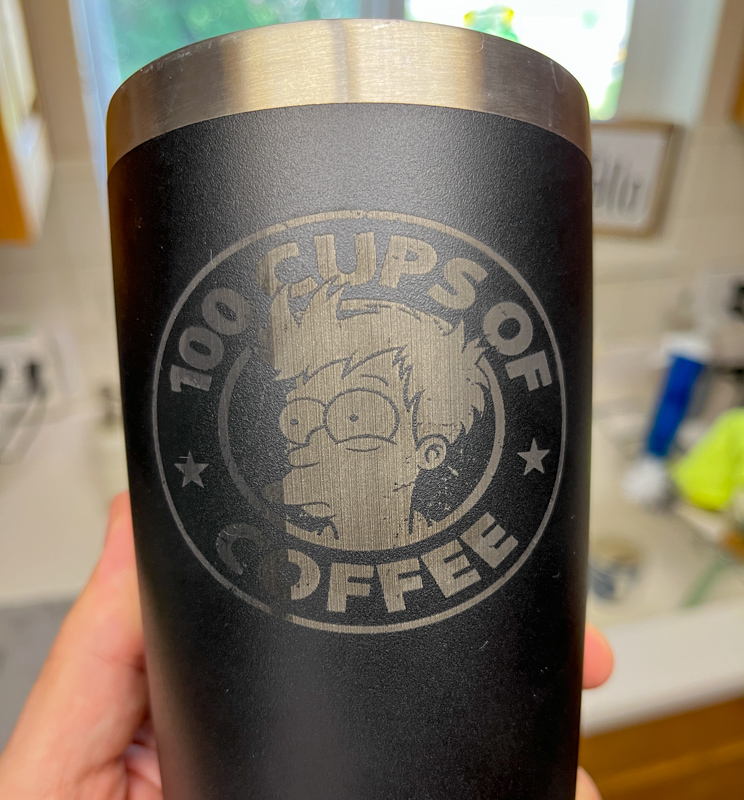
REVIEW – There have only been a handful of times in my life when I wished I had a laser cutter/engraver. It’s the sort of tool that hasn’t ever been at the top of my mind, but now that I’ve received the ORTUR Laser Master 2 S2 24V laser engraving machine to review, it’s opened a floodgate of creative applications that I never knew I could do. Fry from Futurama on my coffee mug? Check. A new dog tag for the little mutt? Check. A butt-themed beer table? Check.

The ORTUR Laser Master 2 S2 24V laser engraving machine (that’s a mouthful) is a laser cutter/engraver system. You can send designs or images to it and either cut or engrave those designs onto a wide variety of surfaces, including wood, metal, glass, stone, and much more.

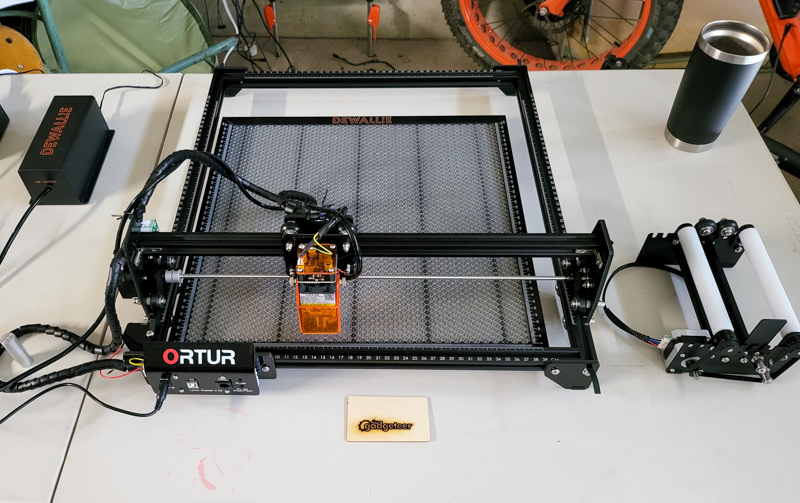
NOT INCLUDED but pictured throughout this review and provided by Made the Best:

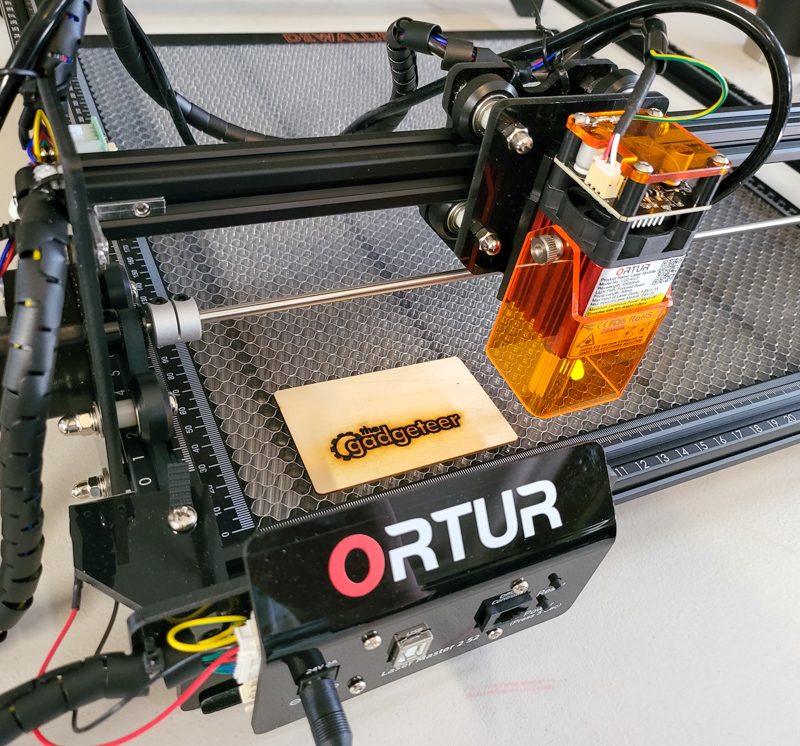
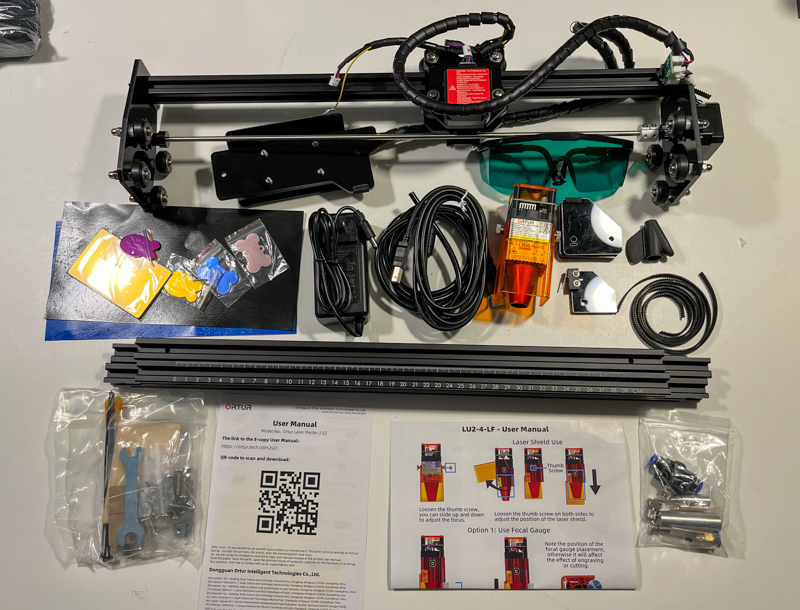
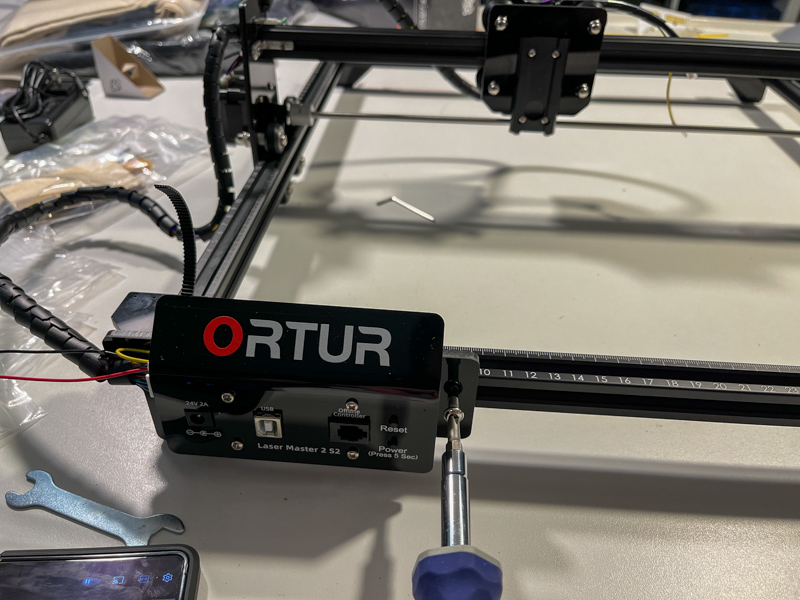
The ORTUR Laser Master 2 S2 24V laser engraving machine seems to be a fairly standard laser engraver/cutter design. A frame allows the laser head to move along the X and Y axis and a small control panel on the front includes power and USB connections as well as power and reset controls.

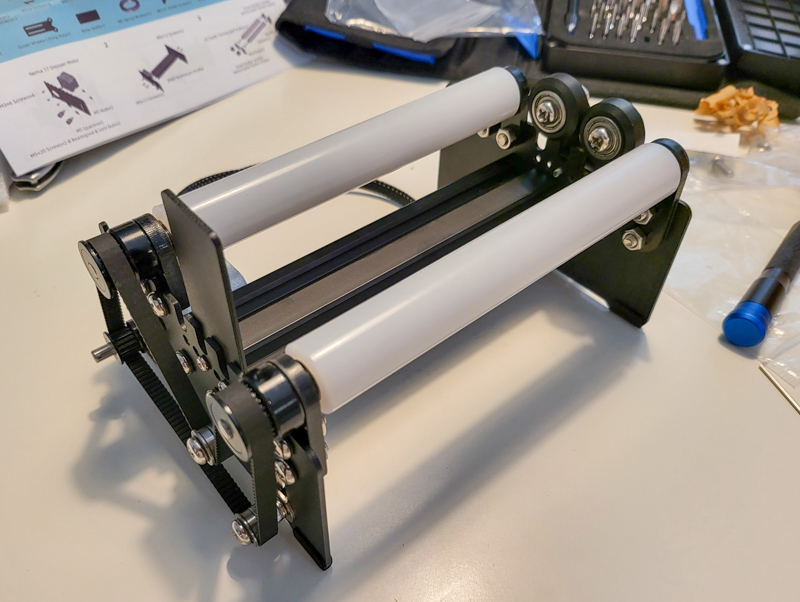
The optional Ortur Y-axis Rotary Roller 2.0 is shown above, this consists of two rollers that can be moved around to accommodate fairly large mugs, bottles, or glasses. This plugs into the control unit directly.

Made the Best also sent over an air pump, which I set up as shown above. This blows a steady stream of air onto the surface being lased, which keeps smoke away and results in less darkened edges due to smoke.

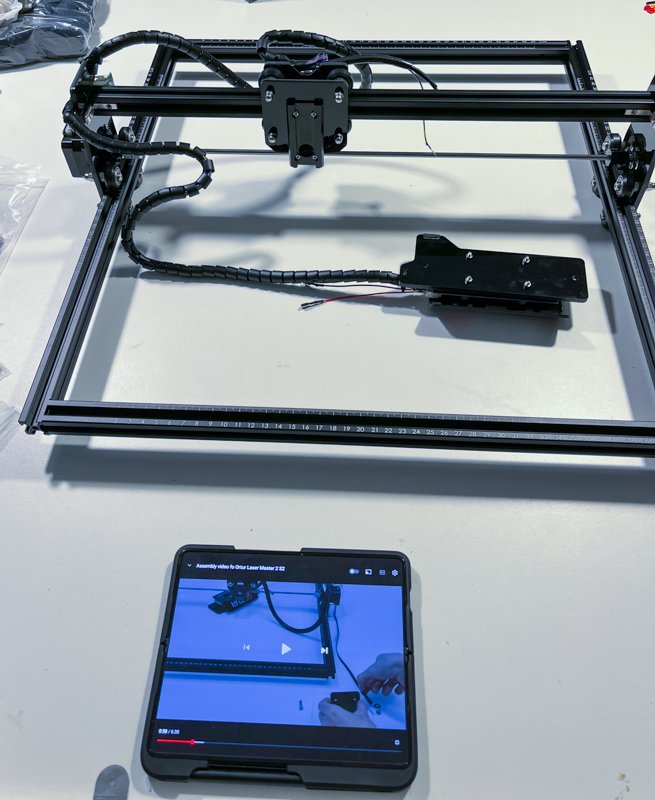
Setup consisted of quite a few screws and belts to be installed, but the tutorial video (a QR code in the manual leads to this) did a good job of clearly illustrating each step.

In the shot above, I’m putting the finishing touches on the installation. This all took less than 30 minutes start to finish, and only required a standard screwdriver and scissors or snips to remove excess belt material after installation.
Next, you want to make sure you have something below the object being engraved or cut, I opted for an old piece of a desk for my first test. If you don’t have a safety material then plan on having whatever surface you are on to get scorched and possibly cut.

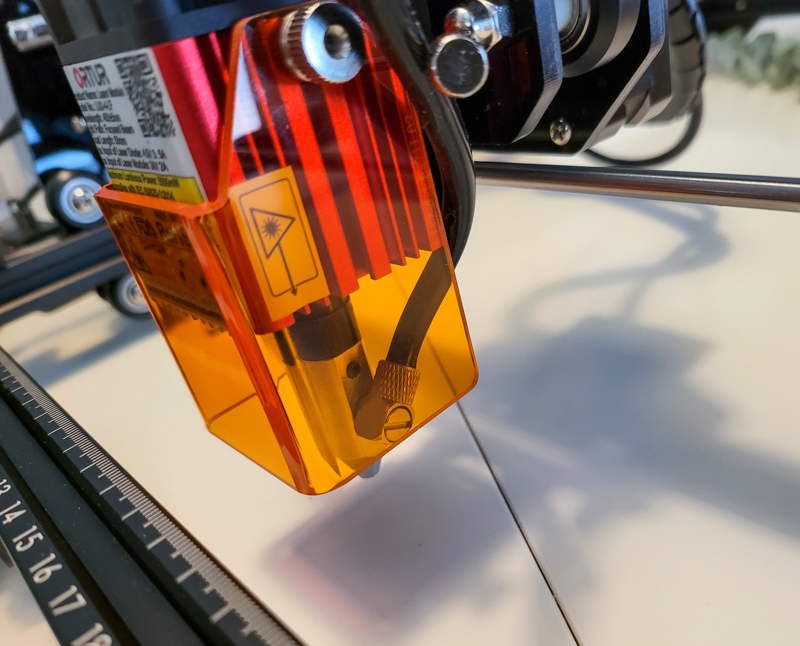
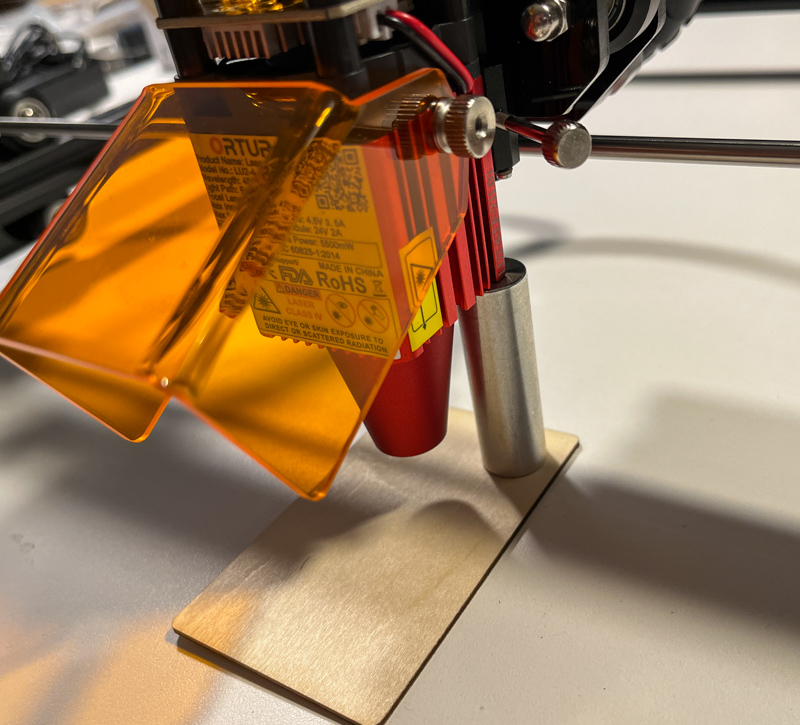
The included small metal cylinder pictured above is provided to adjust the laser height to the perfect position above the item to be engraved/cut. An easy thumbscrew loosens the laser head, and you can slide it up, set the metal cylinder on your object, lower the laser to gently rest on it, then tighten the thumbscrew to lock in that position.
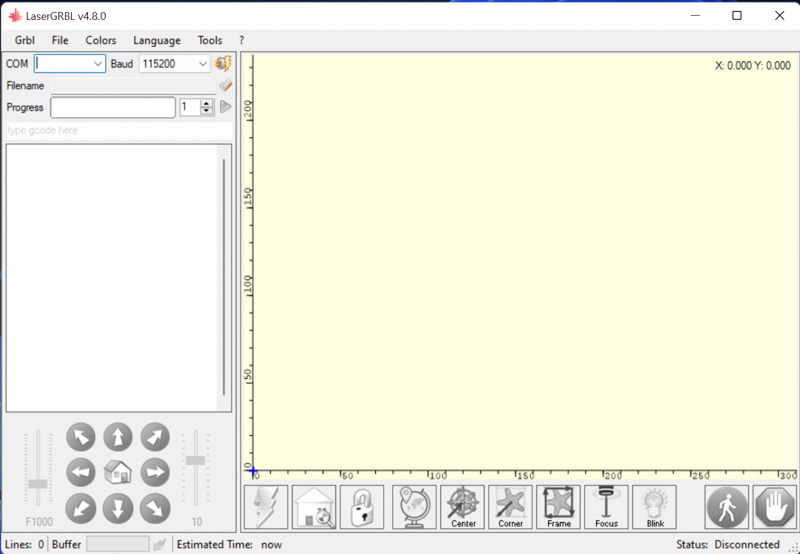
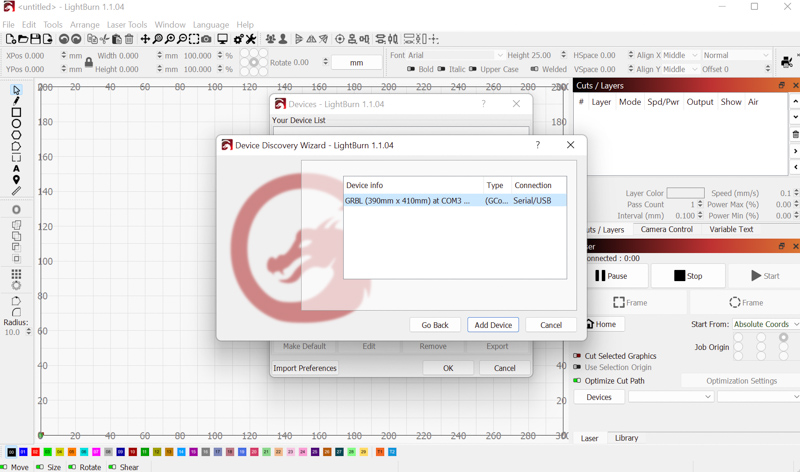
Next up, you’ll need to select software to convert images to cutting/engraving instructions. Made The Best suggests either LaserGRBL (free) or LightBurn (free 30 day trial then $40). Here’s screenshots of both:

I found LaserGRBL to be fairly easy to use. It feels like 10 year old software, but it gets the job done. I was able to do my first few engravings after watching one or two tutorials.

Lightburn (pictured above) is a more complex interface, but it feels like you’d be able to do more with it and it comes highly recommended by many of the creators I found while browsing laser engraving tutorials.
Regardless of the software you use, basically you import an image or design, choose how the software should interpret that to laser instructions, and decide variables like power and speed (which, depending on your material, affect how deeply the laser cuts or engraves).

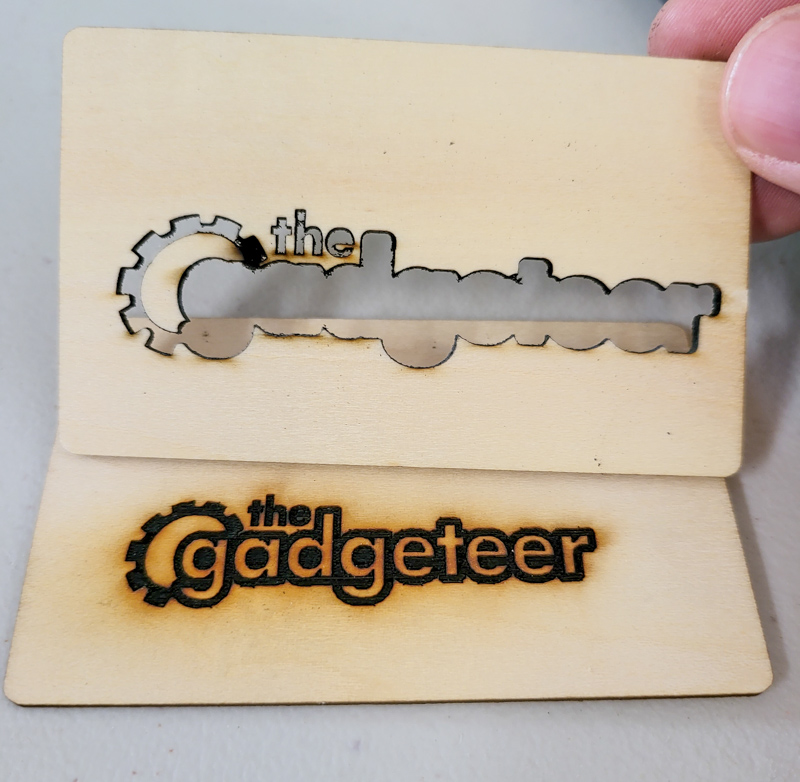
I started with our Gadgeteer logo (naturally), and as you can see above I learned some valuable lessons quickly about laser power and the need to have a safe surface behind whatever you’re cutting. The power in the top one was at 100%, and easily and quickly cut right through the thin wood, while the bottom one was at a 20% setting. The speed you tell the laser to cut at also affects engraving versus cutting – more power and/or less speed will result in a deeper cut.
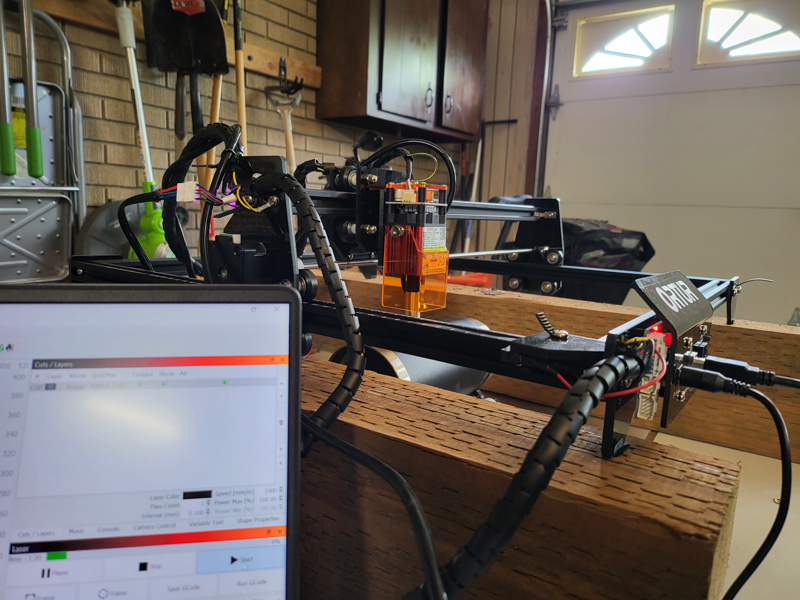
Once I’d mastered the basics of the settings and the software, I moved on to a more advanced project: cutting a picture of Fry from Futurama onto my coffee mug. I had to connect the Ortur Y-axis Rotary Roller 2.0 (which disables the Y axis motors and instead spins an object in place while the laser can still move along the X-axis). I also had to get creative and raise the whole unit a few inches with some spare wood beams.

Pictured below: success.  Also pictured, an inadvertent test of the optional air blower attachment turned on partway through the engraving (the left side you can see is much darker, this is due to smoke from the engraving not being blown away during the process). I highly recommend getting a blower or using an air compressor with this unit, you can tell from my results what a difference it makes.

I was highly impressed with the accuracy and performance of the ORTUR Laser Master 2 S2 24V laser engraving machine. I have yet to push the limits of what it can do, specifically in engraving grayscale images onto various surfaces. This is not for lack of trying, but rather lack of experience, several tests resulted in too-light or too-dark images on different types of wood. You’ll need to experiment to dial in a highly detailed image with higher contrast, but the laser is capable of 1000 different power levels (many competing models only have 255 levels). This theoretically could result in up to 1000 shades of grey in an image engraving.
Image resolution is also very high, over a fairly large cutting area (39 x 41 centimeters).

I think the image above sums up the value of the ORTUR Laser Master 2 S2 24V laser engraving machine to me more than any words could. This machine has opened up new worlds of cutting and engraving that I hadn’t even dreamed of before, creative juices are flowing, and I’m excited for many projects in the future!
Price: $359.00
Where to buy:
ORTUR Laser Master 2 S2 LF LU2-4
Made The Best: https://www.madethebest.com/collections/engraving-machines-1/products/ortur-laser-master-2-s2?variant=42866699075800&aff=64
Made The Best Coupon code: M2S2 save $30
Amazon: https://amzn.to/3At1L1F
Ortur YRR2.0 Y-axis Rotary Roller
Made The Best: https://www.madethebest.com/products/ortur-laser-engraver-y-axis-rotary-roller-engraving-module-for-engraving-cylindrical-objects-cans?_pos=3&_sid=bbaaab738&_ss=r&variant=40259244753082&aff=64
Amazon: https://amzn.to/3bVdrji
Source: The sample for this review was provided by Made The Best
Your email address will not be published.


This site is intended for informational and entertainment purposes only. The contents are the views and opinions of the author(s) and/or associates. All products and trademarks are the property of their respective owners. Reproduction in whole or in part, in any form or medium, without express written permission of The Gadgeteer,  is prohibited. All content and graphical elements are Copyright © 1997 – 2022 Julie Strietelmeier and The Gadgeteer. 
All rights reserved. 

source

Bloomingdale's Launches Exclusive AQUA x Studio 189 Collection :: Macy's, Inc. (M) – Macy's, Inc.

The summer capsule collection, called “AKUA”, features Studio 189’s artisan-produced fabrics to debut at The Surf Lodge
[LINK TO DOWNLOAD EDITORIAL & BTS IMAGES HERE]
NEW YORK, June 29, 2022 /PRNewswire/ — Bloomingdale’s today announces AQUA x Studio 189, a limited-edition collaboration between the retailer’s best-selling exclusive brand and the artisan-produced fashion luxury lifestyle brand and social enterprise co-founded by luxury executive and educator Abrima Erwiah and actress and activist Rosario Dawson. The collection features vibrant hand-dyed prints produced by Studio 189 artisans in Ghana in vibrant summer-ready styles including dresses, tops, skirts, and swimwear – all designed to be mixed and matched. The AQUA x Studio 189 collection launches on July 1 at Bloomingdale’s stores nationwide and on Bloomingdales.com. Bloomingdale’s will host celebrations at The Surf Lodge in Montauk, N.Y., from June 29 to July 4, with special integrations across the property, including the premiere of AQUA x Studio 189 collection in the boutique. View and shop the AQUA x Studio 189 collection here.
Looks from Bloomingdale's exclusive AQUA x Studio 189 collection
“By partnering with AQUA on this collection, we’re able to celebrate the work of our artisans on a whole new level,” said Abrima Erwiah, Studio 189 co-founder. “The special hand-batiked prints that were created exclusively for this collaboration resulted in Studio 189’s largest single fabric order to date, which grants us the opportunity to present the craftsmanship of our artisans to a broader audience. It’s an accessible collection that embraces joy with vibrant and tropical designs fitting for the summer season.” 
“We’re delighted to have had the opportunity to collaborate with Studio 189 on this beautiful collection,” says Denise Magid, Executive Vice President and General Merchandise Manager for Ready-to-Wear, Center Core, Concessions and Bloomingdale’s Outlets.  “As a brand that works with artisanal communities that specialize in various traditional craftsmanship techniques, Studio 189 brings bold, inspired new looks to our beloved and best-selling AQUA portfolio this summer.”
The AQUA x Studio 189 collection entitled “AKUA” was born on a Wednesday during New York Fashion Week after Bloomingdale’s Creative Director of AQUA Erica Ruff Hatfield contacted designer Abrima Erwiah to collaborate following Studio 189’s SS2022 Runway Show. “In Ghana, we are named after the days of the week. For example, Abrima is Nzema for Tuesday born. I felt very moved by this idea of birthing a new project “AKUA” when I was contacted by Bloomingdale’s and AQUA,” says Erwiah. Akua is an Akan female name for a girl child born on Wednesday and is derived from deities. Akua is said to be a champion for the cause of others. Erwiah continued, “This was fitting because the goal of this collaboration was to allow Studio 189 to create more work for the communities we serve in Africa. We were able to produce more than 20,000 yards of hand-made fabric and activate rural communities that really need the work especially considering the effects of the pandemic and rising prices. This was also our first time producing in Asia which is where AQUA produces. We learned new ways of working via skills transfer from AQUA’s family-run factory that is based in LA, Korea and China. This was a true collaboration in every way. The team we worked with has been spectacular and have helped us to achieve our mission in providing jobs, to empowering women in disenfranchised communities, and to support education and skills training.”
The AQUA x Studio 189 collection features vibrant prints produced by Studio 189 artisans using the art of hand-batiking. This art form starts with patterns carved into wood or sponge that are dipped into hot wax and stamped onto cloth. This cloth is dipped into hand-mixed dyes and then the wax is removed to unveil the finished design.
A total of 11 different hand-batiked prints were created exclusively for this collection, including palm leaves and pineapple motifs, each designed in bright, vivid color palettes. The summer styles can be worn on their own or mixed and matched with one another, with ready-to-wear pieces spanning halter maxi dresses, ruffled tiered skirts, miniskirts and more. The collection also marks the first-ever AQUA swim collaboration with one and two-piece swimsuits and that can be paired with the ready-to-wear styles for a beach to bar look. AQUA x Studio 189 has 17 apparel pieces and 8 swim styles ranging from $48 to $198.
AQUA is a contemporary, trend-driven brand available exclusively at Bloomingdale’s stores and online at Bloomingdales.com. Each season, AQUA features of-the-moment ready-to-wear apparel and accessories for a stylish head-to-toe look at an approachable price point. The brand has previously partnered with cultural figures and top brands, including Pendleton, Scout the City, Mary Katrantzou, Zendaya, Helen Owen, Mary Lawless Lee, Yigal Azrouël, Maddie & Tae, Zadig & Voltaire and Madeleine Thompson.
Bloomingdale’s will celebrate the AQUA x Studio 189 collection at The Surf Lodge over the 4th of July holiday weekend with integrations throughout the property. The Surf Lodge boutique will be the first to offer the AQUA x Studio 189 collection, which will be available June 29 – July 4. Continuing the celebration at The Surf Lodge, Bloomingdale’s will also be hosting a private dinner with guests of honor Studio 189 co-founders Abrima Erwiah and Rosario Dawson, and special musical performances.
Visit Bloomingdales.com here and your nearest Bloomingdale’s store to shop the full AQUA x Studio 189 collection starting Friday, July 1.
Bloomingdale’s is America’s only nationwide, full-line, upscale department store.  A division of Macy’s, Inc., it currently operates 33 Bloomingdale’s stores and 21 Bloomingdale’s, The Outlet Stores, in California, Connecticut, Florida, Georgia, Hawaii, Illinois, Maryland, Massachusetts, New Hampshire, New Jersey, New York, Pennsylvania, Texas, and Virginia, along with 1 Bloomie’s location in Virginia. In addition, Bloomingdale’s has an international presence with a location in Dubai. Founded in 1872, the iconic retailer is celebrating its 150th anniversary this year.  Be sure to follow @bloomingdales on social media, become a Loyallist, and for more information, or to shop any time, visit www.bloomingdales.com
Co-founded by Rosario Dawson and Abrima Erwiah, is an artisan produced fashion lifestyle brand and social enterprise that has recently been a recipient of the prestigious CFDA/VOGUE fashion fund grant and has also won the CFDA Lexus Fashion Initiative for Sustainability. The brand is made in Africa and produces African and African-inspired content and clothing. The brand currently operates a store in Accra (Ghana), an ecommerce site, a manufacturing facility in Accra, and supports various community led projects in Africa and in the USA. Studio 189 works with artisanal communities that specialize in various traditional craftsmanship techniques including natural plant based dye indigo, hand-batik, kente weaving and more. Studio 189 focuses on empowerment, creating jobs and supporting education and skills training. Studio 189 is the recipient of various awards including the prestigious FIT Changemaker Award, the Cooper Hewitt Smithsonian Emerging Designer Award and the Martin Luther King Jr Social Justice award from Upenn. The first collection launched on February 14th 2013 in honor of One Billion Rising. The mission took shape following a trip with Eve Ensler’s V-Day and Dr. Mukwege’s Panzi Hospital in February 2011, through Kenya, Burundi and Rwanda to Bukavu in the Democratic Republic of Congo for the opening of the City of Joy.

Cision View original content to download multimedia:https://www.prnewswire.com/news-releases/bloomingdales-launches-exclusive-aqua-x-studio-189-collection-301577448.html
SOURCE Bloomingdale’s
Released June 29, 2022

source

How Music Producer Calvin Ngo Went From Zero to Musical Force – Village Voice

The start of every journey is a single step, and for renowned music producer Calvin Ngo, this was a step he took almost six years ago. Calvin Ngo, popularly known by his artistic name, NGO, developed a passion for music at a young age. He loved and enjoyed listening to different genres of music, which led him to learn more about music production.
According to NGO, he always wanted to know how songs made their way from the studio to the radio. To quench his thirst, he began digging into the production process and started learning about the different techniques used to create and manipulate sounds.
At the time, NGO pursued music production as a hobby while also attending high school. Between after school sports and the workload from his classes, he had no time to take formal music production classes but he took it upon himself to learn through YouTube videos and try to recreate songs that he liked in FL Studio.
“It was a frustrating trial and error process, and most of the time, I wasn’t sure whether what I was doing was the right thing. But I did not give up. I continued practicing, and after months of hard work, my productions started to seem more well-rounded,” says NGO.
This enabled NGO to shape his own sounds. However, the challenges were far from over. NGO didn’t know anyone in the music scene, and with no support or money to promote his work, it was tough to break into the scene. He explains that it took him several months before he got his big break.
NGO shot into the limelight when he released his future bass-inspired dance-pop remix of “Too Good” by Drake and Rihanna. His undeniable talent, skills, and unique sound helped him establish and cement his place in the music industry with the “Too Good” remix amassing over 15 million streams. Since then, NGO has not looked back, and he has released hit after hit.
NGO is the creative behind several viral remixes, including “All We Know” by The Chainsmokers, which has gained 20M+ streams and earned NGO support from The Chainsmokers themselves, Trap Nation, and countless other artists/influencers. NGO has also released “Levitate”, Hear From Me”, and “Somebody”, which are original projects signed to reputable record labels that have attracted much attention from the public.
NGO has over 75 million streams and has been interviewed and featured on several online publications and media networks, making an appearance on the iconic BBC Radio 1 twice. He also launched his own record label, BLNDR, in 2020.
From a struggling young dreamer to one of the most sought-after music producers in the US, NGO is on his way to the top. He is a musical force who is not only dropping great tunes for his growing fan base but is also redefining the music scene. He is introducing a new vibe to the music industry that is uniquely his own, one that is not defined by any particular genres.
NGO says his goal is to create more timeless music as he builds an online family of music lovers. Through BLNDR (Blender), NGO provides upcoming artists with a chance to showcase their talents. Whether it be support in one of his highly influential curated playlists on Spotify or signing the tracks to the BLNDR record label, NGO envisions BLNDR as the launchpad for talented artists, regardless of their size.

source

Like 'Minions,' Jack Antonoff is inescapable – Los Angeles Times

For a guy who got his first big break with a song called “We Are Young,” Jack Antonoff sure seems fixated on old music.
At last month’s Bonnaroo festival in Tennessee, Antonoff — former guitarist of the pop-rock trio fun., whose exultant (if somewhat cringe) 2012 smash about youth topped Billboard’s Hot 100 for six weeks on its way to winning song of the year at the Grammy Awards — convened a bunch of musician pals for an all-star tribute to his birth year of 1984.
Last week, he played Inglewood’s Kia Forum with his current group, Bleachers, which stopped channeling Bruce Springsteen’s time-honored thoughts on girls and New Jersey only to cover Tom Waits’ “Jersey Girl.”
A few days after that show, the latest “Minions” movie landed in theaters with an Antonoff-assembled soundtrack of indelible ’70s hits newly recorded by the likes of Thundercat, Kali Uchis, St. Vincent, H.E.R. and Caroline Polachek. “The Rise of Gru,” as the animated film is called, set a Fourth of July box office record, which almost certainly means that millions more grade-schoolers have now heard “Fly Like an Eagle” than had the weekend before.
It’s no wonder Antonoff, 38, keeps rifling through the used bins: Old music is big business these days, with so-called catalog material accounting for 70% of what was streamed last year on services such as Spotify and Apple Music, according to MRC Data. Thanks in large part to TikTok, vintage tunes like Fleetwood Mac’s “Dreams” and Matthew Wilder’s “Break My Stride” have surged onto streaming charts; Kate Bush’s “Running Up That Hill (A Deal with God)” sits at No. 6 on the Hot 100, ahead of Beyoncé’s new single, after it was prominently featured in Netflix’s “Stranger Things.”
Music
Bush, a rare female auteur in the male-dominated music world, has inspired a raft of acclaimed artists from Fiona Apple to FKA Twigs to Japanese Breakfast.

Indeed, “The Rise of Gru” isn’t this summer’s only Hollywood blockbuster with a soundtrack of familiar melodies. For his splashy take on the life of Elvis Presley, Baz Luhrmann recruited Doja Cat, Eminem, Kacey Musgraves and Stevie Nicks, among others, to punch up Presley’s music, while “Top Gun: Maverick” recycles Kenny Loggins’ “Danger Zone” to accompany a nearly shot-for-shot re-creation of the original “Top Gun’s” opening sequence.
Yet Antonoff’s retro leanings have actually made him a major player shaping the sound of modern pop. More than Bleachers — a moderately successful alt-rock radio act headlining an arena for the first time at the Forum — what he’s best known for is his production and songwriting for superstars including Taylor Swift and Lorde and acclaimed critics’ faves such as Lana Del Rey, Clairo and St. Vincent. When the Chicks got back together a couple of years ago (minus the “Dixie”), the groundbreaking country trio hired Antonoff to oversee their return; when Olivia Rodrigo revised the credits for her album “Sour” to acknowledge some crucial inspirations (and perhaps to stave off a copyright lawsuit or two), Antonoff’s name was among those added. At April’s Grammys ceremony he was named producer of the year — one of four Grammys he’s won, along with fun.’s two, for his behind-the-scenes studio work.
Antonoff’s touch — his ability to blend classic and cutting-edge, cult and mass, intimate and anthemic — has proven sufficiently zeitgeist-y that he’s started attracting older musicians eager to connect with fans of the millennial and Gen Z artists who idolize them: Diana Ross and Earth, Wind & Fire’s Verdine White both appear on the “Rise of Gru” soundtrack, while Springsteen himself puts in a cameo on Bleachers’ third LP, 2021’s “Take the Sadness Out of Saturday Night,” which got no higher than No. 27 on the Billboard 200 but which scored Bleachers a last-minute booking on “Saturday Night Live” in January after Roddy Ricch bailed due to a COVID exposure.
So what is it precisely that Antonoff does? In interviews, he routinely describes his production approach as an act of emotional availability — establishing a secure environment for artists to express themselves, then responding in a way that encourages them to keep going further than they otherwise might. Whatever arrangement he helps devise depends entirely, in his telling, on where the artist has led him. “Production isn’t someone with the coolest snare sound,” he told The Times in 2019. “Production is the idea.”
It’s a willful throwback to a more collaborative, exploratory age before hitmakers like Max Martin and the Neptunes provided pop stars and rappers with nearly finished tracks awaiting a marquee vocal performance; it’s also, in the wake of sexual-abuse allegations against the once-powerful Dr. Luke, a shrewd assurance of his respect for women in the workplace. (Jack Antonoff: the original gentleminion.) So inescapable did he seem last year that a mild backlash began forming among listeners who felt he’d overplayed his hand as a female ally — at least until he turned up yet again as Florence Welch’s right-hand man on Florence + the Machine’s well-received “Dance Fever.”

Still, that framing downplays Antonoff’s reliance on a variety of sonic hallmarks: booming drums, airy synths, snaking guitar lines, reverb-drenched vocals, each rooted in a lifetime of obsessive listening and tinkering with both instruments and software. That you can detect his fingerprints throughout the songs from “Minions” — even in cuts as distinct as Phoebe Bridgers’ winsome take on the Carpenters’ “Goodbye to Love” and Brockhampton’s swaggering run through “Hollywood Swinging” by Kool & the Gang — is an indication of how finely he’s honed his textural palette. Maybe too finely: For Bleachers’ rendition of John Lennon’s “Instant Karma!” Antonoff made the insane choice to forgo the late Alan White’s iconic drum fill.
Antonoff, an occasional tabloid presence thanks to his relationships with actresses Lena Dunham and Margaret Qualley, isn’t alone in his flair for slightly denaturing sounds familiar to any music fan. Smart, young-ish acts curious about the history of pop and rock — your Haims and Vampire Weekends and Lady Gagas — have sought out other writer-producers such as Ariel Rechtshaid, Rostam, Blake Mills and Tame Impala’s Kevin Parker, the last of whom teamed with Ross and Antonoff for a standout original, “Turn Up the Sunshine,” for “The Rise of Gru.”
Taken together, these guys’ efforts reflect an era in which the creative instinct has grown inseparable from the curatorial one — when the only way to say something honest about your life is to acknowledge that each of your experiences was shaped by those who experienced and then sang about them before you did.
“I miss Long Beach and I miss you, babe / I miss dancing with you the most of all,” Del Rey purrs in “The Greatest,” a stately piano ballad she and Antonoff co-wrote for 2019’s richly allusive (and endlessly memeable) “Norman F— Rockwell!” “I miss the bar where the Beach Boys would go / Dennis’ last stop before ‘Kokomo.’”
What does distinguish Antonoff, who came up playing in punk bands in his native New Jersey before breaking out with fun., is his eagerness to forget that he knows all that. Fronting Bleachers at the Forum, he began the show in proudly nerdy media-studies mode, mumbling the band’s “91,” about watching the Gulf War on TV, in front of a flickering box; within 15 minutes or so, he pretended to decide that the sweater he’d worn onstage had been a bad move.
“No f— way I’m playing this song in a cardigan,” he said as he tore it off (along with his Coke-bottle eyeglasses) to reveal a sleeveless T-shirt, his bandmates revving up the monstrous and chiming “How Dare You Want More” behind him. And that was where Antonoff, perhaps the unlikeliest rock star since Weezer’s Rivers Cuomo, achieved something like an escape into the fantasy his music holds out. It’s not that the songs about grief and ambition were mapping new thematic territory; it’s definitely not that the “Born to Run” glockenspiel licks were doing something you’d never heard.
But the emotional energy felt incredibly pure as he and the rest of Bleachers pushed their way to a sweet spot where you couldn’t tell the difference between a blaring guitar and a blaring saxophone. He wasn’t lost in the music, exactly, but he didn’t seem to want to find his way back.
The complete guide to home viewing
Get Screen Gab for weekly recommendations, analysis, interviews and irreverent discussion of the TV and streaming movies everyone’s talking about.
You may occasionally receive promotional content from the Los Angeles Times.
Follow Us
Mikael Wood is pop music critic for the Los Angeles Times.
Music

Television

Music

Music

Music

Music

Music

Music

Music

Subscribe for unlimited access
Follow Us

source

Mayor Of London Opens The Talent House – A Brand New Creative Hub – Broadway World

Get local news, offers & more…
Mayor Of London Opens The Talent House - A Brand New Creative Hub
The Talent House, a new £4.1 million state-of-the-art creative hub from East London Dance and leading national youth music organisation, UD, has officially been opened in Stratford by the Mayor of London, Sadiq Khan.
The new hub will equip young diverse talent in east London to become the next generation of music and dance professionals by providing free and affordable access to world class facilities as a launchpad to reach new audiences, alongside facilitating collaboration between young people and early career creatives and producers.
The five-year capital project, launched with initial funding from Arts Council England and the Greater London Authority (GLA), brings East London Dance and UD together under one roof. The Talent House will welcome more than 12,000 people every year with an inspirational public programme, co-curated with young people, artists and local residents.
Equipping young diverse talent in east London to become the next generation of music and dance professionals
The Talent House will enable the two organisations, both long-standing champions of the next generation of artists, entrepreneurs and creative leaders, to support even more outstanding but under-represented talent. From schools outreach and skills programmes to industry networks and professional development opportunities, East London Dance and UD will continue to nurture the confidence of young creatives and support them to build sustainable careers, acting as a pivotal player in the talent development pipeline of the next generation of music and dance professionals.
Providing free and affordable access to world class facilities as a launchpad for young creatives to reach new audiences
With professional rehearsal spaces and digital broadcast capability throughout the building, brand new creations and collaborations from bold, authentic and blazingly contemporary east London dance and music creatives will have a vital launchpad to reach new audiences locally, nationally and internationally. More than 2,100 hours of free access to the building with its facilities will be made available to locally-based independent artists and young participants every year.
Facilitating collaboration between young people and early career creatives and producers
An engine room for creativity, the Talent House will create opportunities for early career and more established dance and music artists and professionals to connect with one another, to be inspired and create, as well as encouraging the cross-pollination of talent, ideas, conversation and performance between art forms.
Designed by Waugh Thistleton with internal design by award-winning architect Katy Marks from Citizens Design Bureau, and located within a new development by Vastint UK, the three-storey building housed in an historic warehouse with a modern extension was repurposed by specialist fit-out contractors ITC. The building comprises two dance studios, five music production/recording studios, a live room and two vocal booths, a large flexible rehearsal/events space and a tech lab for education and training. The design also includes a co-working space for artists and members, and a central atrium functioning as the main reception and multi-use space for dance jams and informal gigs.
The Mayor of London, Sadiq Khan, said: “Culture is at the heart of what makes London the greatest city in the world, which is why I’m delighted to officially open Talent House. London’s music and dance scene is thriving, but these companies need a home to nurture and support talent, so I’m proud to have invested in this state of the art facility, which will not only be a springboard for creatives and performers in Newham and across the city, but help to cement London as the creative capital of the world. Investment like this is essential for our city’s recovery and a key part of building a better London for everyone.”
Tia Hassan & Kate Scanlan, Joint Creative Director & Chief Executive, East London Dance said: “For more than three decades, East London Dance has played a central role in the development of dance in east London – nurturing, showcasing and championing young and emerging artists and creatives from black, Asian, ethnically diverse and working-class communities. With the Talent House, our first dedicated home, we are energised like never before to create a world where creative talent is always met with opportunity, no matter where you come from. We’re committed to artist-led and co-designed programmes and to ensuring that the Talent House is a welcoming and open space for people to gather, connect, learn, collaborate and share their creativity with the world – so come and get involved.”
Pamela McCormick, Founder and CEO, UD said: “Over the last 20+ years, UD has seen the potential for excellence in every young person we’ve encountered. Talent is everywhere, but opportunity is not. We know that the specific training needs demanded of Black music are not met by music education; there is a lack of strategic talent development in Black music, with many artists unable to achieve sustainable careers without subsidised intervention; and, whilst Black music has never been more commercially successful in the UK, only a small percentage of the workforce is from communities experiencing racial inequality or barriers to social mobility. As we move into the Talent House, we are poised to realise the potential that this new state-of-the-art resource can bring to transforming the lives of young people, challenging the outdated traditions of music education, and diversifying the face of the music industry.”
Michael Cronin, Head of UK Portfolio, Vastint said “We are delighted to welcome UD Music back to Sugar House Island, alongside East London Dance, to create a place which will support and inspire the local community. It is fitting that this partnership comes together under the roof of a building which has witnessed the Island’s long-standing history of creativity and collaboration and we look forward to playing host to upcoming talent from across the capital.”
Baseless Fabric Announce Free Street Performances of CARMEN Across South London
Photos: First Look at Louis Gaunt in MARY POPPINS
Italia Conti’s Student Welfare Officer Responsible For Offensive Social Media Posts
Karena Johnson Joins Barbican As New Head of Creative Collaboration And Learning
Hot stories

HARRY POTTER AND THE CURSED CHILD To Have Someone on Stage Continuously Over 24-Hour Perio Photo

CURSED CHILD To Have Someone on Stage Over 24-Hour Period

Emilia Clarke Hopes Her West End Debut Will Go Better Than Her 'Catastrophic' Broadway Deb Photo

Emilia Clarke Has High Hopes For West End Debut

Review: RICHARD III, Royal Shakespeare Theatre Photo

Review: RICHARD III, Royal Shakespeare Theatre

Casting Announced For the UK Premiere of Dawn King's THE TRIALS at The Donmar Warehouse Photo

Casting Announced For the UK Premiere of Dawn King’s THE TRIALS at The Donmar Warehouse

CURSED CHILD To Have Someone on Stage Over 24-Hour Period
Emilia Clarke Has High Hopes For West End Debut
Review: RICHARD III, Royal Shakespeare Theatre
Casting Announced For the UK Premiere of Dawn King’s THE TRIALS at The Donmar Warehouse
BroadwayWorld TV
News + special offers for Broadway Shows

Save Up To 50% On Tickets For JITNEY at The Old Vic
Save 38% on SECRET CINEMA PRESENTS DIRTY DANCING
Show Of The Week: Exclusive Ticket Prices For MAGIC MIKE LIVE!
Recommended for You


Sign-Up for UK / West End News
Follow Us

BWW Sister Sites

Apps

source

'Wherever you go, there you are' : Code Switch – NPR

GENE DEMBY, HOST:
Just a heads up, y’all – this episode contains mentions of suicide.
What’s good, y’all? I’m Gene Demby, and this is CODE SWITCH from NPR.
(SOUNDBITE OF MUSIC)
DEMBY: So for as long as CODE SWITCH has been the thing, our team has been made up in no small part of the kids of immigrants. So when we’re all chopping it up on the CODE SWITCH stoop, which is the joke-y (ph) name for the little area in the NPR office where all of our cubicles are situated, we sometimes get to complaining about our families and our parents, you know, as you do, and all the typical generational frictions and frustrations come up, but also so does a lot of commiserating about this experiential stuff – right? – this giant gap in outlooks when you are born and raised in the United States, and your mother or your father or the people who raised you grew up somewhere, you know, halfway around the world.
People on the team have talked about what it was like to go back to their parents’ home country and to see their parents transform into these unfamiliar beings once they were back in this different element, their own element. A normally taciturn father who was suddenly really mischievous and quick-witted, the life of the party even. The anxious mother who was just more assured, who was just moving lighter. Sometimes it was a function of people’s parents slipping back into some role they played in the family order back in the old country, back in the day. And sometimes it was just about their parents being able to step back into a life they had before they had the life they have now, before any number of potential lives and careers and lovers came off the table.
On this episode, we’re going to hear a very personal story from someone who was stuck between these two different versions of himself, these two different modes of being. Miguel Macias was an executive producer with our play cousins over at Latino USA. He grew up in Spain but moved to the United States when he was in his 20s. And he’s spent a lot of his life since toggling back and forth between these two worlds that he inhabited on either side of the Atlantic. And this episode, which originally ran on Latino USA, Miguel gets very honest about his hopes, his regrets, his debilitating depression and what you lose when you choose the freedom of not putting down stakes anywhere.
(SOUNDBITE OF MUSIC)
PABLO: (Speaking Spanish).
MIGUEL MACIAS, BYLINE: This story starts in 2012. That’s the year I started taping interviews with my friends in Spain. The 2008 economic crisis was four years in and not going away anytime soon. I saw many of my friends give up on their dreams of a more fulfilling life as I watched from the outside. So we talked. We talked for hours and hours about the crisis, politics, society, Spain, our generation.
PABLO: (Speaking Spanish).
MACIAS: My generation was born around the time Franco, the Spanish dictator, died. We grew up under a new democracy full of promise that things would be better for us, better than for our parents, not just politically but also economically. But the crisis took away that promise. By then, I had been in the U.S. for more than a decade. I had a stable job as a professor teaching radio production at Brooklyn College in New York City. And at that moment, when so many of my friends were basically drowning, I felt lucky to live somewhere else, to have some stability.
PABLO: (Speaking Spanish).
MACIAS: That’s my friend Pablo, an architect. Studying architecture in Spain seemed like a good idea for a while for my generation, when construction was booming, until it wasn’t, until the crisis devastated the sector. Work started to dry up progressively until there was no work for Pablo. He was unemployed for years.
PABLO: (Speaking Spanish).
MACIAS: He went into a dark place, thinking that, at 40 years old, he had nothing to show for his life…
PABLO: (Speaking Spanish).
MACIAS: …Wondering what good happened to him in 20 years.
PABLO: (Speaking Spanish).
MACIAS: He started doubting himself. Everything you expect to feel when you’re unemployed for a long time, he knew these feelings were coming, and he still suffered from them.
PABLO: (Speaking Spanish).
(SOUNDBITE OF MUSIC)
UNIDENTIFIED PERSON #1: (Speaking Spanish).
UNIDENTIFIED PERSON #2: (Speaking Spanish).
UNIDENTIFIED PERSON #3: (Speaking Spanish).
MACIAS: As I listened to my friends talking about a system that felt like it was falling apart, I told myself, why would there be a place for me in this society? And they told me too in no uncertain terms, Miguel, don’t come back to Spain now; it’s horrible here. So for me, at that moment, the crisis took away a different kind of promise – my dream to go back to Spain one day.
UNIDENTIFIED PERSON #4: (Speaking Spanish).
UNIDENTIFIED PERSON #5: (Speaking Spanish).
(SOUNDBITE OF MUSIC)
MACIAS: I am, by all means a privileged immigrant. I came to the U.S. because I wanted to. I was able to study and get a job. I even had support from my family in my early years here. I guess we could say that I’ve been fairly successful, too. So I could have gone back to Spain any time. I can go back now if I want to. But for some reason, while I once felt free to leave, I never felt I had earned the right to go back. And I could have gone back, too, in those years if it weren’t for the crisis. But instead, I used every opportunity I had to spend time in Spain. And these interviews – they became a way to get to know my friends better, get to know what they thought about me.
MARIANGELES: (Through interpreter) Just one thing. Seriously, Miguel, can I really ask you questions?
MACIAS: Yeah, I’m saying that if the conversation leads to you asking me questions, I will answer them.
MARIANGELES: (Through interpreter) But are you ready for my questions?
MACIAS: Mariangeles (ph) is one of my best friends in Spain. She has a way to cut through the crap when she speaks. I interviewed her twice for my documentary about the crisis, but by the second time I sat down with her in 2016 at her terrace overlooking the center of Seville, the same place where we have had so many parties over the years, by then my conversations with my friends had turned a lot more personal.
MARIANGELES: (Through interpreter) I think that you are part of your group of friends in Spain as much as if you lived here. Now, they are happy when you visit, but they don’t miss you when you’re not here.
Do you consider them your people?
MACIAS: (Speaking Spanish) I do. They are my people, but they miss a great part of my life, the same way that I miss a great part of their lives. (Speaking Spanish).
MARIANGELES: (Through interpreter) I have one more question for you. Do you ever think about coming back?
MACIAS: (Speaking Spanish). Do I think about it? I think about it all the time. Where do you think I’ll be in 10 years?
MARIANGELES: (Through interpreter) You’ll be there. I think you just don’t want to come back.
MACIAS: I did want to go back. I still do. And hearing many of my friends say that I didn’t kind of broke my heart because it made me feel that they were seeing something I couldn’t see, that I had reached a point of no return. In my mind, I had just never found the moment to come back. I always imagined there would be this time in my life when I would be successful enough to be able to make some kind of triumphal return, to finally rest, to even be happy, build a house, work on my own things, not have to worry about my career anymore, and that moment has never come.
So I’m not sure how 10 years have passed since 2012 and I still have not been able to make a decision because I’m afraid – afraid that 20 years of my life could evaporate without a trace if I went back, afraid that my achievements would not mean much in Spain, that I couldn’t even get a good job, afraid that the past two decades of my life, the effort, the fighting, the sacrifice, the loneliness, could amount to nothing. It’s an immigrant’s worst nightmare, going back with nothing to show for. And while this might not actually be true, those are my fears. And fears have a way to sneak up on your decisions, to convince you that the worst-case scenario is real.
(SOUNDBITE OF MUSIC)
MACIAS: The first time I ever visited the U.S. – long before I moved – was in 1991, when I was 15 years old. My father was obsessed with the need to speak English to succeed in life. He was also obsessed with succeeding in life. So my parents signed me up to one of those summer programs where you spend a couple of months with an American family. I spent a few summers over the years with Peg and Mick (ph), my host family in the U.S., who made me feel at home in Delaware. I kept coming back. I guess I liked it there. I don’t really remember. Lourdes (ph), who was my girlfriend at the time, she does.
LOURDES: (Speaking Spanish).
MACIAS: She remembers me connecting with the U.S. when I was young. She even still has handwritten letters that I sent her during those summers. I would tell her about everything that I observed with bright eyes.
LOURDES: (Speaking Spanish).
MACIAS: I remember the night before I visited the U.S. for the first time. I have this image of walking into my room and seeing a bottle of scotch and a box of condoms on my table. It took me a few seconds to understand that my parents had found them where they were hidden in my room. I was 15 years old, and I was a difficult teenager. But that didn’t keep me from getting straight As in high school. My mother, who’s a psychologist, took me to her home office to talk to me about the obvious risks of drinking and having sex at that age. All I could think about was the fact that the next morning, I had a ticket to jump on a plane and travel to Delaware.
That was my first summer in the U.S. Many followed in the ’90s. So when I decided that I wanted to go live somewhere else, the United States seemed like the logical place for me to go. In January 2001, I packed a suitcase, got a job as a waiter in the West Village, and I started to count the years – five, 10, 15, 20, almost half of my life at this point.
(SOUNDBITE OF MUSIC)
MACIAS: My initial goal was not necessarily to stay in New York permanently. I wanted to study radio production for a year, maybe two. I enrolled in the master’s program, I got a student visa, and I started working as a teaching assistant at Brooklyn College. I thought I was going to go back to Spain with my fancy title and score a great job. I had spent a bunch of time in Spain after college working in bars and clubs, playing guitar in a rock band, just being young. So when I moved to New York at 25 years old, I was ready to accomplish things.
(SOUNDBITE OF UNIDENTIFIED SONG)
UNIDENTIFIED MUSICAL ARTIST: (Singing in Spanish).
MACIAS: For a few years, I just put my head down to study and work at all times, except for when I went back to Spain for the summer or for Christmas. I remember having the feeling during those years that I had started running, running at all times, and that I was never going to stop.
IRENE: You were so busy during that time. Even before you began school, I remember you were always very busy, and you were working a lot of hours.
MACIAS: Irene (ph) was a professor of mine in grad school. She met me just a few weeks after I arrived in New York in 2001. She’s been a patient mentor, even though I’ve disappointed her a few times throughout the years with my decisions.
IRENE: Do you remember how you felt then?
MACIAS: I think that when I was a student, I was very excited about my potential, you know? At the time, I thought that I may have a lot of talent. And I was very excited about what I could accomplish. And I was convinced that I was going to achieve great things, basically.
I worked with Irene on my master’s thesis project. It was a long audio experimental documentary about romantic love called “Chasing Love.” It was really important to me. I thought it was going to win all the awards or something.
(SOUNDBITE OF DOCUMENTARY, “CHASING LOVE”)
UNIDENTIFIED PERSON #6: I’ve been in love and it was a physical feeling. It wasn’t like the idea of, oh, now we’ll be together. That’ll be great. It was a feeling in my stomach.
UNIDENTIFIED PERSON #7: People just take love at face value. You know, like, oh, they’re married, so they’re in love. They love each other. But you’re like, but why? Why are they in love?
UNIDENTIFIED PERSON #8: There’s definitely things going on in our bodies that require us to touch other people. You know, that’s definitely true.
(SOUNDBITE OF MUSIC)
IRENE: I think in the present that you are a very, very, extremely talented person. But maybe I always felt that your creativity was, like, very slippery. I felt that you were sabotaging yourself the whole time. Your whole life in Brooklyn College was very general with other people, but I think to a point of being an excuse not to sit down and confront a creative project because at the end of the day, we’re always afraid of rejection.
MACIAS: She is right. I am afraid of rejection. That’s why the creative process is something that has haunted me for years. Creativity is slippery indeed, and I needed to take risks. But I’ve always been risk-averse, so instead I turned to my professional development as the thing to be proud of. I made it the reason why I came to this country and success, progress, accomplishment became crucial for me. As I worked, I worked at all times.
(SOUNDBITE OF MUSIC)
MACIAS: In 2004, after graduating from Brooklyn College, I was offered a job in public radio and I couldn’t turn it down. And that’s what I told myself, that I couldn’t turn it down. There would surely be another chance to go back to Spain. Funny how I keep telling myself the same thing decades later. Then, not long after I started my job as a radio producer, I met Julia. Her name is not actually Julia, but we’ll call her that.
(SOUNDBITE OF MUSIC)
MACIAS: We fell in love, started spending almost every single night together, then moved into a beautiful apartment in Brooklyn. We got married. Julia brought along perhaps the happiest moments of my life in the U.S. I felt I was growing roots. I loved the life that we had. We eloped, went to Montauk for our honeymoon. We were a team, and we could do anything we wanted. So we picked up and moved to LA. Julia taught me so many of the things I know about this country. As an immigrant, I’ve always been wary about assimilating. But with Julia, I actually understood so many things – politics, culture. She made me a football fan who would go to the bars on Sundays, eat wings, drink beer and cheer for the Steelers. Went to Dodger Stadium quite a few times to see Manny Ramirez at bat, Broxton closing games. I once cooked a rabbit paella for a bunch of friends in the amazing yard that we had. I felt like I was growing up. That was a time when I was the farthest away from Seville, both literally and in spirit. But I would still go back for Christmas every year.
(SOUNDBITE OF MUSIC)
MACIAS: There’s a picture Julia once took of me in Spain. I’m laughing, my head tilted back, while hanging out with friends on a sunny Friday afternoon. One day, while looking at that picture, Julia said something I will never forget – when you’re in Spain, you’re like a different person. Even the way you laugh is different. I couldn’t understand what she meant by that. Then, over the years, I spoke to other immigrants about it. They all had heard the same thing. I’ve never been able to understand the differences between my two identities. Like, I couldn’t give you an example. It’s more like what I hear from people who know me about the way I laugh, the way I interact with other people, the faces I make. But there’s also something else, something that has shaped my identity deeply.
(SOUNDBITE OF MUSIC)
MACIAS: So how do you think about the meaning of life, then? I mean…
LISALI: Oh, no. You’re not going to ask me that question (laughter).
MACIAS: Yes, yes, yes. I mean…
LISALI: That’s ridiculous. This can’t be the first question.
MACIAS: (Laughter).
LISALI: Are you crazy?
MACIAS: That’s my good friend, Lisali (ph). She emigrated from Brazil decades ago. She’s one of my closest friends in Brooklyn, and she has seen me navigate all the changes in my life.
LISALI: Ultimately, I think it’s about daily survival, but it’s also about the love and the connection you make with people. Yeah, in general, I am a half-glass-full person, I guess. But it’s funny because I see you that way, as well. I know you’ve struggled with your depression, but it never transpired in our relationship. I know that happens in your life because you tell me, but it’s not something I experience. And I actually – my interactions with you, I see you as a happy person.
MACIAS: I am optimistic, you know, as a way to survive, you know? So – OK, so I just need to think positively about where things are going to go because, otherwise, I will be depressed all the freaking time, basically, you know?
LISALI: Right. But it’s also interesting that I feel like not only our interactions, I find you are – seem a happy person. You are always enjoyable to be around. You’re a positive person. But I feel like you also have it so together. Like, you are one of the most punctual people I know, and I’m pretty punctual.
MACIAS: I have suffered from chronic depression since I was a teenager. I’ve done all the things that you can do – therapy, medication. I am stupidly proud of never missing a day of work, never saying no to a plan with friends. But all the while, I was suffering.
The other thing that I’ve thought sometimes is that being an immigrant always kind of – it’s complicated, mentally, to some extent, you know? I mean, you know…
LISALI: Yeah.
MACIAS: …I suffered from depression, you know, a decade before I moved to the U.S. But it’s true that, you know, you have to develop a little bit of a different personality and different language, right?
There was a time when I was young, when I was openly sad. My friends in college knew me as someone who was always thinking, questioning, but also sad. I was convinced I wouldn’t make it to an old age. I don’t know how far I thought I would get, but suicide was a real option in my mind.
(SOUNDBITE OF MUSIC)
MACIAS: Then one day – I’m not sure why – I decided I did not want people to see me that way again. So I stopped showing my sadness. When I moved to the U.S., I had a chance to develop a different reputation, not just in the way people saw me but also in the way I thought about myself. I only told my closest friends about my depression, and when I did, I felt I was putting my life in their hands. I saw it as a weakness, a liability. I was convinced that if I told people, they would never look at me in the same way. And even with people I told, I never really showed my suffering. But my wife, Julia, did see a lot of the suffering, and she suffered with me as a consequence of it. She didn’t know what to do when I would sit on the bed in the morning and stare at the floor, unable to explain what was going through my head.
There are two interesting things about suffering. One is that after the years, if you make it, you know you can survive it. So when something difficult actually happens, it might not even make you that sad because it’s something real. After all, suffering for a reason is much easier than suffering for no reason. The other interesting thing is that you want it to stop, and so you’re always thinking about what to do to stop it. And I don’t mean hurting yourself, although those thoughts are always lurking around. I mean wondering what other life will make you happier? A different job, a different city, buying something, selling something, meeting someone, breaking up with someone.
(SOUNDBITE OF MUSIC)
MACIAS: In January, 2012, Julia and I separated. We had moved back to New York a few years before. I thought I would be OK, but I wasn’t because it touched the core of my identity in this country. I felt uprooted, out of place, lost. I moved into a room in Prospect Heights, sharing an apartment with two young women – medical students. I would get up every day before dawn, go to have the same breakfast at the same local cafe, then head to work, stay way past my teaching hours and only return home late at night. I felt like an immigrant all over again. And then something happened – a moment that has stretched over the years for me that never really ended.
MARIA: (Through interpreter) When I met you – I didn’t know, Miguel, because – what do I say – how American you seemed to me when I met you.
MACIAS: (Speaking Spanish).
MARIA: (Through interpreter) The large shirts. Well, when I met Miguel, Miguel was a very strange American.
MACIAS: I met Maria outside of a bar in Seville. People love to be out on the streets in the south of Spain, letting the hours go by while you talk about nothing in particular. And there’s nothing in the world I love more than getting together with a group of friends outside. You can send a WhatsApp message at 1 p.m. and by 2:30 p.m., you have eight people together at some bar in the sun and no one make plans for later because you know you’ll be there for hours. So Maria pointed at me from inside the bar. I looked around and gestured, me? She said, no, no, the friend next to you. Maria came out of the bar and Mariangeles, my friend, introduced us. We smiled at each other a lot, didn’t talk much. Nothing happened that night, but I hoped we would run into each other again, which happens a lot when you spend hours outside of bars talking about nothing in particular. We ran into each other another night, and so it begun.
MARIA: (Through interpreter) I really think that when I first noticed your personality change, when I realized you went from a Spanish to an American way of being, was in the last part of our trip to the United States when we arrived in New York.
MACIAS: It did not take long for Maria to realize there was Miguel in Spain and Miguel in the U.S.
MARIA: (Through interpreter) You became much more serious, you looked down more, walked faster, talked to me less.
MACIAS: Maria and I fell in love very quickly. I guess everybody falls in love very quickly, but it was really special. Meeting Maria started a period of my life when I would use every opportunity I had to go back to Spain. I would load my big suitcase, close up my little apartment in Crown Heights and take off for months at a time. Every time I had to go back to New York, it was heartbreaking to separate from Maria, my friends – every single time. And it did not get easier over the years.
MARIA: (Speaking Spanish).
MACIAS: This conversation was recorded in 2017 in Spain. We had actually broken up after a really tough stretch for both of us. We sat in an empty living room to talk with the sun coming through the windows.
(Through interpreter) What role do you think my visits to Spain play?
MARIA: (Through interpreter) I think it’s a role of – I mean, your visits have a nourishment role – nourishment in many ways. (Laughter) You eat all the tapas in town. And I think it also contributes to your survival because I don’t know how sustainable a life like the one you lead is without having a little bit of affection from time to time. And you do have friends there, but I think relationships here are more about touching and also more about laughing.
MACIAS: (Through interpreter) I do laugh a lot more here, yeah.
MARIA: (Speaking Spanish).
MACIAS: (Speaking Spanish).
MARIA: (Through interpreter) And also, you always come wanting to laugh, sitting down with your friends and seeing that everything is the same. I don’t know. I would say that you’re home. I know you wouldn’t say it, but these are things that make you feel like you’re at home.
MACIAS: And I held on to those things over the years. I don’t know if it was a choice I made or the sway of the small things that made me feel at home in Spain. My friends are a huge part of it. But then there’s Maria. We continued to see each other after breaking up. And naturally, after a while, we came back together.
(SOUNDBITE OF MUSIC)
MACIAS: During that time, one of those days walking down the street in Spain, Maria asked me what I thought love was, and I told her something like, it is full trust. It is caring, understanding, support, really knowing each other, more or less what you and I have. And out of the corner of my eye, I saw her hold back her tears. Another day, when I had just arrived from the U.S., she hugged me on the subway and told me, it’s just that life’s better when we’re together. And I stayed there, hugging her, silent, so that she could not see that I was holding back tears.
(SOUNDBITE OF MUSIC)
MACIAS: I would feel deeply lonely in New York after spending months surrounded by my friends and my girlfriend, but I would also struggle when I spent long periods of time in Seville without my usual work routines. Routines are a big thing for me. It’s how I fight depression.
(SOUNDBITE OF MUSIC)
MACIAS: A few years later, I got tenure at Brooklyn College, yet one more reason not to give up everything I had accomplished. But I kept recording interviews with my friends in Spain.
UNIDENTIFIED PERSON #9: (Speaking Spanish).
UNIDENTIFIED PERSON #10: (Speaking Spanish)
MACIAS: I also taped hours and hours of me just hanging out with my friends, tape that I stored on a harddrive, tape that I haven’t looked at much, the past 10 years of my life in video as if I was trying to hold on to those moments, as if they were not happening unless I was taping them.
UNIDENTIFIED CROWD: (Singing in Spanish).
(SOUNDBITE OF MUSIC)
LISA: I didn’t send you the book “Wherever You Go, There You Are”? I didn’t insist that you read it?
MACIAS: I didn’t read, it, no. “Wherever You Go, There You Are”? – tell me.
LISA: Oh, we have to – “Wherever You Go, There You Are.” It’s a famous book about exactly that – you know, that there is no better place.
MACIAS: Lisa is a dear friend from my LA years. We were really close back then. Now, we talk less often, but I still consider her one of my closest friends in the U.S. We talked about this notion that your problems travel with you.
LISA: I don’t think it’s untrue that somebody can be happier in a certain environment than in another. You know, I don’t think that that’s untrue. But I think, at the core, simply relocating doesn’t erase whatever fundamental issues or needs or demons or angels or whatever in us.
MACIAS: I now know the depression came with me when I moved to the U.S., even when I tried to hide it, to deny it, to pretend it didn’t exist. And I am terrified now that depressio will chase me back to Spain in full force if I moved back.
Right. I mean – and my fear is that nothing will get rid of those demons. So on one hand, I have this, like – this constant need to make decisions to be happier and, on the other hand, I have this constant fear that, no matter what I do, I will never be happy.
LISA: What do you think it means to be happy?
MACIAS: For me, being happy means to not suffer, basically.
LISA: Mmm hmm.
MACIAS: I mean, if I were able to just go through my days without suffering, then I would call that happiness.
(SOUNDBITE OF MUSIC)
MACIAS: Sometimes, I forget that I’m depressed. I take my medications every day as if I was taking vitamins. I pretend that I’m handling things perfectly, that depression is not influencing every single day of my life. And every day, when I get up, I check on myself for a minute to see where my mind is. Am I going to be able to cruise through this morning, or is it going to be a battle? I’ve wondered many times if the process of migration, the process of uprooting yourself, developing a different personality and different language might be the worst possible combination for people who suffer from depression.
Migrating, just like depression, is not a single event. It happens every day when you get up, happens every time you meet someone and they notice your accent, every occasion someone makes an old cultural reference and you don’t get it. It happens every time something important happens back at home and you’re not there for that – a birthday, a death, a celebration, a sickness, good news, bad news, no news, this life. And you’re not there for any of it. And over the years, my depression and my process of migration have intertwined in a way that now I no longer can tell them apart.
(SOUNDBITE OF MUSIC)
MACIAS: The pandemic caught me in Brooklyn in 2020. I had a plane ticket to go back to Spain around Easter, and I remember telling Maria in February, I don’t know, this COVID thing is not looking good. I worked from home during those months, and I mostly did OK, keeping myself busy, dodging sadness one day at a time.
In early April, my mother told me that the private nursing home where my father lived was being taken over by the public health system. A few days later, she called me to let me know that my father had tested positive. We laughed it off. My father had survived a devastating stroke, decades of living under the risk of dying from another stroke any day. COVID could do nothing to him. I have never liked to talk about my father. I was 12 when he had the stroke. I only have scattered memories from that time, but I was never able to bury the image of him trying to smile at me when I walked into the hospital room days after. My sister Beatriz was two years older than me.
BEATRIZ: I don’t remember very much. I just remember the shock of seeing him like that. I think my mom said, you’re going to recover. She’d talk to him in a very tender way. And she said, you’re going to recover, aren’t you?
MACIAS: He did not recover. He became disabled, fought hard to get better. And he was relentless, the way he had worked relentlessly all his life. But ultimately, he never got much better. Beatriz and I had never talked about this until this past Christmas Day.
BEATRIZ: I felt you separated from – I don’t know if the family or me, but I remember before that we were very actively united, you and I, as children. And I don’t know if that was a turning point – kind of afterwards interpreted that it was too hard for you. So you kind of got away from the whole family. And part of the family was me. But I also felt bad because I was a child, so I felt I was left alone.
MACIAS: As I went into my teenage years, I wasn’t just far away from my family; I was also having fights with them all the time. My father needed a lot of care, and I didn’t help. It all fell on my sister and my mother.
BEATRIZ: And I was very, like, very clear of the fact that I was still talking about him as an agujero negro.
MACIAS: Beatriz calls him an agujero negro, a black hole of energy and care. Even when she took him on big trips to Russia, to New York, just to please him, he could not be grateful.
BEATRIZ: I went there saying, this is just for him, so I’m going to do whatever he wants. And it was very obvious that he couldn’t be good. And I would say, do you want to do A or B? And he would say B, and then he would just be angry at me because we did B and shouting at me. And in that trip, it was – for me, it was very obvious that was something I had been seeing all along my life. It was toxic in some way, but in that trip, that was obvious.
(SOUNDBITE OF MUSIC)
MACIAS: I barely remember anything about my father before he had the stroke. My mother always tells me that I was really close to him, that I would go everywhere with my father. But I’ve wondered many times if he ever had the capacity to enjoy life. He was old-fashioned, obsessed with work and productivity. Everything he did had to have a purpose. Even dancing sevillanas was a project for him. My mother told me once about a summer when he got to the family’s house near the beach for a long vacation. He sat on the stairs and said something like, what am I going to do here with all this time? He would go on long bike rides, and I would come along. He would buy lots of sardines and grill them at home. I didn’t like sardines back then. I love them now. But my relationship with him after the stroke could not have been worse. I thought he was mean, ungrateful, controlling.
BEATRIZ: Yeah, I remember you couldn’t look at him of the face when we were having lunch as teenagers, very young, here in this table. And it was always tense when we were together. But I remember specifically, you don’t – do like this. You’re looking at the table. And I interpreted that – I don’t know – if you couldn’t just accept that he had gone, that you felt abandoned in some way by him.
MACIAS: So, you know, the one thing that I’ve talked about in therapy many times, but, you know, it’s – I don’t know if there’s any conclusion, but, you know, the fact that for all intents and purposes, you know, Dad died basically when he got sick.
BEATRIZ: Yeah.
MACIAS: My father wasn’t much older than I am now when he had the stroke. I cannot imagine what it was like for him and my mother. And for me, I simply never came to terms with what happened. The father who took me everywhere became forever disconnected from this other person who I never learned to love. Those are the years when I started going to the U.S. during the summer. The United States became my escape. I miss Spain. I found refuge in my friends. They became my lifeline.
BEATRIZ: It was also obvious that you were a different person when you were with your friends. I’ve said you have anesthesia when you were at home, but then you will see – I will see yourself with your friends. And you were totally different, and you were very loved.
MACIAS: Yeah. So yeah, I think that I became very cold with the family, and also unfair probably. And with Dad, I don’t think I was – I was very unforgiving with him.
(SOUNDBITE OF MUSIC)
MACIAS: I’ve never known how much of my father’s toxic behavior was there before and how much came after his stroke. My mother and sister explained it in a number of ways, but I didn’t understand it or didn’t want to understand it. So I moved away, emotionally and physically, leaving the burden of caring for my father to them. It was selfish of me, like many of the decisions I make. I’ve been running away from the legacy of my father all my life. My constant need to accomplish things in my life in the U.S. to one day earn the right to go back – it’s pretty clear to me now where it comes from, but I don’t even know what exactly I’m trying to accomplish anymore and for what purpose. The further I get, the more elusive the notion of success becomes, and the opposite of success is failure.
(SOUNDBITE OF MUSIC)
MACIAS: On April 9, 2020, my mother called me to give me the news. My father died of COVID three days after testing positive alone in his nursery home in Seville. I cried on the phone, took the rest of the day off, went back to work the next morning. After all, suffering for a reason is much easier than suffering for no reason.
(SOUNDBITE OF MUSIC)
MACIAS: As the years went by, I changed jobs as part of this accomplishment strategy of mine, as it wasn’t already problematic. The only problem is that the burden fell on my relationship with Maria. I had less and less time for her, and Maria warned me more than a few times, this is not going to work, Miguel. And it didn’t really. But we persevered, mostly thanks to her patience. And then I got an offer for a great job in D.C., an offer I couldn’t turn down. Maria did not take it well.
El tema. What do you mean by el tema?
MARIA: (Through interpreter) Well, the topic – I’m talking about the subject of what’s your plan? What is your life plan? What do you plan to do?
MACIAS: This was recorded in October of 2021, when Maria visited me for a week in D.C. The day she was flying back, we sat down on the sofa, with the warm sun coming through the windows, to talk.
MARIA: (Through interpreter) It is very difficult after 10 years and the distance to have projects in common and suddenly, once again, take it all to pieces and have to rebuild it in some other way. And also – this is something I have already told you – that I think they’re going to give me the Nobel Prize for patience because my decisions, my preferences, my personal growth, vital and professional growth – they are never taken into consideration here.
MACIAS: Well, I feel – I mean, like, yeah, I mean, that’s true. But I feel that I do have a huge amount of respect for your – I mean, something that people ask me all the time is, you know, so is she going to come here, you know? And I always think that, you know, for me, it’s always – I think that I have a lot of respect for your life there, your job, family, friends. And I’ve always felt that asking you to come here would be a huge sacrifice. So in a kind of – in a twisted way, I am taking it into consideration.
MARIA: (Through interpreter) But again, it is a consideration that you’re having for me in which you’re not taking into account what I think because this is an old conversation, and you know that. And you have never asked me to come live with you directly. Is this a project of yours in which…
MACIAS: Yeah, I mean…
MARIA: (Through interpreter) …We’re going to see how long I can last by your side? And what will I feel like? Working – just working for you, and working and waiting for me – is that what you want?
MACIAS: I don’t think so. I don’t think so. I mean, I’m kind of like – there’s this great irony to the way I approach life in general, which is I’ve always – since I was very young, I’ve been obsessed with being ahead of life, basically being ahead of the kind of things that you will know 10 years from now, 20 years from now so that you can make the right decisions earlier in life. And so the irony is that that has kind of turned into this eternal chase. In the process, life is going by, basically. And I think that’s what makes me sad about the past, that I feel like I’ve just been running all the time (crying).
MARIA: (Through interpreter) Oh, my darling, maybe you have the opportunity to stop running and to just be. That is why I have come to visit – to be with you, not to do many things or eat in many places or see the Capitol many times. I have come to be with you and spend time with you, which is the only thing I have decided – try to spend time with you when I’ve had the chance, when you have allowed me to.
MACIAS: Hearing this broke my heart. It breaks my heart every single time I hear it. I’ve wondered too many times what kind of person I am, if I am capable of hurting and disappointing people that I love. I’ve made some mistakes in my life – sometimes mistakes to rectify previous mistakes. I’ve dragged Maria in the process. I’m desperately hoping that those mistakes somehow amount to the right final outcome to one correct final decision. But maybe lately things are beginning to change.
(SOUNDBITE OF MUSIC)
MACIAS: Recently, a friend of mine sent me a message. She’s also an immigrant to the U.S. She also struggles with depression. She was holding back tears while talking to me about the same things I’ve been struggling with. Where is our place in the world? Why are we putting ourselves through all this suffering, going back and forth? And the only advice that I could give her is, try to decide where you want to be in the future. And even if you don’t know when that will happen, even if you continue to wonder what version of yourself is more real, at least you’ll know that you made a decision. And at that moment, I realized that I had made a decision.
(SOUNDBITE OF MUSIC)
MARIA: (Speaking Spanish).
(SOUNDBITE OF DOOR CREAKING)
MACIAS: (Speaking Spanish).
MARIA: (Speaking Spanish).
MACIAS: (Speaking Spanish).
MARIA: (Speaking Spanish).
MACIAS: (Speaking Spanish).
MARIA: (Speaking Spanish).
MACIAS: I bought an old house in Seville to tear it down and build a beautiful home where we can live and be happy together. This past Valentine’s Day, I sent flowers to Maria’s job – not the kind of thing I’ve ever done. I also asked her to marry me on my birthday while getting lunch with some good friends in Seville in the sun. What else could I ask for?
MARIA: (Speaking Spanish).
MACIAS: Recently, we visited the old house to talk about what the new house will look like when it’s built.
MARIA: (Speaking Spanish).
MACIAS: (Speaking Spanish).
MARIA: (Speaking Spanish).
MACIAS: I’m not surprised she’s skeptical when I tell her that I will come back to Spain for good when the house is finished. My time is ticking away, but I finally know where my place in the world is. And even though I don’t have a date or a one-way plane ticket, I know I will come back to Spain to live with Maria, to finally rest, to even be happy, to live for the things that matter.
(SOUNDBITE OF MUSIC)
MARIA HINOJOSA, BYLINE: This episode was produced by Miguel Macias and edited by Sophia Paliza-Carre, with help from Marta Martinez and Andrea Lopez-Cruzado. It was mixed by Stephanie Lebow and Julia Caruso. The Latino USA team includes Daisy Contreras, Mike Sargent, Julieta Martinelli, Victoria Estrada, Reynaldo Leanos Jr., Alejandra Salazar, Patricia Sulbaran and Julia Rocha, with help from Raul Perez. Our editorial director is Julio Ricardo Varela. Our associate engineers are Gabriela Baez and JJ Querubin. Our marketing manager is Luis Luna. Special thanks to Yorch for the music for this episode, and thanks also to Adriana Tapia. Our theme music was composed by Xenia Rubinos. I’m your host and executive producer, Maria Hinojosa. Join us again on our next episode. And in the meantime, remember, (speaking Spanish).
Copyright © 2022 NPR. All rights reserved. Visit our website terms of use and permissions pages at www.npr.org for further information.
NPR transcripts are created on a rush deadline by an NPR contractor. This text may not be in its final form and may be updated or revised in the future. Accuracy and availability may vary. The authoritative record of NPR’s programming is the audio record.
Sponsor Message
Become an NPR sponsor

source

Could Immersive Audio Make Lousiville A Major Music City? – Louisville Eccentric Observer (LEO Weekly)

By
The most beautiful things happen when creativity and technology embrace one another like the lovers they were meant to be. But here in Louisville, where musical artistry knows no limits, there’s a dearth of recording studios offering the kind of production and engineering that will yield recordings poised to satisfy newly-educated listeners worldwide. 
As if struck by Cupid’s arrow, music lovers are falling for immersive audio, thanks to the streaming platforms and listening devices that deliver in this arena. Join the fans who popped in their AirPod Pros and listened to “Gotta Move On” by Bryson Tiller and Diddy, Vory’s album Lost Souls, or EST Gee’s album Last Ones Left, via Apple Music or Tidal. The songs were mixed for Dolby Atmos, a magically wonderful technology exported from the movie industry. You will walk away from your personal listening session knowing something different happened, craving more of these captivating sounds, even if you cannot identify the root cause.
So let’s get down to it and explore what immersive audio actually is. No matter how many tracks a song originally has, a stereo mix boils them all down to two tracks, left and right. Meanwhile, an Atmos mix supports 128 channels, and each track is located and manipulated individually by the mixer. 
The mastering engineer has a leadership role in that they need to know the ins and outs of the technology and possess the expertise and creativity to use that technology. But they are not working alone. An artist listening to their own music in an Atmos-enabled environment, a 7.1.4 surround sound environment, can give feedback to the mastering engineer, specifying their preferences for which qualities are emphasized and where the tracks are located. “Let’s try putting the hi-hat over here, and the kicks back there,” they might say. In the end, a listener gets to experience the music the way the artist intended, immersed in three-dimensional sound. 
A well-done Atmos mix has textures, layers and volume dynamics that are less notable in stereo versions.
A year ago on May 17, Apple Music announced that big changes were afoot, stating, “Apple Music is bringing industry-leading sound quality to subscribers with the addition of Spatial Audio with support for Dolby Atmos. Spatial Audio gives artists the opportunity to create immersive audio experiences for their fans with true multidimensional sound and clarity. Apple Music subscribers will also be able to listen to more than 75 million songs in lossless audio — the way the artists created them in the studio. These new features will be available for Apple Music subscribers starting next month at no additional cost.”
Indeed, it did.
While Spotify dominated the marketplace, grabbing 32% of streaming listeners globally, Apple Music promised to be a conduit for better listening experiences, and they weren’t lying. Their leadership in this audio category, a quality-driven audio space that is shared with Tidal, Amazon Music and Qobuz, syncs up with the proliferation of new listening products designed for spatial audio. New-to-market speakers, soundbars, receivers, and even models of several brands of earbuds (Apple, Beats, and Sony) support immersive listening. 
You might have heard — or you may be — a naysayer dismissing immersive audio as a fad. But we can expect pushback when the tides of change roll in. The thing is, immersive audio has been with us for a long time, utilized in movie theaters, where the audience is not confined to a stereo experience. In a movie theater, the sound comes from all around you. That’s Atmos.
Louisville-based studio designer Greg Geddes has tracked the emergence of spatial audio since its origins. A musician signed to Phillips Records at age 19, he put out albums with his band Hello People and toured with Todd Rundgren, who audaciously skipped his Rock & Roll Hall of Fame induction last year (“The fans have practically no power to influence who gets into the Hall.”). In 1980, he went to work for ​​Modern VideoFilm in Los Angeles, transferring film to videotape. From there Geddes moved to Chase Productions where he did archival restorations, including remixing “Gone With The Wind” using early Dolby technology.
Building his reputation on his musical artistry and decades of stellar work at California post-production houses, today he designs Atmos studios and his current project is overseeing the build-out of two Atmos rooms he designed for Wildtracks in Burbank, CA. Wildtracks is a full-service post-production audio facility in Hollywood specializing in television, theatrical marketing, and commercials. The company is responsible for audio on “Breaking Bad,” “Ozark,” and “The Good Wife.”
“The Dolby Atmos Production Suite renderer being made available for music had a lot to do with record companies being able to hire out,” Geddes said. “Two years ago, studios in Nashville and Los Angeles were suddenly flooded with catalogs to put into Atmos. … The original Atmos renderers were designed for motion pictures for a three man mix on a dub stage. They were expensive. … Then, about a year ago, the Dolby folks made it possible to mix in Dolby Atmos with Pro Tools Ultimate with panners specifically made for music.”
Advancements have come fast and furious, and now Atmos post-production work hardly requires any equipment. Just a laptop. 
So how does this all tie into Louisville’s music scene? Right now, there are at least four Louisville artists consistently producing new music mixed for immersive audio: EST Gee, Bryson Tiller, Vory, and Jack Harlow. Thanks to a stiff hierarchy that controls information flow in the entertainment world, commercially successful artists like these are tuned into trends and industry shifts, and so they know Atmos mixes are not optional. But what are Louisville artists to do if they want to match the big stars on sound quality?
The trick is to find an Atmos-enabled studio where you can book time. 
Geddes explained what an Atmos-enabled environment is when describing his home studio:
“It’s an Atmos studio because I have the software license for the Dolby Atmos renderer, and I use Pro Tools Ultimate with that,” Geddes said. “And mainly because I have a whole lot of speakers. It’s a 7.1.4 Atmos environment with the speakers in their logical places, but most importantly, I get to use all my learned skills from working in multi-format surround post-production and apply it to my first love — music.”
Finding such a place locally is going to be a challenge right now. There aren’t any Louisville studios marketing themselves as Atmos-enabled. One reason could be the financial investment in speaker systems required to optimize for Atmos; another could be doubts about whether there’s a market for immersive audio production here in town.
The fact is, Louisville is behind with regard to audio technology. There is a Nashville cluster of Atmos-enabled studios on Dolby’s list, and another in proximity is Sweetwater Studios in Fort Wayne, Indiana.
DeShawndra Ray, founder of the production company 7 Ray Media and manager of Bblasian and Cam Harris, has seen all aspects of the local music industry, first as an artist himself and more recently as an artist manager. Ray has solid points of comparison to draw from, having invested significant time in Los Angeles, Atlanta, and Nashville, where his clients record.
Ray noted that the lack of availability of Atmos-enabled studios and low numbers of Atmos-savvy artists and engineers is a sign that the local music industry must employ a coordinated strategy if it intends to emerge further: “Arts funding and tax breaks directed at the music scene seem like part of the answer, but it is more complicated than that. If the music sector were to follow the roadmap of the bourbon industry, unify through organization, build a lobby, we would get heard by state and city officials. If we were to effectively communicate the economic benefits of fully building out the music sector, Lousiville would become the music city it was meant to be.”
Deep structural changes won’t happen overnight, and some artists won’t wait for a foundation of support to coalesce. They will take matters into their own hands. •
Keep Louisville interesting and support LEO Weekly by subscribing to our newsletter here. In return, you’ll receive news with an edge and the latest on where to eat, drink and hang out in Derby City. 
Follow us on Facebook, Twitter and Instagram.
Join our e-mail list to receive LEO exclusives and special offers on tickets and giveaways.
All material ©2022 LEO Weekly, Louisville, KY. All rights reserved.

source

Media Advisory: Wayne State University and Save The Music Foundation partner to advocate for the legacy of Detroit producer J Dilla in music education – Wayne State University

WHAT: Join Save The Music Foundation (STM) and Wayne State University as they recognize the legacy of music producer, J Dilla, in a full-day intensive training program for area teachers about music technology. Teachers from public school districts in the metro Detroit area will receive an introduction to modern music production pedagogy, led by WSU music faculty and will use software and equipment in the J Dilla Music Tech Grant, provided by Save The Music.
WHEN: Friday, July 8, 2022, 9:30 a.m. to 3:30 p.m. J Dilla's mother, Ma Dukes, will be visiting from noon to 1 p.m. Media are welcome to come anytime during the day, as well.
 
WHERE: Wayne State University, Old Main building, 4841 Cass Avenue, Detroit
ABOUT THE J DILLA MUSIC TECH PROGRAM: Developed in partnership with Pharrell Williams’ creative collective, i am OTHER, supported by Ma Dukes, and named after her son, legendary hip hop producer J Dilla, the STM J Dilla Music Technology Grant delivers the future of music education through innovative tech tools and curriculum to bring out students’ inner creativity, talent, and confidence by teaching the fundamentals of electronic music creation, recording, and production.
Learn more at https://www.savethemusic.org/how-we-work/explore-music-tech/
ABOUT SAVE THE MUSIC
Website | Instagram | Twitter | Facebook
The Save The Music Foundation is a 501(c)(3) nonprofit that helps students, schools, and communities reach their full potential through the power of making music. For 25 years, Save The Music has addressed the systemic inequities in music education by investing in under-resourced communities across the US – donating school instruments and technology; working as a convener, expert, and catalyst; helping to train and support teachers; and starting and building thousands of new music programs in over 286 school districts nationwide. Learn more at https://www.savethemusic.org.
CONTACT:
Zack Flores, Save The Music Foundation, [email protected]
Jessica Archer, Wayne State University, [email protected]
Direct to your inbox 3 times a week
Twitter
3100 Academic/Administration Building
5700 Cass Avenue Detroit, MI 48202 (map)
Fax: 313-577-4459
Phone: 313-577-8155
The Wayne State University Office of Communications is the primary liaison between the university and the news media. We understand timeliness is critical in news reporting. Our goal is to deliver a rapid response to media inquiries and provide reporters with the most relevant experts and spokespeople.
Privacy and University Policies
Wayne State University © 2018

source

Taking a Plug-In Path Less Traveled – Mix

Update your browser to view this website correctly. Update my browser now
×
Home › Recording›Music Production
Skyler Gibbons, a partner at the Grand Bay studios complex in Tampa, has been using Polyverse plug-ins on a number of his music mixes.
By Mix Staff

Tampa, FL (July 6, 2022)—Skyler Gibbons, a partner at the Grand Bay studios complex in Tampa, has been using Polyverse plug-ins on a number of his music mixes.
​Noted Gibbons, “It’s always been a thing for me to look for new ways of using the plug-ins I have. Something might say the plugin is for drums, but I might throw it on vocals. You never know what might work. Even if you’re experimenting a lot, you can hit a wall of using the same stuff again and again, so sometimes I’ll just strip down everything I’ve been using and start over with all-new stuff. That’s how I found Polyverse.”
The Manipulator granular pitch and formant shifting plug-in has been used a few times in Gibbons’s mixes for pitch-bent vocal sounds. “I use it with so many pop vocals because it’s perfect for a whole bunch of processed vocal sounds,” he says. “It’s also great for hip-hop, because they always want that deep voice in the background and it gives you the perfect version of that. A lot of times with sound manipulation, you can get a lot of artifacts and other stuff you don’t want, but I don’t get that with Manipulator. Even when I’m messing with the formant a lot the sound stays really smooth and clear.”
Tags ⋅ ⋅ ⋅ ⋅ ⋅ ⋅

© 2022 MIX is part of Future plc, an international media group and leading digital publisher. Visit our corporate site.

source

Music Video Production Market Trends Size, Share and Forecast to 2028 |Litewave Media, Video Ink, Tribesound, London Alley, Lighthouse Films – Designer Women – Designer Women

The Global Music Video Production Market research looks at prospective segments, including product type, application, and end-user, as well as their impact on size. In simple and understandable formats, the article offers a detailed and knowledgeable evaluation of the complex analysis of prospects, development variables, and future projections.
Click the link to get a Sample Copy of the Report: https://www.marketresearchintellect.com/download-sample/?rid=197417 
To ensure that the specific detailing of the Global Music Video Production Market’s footprint and sales demographics are captured with precision, an in-depth analysis of several regions is carried out, allowing the user to make the most of the data.
Market Segmentation:
Key Players:
Segment by Types:
Segment by Applications:
Get | Discount On The Purchase Of This Report @ https://www.marketresearchintellect.com/ask-for-discount/?rid=197417 
Music Video Production Market Market Report Scope: 
Regions Are covered By Music Video Production Market Report 2022 To 2028
For a comprehensive understanding of dynamics, the global Music Video Production Market is analyzed across key geographies namely: North America (United States, Canada, and Mexico), Europe (Germany, France, UK, Russia, and Italy), Asia-Pacific (China, Japan, Korea, India, and Southeast Asia), South America (Brazil, Argentina, and Colombia), Middle East and Africa (Saudi Arabia, UAE, Egypt, Nigeria, and South Africa). Each of these regions is analyzed on the basis of findings across major countries in these regions for a macro-level understanding of the.
Key Highlights of the Report
– Quantitative information and forecasts for the global Music Video Production Market industry, segmented by type, end-use, and geographic region.
– Expert analysis of the key technological, demographic, economic, and regulatory factors driving growth in the Music Video Production Market to 2026.
– opportunities and recommendations for new investments.
– Growth prospects among the emerging nations through 2026.
For More Information or Query or Customization Before Buying, Visit: https://www.marketresearchintellect.com/product/global-music-video-production-market-size-and-forecast/
Key questions answered in the report:
✦ What is the growth potential of the Music Video Production Market?
✦ Which product segment will get the lion’s share?
✦ Which regional will emerge as a forerunner in the coming years?
✦ Which application segment will grow at a steady pace?
✦ What are the growth opportunities that could emerge in the lock washer in the coming years?
✦ What are the main challenges that the global Music Video Production Markets could face in the future?
✦ What are the leading companies in the world of Music Video Production Market?
✦ What are the main trends that have a positive impact on the growth of the?
Below is a snapshot of these quadrants.
The Music Video Production Market study offers an in-depth assessment of various customers’ journeys pertinent to the and its segments. It offers various customer impressions about the products and service use. The analysis takes a closer look at their pain points and fears across various customer touchpoints.
The various insights in the Music Video Production Market study are based on elaborate cycles of primary and secondary research the analysts engage with during the course of research. The analysts and expert advisors at Research Intellect adopt industry-wide, quantitative customer insights tools and projection methodologies to arrive at results, which makes them reliable.
The findings presented in this study are an indispensable guide for meeting all business priorities, including mission-critical ones. The results when implemented have shown tangible benefits to business stakeholders and industry entities to boost their performance. The results are tailored to fit the individual strategic framework.
The Music Video Production Market study equips businesses and anyone interested in the to frame broad strategic frameworks. This has become more important than ever, given the current uncertainty due to COVID-19. The study deliberates on consultations to overcome various such past disruptions and foresees new ones to boost the preparedness.
Top Trending Reports:

Global Rotary Hydraulic Actuator Market
Global Oil Water Separator Market
Global Offshore Inflatable Boats Market
Global Underblanket Market
Global Hydraulic Sand Fracturing Equipment Market
Global Cbm Drilling Rig Market
Global Air Freshener Fragrances Market
Global Gantry Waterjet Cutting Machine Market
Global Etc System Market
Global Compact Street Sweeper Market

About Us: Market Research Intellect
Market Research Intellect provides syndicated and customized research reports to clients from various industries and organizations with the aim of delivering functional expertise. We provide reports for all industries including Energy, Technology, Manufacturing and Construction, Chemicals and Materials, Food and Beverage, and more. These reports deliver an in-depth study of the with industry analysis, the value for regions and countries, and trends that are pertinent to the industry.  
Contact Us:
Mr. Steven Fernandes
Market Research Intellect
New Jersey (USA)
Tel: +1-650-781-4080
Website: –https://www.marketresearchintellect.com/
 

source

"Nothing" – Freestyle Trap Beat | New Rap Hip Hop Instrumental Music 2021 | Freeze #Instrumentals

Fairtility Granted CE Mark Under New European Medical Device Regulation (MDR) for AI Decision Support Tool, CHLOE EQ™ – PR Newswire

Telephone
+972-77-2005042 from 8 AM – 11 PM IL
Contact
+972-77-2005042
from 8 AM – 11 PM IL
News provided by
05 Jul, 2022, 14:40 IDT
Share this article
CHLOE EQ™ is the first AI-powered decision support tool for embryo classification and selection to achieve CE MDR approval
TEL AVIV, Israel, July 5, 2022 /PRNewswire/ — Fairtility™, the transparent AI innovator powering in vitro fertilization (IVF) for improved outcomes, today announced its AI decision support tool CHLOE EQ™ earned the CE Mark under the European Medical Devices Regulation (MDR) regulatory requirements. CHLOE EQ™ is now commercially available to IVF fertility clinics across Europe.
CHLOE EQ™ is an AI decision support tool that was developed to provide Embryo Viability Assessment which supports the prediction of blastulation, the prediction of implantation and ploidy and, ranks embryos in order of priority. It also provides automatic annotations for morphokinetic and PN count which support fertilization assessment.
According to Dr. Cristina Hickman, Fairtility VP of Clinical Affairs and leading embryology expert, "Traditionally, embryo evaluation and selection has been a manual process, limiting patient access to treatment while also opening the door for human error. One of the key advantages that CHLOE EQ™, the transparent AI-driven embryo quality assessment tool, was designed to offer is accuracy and consistency in assessment. CHLOE’s proprietary AI-based algorithms become more accurate the more data it gathers, leading to uniform and accurate embryo assessment."
The information provided by CHLOE EQ™ can then assist embryologists and IVF professionals in the decision of prioritizing the most viable embryo for treatment, especially when there are multiple embryos deemed suitable.
CHLOE EQ™ is designed to add efficiency to embryologists’ workflow, automating manual steps, including annotation of each embryo and written daily observations into each patient’s electronic medical record (EMR). Embryologists verify the system’s automatic annotations that are then immediately integrated from the Time Lapse Incubator (TLI) directly into the EMR.
"Having gained regulatory acknowledgement in Europe, under the more stringent directive that the CE MDR provides, we are now commercially launching CHLOE EQ™ in clinics across the EU while continuing to uphold the highest standard of this classification," said Eran Eshed, CEO and Co-Founder of Fairtility. "With the EU IVF market size estimated to reach over $2 billion by 2027, we see tremendous opportunities to demonstrate the clinical efficacy and impact of CHLOE EQ™ ahead of US market entry."
The European MDR came into effect in May 2021 and serves as the new European legal framework for medical devices. MDR has more stringent requirements for demonstrated compliance, vis a vis the obsolete Medical Device Directive (MDD), the previous industry standard.
Fairtility is showcasing CHLOE EQ™ at the 38th Annual Meeting of the European Society of Human Reproduction and Embryology (ESHRE), taking place in Milan Italy from July 3-6, 2022 with five oral presentations and seven posters supporting the clinical impact of the product. 
About Fairtility
Fairtility™ is powering in vitro fertilization (IVF) through transparent AI to improve outcomes. Equipping clinicians and their patients with unparalleled visibility into IVF treatment, CHLOE™ (Cultivating Human Life through Optimal Embryos) is the first and only transparent AI-based decision support tool that provides clinicians with complete visibility into the clinical and laboratory parameters that make up data output to help improve IVF outcomes. Beginning with CHLOE EQ™, a proprietary embryo grading platform, Fairtility is on a path to expand CHLOE™’s application to span the full IVF journey – from infertility cause assessment through transfer optimization. To learn more about Fairtility™ or schedule a demo, visit our website and follow us on Twitter and LinkedIn.
Media Contact
Nechama Feuerstein
[email protected]
+1 551-444-0784
SOURCE Fairtility
+972-77-2005042
from 8 AM – 11 PM IL

source

Digitized sound art revives lost voices – KFYR

BISMARCK, N.D. (KFYR) – Home movies became popular in the 1950s, then home video cameras encouraged a generation of Americans to record family events and their children’s first steps all the way to graduation. Now a new trend in audio recording is finding a voice with consumers.
The image of an audio waveform is trending. A company from Indiana is making noise recording greetings, treasured voice mail messages and even the sound of a beloved pet barking forever.
Robb Woodruff lost his dad last year, and give his mother the gift of his father’s voice mail box as a anniversary present.
“Obviously, she was in tears, hearing his voice on their anniversary,” Bismarck resident Rob Woodruff said.
Joel and Cindy Pendl own Jack Vaughn Gifts and Decor, which produces the sound wave art. They started making audio recordings in 2018 as a way to sell something that had more meaning.
“Tons of people have that voice mail and they don’t know what to do with it, so it kind of catches them off guard and they are excited to do it,” co-owner Cindy Pendl said.
Customers can send in audio clips that are then digitized to make the art. Words from the audio clip are placed below the sound wave and QR codes can be added. When scanned technology brings up the original audio clip of the art.
“It’s just the fact that is was his voice, you know you can hear his voice, it’s the small things like that you miss later you know, even if it is just a work voice mail, it’s still incredible just to hear his voice,” Woodruff said.
The entire process of creating the art takes only 45 minutes, so it can be done live at vendor shows such as last weekend at Art in the Park in Mandan. Orders can also be made online and shipped anywhere in the US.
“We’ve been able to record several people who have been recently diagnosed with diseases that are life threatening and we’re able to take their voice and digitalize before they lose their voice,” co-owner Joel Pendl said.
All order prices are different but the cost for the art normally falls under 50 dollars. Greeting cards, key chains and magnets are other options than the standard art print.
The art can be ordered here.
Copyright 2022 KFYR. All rights reserved.

source

About the Madison Arts Commission – Planning – DPCED – City of Madison, Wisconsin

Alder Sheri CarterSheri Carter is a lifelong Madisonian and an alumna of West High School and the University of Wisconsin-Madison.  Sheri was elected in 2015, making her one of the first African American woman elected to the Madison Common Council. Over the past 15 years, Sheri has been actively involved in the Madison community. Prior to her election as Alder, Sheri served as the President of Arbor Hills Neighborhood Association for over 10 years, and initiated several community projects in Arbor Hills and worked closely with the Leopold Neighborhood Association.

In 2008 she launched the "See something, Say something, Make the Call" campaign in Arbor Hills.  She has worked closely with Penn Park Partners to increase summer programs in Penn Park. In addition, Sheri served as President of South Metropolitan Planning Council and became very aware of other neighborhood's projects and concerns. Sheri was part of the Nine Springs Health Assessment Committee working with the Public Health of Madison/Dane County staff and community residents.
Annik DuPatyFor over 10 years, Annik Dupaty has planned, managed and executed all of the Madison Museum of Contemporary Art’s major fundraising events —including the Art Fair on the Square, one of the largest and most highly ranked art fairs in the country attracting some 200,000 attendees. She holds both a bachelor's and a master's degree in art history from the University of Wisconsin – Milwaukee; worked at the Milwaukee Art Museum; taught art history at the Milwaukee Institute of Art & Design (MIAD); was a contributing Author/Researcher for Permission to Paint, Please – a book chronicling a 150-year period of African American art and artists in Wisconsin; and recently illustrated a children’s book, My Imagined World: A Story Inspired by Prince Rogers Nelson. Although drawing was her earliest form of creative expression, she has been exploring photography, ceramics and painting her whole life. She has worked in the arts for decades, but is still regularly awed and amazed by human creativity, and wishes all children would be encouraged to express themselves through art. Annik lives in Madison, WI with her family, and a beloved collection of Prince albums and Prince-inspired artworks.

Katie Howarth Ryan was recently named to the Advisory Council of the Madison Museum of Contemporary Art (MMOCA), where she serves on the Permanent Collection Committee. Ryan completed two terms on MMOCA's Board of Trustees and had previously been its Curator of Education. Ryan also currently serves as a docent at the Chazen Museum of Art.

Ryan moved to Wisconsin from New York where she worked at Art in America magazine and was ARTFORUM magazine's Managing Editor. In Wisconsin, Ryan pursued graduate work in art history at UW-Madison and was a teaching assistant before taking the Education Curator position at MMOCA (then the Madison Art Center). When she left the museum, she continued to volunteer in the community with particular commitments on the Cooksville Historic Trust, Inc., the Historic Commission of Porter Township's Zoning Committee, Rotary Gardens Education Committee, and at the schools of her four children. She is currently a resident of Madison and a member of Rotary Club of Madison.
Anna JanuaryAnna January is currently the Director of Individual Giving at Wisconsin Public Television. She has a background in fundraising, arts administration, museum administration, grants, community development, and art history.

Anna spent her childhood in Madison and returned to the city in 2014 after completing a MA in art history at McGill University (Montreal, QC Canada). While living in Montreal she also received a Fulbright Scholarship, supporting her research on Native arts practices, critical race theory, and intersectional feminism.

In addition to working at WPT, Anna has held positions at the University of Wisconsin's Division of the Arts, the Wisconsin Film Festival, Madison Children's Museum, the McCord Museum, the National Gallery of Ireland, and the Smithsonian Institution's Smithsonian Associates Program.
Bethany Jurewicz is the Director of Public Programming and Community Outreach at Garver Feed Mill. Formerly, she was the Exhibitions and Events Manager at the James Watrous Gallery, a program of the Wisconsin Academy of Sciences, Arts, and Letters where she remains on staff part-time as a financial advisor.

After gaining a master’s degree in Contemporary Art Theory from Sotheby’s Institute in London, she moved to New York City and developed an expansive career in the food, beverage, and event industries. She relocated to Madison in 2014 and currently lives in the Atwood neighborhood on Madison's east side. Upon arrival, she gained employment as the business manager for various organizations and simultaneously produced large-scale culinary and visual art pop-ups as fundraisers for local non-profits, including The Apartment Project, Municipal, Makeshift, and the CSArt Dinner Series. Recently, she co-produced Femmestival with the Culinary Ladies Collective and curated Outside Looking In, a drive-thru exhibition in the windows of Garver Feed Mill. She looks forward to planning public events at Garver and throughout Madison that highlight Madison's creative economy while supporting artists, musicians, and culinary entrepreneurs.
Lance OwensLance Owens is the founder and director of ArtWorking, a non-profit program that supports artists with disabilities, who wish to pursue careers in the arts and small business sectors. For most of the last two decades, Owens’ professional emphasis has been on inclusionary art practices, and microenterprise development within the disability community. In particular, Owens has focused on the intersection of arts entrepreneurship and social justice, and how art as a business practice can lead to inclusion in the community for marginalized populations. 

In addition to ArtWorking, Owens has been an art instructor, and a community based art-facilitator, coordinating projects that emphasize collaborative art making experiences for people that may or may not identify as artists. Owens has also been actively engaged in music creation and production for the last 30 years, with an emphasis on audio engineering and mixing.

Owens received his BA in fine art from the University of California at Santa Cruz, as well as an MFA from UW Madison, with an emphasis in printmaking.
Nick PjevachNick Pjevach is currently a Gift Analyst at the Wisconsin Foundation and Alumni Association, having previously served as Development Database Manager at Milwaukee Repertory Theater. He is a lifelong resident of Southeast Wisconsin, having come to live in Madison on two separate occasions, both to pursue degrees at UW: an MBA from the Bolz Center for Arts Administration and a BS in Computer Sciences.

Outside of work, Nick chairs the Economic Impact subcommittee of Greater Madison Music City, a broad coalition strategizing for equity among all members of our city's music ecosystem. Lastly, he is a course instructor for Constructing the Real, a free online school put on by Art and Labor Podcast. “Break Stuff: Luddism, the Californian Ideology, and How to Make Technology Work for Us” attempted to explore the current weird, wired world we find ourselves in and how to navigate it. A follow-up in late 2022 will explore artistic expression in relation to Frederick Jackson Turner’s Frontier Thesis.
Rae SenarighiRae Senarighi / AKA Transpainter is your average non-binary cancer survivor inspiring self-compassion, activism and gender resilience via unapologetic portraiture and typography celebrating vibrant transgender and non-binary power. Rae's detailed, thoughtful artwork is influenced by years of scientific illustration, studying the natural world in micro and macro and being published multiple times in international publications such as Science and Nature magazines. 

As a fine artist, designer and muralist, he is best known for intricately illustrative typography and vividly colorful, large-scale portraiture. Rae champions storytelling through art, working to create accurate and celebratory representation of the transgender and non-binary community in the fine art world and beyond.
Rae’s work has been featured in galleries throughout the United States and internationally in a wide range of outlets such as TEDx, Art Voices magazine, DNA India, GLAAD and Netflix.
 
Meri Rose Ekberg serves as Community & Cultural Resources Planner in the Department of Planning and Community and Economic Development at the City of Madison. She administrates public art projects for the Madison Arts Commission and assists in historic preservation planning for the Landmarks Commission.
Originally from Nevada, Meri Rose has resided in the City of Madison since 2015. Prior to this position, she was the Assistant Director of the UW-Madison Public History Project, and for several years she managed educational programming at Overture Center for the Arts. She has additional experience in exhibition curation, music festival administration, collection management, digital archiving, event planning, and web design.
She has a M.A. In Library and Information Studies from the University of Wisconsin-Madison, an M.A. In Contemporary Art History, Theory and Criticism from the School of the Art Institute of Chicago, and a B.A. in Studio Art and Art History from Western Washington University.
Angela Puerta is a certified Urban Planner for the City of Madison Department of Planning & Community & Economic Development. She started as an AASPIRE intern in 2014 and has been working full-time with the City since early 2016. She is bilingual in Spanish and has a bachelor’s degree in Architecture from her home land Colombia and a Master’s Degree in Urban and Regional Planning from the UW-Madison. Angela’s planning focus areas are neighborhood planning, community engagement and urban design.
Angela is also a professional musician, currently oversees music-related projects for the Madison Arts Commission and is an active member of the Greater Madison Music City (GMMC) team. Angela leads the Tourism Music Hub GMMC workgroup and assists implementing the Task Force on Equity in Music and Entertainment recommendations.
Projects, Programs, & Partnerships 2018-2019
Projects, Programs, & Partnerships 2016-2017
Projects, Programs, & Partnerships 2014-2015

Section Break
As the primary municipal agency that funds artistic activities and initiates cultural programs in Madison, MAC is often solicited to provide letters of support for artists and organizations applying for outside grants, permits, and honors. To insure that letters are consistent, requests must include sufficient background information to evaluate the level of appropriateness of a letter of support. The following procedures apply:
Requests for letters of support should be submitted to MAC at least two weeks prior to a scheduled commission meeting. View upcoming meetings here.
Requests for letters of support should include:
View and register for upcoming meetings here. 
Download the MAC logo to use for all promotional materials related to projects and events funded by the Madison Arts Commission.  The logo is available in three colors.  Right click the image to save it to your computer. 
MAC Logo - Blue
MAC Logo Black
MAC Logo - White
Our Madison – Inclusive, Innovative, & Thriving

source

Features or pixels: Apple Studio Display and the battle to be your monitor – iMore

We may earn a commission for purchases using our links. Learn more.
Apple Studio DisplaySource: Apple
Buying a monitor for your Mac can be either infuriatingly complicated or the easiest thing in the world, money notwithstanding. Many of the concerns Mac buyers had were fixed when Apple announced the Studio Display in early 2022 — but that isn’t the end of the story.
You don’t need to have been paying hawk-like attention to know that the Studio Display received a lot of pushback at launch. It isn’t cheap, of course, with the $1,599 starting price enough to put some off. Others complained about its lack of features — no high refresh rate mode, no mini-LED, no HDR support, and more. Things got worse when people started using the thing, with reports of abysmal webcam quality littering the internet as soon as reviews began to appear online.
But all of this missed the point somewhat. The Studio Display doesn’t have any competition. It stands on its own and, for that reason, it’s the very best Mac monitor most people can buy. However, it could also be the worst. Let me explain.
The Studio Display is a 27-inch monitor with a resolution of 5K, or 5120×2880 if you prefer. To some buyers, that’s all that matters and that was enough to have them slapping down pre-orders before the price was announced.
To understand why, you need to remember an important factor — to many, a monitor at around the 27-inch mark needs to have a resolution of at least 5K to be classed as Retina. That is, the resolution is so high and the pixels so crammed together that they are no longer discernable to the human eye. And that’s important — again, to some, not all — when spending eight hours and above staring at a computer monitor.
Apple Mac Studio Studio Display Lifestyle 02Source: Apple
Go above 27 inches and you’re going to need more pixels which is why Apple’s excruciatingly costly Pro Display XDR has a 6K resolution at 32 inches. Despite the larger canvas, those extra pixels fill the space just so, making themselves invisible in the process.
The way macOS is set up, that’s important and it ensures that lines are crisp and on-screen characters look like they were printed on the very best printer. As we found when Retina first debuted with Apple’s iPhone 4 back in 2010, it almost looks as if the text is printed onto the display.
Sure, people could buy other monitors and make do, but they don’t want to. They spend their time looking at Retina iPhones and the stunning MacBook Pro displays when on the go and don’t want to have to look at a mish-mash of pixels when sitting at their desk. That’s reasonable, right?
I mentioned earlier that the arrival of the Studio Display was a big deal, and it was. But it wasn’t the first display available to Mac users at that resolution.
The LG UltraFine 5K is essentially the same monitor, although Apple’s version is slightly brighter at 600 nits compared to the LG’s 500 nits. The LG also lacks in contrast and color reproduction, but the bones are the same: 5K, 27 inches. It’s cheaper, too, and around $300 cheaper, depending on where you look. The LG UltraFine 5K is exactly what Mac users have been buying assuming they couldn’t stretch to a Pro Display XDR, but they universally hated it. Its plastic design, terrible stand, and LG’s abysmal customer service all contributed. The fact that they kept failing didn’t help, either. All everyone wanted was an Apple monitor of the same size and with the same resolution — and they got it with the Studio Display.
There are, of course, plenty of other monitors on the market, and many with features that the Studio Display can’t claim to have. That means that people who want Retina might have to accept missing out on a couple of things, at least at this price point.
All of this still isn’t enough for some — usually, those who aren’t actually in the market for such a monitor — but that’s another story.
Monitors like the stunning Samsung Odyssey Neo G8 might have ridiculous names, but they have something Apple’s Studio Display doesn’t in the shape of a 240Hz refresh rate. That’s buttery smooth and will be a big boon for gamers. But there’s one problem — it’s a 4K monitor. 5K at even 120Hz is currently impossible using the Thunderbolt connections used by Apple, meaning it’s 60Hz or nothing. At least for now.
Samsung Odyssey Neo G8 MonitorSource: Samsung
Other monitors like the Samsung M8 support HDR — despite a lower peak brightness than the non-HDR Studio Display — whereas the Studio Display doesn’t. It’s also larger at 32 inches. But in this case, that isn’t a good thing because of its paltry 4K resolution. The result? You guessed it, pixels the size of dinner plates and more space between them than your average galaxy. Sure, that might be a slight exaggeration, but the point stands — its pixel density is far too low for those wanting Retina. So they buy the Studio Display.
Sony recently announced the InZone M9, a new monitor that’s designed for PC and PlayStation gamers. But there’s little stopping you from connecting it to your Mac, and its 96 local dimming zones — sections of the display that are lit and controlled individually to allow for improved contrast — make for some decent HDR capabilities. And it has a 144Hz refresh rate, more than double the Studio Display’s pedestrian 60Hz. But, there’s another problem — this 27-inch monitor has a 4K resolution, which is acceptable if you’re playing PlayStation games but not so much if you’re editing code and want everything to be as pin-sharp as pixels could ever wish to be.
Could Apple have added local dimming zones when designing the Studio Display? Probably. The Pro Display XDR has 576 of the things, after all. But then it likely wouldn’t have been able to get near the starting price people need this monitor to sell at.
Ever since Apple introduced the $5,999 Studio Display XDR, Mac owners have been asking for a smaller, cheaper version that maintained Retina proportions because the LG UltraFine 5K is universally hated. Essentially, they wanted the old 27-inch 5K iMac but without the Intel space heater attached. With the Studio Display, that’s what they got. And for anyone wanting Retina at 27 inches, that’s exactly what they needed.
It’s just a shame they need to pay extra for a proper stand and a usable webcam, but that’s a different editorial entirely.
The newest display from Apple looks like a display for the masses. With four ports, six speakers, a decent camera, and more, it’s a perfect display to hook up to any Mac you have.
We may earn a commission for purchases using our links. Learn more.
Apple’s Shortcuts app extends the functionality of their operating systems far beyond what users could do otherwise. Does that leave out non-Shortcuts users, and if so, what can Apple do to fix it?
Analyst and insider Ming-Chi Kuo says that Apple’s decision to only upgrade the ‘Pro’ iPhone processor this year will seriously boost how many it sells compared to previous years.
The fifth beta of watchOS 8.7 is now available to developers.
Streaming on a Mac is made easy with the right equipment. Get one of these capture cards and get to streaming quickly.
Sign up now to get the latest news, deals & more from iMore!

I would like to receive news and offers from other Future brands.
I would like to receive mail from Future partners.
No spam, we promise. You can unsubscribe at any time and we’ll never share your details without your permission.
Oliver Haslam has written about technology for more than ten years. His work has been published in print at Macworld and online pretty much everywhere else. If it plugs in or has a battery, it’s fair game, but nothing will ever really compare to the stunner that was iPhone 4.
Can normally be found at twitter.com/OliverJHaslam.

source

The Sound Worlds Of Vangelis – Reverb

The mighty Vangelis—aka Evangelos Odysseas Papathanassiou—died on 17 May 2022, aged 79.
He is perhaps best-known in mainstream culture for his early 80s film music: the Oscar-winning score for Chariots of Fire (1981) and his hugely influential soundtrack for Ridley Scott’s 1982 cyberpunk masterpiece Blade Runner.
When it comes to writing about and exploring Vangelis’s music, the Blade Runner score tends to dominate the discourse, and probably rightly so; it remains a stunning achievement in the context of late 20th century cinematic music, and a significant moment in the development of electronic music aesthetics.
Because of this, the full extent of his catalogue—which covers a deliciously wide range of styles, atmospheres, and vibes—is talked about less often, from his proggy beginnings with Aphrodite’s Child, to the psychedelic solo freak outs in the early 70s, through the atmospheric maximalism and sequenced mayhem of the Nemo Studio years to the quasi-symphonic pomp of his later work.
Vangelis’s music at heart is built around killer keyboard rigs that are imminently playable with a wide range of tonal options within arm’s reach at all times.
An abiding posthumous image of the artist might be one of him nestled heroically in the middle of a vintage music technology paradise, surrounded on all sides by various organs, Fender Rhodes, clavinets, gigantic polysynths, sequencers, and later on with walls of sampler modules and bespoke MIDI routers operated by foot switch.
Poring over rare performance footage and studio photos from Vangelis’s career has long been a joyous occupation for gearheads and synth spotters. Let’s take a look at some of the vintage gear that features in some of his best work (aside from Chariots and Blade Runner).
In the late 1960s Vangelis played keyboards in the influential Greek psychedelic rock band Aphrodite’s Child, who found success in Europe with hit singles such as ‘Rain and Tears’, ‘I Want to Live’ and ‘It’s Five O’Clock’. The band featured Loukas Sideras on drums, Silver Koulouris on guitar, and Demis Roussos on bass and vocals, who would go on to become his own cultural phenom and ‘kaftan-wearing sex symbol’.
In this video, a lip-synced performance for ‘It’s Five O’Clock’ from a TV appearance in 1969, you can see Vangelis is miming on a Hammond organ with a battered looking Hohner Clavinet II perched on top. Vangelis’s rig during this period did feature a Clavinet II and Hammond L-100.
When the song hits the chorus, the sound explodes into a vast Phil Spector-esque orchestra, a swelling sound that was not achieved with string ensembles but rather a bespoke modification on the L-100. The organ was then treated by a series of two Binson Echorec delay units for maximum miasmatic density and crunch.
In addition to organs, Vangelis also played a modified Fender Rhodes with special EQ controls mounted on top, and he fed the signal through his chained Echorec units to create lush and gooey psychedelic textures. You can hear this effect exploited on the band’s third and final album, 666 (1972), a concept album inspired by the Book of Revelation.
The album—by now firmly established as a prog-rock classic—was much more psychedelic and experimental than anything the band had released previously, though borrowing atmospheres from the film and TV composition work Vangelis had been doing on the side.
While there are many excellent prog bangers to choose from on 666, including the classic track ‘The Four Horsemen’, the outsized atmospheric combo of echo-treated Hammond swells, rippling Fender Rhodes and ethereal clavinet melodics captivates on the beautifully moody ‘Aegian Sea’.
The reedy synth-like tone that comes in at around the 2:30 mark (as well as the grinding bass tone at around 4:20) could be a Selmer Clavioline – an early forerunner to the analogue synthesizer, invented by French engineer Constant Martin in 1947.
Vangelis spoke about the rare instrument in a 1974 interview with Sounds magazine, saying “It’s a very old thing… easy 20 years old. They don’t make it anymore because nobody buy it. But it’s beautiful. But the way you use this it can give you many, many things. It’s up to you.”
In 1970, as a side project away from the band, he composed music for a nature documentary series called L’Apocalypse des animaux (directed by Frédéric Rossif). The soundtrack is one of Vangelis’s earliest solo works, displaying a much gentler and more restrained aspect to his sound. ‘La Petite Fille De La Mer’ showcases the delicacy and nuance that could be achieved by softening and shaping brash and unwieldy sounds through outboard effects in creative ways.
During the early 70s, before his move to Nemo Studios in London—where he would begin working with synthesizers for the first time—Vangelis pretty much perfected his form using this set up with his 1973 album Earth. You can spot all of the gear from this era in this amazing televised live jam on tracks from Earth especially created for French TV show Melody, in 1974.
From 1975 to 1987, Vangelis almost exclusively produced music from his own recording studio in the W1H area of London, Nemo Studios. From 1975’s Heaven and Hell through to 1977’s Spiral, 1982’s Blade Runner OST and 1985’s Mask, Vangelis’s output from Nemo rode the wave of emerging synth technology and expanded the limits of what electronic music could become.
Throughout the mid-to-late 70s, Nemo acquired a number of monosynths—Roland SH-1000 and SH-3A, a Korg MiniKORG 700S, and an ARP Pro Soloist. He also collected some of the first polyphonic synthesizers, including the Korg Maxi-Korg 800DV, the Farfisa Syntorchestra, an Elka Rhapsody 610, and the mighty Yamaha CS-80 which was introduced in 1977.
The first release from Nemo, Heaven and Hell (1975) departs from the jammy psych sprawl of Earth, instead offering a slightly avant-garde and baroque-inspired synth aesthetic. At times, he explores what individual monophonic voices can do when arranged in polyphony and counterpoint. This is evident in tracks like the spikily ornate ‘Needles and Bones’, sounding like a fusion of a horror film soundtrack and Wendy Carlos’s Switched-On Bach album.
The following year he released Albedo 0.39, which saw a shift away from classical inspirations towards something spacier and jazzier. This is the album where we can hear the Elka Tornado IV combo organ, a cheap vintage instrument from Italy—as he described it to Sounds Magazine in 1974, “very, very cheap. I mean it’s for babies… I bought this in a child department”.
On ‘Nucleogenesis’, you can hear the Elka burning through a Roland RE-201 Space Echo unit, sizing up the sound like a pipe organ in a gigantic cathedral. The RE-201 is also responsible for the spectral echoes around the vocal narration on the title track.
The CS-80 makes its first appearance on Spiral in 1977, and we get to hear some analogue sequencing courtesy of two Roland System 100 modular units that were reportedly rather difficult to set up and impossible to keep in tune, according to engineer Keith Spencer-Allen. You can hear these sequencers doing their thing across the arpeggios that introduce Spiral’s title track.
Moving into the 80s, old analog effects like the Binson Echorecs, Roland Space Echo RE-201s and AKG spring reverbs were ditched in favour of the brand new, cleaner-sounding Lexicon 224 digital reverb. As Lexicon’s first official customer, Vangelis was the earliest adopter of the 224, having purchased serial number 0002 (0001 was the unit that Lexicon had kept for themselves).
The digital revolution in the early 80s also brought new and improved sequencing technology to the artist. Roland’s microcomputer-controlled CSQ-100 and CSQ-600 units could hold more steps in their memory, with the latter able to hold four different sequences that could be triggered, chained together, or played simultaneously.
In this clip below of a live jam from Nemo Studios—broadcast by Musical Express in 1982—we can spy some of these new sequencers in action in addition to some pretty righteous soloing on the Yamaha CS-80.
1988’s Direct was the first release after the move from Nemo Studios to a more iterate and mobile way of working. This album bridges the synthetic-cinematic sound that made Vangelis popular in the 80s with the orchestral sample-based sound that characterises his later works.
Promotional images from around the time of Direct’s release reveal the presence of some iconic digital and sampling synths from the era—namely Yamaha’s DX7 and DX7II as well as E-mu’s Emulator II—alongside some classic analogue polysynths like the JUNO-106 and Prophet 10, and a few samplers including the Roland S-50 and AKAI S-900.
If any single track on Direct points towards the next stage of Vangelis’s evolution in style, it must be “Glorianna (Hymn a la Femme)”. On this track he uses the above sparkling synths and samplers (equipped with orchestral, percussion and natural sounds) to accompany a soaring, wordless operatic duet. The result is emotional, beautiful, and intense.
Vangelis composed the musical score to Ridley Scott’s epic historical drama 1492: Conquest of Paradise in 1992, their first collaboration since Blade Runner a decade earlier. Much like his score to Blade Runner, the music would end up having a larger life of its own a few years down the track when political parties in the mid-90s began used the title theme it as a campaign rally anthem—notably by the Portuguese Socialist Party in 1995, and the second round of Russia’s presidential election in 1996.
After that, it became a popular entrance theme for athletes and teams at sporting events all over the world—the soundtrack broke many sales records as it infiltrated the popular consciousness, despite the film being something of a box office flop.
Once again there is wordless singing—courtesy of a unison male choir—set against a stirring orchestral arrangement comprised of sampled symphonic instruments, with the synths covering what would traditionally be the brass parts of the orchestration. 1492: Conquest of Paradise is a classic work of symphonic electronica, a notable expression of the ‘hybrid score’ sound, later popularised by Hans Zimmer, and predating his synthetic-orchestral Crimson Tide soundtrack by 3 years.
Beyond the sonic affordability of samplers and sound modules, the digital revolution and development of MIDI allowed Vangelis to compose and perform more efficiently. From the mid-90s onwards he used a unique MIDI system custom built by YES Audio, which was connected to various synth racks and up to 17 foot pedals, which were used to control instrument changes, volume/dynamics, articulation envelopes and effects.
The system was designed by Vangelis to allow him to play and compose music live without the need for multitracking overdubs, keying through complicated soft-menus, messing with timecode, or painstakingly having to program sequences.
In the above video, Vangelis demonstrates the ease with which he can realise complex orchestral textures in real time—Vangelis becomes the orchestra. You may recognise the 90’s-era sounds of the Roland SR-JV80-02 Orchestral Expansion board.
Watching him improvise in this creative zone, one cannot help but be reminded of where he started, how he magicked ethereal orchestral tones from his Hammond L-100 and banks of Echorecs. It’s almost as if this ability to become orchestral was the goal all along, finally realised here in this last phase of creativity.
Reportedly, Vangelis never gave in to the world of virtual instruments, DAW plugins and effects. Staunchly hardware-based until the end, he was spotted still using that rig with the mysteriously labelled white boxes, switches and floor pedals as late as 2013, with his appearance on the BBC documentary The Sounds of Cinema.
Your purchases help youth music programs get the gear they need to make music.
Your purchases also help protect forests, including trees traditionally used to make instruments.

source

PIXELYNX Music Metaverse Platform Announces New Hires – Yahoo Finance

Richard Sanders Named Group Strategy Advisor for PIXELYNX Advisory Board
LONDON and LOS ANGELES, July 06, 2022 (GLOBE NEWSWIRE) — PIXELYNX, the music metaverse™ platform founded by groundbreaking electronic musicians and technology visionaries Joel Zimmerman aka deadmau5 and Richie Hawtin aka Plastikman, announced today several new hires made up of veterans in the gaming, creative, and music industries.

In addition to these new hires, PIXELYNX also welcomes Richard Sanders as Group Strategy Advisor, a key member of the PIXELYNX Advisory Board. A veteran of the music business space, Richard Sanders was most recently CEO of Tidal, one of the world’s leading digital service providers. He was formerly President of Kobalt Music Group, Chairman of Sony Music International, President of Global Marketing/CMO SonyBMG and has served in leadership roles at such companies as RCA, V2 and others.
These are the newest members of PIXELYNX:
Paul Joffe, COO
A senior leader with more than 20 years of experience building games, Joffe served as the GM of Games at Sony Pictures Entertainment where he worked his way up from Head of Product. He additionally founded Kid Awesome, a group of design and educational software industry veterans committed to combining high-quality play with common core curriculum to deliver fun, educational and safe apps.
Steve Wakeman, Head of Production
A BAFTA-winning industry veteran with vast experience across the digital and technology industries, Wakeman takes on this Head of Production role with more than 18 years of experience in production and management. He’s previously worked for Codemasters, Inspired Gaming Group, and PM Connect.
Zac Alcampo, Creative Director
A game director, managing director, design director and artist with 17 years of experience on console and mobile, Alcampo previously was a world and systems designer and product owner at Wargaming. Before that, he worked at Sandbox Global.
Pal Chohan, VP of Audio Systems and Music
Having most recently served as Product Manager for Music Research and Development at TikTok, Chohan brings with him an extensive background in music and audio technology. Chohan has previously worked for the BBC as a product manager, and was also co-founder of music technology startup SendMusic.
Jaime Valls Vigil, Games System Designer
A veteran game designer with over a decade of experience under his belt, Valls Vigil takes on the Games System Designer role. Valls Vigil will help develop and design ELYNXIR game systems. Previously, Valls Vigil was Senior Game Designer at Blackmouth Games, Coatsink, and FunFair Technologies.
“All five new PIXELYNX hires, along with Richard Sanders, bring with them crucial skills and forward-thinking approaches to technology, gaming, Web3, music and business,” says PIXELYNX Co-founder and CEO Inder Phull. “With their many years of experience working for some of the most influential and established companies in the world, their expertise will be essential to the continued success of PIXELYNX.”
Download photos here
About PIXELYNX
PIXELYNX is a new gaming venture by iconic musicians and technologists Joel Zimmerman aka deadmau5, Richie Hawtin aka Plastikman, and music industry visionaries Ben Turner (Graphite; IMS: International Music Summit; AFEM: Association for Electronic Music), Dean Wilson (Seven20 Entertainment / mau5trap), and Inder Phull, a music metaverse futurist. The company, based in London and Los Angeles, is focused on building a music metaverse that will transform the way artists connect and engage with their fans through gaming experiences. Its debut mobile game, ELYNXIR, will be out later this year.
More info at: https://pixelynx.io
Twitter: @pixelynx_io and @elynxirgame
Instagram: @pixelynx_io and @elynxirgame
Discord – Discord.gg/Pixelynx
Media Contacts:        
John Vlautin
[email protected]
Jill Mango
[email protected]
Molly Sheban
[email protected]

New immune-evading Omicron subvariant BA.5 is now dominant in the U.S., and previous heavy hitter “stealth Omicron” is now a shadow of its former self, according to federal health data released Tuesday.
The Dow Jones rallied after the latest Fed Minutes were released. Tesla stock fell even as a rival EV play soared. Apple stock popped.
Yahoo Finance Live's Jared Blikre looks at GameStop's stock ahead of its four-for-one stock split on July 22nd. 
The tech billionaire keeps plowing millions into this asset class.
Anyone positioning their portfolio for a recession could be making a big mistake.
Yahoo Finance's Pras Subramanian explains why Tesla is slowing production in July.
Now that we’re into the second half of 2022, with the Independence Day holiday behind us, we can take stock of the changes that the last six months have brought. And those changes have been dramatic. As this year got started, the S&P 500 was coming off of a 27% annual gain. Today, the index is down 20%, putting it into a bear market. The losses have been broad-based, and have left many otherwise sound equities languishing at low prices. It’s a circumstance that has a lot of unhappy investors won
KELLEY BLUE BOOK New car owners are experiencing more problems in the first 90 days of ownership than ever before. Buick took the top spot in the 2022 J.D. Power Initial Quality Study, but the headline isn’t the winner this year.
Close to 12,000 fewer homes sold in April and May compared to the pre-pandemic average.
Stocks are set to veer south post holiday, following earlier optimism over reports President Joe Biden may lower tariffs on some Chinese goods to help ease the inflation sting. There isn’t much to explain the moodiness of stocks, which logged gains on Friday, but weekly losses on worries about a recession spurred on by rising U.S. interest rates. In the U.S., mortgage applications are down 28% from their peak, new home sales are off 17% and housing starts down 13%.
The uber-wealthy investor is thrifty with everything from his breakfast to his house.
U.S. stocks end with modest gains Wednesday after minutes of the Federal Reserve’s June policy meeting signaled another big rate-hike on tap this month to help cool inflation.
The economy is rocky, but high-net-worth individuals aren't worried.
The major indexes rose slightly as Fed minutes held few surprises. Megacap stocks reclaimed key levels. These two Tesla rivals are in buy zones.
(Bloomberg) — By 2:08 p.m. Shanghai time on March 8, it was clear that Xiang Guangda’s giant bet on a fall in nickel prices was going spectacularly wrong.Most Read from BloombergNatural Gas Soars 700%, Becoming Driving Force in the New Cold WarRoaring US Rental Market Shows Early Signs of Slowing DownUS, Allies Discuss Capping Russian Oil at $40-$60 a Barrel to Cut War FinancingCiti Says Oil May Collapse to $65 by the Year-End on RecessionWall Street Says a Recession Is Coming. Consumers Say It
(Bloomberg) — Taiwan Semiconductor Manufacturing Co. jumped as much as 5.4% in Taipei on Thursday after chipmaking rival Samsung Electronics Co. reported sales that were better than anticipated.Most Read from BloombergNatural Gas Soars 700%, Becoming Driving Force in the New Cold WarRoaring US Rental Market Shows Early Signs of Slowing DownUS, Allies Discuss Capping Russian Oil at $40-$60 a Barrel to Cut War FinancingCiti Says Oil May Collapse to $65 by the Year-End on RecessionWall Street Says
Welcome Back to Found, the TechCrunch podcast where we get the stories behind the startups. It’s rare we get to speak to someone who has been working at their company for 19 years so this conversation with Matt Mullenweg of Automattic and WordPress feels a little special. Now WordPress is pretty much ubiquitous in the digital publishing world.
Rowling has repeatedly been criticised and accused of transphobia for her past comments about transgender people
Yahoo Finance Live looks at several of today's top-trending stocks, including Inspira's new non-invasive blood sensor medical device and Peloton's leadership tactics to boost the brand's morale.
IRA rollovers are common, whether they’re from an old 401(k) or just one account to another, but a newly implemented Department of Labor rule says financial advisers suggesting the move have some explaining to do. Retirement Tip of the Week: If you work with a financial adviser and they are suggesting you do an IRA rollover, a rule made effective July 1 says the reason must be in writing. Make sure you get that document, for your sake as well as your adviser’s.

source

The Global Creative Software Market size is expected to reach $13 billion by 2028, rising at a market gro – Benzinga

New York, July 04, 2022 (GLOBE NEWSWIRE) — Reportlinker.com announces the release of the report "Global Creative Software Market Size, Share & Industry Trends Analysis Report By Deployment, By Type, By Regional Outlook and Forecast, 2022 – 2028" – https://www.reportlinker.com/p06289225/?utm_source=GNW
One of the most successful ways to engage customers is through video. This tendency has helped the creative software market.

The market's major participants are taking significant steps to enhance their positions. Adobe Systems Inc., a global leader in digital media goods and software, for example, is promoting its Adobe Premiere Element software, which is gaining traction as an all-in-one video solution for editors. A rising number of online businesses, YouTubers, and social media influencers are adopting audio and video editing technologies to integrate creativity into their online video content.

To diversify their revenue sources, solution providers and integrators are emphasizing their creative software solutions to attract small businesses. Furthermore, while some businesses and start-ups lack the financial resources to hire professional video editing companies, the growing start-up culture around the world is opening up new opportunities for audio and video editing software manufacturers. As a result of the digital marketing invasion, small businesses are becoming more ambitious in their efforts to sell and market their products using captivating online video content.

Utilizing editing tools, the user may effortlessly edit and develop photos, videos, banners, etc. Professionals' increasing adoption of image and video editing software for editing photographs and videos is a major driver in this segment's contribution to the creative software industry. Additionally, end-users want advanced new tools and increased use of image and video editing software by those utilizing smartphones. Professionals also require modern editing tools for image and video editing.

COVID-19 Impact

Both industrialized and developing countries experienced millions of positive cases and millions of fatalities during the COVID-19 outbreak. Governments across the globe implemented lockdowns in their countries to stop the spread of the virus. Companies implemented work-from-home initiatives as a result of the COVID-19 pandemic. COVID-19 also encouraged children and teenagers to seek amusement and education via internet video and streaming services. Because of the worldwide lockdown, which has forced schools and institutions to close for an indeterminate period of time, innovative solutions, audio, and video recording and editing software, and digital solutions have grown in popularity.

Market Growth Factors

Use of Content in Marketing by Companies

In the last decade, marketing has evolved drastically, and having an online presence is now a requirement for any successful firm. Many companies make specialized content for their social media accounts to entice and excite their consumers and their target audience. With the rise of digital marketing and digital out-of-home advertising, making audiovisual content, banners, and illustrations has become a necessity. To create a recognized online business, online marketing is a large subject with many parts that must be grasped. Many organizations have embraced video marketing to reach a big audience, and it is one of the most extensively employed parts of current marketing.

Increasing Demand for Audio Editing Software

The primary market driver for audio editing software is the growing need for high-quality audio products across organizations in the media and entertainment industry. Similarly, the entertainment industry's growing emphasis on noise reduction and high-quality audio content is driving up demand for audio editing software. The growing use of audio editing software in applications including recording, playback, audio optimization, production, and audio is increasing revenue opportunities for software vendors. Furthermore, the incredible growth of Spotify has enabled beginning and underground musical artists to put their music on the Spotify platform and put it at the tap of the finger of millions of people.

Market Restraining Factors

High Cost of Video Editing Software

Video editing software is no exception to the rule that software development is costly. That's because developing it takes a lot of time and, to some extent, a massive task force. To retain smoothness, video editing requires high data speeds and high-end CPUs. Technical errors that disrupt the audio and visual timeline's flawless sync should not impede an editor's creative process. Dealing with it necessitates specialized knowledge and high-end engineering. As a result, development is a costly and time-consuming process. The creators do not anticipate amateurs and beginners purchasing their video editing software.

Deployment Outlook

Based on Deployment, the market is segmented into Cloud and On-premise. This mode of deployment offers various advantages such as more security of data and the ability to use the software without connecting to the internet.

Type Outlook

Based on Type, the market is segmented into Sound & Video Recording Software, Image & Video Editing Software, Graphics & Illustration Software, Desktop Publishing Software, and Others. The sound and video recording software segment acquired the highest revenue share in the creative software market in 2021. This is due to the incredible rise in video and audio production because of platforms like YouTube and Spotify that enables users to reach their target audience with ease. Any tool that allows users to record their screen, webcam, or both are considered video recording software. One can record lectures, make how-to videos, send customer care messages, and more with video recording software. Any computer user, notably marketers, customer service agents, remote employees, and other professionals, needs video capture software. Audio recording software is software that allows users to record any sound.

Regional Outlook

Based on Regions, the market is segmented into North America, Europe, Asia Pacific, and Latin America, Middle East & Africa. North America acquired the largest revenue share in the creative software market in 2021. The area includes mature economies with more advanced technological infrastructure. Furthermore, a highly competitive regional environment is likely to provide multiple chances for industry participants and a favorable market outlook. Additionally, a developed entertainment sector in the US is also driving the demand for creative software in the region.

The market research report covers the analysis of key stake holders of the market. Key companies profiled in the report include Adobe, Inc., Sony Corporation, Artlist Limited, Nero AG, Movavi Software Limited, Magix Software GmbH, Wondershare Technology Group Co. Ltd., TechSmith Corporation, CyberLink Corporation, and Corel Corporation.

Recent Strategies Deployed in Creative Software Market

May-2022: CyberLink launched PowerDVD 22, the updated version of its award-winning movie and media playback software that allows consumers to have an immersive experience with movies, music, and YouTube. The software runs films in 8K, 4K HDR Blu-ray, and a broad range of media formats across any PC, laptop, TV, tablet, or phone. PowerDVD 22 takes CyberLink's pioneering media technology forward by providing interesting new features that give users more control and customization choices.

Dec-2021: Adobe released Creative Cloud Express, a unified task-based, web and mobile product. The product simplifies creating and sharing wonderful multimedia content, ranging from social media posts and stories to invitations to marketing materials like logos, flyers, and banners. Creative Cloud Express allows drag-and-drop content creation, enabling every user to share their content with a few clicks. Additionally, Creative Cloud Express provides thousands of high-quality templates.

Aug-2021: Adobe acquired Frame.io, a company with cloud-based software that allows various people to provide input on video. The acquisition helped enhance Adobe's Premiere Pro and After Effects applications for video editing through review and approval capabilities.

Jul-2021: FXhome released updates to its sophisticated image production software called Imerge Pro. The update introduced eight new effects, major enhancements to the effects menu, and new effect stack presets. Imerge Pro has avoided being lumped in the same category as other Photoshop alternatives by approaching the image production process with flexibility and adaptability optimized for the different workflow processes of individual users. These fluid, non-destructive features and processes make Imerge perfect for creatives.

Feb-2021: TechSmith Corporation formed a partnership with Panopto, the leading video management system provider for higher education and large enterprises. Under the partnership, both companies aimed to offer students, educators, and employees a powerful solution for creating, securing, and distributing video-based intelligence in universities and enterprises. The partnership allowed users to simply leverage TechSmith's best-in-class video editing tools and easy-to-use screen recording with Panopto's industry-leading video management system for enterprises. Additionally, TechSmith is ending its Knowmia Enterprise service and is suggesting Panopto as its preferred migration platform.

Oct-2020: Adobe joined hands with Contentserv, the world's leading Product Experience Platform provider. Under the collaboration, Contentserv was integrated with Adobe Creative Cloud Libraries via Contentserv's new Adobe Creative Cloud Connector. The merger enabled runtime synchronization of digital assets between Adobe applications and the Contentserv Digital Asset Management (DAM) solution.

Scope of the Study

Market Segments covered in the Report:

By Deployment

• Cloud

• On-premise

By Type

• Sound & Video Recording Software

• Image & Video Editing Software

• Graphics & Illustration Software

• Desktop Publishing Software

• Others

By Geography

• North America

o US

o Canada

o Mexico

o Rest of North America

• Europe

o Germany

o UK

o France

o Russia

o Spain

o Italy

o Rest of Europe

• Asia Pacific

o China

o Japan

o India

o South Korea

o Singapore

o Malaysia

o Rest of Asia Pacific

• LAMEA

o Brazil

o Argentina

o UAE

o Saudi Arabia

o South Africa

o Nigeria

o Rest of LAMEA

Companies Profiled

• Adobe, Inc.

• Sony Corporation

• Artlist Limited

• Nero AG

• Movavi Software Limited

• Magix Software GmbH

• Wondershare Technology Group Co. Ltd.

• TechSmith Corporation

• CyberLink Corporation

• Corel Corporation

Unique Offerings

• Exhaustive coverage

• Highest number of market tables and figures

• Subscription based model available

• Guaranteed best price

• Assured post sales research support with 10% customization free
Read the full report: https://www.reportlinker.com/p06289225/?utm_source=GNW

About Reportlinker
ReportLinker is an award-winning market research solution. Reportlinker finds and organizes the latest industry data so you get all the market research you need – instantly, in one place.

__________________________


© 2022 Benzinga.com. Benzinga does not provide investment advice. All rights reserved.

source

‹ Previous Next ›