Through a partnership with the cloud-based platform Spiideo, the elite youth Gothia Cup soccer tournament will be livestreamed in its entirety. Every match of the Gothia Cup, to be played July 17-23 in Gothenburg, Sweden with a pool of approximately 35,000 players, will be available via Spiideo’s automated fixed and portable SmartCam systems. The automated application allows 1,620 matches to be shown along with graphics, match analytics and commentary. Streams will be live and then available to be watched via replay. Spiideo’s technology will also be used for handball’s Partille Cup, July 4 through 9th and for the Gothia Floorball Cup in January of 2023 – which means the company will livestream a total of 6,000 sporting events in three sports. Sparta Science, a movement performance company specializing in force plate data, has partnered with seven healthcare organizations. The most recent addition is Orlando Health, a Central Florida hospital network that is also the official medical provider for MLB’s Tampa Bay Rays, Orlando City SC of MLS and NWSL’s Orlando Pride. The cloud-based Sparta Science platform analyzes movement data and provides feedback to patients through a mobile app and to clinicians who can use the machine learning analysis as a second opinion to assess rehab protocols and plan treatment. Among the other recent Sparta partners are Inflect Health, which has deployed Sparta in seven of its clinics, and Louisiana’s Ochsner Lafayette General. Founded by strength coach and physician Dr. Phil Wagner, Sparta’s roots are in elite athletics and tactical units. Nielsen and LaLiga Tech, the technology subsidiary of Spain’s top soccer league, collaborated on a new study that found sports fans aged 34 and younger claimed to follow an average of 6.3 sports, a marginal increase compared to older generations. The survey is based on responses from 20,000 fans across the Gen Z, Millennial, Gen X and Baby boomer age groups. The surveyed fans came from 15 countries across North America, Europe, Asia and Africa. Fans 34 and under listed a total of 65 different sports as being of interest. Nearly half (46%) of the younger fans (Gen Z and Millennial) prefer to watch sports on smartphones or tablets. The same group is 41% more likely than older fans to engage with fantasy sports while watching a game broadcast while 55% of Gen Z fans expect to see and interact with live statistics during a broadcast, according to the report. Of the 20,000 fans surveyed, 41% watch some sporting events via a streaming platform. Roughly half of that audience (47%) say they also watch traditional television simultaneously while streaming sports. According to Nielsen, multi-screen consumption for Gen Z increased 10% globally over the past year compared to a 5% increase for all demographics. “This report underlines trends that we have been monitoring for some time; digital audiences are being attracted to sport through gaming, streaming content or mobile apps, but their level of fandom has not changed, in fact it may even be increasing,” LaLiga Tech product lead Fabio Gallo said in a statement. “Now is the time for sports organizations to prepare for the change by creating owned digital platforms that allow their content to be discovered by a new generation, using data analytics to create stronger fan links than we have ever seen before.” After three years of research and development, the tech company Altis is releasing its interactive AI personal trainer to the public. The company’s software engineers have constructed a Movement Operating System designed to create a gamified, mixed-reality training regimen for users. The sleek product is seamlessly attached to any home screen and can be personalize individual workouts without the use of wearables or sensors. Altis utilizes a trademarked BodyGPS, or motion capture system, that uses computer vision to identify a user’s limbs and joints within one centimeter of pinpoint accuracy. With 4D capability, the system is able to monitor a user’s fatigue in real time to determine what weight and how many reps should be lifted during training. AltisVision is another trademarked mixed-reality aspect of the unit that gamifies the workout by creating a real-time avatar of the user, along with graphics and visual cues to ensure the user has proper technique. Via artificial intelligence, the unit’s machine learning also creates individualized short and long term workout suggestions for the user. Software engineer Andrew Rabinovich, the former leader of AI at Magic leap and co-founder of Headroom, was among the developers. Shift4 has partnered with the Tennessee Titans to become the official payment processor at Nissan Stadium. The company’s electronic payment solutions will process food and beverage concessions and retail sales at Nissan Stadium, starting with the WWE SummerSlam hosted July 30. Founded in 1999, Shift4 (NYSE: FOUR) went public on the New York Stock Exchange in June 2020. As the Covid-19 pandemic accelerated touchless payments inside sports stadiums, Shift4 acquired point-of-sale provider VenueNext for$72 millionin March 2021. VenueNext’s point-of-sale, mobile ordering, and mobile wallet systems will now be integrated into Nissan Stadium, which became cashless in 2021. Shift4 addedWells Fargo Center, Oracle Park, LoanDepot Park, Snapdragon Stadium and all of Ohio State’s athletic facilities as payments processing clients in the first quarter of 2022. Shift4’s Head of Sports and entertainment Dustin Alpert will speak at SportTechie’s upcomingHorizon Summithosted with the San Francisco 49ers from July 12-13 at Levi’s Stadium. In 2014, Levi’s Stadium becamethe first pro sports venueto add VenueNext’s payment processing systems. SweatWorks, a digital agency focused on fitness and wellness, has reached a strategic partnership with Feed Music Group, a music licensor, to create new connected fitness products with high engagement rates. Feed Music Group and SweatWorks have previously worked together on products for MYXFitness, CityRow, Openfit, CLMBR and Hygear. Research from FMG indicates that those who listen to its curated music stations during workouts have an average session that lasts 3.2 times longer and have a customer retention rate beyond 90 days that’s 1.6 times higher. SweatWorks helps create custom hardware, software and AI for the fitness industry. FMG has also collaborated with Mirror, Nautilus and Tonal. Youth baseball games played at Cooperstown All Star Village (CASV) this summer will be recorded and livestreamed using Pixellot’s AI-powered cameras. The partnership covers 5,000 games through Labor Day for players under 12 years old. Pixellot DoublePlay, the baseball camera system that automatically follows ball and player movements, will be installed at all 12 fields at CASV, which is located about 20 miles from the National Baseball Hall of Fame and Museum. The system includes a camera placed behind home plate and centerfield. The cameras require no human operator and can automatically switch angles and zoom in on the ball. The video will be livestreamed to the All Star Village’s website, which also lets families of players save and share game footage and highlights. Each week, more than 10,000 youth players from 700 teams attend week-long baseball camps hosted by CASV throughout the summer. Pixellot recently raised $161 million in Series D funding. MLB uses the company’s DoublePlay camera system to record and stream games for the MLB Draft League and Appalachian League. Staige, an automated video production company, has received a significant investment from Bundesliga club Borussia Dortmund and signed a partnership with Spanish youth soccer streaming platform Footters. Originally founded as Soccerwatch in 2017, Staige uses AI-powered cameras to record and stream live sports and offers an integrated coaching tool for post-match analysis. Dortmund, a regular Champions League entry, invested €8.5 million ($8.9 million) earlier this month. The agreement with Footters is for three years. The site has streamed Spain’s third-division league, RFEF, and carries the understated tagline, “Tenemos mucho fútbol,” or, “We have a lot of soccer.” All Syracuse University athletes can potentially have their own personal NFTs after the school’s athletic department struck a partnership Fantastec SWAP. Any 2022-23 Syracuse athlete, from any sport, will be eligible to have an NFT via Name, Image and Likeness. Syracuse is the first collegiate program to have deal with Fantastec SWAP, which previously has produced NFTs for soccer clubs Arsenal, Borussia Dortmund and Real Madrid. According to the university, the athletes’ NFTs can be collected, traded or sold through the Fantastec SWAP APP. The first iteration of the partnership—Syracuse’s “Season Preview Collection”—will become available this Thursday, leading to more releases during the season. Related: More on NFTs will be covered at SportTechie’s upcoming Horizon Summit, July 12-13. Sports Gambling Guides, which represents nearly 1,000 social media content creators and influencers, has gained $2 million in funding as online gaming continues to be legalized nationwide. Astralis Capital, a venture capital firm known for backing companies in the digital gaming space, was among the top investors through its betting-focused Astralis Fund I LP. Considering Sports Gambling Guides is licensed in every legal on-line wagering state—with more states expected to legalize digital gambling soon—the funding will help it expand its reach. Sports Gambling Guides has gained notoriety as a top Instagram and Twitter gambling account. Birthed in 2020 by father and son founders, the company’s content creators have an aggregate audience of more than 22 million followers. The company’s client database boasts gaming brands such as PointsBet, PrizePicks, BetMGM, DraftKings and FanDuel. FIFA and FIFPRO, the international union for professional soccer players, will launch a service to detect hate speech on social media during international tournaments. The service will monitor posts across social media platforms that are sent to a tournament’s participating team accounts, players, coaches, and referees. It will launch in time for November’s start of the men’s World Cup in Qatar. The monitoring service will be programmed to scan recognized hate speech terms on social media during men’s and women’s international tournaments. Once an abusive post is detected, the comment will no longer be viewable by the tagged recipient and their followers. Offensive posts will remain viewable to the person who sent the post, enabling FIFA and FIFPRO to potentially report the account’s activity to the social media company and law enforcement authorities. FIFA recently published a report that used artificial intelligence to track more than 400,000 social media posts sent during the semi-finals and finals of the UEFA Euro 2020 and 2021 Africa Cup of Nations men’s tournaments. More than 50% of participating players across the tournaments were found to have received discriminatory abuse on social media. The report claims that a significant amount of abusive posts were sent from accounts located in the directed player’s home nation, and that homophobic (40%) and racist (38%) comments made up the majority of flagged comments. FIFA’s study also found that 90% of accounts flagged for publishing abusive posts have a “high probability” of identifying the person behind the account.
Google Sheets is one of the best spreadsheet apps that you access via your web browser. Here are some tips to help you get started. Google Sheets is one of the most powerful spreadsheet programs that allows you to store massive data sets and perform complex calculations on them. It uses functions and formulas to do these computations on the data stored in the cells. This makes many jobs easier as you don't have to do any calculations manually. In short, it can save you a lot of time and effort if done correctly. But, it is a complicated program to get started with. Read on to master the basics of this sometimes intimidating program. Most beginners aren't fully aware of Google Sheets' functionality or where to start. This guide will discuss how you can set up a perfect work environment, use functions and formulas, and create charts in Google Sheets. If you're a newbie, this guide will act as an ideal starting point. But, if you’re a little more experienced, you could start looking into other more complex, useful Google Sheets formulas. For many users, the default size of the cells in a spreadsheet may be too small or too large to fit the data correctly. It's best to change the appearance beforehand so that your data can look visually appealing and easy to read. Here are a few things you can do to change the appearance of your spreadsheet. There are two ways to adjust the size of a column or a row in Google Sheets. Method 1: To adjust the row or column size on the go, all you have to do is: Method 2: This allows you to resize single and multiple rows or columns. Follow these steps to do so: Having multiple tabs within a spreadsheet is an easy way to divide them depending on your data. It helps keep your sheet organized and prevents slowing down when you open a sheet with many formulas running at once. To add a spreadsheet, simply click on the Plus icon (+) in the bottom-left part of the screen. This will create another tab in the same spreadsheet. Think of this as pages in a book. Working with two or more tabs in a spreadsheet can get confusing when you don't know which spreadsheet tab contains what data. One solution to this problem is to rename the tabs. To do this: To delete a spreadsheet tab, right-click on the desired tab and choose Delete from the drop-down menu. Google Sheets will ask you for confirmation. Click on OK, and it will delete the tab. If you're new to Google Sheets, functions are some of the essential things you should aim to learn as they are powerful, predefined formulas that allow you to perform calculations in your spreadsheet. There are three ways to enter a function into your spreadsheet. Method 1: Select the cell where you wish to input the function in the first method. Then click on the fxtext bar and enter the function there. Method 2: Enter the function directly into the cell. Method 3: Follow the below steps to use a function through the Insert menu: Every formula follows a specific syntax, and deviating from that can cause the formula not to work at all. While many functions operate with different syntax, many use a similar line of calculation. Here is the syntax for most of the formulas in Google Sheets: Formulas can use several different operators within the arguments. These include: Simply entering your data isn't enough when working with people who may want a quick overview of results. Huge spreadsheets can be tedious to analyze, so you can use Google Sheet's handy Charts feature to make data more readable. Here are the steps you need to follow to create a chart in Sheets: You can customize the color, font, style, background, and other features by going to the Customize tab in the Chart Editor. Now that you have a handle on the basics, you can start building spreadsheets. But, it takes years to become a true pro at Google Sheets. Keep on practicing, and that time will fly by as you master this powerful program.
Join our newsletter for tech tips, reviews, free ebooks, and exclusive deals!
Media The report studies the industry insights and examines how the next normal will look like. It is critical for the companies aspiring to grow. It is aimed at equipping investors, policymakers, well-established firms, start-up businesses, and other interested market participants with the information they need to understand about the Global Audio Analyzers Market, providing a detailed market overview, Global Audio Analyzers Market, and exploring key areas of the Global Audio Analyzers Market. This report will aid market participants in identifying where and how to invest in the market, enabling them to analyze relevant Global Audio Analyzers Market segments. The report looks at the risks and market opportunities along the Global Audio Analyzers Market value chain, country-specific regulatory framework and policies and other Global Audio Analyzers Market influencers. Key Players in the Audio Analyzers market: Rohde Schwarz, NTi Audio, HP, Tektronix,Inc, Audio Precision, Keysight Technologies, Sencore, Avermetrics, Phonic, Keithley, Alfamation SpA, Agilent Technologies, Prism Sound, Wireless Telecom Group … Request a sample report :https://marketstrides.com/request-sample/audio-analyzers-market The report provides forecasts with econometric and expert-based projections for segment market sizes, macroeconomic, market share, consumer income, demographic variables. The forecasts such as regulatory changes, hard-to-predict events, legislative changes or key company campaigns are provided in the global Audio Analyzers market report. The report helps market players understand product portfolios, identify growth trends, anticipate risks, study market sizes and forecasts, with five-year view into the global Audio Analyzers market future, and explore covid-19 related market scenarios. Audio Analyzers Market Types: Dual Channel, Four Channel, Modular Audio Analyzers Market Applications: Industrial, Commercial The global Audio Analyzers market offers an overview of the global Audio Analyzers market supply chain, key trends in Global Audio Analyzers Market investing observed, forecasts and scenario analysis. The report presents different scenarios that bring out facts that describe global Audio Analyzers market situations. The report provides forecasts with econometric and expert-based projections for segment market-sizes, and macroeconomic trends. The report studies the major markets and provides future outlook of the global Audio Analyzers market. This report attempts to answer the following question on the global Audio Analyzers market such as what is Global Audio Analyzers Market growth rate, which segment of the Global Audio Analyzers Market is at the leading position, which segments are witnessing an upward trajectory throughout 2021, on what aspects the global Audio Analyzers market will continue to grow, and what is the revenue generated by the Audio Analyzers worldwide 2020-2030. The report looks at the risks and market opportunities along the Global Audio Analyzers Market value chain, country-specific regulatory framework and policies and other Global Audio Analyzers Market influencers. Check Discount on Audio Analyzers Market report @ Check Discount For This Report: https://marketstrides.com/check-discount/audio-analyzers-market About Us: Market Strides is a Global aggregator and publisher of Market intelligence development reports, equity reports, database directories, and economic reports. Our repository is diverse, spanning virtually every industrial sector and even more every category and sub-category within the industry. Our pre-onboarding strategy for publishers is perhaps, what makes us stand out in the market space. Publishers & their market Share, reports are meticulously validated by our in-house panel of consultants, prior to a feature on our website. These in-house panel of consultants are also in charge of ensuring that our website features the most updated reports only. Have Any Query? Ask Our Experts Market Strides have team of professionals that assist you in many advanced industry specific trends, content and tests different strategies and implements the most productive one for the business. For more information, Email – [email protected] Contact Us: +1 856 677 8909 (US) Follow us on Social Media: New Trending report List: https://www.digitaljournal.com/pr/almond-milk-market-report-15-2-healthy-cagr-competitive-landscape-growth-factors-and-top-industry-segments-like-type-packing-type-distribution-channel https://marketstrides.com/report/dehumidifier-market https://marketstrides.com/report/digital-pressure-sensors-market https://marketstrides.com/report/gram-negative-bacterial-infection-therapeutics-market
We use your sign-up to provide content in ways you’ve consented to and to improve our understanding of you. This may include adverts from us and 3rd parties based on our understanding. You can unsubscribe at any time. More info The audio is of top-secret talks between military commanders and that it details invasion plans involving 140,000 troops, it is reported. The file released by Lude Media purports to be a meeting of Chinese Communist Party chiefs who discuss putting parts of China on a war footing to prepare for a “final” battle to gain control of Taiwan and the South China Sea. The audio and a photograph taken in secret were published on Lude Media by a US based Chinese exile who said the recording was leaked to them by senior members of the military. It is claimed they did it because they felt concern at mounting Chinese aggression over Taiwan. One speaker is quoted as saying in an English translation: “We won’t hesitate to start a war, crush Taiwan’s independence and strong enemies’ plots, and resolutely defend national sovereignty and territorial integrity.” They add: “United, we’ll be as solid as a fortress. We must ensure the supplies and the strategic victory.”
Express.co.uk has not been able to independently verify the recording or translation. Among those said to be present at the meeting are General Zhou He, who is commander of the Guangdong Military Region. The translated transcript of the alleged meeting also includes discussion of a proposed mobilisation centred around Guangdong, which is to the west of Taiwan. It states 140,000 personnel, 953 ships and 1,653 sets of “unmanned equipment” would be put into action.
READ MORE ABOUT A LOG BURNER WARNINGA total of sixty-four 10,000-ton, roll-on/roll-off ships, 38 aircraft, 588 train cars and 19 civil facilities, including airports and docks, are also quoted in the transcript. Taiwan is a thriving democracy but Beijing sees the island as its own territory and has never renounced the use of force to bring it under its control. China launched its third aircraft carrier on Friday, named Fujian after the province opposite Taiwan. A senior Taiwan official familiar with the island’s security plans told news agency Reuters that with the new carrier China was flagging to the region its ambition to projects its power well into the Pacific.
DON’T MISS: Paras face sacking ‘for activities that bring regiment into dispute’ [REPORT] Palace shoots itself in foot by not releasing Meghan bullying report [REVEALED] Kate and William’s latest move is a ‘slapdown’ to Meghan and Harry [LATEST]This month saw the defence chiefs of China and the US holding face-to-face talks for the first time with both sides standing firm on their opposing views over Taiwan’s right to rule itself. At the start of this month the Chinese military announced it had carried out a combat “readiness patrol” in the seas and airspace around Taiwan. It said the patrol was a necessary action in response to “collusion” between Washington and Taipei. US President Joe Biden angered Beijing by appearing to signal a change in an American policy of “strategic ambiguity” over Taiwan, saying the United States would become involved militarily if China were to attack the island.
The full 57-minute leaked audio file of the War Mobilization plan is at https://t.co/yc9KLVzsxq The full transcript of the plan is at https://t.co/rvJVtDLZMx#Taiwan#War#PLA China’s commerce ministry has also said it “firmly” opposes the launch of a US-Taiwan trade initiative. Beijing’s warplanes have continued to buzz Taiwan in apparent provocation towards the island. The US on Tuesday backed Taiwan’s claim that the strait dividing the island from the Chinese mainland is an international waterway. It was a further rebuff to Beijing’s claim towards sovereignty over the strategic passage.
The Taiwan Strait has been a frequent source of military tension since the defeated Republic of China government fled to Taiwan in 1949 after losing a civil war with the communists, who established the People’s Republic of China. In recent years, US warships those from allied nations, including Britain and Canada, have sailed through the strait, provoking Beijing’s anger. China’s Foreign Ministry said on Monday the country “has sovereignty, sovereign rights and jurisdiction over the Taiwan Strait”. It called it “a false claim when certain countries call the Taiwan Strait ‘international waters’.”
See today’s front and back pages, download the newspaper, order back issues and use the historic Daily Express newspaper archive.
(Ashland, Oregon) The Oregon Center for the Arts at Southern Oregon University has launched its newest degrees – a bachelor of arts and a bachelor of science in Music Industry & Production Studies (MIPS). “I am so thrilled to see MIPS take off,” said Derek Keller, Ph.D., assistant professor of music at SOU. “Imagine yourself as an ‘artist in residence,’ composing, producing, performing your own music and preparing for a career in the industry. The MIPS program is an incubator for musical creatives and entrepreneurs who seek an open, welcoming environment to prepare for a career in tomorrow’s music industry.” The new degree program is a robust one that features course sequences in audio & music production, music theory, aural skills, piano proficiency, music industry, business, and economics. Certificates in Music Industry and Production, and Sound Design – and a micro-credential in Audio and Music Production – are also offered for individuals that do not wish to pursue the full degree. “MIPS is a unique blend of academics, specialization in music and entrepreneurial development,” Keller said. “I want our graduates to be ready to meet the future with poise, critical thinking and cutting edge audio tools, and to be adaptable with both academic rigor and vocational skills. We also happen to be an AVID learning partner, one of only two in the state!” AVID is the software developer of Pro Tools, the industry-standard audio/music production software, as well as Media Composer and Sibelius. Students put their developing knowledge and skills to work in the MIP Lab and the Control Room of the Music Recital Hall at SOU. “Students produce their own and their colleagues’ music, manage and direct live events, and contribute to our social media outlets,” Keller said. “All of this leads to network building and work experience that is résumé worthy.” The MIP program is already gaining attention both locally and within the music industry. “I wish they had this curriculum when I was in school,” said Andy Osborn, Artists & Labels Operations Manager at Bandcamp.com, and a featured guest artist in one of the SOU Music Program’s music industry courses this year. “It is so terrific that you are offering these new opportunities to students and providing the cutting-edge tools and training they need; I would love to help any way I can,” wrote Ryan Wines, CEO of Marmoset Music, an SOU Alum and member of the SOU Foundation Board. MIP classes feature regular guest artists and presenters from all sectors of the music industry. In MUSIX, MIPS’ flagship ensemble, students compose, rehearse, produce and perform their own music. This music is released and accessible through both public/live performance and regular media outlets. MUSIX has already released two EPs, and will release its first full-length LP in fall 2022. “Our next release event will be in Lithia Park,” Keller said. “MUSIX recent performances are available on the OCA YouTube page, on Spotify, Pandora, or Bandcamp, or follow MUSIX on Twitter, Instagram, and TikTok.” “We want our students to have complete control over their creative work, learn the power of their copyright, create a network of professional colleagues and write, produce, teach, arrange compose for film/video/radio, work in merchandising/retail/promotions/social media, manage performance venues, etc. – the industry is vast,” Keller said. “You can land a successful career in music outside of pursuing rock stardom, or performing cover music.” The new BA/BS in Music Industry & Production Studies is now available to prospective and current students. SOU features open enrollment with rolling admissions, which means that any student can enroll at any time and begin pursuing their degree path. To apply to SOU go to https://sou.edu/admissions/apply/ To assist students, SOU’s Music Program offers over $160,000 in music scholarships, and many opportunities for work study and student employment. For more information on scholarships go to: https://app.getacceptd.com/oca. For more detailed information about the new degree programs, contact Keller at [email protected]. -SOU- Joe Mosley – Director of Community and Media Relations Phone: 541.552.6719
Bubba Brothers are ready to take over the dancefloor at the iconic Es Paradis in Ibiza. The DJ and music production powerhouse duo are expected to showcase their signature style and sound at the iconic venue; their characteristic sound that blends Techno and House and has been reaching new heights with every release, having their song ‘Karma’ reach the No. 1 spot in the Beatport Top 25 chart, as well as and several other releases reach high spots in the charts as well. Their masterful skills have gotten them the chance to perform at the most highly regarded venues and festivals like Sun and Moon festival in the UK; Infinity Sunset by Pete Tha Zouk in Portugal; the emblematic Ministry of Sound in London, and now, the quintessential Es Paradis in the acclaimed island of Ibiza.
Es Paradis has seen the biggest names in the Electronic music world perform for its magical dancefloor, as now the Bubba Brothers join its wall of fame to introduce their hard-hitting live mixes.
This Sunday 26th of June, expect to see the Bubba Brothers take over the mixing deck and sharing the lineup with highly-regarded fresh acts like DJs like Thomas Schumacher, Eddy Romero, Frink, and Mihai Popoviciu, among others.
The highly anticipated show will certainly see the duo deliver their best and powerful live mix as well as feature their music that will undoubtedly make for a night to remember.
DENVER — “As an Indigenous Two-Spirit person, I think what I’m bringing to most birthing humans is an Indigenous ceremony from start to finish,” Melissa Ivey said. Ivey is a musician and doula that provides physical, emotional and informational support with a Native and Indigenous lens to birthing individuals and partners. The support Ivey provides is centered around understanding the community member’s wants and needs. Some practices include building an altar, journaling, creating a song for the baby, guided meditation, massage and sharing food. Ivey also loves growing herbs and putting together medicine bags for the community. When Hathor Brown found out she was pregnant during the first year of the pandemic, she was worried. “Being pregnant during a pandemic was really scary,” Brown said. “Just even being able to go outside, being able to make it to your doctor appointments was really confusing. Protocols were different depending on where you would go … a whole bunch of things.” Brown added that she and her husband were also struggling financially due to the pandemic. They were worried about becoming homeless. During a time of great stress and anxiety, Brown began looking for a doula to help support her during her pregnancy, but the doulas she found were too expensive. Then she met Ivey. During their first meeting on the phone, Ivey had Brown do a breathing exercise — take a deep breath through her nose, a breath so deep that when she exhaled it became a hum. Ivey explained that music can help calm breathing and keep the muscles relaxed while a person is experiencing contractions. Exercises like the one Ivey had Brown do can help clients know how to stay relaxed while giving birth. Ivey and another doula came to Brown and offered a package of their services, free of charge. They provided massages and food, ran baths and helped take care of Brown’s eldest daughter Kimimila. They even organized Brown’s closet. Brown added that Ivey also made sure to include Brown’s husband throughout the sessions. “Mel taught that vibration, that humming, to my husband and was like, ‘When she starts to fall, you gotta lift her up. When she’s running out of breath – when she can’t take that breath – remind her how to take that breath,’” Brown said. She treasured being given a safe space to process her anxieties and fears. “Sometimes we get support around us, and we don’t know how to use it because we’re so used to taking care of everything ourselves,” Brown said. “So I had to do some unlearning. And even that unlearning is healing.” Ivey explained that every session is aimed towards building trust. When that trust is built, Ivey makes sure to have the tough conversation with the client: a plan for if something goes wrong during birth. For Ivey, those conversations can be difficult and eye opening for everyone involved. Ivey added that it’s essential to know how and when to navigate the conversation – how to build trust, how to hold space for being emotional, being confused, being lost. And then to navigate the ceremony around it culturally, individually or as a unit. But once a plan is made, Ivey encourages the birthing individual to shift and visualize a positive birth – to redirect and reframe the brain so that it isn’t stuck in worry. Brown recalled that her water unexpectedly broke while Ivey was bringing over some food. In the end, Brown gave birth to her daughter in her bathroom. She emphasized that despite the surprise birth at home, the day still felt celebratory. Brown’s doulas brought a photographer to the house to take pictures of the home birth. A flower garland was placed above the nursery. Pictures of Brown and her husband’s family members were put up. People prayed. “We got back to being Indigenous, being people of the land and enjoying childbirth,” Brown said. “I would do it all over again, because I had people around me who made sure to treat it like it was the best blessing.” Sedona Moreno-Castelan felt that meeting Ivey at a climate strike rally was meant to be. “Our paths crossed in a very magical and synchronistic way,” Moreno-Castelan said. The two met at a climate strike rally and discovered that they shared a passion for advocating for missing and murdered Indigenous women, Two Spirits and girls. When Moreno-Castelan became pregnant, she asked Ivey to be her doula. Moreno-Castelan explained that she wanted a companion that could support her and her husband as they navigated pregnancy and birth. She also wanted a natural birth that felt magical, ceremonial and honored her ancestors. Moreno-Castelan remembers giving birth to her daughter Yaretzi at the Birth Center of Denver as a transformative and deeply moving process. Every time she opened her eyes, Moreno-Castelan said, she would see Ivey there making sure she was hydrated, putting a rag over her head, massaging her, or using a rebozo – a traditional Mexican shawl or wrap – to help loosen her hips and provide counter pressure when she was in intense pain. “There were definitely times when it would get so hard, and I was in meditation the whole time. I was in a trance, almost, bringing her earth side. Really deeply moaning,” Moreno-Castelan remembered. Looking back, she said that she wouldn’t have had anyone else but Ivey as her doula. Even after giving birth, Moreno-Castelan said that Ivey helped support her by providing bone broth, sharing herbs, making a yoni steam and encapsulating Moreno-Castelan’s placenta. With the help of another doula, Ivey also performed a Closing of the Bones Ceremony for Moreno-Castelan. “When you bring someone earthside and you give birth, you’re opening a portal through your body, and that portal is remaining open until we do ceremony to physically, emotionally and spiritually close up the body,” Moreno-Castelan said. “And that ceremony was so amazing.” Ivey wants to continue sharing Indigenous traditions with the community. In order to create a space where Indigenous oral tradition can be preserved and celebrated, they are working on the Recording Womb project, a nine-foot, womb-like dome that offers access to private and communal audio recording and is a space where people can share and exchange stories. “It follows in the footsteps of my ancestors. It’s a safe space and kind of like a red tent tradition. But I’ll be having recordings here littered about and, with consent, we’ll be recording some of these conversations for our future ancestors to listen to,” Ivey said. For Ivey, the project unites their service as a doula with their artistry as a musician, storyteller, educator and future ancestor. Theresa Ho is the RMPBS Kids digital content producer. You can reach her at [email protected]. Providing Support for RMPBS Community stories from across Colorado and updates on your favorite PBS programs, in your inbox every Tuesday. Sign up here!
Sarasota Magazine 1255 N. Gulfstream Avenue, Suite 101, Sarasota, FL 34236 Phone: (941) 487-1100 By Kim Doleatto June 21, 2022 A dining room in a Sarasota home built by Nautilus Homes. Image: Ryan Gamma Nautilus Homes was named Florida Builder of the Year by the Florida Association of the American Institute of Architects (AIA). No stranger to awards, the firm’s work is well-known locally. From an Antebellum-style home on the Manatee River we wrote about a couple of years ago to its ultra-chic architectural partnership on the En Pointe luxury condominiums on Golden Gate Point, Nautilus’ work has caught our eye before. Now the bestowers of the AIA Florida/Caribbean Honor and Design Awards have taken note, too. The Florida Builder of the Year award is the state’s most prestigious award for our region’s architectural profession. Each year, AIA celebrates the best buildings and spaces and the people behind them. Nautilus Homes is a second-generation luxury home builder in Sarasota led by Sarasota native Ryan Perrone. Perrone is also the vice-president of the board of Architecture Sarasota and last year, he won the 2020 National Association of Home Builders Young Professionals Award. His wife Brittany Perrone is the firm’s office and marketing manager. A modern home on Waldemere Street in Sarasota, built by Nautilus Homes. Image: Ryan Gamma Nautilus Homes will receive the 2022 Florida Builder of the Year award at a ceremony on July 30 held at The Breakers in Palm Beach. In addition to the Honor Awards, the AIA Florida Gulf Coast chapter was also well-represented in the AIA’s Florida Design Awards categories. Winners include Halflants + Pichette Studio for Modern Architecture (Merit Award for New Work: Risdon on 5th, Sarasota, Citation Award for Interiors: Architecture Studio, Sarasota); Seibert Architects, P.A. (Honor Award for Renovations/Additions: Lido House, Lido Key); SOLSTICE Planning and Architecture (Citation Award for Sustainability: St. Armand’s Parking Garage, Sarasota); Carl Abbott, FAIA (Citation Award for Test of Time: Triangle House, Florida Keys); and STRANG Design (Honor Award for Historic Preservation/Restoration: The Gene Leedy House, Winter Haven). Grand Hotels 05/27/2019 By Megan McDonald Scholarships 04/20/2022 By Staff Living the Dream 05/23/2022 By Chloe Nelson A Siesta Key Story 10/25/2021 By Kim Doleatto
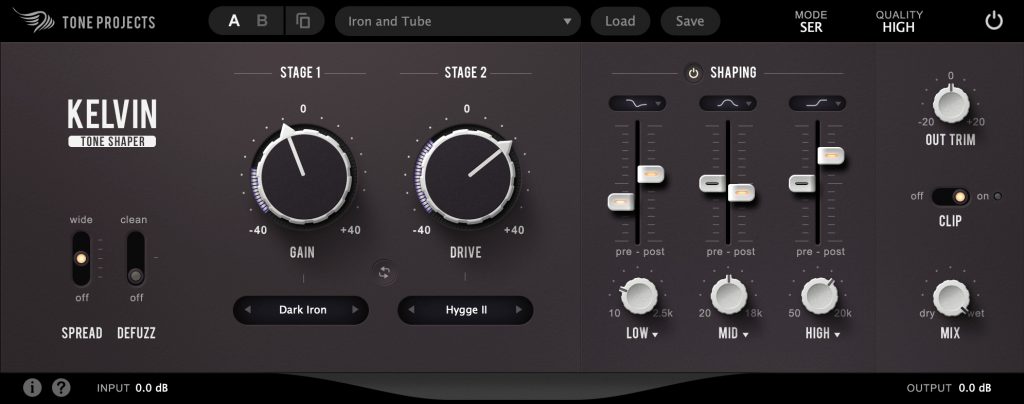
So, there’s a new saturation plugin on the market. Now before the proverbial eye rolls start, hear me out for a second. I know, in today’s world of plugins it’s almost laughable the senseless amount of options we have at our disposal in DAW land. Be that as it may, I must admit when I heard of the Tone Projects Kelvin Tone Shaper, my interest was indeed piqued – despite an already belligerent plugin folder. Read more product reviews here. Tone Projects (previously OtiumFX) market themselves as a boutique audio plugin developer based in Copenhagen, Denmark. Their mastermind is Rune Lund-Hermansen, who develops all their products, often in close collaboration with various engineers, producers and of course, DSP specialists. And the story checks out, as upon install and first opening up of the Kelvin Tone Shaper in a session, it’s abundantly clear these cats mean business. As the name suggests, Kelvin is indeed a Tone Shaper – with an interactive dual stage saturation section and a rather sophisticated EQ or “shaping” section; but that’s just where the fun starts. Both of these sections rather cleverly interact with each other, but more on that shortly. Kelvin has many of the usual features you’d expect from a plugin released in 2021. Input and output controls, yep. A mix knob, absolutely! A four-position switch called spread, sure, why not. Going through each part of this plugin (a handy “tool tips” button if more info is required), it became immediately obvious just how much attention to detail had been put into this plugin. It’s certainly not over populated with switches and knobs, but seemingly just the right amount. Not trying to do too much, nor too little. There are several modes in which Kelvin can operate. Series, parallel, and m/s (mid-side). Depending on which mode of operation is chosen dictates how the Stage 1 and Stage 2 parts of the saturation stage can interact with each other. There’s also varying levels of quality the plugin can perform at in real time too, ranging from low latency through to pristine, as well as the option to offline render in pristine quality. I mentioned the spread function earlier, and this is worth going into more detail. This, depending where set, introduces slight variations of harmonics between the left and right (but also can be used on mono sources). This can indeed range from very subtle to more obvious or “creative” amounts depending where it is set and in what mode is being used. The defuzz three-position switch is also rather interesting as it affects the amount of harmonic artefacts in the mid and high frequency bands. Really worth a tweak and play with, especially when driving or saturating in more extreme settings. Now let’s talk about saturation for a sec. The two stages called gain and drive cleverly interact with each other. Opening up with a menu of available saturation types there’s a wealth of options to choose from ranging from clean (bypassed, not as exciting), pure second or third order harmonics, through to numerous tube-based saturation types or transformer-based circuits. The variety of flavours available here is pretty amazing, and even just having one stage with this many options would be worth the price of admission. But having two stages to work with and given how they network with each other is pretty fresh and inspiring; not to mention they sound great!
The EQ or “shaping” section of Kelvin is, despite its rather unassuming façade, pretty darn powerful, and the way in which it interplays with the saturation stages makes it even more noteworthy. Each of the three available bands have pre and post sliders. These in essence shape source material either pre or post saturation stage. The pre-slider focuses the way in which that specific band is effected or saturated, without changing the frequency response (when the post slider is left at unity), which is pretty neat as some rather interesting shapes and characteristics can be brought out in the source material. There’s a wealth of filter shapes available on each band, with a variety of shelf shapes (low and high), bell curves (wide and Hi-Q), as well as EQP shapes for the respective low and high bands (being, you guessed it, Pultec inspired), and low and high pass filters for the low and high bands, which can be set pre or post. The frequency band width of each band is pretty broad with plenty of crossover between each band, ranging from 10Hz to 20kHz between them all. A little drop down menu at the bottom of each band can dictate whether each band interacts with either Stage 1, Stage 2, or both, and these can be independently selected per EQ band. Obviously the shaping section is designed for just that – tonal shaping – and it isn’t surgical, and nor should it be. There really is some pretty clever wizardry going on under the hood here. Between the pre and post sliders, how they interface with the saturation stages, controlling how a sound source is saturated, but also some overall EQ shaping in the post stage can help give things an overall lift and really encourages creative ideas to flow. Certainly not a one trick pony, Kelvin also isn’t trying to bite off more than it can chew. This tone shaping plugin has been very cleverly executed with inspiring sections that interact beautifully together. This really is as versatile as I’d hoped, being that it’s equally suited being inserted on a snare drum, kick, or vocal, as it is on a buss or over the master. If the fun is in the detail or you just want to get things nice and crunchy, Kelvin is equally likely to find its way onto numerous parts of your next session. Head to Tone Projects for more information.
Resolutions authorizing the release of up to US$ 163M in financing for the construction of new affordable and permanent supportive housing complexes in Los Angeles’ Florence-Firestone, Alhambra, and West L.A. VA cities, have been approved by the Los Angeles County Board of Supervisors. The funds will benefit Meta Housing Corp. which is seeking almost $58.1 million to construct a new six-story structure dubbed The Metro @ Florence on the Florence Car Wash at 7220 Maie Avenue. The building, which will be built next to the A Line’s Florence Station, will feature 160 studio, one-, and two-bedroom apartments for formerly homeless people and households earning 30 to 50 per cent of the local median income. Renderings show a white, green and grey modern podium-style structure with a common room, an outdoor courtyard, a roof deck, and on-site supported services.
Search for construction leads
The funds will also go towards the implementation of another project at 2111 Firestone Boulevard, roughly a half-mile east of the A-Line in Florence-Firestone. Project applicant Domus Development is seeking approximately US$ 26.9M in bond financing to redevelop the roughly 36-acre site into a six-story building featuring 85 studio, one-, and two-bedroom apartments, reserved for households earning at or below 30 and 50 per cent of the area median income level. The contemporary podium-type building will also include a workout room, offices, a lobby, staff parking, and on-site services provided by HousingWorks, a New York City-based non-profit fighting AIDS and homelessness.
Other beneficiaries of the US$ 163M affordable housing complexes funding in Los Angeles
At the West LA VA Campus, Century Housing Corp., a Culver City, California-based private, nonprofit lender to developers building affordable housing targeting low- and moderate-income wage earners, is poised to receive US$ 47.2M in bond financing for the conversion of Buildings 157 and 157, which were originally offices and a medical clinic, into housing developments. Also Read: SoLa Vermont Apartment Complex Construction in Los Angeles Begins Post-redevelopment plans call for 112 units of permanent supportive housing reserved entirely for veterans. The apartments will be offered at rents considered affordable to individuals earning at or below 30 and 50 per cent of the area median income level. The funds will also go towards the development of The Mariposa on Second apartments that are set to rise at 46 South Second Street in the City of Alhambra. Applicant American Family Housing is seeking up to US$ 20.8M in bond financing for the construction of the new six-story building featuring 49 one- and two-bedroom apartments, including supportive housing priced for households earning no more than 30 per cent of the area median income level and generally affordable units priced for households earning up to 50 per cent of the area median income. In addition to housing, The Mariposa on Second apartments will include office space for staff and social services providers, as well as a community centre, public parking, and cultural space. If you have a remark or more information on this post please share with us in the comments section below
Jon Reichardt’s latest undertaking, ‘Strings Attached’ for hip hop luminaries Bliss N Eso, is his boldest yet. Image: Dean Hammer Jon Reichardt is an accomplished session guitarist, producer and songwriter who’s contributed to releases by 360, Chance Waters, and Illy. His latest undertaking, ‘Strings Attached’ for Bliss N Eso, is his boldest yet. Producer and multi-instrumentalist Jon Reichardt is a risk taker. Reichardt’s been a professional musician since late adolescence, when he graduated from playing in bluesy jam bands to working as a session guitarist. Reichardt’s familiarity with the studio environment has meant he’s worked with acts like 360, Chance Waters and Illy, Hilltop Hoods, Drapht, Sarah Aarons, Hayley Mary, and Pez. Reichardt first hooked up with Aussie hip hop trio Bliss n Eso in the lead-up to their 2017 LP, Off the Grid. But his latest collaboration with MCs Bliss and Esoterik and DJ Izm is unlike anything either party had done before. On Friday June 17th, Bliss n Eso performed ‘Strings Attached’ at Brisbane’s Fortitude Music Hall. Reichardt was responsible rejigging tracks from the BnE albums Flying Colours (2008), Running On Air (2010), Circus in the Sky (2013), Off the Grid and The Sun (2021) to be performed with the 38-piece Brisbane Symphony Orchestra. The sold-out show was, in Bliss n Eso’s words, “one of the most incredible shows of our entire career,” and the group is now teasing an Australian tour. Tone Deaf spoke to Reichardt about his involvement in ‘Strings Attached’ and his propensity to jump in the deep end with projects like this.
Get the latest Hip Hop news, features, updates and giveaways straight to your inbox Learn more A post shared by Jon Reichardt (@jonreichardt) Tone Deaf: What’s the back story of the Bliss N Eso ‘Strings Attached’ show? How did you get involved? Jon Reichardt: Back in early 2018, Bliss hit me up to start working on a Bliss n Eso project with Cam Bluff, Mitch James and James Illingworth. The project was reimagining some of BnE’s biggest songs from their career with a live band and string quartet. As I was working on the demo for their song ‘Friend Like You’, I got in the zone and kept writing more and more string arrangements. I wasn’t consciously writing for an orchestral context; it just happened naturally as many of their songs have a sort of intrinsic cinematic quality to them. I showed it to Bliss and I think we both had a moment where we realised we had to go bigger for the project. I didn’t even know if it was possible, but Bliss had the vision and drive, and we had a shared love for orchestral music and composers like Hans Zimmer. The project was sidelined for a while as we finished off their latest album, The Sun, but this was perfect timing as the Fortitude Music Hall approached BnE late last year once The Sun had been released and asked them to do ‘Strings Attached’. TD: The setlist included fifteen of Bliss n Eso’s biggest songs from their 20-year career and featured a 38-piece orchestra. Where do you start with something like this? Did you curate the setlist to include songs that were well-suited to orchestration? JR: The boys created a setlist and enlisted myself, Mitch James and Cam Bluff to start chipping away. At first Mitch and I were re-producing/writing the orchestral arrangements and Cam was engineering vocals and mixing the tracks. However, half-way through the project, Mitch ended up moving to Japan and I had to take over his workload. Since we were literally starting from scratch with all of the production for most of the songs, we had more freedom in choosing what tracks to include – we weren’t bound by the previous vision of the songs.
A post shared by Jon Reichardt (@jonreichardt) TD: How much experience did you have working with orchestras and arranging parts for such a large group of musicians prior to this? Did you notate everything for the orchestra? JR: I’ve written arrangements for string quartets in the past – a notable example is 360’s ‘Tiny Angel’ – but I had never written for an orchestra. So, it was quite daunting but exciting at the same time. I studied music at school and university, but to be honest my music theory is pretty rusty so thank God for programming and Google. Simon Kruit was enlisted a few months before the concert to write some additional arrangements and transcribe the sheet music. This was a relief since transcribing is definitely not my strong suit. So, the process entailed me writing the orchestral arrangements in my [digital audio workstation] with orchestral [virtual studio technologies], then I exported the stems and sent them to Simon.
TD: You also played guitar in the live show. Tell me about the extent of your role in the live production of ‘Strings Attached’. JR: I played guitar and was MD. This meant liaising with the band, conductor and sound guys to make sure everything was running smoothly. This ended up being quite complicated since we were also running backing tracks, click and timecode for the show to be as sonically and visually huge as possible. After each rehearsal, if there were any changes that had to be made in the backing tracks to work better with the live orchestra and band, I would have to go back to my hotel and make edits and re-bounce stems. So I was working around the clock.
TD: What were your inspirations for this show? Hilltop Hoods have done a few strings attached style shows, and so have artists like Nas, Kanye West. Were you drawing influence from other hip hop acts, or looking further afield? JR: Definitely further afield. I remember buying Metallica’s S&M when I was a teenager and being completely blown away. That album is still in my top ten to this day. Michael Kamen’s arrangements were so emotive and fierce, adding a whole other dimension to Metallica’s music. This got me interested in cinematic composers like Hans Zimmer, John Williams, Danny Elfman and even post-minimalist composers like Jóhann Jóhannsson. Some of music production for the show is very different from the originals and this is very much a result of me loving all kinds of music. I’m super grateful to the BnE boys that they were open to this sort of exploration.
TD: What have Bliss N Eso been like to work with on this project? Were they adding ideas along the way? Have they been malleable to your requests? JR: They were very hands on, especially Bliss. He was very involved in every aspect of this show, from the music to the visuals. For example, if he didn’t like a string or horn arrangement I’d done, he’d hum where he’d like the melody to go and even make suggestions. He also helped source and edit a lot of the visuals. He worked his arse off. The boys also let me explore and take some of the songs in a very different direction. Tick to subscribe, untick to unsubscribe from any newsletters below: Tick to subscribe, untick to unsubscribe from any newsletters below:
STEVE INSKEEP, HOST: If you want to work in agriculture but life on a farm is not for you, well, here’s some news. The largest number of open positions in agriculture are in cities and in science. Kate Grumke of Harvest Public Media reports on a new crop of ag jobs. KATE GRUMKE, BYLINE: A parking lot with office buildings in suburban St. Louis is also lined with something a bit out of character – rows of huge greenhouses. This is the Donald Danforth Plant Science Center, a research institute devoted to studying plants. In a lab in one of the buildings on the campus, people are sitting at stations lined with trays of bacteria cultures. You can hear the hum of freezers and the buzz of a labeler. They’re working on a bacterial product for plants used in agriculture. NATALIE BREAKFIELD: It’s almost like a probiotic for a plant. GRUMKE: That’s Natalie Breakfield, vice president for research and discovery at NewLeaf Symbiotics, a biotechnology startup. Although this is a science-heavy job, not every position here requires a Ph.D. NewLeaf has some hands-on lab positions requiring just an associate’s degree or technical training program. Breakfield does have a Ph.D., but she says she came to this field in a roundabout way. She had a molecular biology degree but didn’t really have any experience with plants before starting her first job as a lab technician. BREAKFIELD: Well, I knew I liked science. I didn’t really know these kind of jobs existed. And that was my first real introduction into working with plants, and then I actually just fell in love with it. GRUMKE: While it worked out well for Breakfield, that’s a key challenge for the agriculture industry – making sure people who like science know about these types of careers. Kim Kidwell sees this firsthand as an associate chancellor at the University of Illinois and a former dean of the College of Agriculture. KIM KIDWELL: When people meet folks that work in the ag industry, they’re often shocked about what they actually do for a living. And, you know, there’s a lot of engineering. There’s a lot of business. There’s a lot of computer science. There’s so many things that underpin what we do in food ag, and people just don’t connect the dots. GRUMKE: Corteva Agriscience is also feeling the demand for workers. The global chemical and seed company lists about 500 open positions on its website right now, based all over the country. Angela Latcham leads the company’s North America seed production and supply chain teams and says people think they have to have an agriculture degree to work for a company like Corteva. ANGELA LATCHAM: And that’s far from the truth. We’re looking for people with, you know, nontraditional backgrounds. GRUMKE: Back in St. Louis, one program is trying to fill the worker pipeline by training students to work in labs. Elizabeth Boedeker runs St. Louis Community College’s Center for Plant and Life Sciences. She says even without a four-year degree, her students are in high demand, and salaries for these jobs are around $45,000. ELIZABETH BOEDEKER: You are getting some solid foundation, and there is a huge workforce demand right now. So the odds are pretty good you’re going to get a job at the end. GRUMKE: One of her students is Kasha Vanyoka (ph), who was exposed to agriculture early in Poland, where she grew up on a farm. Vanyoka has always been interested in science but has an untraditional education background and never finished her degree. KASHA VANYOKA: But it’s fine because everybody’s education takes different pathways. And I think this is important to recognize that not every pathway is good for everybody. GRUMKE: Vanyoka says now she’s finally found her field, working part time at a plant science startup while finishing up her community college program. After that, she says she wants to keep doing research in microbiology, not on a farm but in the city. For NPR News, I’m Kate Grumke. (SOUNDBITE OF MUSIC) INSKEEP: Harvest Public Media is a collaboration of public media newsrooms in the Midwest and Great Plains reporting on food systems, agriculture and rural issues. Transcript provided by NPR, Copyright NPR.
Thank you for visiting nature.com. You are using a browser version with limited support for CSS. To obtain the best experience, we recommend you use a more up to date browser (or turn off compatibility mode in Internet Explorer). In the meantime, to ensure continued support, we are displaying the site without styles and JavaScript. Advertisement Scientific Reportsvolume 12, Article number: 10378 (2022) Cite this article Metrics details Electrohydrodynamic flow control systems have proven to be among the most promising flow control strategies within previous decades. Several methods for efficient evaluation and description of the effect of such systems are indeed available. Yet, due to these systems’ critical role in various applications, possible improvements are still investigated. A new phenomenological model is presented for the simulation of the plasma actuators based on the electrodynamic properties of low-frequency plasmons. The model simulates the plasmonic region as a dispersive medium. This dissipated energy is added to the flow by introducing a high-pressure region, calculated in terms of local body force vectors, requiring the distribution of the electric field and the polarization field. The model determines the electric field for the computation of the body force vector based on the Poisson equation and implements the simplified Lorentz model for the polarization field. To fully explore the performance of the presented model, an experiment has been conducted providing a comparison between the observed effect of plasma actuators on the fluid flow with the results predicted by the model. The model is then validated based on the results of other distinct experiments and exempted numerical models, based on the exchanging momentum with the ambient neutrally charged fluid, demonstrating that the model has improved adaptability and self-adjusting capability compared to the available models. Electrohydrodynamic flow control systems have proven to be among the most promising flow control strategies within previous decades. Among these systems, plasma actuators have been confirmed to be effective in a wide variety of applications, including flow control purposes, photonics and optoelectronics, food processing technologies, cancer treatment, and biotechnology1,2,3,4,5,6. Literature shows a strong background, investigating and improving the applicability and effectiveness of different flow control methods in several application fields7,8,9,10,11,12,13,14,15,16. However, a thorough development and testing process is required to incorporate the resulting systems into actual applications. Numerical simulations have traditionally attempted to give advanced algorithms for designing, simulating, and comprehending complicated flow control systems, as the experimental approach requires several costly and time-consuming trial-and-error iterations. Several methods for efficient evaluation and description of the effect of dielectric barrier discharge (DBD) systems are currently available through the literature. However, due to these systems’ critical role in many flow control problems, possible improvements are always worth investigating, and an improved algorithm is always welcome. There are currently three categories of models for simulating plasma actuators; models based on fundamental principles17,18,19,20,21, empirical models22,23, and phenomenological models24,25,26,27,28. In order to form frameworks for first-principles-based methodologies, models in the first category attempt to reproduce the physical mechanisms of a plasma actuator, both from the hydrodynamical side20,21,29,30 and from the plasma side17,18,19. Therefore, these models are required to consider transport equations for both charged and neutral species, as well as the Poisson equation for the electric field and the Navier-Stokes equations. These models are of more accuracy while requiring notable computational cost and time. The second category attempts to impose an accurate description of the induced body force of plasma actuators in the momentum equations. These models consider developing practical modeling tools for DBD actuators for fast design, control, and optimization purposes. The final category of models uses simplified sets of differential equations, resulting in less computationally demanding simulations while considering the contributing physics with simplifications and maintaining an acceptable level of accuracy. In recent years, there has been much research on plasma actuators. In the first place, the current work reviews some of the exempted past experimental and numerical research on plasma actuators, then discusses thoughts and fundamentals in order to better understand the underlying physical mechanisms of the actuator’s interaction with the flow and to develop a new practical methodology for simulating plasma actuators. Based on the descriptions above regarding the different categories of models for simulating plasma actuator, this study is then going to provide a phenomenological model for the simulation of low-frequency plasma actuators. In what continues, specifically, phenomenological models will be studied. The plasma actuators are comprised of two electrodes separated by a dielectric substance, as shown in Fig. 1. When it comes to DBD plasma actuators, they can be classified as self-sufficient compared to plasma actuators that need an external source of creating charged particles that can be impacted by an electric or magnetic field. The self-contained plasma actuators generate their own electric field and charged particles to apply electric force on them. The air around the electrodes ionizes weakly when an AC voltage is applied to them. Differences between the phenomenological models come into a discussion based on ways of characterizing and then implementing the consequences of this weakly ionized medium, considered as the plasmonic medium. Shyy et al.26 characterized the exterior flow effects of the plasma actuators as a time-averaged mean body force spread in a triangular area above the embedded electrode. Suzen and Huang27,31 proposed a model using the plasma formulation of Enloe et al.32 based on the experimental data, reducing the Maxwell equations, considering the plasma formation as a quasi-steady process, and ignoring magnetic forces. In the Navier-Stokes equations, the induced body force was introduced as a source term. The charge distribution over the dielectric surface was assumed to have a 1-D Gaussian distribution based on the experimental data33. Many improvements to this formulation have been presented in the literature28,34,35,36,37. Orlov and Corke38,39 used a lumped parameter model to simulate the plasma actuator effects. Different versions of the electric force obtained based on the calculated charges and electric fields from different models has been employed to compute the flow actuation effect across the literature21,38,39,40,41,42. DBD plasma actuator schematic. A literature review reports that much effort has been expended on simulating the plasma actuation effect on fluid flow as accurately as feasible while keeping the computational cost near the optimum. However, the previous works introduce the plasmonic region as a volume charge density distribution, being exposed to an electric field that produces and transfers momentum into the fluid flow. These models require characterizing parameters to be regulated based on the experiments due to changes in the actuator’s excitation features or configuration. The concerns appear when new fields of application for these controlling devices face scalability, layout design, and optimization challenges, and the existing models fail to provide enough flexibility. Despite the fact that computational investigation of the underlying physics of DBD actuators has been extremely difficult, treating the plasmonic region as an excited material based on its frequency responsive properties, rather than predicting a space charge density distribution for the region, leads to a modulable model. We aim to present a new numerical methodology for plasma actuator-based active flow control applications. In this innovative approach, the plasmonic zone is replicated using a practical material model, the Lorentz model43. As stated previously, this model goes under the category of phenomenological models. Table 1 summarizes the features of the previous phenomenological models that are near to our modeling perspective in order for a better comparison. The next section goes into the model’s development and implementation in detail. The electrodynamic computations for a single plasma actuator and computations of flow control in quiescent flow using a single plasma actuator are given in the “Results and discussion” section. Concluding remarks would come in the section titled “Conclusion”section. The final section titled “Method”section provides details of the conducted experiments. A DBD plasma actuator is mounted on the surface of any device, with one electrode exposed to the environment and the other embedded in the dielectric material below the surface (Fig. 1). The plasmonic zone is created when high-amplitude alternating voltage is delivered to the electrodes, which causes the air around them to ionize weakly. As previously mentioned, distinctions between phenomenological models are discussed based on methods of describing and subsequently applying the implications of this weakly ionized medium, referred to as the plasmonic medium. To simplify the process of plasma actuation, we know from self-sufficient plasma devices that they generate the Lorentz force by providing themselves charged particles through ionization of the medium as well as their required electric field. While analyzing and estimating the electric field is rather straightforward in this context, there are three distinct methods for simulating the generation and distribution of charged particles. The fundamental way to mimic the generation and distribution of charged particles is to simulate the exact molecular interaction and solving complicated transport equations for charged and neutral species. Another technique to approach this phenomena is macroscopically, by empirically or semi-empirically calculating the charge density distribution. This method may give an ideal model when the integral features of a system are important; nevertheless, for industrial applications, the integral parameters such as total lift force, total drag force, and total torque generated are critical. Models following the latter technique typically contain constants that must be determined experimentally for each DBD configuration and study case (e.g., in Shyy’s model, we must obtain the charge density of the plasma region from an experiment as well as having a fixed plasma region, or in Suzen’s model, we must tune the peak charge density or standard deviation of the charged particle normal distribution with the experiment). This study, however, aims to answer a bigger question, whether we can provide tunability to the plasma actuation in terms of both the magnitude and the direction of the injected momentum vector, while still keeping the computational cost near optimum, compared to the first-principle-based models. In this regard, there is this need to develop a model that provides us with physics-based controlling parameters. This latter specification makes the model independent of the experiments conducted for each study case in order to determine the tuning parameters, as is the case with Suzen’s or the Shyy’s models. With the above explanation, the challenge that arises is how to describe the plasmonic region in order for it to be self-configurable within the model. We propose in this study that we can represent the plasma region as if it were a medium that is excited at a certain frequency. As a consequence, the domain’s permittivity and permeability would alter. While permittivity and permeability are often described in terms of constant (frequency-independent) values, in fact, all material characteristics are frequency dependent. Numerous material models have been developed to characterize materials’ frequency response. The Lorentz model is one of the most well-known material models. It is developed from an analogy to the electron’s motion as a driven, damped harmonic oscillator. When restoring forces are negligible, a simplification of the Lorentz model yields the Drude model, which is employed in our modeling. Assuming the plasma is quasi-neutral with ions too heavy to respond to electromagnetic field fluctuations, coupling between the electromagnetic response of the medium and the plasma occurs primarily through the electron current density. Due to the wave impedance of the medium in which an electromagnetic wave propagates, focus is usually on how the electric field impacts electron motion in the presence of the nucleus, and hence the basic dipole moment of this system. Based on this behavior, models of the medium’s electric susceptibility and, as a result, permittivity have been developed. As said, one of the most popular material models is the Lorentz model, which represents the temporal reaction of a component of a medium’s polarization field to the same electric field component. According to the Lorentz model, a medium excited by an applied electromagnetic wave is defined by the created polarization field and consequently, the region’s permittivity. The plasma permittivity, or more accurately, the electromagnetic frequency, plasma frequency, and frequency of electron-neutral collisions, governs wave propagation, evanescence, or attenuation. When it comes to DBD plasma actuators, the characterizing permittivity of the plasmonic region becomes attenuating, introducing the region as a dispersive medium. In this model, this dispersed energy is expressed in terms of a volume body force. It is then incorporated into the Navier Stokes equations to mimic the energy transfer to the fluid flow. The electrohydrodynamic (EHD) force is defined as, where (vec {f_b}), is the body force per unit volume, (rho _c), is net the charge density, (vec {E}), is the electric field intensity, (vec {V }), is the velocity vector, and (vec {B }), is the magnetic field. Before getting into the details of the mathematical modelling of this study, let us provide two basic discussion. In this regard, what follows provide an overview of the electrodynamic analysis of a DBD actuator system. Afterwards, the Lorentz model is introduced to be used in later discussions. In general, to explain the electrodynamic properties of any system the following four Maxwell equations are implemented: where (vec {H}), is the magnetic field intensity, j, is the electric current, (vec {D}), the electric induction vector, representing the force induced to dielectric by the electric field. In addition, two constitutive relations are required to make the above four equations sufficient to permit a solution. These equations have usually been introduced in terms of the two material field vectors (vec {P}) and (vec {M}), the polarization density and the magnetization density, with (varepsilon _0), and (mu _0) representing the free space permittivity and permeability, respectively. In DBD plasma actuators, the actuation process is studied based on the energy transfer form the ionized plasmonic region to the ambient flow. The fluid characteristic time scales for low-speed, incompressible fluid flow applications, which is the present study’s emphasis, are considerably larger than the operational plasma dynamics. In other words, as the electric field generation and ion rearrangement are much faster than the flow response, the energy generation part can be considered as a quasi-stable process, and the link between fluid and plasma physics may be safely treated in one direction, from plasma to the fluid flow. Therefore, the ions’ arrangement will be considered constant, and the current will be zero21,38,40. Also, all time-derivatives in the above equations become zero, and the only remaining equation will be what follows, Equation 9 yield that the gradient of a scalar potential can be used to calculate the electric field, The electric susceptibility is related to polarization and electric fields as, Defining the effective permittivity of any medium as, with (varepsilon _r), as the relative permittivity of the medium, Eq. 10 yields, Gauss’s law then yields The above formulation suggests that, with having a known electric field intensity, one needs to describe the charge density distribution to result in the produced body force. Dissimilar to other approaches in the literature, we aim to go one step back to study the polarization field of a medium in response to its excitation with a particular frequency. As previously stated, in this study, we will use the Lorentz Oscillator model to follow the consequences of excitation on the medium’s electric permittivity. In what follows, the Lorentz model is presented and will be discussed further. According to the Lorentz oscillator model, an electron is modeled as a driven damped harmonic oscillator. In this scenario, the electron is connected to the nucleus through a hypothetical spring with a spring constant of C. The driving force is the oscillating electric field. Although the source of the damping force is unknown, it exists to avoid unending oscillations when the driving force is at resonance. The goal of this model is to determine the electron’s velocity using Newton’s Second Law, from which formulae for the dipole moment, polarization, susceptibility, and dielectric constant may be derived. Let us consider the driving oscillating electric field as (E = E_0 cos(-omega t)) (the minus in (cos(-omega t)) is to guarantee that it matches time dependence of a standard traveling electromagnetic wave). Describing the velocity-dependent damping force by the damping coefficient (Gamma _L), we would have, Rearranging the latter equation, we would have, with m representing the mass of the bulk of material under study, q the electric charge, and (omega _0) the Natural frequency of the system and (omega _0 = sqrt{C/m}). For the purpose of this study, we need to formulate the Polarization field, based on the introduced Lorentz model. The polarization, P, is the dipole moment per volume. The complex dipole moment induced by an electron moving like what was explained in an atom, with the nucleus at the origin, stationary so it does not contribute to the dipole moment is given as, If we assume that there are n electrons per volume, the polarization P is then derived from the following equation, where (f_0 = omega _0 / 2pi), represents the characteristic frequency of the restoring forces, and (chi _L) the coupling coefficient of the right-hand side driving term. The expression gives the frequency response, assuming the standard (exp(+jomega t)) time dependency, as, The response is resonant at the natural frequency with negligible losses (f_0). From 12 The electric susceptibility of the Lorentz model would be, The restoring force is insignificant in a lightly ionized region. As a result, the Drude model is obtained, represented as, where the plasma frequency, (omega _p=sqrt{frac{e^2n_e}{varepsilon _0m_e}}), generally represents the coupling coefficient, (chi _D={omega _p}^2). The permittivity of the Lorentz-Drude model then comes as, It is critical to note that even in such a straightforward situation, the equation results in a complex permittivity, which results in complex wave vectors and refractive indices. This implies that permittivity and, hence, index of refraction are frequency dependent, implying dispersion. This dispersion plays the critical role in our proposed model. To proceed to study the particular issue of a DBD actuator structure, the very first question that emerges is, what do we precisely know about an operating DBD setup? From the boundary conditions of a DBD actuator setup, we know the voltage on the two electrodes, as well as the excitation frequency of the voltage between the two electrodes. We would have, where (varphi) is the time-dependent electric potential, and (phi) the time-independent electric potential. Since the time dependency is caused solely by the boundary condition for the applied voltage at the exposed electrode, by applying a constant boundary condition, the related equations and voltage boundary conditions are rendered time-independent and solved. Note that we assume that this time-dependency of the boundary conditions is decoupled from the hydrodynamic features of the flow field. The following are the normalized parameters for 2-D coordinates: where f(t) is a function that represents the voltage’s waveform. Having the electric potential on the electrodes, we need to solve the governing integral equation below, to find the electric charge density distribution on the two electrodes that are responsible for the electric potential on the electrodes. where (V_{applied}) is the applied voltage on the upper electrode. We are assuming that the lower electrode is set to be as ground. (Gleft( vec {r},vec {r^prime }right)) represents the Green’s Function of the medium that provides the medium’s response to a Dirac Delta source in the domain. With the electric charge distribution on the electrodes, the solution of the Eq. 15, results in the electric potential field around the DBD actuator setup. With the space electric potential field at hand, Eq. 28 results in the space electric intensity field around the DBD actuator system. As previously noted, plasma frequency is determined by electron density, (n_e), and the charge of an electron, e, the free space permittivity, (varepsilon _0), and the electron mass, (m_e). The electron density changes within the range of (10^{17})–(10^{20})(m^{-3}) based on the gas flow pressure. Knowing the excitation frequency, we can now implement the Eq. 25. Consequently, we can define the effective permittivity of the plasmonic medium as, The Lorentz-Drude model then results as below, Finding the divergence of the electric distance field from the Eqs. 10, and then 4, results in the space electric charge distribution around the DBD setup. To think backward to the problem at hand, this space electric charge distribution around the DBD setup is responsible for the previously found electric, electric potential and electric distance fields. Now that we have both the space electric field and the space electric charge distribution, the resultant volume body force is expressed as, For fluid flow modeling, the 2-D incompressible Reynolds Averaged Navier-Stokes (RANS) equations are utilized. It is anticipated that the bulk of the energy provided by the plasma actuator is mostly used to accelerate the fluid particles; thus, the amount contributing to fluid warming is deemed unimportant, and the flow field energy equation is neglected44. The following are the fundamental equations of momentum and mass conservation that were used for fluid flow simulation: where (rho), (vec {u}), (upsilon), and P are the density, velocity, kinematic viscosity, and static pressure, respectively, and (vec {f}_b) is the body force per unit volume in (N/(m^3)). In Eq. 33, the volume body force vector components created by plasmonic actuation are added to the momentum equation’s right-hand side (Eq. 35). The finite element method, with the Galerkin method, is used to solve these equations and simulate fluid flow with direct interaction with the electrostatic field. The algorithm code is written in the C++ programming language. To better explain the numerical implementation procedure in practice, Fig. 2 illustrates a schematic of the mathematical process at each step, as well as the numerical scheme associated with each of the processes. As stated previously, we began modeling from the diagram’s boundary conditions. The voltage between the two electrodes and its excitation frequency are known from the boundary conditions and initial conditions, respectively. Aside from describing the mathematical procedure described previously, the diagram also specifies the numerical algorithm used in each step. The integral equation that provides the electric charge distribution responsible for the known voltages on the two electrodes was solved using the finite element method with the Galerkin weighting function. The space electric potential field was also calculated using numerical integration of the two electrodes’ electric charge distributions. The finite element method was used again to calculate the gradient of the space electric potential field. The schematic calculation procedure of the New Lorentz Force (Volumetric Body Force) mathematical procedure with the associated Numerical procedure for each step. In order to accurately imitate the influence of the plasma actuator on flow dynamics, the domain addressed to the plasma must have two characteristics: first, it must be compatible with plasma formation physics, and second, it must be self-scalable. When applying any model to an area, the first step is to establish the region’s bounds and extension so that the working domain is completely recognized. This study considers a rectangle associated with the area surrounding the DBD actuator’s structure, with precisely determined dimensions to make the region frequency responsive, guaranteeing the compatibility of the model with the physics as well as the self-scalability of the working region. When compared to a simple parallel plane structure, the existence of a dielectric between the electrodes and the asymmetry results in a qualitatively different pattern of electric field lines in an asymmetric actuator configuration. The electric field is most intense near the inner margins of the two electrodes. As a result, plasma generation is more likely in areas with stronger electric fields. In this layout, the anode surface is the dielectric rather than the electrode, resulting in a pseudo anode. In this regard, the anode region directly adjacent to the pseudo anode is an electron-rich zone. Since the dielectric, in contrast to the cathode, prohibits charge mobility on its surface, we have a concentration of charges on the cathode and a comparatively sparse distribution of electrons on the pseudo anode26. From the above discussion, one understands that the width of the plasma region consists of the whole length of the dielectric layer, or more accurately, the pseudo anode, and a portion of the exposed electrode that needs further discussion to be fully determined. The Debye length is another length that contributes to the plasmonic area as a general characteristic length scale for plasma discharges. The Debye length, defined as the ratio of the electron thermal velocity divided by the plasma frequency, is a characteristic distance over which ions and electrons can be separated in a plasma45. Hence, a plasma plum will form a sphere with the radius of the Debye length in an unbounded space. However, in a region bounded by the structure of DBD actuator, we can expect the plasma region to fill a semi-sphere, with the radius of the Debye length and the origin at the trailing edge of the exposed electrode. Based on the foregoing, the domain of the plasmonic area is estimated as a rectangle with a height equal to the Debye length and a width beginning at a portion of the exposed electrode equal to the Debye length and ending at the trailing edge of the embedded electrode. Figure 3 illustrates the described plasmonic region. This region provides the self-scalability for the model. It should be noted that the the plasma is assumed to have constant permittivity for the entire domain for the sake of simplicity. The more accurate distribution of the permittivity, as well as its dependency on the applying voltage and the exciting frequency, is going to be undertaken in future research. The Debye length (lambda _D) is given from the following empirical relation34,35: It is clear that based on the previous equation, the Debye length changes due to the change in the applied voltage and the exciting frequency. Since the area considered as the plasmonic region is defined based on the Debye length, this area will change as a consequence of changes in the voltage and frequency. The schematic of a DBD plasma actuator to illustrate the defined plasmonic region by the presented model. Intensive work has been done to model the fluid flow impacted by the plasma actuators as accurately as possible while keeping the computational cost near the optimum. These models give basic algorithms for simulating plasma actuators. However, they disregard the intricacies of plasma creation, modeling the integral effects of the plasma jet on the flow to avoid the complexity and high computational expense of a proper investigation of the physical phenomena. Furthermore, these models rely on experimental data to change their characteristic properties. Various formulations have been offered in the literature23,26,27,28,31,35,36,38,39. These formulations have become optimized and applicable yet add to the complexity of the model, and still avoid the implementation of the plasma physics. Details of plasma dynamics have been implemented using the provided approach to establish a criterion for the plasma to generate fluid flow while keeping the model simple and low in computational cost compared to fundamental principle-based models. Nonetheless, the proposed model is currently being refined to provide complete controllability over the actuating body force components. Furthermore, the model is restricted to the frequency (1–14kHz), and the applied voltage (3k–20kVpp) ranges. While experience has shown that the ranges are adequate for most engineering applications, more precise reasoning will be pursued in future studies. Figure 4 illustrates the boundary conditions for the solution of the Poisson equation. The electric potential equation and the Gauss Law’s equation (Eq. 15) is solved in the outer domains and the outer boundaries. As mentioned earlier, the equations and the voltage boundary conditions are modified to be time-independent; therefore, (phi = 0) is set on the embedded electrode, and (phi = phi _{max}/sqrt{2} = phi _{rms}), on the exposed electrode. (phi _{max}) refers to the amplitude of the applied AC voltage. A DBD actuator schematic including the boundary conditions for electrostatic simulation. An experiment has been conducted to fully explore the performance of the presented model on predicting the effects of a plasma actuator on fluid flow. Furthermore, to analyze the applicability and adjustability of the model, the experimental case from Kotsonis et al.46 has been selected for the study. A final comparison was made based on an experiment by Palmeiro et al.47 regarding nominated numerical modeling cases with different actuator configurations and applied voltages and excitation frequencies. These studies provide a comprehensive understanding of the applicability of the presented model based on the experimental data and a thorough comparison concerning other numerical approaches. The reports presented in the following are based on simulations to ensure the validity of the discussion. For simulation purposes, the reference geometry of the DBD configuration varies depending on the chosen situations. These geometries are considered 2-D shapes for the simulation, which is a reasonable assumption given the considerable length to thickness ratio of all DBD combinations. The meshing was with triangular pieces, and the mesh setting was initially set to “extremely fine.” The grid spacing was limited to no more than the Debye length. Furthermore, an adaptive mesh refinement was used to achieve grid independence of the acquired results while also minimizing the numerical cost for the simulation of each case to provide perfection with the meshing based on the multiphysics nature of each problem. Table 2 contains the test conditions and experimental data for all of the conducted experiments as well as the study cases. In all cases, the working fluid is air at standard condition ((nu = 1.75e5 m^{2} s^{-2}) and (rho = 1.18 kgm^{-3})). The obtained results from the conducted experiments are presented in this section. Details regarding the experimental setup and measurement systems are discussed in the section titled “Method” section. Figure 5 provides the configuration used for the experiment. The velocity profiles are the metric used to assess the efficacy of the proposed model in predicting the strength of the simulated induced jet and its interaction with the neighboring fluid in comparison to the experimental data. The Applied voltages and frequencies for the experiments and the corresponding simulations are 6,7.2 kVpp and 6, 8 kHz, respectively. As mentioned in Table 2 the length of the exposed and embedded electrodes are 10 mm and 30 mm, respectively. The thickness of the electrodes is 0.05 mm, and the dielectric is made up of polyimide Kapton tape with a total thickness (including adhesive layer) of 0.6 mm and relative permittivity of 2.7. The actuator arrangement utilized in the studies is depicted schematically. For this scenario, the computing domain is a rectangle 104 cm long and 50 cm high. The bottom boundary condition is set to no-slip, and the upper boundary is subject to the symmetry criterion. The velocity at the left inlet boundary is set to be zero, and the pressure at the right outlet boundary is set to be zero, as well. The actuator is adjusted at around 30% near the inflow boundary. Figure 6, represent the induced velocity profiles obtained using the current model, compared to the experimental data at a station 5 mm downstream of the exposed electrode’s leading edge for the applied voltages of 6 kVpp and the excitation frequency of 6, 8 kHz, respectively. Based on the flow characteristics, the Debye length (36) is calculated to be 0.114 mm and 0.118 mm, respectively. It is observed that although the presented numerical model underestimates the scaled velocity, it is capable of capturing the general trend of the velocity profile. Moreover, the model estimates the height where the maximum velocity occurs, characterizing the jet-induced boundary layer thickness with acceptable accuracy. Comparison of velocity profiles from the experiments and the presented numerical scheme for a V = 6 kVpp, f = 6 kHz, and b V = 6 kVpp, f = 8 kHz, at 5 mm downstream of the exposed electrode’s leading edge. Figure 7, also, represent the induced velocity profiles obtained using the current model, compared to the experimental data at a station 12.5 mm downstream of the exposed electrode’s leading edge for the applied voltages of 6 kVpp and the excitation frequency of 6, 8 kHz, respectively. It is observed that the presented numerical model is capable of capturing the general trend of the velocity profile. Moreover, the model estimates the height where the maximum velocity occurs, characterizing the jet-induced boundary layer thickness with acceptable accuracy. Comparison of velocity profiles from the experiments and the presented numerical scheme for (a) V = 6 kVpp, f = 6 kHz, and (b) V = 6 kVpp, f = 8 kHz, at 12.5 mm downstream of the exposed electrode’s leading edge. Figure 8 provides the electric potential field around the actuator. The maximum voltage difference is observed between the edges of the embedded and exposed electrodes, resulting in the maximum electric field magnitude. Figure 9 provides the flow velocity field around the vicinity of the actuator, indicating that the majority of momentum increases occur in the x-direction. A weak suction effect is also found upstream of the inner edge of the electrodes, indicating the presence of a potentially large pressure differential near the actuator. The electric potential field around the actuator in volts, for the actuation case of V = 6 kVpp and f = 8 kHz. The flow velocity field around the actuator in (ms^{-1}), for the actuation case of V = 6 kVpp and f = 8 kHz. Figure 10 provides the induced velocity profiles for the applied voltages of 7.2 kVpp and the excitation frequency of 6, 8 kHz, respectively, comparing the current model to the experimental results at a station 5 mm downstream of the exposed electrode’s leading edge. Based on the flow characteristics, the Debye length (36) is calculated to be 0.0228 mm and 0.0229 mm, respectively. The presented results show that the numerical model is able to accurately simulate the general trend of the velocity profile as well as predict the height where the maximum velocity occurs. Comparison of velocity profiles from the experiments and the presented numerical scheme for (a) V = 7.2 kVpp, f = 6 kHz, and (b) V = 7.2 kVpp, f = 8 kHz, at 5 mm downstream of the exposed electrode’s leading edge. Moreover, Fig. 11 provides the induced velocity profiles for the applied voltages of 7.2 kVpp and the excitation frequency of 6, 8 kHz, respectively, comparing the current model to the experimental results at a station 12.5 mm downstream of the exposed electrode’s leading edge. The presented results show that the numerical model is able to accurately simulate the general trend of the velocity profile as well as predict the height where the maximum velocity occurs. Comparison of velocity profiles from the experiments and the presented numerical scheme for (a) V = 7.2 kVpp, f = 6 kHz, and (b) V = 7.2 kVpp, f = 8 kHz, at 12.5 mm downstream of the exposed electrode’s leading edge. Same as the previous cases, Fig. 12 provides the electric potential field around the actuator. It is observed that the maximum voltage difference occurs between the edge of the embedded and exposed electrodes resulting in the maximum electric field magnitude. Figure 13 represents the flow velocity field around the vicinity of the actuator, showing that the momentum increases mainly in the x-direction, and a potentially strong pressure gradient due to a weak suction effect exists upstream the inner edge of the electrodes. The electric potential field around the actuator in volts, for the actuation case of V = 7.2 kVpp and f = 8 kHz. The flow velocity field around the actuator in (ms^{-1}), for the actuation case of V = 7.2 kVpp and f = 8 kHz. The maximum velocities obtained using the presented numerical model and the corresponding results from the experiments are tabulated in Table 3, for voltages 6, and 7.2 KVapp and frequencies 6, and 8 KHz, respectively, at two distances along the x-direction, 5 mm and 12.5 mm downstream of the exposed electrode’s leading edge. The results reveal that the model predicts the maximum velocity, as an indication of the total body force, with acceptable accuracy. The experiment of Kotsonis et al.46 on the body force field of DBD actuators is selected to serve as a benchmark, providing certainty with the model. Kotsonis et al. provide body force fields derived from PIV observations for various input voltages. The details of the plasma actuator configuration used in the work of Kotsonis et al. are presented in Table 2. The plasma actuator configuration used by Kotsonis et al. consists of electrodes with a width of 10 mm and 0.06 mm thickness. The electrodes are separated by a horizontal gap of zero. Furthermore, two dielectric layers of polyimide Kapton tape with a total thickness (including the adhesive layer) of 0.11 mm separate the electrodes. The peak-to-peak voltage on the electrodes was adjusted from 8 to 16 kVpp in 2 kVpp steps. For each input peak-to-peak voltage, the body force field is monitored. The computational domain and the boundary conditions are set to be the same as in the previous section. Based on the flow characteristics provided by Kotsonis et al. the Debye length is considered to be 2 mm. In this regard, the area considered as the plasmonic region would be a rectangle with the height of the Debye length and a width starting from a portion of the exposed electrode that is equal to the Debye length and ends at the trailing edge of the embedded electrode. Figure 14 provides the spatial distribution of the body force components based on the presented numerical model. It is observed that the maximum horizontal body force is produced at the edge of two electrodes where, as predicted, is the region with the highest electric field magnitude, therefore, with the most probability for ionization. Spatial distribution of the horizontal body force component calculated based on the presented numerical model. Table 4 compares the computed integrated horizontal body force component to the experimental results of Kotsonis et al. for various input voltages, respectively. A comparison is made based on the integrated body forces on the area surrounding the plasmonic region. The Kotsonis et al. experiment area was a rectangle with the height of the Debye length’s order and a width starting from 10% of the exposed electrode and ends at 70% from the trailing edge of the embedded electrode. One may interpret the results by saying that the presented model is capable of accurately predicting the integral effect of the body force production. The resultant body forces are accurately predicted with a maximum deviation of 7.69% from the experimental results. According to the literature, the generated thrust should increase by (V^{7/2})32. This proportionality also applies to the total body force generated, (f_bpropto V^{7/2}). The results from the numerical simulation reveals that the obtained integrated body forces agree with the proportionality found in literature. The final case to examine the applicability of the presented modeling strategy has been selected to be the experimental work of Palmeiro et al.47. Furthermore, we compare the current model to various numerical models using the numerical works offered by Palmeiro et al. Following his studies, three test scenarios are explored. The details of all the cases are given in Table 2. For each test case, five sets of results are presented: (A) the experiment47; (B) the lumped-circuit model25; (C) the hybrid model24; (D) the simple body force model26, and (E) the current numerical model. The corresponding maximum velocity normalizes the velocity profiles for every modeling methods. As tabulated in Table 2, the plasma actuator configuration used for cases A–C of Palmeiro et al. consists of electrodes with widths of 6.35, 12.7, and 5 mm, respectively, all with a thickness of 0.075 mm. The horizontal gap used between the electrodes is set to be 1 mm, 1 mm, and zero, respectively. The electrodes, in all cases, are separated by a dielectric layer of polyimide Kapton tape with a total thickness of 0.19, 0.57, and 0.18 mm, respectively. Moreover, the input peak-to-peak voltage on the electrodes is 12, 15, and 10 kVpp, respectively, with excitation frequencies of 3, 3, and 2.75 kHz, respectively. The computational domain, as well as the boundary conditions, are set to be the same as in previous sections. Based on the flow characteristics, the Debye length (36) for cases A–C is calculated to be 0.46, 0.74, and 0.28 mm, respectively. In this regard, the area considered as the plasmonic region would be a rectangle with the height of the Debye length and a width starting from a portion of the exposed electrode equal to the Debye length and ends at the trailing edge of the embedded electrode. Figures 15, 16 and 17 provide the induced velocity profiles obtained based on the experimental and the numerical results from Palmeiro et al. compared to the results from the presented numerical model for cases A, B, and C, respectively. Based on the results for case A (Fig. 15), the presented numerical model performs as well as the Simple Body Force and the Hybrid models in estimating the velocity profile. While the three models over-predict the normalized velocity, the presented model provides the best result. The Lumped Circuit model is the one method that correctly predicts the normalized velocity while it deviates from the experimental results when moving away from the actuator. The results from the presented numerical model compared to the experimental and other numerical vertical velocity profiles on actuator geometry of Case A. Comparing the numerical results to the experimental data in Fig. 16 for case B, it is observed that the presented numerical model provides the best prediction of the velocity profile compared to the other numerical schemes. Both the presented numerical model and the Simple Body Force model can accurately predict the jet boundary layer thickness, while the results of the latter deviate from the experimental data as we move away from the actuator. The figure shows that the Hybrid model fails to capture the velocity profile, and the Lumped Circuit model underestimates the normalized velocity although capturing the general trend. The results from the presented numerical model compared to the experimental and other numerical vertical velocity profiles on actuator geometry of Case B. Results from case C (Fig. 17) show that the presented numerical model provides the best prediction for the jet boundary layer thickness characterized by the location where the maximum velocity occurs compared to the Simple Body Force and the Lumped Circuit models. However, similar to the Lumped Circuit model, the presented numerical model underestimates the normalized velocity when moving away from the actuator. Unlike the hybrid model, the presented numerical model performs as well as the Simple Body Force and the Lumped Circuit models in capturing the general trend of the velocity profile. The results from the presented numerical model compared to the experimental and other numerical vertical velocity profiles on actuator geometry of Case C. Once the findings from all three examples are reviewed, it is clear that the given modeling method has the most consistent predictive capability for the various test cases compared to the other phenomenological models. To compare the potentiality of the presented model to other numerical methods more in detail, Table 5 offers the maximum velocity obtained at x = 25 mm from the exposed electrode’s leading edge, respectively, for cases A, B, and C. The present model shows the most consistent predictive capability and adequate accuracy for all three cases in comparison to other numerical scenarios. In this study, a new modeling approach has been outlined for the numerical investigation of the fluid flow affected by a plasma actuator. In this new approach, we presented a model that simulates the plasmonic region based on the practical material model, the Lorentz model, to characterize the region as a dispersive medium. The dissipated energy added to the flow is calculated in terms of local body force components by solving Poisson’s equation for the electric field and implementing the simplified Lorentz model for the polarization field. The area considered as the plasmonic region is defined to be based on the characterizing Debye length, changing as a function of the excitation frequency and the applied voltage. In this regard, the current approach establishes a criterion for the plasma to induce the fluid flow by considering the details of the plasma dynamics. This facilitated us to define the characterizing parameters of the actuation to be self-adjustable based on the physics while keeping the model simple and of low computational cost compared to the fundamental principle-based models. We conducted an experiment to compare the observed influence of plasma actuators on fluid flow with the results predicted by the model to assess the proposed model’s validity and performance. The results indicated that the model could capture the general trend of the velocity profile and estimate the jet-induced boundary layer thickness with acceptable accuracy. The model also estimated the significant increase in momentum in the x-direction regarding the actuator and a potentially significant pressure differential near the actuator. Furthermore, the model’s universality was validated using diverse experiments and exempted numerical models. The integral effects of plasma actuation have been predicted with a maximum error of roughly 8%. The model’s ability to capture the velocity profile, estimate the jet-induced boundary layer thickness, and calculate the induced jet strength was evaluated using experimental data and results from the selected numerical models. The present model shows the most consistent predictive capability and adequate accuracy for all test cases in comparison to other numerical scenarios. The results show that the proposed model and technique have a bright future in plasma flow control applications. The experimental setup and the plasma actuator investigated in this study are illustrated in Fig. 18. The plasma device is comprised of two 0.05 mm thick aluminum electrodes and six layers of Kapton film as a dielectric. The exposed electrode and embedded electrode have widths of 10 mm and 30 mm, respectively. In the streamwise direction, the spacing between the upper and lower electrodes is adjusted to zero. Each actuator is 0.4 m long, and velocity field measurements were performed along the actuator device’s centerline. Measurements were obtained using a 1.6 mm outer diameter glass pitot tube in quiescent air. The probe was directed to measure the streamwise velocity and mounted to a vertical traverse with a resolution of 0.01 mm. Each velocity data point was averaged over a sample measured at 5 kHz for an interval of 10 s. The sample population was recorded using a NI-USB5239 data acquisition device connected to a PC. The downstream location of the measurement relative to the trailing edge of the exposed electrode for each actuator is set to be 5 mm and 12.5 mm respectively, for two study cases. Each excitation signal was sinusoidal and was delivered using a Rigol DG1011 waveform generator. The output sine wave voltage and frequency range of the power supply were, respectively, 0–15 kV and 0–15 kHz. The steady-state wave was used in all of the experiments. Schematic representation of the experimental setup of the conducted experiment. Rodriguez, J. A. et al. Inverse design of plasma metamaterial devices for optical computing. arXiv preprint arXiv:2102.05148 (2021). Kourtzanidis, K., Pederson, D. M. & Raja, L. L. Electromagnetic wave energy flow control with a tunable and reconfigurable coupled plasma split-ring resonator metamaterial: A study of basic conditions and configurations. J. Appl. Phys.119, 204904 (2016). ADS Google Scholar Hamouda, I., Labay, C., Cvelbar, U., Ginebra, M.-P. & Canal, C. Selectivity of direct plasma treatment and plasma-conditioned media in bone cancer cell lines. Sci. Rep.11, 1–12 (2021). Google Scholar Roy, S., Choudhury, B., Johnson, J. & Schindler-Tyka, A. Application of dielectric barrier discharge for improving food shelf life and reducing spoilage. Sci. Rep.11, 1–9 (2021). Google Scholar Deylami, H. M., Amanifard, N., Dolati, F., Kouhikamali, R. & Mostajiri, K. Numerical investigation of using various electrode arrangements for amplifying the ehd enhanced heat transfer in a smooth channel. J. Electrostat.71, 656–665 (2013). Google Scholar Kazemi, M., Ghanooni, P., Mani, M. & Saeedi, M. Drag reduction of 3d bluff body using sdbd plasma actuators. Proc. Inst. Mech. Eng. Part D J. Automob. Eng.235, 1461–1480 (2021). Google Scholar Sato, S., Furukawa, H., Komuro, A., Takahashi, M. & Ohnishi, N. Successively accelerated ionic wind with integrated dielectric-barrier-discharge plasma actuator for low-voltage operation. Sci. Rep.9, 1–11 (2019). ADS Google Scholar Portugal, S., Roy, S. & Lin, J. Functional relationship between material property, applied frequency and ozone generation for surface dielectric barrier discharges in atmospheric air. Sci. Rep.7, 1–11 (2017). CAS Google Scholar Pinchuk, M. et al. Role of charge accumulation in guided streamer evolution in helium dbd plasma jets. Sci. Rep.11, 1–11 (2021). Google Scholar Rizzetta, D. P. & Visbal, M. R. Plasma-based flow-control strategies for transitional highly loaded low-pressure turbines. J. Fluids Eng.130, 041104 (2008). Google Scholar Thomas, F., Kozlov, A. & Corke, T. Plasma actuators for landing gear noise reduction. In 11th AIAA/CEAS Aeroacoustics Conference, 3010 (2005). Little, J., Nishihara, M., Adamovich, I. & Samimy, M. High-lift airfoil trailing edge separation control using a single dielectric barrier discharge plasma actuator. Exp. Fluids48, 521–537 (2010). Google Scholar Whalley, R. D. & Walsh, J. L. Turbulent jet flow generated downstream of a low temperature dielectric barrier atmospheric pressure plasma device. Sci. Rep.6, 1–7 (2016). Google Scholar Labergue, A., Moreau, E., Zouzou, N. & Touchard, G. Separation control using plasma actuators: Application to a free turbulent jet. J. Phys. D Appl. Phys.40, 674 (2007). ADSCAS Google Scholar Gibson, B., Arjomandi, M. & Kelso, R. The response of a flat plate boundary layer to an orthogonally arranged dielectric barrier discharge actuator. J. Phys. D Appl. Phys.45, 025202 (2011). ADS Google Scholar Jukes, T. N. & Choi, K.-S. Long lasting modifications to vortex shedding using a short plasma excitation. Phys. Rev. Lett.102, 254501 (2009). ADSPubMed Google Scholar Likhanskii, A. V., Shneider, M. N., Macheret, S. O. & Miles, R. B. Modeling of dielectric barrier discharge plasma actuators driven by repetitive nanosecond pulses. Phys. Plasmas14, 073501 (2007). ADS Google Scholar Likhanskii, A. V., Shneider, M. N., Macheret, S. O. & Miles, R. B. Modeling of dielectric barrier discharge plasma actuator in air. J. Appl. Phys.103, 053305 (2008). ADS Google Scholar Hoskinson, A. R., Hershkowitz, N. & Ashpis, D. E. Force measurements of single and double barrier dbd plasma actuators in quiescent air. J. Phys. D Appl. Phys.41, 245209 (2008). ADS Google Scholar Roy, S. Flow actuation using radio frequency in partially ionized collisional plasmas. Appl. Phys. Lett.86, 101502 (2005). ADS Google Scholar Roy, S. & Gaitonde, D. Modeling surface discharge effects of atmospheric rf on gas flow control. In 43rd AIAA Aerospace Sciences Meeting and Exhibit, 160 (2005). Yoon, J.-S. & Han, J.-H. Semiempirical thrust model of dielectric barrier plasma actuator for flow control. J. Aerosp. Eng.28, 04014041 (2015). Google Scholar Amanifard, N., Abdollahzadeh, M., Moayedi, H. & Pascoa, J. An explicit cfd model for the dbd plasma actuators using wall-jet similarity approach. J. Electrostat.107, 103497 (2020). Google Scholar Lemire, S., Vo, H. D. & Benner, M. W. Performance improvement of axial compressors and fans with plasma actuation. Int. J. Rotat. Mach.https://doi.org/10.1155/2009/247613 (2009). Google Scholar Mertz, B. E. Refinement, Validation, and Implementation of Lumped Circuit Element Model for Single Dielectric Barrier Discharge Plasma Actuators (University of Notre Dame, 2010). Shyy, W., Jayaraman, B. & Andersson, A. Modeling of glow discharge-induced fluid dynamics. J. Appl. Phys.92, 6434–6443 (2002). ADSCAS Google Scholar Suzen, Y., Huang, G., Jacob, J. & Ashpis, D. Numerical simulations of plasma based flow control applications. In 35th AIAA Fluid Dynamics Conference and Exhibit, 4633 (2005). Abdollahzadeh, M., Pascoa, J. & Oliveira, P. Modified split-potential model for modeling the effect of dbd plasma actuators in high altitude flow control. Curr. Appl. Phys.14, 1160–1170 (2014). ADS Google Scholar Boeuf, J. & Pitchford, L. Electrohydrodynamic force and aerodynamic flow acceleration in surface dielectric barrier discharge. J. Appl. Phys.97, 103307 (2005). ADS Google Scholar Singh, K. P. & Roy, S. Modeling plasma actuators with air chemistry for effective flow control. J. Appl. Phys.101, 123308 (2007). ADS Google Scholar Suzen, Y. & Huang, G. Simulations of flow separation control using plasma actuators. In 44th AIAA Aerospace Sciences Meeting and Exhibit, 877 (2006). Enloe, C. L. et al. Mechanisms and responses of a dielectric barrier plasma actuator: Geometric effects. AIAA J.42, 595–604 (2004). ADS Google Scholar Enloe, C., McLaughlin, T., Van Dyken, R. & Fischer, J. Plasma structure in the aerodynamic plasma actuator. In 42nd AIAA Aerospace Sciences Meeting and Exhibit, 844 (2004). Omidi, J. & Mazaheri, K. Micro-plasma actuator mechanisms in interaction with fluid flow for wind energy applications: Physical parameters. Phys. Fluids32, 077107 (2020). ADSCAS Google Scholar Omidi, J. & Mazaheri, K. Differential evolution algorithm for performance optimization of the micro plasma actuator as a microelectromechanical system. Sci. Rep.10, 1–18 (2020). Google Scholar Bouchmal, A. Modeling of dielectric-barrier discharge actuator. Master of Science Thesis, Delft University of Technology (2011). Ibrahim, I. & Skote, M. Simulations of the linear plasma synthetic jet actuator utilizing a modified suzen-huang model. Phys. Fluids24, 113602 (2012). ADS Google Scholar Orlov, D. & Corke, T. Numerical simulation of aerodynamic plasma actuator effects. In 43rd AIAA Aerospace Sciences Meeting and Exhibit, 1083 (2005). Orlov, D., Corke, T. & Patel, M. Electric circuit model for aerodynamic plasma actuator. In 44th AIAA Aerospace Sciences Meeting and Exhibit, 1206 (2006). Jayaraman, B. & Shyy, W. Modeling of dielectric barrier discharge-induced fluid dynamics and heat transfer. Prog. Aerosp. Sci.44, 139–191 (2008). Google Scholar Hall, K., Jumper, E., Corke, T. & McLaughlin, T. Potential flow model of a plasma actuator as a lift enhancement device. In 43rd AIAA Aerospace Sciences Meeting and Exhibit, 783 (2005). Roy, S. & Gaitonde, D. Radio frequency induced ionized collisional flow model for application at atmospheric pressures. J. Appl. Phys.96, 2476–2481 (2004). ADSCAS Google Scholar Weile, D. S. Electromagnetic metamaterials: Physics and engineering explorations (engheta, n. and ziolkowski, rw; 2006)[book review]. IEEE Antennas Propag. Mag.49, 137–139 (2007). ADS Google Scholar Corke, T. C., Enloe, C. L. & Wilkinson, S. P. Dielectric barrier discharge plasma actuators for flow control. Annu. Rev. Fluid Mech.42, 505–529 (2010). ADS Google Scholar Chen, F. F. et al.Introduction to Plasma Physics and Controlled Fusion Vol. 1 (Springer, 1984). Google Scholar Kotsonis, M. & Veldhuis, L. Experimental study on dielectric barrier discharge actuators operating in pulse mode. J. Appl. Phys.108, 113304 (2010). ADS Google Scholar Palmeiro, D. Modeling of dielectric barrier discharge plasma actuators for flow control simulations. Ph.D. thesis (2011). Download references Aerospace Engineering Department, Amirkabir University of Technology, Tehran, Iran D. Soltani Tehrani, G. R. Abdizadeh & S. Noori You can also search for this author in PubMedGoogle Scholar You can also search for this author in PubMedGoogle Scholar You can also search for this author in PubMedGoogle Scholar D.S.T.: Conceptualization, investigation, experimental test, software, validation, data curation, writing—original draft preparation, writing—reviewing and editing. G.R.A.: Conceptualization, investigation, experimental test, methodology, software, data curation, editing. S.N.: Supervision. Correspondence to G. R. Abdizadeh. The authors declare no competing interests. Springer Nature remains neutral with regard to jurisdictional claims in published maps and institutional affiliations. Open Access This article is licensed under a Creative Commons Attribution 4.0 International License, which permits use, sharing, adaptation, distribution and reproduction in any medium or format, as long as you give appropriate credit to the original author(s) and the source, provide a link to the Creative Commons licence, and indicate if changes were made. The images or other third party material in this article are included in the article’s Creative Commons licence, unless indicated otherwise in a credit line to the material. If material is not included in the article’s Creative Commons licence and your intended use is not permitted by statutory regulation or exceeds the permitted use, you will need to obtain permission directly from the copyright holder. To view a copy of this licence, visit http://creativecommons.org/licenses/by/4.0/. Reprints and Permissions Tehrani, D.S., Abdizadeh, G.R. & Noori, S. Numerical modeling of dielectric barrier discharge actuators based on the properties of low-frequency plasmons. Sci Rep12, 10378 (2022). https://doi.org/10.1038/s41598-022-14370-z Download citation Received: Accepted: Published: DOI: https://doi.org/10.1038/s41598-022-14370-z Anyone you share the following link with will be able to read this content: Sorry, a shareable link is not currently available for this article.
Text of this article June 6, 2022 PRESS RELEASE Apple unveils an all-new Lock Screen experience and new ways to share and communicate in iOS 16 Users can personalize their Lock Screen, keep family photos in iCloud Shared Photo Library, recall sent messages, schedule mail, and discover more with Live Text and Visual Look Up CUPERTINO, CALIFORNIA Apple today previewed iOS 16, delivering the biggest update ever to the Lock Screen, and new sharing, communication, and intelligence features that together change the way users experience iPhone. iOS 16 introduces iCloud Shared Photo Library to seamlessly share a collection of photos with family, updates to Messages and Mail that help users stay in touch with ease, and powerful enhancements to Live Text and Visual Look Up. “iOS 16 is a big release with updates that will change the way you experience iPhone,” said Craig Federighi, Apple’s senior vice president of Software Engineering. “We have reimagined how the Lock Screen looks and works with exciting new features that make it more personal and helpful, introduced iCloud Shared Photo Library for families, streamlined communication through new capabilities in Messages and Mail, and harnessed enhanced intelligence with updates to Live Text and Visual Look Up.” A Personalized Lock Screen Experience The Lock Screen gets more personal, beautiful, and helpful with iOS 16. With a new multilayered effect, the subjects of photos are artfully set in front of the time on the Lock Screen, creating a sense of depth. Users can also change the look of the date and time with expressive type styles and color choices. The Lock Screen features widgets that take inspiration from Apple Watch complications, making it easy to get information at a glance, such as upcoming calendar events, the weather, battery levels, alarms, time zones, Activity ring progress, and more. A new Lock Screen gallery features a range of options for inspiration, such as Apple collections, which include Pride and Unity to celebrate special cultural moments; a Weather wallpaper to see live weather conditions as they change throughout the day; and an Astronomy wallpaper for views of the Earth, moon, and solar system. Users can also create Lock Screens using their favorite emoji or color combinations. With multiple Lock Screens, users can switch between their favorites with just a swipe. Live Activities is a new feature that helps users stay on top of things that are happening in real time, such as a sports game, workout, ride-share, or food delivery order, right from the Lock Screen.1 Notifications have been redesigned to roll up from the bottom, ensuring that users have a clear view of their personalized Lock Screen. Find Balance with Focus Focus is more powerful, easier to set up, and now connects to the Lock Screen, offering users a way to tie a Lock Screen wallpaper and widgets to a particular Focus. To activate a Focus, users can simply swipe to the corresponding Lock Screen. With Focus filters, apps like Calendar, Mail, Messages, and Safari can display only the content that is relevant to a user’s Focus, helping them to find better balance. One Place for Family Photos with iCloud Shared Photo Library iCloud Shared Photo Library gives families a new way to share photos seamlessly with a separate iCloud library that up to six users can collaborate on, contribute to, and enjoy. Users can choose to share existing photos from their personal libraries, or share based on a start date or people in the photos. A user can also choose to send photos to the Shared Library automatically using a new toggle in the Camera app. Additionally, users will receive intelligent suggestions to share a photo that includes participants in the Shared Photo Library. Every user in the Shared Photo Library has access to add, delete, edit, or favorite the shared photos or videos, which will appear in each user’s Memories and Featured Photos so that everyone can relive more complete family moments. Updates to Messages Users can edit or recall recently sent messages, recover recently deleted messages, and mark conversations as unread so they can come back to them later.2 In addition, SharePlay is coming to Messages, making it possible to enjoy synced content like movies or songs and shared playback controls all while chatting in Messages. New Tools for Mail Now users can schedule emails ahead of time and are even given a moment to cancel delivery of a message before it reaches a recipient’s inbox. Mail detects if the user forgot to include an important part of their message, such as an attachment. Users also have the option to resurface a message at any date and time with Remind Later, and Follow Up suggestions automatically remind users to follow up on an email if they have not received a response. Mail also includes the biggest overhaul to search, and uses state-of-the-art techniques to deliver more relevant, accurate, and complete results. Users see recent emails, contacts, documents, and links the moment they begin to search for emails. Live Text and Visual Look Up Enhancements Live Text uses on-device intelligence to recognize text in images across iOS, and it is now expanding to include video. Users can pause a video on any frame and interact with text. Live Text also adds the ability for users to quickly convert currency, translate text, and more. Visual Look Up takes photos further by introducing a new feature that allows users to tap and hold on the subject of an image to lift it from the background and place it in apps like Messages. Visual Look Up also expands to recognize birds, insects, and statues. Wallet Adds Apple Pay Later, Order Tracking, and Other Features Apple Pay Later provides users in the US with a seamless and secure way to split the cost of an Apple Pay purchase into four equal payments spread over six weeks, with zero interest and no fees of any kind.3 Built into Apple Wallet and designed with users’ financial health in mind, Apple Pay Later makes it easy to view, track, and repay Apple Pay Later payments within Wallet. Users can apply for Apple Pay Later when they are checking out with Apple Pay, or in Wallet. Apple Pay Later is available everywhere Apple Pay is accepted online or in-app, using the Mastercard network.4 Additionally, with Apple Pay Order Tracking, users can receive detailed receipts and order tracking information in Wallet for Apple Pay purchases with participating merchants. Keys and IDs in Wallet get expanded support. Users can use their ID in Wallet for apps requiring identity and age verification. To ensure a private and secure experience, only the necessary information required for the transaction will be provided to the app, and the user can review and consent to share it using Face ID or Touch ID. Additionally, users can securely share their home, hotel, office, and car keys in Wallet through messaging apps, including Messages, Mail, and more. The Next Generation of CarPlay CarPlay has fundamentally changed the way people interact with their vehicles, and the next generation of CarPlay goes even further by deeply integrating with a car’s hardware. CarPlay will be able to provide content for multiple screens within the vehicle, creating an experience that is unified and consistent. Deeper integration with the vehicle will allow users to do things like control the radio or change the climate directly through CarPlay, and using the vehicle data, CarPlay will seamlessly render the speed, fuel level, temperature, and more on the instrument cluster. Users will be able to personalize their driving experience by choosing different gauge cluster designs, and with added support for widgets, users will have at-a-glance information from Weather and Music right on their car’s dashboard. More information about the next generation of CarPlay will be shared in the future, and vehicles will start to be announced late next year. Additional Features Availability The developer preview of iOS 16 is available to Apple Developer Program members at developer.apple.com starting today, and a public beta will be available to iOS users next month at beta.apple.com. New software features will be available this fall as a free software update for iPhone 8 and later. For more information, visit apple.com/ios/ios-16-preview. Features are subject to change. Some features may not be available in all regions or all languages. About Apple Apple revolutionized personal technology with the introduction of the Macintosh in 1984. Today, Apple leads the world in innovation with iPhone, iPad, Mac, Apple Watch, and Apple TV. Apple’s five software platforms — iOS, iPadOS, macOS, watchOS, and tvOS — provide seamless experiences across all Apple devices and empower people with breakthrough services including the App Store, Apple Music, Apple Pay, and iCloud. Apple’s more than 100,000 employees are dedicated to making the best products on earth, and to leaving the world better than we found it. Press Contacts Nadine Haija Apple [email protected] (408) 862-6490 Jacqueline Roy Apple [email protected] (408) 862-4386 Apple Media Helpline [email protected] (408) 974-2042 Images in this article Apple revolutionized personal technology with the introduction of the Macintosh in 1984. Today, Apple leads the world in innovation with iPhone, iPad, Mac, Apple Watch, and Apple TV. Apple’s five software platforms — iOS, iPadOS, macOS, watchOS, and tvOS — provide seamless experiences across all Apple devices and empower people with breakthrough services including the App Store, Apple Music, Apple Pay, and iCloud. Apple’s more than 100,000 employees are dedicated to making the best products on earth, and to leaving the world better than we found it. Nadine Haija
PANAMA CITY BEACH, Fla. (WJHG/WECP) – Fourth of July is quickly approaching, and it is a day to celebrate the independence of the United States. Many families like decorating or gathering with friends and family to honor the holiday. D.I.Y. expert Sarah Marler joined the NewsChannel 7 Today team in studio to show how to make a Fourth of July door wreath that could also be used as a centerpiece. You can watch the segments attached to this article to see how Sarah created the craft or the tips and tricks she offers for doing so. Copyright 2022 WJHG. All rights reserved.