“I watch TV like it’s a game film now. I don’t watch TV like it’s entertainment. I’m reading Variety, Deadline, The Hollywood Reporter, so I keep abreast of all that stuff,” The Kid Mero tells Kim Masters. Desus Nice (left), Mero and Rosie Perez (right) attend the Emmy For Your Consideration conversation at the Stanley H. Kaplan Penthouse in New York, on May 3, 2019. Photo by Shutterstock.
Desus Nice and The Kid Mero are back with their late-night series “Desus & Mero.” In its fourth season, the comedy duo give their own take on the day’s hot topics, eschewing scripted monologues and uncensored conversations with guests intersecting pop culture, sports, music, politics and more. The series includes banter and interviews that range from humorous to informative, with guests like Denzel Washington, Samuel L. Jackson, Wanda Sykes, and Deret Jeter, to name a few.
Before becoming the hosts of the WGA Award-winning series, they covert-tweeted their way out of their day-time jobs with funny comments. Desus turned to Twitter to cope with his occupation at the time.
“It was just like such a soul-crushing office job that I basically turned it into a text version of that show ‘The Office,’” he remembers. “I renamed all my co-workers and gave them pseudonyms, and I would live-tweet every day about what was going on, [and] people could relate to them.”
He continues, “[and I was like], ‘If I’m gonna go through this, let me at least make it funny and tweet about it.’ And going through that lens gave me content for the podcast. So it kind of worked out for me.”
Mero was working as a Science-aide teacher at a public school in the Bronx when the vice principal found out about his side job. It was 2013 and the New York Times had a front-page story in its Arts and Culture section featuring Mero and discussing his comedy career on Twitter. He was called into the principal’s office.
“I had to make up this elaborate lie about how my manager/creative partner Victor Lopez was banking and tweeting my tweets out throughout the day, so that I wasn’t tweeting on company time,” Mero recalls. “[But] I used to go to the bathroom and take like a 20 minute bathroom break… just to keep the engagement up.”
Twitter was the place where they launched their careers with observational tweets, and it also became the training ground to transition their act into a 46-episode, self-titled podcast “Desus vs. Mero” on Complex TV.
“Without being on Twitter for almost a decade, I couldn’t have done that. So I’m kind of glad that I tested that earlier on,” Desus, who is currently taking a social-media break for the summer, affirms.
Desus now says at the time he didn’t even know what a podcast was, but his friend Donnie Kwak, who is now a deputy editor at Complex Media, invited them to record an episode.
“I remember playing the test episode for my sister and her friends while we were on the way to a party in the car, and they said to turn it off because their makeup was starting to run because they were laughing so hard. And so it was just like that, and we had gold there,” he recollects.
From there, the duo appeared on several shows on MTV2, and then went to co-host Viceland‘s “Desus & Mero” talk show until June 2018. That experience was their training ground for linear television.
“I always call it undergrad for the industry because when we got there, we didn’t know anything about making TV or doing anything like that,” Mero notes.
That is also where they also learned how to navigate Hollywood.
“It’s such a fluid industry. You are working for this company today, [it] might dissolve, [it] might be acquired tomorrow. This platform where your show was on might not exist at the end of the year,” Desus explains. “So you always have to just be ready to change on a moment’s notice because Hollywood moves really fast, and I don’t think the average person realizes it.”
At Showtime, Desus says they made the right decision moving the show there as “there’s a general feel for concern about the content we make and the staff. And you don’t generally get that as some of the other networks that we’ve had.”
And he jokes that they can contact anyone for help: “I could personally call the President David Nevins if I want right now. Would I do that? No, he would not like that.”
The show’s comic style is more relaxed than in the traditional late night space, with unscripted monologues and interviews.
During COVID, however, it took a more informative approach. In one of the episodes, they invited Dr. Antony Fauci, the director of the National Institute of Allergy and Infectious Diseases and the Chief Medical Advisor to President Joe Biden.
“I was in the Bronx during the pandemic… there was so much misinformation about COVID, [and] at the same time the South Bronx was hit so hard,” Desus recalls. “I remember walking my dog and we used to pass the refrigerated trucks by Lincoln Hospital where they had to keep the extra bodies from the mortgage below.”
With that scenario, he thought, “so we have a platform and our audience could benefit from this. That was a no brainer. [And] even if they didn’t want to hear Dr. Fauci, [but] they liked the show… hopefully, they learned something.”
Most recently, they had Chris Smalls to talk about unionizing Amazon workers, not an inherently funny segment, “[but] we sit down with him and we banter, [and] funny stuff comes out of it,” Mero quips, “because when you get three guys from similar backgrounds talking about whatever, it ends up being just organically funny.”
After two years of COVID-affected production and shooting from home, Desus and Mero are back in studio. This time, the comedy duo have a showrunner, J.D. Amato, who has streamlined the whole process.
“The show is quicker to make, the staff is happier being there, we’re happier, and I think that really comes through in season four. You can definitely kind of feel a difference in energy…a sense of levity that I think comes through on camera,” says Desus.
And, they also have a writer’s room.
“We have some of the best writers right now for what we do because they don’t write jokes for us. They put us in situations where they know we can be funny,” he adds.
The fourth season of “Desus & Mero” is now available on Showtime on Thursdays at 11 pm ET.
More from The Business
Latest
From this Episode:
‘Desus & Mero’ hosts discuss comedy roots, and late-night show success
Warner Bros. bets big on “Elvis,” its only summer live-action movie, to allure audiences and bring in profits.
6 min
“Desus & Mero” hosts talk about journing from funny tweets to their late-night, self-titled, dream series on Showtime.
22 min
Featured
The best of what to see, hear, eat, do, and more.
Get the latest from KCRW in your inbox 3x a week.
'Desus & Mero' hosts: From day-job tweeting to a dream TV career – KCRW
Fact Check | Did Black people create house music? – REVOLT

As Drake and Beyoncé spark conversation about house music during Black Music Month and Pride Month, REVOLT determines the beloved genre’s origins.
A resurgence of 90s-inspired house music arrived June 17 beside the mixed reviews of Drake’s surprise dance album, Honestly, Nevermind. The rapper’s 14-song LP was executive produced by South African house legend Black Coffee and OVO’s Noah “40” Shebib, Oliver El-Khatib, and Noel Cadastre, in tribute to the late fashion designer, philanthropist, and DJ Virgil Abloh. As founder of the fashion label Off-White™ and Louis Vuitton’s men’s artistic director, Abloh consistently managed to incorporate his love for electronic dance music (EDM) alongside luxury goods. This admiration for EDM and its respective subgenres was extended earlier this week (June 21) by Beyoncé’s “Break My Soul,” the lead single from her upcoming seventh album, Renaissance.
The buzzing dance track references Robin S’ 1993 hit “Show Me Love” and samples Big Freedia’s bounce bop, “Explode.” As a consistent LGBTQIA ally, Mrs. Knowles-Carter utilized post-chorus vocals from Freedia and additive ball culture terminology. For example, the song’s lyrics, “Release ya trade…” refer to the word (trade) that “Black femme queers [created] to describe a guy who’s hot and acts masc despite being attracted to men,” per Vulture. Also, the underground ballroom scene and its independent houses as we know them today were first reimagined in the 60s by the House of LaBeija, ahead of the high-tempo genre erupting in the 70s underground clubs through gay DJs. These then-nightlife communities have since evolved and supported one another through historical movements.
Contributing “Break My Soul” elements and its four-on-the-floor cadences have roused debates across music and social media platforms about the true origins of the house genre. With respect to the interconnectedness of Black Music Month and Pride Month, REVOLT will sort through some of the digital confusion. ICON, a music production educational collective, archived, “The anti-disco rally was led by Steve Dahl, a loudmouthed disc jockey who had been fired from a Chicago radio station … The popularity of disco declined substantially after [his] ‘Disco Demolition Night’ … Many still believe the anti-disco movement expressed racism and homophobia.” In time, the Bronx-born DJ Frankie Knuckles, Brooklyn-born DJ Larry Levan, and Chicago-born DJ Ron Hardy innovatively rearranged dance sections and laid the tuneful blueprint for house music. Each of these Black gay visionaries was invested in LGBTQIA causes, such as uplifting their community through the acquired immunodeficiency syndrome (AIDS) epidemic with their take on the genre.
The Claim: Did Black people create house music?
Our Rating: True.
While it is crucial to emphasize that human immunodeficiency virus (HIV) and AIDS do not affect queer identities exclusively, these ailments have particularly ravaged Black bodies since 1981’s first reported cases by Los Angeles immunologist Dr. Gottlieb. Moreover, house genre pioneers Levan and Hardy were infected with the virus during a period of intentional misinformation. In context, the Human Rights Campaign’s (HRC) website paraphrased, “Calling HIV a ‘gay’ or ‘LGBTQ’ disease is medically untrue…” Concerning the era, HuffPost published, “Black gay men often flocked to a sacred space — the dancefloor … Our architects had already become casualties of the time … Both [Levan and Hardy] were long-term drug users and had been diagnosed with HIV.”
The development of house’s cultural appeal advanced among daily medical tragedies. “Racism, longstanding systemic inequities, residential segregation, social and economic marginalization, and other ingrained barriers are among the factors that have contributed to these troubling and persistent disparities,” documented the CDC while examining the virus’ ongoing treatment detriments. Thus, the liberation of Levan and Hardy’s 80s and early 90s house sets are believed to have provided impact far beyond the genre’s musicality. Even so, one turntablist is globally crowned as house’s originator.
“Nobody can agree on who invented the blues or birthed rock & roll, but there is no question that house music came from Frankie Knuckles … Knuckles is, hands down, one of the dozen most important DJs of all time. At his Chicago clubs, the Warehouse (1977-82) and Power Plant (1983-85), Knuckles’ marathon sets, typically featuring his own extended edits of a wide selection of tracks from disco to post-punk, R&B to synth-heavy Eurodisco, laid the groundwork for electronic dance music culture — all of it,” printed Rolling Stone. Before he was dubbed the “Godfather of House Music,” Knuckles became involved in Harlem’s ball culture as a designer, where he helped style separate houses with his childhood friend Levan. Electric Soul, a digital electronic music history forum, reported, “When Levan dropped out of high school and found himself working as a dressmaker for ball culture, he befriended Knuckles and many other notable DJs in the scene. Levan got his start DJing alongside Knuckles at the gay bathhouse, Continental Baths…”
Knuckles confirmed their teenage friendship to the United Kingdom periodical Defected, saying, “I got to the high school, studying art & design … by the time I got into the 11th grade, I discovered clubs and nightlife. I was running around with Larry Levan, who introduced me to The Loft [an after-hours spot] … I met Larry when I was fourteen…” The pair initially became established at sex-positive underground venues and alongside New York City’s ballroom elite, before launching celebrated disco residencies. DJ Lynnée Denise joined the present house discussion on Twitter by posting, “House music was used to help ‘the children’ raise money for weekly funerals when AIDS began to snatch bodies from the dance floor. We turned to house music and to ballroom mothers and fathers when our families turned away from us.”
Contemporary television links to Denise’s social media sentiment can be viewed on popular shows like “Pose,” “RuPaul’s Drag Race,” and “Legendary.” And with acknowledgment of these associated movements, by the late 70s, Knuckles was seeking respect and growth for his proven benefactions — and transitioned to Chicago following an offer from Robert Williams, a dancer and entrepreneur who opened an after-hours club, the Warehouse. It was in this cultural moment that dance history was birthed. According to Forbes, “He merged disco classics with electro-pop, funk, soul and other genres. His style became known as ‘House Music’ … Knuckles’ contribution is only a sample of the numerous other legendary Black artists who also set the stage for the future of house and electronic music: Ron Hardy, Larry Levan, Marshall Jefferson, Steve ‘Silk’ Hurley, Phuture, Larry Heard, Chip E, and Farley ‘Jackmaster’ Funk are among the heavyweight names.”
Academically, house is defined as a “style of high-tempo, electronic dance music that originated in Chicago in the early 1980s and spread internationally. Born in Chicago clubs that catered to gay, predominantly Black and [Latinx] patrons, house fused the symphonic sweep and soul diva vocals of 1970s disco with the cold futurism of synthesizer-driven Eurodisco,” by Britannica. The genre persisted worldwide into the mainstream. Knuckles was inducted into Chicago’s Gay and Lesbian Hall of Fame in 1996 and the Dance Music Hall of Fame in 2005.
He became the first-ever DJ to win in the Remixer of the Year category at the 1998 Grammy Awards. All Music noted, “After more than 15 years spinning vinyl, Frankie Knuckles began recording as well, debuting with several singles released on the seminal Trax Records. Such efforts as ‘Your Love’ [and] ‘Baby Wants to Ride’ … were among the best tracks released in the Chicago house explosion of the mid-80s … He formed Def Mix Productions with David Morales and began working on house treatments for the biggest pop stars of the 80s and 90s, including Michael Jackson, Diana Ross, Chaka Khan…” and many others.
Sources:
–https://www.apstylebook.com/ask_the_editor_faq
–https://www.youtube.com/watch?v=rJi7GobzRgY
–https://www.youtube.com/watch?v=yjki-9Pthh0
–https://www.youtube.com/watch?v=fwMcKIxj3RU
–https://www.nytimes.com/2022/06/19/arts/music/drake-honestly-nevermind-review.html
–https://www.realblackcoffee.net/projects
–https://www.youtube.com/watch?v=DdJVeFTUUIo
–https://open.spotify.com/album/2hicq6IKmDsPxZV7fJablX
–https://iconcollective.edu/the-history-of-house-music/#:~:text=House%20music’s%20origins%20trace%20back,sets%20to%20keep%20people%20dancing.
–https://www.iheart.com/content/2022-06-17-drake-drops-falling-back-video-after-dedicating-new-album-to-virgil-abloh/
–https://www.lvmh.com/news-documents/news/virgil-abloh-and-lvmh-announce-significant-expansion-of-their-successful-relationship/
–https://soundcloud.com/paris_il/off-white-ss20-mens-runway-show-soundtrack-1?utm_source=clipboard&utm_medium=text&utm_campaign=social_sharing
–https://hiphopdx.com/news/id.71087/title.drake-dedicates-honestly-nevermind-to-late-fashion-icon-virgil-abloh#
–https://www.britannica.com/art/house-music
–https://genius.com/Big-freedia-explode-lyrics
–https://www.vogue.co.uk/fashion/article/beyonce-vogue-cover-new-music
–https://www.rollingstone.com/music/music-news/frankie-knuckles-godfather-of-house-music-dead-at-59-243506/
–https://www.complex.com/music/house-music-history
–https://www.theatlantic.com/culture/archive/2022/06/drake-honestly-nevermind-album-beyonce-single/661344/
–https://twitter.com/lynneedenise/status/1539231978637205506?s=11&t=H0VFW4fh3ULdHhbwk6rOuw
–https://www.thecut.com/article/the-house-of-labeija.html
–https://www.rollingstone.com/culture/culture-features/striking-a-pose-a-brief-history-of-ball-culture-629280/
–https://www.royalhouseoflabeija.com/history
–https://pitchfork.com/reviews/tracks/beyonce-break-my-soul/
–https://daily.redbullmusicacademy.com/2015/05/ron-hardy-at-the-music-box
–https://haenfler.sites.grinnell.edu/subcultures-and-scenes/underground-ball-culture/#:~:text=Ball%20culture%20emerged%20in%20the,their%20faces%20(Cunningham%201995).
–https://www.outinperth.com/on-this-gay-day-dj-larry-levan-was-born/
–https://chicago.gopride.com/news/article.cfm/articleid/55116724#:~:text=Knuckles%2C%20a%20Grammy%20Award%20winner,Hall%20of%20Fame%20in%202005.
–https://www.unaids.org/en/resources/fact-sheet
–https://www.cdc.gov/hiv/basics/whatishiv.html
–https://www.thebritishacademy.ac.uk/blog/aids-epidemic-lasting-impact-gay-men/
–https://abcnews.go.com/US/gay-men-face-hurdles-donate-blood-amid-national/story?id=82197317
–https://www.huffpost.com/entry/black-gay-men-of-the-aids-generation-invented-your_b_57682a40e4b034ff3eefc889
–https://www.nbcnews.com/nbc-out/out-politics-and-policy/national-blood-crisis-reignites-calls-fda-end-gay-donor-restrictions-rcna11918
–https://www.hrc.org/resources/debunking-common-myths-about-hiv
–https://www.ncbi.nlm.nih.gov/pmc/articles/PMC1470620/
–https://splice.com/blog/continental-baths/?utm_source=twitter&utm_medium=social&utm_campaign=low-pride-2019&utm_term=null&utm_content=null
–https://www.youtube.com/watch?v=UOrzpQeJyKI
–
https://artsandculture.google.com/story/club-kids-amp-queer-pioneers-from-ballroom-amp-disco-to-cybergoths-amp-psytrance-museum-of-youth-culture/EgUREYLZH7U13g?hl=en
–https://www.cdc.gov/nchhstp/newsroom/2022/NBHAAD-2022.html#:~:text=Black%20or%20African%20American%20
–https://chicagolgbthalloffame.org/knuckles-frankie/
–http://gaycultureland.blogspot.com/2016/07/frankie-knuckles.html
–https://www.electricsoul.com/magazine/melanated-music-black-artists-of-electronic-music-past
–https://m.facebook.com/LTBHMusic/photos/a.466742786746554/3177701632317309/?type=3
–https://www.chicagomag.com/city-life/April-2014/RIP-Frankie-Knuckles-Who-Took-Back-Music-From-the-Disco-Demolition-Forces-of-Darkness/
–https://defected.com/news/post/interview-simon-meets-frankie
–https://5mag.net/features/who-is-robert-williams/
–https://www.discogs.com/artist/827322-Robert-Williams-7
–http://www.djlynneedenise.com/bio
–https://linktr.ee/lynneedenise
–https://www.thehistorymakers.org/biography/frankie-knuckles
–https://www.allmusic.com/artist/frankie-knuckles-mn0000793821/biography
–https://www.last.fm/music/Frankie+Knuckles/+wiki
–https://www.encyclopedia.com/education/news-wires-white-papers-and-books/knuckles-frankie-1955
–https://www.forbes.com/sites/lisakocay/2022/02/28/celebrating-the-history-of-black-culture-in-dance-music/?sh=12407f332740
–https://m.facebook.com/groups/56108152083/permalink/10158092780652084/
–https://www.thelineofbestfit.com/news/latest-news/house-dj-frankie-knuckles-dies-age-59-149770#:~:text=The%20%E2%80%9CGodfather%20of%20House%E2%80%9D%20Frankie,from%20complications%20related%20to%20diabetes.
–https://liveforlivemusic.com/news/breaking-news-godfather-of-house-music-frankie-knuckles-passes-away/
–https://www.grammy.com/artists/frankie-knuckles/11683
–https://www.vice.com/en/article/bmaxmd/frankie-knuckles-honored-by-the-grammys-as-dance-music-gets-brushed-aside
© 2022 Revolt TV All rights reserved.
EMG UK Chairman Barry Johnstone Dead at 76 – Sports Video Group

By Ken Kerschbaumer, Editorial Director
Friday, June 24, 2022 – 11:21 am
Print This Story | Subscribe
Barry Johnstone, chairman of EMG’s UK companies, co-founder of CTV in 1980, and a key industry figure in the UK and global sports production marketplace for more than 40 years, died of a heart attack last night at the age of 77. He is survived by his son Adam, Ben, and Lucy.
Barry Johnstone, co-founder of CTV and chairman of EMG UK
Johnstone was inducted into the Sports Broadcasting Hall of Fame in 2013 and in his Hall of Fame biography he said he was proud of only having three jobs during his long career. Born and educated in New Zealand, he arrived in the UK in 1970 and from 1971 to 1980 he was International Director at Magnet Records. In 1980 he co-founded a small post production facility which was acquired by Carlton Communications, and the company was rebranded Carlton Television Facilities (CTV). In 1981, Barry was appointed CEO and broadened its services in the mid 80s to include studios, OBs and transmission / playout. For more than 40 years Johnstone would remain at the center of one of Europe’s leading mobile-production-truck providers. Since beginning work at age 15, Johnstone has had some remarkable adventures, but OB trucks were his love and business passion.
Since the 1980s, he was a mainstay in sports and music production in Europe and has also developed a reputation among U.S. and world broadcasters as someone who could be relied on year after year. For example, for more than 35 years CTV OB has played a key role in helping ABC Sports, ESPN, NBC Sports, and Sky Sports deliver the British Open to viewers. And during the London Olympics, CTV OB was at the center of the TV production of the Opening and Closing Ceremonies, one of the most complex ceremony productions ever.
Tasked with developing Carlton’s mobile-production-unit business in the 1980s, he soon found that mobile units were to become the love of his life. Johnstone would later serve as COO of Euro Media Group between 2007 and 2010 and as International Director between 2010 and 2019 prior to becoming Chairman of EMG UK.
“I got the opportunity to join a group of people that wanted to build a mobile-edit suite,” he said in 2013. “It was quite unique. One-inch–tape machines had just been introduced into England. We decided that, if we bought these machines and put them into a truck, we could go around to all the network television stations and edit 10 times faster on 1-inch as opposed to what they did on 2-inch.”
As Carlton grew, opportunity again knocked. Carlton agreed to sell Johnstone the editing studio and postproduction assets but not the OB vans, so, when Johnstone started his new company — Corinthian Television (CTV) — in 1995, he had a company with postproduction and a studio but no mobile-production units.
“Within a year, that all changed,” he said, “and my life changed with it.”
The success at the Open nearly 40 years ago created a domino effect that made CTV OB the primary force in golf coverage in Europe. In 1990, the company took over technical facilities for the Senior Open, another TWI event. Then, in 1992, European Tour Productions was launched as a joint venture between the European Tour and TWI. CTV OB was again involved in a major European golf production and, in 1997, was awarded a five-year contract for ETP, allowing a fleet of OB units to be built specifically for golf coverage.
Over the years, CTV OB has accomplished many impressive technical feats as part of its technical contract for the Open. Going all digital, going all HD, and expanding the coverage to fully unilateral production are just a few of the notable milestones. And now as part of EMG the company’s legacy continues to evolve as the combination with Telegenic has transformed both companies.
Johnstone also served on the SVG Europe advisory board and in 2018 was presented with the SVG Europe Outstanding Contribution to European Sports Broadcasting Award. SVG and SVG Europe will have additional details regarding services in the coming days.
© 2022 Sports Video Group. All rights reserved. Site by Brightgreen Design/Arturan/Sfera Interactive.
A lowercase letter
A capital (uppercase) letter
A number
Minimum 8 characters
Music Creation Software Market 2022 by Top Major Players and Vendors: Avaid Techhnology, FL Studio, PreSonus Audio Electronics, Ableton, Steinberg Media Technologies, etc… – Indian Defence News – Indian Defence News

Media
The report starts with Global Music Creation Software Market definition, threat analysis, intermarket effects, market background, demand and supply chain dynamics, present status of the global Music Creation Software market, market participants, market share analysis, market value pool, competition, existing rivalry, study of macroeconomic factors, and more. The report conducts threat analysis undergoing substitute and entry threat analysis.
Key Players in the Music Creation Software market:
Avaid Techhnology
FL Studio
PreSonus Audio Electronics
Ableton
Steinberg Media Technologies
Magix
Cakewalk
Adobe
Propellerhead Software
Apple
NCH Software
Cockos
Acon Digital
Request a sample report : https://www.orbisresearch.com/contacts/request-sample/6573435?utm_source=R0hLP16ID25
There are certain trends contributing to the such as impressive growth and if the current trends continue the will witness tremendous financial prosperity in the forthcoming years. Sensing the opportunities the investors and stakeholders are racing to capture value from the market and have demonstrated higher total returns. However, finding new opportunities in the market is quite difficult and requires detailed understanding and granular study of the market segments, geographies, value chains, supply chain dynamics, as well as production, processing, and other aspects like challenges and risks.
Music Creation Software Market Types:
Editing
Mixing
Recording
Music Creation Software Market Applications:
Artists
Musicians
Entertainment
Education
The report is presented in different chapters. The first chapter includes the current state of the global Music Creation Software market. The existing global Music Creation Software market is reviewed and analysed in the chapter. The key prospects of global Music Creation Software market are explored in the second chapter. Chapter three presents the trends driving the market, technological innovations influencing market growth, financial market structure, and other several aspects. The challenges and issues facing the market players and those faced during the pandemic are presented in chapter 4.
The report brings together the data from authentic sources with in-depth survey to date about the global Music Creation Software market, providing knowledge about the current state of the global Music Creation Software market, and direction for the market players in the global Music Creation Software market. The report provides greater insight to the constantly changing dynamics of the global Music Creation Software market activities. The report covers the GDP of the global Music Creation Software market. The countries included in the study are United States, Canada, China, India, Mexico, etc. The challenges as well as opportunities about the global Music Creation Software market are gathered in the report. The report provides current trending conditions and future outlook of the global Music Creation Software market.
The report identifies the key drivers, factors influencing the global Music Creation Software market. Qualitative and quantitative research approaches are studied in the report. The prominent national and international organizations leading the global Music Creation Software market are examined in the report. Regulatory environment and regulatory barriers constraining investments and hampering the global Music Creation Software market being internationally competitive are discussed in the report. Market policies and reforms that have significantly implemented in the global Music Creation Software market are detailed in the report.
Do Inquiry before Accessing Report at: https://www.orbisresearch.com/contacts/enquiry-before-buying/6573435?utm_source=R0hLP16ID25
About Us:
Orbis Research (orbisresearch.com) is a single point aid for all your market research requirements. We have a vast database of reports from leading publishers and authors across the globe. We specialize in delivering customized reports as per the requirements of our clients. We have complete information about our publishers and hence are sure about the accuracy of the industries and verticals of their specialization. This helps our clients to map their needs and we produce the perfect required market research study for our clients.
Contact Us:
Hector Costello
Senior Manager – Client Engagements
4144N Central Expressway,
Suite 600, Dallas,
Texas – 75204, U.S.A.
Phone No.: USA: +1 (972)-362-8199 | IND: +91 895 659 5155
Email ID: [email protected]
Your email address will not be published.
Media
Proudly powered by WordPress | Theme: Newses by Themeansar.
Stabilizing quantum GANs – Nature.com

Thank you for visiting nature.com. You are using a browser version with limited support for CSS. To obtain the best experience, we recommend you use a more up to date browser (or turn off compatibility mode in Internet Explorer). In the meantime, to ensure continued support, we are displaying the site without styles and JavaScript.
Advertisement
QUANTUM MACHINE LEARNING
Nature Computational Science volume 2, page 351 (2022)
12
1
Metrics details
Phys. Rev. Lett. 128, 220505 (2022)
This is a preview of subscription content
Subscribe to Nature+
Get immediate online access to the entire Nature family of 50+ journals
$29.99
monthly
Subscribe to Journal
Get full journal access for 1 year
$99.00
only $8.25 per issue
All prices are NET prices.
VAT will be added later in the checkout.
Tax calculation will be finalised during checkout.
Buy article
Get time limited or full article access on ReadCube.
$32.00
All prices are NET prices.
Nature Computational Science https://www.nature.com/natcomputsci
Jie Pan
You can also search for this author in PubMed Google Scholar
Correspondence to Jie Pan.
Reprints and Permissions
Pan, J. Stabilizing quantum GANs. Nat Comput Sci 2, 351 (2022). https://doi.org/10.1038/s43588-022-00277-2
Download citation
Published:
Issue Date:
DOI: https://doi.org/10.1038/s43588-022-00277-2
Anyone you share the following link with will be able to read this content:
Sorry, a shareable link is not currently available for this article.
Provided by the Springer Nature SharedIt content-sharing initiative
Advertisement
Advanced search
© 2022 Springer Nature Limited
Sign up for the Nature Briefing newsletter — what matters in science, free to your inbox daily.
Amazon uses kid’s dead grandma in morbid demo of Alexa audio deepfake – Ars Technica

Front page layout
Site theme
Sign up or login to join the discussions!
Scharon Harding –
Amazon is figuring out how to make its Alexa voice assistant deepfake the voice of anyone, dead or alive, with just a short recording. The company demoed the feature at its re:Mars conference in Las Vegas on Wednesday, using the emotional trauma of the ongoing pandemic and grief to sell interest.
Amazon’s re:Mars focuses on artificial intelligence, machine learning, robotics, and other emerging technologies, with technical experts and industry leaders taking the stage. During the second-day keynote, Rohit Prasad, senior vice president and head scientist of Alexa AI at Amazon, showed off a feature being developed for Alexa.
After noting the large amount of lives lost during the pandemic, Prasad played a video demo, where a child asks Alexa, “Can grandma finish reading me Wizard of Oz?” Alexa responds, “Okay,” in her typical effeminate, robotic voice. But next, the voice of the child’s grandma comes out of the speaker to read L. Frank Baum’s tale.
You can watch the demo below:
Prasad only said Amazon is “working on” the Alexa capability and didn’t specify what work remains and when/if it’ll be available.
He did provide minute technical details, however.
“This required invention where we had to learn to produce a high-quality voice with less than a minute of recording versus hours of recording in a studio,” he said. “The way we made it happen is by framing the problem as a voice-conversion task and not a speech-generation task.”
Of course, deepfaking has earned a controversial reputation. Still, there has been some effort to use the tech as a tool rather than a means for creepiness.
Audio deepfakes specifically, as noted by The Verge, have been leveraged in the media to help make up for when, say, a podcaster messes up a line or when the star of a project passes away suddenly, as happened with the Anthony Bourdain documentary Roadrunner.
There are even instances of people using AI to create chatbots that work to communicate as if they are a lost loved one, the publication noted.
Alexa wouldn’t even be the first consumer product to use deepfake audio to fill in for a family member who can’t be there in person. The Takara Tomy smart speaker, as pointed out by Gizmodo, uses AI to read children bedtime stories with a parent’s voice. Parents reportedly upload their voices, so to speak, by reading a script for about 15 minutes. Although, this differs from what Amazon’s video demo implies, in that the owner of the product decides to provide their vocals, rather than someone affiliated with the owner (Amazon didn’t get into how permissions, particularly for deceased people, might work with the feature).
Besides worries of deepfakes being used for scams, rip-offs, and other nefarious activity, there are already some troubling things about how Amazon is framing the feature, which doesn’t even have a release date yet.
Before showing the demo, Prasad talked about Alexa giving users a “companionship relationship.”
“In this companionship role, human attributes of empathy and affect are key for building trust,” the exec said. “These attributes have become even more important in these times of the ongoing pandemic, when so many of us have lost someone we love. While AI can’t eliminate that pain of loss, it can definitely make their memories last.”
Prasad added that the feature “enables lasting personal relationships.”
It’s true that countless people are in serious search of human “empathy and affect” in response to emotional distress initiated by the COVID-19 pandemic. However, Amazon’s AI voice assistant isn’t the place to satisfy those human needs. Alexa also can’t enable “lasting personal relationships” with people who are no longer with us.
It’s not hard to believe that there are good intentions behind this developing feature and that hearing the voice of someone you miss can be a great comfort. We could even see ourselves having fun with a feature like this, theoretically. Getting Alexa to make a friend sound like they said something silly is harmless. And as we’ve discussed above, there are other companies leveraging deepfake tech in ways that are similar to what Amazon demoed.
But framing a developing Alexa capability as a way to revive a connection to late family members is a giant, unrealistic, problematic leap. Meanwhile, tugging at the heartstrings by bringing in pandemic-related grief and loneliness feels gratuitous. There are some places Amazon doesn’t belong, and grief counseling is one of them.
You must login or create an account to comment.
Join the Ars Orbital Transmission mailing list to get weekly updates delivered to your inbox.
CNMN Collection
WIRED Media Group
© 2022 Condé Nast. All rights reserved. Use of and/or registration on any portion of this site constitutes acceptance of our User Agreement (updated 1/1/20) and Privacy Policy and Cookie Statement (updated 1/1/20) and Ars Technica Addendum (effective 8/21/2018). Ars may earn compensation on sales from links on this site. Read our affiliate link policy.
Your California Privacy Rights | Do Not Sell My Personal Information
The material on this site may not be reproduced, distributed, transmitted, cached or otherwise used, except with the prior written permission of Condé Nast.
Ad Choices
TikTok's Best: Music Career Tips – Digital Music News
This is the third installment in a series of posts about TikTok’s best tips for indie musicians. There’s so much helpful content for musicians on TikTok, and this series is me sharing the best content I’ve come across. I’ve already covered music production and songwriting, so this post has some of the best music career tips I’ve seen on TikTok. This includes marketing tips, advice for growing your fanbase, and how to release music.
#musicmarketing #independentartist #musicnft #musiccommunity #musictok
♬ Runaway by Kanye Piano – Henry Cantu
Authenticity is how you succeed on TikTok. Whether it’s how the app is designed or that’s just the vibe TikTok has put off, it’s the social media app that begs for realness. According to this TikTokker, he’s seen about 300 indie musicians (as of May 28, 2022) gain traction on TikTok for two main reasons: authenticity and conversion. First, post authentic content that shows your personality and that you enjoy shooting, Second, turn TikTok engagers into actual fans, like people who stream your music, subscribe to your email list, or join your Discord. How do you convert TikTok engagers to fans? Here’s a start.
Reply to @whyuh8 a good way to sound smart is to listen
♬ Blade Runner 2049 – Synthwave Goose
There are a lot of things you don’t know. There are a lot of things I don’t know. And I don’t know the things I don’t know. So the best course of action, if I want to continually get better as a songwriter, producer, and independent musician, is to listen. Listen to people who know more than you and you will learn.
YOUR OLD MUSIC ISN’T DEAD!#digitalmarketing #independentartist #musicmarketing #musicbusiness
♬ original sound – symphony.os
Millions of people have never heard your music. Just because a song came out last year, doesn’t mean its momentum is dead. Your old music is new music to new listeners. And once someone finds your old music and likes it, they’ll listen to your new music. So keep promoting your older songs.
Reply to @jeffsmallmusic that’s the beauty of TikTok…you can have zero followers and get a million views with the right content. #independentartist #musicmarketingtips
♬ original sound – NDPNDNT PODCAST
TikTok helps creators reach new people because of the way its algorithm works. Other social media platforms primarily show your content only to your followers while TikTok shows your content to your followers and to people who don’t follow you (although other platforms are changing their newsfeeds to mimic TikTok). That’s why videos go viral, because it’s not limited to only that creator’s followers. This is why TikTok can be so good for indie musicians.
If you’re just starting out, or your priority is growth, we highly recommend consistent singles > albums 📈 #independentartist #musicmarketingtip #singersongwriters #musicbusiness #indieartists
♬ original sound – NDPNDNT PODCAST
If you are trying to turn your music into a career, you may want to consider releasing singles before dropping an album. Use the traction from those singles to grow your fanbase. Then, once you have a group of fans that will listen to an entire album from you, release an album.
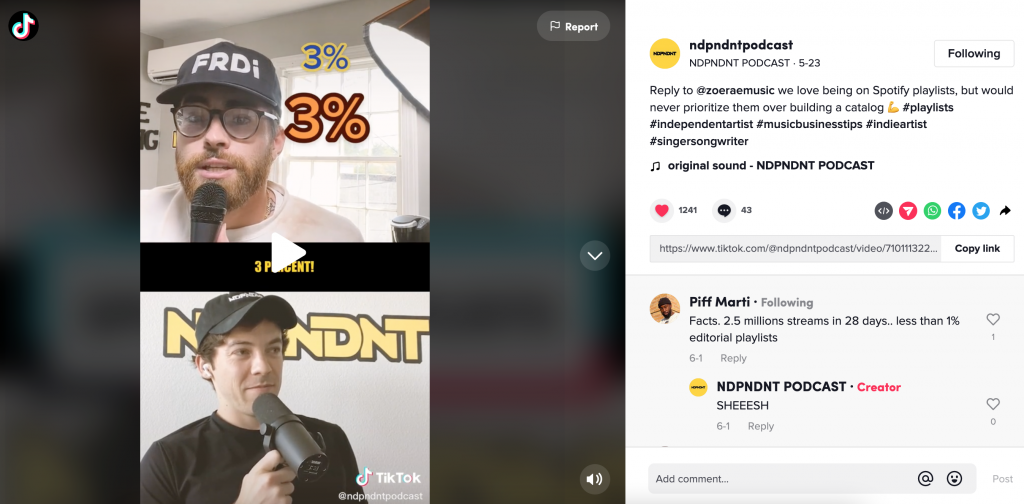
Reply to @zoeraemusic we love being on Spotify playlists, but would never prioritize them over building a catalog 💪 #playlists #independentartist #musicbusinesstips #indieartist #singersongwriter
♬ original sound – NDPNDNT PODCAST
The fellas from the NDPNDNT podcast say that building a catalog of great music is more important than relying on Spotify playlists. Playlists can definitely be good for indie musicians, but the more important focus is improving your craft.
#independentartist #musicmarketing #musicbiztok #theartistmentor #musician
♬ original sound – Conan John Avery
This TikTokker asks a couple simple questions and proves his point. When was the last time you discovered an artist from a blog feature? When was the last time you discovered an artist from a social media ad? For me, the main ways I discover indie artists is on TikTok, Spotify playlists, and word-of-mouth
There’s no secret shortcuts so you might as well enjoy the journey and take pressure of yourself💯🙌 #Stevenpressfield #mindsetmotivation #lifejourney #deepfacts #deepthought
♬ original sound – Real_Inspirational
Just because you’re 21 years old and you haven’t blown up yet doesn’t mean you’ll never have a career in music. Tons of artists have turned music into a career in their 20s, 30, and even 40s. Heck, I’m in my 30s and I’ve never been closer to doing music full-time.
Music careermusic career tipsmusic marketingmusic promotionpromote your music
Podcastle hops on the video podcast trend with its latest update – TechCrunch

As video-led podcasts become highly favored by listeners, Podcastle, which was primarily an audio recording and editing studio, is introducing a new feature that enables podcasters to conduct high-resolution video interviews or solo recordings.
Now, Podcastle will allow users to invite and video record up to 10 guests through the Chrome browser or the Podcastle mobile app on iOS devices. Since it’s all remote, podcast creators can interview each guest with separate audio and video tracks, also known as multitrack recording. Poor internet connection shouldn’t be a problem either, as Podcastle records all interview participants locally, and the files are automatically saved on a cloud database.
In the weeks ahead, Podcastle says it will launch screen sharing and video rendering, which allows users to interview participants in a single view and download the video without leaving the browser. There will also be the ability to add a unique branding to the background.
To use the service, Podcastle users click on the “+” on the app or “Create New Interview” on the desktop. They then select the type of interview — either video or audio. Each option has a camera feature, however. Creators then schedule the interview and add guests via their email address or by sharing a meeting link. To begin recording, podcast creators click “Start Interview,” and tap the record button. When the interview is finished, the file is automatically saved.
After recording what looks like a Google Meet or Zoom call, users can add the interview to their project and begin working on the audio, isolating tracks, adding royalty-free music or special effects, deleting awkward pauses and more. The editing stage can only be done on the desktop — the app is just for recording purposes.

Image Credits: Podcastle
Image Credits: Podcastle

Image Credits: Podcastle
Image Credits: Podcastle
Podcastle initially began as a Chrome extension that converts any online article into a podcast. Today, it’s available in the browser and on iOS devices and offers a full suite of tools and features such as an audio editor, text-to-speech converter, automatic background noise and silence remover, transcriber and AI-powered features that allow podcasters — beginners and professionals — to easily use features like Magic Dust, which isolates voices and removes background noise.
Upon testing the software, we found that the audio is uncompressed, which means it is as true to the original sound as you can get. The audio sample is 48 kHz WAV (Waveform Audio File Format), which is the common standard. We didn’t use a fancy microphone or studio equipment, so while the audio wasn’t “My Favorite Murder” quality, but it was decent.
The video quality on an iPhone is nice, but we wouldn’t consider it studio quality. Recent iPhone and iPad models can record in 4K, so at least you won’t be uploading a video that looks like you took it in the early 00s. To record in 4K, however, Podcastle requires users to pay for a subscription plan.
Podcastle has a basic free tier, yet it only gives users up to three hours per month of video recording (160 kbps MP3 audio download quality) and only 720p video download quality. In addition, it only allows the user to utilize the Magic Dust AI-powered sound enhancement, 1-click silence removal and auto-leveling features a total of three times per month each.
To upgrade, users must pay $15/month for its Storyteller plan, which gives eight hours of video recording (up to 4K quality) and unlimited audio plus 320 kbps MP3 or 1411 kbps WAV audio download quality — which is higher in quality than the free 160 kbps. Podcastle Pro is $30/month and gives unlimited audio and 20 hours of video recording.
This is a very similar pricing structure to its rival Riverside, except its Standard tier, costs $19/month while Riverside Pro costs $29/month. Both paid plans include the ability to live stream to Twitter, YouTube and Facebook. In addition, Riverside has a free plan, but it has very limited features.
Meanwhile, Anchor by Spotify, another competitor in podcasting software, only allows you to record audio. The service is free due to its monetization philosophy allowing everyone has access to its features, which include an editing tool that is far less comprehensive than Podcastle as it only allows for trimming and splitting audio. But as Spotify advances into video podcasts, it partnered with Riverside to give creators the option to make a separate Riverside account and record video episodes. With Podcastle’s update, you can record both audio and video all on one platform.
“With major video platforms like YouTube dedicating entire departments to the podcasting market, the industry is experiencing a major expansion,” said Artavazd Yeritsyan, the founder and CEO of Podcastle. “We’re so excited to deliver studio-quality video recording to our users, many of whom have been eagerly awaiting this launch,” Yeritsyan added.
Podcastle has raised a total of $8.8 million in funding to date and generates its revenues mainly from the subscription plans.
Podcastle raises $7M for its all-in-one platform for podcast production and publishing
Settlement reaffirms right to film and photograph at border. But the signage is less clear – The San Diego Union-Tribune

Christian Ramírez had just crossed back into the U.S. from Mexico at the San Ysidro Port of Entry with his wife when they saw male border officials patting down female travelers.
Ramírez, a longtime border activist, instinctually took out his cellphone and began snapping photos. But he was quickly stopped by private security officials on the pedestrian bridge and soon after surrounded by a group of Customs and Border Protection officials. They confiscated his cellphone and deleted all of the images he had taken from the bridge, according to court records.
For the record:
12:32 p.m. June 23, 2022A previous version of this story gave the incorrect title of Christian Ramirez. He is the policy director at SEIU-USWW.
The 2010 incident became the basis of a First Amendment lawsuit that challenged the government’s restrictions of filming and photographing near official border crossings. Ten years later — and after two dismissals and a federal appellate ruling — the case resulted in a settlement that forces CBP to acknowledge the rights of people to document activity in public spaces.
“Just to illustrate how long this has been dragging on … the electronic device that I had on me at the time was a Blackberry, so that tells you that this has been going on for many years now,” Ramírez, who used to work on human rights issues for Alliance San Diego and now directs policy at SEIU-USWW, a service worker labor union, said in a recent interview. “But it was well worth it.”
The 2020 legal settlement between the American Civil Liberties Union and CBP says the agency can no longer restrict people from filming and taking photos outside of U.S. land ports of entry, but local activists say new signage at the U.S.-Mexico border required under the terms of the agreement doesn’t go far enough to highlight the substantial change.
“I would say there was always a First Amendment right to record at the port of entry, but the federal government refused to acknowledge that First Amendment right, and the settlement forces them to do so,” said Mitra Ebadolahi, a former border litigation project staff attorney at the ACLU who handled the case. Her work focused on identifying, documenting and litigating alleged human and civil rights violations along the U.S.-Mexico border.
The settlement specifies that CBP “shall not prevent, impede or otherwise interfere with the First Amendment rights of members of the public to make and retain photographs, video records or other recordings of matters or events from a publicly accessible area … at any land port of entry in the United States, except as permitted in the (settlement).”
A sign posted outside a San Ysidro pedestrian bridge is less direct and includes language that indicates “written permission of an authorized official” might be required in certain instances, such as restricted areas. However, the federal regulation cited on the sign does not supersede the settlement or the First Amendment, as applied to the public, Ebadolahi stressed.
“If you are outside, in a publicly accessible area, you have a First Amendment right to take photographs and record,” explained Ebadolahi, clarifying you do not have to get any special written permission. The restricted areas include indoor areas or areas only accessible as you cross the border.
Ray Askins, a border environmentalist and another plaintiff in the lawsuit, sent the Union-Tribune a photo of the Calexico border crossing on Tuesday that he said shows some of the old signage still posted and incorrectly reflecting outdated language that filming at the border is prohibited without prior permission.
“CBP did not take this agreement seriously, changing the verbiage marked on some signs, and leaving other signs unchanged,” Askins said. “My feelings are mixed knowing no meaningful agreement was reached. The United States Constitution and the First Amendment was violated.”
Askins, who is concerned about vehicle emissions at border crossings, wanted to take a photograph of a vehicle inspection area in April 2012 at the port of entry in Calexico for a conference presentation.
He called CBP, and, according to court documents, was told his request would be “inconvenient.”
He ended up taking three or four photos from an intersection near the port before CBP officials demanded that he delete the images, the lawsuit states.
When he refused, the officials threatened to smash his camera and then handcuffed him, confiscating his camera and holding him in a port inspection area, according to court documents. He was released about a half-hour later after CBP deleted all but one of his photos.
Askins said some signs posted in Calexico have conflicting and confusing language. Ebadolahi, the attorney, said the wording in the signs is not ideal, but more work needs to be done educating the public about what their rights are.
“The signs can’t be the end-all, be-all,” she added.
In response to questions about the signs and settlement terms, a CBP spokesperson released a statement that said: “Customs and Border Protection made the changes in signage that were agreed upon as part of the settlement by February of 2021. CBP also has notified its employees of the terms of the settlement, including that, except as provided in the settlement, they may not interfere with visual or audio recording in outdoor, publicly accessible areas at our land ports.”
Activists and legal experts say the settlement could have far-reaching impacts — both in documenting or preventing potential law enforcement abuse and in establishing that the federal government can’t make special rules within certain undefined zones that ignore constitutional rights.
The issue predates smartphones, when instead of telling people to delete images, border agents would rip up videotapes and camera film of activists or journalists seen documenting activity in the port of entry areas. In at least one instance, which is not part of the litigation, private security guards made a journalist read aloud the signage that they said showed he could not take photos.
Activists and legal experts point to the case of Anastasio Hernández-Rojas, who was fatally beaten and shot with a Taser in 2010 while being deported to Mexico, as being emblematic of what’s at stake. Witnesses nearby captured part of the arrest on video.
“They claimed that he had been resisting, and that he was violent and that he was a threat to the agents and officers,” said Ebadolahi, “and then this video comes out that shows they had hogtied him, he’s prone on his belly and they’re tasing him over and over again, and he dies of a heart attack. It’s so egregious.”
In 2017, a federal judge approved the U.S. government’s offer to pay $1 million to Hernández-Rojas’ children to settle a lawsuit.
Get Essential San Diego, weekday mornings
Get top headlines from the Union-Tribune in your inbox weekday mornings, including top news, local, sports, business, entertainment and opinion.
You may occasionally receive promotional content from the San Diego Union-Tribune.
Follow Us
Local
Immigration
Many are frustrated that a program known as humanitarian parole has left Afghans waiting in danger for months with no response
Public Safety
Tyler Adams, who uses more than a dozen aliases, is wanted for questioning in disappearance of San Diego resident Racquel Sabean
Music
The pioneering Latin-rock guitarist, who grew up in the Mexican border city near San Diego, hopes to launch annual fundraising event in 2023. His most Tijuana performance was a 1992 homecoming concert
Border & Baja
Some critics have raised the question of racism against Black migrants. And the head of Customs and Border Protection has strongly denounced the coins.
Latino life
Nonprofit raises funds to build place for asylum seekers and refugees
Immigration
Two Haitian migrants in Tijuana were the most recent to die under circumstances that the community attributes to systemic racism in Mexico’s hospitals and U.S. border policy
For the record:
12:32 p.m. June 23, 2022: A previous version of this story gave the incorrect title of Christian Ramirez. He is the policy director at SEIU-USWW.
Defense
Privacy Policy
Terms of Service
Sign Up For Our Newsletters
Follow Us
Spin Master Entertainment, Company Behind ‘PAW Patrol,’ Announces ‘Vida the Vet’ (EXCLUSIVE) – Variety

Variety Print Plus Subscriber
Variety Print Plus Subscriber
Variety Print Plus Subscriber
Variety Print Plus Subscriber
Variety Print Plus Subscriber
By Selome Hailu
Spin Master Entertainment, the production company behind children’s franchises “Paw Patrol” and “Bakugan,” has a new character coming to the party.
Variety has learned exclusively of the launch of “Vida the Vet,” which follows a preteen as she cares for a community of animals. The animated series will premiere in the fall of 2023 on BBC’s CBeebies and BBC iPlayer in the U.K., as well as Corus Entertainment’s Treehouse and StackTV in Canada. Other international broadcasting partners, including a distributor in the U.S., will be announced at a later date.
Vida, who is 10 years old, spends her days tending to the woodland creatures that live outside her home, from a fox with a sprained paw to a turtle with an itchy toe to a tiger with an aching tooth.
“We started from wanting to mirror to preschoolers the idea of nurture,” Dodge says. “What wellness looks like, being able to model good self care and good care of others — and at the same time, alleviating fears a small child may have about their own visits to the doctor or dentist.”
“Some of the shows that we’ve done in the past are high-end, computer-generated exploration, but with ‘Vida,’ we wanted it to feel classic,” she adds. “To highlight the forest and all the animals, we wanted a beautiful color palette and illustrative 2D animation.”
Collaboration between creator Dustin Ferrer (“Esme & Roy,” “Peg & Cat”), showrunner Jennifer Oxley (“Wonder Pets!,” “Peg & Cat”) and animation studio Jam Filled Entertainment made for visually calming compositions: soft blues, greens and purples for the outdoor backgrounds; flowing orange hair and wide eyes for Vida.
Spin Master is a toy company at its core: Its entertainment arm launched in 2008, while the larger company was founded in 1984. But “Vida the Vet,” like “Paw Patrol” before it, is moving full steam ahead without a preceding toy line.
“Spin Master is comprised of three creative centers: entertainment, toy and digital games,” says Jennifer Dodge, the company’s president of entertainment. “The role of entertainment is to create content that can be a catalyst for the other two creative centers. ‘Vida’ will eventually have a beautiful toy line. But first and foremost, it’s about building story, building character, creating a world.”
Dodge says that developing ideas within the entertainment division and later consulting with colleagues who work on toys and games allows Spin Master to “bake in” on-screen elements that will be conducive to eventual merchandising.
“Paw Patrol is the greatest example of that. We were able to bring in resources that make sense — and leave the things out that do not,” Dodge explains. “For example, from a content standpoint, we wanted an area to get the call to give the pups their instructions, that first responder moment. Our toy group said, ‘We can build a tower that has a slide so the pups can jump into their vehicles, and that way we could rotate the vehicles around [when toys are made].’”
“But there are definitely times where there might be an ask from another group within the company, and if it just does not make sense for that property, then we find another solution,” she continues. “We are very protective. Everything that goes into every show has a storytelling purpose.”
“Vida the Vet” is executive produced by Dodge, Oxley, Laura Clunie, Toni Stevens and Spin Master co-founder Ronnen Harary. Season 1 will consist of 52 11-minute episodes, and “Vida the Vet” toys will debut in 2024.
A Variety and iHeartRadio Podcast
The Business of Entertainment
How to spot hidden surveillance cameras in your Airbnb, VRBO, or vacation rentals – USA TODAY

It’s happened to me. You check into a vacation rental, get settled in and spot surveillance cameras. Even when the cameras are technically allowed, it’s very alarming.
Prepared to be shocked. Cameras can hide in vents, lamps, power outlets and even unassuming objects like humidifiers and TV remote controls. You must see these cameras to believe they exist. Tap or click for 10 hidden cameras so sneaky you’d never know they were there.
Don’t blab about your trip on social media to keep your home safe while you’re on vacation. I also use a cheap Amazon Echo to alert me to any sounds like glass breaking. Tap or click here to learn how to set it up and use your laptop or desktop to record what it sees while you’re away.
If you’re going on vacation any time soon, it’s essential to know your rights regarding surveillance cameras in your rental.
Years ago, surveillance cameras were expensive and bulky. These days, they’re affordable and easy to install and hide. Depending on the rental service, the owner is within their rights to install cameras.
An Airbnb I rented a few years ago had about a dozen cameras inside the home. The owner disclosed the cameras using a tiny font at the bottom of the listing. Now I read rental listings very carefully and ask these questions before I book:
• What is the exact number of cameras and where are they located?
• Are the cameras recording?
• What happens to those recordings after my stay?
Airbnb allows security cameras or audio recorders in “public spaces” and “common spaces.” That means no bathrooms, bedrooms, or other sleeping areas. For instance, a camera or other monitoring device is not allowed if the living room has a sofa bed. Concealed and undisclosed cameras are not permitted, either.
VRBO allows for cameras and other surveillance devices only outside a property. The one exception: Smart devices that cannot be activated remotely. Guests must be informed and given the option to deactivate them.
Tech tips to your inbox: Your privacy is important. That’s why I send out smart daily tips to help secure your digital life. Try my free emails here.
Laws on this sticky subject vary from state to state. The Federal Video Voyeurism Act says you can’t “capture an image of a private area of an individual without their consent, and knowingly does so under circumstances in which the individual has a reasonable expectation of privacy.” It’s important to note that “private area” refers to nudity or lesser states of dress.
Local and state laws usually permit property owners to install cameras in “public spaces.” This is an important distinction. Private areas, like bedrooms and bathrooms, or anywhere anyone would reasonably expect privacy are off-limits. In a situation where you rent a single room of a house or apartment, it gets trickier.
There’s another caveat: It’s illegal to record someone for blackmail or other malicious intent. Audio recording also has much stricter rules than video. In many states, both parties must be aware that the recording is taking place.
If you’re renting, check the listing carefully for any mention of cameras. Whether or not you see a disclosure, it’s your responsibility upon arrival to check every single room. I’ll show you how.
RELATED: You might be breaking the law online and not even know it
Larger cameras are easy to spot, but anyone can easily hide smaller cameras behind furniture, vents, or decorations. A simple way to spot most types of cameras is to look for the lens reflection.
• Turn off the lights and slowly scan the room with a flashlight or laser pointer, looking for bright reflections.
• Scan the room from multiple spots so you don’t miss a camera pointed only at certain places.
• Inspect the vents and any holes or gaps in the walls or ceilings.
You can also get an RF detector. This gadget can pick up wireless cameras you might not see. Unfortunately, RF detectors aren’t great for wired or record-only cameras. For those, you’ll need to stick with the lens reflection method.
If you can connect to the rental’s wireless network, a free program like Wireless Network Watcher shows what gadgets are connected. You might be able to spot connected cameras that way. I do this in every rental I stay in, just to double-check what’s connected to the network.
Be aware that the owner might have put the cameras on a second network, or they could be wired or record-only types, so this is not a fail-safe option.
If a home automation system controls the rental property, it’s relatively easy to find cameras. Open the system controller’s menu and look for anything mentioning cameras. Accordingly, you can scan the TV channels for anything suspicious. I found a lot of cameras in a vacation rental this way.
More travel smarts: 5 smart tech steps to take before you hit the road
If you find an indoor surveillance camera that was not disclosed to you, pick up the phone and call the police. Tell them you have direct evidence that your landlord is spying on you inside your rental home without your knowledge or permission. Use this exact phrase.
Document the situation with video and photos on your smartphone. If you’re traveling with others, ask them to be witnesses once the police arrive. Remind them they were about to be victimized too. Once you have your police report, contact the rental site.
This isn’t just an annoyance. It’s a serious invasion of privacy.
PODCAST PICK: iPhone updates, Twitter warnings, Instagram scam
Tweeting a spoiler? Put a content warning on it. You should also watch your inbox for this new Instagram scam. Plus, Furbo’s latest pet cam gives you 360-degree views. In this podcast, I’ve got the inside scoop on seven exciting new iOS 16 features and a photography hack for action shots.
Check out my podcast “Kim Komando Today” on Apple, Google Podcasts, Spotify, or your favorite podcast player.
Listen to the podcast here or wherever you get your podcasts. Just search for my last name, “Komando.”
Learn about all the latest technology on the Kim Komando Show, the nation’s largest weekend radio talk show. Kim takes calls and dispenses advice on today’s digital lifestyle, from smartphones and tablets to online privacy and data hacks. For her daily tips, free newsletters and more, visit her website at Komando.com.
The views and opinions expressed in this column are the author’s and do not necessarily reflect those of USA TODAY.
COVID outbreaks are canceling shows at St. Louis theaters and testing small troupes – St. Louis Public Radio

Cherokee Street Theater Company made its second ill-fated attempt to stage a parody of the “Kill Bill” films this month.
The scrappy troupe had postponed a 2020 adaptation of Quentin Tarantino’s work when it shut down operations early in the coronavirus pandemic. With live performances happening regularly around St. Louis, the theater’s leaders felt good about being able to pull it off this summer.
“Then it gets canceled because my whole cast and crew got COVID,” said Ron Strawbridge, who co-founded the company with Suki Peters.
Their experience is increasingly common. Dozens of cast and crew members at St. Louis theater companies have tested positive for the coronavirus this month, causing show postponements and cancellations.
Smaller organizations with tighter budgets are less able to adapt to an environment in which pandemic safety protocols are loosening, even as community spread of the virus in St. Louis remains high.
“We’re not some giant, well-known rock band that can keep rescheduling for two years,” said Strawbridge. “You have the ability to reach out to someone pretty quickly to ask them to step in [when a cast member tests positive], and we tried. But because we’re a small company, what we can pay is not what other people can pay.”
Kirkwood Theatre Guild faced a similar problem this month, when a key cast member tested positive for the coronavirus on the eve of the troupe’s final dress rehearsal for the musical “Singin’ in the Rain.”
The troupe scrambled to prepare understudies, but then more people tested positive the next day. Producers canceled the opening weekend, hoping to start performances the following week.
But the positive tests kept coming: 14 in all, according to a theater spokesperson.
“By the time Monday came around, it was just too much. We would not be able to cover everybody’s part,” Tran said.
Kirkwood Theatre Guild canceled the production.
More budget means more flexibility
Before a performance of Mozart’s “The Magic Flute” at Opera Theatre of St. Louis on Wednesday evening, patrons sat in the shade under tents, sipping drinks and waiting for showtime.
Compared to last season, when the company performed abbreviated shows on a temporary stage in the parking lot, things looked a lot like they did before the pandemic began.
But the organization’s leaders have scrambled behind the scenes here, too. Cast members in two shows have come down with the virus, as did the principal conductor for a production.
Opera Theatre has the resources to prepare backup singers for most roles and schedule extra rehearsals to respond to last-minute personnel changes. It has also followed strict safety protocols backstage, as required by artists unions.
As the ensemble of “Awakenings” rehearsed in a studio one recent afternoon, each member wore a mask. Down the hall in an administrative office, boxes of at-home coronavirus tests were stacked on a desk. Staff tested singers three times a week and others in the production less frequently. Opera Theatre of St. Louis also requires patrons to show proof of COVID-19 vaccinations to enter the theater; cast and crew must be vaccinated and fully boosted.
“The budget implications have come in some significant overtime in making sure everything is properly prepared and rehearsed,” said General Director Andrew Jorgensen. “Usually, when ‘Carmen’ opens, you pretty much stop rehearsals. This year we kept going, to make sure the understudies were prepared.”
St. Louis Shakespeare Festival has also produced a show this month with no cancellations due to the coronavirus. It tests its personnel regularly during rehearsals. Actors who kiss onstage take additional tests a few hours before each show. The company also has the advantage of performing outdoors, where virus transmission is less likely. No cast members have tested positive, though some crew members have and were replaced.
Smaller arts organizations have less flexibility and often are not bound by union safety requirements. Strawbridge and Trung said the cast members of their productions were not required to use masks during rehearsals.
The cast of New Line Theatre’s “Urinetown” did wear masks throughout most of the rehearsal process. Some of them tested positive for the virus after the show’s opening weekend, and artistic director Scott Miller canceled the second of four planned weekends of shows — costing the troupe a bit more than a quarter of its budgeted ticket revenue.
“We lost three pretty full houses. It’s a lot of money,” Miller said.
But the outbreak was manageable — even as it led to some musical chairs backstage, with some members of the backing ensemble stepping into main roles.
“It was just that we had such a strong ensemble that we could take two people out of it and still have a good ensemble. And those people were so strong that they could pick up the leads and memorize it really quickly,” Miller said.
The troupe is planning for the last three performances of “Urinetown” this weekend.
Most live venues in St. Louis that required masking and proof of vaccination earlier in the pandemic have dropped those rules. But the basics of transmission of the coronavirus are unchanged: It passes more easily from person to person indoors, and good, well-fitted masks cut down on that spread.
Even with the strictest safety protocols backstage, performing arts groups will continue to battle virus outbreaks and potential show cancellations if the coronavirus spreads unchecked.
“While the rest of the world, on airplanes and in many spaces, has decided that the pandemic is over, reminding people that things are not business as usual is incredibly important,” Jorgensen said. “What I’m learning is that while this may look more familiar, normal is no longer a thing.”
Correction: A previous version of this story incorrectly described the status of Kirkwood Theater Guild’s production of “Singin’ In The Rain.” It has been canceled.
Follow Jeremy on Twitter: @jeremydgoodwin
Send questions and comments about this story to [email protected].
How to Watch the Jan. 6 Committee Hearings – The New York Times

Advertisement
The House committee that has spent nearly a year investigating the Jan. 6 attack on the Capitol and the events that led up to it will hold a public hearing on Thursday evening to begin setting out its findings.
Over the last 11 months, the committee has interviewed hundreds of witnesses and pored over thousands of hours of video footage and more than 100,000 pages of documents.
The hearing, which will be televised in prime time, is the first in a series that will run throughout June.
Here is a guide to following the hearing and what to expect.
The committee will begin the session at 8 p.m. Eastern time on Thursday.
The New York Times will provide live video of the hearing at nytimes.com along with live discussion and analysis from Times reporters. All of the major broadcast networks plan to carry the hearing live, as do the major cable news networks, with the exception of Fox News.
Committee leaders have indicated that the focus on Thursday will be on presenting a complete timeline of the riot, beginning with the 2020 election and extending through the riot itself and its aftermath.
Democrats involved in the investigation have said the evidence they present will connect the dots between the monthslong campaign that President Donald J. Trump and his allies waged to discredit the outcome of the election and the effort by rioters on Jan. 6 to disrupt the congressional certification of the results.
The hearing is also likely to highlight the involvement of the Proud Boys, the far-right group whose members played a critical role in the storming of the Capitol. The committee said the witnesses at the session would include Nick Quested, a documentary filmmaker who was embedded with the group in the run-up to Jan. 6, and Caroline Edwards, a Capitol Police officer who was injured at the start of the violence.
Future hearings this month are expected to focus on other issues, such as the effort by Mr. Trump to install a loyalist atop the Justice Department, the pressure campaign on Vice President Mike Pence to prevent Congress from certifying the Electoral College count and the way Mr. Trump encouraged supporters — including far-right and militia groups — to come to Washington for the rally on Jan. 6 that immediately preceded the attack.
The hearings will be led by the committee’s chairman, Representative Bennie Thompson, Democrat of Mississippi, and its vice chairwoman, Representative Liz Cheney, Republican of Wyoming, who has broken with her party’s leadership by seeking to hold Mr. Trump accountable for the effort to overturn the election.
The committee’s next hearing is scheduled for Monday at 10 a.m. The panel has yet to announce dates and times for subsequent sessions, but it is expected to hold two more next week and others the following week.
Video will again be available at nytimes.com.
The committee plans to release its final report in September, ahead of the midterm elections.
Advertisement
SDDOT and Meade County Seek Public Input into Meade County Master Transportation Plan Study – South Dakota State News Home

For Immediate Release: Wednesday, June 22, 2022
Contact: Steve Gramm, Planning Squad Leader, 605-773-3281
RAPID CITY, S.D. – The South Dakota Department of Transportation (SDDOT), in collaboration with Meade County, will hold public meeting open houses to gather public input on the draft Meade County Master Transportation Plan. These public meetings will be held at 5:30 p.m. on the following dates and locations:
Tues., June 28 American Legion Post #311 101 Pine St. Piedmont
Wed., June 29 Meade County Erskine Building 1300 Sherman St. Sturgis
The draft Meade County Master Transportation Plan addresses a full range of transportation options and issues, including pedestrian, bicycle, transit, freight, and automobile. The purpose for the public meetings is to inform the public of the plan’s recommendations and to record any comments and/or concerns the public may have on those recommendations that will determine the future look of Meade County’s roadway, bus / transit, bicycle and pedestrian systems.
For those who cannot attend the meeting or desire additional information on the study, information will be made available online after the public meeting at https://klj.mysocialpinpoint.com/meade-county-transportation-plan.
The public meetings will be held from 5:30 to 7 p.m. at each location indicated. The opportunity to present written comments will be provided. Written comments will be accepted until Thursday, July 14, 2022.
Notice is further given to individuals with disabilities that this open house is being held in a physically accessible place. Any individuals with disabilities who will require a reasonable accommodation in order to participate in the open house should submit a request to the department’s ADA Coordinator at 605-773-3540 or 1-800-877-1113 (Telecommunication Relay Services for the Deaf). Please request the accommodations no later than two business days prior to the meeting in order to ensure accommodations are available.
Written and verbal comments will be accepted from June 28 through July 14, 2022.
For more information, contact Steve Gramm, Planning Squad Leader, at (605) 773-3281 or by email at [email protected].
About SDDOT:
The mission of the South Dakota Department of Transportation is to efficiently provide a safe and effective public transportation system.
For the latest on road and weather conditions, road closures, construction work zones, commercial vehicle restrictions, and traffic incidents, please visit https://sd511.org or dial 511.
Read more about the innovative work of the SDDOT at https://dot.sd.gov.
-30-
Inside the Push to Diversify the Book Business – The New York Times

For generations, America’s major publishers focused almost entirely on white readers. Now a new cadre of executives like Lisa Lucas is trying to open up the industry.
Lisa Lucas, the publisher of Pantheon and Schocken Books, at home in Brooklyn.Credit…Wayne Lawrence for The New York Times
Supported by
Send any friend a story
As a subscriber, you have 10 gift articles to give each month. Anyone can read what you share.
To hear more audio stories from publications like The New York Times, download Audm for iPhone or Android.
At the end of one of her first days on the job at Pantheon books in January 2021, Lisa Lucas picked up her iPad, settled into a couch and began swiping through the manuscript of an unpublished novel called “Sweet, Soft, Plenty Rhythm.” Written by Laura Warrell, the story follows a jazz musician and his entanglements with a dozen or so women. As Lucas devoured its pages, she slipped into a kind of trance. Hours ticked by. The sun set outside her windows, and still she could not stop reading.
Lucas was captivated by the novel’s inventive form, the way it reveals the plot through a kaleidoscope of female voices, but her response to the manuscript went deeper than just aesthetic appreciation. The musician at the center of the novel is racially mixed, and the world he inhabits is rich with every kind of diversity: social, economic, racial, ethnic. To Lucas, it felt like the real world. “I’m an unmarried Black woman,” she told me during one of the many conversations we had over the past nine months. “Over 40. Who does not live in a convent. These stories matter to me.” She got only halfway through the manuscript before she started emailing it to colleagues. Did they agree that Pantheon needed to try to buy the book?
This is pretty much how book publishing has worked for generations. The stronger the emotional connection an editor has to a manuscript, the more likely she is to publish the book. The more editors who want a book, the more likely that its publication rights will be sold at auction, which drives up their price. These decisions are influenced by practical business considerations. Does the book have an audience? Does the author have a reputation? Can the publisher afford the rights? But they are also swayed by more romantic factors. Editors often justify their purchases by talking about how much they “love” a manuscript. In this way, book publishing is like the real estate market but with offer prices conditioned on the approval of a book publisher, not a bank.
Until recently, almost all the people who wielded the stamp of approval in book publishing were white. Lucas is the first Black publisher in Pantheon’s 80-year history and one of the few to ever hold such a post at Penguin Random House U.S., the umbrella company that contains Pantheon as well as dozens of other imprints. When “Sweet, Soft, Plenty Rhythm” went to auction, Lucas offered a winning bid in the mid-six figures. The price reflected her hopes for the book’s commercial appeal.
“I did not get up today to share this book with 20 people,” she said. “I got up today to share this book with as many people as I could convince to read it, because I think it’s beautiful. It moved me, and I believe that people are looking for those kinds of experiences.”
Though Lucas began her job last year, she was hired in July 2020, near the start of a period in which the number of nonwhite employees in the book-publishing industry surged. This was not a coincidence. During the national protests that followed the murder of George Floyd, book publishing came under scrutiny for its history of undervaluing and ignoring Black editors. That June more than 1,000 publishing professionals signed up to participate in a “day of action” to protest, among other things, the industry’s “failure to hire and retain a significant number of Black employees.”
Lucas had witnessed these failures firsthand since she began working as the publisher of the nonprofit magazine Guernica in 2014. “I started in film and in theater,” she told Brooklyn Magazine in 2016. “I was used to being one of very few people of color in the room, but I had rarely had the experience of being the only one in certain rooms until I worked in publishing.”
All that changed in the summer of 2020. The same month that Lucas was hired, Dana Canedy, the administrator of the Pulitzer Prizes who had been a reporter and editor at The New York Times for 20 years, became the publisher of Simon & Schuster. Elsewhere, nonwhite editors have been hired or promoted into senior positions at imprints like Doubleday (Thomas Gebremedhin), Flatiron (Nadxieli Nieto) and Random House (Jamia Wilson). Books by Black authors have filled best-seller lists, and editors have scrambled to buy manuscripts by nonwhite authors. (“Sweet, Soft, Plenty Rhythm” sold in a six-way auction.) Publishing houses also have doubled down on their efforts to recruit and support nonwhite employees and to examine their procedures through diversity, equity and inclusion councils. Veteran nonwhite publishing professionals regarded these changes with hope — and skepticism. Many of them know that two waves of previous efforts to diversify the industry created little lasting change.
For decades publishing insiders have wrung their hands over the ways in which television, video games and the internet have eaten into their profits, while ignoring the ways in which their own business practices have limited the audience for their products. Survey after survey shows that the two groups of Americans most likely to read books are those who have a bachelor’s degree and those who earn more than $75,000 a year. For publishers, this should be Champagne-popping news. After all, the percentage of Americans over 25 who have earned bachelor’s degrees has more than doubled since 1970. But demographically these graduates look different than they did in the 1970s — they are more likely to be women and to be Black, Asian or Latino — and by neglecting to build an audience among them, publishers may have lost millions of customers. Publishers, Lucas pointed out, have nurtured audiences for items as strange as adult coloring books and young-adult vampire mysteries. “We built these audiences,” she said. “We invested. We worked. We took things that did work and we built something out of them.”
Some editors, like Lucas, are trying to figure out how to do the same for the vast swaths of America that big publishers have mostly ignored. It’s an effort that is complicated by a long history of neglect, which itself is bound up with publishers’ failure to take diversity in their own professional ranks seriously until recently. In interviews with more than 50 current and former book professionals and authors, I heard about the previous unsuccessful attempts to cultivate Black audiences and about an industry culture that still struggles to overcome the clubby, white elitism it was born in. As Lucas sees it, the future of book publishing will be determined not only by its recent hires but also by how it answers this question: Instead of fighting over slices of a shrinking pie, can publishers work to make the readership bigger for everyone?
When I entered the world of book publishing — where I spent two years as an assistant and another 16 as a book-review editor, critic and reporter — Barbara Epler, now the publisher of New Directions, warned me that the entry-level pay was abysmal, in large part because publishers assumed that few of their entry-level hires would actually have to survive on it: Historically, salaries were considered “dress money.” She said it with an outraged laugh, and I thought it was a joke, but I soon learned that she was right. When I was hired at Farrar, Straus & Giroux in 1997, I made $25,000 a year for a job that required a college degree, industry experience and often more than 60 hours a week. I could have earned more money temping. Over the years, publishers remained reluctant to raise wages. In 2018, according to a Publishers Weekly industry survey, the median salary for an editorial assistant was $38,000.
For much of its history, book publishing, especially literary book publishing, was an industry built and run by rich, white men. One of the founders of Farrar, Straus & Giroux was Roger Straus Jr., whose mother was an heir to the Guggenheim fortune and whose father’s family ran Macy’s department store. Grove Press was owned by Barney Rosset, whose father owned banks in Chicago. When Bennett Cerf, the son of a tobacco-distribution heiress, bought the Modern Library, which would be renamed Random House in 1927, he and his partner, Donald Klopfer, each ponied up $100,000 — roughly the equivalent of $1.7 million today.
Until the 1960s, American literature was shaped by the fact that Black authors needed white publishers to achieve national recognition. In her recent article for Publishers Weekly, “Black Publishing in High Cotton,” Tracy Sherrod, an executive editor at Little, Brown — who was the editorial director of the Black-themed imprint Amistad Press for nine years — notes that both the poet Langston Hughes and the novelist Nella Larsen got book deals in the 1920s with the help of Blanche Knopf, an editor at the prestigious publishing house Alfred A. Knopf. After that, you could always point to a few great Black authors published by New York houses. Yet white editors didn’t necessarily think of themselves as serving Black readers.
“There is a subgenre of essay in the African American literary tradition, that can loosely be called What White Publishers Won’t Print,” Henry Louis Gates Jr., a professor of English at Harvard, said. Both James Weldon Johnson and Zora Neale Hurston wrote essays with that title, more or less. Gates said, “There is a consciousness from almost 100 years ago among Black writers about the racial limitations and biases of the American publishing industry.” Richard Wright, whose 1940 novel “Native Son” sold 215,000 copies in three weeks, for example, still saw half of his 1945 memoir “Black Boy” expurgated to please the Book-of-the-Month Club, which catered to an audience of white middle-class readers.
Under pressure from the civil rights movement, America’s big publishing houses embarked on their first effort to serve a more diverse market in the 1960s. Teachers and school boards in cities like Chicago and New York were demanding schoolbooks that recognized the histories and experiences of nonwhite Americans. On Capitol Hill, Representative Adam Clayton Powell Jr., Democrat of New York, investigated the portrayal of minorities in classroom writings as part of the Ad Hoc Subcommittee on De Facto Segregation in 1966. His hearings revealed that there was only a single Black editor leading any of the new schoolbook series that publishers had established: Doubleday and Company’s Charles F. Harris. In response to this revelation, many publishers began recruiting Black editors into their education divisions, and a few of these editors later moved to the companies’ general trade-book divisions as well. “Those were the glory days,” Marie Brown, who was hired by Doubleday in 1967, told me. “We were invited in.” Among the ranks of these new hires was the future Nobel Prize winner Toni Morrison, who worked in a scholastic division of Random House while writing her first novel, “The Bluest Eye.”
Despite that wave of hires, though, the industry remained overwhelmingly white, both in its staff and in the audiences it cultivated — creating an opportunity for a new group of small, independent Black publishers. In 1965 Dudley Randall founded Broadside Press in Detroit. In 1967 Haki R. Madhubuti became a co-founder of Third World Press in Chicago, and in 1978 Paul Coates started Black Classic Press in Baltimore. “There was a need for the people who were struggling to have control of their voices so that they would accurately project what we saw,” Coates told me. These Black-owned houses published authors who are now recognized as essential to the American canon: Amiri Baraka, Gwendolyn Brooks, Audre Lorde, Nikki Giovanni, Sonia Sanchez and Pearl Cleage. But none of these companies had the funds to underwrite splashy marketing campaigns and national tours — the kinds of investments that help catapult books onto best-seller lists. All three started in their publishers’ homes. Yet they continued to publish nonwhite writers even when the civil rights movement faded and New York publishers’ interest in producing books for a broader audience waned.
Marie Brown told me that during the 1970s, a colleague at Doubleday advised her that “the Black thing is over.” If she wanted to make it as a trade-book editor, she needed to buy manuscripts of “universal” interest. “I was stunned,” Brown recalled. “I knew there was a thriving market; there were readers.” Brown left Doubleday in 1981, eventually becoming a literary agent and a mentor to younger generations of Black publishing professionals. But her instincts were right. After Morrison moved to Random House’s trade imprint, she assembled “The Black Book,” a landmark anthology of Black historical documents. Random House balked at publishing it. “It just looked to them like a disaster,” Morrison told Hilton Als in a 2003 New Yorker profile. “They didn’t know how to sell it.” But the anthology became a national best seller in 1974. And in 1976, when Doubleday published Alex Haley’s “Roots,” a historical novel that it bought in embryonic form during the 1960s, it spent 22 weeks at the top of the New York Times best-seller list.
Even after witnessing these blockbusters, book publishers still seemed to struggle to see Black Americans as a significant consumer market. Gates told me that Random House’s hire of Morrison was “probably the single most important moment in the transformation of the relationship of Black writers to white publishers.” Yet even Morrison felt she could effectively publish only one African American book each season, shepherding books by writers like Gayl Jones, Toni Cade Bambara and Angela Davis. They never turned into national best sellers but did become classic backlist titles. When Morrison left Random House in 1983, the company’s publication of Black authors plummeted.
During the 1970s, Harris left trade publishing for Howard University, where he started the nation’s first Black university press and a six-week training program for would-be publishing professionals. Malaika Adero graduated in its first class. During her interview to become an editorial assistant at Simon & Schuster in 1985, she said she would like to eventually become an acquiring editor. Her interviewer offhandedly told her that it would never happen. Her break came when a lawyer she once worked for in Atlanta offered her an opportunity to do a book with the jazz musician Miles Davis.
“Miles: The Autobiography,” written with Quincy Troupe, became a hit that sold more than 100,000 copies. But after its publication, Adero still had a hard time persuading her colleagues to let her buy the books that she wanted. Weekly editorial meetings felt like walking the gantlet, she says. Often when she brought up a book by a Black author, someone would say some version of, “Oh, these Black books just don’t sell.” When Adero pointed to Davis’s sales or to those of the filmmaker Spike Lee, another one of her celebrity authors, she was informed that those were “not Black books.” When she tried to buy a manuscript written by Susan Taylor, the editor in chief of Essence, she was told that Taylor’s book was too focused on religion. (Simon & Schuster neither confirmed nor denied Adero’s account of her time at the house but noted in a statement that “experiences such as she describes should not have been considered acceptable in any era of publishing.”)
“We’re hired for our special knowledge and experience, but our special knowledge and experience isn’t valued in the same way,” Adero told me. “It’s taxing. You still need a white ally.” After she quit Simon & Schuster in 1990s and joined Amistad Press — then an independent house started by Harris — Adero published Taylor’s book, “In the Spirit,” and watched it become a major best seller.
In the 1990s the myth that Black books wouldn’t sell began to look increasingly unsustainable. According to Calvin Reid, a reporter at Publishers Weekly who has been covering the industry since the late 1980s, the turning point came in 1992, when three Black women — Toni Morrison, Alice Walker and Terry McMillan — appeared on the New York Times best-seller list at the same time. In their wake, many other Black writers — among them, Walter Mosley, E. Lynn Harris, Zane and Edward P. Jones — had huge sales.
Many of these writers had to begin by building a reliable fan base for their books on their own, either by self-publishing or by orchestrating their own publicity campaigns. McMillan, who topped the Times best-seller list with her third novel, “Waiting to Exhale,” told me that Houghton Mifflin, the publisher of her first book, “Mama” (1987), made no plans to send her on a book tour. Instead, she herself sent hundreds of letters to bookstores and Black organizations across the country, offering to do readings and including pages from “Mama.” The response was overwhelming: She received so many invitations that she could not accept them all. Once, she walked into a bookstore in Atlanta and wept when she saw that the crowd waiting for her was standing-room-only. “Black people have always read,” she said. “They were waiting for something to read that they might be able to identify with, that’s all.”
Eyeing these successes, some publishing houses established themed imprints with nonwhite editors who reported to white publishers. At Random House, Cheryl Woodruff became the founding editor of One World in 1991, Melody Guy inaugurated Strivers Row in 2000 and Janet Hill formed Harlem Moon in 2002. Disney’s Hyperion Books for Children, meanwhile, created the Black children’s imprint Jump at the Sun with the editor Andrea Davis Pinkney in 1998, and HarperCollins bought Amistad in 1999.
But by 2012 all these editors were gone, and most of the imprints were abandoned. Many people told me that they believed the adult imprints were doomed when executives developed a single-minded appetite for knockoffs of Sister Souljah’s smash hit “The Coldest Winter Ever” (1999). Souljah’s novel, which was published by an imprint of Simon & Schuster, sold more than a million copies and revived a genre known as “street lit,” which often features characters connected to drug dealing and prostitution. The genre’s first hit was Iceberg Slim’s 1967 novel “Pimp,” published by Holloway House, a specialist in pulp fiction that began catering to Black readers after the success of Slim’s book.
Though street lit sold well in some chain stores located in metropolitan areas, its authors usually wooed readers through more grass-roots efforts: selling self-published books through street vendors or Black book clubs or at independent bookstores located in Black neighborhoods. These were not the kinds of outlets that big publishers valued, and these lines of distribution dried up when local retailers lost customers to chain stores like Borders and to a rising giant named Amazon.
“So it failed,” said one veteran, who asked for anonymity for fear of professional repercussions. “It was practically engineered to fail.” And when street-lit sales faded, the trend dragged down a generation of Black editors and publicists with it. Some professionals told me that when they witnessed this collapse, they felt as if publishing executives had showed their true colors. The demise of One World — one of big publishing’s first multiethnic literary imprints — felt especially painful. Worldwide, Random House sold 70 million copies of “Fifty Shades of Grey” in 2012, yet its publisher, Vintage Books, was never pressured to become an erotica imprint. “An editor can say, ‘I love this or that kind of book,’” the veteran said. “But the only thing that you see in Black literature is street lit.”
Narrow-minded ideas about what Black readers want have also affected white authors whose work touched on Black history. Rebecca Skloot told me that when she tried to sell her science history, “The Immortal Life of Henrietta Lacks,” in the late 1990s, editors suggested to her that there was not a large audience for a book about the ways a Black family was exploited by medical researchers. After she sold the book, an editor at a large publishing house wanted her to minimize the history of the Lacks family and focus on the scientific research that was conducted on the cells taken without consent from their matriarch. (Skloot did not want to publicly identify the editor or the publisher. The editor said that Skloot was asked to emphasize the medical research to fit with their other popular science books.) Skloot wrestled back her rights and resold the manuscript with the Lacks’ story intact. After Random House’s imprint Crown published the book in 2010, it spent nine years on the Times hardcover and paperback best-seller lists.
The experience for Black authors could be eviscerating. The best-selling author Kiese Laymon told me that when he was trying to publish his first novel, “Long Division,” with a major house in the early 2000s, he felt pressured to remove the novel’s references to Katrina, to move its setting out of the American South and to mute its handling of racial politics. (Laymon did not want to publicly identify the editor or the publisher. The editor contested Laymon’s account and said, “I would not tell an author to remove race from a book.”) Unable to stomach these kinds of revisions, Laymon, then a professor at Vassar College, returned the advance from a major house, resold the novel for $4,000 to an independent publisher in Illinois and shouldered the work of promoting it himself. “I’m just out here, putting them in my Ikea bags and putting them in my trunk and trying to sell them,” he told me. In 2013, Laymon published a lightly fictionalized essay in Guernica about this experience. He never would have published his memoir, “Heavy,” with a Big Five publishing house if he had not met Lisa Lucas while she worked at the magazine: “She was the only person in New York who said, I think there’s a value in what you’re doing.”
When she began her job at Pantheon, Lucas had no previous experience working inside a book-publishing house. She had to learn to be a publisher while performing the job at an imprint that was already publishing about 40 new books a year and owned a catalog of backlist titles that dates to at least 1942. (The backlist includes a book by my husband, published in 2014.) She understood that the first year would be brutally hard, in part because she would also be trying to change the way Pantheon thought about its audience.
“I’m not here to make Black Pantheon,” she told me. “I’m here for all the gods, the whole pantheon.” This was also her approach at the National Book Foundation, which she directed for almost five years. “Books are for everyone,” she declared many times while she was there. Under her leadership, the foundation started a program that got more than a million books to children in public housing, and it also distributed books in prisons. To promote reading, it set up panels for National Book Award winners and finalists at libraries, colleges, theaters and book festivals in both rural and urban areas across the country.
“The books were actually pretty diverse in the years that came right before me,” Lucas said. “But then you point them at everyone. There’s no reason why somebody of Polish descent wouldn’t like Jackie Woodson’s book. There’s no reason why a Dominican reader wouldn’t enjoy Masha Gessen. So point these books toward everyone, and that’s equity to me.”
For Lucas, this attitude has deep roots. Her mother worked at the pioneering Black-owned advertising agency Uniworld, which persuaded corporations like AT&T, Ford and Texaco to take Black consumers seriously. “I grew up hearing these conversations,” Lucas said. Her father was a record producer, songwriter and guitarist who produced most of Madonna’s first album. Lucas earned a degree in literature at the University of Chicago. Zadie Smith’s “White Teeth” was the first novel she encountered with a cast of characters that reflected the kind of diversity that she experienced growing up in New Jersey.
It’s still too early to tell exactly how Lucas’s leadership will change the way that Pantheon builds a readership for its books. The pandemic made it difficult to organize the sort of in-person events that Lucas pushed at the National Book Foundation, and Lucas herself spent most of 2021 on a hiring spree. Her top priority was hiring people she trusted, whose taste she liked and who had the experience to make Pantheon succeed while also mentoring new, nonwhite junior staff members. Her first three senior additions were veteran white women: Denise Oswald as editorial director, Maria Goldverg as senior editor and Naomi Gibbs as executive editor. “I need somebody who knows more than I do, because I’m coming from nonprofits; I’m also being trained,” Lucas said. Late last year she recruited two other publishing outsiders: David Treuer, an Ojibwe writer whose history “The Heartbeat of Wounded Knee” was a National Book Award finalist in 2019, joined to focus on works by Indigenous authors; and the Dominican reporter and editor Concepción de León left The Times to acquire nonfiction. (Warrell’s novel was edited by Pantheon’s longtime editor, Deborah Garrison.) Now seven of Pantheon’s 13 staff members are nonwhite, making it one of the most diverse imprints in the company.
The scale of Lucas’s hiring spree was impressive, in keeping with Penguin Random House’s promise to invest in Lucas, financially and otherwise, after she came aboard. Maya Mavjee, the president and publisher of the Knopf Doubleday Publishing Group, which houses Pantheon within Penguin Random House, decided to turn Pantheon into “an equal and fourth pillar” of the group last year. This means that the imprint has a publisher devoted exclusively to its editorial and business success. “It’s extraordinary how much she’s managed to achieve in such a short time, because not only is she reading, editing, building a list, hiring, but also understanding the business,” Mavjee told me in a video call with Lucas.
But persuading authors and agents to pick Pantheon hasn’t always been straightforward. “I’m new, so I can’t say, ‘Look what I did in 1997 and this book I published in 2015 that did so well,’” Lucas says. The book industry is full of editors, agents, designers and salespeople who have worked together for decades. For them, Lucas is still a newcomer. Over a year into the job, one agent asked her, “Do you think you’re going to stay?”
Lucas’s racial identity has also brought her more visibility than other new publishers would normally have. “You’re not just proving yourself to the five or 20 people that you work with, you’re proving yourself in plain day to everyone who’s paying any attention for whatever reason,” she says.
The pressure was intense. One afternoon when I peppered her with questions about her hires, Lucas lost patience. “There’s so much energy directed toward editorial,” she said. “What about the critics? What about media coverage? What about book clubs? What about agents? What about marketing? What about sales? What about production? What about design? What about everything? You have to know how to sell things.” She had gestured at a restaurant across the street. “I can rent that out and make the best, most equitable production,” she said. “But I won’t be able to ever do it again if I don’t find an audience.”
Lucas has only two more positions — a graphics editor and a publishing assistant — to fill before her team is complete. She’s also thinking about how to use the tactics of an indie publisher or even an upstart politician to capture the attention of a diffuse group of potential readers. There was no tidy list of action items, she said. What mattered was the welcoming attitude with which a publisher did everything. “Many people are snobs and think that some people will read books and some people never will,” she said. “If you publish against that instinct, your spirit is one of invitation.”
During the uncertainty and isolation of the pandemic, many Americans turned to old-fashioned book reading in much the same way that some started baking bread. For the first time in 18 years, the number of print books sold in the United States rose for two consecutive years. In 2020, NPD BookScan recorded an 8 percent increase in the unit sales of print books, and in 2021 it registered another 9 percent increase. Worldwide, these bumps pushed Penguin Random House’s revenues up by $190 million in 2020 and by another $270 million in 2021, with more than half of those revenues coming from the United States. Sales were led by Barack Obama’s second memoir, “A Promised Land,” which sold more than three million copies in the United States in print, electronic and audio formats in its first month.
But nobody expects these boom times to last. During the 1980s and 1990s, America’s varied national landscape of independent bookstores was razed by chain stores, like Borders and Barnes & Noble. These have been ravaged in turn by online stores, especially Amazon. Each change has left publishers negotiating with ever larger, more powerful retailers. As a result, profit margins have slimmed, and the larger houses have sought leverage in size. Doubleday, for example, was acquired by Bertelsmann in 1986, as was Random House in 1998. In 2013, Pearson and Bertelsmann merged their respective publishing companies to form Penguin Random House, which Bertelsmann has wholly owned since 2020. Today there are five giant publishing houses in America — Penguin Random House, Hachette, Macmillan, Simon & Schuster and HarperCollins — and Penguin Random House’s best hope for negotiating with Amazon is to buy Simon & Schuster, a deal that the Justice Department is trying to block.
Publishers are also staring down a more existential threat: Fewer people are reading. In 1982 the National Endowment of the Arts found that more than 60 percent of Americans read at least one book during the previous 12 months. By 2017, that number had dropped by more than eight percentage points, or more than 26 million potential readers. Data from the Pew Research Center makes even the increase in readership during the pandemic look gloomy. Yes, 75 percent of Americans read or listened to at least part of a book in 2021, but that’s no better than the number who did a decade earlier, when American readership was already slipping.
The usual explanation for this plunge is that books have lost market share to other media. There’s most likely some truth to this line of reasoning. But it’s also true that the “total addressable market” for books has changed. In the United States, the biggest consumers of books have always been college graduates and those with significant disposable income. And between 1990 and 2020, the percentage of Black adults and Hispanic adults with bachelor’s degrees more than doubled, while the percentage of Asian Americans with college degrees reached 62 percent.
Even as late as 2016, a whopping 87 percent of publishing professionals identified as white or Caucasian in a survey conducted by Publishers Weekly, and only 11 percent identified as Black, Hispanic, Asian or mixed. That imbalance can feed an unhealthy culture. “The submission process, it was incredibly challenging,” one agent, who asked to remain anonymous to avoid hurting her authors, said of the pre-George Floyd years. “It’s basically white people looking for books about white people for white people.” Occasionally, subgroups would get a brief turn in a narrow spotlight: three or four writers from India, say. Or an undeniably brilliant writer would become a critical darling, then a commercial success. Colson Whitehead. Junot Díaz. Chang-rae Lee. Oprah’s Book Club helped some authors break through: Ernest J. Gaines, Edwidge Danticat, Ayana Mathis. But a recent project by the McGill University professor Richard Jean So and the New York Times graphics editor Gus Wezerek found that 89 percent of the fiction books published in 2018 by Simon & Schuster, Penguin Random House, Macmillan and HarperCollins were written by white, non-Hispanic authors — a nearly exact reflection of the industry’s staff demographics the previous year.
Yet as publishing turned its back on nonwhite readers, the audience they dismissed grew bigger and richer. Recently, McKinsey projected that by 2030 the collective economic power of Black consumers alone will be $1.7 trillion. Over the past few years, publishers have made greater efforts to supply books for this market. Rachel Deahl, who has tracked notable acquisitions for Publishers Weekly for more than a decade, says that she has seen a huge shift in her column over the past year and a half. “I tend to cover six to seven books a week,” she explained over email. “It’s not unusual now for half of the books I cover to be written by people of color.”
For Penguin Random House, Lucas’s reinvention of Pantheon is just one part of a larger effort to transform the company. In 2016, it revived One World, with the editor Chris Jackson as publisher. (The imprint published “The 1619 Project,” created by Nikole Hannah-Jones and The New York Times Magazine, last year.) In 2017, Penguin Random House’s global chief executive, Markus Dohle, announced that diversity was now an “urgent and important goal for our publishing programs”; soon after that, it formed its first companywide employee council on diversity and inclusion. In 2020, a few months after it announced that Lucas would become the vice president and publisher of Pantheon and Schocken, Penguin Random House increased its baseline pay for entry-level positions to $45,000. Later that fall, Penguin Random House became the first publishing company to publicly release demographic information about its employees. In 2016, its reports revealed, only 21 percent of its new hires were nonwhite. Last year, its number of nonwhite new hires crossed 50 percent for the first time.
In a video meeting, Penguin Random House U.S.’s executive vice president of strategy for diversity, equity and inclusion, Kimberly Ayers Shariff, who was hired last year, and its director of corporate communications and social responsibility, Claire von Schilling, assured me that the company had made a long-term commitment to change at the highest levels. “I sit on the U.S. board with the rest of my colleagues in top management of this company,” Ayers Shariff said. “When the board comes together, we are talking about issues of diversity, equity and inclusion.” She and von Schilling described in-house training efforts, changes in recruitment and the development of a two-year strategic plan that will include specific diversity, equity and inclusion goals that they plan to release later this month. Similar transformations are also underway at companies like Hachette, Simon & Schuster and Macmillan.
These efforts reminded me of the programs that Bertelsmann put in place after Thomas Rabe became chief executive and announced in 2011 that the conglomerate needed to promote more women. Achieving this agenda took more than a decade, but by the end of last year, women held 30 percent of the senior management positions across all of Bertelsmann’s divisions. “More diverse publishing is not just a moral imperative,” Shariff emphasized when we spoke last month. “We have to establish these more inclusive business practices as a necessity. That’s the way that we’re going to strive to fulfill our mission — to create books for everyone.”
In January, a year after she first read “Sweet, Soft, Plenty Rhythm,” Lucas received a draft version of its cover. Over the previous 12 months, the manuscript had been edited and revised. Lucas pushed it at Penguin Random House sales conferences. The publicity team made plans for a Zoom media launch with Pantheon stalwarts, like Alexander McCall Smith and Julia Glass.
It was just one book, but for Lucas it could have significant effects. If “Sweet, Soft, Plenty Rhythm” hits big, agents might steer more of their best manuscripts to the imprint. And if it tanks, everything could get a little harder for Lucas, at least until some other Pantheon book succeeds. In a scenario like this, all the marketing decisions matter.
Over dinner in Los Angeles, Lucas pulled out her phone and showed the latest version of the cover to Warrell. The two women huddled over the image, swiping back and forth between iterations to examine the details.
The design used a minimalist illustration of a woman embracing a man. Two bold lines defined her back. Two more indicated wavy hair. There was a hint of breast, a delicate ear, the suggestion of thick black eyelashes. The man was faceless, and the coloring — sandy caramel splattered with fuchsia — revealed nothing about the couple’s race.
In her 2020 essay “Writing While Black,” Warrell recounts many occasions in which white teachers and colleagues pressured her to handle race in ways that made them feel more comfortable. If she identifies a character as Black, the leader of a writing workshop told her, “then race must be integral to the plot. Otherwise, it’s a distraction.” One writer said he found it “jarring” to find out a character was Black on Page 3. In another workshop, Warrell’s classmates insisted on interpreting one of her stories as a gloss on race in America because 63 of the story’s 9,075 words described a microaggression against a Black character.
In “Sweet, Soft, Plenty Rhythm,” Warrell decided to address diversity by not addressing it, focusing on romantic conflicts rather than racial tensions. “I want to have the freedom to write whatever the hell I want to write, like white male writers do,” Warrell said at the dinner. “And if I want to write a book about race, I want to be able to do that. But if I want to write a book about people struggling to form intimate connections that’s what I want to write.” She may have paid a price for this approach — her novel was ignored or rejected by 49 agents over two years before she connected with Chad Luibl at Janklow & Nesbit during the summer of 2020 — but as a result, her novel feels like a political act, even though there’s almost nothing political in it.
One of Warrell’s most compelling characters is Koko, a teenager struggling to love herself and to understand her sexual impulses. Her white, blond mother seems to Koko like the epitome of American beauty, and her sexy, mixed-race father is mostly absent. “She’s dealing with that very authentic universal experience that girls have,” Warrell said. “And she’s also got to deal with the fact that there’s this racial component, but it’s not the driving force by any means. And I think that she’s aware of it, but I think that she also recognizes the other things.”
Across the table, Lucas nodded. “Do you wake up every morning thinking, How am I going to do today while Black?” she said with exasperation. “Nobody ever thought that. I mean, it’s like something happens and you’re like, I am now reminded.”
Warrell laughed in agreement. “Yeah, it’s not like you go: ‘Oh, my God, I don’t believe I am ever going to fall in love! I’m Black!’” Warrell sighed. “These people are just living their lives and they happen to be people of color.”
When I mentioned Warrell’s workshop experiences to the writer Danzy Senna, she said, “That’s just another Wednesday for a Black writer.” After the success of Senna’s first novel “Caucasia” (1998), people suggested that she didn’t need to keep writing mixed-race characters. “Like, it’s too weird and specific to be more than a one-off,” she said. (Roughly nine million Americans self-identified as multiracial in 2013.) What interests Senna most about Lucas’s post at Pantheon is the way it might open new possibilities for literature, allowing nonwhite writers to express themselves more completely as artists. “She’s speaking to the global majority,” Senna said. “She’s talking about the future of literature. Even framing her as Black person in publishing feels a little small in terms of her vision and what she wants to do.”
One of the last times I met Lucas in Manhattan, she arrived talking on the phone, going over deal points for a manuscript that Pantheon was trying to buy before it could go to auction. She had just finished meeting with several A-list agents who had interrogated her about her vision for Pantheon. She’d been to a lot of these kinds of meetings over the past year. Agents were balancing their fear of change with their sense of opportunity, and all of them wanted to know: What is Pantheon going to be?
At first, when I pressed Lucas to answer the question, she had trouble — in part because she seemed reluctant to close off any possibilities, but also because her phone buzzed with emails the whole time we talked. Art Spiegelman’s visual retelling of the Holocaust, “Maus,” had recently been banned by a school board in Tennessee. In response, its national sales spiked. Lucas needed to coordinate printing and shipping schedules with colleagues to meet the increased demand. Then her phone rang. The pre-empt had worked: The Pantheon editor Maria Goldverg had scooped up a series of three history books by Marcia Chatelain, the Pulitzer-prize winning author of “Franchise.”
For Lucas, signing the rising historian felt like nabbing a young Robert Caro. She did a smooth little dance in her seat, tilting her head and swishing her hands. The triumph cleared her vision: “I want it to be modern,” she said of Pantheon. “Cool. Inviting even when they’re challenging books.” She brought up the experimental origins of “Maus,” which was rejected by several publishers before finding a home with Pantheon in the 1980s. “It was radical publishing,” she said. “It was comix with an x. I want to be the kind of place where those kinds of books hatch.”
Publishing is a slow business. The truth is that permanently growing a loyal audience of readers among nonwhite Americans may take a decade. Books can take years to develop from nascent proposal to full-grown manuscripts. Authors can take a decade of nurturing to hit their artistic stride. In an interview with the podcast “Longform,” Ta-Nehisi Coates, the son of the founder of Black Classic Press, describes how he met his editor Chris Jackson in the early 2000s when he wanted to write a book about hip-hop. Jackson helped him see the value in writing a memoir about his childhood in Baltimore instead. More than a decade later, Coates became a celebrity with his second book, “Between the World and Me.”
“People misunderstand how long change takes,” Lucas told me. “They want change right now.” Building a foundation that lasts requires years — years of thoughtful conversations with staff members, years of losing bids, years of mentoring writers, years of books that succeed and fail. Fiona McCrae, the former publisher of Graywolf Press and one of Lucas’s mentors, told me that she offered Lucas some advice in 2020. There are two kinds of time in publishing, McCrae explained. There’s quick time: the books that you fight for in auction and that you just published or are just about to publish. Then there’s a longer arc: the book that happens because of something that you did five years earlier.
“It’s important to develop that sense of slow time,” McCrae told me. Success doesn’t always happen in the one- or three-year period in which profits and losses are measured. Publishing is littered with people who bought a book and were let go before it hit. And because the industry’s interest in nonwhite readers has waxed and waned, because books by Black authors have been regarded as trends rather than a core subject, readers have never really gotten to see what American literature or commercial fiction or narrative nonfiction might look like if more nonwhite editors were allowed slow time.
Sometimes when I spoke to Lucas, the intensity of her optimism gave me a kind of whiplash. Because she never had to climb her way up the ranks of a publishing house, she seemed less bruised than the other Black publishing professionals I interviewed. “I don’t know what it’s been like for them,” Lucas said. “I was outside. I was doing warm and crunchy work that everybody thought was so good and so helpful.” When I mentioned how disorienting I found her faith in the future, Lucas replied, “I think it’s just about not having a lot of fear.” She came to publishing because she adores books, but her first professional experiences were at the Steppenwolf Theater and the Tribeca Film Institute. She could pivot to another position as an arts administrator if publishing became untenable. When you have options, you can be outspoken. You can take risks because you know that, whatever happens, you’ll land on your feet.
Most of the authors, agents, editors, publicists and salespeople whom I interviewed for this article didn’t have those options. At some point in their 20s or 30s, they committed to learning the art of making and selling books, and they knew that if they lost their jobs, they might never find another salaried position. The nonwhite veterans I spoke with were especially wary. Although they cheered the recent wave of new hires and initiatives, none could muster much confidence about the staying power of this moment, and few would consent to speaking on the record. They had weathered too many indignities, suffered too many dashed expectations. “I’ve been having this conversation for over 50 years,” Marie Brown told me. “We have these moments, and then they fade.”
“The jury is still out for me,” said Linda A. Duggins, a former senior publicity director at Grand Central Publishing. “Some of these programs: been there, done that. When are they going to put cash in people’s pockets?”
Even those who praised their current jobs and bosses were reluctant to paint a rosy future. “The history of things means that I can’t relax,” Sherrod said. “Because we never know. We never know.”
The efforts of the 1960s were abandoned during the inflationary years of the 1970s. The nonwhite professionals promoted during the 1990s were mostly let go after the dot-com bubble burst and the great recession appeared in the 2000s. What will book publishers do when the next economic downturn inevitably arrives?
Many white professionals are also nervous about what may come next. “Insiders, especially some agents I’ve spoken to, are concerned that publishers are rushing to buy these books, but aren’t prepared to support them,” Deahl wrote me. “We’re in a very difficult environment, when it comes to finding an audience for books — the factors are myriad and longstanding, from the lack of review outlets to the movement from physical retail to online — and if a book doesn’t have the support of its publisher at publication, it’s unlikely to sell many copies. And, once you’re an author of a book with underwhelming sales, you’re going to find it very difficult to sell your next project to any publisher.”
The day before we met Warrell for dinner, Lucas and I visited Skylight Books in Los Feliz, ostensibly to study book covers. She pulled more than a dozen volumes off the shelves as we walked through the store, showing me what she liked. Many of the jackets had bold, minimalist designs, but their largest common denominator was that — clever promoter that she was — nearly all of them were for books published by Pantheon or its sister imprints Knopf and Vintage.
Then we entered Skylight’s annex, where it displays graphic novels and nonfiction. Pantheon was one of the earliest mainstream imprints to embrace the genre, and it’s one that Lucas loves. She began placing books and folios in front of me like they were rare treasures: Anders Brekhus Nilsen’s “Tongues.” Ben Passmore’s “Your Black Friend.” As I flipped through them, she chatted up a salesclerk, a burly white man with red hair and a big beard who stood behind the counter. “Do you have any more work by Jordan Crane?” she asked. “Can you recommend something offbeat that I might not have heard of before? … No, nothing from Fantagraphics, I need more obscure. … I work at Pantheon. … Yes, that book is delayed, this is why. This is the book you need to look out for this fall.”
At first it was hard to tell exactly what the clerk made of this chatty woman in a knit hat and oversize camel-colored coat. She was the only Black person in the store. But soon, he came out from behind the counter and began pulling his favorite, most esoteric books off the shelves. They entered a rapid fire swap of names and titles, identifying shared tastes. Finally, as she carried her haul of recommendations to the cashier, he threw up his hands in a gesture of surrender. “Well, keep me posted!” he called as she paid.
Maybe Skylight would sell a few more units of Pantheon titles because she stopped by. Everywhere we went she was hard at work — disarming, learning, selling. But Lucas couldn’t be out there all the time, proving herself to people and charming them into embracing her books. There was so much work to be done, and nobody knows how long the opportunity to do it will last.
Advertisement
Global Music Production Equipment Market 2022 Key Factors and Emerging Opportunities with Current Trends Analysis 2028 – Designer Women – Designer Women
MarketsandResearch.biz has announced a detailed study on Global Music Production Equipment Market from 2022 to 2028. It summarises the market size and CAGR for each of the Music Production Equipment market’s segments and sub-segments. It offers market intelligence on innovations, developments, product launches, partnerships, exclusive distribution agreements, and other topics for the Music Production Equipment industry. The research study examines position in terms of volume and revenue.
The research begins with the Music Production Equipment fundamentals: concepts, classifications, applications, and an overview of the industry; product requirements; manufacturing processes; cost structures; and raw materials. The report includes a detailed study of the industry’s dynamics, market share, and sales forecasts.
DOWNLOAD FREE SAMPLE REPORT: https://www.marketsandresearch.biz/sample-request/296338
The following are the findings and major opportunities from the Music Production Equipment business report: This business research looks at regional market penetration around the world. The market research looks at the market potential of each geographic area in terms of CAGR, economic and financial factors, client purchasing habits, and industry demand and supply scenarios.It gives the reader a sound judgement that can help them construct their business plans and strategies.
The report is categorized into segments:
The type which includes
The application which includes
It is categorized into various geographies:
It is organized into the organization:
ACCESS FULL REPORT: https://www.marketsandresearch.biz/report/296338/global-music-production-equipment-market-2022-by-manufacturers-regions-type-and-application-forecast-to-2028
The report has various advantages such as it give best idea about,instruments that are both quantitative and qualitative, an industry SWOT analysis, level of competition, and threats from new entrants in the market, offers market attractiveness graphs to aid in the development of a realistic strategy, and recent development by important players is emphasised.
Customization of the Report:
This report can be customized to meet the client’s requirements. Please connect with our sales team ([email protected]), who will ensure that you get a report that suits your needs. You can also get in touch with our executives on 1-201-465-4211 to share your research requirements.
Contact Us
Mark Stone
Head of Business Development
Phone: 1-201-465-4211
Email: [email protected]
Asolo Repertory Theatre opens expanded rehearsal space – Your Observer

The Observer Media Group Inc. respects your privacy and values the relationship we have with you. We use technology to collect information that helps us enhance your experience and our products and services. The cookies we use help us understand what information and advertising are most useful and valuable. Please take a moment to review our Cookie Policy and Privacy Policy. By clicking “Accept,” you agree to our use of cookies and similar technologies.
Fourteen months ago, it was a patch of dirt. And today, it’s a world-class rehearsal facility that promises to transform the way the Asolo Repertory Theatre does business for decades into the future.
Asolo Rep celebrated on Thursday the birth of a new building at the Koski Production Center, a sprawling facility on Tallevast Road that will eventually allow multiple productions to rehearse at the same time.
Michael Donald Edwards, the theater’s producing artistic director since 2006, spoke to a group of executives and donors Thursday and thanked them for investing in the company’s future.
The building has 9,400 square feet of space, and Edwards told the crowd that it offers a rare example of permanence in a transitory industry.
“We make intense families. We rehearse, we give our heart’s blood to putting these shows on stage,” he said before the facility’s ceremonial ribbon-cutting. “When it's over, we dissipate, we disappear, we move on. We have to let go of those intense connections, go back to our regular lives. Until the next opportunity we have that we can come together as a family. … It’s rare in this business to feel that you've created something that's going to live way beyond you.”
The Asolo raised $13.5 million for the first phase of the project, which included funding for the purchase of the property and an endowment component.
The project came in right on budget, and the Asolo expects the next phase of renovations to cost $7 million.
Edwards, who is prepping for his final season at the helm of Asolo Rep, said that the first show that will get to rehearse in the revamped Koski Production Center will be "Cabaret."
The company has had a facility on Tallevast Road for around a decade, but the new space has several advantages over the old one. The new space has ceilings taller than 20 feet high, which will allow the rehearsals to take place in front of a full set.
The facility will have lots of room for storage of sets and costumes, and it has a dedicated catering kitchen to support the use of the space as an event venue. There’s still another phase of construction that will round out the spaces at both buildings on the premises.
“There will be a second rehearsal studio next door, which you need for creating big musicals,” says Edwards. “You need to be able to do two things at the same time. It'll be able to do book scenes and music scenes and choreography, and then it'll be two active spaces at the same time. They have those complexes in New York; they’re very expensive to use.
"We're going to be one of the only places in the country where that is actually possible to do.”
Edwards lauded the construction company, Tandem Construction, and architecture firm, Sweet Sparkman, behind the project, and he said it was refreshing to work with companies who listened to what the artists wanted before building out the space.
Now, instead of struggling for room to rehearse all of its productions, Edwards says that Asolo Rep will become “a mega creative factory.” There’s room to dream of even bigger productions, and Edwards thanked everyone involved.
“Extraordinary creative things are going to happen in this room,” he said. “Really significant artistic achievement is going to be born here. Hopefully, all of us will be around to see it, but it’s going to happen continuously. The reputation of this theater is going to expand exponentially. Because you've invested in the product. You’ve invested in creating a product.”
Join the Neighborhood! Our 100% local content helps strengthen our communities by delivering news and information that is relevant to our readers. Support independent local journalism by joining the Observer’s new membership program — The Newsies — a group of like-minded community citizens, like you. Be a Newsie.
View the discussion thread.
Verified Audit
1101 Fifth Ave. Ste, 270 San Rafael, CA 94901
(415) 461-6006
www.verifiedaudit.com
Lawrenceville approves contract for stormwater master plan – The Atlanta Journal Constitution

The Lawrenceville City Council recently approved a $302,175 contract with Hayes, James & Associates to create a stormwater master plan.
A stormwater master plan will provide the city with an assessment of the current stormwater system conditions, recommended service levels, how much funding is needed to maintain the system and a prioritized list of projects based on conditions and risks that will serve as a guide for the next 10 years.
Lawrenceville’s stormwater system is made up of over 51 miles of pipe and over 4,000 structures. A large portion of the system is outdated and past its useful service life. According to city documents, “the city needs a systematic process to identify the condition of the system and how to best use the funds to maintain it.”
Engineers will interview city employees to identify improvements and repairs that have already occurred. The master plan process will also use several existing stormwater studies and reports that were completed in 2009 and 2018. The stormwater master plan will update this previous information and compile a single new planning document. The process will also include feedback from the public to identify areas of concern.
The final document will be adopted later by the Stormwater Utility Board as a guide for the future.
About the Author