Image Credit: BLEASS Finding yourself stuck staring at oscillators in search of inspiration can be time-consuming. Well BLEASS Monolit is here to help you find inspiration with its abundance of sound design tools… To see what this tool can do straight out of the box simply play with its randomizer. By clicking on the dice, the engine randomizes every parameter on the synths and really shows you what it can do. Though you won’t get a musical result every time, you will find inspiration for musical ideas. Though Monolit is a monophonic software synthesizer, you can have up to 7 voices for a more stereo sound. The synth offers two oscillators, where the first features a square wave with PWM, in addition to a triangle and a sawtooth wave. Alternative, you can use oscillator 1 as a noise oscillator. In contrast, the second oscillator has a totally morphable waveform! You’ll find octave and fine-tuning controls on both oscillators too. And you can apply frequency modulation via a dedicated oscillator to OSC 1, OSC 2, or both with sine, tri, saw, and square waves. To add some movement, character and warmth your signal; a multimode filter is available with slope & drive controls. And two ADSR envelopes enable you to apply modulation, in addition to an LFO with multiple waveforms that you can sync to your host DAW’s tempo. Slide and pressure controls feature two slots each on the General tab. Here you’ll also find a modulation wheel. In my opinion, there is a lot of modulation potential for a free synthesizer! Moreover, adjustable vibrato, glide tools, and a range of re-trigger options allow you to maximise movement in your sound. The synth even features an onboard arpeggiator too! If you’re stuck for melody ideas, don’t fear. You can play around with the arpeggiator settings and find the right rhythm for your track. And, of course, a very clear and colourful user interface houses all of these awesome tools in true BLEASS fashion. The look is far from intimidating and new users will have no trouble finding their way around. Finally, BLEASS Monolit comes with high-quality presets from both independent sound designers and YouTubers such as Red Sky, The Sound Test Room, and more! You can get Monolit now as a free download. It’s available in VST3, AU, and AAX plugin formats for macOS and Windows devices. And iOS-based producers can get their hands on it too with its AUv3 support.
Softube Wasted Space is a new lo-fi reverb effect coming to you from the labs of “the Swedish masters of dsitortion”. CLAP (Clever Audio plugin API) is a new open standard for audio plugins and hosts. Sign up to our newsletter and make sure you don’t miss a thing ! Officially launched in 2007, RouteNote began as a digital music distribution platform for independent artists and labels to get their music online, free! Designed and built to take advantage of the shift towards independent and self-publication through online and mobile music or video outlets. RouteNote is partnered with some of the biggest retailers on the web to give artists massive and immediate availability for their products. RouteNote has since grown into a full digital media management service providing artists, labels and creators instant access to a large proportion of the online market. Onsite, artists, labels and creators can upload content to the RouteNote catalogue and enter into a non-exclusive agreement permitting us to distribute their music to a worldwide audience. Our rates for providing a distribution service are currently the best in the market and our ever expanding catalogue gives us increasing muscle with which to negotiate deals from which everyone, artists, clients and distribution partners included will all benefit.
A “for rent” sign posted on the exterior of an apartment building on June 2, 2021, in San Francisco. San Francisco has all kinds of unique rental situations. From bunk bed pods to beds that descend from the ceiling, living in one of the most expensive cities in the country forces people to get creative in order to find semi-affordable housing. And one of the best ways to get a deal is to luck into a room in a San Francisco apartment that’s been rent-controlled for years. But when you sign up to live with someone who’s paying far below market rate, they’re not just becoming your roommate — they’re also becoming your landlord. The “master tenant,” as they’re often known, gets to decide your rent; you’ll likely cut a check directly to them and even funnel repair requests their way. This situation is ripe for conflict, seeing as one person has drastically more power than the other tenants. But it’s not a perfect arrangement for the de facto landlord, either: They often hold even more power than they may have bargained for. To understand a “master tenant” situation, it’s important to start with rent control and all the rules that come along with it. More than 60% of San Francisco’s rental units are subject to rent control. Specifically, rental units in a building constructed before June 13, 1979, qualify. Under the San Francisco Rent Board, people living in rent-controlled apartments are entitled to special protections regarding rental increases and eviction. Their apartments are likely cheaper than market rate and can only increase in rent costs by a certain amount each year. The San Francisco Rent Board sets a percentage per year based on the Consumer Price Index in the San Francisco-Oakland-San Jose region for a 12-month period. The allowable annual increase amount for March 2021 to Feb. 28, 2022, was 0.7%. This year, the allowable increase has risen to 2.3%. If you moved into your current two-bedroom apartment in 2010 and paid $2,800 a month, the most your rent could be now is $3,339. That’s about 15% below the median rent for a two-bedroom apartment according to Zumper’s most recent rental estimations. “These arrangements are pretty much the only affordable arrangements that are left,” said Scott Weaver, an attorney and volunteer with the San Francisco Tenants Union. “It’s unfortunate in this tight housing market because you want to be able to be picky about who you have as a master tenant.” A “for rent” sign hangs outside an apartment building in San Francisco. But becoming a master tenant often happens by accident. “There’s no document that’s signed that empowers someone to be a master tenant,” said tenants’ rights attorney Joseph Tobener. “It happens by circumstances. People get into these roommate situations in order to survive. … The roommate is a way to make ends meet.” Search “master tenant” on Twitter and there are plenty of horror stories out there. A common grift? Master tenants charging subtenants an amount that adds up to more than the actual rent, allowing them to keep the profit. Adam, who declined to give his last name, said when he first moved to San Francisco, he found a two-bedroom apartment in Nob Hill with a master tenant who was never around (a nice perk). But the master tenant later rented her room out to another tenant, who was very messy, and then eventually stopped paying rent entirely. Adam came home one day to find a note taped to the front door that showed the full rent amount of the apartment, which was far lower than the “half” he was paying for his room. The full rent for the apartment was $2,150, and his rent for the smaller bedroom was $1,500. Yup the total rent for the 3 bed was $1600 that the master tenant was paying I was paying 1200 of that!!!! The master tenant moving out of their apartment entirely happens more than you’d think, whether or not they ever plan to return. We also never had contact with the landlord, we could only communicate through the master tenant who lived in a different time zone. Some San Franciscans get a room in a master tenant-run apartment that’s too cheap to leave, even though the master tenant is dangerous, abusive or just plain a terrible roommate. I was a master tenant at a great flat on Oak Street back in the late nineties. Had 3 other good, stable, roommates for years. They all left at the same time for various reasons, had to bring in 3 new people, it was a disaster. I left rather than be stuck with them. One SFGATE staffer said he suffered through a terrible master tenant situation for eight years because the rent on his apartment in Russian Hill was significantly cheaper than it would have been in a market-rate unit. The master tenant had already been there for more than 10 years, was messy and had a penchant for late-night parties. But ultimately, the master tenant conundrum is what allowed the SFGATE staffer to save up enough money to buy a place in the Bay Area. If you’re tempted to rent a room from a master tenant, make sure to look out for red flags, Weaver said. “You want to be picky about your master tenant. You have to rely on your gut instincts. If there’s been a lot of turnover, that may be a warning sign.” Weaver also warns against renting from someone who seems to revel in their amount of power and the fact that they get to make the rules. While it seems like master tenants are all-powerful, they’re actually taking on more responsibility than they often think. “Master tenants are landlords under the rent ordinance, so any law that applies to a landlord is going to apply to master tenants,” Tobener said. That means a master tenant could be sued if repairs aren’t made in a timely manner, or if they aren’t keeping the apartment up in a safe way should there be a fire, for example. They also could be sued if it’s discovered that they’re charging the subtenants more than the total cost of rent, or an odd proportion of the share. If you end up as a master tenant, even by accident, Tobener recommends getting tenant insurance to protect yourself. “You’re in the business of landlording if you’re a master tenant and you’ve got to run it like a business or it’s going to bite you in the ass,” Tobener said. “And most people don’t. Most people think of it just like a roommate situation [where you’re] the one cutting the check.” The actual landlord will also typically only work with the master tenant when it comes to collecting rent, taking repair requests, etc. If the landlord forms a relationship with one of the other tenants, then they wouldn’t be able to necessarily raise the rent if the master tenant eventually moves out. Plus, it’s easier to just deal with one person. With San Francisco rental prices still the second-highest in the country, Weaver said he thinks these types of situations will always be around. And he said he thinks most of the time, they end up working out fine. “If people are able to get along, it’s a great thing,” Weaver said. Tessa is a Local Editor for SFGATE. Before joining the team in 2019, she specialized in food, drink and lifestyle content for numerous publications including Liquor.com, The Bold Italic, 7×7 and more. Contact her at [email protected].
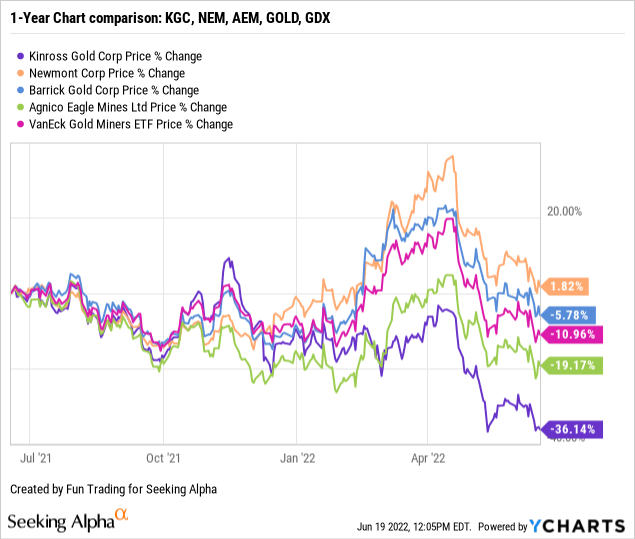
Oat_Phawat/iStock via Getty Images Toronto-based Kinross Gold Corp. (NYSE:KGC) released its first quarter 2022 results on May 10, 2022. Note: I have followed KGC quarterly since 2015 with 39 articles and counting. This new article is a quarterly update of my article published on February 20, 2022. Also, for those who do not understand “Dasvidaniya,” It is the Russian word for “goodbye.” For the first quarter of 2022, revenues were $768 million, with a net loss of $523.8 million or $0.41 per diluted share. In this article, I will cover the results in detail, but one crucial event is the fire sale of Kinross gold’s Russian assets. On June 16, 2022, Kinross Gold completed the sale of 100% of its Russian assets to the Highland Gold Mining group of companies for total cash consideration of $340 million. The Company received $300 million in US dollars in its corporate account and will receive a deferred payment of $40 million after a year of closing. As disclosed on April 5, 2022, the previously agreed total consideration for the transaction was $680 million, which included a payment of $100 million upon closing, with the remaining $580 million scheduled to be received in annual payments from 2023 through to 2027. The transaction consideration was adjusted by the parties following review by the recently formed Russian Sub-commission on the Control of Foreign Investments, which approved this transaction for a purchase price not exceeding $340 million. A total surprise because the initially agreed sale price was $680 million on April 5, 2022. The question that many shareholders were asking why selling at this fire sale price? KGC could have put the mine on care & maintenance until things get better. Many US and European companies have left Russia despite massive financial losses (e.g., McDonald, Shell, BP, and many others), and I believe it was the right thing to do. In business, trust is essential. The risk of doing business in Russia with a total despot running the Country is too high. Gold assets owned by European or Canadian companies can be confiscated or nationalized without any warning with no recourse possible. CEO J. Paul Rollinson said in the press release: After the completed divestment of our Russian business, Kinross’ rebalanced portfolio maintains a substantial production outlook anchored by its two tier one assets – Tasiast and Paracatu – as well as a strong portfolio of mines in the Americas, a growing business in Chile, and the large, world-class Great Bear project in Canada, Look at what happened with this so-called “Russian Sub-commission on the Control of Foreign Investments” and its relationship with the so-called “Highland Gold Mining group of companies” that purchased Kupol at a 50% discount. It is extortion, in my opinion, but it could have been much worse. By the way, the total discount for the Russian assets is even higher than the $225 million for the sale of the Chirano mine (90% stake) in Ghana announced on April 25. Thus, even if the sale was low, the Company was able to get $340 million in US$ (assuming they get the $40 million next year), and it could have been much worse. The Company will survive… Dasvidaniya Russia! However, let’s return to Kinross Gold and the first quarter of 2022 that missed analysts’ expectations. J. Paul Rollinson, President and CEO, said in the conference call: With respect to our first quarter results, our assets performed largely as planned and are set to ramp up throughout the year. It was a low production quarter as expected due to seasonality and our mine planning schedule. But we remain on track to deliver stronger performance as the year progresses. Kinross has underperformed the VanEck Vectors Gold Miners ETF (GDX), Barrick Gold (GOLD), Newmont Corp. (NEM), and Agnico Eagle (AEM) on a one-year basis, mainly due to the technical issue at the Tasiast mine and the fire sale of its assets in Russia. KGC is now down 36% on a one-year basis.
Data Source: Company release and Fun Trading. * Estimated by Fun Trading Note: Historical data from 2015 are available for subscribers only. 1.1 Total attributable gold equivalent production
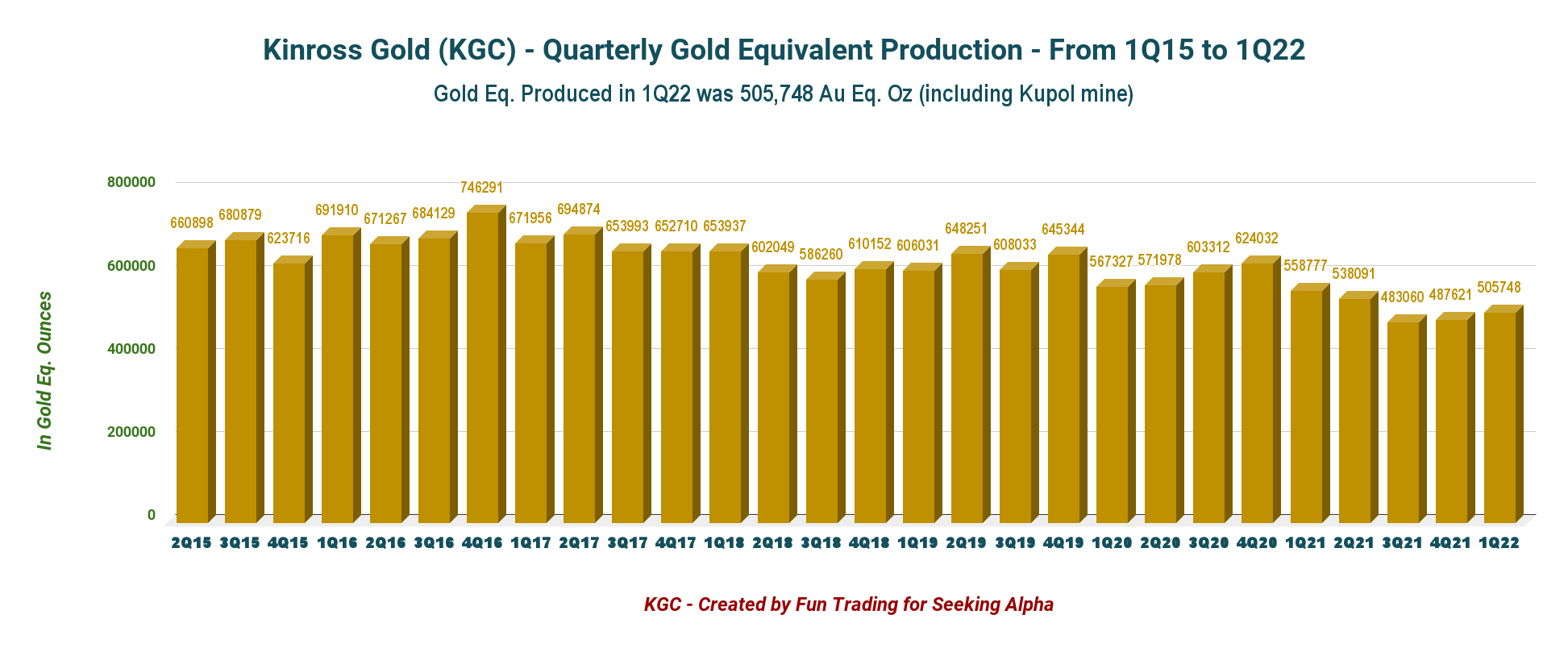
KGC Quarterly Gold equivalent history (Fun Trading)
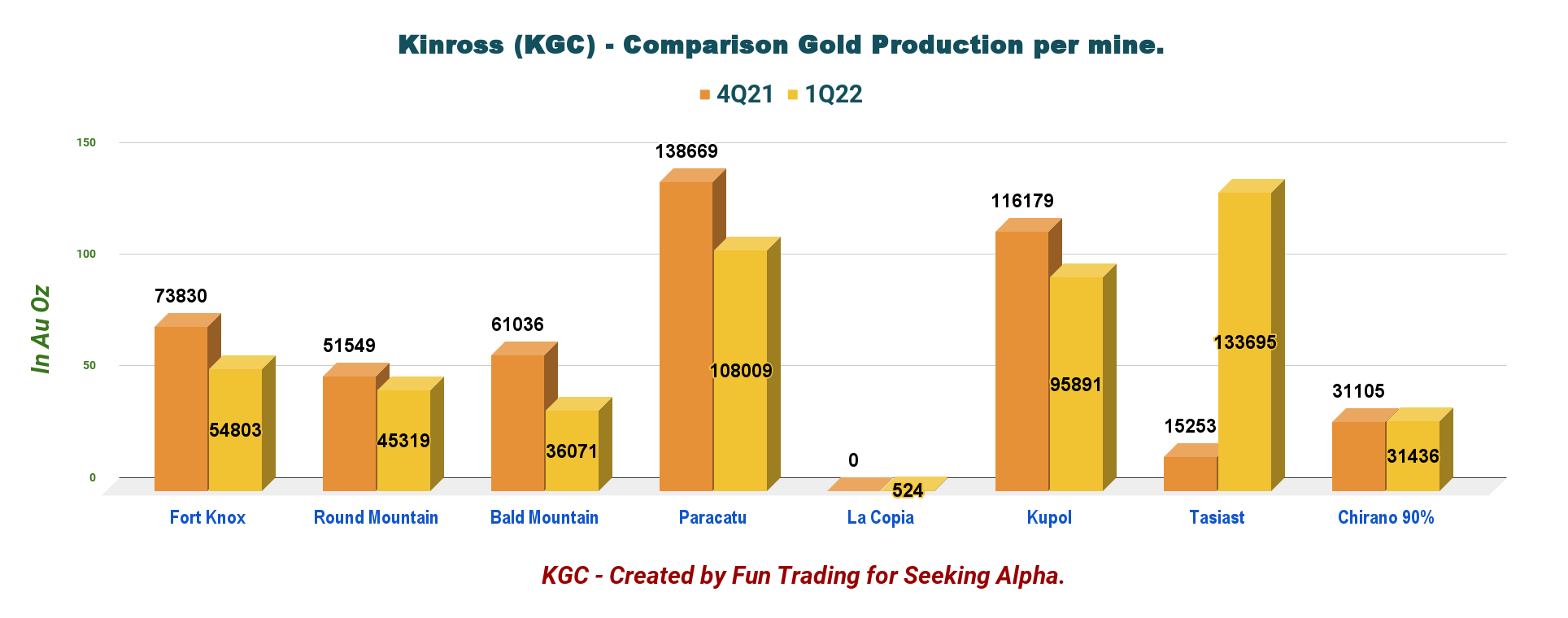
Kinross Gold equivalent produced 505,748 attributable Au eq. Oz. in 1Q22 – including production from Kupol – compared with 558,777 Au eq. Oz. in 1Q21.The downside from a year ago was mainly due to lower output at Round Mountain and Paracatu, which offset record production at the Tasiast mine, as shown in the graph below:
KGC Quarterly gold equivalent production per mine 4Q21 versus 1Q22 (Fun Trading)
As we can see, Tasiast production achieved record production in 1Q22, with the 24k project progressing well and on schedule. Also, the La Copia mine is expected to reach full production capacity in 3Q22 and is now part of the Company’s producing assets.
KGC Quarterly Gold equivalent history (Fun Trading) KGC Quarterly gold equivalent production per mine 4Q21 versus 1Q22 (Fun Trading) However, Kinross agreed with Asante Gold Corporation to sell the Company’s 90% interest in the Chirano mine in Ghana for total consideration of $225 million in cash and shares on April 25, 2022. Upon closing of the transaction, Kinross will receive $115 million in cash. Kinross will also receive a number of Asante common shares having a value of $50 million based on the 30-day volume-weighted average price of Asante common shares prior to closing, provided that the issuance of Asante common shares will not result in Kinross exceeding a 9.9% ownership in Asante. Kinross will also receive a total deferred payment of $60 million in cash, with 50% payable on the first anniversary of closing and the other 50% payable on the second anniversary of closing. If the 9.9% share ownership limit is reached, the remainder of the $50 million will be paid by increasing the deferred cash payments in equal portions. The Company has agreed that it will hold its Asante common shares for at least 12 months following the closing of the transaction. The sale has not been completed as of today, even though the Company expected the completion in May. The total producing assets for Kinross Gold will drop by two units starting 3Q22 (after Kupol and Chirano divested).
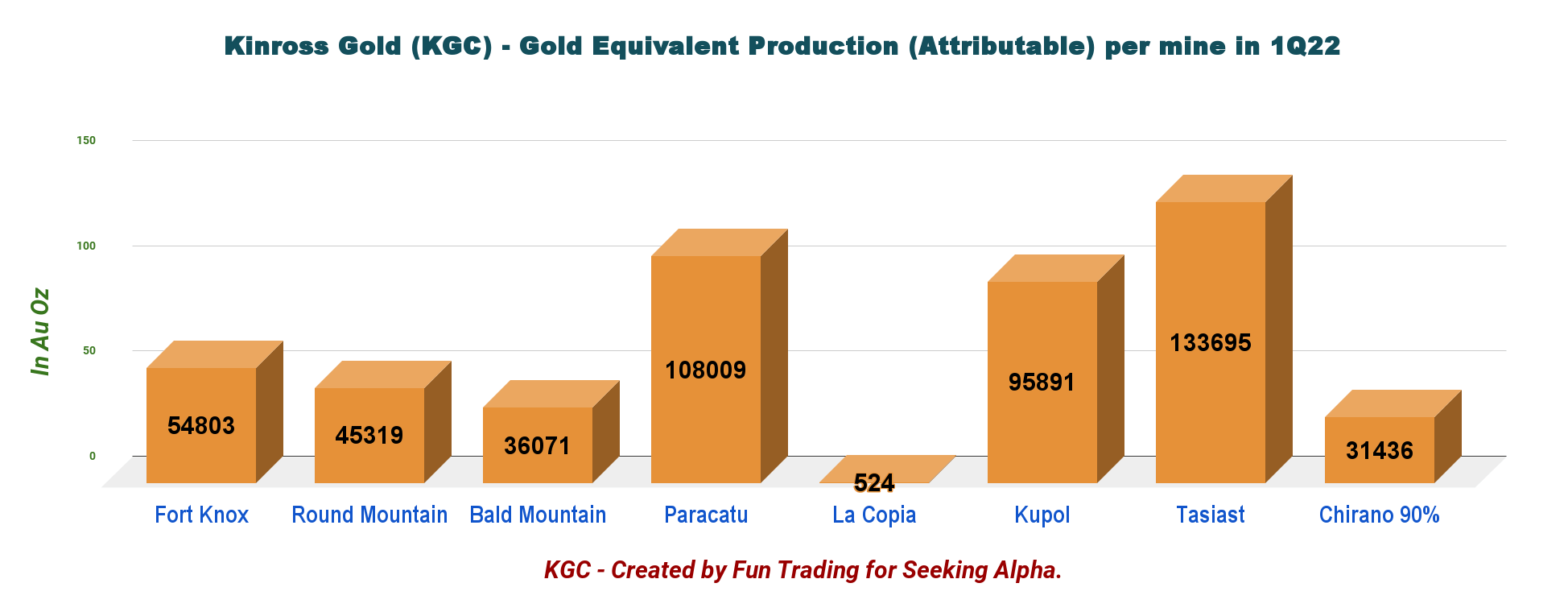
KGC Quarterly gold equivalent production per mine in 1Q22 (Fun Trading )
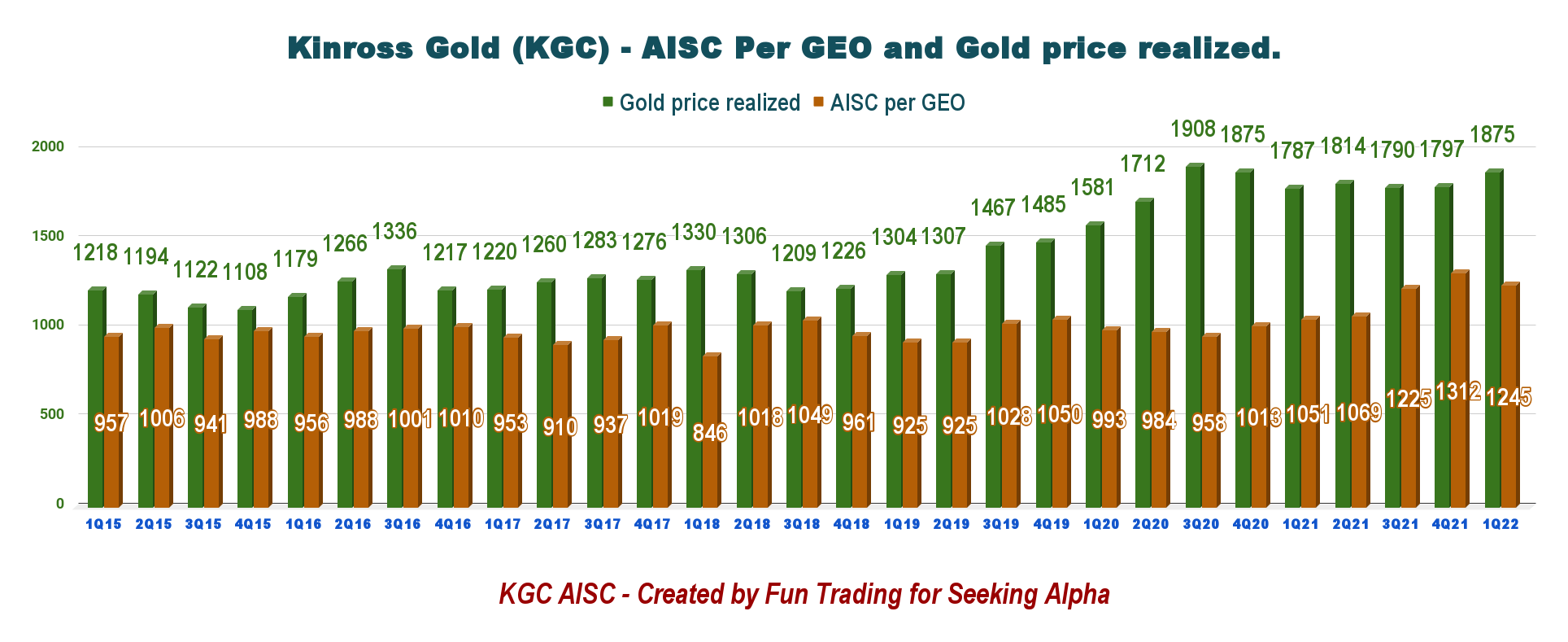
The chart below shows that the AISC is now $1,245 per GEO, down sequentially from $1,051 per ounce. AISC is still abnormally high for KGC, but it is due to temporary elements such as the La Copia mine about to be fully operational.
KGC Quarterly gold price and AISC history (Fun Trading )
KGC Quarterly gold equivalent production per mine in 1Q22 (Fun Trading ) KGC Quarterly gold price and AISC history (Fun Trading ) 1.2 – Tasiast mine in Mauritania delivered record production of 133,695 Au Eq. Oz this quarter. It is the best valuable asset for the Company. It is a relief that the mine is performing exceptionally well now, partially offsetting gold production issues in many of Kinross’s assets in 1Q22. The Company expects to produce over 600K Au ounce in 2022 from Tasiast with a cost of sales of $738 per ounce.
KGC Tasiast Presentation (Kinross Gold)
KGC Tasiast Presentation (Kinross Gold) 1.3 – Operational achievement in 1Q22 – Commentary A lot happened this quarter. 1.3.1 – La Coipa mine in Chile KGC poured the first doré bar in 1Q22 and expects to reach full production capacity in H2 2022. On February 16, 2022, the Company indicated mineral proven and probable of 898K Oz. 1.3.2 – Paracatu mine in Brazil The mine experienced lower production this quarter as expected. The Company said the stripping advanced and processed a lower-grade stockpile this quarter. However, production is expected to increase throughout the year. 1.3.3 – Round Mountain in Nevada, USA. KGC expects to start the construction of Phase X by the end of this year. Phase W requires shallower pit wall angles and more stripping are necessary at Phase W. Also, high-grade intercepts from the Gold Hill exploration drill confirm the down-deep extension of the Alexandria vein discovered in 2021. 1.3.4 – Great Bear Project in Red Lake, Canada. At the Great Bear project, the Company said that exploration, study, and permitting activities have ramped up since the completion of the acquisition on February 24, 2022, with assay results reaffirming the world-class potential of the deposit. 1.3.5 – Sale of the Russian assets and the Chirano mine in Ghana For a total cash and shares consideration of $565 million. 2.1 – Revenues were $768 million in 1Q22
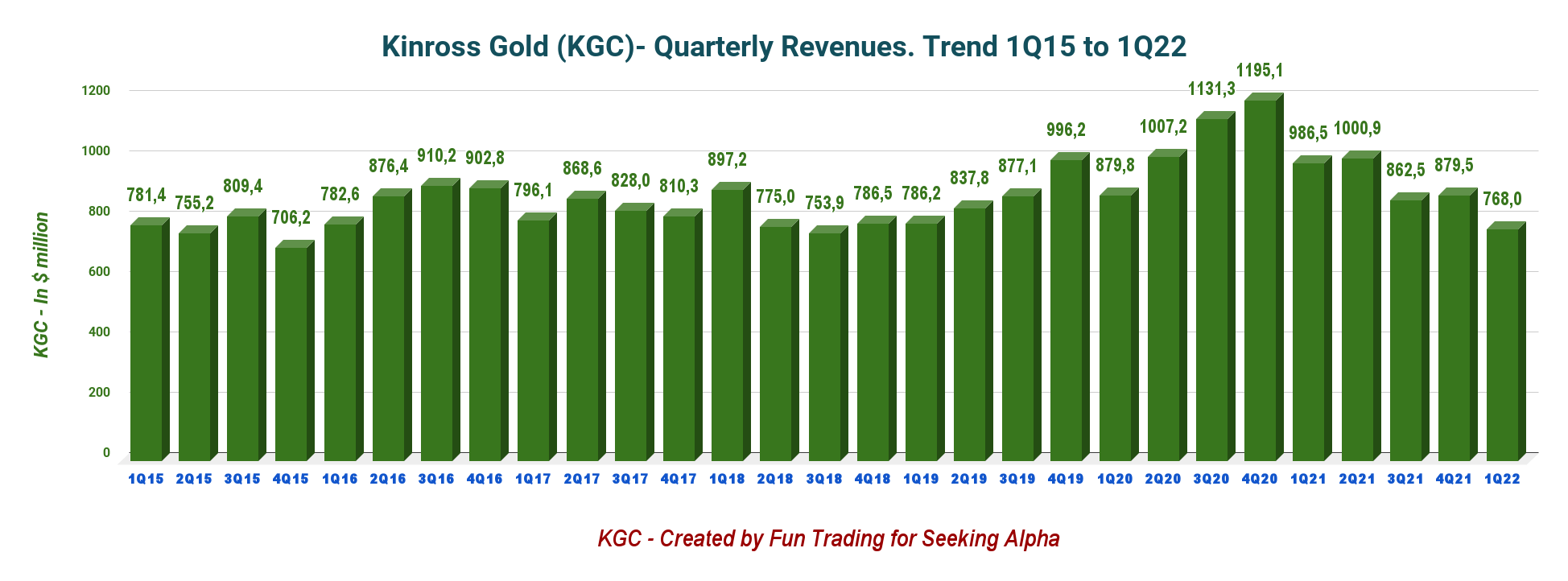
KGC Quarterly Revenues history (Fun Trading)
KGC posted a loss of $523.8 million or $0.41 per diluted share in the first quarter of 2022 compared to an income of $149.5 million or $0.12 per diluted share in the same quarter a year ago.
KGC Quarterly Revenues history (Fun Trading) KGC posted a loss of $523.8 million or $0.41 per diluted share in the first quarter of 2022 compared to an income of $149.5 million or $0.12 per diluted share in the same quarter a year ago. The adjusted net earnings were $70.6 million or $0.06 per share for 1Q21. Revenues in 1Q22 were unchanged year-over-year to $768 million. 2.2 – Free Cash Flow was $90.3 million in 1Q22
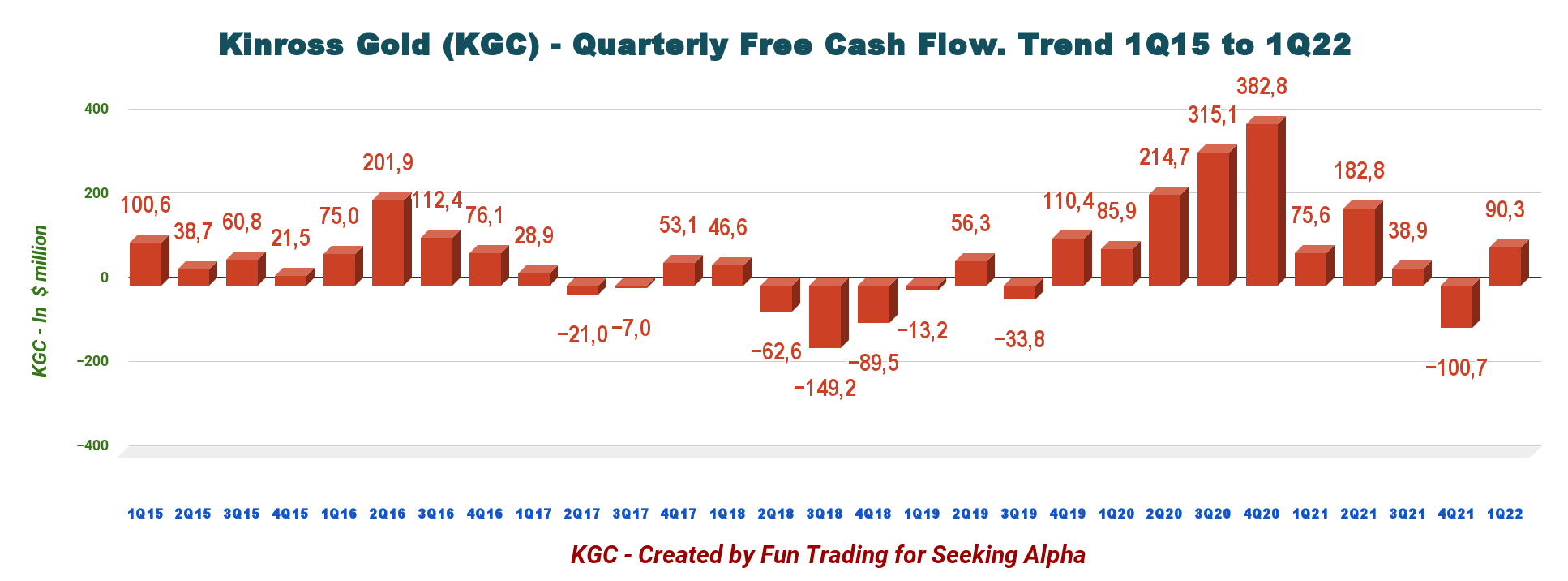
KGC Quarterly Free cash flow history (Fun Trading)
Note: Generic free cash flow is the cash from operations minus CapEx.
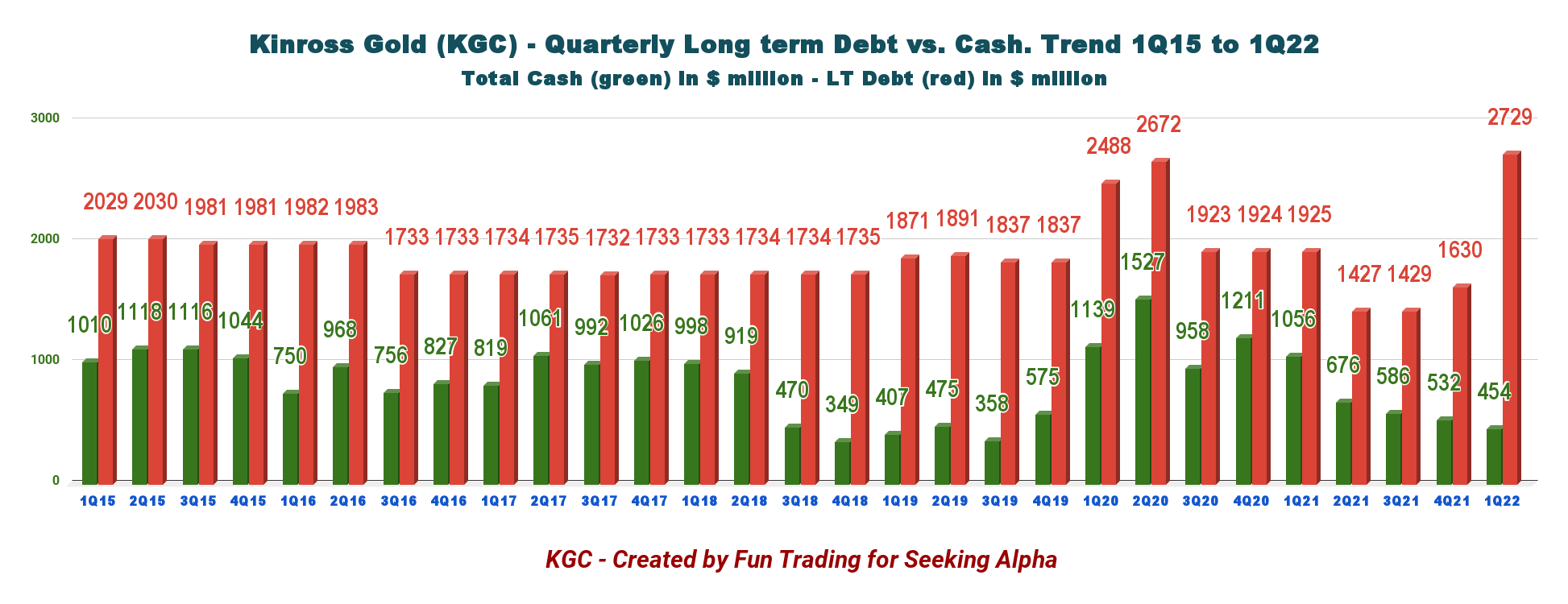
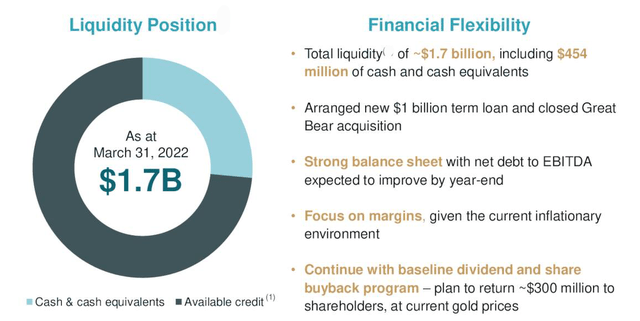
KGC Quarterly Free cash flow history (Fun Trading) Note: Generic free cash flow is the cash from operations minus CapEx. Trailing 12-month free cash flow is $211.3 million. The Company had $90.3 million in 1Q22. The Company pays a quarterly dividend of $0.03 per share or a yield of 2.93%, easily covered by the free cash flow. 2.3 – Net debt and liquidity – Excellent profile but deteriorating sequentially The net debt jumped sequentially to $2,275 million in 1Q22 after the Company arranged a new $1 billion term loan and closed the Great Bear acquisition. Under the terms of the Arrangement, Great Bear shareholders were provided the right to elect to receive C$29.00 in cash for each Great Bear common share (“Great Bear Share”) or 3.8564 Kinross common shares (“Kinross Share”) per Great Bear Share, both subject to pro-ration to a maximum cash consideration of approximately US$1.1 billion (C$1.4 billion) and a maximum of 80,773,353 Kinross Shares The Company had cash and cash equivalents of $454.2 million, with total liquidity of approximately $1.7 billion, on March 31, 2022.
KGC: Quarterly Cash versus Debt history (Fun Trading)
KGC: Liquidity Presentation (Kinross Gold )
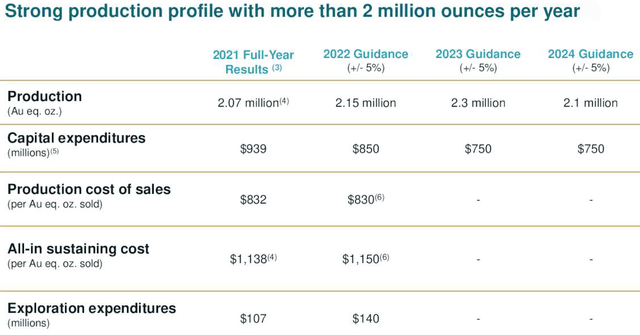
KGC: Quarterly Cash versus Debt history (Fun Trading) KGC: Liquidity Presentation (Kinross Gold ) 2.4 – Updated Outlook from 2022 to 2024 Kinross expects its attributable production to increase 28% year-over-year to 2.65 million Au eq. Oz. in 2022, and to further increase to 2.8 million Au eq. Oz. in 2023, generating substantial free cash flow growth. Kinross expects to produce 2.6 million attributable Au eq. Oz. in 2024 and an average of at least 2.5 million attributable Au eq. Oz. per year over the remainder of the decade.
KGC: Updated outlook Presentation (Kinross Gold)
KGC: Updated outlook Presentation (Kinross Gold) However, I believe the 2022 guidance will be revised soon after selling the Russian assets, the Chirano mine in Ghana, and the Great Bear acquisition.
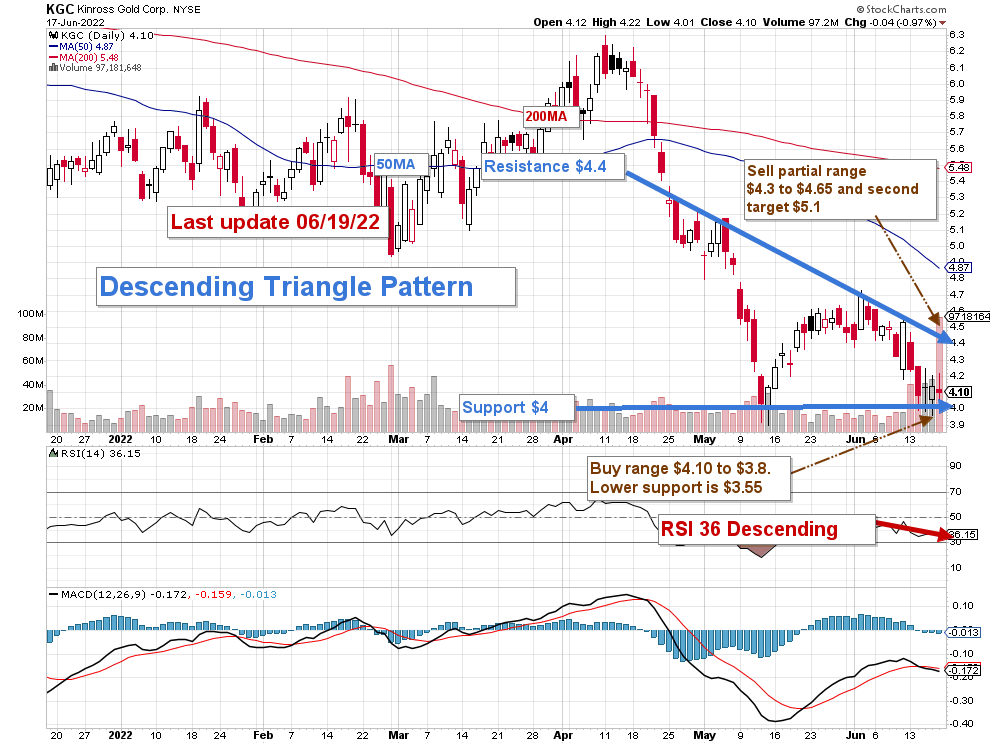
KGC: TA chart short-term (Fun Trading)
KGC: TA chart short-term (Fun Trading) Note: the chart is adjusted for the dividend. KGC forms a descending triangle pattern with resistance at $4.4 and support at $4. The general strategy has not changed for Kinross Gold. I recommend trading short-term LIFO about 40%-60% and keeping a core long-term position for a final target of $7.50-$8.25. It is the basic strategy that I promote in my marketplace, “The Gold and Oil corner.” However, with the recent events (sales of Russian assets and the Chirano mine in Ghana), the stock could suffer even more next few weeks. I recommend you pace your buying carefully and avoid investing too much until the situation becomes more evident. I suggest selling about 50% of your position between $4.30 and $4.65 and waiting for a clear direction signal following that sale. If the gold price turns bullish due to the FED’s inability to control rampant inflation, KGC could breakout and reach over $7. It is unlikely, though. The FED acted firmly against inflation and raised the interest rate by 75-point in June. Moreover, it has indicated that it will hike interest even more in 2022 and potentially another 75-point the next meeting. While inflation is significant for gold, any attempt by the FED to fight it will weaken the gold price. I suggest buying KGC at or below $4 with possible lower support at $3.55. Note: The LIFO method is prohibited under International Financial Reporting Standards (IFRS), though it is permitted in the United States by Generally Accepted Accounting Principles (GAAP). Therefore, only US traders can apply this method. Those who cannot trade LIFO can use an alternative by setting two different accounts for the same stock, one for the long-term and one for short-term trading. Warning: The TA chart must be updated frequently to be relevant. It is what I am doing in my stock tracker. The chart above has a possible validity of about a week. Remember, the TA chart is a tool only to help you adopt the right strategy. It is not a way to foresee the future. No one and nothing can. Author’s note:If you find value in this article and would like to encourage such continued efforts, please click the “Like” button below to vote for support. Thanks.
Join my “Gold and Oil Corner” today, and discuss ideas and strategies freely in my private chat room. Click here to subscribe now. You will have access to 57+ stocks at your fingertips with my exclusive Fun Trading’s stock tracker. Do not be alone and enjoy an honest exchange with a veteran trader with more than thirty years of experience. “It’s not only moving that creates new starting points. Sometimes all it takes is a subtle shift in perspective,” Kristin Armstrong. Fun Trading has been writing since 2014, and you will have total access to his 1,988 articles and counting.
This article was written by I am a former test & measurement doctor engineer (geodetic metrology). I was interested in quantum metrology for a while. I live mostly in Sweden with my loving wife. I have also managed an old and broad private family Portfolio successfully — now officially retired but still active — and trade personally a medium-size portfolio for over 40 years. “Logic will get you from A to B. Imagination will take you everywhere.” Einstein. Note: I am not a financial advisor. All articles are my honest opinion. It is your responsibility to conduct your own due diligence before investing or trading. Disclosure:I/we have a beneficial long position in the shares of KGC either through stock ownership, options, or other derivatives.I wrote this article myself, and it expresses my own opinions. I am not receiving compensation for it (other than from Seeking Alpha). I have no business relationship with any company whose stock is mentioned in this article. Additional disclosure: I trade short-term KGC as well.
“ Music Production System Market research is an intelligence report with meticulous efforts undertaken to study the right and valuable information. The data which has been looked upon is done considering both, the existing top players and the upcoming competitors. Business strategies of the key players and the new entering market industries are studied in detail. Well explained SWOT analysis, revenue share and contact information are shared in this report analysis. It also provides market information in terms of development and its capacities. “Music Production System Market is growing at a High CAGR during the forecast period 2022-2029. The increasing interest of the individuals in this industry is that the major reason for the expansion of this market”. Get the PDF Sample Copy (Including FULL TOC, Graphs, and Tables) of this report @: https://researchcognizance.com/sample-report Some of the Top companies Influencing in this Market includes: Steinberg, Apple, Image-Line, Sony, MuTools, Acoustica, Tracktion, Zynewave, Renoise, PreSonus, BandLab, Various factors are responsible for the market’s growth trajectory, which are studied at length in the report. In addition, the report lists down the restraints that are posing threat to the global Music Production System market. It also gauges the bargaining power of suppliers and buyers, threat from new entrants and product substitute, and the degree of competition prevailing in the market. The influence of the latest government guidelines is also analysed in detail in the report. It studies the Music Production System market’s trajectory between forecast periods. Global Music Production System Market Report Offers: Get up to 30% Discount on this Premium Report @: https://researchcognizance.com/discount The cost analysis of the Global Music Production System Market has been performed while keeping in view manufacturing expenses, labor cost, and raw materials and their market concentration rate, suppliers, and price trend. Other factors such as Supply chain, downstream buyers, and sourcing strategy have been assessed to provide a complete and in-depth view of the market. Buyers of the report will also be exposed to a study on market positioning with factors such as target client, brand strategy, and price strategy taken into consideration. Key questions answered in the report include: Buy Exclusive Report @:https://researchcognizance.com/checkout If you have any special requirements, please let us know and we will offer you the report as you want.
About Us: Research Cognizance is an India-based market research Company, registered in Pune. Research Cognizance aims to provide meticulously researched insights into the market. We offer high-quality consulting services to our clients and help them understand prevailing market opportunities. Our database presents ample statistics and thoroughly analyzed explanations at an affordable price. Contact Us: Neil Thomas 116 West 23rd Street 4th Floor New York City, New York 10011 [email protected] +1 7187154714
The Observer Media Group Inc. respects your privacy and values the relationship we have with you. We use technology to collect information that helps us enhance your experience and our products and services. The cookies we use help us understand what information and advertising are most useful and valuable. Please take a moment to review our Cookie Policy and Privacy Policy. By clicking “Accept,” you agree to our use of cookies and similar technologies. Stretch Zone, a nationwide chain of stretching studios whose investors include former New Orleans Saints quarterback Drew Brees, will open its 200th location — and 48th in Florida — June 27 in St. Petersburg. The St. Pete Stretch Zone, according to a news release, will be owned and operated by franchisees Joe Morrissey and Steven Cox and located at 327 11th Ave. N. It will offer practitioner-assisted stretching sessions to help enhance quality of life. “From the way we stretch to the way we franchise, no one can do it like Stretch Zone. We are often imitated but never duplicated by our competitors, which is why franchising into new markets has been crucial for our team,” Stretch Zone CEO Tony Zaccario states in the release. “Not only have we opened 100 locations in under a year, driving us to 200 studios, we are also proud that not one studio has closed. We are confident that Joe and the St. Pete Stretch Zone team will have massive success for years to come.” Stretch Zone, the release states, also plans to open new locations in Chicago, Dallas and Anchorage on June 27. Brees, who’s also a member of the Stretch Zone board of directors, retired from the NFL in March 2021 after a 20-year career with the Saints and San Diego Chargers. View the discussion thread. USPS Periodicals Permit ISSN# 2325-8195 as required for Public Notices per F.S. 50.011
HAMPTON — Mélineige Beauregard took home the top prize and the People’s Choice Award at this year’s Hampton Beach Master Sand Sculpting Classic for her piece titled “I am life.” “Oh my god this is amazing,” Beauregard said Saturday after winning her third championship at Hampton Beach in four years. “This is an awesome event, and you are always competing against amazing sculptors. It’s awesome just to be here.” Beauregard, of Captain Cook, Hawaii, was awarded $6,000 for first place and another $1,000 for the People’s Choice Award. Her two-sided sculpture shows life on one side and death on the other. “It’s inspired by the design pattern of the Flower of Life,” Beauregard said of her winning masterpiece. “It’s a pattern that is present in most nature, life, and ourselves.” One side, she said, “is more like nature, the creation, the flowers and all of the beauty in the world and on the other side is the decay, destruction, and death.” The three-day contest put on by the Hampton Beach Village District wrapped up Saturday and featured a who’s who of master sand sculptors. The contest was organized by Greg Grady and is in its 22nd year. Second place, and $4,000, went to Karen Fralich, of Ontario, Canada, for her piece titled “Trolls.” “I really like to carve fantasy and this is inspired by a story called ‘In the Hall of the Mountain King’ which is based on a Norwegian play called Peer Gynt,” said Fralich. “This is part of the story where the Troll King has come upon a lot of treasure and the trolls are obviously really happy about that.” While other sculptors plan ahead and come in with a vision of what they want to create, the five-time world champion said she likes to just go and “let the sand talk to me and kind of go from there.” Third place and $3,000 went to Carl Jara, of Lyndhurst, Ohio, for “Entropy” and fourth place and $2,000 went to Rusty Croft, of Carmel, California, for “Transition.” Jara’s sculpture was about his dad who has dementia. It was a sculpture of a man’s head, hollow inside with picture frames of family memories. For Croft, his piece was also an emotional one as it was dedicated to his brother, Michael Croft, who died last year from COVID-19 at the age of 53. Croft, who starred in the Travel Channel’s TV show “Sand Masters,” was also awarded the Sculptor’s Choice Award, which is voted on by those competing in the contest. Taking home the Governor’s Award, selected by Gov. Chris Sununu, and securing a spot in next year’s contest was Greg Grady Jr. for his piece titled “Wyvern Whisperer.” It showed a two-legged dragon being fed a bone by a superhero boy. “This piece was made for my son,” Grady Jr. said. “He wanted a dragon. He’s going to be 5 in August and he loves superheroes.” More: Piping plovers threaten Hampton Beach Fourth of July fireworks Abe Waterman, who came in first place in last year’s contest, failed to place this year after his sculpture collapsed Saturday with just five minutes left in the contest. The audience gasped, went silent, and then gave him a round of applause when he held his hands up and just shrugged it off. Waterman’s piece titled “Hierarchy of Needs” showed a woman on a cellphone ignoring a baby who was dead on the ground. The writing on the base of the sculpture stated, “follow me on #dead.” “It was just a commentary that we are more involved in social media than you are with your surroundings and the people around you,” Waterman said. Waterman said the astronomical high tide from the night before reached the base of the sculpture and may have played a role in the collapse. “The bottom of my sculpture was still wet which made it not as structurally sound,” he said. “It’s unfortunate. I like to see the piece finished and to have a final product. But at the end of the day, it is only sand. There are greater travesties that happen in the world than some sand falling down.” Also suffering a major collapse was Bruce Phillips, of San Diego, California, who saw a section of his sculpture collapse on the first day of the contest. “I recovered and basically sculpted a version of what I was already sculpting,” he said. “It happens. We are pushing the limits. if you don’t push the limits, you don’t know what you can do.” The piece titled “Linked” was supposed to be 11 feet tall but after the collapse ended up at 8 feet tall. “Basically it kind of represents people and working together for a common goal,” Phillips said of the sculpture that showed different sizes and shapes of links. “If you work together you have strength like links in a chain. But as soon as one fails, things break up and things go south. Other sculptures included Chris Guinto’s “Primal, which showed a Spinosaurus, and John Gowdy’s “Knowledge is limited. Imagination encircles the world.” “I love Albert Einstein,” Gowdy said. “I love his quotes. One of his quotes is ‘Knowledge is limited. Imagination encircles the world.’ I just wanted to adapt my sculpture to that.” Justin Gordon, from Groveland, Massachusetts, said his sculpture was inspired by a woman he danced with who cried to the song “Let There Be Peace On Earth.” “The song just stuck in my head and would not go away,” he said. The sculpture, named after the song, shows an old sad man holding a dove in his hands. “The dove is life and let there be peace,” he said. Atlantic sturgeon: Endangered ‘prehistoric-looking’ fish spotted near Hampton Harbor This is Beauregard’s third win at Hampton Beach. Beauregard said she learned the art of sand sculpting from her father. “I just got the flame and carried it on,” Beauregard said. Beauregard said she came into the competition with a “vague idea” behind her winning sculpture. “But there was also a lot in the moment,” she said. “I’m happy it’s done and didn’t collapse.” Beauregard said she is going to celebrate her win with rest and a cup of wine. “And then it’s on to the next one (sculpture and contest),” she said, and “to try and do something different and better.” Prior to the three-day contest, sculptors worked on the sponsor site with the theme being “The Greatest Show in Sand.” The circus-themed site included an elephant, lion, seal and more. The sculptures will remain on the beach, illuminated at night, until June 26. This article originally appeared on Portsmouth Herald: Hampton Beach NH Sand Sculpting Classic 2022 winners From beachside homes to an impeccably designed wellness treats, these are the places to book when you need some serious relaxation Natascha McElhone (Ronin, Californication, Halo) leads the cast as Bella Ainsworth, the daughter of a wealthy industrialist who moves to Italy to set up a quintessentially British hotel in the breathtaking beautiful town of Portofino. Mark Umbers (Home Fires) plays her charming but dangerous aristocratic husband, Cecil, and Anna Chancellor (Four Weddings and a Funeral, The Hour) plays the hotel’s most influential but hard-to-please guest, Lady Latchmere. Get this Ninja NeverStick Cookware Set on sale from Amazon and make your cooking sessions more enjoyable. Breweries on tap include Smuttynose, Stripe Nine Brewing Co., Loaded Question Brewing, Long Blue Cat Brewery Co., Northwoods Brewing Co., and Whym. Move over Prince Harry, another European royal is getting the feature doc treatment. Pauline Ducruet, the daughter of Princess Stephanie of Monaco and granddaughter of Grace Kelly, is set to star in a new documentary from Calabasas Films and Media about her glamorous life. Calabasas Films’ partners Paul Beahan and Kapil Mahendra will produce the […] The 88th New Hampshire Open will begin Thursday at Breakfast Hill Golf Club in Greenland. Locals in the three-day tourney include North Hampton's Ryan Quinn, Newmarket's Scott Hacker, Rye's Jack Zioze, Greenland's Jeffrey Soris, Hampton Falls' Michael Fiacco and Brentwood's Valentino Cheek. Recent Jacksonville building permits have been approved for Morgan & Morgan, Gutter Helmet of North Florida, JEA and Imeson Park South. If an employee says, "Have a magical day," that's not a good thing.View Entire Post › Crystal-clear natural springs, the rolling hills of horse country, and a charming historic downtown help this central Florida city shine. Two Australia farmers are aiming rival Mexican tequila and mezcal with a similar delicious spirit. Emerald City locals share the faux pas they often see visitors committing. It's no secret that Costco offers tons of savings opportunities for its members, including deals on food, clothing, electronics and more. But, are you maximizing the additional perks that the… Here are a handful of Kentucky getaway and vacation ideas around the state that won't break the bank but will still satisfy your summer wanderlust. “Surrounded by creeks, a sound, and the ocean, this place revolves around the water.” Maybe you'd rather discover underrated treasures and little-known spots whether this is your first or 100th time visiting New York City. Visitors are returning to a changed landscape in Yellowstone National Park as it partially reopens following record floods that reshaped the park. The world's first national park will reopen this week after the devastating floods. Here's what you can expect. The world's first national park will reopen this week after the devastating floods. Here's what you can expect. Amsterdam is a city that celebrates individuality, encourages quirkiness and delights in difference. It has a long history of riches and rebelliousness. The glory-days of the 17th century, the über-cosy 1800s, the counter-culture explosion of the 1960s – they’ve all left tidelines along Amsterdam’s canals: opulent gables, Rembrandt and Van Gogh, barrel-lined cafés, gardens of rare blooms, marijuana-selling 'coffeeshops', and Miss Marple bicycles. What made Illinois stand out in this WalletHub list? The ranking considered 26 metrics, and Illinois ranked dead last on one. Here’s what put the state ahead in the overall placement, plus how Missouri stacked up. The highest-ranked local restaurant came in at No. 22, with Sarasota, Bradenton, Venice, North Port and Osprey represented on the list.
“ Music Production App for Phone Market research report is the new statistical data source added by Research Cognizance. “Music Production App for Phone Market is growing at a High CAGR during the forecast period 2022-2029. The increasing interest of the individuals in this industry is that the major reason for the expansion of this market”. Music Production App for Phone Market research is an intelligence report with meticulous efforts undertaken to study the right and valuable information. The data which has been looked upon is done considering both, the existing top players and the upcoming competitors. Business strategies of the key players and the new entering market industries are studied in detail. Well explained SWOT analysis, revenue share, and contact information are shared in this report analysis. Get the PDF Sample Copy (Including FULL TOC, Graphs, and Tables) of this report @: https://researchcognizance.com/sample-report Top Key Players Profiled in this report are: Steinberg, Apple, Image-Line, Korg, Moog Music, Casio, Native Instruments, Akai, Propellerhead, Arturia, The key questions answered in this report: Various factors are responsible for the market’s growth trajectory, which are studied at length in the report. In addition, the report lists down the restraints that are posing threat to the global Music Production App for Phone market. It also gauges the bargaining power of suppliers and buyers, threat from new entrants and product substitute, and the degree of competition prevailing in the market. The influence of the latest government guidelines is also analyzed in detail in the report. It studies the Music Production App for Phone market’s trajectory between forecast periods. Get up to 30% Discount on this Premium Report @:https://researchcognizance.com/discount Regions Covered in the Global Music Production App for Phone Market Report 2022: • The Middle East and Africa (GCC Countries and Egypt) • North America (the United States, Mexico, and Canada) • South America (Brazil etc.) • Europe (Turkey, Germany, Russia UK, Italy, France, etc.) • Asia-Pacific (Vietnam, China, Malaysia, Japan, Philippines, Korea, Thailand, India, Indonesia, and Australia) The cost analysis of the Global Music Production App for Phone Market has been performed while keeping in view manufacturing expenses, labor cost, and raw materials and their market concentration rate, suppliers, and price trend. Other factors such as Supply chain, downstream buyers, and sourcing strategy have been assessed to provide a complete and in-depth view of the market. Buyers of the report will also be exposed to a study on market positioning with factors such as target client, brand strategy, and price strategy taken into consideration. The report provides insights on the following pointers: Market Penetration: Comprehensive information on the product portfolios of the top players in the Music Production App for Phone market. Product Development/Innovation: Detailed insights on the upcoming technologies, R&D activities, and product launches in the market. Competitive Assessment: In-depth assessment of the market strategies, geographic and business segments of the leading players in the market. Market Development: Comprehensive information about emerging markets. This report analyzes the market for various segments across geographies. Market Diversification: Exhaustive information about new products, untapped geographies, recent developments, and investments in the Music Production App for Phone market. Buy Exclusive Report @:https://researchcognizance.com/checkout If you have any special requirements, please let us know and we will offer you the report as you want. About Us: Research Cognizance is an India-based market research Company, registered in Pune. Research Cognizance aims to provide meticulously researched insights into the market. We offer high-quality consulting services to our clients and help them understand prevailing market opportunities. Our database presents ample statistics and thoroughly analyzed explanations at an affordable price. Contact Us: Neil Thomas 116 West 23rd Street 4th Floor New York City, New York 10011 [email protected] +1 7187154714
Thank you for visiting nature.com. You are using a browser version with limited support for CSS. To obtain the best experience, we recommend you use a more up to date browser (or turn off compatibility mode in Internet Explorer). In the meantime, to ensure continued support, we are displaying the site without styles and JavaScript. Advertisement Scientific Reportsvolume 12, Article number: 10429 (2022) Cite this article 93 Accesses 2 Altmetric Metrics details Understanding biological responses to environmental fluctuations (e.g. heatwaves) is a critical goal in ecology. Biological responses (e.g. survival) are usually measured with respect to different time reference frames, i.e. at specific chronological times (e.g. at specific dates) or biological times (e.g. at reproduction). Measuring responses on the biological frame is central to understand how environmental fluctuation modifies fitness and population persistence. We use a framework, based on partial differential equations (PDEs) to explore how responses to the time scale and magnitude of fluctuations in environmental variables (= drivers) depend on the choice of reference frame. The PDEs and simulations enabled us to identify different components, responsible for the phenological and eco-physiological effects of each driver on the response. The PDEs also highlight the conditions when the choice of reference frame affects the sensitivity of the response to a driver and the type of join effect of two drivers (additive or interactive) on the response. Experiments highlighted the importance of studying how environmental fluctuations affect biological time keeping mechanisms, to develop mechanistic models. Our main result, that the effect of the environmental fluctuations on the response depends on the scale used to measure time, applies to both field and laboratory conditions. In addition, our approach, applied to experimental conditions, can helps us quantify how biological time mediates the response of organisms to environmental fluctuations. One of the biggest challenges faced by humanity is climate change1,2,3. A key characteristic of current climate change is the presence of extreme climatic events, i.e. strong fluctuating environmental conditions, manifested as storms, hurricanes and heatwaves. Hence, a challenge for ecologists consists in quantifying and predicting the responses of ecological systems (from populations to ecosystems) to such fluctuations4,5,6,7. Despite the emphasis in understanding ecology and evolution in fluctuating environments8,9,10,11 most experiments concerning climate driven environmental variables focus on responses to constant conditions11,12,13. The currently growing body of work tackling responses to fluctuating environments highlights the complications in attempting to incorporate the role of variation in such environmental drivers13,14,15,16,17 especially in dealing with their combined actions18,19. For instance, research on extreme events has identified five primary traits characterising heatwaves20, which should be added to the effect produced by the average condition experienced during that event. An additional layer of complexity is given by the biological time (e.g. time to metamorphosis, to reproduction, generation times), characterising biological systems21. Biological time is governed by the interaction between the environmental and physiological processes and plays a critical role in driving fitness, population dynamics and community structure21,22,23,24,25. Biological time is critical because of three reasons. First, responses (e.g. survival rates) to environmental conditions are driven by a number of developmental processes operating at different biological time scales26,27,28,29,30,31, ranging from short (e.g. physiological acclimation) to medium (developmental plasticity) and long term (transgenerational plasticity, changes in gene frequencies). Second, if we characterise a fluctuation by its time scale, then the response will depend on the biological time characterising that species. From the perspective of organisms (e.g. with time scales ranging from those of from bacteria to trees), whether a fluctuation is long or short, is not determined by the chronological (= clock) time, but instead by its characteristic biological time31. Third, responses may be measured after a predetermined chronological time scale (e.g. at a given time in the year) or biological time scale (e.g. at maturity). The expression of biological responses in chronological time is obviously important to understand long term changes in seasonal habitats. However, measurements on biological time scales are critical for understanding population dynamics and evolution because such number drives individual fitness and the population growth rate. This is especially important in species that experience habitat shifts (e.g. most bottom living marine invertebrates, insects, migratory fish, birds and mammals). In such species, the biological time is “reset” at critical stages (e.g. metamorphosis, onset of migration) because, after the habitat shift, organisms experience the environmental conditions of a new habitat and the conditions in the old habitat might become irrelevant. Overall, understanding and quantifying the actual response to climate driven fluctuations requires that we also understand how responses are modified with a change in the time reference frame (from chronological to biological). We propose a framework to understand and quantify responses to fluctuations in one or more climate-driven environmental variables, considering biological time. We consider environmental fluctuations characterised by a magnitude (e.g. the amplitude) and a timescale (e.g. the period of the fluctuation or the time of exposure to a given magnitude: Fig. 1). The response is quantified at least once after the environmental drivers are experienced, with respect to chronological time or at a given life history event (e.g. at maturity). We use an experimental case and simulations to understand how biological responses to fluctuating environmental drivers are modified by the clock and biological time scale used to study the response. We structure this article as follows: First, we introduce definitions and a system of equations describing the biological responses. Second, the equations are explored using four specific cases. Third, in the methods section, we describe the experiments carried out to illustrate case 3. Experimental set up and equations. (A) A biological system (e.g. an organism) is exposed to two fluctuating environmental drivers (E1, E2). The fluctuations are characterised by predictors, i.e. the amplitudes (m1, m2) and time scales (t1, t2). Measurement of the response, R, are made at different times ((t{^*})1) after the fluctuations occurred (black circle); additional measurements may be carried out at other fixed times after (t{^*})1 (grey circles). (B) In a factorial experiment the process would be repeated so that observations are made for a minimum of two levels per predictor giving 16 factor combinations. In (B): vertical dimension = magnitude; horizonal dimension = clock time scale. We consider a biological response (e.g. body size, survival, biodiversity) to two environmental drivers (i.e. any abiotic or biotic factor) but the same idea may be applied to a larger number of drivers. The response depends of a set of predictors consisting in the magnitudes (m1 and m2) and time scales of fluctuation of two drivers (i = 1, 2); in addition, the response is quantified at least once after the fluctuations have been experienced (Fig. 1a). Time is defined using two different frames; chronological (= clock) time (measured by clocks) and biological time. For the “clock” time scales of the fluctuations (t1, t2) there are associated biological times (τ1, τ2). Likewise, for the clock time at which the response is quantified (({t}^{^*})) there is an associated biological time (τ({^*})). Biological time is the proportion of (clock) time needed to reach a life history event (e.g. moulting, maturity). Hence, for t1, t2 and t({^*}) we obtain τi = ti/D and τ({^*}) = t({^*})/D, (D = clock time needed to reach such life history event). We express the τi and τ({^*}) in terms of a function L = 1/D. For instance, for t({^*}) we obtain: where L = L(ω) = D−1(ω) characterises the timing of a life history event (with units as the inverse of clock time units). L depends on the set of predictors ω associated to the fluctuations; an important set of predictors will be defined by thermal fluctuations (the amplitude and time scales), which in ectotherm species have a strong influence on developmental time32,33. We find by differentiation that L provides the transform function between clock and biological time frames; for instance, if L does not depend on any ti we have L = dτ/dti. The response is expressed as a function of the predictors defined above, as R(m1, m2, t1, t2, t({^*})) = r[m1,m2,τ1 (t1), τ2(t2),τ({^*})]. The contribution of each predictor to the response is better understood by the partial derivatives with respect to each predictor; this defines a system of partial differential equations (PDE; Supplementary note 1) which expressed in matrix form give the following matrix equation. In the PDE (Eq. 2), the left-hand side is a vector column of the derivatives of the response in clock time (R), with respect to each predictor; the right-hand side is the standard (= inner) product of a matrix (M) by a vector of the derivatives of the response in biological time (r), i.e. R = Mr. The matrix contains the derivatives of the predictors with respect to each other, with time both expressed in clock or biological scales; one can think of M as an object containing coefficients that transform r into R in the same way as a constant (= 1000) would transform kilometres into meters of distance. The large number of terms in M highlights the considerable diversity and the challenges in quantifying responses to multivariate environmental fluctuations. We show below how to use Eq. (2) to quantify the effect of fluctuating environmental drivers on biological responses, as mediated by biological time. First, we note that M contains three groups of terms: (1) Terms accounting for situations where the magnitude of a driver affects the magnitude of the second driver (e.g. temperature drives oxygen concentration in aquatic habitats): these are dmi/dmj for any i, j = 1, 2. (2) Terms accounting for cases where the magnitudes and time scales of stressors are related: dmi/dtj and dmi/dti. (3) Terms where biological time depends on the magnitude or time scale of the environmental fluctuation dτi/dtj and dτi/dmj. The terms of groups (1) and (2) are zero when they are mutually independent, such as in a factorial experiment with orthogonal manipulation. We will set those to zero in the rest of this analysis. Second, we note that for group (3) there are three scenarios: (3a) biological time does not depend on any environmental driver. This is the trivial case where biological time is proportional to clock time, not considered here; M is simplified to a diagonal matrix, i.e. with constants in the diagonal, and zero’s otherwise leading to a single constant term per equation (3b). Biological time depends on the magnitudes of any or both drivers. In such case, τ1 τ2, and τ({^*}) will be driven by the same equation: if τi = ti · L (m1, m2) we obtain dτi/dtj = dτi/dti = L (m1, m2). (3c) Biological time depends on the time scale of the fluctuations: in such case, differentiating Eq. (1) with respect to time, we obtain dτi/dti = L + ti dL/dti. Here, we explore four special cases where the equations are simplified to highlight the importance of biological time in modifying the responses as compared to clock time. We start with the simplest case where there is a single environmental variable and then we consider cases with two variables. We focus on cases representing the most frequent experiments carried out on multiple driver research, i.e. factorial manipulations where terms of the groups 1 and 2 are zero. We start with the simplest case i.e. where the response is driven by the magnitude of a single driver, e.g. temperature (= m). Examples of this case are laboratory experiments quantifying the effect of temperature on body mass or survival of a given species, or mesocosm experiments quantifying effects of temperature on species richness where thermal treatments are kept constant over time. Here, the response is quantified at different times, both in the clock and biological frames. In such case we have R(m, t({^*})) = r[m, τ({^*})(m, t({^*}))] and the PDEs simplify to. From Eq. (3), and because dR/dm ≠ dr/dm, we see that the response to the magnitude of the driver depends on a component quantifying the effect biological time: as long as dτ({^*})/dm ≠ 0 the time reference frame affects the observed effect of m on the response. The simulation illustrated in Fig. 2 shows a case where there are differences between the observed responses at clock vs biological times. In the simulated experiment, there is a strong effect of the magnitude of the driver on the response at clock time, but such effect is much less pronounced at biological time. By contrast, there is no effect when the response is measured in the biological time frame. Case 1: Response to the magnitude of a single variable (m). Horizontal line: measurement taken at clock time t({^*}) = t({^*})c; note that, along the line, the response increase with m (it crosses the colour gradient). Curve with yellow circles: measurements taken at a constant biological time (τ({^*})c = 100); along the curve, the response does not vary with m. The equations used were: R = m(0.5t({^*})), τ({^*}) = t. m giving r = 0.5. τ({^*}) not depending on m. Equation (3) (details in Supplementary code 1) captures an obvious but important feature of experiments manipulating temperature over the development of ectotherms, for instance, from birth to metamorphosis; namely that there is no consistent definition of a simultaneous event across the different time frames. Experiments are usually stopped at different clock times because organisms must be sampled at the same biological time. All points located in the horizonal line in Fig. 3 represent simultaneous events, as defined in clock time occurring at different temperatures (e.g. whether an animal is dead or alive); however, simultaneous events occurring in biological time are represented by the points on the curve. Hence, Fig. 2 gives a geometric representation of such fact. Temperature as a driver of developmental rates32 is a central candidate to produce responses that differ at clock vs biological time. We explore further this case with an example where the response is expressed as a function of time and an instantaneous rate μ(m) quantifying for instance mortality, growth or biomass loss. For this example, we obtain R(m, t({^*})) = r[μ(m), τ({^*})(m, t({^*}))]. By differentiating in both sides, we get: Equation (4) shows that m affects the response through two components: the instantaneous rate (dμ/dm) and the biological time (dτ({^*})/dm). We call the first component “eco-physiological” and the second component “phenological” (m drives the timing of a biological event, e.g. time to maturation). Those components are not evident if the response is expressed in clock time; otherwise we would obtain dR/dm = ∂R/∂μ · dμ/dm. In order to better understand Eq. (4), consider an example where the response is biomass loss experienced by an organism during the process of migration (e.g. towards a feeding or reproductive ground); when the access to food during migration is very limited the result should be a decrease in body mass reserves through time. Let biomass (B) be modelled as an exponential decaying function of time and an instantaneous rate of biomass loss μ; let μ depend on temperature (= m) such that, μ = μ(m). In such case we obtain: By differentiation in both sides of Eq. (5) we get: Equation (6) shows the eco-physiological (dμ/dm) and phenological components (dτ({^*})/dm) within the brackets. If μ responds linearly to temperature, then dμ/dm would be represented by a constant quantifying the thermal sensitivity of biomass loss; the value of such constant would depend on physiological processes associated to use of reserves to sustain movement and the basal metabolic rate. Likewise, if τ({^*}) responds linearly to temperature, the dτ({^*})/dm would be driven by a constant controlling the sensitivity of developmental time to temperature. Because biomass is a trait that is central to fitness, Eq. (6) gives the indirect contribution of phenological and physiological responses to fitness. Assuming that fitness should be maximised, adaptive responses should involve the mitigation of negative effect of m on both components of Eq. (5), represented by the partial derivative of the right-hand term. For instance, organisms with the ability to minimise the eco-physiological effect (through e.g. a compensatory physiological mechanisms) or the phenological effect (e.g. shortening the exposure time) would complete the migration minimal loss of reserves. By generalization, Eqs. (4–6) help us to provide biological meaning to the terms of the matrix M: any term of the form dτ({^*})/dmj, dτi/dmj or dτi/dtj represents the effect of an environmental driver on the timing of a phenological event; hence, they are phenological components. Terms that contain the effect of an environmental variable on an instantaneous rate are eco-physiological components. By substitution we find that the terms of the matrix in Eq. (2) can be classified in two categories according to whether the component is eco-physiological (E) or phenological (P): Here we expand the previous case by looking at a response to the magnitude of two different drivers; i.e. keeping the levels of each driver constant over the duration of the experiment. Examples of this case are experiments quantifying the effect of temperature and nutrient load on body mass (e.g. in a rearing containers) or species richness (e.g. in mesocosms). This case is represented by the terms of first two rows of the matrix and the vectors of Eq. (2), with the terms of the remaining rows set to zero. Here, there are different scenarios, but we focus on the one highlighting the importance of biological time. Consider a case where biological time depends on the magnitude of the first driver while the response is explicitly driven by the magnitude of the second driver (Fig. 4). For instance, the response may be the survival rate of a host organism exposed to different temperature and parasitic load. The response in clock time is described as R(mP, t({^*})). The driver controlling the biological time is temperature (mT) while the parasitic load (mP) controls survival. In such case, dτ({^*})/∂mP = 0, dR/dmP ≠ 0 and dR/dmT = 0. Although by definition the response in clock time does not depend on mT , it will do so in biological time. This is because, applying the matrix multiplication in Eq. (2), we obtain: The second right-hand term in Eq. (8a) quantifies the effect of temperature on the response mediated by biological time. In order to better understand the responses, consider a simple linear response: R = R0 − mP·t({^*}) and notice that, for a fixed clock time (t({^*})c) the effect of the magnitude of parasitism is constant (dR/dmP = −t({^*})c); hence, the response can be understood, geometrically, as a flat surface with slope not depending on temperature. Now, note that under the specific conditions of our example, r = R0 − mP·τ({^*})/L(mT). Hence, for a fixed biological time (τ({^*})c) we obtain ∂r/∂mP = −τ({^*})c/L(mT); i.e. the importance of the parasitic effect depends now on temperature. In addition, this example is valid for the case of additive effects of any two environmental drivers: assuming R = R0 − (a1·mP + a2· mT)·t({^*})(a1, a2 are constants), we obtain dR/dmP = −a1t({^*}); however, ∂r/∂mP = −a1τ({^*})c/L(mT). In words, additive effects observed in clock time become interactive in biological time. This is illustrated in the simulation (Supplementary code 2) depicted in Fig. 4: the response in clock time depends on a single driver (parasite load); however, the response in biological time is interactive, i.e. the effect of parasite load depends on temperature. Case 2: Multiple driver responses. (A) Modelled responses (colour scale) at a specific clock (t({^*}) = 40) and biological times (τ({^*}) = 1), showing an interactive effect only in the biological time frame. (B) Interaction plots of the responses for specific levels of temperature and a second driver showing that the effect high temperature mitigates the negative effect of the second driver on the response. The response was modelled with as a sigmoidal function R = exp(−t({^*})φ) with φ = 0.1[1 + exp(m2/2)]−1 to produce a strong gradient in the range of m2 = 25–30 units. The biological time was modelled based on the effect of temperature on the development of marine organisms33 as so that t({^*}) = τ({^*})exp[−22.47 + 0.64/(k(m1 + 273)], i.e., using the Arrhenius equation with k: Boltzmann constant (≈ 8.617 10–5 eV K−1). Previous examples did not consider, the time scale of the fluctuations as drivers of the response. Here we explore how a biological variable (= survival rate) responds to different levels of magnitude of a driver (= temperature) and to simultaneously changing the time scale of a fluctuation (from clock to biological time) of a second driver (= food limitation). As model, we use larval stages of a crab because there is sufficient information on the effect of temperature and food levels on survival and the timing of moulting33,34. We performed the so-called point-of-reserve-saturation experiment (PRS35), i.e. exposing groups of recently hatched larvae of the crab Hemigrapsus sanguineus to different initial feeding periods (= our time scale of fluctuation), after which they were starved until they either died or moulted to the second larval stage (Supplementary Fig. 1). H. sanguineus is originated from East Asia but has invaded the Atlantic shores of North America and North Europe36,37. This experiment was carried out at 4 temperature levels (15–21 °C), within the range of thermal tolerance of larvae of this species, i.e. where the magnitude of temperature does not affect survival38,39. In addition, because there is a single level of food limitation (= starvation), the magnitude of food limitation (mF) is not considered as a variable in the example. The response variable was the proportion of first stage larvae surviving the moulting event to the second stage, set to biological time τ({^*}) = 1. In response to different starvation periods (preceded by feeding), the survival shows a sigmoidal pattern35, characterised by a parameter, PRS50. This is the point of development where larval reserves are “saturated”; i.e. enough reserves have been accumulated during the previous feeding period to ensure survival and moulting to the next stage. Under the conditions of the experiment, the survival proportion (= R) is driven only by the time scale of a fluctuation (here t1 = t, τ1 = τ for simplicity), characterised by the starvation period; hence, R = R(t) = r[τ(t)] given that there is a single time of observation fixed to τ({^*}) = 1. Because biological time does not depend t, we get L = dτ/dt and: Equation (9) is represented in the PDE by the terms of row 3 and column 4 of M multiplied by the term of row 3 of the column vector r; dτ/dt = L(m), m represents the magnitude of temperature. The relationship between biological time and temperature was best explained by a power function D(T) = aTb (Fig. 4A, Supplementary Table 1, Supplementary Fig. 2), in consistence with previous studies36,40. The interaction between starvation time and temperature was weak (Supplementary Fig. 3); best models retained starvation time only at 21 °C where the percentage of explained variance was still low (R2 < 0.2). The full range of starvation times resulted in a variation of developmental time of < 2 days, while the full range of temperature used resulted in variations of 8 days (range 5–14 days); hence, we approximated the model as L depending on temperature as L = 1/(aTb). Survival showed an S-shape pattern consistent with results found for other species35. When the starvation time was expressed in clock time (PRS50 = t50 in days) there was a dilation/contraction effect of the response curve, quantified by the PRS50 and driven by the effect of temperature on biological time (Fig. 4B, Supplementary Table 2). When time was expressed in biological time units (PRS50 = τ50), a single response curve explained 91% of total variation (Fig. 4C, Supplementary Table 3), irrespective of temperature. The estimate of parameters by temperature showed PRS50 in the range of 0.47–0.58% of moulting time with a slight decrease towards higher temperatures (Supplementary Table 4); the range of percent values found here is also consistent with findings in other species (40–60%)35. There were therefore important differences in the effect of temperature on estimates of PRS50 depending on the choice between time scale (Supplementary Table 5). In synthesis, in the biological time scale we found a simple function showing that the PRS50 was less responsive to a change in temperature than in clock time; we will address this point in the discussion in the context of physiological time keeping mechanisms. Case-3: Responses of food limitation. (A) Effect of temperature on the time needed by larvae to moult for developmental time, D(T). (B) Proportion of survivors in response to temperature and the starvation period measured in clock time. Data were fitted with a Boltzmann sigmoidal function with parameters given in Supplementary Table 2. (C) Proportion of survivors vs time scale of starvation period in biological time. The equation obtained for the response in clock time (t), was R (t,T) = −0.70/(1 + f), with f = 19.3[t· e−9.457 ·T2.569) − 0.53, L = 1/D(T). Here, we generalise the above cases by considering situations where both the magnitude and time scale of an environmental fluctuation drive biological time. For simplicity, we consider a single driver. In such case, L = L(m,t) and the PDEs reduce to: We now consider a response interpreted as a decay in performance of an organism, where longer time scales of the fluctuation increase the biological time, as expected for cases where organisms are exposed to suboptimal conditions (e.g. food limitation experienced over a given time scale). There are obviously many possible scenarios but for better understanding, we consider Cases 4A-D, where dL/dt is negative, reducing performance and where the functions linking m and t with L act additively or multiplicatively. Additive responses are will be illustrated with L = [k1/m + k2/t], while multiplicative responses will be illustrated L = k3/mt, with k1, k2 and k3 as constants. The first two cases focus on Eq. (10a), which may be considered as an extension of Case 3. Case 4A: additive response: in such case dL/dt depends only on t and we get that dR/dt and dr/dτ differ by a factor k1/m: In addition, if L only depends on t, the result is that the response in clock time does not depend on the time scale of fluctuation (dR/dt = 0) because the terms of Eq. (10a) associated to L cancel out. However, the response in biological time does not need to be zero (dr/dτ may not be zero). For instance, assume that r(m, τ) = exp(−ω·m·τ), and L = k2/t , with ω = constant. We obtain R = exp(−ω·m·k2) and dR/dt = 0, while dr/dτ = −ω·m·exp(−ω·m·τ). Case 4B: Multiplicative response of m and t in L. In such case, dR/dt = 0 because the terms associated to L cancel out, while dr/dτ may not be zero. The next two cases focus on Eq. (10b), which is an extension of cases 1 and 2. The effect of the time scale of the fluctuation depends again on how it relates, through L, to the effect of the magnitude of the fluctuation. We interpret the response as a decay in performance (or fitness), contributed by the “ecophysiological” and “phenological” components: In Eq. (11), the phenological component (within the brackets) is driven by two terms. The expression t·dL/dm shows that the time scale of the fluctuation act as increasing the exposure to the suboptimal conditions and contributes to a further reduction in performance. Equation (11) takes different forms depending on whether the functions linking t and m with L are additive or multiplicative. Case 4C: when the response is additive, the phenological contribution is proportional to the time scale of the fluctuation which then contributes to a further reduction of the performance: Case 4D. When the response is multiplicative, the phenological component responds non-linearly to the time scale of the fluctuation. In both 4C and 4D the effect of the magnitude, m, on the response depends on whether the fluctuation is quantified in terms of clock or biological time. For example, when L = k1/m or L = k3/mt, dR/dm does not depend on t while dr/dm depends on τ. Overall, Cases 4A-D further extend the relevance of cases 1 and 2 in understanding the effects of fluctuating environmental drivers on the responses. We have introduced a mathematical framework to better understand and quantify the responses of biological systems to fluctuations in climate driven stressors. Central to that framework is the need to consider biological time as playing a role in driving ecological and evolutionary processes20. We did not consider the average magnitude of the fluctuation because responses to fluctuations can differ from responses to the average in two different ways. First, under extreme fluctuations critical tolerance levels may be surpassed leading to the collapse or irreversible shift of the biological system under study. The most obvious case is when the temperature surpasses critical tolerance levels leading to death42 but experiencing less extreme levels may lead to negative carry-over effects or acclimatory responses15, not present when average conditions are experienced. Second, when the relationships between environmental drivers (e.g. temperature) and biological responses (e.g. physiological performance) is non-linear, average conditions do not predict well the expected response to a fluctuating environment13,17. We started with the simple Case 1 of a single variable and no fluctuation. This case may be considered as trivial but helped as a step to understand more complex cases. For instance, through Case 1 we noted that when the matrix M of the PDE is not the identity matrix, simultaneous events in biological time are not so in clock time; this known observation in experimental research was then identified geometrically as the difference between a curve and straight lines when plotting the response in the space defined the magnitude of an environmental variable and the time scale of observation (Fig. 2). With further analysis of Case 1, we noted that the M contained two types of terms interpreted as eco-physiological and phenological effects. The specific example of the migrating organism provided further biological interpretation to the components of the differential equation. We focused on the negative effects of temperature (biomass loss) and then noted that adaptations should minimise either one or both the phenological and the physiological components if biomass loss were to be minimised. This is for instance the case of the evolution of early life histories of marine invertebrates to habitats characterised by limited food availability43. Where food is available, marine invertebrate tend to develop through feeding larval stages; however, where food is too limiting, most species develop through non-feeding larvae with abbreviated larval phase. In such case, the allocation of maternal reserves into eggs contributes to minimise both the eco-physiological a phenological components with respect to survival, because both the mortality rates and developmental time are independent of food availability. In Case 2, we introduced the magnitude of a second variable, to explore more complex scenarios studied through factorial experiments carried out under constant conditions; i.e. not yet considering the time scale of a fluctuation. Here, the presence of an interactive response depended on the scale used to measure time. This finding is central to climate change biology, given the interest on interactive effects of multiple environmental variables on biological systems12,18,19,44. A critical question is whether effects are additive or whether they are antagonistic or synergistic. Additive effects refer to situation where the response can be modelled from the isolated effect of each single variable; many biological responses are however synergistic or antagonisitic44. Synergistic responses occur when the combined effects are larger than the expected contribution of each separate variable. Synergistic responses are critical when they are negative, for instance the combined effect of habitat loss and an environmental stressor, as they can drive ecosystem collapse. By contrast, antagonistic responses imply a mitigation effect. For management, it is essential to get the response right because resources for actions are limited and disrupting synergies may be considered a priority51. In such context our findings suggest that management depends on using the correct time frame to measure the response. Interactive effects also change when responses at low levels of organization (e.g. consumer resource functional responses) are used to predict those at higher levels (e.g. population dynamics45), because of the non-linear nature of the function mapping the response across levels. In our case there is a non-linearity in that the components of M are partial derivatives which depend on the predictors (i.e. the original functions are non-linear). We used Case 3 to explore responses including the time scale of fluctuation and to better understand how experimental results are interpreted in the light of the PDE. We studied responses in larval stages because of the relevance of marine larvae in driving climate-change effects on marine organisms: most marine organisms (e.g. mussels, crabs, fish) develop through a pelagic larval stage, and larval dynamics affect species range38,39, population dynamics46, connectivity47 and community structure48. Warming provides a new context where larvae need to cope with fluctuations in e.g. food abundance (or other variables) in a scenario of increased metabolic demands due to higher temperatures49. Case 3 highlighted the importance of understanding how temperature drives time keeping mechanisms in biological systems, understood as those responsible for setting the pace and regulating the timing of life history events50. For Case 3, the phenological component of the PDEs captured the effect of temperature on PRS50 which instead reflects hormonal control of the so called “D0-threshold”. This threshold is surpassed when moulting hormones are triggered and the premoult period starts51; after D0, development proceeds at a rate that is independent of food levels and larvae will moult. Case 3 therefore highlights the importance of understanding how temperature drives the hormonal regulation of moulting, for the formulation of mechanistic models predicting survival. By extension, knowledge of role of hormones and other signalling mechanisms50,52,53 should help the formulation of models in other species. In cases where organisms undergo acclimation, an important question is how the time scale of acclimation relates to time keeping mechanisms, including hormonal processes and metabolic rates31. Acclimation speed correlates negatively with body size, most likely driven by the positive effect of metabolic rates on acclimation speed54. Perhaps acclimation time, as a fraction of developmental time, varies little with temperature or alternatively, acclimation time and the developmental processes setting phenological events have different sensitivities to temperature. In Case 4, we introduced effects of the time scale of a fluctuation on the function L and found equations that may be considered extensions of the previous cases. A critical question is to determine situations when responses may follow Cases 1–3, 4 or be further simplified into the trivial case. An important point is therefore to determine how and when developmental time depends on the time scale of the fluctuation being experienced. For instance, we find that dependencies on degree days41 fit within Cases 1–3 (Supplementary note 2, Supplementary Fig. 4). However, whether the developmental time is driven by time scale of the fluctuation depends on the timing of the fluctuation in relation to size thresholds reached as organisms grow55,56,57. Our work suggest that we need to understand how such thresholds relate to time-keeping mechanisms. We used the PDEs to understand the importance of the choice of time scale, within an experimental setting. In addition, Case 3 suggest the set of conditions where simple models predict responses to environmental fluctuations. In the example, the response may be approximated by a function quantifying the relationship between temperature and biological time and a second function controlling the timing of the starvation period. Notice that under the range of temperatures considered, the transformation from clock to biological time led to a simple model with high predicting capacity (> 90% of explained variation) although it ignores the significant (but small) effects of food limitation on developmental time (Supplementary Fig. 3). In similar cases, data of the response from a narrow temperature range would give an approximation of ∂r/∂τ when scaled in biological time. In that case, additional data on the effect of temperature on biological time may be used predict the response. An important point is the set of conditions where equation-8 may be used with safety. For our experimental system, we hypothesise that equation-2 had a good fit because the developmental time varied little with the time of starvation and the range of temperatures was within the so called “pejus range”58 i.e. where survival was high irrespective of the magnitude of temperature (dR/dmT ≈0). However, assumptions are not valid if the response fall within Case 4 or at temperatures beyond the pejus threshold where a change in temperature have strong effects on the response. Under the conditions of equation-8, one may combine mechanistic sub-models as modules (e.g. for each of the partial derivatives). In Case 3, the first module is given by L which may be modelled from metabolic theories (MTE32,33). For instance, in the MTE, the effect of temperature on biological time, is represented by the Arrhenius equation, which instead will determine L. For the second module (represented by ∂r/∂τ), we can associate the response to hormonal control of development which drive the timing the switch of the sigmoid survival function. More in general, sigmoid responses are characteristic of populations or ecosystems exhibiting regime or phase shifts59,60. At the population level, phase shifts reflect an unstable equilibrium (saddle points) point driven by thresholds associated to density-dependent changes in mating and reproduction. Hence, the mechanisms associated to such phase shifts would be captured in the response function expressed on biological time scale (e.g. the generation time for population level responses). There are two important points concerning relevance of our approach to characterizing biological responses to environmental fluctuations in the field. First, our main finding, i.e. that responses to environmental fluctuations depends on the scale used to measure time, is valid for both field and experimental conditions. The use of the experimental set up only facilitates teasing apart the independent contributions of each of the predictors (i.e. the magnitudes and time scales of fluctuations). However, whether one can directly apply the equations straight away to field conditions, depends on meeting the assumptions used to formulate the equations; in this sense our approach is not different from any other experimental approach and the usual recommendations apply18. There are three assumptions: (1) the right few predictors are identified (e.g. magnitudes and times scales of temperature and any other factor). (2) No covariation among predictors; (3) fluctuations characterised by well-defined values of predictors. A first challenge in field applications is the complexity shown by natural environmental fluctuations. For instance, real fluctuations (e.g. heatwaves) consist of a sequence of oscillations; in addition, fluctuations may be characterised by descriptors other than the period and amplitude (e.g. the rate of daily temperature increase in tropical habitats)20. A second challenge is that environmental variables covary in the field12. This include situations, not considered here, where different environmental variables fluctuate sequentially12,31, and an additional time scale must be included in the PDEs (i.e. the one separating the fluctuations). Third, in the field, fluctuations may be characterised by means and variances of the predictor values and attempts to model the average biological response need to consider issues associated to non-linear responses13,17. However, the most likely scenario is that field observations inform the design of future experiments. For example, field studies can identify the main environmental variables, the most important traits characterising the fluctuations, whether fluctuations of different variables occur sequentially or simultaneously12,18. Another important question is what time frame should we choose. The selection of the appropriate reference frame will depend on the question asked by the researcher. In experiments aimed at determining the effects of environmental fluctuations on body size or survival at e.g. maturation, biological time will be the obvious choice. Biological time will be a choice in situations where organisms experience habitat shifts through the life cycle, for example in species where the larval habitat is aquatic and the adult habitat is terrestrial. In such case, once the aquatic larvae metamorphose to a terrestrial juvenile stage, the importance of the larval habitat conditions for the survival of the juvenile is likely to be low; hence, what matters are the conditions experienced as larvae up to the time of metamorphosis. There are however cases where the decision is less clear. For example, where larvae and adults coexist or where key environmental variables (e.g. weather conditions) can affect both the larval and adult habitat. Another example is the one given by, mesocosm experiments, used to study the effect of warming on populations and communities18; under warming, it is likely that populations fluctuate over more generations that in the absence of warming. If the number of generations is important, it will be helpful to analyse the responses considering both clock and biological time (i.e. after a fixed number of generations). The same experiment may be designed to understand the importance of a fluctuation occurring at a characteristic clock time scale, associated to e.g. seasonal fluctuations or 5-day long heatwaves; in such case, the scale of the fluctuation should be kept in clock time. Overall, we will profit from analysing the response in both time frames, as they will provide different pieces of information. Experiments were carried out in automated fully programmable incubators (RUMED-EcoLineR). At each combination of temperature and starvation period, three replicate groups (10 larvae each) were kept in well oxygenated and filtered natural seawater (mesh = 1 μm, salinity = 32.5 PSU) in glass vials of 100 ml. Water and food were changed every day (except at 21 °C where food was checked every ~ 12 h, at 7:00 and 18:00 h); at such times larvae were checked for moulting or mortality (dead larvae were removed from cultures). Larvae were fed freshly hatched Artemia sp nauplii, provided at libitum (density 5 nauplii per ml) during the feeding periods. The effect of temperature (T) or feeding period on developmental time (D) were evaluated through model selection61,62 using general least squares for model fitting and Akaike information criterium (AIC) for model comparison. Analyses were carried out in R using the package nlme61. Four models were compared, i.e. linear ((D=-a cdot T)+b), exponential ((D=acdot {e}^{-bcdot T})), power ((D=acdot {T}^{-b})) and Arrhenius ((D=acdot {e}^{frac{b}{(T+273}})), where a and b are constants. Models were fitted after appropriate transformations, log(D) for exponential, log(D)-log(T) for power and log(D) vs 1/(T + 273) for Arrhenius model. Effects of initial feeding periods on survival were evaluated using the sigmoidal dose response function: where fm and fM are the asymptotic minima and maxima respectively, k is the slope parameter and PRS50 is the timing of the inflection point where f(PRS50) = f(xM)/2. Model fitting was carried out by non-linear regression (in GraphPad Prism software), with feeding period expressed in both chronological and biological time scales. When the biological time scale was used, a single model was fitted to data from all temperatures. In that case, there were sufficient degrees of freedom to enable appropriate estimation of the four model parameters. In addition, separate models were fitted by temperature using at biological and chronological time. For those models, the estimation of some parameters was unreliable (e.g. extremely large confidence intervals); hence, we focused on estimating PRS50, which is the parameter determining the time of the inflexion point in the curve. Therefore, we set fm= 0 and fM = M, with M being the average survival of the last three points. In addition, for 19 and 21 °C we set k to a constant value obtained after our initial attempt to estimate k. Data will be available in the portal PANGEA. Wigley, T. M. The climate change commitment. Science307, 1766–1769 (2005). ADSCASPubMedArticle Google Scholar Chen, P. Y., Chen, C. C., Chu, L. & Mc, C. B. Evaluating the economic damage of climate change on global coral reefs. Glob. Environ. Change30, 12 (2015). Article Google Scholar UN. 2015 Transforming our World: the 2030 Agenda for Sustainable Development. Baselga, D. & Araujo, M. Individualistic vs community modelling of species distributions under climate change. Ecography32, 55–65 (2009). Article Google Scholar Burrows, M. T. et al. The pace of shifting climate in marine and terrestrial ecosystems. Science334, 652–655 (2011). ADSCASPubMedArticle Google Scholar Moritz, C. & Agudo, R. The future of species under climate change: Resilience or decline?. Science341, 504–508 (2013). ADSCASPubMedArticle Google Scholar Bennett, S., Wernberg, T., ArackalJoy, B., de Bettignies, T. & Campbell, A. H. Central and rear-edge populations can be equally vulnerable to warming. Nat. Commun.6, 10280 (2015). ADSCASPubMedArticle Google Scholar Levins, R. Evolution in Changing Environments (Princeton University, 1968). Book Google Scholar Sæther, B.-E. & Engen, S. The concept of fitness in fluctuating environments. Trends Ecol. Evol.30, 273–281 (2015). PubMedArticle Google Scholar Bernhardt, J. R., O’Connor, M. I., Sunday, J. M. & Gonzalez, A. Life in fluctuating environments. Philos. Trans. R. Soc. B375, 20190454 (2020). Article Google Scholar Burton, T., Lakka, H.-K. & Einum, S. Measuring phenotypes in fluctuating environments. Funct. Ecol.34, 606–615 (2020). Article Google Scholar Gunderson, A., Armstrong, E. & Stillman, J. Multiple stressors in a changing world: the need for an improved perspective on physiological responses to the dynamic marine environment. Annu. Rev. Mar. Sci.8, 357–378 (2016). ADSArticle Google Scholar Kroeker, K. J. et al. Ecological change in dynamic environments: Accounting for temporal environmental variability in studies of ocean change biology. Global Change Biol.26, 54–67 (2020). ADSArticle Google Scholar Britton, D., Cornwall, C. E., Revill, A. T., Hurd, C. L. & Johnson, C. R. Ocean acidification reverses the positive effects of seawater pH fluctuations on growth and photosynthesis of the habitat-forming kelp, Ecklonia radiata. Sci. Rep.6, 26036 (2016). ADSCASPubMedPubMed CentralArticle Google Scholar Jarrold, M. D., Humphrey, C., McCormick, M. I. & Munday, P. L. Diel CO2 cycles reduce severity of behavioural abnormalities in coral reef fish under ocean acidification. Sci. Rep.7, 10153 (2017). ADSPubMedPubMed CentralArticleCAS Google Scholar Thompson, R. M., Beardall, J., Beringer, J., Grace, M. & Sardina, P. Means and extremes: Building variability into community-level climate change experiments. Ecol. Lett.16, 799–806 (2013). PubMedArticle Google Scholar Denny, M. Performance in a variable world: Using Jensen’s inequality to scale up from individuals to populations. Conserv. Physiol.7, coz053 (2019). PubMedPubMed CentralArticle Google Scholar Boyd, P. W. et al. Experimental strategies to assess the biological ramifications of multiple drivers of global ocean change—A review. Global Change Biol.24, 2239–2261 (2018). ADSArticle Google Scholar Orr, J. A. et al. Towards a unified study of multiple stressors: divisions and common goals across research disciplines. Proc. R. Soc. B287, 20200421 (2020). PubMedPubMed CentralArticle Google Scholar Hobday, A. J. et al. A hierarchical approach to defining marine heatwaves. Prog. Oceanogr.141, 227–238 (2016). ADSArticle Google Scholar Post, E. Time in ecology: A theoretical framework. in Monographs in Population Biology. Vol. 61. (Princeton University Press, 2020). Stearns, S. Evolution of Life Histories (Oxford University Press, 1986). Google Scholar Roff, D. Evolution of Life Histories. Theory and analysis (Springer, 1992). Google Scholar Caswell, H. Matrix Population Models (Sinauer, 2001). Google Scholar Silby, R., Brown, J. & Kodrik-Brown, A. Metabolic Ecology. A Scaling Approach (Wiley-Blackwell, 2012). Google Scholar Carroll, S. P., Hendry, A. P., Reznick, D. N. & Fox, C. W. Evolution on ecological time-scales. Funct. Ecol.21, 387–393 (2007). Article Google Scholar Chevin, L.-M., Lande, R. & Mace, G. M. Adaptation, plasticity, and extinction in a changing environment: Towards a predictive theory. PLoS Biol8, e1000357 (2010). PubMedPubMed CentralArticleCAS Google Scholar Gerken, A. R., Eller, O. C., Hahn, D. A. & Morgan, T. J. Constraints, independence, and evolution of thermal plasticity: Probing genetic architecture of long- and short-term thermal acclimation. Proc. Natl. Acad. Sci.112, 4399–4404 (2015). ADSCASPubMedPubMed CentralArticle Google Scholar Hoffmann, A. A. & Sgro, C. M. Climate change and evolutionary adaptation. Nature470, 479–485 (2011). ADSCASPubMedArticle Google Scholar Donelson, J. M., Salinas, S., Munday, P. L. & Shama, L. Transgenerational plasticity and climate change experiments: Where do we go from here?. Global Change Biol.24, 13–34 (2018). ADSArticle Google Scholar Jackson, M. C., Pawar, S. & Woodward, G. Temporal dynamics of multiple stressor effects: from individuals to ecosystems. Trends Ecol. Evol.36, 402–410 (2021). PubMedArticle Google Scholar Brown, J. H., Gillooly, J. F., Allen, A. P., Savage, M. & West, G. B. Towards a metabolic theory of ecology. Ecology85, 1771–1789 (2004). Article Google Scholar O’Connor, M. et al. Temperature control of larval dispersal and the implications for marine ecology, evolution, and conservation. Proc. Natl. Acad. Sci.104, 1266–1271 (2007). ADSCASPubMedPubMed CentralArticle Google Scholar Anger, K. The biology of decapod crustacean larvae. in Crustacean Issues 14. (Balkema, 2001). Anger, K. The D0 threshold: a critical point in the larval development of decapod crustaceans. J. Exp. Mar. Biol. Ecol.108, 15–30 (1987). Article Google Scholar Epifanio, C. Invasion biology of the Asian shore crab Hemigrapsus sanguineus: A review. J. Exp. Mar. Biol. Ecol.441, 33–49 (2013). Article Google Scholar Geburzi, J., Brandis, D. & Buschbaum, C. Recruitment patterns, low cannibalism and reduced interspecific predation contribute to high invasion success of two Pacific crabs in northwestern Europe. Estuar. Coast. Shelf Sci.200, 460–472 (2018). ADSArticle Google Scholar Epifanio, C., Dittel, A., Park, S., Schwalm, S. & Fouts, A. Early life history of Hemigrapsus sanguineus, a non-indigenous crab in the Middle Atlantic Bight (USA). Mar. Ecol. Prog. Ser. 170, 231–238 (1998). Giménez, L. et al. Exploring larval phenology as predictor for range expansion in an invasive species. Ecography43, 1–12 (2020). Article Google Scholar Dawirs, R. Temperature and larval development of Carcinus maenas (Decapoda) in the laboratory; predictions of larval dynamics in the sea. Mar. Ecol. Prog. Ser.24, 297–330 (1985). ADSArticle Google Scholar Bonhomme, R. Bases and limits to using “degree.day” units. Eur. J. Agron.13, 1–10 (2000). Article Google Scholar Lynch, H. J. et al. How climate extremes-not means-define a species’ geographic range boundary via demograhic tiooing point. Ecol. Monogr.84, 131–149 (2014). Article Google Scholar Anger, K. The conquest of freshwater and land by marine crabs: adaptations in life-history patterns and larval bioenergetics. J. Exp. Mar. Biol. Ecol.193, 119–145 (1995). Article Google Scholar Côté, I. M., Darling, E. S. & Brown, C. J. Interactions among ecosystem stressors and their importance in conservation. Proc. R. Soc. B283, 20152592 (2016). PubMedPubMed CentralArticle Google Scholar De Laender, F. Community- and ecosystem-level effects of multiple environmental change drivers: Beyond null model testing. Glob. Change Biol.24, 5021–5030 (2018). ADSArticle Google Scholar Roughgarden, J., Gaines, S. & Possingham, H. Recruitment dynamics in complex life cycles. Science241, 1460–1466 (1988). ADSMathSciNetCASPubMedMATHArticle Google Scholar Cowen, R. K., Paris, C. B. & Srinivasan, A. Scaling of connectivity in marine populations. Science311, 522–527 (2006). ADSCASPubMedArticle Google Scholar Connolly, S. R. & Roughgarden, J. Theory of marine communities: Competition, predation, and recruitment-dependent interaction strength. Ecol. Monogr.69, 277–296 (1999). Article Google Scholar Torres, G. & Giménez, L. Temperature modulates compensatory responses to food limitation at metamorphosis in a marine invertebrate. Funct. Ecol.34, 1564–1576 (2020). Article Google Scholar Helm, B. et al. Annual rhythms underlie phenology: biological time-keeping meets environmental change. Proc. R Soc. B280, 20130016 (2013). PubMedPubMed CentralArticle Google Scholar Anger, K. & Spindler, K.-D. Energetics, moult cycle and ecdysteroid titers in spider crab (Hyas araneus) larvae starved after the D0 threshold. Mar. Biol.94, 367–375 (1987). Article Google Scholar Crespi, E. J., Williams, T. D., Jessop, T. S. & Delehanty, B. Life history and the ecology of stress: How do glucocorticoid hormones influence life-history variation in animals?. Funct. Ecol.27, 93–106 (2013). Article Google Scholar Lema, S. C. Hormones and phenotypic plasticity in an ecological context: Linking physiological mechanisms to evolutionary processes. Integr. Comp. Biol.54, 850–863 (2014). CASPubMedArticle Google Scholar Rohr, J. R. et al. The complex drivers of thermal acclimation and breath in ectotherms. Ecol. Lett.21, 1425–1439 (2018). PubMedArticle Google Scholar Hentschel, B. T. Complex life cycles in a variable environment: Predicting when the timing of metamorphosis shifts from resource dependent to developmentally fixed. Am. Nat.154, 549–558 (1999). PubMedArticle Google Scholar Day, T. & Rowe, L. Developmental thresholds and the evolution of reaction norms for age and size at life-history transitions. Am. Nat.159, 338–350 (2002). PubMedArticle Google Scholar Nilsson-Örtman, V. & Rowe, L. The evolution of developmental thresholds and reaction norms for age and size at maturity. Proc. Natl. Acad. Sci.118, e2017185118 (2021). PubMedPubMed CentralArticleCAS Google Scholar Pörtner, H.-O. & Knust, R. Climate change affects marine fishes through the oxygen limitation of thermal tolerance. Science315, 95 (2007). ADSPubMedArticleCAS Google Scholar May, R. M. Thresholds and breakpoints in ecosystems with a multiplicity of stable states. Nature269, 471–477 (1977). ADSArticle Google Scholar Scheffer, M. Critical Transitions in Nature and Society (Princeton University Press, 2021). Google Scholar Pinheiro, J., Bates, D., DebRoy, S. & Sarkar, D. R Core Team. nlme: Linear and Nonlinear Mixed Effects Models. R Package Version 3.1–137 (2018). Zuur, A., Ieno, E., Walker, N., Savaliev, A. & Smith, G. Mixed Effect Models and Extensions in Ecology with R (Springer, 2009). MATHBook Google Scholar Download references Noe Espinosa is supported by the Bundesministerium für Bildung und Forschung (BMBF), Germany. Open Access funding enabled and organized by Projekt DEAL. Biologische Anstalt Helgoland, Alfred-Wegener-Institut, Helmholtz-Zentrum Für Polar- Und Meeresforschung, 27498, Helgoland, Germany Luis Giménez, Noé Espinosa & Gabriela Torres School of Ocean Sciences, Bangor University, Menai Bridge, LL59 5AB, UK Luis Giménez You can also search for this author in PubMedGoogle Scholar You can also search for this author in PubMedGoogle Scholar You can also search for this author in PubMedGoogle Scholar L.G. and G.T. developed the concept. N.E. and G.T. run the laboratory experiment. L.G. developed the equations and the simulations. L.G., N.E. and G.T. analysed the data. L.G. wrote the original draft. L.G., N.E. and G.T. edited the paper. Correspondence to Luis Giménez. The authors declare no competing interests. Springer Nature remains neutral with regard to jurisdictional claims in published maps and institutional affiliations. Open Access This article is licensed under a Creative Commons Attribution 4.0 International License, which permits use, sharing, adaptation, distribution and reproduction in any medium or format, as long as you give appropriate credit to the original author(s) and the source, provide a link to the Creative Commons licence, and indicate if changes were made. The images or other third party material in this article are included in the article’s Creative Commons licence, unless indicated otherwise in a credit line to the material. If material is not included in the article’s Creative Commons licence and your intended use is not permitted by statutory regulation or exceeds the permitted use, you will need to obtain permission directly from the copyright holder. To view a copy of this licence, visit http://creativecommons.org/licenses/by/4.0/. Reprints and Permissions Giménez, L., Espinosa, N. & Torres, G. A framework to understand the role of biological time in responses to fluctuating climate drivers. Sci Rep12, 10429 (2022). https://doi.org/10.1038/s41598-022-13603-5 Download citation Received: Accepted: Published: DOI: https://doi.org/10.1038/s41598-022-13603-5 Anyone you share the following link with will be able to read this content: Sorry, a shareable link is not currently available for this article.
There’s a “full force” collaboration going on between a production company and local artists in the Hillsborough community. Owner and founder of 624 Productions LLC, Tom Baldinger, has provided the tools and services of his production company to help Hillsborough residents like Michael LaMastro and Salman Jaffri, bring their artistic works to life. “We’ve been rocking and rolling,” Baldinger said of the recent work done by 624 Productions. “We want to continue to grow and become a full-service production company.” LaMastro is the lead vocalist/guitarist of the heavy metal band Nuse, which is based in Hillsborough. He met Baldinger last year through mutual friends. The two Hillsborough residents have since built a strong professional relationship and that has correlated into 624 Productions and Nuse working together on a couple of projects. The first of those projects was filming and producing the music video for Nuse’s song “Swept Away,” which won the award for Best Music Video at the Independent Shorts Awards, an international film festival that is associated with the international movie base website IMDB. “We’re definitely happy as a local band to be working with (624 Productions),” LaMastro said. “Anything 624 Productions does is ‘Grade A’ stuff.” LaMastro said Nuse is hoping to “strike gold” twice on the music video that they shot with 624 Productions for their new single “Scoundrel.” Lead guitarist of Nuse, Mike Wilday, who is also a Hillsborough resident, said the band’s new single off its album Evilution-Volume 1 “revolves around the people you run into in life that are not nice to you and to everyone else around. It can be like people yelling at the cashier in a coffee shop or those showing no respect to others around them.” “The song depicts what life would be without those types of people in our society,” he said. Baldinger came up with an idea to make a “comical” presentation for the music video of Scoundrel, which was released on May 12.
Russia will reroute trade to BRICS partners, Putin says Updates from key battlefields: ‘Hellish battles’ in the east, civilian strikes near Russian border Watchdog to scrutinize how U.S. military will restock weapons it provides Ukraine International views improve on NATO, U.S., decline on Russia, Pew finds The E.U. is poised to back Ukraine’s candidate status. Here’s what that means. Germany, Austria, Netherlands plan return to coal amid gas shortage Letters written, tanks in position as battle for Lysychansk looms Microsoft launches effort to slow Russian propaganda on war, vaccines South Korea’s Russian oil imports plunged in May Putin lays wreath to honor WWII dead on anniversary of Nazi invasion Russia declares area outside U.S. Embassy in Moscow ‘Donetsk People’s Republic Square’ Ukrainian photojournalist ‘executed in cold blood’ by Russians, group says Estonia protests Russian invasion of airspace as Baltic frictions rise Russia suffered ‘significant losses’ in Snake Island attack, Ukraine says Canada bolsters air defense, citing threat of ‘autocratic regimes’ Russia will reroute trade to BRICS partners, Putin says Updates from key battlefields: ‘Hellish battles’ in the east, civilian strikes near Russian border Watchdog to scrutinize how U.S. military will restock weapons it provides Ukraine International views improve on NATO, U.S., decline on Russia, Pew finds The E.U. is poised to back Ukraine’s candidate status. Here’s what that means. Germany, Austria, Netherlands plan return to coal amid gas shortage Letters written, tanks in position as battle for Lysychansk looms Microsoft launches effort to slow Russian propaganda on war, vaccines South Korea’s Russian oil imports plunged in May Putin lays wreath to honor WWII dead on anniversary of Nazi invasion Russia declares area outside U.S. Embassy in Moscow ‘Donetsk People’s Republic Square’ Ukrainian photojournalist ‘executed in cold blood’ by Russians, group says Estonia protests Russian invasion of airspace as Baltic frictions rise Russia suffered ‘significant losses’ in Snake Island attack, Ukraine says Canada bolsters air defense, citing threat of ‘autocratic regimes’ This live coverage has ended. For Thursday’s live updates, click here. The fate of Ukraine’s eastern Luhansk region is on the line as Russian forces continue to advance. Ukraine says the village of Toshkivka, south of Lysychansk, fell to Russia this week and is being used as a base to bombard the city, where Ukrainian forces are digging in. “Hellish battles” are ongoing in Severodonetsk, the regional governor said Wednesday, while Lysychansk is “constantly suffering from enemy fire.” Russian President Vladimir Putin said Wednesday that the country would redirect trade to “reliable international partners,” which include four of the world’s fastest growing economies, at a time of intense pressure from the West. Speaking at this year’s summit for the coalition known as BRICS — which includes Brazil, Russia, India, China and South Africa — Putin highlighted a 38 percent increase in trade between Russia and the group’s member states during the first three months of the year. There is constant, bloody fighting in and around a key eastern city, as Russia fights to surround the Ukrainian troops there. In the northeast, a barrage of strikes on civilians means a rising death toll, with local leaders projecting prolonged conflict. Here are more updates from across the country: The Defense Department’s Office of Inspector General will scrutinize the degree to which the Pentagon has planned to restock weapons and ammunition it is providing Ukraine. The U.S. military has provided billions of dollars in arms to Kyiv as it fights off a Russian invasion. The Pentagon’s top independent watchdog signaled its interest in the topic in a memo to senior U.S. defense officials and reserved the right to “revise the objective” of the evaluation as it proceeds. In a time of crisis, the international image of the United States, NATO and Russia has shifted — with views on Russia plunging and views of the United States and NATO remaining positive, even increasing, a new Pew study of 18 nations found. In Poland, the shifts have been dramatic. Views on the United States, European Union and NATO have reached all-time highs — all hovering around 90 percent — since the question was first asked in 2007. And views on Russia plummeted from one-third of Poles with a favorable view in 2019 to 2 percent in 2022. This is an excerpt from a full story. BRUSSELS — European leaders meeting Thursday are expected to back European Union candidate status for Ukraine, a move that would mark a historic moment for the bloc and a major morale boost for Kyiv amid war with Russia. Support for Ukrainian candidacy does not grant membership but would be a first step on the long and difficult road to joining the bloc. Full membership would still be many years or even decades away. This is an excerpt from a full story. BERLIN — Austria, Germany, Italy and the Netherlands announced plans this week to prepare to resurrect old coal plants as natural gas supplies dwindled. The moves came just days after Moscow reduced gas flows to several European countries, including Italy and Slovakia, alarming leaders who are worried about energy reserves ahead of winter. That’s not the direction in which these government wanted to move. A return to coal would controvert climate policy already in place in Amsterdam and Berlin. Some officials are concerned about the longer-term threat such a move would affect efforts to fight climate change in Europe. This is an excerpt from a full story. LYSYCHANSK, Ukraine — With Russian forces massed just across the river, Valentina Danko leaned over a pool of candlelight and wrote letters to her children. They had left months ago, but she chose to stay in her hometown and has lived in a dark school basement for 116 days. “Everything is fine with me,” she wrote, her pen scratching quietly across the paper amid the coughs of other poor and elderly residents now directly in the path of the Russian military’s gruesome march across eastern Ukraine. This is an excerpt from a full story. Microsoft said Wednesday that it would do more to slow the spread of covert foreign government propaganda in the United States and other countries, starting with stories pushed by Russia to distort the war in Ukraine and to stir fear about coronavirus vaccines. Brad Smith, the president of Microsoft, the maker of Windows software and Outlook email programs,would use more data, new analytics and additional staff to counterRussia’s success in distributing false narratives throughgovernment-owned and government-influenced media. Microsoft has unusual visibility because most computer owners use one or more of its products daily, including its browsers and web servers. This is an excerpt from a full story. South Korea, Asia’s third largest buyer of Russian oil, continues to let Russian oil imports plunge. All of the country’s crude oil imports from Moscow in May were carried on a single Aframax cargo, customs data showed. That marks an 84.3 percent drop in Russian crude imports from the same month last year — a dive that signals South Korea is on track to phase out Russian oil by the end of the year, industry sources say, according to an analyst insight from S&P Global Commodity Insights. Russian President Vladimir Putin laid a wreath at the Tomb of the Unknown Soldier in Moscow on Wednesday to mark the anniversary of Nazi Germany’s attack on the Soviet Union in 1941. The anniversary, known in Russia as the Day of Remembrance and Sorrow, is also marked in Ukraine and Belarus. An estimated 26 million Soviet citizens died during World War II. Russia issued a decree proclaiming the area outside the U.S. Embassy in Moscow “Donetsk People’s Republic Square,” state media reported, the latest move in a dispute over the area’s name. The name references the Russian-aligned, self-proclaimed breakaway region in eastern Ukraine. It follows an announcement by Russia in May that the square would be called “Defenders of Donbas Square,” a reference to the larger Donbas region, including Donetsk, on which Moscow has set its sights. There is evidence that Russian forces killed a Ukrainian photojournalist, along with a soldier accompanying him in a forest near Kyiv in March, Reporters Without Borders said in an investigation published Wednesday. Maksym Levin, whom colleagues called Max, was found dead in April after friends lost contact with him in March. The photojournalist — who had worked for organizations including Reuters, the BBC and Ukrainian outlets — had been reporting near the front lines around the capital, from which Russian forces later retreated. This is an excerpt from a full story. News• News• News• The latest:U.K. intelligence believes Russia’s momentum could slow in the coming months as the Kremlin exhausts its resources. Meanwhile, the cities of Severodonetsk and Lysychansk remain the sites of “hellish battles” against Russia. The fight: A slowly regenerating Russian army is making incremental gains in eastern Ukraine against valiant but underequipped Ukrainian forces. The United States and its allies are racing to deliver the enormous quantities of weaponry the Ukrainians urgently need if they are to hold the Russians at bay. The weapons: Ukraine is making use of weapons such as Javelin antitank missiles and Switchblade “kamikaze” drones, provided by the United States and other allies. Russia has used an array of weapons against Ukraine, some of which have drawn the attention and concern of analysts. Photos: Post photographers have been on the ground from the very beginning of the war — here’s some of their most powerful work. How you can help: Here are ways those in the U.S. can help support the Ukrainian people as well as what people around the world have been donating. Read our full coverage of the Russia-Ukraine crisis. Are you on Telegram? Subscribe to our channel for updates and exclusive video. News• News• News•
Las Vegas, NV (June 15, 2022)—U.S.-based producer, composer and educator Reid Stefan, who also goes by The Realest Puppet in the Game, a character initially created to promote his Whole Loops sample pack brand, has installed Prism Sound’s multichannel Titan audio interface at his facility in Las Vegas, NV. Stefan’s decision to purchase a Titan was reportedly made after he heard the unit in action at Luca Pretolesi’s Studio DMI facility in Las Vegas. The six-times Grammy-nominated mixing and mastering engineer is Stefan’s mentor and has been using Prism Sound conversion for many years. “I figured they must be special if Luca had one in his desk,” Stefan explains. “Music sounds so natural and wide in his rooms, and even in headphones, but having used common consumer interfaces for more than 10 years, I wasn’t sure if I’d ever be able to switch brands or re-think my workflow. However, I was very curious to find out good all-in-one audio interfaces really could sound, especially as my previous interface was good at everything. I wanted to see if an interface from a company like Prism Sound that specializes in input/output sound quality and conversion was any better.” Reid put a Prism Sound Titan through its paces during a recording session with Karra, an artist he has been developing and producing for the last two years. “As I was engineering my first session with the Titan, Karra asked ‘Is it just me or do the headphones and mic sound crisper than usual?,’” he explains. “After recording, I listened through my monitors and could easily hear more stereo width, low-end clarity, and tiny details that I’ve never heard before in my home studio. The difference was immediately noticeable. “We didn’t want to return the demo unit, so I got one for my studio. I should also add that the installation and setup was so easy there was almost nothing to it. Prism Sound’s Audio Control app is perfectly streamlined for routing analogue hardware, controlling levels, latency free headphone monitoring, and all the essentials.” Stefan uses his puppet to deliver tutorials that help people learn the fundamentals of their music tools so that they can improve their production and engineering skills. These have generated nearly 300,000 YouTube subscribers and over 194,000 followers on Instagram. Tags ⋅Las Vegas ⋅ Prism ⋅ puppet ⋅ Titan Mix Staff
Elon Musk has again pushed back the public offering for Starlink, SpaceX’s satellite internet business, by three to four years, CNBC reported on Tuesday. The SpaceX CEO told employees in an all-hands meeting last week that he wasn’t sure when an initial public offering (IPO) would happen, but guessed it would not be until 2025 or 2026, according to an audio recording obtained by CNBC. Musk said in the meeting that Starlink, which is owned by SpaceX, needs to be “in a smooth sailing situation” with “good predictability,” per the recording. When Starlink reaches this point, taking it public would “make a lot of sense,” Musk told SpaceX workers, according to the recording obtained by CNBC. During the meeting, Musk warned staff they “should not think of things going public as, like, a sure path to riches,” CNBC reported from the audio recording. Video: SpaceX launches 2nd batch of Starlink satellites (Associated Press) The billionaire described stock markets as “fickle” and “really pistol-whip you if you don’t meet expectations,” per the recording. “Being public is definitely an invitation to pain,” Musk told SpaceX employees, according to the recording cited by CNBC. SpaceX didn’t immediately respond to Insider’s request for comment. His revised date means Starlink’s IPO has been delayed once again for another three years. In an email to SpaceX workers in 2019, also obtained by CNBC, Musk gave a three-year timeline for Starlink’s public offering, meaning an IPO could have taken place this year. In 2020, Musk tweeted that Starlink would “probably IPO” in “several years.” He then tweeted in June 2021 that it would be “at least a few years before Starlink revenue is reasonably predictable” and taking it public any earlier would be “very painful.” Musk has maintained that the timing must be right for Starlink to go public. He said in February 2021 that SpaceX has to go through “a deep chasm of negative cash flow” over the next year to make Starlink financially viable. Eventually, Musk wants Starlink to make revenues of between $30 billion and $50 billion a year.
You are currently accessing International Investment via your Enterprise account. If you already have an account please use the link below to sign in. If you have any problems with your access or would like to request an individual access account please contact our customer service team. Phone: +44 (0) 1858 438800 Email: [email protected] Search International Investment Sponsored by Sponsored by Search International Investment You are currently accessing International Investment via your Enterprise account. If you already have an account please use the link below to sign in. If you have any problems with your access or would like to request an individual access account please contact our customer service team. Phone: +44 (0) 1858 438800 Email: [email protected] UBS Asset Management UBS Asset Management has appointed Andrew Morris to the newly created role of head of infrastructure equity within its Real Estate and Private Markets (REPM) group. In the new role, Morris will be responsible for developing and increasing the presence and global investment opportunities for the REPM’s $5.2bn infrastructure platform. Morris joins the firm from Canadian Pension Plan (CPP) Investments, where he served as managing director of infrastructure, real ass… To continue reading this article… Join International Investment today Unlock members-only benefits: Join now Login Top four diligence checks advisers should make on offshore life companies Malta Chamber of Commerce warns unfortunate grey listing episode is lesson to all
Get the latest concert news and more from the St. Louis music scene from Kevin C. Johnson. Josh Groban Josh Groban was in the middle of recording songs for what would become “Harmony,” his ninth studio album, when the pandemic shut down everything in early 2020. At that point, the multiplatinum-selling singer, songwriter and actor had to decide whether to step back and wait it out or find some way to move forward. He chose the latter path. “All of us that are music makers, actors, theater creators or whatever, everybody felt like, ‘Well, we can’t just sit around and microwave dinners every night and feel sorry for ourselves,’” Groban says by phone from his tour rehearsals in Detroit. “We have to create.” Besides, he notes, the pandemic “continues to be a moving target. Every time we think we can predict when we’ll be over this thing, we tack on another year.” He and his team began connecting with one another online and recording remotely, taking every precaution. “We had a (socially distanced) orchestra 8 feet apart from each other in London while I’m in LA and my producer is in Nashville,” he says. “We used technology to allow my duet partners (Sara Bareilles, Kirk Franklin and Leslie Odom Jr. among them) to sing in their home studios while I’m in my studio in my house. And we all came together.” It might have been easier to put the project on hold, “but that’s not the way the muse works,” Groban insists. “You’ve got to keep moving, even if the environment around you isn’t ideal.” “All of us that are music makers, actors, theater creators or whatever, everybody felt like, ‘Well, we can’t just sit around and microwave dinners every night and feel sorry for ourselves.’ We have to create.” Josh Groban Controlling the environment — to whatever degree is possible, that is — is one reason he’s touring amphitheaters instead of arenas this summer. Groban and members of his family caught COVID not long ago, after having “outrun it for a good long time.” Besides recording, Groban used the pandemic period to hone his cooking skills and spend time with his ailing 16-year-old dog who subsequently died. (He’s still feeling it.) Groban also didn’t mind simply spending time on his own. “I’m a natural-born introvert,” he says. “Even though I perform for a living, I am great at wasting time by myself.” But he also worked, downloading music-production software and learning how to use it to craft demo recordings on his own. The album’s two Groban originals, “Your Face” and “The Fullest,” came from that period. “Those templates came from demos I made in my bedroom,” he says. “In fact, the vocal for ‘Your Face’ was done entirely in my bedroom … which is a strange sentence to say,” he adds, cracking himself up. Ten of the album’s 12 songs are covers: Some of them timeless classics, others favorites of more recent vintage. Among them are “The Impossible Dream” (from the Broadway musical “Man of La Mancha”), Ewan MacColl’s “The First Time Ever I Saw Your Face” and Joni Mitchell’s “Both Sides Now,” alongside Sting’s “Shape of My Heart,” Kenny Loggins’ “Celebrate Me Home” and Robbie Williams’ “Angel.” Josh Groban “This is a bucket list album,” Groban says. “These were songs that I’ve wanted to sing since I was just starting out in the business.” At least a few of them, though, came from comments Groban gathered on social media. “After 20 years of doing this, you hear a lot from fans, like, ‘Oh, please sing this or sing that,’” he says. “You kind of gather a list of songs that you think, ‘Yeah, at some point, I should sing that.’” Groban is happy to finally to perform the “Harmony” material in concert, but the tour isn’t merely to promote the album, he says. “We’re not really promoting anymore. We’re just going out and doing it for fun. We’re looking at it through that lens.” Groban is joined on the tour by the Preservation Hall Jazz Band, violinist Lucia Micarelli and singer-songwriter Eleri Ward. Special to the Post-Dispatch Ward gave her first performance outside of New York City at Blue Strawberry in February. She recorded her debut album, “A Perfect Little Death” — a set of indie-folk reinterpretations of songs by Stephen Sondheim — in her apartment’s walk-in closet while at the same time becoming a TikTok sensation. Groban crossed paths with Ward when he was invited by a friend to see her perform in New York. Drawn in by the Sondheim connection (Groban is a major fan), he was wowed by her take on Sondheim and by her voice — “The hairs did that thing on the back of my neck,” he says — so he invited the fledgling artist to go on tour with him. Micarelli is a familiar face to longtime Groban fans. She was a featured soloist on some of his earlier tours as well as those of Chris Botti. She’s also known for her portrayal of musician Annie Tee on HBO’s “Treme.” While Ward and the Preservation Hall Jazz Band will do their own opening sets, Micarelli will be spotlighted during Groban’s set. “She does with the violin what Eleri does with her voice,” he says. “Lucia was hiding this amazing voice from me when we were touring back in the day,” Groban adds. “So she’s going to be singing a little bit as well.” What Josh Groban with the Preservation Hall Jazz Band, Lucia Micarelli, Eleri Ward • When 7 p.m. June 26 • Where Hollywood Casino Amphitheatre, 14141 Riverport Drive, Maryland Heights • How much $22-$299 • More info 314-298-9944; ticketmaster.com Get the latest concert news and more from the St. Louis music scene from Kevin C. Johnson.
The superstar country act performed 22 songs from “Sin Wagon” to “Goodbye Earl” along with most of the “Gaslighter” album.
“Nellyville,” released this week in 2002, earned Nelly his first Grammy Awards and his first No. 1 singles.
Mvstermind will curate the sounds fans hear before, during and after St. Louis City SC matches.
Justin Bieber continues to recover from Ramsay Hunt syndrome, which has caused partial facial paralysis.
Hard to think of a better way for Paul McCartney to celebrate his 80th birthday than by singing “Glory Days” onstage with Bruce Springsteen.
The All-Star Jazz Festival is back with more singers and musicians — and it’s moving indoors.
Post Malone, Mary J. Blige, Ryan Adams and GIVĒON highlight this week’s latest concert announcements.
“I’ll never be Whitney, but I can give her the respect she deserves,” says Amanda Cole, who performs with the St. Louis Symphony Orchestra.
The Hawthorn will open inside a former auto garage at 2225 Washington Avenue.
“We’ve been doing this all these years, and we have never taken a year off,” says Chicago co-founder James Pankow. Josh Groban Josh Groban Get up-to-the-minute news sent straight to your device.
We’re sick of big and we’re sick of hard to use, that’s why products like the Teenage Engineering TX-6 and this iRig Pro Quattro I/O are well thought out for the modern user. Think of heading into the wild to collect found sounds, moving between recording studios, setting up in various spaces, and performing live with a collection of instruments. The iRig Pro Quattro I/O has you covered. IK Multimedia is a company that’s hard to miss, from their huge collection of plugins like amp simulations bundles to their UNO synth series they cover such a wide world in the music production and live performance world. The latest release from their iRig series, the iRig Pro Quattro I/O, gives users all options of connections and flexibility inside a very small package. We opened up the package in the studio and gave it a good test. The iRig Pro Quattro I/O is a few things. It’s an audio interface for Mac, PC, iPhone and Andriod, it’s a standalone mixer and — camera operators listen up — it can connect to a camera to feed the audio in. It has 4 combo inputs (mic and instrument), a built-in microphone, and headphone output all powered via either 9v DC, USB (micro), or 4 x AA batteries. All of this had me thinking — why should bring a full recording rig to the next live performance video shoot!?! After all the experimentation and realising how flexible this unit is, I wondered if the next release might include some kind of SD card slot or internal memory as you cannot use this as a standalone recorder. If IK Multimedia did this, I would guarantee they would take Zoom for a run for their money. Moving onto the other features, there’s a super simple LED display with battery percentage, 48v lights for inputs 1-2 and 3-4, meter levels for all 4 inputs and left and right outputs. There’s 4 knobs for the inputs, Mic on/off switch for the internal mic, Multi (for multitrack recording), Stereo, and Mono Mode switch, a headphone level knob, a line out knob, and Direct, Loopback and Limiter off/on switches. As mentioned before the 4 inputs are balanced combo inputs, and inputs 3-4 can also be . Inputs 1-2 are on the top and inputs 3-4 are on the right side along with optional line inputs of 3-4 via RCA connections or 6.5mm jack. 48v (phantom power) works in banks, with 1 switch for 1-2 and another switch for 3-4. As a fond user of ribbon microphones I found this slightly annoying. On the left side of the unit there’s Midi in and out — accessed via IK Multimedia’s 2.5mm-to-MIDI cables, a headphone output, a main stereo output, and two main line level left and right XLR outputs. On the bottom of the unit there’s a 9v DC power input, a 3 way power switch between USB, battery or off, USB power and USB host inputs. I plugged in an electric guitar, a synth and a stereo piano microphone setup and mixed these then sent them to Ableton as a stereo mix. The result was great and I thought the preamps were nice and clean. It really hit the mark for me in that application. Further to this, I could have changed the mode and recorded this trio of instruments separately. Huge benefits there, with lots of flexibility. I do really wish it could record as a standalone device, but maybe I’m asking too much for a unit of this price. It comes in at 449USD. All and all this is a very affordable and flexible device. From being an audio interface to it’s use as a studio hub or live performance mixer, I can see this used in many different applications. Head over to IK Multimedia’s website for more details.
News and Entertainment from Australia’s favourite youth publisher WE ARE HAPPY MEDIA PTY. LIMITED GET HAPPY IN YOUR INBOX
MPC Key 61 reveals collection of 25 world-class plugin instruments and a premium keyboard CUMBERLAND, R.I.–(BUSINESS WIRE)–Akai Professional, a leading manufacturer of music equipment for performers and producers, announced today the launch of the highly anticipated MPC Key 61 standalone semi-weighted production synthesizer keyboard, including 25 unique plugin instruments with the most modern sound design textures and tonality for all genres of music, making it a powerfully versatile tool for the music creative of today. MPC has been a mainstay of contemporary production for decades, and has always defined chart-topping hip hop, pop and electronic music. The standalone MPC platform has built on that rich history with innovative mixing and instrument plugins, an intuitive user interface, and a wealth of technology that embraces the modern music producer. At the heart of MPC Key 61 are the sounds, including 25 unique plugin instruments with the most modern sound design textures and tonality for all genres of music. From timeless acoustic to futuristic synth, the full sonic capability of MPC Key 61 runs the harmonic spectrum. “Sound has always been the hallmark of MPC,” said Dan Gill, Akai Professional Senior Product Manager. “Our punchy and warm sampling, unique swing and groove, and lock-tight sequencing have all been heard on countless major music productions. We’re extremely excited to build on that heritage with a new industry benchmark. We’ve added a remarkable set of plugin instruments and production tools for the modern music creator. MPC Key 61 equips every music maker from any genre with a diverse palette of inspirational sounds and tools to craft chart-topping hits of today—and even develop the new signature sounds and styles of tomorrow.” Fabric XL is the flagship power synthesizer offering the most dynamic and powerful synth-engines and sampled acoustic instruments for contemporary music production. Fabric XL’s wide selection of presets are powered by a revolutionary multi-sample-based synthesis engine for cutting-edge performance and sound. OPx4, a powerful 4-operator FM Synthesizer engine, provides the classic sound of FM at the musician’s fingertips. Built around an elegant interface, the user can dive into a whole new world of sound design, effects and parameters to truly make it their own. Stage Piano, Session Strings, Stage EP, and Organ offer world-class sounds of acoustic and electromechanical instrument plugins. Stage Piano includes a Steinway® grand and Bechstein® upright for a complete lineup of rich piano tones. Session Strings is an elaborate group of orchestral instruments destined to be a secret weapon in the composer’s toolbox. From delicate solo violins to formidable ensembles of bowed instrumentation, Session Strings delivers everything needed to create stringed layers of depth and dimension. Stage EP’s tone is meticulously true to all the classic keyboards such as Rhodes, FM Electric Piano, Wurlitzer® and more, while the Organ plugin screams through its Leslie speaker simulation with the very soul and spirit of the mighty B3. The Complete MPC Package MPC Key 61 is the first MPC to introduce a 61 semi-weighted keybed with velocity and aftertouch, making the new plugin instruments come to life. With two onboard high-end mic preamps and AD/DA converters along with phantom power, MPC Key 61 delivers the full MPC sampling experience while also introducing new ways to morph, shape and define signature sounds with the assignable Touch Strip controller and Q-LINK knobs. From customizing personalized sounds, to composing and fully recording harmonic and melodic ideas, to delivering final productions—MPC Key 61 is the most complete music production tool in the industry for modern music creators. 16 velocity-sensitive RGB drum pads with aftertouch offer the world-renowned MPC beat making and rhythmic experience that is second to none. With an onboard Transport, lay down rhythms and sequences with an effortless workflow. Go from intuitively browsing the thousands of sound presets on the beautiful 7-inch multi-gesture color display, to quickly sequencing ideas and finalizing them with premium effects from award-winning AIR Music Tech. Assign and control all effect parameters with the (4) 360 rotary Q-LINK knobs, perfect for writing real-time automation. With a wide selection of I/O, MPC Key 61 integrates seamlessly into any studio environment. Use the Class Compliant USB ports to connect devices such as MIDI controllers, audio interfaces, or removable storage. (8) 3.5mm CV/Gate outputs provide plenty of room to plug into your modular and synth gear, and dedicated Pitch Bend/Mod Wheels add expanded control, depth and texture. The onboard TRS ¼” audio outputs can be configured as dual-stereo or four-mono signal paths while the two XLR/¼” combination inputs enable sampling and recording from Mic, Instrument, or Line-level sources via the ultra-clean preamps and premium AD/DA converters. Key Feature Bullets Availability MPC Key 61 will be available globally on Thursday June 23, 2022. MPC Key 61 users will also receive a free update to the MPC 2.11 desktop software. To learn more about MPC Key 61, visit akaipro.com. Videos are available at: https://www.youtube.com/watch?v=nGM09eR7zpU https://www.youtube.com/watch?v=wnrZdr6ewzE https://www.youtube.com/watch?v=KbrKyzui1eI Pricing USA MAP: $1899 MSRP €1,999.99 / £1,699.99 About Akai Professional The world’s most influential manufacturer of music production gear, Akai Professional develops creative technologies to empower music makers with tools that are unmatched in expressive capability. Akai Professional is best known for creating the legendary MPC, an instrument that has inspired generations of producers and performers and spawned entirely new genres of music. Akai Professional is a part of the inMusic family of premier music brands. Jimmy R. Landry Senior Brand Manager inMusic Brands [email protected]