Get the latest news delivered daily! E-Edition Trending: With division seemingly on the rise in Orange County, Debora Wondercheck said she wanted to bring Orange County community members together through celebration and performance – the result is Sunday’s Gospel Voices of Orange County, honoring Juneteenth. While it’s a commemoration of the emancipation of enslaved Black people, Juneteenth is also a celebration of Black culture and traditions. And so is the production Wondercheck has helped organize.
Members of the Impact Dance Ensemble practice their dance during rehearsals for the first-ever Gospel Voices of OC, a multi-cultural arts celebration on June 19 (Juneteenth) at Chapman’s Musco Center of the Arts on Friday, June 17, 2022 in Orange CA. (Photo by Michael Goulding, Contributing Photographer)
Narrator Logan Johnson practices his lines in front of projection of a person in chains during rehearsals for the first-ever Gospel Voices of OC, a multi-cultural arts celebration on June 19 (Juneteenth) at Chapman’s Musco Center of the Arts on Friday, June 17, 2022 in Orange CA. (Photo by Michael Goulding, Contributing Photographer)
Large ribbons of cloth representing the ocean are brought on stage during rehearsals for the first-ever Gospel Voices of OC, a multi-cultural arts celebration on June 19 (Juneteenth) at Chapman’s Musco Center of the Arts on Friday, June 17, 2022 in Orange CA. (Photo by Michael Goulding, Contributing Photographer)
Members of the Impact Dance Ensemble practice their dance during rehearsals for the first-ever Gospel Voices of OC, a multi-cultural arts celebration on June 19 (Juneteenth) at Chapman’s Musco Center of the Arts on Friday, June 17, 2022 in Orange CA. (Photo by Michael Goulding, Contributing Photographer)
Soloist James Shelby performs during rehearsals for the first-ever Gospel Voices of OC, a multi-cultural arts celebration on June 19 (Juneteenth) at Chapman’s Musco Center of the Arts on Friday, June 17, 2022 in Orange CA. (Photo by Michael Goulding, Contributing Photographer)
Sheryl Imani Harris goes through her steps during rehearsals for the first-ever Gospel Voices of OC, a multi-cultural arts celebration on June 19 (Juneteenth) at Chapman’s Musco Center of the Arts on Friday, June 17, 2022 in Orange CA. (Photo by Michael Goulding, Contributing Photographer)
Members of the adult choir perform during rehearsals for the first-ever Gospel Voices of OC, a multi-cultural arts celebration on June 19 (Juneteenth) at Chapman’s Musco Center of the Arts on Friday, June 17, 2022 in Orange CA. (Photo by Michael Goulding, Contributing Photographer)
Members of the Impact Dance Ensemble practice their dance during rehearsals for the first-ever Gospel Voices of OC, a multi-cultural arts celebration on June 19 (Juneteenth) at Chapman’s Musco Center of the Arts on Friday, June 17, 2022 in Orange CA. (Photo by Michael Goulding, Contributing Photographer)
Soloist James Shelby performs during rehearsals for the first-ever Gospel Voices of OC, a multi-cultural arts celebration on June 19 (Juneteenth) at Chapman’s Musco Center of the Arts on Friday, June 17, 2022 in Orange CA. (Photo by Michael Goulding, Contributing Photographer)
Members of the youth choir perform “Oh Happy Day” during rehearsals for the first-ever Gospel Voices of OC, a multi-cultural arts celebration on June 19 (Juneteenth) at Chapman’s Chapman’s Musco Center of the Arts on Friday, June 17, 2022 in Orange CA. (Photo by Michael Goulding, Contributing Photographer)
Members of the Impact Dance Ensemble practice their dance during rehearsals for the first-ever Gospel Voices of OC, a multi-cultural arts celebration on June 19 (Juneteenth) at Chapman’s Musco Center of the Arts on Friday, June 17, 2022 in Orange CA. (Photo by Michael Goulding, Contributing Photographer)
Tap dancer, Bakari Anderson gets airborne during rehearsals for the first-ever Gospel Voices of OC, a multi-cultural arts celebration on June 19 (Juneteenth) at Chapman’s Musco Center of the Arts on Friday, June 17, 2022 in Orange CA. (Photo by Michael Goulding, Contributing Photographer)
A member of the Impact Dance Ensemble shares the stage with material representing the ocean during rehearsals for the first-ever Gospel Voices of OC, a multi-cultural arts celebration on June 19 (Juneteenth) at Chapman’s Musco Center of the Arts on Friday, June 17, 2022 in Orange CA. (Photo by Michael Goulding, Contributing Photographer)
The Global Music Production Equipment Market from 2022 to 2028 report by MarketsandResearch.biz at the maximum current survey file gives facts and beneficial data on market shape and size. At first, the document gives an essential define of the commercial agency that covers definitions and applications. The report assesses the opportunities and existing market status, as well as providing insights and updates on related segments involved in the global Music Production Equipment market for the forecast period of 2022-2028. The study is founded on a thorough examination of a variety of elements, including difficulties, market dynamics, competitive evaluations, market size, issues, and the organisations involved. The study is important for firms or individuals looking to enter the Music Production Equipment industry since it gives detailed qualitative and quantitative data. It also looks at how changing patterns, COVID-19, and inflation affect market growth. In addition, supply chain analysis, profit margin analysis, and pricing research are all discussed in depth to aid organisations and give them an estimate of how much cash they will need to enter this market. DOWNLOAD FREE SAMPLE REPORT: https://www.marketsandresearch.biz/sample-request/296338 By product types of Music Production Equipment market: The global Music Production Equipment market study is separated into applications, such as The following nations were identified as the most significant in the market research: The research contains a detailed examination of each parameter, allowing our users to identify the most likely and perhaps best trend in the current environment. Participants in the global market who are well-known and growing: ACCESS FULL REPORT: https://www.marketsandresearch.biz/report/296338/global-music-production-equipment-market-2022-by-manufacturers-regions-type-and-application-forecast-to-2028 The file uses distinct qualitative tools inclusive of Porter’s Five Forces, SWOT, PESTEL, and Feasibility Analysis. It facilitates them to get a knowledge of the nearby performance of the Music Production Equipment market by measuring the opposition intensity, buyer’s and supplier’s strength along with strengths, weaknesses, threats, and possibilities in the market. Customization of the Report: This report can be customized to meet the client’s requirements. Please connect with our sales team ([email protected]), who will ensure that you get a report that suits your needs. You can also get in touch with our executives on 1-201-465-4211 to share your research requirements. Contact Us Mark Stone Head of Business Development Phone: 1-201-465-4211 Email:[email protected]
SATURDAY JUNE 18, 2022 10:00 a.m. – 12:00 p.m. CST (8am-10am PST / 11a.m.-1p.m. EST) SATURDAY MORNING FORUM BACCALAUREATE SERVICE “HONORING GRADUATES – CHALLENGE TO YOUNG AMERICA” Location: Rainbow PUSH Auditorium– 930 E. 50th Street, Chicago IL 60615 Session Description: Even amidst the pandemic, 2021 saw the highest-ever graduation rate for Chicago Public Schools at 83.8 percent. A decade earlier, the graduation rate for the same school district sat at 56.9 percent. The dramatic increase has been driven by a combination of investments in intervention programs and additional resources for students across the spectrum and puts the district on track to achieve its goal of a 90 percent graduation rate by 2024. The Rainbow PUSH Coalition and PUSH for Excellence will honor the graduating class of 2022 with a celebration and discussion about the best ways to advance this progress – which has been propelled by gains from Black students – into the foreseeable future. 10:00 a.m. Opening Video 10:01 Call to Order (introduce the start of the convention, where, etc.) 10:02 Presentation of The Graduating Class of 2022 — Lift Every Voice and Sing 10:07 Musical Selection — Swedish Choir 10:11 Oratorial Introduction of Reverend Jesse L. Jackson, Sr. 10:17 Remarks and Introduction of Panel — Reverend Jesse L. Jackson, Sr. 10:20 Panel 10:35 Presentation of Honoree Dr. Joyce Kenner, Retired Principal of Whitney M. Young Magnet High School and Former Deputy Education Director for the PUSH for Excellence Program 10:45 Presentation of Kenwood Football Team Jackets and Voter Registration Cards 10:55 Presentation of the Ambassador of African Union to the High Excellency U.S., Hilda Suka-Mafudze 10: 56 Remarks — Ambassador to African Union, High Excellency Hilda Suka Mafudze 11:30 Presentation of Grant to Virtual Learning Systems — State Representative Kam Buckner, Illinois House of Representatives, Chair of Illinois Black Caucus 11:35 TC the 3rd — Jazz 12:00 p.m. – 4:00 p.m. CST (10a.m.-2 p.m. PST / 1 p.m.-5 p.m. EST) MINI PUSH EXPO Location: Rainbow PUSH Community Hall– 930 E. 50th Street, Chicago, IL 60615 Session Description: Explore The Art and “Taste of Soul” in this mini-exposition featuring work from Black artists, entertainers, and chefs. Session Coordinator: Linda Britt Entertainment: Jazz
Food Vendors: 1:00 p.m. – 4:00 p.m CST (11 a.m.-1 p.m. PST / 2 p.m.-4 p.m. EST) JOB FAIR Location: Rainbow PUSH Tech Center Lower Level and Library – 930 E. 50th Street, Chicago IL 60615 Session Description: Looking for a new job opportunity? Come connect directly with local employers at the Rainbow PUSH Coalition Job Fair. By attending this event, you will be able to chat directly with hiring managers, get instant feedback on your resume, and in some cases, get hired on the spot. SessionCoordinators: Cameron Barnes and Alfonso Stewart Companies: 1:00 p.m. – 3:00 p.m. CST (11 a.m.-1 p.m. PST / 2pm-4pm EST) ELEVATE Digital Certification Training with META (formerly Facebook) Location: Rainbow PUSH Auditorium – 930 E. 50th Street, Chicago IL 60615 Session Description: As its adoption increases, the Metaverse promises to open up a whole new world of economic opportunities, from virtual events to NFT-based products. Given its vast potential, many big tech giants are already making significant investments in the world of Metaverse. This Metaverse certification course, hosted by Martha Pena of Facebook parent company, Meta Platforms, Inc., aims to provide a deeper understanding of this new ecosystem and the way we will interact with it, giving you a significant competitive advantage in this newly emerging digital world. Session Coordinators: Dr. Joseph Bryant and Rose Glenn Moderator: Martha Pena, Meta
1:00 p.m. – 3:00 p.m. CST (11 a.m.-1 p.m. PST / 2 p.m.-4 p.m. EST) THE OBAMA EXPERIENCE – PORTRAITS IN THE METAVERSE Virtual Reality Tour of the White House Location: Rainbow PUSH Tech Lab 2nd Floor – 930 E. 50th Street, Chicago IL 60615 Session Description: In the future, people will be able to connect and work together virtually in environments that will blend the physical and digital worlds using advanced gaming technology. Discover the future of work and human interaction and the hardware and software innovations making it all possible in this two-hour virtual immersion workshop. Session Coordinators: Rose Glenn, Martha Pena, and Jeni Williams 1:00 p.m. – 3:00 p.m. CST (11 a.m.-1 p.m. PST / 2 p.m.-4 p.m. EST) ROBOTICS DEMONSTRATION
Location: Rainbow PUSH Tech Lab 2nd Floor – 930 E. 50th Street, Chicago IL 60615 Session Description: Session Coordinator: Dr. Martin Pieters
Location: Rainbow PUSH Community Hall – 930 E. 50th Street, Chicago IL 60615 Session Description: In years past the federal government played a harmful contributing role in our Nation’s inequity, most notably by building a federal highway system that frequently cut through Black and brown neighborhoods walling those populations off from economic opportunity.
U.S. Transportation Secretary, Pete Buttigieg has committed to using his office to right these wrongs, making the fight against systemic racism a centerpiece of his job. In this keynote session, Secretary Buttigieg will outline his vision for designing a more equitable and sustainable transportation system that will simultaneously create jobs, address the climate crisis and racial inequities, and reduce road traffic deaths by leveraging the historic levels of funding available through the recently passed Infrastructure Investment & Jobs Act.
Session Coordinator: Shelley Davis Speakers: The Honorable Pete Buttigieg, United States Secretary of Transportation, U.S. Representative Danny K. Davis, and Mayor Lori Lightfoot SUNDAY JUNE 19, 2022 12:00 pm – 3:00 pm CST (10pm-12pm PST / 1pm-4pm EST) RADIO SHOW AT RAINBOW PUSH COALITION
Location: Rainbow PUSH– 930 E. 50th Street, Chicago IL 60615 Session Coordinator: Robert Patillo Session Description: Live from Rainbow PUSH HQ — People, Passion, and Politics 3:00 pm – 5:00 pm CST (1pm-3pm PST / 4pm-6pm EST) MEN AND CIVIC LEADERSHIP ROUNDTABLE TO ADDRESS VIOLENCE
Location: Rainbow PUSH– 930 E. 50th Street, Chicago IL 60615 Room: Community Hall Session Description: Life as a man comes with both incredible privilege and an incredible burden. Each day presents challenges that can cause us to lose our faith. In these moments, it’s important to find support in a community that understands the unique and evolving challenges of manhood in the 21st Century.
Come, be motivated and empowered at this men’s rally which will feature speakers and discussions on the topics that matter most to you.
Location: Fellowship Missionary Baptist Church – 4543 S. Princeton Ave, Chicago, IL 60609 Session Description: Be inspired by an uplifting night of music featuring nationally recognized choirs and some of the most talented contemporary gospel music performers. Session Coordinators: Sasha Daltonn and Eric Thomas Oratorical Presentation: Kristopher Smith
Artists: Honorees: MONDAY JUNE 20, 2022 9:30 am – 10:30 am CST (7:30am-8:30am PST / 10:30am-11:30am EST) COMMUNITY COLLEGE ROUNDTABLE
Location: South Shore Cultural Center – 7059 S South Shore Drive, Chicago, IL 60649 Room: Dining Room Session Coordinator: Rev. Dr. Janette Wilson Moderator: Dr. Julianne Malveaux, President of PUSH Excel Panelists: 10:45 am – 12:00 pm CST (8:45am-10:00 pm PST / 11:45am-1:00 pm EST) NEW MARKETS IN HOUSING & DEVELOPMENT
Location: South Shore Cultural Center – 7059 S South Shore Drive, Chicago, IL 60649 Room: Solarium Session Coordinators: Bishop Tavis Grant, Rev. Dr. Janette Wilson, and Rev. Cameron Barnes Session Description: At the heart of the nation’s affordability crisis is the fact that the cost to build and operate housing simply exceeds what low-income renters can afford. Nationally, the average monthly operating cost for a rental unit in 2018 was $439, excluding mortgage and other debt-related expenses.
Thanks to the lack of funding, American public housing faces an $80 billion maintenance backlog. America is in the grips of a severe housing shortage. Tens of millions of people are newly in the market for a home or apartment thanks to the pandemic rescue packages and the strong labor market.
Housing is the key to reducing intergenerational poverty and increasing economic mobility. Research shows that increasing access to affordable housing is the most cost-effective strategy for reducing childhood poverty and increasing economic mobility in the United States. We seek to address these and other issues, including the DEI vacuum that exists in the housing industry for jobs and contracts.
Emcee: Stefan Holt, Anchor at NBC 5
Conversation: Jenn Jones, Chief of Staff of the Secretary U.S. Department of Housing and Urban Development and Sheryll Cashin, Esq., Carmack Waterhouse Professor of Law of Civil Rights and Social Justice at Georgetown Law Moderator: Sheryll Cashin, Esq., Carmack Waterhouse Professor of Law of Civil Rights and Social Justice at Georgetown Law Panelists: NEW MARKET IN SPORTS BUSINESS LUNCHEON
Location: South Shore Cultural Center – 7059 S South Shore Drive, Chicago, IL 60649 Room: Paul Robeson Room Session Description: Session Coordinators: Dr. Joseph Bryant and John Mitchell Oratorical Presentation: Gabriel Gatheright Emcee: Stefan Holt, Anchor at NBC 5 Opening Remarks: Rev. Dr. Joseph Bryant Presenters: Keynote: Thomas S. Ricketts, Owner of the Chicago Cubs Remarks: Valerie Daniels-Carter, Part Owner of the Milwaukee Bucks Honorees: 1:30 p.m. – 3:00 p.m. CST (11:30 p.m.-1:00 p.m. PST / 2:30 p.m.-4:00 p.m. EST)
“COMBATTING THE VICIOUS ATTACK ON VOTING RIGHTS” Location: South Shore Cultural Center – 7059 S South Shore Drive, Chicago, IL 60649 Room: Dining Room Session Description: “When Black Votes are under attack, what do we do? Stand Up! Fight Back!”
The Rainbow PUSH Coalition and the Transformative Justice Coalition will assemble an All-Star panel of the nation’s most prominent voting rights advocates for a special discussion to be held on June 20th at 1:30 p.m. CST, the national holiday of Juneteenth entitled, “Combatting the Vicious Attack on Voting Rights.”
The goal of this panel is to educate, inspire and ignite our national audience to fight the assault on voting rights and to lift up the best practices for protecting all Voters, particularly, African American, Latino, Native American, Asian American, Youth Voters, and Voters with Disabilities. The panel will equip our “free d vote” fighters with the information and resources to battle for the soul of our democracy! This panel will present Top voting rights activists and lawyers sharing major insights and replicable strategies on how to both transcend the pressing threat to voting rights and protect access to voting in America.
Session Coordinators: Rev. Jesse L. Jackson, Barbara R. Arnwine Esq., and Daryl D. Jones Esq. Moderator: Daryl D. Jones, Esq., Chair of the Board, Transformative Justice Coalition Panelists: 2:30 pm – 4:00 pm CST (12:30pm-2pm PST / 3:30pm-5pm EST) BUSINESS IN HOUSING EXPO
Location: South Shore Cultural Center – 7059 S South Shore Drive, Chicago, IL 60649 Room: Solarium Vendors: 3:00 pm – 5:00 pm CST (1pm-3pm PST / 4pm-6pm EST) REPARATIONS ROUNDTABLE
Location: South Shore Cultural Center – 7059 S South Shore Drive, Chicago, IL 60649 Room: Dining Room Session Description: Session Coordinator: Rev. Dr. Janette Wilson Moderator: Dr. Julianne Malveaux, President of PUSH Excel Panelists: 6:00 pm – 8:00 pm CST (4:00pm-6:00pm PST / 7:00pm-9:00pm EST)
RECEPTION Location: South Shore Cultural Center – 7059 S South Shore Drive, Chicago, IL 60649 Room: Dining Hall Session Coordinators: Honorees: TUESDAY JUNE 21, 2022 9:00 am – 10:30 am CST (7am-8:30am PST / 10am-11:30am EST) NEW MARKETS IN FINANCE ROUNDTABLE
Location: South Shore Cultural Center – 7059 S South Shore Drive, Chicago, IL 60649 Room: Dining Room Session Description: Today’s panel of distinguished professionals from a few of our country’s leading financial service institutions will discuss the financial services products available for individuals and small businesses in diverse communities. Also, they will address whether their respective institutions have a process to list foreclosed properties (condos, co-ops, and others) for review and possible financing opportunities by members of these communities. Session Coordinators: Rev. Dr. Janette Wilson, John Mitchell, and Rebecca Cruz Moderator: Terry Savage, Financial News Reporter for WGN Channel 9 Panelists: 10:00 am – 12:00 pm CST (8am-10am PST / 11am-1pm EST) GLOBAL AND AFRICA DIASPORA INVESTMENT FORUM
Location: South Shore Cultural Center – 7059 S South Shore Drive, Chicago, IL 60649 Room: Dining Room Session Description: This session is a follow up of last year’s “Africa Investment Opportunities Forum” and this year’s Wall Street Annual Summit scheduled in New York in February. Panelists will discuss Africa’s continuing tremendous business opportunities not only in oil, gas and natural resources, but also in areas such as energy, telecommunications, technology, entertainment, construction, financial services, and tourism in their respective countries/sectors. The Africa Continental Free Trade Area (AFCFTA) and the Pan-African and Settlement System (PAPSS) will also be explored.
Session Coordinator: James Gomez Moderator: Dr. Ewa Ewa – Activist / Community Organizer Guest Speaker: Equatorial Guinea Panelists:
Closing Remarks: Hon. Akwasi Opong-Fosu – Former Ghana Minister of State; Governance & Public Policy Analyst; Africa Growth Advocate
Honorees for the INTERNATIONAL SERVICE AWARD: Will be Honored at the Clergy Luncheon 12:30 pm – 2:30 pm CST (10:30am-12:30pm PST / 1:30pm-3:30pm EST) FAITH LEADER LUNCHEON
Location: South Shore Cultural Center – 7059 S South Shore Drive, Chicago, IL 60649 Room: Paul Robeson Room Session Description: National Moral Response to Community Violence Oratorical Presentation: Alexander Smith Emcee: Art Norman, NBC Channel 5 Greetings: Keynote: Rev. Jesse L. Jackson, Sr. introduces Rev. Dr. Starsky Wilson, Executive Director, Children’s Defense & Education Fund Honorees for the INTERNATIONAL SERVICE AWARD: 2:30 pm – 4:00 pm CST (12:30pm-2pm PST / 3:30pm-5pm EST) INTERNATIONAL HUMANITARIAN ROUNDTABLE —FOCUS ON HAITI / UKRAINE
Location: South Shore Cultural Center – 7059 S South Shore Drive, Chicago, IL 60649 Room: Dining Hall Session Description: Session Coordinators: Robert Patillo and James Gomez
Location: South Shore Cultural Center – 7059 S South Shore Drive, Chicago, IL 60649 Room: Dining Hall Session Description: The Prison Reform Plenary Session is designed to address the systemic issues that both inmates and their families face while being incarcerated. At this session we will provide a comprehensive overview of the demographics of local, county, state, and federal institutions to provide both context and data on particulars of the prison population. Session Coordinator: Bishop Tavis Grant Moderators: Sabrina T. Gallion and Kalana Cale Scott Panelists: Honoree: Abraham W. Bolden, America’s First African American Secret Service Agent
6:00 pm – 9:00 pm CST (4pm-7pm PST / 7pm-10pm EST) NEW MARKETS IN HIP-HOP
Location: South Shore Cultural Center – 7059 S South Shore Drive, Chicago, IL 60649 Room: Dining Hall Session Description: Welcome To the PUSH Music Seminar. Formerly the Independent Music Seminar (IMS), The PUSH Music Seminar was founded in 2013 by Jesse Jones headquartered in Chicago, Illinois. The seminar helps to foster and educate musicians and creators to achieve their goals in the licensing, publishing, film, and music production industries. The PUSH Music Seminar continues to grow every year expanding beyond music into the multi-media space giving a voice to talent creators and presenting a credible platform for all. Every year, the PUSH Awards hosts panel discussions and interactive media sessions that discuss business opportunities, education, financial literacy, and business development opportunities. Session Coordinator: Jesse Jones Honorees: WEDNESDAY JUNE 22, 2022 8:00 am – 9:30 am CST (6am-7:30am PST / 9am-10:30am EST) NEW MARKETS IN LABOR — BREAKFAST
Location: South Shore Cultural Center – 7059 S South Shore Drive, Chicago, IL 60649 Room: Paul Robeson Room Session Description: Session Coordinator: John Mitchell Oratorical Presentation: Carleigh Lewis Moderator: Jaquie Algee, Vice President — Director of External Relations for SEIU Healthcare Presenters: Sponsor Remarks: Jared E. Evans, Community and Business Development for Chase Honoree: President Chris Smalls of the Amazon Labor Union (ALU) 12:00 pm – 2:00 pm CST (10am-12pm PST / 1pm-3pm EST) WOMEN’S POLICY ROUNDTABLE — LUNCH
Location: South Shore Cultural Center – 7059 S South Shore Drive, Chicago, IL 60649 Room: Paul Robeson Room Session Coordinators: Rev. Dr. Janette Wilson, Betty Magness, and Wanda Wright Oratorical Presentation: Leilani Jenkins Opening Remarks: Dr. Julianne Malveaux, President of PUSH Excel Panelists: Honorees: Closing Remarks: Tricia “CK” Hoffler, CEO of the CK Hoffler Firm, Chair of Rainbow PUSH, and Immediate Past President of the NBA RAINBOW PUSH COALITION 2022 ANNUAL CONVENTION SCHEDULE Convention Theme: Make America Fair and Equal: “PUSHing for New Markets in 2022” SATURDAY JUNE 18, 2022Location: Rainbow PUSH HQ 10am-12pm SATURDAY MORNING FORUM BACCALAUREATE SERVICE – Auditorium 12-4pm MINI PUSH EXPO – Community Hall & other spaces as needed 1-4pm JOB FAIR – Tech Center Lower Level & Library 1-3pm ELEVATE DIGITAL CERTIFICATION TRAINING WITH META – Auditorium 1-3pm THE OBAMA EXPERIENCE – PORTRAITS IN THE METAVERSE – 2nd Floor Tech Lab 1-3pm ROBOTICS DEMONSTRATION – 2nd Floor Tech Lab 4-5pm SEC. BUTTIGIEG- TRANSPORTATION & MOBILITY SESSION – Community Hall SUNDAY JUNE 19, 2022 Location: Rainbow PUSH HQ & Fellowship Missionary Baptist Church 3-5pm MEN AND CIVIC LEADERSHIP ROUNDTABLE –Rainbow PUSH HQ 6-8pm ANNUAL REVEREND CLAY EVANS GOSPEL CONCERT – Fellowship MB Church MONDAY JUNE 20, 2022 Location: South Shore Cultural Center 9:30-10:30am COMMUNITY COLLEGE ROUNDTABLE – Dining Room 10:45-12pm NEW MARKETS IN HOUSING AND DEVELOPMENT – Dining Room 12:30-2pm NEW MARKETS IN SPORTS BUSINESSLUNCH – Paul Robeson Room 1:30-3pm “COMBATTING THE VICIOUS ATTACK ON VOTING RIGHTS.” Dining Room 2:30-4pm BUSINESS IN HOUSING EXPO – Solarium 3-5pm REPARATIONS ROUNDTABLE – Dining Room 6-8pm RECEPTION FOR AHMAUD ARBERY – Dining Room TUESDAY JUNE 21, 2022 Location: South Shore Cultural Center, Paul Robeson Room 9-10:30am NEW MARKETS IN FINANCE ROUNDTABLE – Dining Room 10-12pm GLOBAL AND AFRICA DIASPORA INVESTMENT FORUM – Dining Room 12:30-2:30pm FAITH LEADER LUNCHEON – Paul Robeson Room 2:30-4pm INTERNATIONAL HUMANITARIAN ROUNDTABLE – Dining Room 4-6pm PRISON POLICY ROUNDTABLE – Dining Room 6-9pm NEW MARKETS IN HIP-HOP – Dining Room WEDNESDAY JUNE 22, 2022 Location: South Shore Cultural Center 8-9:30am NEW MARKETS IN LABOR BREAKFAST – Paul Robeson Room 12-2pm WOMEN’S POLICY ROUNDTABLE LUNCHEON – Paul Robeson Room
Subscribe to our mailing list to receives daily updates direct to your inbox!
David Simon and Ed Burns discuss the legacy of their seminal crime drama, and why the systemic decay it depicted has become only more profound. David Simon’s “The Wire” struggled to stay on air during its run but has since been widely hailed as one of television’s greatest shows.Credit…Mark Sommerfeld for The New York Times Supported by Send any friend a story As a subscriber, you have 10 gift articles to give each month. Anyone can read what you share. By Jonathan Abrams Jonathan Abrams, a sports reporter for The New York Times, is the author of “All the Pieces Matter: The Inside Story of ‘The Wire,’” an oral history of the series. David Simon concedes that it takes a special kind of [expletive] to say, “I told you so.” “But I can’t help it, OK?” he said recently. “Nobody enjoys the guy who says, ‘I told you so,’ but it was organic. Ed and I and then the other writers, as they came on board, we had all been watching some of the same things happen in Baltimore.” Two decades ago, Simon, a former cops reporter at The Baltimore Sun, joined Ed Burns, a retired Baltimore homicide detective and public-school teacher, to create HBO’s “The Wire.” Fictitious but sourced from the Baltimore that Simon and Burns inhabited, “The Wire,” which premiered on June 2, 2002, introduced a legion of unforgettable characters like the gun-toting, code-abiding Omar Little (played by the late Michael K. Williams) and the gangster with higher aspirations, Stringer Bell (Idris Elba). They were indelible pieces of a crime show with a higher purpose: to provide a damning indictment of the war on drugs and a broader dissection of institutional collapse, expanding in scope over five seasons to explore the decline of working-class opportunity and the public education system, among other American civic pillars. This was not the stuff of hit TV: In real time, the show gained only a small, devoted audience and struggled to avoid cancellation. But over the years, “The Wire” became hailed as one of television’s greatest shows, even as the systemic decay it depicted became more pronounced in the eyes of its creators. Burns and Simon went on to collaborate on other high-minded projects for HBO, most recently “We Own This City,” a mini-series created by Simon and their fellow “Wire” alumnus George Pelecanos, based on the true story of the Baltimore Police Department’s corrupt Gun Trace Task Force. In separate interviews, Burns and Simon discussed the legacy of “The Wire” — Burns by phone from his Vermont home and Simon in person in HBO’s Manhattan offices — and why it couldn’t be made in the same way today. They also talked about the inspirations for the show and the devastating effect of America’s drug policies. These are edited excerpts from those conversations. Could you have ever imagined “The Wire” would have had this kind of staying power two decades later? ED BURNS The first thing that comes to my mind is that this show will live forever, because what it tries to portray will be around forever. It’s just getting worse and worse. That’s all. And it’s expanding; it’s not just an urban thing anymore. It’s everywhere. DAVID SIMON Ed and I in Baltimore, George in Washington, Richard Price in New York — we’d been seeing a lot of the same dynamics. There were policies, and there were premises that we knew were not going to earn out. They were going to continue to fail. And we were fast becoming a culture that didn’t even recognize its own problems, much less solve any of them. So it felt like, “Let’s make a show about this.” I didn’t anticipate the complete collapse of truth, the idea of you can just boldly lie your way to the top. I did not anticipate the political collapse of the country in terms of [Donald] Trump. [The fictitious Baltimore mayor in “The Wire,” Tommy Carcetti] is a professional politician. Donald Trump is sui generis. It’s hard to even get your head around just how debased the political culture is now because of Trump. The show seemed to hint at the collapse of truth with the fabricated serial killer story line in the final season, and how the media ran with it. SIMON We very much wanted to criticize the media culture that could allow the previous four seasons to go on and never actually attend to any of the systemic problems. We were going there, but I didn’t anticipate social media making the mainstream miscalculations almost irrelevant. You don’t even have to answer to an inattentive, but professional press. You just have to create the foment in an unregulated environment in which lies travel faster the more outrageous they are. If truth is no longer a metric, then you can’t govern yourself properly. BURNS If you look at the map, half of the Midwest and West are drought-ridden, and we’re treating it like how we used to treat a dead body on the corner or a handcuffed guy. It’s like a news thing or bad automobile accident: “Oh my, look, that tornado ripped apart this whole town.” And that’s it. There’s no energy. I’ve always thought about trying to do a story where the government has developed an algorithm to identify sparks, the Malcolm Xs and the Martin Luther Kings, these types of people, when they’re young, and then they just either compromise them away with the carrot or they beat them away with a stick. Because you need sparks. You need those individuals who will stand up and then rally people around them, and we don’t have that — those sparks, that anger that sustains itself. Is it a conflicting legacy that “The Wire” has gained a greater audience over the years, yet the institutional decay that it illuminates has seemingly worsened? BURNS Recently, the Biden administration and the New York mayor’s administration said they want to increase the number of police on the street. It amuses me that what they’re doing is a definition of insanity: You try something, it doesn’t work. You try it again, it doesn’t work. It’s about time you try something different. They’re still doing the same thing. Granted, “defund the police” is not the right way of presenting the argument. But rechanneling money away from the police to people who could better handle some of the aspects of it would be good. And then doing something even more dramatic, like creating an economic engine, other than drugs, to help people get up and start making something of their lives. How should “We Own This City” be viewed in relation to “The Wire”? SIMON It’s a separate narrative. We’re very serious about having attended to real police careers and real activities and a real scandal that occurred. So no, it’s not connected to “The Wire” universe in that sense. It is a coda for the drug war that we were trying to critique in “The Wire.” If “The Wire” had one political message — I don’t mean theme; if it just had a blunt political argument about policy — it was, “End the drug war.” And if “We Own This City” has one fundamental message, it’s “END. THE. DRUG. WAR.” In capital letters and with a period between every word. It’s just an emphatic coda about where we were always headed if we didn’t change the mission of policing in America. Is a goal of “We Own This City” to provide a sharper critique on policing than “The Wire” provided? SIMON No. I don’t think there’s that much difference between the two, other than the depths of the corruption of the bad cops. Police work is as necessary and plausible an endeavor as it’s ever been. In many cases, and in many places like Baltimore, the national clearance rate has been collapsing for the last 30, 40 years. That’s not an accident. That’s because they’ve trained generations of cops to fight the drug war. It doesn’t take any skill to go up on the corner, throw everybody against the wall, go in their pockets, find the ground stashes, decide everybody goes, fill the wagons. That’s not a skill set that can solve a murder. That’s not me saying, “Oh, policing used to be great.” No, I understand there were always problems with policing. But we’re one of the most violent cities in America. And all the discourse about abolish the police or defund the police — I’d be happy to defund the drug war. I’d be happy to change the mission, but I don’t want to defund the police. Good police work is necessary and elemental, or my city becomes untenable. I’ve seen case work done right, and I’ve seen case work done wrong, and it matters. BURNS I’m sorry [Baltimore] was labeled the city of “The Wire,” because we could’ve taken that show into any city, in exactly the same way. Akron, Ohio, would have suddenly become the “Wire” city. So it’s a shame that it was pushed onto this little town. Would “The Wire” be greenlighted if you pitched it today? BURNS No, definitely not. HBO was going up the ladder at the time. They didn’t understand “The Wire” until the fourth season. In fact, they were thinking about canceling it after three. We caught that moment where networks were thinking, “Oh, we need a show for this group of people.” But now, it’s got to be “Game of Thrones.” It’s got to be big. It’s got to be disconnected from stepping on anybody’s toes. I’ve watched a couple of the limited series on HBO, and they’re good shows, but they’re not cutting new paths. They are whodunits or these rich women bickering among themselves in a town. I don’t see anybody saying, “Hey, that’s a really great show.” SIMON No, because we didn’t attend, in any real way, to the idea of diversity in the writers’ room. I tried to get Dave Mills, who had been my friend since college, to work on “The Wire.” But that would have been organic. It was just a friend; it wasn’t even about Black and white. But other than David, who did a couple scripts for us, and Kia Corthron, the playwright, did one, we were really inattentive to diversity. That wasn’t forward thinking. Why were we inattentive? Because it was so organic to what I’d covered and what Ed had policed. And then, I started bringing on novelists. The first guy was George Pelecanos, whose books about D.C. were the same stuff I was covering. And I happened to read his books, and I was like, “This guy probably could write what we’re trying to do.” And then he said: “Look, you’re trying to make novels. Every season’s a novel. We should hire novelists.” And so we went and got Price. If I had it to do over again, I would have to look at [the diversity of the creative team] in the same way that I looked at later productions. In retrospect, is there anything else that you wish that the show had done differently? BURNS I wish that Season 5 took a different direction, as far as the newsroom was concerned, and didn’t debase the idea of investigation. But it’s fine. What we tried to get across is that the kids that we saw in [Season 4] were becoming, as they approached adulthood, the guys that we saw in [Seasons] 1, 2, 3 and 4. It was continuous. This is just the next generation. Other than the fact that the issues it highlighted are still prevalent, why do you think “The Wire” has such staying power? SIMON Nothing’s in a vacuum. I would credit “Oz” for showing me that there was this network out there that would tell a dark story and tell an adult story. “Homicide” [Simon’s first book] had been made into a TV show. But with “The Corner” [Burns and Simon’s nonfiction book centered on a West Baltimore drug market], I was like: “The rights are worth nothing. Nobody’s going to put that on American television.” And then I saw “Oz,” and so that was the moment where I looked at HBO and said, “Oh, would you like to make a mini-series about a drug-saturated neighborhood and about the drug war?” And then the other places we stole from: We stole from the Greek tragedies, the idea that the institutions were the gods and they were bigger than the people. So, thanks to the college course that made me read Greek plays. Thanks to “Paths of Glory,” which was a movie about institutional imperative, the [Stanley] Kubrick film — I took stuff liberally from there. Thanks to a bunch of novelists, Pelecanos, Price, [Dennis] Lehane, who decided they were willing to write television. Obviously, the cast and crew and everyone. But it was a show that was ready for where TV was going to end up, and that’s where a lot of luck is involved. The idea that you flick on your TV screen and decide you want to watch something that was made 10 years earlier or has just been posted; or you’ll wait until there are enough episodes to binge watch it; or you have insomnia, so you’ll watch four hours of a mini-series and just acquire it whenever the hell you want — boy, I didn’t see that coming. BURNS It’s like a western: It’s mired in legend. But the legend is actually reality. Today, 20 years ago, 20 years from now — it’s the same thing. And each generation coming up, each bunch of kids coming up, discover it and inject more life into it. Advertisement
Copyright 2021 UVR Media LLC. When it comes to hand tracking games on Quest, nothing really comes close to Unplugged. Developed by Anotherway and published by Vertigo Games in late 2021, Unplugged is an air guitar game, inspired by Guitar Hero and many others, that lets you shred in VR with a virtual guitar and your real hands. As I’ve said elsewhere, Unplugged leverages Quest’s hand tracking technology to breathe life into the imaginary act of air guitar. In doing so, it takes hand tracking to a whole new conceptual and technological level, surpassing everything else available on Quest. “From the very beginning, our obsession was to understand how the technology is limited and try to polish that stuff,” says studio director and Unplugged creator Ricardo Acosta. “That was the very first thing. Not the graphics, not even the gameplay.” After speaking with Acosta in our virtual studio (full video interview embedded above), it’s clear that creating a polished and tangible experience was always the goal. “I think that hand tracking is here for good,” he tells me. “I wanted to create something that worked for real. It wasn’t just another demo.” Such strong commitment to this new form of input is a big call, especially for Acosta, who spent years as a hand tracking skeptic while working on the HoloLens team at Microsoft. “When I was at Microsoft, I was like an advocate for controllers,” he says with a laugh. “At Microsoft, they are all about hand tracking, but I was like, ‘No guys, we need controllers. Controllers are great.’ And now I’m saying the exact opposite thing.” “On the first version of the HoloLens … you have hand tracking, but just like the blob. It’s just the hand, not the fingers.” Without full and reliable finger tracking, Acosta came away disappointed and skeptical. “With the HoloLens 2, it was a bit better, but the lag between your movement and the hand was very big, for a lot of technical reasons.” Even so, Unplugged was first conceptualized in 2015 — well before the advent of any modern VR’s hand tracking functionality. “I remember being in a concert in Prague and I was just like doing air guitar,” he recalls. “And at some point I was like, oh, this is an interaction that could work in VR.” “As soon as I went back home, I prototyped something … and it totally worked. It was like, oh, this is good. This is something that we could actually turn into a game.” The original idea developed into something akin to Rock Band but for VR, using controllers and the first Vive headsets and Oculus SDKs. Acosta said he quit his job at Microsoft to work on the prototype, titled Rock the Stage, over the course of four months. “I think that it was pretty good,” he says of the Rock the Stage prototype, of which videos still exist online. “The best thing it was that it made you feel like you were there.” But Acosta soon ran into a road bump — music games, and particularly the associated licensing, are complicated work. “You need a lot of money. You need a team of people handling all that music licensing. And I didn’t have all that back in the day. So I decided, at some point, to go back to my job.” After continuing in Microsoft’s VR/AR division for another few years, Acosta revisited the concept in 2020 while bored at home during the pandemic. “Oculus [had] just released the hand tracking system [for Quest] and suddenly it came to me like, ‘Oh my god, I could actually rescue that…prototype and try [see] if it works using hand tracking.’” Even in the early stages, hand tracking felt like a turning point for the previously controller-only experience. “It worked so well. . .Back in the day with the controllers was nice, but with hand tracking was exactly what it should be.” Acosta adapted his original prototype into something new, ditching controllers for something much more freeing and immersive. “When I put [hand tracking] on the prototype, it wasn’t perfect, but it was good enough for me to start polishing the experience. I knew that with a bit of work and a few algorithms on top of the hand tracking, I could make it work.” Acosta created a video showcasing the new prototype game and posted it to social media. It soon exploded and attracted a lot of interest, especially from publishers offering funding. After discussions options with a few different publishers, Acosta signed with Vertigo Games. “They offered the best deal. And also they were bigger, and they really had a super nice vision about what the game should be.” “At first I was a bit scared about it, because it was a super big project. We didn’t have a company together. It was complicated.” What started as a one-man show had to turn into a burgeoning team. Acosta’s wife joined as a project manager and they were then joined by a few others to make up the small studio now known as Anotherway. “We are six people now, which is not a lot,” he says. “Very recently, we had the opportunity to grow a little bit, but we decided to stay small. I’ve been working in Microsoft for most of my career. That is a very big company and it’s amazing, but I really like working with just a very small amount of people. It’s a very creative environment.” Working alongside Vertigo, Unplugged quickly developed into a project with bigger ambitions than Acosta had ever imagined. “I’m very conservative in terms of adding features, because I know that anything you add to a project, it will create a lot of problems, a lot of bugs, a lot of things.” “They pushed for more staff. They wanted more music, they wanted more venues, they wanted more quality on the game and they’ve been always pushing for that. And I think that, in general, the game would have been way smaller without Vertigo,” he says. In particular, working with Vertigo opened up opportunities when it came to the proposed tracklist. “In the very beginning we were just going for small bands. And then when we signed up with Vertigo they were like ‘No, like indie bands are cool and we will have a few. But we need famous bands.’ And we were like, oh, but that’s going to be super complicated.” Vertigo sent Anotherway a Spotify playlist and asked them to add any songs they might want in the game. “And we were like ‘Wait, whatever music?’” It was a big mental shift. The Offspring’s The Kids Aren’t Alright was the first major song that Vertigo and Anotherway secured the rights to. “We were just like jumping, like, ‘Oh my god, we made it.’” The final selection included some massive artists — The Clash, T. Rex, Weezer and Steel Panther, to name a few. “[Music licensing] is a very time-consuming process, and I knew that. So not even in my wildest dreams I would have dreamed about having Weezer or Tenacious D, The Offspring, or Ozzy…” The inclusion of Tenacious D’s Roadie is particularly special to Acosta — not only is the band one of his favorites, but he had used the song all the way back in 2015 in the very first prototype. However, the song almost didn’t make it into the final game at all. Vertigo and Anotherway initially struggled to make contact with Tenacious D to secure the rights. However, Vertigo had a trick up its sleeve — Guitar Hero legend Mark Henderson had been brought on board to assist with the game. “He was like, ‘Guys, leave it up to me. I’ll make it happen.’ So somehow he contacted the manager of Tenacious D and started talking to them.” With Henderson’s help the rights to the song were secured. But another problem emerged — with a PEGI 12 rating, Roadie’s explicit and frequent F-bombs weren’t going to cut it. “So at another point we were like, ‘Okay, we have the song now, but we cannot use it because we are PEGI 12, so we have to take it out from the list.’” Acosta made his peace with leaving the song off the tracklist but, in his words, “maybe the stars were in a particular position that night.” Henderson was able to get Tenacious D back into the studio to re-record a clean version of Roadie, specifically for Unplugged, excluding all the swearing. “It was insane,” says Acosta. “Knowing that my favorite band re-recorded a song just for the game. It’s insane. It’s just amazing. And a lot of people have complained about the fact that it’s a different version of the song, without the swearing. But I’m so proud of that. To me, it’s even better because it’s our song.” With a solid tracklist secured, Acosta and the team at Anotherway set to work on creating an unforgettable and reliable hand tracking experience. “I am a UX designer, so for me, the main important thing on anything is user experience. If the experience is not good, the whole game won’t work, or the whole experience will be shit, and we didn’t want that.” As a result, the gameplay itself was adapted and designed to work with, not against, hand tracking. Even tiny changes mad a big difference — the size of the guitar in Unplugged, for example, is a bit smaller than a regular, real-life guitar, which helps keep your hands in view of the cameras. “In the beginning, with hand tracking 1.0, we had to be very aware of your movements,” he explains. “We had to create the mapping so that the music charts in a way that is always aware of the limitations of the technology.” That meant that at launch, the mapping in Unplugged didn’t always completely follow the music, leading some players to complain that the music and the notes didn’t always line up. “And we knew why, but we couldn’t do anything about it, because the hand tracking was very limited and you couldn’t move your hand that quickly,” he said. Nonetheless, Acosta remains proud of the experience offered at launch. “In the first version, it was absolutely playable. Obviously it wasn’t perfect, but it was playable. And I think that we proved that you can actually create a hand tracking game that uses hand tracking very intensively.” Skip forward a few months after launch and the release of Meta’s Hand Tracking 2.0 software offered huge gains for Unplugged. Not only was the technology more reliable than ever, but it was so good that Anotherway went back and re-mapped the entire tracklist for increased accuracy and challenge. “We want the game to be fully accessible for everyone, obviously. But I think that for 98% of people, the game works very well.” Nonetheless, Anotherway are still implementing algorithms and workarounds to account for error and improve the experience — the latest being an AI system. “We’re using deep learning in order to see where your hands should be or what’s your pose or what’s your intentions. We made all that stuff so [that] when there is a problem with the hand tracking, there is another layer trying to help and trying to make the experience as smooth as possible.” There’s more to come too. In the short term, Anotherway just released a new DLC pack — featuring songs by metal band Pantera — and are working on an upcoming accessibility update adding new features and “another thing” that is top secret but will be “really big.” In terms of song selection, there’s definitely more on the way. “We are working to add more music all the time. We want to add free music [as well], not just DLC. Also, I want to add more indie music because I think that there is a lot of really good indie music out there.” But what about the long term? What does the next year or more look like for Unplugged? “I cannot talk too much about it because Vertigo will kill me,” Acosta says with a laugh. “But our plans are very big. Unplugged is going to become bigger, at least in terms of features…” “I would be very excited about Unplugged if I knew what’s going to happen. Probably like in a year, Unplugged will be very different. It will have way more stuff. That’s it. That’s all I can say.” For a game that has already pioneered a new technology on a cutting edge piece of hardware, there could be a lot of interesting developments in Anotherway’s future. “Unplugged is going to move forward,” Acosta said. “That is for sure. We are not staying still.” Unplugged is available on Quest headsets and hand tracking-enabled PC VR headsets on Steam. You can read our full and updated 2022 of the game here.
Air guitaring VR game, Unplugged, is getting a hand from a Guitar Hero/Rock Band veteran. You’ve never seen a music game like Unplugged. We sit down with the team to… https://www.youtube.com/watch?v=tHEWPlnX5Aw&feature=youtu.be Harry is a gaming and tech journalist based in Melbourne, Australia. While he started his journalism career in the competitive Overwatch and esports scenes, he couldn’t resist getting into the ever-evolving industry of virtual reality. Harry started with UploadVR as the Community Moderator before joining the full-time staff as a News Writer. Copyright 2021 UVR Media LLC. All RIGHTS RESERVED.
Media “ The Music Video Production market research report contains regional and global market intelligence that is predicted to grow in value in the next years. Global Music Video Production market research is important for both global and local markets. The Music Video Production market analysis includes a number of graphics, including maps, pie charts, and diagrams, that depict the proportion of service providers’ tactics used in regional and global markets. Company conditions need primary competitors, expenses, and placement operating in the same territory, as well as an all-encompassing method for data collecting. Market growth trends, share predictions, competitive environment research, competition restrictions, market dynamics, market sales analysis, and company profiles are among the most important data sets included in the study. The Music Video Production research also examines significant consumer areas in these nations, such as North America, Asia Pacific, and Europe, with a focus on product consumption. Request for a sample report herehttps://www.orbisresearch.com/contacts/request-sample/6322044 Top Manufacturers in Global Music Video Production Market: Litewave Media Video Ink TribeSound London Alley Lighthouse Films Maximum Flavor Media Go Big LA ARTtouchesART Partizan Escape Plan Productions Remedy Polar productions Pulsecinema, inc Marzmotion Videocraft productions The Mill BBDO One Media Group Allua Limited Yum Yum Videos Epipheo Studios Sandwich Video Demo Duck Thinkmojo Explanify Type Analysis of World Wide Market: Performance Videos Narrative Videos Concept Videos Others Segmentation of global Music Video Production market by application: Music Album Commercial Advertisement Public-Interest Advertising Other The Music Video Production study also includes a main market revenue analysis, a SWOT and PESTEL analysis, a regional split, and a profitability index for the market. In addition, the Music Video Production analysis portrays the current positions of significant players in today’s fast-paced corporate environment. Furthermore, the Music Video Production market research provides a complete and comprehensive review of the market, including product utilization, capabilities, consumer demand, and growth. The Music Video Production market revenue and key competencies of the major players in the sector are quickly examined since they are assessed using secondary and primary methodologies. The analyst provides a detailed assessment of the global Music Video Production market size, total earnings, gross share, share, trends, and profit margin in order to confidently make a prediction and provide professional suggestions to investors to keep them up to speed with current Music Video Production industry changes. The study report evaluation will aid a lot of companies in discovering and maximizing their global marketplace. Global customer tastes and global expansion are two of the most important elements in the sector. Ask our Expert if You Have a Query at: https://www.orbisresearch.com/contacts/enquiry-before-buying/6322044 Key Points Covered in the Music Video Production Industry Report: – The study includes potential forecasts for the global Music Video Production industry, which might aid major competitors in increasing their profit margins. – The global Music Video Production industry research report includes in-depth analysis, market size and trends, threats, growth factors, opportunities, forecasts, and industry awareness, as well as profiles of significant suppliers. – Primary research interviews, systematic assessment, and secondary research data were used to create this study report. – An in-depth and thorough examination of Music Video Production market competitiveness. Key Reasons to Purchase this Music Video Production Industry Report: – To have a better knowledge of the present Music Video Production market situation, do a statistical market analysis of market size, scope, and revenue. – The study examines the Music Video Production industry’s global structure, general outlook, recent changes, and price structure. – A complete assessment of existing and future global economic patterns, mandates, legislation, and micro and macroeconomic indicators is also included in in-depth surveys. – The Music Video Production analysis examines how popular significant sectors will be in the future. – The global Music Video Production study report examines data obtained by firm researchers in both qualitative and quantitative ways, as well as the viewpoints of executives at crucial points in the user value chain. About Us: Orbis Research (orbisresearch.com) is a single point aid for all your market research requirements. We have vast database of reports from the leading publishers and authors across the globe. We specialize in delivering customized reports as per the requirements of our clients. We have complete information about our publishers and hence are sure about the accuracy of the industries and verticals of their specialization. This helps our clients to map their needs and we produce the perfect required market research study for our clients. Contact Us: Hector Costello Senior Manager – Client Engagements 4144N Central Expressway, Suite 600, Dallas, Texas – 75204, U.S.A. Phone No.: USA: +1 (972)-362-8199 | IND: +91 895 659 5155 Email ID: [email protected] Direct Purchase Report @ https://www.orbisresearch.com/contact/purchase-single-user/6322044 ”
Your email address will not be published.Required fields are marked *
Prathamesh Wadia Sevak discusses his sonic direction, favorite music production tools, new single "Horizon" and more. Inspired by some of the electronic music greats, Maurya Sevak is on a mission to make his own impact on the genre. Hailing from Toronto, the surging DJ and dance music producer recently released his latest single, "Horizon." Blending progressive house with elements of trance, the electrifying track emanates from Sevak's love of music by artists like David Guetta and Armin van Buuren. He says he was "utterly mesmerized" by those dance music pathfinders—specifically their performances at the iconic Tomorrowland festival in Belgium. And with their music serving as a catalyst, the young beatsmith is working diligently to carve his own sound. We caught up with Sevak to discuss his direction, favorite music production tools and more. EDM.com: Tell us about your latest release, “Horizon." Is there a story behind the making of that track?
Maurya Sevak: I could see the vision of a beautiful, nature-filled view from a beach somewhere in the Mediterranean, similar to the song artwork. The thought of the view itself inspired me to make a pulsating melody with a big-room pluck and combining it with some strings and a powerful drop. EDM.com: What went into the composition of “Horizon”? Did you have favorite studio equipment or software you used on this track that you’d like to highlight? Maurya Sevak: I composed “Horizon” in two different parts: the first is the catchy, big room intro and the drops, and the second is the enigmatic, orchestral strings breakdown. My favorite software to use on this track was from Native Instruments Kontakt 6 | Komplete violin library, which I used for the violin solo in the breakdown. It sounds so beautiful and realistic, it gives the feeling that a real violinist is performing in front of an audience. Sevak discusses his sonic direction, favorite music production tools, new single "Horizon" and more. Whether you're a veteran or new to the farm, here are 10 experiences not to miss out on at Shambhala. Celebrating the Year of the Mushroom, Friendzy Fest returns for its second edition this August. EDM.com: Where does “Horizon” sit, compared with your previous releases, “Desert Rose” (a Sting cover), “Liar” and “X”? Maurya Sevak: “Horizon” is a very different track compared to “Desert Rose,” “Liar” and “X.” As opposed to being a progressive-house or future-rave track, “Horizon” is a pure, big room powerhouse with a touch of fluttering emotions and catchy melodies. Being an instrumental compared to the previous three vocal tracks, “Horizon” is made for EDM fans who want to hear only the soaring sound of the music without having to divert their attention to the lyrics. EDM.com: Talk about “Liar” and what went into the making of that track. Maurya Sevak: “Liar” was a track made to bring-out the listener’s emotions and to touch the strings of the listener’s soul. It’s a future-rave powerhouse! The track started with an arpeggiated lead melody on a future-rave synth patch. I had the rhythm down and started to look for a euphoric, dreamy melody. Towards the end, I added an Acid 303 sound with Serum, playing on the off-beat. EDM.com: You seem very energetic when you perform. What live shows have you attended that impacted you the most? Was there a specific artist or performance that made you want to become a producer and DJ, yourself? Maurya Sevak: As my age—I was born in 2005—doesn’t allow me to attend the 18+ live concerts, I’ve attended deadmau5’s Cityview drive-in concert in Toronto and the Tomorrowland virtual festivals. I idolize David Guetta and Armin van Buuren, and they inspired me to become a DJ-producer myself. It was their Tomorrowland 2018 sets that did it. The music they played was so mesmerizing and energetic and I got hooked to it right away and started to imagine myself playing up there on the stage and entertaining the crowd. Website: mauryasevak.com Instagram:instagram.com/maurya.sevak Facebook: facebook.com/djmauryasevakofficial Twitter: twitter.com/djmauryasevak Spotify:spoti.fi/3xIoGCW Sign up for the latest news, exclusive giveaways & more. Maro Music has three original productions on the official Cyberpunk 2077 game release and one track—“When It’s War” with Deadly Hunta—on the official soundtrack. “One love, straight ‘cross the board, team unstoppable.” The rising, multi-hyphenate electronic music artist recently unveiled her latest single, a sultry dance record called “i-LIBERATE.” The upcoming album will feature contributions from Wu-Tang Clan’s Ghostface Killah and Raekwon, among other high-profile collaborators. The bass music star fittingly released his debut album, “Story of a Stoner,” on 4/20. INTERVIEW: Sultan + Shepard Discuss Their Favorite Music, The State of EDM, and More! An interview with the iconic German DJ and dance music producer, who caught up with EDM.com to discuss his new EP and 2021 rework of his classic, “Your Love (9PM).” “During times like these, you need to adapt to the situation that’s in front of you and deliver the best that you possibly can as a performer.”
In a world of easy online shopping and constant Instagram inspo, it can be challenging to find decor and artwork for your home that’s truly unique. At some point, it feels like everyone has identical wall prints or has framed a similar photo as you. But it’s possible to create something entirely original and visually stunning for your house. You just have to learn how to use Inkspace. With Inkspace, you take a photo you love as a base and draw whatever you’d like onto it. It’s not difficult to master, but it takes some insider knowledge and artistry to make something you’ll proudly want to display or hand off as a gift. With Drawing Cartoon Characters Into A Photo With Inkspace, an educational art course, you can learn how to navigate Inkspace like a pro, enhance your illustration skills, and confidently tap into your creative side. By signing up for the course, you can access nine lectures and an hour of content to shape you into a talented Inkspace artist. Your instructor is István Szép, a design teacher with a 4.5/5 star instructor rating and over ten years of experience. He also works as a graphic designer and instructs college courses in Budapest, so you can be confident he knows what’s doing. In the class, you’ll learn how to pick the right photo, what colors to use, how to correctly apply lighting and shadows, and other online art platform skills. By the end of this course, you’ll be able to create gorgeous and unique pieces of artwork that you can use as illustrations for books, wall art, gifts, and more. You won’t have to break the bank for this valuable skill, either. Drawing Cartoon Characters Into a Photo with Inkscape! is on sale for just $12.99. Prices subject to change. An old lady in England got a voice assistant as a gift. A devout Catholic, she asked it to say the Hail Mary. Delighted when it did so, she made it a daily habit. And Amazon was charging her for it, writes Patrick Collinson, her son. She had “unwittingly ordered” a subscription for an app… READ THE REST As Ars Technica puts it, “ISPs can’t find any judges who will block California’s Net Neutrality law”, and it’s not like they haven’t been shopping hard. FCC Chairwoman Jessica Rosenworcel, who voted for federal net neutrality rules in 2015 and opposed their repeal in 2017, applauded yesterday’s court decision.”This is big. Because when the FCC… READ THE REST ⍼, “RIGHT ANGLE WITH DOWNWARDS ZIGZAG ARROW”, is a Unicode character of uncertain origin. It may be summoned as the HTML entity ⍼. Jonathan Chan set out to uncover its mysterious purpose, a journey that led way back to Unicode’s own antecedents. The meaning of ⍼ will be whatever meaning is assigned by whoever uses… READ THE REST The only thing worse than a broken heart is a broken planter. You could throw it out with the rest of the garbage polluting planet earth, making us all a little worse for the wear, or you could give it new life with this Sugru Moldable Multi-Purpose Glue Fix and Create Kit Bundle. If you’re prone to… READ THE REST You may not be a techie, per se, but when it comes to Apple products, you know your stuff. Ever since those colorful iBooks hit shelves back in 1999, you’ve been hooked, and with so many awesome gizmos and gadgets to choose from today, your home is looking more and more like an Apple Store by the… READ THE REST When you live your life on the go, finding time to cook is challenging. You might resort to unhealthy and unappetizing snacks just to make it through the day. It doesn’t have to be that way, though. You can devour quality meals that require barely any prep. In fact, you can even have great seafood… READ THE REST Read the rules you agree to by using this website in our Terms of Service. We are a participant in the Amazon Services LLC Associates Program, an affiliate advertising program designed to provide a means for us to earn fees by linking to Amazon.com and affiliated sites. Boing Boing uses cookies and analytics trackers, and is supported by advertising, merchandise sales and affiliate links. Read about what we do with the data we gather in our Privacy Policy. Who will be eaten first? Our forum rules are detailed in the Community Guidelines. Boing Boing is published under a Creative Commons license except where otherwise noted.
Down the steps at Falls Park on Saturday, individuals and their families were gathered to celebrate Juneteenth, also known as Freedom Day. Juneteenth commemorates the day that slaves in Galveston, Texas learned that slavery was outlawed, two years after Abraham Lincoln signed the Emancipation Proclamation. Since then, the holiday has represented a time to gather with family and community, honor the present and reflect on shared history and tradition, according to the National Museum of African American History and Culture. For Rueben Hays, the Juneteenth GVL Megafest was a dream that turned into a reality and the first of its kind in the city of Greenville. What does Juneteenth mean to you?:Here’s how 6 Greenville residents answered Juneteenth:Here’s how the Upstate will celebrate, commemorate Hays is the executive director of the Upstate SC Juneteenth Alliance and has been planning this inaugural celebration since 2018. “This is God’s vision. He placed it on my heart to roll with it,” Hays explained. He said that this event is not a protest, but a celebration of freedom. “Freedom is definitely something worth celebrating, especially after our community has fought so hard and so long for it. Celebrating it now, celebrating it boldly, celebrating diversity with unity in mind.” The festival featured various vendors selling everything from apparel, natural products, art and food. Along with the vendors, the festival had live performances from several dance groups, bands, and gospel performers on the stage of the amphitheater. Mauldin resident Sonya Geter came to the festival with her family. Her 11-year-old daughter Tamera is a member of T Motion Dance Studio one of the festival’s performance groups. Though Tamera did not perform, Sonya felt it was important not only to support the group but to celebrate as her daughter is able to witness the various forms of representation within the Black community. “I think it’s very important when she goes to middle or high school, she needs to be able to be herself,” Sonya said. “So she needs to know that it’s okay to wear locs or wear your natural hair, to be able to just be herself and not have to be put into a box based on what others feel.” For Raysean Wintz, he didn’t know what Juneteenth was when he was younger so he was excited to share bring children out to celebrate. “We didn’t get that growing up, we didn’t know anything about Juneteenth until later on when we got older. So for them to be learning about it now and learn about our culture and our history is simply amazing,” Wintz said. With a calm demeanor, Hays expressed his gratitude regarding the turnout of the event in its first year and hinted at what was to come. “I think this is a good start, but the vision is much bigger than that and you have to stay tuned for that.” Alexis Hamilton is a Beaufort, SC native covering higher education in the Upstate. Reach her at 727-514-5734 or [email protected]
Each day, more arrive. Convolution. Modelled. Oversampled. You think of it, someone has created it… plugins! We’re undeniably in a golden age of audio processors. A laptop computer and a few hundred dollars can buy the equivalent of a recording studio that just 30 years ago would cost millions of dollars. With all those options, however, comes a steep learning curve, paralysis by way of endless possibilities, and endless YouTube reviews. The content creators race to keep pace with the relentless release schedule of the myriad of developers vying for our creative hearts, minds, and dollars. It’s dizzying. At some point we need to step off the carousel, pause, and reflect on everything we have at our fingertips, put the credit card away and dive deeper into the creative well, to mine techniques with the tools we have at hand. Read all the latest features, columns and more here. In this article, we’re going to explore techniques using stock plugins to emulate a famous mixing process, the Abbey Road Reverb technique. The effect can be heard clearly on ‘Cry Me a River’ by Shirley Bassey. Listen to the clear mid-focussed reverb on the strings and voice. Incredible.
Abbey Road is a studio that needs no introduction. Forever enshrined in history by way of the Beatles eponymously-titled album Abbey Road, the studio has a storied past and has served as the creative hub for some of the most iconic recordings ever made. From the Beatles to Pink Floyd and more recent acts such as Massive Attack and Dave Omoregie (aka Dave), Abbey Road has become a revered studio of unrivalled sonic integrity. The studio pioneered many recording techniques and technologies, such as four-track recording – using the REDD console, ADT – automatic double tracking, and advanced equalisation – RS-56 EQ. Another technique that emerged in the late ’50s/early ’60s, after the advent of the plate reverb, came to be known as the Abbey Road reverb trick. Simple in execution, but profound in utility, the technique was derived to avoid the low frequency build up that could occur within the original mechanical plate reverb units. This build-up could muddy a mix and make it difficult to distinguish sounds in the lower frequencies between 100Hz and 400Hz, a region in audio production that is notoriously difficult to find clarity within. To create to the effect, first set-up a drum loop on a channel in your DAW. Nothing too fancy, just something like this.
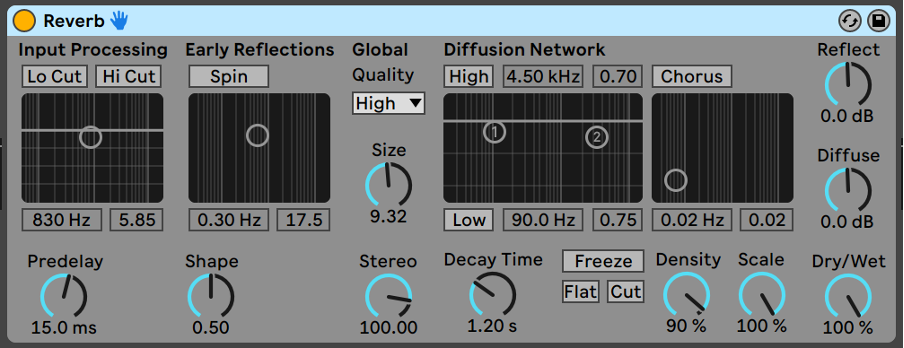
Next, route the drum loop to an auxiliary and install a reverb plugin set to 100 per cent wet. You can copy the settings below for a starting point or use a preset to achieve a standard plate or room with a 1.2 second decay time, or thereabouts. Be sure to disable any equalisation parameters within the plugins as we are going to use a separate EQ plugin to achieve this. In this example I’m using Ableton Live’s native Reverb device, but any DAW will have a suitable reverb plugin that will allow you experiment. Hit play and you should hear something like this.
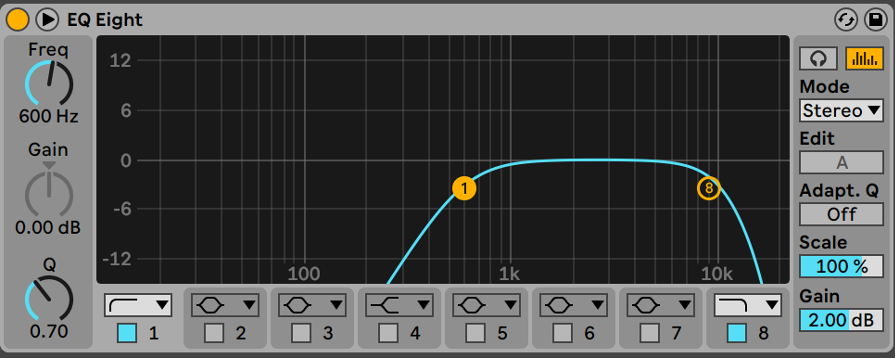
It has reverb, sure, but the low frequency energy from the kick drum is making the sound muddy and indistinct, and the cymbals are adding sibilance and fizz to the high end. To emulate the Abbey Road reverb technique we are going to apply a drastic EQ. To do so, insert an EQ plugin before the reverb plugin on the auxiliary track. Set up a high pass filter with a slope of 12dB per octave and a corner frequency to 600Hz. Alarming, I know. This will remove all of the bass and low mids from the signal to provide a clearer reverb sound that can be increased considerably in volume without obscuring the drum loop. Conversely, setup a low pass filter with a slope of approximately 12dB and a corner frequency of 10kHz. This removes some of the cymbal spill that can make the reverb sounds fizzy. The EQ should look something like this. Feel free to experiment with the filter corner frequencies. The 600Hz and 10kHz can be considered starting points. Rather than competing with the original dry drum loop, the resulting sound complements it. As a result, the reverb return can be increased in gain and sits better with the original, making the whole drum kit sit together in a single acoustic space.
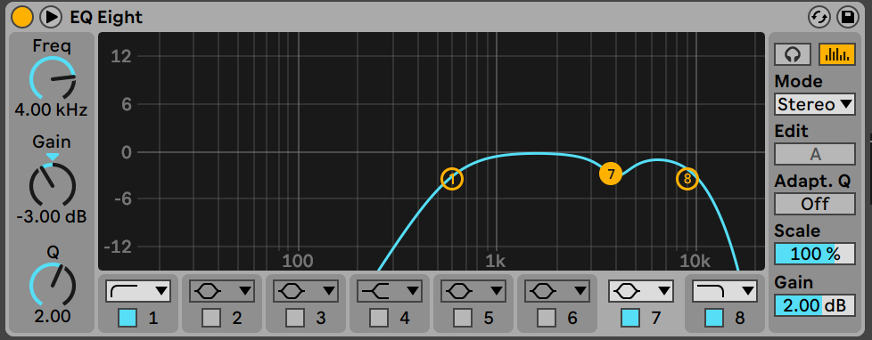
Depending on the source material, this bandpass filter technique can focus the mids to a point where some additional resonance in the mid frequencies, around 1kHz – 4kHz, become noticeable. A parametric EQ can be used to reduce this resonance and further separate the audio source from the reverb. The image below shows a gain reduction of 3dB at 4kHz. The resulting reverb level can be increased a small amount and sounds smoother and slightly less prominent in the mid frequencies. When using the technique with vocal, try reducing 1kHz with a male voice and 2kHz with a female voice, to help the reverb sit better in the mix. As always, use these frequencies as a guide only, depending on your source material.
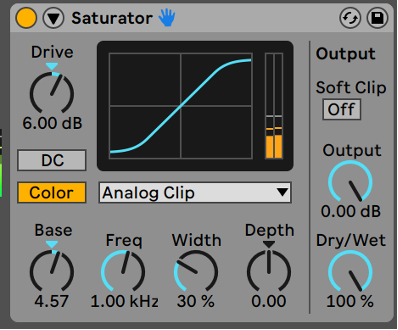
Every analog EQ, preamp, or mixing console adds differing levels of non-linear saturation to the sounds being processed. This adds some excitement and additional harmonics to the sound being processed by the reverb. We are going to emulate the process of hitting the input section of a hardware reverb unit too hard. (A technique that has been used long used back in the pure analog days and not only with an Abbey Road plate. Think Lexicon PCM 60 reverb, LED meter redlined!). Engineers would push the input signal into saturation and then clipping, resulting in additional harmonics being generated to the input signal. A subtle, or not so subtle distortion, depending on taste. These harmonics are heard as additional frequencies above the original sound. When fed into the reverb, there will be more frequency content between the band-passed region of 600Hz and 10 kHz. To emulate this process, insert a saturation plugin in front of the chain, before the EQ and the reverb. This will generate harmonics of the full bandwidth version of the loop. This provides a subtle perceived increased in low end response, a psycho acoustic phenomena know as the “missing fundamental” , as well as a more mid-focussed presence. From the screenshot below, you can see the settings I used to introduce the saturation. Nothing crazy, just pushing the drum loop into non-linearity by 6.00dB. Play around with the setting as it will very much depend on how loud the drum loop is.
Now go back and listen to examples one and two to hear the difference! With some tweaking and experimentation, the Abbey Road reverb technique can yield fantastic results and works well on a host of source material: drums, vocals, synths, guitars, acoustic instruments, horns. Try different reverb types too. Although, the original technique was used with plate reverbs it can help any reverb sit better in the mix. Don’t forget to move the filter corner frequencies around and experiment with different types of saturation too but make a conscious effort to stick with the stock DAW plugins. The extra understanding you obtain will far exceed the marketing promises of those ever-tempting next best things! Learn more about Abbey Road.
Variety Print Plus Subscriber Variety Print Plus Subscriber Variety Print Plus Subscriber Variety Print Plus Subscriber Variety Print Plus Subscriber We've picked out 10 top vinyl exclusives to look for, from the Who to "The Royal Tenenbaums" (plus an actual CD, from Wilco). By Chris Willman Senior Music Writer and Chief Music Critic If you think that this weekend’s Record Store Day Drop feels like a dribble, you’re not completely wrong. The June 18 event is an adjunct to the big collectors’ kahuna that happened back in April, with just under 80 exclusive vinyl titles being released for this bonus RSD, versus the roughly 400 shoppers got in mid-spring. The follow-up day is for releases that, mostly because of supply-chain issues, weren’t able to be shipped in time for the big day two months ago. And the irony (or maybe just wry reality)? This weekend’s list a little shorter than originally announced, just because a handful of titles had to be bumped yet again, to the annual RSD Black Friday event the day after Thanksgiving. Patience, then — in a post-pandemic, pressing-plant-challenged world, all good Johnny Thunders albums come to those who wait.
But what this born-out-of-necessity RSD Drop deliberately lacks in quantity, it will make up for in quality, at least for buyers with very specific wants. Probably the three most coveted titles showing up in independent stores this weekend are a trio of Sony Legacy releases, from Prince, Pearl Jam and Miles Davis. All three are being manufactured in fairly hefty quantities, so there’s a good chance of picking them up Saturday evening or even Sunday, although everyone’s mileage at their local brick-and-mortar outlets will vary, of course. Also on the agenda are reissues or fresh releases from Wilco, the Who, Nicki Minaj, Ray Charles, Fats Domino, Paul McCartney, Kali Uchis, Supergrass, Dio, John Williams, My Morning Jacket, Linda Martell, the Kinks, Peter Gabriel, Ralph Stanley, Slash, Tangerine Dream, the Jerry Garcia Band, Voivod, Brian Tyler and a few dozen more. (For more extensive details on all the titles, and a list of participating stores, click here.) And of course there will be other items to search out once RSD has you in the door — like, also new this weekend, the Beach Boys’ brand new six-LP box set “The Very Best of the Beach Boys,” not directly related to Record Store Day but destined to go in the same bag for a lot of folks. Ten RSD Drop highlights to look for: Pearl Jam, “Live on Two Legs” (20,600 copies) Pearl Jam releases are always pressed in such massive quantities for RSD that you think surely they will stick around in stores for a while … and yet the chance to pick one up always ends up receding quickly in one’s rearview mirror. This double live album did get a limited vinyl release back in ’98, the year of the tour it documented, but copies now go for $300-400. The price is now right, as is the clear vinyl pressing of the two LPs. Come for then-recent favorites like “Elderly Woman Behind the Counter in a Small Town,” “Daughter” and “Better Man,” stay for the Neil-saluting “Fuckin’ Up” encore. Prince, “The Gold Experience” (24,150 copies) Original copies of this particular item had been going for $700-800, so, sorry to collectors who will suddenly see those seriously devalued. But now another 25,000 or so fans will get a fairly exact duplication of a promo edition of Prince’s album that went out in 1995 on gold double-vinyl. It replicates the original down to having the packaging for the two LPs consist of a single plain brown sleeve with stickers affixed to the front and back (the latter being a very long sticker reprinting a St. Paul Pioneer Press essay on Prince from that year). The second disc includes a whole side’s worth of “Hate U” remixes, perfect for gifting to the most beautiful girl in the world in your life.
Miles Davis, “What It Is: Montreal 7/7/83” (10,000 copies) Davis’ camp has another substantial CD boxed set on the way, “The Bootleg Series Volume 7,” representing his sometimes polarizing ’80s work. But they’re previewing it with a big vinyl appetizer — and for vinyl-favoring fans, this may actually be the main course — by pulling out a 1983 show in Montreal for a singular two-LP release. The band, which included John Scofield, Bill Evans (the sax-playing Bill Evans), Darryl Jones, Al Foster and Mino Cinelu, was captured at the Theatre St. Denis in Montreal, Canada. A couple of tracks were included on his 1984 album “Decoy,” albeit in edited form, but the rest are premiering here. One reason not to wait for this to appear in the eventual CD set: one of the inner sleeves includes a lengthy essay by the late, great writer Gregory Tate, who completed the album notes not long before he died. Wilco, “Cruel Country Pre-Release Limited Edition” (8,000 copies) When Wilco’s excellent “Cruel Country” came out as a 21-track album some weeks back, there were some lamentations in Wilco-world that no physical edition existed at all, with either a CD or LP version said to be months away. However, a bargain has been struck, in that the band is putting out a CD version with the plainest, most bare-boned packaging for RSD as a “pre-release limited edition.” Now, 8,000 copies would be a lot for a finished edition to sell through these days, given the diminishing popularity of CDs versus vinyl. But if deserve’s got anything to do with it, these will be gone and the band can get on with pressing a proper release that will do well, too. Linda Hoover, “I Mean to Shine” (2,000 copies) Here’s the kind of oddball discovery that keeps RSD fun for those who aren’t so much into repackagings. It’s a shelved album that includes a copious amount of never-before-heard songs by Donald Fagen and Walter Becker, written just before they first hit the streets as Steely Dan, production by future Dan helmer Gary Katz, and players like Denny Dias and Jeff “Skunk” Baxter. Fans of Fagen and Becker will of course recognize the title track as something that was also recorded by Barbra Streisand, which helped steal the thunder from Hoover’s own debut album coming out. Fifty-plus years later after the album release and effectively Hoover’s entire music career were set aside, any major dude will tell you that this is a must-add to Dan-heads’ collections. My Morning Jacket, “Live From RCA Studio A (Jim James Acoustic)” (5,000 copies) Many RSD releases are labeled as “RSD First” items, meaning they may be available later at all retailers, or repressed. This live album from Jim James is branded as an “RSD Exclusive,” however, so it’s not likely to suddenly reemerge after this edition sells out. James went into the most famous studio in Nashville to recut seven of the songs from My Morning Jacket’s self-titled album, as a solo artist. The Who, “It’s Hard (40th Anniversary)” (6,000 copies) Who albums from the late ’70s and early ’80s have been making their way onto RSD vinyl limited editions with bonus material. For its 40th anniversary, “It’s Hard” joins their company. There’s a half-speed remaster of the original album, but the biggest draw for fans in this two-LP set (pressed on orange and yellows slabs) may be a fourth side that includes four unreleased or rare tracks, including an “Eminence Front” that had Roger Daltrey trying out the lead vocal before Pete Townshend decided that one was his, and, conversely, a “One LIfe’s Enough” that has Pete singing instead of Rog. Linda Martell, “Color Me Country” (2,000 copies) Martell’s name has been brought up a lot in country circles over the past couple of years, as the extreme racial disparities in the genre have been highlighted and Martell brought up as the only Black woman to have any significant success in the format in the 20th century, or before Mickey Guyton, really — and even then, she barely cracked the limelight before disappearing. This debut album was also a swan song album, sadly, but, with its inclusion of her minor hit “Color Him Father” and 10 other tracks, it’s a chance to catch up on what could have been, 50 years ago, if the gatekeepers had been any more open then than they are today. Various Artists, “50 Years of TV’s Greatest Hits” (2,500 copies) Normally, having roughly 60 tracks spread across two LPs would be a mastering and probably listening nightmare, but as the title would indicate, it’s one quickie after another in this collection. Classic themes from “Star Trek,” “Alfred Hitchcock Presents” and “Peter Gunn” are represented; so are relatively modern ones for “Kids in the Hall,” “Sex and the City” and “Dexter.” Appropriate for such a sprawling, scattershot set, it’s on splatter vinyl. Various Artists, “The Royal Tenenbaums (Original Motion Picture Soundtrack)” (unspecified quantity) Soundtracks always draw a cult-within-a-cult to RSD events. Much requested, long delayed and never previously available on vinyl, the score for Wes Anderson’s film includes Mark Mothersbaugh’s score and an eclectic song selection that includes Bob Dylan, the Ramones, Nick Drake, the Velvet Underground, the Clash, Emitt Rhodes, Elliott Smith and two Nico tunes. Its two LPs are pressed on sky (not royal) blue and olive green vinyl and come in a die-cut, gatefold jacket.
The complete list of available RSD Drop 2022 titles: The Album Leaf Past and Future Tense Nettwerk 2xLP Be Bop Deluxe Live In The Air Age Esoteric 3xLP Billy Bragg Life’s A Riot With Spy vs Spy (30th Anniversary Edition) Cooking Vinyl The Brand New Heavies Heavy Rhyme Experience: Vol. 1 [30th Anniversary] Craft Recordings LP The Paul Butterfield Blues Band The Original Lost Elektra Sessions (Expanded) Run Out Groove 3xLP Ray Charles Genius Loves Company Tangerine 2xLP Collective Soul Disciplined Breakdown Craft Recordings LP Creedence Clearwater Revival Travelin’ Band (Live At Royal Albert Hall, 1970) Craft Recordings 7″ Daughtry Dearly Beloved Dog Tree Records 2xLP Miles Davis What It Is: Montreal 7/7/83 Legacy 2xLP Dio Double Dose of Donington BMG 12″ Single Fats Domino Here Comes… Fats Domino Reel LP Sam Fender Alright/The Kitchen (Live) Interscope 7″ Field Music Plumb Memphis Industries LP Flash & The Dynamics The New York Sound Craft Recordings LP Richie Furay In The Country BMG Rights Management (US) LLC LP G.B.H. City Baby Attacked By Rats BMG LP Peter Gabriel Live Blood Real World 3xLP Jerry Garcia Band Ragged But Right Round 2xLP Billy F Gibbons Hardware [Deluxe Edition] Concord CD Box The Go! Team Proof of Youth Memphis Industries LP Parry Gripp For Kids About To Rock Oglio LP Steve Hackett The Tokyo Tapes Esoteric Antenna 3xLP Halestorm Back From The Dead Atlantic LP Bobby Hamilton Quintet Unlimited Dream Queen Now-Again Records LP Home Boy and the C.O.L. Home Boy And The C.O.L. Tidal Waves Music LP Linda Hoover I Need To Shine Omnivore Recordings LP Freddie Hubbard Live At Studio 104 Maison de la Radio, (ORTF), Paris 1973 WeWantSounds 2xLP Hasaan Ibn Ali Retrospect In Retirement Of Delay: The Solo Recordings Omnivore Recordings 4xLP Jetstar Records The Soul Sides Jetstar Records LP Otto Kentrol No Mistakes Modern Harmonic 2xLP Calvin Keys Full Court Press Tidal Waves Music LP The Kinks Waterloo Sunset EP BMG 12″ EP Madness Baggy Trousers BMG 12″ EP Esther Marrow Sister Woman Craft Recordings LP Linda Martell Color Me Country ORG Music LP Paul McCartney/St. Vincent “Women and Wives” Capitol 12″ Nicki Minaj Beam Me Up Scotty Republic 2xLP My Morning Jacket Live From RCA Studio A (Jim James Acoustic) ATO Records LP Night Beats Live at Valentine Cooking Vinyl Pearl Jam Live on Two Legs Legacy 2xLP Prince The Gold Experience Legacy 2xLP The Rationals The Rationals Prudential Music Group LP The Residents Warning: Uninc – Live And Experimental Recordings 1971-1972 New Ralph 2xLP Keith Richards Talk is Cheap / Live At The Hollywood Palladium BMG 2xCassette Slash Live At Studio 60 BMG 2xLP Ralph Stanley & The Clinch Mountain Boys The Bluegrass Sound Reel LP Sun’s Signature Sun’s Signature Partisan Records 12″ EP Super Furry Animals (Brawd Bach) – Rings Around the World BMG LP Supergrass Moving Echo 12″ EP Surfbort Keep On Truckin’ Inner Freak Records LP The Sweet Platinum Rare VOL 2 Prudential Music Group 2xLP Tangerine Dream Alpha Centauri Esoteric 2xLP Tangerine Dream Live At Reims Cinema Opera (September 23rd, 1975) LMLR 2xLP Brian Tyler The Fast And The Furious: Tokyo Drift (Original Score) Varese Sarabande 2xLP Kali Uchis Sin Miedo (Del Amor y Otros Demonios) Interscope LP Various Artists Big Night (Original Motion Picture Soundtrack) Varese Sarabande LP Various Artists You Can’t Sit Down: Cameo Parkway Dance Crazes 1958-1964 (U.K. Collection) ABKCO 2xLP Various Artists You Got The Power: Cameo Parkway Northern Soul 1964-1967 (U.K. Collection) ABKCO 2xLP Various Artists Greensleeves Ganja Anthems VP Records LP Various Artists Love Is All I Bring Trojan Records 2xLP Various Artists Go Ahead Punk…Make My Day Craft Recordings LP Various Artists Song Confessional Vol 1 Good Taste Society LP Soul Jazz Records Presents 100% DYNAMITE! Ska, Soul, Rocksteady & Funk in Jamaica Soul Jazz Records 2xLP Soul Jazz Records Presents STUDIO ONE CLASSICS Soul Jazz Records 2xLP Various Artists Sweet Relief – A Benefit for Victoria Williams Legacy 2xLP Various Artists The Royal Tenenbaums (Original Motion Picture Soundtrack) Hollywood 2xLP Various Artists 50 Years of TV’s Greatest Hits LMLR (French Import) 2xLP Viktor Vaughn Vaudeville Villain Get On Down 2xLP Virgin Prunes Pagan Lovesong (40th Anniversary Edition) BMG 12″ Single Voivod Nothingface Real Gone Music LP Wailing Souls Firehouse Rock Deluxe VP Records 2xLP Warrior Soul Odds & Ends Prudential Music Group LP Mike Watt + Larry Mullins Fun House ORG Music 7″ Vinyl Gerard Way Hesitant Alien Reprise LP Barry White No Limit On Love Reel LP The Who It’s Hard (40th Anniversary) Polydor 2xLP Wilco Cruel Country Pre-Release Limited Edition dBpm 2xCD John Williams Lost In Space: Title Themes from the Hit TV Series Spacelab9 LP World Party Seaview Records Presents: World Party – Curated By RSD Seaview LP Young-Holt Unlimited Young-Holt Unlimited Plays Superfly Liberation Hall LP Delayed: A Variety and iHeartRadio Podcast The Business of Entertainment
Driving Business Sustainability in the age of Data and Technology is a keynote lecture presented at the National Institute of Marketing of Nigeria (NIMN) Annual Conference on 16th June 2022 by Kola Oyeyemi, CEO, Axiom Intel Limited at the Eko Hotel & Suites, Victoria Island, Lagos. When the esteemed Austrian economist Joseph Schumpeter coined the term Creative Destruction in the 1940s to describe how technological progress would improve the life of many at the expense of a smaller few, little did he know that the smaller few he referenced would keep getting bigger by each turn of the evolution to the point of great concerns. Mainstream economic thinking believed that those that would be displaced by technological advancements would have newer opportunities in the new jobs that would be created by the obtrusive technology. Unfortunately, this has not often been the case. Many jobs and many industries have been made extinct by technology and with their extinction, many once upon a time successful companies and valuable talents. There is no more concerning time in history than now with the explosion in data and very aggressively disruptive technologies to discuss the issue of Business Sustainability, not from the green planet and environmental impact point of view which is very important and cannot be discounted but from business performance fundamentals. A futurist once said in 2012 that the world will fundamentally change in ten years more than it changed in the previous 100 years. We are in the tenth year of that prediction and how so true it is today. Let’s see some staggering stats on Data generation: 1. In 2018, according to Social Media Today, more than 2.5 quintillion bytes of data were created every day. This was the year people used over 3.1 million gigabytes of internet data and mined 1.25 bitcoin every minute. 2. According to World Economic Forum, the amount of data in the world was estimated to be 44 Zettabytes at the dawn of year 2020. A Zettabyte is 1,000 bytes to the seventh power. This means one Zettabyte has 21 zeros. This number came from a summation of the data generated daily by social media sites, financial institutions, medical facilities, shopping platforms and several other online activities. 3. At the beginning of 2020 according to World Economic forum, the number of bytes in the digital universe was 40 times bigger than the number of stars in the observable universe. 4. The World Economic forum High Scalability report says that by 2025, the amount of data that would be generated each day will get up to 463 Exabytes globally. An Exabyte is 1,000 bytes to the sixth power. In contrast to this fact, all the words ever spoken by man according to the report, fit only into 5 Exabytes! 5. Internet World Stats recorded that as of July 2020, there were over 4.8 billion internet users in the world. This means nearly 60% of the people on the planet earth at this point were digitally active. 50% of the overall traffic came from Asia but Africa has been recording the fastest growth at about 12.44% between the year 2000 and 2020 6. Internet Live Stats says Google handles 1.2 trillion searches annually 7. Business of Apps recorded that 71.5 billion Apps were downloaded worldwide in the first half of year 2020. Google Play store did 52.3 billion and App Store did 18.3 billion. These are data consuming and data generating Apps. 8. Talking about E-commerce and Online Shopping, Visual Capitalist says the world spends almost $1 million dollars per minute on commodities on the internet. 9. 5G has the capacity to increase data transmission speed by up to 100 times and decrease latency from about 20 milliseconds to one millisecond according to CNET, Fierce Wireless, Light Reading and Statista. This will cause an explosion in data usage. Imagine how much data gets consumed when it is possible to download a whole TV series Season in less than a minute! It is simply unfathomable but real! This is the background and environment within which organizations and businesses must strategize to compete and win sustainably. The question is; How? Before we get into the How of sustainability, there is still the unsettling issue of disruptive technologies. This is like riding a wild tiger. Any error can be very fatal. Technology can help you drive operational and financial efficiencies. It can make you leaner, fitter, smarter, and more profitable. It can make you more innovative and enable faster access to market. However, technology can also accelerate your extinction. And it can come as a barbarian from outside your industry. Let’s look at the Smartphone technology as an example. When IBM introduced the first Smartphone in 1992 and began commercial shipping and sales in 1994, little did they know that the explosion of the internet will empower the smartphone to change the face of business and personal interactions forever. This is one of the most visible examples of Creative Destruction. The smartphone took mobility of life and business to a whole new level and created a convergence of industries into this powerful device. That convergence also saw the premature death or a mutation of a lot of industries Over 14 classic industries have been changed or are being changed by the Smartphone. Some of these industries are: 1. Music production and distribution 2. Video production and distribution 3. Banking 4. Insurance 5. Watch 6. Print production 7. Broadcast 8. Gaming 9. Retail brick and mortar channels 10. Maps 11. Credit 12. Cinema 13. Advertising 14. Photography 15. Hospitality 16. Transportation 17. Logistics 18. Education 19. Medical Practice These technologies have no regard for extant rules of engagement or the old factors of competitive advantage. They are barbarians who have pulled down old structures and systems and created a whole new frame for competitiveness beyond industries. The need to drive sustainability in business in the environment painted thus far has been a global discourse that has engaged thought leaders in the last couple of years. A school of thought believes that the age of Sustainable competitive advantage is gone for ever. That school postulated the new age of Transient Competitive advantage. Rita Gunter McGrath, a Professor at Columbia business school and leading expert on Strategy in highly uncertain and volatile environments wrote a book that she boldly titled; The End of Competitive Advantage In the book, she challenged the age long foundational assumptions in the Strategy field. These assumptions are; 1.) Industry matters most. This assumption opines that industries are made up of relatively enduring and stable competitive forces. Once you invest in a thorough analysis of these forces, you are able to identify trends and then you can design your strategy accordingly. One of the famous tools and frameworks of those times was the Porters five forces of industry competitiveness. This assumption sits on relative industry stability and enables long term planning. So you had then, 3 years, 5 years and even 10 years plans. The second assumption she challenged in the book is the assumption that once an organization achieves certain advantages, they are sustainable. All the company needs to ensure is that it keeps optimizing people, assets and systems around the advantages. According to Rita, the assumption of industry focused sustainable advantage creates a bias toward stability. In a VUCA environment, this is most dangerous. It creates wrong reflexes. The incentive to build up on existing business model is tempting. People generally and conveniently fall into habits and routines. Organizational rigidity festers and innovation is impaired. In a volatile environment, this is certain death! She submitted that organizations need to move away from industry focused competitive benchmarking and competitive analysis. We are in an age where industries compete against industries; business models compete against business models even in similar industries and we have whole new categories emerge where once there was none. Industry competitiveness is still important. However, a higher level of analysis beyond the industry is required for survival and sustainable success. Instead of industry competitiveness, she postulated Arenas. She sees these Arenas like waves of the sea and organizations and their leaders like the surfers. When the waves rise, the surfers dive in to ride the waves and enjoy the thrill. However, once the waves attenuate, the surfers pick up their boards and wait for the next wave. The focus is on capturing territories instead of an industry positional advantage. The measure of success is not market share but the share of potential opportunities. The threat is not intra industry but inter industry and disruption of business models. Customer segmentation is not on geography or demographics. It is behavioral While you are riding the waves or exploiting the opportunity, you differentiate from intra industry competitors, scale up quickly but refrain from over investment and complacency so your exit does not get encumbered when its to me to move. Closely related to the theory by Rita and team is Ecosystem thinking. Survival and sustainability in the VUCA world driven by data and technology is impossible with silo thinking and Silo business models. You need an Ecosystem thinking where you bring together various organizations to develop solutions where everyone inputs and value is shared. This moves the thinking away from Products and Services to delivery of solutions. This is the new collaborative economy. It calls for a multi-sided business model and not a a narrow focus business model Let’s take the Media business as an example: Media company provides platform Content producers or curators provide content at zero cost Customers view for free The Media company displays advertising consumed by viewers Advertisers pay for eyeball or viewership data Therefore, the richer the content, the higher the viewer number; the higher the viewer numbers, the more attractive the platform to advertisers. The more viewing hours generated, the more premium can be charged on advertising. This leads to growth in revenue and more value to share within the ecosystem. Richer contents can be procured to attract more viewers and the virtuous cycle goes on. This thinking runs against the grain of the old model where I own the platform. I procure the content which is limited because of funds. I grow the audience piecemeal because I don’t have rich content. I chase and beg the advertisers because my proposition is not compelling. I am not competitive and so I barely manage to survive. This business model is not sustainable any longer One powerful strategy that gives businesses a chance at sustainability and access to global resources and leading thoughts in Arenas or industries is the Mobility of Business functions. Businesses no longer need to warehouse all functions within a geography with the attendant costs. Operations can be located in areas where cost advantages are possible and still be remotely monitored and controlled centrally. Apart from the cost benefit, this also gives access to remote markets faster. IOT makes this a present reality. Organizations that desire to pursue sustainability in the age of data and technology cannot afford to pay lip service to digitization. Mere leverage of technologies to digitize operations, assets and upscaling the workforce cannot be enough in the digital economy. If you truly want to capitalize on emerging opportunities in the digital economy, there is a necessity for a total rethink and overhaul of structures, culture, business models and revenue models, route to market models etc. Organizations must radically transform from the inside out. Unfortunately, a lot of companies are approaching digitization furtively. It’s almost as if it’s a fad that will blow away like others before it. This is a grave error and can be very costly in the immediate future. I have been involved in conversations on digitization before and it is amazing how people think it is of value but are scared to take the leap. Incremental progress is preferred over radical changes. This can go on safely until an external aggressor comes after your breakfast. One of the most powerful strategies that is practically difficult to replicate is an excellent customer experience strategy. In the digital economy, this is most critical. Many folks are still locked in the old customer service or customer relations model that is more reactive than proactive; more accidental than intentional. This is bigger than managing touchpoints. It is a deliberate strategy that focuses on customer journey design before product, service or solution design. Loyalty and churn reduction are by-products of a comprehensive, well thought-through customer experience strategy. The digital customer has high expectations and will not hesitate to punish you if you fail to deliver on his experience expectations. However, if you deliver on his experience expectations consistently, you can reduce your marketing cost and Cost of Sales as the customers become your advocates. This leads me to speak to a subject I am passionate about; the customer ownership concept. Sustainable strategy built around a deliberate effort to own the customer is a sure guarantee of sustainability. If you manage to deliver excellent experiences, you can leverage this across verticals. This requires a lot of data mining and analytics to get insights on the customers to design the right customer journeys, define performance metrics and organize the entire organization to deliver on same from the CEO to the doorman. The final point is to hire skills that can travel across categories and Arenas. This way, as you migrate to other verticals or even totally different businesses, you are not coupling and decoupling skills. These strategies are by no means exhaustive. Business sustainability in a VUCA world of data and technology disruptions is an ongoing discourse. However, If you would approach sustainability from business purpose, model, structure, intentional digitalization and a robust customer experience platform, you do stand a very good chance to succeed. Kolawole Oyeyemi, CEO Axiom Intel Limited 16th June 2022
http://www.consumersvalueawards.com BrandCrunch.com.ng is a revolution in reporting and analyzing brands & marketing, marketing communications’ activities, issues and allied subjects and the industry generally. It is a solely web based platform that offers you news, features and up-to-date happenings in the industry real time, on-line, as they unfold. Our investigations of different brands led us to a site called casinoexpressindia.com. This website has positioned itself as a solid and helpful platform for those interested in online casino India entertainment. They have created solid, and helpful content, intended to help out newcomers and experienced gamblers alike.
Copyright 2021 UVR Media LLC. Comedy rock duo Tenacious D returned to the studio specifically for VR game Unplugged to re-record a song’s vocals. We recently spoke to Unplugged creator and Anotherway director Ricardo Acosta in our virtual studio to discuss the history of Unplugged and its development. One interesting tidbit from our talk revealed that Tenacious D re-recorded vocals for Unplugged so that their song Roadie could make it into the game. The song (and the band) is one of Acosta’s all-time favorites and he used it in a very early prototype all the way back in 2015. But even after partnering with Vertigo Games in 2020 and beginning development on Unplugged, he wasn’t sure if they would be able to include the song. After being unsuccessful in making contact with the band to secure the rights, Guitar Hero legend Marcus Henderson (brought on board by Vertigo) came to the rescue. “He was like, ‘Guys, leave it up to me. I’ll make it happen,’” said Acosta. “So somehow he contacted the manager of Tenacious D and started talking to them.” With Henderson’s help, the rights to the song were secured. But another problem emerged — with a PEGI 12 rating, Roadie’s explicit and frequent F-bombs weren’t going to cut it. “So at another point we were like, ‘Okay, we have the song now, but we cannot use it because we are PEGI 12, so we have to take it out from the list.’” Acosta made his peace with leaving the song off the tracklist. But, in his words, “maybe the stars were in a particular position that night.” Henderson was able to get Tenacious D back into the studio to re-record a clean version of Roadie, specifically for Unplugged, excluding all the swearing. “It was insane,” said Acosta. “Knowing that my favorite band re-recorded a song just for the game. It’s insane. It’s just amazing. And a lot of people have complained about the fact that it’s a different version of the song, without the swearing. But I’m so proud of that. To me, it’s even better because it’s our song.” Be sure to check back with UploadVR tomorrow morning as we publish our full interview and video charting the story on Unplugged.
Unplugged is a hand-tracked air guitar game, and it’s coming to VR this fall with… Air guitaring VR game, Unplugged, is getting a hand from a Guitar Hero/Rock Band veteran. Speaking to UploadVR, Unplugged’s creator Ricardo Acosta teased more music and content in the game’s… Harry is a gaming and tech journalist based in Melbourne, Australia. While he started his journalism career in the competitive Overwatch and esports scenes, he couldn’t resist getting into the ever-evolving industry of virtual reality. Harry started with UploadVR as the Community Moderator before joining the full-time staff as a News Writer. Copyright 2021 UVR Media LLC. All RIGHTS RESERVED.
The Audio-recording Software Market accounted for US$ XX Million/Billion in the year 2022 and is expected to grow at a CAGR of XX% during the forecast period 2022 – 2030, to account for US$ XX Million/Billion in the year 2030. Global Audio-recording Software Market is segmented by region into North America, Europe, Asia-Pacific, Middle East and Africa, South and Central America. The North America regional market is expected to grow with CAGR of XX.X% and reach US$ XX Million/Billion 2015 from US$ XX Million/Billion in 2022. The key players profiled in the Audio-recording Software Market research study includes top: Apple, Adobe, Digidesign, Steinberg, MOTU Digital Performer, Ableton Live, Mixcraft, Cakewalk Sonar, ACID Pro, FL Studio, Auto-Tune, Audacity, Ardour Segment by Type– Windows– Linux– macOS– OtherSegment by Application– Amateurs– Professional Request Sample Copy of Audio-recording Software Market research report at – marketreports.info/sample/51856/Audio-recording-Software Since, the key findings in the Audio-recording Software Market research reports highlight crucial progressive industry trends, it allows the companies across the value chain to develop effective long-term strategies. The clients get to understand a clear picture of the competitors and can develop strategies and modify business expansion plans accordingly. The Audio-recording Software Market research reports cover thousands of global players that based on several parameters, such as company revenue, product portfolio, and geographic presence. marketreports.info adheres to the codes of practice of the Market Research Society and Strategic and Competitive Intelligence Professionals. The following methodology has been followed for the collection and analysis of data presented in this report: Coverage: The objective of updating “marketreports.info” coverage is to ensure that it represents the most up-to-date vision of the industry possible. The estimated revenues of all major companies, including private and governmental, are gathered and used to prioritize coverage. Companies which are making the news, or which are of particular interest due to their innovative approach, are prioritized. Secondary Research: The Audio-recording Software research process begins with exhaustive secondary research using internal and external sources to obtain qualitative and quantitative information relating to each Audio-recording Software Market. The secondary research sources that are typically referred to include, but are not limited to: NOTE: All the financials considered in Company Profile’s section have been standardized to US$. This has been achieved after converting the financials (for those not in US$) with respective currency exchange rates of the particular year. Get Discount on Audio-recording Software report@ marketreports.info/discount/51856/Audio-recording-Software Primary Research: “marketreports.info” conducts hundreds of primary interviews a year with industry participants and commentators in order to validate its data and analysis. A typical Audio-recording Software research interview fulfils the following functions: Order a copy of this research Audio-recording Software Market research report at – marketreports.info/checkout?buynow=51856/Audio-recording-Software Primary research involves email interactions and telephone interviews for each Audio-recording Software market, category, segment and sub -segment across geographies. The participants who typically take part in such a process include, but are not limited to: About Us marketreports.info is a global market research and consulting service provider specialized in offering wide range of business solutions to their clients including market research reports, primary and secondary research, demand forecasting services, focus group analysis and other services. We understand that how data is important in today’s competitive environment and thus, we have collaborated with industry’s leading research providers who works continuously to meet the ever-growing demand for market research reports throughout the year. Contact Us: Carl Allison (Head of Business Development) Tiensestraat 32/0302,3000 Leuven, Belgium. Market Reports phone: +44 141 628 5998 Email: [email protected] Website: www.marketreports.info
** FOR USE WITH AP WEEKLY FEATURES ** This photo provided by the California Strawberry Commission shows fresh ripe berries, to enjoy at their best in all manner of recipes. Try them in savory new guises as salsas, as well as in favorite classic desserts. (AP Photo/California Strawberry Commission) ** FOR USE WITH AP WEEKLY FEATURES ** This photo provided by the California Strawberry Commission shows fresh ripe berries, to enjoy at their best in all manner of recipes. Try them in savory new guises as salsas, as well as in favorite classic desserts. (AP Photo/California Strawberry Commission) This is a two-part series. We cover strawberries and blueberries in this article, and raspberries and blackberries in Part II. There is nothing more rewarding than to go out to your garden and pick berries that can be consumed fresh. All berries are herbaceous perennials; therefore it is important to choose a good location, as that is where they will most likely remain. Buy dormant strawberry stock that consists of a crown and root, which will send up shoots, leaves and, eventually, runners. Most varieties last three to four years and then need to be replaced. Planting: Do not plant where potatoes, tomatoes, eggplants or peppers were previously planted due to verticillium wilt transfer. The location chosen needs six hours of direct sun; plant in well-drained, loamy, sandy soil. It is best to prepare the bed in the fall with composted steer manure and organic matter. Have the pH tested; it’s best at pH 6.5, so you may need to incorporate sulfur or ammonium sulfate in the soil to arrive at that pH. Plant March or April if bare root and May if potted plants. Loosen the soil, plant 6 inches deep, spreading the roots in a fan shape, and leave the crown at soil level, 8 inches apart. It is best to mulch to help retain moisture and to keep soil acid. Even watering is important, especially before and during harvest. Fertilize with 5-10-5, especially before fruit set and during harvest. Always pinch back runners to send energy to the plant and berry production. Bird control is important as the berries ripen, so it is best to put hoops and netting over the plants or use floating row cover. Shade cloth can be applied July and August to protect ever bearing plants that produce in the late summer. Harvest early morning, leave on the calyxes, refrigerate, and wash only before consuming. After harvest, remove the leaves but don’t damage crown. Cover with mulch (straw) over the winter for protection. There are three types of strawberry plants. Blueberries have their growing challenges, but many rewards (80 calories/cup packed with antioxidants). When established, they are long-lived and provide fresh berries each year. It is important to precondition the soil, especially in Eastern Washington, which has alkaline soils (6.5-7.5). Blueberries demand acid soil (4.0-5.5); if you do not provide that, it triggers iron deficiency, which results in yellow foliage and then dead plants. The year before, start treating the soil by mixing sulfur powder into the top 8 inches of the soil. Test the pH and you will need to repeat the process. Improve the soil by adding organic matter, rotted manure, sawdust or peat moss (an acidifier). Plant in full sun, but afternoon shade is desirable in Eastern Washington with its hot summers. Plant at least two varieties, which will result in better pollination and bigger, earlier fruit. Two or more different ripening times also extends the season for your enjoyment. Buy container plants that are 3-4 years old, or you can get two-year bare root stock. The first year, remove all blossoms to encourage strong roots and stems. Dig a hole 14-18” deep but backfill with organic matter. Blueberries have shallow roots, so spread out roots on top of the soil, then fill the hole and leave a slight depression for water to sink to roots. Avoid fertilizing the first year so roots are not burnt. Spacing depends on variety, but the average is 4 to 5 feet. Water should be constant, with even watering of shallow roots. It is best to not let them dry out, so mulching is required. A drip system on a timer is best. Drought symptoms include reddened foliage; weak, thin shoots; and reduced fruit set. Use a balanced 5-10-10 fertilizer in the early spring or before fruit set. Follow up in May annually with ammonium sulfate at leaf bud break to keep the soil acidic. Netting over the plants before and during production is best to protect berries from being eaten by robins, starlings and finches. After four or five years, you will need to prune in early spring to vase shape, opening the center for air circulation. Remove low-spreading branches near the ground. Remove broken, diseased branches and any canes over 1” in diameter at ground level. Cut branch tips if twiggy with hand sheers. Flower buds are nearer the tip and are fatter and less pointed than leaf buds. Pick when ripe; not all ripen at the same time, so you need to pick every three to five days throughout season. Harvest is best in the early morning. They have a two-week refrigerator shelf life and also freeze well. There are five main types of blueberry bushes: Enjoy the “fruits of your labor,” and if you have any questions, feel free to call or email the Master Gardener clinic. We are here to help you succeed. Gardening problems? The public is encouraged to visit the Master Gardener diagnostic clinic in Union Gap, Mondays and Fridays from 9 a.m. to noon and 1-4 p.m. Contact us at 509-574-1604 or email [email protected]. For better identification, bring a sample of the damaged plant in a sealed zip-close bag. Master Gardeners at the Farmer’s Market WSU Yakima County Master Gardeners host a tent at the Yakima Farmer’s Market from 9:00 a.m. to 1:00 p.m. every Sunday from May 8 through October 23, 2022. In accordance with WSU science-based research, advice for backyard gardeners is given without charge. Brochures, class and training leaflets, contact information and general information are on hand to pick up. Come ask questions or tell your garden story. At least two Master Gardeners are there for all Sundays. Your comment has been submitted.
Reported There was a problem reporting this. Log in Keep it Clean. Please avoid obscene, vulgar, lewd, racist or sexually-oriented language. PLEASE TURN OFF YOUR CAPS LOCK. Don't Threaten. Threats of harming another person will not be tolerated. Be Truthful. Don't knowingly lie about anyone or anything. Be Nice. No racism, sexism or any sort of -ism that is degrading to another person. Be Proactive. Use the 'Report' link on each comment to let us know of abusive posts. Share with Us. We'd love to hear eyewitness accounts, the history behind an article. The Yakima Herald-Republic is hiring. Sign up to receive news and updates from this site directly to your desktop. Click on the bell icon to manage your notifications at any time. Get up-to-the-minute news sent straight to your device.