Music production equipment for beginners is often affordable and compact, so the only limits while building a home studio are your budget and the size of your room.
But the equipment you’ll need to make music depends on the style of music you want to make. For example, if you want to make electronic music then you won’t need a microphone or an audio interface, but you will need headphones, a computer, and a program that you can make the music on.
The music gear you need ultimately comes down to the music you want to make.
So we’re exploring what the essential equipment is for recording at home, what’s not so essential, what you’ll need to produce music of various styles… and where you can get it all!
The equipment you need to record music at home includes a computer, an audio interface, a microphone, a DAW, and headphones.
While professional studios have masses of desk space full of equipment and cables, this isn’t necessary for a home recording studio. More specifically, you need only get a couple of pieces of equipment to record songs at home.
A lot of digital recording equipment is small enough to sit nicely on a small desk or even a kitchen table. As a result, you can make your home studio flexible enough to work around you.
There are a number of music gear websites, but I recommend checking out any local music shops in your area too. Here are some examples of gear websites:
If you keep reading, you’ll also find a number of links to affordable gear for home studios in each section.
But, of course, there are two ways that you can read this article.
If you want to record instruments and vocals:
And if you want to make electronic music or beats:
First and foremost, you’ll need a reliable computer for recording instruments and vocals, making beats, designing sounds, and producing music.
Today, digital audio is the heart of music studios and computers are at the forefront of music production. In fact, music production is so widely accessible because you can:
As a result, a computer for music production is the first thing to get for a home music studio. Whether you’re making beats or recording audio, your music production PC is something to go as big as you can on.
There are three specifications you’ll want to prioritize more than others: CPU, RAM, and SSD storage.
In an ideal world, you’ll want the fastest computer you can afford for music production. No matter if it’s a computer for making beats or recording instruments, your home recording studio depends on the capabilities of your computer.
However, nearly all computers have enough processing power to handle recording in small quantities. So if you have a computer of some sort, see if you can make do for now – your budget will thank you – because you can always upgrade in the future.
If you want to make music on the go, you’ll want to look for a laptop with these specifications rather than a desktop PC.
A laptop with a battery life between 4 to 8 hours may see you through on an average day, but it’ll depend on your usage and how many programs you have open.
Here are some affordable laptops for music production.
With your computer setup, you’ll need some music-making computer programs. The first of any music-making software you’ll need is a Digital Audio Workstation.
DAW software allows you to record and edit audio, apply effects to instruments or groups of them, and mix the audio channels to work together as a song.
In summary, a digital audio workstation is a music-making software for PC and Mac where you can record, edit, and organize your musical ideas.
You can compose music via MIDI in a DAW or record audio into them with a microphone. Then, you can expand your ideas into full songs, mix, and master them.
Below is a list of some industry favorites DAWs
Each DAW offers a unique workflow based on different user needs and musical styles. Some are better for recording instruments (Logic Pro, Pro Tools, Cubase), others are better for making electronic music (FL Studio, Ableton, Bitwig), and others are good for both.
DAWs allow you to work quickly and experiment seamlessly. Some DAWs like Ableton and Logic Pro X are renowned for their user-friendly interfaces too.
But these DAWs are a little on the expensive side. However, there are free DAWs that will provide you with every tool you’ll need to get started recording music and producing.
Below are some examples of free DAWs that are great for beginners:
You’ll need an audio interface to record anything professionally. They allow us to record microphones and electric instruments, as well as connect headphones and speakers to our setup.
In short, it’s audio interfaces that make professional home recordings so accessible today.
They’re critical tools if you want to record audio to a professional standard. Unless you make all of your music “in-the-box” (using only computer programs), you’ll need an audio interface to record music.
Computer motherboards or soundcards don’t accept microphone XLR cables, but audio interfaces do. Therefore, only audio interfaces can accept these inputs and then convert the microphone signals into digital signals that your computer can read.
Furthermore, an interface generally provides more connectivity options than computer motherboards do. You can connect multiple microphones, multiple electric instruments, and more!
Below is a list of 3 entry-level audio interfaces:
Many people ask if a DI Box (Direct Injection/Direct Input) is necessary for a home studio. The answer is: you could use a DI box but you don’t need one if you have an audio interface.
This is because audio interfaces utilize microphone preamps and dedicated instrument inputs. In short, an audio interface will give you all the inputs you need in your home studio.
You don’t need a DI Box unless you are connecting bits of equipment with mismatching voltages together.
If you’ll be recording acoustic instruments, you’ll only need one or two home recording microphones. And the instruments you want to record should dictate the microphone you buy.
A microphone registers the soundwaves of your performance and converts them into electrical signals. Then, it sends this signal to an audio interface input which then converts the signal to a digital one.
The two types of microphones you’ll want to consider are dynamic and condenser microphones.
Dynamic microphones are more durable but have less sensitivity than condenser microphones. This makes them better suited to recording louder sound sources like drums and guitar cabinets. They’re often cheaper, but their design makes them better for live sound too.
On the other hand, condenser microphones have a lot of electrical resistance. So, they need phantom power to reduce the resistance and increase the sensitivity of the microphone.
The boost in current allows condenser microphones to capture intricate sonic details of a soundwave, making them better for quiet instruments like acoustic guitars and vocals.
You’ll be collecting microphones as if they were stamps as time goes on, but each microphone will serve you a different purpose.
Below is a list of microphones that’ll let you get started recording a variety of instruments.
In addition to the right microphone, you need to record in the right space. It’s often tricky converting a room at home into an acoustically sound home studio when you have limited money.
Sound naturally travels in every direction and will bounce around the room if the room isn’t treated. Unfortunately, microphones register that reflected sound which means the room you’re recording in has a huge impact on your recording.
Check out the video below to find out how you can begin treating your home studio.
In short, a microphone stand is a mount for your microphone. There are six different designs of microphone stands, each allowing you to freely position your microphone.
Not all microphone stands are the same and finding the right microphone stand for you is one of the most valuable buys.
Of course, the immediate benefit is that you don’t have to hold the microphone. But another, and perhaps the bigger benefit, is that it removes the risk of the mic registering static interference that it would if you were holding the microphone.
Moreover, a shock mount houses your microphone at the top of the stand too. Though different microphone shapes ask for different shock mounts, the sensitivity of a microphone plays a huge factor in how absorbant the shock mount needs to be.
Here is a couple of affordable tripod microphone stands:
What does a microphone pop filter do? Well, the purpose of a mic pop filter is to cancel out low-frequency blasts of air (pops/plosives) that naturally occur with words that include B’s and P’s.
These pops are undesirable because they’re heard as thuds in recordings. Together, a microphone, a pop filter, and a microphone stand give you the ultimate home recording setup.
Pop filters also protect your microphone from saliva. So if you’re planning on recording vocals you’ll want a pop filter.
You’ll need studio headphones or speakers to hear the details of your music that laptop speakers and small desktop speakers won’t be able to reproduce… but you don’t need both.
The chances are that your room is cluttered, maybe cramped, and generally small. These conditions make for a poor acoustic space and placing studio monitors in this space is a wasted effort.
But headphones aren’t prone to the same vulnerabilities, so focus on getting studio headphones if you can’t afford acoustic treatment or your room is how I have described.
There are three types of studio headphones. These are closed-back, open-back, and semi-open-back.
Closed-back headphones are an essential bit of studio equipment while recording instruments. The earcups on closed-back headphones are sealed, which is why we call them so.
This design prevents sound from leaking into your outside environment and into your microphone. This makes them perfect for monitoring while recording as closed-back monitoring headphones don’t bleed sound into the microphone.
With that said, the sealed nature of these headphones means that sound reflects in the earcup, leaving something to be desired while mixing.
The purpose of studio headphones for mixing is to allow you to hear the details of your music. But closed-back headphones aren’t the best for this due to the reflected sound in the earcup.
In contrast, the design of open-back headphones deliberately leaks sound. The earcup is open whereby a thin metal grill with air holes allows sound pressure to leave the earcup.
No sound reflects within the earcup as a result.
In other words, open-back headphones have more of a ‘natural” sound because they release sound pressure into your outside environment. But open-back headphones are also more expensive than closed-back cans.
The stereo-field reproduction and bass response of open-back headphones are more accurate due to their design, so you can hear a more accurate reproduction of your mix.
In short:
Finally, semi-open-back headphones are the best of both!
They’re partially open at the back of the earcup but more or less closed. But they do allow air to out of the earcup because they don’t seal the rear of the cup entirely.
While more suited to mixing, semi-open-back headphones leak sound to a much less extent than open-back headphones. This means you can use them for monitoring while recording, but closed-back headphones are still the best option here.
But semi-open-back headphones will make a great first pair of studio headphones, especially if you have a small budget. As a merger of the two, you can use semi-open back cans for both mixing and monitoring with their extended low-frequency response, a strong stereo field, and some sound isolation.
Below is a list of good music production headphones for beginners:
Commercial headphones like Beast by Dre, Apple AirPods, and the rest are not ideal for making music. Commercial headphones utilize frequency boosts (particularly in the low end) to improve the listening experience for users.
The frequency boosts will distort your perception of your music productions, while headphones with as flat a frequency response as possible will sound more true to what you’ve made.
Consequently, recording & producing music with commercial headphones like Beats by Dre removes opportunities for informed decision-making.
In contrast, the goal of music production headphones and studio monitor manufacturers is to create speakers with ‘flat’ frequency responses. In other words, headphones for producing music utilize as few frequency boosts and cuts as possible.
Like studio headphones, comparing studio monitors to consumer-grade speakers shows us that studio monitors have a flatter frequency response. Consequently, they provide a more neutral and transparent reproduction of your music.
They do so because they’re active speakers which means they have an internal amplifier. In contrast, most consumer audio systems like home entertainment setups are passive because they rely on an external amplifier to boost the audio signal.
Compared to headphones, the frequency response of studio monitors is generally more accurate thanks to the bigger drivers too.
Though studio monitors are speakers for producing music, they’re not essential for your home studio at first.
If the space that will host your music is a small room, is cluttered (as bedrooms can be), or has parallel walls then it’ll be a poor acoustic space. As a result, studio monitors (otherwise known as nearfield monitors) won’t sound as good as they could.
But let’s say you have a good acoustic space and carry on because we both know you’re going to buy a pair someday…
Studio monitors are a great tool for mixing when they’re in acoustically sound spaces.
Many studio monitors also come with adjustable EQ settings and Room Correction. Some speakers offer more settings than others, but these tools allow you to tune your monitors to your room.
But EQ and Room Correction tools can only do so much. While they can make speakers sound great in good acoustic spaces and can help speakers sound better in bad spaces, defeating uncontrolled acoustics in your space is very hard for any pair of speakers.
Unfortunately, the EQ settings on entry-level studio monitors are often minuscule. Though most speakers at this level offer some settings they don’t provide a lot of flexibility.
Let’s take a look at the features on the rear of M-Audio’s BX5 D3 studio monitors.
Whether your speakers will sit on your desk or speaker stands, a pair of isolation pads will go a long way!
Isolation pads prevent the speaker vibrations from vibrating through your desk/speaker stand, thereby isolating the sound that’s leaving the speakers.
The studio monitors you’ve probably ordered by now may come with stock isolation pads. These may do the trick, but if not you can check out a range of isolation pads here.
There are a number of cables you’ll come across in your journey of making music.
The two main types of cables you’ll use are XLR cables primarily for microphones (but studio monitors also accept them), and 1/4″ TRS / TS for speakers and electric instruments.
Firstly, here is an XLR cable that you’ll use for microphone inputs more than anything.
And here are examples of TRS & TS jacks that electric instruments and speakers accept. The difference between them is the additional ring on TRS jacks.
Additionally, XLR & TRS are balanced cables while TS cables are unbalanced. Balanced cables are more desirable for microphone and speaker connections as they eliminate unwanted noise that builds up in the signal while unbalanced cables do not.
Balanced XLR & TRS cables do so by utilizing two wires that carry the audio signal while unbalanced cables use only one signal wire.
The two signal wires in balanced cables carry identical copies of the audio signal with their polarities flipped, then merge the two signals to remove any unwanted noise.
Unfortunately, the one signal wire in unbalanced cables doesn’t eliminate any unwanted noise buildup.
Some sort of acoustic treatment is essential in a home studio for reasons we’ve explored in our speaker and microphone sections. Acoustically treating your studio helps mitigate the problems that the acoustics of the space will cause you.
Rectangular rooms (not square rooms) with tall ceilings, no parallel walls, hard flooring (with a rug), and internal structures that disrupt reflected sound are rooms with good acoustics qualities.
Building a room with naturally good acoustics asks for a lot of money and time. But this isn’t feasible for so many people, and most of us have a perfectly square room with four parallel walls where reflected sound thrives.
Though you can dampen these reflections with fabricated wall hangings and tapestries, well-placed acoustic treatment minimizes the amount of reflected sound that can cause you trouble.
You’ll need a combination of three things to get the best acoustics, but you don’t need all three to get good results.
Measure your room before you start throwing cash at the problem. Then use this guide below to make an informed choice about how much treatment your home studio needs.
Now it’s time to talk about the digital hardware that makes music production on computers more immersive, fun, and creative.
A MIDI controller (Musical Instrument Digital Instrument) is a physical interface between you & your music production software. A MIDI controller sends digital data to your computer that it and other digital music hardware can read and process.
In practice, a sound source could be a virtual instrument or a sample, and you can use the MIDI controller to trigger the sound. Many MIDI controllers feature controls that allow you to manipulate the virtual instruments’ settings too!
Therefore, you can use MIDI controllers to:
Though they’re not essential in a home studio, they’re both handy and fun to have because they make composing music more interactive (especially if you’re making electronic music or beats).
The three main types of MIDI controllers are:
MIDI keyboards provide you with a number of keys that allow you to compose music with samples and virtual instruments.
They come in many sizes, but 25-key keyboards are more portable than others. These smaller keyboards provide “Octave Shift” functions that allow you to transpose the keys up and down in pitch.
MIDI keyboard sizes include:
Drum pads allow you to program drums and trigger samples and loops. Although you can do this with MIDI keyboards, finger-drumming with drum pads is much more fun.
Like keyboards, MIDI drum pads also come in different shapes and sizes. For example, see the AKAI LBD8 MIDI controller below.
The device features 8 pads, 8 knobs, and a couple of buttons such as Play, Stop, and other global controls.
The pads are perfect for finger drumming while the knobs allow you to control the settings of the virtual instrument you’re triggering with the pads.
Now, compare that with the Maschine Mikro 3 by Native Instruments.
It comes with more pads and more buttons, and it’s designed to work seamlessly with NI’s Maschine DAW software. The Mikro also comes with some cool MIDI functions like Chord Mode which we’ll be explaining soon.
Many developers like AKAI and Native Instruments design their MIDI hardware to integrate with their software. Though you can effortlessly control your DAW with many MIDI controllers, some controllers like the Mikro are better used with its dedicated Maschine software.
Then we have MIDI drum pad units like the Ableton Push 2 which are much bigger in size.
The Push 2 is Ableton’s equivalent of the NI Mikro 3 for Maschine. It’s designed to integrate seamlessly with the Ableton DAW and puts every Ableton tool a producer needs at their fingertips.
Finally, control surfaces are designed with controlling a broad catalog of DAWs and virtual instruments in mind.
The X-TOUCH looks like a miniaturized mixing desk, right?
Well, each button & mode on a MIDI control surface allows you to control different settings in your DAW software, and some integrate with virtual instruments and plugins too. Therefore, MIDI control surfaces are something like affordable mixing desks!
MIDI control surfaces use numbered MIDI CC messages to control different settings within the software.
Don’t forget to check out the article below to find out more about how MIDI works!
Finally, companies like Native Instruments, Arturia, and AKAI offer big software bundles with their MIDI controllers. These software bundles can include plugins, software instruments, synthesizers, and entry-level DAWs too.
Most software will be the manufacturer’s own, but many include third-party software like Ableton Lite.
Better yet, most MIDI keyboards have a combination of most or all of these features! For example, a lot of MIDI keyboards feature drum pads, knobs, and various MIDI modes.
Below are some examples of entry-level MIDI keyboards with these features:
Additional features like chord modes are available on some MIDI controllers too. Found on controllers like the Mikro 3, chord modes allow you to write chord progressions with no knowledge of music theory. Simply select a chord mode (Major, Minor, etc.) then press a key and you have the corresponding chord!
Some MIDI controllers also utilize arpeggiators. An arpeggio is a broken chord, and an arpeggiator utilizes time signatures to create a melody with various rhythmic patterns of the individual chord notes.
Consequently, you can create cool melodies by pressing just a few notes!
Traditionally a dedicated hardware piece, it’s not uncommon to find sequencers on MIDI controllers.
A sequencer allows you to program notes (known as steps) across musical bars. Some allow you to map notes across 8 steps, while others 16 or 32.
There are 16 steps in a 4/4 bar. So an 8-step sequencer allows you to plot notes across half a bar while a 16-step sequencer allows you to plot notes across a whole bar.
Next, let’s talk some more about virtual instruments and plugins that musicians and producers use.
Software instruments are virtual emulations of acoustic instruments. They generate a signal with pre-recorded sounds, so when you press a key you’re triggering a sample of a real instrument.
Therefore, software emulations of an acoustic instrument use a collection of samples to recreate the sound of that instrument.
Developers of virtual instruments build this sample-based music software by recording musicians playing real instruments. Then, they convert those recordings into sample libraries.
Examples of software instruments:
In contrast, software synthesizers primarily utilize algorithms to generate a signal, but some do offer sample-based synthesis too. But the different parameters on the synthesizer’s interface allow you to shape that signal even further.
In other words, the sound design process starts with a digitally generated sound of a fundamental waveform as a basic building block. Then, you can add more waveforms and manipulate them in countless ways with the controls and features on the synthesizer’s interface.
But there are numerous types of synthesis. In the image above sits Serum – a wavetable synthesizer.
Other methods of synthesis include:
Below are some examples of different synthesizers that utilize different synthesis techniques:
Finally, plugins are creative effects that don’t generate a sound of their own. Instead, we insert plugins onto audio channels to manipulate those sounds.
There are thousands – if not millions – of third-party plugins available. With that said, all DAWs feature stock plugins and virtual instruments that are good for beginners. But you will inevitably begin to use third-party plugins at some point in your journey…
Let’s take a look at some plugin effects in closer detail.
An EQ (equalizer) is a tool that allows you to increase or attenuate the level of the frequency band in an audio signal. Emphasizing or removing frequencies allows us to shape sounds and clean them up.
Most EQs utilize linear processing which means the signal will leave the EQ in the same shape as it is entered unless you adjust any settings in the plugin.
There are numerous types of EQs including dynamic and graphical EQs, but parametric EQs are most common among producers today.
Parametric EQs provide a more hands-on workflow where you can make very specific adjustments to frequency bands. On the other hand, dynamic EQs utilize compression settings to emphasize or attenuate frequencies when certain conditions are met in the signal.
A compressor allows you to adjust the dynamic range of an audio signal – the difference between the loudest and quietest parts of the signal.
In practice, you can use a compressor to keep a consistent level across all of your audio channels. But there are multiple ways of using compression for different results too!
Compressors and EQs are important tools that allow us to keep our signals under control. In fact, you may use both of them more than other plugins from time to time.
Reverb is a creative effect that puts a sound in a space, meaning it synthesizes the effect of sound reflecting in a room.
A reverberating signal repeats thousands of times in less than 50ms which makes the actual sound itself sound bigger.
Different reverbs synthesize the effect in different spaces too. For example, plugins offer different spaces like ‘Room, ‘Hall’, and ‘Chamber’.
These three examples have different rates of reverb. The Chamber reverb sounds much bigger than the Room reverb because the stone construction in a chamber is super reflective.
So, reverb plugins take into account reflective materials found in these spaces too.
The main elements of reverb that you can control are:
Like reverb, a delay effect is a time-based effect that utilizes reflected sound. However, the rates of reflection are dramatically slower and sound more like an echo.
Unlike reverb, delay repeats a signal slower than 50ms per second. But, like reverb, delay still makes a signal bigger and adds depth too.
Finally, distortion mathematically adds additional harmonics higher than the fundamental frequency (core frequency) of a signal. And distortion fits into two neat categories: even harmonics and odd harmonics.
Even distortions like tube distortion add harmonics at even multiples of the fundamental. For example, if the fundamental frequency is 200Hz, tube distortion adds new harmonics at 400Hz, 600Hz, and so on.
In contrast, odd harmonic distortions like phase distortion add harmonics at odd intervals. Sticking with our 200Hz example, phase distortion adds harmonics at 300Hz, 500Hz, etc.
The last thing we’re going to cover is samples.
Samples are segments of audio taken from a bigger piece of audio, and this is adequately called sampling.
If you’re going to be making beats and electronic music then you’ll need access to a range of pre-recorded sounds to manipulate in your music.
The three types of samples: one-shots, loops, and sound effects.
A one-shot is a singular instance of an instrument or sound – the most common one-shots are drum samples – whereas a loop can feature any instrument or sound playing a musical sequence. But sound effects can be anything in between!
Absolutely anything can be a sample and that’s why thousands of producers and musicians use sampling in their music every day. One-shots and loops can consist of any instrument imaginable, and anything can be considered a sound effect.
In fact, sampling has been growing in popularity for decades and today it is at the forefront of music and inspiring new genres like Lofi music.
And that’s where subscription-based samples come in. Due to the huge demand, there are places where you can download and keep multiple royalty-free sounds for a small monthly fee.
Those looking to dip their toes into sampling may find our Beginner tier a great starting point. You can download and keep 100 sounds every month for just $2.99!
A multiverse of creative potential awaits you in your own home studio. Whether you want to be a musician, a music producer, a session performer, a beat-maker, or simply record for your own amusement, a home music production studio creates a lot of opportunities.
However, the price adds up fast. Let’s first take a look at how much some entry-level basics may cost you assuming you use a free DAW:
It’ll cost you over $1000 for home recording basics if you don’t already have a computer. But if you do then it’ll only cost you about $300 – $500.
But if you’re going to only be making beats or electronic music then you only need to spend $200-$300 on headphones and a couple of virtual instruments if you already have a computer.
But the price creeps up when looking at studio monitors, MIDI keyboards, and more fund music gear.
In any case, remember to only buy what you need first. While some things like a computer, a DAW, a computer, and headphones are essential for a home studio, the rest is just eccentric fun stuff.
I have some advice to offer on this note. Start simple and treat music recording & production as a hobby – not a potential career.
Running before you can walk by trying to learn too much at once will only lead to burnout. If you take one step at a time, you can avoid:
These are the results of trying to learn too much too soon! Nurture your interest and don’t bite off more than you can chew.
So, how is your home studio looking?
Sign up to our newsletter and make sure you don’t miss a thing!
Hit enter to search or ESC to close.
Everything you need to record & produce music at home – RouteNote
Birch basks in Shaggy's golden success – Jamaica Observer

MUSICIAN and producer Christopher “Birchill” Birch says he is happy to be a part of any successful project.
Birch, a renowned keyboardist who was a member of Shaggy’s band, co-wrote or played on four of the songs featured on the 19-track Best of Shaggy: The Boombastic Collection which was certified gold by the British Phonographic Industry (BPI) last Friday, commemorating sales exceeding 100,000 units.
“It’s always a good feeling being part of success and some failures, because you learn from the failures. Being part of that success is always good. Just being in the room where the project was created is a good feeling,” Birch told the Jamaica Observer on Sunday.
Released by Geffen Records in 2008, Best of Shaggy: The Boombastic Collection is a greatest hits compilation which features songs culled from six of Shaggy’s albums, namely Pure Pleasure (1993), Boombastic (1995), Hot Shot (2000), Lucky Day (2002), Clothes Drop (2005), and Intoxication (2007).
Birch co-produced the tracks Hey Sexy Lady (which also features Brian and Tony Gold) and Those Days. He played on the hits Church Heathen and Strength of a Woman.
Hey Sexy Lady, taken from Shaggy’s 2002 album Lucky Day, peaked at 10 in the United Kingdom and has been certified gold in Belgium and platinum in Canada and Australia.
Strength of a Woman, from the Hot Shot album released in 2000, rose to 39 on Billboard’s Pop Airplay chart.
Other credited producers on the greatest hits album include Robert Livingston, Shaun “Sting” Pizzonia, Jimmy Jam and Terry Lewis and Tony “CD” Kelly.
Among the songs included on the hits package are Angel and In the Summertime (both featuring Rayvon), Hope (featuring Prince Mydas), It Wasn’t Me (with Ricardo “Rik Rok” Ducent), Ready Fi Di Ride, Wild 2Nite (featuring Olivia), and Feel the Rush.
Birch, a former member of Shaggy’s band, started out with the SANE Band. He also worked with several bands on the hotel cabaret circuit and later ventured into music production. He said working with Shaggy has been a journey.
“Being part of the 809 band and then moving on to working with Shaggy and transitioning into being part of his band, it was a world of tours all over the place. Being a musician then transitioning to building beats for Shaggy and then to starting my own label, it was good,” said Birch.
Birch came to the fore with the Thrilla rhythm, released in 2004 on his Echo label. It spawned Macka Diamond’s breakthrough hit Done Already, Exit Sign by Voice Mail, Get On Up and Dance by Elephant Man, Solid as a Rock by T.O.K., and Stand Firm by Bounty Killer, among others.
He has toured with several acts through the years including Buju Banton, Marcia Griffiths, Tony Rebel, Wayne Wonder, Mutabruka and Diana King.
His most recent music production, Sponsor featuring singer Lanae, was released in August.
Now you can read the Jamaica Observer ePaper anytime, anywhere. The Jamaica Observer ePaper is available to you at home or at work, and is the same edition as the printed copy available at
HOUSE RULES

Jack Brogan, Who Gave Substance to Artists' Visions, Is Dead at 92 – The New York Times

Advertisement
Supported by
A master fabricator, he was a wizard at handling the new materials and technologies used by artists. But to the public, he remained a hidden gem.
Send any friend a story
As a subscriber, you have 10 gift articles to give each month. Anyone can read what you share.
They were the men and women behind Southern California’s Light and Space movement. Some of them were called the Finish Fetish artists because of their manipulation of surfaces. Starting in the 1960s, Robert Irwin, Larry Bell, Peter Alexander, Helen Pashgian and other artists began experimenting with new materials and technologies — including acrylic, urethanes and resin — that were often polished to a high sheen or rendered so that they disappeared altogether.
Jack Brogan, a laconic, denim-clad craftsman raised in Tennessee, was their all-important collaborator and fabricator, even if his contributions often went unrecognized.
When Mr. Alexander began to make his luminous resin cubes, he turned to Mr. Brogan for help. For John McCracken’s high-gloss fiberglass and resin plinths and planks, Mr. Brogan pushed the artist’s already laborious process further — sanding, painting and burnishing the work until it shone like glass. And for Mr. Irwin, with whom he had his longest and most intimate collaboration, he engineered all manner of material acrobatics.
Mr. Brogan died in his sleep on Sept. 14 at his home in Santa Monica, Calif., his wife, the abstract painter Edith Baumann, said. He was 92.
The name Light and Space came from a 1971 show at the University of California, Los Angeles, called “Transparency, Reflection, Light, Space: Four Artists,” featuring work by Mr. Bell, Mr. Alexander, Mr. Irwin and Craig Kauffman, who was known for his translucent plastic wall reliefs.
The movement, Southern California’s answer to Minimalism, was inspired by car and surf culture; by the region’s bountiful light and the Pacific Ocean; and even by the region’s local industry, movies — by, as Michael Govan, director of the Los Angeles County Museum of Art, pointed out, a projector’s light in a dark theater.
The artists, Mr. Govan said in an interview, “were interested in the fine line between immateriality and materiality, in light and also its opposite, the dark, and it was a moment when all sorts of new materials were available that had been developed by the aerospace and defense industries.”
Mr. Brogan “was a galvanizing force,” Mr. Govan said, adding: “It was a turning point in art history, and he had a hand in shaping it. Artists knew what they wanted, but they didn’t always know how to make it happen. Jack did.”
Lynda Benglis wanted her large pleated and knotted pieces, made from canvas or steel mesh, to have more heft, as if they had been cast in metal, so Mr. Brogan developed a process to cover them with a metallic mist. He built vacuum chambers to pull the bubbles out of the liquid acrylic used by Mr. Alexander and Ms. Pashgian. He made Mr. Irwin a 30-foot acrylic prism, a slender column so strong that it withstood an earthquake.
He also taught Ms. Pashgian a technique for polishing her work. After she had labored over a piece in his studio for hours, she told the writer Lawrence Weschler, who profiled Mr. Brogan last year for The Brooklyn Rail, Mr. Brogan would wander over and urge her on, telling her, “That’s not the best you can do.”
“It was Jack,” she told Mr. Weschler, “who taught me to see.”
Mr. Brogan’s upbringing was eclectic. He was born Jackie Franklin Seidner on May 12, 1930, in Springfield, Ohio. His young mother, Beatrice, had married an engineer and roustabout named Horace Seidner who turned out not to be the family type. A year or so after Jack was born, Jack’s maternal grandfather, William Brogan, brought his daughter and grandson home to his farm in Anderson County, Tenn.
Beatrice soon remarried and moved on, and Jack was raised by his grandparents, who adopted him. When he was 9, he had an after-school job with a Dutch architect, assisting in cabinet making. Jack’s grandfather died when he was 14 (his grandmother, Susan Jane Brogan, died when he was 8), and Jack went to live with an uncle, working in his concrete block and pipe factory and selling Bibles door to door. After high school, he worked for a time for two auto companies in Detroit and spent a few months back home in a local college studying engineering.
He was drafted into the Army in 1950 and served in the Korean War. Upon his discharge in 1953, he returned to Tennessee and a hodgepodge of jobs: running moonshine, repairing used cars and working in one of the nuclear reactor labs opened by the government in Oak Ridge. He also bought a concrete plant.
By the late 1950s he was in Los Angeles. He had injured his spine in a car accident, he told Mr. Weschler, and was encouraged by his doctors to recuperate in a milder climate. He opened a furniture-making shop there and also worked for the Packard Bell Company; for real estate developers, building models; and as a consultant to the furniture makers Knoll and Herman Miller. When his furniture shop burned down, he opened a studio in Venice Beach, offering fabrication services to architects and industrial designers, as well as to NASA and aerospace contractors.
Mr. Irwin walked into his studio one day in the mid-1960s looking for help in building a curved, convex armature for his canvas dot paintings. Mr. Brogan, he recalled to Mr. Weschler, suggested a technique used for the wings of biplanes.
Next, Mr. Irwin wanted help producing the acrylic disks for which he would become known: evanescent convex shapes, mounted so that they seemed to hover and lit from four sides to create a cloverleaf pattern. Mr. Brogan aced those, too, and a lifelong collaboration and friendship were forged.
Mr. Irwin, Mr. Weschler wrote, “was becoming more and more interested in the object as an occasion, a prompt, for the experience of perception.” And, Mr. Irwin told Mr. Weschler, “the thing about that kind of work, when the artwork is merely the cue and not itself the subject matter, is that the object has to be expertly, meticulously crafted, precisely so as to avoid calling attention to itself, and in that regard there was just nobody but Jack who could do it.”
Mr. Irwin began sending everyone on the scene to Mr. Brogan. And as a work aged, Mr. Brogan would be called in to revive it.
It wasn’t just the California cadre he fixed. When an Alexander Calder mobile was warped in a fire, Mr. Brogan restored it. When a massive marble sculpture by Henry Moore needed cleaning up, Mr. Brogan was the go-to surgeon (he used dental tools).
Despite his essential role in art making, his contributions were often unacknowledged; it wasn’t unusual that even when Mr. Brogan had installed an artist’s show, there would be no invitation to the opening.
“He didn’t talk about it,” Ms. Baumann said, but he felt the slight. “He was very much the Southern gentleman. He was very much ‘Forget about it, move forward.’ He was all about the work.”
One source of tension — and financial upheaval — was the cardboard furniture the architect Frank Gehry had begun making in the early 1970s. As Mr. Gehry said in a phone interview, he was fooling around with the material for displays in department stores. He loved that the edges looked like corduroy. He made a desk and a filing cabinet, and Mr. Irwin encouraged him to make a chair, sketching out an idea and giving it to Mr. Brogan to make.
“It was wonderful, and we formed a funny partnership and Jack made everything,” Mr. Gehry said. “Nothing was too complicated, he never said no, and we would play like kids in a playground.”
But things changed after a businessman sought to produce their Easy Edges furniture, as it was called, and Mr. Irwin and Mr. Brogan were cut out of the action. Mr. Gehry went on to design a model room of cardboard furniture for Bloomingdale’s in 1972 — it was one of the must-see interiors orchestrated by Barbara D’Arcy, the store’s merchandising guru — and won national attention.
“It all blew up, and Irwin never forgave me,” Mr. Gehry said. Mr. Brogan wasn’t happy, either: He had developed the machinery to produce the cardboard and took a huge financial hit. He sold his house and his studio, Ms. Baumann said, so he could pay off the creditors.
That iteration of the furniture was also a financial wash for Mr. Gehry, who ended up filling orders at cost and turning his focus to architecture. The pieces, however, became design classics, and in 2005 Mr. Gehry sold the production rights to Vitra. The Vitra Wiggle Chair, the most recognizable piece of the collection, now sells for about $1,500.
“It was a terrible outcome,” Mr. Gehry said, “and I still feel awful about it.”
In addition to his wife, whom he married in 1995, Mr. Brogan is survived by his daughters, Kendra and Ronnia Brogan; his stepson, Ezra Hudson; and a granddaughter. His marriage to Evelyn Leinart ended in divorce.
In 2012, the Katherine Cone Gallery in Los Angeles organized a show featuring work created with the help of Mr. Brogan. There was a glowing resin wedge by Mr. Alexander, a luminous and trippy polyester resin wall hanging by Ms. Pashgian, a polished acrylic prism by Mr. Irwin and three Easy Edge cardboard pieces, among other works.
The exhibition’s title? “You Don’t Know Jack.”
Advertisement
Microsoft announces the Surface Studio 2+, a flexible all-in-one desktop for professional creators – Yanko Design


Designed as an upgrade to their Surface Studio 2, the 2+ now has double the graphical capabilities of its predecessor and comes built expressly for Windows 11.
Earlier today, Microsoft announced a slew of hardware products under their Studio line (along with even an audio dock system for enterprise use with their Teams software). Debuted alongside next-gen announcements for the Surface Tab and Laptop, the company even revealed an upgraded version of their flagship all-in-one desktop system. Aptly titled the Surface Studio 2+ (since it’s an upgrade, not a next-gen), the desktop device comes with the same flexible, adjustable design as its predecessor, however with a few tweaks under the hood. The Studio 2+ sports a massive 28″ PixelSense™ touchscreen with support for a digital pen, with a virtually weightless, adjustable Zero Gravity Hinge connecting it to the main hub.
Designer: Microsoft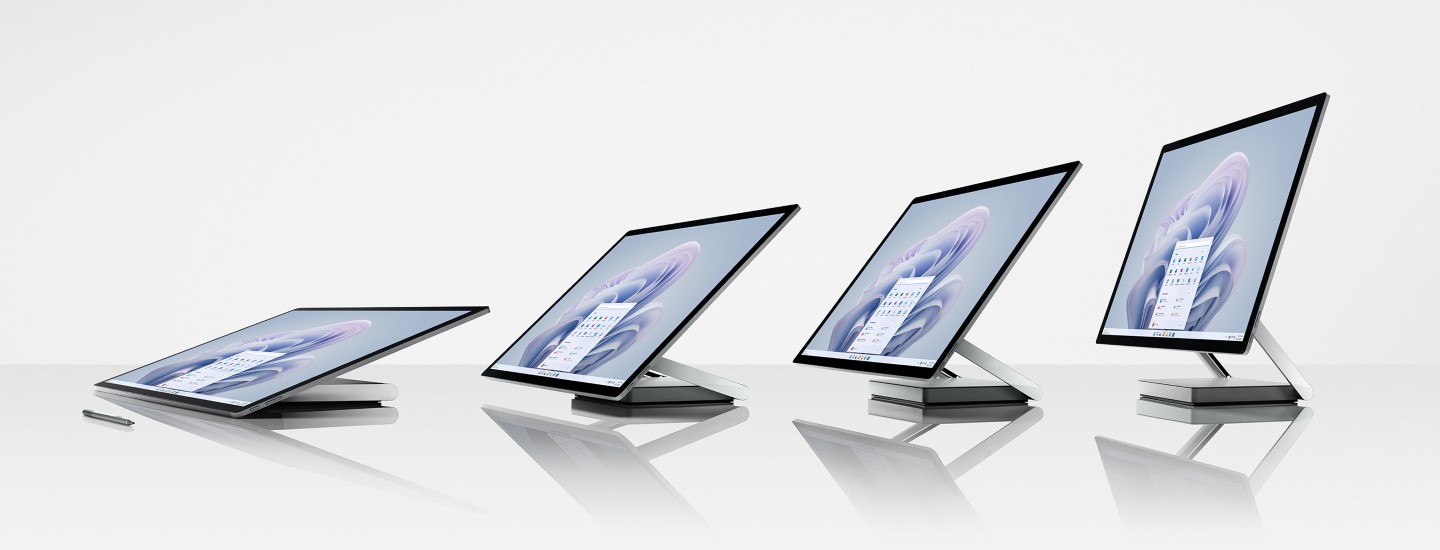
The Studio 2+ comes with an 11th Gen Intel® Core™ H-35 Processor under the hood (50% faster than the Studio 2) with 32GB DDR4 memory, enabling multitasking, working with large files, and conducting video calls right on the device. It even houses an NVIDIA® GeForce RTX® 3060 Laptop GPU with the latest RT Cores, Tensor Cores, and streaming multiprocessors, offering double the graphical productivity of its predecessor.
The Surface Studio 2+ comes with an abundance of essential ports including thunderbolt and USB-C inputs, a 3.5mm input, and a Gigabit Ethernet port. The 28″ display boasts a 3:2 aspect ratio and a 4500 x 3000 resolution with support for Dolby Vision and color calibration suited for most artist and creative-based applications. Gorilla Glass 3 on the top keeps the display unit protected against scratches, scuffs, and any other damage.
Other hardware specs include a front-facing 1080p camera with Windows Hello face-unlock, 1TB of SSD storage, Wi-Fi 6 and Bluetooth 5.1 connectivity, stereo 2.1 speakers and dual far-field microphones, and finally a Surface Pen and Surface Keyboard that comes bundled with the Studio 2+. The Microsoft Surface Studio 2+ ships with a 1-year limited warranty, and impressively enough, is designed with replaceable components, enabling repairing and upgrading with time.
Pricing and availability details for the Microsoft Surface Studio 2_ are still forthcoming, and this piece will be updated once the information becomes available.
Its Cyberpunk-ish appeal aside, the CYBERBLADE TWS Earbuds from Angry Miao are pretty impressive as audio devices overall… but one feature stands out as perhaps…
The sleek blanket and home slippers come with Casamera’s iconic waffle-weave pattern, giving you soft comfort while keeping you warm in the winters and cool…
I know not everyone is a fan of our eventual submission to a robot army, but I know I’ll be psyched about all the cool…
It seems like printers completely dominate the room there in, turning otherwise comfy spaces in to a full on copy and print center! Simply called…
Traveling with small, unmarked toiletries dispenser is quite cumbersome and for folks like me, a nightmare. To consolidate all of them into one product is…
If you’re going to have indoor lighting, it might as well serve your plants too, right?! That’s the idea behind MILO, a creative illumination solution…
We’re an online magazine dedicated to covering the best in international product design. We have a passion for the new, innovative, unique and undiscovered. With our eyes firmly focused on the future.
Editorial Standards and Ethics / Privacy Policy

Green Day's 'Good Riddance' Was Nearly Bon Jovi-Style Rock Ballad – Ultimate Classic Rock

When Green Day released “Good Riddance (Time of Your Life)” in 1997, it was the culmination of a yearslong battle to find satisfaction with the song.
By the time it appeared on their fifth studio album, Nimrod, in October of that year, the track had been through several incarnations. Frontman Billie Joe Armstrong had written it before the trio started work on their major label debut, Dookie, three years earlier, inspired by a girlfriend who left him to move abroad. At the time the song was titled “Time of Your Life (Good Riddance)” and featured a softer approach to the music than the rest of the album, so it was cast aside.
But producer Rob Cavallo always felt the track had something about it, and the band agreed. So in 1997, they recorded a new demo version as Nimrod came together. The Ringer recently noted that Cavallo took the rough track with him every night to think about it. “It was sort of like a musical problem to work out,” he said. “I just was playing it at my house thinking … ‘This song is a freaking hit. It just seems so close to a hit.’”
He eventually came up with two significant changes. First, he asked Armstrong to pick open notes instead of strum chords at the start of the song, so that the strumming felt like a crescendo when it finally came in. Perhaps an indicator as to how different an approach it was can be heard in the album version, which starts with Armstrong messing up the intro and saying “fuck!” before starting again.
Second, Cavallo suggested adding a string section. That proved a little more difficult to achieve. “At first [there was] a whole orchestra in there, and they’d all come in like, ‘Shung!’” Armstrong later recalled. “In the studio, we played it as a big, Bon Jovi–style ballad. Now that was funny.”
Watch Green Day's 'Good Riddance (Time of Your Life)' Video
They realized that wasn’t the correct approach for a band like Green Day, so Cavallo wound up focusing on a smaller string section and continued to grapple with the song. One day he asked the band to leave him alone in the control room, and they went to play foosball in the studio lounge. About 20 minutes later he called them back, saying:, “You guys want to hear a No. 1 hit?”
While “Good Riddance” didn’t quite reach that height, it did make the Top 20 all over the world, including No. 2 on Billboard’s Alternative Airplay chart. Its most unexpected success came in the form of a prom-night song, which Armstrong fully supported. “The people that you grew up and braved the trials of high school with will always hold a special place. Through all the BS of high school, you hope that your friends had the time of their life, and that's what the song is talking about,” he told CBS in 2012.
Armstrong also admitted he was “scared for that song to come out,” noting that he had a few drinks before performing it for the first time. “I thought it was a powerful song and it made me cry and all that. … But because it was such a vulnerable song, to put that song out … it was like, ‘Which way will it end up going?’”
The frontman has previously explained that before he became a punk rocker, he considered himself a songwriter, and he's stayed true to that. Bassist Mike Dirnt added that “Good Riddance” was the “most punk” thing Green Day had ever done. That attitude also represented Armstrong’s reaction when writer John Norris asked him, “Will fans understand it?” Armstrong replied: “I don’t give a shit. I get it.”
Secret audio recording reveals two faces of The Animal Foundation – KTNV 13 Action News Las Vegas

Menu
LAS VEGAS (KTNV) — As The Animal Foundation deals with one crisis after another, former employees say the troubled shelter continues to be the victim of its own mismanagement.
13 Investigates exclusively obtained a secret audio recording that shows the two faces of The Animal Foundation: one put out to the public, and another face that staff sees behind closed doors.
“I really want to say to you personally, I know it’s on me at the end of the day and I’m so, so sorry that you all felt like you had no alternative but to take the action that you did,” said Animal Foundation CEO Hilarie Grey on an audio recording of a meeting with eight former members of the shelter’s admissions team (including three supervisors) who quit en masse on a recent Sunday morning.
“That day, Sunday, we came into a full room–Blue room full–our overflow room. The cat room was full too. And then we already had Animal Control coming in asking for space and we were scrambling while Animal Welfare is just barely starting to clean kennels,” the former employees told Grey.
Some of the staffers who walked out had been there for less than one year while others had worked at the shelter for seven years or more.
“We’ve been struggling for a while. We’ve asked for help. We’ve asked multiple different people for help. Nothing ever got done,” one former employee said.
Fed up with being overworked, underpaid and unheard, they recorded the meeting without telling Grey.
“When we ask for help, it falls on deaf ears,” a former employee said.
After the group of eight quit, there were only two Admissions staffers left and The Animal Foundation was forced to temporarily close, then plead with the public for help.
In a press conference, Grey said, “We’re placing an urgent call to the community for temporary foster support, to get animals out of the shelter environment and to free up space for new intakes and for the animals that really need our help the most.”
“I’m not surprised that they’re in the spot that they’re at. I’m surprised that they haven’t listened to the warning signs,” said former Chief Operating Officer James Pumphrey, who is speaking publicly for the first time to 13 Investigates.
He says he warned shelter management months earlier that Admissions staff would leave if working conditions and wages did not improve.
“We had a meeting with the chief executive, with the operations leaders of the shelter, and we very clearly articulated, ‘We will lose the Admissions team. They will walk.’ And two months later they did.”
In July, Pumphrey submitted a report documenting the staff’s struggles and other systemic problems.
He was fired days after sending the report to Board Chairperson Kevin Murakami and to CEO Hilarie Grey.
“They didn’t want to give staff pay raises that the board had already approved. That was the most troubling of it all. And I didn’t understand, and I still don’t understand why that was the case. It was quite avoidable,” Pumphrey said.
The former Admissions staffers say Pumphrey was the only top-level executive who worked to help them with a very demanding job.
Admissions employees are the front line at The Animal Foundation. They deal with the public turning in strays, owners surrendering their pets, and people reclaiming lost pets.
They intake animals from City, County and North Las Vegas Animal Control, processing, even vaccinating every animal.
They work shifts that often range from 12-16 hours a day and are paid about $13 an hour.
In the press conference Grey held after they quit, she said their departure came as a surprise, telling the media, “I was shattered, personally.”
The former employees who recorded the meeting say they felt that was disingenuous.
They all claim Grey could and should have seen it coming due to conditions that occurred on her watch and were documented by Pumphrey in his July report.
They say The Animal Foundation is failing to be transparent with the public and the government entities they contract with by failing to admit the shelter is often at capacity and constantly playing catch-up to intake animals.
“They’re suffering because they’re still in those dirty kennels,” said one former employee.
“And you don’t really have people in the morning,” added another. “We all come in at 11 am when the doors open, and we don’t have time to process any dogs to make room for the public. We have the public waiting in a line, holding dogs, and we don’t have room.”
One employee said dogs often sit in cages in Admissions for 15 or more hours before being moved into the shelter, some in desperate need of medical care.
“There was a dog that was bleeding out, basically, there was blood all over its kennel,” one former employee recalled.
Another former employee detailed threats they got from the public, “Stating they’re either gonna abandon the dog or tie it up to a pole–those are just the very common ones we get. The bigger threats we get is they’re going to come in with guns, they’re going to come in and threaten us to take their dogs back or to fight.”
Again, those are scenarios then-COO James Pumphrey documented in that July report.
Former employees say nothing changed.
“Everyone kept leaving or getting fired but we never replaced those roles,” one former employee said. “And everyone expected us to do the jobs of three other people and get paid just $13.50. That’s another reason they’re not staying. You could go down the street to Panda Express and they have a sign that says hiring $16-17, $18 or $19.”
To the public in the press conference, Grey said of the employees who quit, “So, we’re speaking to them. I’m hopeful that some of them might consider coming back as well.”
In private, one former employee asked, “Would you rather us return back to The Animal Foundation?”
Grey responded, “Right now, you all have made your decision. And we’re going to be looking to staff back up.”
Former Employee: “With the ‘staff back up’ we could have used that a long time ago. What would be different to hiring now?”
Hilarie Grey: “I can’t answer that question for you right now.”
She offers no raise to bring them back. They ask what the plan is for new hires.
Former employee: “Do you think they’ll actually get paid more or actually be set off with $13.50 or less?”
Grey: “I mean, we’re going to look at everything but it’s like, you guys made your decision that you felt like you needed to leave.”
She added, “Individually, if you want to look at coming back, there will be processes for that, for sure.”
Pumphrey has also heard the audio recording of that meeting.
“And at no point in time did she ever say, ‘you’re valuable, you’re experienced, we want you back. What can we do to bring you back?’ There’s the public face, and there’s what she said to those people in that meeting. What do we make of how divergent those paths are?” Darcy Spears asked.
“I think that private face is what the staff and the volunteers are encountering. And it’s callous,” Pumphrey said. “And it is forcing people to work in unsafe conditions.”
Hilarie Grey did not respond to our repeated requests for comment.
We spoke to the former employees after they met with her and they called the meeting “Useless.”
We’d like to note that the audio recording in this story was obtained and published legally. In Nevada, two-party consent–meaning people on both sides–is only required for telephone conversations.
Report a typo
Paulina Porizkova Shares #NoFilter Snaps Of 'No Filter' Audio Recording – The Blast

by Posted on October 17, 2022 at
Model Paulina Porizkova is giving fans a behind-the-scenes peek at her recording of the audio version of her new book, “No Filter,” which hits bookshelves in November.
On Monday, October 17, the 57-year-old model shared a few #NoFilter snaps which showed her sitting in the studio as she talked about the process behind creating her audiobook, including “endless” glasses of water!
In her latest Instagram post on Monday, October 17, the first-ever Central European woman to appear on the cover of a Sports Illustrated swimsuit magazine revealed that she is giving her fans an audiobook version of her upcoming book, “No Filter.”
“Here I am recording my book for the audio version of my book, for those of you who prefer to listen,” she wrote in the caption, adding, “I know I love my books on tape when driving!”
“I was inexplicably nervous to record the audio- because I had never done anything like it before. Interviews and shows and movies- sure, but just reading out loud?” she asked. “But it turned out to be really fun. In fact, reading my book out loud with the intention it was written, felt fantastic.”
“I drank endless glasses of water to keep my mouth moisturized- (who knew?) and had to keep a pillow in front of my stomach because it turns out, when you’re in real silence your stomach does quite a bit of talking! (Who knew?),” she joked, offering a “Big thanks to @cdmstudios !”
“My book No Filter, the Good the Bad and the Beautiful , will available in bookstores November 15th- but available for pre-sales now , just click link in my bio!” she added. “That also has whatever upcoming appearances and the bookstores!”
Paulina’s 837 thousand Instagram followers were quick to shower the post with positive comments. One fan commented, “I’d be delighted to listen to you read all day long! And with stomach growling too!” Another follower agreed, adding, “I can think of no one else who could read it as perfect as you, because you know exactly how to paraphrase each line.”
“Can’t wait to read it,” one follower shared. “Thank you for keeping it real ❤️❤️🔥,” another fan wrote. “So proud of you. Bring on the documentary,” another follower chimed in. “Wonderful! Congratulations! Can’t wait to read/listen to it!! 👏👏👏👏,” another fan shared.
The book, which hits stores on November 15, has been listed as one of the New York Post’s 28 Books You’ll Want To Read this fall, according to her website. New York Times bestselling author Ann Patchett had nothing but praise for the book, calling it “a book about a rare life, profound love, profound grief, anxiety, self-assurance, empowerment, aging, loss, and joy. It is nuanced, complex, insightful, helpful, and constantly surprising.”
The synopsis for “No Filter” calls the memoir “a wise and compelling exploration of heartbreak, grief, beauty, aging, relationships, re-invention and finding your purpose. In these essays, Porizkova bares her soul and shares the lessons she’s learned—often the hard way. After a lifetime of being looked at, she is ready to be heard.”
After the book is released, Paulina has a series of in-person appearances to promote the book. On Wednesday, November 16, she will head to the Barnes & Noble in Union Square for a conversation with Kerry Egan. Two days later, on Friday, November 18, she will appear at the “Books & Books + The Coral Gables Chamber of Commerce” for a conversation with someone who has yet to be announced.
The following night, on Saturday, November 19, she will appear at the Miami Book Fair in Miami Dade College for a conversation with Dani Shapiro. Fans are hopeful that more in-person events will be announced soon!
Filed Under: Stars, Top Stories
Can the Rock steady the DC universe with 'Black Adam'? – Bay News 9

Get the best experience and stay connected to your community with our Spectrum News app. Learn More
Continue in Browser
Get hyperlocal forecasts, radar and weather alerts.
Please enter a valid zipcode.
Save
NEW YORK (AP) — In Hollywood’s superhero era thus far, there has been one particularly conspicuous absence: While a parade of big-name actors have taken their turns donning various spandex suits, Dwayne Johnson — arguably the biggest movie star in the world — has, until now, sat out the trend.
The Rock didn’t really need a cape to prove his powers. The 6-foot-5 260-pound actor was, in many respects, already a superhero in his own right: a skyscraper-climbing hulk, a shape-shifting demi-god, even a bulked-up tooth fairy.
“I was always ready and open to playing a superhero,” Johnson said in a recent interview. “But it had to be right and it had to feel right. I had been approached before in the past about playing a few superheroes that, ultimately, I ended up passing on. They ended up going to the right actors to play them. I just waited.”
The fates have finally aligned in “Black Adam,” a debut so seamless that it could be called redundant. When Johnson was first trying on Black Adam’s suit, he had the muscle padding removed.
Johnson’s entry to the superhero business comes at a crucial juncture for the DC Extended Universe, which has been plagued of late by scandal and misfires. Ezra Miller, star of the upcoming “The Flash," has been arrested twice this year amid reports of troubling behavior (in August, Miller sought treatment for what he described as mental health issues ). “Batgirl,” a $90 million movie completed for HBO Max, was summarily axed, prompting an outcry over its atypical cancellation.
Warner Bros. Discovery CEO David Zaslav has promised a “reset” to the studio’s DC operations in an overhaul to implement a more Marvel-like 10-year structure and improve quality. At the fulcrum of these two eras sits “Black Adam,” which opens in theaters Thursday.
Amid such turmoil, it certainly doesn’t hurt to be welcoming in a movie star as popular as Johnson, who has 341 million followers on Instagram and is often forced to deflect questions about a possible presidential run. But just how much stability can The Rock bring to DC?
“I think the timing is actually perfect. What an opportunity we have," Johnson said. "I have been saying for almost years now that the hierarchy of power in the DC universe is about to change.”
Before Johnson, not many saw Black Adam as such an axis-tilting force. The character, an ancient Egyptian created by Otto Binder and C.C. Beck, first appeared in a 1945 issue of Fawcett Comics’ “In DC Comics" and has generally been portrayed as a supervillain and foe to Captain Marvel (not the Brie Larson one).
More recent treatments have pushed Black Adam more toward antihero status, something the film, directed by Jaume Collet-Serra ("Jungle Cruise"), extends. Black Adam, summoned to modern day, is depicted as a reluctant hero who fears his own powers.
In one telling scene, Black Adam stops for a moment to watch a television with Clint Eastwood as the Man With No Name — an antihero model for Black Adam.
“He has been my inspiration from day one. My favorite actor and certainly one of my favorite directors,” Johnson said. “I’m happy to call Clint a buddy. That was my way of paying homage to him.”
How Black Adam would be introduced to movie audiences wasn’t always clear. Initially, Captain Marvel, also known as Shazam, and Black Adam were to debut in a movie together. After the scripting stage, Johnson and others felt the combined launch did a disservice to Black Adam.
“We did have a template for a really good idea, but ultimately both characters required so much space to properly launch them,” said producer Hiram Garcia. “We were just struggling in terms of bandwidth that the script could hold and in terms of tone, as well. Inherently, as you saw with how the ‘Shazam’ movie came out, that movie is just so differently tonally from how ‘Black Adam’ is.”
“Shazam!” starring Zachary Levi, was a goofy, well-received body-swap hit, grossing $366 million worldwide in 2019 (a sequel is due out in March). The ambitions for “Black Adam" are larger.
The film, made with a budget roughly twice that of “Shazam!” also introduces the Justice Society of America, a superhero team of Hawkman (Aldis Hodge), Doctor Fate (Pierce Brosnan), Atom Smasher (Noah Centineo) and Cyclone (Quintessa Swindell).
“I always felt like it was a matter of convincing our studio partners to try to look beyond the Justice League,” Johnson said. “I love the Justice League. But when you look past them, you open up the DC bible. There are so many cool characters you can tap into.”
It’s been a long haul to develop the film, tailor the part to Johnson and shoot the movie around COVID-19 delays. Johnson was first announced to play Black Adam way back in 2014.
“Easy and this process have not gone together,” Garcia said.
But the filmmakers were committed to giving Black Adam the proper launch.
“If Dwayne Johnson’s going to do a superhero, the powers better be A-plus,” said producer Beau Flynn.
Superhero films aren’t often described as a “passion project” but it’s how Johnson talks about “Black Adam.” He speaks about the character’s previously low profile like an underdog.
“No one gave him a shot," he said. Unlike many of the best-known comic-book characters, Johnson is not taking on this role secondhand.
“No other actors had stepped into the boots of Black Adam,” said Johnson who professes a deep connection with the character. “I’m a very direct talker. Black Adam is very direct with his thoughts, too. The difference is: Black Adam will slap some people around. I might slap some people around but I’ll do it with a smile.”
As of this summer, Michael De Luca and Pam Abdy are running Warner Bros.’ revamped film division, though no new DC leader has yet been appointed. Zaslav has been seeking his studio’s answer to Marvel’s Kevin Feige to take the reigns. For Johnson, “Black Adam” is part of that new chapter for DC.
“I think you’re feeling this sense of urgency and the sense of excitement,” said Johnson. “This has been a great convergence of ‘Black Adam’ coming out and new leadership.”
Tracking reports have suggested that Johnson, 50, could be headed for his biggest opening weekend ever at the box office with “Black Adam.” But sounding a little like his WWE wrestler, Johnson is also eyeing his next opponent. Black Adam, he believes, is a lesser power to no superhero. He’s gunning for Superman.
“For five years, the most powerful and unstoppable force in the entire superhero universe has been idle on the sidelines. All that had to come to a new end,” says Johnson. “This is what I mean with this new era in the DC universe. Let’s get that hero off the sidelines and on the big screen.”
___
Follow AP Film Writer Jake Coyle on Twitter at http://twitter.com/jakecoyleAP
Copyright 2022 The Associated Press. All rights reserved. This material may not be published, broadcast, rewritten or redistributed without permission.
No. 7 EQ Drops Tight 10-8 Decision at No. 5 Georgia – BaylorBears.com

Cal Poly to Host Andrew Surmani for Music Industry Lecture and Q&A on Nov. 17 – Cal Poly San Luis Obispo News


SAN LUIS OBISPO — Cal Poly’s Music Department and Jazz Studies program will host Andrew Surmani for a lecture and Q&A about the music industry, music business and entrepreneurship at 11:10 a.m. Thursday, Nov. 17, in Room 216 of the Davidson Music Center (No. 45).
Surmani is president and CEO of Surmani Business Coaching and teaches music industry studies at California State University, Northridge, where he is also the academic lead of the music industry administration master’s degree program. He previously served as CEO of Caleb Chapman’s Soundhouse, a contemporary music training program.
As chief marketing officer for Alfred Music, he oversaw global sales and marketing operations. While there he helped consolidate company operations following the largest acquisition in print music publishing history — Alfred’s purchase of Warner Bros. Publications — and launched and oversaw major product lines including the release of “Accent on Achievement,” “Strictly Strings,” “Choral Designs,” “Alfred Pop Choral,” “Alfred’s Essentials of Music Theory” and the revolutionary new customizable band and string methods, “Sound Innovations.”
Surmani also works as a freelance musician and has performed in numerous international jazz festivals. He has been a band leader and played lead trumpet in shows at Walt Disney World, and he has managed high school groups tours to Hawaii and Japan for a music production company.
He was a founding board member and past president of the international Jazz Education Network. He currently serves on the Music Technology Advisory Board at Indiana University/Purdue University Indianapolis, the Technology through Music Education advisory board and the College Music Society editorial board.
Surmani holds a Bachelor of Music degree in trumpet performance and a Master of Business Administration degree from California State University, Northridge.
The presentation is free and open to the public. It is sponsored by Cal Poly’s Music Department, College of Liberal Arts and Instructionally Related Activities program. For more information, call the Music Department at 805-756-2406 or visit the department’s calendar website.
Links
– Davidson Music Center map
– Cal Poly Music Department Calendar
Caption
Cal Poly’s Music Department and Jazz Studies program will host Andrew Surmani for a lecture and Q&A about the music industry, music business and entrepreneurship at 11:10 a.m. Thursday, Nov. 17, in Room 216 of the Davidson Music Center (No. 45). He is president and CEO of Surmani Business Coaching and teaches music industry studies at California State University, Northridge, where he is also the academic lead of the music industry administration master’s degree program.
October 17, 2022
Contact: Michele Abba
805-756-2406; [email protected]
CONNECT WITH CAL POLY
CONNECT WITH CAL POLY
© 2022 California Polytechnic State University  San Luis Obispo, California 93407
Phone: 805-756-1111

Executive Producer — Dark Mofo – Pedestrian.TV
Hobart
Posted 17 Oct 2022
Closes 16 Nov 2022
The Executive Producer – Dark Mofo is responsible for the planning, organisation, and delivery of the festival within scope parameters including time, budget, production, patron experience and operational risk. They lead the festival operations team as well as core project managers, ensuring that each performance is executed to a high standard and festival precincts and spaces are well managed. They focus on continuous improvement of festival operational processes throughout the year as well as investigate other opportunities for festival delivery teams.
The Gig:
The You:
Sign up with your Facebook
or Linkedin account
Please select at least one of the following options to continue
By signing up, you agree to Pedestrian Group’s Terms of Service and consent to our Privacy Policy.
Already registered? Login here
'Majestic' 3-ton sunfish sets a new world record for largest bony fish ever discovered – Livescience.com

No offers found
Live Science is supported by its audience. When you purchase through links on our site, we may earn an affiliate commission. Here’s why you can trust us.
A new study has revealed that a 6,000-pound giant sunfish found dead in the Azores is the heaviest bony fish ever recorded.
The scale-tipping behemoth, known as a giant sunfish or bump-head sunfish (Mola alexandrini), was discovered on Dec. 9, 2021 as it floated lifelessly off the coast of Faial Island, in the Azores — a Portuguese group of islands in the North Atlantic Ocean. Local authorities scooped up the hefty carcass and took it back to port so it could be properly studied, according to a statement from the Atlantic Naturalist Association, a non-profit conservation and research organization based on Faial Island.
Researchers carried out a necropsy on the giant sunfish and detailed the results in a new study, published Oct. 11 in the Journal of Fish Biology (opens in new tab). The humongous fish was around 12 feet (3.6 meters) tall and around 11 feet (3.5 m) long, and it weighed a hefty 6,049 pounds (2,744 kilograms), or approximately 3 tons (2.7 metric tons). The researchers also analyzed the sunfish’s stomach contents and took samples of its DNA, according to the statement.
The dead fish is a truly “majestic specimen,” study lead author José Nuno Gomes-Pereira, a marine biologist at the Atlantic Naturalist Association, told Live Science in an email. The pictures of its corpse don’t do justice to how incredible it must have appeared in the water, he added.
Related: What’s the biggest freshwater fish in the world?
The previous world record for the heaviest bony fish was held by another giant sunfish caught in Japan in 1996, which weighed around 5,070 pounds (2,300 kg), according to Guinness World Records (opens in new tab).
Giant sunfish have previously been misclassified as unusually large individuals of the more common ocean sunfish (Mola mola), which grow to around half the size of the recently discovered juggernaut. M. alexandrini was classified as a unique species in 2018, thanks to a study published in the journal Ichthyological Research (opens in new tab).
—Astonished fishers reel in gigantic 400-pound stingray in Cambodian river
—Bizarre translucent ‘Jell-O fish’ pulled up from icy depths in Alaska
—Scientists discover beautiful new rainbow-colored fish lurking among ‘twilight reefs’
Giant sunfish can be found across the globe, but their exact numbers are unknown.
In June, fishers in Cambodia reeled in the world’s heaviest freshwater fish, a 13-foot-long (4 m) giant freshwater stingray (Urogymnus polylepis) that weighed a hefty 661 pounds (300 kg).
Harry is a U.K.-based staff writer at Live Science. He studied Marine Biology at the University of Exeter (Penryn campus) and after graduating started his own blog site “Marine Madness,” which he continues to run with other ocean enthusiasts. He is also interested in evolution, climate change, robots, space exploration, environmental conservation and anything that’s been fossilized. When not at work he can be found watching sci-fi films, playing old Pokemon games or running (probably slower than he’d like).
Why did T. rex have such tiny arms?
Why do cats and dogs shed?
1,600-year-old mosaic of Hercules and Neptune’s 40 mistresses unearthed in war-torn Syria
Stay up to date on the latest science news by signing up for our Essentials newsletter.
Thank you for signing up to Live Science. You will receive a verification email shortly.
There was a problem. Please refresh the page and try again.
Live Science is part of Future US Inc, an international media group and leading digital publisher. Visit our corporate site (opens in new tab).
© Future US, Inc. Full 7th Floor, 130 West 42nd Street, New York, NY 10036.
JW Marriott Marquis Hotel Shanghai Pudong presents The Mindful Room with Musicstyling – Time Out Shanghai

The Mindful Room will officially be open for reservations from October 15, 2022
Posted: Monday October 17 2022
© 2018 Time Out Group Ltd. All rights reserved. All material on this site is © Time Out.
Niagara nurse, former rower checks master's degree off to-do list – Brock University

Tuesday, October 18, 2022 | Subscribe to The Brock News
Friday, October 14, 2022 | by Stephen Leithwood
While working as an emergency room nurse, training clients as a personal trainer and rowing for the Brock varsity team, Sarah Slattery still found the time to earn her master’s degree.
Slattery’s busy days begin before the sun rises. Her morning routine begins at 5:30 a.m., when, with a coffee in hand, she writes the day’s to-do list, which typically includes tasks such as work goals, meal preparation or laundry.
On Friday, Oct. 14, Slattery had a unique item on her list: receive a Master of Professional Kinesiology degree during Brock University’s 112th Convocation.
Slattery was one of more than 1,000 graduates who crossed the stage at Ian Beddis Gymnasium Friday. The moment encapsulated all the hard work she put in to achieve the honour.
“Obtaining my master’s degree has been rewarding because I was able to complete it while working full time,” Slattery said. “I’ve achieved different certificates in the past, but I always wanted higher education in the field of fitness.”
In her time at Brock, which began during the COVID-19 pandemic, it wasn’t unusual for the St. Catharines native to work and attend class 12 hours a day, seven days a week.
A registered nurse since 2015, Slattery completed her graduate studies while working at Niagara Health sites and at Dr. Peter Fritz Periodontal Wellness and Implant Surgery in Fonthill. She’s also a personal trainer with Exercise for Cancer to Enhance Living Well (EXCEL) and White Oaks Resort and Spa in Niagara-on-the-Lake.
Despite having an already packed schedule, Slattery was recruited by the Brock Badgers rowing program — a sport she hadn’t competed in since high school — after coaches saw the results of her ergometer times.
She went on to capture a gold medal at the Canadian Indoor Rowing Championships and compete in the Canadian University Rowing Championships.
Six years before she attended Brock, Slattery was a student-athlete at what is now Toronto Metropolitan University, where she served as captain of the women’s soccer team while earning her Bachelor of Science in Nursing.
In spite of her own athletic success, Slattery’s passion is rooted in training high-risk individuals, such as those managing chronic diseases.
“Training high-risk populations is the most rewarding area of fitness,” she said. “They need guidance more than anyone in how to move their bodies and the benefits they experience from exercise cannot be ignored.”
She added that training someone with an end-stage disease is meant to improve their quality of life.
“It’s so their last days, weeks or months on earth are as independent and empowering as possible,” Slattery said. “There’s a strong contrast when I see healthy people who don’t exercise their bodies and when I train people with end-stage cancer who can’t wait to pump some serious iron.”
Though she’s often the one inspiring those she works with to push a little bit harder, Slattery points to her mother, Kim Hague, as being the greatest influence on who she is as a person, and a nurse.
“My mom is an exceptional human being and I strive to be half the woman she is,” she said. “She went to nursing school when she had two small children to pursue a career where she could directly help people as much as possible, which I think is pretty amazing.”
With her degree finished, Slattery now looks forward to evolving as a nurse and a personal trainer. Most recently, she became a professor at Niagara College in the Health and Fitness Promotion program, where she hopes to inspire students to also pursue a career in the chronic disease sector.
Read more stories in: Alumni, Applied Health Sciences, Graduate Students, Graduate Studies, News, People, Sports
Brock Badgers, convocation, Faculty of Applied Health Sciences, Fall Convocation, hospital, kinesiology, master’s degree, Niagara Health, nurse, OUA, personal trainer, rowing, student-athlete
October 17, 2022
October 17, 2022
October 17, 2022
October 17, 2022
October 17, 2022
October 17, 2022
October 14, 2022
October 14, 2022
October 14, 2022
October 14, 2022
© 2022 Brock University Niagara Region 1812 Sir Isaac Brock Way St. Catharines, ON, L2S 3A1 Canada +1 905-688-5550

Global Music Production App for Phone Market 2022 Key Business Strategies by Leading Industry Players and COVID-19 Impact Analysis 2028 – Sioux City Catholic Globe – Sioux City Catholic Globe
MarketsandResearch.biz has actuate another report called Global Music Production App for Phone Market from 2022 to 2028. This report is progressed with market information, major industrial projects, opportunity, sustainable development, and late progress. In like way, the Music Production App for Phone market report gives a state-of-the-art assessment of the mechanical advances and new updates.
The report gives express part, by area, scope, premium for better understanding the current situation of the Music Production App for Phone market not really set in stone models which will be answerable for driving the market. The market contender will profit from this current report’s assessments on the best strategy for managing plan their techniques for thinking to get by the risks and openings that would be possible soon.
DOWNLOAD FREE SAMPLE REPORT: https://www.marketsandresearch.biz/sample-request/311604
In the report, current contender is separated the degree that their strategies, expenses and approaches, applications, different techniques took on to help in the Music Production App for Phone market. This examination enough gets the mix in industry execution pointers and supply-demand conditions across different land regions.This report relies on data collected by grounded experts from various sources. Data is regularly collected for all market-related business areas of Music Production App for Phone market. The market is completely open with the help of the wide expansion and microeconomic regions.
The evaluation in like way checks out the major financials’ thing/organization approach of central people/structures:
Application-based:
Thing based:
On the business’ standard region, including
ACCESS FULL REPORT: https://www.marketsandresearch.biz/report/311604/global-music-production-app-for-phone-market-2022-by-company-regions-type-and-application-forecast-to-2028
Customization of the Report:
This report can be customized to meet the client’s requirements. Please connect with our sales team ([email protected]), who will ensure that you get a report that suits your needs. You can also get in touch with our executives on 1-201-465-4211 to share your research requirements.
Contact Us
Mark Stone
Head of Business Development
Phone: 1-201-465-4211
Email: [email protected]
The Hingham Public Schools Fine Arts Department presents an 83-student production, The Music Man, coming this December! – Hingham Anchor


October 17, 2022 Submitted by Hingham Public Schools
The Hingham Public Schools Fine Arts Department and the Hingham High Drama Program are proud to present The Music Man coming this December. Set in Iowa in July 1912, The Music Man follows traveling salesman (and scoundrel) “Professor” Harold Hill as he cons the people of River City into purchasing musical instruments and band uniforms for their children. His ruse? Getting the kids involved in music will save them from the unspeakable evils of spending their afternoons with too much time on their hands in the downtown pool hall. The problem? He doesn’t know a thing about teaching music! His days as a con artist end when he decides to “face the music”, after falling for the local librarian, Marian.
This TONY Award-winning show will open on Thursday, December 1st at 7:00 PM in the Hingham Middle School Auditorium. There will be two more evening performances, Friday the 2nd, and Saturday the 3rd, both at 7:00 PM. For the first time, there will also be a matinee performance, on December 4th at 2:00 PM. All four performances will be held in the Hingham Middle School Auditorium. Tickets are available online now: our.show/hingham/musicman
“THE MUSIC MAN, while it takes place in 1912, is a great fairytale for our 2022 reality. Though Harold Hill is a charlatan, the power of music brings together a divided community, and life in River City takes on a new vitality, with everyone bringing the best of themselves to a common vision for the first time in a long time – or maybe ever! The Arts do just that, every single day – and we have so much happening in the Arts in Hingham right now! Combine that message of “we are better together” with an iconic musical theatre score, about 58 HHS actors and crew members, and 25 HMS students as the kid’s band, and you’ve got a fantastic show that will warm your heart and make you want to march along!” – Mo Fish, Drama Director.
“You won’t want to miss this production! Our wonderful director, Mo Fish, brings passion, heart, and energy to everything she touches. She excels at bringing out the best in students, building a strong community that lifts each other up, and never fails to put on a fantastic show. We hope to see you there!” – Joann Bellis, Fine Arts Director
This site uses Akismet to reduce spam. Learn how your comment data is processed.
Helpful Links