
17 Best Sellers Having a Moment on the Vintage Furniture Market Right Now | Architectural Digest Architectural Digest
source

The Kansas City Fed declined to comment to either The Wall Street Journal or Bloomberg on the status of Reserve Trust’s master account.
The company appears to have scaled back its footprint considerably. A Google search of the company’s name did not yield a link to its website. A link to Reserve Trust’s home page — consisting simply of an address, phone number and legal disclosures — could be found, however, through QED Investors, the firm that led Reserve Trust through a $30.5 million Series A investment round in August.
Dennis Gingold, founder and former chair of Reserve Trust, told Bloomberg he and QED Investors had differed over Reserve Trust’s path. Gingold and other board members sold their shares to QED Investors in December 2020, he told the wire service.
Toomey, the Senate Banking Committee’s ranking member, said in his Wednesday letter “it is critical that the Federal Reserve System be transparent with the public and Congress on all matters.
“That principle becomes even more important when serious concerns are raised that undermine the public’s faith that the Fed makes decisions when granting a public good to a private actor in a fair and consistent manner on behalf of the American people, rather than what might be best for well-connected operators,” he wrote to George, according to Bloomberg.
George is set to retire from the Kansas City Fed in January.
The Kansas City Fed denied Reserve Trust’s first application for a master account in June 2017 — a month after Raskin joined the fintech’s board. Lummis said Raskin called the Kansas City Fed in August 2017 about the denied application. Reserve Trust was granted a Fed master account in 2018. Reserve Trust’s LinkedIn page still leans into the company’s master account status as a selling point.
Raskin, meanwhile, repeatedly refused at her January hearing to say whether she called the Kansas City Fed on Reserve Trust’s behalf. She later submitted a written statement to Toomey indicating she did “not recall any communications I made to help Reserve Trust obtain a master account.”
Toomey refuted that in a February letter, claiming that George herself told him Raskin made the 2017 call directly to her.
Republicans’ misgivings over the master account issue and Raskin’s stance on climate change contributed to a boycott by the party’s 12 Senate Banking Committee members, forcing Democrats to delay votes on a full slate of five Fed nominees. Raskin withdrew her nomination in March.
The master account issue may have been personal for Lummis. Her home state of Wyoming has been a pioneer with regard to special-purpose depository institution licenses — a designation Custodia Bank received in 2020. It applied for a Fed master account in October of that year and has been waiting 19 months for its application to be approved, it said in a complaint Tuesday. The Fed’s standard form agreement states “[p]rocessing may take 5-7 business days,” Custodia Bank said.
Toomey, in his letter Wednesday, said he had been “stonewalled” when he asked the Kansas City Fed for a briefing and documents detailing why Reserve Trust had received its master account in 2018, Bloomberg reported.
The Fed, meanwhile, has been reviewing its approach to granting master accounts. The central bank in March proposed a tiered system that would give institutions with federal deposit insurance a “more streamlined level of review.”
“Those without insurance that are supervised by a federal banking agency would undergo an intermediate level of review, and those without insurance and not supervised by a federal bank regulatory agency would be subject to a stricter level,” the central bank said in March.
Six banking trade groups called on the Fed, in an April letter, to provide more clarity over the way it grants master accounts to nontraditional companies.
The purported revocation of Reserve Trust’s master account “heightens the significant concerns already surrounding the fairness, transparency and consistency of the Federal Reserve System’s approach to master account applications,” Toomey wrote Wednesday, according to The Wall Street Journal.
Get the free daily newsletter read by industry experts
An HSBC executive's comments downplaying climate risk, combined with a relatively paltry ESG fine for BNY Mellon, may show the need for regulators to stiffen their penalties.
Aside from lavishing attention on non-specialized employees, the Charlotte, North Carolina-based lender has developed a habit of rolling out perks in pairs.
Subscribe to Banking Dive for top news, trends & analysis
Get the free daily newsletter read by industry experts
Want to share a company announcement with your peers?
Share your announcement ➔
An HSBC executive's comments downplaying climate risk, combined with a relatively paltry ESG fine for BNY Mellon, may show the need for regulators to stiffen their penalties.
Aside from lavishing attention on non-specialized employees, the Charlotte, North Carolina-based lender has developed a habit of rolling out perks in pairs.
The free newsletter covering the top industry headlines
Thank you for visiting nature.com. You are using a browser version with limited support for CSS. To obtain the best experience, we recommend you use a more up to date browser (or turn off compatibility mode in Internet Explorer). In the meantime, to ensure continued support, we are displaying the site without styles and JavaScript.
Advertisement
Scientific Reports volume 12, Article number: 9676 (2022)
Metrics details
Sustainable waste and water management are key components of the newest EU policy regarding the circular economy. Simple, performant and inexpensive water treatment methods based on reusing waste are prerequisites for human health, sustainable development and environmental remediation. The design of performant, cost-effective absorbents represents a topical issue in wastewater treatment. This study aimed to investigate the development of a newly engineered adsorbent by functionalizing two different types of waste (industrial and food) with magnetic nanoparticles as environmentally friendly, highly efficient, cheap material for cadmium removal from aqueous solutions. This nano-engineered adsorbent (EFM) derived from waste eggshell and fly ash was used to remove the cadmium from the aqueous solution. SEM analysis has demonstrated that magnetite nanoparticles were successfully loaded with each waste. In addition, was obtained a double functionalization of the eggshell particles with ash and magnetite particles. As a result of this, the EFM surface area substantially increased, as confirmed by BET. A comprehensive characterization (BET, FT-IR, SEM, XRD and TGA) was performed to study the properties of this newly engineered adsorbent. Batch experiments were conducted to investigate the influence of different reaction parameters: temperature, pH, contact time, dosage adsorbent, initial concentration. Results showed that cadmium adsorption reached equilibrium in 120 min., at pH 6.5, for 0.25 g of adsorbent. The maximum efficiency was 99.9%. The adsorption isotherms research displayed that the Cd2+ adsorption fitted on the Freundlich model indicated a multi-molecular layer adsorption process. In addition, the thermodynamic study (ΔG < 0, ΔH > 0; ΔS > 0) shows that cadmium adsorption is a spontaneous and endothermic process. The adsorbent kinetic study was described with the pseudo-second-order model indicating a chemisorption mechanism. Desorption results showed that the nano-engineered adsorbent (EFM) can be reused. These data confirmed the possibility to enrich relevant theoretical knowledge in the field of waste recovery for obtaining newly designed adsorbents, performant and inexpensive for wastewater remediation.
The water pollution corroborated with the water scarcity issue has become a major concern not only in Europe but also worldwide. It is well known that the largest water consumers are recorded in industry and agriculture. In the next years, the exponential growth of water consumption is forecast in these economic sectors which will harm the quality and freshwater reserves. In this respect, the global emerging economy imperatively imposes a new strategy for the complete transformation of the present quo linear economy to a completely new concept based on the preservation and regeneration of natural capital. The newest EU policy regarding the circular economy imposed a completely different strategic approach allowing the development of innovative and highly efficient methods and technology designed to ensure the achievement of the main European objectives: (1) economical and energetic security; (2) increased competitiveness; (3) sustainable resources and waste management1,2,3.
Sustainable water management will be a permanent challenge in particular, due to several factors, including an increasing trend of the global population, pollution, water resource depletion and last but not least the wide world increased food, bioenergy and clean water demand1,2.
Consequently, rapid and effective measures are needed to remove pollutants and decontaminate the pollutant source1,2,3.
There are several categories of contaminants in industrial wastewater: heavy metals, organic compounds (dyes, pharmaceuticals, surfactants, phenols, pesticides, hydrocarbons, halogenated compounds, etc.), suspended solids, others. Heavy metals (Cd, Cu, Hg, Pb, Ni, Zn, As) represent one of the most frequent and hazardous types of water pollutants due to their high toxicity for human health and the negative impact on bio-systems. Although heavy metal industrial tainted wastewater is a relatively common problem at present, it is imperative to treat it to avoid extremely serious long-term ecological problems4,5,6,7,8.
Cadmium pollution must be considered a top priority and main public health concern. This transitional metal accumulates in the ecosystem and the human body, having a long half-life of about 25–30 years, is included in the category of teratogenic and carcinogenic substances by the World Health Organization9,10,11,12.
According to WHO recommendations, the maximum allowable concentration of cadmium in water is 3 μg/L13,14. Contamination of the environment with cadmium, food and beverages is the result of various anthropological activities, agriculture (phosphate fertilizers, pesticides), industry (mining, textile industry, metallurgical industry, electroplating, incineration of solid and liquid fuels, welding, batteries, and so on), improper storage or burning of waste high in cadmium, smoking, etc.10,11,12,15,16.
It is estimated that globally the amount of cadmium emissions is about 7000 t/year. Therefore, is necessary to adopt efficient ecological regulations and strategies regarding the limitation of pollution with this heavy metal. It should also be mentioned that, as a result of the measures imposed within the European Union, cadmium emissions have decreased by over 30%. However, minimizing heavy metal emissions remains a global priority17,18,19,20. Moreover, since the end of August 2021, maximum limits have been imposed in the EU on a range of foods, a measure that also aims to reduce food contamination by lead and cadmium21.
Conventional technologies used for the removal of heavy metals from industrial wastewater are quite various and are based on chemical, physical or combined processes (chemical precipitation, membrane separation, reverse osmosis, electrodialysis, extraction with different solvents, flocculation and adsorption)2,3,4,5,6,15,22,23. Their applicability on an industrial scale is limited by several factors: the efficiency of cadmium removal, cost-effectiveness, treatment time, simplicity, the generation of secondary chemicals (wastes), ecological aspects (possibility of heavy metal recycling), others15,22.
Adsorption is considered to be the most efficient and inexpensive method for removing heavy metals15,16,22. There are various studies on different categories of adsorbents use to remove cadmium from wastewater: natural and synthetic zeolites, natural clays, alumina, silica, polymer materials, activated carbon, chitosan, ferric oxides, etc.22,24.
A sustainable economy aims to increase the process performance at minimal costs. The raw material costs must play a key role in the development of any future technology.
Conversion of wastes as a source of raw materials for innovative and highly efficient materials for removing contaminants from wastewater from manufacturing processes represent an interesting challenge for researchers.
Magnetic nanoparticles, in addition to multiple other applications (drug delivery, sensors, chemotherapy, data storage, ferrofluids, nanotechnology, etc.), can be used in wastewater remediation as effective adsorbents for the removal of pollutants (heavy metals, phosphorus) due to their high specific area and stability, low-cost. An additional advantage is that after adsorption they can be easily recovered with a magnetic field23,25,26.
In the context of the current European circular economy action plan (CEAP) are required to identify efficient strategies based on extremely high-performance, versatile and cheap materials. Particular attention is paid to the valorization of waste in the development of advanced methods to increase the efficiency of resources and reduce the negative impact on water quality, soil productivity and food security27.
Recent studies have focused on the reuse of different agricultural and industrial wastes (sawdust, nuts shell, animal bones, crustacean shell, tea leaves, various fruits seed, vegetable or fruits peel, corncob, hen eggshell, coal ash and so on) for the adsorption of cadmium from aqueous solutions15,16,22,28,29,30,31.
Studies focused on the possibilities of reusing the fly ash (waste from the power plants) have demonstrated its applicability in construction (for the preparation of cement, concrete) but also in the remediation of the environment, where it showed good adsorbent properties against various heavy metals or organic pollutants (phenols, dyes) from wastewater16,22,32.
Furthermore, fly ash is an environmentally friendly source of silica (SiO2) and alumina (Al2O3) (its major components), very cheap, available in large quantities32.
Eggshell waste has been classified by the Environmental Protection Agency as one of the main environmental pollutants generated by the food industry, with potential health hazards for humans29.
Globally, and especially in Asia, there is a steady increase in the amount of eggshell waste, which is why it is necessary to develop sustainable strategies to minimize the negative impact on the environment by reusing them as value-added raw material sources29,31.
Research in this regard has shown that, due to its very high content (about 95%) of calcium carbonate, it is a much more affordable substitute than activated carbon for immobilizing heavy metals in wastewater15,30,33.
Studies on the adsorption performance of heavy metals have been shown to achieve a very high yield (93%) at 25 °C, short contact time (1.5 h) and a neutral pH. Moreover, the cost-effective method can be improved by reducing the size of the eggshell particle to nanometer size29.
The performance of an adsorbent is influenced by its surface and pore size. Engineering adsorbents have allowed optimizing the adsorption capacity, stability and selectivity34.
The functionalization of some wastes with magnetic iron nanoparticles ensures, in addition, the easy separation and recovery of adsorbent into an external magnetic field35.
Recent research has reported that α-FeOOH modified eggshells can improve the adsorbent properties of eggshell29,36.
Lately, the development of eggshell coated magnetic nanoparticles has demonstrated an efficiency of over 94% in removing cadmium from water29,35.
In this study, a new nano-engineered low-cost adsorbent from two different types of waste (eggshell and fly ash) were prepared for immobilizing cadmium from aqueous solutions. The mechanism of functionalization was the simultaneous loading of each waste (eggshell and fly ash) with magnetite nanoparticles.
To our best knowledge, this study reported first the possibility of concomitant reuse of industrial waste (fly ash) and food waste (eggshell) to remove cadmium from wastewater.
The materials used for the engineered adsorbent preparation are cheap, available in large quantities, environmentally friendly, have good performance in removing cadmium from aqueous solutions and are reusable. The new nano-engineered adsorbent obtained by us exhibits enhanced adsorbent properties of the waste and has magnetic properties that allow magnetic separation. The characteristics of this new low cost-adsorbent (adsorption isotherm model, thermodynamic studies, adsorption kinetics, adsorption mechanism, desorption kinetics, influence of various reaction parameters such as temperature, initial concentration, adsorbent dose, contact time, pH) were systematically investigated. In addition, the effect of different molar ratios between the two wastes on cadmium removal performance was also determined. The physico-chemical properties of this new adsorbent were studied in-depth through the joint analysis methods of Brunauer–Emmett–Teller (BET) surface area measurement, Fourier-transform infrared (FTIR) spectroscopy, scanning electron microscopy (SEM), thermogravimetric, analysis (TGA) and X-ray diffraction (XRD).
These data provide a new type of highly efficient, reusable and selective, low-cost adsorbent for the potential application in heavy metal wastewater remediation.
All used reagents and solvents were analytical grade and were acquired from commercial sources (Merck, WWR, Sigma-Aldrich) and used without further purification.
Electro-filter fly ash (with particle average size of 25–55 nm) was provided by Colterm Cogeneration Power station (Timisoara, Romania). The fly ash chemical composition was characterized using SEM/EDAX analysis before the preparation of absorbent.
Eggshells (ES) were collected from the household, washed five times with distillate water to remove any impurities. After that was dried in an oven at 50 °C for 24 h. Finally, the eggshells were crushed and sieved to obtain a powder with the size of particles between 125 and 250 μm15.
Industrial magnetite (with particle size of 50 nm) was commercially acquired from Jalutex, Romania. The magnetite was washed several times with distillate water to remove dust or any other impurities. Then were filtered and dried at 180 °C for 18 h. Finally, the dried magnetite cooled to room temperature was stored in a desiccator until it was used.
Scanning electron microscope (SEM) micrographs were conducted with SEM–EDS system (QUANTA INSPECT F50) equipped with field emission gun (FEG), 1.2 nm resolution and energy dispersive X-ray spectrometer (EDS) with MnK resolution of 133 eV.
X-ray powder diffraction (XRD) pattern was performed using Rigaku Ultima IV diffractometer equipped with a D/teX Ultra detector and operating at 40 kV and 40 mA with monochromatic CuKα radiation (λ = 1.5406 Å), in the 2θ range 10–80°, with a scan speed of 5°/min and a step of 0.01°. The XRD patterns were compared with those from ICDD Powder Diffraction Database, (ICDD file 04-015-9120). Frequency dependence was conducted with an Agilent LCR-meter (E-4980A type), at room temperature, over the frequency range (1 kHz to 2 MHz) and various values of the polarizing field. The duration of the measurement into a constant magnetic field, over the entire frequency range, was about 40 s. The average crystallite size and the phase content was calculated using the whole pattern profile fitting method (WPPF).
The thermal analysis was performed using a Perkin-Elmer Diamond TG/DTA/DTG (Perkin–Elmer, Waltham, MA, USA), in a synthetic air atmosphere (Linde-Gas). The analyses were performed in open aluminum crucibles, using a heating rate of 10 °C/min to 500 °C. Fourier transform infrared spectrum (FTIR) spectra were obtained by using KBr pellet method ranging from 4000 to 400 cm−1 with Perkin–Elmer Spectrum 100 FT-IR (Perkin–Elmer, Waltham, MA, USA).
Brunauer–Emmett–Teller (BET) analysis was conducted by using Nova 1200 e high-speed surface area and porosity analyzer (Quantachrome, Boynton Beach, FL, USA). Nitrogen adsorption/desorption isotherms were recorded at 77 K. The specific surface area was calculated by Brunauer–Emmett–Teller (BET) theory37. The surface areas and the pore size distributions were calculated by the BET (from multi-point regression in the 0.08–0.3 relative pressure range) and (Barrett-Joyner-Halenda) (BJH) method, respectively. The total pore volume was determined from the last point of the isotherm with a value close to 138.
The atomic absorption spectrophotometry was performed using an atomic absorption spectrophotometer (Varian SpectrAA 280 FS adsorption, Varian, Palo Alto, CA, USA).
A newly nano-engineered adsorbent (EFM) was prepared from magnetite, eggshell and fly ash using two distinct molar ratios: 1:3:1 (magnetite:eggshell:fly ash) for M1, and respectively 1:1:3 (magnetite:eggshell:fly ash) for M2. And each of the obtained mixtures was subject to mechanical alloying in the mill with high energy balls at room temperature (22.5 °C), for 15 min.
Batch adsorption experiments using a single factor static adsorption method were conducted to investigate the performance of the prepared adsorbent to remove cadmium from water considering the influences of the main reaction parameters: initial concentration (1–33.5 mg/L), contact time (0–600 min), pH (3–7), adsorbent dosage (0.05–0.35 g) and temperature (5–50 °C). The adsorption experiment proceeded in a 100 mL conical flask containing 0.25 g absorbent and 50 mL of the metal ion stock solution (28.5 mg/L), pH 6.5. The resulting suspended solutions were placed into a thermostat shaker at (22.5 °C), 140 rpm for 120 min. After adsorption reached equilibrium, the mixed liquid was centrifuged, decanted and filtered (Φ185 mm filter paper). The initial and residual cadmium concentration was analysed by atomic absorption spectrophotometer. The residual heavy metal concentrations from all samples were detected by atomic absorption spectrophotometry. In this study, stock cadmium solution with 28.5 mg/L is prepared for the adsorption tests by dissolving the chemically pure cadmium nitrate in an appropriate amount of distilled water.
All standard heavy metal solutions with the selected concentration used in adsorption experiments were prepared by diluting the stock cadmium solution (28.5 mg/L) with distilled water. Standard 1 N HNO3 and 1 N NaOH solutions were used for pH adjustment. In order to obtain reproducible experimental results, all adsorption experiments were carried out in triplicate and averaged, and the obtained data and the result is accurate to 0.02%.
Statistically significant differences between the adsorbents used in this study: M1 and M2 were conducted using one-way analysis of variance (ANOVA) without replication was further used to test the null hypothesis of no significant differences in the applicability of M1 and M2 towards the cadmium adsorption39.
The removal efficiency as well as the adsorption capacity were calculated based on the changes of cadmium concentration before and after the adsorption were calculated on the basis of the following Eqs. (1), (2):
where R (%) represent the removal efficiency; Q (mg Cd/g) is the adsorption capacity; V (mL) represent the working solution volume; C0 and Ce (mg/L) are cadmium initial concentration and respectively residual cadmium concentration in when the adsorption becomes equilibrium; m (g) is the adsorbent amount.
The adsorption isotherm study was conducted for newly adsorbent material (0.25 g) with different initial heavy metal concentrations (1–33.5 mg/L) at 22.5 °C, pH 6.5 and the adsorption time was 2 h.
The Langmuir and Freundlich isotherms are expressed in Eqs. (3) and (4)
The Langmuir model was used for determination of separation factor, RL, according to the next equation, Eq. (5).
where Q (mg/g) represent the equilibrium adsorption capacity; Ce (mg/L) = cadmium concentration in the solution at equilibrium. Qm = theoretical maximum adsorption capacity; KL (L/mg)—adsorption constant in Langmuir isotherm; KF = the constant of Freundlich isotherm; n = heterogeneity factor of Freundlich isotherm.
The effect of contact time on the adsorption process was investigated both for M1 and M2 following the next procedure: in five different conical flasks (100 mL) 0.25 g absorbent was weighted and added a constant volume (50 mL) of aqueous solution (with concentration of 28.5 mg/L cadmium) at pH 6.5 The flasks were kept at room temperature (22.5 °C) and 180 rpm, and small samples were collected at different times (0–600 min).
Adsorption experiments of cadmium on M1 and respectively M2 were performed at different pH values (varied from 3.0, 3.5, 4.0, 4.5, 5.0, 5.5, 6.0, 6.5 to 7.0), because higher pH values can result in precipitation of cadmium15.
Batch experiments were conducted in 100 mL conical flasks solution were added 0.25 g absorbent, a constant volume (50 mL) of cadmium solution (28.5 mg/L). The flasks were kept 120 min at room temperature (22.5 °C) and 180 rpm.
Sets of batch experiments were conducted to evaluate the effect of adsorbent dosage. For each set of analysis, seven different samples (S1 = 0.05 g; S2 = 0.10 g: S3 = 0.15 g; S4 = 0.20 g; S5 = 0.25 g; S6 = 0.30 g and respectively S7 = 0.35 g) from adsorbent material (both M1 and M2) were weighed. To each adsorbent sample (S1–S7) a constant volume of 50 mL synthetic water (cadmium solution) with concentration of 28.5 mg/L was added. The mixture (pH 6.5) was stirred at 180 rpm at room temperature for 2 h.
Set batch experiments were conducted both for M1 and M2 following the next procedure in conical flasks (100 mL) 0.25 g absorbent was weighted and added a constant volume (50 mL) of synthetic water with different values of cadmium concentration in the range 1.0 mgL–33.5 mg/L. The flasks were kept at room temperature (22.5 °C) for 120 min. and 180 rpm, and small samples were collected at different times (0–600 min).
Batch experiments were conducted to evaluate the effect of the temperatures on cadmium removal efficiency following the next procedure: in six different conical flasks (100 mL) 0.25 g absorbent was weighted and added a constant volume (50 mL) of synthetic water (with concentration of 28.5 mg/L cadmium) at pH 6.5 (adjusted with 1 N HNO3 or 1 N NaOH solution) and were stirred at 5 °C, 10 °C, 25 °C, 35 °C, 40 °C and 50 °C. Small sample of filtrate were collected.
The effect of contact time on the adsorption process of each raw material and of EFM adsorbent (M1 and M2) was investigated following the next procedure: in five different conical flasks (100 mL) 0.25 g absorbent was weighted and added a constant volume (50 mL) of aqueous solution (with concentration of 28.5 mg/L cadmium) at pH 6.5 (adjusted with 1 N HNO3 or 1 N NaOH solution). The flasks were kept at room temperature (22.5 °C) and 180 rpm, and small samples were collected at different times (0–720 min), filtered using Whatman filter papers (0.45 μm) and cadmium concentration measured using atomic absorption spectrophotometry.
Both adsorption reaction models and adsorption diffusion models were used to describe the kinetics of the heavy metal adsorption process on the prepared adsorbent. Thus, the pseudo-first-order kinetic model, pseudo-second-order kinetic model and intraparticle diffusion model were selected and fitted with the experimental data.
The pseudo-first-order kinetic model (Lagergren equation) is expressed in Eq. (6)
where qe (mg/g) = adsorption capacities at equilibrium. qt (mg/g) = adsorption capacities at the time t. K1 (min−1) = rate constant of adsorption kinetics.
The quasi-second-order kinetic model (Ho equation) is presented in the following Eq. (7):
Herein K2 [mg/(g min)] = the constant of speed of pseudo second order.
The intraparticle diffusion model is described in the Eq. (8)
where Ki [mg/(g min-1/2)] = the intraparticle diffusion rate constant, qt (mg/g) = the amount of metal ions adsorbed at time t, C (mg/g) = constant related to the thickness of the boundary layer.
The adsorption kinetics study was conducted at constant temperature (25 °C) and pH value (pH = 6.5), 0.25 g absorbent and 25 mL cadmium solution. The samples were taken out at different times (0–250 min).
Evaluation of the prepared material thermodynamics properties (entropy (ΔS), enthalpy (ΔH), and Gibbs free energy (ΔG°) were determinate using the next equations (Eqs. 9–11):
Equation van’t Hoff (Eq. 9), describe the correlation between enthalpy (ΔH) and entropy (ΔS)
Herein, Q (mg/g) = adsorption capacity at equilibrium; Ce (mg/mL) = equilibrium adsorption concentration; K (mL/g) = adsorption equilibrium constant, ΔG (kJ/mol) represent the free energy variation value of the adsorption process or the Gibbs free energy; ΔH (kJ/mol) = enthalpy change value of adsorption process; ΔS [J/(mol K)] = entropy variable value; R = 8.314 J/(mol K) = the gas constant; T(K) = the absolute temperature.
The thermodynamic study was conducted for six different temperatures (278.15 K; 283.15 K; 298.15 K; 308.15 K; 313.15 K and 323.15 K), constant pH value (pH = 6.5), 0.25 g absorbent and 25 mL cadmium solution.
The adsorption thermodynamic diagram was plotted as lnK (abscissa) against 1/T (ordinate). The correlation coefficient R2 = 0.9757 demonstrates a good linear relationship between the two selected coordinates. Function: Y = − 0.0431X + 0.0587.
Batch desorption experiments were conducted in 100 mL conical flasks solution were added 0.25 g absorbent, a constant volume (50 mL) of cadmium solution (28.5 mg/L), at constant temperature (25 °C) A volume of 10 mL of nitric acid (1.0 mol/L) or hydrochloric (1.0 mol/L) or NaOH (1.0 mol/L) was added, respectively. The flasks were kept at room temperature (22.5 °C) and 180 rpm and small samples were collected at different times (0–720 min), filtered using Whatman filter papers (0.45 μm) and residual cadmium concentration measured using atomic absorption spectrophotometry. The desorption rate was calculated from the next formula:
Herein, qd = amount of metal ion desorbed, qa = amount of metal ion adsorbed.
Batch experimental analysis was performed using the following procedures: conical flasks (100 mL) 0.25 g absorbent was weighted and added a constant volume (50 mL) of aqueous solution (with concentration of 28.5 mg/L cadmium) at room temperature (22.5 °C) and pH = 6.5. A volume of 25 ml of HNO3 0.1 M was added. The mixture was stirred at 180 rpm at room temperature for 5 h and then filtered (0.45 μm). The heavy metal residual concentration was analysed using atomic absorption spectroscopy.
The surface properties of newly prepared adsorbent and its components were investigated through nitrogen adsorption–desorption isotherms. Table 1 presents the results of the adsorbent the textural properties assessment.
From the quantitative data reported in Table 1 it can be observed that eggshell BET/N2 surface area is 0.67 m2/g, value similar to that in the literature15,31,40.
According to Table 1 the BET/N2 specific surface area for fly ash, is 4.961 m2/g. Apparently the value obtained in this study seems higher than in the data reported in the literature (0.414 m2/g). However, it should be noted that both the type of ash used and the experimental conditions of this study differ from the data reported in the literature16,22.
As expected, very different values were obtained for the specific surface of M1 (25.196 m2/g) and respectively 26.866 m2/g for M2, which correspond to the adsorbent prepared in the two molar ratios studied. This difference can be justified by the variation of the ratio between eggshell and fly ash in M1 and M2, respectively.
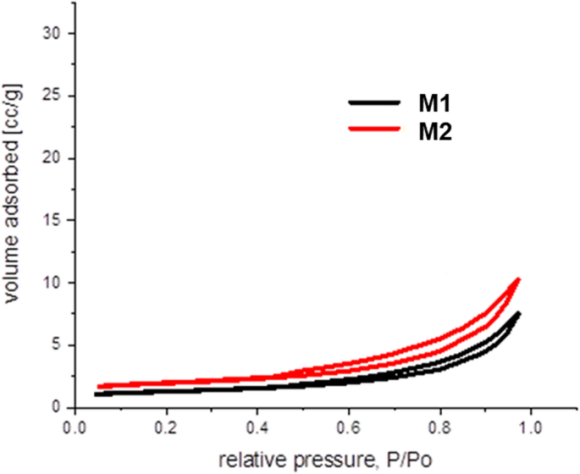
Physical properties of adsorbent (pore size, pore volume) were investigated using the low-temperature (77 K) nitrogen adsorption–desorption isotherms. As presented in Fig. 1 the isotherms of EFM fitted in a type II isotherm with a H3 hysteresis loop, indicating a macroporous structure for the both adsorbent molar ratio (M1 and M2)38.
The nitrogen adsorption–desorption isotherms for EFM adsorbent.
The mineralogical compositions of the raw materials as well as of the adsorbent were studied through XRD analysis. The size of the crystalline domains was evaluated by means of the Debye–Scherrer formula (Eq. 14)41,
where (lambda) is the X-ray wavelength of Cu K-α ((lambda = 0.15406;{text{nm}})), (beta) is the full width at half maximum in radians and (theta) is the Bragg angle.
From the most prominent peak, one gets D = 21.6 nm.
The XRD spectrum of magnetite sample (Fig. 2) shows the diffraction peaks of the well crystallized spinel phase magnetite Fe3O4 (COD 9005837) with average crystallite size of 21.6 nm. In the XRD spectrum of eggshell sample (Fig. 3) are recorded the diffraction peaks of the single phase well crystallized calcite CaCO3 (COD 9000965) with mean crystallite size of 125.8 nm15,40.
XRD spectra of magnetite.
XRD spectra of eggshell.
The XRD spectrum (Fig. 4) shows that the fly ash sample has a complex composition. Four crystalline phases have been identified whose characteristics are presented in Table 2.
XRD spectra of fly ash sample.
From the data presented in the Table 2 indicates that fly ash sample used in the preparation of the adsorbent is not non-hazardous solid waste22.
In the XRD spectra of M1 (Fig. 5a) are visible the diffraction peaks characteristic of the crystalline phases existing in the eggshell (calcite CaCO3), the fly ash (but only those of the phase with more intense peaks, quartz SiO2), and magnetite (Fe3O4). Because the eggshell is mixed in a larger proportion than the other two components, the CaCO3 peaks are the most intense.
(a) XRD spectra of M1. (b) XRD spectra of M2. (c) XRD spectra of magnetite, eggshell, fly ash, M1 and M2.
Analyzing the XRD spectrum obtained for M2 (Fig. 5b), the crystalline phases that can be identified are: magnetite Fe3O4, calcite CaCO3, quartz SiO2, and corundum Al2O3. The most intense are the magnetite peaks. In this sample, because the ash is mixed in a larger proportion, the SiO2 peaks are more intense and another crystalline phase present in it (Al2O3) becomes visible in the spectrum.
Figure 5c shows the overlapping XRD spectra of M1, M2 and raw materials (magnetite, fly ash and eggshell). In both M1 and M2, the phase peaks of individual components can be observed.
However, due to the different materials crystallinity, only the most intense peaks appear by overlap. Also, the phase diffraction lines (Figs. 2, 3, 4, 5) are no longer visible.
The surface morphology and particle size of raw materials and adsorbent were investigated through SEM technique. The micrographs are presented in Figs. 6, 7, 9, 10, 11, 12, 13 and 14.
Two-dimensional image of the magnetite particle obtained by the SEM technique.
Two-dimensional image of the ash fly particle obtained by the SEM technique.
The SEM image of magnetite (Fig. 6) suggest that particles are of nanometric dimensions (with the average size about 21 nm), uniform and with a cubic structure25,42,43.
Figure 7 shows that the fly ash particles are of porous spherical shapes with different sizes as well as porous irregularly or angularly shaped particles16,44. As can be seen in (Fig. 7) the surface of the ash sphere is irregular and has streaks due to the mechanical and thermal stress.
Figure 8 presents the elemental composition of the ash fly determined through EDX analysis.
EDS spectra of fly ash sample.
According to the data from EDX (Fig. 8), there are only seven elements which are predominant in sample: aluminum, iron, magnesium, calcium, silica, oxygen and sulphur16,45.
SEM micrograph of eggshell sample (Fig. 9a,b) indicates a different size (about 100 nm) irregular crystal on multihole surface structure36,40.
(a) Two-dimensional image of the eggshell particle obtained by the SEM technique. (b) Two-dimensional image of the eggshell particle obtained by the SEM technique.
The morphology of M1 (Fig. 10a,b) indicates the presence of agglomerations of particles of different sizes in the nano field, spherical shape, cubic shaped and irregular crystal structure sizes, suggesting a good connectivity between them.
(a) Two-dimensional image of M1 particle obtained by the SEM technique (magnitude 3 µm). (b) Two-dimensional image of M1 particle obtained by the SEM technique (magnitude 5 µm).
Also, the (Fig. 10b) indicates that the cubic-shaped particles characteristic of magnetite (Fig. 6) loaded into the pores of the ash and eggshell particles.
The Fig. 11 shows the live map for M1 and the distribution of the identified elements.
SEM M1- Live map.
The SEM micrograph of M2 (Fig. 12a,b) the same agglomerations of particles of different nano-sizes, spherical shape, cubic shaped and irregular crystal structure sizes are observed as in the case of SEM graph for M1.
(a) Two-dimensional image of M2 particle obtained by the SEM technique (magnitude 3 µm). (b) Two-dimensional image of M2 particle obtained by the SEM technique (magnitude 5 µm).
The Fig. 13 shows the live map for M2 and the distribution of the identified elements.
M2 SEM—Live map.
The comparative analysis of the Fig. 13 showing Live map for M2 and M1 (Fig. 11) highlights the presence of differences regarding the proportion of identification elements in the two samples, due to the different molar ratio between eggshell and ash.
In the Fig. 14a can be observed a larger number of spherical particles characteristic of district heating ash, as a result of the change in the ratio between the two wastes (eggshell:ash = 3:1), loaded with magnetite particles. At the same time, in SEM the micrograph for M1 (Fig. 14b) is much more obvious the multihole structure of the eggshell.
(a) Two-dimensional image of M1 particle obtained by the SEM technique (magnitude 30 µm). (b) Two-dimensional image of M2 particle obtained by the SEM technique (magnitude 50 µm).
The analysis of the SEM micrograph (Fig. 14a) of the M1 sample (in which the eggshell component is predominant) indicates that the multi porous structure of the eggshell is loaded with both the cubic-shaped particles of the magnetite and the spherical ones belonging to the ash sample. This aspect is much more visible in the case of SEM micrograph of the M2 sample (Fig. 14b), considering the fact that in this ash is found in the majority proportion (magnetite:eggshell:ash = 1:1:3).
This result suggests that through the procedure of mechanical alloying in the mill with high energy balls were achieved simultaneously:
reducing the particle size of magnetite, ash and eggshell;
individual functionalization of each waste (eggshell, ash) with magnetite particles;
a new, nanosized material in which the double functionalization of the eggshell with ash particles functionalized with magnetite was achieved simultaneously with the loading of the pores of the eggshell surface with the magnetite particles.
By modifying the structure of the two wastes from the composition of the newly obtained material (decreasing the number of pores) leads to increased surface areas, confirmed by the results of the BET analysis (Table 1) and implicit sorption sites suggesting an improvement of adsorbent properties.
Figure 15 shows the IR spectra for EFM adsorbent raw materials (magnetite, fly ash and eggshell).
IR spectra for adsorbent raw material samples (magnetite, eggshell and fly ash).
FT-IR spectra for EFM engineered adsorbent are presented in Fig. 16.
FT-IR spectra of adsorbent (both molar ratios: M1 and M2) and its raw materials.
The FT-IR spectra for adsorbent (at the both molar ration: M1 and M2) presents the vibrational bands characteristic of magnetite at 589 and at 432 cm−1associated with Fe–O stretch vibration46. The peaks assigned to the fly ash component: at 588 cm-1 Ca O group, at about 670 cm−1 attributed to the Al–O–Al bending vibration, at 1100 cm−1 is associated with X–O (X = Al, Si) and asymmetric stretching vibrations and band at 830 cm−1 specific to AlO4 coordination16,22,47,48,49. In addition, in the adsorbent FTIR spectra (Fig. 16) were found the characteristic IR bands eggshell component (Fig. 15). Thus, peak at 712 cm−1 (correspond to CaO stretching vibration), peaks at 875 and 1423 are attributed to C–O stretching vibration. The bands at 1798 and 2515 cm−1 are associated with O–C–O and peaks at 2875 respectively at 2981 cm−1 are due to CH– symmetric and asymmetric stretching vibration15,31,50. The position of O–H peak at 3740 cm−1 indicates the presence of moisture and water molecules15,22. As expected, the intensity of the peaks differs in M1 and M2, due to the different molar ratio between two of the raw materials that are part of the adsorbent component (fly ash and eggshell). These results are in close agreement with the literature and theoretical values confirms the presence of magnetite, fly ash and eggshell in adsorbent (at both molar ration: M1 and M2).
Figure 17a presents the thermal analysis results for fly ash sample.
(a) Thermogravimetric analysis of the fly ash sample in the range of 30–500 °C with a heating rate of 10 °C/min in open aluminum crucibles in the air atmosphere. (b) Thermogravimetric analysis of the eggshell with a heating rate of 10 °C/min up to 500 °C.
The thermal analysis performed in the interval 30–500 °C highlighted two stages of decomposition. The first stage takes place in the range of 30–49 °C with a loss of 0.22% of the sample mass. This decomposition can be attributed to water loss. This process is visible in the DTG curve with a maximum at 45.5 °C, but also on the Heat Flow curve with a maximum at the same temperature and characterized by an exothermic process with ΔH = − 12.44 J/g. The second process presents a continuous thermal decomposition with a maximum observable on the DTG and HF curve at 480 °C, characterized by an exothermic effect. The decomposition does not end in the studied interval. The total weight loss is 2% of the sample mass16.
The thermal analysis, in the range of 30–500 °C, performed for the eggshell sample (Fig. 17b), revealed a complex thermal decomposition. This decomposition has several stages that are difficult to separate. It is known that, in addition to inorganic calcium carbonate compounds, in the eggshell are present a multitude of organic components such as: proteins as main constituents, small amounts of carbohydrates and lipids51,52.
At the same time, uronic acid is also present, which plays an important role in the resistance of the shell, such as sialic acid in very low concentration and two glycosaminoglycans, including hyaluronic acid, as well as a copolymer consisting of chondroitin sulfate-dermatan sulfate. There is also limited information on variations in nitrogen concentrations and the amino acid composition of the eggshell. A better understanding of the chemicals present in the composition of the eggshell is very important for its application in various fields, including for the purpose of absorbent material.
The analysis of the TG curve highlights three hardly separable decomposition stages, the last of which is characterized by a complex multistage decomposition process. It is observed that in the interval 30–100 °C which can be attributed to dehydration, followed by the loss of crystallization water in the range 100–266 °C (4.8% of the sample mass) and then the complex decomposition of organic components in different stages depending on their stability until at 500 °C15.
The last decomposition stage results in the loss of 80% of the total mass of the sample. Over 500 °C the decomposition of the inorganic component takes place, namely Ca carbonate. It can be seen that in the analyzed sample the weight of inorganic component is relatively small, namely 12.2% of the sample mass. During the decomposition stage from the interval 266–500 °C several maxima are observed on the DTG curve, which led us to conclude that simultaneous decompositions of several organic compounds take place, observing maxima at 345, 363, 374, 403, 408, 412, 430, 466 and 470 °C. The same main decomposition steps are faintly visible and the HF curve with processes in most cases exothermic. At temperatures higher than 266 °C and on this curve are visible several processes, most of which are exothermic, which can be attributed to the oxidation of organic compounds and their decomposition. The residue left after the thermogravimetric study (performed up to 500 °C) is calcium carbonate15,53.
Subsequently, the mixture of the two wastes was analyzed in the two molar ratios:eggshell:fly ash = 3:1 and eggshell:fly ash = 1:3, respectively.
The profile of thermogravimetric analysis for the binary mixture eggshell:ash fly in a 1:3 mass ratio performed in the range of 30–500 °C is depicted in Fig. 18.
Thermogravimetric analysis for eggshell: fly ash binary mixture in a 1: 3 mass ratios obtained in the range of 30–500 °C.
The thermal analysis performed in the case of the binary mixture of eggshell and ash, in a 1:3 molar ratios, highlights the decomposition stages of the two components. Namely, the stage of water loss within the ash is visible, to which is added the loss of moisture observed in the case of the eggshell. On the HF flow is visible the exothermic process with a maximum of 45 °C and a ΔH = − 17.023 J/g which represents a sum of the two processes mentioned above. Two other processes are visible on the TG curve, one in the temperature range, 51–213 °C, with a mass loss of 0.27% of the sample mass. Then followed by a loss of 1.74% in the temperature range 213–405 °C. The thermal decomposition continues even above this temperature and the decomposition process was not completed in the studied temperature range.
A thermogravimetric study was performed for the same binary mixture but in the eggshell:fly ash = 3:1 molar ratio. The results are presented in the next figure (Fig. 19).
Thermogravimetric analysis for eggshell: fly ash binary mixture in a 3:1 mass ratio obtained in the range of 30–500 °C.
In the case of the thermal analysis of the binary mixture of eggshell and ash in a 3:1 molar ratio, the decomposition stages and the thermal behaviour of the individual components in correlation with the mixing ratio are very clearly visible.
The magnetic properties of the samples: magnetite, M1 and M2 were investigated with an induction hysteresis-graph at low frequency driving field (50 Hz)54. And the hysteresis loops are presented in Figs. 20, 21 and 22. It was found that the samples reveal ferromagnetic behaviour and from the measured hysteresis loops the saturation magnetization ((sigma_{S})), the coercive field (Hc) and the remnant magnetization ((sigma_{R})) were determined. The results are presented in Table 3.
The hysteresis loop of sample M2.
The hysteresis loop of sample M1.
The hysteresis loop of magnetite.
As expected, the largest value of the saturation magnetization is that of the sample consisting entirely of magnetite. By diminishing the content of ashes from the thermal power station (from three parts in M2 sample to one part in sample M1) a small increase of the saturation magnetization was observed, from 14.06 to 15.12 emu/g (see Table 3). This can be explained by the presence of diamagnetic compounds within the ashes of the thermal station, the decrease of which led to the increase in the saturation magnetization of the sample M1, as compared to the sample M2. All three samples have small values of the remnant ratio, (sigma_{R} /sigma_{S}), which is an indication of the ease with which the magnetization reorients to the nearest easy axis magnetization direction after the remove of magnetic field.
The dependencies on frequency of the complex magnetic permeability of the samples, (mu left( f right) = mu^{prime}left( f right) – imu^{primeprime}left( f right)), measured at room temperature, over the frequency range 3 kHz to 2 MHz are presented in Fig. 23. The measurements were performed using an Agilent LCR-meter (E-4980A type) in conjunction with a coil containing a vial in which the samples were placed. Details on the method of measurements of the real, (mu^{prime}left( f right)) and imaginary, (mu^{primeprime}left( f right)) components of the complex magnetic permeability are given in a previous study55.
Frequency dependence of the magnetite, M1, M2 of the complex magnetic permeability.
In the frequency range in which the measurements were made, samples M1 and magnetite exhibits visible relaxation peaks of (mu^{primeprime}left( f right)), at the frequency of 30 kHz. Even if the M1 sample and the M2 sample have the same amount of magnetite, due to the diamagnetic compounds in the fly ash, the relaxation peak of the M1 sample is very attenuated (little visible, almost missing).
Given the small size of the magnetite particles in the samples (on the order of tens of nanometers), they do not have a multi-domain magnetic structure. Thus, the only magnetic relaxation process, measurable in the radio frequency field, is the Neel relaxation process. The Néel relaxation time, (tau_{N}) is given by Eq. (15)56
where K is the effective anisotropy constant of the material from which the magnetic particles are made of, v is the magnetic volume of particles, kB is the Boltzmann’s constant, T is the temperature and (tau_{0}) is a constant in order of 10–9 s56.
Assuming that the frequency dependence of the complex magnetic permeability,(mu left( f right) = mu^{prime}left( f right) – imu^{primeprime}left( f right)) obeys the Debye dispersion relations, then the frequency corresponding to the maximum of (mu^{primeprime}left( f right)) is correlated with the relaxation time by the relation, (2pi {kern 1pt} ftau = 1). For measurements at room temperature, with f = 30 kHz, the magneto-crystalline anisotropy constant of magnetite, K = 1.1 × 10⁴ J m−3 and (tau = tau_{N}), under assumption of spherical shape of particles, one gets a magnetic diameter of the magnetite particles, d = 18.2 nm. This value compares favourably with the values measured by SEM and X-ray diffraction.
Figure 24a and b show the relationships between different material dosage and the cadmium removal efficiency and respectively adsorption capacity.
(a) The relationship between different material dosage and the cadmium removal efficiency. (b) The relationship between different material dosage and the cadmium adsorption capacity.
According to the Fig. 24a and b, cadmium removal efficiency and adsorption capacity depending on the amount of adsorbent used shows an upward trend (for quantities between 0.05 and 0.25 g), reaches a maximum of 0.25 g adsorbent (99.9% and 75.48 mg/g for M1 and respectively 99.8% and 75.46 mg/g for M2), after which both removal efficiency and heavy metal adsorption capacity gradually decrease with the increase in the adsorbent dose (0.3 g). These results suggest that the increased amount of adsorbent provides a supplement to the free active sites, but after reaching equilibrium, it leads to the formation of agglomerations and consequently to a decrease in the number of available active sites22,23.
Figure 25a shows the influence of heavy metal initial concentration on cadmium removal efficiency. It can be seen that removal efficiency shows an upward trend simultaneously with the increase of the initial cadmium concentration in the range 0–33.5 mg/L. The maximum removal efficiency (99,9% for M1 and respectively 99.8% for M2) was reached at a concentration of 28.5 mg/L, after which the decrease in cadmium removal efficiency begins.
(a) Relationship between initial concentration and removal efficiency (%). (b) Relationship between initial concentration and adsorption capacity (mg/g).
According to the Fig. 25b, in the same cadmium concentration range (0–33.5 mg/L), the adsorption capacity shows a similar trend, reaching a maximum at 28.5 mg/L (75.48 mg/g for M1 and respectively 74.46 mg/g for M2), and after which gradually decreases.
These results indicate the initially an increase in the concentration of heavy metal causes an increase in the amount of Cd2 + ions and implicitly in the possibility of interaction with the active sites of the EFM adsorbent. And after reaching equilibrium, the amount of available metal ions is disproportionate compared to the decreasing number of free sites in the adsorbent, causing a decrease in the adsorption efficiency of the new engineered magnetic adsorbent used in the study15,57.
The wastewater pH is one of the top parameters with highly influence on the adsorption process efficiency having impact direct on the adsorption rate and adsorption capacity as fluctuations in the pH value of the solute induce changes in the degree of ionization of the adsorptive species and the of adsorbent surface23,57.
In this study was investigated the pH influence toward the cadmium removal using the prepared material in the pH range of 3.0–7.0, to avoid the precipitation of Cd(OH)2 at pH values > 715.
According to the experimental results presented in Fig. 26a and b, the increase in pH value (between pH 3 and pH 6) leads to a significant increase in adsorption efficiency and adsorption capacity. The adsorption efficiency and adsorption capacity reach a maximum value (99.9% and 75.48 mg/g for M1 and respectively 99.8% and 75.46 mg/g for M2) at pH 6.5, after which it decreases slightly. This could be explained as follows: at low pH values is a competition between protons and Cd2+ to occupy the active sites of the adsorbent, even if they are available in large numbers. An increase in pH simultaneously leads to a decrease in the competition of protons and electrostatic repulsion forces, which induces an increase in cadmium removal efficiency. At pH > 6.5 the removal efficiency begins to decrease as increased hydroxyl ion generation occurs to the detriment of Cd2+ ions. Therefore, the optimal pH 6.5 was chosen for subsequent experiments15,16,25,58,59.
(a) Effect of pH variation on cadmium removal efficiency. (b) Effect of pH variation on adsorption capacity.
Figure 27a showed the relationship diagram between the contact time and cadmium adsorption capacity.
(a) Effect pf contact time on cadmium adsorption capacity (mg/g). (b) Effect of contact time on cadmium removal efficiency (%).
It can be observed from the Fig. 27a and b that the increase of the contact time determines an increase of the adsorption capacity and of the removal efficiency respectively. Both reached the maxima at 120 min The maximum of cadmium adsorption capacity was 75.48 mg/g for M1 respectively 75.46 mg/g for M2, and the maximum of removal efficiency was 99.9% for M1 and respectively 99.8% for M232.
This performance can be attributed to the higher surface, the microporous structure that results from the experimental conditions of this study15.
The analysis of this diagram indicates that the adsorption of cadmium takes place in three distinct phases:
0–90 min, characterized by adsorption is fast due to the large number of active sites available on the surface of the adsorbent.
the second phase, 90–120 min, the adsorption is slower which can be attributed to the diminution of the free adsorbent active sites;
phase three:120–330 min, corresponds to the time interval in which there are no more free sites on the surface of the adsorbent and the adsorption has reached equilibrium.
According to the experimental results, optimum time in which the adsorption reaches an equilibrium is 120 min and was selected for the next investigations16,60.
Temperature represents a key parameter in adsorption process. Therefore, the influence of temperature on cadmium adsorption on prepared material in the two different molar ratios (both M1 and M2) was investigated in the range of 5–50 °C (278.15–323.15 K). The cadmium removal efficiency and adsorption capacity increase first and then a very slight decrease occurs with the increase of temperature (Fig. 28a,b).
(a) Relationship between temperature and heavy metal removal efficiency. (b) Relationship between temperature and heavy metal adsorption capacity.
At 25 °C the maximum removal efficiency is reached (99.89% for M1 and respectively 99.64% for M2). At the same temperature the heavy metal adsorption capacity is maximum of 75.48 mg/g for M1 and 75.43 mg/g for M2. This can be explained by the fact that within this temperature range indicated the favorability for the heavy metal mobilization and thus contact between cadmium and active sites from adsorbent. The relationship between temperature and cadmium adsorption effect indicates that in the range of 5–25 °C the cadmium absorption on prepared material is an endothermic process (physical adsorption). At 25–50 °C the adsorption process becomes exothermic and chemisorption occurs. However, the removal efficiency remains very high even at a temperature of 50 °C (98.78% for M1 and respectively 97.74% for M2).
A comparison of cadmium removal efficiency of the newly engineered adsorbent (EFM) with other adsorbents reported in literature is presented in the next table (Table 4).
The performance of the nanosized adsorbent EFM (at both molar ratios) can be attributed to the higher surface area, the microporous structure that results from the experimental conditions of this study15.
The removal efficiency of EFM adsorbent compared to that of its raw materials (fly ash, eggshell and magnetite) was investigated as the effect of contact time on the adsorption process. The relationship between the removal efficiency and contact time is presented in Fig. 29. It can be observed that there is an increase in the efficiency of removing heavy metal for all five investigated adsorbents (eggshell, ash, magnetite, M1 and M2) with a maximum of two hours of contact. According to the experimental results presented in Fig. 29, the best cadmium removal efficiency was obtained for M1 (99.89%) and 99.80% for M2, followed by eggshell (95.23%), fly ash (76.31%) and magnetite (71.44%).
Relationship between adsorbents removal efficiency and contact time.
Then, a very slight decrease occurs with the increase in contact time. These results confirm the cadmium removal efficiency dependence on the specific surface area and pores (number of available active sites) of the adsorbent used (Table 1).
The maximum cadmium removal efficiencies determined experimentally in this study for the raw materials (eggshell, ash and magnetite) corroborated with the data reported in the literature15,25,33,61.
The absorption mechanism evaluation can be performed through an isotherm adsorbent study. The equilibrium isotherm plays a key role in the investigation of the adsorption behaviour.
Due to their simplicity and convenient accuracy, Langmuir and Freundlich’s models are the most commonly used to adjust an adsorption process.
Langmuir models provides information on the interaction between the solute and the monolayer surface of the adsorbent. The main working hypotheses of this model are: (1) adsorbent surface consists of uniform, identical sites distributed on the surface of adsorbent (2) adsorbent process takes place only on the surface of the adsorbent and (3) no contact between adsorbed molecules on the surface of the adsorbent.
Freundlich model is appropriate to monolayer and multilayer adsorption processes on multiphase surfaces. This isotherm gives an expression on adsorbent surface heterogeneity and the variation in the heat of adsorption process. The applicability of the Freundlich model is limited by adsorption processes that take place at high pressures, but this restriction does not apply to the Langmuir model.
These two adsorption isotherm models were applied in order to identify and implement an optimal model that adequately reproduces the experimental results obtained in this study were employed to study the mechanism of cadmium adsorption on the prepared material60,62.
The parameters calculated as well the coefficient of correlation (R2) for both Langmuir and Freundlich models are presented in the Table 5.
As shown in the Table 5 both models fitted well for the experimental results. The maximum capacities calculated are close to the values for each component of the prepared adsorbent material (magnetite, eggshell and fly ash) and maximum capacities obtained at equilibrium (Table 5)22,23,57,63,64. However, according to the values of the correlation coefficient, R2, the behaviour of cadmium absorption suits better with Freundlich model (the higher correlation coefficient) suggests that the adsorption for cadmium ions was a multi-molecular layer adsorption process. The values for the Langmuir constant, KL, or equilibrium parameter for absorbent (the both molar ratios, M1 respectively M2) falls within the range 0 < RL > 1 indicated a favourable adsorption process. Moreover, Freundlich dimensionless constant n values having greater than 1 suggests a favourable adsorption process that occurs on the investigated EFM adsorbent heterogeneous surfaces62,65,66.
The kinetic models provide information on the efficiency of the adsorbent, the dynamic parameters (rate, time, etc.) of the adsorption process. The cadmium adsorption process on the prepared material was investigated employing linear and non-linear of pseudo-first-order (Eq. 6) pseudo-second-order (Eq. 7) and intraparticle diffusion models (Eq. 8) to fit the obtained experimental adsorption data. The Fig. 30a–c depicted the plots of the first-order, second-order and intraparticle diffusion models for the cadmium adsorption on nano-engineered adsorbent (EFM).
(a) Pseudo first-order model fitting diagram. (b) Pseudo second-order model fitting diagram. (c) Intraparticle diffusion model fitting diagram.
The kinetic parameters were obtained from the slope and intercept of the fitting plots of adsorption reaction models: pseudo first-order model (the correlation between log(qe-qt) against time), respectively the pseudo second-order model (correlation between t/qt function on time) and adsorption diffusion model: intraparticle diffusion model (the plot as function of ({t}^{1/2})).
The results of fitting parameters on these kinetic models are presented in Table 6.
According to the data obtained in Table 6, the coefficients of adsorption reaction models have both values close to one, slightly differing only at the fourth decimal. It could suggest that cadmium removal is achieved through a physical and chemical adsorption process. It must be noted that were obtained higher values for the correlation coefficient (R2) and the calculated adsorption capacity value is very similar to those determined experimentally in the case of the pseudo-second-order kinetics model. Therefore, pseudo-second-order kinetic model was more suitable to describe the adsorption process. This indicating a chemical adsorption is assumed as the rate-limiting step for the cadmium adsorption on prepared material, involving an electron exchange between adsorbent and adsorbate (cadmium occurs with formation of strong chemical bonding)23.
According to the Fig. 30c the allure of intraparticle diffusion model includes three regions. The first region corresponds to a boundary diffusion (cadmium diffusion on the prepared material exterior surface). The second region is related to heavy metal intraparticle diffusion into the pores of nano-engineered adsorbent (EFM). The third region represent the cadmium adoption into the interior site of the EFM. Since, the slope of the three regions gradually decreases (Ki1 > Ki2 > Ki3) is assumed that boundary diffusion is the limiting region, followed by intraparticle diffusion15,67. The results indicate that beginning of the adsorption process cadmium ions can be quickly bound on the prepared material exterior surface. In the intraparticle diffusion process (second region) there is a gradual decrease in adsorption at the sites on the adsorbent surface (adsorption capacity reaches the maximum value). Then, cadmium adsorption takes place on the available sites inside the adsorbent, generating significant mass transfer resistance and reaching the adsorption equilibrium and the adsorption rate gradually decreases68,69,70.
The adsorption models used provide information on both the performance of the prepared material and a perspective of the adsorption mechanism.
The Gibbs free energy in adsorption process was calculated according to the corresponding equation (Eq. 10). The thermodynamic parameters ΔS and ΔH were obtained from the slope and intercept of the adsorption thermodynamic curve. The obtained results are presented in next table (Table 7).
From these data obtained (Table 7) can be found that the free energy variation value of the adsorption process has negative values (ΔG < 0) for both M1 and M2 indicating that adsorption is thermodynamically feasible and take place spontaneously. In the range of temperature 278.15–298.15 K, the ΔG values decrease with an increase of temperature. These data suggest a decrease in the feasibility of adsorption at a higher temperature. After 298.15 K a shift can be observed. The ΔG values decrease slightly with increasing temperature in the temperature range temperature: 298.15–323.15 K, indicating that the adsorption was more spontaneous at low temperature.
The calculation of the ΔH value is important because it provides information on the type of adsorption, whether it is a physical or chemical process. The ΔH value calculated in this study were 41.12 kJ/mol for M1 and 39.76 kJ/mol for M2.
The positive enthalpy values (ΔH) denote an endothermic adsorption process and also suggest that the type of adsorption is a physico-chemical adsorption. Likewise, the entropy charge, ΔS, positive values (133.54 J/(K mol) for M1 and 128.43 J/(K mol) indicate an affinity of this adsorbent for cadmium ions as well the fact that in the EFM adsorbent material occurs structural change23,57,60,61,71,72,73,74,75.
Structural and morphological data obtained through FT-IR and SEM–EDX techniques was used to get information on cadmium adsorption mechanism on the prepared material.
A comparative investigation on FTIR spectra of EFM was performed before (Fig. 31a) and after cadmium removal (Fig. 31b) in order to identify the modification on adsorbent functional groups vibrational bands.
(a) FT-IR spectra of adsorbent (both molar ratios: M1 and M2) prior adsorption. (b) FT-IR spectra of adsorbent (both molar ratios: M1 and M2) after cadmium adsorption.
Figure 31b shows significant changes in the intensity of some vibrational peaks, the displacement of others at other wavelengths and new absorption bands identified after adsorption of cadmium on EFM. Also, new adsorption bands and substantial changes regarding the intensity and displacement of functional groups peaks from M1 and M2 after the cadmium adsorption can be observed in Fig. 31b. Thus, the significant attenuation of the O–H peak at 3740 cm−1 can be attributed to the fact that this functional group is involved in the adsorption process23,68.
In addition, the cadmium adsorption on EFM determined a significant attenuation of the intensity of the following adsorption bands: 1423 cm−1 (attributed to C–O stretching vibration), at 1798 and 2515 cm−1 (associated with O–C–O), at 2875 respectively at 2981 cm−1(CH– symmetric and asymmetric stretching vibration). These differences in the band intensity can be attributed to the interaction of cadmium ions with functional groups of EFM76.
After the cadmium adsorption on M1 and M2It can also be seen that the absorption bands at about: 589 cm−1 (associated with Fe–O stretch vibration), 670 cm−1 (attributed to the Al–O–Al bending), 875 cm−1 (attributed to C–O stretching vibration) and 1100 cm−1(associated with X–O (X = Al, Si)) have been shifted.
Peak identified at 1392.81 cm−1 can be attributed to the nitrate stretching vibration from the heavy metal source (cadmium nitrate)77,78.
Also, the appearance of new absorption bands in the 400–500 cm−1 region can be attributed to the Cd–O bond vibrational peaks77. According to the FTIR results can assume that adsorption of cadmium on EFM takes place through chemical bonds76,77.
To confirm the results of FTIR spectroscopy, the morphological modification of the EFM after cadmium adsorption was investigated by the SEM_EDX technique.
The SEM micrograph of M1 and M2 before and after the cadmium adsorption are presented in the Figs. 32 and 33.
(a) Two-dimensional image of M1 particle obtained by the SEM technique (magnitude 10 µm) before adsorption. (b) Two-dimensional image of M1 particle obtained by the SEM technique (magnitude 10 µm) after adsorption.
(a) Two-dimensional image of M2 particle obtained by the SEM technique (magnitude 5 µm) before adsorption. (b) Two-dimensional image of M2 particle obtained by the SEM technique (magnitude 5 µm) after adsorption.
The SEM micrograph of M1 and M2 after adsorption (Figs. 32b, 33b) indicate the presence of the presence of numerous particles of irregular shapes attributed to heavy metal. Since both SEM of M1 and M2 after adsorption shows a higher accumulation of particles compared with SEM images before (Figures), which suggests that adsorption takes place in the inner pores of the prepared material and thus decreasing the porosity of the adsorbent. This fact indicates that both M1 and M2 show morphological changes after cadmium adsorption76,79.
The EDX spectra of M1 and M2 prior and after adsorption are presented in the Figs. 34 and 35.
(a) EDX spectra of M1prior adsorption. (b) EDX spectra of M2 prior adsorption.
(a) EDX spectra of M1 after adsorption. (b) EDX spectra of M2 after adsorption.
The intensity of M1 and M2 peaks corresponding to their elemental composition differs due to the different molar ratios of the two raw materials (ash and eggshell) that are part of the adsorbent component.
The comparative analysis of the Figs. 34 and 35 shows that in the EDX spectra of M1 and M2 the peak of the heavy metal appears only after adsorption (Figs. 34b, 35b).
According to these results the adsorption of cadmium takes place into the EFM76,79,80.
A sustainable and efficient adsorbent means very high efficiency of pollutant removal and the reused possibility15,59.
In this study, the desorption of the adsorbed cadmium ions on the EFM was investigated using acid (nitric acid and hydrochloric acid) and base (NaOH) solutions. The desorption yield was determined using the equation (Eq. 13).
Figure 36a shows the relationship between the desorption rate obtained for the desorption agents used as a function of time. It can be observed as the desorption rate, for all desorption agents used, increases proportionally with time between 0 and 10 h, when it reaches a maximum value, after which there is a slight decrease57.
(a) The relationship between the desorption rate and time. (b) Reuse of EFM.
According to Fig. 36a, nitric acid was the best desorption agent (a maximum desorption rate of 88.56% for M1 and 88.82% for M2). This fact can be justified that, in an acidic environment, there is a massive number of protons competing with adsorbed cadmium ions. The increase in electrostatic repulsion forces between cadmium ions leads to the replacement of cadmium with protons in the active sites of the adsorbent15,59.
Instead, in an alkaline environment occurs the cadmium precipitation, although, in the presence of NaOH, are desorbed a large number of cadmium ions from the surface of the prepared material59.
The key feature of a cheap and high-performance adsorbent is the possibility of multiple reuses. And the desorption of the pollutant from the adsorbent must be done by a simple and efficient method68.
Ten cycles of adsorption–desorption experiments were conducted to examine the cadmium adsorption capacity of the EFM. Figure 36b depicted the variation of the adsorption capacity of cadmium depending on the number of adsorption/desorption cycles. It was found that the adsorption capacity decreased by 20% (both for M1 and M2) after ten cycles. After only five cycles, the adsorption capacity decreased by only 6% for M1 and M2. These results suggest that the performance and regenerative capacity of EFM are good23,61.
Table 8 present the results of one-way analysis of variance (ANOVA) without replication.
The results obtained (F = 1.149592 and p = 0.30177) indicate that variation within the samples (F) is a value for F ~ 1, and the p value is > α lower than 0.05 (α = 0.05), which suggests that between the M1 and M2 there are not statistically significant differences.
This study described the cadmium removal from an aqueous solution using a newly engineered nano-adsorbent (EFM) from two different wastes (eggshell and fly ash). The adsorption and physico-chemical properties of this new adsorbent were detailed studied. The mechanism of functionalization was the simultaneous loading of each waste (eggshell and fly ash) with magnetite nanoparticles and was confirmed by SEM, XRD, and FTIR.
In addition, SEM and BET analysis support the claim that the double functionalization of the eggshell with ash particles functionalized with magnetite was achieved simultaneously with the loading of the pores of the eggshell surface with the magnetite particles. Therefore, there was a substantial increase in the surface area and the number of active adsorption centers, which allowed to obtain a very high cadmium removal efficiency (99.9%). The room temperature and pH 6.5 are favourable for the adsorption process. Results from the adsorption isotherms study indicated that adsorption for cadmium ions was a multi-molecular layer adsorption process that occurs on the investigated new magnetic nano-sized engineered adsorbent heterogeneous surfaces. The adsorption kinetics results suggest a chemical mechanism described by pseudo second-order model. FTIR and SEM–EDX studies suggest that metal adsorption on the new magnetic nano-sized engineered adsorbent is done through chemical bonds.
Desorption and regeneration study shows that nitric acid can be used for the cadmium desorption (a maximum desorption rate of 88.56% for M1 and 88.82% for M2) and also for the adsorbent regeneration.
This study demonstrates the advantages of this newly engineered adsorbent: (1) simple preparation method; (2) environmental-friendly; (3) reusable; (4) highly efficient at mild experimental condition (25 °C pH 6.5); (5) stable and (6) simple, easy method to reuse a mixt of waste within the circular economy model for heavy metal wastewater treatment.
WHO (World Health Organization). Health through safe drinking water and basic sanitation. http://www.who.int/water_sanitation_health/mdg1/en/index.html (2008).
Ghisellini, P., Cialani, C. & Ulgiati, S. A review on circular economy: The expected transition to a balanced interplay of environmental and economic systems. J. Clean Prod. 114, 11–32 (2016).
Article Google Scholar
Gautam, R. K., Sharma, S. K. & Mahiya, S. Chattopadhyaya Mahesh, C. Major contaminants in industrial and domestic wastewater a contamination of heavy metals in aquatic media: transport, toxicity and technologies for remediation. In Heavy Metals in Water: Presence, Removal and Safety (ed. Sharma, S. K.) (The Royal Society of Chemistry, 2015).
Google Scholar
Mishra, A. & Tripathi, B. D. Utilization of fly ash in adsorption of heavy metals from wastewater. Toxicol. Environ. Chem. 90(6), 1091–1097 (2008).
CAS Article Google Scholar
Torres, N. & Gupta, G. Use of fly ash in reducing toxicity of and heavy metals in wastewater effluent. J. Hazard. Mater. 57(1–3), 243–248 (1998).
Google Scholar
Wang, S., Soudi, M., Li, L. & Zhu, Z. H. Coal ash conversion into effective adsorbents for removal of heavy metals and dyes from wastewater. J Hazard Mater. 133(1–3), 243–251 (2006).
CAS PubMed Article Google Scholar
The Romanian Law 241/2006 on the water supply and sewerage service (2006).
The Regulations on the conditions of wastewater discharge into the sewage systems of towns and directly into treatment plants. NTPA-002/2002 of 28.02.2002 (2002).
WHO. Preventing disease through healthy environments: Exposure to cadmium—A major public health concern (WHO/CED/PHE/EPE/19.4.3) (World Health Organization, 2019).
Google Scholar
Bernhoft, R. A. Cadmium toxicity and treatment. Sci. World J. 2013, 7 (2013).
Article CAS Google Scholar
Genchi, G., Sinicropi, M. S., Lauria, G., Carocci, A. & Catalano, A. The effects of cadmium toxicity. Int. J. Environ. Res. Public Health 17(11), 3782 (2020).
CAS PubMed Central Article Google Scholar
Haider, F. U. et al. Cadmium toxicity in plants: Impacts and remediation strategies. Ecotoxicol. Environ. Saf. 211, 111887 (2021).
CAS PubMed Article Google Scholar
WHO. Cadmium in Drinking-Water. Background Document for Development of WHO Guidelines for Drinking-Water Quality (World Health Organization) (WHO/SDE/WSH/03.04/80/Rev/1). http://www.who.int/water_sanitation_health/water-quality/guidelines/chemicals/cadmium.pdf (2011).
WHO. Guidelines for Drinking-Water Quality 4th edn, 327–328 (World Health Organization, 2011).
Google Scholar
Annane, K., Lemlikchi, W. & Tingry, S. Efficiency of Eggshell as a Low-Cost Adsorbent for Removal of Cadmium: Kinetic and Isotherm Studies (Springer, 2021).
Google Scholar
Olabemiwo, F. A. et al. Cadmium removal from contaminated water using polyelectrolyte-coated industrial waste fly ash. Bioinorg. Chem. Appl. 2017, 13 (2017).
Article CAS Google Scholar
Godt, J. et al. The toxicity of cadmium and resulting hazards for human health. J. Occup. Med. Toxicol. 1, 22 (2006).
PubMed PubMed Central Article CAS Google Scholar
CEIP. EMEP Centre on Emission Inventories and Projections. Centre on Emission Inventories and Projections. https://www.ceip.at (2021).
EEA. EMEP/EEA air pollutant emission inventory guidebook 2019: Technical guidance to prepare national emission inventories. EEA Report No 13/2019. European Environment Agency. https://www.eea.europa.eu/publications/emep-eea-guidebook-2019 (2019).
EEA. Air quality in Europe: 2020 report. EEA report No 9/2020. European Environment Agency. https://www.eea.europa.eu/publications/air-quality-in-europe-2020-report (2020).
Commission Regulation (EU) 2021/1323 of 10 August 2021 amending Regulation (EC) No 1881/2006 as regards maximum levels of cadmium in certain foodstuffs (Text with EEA relevance). http://data.europa.eu/eli/reg/2021/1323/oj (2021).
Mohan, S. & Gandhimathi, R. Removal of heavy metal ions from municipal solid waste leachate using coal fly ash as an adsorbent. J. Hazard. Mater. 169(1–3), 351–359 (2009).
CAS PubMed Article Google Scholar
Lei, T. et al. Adsorption of cadmium ions from an aqueous solution on a highly stable dopamine-modified magnetic nano-adsorbent. Nanoscale Res. Lett. 14, 352 (2019).
ADS PubMed PubMed Central Article CAS Google Scholar
Bassam, R. et al. Studies on the removal of cadmium toxic metal ions by natural clays from aqueous solution by adsorption process. J. Chem. 2021, 14 (2021).
Article CAS Google Scholar
Padmavathy, K. S., Madhub, G. & Haseena, P. V. A study on effects of pH, adsorbent dosage, time, initial concentration and adsorption isotherm study for the removal of hexavalent chromium (Cr(VI)) from wastewater by magnetite nanoparticles. Procedia Technol. 24, 585–594 (2016).
Article Google Scholar
Cepan, C. et al. Assessment of the different type of materials used for removing phosphorus from wastewater. Materials 14(16), 4371 (2021).
ADS CAS PubMed PubMed Central Article Google Scholar
European Commission. Communication from the Commission to the European Parliament, the Council. The European Economic and Social Committee and the Committee of the Regions Closing the loop: An EU action plan for the Circular Economy, Brussels, 2.12.2015. COM (2015) 614 final (2015).
Alquzweeni, S. S. & Alkizwini, R. S. Removal of cadmium from contaminated water using coated chicken bones with double-layer hydroxide (Mg/Fe-LDH). Water 12, 2303 (2020).
CAS Article Google Scholar
Waheed, M. et al. Channelling eggshell waste to valuable and utilizable products: A comprehensive review. Trends Food Sci. Technol. 106, 78–90 (2020).
CAS Article Google Scholar
Jai, P. H., Wook, J. S., Kyu, Y. J., Gil, K. B. & Mok, L. S. Removal of heavy metals using waste eggshell. J. Environ. Sci. 19, 1436–1441 (2007).
Article Google Scholar
Carvalho, J., Araujo, J. & Castro, F. Alternative low-cost adsorbent for water and wastewater decontamination derived from eggshell waste: An overview. Waste Biomass Valor. 2, 157–167 (2011).
Article Google Scholar
Ma, L. et al. Removal of cadmium from aqueous solutions using industrial coal fly ash-nZVI. R. Soc. Open Sci. 5, 171051 (2018).
ADS PubMed PubMed Central Article CAS Google Scholar
Daraei, H., Mittal, A., Noorisepehr, M. & Mittal, J. Separation of chromium from water samples using eggshell powder as a low-cost sorbent: Kinetic and thermodynamic studies. Desalin. Water Treat. 53(1), 214–220 (2013).
Article CAS Google Scholar
Fernández-Reyes, B., Ortiz-Martínez, K., Lasalde-Ramírez, J. A. & Hernández-Maldonado, A. J. Engineered adsorbents for the removal of contaminants of emerging concern from water. Contam. Emerg. Concern Water Wastewater 3, 45 (2020).
Google Scholar
Ravi, T. & Sundararaman, S. Synthesis and characterization of chicken eggshell powder coated magnetic nano adsorbent by an ultrasonic bath assisted co-precipitation for Cr(VI) removal from its aqueous mixture. J. Environ. Chem. Eng. 8, 103877 (2020).
CAS Article Google Scholar
Chen, D., Xiao, X. & Yang, K. Removal of phosphate and hexavalent chromium from aqueous solutions by engineered waste eggshell. RSC Adv. 6(42), 35332–35339 (2016).
ADS CAS Article Google Scholar
Lowell, S., Shields, J. E., Thomas, M. A. & Thommes, M. Characterization of porous solids and powders: Surface area, pore size and density (Springer, 2004).
Book Google Scholar
Thommes, M. et al. Physisorption of gases, with special reference to the evaluation of surface area and pore size distribution (IUPAC Technical Report). Pure Appl. Chem. 87(9–10), 1051–1069 (2015).
CAS Article Google Scholar
du Prel, J. B., Hommel, G., Röhrig, B. & Blettner, M. Confidence interval or p-value? Part 4 of a series on evaluation of scientific publications. Dtsch Arztebl Int. 106(19), 335–339 (2009).
PubMed PubMed Central Google Scholar
Park, H. J., Jeong, S. W., Yang, J. K., Kim, B. G. & Lee, S. M. Removal of heavy metals using waste eggshell. J Environ Sci (China) 19(12), 1436–1441 (2007).
CAS Article Google Scholar
Fannin, P. C., Bunoiu, O. M., Malaescu, I., Marin, C. N. & Ursu, D. Magnetically tuning microwave propagation parameters in ferrofluids. Eur. Phys. J. E. https://doi.org/10.1140/epje/s10189-021-00087-w (2021).
Article PubMed Google Scholar
Sundrarajan, M. & Ramalakshmi, M. Novel cubic magnetite nanoparticle synthesis using room temperature ionic liquid. J. Chem. 9(3), 1070–1076 (2012).
CAS Google Scholar
Nazri, N. A. A. et al. Magnetite nanoparticles (MNPs) used as cadmium metal removal from the aqueous solution from mill scales waste sources. Sains Malays. 49, 847–858 (2020).
CAS Article Google Scholar
Ohenoja, K., Pesonen, J., Yliniemi, J. & Illikainen, M. Utilization of fly ashes from fluidized bed combustion: A review. Sustainability 12(7), 2988 (2020).
Article Google Scholar
Kutchko, B. & Kim, A. Fly ash characterization by SEM–EDS. Fuel 85(17–18), 2537–2544 (2006).
CAS Article Google Scholar
Namduri, H. & Nasrazadani, S. Quantitative analysis of iron oxides using Fourier transform infrared spectrophotometry. Corros. Sci. 50(9), 2493–2497 (2008).
CAS Article Google Scholar
Khalil, M. I. Co-precipitation in aqueous solution synthesis of magnetite nanoparticles using iron(III) salts as precursors. Arab. J. Chem. 8(2), 279–284 (2015).
CAS Article Google Scholar
Nampi, P., Padmanabhan, M., Berry, F., Mortimer, M. & Warrier, K. Aluminosilicates with varying alumina–silica ratios: Synthesis via a hybrid sol–gel route and structural characterisation. Dalton Trans. 39, 5101–5510 (2010).
CAS PubMed Article Google Scholar
Choudhary, R., Koppala, S. & Swamiappan, S. Bioactivity studies of calcium magnesium silicate prepared from eggshell waste by sol–gel combustion synthesis. J. Asian Ceram. Soc. 3, 173–177 (2015).
Article Google Scholar
Borhade, A. V. & Kale, A. S. Calcined eggshell as a cost effective material for removal of dyes from aqueous solution. Appl. Water Sci. 7, 4255–4268 (2017).
ADS CAS Article Google Scholar
Nakano, T., Ikawa, N. I. & Ozimek, L. Chemical composition of chicken eggshell and shell membranes. Poult. Sci. 82, 510–514 (2003).
CAS PubMed Article Google Scholar
Burley, R. W. & Vadehra, D. V. The avian egg: Chemistry and Biology (Wiley, 1989).
Google Scholar
de Oliveira Spelta, J. S. & de Sousa Galdino, A. G. Bioceramic composite: Hen’s eggshell characterization and main applications. Rev. Ifes Ciência 4(2), 9–20 (2007).
Google Scholar
Mihalca, I. & Ercuta, A. Structural relaxation in Fe70Cr10.5P11.5Mn1.5C6.5 amorphous alloys. J. Optoelectron. Adv. Mater. 5, 245–249 (2003).
CAS Google Scholar
Marin, C. N., Fannin, P. C. & Malaescu, I. Time solved susceptibility spectra of magnetic fluids. J. Magn. Magn. Mater. 388, 45–48 (2015).
ADS CAS Article Google Scholar
Mălăescu, I. & Marin, C. N. Study of magnetic fluids by means of magnetic spectroscopy. Physica B 365, 134–140 (2005).
ADS Article CAS Google Scholar
Zhai, Q. Z. & Li, X. D. Efficient removal of cadmium(II) with SBA-15 nanoporous silica: Studies on equilibrium, isotherm, kinetics and thermodynamics. Appl. Water Sci. 9, 143 (2019).
ADS Article CAS Google Scholar
Li, B. et al. Highly efficient removal of lead and cadmium during wastewater irrigation using a polyethylenimine-grafted gelatin sponge. Sci. Rep. 6, 33573 (2016).
ADS CAS PubMed PubMed Central Article Google Scholar
Liu, X., Xu, X., Dong, X. & Park, J. Adsorption characteristics of cadmium ions from aqueous solution onto pine sawdust biomass and biochar. BioResource 14(2), 4270–4283 (2019).
CAS Article Google Scholar
Mnasri-Ghnimi, S. & Frini-Srasra, N. Removal of heavy metals from aqueous solutions by adsorption using single and mixed pillared clays. Appl. Clay Sci. 179, 105151 (2019).
CAS Article Google Scholar
Kara, A. & Demirbel, E. Kinetic, Isotherm and thermodynamic analysis on adsorption of Cr(VI) ions from aqueous solutions by synthesis and characterization of magnetic-poly(divinylbenzene-vinylimidazole) microbeads. Water Air Soil Pollut. 223(5), 2387–2403 (2012).
ADS CAS PubMed Article Google Scholar
Ayawei, N., Newton Ebelegi, A. & Wankasi, D. Modelling and interpretation of adsorption isotherms. J. Chem. 2017, 11 (2017).
Article CAS Google Scholar
Ouyang, D. et al. Research on the adsorption behavior of heavy metal ions by porous material prepared with silicate tailings. Minerals 9(5), 291 (2019).
ADS CAS Article Google Scholar
Wang, Z. et al. The selective adsorption performance and mechanism of multiwall magnetic carbon nanotubes for heavy metals in wastewater. Sci. Rep. 11, 16878 (2021).
ADS CAS PubMed PubMed Central Article Google Scholar
Nordstrand, J. & Dutta, J. Dynamic Langmuir model: A simpler approach to modeling capacitive deionization. J. Phys. Chem. C 123(26), 16479–21648 (2019).
CAS Article Google Scholar
He, Y. et al. Efficient removal of Pb(II) from aqueous solution by a novel ion imprinted magnetic biosorbent: Adsorption kinetics and mechanisms. PLoS ONE 14(3), e0213377 (2019).
CAS PubMed PubMed Central Article Google Scholar
Huang, Y. et al. A sustainable adsorbent for phosphate removal: Modifying multi-walled carbon nanotubes with chitosan. J. Mater. Sci. 53(17), 12641–12649 (2018).
ADS CAS Article Google Scholar
Pang, Y. et al. Cadmium adsorption performance and mechanism from aqueous solution using red mud modified with amorphous MnO2. Sci. Rep. 12, 4424 (2022).
ADS CAS PubMed PubMed Central Article Google Scholar
Balkaya, N. & Cesur, H. A kinetic study on cadmium adsorption from aqueous solutions by pre-conditioned phosphogypsum. Desalin. Water Treat. 57(6), 2515–2521 (2015).
Article CAS Google Scholar
Wang, J. & Guo, X. Adsorption kinetic models: Physical meanings, applications, and solving methods. J. Hazard. Mater. 390, 122156 (2020).
CAS PubMed Article Google Scholar
Guo, C., Wang, Y., Wang, F. & Wang, Y. Adsorption performance of amino functionalized magnetic molecular sieve adsorbent for effective removal of lead ion from aqueous solution. Nanomaterials 11, 2353 (2021).
CAS PubMed PubMed Central Article Google Scholar
Sahmoune, M. N. Evaluation of thermodynamic parameters for adsorption of heavy metals by green adsorbents. Environ. Chem. Lett. 17, 697–704 (2019).
CAS Article Google Scholar
Horsfall, M. Jr. & Spiff, A. I. Effects of temperature on the sorption of Pb2+ and Cd2+ from aqueous solution by Caladium bicolor (Wild Cocoyam) biomass. Electron. J. Biotechnol. 8(2), 43–50 (2005).
Google Scholar
Upendra, K. Thermodynamics of the adsorption of Cd(II) from aqueous solution on NCRH. Int. J. Environ. Sci. Dev. 2(5), 334–336 (2011).
Google Scholar
Natale, F., Erto, A. & Lancia, A. Cd(II) removal from aqueous solutions by adsorption onto activated carbon. In ICHEAP-8-8th International Conference on Chemical and Process Engineering, Ischia, Napoli, Vol. 2, 689–695 (2007).
Gorzin, F. & Bahri Rasht Abadi, M. Adsorption of Cr(VI) from aqueous solution by adsorbent prepared from paper mill sludge: Kinetics and thermodynamics studies. Adsorpt. Sci. Technol. 36(1–2), 149–169 (2017).
Google Scholar
Nasehi, P., Mahmoudi, B., Abbaspour, S. F. & Moghaddam, M. S. Cadmium adsorption using novel MnFe2O4–TiO2-UIO-66 magnetic nanoparticles and condition optimization using a response surface methodology. RSC Adv. 9(35), 20087–20099 (2019).
ADS CAS PubMed PubMed Central Article Google Scholar
Stewart Lingscheid, J. The infrared spectrum of nitrate ion in various crystalline environmentals. M.Sc. thesis, Oregon State University (1965).
Khan, M. N. et al. Remediation of emerging heavy metals from water using natural adsorbent: Adsorption performance and mechanistic insights. Sustainability 13, 8817 (2021).
CAS Article Google Scholar
Mihaylov, M. Y. et al. Infrared Spectra of surface nitrates: Revision of the current opinions based on the case study of ceria. J. Catal. 394, 245–258 (2020).
Article CAS Google Scholar
Download references
National Center for Micro and Nanomaterials (the center is part of the Department of Science and Engineering of Oxide and Nanomaterials Materials of the Faculty of Applied Chemistry and Materials Science of the Politehnica University of Bucharest. “Coriolan Drăgulescu” Institute of Chemistry of Romanian Academy. C.N. Marin acknowledges the kind support of Dr. A. Ercuta. This work was supported partly funding from the research contract 02-1-1107-2011/2021 ANCSI-JINR Dubna.
Institute for Advanced Environmental Research -West University of Timisoara (ICAM -WUT), Oituz nr. 4, Timisoara, Romania
Adina-Elena Segneanu
West University of Timisoara, 4 Blvd.V.Parvan, 300223, Timisoara, Romania
Catalin Nicolae Marin & Gabriela Vlase
University Politehnica Timisoara, 2 P-ta Victoriei, 300006, Timisoara, Romania
Claudiu Cepan, Maria Mihailescu, Cornelia Muntean & Ioan Grozescu
You can also search for this author in PubMed Google Scholar
You can also search for this author in PubMed Google Scholar
You can also search for this author in PubMed Google Scholar
You can also search for this author in PubMed Google Scholar
You can also search for this author in PubMed Google Scholar
You can also search for this author in PubMed Google Scholar
You can also search for this author in PubMed Google Scholar
All persons who meet authorship criteria are listed, and all authors certify that they have participated sufficiently in the work to take public responsability for the context, including participation in the concept, design, analysis, writing or revision of the manuscript. Furthermore, each author certifies that this material or similar material has not been and will be submitted to or published in any other publication. Conception and design of study: A.-E.S., I.G.; Methodology: A.-E.S.; Aquisition of data: M.M. C.M., C.N.M.; Analysis and interpretation of data: A.-E.S., C.M., C.M., G.V.; Writing—Original Draft Preparation: C.C.; Writing: Review and Editing: C.N.M., A.-E.S. Investigation: M.M. and C.C.
Correspondence to Catalin Nicolae Marin.
The authors declare no competing interests.
Springer Nature remains neutral with regard to jurisdictional claims in published maps and institutional affiliations.
Open Access This article is licensed under a Creative Commons Attribution 4.0 International License, which permits use, sharing, adaptation, distribution and reproduction in any medium or format, as long as you give appropriate credit to the original author(s) and the source, provide a link to the Creative Commons licence, and indicate if changes were made. The images or other third party material in this article are included in the article’s Creative Commons licence, unless indicated otherwise in a credit line to the material. If material is not included in the article’s Creative Commons licence and your intended use is not permitted by statutory regulation or exceeds the permitted use, you will need to obtain permission directly from the copyright holder. To view a copy of this licence, visit http://creativecommons.org/licenses/by/4.0/.
Reprints and Permissions
Segneanu, AE., Marin, C.N., Vlase, G. et al. Highly efficient engineered waste eggshell-fly ash for cadmium removal from aqueous solution. Sci Rep 12, 9676 (2022). https://doi.org/10.1038/s41598-022-13664-6
Download citation
Received:
Accepted:
Published:
DOI: https://doi.org/10.1038/s41598-022-13664-6
Anyone you share the following link with will be able to read this content:
Sorry, a shareable link is not currently available for this article.
Provided by the Springer Nature SharedIt content-sharing initiative
By submitting a comment you agree to abide by our Terms and Community Guidelines. If you find something abusive or that does not comply with our terms or guidelines please flag it as inappropriate.
Advertisement
Advanced search
© 2022 Springer Nature Limited
Sign up for the Nature Briefing newsletter — what matters in science, free to your inbox daily.
June 10, 2022 – Indie singer-songwriter Stephanie Hatzinikolis is thrilled to release her new single “So High” that is out now.
Stephanie says, “‘So High’ was written to dance to and to feel good about the days ahead. It’s an adventurous and free-spirited celebration of life after enduring difficult times. Ultimately, it’ll make you want to release stress, cut loose, and enjoy the party.”
Stephanie Hatzinikolis is an artist and songwriter with a focus on creating personal, yet catchy and mesmerizing indie pop rock. With a new EP set to be released in late 2022, her second single, “So High,” is a free-spirited celebration of life as well as an invitation to release the stress brought on by a chaotic world. Stephanie’s sound combines diverse influences ranging from artists such as Elliott Smith and Broken Bells, to Sufjan Stevens and Aimee Mann. “So High” was written to dance to. This song has an adventurous energy and an earthy backdrop; painting the image of cutting loose and enjoying the party.
Hatzinikolis has a gift in her ability to transmute pain and suffering into love and beauty. She takes the difficult-to-process moments in life and crafts them carefully into something relatable and familiar through a stunning and immersive listening experience. Stephanie’s music has helped her overcome her own depression, trauma, and anxiety throughout the years and she hopes to help others to feel understood, loved, and more optimistic towards themselves and their lives. At the end of the day, Stephanie’s sound feels like a great combination of a wide range of creative influences and a visionary approach to music production and composition, highlighting the artist’s unique talent and personality when it comes to great soundscapes. Stephanie is definitely up to something special, and we can’t wait to hear what’s next from her. Learn more about Stephanie Hatzinikolis and do not miss out on her music, which is currently available on all major digital music streaming services.
“So High” is out everywhere at https://lnk.dmsmusic.co/stephaniehatzinikolis_sohigh


Live Science is supported by its audience. When you purchase through links on our site, we may earn an affiliate commission. Here’s why you can trust us
By published
The space agency says there is no evidence that the objects are extraterrestrial
NASA has announced plans to begin studying UFOs in a scientifically rigorous way before publishing the findings in a public report.
Experts involved in the study will dig up relevant data from sightings of unidentified aerial phenomena (UAPs); figure out how to best record such UAPs in the future; and determine how NASA can use the new information to improve scientific understanding of the mysterious objects.
The announcement of the new initiative, which is expected to start in early fall and take roughly nine months to complete, comes just over three weeks after a landmark Congressional hearing in which lawmakers grilled two senior intelligence and defense experts on multiple reports by military pilots of UAPs, Live Science previously reported. The hearing focused on a June 2021 Pentagon report on 144 documented UAP sightings by U.S. Navy pilots since 2004, most of which the department concluded “probably do represent physical objects.”
Related: 9 things we learned about aliens in 2021
Of the 144 UAP sightings, 18 were reported to have extremely unusual flight behaviors, with the unidentified objects appearing to “remain stationary in winds aloft, move against the wind, maneuver abruptly or move at considerable speed, without discernible means of propulsion,” according to the report. Released video clips, alongside eyewitness accounts from Navy pilots, also point to at least some of these ostensibly propulsionless craft moving at hypersonic speeds, Live Science previously reported; one video clip, captured by the U.S. Navy, appeared to show a spherical UFO hovering in midair while bouncing from side to side, before plunging into the ocean.
NASA’s new study — which the agency says is not part of the Pentagon’s Airborne Object Identification and Management Synchronization Group (AOIMSG) or its predecessor, the Unidentified Aerial Phenomena Task Force (UAPTF) — will be led by astrophysicist David Spergel and orchestrated by assistant deputy associate administrator for research at NASA’s Science Mission Directorate Daniel Evans.
“Given the paucity of observations, our first task is simply to gather the most robust set of data that we can,” Spergel said in a statement. “We will be identifying what data — from civilians, government, nonprofits, companies — exists, what else we should try to collect, and how to best analyze it.”
The last time an extensive government investigation of UAPs (the preferred official term for unidentified flying objects, commonly called UFOs) took place in 1969, when a U.S. Air Force investigation called Project Blue Book ended by deeming that no unexplained flying object had been verified, and that none had ever been judged a threat to national security.
—What messages have we sent to aliens?
—9 strange, scientific excuses for why humans haven’t found aliens yet
—Two planes report ‘bright green UFO’ swooping through the clouds over Canada
Then, nearly 50 years later in 2017, Politico and The New York Times dropped a series of bombshell whistleblower reports about the Pentagon’s secret UFO research office. Those reports involved testimonies from the Navy pilots and radar crew who had encountered the strange aerial objects on an almost “daily basis.”
In the wake of these reports, President Donald Trump included a requirement in the December 2020 Covid Relief Bill which mandated that the director of national intelligence and the secretary of defense produce a report on what the government knew about UAPs. Later, President Joe Biden also placed a requirement in the new National Defense Authorization Act, this time stipulating that the military create a new office to investigate UAPs, alongside producing an annual report and semiannual briefings to Congress.
The subsequent nine-page 2021 report and last month’s public hearing were light on detail. Neither drew inferences from the “largely inconclusive” UAP accounts, and the report could only explain one of the sightings (which turned out to be a large, deflating balloon), saying that “we currently lack data to indicate any UAP are part of a foreign collection program or indicative of a major technological advancement by a potential adversary.” The 2021 report also denied that the sightings were in any way linked to clandestine tests by the U.S. military.
NASA officials stressed that there is no evidence that UAPs are extraterrestrial in origin, although they are of interest to the U.S. government for national security and air safety reasons. Defense expert testimony at the May hearing described how UAPs had been involved in 11 near-collisions with U.S. military aircraft. The subcommittee also heard that some encounters have even been rumored to have taken place above sensitive nuclear facilities, such as an alleged incident at Malmstrom Air Force Base in Montana that saw 10 nuclear intercontinental ballistic missiles (ICBMs) rendered inoperable after a glowing red orb was seen overhead.
Originally published on Live Science.
Ben Turner is a U.K. based staff writer at Live Science. He covers physics and astronomy, among other topics like tech and climate change. He graduated from University College London with a degree in particle physics before training as a journalist. When he’s not writing, Ben enjoys reading literature, playing the guitar and embarrassing himself with chess.
Stay up to date on the latest science news by signing up for our Essentials newsletter.
Thank you for signing up to Live Science. You will receive a verification email shortly.
There was a problem. Please refresh the page and try again.
Live Science is part of Future US Inc, an international media group and leading digital publisher. Visit our corporate site (opens in new tab).
© Future US, Inc. Full 7th Floor, 130 West 42nd Street, New York, NY 10036.

Searching for your content…
In-Language News
Contact Us
888-776-0942
from 8 AM – 10 PM ET
News provided by
Jun 02, 2022, 09:00 ET
Share this article
Equalize your vocal tracks with the power of Auto-Tune pitch technology
SANTA CRUZ, Calif., June 2, 2022 /PRNewswire/ — Antares Audio Technologies, creators of Auto-Tune®, continue to lead in the development of advanced vocal production software with the release of Auto-Tune Vocal EQ, the only dynamic equalizer with patented Auto-Tune pitch tracking technology built in. Auto-Tune Vocal EQ is the fastest and easiest way to EQ vocals as well as instruments and other audio tracks.
Introducing Auto-Tune Vocal EQ: the only dynamic equalizer with patented Auto-Tune pitch tracking technology built in.
Engineered specifically for vocals, Auto-Tune Vocal EQ allows you to isolate and accentuate precise frequencies while controlling interference and resonance to make vocals sound smoother and more consistent. Powerful dynamic nodes combined with proprietary Auto-Tune pitch metering makes it easy to find the optimum place in the frequency spectrum to work in for any vocalist. Auto-Tune Vocal EQ marks another valuable addition to Auto-Tune Unlimited, the ultimate vocal production suite.
Key Auto-Tune Vocal EQ Features:
Pitch Metering
Watch a vocalist’s pitch move across the frequency spectrum in real-time to visualize range and thresholds.
Pitch Tracking
Lock an EQ band to a vocalist’s pitch to focus on fundamental pitch or harmonics.
Vocal Learning
Automatically determine input type and highlight the average vocal range (alto, tenor, soprano) for a quick start to EQing.
Auto-Tune Vocal EQ joins the recent additions of Auto-Tune Slice, Auto-Tune Vocodist, and Auto-Tune SoundSoap to the Auto-Tune Unlimited subscription bundle.
Steve Berkley, CEO of Antares Audio Technologies, says that, "EQ is a foundational element of every serious vocal production, whether in the home studio or world class engineering facility. Auto-Tune Vocal EQ strengthens our premiere vocal production suite with a powerful EQ that any Auto-Tune Unlimited subscriber can now access."
He goes on to say, "Auto-Tune Vocal EQ is another example of our long-term focus on building a robust, feature-rich vocal production experience for audio professionals around the world. With the release of Auto-Tune Vocal EQ, we continue to innovate as an audio technology leader and demonstrate our dedication to the creative culture we love and respect."
Auto-Tune Vocal EQ comes complete with a range of powerful tools to give you an extensive range of control over every aspect of a track to get the right mix every time.
Auto-Tune Vocal EQ is available exclusively in Auto-Tune Unlimited, the premium subscription service that includes every current edition of Auto-Tune, Auto-Tune Slice, Auto-Tune SoundSoap, Auto-Tune Vocodist, and 11 more essential vocal production plug-ins. Auto-Tune Unlimited also includes free automatic updates for included plug-ins, free access to select future plug-ins from Antares, and free video tutorials in the Auto-Tune Vocal Production Academy.
Current Auto-Tune Unlimited subscribers have immediate access to Auto-Tune Vocal EQ at no extra cost. New subscribers can access Auto-Tune Unlimited for $24.99 paid monthly, or $14.58 a month with paid annual subscription. A free 14-day trial is available to everyone, regardless of previous trials or subscriptions.
Download Free Trial of Auto-Tune Vocal EQ here
Availability: Available now to current Auto-Tune Unlimited subscribers.
Price: Available exclusively with a subscription to Auto-Tune Unlimited for $24.99/mo or $224.90/yr (if paid monthly) or $14.58/mo or $174.99 (if paid annually).
Press Materials
Auto-Tune Vocal EQ Press Images
Auto-Tune Vocal EQ Trial Software (Included with Auto-Tune Unlimited)
Auto-Tune Vocal EQ Product Page
Auto-Tune Vocal EQ Teaser Video
SOURCE Antares Audio Technology (Auto-Tune)
More news releases in similar topics
Cision Distribution 888-776-0942
from 8 AM – 9 PM ET

June 9
Fred Lambert
– Jun. 9th 2022 3:04 am PT
@FredericLambert
Elon Musk revealed more details about what his Tesla Master Plan Part 3 will be about during a new companywide meeting with employees last night.
Part One and Two of Musk’s “master plan” for Tesla have been important pieces of literature at the company that, in many ways, laid the path to its success.
Back in March 2022, six years after part 2, Musk announced that he is working on a Tesla Master Plan Part 3.
Three months later, he has yet to release the plan and during a companywide meeting held last night, with details obtained by Electrek, Musk was asked by an employee what the new plan is going to be about. The CEO responded:
Master Plan Part 3 is all about achieving very large scale. In order to shift the entire energy infrastructure and transport infrastructure of earth, there has to be a very high scale. We have to ask what is the actual tonnage? If we work backward from let’s say about 300 TWh of installed capacity in vehicles and stationary (battery packs) then how do you achieve that tonnage from a mining and refining standpoint, but also do so in a sustainable way.
Musk then summarized:
That’s what Master Plan Part 3 is: How do you get to enough scale to actually shift the entire energy infrastructure of earth?
You can say a lot about Elon Musk but you can’t say the man is not ambitious.
Tesla has lately been ramping up its partnerships with mining companies in order to secure long-term supply of critical minerals for battery production like nickel and lithium.
The company has even talked about getting directly involved into the mining and refining business. With the completion and current buildout of Texas and Berlin Gigafactories added to Fremont and Shanghai, Tesla now has the blueprint for building Giga-scale factories fast and efficiently.
On August 2, 2006, Musk published a blog post titled “The Secret Tesla Motors Master Plan (just between you and me).”
The post is worth a read, but it ends in a summary with the core principle being laid out in four steps:
It didn’t happen smoothly, but Tesla managed that for the most part with the Roadster, Model S, and then Model 3.
In 2016, Musk followed up with the “Tesla Master Plan Part 2.”
Part 2 came as Tesla was delivering the Model 3 and acquiring Solar City, which are basically the last two steps of the original plans.
In Part 2, Musk emphasized the integration of energy storage with renewable energy generation under the new “Tesla Energy” division. The creation of the solar roof was also announced in the plan.
The updated plan was also focused on self-driving capabilities, which became a priority at Tesla.
Musk summarized the Master Plan Part 2 at the end:
Among the other segments mentioned in the plan, Musk mentioned “a new kind of pickup,” which ended up being the Cybertruck; a compact SUV, the Model Y; a “heavy-duty truck, which became the Tesla Semi; and finally “high passenger-density urban transport.”
Every vehicle announced in the plan was unveiled, though they now need to be brought to production, except for the “high passenger-density urban transport.” It was rumored through a partnership with The Boring Company, but we have never seen anything official from Tesla.
FTC: We use income earning auto affiliate links. More.
Subscribe to Electrek on YouTube for exclusive videos and subscribe to the podcast.
Tesla is a transportation and energy company. It sells vehicles under its 'Tesla Motors' division and stationary battery pack for home, commercial and utility-scale projects under its 'Tesla Energy' division.
@FredericLambert
Fred is the Editor in Chief and Main Writer at Electrek.
You can send tips on Twitter (DMs open) or via email: [email protected]
Through Zalkon.com, you can check out Fred’s portfolio and get monthly green stock investment ideas.
Elon Musk talks about Tesla's Master Plan Part 3
Audi to expand charging hub model to additional sites
Cadillac teases its next electric car, the Celestiq
World's first CO2 battery is ready for global launch
Jun 10, 2022
The Hillbily Gypsies will play at Smoked Country Jam Bluegrass Festival. PHOTO PROVIDED.
As music fests gear up for the summer season, many have both returning and new performers for this year, as they’ve had in years past. But with changes in music, a number of festivals are now targeting a younger demographic, booking younger artists to perform. In addition, they are offering more than just music to attract young families and children.
BILLTOWN BLUES MUSIC FESTIVAL
Throughout its 32-year history, the Billtown Blues Music Festival’s (BBMF) three-day music extravaganza continues to be one of the area’s premier music events. From June 10 – 12 at the Lycoming County Fairgrounds in Hughesville, several thousand loyal fans will return this year. Now the Billtown Blues Association, the organization responsible for the fest, is turning its attention to a younger and growing demographic using social media.
“Several of our performers this year are young musicians in their 20s and early 30s who have chosen a path of devotion to the blues art form, with the hope of demonstrating to younger music fans that, despite its stigma of old, sad, predictable music, it is just the opposite,” says Bonnie Tallman, executive director of the Billtown Blues Association and events producer for the BBMF. “Blues music is fun, exciting, meaningful and challenging to play, whose cultural and historical significance is part of the American fiber and transcends all modern-day music.”
Because this fest is all about the music and the musicians, the selection of artists plays a key role in attracting audiences.
“Great care and thought goes into presenting a showcase of variety designed to keep the program entertaining, interesting and educational,” Tallman says. “Often, we hear patrons say, ‘We don’t know who is next, but we know they will be great!’ So, I have to say feedback from past attendees always indicates it is the music quality and variety that brings them back.”
Equally important to the fans is atmosphere – the “vibe” attendees feel from the entrance gate throughout their entire stay, making them feel like they are part of the special Billtown Blues family.
The festival’s staff is a small group of non-paid volunteers, whose focus is on ensuring all attendees leave feeling their time and money was well spent, while attending the BBMF. “Our core staff of volunteers who undertake all the planning and preparation are united in our service to the arts community, the musicians, and the celebration of the blues art form,” Tallman says. “Many long-standing friendships have been born at the Billtown Blues Festival with folks coming in to reunion year after year.”
Although it is small by design and needs certain numbers every year to stay afloat, the BBMF focuses more on the quality of music and production.
“We recognize we have a small staff of people and try not to extend beyond our capability to deliver a great event,” Tallman says. “Many repeat attendees tell us they enjoy the ease and family-feel of our event. As festivals go, we are on the smaller end of the scale. The saying, ‘less is more,’ applies.”
Tallman says the BBMF always strives for a smooth, comfortable, and stress-free operation. Being an all-volunteer, non-paid group, they are limited to some extent but are defined by a united cause of presenting and honoring this significant blues art form. “Many of our volunteers have been part of the effort for 20 years or more,” she says. “There is a consistent and dependable flow to our event, again by design.”
Tallman says maintaining an affordable event sets them apart from other fests, as they try to keep admission prices as low as possible to ensure families, especially kids, can afford the blues festival experience. In order to do this, they invest time and effort all year long on securing funding from grants, area businesses and corporate donations. “Without the financial aid of our partners, we could not survive with our current low admission fee system,” she says. “Additionally, we invite kids under 16 as our special guests, we offer free parking, we offer free bus service to and from Williamsport, and we provide affordable camping on-site over the three-day event.”
billtownblues.org
SMOKED COUNTRY JAM
BLUEGRASS FESTIVAL
The Smoked Country Jam Bluegrass Festival at Quiet Oaks Campground in Cross Fork was named after a New Jersey/Maryland based bluegrass band of the same name that was very popular in Central PA in the 1970s. Originally a traditional bluegrass festival, it has in recent years evolved into a “roots to branches” bluegrass festival, featuring the past, present, and future of the genre.
Founded by Ron Kodish and his wife Teresa, the first festival took place in 2004 as a benefit for the Lupus Foundation, after Teresa was diagnosed two years earlier with systemic lupus, an incurable autoimmune disease. Seventeen years after it began, the festival has raised over $35,000 through their annual Lupus Auction and several other festival fundraisers.
The growth of the festival has required three venue changes, from McElhattan to Sugar Valley, and in 2011 to their present location at the Quiet Oaks Campground.
Many artists have become regular performers at Smoked Country Jam, returning to the festival each and every year, including Van Wagner, a prolific songwriter from Danville who has played all but four festivals (for more on Wagner check out page 10).
“His songs are all about Pennsylvania,” Kodish says, “the state’s people, natural resources, environment, traditions, and history.”
Held from June 16 – 18, Smoked Country Jam attendees can expect to find any number of activities and events at the festival to spark their interest, including 10 hours of free workshops where attendees learn to play instruments, write songs, read music, or listen to their performers play in an intimate setting. There are also 10 hours of supervised children’s activities, and free play activities.
“An organized bluegrass jam is held each day in the workshop tent, for those who play to pick and sing, and for those who do not play to listen and enjoy,” Ron says. “There will be jamming that takes place around campfires throughout the day and all through the night. There are many bluegrass festival goers that spend most of their time jamming with other musicians and going to the stage shows for only a couple bands.”
The midway offers between 12-15 vendors selling food & drink, crafters and merchants selling festival wear, jewelry, and other handcrafted items. The Lupus Auction is a two-day event where items that have been donated are bid on by attendees, with all proceeds given to the Lupus Foundation of America.
Ron says Smoked Country Jam is very laid back,where folks come to enjoy the company of festival friends they have made through the years. “It has always been a very family-friendly festival through the years, as we have gone to great effort to attract families through the type of music we present, to the way the festival is promoted,” he says. “Smoked Country Jam is also pet-friendly, and golf cart/ATV friendly. The natural beauty of the PA Wilds is also a point that we have made to bring people to the festival. I have often said, the journey through the PA Wilds is as beautiful as the destination. Just relax and enjoy the trip.”
Ron says he, Teresa, and the staff make Smoked Country Jam the most enjoyable festival experience possible by paying attention to the details. “The peaceful, easy feeling we have created is what people have come to expect,” he says. “If we have succeeded in creating that feeling, our attendees want to return the next year.”
smokedcountryjam.com
ENDLESS MOUNTAIN
MUSIC FESTIVAL
Now in its 16th year, the Endless Mountain Music Festival (EMMF) in Wellsboro will be held this summer June 22 – August 7. The 17-day music celebration brings world-renowned musicians to Northern Pennsylvania and Southern New York to enrich the cultural, economic, and educational life of the Twin Tiers region.
Cynthia Long, executive director of the EMMF says it is all about the experience. “On Friday and Saturday nights, you have a full 62-piece orchestra performing,” she says. “And during the week, there are intimate chamber concerts in unique venues giving the audience an up close and personal experience.”
Those attending the EMMF feel the timeless beauty interwoven with nature and music. “The Endless Mountain Music Festival experience brings the passion of classical orchestral performances and chamber ensembles decorated with blues and jazz,” Long says. “Then blend in spectacular mountains, the Pennsylvania Grand Canyon, carved by the ice age, sparkling blue-green streams, forests teeming with wildlife, and quaint towns, where staying in one of the many bed & breakfasts is a treat for visitors.”
The EMMF offers two concerts with film played on two large screens with the orchestra playing in between. Their POPS concerts are free and open to everyone.
“We offer a free chamber concert at the Cherry Springs State Park (Dark Skies),” Long says, “where at dusk, the park rangers bring out telescopes with a science lesson on our galaxy.”
endlessmountain.net
LHJAMS
LHJAMS Music and Art Festival will expand to three days this year.
The Clinton County Arts Council’s premier music and arts festival will be held Aug. 11, 12 and 13.
“We are busy pulling together a great schedule of vendors, artists and musicians to the 7th annual LHJAMS summer festival. As the COVID pandemic still seems to be part of our lives, we are working with forward positive thinking,” said Steve Getz, who co-founded the event with CCAC President Carol Cillo.
“The primary focus of LHJAMS is to bring exceptional musicians with national an international notoriety to our community. We also bring the visual arts to the street festival by including en plein air painters and juried fine artists and fine craft vendors,” Getz added.
He called the festival a “spectacular infusion of music and creativity in a block party atmosphere.”
LHJAMS will feature an indoor ticketed event as a fundraiser on Aug. 11.
Playing from 7 to 9:30 p.m. that night in the Roxy Theatre on Main Street will be Desert Highway, an Eagles tribute band. Ticket information can be found on www.lhjams.org.
The other concerts are either on the outdoor stage at Main and Grove or the Elks Lodge patio.
On Aug. 12, McCloskey and the Hi-Fi’s will play from 6 to 8 p.m. Velveeta will play from 8 to 10 p.m. that Friday night.
Aug. 13 will kick off with Eric Ian Farmer and Ady Martinez, featuring Bob Hart and Elizabeth Webb, on the stage from noon to 1:30 p.m.
That will be followed by La Cuchina from 1:30 to 3 p.m. on the Elks Lodge patio. And then Mulebone plays from 3 to 4:30 p.m. on the stage. The Edgardo Cintron Band will takeover from there at 4:30 to 6:30 p.m.
Culminating LHJAMS will be the sensational Earth, Wind and Fire tribute band, Coast 2 Coast, from 6:30 to 9 p.m. on the Elks Patio (barring any encores).
That performance is part of the summer-long Lock Haven Free Summer Concert Series, which began June 3. The series is the first and third weekends in Lock Haven.
Go to www.lockhaven.com for the entire series schedule.
LHJAMS lineup can be found online at www.lhjams.org.
lhjams.org
Today’s breaking news and more in your inbox
Today’s breaking news and more in your inbox
Copyright © The Express | https://www.lockhaven.com | 9-11 W. Main Street, Lock Haven, PA 17745 | 570-748-6791
Thank you for visiting nature.com. You are using a browser version with limited support for CSS. To obtain the best experience, we recommend you use a more up to date browser (or turn off compatibility mode in Internet Explorer). In the meantime, to ensure continued support, we are displaying the site without styles and JavaScript.
Advertisement
Scientific Reports volume 12, Article number: 9672 (2022)
Metrics details
A fast response time (0.1 s) magnetic field sensor has been demonstrated utilizing a photonic crystal fiber with nano-size air holes infiltrated with polyethylene glycol based magnetic fluid. The effect of magnetic nanoparticles concentration in the fluid on the magneto-optical sensor performance and its dependence under varying magnetic-field loads was investigated in detail. In particular, the sensor response was analytically modelled with a Langevin function with a good fit (R(ge )0.996). A threshold sensing point as low as 20 gauss was recorded and a detection range of 0–350 gauss was demonstrated by means of optical transmission measurements. The experimental results were validated by theory using a waveguide light transmission model fed by finite-element method simulations of the principal guided modes in the infiltrated fiber sensor. The simple interrogation scheme, high sensitivity and quick response time makes the proposed hybrid fiber-optic magneto-fluidic probe a promising platform for novel biochemical sensing applications.
With the advent of the internet of things, wearable sensors and personalized medicine, there is growing demand for compact and reliable sensors to provide biosensing and environmental monitoring to users and artificially intelligent beings. Among various kinds of optical fiber based sensors, specialty fibers infiltrated with magnetic fluid has recently attracted scrutiny towards the development of highly sensitive and compact magnetic field sensors. Magnetic field sensors have been extensively used in electric current measurements, in metallurgy, power industry, in biomedical detection, for the oil and gas exploration as well as aviation industry1,2,3. The most common methods rely on magneto-transistor, magneto-resistive, fluxgate or the Hall effect to detect and measure magnetic fields4,5,6. These sensors exhibit some drawbacks related to their power consumption, limited multiplexing, cost, miniaturization and remote monitoring capabilities. In addition, surrounding electrical field sources are prone to introduce noise via electromagnetic interference to the electronic circuits7.
Compared to conventional sensors, optical fiber based magnetic field sensors offer promising key benefits such as a compact size, immunity to electromagnetic interference, remote monitoring and multiplexing capabilities through optical networks modalities, high reliability and sensitivity. Initial fiber-optic magnetic field sensors reported in the last four decades employed magnetostrictive materials in conjunction with Mach–Zehnder interferometry while other schemes exploit changes on the state of polarization of the light8,9,10,11.
Meanwhile with the growth of nanotechnology and the advent of liquids functionalized with nanoparticles, emerging applications of so called magnetic fluids (MF) are studied in the sensing field. A MF is a liquid typically composed of single-domain magnetic nanoparticles (MNPs) coated with surfactant in suspension within a liquid carrier, and with engineered physicochemical properties including magnetic susceptibility, polydispersity, and dipolar interactions. Owing to its customizable magneto-optical properties, MFs have been applied in a variety of photonic devices, including optical gratings12, optical switches13, modulators14, couplers15 and magnetic field sensors16.
The ability to exhibit a magnetic-field-dependent refractive index (RI)17,18 that is attributed to the microstructural distribution of MNPs inside the MF-is a key parameter used in many sensing applications. Accordingly, different configurations of optical fibers in conjunction with MF have been well studied as magnetic field sensors. They can be used in three different configurations, initially in the form of the MF thin film at the end facet of optical fiber cross section, as the cladding of an etched/tapered fiber (in the middle section) and finally as the filling material inside the fiber. For the first configuration, several Fabry–Pérot based sensors that incorporate MF within a section of optical fiber were reported19,20. This technique suffers from sensitivity to thermal expansion and a complicated process to calculate and fabricate the correct cavity dimensions. Those problems were solved in etched tapered fibers21,22, however these thinned fibers are very fragile owing to their low mechanical strength. Finally, by injecting the MF inside the fiber, the original microstructured features are not only preserved but the whole fiber also offers an extended interaction area that enhances the sensitivity23. In this work, we present a special photonic crystal fiber (PCF) with nanometer-scale air holes infiltrated with MF. Sensor performances including sensitivity, threshold and saturation points, response/recovery times were studied in detail for various concentrations of the MF. This work is organized as follow: section “Fabrication process and operation principle” describes the PCF infiltration process and sensing principle. In section “Results and discussion” the experimental investigation on the effect of MF concentrations in sensor responses are considered. Also, numerical simulations regarding output power, which is then followed by a comparison between the experimental and simulation results were done. The proposed functional sensor with features such as compact size and fast response/recovery time may find applications in future biochemical and industrial sensing.
Figure 1a,b depict the schematic experimental setup for filling the PCF with the MF (ferromagnetic MNP of 10 nm average size in polyethylene glycol solution from Ferrotec, USA). The flat-cleaved end of a 15 cm PCF was immersed perpendicularly in 2 ml sample vial containing the MF. The MF was successfully infiltrated into the air holes and throughout the whole length of the PCF based on Poiseuille law24 under which the induced pressure gradient between the two ends of the fiber results in a laminar flow of MF [Fig. 1c,d].
Figure 1b shows the SEM cross-section of the used PCF which features a holey cladding made of air holes arranged in a hexagonal lattice pattern with 1.4 mm pitch and average hole diameter of 480 nm . In order to apply a uniform magnetic field on the side of the MF-infiltrated PCF, a plate shaped magnet (KJ Magnetics, USA) was placed next to the sensing region at precisely defined distances from the fiber. A Hall probe-based magnetometer (KOSHAVA 5 model, Wuntronic GmbH) was employed to monitor the magnetic field strength and calibrate the magnetic field fiber-optic sensor. The output beam profile as well as transmitted power at the output of optical fiber were monitored via a CCD camera and optical power meter respectively.
(a) Schematic of experimental setup for filling the PCF, (b) Cross section SEM image of PCF, (c) Optical microscope image of Bare PCF and (d) infiltrated side views of the PCF.
As shown in Fig. 2b, when the infiltrated PCF was exposed to the magnetic field the spatial distribution of MF transforms from randomly homogeneous to an ordered field dependent pattern. The MNPs tend to agglomerate and form chain-like clusters along the direction of magnetic field25 owing to Néel and Brownian relaxation. This phenomenon induces a refractive index (RI) change of the MF that depends on the exerted magnetic field strength26,27.
It is well known that MFs possesses high optical absorption in the visible spectrum28 as well as a high absorption band at 1470 nm wavelength. The absorption band is related to the orbital transition process in magnetite particles29. Therefore, to benefit from the RI tunability of MF in sensing applications, the geometry of the optical waveguide plays an important role. For example, in the case of a PCF with large air holes, a larger fraction of optical power would be absorbed resulting in very high optical loss. In this work, the use of a special PCF with very small air holes enabled light transmission in the range of 800–1000 nm. The experimental testing setup is depicted in Fig. 2a.
The incident light from a near infrared laser source ((lambda )= 976 nm, Thorlabs, Pigtailed Butterfly Package) was coupled into the PCF through a combination of objective lenses. The transmitted light power and output beam profiles were recorded via an optical power meter and CCD camera, respectively. A linear polarizer was tuned so as to optimize the interaction of light with the MF: when the direction of E-field is parallel to the direction of exerted magnetic field (H) the induced change in optical absorption is almost twice that of the case when the E-field is perpendicular to the direction of applied H-field29.
Schematic illustration of (a) experimental setup, (b) magnetic nanoparticles arrangement within the holes of the PCF with (bottom image) and without (top image) the application of an external magnetic field.
The proposed sensor operates based on RI variation and this phenomenon strongly depends on the volume fraction of magnetite particles and the liquid carrier (water, organic solvent, etc.). In this regard, the used polyethylene glycol-based MF with superparamagnetic properties offers higher colloidal stability compared to water based MFs. In this experiment, three different concentrations of MF with 5.9, 8.8 and 11.8 Vol.% of magnetic particles were considered. As shown in Fig. 3 the transmitted optical power through the infiltrated PCF exhibits a strong dependence with the applied magnetic field strength. The sensor saturation point (identified by square markers in Fig. 3) increased with the concentration of MNPs, which is attributed to the saturation magnetization (M_{s}) of the MF that follows a linear dependence with the concentration. Generally, the magnetization of superparamagnetic materials is described by a Langevin function under magnetic field30.
Correspondingly, the experimental results in Fig. 3 were fitted with a Langevin function with a good degree of confidence ((R ge 0.996)). The proposed sensor exhibited a limit of detection(le )16 gauss within the effective sensing range (i.e. below saturation point).This demonstration of the magnetic-field modulation of transmitted light via the superparamagnetic response of magnetite NPs31 points to the potential of using the proposed MF-infiltrated PCF waveguide in magneto-optical sensing applications.
Transmission loss versus magnetic field for samples with various Vol.% concentration of MNPs.
Figure 4 presents the CCD camera images related to the output beam pattern intensity of the infiltrated PCF with various concentrations of MF and submitted under varying magnetic field strengths. This figure provides a clear visual support to the fact depicted in Fig. 3 that transmission losses increase with the applied magnetic field for all three MF concentrations investigated. In the absence of an external magnetic field, individual magnetite particle can be described as a single domain magnetic dipole with permanent moment. While in the presence of low magnetic field (20 gauss), the sensor containing the highest concentration of MNPs showed distinctive pattern changes highlighted by green dashed rectangles in Fig. 4i,j. An explanation is that at higher volume percentages of MNPs, because the free distance between the centers of two dipoles is lower the portion of attractive polar energy is larger than the thermal energy such that dipole-dipole interactions dominate32. The latter phenomenon results in small RI changes, which in turn leads to the observed variation in the output beam pattern.
Output beam pattern intensity related to the PCFs infiltrated with: (a–d) 5.9 Vol.%, (e–h) 8.8 Vol.% and (i–l) 11.8 Vol.% concentrations of MNPs under applied magnetic fields of 0, 20, 230 and 330 gauss.
The reaction time in sensor applications is an important parameter. In order to evaluate the dynamic response of our sensor, equal length of infiltrated PCFs with different concentrations of MF were exposed to constant magnetic field of 250±8.7 gauss.To ensure the stability and repeatability of sensor responses, the samples were exposed to magnetic field consecutively for three repetitions. The samples containing the lowest concentration of magnetic particles (5.9 Vol%) exhibited very fast response time (time interval during which the transmitted optical power changes from 90 to 10% of its variation) of 0.1s and recovery time (in reverse of response time definition) of also 0.1s as shown in Fig. 5.
Sample with 8.8 Vol. % showed 0.16s response/recovery time. Although MF with the highest concentration (11.8 Vol.%) showed a longer response time of 150s and recovery time of 9s . The latter observed long response time is explained by the growing short-range repulsive forces that increase at high concentration levels of MNPs and which, in turn, slow down the attractive dipole–dipole interactions responsible for the formation of chain-like clusters [depicted in Fig. 2b]. It should be noted that the response and recovery times were not affected by the strength of the applied magnetic field. In Table 1 we summarized the performance of the main sensing specifications reported in the recent literature in comparison to the present work. The compiled results show that the proposed PCF sensor compares favorably in terms of sensitivity and response time.
(a) Dynamic response of the infiltrated PCF with 5.9 Vol. % MF in H=250±8.7 gauss, (b) Close-up view with finer resolution of the response time region.
We also modeled the principal waveguiding mechanism of the infiltrated PCF. Due to the small RI contrast between the silica glass fiber structure and the MF, we expect leakage of the guided light into the holey cladding region, as evidenced by the recorded output intensity patterns in Fig. 4.
In order to model this peculiar waveguiding, finite-element method (FEM) simulations using COMSOL Multiphysics were performed. A uniform 480 nm diameter of PCF holes was assumed along with a pitch value of 1.4 (upmu {mathrm{m}}) inside the 125 (upmu {mathrm{m}}) diameter silica PCF coated with acrylate protective jacket (250 (upmu {mathrm{m}}) diameter). Moreover, the refractive index of different MFs was measured via a digital refractometer (Kruss DR301-95) at 589 nm wavelength. It was observed that the RI increased linearly with increasing concentration of samples. That is for 5.9, 8.8 and 11.7 Vol. % MF the measured RI were 1.4276, 1.4707 and 1.493, respectively.
The latter values of RI were used in the simulations since changes in RI of the MF at 589 nm compared to a wavelength of 976 nm are negligibly small as well as exhibit a similar trend with respect to changes in MF concentration. The first five principal guided modes were selected for each value of applied magnetic field, and the corresponding (n_{eff}), loss ((alpha )), E-field as well as H-field components were calculated with the FEM mode solver.
Subsequently, the transverse E-field distribution at the output facet of the fiber sensor of length L was modeled as the coherent superposition of the N guided modes as described by the following equation :
where (E_j = (E_j^x,E_j^y)) are the x and y transverse field components, while (n_{eff,j}) and (alpha _j) denote the real effective index and the power loss coefficient of the (j-th) guided mode at a given frequency (omega ). The variable (C_j) stands for the normalized amplitude coupling coefficients calculated from the overlap integral of the input Gaussian beam and overlap integral of the respective modal distributions of the (j-th) mode :
where the modal fields were properly normalized to unit power through via (frac{F}{sqrt{frac{1}{2}int Rel{(E_ttimes H_t^*)} dxdy}}), where F stands for the (E or H) field component of the electromagnetic field vector. The used 976 nm laser is linearly polarized such that an x-polarized Gaussian beam of radius (sigma =7upmu m ) was considered as the input source with optical power P: in the simulations:
Therefore by using Eq. (1) an expression can be derived for the transmitted power in the infiltrated PCF sensor:
where ((x_0,y_0)) denotes the coordinates of the PCF cross-section center. In order to model the transmitted power in Eq. (5) of our fiber sensor, we used the FEM-simulated first five dominant guided modes that carry(ge ) 90(%) of the transmitted power. Another key simulation parameter that was considered relates to the changes in the refractive index of the magnetic fluid ((n_{MF})) to implement in our simulations when the applied magnetic field is (H>0). This relationship between (n_{MF}) and H is a priori unknown. But knowing that the value of (n_{MF}) obeys a decreasing Langevin function behavior30,33and the fact that we measured the value of (n_{MF}) at H=0 gauss, we performed a series of FEM simulations that allowed us to find the best fit between the simulated and experimental sensor output transmission loss in Fig. 6b using the model for (n_{MF}) in Eq. (6) and shown in Fig. 6a. We note that the model in Eq. (6) was derived for a MF concentration of 5.9 Vol.% for which we observed the highest sensor performance. Consequently, all simulations were performed for this specific concentration.
The discrepancies between the experiment and simulations are owed to additional optical scattering within the PCF that are not accounted for in the simulations which assumed a perfectly smooth PCF structure.
(a) Modeled (n_{MF}) versus applied magnetic field, (b) Comparison between simulation and experimental data regarding the optical transmission loss in the MF-infiltrated PCF as a function of applied magnetic field.
The exquisite precision of mature optical fiber technology in combination with functional fluids tailored with fine magnetic particles makes a hybrid fiber-optic magneto-fluidic probe design desirable for emerging biochemical and environmental sensing applications. In this work, we propose and demonstrate a new type of magnetic field fiber-optic sensor based on a special type of photonic crystal fiber (PCF) with very small submicron-sized air holes infiltrated with a functional magnetic fluid (MF). The resulting fiber-optic probe enabled us to demonstrate a highly sensitive (0–350 gauss), fast (0.1 s response time) and compact magnetic field sensor that can be driven using cost-effective near-infrared laser diodes. The experimental results were well fitted using a Langevin function and explained by a magnetic-field and mode-dependent optical transmission model that was validated by finite-element method simulations. This demonstration provides another step towards novel hybrid magneto-fluidic fiber-optic sensing approaches for biochemical and environmental sensing applications.
The datasets used and/or analysed during the current study available from the corresponding author on reasonable request.
Shi, D., Sadat, M. E., Dunn, A. W. & Mast, D. B. Photo-fluorescent and magnetic properties of iron oxide nanoparticles for biomedical applications. Nanoscale 7, 8209–8232 (2015).
ADS CAS Article Google Scholar
Němec, F., Morgan, D. D., Gurnett, D. A. & Andrews, D. J. Empirical model of the Martian dayside ionosphere: Effects of crustal magnetic fields and solar ionizing flux at higher altitudes. J. Geophys. Res. Sp. Phys. 121, 1760–1771 (2016).
ADS Article Google Scholar
Kurosawa, K. Development of fiber-optic current sensing technique and its applications in electric power systems. Photonic Sensors 4, 12–20 (2014).
ADS Article Google Scholar
Mancoff, F. B., Dunn, J. H., Clemens, B. M. & White, R. L. A giant magnetoresistance sensor for high magnetic field measurements. Appl. Phys. Lett. 77, 1879–1881 (2000).
ADS CAS Article Google Scholar
Langfelder, G. & Tocchio, A. Operation of Lorentz-force MEMS magnetometers with a frequency offset between driving current and mechanical resonance. IEEE Trans. Magn. 50, 1–6 (2013).
Article Google Scholar
Snoeij, M. F., Schaffer, V., Udayashankar, S. & Ivanov, M. V. Integrated fluxgate magnetometer for use in isolated current sensing. IEEE J. Solid-State Circuits 51, 1684–1694 (2016).
ADS Article Google Scholar
Ripka, P. & Janosek, M. Advances in magnetic field sensors. IEEE Sens. J. 10, 1108–1116 (2010).
ADS Article Google Scholar
Koo, K. P. & Sigel, G. H. Characteristics of fiber-optic magnetic-field sensors employing metallic glasses. Opt. Lett. 7, 334–336 (1982).
ADS CAS Article Google Scholar
Rashleigh, S. C. Magnetic-field sensing with a single-mode fiber. Opt. Lett. 6, 19–21 (1981).
ADS CAS Article Google Scholar
Sedlar, M., Matejec, V. & Paulicka, I. Optical fibre magnetic field sensors using ceramic magnetostrictive jackets. Sens. Actuators A 84, 297–302 (2000).
CAS Article Google Scholar
Yoshino, T. & Ohno, Y. Highly sensitive all-optical method for measuring magnetic fields. Fiber Integr. Opt. 3, 391–399 (1981).
ADS Article Google Scholar
Horng, H.-E. et al. Magnetochromatics resulted from optical gratings of magnetic fluid films subjected to perpendicular magnetic fields. J. Appl. Phys. 88, 5904–5908 (2000).
ADS CAS Article Google Scholar
Horng, H.-E. et al. Tunable optical switch using magnetic fluids. Appl. Phys. Lett. 85, 5592–5594 (2004).
ADS CAS Article Google Scholar
Chieh, J.-J., Yang, S.-Y., Horng, H.-E., Hong, C.-Y. & Yang, H.-C. Magnetic-fluid optical-fiber modulators via magnetic modulation. Appl. Phys. Lett. 90, 133505 (2007).
ADS Article Google Scholar
Dutt, A., Varshney, S. K. & Mahapatra, S. Design of tunable couplers using magnetic fluid filled three-core optical fibers. IEEE Photonics Technol. Lett. 24, 164–166 (2011).
ADS Article Google Scholar
Wu, W. et al. Compact magnetic field sensor based on a magnetic-fluid-integrated fiber interferometer. IEEE Magn. Lett. 10, 1–5 (2019).
ADS Article Google Scholar
Philip, J. & Laskar, J. M. Optical properties and applications of ferrofluids-a review. J. Nanofluids 1, 3–20 (2012).
CAS Article Google Scholar
Jin, J., Song, D., Geng, J. & Jing, D. Time-dependent scattering of incident light of various wavelengths in ferrofluids under external magnetic field. J. Magn. Magn. Mater. 447, 124–133 (2018).
ADS CAS Article Google Scholar
Hu, T., Zhao, Y., Li, X., Chen, J. & Lv, Z. Novel optical fiber current sensor based on magnetic fluid. Chin. Opt. Lett. 8, 392–394 (2010).
ADS Article Google Scholar
Lv, R.-Q., Zhao, Y., Wang, D. & Wang, Q. Magnetic fluid-filled optical fiber Fabry–Pérot sensor for magnetic field measurement. IEEE Photonics Technol. Lett. 26, 217–219 (2014).
ADS Article Google Scholar
Zhao, Y., Wu, D. & Lv, R.-Q. Magnetic field sensor based on photonic crystal fiber taper coated with ferrofluid. IEEE Photonics Technol. Lett. 27, 26–29 (2015).
ADS Article Google Scholar
Azad, S., Nikzad, A. & Parvizi, R. evanescent field-modulated magnetic immune sensor based on magnetic fluid and polymer optical fiber. IEEE Sens. J. 2, 2 (2018).
Article Google Scholar
Gao, R., Jiang, Y. & Abdelaziz, S. J. All-fiber magnetic field sensors based on magnetic fluid-filled photonic crystal fibers. Opt. Lett. 38, 1539–1541 (2013).
ADS CAS Article Google Scholar
Pfitzner, J. Poiseuille and his law. Anaesthesia 31, 273–275 (1976).
CAS Article Google Scholar
Kötitz, R., Fannin, P. C. & Trahms, L. Time domain study of Brownian and Néel relaxation in ferrofluids. J. Magn. Magn. Mater. 149, 42–46 (1995).
ADS Article Google Scholar
Yang, S.-Y. et al. Magnetically-modulated refractive index of magnetic fluid films. Appl. Phys. Lett. 81, 4931–4933 (2002).
ADS CAS Article Google Scholar
Horng, H.-E., Hong, C.-Y., Yang, S.-Y. & Yang, H.-C. Designing the refractive indices by using magnetic fluids. Appl. Phys. Lett. 82, 2434–2436 (2003).
ADS CAS Article Google Scholar
Hoffmann, B. & Köhler, W. Reversible light-induced cluster formation of magnetic colloids. J. Magn. Magn. Mater. 262, 289–293 (2003).
ADS CAS Article Google Scholar
Inaba, N., Miyajima, H., Takahashi, H., Taketomi, S. & Chikazumi, S. Magneto-optical absorption in infrared region for magnetic fluid thin film. IEEE Trans. Magn. 25, 3866–3868 (1989).
ADS CAS Article Google Scholar
Bean, C. P. & Livingston, U. D. Superparamagnetism. J. Appl. Phys. 30, S120–S129 (1959).
ADS Article Google Scholar
Sharma, M., Pradhan, P. & Ung, B. Endlessly mono-radial annular core photonic crystal fiber for the broadband transmission and supercontinuum generation of vortex beams. Sci. Rep. 9, 2488 (2019).
ADS Article Google Scholar
Zhu, Y., Ivey, M. L., Sheaffer, P., Pousset, J. & Liu, J. Magnetic field-induced phase transitions in ferrofluid emulsion. Int. J. Mod. Phys. B 10, 2973–2981 (1996).
ADS CAS Article Google Scholar
Zhao, Y., Lv, R.-Q., Wang, D. & Wang, Q. Fiber optic Fabry-Perot magnetic field sensor with temperature compensation using a fiber Bragg grating. IEEE Trans. Instrum. Meas. 63, 2210–2214 (2014).
Article Google Scholar
Dai, J., Yang, M., Li, X., Liu, H. & Tong, X. Magnetic field sensor based on magnetic fluid clad etched fiber Bragg grating. Opt. Fiber Technol. 17, 210–213 (2011).
ADS CAS Article Google Scholar
Tian, Q. et al. A temperature-independent fibre-optic magnetic-field sensor using thin-core fibre tailored fibre Bragg grating. Opt. Commun. 393, 169–172 (2017).
ADS CAS Article Google Scholar
Wu, J. et al. Magnetic-field sensor based on core-offset tapered optical fiber and magnetic fluid. J. Opt. 16, 075705 (2014).
ADS CAS Article Google Scholar
Chen, Y., Han, Q., Liu, T., Lan, X. & Xiao, H. Optical fiber magnetic field sensor based on single-mode-multimode-single-mode structure and magnetic fluid. Opt. Lett. 38, 3999–4001 (2013).
ADS Article Google Scholar
Download references
The authors would like to thank Mathieu Gratuze for his help in the extraction of simulation data.
Department of Electrical Engineering, École de technologie supérieure, Montreal, H3C 1K3, Canada
Saeed Azad, Ricardo Izquierdo & Bora Ung
Université Laval, Center for Optics, Photonics and Lasers (COPL), Quebec, G1V 0A6, Canada
Satyendra Kumar Mishra
Department of Physics, College of Sciences, Yasouj University, Yasouj, 75918-74934, Iran
Ghasem Rezaei
Department of Electrical Engineering, LACIME, Montreal, H3C 1K3, Canada
Saeed Azad, Ricardo Izquierdo & Bora Ung
You can also search for this author in PubMed Google Scholar
You can also search for this author in PubMed Google Scholar
You can also search for this author in PubMed Google Scholar
You can also search for this author in PubMed Google Scholar
You can also search for this author in PubMed Google Scholar
S.A., B.U. and R.I. conceived the experiments. S.A. and S.K.M. conducted the experiments. B.U., S.A. and G.R. worked on the modelling and interpretation of the results. B.U. and R.I. supervised the project as well as provided the resources. All authors reviewed the manuscript.
Correspondence to Bora Ung.
The authors declare no competing interests.
Springer Nature remains neutral with regard to jurisdictional claims in published maps and institutional affiliations.
Open Access This article is licensed under a Creative Commons Attribution 4.0 International License, which permits use, sharing, adaptation, distribution and reproduction in any medium or format, as long as you give appropriate credit to the original author(s) and the source, provide a link to the Creative Commons licence, and indicate if changes were made. The images or other third party material in this article are included in the article’s Creative Commons licence, unless indicated otherwise in a credit line to the material. If material is not included in the article’s Creative Commons licence and your intended use is not permitted by statutory regulation or exceeds the permitted use, you will need to obtain permission directly from the copyright holder. To view a copy of this licence, visit http://creativecommons.org/licenses/by/4.0/.
Reprints and Permissions
Azad, S., Mishra, S.K., Rezaei, G. et al. Rapid and sensitive magnetic field sensor based on photonic crystal fiber with magnetic fluid infiltrated nanoholes. Sci Rep 12, 9672 (2022). https://doi.org/10.1038/s41598-022-13873-z
Download citation
Received:
Accepted:
Published:
DOI: https://doi.org/10.1038/s41598-022-13873-z
Anyone you share the following link with will be able to read this content:
Sorry, a shareable link is not currently available for this article.
Provided by the Springer Nature SharedIt content-sharing initiative
By submitting a comment you agree to abide by our Terms and Community Guidelines. If you find something abusive or that does not comply with our terms or guidelines please flag it as inappropriate.
Advertisement
Advanced search
© 2022 Springer Nature Limited
Sign up for the Nature Briefing newsletter — what matters in science, free to your inbox daily.

This summer, Noah Silver is embarking on two new adventures: one as a college student and the other as a business owner. The Macon native’s record store opens in Mercer Village on June 10, and he will begin his studies at Mercer as a freshman in August.
Silver has always been interested in owning a store and took on his first business pursuits early in high school. He sold soaps and candles at the Mulberry Market in Tattnall Square Park and later online on TikTok. He eventually began selling clothing on the Depop website.
Through Vertigo Vinyl, he was able to combine his interests in business and music. Silver — the son of Mercer English professors Dr. Andrew Silver and the late Dr. Anya Silver — discovered a passion for music as a teenager and began playing guitar and listening to anything he could get his hands on. After discovering some albums in his mother’s closet, he fell in love with records.
“I just liked the listening experience,” he said. “It let me discover songs on albums that I never would have listened to.
“It’s the original master recording on vinyl. You can’t get that with audio recording. Albums are meant to be listened to, from the first song to the last song. They tell a story. You can’t really get that listening to single tracks.”
While shopping at record stores, he learned about vinyl prices and values. Before long, he was selling albums on eBay and Depop and buying people’s record collections around town. A TikTok account he created amassed 90,000 followers after only a couple months, and the website for his merchandise started gaining a lot of traction as well. From there, he established relationships with four wholesale distributors for acquiring records and vintage band shirts.
“I always wanted a business of some sort, and I wanted it to be something I loved,” Silver said. “It came together for me when I didn’t expect it.”
With a storefront now in Mercer Village, in the same plaza as Francar’s Buffalo Wings and GPB Radio, he will be able to connect with his customers. Store hours are noon-6 p.m. Wednesday, Thursday, Friday and Sunday and 10:30 a.m.-7 p.m Saturday.
Vertigo Vinyl’s inventory includes more than 5,000 records, CDs, band shirts, record players and Funko Pop collectibles. Some items are also available for purchase online, but used records are sold exclusively in the store.
“I started off selling more of the music I love, but now I have a pretty big variety: soul, country, rock, ’70s, ’80s, ’90s and 2000s,” Silver said. “The inventory I have now is seriously so amazing. When it comes to vintage vinyls, I have everything you could possibly want.”
Musicians are working with vinyl a lot more these days, and many partner with businesses to release exclusive records, Silver said. Suki Waterhouse and Lana Del Rey are a few artists who are known for selling their music on vinyl. Del Rey’s “Born to Die,” “Ultraviolence” and “Paradise” albums were some of the first records that Silver listened to from his mother’s collection, and they remain among his favorites to this day.
Vinyls are also produced in many different colors, and collecting those color variants is a big trend right now.
While many record stores cater to an older audience, Vertigo Vinyl is geared toward younger patrons. Silver’s top three best-selling albums are Del Rey’s “Ultraviolence,” Harry Styles’ self-titled album and “Reputation” by Taylor Swift.
“I know what younger people want, and that’s the majority of my audience,” he said. “That’s why we wanted to put Vertigo Vinyl in Mercer Village, so college and high school students from Macon will want to go there. I have a lot of records that aren’t easy to find.”
Silver looks forward to meeting people at his store and growing his business. He also hopes his storefront can eventually become a space where younger people can perform music, since most live venues are for ages 21 and up.

The solo show adaptation of James Joyce’s Ulysses by Aedín Moloney and Colum McCann is directed by John Keating.
Aedín Moloney and Colum McCann‘s Yes! Reflections of Molly Bloom begins preview performances at Irish Repertory Theatre June 8. The stage adaptation of James Joyce’s Ulysses will officially open June 15 on the W. Scott McLucas Studio Stage, and run through July 17.
Moloney stars in the solo play as Molly Bloom, delving into the mysteries and affirmations that come with loss and love, as well as the choices available to a woman in early 20th century Dublin. Set in the early hours of June 17, 1904, Molly’s philandering husband returns home and Molly ruminates on the love they once shared through a reflective and unsentimental steam of consciousness.
Since reading Ulysses as a young girl, Moloney has developed her interpretation of Joyce’s Penelope chapter since then through performances of passages. With McCann’s encouragement, Moloney worked on the show’s development beginning with the audio recording “Reflections of Molly Bloom” in 2017. Following in 2019, Yes! Reflections of Molly Bloom made its world premiere at Irish Rep, and was produced for Irish Rep Online during the pandemic.
John Keating directs the production, which features original music by Paddy Moloney, scenic design by Charlie Corcoran, costume design by Leon Dobkowski, lighting design by Michael O’Connor, and sound design by M. Florian Staab. Jeff Davolt is the production stage manager.
For tickets and more information, visit IrishRep.org.
The Off-Broadway production of Michael Breslin and Patrick Foley’s Pulitzer finalist will host several Pride-specific performances.
The lineup includes the return of the 2nd Annual Mx. Juneteenth Drag Pageant on Fire Island.
The show stars Emmy nominee Carl Clemons-Hopkins and Crystal Dickinson.
Clyde’s, Company, and SIX: The Musical lead this year’s winners, set to be honored June 14 at Sardi’s.
Hall, who won the 2021 Pulitzer for her play The Hot Wing King, wrote and produced Broadway’s Tina: The Tina Turner Musical.
Madhuri Shekar’s Queen, directed by Aneesha Kudtarkar, transfers from Connecticut’s Long Wharf Theatre.
The Off-Broadway production at Park Avenue Armory is being performed in repertory with Icke’s Oresteia.
The upcoming run marks the second New York encore engagement for the comedian’s latest show.
The Public and National Black Theatre co-produce James Ijames’ 2022 Pulitzer-winning play’s New York premiere.
The Off-Broadway musical will complete its run at Playhouse 46 June 13.
The new theatrical commission will bring the sprawling classic novel to life.
The limited engagement will play the Players Theatre.
The Mrs. Doubtfire Tony nominee will take over the role from Skylar Astin at the Westside Theatre.
Carl Clemons-Hopkins and Crystal Dickinson take on the roles of James Baldwin and Nikki Giovanni, respectively.
The reading benefits National Network of Abortion Funds.
New York’s Signature Theatre again joins forces with Theatre for One for a series of plays in Signature’s lobby.
The Whitney White-directed play stars Leon Addison Brown.
Marla Mindelle, Constantine Rousouli, Frankie Grande, more star in the Titanic parody.
The show follows a teenage girl as she accepts her queer identity on the eve of her quinceañera.
The Atlantic Theater Company production stars Zoe Glick, Caissie Levy, Bebe Neuwirth, Ashley Blanchet, and more.
The awards will be presented June 14 at Sardi’s Restaurant.
The new show from Mando Alvarado, Tommy Newman, and Jaime Lozano will be presented across New York City this summer.
Gingold Theatrical Group returned to in-person performances last year with the Bernard Shaw revival directed by David Staller.
The spring run of Talene Monahon’s “Jacobean feminist revenge comedy” was filmed at the New Ohio Theatre.
Starring Dorcas Leung, Teresa Avia Lim, and John Yi, the show began previews May 20.
The solo show adaptation of James Joyce’s Ulysses by Aedín Moloney and Colum McCann is directed by John Keating.
The Pulitzer finalist has announced select Pride performances for its simultaneously in-person and live-streamed hybrid production.
The world premiere musical will feature beloved puppets and songs from the television series as well as Broadway guests and new songs from Broadway songwriters.
Igor Golyak’s adaptation of the Chekhov classic is also available virtually.
The one-night-only event at the Triad Theater celebrates the late Broadway performer who passed away in 2021.
Freedome Bradley-Ballentine will also be serving as the new Director of Artistic Programs for the Off-Broadway company.
To make tickets more affordable, many Off-Broadway shows have implemented rush, lottery, and inexpensive ticket policies.
Due to the expansive nature of Off-Broadway, this list is not comprehensive.
What shows are about to close in New York City?
The Tony- and Olivier-winning musical is headed back to NYC at Off-Broadway’s Stage 42.
Honorees also include Michael Oberholtzer, Harvey Fierstein, the ensemble of The Music Man, and more.
The five actors of Irish Rep’s current production delve into the play’s crass language, historical revelations, and contemporary resonance with women’s rights issues.
The month-long engagement played Off-Broadway’s Players Theatre.
Kyle Beltran and Will Brill in the two-hander play at Off-Broadway’s Signature Theatre.
The world premiere at Playwright Horizons was extended from May 22.
The event features over 20 NYC bakeries, will all proceeds going to Brigid Alliance.
Scooter Pietsch’s new comedy will run through June 19.
The Roundabout play about three generations of Black, gay men opened June 2.
The Flea has partnered with Black and Brown Equity Coalition of Fire Island to present the pageant, now in its second year.
Scott Illingworth will direct the production, performed in repertory with Emily Zemba’s The Strangers Came Today.
The platform is releasing four new titles recorded at Off-Broadway’s Minetta Lane Theatre.
The play is based on the best-selling novel by Hanya Yanagihara.
Asher Muldoon’s musical adaptation of Patrick McCabe’s novel will play the Off-Broadway company beginning in August.
The two performances are part of the Queens Rising celebration in honor of Juneteenth.
The production plays the Mitzi E. Newhouse Theatre at Lincoln Center Theater.
Sign up for reopening news, announcements, and exclusive discounts on tickets to your favorite shows!
Blocking belongs
on the stage,
not on websites.
Our website is made possible by
displaying online advertisements to our visitors.
Please consider supporting us by
whitelisting playbill.com with your ad blocker.
Thank you!

These pricey planar magnetic headphones deliver a blissful earful
The bulky Monoprice Monolith M1070C headphones use planar magnetic drivers to deliver a wonderful sound signature with excellent clarity throughout the frequency range.
The Monoprice Monolith M1070C headphones ($399.99) produce a splendid sonic experience and are (mostly) comfortable despite their large size. For a pair of planar magnetic headphones, they’re fairly affordable, too. Just don’t expect them to match the portability or features of similarly priced high-end wireless headphones; this wired pair is purpose-built for at-home studio and listening sessions. Ultimately, the HiFiMan Ananda ($999.99) remains our Editors’ Choice pick for audiophile headphones because of its slightly more reasonable size and phenomenal audio performance. But this Monoprice pair is a comparatively excellent value for less than half the cost.
These closed-back M1070C headphones are available only in black and, as mentioned, are very large—I felt like Dark Helmet(Opens in a new window) when I tested them. But that’s a necessary trade-off for the 106mm planar magnetic drivers that deliver a frequency response of 5Hz to 50kHz and an impedance of 60 ohms.
Both the default earpads and the headband feature memory-foam padding with a faux leather covering. You can swap the earpads for a velour-covered set that are in the box and use an equal amount of padding and memory foam.
Whether the over-ears are comfortable is difficult to state definitively. The earpads and headband sport among the most luxurious cushioning of any pair in recent years, but that’s more so out of necessity; that padding prevents the headphones from falling off every time you tilt your head forward or backward. If you wear glasses, like me, you might find that the massive earpads battle with the temples of your glasses for real estate. More than a few times, the pressure of the earcups was enough to lift and suspend my glasses in front of my eyes when I adjusted them. Regardless of the materials they use, the pair’s bulk simply might be too much for some people to get around.
The over-ears’ detachable cable terminates in a 3.5mm connector. (A 1/4-inch headphone adapter is also in the box for stereo and pro gear.) The cable splits around the mid-torso and connects to jacks on the left and right earcups. The connection is quite secure, though it doesn’t feature any of the twist-to-lock elements we often see on DJ or studio-focused models with detachable cables. The M1070C pair’s closed-back design prevents significant audio leakage, so you could certainly use these phones in a studio for tracking or checking mixes.
In addition to the removable cable and extra earpads, the over-ears ship with a huge zip-up hard-shell case. We would have liked Monoprice to include a cable with an inline mic/remote because that’s something many similarly priced headphones bundle. You probably shouldn’t use this pair with mobile devices, but the mic and remote could still have been useful for desktop applications.
For most of our tests, we plugged the headphones into a McIntosh stereo receiver on which we adjusted the loudness dial and EQ at times to achieve different degrees of bass depth.
On tracks with intense sub-bass content, like The Knife’s “Silent Shout,” the headphones deliver a laudable low-frequency response. If your stereo can drive the lows and you want something more boosted than accurate, the pair’s planar magnetic drivers are more than capable. With the loudness (not the volume) all the way up, the lows on this track sound powerful and robust. At mid-level, the lows still sound strong, though they don’t overpower the mix. If you dial the loudness down to zero, we note a definite drop-off in bass depth—the over-ears produce a more clinical sound signature at that setting, but never one that is bass-deprived or thin. Depending on your listening preference, the drivers can produce a serious thump or a flatter response.
Bill Callahan’s “Drover,” a track with far less deep bass in the mix, better reveals the pair’s sound signature. The drums on this track pack a realistic thump when the settings on the receiver are neutral in the EQ section and the loudness is at zero—dialing up the lows ushers in a sense of thunder that the drivers have no issue handling. Callahan’s baritone vocals receive a quality balance of low-mid richness and high-mid definition, while the acoustic strums receive a pleasant brightness that doesn’t seem overly sculpted. The headphones have a lovely balance; they emphasize accuracy and clarity throughout the frequency range, but also have no problem driving a bigger, richer bass sound.
On Jay-Z and Kanye West’s “No Church in the Wild,” the kick-drum loop receives ample high-mid presence, which allows the loop’s attack to retain its power. The vinyl crackle and hiss are audible but remain in the background. The sub-bass synth hits that punctuate the beat come across with solid depth, though they don’t stand out as bass-forward. Again, with some boosting at the sound source, you can bring out some serious, deep low-frequency rumble without distorting the drivers. The vocals on this track sound crisp and clear, with perhaps a hint of added sibilance.
Orchestral tracks, like the opening scene from John Adams’ The Gospel According to the Other Mary, benefit from a wonderful balance between the rich—but not overly boosted—lows and the bright, well-defined highs. Because of the pair’s focus on clarity, orchestral tracks shine. The higher-register brass, strings, and vocals own the spotlight here and the lower-register instrumentation (which can occasionally reach deep into the lows on this recording) serves as an excellent anchor to their detailed presence.
You may initially find it difficult to justify the cost of the Monoprice Monolith M1070C headphones in light of all the other wireless headphones available with fancy features such as active noise cancellation and noise-isolating microphones. But planar magnetic drivers remain a clear indicator of high-end audio performance, so their cost is quite reasonable. The over-ears deliver a clean, detailed listening experience and are easy to tune to your preference via your sound source’s EQ. Just make sure you are prepared to deal with the pair’s overbearing size.
The number of wired headphones in this price range is dwindling, but the HiFiMan Ananda remains our top overall choice if superb sound is your primary goal. We’re also fans of the $299 Beyerdynamic DT 700 Pro X and the $179.99 Beyerdynamic DT 770; both produce strong, accuracy-focused audio.
The bulky Monoprice Monolith M1070C headphones use planar magnetic drivers to deliver a wonderful sound signature with excellent clarity throughout the frequency range.
Sign up for Lab Report to get the latest reviews and top product advice delivered right to your inbox.
This newsletter may contain advertising, deals, or affiliate links. Subscribing to a newsletter indicates your consent to our Terms of Use and Privacy Policy. You may unsubscribe from the newsletters at any time.
Your subscription has been confirmed. Keep an eye on your inbox!
Advertisement
I’ve been a contributing editor for PCMag since 2011. Before that, I was PCMag’s lead audio analyst from 2006 to 2011. Even though I’m a freelancer now, PCMag has been my home for well over a decade, and audio gear reviews are still my primary focus. Prior to my career in reviewing tech, I worked as an audio engineer—my love of recording audio eventually led me to writing about audio gear.
Headphones and earphones
Wireless and computer speakers
USB mics
Bluetooth headsets
Probably because of their prevalence in the recording studios I worked in a long time ago, I am most comfortable on Macs—I’m writing this on the 2019 iMac I use for testing. I also have a MacBook Pro that gets plenty of similar use.
My workspace has a mini recording studio setup, and the the gear I work with there is a mix of items I’ve used forever (Paradigm Mini Monitors and a McIntosh stereo receiver) and newer gear I use for recording and review testing (such as the Universal Audio Apollo x16).
I’m obsessed with modern boutique analog synths—some of my favorites instruments in this realm are the Landscape Audio Stereo Field and HC-TT, the Soma Enner, the Koma Field Kit, and the Lorre Mill Keyed Mosstone.
From my studio days, I’m comfortable using Pro Tools, and in recent years have branched out to other realms of creative software, like Adobe Premiere and After Effects.
I stream music, but I also still buy albums, digitally or on vinyl, and encourage anyone who wants fair compensation for musicians and engineers to do the same.
I also play lots of Wordle.
PCMag.com is a leading authority on technology, delivering lab-based, independent reviews of the latest products and services. Our expert industry analysis and practical solutions help you make better buying decisions and get more from technology.
© 1996-2022 Ziff Davis. PCMag Digital Group
PCMag, PCMag.com and PC Magazine are among the federally registered trademarks of Ziff Davis and may not be used by third parties without explicit permission. The display of third-party trademarks and trade names on this site does not necessarily indicate any affiliation or the endorsement of PCMag. If you click an affiliate link and buy a product or service, we may be paid a fee by that merchant.
Jump to navigation
Kuedo will release new album ‘Infinite Window’ on July 29th.
The producer will release the album through Brainfeeder this summer, and it attempts to find the balance between his painterly, synth-led sound sculptures and his rooted in system music.
In a statement, Kuedo locates the contrasts between his “spacey synth driven music production work” and “what makes rap and UK jungle work, and what makes pop and R&B work…”
He says: “I found myself turning more to what I just enjoy listening to, or to what’s really endured through history, even if it’s new to me. I realised that old music can speak to the current moment as well or better than new music. Particularly in terms of ecological, planetary anxieties, and hopes too…”
Out on July 29th, the project is led by ‘Sliding Through Our Fingers’, an undulating slice of synth abstraction that allows its rhythmic chassis to shine through.
“The music gives me a feeling of how time slides past us, how we try to hold it,” says Kuedo. “I thought of sand sliding through open fingers. And how time is such a blurry moving stream, like we dream of our future lives, that open horizon turns into memories, how the current time keeps recalling the past to us. How we just sail through time, no matter how we feel about that.”
Tune in now.
‘Infinite Window’ will be released on July 29th.
– – –



Akron, OH
Sunday, June 12, 2022
Jon
GREATER AKRON — The Summit County Master Gardeners’ annual Tour of Gardens will showcase six outstanding and unusual local gardens June 25 from 9 a.m. to 4 p.m., according to organizers.
Check-in will take place in the parking lot at St. Paul’s Episcopal Church, located at 1361 W. Market St. in West Akron, with visitors receiving a map of the garden sites. Attendees will be able to explore the gardens at their leisure on a self-guided tour.
General tour tickets are $25 each and must be purchased in advance. Tickets include admission to the Posie Shoppe and New to You Gift Shop, where visitors can shop for Master Gardener-grown plants and garden items.
E-tickets for the tour can be purchased at summitmastergardeners.org/tour-of-gardens. Tickets may also be purchased in person with cash or checks payable to Summit County Master Gardeners at the following sites: The Bird Store & More, 117 Merz Blvd. in Fairlawn; Graf Growers, 1015 White Pond Drive in Copley; Dayton Nursery & Garden Center, 3459 S. Cleveland-Massillon Road in Norton; and Suncrest Gardens, 5157 Akron-Cleveland Road in Peninsula.
In addition, those who selected to become Tour of Gardens sponsors will be invited to enjoy a catered breakfast in a seventh secret garden. Along with a breakfast by Moe’s, sponsors can be first to shop the variety of Master Gardener-grown plants and garden items at the Posie Shoppe and New-to-You gift shop. A limited number of sponsor tickets, available until June 14 on a first-come, first-served basis, are $125 for Platinum sponsors or $100 for Gold, and include a general tour ticket.
This event raises additional funds to support Master Gardeners volunteer programs and mission, projects and initiatives promoting local research-based educational and good gardening practices, according to event officials. Also, Secret Garden sponsors will be recognized in the tour program.
Please support Leader Publications as we continue to provide the community with local news.
Click the link below for more information on our 2020 Voluntary Subscription Drive!
June 9, 2022
Summit County Public Health has issued these death notices for the week of April 10-16, 2022 (continued from last week): Marlene Mae Niebuhr, Akron, 87, died April 7, 2022 George Ronald Palmer, Cuyahoga Falls, 87, died April 8, 2022 Allen K. Perry, New Franklin, 82, died April 8, 2022 Jordan…
Leader Publications
3075 Smith Road, Suite 204, Akron, Ohio 44333
330-665-9595
Our Hometown DMCA Notices
Newspaper web site content management software and services
Please support Leader Publications as we continue to provide the community with local news.
Click the link below for more information on our 2020 Voluntary Subscription Drive!

The UK’s leading audio recording equipment exhibition in association with Sound on Sound, is making its way to Tileyard London on July 2nd, bringing together some of the biggest studio gear manufacturers, industry experts and notable engineers, producers, record labels & artists in one spot, for enthusiasts to enjoy at their leisure.
Located just ten minutes from Kings Cross Station, Tileyard London is home to over 100 music studios and 250+ businesses in the music and creative industries, including Spitfire Audio, Pioneer, Novation, Platoon, SoundCloud, and many more, providing the perfect backdrop for GearFest 2022.
Visitors on the day will have the opportunity to meet with audio brands face-to-face and get hands-on with an array of studio kit including mixers, monitors, outboard processors, microphones, musical instruments, DAW software and much more.
As part of the action-packed schedule, audio fans will also experience Tileyard’s Dolby Atmos® studio, have access to a program of insightful panel talks by industry experts and enjoy networking opportunities with other attendees in various social spaces including licensed bar, food court and live music area, which will play host to several acts throughout the day including George Bone, Fanchon & Robinson’s Village.
GearFest visitors will also enjoy live music at Campfire, Two Tribes Brewery’s outdoor bar & event space, located within Tileyard.
Confirmed exhibitors include:
Ableton, ADAM Audio, Akai, Apogee, Audient, Austrian Audio, Bitwig, Bjooks, Dolby, Focal, Focusrite, Ferrofish, Imperative Audio, Lauten Audio, Neve, Nord, Novation, RME, Solid State Logic, Sonnox, Sontronics, Sound On Sound, Spitfire Audio, Steinberg – with many more to be added.
GearFest 2022 at Tileyard London runs from 10am – 6pm on Saturday, 2nd July 2022, and tickets cost just £10 via Eventbrite and can be bought here.
News
Top Stories,News
Live,News
Top Stories,Business,News
News
News
Top Stories,Business,News
News
News
Top Stories,News
Top Stories,News
Top Stories,News
New Gear,Studio,News
Studio,News
Top Stories,Interview,News
News
Top Stories,Business,News
New Gear,Studio,News
News
News
Get the latest News, Reviews and more in your inbox.
*indicates required fields
Please tick below to confirm you accept our Terms and Conditions >
This site is protected by reCAPTCHA and the Google Privacy Policy and Terms of Service apply.
© Copyright Audio Media International Limited. All rights reserved. Talk to our Partnerships Team > Talk to the Editorial Team >
By using this website you agree to our Terms and Conditions, Privacy and Cookie Policies.
A. Introduction
1. The privacy of our website visitors is very important to us, and we are committed to safeguarding it. This policy explains what we will do with your personal information.
2. Consenting to our use of cookies in accordance with the terms of this policy when you first visit our website permits us to use cookies every time you visit our website.
B. The following types of personal information may be collected, stored, and used:
1. information about your computer including your IP address, geographical location, browser type and version, and operating system;
2. information about your visits to and use of this website including the referral source, length of visit, page views, and website navigation paths;
3. information, such as your email address, that you enter when you register with our website;
4. information that you enter when you create a profile on our website—for example, your name, profile pictures, gender, birthday, relationship status, interests and hobbies, educational details, and employment details;
5. information, such as your name and email address, that you enter in order to set up subscriptions to our emails and/or newsletters;
6. information that you enter while using the services on our website;
7. information that is generated while using our website, including when, how often, and under what circumstances you use it;
8. information relating to anything you purchase, services you use, or transactions you make through our website, which includes your name, address, telephone number, email address, and credit card details;
9. information that you post to our website with the intention of publishing it on the internet, which includes your username, profile pictures, and the content of your posts;
10. information contained in any communications that you send to us by email or through our website, including its communication content and metadata;
11. any other personal information that you send to us.
Before you disclose to us the personal information of another person, you must obtain that person’s consent to both the disclosure and the processing of that personal information in accordance with this policy
D. Using your personal information
Personal information submitted to us through our website will be used for the purposes specified in this policy or on the relevant pages of the website. We may use your personal information for the following:
1. administering our website and business;
2. personalizing our website for you;
3. enabling your use of the services available on our website;
4. sending you goods purchased through our website;
5. supplying services purchased through our website;
6. sending statements, invoices, and payment reminders to you, and collecting payments from you;
7. sending you non-marketing commercial communications;
8. sending you email notifications that you have specifically requested;
9. sending you our email newsletter, if you have requested it (you can inform us at any time if you no longer require the newsletter);
10. sending you marketing communications relating to our business or the businesses of carefully-selected third parties which we think may be of interest to you, by post or, where you have specifically agreed to this, by email or similar technology (you can inform us at any time if you no longer require marketing communications);
11. providing third parties with statistical information about our users (but those third parties will not be able to identify any individual user from that information);
12. dealing with inquiries and complaints made by or about you relating to our website;
13. keeping our website secure and prevent fraud;
14. verifying compliance with the terms and conditions governing the use of our website (including monitoring private messages sent through our website private messaging service); and other uses.
15. Other Uses
If you submit personal information for publication on our website, we will publish and otherwise use that information in accordance with the license you grant to us.
Your privacy settings can be used to limit the publication of your information on our website and can be adjusted using privacy controls on the website.
We will not, without your express consent, supply your personal information to any third party for their or any other third party’s direct marketing.
E. Disclosing personal information
We may disclose your personal information to any of our employees, officers, insurers, professional advisers, agents, suppliers, or subcontractors as reasonably necessary for the purposes set out in this policy.
We may disclose your personal information to any member of our group of companies (this means our subsidiaries, our ultimate holding company and all its subsidiaries) as reasonably necessary for the purposes set out in this policy.
We may disclose your personal information:
1. to the extent that we are required to do so by law;
2. in connection with any ongoing or prospective legal proceedings;
3. in order to establish, exercise, or defend our legal rights (including providing information to others for the purposes of fraud prevention and reducing credit risk);
4. to the purchaser (or prospective purchaser) of any business or asset that we are (or are contemplating) selling; and
5. to any person who we reasonably believe may apply to a court or other competent authority for disclosure of that personal information where, in our reasonable opinion, such court or authority would be reasonably likely to order disclosure of that personal information.
Except as provided in this policy, we will not provide your personal information to third parties.
F. International data transfers
1. Information that we collect may be stored, processed in, and transferred between any of the countries in which we operate in order to enable us to use the information in accordance with this policy.
2. Information that we collect may be transferred to the following countries which do not have data protection laws equivalent to those in force in the European Economic Area: the United States of America, Russia, Japan, China, and India.
3. Personal information that you publish on our website or submit for publication on our website may be available, via the internet, around the world. We cannot prevent the use or misuse of such information by others.
4. You expressly agree to the transfers of personal information described in this Section F.
G. Retaining personal information
1. This Section G sets out our data retention policies and procedure, which are designed to help ensure that we comply with our legal obligations regarding the retention and deletion of personal information.
2. Personal information that we process for any purpose or purposes shall not be kept for longer than is necessary for that purpose or those purposes.
3. Notwithstanding the other provisions of this Section G, we will retain documents (including electronic documents) containing personal data:
1. to the extent that we are required to do so by law;
2. if we believe that the documents may be relevant to any ongoing or prospective legal proceedings; and
3. in order to establish, exercise, or defend our legal rights (including providing information to others for the purposes of fraud prevention and reducing credit risk).
H. Security of your personal information
1. We will take reasonable technical and organizational precautions to prevent the loss, misuse, or alteration of your personal information.
2. We will store all the personal information you provide on our secure (password- and firewall-protected) servers.
3. All electronic financial transactions entered into through our website will be protected by encryption technology.
4. You acknowledge that the transmission of information over the internet is inherently insecure, and we cannot guarantee the security of data sent over the internet.
5. You are responsible for keeping the password you use for accessing our website confidential; we will not ask you for your password (except when you log in to our website).
I. Amendments
We may update this policy from time to time by publishing a new version on our website. You should check this page occasionally to ensure you understand any changes to this policy. We may notify you of changes to this policy by email or through the private messaging system on our website.
J. Your rights
You may instruct us to provide you with any personal information we hold about you; provision of such information will be subject to the following:
1. the payment of a fee
We may withhold personal information that you request to the extent permitted by law.
You may instruct us at any time not to process your personal information for marketing purposes.
In practice, you will usually either expressly agree in advance to our use of your personal information for marketing purposes, or we will provide you with an opportunity to opt out of the use of your personal information for marketing purposes.
K. Third party websites
Our website includes hyperlinks to, and details of, third party websites. We have no control over, and are not responsible for, the privacy policies and practices of third parties. This text was provided by Website Planet.
L. Updating information
Please let us know if the personal information that we hold about you needs to be corrected or updated.
M. Cookies
Our website uses cookies. A cookie is a file containing an identifier (a string of letters and numbers) that is sent by a web server to a web browser and is stored by the browser. The identifier is then sent back to the server each time the browser requests a page from the server. Cookies may be either “persistent” cookies or “session” cookies: a persistent cookie will be stored by a web browser and will remain valid until its set expiry date, unless deleted by the user before the expiry date; a session cookie, on the other hand, will expire at the end of the user session, when the web browser is closed. Cookies do not typically contain any information that personally
identifies a user, but personal information that we store about you may be linked to the information stored in and obtained from cookies.
1. The names of the cookies that we use on our website, and the purposes for which they are used, are set out below:
1. we use Google Analytics and Adwords on our website to recognize a computer.
2. Most browsers allow you to refuse to accept cookies—for example:
1. in Internet Explorer (version 10) you can block cookies using the cookie handling override settings available by clicking “Tools,” “Internet Options,” “Privacy,” and then “Advanced”;
2. in Firefox (version 24) you can block all cookies by clicking “Tools,” “Options,” “Privacy,” selecting “Use custom settings for history” from the drop-down menu, and unticking “Accept cookies from sites”; and
3. in Chrome (version 29), you can block all cookies by accessing the “Customize and control” menu, and clicking “Settings,” “Show advanced settings,” and “Content settings,” and then selecting “Block sites from setting any data” under the “Cookies” heading.
Blocking all cookies will have a negative impact upon the usability of many websites. If you block cookies, you will not be able to use all the features on our website.
3. You can delete cookies already stored on your computer—for example:
1. in Internet Explorer (version 10), you must manually delete cookie files
2. in Firefox (version 24), you can delete cookies by clicking “Tools,” “Options,” and “Privacy”, then selecting “Use custom settings for history”, clicking “Show Cookies,” and then clicking “Remove All Cookies”; and
3. in Chrome (version 29), you can delete all cookies by accessing the “Customize and control” menu, and clicking “Settings,” “Show advanced settings,” and “Clear browsing data,” and then selecting “Delete cookies and other site and plug-in data” before clicking “Clear browsing data.”

HAMPTON — Some 200 tons of imported sand is set to drop on Hampton Beach this Friday, a sure sign the annual Hampton Beach Master Sand Sculpting Classic can’t be far away.
Now in its 22nd year, founder Greg Grady of Hampton has dubbed this year’s event as “The Greatest Show in Sand.” He certainly looked the part of P.T. Barnum Tuesday as he put up the fencing on the beach and moved in a series of forms.
On Monday, June 13, sculptors will start work on the sponsor site sculptures, which beach visitors can watch as they are created. The three-day competition kicks off Thursday, June 16.
Once again Grady is welcoming the best in the world from near and far with 10 sculptors vying for $25,000 in prizes.
“We’re going to do a circus theme this year for the demo sculpture and we’ve got 10 world-class sculptors coming in,” said Grady.
Hampton Beach:First fireworks shows called off. The reason? Piping plovers are nesting.
Back to defend his title is Prince Edward Island’s Abe Waterman, who took home the top prize for his poignant sculpture “Empty” last year which featured a double-sided sculpture showing a face with connecting tears spilling from the eyes on either side.
“He scored really high on two counts – the degree of difficulty and then he had his title, and it related to the title very well, and it was very emotional,” said Grady, who is the head judge and serves as the tie-breaking vote for the three-judge panel, which includes Gov. Chris Sununu this year.
Art in sand:Here are the winners in 2021 Hampton Beach Sand Sculpting Classic
Real estate:This $6.4 million Rye home tops list as Seacoast sets new record for million-dollar sales
“Art is emotional and people don’t always get that. What these people are doing down here is like a free museum and then when you throw in the physical part of it, shoveling the sand and sand sculpting is pretty unique.”
Also back this year is former Hampton winner and last year’s runner-up and people’s choice winner Mélineige Beauregard of Hawaii, who wowed the large crowds at Hampton with her “Rebirth of Phoenix” sculpture.
One newcomer who Grady has his eye on is San Diego sculptor Bruce Phillips, a seven-time winner of the U.S. Open Sandcastle Competition. Phillips is also a judge along with fellow competitor Karen Fralich on the hit Canadian reality sand sculpting show, “Race against the Tide.”
“He’s going to attract a lot of Canadian friends,” said Grady. “They will be happy to see him.”
Ohio sculptor Carl Jara, who won several times early on in Hampton, is another artist Grady feels could rise back to the top.
“Carl hasn’t won in a while, but he has really been close,” said Grady, who knows better than to try to pick a favorite out of this talented field.
“It really just takes that wow factor from any of them.”
Hampton Beach Ocean Wok:Founder Matthew Fan returns to revive restaurant
The event is put on by the Hampton Beach Village District. Along with a slew of local sponsors, Grady was pleased to see not only Plymouth Rock Assurance return as a platinum sponsor, but also see South County Rhode Island, a tourism site that is promoting its inaugural sculpting event this fall, come aboard, too.
“They know the draw that Hampton gets and they came here and sponsored this,” said Grady. “I was blown away that another tourism county wants to come up and advertise here.”
After the 200 tons of imported fine sand from Hudson is delivered on Friday near the Seashell Stage, the sculptors, affectionately known as “Grady’s Bunch,” will begin working on transforming half of that massive pile into the sponsor’s sculpture on Monday, June 13. On Wednesday the sponsor’s sculpture “The Greatest Show in Sand” will be completed and the 10 artists will be unleashed on their own individual sculptures for three days.
The event culminates next Saturday, June 18 with voting for the People’s Choice Award in the afternoon and an awards ceremony at 8 p.m. where some $25,000 in awards will be handed out, including $6,000 to the winner. The sculptures will remain standing and will be illuminated at night until Sunday, June 26.
The final breakdown is always a bittersweet moment for Grady, a veteran sculptor who has grown the event to international prominence in the last two decades.
Over that span, he’s seen countless designs and themes but has never ceased to be amazed at the striking and moving works of art that his talented guests leave behind.
Decorator crabs:The amazing spider crustaceans found in Hampton Beach tidepools
“I’m just really excited to see what they come up with and every year it just blows me away,” said Grady. “My main thing – and all the sculptors know this – is that I don’t want to see anything that you have done before. It’s totally up to them and as a group, I’m really looking forward to seeing what they come up with.”
For more information, log on to hamptonbeach.org/events/sand-sculpture-event, or search Hampton Beach Sand Sculpting Classic on Facebook.
June 10: 200 tons of imported sand dropped on Hampton Beach
June 13-15: Sculptors create massive 100-ton sponsor site
June 15: Sponsor site grand finale with a master group carve
June 16-18: Master solo competition featuring 10 world-class sculptors
June 18: Judging and People’s Choice Award voting from 1 to 3 p.m.
June 18: Awards ceremony, 8 p.m., Seashell Stage
June 18-26: Sculptures will remain on display, illuminated at night