Third-year IT student at Tshwane University of Technology (TUT) and Birch Acres resident Mpho Shaun Dibakoane realised his passion for music.
ALSO READ: Two musicians join forces to create an impressive ballad
Although he is not a performer, Dibakoane was always fascinated by music.
He was in high school when the idea of music production took hold of his heart.
“My friends used to rap and we would go to a recording studio not far from where I live.
“While we were there, the owner used to ask me if I was a producer and I laughed it off at the time and said no.
“A few years later I decided to give myself the challenge to produce beats because I love music and I love technology,” said Dibakoane.
The 21-year-old said creating the studio was not easy, however, with the help of friends they were able to turn what was a store room into a space where creatives can flourish.
His favourite part of the installations was the booth.
“A lot of the things you see in my studio were designed by my friends,” said the young producer.
ALSO READ: The power of music for wellbeing
Mpho installed studio monitors an audio interface, TRS cables, a microphone and studio headphones.
Although still a new studio, Mpho has managed to grab the attention of 10 artists from the neighbourhood recording a variety of genres.
“A lot of the work I’ve done hasn’t been released yet, some of the work that’s completed is available on a YouTube channel called The AfterEffect with Zhane.
“People can also expect some music from an amapiano group, The Heavy Joints Sessions, and there’s also a project we are working on with Jazzylee Mapiano,” said Dibakoane.
Also follow us on:


We use cookies to help improve your experience and to show you relevant advertising. To learn more about cookies, please read our Privacy Policy. 
From store room to studio booth – Kempton Express
Chesa Boudin Recall: Live SF Election Results – San Francisco Chronicle

The S.F. Department of Elections is not yet reporting results for this election. The department will start publishing data at around 8:45 p.m. on June 7. Check back then for live results.
Advertisement
Advertisement
Live Updates: California and Bay Area June 2022 Election
Will Chesa Boudin recall’s ‘unprecedented’ effort courting S.F.’s Asian voters pay off?
Key moments in the Chesa Boudin recall election
Design and development
Evan Wagstaff • [email protected] • @EvanWagstaff
Ying Zhao • [email protected] • @YingZhao0521
Nami Sumida • [email protected] • @namisumida
Danielle Rindler • [email protected] • @danrindl
Eric Blom • @ejblom
Project Manager
Brittany Schell • [email protected] • @BrittLynnS
Editors
Jess Marmor Shaw • [email protected] • @jessmarmor
Sara Libby • [email protected] • @SaraLibby
Dan Kopf • [email protected] • @dkopf
Graphic Artists
Daymond Gascon • [email protected] • @daymondonline
Todd Trumbull • [email protected] • @ToddTrumbull
LIVE BLOG: 2022 Primary Election Night results, candidates, races – KGET 17

KGET 17
Please enter a search term.
Please enter a search term.
by: KGET Staff
Posted:
Updated:
by: KGET Staff
Posted:
Updated:
This page will be edited. Check back for updates.
6:15 a.m. — The Associated Press is projecting Kevin McCarthy (R), with 55.87 percent of the votes, will move forward to November’s general race. Among his competitors, Marissa Wood (D) currently holds 26.81 percent of the votes, with 56 percent of precincts reporting.
David Valadao (R) has held on to second place in the 22nd District race. He currently has 25.64 percent of the votes, with 30 percent of precincts reporting.
In the race for the State Senate 16th District, David Shepard (R) has grown his lead to 42.10 percent of the votes. Melissa Hurtado (D) has 31.16 percent, Nicole Parra (D) 14.09 percent, Gregory Tatum (R) 8.21 percent and Bryan Osorio (D) 4.43 percent. Thirty-eight percent of precincts have been reported.
Vince Fong ran unopposed and will move forward to November’s general election.
In local supervisor races, Zack Scrivner has a commanding lead with 70.55 percent of the vote for the 2nd Supervisor District. Kelly L. Carden Jr. has 23.88 percent and Pete Graff has 5.57 percent with all precincts reporting.
For the 3rd Supervisor District, Jeff Flores has 38.74 percent of the vote, Brian Smith 34.16 percent and Louis Gill 27.10 percent, with all precincts reporting.
In the race for assessor-recorder, Laura Avila has lost a bit of her commanding lead with all precincts reporting. She has 57.19 percent of the vote compared to Todd Reeves’ 42.81 percent.
For Auditor-Controller-County Clerk, Aimee X. Espinoza has also lost a bit of her lead with all precincts reporting. She has 56.41 percent of the vote and Mark McKenzie has 43.59 percent.
6/7/22
11:20 p.m. — The Associated Press is reporting Rudy Salas (D) has won the primary with 50.88 percent. David Valadao (R) trailed him with 25.43 percent, with 19 percent of precincts reporting.
10:10 p.m. — With 19 percent of precincts reporting, Rudy Salas (D) has 51.52 percent of the vote for the 22nd Congressional District, with David Valadao (R) getting 25.32 percent. Chris Mathys (R) has 16.59 percent and Adam Medeiros (R) 6.57 percent.
In the race for the State Senate 16th District, David Shepard (R) has 39.37 percent, Melissa Hurtado (D) has 33.23 percent, Nicole Parra (D) 14.95 percent, Gregory Tatum (R) 7.78 percent and Bryan Osorio (D) 4.67 percent. Twenty-four percent of precincts have reported.
Leticia Perez (D) has a lead over Dr. Jasmeet Bains (D) in the race for the newly-formed 35th Assembly District, with 61.01 percent to Bains’ 38.99 percent. So far, 39 percent of precincts have reported
In local supervisor races, Zack Scrivner has a commanding lead with 69.52 percent of the vote for the 2nd Supervisor District. Kelly L. Garden Jr. has 25.26 percent and Pete Graff has 5.22 percent with 43 percent of precincts reporting.
For the 3rd Supervisor District, Jeff Flores 37.92 percent of the vote, Brian Smith 33.73 percent and Louis Gill 28.35 percent, with 52 percent of precincts reporting.
In the race for assessor-recorder, Laura Avila has a substantial lead with 47 percent of precincts reporting. She has 60.45 percent compared to Todd Reeves’ 39.55 percent.
For Auditor-Controller-County Clerk, Aimee X. Espinoza has 60.65 percent with 47 percent of precincts reporting. Mark McKenzie has 39.35 percent.
9:20 p.m. — Congressman Kevin McCarthy (R-Bakersfield) has declared victory, issuing the following statement:
“I want to thank the voters of the new 20th District for their support in our shared vision to make the Central Valley more prosperous, safer, and affordable for our families and communities. I also want to personally thank my family, staff and volunteers for their tireless work and commitment. It is my greatest honor to represent you in Congress, and I will continue to fight to stop the rising cost of inflation in our stores and at the pump, keep our neighborhoods safe, and bring more water to our farms and communities.”
8:20 p.m. — Results are beginning to trickle in. The Kern County elections website is now reporting results live.
With 93 of 265 precincts reporting, Rudy Salas (D) is leading with 60.78 percent of the vote for the 22nd Congressional District, and incumbent David Valadao (R) is in second with 23.53 percent.
In the race for Kern County’s 3rd District Supervisor, Jeff Flores has 37.60 percent, Brian Smith 33.18 percent and Louis Gill 29.22 percent. A total of 20 of 110 precincts have reported.
Shannon Grove (R) has 63.88 percent of the vote for the State Senate 12th District with 102 of 321 precincts reporting, compared to 36.12 percent for Susanne Gundy (D).
Leticia Perez (D) has 61.01 percent of the vote for the newly-formed State Assembly 35th District, with 89 of 259 precincts reporting. Jasmeet Bains (D) has 38.99 percent.
In the State Senate 16th District race, Melissa Hurtado (D) has 37.75 percent of the vote. David Shepard (R) has 25.87 percent, Nicole Parra (D) 21.01 percent, Bryan Osorio (D) 8.27 percent and Gregory Tatum (R) 7.11 percent. Seventy-nine of 248 precincts have reported.
Congressman Kevin McCarthy (R-Bakersfield) has 55.10 percent of the vote with 79 of 286 precincts reporting. His closest challenger is Marisa Wood (D) with 30.03 percent.
8 p.m. — Polls in California are officially closed.
7 p.m. — Polls close in one hour.
5 p.m. — Polls are currently open and will be closing at 8 p.m.
Visit 17 News’ voter guide for information and coverage on this year’s candidates and races.
Copyright 2022 Nexstar Media Inc. All rights reserved. This material may not be published, broadcast, rewritten, or redistributed.

Behind The Board: Producer Eric Zayne On His Improbable Path To Music That Led To Working With Superstars Like HER & BTS – The GRAMMYs

Be the first to find out about GRAMMY nominees, winners, important news, and events. Privacy Policy
Photo: Daniel Mendoza/The Recording Academy
video
Eric Zayne explains how his war-torn childhood in the Congo shaped his musical identity — one that’s helped him become a superproducer and multifaceted artist in his own right.
For Congo-born musician, artist and producer Eric Zayne, inspiration has often come from unexpected places. "I was walking through a construction site and there was a jackhammer. And instead of hearing the jackhammer, I could hear a whole symphony," he recounts. "Something opened up, and I started hearing music everywhere in everything."
In this episode of Behind the Board, get to know the multi-faceted artist who has written and produced music for a diverse cast of A-listers that range from Twenty One Pilots and Ashlee Simpson to BTS, H.E.R. and Matisyahu.
As a kid, music seemed like an unlikely choice for Zayne, who grew up in a war zone and had to leave the Congo without his family when he was 13. "I was in school and there were a bunch of soldiers everywhere. They were handing out notes. And the notes said, 'Don't leave your house on Monday. A war will start.' That was Friday. Monday morning, 7 am, right on cue, bullets are covering the sky."
When his family had the chance to evacuate just one of its members, Zayne was forced to live independently from his teen years into young adulthood. "I had to basically learn to reconstruct what life is on my own," he notes.
Now, he says that experience taught him wisdom, compassion and understanding — all qualities that have contributed to his musical identity. Zayne's artistic philosophy is centered on humility and operating as a vessel for something greater and more mystical.
"I personally feel that I have never written anything in my life. I'm just lucky enough to pick up what's already there," he relates. "The minute that you take ownership of it is when you lose it, because it is not yours. You're lucky enough to get the antennas to download it. So get out of the way and let it move through you."
Zayne — who is now based in LA — says he's been lucky enough to meet some of the most talented, inspired people in the music business. "One of my favorite sessions was with H.E.R.," he says. "I was just so amazed to watch a true artist that really knows how to play all her instruments and understands music."
Get to know more about Zayne's personal history and musical methodology in the video above, and keep checking GRAMMY.com for more episodes of Behind the Board.
Why Is BTS So Popular? 9 Questions About The K-Pop Phenoms Answered
Travis Scott
Photo: Scott Dudelson/Getty Images
news
Pass through the velvet rope at the Beverly Hilton in Los Angeles for an exclusive look at the star-studded 2019 Pre-GRAMMY Salute To Industry Icons
On Feb. 9, on the eve of Music’s Biggest Night, the 61st GRAMMY Awards, artists from across genres and decades gathered at the glitzy Beverly Hilton in Beverly Hills, Calif. for the 2019 Pre-GRAMMY Salute To Industry Icons.
Less than 24 hours before the big red carpet walk today, the likes of current GRAMMY nominees Ella Mai, Dua Lipa, Diplo, Shaggy, Alice Cooper and Weird Al Yankovich, and GRAMMY winners Melissa Etheridge and Quincy Jones, brought their vibrant energy and killer looks at the annual celebration hosted by the Recording Academy and Clive Davis. Onlookers tried to spy the glam looks on the red carpet as they peered into the hotel’s glass—we’ll let you past the velvet rope and walk it with us as at this exclusive music industry event.
Dua Lipa & Ellie Goulding | Photo: Steve Granitz/WireImage/Getty Images
This year’s who’s-who of music gala celebrated iconic industry veteran Clarence Avant, known as the Godfather Of Black Music, as the honoree of the evening. Like event host and fellow legend Davis, he helped launch the careers of many great artists, working with the likes of GRAMMY-winning greats Bill Withers, Kenneth “Babyface” Edmonds and Jimmy Jam and Terry Lewis of The Time.
The video celebrating Avant had countless heroes such as Former President Barack Obama, Jones, Diddy and JAY-Z sharing how much they love Avant, the powerful impact he’s made on their lives and music, and how he always knows the right thing to say. Recording Academy President/CEO Neil Portnow introduced him with a fitting complement, and a huge one given the company they were in: “You’re the ultimate music person.” The Time properly brought the funk on stage to celebrate Avant with a performance of their ’80s hits “The Bird” and “Jungle Love,” dancing as if no time had passed.
Current GRAMMY nominee Travis Scott set the mood opening the evening’s performances with “Goosebumps” and “Sicko Mode,” while sisters and fellow nominees Chloe x Halle brought home a rousing cover of the late GRAMMY-winning Queen Of Soul Aretha Franklin‘s “Sisters Are Doing It For Themselves.” Brandi Carlile, another current GRAMMY nominee, returned to the stage to join the duo, along with past nominee Valerie Simpson and Broadway star Keala Settle, ending the evening on quite the high note.
Chloe x Halle | Photo: Scott Dudelson/Getty Images
Other musical guests for the evening included current nominees Bebe Rexha, Florida Georgia Line and H.E.R., along with past nominees Jazmine Sullivan and Ledisi, plus GRAMMY winner Rob Thomas. Sullivan and Thomas offered a powerful duet, belting out Aretha and George Michael’s “I Knew You Were Waiting (For Me).”
As the evening rolled on, Davis made sure to highlight all the countless legends in the room, as the crowd continuously burst into applause and often up on their feet to celebrate the likes of music greats Barbara Streisand, George Clinton and Dionne Warwick, along with House Speaker Nancy Pelosi, Apple’s Tim Cook and even former-L.A. Lakers star Kareem Abdul-Jabbar.
Don’t forget to tune in to the 2019 GRAMMYs live from Staples Center today. Start with the GRAMMY Awards Premiere Ceremony at 12:30 p.m. PST/3:30 ET, then follow us to the red carpet at 2:00 p.m. PST/5:00 p.m. ET—both will be live streamed right here on right here on GRAMMY.com.
Then the moment you’ve all been waiting for, the 61st GRAMMY Awards, hosted by 15-time GRAMMY winner Alicia Keys, will air live at 5:00 p.m. PST/8:00 p.m. ET / 7:00 p.m. CT on CBS.
GRAMMY Nominees In Their Own Words: Brandi Carlile, H.E.R., Shawn Mendes, Janelle Monaé & More
TOKiMONSTA
news
The L.A.-based electronic music producer describes the organic journey of turning her love of music into a career, how she's learned to go with the flow creatively and more
Jennifer Lee aka TOKiMONSTA is up for her first GRAMMY Award this year, for Best Dance/Electronic Album for her third studio album, Lune Rouge. While she has been experimenting with beats and sounds and sharing her music with the world since her first EP in 2009, she didn’t always think her love of music would ever be more than a hobby.
In the second episode of the Recording Academy’s Behind The Board, which looks at the producers and other creatives behind the studio board, Lee dives into how she went from a music lover to full-time creator. She shares how she got her making beats with the likes of Flying Lotus and Daedalus at underground parties in her native Los Angeles and how that paved the way to where she is today.
She also discusses another way that going with the flow has helped her in her life, sharing that forcing herself to make music has never really worked. “I’ve learned that for me in my ‘creative process’ is to not really have a process,” she says.
Lee also talks about how she’s proud of her GRAMMY-nominated album, that time Skrillex called to congratulate her on her nomination and how making music that she truly loves helps her connect with fans.
“I’m hoping that if I make music that’s for myself, that there’s a commonality between me and my listeners where we can agree on this music together. So it’s more of a joint venture where we all get this,” Lee explains.
Watch the exclusive interview with TOKiMONSTA above, and don’t forget to tune into the 61st GRAMMY Awards on Sun. Feb. 10 on CBS.
Meet The First-Time GRAMMY Nominee: TOKiMONSTA On Authenticity & Why ‘Lune Rouge’ Is “A Celebration Of Life”
Photo: Monhand Mathurin
interview
'An Evening with Silk Sonic' producer D’Mile revisits his career milestones and discusses his blockbuster 2021, which included back-to-back GRAMMY “Song Of The Year” Awards and multiple hit collaborations.
"He is a genius. I don’t feel like most people realize how much of a genius he actually is" producer D’Mile asserts when thinking back on his most popular project to date with Bruno Mars.
But prior to the formation of Silk Sonic, longtime friend and bandmate Anderson .Paak implored Mars and D’Mile to come together for a session. "Once we realized we were doing a group project, I think it was easy for all of us to know what kind of vibe it was going to be," D'Mile says.
"Leave The Door Open,'' the GRAMMY-winning product of the trio’s collaboration, became a hit for its groovy R&B bridges and velvety vocal harmonies — and D’Mile’s career skyrocketed. Now, he is a creative backbone behind many top artists, infusing discographies with blues, jazz and neo-R&B, while engineering for Beyoncé, Jay Z, Lupe Fiasco, H.E.R. and others. Long before earning a clutch of awards, D’Mile was disciplined in a musical household.
Dernst Emile II, a.k.a. D'Mile was born to two esteemed Haitian musicians — vocalist Yanick Étienne and Dernst Emile, an established music arranger and instrumentalist — with a wide global lineage and appreciation of the music of the African diaspora. Coming up in Brooklyn, D'Mile learned the piano from his father, and would hear his mother sing jazz and Haitian konpa around the house.
"They would always work together," the 37-year-old music producer bashfully remembers over Zoom, chuckling. "My dad [still] gives private lessons to this day. I was just always around instruments my whole life — the jam and recording sessions. I feel like I am just a younger version of him."
A young D'Mile inherited the musical aptitude of his parents, nurturing his musical roots while keeping his ear close to the ground as his career blossomed. "One of my first [producer] placements ever was actually Mary J. Blige in 2005," D’Mile reflects bashfully. That single was the title track on Blige’s 2005 album, The Breakthrough, which won the GRAMMY Award for Best R&B Record.
Nearly two decades into producing music, D’Mile applies artists' personal experiences to the music they create together, tailoring their sounds as a reflection of who they are, at the moment he meets them. "I just do what I know when I feel right in my heart," D’Mile says, shrugging his shoulders. "[But] when I do a collab with an artist, I try to speak to who they are through the music."
That insight, and ability to cohere an artist's essence with contemporary culture, has led to many hit-making moments. After having compulsive thoughts of quitting music over the past decade, D’Mile ignited an artistic flare at the beginning of the pandemic and a plethora of gold-plated accolades was on the horizon.
From 2020 to 2022, D’Mile experienced highs that accelerated career’s trajectory. At the 2020 GRAMMY Awards, D’Mile received seven nominations for his work on Lucky Daye’s debut album, Painted and H.E.R’s second album, I Used To Know Her. Following the police murder of George Floyd, D'Mile channeled racial tensions into H.E.R.'s "I Can’t Breathe"; the song won the coveted GRAMMY Award for Song Of The Year in 2021. That same year, D'Mile won an Academy Award for Best Original Song ("Fight For You") in the motion picture, Judas and the Black Messiah.
D'Mile's star only continued to rise in 2022. At the 64th GRAMMY Awards, the producer took home three golden gramophones for his work on Silk Sonic's "Leave the Door Open" — including Song and Record Of The Year. A testament to his production expertise and wide-ranging ear, D'Mile was also nominated for his efforts on Christian/Contemporary song "Hold Us Together (Hope Mix)."
"I am not saying my first accomplishments haven’t hit me yet, but it is just unbelievable sometimes to think of all of the good things that have been happening in my career recently," D'Mile reflects.
The Los Angeles-based musician is nourishing the nucleic basis of R&B, creating an environment for upcoming and celebrated artists to rejoice and evolve. The producer shared memories from some of his favorite collaborations with GRAMMY.com.
Executive produced by D’Mile, Joyce Wrice's 2021 debut album is an exquisite gift to R&B buffs. The bluesy 14-track Overgrown is a delineation of nostalgic 90’s R&B and hip-hop, with pitched vocal highs and emotional lows.
"The first time Joyce and I met in the studio, I was picking up on who she is as a woman and her vision for Overgrown," says D’Mile. "I got close with her and I would gather information off of what she would play me. I feel like when I make music, that's me kind of examining who you are."
Throughout Overgrown, the San Diego native sings about the pains of healing from heartbreak and unrequited love. The album is also a celebration of womanhood, where a confidently independent Wrice embraces the mental strength she discovered while finding herself.
Compton-raised rapper Buddy released his sophomore album, Superghetto, in 2022 and D’Mile produced one of the most popular tracks from the project. "Happy Hour" is an ode to letting loose and treating life as joyously chaotic as ordering a drink at a crowded bar on a weekend night.
"Buddy and I created this song a couple of years ago," D’Mile recalls, thinking deeply about the track's origins.
The single can be seen as a sequel to T-Pain’s 2007 anthem, "Bartender" — and fittingly so. Adds D'Mile, "T-Pain hopped on the track maybe a few months before it was released. I can’t take credit for getting that feature on the song, but it did make all the sense in the world."
In 2021, D’Mile got together with longtime collaborators H.E.R and singerTiara Thomas to create socially-charged songs that highlighted the atrocities of police violence against Black Americans.
"The creation of these songs started with a conversation," D’Mile says, smiling as he reflects on the trio's tight bond. "H.E.R and Tiara were talking about what was going on in the world. H.E.R. is an artist that really cares about people and cares about what's right."
D'Mile recalls that H.E.R. picked up a guitar and played "I Can’t Breathe." "I remember tearing up when I first heard the song and I just knew exactly what I needed to do to help."
The producer also assisted on the tearful tune "Could've Been," which was also born from this session and later appeared on H.E.R’s second LP.
D’Mile had his hands in all processes behind the production of Victoria Monét’s debut album, Jaguar. The supersonic 2020 project is a funky unification of fun R&B with sultry pop melodies.
While Monét has penned lyrics for Ariana Grande, Nas, Chris Brown and others, Jaguar was the Georgia native's first full-length foray as a solo artist. The performer, dancer and recent mom is also using D’Mile’s musical compositions on her next album. D'Mile says he's excited for Monét’s next musical chapter, which incorporates her experiences with motherhood and more sass.
"We dug a little deeper. She is an artist that I feel really comfortable with," the producer says of Monét's forthcoming record. "There might be a couple of songs that you wouldn’t expect from her, and then there are songs that are just incredible records."
The breakout group of 2021 were undoubtedly the nostalgically catchy vocal duo Silk Sonic — a project of Bruno Mars and Anderson .Paak. D’Mile executive produced the entire An Evening With Silk Sonic album, which swept the 64th GRAMMY Awards.
D’Mile related immensely to Bruno Mars, who is also a producer, and found commonality in .Paak's interest in older R&B originals from the likes of Michael Jackson, Donny Hathaway and Stevie Wonder. The stars finally aligned in 2020 when Anderson reached out to D'Mile about a collaboration.
"It took us two years to create the vision and we all just kind of love that era of music [that Silk Sonic is emulating]. That's what we grew up on," D’Mile reminisces. "'Smoking Out the Window' was a song that Bruno and Anderson sat on for five years until the right moment came. It feels like a blur because we were just having so much fun together."
10 Essential Vangelis Albums: Remembering The Electronic Music Pioneer
BTS – “Black Swan” Music Video
news
The striking visual is the latest offering from the South Korean septet's chart-topping album
BTS are back with another stunning music video off their newly released, chart-topping album Map Of The Soul: 7. Today (March 4), the global pop superstars released the official music video for “Black Swan,” the first single off the album.
Simple yet striking, the “Black Swan” video shows the South Korean septet deliver a gorgeous dance performance inside an equally beautiful theater. Directed by YongSeok Choi and co-directed by Guzza, both from the Lumpens creative collective, the visual depicts the members of BTS transforming from swans into the song’s eponymous black swans onstage.
The “Black Swan” video follows the group’s recent cinematic visual for Map Of The Soul: 7 single “ON,” which last week (Feb. 28) broke YouTube’s record for most views for a video premiere. Last month (Feb. 21), BTS released the Kinetic Manifesto Film: Come Prima, the first visual for “ON” that unfolds like a short film.
Released last month, Map Of The Soul: 7, BTS’ fourth studio album, is breaking records around the world. Already the best-selling album of the year worldwide, the album topped the Billboard 200 chart, their fourth No. 1 album in the U.S., while lead single “ON” currently sits at No. 4 on the Billboard Hot 100 chart, marking their highest record on that chart to date.
Read: BTS Talk New Album ‘Map Of The Soul: 7’: “The Genre Is BTS”
In an interview with the Recording Academy last month, BTS explained their creative approach to Map Of The Soul: 7, which sees the group exploring everything from pop ballads to hip-hop jams.
“I think it’s less and less meaningful to divide music into genres now,” BTS member Suga said.
“The genre is BTS. That’s the genre we want to make and the music that we want. New genre,” the group’s Jungkook, V and J-Hope added.
Map Of The Soul: 7 follows a dazzling performance from BTS at the 62nd GRAMMY Awards last month. They joined Lil Nas X in a star-studded performance of “Old Town Road” that also featured Billy Ray Cyrus, Diplo and Mason Ramsey.
Map Of The Soul: 7 marks BTS’ first full-length project since their 2018 album, Love Yourself: Tear, which topped the Billboard 200 chart and solidified the group as the first Korean act to accomplish that record-setting feat. It’s also the second installment in BTS’ ongoing Map Of The Soul series, which launched with the chart-topping Map of the Soul: Persona EP last April.
Why is K-pop’s popularity exploding in the United States?
RECORDING ACADEMY
MEMBERSHIP
GRAMMYS
ADVOCACY
MUSICARES
LATIN GRAMMYS
GRAMMY MUSEUM
@ 2022 – Recording Academy. All rights reserved.
Some of the content on this site expresses viewpoints and opinions that are not those of the Recording Academy. Responsibility for the accuracy of information provided in stories not written by or specifically prepared for the Academy lies with the story's original source or writer. Content on this site does not reflect an endorsement or recommendation of any artist or music by the Recording Academy.
Major new funding for charging stations key to electric vehicle growth – Dayton Daily News

Record-high gas prices have led more consumers to consider buying a battery-electric vehicle, but Ohio adopters may have to wait a bit longer for the market to spool up production, while federal investments also aim to make charging stations more ubiquitous.
A total of $140 million is coming to Ohio to develop electric vehicle charging stations over five years. As part of the Bipartisan Infrastructure Law, The National Electric Vehicle Infrastructure (NEVI) program will provide a total of $5 billion for EV charging infrastructure nationwide.
Initial funds must go toward building EV chargers along so-called Alternative Fuel Corridors, designated by the Federal Highway Administration, particularly along interstates. But local organizations say there should be considerations for other areas of life, including apartment complexes and businesses.
“It should mainly be spent on places that don’t have charging now,” said Tim Benford, President of Drive Electric Dayton. “People without garages at home can’t do what I do, which is plug in and press on. Highways and major shopping centers, where folks from out of town will visit (are areas of need).”
Roughly 40% of federal funding will be dedicated for clean energy infrastructure in disadvantaged communities, in accordance with the Justice40 Initiative, according to guidance from Clean Fuels Ohio. States must submit an “EV Infrastructure Deployment Plan” to the federal government by August 1, detailing how they intend to apportion the formula funding in a way that ensures “affordable, reliable, and equitable access to EV charging for all users.”
Credit:
Credit:
Credit:
Credit:
Establishing charge points along major highways is vital to enabling long-distance travel. Benford, who drives a Tesla Model 3, primarily charges his car at his Oakwood home for day-to-day driving, but made use of highway-side EV chargers on a recent trip to New Orleans. The Model 3 has a range of about 300 miles.
“This is the only time you really have to think about charging, the rest of the time you’re plugging in at home,” he said.
However, lack of homeownership can be a barrier to owning an electric car. Though they could install chargers at apartments, some landlords won’t.
“It’s a lot of trouble, it costs them money,” Benford said. “They probably don’t think it’s necessary. But landlords need to be prepared, if we’re going to encourage people to drive and buy EVs, the infrastructure is going to have to be built out in advance.”
Last year, several local cities began implementing their own electric vehicle chargers through Ohio Environmental Protection Agency grants, primarily in public spaces. Publicly available Level 2 chargers were funded through Ohio’s $3.25 million portion of the Volkswagen Clean Air Act violation settlement, including sites such as Austin Landing, the Dayton Art Institute, Miami Valley Hospital, the Oregon District, Caesar Creek State Park and the Rose Music Center.
AES Ohio has also made $5.1 million in electric vehicle charging rebates available for businesses, apartments, and local and state governments. Level 2 Chargers can be installed at workplaces, apartment complexes, and DC Fast Chargers must be installed in areas that are available to the public.
“Our smart grid modernization plan supports the adoption of EV charging,” said AES Ohio spokeswoman Mary Ann Kabel.
Credit: JIM NOELKER
Credit: JIM NOELKER
Credit: JIM NOELKER
Credit: JIM NOELKER
Autotrader.com reviewed the pros and cons of electric vehicles. Pros include potentially thousands of dollars in annual savings on gas, oil changes and other maintenance; a reduced carbon output; and tax credits for purchasing. Cons include how far you can drive on a charge and how long it takes to recharge; higher purchase prices for some models; and expensive battery replacement if you keep the car for a decade.
As gas prices continue to climb, Drive Electric Dayton events have been packed, Benford said, but new consumers interested in buying electric vehicles will probably have to wait. Consumer adoption of electric vehicles has been hamstrung by a shortage of computer chips. An electric car typically requires twice the number of semiconductors that a gas-powered vehicle does.
Last September, auto industry consulting firm AlixPartners predicted that 7.7 million units of vehicle production would be lost in 2021, due to this and other supply chain woes. The prediction is up from 3.9 million in May, costing the industry $210 billion globally in lost revenue.
“You’re going to have to wait until November if you ordered one today,” Benford said.
Semcorp, a Shanghai-based producer of electric vehicle battery components, plans to invest $916 million in a manufacturing plant in Sidney to make separator film for lithium-ion batteries.
“Ohio definitely needs to take the lead so we’re manufacturing and driving more EVs,” Benford said.
Credit: JIM NOELKER
Credit: JIM NOELKER
Credit: JIM NOELKER
Credit: JIM NOELKER
About the Author
Exposure to road traffic noise and cognitive development in schoolchildren in Barcelona, Spain: A population-based cohort study – PLOS
PLOS Medicine publishes research and commentary of general interest with clear implications for patient care, public policy or clinical research agendas.
Get Started
Loading metrics
Open Access
Peer-reviewed
Research Article
Roles Conceptualization, Data curation, Formal analysis, Funding acquisition, Investigation, Methodology, Writing – original draft, Writing – review & editing
* E-mail: [email protected]
Affiliations ISGlobal, Barcelona, Spain, Universitat Pompeu Fabra (UPF), Barcelona, Spain, CIBER Epidemiología y Salud Pública (CIBEREsp), Madrid, Spain, PHAGEX Research Group, Blanquerna School of Health Science, Universitat Ramon Llull (URL), Barcelona, Spain
 https://orcid.org/0000-0003-4450-4123
Roles Data curation, Formal analysis, Methodology, Software, Writing – review & editing
Affiliations ISGlobal, Barcelona, Spain, Universitat Pompeu Fabra (UPF), Barcelona, Spain, CIBER Epidemiología y Salud Pública (CIBEREsp), Madrid, Spain
Roles Data curation, Investigation, Methodology, Writing – review & editing
Affiliation Department of Child and Adolescent Psychiatry and Psychology, Erasmus MC University Medical Center, Rotterdam, the Netherlands
https://orcid.org/0000-0002-5090-7538
Roles Data curation, Investigation, Methodology, Writing – review & editing
Affiliations ISGlobal, Barcelona, Spain, Universitat Pompeu Fabra (UPF), Barcelona, Spain, CIBER Epidemiología y Salud Pública (CIBEREsp), Madrid, Spain
https://orcid.org/0000-0002-4743-619X
Roles Data curation, Project administration, Resources, Writing – review & editing
Affiliations ISGlobal, Barcelona, Spain, Universitat Pompeu Fabra (UPF), Barcelona, Spain, CIBER Epidemiología y Salud Pública (CIBEREsp), Madrid, Spain
https://orcid.org/0000-0003-4733-9688
Roles Investigation, Project administration
Affiliations ISGlobal, Barcelona, Spain, Universitat Pompeu Fabra (UPF), Barcelona, Spain, CIBER Epidemiología y Salud Pública (CIBEREsp), Madrid, Spain
Roles Methodology, Writing – review & editing
Affiliation Universitat Pompeu Fabra (UPF), Barcelona, Spain
https://orcid.org/0000-0001-6938-2498
Roles Methodology, Writing – review & editing
Affiliations MRI Research Unit, Department of Radiology, Hospital del Mar, Barcelona, Spain, Centro Investigación Biomédica en Red de Salud Mental, CIBERSAM, Barcelona, Spain
https://orcid.org/0000-0002-9946-4547
Roles Methodology, Writing – review & editing
Affiliations ISGlobal, Barcelona, Spain, Universitat Pompeu Fabra (UPF), Barcelona, Spain, CIBER Epidemiología y Salud Pública (CIBEREsp), Madrid, Spain
https://orcid.org/0000-0002-2325-1027
Roles Conceptualization, Funding acquisition, Investigation, Methodology, Project administration, Supervision, Writing – review & editing
Affiliations ISGlobal, Barcelona, Spain, Universitat Pompeu Fabra (UPF), Barcelona, Spain, CIBER Epidemiología y Salud Pública (CIBEREsp), Madrid, Spain, IMIM (Hospital del Mar Medical Research Institute), Barcelona, Spain
https://orcid.org/0000-0002-2602-4110
Road traffic noise is a prevalent and known health hazard. However, little is known yet about its effect on children’s cognition. We aimed to study the association between exposure to road traffic noise and the development of working memory and attention in primary school children, considering school-outdoor and school-indoor annual average noise levels and noise fluctuation characteristics, as well as home-outdoor noise exposure.
We followed up a population-based sample of 2,680 children aged 7 to 10 years from 38 schools in Barcelona (Catalonia, Spain) between January 2012 to March 2013. Children underwent computerised cognitive tests 4 times (n = 10,112), for working memory (2-back task, detectability), complex working memory (3-back task, detectability), and inattentiveness (Attention Network Task, hit reaction time standard error, in milliseconds). Road traffic noise was measured indoors and outdoors at schools, at the start of the school year, using standard protocols to obtain A-weighted equivalent sound pressure levels, i.e., annual average levels scaled to human hearing, for the daytime (daytime LAeq, in dB). We also derived fluctuation indicators out of the measurements (noise intermittency ratio, %; and number of noise events) and obtained individual estimated indoor noise levels (LAeq) correcting for classroom orientation and classroom change between years. Home-outdoor noise exposure at home (Lden, i.e., EU indicator for the 24-hour annual average levels) was estimated using Barcelona’s noise map for year 2012, according to the European Noise Directive (2002). We used linear mixed models to evaluate the association between exposure to noise and cognitive development adjusting for age, sex, maternal education, socioeconomical vulnerability index at home, indoor or outdoor traffic-related air pollution (TRAP) for corresponding school models or outdoor nitrogen dioxide (NO2) for home models. Child and school were included as nested random effects.
The median age (percentile 25, percentile 75) of children in visit 1 was 8.5 (7.8; 9.3) years, 49.9% were girls, and 50% of the schools were public. School-outdoor exposure to road traffic noise was associated with a slower development in working memory (2-back and 3-back) and greater inattentiveness over 1 year in children, both for the average noise level (e.g., ‒4.83 points [95% CI: ‒7.21, ‒2.45], p-value < 0.001, in 2-back detectability per 5 dB in street levels) and noise fluctuation (e.g., ‒4.38 [‒7.08, ‒1.67], p-value = 0.002, per 50 noise events at street level). Individual exposure to the road traffic average noise level in classrooms was only associated with inattentiveness (2.49 ms [0, 4.81], p-value = 0.050, per 5 dB), whereas indoor noise fluctuation was consistently associated with all outcomes. Home-outdoor noise exposure was not associated with the outcomes. Study limitations include a potential lack of generalizability (58% of mothers with university degree in our study versus 50% in the region) and the lack of past noise exposure assessment.
We observed that exposure to road traffic noise at school, but not at home, was associated with slower development of working memory, complex working memory, and attention in schoolchildren over 1 year. Associations with noise fluctuation indicators were more evident than with average noise levels in classrooms.
Citation: Foraster M, Esnaola M, López-Vicente M, Rivas I, Álvarez-Pedrerol M, Persavento C, et al. (2022) Exposure to road traffic noise and cognitive development in schoolchildren in Barcelona, Spain: A population-based cohort study. PLoS Med 19(6): e1004001. https://doi.org/10.1371/journal.pmed.1004001
Academic Editor: Stephen Stansfeld, Wolfson Institute of Preventive Medicine, UNITED KINGDOM
Received: October 13, 2021; Accepted: April 27, 2022; Published: June 2, 2022
Copyright: © 2022 Foraster et al. This is an open access article distributed under the terms of the Creative Commons Attribution License, which permits unrestricted use, distribution, and reproduction in any medium, provided the original author and source are credited.
Data Availability: Data cannot be shared publicly because they contain personal information of children and according to the ethical approval they should be kept confidential. Data are available from the Institutional Data Access / Ethics officer (contact via: [email protected], https://www.isglobal.org/en/-/breathe-brain-development-and-air-pollution-ultrafine-particles-in-school-children) for researchers who meet the criteria for access to confidential data.
Funding: This research received funding from the following sources: European Research Council under the ERC Grant Agreement number 268479 (FP7 Ideas) – BREATHE project (JS) and the ERC Grant agreement number 785994 (H2020) – AirNB project (JS), https://erc.europa.eu/. Project “PI16/00118”, funded by Instituto de Salud Carlos III and co-funded by European Union (European Regional Development Fund) “A way to make Europe” (JS), www.isciii.es. Agència de Gestió d’Ajuts Universitaris (Beatriu de Pinós fellowship, 2017 BP 00173, MF), https://agaur.gencat.cat/en/Beatriu-de-Pinos. MF is currently supported by an AXA Research Fund grant, https://www.axa-research.org/. We also acknowledge support from the Spanish Ministry of Science and Innovation and State Research Agency through the “Centro de Excelencia Severo Ochoa 2019-2023” Program (CEX2018-000806-S, https://www.ciencia.gob.es/site-web/en/Organismos-y-Centros/Centros-y-Unidades-de-Excelencia.html, and the Generalitat de Catalunya through the CERCA Program (https://cerca.cat/). The funders had no role in study design, data collection and analysis, decision to publish, or preparation of the manuscript.
Competing interests: The authors have declared that no competing interests exist.
Abbreviations: ANT, Attentional Network Test; BREATHE, Brain Development and Air Pollution Ultrafine Particles in School Children; d′, detectability; EC, elemental carbon; HRT-SE, hit reaction time standard error; IR, Intermittency Ratio; IQR, interquartile range; LAeq, A-weighted equivalent noise levels; Lday, LAeq for the daytime (7 AM to 9 PM); Lden, LAeq for the 24 hours with 5 dB and 10 dB penalties for the evening (9 PM to 11 PM) and nighttime (11 PM to 7 AM), respectively; NE, noise event; NO2, nitrogen dioxide; PISA, Programme for International Student Assessment; RANCH, road traffic and aircraft noise exposure and children’s cognition and health; SDQ, Strengths and Difficulties Questionnaire; TRAP, traffic-related air pollution
Road traffic noise is the most prevalent environmental and transportation noise source in Europe [1]. Transportation noise is the second most detrimental environmental factor for ill health in Europe, just after air pollution [2,3]. Such health impact is supported by an increasing number of epidemiological studies in adults; however, little is known yet about the effects in children [4–6].
One of the first adverse effects of noise on children could relate to cognitive development, given that childhood is a vulnerable period for brain maturation [7]. It is suggested that noise may impact cognitive abilities directly or lead to impaired attention, frustration, learned helplessness, arousal, or tuning out, which could impact performance and learning in the long term [8]. The impact of noise on cognition is supported by animal experiments in rats in which subchronic exposure to white noise (4 hours/day, 100 dB, up to 30 days) led to electroencephalographic changes in the occipital and prefrontal regions (relevant for executive functions) [9,10] and to reduced dendrite number in the hippocampus (relevant for learning and memory) [10]. An experiment exposing mice to average noise levels closer to environmental noise levels (72 dB continuous aircraft noise, up to 4 days) further observed increased oxidative stress in the brain, particularly in the frontal cortex [11].
In schoolchildren, there is substantial evidence for the association between exposure to aircraft noise and decreased cognitive development, particularly for reading comprehension, achievement tests, and long-term memory, according to longitudinal studies, intervention studies, and recent systematic reviews [5,8]. However, the available evidence for the association between exposure to road traffic noise and children’s cognition is still limited and based only on cross-sectional studies [5,8]. In specific, it is unclear how noise could affect working memory or attention, which are essential for learning and school attainment [12,13] and which develop actively between 6 to 10 years of age as a result of cognitive maturation [14–16]. To our knowledge, only 5 cross-sectional studies from 3 different projects have examined the association between exposure to road traffic noise and tests of attention and they used different tests yielding mixed results [17–21]. Another 5, all part of the same cross-sectional RANCH study (road traffic and aircraft noise exposure and children’s cognition and health), evaluated the association between exposure to road traffic noise and tests of working memory and reported no effects [19–23]. All of these studies except Cohen and colleagues [17], evaluated school-outdoor road traffic noise levels, using measured or modelled A-weighted equivalent noise levels (LAeq), which were representative of annual average noise levels. Cohen and colleagues [17] only assessed home-outdoor road traffic noise exposure, but using floor level as a proxy of noise exposure. Van Kempen and colleagues [20,21] assessed both school-outdoor and home-outdoor average levels of road traffic noise, and only observed associations between school-outdoor noise exposure and worse attention.
Importantly, none of the few previous studies have evaluated indoor road traffic noise levels in the classroom, where repeated exposure to noise could affect concentration, learning, and cognition [7]. Moreover, studies have focused on exposure to average noise levels, whereas the role of noise fluctuation (i.e., the presence of peaks and noise intermittency) on children’s cognition remains unknown. Indirect evidence in adults indicates an association of noise fluctuation with endothelial dysfunction [24] and higher annoyance in people exposed to greater road traffic noise intermittency [25]. Finally, only 2 RANCH studies adjusted associations for coexposure to traffic-related air pollution [21,22], which has been also related with cognitive impairment in children [26]. In conclusion, there is a need for longitudinal studies and of novel, comprehensive assessments of children’s exposure to noise at school and home in order to understand the effects of exposure to road traffic noise on children’s cognitive development.
We hypothesise that school and home exposure to road traffic noise impairs the development of working memory and attention in children. The aim of the present study was to assess the association between exposure to road traffic noise indoors and outdoors at schools, accounting both for the annual average noise level and the noise fluctuation characteristics, with the development of working memory and inattentiveness over 12 months in primary schoolchildren, based on the BREATHE project (Brain Development and Air Pollution Ultrafine Particles in School Children), a cohort study of children in Barcelona. The study also assessed the association between home-outdoor long-term exposure to road traffic noise with the development of working memory and inattentiveness.
This longitudinal study was carried out in the city of Barcelona, within the context of the BREATHE project (2011 to 2016). The BREATHE project aimed to study how air pollutants, including noise pollution, affected children’s cognition. Barcelona is a densely populated city in northeast of Spain, in which the main source of noise is road traffic noise. In Barcelona, a total of 53% of the population are exposed to road traffic noise levels above the recommended levels by the World Health Organization (24-hour EU noise indicator: Lden ≥ 53 dB) [4,27]. The BREATHE project assessed 2,897 children aged 7 to 10 years who were followed up through 2 academic courses between years 2012 and 2013 with a total of 4 visits and who attended 39 schools in Barcelona (Catalonia, Spain). Schools were selected based on the range of estimated outdoor levels of traffic-related nitrogen dioxide (NO2) [28] in Barcelona, which would therefore also represent the range of noise as another traffic-related factor. We paired schools with low and high NO2 levels by socioeconomic vulnerability index (SES) and type of school (i.e., private/public). In specific, we identified schools in Barcelona with low to moderate NO2 levels (maximum 51 μg/m3, mean of the city) estimated with a land use regression model [28] and searched schools with higher NO2 levels but of similar type and SES (S1 Table). The participating schools were representative of the rest of schools in Barcelona in terms of neighbourhood socioeconomic vulnerability index (0.46 versus 0.50, Kruskal–Wallis test, p-value = 0.570) and NO2 levels (51.5 versus 50.9 μg/m3, Kruskal–Wallis test, p-value = 0.720). We invited all children from second to fourth grade who had no special needs and a 59% of families agreed to participate. All children had attended the same school for at least 6 months and a 98% for more than 1 year. In the present study, we excluded 1 school due to incomplete noise data. This study did not have a prespecified analysis plan.
All the participating children’s parents or guardians signed and provided the informed consent. The research procedures were explained in detail to the children, who could ask any question. All included children provided their assent. The study received ethical approval by the Clinical Research Ethical Committee (No. 2010/41221/I) of the Institut Hospital del Mar d’Investigacions Mèdiques–Parc de Salut Mar, Barcelona, Spain, and the FP7-ERC-2010-AdG Ethics Review Committee.
This study is reported as per the Strengthening the Reporting of Observational Studies in Epidemiology (STROBE) guideline (S1 STROBE Checklist).
Environmental campaigns started in January 2012 and were performed twice, 6 months apart, during the cold and hot seasons. School pairs were assessed simultaneously. Road traffic noise was measured indoors (in classrooms) in the first campaign and indoors/outdoors 6 months later during the second campaign, following ISO 1996–2 (2007) for long-term environmental noise assessment based on short-term measurements. As part of this protocol, we carried out supervised time-stamped 30-min recordings of A-weighted equivalent noise levels (LAeq, in dB) during 2 consecutive weekdays before lessons started, using a calibrated CESVA SC160 device (type II microphone). We took simultaneous measurements indoors in 1 classroom (LAeq,in) and outdoors in the playground (LAeq,playgr.), followed right after by a street recording in front of the school (LAeq,street). Windows were closed during the measurement. Noise artefacts were subtracted to obtain clean road noise measurements. The 2-day mean of the measurements at each location during the second campaign, which assessed all school environments, was used as the exposure estimate.
Postprocessing analysis further confirmed the validity of the short-term noise protocol (ISO 1996–2) and the use of the 2-day mean to represent long-term (i.e., annual) means. Indoor noise measurements exhibited high reproducibility, i.e., intraclass correlation between the 2-day mean of each campaign = 0.89 and of the mean of the 2 campaigns = 0.94 (p-values < 0.001, 1-way random effects model). Moreover, the LAeq, street average was highly correlated (Spearman’s rank r = 0.86, Pearsons’ r = 0.85, p-values < 0.001) with the annual average noise levels for the daytime (Lday) obtained at the same location from the 2012 Strategic Noise Map for Barcelona derived under the EU Directive 2002/49/EC [29]. The noise map was published in year 2012 and represents average noise levels before year 2012.
To provide individual indoor average noise levels for each child during the study period (LAeq,in-indiv.), we further modelled indoor average levels of road traffic noise for all classrooms (adjusted R2 = 67.7%; see S1 Text), based on data on the floor level of classrooms, room orientation (classroom oriented towards: indoor area, outdoor courtyard, or directly to the street), outdoor levels of road traffic noise, the type of courtyard (open, semi-open, built), and the type of windows, among others, and accounted for child’s change of classroom between school years.
We calculated the average number of individual noise events (NE) at each of the measured locations, i.e., street (NE, street), playground (NE, playgr.), and indoors (NE, in) as defined by [30] and previously used [24]. A noise event was labelled as a noise peak whose maximum noise level exceeded 3 dB above the total LAeq level during the measurement period [30]. Subsequently, noise intermittency ratio at the measured locations (IR, street; IR, playgr.; and IR, in) was calculated as the ratio between the LAeq noise level of the noise events for period T (Leq,T,events) and the total LAeq noise level for the same period T (Leq,T,tot), both expressed in sound energy (unit: percent) (Eq 1).
These fluctuation metrics were designed by Wunderli and colleagues [30], after the original planning of the current study. These metrics were calculated from the original noise measurement data.
We assigned exposure to road traffic noise as annual average road traffic noise levels at the geocoded noise measurement location in front of the school and at the geocoded home address of each participant, using the 2012 Strategic Noise Map of Barcelona, derived under the European Directive 2002/EC/49 [29]. Assignment of modelled noise levels was only possible in the 34 schools and 2,346 home addresses that fell within the boundaries of the city noise map, which excludes the outskirts of the city where 4 schools and some children’s homes were located. Specifically, at schools, we estimated the A-weighted equivalent noise levels for the daytime (Lday, from 7 AM to 9 PM) to account for children’s exposure during the academic time window. At home, we estimated the standard EU indicator for the 24 hours, i.e., the A-weighted equivalent noise levels for the 24 hours (Lden) with 5 dB and 10 dB penalties for the evening (9 PM to 11 PM) and nighttime (11 PM to 7 AM) to account for the children’s exposure during the nonacademic hours, weekends, and holidays during the year.
From January 2012 to March 2013, children were visited 4 times (every 3 months) to carry out computerised psychometric measurements for working memory and inattentiveness in sessions of approximately 40 minutes. Tests were performed at schools by trained fieldworkers, who noted any incidents (including noise in the room) during the test. All children wore earphones to perform the tasks, which limited any influence of external noise stimuli on their outcomes.
We assessed 2 cognitive functions that develop rapidly during preadolescence, namely: working memory, assessed through the n-back task [14,31] and inattentiveness, assessed through the Attentional Network Test (ANT) [32,33]. Both tests have been validated as measures of neuropsychological development [32,34,35].
Working memory and attention are essential for learning and school attainment [12,13]. Working memory functions permit the maintenance and manipulation of information over short periods of time, and complex working memory requires continued, effective processing of information held in working memory stores. It underlies many other aspects of cognition, including learning, problem solving, reasoning, mathematics, and language comprehension [31]. Attention includes processes such as selectively attending to specific stimuli, focusing for prolonged periods on a task or incoming stimuli, or regulating and monitoring actions [14,36].
The experimental tasks were created for the project using the psychology experiment computer program E-Prime version 2.0 (Psychology Software Tools) and have been previously described [34,36,37].
In the n-back task, children observed a series of stimuli presented in the centre of the laptop’s screen, and they were instructed to press a specific keyboard button whenever a given stimulus was the same as the one presented n trials previously (1-, 2-, and 3-back). Participants completed 3 blocks (1-, 2-, and 3-back) for each stimulus. Each block consisted of 25 trials, and blocks were separated by a short break (5 to 20 seconds). The first 3 trials of each block were never a target, and 33% of stimuli of the following trials were targets. The completion of a target was followed by a motivational sound (“woo hoo!”) and a smiling face [37].
In the ANT, the screen showed a row of 5 yellow fish appearing either above or below a fixation point. Children were invited to “feed” the central fish as quickly as possible by pressing either the right or the left arrow key depending on the direction in which the target fish was pointing while ignoring the flanker fish, which pointed in either the same (congruent) or opposite (incongruent) direction than the middle fish. Visual signals informed about the approach of the target only (alerting cue) or about the approach of the target as well as its location (orienting cue) [38]. Each correct answer was followed by a simple animation sequence (the target fish blowing bubbles) and a recorded sound (“woo hoo!”). Incorrect responses were followed by a single tone and no animation of the fish [32]. A session consisted of 16 practice trials and 4 experimental blocks, each with 32 trials (128 trials in total) [36].
For the current study, we selected the following specific indicators because they showed little learning effect and an incremental growth in the repeated measurements during the study period. For the n-back test, we selected 2 loads (2-back and 3-back) and the numbers stimuli [26]. The 2-back test (or working memory hereafter) predicts general mental abilities, whereas the 3-back test (or complex working memory hereafter) is more complex to perform for children and could predict superior functions such as fluid intelligence [39]. All sets of n-back tests started with colours as a training phase and followed by the number stimuli. We evaluated the n-back parameter d prime (d′), a measure of detectability, obtained by subtracting the normalised false alarm rate from the hit rate: (Zhit rate−Zfalse alarm rate) × 100. A higher d′ indicates more accurate test performance, i.e., better working memory or complex working memory performance. For the ANT, we selected the hit reaction time standard error (HRT-SE). This is a measure of response speed consistency for correct responses throughout the test [40]. As such, a higher HRT-SE indicates a highly variable reaction, thus more inattentiveness (i.e., poorer sustained attention).
We collected questionnaire information from parents about maternal and paternal education, marital status, occupation, family origin, gestational age at delivery, birth weight of the child, smoking during pregnancy, breastfeeding, siblings, adoption, and use of computer games. Area-level socioeconomic position (SES) at school and at home was derived using the neighbourhood socioeconomic vulnerability index (area-level SES) at census tract level (median area of 0.08 km2), a combined measure of 21 indicators covering 4 main dimensions: socioeconomic vulnerability, sociodemographic vulnerability, housing vulnerability, and subjective perception of vulnerability [41]. We measured height and weight and defined overweight and obesity using standard procedures [42]. We also collected information about the type of school (public/private) and assessed school educational quality as the sum of the school level (low, middle, high score) obtained in the basic competences of languages (Spanish and Catalan) and maths in the 2010/2011 Programme for International Student Assessment [43], which was self-reported by schools. Parents also completed the Strengths and Difficulties Questionnaire (SDQ) on child behavioural problems [44].
We accounted for annual average traffic-related air pollution (TRAP) levels outdoors and indoors at school by deriving a TRAP index consisting of 2 main traffic-related air pollutants in Barcelona, namely elemental carbon (EC) and NO2 [45–47]. In parallel to noise measurements, these air pollutants were measured simultaneously indoors (in the classroom) and outdoors (in the courtyard) for each school pair. Measurements were carried out over two 1-week campaigns, which corresponded to the cold and warm seasons. EC was obtained with thermal-optical analyses [45] of the particulate matter <2.5 μm filters (high volume samples, quartz microfiber filters for sampling) deployed from 9 AM to 5 PM. Weekly NO2 concentrations were measured with passive NO2 samplers (NO2 diffusion tube, Gradko International, United Kingdom). Annual concentrations were obtained by averaging the two 1-week measures after temporal adjustment by the ratio of the annual average to the weekly concentrations measured at a fixed background air quality monitoring station in Barcelona [47]. Individual exposure to traffic-related air pollution at home was estimated as annual average NO2 levels at the geocoded postal addresses using land use regression models for the pollutants, as explained elsewhere [28].
We included a total of 2,680 (92.5%) children with complete data (i.e., with information at least for 1 outcome and school noise exposure and with data on age, sex, maternal education, and TRAP exposure), representing 9,984 (93.6%) tests. To account for the multilevel nature of the data, we used linear mixed effects models with the 4 repeated cognitive measures as outcomes (for each 2-back, 3-back, and HRT-SE), each noise exposure variable (one for each separate model) as a fixed effect predictor and child and school as nested random effects. To model the changes in the 12-month cognitive development associated with noise exposure, we further included an interaction term between age and the studied noise exposure variable [26]. As part of this model, we also reported the baseline effect (visit 1), namely the cross-sectional association between noise exposure and the cognitive outcome before the evaluation of the 12-month change in cognitive development. All models were further adjusted for potential confounders, as previously used [26]: age (years), sex (girl versus boy), maternal education (none/primary/secondary/university) as an indicator of household SES, urban vulnerability index as an indicator of residential neighbourhood-level SES, and outdoor or indoor TRAPs for models using outdoor or indoor noise at school, respectively, and for NO2 at home for models using noise at home.
Moreover, we carried out stratified analyses to evaluate whether the trajectories of the cognitive outcomes over 1 year differed in children attending schools with low and high outdoor and indoor road traffic noise levels, using a cutoff of 55 dB for low/high outdoor noise levels, according to the EU definitions [1], and a cutoff of 30 dB for indoor noise according to the WHO guidelines for classroom noise levels [48]. The stratified models were adjusted for the same covariates of the linear mixed effects models described in the previous paragraph.
To assess the robustness of the evaluated associations to residual confounding, we further adjusted the main models for (one at a time) type of school (public versus private), paternal education (none/primary/secondary/university), foreign origin (child or the 2 parents born outside Spain/the child and at least 1 parent born in Spain), marital status (married or stable couple/others), overweight (non-overweight: body mass index < 85th percentile/overweight or obese: body mass index ≥ 85th percentile of WHO definition) [42], computer games during weekends (2 hours or less/>2 hours), siblings (Yes/No), adoption (Yes/No), smoking during pregnancy (Yes/No), preterm birth (<37 weeks/≥37 weeks), birth weight (<2.5 kg/≥2.5 kg), breastfeeding (Yes/No), socioeconomical vulnerability index at school (range: 0 to 1), school education quality (range: 0 to 6), and behavioural problems (range: 0 to 32). We also controlled for the paired design by including the school pair as a random effect (upon request during peer review). We also adjusted the studied associations at school for exposure to road traffic noise at home in the subsample living within the geographical limits covered by the 2012 Strategic Noise Map of Barcelona (n = 2346).
To compare our outdoor noise results with previous studies, which used modelled noise levels at street level instead of measurements, and to further assess the representativeness of our measurements for long-term exposure (i.e., annual averages), we repeated the main analyses by replacing the measured noise indicator (LAeq, street) by the modelled annual average level of road traffic noise for the daytime (Lday) estimated at the same location (n = 34 schools).
We reported the estimated change in the evaluated outcomes for a 5 dB, 50 events, and 10% increase in the noise level, number of noise events, and intermittency ratio, respectively. The statistical significance level used was p < 0.05, 2-sided. Analyses were performed with R statistical package (Version 3.4.2, R Foundation for Statistical Computing, Vienna, Austria) and Stata (Release 14. College Station, TX: StataCorp LP, United States).
As shown in Table 1, a total of 2,508, 2,563, 2,493, and 2,420 children participated in visits 1 to 4, respectively, which represented a total participation of 2,680 children and 9,984 repeated outcome measurements. The median (percentile 25, percentile 75: p25; p75) age of the children in visit 1 was 8.5 (7.8; 9.3) years, and in visit 4, it was 9.4 (8.7; 10.2) years. During the 12-month period of the study, children’s median (p25; p75) working memory (detectability) increased from 221 (131; 363) to 263 (153; 392) points, complex working memory (detectability) from 112 (59; 171) to 129 (64; 212) points, and inattentiveness (HRT-SE) decreased from 267 (201; 337) to 223 (162; 291) milliseconds.
https://doi.org/10.1371/journal.pmed.1004001.t001
The school- and individual-level characteristics of the study sample are presented in Table 2. Among others, a total of 49.0% of the sample were girls, 58.7% of the children had mothers, and 53% had fathers with high educational level (i.e., university) and the mean (standard deviation: SD) neighbourhood socioeconomic vulnerability index at residential level was 0.4 (0.2) points. Out of the 38 participating schools, 50% were public schools. Schools’ mean (SD) road traffic noise levels were the highest in the street (LAeq,street), and decreased in the playground (LAeq,playgr) and even further indoors (LAeq,in) and for individual exposure in the child’s classroom (LAeq,in-indiv), respectively: 63.6 (6.3) dB, 53.5 (5.4) dB, 38.6 (5.2) dB, and 37.5 (4.1) dB. Schools’ mean (SD) noise intermittency ratio in the street (IR, street) was higher than in the playground (IR, playgr) and indoors (IR, in), respectively: 52.8 (16.2) %, 20.8 (11.3) %, and 25.0 (13.2) %. Similarly, the mean (SD) total number of noise events in the street (NE, street) was greater than in the playground (NE, playgr) and indoors (NE, in), respectively: 178.1 (59.6), 92.7 (49.0), and 102.6 (58.4) events. The same patterns were observed for school-outdoor versus school-indoor air pollution levels of EC, respectively: 1.5 (0.7) μg/m3 and 1.4 (0.6) μg/m3 and NO2, respectively: 48.2 (13.2) μg/m3 and 31.6 (13.1) μg/m3. School’s mean (SD) road traffic noise levels based on modelled estimates in the street was 65.6 (6.5) dB. Home-outdoor mean (SD) exposure to average road traffic noise (Lden) was 63.8 (7.8) dB and to NO2 it was 54.6 (17.9) μg/m3. Bivariate analyses (S2 Table) stratified by the median of LAeq,street at schools showed no statistically significant differences across percentage of public schools, neighbourhood socioeconomic vulnerability index at school or working and complex working memory at baseline. As main differences, schools with LAeq,street below the median (<63.5 dB) compared to those equal or above the median had less children with inattentiveness at visit 1 [median (interquartile range, IQR) = 262.3 (134.5) versus 271.9 (142.1), p-value < 0.012, Kruskal–Wallis test] and behavioural problems [median (IQR) = 7.0 (7.0) versus 8.0 (7.0), p-value < 0.001, Kruskal–Wallis test], had more girls (62.9% versus 54.1%, p-value < 0.001, χ2 test), schools with higher educational quality [median (IQR) = 5.0 (3.0) versus 3.0 (2.0), p-value < 0.001, Kruskal–Wallis test], mothers with higher educational level (57.1% versus 48.7%, < 0.001, χ2 test) and similarly for partners, and lower neighbourhood socioeconomic vulnerability index at home [median (IQR) = 0.4 (0.4) versus 0.5 (0.3), p-value < 0.001, Kruskal–Wallis test].
https://doi.org/10.1371/journal.pmed.1004001.t002
Pearson correlations between school-noise indicators were generally low or moderate (S3 Table), with some exceptions of high correlations between outdoor average noise levels (LAeq,street versus LAeq,playgr, r = 0.74, p-value < 0.001), between playground indicators of intermittency ratio and number of noise events (IR,playgr versus NE,playgr, r = 0.82, p-value < 0.001), and between indoor indicators of intermittency ratio and number of noise events (IR,in versus NE,in, r = 0.83, p-value < 0.001). Correlations between street and playground (i.e., outdoor) noise indicators were higher than between outdoor and indoor noise indicators [r range (p-value), respectively = 0.32 (0.059) to 0.74 (<0.001) versus 0.14 (0.426) to 0.44 (<0.001)], except for IR,street which exhibited, overall, low correlation with other indicators. Regarding air pollution, the correlation between outdoor and indoor TRAPs was high (r = 0.79, p-value < 0.001). The correlation between outdoor TRAP and outdoor noise indicators at school was moderately high with LAeq [r range (p-value): r = 0.68 (<0.001) to 0.70 (<0.001)], moderate with NE [r range (p-value): 0.40 (0.014) to 0.41 (0.012)] and low with IR [r range (p-value): ‒0.15 (0.384) to 0.28 (0.094)]. Similar magnitudes were observed for the correlation between indoor TRAP and indoor noise indicators in the classroom. The correlation between home-outdoor average noise levels (Lden) and NO2 was r = 0.33 (p-value < 0.001). Finally, there was no correlation between outdoor exposure to noise at school and at home for any of the noise indicators [r range (p-value): ‒0.03 (0.165) to 0.02 (0.287)].
The adjusted models for the association between exposure to road traffic noise at school and home and working memory, complex working memory and inattentiveness are shown in Table 3. Unadjusted models are shown in S4 Table.
https://doi.org/10.1371/journal.pmed.1004001.t003
At baseline, i.e., cross-sectionally, we observed some statistically significant associations (S4 Table) between average noise levels at school and the cognitive outcomes, which disappeared in adjusted models (Table 3), except for an association between street average noise levels and complex working memory, β = ‒3.92 points (95% CI: ‒7.74, ‒0.09, p-value = 0.045) per 5 dB and a general tendency in the expected direction in the estimated magnitudes for school average noise levels in the street, playground, and indoors in the classroom.
Regarding the 12-month change, both in unadjusted (S4 Table) and adjusted models (see Table 3), school-outdoor average noise levels (both at street level and at the playground) were consistently associated with a slower development of working memory, complex working memory, and with a slower improvement of inattentiveness over 12 months, which reached statistical significance except for the association between playground noise and inattentiveness. For example, a 5-dB increase in street average noise levels was related to a 12-month change of ‒4.83 points (95% CI: ‒7.21, ‒2.45, p-value < 0.001) in 2-back detectability, ‒4.01 points (95% CI: ‒5.91, ‒2.10, p-value < 0.001) in 3-back detectability, and 2.07 ms (95% CI: 0.37, 3.77, p-value = 0.017) in HRT-SE.
Regarding school-indoor average noise levels, individual average noise exposure in classrooms was associated with a slower improvement of inattentiveness in unadjusted models and was borderline significant in adjusted models and of similar magnitude to results with outdoor levels: β = 2.41 ms (95% CI: 0.00, 4.81, p-value = 0.050) per 5 dB (adjusted model). In contrast, no association with indoor noise levels was present for working memory and complex working memory (e.g., ‒0.80 points; 95% CI: ‒3.78, 2.19, p-value = 0.601, in the 12-month change in 3-back detectability per 5 dB). Indoor average noise levels based on measurements in 1 classroom were not associated with any of the outcomes, although the estimated magnitude was in the expected direction (e.g., 1.11 ms (95% CI: ‒1.37, 3.59, p-value = 0.381) in the 12-month change in HRT-SE per 5 dB) (Table 3).
There was no association between home-outdoor average noise levels (Lden) and any of the cognitive outcomes.
Both school-outdoor and indoor exposure to noise intermittency and to noise events were associated with slower development in the cognitive outcomes in children over 12 months in unadjusted (S4 Table) and adjusted models (Table 3). Some associations were observed at baseline in unadjusted models (S4 Table); however, they disappeared after further adjustment (Table 3).
Regarding intermittency ratio (Table 3), a 10% increment in playground IR was associated with a 12-month change of ‒2.59 points (95% CI: ‒5.45, 0.27, p-value = 0.075) in 2-back detectability, ‒3.42 points (95% CI: ‒5.71, ‒1.13, p-value = 0.003) in 3-back detectability, and 3.76 ms (95% CI: 1.71, 5.81, p-value < 0.001) in HRT-SE, and a 10% increment in indoor IR was associated with a 12-month change of ‒2.27 points (95% CI: ‒4.67, 0.13, p-value = 0.063) in 2-back detectability, ‒2.76 points (95% CI: ‒4.66, ‒0.85, p-value = 0.005) in 3-back detectability, and 3.05 ms (95% CI: 1.34, 4.76, p-value < 0.001) in HRT-SE. Street IR was not associated with any of the outcomes.
Associations were also observed for street, playground, and indoor NE with a slower development in 2-back and 3-back detectability and a slower improvement of inattentiveness over 12 months, which were statistically significant except for playground and indoor NE with 2-back detectability (Table 3). For instance, increments in exposure of 50 noise events at street, playground, and indoor level were associated, respectively, with a 12-month change of ‒4.38 points (95% CI: ‒7.08, ‒1.67, p-value = 0.002), ‒2.68 (95% CI: ‒5.71, 0.35, p-value = 0.082), and ‒2.72 (95% CI: ‒5.45, 0.01, p-value = 0.051) in 2-back detectability, and ‒3.99 points (95% CI: ‒6.16, ‒1.82, p-value < 0.001), ‒3.03 (95% CI: ‒5.46, ‒0.61, p-value = 0.014), and ‒3.22 (95% CI: ‒5.39, ‒1.04, p-value = 0.004) in 3-back detectability, and 2.13 ms (95% CI: 0.18, 4.08, p-value = 0.032), 2.22 (95% CI: 0.07, 4.37, p-value = 0.043), and 3.15 (95% CI: 1.20, 5.11, p-value = 0.002) in HRT-SE.
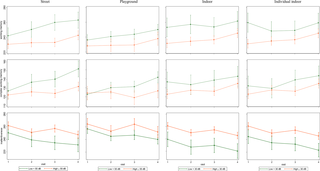
As shown in Fig 1, children who attended schools with high road traffic noise at street level (≥55 dB) had a slower development of working memory, complex working memory, and a slower improvement of inattentiveness over 12 months than those attending quieter schools in adjusted models. Similar trends with slightly weaker differences between groups were observed for schools exposed to high noise at the playground. Finally, children who attended schools with high road traffic noise in the classroom (≥30 dB) had a slower improvement of inattentiveness over 12 months than those who attended schools with quieter classrooms.
Y axis: point estimate (beta coefficient), error bars (95% confidence intervals). Predictions for working memory (2-back number stimuli, d′), complex working memory (3-back number stimuli, d′), and inattentiveness (HRT-SE, ms) adjusted at the means of age, sex, corresponding road traffic noise indicator, age*road traffic noise indicator, maternal education, socioeconomical vulnerability index at home and outdoor or indoor TRAP at school for models including outdoor or indoor noise levels, respectively. Child and school included as nested random effects. d′: detectability, a higher value indicates better working memory; HRT-SE: hit reaction time standard error, a higher value indicates greater inattentiveness; LAeq: A-weighted equivalent noise levels; TRAP: traffic-related air pollution.
https://doi.org/10.1371/journal.pmed.1004001.g001
When using modelled (Lday) instead of measured average road traffic noise levels at the school street (see bottom of Table 3), we observed the same consistent associations with a slower development of all the cognitive outcomes over 12 months.
Associations between the different road traffic noise indicators at school and the development of cognitive outcomes were robust to additional adjustment for other potential confounders (S5–S7 Tables) and to the inclusion or exclusion of traffic-related air pollution in the adjustment sets. Although in certain adjustment sets the associations of indoor intermittency ratio and indoor number of noise events with working memory gained significance and the association between individual indoor LAeq and inattentiveness lost significance, the estimated magnitudes of effect remained unchanged.
In the current study, exposure to road traffic noise at school, but not at home, was associated with a slower development of working memory and of complex working memory, and with a slower improvement of inattentiveness over 1 year in schoolchildren. Exposure to road traffic noise (at school and home) was not associated with the cognitive outcomes cross-sectionally (i.e., at the baseline visit). Both the school-outdoor average level and fluctuation characteristics of noise were associated with a deceleration in the studied cognitive outcomes. In contrast, in the classroom, the noise fluctuation characteristics were more robustly associated with all cognitive outcomes, whereas average levels were only associated with greater inattentiveness. Finally, children attending schools exposed to outdoor road traffic noise levels ≥55 dB had a slower development of working and complex working memory and greater inattentiveness and those with classroom levels ≥30 dB had greater inattentiveness over 12 months, compared to children exposed to lower outdoor (<55 dB) and indoor (<30 dB) noise levels, respectively.
Associations with working memory (2-back detectability) were generally in the expected direction but only reached statistical significance in relation to street-level indicators (average noise and number of events). This could relate to the fact that the 2-back detectability test was less challenging for children, thus potentially less sensitive to capture changes in development than complex working memory (3-back detectability) for which associations with noise indicators were statistically significant.
As we observed, while individual exposure to the annual average noise level in the classroom was only associated with inattentiveness, exposure to intermittent noise and to a greater number of noise events in the classroom was associated both with greater inattentiveness and slower complex working memory and also marginally with slower working memory development. These findings support the hypothesis that the noise characteristics beyond the average noise level, i.e., its fluctuation, might be more relevant for children’s neurodevelopment in the classroom. They also support the importance of carrying out detailed indoor noise exposure assessment in studies of the cognitive effects of noise, to move closer to the personal exposure inside the classroom. In other words, the peaks of road traffic noise that propagate into the classroom (and their frequency) could be further disruptive for children’s working memory and attention development during concentration at school even when the average noise level in the classroom is lower and may only affect attention. The relevance of the same fluctuation characteristics of noise was previously observed for the effects of transportation noise on cardiovascular outcomes [24]. These results suggest that noise fluctuation should be further investigated and that policy recommendations to protect children’s health may have to consider noise fluctuation in addition to average noise levels. We did not observe associations between exposure to road traffic noise at home and the studied cognitive outcomes, which is in line with the only previous study assessing both school and home exposure [20,21]. This could suggest that exposure to noise at school, rather than at home, may be more detrimental by affecting vulnerable windows of concentration and learning processes [8]. Another complementary explanation may relate to a greater degree of exposure misclassification for noise exposure at home, as we could only assign outdoor average noise levels at the home address, as commonly done in previous studies. Moreover, we could not estimate fluctuation measures, which were relevant indicators associated with cognitive development at school.
We observed very few associations between exposure to road traffic noise at school and the cognitive outcomes at baseline. The baseline results represent the cross-sectional association between exposure to noise and cognitive outcomes during the first visit. The general lack of associations at baseline could partly indicate that the children’s long-term noise exposure years before baseline was not captured with our exposure assessment, given that we did not have historical information about exposure of children in previous schools, although a 98% of children had attended the same school for at least 1 year. Alternatively, the more consistent associations with the 12-month development might respond to the vulnerable window of effects of the studied cognitive functions, which develop significantly during primary school age [14–16]. Finally, inconsistencies in the baseline results could be partly inherent to the cross-sectional nature of the observation, and would be in line with the mixed findings of previous cross-sectional studies [17–23].
There is limited evidence for the association between road traffic noise and cognitive development in children, including working memory and attention, which are crucial for learning and school attainment [12,13] and which are actively developing during primary school age [14]. The few studies so far were all cross-sectional and used diverse outcome tests, which precludes direct comparison with the current study. The multicentric and cross-sectional RANCH study, carried out in 2,844 schoolchildren of 9 to 10 years of age in the Netherlands, Spain, and the UK in 2002, observed associations between annual average noise levels of road traffic noise outdoors at schools (daytime LAeq) and cognitive performance, in terms of reading comprehension and episodic memory [19,23]. In line with our study, they observed associations between school-outdoor road traffic noise levels at school, but not at home, and inattention in the 553 children in the Netherlands, based on the Switching Attention Test [20,21]. However, the RANCH project did not find associations with working memory, assessed with a modified version of The Search and Memory Task [19–23], or with sustained attention [19,20,22], assessed with a modified version of the Toulouse–Pieron test [19]. Finally, 2 small studies, one studying exposure to road traffic noise at home in 73 children and another one at 2 schools, found respectively no [17] and suggestive [18] associations with tests of attention. None of the aforementioned studies evaluated exposure to road traffic noise indoors in the classroom or noise fluctuation measures.
Our results support the general hypothesis that childhood may be a vulnerable period in which external stimuli such as noise could affect the rapid cognitive development that is occurring [7]. There are several suggested pathways on how noise may affect cognitive development in children. One suggested pathway is that noise may affect cognition by impairing attention [8], which is in line with our findings with inattentiveness. It is also suggested that noise could directly impair children’s cognitive abilities, or act indirectly through frustration, learned helplessness, increased arousal, or tuning out, which could impact performance and learning in the long term under repeated noise exposure [8]. The effects of noise on cognition are further supported by animal experiments showing that exposure to environmental noise levels (72 dB, aircraft, up to 4 days) increases oxidative stress in the frontal cortex [11] and subchronic exposure to white noise (4 hours/day, 100 dB, up to 30 days) leads to brain changes in occipital and prefrontal regions [9,10] and in the hippocampus [10], which are relevant for executive functions, learning, and memory. Overall, the suggested pathways and our results support the hypothesis that the effects of noise on cognition, here executive functions, such as working memory, and attention, may be greater during activities that involve concentration or attention and that may affect learning.
The major strength of this study was the longitudinal design with repeated cognitive evaluations, which allowed to study for the first time the association between exposure to road traffic noise and the development in the cognitive functions of working memory and attention in schoolchildren. We also used validated computerised tests that could capture different dimensions of cognition and executive functions that are developing in primary schoolchildren [34]. Moreover, to our knowledge, this study performed the most extensive and detailed noise exposure assessment of road traffic noise to date, including exposure in different microenvironments at school (at street level, playground, and indoors in the classroom), assessing not only average noise levels but also fluctuation characteristics of noise at school (i.e., intermittency ratio and number of noise events), and exposure to average road traffic noise levels outdoors at home. Furthermore, our road traffic noise measurement protocol yielded representative estimates of the annual average noise levels during the study period, as shown by the high correlation between the annual average noise levels from Barcelona’s Strategic noise map published in 2012 and our school measurements at the street level in 2012 (Spearman’s rank r = 0.86, Pearson’s r = 0.85), the consistent results found with these 2 exposures (modelled and measured) and also the high intraclass correlation (ICC = 0.94) between indoor noise measurements in the 2 campaigns, which were performed 6 months apart.
Among the limitations, our study did not assess past noise exposure. However, all children had attended the same school at least for 6 months and 98% had attended for more than 1 year. In turn, it is unlikely that road traffic noise levels were different during the previous years, as it would require drastic changes in traffic. The lack of association between exposure to noise at home and the cognitive outcomes could partly relate to the greater exposure misclassification expected with the residential assignment of modelled noise levels at the home address. Another limitation is the potential lack of external validity of our results, given that 58% of the participating mothers had a university degree compared to a 50% of women between 25 and 39 years of age in the region [49]. However, maternal education did not seem to determine participation, given that the participation rate was independent of the school-area socioeconomic level (Spearman’s rank correlation = ‒0.09, p-value = 0.61). Besides, we could not study children with specific needs, as this would require a larger sample size to have statistical power. Furthermore, residual confounding is always a possibility, although we adjusted for multiple potential confounders and results were robust to additional adjustments in sensitivity analysis. Finally, air pollution could be an important confounder of the studied association, given that it has been associated with impaired cognitive development [26]. In the current study, we adjusted our analyses for TRAP. Moreover, the correlation between TRAPs and the measured noise fluctuation indicators was moderate or low, which further supports that the observed associations between road traffic noise and deceleration in working memory and attention development were independent of air pollution.
At least 1 in every 5 Europeans are exposed to high road traffic noise levels (Lden ≥ 55 dB) [1]. In Barcelona, more than half of the population are affected by road traffic noise levels above those recommended by the WHO (Lden ≥ 53 dB) [4,27], and in the current study, more than half of the schools were also exceeding the recommended WHO thresholds both outside and inside classrooms. The current findings suggest that exposure to road traffic noise is associated with a slower development of the cognitive functions of working memory and attention in primary schoolchildren of Barcelona, which are essential for learning and school attainment [12,13]. Given the expected large number of children exposed to road traffic noise at schools, particularly in urban areas, the application of policies to reduce road traffic noise at schools (outside and inside classrooms) could substantially benefit cognitive development, at least working memory and attention, and future health. Furthermore, the current findings add to the previous evidence about the adverse effects of school exposure to aircraft noise on other dimensions of children’s cognition [5,8], and also to our previous findings for the associations of air pollution [26,50,51] with working memory and attention in the same cohort of children. Together, this evidence indicates that efficient interventions to protect the school environment should target transportation and consider not only cleaner air but also quieter school environments.
In conclusion, exposure to road traffic noise at school, but not at home, was associated with slower working memory, complex working memory, and attention development, in primary school children. Associations were observed both for school-outdoor average noise levels and noise fluctuation indicators, although in classrooms, noise fluctuation was more consistently associated with all cognitive outcomes than average noise levels. Finally, slower development of working memory, complex working memory, and attention was observed in children attending schools exposed to outdoor road traffic noise levels above ≥55 dB and to classroom levels ≥30 dB, compared to children exposed to lower outdoor (<55 dB) and indoor (<30 dB) noise levels, respectively. Further longitudinal studies are needed to replicate these findings in different populations and settings, to assess different microenvironments and noise fluctuation metrics and to study other cognitive functions developing over the first years of life.
https://doi.org/10.1371/journal.pmed.1004001.s001
(PDF)
https://doi.org/10.1371/journal.pmed.1004001.s002
(PDF)
https://doi.org/10.1371/journal.pmed.1004001.s003
(PDF)
https://doi.org/10.1371/journal.pmed.1004001.s004
(PDF)
https://doi.org/10.1371/journal.pmed.1004001.s005
(PDF)
(n = 2,680 children, 9,984 repeats).
https://doi.org/10.1371/journal.pmed.1004001.s006
(PDF)
https://doi.org/10.1371/journal.pmed.1004001.s007
(PDF)
https://doi.org/10.1371/journal.pmed.1004001.s008
(PDF)
https://doi.org/10.1371/journal.pmed.1004001.s009
(PDF)
We acknowledge all the families participating in the study for their altruism and particularly to the schools Antoni Brusi, Baloo, Betània–Patmos, Centre d’Estudis Montseny, Col·legi Shalom, Costa i Llobera, Escola El Sagrer, Els Llorers, Escola Pia de Sarrià, Escola Pia Balmes, Escola Concertada Ramon Llull, Escola Lourdes, Escola Tècnica Professional del Clot, Ferran i Clua, Francesc Macià, Frederic Mistral, Infant Jesús, Joan Maragall, Jovellanos, La Llacuna del Poblenou, Lloret, Menéndez Pidal, Nuestra Señora del Rosario, Miralletes, Ramon Llull, Rius i Taulet, Pau Vila, Pere Vila, Pi d’en Xandri, Projecte, Prosperitat, Sant Ramon Nonat–Sagrat Cor, Santa Anna, Sant Gregori, Sagrat Cor Diputació, Tres Pins, Tomàs Moro, Torrent d’en Melis, and Virolai. We also acknowledge the ESCAPE project for the design and supervision modelling of air pollution. Furthermore, Xavier Mayoral did the technical development of the n-back test; Cecilia Persavento, Judit Gonzalez, Laura Bouso, and Pere Figueras contributed to the field work. Joan Forns contributed to the design and project management.
For more information about PLOS Subject Areas, click here.
Is the Subject Area “Schools” applicable to this article?
Thanks for your feedback.
Is the Subject Area “Working memory” applicable to this article?
Thanks for your feedback.
Is the Subject Area “Roads” applicable to this article?
Thanks for your feedback.
Is the Subject Area “Children” applicable to this article?
Thanks for your feedback.
Is the Subject Area “Attention” applicable to this article?
Thanks for your feedback.
Is the Subject Area “Air pollution” applicable to this article?
Thanks for your feedback.
Is the Subject Area “Human learning” applicable to this article?
Thanks for your feedback.
Is the Subject Area “Cognitive impairment” applicable to this article?
Thanks for your feedback.

Apple launches MacBook Pro & Air with new M2 chipset – RouteNote
Image Credit: Apple
Apple state that the new M2 chipset provides improved performance against the M1 chipset. So, is it fair to say the new M2 MacBooks will be bigger music production workhorses than previous models?
The M2 MacBook Air offers an 18% performance increase compared to the M1 chip in addition to the 24 GB of unified memory provided by the M2 chipset. As a result, the M2 MacBook Air is more capable than previous iterations to complete both simpler and heavy processing tasks.
Furthermore, the MagSafe charging is back as a standard. But now fast charge is available with an optional 67W USB-C power adapter. The M2 Air has up to 18 hours of battery life. Weighing in at just 1.24 kg and 1.13cm thin.
And a mini-jack output is also back too. In somewhat of a plot twist, this headphone jack supports high-impedance headphones too! The Air has a 13″ liquid retina display and comes in four colours: Midnight, Starlight, Space Grey, and Silver.
The 13-inch M2 MacBook Pro brings more power but doesn’t have a design that’s too bulky. It has a 10-core GPU, features a stylish touch bar and charges via USB-C. You’ll find you get a slightly longer battery life than the M2 air too.
The MacBook Pro with M2 chip provides 20 hours of battery life, and it has a 13.3-inch retina display.
The MBP Magic Keyboard “delivers a comfortable, quiet and responsive typing experience.” The featured Touch Bar empowers you as it hosts the commands you need most “right where you need them”. Finally, Touch ID allows you to access your computer faster with a secure login and make purchases faster too.
Two Thunderbolt ports allow for fast data transfer as you move samples around, faster charging in addition to video output for additional monitors too. Like the M2 Air, the MBP also has a 3.5mm headphone jack that supports high-impedance headphones.
The new M2 MacBook Air will be available in July from Apple next month – starting at $1199. Meanwhile, the M2 MacBook Pro is starting at $1299.
A direct injection (DI) box converts unbalanced instrument level signals with high impedance (electrical resistance) into balanced microphone-level signals with low impedance.
If you want to record music for a pass time or build a possible career, building a home studio is easier than ever. So, let’s talk about how you can build your own recording studio with what you’ll need to record music at home.
Sign up to our newsletter and make sure you don’t miss a thing !
Officially launched in 2007, RouteNote began as a digital music distribution platform for independent artists and labels to get their music online,
free!
Designed and built to take advantage of the shift towards independent and self-publication through online and mobile music or video outlets.
RouteNote is partnered with some of the biggest retailers on the web to give artists massive and immediate availability for their products.
RouteNote has since grown into a full digital media management service providing artists, labels and creators instant access to a large proportion of the online market.
Onsite, artists, labels and creators can upload content to the RouteNote catalogue and enter into a non-exclusive agreement permitting us to distribute their music to a worldwide audience.
Our rates for providing a distribution service are currently the best in the market and our ever expanding catalogue gives us increasing muscle with which to negotiate deals from which everyone, artists, clients and distribution partners included will all benefit.
Live updates | Russia returns 210 dead Mariupol defenders – The Associated Press

KYIV, Ukraine — Ukraine’s military intelligence agency says Russia has so far turned over the bodies of 210 Ukrainian fighters killed in the battle for Mariupol. It says most of them were among the last holdouts in the Azovstal steelworks.
The agency did not specify Tuesday how many more bodies are believed to remain in the rubble of the plant.
Russia now controls the destroyed port city. It began turning over bodies last week. Ukraine said Saturday that the two sides had exchanged 320 bodies, with each getting back 160. It is unclear whether any more bodies have been given to Russia.
The Ukrainian fighters defended the steelworks for nearly three months before surrendering in May under relentless Russian attacks from the ground, sea and air.
___
KEY DEVELOPMENTS IN THE RUSSIA-UKRAINE WAR:
— AP Exclusive: Ukraine recovers bodies from steel-plant siege
— Ukraine’s leader says Russia is trying to capture a key southeastern city
— US general says US, allies will keep sending ‘significant’ aid to Ukraine
— UN: Climate shocks and Ukraine war fuel multiple global food crises
___
Follow AP’s coverage of the war in Ukraine at https://apnews.com/hub/russia-ukraine
___
OTHER DEVELOPMENTS:
KYIV, Ukraine — Ukrainian President Volodymyr Zelenskyy says his government is working to raise money to fund the army and rebuild cities and towns destroyed in the fighting.
He said in his nightly address Tuesday that work is already underway to restore electricity, gas, running water and phone service in places from which Russian forces have been pushed out. He says much also needs to be done to re-equip hospitals and remove landmines.
Zelenskyy says one of the ways money is being gathered is through the government fundraising platform UNITED24, which in its first month brought in more than $50 million.
He says Ukrainian tennis player Elina Svitolina on Tuesday joined former Ukrainian soccer player Andriy Shevchenko in becoming an ambassador for the fundraising platform.
___
KYIV, Ukraine — Ukrainian President Volodymyr Zelenskyy says Russian forces have made no significant advances in the eastern Donbas region over the past day.
In his nightly video address, Zelenskyy said late Tuesday that “the absolutely heroic defense of the Donbas continues.”
Zelenskyy says the Russians clearly did not expect to meet so much resistance and are now trying to bring in additional troops and equipment. He says the same is true in the southern Kherson region, which Russian troops occupied early in the war.
Zelenskyy slso says that Ukraine plans to release a special “Book of Executioners” next week with confirmed information about war crimes committed by the Russian army. He says those named will include not only those who carried out war crimes but their commanders.
___
JERUSALEM — Ukraine’s ambassador is urging Israel to sell its Iron Dome rocket interception system and provide anti-tank missiles to defend civilians against Russia’s invasion.
Yevgen Korniychuk on Tuesday stopped short of accusing Israel of blocking the sale of the missile defense system. But he wants the Israeli government to back up its verbal support for Ukraine with military assistance. At a news conference in Tel Aviv, he said Ukraine wants to buy the Iron Dome system, contending that the United States would not oppose such a sale.
The United States has been financially supporting Israel’s Iron Dome for about a decade, providing about $1.6 billion for its production and maintenance, according to the Congressional Research Service. The system is designed to intercept and destroy short-range rockets fired into Israel.
Korniychuk also said Israel last week declined a U.S. request for Germany to deliver Israeli-licensed “Spike” anti-tank missiles to Ukraine.
Israel has limited its support for Ukraine to humanitarian aid and was the only country operating a field hospital inside the country earlier in the year. Israel fears helping Ukraine militarily would inflame Russia, which has a military presence in neighboring Syria. Israel, which carries out frequent strikes on enemy targets in Syria, relies on Russia for security coordination.
The Israeli Defense Ministry had no comment.
___
WASHINGTON — The U.S. military has begun training Ukrainian forces on the sophisticated rocket systems that the Biden administration agreed last week to provide, but that Russia has said could trigger wider airstrikes in Ukraine.
Marine Lt. Col. Anton Semelroth, Pentagon spokesman, said Ukrainian troops are training on the High Mobility Artillery Rocket System, or HIMARS, at Grafenwoehr training base in Germany and elsewhere in Europe.
The U.S. agreed to send four of the medium-range, precision rocket systems to Ukraine as part of a $700 million package approved last week, and officials said it would take about three weeks of training before they could go to the battlefront.
Russian President Vladimir Putin warned on Sunday that any Western deliveries of longer-range rocket systems would prompt Moscow to hit “objects that we haven’t yet struck.”
About 900 Ukrainian service members have received training on a variety of weapons by the U.S. so far, including on howitzers which are being delivered to the front lines.
The HIMARS is mounted on a truck and can carry a container with six rockets, which can each travel about 45 miles (70 kilometers).
___
MILAN — Italian right-wing leader Matteo Salvini says Italians are prepared to continue to make economic sacrifices “to support the defense of Ukraine and reach a ceasefire.”
Inflation in Italy last month was 7% as prices at the gas pump, grocery store and in energy bills skyrocketed, due in part on sanctions on Russian energy and raw materials shortages.
Salvini, speaking to foreign reporters on Tuesday in Rome, said his League party backs the sanctions that the European Union imposed on Russia. But he emphasized they must be a means to a cease-fire and not be something that continues into the fall.
“We need to see if they work or not,” said Salvini, whose party is part of Italy’s wide-ranging governing coalition. “In April of this year, the value of Russian exports to Italy rose by 18%, while the value of Italian exports to Russia decreased by 48%. The bottom line is that Russia is accumulating a ton of rubles, euros, dollars and who knows what, while European countries are choking.”
Added Salvini: “Sanctions are an absolutely useful instrument as long as they damage those sanctioned. If, at the end of the day, they damage those that impose them, then something is not working”
___
MOSCOW — The Russian parliament has passed a set of laws allowing Moscow not to comply with the top European human rights court’s rulings.
The move on Tuesday formalized the broken ties between Russia and the Council of Europe, the continent’s foremost human rights body.
In accordance with the new laws passed by the State Duma, Russia’s lower parliament house, Russian authorities are no longer obligated to comply with rulings of the European Court of Human Rights issued after March 15.
On that date, Russia announced it was withdrawing from the Council of Europe — only to be officially expelled the next day over what the Kremlin calls a special military operation in Ukraine.
Thousands of Russians in recent years have turned to the court as a last resort, after failing to win in Russian courts, on human rights issues ranging from political persecution to domestic violence.
State Duma speaker Vyacheslav Volodin on Telegram on Monday described the court as a “tool of a political battle against our country in the hands of Western politicians,” adding that “some of its rulings went directly against Russia’s Constitution, our values, our traditions.”
Volodin cited a ruling demanding that Russia recognize same-sex marriage, which was outlawed two years ago in a set of constitutional amendments.
___
KYIV, Ukraine — The Ukrainian authorities have refused to allow the head of the U.N. nuclear watchdog to visit a nuclear plant in southern Ukraine under the Russian control.
The International Atomic Energy Agency director Rafael Mariano Grossi said that he intends to visit the Zaporizhzhia plant, the largest in Europe, to help maintain its safety and security.
Grossi spoke Monday to the IAEA board about the dire situation at the plant, taken by the Russian troops in early March. He noted the pressure on the plant’s Ukrainian staff and voiced concern that some spare parts were not getting to the plant due to supply chain interruptions.
He reiterated his determination to lead an expert mission to the plant, saying that “we must find a solution to the hurdles preventing progress.”
Grossi contended that Ukraine’s government had called on him to lead such a mission, but Energoatom, the Ukrainian state company overseeing the country’s nuclear power plants, said in a blunt statement Tuesday that he wasn’t welcome.
Energoatom said it hadn’t invited Grossi to visit the plant and described his intention to tour it as “yet another attempt to legitimize the occupier’s presence there and effectively approve their action.” The company contended that Grossi’s previous visits to Ukraine were useless. It alleged that he was acting in collusion with Russia, claiming that the Russians hold a quarter of senior managerial positions at the IAEA.
___
MOSCOW — Using unusually crude language, a top associate of Russian President Vladimir Putin has castigated Moscow’s opponents, reflecting heightening tensions between Russia and the West amid the fighting in Ukraine.
Dmitry Medvedev, the former Russian president who now serves as the deputy head of Russia’s Security Council, explained his harsh criticism of Russia’s foes on his messaging app channel by saying: “I hate them. They are bastards and scum.”
He went on, saying that “they want that Russia and all of us die” and adding that “as long as I’m alive, I will do everything to make them disappear.”
Medvedev served as Russia’s president in 2008-2012 when Putin had to shift into the prime minister’s post due to term limits. He had been seen in the West as a liberal, but to Western disappointment, he stepped down after one term to let his mentor reclaim the presidency. He then served as his prime minister for eight years until Putin named him his No. 2 at Russia’s Security Council.
Medvedev has been increasingly critical of the West.
___
KYIV, Ukraine — A Ukrainian presidential advisor has vowed that Kyiv will retake all the lands currently under Russian control and urged Ukrainians to be patient.
“Don’t let the news that we’ve ceded something scare you,” Mykhailo Podolyak said in a short video address on Tuesday. “It is clear that tactical maneuvers are ongoing. We cede something, we take something back. Russians outnumber (Ukrainian troops), they have more equipment.
The adviser added: “But we need to make sure that every village we temporarily cede and then take back costs Russians a lot of blood” and make them exhaust ”reserves and resources,.”
Podolyak stressed that Ukraine is still waiting for more weapons from its allies.
___
MOSCOW — Russia’s defense minister says that the Russian troops have taken control of large swaths of eastern Ukraine.
Sergei Shoigu said Tuesday that the Russian forces have fully “liberated” the residential quarters of Sievierodonetsk and are fighting to take control of an industrial zone on its outskirts and the nearby towns.
That city, the administrative center of the Luhansk region, has recently been the focus of the Russian offensive.
Shoigu added that the Russian troops were pressing their offensive toward the town of Popasna, with a pre-war population of 20,000, and lying some 30 kilometers (20 miles) south of Sievierodonetsk. He noted that they have taken control of Lyman and Sviatohirsk and 15 other towns in the region. He claimed that 97% of the Luhansk region has already been “liberated.”
___
VILNIUS, Lithuania — German Chancellor Olaf Scholz says his country is ready to increase its military presence in the Baltic region to meet new challenges to regional security.
“We have agreed to strengthen the eastern flank of NATO by creating a new strong brigade here,” Scholz said during a visit on Tuesday to Lithuania. The Baltic country borders Kaliningrad, a Russian region where the country’s Baltic Sea fleet is based. A brigade would be 3,000 to 5,000 soldiers
Scholz also pledged to continue supplies of necessary weapons and troops’ training to Ukraine. He dismissed claims that Germany was hesitating with heavy weaponry supplies, including most modern howitzers, to Ukraine.
Lithuania President Gitanas Nauseda welcomed the German plans to deploy more troops in the country. The Russian military threat “will remain a major source of threat to regional security,” she said. “Baltic states are in an especially vulnerable position here on the front line of NATO external borders.”
___
MOSCOW — The Russian military says it has destroyed several artillery systems provided by the West in the latest series of strikes on Ukrainian targets.
Maj. Gen. Igor Konashenkov said Tuesday that the Russian artillery hit a howitzer supplied by Norway and two other artillery systems given to Ukraine by the United States. He said that the Russian artillery barrage destroyed other Ukrainian equipment in the country’s east while the Russian air force hit Ukrainian troops and equipment concentrations and artillery positions.
Konashenkov’s claims couldn’t be independently confirmed.
___
LVIV, Ukraine — A Ukrainian official says Russia has deployed additional troops to eastern Ukraine to help capture a key city.
Luhansk governor Serhiy Haidai told The Associated Press that the Russian forces control industrial outskirts of Sievierodonetsk, one of key two cities in the Luhansk region left to be seized by Russia. The Russian forces have so far failed to take over all of it and have been forced to deploy additional troops, he said.
“Toughest street battles continue, with varying degrees of success, the situation constantly changes, but the Ukrainians are repelling attacks,” Haidai said.
Neighboring Lysychansk — another city still not taken in the region — is being barraged by artillery. Haidai said. He said the Russian troops shelled a local market, a school and a college building, destroying the latter. Three people with wounds were sent to hospitals elsewhere Ukraine.
“A total destruction of the city is underway, Russian shelling has intensified significantly over the past 24 hours. Russians are using the scorched earth tactics,” Haidai said.
In all, the Ukrainian forces have repelled 10 Russian attacks over the past 24 hours, according to the Luhansk governor.
Nearly all the region is under the control of Russia, which is being helped by local pro-Kremlin forces.
___
KYIV, Ukraine — In a latest sign of Ukrainian resilience, a theater in Ukraine’s capital reopened for the first time since Russian forces invaded the country on Feb. 24, and tickets sold out for Sunday’s performance.
Cinemas and the National Opera opened their doors at the end of May in Kyiv.
“We were wondering how it would be, whether spectators would come during the war, whether they think at all about theater, whether it’s of any interest,” said one of the actors, Yuriy Felipenko. “And we were happy that the first three plays were sold out.”
Actor Kostya Tomlyak says he had hesitated to perform in wartime. But the influx of people returning to Kyiv since hostilities there have lessened persuaded him that it’s necessary to go on.
Said Tomlyak: “You continue living, although you don’t forget that there is the war. The main question is how actors can be helpful.”
____
MOSCOW — Russia’s Foreign Ministry announced Monday that is levying sanctions on 61 U.S. nationals,.
It said the move was being taken “in response to the ever-expanding U.S. sanctions against Russian political and public figures, as well as representatives of domestic business.”
The list includes U.S. officials and former and current top managers of large American companies, such as Treasury Secretary Janet Yellen, Energy Secretary Jennifer Granholm, White House communications director Kate Bedingfield and Netflix CEO Reed Hastings.
___
KYIV, Ukraine — Russia has begun turning over the bodies of Ukrainian fighters killed at the Azovstal steelworks, the fortress-like plant in the destroyed city of Mariupol where their last-ditch stand became a symbol of resistance against Moscow’s invasion.
Dozens of the dead taken from the bombed-out mill’s now Russian-occupied ruins have been transferred to the Ukrainian capital, Kyiv, where DNA testing is underway to identify the remains, according to both a military leader and a spokeswoman for the Azov Regiment.
The Azov Regiment was among the Ukrainian units that defended the steelworks for nearly three months before surrendering in May under relentless Russian attacks from the ground, sea and air.
It was unclear how many bodies might remain at the plant.
Meanwhile, Russian forces continued to fight for control of Sievierodonetsk, an eastern Ukrainian city that is key to Moscow’s goal of completing the capture of the industrial Donbas region.
___
NEW YORK — U.S. authorities moved Monday to seize two luxury jets — a $60 million Gulfstream and a $350 million aircraft believed to be one of the world’s most expensive private airplanes — after linking both to Russian oligarch Roman Abramovich.
A federal magistrate judge signed a warrant authorizing the seizure of the Gulfstream and a Boeing jet that authorities said was worth less than $100 million before a lavish customization.
The action takes place just days after the United States announced new sanctions and penalties on Russian oligarchs and elites, Kremlin officials, businessmen linked to President Vladimir Putin and their yachts, aircraft and firms that manage them.
President Joe Biden promised after Russia’s February invasion of Ukraine to pursue Russian elites’ “ill-gotten gains.”
U.S. Attorney Damian Williams said Monday that his office was using every legal tool available to respond to “Russian’s illegal war in Ukraine.”
___
UNITED NATIONS — The U.N. envoy on sexual violence in conflict says sexual violence in Ukraine especially against women and girls remains prevalent and underreported, and the humanitarian crisis in the war-torn country is turning into “a human trafficking crisis.”
Pramila Patten told the U.N. Security Council Monday that there is a gap between its resolutions aimed at preventing rape and other sexual attacks during conflicts and the reality on the ground for the most vulnerable — women and children.
As of June 3, she said, the U.N. human rights office had received 124 allegations of conflict-related sexual violence — 97 against women and girls, 19 against men, 7 against boys and 1 gender unknown. Verification of these cases is on-going, she said.
Patten said Ukraine’s prosecutor general informedher during a visit in May that a national hot line reported the following forms of conflict-related sexual violence between Feb. 24, when Russian troops invaded the country, and April 12: “rape, gang rape, pregnancy following rape, attempted rape, threats of rape, coercion to watch an act of sexual violence committed against a partner or a child, and forced nudity.”
Ableton Live 11 Summer Sale: 25% off Standard, Suite – gearnews.com – Gearnews

· Source: Ableton
In the spirit of annual summer sales, Ableton is having its own summer jam. Until June 14, the company you know darn well is taking 25% off the prices of Ableton Live 11 Intro, Standard, and Suite. The deals include upgrades from Lite and older software versions. Also on sale are Max for Live, all Ableton Live Packs, and Crossgrades to Max 8. No hardware (Push 2) sale this time, but it’s a good opportunity to get your software and a bunch of sounds sorted. Knowing Ableton, Push 2 will likely go on sale for Black Friday. So if you’ve been waiting a while, there’s a little stretch left.
Ableton Live 11 is the most popular DAW for production and composition. At it’s core, it’s a simple and enjoyable experience of opening and app and getting some sounds going. On a deeper level, it’s a very competent (and possibly complicated) production and performance tool. That’s why Ableton Live is used by most producers, musicians, and live performers to create and perform music in all possible genres – especially those leaning on electronica. To that, Ableton ships with cutting-edge virtual instruments, sound packs, and effects.
By loading the video, you agree to YouTube’s privacy policy.
Learn more
Load video
You can now save up to 25% off the regular Live 11 prices. Ableton discounts don’t usually go deeper than 25%, so don’t wait for tangibly better offers if you want a piece of the action. However, if you are completely new to Ableton and interested, do take advantage of the free trial versions offered by the developer.
The deals below are available from our affiliate partner Thomann *:
Ableton Live 11 Suite Download
Price599.00 €
Ableton Live 11 Suite UPG Lite Download
Price509.00 €
Ableton Live 11 Standard Download
Price349.00 €
Ableton Live 11 Standard UPG Lite Download
Price299.00 €
Ableton software runs standalone under macOS 10.13 or later and Windows 10 or later and requires an internet connection for authorization and installation. Different bundles of sounds, plug-ins, presets, and effects are included depending on the version you choose
Your email address will not be published.
· Just bought it. What an incredible sound. I compared it to my real 101 and it’s not far off in the blind test. Definitely the best emulation in the market. And I own all. Also the Softube Moog and …
· I do wish that those ultra-realistic looking 3D rendered images which often accompany soft-synth marketing, could be shared – and ‘played with’ as well. Even if non-functioning as far as parameter…
· That’s some serious mechanical engineering. Just thinking of possible use cases… whilst waiting for three hours stuck on the tarmac you could whip out the Foldiecaster from the overhead locker for…
N.J. primary election 2022: See live results for U.S. House, county and local races – NJ.com

Voters from around the state cast their ballots Tuesday to choose the Democratic and Republican nominees for the 12 U.S. House seats representing New Jersey as well as more than 100 contested county and local races.
For the second year in a row, voters had three ways to vote — either in person during early voting which began on June 3 and concluded June 5, by sending in a mail-in ballot or putting it in a dropbox, or by stepping into a voting booth on Tuesday.
At the top of the ticket, there are 56 candidates — both Democrats and Republicans —vying for their party’s nod to run in the fall for the Congressional seats at President Joe Biden’s midterm.
More than 1.4 million residents moved to new Congressional districts — and are seeing new candidates to choose from — due to new lines drawn by New Jersey’s independent redistricting commission to reflect population shifts under the 2020 census.
And across the state, hundreds of races are underway for county offices, mayors and elected positions on the municipal level. But, only about 100 races are contested.
NJ Advance Media is compiling results from local and county contested primary races around the state.
Ballots that are mailed in and postmarked by June 7 can be accepted until June 13, so results will continue to change after the close of polls on Election Night. Provisional ballots are not counted until after all mail-in ballots are tallied. For all of our election coverage, go to nj.com/elections.
Congressional results
Atlantic County election results
Bergen County election results
Burlington County election results
Camden County election results
Cape May County election results
Cumberland County election results
Essex County election results
Gloucester County election results
Hudson County election results
Hunterdon County election results
Mercer County election results
Middlesex County election results
Monmouth County election results
Morris County election results
Ocean County election results
Passaic County election results
Salem County election results
Somerset County election results
Sussex County election results
Union County election results
Warren County election results
Our journalism needs your support. Please subscribe today to NJ.com.
Note to readers: if you purchase something through one of our affiliate links we may earn a commission.
Registration on or use of this site constitutes acceptance of our User Agreement, Privacy Policy and Cookie Statement, and Your California Privacy Rights (User Agreement updated 1/1/21. Privacy Policy and Cookie Statement updated 5/1/2021).
Cookie Settings
© 2022 Advance Local Media LLC. All rights reserved (About Us).
The material on this site may not be reproduced, distributed, transmitted, cached or otherwise used, except with the prior written permission of Advance Local.
Community Rules apply to all content you upload or otherwise submit to this site. Ad Choices
Fox News Doesn’t Plan to Carry Jan. 6 Hearings Live – The New York Times

Advertisement
Supported by
Its sister network, the lower-rated Fox Business, will carry live coverage, while star prime-time hosts like Tucker Carlson and Sean Hannity will proceed as usual.
Send any friend a story
As a subscriber, you have 10 gift articles to give each month. Anyone can read what you share.
Jeremy W. Peters and
The group of lawmakers investigating the Jan. 6 Capitol riot would like as many Americans as possible to learn jarring and unknown details about the attack. So they decided to hold a public hearing on Thursday during prime time, when many people are sitting in front of their TVs.
Fox News, the nation’s top cable news channel, has other plans.
When the hearing begins at 8 p.m. Eastern, NBC will go into special report mode. CBS will air a special called “Capitol Assault Hearings,” while ABC will run “Attack on the Capitol: The Investigation — An ABC News Special.” MSNBC and CNN will have wall-to-wall coverage all night.
But Fox News will not carry the hearing. Instead, the network will stick with its prime-time lineup of opinionated conservative hosts: Tucker Carlson, Sean Hannity and Laura Ingraham, who have repeatedly downplayed the assault as a mere “footnote” to American history and tried to discredit the congressional inquiry as a ruse to “purge” former President Donald J. Trump and his supporters from the Republican Party.
The network said on Monday that its prime-time hosts would cover the event “as news warrants.” Live news coverage will be left to Fox Business, a sister network with much smaller viewership. Last month, Fox News averaged 1.5 million viewers at any given time during the day; Fox Business averaged 136,000. Mr. Carlson regularly draws more than three million viewers for his show at 8 p.m.
Republicans in Washington and conservative commentators across right-wing media have attacked the committee’s hearings — the one on Thursday is one of at least six that are planned — as partisan political theater, produced by Democrats to enhance their chances in the midterm elections.
That is the view among many inside Fox News, including its top-rated talent. They have watched their ratings soar as the network abandoned the more straightforward tone it took immediately after the 2020 election and then leaned hard into the grievances and misleading claims propagated by Republicans who want to rewrite the history of Mr. Trump’s loss and its aftermath.
Not broadcasting the hearing sends a message to loyal Fox viewers, media observers said: The network won’t help legitimize a process that many conservatives see as a kangaroo court.
“To walk away from what is surely going to be on every cable station and the networks, it’s impossible to believe it’s anything other than trying to make a statement by not showing up,” said Carl Cameron, the former chief political correspondent at Fox News, who left in 2017 and has since been critical of the network.
Fox News, like the Republican Party, has changed over the past few years. It is less tolerant of dissenting voices and more willing to air unsupported claims. It has let go or sidelined on-air personalities critical of Mr. Trump. Others have quit in protest, including two conservative writers who said they were appalled by a documentary, starring Mr. Carlson, that promoted the unfounded idea that the Jan. 6 riot was a so-called false flag operation meant to persecute conservatives.
Nicole Hemmer, a historian at Columbia University and the author of “Messengers of the Right: Conservative Media and the Transformation of American Politics,” said the Fox News decision to put the Jan. 6 committee hearing on its smaller platforms fit into a larger conservative argument that the insurrection was “not that big of a deal.”
“To air it on their tiny sister network, they are reinforcing that argument: This isn’t important,” she said.
Fox News disputed that claim on Tuesday, saying the hearing will be available to its audience in several ways. The coverage on Fox Business will be led by Bret Baier, Fox News’s most prominent host who is not overtly partisan, along with Martha MacCallum. That programming will also run on the Fox News website as well as on Fox’s streaming service, Fox Nation. Mr. Baier and Ms. MacCallum will appear on Fox News after prime time with an 11 p.m. posthearing special.
The network also pointed to its past coverage, in full, of other sessions from Capitol Hill, such as Supreme Court confirmation hearings. Those were daytime events.
By not carrying the hearings live in prime time, Fox News is potentially sparing itself an awkward on-screen moment. Private communications between several Fox anchors and the Trump administration were unearthed during the Jan. 6 committee investigation. Multiple messages show how the hosts were deeply concerned about the rioters and Mr. Trump’s refusal to rebuke them on the day of the attack.
In text messages, Mr. Hannity, Ms. Ingraham and Brian Kilmeade, a host of the morning show “Fox & Friends,” expressed growing alarm to Mark Meadows, Mr. Trump’s chief of staff, as the attack played out. “He is destroying his legacy,” Ms. Ingraham wrote in one message obtained by the committee.
The other major TV networks plan to cover the hearing with their highest-profile journalists. The broadcast networks will call in their evening news anchors — David Muir, Lester Holt and Norah O’Donnell — to lead two hours of coverage. CNN will turn to Jake Tapper and Anderson Cooper, along with a small army of reporters and correspondents. Rachel Maddow, Nicolle Wallace and Joy Reid will anchor the coverage on MSNBC.
Separately, in a decision that could affect more viewers, the Fox broadcast network will not direct its affiliates, which reach many millions more homes than Fox News, to show the hearing. They “will be offered” coverage of the hearing, Fox News Media said, but not mandated to take it, as is often the case with major events like a presidential address.
Given the highly polarized view that Americans have taken of the select committee’s work, it is unclear that Fox News’s usual viewers would tune in at all. They have punished the network in the past for coverage that did not toe the line. Its ratings fell sharply after Fox News became the first network in 2020 to call Arizona for President Biden, effectively declaring him the winner of the election, and then declined to promote the wildest claims of voter fraud. Newsmax, a conservative cable news channel that was more willing to broadcast questionable stories about fraud at the polls, saw its ratings surge temporarily.
Only after Mr. Biden was inaugurated, and Fox News anchors like Mr. Carlson began to cast events like Jan. 6 as a partisan smoke screen exploited by Democrats, did the network’s ratings rebound.
“The base isn’t clamoring to tune in, because they agree that Jan. 6 hearings are just a political stage show and that Jan. 6 has been blown out of proportion,” Ms. Hemmer of Columbia said.
During the Trump presidency and his two campaigns, Fox News was often caught between its audience and its notion of itself as an independent, conservative voice in media.
Egged on by Mr. Trump, conservatives pounced when they thought a Fox host like Megyn Kelly was unfairly critical of him. To this day, he complains that Fox treats him poorly because it doesn’t air his political rallies live and in full. He has gloated about the network’s ratings crash after the 2020 election, noting of Fox’s audience, “They don’t want to hear negativity toward me.”
With the decision to limit coverage of the Jan. 6 hearing this week, Fox News is sending a clear signal that it is siding with this audience.
Mr. Carlson called the committee “grotesque” on his program Monday night. Mr. Hannity has called the group of five Democrats and two Republicans “fake” on his 9 p.m. show.
“You will not hear the real story of Jan. 6 anywhere, I don’t think, except here,” Mr. Hannity said on Monday night.
Advertisement
Megatrax Music – Creative Sync Sales / Brands / Corporate /Advertising (US) – Music Business Worldwide

MEGATRAX MUSIC is looking for a Creative Sync Sales / Brands / Corporate /Advertising at our premier Los Angeles based company with over 30 years in music production and publishing.
High growth sales opportunity licensing music for corporate, advertising and internet productions.
Join a great team at an innovative production music company pitching and selling music, developing new business and seeking out new licensing opportunities.
Salary plus commission and benefits, work from home.
Must have prior experience in sync licensing and music pitching for advertising and brands, and a successful track record in sales and business development.
East Coast-based candidates preferred.
Please send resume and cover letter explaining what skills you can offer to: [email protected]
Music Business Jobs is the most effective way for the global music industry to find the best candidates for their open positions.
In addition to being seen by over 300,000 monthly unique readers online, our listings are also emailed direct to more than 50,000 professional subscribers every week – across the US, UK, Europe, Asia-Pacific and beyond.
Click through below for details on how to submit a Music Business Jobs listing – and learn why our advertisers ‘strongly recommend’ us to their peers…
How to Use the Slide Master in PowerPoint – groovyPost

Do you want to be able to use the same look through all of your PowerPoint slides? Edit the Slide Master to do it. Here’s how.
Giving a long presentation? You’ll want to impress, and Microsoft PowerPoint will give you the tools to do so.
The problem is, it’s very easy to make a PowerPoint presentation that looks the same as every other. Changing the look and style of your slides can give your PowerPoint more visual appeal, but editing each slide in turn is a laborious process.
The good news is that it’s possible to create a Slide Master so that every slide you insert has the same look, but still impresses your audience. Here’s how to use the Slide Master in PowerPoint.
Editing the Slide Master in PowerPoint allows you to create a uniform style for all the slides that you create.
You need to edit the Slide Master before you create your slides, as any slides created before you edit the Slide Master will keep their original formatting.
To edit the Slide Master in PowerPoint:
Now that you have edited your Slide Master, it’s time to use it to create some slides for your presentation.
To use the Slide Master in PowerPoint:
You can edit the Slide Master as many times as you wish. However, any slides that you have added to your presentation before making changes will keep their original formatting. You’ll need to create these slides again if you want them to have the updated Slide Master formatting.
Learning how to use the Slide Master in PowerPoint can help your presentations to stand out from the crowd.
Once you’ve created a PowerPoint you’re proud of, you can import and reuse PowerPoint slides in other presentations. If it turns out you regret that decision to use Comic Sans, you can quickly change the font on all slides in PowerPoint.
If you want to make your presentation sound great as well as look great, it’s simple to add audio to a PowerPoint presentation.
Your email address will not be published. Required fields are marked *
If you need to transfer your Windows 11 product key or just need it to do a clean install of the OS,…
Backing up your data to the cloud via an automated service is critical. Backblaze is the solution I use and recommend. Here’s…
Chrome does an excellent job of storing your browsing history, cache, and cookies to optimize your browser performance online. Hers’s how to…
Buying in-store doesn’t mean you have to pay higher prices. Thanks to price-matching guarantees, you can get online discounts while shopping in…
If you’ve been enjoying Disney Plus and want to share it with others, here’s how to buy a Disney+ Gift subscription for…
Copyright © 2007-2021 groovyPost™ LLC | All Rights Reserved
Ableton offers 25 percent off all of its music production software – Engadget
If you’re looking for a new DAW (or digital workstation) for making music, it’s worth taking a look at Ableton’s latest sale. The company has temporarily dropped the price of all of its software by 25 percent, including Ableton Live 11, which is perhaps the most popular DAW around.
Live 11 Intro (which includes the essentials), is down from $99 to $74. Live 11 Standard, which unlocks all the DAW’s features and adds some extras, has dropped from $449 to $337. At the top end, there’s the complete integrated studio of Live 11 Suite. That currently costs $562, down from the regular price of $749. The same 25 percent discount applies to packs.
Ableton offers students and teachers up to 40 percent off Live, but it doesn’t hold sales like this all too often. If you’re not an educator or in school, these are likely among the best deals you’ll find on the company’s software. The sale runs until June 14th.
Earlier this year, Ableton rolled out the first major update for Live 11. Among the additions was native support for Apple Silicon-powered Macs. That should mean the DAW runs more efficiently on systems with an M1 or M2 chip, in case you have a recent Mac and were on the fence about snagging it.
Follow @EngadgetDeals on Twitter for the latest tech deals and buying advice.
Subscribe to our newsletter or check out the latest
Please enter a valid email address
Afrojack & David Guetta Hire ZANE Productions to Break EDM Mold With a Story-Driven Music Video – GlobeNewswire

| Source: ZANE Productions
Los Angeles, UNITED STATES
LOS ANGELES, June 04, 2022 (GLOBE NEWSWIRE) — Spinnin’ Records, a division of Warner Group Music, sought Director ZANE to break free from EDM video clichés for Afroajck & David Guetta’s song, “Hero.” ZANE’s zealous storytelling and unique concepts are well-known in the industry since he started producing and directing videos in 2015.
The “Hero” music video explores a pair of siblings who lost their parents and now live with their grandfather. The 17-year-old girl has dreams of the big city, while the little brother obsesses over superheroes. By the end of the video, the girl gains the courage to leave home to pursue her dreams, while the brother becomes more interested in real-life heroes, like firefighters and his big sister, than anyone in a comic book.
The video inspires all who watch it to turn inward to find the true hero. This EDM music video’s innocent nature is a rarity in its genre. Director ZANE communicates the song’s message while visually capturing the audience’s attention.
“This video allowed us to go beyond pretty faces and slow-motion shots, which most EDM videos lean into. We were able to create a story from start to finish,” said ZANE. “Creating visually elevated, emotionally engaging, and intellectually-captivating videos that resonate in the hearts and minds of people is simply what I constantly aim to achieve as a video director.”
Earlier this year, Afroajck and David Guetta received a Grammy nomination for the song “Hero.” Check out the “Hero” music video here.
Director ZANE has worked with several other musical artists such as The Isley Brothers, James Arthur, and Snoop Dogg. No matter the genre or artist, Director ZANE’s focus on storytelling is paramount. With dozens of projects in the pipeline, he will continue to create one-of-a-kind videos.
About ZANE Productions
ZANE Productions is an award-winning full-service video production company based in Los Angeles, CA. They specialize in commercial videos, music videos, corporate videos, and digital content. They’ve delivered over 250 videos since the Summer of 2015, and they’ve worked with Marvel, Samsung, UFC, Markwins Beauty, Segway, and many more. They aim to produce high-quality videos that are appealing, entertaining, and effective.
For more information, visit: www.zane-productions.com
Related Images

Behind the scenes
This content was issued through the press release distribution service at Newswire.com.
Attachment
'Stray' preview: Because you're a cat – Yahoo Entertainment

Every gameplay mechanic and design decision in Stray is driven by a single idea: Because you’re a cat. The world of Stray is filled with anthropomorphic robots, futuristic Hong Kong-inspired streets and makeshift skyscrapers built on heaping piles of trash, and it all serves as a playground for the protagonist, an orange tabby on a mission to escape the city and reunite with its family. And knock over as many delicate objects as possible, of course.
In a hands-off preview event for Stray, producer Swann Martin-Raget of BlueTwelve Studio consistently repeated the phrase, “because you’re a cat,” justifying his decisions to topple various items, jump to precarious ledges and curl up to sleep on top of buildings.
“It is required to scratch every wall and sofa because you’re a cat and that’s very, very important,” he said, the orange tabby digging its claws into a random robot’s couch cushion.
Set pieces that would be afterthoughts in games like Deus Ex: Mankind Divided or Cyberpunk 2077 are integral to Stray’s gameplay. A paint can left on a rooftop, the textured arm of a sofa, a bucket abandoned in the corner – from the perspective of a cat, these items are irresistible, and in Stray players are rewarded for succumbing to every feline instinct. Gameplay relies on curiosity and freewheeling exploration, with platforming challenges, physics riddles and spatial puzzles built into the environments at cat-level.
Take that abandoned bucket for example. As a cat, players can pick it up with the handle in their mouth and chuck it into a fan on the side of a building, jamming the blades and opening up a new walkway. Scratching walls and sofa cushions makes the PlayStation 5 DualSense controller rumble, and pawing at doors can open up new areas to explore. After knocking over that rooftop paint can – because you’re a cat – and spilling yellow goo all over the floor of an empty warehouse, players can walk through the spill, leaving small paw prints in their wake.
This last example isn’t exactly crucial to game progression, but it’s one of the many adorable details that bring Stray to life.
Plenty of actions in Stray exist simply because they make sense for a cat protagonist (and probably because they’re cute as hell). There’s a discrete button to meow, even during some cutscenes, and the robots react with shock and frustration when the cat cuts across their board game, throwing pieces to the floor. It’s possible to curl up and sleep basically any time, anywhere – even directly on top of a robot stranger. When the cat gets pets and cuddles from the robots, it purrs and the DualSense’s haptics fire up in response.
“You really feel that you are holding a cat in your hands,” Martin-Raget said. “So that’s quite nice.”
But even seemingly innocuous actions can drive the narrative in Stray. There’s an abandoned couch and television set in a back alley of the city, and the cat can turn on the TV and learn more about the world through news programs and ads. The cat’s momentum will make some platforms pivot when it jumps to them, creating new passageways as they swing. The robots are living full lives in every corner of the city, and it’s possible to walk by and gather information from some of them, learning more about the citizens in each environment. The local barman is particularly good in this regard, as barmen in adventure games tend to be.
As cute as all of this sounds, Stray tempers the sweetness with dystopian background details. For instance, End Village is a community built on a sea of trash in an abandoned reservoir, with robots living in a makeshift tower sprouting out of the debris. The robots here are struggling but complacent, and the environment is in stark contrast to the neon lights and vending machines of the main city. In End Village, the cat can roam around, using dangling buckets as elevators and disrupting board games, and there’s a mission to collect flowers for a robot called Zbaltazar, who has knowledge to share about escaping the city.
“End Village is a very interesting example because it shows how we can really use the fact that we are playing as a cat to have fun in level design, in terms of verticality, for example, or types of paths that you can find,” Martin-Raget said. “You can still be, you know, annoying to everyone if you want to.” Because you’re a cat, it goes without saying.
There’s no fall damage in Stray, meaning every jump is a successful one, and dying isn’t a core mechanic (no, not even nine times). It is possible to be killed by the game’s main enemies, these pale beige blobs with glowing yellow eyes that chase the cat as a mob, but otherwise, it’s all about agility and the freedom to explore. Action sequences with the enemies are fast-paced, and the scene Martin-Raget showed off had the cat running and leaping down a long alleyway, the blobs close on its tail.
While Stray encourages exploration, the path forward is usually clear, with crates and ledges marked by splotches of yellow and graffiti-style arrows that try to blend into the scenery. Players are able to carry a flashlight and other tools in a small inventory managed by B-12, a cute drone that lives in a backpack the cat picks up along its journey. B-12 has its own backstory, according to Martin-Raget, and it’s the main way the cat interacts with technology and talks to robots. The drone also displays the current objective.
“I don’t want to reveal too much about this, but there are a few points in the story where B-12 is a bit more powerful than what I show you now,” Martin-Raget said.
And now some rapid-fire facts about Stray:
There are no customization options for the cat.
The cat doesn’t have to eat, drink or sleep to stay alive, but it can do these things because they’re cute.
The cat doesn’t have a name.
There are no laser-pointer mini games.
Stray exists somewhere between a futuristic survival game and a housecat simulator, with some machine-powered dystopia sprinkled across the entire thing. It’s about discovery and exploration, but mostly, it’s a game about being a cat.
“As you can see, even though all the jumps are successful, I’m still really free to move around anywhere I want to,” Martin-Raget said, the cat strolling by a can on a ledge. He swiped a paw at it and it clattered to the ground. “I have to make that fall because I’m still a cat.”
Stray is due to hit PlayStation 5, PS4 and PC via Steam on July 19th.
In protest of France's content streaming rules, Disney has announced that its latest animated film Strange World (aka Avalonia) will go straight to Disney+.
No Russian is not in the new, fun-focused ‘MWII.’
Amazon is selling the Samsung Galaxy Watch 4 for just $179 right now — an easy choice if you want a Wear OS smartwatch.
Find the best under $50 gift ideas for dad, including game controllers, portable chargers, smart home devices and more, as chosen by Engadget editors.
A 2018 change in Facebook’s algorithm resulted in significant boosts in engagement for local Republican groups, according to newly published research.
Razer is upgrading its Kishi mobile gaming grip for 2022 with a redesigned bridge, new switches and programmable bumpers.
Entertain your feline friend with this cat tower while it’s 45% off.
When its Pay Later service launches alongside iOS 16 later this year, Apple plans to handle lending decisions on its own.
It took 157 days to perform the calculation.
Twitter could comply with Elon Musk’s demand for more data about its users as soon as this week.
The company suspended operations back in March but kept employees on the payroll.
Between Summer Game Fest and the Xbox showcase, June is jam-packed.
The Winklevoss twins' crypto exchange, Gemini, is facing a lawsuit accusing it of negligence in a $36 million theft.
Only 5 percent of the rides will be driverless at first.
Bird, the rental service for electric scooters, is one of the latest companies in the tech industry to lay off quite a big percentage of its workforce.
LinkedIn is expanding its Clubhouse-style live audio feature as it looks to draw more creators to its platform.
Panasonic recently launched the GH6 with internal ProRes recording and other nice pro features, but one thing missing was any RAW video recording.
Twitter's latest experiment is product drops, which allows users to get notifications ahead of in-demand product launches.
Calling all dog show fans! Westminster's 146th Annual Dog Show presented by Purina Pro Plan is right around the corner. This year’s festivities include a Veterinarian of…
A pet husky in China managed to turn on a rice cooker by following his owner’s remote voice commands given through a surveillance system. Before leaving his house in Zhejiang Province to get groceries, the man, surnamed Zhou, washed the rice and placed it into the rice cooker. After taking longer than expected to return home, Zhou used his home surveillance system to instruct his pet husky Lucky to turn on the rice cooker.
Sen. Heinrich talks Biden's solar panel aid, immigration, and gun control reform – Yahoo Money

New Mexico Sen. Martin Heinrich (D-NM) joins Yahoo Finance Live to discuss solar panel tariffs, immigration, and the outlook for gun control reform.
AKIKO FUJITA: Hundreds of solar energy projects are set to resume across the country, after the president waived new tariffs for certain panels manufactured abroad. The White House move came after heavy opposition from the solar industry over a Commerce Department investigation into potential violations by Chinese manufacturers circumventing existing tariffs.
Let’s bring in New Mexico Senator Martin Heinrich, who’s been a leading voice on this issue. Senator, it’s great to talk to you today. You put out a statement on the back of the White House move earlier this week, applauding the president for his actions. And yet, I have to wonder if this action only increases the reliance on these key components coming in from China, just given how significant a market share they have. How should we be looking at it?
MARTIN HEINRICH: No, I think what the president’s plan does is it keeps the jobs that we already have in the US, in US manufacturing of things like racking and tracking, inverters, all of those trade jobs installing existing panels, and the installers who do rooftop solar. And then it builds a bridge to more US manufacturing of actual panels. So rather than pitting one set of jobs against another domestically, in the US, what the president really said is, we’re going to come up with a plan to make sure we have both. And we’re going to build a bridge to more domestic manufacturing of solar panels themselves.
AKIKO FUJITA: In many ways, this debate over the Commerce Department’s investigation has kind of exposed a big divide within the industry, those like Oxen Solar, First Solar, who are very focused on manufacturing in the US. And those developers were saying, look, we just can’t continue to build that at the rate that’s necessary without parts being imported. I mean, is that kind of the reality right now?
MARTIN HEINRICH: Well, and you just have to realize that Oxen and First Solar really represent such a small supply, that a huge amount of the existing jobs in creating utility scale projects, as well as creating distributed rooftop projects, couldn’t exist over the course of the next couple of years. We need to about triple our domestic capacity to really have the kind of impact that we want.
And the president’s plan does that. I mean, he was able to really garner private capital to scale up domestic manufacturing of solar panels. And you can’t ask people who are working in those fields to just wait two years to start working in their jobs again. They need to be continually building capacity for the next two years, which is why the two-year waiver is so important.
AKIKO FUJITA: Let’s talk about the larger issue of inflation. You’ve got your Democratic colleagues over in the House urging Democratic leaders to move on inflation, laying out a number of steps, including lifting tariffs, including immigration reform as well. Notably missing here is a push for a federal gas tax holiday. Where do you stand on that?
MARTIN HEINRICH: Well, I think it would make more sense to have some sort of inflation rebate directly to consumers. If– there are many folks who are in high income brackets who I don’t really think need a gas tax holiday. But I think it would be more useful, especially for people feeling the most pressure, the folks under the most economic strain, to have a rebate directly to them, rather than hoping that gasoline retailers would pass something like that on to consumers.
AKIKO FUJITA: What about on the issue of tariffs? I mean, it does feel like there is a divide within the administration, specifically on these tariffs for Chinese imports coming in. I’ve heard the argument about keeping tariffs in place for something like steel, but maybe more consumer-facing goods, tariffs should be lifted on that front. What do you think is a good compromise?
MARTIN HEINRICH: Oh, I actually think tariffs are probably not the place we should be looking to ease inflation pressure. We really need to look to the labor market. And immigration reform is the fastest, most efficient way to really get at what is driving a large portion of our inflationary pressure.
AKIKO FUJITA: What specifically on immigration? We’ve heard, for example, a number of tech companies who’ve spoken out, saying that they want more, the green card processing accelerated. But in terms of any kind of reform, I mean, that would take a little longer than something like tariffs where that can be an immediate impact, no?
MARTIN HEINRICH: Well, I do think the administration needs to realize that across the board, the previous administration throttled down immigration everyplace they could. And they have the power to, within the existing legal framework, increase immigration again, really upscale our staffing of all those places where we can ease labor pressures right now. And that would have a huge impact on inflation. And so much of our inflation has been tied to fossil fuel commodity prices. And so the faster we can make this transition to clean energy, the more we ease inflationary pressures there as well.
AKIKO FUJITA: Finally, senator, I do want to ask you about the debate around gun control legislation. It appears, at least what we’ve heard publicly, that these negotiations are not likely to yield any significant progress on an assault ban– assault weapons ban, expanded background checks.
But I wonder how you’re thinking about the role that businesses can play in this conversation. Some have suggested that banks, for example, just like the debate over climate, should not necessarily be financing some of these gun manufacturers. That credit card companies potentially could be stepping in to be looking at assault weapons purchases. I mean, what do you think is the role of business in all this in the absence of key legislation?
MARTIN HEINRICH: Well, first off, I’m not going to accept that we need– that we are not going to come out with a product on this. I see a willingness right now on the Republican side of the aisle to really talk about tough issues that hasn’t been there historically. And so, I’m not going to accept defeat out of the gate because the American people are focused on this in a way that really feels different this time. That doesn’t guarantee that we’re going to get there. But I do think these negotiations have been genuine on the part of many of my Republican colleagues.
Now, whether we can get to 60 is an open question. But I do think there is an opportunity here that has not existed in the past. And businesses are going to have to be part of this conversation, too. What role they choose to play has an impact. It’s not a substitute for policy, but it definitely sends messages, especially economic signals, to all of the manufacturers in this space.
AKIKO FUJITA: New Mexico Senator Martin Heinrich, it’s great to have you on today. Really appreciate the time.
MARTIN HEINRICH: Yeah, thank you for having me.
Marijuana cultivation and possession in Thailand was decriminalized Thursday, like a dream come true for an aging generation of pot smokers who recall the kick the legendary Thai Stick variety delivered. The stated intention of the country’s public health minister to distribute 1 million marijuana seedlings for cultivation has added to the impression that Thailand is turning into a weed wonderland. Thailand has become the first nation in Asia to decriminalize marijuana — also known as cannabis, or ganja in the local lingo — but it is not following the examples of Uruguay and Canada, the only two countries so far that have legalized recreational marijuana on a national basis.
Ukraine resistance blows up cafe used by Russian leaders Russia returns bodies of Mariupol martyrs to Ukraine UK missiles help to chase Russian navy fleet from Black Sea coast British fighters face death penalty in Russian-backed court Listen to the latest episode of our daily Ukraine podcast
Kimberly Rubio, mom of a Uvalde victim, said leaving her daughter at school on May 24 was a decision that would haunt her for the rest of her life.
Mexican President Andrés Manuel López Obrador skipped out on the Summit of the Americas after Biden refused to invite Cuba, Venezuela and Nicaragua.
(Bloomberg) — Chinese President Xi Jinping reviewed efforts to boost domestic grain production in Sichuan province, as Russia’s war in Ukraine continues to destabilize global food security.Most Read from BloombergTarget Tries to Save Itself by Putting Everything on SaleAmazon’s Stock Split Delivers More Than Bargained ForHedge Fund D1 Borrowed Billions for a Hot Bet That Now Faces ReckoningTarget's Oversupply Problem Should Scare All RetailersThese Are the World’s 20 Most Expensive Cities for E
Pakistan and India have fought three wars and countless skirmishes, but as summers get hotter with climate change, their peoples are united by love for a cooling 115-year-old pink libation with a secret recipe.
(Bloomberg) — US Secretary of State Antony Blinken blamed Russia’s invasion of Ukraine for exacerbating global hunger, saying food insecurity globally is reaching historic levels due to the President Vladimir Putin’s war that has upended grain markets.Most Read from BloombergTarget Tries to Save Itself by Putting Everything on SaleAmazon’s Stock Split Delivers More Than Bargained ForHedge Fund D1 Borrowed Billions for a Hot Bet That Now Faces ReckoningTarget's Oversupply Problem Should Scare Al
In a hall in the Ecuadoran capital, a group of men raise their arms up high, draw a deep breath, and release it in tandem with a resounding "aaah!"
House passes gun control legislation
In 2020, the death rate from drug overdose among Black people surpassed that of white people in the United States for the first time since 1999, according to a study published this year.
Lorando Duncan wears long-sleeved shirts because his arms bear scars he doesn't like to show: those of the drugs he has been injecting into his veins for decades.
An ancient lake-side fortress once used by jihadists to launch attacks is slowly regaining its status as a key cultural destination, attracting visitors from across war-torn Syria.
Death threats, accusations of betrayal and censure by their local parties: for the six Republicans running for re-election after voting to impeach Donald Trump, the last 17 months have been a painful lesson in the perils of opposing an unforgiving leader.
Seventeen months after the US Capitol assault, Donald Trump's crusade to overturn the 2020 election has morphed into a rallying cry for Republicans seeking an edge at the polls and to drive more of their supporters to vote.
The Casper, Wyoming, incident comes as abortion-rights advocates say they have seen a rise in violent acts against clinics in the U.S.
Military officials said the aircraft was carrying 5 Marines, but there was no immediate information about injuries or fatalities.
ReutersThe Jan. 6 Committee begins its highly anticipated national reckoning Thursday night by calling attention to the brutality Capitol Police officers faced 18 months ago and diving into details about one of the gangs leading the violence on that dark day.While it’s doubtful the hearings will meet the sky-high expectations of those who believed the committee would expose open-and-shut wrongdoing from some of the nation’s top officials, the prime-time hearings will deliver one thing: evidence
R. Kelly, the R&B superstar known for his anthem “I Believe I Can Fly,” deserves at least 25 years behind bars for sexually abusing women and girls, prosecutors said in a memo filed Wednesday in advance of his sentencing later this month. A New York City jury found Kelly guilty of racketeering and multiple other counts last year at a sex-trafficking trial that was seen as a signature moment in the #MeToo movement. Prosecutors alleged that the entourage of managers and aides who helped Kelly meet girls — and keep them obedient — amounted to a criminal enterprise. Several accusers testified in lurid detail during the trial, alleging that Kelly subjected his victims to perverse and sadistic whims when they were underage.
(Bloomberg) — President Joe Biden called on state and local governments to spend more money fighting crime and gun violence after voters on Tuesday “sent a clear message” about their public-safety concerns, including in California Democratic primaries.Most Read from BloombergTarget Tries to Save Itself by Putting Everything on SaleAmazon’s Stock Split Delivers More Than Bargained ForHedge Fund D1 Borrowed Billions for a Hot Bet That Now Faces ReckoningTarget's Oversupply Problem Should Scare Al
California is a Democratic fortress, but Tuesday’s primary election may have revealed some cracks. Gov. Gavin Newsom and other top-tier Democrats emerged safely from contested statewide races in which they will be strongly favored this fall, and the Legislature appears on track to stay firmly in Democratic control.
SEC trading changes will likely ‘benefit the biggest firms,’ analyst says – Yahoo Money

JMP Securities Director of Financial Technology Research Devin Ryan joins Yahoo Finance Live to discuss the expectations for SEC Chairman Gary Gensler’s proposal on Wednesday, stock reactions, and the outlook for firms like Robinhood and Schwab.
[MUSIC PLAYING]
BRIAN CHEUNG: Securities and Exchange Commission Chairman Gary Gensler expected to speak today with anticipation that he could propose changes to the way that your stock orders are carried out reporting from “The Wall Street Journal” yesterday suggesting that the SEC will require wholesalers to compete amongst each other on orders sent to them by brokerages like Robinhood. But how does all this affect the bottom line for the brokerages that retail traders are familiar with?
Let’s bring in Devin Ryan, director of Financial Technology Research at JMP Securities, a Citizens company. Devin, great to have you on the program this morning. I know that you watch the stocks that are kind of linked to the brokerage industry. How important do you think the changes are as originally reported to the industry when it comes to the bottom line?
DEVIN RYAN: Hey, Brian, great to be here as always. So, you know, first off, what I would say is that payment for a flow is another topic that I think is getting a lot of attention here over the last few days with potential proposed changes. And honestly, we need to see more details to have a more detailed view here. But anything that’s going to drive more transparency in the industry and better execution in the industry I think should be applauded.
But what I would also say is that there’s been a lot of initiatives taken even over the past couple of years that are driving in that direction, whether it be on the transparency side, enhanced disclosures on 606 reports which is where brokerages share the market-making data that of the partners that they work with on that front or on best execution where there’s been a record level of price improvement where retail investors are getting even better prices on their execution.
And so I think we need to be careful what we wish for. Market structure is really complicated. And if you change one very small piece of it, it can have ripples through the entire system. And what we’ve been writing, really, over the past couple of years is that if you make a big change here, that’s going to benefit the biggest firm.
So I think perversely, everyone thinks that you change payment forward flow or how trades are executed. And that’s really bad for firms like Robinhood or Schwab or some of the others. In reality, what that will likely do is push them towards internalizing their own trades.
So the scale players have enough flow where they can execute those orders themselves if they have their own market-making capabilities. Some firms are already doing that like Fidelity. What it will do is significantly hurt the small brokerages that are trying to scale and also deter new firms from coming in and try to disrupt the existing system. So I think it will be interesting to see where we go here.
We don’t think that payment for order flow will be dramatically affected because I think the SEC understands that making a big change there could have some pretty negative ripples through. But we do think that anything that comes out of this that is related to more transparency, which I think would help investors feel more confident that the markets are fair or even better execution if there’s ways to do that, we think that could be a positive for the overall industry. And I think people would be supportive of it.
AKIKO FUJITA: Yeah, Devin, let me follow up on that because everything we know so far is based on reports. We haven’t heard from Gary Gensler himself just yet. And yet, yesterday, we saw Robinhood down well over 5%. I mean, you’ve just made the case that maybe that was a bit of an overreaction. But how do you think investors should be looking at these changes in the context of names like Robinhood?
DEVIN RYAN: Sure. Well, yeah, the market almost always overreacts. Payment for order flow in the headlines is not a new thing. And if you can go back over the last five years, every time it comes up, you tend to see negative reactions in stocks that are highly tied to trading.
So it’s not surprising. And it’s also a very complicated, nuance topic where people again immediately react this is a big negative without thinking through that there’s other remedies that these companies can take. In reality, there’s value to their customer base that they have. And all of these firms, whether it be the market makers or the brokerage firms or the exchanges, they have to make money in some way.
And I would argue that the retail investor has never had to think about the direct and indirect cost of trading a better opportunity in the market than they do today. Prices overall, direct and indirect, are probably down 75% if you think about the cost and the friction in trading just over the past couple of years.
So yeah, I do think that when the dust settles here, it’ll be OK for those firms. But we’ve seen this many times where market doesn’t like uncertainty. And right now, there’s some uncertainty because we don’t know exactly what the proposals entail and how they’ll be executed.
The other point is that to the extent there is a negative normal kind of initial reaction here, if there are remedies for firms like Robinhood or Schwab that ultimately could be positive, it’ll still take time to move those forward. And I think that’s another potential risk in the near term.
AKIKO FUJITA: OK, well, I’ll be watching for those specifics out of the SEC. Devin Ryan is always appreciate your time. Director of Financial Technology Research at JMP Securities Citizens Company.
Ukraine resistance blows up cafe used by Russian leaders Russia returns bodies of Mariupol martyrs to Ukraine UK missiles help to chase Russian navy fleet from Black Sea coast British fighters face death penalty in Russian-backed court Listen to the latest episode of our daily Ukraine podcast
Kimberly Rubio, mom of a Uvalde victim, said leaving her daughter at school on May 24 was a decision that would haunt her for the rest of her life.
Mexican President Andrés Manuel López Obrador skipped out on the Summit of the Americas after Biden refused to invite Cuba, Venezuela and Nicaragua.
Pakistan and India have fought three wars and countless skirmishes, but as summers get hotter with climate change, their peoples are united by love for a cooling 115-year-old pink libation with a secret recipe.
(Bloomberg) — US Secretary of State Antony Blinken blamed Russia’s invasion of Ukraine for exacerbating global hunger, saying food insecurity globally is reaching historic levels due to the President Vladimir Putin’s war that has upended grain markets.Most Read from BloombergTarget Tries to Save Itself by Putting Everything on SaleAmazon’s Stock Split Delivers More Than Bargained ForHedge Fund D1 Borrowed Billions for a Hot Bet That Now Faces ReckoningTarget's Oversupply Problem Should Scare Al
In a hall in the Ecuadoran capital, a group of men raise their arms up high, draw a deep breath, and release it in tandem with a resounding "aaah!"
House passes gun control legislation
In 2020, the death rate from drug overdose among Black people surpassed that of white people in the United States for the first time since 1999, according to a study published this year.
Lorando Duncan wears long-sleeved shirts because his arms bear scars he doesn't like to show: those of the drugs he has been injecting into his veins for decades.
An ancient lake-side fortress once used by jihadists to launch attacks is slowly regaining its status as a key cultural destination, attracting visitors from across war-torn Syria.
Death threats, accusations of betrayal and censure by their local parties: for the six Republicans running for re-election after voting to impeach Donald Trump, the last 17 months have been a painful lesson in the perils of opposing an unforgiving leader.
Seventeen months after the US Capitol assault, Donald Trump's crusade to overturn the 2020 election has morphed into a rallying cry for Republicans seeking an edge at the polls and to drive more of their supporters to vote.
The Casper, Wyoming, incident comes as abortion-rights advocates say they have seen a rise in violent acts against clinics in the U.S.
Military officials said the aircraft was carrying 5 Marines, but there was no immediate information about injuries or fatalities.
ReutersThe Jan. 6 Committee begins its highly anticipated national reckoning Thursday night by calling attention to the brutality Capitol Police officers faced 18 months ago and diving into details about one of the gangs leading the violence on that dark day.While it’s doubtful the hearings will meet the sky-high expectations of those who believed the committee would expose open-and-shut wrongdoing from some of the nation’s top officials, the prime-time hearings will deliver one thing: evidence
R. Kelly, the R&B superstar known for his anthem “I Believe I Can Fly,” deserves at least 25 years behind bars for sexually abusing women and girls, prosecutors said in a memo filed Wednesday in advance of his sentencing later this month. A New York City jury found Kelly guilty of racketeering and multiple other counts last year at a sex-trafficking trial that was seen as a signature moment in the #MeToo movement. Prosecutors alleged that the entourage of managers and aides who helped Kelly meet girls — and keep them obedient — amounted to a criminal enterprise. Several accusers testified in lurid detail during the trial, alleging that Kelly subjected his victims to perverse and sadistic whims when they were underage.
(Bloomberg) — President Joe Biden called on state and local governments to spend more money fighting crime and gun violence after voters on Tuesday “sent a clear message” about their public-safety concerns, including in California Democratic primaries.Most Read from BloombergTarget Tries to Save Itself by Putting Everything on SaleAmazon’s Stock Split Delivers More Than Bargained ForHedge Fund D1 Borrowed Billions for a Hot Bet That Now Faces ReckoningTarget's Oversupply Problem Should Scare Al
California is a Democratic fortress, but Tuesday’s primary election may have revealed some cracks. Gov. Gavin Newsom and other top-tier Democrats emerged safely from contested statewide races in which they will be strongly favored this fall, and the Legislature appears on track to stay firmly in Democratic control.
Themes of inequality, crime, and rising cost of living dominated races, but experts call turnout a stark sign of political apathy
Russia has stolen around 600,000 tonnes of grain from occupied Ukrainian territory and exported some of it, the deputy head of Ukraine’s agricultural producers’ union said on Wednesday.