
Judge formally dismisses Trump’s case for a Mar-a-Lago special master CNN
source

iZotope has always been an industry leader in providing creators and producers with high-quality plugins for every step of the mixing and mastering process. While the cost of the plugins can be an issue for up-and-coming producers, now is the time to check into their products as the company just revealed their newest set of deals for their early Black Friday savings. Right now is a great opportunity to save up to 75% during early Black Friday sales on some of the best and most powerful VST plugins iZotope has to offer. Here we will break down some of the best deals and run through the can’t miss deals on VST Plugins this Black Friday and Cyber Monday.
1. Ozone 10 Advanced – Now $299, was $499 ($200 off)
With Ozone 10, achieving a professional master is faster and more personalized than ever. Match the sound of your favorite chart-topping tunes with the new Master Assistant, add punch with the new Impact Module, and stabilize with the new Stabilizer Module. Utilize Ozone 10 to produce releases that sound better. One of the best early black Friday deals on VST plugins to avail.
| Best VST Plugins for Techno music production – Click here to checkout
2. Neutron 4 – Now $199, was $399 ($200 off)
You can mix more intelligently and quickly with Neutron 4 while maintaining your flow. Eight potent plug-ins combine their strengths with the aid of AI assistive technology to produce a cutting-edge, intelligent mixing environment.
3. RX 10 Standard – Now $299, was $399 ($100 off)
The entire toolkit for audio cleanup in post-production and music is RX 10 Standard. RX 10 offers first aid and artistic tools at the same time, from surgically rebalancing stereo mixes with Music Rebalance to automatically eliminating noise utilizing the clever Repair Assistant plug-in in the DAW.
While these individual deals are great for mixing, post-production and mastering, iZotope is also offering three superb deals on bundles.
1. iZotope Everything Bundle
Includes all the tools necessary for all stages of audio production and editing. While this powerful and comprehensive collection normally goes for $2499, it is now half off and going for just $1249.
2. Music Production Suite 5 Universal Edition
Of course, not every creator needs every plugin in the bundle, and some may even own some of the iZotope suite products already, or maybe don’t feel they need all the mastering tools, and they can opt for the Music Production Suite 5 Universal Edition, offering 12 plugins, regularly selling for $999 and now available for just $499 during the Black Friday Sale.
3. RX Post Production Suite 7
Finally, iZotope has marked down their RX Post Production Suite 7, a powerful collection designed to improve and repair audio, also 50% off at just $999, down from $1999.
Read Next: Cableguys introduces Shaperbox 3
Image Credit: Izotope
Avid music fan, and avid music producer! Producer and songwriter for NOHC.
[email protected]
GET THE MAGAZINE!
We Rave You Ltd. All Rights Reserved © 2022

Motivated and healthy employees are the key to business success. At the same time, a study shows that 81% of employees feel at risk of burnout (Mercer, Global Talent trend 2022).
STOCKHOLM, Nov. 30, 2022 /PRNewswire/ — EQ Europe has developed a unique program, where we in partnership with clients, map the road to achieve a human-centered culture by transforming company values into behavioral EQ competencies. It is about changing leader and employee behaviors aligned with values and strategies that promote well-being.
The road to success, with social sustainability (ESG) and DEI, spells emotional intelligence. EQ is grounded in rigorous research and through advances in neurophysiology, we have gained valuable insights into how our emotions work in the brain and in the body. Although IQ is a well-known concept, EQ has become a new dimension in understanding which behaviors lead to business success. These behaviours can be measured, developed, and evaluated.
Lars Hellberg, President and CEO Fortaco Group:
EQ competencies are business-critical to delivering premium value every day. We contacted EQ Europe in mid-2020 to understand how emotional intelligence among our leaders could help us to ensure people sustainability.
After successful workshops and individual coaching with our managers for 12 months, the results were very convincing and the changes in well-being and performance noticeable and visual.
Welcome to join our open seminar “How companies can succeed with social sustainability (ESG) and DEI” on 14 December at 12.00 – 12.30 CET. To register, email CEO Jenny Westergård at [email protected]
*DEI = Diversity, equtiy, and inclusion
*ESG = Environmental, social, and governance
The following files are available for download:
https://news.cision.com/eq-europe/i/pic-pressrelease-20221128,c3118070
Pic Pressrelease 20221128
View original content:https://www.prnewswire.co.uk/news-releases/eq-europe-launches-a-unique-program-for-companies-on-how-to-succeed-with-social-sustainability-esg-and-dei-by-measuring-and-developing-emotional-intelligence-eq-301689807.html
Elon Musk is used to facing critics, haters and detractors. He even likes these battles very much. Sometimes he even tends to provoke his supposed enemies. The Techno King, as he's known at Tesla , likes to turn his opponents' attacks into counterattacks.
Wake up and smell the diesel.
Feeling optimistic the new year will usher in a change in stock market dynamics and shift sentiment from bear to bull? Well, Leon Cooperman has some bad news for you. The billionaire investor has been a fully-fledged bear for a while now and 2023 has done little to change his stance. "Anybody looking for a new bull market any time soon is looking the wrong way,” Cooperman said. In fact, Cooperman thinks there’s only a 5% chance the S&P 500 sees out 2023 above the 4,400 mark (up 13% from current
How Social Security income is taxed depends on how much income you have from other sources. Here are the 2022 IRS limits for individual and joint filers.
Time flies. But it also crashes.
Berkshire owns New England Asset Management (NEAM), a financial institution with $5.9 billion in invested assets, but none of those securities will appear in Berkshire's 13F filings. Instead, NEAM files its own Form 13Fs with the Securities and Exchange Commission. To be perfectly clear, Buffett does not control NEAM's invested assets, at least not directly, but he does run the company that ultimately owns those assets.
Over the last 30 years I’ve accumulated a lot of “junk” from eBay (EBAY) Now, I’m also trying to clean out my house, and sell it at cost or a small profit. With eBay now sending out 1099s, I believe I have to pay taxes on the profits. Is it possible to use the income figure on the 1099, say $6,000, and contribute this amount to an IRA rather than claim the small profit and pay taxes?
Bigger isn't always better though.
Oil prices enter 2023 in the mid-$70s — around the same level they were at the start of 2022. Three that stand out to a few Fool.com contributors for their resiliency in any type of oil market are Enterprise Products Partners (NYSE: EPD), Enbridge (NYSE: ENB), and Chevron (NYSE: CVX). Reuben Gregg Brewer (Enterprise Products Partners): Profits in the upstream (oil production) and downstream (chemicals and refining) segments of the energy sector are heavily impacted by highly volatile oil and natural gas prices.
In this article, we discuss Jim Cramer’s recession-proof stock picks. To skip to the top four stocks in this list, go to Jim Cramer’s Top 4 Recession-Proof Stock Picks. Warning bells for recession started ringing in 2022 and they haven’t stopped since. As if investors weren’t already spooked enough, a fresh warning comes straight from […]
Some Twitter employees finally received their severance after several delays, but the emails are being marked as spam.
Although the dividend yield is tempting, investors need to dig deeper into the companies to understand why it's so high.
A $10 million nest egg will pay for a comfortable retirement for the majority of retirement savers. However, whether that much is enough to fund any specific retiree's golden years depends on a number of factors. This includes pre-retirement lifestyle … Continue reading → The post Is $10 Million Enough to Retire? appeared first on SmartAsset Blog.
When it comes to successful investing, Berkshire Hathaway (NYSE: BRK.A) (NYSE: BRK.B) CEO Warren Buffett is in a class by himself. The so-called "Oracle of Omaha" has reigned over the company for more than 50 years, building a track record that's unmatched. When markets are down and uncertainty runs rampant, many investors look to emulate Buffett's success by finding inspiration among his holdings.
Shares of Alibaba Group Holdings are higher following news that co-founder Jack Ma is ceding control of affiliate company Ant Group Co., potentially paving the way to revive plans for an initial public offering by the fintech giant. Shares are outperforming a 1.7% gain in the city's broader Hang Seng Index and helping lift the city's tech index by 3.0%. Alibaba is a shareholder of Ant.
During their first year in business, they generated $5 million in revenue, and now they are on a mission to give away $1 million in trading profits from their own trades to urban communities over the course of two years.
Micron Technologies (NASDAQ: MU) is one of the cheaper semiconductor stocks investors can buy. In this video, I will determine whether buying Micron stock is an excellent idea. *Stock prices used were the afternoon prices of Jan.
'Why can’t we just add a form to our regular tax return? What is so complicated that it would cost so much?'
The solar pv sector has been held back by rising costs since the end of 2020, but falling costs in 2023 could spur growth in solar stocks according to a new report from Goldman Sachs
The tech-heavy Nasdaq Composite plunged 33% in 2022, coming off its worst year since 2008. After tech's heady days earlier in the pandemic, inflation reared its head for the first time since before the Great Financial Crisis, and the Federal Reserve raised interest rates at its fastest pace in decades. While some may be expecting a big bounce-back from the most beaten-down tech stocks (which have fallen the farthest), lots of uncertainty remains.

Rockaway's Newspaper since 1893 | 718-634-4000
Ryan Schwach 
So I had some writer’s block this week.
Click ad for more information
Not that it was anything further from a slow news week, it’s not every day (or even every year) that there is a contentious election that is so close we have to wait a full week to get the results.
I wrote a few weeks ago about how much I love election day. I called it “Journalist’s Christmas” to several people last Tuesday, which may have been more annoying than it was quirky, since election day tends to be stressful for most other people.
Click ad for more information
I don’t want to write about election week again, so I’ll throw something else out there.
At the beginning, a lot of this column was supposed to include quotes that didn’t make it into the paper, and somewhere since that idea popped into my head I have had less and less quotes I didn’t actually use. I also have been relying more on audio recording interviews recently (I go back and forth) so it’s more like “Stuck in the Audio Recording App” this week more than “Stuck in the Notebook.”
That just sounds terrible though.
This week (and last) I did do some good interviews though. Like with Genesis Ramirez, who read the names at the Flight 587 memorial. She remarked that although she does speak Spanish and English, not every name was easy.
“There were some names that came up that weren’t just Spanish and English names. And I was like, ‘I’m trying my best’,” she said.
Last week, I spoke to Bobby Prokopowicz from the Broad Channel VFW for our story on Veteran’s Day.
Bobby told me about his effort to get visitors back into Veterans Hospitals, which has been difficult with Covid restrictions.
“Right now we’re not allowed to go there because of the COVID restrictions. We keep in contact with their administration and try to get any kind of updates and we really don’t get any updates on everything. It’s just the status quo stays the same,” he said. “Hopefully things will change in the near future.”
I liked the quote and the info, but it just didn’t fit into the story about general Veteran’s Day. I had a fun interview with Rockaway born-rappers, MC Serch, Bobby J about their new track about Rockaway, “Round Here.” It’s a good song, and not necessarily a “quote” per say, but my favorite lyric in the track is Bobby J’s:
Why you think my name is Bobby J From Rockaway?, We’re known for the bars.
He then lists out some Rockaway bars, like Connolly’s. I thought it was clever.
Like Bobby, I grew up in Belle Harbor, and hearing it rapped about over a hip-hop beat is sort of strange, but still a good listen.
Also, if anyone caught the mention of “George Schwach” in last week’s Looking Back, and wondered “How many of those people are there?” The answer is very, very few. However, we tend to work our way into weird situations, and George Schwach, who lost his election attempt many years before I came along, is actually my great-great-great uncle, information I confirmed with my grandfather.
Your email address will not be published. Required fields are marked *
Our Hometown DMCA Notices
Newspaper web site content management software and services
 » Academics
Program(s) Available: M.S.
One of the most notable benefits of having an M.S. in Nutrition is how a graduate degree improves your earning potential. According to a 2021 BLS study, a master’s can increase your earnings by 20 percent.
Interested in this profession? Some pretty significant changes are happening. Last year, the Academy of Nutrition and Dietetics announced that beginning in 2024, anyone seeking to become a registered dietitian (RD) must have a minimum of a master’s degree to take the dietetic registration exam.
Terry Long
660.562.1297
[email protected]
Northwest Missouri State University
800 University Drive
Maryville, MO 64468 USA
660.562.1212
© 2022 Northwest Missouri State University. All rights reserved.
Northwest Missouri State University is an equal opportunity/access/affirmative action/pro-disability and veteran employer and does not discriminate on the basis of sex in our education programs or activities, pursuant to Title IX and 34 CFR Part 106. For more information, visit Northwest’s Non-Discrimination Policy.

When you purchase through links on our site, we may earn an affiliate commission. Here’s how it works.
Image-Line’s DAW gets its first ‘full’ update since 2018
Believe it or not, it’s been four-and-a-half years since the release of FL Studio 20, which celebrated the DAW’s double-decade anniversary. Sure, we’ve had plenty of point releases from Image-Line since then, but now it’s finally time for FL Studio 21.
The headlining new feature is the integration of envelopes into audio clips – you can now adjust fade-ins/outs and levels in the Playlist on a per-clip basis. What’s more, dragging one clip into another will automatically create a crossfade between them, leaving you to adjust the ‘tension’ until you’re happy with it.
The look of FL Studio 21 can be adjusted with new themes, which themselves can be tweaked to your liking, while the upgraded file browser offers tagging, faster search and the option to preview a sample from any point on its waveform.
If you have the All Plugins edition of the FL Studio, you’ll also get the new Luxeverb reverb, while the Vintage Phaser plugin (available in the Signature Bundle and up) models a classic effect used on Oxygene by Jean-Michel Jarre (Electro-Harmonix Small Stone, by any chance? (opens in new tab)).
The new Multiband Delay, meanwhile, is included in every version of FL Studio 21 from the Producer Edition upwards, and everybody gets the VFX Sequencer, regardless of which edition they’re rocking. This is an “advanced” step sequencer that can transform chords into melodic phrases.
Other enhancements include expanded multi-language support (Spanish, German and French join English and Chinese) and a whole lot more besides (opens in new tab).
FL Studio 21 is free for existing users as part of the company’s Lifetime Updates policy, and until the end of the year, there are discounts on both upgrades (to a better version) and for new customers. The popular Producer Edition, for example, is currently on sale for $149/£129.
Find out more and download a demo on the Image-Line (opens in new tab) website. FL Studio 21 is available for PC and Mac.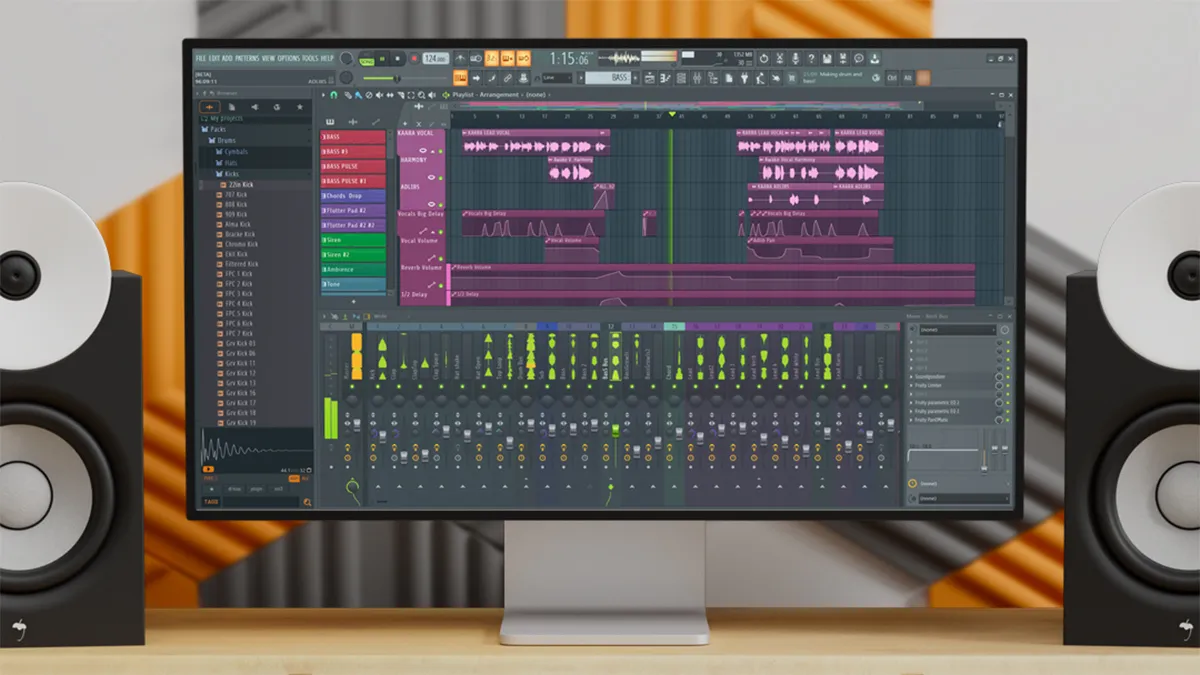
I’m the Deputy Editor of MusicRadar, having worked on the site since its launch in 2007. I previously spent eight years working on our sister magazine, Computer Music. I’ve been playing the piano, gigging in bands and failing to finish tracks at home for more than 30 years, 24 of which I’ve also spent writing about music and the ever-changing technology used to make it.
MusicRadar is part of Future plc, an international media group and leading digital publisher. Visit our corporate site (opens in new tab).
© Future Publishing Limited Quay House, The Ambury, Bath BA1 1UA. All rights reserved. England and Wales company registration number 2008885.
Links on Android Authority may earn us a commission. Learn more.
Taking notes manually is a thing of the past, especially if you have a Pixel device. Google’s Recorder app can record audio and transcribe whatever you say into text. It’s an impressively simple application that will save you time and stress. You’ve come to the right place if you’re trying to learn how to use the Recorder app on Google Pixel phones. Let’s walk you through the process.
Read more: The best Pixel-only features around
QUICK ANSWER
To use the Recorder app on Google Pixel phones, open the Recorder application and tap on the red Record button. The app will start recording audio. When done, press Pause. You can go into the Transcript section to read the speaker's transcription. When done, you can hit Save to store the audio and transcript.
JUMP TO KEY SECTIONS
The Recorder app is available on all Google smartphones since the Pixel 3. There are differences in supported languages depending on your model, though.
Pixel 3 to Pixel 5a:
Pixel 6 and newer:
Keep in mind that you can still record unsupported languages. The only downside is that transcriptions won’t work.
If your device is graced by the Recorder app, recording audio is a breeze.
The recording will be displayed on the Recorder app’s main page.
Once you save an audio recording, you can do some light editing to get rid of unwanted sections.
Now it’s time for the fun part. You don’t need to listen to the audio to see what you recorded! Recorder will save a transcript. Here’s how to access it.
Recordings can get long, so Google has added a way to search within a recording. Here’s how to do it.
Because the Recorder app comes from Google, it integrates perfectly into the company’s cloud services. You can easily sync recordings with your Google account. Here’s how to enable this feature.
You can get rid of audio recordings just as quickly as you created them.
Alternatives: These are our favorite voice recorder apps for Android
Yes! To store the recording’s location, simply tap on the Avatar icon and go to Recorder settings > Google Location settings. Toggle Use location on.
The Recorder app is available for Pixel 3 and newer phones.
It depends on your Pixel model. Pixel 3 to Pixel 5a phones support US English, British English, Singaporean English, Irish English, Australian English, Japanese, German, and French. Pixel 6 and newer devices support all those languages, as well as Italian and Spanish.
Sharing your audio recordings and transcripts from the Recorder app is simple. Simply open the recording, tap on the three-dot menu icon, and select Share. Follow the instructions to customize what you want to send.
You can back up Recorder clips and transcripts to the cloud using your Google account.

Whether it’s beat-making, EDM production, multi-track recording, or critical audio editing, finding the best music production software for your creative endeavors is all about ensuring that you have the required tools to optimize your workflow without getting bogged down in the details. Some music production software is incredibly simple and best suited for beginners and simple creative tasks, while other software is favored by professionals for its advanced editing tools and flexible workflow. In this article, we’ve selected some of the best music production software based upon usability, sound libraries, and overall flexibility to help you make the right choice before starting your next creative project.
— Best Overall: Avid Pro Tools
— Best for Macs: Apple Logic Pro X
— Best for Hip Hop: Ableton Live
— Best for Beginners: Image Line FL Studio
— Best Free: Apple GarageBand
Not all music production software is designed equally. Here are a few factors we took into account when selecting the best music production software for this list.
Price: The price of music production software varies widely, and we aimed to select products suitable for a range of budgets. On this list, we’ve included the best free music production software as well as flat-fee paid options and a subscription option.
Sound Libraries: If you’re using music production software primarily for composing and building tracks, a large library of high-quality sounds is an important feature to consider. Each of the digital audio workstations on this list includes a bundled library of sounds and effects, and some of the manufacturers offer additional sounds to purchase.
Compatibility: Not all music production software is compatible with every type of computer, and we did our best to ensure that Mac and Windows users are both represented within this list. Some software, like Pro Tools and Ableton Live, are compatible with both Windows and Mac, making them a good choice for maximizing your flexibility.
User-Friendliness: Music production software can be incredibly user-friendly, incredibly complex, or a mix of both. We took into account the needs of beginners and pros alike when making this list.
Why It Made The Cut: Avid Pro Tools is one of the most widely-used digital audio workstations in the industry, thanks to its advanced design and nearly limitless capabilities.
Specs:
— System Compatibility: Windows, Mac
— System Requirements:
Mac: macOS 10.14 or later
Windows: Windows 10 & 11
RAM: 16 GB minimum
Processor: Intel, Apple Silicon
— Plugin Format: 64-bit AAX
Pros:
— Cutting-edge audio recording and editing features
— Great for moving projects studio-to-studio; widely used
— Works on both Mac and Windows systems
Cons:
— Dense user interface with a moderate learning curve
— Plugins limited to proprietary AAX format
— Pricey subscription-based software
Avid Pro Tools is considered to be the industry-standard digital audio workstation for many reasons, all of which contribute to it being our pick for the best music production software overall. In addition to hosting a powerful suite of audio recording and editing features, Pro Tools stands out from the crowd with its flexible and lightning-fast workflow that make it an ideal choice for producing commercial audio on tight deadlines for music, TV, broadcast, and other media. Because it’s found in commercial studios everywhere, Pro Tools is also the best choice for maximizing compatibility when transferring session files between different studios or between Windows and Mac systems, both of which support the software.
Unlike the relatively intuitive drag-and-drop user interfaces of Apple’s Logic Pro X or GarageBand, Pro Tools leans toward a keyboard- and menu-heavy utilitarian workflow that offers incredibly granular control to users while being somewhat challenging and time-consuming to master. Users are also required to heavily commit to the Avid ecosystem when using Pro Tools, which only accepts plugins of Avid’s proprietary AAX format and now requires a monthly subscription fee in lieu of a flat one-time purchase. While this payment format can quickly add up over time and become expensive for small studios and individual users, Avid does a good job of keeping the software consistently up-to-date for their subscribers.
Why It Made The Cut: Apple’s flagship digital audio workstation (DAW) features an intuitive workflow and a large number of software instruments and effects, making it a great choice for composing, mixing, and mastering on Mac systems.
Specs:
— System Compatibility: Mac
— System Requirements:
OS Version: macOS 11.5 or later
RAM: 8 GB minimum
Processor: Intel, Apple Silicon
— Plugin Format: 64-bit AU
Pros:
— Robust audio recording and editing interface with large sound library
— Full version priced competitively compared to other DAWs
— Excellent effects library includes high-quality guitar amps and reverbs
Cons:
— Limited to Mac systems
— Only supports AU plugin format
— Workflow tailored more for composition and mixing than experimentation
Logic Pro X is some of the best music production software for Macs available, and that’s not just because it happens to be Apple’s flagship digital audio workstation. In addition to being competitively priced and offering a huge library of high-quality sounds and effects, Logic has an easy-to-learn user interface and intuitive workflow that make it a fantastic choice for recording, mixing, and mastering music of any kind. While it shares plenty of design DNA with Apple’s free entry-level music production software, GarageBand, Logic Pro X offers a deeper and more flexible variety of editing tools, including a musical score view and a dedicated mixer panel to meet the needs of professional songwriters, engineers, and composers. The amplifier emulations, reverbs, software instruments, and loop samples that come bundled with Logic Pro X are also some of the best available, making it a particularly good DAW for composition and songwriting.
While Logic Pro X’s overall strength lies in its creativity-oriented design, its sound stretching and chopping tools aren’t quite as easy to access and use as those found in Ableton Live, making it less ideal for sampling and experimentation. Its audio editing capabilities also aren’t quite as snappy as those found in Pro Tools, though they are easier to grasp and master. Finally, Logic Pro X is a Mac-only program, leaving out users who can’t commit to the more expensive Apple ecosystem. If you fall into that category, Avid Pro Tools is your best bet for commercial audio recording and editing while Ableton Live is the best choice for making beats and electronic music.
Why It Made The Cut: Ableton Live’s intuitive sound manipulation tools and extensive library of instruments and effects make it an ideal digital audio workstation for producing electronic music and experimental audio content.
Specs:
— System Compatibility: Windows, Mac
— System Requirements:
Mac: macOS 10.13 to 12
Windows: Windows 10
RAM: 8 GB minimum
Processor: Intel, AMD, Apple Silicon
— Plugin Format:
Mac: 64-bit VST2, VST3, AU
Windows: 64-bit VST2, VST3
Pros:
— Intuitive workflow ideal for electronic music and experimental sound tweaking
— Latest version adds more traditional production features like take comping
— Large library of synth sounds and effects
Cons:
— User interface could use a refresh; appears drab and utilitarian
— Full-featured Suite version costs significantly more than other DAWs
— No free upgrades as the software develops
Ableton Live is a widely popular DAW with a reputation for being some of the best music production software for hip hop and beatmaking, thanks to its robust creativity-centric workflow, extensive sound manipulation capabilities, and live performance integration. In addition to featuring plenty of sample-chopping and resampling tools, Ableton Live includes a vast library of over 1,500 sounds in its lowest-priced tier and over 5,000 in its full Suite edition, making it an ideal choice for experimenting and creating unique projects. The software’s intuitive session overview is also perfectly designed for looping and stacking phrases when building beats or songs, and when paired with a MIDI controller like the Ableton Push 2, users can harness Ableton’s live set capabilities to trigger clips and samples for live performance.
Historically, Ableton Live hasn’t offered the most robust or in-depth audio recording features when compared to other professional DAWs, but the most recent version aims to step up its game by introducing recording tools, like take comping and a new effect stacking system. The software’s interface is still blocky and predominantly gray, making it look slightly drab and outdated when compared to other DAWs. While the Intro edition of Ableton is fairly affordable, it only permits a maximum of 16 audio tracks, while the unlimited Standard and Suite editions cost significantly more than a competitor like Logic Pro X. Despite these limitations, Ableton Live’s enormous sound library and flexible sound manipulation tools might make it the perfect tool for you if you produce hip hop, beats, or other electronic music.
Why It Made The Cut: FL Studio’s beat-focused workflow and EDM-centric production tools are some of the easiest to learn and master, making it a great choice for budding music producers.
Specs:
— System Compatibility: Windows, Mac
— System Requirements:
Mac: macOS 10.13.6 or later
Windows: Windows 8.1, 10, 11, or later
RAM: 4 GB minimum
Processor: Intel, AMD, Apple Silicon
— Plugin Format:
Mac: 64-bit VST & VST2, VST3, 64-bit AU, FL Studio proprietary
Windows: 32-bit and 64-bit VST & VST2, VST3, FL Studio proprietary
Pros:
— Affordable software with free lifetime upgrades
— Step sequencer and piano roll are among the best available
— Robust automation tools ideal for EDM production
Cons:
— Lacks some advanced audio editing tools like comping
— Difficult to keep larger or more complex sessions organized
— Unique workflow doesn’t translate well to other DAWs
FL Studio stands apart on this list with an incredibly simple step-based interface and automation tools that make some of the best music production software for beginners overall. While it’s not as capable at recording multi-track audio as some of its competitors, FL Studio’s simple grid-based point-and-click workflow includes one of the best piano roll and step sequencer systems available in any DAW as well as extensive automation options. These tools make FL Studio very easy to learn, and thanks to its large library of samples, instruments, and effects, it’s a fantastic choice for making beats and producing electronic music at any skill level.
While the visual simplicity of FL Studio’s workflow is one of the major reasons that it’s so great for beginning producers, it’s different enough from other pro DAW software that much of the knowledge and workflow won’t be transferable. It lacks comping and other audio editing features that some users might consider essential, making it less than ideal for producing non-electronic styles of music, and session files can often become visually disorganized and unwieldy when the music becomes complex. Still, FL Studio is significantly more affordable than many of its competitors, and because all users get free lifetime updates, it’s an all-around solid value for beginners and pros alike.
Why It Made The Cut: GarageBand offers a streamlined library of musical loops, software instruments, and recording tools to every Mac user at no cost.
Specs:
— System Compatibility: Mac
— System Requirements:
RAM: 4 GB minimum
Processor: Intel, Apple Silicon
— Plugin Format: AU
Pros:
— Simple and intuitive user interface with some advanced features
— Includes high-quality library of instruments and effects
— Comes free on every Mac; iPad and iPhone version available
Cons:
— Requires a Mac computer or iOS device; no Windows version
— Limited flexibility; no mixer view, rudimentary track inspector
— Fixed sample rate of 44.1 kHz
If you’ve ever produced music, there’s a good chance you’ve already heard of GarageBand, Apple’s free-to-use digital audio workstation for macOS and iOS. As far as free music production software goes, GarageBand stands head-and-shoulders above the rest thanks to its simple and intuitive design, combined with a large library of high-quality sounds that include drum samples, synths, and guitar amp emulations. While GarageBand inexplicably lacks useful features found in other pro DAWs like a mixing console view and individual channel inspectors, its clean and blocky user interface makes it incredibly easy to start making music from scratch in no time at all. It also includes basic automation features for automatic adjustment of panning, volume, and other parameters, and all of its project files are fully compatible with Logic Pro X if and when users decide to upgrade their DAW.
While GarageBand is a great option for fast songwriting and musical sketching that can even be used to make commercial recordings, its design is fairly inflexible, requiring users to operate within the software’s beginner-friendly parameters with few exceptions. It also doesn’t support audio recording at sample rates above 44.1 kHz, preventing users from creating high-resolution projects that meet the industry standard. Still, GarageBand is entirely free to Mac, iPad, and iPhone users, making it a useful tool that’s worth checking out whether you’re a beginner or a seasoned pro. If you’re a Windows user looking for a free DAW, Cakewalk by Bandlab is a good option that’s been kept consistently up-to-date for years.
Style of Music: While the best music production software is generally flexible enough to use for a variety of genres and styles, some are much better suited to certain types of music than others. For example, sampling-oriented digital audio workstations like FL Studio or Ableton Live are more tailored for producing novel sounds and electronic music than Logic Pro X or Pro Tools, which offer smoother and more intuitive workflows for multi-track audio recording and editing.
Computer Age: One of the largest drawbacks to digital audio recording is waning compatibility and support in older computers, all of which will eventually stop working with the newest versions of music production software. If you’re looking for the most cutting-edge music production experience, make sure to double check your computer’s specs against the software’s requirements before committing.
Operating System: Unfortunately, not all music production software works with all operating systems. Apple GarageBand and Logic Pro X are two of the most widely used digital audio workstations, but they only run on Mac systems, leaving out Windows users. If you’re looking to maximize the accessibility of your session files across multiple systems, choosing DAWs like Pro Tools or Ableton Live that are compatible with Windows and Mac is the safest option.
Audio Project Scale: Some music production software is great for sketching out musical ideas or creating small-scale projects while others are better for tackling larger and more complex compositions. FL Studio is a good example of a DAW that makes it very easy to begin composing while requiring a lot of user intervention to keep projects organized as they grow. While all of the DAWs on this list can handle projects of different sizes, GarageBand or FL Studio are generally some of the best for jumpstarting creativity while Pro Tools, Logic Pro X, and Ableton Live are better suited for larger-scale production.
Music production software typically costs anywhere between completely free to near $1,000, and this is for the digital audio workstation alone. Additional plugins, which include software effects and instruments, can sometimes cost multiple hundreds of dollars each and be a significant contributing factor in the overall cost of a music production software collection.
If you’re primarily editing audio for commercial purposes and work with industry standard software, Pro Tools is the best music production software overall for handling complicated tasks with relative ease. If you’re a Mac user looking to complete some of the same tasks with a bit more access to creativity-oriented tools, Logic Pro X might be more your thing. Ableton Live is still some of the best music production software for hip hop and beat making, thanks to its quick and intuitive sample editing tools, while FL Studio is the best option for beginners due to its simple workflow. Finally, if you’re looking to save some money, GarageBand is still the best free music production software currently out there, but you’ll need a Mac to use it.
This post was created by a non-news editorial team at Recurrent Media, Futurism’s owner. Futurism may receive a portion of sales on products linked within this post.
Partly cloudy this evening, then becoming cloudy after midnight. Low 42F. Winds light and variable..
Partly cloudy this evening, then becoming cloudy after midnight. Low 42F. Winds light and variable.
Updated: January 7, 2023 @ 11:31 pm
River Bluff High School in Lexington County School District One.
State Rep. R.J. May, R-Lexington, serves as vice chairman of the South Carolina Freedom Caucus, known for its hardline conservatism. File/Staff
K-12 Education Reporter
Enter your email to receive top stories, including breaking news alerts, straight to your inbox.
River Bluff High School in Lexington County School District One.
State Rep. R.J. May, R-Lexington, serves as vice chairman of the South Carolina Freedom Caucus, known for its hardline conservatism. File/Staff
COLUMBIA — A right-wing legislative group now admits it had a role in editing an audio recording that became the basis of a Fox News report attacking a South Carolina school district.
The admission from the South Carolina Freedom Caucus comes a day after a Post and Courier article that quoted claims the clip had been doctored from the CEO of a nonprofit education group that employs the person speaking on the recording.
State Rep. R.J. May, R-Lexington, previously said his group did not create the recording of an EL Education employee, purportedly instructional specialist Tarika Sullivan. But on Nov. 1 he acknowledged that members of his organization altered the raw footage they received.
May said the S.C. Freedom Caucus removed the voice of the person who provided them with the audio in order to protect the identity of that person, described by May as a “whistleblower.” The caucus also edited background noise from the conversation, May said, but he denied altering the speaker’s words.
Scott Hartl, president and CEO of the New-York based nonprofit EL Education, said Oct. 31 that the speaker on the recording is an EL employee but did not confirm it was Sullivan. He said the speaker was recorded without consent under false pretenses by a hotel employee who pretended to be interested in her work.
Remarks from different parts of their conversation appear on the clip without any context on what came in between. At one point, she references the Lexington One School District, one of several in the state that contracts with EL Education. Later she mentions critical race theory.
But the fragments give no indication as to what she was responding to at any point, including whether she was discussing her own work or views or answering a pointed question about someone else. The clip created a “false and crudely edited narrative,” Hartl said on Oct. 31. Whether the audio had also been edited prior to the caucus receiving it remains unclear, as does the date of the recording.
May denies that the resulting audio misrepresents what the speaker said, which he said was to tout a critical race theory curriculum for Lexington County School District One.
“The far left will stop at nothing to destroy those who challenge their radical ideology,” May said. “Therefore, the video was edited to ensure the protection of the whistleblower. In doing so, we preserved the integrity and intent of Mrs. Sullivan’s words.”
Also on Nov. 1, Fox News updated its article from the week prior after the Post and Courier pointed out a misquotation of the audio.
Since 2013 EL Education has worked with six schools in the Columbia area, all of them in Lexington County School District One, which is the state’s sixth-largest district at more than 27,000 students, including from the towns of Lexington, Gilbert and Pelion.
Hartl said the nonprofit’s research is “based on the science of reading and learning.” The most prominent example of the role EL plays in Lexington One is likely the “Crew” program at River Bluff High School, which is a team-building program for teachers, and for students is a random grouping of them — regardless of background or grade level — to organically foster study groups and mentorships.
The S.C. Freedom Caucus said in a statement that EL Education is actively attempting to “circumvent state law” by teaching critical race theory to students.
Lexington One spokeswoman Megan Moore said the comments heard on the recording “do not represent the views or educational practices” of the school district.
EL Education also works with schools in Charleston and Greenville counties.
“Lexington District One will continue to look into this matter and is committed to ensuring all Lexington District One schools adhere to South Carolina standards and statutes,” Moore said in an Oct. 25 statement.
Click here for more news from Columbia, S.C.
K-12 Education Reporter
T. Michael covers education in the Columbia area. He studied journalism at the University of South Carolina and communications at the University of Denver, and worked as a reporter covering Denver Public Schools.
South Carolina hosted No. 8 Tennessee on Saturday. Read moreEighth-ranked Tennessee hands Gamecocks worst SEC loss in their history
In a tight labor market, Columbia and Richland County are looking to raise salaries for public safety employees, as well as evaluate pay across the board. The question of where the money will come from remains. Read moreHow Columbia and Richland County are looking to increase employee pay
Legislative leaders hoped pocketbook issues and public safety would be the guiding themes for the 2023 legislative session, but the state Supreme Court’s decision to toss out South Carolina’s six-week abortion ban likely blew up the priority list. Read moreStatehouse Preview: Abortion ruling puts debate back in center stage for 2023 SC session
It’s easy to… Read moreScoppe: Against backdrop of abortion debate, SC speaker’s early agenda focuses on adoption
The Post and Courier Columbia
2101 Gervais Street
Columbia, SC 29204
Phone: 803-765-0707
News tips/online questions: [email protected]
Subscription questions: [email protected]
, Post and Courier, an Evening Post Publishing Newspaper Group. All rights reserved.
I interviewed Annalibera’s Anna Gebhardt in Greenwood Park in Des Moines during a hailstorm. Taking sanctuary in the open-air shelter by the pond, we read the graffiti scrawled all over its wooden posts.
“Don’t get good at sumthin u don’t like doing.”
Our conversation that day ranged from Terry Pratchett’s satirical fantasy series Discworld and Olaf Stapledon’s speculative history of the cosmos Star Maker to NBA teams, to silent film music (the subject of her college thesis).
Gebhardt is an adventurous and restless artist who emerged from a classical music background in 2015 with two debuts: the shoegazey Nevermind I Love You, where Annalibera is a simmering alt-rock trio, and the noise cassette loveil, where Annalibera is a screeching bionic animal made up of Gebhardt and her laptop.
Her follow-up, the self-produced Opia (2018), where Annalibera is a flamboyant studio operation, burst out in just about every direction—dream pop, chamber pop, jazz ballads, new wave, drone rock, impressionistic jams—all anchored by Gebhardt’s expressive voice.
Annalibera’s latest album Moon Bath was made in collaboration with producer Philip Rabalais, previously a member of Iowa bands Trouble Lights and Utopia Park.
Moon Bath again plunges Gebhardt into colorful new territory: the world of electronic pop, with detours into sound collage and electronica. Moon Bath was released on CD by vibrant independent label Nova Labs right before the 2020 lockdown. Swallowed by the pandemic and unsupported by a tour, the album didn’t receive digital release until now.
This September, Annalibera will play for their biggest crowds yet as the opener for Pavement’s reunion shows in Denver, Kansas City, and Saint Paul. Iowans who want to catch the new iteration of the project can see them at the Maximum Ames Music Festival earlier that week, on Saturday, Sept. 17. The band’s current lineup is Anna Gebhardt, Ryan Stier, Caleb Swank-Ferrara, and Trent Derby, and will feature Gebhardt on sax.
Our conversation follows below, condensed and edited for clarity.
NK: In a way Moon Bath continues the adventures in electronic music that Annalibera began with loveil. Did you know Moon Bath was going to be an electronic pop album when you were writing it? Is that why you started working with producer Philip Rabalais?
AG: I didn’t set out to write it that way specifically. Some ideas just needed that treatment or sort of come like that. […] With Phil, Trouble Lights was playing at Wooly’s, and I chased him down when he was heading to his car after the show. I told him that I had some songs I wanted to record and that, with his style, he would be the perfect person to work with. He said yes. And it was a really nice experience making Moon Bath with him. It’s my favorite [experience making a record] so far.
I actually saw Phil at the first concert I went to when I moved here in 2008. I drove over to Iowa City, to Gabe’s. I went to see Tilly and the Wall and this band opened for them called Porno Galactica which was Phil and his brother Dom. They were doing computer music and hanging from the rafters.
Hanging from the rafters?
Literally. They jumped up there and climbed around on them, hanging down and singing and stuff. It was awesome, I mean, it was really good.
Were you into electronic music at the time?
Yeah, yeah. I grew up listening to late 90s, early 2000s Madonna, for example. I was just listening to the Scissor Sisters driving here. You know the Scissor Sisters?
I don’t think so.
Well, I mean…[plays “Filthy/Gorgeous” from her phone] And I loved Eiffel 65 as a kid. I listened to that album so much, I could sing the whole thing exactly.
Moon Bath is more pop-inspired than your previous albums, with danceable beats and a few big choruses, but it also resists some pop tendencies with musical left turns and traces of Annalibera’s experimental side. What’s your relationship to pop music in general?
I like pop music, whenever people ask me what kind of music I play, I mention pop. But it’s hard to get the point across since “pop” means a lot of different styles. […] I really like making stuff that feels very balanced, like it already existed. Almost basic. That’s pop music I think.
“Kikyo II” is one of my favorite songs on the album. Is it a sequel to loveil’s “Kikyo”? It interpolates a vocal chant from the earlier song.
Yes, “Kikyo II” is about the same character that I wrote the first one about. We’re doing that one on the tour.
Is there a connection between loveil and your classical music background? You jumped right into the world of noise music with that album but everything in it is well structured and it has the kind of composition you might hear in a 20th-century classical work.
Oh cool. I was actually reading a book about [16th century Italian composer] Gesualdo at the time. He was a noble, a creepy Italian dude in his creepy castle. Killed his wife. He made this insane weird music, very emotional, very intense. I sent loveil to the guy who wrote [the Gesualdo book I was reading] and he was like, “I see no connection between Gesualdo and your music.” But he was nice, he said thanks for sharing.
Do you prefer making music by yourself or with other people? Moon Bath and Nevermind I Love You both had a collaborative process while Opia and loveil seem more self-driven.
I have a choral background, I grew up doing music in church…I don’t know what to call that feeling of community or transcendence when you’re making music with people. I feel good playing piano by myself too;I love doing that. But once I got out in the world, off the farm—as a kid I couldn’t really leave the farm unless my parents let me, so piano was really big for me at that time in my life—[I was more excited about making music with other people than] playing by myself. But I like both.
When I started making music on my own, I was trying to get out of the jail of classical music. Opera didn’t want me. I noticed people don’t seem inspired when I sing that, but they do seem inspired when I sing indie or Americana styles.
Was opera something you wanted to do?
Not really, it was just what the program focused on. I had a great time– I mean, I had an intense time but also a great time with the choral program at Drake. We were making music at a really high level. I had some amazing moments performing, transcendent I-know-everything-about-the-universe moments. Have you had those? It’s like, “why can’t I remember that?” when they’re over. “I knew all the answers! Where’d they go?” I’ve always tried to find that making my own music. Never found it so far really. I still sing with choirs, I’ve pretty consistently sung with choirs since college.
It seems like you’re interested in other arts too. You directed a film for loveil which references filmmaker Jean Luc Godard’s Two or Three Things I Know About Her early on. Your song “Sarah Lucas” is dedicated to the artist…
I’m going to make more films; I really like it. I like Kenneth Anger, Maya Deren, that’s the kind of thing I’d want to make more of. I’m always writing and planning films and scenes.
The “Renaissance man” isn’t really a thing these days. You have to be such a specialist. I think it’s easy to get in a tunnel vision with whatever your thing is and then be like, “Nothing else matters.” I love visual art, I love film, I try to see live theater as much as I can, I love going to operas, I love sports. I really like watching the NBA. I think sports are an art, I get a lot out of them. […] During the pandemic I decided I have a new big dream. I want to be a comic writer– as in funny, not graphic novels.
That makes sense. There’s a humor to some your songs, especially on Opia. Or “Love In A Recession” which, when I first heard it at one of your shows, I thought was a cover of an old John Prine country song or something. It has that kind of sensibility. It starts out kind of funny and then gets more emotional as it goes on and as the performance becomes more intense.
Thanks. That’s why with Nevermind I Love You…I have a lot of distance from it now and I’m proud of it when I listen to it, but at the time it didn’t turn own how I envisioned it. It’s not funny at all, all of the lightness isn’t there. It’s very serious. But there are a lot of people who like that about it and that’s important to me too, the conversation that happens after you share what you’ve made.
You mentioned going on tour in Europe around the time of Nevermind I Love You.
We had started playing with this woman Anne. She was going to go study in Stockholm and said we should go on a European tour. So we did. We played loveil material pretty much. I booked the tour myself and the routing was really, really bad. We’d be like, “Okay, today we’re driving across Germany and then we’re gonna drive back across Germany again for the next set.” You can’t do that. Whatever, we did it and it was insane. It’s a really long story, I could probably write a book about it. And that’s the only way I can really tell the story, unless we’re in, like, a fifty-hour car ride together. I don’t even like telling stories. There are stories and they could stand alone but it’s like, you don’t understand the effect of what I’m saying because for two weeks straight before this, the same amount of intensity of insane stuff was happening back to back the whole time. So me just telling this standalone part of it doesn’t really get the point across.
But anyway, I got to do this cool last hurrah with her. Her being in the band helped me a lot. Actually the European tour did too. People think the music industry is maybe [half women], and it does kind of seem like that because there are a lot of frontwomen. But the lead singer is just a small part of the music industry. There’s all the players, there’s the bartenders, the promoters—everyone involved is a dude, basically. That tour was the first time I realized that when we do soundchecks and there’s dudes in my band, no one talks to me. So when me and Anne would do soundchecks, the engineers would say, “Who am I supposed to talk to?” Like, one of us! There’s only two of us, and we’re both women so you’ve gotta take your pick, man, sorry!
How do you play loveil songs live?
When I play that material live, I’ll play solo usually or maybe with a guitarist. One time I played a show with Bob [Nastanovich of Pavement, at Baby’s All Right in Brooklyn], and he was on drums. I use several pedals and a microphone. It doesn’t really sound like the album; I mess with the sounds and play improvisational versions of the songs. I’m kind of chopping up and mutating the material with a sampler.
What’s your personal history with Pavement?
When I was in high school my friend would put their songs on mix CDs for me. “We Dance” was a really big song for me then. I was listening to “Cut Your Hair” yesterday and was like, “perfect.” I never thought I’d get to see them live, let alone open for them.
The future of tuning shops already looks bleak with the rise of EVs. OTA (over-the-air) updates give manufacturers the power to remotely lock or unlock features on your vehicle, including its performance, and of course they’re going to make you pay for it. Mercedes is already getting this ball rolling with a subscription-based performance package that will increase the power output of its EQ line of EVs. All for the low, low price of $1,200.00 (not including tax).
Called “Acceleration Increase,” the update increases both torque and maximum power output for your EQ EV. Mercedes says that power output will increase by 20-24 percent, while increasing the overall performance of the EV. Depending on the model, zero to 60 mph times drop 0.8 to 0.9 seconds which, if this were a normal ICE-engined vehicle being tuned, would be pretty impressive.
This performance increase isn’t limited to specific models either, it’s available across the EQ range:
Mercedes-EQ EQE 350 4MATIC: increase from 215 kW to 260 kW, with 0-60 time changing from 6.0 seconds to approx. 5.1 seconds.
It's a camera. For your car.
The Ring Car Cam's dual-facing HD cameras capture activity in and around your car in HD detail.
Mercedes-EQ EQE SUV 350 4MATIC: increase from 215 kW to 260 kW, with 0-60 time changing from 6.2 seconds to approx. 5.2 seconds.
Mercedes-EQ EQS 450 4MATIC: increase from 265 kW to 330 kW, with 0-60 time changing from . 5.3 seconds to approx. 4.5 seconds
Mercedes-EQ EQS SUV 450 4MATIC: increase from 265 kW to 330 kW, with 0-60 time changing from 5.8 seconds to approx. 4.9 seconds
While the power increase is welcome, the downside is that this is a subscription. To unlock this performance requires that owners drop $1,200 a year to keep this performance upgrade.
Perhaps Mercedes missed the writing on the wall, considering the backlash BMW received over its heated seats subscription, their subsequent assurance that the U.S. wouldn’t see something like that, or the data that shows some 75 percent of car buyers don’t want subscriptions. I’ve reached out to Mercedes for comment and will update if and when they respond.

Kevin Allen Music Production to play holiday kickoff concert at … Northwest Georgia News
source
Subscribe
Uniting Souls Music delivers ‘Half Light Sway’ remix EP to close out 2022
Seven Lions sets date for release of long-awaited debut album ‘Beyond The Veil’
Kai Wachi releases heavy yet heartfelt EP ‘Skins’
Scumz begins Titans tour at Stage Seattle
Seattle’s Faraday brings cutting-edge production across the PNW (Local Spotlight)
GRiZ announced as first major headliner for Shambhala 2023
Ultra Miami drops star-studded Phase 2 lineup
The Finale: Get LOST for the final time this Saturday
C89.5’s ‘Music’s in our Blood’ Drive: Give blood, do good, see Sofi Tukker
DanceSafe releases significantly improved fentanyl test strips
Portland’s Moonlight Masquerade New Year’s Eve 2023 packs an elite lineup
CRSSD Festival promises vibes and smiles with stacked 2023 Spring lineup
Seven Lions will kick off upcoming ‘Beyond The Veil’ Tour in the PNW
Here’s your last-minute guide to New Year’s Eve events in Seattle
Contact Music Festival returns to B.C. with a 2023 lineup that’s better than ever [Artist Guide]
Tips for keeping yourself safe from theft at music festivals
MDLBeast, a music collective in Saudi Arabia, is uplifting EDM culture in the Middle East
Grooving for Good mental health nonprofit initiative kicks off at UW
An important conversation about hearing loss
Beat the cold in line for shows this winter with these helpful tips
Looking back on a decade to remember with the Pacific Northwest’s own ODESZA
DMNW Spotlight: Mahalo Promotions coming back strong after the return of live music
Music Rights 101: What you need to know about licensing your music rights to a label
C89.5 celebrates 50 years as Seattle’s unstoppable home for dance
The Dance Music Northwest team picks their favorite albums of 2021
A look behind the lens with Seattle photographer Kainalu Ramos
The art of listening to the listener at C89.5: A conversation with Program Director Ron Chatman
Seattle VJ Jayson Esguerra on his origin story, working with G Jones, and his plans for the future
A conversation with Erica Opsvig & Sean Fischer, up-and-coming creators of Seattle’s Duck Brunch and Plamphaus
DMNW sits down with talented turntablist DJ Mixxtress
The Seattle Electronic Music Producers Association is helping elevate local producers’ sounds
These Washington music production programs can help take your career to the next level
DMNW Interview: Anjunadeep’s Enamour talks music gear and production before Ora show
Apple Music launches Dolby Atmos-powered ‘Spatial Audio’ along with lossless tier
Antelope Audio launches Zen Q Synergy Core 14 x 10 bus-powered portable audio interface
Production
Production
Production
Production
Production
By
on
Seattle Electronic Music Producers Association (SEMPA) is a group that has been helping local producers enhance their production and provide a network for local production talent. Formed by Jason Melton in 2015, the group has had humble beginnings, where musically like minded friends held basement sessions, feeding production ideas, tips, and tricks off of each other.
Then word began to spread about what was being cultivated in these sessions, allowing the group to organically grow. Experiencing the woes of the pandemic, the group was held together by long time members, Dave Clayton, Mindy Christman, and Ben Meadow.
Credit: Mindy Christman
“I really loved the energy and how people came from all different corners (genres) of the electronic music scene. The vibes were very positive. It was all about community, education and growth. There was zero scene politics or ego involved – a breath of fresh air from the working DJ world for sure.” – Ben Meadow
SEMPA is now homed at Substation, where their sessions are held on the second Wednesday of each month to allow producers of any electronic genre to share their current creations. As they continue to grow, they are considering adding in-person classes on Tuesdays (stay tuned). It is a unique opportunity for producers to hear their work played out on a club system.
A full-blown, state of the art studio with top-of-the-line equipment isn’t necessary nowadays to make good electronic music. Big dance floor groovers and talent are curated from all places around the world and from a diverse range of individuals. Advances in music software and technology, coupled with social media, has helped expose the vast amount of electronic music being produced, while providing a connection between artists and fans.
However, the sounds produced in your bedroom might not transfer well to a club’s sound system. In fact, it can be a difficult task that takes extra technical finesse. There is room-correction software available to help remedy this, but there is something invaluable about in person, hands on learning. SEMPA has helped many local producers through production difficulties in a welcoming, learning conducive environment. Curious about production? We listed Washington programs to help get you started!
“Being able to test your tracks on the loud sounds has really drawn out producers I had no idea existed in Seattle. We also love to have local producers come through for showcases on their own knowledge and processes. I also have personally taken on some one on one classes with people to teach fundamentals. I love this group of people and what we have cultivated. I am exited to see how we grow this next year” – Mindy Christman
Credit: Mindy Christman
Sessions start with a Producer Showcase from a local producer who shares his or her current production process and style, sharing tips and advice you can’t always get from a Youtube video. Then the session will move into the Track Feedback portion where producers in attendance are given the opportunity to play a few minutes of a track they are currently working on and in return the room gives feedback and comments.
“I have gained so much from this group from listening to major artist showcase to the many friends, mentors, collaborators, and networking opportunities I’ve gained as I’m sure some in this group can also say the same.” – Marcus Kidder
Credit: Mindy Christman
The sessions are welcome to any Digital Audio Workstation experience and any genre of electronic music. They do focus their teaching on Ableton, but inherently a lot of the same skills learned crosses over into other programs.
Outside of the session, SEMPA members stay connected through remix contests and online discussions. SEMPA embodies the connection and camaraderie that is much needed in the local scene, especially in today’s climate. Check out more of our stuff covering production!
Important things happen in Pacific Northwest nightlife, and DMNW will send you alerts!
covering the shades of deep, progressive, and melodic house PNW – Seattle
Your email address will not be published.
A look behind the lens with Seattle photographer Kainalu Ramos
The art of listening to the listener at C89.5: A conversation with Program Director Ron Chatman
Contact Music Festival returns to B.C. with a 2023 lineup that’s better than ever [Artist Guide]
Above & Beyond surprises fans with unexpected Gorge Weekender in 2023
Important things happen in Pacific Northwest nightlife, and DMNW will send you alerts!
Founded in 2013. © 2021 Dance Music Northwest, LLC.
Important things happen in Pacific Northwest nightlife, and DMNW will send you alerts!
Players wondering how to find all of Bruce Wayne’s secret caches in Gotham Knights can refer to this handy guide.
In Gotham Knights, players will find themselves running all over Gotham City not only in pursuit of criminals but also on the hunt for several collectibles. During the beginning cutscenes of Gotham Knights, it is revealed that Bruce Wayne is dead, and it is up to the bat family to take his place in protecting Gotham.
Red Hood, Nightwing, Batgirl, and Robin all join forces to take out the criminal underworld who are starting to realize Batman is not around anymore. Taking on Batman's last case, the bat family discovers there is more to the ongoing threat to Gotham's future than meets the eye.
Bruce Wayne was by no means unprepared for his recent passing, as he was a cunning man who moved two steps ahead at all times. Before his death, Bruce had hidden audio recordings in secret caches all around Gotham City. These audio recordings are marked on the map and players must complete a time trial to unlock the location of the secret cache they are stored in.
Finishing off the very first main case mission – Main Case 01: Batman's Last Case, will make the first secret cache icon appear on the map in the bat computer. For the other caches to appear, players must return to the Belfry, ending the night and unlocking the locations of the next set of audio recordings.
Once an audio recording location is reached, there will be an activation plate on the roof of the building. Stepping on the plate and holding the button on the screen will activate the time trial. Players aiming for 100% completion will need to locate and beat every time trial. These time trials can be difficult if they are approached in the wrong way, and failure will mean heading back to the location of the activation plate and retrying.
All goals must be passed through for them to count off the total needed to pass the trial. Careful parkour and not rushing will see victory in the trials. Once all the goals have been reached before the timer runs out, the location of the secret cache containing the next audio recording will be revealed on screen and is usually close to the final goal of the time trial.
Use the grapple instead of heroic travel to reach the checkpoints.
If all secret cache icons are clear from the Gotham City map, it is time to head back to the Belfry to spawn the next set of audio recordings. Once the night is ended when the cache trials have been cleared, the next set will appear. This process must be repeated until all 12 of the time trials have been beaten and the secret caches at the end of them have been opened.
Luckily none of the secret caches are missable and all of them are marked handily on the map, saving players the need to hunt them down. The audio recordings can be listened to in the Database menu under the collections tab, then by selecting Bruce’s Audio Log. Upon completion of all 12, players will unlock the Gotham City Confidential trophy and achievement.
Gotham Knights are available now on PS5, Xbox Series, and PC.
A gaming writer for GameRant, Ali loves the finer things in life, like Sonic 3 & Knuckles, gaming since the 80's on multiple platforms.While Ali isn't writing for GameRant he is a Podcast host and video editor.

After a more than two year hiatus, the Peloton studios are once again open to the public. Following the soft reopening phase that began in June, Peloton Studios New York (PSNY) and Peloton Studios London (PSL) officially celebrated their grand reopening on August 19, 2022. When Peloton first shared the news, they also relaunched the studio booking site, which had been dormant since the initial studio closure. If you have questions about how to book an in-person class, you’re not alone! This article provides an in-depth overview of how to book and take an in-person class at PSNY and PSL. First, we’ll cover a lot of frequently asked questions about how to book classes; then we’ll take you through a step-by-step tutorial of the actual booking process.
There is a special website to book in-person classes, which you can find at studio.onepeloton.com. There you will find the list of classes. See the bottom of this article for an in-depth walkthrough, guide, and screenshots of the booking process and what to expect.
Classes at PSNY cost $35 and classes at PSL cost £25. You technically buy a credit, which you will then use to reserve your spot in the class. You can buy credits at https://studio.onepeloton.com/shop. One interesting note is that you can essentially gift class credits to friends and family by purchasing the credits and then transferring them to another member. Similarly, if you purchased credits that you will no longer be able to use, you can transfer them to another member. You can visit your account page to view your credits and any classes you have scheduled, or previously taken at the studio.
Yes, each class is the same cost no matter the class length or modality.
The Peloton Studios are currently open to members on Fridays through Sundays. Mondays through Thursdays are reserved for coach-to-camera instruction.
Peloton is currently releasing classes for bookings 6 weeks in advance at both Peloton Studios New York & London.
Peloton is releasing new in-person classes for booking on Mondays around 12:00pm ET (this is of course subject to change, but has been stated as the policy). Each Monday, they’ll release the next weekend’s worth of classes – which will be six weeks away. Thus, the schedule will be released on a rolling six week basis.
Members who visited Peloton’s original 23rd Street Studio will recall that the schedule was released two weeks out, and you could book exactly one week in advance. However, now that Peloton is wanting their studios to be a destination experience, they are opening up the schedule much further in advance so that members can make travel arrangements.
With the studio only recently having reopened, demand is high to take in-person classes. This means that classes are selling out within minutes or hours of them becoming available (which again, is typically around 12:00pm ET on Mondays). We expect over the coming months it to become easier to book a spot once more people have had a chance to visit the studios.
No, you cannot pick your own Bike/Tread/mat location when booking. The assignment is random – your confirmation email may note a spot auto-assigning to you, but this does not really matter. When at the studio, it is essentially first-come first-served as you enter the room. However, Peloton may move you at their discretion (potentially based on height or other factors). This applies in particular to the yoga and strength studios, which are smaller and present more of an opportunity for taller people potentially blocking the cameras.
At the original 23rd Street Studio, one of the steps was using a map to select a specific Bike or Tread. Peloton has done away with this since their reopening.
Although there isn’t a published map of the Peloton Studios cycling studio (or other studios), there are still limits for each class. The capacities for Peloton Studios New York (PSNY) are below:
The capacities for Peloton Studios London (PSL) are below:
(At time of publishing PSL does not have yoga classes, and strength classes are recorded without members).
No. You’ll know the modality, length, and instructor – but no other additional information will be available upon booking. You will be able to check the upcoming schedule approximately two weeks in advance to learn additional information.
If you cancel more than 12 hours in advance, your credit will be returned to your account (but you will not receive a refund). That credit must be used in 60 days.
We have heard that in mid-August Peloton implemented a limit of two classes (per person, per day) in order to allow more members the opportunity to check out the new studios. So for example, if you’re visiting NYC for the weekend you can take a maximum of six classes throughout the weekend: two on Friday, two on Saturday, and two on Sunday. We imagine this limit might be reexamined in the future.
In theory, yes. However, it is important to note that the doors to the class open 30 minutes prior to the class start time, and “close” 15 minutes prior to the start time. So if you aren’t there 15 minutes before, Peloton might give your spot to someone on the waitlist. You should avoid booking back-to-back classes too close together, as you want to allow time following the class to get your picture taken with the instructor.
According to the FAQ page members may book up to five spots in a class. You can do this by booking once, then going back and booking the same class again as many times as the number of spots you’re looking to book. However, we’ve received reports that Peloton plans to change this and only allow one spot in a class per member – so this means that if you want to go with friends they would need to book their own spot. We’ll keep an eye on this.
For group bookings – perhaps such as an unofficial home-rider invasion from a particular leaderboard tag – you can reach out to [email protected] (PSNY) or [email protected] (PSL). You can expect to hear back from Peloton within 1-2 business days regarding pricing and availability. You can also contact the concierge for visitor information at [email protected] (PSNY) or [email protected] (PSL).
Sort of. To actually book a class, you do need a Peloton account, which you can sign up for for free as part of the booking process. However, you don’t need to be an active member to do so.
Bookings at the studio are open to all members regardless of whether they are All-Access (those who own a Peloton device such as the Bike or Tread) or App-only. Note that you do still need a Peloton account, which you can sign up for for free as a part of the booking process. The cost of an in-person class is the same regardless of your membership type as well.
At the 23rd Street studio members could buy packs of class credits at a slight discount. As of right now, they are not allowing you to do this at Peloton Studios New York (PSNY) and Peloton Studios London (PSL).
You should see a “find a class” button in the top right corner of the studio booking site – clicking this will allow you to toggle between the NYC and London studios. There is also a “location” field in the left-hand side bar of the page that allows you to select either NYC or London.
The 23rd Street studio offered a monthly pass (that cost approximately $400) for unlimited studio rides. Since Peloton wants a visit to Peloton Studios New York (PSNY) or Peloton Studios London (PSL) to be a member experience with the opportunity to meet instructors and other members, they aren’t treating the studios like a local gym – so they are currently no longer offering an unlimited pass option for locals.
If you don’t have a credit, the booking process will let you buy one credit as you check out. Just keep in mind to have your credit card handy, as you can’t save your credit card info to your profile; you have to enter it as you buy that credit. Note that credits are only good for 60 days, so if you’re not exactly sure when you’ll visit, it is probably safer to wait until you’re ready to book before purchasing the credit.
Peloton will periodically add the “Waitlist” button next to classes that had been previously full, and even more rarely, but the “Book” button back so you can directly book and skip the waitlist. This might occur if there were cancellations, or they had been holding spots for something and no longer need them. There is no set time or date these get released back – you just have to get lucky and check the studio website at the right time to see that.
A waitlist spot means that you don’t have a guaranteed spot in the class, but there is a chance Peloton will email you if someone cancels. There is no guarantee you will get into the class.
If you’re not moved from the waitlist into the class you will not receive your money back, but your credit will be returned to you. You can then book another class before your credit expires in 60 days.
There is no solid answer – it simply depends on when people who were able to book a spot in the class cancel. It could be a few days or weeks in advance of the class; it could be the morning of; or it could be 15 minutes before the class begins (in the instance of a no-show, for example).
This entirely depends on your personal situation and whether you’re willing to gamble on a potentially “wasted” trip if you go to the studios but ultimately don’t get off the waitlist. If you’re local or already in town and don’t have anything else to do, it is potentially worth a shot. However, we would not advise planning an entire trip around a visit if you’re only on the waitlist, because there is no guarantee you’ll get into the class.
If you’re interested in taking a class in-person at the Peloton studios, head to https://studio.onepeloton.com/. You’ll be brought to a welcome screen where you have two options: you can click the “book your spot” button to jump straight to the schedule, or you can hit the down carrot button at the bottom of the screen to learn more about the studio space and explore instructors.
Upon clicking the “book your spot” button, you will be brought to the main schedule page. The first thing to look for is whether you’re viewing the New York studio or the London studio, as you can only view the schedule for one at a time.
Below the location box there is a list of fitness disciplines that you can filter by: cardio, cycling, running, running, strength, walking, and yoga. You can select certain boxes so that you only view classes of that modality. For example, if you’re dead-set on taking a cycling class at Peloton studios, you should select the “cycling” box so that you only see upcoming rides.
You can also filter by instructors. Note that there is only basic information listed for each of the classes: the modality, length of the class, and the instructor. If the date is within the next two weeks you can head to the Peloton class schedule to get additional information, such as whether the class is music-focused vs. fitness-focused, or centers around a particular theme. Peloton has been adding more details to the studio booking site once the class is within two weeks; but the classes have been completely booked by the time those updates are made.
When viewing the list of upcoming classes you will be able to see on the right-hand side whether the class is available to book, waitlisted, or full. Completely full classes will not have a clickable button. You can only sign up for a class if you see a “book” button, or if there is a waitlist option available.
After clicking the “book” button for the class you’d like to take, you’ll be brought to a screen that contains only that class information: the modality, date, time, instructor, and duration. There is also a disclaimer provided by Peloton: “As we’re a LIVE production studio, spots are assigned by us. You may be placed on spot and then be asked to move for production purposes.”
This is a major change from how Peloton previously operated their studio booking, as members used to be able to select their specific spot each class. It appears that moving forward Peloton will assign that spot for you.
When the studio booking site first relaunched members booking a cycling class were asked to input their shoe size or indicate if they were bringing their own, but that section has since been removed from the site.
If you don’t have any credits, you will need to purchase those in order to book the class. Classes at PSNY cost $35 and classes at PSL cost £25. You can buy them as a step of the booking process, or buy them ahead of time. Note if you buy a credit ahead of time, they are only good for 60 days, so be sure you will be able to find a class at the time you can visit before doing so.
Upon booking the class you’ll be brought to a confirmation screen that says: “You’re booked!” From there you can return to the schedule, view your classes, and review the studio rules. You’ll also receive any email containing the booking confirmation.
If you need to cancel the class you’ve booked, you can do so by navigating to the my classes page and clicking the “cancel” button next to that particular class. You may also reach out by phone, email, or chat. You must cancel at least 12 hours before the class starts in order for your class credit to be returned to your account. Otherwise it will be considered a “late cancellation” and you will lose the credit.
If you’re on the waitlist for a class but can no longer attend, you should also remove yourself from the waitlist at least 12 hours ahead of the class start time.
You can visit your account page to view your credits and any classes you have scheduled, or previously taken at the studio.
The day has finally arrived and you’re ready to head to the studio! You’ll want to make sure you’re completely prepared for the experience. In the coming days we’ll have a separate guide covering everything to know for the actual visit.
For additional information & questions not covered about booking Peloton classes, in either New York or London, you can always visit the Peloton Studios FAQ site.
Want to be sure to never miss any Peloton news? Sign up for our newsletter and get all the latest Peloton updates & Peloton rumors sent directly to your inbox.
Get our newsletter and stay up-to-date with all the Peloton news you need to know!
Hi – thanks for this information. Do you know if there’s a parking garage close to PSNY? Thanks!
Thank you for the info! I am waitlisted for a ride in London in a few weeks. Do you know the likelihood of getting off the waitlist? How many people are generally waitlisted for a class?
Your email address will not be published.
Pelo Buddy is in no way affiliated with Peloton Cycle or Peloton Interactive. Peloton is a registered trademark of Peloton Interactive, Inc. Some links on the site are affiliate links. As an Amazon Associate I earn from qualifying purchases.
At two years old, Matt Dugan watched his parents dance around the living room as Carlos Santana’s “Smooth” blared from the speakers. His earliest memory is still one of his favorite stories to tell, though he’s added some great memories during his time working in Los Angeles recording studios with top artists in the music industry.
Dugan graduated in 2020 with a major in music production and recording industry from the School of Media Arts and Studies (MDIA) in the Scripps College of Communication. Leading up to college, Dugan promoted himself as the all-around music guy. He produced and mixed songs for friends and local rap and R&B artists, continuing his passion for the genre that sparked in middle school. Dr. Dre and Mac Miller were the earlier artists Dugan drew inspiration from, as well as producer Jake One.
As a MDIA student, Dugan was eager to get into other studios and inspired by Professor Josh Antonuccio’s courses. He applied for the MDIA Masterclass Series and was accepted into the competitive program, which took him to Austin, Texas and New York City.
Dugan spent a week in Austin with four Scripps peers, elevating his production skills in an Austin studio run by Jim Eno, most notably known from the band Spoon. In New York City, students worked with Michael Brauer, a mix engineer who received Grammy Awards for his work on John Mayer’s album “Continuum” and two Coldplay albums.
During both trips, Dugan recorded, produced and mixed, gaining hands-on experience with advanced audio gear and well-known engineers and artists in the music industry.
Dugan joined Brick City Records, the student-run record label and MDIA capstone experience his senior year. As a lead engineer, he worked closely with artists in studio sessions. He said the internship he landed in the OHIO-in-LA program the summer before his senior year also helped him apply for the master class programs and excel in the capstone.
OHIO-in-LA is a mixture of networking and industry experience, requiring students to get an internship while on the ground in Los Angeles. Dugan interned at Clear Lake Recording Studios, setting up and tearing down sessions, making trips for artists’ needs and being available anytime for the chaos that comes with working in the music industry.
Dugan kept in touch with everyone at Clear Lake and after graduation, he heard that the studio was in desperate need of engineers due to the pandemic. He started out as a runner there and in his extra time interned at LoveRenaissance (LVRN), an Atlanta-based studio that has worked with artists like 6LACK and Summer Walker.
He also kept in contact with engineer Denis Kosiak, whom he met at Clear Lake and who asked Dugan to help with personal projects. Kosiak has worked with artists like Justin Bieber, Khalid, Alicia Keys, Billie Eilish, David Guetta, and Benny Blanco, just to name a few.
Although being in the same studio as some of the greatest artists of our time, like Lil Wayne, Smino and Khalid was a thrill, Dugan really wanted to work with these artists and help them make their musical visions come to life. But the music industry can be hard to penetrate, and for a time, Dugan doubted whether music was the right career path for him.
“It’s very inconsistent, and I’ve been offered really awesome jobs elsewhere that fell through,” Dugan said. “So it’s been a crazy up and down battle trying to break in.”
All this changed in one day during a single session. Dugan was told the band For King and Country would be coming in for promotional photoshoots in a studio next door to where he would be tracking vocals the same day. He didn’t have any details on who he would be working with and was surprised to see Jordin Sparks walk in to record her vocals on For King and Country’s latest single “Love Me Like I Am.”
Dugan finally got to work one-on-one with an artist he has looked up to since he was a kid.
“Once we started recording, it was like a fever dream,” Dugan added. “I didn’t’ really think about how far I’ve come but looking back it definitely puts everything into perspective.”
As fate would have it, Sparks invited Dugan to a session at her home studio, where they were able to talk about the uncertainty of the music industry, artist to artist.
“At the end of the day, we didn’t get into [music] to be a cog in the machine,” said Dugan, referring to his shared perspective with Sparks. “We want to get paid to have fun and be creative. We don’t want it to feel like work.”
Sparks also writes out every song she has ever worked on and asks anyone involved in its creation to sign the paper. Dugan is one of those signatures on “Love Me Like I Am.”
“It makes you feel a part of it,” Dugan said. “That was the validation of ‘I did it.’”
© 2023 Ohio University. All rights reserved.
When you purchase through links on our site, we may earn an affiliate commission. Here’s how it works.
The universe may be vast, but researchers have multiple points of evidence that reveal its shape.
Physicists think the universe is flat. Several lines of evidence point to this flat universe: light left over from the Big Bang, the rate of expansion of the universe at different locations, and the way the universe “looks” from different angles, experts told Live Science.
David Spergel (opens in new tab), a theoretical astrophysicist and emeritus professor of astrophysical sciences at Princeton University, has probed the shape of the universe for decades. In a 2003 study published in The Astrophysical Journal (opens in new tab), Spergel measured irregularities in the cosmic microwave background (CMB), light left over from the Big Bang, that were observed by NASA’s Wilkinson Microwave Anisotropy Probe (WMAP) and later by the European Space Agency’s Planck spacecraft.
The amounts of positive and negative energy in a flat universe are exactly the same, and therefore cancel each other out. If the universe had a curvature, one would be higher than the other. “A flat universe corresponds to a universe with zero energy,” Spergel told Live Science.
Related: How many atoms are in the observable universe?
In this case, the WMAP measurements of CMB fluctuations suggested the universe was both infinite and flat. Spergel also compared these measurements with those made by the European Space Agency’s Planck spacecraft, which further constrained the possible shapes the universe could take.
“We can measure the curvature with some uncertainty, so we can say that the curvature is zero with some uncertainty,” Spergel said. “While we can lower the uncertainty, we only at best constrain the geometry.”
Another reason Spergel is positive the universe is flat is its rapid expansion, which is captured by the Hubble constant. Because the universe went from coming into existence as a compact ball of matter to expanding outward at remarkable speeds, all that stretching rendered it flat, or at least as close to flat as possible.
Evidence for the flatness of the universe also shows up in what’s known as the critical density. At the critical density, a hypothetical universe would be flat and would eventually stop expanding, but only after an infinite time, according to the Swinburne University of Technology (opens in new tab) in Australia. If a hypothetical universe were denser than this, it would be curved like a sphere and eventually collapse in on itself due to its gravity — a proposed phenomenon known as the “Big Crunch.”
—What’s the coldest place in the universe?
—What is the smallest particle in the universe? (What about the largest?)
—How do we know the age of the universe?
But all measurements of our real universe suggest it is just below the critical density, meaning the universe is both flat and will expand indefinitely.
Yet another line of evidence suggests the universe is flat: It is isotropic, meaning it looks the same from every angle. Anton Chudaykin (opens in new tab), a physicist at the Institute for Nuclear Research in Russia, and colleagues looked at the data on oscillations in regular, or “baryonic,” matter, as well as models of how atomic nuclei heavier than hydrogen were created soon after the Big Bang, to estimate the curvature of the universe.
“In different geometries, matter and light evolve differently, which allows us to extract the three-dimensional shape of the universe from observation data,” Chudaykin told Live Science.
The research, published in the journal Physical Review D (opens in new tab), found that to within a 0.2% margin of accuracy, the universe was flat.”The data we gathered indicate that the spatial curvature is consistent with zero,” the researchers wrote in the study. “It implies that our universe within statistical uncertainty is infinite.”
Elizabeth Rayne is a contributing writer for Live Science. Her work has appeared in SYFY WIRE, Forbidden Futures, Grunge and Den of Geek. She holds a bachelor of arts in English literature from Fairfield University in Connecticut and a master’s degree in English writing from Fordham University, and most enjoys writing about space, along with biology, chemistry, physics, archaeology and paleontology.
Live Science is part of Future US Inc, an international media group and leading digital publisher. Visit our corporate site (opens in new tab).
© Future US, Inc. Full 7th Floor, 130 West 42nd Street, New York, NY 10036.
Amazon’s flagship Echo has more speakers than you can shake a stick at
Smart speakers can make a great addition to many homes, especially those with other smart devices like various, vibrant smart lights and plugs. While there are plenty of inexpensive, minimalist speakers that add lots of smarts to your home, they usually lack in the sound department. If you want a smart speaker that prioritizes sound quality, you’ve got to shell out more cash, so while the Amazon Echo Studio may seem like a big ask at $200, it’s in a different class than your average smart speaker.
So, while it may not be ideal for anyone who just wants things like reminders or the weather, anyone looking for a smart speaker that prioritizes sound quality as highly as voice assistant features will be drawn to the Echo Studio. The main focus may be music, but that doesn’t mean smart-home features are lacking. With inclusions like a Zigbee hub and Dolby Atmos, it’s clear the Echo Studio is designed to be the hub of your smart home just as much as it is your preferred method of streaming your music. The biggest weakness is Amazon’s Alexa, but it’s more of a minor annoyance than an Achilles heel.
The Echo Studio may not be a bang-for-the-buck device, like Amazon’s cheaper Echo offerings, but it’s clearly the one Amazon thinks of as its flagship. Between Dolby Atmos, a Zigbee hub, and the sheer number of speakers packed in here, the Echo Studio doesn’t have to be cheap to be worth the money.
There’s no way around this, the Echo Studio is big. If you’re coming from something more reasonably sized, like an Echo Dot or even a full-sized Echo, you’ll struggle to fit the Echo Studio into the same spaces you could comfortably tuck other smart speakers. There’s an excellent reason for that, though, and it’s because the Echo Studio is crammed to the gills with speakers. With a 5.25” woofer, a 1” front-firing tweeter, and 2” left, right, and top firing speakers, the studio has a lot of hardware to justify its size, as well as the heft that comes with it.
The exterior design is fairly minimal, with just 4 buttons. Left to right are the mute toggle, volume down, up, and the assistant wake button. That last one is handy if someone changed the wake word to Ziggy when you weren’t paying attention (yes, that’s actually an option), and your Quantum Leap knowledge is severely lacking. It’s easy to tell when the mic is disabled since both the light ring around the top of the Echo Studio and the button itself will be red.
Probably the most prominent physical features are the front and back woofer cutouts near the bottom. The other speaker grills are noticeable if you look closely, but are otherwise obscured by the fabric cover. Speaking of that fabric, your only color options for it are gray, and Billie Eilish. That’s not me being snarky and out of touch about a neon green or platinum blonde colorway, the only other option is literally a picture of Billie Eilish—see below. That difference will run you an extra $30, but there’s no other differences to speak of; it even has the same black plastic trim pieces.
If, for some reason, this appeals to you, Amazon will sell you one.
Around the back, just below the woofer cutout, you’ll find the only inputs. Left to right is a USB Micro B port that’s just for Amazon to use, the figure eight power inlet, and a combo optical/3.5mm jack. That’s a bit of a curveball, as far as audio inputs are concerned, but when your target demographic is stuffy audiophiles, supporting optical audio isn’t a terrible move. Don’t expect it to come with any of those input cables, though. The only things the Echo Studio comes packed with are a six-foot power cable, and the tote bag it’s packed in to make it easy to pull out of the box.
One of the big promises of the Echo Studio is room-filling sound, and that relies on understanding the acoustic properties of your room. Much like a professional setting up a surround system, the Echo Studio gets a profile of your room by producing a test sound and analyzing the reverberations. The Echo Studio has an array of seven mics for voice controls that pull double duty when you calibrate for a new room. This is also how it pulls off Dolby Atmos support, allowing it to project sound to make it seem like it’s coming from other locations. There aren’t a lot of Atmos tracks on Prime Music, but there’s enough to get a decent enough feel for it, and I was honestly surprised by how convincing it can be at times. Even sitting right in front of it at my desk, some tracks sounded like there was music coming from my left and right, and oddly enough some vocal parts sounded like they were coming from closer than the speaker.
On the whole, the Echo Studio has enjoyable sound quality, though it isn’t quite as good at lower volumes. While it’s impressive at higher volumes, with zero distortion or rattle from the woofer, it can sound very hollow at lower levels. I don’t believe this will be an issue if it’s in a living room, or anywhere else where it’ll have other noise to compete with, but in a quiet room where you’re likely to listen at low volumes, expect it to sound like a cheaper speaker. This is only an issue when it’s below about 20% volume, but it’s a very drastic change when you cross that threshold.
I already mentioned how impressed I was with the lack of distortion at higher volume levels, but I’m impressed just how loud it can be. I’ve seen the phrase “room-filling sound” thrown around a lot, but it’s very fitting in this case. While the Echo Studio is definitely large for a smart speaker, something this size should not be able to cover a room in sound as well as this does. If you absolutely have to squeeze more sound into a room, you can either add the Echo Sub into the mix, get a second Echo Studio to make it a stereo pair, or both.
The Echo Studio is marketed as a music-centric smart speaker, and the only way you’ll be able to take advantage of that is to play high-def and lossless tracks. The Studio supports plenty HD sources; in addition to Amazon’s own HD Music service, you get Deezer, Apple Music, and Tidal. It supports Spotify, too, but we’re still waiting for the launch of Spotify Hifi. While I’d like to see more services available, like Qobuz for example, the only big service that’s missing is YouTube Music. There are a few other options to choose from, but even with all the prominent (non-Google) players and a few extras thrown in for good measure, the selection still feels a bit limited. Unlike Google’s speakers, you can’t just “cast” whatever’s on your phone to the Echo Studio.
One of the weakest aspects of the Echo Studio is Alexa. Between Google Assistant, Siri, and Alexa, Amazon’s voice assistant has been the weakest in my experience, but at least it’s still better than Bixby. The third-party skills marketplace gives it a bit of a leg up since it lets other developers give your Echo the ability to do things like call you an Uber or order you a pizza, but that doesn’t change Alexa itself. My main complaint is how specific and non-conversational your commands need to be. Commands as simple as “Turn off the lights” will prompt Alexa to ask you if you mean one specific light, meanwhile the Google Assistant knows I want to turn all the lights off. There are plenty of commands that will get you what you want in any given scenario, but it’s just not as intuitive as Assistant or Siri.
While Alexa itself is a bit wonky at times, setting up the Echo Studio through the Alexa App was a breeze. My phone connected to the Echo Studio right through the app, and then it only took a few seconds for it to hop over to my wifi. Setting up other smart devices is just as easy since the Echo Show doubles as a Zigbee hub. I happened to have an extra Zigbee-enabled Hue bulb in my closet, so I decided to add it through the Alexa app instead of the Philips Hue app. Unlike setting a new bulb up through my Hue hub, it immediately found it and let me add it to a room profile, cutting the process down from minutes to just seconds.
Maybe. It’s obviously not for everyone at $200, but it’s full of features that everyone wants in a smart speaker. If you want a good intersection of sound quality and price, this is a pretty appealing option, especially since it can easily be expanded piecemeal into a much more serious system by adding a second Echo Studio and an Echo Sub. If you care about having the absolute best audio, there are better options, though they cost significantly more.
Amazon has other Echo devices that work as a Zigbee hub, though all of them are a far cry from the Studio in terms of sound quality. If you aren’t a fan of Alexa, you might be better off checking out our other favorite smart speakers for one that has Google’s Assistant instead. But if you've been waiting for a Google Home Max 2, it might be time to switch to Alexa.
If you're caught up on Google's spat with Sonos, you'll be aware that even if you bought a stereo pair of Nest Audios, you can no longer cast to them as a group from the Google Home app. Amazon still has this functionality built in, so if you expand your smart speaker collection, you'll still easily manage simultaneous playback across however many Echos you want. As far as sound goes, while the Nest Audio is a fine device, the audio from the Echo Studio is in another class. While you can get a stereo pair of Nest Audio speakers for the same price, the Dolby Atmos built into the Studio helps to level the playing field, especially considering how limited the stereo functionality of the Nest speaker line is, thanks to the aforementioned legal trouble with Sonos.
The Sonos One has a very similar list of audio optimization features, and stereo pairing ease, but as far as speakers are concerned it only has a tweeter and woofer packed into its much smaller frame. In addition to this more compact size, it also clocks in at about half the weight, but that's not really a selling point for a device that you aren't supposed to move around after setup. Features the Sonos One has over the Echo Studio are an ethernet port, access to the Google Assistant, and touch controls that include track skipping. I wouldn't say that those are enough to justify a larger price tag, especially considering the massive difference in the size, number, and variety of speakers the Echo Studio has.
Connor is a writer living in Dallas, Texas, where he can usually be found taking photos, working out, or camping. He writes reviews, features, and guides for Android devices, power stations, earbuds, and audiophile devices like DACs and DAPs. Connor's first Android was a Samsung Intercept all the way back in 2010, and his favorite phone of all time is the Pixel 2 XL, which he insists on keeping up to date with third-party ROMs like LineageOS. At 6'5", Connor is quite literally a massive nerd, and he's so obsessed with coffee that he brought his espresso machine camping with him as part of a power station review. Connor often values cool factor over practicality, which is probably why he built an all-in-one VR gaming PC into a 2003 eMac case. Connor can be reached at c.nolan at androidpolice .com
The Federal Reserve, the central bank of the United States, provides the nation with a safe, flexible, and stable monetary and financial system.
Federal Open Market Committee
Monetary Policy Principles and Practice
Policy Implementation
Reports
Review of Monetary Policy Strategy, Tools, and Communications
Institution Supervision
Reports
Reporting Forms
Supervision & Regulation Letters
Banking Applications & Legal Developments
Regulatory Resources
Banking & Data Structure
Financial Stability Assessments
Financial Stability Coordination & Actions
Reports
Regulations & Statutes
Payment Policies
Reserve Bank Payment Services & Data
Financial Market Utilities & Infrastructures
Research, Committees, and Forums
Working Papers and Notes
Data, Models and Tools
Bank Assets and Liabilities
Bank Structure Data
Business Finance
Dealer Financing Terms
Exchange Rates and International Data
Financial Accounts
Household Finance
Industrial Activity
Interest Rates
Micro Data Reference Manual (MDRM)
Money Stock and Reserve Balances
Other
Regulations
Supervision & Enforcement
Community Development
Research & Analysis
Consumer Resources
November 04, 2022
For release at 1:30 p.m. EDT
The Federal Reserve Board on Friday invited public comment on a proposal to publish a periodic list of depository institutions that have access to Federal Reserve accounts—often referred to as “master accounts”—and payment services. The proposal would result in a transparent and accessible source of this information for the public.
In August, the Board adopted final guidelines that establish a transparent, risk-based, and consistent set of factors for Reserve Banks to use in reviewing requests to access these accounts and payment services.
“Today’s proposal will enhance transparency to the public by periodically publishing a comprehensive list of financial institutions that have access to Federal Reserve accounts and payment services,” said Vice Chair Lael Brainard. “I look forward to getting feedback on this proposal for enhanced transparency.”
The proposal issued today would build on the transparency of the guidelines by requiring Reserve Banks to periodically disclose which depository institutions have access to their accounts and payment services.
Comments will be accepted for 60 days after publication in the Federal Register.
For media inquiries, please email [email protected] or call 202-452-2955.
Federal Register notice: Guidelines for Evaluating Account and Services Requests
Board of Governors of the Federal Reserve System
20th Street and Constitution Avenue N.W., Washington, DC 20551