MusicRadar is supported by its audience. When you purchase through links on our site, we may earn an affiliate commission. Here’s why you can trust us.
Multiple developers advise against installing macOS 10.13 too soon
macOS Ventura (10.13) has been available for a couple of weeks now, and for musicians, the not-at-all-surprising news is that you should probably hold off installing it for a while.
Pro Tools Expert (opens in new tab) has put together a pretty exhaustive list of which music software is certified as Ventura-friendly, but the bottom line is that, even if you find that your DAW is supported, there’s a very good chance that some of your plugins currently aren’t.
This isn’t to say that they definitely won’t run, but until all of your instruments and effects are greenlit for Ventura – or all of the ones you really care about at least – it makes sense to stick with the OS version you’re currently rocking.
Among those companies currently advising that you shouldn’t upgrade if you’re using some or all of their software are Arturia (opens in new tab), Cherry Audio (opens in new tab), Eventide (opens in new tab), GForce (opens in new tab), iZotope (opens in new tab), Native Instruments (opens in new tab) and Output (opens in new tab).
Don’t forget about your audio interface, either – you need to ensure that this is compatible with macOS 10.13 before you make the jump, too.
Once you do install Ventura, you’ll be able to benefit from a number of new features, including Stage Manager – a new tool that automatically organises open apps and windows – and Continuity Camera, which enables you to use your iPhone’s camera as your webcam.
Rest assured, though, that there’s nothing in macOS 13 that’s going to dramatically change your music-making life, so don’t worry about installing it until it’s safe to do so.
I’m the Group Content Manager for MusicRadar, specialising in all things tech. I previously spent eight years working on our sister magazine, Computer Music. I’ve been playing the piano, gigging in bands and failing to finish tracks at home for more than 30 years, 20 of which I’ve also spent writing about music technology.
Ujam says that its free Drive synth plugin is as easy to use as an Instagram filter
Full Bucket Music flexes its PECS, a free plugin version of the Korg PE-2000 Poly-Ensemble string machine
Thomann Black Friday deals 2022: up to 60% off in their Cyber Week sale, live now!
Don’t miss the latest deals, news, reviews, features and tutorials
Thank you for signing up to Musicradar. You will receive a verification email shortly.
There was a problem. Please refresh the page and try again.
MusicRadar is part of Future plc, an international media group and leading digital publisher. Visit our corporate site (opens in new tab).
© Future Publishing Limited Quay House, The Ambury, Bath BA1 1UA. All rights reserved. England and Wales company registration number 2008885.
macOS Ventura not currently so ace for computer music makers: check your DAW and plugin compatibility before you upgrade – MusicRadar

Work on The Cove apartments in Worcester’s Canal District beginning as early as next week – MassLive.com

Artist renderings of The Cove, a planned mixed-use development next to Polar Park in Worcester. (Courtesy V10 Development)
Construction on a seven-story mixed used development right next to Worcester’s Polar Park is set to begin as early as next week.
John Tocco, managing director and COO of V10 Development, confirmed Wednesday that work is set to begin soon on The Cove, a development that will include 171 apartments, commercial space, a pizza restaurant and bowling alley at 89 Green St.
If you purchase a product or register for an account through one of the links on our site, we may receive compensation.
Registration on or use of this site constitutes acceptance of our User Agreement, Privacy Policy and Cookie Statement, and Your California Privacy Rights (User Agreement updated 1/1/21. Privacy Policy and Cookie Statement updated 7/1/2022).
Cookie Settings
© 2022 Advance Local Media LLC. All rights reserved (About Us).
The material on this site may not be reproduced, distributed, transmitted, cached or otherwise used, except with the prior written permission of Advance Local.
Community Rules apply to all content you upload or otherwise submit to this site. Ad Choices
Teenage Engineering’s Record Factory is a DIY musician’s dream – Engadget

The digitization of the music industry leveled the playing field for artists. An album can be written, recorded and released from a bedroom without an expensive recording studio or predatory record label. This DIY ethic isn’t new. Bands have been recording and releasing albums on their own or out of friendly record stores for decades.
Digitization has also created a glut of available music, which can make it difficult for new bands or artists to break through the noise. Plus, popular artists with record deals still get the lion’s share of the attention. I’m pretty sure every Beyonce release is now a national holiday. For every other artist, the resurgence of vinyl and cassette has revived the ability to give or sell something tangible to their fans – a physical keepsake that could offer a tighter emotional bond with the music. While making copies of tapes has been an at-home pastime since the 1980s, vinyl has required a third party that specializes in cutting records. At least, until recently.
Teenage Engineering’s $149 PO-08 Record Factory combines the nostalgia of a Fisher-Price turntable with the utility of a machine that can actually cut vinyl. You’ll have to assemble it yourself and master each song specifically for the device. Even after all that work, your music probably will sound like it’s being played through an AM radio. That might sound like a nightmare for some, yet is potentially wonderful for others.
The PO-08 is a rebranding of magazine publisher Gakken’s “Easy Record Maker” — a record cutter/player designed by Yuri Suzuki. Teenage Engineering worked with Suzuki for its version and even includes an interview with the designer in the supplied magazine/instruction booklet.
Though the turntable looks like a toy, Teenage Engineering tells you (again and again) that it’s not recommended for kids under the age of 12. It’s really built for “children” between the ages of 17 and 64 — for the type of person that has three bands, strong opinions about direct drive turntables, a very active Discogs account and a DIY attitude. Oh, and also the patience needed to fiddle with tiny parts for hours to create a single, not-so-perfect mono copy of a song. Yes, it works, but it’s a lo-fi representation of a professionally created record; The Factory is an EZ bake oven for vinyl.
Building the Record Factory takes about 60 to 90 minutes, and it helps give you the confidence to disassemble it when you realize that, say, you didn’t attach the cable for the needle securely. I had to do exactly that when there was no audio after I first put the device together – everything seemed to be working but there was no actual sound.
Having to assemble the device also lends insight into the Record Factory’s inner workings, which are quite clever. The cutting needle vibrates via a tiny speaker to engrave your audio onto one of Teenage Engineering’s blank discs. A tiny gearing system moves the needle along and after three to four minutes (depending on the recording speed), your song is inscribed onto the vinyl.
But everything leading up to that is a series of adjustments. If you’re the type of person that requires a thing to “just work” without much tinkering, stay far away from the PO-08.
You begin with your original recording and at the end of the inscription, you get a mono representation. The single-channel audio is a technical limitation of the device. To make sure the audio going in is mono, the Record Factory comes with a minijack cable that takes the left and right channels of your stereo signal and merges them together. You also end up losing fidelity, which is another technical limitation. The top and low ends of a song can get muddy easily and too much bass actually causes the cutter needle to jump.
You can try to fix this yourself, but it’s smarter to use Teenage Engineering’s online audio mastering tool. Just upload the file, wait a few minutes and the site spits out something that works better with the device. This process does result in the loss of all the intricate details of your song. The low end becomes slightly muddy or disappears altogether while the high end loses its bite. If you’re looking for crisp, exact copies, skip the PO-08 entirely.
A whole 45 minutes after mastering your audio, you get to cut a record. In that time, you’ll be adjusting the pressure of the cutting arm, listening very carefully to the audio being sent to the device to make sure it’s not distorting and if it is, turning down the volume. But you can’t go too low, or the signal wont be strong enough to engrave. That means you have to open up the equalizer and make adjustments (so many adjustments) until the audio sounds good (enough).
Now you’re ready to put it on wax (as they used to say in the olden days). Except before you create a record you can share, you need to cut audio onto a test vinyl. You record 10 seconds, wash the disc with water to get all the excess bits out of the grooves, then switch the Record Factory to play mode and listen to your masterpiece.
The test record isn’t that a big deal until you realize that Teenage Engineering has sold out of the discs needed for the turntable and hasn’t shared information on when they’ll be back in stock. This makes testing all the more important.
A word of caution: the cutter slows down the turntable, so when played back at regular speed it might sound a little higher pitched. Like low-level Chipmunks high. So make sure you drop your file into the relevant tools online to adjust your song. Except it likely still needs work if you want the closest representation of your song available from the PO-80, which means you’ll have to, surprise surprise, make more adjustments. I conducted five test cuts before I was finally ready to create my first at-home vinyl record of a song.
On top of all that, the turntable itself isn’t a great player, either. It sounds like you’re listening to music from under the sea. It’s fun to create and play on the same device, but it’s best to take the disc to a proper turntable. On my Technics SL-1200 MK2, the mono audio with the high and low-end cut-off sounded a bit far away compared to the original and the fidelity is nowhere near the quality of professional vinyl in my collection. Yet, it’s exactly what I anticipated and I’m happy with the end result.
The Record Factory lives or dies by its owner’s expectations. There are two types of people in this world: those that lose their minds and patience dealing with even the tiniest inconvenience and those that live for tinkering and experimenting.
The second group are people like me, and are excited about the difference in sounds between an at-home produced record, a cassette and a digital file. My band typically records on a digital eight-track but I also use a cassette four-track from the late 80s. There’s something special about sending a fan a vinyl recording that was produced at home. The PO-08 is for people that find beauty in the inherent potential for errors in DIY analog recordings.
The Record Factory will find its niche of users that happily spend hours creating the perfectly imperfect vinyl copy of their song. Unfortunately, if someone doesn’t already have a PO-08 turntable they will have to find one of these beauties on eBay or Craigslist. The power move is to search for the Gaken branded version on eBay. Those turntables are much cheaper (under $100) than the Teenage Engineering version.
Teenage Engineering told Engadget that it has no plans to produce more of the sold-out turntables which is a shame. Not every musician can afford to have hundreds of records produced by a third party. But, if they can find a Record Factory (they’re currently selling from $250 to $500) they can cut one-of-a-kind vinyl they can share with friends and fans while they wait to make it big. As long as they are happy doing that on a toy built for very patient music nerds that are happy trading fidelity for something real.
Subscribe to our two newsletters:
– A weekly roundup of our favorite tech deals
– A daily dose of the news you need
Please enter a valid email address
Please select a newsletter

KIRCO Completes First Michigan Senior Living Community – Multi-Housing News

KIRCO has celebrated the completion of Monark Grove Clarkston, a 148-unit senior housing community in Clarkston, Mich. Beztak will operate the 189,000-square-foot community under the Monark Grove brand.
Monark Grove Clarkston features 77 independent living units, 22 memory care units and 49 assisted living units. The property encompasses studio, one- and two-bedroom floorplans ranging between 441 and 1,346 square feet.
Common-area amenities include an art studio, pickle ball and bocce courts, a state-of-the-art fitness center, a library, a salon and barbershop, a pub and a bistro, garden areas and an outdoor fireplace. In-unit amenities consist of high-end interior finishes, stainless-steel appliances, washer and dryers, large windows, as well as patios or balconies.
The community’s French-country inspired architectural style promotes social engagement, while providing live entertainment along with opportunities to attend classes and lectures.
Located at 7373 Sashabaw Road, the 17-acre site is near Interstate 75, which provides direct access to downtown Detroit. There are many dining options, retail spaces and entertainment venues in the property’s proximity. Green areas such as Independence Oaks County Park and Orion Oaks County Park are within a 5-mile radius from the community.
Oakland County Commissioner Karen Joliat and Executive Director of the Clarkston Area Chamber of Commerce Jennifer Fair Margraf attended the ribbon-cutting event.
A $72.5 million project for a mixed-residence senior living campus in Holland, Mich., is currently underway. Earlier this year, Resthaven broke ground on the property, which will feature single-family homes, duplexes and multifamily apartment buildings. Construction is expected to be complete in 2024.
The latest multifamily news, delivered every morning.
Like what you’re reading? Subscribe for free. Subscribe
© 2022 – Multi-Housing News Online
Dayton-area rapper expands creative arsenal on new album – dayton.com

Credit: CONTRIBUTED PHOTO
Credit: CONTRIBUTED PHOTO
Music has been part of Issa Ali’s life since a young age but he continues to find ways to expand his skillset. The Yellow Springs-based rapper recently discussed his decision to add some new weapons to his creative arsenal on his new album, “Book of Issa: Verse III: Three Birds One Stone.”
Early induction: “My dad bought me a drum set when I was 7 or 8 years old. I used to play for the church choir. I used to have a little keyboard when I was 8 or 9 years old, and I’d be on it all day every day. I started writing rhymes in sixth grade and my friend got a little drum machine around that time. He had a little keyboard, so we learned how to manually program beats together. It’s been a natural evolution and progression of production since then.”
One-man operation: “What’s unique about this album, I actually recorded it myself in my own studio. Of course, I made the beats, wrote and mixed and mastered it myself. This album was a complete, 100 percent, Issa production. There are very few dope artists and producers who do both at a high level. That gives me a lane that’s unique. Plus, I love it. I love making beats. I love writing rhymes. I love performing. They came up simultaneously and all work together hand-in-hand.”
Fluid evolution: “I started watching these little YouTube tutorials on how to mix and master to learn more about the process. I just needed to know the technical things like what plug-ins, settings and knobs to use. Once I figured that out, it was pretty much all by ear. I feel like I already have a natural ear as a producer. It was just time for me to do that part of it and I just basically kept making songs. I cut 20 or 30 songs off of it. It’s just in me. I can’t help it. It just always runs through me.”
Embracing the process: “I found my ears in every part of making these songs and, for me, that gave it more life. That’s kind of the nerdy part of it, in a way, but I enjoy knowing how to do it. I feel like it gave me a level of freedom I’ve always wanted in my expression of art and music. Now, I don’t have to worry about anything. I can put music out anytime I want.”
Contact this contributing writer at 937-287-6139 or e-mail at [email protected].
About the Author
Don Thrasher, a native of Gadsden, Alabama, has been a weekly contributor for the Dayton Daily News since 2003. He covers national and international music, performance and art. Don is a versatile writer, who has interviewed ballet dancers, professional athletes, authors, comedians, filmmakers, rodeo clowns and other disparate figures.
EQ Resources (ASX:EQR) targeting extensions in upcoming Mt Carbine drilling – The Market Herald

EQ Resources (EQR) has appointed a drilling contractor for its upcoming phase two drilling program at its Mt Carbine project in North Queensland.
DDH1 Drilling will complete 23 planned holes for over 3000 metres to target the potential for the phase three pit extension following phase one drilling in the Dyke West Zone and a recently updated bankable feasibility study (BFS).
The BFS expanded the mine life to 14.5 years with “impressive” economics, including a net present value of $210 million and an internal rate of return of 397 per cent.
The BFS was also enhanced by a recently-announced 29.3 per cent upgrade in open pit ore reserves, resulting in a 15 per cent higher tungsten concentrate.
“We are now prioritising further resource drilling on the projected Western Extension of the Mt Carbine orebody with a view to expanding the near-pit mine reserves. Any successful results from the drill campaign could be quickly brought into life-of-mine planning,” EQ CEO Kevin MacNeill said earlier this month.
While drilling will primarily focus on the Western Extension of the project, the company will also follow up on discoveries from the phase one program.
A single hole will aim to determine the orientation of the high-grade zone found in a phase one drill hole which returned 5.95 metres at 0.94 per cent tungsten. The company believes the high-grade zone plunges west and has the potential to add to the future underground assessment.
More holes will be drilled at the Iron Duke system to investigate the outcropping Ruby Vein and the high-grade Crown Vein outcrops.
“All of the upcoming drilling has a strong value-add focus on life-of-mine, area definition and orebody extension,” Mr MacNeill concluded.
Field works will commence later this month and EQ Resources expects drilling will wrap up by the end of February next year.
EQR shares were trading at 4.5 cents at 11:01 am AEDT.
Skewering the news with sound technology – RedTech

The award-winning BBC topical comedy, The Skewer, uses experimental digital audio mixing techniques to give a different slant on current events
The Alliance for IP Media Solutions has re-elected all members of the AIMS Board to serve throughout 2023
The event incudes a salute to the BBC’s centenary
The new features eliminate unnecessary manual data re-entry
The AV distributor says it is adopting a new way of helping broadcasters make the switch to digital infrastructures
The partnership with Sportradar allows real-time sporting data in audio ads
Latest News
Skewering the news with sound technology
Board of Directors AIMS high in 2023
Radio TechCon 2022 releases session program
Marketron adds new time-saving features to REV platform
AV Worx bridges the digital divide in South Africa
Adthos Creative Studio adds real-time sporting data
Australia metro ad revenue up again
Wheatstone adds folder sharing to VoxPro
WorldDAB ready to roll in London
Walking the talk
LONDON — When Douglas Adams created the original radio series of The Hitchhiker’s Guide to the Galaxy in 1978, he wanted it to sound like a rock album. Instead of the traditional “Door slam A, door slam B, footsteps on a gravel path and the odd comic boing,” Adams thought the voices, music and effects should seamlessly orchestrate to “create a coherent picture of a whole other world.”
BBC studio managers achieved this using analog recording and digital effects equipment of the time. Today, 44 years later, digital audio workstations such as Avid Pro Tools featuring the latest processing plug-ins allow writers and engineers to create imaginative and otherworldly soundscapes faster and far more easily. Audio program makers exploiting this technology include comedian and writer Jon Holmes. His dark topical comedy, The Skewer, has won awards for its unsettling, twisted manipulation of news clips, edited together with jarring juxtapositions over a montage of sound effects and music.
From its pilot episode in 2019 and first full series the following year, The Skewer has been recognized not only for its material — being nominated in the Chortle Awards 2019, winning second place for Best Radio Podcast at the British Podcast Awards 2020, silver at the New York Festival Radio Awards 2021 and gold two years running for Best Comedy at the Radio Academy Awards (2021 and 2022) — but also the audio production. Awards include Best Sound Designer (gold) for Holmes and his technical partner Tony Churnside in the Audio Production Awards 2020, the Sound Art award at the New York Festival Radio Awards 2020, and silver in 2021.
Churnside’s technical creative prowess emerged when he worked for BBC R&D at its MediaCityUK labs in Salford, where he was involved in developing object-based audio for radio production. After that, he went freelance.
Holmes’ company, Unusual Productions, produces The Skewer for BBC Radio 4 and now BBC Sounds as a podcast. Holmes has been a regular name and voice for the broadcaster since the late 1990s, appearing on another topical comedy, The Now Show, and creating and co-presenting Listen Against with newsreader Alice Arnold. That show took clips from news bulletins and re-edited them for satirical and comic effect, a technique now used in The Skewer. Holmes comments, “radio has always been my thing” and that he has “always played with sound.” This is reflected in his taking a degree in English with radio, film and television at Canterbury Christ Church University, where he also worked on student station C4 Radio (now part of CSR 97.4FM).
The Skewer has won awards for its unsettling, twisted manipulation of news clips, edited together with jarring juxtapositions over a montage of sound effects and music.
In coming up with The Skewer, Holmes wanted to take the style of Listen Against further. Gone is the linking material from a presenter, with the different items flowing into each other. The approach is similar to Chris Morris’ cult insert Blue Jam, broadcast on BBC Radio 1 during the late ’90s, which was a succession of sketches performed by actors mixed over a bed of ambient music. The Skewer has the same seamlessness style, but assembles the different segments using speech clips from other programs, playing complementary music and effects in between or behind.
“Jon’s pitch for The Skewer was a ‘satirical river of sound,’ but also a topical comedy,” comments Churnside, “which threw me a little.” Despite that, Churnside soon came up with a methodology for assembling and producing the program, which, as well as featuring Holmes’ material, encourages listeners to contribute segments, either as finished “soundscapes” or ideas that Churnside manipulates.
Another element of The Skewer that sets it apart from other radio comedy shows is that it features binaural techniques. Consequently, the show encourages people to listen on headphones as elements of the sound move or appear from different directions. “We use a mixture of stereo and binaural elements,” says Churnside.
“I mix the show using a pair of Sennheiser HD25 headphones; we gear the whole thing towards headphone listening. In general, I’m not a fan of pure binaural as that limits some of the phasing and doubling stereo effects I use in The Skewer. For example, I might take one or two of the keywords from a sound bite, pan them hard left and right and time stretch one slightly to introduce a weird but very wide ‘phasey’ effect. This can be overused, but stuff like this has become a signature of The Skewer’s sound.”
However, there are some instances where Churnside uses pure binaural elements, which are either recorded within the format or binaurally panned. An example of the former is from a few series ago, which featured a door knock that was a binaural dummy head recording. “Even after spending hours mixing it, whenever I heard the knock, I’d turn my head thinking someone was knocking on my studio window,” Churnside laughs. “Sometimes I use binaural panners too, but as our delivery format is a two-channel/stereo file, we can only work with static binaural without any clever head tracking. Until we can deliver in object-based audio, we are stuck to using sparing bits of static binaural.”
Holmes and Churnside mix and edit the show in Pro Tools. Contributions arrive in various formats, including Pro Tools sessions, GarageBand, Audacity and, sometimes, iMovie, either emailed with links to online clips or via Dropbox or WeTransfer. “One of the biggest challenges with The Skewer workflows is just how many formats we work with,” says Churnside. “We have to get everything into Pro Tools as a multitrack, then unpick a lot of it and stitch it back together. It’s from lots of different people, but the art is making it all feel like it belonged to the same program while keeping it immersive, flowing and funny.”
Holmes comments that the aim is to create a single long narrative. “Things have a rhythm and click together,” he says. “It’s about auditory illusions, with sounds going together. The actual news itself is almost secondary to the overall sound, but they still have to work hand-in-hand.” Finished shows are sent to the BBC as WAV files using Signiant Media Shuttle, after which the broadcaster loads them into its playout system.
The author trained as a radio journalist, worked for BFBS Radio as a technical operator, producer and presenter before moving into magazine writing during the late 1980s. In recent years he has got back into radio through his involvement in an RSL station where he lives on the south coast of England.
author
17 Nov. 2022 – How to Sell Your Podcast | Walking the Talk | Bauer Media Sees Red
10 Nov. 2022 – Sound Quality in a Spin? | WorldDAB Summit Speakers | AIMS Casts its Net
3 Nov. 2022 – Why Beasley is Booming | Radio Attention Study Results | DAB+ Growth in Czech Republic
27 Nov. 2022 – North Korea Doubles DRM Output | WorldDAB Announces Summit Host | Radio TechCon Bursaries
20 Oct. 2022 – Self Regulation in Africa | DTS Autostage Adds Insights | Genelec’s Charity Auction
13 Oct. 2022 – VivaCité’s Visual Revamp | Sunshine Coast’s Trusted Tech | ‘Best in Show’ Awards Guide
6 Oct. 2022 – The People’s Podcast | Why Australian Radio Thrives | The DRM Receiver Riddle
29 Sept. 2022 – Rádio Renascença’s Creative Approach | Rethinking Radio | International Podcast Day
22 Sept. 2022 – Accomplished Acoustics | Partners in AI | Women in Music Production
15 Sept. 2022 – RTL Deutschland’s Balancing Act | Reconnecting at IBC2022 | RedTech Award Winners
8 Sept. 2022 – Preserving Culture in War | RNZ Resumes Shortwave | Aussie Youth Listenership Up
1 Sept. 2022 – IBC’s Welcome Return | Aussie Commercial Radio Grows | Johan Boqvist on Simplifying Broadcast Workflows
25 Aug. 2022 – Wellness Radio | Simplifying Broadcast Operations | NZSO Lawo Refit
11 Aug. 2022 – TOPRadio’s Overhaul | The Digital Audio-First Strategy | UK Radio Audiences Embrace Digital
11 Aug. 2022 – TOPRadio’s Overhaul | The Digital Audio-First Strategy | UK Radio Audiences Embrace Digital
4 Aug. 2022 – Tiny Island FM Goes Global | TV Guides Radio Compliance | Barber Takes Helm of Inovonics
The acquisition of Red FM strengthens the operator’s position in the country
After almost 40 years, the vinyl LP is returning to radio, bringing its supposed “warmer” sound. But are vinyl’s audio benefits inflated?
For Caroline Beasley, declining radio audiences are part of a natural shift
RedTech International SAS
250 bis boulevard Saint-Germain
75007 Paris, France
+33 5 55 18 03 61
[email protected]
Barbra Streisand remembers the first time she 'felt the warmth of a spotlight' – NPR

Rachel Martin
Reena Advani
Kaity Kline
Barbra Streisand in 1963, one year after the recording of her performance at The Bon Soir. WWD/Penske Media via Getty Images hide caption
Barbra Streisand in 1963, one year after the recording of her performance at The Bon Soir.
Barbra Streisand was just 18 years old in 1960, the year that she started singing at a club in Manhattan called The Bon Soir. Recordings of her made there just a couple of years later were supposed to comprise her debut album; in the end, they were shelved in favor of studio recordings, an environment she says she prefers anyways.
Now, 60 years after Streisand’s unbridled performance there, we get to hear the exceptional young talent in a remastered collection of those 22 songs (and two interstitial tracks) titled Live at the Bon Soir.
“I remember, it was the first time I felt the warmth of a spotlight,” Streisand recalls in a conversation with Morning Edition‘s Rachel Martin. Singing though, she explains, was secondary to her acting ambitions. “I did it to pay the rent.”
This interview has been edited and condensed. To hear the broadcast version of this conversation, use the audio player at the top of this page.
Rachel Martin, Morning Edition: The rendition of “Cry Me a River” on this album – you brought things I’ve never felt or heard in that song before.
Barbra Streisand: Well because you heard anger. In other words, there was an exercise I learned in acting class about creating a face of someone that you had certain feelings for. So the exercise, at the beginning of the song, was creating this person’s face in my mind, so it was very specific. Like, now this person comes back in my life and says “I made a mistake and we never should have broken up,” well, you know, screw you! That’s what I decided to use, and that turned into my rendition of “Cry Me a River.”
So… where does the confidence to be that person come from?
I don’t know – my mother thought I would never make it, she tried to make me cut my nails and learn how to type. That’s when I was 13, 14. I grew my nails longer so I never could learn how to type.
She kept saying to me: “Well you’ll get a nice job, you’ll work in the school system.” My father was a teacher, you get summers off, you get Christmas off. It’s a great job!
But here’s what I don’t understand: You’re channeling your theater skills, you have all of this confidence, despite the fact that your mom sort of didn’t believe that you could do this. How does that make sense with your lifelong aversion to performing publicly?
That’s interesting, isn’t it? I don’t want to get nervous! I get nervous being judged – I didn’t have that when I was young and trying to prove that I could be somebody. And then all of a sudden it becomes now you’re being judged, you know, if you get older and your voice is not as pure or this and that. And I thought, maybe I was just proving something to myself. That I could be somebody.
In truth, I just don’t like performing. I had to do it to make something of myself, but I would much rather be in a recording studio just with my little team. You don’t have to worry about what gown you’re gonna wear, you don’t have to worry about your makeup, you don’t have to worry about your hair… you just sing. It’s me and the music.
What is your relationship to performing these days? Or just singing, does singing bring you joy still?
Singing brings me joy when I can – well when I sing with my granddaughter … she knows all the songs from Frozen.
Barbra, you could crush “Let It Go.” [Laughs] Are you pleased with how everything turned out? When you think about that version of you singing?
I have much gratitude. It’s so astounding, how we become a being, alive in this world to do what we can to make it a better place. [There is] a Jewish philosophy, called tikkun olam, it means to “repair the world.” In other words, we are indoctrinated with that purpose in life, to make the world a better place. I like repairing the world, if I can. In any small way I can.
Sponsor Message
Become an NPR sponsor
Issue 390 of Future Music is out now – MusicRadar

Issue 390 of Future Music is out now MusicRadar
source
EU economy greenhouse gas emissions in Q2 2022 – Products Eurostat News – Eurostat – European Commission

15/11/2022
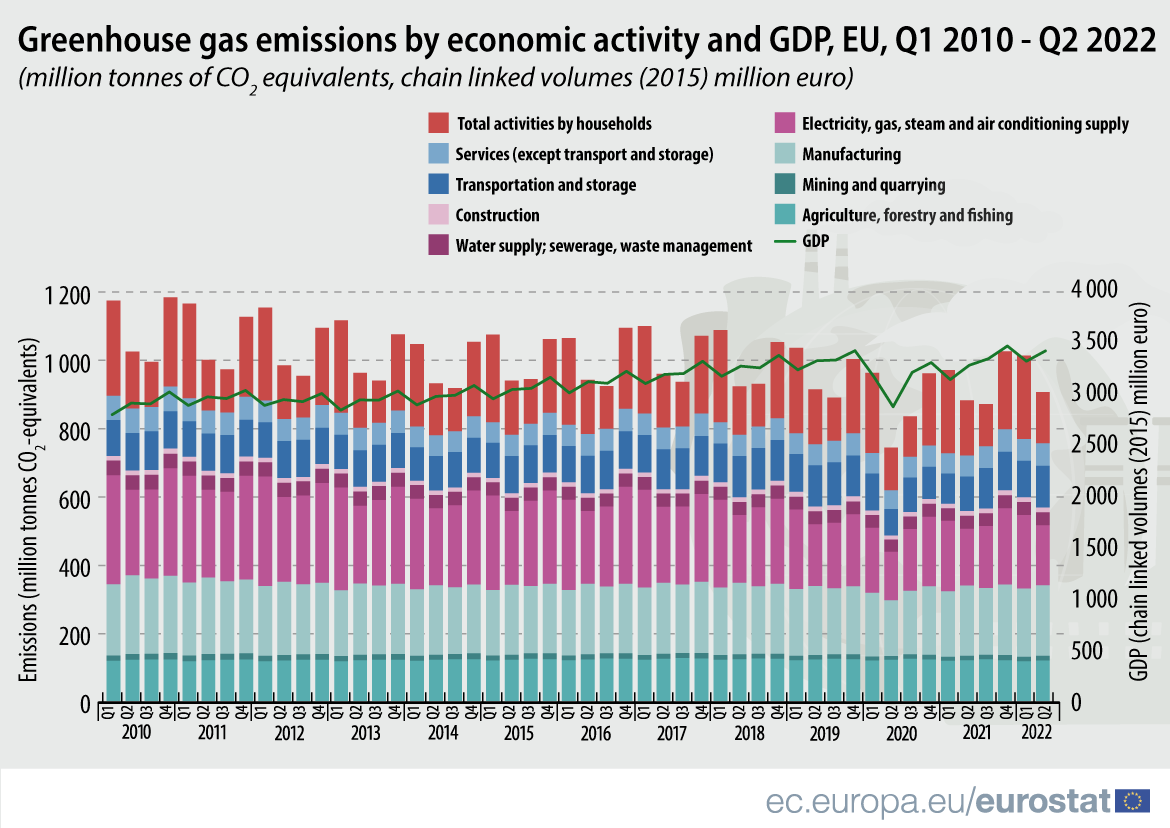
In the second quarter of 2022, EU economy greenhouse gas emissions totalled 905 million tonnes of CO2-equivalents (CO2-eq), a 3% increase compared with the same quarter of 2021. The documented increase is largely related to the effect of the economic rebound, which can be drawn from gross domestic product (GDP) growth, following the sharp decrease in activity due to the COVID-19 crisis.
This information comes from data on quarterly estimates for greenhouse gas emissions by economic activity published by Eurostat today. Quarterly estimates of greenhouse gas emissions complement quarterly socio-economic data, such as GDP or employment. This article presents a handful of findings from the more detailed Statistics Explained article on quarterly greenhouse gas emissions.
Source datasets: env_ac_aigg_q and namq_10_gdp
In the second quarter of 2022, the economic sectors responsible for the most emissions of greenhouse gases were ‘manufacturing’ (23%), ‘electricity, gas supply’ (19%) and ‘households’ (17%), followed by ‘transportation and storage’ (14%) and ‘agriculture’ (13%).
Source dataset: env_ac_aigg_q
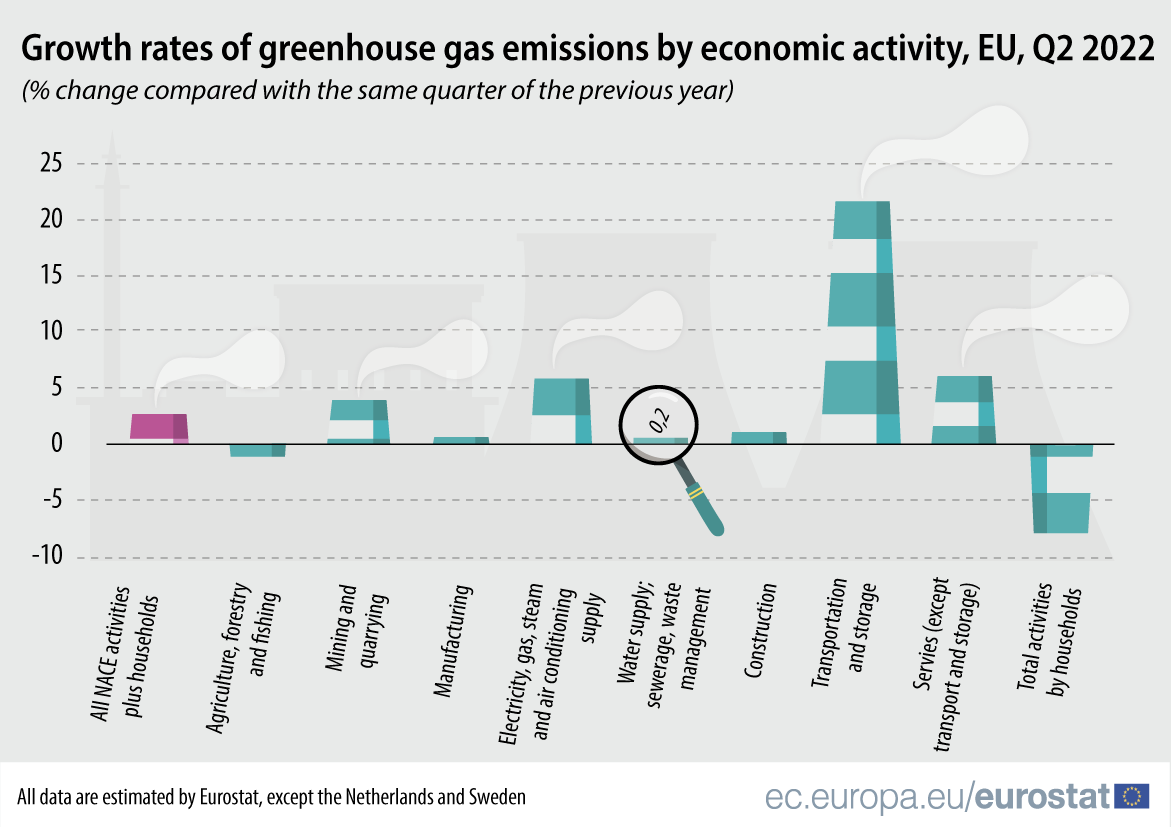
Greenhouse gas emissions increased in most sectors compared with the same period of 2021, except for ‘households’ and ‘agriculture’, which decreased by 8% (-13 million tonnes of CO2-eq.) and 1% (-1 million tonnes of CO2-eq.), respectively. The highest increases were recorded in ‘transportation and storage’ (+22% or 22 million tonnes of CO2-eq.), ‘electricity, gas supply’ (+6% or 10 million tonnes of CO2-eq.) and ‘services’ (+6% or 4 million tonnes of CO2-eq.)
For more information:
Methodological notes:
To contact us, please visit our User Support page.
For press queries, please contact our Media Support.
Thank you for your feedback.
We are sorry to hear that. You can report the issue here.
Thank you for the information. We will investigate the issue.
Was this page useful?
News
Data
Publications
About us
Opportunities
Stock Market Today: Dow, S&P Live Updates for Nov. 18 – Bloomberg

Ivory Coast Caps Pasta, Meat, Milk Prices to Fight Inflation
Slow to the EV Game, Foreign Car JVs in China Face Bleak Future
California Strike by 48,000 Academic Workers Flexes UAW’s Muscle
Musk Starts Twitter Poll on Reinstating Ex-President Trump
Twitter Staff Wipeout Under Musk Spurs Fear Site Will Decay
Gamers Seek Fame, Riches in World’s Next Esports Hub India
Kamala Harris Announces San Francisco as 2023 APEC Host City
Kamala Harris Briefly Meets Xi Jinping as US-China Tensions Ease
Grindr’s Biggest Investors Are Billionaires on Stock Surge
Reselling Taylor Swift Tickets? You’re Going To Have To Pay Taxes
The US Is Unlikely to Score Many Goals in the World Cup — You Can Bet on It
These 10 Artworks Total $958 Million in Unprecedented November Sales
Whoever Tweets Last, Don’t Forget to Turn Off the Lights
Crypto’s Coffin Is Not Quite Nailed Shut Yet
The UK Already Has a Nasty Wealth Tax
Sears Limps Through What Could Be Its Final Holiday Season
Why Europe’s €2.75 Trillion Renovation Wave Is Falling Flat
A Nation in the Crosshairs of Climate Change Is Ready to Get Rich on Oil
Pay Gap at Nike Persisted After Changes, Lawsuit Alleges
Lawsuit Filed Against FDA to Block Access to Abortion Pill
California Utility Warns of Potential Shutoffs Due to Fire Risk
Slow to the EV Game, Foreign Car JVs in China Face Bleak Future
Maya Lin on Art, Architecture, Landscape and Memory
A New Gallery Hopes to Rival the Louvre, the Tate — and Sydney’s Beaches
New York Cannabis Farms Have $750 Million of Weed — and Nowhere to Sell It
GOP’s Hawley Wants Democrats’ Emails as FTX Collapse Turns Political
Crypto Traders in US Surged 149% to 2.3 Million as Pandemic Hit
Sam Bankman-Fried’s Island Haven Is Drawing Scrutiny After FTX Demise
Vildana Hajric and
Isabelle Lee
US stocks ended with a slight gain Friday after shrugging off Federal Reserve warnings that there was more policy tightening to come. Oil futures fell on signs that the market is currently awash in supply.
The S&P 500 Index added 0.5% Friday to finish the week down 0.7% and the Nasdaq 100 fell 1.2% in the five-day period. Trading volumes was muted throughout Friday’s $2.1 trillion options expiration, normally a day when volatility spikes as traders and dealers rebalance their big exposures.
Opportunity Fund Awards $264,000 to Arts and Culture Projects, Helps Fill Gaps in Existing Funding Structures – charlottenc.gov

Latest grants bring annual total of Opportunity Fund awards to more than $600,000
CHARLOTTE, N.C. (Nov. 17, 2022) — The City of Charlotte's Arts and Culture Advisory Board on Tuesday awarded more than $264,000 in grants to 16 projects by local artists and groups. The awards come from a portion of the Infusion Fund known as the Opportunity Fund, which supports local arts and culture projects, programs and initiatives that may fall outside existing grant cycles or structures in the Charlotte-Mecklenburg area or that need supplemental support.
Opportunity Fund grants have been available on a rolling basis through an open call and awarded monthly. The November round of awards brings the total amount of these grants awarded in the current fiscal year 2023 (July 2022 to June 2023) to more than $600,000.
"The Opportunity Fund is innovative, not only for the Charlotte-Mecklenburg area, but in the nation," said Priya Sircar, the city's arts and culture officer. "Local artists and organizations are developing and carrying out projects all the time — not just during established grant cycles. We are so pleased to use this unique tool to meet their needs in a timely manner so their good work can benefit our community."
Access to Move by Dance Artist Alliance CLT
Program to support local dancers through subsidized rehearsal studio space.
Grant amount: $6,000.
Arko & the Moon Immersive Exhibit by Arko and Luvly Moon
Fully immersive art installation that blends the imaginative worlds of local artists Arko and Luvly Moon to give viewers the opportunity to step into and explore the art in a different way.
Grant amount: $20,000.
BOOM Echoes: Engage by BOOM Charlotte
A series of engagements, workshops and classes, culminating in two festival-style events, that feature local artists and amplify the stories and voices of immigrants and refugees in east Charlotte.
Grant amount: $25,000.
BreatheINK Youth Poetry Slam Initiative
Initiative to establish poetry clubs and poetry curricula in six Charlotte-Mecklenburg high schools in the 2022-2023 school year.
Grant amount: $5,000 for project planning.
Collaboration by Charlotte Art League and Charlotte Lab School's Co Lab
School-based programs for students to create inclusive and uplifting creative experiences that strengthen their sense of identity, history and belonging.
Grant amount: $26,000.
Community Impact Film Series Pilot Program by the Charlotte Film Society and the Independent Picture House
Inaugural film screening for the series, showing "My Ascension," a documentary about a 16-year-old's suicide attempt and her subsequent mission of suicide prevention.
Grant amount: $9,000.
Craft Workshops by Craft & Trade Academy
Grant amount: $12,500.
Detention Center Poetry and Art Program by Guerilla Poets
Twice-a-week poetry workshops for adults at the Mecklenburg County Detention Center Central, and a monthly art workshop for teens in juvenile detention.
Grant amount: $11,564.
Durag Fest by Dammit Wesley and Lica Michelle
Juneteenth festival celebrating the creativity, ingenuity and diversity of Black communities through art, fashion, food and music.
Grant amount: $20,000.
Healing Through Art by the Social Justice Center
Community events to bring healing to local artists and marginalized people through yoga and meditation, music, visual arts and spoken word.
Grant amount: $5,000 for project planning.
Historic West End Partnership and Concert Performance by the Charlotte Symphony Orchestra
A full symphony performance in the historic West End in 2023 in collaboration with Johnson C. Smith University.
Grant amount: $20,000.
Music Everywhere CLT by Charlotte Center City Partners Community Trust
A new music conference to establish Charlotte as a regional hub for music and to inspire Charlotteans to value music as an essential element of the city's identity.
Grant amount: $10,000 now, and another $30,000 if matching funds are also raised.
Queen Charlotte Chorus
New competition costumes for the nonprofit educational chorus for women, which performs and promotes a cappella and barbershop music.
Grant amount: $2,500.
Recording Inclusivity Initiative by WDAV Classical Public Radio
Professional recordings and broadcasts of works by three community-nominated composers from underrepresented communities.
Grant amount: $22,000.
The "Afterschool" Audio Engineering Masterclass by Nigel Malone of Colorful Noise
Free introductory classes that teach people audio mixing and mastering, and music production, and to give aspiring engineers access to professional expertise and equipment.
Grant amount: $15,000.
The Arts Empowerment Project by Promoting Peace + Justice and Encounters Life Skills Seminar
Programs to help children who have experienced or been impacted by violence or trauma find their voices, learn social and emotional skills, and heal through art.
Grant amount: $25,000.
Advisory board members initially allocated roughly $400,000 for the Opportunity Fund in the current fiscal year. When the open call launched in early September, it met a strong response. The city and the advisory board received 82 grant requests in September and October. Most were deemed eligible and qualifying applicants were invited to submit full proposals for further evaluation.
The board awarded Opportunity Fund grants in September and October, leaving about $64,000 to award in November.
The board's vote on Tuesday awarded the remaining funds as well as another $200,000 to projects that were evaluated and recommended for funding by a smaller working group of the board. The full board felt comfortable with the additional awards because more than $350,000 would still be available in the Infusion Fund for the current fiscal year.
The board is now assessing the Opportunity Fund's progress to date and fine-tuning the grant request process to prepare for potential new funding opportunities in the remainder of fiscal year 2023.
The Infusion Fund is a partnership of the city, Foundation For The Carolinas and private donors to support arts and culture through June 2024.
Visit the city's arts and culture web pages to find the full list of past recipients of the Opportunity Fund and the larger Infusion Fund.
Oregon vs. Utah: Prediction, pick, spread, football game odds, live stream, TV channel, watch online – CBS Sports

Play Now
Football Pick’em
Play Now
College Football Pick’em
Start or Sit (NFC Home Games)
U.S. Soccer Podcast
The top of the Pac-12 standings are a convoluted mess with just two weeks remaining in the 2022 college football regular season. Five teams with either one or two losses in league play still have a shot at reaching the conference title game. Two of those teams still alive, No. 10 Utah and No. 12 Oregon, will meet Saturday night in a pivotal game between teams with identical records of 8-2 and 6-1 in the Pac-12.
Two of the last three meetings between these teams have been in the Pac-12 Championship Game, and though a title is not on the line this time, it’s a big matchup nonetheless. Utah is seeking back-to-back Rose Bowl appearances, and Oregon is trying to finish strong under first-year coach Dan Lanning following last week’s heartbreaking loss to Washington.
The Utes dominated Oregon twice last season by a combined margin of 76-17, including a 38-10 beatdown in last year’s Pac-12 Championship Game. That turned out to be the last game for the Ducks under coach Mario Cristobal, who left for the Miami shortly thereafter. Utah has kept on chugging under 18th-year coach Kyle Whittingham, and this game will provide Oregon a chance to see if it has closed the gap in one season under Lanning.
Bo Nix’s health: The status of Oregon star quarterback Bo Nix is up in the air for this game after he appeared to suffer a knee injury late in last week’s loss. Nix missed a key series after the injury, though he did return for the Ducks’ final possession of the game. Lanning explained this week Nix is “preparing himself as if he can go,” but added that “we also got some other guys ready to go if needed.”
Nix has completed completed 72.8% of his passes for 2,774 yards, 24 touchdowns and just five interceptions while enjoying a renaissance season after three up-and-down years at Auburn. He’s also run for 512 yards and 14 touchdowns. If he can’t play, redshirt freshman Ty Thompson would likely step in. Thompson has completed 18 of 35 passes for 159 yards, two touchdowns and three interceptions in nine career appearances.
Win and you’re in: The Pac-12 scrapped division standings this season and for the first time will send the two teams with the best league record to its title game. For Oregon and Utah, it’s simple: Win your last two regular-season games and you’re in. That will be more challenging for the Ducks, however, as they must play at No. 23 Oregon State next week in a rivalry showdown. Utah is on the road next week as well, but it’s against a Colorado team that is just 1-9 entering Week 12 action.
Oregon’s poor pass defense: Oregon’s pass defense is a glaring weakness; the Ducks rank No. 127 nationally in passing yards allowed at 289.7 per game. Washington capitalized on Oregon’s weak secondary last week, but doing so may be more challenging for Utah. While 6-foot-4 receiver DeVaughn Vele and tight end Dalton Kincaid are excellent pass-catchers, the Utes aren’t known for airing it out. But if quarterback Cam Rising can hit some deep balls in this game and open up the box for Utah’s rushing attack, it would go a long way toward helping the Utes rack up points.
Date: Saturday, November 19 | Time: 10:30 p.m. ET
Location: Autzen Stadium — Eugene, Oregon
TV: ESPN | Live stream: fuboTV (Try for free)
Utah dominated Oregon in two meetings last season, and it’s not clear whether the gap has closed. While first-year Ducks’ coach Dan Lanning and offensive coordinator Kenny Dillingham have quarterback Bo Nix playing at an elite level, the Utes will be the most physical team Oregon has faced since a Week 1 loss to Georgia. Nix’s status is also uncertain after he suffered an injury in the fourth quarter of last week’s loss to Washington. That defeat eliminated Oregon from the College Football Playoff conversation, and it will be interesting to see if the Ducks remain highly motivated to play for a Pac-12 title. Prediction: Utah -2
Which college football picks can you make with confidence in Week 12, and which top-20 teams will go down hard? Visit SportsLine to see which teams will win and cover the spread — all from a proven computer model that has returned almost $3,000 in profit over the past six-plus seasons — and find out
© 2004-2022 CBS Interactive. All Rights Reserved.
CBS Sports is a registered trademark of CBS Broadcasting Inc. Commissioner.com is a registered trademark of CBS Interactive Inc.
Images by Getty Images and US Presswire
Coal mining is a dangerous job. In Afghanistan, kids often do much of the work – Northern Public Radio (WNIJ)
LEILA FADEL, HOST:
While world leaders have been talking about limiting global warming at the U.N. climate summit, Afghanistan has been moving in another direction and ramping up its production of coal. Mining for that coal is dangerous and sometimes deadly. And as NPR’s Arezou Rezvani reports, in Afghanistan, kids often do much of the work.
(SOUNDBITE OF MUSIC)
UNIDENTIFIED MUSICAL ARTIST: (Singing in non-English language).
AREZOU REZVANI, BYLINE: You don’t have to travel too far outside of Kabul to see signs that coal is king in Afghanistan’s economy these days.
So we left Kabul just a couple of hours ago. We’re about to make our way through the Hindu Kush mountains on these backbreaking roads built to buy the Soviets years ago. And already we’re passing truck after truck after truck, all of them full of coal. Some are carrying so much, it’s just spilling over the sides. When the old Afghan government collapsed last year, its economy collapsed with it. Foreign governments withdrew billions of dollars in economic assistance when the Taliban returned to power. Now, after a year of isolation, the cash-strapped Taliban government is increasing its coal production and exports to fill the void. And those bringing that coal to market aren’t who you’d expect.
(SOUNDBITE OF FOOTSTEPS ON GRAVEL)
REZVANI: We’ve driven through mountains, through riverbeds, and we’re now walking this final stretch to get to the coal mines. And headed in the other direction, headed down the mountain are a lot of miners with coal dust all over them. And some of these faces we see are quite young.
It’s not uncommon to see children work hard jobs in poor countries – in factories, farms or food stalls. But the scene atop this mountain is still astonishing. Inside a narrow tunnel, the distant, faint glow of headlamps appears first.
FAZEL: Be careful here.
REZVANI: OK.
As we go deeper, the young faces come into focus.
UNIDENTIFIED CHILD #1: (Speaking Dari).
REZVANI: Older boys are swinging pickaxes, digging for coal. Some are busy fixing wood beams for the crumbling tunnel walls.
(SOUNDBITE OF WOOD BEING SANDED)
REZVANI: The younger boys escort coal-laden donkeys out of the mines. Among them is 12-year-old Mansour. When he emerges from this mountain’s womb, the boys outside greet him with a tune from a toy flute. They take turns playing.
(SOUNDBITE OF FLUTE)
REZVANI: It’s a humble celebration for making it out alive, they say.
(SOUNDBITE OF FLUTE)
REZVANI: Like everyone here, little Mansour wears no helmet, no goggles, just a pair of cheap rubber shoes he sliced open to air out his little black toes peeking out.
MANSOUR: (Speaking Dari).
REZVANI: “My workday starts at dawn,” he tells me. He shepherds donkeys up and down this mountain for 10 hours a day.
MANSOUR: (Speaking Dari).
REZVANI: “The work’s not hard,” he says, but he looks bone tired. His delicate hands are black and calloused.
ABDUL: (Speaking Dari).
REZVANI: Much of the coal Mansour takes down is carried out of the earth by older boys, like Abdul Salaam. He’s 17 and already a veteran of these lands.
ABDUL: (Through interpreter) I’ve been working here most of my life. I started working in these mines when I was 9.
REZVANI: The child labor that existed under the old government has grown worse in the last year. The Taliban government wants to fix that. But with an economy in shambles, more families are sending younger kids here, says Jawad Jahed, the engineer who oversees this mine for the government.
JAWAD JAHED: (Through interpreter) Kids under 18 aren’t supposed to work here. But our people are so poor, families have no choice. They send their children to work because they need the money. And it’s hard for us to turn them away.
REZVANI: The boys earn a few dollars for a day’s work. It’s a strong, steady wage in these cruel economic times, even if it comes at great risk. Heavy rains last winter caused one of the tunnels here to collapse. A dozen workers were killed. When I asked 17-year-old Salaam if he’s worried about getting hurt, he shrugs.
ABDUL: (Through interpreter) It is the work of destiny. If it is my destiny to die in these mines, then so be it.
REZVANI: But that destiny may already be taking shape. As the sun sets, we head back down the mountain. A few young miners are sitting on a ledge overlooking this vast, blackened landscape. One of them pulls out the flute.
(SOUNDBITE OF FLUTE)
REZVANI: He plays it for a few seconds. Then he stops.
UNIDENTIFIED CHILD #2: (Speaking Dari).
UNIDENTIFIED CHILD #3: (Speaking Dari).
REZVANI: “Carry on,” the other boys say. But he can’t.
UNIDENTIFIED CHILD #4: (Speaking Dari).
REZVANI: After a long day at the mines, he doesn’t have the breath to go on.
Arezou Rezvani, NPR News, Nahrin, Afghanistan.
(SOUNDBITE OF HARIPRASAD CHAURASIA’S “RAAG BHUPALI”) Transcript provided by NPR, Copyright NPR.
Ataxia: “The Roland SH-101 is the building block of almost every Ataxia song. There is no oddity this synth can't help you explore” – MusicRadar

MusicRadar is supported by its audience. When you purchase through links on our site, we may earn an affiliate commission. Here’s why you can trust us.
The Detroit duo making raw, punk-inspired dance music talk us through their studio set-up, synth secrets and “going knob-crazy in patch bay paradise”
Detroit natives Rickers and Ted Krisko are Ataxia, an electronic duo serving up a raw and unfiltered take on dance music that’s inspired by formative years spent in hardcore and punk bands.
The electrifying amalgam of house, techno, breakbeat and rave found on their latest release, Out of Step, is produced using a formidable arsenal of analogue machines, pedals and outboard gear, along with a few strategically deployed stock plugins from their DAW of choice, Ableton Live.
We caught up with the pair to delve deeper into the creative process and studio secrets behind their new album.
When did you start making music, and how did you first get started?
Ted: “Guitar in the early ‘90s was my initial swan dive into all the ruckus. Punk was the first route that had the most immediate gratification. Three chords, sometimes less, sometimes none. Early staples were Fugazi, Nirvana, Black Flag, Minor Threat, and loads of Beastie Boys jams. My cousin gave me an original ProCo RAT distortion fuzzbox – this set the pace early on. My bands recorded on Tascam 4-tracks relentlessly throughout my youth… oh how things come full circle.”
Rickers: “I started making music genuinely when I heard “The Vans Song” by Suicide Machines circa 2002, although I think the original was released in ‘95. They inspired me to make music that was fun, purposefully lacking a “seriousness” that would, by definition, destroy creativity. I played the bass guitar, that was the first instrument, and I was focused on making punk rock!”
Tell us about your studio/set-up.
“We have a couple of spaces we work out of. Our main studio is in Detroit, the My Baby Records HQ… a space we share with our brother till the end, Mister Joshooa. Our collective runs the label and studio. We did a lot of damage out of the past version, but the space is currently under renovation to improve some aspects of the acoustics, and also to build soffits for our mains. Our approach is very modular, in a sense that everything lives on a patch bay, including , and maybe most importantly, the I/Os from the front end and console.”
Our approach is very modular, in a sense that everything lives on a patch bay. It’s fucking amazing going knob-crazy in patch bay paradise
“We are constantly routing and re-routing pedals, rack effects, processing gear… it’s a mess! [laughs] It’s nice though, because we can introduce new equipment on the fly by patching into the console or soundcard on the bay, before making a full commitment as to how or if we will eventually include it in our setup.
“Although there’s no arguing the utility of plug-ins, most of the work is outboard. On one hand, there is no problem with anything in-the-box, it’s all about your ears and the decisions you make about what the sounds are like in your design. On the other hand, it’s fucking amazing going knob-crazy in patch bay paradise.”
“Our second space is a secret lair, stocked with a near carbon copy of the main studio, plus some extra processing and summing equipment, a full array of API outboard rack gear, and a dreamy boutique effects pedal setup: original Boss CH1 & BF2, Mu-Tron Phaser III, Ibanez AD9 Analog Delay with Robert Keeley Baked Mod, Fulltone OCD. Our guitar and bass rigs live here as well… jam station central!”
What DAW (or DAWs) do you use, and why did you choose it?
“Ableton Live. On first take, the processes seemed very user driven as far as depth and control in terms of where to take your experiments. It was more complex than previous DAWs we had early beginnings with, like Fruity Loops and Reason. Richie Hawtin was using Live as a standalone DAW to produce, and as a virtual outboard effects rack for his DJ sets, and does to this day. We took a lot of inspiration from seeing a very in-the-box program used in a very out of the box way.
“Ableton really does have it all – you can set up quick experiments with effects or processing either in line, or through sends/returns, just a few clicks away from your next weird sound! As far as what’s in the box, their instruments are quality stuff! Analog, for instance, is an incredible plug for making a big warm bass tone quickly. In addition to their stock EQs and compressors, plugins like Tension, Operator, and of course the basics like Sampler and Simpler, are all extremely useful and perfect for working on music without needing external instruments or outboard gear at all.”
“And for the noodlers, like us, Max 4 Live brings a whole modular world to the table that really gives users the power to design and deploy their own modules within Ableton’s ecosystem seamlessly. Live has been a steady, reliable beast for us from the earliest days of Ataxia.”
What one piece of gear in your studio could you not do without, and why?
“The Roland SH-101, tried and true. This is the building block of almost every Ataxia song since we first picked up this juggernaut. There is no oddity this synth can’t help you explore. We trigger the 101’s internal sequencer externally with an Elektron Analog Four’s gate out – see our tips section on this one.”
“Handsome Audio’s Zulu. It’s a passive tape emulator. Transformer magic. It’s kind of insane. We started by tracking with it, and quickly moved on to bussing and summing. The results have been extremely pleasing. It truly does what it says on the tin, tape flutter and wow without the hiss.
“We usually track on a Tascam 438 cassette machine, which is wonderfully fussy but sounds incredible. I can’t see tape getting replaced at our studios in any permanent capacity, but for now, it’s been nice running with something new that brings the music to life in a very similar way.
“The Zulu really does get the drums knocking, while smoothing out transients and getting the claps and hats to gel. Time will tell once and for all – will tape continue to reign supreme, or did Handsome Audio crack the code here?!”
What dream bit of gear would you love to have in your studio?
Ted: “A combo of the API 1608 loaded, along with the Studer A827 MCH 2-inch 24-track tape machine, all patched up and ready for controlled chaos in the best possible way.”
Rickers: “Fuck, lots of things, that most likely wouldn’t make music anymore fun. Honestly, my boy Chuck at Paxahau just got this Rigsmith Analog Dub Siren – it’s tight, so maybe one of those next.”
When approaching a new track or project, where do you start?
“Drums are the core of Ataxia’s vibe. Nearly all of our cuts circulate out of a drum machine riff. Our collection is pretty steep: Roland 909, 727, 707, 606, R8 and the Tanzbar MFB, Vermona DRM1, and Elektron’s Rytm MK1 and 2, so we have a good deal of options for how to express that we are both the drummer. Although, despite the machines, sometimes it’s just a good hip hop or breakbeat sample to get up and running… whatever works!”
Once things take too long they stop being fun. When the fun stops, the music usually sucks
“We tend something going on a monosynth next, usually the Roland SH-101. This is routed with a delay pedal in line, which generally helps the vibe for the notes to slap back a little. Polysynth-land usually involves the Sequential Prophet 6, another core Ataxia sound. From there it’s vocals and automation – really not a very long process from start to finish for us.”
“Once things take too long they stop being fun. When the fun stops, the music usually sucks. The music we make relies on translating an energy to people on the receiving end, the goal is to get people to loosen up and have fun. Our punk roots really come through in our process – move quick, or it’s dead in the water. Things that sit around never get finished.”
What are you currently working on?
“We have just dropped Out of Step, our debut album on Life and Death, an Italian label based in Miami, operated by our good friend DJ Tennis. It’s a gatefold, double LP – 12 cuts, clocking in just under 80 minutes. Despite making music together for 13 years, and dropping dozens of singles & EPs, this is Ataxia’s first venture into LP territory. It features good friends and fellow Detroiters Andrés, DJ Minx and Mister Joshooa. Give it a listen and leave a Yelp review.”
“Past this, we have a nice follow-up on deck for Life and Death, plus new material forming for a return to 20/20 Vision, finishing a record for Mike Shannon’s Cynosure. Cooking up something with Paul Woolford / Special Request as well. Honored to work with artists and labels that we hold in high esteem.”
Ataxia’s latest album, Out of Step, is out now on Life and Death.
“It doesn’t take much to get something nice cooking. When producing, don’t overthink “making a hit” or “writing a song” and paint yourself into some corner with expectations attached. For us, making dance cuts, it’s about getting a groove going with a bit of kick, hat, snare… then immediately starting experiments with a couple of pieces of gear until you get something that sounds and feels good. A quick riff on a monosynth, some lush pads on a multi-voice instrument, a triggered sequence lead to coast on top, a tight vocal sample to sprinkle in here or there, and boom, you’re off to the races.”
“Mathew Jonson did some lectures on his setup with the Cirklon triggering the internal sequencer on the Roland SH-101, and it changed the game for how we tackle the midi implementation throughout our studios’ jam stations. That lecture paved the way for a 3D approach to machinery in the Ataxia lab.
“In our studio, any device with a sequencer and a “Trigger Out” becomes a deadly weapon, however complex, reduced to a simple task of sending pulse information to step the internal sequencers on synths like the 101 and Prophet 6. The connection happens with a cable from the external device’s trig out, into “EXT CLK IN” (or something similarly named depending on the synth) you’ll be programming steps into.
“Sync your external device being used to send triggers to a midi clock from your session, and now you’re in the pocket with a completely jazzy approach to jamming your note picks. No longer bound to one dimension of a sequence, you now are at the helm of choosing when the trigger events as steps within the pattern.
“This changes our approach to both how synthesizers are used as modules, and as sequencers, but is a nice work around, as you can even be triggering additional synthesizers that perhaps may not even have an internal sequencer of its own, but can benefit from being downstream from a midi cabling path with a synth prior to it with it’s sequencer being triggered by the external device… because trust us, this style of sequencing is addictive.”
“Automation is crafty, but we as humans, in engineering mode, tend to organize information in some sort of logical, uniform fashion. We’ve found that it’s better to let a device make obscurities and let randomness bring the elements to life. LFOs are technology’s gift to us.
“A beautiful piece of kit to exemplify the LFO’s utility is Vermona’s Filter Lancet. A supreme distortion box melded with a hard-ass LFO, switchable LPF / HPF, pre-volume circuit gain that can quickly overdrive the most sterile of samples into something interesting. Another irreplaceable gem would be the Sherman Filterbank, a major wormhole of odd filtering, modulation and frequency manipulation.”
“Go the distance, see what the knob does, find out what the switch can do for you. These machines were made for us, simply put. If you don’t run experiments you won’t get results.”
I’m the Tech Features Editor for MusicRadar, working on everything from artist interviews to tech tutorials. I’ve been writing about (and making) electronic music for over a decade, and when I’m not behind my laptop keyboard, you’ll find me behind a MIDI keyboard or a synthesizer.
Sequential unveils the Trigon-6, Dave Smith’s final synth: “We believe it continues his legacy”
The iconic Moog Minimoog Model D synth is back in production and looking better than ever
What is the best new electric guitar of 2022?
Don’t miss the latest deals, news, reviews, features and tutorials
Thank you for signing up to Musicradar. You will receive a verification email shortly.
There was a problem. Please refresh the page and try again.
MusicRadar is part of Future plc, an international media group and leading digital publisher. Visit our corporate site (opens in new tab).
© Future Publishing Limited Quay House, The Ambury, Bath BA1 1UA. All rights reserved. England and Wales company registration number 2008885.
When Anderson Met Audie – All There Is with Anderson Cooper – Podcast on CNN Audio – CNN

Anderson Cooper takes us on a deeply personal exploration of loss and grief. He starts recording while packing up the apartment of his late mother Gloria Vanderbilt. Going through her journals and keepsakes, as well as things left behind by his father and brother, Cooper begins a series of emotional and moving conversations about the people we lose, the things they leave behind, and how to live on – with loss, with laughter, and with love.
Back to episodes list
Anderson is pleased to present the first episode of Audie Cornish’s new podcast: The Assignment… but first a conversation on the intimacy of podcasting with Audie and Anderson.
Fiery Twitter threads and endless news notifications never capture the full story. Each week on The Assignment, host Audie Cornish pulls listeners out of their digital echo chambers to hear from the people who live the headlines. From the sex work economy to the battle over what’s taught in classrooms, no topic is off the table. You can find The Assignment wherever you get your podcasts.
© 2022 Cable News Network. A Warner Bros. Discovery Company. All Rights Reserved. CNN Audio’s transcripts are made available as soon as possible. They are not fully edited for grammar or spelling and may be revised in the future. The audio record represents the final version of CNN Audio.