Blog

Best pitch correction plugins and apps 2023: software to improve or … – MusicRadar

When you purchase through links on our site, we may earn an affiliate commission. Here’s how it works.
Get your vocals in tune or nail that incredibly popular Auto-Tune® sound with 13 free and paid-for plugins from Antares, iZotope, Waves and more – includes PC, Mac and mobile options
If singing is at the heart of your music production, then you’ve probably considered using the best pitch correction plugins and apps to either tweak your vocals so they are in tune, or to produce the synthetic vocal effect made famous by Cher on the track ‘Believe’ back in 1998. 
Tuning vocals is now easy with software and many tuning apps are also capable of that Auto-Tune effect which is still incredibly popular across many music genres. In this round-up we have the best pitch correction plugins and apps, all capable of both naturally tuning your vocals to perfection or for creating that distinctive synthetic vocal sound.
The Auto-Tune effect was originally produced on the aptly-named Auto-Tune plugin by Antares. With well over two decades of popularity, it’s not surprising that the effect can now be produced by a host of other plugins and apps from many other developers. Where the original Auto-Tune is still right up there in terms of features and slick workflow, the growing list of similar plugins can massively range in price and feature set; some are dedicated to just that effect while with others it is just one of many audio processing features.
In this best vocal tuning plugins and apps buyer’s guide we’ll be looking at plugins for both types of automatic tuning scenarios: those which excel at natural, invisible vocal tuning, and those that can produce the more robotic effect.
Some DAWs come with these kinds of plugins built-in. Logic has Flex Pitch, for example, which delivers great results. Steinberg’s Cubase also has its own plugin, VariAudio, which can easily handle all your tuning needs. However, in our buyer’s guide we are only including third-party plugins that are available for every DAW or those which can run as mobile tuning apps.
If you want that Auto-Tune effect then the original is still, in many ways, the best, with Antares Auto-Tune (opens in new tab) still doing its thing in an even more slick environment some 24 years after Cher made it famous. The Pro version gets you all the bells and whistles and ‘live’ tuning for onstage, and instant tuning on vocal recordings. 
Brainworx bx_crispytuner (opens in new tab) and Waves Tune Real Time (opens in new tab) are the best of the rest when it comes to Auto-Tune pretenders, the latter often on sale for silly money.
For another cheap route to robotic vocals – and some other neat effects along the way – Soundtoys Little AlterBoy (opens in new tab) impresses us with its simplistic but beautiful approach to not only Auto-Tune style effects, but brilliant male to female and female to male formant editing and more.
For more refined pitch editing, Celemony’s Melodyne (opens in new tab) will always be the black magic plugin that impresses with its abilities. But it does cost, so if you are after its basic functionality and a whole lot more, we have to throw iZotope’s Nectar 3 Plus (opens in new tab) in as a great option, which gives you module upon module of vocal editing options, the miraculous Vocal Assistant feature and even a version of Melodyne!
For mobile voice manipulation, one of the best to audition – and it’s free to start with – is Voloco (opens in new tab). It offers a lot of mobile fun and is cross platform so is available for desktop music production too.Best autotune plugins: Auto-Tune ProAntares kickstarted the automatic tuning revolution with Auto-Tune back in 1997. Like all Auto-Tunes in the range, Pro takes an incoming signal and corrects any pitching, so puts an out-of-tune singer in tune. It can do this transparently, or with the famous ‘Cher/T-Pain’-style sudden jumps in pitch.
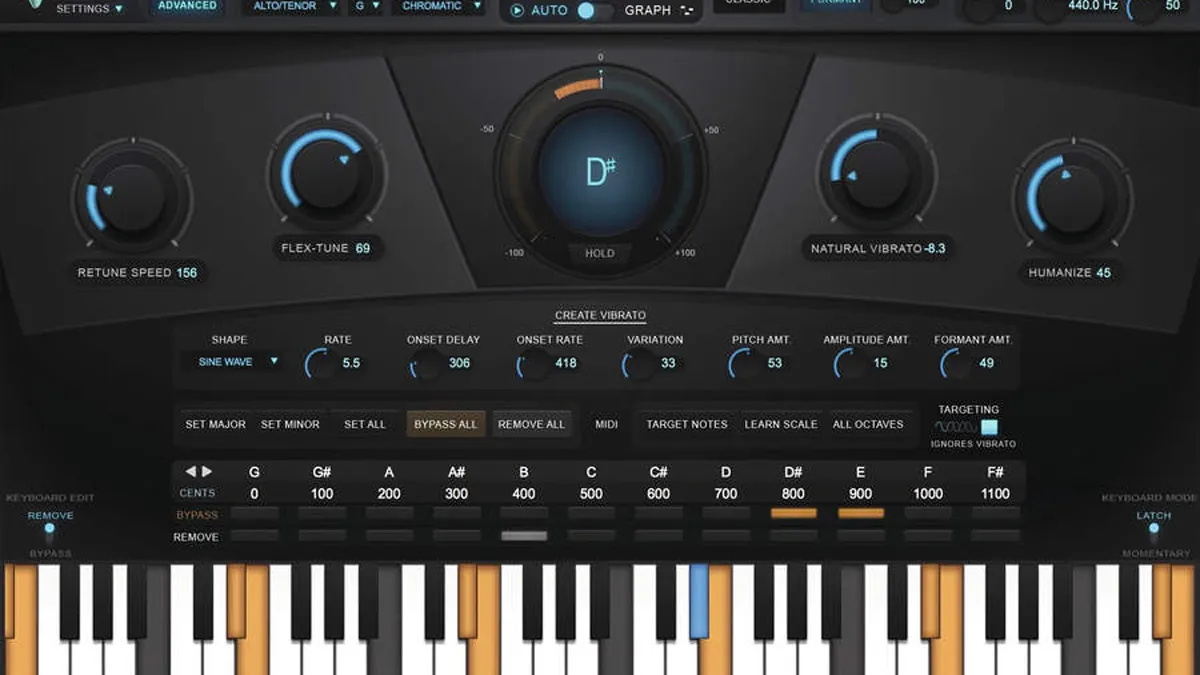
It’s operated in either of two modes: Auto and Graph, the first enabling real-time automatic re-pitching, the latter for detailed manual editing. You also get two views: Basic and Advanced. With Basic, choose a voice type, select the target key and scale, set specific pitches for removal (or leave unchanged). You can also use the Auto-Key plugin to detect the key and scale of the audio in your track, and transmit the results to all running instances of Auto-Tune.
Advanced view has a few extras like Create Vibrato, ideal for adding a bit of wobble via an LFO, plus options to set minor and major modes, edit across multiple octaves, and MIDI input editing features.
Auto-Tune Pro is the most powerful, usable incarnation of this standard yet, and easily maintains the software’s position as one of the best retuning solutions available, and may well prove to be the ultimate pitch-manipulating toolbox.
Read the full Antares Auto-Tune reviewBest autotune plugins: Brainworx bx_crispytunerLike other vocal tuning plugins here, bx_crispytuner has Auto-Tune in its sights and is capable of both authentic and robotic tuning. It can be run ‘live’ so that vocals are processed with zero latency for either live vocal recording or onstage performances. Or you can simply play your vocal into the plugin for an analysis and all of your notes laid out across a piano keyboard for your offline editing.
bx_crispytuner works best with bx_crispyscale (included free of charge), the latter allowing you to determine and apply a scale to the former, although crispyscale is by no means essential. Using the two in tandem, however, will allow you to apply a scale to multiple instances of crispytuner, which is great for large vocal sessions.
bx_crispytuner is very similar to Auto-Tune in that it has similar timing controls to make your tuning more natural or more synthetic. They even retail for the same price, although crispytuner is perhaps the slicker looking plugin of the two. And in terms of creating that synthetic vocal effect, it almost outdoes Auto-Tune. Subtle it isn’t, but that might be just what you are aiming for.Best autotune plugins: Waves Tune Real TimeWhere Waves Tune processes existing recorded audio with ease, the newer Waves Tune Real Time takes advantage of up-to-date computer power to take the automatic tuning processing up a few notches by doing it ‘live’. You can simply use it like Waves Tune and insert it on your audio track to enjoy some great vocal pitch correction, however its real benefits lie in tuning live vocals, whether that be in the studio or on stage.
In order to perform this live tuning, the plugin operates with ultra low latency, so that even though the audio needs to go through your DAW and computer’s routing, it can still be monitored in real time. This means you as the singer, or your monitoring engineer, can hear what is happening as it happens and can make adjustments accordingly.
While some of the UI features are shared with Waves Tune, which is its non real-time sister plugin, the interface is somewhat more modern and slicker. It features a live tuning meter which shows the pitch as the vocal passes through, and as with Waves Tune, there are controls for Speed, Transition Tolerance and vocal Range. The central keyboard also indicates the notes of the audio passing into the plugin and here you can set the range of ‘allowed’ notes.
The Speed dial can, as with so many plugins of this ilk, be set to fast (zero) for the robotic Cher effect should you wish. Used in conjunction with the Transition dial, both can easily be used to create that effect, only this time you are doing it on live vocals. Waves Tune Real Time is therefore probably the first choice of the Waves Tune plugin range for that more unnatural effect, whereas the standard Tune will get you more natural results with ease.Best autotune plugins: Soundtoys Little AlterBoyIf there’s one plugin that comes up more often than any other in our producer interviews as an all-time favourite, it’s Soundtoys Little AlterBoy. This simple but cheap plugin only boasts a few controls but can deliver wide-ranging results on any audio, but is specifically aimed at vocals for both pitch and formant editing.
You get three main modes from left to right: the main controls for Pitch and Formant, three Mode options (Transpose, Quantize and Robot) and then a Drive and Mix area. The Pitch control alters the incoming audio by semitones but the beauty of AlterBoy is that you don’t get the kind of high-pitch chipmunk effects you get with some pitch shifters – it’s a far more natural shift (unless you want to make it more extreme).
The Formant option can, again very naturally, sweep a male vocal into a female, or vice versa. It’s pretty incredible to hear it in operation because one of AlterBoy’s main attractions is the fact that it does it with no nonsense, one dial with all the science bits hidden away. It just gets on with it, with brilliant results.
The central Modes are where things get even more interesting. After a simple Transpose option, you get Quantize, where notes are forced to the nearest semi-tone for that Auto-Tune like effect. It works well and incredibly simply, although you’ll probably get more finesse and tweakability out of the real-deal Auto-Tune. 
However, for no nonsense results, this is great. Finally here you also get Robot Mode, where the pitch is frozen to one note, no matter what the original input is singing. This pitch, and indeed the formant, can still be changed with the left hand dials.
Add in saturation via a Drive option and AlterBoy is a wonderful, diverse vocal tuning plugin that does the job and does it very well. Great for beginners and superb value.Best autotune plugins: Celemony Melodyne 5Where Antares has made the ‘Cher sound’ famous with Auto-Tune, Celemony’s Melodyne brings more natural tuning to vocals – and indeed, anything else. You can even get in and edit polyphonic material, black magic technology that Celemony has been fine-tuning since 2009. And with the latest versions – there are several price bands you can buy into – integration with your DAW has never been better.
Recent additions include a Melodic algorithm that allows editing of noise-based sibilants to be carried out separately from pitch-based parts. Vocal pitch editing is also now incredibly natural due to features like a Levelling Macro that balances quiet and loud elements, and even the tiniest of pitch deviations can be tweaked.
Melodyne 5 Studio offers the full panoply of multitrack polyphonic editing options, but, if you mainly work with monophonic material, the more affordable Melodyne 5 Assistant still delivers many of the essential features. Whatever version, Melodyne is powerful and remains an exceptional tool for manipulating vocals and other audio in functional and creative ways.
Read the full Melodyne 5.1 reviewBest autotune plugins: iZotope Nectar 3 PlusNectar is a powerful one-stop vocal processing shop. It’s become a go-to plugin for the professional producer looking to easily get vocals of all kinds – from sung and rapped to dialogue and voiceover – sounding their best. It utilises an array of reorderable modules to apply voice-optimised dynamics shaping, EQ, pitch correction, harmonisation, de-essing, distortion and effects to your audio.
One of Nectar 3’s many highlights is a machine-learning driven system for automatically setting the plugin up based on analysis of the input signal. Called Vocal Assistant, it creates a custom preset to make your vocal sound objectively ‘better’ and more mix-ready. 
Select Assist mode, point the algorithm in the right direction by choosing Vintage, Modern or Dialogue as the source ‘Vibes’, and Light, Moderate or Aggressive as the processing ‘Intensity’. The input signal is analysed for a few seconds, during which the modules are set up in the background to correct for dynamic fluctuations, resonant peaks, sibilance, and even adjust pitch correction and reverb mix.
In Unmask mode, Vocal Assistant clears space for the vocal by applying equalisation to any other track that’s fighting with it for space. The results are invariably well- judged and thoroughly effective, giving the vocals a perceived lift that’s almost always beneficial. This feature has also been enhanced for Nectar 3 Plus, the latest incarnation of Nectar.
With many other great features and modules plus a souped up EQ, Nectar 3 sounds incredible and flows beautifully, and we can’t recommend it highly enough to any vocal-wrangling producer. However, if you are just after simple tuning or that robotic vocal tuning effect, it may deliver much more than you need and there are cheaper alternatives out there.
Read the full iZotope Nectar 3 reviewBest autotune plugins: VolocoVoloco describes itself as a mobile recording studio, although it really focuses on automatic tuning, harmony creation and vocoding. It comes with 50 effect presets spread over 12 packs covering all sorts of vocal effects.
You can go from simple noise removal through harmonisers and alien effects to some of the most famous vocal tuning styles. Here you get everything from Daft Punk to T-Pain, although artists are not named directly (Bon Hiver, Duft Pank and P-Tain anyone?). Once done you can then apply some decent effects – compression, reverb and EQ – to the results for extra polish.
On top of this you get a free beat library, rudimentary multi-track recorder and the ability to import your own beats and export any creations you produce as WAV or AAC files, or share your efforts with other users.
Voloco is a huge amount of fun and also yields impressive results. It’s free but various subscriptions – up to $50 (£35 approx) a year – unlock extra import, multitrack and effect features, although what you get for free is still impressive.Best autotune plugins: Synchro Arts Revoice Pro 4Where VocAlign (below) is SynchroArts’ plugin for vocal (and other audio) processing, Revoice Pro is a standalone application with more features. It adds a pitch editor and also allows you to create double tracks from a single voice and then import the results into your DAW. You can also get in and manually adjust the pitch, timing and alignment of groups of track simultaneously. You can therefore home in and align the timing, pitch and vibrato of backing vocal tracks, for example.
APT (Automatic Performance Transfer) lies at the heart of what makes Revoice Pro so special. Having done your tuning work on the selected tracks, you simply call up the APT dialogue and select one of the presets (you can also make your own), tell it which is the guide and apply it to any track you wish to edit. This is great for backing vocals, for example, where you can add tracks and align not just the pitch and timing but also the dynamic.
Compared to the simpler plugins here, both VocAlign and Revoice Pro are perhaps aimed at the more professional user; pro producers and mixers will save countless hours in the studio with both tools. They do cost that bit more than other plugins here, so if you are just after simple tuning and the Auto-Tune effect, you will find simpler and less expensive alternatives in this guide.Best autotune plugins: Synchro Arts VocAlign UltraVocAlign is a long-established market-leading tool that adjusts the timing of an audio file (Dub) so it matches that of a source (Guide). It works well with any audio and is used for many music and post-production tasks. However it is particularly in demand for vocals and speech, where accurate pitch and timing alignment can be crucial. VocAlign Ultra sits between the affordable but basic VocAlign Project and Synchro Arts’ flagship processor, Revoice Pro 4.
The software has three core processors – Match Timing, Match Pitch and Formant Shift – each accompanied by a parameter control to determine how loose or tight the matching processing is. It has great visual feedback with the three zoomable views – waveform, pitch and signal energy – allowing you to see timing and pitch both before and after processing. The display can be used to add manual Guide/Dub sync points or establish protected areas that won’t be processed – handy for more creative applications.
You can use VocAlign Ultra without delving too deeply into the advanced features. In that respect, we managed to tighten all manner of doubled and layered vocals. The results are very impressive and in many cases pleasantly transparent. It’s also very easy to adjust the amount of timing and pitch correction, and loosening things a bit is often the key to getting the most natural results.
VocAlign Ultra is a great vocal and audio processor. It’s a bit pricey but if you do a lot of editing and aligning it will improve your productivity considerably.
Read the full Synchro Arts VocAlign Ultra reviewBest autotune plugins: Waves TuneWaves Tune is just one of many Waves plugins we could have included in this buyer’s guide (the company’s live version of this plugin and the more creative Vocal Bender (opens in new tab) appears elsewhere in this guide, while OVox (opens in new tab) takes vocal processing to another level entirely). Tune gets a place because it competes well with Antares’ Auto-Tune and gets right to the heart of vocal processing, fast.
You insert the plugin on an audio channel just like any other effect, play your audio and it will map it across a piano keyboard after scanning it. (This is as opposed to the real-time processing of Waves Tune Real Time – see above.) An orange line shows the original recording and you can then drag and drop the constituent parts onto the correct notes. Once done, a green line shows the corrected notes.
Controls allow you to select vocal type, root of the scale and scale type. There are also a couple of speed controls that determine how quickly the plugin takes effect so you can go natural or robotic, your choice.
There’s also an LT version of Waves Tune that greys out some of the features of the main plugin. It retails for less (often around £30/$37), but since the full version is usually on sale (at the time of writing just $36/£29), we’d recommend shelling out the extra on it. It does the job of tuning without any fuss and very accurately, and focusses well on natural vocal tuning – although you can get more extreme effects should you wish.Best autotune plugins: Waves Vocal BenderWaves has some great plugins for vocalists – particularly in its bundles like Waves Silver (reviewed here), which includes the classic De-Esser and Doubler. However Vocal Bender is, like the other two Waves Tune plugins in this buyer’s guide, all about the pitch and formant editing. It presents these features in a newer and slicker environment and can therefore be a little more creative than the Tune plugins as a result.
There are two knobs, Pitch and Formant, controlling the central tone of the human vocal and the resonant frequencies that shape the timbre of the vocal. A Flatten button allows you to force the input to snap to a predetermined note, a speedy tool for building up augmented choruses and harmonies.
Experiment with the modulation and automation options, and vast creative scope presents itself. Automation can be a superb way of introducing vocal effects (such as sudden pitch drops) that activate based on the volume of the input signal, so the intensity of your performance can be the triggering factor.
The aim of the game with Vocal Bender is really getting that professional-sounding vocal manipulation at speed and with no processing lag. It is certainly one of the slickest vocal plugins we’ve experimented with – best in class for quick-fire, modern pitch manipulation.
Read the full Waves Vocal Bender reviewBest autotune plugins: Qneo Voice SynthVoice Synth has been around for a while – around a decade – and as such comes with just about as many vocal features as you could wish for, including the obligatory T-Pain and Daft Punk style vocal correction processing.
One of its big draws is that you can play the instrument with your voice, or if that is shaky, play within set pitch parameters with tuning set up for you with its Auto Pitch Tracking.
There are an incredible number of presets to get you going – over 250 covering harmonies, tuning effects, formant shifting, alien vocoder voices and more rhythmic effects. These all utilise Voice Synth’s more pro-end effects like a 24-band EQ, auto-gain compressor, 8-octave pitch shifter, arpeggiator and analogue modelling vocoders.
You certainly get a huge variation in sound and, even though it’s a decade old, Voice Synth still has a lot to say – or you can say it too with its integrated sampler. That all said, the iOS version scores much better than the full desktop Mac version on their respective App Stores, so this is a good mobile but less attractive desktop proposition.Best autotune plugins: Tune MeWith Qneo’s Voice Synth being iOS only, here’s an automatic tuning app to satisfy Android users. Tune Me utilises its Auto-Pitch technology which you can set at a maximum, just like the timing features used in the full-blown desktop options in this buyer’s guide, for maximum T-Pain synthetic damage.
You get 500 beats included with the app which will play in time with your vocals – yes it sorts both your timing and pitch out – and in this respect it delivers the goods fast. It’s a bit geared towards that one-trick synthetic style, with hip-hop and R&B being its focus, but it is free so well worth a download.
There is a Pro version, but at just $3.99/£3.59 it’s not much of an outlay for extra multitrack recording features, more effects and, of course, less ads.Man recording vocals in a recording studioWhy you can trust MusicRadar Our expert reviewers spend hours testing and comparing products and services so you can choose the best for you. Find out more about how we test.
When it comes to buying a plugin specifically for vocals (check out our guide to the best vocal plugins for more insight), you need to decide what your needs are from the many issues vocalists have. It might well be that a simple EQ is all you require, just to bolster certain frequencies to give your vocal more body, or remove mid and high frequencies to reduce overall harshness.
Some of our buying choices, particularly the mobile entries, also focus on other more out-there effects. Some of the other vocal processes you will come across in these include formant shifting, where you might turn a male voice into a female (or vice versa); harmonising or doubling, where a single voice is doubled or more to produce a group of voices singing together; and vocoding, where a standard voice becomes a more robotic voice not dissimilar to the extreme pitch and time settings in automatic tuning software.
However, aside from these more extreme vocal effects, it’s more likely that you will have tuning issues with your singing and that’s where this buyer’s guide really comes into its own. Vocal tuning is, of course, an essential application. Even if you are – or are recording – the world’s best vocalist, you or they will always have an off day, and it might not be possible to do a vocal retake. Vocal tuning applications to help tweak the vocal into tune post-recording are therefore incredibly popular, and this process can be very straightforward and transparent. You, your vocalist and audience need never know such processing has taken place.
Or you might want the opposite! You might want everyone to know just how much processing you’ve done by utilising the famous and much more obvious automatic tuning effect. The effect, made famous by Cher in the late ’90s and the producer T-Pain the 2000s, is essentially derived from the mother of all tuning plugins, Antares’ aptly named Auto-Tune. This software was originally intended simply to help vocalists or producers get voice recordings in tune.
The almost robotic-like vocal effect is produced when that (or a similar) plugin is used in a more extreme setting. Here its tuning effect – produced in Auto-Tune’s case by way of the Return Speed parameter – is at its quickest setting. It therefore retunes any incoming vocal signal at the fastest speed resulting in an inhuman effects where you can hear the jolt as it knocks the vocals in tune. You suspect that Auto-Tune was never really intended to be used at this setting on purpose but, as with many music production principles, if used at an extreme setting, happy accidents occur!
So when buying your pitch correction plugin, you simply need to decide whether you want to go natural or robotic, or would prefer a plugin that is capable of both. In our best pitch correction plugins buyer’s guide we have plugins capable of both, and some like iZotope’s Nectar that are capable of much more.
Finally, of course, decide on your desktop or mobile needs. Most of our recommendations run as third party plugins within standard Mac and PC DAWs, although we have also included app options for the mobile Android and iOS platforms. Only one, Voloco, sits in both mobile and desktop camps so could be used to transfer your mobile vocal experiments to desktop with ease.
Don’t miss the latest deals, news, reviews, features and tutorials
Andy has been writing about music production and technology for 30 years having started out on Music Technology magazine back in 1992. He has edited Future Music, Keyboard Review, MusicTech magazines and currently runs Computer Music which he helped launch back in 1998. He owns way too many synthesizers.
MusicRadar is part of Future plc, an international media group and leading digital publisher. Visit our corporate site (opens in new tab).
© Future Publishing Limited Quay House, The Ambury, Bath BA1 1UA. All rights reserved. England and Wales company registration number 2008885.

source

Stock Market Today: Dow, S&P Live Updates for Dec. 7 – Bloomberg

Bloomberg Surveillance: Early Edition with Francine Lacqua live from London, bringing insight on global markets and the top business stories of the day.
Overnight on Wall Street is morning in Europe. Bloomberg Daybreak Europe, anchored live from London, tracks breaking news in Europe and around the world. Markets never sleep, and neither does Bloomberg News. Monitor your investments 24 hours a day, around the clock from around the globe.
Radio personality and budding entrepreneur Angela Yee describes her youth in the New York City hip hop scene, her first radio job at Shade 45 and how she played a central role in bringing together some of the biggest names in music. In this episode, hear how Yee introduced Jay Electronica to Jay Z, why she decided to book Eminem for one of his first shows, and how she’s expanded her empire to include real estate and a new coffee venture.
China Goes All Out to Rescue Its Ailing Property Sector
Watch UK Supermarkets, Homebuilders as European Earnings Season Kicks Off
German Factory Orders Plummet as Manufacturers Under Siege
UK House Prices May Decline by 8% This Year, Halifax Says
India Central Banker Sees Inflation, Debt as Risks in Region
China May Ease ‘Three Red Lines’ Property Rules in Big Shift
British Airways Shows First New Uniform Since 2004, by Ozwald Boateng
Tesla Now Over 40% Cheaper in China Than US as Prices Cut Again
Twitter Security Headaches Mount With User Data Leak Claim
Samsung Hit by Historic Profit Fall, Spurring Capex Cut Hope
Turkey Closes in on Russia-backed Assad Deal in Blow for US
Ukraine Latest: Putin’s Cease-Fire Nears as Russian Costs Mount
The Bad News May Soon Be Over for UK Small Caps
More Americans Tap Credit Cards for Everyday Expenses
Prince Harry’s Memoir, Spare: All the Key Points and Revelations So Far
Harry Claims William Was ‘Tormented’ Over King’s Relationship With Camilla
Churchill’s Mystery-Wrapped Riddle, Updated
Meta Will Decide How Painful Its Irish Gut Punch Is
AI Is Cool But Can It Tailor a $50,000 Suit?
The World’s Love Affair With Japanese Cars Is Souring
It Takes 6,000 Gallons of Water to Cool the World’s Fastest Supercomputer
The Many Forces Fueling Tesla’s $860 Billion Tumble
Dads of Congress Turn Capitol Into Day-Care Center During Vote Marathon
Nurses at Several NYC Hospitals Prepare to Strike Next Week
Key China Coal Importer Buys Australian Cargoes as Curbs Ease
Winter Heat Wave Offers Reprieve from the Energy Crunch — For Now
Valparaiso’s Decline Leaves Unesco World Heritage Site Graffitied, Crumbling
How Formerly Incarcerated People Won Legal Protection in Atlanta
Relentless Rents Leave Few Choices for Americans Relying on Assistance
Digital Currency Group Closes Wealth Division Amid Trouble
Crypto’s Alpha Male Culture, Explained (Podcast)
What’s to Become of Miami’s “Crypto Hub” Status? (Podcast)

Subscriber Benefit
Subscribe
Sign In
The stock market came under pressure once again, with Treasuries signaling growing concern about a recession next year amid an aggressively tight Federal Reserve policy.
In a session marked by unnerving swings in both directions, the S&P 500 suffered a fifth straight loss. Oil erased its 2022 gains on easing demand for fuels. Economic jitters were palpable among bond traders, with a key segment of the US curve reaching a four-decade extreme. Treasury 30-year yields sank to the lowest since September.

source

Master of Addiction Science Launches – University of Southern California

Fall 2023 Priority Deadline: Full-Time & Advanced Standing – January 23
Summer 2023 Deadline: Part-Time/Flex – February 15
Over 20 million people in the United States were diagnosed with Substance Use Disorder (SUD) in 2019, yet only 10% of these people received treatment. In 2021, an estimated 107,000 people died of drug overdoses, while every year 95,000 people are estimated to die from alcohol-related causes, making it the third-leading preventable cause of death in the U.S.

The USC Institute for Addiction Science (IAS) aims to revolutionize the way substance use is discussed, treated and prevented through a new Master of Addiction Science (MAS), the first degree of its kind to be offered at a major university, melding pharmaceutical, medicine and social work together. The new program, which recently opened enrollment for fall 2023, is a cross-disciplinary curriculum partnership between the USC Alfred E. Mann School of Pharmacy and Pharmaceutical Sciences, USC Suzanne Dworak-Peck School of Social Work, and Keck School of Medicine of USC Department of Population and Public Health Sciences.

“We’re expecting that the students who graduate from our program will be able to elevate the field, and really apply transformative change to the nature of addiction treatment in this country,” said Jennifer Lewis, associate teaching professor at the Suzanne Dworak-Peck School of Social Work and one of the collaborators in the development of the curriculum for the MAS degree. “We all need to recognize the complexity of addiction. None of us has the key to solving this tremendous social problem alone. The key is working together to make an impact.”

Treatment for addiction, like the majority of the health care system, is largely based on a siloed structure of specialists who each treat their own aspect of a patient’s addiction using only the tools within their discipline. The Master of Addiction Science seeks to create a new integrated system of care model that blends science-based disciplines together, providing practitioners with an ability to co-deliver treatment and prevention for greater impact and increased patient satisfaction, while also working closely with researchers to explore emerging scientific developments.

Students in the MAS program can choose courses spanning across 18 schools at USC, and an option to pursue clinical or research tracks.  The MAS fits within USC’s priority to leverage cross-campus collaboration for both faculty and students, drawing on the strengths and perspectives of multiple disciplines to create solutions to challenging societal issues. MAS curriculum is focused on examining a wide variety of addictions — from opioids and alcohol to vaping and gambling — with myriad approaches to prevention and treatment. Students will develop the skills to translate research theory into clinical practice that is unique to an individual patient and their history, making it a true “bench to bedside” program.

“We are bridging the gap between science and practice. We’re able to bring together people who are out in the field as well as people who are in the lab and really build a conversation that makes for a better application of scientific evidence and real-world experience,” said Terry Church, assistant professor of regulatory and quality sciences at the USC Mann School of Pharmacy and one of the lead MAS curriculum architects. “For me, it’s a great place to be a scientist because it allows me to build creatively from the ideas of others. It makes for a broad view and I think that’s truly how we’re going to solve some of these larger problems in the world.”

The causes of addiction and substance use disorders are multifaceted, often interdependent and not fully understood by current scientific research. Some people may have a strong genetic predisposition to addiction, while others appear to be influenced by their environment, and still others may have developed damaging habits and behaviors over time. To address the many forms in which addiction can present, the MAS program takes a cell to society approach that spans from cellular biology to social and physical environmental factors to behavioral norms and government policies. Taken together, this allows for a more comprehensive look at addiction from many angles.

“Addiction isn’t just about neurobiology or psychology or public health or any one component, layer, or discipline,” said Jessica Barrington-Trimis, associate professor of population and public health sciences at Keck and the third member of the MAS curriculum development team. “In order to fully understand the impact of addiction and how to positively work toward reducing the epidemic of addiction, students need to understand addiction science from multiple perspectives and fields of study, from the underlying biological processes relevant to addiction to the overall impact on society.”

This cutting-edge, transdisciplinary approach to addiction science also increases the potential career paths for graduates of the MAS program, including clinical positions interacting directly with those seeking treatment, administration positions in recovery-related fields, research appointments across disciplines, and high-level policy development opportunities.

As social determinants of health (SDOH) are increasingly recognized for their influence on a variety of mental and physical health conditions, social work is a core component of health care teams providing expertise on treating individual and societal risk factors. Environment and lived experiences are both predictors associated with addiction, including the socioeconomic disparities frequently experienced by people of color and other marginalized groups. Studies show that SDOH can actually alter DNA and other core elements of physical health and development. The expertise of social workers in SDOH makes this discipline an important element in addiction prevention and treatment.

“Social work has traditionally looked at biopsychosocial or systems-dynamic approaches to problems that are more comprehensive and target multiple levels of abstraction,” said John Clapp, associate director of the Institute for Addiction Science and the Lenore Stein-Wood and William S. Wood Professor of School Behavioral Health at USC Social Work. “Historically, sociologists would have focused only on community and policy, public health would focus on macro policy and economics, and psychologists focus on the biological and behavioral parts. Social workers design interventions that meet the complexity of the problem across disciplines and from the micro to the macro.”

Social workers also bring a spectrum of services to the client relationship, doing everything from helping clients meet their essential needs such as housing and food to addressing mental health and addiction cravings using the latest evidence-based interventions. This broad skillset is particularly useful with the treatment and prevention of addiction, where the problem can be impacted by chronic environmental factors that generate further negative outcomes for an individual’s life, making an integrated, comprehensive approach essential.

“I wish there were more disciplines like social work, which is already transdisciplinary,” Church said. “For me, including social work in this degree program was very important. Their work is dedicated to really helping people get better across different aspects of their lives.” 

To reference the work of our faculty online, we ask that you directly quote their work where possible and attribute it to “FACULTY NAME, a professor in the USC Suzanne Dworak-Peck School of Social Work” (LINK: https://dworakpeck.usc.edu)
© 2023 University of Southern California Suzanne Dworak-Peck School of Social Work

source

Lil Uzi Vert Goes Diamond with 'XO TOUR LLIF3,' DJ Drama Shares Backstory – TMZ

Lil Uzi Vert Goes Diamond with ‘XO TOUR LLIF3,’ DJ Drama Shares Backstory  TMZ
source

How to Enable “Stereo Mix” in Windows and Record Audio from Your PC – How-To Geek

Join 425,000 subscribers and get a daily digest of news, geek trivia, and our feature articles.
By submitting your email, you agree to the Terms of Use and Privacy Policy.
Nick Lewis is a staff writer for How-To Geek. He has been using computers for 20 years — tinkering with everything from the UI to the Windows registry to device firmware. Before How-To Geek, he used Python and C++ as a freelance programmer. In college, Nick made extensive use of Fortran while pursuing a physics degree. Read more…
Read more…

Ever need to record something on your computer exactly as it comes out of your speakers?  Enabling “Stereo Mix” will let you do exactly that, and here’s how to do it. This will work on Windows 11, Windows 10, Windows 8, and Windows 7.
Nowadays, most sound cards have the ability to record whatever is being output. The only hang-up is accessing that recording channel. Depending on your PC, the recording channel may be named “Stereo Mix,” while on other devices it will be called “What U Hear” or something very similar.
You can’t control your system’s sound devices very effectively through the sound options in the Settings app — for this, we need the old Sound settings window found in the Control Panel.
If you’re using Windows 10 or an older version of Windows, all you need to do is right-click the audio icon on your Taskbar and click “Sounds.”

The “Sounds” option isn’t available in Windows 11. Right-click the audio icon on the taskbar, then click “Sound Settings” instead.

Scroll down until you see “More Sound Settings” and click it — that button opens the legacy Sound settings window.

In the pane, right-click on a blank area, and make sure both “View Disabled Devices” and “View Disconnected Devices” options are checked. You should see a “Stereo Mix” or “What U Hear” option appear.

Right-click on “Stereo Mix” or “What U Hear,” then click “Enable” to be able to use it.

The short answer: The audio drivers for your sound card don’t support them, or your sound card itself does not support it. There usually isn’t much you can do about that, unless you happen to find a different version of the drivers that have those features, or you write your own drivers.
Stereo Mix has been going by the wayside for years and isn’t present on many newer PCs. What U Hear is more common, but it isn’t universal either — so how do you record your system audio if neither are available to you?
You need to use a third-party program. Audacity makes it easy to record the audio coming from your PC, but Open Broadcast Software (OBS) will work too.
RELATED: How to Record the Sound Coming From Your PC (Even Without Stereo Mix)
With “Stereo Mix” enabled, you can open up your favorite recording program and select that instead of your microphone before you record. If you don’t see the option, or your program doesn’t give you the ability to change the recording device, you can disable or unplug your microphone and make “Stereo Mix” or “What U Hear” the default recording device.

This works well for when you want to capture audio for a screen-sharing session or record audio from streaming sources — such as live web-casts — that don’t necessarily allow you to download content immediately.
Open up your recording application of choice (like Audacity), look around for the option to select your input device, then select “Stereo Mix” or “What U Hear” as the input. It’ll probably be selected automatically if you set Stereo Mix or What U Hear as the default device.
Select "Audio Setup," mouse over "Recording Devices," then select "What U Hear" or "Stereo Mix."
If you don’t have Stereo Mix, What U Hear, or something equivalent, you’ll need to use other methods to record your PC’s audio.
RELATED: How to Record the Sound Coming From Your PC (Even Without Stereo Mix)
Facebook
Instagram
Twitter
LinkedIn
RSS Feed
The Best Free Tech Newsletter Anywhere
By submitting your email, you agree to the Terms of Use and Privacy Policy.

source

2022 college cross country championships: Schedules, times, updates – NCAA.com

🤸‍♀️ Gymnastics 101: How to sound like an expert
🤩 Top freshmen in men's hoops
🏀 Providence hands UConn another L
👀 Must-see indoor T&F rivalries
Enter your information to receive emails about offers, promotions from NCAA.com and our partners
Northern Arizona and NC State won the men’s and women’s DI cross country championships, respectively. Here’s what you may have missed.
Individual
Stanford’s Charles Hicks was the first to cross the finish line in 28:43.6. Hicks took the lead over the last 2K and never looked back. Hicks set a course record with his time and became the first Cardinal runner to ever win the individual title.
Click or tap here for the complete results from the race.
Hear what Charles Hicks said after becoming the 2022 Men’s Cross Country Individual National Champion!

📺 ESPNU#NCAAXC pic.twitter.com/hBaoIPjYGQ
Team
Northern Arizona won the DI men’s cross county team title, finishing with 83 points. The Lumberjacks won a tiebreaker over Oklahoma State 3-2.
It’s the first time in DI men’s cross country history that a tiebreaker determined the national champion. The only other tie came in 1942, before a tiebreaker was established.
Northern Arizona has now three-peated, winning three titles from 2020-2022. It the second three-peat for the Lumberjacks, who three-peated from 2016-2018. Northern Arizona has won six titles in the last seven years. The only other school to achieve the feat was UTEP from 1975-1981.
Click or tap here for the complete results from the race.
Individual
NC State’s Katelyn Tuohy was the first to cross the finish line in 19:27.7. Tuohy used a final kick to surpass Florida’s Parker Valby over the final 1K and secure the win.
Click or tap here for the complete results from the race.
Team
NC State won the 2022 DI women’s cross country team title, finishing with 114 points. The win gives the Wolfpack back-to-back titles, becoming the first back-to-back DI women’s champion since 2009-2010.
NC State also is the first program since Colorado in 2018 to win both the individual and team title.
Click or tap here for the complete results from the race.
Colorado School of Mines and Adams State won the men’s and women’s DII cross country championships, respectively. Here’s what you may have missed.
Team
Colorado School of Mines won the men’s DII cross country title. The Orediggers finished with 43 points, 133 points more than Wingate in second place. It’s the first championship for the Orediggers since 2019.
Individual
Colorado School of Mines’ Dillon Powell won the men’s DII individual cross country championship in 29:28.0. Grand Valley State’s Tanner Chada finished second for the second straight year.
Click or tap here for the complete results from the race
Team
Adams State won the women’s DII cross country title. The Grizzlies finished with 75 points, 51 points more than Grand Valley State in second place.
Adams State has won three straight championships, marking the fifth time the feat has been achieved in DII women’s cross country history. Adams State has won five of the last seven championships and 22 titles total, the most in DII women’s cross country.
Individual
Adams State’s Stephanie Cotter won the women’s DII individual cross country championship in 19:45.2. Cotter becomes the ninth women to win the DII championship twice, previously winning in 2019. Winona State’s Lindsay Cunningham finished second.
Click or tap here for the complete results from the race
MIT and Johns Hopkins won the men’s and women’s DIII cross country championships, respectively. Here’s what you may have missed.
Johns Hopkins won the women’s DIII cross country title. The Blue Jays finished with 144 points, three less than second place. With the win, Johns Hopkins has back-to-back titles
Click or tap here for the complete results from the race.
Individually, Loras’ Kassie Parker finished first in 21:06.5. Parker won by 43.1 seconds for her second-consecutive cross country individual title.
MIT won the men’s DIII cross country title. The Engineers finished with 82 points, three less than second place. With the win, Johns Hopkins has won back-to-back titles
Click or tap here for the complete results from the race.
Individually, John Carroll’s Alex Phillip won in 24:37.6. Phillip repeats as national champion.
Adams State won the women’s DII cross country title. The Grizzlies finished with 75 points, 51 points more than Grand Valley State in second place.
Adams State has won three straight championships, marking the fifth time the feat has been achieved in DII women’s cross country history. Adams State has won five of the last seven championships and 22 titles total, the most in DII women’s cross country.
Adams State’s Stephanie Cotter won the women’s DII individual cross country championship in 19:45.2. Cotter becomes the ninth women to win the DII championship twice, previously winning in 2019. Winona State’s Lindsay Cunningham finished second.
Click or tap here for the complete results from the race
Adams State’s Stephanie Cotter leads the pack at the 2 Mile marker. The Grizzlies also lead the team race at this point in the race.
The DII women’s cross country championship is underway. Watch the race at the link below.
WATCH THE DII WOMEN’S CROSS COUNTRY CHAMPIONSHIP
Colorado School of Mines won the men’s DII cross country title. The Orediggers finished with 43 points, 133 points more than Wingate in second place. It’s the first championship for the Orediggers since 2019.
Colorado School of Mines’ Dillon Powell won the men’s DII individual cross country championship in 29:28.0. Grand Valley State’s Tanner Chada finished second for the second straight year.
Click or tap here for the complete results from the race
Colorado School of Mines’ Dillon Powell leads the pack at the 4 Mile marker. The Orediggers also lead the team race at this point in the race.
The DII men’s cross country championship is underway. Watch the race at the link below.
WATCH THE DII MEN’S CROSS COUNTRY CHAMPIONSHIP
The 2022 Division II men’s and women’s cross country championship races are today, Friday, Dec. 2. Seattle Pacific University will host the championships at Chambers Creek Regional Park in University Place, Wash.
The men’s race will begin at 1 p.m. ET, followed by the women’s race at 2:15 p.m. ET. Both races will be airing live on NCAA.com. We’ll also be providing live coverage here on NCAA.com.
Men’s race
Women’s race
👀: Click or tap here for the every DII XC team and individual qualifier
The NCAA Division II Men’s and Women’s Cross Country Committee has announced the participants for the 2022 NCAA Division II Men’s and Women’s Cross Country Championships.
Thirty-four teams were selected to participate in each championship. The top three, seven-person teams automatically qualified from each of the eight regions, for a total of 24 teams. Ten additional teams were selected at-large. A minimum of 24 additional individuals were selected to participate in each championship through an automatic qualifier and at-large selection process.
👀: Click or tap here for the every DII XC team and individual qualifier
The championships will be held Dec. 2 at Chambers Creek Regional Park in University Place, WA. Seattle Pacific University will serve as the host. The men’s race will begin at 1:00 p.m. Eastern, followed by the women’s race at 2:15 p.m. Eastern. 
A live webstream of the championships will occur on www.NCAA.com from 1:00 p.m. Eastern until the conclusion of the awards ceremony.  You’ll be able to find live results from the championships by clicking or tapping here.
The 2022 DII men’s and women’s cross country selections will be released today at 5 p.m. ET.
34 teams per gender will be selected for the championships. 24 on each side will automatically qualify (three per region, from regional championships) while the remaining 10 for each of the men’s and women’s championships will be picked at large.
When: Monday, November 21 at 5 p.m. ET
Where: NCAA.com
The championship race will be at Chambers Bay in University Place, Washington on Friday, Dec. 2. It will be streamed live on NCAA.com beginning at 1 p.m. ET for the men’s race and 2:15 p.m. ET for the women’s race. 
MIT won the men’s DIII cross country title. The Engineers finished with 82 points., three less than second place. With the win, Johns Hopkins has won back-to-back titles
Click or tap here for the complete results from the race.
Individually, John Carroll’s Alex Phillip won in 24:37.6. Phillip repeats as national champion.
The DIII men’s cross country championship is underway. Watch the race at the link below.
WATCH THE DIII MEN’S CROSS COUNTRY CHAMPIONSHIP
Northern Arizona won the DI men’s cross county team title, finishing with 83 points. The Lumberjacks won a tiebreaker over Oklahoma State 3-2.
It’s the first time in DI men’s cross country history that a tiebreaker determined the national champion. The only other tie came in 1942, before a tiebreaker was established.
Northern Arizona has now three-peated, winning three titles from 2020-2022. It the second three-peat for the Lumberjacks, who three-peated from 2016-2018. Northern Arizona has won six titles in the last seven years. The only other school to achieve the feat was UTEP from 1975-1981.
Click or tap here for the complete results from the race.

source

Novation makes two classic synth plugins free – DJ Mag

Download the ’90s-originating Bass Station and the V-Station plugins now
Novation has made its Bass Station and V-Station classic synth plugins available for free.
Bass Station refashions the 1993 dual-oscillator hardware synth of the same name for your DAW, also comprising two digital oscillators and an analogue filter. The plugin is loaded with 100 presets, which includes those featured on the original synth.
The V-Station is an 8-voice polyphonic synth that recreates the K-Station hardware synth first released in 2002. It also uses three oscillators delivering multiple waveforms, ring modulation and FM, as well as providing effects like reverb, chorus, phaser, delay and distortion, an arpeggiator, and 200 factory presets. 
Novation formed in the UK in 1992 and put themselves on the map with their second piece of hardware, the Bass Station synthesiser, in 1993. The synth was noted for bearing a sonic resemblance to the iconic Roland TB-303 and used by electronic music artists including Laurent Garnier, Massive Attack, Underworld, Orbital, Underworld, and more.
Both plugins can be downloaded from the Novation site. 
Last month, Novation launched its first 88-key MIDI keyboard controller, the Launchkey 88 MIDI keyboard, which comes furnished with a semi-weighted keybed — the UK  “best keybed to date” — 16 velocity-sensitive pads, eight scale types, an integrated arpeggiator with strum mode, and other features. It also integrates with Ableton Live, Logic Pro, Cubase, and other DAWs.
Thrust Publishing Ltd, Unit 3, 30-40 Underwood Street, London, N1 7JQ, United Kingdom. Tel: +44(0)7940488008

source

Best beginner DAWs 2023: music production software … – MusicRadar

Best beginner DAWs 2023: music production software …  MusicRadar
source

Governor Newsom Unveils New Plan to Transform Kids' Mental … – Office of Governor Gavin Newsom

Published:
In significant overhaul of state’s mental health system, Governor’s plan increases access to mental health services for all Californians ages 0-25
Master Plan for Kids’ Mental Health invests $4.7 billion to reimagine mental health and substance use services, adds 40,000 new mental health workers
FRESNO – With kids across California headed back to school, Governor Gavin Newsom today unveiled California’s Master Plan for Kids’ Mental Health to ensure all California kids, parents and communities have increased access to mental health and substance use services.
Nationally, kids are reporting symptoms of depression and anxiety at record rates and are considering or attempting suicide at historic levels. Here in California, about one-third of 7th and 9th graders and half of 11th graders experienced chronic sadness in the 2020-2021 school year and it’s estimated that 1 in 10 kids between the ages of 12 and 17 suffered from at least one major depressive episode in the last year. Suicide rates for California youth ages 10 to 18 increased by 20% from 2019 to 2020.
California is taking urgent action to address this crisis. For kids and families needing help now, some elements of the Governor’s plan are already available to all California kids, including the Children’s Mental Health Resources Hub, which offers kids and parents a central hub for a variety of resources, including several support hotlines, CalHOPE and informational guides on suicide and depression warning signs.
The Governor unveiled the plan at McLane High School in Fresno, which provides social emotional support services for students with a dedicated social emotional support staff made up of psychologists, social workers, and welfare specialists. Over the past decade, the Fresno Unified School District has increased mental health staffing from around 50 to more than 200 professionals. The Master Plan for Kids’ Mental Health provides funding to schools across the state to offer the same kind of resources McLane and Fresno Unified does.
“Mental and behavioral health is one of the greatest challenges of our time. As other states take away resources to support kids’ mental health, California is doubling down with the most significant overhaul of our mental health system in state history,” Governor Newsom said. “We’re investing billions of dollars to ensure every California child has better access to comprehensive mental health and substance use services. The Master Plan for Kids’ Mental Health is premised on a very simple belief: every single kid deserves to have their mental health supported. That’s the California Way – putting our kids first.”


Governor Newsom unveils new plan to transform kids’ mental health at McLane High School in Fresno
The Governor also signed AB 2508 by Assemblymember Sharon Quirk-Silva (D-Fullerton) to better define the role of school counselors that recognizes the importance of access to mental health.
Over the last three years, California has launched an historic overhaul of the state’s mental health system – investing $4.7 billion to boost coverage options and public awareness so all children and youth are routinely screened, supported, and served. The funding creates new virtual platforms and establishes a new pipeline for the mental health workforce, adding 40,000 new mental health workers in the state.
Other investments include:
“As a parent, there’s nothing worse than seeing your child in pain and feeling powerless to help. And that’s the case for far too many families around the country with children struggling with serious issues such as depression and anxiety without access to the care they need,” said First Partner Jennifer Siebel Newsom. “In California, we take the mental health and wellbeing of our children seriously, and we’re tackling this problem head-on with significant investments in the infrastructure of the state’s mental health system. And for those looking for support today, California’s mental health resource hub for youth is connecting parents, caregivers, educators, and children with the resources and support kids need to improve their mental health and build healthy wellness habits and practices that will help them thrive.”
“I truly believe every student would benefit from a connection with a mental health counselor and I am hopeful we will continue to see a positive change from investments in social emotional support for our students and I know Governor Gavin Newsom can provide students with the much needed resources to successfully navigate life,” said Aliyah Barajas, a senior at McLane High School.

Governor Newsom unveils new plan to transform kids’ mental health at McLane High School in Fresno
The Master Plan for Kids’ Mental Health outlines action across three key pillars:
The plan announced today will make it easier than ever before for kids to access critical mental health and substance use services – in their schools, in their homes and in their communities. Read the full Master Plan for Kids’ Mental Health here.
If you or a friend or loved one is having suicidal thoughts, call the National Suicide Prevention Lifeline: call or text 988 or chat at 988lifeline.org/.
# # #
Copyright 2023 State of California

source

Wholegrain Digital Systems Bringing Top Engineers to Talk About … – Mix

Update your browser to view this website correctly. Update my browser now
×
Home › Events
Tom Marks, CAS (Re-Recording Mixer); Jason LaRocca (Scoring Mixer); Alfredo Pasquel (Music Editor, Mixer); and Thor Legvold (Sonovo Mastering) will appear at Wholegrain Digital Systems’ ‘Using Dynamic Parametric EQ to Tame Large-Scale Mixing Projects’ panel.
By Mix Staff

Following up on his success at the Mix Immersive Music event at Power Station/Berklee NYC in August, Duane Wise, founder of Wholegrain Digital Systems and creator of the DynPEQ family of plug-ins, brings his roadshow to Mix Presents Sound for Film & Television, to be held Saturday, September 24, at Host Partner Sony Pictures Studios.
As part of the program, Wholegrain will host an expert panel of top mixing, scoring, mastering and re-recording engineers, discussing the use of EQ in taming large-scale mixing projects.
“Duane is a great guy with a great product, one that has caught on with some of the top ears in professional audio, including a bunch of scoring engineers,” said Tom Kenny, co-editor of Mix. “He represents that boutique side of our manufacturing community, which is really the lifeblood of technological development. A small shop with a big product. We’re excited that he gets a chance to address the sound for film and television audience.”
The Wholegrain Digital Systems panel will take place at 12:30 p.m. in the Burt Lancaster Theater. The topic of discussion and panelists are:
Using Dynamic Parametric EQ to Tame Large-Scale Mixing Projects
The panel session concerns using dynamic parametric equalization, manifest in the DynPEQ family of plug-ins, to allow the mixing engineer to produce better results faster.  In addition to its application to acoustic correction, DynPEQ can be used akin to an arbiter in large-scale mixes, modulating groups when the overall mix gets dense and competitive.  What’s more, the analog peak limiter in Quartet DynPEQ allows for extra headroom while avoiding distortion.
Moderator: Tony Cariddi
Panelists: Thor Legvold (Sonovo Mastering); Jason LaRocca (Scoring Mixer); Tom Marks, CAS (Re-Recording Mixer); Alfredo Pasquel (Music Editor, Mixer)
For more program information, and to register, visit the Mix Presents Sound for Film & TV website.
For sponsorship information, contact Mix Publisher Janis Crowley.

Tags ⋅ ⋅ ⋅ ⋅ ⋅ ⋅ ⋅
© 2023 MIX is part of Future plc, an international media group and leading digital publisher. Visit our corporate site.

source

High demand for studio, one-bedroom rentals causing spike in … – QNS

A StreetEasy report, released on Wednesday, Nov. 16, reveals that Queens renters are prioritizing finding their own place — even if it means paying higher rents.
Renter demand for studio and one-bedroom apartments in Queens is now up more than 150% since January 2021, when renter demand in Queens hit the bottom, StreetEasy economist Kenny Lee told QNS.
Lee suggests that the increased demand for studio and one-bedrooms might be due to the rising number of New Yorkers who are working from home.
“Many are looking to move further [from Manhattan] in search for better prices,” Lee said. “Queens has experienced a decline in availability of studio and one-bedrooms as a result of the migration.”
With New Yorkers working from home, there are no ties to a particular neighborhood. As a result, StreetEasy’s data suggests that many are migrating to Queens, causing a decline in availability for studios and one-bedrooms and an increase in prices.
“Overall renter demand in Queens has really surged through the pandemic,” Lee added. “Renters in the city are trying to be as flexible as possible in search for affordability.”
Demand for two-or-more-bedroom housing has softened after the peak of the pandemic.
“It’s really surprising to us,” Lee said. “When rents rise quickly, renters are more likely to pair up, but that has not been happening in the city at all.”
In October, studio and one-bedroom listings received 100% more inquiries on average than in January 2021, and 1.5 times more inquiries than listings with two or more bedrooms. The demand for listings with two or more bedrooms has cooled since this summer, though is still up 62% from January 2021.
Post an Event
View All Events…
Subscribe
Keep up with all the latest from your borough.

source

New Year's Eve Celebration Coming to Universal Studios Florida – WDW News Today

 A New Year’s Eve celebration will happen at Universal Studios Florida this year. December 31 will have a celebration similar to the July 4 celebration earlier this year. Accordingly, the theme park hours for December 31 have been extended until 1:00 a.m. at Universal Studios Florida.
Though Universal Orlando has not made a formal announcement of a New Year’s Eve celebration yet, they did divulge details in a comment on social media. This celebration will happen from 6:15 p.m. until 1:00 a.m. in the Music Plaza of Universal Studios Florida.
Like the July 4th event, a high energy band will perform. Special character interactions will be available. Being a New Year’s Eve event, the night will climax with a special countdown and brief pyrotechnics display at midnight. Guest should be aware, based on Universal Orlando’s location within the city of Orlando, that only a limited fireworks display will happen.
Universal Orlando used to hold a special paid New Year’s Eve event in the CityWalk area. Since the theme parks shut down for several months in 2020, that event has not returned. Things have slowly been returning to normal regarding special events at Universal Orlando. Also in the past, the park has had a special New Year’s Eve lagoon show, but it’s been several years and based on the 4th of July activities, we don’t expect it to return.
This New Year’s Eve event will be included with the price of regular admission to Universal Studios Florida.
Speaking of special entertainment included with the price of regular admission, the Universal Orlando holiday festivities will still be happening on December 31. The holiday celebration runs through January 1, 2023. Guests could attend the New Year’s Eve event and still enjoy the Christmas activities.
During the holiday celebration at Universal Orlando, guests can see a holiday parade, tour the Tribute Store, see all the Grinchmas activities, and even enjoy the nighttime holiday light show on Hogwarts Castle with standard theme park admission to both theme parks. We have created a complete guide to the Universal Orlando holidays if you are interested in more information about those activities.
Will you be kicking off the New Year at Universal Studios Florida? If so, please let us know what you are most excited to experience in the comment below.
For more Universal Studios news from around the world, follow Universal Parks News Today on Twitter, Facebook, and Instagram. For Disney Parks news, visit WDWNT.
Previous


This site uses Akismet to reduce spam. Learn how your comment data is processed.
All times are Eastern (ET)

WDWNT Daily Signup

source

These Washington music production programs can help take your … – Dance Music Northwest

Subscribe
Uniting Souls Music delivers ‘Half Light Sway’ remix EP to close out 2022
Seven Lions sets date for release of long-awaited debut album ‘Beyond The Veil’
Kai Wachi releases heavy yet heartfelt EP ‘Skins’
Scumz begins Titans tour at Stage Seattle
Seattle’s Faraday brings cutting-edge production across the PNW (Local Spotlight)
GRiZ announced as first major headliner for Shambhala 2023
Ultra Miami drops star-studded Phase 2 lineup
The Finale: Get LOST for the final time this Saturday
C89.5’s ‘Music’s in our Blood’ Drive: Give blood, do good, see Sofi Tukker
DanceSafe releases significantly improved fentanyl test strips
Portland’s Moonlight Masquerade New Year’s Eve 2023 packs an elite lineup
CRSSD Festival promises vibes and smiles with stacked 2023 Spring lineup
Seven Lions will kick off upcoming ‘Beyond The Veil’ Tour in the PNW
Here’s your last-minute guide to New Year’s Eve events in Seattle
Contact Music Festival returns to B.C. with a 2023 lineup that’s better than ever [Artist Guide]
Tips for keeping yourself safe from theft at music festivals
MDLBeast, a music collective in Saudi Arabia, is uplifting EDM culture in the Middle East
Grooving for Good mental health nonprofit initiative kicks off at UW
An important conversation about hearing loss
Beat the cold in line for shows this winter with these helpful tips
Looking back on a decade to remember with the Pacific Northwest’s own ODESZA
DMNW Spotlight: Mahalo Promotions coming back strong after the return of live music
Music Rights 101: What you need to know about licensing your music rights to a label
C89.5 celebrates 50 years as Seattle’s unstoppable home for dance
The Dance Music Northwest team picks their favorite albums of 2021
A look behind the lens with Seattle photographer Kainalu Ramos
The art of listening to the listener at C89.5: A conversation with Program Director Ron Chatman
Seattle VJ Jayson Esguerra on his origin story, working with G Jones, and his plans for the future
A conversation with Erica Opsvig & Sean Fischer, up-and-coming creators of Seattle’s Duck Brunch and Plamphaus
DMNW sits down with talented turntablist DJ Mixxtress
The Seattle Electronic Music Producers Association is helping elevate local producers’ sounds
These Washington music production programs can help take your career to the next level
DMNW Interview: Anjunadeep’s Enamour talks music gear and production before Ora show
Apple Music launches Dolby Atmos-powered ‘Spatial Audio’ along with lossless tier
Antelope Audio launches Zen Q Synergy Core 14 x 10 bus-powered portable audio interface


By
on
If you are looking to expand your knowledge of the music business, audio engineering, or EDM production Washington state is an excellent place to be. This list of programs in the state are excellent options to explore if you’re interested in getting a degree or certificate in music disciplines.
Bachelor Degrees:
Certificate Programs:
Associate Degrees:
Certificates:
Bachelor Degrees:
Have you attended one of these music programs or another? What was it like? Let us know in the comments, or on social media!
Important things happen in Pacific Northwest nightlife, and DMNW will send you alerts!

Your email address will not be published. Required fields are marked *


The Seattle Electronic Music Producers Association is helping elevate local producers’ sounds
Antelope Audio launches Zen Q Synergy Core 14 x 10 bus-powered portable audio interface
FabFilter Saturn 2 review: One of our favorite production plugins of 2020
The Battle of the UAD Tube Channel Strips: Avalon vs. Manley
Important things happen in Pacific Northwest nightlife, and DMNW will send you alerts!
Founded in 2013. © 2021 Dance Music Northwest, LLC.
Important things happen in Pacific Northwest nightlife, and DMNW will send you alerts!

source

Ancient Egyptian mummification was never intended to preserve … – Livescience.com

When you purchase through links on our site, we may earn an affiliate commission. Here’s how it works.
It’s long been believed that mummification was meant to preserve the dead. It turns out that notion is dead wrong.
It’s long been believed that ancient Egyptians used mummification as a way to preserve a body after death. However, an upcoming museum exhibition indicates that was never the case, and instead the elaborate burial technique was actually a way to guide the deceased toward divinity.
Researchers from the University of Manchester’s Manchester Museum (opens in new tab) in England are highlighting the common misconception as part of preparations for an exhibition called “Golden Mummies of Egypt” that opens early next year. This new understanding about mummification’s intended purpose essentially upends much of what is taught to students about mummies.
“It’s a big 180,” Campbell Price (opens in new tab), the museum’s curator of Egypt and Sudan, told Live Science.
So, how exactly did this misconception flourish for so long? Price said the Western-led idea began with Victorian researchers who wrongly determined that ancient Egyptians were preserving their dead in a similar fashion as one would preserve fish. Their reasoning? Both processes contained a similar ingredient: salt.
“The idea was that you preserve fish to eat at some future time,” Price said. “So, they assumed that what was being done to the human body was the same as the treatment for fish.”
Related: Hundreds of mummies and pyramid of an unknown queen unearthed near King Tut’s tomb
However, the salty substance used by ancient Egyptians differed from salt used to preserve the catch of the day. Known as natron (opens in new tab), this naturally occurring mineral (a blend of sodium carbonate, sodium bicarbonate, sodium chloride and sodium sulfate) was abundant around lake beds near the Nile and served as a key ingredient in mummification.
“We also know that natron was used in temple rituals [and applied to] the statues of gods,” Price said. “It was used for cleansing.”
Price said that another material commonly associated with mummies is incense, which also served as a gift to the gods.
“Look at frankincense and myrrh — they’re in the Christian story of Jesus and were gifts from the three wise men,” Price said. “In ancient Egyptian history, we’ve found that they were also appropriate gifts for a god.”He added, “Even the word for incense in ancient Egyptian was ‘senetjer (opens in new tab)‘ and literally means ‘to make divine.’ When you’re burning incense in a temple, that’s appropriate because that’s the house of a god and makes the space divine. But then when you’re using incense resins on the body, you’re making the body divine and into a godly being. You’re not necessarily preserving it.” 
Like Egyptians, Victorian Egyptologists also believed that the deceased would need their bodies in the afterlife, which added more credence to the misunderstanding of mummification.
“It didn’t help that there was a biomedical obsession that was born from Victorian ideas about needing your body complete in the afterlife,” Price said. “This included removing the internal organs. I think that actually has a somewhat deeper meaning…and is basically about turning the body into a divine statue because the dead person has been transformed.”
Archaeologists often find mummies placed with a sarcophagus that shows the likeness of the deceased.
—Protective childbirth tattoos found on ancient Egyptian mummies
—Why did people start eating Egyptian mummies?
—7 famous mummies and secrets they’ve revealed about the ancient world
“In English, a mask is something that obscures your identification; a portrait reveals identity,” Price said. “Those objects, panels and masks give an idealized image to the divine form.”
As part of the exhibition, the museum will display a number of burial masks, panel portraits and sarcophagi associated with ancient Egyptian burials, offering further proof of the original intentions of mummification.
“Golden Mummies of Egypt” will be on display at the Manchester Museum beginning Feb. 18, 2023. The museum has also published a book (opens in new tab) with the same title written by Price to accompany the upcoming exhibition.
Jennifer Nalewicki is a Salt Lake City-based journalist whose work has been featured in The New York Times, Smithsonian Magazine, Scientific American, Popular Mechanics and more. She covers several science topics from planet Earth to paleontology and archaeology to health and culture. Prior to freelancing, Jennifer was a reporter at Interior Design Magazine, and before that she held an Editor role at Time Inc. Jennifer has a bachelor’s degree in Journalism from The University of Texas at Austin.
Live Science is part of Future US Inc, an international media group and leading digital publisher. Visit our corporate site (opens in new tab).
© Future US, Inc. Full 7th Floor, 130 West 42nd Street, New York, NY 10036.

source

How I pioneered music production training in Nigeria, Countrysyde Studios’ owner, Adeyinka – Vanguard

How I pioneered music production training in Nigeria, Countrysyde Studios’ owner, Adeyinka  Vanguard
source

Hundreds of mummies and pyramid of an unknown queen … – Livescience.com

When you purchase through links on our site, we may earn an affiliate commission. Here’s how it works.
On the 100-year anniversary of unearthing King Tut’s tomb, archaeologists discover hundreds of tombs and mummies buried in Giza.
Archaeologists have unearthed the pyramid of a never-before known ancient Egyptian queen; a cache of coffins, mummies and artifacts; and  a series of interconnected tunnels.
For the past two years, archaeologists have been working at Saqqara, an archaeological site in Giza, about 20 miles (32 kilometers) south of Cairo. Recently, they discovered a trove of coffins and mummies, which may belong to some of King Tut‘s closest generals and advisors during his reign (1333 B.C. until his death in 1323 B.C.).
Archaeologists also focused their attention on a nearby pyramid, which belonged to Teti, the first king of the Sixth Dynasty of Egypt.
“Teti was worshipped as a god in the New Kingdom period, and so people wanted to be buried near him,” Zahi Hawass (opens in new tab), an Egyptologist who is working on the dig and who formerly served as Egypt’s Minister of Antiquities, told Live Science in an email. “However, most burials known in Saqqara previously were either from the Old Kingdom or the Late Period. Now we have found 22 [interconnected] shafts, ranging from 30 to 60 feet [9 to 18 meters deep], all with New Kingdom burials.” (Also known as the Egyptian Empire, the New Kingdom period lasted from the sixth century B.C. to the 11th century B.C.)
Related: What did ancient Egypt’s pharaohs stash inside the pyramids?
Buried within these shafts, archaeologists found a “huge limestone sarcophagus” along with “300 beautiful coffins from the New Kingdom period,” Hawass said.
“Burials from the New Kingdom were not known to be common in the area before, so this is entirely unique to the site,” Hawass said. “The coffins have individual faces, each one unique, distinguishing between men and women, and are decorated with scenes from the Book of the Dead [an ancient Egypt funerary text]. Each coffin also has the name of the deceased and often shows the Four Sons of Horus, who protected the organs of the deceased.”If discovering the coffins wasn’t astonishing enough, when the researchers lifted the coffins’ lids they were surprised to find the mummies in good condition, even after all these centuries. 
“This shows that mummification reached its peak in the New Kingdom,” Hawass said. “Some coffins have two lids, and the most amazing coffin so far has a mask of a woman made completely of solid gold.”
He added, “Inside the coffins and tomb shafts are also various artifacts, including games such as the ancient game of Senet, shabtis [small figurines], statues of the god Ptah-Sokar and even a metal axe found in the hand of an army soldier.”
—Tomb of ancient Egyptian mercenary commander found in Egypt
—Face of ancient Egyptian ‘Mysterious Lady’ mummy revealed in stunningly lifelike reconstructions
—7 famous mummies and secrets they’ve revealed about the ancient world
In addition, researchers found a pyramid commemorating a queen whose identity was previously unknown.
“We have since discovered that her name was Neith and she had never before been known from the historical record,” Hawass said. “It is amazing to literally rewrite what we know of history, adding a new queen to our records.”
A selection of the coffins and antiquities found at the excavation site will be on display at the Grand Egyptian Museum (opens in new tab) in Giza, which is slated to open next year.
Editor’s note: Updated at 5:21 p.m. EST on Nov. 21 to change the headline, noting that the findings were at Saqqara, not near King Tut’s tomb, as was previously stated. 
Jennifer Nalewicki is a Salt Lake City-based journalist whose work has been featured in The New York Times, Smithsonian Magazine, Scientific American, Popular Mechanics and more. She covers several science topics from planet Earth to paleontology and archaeology to health and culture. Prior to freelancing, Jennifer was a reporter at Interior Design Magazine, and before that she held an Editor role at Time Inc. Jennifer has a bachelor’s degree in Journalism from The University of Texas at Austin.
Live Science is part of Future US Inc, an international media group and leading digital publisher. Visit our corporate site (opens in new tab).
© Future US, Inc. Full 7th Floor, 130 West 42nd Street, New York, NY 10036.

source

Local Event: 18th Annual Dunedin Fine Art Center Studio Open House – Patch

Dunedin Fine Art Center will host its annual Studio Open House on Sunday, Dec. 4 from 10 a.m. to 2 p.m. 
Meet the award-winning faculty, demonstrations and a chance to enter to win a free class.  
There will also be clay and print sale Saturday, Dec. 3 from 10 a.m. to 2 p.m. 
All proceeds benefit the Education Studios at DFAC.

Admission is free. Click here.

Dunedin, FL
Dunedin, FL
Dunedin, FL
Dunedin, FL
Dunedin, FL
Dunedin, FL
Dunedin, FL

source

8 Best Free Sample Managers For Organizing Your Sample Library

Here is a collection
https://distrokid.com/vip/seven/584756

Crawley, Seggerman Win Title At Master'U Championships – UNC Athletics

December 4, 2022


Thanks for visiting !
The use of software that blocks ads hinders our ability to serve you the content you came here to enjoy.
We ask that you consider turning off your ad blocker so we can deliver you the best experience possible while you are here.
Thank you for your support!

source

Finding a groove: New minor in music technology hits all the right … – Union College

The sounds of a digital musical composition filled the Music Technology Studio in the Taylor Music Center. As students absorbed the 90-second track, Chris Chandler encouraged them to listen carefully to what they heard.
He wanted them to identify the attributes or characteristics of the student-created piece.
Students dissect a composition in a music technology course, listening for sound, harmony, melody, rhythm and growth. Building on the strengths of the College’s liberal arts and engineering programs, Union now offers a minor in music technology.
“Think about sound, harmony, melody, rhythm and growth,” said Chandler, assistant professor of music. “How do those various elements change in different sections of the piece? You can see where layers are added or taken away. What are some qualities that define those different sections?”
An accomplished composer, Chandler introduced Music Technology 1: Transforming Sound, Making Music, to the Department of Music’s curriculum in 2019. That was followed by another course, Music Technology 2: Recording, Mixing and Synthesizing Sound.
Those two courses are integral to a new program at Union.
Building on the strengths of the College’s liberal arts and engineering programs, Union now offers a minor in music technology. Approved by a faculty vote last spring, the minor consists of six courses drawn from the departments of Music, Engineering, Computer Science and Visual Arts.
Open to students from all majors, the program will engage students with analog and digital technologies, and fundamental concepts through creative expression and scientific inquiry
Chris Chandler, assistant professor of music, teaching Music Technology 1: Transforming Sound, Making Music. Beginning this fall, Union now offers a minor in music technology. The minor consists of six courses drawn from the departments of Music, Engineering, Computer Science and Visual Arts.
“I have had several engineering students in my music tech classes, and it’s been very rewarding to see their eyes light up when I talk about creative and artistic applications for concepts they have also encountered in their engineering courses,” said Chandler.
He will oversee the new program, which was developed in consultation with Jennifer Milioto Matsue and Tim Olsen from the Department of Music, and Shane Cotter, Luke Dosiek and Cherrice Traver from the Department of Electrical, Computer and Biomedical Engineering.
While music technology programs are not uncommon among larger colleges and universities, few liberal arts institutions, particularly those with engineering such as Union, offer the option.
“One of the things that attracted me to Union was the strong engineering program and the potential for interdisciplinary collaborations,” said Chandler. “There is a significant amount of shared content, particularly between Music Tech, Electrical Engineering and Computer Science. The minor is a perfect fit for a place like Union. It meets the needs of both music-interested students in engineering and technology-interested students in music.”
Students who choose to minor in music technology will be required to take three core courses. In addition to Music Technology 1 and Music Technology 2, this includes Introduction to Audio Electronics, which was developed by the Department of Electrical, Computer and Biomedical Engineering. Students will also select three electives from two categories, music and technology, which include courses from several departments on campus.
“The flexibility of this minor allows students to make the most of Union’s liberal arts core and find connections across different fields of study intersecting with music and technology,” said Chandler.
Chandler plans to develop additional courses that will count as electives. These include Introduction to Film Scoring, which will blend music technology and music theory with an emphasis on composing music for visual media, and Music Technology Workshop, centered on approaches to performing music with technology, such as synthesizers and hardware controllers. He also plans to develop Music Technology 3, a special topics course focused on modular synthesis and algorithmic approaches to digital music-making.
Enrollment in Chandler’s Music Technology 1 class this term is capped at 16 students. Majors represented include economics, computer science, psychology, political science, biology and biomedical engineering.
Abby Mitty ’23, an Interdepartmental major (ID) in psychology and Spanish from Boston, has been playing guitar and writing her own music for the past seven years. The music technology class has taught her how to use music production software.
“I mostly write acoustic music, but I have learned how to use digital instruments, which has allowed me to add a number of different features to my own music,” said Mitty. Upon graduation, she plans to go into organizational psychology while continuing to pursue her passion for music.
“I hope to take my music further and learn how to produce my own music,” said Mitty. “I haven’t done anything with my music yet, but this class has inspired me to keep working on it and share it eventually.”
The introduction of a minor in music technology comes at a time when the Music Technology Studio is slated for a major renovation this winter. A gift from Kurt W. Hillig ’75 and his wife, Kathy J. Dien Hillig, will transform the layout of the space by upgrading the studio’s equipment, including new computers, workstations, audio interfaces and microphones.
For more information on the music technology minor at Union, visit the website.

White text reading ‘Union College’
(518) 388-6000
Admissions: (518) 388-6112

807 Union Street Schenectady, NY 12308 © 2023 Trustees of Union College · Student consumer information · Website privacy policy

source

‹ Previous Next ›