Daniel Hickey Ruby Spiegel, 17, performing at the launch of Strathmore Records, a new label promoting young musicians at Gresham's School in north Norfolk.– Credit: Gresham's School A school in north Norfolk has launched a record label to help develop and promote young musicians. Gresham’s in Holt held an event on Friday, September 23 to kickstart Strathmore Records, which will aim to support young artists by giving them a platform to record and release their music. A sixth-former who goes by the name 4-Entrial recorded the first official release, with a four-track EP heavily influenced by 80s cinematic electronica and her love of classic video games. A second EP, by Ruby Spiegel, 17, who performed at the launch, will follow soon. Chris Cooper, music teacher and studio producer, and Justin Myers, head of music technology, in the studio at Gresham's School holding the Strathmore Music sign.– Credit: Gresham's School Chris Cooper, music teacher and studio producer, and Justin Myers, head of music technology, both professional musicians in their own right, decided to start up the record label to showcase the wealth of talent in the school. Michelle Wolfe, senior school director of music, said: “The studio and record label have provided a great opportunity to provide real-world experience for our pupils and a great platform to share the incredible and exciting work being produced in the studio.” The launch follows the opening of the Britten Building, home of the school’s music department, by Princess Anne in 2017. The £6.5m centre, named after composer Benjamin Britten, provides facilities for pupils learning music at Gresham’s and includes a recording studio, a live room and a 140-seater recital hall which, hard-wired into the studio, contains a Steinway C Grand Piano. The school has also encouraged external use and to date a range of musicians including pianist Adam Johnson, Rollo Armstrong, Kit and McConnell, singer-songwriter Nick Corbin, members of Norwich City Football Club, pop band Martha Gunn and engineers from Abbey Road Studios have all made use of the studio. Guests at the launch of Strathmore Records, from left to right: Toby Girling, head of performance and vocal studies at Gresham's School; Rollo Armstrong, music producer; and Steven Todd, of Live Nation. – Credit: Gresham's School Digital Music Production is also now studied as an academic BTEC subject. Strathmore Music is named in recognition of the family who donated money for Studio. Music from the label is available on Spotify and other digital platforms. Other output from the studio, including the annual Gresham’s Girls’ and Gresham’s Guys’ Christmas singles can be found on the Gresham’s Media Youtube Channel.
There were 1,787 press releases posted in the last 24 hours and 252,130 in the last 365 days.
THE NEW STUDIO ALBUM "NOBODY’S FOOL" WILL RELEASE OCTOBER 28th BY KTBA RECORDS AVAILABLE ON CD, VINYL AND DIGITAL Carol L Chenkin CLC Enterprises +1 561-929-0172 email us here Visit us on social media: Facebook Twitter Other You just read:
EIN Presswire’s priority is source transparency. We do not allow opaque clients, and our editors try to be careful about weeding out false and misleading content. As a user, if you see something we have missed, please do bring it to our attention. Your help is welcome. EIN Presswire, Everyone’s Internet News Presswire™, tries to define some of the boundaries that are reasonable in today’s world. Please see our Editorial Guidelines for more information.
Advertisement Supported by Known for its endlessly customizable fixtures, In Common With is breaking fresh ground with an expanded Brooklyn headquarters and a fantastical new collection. Send any friend a story As a subscriber, you have 10 gift articles to give each month. Anyone can read what you share. By Suleman Anaya “Choices are very much our thing,” says Nick Ozemba, the co-founder, with Felicia Hung, of the Brooklyn-based lighting design studio In Common With. The five-year-old brand’s ethos is evident in its 2,500-square-foot production room, part of its newly expanded home near Gowanus Canal. Lining the walls are hundreds of fixture components in an array of elemental shapes and materials: There are goblet- and hat-shaped shades bearing the imprint of hand-molded clay; towering, weighty conical bases with voluptuous glazed surfaces; and pieces with a more polished, machine-made appearance. Light models named after their basic forms — Disc, Dome, Pyramid — recur in pendant, table and floor variations, with a plethora of possibilities in material, finish and wiring. The overall effect is of both precision and abundance. Hung and Ozemba, both 31, met as students at Rhode Island School of Design, and after graduating moved to New York where they gained experience designing products and interiors, respectively, at established firms. Working on larger contract projects, Ozemba realized how challenging it was to find special design pieces within budget, especially if larger quantities were required. Once the two friends were ready to launch a business together (something Ozemba says “was always going to happen”), the decision of what type of product to make was almost incidental; their primary goal was to create a scalable yet flexible production system — and that lent itself well to lighting. “We had to find a way to structure the manufacturing so we could produce at a higher quantity but assemble each item to order,” Ozemba says. “Everything had to be reproducible but completely distinct every single time.” True to its name, the studio has been a communitarian endeavor from day one. “We started with the idea of collaborating with others; it’s what sets us apart,” Hung says. Each collection is created in conjunction with skilled partners, from metalsmiths and ceramists to glassblowers and engineers. “Our philosophy is that the production process informs the product. We never say, ‘this is what we need, please make it for us,’” Ozemba adds. “Instead, we have a general idea, ask our partners, ‘How would you make this?’ and work with them to realize it.” The end product emerges from patient research, prototype development and observation. “We spend hours in our vendors’ workshops,” Hung explains. “We think and design based on how things are made, what the material wants to be and how we can push that into different ways to create a product.” This thoughtful approach has paid off: In just over four years, In Common With’s lights have become a favorite of some of the most in-demand interior designers of the moment, including Giancarlo Valle and Ariel Ashe and Reinaldo Leandro of Ashe Leandro. The studio’s star product, the Up Down sconce — available in more than 1,000 permutations — can be found in buzz-worthy restaurants and hotels from Ibiza to Australia. And last week, In Common With marked a double milestone: the launch of its latest collection, Flora, and the addition of precious space for its design, sales and production staff of 13. The new workshop is one of two separate units the studio now occupies in a century-old brick building under the Smith-Ninth Street elevated subway tracks. Half of the 1,000-square-foot space that once housed In Common With’s entire operation has been turned into the brand’s first showroom, now open by appointment. During a recent visit, the founders came across as both down to earth and coyly proud of what they’ve accomplished. While Hung, the pair’s slightly more reserved half, laid out the brand’s strategy, Ozemba, with a laugh, described In Common With’s penchant for manifold combinations as “very Missy Elliott — put your thing down, flip it and reverse it.” He added, “it is important to us that people can make our fixtures their own.” But despite their aim to break barriers through scale, Ozemba and Hung are aware that accessibility is relative; the brand’s simple sconces start at $375 but more elaborate designs can cost several times that, in part because of the manual labor involved. The 20 pieces in the Flora line fall into the second category; they represent a new leap for the studio, a shift from its signature earthy, utilitarian aesthetic to something more exuberant. The collection was created with the New York-based French American designer Sophie Lou Jacobsen, who is known for her joyful, bendy carafes, vases and stemware made in colorful glass. “There was a lot of overlap in our histories, our influences and the mind-set with which we approach things,” Ozemba says. Where previous collections skewed minimal, Flora is whimsical, its glass forms evoking flowers in some instances, skirts or jellyfish in others; one unapologetically romantic chandelier is made up of curved brass arms capped with small shades that resemble inverted tulips. The surprising shapes were informed by fazzoletto, a technique developed in second-century Rome and revived by the Italian glass masters Paolo Venini and Fulvio Bianconi in the 1940s (the artist Dale Chihuly later popularized it stateside). Fazzoletto means “handkerchief” — finished products resemble draped fabric — and involves spinning a cuplike form in high heat before allowing gravity to set the distinctive flared edges into place. Flora may be an aesthetic outlier for the designers, but its genesis hints at the studio’s ongoing evolution, according to Ozemba. “Our earlier work was about using industrial techniques to do something new; now we’re contemporizing an age-old craft” — a relevant pursuit at a time when glassmaking’s future as an art form is uncertain. The duo is also planning to expand into furniture. “More and more we’re thinking about the type of space that inspires us and how we can insert what we make back into that context,” Ozemba says.The showroom offers a glimpse of this vision: The designers have appointed a staged living area with a mix of contemporary and vintage items in shades of brown, including a Mario Bellini sofa and a Milo Baughman coffee table. It’s simultaneously rich and relaxed, timeless and of its time — perfectly calibrated to let the lighting shine. Advertisement
Taking notes is crucial during important meetings, whether that’s a college lecture or a video conference. However, if the speakers breeze through information too quickly to keep up, you might be scrambling for clarification. A voice recorder can act as a backup, allowing you to focus on the content being presented, so you can revisit the audio file if you miss something essential. There are many audio recorders on the market, but if your work involves staying mobile, you should consider a lightweight gadget with respectable battery life and storage. This slim voice recorder by UGR Tech might suit your needs, and it’s on sale for $40 or 24 percent off. This recorder measures 23-by-43 millimeters large and five millimeters thick, so you should have no problem slipping it into your pocket, purse or backpack. It contains a 230mAh battery, which can provide up to 145 hours of recording time off a single charge. That alone will only moderately consume the storage; it features 64GB of memory, enough for 750 hours of content.
Turn on browser notifications to receive breaking news alerts from Engadget
You can disable notifications at any time in your settings menu.
But where this recorder truly shines is its ease of use. You don’t need to download any software to activate it. Simply switch the device on to start recording. Your audio will be saved as a 192Kbps WAV file. Then flip it off when you’re done. Kevin Lee at Chron suggests that a voice recorder may help you jot down memos throughout the day, whether that’s a grocery list or a reminder to set up an appointment. Alternatively, you can use voice-activated mode for hands-free use. The recorder can detect noise in 360 degrees from up to 15 feet away, allowing you to capture conversations in your immediate environment. You can use the device when transcribing interviews or live performances. To play back your audio, just connect a pair of headphones to the jack. With a high-quality recorder, you can create audio journals to capture and recall your day’s most important details. For a limited time, you can purchase this 64GB Mini Voice Activated Recorder for $40, down from $53. Prices subject to change. Engadget is teaming up with StackSocial to bring you deals on the latest headphones, gadgets, tech toys and tutorials. This post does not constitute editorial endorsement, and we earn a portion of all sales. If you have any questions about the products you see here or previous purchases, please contact StackSocial support here. Subscribe to our two newsletters: – A weekly roundup of our favorite tech deals – A daily dose of the news you need Please enter a valid email address Please select a newsletter
A&R Scout Global Records is looking to collaborate with a proficient music talent scout in order to discover the best upcoming artists from GSA & Benelux. The purpose of the music label is to sign artist production contracts worth over 1 Million Euro in investments in music, video production and marketing on a global scale. In this role you will focus on finding singers that correspond to the company’s genre and artist targets. Global Records is the most prominent independent record label in Eastern Europe, with over 15 billion streams to date, numerous no 1 hits and multiple platinum certifications all over the world. Its music is being enjoyed by hundreds of millions of people all over the world, live, on digital and on radios and TV stations. It produces, distributes, and promotes over 200 annual releases for top artists such as INNA, Minelli, Olivia Addams, Holy Molly, Roxen and many more. It is an integrated part of the Global platform, which also includes Global Publishing, home of awarded producers and songwriters with placements for Selena Gomez, Pitbull, Nicki Minaj, Alok, J Balvin, Sean Paul, Alicia Keys, Flo Rida and more. Other integral parts of the Global platform include Global Talent United, the biggest talent and influencers agency in CEE, Global booking, Global Events, Viva la Vidra movie production company, Loops Productions video production company, Mainstage – marketing & advertising agency, We are enthused to meet you and discover Europe’s new talents together! Music Business Jobs is the most effective way for the global music industry to find the best candidates for their open positions. In addition to being seen by over 300,000 monthly unique readers online, our listings are also emailed direct to more than 50,000 professional subscribers every week – across the US, UK, Europe, Asia-Pacific and beyond. Click through below for details on how to submit a Music Business Jobs listing – and learn why our advertisers ‘strongly recommend’ us to their peers…
TOMRA X-Ray Transmission (XRT) sorters provide a game-changing solution for the Mt Carbine mine in Queensland, Australia. On the one hand, they deliver remarkable cost savings while achieving high-purity Tungsten for the processing plant. On the other hand, they contribute to a circular economy by effectively eliminating contaminants from the waste rock, which is used to produce green aggregates for sale – also creating an additional revenue stream for owner EQ Resources. The Mt Carbine mine, located Northwest of Cairns, in the Far North Queensland region of Australia, was acquired by EQ Resources in 2019. The company entered a joint venture with Cronimet Group to set up Tungsten extraction from the mine’s large waste dump and tailings. It is also planning to operate the open pit and underground mine, of which it has full ownership. EQ Resources Management has a long-standing relationship with TOMRA, having used its sorters with success on a variety of projects since 2011. Based on this experience, the company turned to TOMRA once again for the Mt Carbine mine. Test work conducted at TOMRA’s Test Center in Wedel, Germany confirmed that its XRT technology would provide the solution for the project. “We were confident it would work, but we sent a small sample for testing to make sure,” Mt Carbine mine, EQ Resources chief executive officer Kevin MacNeill said. “The advantage of TOMRA’s sorters compared to others is in the image resolution: it is able to resolve the finer inclusions in the Tungsten. This high resolution gives us better recovery and more control over the sorting process.” High recovery rates with considerable savings with TOMRA’s XRT sorting technology Mt Carbine is currently mining the 12 million tons of low-grade historical stockpiles. The ore is crushed and screened at 6 and 40mm. Two TOMRA XRT sorters are used to pre-concentrate the feed in the 6-40mm size range before processing in the wet plant. Approximately 10 per cent of the sorters’ feed mass is ejected as product with a high recovery of Tungsten well over 90 per cent. This means that only 10 per cent of the mass is processed in the wet plant, dramatically cutting running costs, reducing the required size of the wet plant, as well as saving water and energy. “We let the technology do the work for us and take out all the rubbish and we’re left with just the pure Tungsten to send to the processing plant – and we do that very cheaply using the sorters,” MacNeill explained. “One of the best things about the TOMRA XRT is the cost savings to the operation. It costs approximately $1.5 Australian dollars/ton to sort and then it costs 14 Australian dollars/ton for wet processing: as we take out 90 per cent of the sortable fraction mass, we only have to process 10 per cent of the higher grade concentrate and natural -6mm material while maintaining recovery, so our cost benefit is obvious. We couldn’t afford to run this waste dump if we had to crush everything to 6mm and process it through the wet plant, it would be too low grade and costly.” Creating an additional revenue stream in a circular economy EQ Resources is also taking advantage of the TOMRA XRT sorters to create an additional revenue stream from the waste material. “Normally you would grind the waste down to 6mm and put it through the jigs, but by putting it through the TOMRA sorters, we are able to keep a whole range of aggregates on the coarser size fractions. The sorters remove any material containing acid-forming sulphides and the waste rock that comes out is incredibly clean. We are therefore able to use it in making all kinds of different quarry products – from road bases to concrete aggregates. It’s a perfect example of a circular economy,” MacNeill said. “Selling these green aggregates adds a significant portion to our business – about 5 million Australian Dollars a year – and that’s all because of the TOMRA sorters. In fact, we’ve probably paid for each machine from this revenue 5 times over.” The TOMRA XRT sorters are delivering both environmental and business benefits to the Mt Carbine operation, to the satisfaction of MacNeill. “They’re dry, they create no water usage, they require very little power compared to what we use in the processing plant, so it’s a real advantage to us to have these, and we’re looking at purchasing a third one in the near future. From an environmental point of view, I think the TOMRA sorters will play a huge role in the future because of their capability of removing sulphides. If you remove sulphide before stockpiling waste rock, you will have the benefit of no acid creation and drainage – and it would reduce your footprint in your closure plans.” About TOMRA Mining TOMRA Mining designs and manufactures sensor-based sorting technologies for the global mineral processing and mining industries. As the world market leader in sensor-based ore sorting, TOMRA is responsible for developing and engineering cutting-edge technology made to withstand harsh mining environments. TOMRA maintains its rigorous focus on quality and future-oriented thinking with technology tailor-made for mining. About TOMRA TOMRA was founded on an innovation in 1972 that began with the design, manufacturing and sale of reverse vending machines (RVMs) for automated collection of used beverage containers. Today TOMRA provides technology-led solutions that enable the circular economy with advanced collection and sorting systems that optimise resource recovery and minimise waste in the food, recycling and mining industries, and is committed to building a more sustainable future. TOMRA has ~100,000 installations in over 80 markets worldwide and had total revenues of ~10.9 billion NOK in 2021. The Group employs ~4,600 globally and is publicly listed on the Oslo Stock Exchange (OSE: TOM). For further information about TOMRA, click here. To keep up to date with Australian Mining, subscribe to our free email newsletters delivered straight to your inbox. Click here.
Language Country It is well known that patents are an exclusive right granted for inventions, namely, products and processes which are new, inventive, and provided with industrial application. When it comes to music, original compositions are commonly protected by copyright or trademarks (the latter being only possible in the countries where the registration of sound marks is allowed). Even though musical creations do not represent the kind of innovation that patent laws are designed to protect, the steps of creating, recording, listening or streaming and performing music is complex and can comprise patentable products and processes within it.
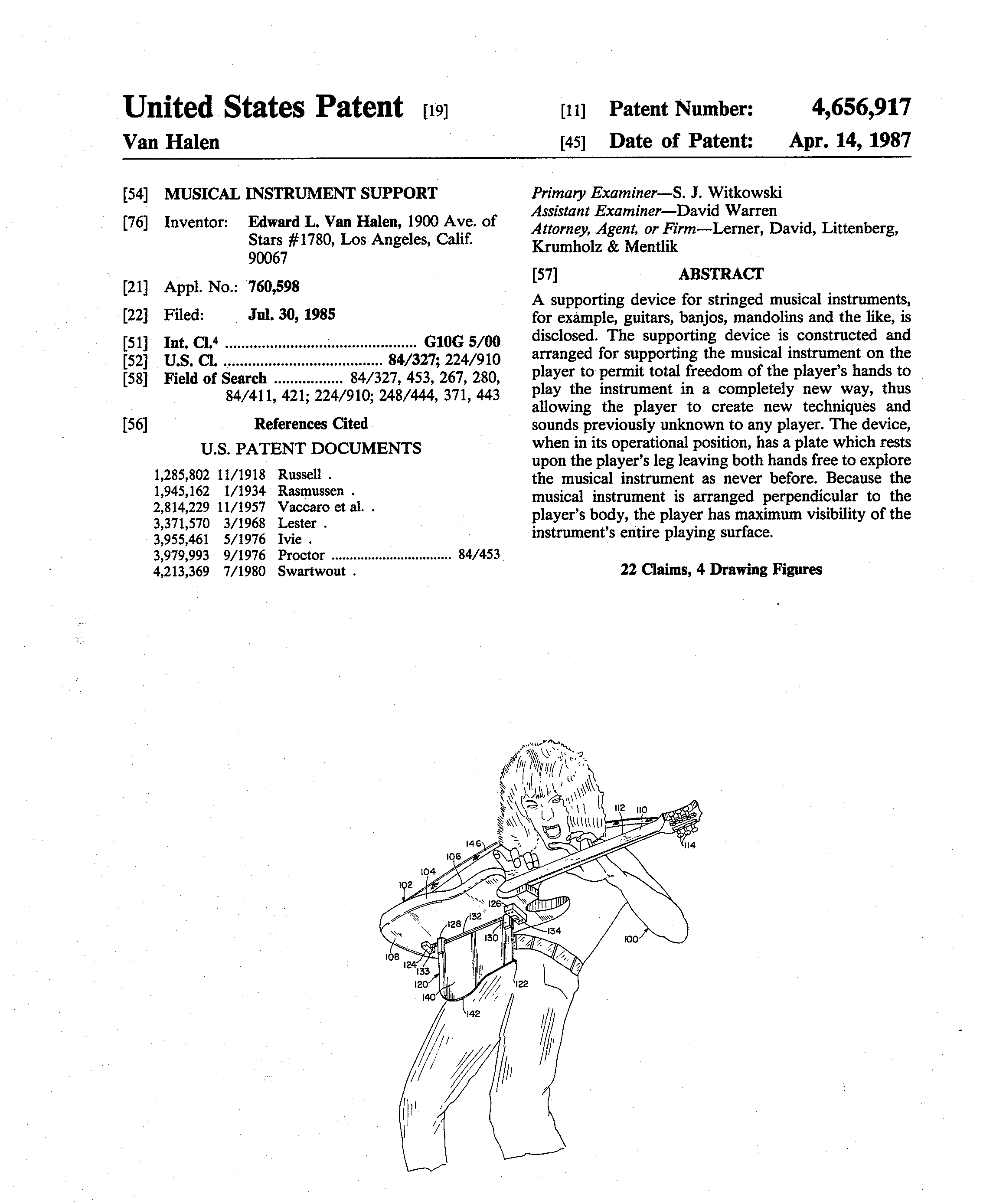
Creating music Creating music is much more than songwriting, after all, there are many songs without words. To structure melody, harmony, and rhythm in a way to create new sounds, new musical instruments or new plug-ins can be developed, as well as structures that allow the use of an existing instrument in a different way. In this sense, Eddie Van Halen improved his fretboard tapping technique by creating a supporting device for stringed musical instruments which was patented in 1987. The support would place the instrument perpendicular to the player's body, allowing total freedom of the musician’s hands to play the instrument in a completely new way.
As regards percussion instruments, Marlon Brando patented an apparatus for adjusting the tension of a drumhead in 2004. It is important to note that the tuning of a drum is made by uniformly stretching the drumhead, being necessary that all screws that fix the drumhead to the drum body be screwed with the same force. Thus, the problem of the state of the art related to the need for a simple and inexpensive drum tuning device which is also accurate, reliable, and not subject to inadvertent adjustments was solved.
Recording music Music recording is one of the most expensive and technological steps of music making. A good sound production studio contains not only technical equipment (such as mixing consoles and microphones) but also digital audio workstation software for combining voice and inputs from electronic musical instruments and devices for producing music. In most countries, software and computer programs are considered a non-patentable matter, therefore not being protectable through patents. However, software-related inventions, such as computer systems and computer-implemented methods, can be protected if the patentability requirements are met. Brian Eno, an influential British musician and producer, best known for his pioneering work in ambient music (as well as his work with some of the biggest names in rock), joined his longtime friend Danny Hillis, a computer scientist and founder of Applied Minds, to develop a method and system for masking speech. LucasFilm, founded by visionary filmmaker George Lucas in 1971, is the owner of several patents in the area of film-making and music making, for example, a system and method for music and effects sound mix creation. Technology has made the recording step much easier, and one can easily record music in a home studio, provided that it comprises all the necessary equipment and computer programs to do so. It is also worth mentioning the use of technology to modify musical data, for example, to produce more harmonious musical accompaniment or to manipulate vocal performance, as well as computer-implemented inventions comprising artificial intelligence that allow the determination of plagiarism in music.
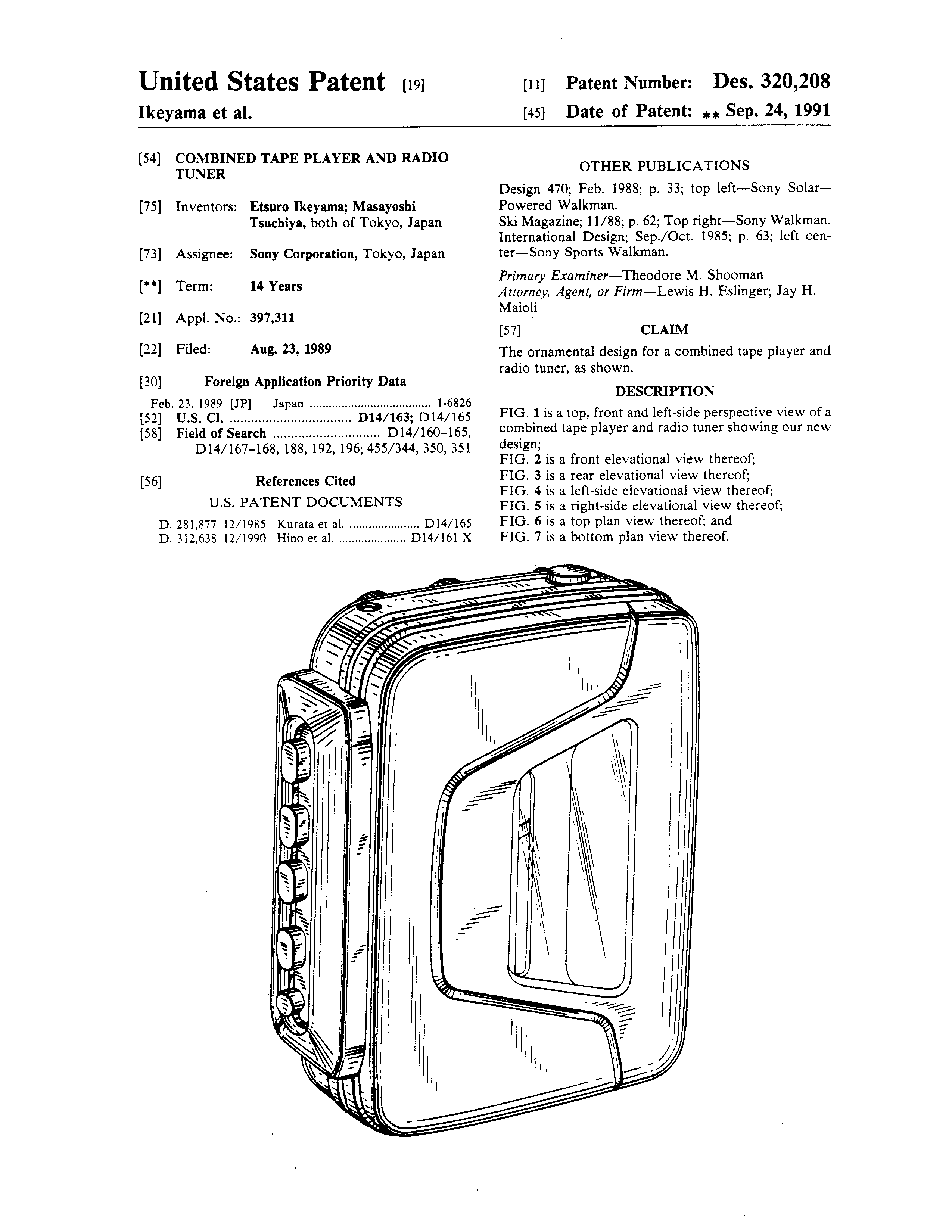
Listening and streaming music Music is part of our everyday life, and it has the capability of changing our mood and helping us to manage emotions. The different ways to listen to music have radically changed over the years and technology is a key factor in this sense. Thomas Edison was the first person to create a device to record and play music—the phonograph—which was patented in 1878. The sound quality was bad, and each recording lasted for one only play. Almost 10 years later, Emile Berliner created the first vinyl record player – the Gramophone—which had to be manually operated. Over the time, vinyl records went through a series of material alterations (Berliner’s records were originally made of glass) and formatting changes, and so did the vinyl players. The magnetic tape for recording sounds was invented by Fritz Pfleumer in 1928, however, the compact cassettes (with the two-spool cartridge) were only developed in the early 60s by Philips Electronics (whose patent was licensed for free to ensure commercial hegemony). In 1979, Sony introduced the first mass mobile device to the market—the Walkman—making music portable. The portability made cassettes the format of choice, and cassette sales surpassed vinyl sales in middle 80s. Co-developed by Philips and Sony, compact disks (CDs) only reached the market in 1982. However, the digital reproduction technology behind the CDs was patented almost a decade earlier by James Russell. The same happened with MP3 players: the devices reached the market in late 1990s, while Kane Kramer patented the first digital audio player in 1979. An innovation developed by singer and songwriter Neil Young relates to a multiple-resolution audio and video system that executes a music file in studio-quality resolution, high-resolution, best resolution, acceptable resolution, selected resolution and / or high definition in a device. The portable music player was commercialised by the name PonoPlayer and sold until 2017, when Neil Young announced the end of the brand due to the overcharge for high-resolution formats imposed by record companies. Today, streaming music, ie, feeding audio content to an audio device without the need of downloading files from the internet, is the easiest and most common way to listen to music. Music streaming services, such as Spotify, uses machine learning to provide its users with a personalised experience, for example, by creating playlists based on what they think the listener would enjoy based on their previous listening history and to recommend or suggest media content in response to input searches for songs of a particular nature.
Performing music The music performance combines songs, dance and sometimes acting and is intended not only to entertain the public, but also to drive the emotions of the audience. Michael Jackson defied gravity in his live performances by leaning forward by 45 degrees. Such movement was only possible due to special shoes that create an anti-gravity illusion created by the pop singer himself. During the concert, a triangular slot in the heel of his shoes would detachably engage to a hitch member that emerged from the stage floor at the right time. In order to improve the quality of the audio during the movements in her performance, singer Paula Abdul invented a microphone support apparatus having a concave-shaped bottom base. The dynamic apparatus would allow the singer to move the microphone support by shifting her weight in a particular direction. Rapper Kanye West has filed a patent application to protect an immersive audio / video experience, which comprised several viewing screens located on the front, on the sides, on above and on below or slightly forward of the viewer. The images are visually coordinated, and the viewer would experience viewing the images, such as a music video or sporting events, as if he or she were actually “in” the scene.
Conclusion Even though music creations are not protectable by patents, innovative music technologies are changing the way people create, listen, and feel music. Advances in technology are not limited to the design and construction of musical instruments: it affects all steps of the music making and allow people to be a part of the whole process.
Audacity Muse Group, the creator of the world's most popular software, tools, content catalogs and communities for musicians, is paving the way for greater music accessibility with the release of a new and improved Audacity, after purchasing the IP back in 2021. New features in the plugin seek to make Audacity an end-to-end production tool with the addition of real-time effects support, non-destructive editing, VST3 support, UX and UI improvements, and notably, quick audio sharing with the newly launched audio.com. Audacity 3.2 brings improved non-destructive audio capabilities, where creators can tweak the effects without changes being permanently written into the audio file. This will allow for heightened levels of editing and audio manipulation, which will make the production of podcasts, mixes, and so much more all the easier. Virtual Studio Technology (VST3 support) is also enhanced with the new production update. Audacity 3.2 delivers a more streamlined experience for creators with a completely rewritten code base, providing the most stable and reliable VST platform to date. New visual improvements have also been made, especially from a user experience perspective. Audacity 3.2 introduces a clearer and more consistent set of visuals in the top bar for a smoother editing experience, with the audio output bar and volume slider combined for more efficient functionality. A new ‘Audio Setup’ option also allows for quick and easy changes to input, mic and output settings. Audacity 3.2 will be available to creators globally for free beginning on September 26, 2022. For more information about Muse Group and its platforms, visit here Managing Editor at Magnetic Magazine – Former Marketing Manager at the Hyperbits Masterclass – Writer, Content Strategist, Music Producer, and Record Label Manager
Roger Ho Aphex Twin’s Samplebrain is free, open-source and available to try now. Aphex Twin's secret sauce is certainly difficult to decode, but the fabled electronic music producer is shedding a light on his creative process with the development of a new creative production app, Samplebrain. The free, open source software effectively turns any given sample into a neural network of possibilities. Aphex Twin teamed up with Dave Griffiths on the app's engineering. A statement by Aphex Twin via Warp Records outlays Samplebrain's possibilities. "What if you could reconstruct source audio from a selection of other mp3's / audio on your computer?" he said. "What if you could build a 303 riff from only acapellas or bubbling mud sounds? What if you could sing a silly tune and rebuild it from classical music files? You can do this with Samplebrain." The 2022 summit will take place October 2-5 at the Detroit Opera House. The explosive performance went down at the inaugural Making Time Festival in Philadelphia. Roy's friends, label mates and fans launched a vigorous campaign in the wake of his death. Intriguingly, Aphex Twin's idea of feeding programmatic software one sample to generate another has been on his mind for nearly 20 years, according to Pitchfork. The advent of Shazam particularly piqued his interest, as he saw in it the possibility to revolutionize music creation with their core technology. Unfortunately, the creators of Shazam did not earnestly share the same vision. So Aphex Twin has since taken matters into his own hands. Music producers can now delve into the full Samplebrain app via Gitlab. Facebook: facebook.com/aphextwinafx Twitter: twitter.com/AphexTwin Spotify: spoti.fi/34xoFmQ Sign up for the latest news, exclusive giveaways & more. Aphex Twin had teased the collaboration on a number of mysterious billboards across the world. The account long believed to be Aphex Twin’s, released 6 tracks over 6 consecutive days. Coachella’s full lineup is due out any day. The Yamaha—with the “Selected Ambient Works Volume II” liner notes etched by Aphex Twin—is up for auction on eBay. The legendary electronic music producer hid a secret clue in the NFT, a collaboration with longtime creative partner and visual artist Weirdcore. We’re in for something new from Aphex Twin. Bale said his character, Gorr the God Butcher, was inspired by Aphex Twin’s 1997 music video for “Come to Daddy.” Clues suggest a new Aphex Twin EP.
Become a member Learn more Become a member Learn more The two-hour workshops are hugely popular, showing participants how to craft jack-o'-lanterns, skulls and more from clay. ROGERS PARK — Nodd Pottery is bringing back its annual clay pumpkin-carving workshops this fall. Participants will learn how to make pinch pots with lids in the shape of jack-o’-lanterns, skulls — or whatever they want. Each piece is returned glazed and with an electric tea light “to give it that spooky Halloween glow,” according to the studio’s website. Everyone 8 and older is welcome. You can sign up online for the two-hour workshops, which will be offered throughout October. Each workshop is $35 per person. Prior registration is required. Each class fits up to eight people, and they’re almost sold out, said Sarah Ortlieb, who started Nodd Pottery about five years ago. The workshop “always goes crazy,” she said. “Usually, I start out with one and then suddenly it becomes two and then three and then four because of how many people in the community are interested in signing up,” Ortlieb said. “And they come with their kids, and it’s a whole lot of fun.” Nodd Pottery is a nonprofit that provides affordable art education to the community and its youth. Ortlieb said she likes to call it “the yoga studio of pottery studios.” “There’s no limit to what you can do with pottery, so, similar to yoga, it’s about building up muscle memory, building up skill level with instruction,” Ortlieb said. Ortlieb, 33, has been doing pottery for about 12 years and teaching art for about 10. She also worked at several studios in the suburbs before moving to Chicago and opening up her own. “Literally worked with every age group you can think of and been doing it for a very long time,” she said. You can learn more about Nodd Pottery and sign up for classes online. Subscribe to Block Club Chicago, an independent, 501(c)(3), journalist-run newsroom. Every dime we make funds reporting from Chicago’s neighborhoods. Click here to support Block Club with a tax-deductible donation. Thanks for subscribing to Block Club Chicago, an independent, 501(c)(3), journalist-run newsroom. Every dime we make funds reporting from Chicago’s neighborhoods. Click here to support Block Club with a tax-deductible donation. Listen to “It’s All Good: A Block Club Chicago Podcast”: After 11 years of declining enrollment, Chicago Public Schools now serves 322,106 children, making it the nation’s fourth largest district after Miami-Dade County Public Schools, which serves 324,961 students. The land deal was approved despite opposition from residents who say the $120 million school will siphon students away from predominately Black neighborhood schools, deepening racial divides. The $24.3 million, four-story building offers 53 apartments as part of an effort to bring back thousands of units to the former public housing site. The community meeting is Saturday at Mary Bartelme Park. Residents can voice their concerns with officials and local groups.
There’s tons of great music production software out there, but it can sometimes be hard to piece together your perfect workflow. Once upon a time, your DAW really only had the bare bones necessary to produce high-quality music — meaning that you had to turn to other developers for all your plugin needs, or rely on outboard gear. These days, however, it’s much easier to get an end-to-end music production solution that removes the need to search high and low for all your favorite plugins. One of the latest of these bundles is Presonus Sphere. Calling Presonus Sphere a bundle, however, is perhaps a bit misleading. Sure, it bundles together all the software you’ll need to write and produce music — but you don’t have to pay an arm and a leg for it like you might have in the past. Instead, you access it on a subscription basis. Not only that, but it’s a portal to a large and growing online music production community, with tutorials and education on top of that. It’s a strong offering from Presonus. Once focused solely on production hardware and the software required to make that hardware run, Presonus is positioning itself as the go-to for all your music production needs. Sphere is a perfect example of why. I’ve been diving into what Presonus Sphere has to offer to get a better sense of whether or not it’s truly worth the money. Here’s everything you need to know about the service. At the heart of Presonus’ music production aspirations is Studio One, the company’s DAW. Over the years, Studio One has seriously grown up — and it’s now a full-fledged, high-quality workstation that can be as easy or as full-features as you want it to be. Studio One is currently in its fifth version, and it has added a number of great features to help make producing music easier. For example, Studio One 5 now has a Score Editor, which leverages the company’s experience with Notion, and makes it easier to manage your MIDI instruments and what they’ll play. Generally, Studio One is a world-class DAW, and unless you’re tied down to one of its competitors, it’s well worth considering for your main DAW. Speaking of editing scores, Sphere also comes with Presonus’ world-class score-editing software, Notion, too. Notion is currently up to its sixth iteration, and it’s now a mature and well-designed product that any composer or musician can wrap their head around. There are a number of features that are new in Notion 6. For example, you can now drag to respace measures and systems, plus there are new Soundiron instruments built into it, and video window controls, which lets you more easily score to a film or video. And, Notion now works seamlessly with Studio One, including the entry-level Studio One Artist. And, you can continue writing your score using the iPad app, which makes scoring on the go easier than ever. One of Notion’s big strengths is the fact that it has an excellent sample library that lets you get a good feel for how your score will sound as you’re composing. These samples were recorded by the London Symphony Orchestra at Abbey Road Studios. Of course, Presonus isn’t just providing the workstation for music creation — it also provides all the tools you’ll need to complete a project. That includes dozens of effects, plugins, and instruments that you can use to create your next masterpiece. Really there are tons of effects to choose from, and they span every aspect of what you would want. You’ll get a series of compressors, EQs, time-based effects, and more. Some of my favorites include the analog delay and the Fat Channel Brit Comp. When it comes to instruments, there are some great ones to choose from too. You’ll get access to Presonus’ Presence XT Piano, Strings, and more. It’s a solid selection, and pretty much everything you’ll need. If you’re into using samples in your music creation, you’ll find plenty to dig through here too. Sphere comes with over 80 sample packs, spanning acoustic instruments like guitars and drums, to electronic loops, to weird sound effects. There’s far more than you’ll ever need or use — the only criticism is that it could take some digging to find that perfect sound. Perhaps one of the best things about Sphere has nothing to do with the production tools — it has to do with the huge community that you’ll have access to. Sphere allows users to communicate with other members, collaborate on projects, ask for feedback, and more. It’s a great way to hone your skills as a musician or producer, work with others, and just get more ears on a project. You might assume that Presonus Sphere comes at bank-breaking monthly rates, but in fact, it’s quite affordable. You’ll get everything mentioned for $14.99 per month — not bad at all. Alternatively, you could pay $164.95 for a year — which equates to around $15 in savings. Interested in getting Presonus Sphere for yourself? You can do so straight from the Presonus website. Christian de Looper was born in Canberra Australia, and since then has lived in Europe and now lives in sunny California. When he’s not tinkering with the latest music gear, Christian is devouring news on new consumer technology. All Things Gear may make a commission on products sold through the links on this website. This in no way affects our review of a product.
Is Monday a public holiday? It depends where you live Millions of Australians have a public holiday coming up — it just depends on which state you live in. Here's the public holiday situation across the country. Yes, if you live in NSW, Queensland, South Australia or the ACT then October 3 is a public holiday. It's not a public holiday for those who live in Victoria, Western Australia, Tasmania or the Northern Territory. In Queensland, the October 3 public holiday is for the Queen's Birthday, even though the late Queen Elizabeth II's birthday was on April 21. The Queensland public holiday has been on the first Monday of October since 2016. In NSW, SA and the ACT October 3 is Labour Day, which celebrates the achievements of workers. Australia has a bunch of national public holidays. These include: New Year's Day, Australia Day, Good Friday, Easter Monday, Anzac Day, Christmas Day and Boxing Day. All the other public holidays, like the Queen's Birthday and Labour Day, are called by state and territory governments. Yes. Australians were given a national day of mourning on Thursday last week following the death of Queen Elizabeth II. Victoria also just had its regular public holiday on the Friday before the AFL Grand Final. If you're talking about holding a bunch of show holidays across the month of October rather than Queen's Birthday holidays, then yes. The show holidays are as follows: We acknowledge Aboriginal and Torres Strait Islander peoples as the First Australians and Traditional Custodians of the lands where we live, learn, and work. This service may include material from Agence France-Presse (AFP), APTN, Reuters, AAP, CNN and the BBC World Service which is copyright and cannot be reproduced. AEST = Australian Eastern Standard Time which is 10 hours ahead of GMT (Greenwich Mean Time)
No Results We’ll remember your choice for next time Tom Lynch has won the Jack Dyer Medal as Richmond’s best and fairest for 2022. The key forward capped a superb season by taking out the club’s most prestigious individual award despite missing four games and barely featuring in another.
The former Gold Coast co-captain polled 60 votes to narrowly beat Daniel Rioli (59) in a tight count, with 2019 winner Dion Prestia in third (56). Shai Bolton and Liam Baker were equal fourth on 53 votes apiece. Just 14 votes separated Lynch at no.1 and Nathan Broad in 10th.
Two-time premiership player Lynch was selected in the 44-man All-Australian and was unlucky not to make the team proper, as he kicked 63 goals, averaging a league-high 3.32 per game He also picked up the leading goalkicker award on his way to a third career best and fairest following two with the Suns.
📰 – https://t.co/T2gCOBdx3upic.twitter.com/mZ7qsee8W2 Other award winners on the night included the retiring Kane Lambert, who won the Francis Bourke Award which is awarded to ‘players that best uphold their trademark values’. Josh Gibcus was the Best First Year Player, Marlion Pickett received the David Mandie Community Award and Jake Aarts won the VFL Best and Fairest. Jack Dyer Medal Top 10 for 2022 1st – Tom Lynch (60) 2nd – Daniel Rioli (59) 3rd – Dion Prestia (56) Eq. 4th – Shai Bolton (53) Eq. 4th – Liam Baker (53) Eq. 6th – Trent Cotchin (52) Eq. 6th – Jayden Short (52) Eq. 8th – Toby Nankervis (47) Eq. 8th – Marlion Pickett (47) 10th – Nathan Broad (46)