Blog

‘Jeopardy!’ Looks To Expand Franchise With Master League – Deadline

By Lynette Rice
Senior TV Writer/TV Editor, Awards
For fans who can’t get enough of the Jeopardy! franchise, Executive Producer Michael Davies has some promising news for you.
Now that a revival of Celebrity Jeopardy! is off the ground, Davies is flirting with other off-shoots like a masters league that features the show’s winningest players, and maybe even a spinoff focused solely on sports and pop culture trivia.
“What we really need to develop is the pro-level version of the game,” Davies told the New York Times. “It seemed ridiculous to me that we have this sport where every single year we take all of our best players — we take our LeBrons and our Dwyanes — and we switch them all out.”

Davies would even like to air the masters league live. “That makes a lot of my staff nervous,” he said to the paper.
The franchise has already begun filming a Second Chance Tournament that will bring back promising contestants, as well as a revamped Tournament of Champions. There’s lots of other distractions in the works for Jeopardy! hungry viewers, like a podcast and a hall of fame for the show’s best players.
“I don’t think there’s ever really been a game show that has really listened to its fans the way that Jeopardy! is currently doing,” former contestant-turned-game show journalist Cory Anotado told the NYT.
Subscribe to Deadline Breaking News Alerts and keep your inbox happy.
Signup for Breaking News Alerts & Newsletters
Get our latest storiesin the feed of your favorite networks
We want to hear from you! Send us a tip using our annonymous form.
Sign up for our breaking news alerts
Deadline is a part of Penske Media Corporation. © 2022 Deadline Hollywood, LLC. All Rights Reserved.

source

The best new free music-making software: essential freeware synths, drum machines and effects for October 2022 – MusicRadar

MusicRadar is supported by its audience. When you purchase through links on our site, we may earn an affiliate commission. Here’s why you can trust us.
Did somebody say free plugins? It’s our monthly round-up of the most fantastic freeware for producers on a budget
Everybody loves a free plugin. We’d wager that even the most affluent music-makers, smugly reclining in their padded studio chairs while they bask in the radiant glow of a specced-out M1 Mac, feel a twinge of excitement when a gratuitous VST pops up on their 6K Retina display. 
This is our monthly free software round-up’s raison d’être. It exists to serve you, the sonically curious and financially prudent producer, in your pursuit of the internet’s finest freeware. We know you’re a busy bunch, so here we present the most intriguing freebies from our regular news coverage that you may have missed, plus anything else that’s caught our eyes (and ears) over the past 30 days. 
• The best free music software and plugins: DAWs, synths effects and more
Platforms: Mac/PC | Formats: Standalone | Download

Having previously worked on a synth with Novation and a microtuning plugin with Oddsound, Aphex Twin (AKA Richard D. James) has now released a free “custom sample mashing app” known as Samplebrain.aphex twinAphex Twin: “I hate the idea of using other people’s equipment – I’ve just got a bit obsessed, I suppose”
This open-source software works by chopping samples up into a ‘brain’ of small, interconnected sections called blocks, which are grouped into a network based on their similarity. This then processes a target sample, chopping it up into blocks in the same way, and attempts to match each block with one in its brain for realtime playing. The idea is that you’re interpreting one sound with another.
Discussing the origins of the software (it’s actually been in development since 2015) and what it’s capable of, Aphex Twin said (opens in new tab): “What if you could reconstruct source audio from a selection of other MP3s/audio on your computer? What if you could build a 303 riff from only a cappellas or bubbling mud sounds? What if you could sing a silly tune and rebuild it from classical music files? You can do this with Samplebrain.”
Platforms: PC | Formats: VST2/VST3 | Download
It’s a shame this one’s PC-only, because everybody should be able to take advantage of this powerful, experimental free drum machine plugin. Here’s the lowdown: Off-Grid is based around seven channels, each of which is equipped with four cells, or voices. 
Each cell can be independently controlled and holds one of the plugin’s 448 built-in sounds, which can be reversed, looped and pitch-shifted as you please. That’s not all – there’s a ton of potential for randomization, meaning glitchy, unpredictable drum grooves are just a click away.
Platforms: Mac/PC | Formats: VST3/AU | Download (opens in new tab)
You may already be familiar with the sound of OTT (over-the-top) compression, but now Sixth Sample and Integraudio are giving you the effect for free with their new Cramit plugin. Many will know the term OTT from the name of a preset in Ableton Live’s multiband compressor, and it’s also been adopted by third-party plugin manufacturers such as Slate Digital and Xfer Records. 
Sixth Sample’s take on the concept gives you three bands of upwards/downwards compression and expansion, and also enables you to apply seven types of distortion (pre or post) that are integrated into a single control. You also get 10 factory presets and a resizable interface.tessla proPlatforms: PC | Formats: VST | Download (opens in new tab)

Nothing beefs up a mix like a tasty bit of analogue saturation, but not all of us can afford a smorgasbord of outboard. Enter TesslaPRO. This Windows-only saturator updates Variety of Sound’s TesslaPRO plugin for a third iteration, bringing the rich tones of classic transformer-based circuit designs of yore straight into the modern era. 
Aimed at mixing and mastering engineers nostalgic for the “extra vibes” delivered by highend analogue equipment, TesslaPRO blesses your audio with those all-important artifacts, bringing depth, dimension and warmth where it’s needed.movementronPlatforms: PC | Formats: VST3 | Download (opens in new tab)

Have you ever found yourself at a creative standstill? Stuck in a production rut? Fear not, because Movementron, a free synth from Flandersh Tech, is all about movement. 
This dual-oscillator gem enables you to sequence your choice of waveforms over 8 steps, creating complex, evolving patterns with the first oscillator, while the second allows you to draw your own waves into the plugin. Flandersh Tech have even thrown in a sequence-able filter, LFO, compressor, delay and reverb too. Neato. 
Platforms: Mac/PC | Formats: VST3/AU | Download (opens in new tab)
Most DAWs come bundled with a free filter plugin, but these are often pretty basic and uninspiring. When you’ve maxed out your stock filter’s capabilities, it’s a good idea to test the waters with something new. A great place to start would be TheWaveWarden’s Filter Force Free, a free version of their (still fairly cheap, at €29) Filter Force Pro plugin. 
This dual filter shines in its modulation capabilities, offering producers two sequencer lanes for rhythmic filter manipulation that’ll generate life and movement in your source audio. The free version’s restricted to two filter types, but it’s a decent plugin nonetheless.

Platforms: Mac/PC | Formats: Kontakt | Download
Every so often a free plugin comes along that stops us in our tracks. Aria Libera is one of those plugins. A Kontakt instrument from Sonora Cinematic, it’s based around  a collection of recordings of vocalist Emma May Price, that have been processed through a granular modular synthesizer. Haunting and ethereal, this one will add a touch of mood and colour to any track. 
Current page: October 2022
I’m the Tech Features Editor for MusicRadar, working on everything from artist interviews to tech tutorials. I’ve been writing about (and making) electronic music for over a decade, and when I’m not behind my laptop keyboard, you’ll find me behind a MIDI keyboard or a synthesizer. 
Don’t miss the latest deals, news, reviews, features and tutorials
Thank you for signing up to Musicradar. You will receive a verification email shortly.
There was a problem. Please refresh the page and try again.
MusicRadar is part of Future plc, an international media group and leading digital publisher. Visit our corporate site (opens in new tab).
© Future Publishing Limited Quay House, The Ambury, Bath BA1 1UA. All rights reserved. England and Wales company registration number 2008885.

source

This pilot program will be required for Marine master, first sergeants – Marine Corps Times

A new Marine Corps pilot program aims to supplement the limited amount of time enlisted service members are given for professional military education, according to the most senior enlisted member of the Marine Corps.
The program ― previously a voluntary course for senior enlisted Marines ― is now being tested as a part of the standard course load for E-8 service members.
“We developed the Senior Enlisted Blended Seminar Program comprised of eight weeks of nonresident seminar instruction followed by a two-week resident session, and it will be a requirement for First Sergeants and Master Sergeants,” Sergeant Major of the Marine Corps Troy Black said in a statement to Marine Corps Times. “The program is currently in a pilot phase.”
“The SEBSP leverages lessons from the Marine Corps University’s College of Distance Education and Training, delivered blended programs for Expeditionary Warfare School and Command and Staff College Distance Education Programs,” he said.
First announced in February, the previously voluntary six-week course was “neither available to the majority of the E-8 population nor a PME requirement for promotion,” according to a MARADMIN post.
Another weeklong required seminar for promotion to E-9 also will be phased out, the February MARADMIN added, though a timeline on this hasn’t been announced.
While the Marine Corps’ professional military education program has evolved over time, this combined in-person and online seminar is being considered a favorable step forward to expand higher learning opportunities for enlisted Marines.
Black briefly spoke about the pilot program, and the status of enlisted professional military education in the Marine Corps, to a group of service members in an hourlong podcast conversation on Sept. 16 at the Marine Corps University’s Brute Krulak Center for Innovation & Future Warfare in Quantico, Virginia.
As the event was hosted at the institutional home to the service’s enlisted professional military education program, Black was asked for his perspective on what has and hasn’t been working in the pipeline.
Black shared that the limited amount of time currently invested for Marines, a period which he said adds up to roughly 22 weeks, remains a challenge.
“Time is the only constraint, not the desire for the curriculum that we have,” said Black, who noted that the Marine Corps recently conducted a servicewide assessment of all its enlisted professional military education curriculum.
In comparison, at the officer level, the Expeditionary Warfare School provides a 41-week educational program.
Other subjects discussed in the conversation included Force Design 2030 and the culture of the Marine Corps.
“We’re working on a draft right now of a document that’s going to in black and white determine what our ethos and culture is,” said Black, emphasizing that the Marine Corps is focused on being a war-fighting organization.
There is no set publication date for this document, Black said, and it is not associated with Force Design 2030.
Jonathan is a staff writer and editor of the Early Bird Brief newsletter for Military Times. Follow him on Twitter @lehrfeld_media
Marine Corps Times © 2022

source

Audio Description (AD) – RNIB

A basic RNIB guide explaining what audio description is and how it is used by blind and partially sighted people. Audio Description on TV can make programmes more accessible.
Audio description, or AD, is a spoken description of the visuals happening on screen to help blind and partially sighted viewers follow the story. It describes elements like facial expressions, movement, gestures, body language and activity. The voice used for AD is a real person.
AD can be used on most UK based broadcast channels like BBC, ITV, Sky and catch-up services like BBC iPlayer, ITV Hub, 4 On Demand.
Audio description in cinema is possible via the use of headsets at most movie theatres.
Streaming services like Amazon Prime and Netflix also provide audio description.
AD is useful if you do not have enough vision to see what is happening but want to be able to tell what is going on during the visual parts a television broadcast, film or documentary.
Without the use of AD, a blind person can miss out on various story lines and plots as the physical actions can be just as significant as the dialogue. AD paints an audio picture of the onscreen content, helping blind or partially sighted people enjoy and experience television programs and films just as sighted people do.
If you have a question about living with sight loss we’re here to offer support.
Call 0303 123 9999
“Alexa, call RNIB Helpline” on Alexa-enabled devices
Most mainstream televisions available today have accessibility features built into them which help to make TV for visually impaired users accessible
We're open 8am – 8pm on weekdays and 9am – 1pm on Saturdays
Email us at [email protected] or say: "Alexa, call RNIB Helpline"

source

After years of decline, the auto industry in Canada is making a comeback – WUNC

RACHEL MARTIN, HOST:
The U.S. gets all the attention for car manufacturing in North America. But after years of decline, that industry is making a comeback in Canada. NPR’s H.J. Mai traveled to Ontario to find out why.
H J MAI, BYLINE: I’m in the Canadian city of Windsor, Ontario, just across the river from Detroit. The truck traffic on the Ambassador Bridge connecting the two cities shows the economic importance of their close, cross-border tie. It’s only when I spot the roughly three dozen Tim Hortons locations, a popular Canadian coffee and doughnut chain, that I realize I’m not in the U.S. anymore.
UNIDENTIFIED PERSON: Could I get a Double Double myself?
MAI: Windsor has benefited from this close connection to Detroit and the big three carmakers that are located there. It’s been the city’s economic engine for more than 100 years. And President Biden’s landmark climate bill, known as the Inflation Reduction Act, promises to accelerate Windsor’s re-emergence as an automotive heavyweight.
DREW DILKENS: Companies that are looking at the new world of automotive and figuring out what role they’re going to play, they’re going to start looking at Windsor-Essex as a place to do business.
MAI: Mayor Drew Dilkens says Windsor is humming again, as new production lines open and additional shifts return. A multibillion-dollar investment from Stellantis, the maker of Chrysler cars, and South Korea’s LG to build a new battery factory in town is further proof that things are trending up.
DILKENS: Five billion dollars, 3,000 jobs – it is not a small, little investment. For a community like ours, it is a massive, game-changing investment. And I’m not even sure those two words are quite, you know, big enough.
MAI: The U.S. climate legislation adds yet another gear. It provides tax credits to EV buyers, but only if the cars and batteries are largely made in North America, and the materials used in batteries, such as lithium or nickel, are mine locally. This gives Canada a clear advantage, according to GM Canada’s David Paterson.
DAVID PATERSON: Our supply chains in North America have been global in the past. Now we have an opportunity to bring some of that back, more to North America, as we shift to making batteries.
MAI: But the industry faced a number of challenges during the past two decades. Like Michigan, Ontario’s auto sector was hit hard by increased automation and the NAFTA trade agreement, as carmakers moved their assembly lines to places like Mexico. Windsor posted some of the highest unemployment numbers in the province for a while.
ANGELO DICARO: We’ve seen disinvestment in the sector. We’ve seen job losses in the sector. We’ve seen plants closed and communities basically disappear as a result of that.
MAI: Angelo DiCaro is the director of research for Unifor, a union that represents roughly 230,000 Canadian auto workers. But change is in the air, and car companies have taken notice, says Flavio Volpe, president of the Canadian Auto Parts Manufacturers’ Association.
FLAVIO VOLPE: Ontario, in the last 18 months, has had the greatest run of new investment in vehicle production in its entire history.
MAI: Ontario has attracted more than $16 billion in planned investments during the past year and a half, yet competition – especially from the U.S. – remains high. Canada’s auto sector is also highly dependent on U.S. buyers, with nearly 80% of cars produced in the country ending up on American roads. Nevertheless, Volkswagen and Tesla both publicly confirmed they are looking at Canada as a potential site for a new battery plant, and that’s got Canada feeling optimistic about the future.
PATERSON: Let’s work our way through this. Let’s make the transition to electric. Let’s optimize the system as best we can. And then let’s take on the world.
MAI: Canada wants to become a global hub for electric vehicle and battery production, and it is laying the groundwork now.
H.J. Mai, NPR News, Windsor, Ontario.
(SOUNDBITE OF MUSIC) Transcript provided by NPR, Copyright NPR.

source

Short Interest in VictoryShares US EQ Income Enhanced Volatility Wtd ETF (NASDAQ:CDC) Declines By 51.0% – MarketBeat

Sign up for MarketBeat All Access to gain access to MarketBeat’s full suite of research tools:
VictoryShares US EQ Income Enhanced Volatility Wtd ETF (NASDAQ:CDC – Get Rating) saw a large decline in short interest during the month of September. As of September 15th, there was short interest totalling 35,000 shares, a decline of 51.0% from the August 31st total of 71,500 shares. Based on an average trading volume of 210,500 shares, the short-interest ratio is presently 0.2 days.

VictoryShares US EQ Income Enhanced Volatility Wtd ETF Trading Down 0.8 %

Shares of VictoryShares US EQ Income Enhanced Volatility Wtd ETF stock opened at $60.30 on Wednesday. The firm has a fifty day moving average of $66.74 and a two-hundred day moving average of $68.58. VictoryShares US EQ Income Enhanced Volatility Wtd ETF has a 52 week low of $60.06 and a 52 week high of $74.46.

VictoryShares US EQ Income Enhanced Volatility Wtd ETF Increases Dividend

The firm also recently announced a monthly dividend, which was paid on Tuesday, September 13th. Shareholders of record on Monday, September 12th were given a dividend of $0.259 per share. This is a boost from VictoryShares US EQ Income Enhanced Volatility Wtd ETF’s previous monthly dividend of $0.08. The ex-dividend date of this dividend was Friday, September 9th. This represents a $3.11 annualized dividend and a dividend yield of 5.15%.

Institutional Trading of VictoryShares US EQ Income Enhanced Volatility Wtd ETF

Institutional investors and hedge funds have recently made changes to their positions in the business. Westside Investment Management Inc. bought a new stake in shares of VictoryShares US EQ Income Enhanced Volatility Wtd ETF during the 2nd quarter valued at $26,000. Accel Wealth Management bought a new stake in shares of VictoryShares US EQ Income Enhanced Volatility Wtd ETF in the 1st quarter valued at $130,000. Clearview Wealth Advisors LLC bought a new stake in shares of VictoryShares US EQ Income Enhanced Volatility Wtd ETF in the 1st quarter valued at $135,000. Horizons Wealth Management bought a new stake in shares of VictoryShares US EQ Income Enhanced Volatility Wtd ETF in the 2nd quarter valued at $397,000. Finally, Private Trust Co. NA bought a new stake in shares of VictoryShares US EQ Income Enhanced Volatility Wtd ETF in the 2nd quarter valued at $459,000.

Further Reading

This instant news alert was generated by narrative science technology and financial data from MarketBeat in order to provide readers with the fastest and most accurate reporting. This story was reviewed by MarketBeat’s editorial team prior to publication. Please send any questions or comments about this story to [email protected].
Before you consider VictoryShares US EQ Income Enhanced Volatility Wtd ETF, you’ll want to hear this.
MarketBeat keeps track of Wall Street’s top-rated and best performing research analysts and the stocks they recommend to their clients on a daily basis. MarketBeat has identified the five stocks that top analysts are quietly whispering to their clients to buy now before the broader market catches on… and VictoryShares US EQ Income Enhanced Volatility Wtd ETF wasn’t on the list.
While VictoryShares US EQ Income Enhanced Volatility Wtd ETF currently has a “N/A” rating among analysts, top-rated analysts believe these five stocks are better buys.
View The Five Stocks Here
Complete the form below to receive the latest headlines and analysts’ recommendations for your stocks with our free daily email newsletter:
Axel Merk, President and CIO of Merk Investments has three very different stocks he frames within the current market and economic conditions.
Sign up for MarketBeat All Access to gain access to MarketBeat’s full suite of research tools:
View the latest news, buy/sell ratings, SEC filings and insider transactions for your stocks. Compare your portfolio performance to leading indices and get personalized stock ideas based on your portfolio.
Get daily stock ideas from top-performing Wall Street analysts. Get short term trading ideas from the MarketBeat Idea Engine. View which stocks are hot on social media with MarketBeat’s trending stocks report.
Identify stocks that meet your criteria using seven unique stock screeners. See what’s happening in the market right now with MarketBeat’s real-time news feed. Export data to Excel for your own analysis.
MarketBeat All Access subscribers can access stock screeners, the Idea Engine, data export tools, research reports, and other premium tools.
Looking for new stock ideas? Want to see which stocks are moving? View our full suite of financial calendars and market data tables, all for free.
Receive a free world-class investing education from MarketBeat. Learn about financial terms, types of investments, trading strategies and more.
As Featured By:
MarketBeat empowers individual investors to make better trading decisions by providing real-time financial data and objective market analysis. Whether you’re looking for analyst ratings, corporate buybacks, dividends, earnings, economic reports, financials, insider trades, IPOs, SEC filings or stock splits, MarketBeat has the objective information you need to analyze any stock. Learn more about MarketBeat.
Twitter Facebook StockTwits Financial Juice YouTube
MarketBeat is accredited by the Better Business Bureau MarketBeat is rated as Great on TrustPilot
© American Consumer News, LLC dba MarketBeat® 2010-2022. All rights reserved.
326 E 8th St #105, Sioux Falls, SD 57103 | [email protected] | (844) 978-6257
MarketBeat does not provide personalized financial advice and does not issue recommendations or offers to buy stock or sell any security.

Our Accessibility Statement | Terms of Service | Privacy Policy | Do Not Sell My Information | RSS Feeds

© 2022 Market data provided is at least 10-minutes delayed and hosted by Barchart Solutions. Information is provided ‘as-is’ and solely for informational purposes, not for trading purposes or advice, and is delayed. To see all exchange delays and terms of use please see Barchart’s disclaimer.

source

New studio Embark announces new free-to-play shooter, The Finals – Polygon

Filed under:
Nexon-backed Embark Studios shows its first game, a Running Man-style game show
Four years ago, Electronic Arts’ chief design officer left to co-found his own studio, created with Nexon’s backing. On Monday, Patrick Söderlund’s studio showed off its first game: The Finals, a squad-based, free-to-play multiplayer shooter inspired by sci-fi bloodsport narratives like Squid Game and The Running Man, where pretty much everything on the game’s maps can be destroyed.
The Finals, said Embark Studios creative director Gustav Tilleby, is “a hero builder, not a hero shooter.” As shown in a debut trailer, players will have access to a variety of weapons and their tactical uses, from a katana and other melee weapons, to rocket launchers, and even a foam gun that can reinforce crumbling walls or build a bridge to higher ground.
“We want to build a game that provides players with the tools to meaningfully interact, change, and use their world,” Tilleby said. “So, this is a shooter; it’s a game where aiming and shooting is important. But it’s also a game where the players can use the environment, and adapt to changes in the environment.”
“We want The Finals to be a game about intuitiveness; wherever you think something should work, it probably will,” Tilleby said. Hence the comprehensive destruction players can wreak all over the map. A standard match in The Finals will feature four teams of three players each. It is “not a battle royale, it’s not a military sim,” Tilleby emphasized.
Stockholm-based Embark Studios was co-founded in 2018 by Söderlund and Rob Runnesson, who is also Embark’s chief creative officer. Originally, Embark’s first game was to have been ARC Raiders, a free-to-play, third-person sci-fi shooter that was announced in December at The Game Awards 2021. In August, Embark announced ARC Raiders was delayed into 2023; but something codenamed “Project Discovery” — which is The Finals — “has progressed faster than we first imagined,” Söderlund said, moving its development and launch planning up on the schedule.
The Finals’ fully destructible environments “means there’s plenty of chaos to go around,” Tilleby said. He called the maps “hyper-realistic virtual playgrounds,” that are “based on iconic real world locations.” One shown Monday was based on the Hotel Monaco in Monte-Carlo, for example (though Embark wasn’t giving out any details on where else the game will be heading).
The environments will have changing weather and time of day to further differentiate each match. Players can destroy furniture and scenery, or entire buildings themselves, by blowing out a load-bearing wall and watching the rest of the structure come pancaking down. “You can interact with physical objects, you can pick them up and throw them, set things on fire,” Tilleby said.
The key innovation behind all of this destruction, Tilleby said, is that all of it runs on The Finals’ servers, as opposed to their clients’ hardware. This is what makes collapsing a whole building possible, Tilleby said. “Server-side movements and destruction is another thing we’ve been chasing for a long time,” he added. “In a multiplayer space, it opens up so many possibilities. It’s kind of like a holy grail.”
Player avatars will, of course, be endlessly customizable both in appearance and performance. “You can be nimble, kind of [like a] ninja, go up onto the rooftops and take down enemies with a katana, or you can be a heavy, a tank, with a rocket launcher. It’s really up to you.” Yes, the game “will definitely have a form of battle pass,” Tilleby said. In Monday’s briefing, we saw players dressed in ballerina tutus and samurai armor, among many other outfits.
The Finals will stage a closed alpha beginning Thursday, Sept. 29 and running until 3 a.m. EDT on Monday, Oct. 3. Embark is taking registrations for the PC alpha (via Steam) right now, but says the player population will be limited and not everyone will be admitted. (When The Finals launches in full, it will also come to PlayStation 5 and Xbox Series X). Players can expect to play a game that has bugs and balance issues, and they’re being asked not to stream their play (although sharing written impressions is fine). The alpha will run in Europe and North America.
The Finals does not yet have a launch date or window; Embark is planning larger-scale alpha and beta tests after the one this coming weekend.
A weekly roundup of the best things from Polygon
Please check your email to find a confirmation email, and follow the steps to confirm your humanity.
Oops. Something went wrong. Please enter a valid email and try again.
Filed under:
Please check your email to find a confirmation email, and follow the steps to confirm your humanity.
Oops. Something went wrong. Please enter a valid email and try again.

source

Wacom Intuos Pro Tablet Review: A Tablet Meant For More Than Drawing – Magnetic Magazine

Wacom has long been a global industry leader in creative drawing tablets. Digital artists have gone as far as to say that Wacom is the best drawing tablet in its market, but they're not the only ones finding amazing days to use these powerful tools.
Because as technology advances, Wacom's features have been able to integrate into other vocations like music production and more. How do I know this? Because we got our hands on Wacom's Intuous Pro model and tested it out over a week or so and I quickly discovered how powerful of a workflow tool this thing can be.
And while Wacom released the original unit in 2019, we decided there is no better time than now to look at this powerful Tablet to determine who this is made for and if it's still worth the purchase today.
The packaging for the Wacom Intuos Pro is very well done and protects the contents perfectly. There is no way that the device or accessories can be damaged when shopping in specialist shops or by post. The box has an outer slipcase, and inside the box, everything is packed securely.
We find the following accessories in addition to the Wacom Intuos Pro: a pen, a pen holder with spare refills, a USB cable, the wireless kit (transmitter and battery), instructions, and the driver CD. We appreciate the pen holder and the integrated wireless kit as two advantages of this product range.
The Wacom Intuos Pro craftsmanship is impeccable at first glance. Its sleek design makes me excited to bust this thing out and start integrating it into my studio and creative workflow.
The Wacom Intuos Pro comes with the Pro Pen 2, which is very similar to an actual pen in appearance and feel. The tip is firm, the grip is curved, and there are switches on the side for added convenience. 
It feels like an actual pen you're working with and responds well to pressure on the pad! While I know it may be standard practice for pen tablets to be velocity sensitive in 2022, it still feels like a great feature.
The ergonomic rubber shape allows you to grip it firmly without causing discomfort to your wrist or fingers, even if you're using it for long periods. Plus, the pen doesn't require batteries! 
The ergonomic aspect of this was indeed a game-changer for me. I spend many hours a week audio editing and making minute adjustments on photos, automation lanes in my DAW while producing music, and more. Because I've always done this with a mouse, my forearms are not likely for me lately. But the switch in grip and the change in posture offered by the Tablet remedied these issues overnight.
Wacom Intuos Pro has a great battery life in comparison to its competition. It stays functioning for much longer than you would expect and means you can safely and comfortably bring this thing with you without flights and trips to get some work done while you're in transit.
Plus, as a bonus, It offers 10 hours of use and can be charged within a few hours with its USB-C type charging cable!
This is where this truly shines and can be a game-changing thing to add to any creative workflow. Most people only assume that Wacom tablets are for digital artists in photoshop or InDesign, but that couldn't be further from the case.
With more customization points and extreme cross-platform usage, Wacom tablets fit seamlessly into audio editing, music production, and other creative workflows. As a music producer, I have really loved drawing in my automating lines with the Wacom tablet.
Not only that, but the ergonomic side of things means that my wrists and forearms are much happier using this after a long session in the studio than it ever was using a standard mouse!
Tablet:
Active Area 8.82 x 5.83" / 224 x 148 mm
Number of Buttons 8
Buttons Customizable Yes
Inputs/Outputs 1 x USB-C
Dimensions (W x H x D) 13.18 x 8.54 x 0.31" / 338 x 219 x 8 mm
Stylus:
Pressure Levels 8192
Tilt 60°
Number of Switches 2
Report Rate 200 PPS
Resolution 5080 lpi
Technology Electromagnetic Resonance (EMR)
Dimensions (L x D) 6.2 x 0.6" / 157.0 x 15.0 mm
General:
Wireless Connectivity Bluetooth
Bluetooth Protocol Bluetooth + LE
Bluetooth 4.2
Battery Type Lithium-Ion
Maximum Battery Life 12 Hours
Charging Time 4.5 Hours
Multi-Touch Yes
Weight 1.5 lb / 0.7 kg
Managing Editor at Magnetic Magazine – Former Marketing Manager at the Hyperbits Masterclass – Writer, Content Strategist, Music Producer, and Record Label Manager 

source

[Free For Profit ] Hip Hop Underground Instrumental | Lofi Type Boom Bap Beat | Base DE Rap

Djo's Joe Keery Knows the Universe Won't Decide for Him – FLOOD Magazine

Listen
Djo’s Joe Keery Knows the Universe Won’t Decide for Him
In our latest digital cover story, the Stranger Things star shares how his creative processes for songwriting and acting overlap, as well as how his second solo LP DECIDE was inspired by a need for change.
Words: Margaret Farrell
Photos: Pooneh Ghana
September 28, 2022
Photo by Michael Muller. Image design by Gene Bresler at Catch Light Digital. Cobver design by Jerome Curchod.
Phoebe Bridgers makeup: Jenna Nelson (using Smashbox Cosmetics)
Phoebe Bridgers hair: Lauren Palmer-Smith
MUNA hair/makeup: Caitlin Wronski 
With 232 pages and an expanded 12″ by 12″ format, our biggest print issue yet celebrates the people, places, music, and art of our hometown, including cover features on David Lynch, Nipsey Hussle, Syd, and Phoebe Bridgers’ Saddest Factory Records, plus Brian Wilson, Cuco, Ty Segall, Lord Huron, Remi Wolf, The Doors, the art of RISK, Taz, Estevan Oriol, Kii Arens, and Edward Colver, and so much more. 
The West Coast punks’ 1980 debut full-length stands as both an important historical document and a necessary, contemporary reflection of the world today.
The jazz fusionist plays to his strengths as a sample-based thinker and collage artist while also showing how he can wrestle his micro-moments into long-form works.
Folksy, harmonic, and earnest in a way that Reed’s often-salacious songs could never be, this archival leap into memory lane is charming, scattered, sketchy, and even funny at times.
Joe Keery wants to go back to a certain golden age of music. No phones or collabs over Zoom—just himself, studio musicians, and producers wizarding over a massive stripboard, confined to a studio for a few weeks with the challenge of throwing ideas to the wall and seeing what sticks. “It would be nice to see how a different environment affects the music you’re making,” he tells me over Zoom of his dream studio locale: Paris. He sits in front of a royal blue velvet couch as he envisions how he wants to challenge himself with making music in the future. 
He invokes a romanticized pressure cooker situation where one is forced to follow their creative intuition in a single studio for a short number of weeks. “Constraints are not necessarily bad,” he says. “Having some outside pressures can be good creatively, because you’re forced to make decisions.” A second passes before a soft smile begins to take shape across his face: A cheesy full-circle moment is about to take place, and he realizes this before the words fly out of my mouth. “You’re forced to decide,” I say, smirking at the namedrop of the album he’s promoting for this interview. “Deciiiiiide,” he says in a sing-songy voice before flailing his arms around in a circle. 
Calling in from Rome, I catch Keery right before he’s about to go back on set for a new movie he’s working on, acting alongside Willem Dafoe and Lily James. Keery is most known for his acting career, starring in Stranger Things as Steve Harrington and showing his range with comedies like 2021’s Free Guy and thriller-horror films like 2020’s Spree. Although acting has brought him stardom, dethroning Robert Pattinson as Hollywood’s new hair king isn’t his only creative pursuit. 
Before Joe Keery was a household name, he gained familiarity in the Chicago music scene playing in the meditative psych-rock group Post Animal. In 2019, it was officially revealed that Keery had parted ways with the band due to scheduling conflicts and the rise of his acting career. Later that year, he released his first single “Roddy” under the name Djo. His growing fame seems to have nurtured his creative output. That same year, he released his debut album Twenty Twenty. 
“The imagery of the eight-ball [on the album cover] is asking the universe, ‘What should I do?’ The universe’s answer is just, ‘Decide, dude. Decide.’”
Now, three years later, Djo returns with the sophomore follow-up DECIDE, which demonstrates an exciting progression from mystical psych-rock to punchy ’70s synth-rock. Inspired by Daft Punk’s Random Access Memories, Keery uses that robotic sound to explore existential dread and technological mundanity. “That’s a band that as a really young kid I found and thought, ‘This is insane,’” he says of the French duo, his eyes growing wide. “I didn’t really understand it because my context for bands was Bruce Springsteen and Led Zeppelin. It’s a band you can kind of keep going back to, and the older you get, you glean something different from their music.”
On Twenty Twenty standout “Chateau (Feel Alright),” Keery gets lost in a dreamy, uncertain certainty. “It’s a decision that I’m glad that I made / I’m still uncertain that it happened at all,” he sings alongside a noodling guitar. His voice has a slight echo, which emphasizes his mind’s instability. It’s easy to imagine Keery lost in his memories, adding and subtracting details in a calm daze. Later, on “Mortal Projections,” Keery eerily declares: “I’ve seen reflections of my mortal self projected on the wall.” It wouldn’t have been necessarily accurate to say that nostalgia, the passage of time, and indecision have been themes throughout Keery’s music, but DECIDE makes clear that these concepts are routinely bumbling around his head. At times, Twenty Twenty crept along with an unsettling inconclusiveness; on DECIDE, Keery pushes forward with urgency and resolve. 
“I’m an indecisive person,” he says. “A lot of change is based around making decisions. That’s a quality that I appreciate in other people and wish that I could [have].” He looks off to the side and smiles before referring to his album’s cover. “The imagery of the eight-ball is asking the universe, ‘What should I do?’ The universe’s answer is just, ‘Decide, dude. Decide,’” he laughs. “You can take out the ‘dude,’ though. I don’t think it’s ‘Decide, dude.’” But who’s to say what the universe sounds like. Maybe, it can take the form of some hippie surfer bro ushering us toward solutions. 
It’s this combination of lightness and existentialism that makes DECIDE worth its runtime. Whether it’s recognizing a shitty friendship, confronting new adulthood, or ignoring the cringey urge to stalk yourself on the internet, Keery doesn’t take himself too seriously, yet doesn’t hold back personal faults and fears. On “Gloom” he sounds like he’s imploding a bit. He bashes someone’s mom and girlfriend, then later frets about not being able to walk his dog. And it’s funny—it’s often hard to tell if Keery is battling a frenemy or himself: “Your insults don’t affect me with my favorite coat on / I know my hair looked good in the bathroom at the bar / Turns out I left my wallet at the bathroom bar,” he sings over a lovechild beat of Devo and Gary Numan.
Keery reveals his innate ability for comedy no matter what he’s making. “It’s difficult to not do it, to be honest with you,” he says while discussing the humor in “Gloom.” “It’s difficult sometimes not to have humor in songs. That was a song that poured right out. I guess it’s a part of my personality. Life is crazy, and a lot of the time things don’t make sense.” Comedy is part of his art, but not something he wants to make the central point. “For a long time, I was like, ‘I don’t want to make a comedy album.’ So maybe I shied away. But this last time I felt more comfortable in letting what will be, be. The second you censor yourself you start to subtract the thing that makes it unique to you.”
He looks to icons like John Lennon and Paul McCartney when staying true to himself throughout the writing process. “The majority of the time, I’m not like, ‘Ooh, these are nice lyrics,’ then applying those to the song. Something I love about Lennon is that a lot of his lyrics seem very stream of consciousness. It poured out of him in a way, but it means something as well. I’m not the type of guy who’s writing a lyric like a poem then applying it to music that’s already been written. A lot of it’s based around being inspired by the music, listening to it, and laying something on top of that.” 
“I felt more comfortable in letting what will be, be. The second you censor yourself you start to subtract the thing that makes it unique to you.”
The humor in Keery’s songs acts mostly to cope or find relief from life’s stresses. “I was mostly trying to be open and true to myself when writing the music. At the end of the process, you kind of have to find the throughline as to what the songs are about.” At 30 years old, that throughline is presented as Keery making sense of his late twenties. “I think universally, it feels you’re at the crest of this wave facing this big sort of abyss before you. You start to question what you really want out of your life, I guess. What is important to you? What do you value? [This album] is the only place where I can talk about those sorts of things creatively. From 25 to 30, I’ve seen the most change with myself. I’m inspired by it and also terrified by it.” 
He details what terrifies him most about these changes: “Things not being the way they were. Saying goodbye to things is difficult. Saying goodbye to chapters of your life that you’ll never get to revisit is a sad realization, but a part of life. Not wanting to say goodbyes is a big theme in the record.”
DECIDE came together with the help of what Keery calls a “supergroup of friends” which included Adam Thein, who also worked on Twenty Twenty. The two met as a result of Keery fawning over Thein’s old group Dolores. Keery reached out to Thein after he’d moved to Oregon and the two have gone from collaborators to close friends. Other collaborators include his friend Sam Jordan, who Keery grew up playing with, Slow Pulp drummer Teddy Matthews, and Kainalu’s Trent Prall. His face brightens describing what made him hunger for a small hint of those golden days—four dudes in a room, jamming. “Get Back was coming out as we were recording. We’d get up in the morning, we’d make coffee, watch some of the documentary, and then we’d probably go in around noon and stay ’til midnight, and then come home and talk about what we did and do that for 10 days. It was incredible.”
One of DECIDE’s strongest tracks was born from that period, which comes the closest to what Keery idealizes as the “old way of making music.” It also, ironically, showcases Keery waving goodbye to the past. “And when I’m back in Chicago I feel it / Another version of me, I was in it,” goes the melancholic synth ballad “End of Beginning.” Here, Keery looks back on a younger version of himself in the city he came of age in. He captures the phantom-limb sensation that comes back when you revisit a former home; memories of yourself begin to feel bittersweet, and that past version almost becomes a familiar stranger with a blurred face. “That [song] felt like an introduction to a new way of being creative and making music that I kind of want to continue to pursue.” 
“Saying goodbye to chapters of your life that you’ll never get to revisit is a sad realization, but a part of life. Not wanting to say goodbyes is a big theme in the record.”
As a self-proclaimed indecisive, Keery reveals his go-to strategy for battling uncertainty. “My favorite part of the process is being like, ‘Let’s do the opposite of what we think is right in this situation, see if it works. Maybe it won’t, but at least we tried it.’ And so I’d say more often than not some really exciting things come out of that.” He uses this open-ended strategy for his acting as well. There’s recognition that decisiveness isn’t necessarily a perfect trait. In some ways it might lead to stubbornness. “When I started this [album], I had a bunch of different ideas about what I thought it would be, or what it would turn into. It’s completely different. So I think you can plan and you can plan, but at the end of the day, the music is going to be kind of what it is.” He adds that it’s best “being open to change, and realizing that if you try something, it doesn’t mean you’re stuck doing it that way.”
What Keery is getting at, both on his new album and in our conversation, is that revisiting any idealized golden age has its merits—but taking the risks that come up along the way and seeing where you end up may be the only way forward. FL
Listen to flood fm

source

End of the line for Geneva's co-working space, Port 100 – Finger Lakes Times

Mostly cloudy early, then sunshine for the afternoon. High 58F. Winds N at 5 to 10 mph..
Clear skies. Low 37F. Winds light and variable.
Updated: September 29, 2022 @ 8:08 am
Maureen Ballatori is co-owner of Port 100, a Geneva co-working space on Castle Street that will close at the end of 2022 — six years after it opened.
Courtney Carroway of 29 Design Studio works at Port 100, which is closing its doors at the end of the year.

Maureen Ballatori is co-owner of Port 100, a Geneva co-working space on Castle Street that will close at the end of 2022 — six years after it opened.
Courtney Carroway of 29 Design Studio works at Port 100, which is closing its doors at the end of the year.
GENEVA — An innovative co-working space launched by the city six years ago to encourage entrepreneurship is closing its doors at the end of the year.
According to co-owner Maureen Ballatori, Port 100 was home over the course of its existence to nearly 100 members and 50 businesses at 100 Castle St., space that was renovated by building owner Dave Linger with city assistance.
“I think the pandemic had a big effect on that space,” Ballatori said Tuesday. “We were on a great trajectory (prior to Covid-19).”
Port 100’s second co-working space on East Avenue in downtown Rochester will remain open. Ballatori said that space recovered quickly when the pandemic eased.
Ballatori owns Port 100 with Craig Webster, whose company, Webster Management, also manages the Geneva Enterprise Development Center. He will assume full ownership in January, she said.
Port 100 features work spaces for up to 12 permanent full-time members and other options as well. The site provides all the workings of a business office.
Ballatori has a special place in her heart for Port 100. Her company, 29 Design Studio Branding and Marketing, evolved from a one-person operation to eight employees. Her business will move over to an adjacent spot in the building, called the Nathaniel Block.
“It’s been such an awesome space for us,” she said.
It was Ballatori, with help from the Ontario County Industrial Development Agency, who spearheaded the effort to save the facility after City Council ending funding for the co-working space as part of the 2020 budget. The IDA provided $30,000 over three years to make up for the loss of city funding.
“We were fortunate to have the county step in,” she said. “With that funding (from the IDA), we had broken even and would have needed that level of funding to continue.”
Ballatori noted that the agency was open to renewing the support for another three years. However, the responsibilities of managing her growing business and family concerns — she is the mother of two younger children — also factored into her decision to close Port 100.
Ballatori said she is proud of what Port 100 has accomplished, noting that a number of businesses and non-profits were members over the six-year run. The space currently has 16 members.
“I didn’t see this as a failure,” she emphasized. “The space ran its course, but I think shared spaces are here to stay. Look at Monaco’s at 10 a.m. on a Tuesday. It’s full.”
Monaco’s Coffee is a bustling establishment on Washington Street that draws a number of people with laptops in hand.
Linger looks at Port 100 as a success as well. He noted that former city manager Matt Horn and Sage Gerling, then director of neighborhood initiatives, were searching for space for a co-working site and chose his building.
“This building was a dilapidated mess,” he said. “They looked past the mess.”
The building was not only renovated to provide space for Port 100 and a retail/office space, it also features 14 apartments with 100 percent occupancy, he noted.
Linger believes the renovation has helped encourage development in a part of Castle that had been somewhat of an afterthought.
“It’s been an ongoing process, but Castle has come a long way,” he said.
Ballatori expressed thanks to Linger, who helped Port 100 deal with a downturn in tenants during the pandemic.
“Co-working spaces are not covid-friendly,” Linger observed. “They (Port 100) were great tenants. I have nothing but positive things to say. It’s just been a tough couple of years for the business.”

The Finger Lakes Times mobile app brings you the latest local breaking news, updates, and more. Read the Finger Lakes Times on your mobile device just as it appears in print.


Success! An email has been sent to with a link to confirm list signup.
Error! There was an error processing your request.
Our daily headlines delivered to your inbox each morning for your reading pleasure.
Receive news and emergency updates as soon as the stories unfold.
Get the latest obituaries from the Finger Lakes Times.
Get the latest local and national news.
Get our expert short-term forecast, summary of the weather details and news of any severe weather.

source

Antares Auto-Tune vs Waves Tune: Which vocal tuner is best? – MusicRadar

MusicRadar is supported by its audience. When you purchase through links on our site, we may earn an affiliate commission. Here’s why you can trust us.
Two of the biggest vocal tuners go head to head as we put Antares Auto-Tune up against Waves Tune to see which is the right one to apply to your vocals
It’s the big Antares Auto-Tune vs Waves Tune head-to-head as we line up two of the biggest names in vocal processing. The business of vocal tuning and pitch correction plugins is huge, for two reasons. There’s the obvious need to correct a singer’s vocal issues as, of course, we don’t all boast the best voices. Then there’s the ongoing popularity of the synthetic effect kick-started by Antares. This artificial vocal effect is still one of the most well-used production techniques today, and if you want to create it with your own vocals or simply keep your singing better in tune, then there is a lot of software to choose from. We’re lining up two of the most popular vocal tuners from two of the industry’s biggest hitters to see which is the right one for your needs.
Waves Tune (opens in new tab) and Antares Auto-Tune EFX+ (opens in new tab) both sit at similar and very popular price points at just over $200 and will each perform a variety of vocal tuning feats. Antares’ Auto-Tune effect was made famous by Cher with the track Believe in 1997. It’s an effect that you still hear across many genres and many other vocal tuners try to emulate it. However, as the original Auto-Tune creators, you can take it as a given that the company has included the ability to create such vocal effects in EFX+. 
Waves Tune can also create the effect just as quickly. Both titles can also be used for more human and subtle tuning, so if you are not a fan of the popular effect, there will still be plenty on offer for you and your vocal tuning with both plugins. 
However there are also big differences between both of the plugins we have lined up, so let’s see which will suit your tuning needs across a variety of subjects including features, design, sound quality and ease of use.Antares Auto-TuneLet’s get started with that most popular of contemporary vocal effects: the synthetic vocal. Both Waves Tune and Antares Auto-Tune EFX+ feature the ability to create this famous effect – and very quickly, as we find out below. Beyond this popular effect though, the plugins differ quite widely in their aspirations.
Waves Tune is more about seeing the notes on screen and making major or minor adjustments. You can get the software to do this for you according to various settings (song pitch, formant, vibrato and so on), or you get the opportunity to go in and make the edits yourself, even note by note if you wish. This not only allows you to make pitch changes on individual phrases, for example, but to keep the human feel of the original recording. 
Antares Auto-Tune EFX+ doesn’t give you these features in such a visual way, nor is it about this kind of detail. However it does offer banks of other effects on top of that Auto-Tune effect and you can keep the humanity in there by switching the Auto-Tune option off or dialling back the Retune Speed. 
It’s the sheer number of other effects that are the standout feature of EFX+ and these tip the ‘Features’ balance in its favour. As you load in one of its many presets you’ll discover various effects (shown in a block of four) that combine to produce dramatic pitch, filter, amp, vocoder and mutating vocal effects. None of them are human in a Waves Tune way, but they are all exciting, although some might not be that useful in some mix situations. To top it off you get an X-Y pad to control parameters and an Auto-Motion pattern generator to give you extra melodic movement in an instant.
Both plugins can produce the synthetic vocal effect we all know and love. Waves Tune adds a more human element by way of its detailed editing, but Auto-Tune EFX+ gives you a Humanize dial and while you don’t get the detail, you get loads of added extra effects.Antares Auto-TuneWaves Tune and Antares Auto-Tune EFX+ certainly feature very different interface designs. Waves Tune is perhaps starting to show its age as it first appeared in 2006. Next to the sleeker, colourful and more modern interface of Auto-Tune EFX+, it is a very different proposition, dominated by a central window that shows the vocal (or other audio) being processed. It appears within the window as notes across the keyboard (top to bottom). Editing is easy and you can zoom in on notes for microtuning and note shifting. A number of other dials allow easy editing of the Note Transition and Speed, and these determine the ‘robotic-ness’ of the effect which can be increased if they are at a minimum. 
Auto-Tune EFX+’s UI is more space age, imparting the excitement of the various effects you can apply to your vocals which are shown at the bottom. As we have seen in the Features section, Auto-Tune EFX+ is now not just about tuning but wilder effects. That said, tuning still plays a huge part in just about everything it does so its screen is dominated by a keyboard showing the notes played and also a large central dial indicating notes, plus the other large Retune Speed and Humanize controls that help get that all important synthetic tuning effect. 
We’re starting to see that while these are tuning plugins, they both have different target audiences so it’s hard to say whether one looks better, but we will try! And only because Waves Tune could probably do with a refresh, it’s EFX’s more modern finish for us.Waves TuneWith Waves Tune, you set it up with the key of your song and the central display will show (in red) notes not allowed in that scale, so you already know visually which notes are allowed. Playing your recorded audio through the plugin will show you in orange the notes sung, while a green line is the suggested tuning position. Next time you play it, the pitch correction will take effect according to the green line. 
For more detailed actions you can click and drag notes up and down by semitones or zoom in on the corrected lines and edit them to make them sharper or flatter. You can add subtle vibrato in the bottom right section and the three knobs left of this help you get that more synthetic effect. The Speed dial determines how quick the tuning effect is applied; the faster you go the more artificial the result. Note Transition is similar and how quickly you’ll move from one note to the next, with the same lower setting introducing less humanity. Ratio acts a little like a mix control, determining how much the previous parameters come into play. When you make your vocals more robotic you’ll see the tuning flatten and the note transitions become square as the tuning becomes more artificial and, hey presto, your vocal is synthetic!
With Auto-Tune EFX+ the process is quite different but just as easy, depending on what you want to do. Playing the audio through the plugin and it immediately takes effect, so it’s more ‘live’ than Waves Tune which needs to process the audio once first. Then you set your song key (as with Waves Tune, use a plugin like Hornet SongKey if you don’t know it), and set your Formant and Auto-Tune controls. The former allows you to pitch up and down your vocals without inherent chipmunk effects. Select the Auto-Tune button, raise the Retune Speed dial (similar to the Waves Speed dial but you are turning it the other way to make the speed quicker) and you have instant synthetic vocals.
The lower half of Auto-Tune EFX+ is more about the extra effects you get with the plugin – see Feature above. These are simple to dial up and edit (using a central modular section) and a neat X-Y pad lets you slide between parameters in a graphical way. 
It’s easy to get the famous synthetic vocal effect with both plugins. But when it comes to detailed vocal editing Waves Tune makes it clearer to see what is going on and make precision edits. However, Auto-Tune’s EFX+ lets you get to its many effects quicker.Waves TuneAt first glance Waves Tune and Antares Auto-Tune EFX+ both look very different but on one level they will actually deliver similar sound qualities: they both do vocal tuning corrections and the famous artificial tuning effect. As we have dug deeper in this head-to-head, though, we have found other sonic differences. 
Waves Tune is more about refined editing and natural results. Add a hint of vibrato here, some subtle tuning there for a natural-sounding vocal take where it’s not obvious that any editing has even been done. You can go unnatural very easily too, with a three-point click and turn routine that takes around 10 seconds! However, it’s one effect or the other, with only some formant and vibrato extras to explore beyond these. With Antares EFX+, things get a little crazier…
The Auto-Tune sounds is a little more instant and pronounced with Auto-Tune EFX+. That’s not to say Waves Tune lacks anything, but it’s very easy to take this synthetic sound into more dramatic territories with EFX+. You then combine it with a full-on multi-effects engine, with six different modules and your vocal – or any other audio for that matter – will be pitched, crunched, filtered, saturated and distorted. And best of all you can glide parameters up and down with an X-Y Pad for great movement and diversity. 
So it sounds like Antares wins out in the sound quality stakes but that depends on what you want. Wild and crazy? Yes EFX+ wins. Natural human and detailed? Waves Tune does it. Truth is we’d gladly have both plugins lined up on our vocal tracks, such is their sound and usefulness across both scenarios.
While both of these plugins both fall into the same price range and they are also clearly tuning plugins, our head to head has revealed different uses and potential customers. We’ll start with the popular over processed vocal tuning effect and both will happily get as robotic or as synthetic as you like – and very quickly indeed. Beyond this though, as we have seen, they start to veer off in different directions.
Waves Tune (opens in new tab) certainly has the ability to dehumanize your vocal – in the popular and pleasing way – but it also has fine tuning and detailed, zoomed in note editing at its heart. You could spend an age tweaking a long vocal line to not only put it completely in tune but also retain all of its humanity. And you wouldn’t hear a note out of place or any edit. No-one would know a thing and your – or your singer’s – blushes will have been spared!
Auto-Tune EFX+ (opens in new tab) can also do the robotic effect but can stretch it in all sorts of directions, not to mention layering other effects on top of it. The clue is in the name EFX+: this is Auto-Tune on steroids. So that gives us two very distinct pieces of software which would suit two very different producers. Those after perfect vocals and who like getting into the detail will love Waves Tune. Those after instant gratification and out-there vocal effects will prefer Auto-Tune EFX+. 
It’s therefore an easy call for you to make. Are you in one camp or the other? Simply choose your own winner! For us though, picking one overall is tough as they excel at very different things. Do we want the crazy and flexible sounds of EFX+ or the solid performing and more natural sound of Waves Tune? We’re leaning more towards flexibility versus humanity and would probably opt for Auto-Tune EFX+, although the truth is you could easily plug both of these side by side into your effects chain and get the best of two very different worlds. And with regular offers for both (at the time of writing Waves Tune is 86% off, for example!) then you can probably afford to do just that. 
Andy has been writing about music production and technology for 30 years having started out on Music Technology magazine back in 1992. He has edited Future Music, Keyboard Review, MusicTech magazines and currently runs Computer Music which he helped launch back in 1998. He owns way too many synthesizers.
Don’t miss the latest deals, news, reviews, features and tutorials
Thank you for signing up to Musicradar. You will receive a verification email shortly.
There was a problem. Please refresh the page and try again.
MusicRadar is part of Future plc, an international media group and leading digital publisher. Visit our corporate site (opens in new tab).
© Future Publishing Limited Quay House, The Ambury, Bath BA1 1UA. All rights reserved. England and Wales company registration number 2008885.

source

GrayMatter Is Building Industrial Robots To Take Over the Jobs Humans Hate – dot.LA

  Get in the KNOW  
  on LA Startups & Tech  
Samson Amore is a reporter for dot.LA. He holds a degree in journalism from Emerson College and previously covered technology and entertainment for TheWrap and reported on the SoCal startup scene for the Los Angeles Business Journal. Send tips or pitches to [email protected] and find him on Twitter @Samsonamore.
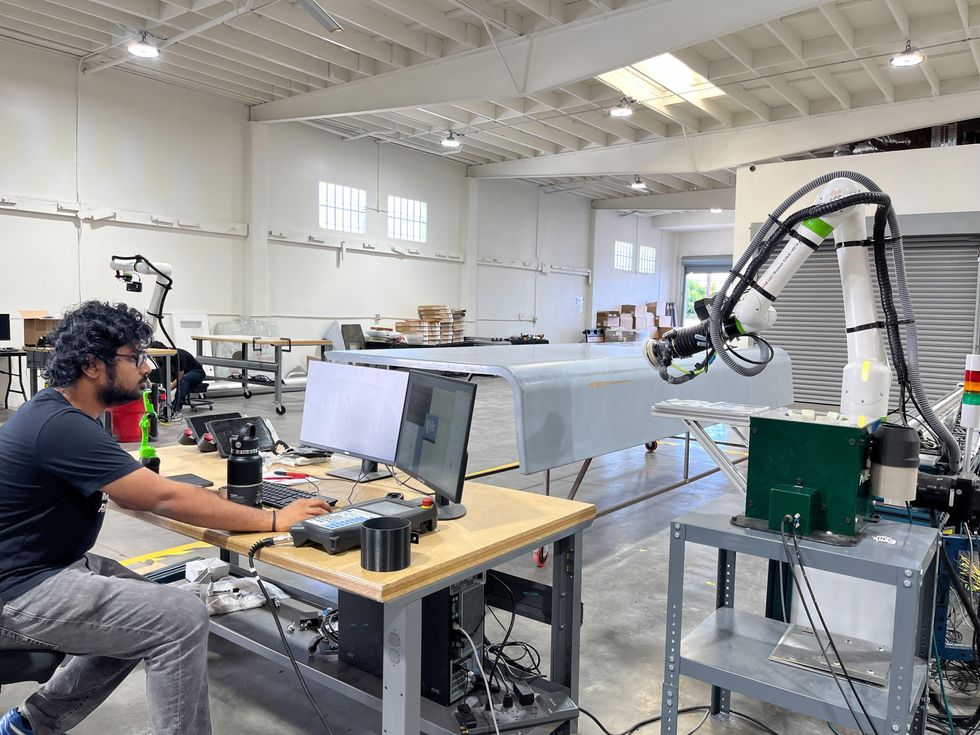
GrayMatter Robotics, a startup based in Gardena (and definitely not a “Breaking Bad” reference, the founders assure us) is looking to disrupt the industrial finishing and sanding industry by programming robotic arms with artificial intelligence software to automate this labor.
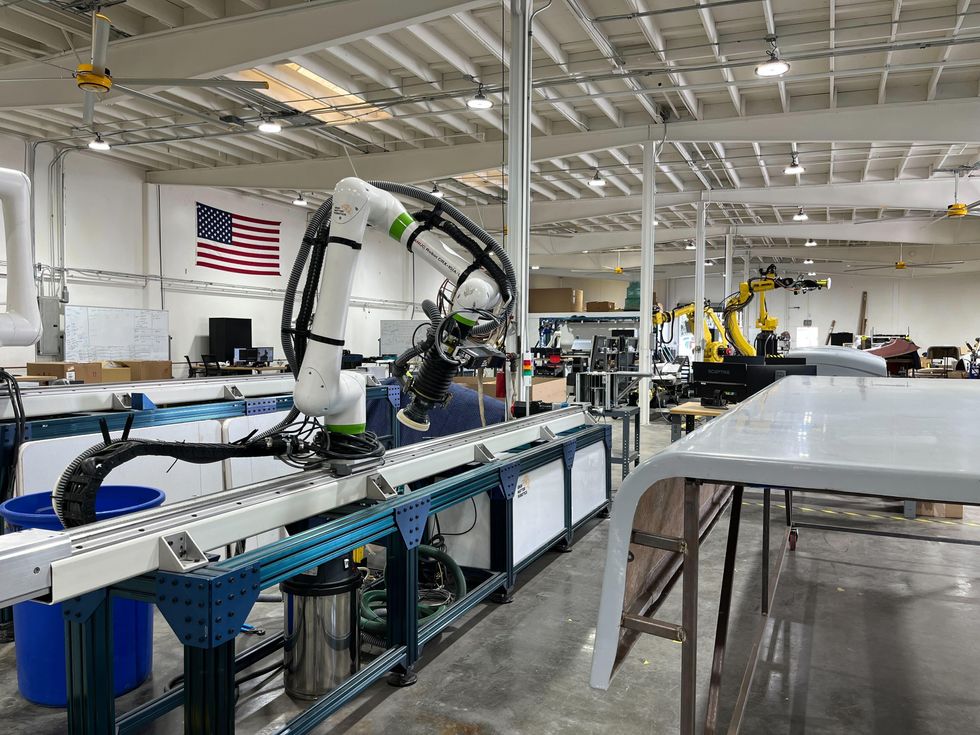
At first look, the company’s manufacturing setup in Gardena looks like an unassuming warehouse. It’s sterile, with minimal decoration except a massive American flag on one shop wall. It’s reminiscent of an engineering lab, but still has the feel of a startup since, well, it’s literally in a garage for now.
GrayMatter employee programming a robot Courtesy of Samson Amore
Ironically, my arrival comes shortly before the headquarters will drastically change its look. Co-founder and CEO Ariyan Kabir has big plans for his modest space, and is planning a remodel in coming months that will add some flair to the currently minimalist, efficient setup.
On one wall, boxes of guitar bodies, still in their skeletal state, await sanding and finishing. GrayMatter co-founder and CTO Brual Shah points out that musical instruments are just one of the products his company’s robots are being enlisted to work on. Additionally, there’s faux marble sinks, a metal lamp post, and parts of a Metro bus: all parts GrayMatter’s either sourced itself or been given by clients to test sanding on.
“A single robot [is] typically two to four times faster than a single human,” Kabir says, noting that most of GrayMatter’s clients use multiple robots at a time. He and Shah both say their enterprise is building “brains for robots” and said that while their robots don’t have an official name, some customers have been calling it – of course – Sandy.
The robot arms can take care of an array of tasks, from sanding to buffing, polishing or spraying. Kabir said the robotic cells vary in size from under a foot to up to about three feet tall. The larger arms are busy practicing sanding techniques on sizable projects – including a bathtub and the hull of a boat.
Typically, it takes a human being an hour to finish sanding one of the large bathtubs GrayMatter's robot is diligently scrubbing away at. But at max capacity the bot is able to sand the surface in less than half the time.

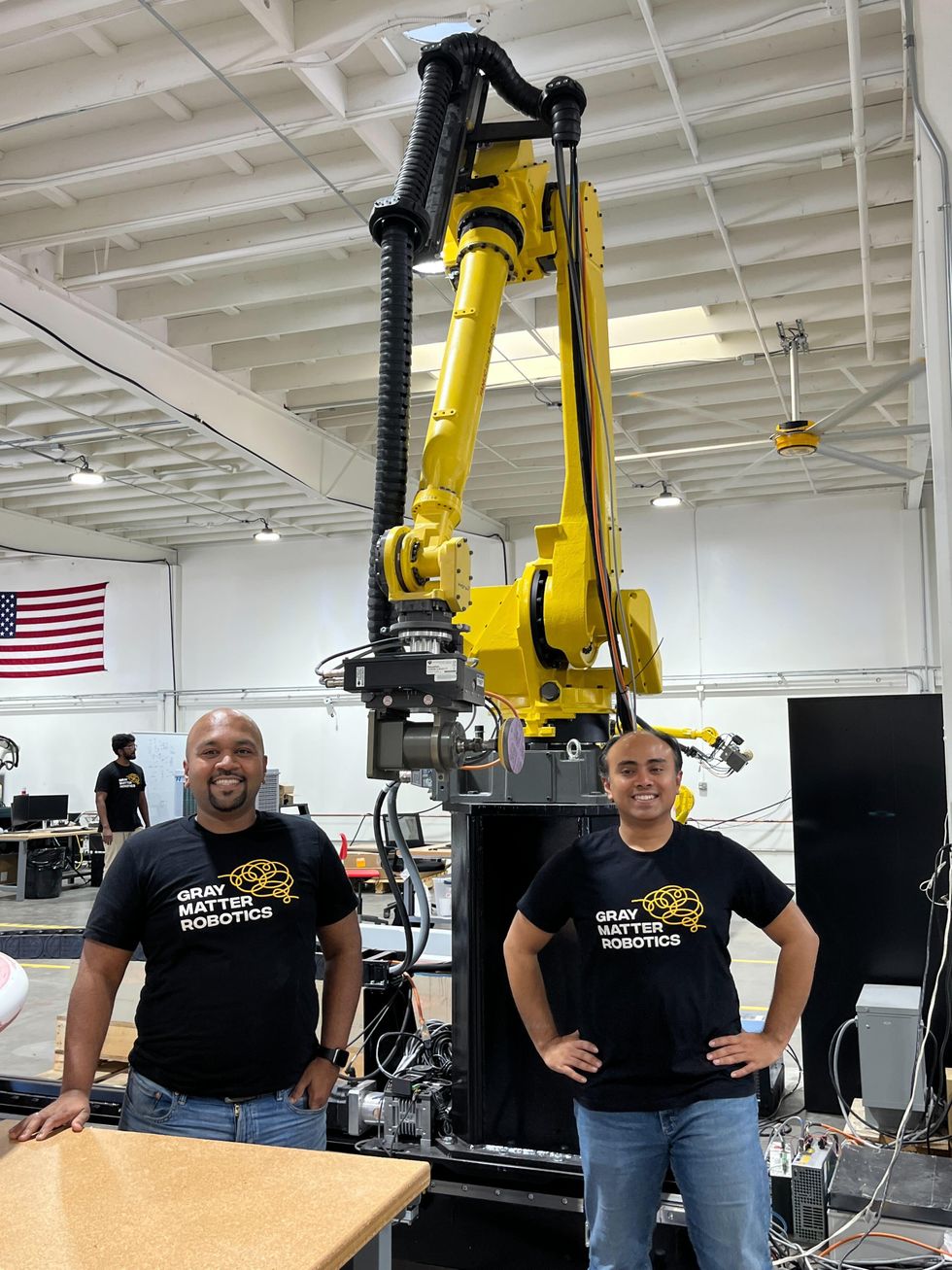
CTO Brual Shah (left) and CEO Ariyan Kabir of GrayMatter

Photo by Samson Amore

Kabir notes two key factors have helped GrayMatter’s business grow – first, the cost of sensors like the ones used in its robots has been steadily falling since 2016; Microsoft noted in a 2019 report that the price of a sensor plunged to an affordable $.44 each. Second, high labor turnover is prompting manufacturers to rethink using robots.

Which helps explain how GrayMatter has been able to raise roughly $24 million, most recently $20 million Series A last month. It also aims to expand its workforce from 17 to 40 people, Kabir said.

In the back of the shop, Shah points to a football helmet the robots have been practicing on. He says one of GrayMatter’s clients is a manufacturer that reconditions and restores helmets for re-use.

“High school up to the NFL, all teams send their helmets to this one [original equipment manufacturer], and the robot sands them or cleans them, polishes them, puts the decal [on] for the next year. It’s recession-proof,” Shah continues.

CTO Brual Shah (left) and CEO Ariyan Kabir of GrayMatter
Photo by Samson Amore
Kabir notes two key factors have helped GrayMatter’s business grow – first, the cost of sensors like the ones used in its robots has been steadily falling since 2016; Microsoft noted in a 2019 report that the price of a sensor plunged to an affordable $.44 each. Second, high labor turnover is prompting manufacturers to rethink using robots.
Which helps explain how GrayMatter has been able to raise roughly $24 million, most recently $20 million Series A last month. It also aims to expand its workforce from 17 to 40 people, Kabir said.
In the back of the shop, Shah points to a football helmet the robots have been practicing on. He says one of GrayMatter’s clients is a manufacturer that reconditions and restores helmets for re-use.
“High school up to the NFL, all teams send their helmets to this one [original equipment manufacturer], and the robot sands them or cleans them, polishes them, puts the decal [on] for the next year. It’s recession-proof,” Shah continues.
Shah and Kabir were adamant that their technology isn’t trying to put humans out of work. The idea being that instead of risking carpal tunnel syndrome or inhaling potentially toxic dust and residue from the finishing process, people who usually work the production line are trained to oversee the robots. Shah says once a human is trained on the software, they’re equipped to manage up to 10 robots at a time.

To that end, many industries are pushing to add automation to their factories. One Manufacturer’s Alliance’s 2021 manufacturing workforce trends survey found that 30% of plant managers were implementing some kind of automation.
“For humans, it's a life changer,” Shah says. “At one of our customer sites, the guy who used to sand by hand before, after introducing the robot, he now became the robot operator.”
But there’s likely going to be hurdles in training these workers. A study published in Oxford University Press last year found that low-skilled workers in these types of factory jobs often faced difficulty in using new technology due to lack of training.
“With the increased prominence of job automation and technological advances in the workforce, low-skilled workers are at risk for fewer opportunities within the labor market,” the study’s authors noted, and emphasized the importance of continuing adult education.
In his 2020 paper on robots replacing humans in the workforce, MIT professor of economics Daron Acemoglu wrote that adding one robot replaces 3.3 human jobs.
GrayMatter robot sanding courtesy of Samson Amore
While GrayMatter’s software at first glance seems pretty point-and-click, workers still will need comprehensive training on how to operate, troubleshoot and oversee the robots safely. It’s possible then that the barrier to entry is unlikely to be as straightforward as Shah and Kabir suggest.
Worse still, research suggests that companies that are quick to add robots also tend to ask more of their human workforce. Another MIT study conducted by Acemoglu found that from 2010 to 2015 firms that brought on robots saw employee hours also increase by nearly 11%.
Still, the same study found that a 20% rise in industrial robot use during that same time period led to a 3.2% decline in overall employment.
When asked about this, Kabir told dot.LA, "we design the systems for the shop floor workers with a very simple [interface]. Our [user interface] for the shop floor operator has only three buttons and the system runs pretty autonomously." He added that GrayMatter also trains factory managers to troubleshoot common hardware and software issues.
For manufacturers, however, the draw of being able to get more done by using robots is an obvious one. Kabir wouldn’t disclose how much clients pay to access the subscription that gives them access to GrayMatter’s robots (which are pre-built and sourced from Japan), software, and any necessary updates or maintenance. He referred to one customer that in a single year, “lost $5 million in a single production line, just for scrap, repair and rework costs for human mistakes.”
Adding that, “The robots are consistent in quality. They're good for humans.” Which humans he’s referring to, however, remains to be seen.
Samson Amore is a reporter for dot.LA. He holds a degree in journalism from Emerson College and previously covered technology and entertainment for TheWrap and reported on the SoCal startup scene for the Los Angeles Business Journal. Send tips or pitches to [email protected] and find him on Twitter @Samsonamore.
Christian Hetrick is dot.LA's Entertainment Tech Reporter. He was formerly a business reporter for the Philadelphia Inquirer and reported on New Jersey politics for the Observer and the Press of Atlantic City.
When avatar startup Genies raised $150 million in April, the company released an unusual message to the public: “Farewell.”
The Marina del Rey-based unicorn, which makes cartoon-like avatars for celebrities and aims to “build an avatar for every single person on Earth,” didn’t go under. Rather, Genies announced it would stay quiet for a while to focus on building avatar-creation products.
Genies representatives told dot.LA that the firm is now seeking more creators to try its creation tools for 3D avatars, digital fashion items and virtual experiences. On Thursday, the startup launched a three-week program called DIY Collective, which will mentor and financially support up-and-coming creatives.
Similar programs are common in the startup world and in the creator economy. For example, social media companies can use accelerator programs not only to support rising stars but to lure those creators—and their audiences—to the company’s platforms. Genies believes avatars will be a crucial part of the internet’s future and is similarly using its program to encourage creators to launch brands using Genies’ platform.
“I think us being able to work hands on with this next era—this next generation of designers and entrepreneurs—not only gets us a chance to understand how people want to use our platform and tools, but also allows us to nurture those types of creators that are going to exist and continue to build within our ecosystem,” said Allison Sturges, Genies’ head of strategic partnerships.
DIY Collective’s initial cohort will include roughly 15 people, Sturges said. They will spend three weeks at the Genies headquarters, participating in workshops and hearing from CEOs, fashion designers, tattoo artists and speakers from other industries, she added. Genies will provide creatives with funding to build brands and audiences, though Sturges declined to share how much. By the end of the program, participants will be able to sell digital goods through the company’s NFT marketplace, The Warehouse. There, people can buy, sell and trade avatar creations, such as wearable items.
Genies will accept applications for the debut program until Aug. 1. It will kick off on Aug. 8, and previous experience in digital fashion and 3D art development is not required.
Sturges said that the program will teach people “about the tools and capabilities that they will have” through Genies’ platform, as well as “how to think about building their own avatar ecosystem brands and even their own audience.”
Image courtesy of Genies
Founded in 2017, Genies established itself by making avatars for celebrities from Rihanna to Russell Westbrook, who have used the online lookalikes for social media and sponsorship opportunities. The 150-person company, which has raised at least $250 million to date, has secured partnerships with Universal Music Group and Warner Music Group to make avatars for each music label’s entire roster of artists. Former Disney boss Bob Iger joined the company’s board in March.
The company wants to extend avatars to everyone else. Avatars—digital figures that represent an individual—may be the way people interact with each other in the 3D virtual worlds of the metaverse, the much-hyped iteration of the internet where users may one day work, shop and socialize. A company spokesperson previously told dot.LA that Genies has been beta testing avatar creator tools with invite-only users and gives creators “full ownership and commercialization rights” over their creations collecting a 5% transaction fee each time an avatar NFT is sold.
“It's an opportunity for people to build their most expressive and authentic self within this digital era,” Sturges said of avatars.
The company’s call for creators could be a sign that Genies is close to rolling out the Warehouse and its tools publicly. Asked what these avatar tools might look like, the startup went somewhat quiet again.
Allison Sturges said, “I think that's probably something that I'll hold off on sharing. We will be rolling some of this out soon.”
Christian Hetrick is dot.LA's Entertainment Tech Reporter. He was formerly a business reporter for the Philadelphia Inquirer and reported on New Jersey politics for the Observer and the Press of Atlantic City.
LA Tech Week—a weeklong showcase of the region’s growing startup ecosystem—is coming this August.
The seven-day series of events, from Aug. 15 through Aug. 21, is a chance for the Los Angeles startup community to network, share insights and pitch themselves to investors. It comes a year after hundreds of people gathered for a similar event that allowed the L.A. tech community—often in the shadow of Silicon Valley—to flex its muscles.
From fireside chats with prominent founders to a panel on aerospace, here are some highlights from the roughly 30 events happening during LA Tech Week, including one hosted by dot.LA.
DoorDash’s Founding Story: Stanley Tang, a cofounder and chief product officer of delivery giant DoorDash, speaks with Pear VC's founding managing partner, Pejman Nozad. They'll discuss how to grow a tech company from seed stage all the way to an initial public offering. Aug. 19 at 10 a.m. to 12 p.m. in Santa Monica.
The Founders Guide to LA: A presentation from dot.LA cofounder and executive chairman Spencer Rascoff, who co-founded Zillow and served as the real estate marketplace firm’s CEO. Aug. 16 from 6 p.m. to 9 p.m. in Brentwood.
Time To Build: Los Angeles: Venture capital firm Andreessen Horowitz (a16z) hosts a discussion on how L.A. can maintain its momentum as one of the fastest-growing tech hubs in the U.S. Featured speakers include a16z general partners Connie Chan and Andrew Chen, as well as Grant Lafontaine, the cofounder and CEO of shopping marketplace Whatnot. Aug. 19 from 2 p.m. to 8 p.m. in Santa Monica.
How to Build Successful Startups in Difficult Industries: Leaders from Southern California’s healthcare and aerospace startups gather for panels and networking opportunities. Hosted by TechStars, the event includes speakers from the U.S. Space Force, NASA Jet Propulsion Lab, Applied VR and University of California Irvine. Aug. 15 from 1 p.m. to 5 p.m. in Culver City.
LA Tech Week Demo Day: Early stage startups from the L.A. area pitch a panel of judges including a16z’s Andrew Chen and Nikita Bier, who co-founded the Facebook-acquired social media app tbh. Inside a room of 100 tech leaders in a Beverly Hills mansion, the pitch contest is run by demo day events platform Stonks and live-in accelerator Launch House. Aug. 17 from 12:30 p.m. to 3 p.m. in Beverly Hills.
Registration information and a full list of LA Tech Week events can be found here.
Christian Hetrick is dot.LA's Entertainment Tech Reporter. He was formerly a business reporter for the Philadelphia Inquirer and reported on New Jersey politics for the Observer and the Press of Atlantic City.
Kristin Snyder is an editorial intern for dot.la. She previously interned with Tiger Oak Media and led the arts section for UCLA's Daily Bruin.
Virtual reality startup AmazeVR now has $17 million to further expand its VR concert experience.
The West Hollywood-based company’s latest funding amounts to a bet that virtual shows, a staple of the pandemic, are here to stay. Mirae Asset Capital led the Series B funding round, with Mirae Asset Financial Group subsidiary (Mirae Asset Venture Investment), CJ Investment, Smilegate Investment, GS Futures and LG Technology Ventures investing again. Mobile game maker Krafton joined the group—but South Korean entertainment company CJ ENM’s stake reveals AmazeVR’s plans to expand into K-pop world.
AmazeVR intends to use the cash infusion to hire more engineers and visual effects artists and to fill out its content offerings. The money will also help the company bolster its artist roster—which already includes Megan Thee Stallion—and produce more virtual concerts.
CJ ENM has certainly made a name for itself through a broad range of content. Forming K-pop groups and producing K-dramas, the company also oversees music TV channels, award shows and fan conventions. Previously, CJ ENM launched a company with K-pop phenomenon BTS’ label to foster new music talent.
Even as in-person concerts come back, their virtual counterparts have permeated pop culture. Even award shows have started to recognize the burgeoning performance method. In August, the MTV Video Music Award introduced the Best Metaverse Performance, which K-pop girl group Blackpink won.
Technology has helped many K-pop groups explode in popularity, with bands amassing very passionateinternationalaudiences through social media platforms. SM Entertainment, the media company behind groups like EXO and Red Velvet, launched a streaming platform to host virtual concerts and interviews with its talent roster. BTS’ online show in June brought in 1.3 million viewers—a slight increase from its 2020 virtual production.
This isn’t AmazeVR’s first time exploring the K-pop space. In July, it partnered with SM Entertainment to produce concerts for its talent roster through Seoul-based Studio A.
Kristin Snyder is an editorial intern for dot.la. She previously interned with Tiger Oak Media and led the arts section for UCLA's Daily Bruin.
© dot.LA All rights reserved

source

Gresham's School launches record label for young musicians – North Norfolk News

Daniel Hickey
Ruby Spiegel, 17, performing at the launch of Strathmore Records, a new label promoting young musicians at Gresham's School in north Norfolk. – Credit: Gresham's School
A school in north Norfolk has launched a record label to help develop and promote young musicians.
Gresham’s in Holt held an event on Friday, September 23 to kickstart Strathmore Records, which will aim to support young artists by giving them a platform to record and release their music.
A sixth-former who goes by the name 4-Entrial recorded the first official release, with a four-track EP heavily influenced by 80s cinematic electronica and her love of classic video games.  
A second EP, by Ruby Spiegel, 17, who performed at the launch, will follow soon.  
Chris Cooper, music teacher and studio producer, and Justin Myers, head of music technology, in the studio at Gresham's School holding the Strathmore Music sign. – Credit: Gresham's School
Chris Cooper, music teacher and studio producer, and Justin Myers, head of music technology, both professional musicians in their own right, decided to start up the record label to showcase the wealth of talent in the school.   
Michelle Wolfe, senior school director of music, said: “The studio and record label have provided a great opportunity to provide real-world experience for our pupils and a great platform to share the incredible and exciting work being produced in the studio.”
The launch follows the opening of the Britten Building, home of the school’s music department, by Princess Anne in 2017.  
The £6.5m centre, named after composer Benjamin Britten, provides facilities for pupils learning music at Gresham’s and includes a recording studio, a live room and a 140-seater recital hall which, hard-wired into the studio, contains a Steinway C Grand Piano.   
The school has also encouraged external use and to date a range of musicians including pianist Adam Johnson, Rollo Armstrong, Kit and McConnell, singer-songwriter Nick Corbin, members of Norwich City Football Club, pop band Martha Gunn and engineers from Abbey Road Studios have all made use of the studio.    
Guests at the launch of Strathmore Records, from left to right: Toby Girling, head of performance and vocal studies at Gresham's School; Rollo Armstrong, music producer; and Steven Todd, of Live Nation. – Credit: Gresham's School
Digital Music Production is also now studied as an academic BTEC subject.
Strathmore Music is named in recognition of the family who donated money for Studio.
Music from the label is available on Spotify and other digital platforms.  
Other output from the studio, including the annual Gresham’s Girls’ and Gresham’s Guys’ Christmas singles can be found on the Gresham’s Media Youtube Channel.

Stuart Anderson

Stuart Anderson

Stuart Anderson
Norfolk Live News
Owen Sennitt

source

JOANNE SHAW TAYLOR RELEASES NEW HEART-WRENCHING SINGLE “FADE AWAY” – EIN News

There were 1,787 press releases posted in the last 24 hours and 252,130 in the last 365 days.

THE NEW STUDIO ALBUM "NOBODY’S FOOL" WILL RELEASE OCTOBER 28th BY KTBA RECORDS AVAILABLE ON CD, VINYL AND DIGITAL
Carol L Chenkin
CLC Enterprises
+1 561-929-0172
email us here
Visit us on social media:
Facebook
Twitter
Other
You just read:

EIN Presswire’s priority is source transparency. We do not allow opaque clients, and our editors try to be careful about weeding out false and misleading content. As a user, if you see something we have missed, please do bring it to our attention. Your help is welcome. EIN Presswire, Everyone’s Internet News Presswire™, tries to define some of the boundaries that are reasonable in today’s world. Please see our Editorial Guidelines for more information.

Follow EIN Presswire
© 1995-2022 Newsmatics Inc. dba EIN Presswire All Right Reserved.

source

Special master plans to preside over trial of man who threatened Trump – New York Daily News

The special master in the Mar-a-Lago documents case still plans to preside over the November trial of a man who threatened to kill former President Donald Trump — another signal that the veteran jurist will make quick work of his role in the classified papers probe.
Judge Raymond Dearie is presiding over the case of Thomas Welnicki, a 72-year-old Rockaway Beach resident who federal prosecutors say made several calls to the Secret Service last year threatening to kill Trump.
The case is scheduled to go to trial in Brooklyn Federal Court on Nov. 2 — weeks before Dearie’s Nov. 30 deadline to complete his special master work.
Judge Raymond Dearie in a courtroom sketch. (Elizabeth Williams/AP)
Dearie told the Daily News through a staff member in his chambers Monday he has no plans to hand the case to another judge despite his special master duties.
At a hearing last week, Dearie told lawyers for Trump and the Department of Justice that he expects to review the roughly 11,000 documents seized by the FBI in a matter of weeks.
“We’re going to proceed with what I call ‘responsible dispatch.’ I’m not going to hurry but we have a lot to do and a relatively short period of time,” Dearie said at the hearing.
Dearie issued a scheduling order in Welnicki’s case last week, setting deadlines for motions as the trial approaches.
A page from the order by U.S. District Judge Aileen Cannon naming Raymond Dearie as special master to serve as an independent arbiter and to review records seized during the FBI search of former President Donald Trump’s Mar-a-Lago estate, is photographed Thursday, Sept. 15, 2022. (Jon Elswick/AP)
Welnicki made several threats against Trump, starting in 2020, when he told Capitol Police in a voluntary interview that he would “acquire weapons” and “take him down” if he refused to leave office, according to a criminal complaint.
The complaint refers to Trump as “Individual-1,” and details a series of calls Welnicki made to the Secret Service in 2021, including a Nov. 8 call where he referred to the former president as “Hitler” and said, “I will do everything I can to make sure [Individual-1] is dead.”
A spokesman for U.S. Attorney Breon Peace declined comment on Monday, as did Welnicki’s lawyer, Deirdre Von Dornum.
Judge Raymond J. Dearie in 2001. (Edwine Seymour/for New York Daily News)
Sources familiar with Welnicki’s defense team said they consider Dearie “extremely fair” and don’t believe any conflict might arise from his special master work.
Dearie was one of Team Trump’s picks for a special master, after Judge Aileen Cannon put the brakes on the DOJ’s investigation into whether the former president took and improperly stored classified and top secret documents after leaving office.
Cannon, a Trump-appointed federal judge in Florida’s Southern District, ordered that DOJ investigators couldn’t use the seized documents in their probe until a special master reviewed them, in a much-derided August ruling.
Former President Donald Trump (Chris Seward/AP)
But that legal victory may have backfired on Trump’s lawyers.
Dearie put Trump’s legal team on the hook last week, forcing them to take a position on whether he declassified documents and to provide proof of his unfounded claim the FBI planted evidence.
And last Wednesday, a three-judge appeals panel in the 11th Circuit — which included two Trump appointees — reversed parts of Cannon’s decision and ruled that the DOJ can continue to use about 100 classified files uncovered in the Mar-a-Lago search.
Copyright © 2022, New York Daily News

source

The Collaborative Studio Reimagining Lighting Design – The New York Times

Advertisement
Supported by
Known for its endlessly customizable fixtures, In Common With is breaking fresh ground with an expanded Brooklyn headquarters and a fantastical new collection.
Send any friend a story
As a subscriber, you have 10 gift articles to give each month. Anyone can read what you share.

“Choices are very much our thing,” says Nick Ozemba, the co-founder, with Felicia Hung, of the Brooklyn-based lighting design studio In Common With. The five-year-old brand’s ethos is evident in its 2,500-square-foot production room, part of its newly expanded home near Gowanus Canal. Lining the walls are hundreds of fixture components in an array of elemental shapes and materials: There are goblet- and hat-shaped shades bearing the imprint of hand-molded clay; towering, weighty conical bases with voluptuous glazed surfaces; and pieces with a more polished, machine-made appearance. Light models named after their basic forms — Disc, Dome, Pyramid — recur in pendant, table and floor variations, with a plethora of possibilities in material, finish and wiring. The overall effect is of both precision and abundance.
Hung and Ozemba, both 31, met as students at Rhode Island School of Design, and after graduating moved to New York where they gained experience designing products and interiors, respectively, at established firms. Working on larger contract projects, Ozemba realized how challenging it was to find special design pieces within budget, especially if larger quantities were required. Once the two friends were ready to launch a business together (something Ozemba says “was always going to happen”), the decision of what type of product to make was almost incidental; their primary goal was to create a scalable yet flexible production system — and that lent itself well to lighting. “We had to find a way to structure the manufacturing so we could produce at a higher quantity but assemble each item to order,” Ozemba says. “Everything had to be reproducible but completely distinct every single time.”
True to its name, the studio has been a communitarian endeavor from day one. “We started with the idea of collaborating with others; it’s what sets us apart,” Hung says. Each collection is created in conjunction with skilled partners, from metalsmiths and ceramists to glassblowers and engineers. “Our philosophy is that the production process informs the product. We never say, ‘this is what we need, please make it for us,’” Ozemba adds. “Instead, we have a general idea, ask our partners, ‘How would you make this?’ and work with them to realize it.” The end product emerges from patient research, prototype development and observation. “We spend hours in our vendors’ workshops,” Hung explains. “We think and design based on how things are made, what the material wants to be and how we can push that into different ways to create a product.”
This thoughtful approach has paid off: In just over four years, In Common With’s lights have become a favorite of some of the most in-demand interior designers of the moment, including Giancarlo Valle and Ariel Ashe and Reinaldo Leandro of Ashe Leandro. The studio’s star product, the Up Down sconce — available in more than 1,000 permutations — can be found in buzz-worthy restaurants and hotels from Ibiza to Australia. And last week, In Common With marked a double milestone: the launch of its latest collection, Flora, and the addition of precious space for its design, sales and production staff of 13. The new workshop is one of two separate units the studio now occupies in a century-old brick building under the Smith-Ninth Street elevated subway tracks. Half of the 1,000-square-foot space that once housed In Common With’s entire operation has been turned into the brand’s first showroom, now open by appointment.
During a recent visit, the founders came across as both down to earth and coyly proud of what they’ve accomplished. While Hung, the pair’s slightly more reserved half, laid out the brand’s strategy, Ozemba, with a laugh, described In Common With’s penchant for manifold combinations as “very Missy Elliott — put your thing down, flip it and reverse it.” He added, “it is important to us that people can make our fixtures their own.” But despite their aim to break barriers through scale, Ozemba and Hung are aware that accessibility is relative; the brand’s simple sconces start at $375 but more elaborate designs can cost several times that, in part because of the manual labor involved.
The 20 pieces in the Flora line fall into the second category; they represent a new leap for the studio, a shift from its signature earthy, utilitarian aesthetic to something more exuberant. The collection was created with the New York-based French American designer Sophie Lou Jacobsen, who is known for her joyful, bendy carafes, vases and stemware made in colorful glass. “There was a lot of overlap in our histories, our influences and the mind-set with which we approach things,” Ozemba says. Where previous collections skewed minimal, Flora is whimsical, its glass forms evoking flowers in some instances, skirts or jellyfish in others; one unapologetically romantic chandelier is made up of curved brass arms capped with small shades that resemble inverted tulips. The surprising shapes were informed by fazzoletto, a technique developed in second-century Rome and revived by the Italian glass masters Paolo Venini and Fulvio Bianconi in the 1940s (the artist Dale Chihuly later popularized it stateside). Fazzoletto means “handkerchief” — finished products resemble draped fabric — and involves spinning a cuplike form in high heat before allowing gravity to set the distinctive flared edges into place.
Flora may be an aesthetic outlier for the designers, but its genesis hints at the studio’s ongoing evolution, according to Ozemba. “Our earlier work was about using industrial techniques to do something new; now we’re contemporizing an age-old craft” — a relevant pursuit at a time when glassmaking’s future as an art form is uncertain. The duo is also planning to expand into furniture. “More and more we’re thinking about the type of space that inspires us and how we can insert what we make back into that context,” Ozemba says. The showroom offers a glimpse of this vision: The designers have appointed a staged living area with a mix of contemporary and vintage items in shades of brown, including a Mario Bellini sofa and a Milo Baughman coffee table. It’s simultaneously rich and relaxed, timeless and of its time — perfectly calibrated to let the lighting shine.
Advertisement

source

Save conversations and take notes with this $40 recorder – Engadget

Taking notes is crucial during important meetings, whether that’s a college lecture or a video conference. However, if the speakers breeze through information too quickly to keep up, you might be scrambling for clarification. A voice recorder can act as a backup, allowing you to focus on the content being presented, so you can revisit the audio file if you miss something essential.
There are many audio recorders on the market, but if your work involves staying mobile, you should consider a lightweight gadget with respectable battery life and storage. This slim voice recorder by UGR Tech might suit your needs, and it’s on sale for $40 or 24 percent off.
This recorder measures 23-by-43 millimeters large and five millimeters thick, so you should have no problem slipping it into your pocket, purse or backpack. It contains a 230mAh battery, which can provide up to 145 hours of recording time off a single charge. That alone will only moderately consume the storage; it features 64GB of memory, enough for 750 hours of content.

Turn on browser notifications to receive breaking news alerts from Engadget
You can disable notifications at any time in your settings menu.

Not now

But where this recorder truly shines is its ease of use. You don’t need to download any software to activate it. Simply switch the device on to start recording. Your audio will be saved as a 192Kbps WAV file. Then flip it off when you’re done. Kevin Lee at Chron suggests that a voice recorder may help you jot down memos throughout the day, whether that’s a grocery list or a reminder to set up an appointment.
Alternatively, you can use voice-activated mode for hands-free use. The recorder can detect noise in 360 degrees from up to 15 feet away, allowing you to capture conversations in your immediate environment. You can use the device when transcribing interviews or live performances. To play back your audio, just connect a pair of headphones to the jack.
With a high-quality recorder, you can create audio journals to capture and recall your day’s most important details. For a limited time, you can purchase this 64GB Mini Voice Activated Recorder for $40, down from $53.
Prices subject to change. Engadget is teaming up with StackSocial to bring you deals on the latest headphones, gadgets, tech toys and tutorials. This post does not constitute editorial endorsement, and we earn a portion of all sales. If you have any questions about the products you see here or previous purchases, please contact StackSocial support here.
Subscribe to our two newsletters:
– A weekly roundup of our favorite tech deals
– A daily dose of the news you need
Please enter a valid email address
Please select a newsletter

source

Universal Audio's Spark Plugin Now Available for Window 10, 11 – iTech Post

To enjoy our website, you’ll need to enable JavaScript in your web browser. Please click here to learn how.
To empower musicians with iconic hardwares and instrument plugins for a low monthly price, UAD launched Spark, a subscription service that finally supports Windows 10 and 11 operating systems. And, similarly to its services to Mac, it would not require any UAD hardwares, or even the other pre-existing production tools under the company to work.
World-leading audio interface and production company Universal Audio Inc. introduced its new subscription service earlier this year. Known for its audio production tools including Apollo and Volt audio interfaces, UAD’s new addition “Spark” is an expansion of instruments that gives authentic emulations of analog hardwares and vintage instruments to Mac users for an affordable price.
To extend UAD’s vision, the Spark plugin is now available for Windows 10 and 11 PCs. Spark is an evolving collection that gets exclusive tools through UAD’s ever-expanding library, and gives its users’ recordings the pro analog tones heard on professionally produced albums.
The plugins featured in the Spark for Windows users includes a number of different compressors, reverbs, delays and modulation, preamps, EQ and tape, compressors, and instruments that will run on the PC for a monthly subscription cost of $20, amounting to $150 annually.
Spark subscribers get to experience an expanding collection from UA, Neve, Moog, API, Lexicon, and Teletronics with no UA hardware required. The plugin will run natively on Windows PCs along with all major DAWs, and will be available to run on VST3, AAX, and AU formats.
The owners of perpetual UAD plug-in licenses also receive corresponding native UADx plug-ins included with the service to a corresponding version of Spark for free without having to pay for a new subscription.
Some UADx included with the Spark plugins are UAD developer’s most popular essentials like the UA 1176 Collection, Brigade and Studio D Chorus, Neve 1073 Preamp and EQ, Moog Minimoog, and Opal Morphing Synthesizer among others and more.
In addition, Lexicon 224 Digital Reverb, Teletronix LA-2A, and API 250 Bus Compressor and Vision Channel will also be free to those who subscribe to the service.
UA’s Founder and CEO Bill Putnam Jr. in a recent press release noted that the Spark plugin subscription for Windows was launched this year to offer and bring the “authentic and inspiring sounds of classic studio and music gear to creators,” expanding the vision of the company to the community, even without the UA hardware.
The UA Spark Plugin is available to those who want to try it through signing up for a 14-day free trial before deciding to commit to a subscription.
Volt audio interface owners also receive a one month free trial, while perpetual UAD license owners receive corresponding native UAD Spark plugins for free.
Earlier this year, the company also added a Pultec Passive EQ Collection to its bundles, which includes emulations that can be used on vocals, guitars, drums, and more with over a hundred presets.
With these innovations, UA continues its goal of inspiring sounds for generations through windows of opportunities.
© 2022 iTech Post All rights reserved. Do not reproduce without permission.
Get the Most Popular iTechPost Stories in a Weekly Newsletter

Clicky

source

Global Records – A&R Scout (Remote) – Music Business Worldwide

A&R Scout
Global Records is looking to collaborate with a proficient music talent scout in order to discover the best upcoming artists from GSA & Benelux. The purpose of the music label is to sign artist production contracts worth over 1 Million Euro in investments in music, video production and marketing on a global scale. In this role you will focus on finding singers that correspond to the company’s genre and artist targets.
Global Records is the most prominent independent record label in Eastern Europe, with over 15 billion streams to date, numerous no 1 hits and multiple platinum certifications all over the world. Its music is being enjoyed by hundreds of millions of people all over the world, live, on digital and on radios and TV stations. It produces, distributes, and promotes over 200 annual releases for top artists such as INNA, Minelli, Olivia Addams, Holy Molly, Roxen and many more.
It is an integrated part of the Global platform, which also includes Global Publishing, home of awarded producers and songwriters with placements for Selena Gomez, Pitbull, Nicki Minaj, Alok, J Balvin, Sean Paul, Alicia Keys, Flo Rida and more. Other integral parts of the Global platform include Global Talent United, the biggest talent and influencers agency in CEE, Global booking, Global Events, Viva la Vidra movie production company, Loops Productions video production company, Mainstage – marketing & advertising agency,
We are enthused to meet you and discover Europe’s new talents together!
Music Business Jobs is the most effective way for the global music industry to find the best candidates for their open positions.
In addition to being seen by over 300,000 monthly unique readers online, our listings are also emailed direct to more than 50,000 professional subscribers every week – across the US, UK, Europe, Asia-Pacific and beyond.
Click through below for details on how to submit a Music Business Jobs listing – and learn why our advertisers ‘strongly recommend’ us to their peers…

source

‹ Previous Next ›