Blog

“We could spend years trying to understand them on on a physics level, or we could automate it”: Neural DSP's Doug Castro on how machine learning can surpass human understanding of amplifiers – Guitar.com

The man behind the revolutionary AI-driven Quad Cortex floor modeller on what it’s like to peek into the black box.
For the head of a company that’s literally named after neural networks, Doug Castro – the founder of Neural DSP – has a somewhat surprising approach to the tech. “Our mantra at Neural is that we should only use AI when everything else has been ruled out,” he tells us over Zoom, from the company’s head office in Finland (we’d be remiss, also, not to mention the illuminated Neural DSP logo behind him). So how did we get here, where Neural DSP’s Quad Cortex is one of the most powerful hardware modellers out there, all thanks to AI?
It’s been said plenty of times that digital modelling has made huge progress in recent years. The Quad Cortex has been a large part of that, leveraging machine learning (and the kind of processing power engineers in the 2000s could have only dreamed of) to create some truly excellent guitar sounds. But, despite the company’s name, relying on neural nets and AI wasn’t always the overarching game plan.
“Those technologies are so hyped at the moment,” Castro says. “A lot of people are trying to force it into working for problems that might be solved by more conventional methods. It’s not actually a good solution for a lot of things.”
While AI wasn’t always the plan, the Quad Cortex was. But the road to the powerful hardware modeller was always going to be long, as evidenced by the fact that the Quad Cortex arrived in 2021, four years after Neural’s founding. “We started the company to build it,” Doug tells us, “ and soon, we realised it would be a lot of hardware development, manufacturing, UX design, and on top of all that, a ton of algorithm research.”
Here, Doug saw an opportunity: “We realised that we had to do all of that DSP work anyway, so we started making plugins right away. That helped us bring in money, and establish the brand – and made sure we set things up for the Quad Cortex to be a success.”
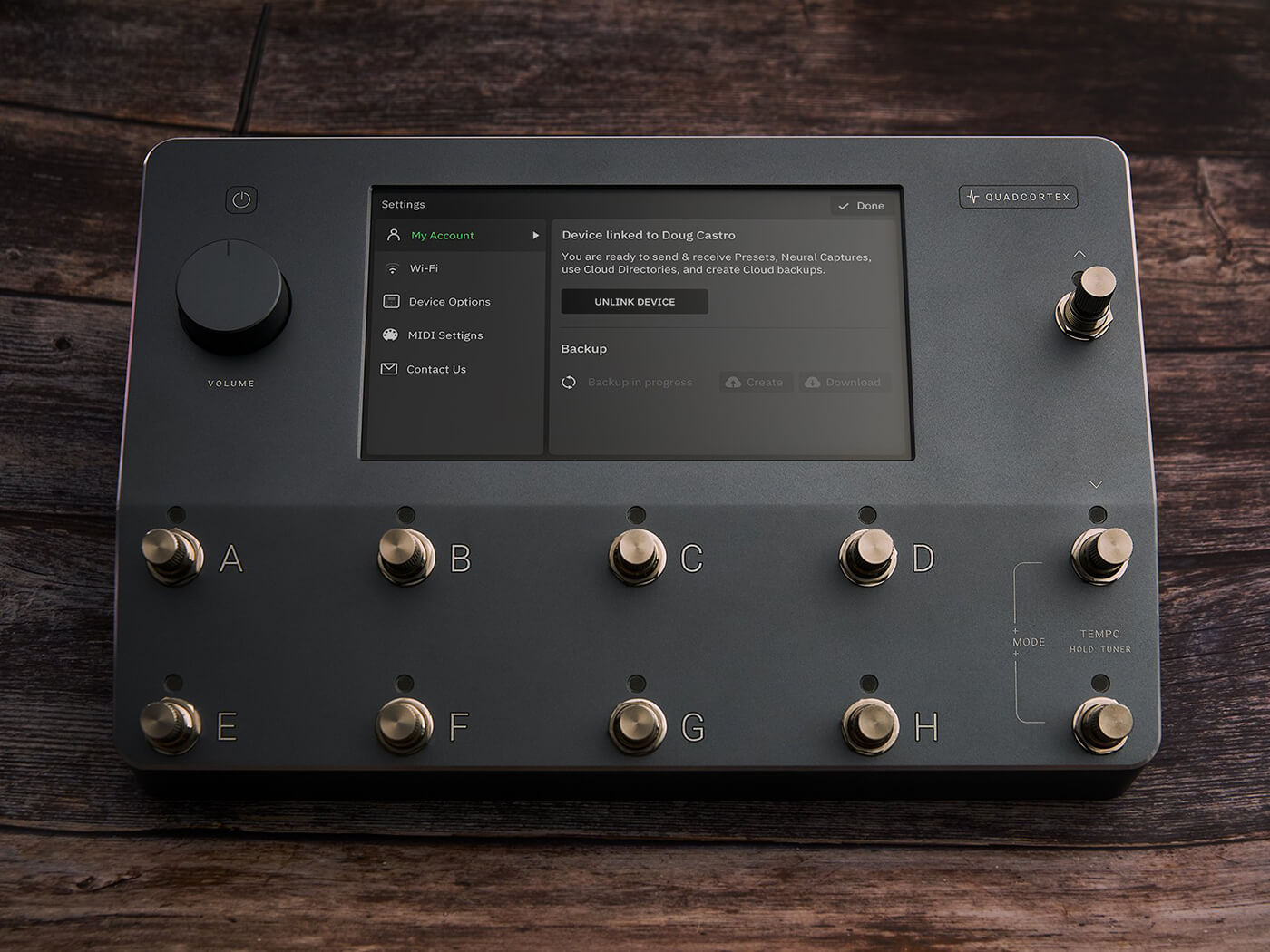
Neural DSP's Quad Cortex
At first, the plugins were being built the old-fashioned way, without machine learning. But the limitations of that approach were soon evident. “We realised it took one of our super-brilliant, world-class PhDs around seven weeks to model an amplifier. Forget about any delays, reverbs, cab simulation, all of that. One amp – seven weeks. And to find enough people that were really good at conventional amp modelling was going to be very hard – there are very few people who understand it from top to bottom – you need to really understand analogue electronics, and DSP algorithms, turning the analogue behaviour into equations, and then you need to be really good at programming so they actually write code that’s efficient and run the model in real time. Finding one person who can do all that? That’s really hard.”
“So that’s why there are very few companies that are doing amp modelling at a super-high level,” Doug adds. “There aren’t enough smart people working on it. Super smart people usually go into other areas that are far more profitable than, you know, modelling amplifiers…”
Doug also notes that hiring enough engineers and programmers to pull off creating the Quad Cortex in just four years was clearly going to be practically financially impossible. And so, as per Neural’s mantra, the odds for the conventional approach working were zero, so it was time to bring out the big guns. “So we thought, if we could automate the development with machine learning, then the odds are still really bad – but a non-zero number! Five per cent might sound horrible, but it’s much better than zero.”

So instead of recruiting engineers for a traditional amp modelling approach, Neural DSP got started on plan B: “finding world-class machine learning people who also played music, and wanted to work on amps.”
“We were lucky enough to run into some really talented people from our local engineering university [Finland’s Aalto University], it has a great audio DSP programme, and some legendary professors. I happened to meet a few guys from the research team who we brought on. I’d told them about this idea, and they actually showed me that they were already working on some machine-learning related modelling. It was a miracle that we met!”
While Doug is dismissive of the idea that neural networks are an instant solution for every problem, it’s hard not to see them as just a little bit magical. “The benefit of machine learning is that with five people, you can do work that could take hundreds of people to do,” Doug says. “We’re always working on the internal tooling and making it more efficient, so it’s not in its final form, but we’re at the point where six machine learning engineers can probably do the work of 10 or 20 people. We want to get it to 10 times, in terms of efficiency. It’s getting there, but there’s still a lot of work to be done.”
As well as efficiency, Doug states that machine learning has helped Neural DSP create incredibly accurate amplifier models. “There’s a lot of things that happen in a tube amplifier that are not really well understood. There’s a lot that we do know, what the tubes are doing, saturation curves and all that – that’s really well documented. But in the later stages of the amplifier, what happens with the interaction between the power supply, the pentodes, the output transformer and the reactive load of the speaker, there’s a lot of weird things that happen there – it’s not really well understood.
“Traditionally, modelling something you understand extremely well is already extremely difficult, and then modelling something you don’t understand fully is really, really hard. I think that’s why many amp models that sound really close do not feel really close, because there’s that 5 per cent that isn’t modelled right because we just don’t understand everything about how the amp is behaving.”

Douglas Castro of Neural DSP
Douglas Castro of Neural DSP. Credit: Tapio Auvinen

The way neural networks function presents a unique shortcut around the problem of modelling something that’s not quite understood. Put very simply, a network is given an input and an output, and then is trained on how to turn one into the other. It doesn’t need to know what’s happening inside the transformer and so on, it just needs to know what goes in, and what comes out. “We realised that we could spend years trying to understand what’s going on on a physics level,” Doug says, “or we could automate it. We just run signals through an amp – we don’t need to understand the effect of each part of an amplifier. If it has an impact on the signal, we should be able to recreate it. So that’s the advantage of black-box modelling like this.”
The ‘black box’, in the world of machine learning, refers to the main side-effect of a program effectively writing itself – the logic is often impossible for a human programmer to parse. This effect is more acute with higher-level algorithms in a later stage of their training (“there’s not a human alive that could tell you how Google’s algorithm works,” Doug notes), but it’s not always an inherent aspect of machine learning.

We ask Doug if it’s ever possible to crack the lid on the black box and make changes if you need to. “We do probe inside, a lot. For the black-box modelling to be reliable, you start from a sort of ‘light grey’ approach – that way you can verify things, test things out early. We don’t have a rule that we never open the algorithm – if something weird is going on, then by all means, we open it.”
But, ultimately, how the code translates guitar input to a tone is more opaque. “You can get the desired output every time, but what it’s doing internally is too complex for anyone to understand. Some of them are self-writing code portions in their own code: part of the code of the model writes itself, which is pretty trippy,” Doug says.
Doug doesn’t share the specifics of how the models are actually trained, but he gives us a picture of the kind of processing time and power it takes. “We record signals for a few hours, and then we train the model on those – the training time is going down, we have a huge server in our storage room which we’re using at the moment, but soon we’re going to move it to cloud processing. On our own servers, it would be four to six hours of recording, and then eight hours of training. We’ll be able to cut down the training time significantly with the cloud.”
Neural DSP Quad Cortex
Just before our chat with Doug, AI had hit the headlines for slightly surreal reasons. An engineer at Google had posted a transcript of his conversation with LaMDA – Google’s AI chatbot – and claimed that the program had achieved sentience. Obviously, the story had the power to create some rather sensational headlines – but Doug and the Neural DSP team were less caught up in the sci-fi hype.
“I read that the transcript was quite edited. And the moment something like that is edited, you know, it can be manipulated to evoke emotions in the reader. Half of our machine learning team come from audio, the other half are more involved with speech synthesis, a much more conventional use for machine learning. And there’s a neuroscientist in the team. I noticed that none of these people were that impressed with the transcript, to be honest. If it had been a breakthrough, I think we wouldn’t have heard about it through a blog post.”
So AI might not be truly sentient just yet – but there are some very human things that it can partake in, such as composition. “Already there’s a lot of amazing tools for assisted composition, so if you’re stuck, they help you by suggesting how you should continue.” We’re curious as to whether Neural DSP might dip its toes into this area. Doug is optimistic, but cautious about biting off more than he can chew. “Just because you can do one thing, it doesn’t mean that you can all of a sudden scale indefinitely – complexity tends to grow exponentially. but it’s possible, if you’ve got a framework you can expand on.”
While compositional tools might not be on the immediate horizon, there is another area Doug sees much more potential for Neural’s participation in: production. “Having machine learning tools that help de-skill that process will be really important. Plugins have already democratised recording, as you don’t need a super fancy studio. Grammys have been won with a decent laptop, an interface and a few hundred dollars worth of plugins.
“Now you don’t have to rely on anyone, any labels – you can be in control of your own music. But there’s the other aspect missing – for a true revolution, we need to reduce the amount of skill required. That hasn’t changed much in the last 30 years, you still need to know a lot about recording, mixing, mastering – it’s a whole different set of skills, and if you’ve been playing guitar for 10 years you need another 10 to truly learn production.”

So what does Neural’s involvement in production look like? “Something like what we already do with amp modelling – just vastly bigger. It’s a daunting task – the wall of scaling up looks pretty high, but we’re definitely doing research on it.
“A lot of people know what they want: they have the idea for their song in their head already, they just need a way to record it that sounds great without having to pay someone 500 bucks a track to mix it, and more to get it mastered and so on. If you can remove that pain and that cost, and offer the same thing for orders of magnitude less of the price – that’s where there’s a lot of potential.”
Branching out into production will perhaps offer Neural DSP some more room to innovate than the potentially restrictive world of guitar tones. “I mean, a Marshall is a Marshall, and it’s been a Marshall for more than 50 years,” Doug says. “How can you innovate that? People want a more convenient way to get that sound, but they don’t want you to reinvent it. With some trippier effects there’s some room to grow but still: you will not reinvent the reverb or the delay or the compressor.”
But, just because Neural DSP didn’t need to reinvent the wheel, sonically speaking, it didn’t mean the Quad Cortex was just another hardware modeller. “The biggest room for improvement was in the user interface,” Doug tells us. “We couldn’t make something that sounds ten times as good as a Universal Audio or Fractal, they’re already very good, but in how easy it is to use – we found there was room for improvement. Sound wise, of course, I think the QC is the best – but, well, I’m biased. It’s my baby!”

Neural DSP King Of Tone Plugin

While modelling technology has become more and more accessible, it’s still been most widely adopted by players of a certain style – modern metal suits the tight, controlled sounds it can conjure up. But Doug is optimistic about Neural DSP’s plans to expand its technology to more traditional sounds – the brand has already partnered with Tone King for amplifier plugin, as well funk wizard Cory Wong for an exceedingly perhaps the cleanest entry into the Archetype plugin range.
“I think we have a lot to offer to people who, maybe we wouldn’t be the first thing that comes to their mind when it comes to a solution for their guitar sound. I mean, the technology involved truly works for all styles, and even beyond guitar as well. So we’ve been venturing into new styles of music with new Archetype plugins, and partnering with brands that make amplifiers that aren’t heavy stuff.”
“For me, I’m a heavy guy at heart, I listen to a lot of stuff but 70 per cent of what I listen to has really heavily distorted guitars and bass. So we’ll always do the heavy things,” Doug adds – this should be no surprise if you’ve ever browsed Neural’s plugin catalogue, loaded with signature Archetype plugins for exemplary heavy artists from Gojira to Tosin Abasi to Polyphia. There are also digital recreations of some truly crushing amps, such as the Soldano SLO-100.
We ask Doug what he’s listening to right now – he mentions he’s been obsessed with solo project Cloudkicker, and has been learning guitar (Doug is primarily a bassist) by playing his tracks. But he also has a standard rotation of heavy classics: “My usuals are Korn, Gojira, Meshuggah, Dream Theater, Animals As Leaders. I’m still rocking those albums. A lot of Polyphia, too. I feel like I’m doing product placement because I’m naming people we have products with – but I love their music. Before working with them I’ve been a fan of them, and then suddenly we’re business partners, it’s a really cool thing.

“I think Polyphia are in a class of their own – their music is so beautiful, and also the biggest flex possible. I was listening to Playing God the other day, and my three-year-old daughter – she hates heavy stuff – she loved it. She was like, ‘play it again’, six times! So if you can make stuff that a hardened metalhead like me lives and a three year old that hates distorted guitars loves, you’re onto something.
But not everyone is seeking the same modern-math-djent perfection as Polyphia. “There are a lot of people who don’t want a 5150, they want a dumble, a tone king, or something like that. So we want to make sure we do offer enough in our catalogue for those who play all sorts of styles.”
We’re curious as to how Neural intends to address the biases of more traditional players – it’s undeniable that for the most fervent seekers of old-school guitar sound, you’d be more likely to convince them to plug their guitar into a live electrical socket than you would a digital modeller. “There’s a certain percentage of people who will never use digital stuff, and that’s fine,” Doug says, “but that number is decreasing a lot. And that’s the nature of the technology – we have better and better products out each year, and the costs are going down.
“10 years ago you couldn’t get a world-class guitar tone from a $100 plugin – it just didn’t exist. And until Fractal Audio came out, you couldn’t get it in a hardware unit either – I think Fractal changed the game in that regard, and opened the way for the Kemper and the Helix and so on.”
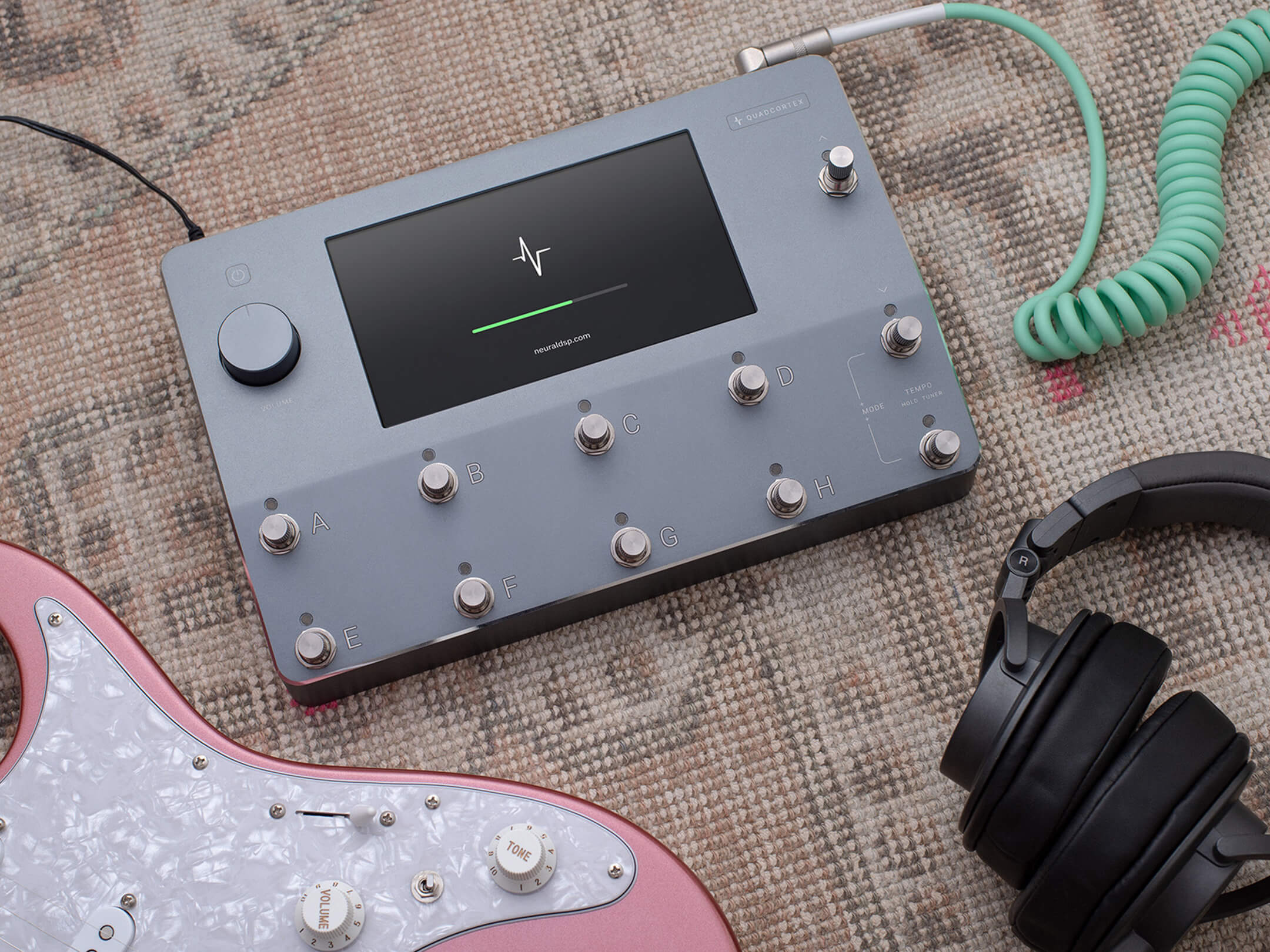
Quad Cortex
Quad Cortex

So what’s next for Neural DSP? “At the moment, we’re really focused on continuing to release amazing plugins, and making the QC the best device of its kind. We’re growing the team so we can do more, and do it faster. There are still things we need to accomplish with the QC before we step back and do other things. It’s not just the device, it’s the app, the ecosystem. There’s always research and ideas, but it’s all at a super-early stage.”
It’s clear that, despite his resolve to continue working on the Quad Cortex, it being a real, tangible product is slightly surreal for Doug. “I have some early drawings from the 2010s – pen and paper. I’ve been thinking about this for like, eight years. For two years after the first idea, it became this burning obsession to the point where we had to start another company to actually do it. For a while, I was running Darkglass and Neural at the same time. It was gruelling. But for that time, I was only thinking about one thing, and that was making the QC happen.

“For the last four or five years, there’s been nothing else on my mind – nothing else mattered other than making this happen. Every book I read, every phone call, it was all about how we can actually make sure that this device exists at some point, and that we’re the ones to do it. That’s a very, very intense way to live your life. With a single point of focus. You can go crazy sometimes, and we thought maybe we’d be able to let off the gas a bit after it came out. But of course, there’s other requirements, and people have expectations – in a way, it intensifies once it’s out.”
“The psychological implications of running a company like Neural, one that’s growing all the time, are tough – most of the time you spend you spend in ‘existential crisis’ mode, with a burning obsession at your core.”
But the hard work has paid off – the Quad Cortex is real, and despite the tough odds of a small, rag-tag group of AI engineers standing toe-to-toe with some of the biggest audio companies on the planet, they did it, with the help of whatever’s inside that ever-elusive black box.
We ask: will the Quad Cortex ever truly be finished? “Perhaps at some point,” Doug responds. “But it’s hard for me to see that happening anytime soon!”
For more information about Neural DSP, click here.
Guitar.com is the world’s leading authority and resource for all things guitar. We provide insight and opinion about gear, artists, technique and the guitar industry for all genres and skill levels.
© 2022 Guitar.com is part of NME Networks.

source

Bear Bryant’s neighborhood: What’s it like to live in the Alabama icon’s former homes? – The Athletic

Bear Bryant’s neighborhood: What’s it like to live in the Alabama icon’s former homes?  The Athletic
source

AAP has audio recording of BJP's 'offer' to Manish Sisodia, will disclose when time comes: Party sources – DNA India

AAP has audio recording of BJP’s ‘offer’ to Manish Sisodia, will disclose when time comes: Party sources  DNA India
source

Muziqq Selects Frontera Group, Inc., and Intellimedia Networks as Technology Partners – MarTech Series


Frontera Group, Inc announced that Muziqq, Inc. (“Muziqq”) has selected the Company’s intellectual property as a base for Muziqq’s new music platform that will power a new chapter in the business of music production. Muziqq will be utilizing Frontera’s IP that was recently acquired from Intellimedia Networks, Inc. in order to speed up the realization of this new model which they believe will transform the music industry.
“We are excited about what we will accomplish in this partnership as we aim to create a reimagining of the music industry to the benefit of artists and fans worldwide. We believe the selection of Frontera Group and Intellimedia Networks as our technology partners is critical to our success. Several announcements in the next few months will clarify how Muziqq intends to revolutionize music and its positive impact on artists and fans. Muziqq will spearhead the next evolution of music,” said Muziqq CEO Clifford Lerebours.
Marketing Technology News:  MarTech Interview With Holden Bale, Head of Commerce at Huge

“This is the realization of our acquisition of Intellimedia’s IP earlier this year. We believe our intellectual property enables the rapid development and deployment of various business models, especially entertainment, media, and training verticals. The music world is about to undergo another fundamental change with the new Muziqq platform, and we are looking forward to being a critical component,” said Andrew De Luna, Interim Chief Executive Officer of FRTG.
“We have a strategy to acquire and invest in companies that we believe will be the next wave of new technologies with a keen focus on applications that markets require and are ready to buy. Muziqq is the perfect example of our goal,” said Mann Yam, Chairman of the Board of FRTG. “We will now work to discover and power recurring revenue models across several markets”.
Marketing Technology News:  Email Management 101 for B2B Marketers
GlobeNewswire is one of the world’s largest newswire distribution networks, specializing in the delivery of corporate press releases financial disclosures and multimedia content to the media, investment community, individual investors and the general public.
Prev Post

Next Post

Social Commerce Set to Be Top Objective for Influencer Marketing Campaigns Within the…
Adswerve Announces Acquisition of Metric Partners Consulting
Americans Feel Some Relief From Robotexts As Summer Comes To An End, According To…
Marketing-as-a-Service: Key Fundamentals
Popular Posts
Aviso Workflows Helping Businesses Recession Proof Revenue…
Melissa Empowers Political Candidates to Boost Campaign…
Accenture Acquires Leadership Firm YSC Consulting to Enhance…
AvePoint Establishes New $100 Million SGD International…
Incorta Extends Platform Agility and Extensibility, Unveils…
Nielsen’s Gracenote ID Distribution System Enables…
IRI and LiveRamp Deliver Better Business Outcomes Through…
Website Downtime Frequency and Severity Increased in Q2 2022
HUMAN Security Inc., Now Integrates with Ping Identity’s…

Copyright © 2022 MarTech Series. All Rights Reserved. Privacy Policy
Welcome, Login to your account.
Recover your password.
A password will be e-mailed to you.

source

Olivia Rodrigo spotted at USC taking a class at the Thornton School of Music – Daily Mail

Olivia Rodrigo spotted at USC taking a class at the Thornton School of Music  Daily Mail
source

ARC Music Festival Announces Art Installations, Gene Farris's Farris Wheel Production Contest And More – Broadway World

Get local news, offers & more…
ARC Music Festival Announces Art Installations, Gene Farris's Farris Wheel Production Contest And More
Just days before ARC Music Festival’s return to Chicago’s Union Park September 2-4, the festival has announced its official ARC Art installation partners alongside info on a production contest hosted by Gene Farris and official set times.
Since its 2021 debut, ARC has prided itself on bringing a fully immersive festival experience to Chicago. This year, the event’s art programming has expanded tenfold, featuring a host of larger than life art installations.
Known for his work representing human form and emotion through brutalist metallic work, Michael Benitsy will bring his twenty-one foot, fire spouting mirrored steel figure, ‘Rise’, to ARC. Wood installation artist Chris Carnabuci continues these themes with his twenty-six foot Mariposita installation, originally created for exhibition at Burning Man 2019. Toy Studio will bring their signature multi-colored flare to the fold, as they showcase their ‘Circle of Light’ installation inspired by the full color spectrum and each’s interaction with the sun from dawn to dusk. ‘Reared in Steel’ cap off the ARC Art programming with their iconic ‘Lions of Steel’ gothic figurines.
Fans also have until end of day today, August 31, to enter Gene Farris and ARC’s producer contest where artists can submit a track for the opportunity to win a track on Gene’s Farris Wheel Records as well as two three-day GA passes to ARC. Enter here by submitting your best unsigned and unreleased track.
ARC has also released its official set times for the Labor Day Weekend event, offering a first look at the musical voyage set to connect electronic music scenes from across the world to the mothership of house music, Chicago. Check out the ARC Music Festival website to chart your experience. Set times assets can also be downloaded here.
Limited tickets remain on sale at ARC Music Festival’s website here.
DESTINOS, 5th CHICAGO INTERNATIONAL LATINO THEATER FESTIVAL to Return in September
Griffin Theatre to Launch 33rd Season With Midwest Premiere of MARYS SEACOLE
Raue Center School For The Arts Announces Fall 2022 Semester Classes
THE MOST SPECTACULARLY LAMENTABLE TRIAL OF MIZ MARTHA WASHINGTON & More Lead Chicago’s September Top Picks
Hot stories

Photos: Go Inside Rehearsals Of Broadway-Bound THE NOTEBOOK At Chicago Shakespeare Theater Photo

Photos: Go Inside Rehearsals Of THE NOTEBOOK At Chicago Shakes

Equity Jeff Awards Announce 2022 Nominations Photo

Equity Jeff Awards Announce 2022 Nominations

Cast Announced for Chicago Premiere of CLUE at Mercury Theater Photo

Cast Announced for Chicago Premiere of CLUE at Mercury Theater

Chicago Shakespeare Theater Executive Director Criss Henderson to Step Down Photo

Chicago Shakespeare Theater Executive Director Criss Henderson to Step Down

Photos: Go Inside Rehearsals Of THE NOTEBOOK At Chicago Shakes
Equity Jeff Awards Announce 2022 Nominations
Cast Announced for Chicago Premiere of CLUE at Mercury Theater
Chicago Shakespeare Theater Executive Director Criss Henderson to Step Down
BroadwayWorld TV


TICKET CENTRAL

word game
Get Broadway’s #1 Newsletter

News + special offers for Broadway Shows

News + special offers for Broadway Shows

Chicago SHOWS
Recommended for You


Sign-Up for Chicago News
Follow Us

BWW Sister Sites

Apps

source

How to watch Missouri vs. Louisiana Tech: NCAA Football live stream info, TV channel, time, game odds – CBS Sports

Play Now
Football Pick’em
Play Now
College Football Pick’em
Complete ADP Review
Talking the business of sports
Louisiana Tech @ Missouri
Last Season Records: Missouri 6-7; Louisiana Tech 3-9
The Missouri Tigers and the Louisiana Tech Bulldogs will face off at 8 p.m. ET Sept. 1 at Memorial Stadium at Faurot Field to kick off their 2022 seasons. Last year was nothing to brag about for Mizzou (6-7), so the team is looking forward to a new start. Likewise, returning after a rocky 3-9 year, Louisiana Tech is aiming to prove that the past does not define them.
A couple last-season defensive stats to keep an eye on: The Tigers were 15th worst when it came to rushing touchdowns allowed last season, with the squad giving up 32 overall (bottom 94%). Louisiana Tech experienced some struggles of their own as they ranked 26th worst in the nation with respect to touchdowns allowed last year, where the team gave up 50 (bottom 90%). It’s possible one of these Achilles’ heels will wind up tripping the losing team up.
Mizzou is the favorite in this one, with an expected 19-point margin of victory. But these early season matchups can go either way as both teams get back into playing shape.

The Tigers are a big 19-point favorite against the Bulldogs, according to the latest college football odds.
The line has drifted a bit towards the Tigers, as the game opened with the Tigers as a 17.5-point favorite.
Over/Under: -109
See college football picks for every single game, including this one, from SportsLine’s advanced computer model. Get picks now.
This is the first time these teams have played each other within the last seven years.
© 2004-2022 CBS Interactive. All Rights Reserved.
CBS Sports is a registered trademark of CBS Broadcasting Inc. Commissioner.com is a registered trademark of CBS Interactive Inc.
Images by Getty Images and US Presswire

source

The best new free music-making software: essential freeware synths, drum machines and effects for August 2022 – MusicRadar

MusicRadar is supported by its audience. When you purchase through links on our site, we may earn an affiliate commission. Here’s why you can trust us.
By ( , ) published
Did somebody say free plugins? It’s our monthly round-up of the most fantastic freeware for producers on a budget
Everybody loves a free plugin. We’d wager that even the most affluent music-makers, smugly reclining in their padded studio chairs while they bask in the radiant glow of a specced-out M1 Mac, feel a twinge of excitement when a gratuitous VST pops up on their 6K Retina display. 
This is our monthly free software round-up’s raison d’être. It exists to serve you, the curious and financially prudent producer, in your pursuit of the internet’s finest freeware. We know you’re a busy bunch, so here we present the most intriguing freebies from our regular news coverage that you may have missed, plus anything else that’s caught our eyes (and ears) over the past 30 days. 
Without further ado, let’s dive into this month’s goodies, which include an orchestral offering from Spitfire Audio, an 8-module effects rack from IK Multimedia and not one, but two lo-fi vibe-shapers. 
Platforms: Mac/PC | Formats: VST/VST3/AU/AUv3 | Download (opens in new tab)
IK Multimedia’s MixBox is a colossal modular effects package that gives users the ability to build a complete processing chain within a single plugin. The paid version is certainly worth your consideration, but what we’re really here for is MixBox CS, a slimmed-down version that IK are giving away absolutely free. 
This should give you a taste of what MixBox has to offer, as it comes bundled with 8 starter modules (including a compressor, tape delay and overdrive) equipped with over 30 presets to help you get started. Pro tip: IK have a ton of other free stuff, including a free version of their flagship soft synth Syntronik 2, available on their website (opens in new tab) – go take a look.
Platforms: Mac/PC | Formats: VST/AU | Download (opens in new tab)
Built to emulate two of the company’s ‘90s/noughties hardware synths, Novation’s Bass Station and V-Station plugins are now pretty long in the tooth themselves. In fact, the company has now discontinued them as commercial products and made them available for free as ‘legacy’ software. It’s worth bearing in mind that there’s no guarantee that they’ll be compatible with your OS and DAW. 
Bass Station is designed to create the monophonic 1993 hardware of the same name in your DAW. Like the original, which was used on countless dance records in the ‘90s, it offers two digital oscillators and an analogue filter. V-Station, meanwhile, is an emulation of the K-Station synth that was released in 2002. It has a 3-oscillator sound engine with noise and FM capabilities, an arpeggiator, effects, 200 user programs and 200 factory presets. 
Platforms: Mac/PC | Formats: VST3/AU/AAX | Download (opens in new tab)
Previously available either for $49 or as a free download to anyone who was prepared to answer a questionnaire and then wait 14 days, Spitfire Audio’s BBC Symphony Orchestra Discover plugin is now free for everyone.
Designed to be an easy-to-use entry point into the world of orchestral composition, Discover features 33 instruments (these cover strings, woodwinds, brass and percussion) and 47 playing techniques, all mixed into a single signal. The instrument offers simple controls and weighs in at just 200MB, though Spitfire claims that the sound is “remarkable” nonetheless.
Platforms: Mac/PC | Formats: VST/VST3/AU | Download (opens in new tab)
The car test is an age-old method for test-driving a final mixdown. Just leave the house, jump in the car and bump it through your vehicle’s stereo system to get a sense of how it might sound when you’ve made it big and they’re playing your hit single on the radio.
The only problem is, we don’t all own a car. And even if we do – well, gas is expensive these days. For those reasons and more, we’re glad to see Rocket Powered Sound have devised a workaround in the form of a new free plugin (opens in new tab). Car Test does exactly what you’d expect, processing your mix in order to produce a simulation of how it’ll sound coming out of a car stereo. All you need to do is load it up on your master channel, hit the big green button, and you’re away. 
Platforms: Mac/PC | Formats: VST3/AU | Download (opens in new tab)
This free synth from developer Nathan Blair is a nifty little plugin that makes use of Karplus-Strong synthesis, a variant of physical modelling synthesis that’s often used to emulate the sound of a plucked or bowed string, or just to design synth sounds with a string-like character. Karp has an undeniably pleasing, elastic tone to it – sample the sound in the video above. 
Platforms: Windows | Formats: VST2/VST3 | Download (opens in new tab)
Bass sounds are notoriously difficult to design, mix and process in comparison to the higher-frequency elements of a track. It’s especially tough to achieve an impactful, sub-heavy bass sound that doesn’t overwhelm the rest of your mix. Substrate’s new free plugin, the Subharmonic Bass Booster, may be able to help you in that regard. Designed to embellish your low-end with additional sub-harmonics, it should make sub bass frequencies more audible on weaker systems.
Platforms: PC | Formats: VST2/VST3 | Download (opens in new tab)
Pneuma is a subtractive polyphonic synthesizer plugin that’s absolutely packed with features. Equipped with four multi-voice oscillators, one noise oscillator and two sample oscillators, it’s got a multi-mode filter, two LFOs and a modulation matrix for tone-shaping and sound design. The real draw here is the bumper FX capabilities: Pneuma comes with an EQ, chorus, phaser, delay, reverb, compressor, saturation and distortion all built in. It’s a shame it’s not Mac-compatible.VIBE MECHANICPlatforms: Mac/PC | Formats: VST3/AU | Download (opens in new tab)
If your tracks are falling short in the vibes department, look no further than Viator DSP’s Vibe Mechanic, a new lo-fi effects plugin that’s “designed to give you different vibe-shaping flavors.” Vibe Mechanic does it’s magic by running audio through EQ, distortion and reverb modules, which can each be manipulated and controlled independently. That’s good vibes.  sr musicsPlatforms: PC | Formats: VST3 | Download (opens in new tab)
If Vibe Mechanic wasn’t quite your vibe, see how you get on with Quantize, another free lo-fi plugin of the vibe-imparting variety. The makers promise that it’s capable of reproducing everything from classic 8-bit grit to dusty old-sampler goodness, thanks to the onboard bitcrusher and filter, and two switchable circuit modes.
Platforms: Mac/PC | Formats: Ableton-only | Download (opens in new tab)
If you’re a Max for Live user, we’d recommend maxing out your modulation capabilities with this bumper pack of 15 modulators from Manifest Audio. Designed to ‘inject life into your sets and compositions,’ the set is made up of six MIDI effects and eight audio effects, all mappable to up to eight parameter targets and capable of producing probability-driven and generative ADSR envelopes, LFO cycles and more. 
Current page: August 2022
I’m the Tech Features Editor for MusicRadar, working on everything from artist interviews to tech tutorials. I’ve been writing about (and making) electronic music for over a decade, and when I’m not behind my laptop keyboard, you’ll find me behind a MIDI keyboard or a synthesizer. 
Don’t miss the latest deals, news, reviews, features and tutorials
Thank you for signing up to Musicradar. You will receive a verification email shortly.
There was a problem. Please refresh the page and try again.
MusicRadar is part of Future plc, an international media group and leading digital publisher. Visit our corporate site (opens in new tab).
© Future Publishing Limited Quay House, The Ambury, Bath BA1 1UA. All rights reserved. England and Wales company registration number 2008885.

source

'We're Teaching Our Students To Be The Best Human Beings They Can Be:' Former Broadway Performer and Now Owner of Triple Threat Performing Arts in Coral Springs – TAPinto.net

source

This Kansas City musician invented an instrument that conjures sound from painting – KCUR

Electronic music fills the air at Agnes Arts, a studio and gallery complex just east of downtown Kansas City, Missouri. Musician Camry Ivory is painting at an easel, and with each stroke of her brush she plays another note.
Ivory is creating music using the prototype of a new instrument. She calls it Coloratura.
“I just thought it would be cool to have a musical paintbrush to be able to create both music and art simultaneously,” Ivory says.
Ivory started developing Coloratura in 2015 as a one-time performance piece for downtown Kansas City’s Art in the Loop Series. She’s been refining the instrument ever since.
After seven years of tinkering with the invention, carting it to arts events around the city, and seeing firsthand the benefits it can bring to those who use it, Ivory is ready to share Coloratura with the world.
The instrument features an easel with a metal canvas, twelve brushes and pots of paint. Long wires connect the brushes to a circuit board. Each brush creates a different sound when it touches the metal canvas.
Before picking up a paintbrush, Ivory’s main instrument was the piano.
“I’ve been playing the piano since I was 8 years old, and I just was looking for something different,” Ivory remembers. “Music is definitely a beautiful art form, but it felt one-dimensional at times. I was just communicating, you know, sonically, but I wanted to add the visual elements to my work.”
To get Ivory out of her musical rut, a friend suggested she learn a new instrument.
“So I took her advice to the extreme and just created an entirely new instrument,” Ivory says.
But Ivory never planned on inventing anything. When she settled on composing music with paint, she says she was certain someone had come up with the idea before her.
When she started looking for other artists combining art and music, and using technology as a connector, she couldn’t find anyone else working in the way she’d envisioned.
“I’m a big old nerd, basically,” Ivory says. “I’ve always been interested in technology, and I did coding and websites when I was a kid.”
Ivory is also a singer, songwriter and composer. She’s known for her work in the local music scene, where she performs with groups like Talking Heads tribute band Found a Job. She says painting takes her music down a different path.
“It totally changed the way I approach music, and makes me play in a really interesting way that I wouldn’t normally play if I were just sitting at a piano,” she says.

Once Ivory came up with a rough prototype, she was able to get the project funded with an Inspiration Grant from ArtsKC. The $2,500 grant is intended for ambitious artistic projects that make a positive impact on the community.
Ivory’s husband, Justin Skinner, jumped in to help too. Skinner, a drummer, percussionist, and sound engineer, figured out how to hollow out paintbrushes so they could be wired to a circuit board. He also helped make the device more rugged, so Ivory can take them on the road.
“So once the brush touches the canvas it sends a signal to my computer, which is running music production software, and that creates the sound,” Ivory says.
Lately, Ivory has been experimenting with the pentatonic scale, comprised of the black keys on a piano. For Ivory, C-sharp is green, E-flat is blue, F-sharp is magenta, A-flat is orange and B-flat is yellow.
“I play often in this particular chord structure because the pentatonic scale is really harmonious, and so every note kind of plays well with each other,” Ivory explains.
After using Coloratura for several years, and having worked with people who have synesthesia, Ivory says she sees her work and the world differently now.
Synesthesia is a condition in which stimulation of one sense, like sight, produces experiences in a completely different sense, like sound. People with synesthesia often report being able to hear color or see sound.
“It has kind of turned me into a quasi-synesthete,” Ivory says. “So now when I listen to music, I think, ‘What would that look like if I were going to paint it?'”
The practice has also changed Ivory’s perspective on embracing the unexpected while creating new art.
“I think with Coloratura, it teaches you that it’s OK to make mistakes. And sometimes the mistakes that I make are, if I can quote Bob Ross, ‘happy little accidents,’ right?” Ivory says with a laugh. “They take me in a different direction, either musically or visually, that I normally wouldn’t have gone. So, yeah, I play a sour note, but it makes a really cool, weird chord that takes me in a completely different direction.”
Ivory says the swirling colors of paint stimulate a second layer of creative energy for her.
“I really get into a meditative flow, and I stop thinking about everything else,” Ivory says. “I’m just in this kind of Zen state of creation, and I really can’t think about anything else because I’m getting this multisensory explosion of color and sound.”
Children are often the first to pick up a brush and give Coloratura a try. Ivory thinks there may be something about the mix of art, music and technology that could have therapeutic benefits.
She remembers the time a little girl approached her after about 15 minutes of painting.
“She says, ‘This is so soothing, this really helps my anxiety.’ And I just wanted to hug her — oh, my God. Like, ‘I’m sorry that you have anxiety when you’re so young, but I’m glad that you found something that you connect with,'” Ivory says.
For the past few months, Ivory’s been demonstrating Coloratura around town at maker fairs and pop-up events, and she’s actively looking for other opportunities to showcase her invention.
“Even though I initially designed it for myself, I really want to share it with other people,” Ivory says. “I think it’s a different way to think about music, to think about art and just to think about yourself as a creative person.”

source

A master of the grandfather clock reveals time's hidden history – National Geographic

This summer, adventure is never far away with Nat Geo Premium with Disney+. Get the best of Nat Geo in streaming, digital, and in print today.
To a veteran horologist, “time is still a man-made invention.” In his Pennsylvania workshop, he fixes its flaws.
New Freedom, PennsylvaniaThe hour struck three and the little shop of clocks erupted in sound, a chaotic chorus of chimes. No two sounded the same. There were tall grandfather clocks and tiny cuckoo clocks, dome-shaped anniversary clocks and caseless skeleton clocks. There was a small, battery-powered kitchen clock on the wall above the register, to tell the time. It was the only one that did not seem to make a sound.
Standing in the middle of it all was Theron “Jeff” Jeffery, a tall, gruff man with thick fingers and slick white hair. He has been fixing clocks for a living for more than 40 years. For 30 of those he’s been here, in his Ye Olde Clock Shoppe, along the side of a road in the rural town of New Freedom, Pennsylvania.
“You have to have several ingredients in one body to be a clockmaker,” Jeffery says, bent over his workbench, his eyes fixed on a verge escapement—a thin rod that clicks into a rotating crown-shaped wheel, at evenly-spaced intervals, to ensure that a clock ticks at a regular pace. This one needed replacing. “You have to have very good eyesight, to see what you’re doing. You have to have very good manual dexterity to work with the small parts. You have to have a very good understanding of—or at least an ability to understand—physics.”
Jeffery himself comes from a family of skilled tradesmen. One of his grandfathers was a master blacksmith; the other was a carpenter. His father was a military engineer with a background in physics. “It’s not a coincidence,” Jeffery says. “Here I am.”
In his more than four decades on the job, Jeffery has repaired thousands of clocks—from the common (grandfather clocks, cuckoo clocks) to the complex or strange (ships’ clocks, urn clocks). His work is largely analog, relying on gears, weights, and moving metal pieces. In boxes of old clock parts delivered to him by people cleaning out their homes, he has found relics of bygone eras: the original Slinky, a clay pipe, a handful of bullets from the Civil War.
His work forms part of an occasional National Geographic series featuring individuals who have become “Masters of their Craft:” A Pennsylvania clockmaker, a Colombian filigree jeweler, a sailor trained in the ancient tradition of Polynesian wayfinding. Wherever they may be, with or without public recognition, they are not only focused, learned experts, but often also repositories of culture and history, with insights into how we live.
Jeffery is a horologist: someone whose work deals with the measurement of time. His workspace sits at the entrance to a labyrinth of dusty backrooms stuffed with tools and machines and cabinets. On this afternoon in late June, there were curved glass covers, dial faces marked with roman numerals, and tall gold-colored pendulums. Jeffery opened and closed dozens of little drawers, showing springs, nuts, and screws—as well as hour- and minute-hands, thumb-sized wooden cuckoo birds, and metal gears of all kinds.
It is striking that most of a clockmaker’s work is spent focused on parts so small, in the service of something so big as keeping time. For a mechanical clock to function with any kind of accuracy, all of these tiny parts must work together in perfect synchronicity. And the ubiquity of these precision timekeeping devices has fundamentally revolutionized the way we work and live.
“Just look around your house,” Jeffery says. Most of us have a clock on the stove, a clock on the microwave, a clock on the coffee maker. We keep clocks in our bedrooms, clocks on our wrists, clocks in our pockets. “Imagine a world where the average household only had one.”
Or none.
Until relatively recently, time in the non-clock world was delineated not by hours and minutes but by natural events. When people were hungry, they ate; when people were tired, they slept. Especially in rural areas, animals—like the crowing rooster or the croaking frog—helped move those processes along, as did the sun and the stars, when the skies were clear. Some early clocks also reflected these natural rhythms: sundials in Ancient Rome and Greece, for example, and water clocks in East Asia. But they were far from precise.
The ancient Egyptians were among the first to divide each day into 12 segments for daylight and 12 segments for dark. This meant that the “hours” lengthened or shortened with the seasons. In European cities—especially in colder, northern climates where the winter sun only shines for a few (often-cloudy) hours per day—more creative rules sometimes had to be established. In 14th century Paris, for instance, a tanner’s workday began when it was light enough to recognize a familiar face in the street, and ended once it was too dark to tell two similar-looking coins apart by sight.
Though Europe was far behind China and the Islamic world in terms of science and technological innovation during the Middle Ages, it is hardly surprising that the first mechanical clocks were invented there in the 14th century, writes David Landes in his landmark book on timekeeping, Revolution in Time. One big reason for the division of the day into equal, set hours was religion, Landes says. For Western practices of Christianity, prayer occurred in groups and at fixed times—time stamps that would come to be known as the “canonical hours”—marked by the ringing of monastic bells.
In Europe, the monastic bells increasingly regulated everyday activity in nearby cities and towns. Much of our modern clock nomenclature is rooted in these religious times, such as “noon” (from the Old English nōn, the ninth hour from sunrise) and “hour” (from the Old French hore, one-twelfth of a day). And if religion pushed the division of the day into even-spaced hours, it was work and business that brought about a need for further development and ubiquity of mechanical clocks—with ever-greater precision, and huge implications for everyday life.
Common people first began learning arithmetic on a wide scale, Landes writes, in order to tell the time. Where the tolling of bells once marked the passing of time in particular cities and towns, soon clock towers allowed those measurements to be more exact; so too did private timekeeping devices (such as watches and house clocks) rise in popularity as laborers wanted to be sure that their superiors were not making them work more hours than they should.
The ties between business, capitalism, and timekeeping became even stronger during the industrial revolution. The proliferation of long-distance railroads in the 19th century brought about time standardization, and time zones—in order to avoid collisions and other dangers on the tracks. And while time is nothing but a construction of humans, today it is easy to feel as though it dictates everything that we do.
Just up the road from Ye Olde Clock Shoppe—along the Susquehanna River in nearby Lancaster County, Pennsylvania—sits the National Watch and Clock Museum. This museum of time is home to a collection of more than 14,000 items from around the world, including the chronometer that first helped sailors find longitude, and a clock that tells the time on Mars.
The 18th and 19th centuries saw a rise in the popularity of clockmaking in the still-nascent United States. “There were a lot of reputable clockmakers working in Pennsylvania,” says Rory McEvoy, a polite, bearded horologist from England and the museum’s new executive director. As he walked through the halls and showrooms of the museum, all the clocks ticking at once sounded like the pattering of raindrops on a tin roof.
Lancaster County and its surroundings has long been a clockmaker’s haven, positioned at the crossroads of influence from English migration to Philadelphia and German migration to the countryside (including the famous Pennsylvania Dutch), and not far from the industrial city of Reading, Pennsylvania.
“There was an explosion of innovation,” McEvoy says, explaining that younger apprentice clockmakers were largely freed from the more rigid ways of their teachers in Europe. “They weren’t just making clocks. They were diversifying.” The same timing technology was applied for other practical uses. Aaron Dodd Crane, a 19th-century clockmaker from New Jersey, developed a “self-rocking” baby cradle to lull children to sleep. Others developed roasting jacks that turned meat over the fire at even intervals. So, too, did some horologists take their most impressive clocks on tour—like the Engle Monumental Clock, an 11-foot-high palace clock on display at the museum, which was completed by Pennsylvanian clockmaker Stephen Decatur Engle in 1878 and marketed at fairs and festivals as the “Eighth Wonder of the World.”
But here, in his small, one-man repair shop across the street from a Dollar General, Jeffery prefers to stick with what he knows. Today he pulled a wooden cuckoo clock down from the wall and opened the back to reveal a maze of chains, gears, bellows and whistles. He turned the hands with his fingers. Twelve o’clock. The bellows moved up and down. A little door in the front opened to reveal a small bird.
“The most fun part of my job is trying to reach back in time,” Jeffery says. With each repair, he tries to get inside the mind of the horologist before him, to understand how a particular device had been put together. But everyone works differently, and the challenge of repairing mechanical clocks—not electric or battery-powered, in other words—does not get old. “The conservative estimate is that there are more than five thousand different varieties of mechanical clocks,” he says.
Some people will put history notes inside the cases of each clock, detailing where it came from, who used to own it, how and why it was passed down through the generations. “As time moves on, you become old enough to realize that this marked life for somebody else, somebody before you,” says Bob Desrochers, a longtime Lancaster County horologist, looking longingly at a grandfather clock in his own shop. “And this marks life now.”
But now that time is everywhere, we take it for granted. “The context is lost,” says Brittany Nicole Cox, an antiquarian horologist based in Washington state who often lectures on the significance of clocks and the people who work on them. “If you were a craftsman or you were the village clockmaker, your importance in that village was as much as that of a priest. You were the prized person in that town, you were the bringer of that technology,” she says. “Because of mass production and automation, we’ve really moved away from what tactile and tangible craft is.”
Cox is one of only a few female horologists to have ever gained widespread recognition in a field historically dominated by men. Old photographs of clock- and watch-making shops and factories show women working, but their names were almost never etched into the dials. “They’re just not acknowledged, they’re invisible,” Cox says. That is also changing, albeit slowly. “There are more women watchmakers going into school, but still not anywhere in proportion to men.”
There are still some horology schools in the United States, though most of them are now focused on watches rather than clocks, and are often sponsored by companies like Rolex that cannot afford to let the technicians die out. But many wonder aloud whether young people today will retain the same sense of reverence as generations’ past, since there are not as many of these older clocks around anymore. Certainly, it has meant that there are fewer clockmakers to do the repairs that remain, keeping people like Jeffery busy, yet largely unnoticed.
“When you come right down to it, time is still a man-made invention,” Jeffery says. “And that makes it flawed.” The repairman who has spent most days fixing time for others now hopes that one of his grandchildren will take an interest in his own life’s work, keep it going. None of them have yet. “Otherwise, what am I going to do with all of this?” And he trailed off, gesturing at his cluttered shop of ticking clocks.
Copyright © 1996-2015 National Geographic SocietyCopyright © 2015-2022 National Geographic Partners, LLC. All rights reserved

source

Mercedes-EQ EQB electric 7-seater SUV lands in Singapore – AsiaOne

Mercedes-EQ has launched its latest electric model in Singapore with the EQB seven-seater SUV.
Prices start at $305,888 with COE for the EQB 250 Progressive, while the EQB 250 Electric Art goes for $313,888 with COE, and the flagship EQB 350 AMG Line, which features a more powerful drivetrain and permanent all-wheel-drive via Mercedes-EQ's 4Matic system, is retailing for $352,888 inclusive of COE.
The EQB is also the first Mercedes model in Singapore that is available to order from the online Mercedes-Benz Store, with customers able to browse through stock availability and place a deposit, before being contacted by a representative from authorised distributor Cycle & Carriage to make an appointment to complete the purchase.
The EQB is essentially an electric version of the popular GLB seven-seater SUV, but features styling elements that reflects the car's status as part of Mercedes-EQ's electric family. 
The front fascia, for instance, with its smoothed-out grille and slim headlights, mirrors that of its siblings, namely the EQA, EQC and EQS, all of which have been launched in Singapore over the past year.
The rear also features the thin taillight bar design that's taken from the EQA, and helps to differentiate the car from its petrol-powered GLB sibling.
The interior pretty much mirrors that of the GLB, with the dual 10.25-inch screens that incorporate the MBUX infotainment system with voice control, and the digital driver instrument panel.
However, depending on the trim level, the EQB can also be specced with rose gold interior trim highlights on the air vents and seats.
Similarly, as the EQB shares its dimensions with the GLB, it offers seven-seater capability, although Mercedes emphasises that the third row of seats is suitable only for children, or adults up to 1.65 metres tall.
Nominal boot space is 110 litres with all the seats up, expandable to 465 litres with the third row down, and 1,620 litres with all the rear seats folded.
The EQB 250's electric drivetrain produces 188hp and 385Nm of torque, which enables it to go from 0-100km/h in 8.9 seconds.
The more powerful EQB 350 meanwhile uses a dual motor setup that churns out 328hp and 520Nm of torque, and sends power to all four wheels via the 4Matic all-wheel-drive system, allowing it to go from 0-100km/h in 6.2 seconds.
Range is quoted at 474km for the former, and 423km for the latter, while charging time is about six and a half hours on an AC charger for both.
Standard features on the EQB 250 Progressive include 18-inch five-spoke alloy wheels, leather upholstery, automatic climate control, a multifunction sports leather steering wheel with paddle shifters, and silver chrome air vents.
The EQB 250 Electric Art model adds to that 19-inch wheels, dual-zone climate control, a 10-speaker sound system, a flat-bottomed steering wheel, and rose gold air vents.
The flagship EQB 350 AMG Line meanwhile adds a whole host of additional features, including adaptive suspension, an AMG Line body kit, 20-inch alloy wheels, sports seats, heated front seats, and AMG brushed stainless steel driving pedals.
Optional equipment that can be added on include a panoramic sunroof ($5,800), and an MBUX Innovation package that includes a head-up display ($5,500).
Meanwhile, safety features such as blind spot assist, active brake assist, which helps to detect and initiates braking if the car detects an impending collision, and parking assistance are standard across the EQB range.
ALSO READ: Watch Japanese Drift King Keiichi Tsuchiya behind the wheel in the latest Toyota GR86
The EQB continues the electric onslaught from the Mercedes-EQ brand, following on from the launch of the EQC and EQA last year, and the EQS in July.
Mercedes-Benz Singapore adds that it will introduce the E-Class-sized EQE luxury sedan, as well as the EQV large van to its electric lineup over the coming months, to bring its electric portfolio to six model strong.

source

F45 opens fitness studio in Vienna, has Springfield one on the way – Tysons Reporter


A new gym has opened in the Town of Vienna.
The Australian fitness company F45 celebrated the grand opening of its latest franchise at 322 Maple Avenue West on Saturday (Aug. 27). The event was considered a success, according to an Instagram post.
Businesses local to the D.C. area like Greenheart Juice Shop and Vegetable and Butcher participated in the event, which featured massages, food, live music, and vitamin injections.
Read more…
The Vienna Town Council dedicated over half a million dollars on Monday (Aug. 29) to an ongoing project to restore Bear Branch tributary, a stream that runs through Southside Park…
Trash collection has become a hot mess in Fairfax County of late. After FFXnow reported earlier this week on local officials’ efforts to address an avalanche of complaints, many community…
Walking down District Avenue in the Mosaic District (staff photo by Angela Woolsey) New Vienna Police Station Cuts Ribbon — “After nearly three years of design and construction, the new,…
With fall just around the corner, Fairfax County has begun to phase out gas-powered leaf blowers in favor of battery-powered blowers. Last week, the county announced that its Park Authority…

source

Milli Vanilli Biopic ‘Girl You Know It’s True’ First-Look Photos Revealed By Leonine Studios – Deadline

By Justin Kroll
Senior Film Reporter
With production underway on its Milli Vanilli biopic Girl You Know It’s True, Leonine Studios has revealed the first-look photos for the pic produced by Wiedemann & Berg Film.
Newcomers Tijan Njie and Elan Ben Ali are set to portray the respective lead roles of Robert Pilatus and Fabrice Morvan. Matthias Schweighöfer is starring as German music producer Frank Farian. The cast also includes Graham Rogers as Milli Vanilli’s U.S. assistant Todd and Bella Dayne as Milli, Farian’s right-hand woman.
You can see the first images below of Ali as Fabrice and Njie as Robert, followed by an image of Schweighöfer as Farian:

Simon Verhoeven is directing the pic, with Quirin Berg and Max Wiedemann producing. It marks another collaboration of the successful trio that has teamed on four No. 1 German box office hits. Kirstin Winkler is overseeing production as executive producer.

Leonine Studios Producing Doc Series 'FC Bayern World Squad' On German Soccer Giant's Young Talent Scouting Program

Girl You Know It’s True centers on the true story of the notorious scandal involving dancers Pilatus and Morvan’s rise to fame in the late 1980s as pop sensation Milli Vanilli. Orchestrated by Farian, they become global stars with three No. 1 hits in the U.S. and even won a Grammy. But only a small circle of insiders knew that the duo never sang a word of their songs. When the truth eventually was revealed, they stared into the abyss at the center of one of the biggest scandals in music history.
Kevin Liles, member of the band Numarx and co-founder and CEO of music company 300 Entertainment, is executive producing alongside co-producers Verhoeven, Farian and Stefan Gärtner. Associate producers are Jasmin Davis — daughter of the late John Davis — and Brad Howell, who were the true voices of Milli Vanilli.
Milli Vanilli’s former assistant Todd Headlee, Carmen Pilatus, sister of the late Rob Pilatus, and Ingrid Segieth aka Milli are also attached as associate producers.
The film is produced by Leonine Studios and Wiedemann & Berg Film, in co-production with Sentana Film, SevenPictures and Mediawan. The production is financially supported by Deutscher Filmförderfonds, FilmFernsehFonds Bayern, Filmförderungsanstalt, Medienboard Berlin-Brandenburg, MFG Baden Württemberg and Bayerisches Staatsministerium für Digitales.
Subscribe to Deadline Breaking News Alerts and keep your inbox happy.
Signup for Breaking News Alerts & Newsletters
Get our latest storiesin the feed of your favorite networks
We want to hear from you! Send us a tip using our annonymous form.
Sign up for our breaking news alerts
Deadline is a part of Penske Media Corporation. © 2022 Deadline Hollywood, LLC. All Rights Reserved.

source

‘The Rocketeer': How Disney Animators Brought a Nazi Nightmare to Life in 1991 Film – Yahoo Entertainment

‘The Rocketeer’: How Disney Animators Brought a Nazi Nightmare to Life in 1991 Film  Yahoo Entertainment
source

Watch UCF vs. South Carolina State: How to live stream, TV channel, start time for Thursday's NCAA Football game – CBS Sports

Play Now
Football Pick’em
Play Now
College Football Pick’em
Complete ADP Review
Talking the business of sports
South Carolina State @ UCF
Last Season Records: UCF 9-4; South Carolina State 7-5
The UCF Knights will play against a Division II opponent, the South Carolina State Bulldogs, in an early-season tune-up Thursday at 7 p.m. ET at FBC Mortgage Stadium. After a 9-4 record last season and a win in the Gasparilla Bowl, UCF is coming in with an eye to spark another quality season.

UCF have won both of the games they’ve played against South Carolina State in the last eight years.
© 2004-2022 CBS Interactive. All Rights Reserved.
CBS Sports is a registered trademark of CBS Broadcasting Inc. Commissioner.com is a registered trademark of CBS Interactive Inc.
Images by Getty Images and US Presswire

source

Annice Hoskins Obituary (1938 – 2022) – Janesville, WI – Legacy.com

Annice Hoskins Obituary (1938 – 2022) – Janesville, WI  Legacy.com
source

STAGE MANAGER / PRODUCTION ASSISTANT – Job – ArtsHub

Sep 2, 2022
Victoria
Sep 18, 2022
Australian National Academy of Music
ABOUT ANAM
The Australian National Academy of Music (ANAM) is dedicated to training the most exceptional young classical musicians from Australia and New Zealand. ANAM provides an intense studio-based program of individually-tailored lessons, classes, coaching, seminars and rehearsals, alongside a public performance schedule of over 180 events each year. ANAM’s audience and membership base is highly engaged and supportive.
 
 
POSITION SUMMARY
ANAM is seeking a casual Stage Manager/Production Assistant for regular shifts during our forthcoming October/November recital season at the Abbotsford Convent.
 
Ongoing work will be available thereafter for suitable candidates.
 
ANAM’s casual operations staff facilitate and support the various activities of the ANAM training program, and other associated activities. There are three different shift types available to ANAM’s casual operations staff, who will be rostered and paid according to the type of work required. Staff rostered into all shift types have a responsibility to adhere to WorkSafe guidelines, and to site-specific policies and procedures.
 
 
DETAILS OF ENGAGEMENT 
Position title:               Stage Manager / Production Assistant
Salary:                         Level B Shift: $39.24/hr
Level C Shift: $48.45/hr
Plus super
Probationary period:   three months
Employment type:      casual
Reports to:                  Head of Operations and Facilities
Location:                     Based at the Abbotsford Convent, Abbotsford, Melbourne
Commencement:        Immediate start
 
 
RESPONSIBILITIES
Level B Shift: General operations work, including maintenance calls and stage managing
Contributing to the day to day operational success of ANAM’s programs and other events by providing assistance such as:
·     Setting up teaching studios, rehearsal rooms, performance spaces and other areas;
·     Assisting ANAM musicians and staff with issues relating to security, instrument hire/loans, access to rehearsal rooms, room booking software, and providing related administrative support;
·     Liaising with the Head of Operations and Facilities to ensure all logistical and production requirements are safely met within required time frames for meetings, auditions, rehearsals and performances;
·     Assist with the concert/stage management of ANAM performances.
·     Loading & unloading of equipment from trucks. Driving 1 ton & 3 ton hire vans/trucks to deliver & collect equipment
·     Setting & striking lighting, audio, projection & staging equipment.
 
Contributing to the efficient management of ANAM’s premises by:
·     Assisting with maintenance items as required;
·     Taking responsibility for locking and unlocking rooms, when required, and to ensure the security of the building and assets is maintained;
·     Ensure the neat and tidy organisation of the facility.
 
Level C Shift: Operating Audio Visual as required
·     As above, and
·     The operation of specified technical equipment (lighting and audio control) as required, for ANAM’s live performances and other events.
·     Recording for internal review purposes
 
KEY SELECTION CRITERIA
Level B Shift   
·       Experience in an operations  / production  in a similar performing / teaching organisation;
·       Stage management experience;
·       Basic lighting & audio technical production knowledge;
·       Knowledge of classical music staging / orchestral experience desirable but not essential;
·       Certification required: Drivers licence; First Aid qualification less than 3 years old; current Working with Children’s Check.
 
Level C Shift  
·       as above, plus
·       knowledge of lighting and audio installation and operation, and associated trouble shooting
 
 
SPECIAL REQUIREMENTS
Availability to occasionally work outside regular ‘office’ hours, including some evenings and weekends. A degree of physical fitness for work involving moving operations and other equipment. 
 
 
OTHER INFORMATION
ANAM’s Commitment to the Safety of Children and Young People
ANAM has a commitment to uphold and respect the safety of all children and young people. This position will require a Victorian Working with Children Check and a National Crime Check.
 
Equity and Diversity
ANAM promotes a workplace that actively seeks to include, welcome and value unique contributions of all people. ANAM encourages people with a disability, indigenous Australians, young people and people from culturally diverse backgrounds to apply for this job.
 
The cohort of employees and contractors at ANAM is selected solely on the basis of merit. Employment at ANAM is based on a recruitment process that includes a panel-based interview. ANAM employees are encouraged to undertake diversity and inclusion awareness training and professional development activities.
 
Vaccination
ANAM’s people must maintain a vaccination status that allows them to participate in the various venues and locations in which ANAM activities take place. ANAM will provide current information about the vaccination requirements of each venue/location, including interstate and/or international travel requirements at the appropriate time. These requirements may change from time to time. 
 
ANAM will therefore require evidence of vaccination status (or exemption status) prior to:
 
ANAM’s Acknowledgement of Country
ANAM respectfully acknowledges the traditional custodians of the lands spread across Australia on which we work and live. We uphold and honour their continued relationship to these sites, we pay respect to their Elders past, present and emerging and extend that respect to all Aboriginals and Torres Strait Islander peoples.
 
 
APPLICATIONS
Enquiries and further information
 
How to apply
Closing
Oct 7, 2022
Closing
Oct 2, 2022
Closing
Sep 12, 2022
Put an end to dead animals in your art, and learn more about vegan art supplies.
Want to attend an art fair but don’t know where to start? Here are some tips on how to make…
Digital portfolios can seem daunting, especially if you’ve never made a website before. Here’s how to do it in five…
Cruise ships have recently returned to the seas, which means entertainers are back on stages as the gig industry reboots.
Social media platforms such as Instagram have greatly impacted the visibility of curators but can it give them some leverage…
Receive newsletters featuring leading industry job, news, opportunities and events
Thank You for Subscribing!!
We acknowledge Aboriginal and Torres Strait Islanders as the Traditional Owners of the land on which we produce ArtsHub, ScreenHub and GamesHub. We pay our respects to Elders, past, present and Emerging. Sovereignty has never been ceded
Copyright (C) 2022 ArtsHub & Screenhub

source

Audio-Technica's new cheap record player with Bluetooth is a modern vinyl dream – TechRadar

Audio-Technica’s new cheap record player with Bluetooth is a modern vinyl dream  TechRadar
source

A federal judge says she will rule later on Trump's special master request – NPR


A security officer guards the entrance to the Paul G. Rogers Federal Building and Courthouse in West Palm Beach, Fla., on Thursday, where a federal judge presided over arguments at a hearing on former President Donald Trump’s request for a special master to review classified documents the FBI seized from his home last month. Marco Bello/AFP via Getty Images hide caption
A security officer guards the entrance to the Paul G. Rogers Federal Building and Courthouse in West Palm Beach, Fla., on Thursday, where a federal judge presided over arguments at a hearing on former President Donald Trump’s request for a special master to review classified documents the FBI seized from his home last month.
A federal judge is not yet ruling on former President Donald Trump’s request for a special master, saying she will enter a written order at some point.
There was no indication of when U.S. District Judge Aileen Cannon, who presided over arguments at a hearing on Thursday afternoon, would do so. The judge also said she would unseal a list of items the FBI seized from Mar-a-Lago last month during its search of the former president’s home. It is unclear when that will happen.
A special master is a third party, typically an attorney, appointed by the court in cases where there is sensitive material. Trump’s request for a special master was the first legal move his made team in the aftermath of the FBI search of his Mar-a-Lago resort on Aug. 8.
Over the weekend, a federal judge said she was inclined to grant Trump’s request.
The Department of Justice, though, argued in a filing this week that the “appointment of a special master is unnecessary and would significantly harm important governmental interests, including national security interests.”
The department also wrote that in the months it took for the DOJ to try and retrieve the documents, Trump’s lawyers did not make the argument that the former president had declassified the documents he was holding at Mar-a-Lago, which they are now putting forward.
The filing raised questions of whether Trump and his team attempted to obstruct justice by concealing or removing some of the documents authorities wanted.
In a response, Trump’s attorneys downplayed the Justice Department’s concerns about the classified material found at Mar-a-Lago, saying in a filing Wednesday that there was no “cause for alarm.”
They added that the Justice Department “significantly mischaracterized” in their filing a meeting in June between prosecutors and Trump’s legal team. And, they added, that without a special master, prosecutors will “impugn, leak and publicize” details of its investigation.
A local law enforcement officer is seen in front of the home of former President Donald Trump’s Palm Beach, Fla., home, on Aug. 9, the day after it was searched by FBI agents for classified documents. Giorgio Viera/AFP via Getty Images hide caption
A local law enforcement officer is seen in front of the home of former President Donald Trump’s Palm Beach, Fla., home, on Aug. 9, the day after it was searched by FBI agents for classified documents.
Some experts say that if a federal judge does approve Trump’s request for a special master, it could potentially further delay the FBI’s investigation.
“If a special master were appointed, then he or she would be given some time in which to review the records,” David Laufman, an attorney who formerly led the Justice Department’s counterintelligence section, told NPR. “And they would sift through materials to determine if anything is truly privileged or not.”
Laufman added that he thinks Trump request for a special master was primarily a move to undermine public confidence in the DOJ and FBI.
A team at the Justice Department has already reviewed many of the documents and identified some that are covered by attorney-client privilege.
Overall, though, Neal Katyal, former acting solicitor general of the United States, told NPR that the potential appointment of a special master is “a large nothingburger.” He says even if a special master was appointed and some of the documents did get returned to Trump, they would be documents that the FBI and DOJ have already seen.
“It’s just going to be a procedural hoop that the Justice Department will have to work through,” Katyal said.
Sponsor Message
Become an NPR sponsor

source

‹ Previous Next ›