News News | VOICES, a local nonprofit arts organization whose mission is to amplify often-silenced voices in the Roaring Fork Valley through the arts, welcomes MinTze Wu as new executive director. “MinTze is an incredible artist with a genuine love for art and craftsmanship, but she is also a professional who is passionate about making things happen,” VOICES’ board President Iliana Rentería said. “I look forward to watching her bloom into this new role and the fantastic, positive impact her leadership will have on VOICES.” Wu, a Carbondale resident since 2018, is a violinist and nonprofit arts leader. She is the founder of the Sounds of Lyons Music Festival and BenFeng Music Productions, where she has served as producer and artistic director to several signature productions including Death of the Pugilist, Beneath, Kreutzer, Xu Zhimo & His Transfigured Night, and the latest being a revolutionary production of Benjamin Britten’s Opera The Turn of the Screw in the fall of 2022. Her artistic involvement with the Roaring Fork Valley includes concertmaster of Aspen Choral Society, curator of Garden Music Series, collaborator with Dance Initiatives & DanceAspen, and ensemble artist in VOICES’ recent Women’s Voices Theater Project Wetlands and last summer’s tiny, mobile theater The ARTery. Through the participation of various projects with VOICES, organization officials said, Wu has garnered an in-depth understanding of VOICES’ work in the community. She recalled her introduction to VOICES as “one with openness, curiosity and honesty. It is a safe space held and nurtured to seek and speak our truths.” She said she is looking forward to the work of deepening relationships with the community through the new and existing VOICES projects, and valuing diversity, equity, inclusion and accessibility as the pillars of VOICES’ work. “This transition marks a pivotal moment in VOICES’ growth,” said Founding Executive Director Renee Prince. “We have a dynamic and diverse team that is deeply committed to empowering marginalized voices in our valley, and I am thrilled to see what they will accomplish next with MinTze’s vision and expertise at the helm.” VOICES has been producing community-based arts projects in local schools and on performing platforms throughout the valley since its founding in 2016 by Prince and local philanthropist and poet Barbara Reese. The legacy includes the Youth Voices Project, Women’s Voices Project and Voices of Latin America, among many others. Prince plans to step away from VOICES Nov. 1, at which point Wu will take the lead. To learn more, visit voicesrfv.org or attend their upcoming Queer Voices Theater Project at TACAW Oct. 23-25.
The Aspen Skiing Co. announced Tuesday that its Premier Pass, which comes with unlimited skiing and no blackout dates, is now available for $1,699 to chamber members if it’s purchased by the super-early deadline of Sept. 16.
Readers around Aspen and Snowmass Village make the Aspen Times’ work possible. Your financial contribution supports our efforts to deliver quality, locally relevant journalism. Now more than ever, your support is critical to help us keep our community informed about the evolving coronavirus pandemic and the impact it is having locally. Every contribution, however large or small, will make a difference. Each donation will be used exclusively for the development and creation of increased news coverage.
Sunburst Car Care in Carbondale Hiring: Cashiers, Lube / Tire Techs. Please apply within at 745 Buggy Circle
RECEPTIONIST (Full-time) Aspen Medical Care, a distinctive family medical practice providing progressive medicine with old fashioned care, seeks a full…
Starting at $20.00 per hour. Financial stability, great employees, and exceptional customers. With a comprehensive benefits package, wellness program, and…
-Professional with Clean Driving Record -Full Time Position -50/50 Split After Expenses
Granby Ranch’s Ranch Hall is seeking a fun and energetic people person to greet homeowners and guests. Duties will include…
Davinroy Services Inc., property management company in Snowmass, is seeking to hire the following positions. Part-Time QuickBooks Bookkeeper $25-$35 (starting…
NOW HIRING Server, Bartender, Host, Food Runners, PM Prep Cook, Dishwasher, Bussers, Expo Please send your resume to [email protected] or…
The Town of Basalt is accepting applications for a Finance Director. This exciting position is responsible for directing and managing…
Crew: $17.00 per hour, Shift Managers: $190.00 per hour. Management Opportunities, Free Meals, Free Uniforms, Flexible Schedules. Text WEN12 to…
Repair and installation of appliances from Aspen to Rifle, CO. Locally-owned home-appliance business in Glenwood Springs, CO looking for self-motivated…
Available job positions Service Department Tech; Troubleshooting and repair of electrical items. Dispatched to various clients at residential and commercial…
Mountain Parks Electric, Inc. (MPEI) has an immediate job opening for the position of Member Service Representative located at our…
Full time position responsible for the operation & control of various aspects of Holy Cross Energy’s (HCE) power system. Monitors…
Join the City of Aspen team! Mountain views and career opportunities with great benefits are right within your reach. Apply…
Now Hiring: Program Coordinator Clinicians II or III / Therapist Advanced Psychiatric Nurse Practitioner Medical Case Manager To apply: https://www.mindspringshealth.org/careers
Computer skills, Office Experience, and Strong Personal Skills. Competitive pay & benefits.
Ski Technicians’ work shifts combine multiple responsibilities, always keeping the job fresh and fun. Core responsibilities include interacting with our…
COMMUNITY CASE COORDINATOR ECPS seeks high quality candidates with clinical and/or administrative medical experience and a passion for providing the…
Seeking eager and motivated: Dishwasher, Line Cook, Sous Chef, Sushi Chef, Host/Hostess, Backserver. Apply in person, 3-4:30 or e-mail [email protected]
SEASONAL PART TIME SALES POSITION SEASONAL PART TIME STOCK POSITION QuickBooks P.O.S. knowledge a plus. Competitive pay & amazing team.…
Loading …
A new tax on short-term rentals has wide support; how about raising ambulance tax?
With rappers making their voices reach the farthest corners of the country, the rap culture has gained momentum over time, as a rapper during a news coverage has said “rap has become Türkiye’s new pop music.” The dominance of rap music was seen in the statistics of Spotify, a digital music streaming platform, last year, while Ezhel was the most listened artist. He was followed by UZİ, while Cakal was in fifth place. Artist Sefo’s “Bilmem mi?” was the most listened song on the platform, while Lil Zey, representing hip-hop, took fourth place among female artists. Yalçın Birol, the founder of Kontent Maker, a music agency, and the music director of Virgin Radio, said that three years after deciding to play rap in 2019, the station moved from 42nd to sixth place, adding, “Even 12-year-old children are now listening to the radio.” “The emergence and acceptance of rappers’ existence have been the most important change. Moreover, they are continuous and quick to produce as digital platforms need new songs every week,” he said. Reminding about the duets they performed with artists from different genres, Birol said, “They have also started to write songs for many singers.” “The motivation of 80 percent of rappers in Türkiye is to make quick money to get out of [Istanbul’s districts with below-average economic conditions such as] Güngören or Esenyurt and provide better living conditions for their families,” said Ünal Yüksel, the founder of M.O.B. Entertainment, a music production company. “With Generation Z dominating the market, rap has become the new pop music for many people all over the world and in Türkiye,” said Kum, a Turkish rapper, adding that the triumph of hip-hop as a mainstream genre has been a historical process. Stating that he started rapping at the age of 16, Keişan, another rapper in Türkiye, said, “I had a lot of trouble at the time, but we, as rappers, have definitely become permanent now.” Idyl, another Turkish rapper, stated that rap grew with the bone mass that supported it in difficult times and started to shape the music industry, while Kool Jane said that the diversity in rap music has increased in recent years. Amid the rise of rap music in Türkiye, the emergence of beatmakers, such as Bugy, DJ Artz and Segah, and with them reaching the level of producers, also diversified the genre. Artists such as Ezhel, Khontkar and Ben Fero make music in the trap genre, which can be identified as the melodic form of rap music with an electronic tone, while UZİ, Batuflex and Cakal are the most popular names in the drill genre, with slower beats. Rappers such as Mavi and Ötenazi have tracks in the alternative trap, which is a blend of trap and hardcore hip-hop, as Sefo represents reggaeton, a mix of reggae and hip-hop, with his pop-like songs. The birth of Turkish rap dates back to the 1990s when the Germany-based Turkish rap group Cartel, whose members are mainly children of Turkish immigrants who went to Germany to find work during the 1960s, released its first album. The band sold around 500,000 records officially and more than 1.5 million pirate copies. Becoming more common in Türkiye with Ceza, Sagopa Kajmer, Fuchs and Fuat, rap first started underground in the country when rappers were hiding themselves and exchanging CDs at the parties they held in the small halls. In the 2000s, rap gradually began to appear in commercials, especially thanks to Ceza, who released his first studio album Med Cezir in 2002. After that, Neyim Var ki, by Ceza and Sagopa Kajmer, which attracted great attention, became an anthem among rap listeners. Ezhel’s album Müptezhel, released in 2017, expanded the path paved by names such as Ceza. Thanks to this album, which is accessible to everyone on digital platforms, unlike the old ones, the voices of rappers from around the country have started to be heard.
If Ukrainian forces were behind the explosions, that would represent a significant escalation in the war. Such attacks could also indicate that Ukrainian operatives are able to penetrate deeply into Russian-occupied territory. Warren Buffett’s company bet more on Apple and Amazon during the second quarter, while also investing billions in old-school oil producers Occidental Petroleum and Chevron. Kenyan-born Turkish athlete Yasemin Can won her second European 10,000m title in Munich on Aug. 15 night as a trio of world-class heavyweights guaranteed their spots in respective finals.
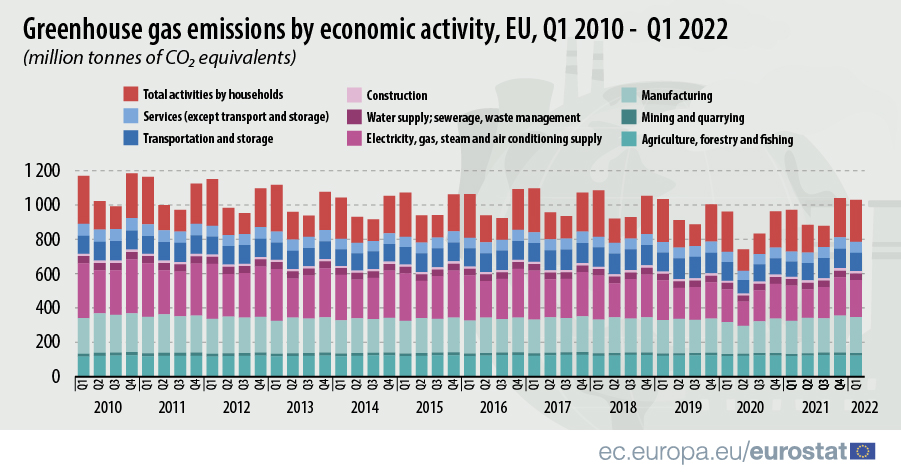
16/08/2022 In the first quarter of 2022, EU economy greenhouse gas emissions totalled 1 029 million tonnes of CO2-equivalents (CO2-eq), a 7% and 6% increase compared with the same quarter of 2020 and 2021, but still below pre-COVID levels registered in the first quarter of 2019, when the EU economy emitted 1 035 million tonnes of CO2-eq. This information comes from data on quarterly estimates for greenhouse gas emissions by economic activity published by Eurostat today. The article presents a handful of findings from the more detailed Statistics Explained article on quarterly greenhouse gas emissions. The documented increases were largely due to the effect of the economic rebound after the sharp decrease in activity due to the COVID-19 crisis. Source dataset: env_ac_aigg_q In the first quarter of 2022, the economic sectors responsible for most emissions of greenhouse gases were households (24%), electricity, gas supply (21%) and manufacturing (20%), followed by agriculture (12%) and transportation and storage (10%). Greenhouse gas emissions increased in all sectors compared with the same period of 2021, except for households which remained at the same level (245 million tonnes of CO2-eq.). The highest increases were recorded in transportation and storage (+21%), mining (+15%) and construction (+11%). Source dataset: env_ac_aigg_q
Emissions in the first quarter of 2022 increased in almost all EU Member States when compared with the same quarter of 2021, indicating a recovery from the COVID-19 pandemic. The Netherlands (-9%) and Finland (-1%) were the only Member States that registered a decrease in emissions in the first quarter of 2022 compared with the first quarter of 2021. Among the Member States with increased emissions in the same comparison period were Bulgaria (+38%), Malta (+21%) and Ireland (+20%). When comparing the first quarter of 2020 with the same quarter of 2019, it revealed the opposite picture: almost all EU Member States registered a reduction in emissions at the beginning of the pandemic. For more information: Methodological notes: To contact us, please visit our User Support page. For press queries, please contact our Media Support.
Thank you for your feedback. We are sorry to hear that. You can report the issue here. Thank you for the information. We will investigate the issue. Was this page useful? News Data Publications About us Opportunities
PITTSFIELD, Mass. — Revisiting as many Sondheim musicals as possible is not an arduous undertaking, and one I have engaged in at many junctures of my life. But this year, the first in the aftermath of Stephen Sondheim’s death, feels like an essential part of a grieving process. As much as I can — to paraphrase one of Sondheim and James Lapine’s own characters in “Sunday in the Park With George”— I want to live again in his canvasses. Broadway has recently obliged with outstanding revivals of “Company” (1970) and “Into the Woods” (1987), and the months ahead offer other intriguing possibilities: Sondheim-centric Signature Theatre in Arlington is turning its new season into a veritable retrospective, offering up three Sondheim musicals, including the rarely seen “Pacific Overtures,” from 1976, to be directed by Ethan Heard, the company’s recently appointed associate artistic director. There is a deep hunger that Sondheim satisfies, for intelligence and syntactic rigor in a form that in lesser hands comes across as pat and lazy. Artists, of course, such as Lin-Manuel Miranda, Jason Robert Brown, Jeanine Tesori, David Yazbek and Michael R. Jackson are worthy upholders of the standards. But Sondheim’s unmatched ability to weld words to notes, to find music and rhymes in the most surprising nooks and crannies of the language, sends me back to his shows in an almost compulsive way. Sondheimism is my own agreeable disorder. Now hear this: How ‘Into the Woods’ makes the noise so joyful My latest encounter occurred over the weekend in this Berkshires city and a production of “A Little Night Music,” the Tony-winning romantic farce Sondheim wrote with librettist Hugh Wheeler in the early 1970s. Barrington Stage Company’s commendable if not entirely successful revival is notable for the high-end leads it has recruited. The cast is led by the handsome, finely tuned pairing of Jason Danieley as Fredrik Egerman and Emily Skinner as Desiree Armfeldt, the lovelorn Swedish stage vet seeking to relight the flame of youthful passion. The score, composed as a series of waltz variations, is based on the Ingmar Bergman comedy “Smiles of a Summer Night” and is Sondheim’s most winsome. It includes the number that put to rest for good the canard that he could not write with emotion or tuneful richness: “Send in the Clowns,” here performed by Skinner with alluring finesse. Wheeler’s book, on this occasion, though, shows signs of age. Half a century proves to be inordinately long for a comedy of sexual manners to hold up, particularly because at its center — in a musical set in 1905 — is the marriage of a middle-aged lawyer and an 18-year-old (Sabina Collazo’s Anne Egerman). As a child, Anne notes, she called Fredrik “uncle.” Stephen Sondheim: An appreciation What once might have struck audiences as comically benign is now slightly discomfiting — as is a lyric in the wordplay of “It Would Have Been Wonderful,” a complaining song for Danieley’s Fredrik and a rival for Desiree, Count Carl-Magnus Malcolm (Cooper Grodin): “If she had only been sulky — or bristling — or bulky — or bruised,” they sing at each other. Eesh. One can take into account the time in which a piece was written, but musicals live and breathe in our moment. It surprised me in the last month that “Into the Woods” rose in my estimation, courtesy of Lear deBessonet’s extraordinary production at the St. James Theatre, and here, director Julianne Boyd’s “A Little Night Music” lowered the show on my canon list. Nothing,however, will ever dampen my regard for theAct 1 finale, “A Weekend in the Country,” a witty round-robin of farcical scheming that sets in motion the settling of scores in Act 2. On Barrington’s Boyd-Quinson Stage, the number further underlines the vital role of Countess Charlotte Malcolm, beleaguered wife of the philandering count, and played here to the marvelous hilt by Sierra Boggess. Who knew the erstwhile star of Broadway’s “The Little Mermaid” could embody the burned-out ends of betrayal so magnificently? New musical version of ‘The Devil Wears Prada’ trips on the runway Some of the limitations of this “Night Music” are technical: A seven-member orchestra conducted by Darren R. Cohen sounds thin in a 520-seat house; when it comes to Jonathan Tunick’s sublime orchestrations, only the full array of flavors will do. (I might have been spoiled by the earful of the “Into the Woods” experience, with an orchestra more than twice as large.) A few of the supporting performances come across as one-dimensional. And the operatic technique of the musical’s Greek-chorus Quintet, often referred to as the Liebeslieder singers, overwhelms some of the lyrics. The trip to Pittsfield nevertheless felt bountiful. In a field eternally questing for true inspiration, Sondheim’s scores represent for me a kind of perfection — or at least, an artist’s indomitable effort to achieve it. So I’ll take that ride, even when the results aren’t perfect. A Little Night Music, music and lyrics by Stephen Sondheim, book by Hugh Wheeler. Directed by Julianne Boyd. Sets, Yoon Bae; choreography, Robert La Fosse; music direction, Darren R. Cohen; costumes, Sara Jean Tosetti; lighting, David Lander; sound, Leon Rothenberg. With Mary Beth Peil, Sophie Mings, Kate Day Magocsi, Slater Ashenhurst, Adam Richardson, Rebecca Pitcher, Stephanie Bacastow, Andrew Marks Maughan, Leslie Jackson. About 2 hours 40 minutes. Through Aug. 28 at Boyd-Quinson Stage, 30 Union St., Pittsfield, Mass. 413-236-8888. barringtonstageco.org. News• News• News•
By Debbie Roland and Emmy Ulmschneider Master Gardeners Curly Mesquite (Hilaria Belanger) is a native, warm season grass that grows from Central Texas and Arizona south throughout Mexico. It is a grass, a monocot and not related to mesquite trees, which are dicots and members of the legume family. This grass is a perennial that forms stolons or runners which help it colonize dry soils ranging in texture from clay to gravelly. The genus name honors Augustin Saint-Hilaire an early French botanist who explored in South America, mainly in Brazil during the early 1800’s. He collected over 42,000 species of primarily plants, birds, and insects with some assorted reptiles, mammals and fish. When he returned to France, he spent the rest of his life describing classifying, and studying what he had collected. For his work, he was recognized as a knight in the French Legion of Honor. The plant is pale green and grows in tufts, with new tufts developing at the nodes of the stolons. Stolons are modified stems growing above ground and are used for vegetative reproduction. This is one reasons why this grass can quickly colonize an area; think how quickly Bermuda grass can spread. The true stems are slender, up to a foot tall with short narrow leaves giving the plant a wavy texture. When the plant dries out and becomes dormant, the leaves curl up giving this plant its name. Curly Mesquite is drought resistant, palatable to grazing animals when it is both green and when dry, thus is a valuable range grass for warm dry areas. It is one of the grasses used in range seeding mixes for central and west Texas. Along with Buffalograss, Buchloë dactyloides and Blue Grama, Bouteloua gracillis, Curly Mesquite is native grass with turf potential and so is a major species in readily available native lawn blends. It is also of use in controlling erosion on dry difficult areas. Native grasses also have ecological value, providing food, shelter, and protection for songbirds and beneficial insects across all the seasons. With their deep roots, they slow storm water runoff and return it to the soil and increase the fertility of the soil. Plant Curly Mesquite during the spring in full sun as it will not tolerate shade. Growth begins in late spring. Thirty to forty days later the seedheads will emerge. Reproduction is primarily through stolons and propagation from seeds is difficult. Try Curly Mesquite alone or with Buffalograss and Blue Grama as your turf grass of choice. For more information, call the AgriLife office at 498-4071 in Odessa or at 686-4700 in Midland or visit aggie-horticulture.tamu.edu or westtexasgardening.org.
Watch The storyline dominating Patriots training camp so far is the implementation of a new offense. The post-Brady/McDaniels switch to a scheme that’s going to be more user-friendly has been a slow and hard-to-watch slog on many days. This is not an entire “out with the old, in with the new” undertaking, sources have told me. Elements of the offense the team’s used for years will remain. But there’s a pivot in the run game to using more stretch or “outside zone” concepts that, ideally, will become the basis for incorporating new pass-game concepts. Don’t expect the Patriots to just throw up their hands because it’s looked ugly. Mac Jones‘ words last week were all the evidence you need to see that’s not happening. “I’m going to figure it out,” Jones said, via Mike Reiss of ESPN.com. “I always have. I always will. At the end of the day, you’re going to have your ups and downs with anything new, but I’ve learned a lot of different systems and the guys around me have too. We know what football looks like, we know what a good play looks like. … It just needs to be more consistent. We all trust in each other at the end of the day. When there’s 10 people that look into my eyes, I know they’re going to trust me to do the right thing on game day.” Why’s it been so hard to master and why’s it looked so rough in practice? Because the outside-zone scheme is complex. Last Thursday, I asked former Denver Broncos great Ed McCaffrey, who came up in the Mike Shanahan offense that beautifully employed outside zone (and sometimes took Bill Belichick’s defenses to the woodshed) what a switch to outside zone would entail. What are you gonna be good at? You can’t be great at everything. You just can’t. So what are you gonna hang your hat on? And if it’s gonna be outside-zone it takes time. McCaffrey, who was co-hosting on SiriusXM NFL Radio when I asked him, went into a detailed explanation that really lays out the intricacies. “Some offensive line coaches are insulted when you call it outside zone,” McCaffrey began. “They like to call it wide zone and they call inside zone ‘tight zone.’ Rarely when you are running an outside zone play does it go outside. It usually cuts back somewhere in between the edge defender and the hash mark. Some people call it stretch, doesn’t matter what you call it, it is a whole system. “But just the outside run play itself is an entire system involving multiple two-man combinations on the front side and back side of the play. It gets more complicated when you introduce different formations and different personnel groupings. So, for instance, you could run a wide-zone play out of 21 personnel (two backs, one tight end) which is what most pro-style West Coast offensive coaches consider their base offense. That involves a fullback and a tight end. “(The complexity rises when you get into) are you running a full-flow to the tight end with the fullback? Are you running split-flow to the tight end with the fullback going the opposite way? Are you running to the open side with the fullback? “In addition to that, every one play is actually two because you’re coaching the front side and the back side. Center and guard have to communicate, guard and tackle have to communicate, tackle and tight end have to communicate. And then there’s 36 minimum basic fronts that involve different two-man combination calls. So if defenders ‘mug and bug’ bringing linebackers up you can potentially turn that into a three or four-man combination play. Communication on the line just for that — we aren’t even discussing 11 personnel or 10 personnel motions and shifts — is a whole entire language.” Patriots Talk: What’s the end goal of the Patriots playing ‘process’? | Listen & Subscribe | Watch on YouTube McCaffrey mentions the fullback. The Patriots made an interesting move with that position in the offseason, saying goodbye to Jakob Johnson and letting him know the straight-ahead battering ram style was going away from their offense. So the outside-zone style McCaffrey’s referencing from 21 personnel may not be the Patriots’ base formation. Either way, the concepts are still complicated. “If you haven’t done it then it does take time just to install the outside zone scheme,” McCaffrey explained. “Just one play is really like 20 plays (because of the variations in personnel and options). So to put in an outside zone scheme with multiple personnel groupings … think of the time it takes to put that in. “In the NFL you have time to put in multiple blocking schemes and all teams do. But how much time are you going to spend doing that? Time is our most valuable asset. So to get guys up to speed and be really good at the outside zone schemes which involve multiple combination blocks versus various fronts, to get really, really good at that takes time. You can’t be great at everything but as a playcaller you still want enough variation to keep defenses on their heels and attack certain fronts. But the big decision is, ‘How much time am I gonna spend on this other stuff? What am I gonna live out of?’ It takes time to learn. A lot of time. And really repetition. Practicing their fits on those two-man combinations and communicating.” McCaffrey, whose son Christian is a standout with the Panthers, currently coaches at the University of Northern Colorado. He’s got an appreciation for what the Patriots staff is wrestling with. “Think of wide zone as a whole language in and of itself,” he said. “And with that, you only have so much time in a day to get really good at something. And that’s the question for head coaches and coordinators. ‘What do we want to be great at?’ If you want to be great at outside zone, you gotta spend a lot of time running outside zone. “Then you have to pair that with all of your play-action passes. Your play-action passes are gonna work off of the runs you run well and have success running. … and with play-action it all comes off of the run game. What are you gonna be good at? You can’t be great at everything. You just can’t. So what are you gonna hang your hat on? And if it’s gonna be outside-zone it takes time.” And it’s going to take time for it to look good. Which is what we’re seeing in Foxboro currently.
Beatport has announced the headline speakers for their upcoming ReConnect summit, which will feature talks, workshops, debates, wellness talks, and music alongside Deadmau5, John Summit, Kerry Chandler, and many more. As Beatport is still the biggest platform for DJs and producers to get their music and discover new artists, the summit will be an excellent learning experience and will push boundaries to help make the music industry more diverse and inclusive.
ReConnect, taking place on the 21st and 22nd of September in New York, is always a hub where industry professionals and aspiring producers can network and learn from each and legends in the industry. This year Beatport wants to provoke thought and challenge mores in the industry, having stated that the Roof area will host inspirational and interesting conversations concerning the music culture, wellness, and diversity all hosted by the likes of shesaid.so, Women in Music and The Art of Areté. Not only does this set Beatport apart, it is a huge step in the right direction
At the 2-day summit, “The Room” will host different showcases with a focus on music technology and tech-centered conversations. Since the crypto world has decidedly become a part of the music industry, Beatport announced panels with the CEO of crypto streaming platform “Audius”, Roneil Rumburg, as well as Inder Phull from PIXELYNX. Clearly, Beatport are looking towards the future.
Producers will benefit from workshops, demo drops, and direct sessions from A&R managers, all hosted by the Beatport Group in the Lounge area. A great way to get a foothold in the music industry and make new connections, Beatport ReConnect is a true networking hub and hotspot for industry professionals- with these staggering headline speakers, the summit is a great follow-up to Beatport’s input at the IMS summit in Ibiza earlier this year.
Written byby Jamia Kenan Published on August 15, 2022 Reading time 14 minutes TikTok sounds are an integral part of the app—users don’t just listen, they remix and revamp to shape new trends and cultural shifts. From hit songs and iconic TV lines to original audio from innovative creators, sound is often a catalyst for TikTok challenges and dances. It’s part of why community and collaboration are at the heart of the app. Music is the universal language of the soul and TikTok has definitely shifted the music industry. But you don’t need a Billboard 100 hit in your TikTok marketing campaigns for your customers to sing your praises— you just need the right sound. Major brands are already taking advantage of sound appeal and marketers should take note. A Kantar report for TikTok reported the app’s sound-on campaigns were much better at increasing brand awareness compared to competitors’ ads, with or without sound. The study also noted TikTok is the only platform where ads with audio generate increases in both purchase intent and brand favorability. According to Sprout Social listening data from January 1st to July 29th, 2022, some 3.46 million messages on Twitter mentioned TikTok sounds.If you haven’t already, it’s time to consider tuning into marketing campaigns driven by TikTok sound because they gain the attention of consumers. But with strict brand guidelines and the end of the Discovery page (RIP), it can be difficult to figure out how to use sound. We’ll calm the noise for you by breaking down current trending sounds and showing you how your brand can leverage audio for engagement and brand awareness. As an app driven by rapid creativity and trends, new TikTok sounds arise every day. Let’s go over a few examples from the past two months to illustrate the culture of sound on everyone’s favorite clock app: Avid social media lovers are familiar with the “he’s a 10, but” trend that infiltrated timelines in early July 2022. In short, a creator will state “he’s (or she’s) a 10, but” follows up with a flaw either verbally or with a text overlay. its terrifying #fyp#foryou#kitten ♬ original sound – 444.songss
This particular audio acts as a complement to the “he’s a 10, but” trend and features a sped-up version of MoKenStef’s 1995 single, “He’s Mine.” Creators show their rendition with on-screen text while the sound plays in the background. The sound is featured in almost 1 billion videos on the app. Everything famous or cool on the Internet either starts or ends up on TikTok. Netflix’s Stranger Things is a prime example. The hit show re-popularized the 1985 song, “Running Up That Hill” by Kate Bush. It’s one of the trendiest sounds with over 2.7 million videos, contributing to the song being one of the most streamed songs in the world in early June 2022. TikTokers didn’t stop there. The “you’re just like papa” sound has also caused a cultural craze. The sound features an argument between two characters in the show, Eleven and Hopper. Hopper tells Eleven that she must face consequences for her actions and Eleven exclaims “you’re just like papa”, a reference to her controlling mad scientist father. #mediaclipped#fyp#foryoupage#strangerthings#jimhopper#hopper#eleven#season2#fight#arguement#powers#papa#lie ♬ original sound – mediaclipped
Creators use these lines to fit various situations such as the one below. In the video, the creator re-enacts a situation where he gives his friend an opinion. When the friend doesn’t like it, they scream “you’re just like papa.” The sound is featured in over 50,000 videos on the app. ♬ original sound – mediaclipped
The repost generated over 6 million views and over 4,000 shares. That’s the type of reach marketers want to achieve. The “past three summers” sound involves the famous social media glow up. Users sync the sound with a montage of themselves over the past three summers. #greenscreen ♬ оригинальный звук – Reinwi
This simple trend illustrates a common TikTok sound tactic: an instrumental with photos or videos that appear on a beat or alongside sound effects. The 90s holds a special place in the hearts of Millennials and Zillenials, but the early 2000s is special to Gen Z. The Long Way 2 Go is a dance challenge created by @marcusreposooo. In his video, he and his friends wear Y2K-inspired outfits as they dance to a remix of Cassie’s 2006 hit “Long Way 2 Go.” It brings you back to the days of pop sensations and music video countdowns. long way 2 go ✨ dc: me #fyp#dance ♬ original sound – Tray
This is definitely one of TikTok’s quintessential dance trends, but creators use it for other types of content as well, like outfit of the day videos and vlogs. Wishing y’all great weekend my lovelies ❤️ thoughts on the outfit? #ootd#fyp#fashion#viral#blacktiktok ♬ original sound – Tray
These are just a few examples of trending sounds, but remember they can fall in popularity quickly. Think of it as a crescendo in a song: trends rise and die quickly. Work towards finding trending sounds often to avoid sounding like a broken record. Now that we’ve gone over a few examples of how trending sounds work, let’s go over how brands can discover trending TikTok sounds. Here’s how: The TikTok Creative Center is your best friend when it comes to trend information. Go to the Trend Intelligence dropdown to view data for hashtags, songs, creators and videos. You can browse or search songs from the previous day, the last 30 days or the last 120 days. You can also select a region. You’ll see two tabs in the Songs section: Popular and Breakout. The Popular tab ranks the top trending songs within the selected region while the Breakout tab features songs that are growing quickly. These lists exclude user-generated content, but you can use the other pages within the Creative Center to discover trends that aren’t driven by songs. View the Hashtags or TikTok Videos pages to see what’s trending. Pay attention to relevant hashtags surrounding trends and sounds. Hashtags like #TikTok sound trends are filled with creators who create content about social media marketing and trend spotting. They’ll showcase rising sounds and even explain how certain trends work. There are several websites like TokBoard and Trendpop Viral 100 that provide information on trending sounds. However, keep in mind these aren’t endorsed or affiliated with TikTok. These sites can be a starting point, but do your own research and corroborate the data before tapping into a trend listed on these types of websites. The biggest takeaway for using TikTok sounds: Beware copyright infringement. Many trending TikTok sounds feature hit music, but brands aren’t individuals and have a different set of guidelines. There are several options your brand can use to incorporate sounds without crossing legal boundaries. Brands can license music, use stock audios, create original or branded sounds and repost user-generated content. These alternative options allow you to hop onto trends and cement your brand as a participant in the conversation. Here’s a breakdown of each tactic: You can earn the rights for commercial use by contacting the copyright holder. This is typically the record label or artist, but this process can be lengthy. This is partly why TikTok introduced Sound Partners, an expansion of the Marketing Partner Program. TikTok’s Sound Partners consist of music production companies, agencies and platforms like UnitedMasters. These partners help brands craft sound-centered marketing campaigns by creating custom sound or offering subscriptions for licensing plans. You can view the full directory of partners here. Use TikTok’s Commercial Music Library to access thousands of royalty-free music selections. You can filter by genre, themes, duration and more. You can also view premade playlists to discover music. Access the library on the app or desktop. On the app, open the camera, click “Add sound” at the top of the screen and tap “Sounds”. Tap “Commercial sounds.” From here, you can browse and search for audio. Explore the playlist options such as Emerging Artists, TikBiz and TikTok Viral. Plus, you can find instrumentals of popular songs so you can allude to trendy music, without infringing. Curating custom audio will help your brand stand out and tap into the culture of TikTok. Create original sounds by remixing stock sounds, adding voiceover or sound effects. You can also use voiceovers for vlogs such as event recaps. You don’t need a hit song to have an effective sound. Try out “talking head” audio, which involves a person talking to the camera. Talking head content is great for tutorials and storytimes. Consider commissioning a branded sound by collaborating with creative agencies, music producers or artists. Think of branded sounds as the modern-day jingle with an interactive twist. Branded sounds are great for campaigns because users can engage by creating their own content. Use the sound as a call to action, asking viewers to make a video using your branded sound and hashtag. Make sure to give your sound an official name too. This is great for branding and awareness since other users can search and find your audio if you give it a name. Dueting is also a popular tactic. A Duet shows two videos in a split screen that play simultaneously. TikTokers use duets for reaction videos, responses and more to encourage collaboration in some way. For example, one TikToker will sing lyrics or recite lines. The creator will take pauses to allow another creator to join in and add their own flair. Here’s an example of an #actingchallenge: u can’t sit with us‼️ #duet with @elianaghen #fyp#foryou#meangirls#acting ♬ You cant sit with us MEAN GIRLS – Eliana Ghen
Brands can use duets by participating in challenges like this one or respond directly to customers. Duets are also an effective way to amplify user-generated content, which leads us to our final option. User-generated content is a great way for brands to connect with their audience since consumers want to see authentic customer experiences. Collaboration and re-creation is the bread and butter of TikTok. But brands should always ask permission first as a precaution—whether you’re using original audio or reposting on your brand’s TikTok page. We also suggest tagging the creator in the caption or the TikTok comment section as well. Avoid reposting any videos that include copyrighted sound—it can still count as infringement even if your brand isn’t using the music. International superstar Beyonce is known for reposting and giving credit to her fans, especially when it comes to promoting her songs. Seeing y’all release the wiggle made me so happy! Thank you so much for all the love for BREAK MY SOUL! – Love B —#RENAISSANCE#BREAKMYSOUL ♬ BREAK MY SOUL – Beyoncé
She posted a mashup video for the hit song “Break My Soul” on her TikTok, but she credited every creator in the comment section, even if they didn’t have an account: Beyonce has one of the biggest personal brands in the world. Remember this lesson from Queen Bey and give credit where credit is due. Your customers will appreciate the thoughtfulness. Plus, this ethical approach protects your brand, especially as more creators begin to trademark their original sounds. Brands on Tiktok have gotten creative with using audio to drive their marketing campaigns. Here are some of our favorite sound-on TikTok campaigns. As the first company to commission a song for TikTok, e.l.f knows how to get its audience tuned in. The beauty brand’s first branded sound was “Eyes Lips Face.” The song was inspired by Kash Doll’s 2018 hit, “Ice Me Out”. Thousands of content creators, celebrities and influencers alike joined in on the lip sync and makeup tutorial trend. The campaign amassed over 3.8 billion posts. this is me every time I beat my face lol #eyeslipsface @elfcosmetics #ad ♬ Eyes. Lips. Face. (e.l.f.) – iLL Wayno & Holla FyeSixWun
Singapore – Ascott Residence Trust (ART) is proposing to acquire nine quality serviced residences, rental housing and student accommodation properties across five countries from its sponsor, The Ascott Limited. At an estimated total capitalised cost of S$318.3 million [1], the yield-accretive acquisition is set to increase ART’s distribution by S$9.2 million and its pro forma FY 2021 Distribution per Stapled Security by 2.8%[2]. The acquisition is expected to strengthen ART’s presence in its existing markets. The assets are predominantly located in Asia-Pacific with seven of the assets in Australia, Japan and Vietnam, and two in France and the USA. The acquisition of the nine properties with a total of 1,018 units will grow ART’s total assets to S$8.3 billion [3] as of 31 December 2021 on a pro forma basis, further consolidating ART’s position as Asia-Pacific’s largest hospitality trust. Post-acquisition, ART’s portfolio will exceed 100 properties, with over 18,000 units across 47 cities and 15 countries. The acquisition will enhance ART’s income resilience as 92% of the nine assets’ gross profit are from stable income [4] sources. It will further increase ART’s total proportion of stable income from 69% to 71% of its gross profit [5]. ART is acquiring three serviced residences – Quest Cannon Hill in Brisbane, Australia and La Clef Tour Eiffel Paris in France that are on master leases; and Somerset Central TD Hai Phong City in Hai Phong, Vietnam which caters mainly to corporate guests and has an average length of stay of about 11 months. The five rental housing properties in Japan have typical lease tenures of about two years. They are in Kyoto, Osaka, Hyogo and Nagoya. The acquisition will expand ART’s footprint to Hai Phong, Hyogo and Nagoya, further diversifying its portfolio. In South Carolina, USA, ART is doubling its stake in Standard at Columbia, acquiring an additional 45% stake in the student accommodation property. Student accommodation properties typically have an average length of stay of about one year. Standard at Columbia is expected to perform well given its prime location and growing student population. ART’s portfolio of operating student accommodation properties in the USA have achieved a strong occupancy rate of over 95%. Currently under development, Standard at Columbia is slated for completion in 2Q 2023. For more information about the nine assets, please refer to Annex. Ms Serena Teo, Chief Executive Officer of Ascott Residence Trust Management Limited and Ascott Business Trust Management Pte. Ltd. (the Managers of ART) said: “We are proposing to acquire nine quality assets that will increase ART’s stable income and further strengthen the resilience of our portfolio, demonstrating our focus to deliver long-term value for our Stapled Securityholders. The acquisition will enhance our geographically diverse portfolio while deepening our presence in our key markets of Australia, France, Japan, USA and Vietnam. The addition of the five rental housing properties in Japan and a student accommodation property in the USA will increase the proportion of our longer-stay [6] portfolio from 17%[7] to 19% of ART’s total portfolio value. This will bring us closer to our target of 25% – 30% for longer-stay assets in the medium term. The acquisition is also set to boost ART’s proportion of green-certified properties, reinforcing our focus on sustainability. ART continues to seek yield-accretive investments while remaining committed to sustainability and taking a disciplined approach in managing our capital and costs.” The transaction is expected to be completed by November 2022, subject to Stapled Securityholders’ approval at an Extraordinary General Meeting to be held on 9 September 2022. The acquisition is to be funded by debt and/or proceeds from a private placement. Post-acquisition, ART will have a gearing of 38.5% which is well below the 45% gearing threshold set by the Monetary Authority of Singapore. ART remains in a strong financial position to continue to make yield-accretive acquisitions. With ART’s longer-stay portfolio comprising 19% of its total portfolio value and the strength of its balance sheet, ART is also resilient against any potential economic volatility. The three serviced residences to be acquired are located in key gateway cities and growth markets. The luxurious La Clef Tour Eiffel Paris has an average daily rate that is more than 30%[8] higher compared to pre-COVID-19 level. The serviced residence has an occupancy rate of about 80%[8], which is above pre-COVID-19 occupancy. Its performance is expected to pick-up as Paris’ tourism market fully recovers by 2023 [9] and as the city hosts the 2024 Summer Olympic Games. Quest Cannon Hill’s occupancy rate is about 95%[8], exceeding its pre-COVID-19 performance. Its occupancy is expected to remain robust as Brisbane continues to develop and upgrade its infrastructure to attract more domestic and international arrivals. Similarly, Somerset Central TD Hai Phong City is well-positioned for further growth as Hai Phong, Vietnam’s third largest city, continues its trajectory of economic development as an industrial hub. In 2021, Hai Phong surpassed Ho Chi Minh City and Hanoi as the top foreign direct investment destination in Vietnam with a registered capital of more than US$5.26 billion, nearly 3.5 times compared to 2020[9]. Somerset Central TD Hai Phong City has an occupancy rate of over 90%[8], which is in line with its pre-COVID-19 level. The serviced residence’s historical EBITDA [10] yield pre-COVID-19 is about 9.7%. The acquired properties will increase the proportion of ART’s green-certified properties from approximately 35%[11] to 38% of its global portfolio by square metre. Quest Cannon Hill, La Clef Tour Eiffel Paris, Somerset Central TD Hai Phong City and Standard at Columbia are expected to be green-certified before the end of 2023. They will contribute to ART’s sustainability targets of greening 50% of its global portfolio by 2025 and 100% of its global portfolio by 2030. [1] Excluding the outstanding development cost and interest expense to be incurred for Standard at Columbia. [2] Assuming 54% of the acquisition cost is funded by debt and the remainder funded by private placement. [3] Including acquisitions announced and/or completed up to 31 March 2022. In 1Q 2022, ART completed the acquisition of Paloma Kent and announced the turnkey acquisition of four rental housing properties and one student accommodation property in Japan, increasing ART’s assets under management by S$0.2 billion. [4] Stable income sources include master leases, management contracts with minimum guaranteed income, management contracts of rental housing and student accommodation; growth income sources include management contracts of serviced residences and hotels. [5] Including acquisitions announced and/or completed up to 31 March 2022. Following the acquisitions of the nine assets and ART’s other acquisitions announced and/or completed up to 31 March 2022, ART will have 33 master leases, 4 management contracts with minimum guaranteed income and 68 management contracts. [6] Longer-stay assets refer to rental housing and student accommodation properties. [7] Based on property valuations as at 31 December 2021, value of acquisitions announced and/or completed up to 31 March 2022 and properties under development. [8] As at July 2022. [9] CBRE, 25 July 2022 – Market summary of the hospitality and serviced apartment markets of Australia, Japan, Vietnam, France and the USA. [10] Earnings before net interest expense, tax, depreciation and amortisation. [11] As at May 2022. The 100-unit Quest Cannon Hill is located in Brisbane, Australia, in the emerging suburb of Cannon Hill within a retail and commercial precinct. The serviced residence is a five-minute walk to Cannon Hill train station, offering direct access to Brisbane’s central business district (CBD). It is also a 10-minute drive to the Metroplex on gateway Estate and Port of Brisbane industrial areas. Quest Cannon Hill offers a range of apartments including studio, one-, two-, and three-bedroom apartments. Facilities at the serviced residence include a meeting room, a gymnasium, pool, and a barbecue area. Quest Cannon Hill is on a master lease with rent increases and rent reviews. For more information or reservations, visit here. The 112-unit La Clef Tour Eiffel Paris is located in the heart of Paris, one of the world’s most visited cities. The serviced residence is a 5- to 10-minute drive to popular tourist attractions such as the Eiffel Tower, Trocadéro, the Arc de Triomphe and Avenue Champs Elysées. The nearest metro station, Trocadéro, is just a two-minute walk away. The Paris Charles De Gaulle Airport is a 25-minute drive from the serviced residence. La Clef Tour Eiffel Paris offers a mix of rooms, studios as well as one- and two-bedroom apartments, set in a 19th-century building designed by architect Ricardo Bofill. An asset enhancement initiative (AEI) is planned to reinforce the property’s upmarket positioning, lifting room rates and improving rent sustainability. Targeted for completion by end 2024, the AEI will encompass the replacement of fixtures, furniture and equipment in the bedrooms as well as the bathrooms. The lobby and lounge area will also be refurbished. La Clef Tour Eiffel Paris is on a fixed-rent master lease with lease cap and annual indexation. The property will remain open throughout the AEI process. For more information or reservations, visit here. The 132-unit Somerset Central TD Hai Phong City is situated in the growth city of Hai Phong, the third largest city and one of the largest industrial hubs and ports in Vietnam. As one of the first serviced residences in Hai Phong City, it is well-positioned to capture the lodging demand arising from foreign direct investment and business activities. The serviced residence is a 15-minute drive to three industrial parks – Deep C, Dinh Vu and South Dinh Vu Industrial Zone, and a 10-minute drive to Cat Bi International Airport. As part of a newly-refurbished 15,000-square metre integrated development and with a multitude of international schools, shopping malls and hospitals around the residence, the property offers an ideal location for long-stay guests. Somerset Central TD Hai Phong City provides a mix of studios as well as one-, two- and three-bedroom apartments. Somerset Central TD Hai Phong City is on a management contract. For more information or reservations, visit here. The five rental housing properties offer 427 units in total and are well-located within four cities in Japan. S-Residence Shukugawa is located in the Hyogo prefecture within a residential district with numerous schools. The property is highly sought-after by professionals working in Osaka and Kobe. In Kyoto, House Saison Shijo-dori is located within walking distance to the city’s prime office and retail belt, Shijo Karasuma as well as several high-profile tourist attractions. In Nagoya, Marunouchi Central Heights is within talking distance to the city’s CBD and close to key tourist attractions and shopping districts. In Osaka, the two rental housing properties, S-Residence Namba Viale and S-Residence Gakuenzaka, are also close to the city’s CBD and near the popular tourist shopping districts of Dotonbori and Shinsaibashi. The rental housing properties are on management contracts. Located in South Carolina, USA, the 247-unit (679-bed) Standard at Columbia will serve over 35,000 undergraduate and graduate students from the nearby University of South Carolina (USC), the largest university in the state. In June 2021, ART and The Ascott Limited jointly invested to own 90% of the asset. Construction of the student accommodation asset is scheduled for completion in 2Q 2023. The property was topped out in 2Q 2022. The freehold purpose-built student accommodation property is close to a plethora of food and entertainment options. It will provide fully furnished studios as well as one- to five-bedroom apartments. Each unit comes with a fully equipped shared kitchen, as well as appliances such as a washer and dryer. Community amenities include a fitness centre, study lounges, a coffee bar, and a jumbotron TV on an elevated amenity deck with a swimming pool and cabanas. Upon completion, Standard at Columbia will be on a management contract. The Ascott Limited (Ascott) is a Singapore company that has grown to be one of the leading international lodging owner-operators. Ascott’s portfolio spans more than 200 cities across over 30 countries in Asia Pacific, Central Asia, Europe, the Middle East, Africa and the USA. Ascott has more than 78,000 operating units and over 57,000 units under development, making a total of more than 135,000 units in over 800 properties. The company’s serviced apartment, coliving and hotel brands include Ascott The Residence, The Crest Collection, Somerset, Quest, Citadines, lyf, Préférence, Vertu, Harris, Citadines Connect, Fox, Yello, Fox Lite and POP!. Ascott’s loyalty programme, Ascott Star Rewards, offers exclusive benefits to its members when they book directly with Ascott for their stays at its participating properties. Ascott, a wholly owned subsidiary of CapitaLand Investment Limited, pioneered Asia Pacific’s first international-class serviced apartment with the opening of The Ascott Singapore in 1984. Today, the company boasts over 30 years of industry track record and award-winning brands that enjoy recognition worldwide. For more information, please visit www.discoverasr.com. Headquartered and listed in Singapore, CapitaLand Investment Limited (CLI) is a leading global real estate investment manager (REIM) with a strong Asia foothold. As at 31 December 2021, CLI had about S$122.9 billion of real estate assets under management, and about S$86.2 billion of real estate funds under management (FUM) held via six listed real estate investment trusts and business trusts, and 29 private funds across the Asia-Pacific, Europe and USA. Its diversified real estate asset classes cover integrated developments, retail, office, lodging, business parks, industrial, logistics and data centres. CLI aims to scale its FUM and fee-related earnings through its full stack of investment management and operating capabilities. As the listed investment management business arm of the CapitaLand Group, CLI has access to the development capabilities of and pipeline investment opportunities from CapitaLand’s development arm. Being a part of the well-established CapitaLand ecosystem differentiates CLI from other REIMs. As part of the CapitaLand Group, CLI places sustainability at the core of what it does. As a responsible real estate company, CLI contributes to the environmental and social well-being of the communities where it operates, as it delivers long-term economic value to its stakeholders. Visit http://www.capitalandinvest.com/ for more information. Joan Tan Assistant Vice President, Corporate Communications +65 6713 2864 The Ascott Limited Hospitality Net membership explained
By Valerie Complex Associate Editor/Film Writer EXCLUSIVE: Production is underway forFancy Dance in Cherokee Nation/Tulsa County, Oklahoma. Based on a script by director Erica Tremblay & Miciana Alise, Fancy Dance was developed with the support of the Sundance Screenwriters Lab, Directors Lab, Creative Producing Lab and Indigenous Intensive. Charlotte Koh for Confluential Films and Bird Runningwater are executive producers. Deidre Backs, Erica Tremblay, Heather Rae, Nina Yang Bongiovi (with Forest Whitaker at Significant Productions), and Tommy Oliver (Confluential Films) are producing along with Confluential Films financing with additional support from AUM Group.
The film stars Lily Gladstone (Killers of the Flower Moon, Certain Women) as a Native American hustler who, following the disappearance of her sister, kidnaps her niece from the child’s white grandparents and sets out for the state powwow in hopes of keeping what’s left of their family intact. Isabel Deroy-Olson (Shadow of the Rougarou) plays the niece.
Related Story
Sanaa Lathan, Algee Smith, Sierra Capri & Mike Epps To Star In 'Young. Wild. Free' From Macro Film Studios & Confluential Films
“Building from my own experiences as an Indigenous and queer woman and drawing from the stories of my relatives, Fancy Dance offers a spotlight on the matriarchal bonds that hold our communities together,” said Tremblay (Reservation Dogs, Little Chief). “I am thrilled to be working with Lily Gladstone again and I’m so grateful to Confluential Films and Significant Productions for investing in me and Indigenous cinema.” “Confluential Films is committed to telling culturally specific and commercially viable stories authentically and we couldn’t be more excited to partner with Erica, Miciana, and the rest of the incredible team to help bring Fancy Dance to the screen,” said Oliver, Confuential’s founder and CEO. Fancy Dance is a recipient of production incentives from the Cherokee Nation Film Office and the Tulsa Film Fund. CNFO’s mission is to increase the presence of Native Americans in every level of the film and television industries, while creating opportunities for economic development and jobs in the Cherokee Nation. The tribe’s film incentive program strives to attract more film and TV projects to shoot within the Cherokee Nation reservation. “The Cherokee Nation is quickly becoming the leading hub for Native storytelling through film,” said Jennifer Loren, director of Cherokee Nation Film Office and Original Content. “Fancy Dance features Native American talent and crew and delivers accurate, current and breathtaking Native imagery while focusing on important issues faced by Indigenous women, children and their families. We are proud to offer our film incentive and services to such an incredible project.”
Studio space is in demand in New Mexico. That’s exactly the reason Edit House Productions decided to expand to its own film studio. It is located at 640 Quantum Road NE in Rio Rancho. Ed Smith, co-owner of Edit House Productions, said its new location in Rio Rancho will add more options for the film industry, as well as to the company itself. For 22 years, Edit House has created documentaries and long-format videos. Smith said for some of its productions, the company often found it difficult to find the studio space to film projects. “We had a project with Finn Wolfhard from ‘Stranger Things’ and we couldn’t find any studio space to film,” Smith said. “We ended up taking a portable green screen to Finn’s house to finish the project for the production.” The film and video production studio fills about 2,000 square feet. It also has 13-foot ceilings, 50-foot black walls as well as 400 amp electrical, two roll-up doors, and adjacent restroom/dressing area with color-temperature adjustable lighted mirror. A floor-to-ceiling green screen area and audio recording booth are also available. Smith says the facility will be used for Edit House clients as well as for daily, weekly or long-term rental for other film or video production companies. Your email is safe with us, we don’t spam. Cancel anytime. “For us, it offers us a space to complete our projects,” he said. “Within the film industry, it’s ideal for an independent film, second unit, documentary or a TV show. There are plenty of possibilities for utilizing this space.” Smith says there are two full editing suites running on Adobe software. The studio’s cameras include two Netflix-compliant, matched FX-9 Sony cameras, a teleprompter, portable lighting, grip and other equipment. Smith says the company is currently working on a project with New Mexico native and retired astronaut Harrison Schmitt. “The plan is for the films to go into the National Archives,” Smith said. “These are the types of projects that Edit House has taken on for years.”
+ more The world of broadcast quality cameras has expanded beyond the traditional barriers of terrestrial TV. Houses of worship, educational institutions, sports leagues and more have taken advantage of more accessible pricing as well as a more manageable form factor. One of the pioneers of the modern POV camera, Tod Musgrave of Marshall Electronics, joined Pro AV Today host Ben Thomas to break down the past, present and future of this new landscape. Check out the discussion below:
*Transcript is auto-generated*
BT: Hey, everybody, welcome back to Pro AV Today. Selfishly, this is going to be one of my favorite episodes at heart. I am a camera guy. I love the optics. I love the resolution increases. But what’s been interesting about the last 5 to 10 years is that you’ve seen cameras that previously weren’t accessible even in broadcast settings, spread out to markets like house of worship and localized sports, things like that. And one of the guys responsible for really leading that charge is my next guest. I’ve got Tod Musgrave on from Marshall. Tod, Thanks so much for coming on today. TM: Thanks for having me. It’s quite flattering. Thank you. BT: Well, Tod, it’s flattering, but it’s true. You guys over at Marshall are known really at scale for your great PTZ and POV cameras. And I know that whether or not you want to take a lot of credit for it, you have been the driver for a lot of that success. Right whether that’s in broadcast applications specifically. But even we could talk a little bit later about some of those UCC applications. But from a broadcast standpoint specifically now we’re talking about cameras that you guys are creating that are literally a 101/100 of the size of what we would think of when we’re looking at those giant box cameras. Talk to me a little bit about where we are in the life cycle of really those POV and PTZ cameras for use in broadcast settings. TM: So we started off about a decade ago. And really we’ve always been in broadcast, right? Marshall’s been around for 40 years in broadcast, maybe most of that time in monitors, heavy analytic monitors with waveform vector scopes, that kind of thing. And then so my, my job when I came to the, to the company was to create another segment, which was POV cameras. Right? something that we first saw were very kind of security ish, if you will. And it was my job to add all those broadcast features, right? The remote adjustability, the adjustment of virus or shading and other remote adjustable features in our cameras, also with interchangeable lenses. So we created some flexibility, if you will, for the different POV shots. And then today we have stuff like our head that makes our little POV camera movable, right? And adjustable, you know, when you want to adjust the right or the left or just slightly. So we’ve come a long way from our initial camera. We’ve incorporated more broadcast centric feature sets. We’ve refined and refined signals because the first thing that a broadcaster will do when you give them a camera is they’ll plug it into a signal analyzer, right? They won’t even look at the broadcast. They won’t look at the quality of the color necessarily before they look at the signal and the structure of the signal and how much noise is on the signal. So so we’ve refined over for many number of years. We’ve gotten better every generation. And I can’t think of any sport on the planet that’s not using our POV cameras to some degree for an extra shot, whether it be a backboard camera or in the pits of a race event or even like warming up pitchers in Major League Baseball or on the backstop. So it all it gives me chills because really, I love hearing about the applications. I love hearing how our broadcast users are using them, most importantly, what they want to see in the next generation. BT: Well, Tod, it’s been really cool to see the work that you guys have done, because really, when you talk about those smaller form factor cameras, really, they kind of made their way into the public eye largely through what, like the GoPros and things like that. And then you see the demand, whether it’s through houses of worship or smaller broadcasters, you see the demand for that smaller form factor in it being broadcast cameras, whether it’s SDI outputs. You talked about things like iris control. You know, you guys have kind of been forced to innovate a lot of times before, really the end user even knew that they wanted it. And that reminds me a lot of if you remember the original XFL back in the days where they introduced the sky Cam and really introduced the rebirth of the steadicam, you guys reminded me a lot of that from a technology. And in an anticipation standpoint, you know, how do you design for something that the end user of the broadcast or the engineer doesn’t even know that they need yet? TM: Well, we work closely with broadcast engineers working those events you talk about. Right so whether it be in professional basketball, football and even now with lacrosse, you know, with the big broadcast events are doing in lacrosse. Really, it’s a matter to me first to start with the sensor to make sure the video quality is up to standards. Now we have use, like I said, say, in Major League Baseball. Right there’ll be a small camera while they’re warming up a pitcher or sometimes just a coach camera, right. Where they’re analyzing the pitcher on the mound exclusively and they’re watching for fatigue. But I always like them getting on air. Right so it’s the stuff they bury in the dirt in front of home plate for the all-Star game or built into the cap of like the shortstop and getting that ball coming to him and him making the play. That’s exciting stuff, man. It was a kicker, too. The idea for me is always I want it to be broadcast quality. We select the right sensors for that and we continually refine and adjust. And we and really, we work with a lot of engineers that are at these events that want some certain thing changed or made easier to remove the headache. And that’s what’s paramount for me is to stay close to those broadcast engineers and keep refining and keep improving. BT: Well, what’s really cool about really specifically the Marshall cameras is you see them in things like the all-Star game and obviously the biggest places in the world. But, you know, some of the things that you guys allow really has democratized broadcast production, not only from an acquisition standpoint, but from, you know, maybe a smaller budget standpoint, too. Now, you talk about educational institutions being able to broadcast their games or houses of worship. Now being able to stream at scale, not only with the great POV cameras, but obviously some of the PTZ and robotic options as well. Talk to me a little bit about some of those maybe non-traditional non-sports markets that you guys are seeing growth in. TM: Well, let me start with the sports for a second, because it’s a very interesting, interesting point you bring up normally or historically. It’s always been football, basketball and a handful of sports. Now, as you said, they can broadcast more. They can do linear and digital broadcasting. And they’re capturing more of their sports and now they’re showing gymnastics. I mean, how good has girls softball gotten, right? I mean, the production value is insane. So so a lot of that comes from what the SEC networks and the ACC networks and Pac 12 networks in coordination with companies like ESPN and Fox Sports. But that is getting more content, being able to show more events, being able to do more stories with additional points of view. Right so from an entry level standpoint, to add a lot of low cost, miniature POV cameras is great. Again with sports is from the very beginning with sports and different shots, but also largely in live music, right? Live events like a house of worship, church production, you know, it’s very inexpensive to add a three, $400 or $500 POV camera at first because maybe they were using an old style camera and standard definition and trying to make it work. So it’s a very we offer anywhere from entry level. We like to call to added and higher priced cameras depending on the complexity of what you want to do. But I mean, how exciting is that to be able to cover more events, to cover more? I mean, everybody wants to be a podcast star, right, from their base. Right so, so so we have cameras that have not only have broadcast standard SDI, but hdmi, also IP. We’ve added NDI capability. Now we’re incorporating NDI three, which is even more low latency. And to be able to pipe in a shot from even remotely right for contributor even news news outlets right newscast we have a lot of especially during COVID. But now it’s become standard, right? It’s a lot cheaper to send a camera to send a camera operator and a camera out. Right so you see a lot more production and sports, but even newscasts and news contribution, weather casting, house of worship. We you know, I love to talk about the stuff we do in space because we have more cameras in space, I think, than anyone. And I can’t elaborate too much in that. But a lot of the shots you see of rockets launching and getting together in the International Space Station of the James Webb telescope that was just released into space. I mean, what would you call that? Would you call that broadcast pro tv? It doesn’t matter to me, really, because I want to make my stuff as good video is possible and is easy to integrate and we’re rewarded with some very unique applications. And we love it. We continue to try to get better. Again, looking ahead at adding this IP and NDI and SRT and we’re adding xixi to some of our IP cameras. So so we want to stay ahead of it. We want to make it easy. We can we collaborate with a lot of companies laterally speaking to make sure it’s compatible and easy to use. That’s really what we’d like to focus on. BT: Well, you talked a little bit about the lines blurring between what you would call the av, the broad. Yes even the it integrator community is one of the markets that it seems like everybody’s trying to scoop up at this point is the UCC market, but you guys have an interesting place in that market because it really, if you think about it, at the end of the day, video conferencing collaboration is a form of broadcast, right? And people now have made the determination to invest in their setups and their gear and their microphones, and that includes their cameras. To talk a little bit about some of the things that you guys are seeing in the UCC space. TM: So when you talk about UCC initially, what comes to mind is collaboration over video, right? That was really exploded during COVID. Everybody had to work remotely, right? And Thank god, before COVID started, we had some USB options, even in miniature size, we had some USB PTZ and other options. Now, I mean, it’s not just over a video call or video chat, it’s now it’s podcasting, it’s creating content very easily over OBS or mics. I mean, these things are very affordable these days. They’re looking for more than just a, you know, a PC camera or a camera built into their computer. They want better quality. And we were in a unique position to be able to do that. We continue to collaborate with companies like Zoom certification for Zoom rooms. We have barco click Share certification. We work with vMX 2 make sure it’s easily ingestible and controllable through their platform. We work with free or OBS project to incorporate docs and plug-ins where you can control the camera if it is a PTZ or even a common Zoom block. We’re also coming out with a EP z camera in for 20 e, which is a 4K 60 sensor, large sensor and being able to manipulate within that 4K sensor with HD video and keep that camera shot still. And you oversaw codecs like we’re on now, right for video conference or streaming but I think it’s a really interesting time in that UCC is now I mean it’s kind of an old term if you will, because, because really, I mean any, any one of our cameras can be plugged into USB, can be plugged into IP. Now with NDI and other things like SRT, very low latency, very lossless video over IP, you know, the world is opening up and it’s so exciting to see people with maybe a lower budgets being able to produce some high quality programming like yourself. BT: Oh yes, just like me. I it would be a stretch to call this high quality programming. I appreciate that. TM: But you know, you’re not using the camera that’s built in your computer, right? BT: That’s true. You know what? That is true. I’ll pat myself on the back. I’ll allow I’ll allow it. But I’m an AV guy. I can’t you know, I can’t use that built in stuff. You know what’s exciting, though, is, is as you see, broadcast grade cameras kind of dripping into newer markets. You talked a little bit about UCC or the dated term UCC, if we will, but there’s also an interesting new market. And this it’s very emerging and we’ll talk about it kind of on a higher level because nobody really knows quite where this market is going to go. And obviously, I’m talking about AI broadcasting and AI technologies over cameras, and it’s almost hard to even have a discussion about because you talk about AI production, and it can mean a lot of different things for some it might mean, hey, I’ve got the 4K sensor like you talked about and I’ve got the 1080p tracking happening, right? Technically that’s AI production, but, you know, extrapolated all the way up to, hey, there’s a machine making decisions on when we’re cutting or when we need to Zoom and when we don’t need to Zoom. And it’s an interesting topic. So on a high level, Tod, you know, talk to me about what you guys are just seeing demand for, right? Are people even asking for AI productions right now? TM: So we get asked a lot for track and follow. As you talked about, we have a 4K sensor where you can move that H&E image within it, but we also have a track and follow camera that’s coming out that has the capability, recognizes faces, learns and recognizes faces. It learns to how to move with the presenter. It it uses AI to anticipate movement so it’s more natural, you know, so you don’t want a self control AI PTZ camera moving quickly or making drastic corrections. So there’s some AI and learn capability with this 620 camera we have coming out, but we are getting asked that more and more. And I think it has to do with maybe less personnel on site, or maybe fewer people at a house of worship, for instance, and the camera doing. Some of the work for people may be understaffed organizations, but we are getting that ask that more and more. We’ve added Ar and VR to more concisely control our cameras in Ar environments. It’s not exactly AI, but it’s similar in that it’s ingesting and and ingesting video content into workflows that adds graphics. Right and that maybe AI graphics or meshing graphics or overlays into video content in a more natural way. And that a lot of that is done through eye of the camera and the processing and certainly the workflow codecs that they’re being used. BT: Well, Tod, the natural next question is this and I’ll wrap with this. You know, obviously, it’s pretty easy to say that our resolution is going to continue to increase our form factors are going to continue to increase efficiency. Productivity is going to continue to increase with cameras. But what are some of the things in the next five, 10 years that maybe end users in broadcasters aren’t expecting from? Maybe guys and maybe it’s even the camera industry as a whole. TM: Well, lately, and certainly a lot of the work that’s being done now is to make IP more are easier to use. Right and that has to do I mean, we have 4K cameras, right? We have real true 4K. We have HD, we have HD. But really, it’s not chasing resolution more than it is making it usable and congested all over network. Right I mean to and sometimes challenging network infrastructure. So with the incorporation of MDI 3×3, you’re seeing lower latency. So if this lower latency IP approaches, say latency of SDI, it becomes very interesting in broadcast and we have a high bandwidth version coming out that takes slightly higher bandwidth that is near lossless or near SD latency. But also when you pack and unpack the video information that it’s lossless essentially. So you see a lot of IP or India or xdr-tb and Inc bandwidth being expanded and faster and better. So you can remotely ingest a camera and in a remote location or ingest videos or graphics and other things remotely are in the cloud. So it’s not just higher resolution cameras. It’s cameras that are more capable of IP network, which is not necessarily improving resolution of a sensor physically. But we do a couple of things. We first are always looking at New sensors and capabilities. We’re looking at ACK stuff, but how many people can consume and use ARRC right now? A lot of people even using 4K at this point. But to be able to use HD over challenging networks remotely with less people, REMI production is very interesting and we work with a lot of companies to make sure that we’re coding. We’re making it Mary and mesh well in the soft codecs that are being used. So not only higher resolution but also incorporating some of the things that we talked about. And we’ll continue to follow that and to see how we can use that in our cameras to make them smarter. BT: Tod, I’ll give you the last word here. Shameless plug. I know you guys are out on the road this summer. Well, I guess we’re outside of summer now. We can say that we’re basically in fall and throughout the next year. Where are you guys going to be and drop a couple of booth numbers if you got them off top. TM: Yeah so so we’re usually at the Nab is we’ll be at the Nab east, we’re going to be at IVC here. And coming up real quick, so as all these trade shows open up and we’ll be going to them and showing our latest and greatest next one will be IBC in several weeks. So we’ll have a booth there. You put me on the spot. That’s my job. I’ve got to catch you on something you’re not prepared for. Oh, it’s brutal. So? so we’re in the Hall. Sit up. I want to. Here we go. BT: They’re going to be at IBC. If you can’t find them, that’s your fault. TM: Here we go. I got it. Booth number 11 and c, 23. So Hall 1123, which is a little bit different, where we were in the past. But if you’re looking for us, we’ll be right next to the outermost booth. Right so but if you’re looking for a camera, for your production or live event, whether it be house of worship, broadcast sports, cast, newscast, all of our cameras can be found on a website. Marshall dash, USA. BT: Look, Tod, we appreciate you coming on the show today. Ladies and gentlemen, Todd Musgrave from Marshall electronics, the father I’m going to say this, the father of the modern POV camera, and I’m going to give you that. TM: I love it. Thanks, Ben, for having us. I appreciate it. BT: Absolutely and Thank you so much for joining. Tune in next week.
Follow us on social media for the latest updates in B2B! Sign up to receive the latest in industry-leading B2B content. MarketScale creates and publishes industry-leading B2B content for industries ranging from Education to Retail, and Hospitality to Healthcare delivering engaging and educational live shows, online learning courses, virtual events and more.

 Loading …