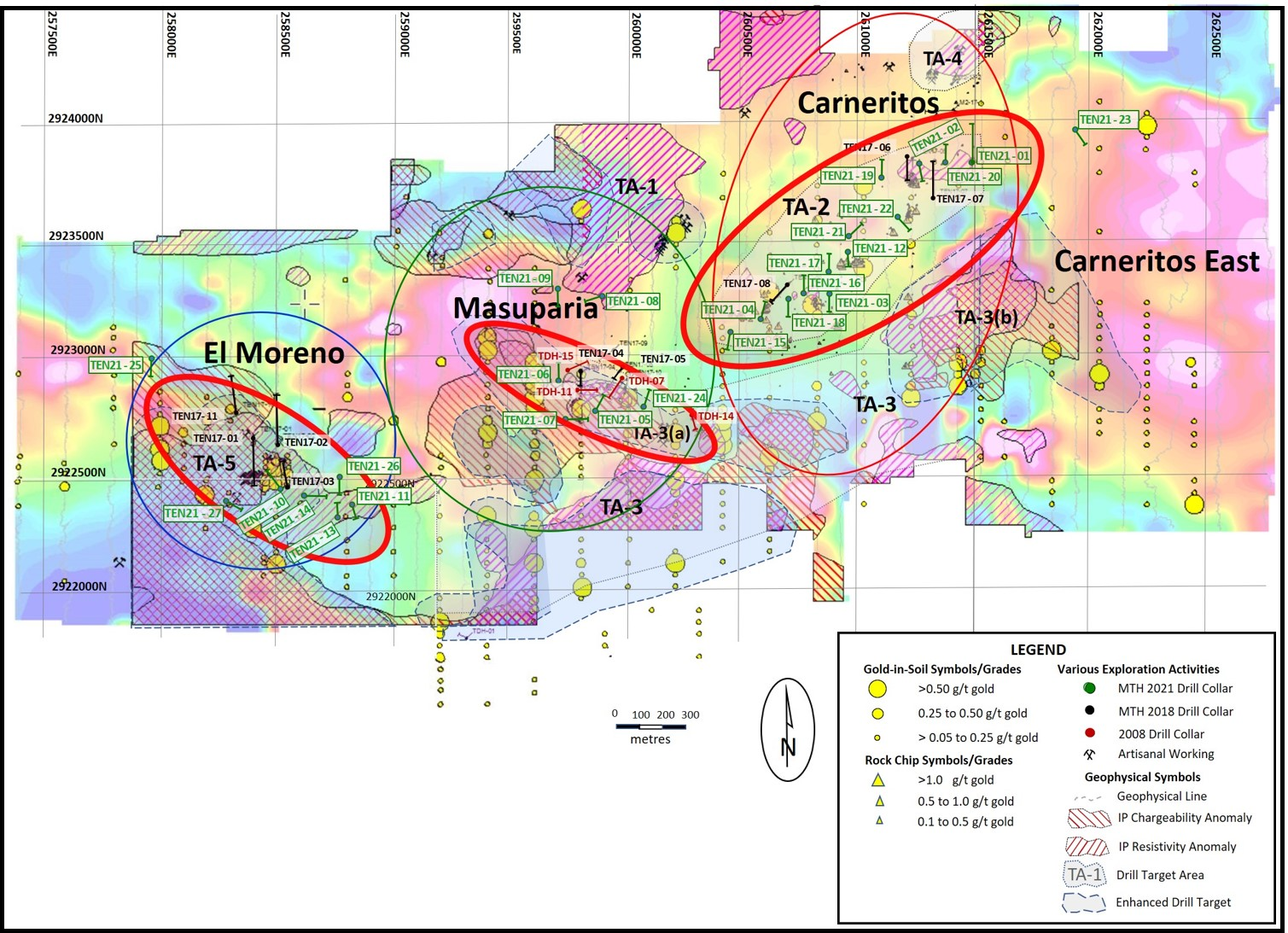
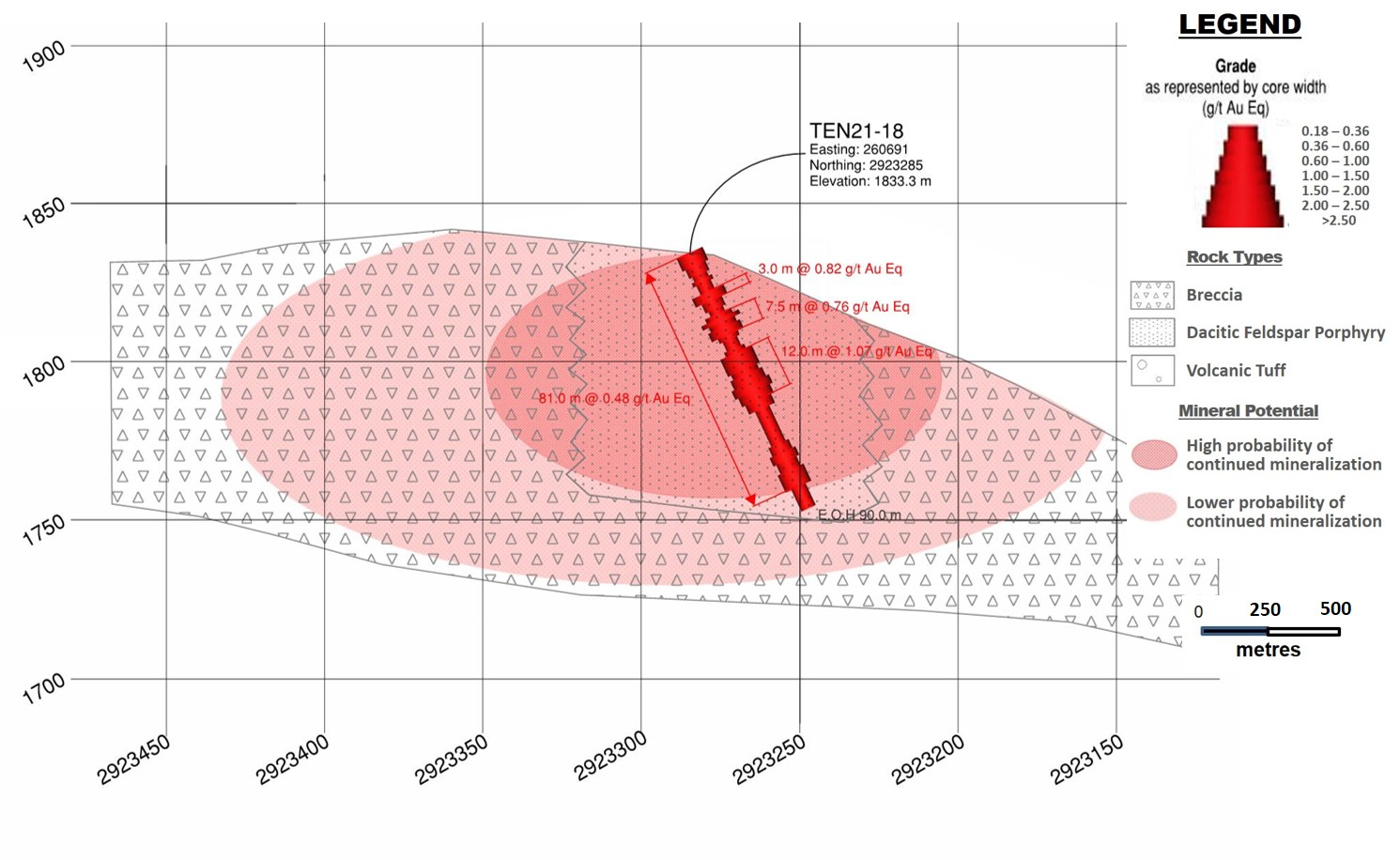
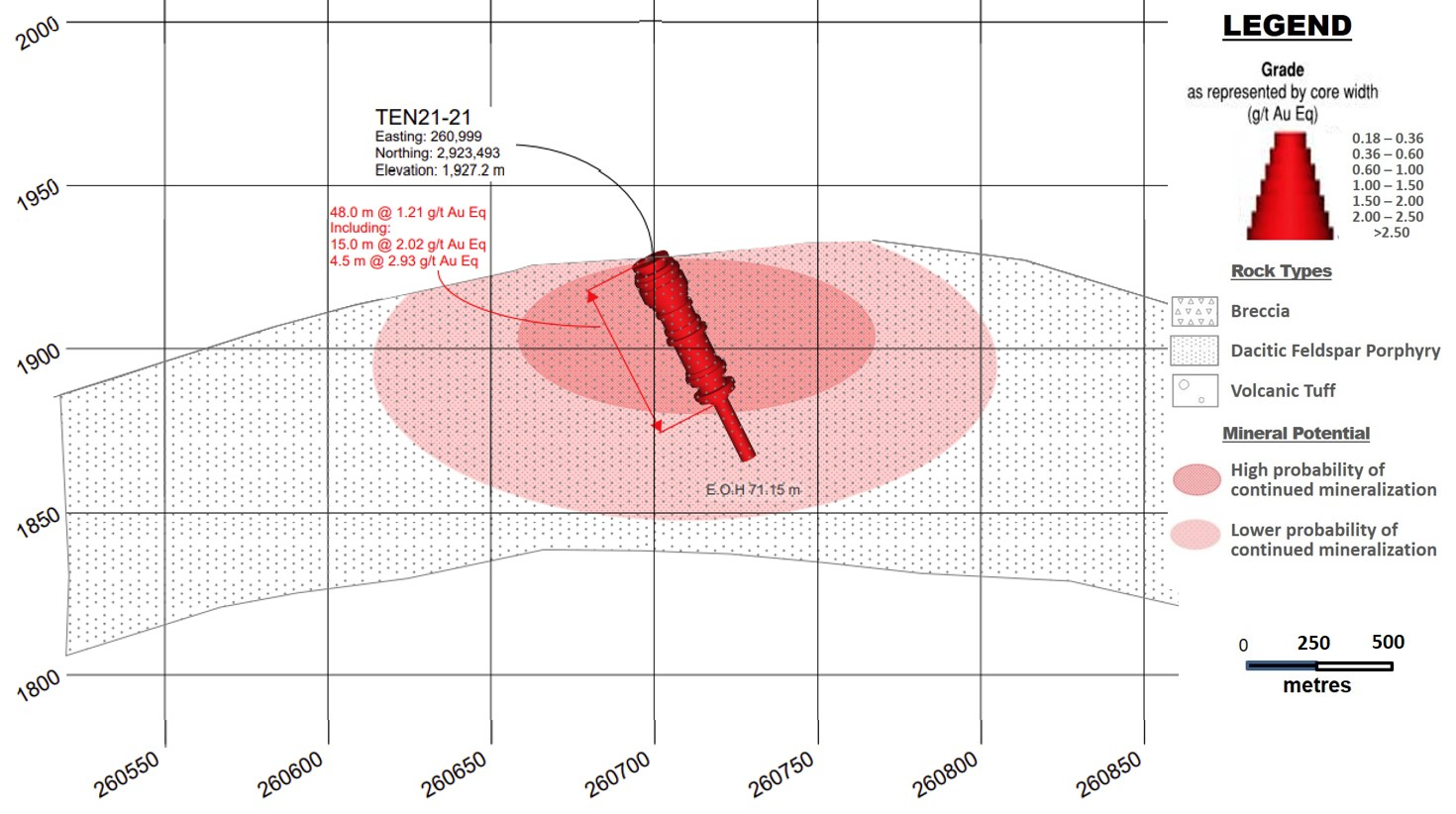
Mr. Thomas Atkins reports: Toronto, Canada – TheNewswire – August 04, 2022 – Mammoth Resources Corp. (TSXV:MTH), (OTC:MMMRF), (the “Company”, or “Mammoth”) is pleased to provide results from an additional four drill holes from its diamond drilling program at its 100% owned Tenoriba gold-silver property located in the Sierra Madre precious metal belt, Mexico. The drill program was designed to test up to five target zones which measure from hundreds of metres (m) to over one kilometre (km) in strike length along a 4 km, east-west trend of gold-silver mineralization identified in 3-dimensional (3D) modelling incorporating data from over 3,000 soil, chip and channel samples, 26 prior diamond drill holes, geological and structural mapping and the potential continuity at depth of surface mineralization as indicated by an Induced Polarization/Magnetometer (IP/Mag) geophysical survey. An additional four diamond drill holes have been completed for a total of 388.95 m bringing the total reported to date to 2,623.55 m in 21 holes. Refer to Figure 1 – Location Map, Tenoriba Property Drilling, 2021-22 (drill holes TEN 21-01 to 21-27). A summary of potentially economical intervals from the four drill holes from this press release are as follows in the table below. Thomas Atkins, President and CEO of Mammoth commented on the additional drill results, stating: “It’s encouraging to see additional successes in drilling within the large Carneritos area whereupon we’ve intersected mineralization over a greater than one kilometre by 500 metre area. It’s especially encouraging to see continued, greater than 80 metre intervals of potentially economical gold-silver mineralization and equally encouraging to see the 48 metre interval grading over 1.2 grams per tonne gold equivalent. These interval lengths and gold grades, taking into account they’re intersecting predominantly oxidized rock over tens of metres in this large target area, continue to support a bulk, open pit mining and heap leach gold extraction scenario, in-line with what we’d hoped for from this drilling. “Mammoth continues to block off areas hundreds of metres up to over a kilometre in size with significant step-outs from sparce historical drilling at Carneritos. Grades in this drilling are averaging those seen in multi-million ounce, High Sulphidation deposits currently being mined or under development by major mining companies in the same Sierra Madre district as Mammoth’s Tenoriba project.” Hole Weighted Average Gold Weighted Average Silver Weighted Average Copper Weighted Average Gold Equivalent Location Number From To Total Grade Grade Grade Grade (m) (m) (m) (g/t) (g/t) (%) (g/t) Carneritos TEN 21-18 0.0 81.0 81.0 0.45 2.2 0.48 (including) 13.5 16.5 3.0 0.81 0.3 0.82 (including) 21.0 28.5 7.5 0.71 3.4 0.76 (including) 36.0 48.0 12.0 1.03 2.9 1.07 TEN 21-19 3.0 13.7 10.6 1.14 17.9 1.38 (and) 45.0 55.0 7.5 0.37 16.2 0.58 (and) 91.5 100.5 9.0 0.20 8.5 0.32 TEN 21-20 4.5 34.5 30.0 0.32 3.5 0.36 (and) 46.5 54.0 7.5 0.33 3.8 0.39 TEN 21-21 0.0 48.0 48.0 1.11 7.4 1.21 (including) 0.0 15.0 15.0 1.58 2.9 1.62 (including) 7.5 12.0 4.5 2.88 3.8 2.93 Notes: Gold Equivalent where silver grade is converted to gold grade at 75 g/t silver = 1 g/t gold = 13.0 lbs copper. Mammoth attempts to drill as near perpendicular as believed to be the orientation of mineralized control features, however drill set-up location options can challenge this objective. Intervals shown are core lengths versus perpendicular, true widths of these mineralized features. Richard Simpson, Mammoth’s Vice President Exploration further commented on these results, stating: “Similar to what Tom is stating, I’m highly encouraged by these results, both the lengthy intervals and intervals at higher grades. Based on surface geology and sampling results we believed there was the potential for these higher grades. It’s terrific to be intersecting them over such interval lengths and we believe this bodes well for future drilling and a robust gold-silver mineral resource at Carneritos.” “Mammoth geologists are particularly excited by the mineral potential at Carneritos given its 1.4 kilometre by 500 metre size. The High Sulphidation target areas at Carneritos are similar, if not larger than those hosting million ounce plus reserves at other commercial mines in the same Sierra Madre belt as hosts Mammoth’s Tenoriba project. “Abundant surface gold-silver mineralization occurs within a large 1,400 metre long by at least 500 metre wide area typified by advanced, altered outcrops of rocks common in these High Sulphidation deposits. These rocks and their associated alteration assemblages, which coincide with geophysical features at depth, continue to support a collapsed volcanic dome depositional environment favourable for gold-silver mineralization at Tenoriba.” The drill results from this release compliment drill intervals from the following 17 previously released drill holes. Hole Gold Silver Copper Weighted Average Gold Equivalent Location Number From To Total Grade Grade Grade Grade (m) (m) (m) (g/t) (g/t) (%) (g/t) Carneritos TEN 21-01 7.5 45.0 37.5 0.31 17.1 0.53 (including) 36.0 40.5 4.5 0.47 75.2 1.47 TEN 21-02 No significant values TEN 21-03 0.0 43.5 43.5 0.54 3.6 0.59 (including) 19.5 25.5 6.0 0.69 2.7 0.73 (including) 30.0 34.5 4.5 0.67 4.6 0.73 TEN 21-04 0.0 19.5 19.5 0.53 7.3 0.63 Masuparia TEN 21-05 12.0 28.5 16.5 0.27 4.6 0.34 172.5 195.0 22.5 0.22 3.0 0.26 TEN 21-06 0.0 18.0 18.0 1.21 1.5 1.23 (including) 16.5 18.0 1.5 6.46 2.8 6.50 27.0 49.5 22.5 0.57 0.6 0.58 TEN 21-07 94.5 102.0 7.5 0.23 5.2 0.30 133.5 135.0 4.5 0.23 2.6 0.26 TEN 21-08 60.0 73.5 13.5 0.30 6.4 0.40 103.5 111.0 7.5 0.22 1.3 0.24 Masuparia TEN 21-09 No significant values Moreno TEN 21-10 15.1 18.1 3.0 – 0.6 0.14 0.25 74.6 88.1 13.5 0.09 4.1 0.15 (including) 86.6 88.1 1.5 – – 0.20 0.33 TEN 21-11 1.5 7.5 6.0 0.20 3.0 0.25 27.0 42.0 15.0 0.34 2.1 0.37 (including) 36.0 42.0 6.0 0.59 2.9 0.63 Carneritos TEN 21-12 4.5 51.0 46.5 0.45 5.1 0.51 Moreno TEN 21-13 0.0 37.5 37.5 0.98 15.1 1.18 (including) 10.5 28.5 18.0 1.13 21.4 0.55 2.34 49.5 61.5 12.0 0.08 0.4 0.45 0.65 Moreno TEN 21-14 0.0 9.0 9.0 0.32 5.6 0.40 Carneritos TEN 21-15 24.0 54.0 30.0 0.52 8.4 0.63 (including) 46.5 51.0 6.0 0.85 12.5 1.02 (including) 37.5 40.5 3.0 0.86 26.3 1.21 TEN 21-16 0.0 12.0 12.0 0.60 0.7 0.61 (and) 24.0 102.2 85.7 0.44 2.3 0.47 (including) 24.0 30.0 6.0 0.92 3.1 0.97 TEN 21-17 0.0 33.0 33.0 0.60 2.8 0.64 (including) 0.0 9.0 9.0 1.06 1.2 1.07 Drill Hole Description: Mammoth initially drilled 2 to 4 holes at significant, up to 250 m drill spacings, within each target area then moved to another target area to drill a similar number of holes (please refer to press release dated July 22, 2021 for target zones). Company geologists would wait for the results from these initial 2 to 4 drill holes in a target area prior to returning to the area to follow up drilling of these areas based on the results from the initial holes. Where mineralized intervals were intersected in the initial sequence of drilling, or where holes failed to encounter mineralization as suggested by the data, the location of follow up holes were based on the combination of results from the initial sequence of drill holes combined with surface geology, soil, chip and channel sample results, geophysics data and ease/complexity of drill access. These field assessments were used to assist in defining additional drill collar locations for these follow up holes in order to understand and test the controls and continuity to gold-silver mineralization. Drill holes TEN 21-18 through TEN 21-21 were all collared in the Carneritos target area where abundant surface gold-silver mineralization occurs within a large 1,400 metre long by up to 500 metre wide area typified by advanced argillic altered outcrops of dacite porphyry and associated breccias with alteration assemblages of kaolinite, abundant dickite, silica and vuggy silica. These altered volcanic rocks coincide with a geophysical magnetic low. The magnetic low is believed to be the result of the destruction of magnetic minerals by intense mineralizing hydrothermal fluids, the same fluids responsible for the alteration assemblages. These combined features are common within High Sulphidation (HS) altered volcanic rocks, typical of a collapsed volcanic dome. Drill Hole TEN 21-18 Drill Hole TEN 21-18 was collared in the epithermal HS gold-silver mineralized system in the Carneritos area. The hole was drilled to a depth of 88.5 m of a planned 100.0 m at 65 degrees decline/dip, azimuth 180 degrees. The hole was collared approximate 100 m east of TEN 21-04 and 200 m west of hole TEN 21-03. Hole TEN 21-18 was drilled to in-fill the southwestern portion of the mapped area of the HS mineralizing system at Carneritos over altered and mineralized outcrops/sub-crops of dacitic volcanic breccia on surface and a combined low IP geophysical resistivity and chargeability features with low magnetic features identified from the 2021 infill geophysics survey. Holes TEN 21-03 and 04 returned 43.5 m grading 0.59 g/t gold Eq and 19.5 m grading 0.63 g/t gold Eq, respectively. Drill hole TEN21-18 intercepted from surface to bottom of the hole at 88.5 metres highly weathered – fractured and generally argillized and oxidized dacite porphyry. Silica alteration was present only locally and was generally weak. The hole did not reach its targeted depth as it was abandoned due to poor ground conditions as drill rods tightened and were at risk of being lost. The hole returned potentially economical gold Eq values over the entire core interval and given it had to be abandoned due to poor ground conditions, it is believed that additional potential exist for continued gold-silver mineralization at greater depths. Refer to Figure 2 – Drill Section, Drill Hole TEN 21-18 (looking east). Drilling in 50 to 100 m step-outs to the south and southeast are recommended to test the continuity and extent of gold-silver mineralization in these directions at Carneritos. Drill Hole TEN 21-19 The hole was collared in the epithermal HS gold-silver mineralized system in the Carneritos area. Drill hole TEN 21-19 was drilled to a depth of 122.0 m of a planned 150.0 m at 70 degrees decline/dip, azimuth 360 degrees. The hole was collared approximately 140.0 m southwest of hole TEN17-06. Hole TEN 21-19 was drilled to in-fill the northeastern portion of the mapped area of the HS mineralizing system at Carneritos where a 100 m deep vertical IP, resistivity feature exists underneath altered and mineralized dacite porphyry and associated breccia on surface associated with advanced argillic alteration identified by Terraspeck (alteration clay analysis) analysis on surface samples and within 2017 drill core wherein the presence of dickite, silica, pyrophyllite and vuggy silica were observed. Hole TEN17-06 returned 126.2 m grading 0.59 g/t gold Eq, including 58.2 m grading 0.80 g/t gold Eq. Drill hole TEN 21-19 intercepted in the first 13.7 m highly weathered and oxidized, moderately to strongly silicified volcanic breccia with dickite, alteration clay infilling irregular fractures. Below 13.7 m the rock was moderately, argillized lithic crystal volcanic tuff which continued to a depth of 90.4 m of which the first approximate 15 m to approximately 30 m, was also highly oxidized. The core contained 5% fine disseminated pyrite and local black sulfide infilling irregular fractures. From 90.4 to 103.3 m, the core consisted of weakly to moderately silicified volcanic breccia with dickite infilling irregular fractures with up to 12% disseminated fine pyrite followed by a similar lithic crystal volcanic tuff (as described above), down to 108.1 m. From 108.1 m to 122.0 m the core consisted of weakly argillized/sericitized dacite porphyry with up to 10% disseminated pyrite. The hole successfully identified the IP, geophysics resistivity feature by the presence of the silicified volcanic breccia from 90.4 to 103.3 m. The hole also identified numerous intervals of variably altered and/or mineralized dacite porphyry and associated breccia with late event faults ere observed to be displacing stratigraphy and mineralization. It is recommended that detailed surface mapping of structural, stratigraphic and alteration features be performed in this area prior to drill hole targeting to better understand controls to mineralization in an effort to define the northcentral-northeastern limits to gold-silver mineralization at Carneritos. Drill Hole TEN 21-20 The hole was collared in the epithermal HS gold-silver mineralized system in the Carneritos area. Drill hole TEN 21-20 was drilled to a depth of 108.3 m of a planned 125.0 m at 80 degrees decline/dip, azimuth 360 degrees. The hole is collared approximately 100.0 m west of hole TEN 21-01. Hole TEN 21-20 was drilled to in-fill the northeastern portion of the mapped area of the HS mineralizing system at Carneritos where a 100 m deep vertical IP, geophysical resistivity feature was observed and to test the continuity of gold-silver mineralization in this portion of the Carneritos area where Hole TEN 21-01, 100 m east of hole TEN 21-20 returned 37.5 m grading 0.53 g/t gold Eq. Drill hole TEN 21-20 intercepted from surface to bottom at 108.3 m the dacite porphyry unit of which the first 18.7 m corresponds to weathered oxide zone followed by a sulfide-oxide transition zone down to 21.5 m. In addition, down to 34.35 m minor oxide filled fractures are present consisting of up to 7% disseminated pyrite and minor irregular black sulfide stringers. Results from this hole failed to explain the buried IP geophysical feature. The hole was successful in identifying almost 50 m of potentially economical gold-silver mineralization tens of metres of economical gold-silver mineralization within what is interpreted as an altered dacitic porphyry dome at Carneritos. Further drilling is recommended 50 to 100 m to the north and south of this hole to assist in defining the northeastern limits to gold-silver mineralization at Carneritos. Drill Hole TEN 21-21 The hole was collared in the epithermal HS gold-silver mineralized system in the Carneritos area. Drill hole TEN 21-21 was drilled to a depth of 71.15 m of a planned 100.0 m at 60 degrees decline/dip, azimuth 060 degrees. The hole is collared approximately 60.0 m north of hole TEN 21-12. Hole TEN 21-21 was drilled to infill the drill spacing within the central portion of the mapped area of the HS mineralizing system at Carneritos where altered dacite porphyry and associated breccias have been mapped on surface and sub vertical flow banding are present in outcrops. The hole was designed to intercept close to perpendicular the flow bands. Hole TEN 21-12, returned 46.5 m grading 0.51 g/t gold Eq. Drill hole TEN 21-21 intercepted from surface to the bottom of the hole at 71.15 m moderately to strongly silicified dacite porphyry with various breccia intervals and presence of dickite alteration clay infilling irregular fractures and veinlets and replacing feldspar phenocrysts and generally low volumes (1%) disseminated pyrite. The unit is oxidized down to a depth of 47.2 m. The hole was successful in intercepting almost 50 m of higher than 1.2 g/t gold Eq gold-silver mineralization, one of the highest grade-thickness holes drilled at Carneritos to date. Refer to Figure 3 – Drill Section, Drill Hole TEN 21-21 (looking east). Further drilling from 50 to 200 m to the north, west and northwest of this hole is recommended to assist in defining the northcentral limits to gold-silver mineralization at Carneritos. Qualified Person / Quality Controls: Richard Simpson, P.Geo., Vice-President Exploration for Mammoth Resources Corp. is Mammoth’s Qualified Person, according to National Instrument 43-101 for the Tenoriba property and is responsible for and has reviewed any technical data mentioned in this news release. Samples referenced in this press release were prepared and analyzed by ALS laboratories (ALS) in their facilities in Mexico and Canada, respectively. Samples generally consisted of a minimum of 2 kilograms of material. Drill core is mostly HQ diameter core with minor lengths of NQ diameter core. Core is sawn in half with a rock saw with one half used for sample analysis purposes. Where samples are taken these are most often 1.5 metres in length, only in poor recovery sections do they exceed this length, with rare exceptions exceeding a maximum of 4.5 metres in length. Samples are collected with sample ticket and deposited into plastic sample bags sealed with nylon zip lock ties, then loaded into grain sacs similarly sealed with a nylon zip lock tie prior to transport by Mammoth personnel to ALS’s facility in Chihuahua, Mexico for sample preparation. Gold and silver analyses are performed in ALS’s facility in Canada via a 30-gram fire assay with an atomic absorption finish. Silver, copper, lead and zinc are analyzed as part of a multi-element ICP package using a 4-acid digestion. Any over limit samples with greater than one percent copper, lead and zinc are re-analyzed using ore grade detection limits. Blank and duplicate samples are inserted randomly at approximately every 15 samples. About Mammoth Resources: Mammoth Resources (TSX-V: MTH) is a precious metal mineral exploration Company focused on acquiring and defining precious metal resources in Mexico and other attractive mining friendly jurisdictions in the Americas. The Company holds a 100% interest (subject to a 2% net smelter royalty purchasable anytime within two years from commencement of commercial production for US$1.5 million) in the 5,333-hectare Tenoriba gold property located in the Sierra Madre Precious Metal Belt in southwestern Chihuahua State, Mexico. Mammoth is seeking other opportunities to option exploration projects in the Americas on properties it deems to host above average potential for economic concentrations of precious metals mineralization. To find out more about Mammoth Resources and to sign up to receive future press releases, please visit the company’s website at: www.mammothresources.ca., or contact Thomas Atkins, President and CEO at: 416 509-4326. Neither the TSX Venture Exchange nor its Regulation Services Provider (as that term is defined in the policies of the TSX Venture Exchange) accepts responsibility for the adequacy or accuracy of this release. Forward Looking Information:This news release may contain or refer to forward-looking information. All information other than statements of historical fact that address activities, events or developments that the Company believes, expects or anticipates will or may occur in the future are forward-looking statements; examples include the listing of its shares on a stock exchange and establishing mineral resources. These forward-looking statements are subject to a variety of risks and uncertainties beyond the Company’s ability to control or predict that may cause actual events or results to differ materially from those discussed in such forward-looking statements. Any forward-looking statement speaks only as of the date on which it is made and, except as may be required by applicable securities laws, the Company disclaims any intent or obligation to update any forward-looking statement, whether as a result of new information, future events or results or otherwise. Although the Company believes that the assumptions inherent in the forward-looking statements are reasonable, forward-looking statements are not guarantees of future performance and, accordingly, undue reliance should not be placed on these forward-looking statements due to the inherent uncertainty therein. Figure 1 – Location Map, Tenoriba Property Drilling, 2021-22 (drill holes TEN 21-01 to TEN 21-27) Figure 2 – Drill Section, Drill Hole TEN 21-18 (looking east) Figure 3 – Drill Section, Drill Hole TEN 21-21 (looking east)
It was signature Uhuru Kenyatta to hug his peers and give them backslaps like none of them. PHOTOS | POOL In the past 10 years the Kenyan president has perpetuated an unblinking business-led foreign policy in the region, playing the main character in the play. As he exits the stage, he might well say, with his bow to the audience: “East Africa is our plate. You don’t pee where you eat,” writes Charles Onyango-Obbo. Kenyan President Uhuru Kenyatta’s political rodeo will end a few weeks after the August 9 General Election. With that, the East African Community (EAC) will see the departure of its most extroverted president. There was more, though, to Uhuru’s gregariousness than a happy lad. The late Tanzanian president, John Magufuli, was a combative, prickly, volatile and quarrelsome leader who got things done. His government had trade disputes with nearly all his neighbours and, in an unforgettable “up yours” moment, set day-old chicks from Uganda and Kenya on fire. By July 2019, the trade fight with Kenya had reached a fever pitch. Uhuru jumped on his plane and headed for Dar es Salaam to massage Magufuli’s feelings. He went one better, visiting Magufuli’s ailing mother and the grave of father. He melted combative Magufuli’s heart. A weepy Magufuli spoke of how he was touched by Uhuru’s kind-heartedness and gifted him four peacocks, a gesture, which he said, had great significance in Tanzania’s history. Read: Kenyatta arrives in Tanzania for two-day private visit For effect, Magufuli said that he had never gifted any other Head of State the birds, nor was he planning to do so again. He died in March 2021 before he could go back on his word. It was signature Uhuru to hug his peers and give them backslaps like none of them. His most hearty hugs and backslaps were handed out to Rwanda President Paul Kagame, Ethiopian Prime Minister Abiy Ahmed and, curiously, newcomer Democratic Republic of Congo’s President Felix Tshisekedi. President Uhuru Kenyatta receives Democratic Republic of Congo President Felix Tshisekedi at State House Nairobi on June 20, 2022. PHOTO | PSCU He was less handsy with Uganda’s President Yoweri Museveni, an avuncular philosophising germaphobe who is averse to public cuddling but accorded him the reverence of an elder. He handled South Sudan’s fragile President Salva Kiir like a delicate pot. When newish Burundi President Evariste Ndayishimiye broke the Pierre Nkurunziza-era isolation and visited Kenya in May 2021, the first time in nearly a decade that a Burundian leader had dropped in the country, Uhuru buttered and treated him like a long-lost brother. Ndayishimiye grinned happily throughout the visit. Uhuru Kenyatta receiving President Evariste Ndayishimiye of Burundi at State House, Nairobi, in June 2022. PHOTO | PSCU He liked to give PM Abiy massive bear hugs, and they would walk hand-in-hand, chuckling away. When new Tanzanian President Samia Suluhu Hassan visited Kenya in May 2021, Uhuru brought out the best family silver and laid on elite-level pampering for her. With a rare pro-Suluhu chorus in the Kenyan media during her visit, the Tanzanian president was visibly pleased. Ethiopian Prime Minister Abiy Ahmed (left) and Kenyan President Uhuru Kenyatta embrace during the Kenyan leader’s visit to Addis Ababa on November 14, 2021. PHOTO | POOL If it hadn’t been for the lingering social distancing of Covid-19, the awkwardness men feel around powerful women, and the austere signals sent by Suluhu’s hijab, Uhuru would probably have kissed her hand. Also read: A region on the fly: Queen Samia and the five East African kings As president, Uhuru was East Africa’s champion hugger and backslapper. If it were only about pressing the flesh, it would have gone down in history as little more than feel-good. But it wasn’t. Uhuru Kenyatta receiving President Hassan Sheikh Mohamud of Somalia during his official visit at State House, Nairobi on July 15, 2022. PHOTO | PSCU It was partly a posture that allowed him to leverage soft power and steward the ever-expanding business interests of corporate Kenya in the region. And, too often panned at home, he seemed to find refuge in East Africa. The result of the latter was that there were more peace meetings held in Nairobi during Uhuru’s presidency than in any other EAC capital. When South Sudan descended into a deadly war again in 2013, the warring parties gathered in Nairobi under Uhuru’s watch to talk peace. Uhuru Kenyatta receiving South Sudan President Salva Kiir at State House, Nairobi, in June 2022. PHOTO | PSCU When the horrors of the Tigray war against the Ethiopian government eventually forced the adversaries to yield to negotiation, the Tigrayan rebels suggested that Uhuru host peace talks with Addis Ababa. As the security situation in eastern DR Congo deteriorated sharply this year, Uhuru hosted the rebels and the Kinshasa government to seek a settlement. A good part of all this is about oiling the wheels for Kenyan business. The chest bumps with Tshisekedi were not just boys’ play. It had money written all over it. During his presidency, Uhuru unlocked doors for companies like Equity Bank to enter DR Congo, make acquisitions and become the country’s second-largest bank in a blink. Profits for Kenyan banks in the East African region have soared. Read: Equity to fund Kenyan businesses in DRC cities His glad-handing of Abiy might well have helped telco giant Safaricom, East Africa’s most profitable company, to gain a foothold in the lucrative but closed 120-million-people Ethiopian market. Unsurprisingly, in June last year, Uhuru flew to Addis Ababa on an official visit that included witnessing the formal award of a telecom operating licence to a consortium led by Safaricom. Uhuru Kenyatta after talks with his host Rwanda President Paul Kagame in Kigali in 2019. PHOTO | PSCU His East African canoodling also represented perhaps the strongest stream of continuity with the policies of his predecessor Mwai Kibaki. Kibaki pushed a neutralist “don’t-rock-the-boat” policy with the rest of East Africa. Thus, like Kibaki, Uhuru prevaricated and buried the dispute with Uganda over the pint-sized Migingo island in Lake Victoria in diplomatic niceties and promises of task forces to look into it. He was not going to die on that island. Read: Kibaki was East Africa’s ‘good thief in the night’ This unblinking business-led foreign policy is uniquely Kenyan in the region. For the past nearly 10 years, Uhuru has been the main character in the play. As he exits the stage, he might well say with his bow to the audience: “East Africa is our plate. You don’t pee where you eat.” -The author is a journalist, writer, and curator of the “Wall of Great Africans”. [email protected] Transport costs in the region are at $1.8 per km, which is way above international best practices. Top Russia, US envoys made trips to Kampala within eight days of each other, and Museveni is looking to gain from both global powers.
This story was produced by the State College regional bureau of Spotlight PA, an independent, nonpartisan newsroom dedicated to investigative and public-service journalism for Pennsylvania. Sign up for our regional newsletter, Talk of the Town. STATE COLLEGE — More than two weeks after unsealed search warrants revealed at least one Pennsylvania State University athlete was reportedly extorted last fall into sending sexually explicit photos and videos of themselves and others, the university has refused to answer specific questions about how it handled the situation. University officials rebuffed Spotlight PA’s questions about whether all individuals who were filmed naked or partially naked have been identified and notified. Penn State also declined to specify how many students were involved, when exactly campus police were brought in, and whether additional crimes were investigated. According to the search warrants, the videos showed naked or partially naked people in the locker room of the Penn State football team. Videos showing multiple men having sex with a woman were also shared with the alleged extortionist, law enforcement officials said in the documents. Penn State successfully petitioned to have the search warrants sealed earlier this year. Spotlight PA, with the Centre Daily Times, and WJAC-TV, later filed a motion seeking to reverse that decision, citing the public’s right to such records. In two separate statements, the university said it would not share additional information because of an “open investigation,” but would not clarify whether it was referring to an internal investigation conducted by the university or the potential federal investigation related to the situation. Lisa Powers, senior director of university public relations, told Spotlight PA in a July 20 email police “have found no evidence to indicate that the sexual acts depicted in the videos are not consensual.” The few known details of the alleged extortion stem from four recently unsealed search warrants and a handful of court filings. In late September 2021, according to the warrants, a student athlete at Penn State told campus police he was the victim of an extortion scheme targeting university athletes carried out by a dating app user who he knew as “Li.” What started as a connection on a dating app escalated into the student sending dozens of sexually explicit photos and videos to the account operated by Li, who threatened to release the images if the student did not send more. The student, who is identified in the documents only as “VICTIM 2,” told police there were potentially five victims on campus facing similar circumstances. Another student athlete, identified only as “VICTIM 1,” told police that his Snapchat account was hacked and that sexually explicit images he stored on the app had been sent to another account. A Twitter account and Instagram accounts created in September publicized some of the images. In a public reply to a tweet by James Franklin, head coach of Penn State’s football team, one account posted a sexually explicity video of Victim 1. According to the search warrants, the post was flagged as abusive and removed. Victim 1 did not send images to Li when pressured to do so, according to the search warrants. However, over three weeks in September, Li’s demands were met by Victim 2, who sent explicit photos of himself and others, such as sex tape videos and recordings filmed inside the Penn State Football locker room. Some of the images and videos were stored on a public Dropbox folder publicized by one of the extortionist’s social media accounts. A detective with Penn State University Police accessed the folder in late September, the warrants detail. The detective reported finding 33 videos and one image in the folder, including seven videos labeled “GANGBANG on white girl” that showed group sex acts between one woman and multiple men. The folder also reportedly contained 19 videos filmed inside the Penn State football locker room showing student athletes in “various states of undress.” In late October, campus police were granted search warrants to gather information from Dropbox, Twitter, Snap Inc., and Facebook (now Meta, the parent company of Instagram). Centre County District Attorney Bernie Cantorna began his investigation in October. Cantorna closed his monthslong investigation in June at the request of the student athletes, according to court filings. No charges were filed, though court filings mention a potential federal investigation. A Centre County judge sealed the entire case at Penn State’s request. It was later unsealed following an appeal from Cantorna. On July 15, the judge made public copies of the search warrants with identifying information redacted. Soon after the search warrants were unsealed, Spotlight PA sent the university and Penn State police detailed questions related to its handling of the incidents and its investigations into possible crimes. The university responded the following day to the questions with a short statement providing few details about the status of the case or its handling of it. Spotlight PA followed up with more questions, including requests for clarifications to the statement, but the university said that it would not provide further information. The media outlet is publishing its entire email exchange with Penn State, which includes the full list of questions and the university’s replies. In particular, Spotlight PA sought to know whether everyone shown in the videos had been identified and notified about the alleged extortion plot. In one statement, the university said campus police have been working since September 2021 “in an attempt to identify both victims and suspects.” Penn State did not answer a question about whether that work had been completed. Penn State said in a separate statement that it had “found no evidence to indicate that the sexual acts depicted in the videos are not consensual.” The university would not answer a question about whether campus police have or plan to look into potential crimes contained in the videos or images it obtained. Based on the information provided in the search warrants, a number of state laws were potentially violated. Under Pennsylvania law, it is at minimum a first-degree misdemeanor to “sell, lend, distribute, transmit, exhibit, give away or show any obscene materials to any person 18 years of age or older.” Pennsylvania law also makes it a third-degree misdemeanor for anyone to photograph or film someone without their consent while that person is fully or partially nude and in a place where the person would expect privacy. The law considers it a separate crime for each victim, or if the same victim is photographed or filmed on separate occasions. More than one violation of the law makes the crime a second-degree misdemeanor. Spotlight PA asked whether campus police could determine that no minors were involved in the videos or photographs that were shared. The university would not provide an answer. Penn State did provide limited information related to Title IX and Clery Act concerns. Title IX is a federal law barring sexual harassment or discrimination based on gender in all federally funded educational settings. Under Penn State’s Title IX policy, coaches and assistant coaches are mandatory reporters if they learn of a potential violation. Penn State policy defines sexual exploitation to include “non-consensual visual or audio recording of sexual activity; non-consensual display or distribution of photos, images or information of an individual’s sexual activity or intimate body parts,” among other things. Penn State said in a statement that “the proper entities within the University were appropriately notified in a timely manner, including the Title IX Office and the Athletics Integrity Office, among others.” However, the university would not answer a question about whether a Title IX complaint was filed. The university would not answer a follow-up request for a list of all offices that were notified, nor would the university answer a request to provide more specific information about when those offices were alerted to the situation. The Clery Act, signed into law in 1990, requires universities and colleges to report crime statistics related to sexual assault, burglary, hate crimes, domestic violence, stalking, and intimidation, among others. The law requires Penn State to send “timely warnings” to its campuses when Clery Act offenses are reported. The university said it was “not aware of any Clery-reportable crimes associated with this investigation, and a timely warning is not required.” Spotlight PA asked for a copy of any information shared with students or student athletes notifying them about the situation. Penn State would not provide the requested information. You can send tips or questions about the case to Massey at [email protected] or 445-236-0562. See more secure ways to reach him here. SUPPORT THIS JOURNALISM and help us reinvigorate local news in north-central Pennsylvania at spotlightpa.org/statecollege. Spotlight PA is funded by foundationsand readers like you who are committed to accountability and public-service journalism that gets results. We believe everyone in Pennsylvania should have access to trusted public-service and investigative journalism. That’s why we don’t have a paywall on our site, charge a subscription fee, or clutter our articles with ads that have nothing to do with our state. Instead, we use the honor system. Each of our stories costs hundreds if not thousands of dollars to produce. If you learned something today, do your part and join our effort to rebuild reliable, high-quality local journalism in Pennsylvania by making a tax-deductible contribution of any amount. We can’t do this work without you.
Sign up for Spotlight PA’s free weekly newsletter and get our exclusive reporting, plus the most important news and events from our region.
Please refresh the page or navigate to another page on the site to be automatically logged inPlease refresh your browser to be logged in Former chancellor says he’s ‘particularly worried’ about policies that worsen crisis after protesters interrupt foreign secretary Find your bookmarks in your Independent Premium section, under my profile Sunak boasts of taking money from ‘deprived urban areas’ Rishi Sunak has told Tory members the party will lose the 2024 general election if inflation is not brought under control – in a veiled warning of the risks of electing as leader Liz Truss, who wants to slash taxes immediately. At a leadership hustings in Eastbourne, the former chancellor said he was “particularly worried about policies that risk making it worse and last longer”. As the event began, Ms Truss was heckled before resuming her speech to blame “infiltrators” and attack “unfair protests” that “interrupt our democracy”. Earlier, Mr Sunak was filmed boasting about diverting funding away from “deprived urban areas” towards more prosperous areas that “deserve” it. Labour’s Lisa Nandy urged the government to investigate the “deeply concerning” remarks made to grassroots Tories in Kent last month – uncovered in footage obtained by the New Statesman . He told supporters: “I managed to start changing the funding formulas, to make sure areas like this are getting the funding they deserve because we inherited a bunch of formulas from Labour that shoved all the funding into deprived urban areas and that needed to be undone.” Good morning! Welcome to The Independent’s rolling coverage of all things UK politics. Stay tuned for the latest. Liz Truss at Sky News’ The Battle for Number 10 last night insisted a recession is not inevitable when asked about the Bank of England’s forecast for an outright recession and 13 per cent inflation. She told the studio audience: “What the Bank of England have said today is of course extremely worrying, but it is not inevitable. We can change the outcome and we can make it more likely that the economy grows.” She said she wanted to keep taxes low and “do all we can to grow the economy by taking advantage of our post-Brexit freedom, unleashing investment, changing things like the procurement rules and doing things differently”. On the other hand, the former chancellor warned Ms Truss’s plan would make the dire economic situation worse, warning of “misery for millions” by pouring “fuel on the fire”. He said: “We in the Conservative party need to get real and fast because the lights on the economy are flashing red and the root cause is inflation. “I’m worried that Liz Truss’s plans will make the situation worse.” Rishi Sunak has accused Liz Truss of economic plans that would pour “fuel on the fire” just hours after the Bank of England warned the UK was heading for a recession. The former chancellor, who has argued that Ms Truss’s planned tax cuts are inflationary, told the Tory leadership debate organised by Sky News: “I’m worried that Liz Truss’s plans will make the situation worse.” Kate Devlin has more: Rival insists shrinking economy is not ‘inevitable’ Business leaders have voiced their concern over Liz Truss’s plans for a bonfire of Brussels regulations, after she said slashing EU red tape would be “a priority” in tackling the expected recession, writes Andrew Woodcock. Speaking ahead of a business round-table on Friday, the frontrunner to succeed Boris Johnson announced plans for a working group of industry leaders to help draw up new UK-only regulations in time for a “sunset deadline” of 2023 for the abolition of EU-derived laws which she believes are holding back the economy. But the Institute of Directors made clear that diverging from EU rules was not a demand of companies facing a cost of living crisis which the Bank of England believes could result in inflation above 13 per cent and five consecutive quarters of negative growth. Read more: Slashing EU red tape ‘a priority’ in plan to beat recession, says frontrunner in Tory race As Coleen Rooney might put it, the big revelation from the Sky News prime ministerial double-header was that the winner was………. Rishi Sunak. Presenter Kay Burley declared, betraying nothing more or less than the media conventional wisdom, “I wasn’t expecting that”. Perhaps, on the day the Bank of England forecast a year-long recession and 13 per cent inflation, the Tory membership is starting to realise they probably need someone leading them who has a passing acquaintance with economic sense? I wonder. Read this from Sean O’Gradyon yesterday’s Tory debate here: Liz Truss is all too keen to excuse Boris Johnson’s ‘mistakes’ – she could be as dangerous as him As Tory candidates clash over their economic policies, read what the Bank of England said about a possible recession from our chief business commentator James Moore. A recession is on the way, with inflation set to peak at 13 per cent. What’s really worrying is the way these projections are getting progressively worse each time the Bank updates them, writes James Moore From skeletons in their closets and clashes over their economic policies as the Bank of England warns of a long recession, Liz Truss and Rishi Sunak have discussed at length a range of topics during their latest televised debate. The two Tory leadership hopefuls took part in Sky News’ The Battle for Number 10 on Thursday night, which saw them separately taking questions from party members. They were also both interviewed by Sky News’ presenter Kay Burley. Here are the key points raised during the 90-minute-long TV event: The two Tory leadership hopefuls took part in Sky News’ The Battle For Number 10. Rishi Sunak has insisted that there is no point in which he would stand aside for Tory leadership rival Liz Truss, despite multiple polls placing the foreign secretary significantly ahead of the ex-chancellor. Mr Sunak insisted he will “fight incredibly hard ‘til the last day” of the leadership campaign, telling a Conservative party member in the audience that “the quick answer is no” when questioned whether there is a point at which he would step aside in the race to be leader. He said he is “fighting for something I really believe in and wants to “try and convince you all that I’m right”. Liz Truss, Kay Burley and Rishi Sunak ahead of the Sky News special programme Boris Johnson and chancellor Nadhim Zahawi are on holiday despite warnings of inflation further soaring and of the economy entering the longest recession since the financial crisis. With ministers taking a back seat as the Tory party is gripped by the leadership contest, both men were away from Westminster when the Bank of England detailed the brutal outlook. Labour accused the Chancellor and the prime minister of being “missing in action” as the cost-of-living crisis deepened further, with the Bank forecasting inflation could peak at 13.3%. Read more: Both men were away from Westminster as the Bank of England raised interest rates again and warned of the longest recession since the financial crisis. Liz Truss is facing the possibility of her first major sleaze probe amid claims she failed to declare “murky donations” related to her leadership campaign. Labour yesterday appealed to the cabinet secretary to open an investigation into the Tory frontrunner over funding for a so-called “Fizz with Liz” champagne dinner. The Independent reported that Ms Truss was facing questions about why she did not declare the thousands of pounds worth of hospitality spent on schmoozing Tory MPs. Our policy correspondent Jon Stonehas more: Labour writes to cabinet secretary demanding ‘urgent’ probe into ‘Fizz with Liz’ event Registration is a free and easy way to support our truly independent journalism By registering, you will also enjoy limited access to Premium articles, exclusive newsletters, commenting, and virtual events with our leading journalists {{#verifyErrors}} {{message}} {{/verifyErrors}} {{^verifyErrors}} {{message}} {{/verifyErrors}}
By clicking ‘Create my account’ you confirm that your data has been entered correctly and you have read and agree to our Terms of use,Cookie policy and Privacy notice. This site is protected by reCAPTCHA and the Google Privacy policy and Terms of service apply. Already have an account? sign in By clicking ‘Register’ you confirm that your data has been entered correctly and you have read and agree to our Terms of use,Cookie policy and Privacy notice. This site is protected by reCAPTCHA and the Google Privacy policy and Terms of service apply. Registration is a free and easy way to support our truly independent journalism By registering, you will also enjoy limited access to Premium articles, exclusive newsletters, commenting, and virtual events with our leading journalists {{#verifyErrors}} {{message}} {{/verifyErrors}} {{^verifyErrors}} {{message}} {{/verifyErrors}}
By clicking ‘Create my account’ you confirm that your data has been entered correctly and you have read and agree to our Terms of use,Cookie policy and Privacy notice. This site is protected by reCAPTCHA and the Google Privacy policy and Terms of service apply. Already have an account? sign in By clicking ‘Register’ you confirm that your data has been entered correctly and you have read and agree to our Terms of use,Cookie policy and Privacy notice. This site is protected by reCAPTCHA and the Google Privacy policy and Terms of service apply. Join thought-provoking conversations, follow other Independent readers and see their replies Getty Images Want to bookmark your favourite articles and stories to read or reference later? Start your Independent Premium subscription today. Please refresh the page or navigate to another page on the site to be automatically logged inPlease refresh your browser to be logged in Log in New to The Independent? Or if you would prefer: Want an ad-free experience? Hi {{indy.fullName}}
Thank you for visiting nature.com. You are using a browser version with limited support for CSS. To obtain the best experience, we recommend you use a more up to date browser (or turn off compatibility mode in Internet Explorer). In the meantime, to ensure continued support, we are displaying the site without styles and JavaScript. Advertisement Scientific Reportsvolume 12, Article number: 13105 (2022) Cite this article 472 Accesses 14 Altmetric Metrics details Anthropogenic carbon emissions are causing seawater pH to decline, yet the impact on marine calcifiers is uncertain. Scleractinian corals and coralline algae strongly elevate the pH of their calcifying fluid (CF) to promote calcification. Other organisms adopt less energetically demanding calcification approaches but restrict their habitat. Stylasterid corals occur widely (extending well below the carbonate saturation horizon) and precipitate both aragonite and high-Mg calcite, however, their mode of biocalcification and resilience to ocean acidification are unknown. Here we measure skeletal boron isotopes (δ11B), B/Ca, and U/Ca to provide the first assessment of pH and rate of seawater flushing of stylasterid CF. Remarkably, both aragonitic and high-Mg calcitic stylasterids have low δ11B values implying little modification of internal pH. Collectively, our results suggest stylasterids have low seawater exchange rates into the calcifying space or rely on organic molecule templating to facilitate calcification. Thus, despite occupying similar niches to Scleractinia, Stylasteridae exhibit highly contrasting biocalcification, calling into question their resilience to ocean acidification. At current anthropogenic carbon emission rates, surface seawater pH is predicted to fall below 7.8, and carbonate saturation states (Ω = [Ca2+] × [CO32−]/K*sp) will greatly reduce before the end of this century1. Such large-magnitude and (geologically) rapid ocean acidification is expected to be a key stressor for marine calcifying organisms2, with many studies showing a reduction in stony coral health, abundance, and calcification rates under low seawater pH conditions (e.g.3). Yet without detailed knowledge of coral biocalcification mechanisms and adaptive strategies the full impact of ocean acidification on these marine calcifiers remains unclear. Particular concerns have been raised as to the vulnerability of deep-sea corals that remain poorly studied and occupy niches that are likely to be at the limits of their carbonate saturation tolerance already4,5. Mineralogy plays an important role in dictating the susceptibility of carbonate to dissolution6,7. Calcite is a relatively dissolution-resistant form of CaCO3, typically adopted by unicellular foraminifera8. Aragonite is a more soluble polymorph, yet many organisms, including scleractinian corals, use this mineral9. As more magnesium is incorporated into calcite (up to ~ 140 mmol/mol Mg/Ca) its solubility increases towards that of aragonite7. Many organisms calcify using this intermediate solubility “high-Mg” calcite including Isidiid gorgonian “bamboo” corals10 and sea urchins11. As the Mg content of calcite increases further (> 140 mmol/mol Mg/Ca) the solubility of this high-Mg calcite falls below even that of aragonite. Organisms that adopt this more soluble mineral form to build their skeletons include crustose coralline algae12. With a diverse array of carbonate minerals used by marine organisms, different calcification pathways are required to construct and maintain these skeletons. However, there have been comparatively few studies where microsensors or pH sensitive dyes have been placed within living biocalcifiers to monitor pH at the site of calcification as they require sophisticated laboratory culture setup and cannot be applied to coral specimens post-mortem (e.g.13,14,15). Skeletal geochemistry is therefore the go-to approach for understanding the mineralisation process, with the boron isotopic composition (δ11B; 11B/10B ratio relative to the standard NIST SRM 951 in ‰) of marine carbonates shown to be a powerful tool to assess pH at the site of calcification16,17. Scleractinian corals and coralline algae adopt more dissolution-susceptible mineral forms, but calcify from fluids that are semi-restricted from ambient seawater and in which pH is biologically elevated to promote calcification. This “pH upregulation” varies by taxon, but in cold-water Scleractinia it is ~ 1 pH unit above ambient seawater16. This strong elevation of pH in the CF results in skeletal δ11B values > 8‰ higher than seawater borate values (Fig. 1; high ∆δ11B; where ∆δ11B = δ11Bcarbonate – δ11Bborate; Fig. 2)16,18,19,20,21,22. While photosynthetic coralline algae are restricted to the photic zone with its generally higher carbonate saturation states, the adaptation of pH upregulation has enabled azooxanthellate cold-water Scleractinia to live much deeper, even in undersaturated seawater conditions (Fig. 25). It has been suggested that biogenic aragonites that lack strong pH upregulation strategies (resulting in low ∆δ11B values) such as the benthic foraminifera Hoeglundina elegans have a more restricted habitat and only calcify when ambient seawater is oversaturated with respect to aragonite, in areas such as the shallow Bahamas platform (Fig. 223). Many studies have suggested that the increased buffering associated with pH upregulation will make Scleractinia resilient against moderate changes in ocean pH16,24, however others continue to highlight the potential vulnerability of these corals in the deep sea and question the energetic demands of this biocalcification strategy4,5,25. Coral δ11B plotted against δ11B of the borate ion in seawater (a function of pH; blue labels). Stylasterid corals (circles; this study) are compared to the well-characterised aragonitic scleractinian Desmophyllum dianthus16,30,31 that strongly upregulate pH at the site of calcification. D. dianthus replicates are averages and one shallow water fjord sample from McCulloch et al.16 was excluded because of high seawater pH variability at that site. Error bars denote the estimated uncertainty on seawater borate δ11B. Skeletal carbonate δ11B offset from δ11B of borate in seawater (∆δ11B)—a measure of calcifying fluid pH upregulation—compared to (A) mineralogy and (B) carbonate ion saturation of seawater (Ω) habitat. Stylasterid coral ∆δ11B are compared to published δ11B values for aragonitic scleractinia16,30,31, high-Mg calcitic bamboo corals32, calcitic and aragonitic foraminifera35, and crustose coralline algae18,21,22. Mineral solubility from7. Stylasteridae (Class Hydrozoa: Order Anthoathecata) are the second most diverse group of hard corals in the global ocean26,27. The majority of stylasterid species can be found below 50 m water depth making this an important, but poorly studied, deep-water coral family26,27. These Hydrozoan corals differ significantly from scleractinian corals in their ability to precipitate skeletons of either aragonite, high-Mg calcite, or in some cases, both mineral polymorphs26. Compared to Scleractinia, skeletal δ18O and δ13C in stylasterid corals are close to equilibrium with seawater28, however a positive covariation of these δ18O and δ13C ratios suggests that there may be at least some biological modification of the internal seawater carbonate chemistry28. Contrary to expectation, the stylasterid corals that deviate least from equilibrium δ18O and δ13C values were found to be aragonitic specimens (~ − 3‰) implying that there is less modification of internal carbonate chemistry than high-Mg calcitic specimens, despite their greater mineralogical vulnerability to dissolution28. While this may represent a mineralogical control on skeletal stable isotope values, little is known about how stylasterids biomineralize and are able to thrive in undersaturated seawater conditions. To address the gap in understanding of stylasterid coral biocalcification, we present the first skeletal δ11B, B/Ca, and U/Ca data obtained from stylasterid coral skeletons (Fig. 3). The samples in this study lived in seawater environments ranging from pH 7.86 to 8.04 (ΩArag. 0.9 to 2.0). They comprise two genera of stylasterid corals (Stylaster and Errina) that represent all three modes of stylasterid skeletal mineralogy: (i) solely aragonite, (ii) both aragonite and high-Mg calcite, and (iii) solely high-Mg calcite28,29. We use the same stylasterid specimens for which skeletal stable oxygen and carbon isotopes have been previously characterised28 for comparison with our carbonate system proxy results. Location of Stylasteridae coral samples used in this study. Base map shows GLODAP v2 gridded seawater pH (total scale) at 700 m65. Map drawn using Ocean Data View software (Version 4.6.5; https://odv.awi.de/)72. Replicate measurements of bulk stylasterid δ11B of the same individual were generally within 0.5‰ of each other (Fig. 1). Once δ11B replicates for each stylasterid specimen are averaged, mean δ11B values are typically within 1‰ of the estimated δ11B composition of borate in ambient seawater for each coral (Fig. 1). The only samples (excluding Stylaster ibericus) with mean δ11B values more than 1‰ higher than δ11Bborate were the high-Mg calcitic E. laterorifa (δ11B = δ11Bborate + ~ 1.5‰). We therefore find little appreciable difference in δ11B between high-Mg calcitic and aragonitic stylasterid corals that live in similar seawater pH conditions. The single Stylaster ibericus specimen in this study yielded anomalously high δ11B (and low B/Ca) compared to other aragonitic stylasterids. This is discussed in detail in the Supplementary Information; however, its inclusion here has little impact on our overall findings. We perform linear regression of stylasterid δ11B measurements against δ11Bborate. The following relationships include all stylasterid δ11B measurements (regardless of mineralogy; Eq. 1), aragonitic stylasterids only (Eq. 2), and weighted regression of aragonitic stylasterids (Eq. 3), against δ11Bborate (SE): The regression in Eq. (3) weights observations according to the inverse of the uncertainty on their mean skeletal δ11B measurements. For this, the range in δ11B of the two replicate analyses about the mean was used. In instances where this range was less than analytical uncertainty, a value of ± 0.16‰ was used instead. These equations open the possibility to utilise stylasterid corals as archives for past seawater pH reconstruction (Supplementary Information). B/Ca replicate measurements made on individual pieces of stylasterid coral were typically within 7% for each specimen. U/Ca measurements were considerably more variable between replicates, on average differing by 14% for both aragonitic and calcitic specimens. Mean B/Ca and U/Ca values for high-Mg calcitic specimens were generally lower (< 330 and < 110 µmol/mol respectively) than aragonitic stylasterids (average 918 and 392 µmol/mol respectively) (Figs. 4 and 5). B/Ca and U/Ca results for the mixed mineralogy species E. gracilis lie on a mixing line between pure aragonitic specimens and high-Mg calcitic specimens, though falling closest to the pure aragonites, consistent with their 92 to 96 weight percent aragonite content28 (Figs. 4 and 5). Carbonate B/Ca against δ11B. Stylasterid B/Ca and δ11B replicate results (this study) are compared to fibrous aragonite within scleractinia (D. dianthus )47, and crustose coralline algae (CCA18,21). Individual analyses from the same specimens are connected by solid trend lines (2 analyses or more). Dashed trendline shows the covariance between all aragonitic stylasterid measurements (p < 0.01). Blue arrow shows theoretical mixing line between solely aragonitic and solely high-Mg calcitic stylasterids. Coral U/Ca against (A) δ18O and (B) δ11B (C) B/Ca. Stylasterid U/Ca, B/Ca, and δ11B data are from this study, paired with δ18O measurements in the same specimens28. Scleractinian D. dianthus data are from micro-sampled specimens by Chen et al.53 and Stewart et al.47. Individual analyses from the same specimens are connected by solid trend lines (2 analyses or more). Dashed trendlines show the covariance between all aragonitic stylasterid measurements (p < 0.01). Where there were differences between B/Ca and δ11B duplicate measurements (i.e. > 0.2‰; n = 6; excluding S. ibericus), in all cases B/Ca was found to be negatively correlated with δ11B for both aragonitic and mixed mineralogy specimens (Fig. 4). U/Ca values in aragonitic stylasterids show little covariance with previous δ18O measurements in the same specimens (Fig. 5A; 28), but positive covariance with skeletal δ11B measurements (Fig. 5B), and slight negative covariance with B/Ca (Fig. 5C). These generalised trends hold both between specimens and between sample replicates (Figs. 4 and 5). The most important result in this study is the low skeletal δ11B measured in all stylasterid corals (Fig. 1) with no apparent offset from ambient seawater δ11Bborate (low ∆δ11B; Fig. 2). These results are in stark contrast to high ∆δ11B values recorded in scleractinian corals16,30,31 and coralline algae18,21,22 known to strongly modify pH at the site of calcification to promote mineral growth (Fig. 2). Instead, the low ∆δ11B values we record in stylasterid corals are more similar to bamboo corals32, sea urchins11,33, bivalves33,34, and unicellular foraminifera (e.g. Cibicidoides wuellerstorfi or H. elegans)35 (Fig. 2). However, many of these organisms are composed of dissolution-resistant mineral forms (e.g. calcite). Stylasterids on the other hand, while not the first aragonitic taxon to exhibit low skeletal δ11B (e.g. H. elegans), are the first to show this feature whilst living at depths close to and below the carbonate saturation horizon36. Assuming that stylasterid δ11B reflects the pH of the CF according to the abiotic relationship between the borate ion and pH (Eq. (4); Methods; e.g.16,17), these δ11B results suggest no modification of internal seawater pH in stylasterids. Furthermore, application of a physiochemical biocalcification model based on scleractinian corals by DeCarlo et al.37 (Methods), the high B/Ca values in our aragonitic stylasterids imply low [CO32−] in the CF (average 110 µmol/kg excluding S. ibericus) similar to external seawater (average 90 µmol/kg). Low [CO32−] in the CF would in turn translate to low CF ΩAragonite (average 1.5 excluding S. ibericus; 4 corals have ΩAragonite < 1). This contrasts with similar modelling of δ11B and B/Ca data in scleractinian corals which suggest CF ΩAragonite is typically more than 5 times that of ambient seawater38. Although our estimates for stylasterid CF ΩAragonite represent minimum values (i.e. no transport of Ca2+ to the CF), it remains hard to explain how stylasterids commence calcification at all at such low saturation states. Like stylasterid corals, the δ11B of many foraminifera record the δ11B of borate and thus external seawater pH35,39, however microsensor studies show the pH of foraminiferal CF is actually slightly elevated (+ 0.5 pH units)40. We therefore explore alternative mechanisms that may facilitate mineralisation at low Ω and/or decouple the boron skeletal chemistry from calcification processes including: (i) bicarbonate active transport41, (ii) high boric acid to seawater flushing rates25, and (iii) organic molecule templating42. Despite cold-water scleractinian corals strongly upregulating pH, unusually low δ11B values (8.5‰) have been observed in their centres of calcification (or early mineralisation zones), particularly in Lophelia pertusa41,43,44. This disconnect between the internal pH and skeletal δ11B has been explained by bicarbonate (HCO3−) active transport to the site of calcification41. The use of HCO3− as a source of DIC rather than CO2 (from respiration and diffusion) promotes mineralisation as it releases fewer protons during conversion to CO32−. The bicarbonate active transport model suggests that seawater borate is co-transported to the site of calcification, resulting in low skeletal δ11B values closer to seawater borate41. While this mechanism could explain low δ11B values in stylasterid corals, studies of the scleractinian coral Lophelia pertusa suggest that these centres of calcification are also associated with low B/Ca compared to the bulk coral (− 40%)41,44. This contrasts with the extremely high B/Ca values we observe in our aragonitic stylasterid corals compared to Scleractinia, suggesting an alternative mechanism is driving their boron skeletal chemistry. Another approach to reconciling discrepancies between pH derived from microsensors and geochemistry comes from coral modelling work by Gagnon et al.25. In this model, internal scleractinian pH is held at a high, but constant, value of 8.9 (resulting in their characteristic high ∆δ11B) and low skeletal δ11B values are instead explained by higher rates of boric acid diffusion (DB) relative to seawater exchange in the CF (kz; where k is the rate of seawater exchange and z is the volume to surface area ratio of the CF); where DB/kz scales linearly with seawater dissolved inorganic carbon ([DIC]). High DB/kz may therefore explain the low δ11B values in stylasterid corals, with low seawater flushing rates allowing them to occupy hostile growth environments (e.g. ΩAragonite as low as 0.5 (depths > 500 m) in the high latitude North Pacific45). To explore this hypothesis further, we use U/Ca and B/Ca ratios, with their sensitivity to the carbonate chemistry of seawater to test the potential role of DB/kz in stylasterids. A positive correlation between carbonate δ11B and B/Ca is readily explained because at high pH more of the boron is in the borate ionic form and readily incorporated into the carbonate lattice46. This phenomenon has been observed in scleractinian corals47 and crustose coralline algae18,21 (Fig. 4). However, we find the opposite—a negative correlation between δ11B and B/Ca in sample replicates of stylasterid corals and particularly high B/Ca ratios in aragonitic specimens which cannot be explained by this effect. Although boron is preferentially incorporated into an aragonite lattice over calcite 48, this cannot account for the near double skeletal boron concentration in aragonitic stylasterids compared to scleractinian corals with the same mineralogy. While this may imply low concentrations of [DIC] and/or [CO32−] (e.g. DeCarlo et al.37 model (Methods)), an alternative explanation for high B/Ca ratios and the negative correlation between δ11B and B/Ca in stylasterid corals is high DB/kz. Higher rates of boric acid diffusion relative to seawater exchange would simultaneously drive δ11B low whilst increasing [B] in the CF, thus driving B/Ca high (i.e. high [B]/[DIC]49). The pH and/or [CO32−] dependency of uranyl ion complexation in seawater gives a strong theoretical basis for the sensitivity of coral U/Ca to the carbonate system50,51. The master variable however is not clear and many potential drivers of coral U/Ca have been suggested including: inverse relationships with (i) calcifying fluid [CO32−]50,52,53, (ii) pH53,54, and (iii) [DIC]55, as well as (iv) positive correlation with the rate of seawater replenishment of the coral calcifying space (kz)55. Evidence for the pH effect on U/Ca comes from positive covariance between δ18O and U/Ca53 (Fig. 5A) and negative covariance between δ11B and U/Ca47 (Fig. 5B) measured in replicate samples of scleractinian corals that strongly upregulate pH at the site of calcification. Thus while covariation of δ18O and δ13C ratios suggests perhaps some modification of internal pH28, the absence of correlation between δ18O and U/Ca (either between stylasterid coral specimens or between replicates) suggests that any pH upregulation in stylasterids is small enough not to impact U/Ca (Fig. 5A). Stylasterid coral results further contrast with scleractinian corals by exhibiting a positive correlation between δ11B and U/Ca between sample replicates (Fig. 5B). This is a counterintuitive result in the context of the pH and [CO32−] effects on coral U/Ca ratios (e.g.53), however if DB/kz were the main driver of stylasterid coral U/Ca (e.g.55) then the positive covariance between δ11B and U/Ca can be reconciled (Fig. 5B) along with low U/Ca values that negatively correlate with B/Ca (Fig. 5C). Thus, high DB/kz can explain both the boron and uranium skeletal chemistry of stylasterids, with any small degree of biologically induced pH increase at the site of calcification (required to facilitate boric acid diffusion) potentially masked by low seawater flushing rates. The mechanisms discussed so far have largely focussed on physiochemical processes inside a coral where mineralisation (ion-by-ion attachment) is dictated by Ω of the CF and where the elemental skeletal chemistry is driven by growth rate effects. Recent studies however highlight the important role that coral organic molecules may play in biocalcification (e.g. review by Drake et al.42). Acid-rich proteins in corals can spontaneously catalyse the formation of amorphous CaCO356. Under this biologically mediated framework, the calcifying space requiring manipulation is just nanometers in size, comprising vesicles that both bind Ca2+ and transport the amorphous CaCO3 to the site of deposition42. This mechanism yields elemental skeletal chemistry which is more dependent on coral physiology42. The contention that stylasterid mineralogy (aragonite or high-Mg calcite) is more dictated by genetics rather than environmental parameters (e.g. seawater ΩAragonite)29 does speak for a strong biological control on calcification. Thus, while aragonite may be vulnerable to dissolution7, it is potentially the more thermodynamically favourable mineral to form when mediated by acid-rich proteins in corals from modern seawater56. A reliance on organic matrix templates for mineralisation may therefore explain the paradoxically low skeletal δ11B values in stylasterids given their depth habitat. The presence of seawater at the site of calcification would also result in low skeletal δ11B values directly linked to ambient seawater pH. A strong biological control on calcification would therefore not preclude the use of stylasterid δ11B for use as a tracer for past seawater pH (e.g. Eq. (1); Supplementary information). The energetic burden of calcifying via biologically-controlled organic molecule templating is considered low, such that it may confer resilience to organisms against future changes in ocean pH56. However, many of the low pH and undersaturated habitats in which stylasterid corals appear to thrive are on seamounts45. These submarine features, particularly those at high-latitude, are often areas of localised current variability (suitable for larval dispersion), high primary production, and high organic flux to the seafloor (food supply), resulting in biodiversity hot-spots57. A ready source of metabolic energy is important in many marine calcifiers (e.g.14), therefore it is possible that stylasterid corals compensate for low saturation conditions with additional metabolic energy sourced from an abundant food supply in these otherwise seemingly inhospitable environments. Some resilience to low pH waters may also come from their relatively thick layer of organic tissue that has been shown to shield the skeletons of other corals from undersaturated seawater58. Stylasterid corals are of great ecological importance, occupying niches that other corals do not, thus providing vital habitat for other benthic organisms26,59. Understanding and mitigating the impacts of climate change on these corals is therefore key to their conservation. The low skeletal δ11B values that we record in all stylasterid corals, regardless of their mineralogy, closely resemble seawater δ11Bborate suggesting that any biological upregulation of pH at the site of calcification in stylasterids is small. This style of biocalcification contrasts greatly with other aragonitic deep-water biocalcifiers (e.g. Scleractinia) and may be a result of an entirely different evolutionary history. For instance, many benthic marine fauna are thought to have originated in shallow waters and evolved to fill deep-water niches, whereas stylasterids are thought to have undergone an opposing, offshore to onshore, habitat expansion60. We argue that the low δ11B and generally high B/Ca and low U/Ca values we record in aragonitic stylasterids are best explained by (i) lower seawater exchange rates and/or higher rates of boric acid diffusion into the CF compared to scleractinian corals or (ii) a reliance on organic matrix templating for calcification. Without a strong internal pH upregulating mechanism, physiochemical models of biocalcification would predict that stylasterids precipitating aragonite will be more vulnerable to future declines in seawater pH than those that have adopted the more dissolution-resistant high-Mg calcitic mineral form. However, if their calcification is strongly biologically mediated, this strategy may prove advantageous over other taxa which rely on ion pumping to modify their calcifying fluid chemistry (e.g. scleractinian corals). Determining the energetic burden of their calcification strategy will therefore be key to understanding the resilience of stylasterids to future change. Stylasterid samples were collected for this study from the Labrador Sea, (RRS Discovery DY081), Northeast Atlantic (RRS James Cook JC136), Equatorial Atlantic (RRS James Cook JC094), Drake Passage (R/V Nathaniel B. Palmer 1103 and 0805; RRS James Clark Ross JR15005), Galapagos Archipelago (Alucia Cruise AL1508) and (Supplementary Information). With the exception of two individuals (which appear to have “pristine” preservation based on visual inspection), all samples in this study were collected alive, with associated organic tissue, thus ensuring paired hydrographic data are representative. Stylasterid samples are grouped by mineralogy (i) solely aragonite (E. antarctica, E. boschmai, E. altispina, S. robustus, S. densicaulis, S. erubescens, S. ibericus, S. marenzelli; Mg/Ca ~ 2.5 mmol/mol), (ii) both aragonite and high-Mg calcite (E. gracilis; Mg/Ca ~ 12 mmol/mol), and (iii) solely high-Mg calcite (E. laterorifa; Mg/Ca ~ 90 mmol/mol)28,29,61. The Li/Mg and Sr/Ca ratios of these same specimens were previously measured by Stewart et al.61. Because E. laterorifa Mg/Ca values are less than 140 µmol/mol, the high-Mg calcitic corals in this study are considered theoretically more resistant to dissolution than pure aragonitic counterparts based solely on their mineralogy7. To characterise ambient seawater conditions at each site we use the same paired hydrographic data to that of Stewart et al.61. Alkalinity and [DIC] measurements were used in conjunction with temperature, salinity, and nutrient data to calculate full carbonate system parameters at each location including pH (total scale); Seacarb package in R62). This calculation used carbonate dissociation constants from Lueker et al.63 and the boron to salinity ratios of Lee et al.64. Where possible seawater hydrographic data were taken from co-located remotely operated vehicle or CTD (conductivity, temperature, and depth) profiles taken during the respective research cruise (10 samples from cruises DY081, JC094, NBP1103, and NBP0805). Where paired shipboard data were unavailable results from nearby bottle data in the GLODAP v2 database were used65. Hydrographic stations were typically within ~ 150 km of coral sampling sites and 30 m depth of the samples. The maximum offset between corals and water data was at the Galapagos site (530 km distance and 89 m water depth) owing to the poor regional sampling coverage. To assess uncertainty on pH estimates caused by both true in-situ variability and distance between coral and hydrographic stations, a further two nearby bottle seawater measurements were selected from the combined GLODAP v2 and research cruise databases (Supplementary Information). For most sites this variability was within ± 0.04 pH units (2σ) with a maximum variation of ± 0.09 pH units. At sites where pH was more variable the most proximal bottle data is still preferred over averaging all three pH estimates. Both the concentration and δ11B of the borate ion (δ11Bborate) increase as a function of seawater pH46,66,67. The incorporation of this charged ion into marine calcium carbonates as they precipitate therefore forms the premise of the boron isotope pH-proxy66. Here we calculate δ11Bborate of ambient seawater experienced by each coral using the seawater pH estimates above and the simplified equation (Eq. 4) rearranged from Zeebe and Wolf-Gladrow67: where δ11Bsw (39.61‰) is the δ11B of seawater68, αB (1.027) is the fractionation factor between boric acid and the borate ion69, and pKB* is the dissociation constant of the two boron species calculated using site specific temperature, salinity, and pressure estimates (8.83 at 3 °C, 35 psu, and 700 m respectively, typical of sites in this study). Factoring for variation in temperature and salinity on pKB*, estimates of seawater pH uncertainty outlined above correspond to uncertainties on δ11Bborate that are typically better than ± 0.15‰ (2 SD; maximum ± 0.57‰). Inorganic aragonite precipitation experiments show that B/Ca ratios are most strongly correlated with either (i) [B]/[DIC] or (ii) [B(OH)4−]/[CO32–] of the CF49. Previous biocalcification models of scleractinian corals have therefore used the theoretical relationship between coral B/Ca and [CO32–] of the CF to obtain a second carbonate system parameter using Eqs. (5) and Eq. (6)37,38,49: where DB/Ca is the partition coefficient of boron into aragonite from seawater, BT is the total boron concentration in seawater (432.5 µmol/kg at salinity 35 psu68) and [H+]CF is calculated using coral δ11B derived pH estimates of the CF. We apply this model to aragonitic stylasterid δ11B and B/Ca data and convert [CO32−]CF to ΩAragonite assuming the [Ca2+]CF is equal to that of ambient seawater (10.3 mmol/kg). Uncertainty on [CO32−]CF is calculated by 1000 Monte Carlo iterations that incorporate analytical uncertainty on δ11B and B/Ca measurements and seawater temperature uncertainty based on proximal hydrographic data. Coral samples for this study were air dried following collection. The majority of organic matter was removed through both physical scraping and treatment in dilute NaClO for 12 h. Cross sectional discs (~ 2 mm thickness) were cut using a rotary cutting tool from the central trunk (or widest branch) of stylasterid samples. Microstructures within deep-sea corals are known to exhibit contrasting boron concentration47 and isotopic composition43. Similarly, the δ18O composition of growing tips of stylasterid branches has been shown to be further from seawater equilibrium than bulk samples28, hence apical tips were avoided and large samples were cut (~ 50 mg; i.e. × 10 mass required for analysis) to diminish the influence of a single microstructural component. To confirm this, corals were also sampled and analysed in duplicate to characterise variability between solid pieces cut from the same coral. Coral fragments were finely crushed using a pestle and mortar before 5 to 10 mg of the homogenous powder was taken. Residual organic matter was removed using warm 1% H2O2 (80 °C; buffered in NH4OH) and a weak acid leach (0.0005 M HNO3) before powders were dissolved in distilled 0.5 M HNO3. All analyses were performed at the University of Bristol. An aliquot of the dissolved sample was analysed by ICP-MS using well-characterised, matrix-matched, synthetic standard solutions to give B/Ca and U/Ca ratios. Samples and standards were introduced in 0.5 M HNO3 and a 0.5 M HNO3 and 0.3 M HF acid wash solution was utilised between samples/standards to aid B wash out31. Repeat analysis of NIST RM 8301 (Coral) yielded mean B/Ca and U/Ca ratios of 527 ± 2% and 822 ± 1% µmol/mol (RSD; n = 35) which are within analytical uncertainty of the interlaboratory consensus value for this reference material70. An aliquot of the dissolved sample containing ~ 25 ng B was separated from the carbonate matrix using 20 μl micro-columns containing Amberlite IRA 743 boron-specific anionic exchange resin71. The δ11B of purified boron samples were measured by Multi-Collector ICP-MS against NIST SRM 95135,71. In this case, all samples, blanks, and standard solutions were introduced to the instrument in a 0.5 M HNO3 and 0.3 M HF acid matrix again to ensure optimal B wash out31. Full procedural uncertainty was assessed using repeat measurement of NIST RM 8301 (Coral) yielding an average δ11B value of 24.27 ± 0.16‰ (n = 25; 2 s) which again was within uncertainty of interlaboratory consensus values70. Total procedural blanks (n = 6) were small (less than 39 ng of boron) and were thus < 0.2% of the boron loaded onto columns for samples. All new boron isotope (δ11B), B/Ca, and U/Ca data from stylasterid corals in this study are included in Supplementary Information. These tables also include coral species and location information and matched proximal hydrographic data. Stocker, T. F. et al.Climate Change 2013: The Physical Science Basis. Contribution of Working Group I to the Fifth Assessment Report of the Intergovernmental Panel on Climate Change (eds T.F. Stocker et al.) Ch. TS, 33–115 (Cambridge University Press, 2013). Doney, S. C., Fabry, V. J., Feely, R. A. & Kleypas, J. A. Ocean acidification: The other CO2 problem. Ann. Rev. Mar. Sci.1, 169–192 (2009). PubMedArticle Google Scholar Albright, R. et al. Carbon dioxide addition to coral reef waters suppresses net community calcification. Nature555, 516–519 (2018). ADSPubMedArticleCAS Google Scholar Chen, C.-T.A. et al. Deep oceans may acidify faster than anticipated due to global warming. Nat. Clim. Chang.7, 890–894 (2017). ADSArticleCAS Google Scholar Guinotte, J. M. et al. Will human-induced changes in seawater chemistry alter the distribution of deep-sea scleractinian corals?. Front. Ecol. Environ.4, 141–146 (2006). Article Google Scholar Figuerola, B. et al. A review and meta-analysis of potential impacts of ocean acidification on marine calcifiers from the southern ocean. Front. Mar. Sci.8, 584445 (2021). Article Google Scholar Ries, J. B. Skeletal mineralogy in a high-CO2 world. J. Exp. Mar. Biol. Ecol.403, 54–64 (2011). ArticleCAS Google Scholar Blackmon, P. D. & Todd, R. Mineralogy of some foraminifera as related to their classification and ecology. J. Paleontol.33, 1–15 (1959). Google Scholar Oliver, W. A. Jr. The relationship of the scleractinian corals to the rugose corals. Paleobiology6, 146–160 (1980). Article Google Scholar Sinclair, D. J. et al. Reproducibility of trace element profiles in a specimen of the deep-water bamboo coral Keratoisis sp. Geochim. Cosmochim. Acta75, 5101–5121 (2011). ADSArticleCAS Google Scholar Liu, Y.-W., Sutton, J. N., Ries, J. B. & Eagle, R. A. Regulation of calcification site pH is a polyphyletic but not always governing response to ocean acidification. Sci. Adv.6, eaax1314 (2020). ADSPubMedPubMed CentralArticleCAS Google Scholar Cornwall, C. E. et al. Understanding coralline algal responses to ocean acidification: Meta-analysis and synthesis. Glob. Change Biol.28, 362–374 (2022). ArticleCAS Google Scholar Al-Horani, F. A., Al-Moghrabi, S. M. & de Beer, D. Microsensor study of photosynthesis and calcification in the scleractinian coral, Galaxea fascicularis: Active internal carbon cycle. J. Exp. Mar. Biol. Ecol.288, 1–15 (2003). Article Google Scholar Al-Horani, F. A., Al-Moghrabi, S. M. & de Beer, D. The mechanism of calcification and its relation to photosynthesis and respiration in the scleractinian coral Galaxea fascicularis. Mar. Biol.142, 419–426 (2003). ArticleCAS Google Scholar Le Goff, C. et al. In vivo pH measurement at the site of calcification in an octocoral. Sci. Rep.7, 11210 (2017). ADSPubMedPubMed CentralArticleCAS Google Scholar McCulloch, M. et al. Resilience of cold-water scleractinian corals to ocean acidification: Boron isotopic systematics of pH and saturation state up-regulation. Geochim. Cosmochim. Acta87, 21–34 (2012). ADSArticleCAS Google Scholar Gilbert, P. U. P. A. et al. Biomineralization: Integrating mechanism and evolutionary history. Sci. Adv.8, eabl9653 (2022). PubMedPubMed CentralArticleCAS Google Scholar Donald, H. K., Ries, J. B., Stewart, J. A., Fowell, S. E. & Foster, G. L. Boron isotope sensitivity to seawater pH change in a species of Neogoniolithon coralline red alga. Geochim. Cosmochim. Acta217, 240–253 (2017). ADSArticleCAS Google Scholar Krief, S. et al. Physiological and isotopic responses of scleractinian corals to ocean acidification. Geochim. Cosmochim. Acta74, 4988–5001 (2010). ADSArticleCAS Google Scholar Hönisch, B. et al. Assessing scleractinian corals as recorders for paleo-pH: Empirical calibration and vital effects. Geochim. Cosmochim. Acta68, 3675–3685 (2004). ADSArticleCAS Google Scholar Anagnostou, E., Williams, B., Westfield, I., Foster, G. L. & Ries, J. B. Calibration of the pH-δ11B and temperature-Mg/Li proxies in the long-lived high-latitude crustose coralline red alga Clathromorphum compactum via controlled laboratory experiments. Geochim. Cosmochim. Acta254, 142–155 (2019). ADSArticleCAS Google Scholar Cornwall, C. E., Comeau, S. & McCulloch, M. T. Coralline algae elevate pH at the site of calcification under ocean acidification. Glob. Change Biol.23, 4245–4256 (2017). ADSArticle Google Scholar Rosenthal, Y., Lear, C. H., Oppo, D. W. & Linsley, B. K. Temperature and carbonate ion effects on Mg/Ca and Sr/Ca ratios in benthic foraminifera: Aragonitic species Hoeglundina elegans. Paleoceanography21, PA1007 (2006). ADSArticle Google Scholar Gori, A. et al. Physiological response of the cold-water coral Desmophyllum dianthus to thermal stress and ocean acidification. PeerJ4, e1606 (2016). PubMedPubMed CentralArticleCAS Google Scholar Gagnon, A. C., Gothmann, A. M., Branson, O., Rae, J. W. B. & Stewart, J. A. Controls on boron isotopes in a cold-water coral and the cost of resilience to ocean acidification. Earth Planet. Sci. Lett.554, 116662 (2021). ArticleCAS Google Scholar Cairns, S. D. Global diversity of the Stylasteridae (Cnidaria: Hydrozoa: Athecatae). PLoS ONE6, e21670 (2011). ADSPubMedPubMed CentralArticleCAS Google Scholar Cairns, S. D. Deep-water corals: An overview with special reference to diversity and distribution of deep-water scleractinian corals. Bull. Mar. Sci.81, 311–322 (2007). Google Scholar Samperiz, A. et al. Stylasterid corals: A new paleotemperature archive. Earth Planet. Sci. Lett.545, 116407 (2020). ArticleCAS Google Scholar Cairns, S. D. & Macintyre, I. G. Phylogenetic implications of calcium carbonate mineralogy in the Stylasteridae (Cnidaria: Hydrozoa). Palaios, 96–107 (1992). Anagnostou, E., Huang, K. F., You, C. F., Sikes, E. L. & Sherrell, R. M. Evaluation of boron isotope ratio as a pH proxy in the deep sea coral Desmophyllum dianthus: Evidence of physiological pH adjustment. Earth Planet. Sci. Lett.349–350, 251–260 (2012). ADSArticleCAS Google Scholar Rae, J. W. B. et al. CO2 storage and release in the deep Southern Ocean on millennial to centennial timescales. Nature562, 569–573 (2018). ADSPubMedArticleCAS Google Scholar Farmer, J. R., Hönisch, B., Robinson, L. F. & Hill, T. M. Effects of seawater-pH and biomineralization on the boron isotopic composition of deep-sea bamboo corals. Geochim. Cosmochim. Acta155, 86–106 (2015). ADSArticleCAS Google Scholar Sutton, J. N. et al. δ11B as monitor of calcification site pH in divergent marine calcifying organisms. Biogeosciences15, 1447–1467 (2018). ADSArticleCAS Google Scholar Heinemann, A. et al. Conditions of Mytilus edulis extracellular body fluids and shell composition in a pH-treatment experiment: Acid-base status, trace elements and δ11B. Geochem. Geophys. Geosyst.13, 1–17 (2012). Article Google Scholar Rae, J. W. B., Foster, G. L., Schmidt, D. N. & Elliott, T. Boron isotopes and B/Ca in benthic foraminifera: Proxies for the deep ocean carbonate system. Earth Planet. Sci. Lett.302, 403–413 (2011). ADSArticleCAS Google Scholar Auscavitch, S. R. et al. Distribution of deep-water scleractinian and stylasterid corals across abiotic environmental gradients on three seamounts in the Anegada Passage. PeerJ8, e9523 (2020). PubMedPubMed CentralArticleCAS Google Scholar DeCarlo, T. M., Holcomb, M. & McCulloch, M. T. Reviews and syntheses: Revisiting the boron systematics of aragonite and their application to coral calcification. Biogeosciences15, 2819–2834 (2018). ADSArticleCAS Google Scholar McCulloch, M. T., D’Olivo, J. P., Falter, J., Holcomb, M. & Trotter, J. A. Coral calcification in a changing world and the interactive dynamics of pH and DIC upregulation. Nat. Commun.8, 15686 (2017). ADSPubMedPubMed CentralArticleCAS Google Scholar Henehan, M. J. et al. Calibration of the boron isotope proxy in the planktonic foraminifera Globigerinoides ruber for use in palaeo-CO2 reconstruction. Earth Planet. Sci. Lett.364, 111–122 (2013). ADSArticleCAS Google Scholar Rink, S., Kühl, M., Bijma, J. & Spero, H. Microsensor studies of photosynthesis and respiration in the symbiotic foraminifer Orbulina universa. Mar. Biol.131, 583–595 (1998). Article Google Scholar Fietzke, J. & Wall, M. Distinct fine-scale variations in calcification control revealed by high-resolution 2D boron laser images in the cold-water coral Lophelia pertusa. Sci. Adv.8, eabj4172 (2022). PubMedPubMed CentralCAS Google Scholar Drake, J. L. et al. How corals made rocks through the ages. Glob. Change Biol.26, 31–53 (2020). ADSArticle Google Scholar Blamart, D. et al. Correlation of boron isotopic composition with ultrastructure in the deep-sea coral Lophelia pertusa: Implications for biomineralization and paleo-pH. Geochem. Geophys. Geosyst.8, Q12001 (2007). ADSArticleCAS Google Scholar Jurikova, H. et al. Boron isotope composition of the cold-water coral Lophelia pertusa along the Norwegian margin: Zooming into a potential pH-proxy by combining bulk and high-resolution approaches. Chem. Geol.513, 143–152 (2019). ADSArticleCAS Google Scholar NOAA Deep Sea Coral Research & Technology Program. NOAA National Database for Deep-Sea Corals and Sponges (version 20201021-0), https://deepseacoraldata.noaa.gov/ (2017). Dickson, A. G. Thermodynamics of the dissociation of boric acid in synthetic seawater from 273.15 to 318.15 K. Deep Sea Res. Part A Oceanogr. Res. Pap.37, 755–766 (1990). ADSArticleCAS Google Scholar Stewart, J. A., Anagnostou, E. & Foster, G. L. An improved boron isotope pH proxy calibration for the deep-sea coral Desmophyllum dianthus through sub-sampling of fibrous aragonite. Chem. Geol.447, 148–160 (2016). ADSArticleCAS Google Scholar Mavromatis, V., Montouillout, V., Noireaux, J., Gaillardet, J. & Schott, J. Characterization of boron incorporation and speciation in calcite and aragonite from co-precipitation experiments under controlled pH, temperature and precipitation rate. Geochim. Cosmochim. Acta150, 299–313 (2015). ADSArticleCAS Google Scholar Holcomb, M., DeCarlo, T. M., Gaetani, G. A. & McCulloch, M. Factors affecting B/Ca ratios in synthetic aragonite. Chem. Geol.437, 67–76 (2016). ADSArticleCAS Google Scholar DeCarlo, T. M., Gaetani, G. A., Holcomb, M. & Cohen, A. L. Experimental determination of factors controlling U/Ca of aragonite precipitated from seawater: Implications for interpreting coral skeleton. Geochim. Cosmochim. Acta162, 151–165 (2015). ADSArticleCAS Google Scholar Reeder, R. J., Nugent, M., Lamble, G. M., Tait, C. D. & Morris, D. E. Uranyl Incorporation into Calcite and Aragonite: XAFS and Luminescence Studies. Environ. Sci. Technol.34, 638–644 (2000). ADSArticleCAS Google Scholar Anagnostou, E. et al. Seawater nutrient and carbonate ion concentrations recorded as P/Ca, Ba/Ca, and U/Ca in the deep-sea coral Desmophyllum dianthus. Geochim. Cosmochim. Acta75, 2529–2543 (2011). ADSArticleCAS Google Scholar Chen, S., Littley, E. F. M., Rae, J. W. B., Charles, C. D. & Adkins, J. F. Uranium distribution and incorporation mechanism in deep-sea corals: Implications for seawater [CO32–] proxies. Front. Earth Sci.9, 159 (2021). ADS Google Scholar Inoue, M., Suwa, R., Suzuki, A., Sakai, K. & Kawahata, H. Effects of seawater pH on growth and skeletal U/Ca ratios of Acropora digitifera coral polyps. Geophys. Res. Lett.38, L12809 (2011). ADS Google Scholar Gothmann, A. M. & Gagnon, A. C. The primary controls on U/Ca and minor element proxies in a cold-water coral cultured under decoupled carbonate chemistry conditions. Geochim. Cosmochim. Acta315, 38–60 (2021). ADSArticleCAS Google Scholar Mass, T. et al. Cloning and characterization of four novel coral acid-rich proteins that precipitate carbonates in vitro. Curr. Biol.23, 1126–1131 (2013). PubMedArticleCAS Google Scholar Rogers, A. D. Advances in Marine Biology, Vol. 79 (ed Sheppard, C.) 137–224 (Academic Press, 2018). Rodolfo-Metalpa, R. et al. Coral and mollusc resistance to ocean acidification adversely affected by warming. Nat. Clim. Chang.1, 308–312 (2011). ADSArticleCAS Google Scholar Hoarau, L. et al. Unexplored refugia with high cover of scleractinian Leptoseris spp. and hydrocorals Stylaster flabelliformis at lower mesophotic depths (75–100 m) on lava flows at Reunion Island (Southwestern Indian Ocean). Diversity13, 141 (2021). Article Google Scholar Lindner, A., Cairns, S. D. & Cunningham, C. W. From offshore to onshore: Multiple origins of shallow-water corals from deep-sea ancestors. PLoS ONE3, e2429 (2008). ADSPubMedPubMed CentralArticleCAS Google Scholar Stewart, J. A. et al. Refining trace metal temperature proxies in cold-water scleractinian and stylasterid corals. Earth Planet. Sci. Lett.545, 116412 (2020). ArticleCAS Google Scholar Seacarb: Seawater Carbonate Chemistry. R package version 3.0.6 .http://CRAN.R-project.org/package=seacarb (2015). Lueker, T. J., Dickson, A. G. & Keeling, C. D. Ocean pCO2 calculated from dissolved inorganic carbon, alkalinity, and equations for K1 and K2: Validation based on laboratory measurements of CO2 in gas and seawater at equilibrium. Mar. Chem.70, 105–119 (2000). ArticleCAS Google Scholar Lee, K. et al. The universal ratio of boron to chlorinity for the North Pacific and North Atlantic oceans. Geochim. Cosmochim. Acta74, 1801–1811 (2010). ADSArticleCAS Google Scholar Olsen, A. et al. The Global Ocean Data Analysis Project version 2 (GLODAPv2)—An internally consistent data product for the world ocean. Earth Syst. Sci. Data8, 297–323 (2016). ADSArticle Google Scholar Hemming, N. G. & Hanson, G. N. Boron isotopic composition and concentration in modern marine carbonates. Geochim. Cosmochim. Acta56, 537–543 (1992). ADSArticleCAS Google Scholar Zeebe, R. E. & Wolf-Gladrow, D. A. CO2 in Seawater: Equilibrium, Kinetics, Isotopes Vol. 65 (Elsevier, 2001). Google Scholar Foster, G. L., Pogge von Strandmann, P. A. E. & Rae, J. W. B. Boron and magnesium isotopic composition of seawater. Geochem. Geophys. Geosyst.11, Q08015 (2010). ADSArticleCAS Google Scholar Klochko, K., Kaufman, A. J., Yao, W., Byrne, R. H. & Tossell, J. A. Experimental measurement of boron isotope fractionation in seawater. Earth Planet. Sci. Lett.248, 276–285 (2006). ADSArticleCAS Google Scholar Stewart, J. A. et al. NIST RM 8301 boron isotopes in marine carbonate (simulated coral and foraminifera solutions): Inter-laboratory δ11B and trace element ratio value assignment. Geostand. Geoanal. Res.45, 77–96 (2020). ArticleCAS Google Scholar Foster, G. L. Seawater pH, pCO2 and [CO32−] variations in the Caribbean Sea over the last 130 kyr: A boron isotope and B/Ca study of planktic foraminifera. Earth Planet. Sci. Lett.271, 254–266 (2008). ADSArticleCAS Google Scholar Schlitzer, R. Ocean Data View, Version 4.6.5 http://odv.awi.de, (2021). Download references We acknowledge the crew and researchers on board the research vessels that obtained the samples for this study. Cruise AL1508 was supported by The Dalio Explore Fund. We also acknowledge the Galápagos National Park directorate for permission to map and collect submarine rock and biological samples (PC-44-15), and the Charles Darwin Foundation for facilitating scientific collaboration in the Galápagos. We thank C. Coath, and C. Taylor for their help with laboratory work and A. Gagnon for helpful discussion while preparing this manuscript. Funding was provided by an Antarctic Bursary awarded to J.A.S., ERC and NERC grants awarded to L.F.R. (NE/S001743/1; NE/R005117/1; NE/N003861/1). School of Earth Sci. Univ. of Bristol, Queens Road, Bristol, BS8 1RJ, UK Joseph A. Stewart, Ivo Strawson, James Kershaw & Laura F. Robinson Department of Earth Sciences, University of Cambridge, Downing Street, Cambridge, CB2 3EQ, UK Ivo Strawson You can also search for this author in PubMedGoogle Scholar You can also search for this author in PubMedGoogle Scholar You can also search for this author in PubMedGoogle Scholar You can also search for this author in PubMedGoogle Scholar J.A.S. and I.S. collected the geochemical data. L.F.R. acquired the bulk of research funding and collected samples. J.A.S., I.S., J.K., and L.F.R. contributed to the interpretation of these results and the construction of the manuscript. Correspondence to Joseph A. Stewart. The authors declare no competing interests. Springer Nature remains neutral with regard to jurisdictional claims in published maps and institutional affiliations. Open Access This article is licensed under a Creative Commons Attribution 4.0 International License, which permits use, sharing, adaptation, distribution and reproduction in any medium or format, as long as you give appropriate credit to the original author(s) and the source, provide a link to the Creative Commons licence, and indicate if changes were made. The images or other third party material in this article are included in the article’s Creative Commons licence, unless indicated otherwise in a credit line to the material. If material is not included in the article’s Creative Commons licence and your intended use is not permitted by statutory regulation or exceeds the permitted use, you will need to obtain permission directly from the copyright holder. To view a copy of this licence, visit http://creativecommons.org/licenses/by/4.0/. Reprints and Permissions Stewart, J.A., Strawson, I., Kershaw, J. et al. Stylasterid corals build aragonite skeletons in undersaturated water despite low pH at the site of calcification. Sci Rep12, 13105 (2022). https://doi.org/10.1038/s41598-022-16787-y Download citation Received: Accepted: Published: DOI: https://doi.org/10.1038/s41598-022-16787-y Anyone you share the following link with will be able to read this content: Sorry, a shareable link is not currently available for this article.
Partly cloudy skies. A stray shower or thunderstorm is possible. Low 74F. Winds E at 5 to 10 mph.. Partly cloudy skies. A stray shower or thunderstorm is possible. Low 74F. Winds E at 5 to 10 mph. Updated: August 6, 2022 @ 5:06 pm By day, Trae Vance is an on-air radio personality; by night, he’s a much sought-after DJ. DJ Trae Vance works the microphone Sunday, July 31, at Upper Cutz Hair Studio as the business hosted its third annual back-to-school event, which provided free hair cuts as well as backpack giveaways, bicycle drawings, bounce houses, hot dogs and music. DJ Trae’s logo adorns the front of his makeshift deejay booth. DJ Trae’s equipment does include two turn tables and a microphone. Reporter By day, Trae Vance is an on-air radio personality; by night, he’s a much sought-after DJ. When DJ Trae shows up, he gets the party started. By day, he’s a disc jockey at radio station 103.9 in Brooksville, the on-air personality weekdays from noon to 3. After hours, he’s a much sought-after DJ around Citrus County and beyond, bringing his high-energy personality to local events, from Kids Night every Wednesday at Crump’s Landing in Homosassa and Teen Night Out on the third Thursdays at the Inverness Depot, to the monthly Crystal Harley-Davidson Bike Night at the Florida Cracker Monkey Bar or an Inverness Elks Italian Night Supper, United Way Boots & Bling, Disco Night to benefit Cayla’s Coats or a Stuff the Bus/Fill the Trailer event. “It doesn’t matter if there’s 20 people or 2,000, if they’re 5 or 50 years old, I just enjoy making people smile,” Trae said. He was born George Ervin Vance III, but everyone calls him Trae. “I was raised in a small town, Tutwiler, Mississippi, the Mississippi Delta,” he said. “I grew up on a cotton farm and worked from the time I could walk. “I got the ‘music bug’ from my mom. I was 2 or 3, and when she cleaned the house she’d listen to music,” he said. “She loved Chicago, Southern rock and country music. I also listened with my dad, riding in his truck, listening to Alabama and John Conley.” DJ Trae Vance works the microphone Sunday, July 31, at Upper Cutz Hair Studio as the business hosted its third annual back-to-school event, which provided free hair cuts as well as backpack giveaways, bicycle drawings, bounce houses, hot dogs and music. His uncle Johnny, John Jennings Jr., had a band, Curb Service. “He still has the band,” Trae said. “He plays rhythm guitar and vocals, and I would go and watch his band and be fascinated with the equipment and lighting and that they had a trailer and they’d put all this equipment in the trailer and go to all these gigs. “I loved the theatrical part, the white trailer with a picture on the side of a girl on roller skates holding a tray — curbside service.” he said. My aunt and some of the other wives would sing with them; they were called ‘Curbettes.’ “I loved how they’d go from an empty stage and fill it and then entertain everybody. I owe my Uncle Johnny a debt of gratitude because watching him, I knew that’s what I wanted to do. “I’d go with him and help set up and do different things,” Trae said. “My uncle got me hooked up with my first DJ gig.” DJ Trae’s logo adorns the front of his makeshift deejay booth. It was a back to school party in Greenwood, Mississippi, and paid $100. Trae’s father, Butch Vance, who now lives in Inverness, got Trae a bed cover for his truck so he could haul his equipment. Then later, another uncle, Phil Jennings, bought Trae his first trailer. “It was this little 5-by-8-foot trailer, and I thought I’d hit the big time,” Trae said, “and also that I’d never have enough equipment to fill it.” Now he fills an 18-foot trailer and travels to gigs around the region and around the state. Prior to moving to Citrus County, Trae, now 46, worked for Miro’s Music Shoppe, tinting windows and installing stereos. One of his jobs was for the actor Morgan Freeman at his nightclub, Ground Zero Blues Club in Clarksdale, Mississippi, doing lighting and sound. “I was 29 when I came here, with a new baby and a new wife, who’s now my ex-wife,” he said. He’s now married to Emily, whom he met in 2013 while DJing at a country bar north of Crystal River. “She came in for wings and a drink, our eyes met and my heart skipped a beat — better my heart (skipping) than the music,” he said, laughing. They married in 2015. “When I first came to Citrus County, my dad, who used to be a crop duster, had started a landscaping business and I came to do that with him,” Trae said. After landscaping for a while, Trae worked a few other jobs, including tinting windows at CTA Audio Accessories. DJ Trae’s equipment does include two turn tables and a microphone. “I didn’t know anybody when I first moved here so I started hanging out at CTA Audio and the owner, Tim Cyr, became one of my first friends here,” he said. In 2013 Trae went to work at Citrus 95 radio station and also did voice over work/commercials for the Fox News 99.9 talk radio station. “Around the start of the pandemic, I got away from radio for about a year, worked at Digital Hound Media and sold cars for a year or so at Crystal Chrysler Dodge Jeep Ram. I did pretty good at that, but I was way out of my element,” he said. He started at the Brooksville radio station in 2021, working for Steve and Barbara Manuel, the former owners of Citrus 95. Prior to that in 2007, a year after he moved to Citrus County, Trae had started building his DJ business, with his first local gig doing a wedding at Rainbow Springs Park in Dunnellon. As he talked about his career, about the big names he’s met — Garth Brooks and Charlie Daniels just to name two — Trae said he always comes back to the lessons he’s learned along the way. He said some of his best lessons have come from his mistakes. “About 23 years ago when I had been DJing for a few years, I was hired to do an employee Christmas party at the Isle of Capri Casino in Coahoma, Mississippi, and I didn’t really know what I was doing,” he said. He booked the job without getting the details of the size of the room, thinking that it would be in a small conference room. Instead, he showed up with two small speakers that he had bought at a pawn shop only to learn he would be in the main ballroom. “I knew I was in trouble and was almost in tears,” he said. “Some guy who worked there saw me and saw that it wasn’t going to work and let me plug into their sound system. “I learned a very valuable lesson from that,” he said. “If you’re going to book something, you need a game plan.” Now his guiding principle is: It’s better to have too much equipment than not enough. Another guiding principle: Play to the audience you have, not the one you don’t have. If you have 20 people, those people deserve your best. “I’ve found I have just as much fun with a small crowd as I do with a huge one,” he said. “And I especially love to be able to get to know the people who see me regularly.” “DJ Trae is certainly becoming a regular fixture at Teen’s Night Out,” said Renea Teaster, executive director of the Anti-Drug Coalition, one of the sponsoring agencies of the monthly teen event. “He provides more than just music, but an atmosphere that teens feel comfortable in. He has developed a rapport with the students, including a few special needs youth that attend each month. “It’s great that he makes everyone feel included,” she said. Trae said one of the drawbacks of doing what he does is being a guest at an event and not being able to not critique the DJ. “I can’t go to a wedding without taking notes,” he said, laughing. “I’m looking at the DJ’s equipment and watching what they do that I like or don’t like and how I could change what I do. The way I see it, if you stop listening, you stop learning, and I’m always wanting to keep learning,” he said. Here’s what he has learned: When all else fails, play “Electric Slide” or “Copperhead Road.” “It doesn’t matter where you are or who’s at the event,” he said with his big old DJ Trae grin, “You play ‘Copperhead Road’ and I guarantee before you know it, everybody’s on their feet and on the dance floor.” Nancy Kennedy can be reached at 352-564-2927 or by email at [email protected]. Reporter {{description}} Email notifications are only sent once a day, and only if there are new matching items.
For filmmaker Mariama Diallo, writing “Master,” a “spooky drama” about Black women navigating the politics at a tony New England college, was a way of excising the microaggressions and racism she’d suppressed during her undergraduate years at Yale. “I had some similar experiences to the ones you see in the film and I had a lot to unpack and process from that time,” she said. “It was kind of screaming at me to be told.” Her debut feature, which premiered at Sundance and will be available in select theaters and on Prime Video Friday, stars Regina Hall as Professor Gail Bishop, the first Black woman to hold the titular post at Ancaster College, an elite Northeastern institution. “The master position is one that I lifted from my own experience at Yale,” said Diallo. “It’s almost like a dean of students, but there are several of them tied to specific residence halls. It was alarmingly normalized to the students in a way that, in retrospect, was almost abusive. You’re inculcated into this system where you’re given a master and before you know it, you’re calling somebody ‘master’ and heading over to the Master’s House to ask them for advice. And that does trickle into your consciousness in one way or another, no matter how the school might try to explain away the origins of the term.” The story is deeply personal for Diallo, whose mother is a retired academic who spent her entire professional career battling similar struggles to Gail. “I always knew I wanted to follow a Black woman who has been promoted into this role and is grappling with everything that that means,” she said. “What I always found compelling about it was the obvious contradiction of a Black woman being named master, thinking back to the historical sense of the word in this country.” The film splits its narrative between the perspectives of Gail and Jasmine Moore (“Jinn” breakout Zoe Renee), an optimistic freshman who quickly finds herself the target of subtle and not-so-subtle racism coming at her from all angles: her fellow students, school staff and even the ghost of a Salem-era witch rumored to make students suicidal. “I think that my experience was in many ways similar to Jasmine’s,” said Diallo. “I’ve kind of almost, perhaps for my own emotional purposes, held Jasmine at arm’s length a little bit and distanced myself from her, saying ‘Well Jasmine is fictional and her experience was so much worse than mine.’ Sort of ‘That’s Jasmine’s problem, I’m good.’
“Making this film and even just to talk about it now is this evolving process of learning more about myself,” she added. “On the most micro, textual level, my experience was really similar to Jasmine’s: The world that she’s living in and some of the darts that are constantly thrown at her are things that I experienced as an undergraduate as well. But I think that what I did, which we see Jasmine try to do, is turn down the noise of that level of racism because it would’ve been impossible to finish had I allowed myself to feel everything that was coming towards me. I made a kind of shield that I realize still exists around me in part to this day. So I really just needed to go back through my history and to excavate all of those memories.” Diallo began imagining Hall for the role of Gail after seeing her dramatic turn in 2018’s “Support the Girls.” “I was holding out hope for so long that we would be able to get her because I think that beyond a horror, ‘Master’ is kind of balancing a lot of different tones,” said Diallo. “And I had always known Regina to be a very flexible actor and really multitalented. She’s a natural comedian but she’s also such a gifted dramatic actress. I hadn’t seen her in a horror film, but I suspected that she would be able to pull that off as well.” She wrote Hall a letter outlining why she’d be perfect for the role and sent it over with a copy of the script. Hall’s agents responded three days later to set up a meeting. “I thought the way she was able to tackle themes like race in the horror genre with the backdrop of elite academia was really smart and timely and very well done,” said the actor. “Mariama is so smart. She had such a vision for her film.” “At its core, it really is the story of the characters,” said Diallo. “It’s about their experiences and evolution over the course of the film.” The first draft of the script was told entirely from Gail’s point of view. “The events of the film are basically the same except our access to Jasmine was much more limited,” said Diallo. “We really only experienced Jasmine through Gail’s eyes.” Since Gail could only plausibly come into contact with Jasmine a few times over the course of the film, Diallo’s Animal Kingdom producers Joshua Astrachan and Brad Becker-Parton leaned on her to incorporate more of the character’s experiences and inner world. “Every draft they’d be asking for more Jasmine,” she said. “And I was like, ‘Yeah but how many more encounters can I contrive between these two characters?’” The idea to split the narrative came as something of a lightbulb moment. “I was running against a wall that did not need to exist,” said Diallo. “I kind of paused and realized, ‘Oh, I can just follow Jasmine on her own,’ which is a tiny bit unorthodox. But when I realized that, it really opened up a lot of possibilities for me because I started thinking about the generational differences between Gail and Jasmine and seeing her try to pass that [wisdom] to somebody else and the failures of some of those lessons.”
Like Jasmine, Gail’s way of dealing with the difficulties of her situation are to avoid them by adopting a nonconfrontational attitude. This way of coping comes in sharp relief to outspoken professor Liv Beckman (Amber Gray), Gail’s friend who is currently up for tenure. “We see Gail, Jasmine and Liv all take different approaches to how they’re dealing with being in this space and how they’re trying to navigate their friends and colleagues,” said Diallo. “They’re all representing different facets of the way that a person might try to move in such a hostile space: We have Jasmine who’s in denial for so much of the film. She really doesn’t want to acknowledge what’s going on around her because it’s just too difficult, which feels close in a lot of respects to my own experience. “And then Gail is optimistic to a fault, self-denying and just trying to forge through,” she added. “She’s got this Obama-era hopefulness of coming in and shaking up the system and moving the school away from some aspects of its history and its past. But I think that what Gail discovers as the film goes on is that that was not at all the school’s intention in hiring her and that is not the role that she’s actually meant to play.” “Part of her identity is invested in being a success and in proving not just to herself but to a larger society, ‘Hey, Black women can be masters, we can do this,’” said Hall. “She put a lot into her education, into an academic life, into achievement. It probably took a long time to become a master: being tenured, writing published works. It’s not an easy journey.” “She’s got this real belief in herself as one person who can drag everything [forward],” said Diallo. “Which is admirable, but when you’re dealing with an institution as wealthy, powerful and established as Ancaster, you need the collaboration of the institution itself to truly be able to move forward. It’s a Sisyphean task and it’s not going to happen that way. “And then there’s someone like Liv, who is more active in some senses than Gail and Jasmine and is more readily combative in pushing back against the institution,” she added. “But she’s also managing and deploying her identity in ways that she understands the institution both values and is fearful of. They’re all taking these different strategies and none of them quite work because the forces that they’re up against are just so great.” “Liv takes advantage of their need to diversify because she has her own agenda,” said Hall. “Gail goes in there probably believing that she’s making a change and Jasmine is the result of that oppressive culture. She can’t quite find her footing. She’s really trying to fit in and be like everyone else, but the reality of what’s going on around her — that with the haunting, whether that’s real or symbolic — it does seem to seep into [her emotional world].” The resultant film, with its themes of both suppression and oppression, feels chokingly claustrophobic. “I think just setting it inside that world of Ancaster College, it felt like there was no way out,” said Hall. “Gail didn’t feel like she had a way out, Liv didn’t feel like she had a way out and Jasmine definitely didn’t feel like she had a way out. Even the people in the village, they felt kind of suppressed. Everything felt suppressed. It didn’t really feel like anyone’s voice was being heard or even being stated. You never really felt Gail really assert her voice. There was a lot of physical and emotional isolation in the movie.” “I’ve heard back from many, many Black people — Black women in particular — who have been in some of these similar spaces and institutions and they’ve remarked how true it feels to their experience and how validating and even surprising it is to see it represented onscreen in a way that it hasn’t before,” said Diallo. “People of all different races have told me they’ve seen commonalities between the characters and their own experiences of isolation in certain spaces. That’s been really cheering to me.” Only good movies Get the Indie Focus newsletter, Mark Olsen's weekly guide to the world of cinema. You may occasionally receive promotional content from the Los Angeles Times. Follow Us Sonaiya Kelley is a film reporter at the Los Angeles Times. The Bronx, N.Y., native previously served as a digital producer at Essence and Allure magazines and has contributed bylines to Complex, Mashable and Patch.com. An alumna of Stony Brook University’s School of Journalism and the Bronx High School of Science, you can find her on Twitter @sonaiyak and on Instagram @sonaiya_k. Entertainment & Arts
The White House 1600 Pennsylvania Ave NW Washington, DC 20500 Via Teleconference 1:53 P.M. EDT THE PRESIDENT: Good afternoon, folks. I’m here with leaders from some of the — America’s largest companies and labor organizations: Kaiser Permanente, General Motors, Cummins, Carrier, Ameren, you know, the United Auto Workers, the AFL-CIO. They’re all here because they believe that the Inflation Reduction Act meets the needs of working families now and what our economy needs now for stronger, sustained economic growth in the years ahead. Let me tell you a few things about what this bill does. First, it will lower healthcare costs for millions of Americans who buy coverage from the Affordable Care Act, locking in the healthcare premiums that save 13 million people an average of $800 a year. This comes on top the news that we have the lowest percentage of Americans who are uninsured than ever before in our history thanks to the Affordable Care Act, as well as the American Rescue Plan that I signed into law last year that saved families an average of $240 [sic] — $2,400 in premiums. $2,400 in premiums.
The Inflation Reduction Act is also going to deliver on a promise Washington has made for years: give Medicare the power to negotiate prescription drug prices. This bill will save the American people and Medicare hundreds of billions of dollars. It’s going to cap the amount of money seniors pay for prescription drugs at $2,000 a year — period — whether it’s for cancer or for other diseases and the treatments they need. Maximum $2,000 a year. That’s a Godsend for so many families. Second, we’re going to invest $369 billion to address the climate crisis and bring down family energy bills by an average of $500 a year. We’re going to do this providing — by providing working families rebates to buy new and efficient appliances, weatherize their homes, and tax credits for everything from heat pumps to rooftop solar to wind energy.
It also provides tax credits to spur the construction of energy projects all across America — projects that will deliver new, clean energy and strengthen our country’s grid. We also — it’s going to — there are also manufacturing tax credits as well in this bi- — in this bill to make products like solar panels, wind turbines, battery storage — make it right here in the United States of America. And this is going to create thousands of good-paying jobs, apprenticeship opportunities, and manufacturing jobs for clean energy construction projects, solar projects, wind projects, clean hydrogen projects, carbon capture projects, and so much more. And along with the CHIPS and Science Act that I’ll be signing into law next week, the Inflation Reduction Act will mean we are making the largest investment ever in clean energy and American energy security — the largest in our history. It will be the largest investment in American manufacturing — in American manufacturing as well. Joining me today are the CEOs of some of the most iconic American manufacturing companies and the union leaders who represent America’s manufacturing workers. They see — they see how, already, because of our work over the last 18 months, American manufacturing is coming back stronger than ever. Where is it written that America can’t lead in manufacturing in the world? Six hundred and thirteen thousand manufacturing jobs created just since I took office — the most created in three decades. And with the investments in this bill, we are going to supercharge that recovery; make sure that the manufacturing, innovation, and jobs that come from this bill are made in America. And third, this bill is going to reduce the deficit by another $300 billion. That’s beyond the record $1.7 trillion we’re on track to cut the deficit by just this year — this fiscal year. And we’re going to help pay for those critical needs from working families and our economy by asking corporations earning more than $1 billion a year to pay a minimum tax of 15 percent. That’s less than a school teacher and a — and a autoworker pay. Let me be clear: Despite what some folks are saying, the Inflation Reduction Act makes sure that no one earning less than $400,000 will pay a penny more in federal taxes, notwithstanding all these ads you see on television. But don’t take my word for it. Nearly 130 economists, 7 Nobel laureates in economics, former — former Treasury Secretaries, the Federal Reserve Vice Chair, former director of the Congressional Budget Office wrote that this bill will, quote, “fight inflation and lower costs for American families while setting the stage for strong, stable, and broadly-shared long-term economic growth.” End of quote. So, you know, look at the facts.
So let me close with this: The Inflation Reduction Act lowers prescription drug prices, lowers health insurance premiums, invests in clean energy that will create jobs and economic opportunity for business and labor. It reduces the deficit and makes commonsense reforms to our corporate tax code. These are the facts.
One more thing. The Inflation Reduction Act has bipartisan support among the people of this country. Look at the polling data: The vast majority of people in America support what’s in the Inflation Reduction Act. So my message to Congress is this: Listen to the American people. This is the strongest bill you can pass to lower inflation, continue to cut the deficit, reduce healthcare costs, tackle the climate crisis, and promote America’s energy security, all while reducing the burdens facing working-class and middle-class families. Pass it. Pass it and get it to my desk. Pass it for the American people. Pass it for businesses and workers. Pass it for America. I’m going to stop here and turn this over to Brian Deese to start the meeting.
But thank you. And thank you all for participating in this meeting. I really appreciate it. MR. DEESE: Thank you, Mr. President. And let me echo my thanks to all of you for joining us and for offering your perspective today. I just want to — we’ll start right in and ask Jennifer, you, to start us off. First of all, congratulations on the — the new role, and would really appreciate your perspective on — on the — from the manufacturing lens. Cummins, obviously iconic and long-serving American manufacturing company. And I’m told — you can confirm if this is true — that half of the diesel trucks on U.S. highways today are powered by Cummins — Cummins engines. And so we’d really just love to start off with your perspective on how this legislation, as well as the other efforts that we’re working on together, affects your thinking about how to grow American manufacturing and, importantly, stay on the cutting edge of manufacturing innovation here. MS. RUMSEY: Great. Well, thank — thank you, Brian. And thank you, Mr. President, for the opportunity to be here today and speak in support of the Inflation Reduction Act and, in particular, the clean technology focus within that — that bill. As you know, Cummins is a global power leader. We’re headquartered in Columbus, Indiana, and we employ more than 26,000 employees across the United States. In fact, we increased that number by several thousand yesterday when we completed our acquisition of Meritor. And we provide power solutions for a wide range of applications. As you said, Brian, we’re best known for providing diesel engines and trucks. And almost every truck on the road has either a Cummins engine or a Cummins component on another engine. We also provide a wide range of other power solutions, including construction, agricultural equipment; power generation, including backup power for hospitals, data centers, even the Statue of Liberty. And, Mr. President, I thought you might be interested to know that we provide the locomotive engines for Amtrak’s Northeast Corridor as well. We have a long history of ensuring that everything we do leads to a cleaner, healthier, and safer environment. We’ve set an environmental sustainability goals that, by 2050, all of Cummins products, our operations, and facilities will achieve carbon neutrality. And that’s aligned with the Paris Climate Agreement and the United States’ own carbon reduction goals. And we truly believe that we can do things that are good for the environment and for our customers and our business. Decarbonization is critical.
I read the news now almost every day that talks about record temperatures, fires in the west, flooding in Kentucky. Climate change is real, and we have a responsibility to deal with it. And we have an opportunity to leverage that for growth in our business and for strengthening — strengthening America innovation and competitiveness. To do that and to have the biggest impact and help our customers as we make this transition, create good-paying American jobs, we need the right policies and incentives for infrastructure development and deployment of new and improved technologies. And many of those market-based incentives that we think are needed are included in the Inflation Reduction Act. We think that the comprehensive scope of energy provisions — from power generation to transportation to hydrogen production — are all important pieces of the decarbonization puzzle, and they’re important to ensure we have wells-to-wheels decarbonization in hard-to-abate — hard-to-abate sectors like those that we serve. The tax credits for low-carbon fuel production, including renewable natural gas and renewable diesel fuel, are needed. These alternative fuels can lower NOx and carbon emissions in many vehicles that are already in use. For new trucks, the 30 percent investment tax credit included for low- and no-carbon trucks and their respective charging and fueling infrastructure are critical to help fleets afford newer technologies, like hybrid and battery and fuel-cell powered vehicles, as we continue to advance and scale up these technologies and make them more cost competitive, and ensure our customers are successful in their businesses as well. The clean hydrogen production credit is essential to creating a robust domestic hydrogen economy so we can compete with Europe and East Asia that are focused on doing that today. And finally, we think that tax incentives for fuel cells, energy storage, and microgrids will help accelerate more efficient solutions for stationary power. So we think these provisions make these new and low-carbon technologies more affordable, accelerating infrastructure development and deployment throughout the economy. And by reducing some of the cost gap between traditional power and these newer solutions, we can advance their viabl- — viability and make them a reality. So thank you again for the opportunity to be here and to support the Inflation Reduction Act, which is good for the economy and the environment. THE PRESIDENT: Well, thank you. Is it all right if I ask a question, Brian? (Laughs.) MR. DEESE: Of course, Mr. President. THE PRESIDENT: Yeah, first of all, you got me back and forth to Wilmington, Delaware, to Washington, D.C., for a long time on Amtrak. Thank you. MS. RUMSEY: You’re welcome. THE PRESIDENT: Look, where we’re going to make a big investment in clean technology manufacturing facilities, like the facilities that make electric vehicles — how important will this investment be in building out the electric vehicle supply chains? Because it seems to me that’s — that’s one of the — I mean, everybody is looking at doing that. We seem to — I think we have enormous opportunity here. MS. RUMSEY: Yeah, I agree, Mr. — Mr. President. There’s a lot of work to build out those supply chains, to build out the infrastructure, to move to these new and a variety of different fuel and technology types. And we see a significant opportunity to increase U.S. manufacturing capacity and grow jobs here in all these different technologies that support our strategy — Destination Zero — to decarbonize our industry. So we’re excited for the opportunity to bring some of those solutions here to the U.S., export those technologies globally, increase America’s economic competitiveness, as we — as we focus on this. And Cummins has done this before. We actually made diesel technology viable for commercial trucking applications. And we see the Inflation Reduction Act as one key piece of accelerating our journey and really transitioning our applications to technologies of the future like battery, fuel cell, electric, and green hydrogen. THE PRESIDENT: Well, I think you can do it. I really do. And I hope this is as helpful as we think it is, because you’ve always been in the forefront here. And, you know, the idea — and it just — we — I keep trying to remind people, and I don’t think I have to remind anybody on this — on the Zoom — that there’s not a damn thing we can’t do when we set our mind to it. We have never failed in trying to break through, no matter what — I mean, over the last hundred years. And I think this presents an enormous opportunity for a healthier environment, a cleaner environment, a cheaper environment for people to ha- — get by on. And — at any rate, I — I am really optimistic. And I want to thank you very much, Jennifer, for being willing to come and talk to us about it. Because we’ll be talking — MS. RUMSEY: My pleasure. THE PRESIDENT: If this passes, we’ll be talking a lot more. (Laughs.) MS. RUMSEY: Yeah. Thank you, Mr. President. MR. DEESE: So, Mr. President, I was going to ask — we’ll go from heavy-duty commercial to light-duty vehicles. And, Mary, thank you for being here. And just wanted to get your perspective on, you know, broadly, the automotive sector and the manufacturing opportunity that you see here, and how this bill and the other things we’re working on will — will affect your perspective on where we can take the sector in this country. THE PRESIDENT: Am I on mute? MS. BARRA: Great. Well, Brian, thank you. And, Mr. President, thank you as well. I, today, am at one of — THE PRESIDENT: Hey, Mary, by the way — MS. BARRA: — our manufacturing facil- — THE PRESIDENT: — we owe you big. You started all this. I remember our conversation. MS. BARRA: (Laughs.) THE PRESIDENT: No, I’m serious. I am serious. MS. BARRA: Yeah, well — well, we’re working hard. And I’m actually at one of our manufacturing facilities in Ohio today. And I’m very pleased to participate on behalf of GM and to have the opportunity to add GM’s voice in support of the Inflation Reduction Act as currently proposed. And, Mr. President, I also want to thank you for your leadership. Your engagement with congressional leaders and a broad set of stakeholders over the last year, I believe, has really helped us get to this point. At GM, we believe we are at an inflection point and one that, as we take these steps, we could create a much brighter future for America. You know, as we talked about the transition to an all-electric future, Mr. President, you saw what General Motors saw and continues to see. And it’s the opportunity to create and maintain good-paying American jobs and the opportunity for America to lead in electrification and innovation. General Motors is (inaudible) — we’ve already announced historic investments in the United States. This bill will help drive further investments in American manufacturing and sustainable, scalable, and secure supply chains. And all that — all that comes with that is a stronger economy and job growth. So we deeply appreciate also the inclusion of the EV provisions in the Inflation Reduction Act. While some of the goals cannot be achieved overnight, we are confident that the significant investments GM is making in manufacturing, in the workforce, in our infrastructure, in supply chains, and in clean energy will establish the U.S. as a global leader today and in the future. So, once again, thank you for the opportunity to voice our support for the Inflation — Inflation Reduction Act. MR. DEESE: Thank you, Mary. And I wanted to just bring Liz, you, in here too. You said recently that this bill was — your — your focus here was on real solutions for working families, and I’m hoping you could give us your perspective from the — kind of, the ground-level view, from the families and workers that you’re talking to and engaging with, how you see this piece of legislation intersecting with their needs and their priorities. MS. SHULER: Absolutely. Thank you, Brian. Hello, everyone. I, too, want to start by thanking President Biden and the administration for your commitment to American manufacturing and, of course, for inviting us to be a part of this conversation today. I think it’s a great mix of labor and business leaders, and it shows how important and historic the Inflation Reduction Act is. And I’m bringing the voice of our 57 unions, 12.5 million members who believe this bill is going to help us reshape the future and deliver real help to working families by reducing rising energy and healthcare costs. And when I’m on the road talking to working people, they’re worried about making ends meet. And so these steps to lower healthcare costs, you know, especially the high cost of prescription drugs; investing in our clean energy future; addressing our broken tax code — this is going to deliver fundamental economic change across America. And, by the way, asking the top 150 or so companies to start paying their fair share of taxes is music to our ears. And let’s just be clear: Asking 150 of the largest, most profitable companies to pay a minimum of 15 percent in taxes is not going to harm manufacturing investment in the U.S. In fact, much of the revenue created by this tax would be from companies who have historically dodged taxes by manufacturing overseas. So, our members are especially excited about the historic clean energy investment that this bill would make because, as was said, it’s going to create millions of good jobs for working people and cut climate pollution by 40 percent. So this is what we need to jumpstart the clean energy transition, address the climate crisis, make clean energy more accessible and affordable. And these investments would actually decrease the cost of domestic clean energy by over one third. And so that’s going to be a game changer for consumers. But we have to look at the other side of the coin too, and — and this bill does that by keeping the working people, who are going to make that future possible, front and center. And not only will it direct investments to underserved communities, it will also make sure that high working standards and high environmental standards can go hand in hand, and it shows that. It’s not a choice; we can do both. And so including the labor standards, domestic content requirements on the tax incentives, that’s going to create good-paying jobs in construction, manufacturing, right here in America. Of course, the prevailing wage and apprenticeship provisions will make sure that these investments not only help strengthen the environment, but are strengthening our economy and that pathway to the middle class. And so that’s how we create lasting change that working families need. So, I’d just say this is a — we see this bill as a major step forward. It’s going to improve the lives of working people. It’s going to improve lives for seniors who are trying to pay for their prescriptions, kids who are going to have a healthier planet to live on. So we are united in support for this legislation. We urge Congress to move it quickly, get it passed, and signed into law. Get it to the President to sign. Thank you. THE PRESIDENT: Hey, Liz, thanks. And Mary. You guys are a hell of a team — what’s going on. You know, one of the things that — and you heard me say this before: My dad used to have an expression. He’d say, “A job is about a lot more than a paycheck. It’s about your dignity. It’s being able to look your kid in the eye and say, ‘It’s going to be okay. It’s going to be okay.’” The only way we’re going to be able to do that for American workers is to make sure that we continue to grow and create good-paying jobs. And that’s what you’re doing, and that’s what the AFL-CIO is doing with Liz, making sure that we can talk about the impact this relief is going to have on American workers. In addition to — and, by the way, I’m looking at a card here, reminding myself that it’s going to cut energy costs and unlock $500 on average annually for energy savings; 30 percent tax credit for home energy systems like rooftop and solar and efficient windows; $7,500 tax credit for new electric vehicles and $4,000 tax credit for used ones; $14,000 for consumer rebate for high-efficiency appliances, like electric heat pumps. It’s going to do an awful lot beyond what is the overall piece here about lowering inflation. And, you know, in addition to the new jobs it’s going to create in this bill, the Inflation Reduction Act is also going to bring down energy and healthcare costs for all Americans, and that’s going to impact on — on — this relief it will have on the American workers is real. Liz, do your folks talk about that? Do we talk about how it’s going to actually, you know, reduce healthcare costs, prescription drug costs, et cetera? MS. SHULER: Absolutely, Mr. President. I would say that that is what’s most on people’s mind, is, you know, can they afford to pay their healthcare premiums; can they afford to put food on the table for their families. And so bringing down costs for workers is exactly what we need in this moment, and that’s what this bill does. And so I know Ray Curry is on here with me. That’s exactly what we’re trying to do, is get the message out there. Because as you know, there’s often a disconnect in what happens in Washington to what happens at the grassroots and community level. So that’s our job as, you know, leaders in the labor movement and working with our members and working people every single day to make sure people recognize what this bill is going to do and — so that they see the impact in their — in their communities and in their wallets. THE PRESIDENT: And, Mary, what General Motors is doing I find absolutely amazing. Your commitment to moving toward — toward clean energy and commitment to electric vehicles, about being able to meet the 2050 international standard, et cetera. And you’re going do it before then. And I just think that General Motors is — can play a gigantic role, and other companies around the world are going to follow, because you’re going to be leading the world. One of the things that I did, I must admit in total disclosure: I’ve spoken to the Chairwoman about the possibility of my being able to buy one of those Corvettes that are electric vehicles that — you know, when they come out. And I’m not going to be able to do it because I can’t drive a vehicle while I’m Vice President — while I’m President any more than I could when I was Vice President. But I think we can change the face of the country with this legislation and reduce inflation, not increase it. Mary, do you have any closing comment you want to make? MS. BARRA: Just that, Mr. President, I completely agree with you. I couldn’t be more excited about the EV portfolio that General Motors is in the midst of launching. Our first battery plant is coming online in a matter of weeks in Ohio. We have another plant next year and the following year, both in the U.S. — and we’re about ready to announce our fourth — as well as converting plants and making sure that we maintain and grow the jobs that we have in this country. So, you know, it is happening. We’re at this critical juncture right now. And I think this Inflation Reduct- — Reduction Act will be part of the catalyst that helps us move forward. So, thank you. THE PRESIDENT: Well, you guys are doing a heck of a job. I really mean it. I want to thank you very, very much. I know there’s — more people that want to speak, and we’re going to have more. But I — I just can’t tell you how much I think you have collectively moved — this whole movement of getting to clean energy, creating jobs — jobs that are increasing environmental protection, and reducing everything from drug prices on, matters. This is one of those inflection points in history. And you all are at the — at the forefront of it, all of you on the screen. We haven’t gotten even to most of you yet. But again, thank you both very, very much. Appreciate it. MR. DEESE: And, Mr. President, on the topic of drug prices and healthcare prices as well, I wanted to bring Greg Adams in. And you’re serving, actively now, I think, 12 million patients and — and close to 2 million Medicare beneficiaries. And so, we’d love your perspective on the healthcare elements of this, particularly in light of what both the President and Liz Shuler said about it being top of mind to people — healthcare premiums, drug pricing. And — and I want to get your perspective. MR. ADAMS: Thank you, Brian. And thank you, Mr. President. I join my colleagues in saying it’s a pleasure to be here today, to have the opportunity to discuss the importance and the urgency of the Inflation Reduction Act. We see this important piece of legislation as being critical to helping millions of Americans continue to have access to affordable healthcare coverage. And it begins to curb the unsustainable drug prices. And, of course, as you’ve heard, it addresses climate change. At the heart of Kaiser Permanente’s mission is a belief that all people deserve access to high-quality, affordable healthcare. Millions of Americans will benefit from the extension of the expanded Affordable Care Act’s subsidies through 2025, which will continue to make healthcare and coverage more available and affordable for our people. Since the enactment of the expanded subsidies, marketplace enrollment has reached an all-time high of 14.5 million people nationwide. And premiums became more affordable — or as premiums became more affordable, millions of Americans saw increased access to zero-dollar plans and low-cost plans or premiums of less than $50 per month. These expanded subsidies were set to expire, so this legislation is just in time for millions of Americans. At Kaiser Permanente, we’re deeply concerned about the burden high drug prices impose on our members, on whose behalf we buy over $10 billion of drugs every year and we prescribe more than 90 million prescriptions annually. So while we believe it’s essential to ensure that drug manufacturers are rewarded appropriately for providing real innovation, it has to be done at a — in a sustainable manner and not just allowing the highest possible price. The target approach here achieves an appropriate balance of those concerns. And the Medicare Part D changes protect seniors from the risk of very high drug costs and ensures that more seniors have the ability to access and are actually taking the drugs prescribed. Finally, I, too, note that — the tremendous impact on climate change. Climate change is real. It’s here. And it is an issue for us, as healthcare providers, as it disproportionately affects socially disadvantaged communities. So as one of the nation’s largest not-for-profit health plans and care delivery systems, each of these issues have a direct impact on our members, our patients, and our communities, and are critical to our ability to carry out our mission to provide high-quality, affordable care, and to ensure that we’re helping improve the health of the communities that we — with which we’re in and we serve. So we join our colleagues in encouraging Congress to act without delay to bring the benefits of this important legislation to the American people. Thank you, Mr. President. THE PRESIDENT: Brian, you’re going to — MR. DEESE: Yes. THE PRESIDENT: I’ve got a question, unless you — why don’t you go ahead first? MR. DEESE: Well, Mr. President, I was going to — I was going to just turn briefly, before we get to our other speakers, to just ask Secretary Yellen to offer — THE PRESIDENT: Before you do, can I ask a question? MR. DEESE: Sure, of course. THE PRESIDENT: I’d like to ask a question. First of all, Greg, thank you very much. You — it’s astounding the number of people you service every day. And one of the goals of this bill is to keep drug prices and — while still allowing drug manufacturers to be rewarded appropriately and for providing real innovation. Do you think it — do you think this meets that balance of both? Because, look, the last thing I want to do is — I don’t want to see there be a disincentive by drug companies to not seek answers to some of the diseases that they’re trying to deal with. And so they have to be compensated, but they’re being incredibly well compensated now. And — and from my perspective, I don’t think that this upsets the balance of making significant profit, at the same time providing breakthroughs and innovation. What’s your sense of it? MR. ADAMS: Yeah, thank you, Mr. President. I do — I think it does maintain the balance. The bill looks at the high costs of specialty drugs. Specialty drugs are a key component of the high drug costs. They actually account for a small percentage of prescriptions, but they are now at a point where they make up over half of our pharmacy costs, impacting the whole population. So the bill looks at a limited number of specialty drugs, actually calls for a negotiation of prices at a point after these drugs have been on the market. I, as the CEO of Kaiser Permanente, will still be responsible and committed to using market forces to help keep the majority of other drugs affordable and accessible. So I don’t see this as interfering. I think it carefully frames the balance that’s needed. So I think the answer to your question is: Yes, I think the balance is here, and I think there’s plenty of room for innovation and for market forces to be at play. THE PRESIDENT: Thank you very much. Brian, back to you. MR. DEESE: Great. Thank you, Mr. President. And before we get to Ray and David and Warner, I just wanted to ask Secretary Yellen to just zoom out for a minute and give us your — your take of the overall economics, particularly at the moment we find ourselves in the — in the recovery. SECRETARY YELLEN: Thank you, Brian. And thank you, Mr. President. I’m really excited to be here today to talk with leaders from both business and labor about how important it is for Congress to pass the Inflation Reduction Act. Actually, I convened business leaders myself yesterday to discuss this important legislation. It will address the cost of prescription drugs and healthcare for millions of Americans, lower energy costs, bolster our energy security so we don’t have to rely on autocrats like Putin. This would be the biggest investment in fighting climate change in our country’s history. And this isn’t just going to protect us from global energy shocks, like we’ve seen from Russia’s illegal invasion. It’s also going to create good-paying jobs across our country to power that work. I also think it’s important to talk about the revenue streams that make these investments possible. And that means adequately funding the Internal Revenue Service so they can enforce our existing tax laws. The vast majority of businesses and workers are play- — are playing by the rules, but some aren’t. And estimates show that the tax gap from the top 1 percent of earners alone is as much as $160 billion each year. Making sure we have the resources to ensure the wealthiest among us can’t avoid paying the taxes they owe, that’s about restoring basic fairness and ending a two-tiered system. It’s about making sure we can invest in addressing those key household expenses and making our economy stronger. I think it’s important to underscore that this legislation is fiscally responsible. It will actually reduce the deficit by hundreds of billions of dollars over time. And by reducing deficits, we’ll be complementing the work the Federal Reserve and the administration is doing to combat inflation, even as we address these cost pressures like healthcare, prescription drugs, and energy. So that’s why I hope Congress will pass this bill as soon as possible. And it’s why you saw five of my predecessors of the Treasury Department — Secretaries who served under Democrats and under Republicans — call for the same this week. Thank you, Mr. President. THE PRESIDENT: Thank you, Janet. MR. DEESE: Thank you. Thank you, Janet. And, Mr. President, we’re going to conclude the open press portion of this event and shift into the next section here. (Press departs.) 2:29 P.M. EDT
We’ll be in touch with the latest information on how President Biden and his administration are working for the American people, as well as ways you can get involved and help our country build back better. Opt in to send and receive text messages from President Biden. The White House 1600 Pennsylvania Ave NW Washington, DC 20500
When On Patrol: Live premieres July 22 on Reelz, fans of Live PD will probably feel some déjà vu. Not only does new law enforcement docuseries have the same weekly schedule as the now-canceled A&E series — it airs Fridays and Saturdays from 9 p.m. to midnight — OPL also reunites Live PD hosts Dan Abrams and Sean "Sticks" Larkin in the studio. Though the third musketeer of the Live PD hosting trio — crime reporter Tom Morris Jr. — was not able to return for On Patrol: Live due to scheduling conflicts, he was quick to suggest a replacement: Curtis Wilson, deputy sheriff in Richland County, S.C. "Tom was the first person to mention Curtis's name," says On Patrol: Live executive producer John Zito. "Curtis is just a tremendous people person, he's such a gentleman, and he just has the experience. I think he's going to bring a dimension to the show that is going to be special." Wilson isn't a complete newcomer to the OPL universe: He appeared as a contributor on Live PD during that show's "Wanted" segments. Now the man of many jobs — in addition to being a Deputy Sheriff, Wilson also works as a local TV news and radio host in South Carolina — is adding one more gig to his packed résumé. EW caught up with Wilson during a rare moment of free time. ENTERTAINMENT WEEKLY: You were a contributor on Live PD during its run. When they approached you about joining On Patrol: Live as one of the three full-time hosts, what interested you about that? CURTIS WILSON: At first, I was like, are they kidding me? Are they really serious? I was excited because being a person who had been a part of the show for a long time and then getting this phone call to actually be on the set — that was amazing. Having been on Live PD and being a member of law enforcement, how did you feel about the show being taken off the air in 2020? Personally, I felt that it was bad timing. With everything going on with law enforcement in the community at that point, a show like that was needed, because you'll see there's some great officers doing some great things out there. A small percentage [of bad cops] does not cover everyone — look at what these officers are doing. Yes, they're human and they do make mistakes. But the majority of them are doing the right thing when they put that uniform on, and [Live PD] was able to show how they interact with people and deal with the community and with issues that go on. It's not all shooting and doing negative things. Why do police departments want to appear on a show like this, especially since producers have what they call "exclusive creative control" over all footage? I think it helps with the recruitment. You get to see this is what a police department is doing, and that can inspire [someone] to say, "Hey, I wanna be [part of] this department." Not only that, it showcases [the department] being proactive with the community. You see law enforcement officers patrolling and meeting and greeting and talking to the citizens out there… That's a positive when you see law enforcement doing the right thing. In this culture, that's important. True, but letting cameras follow your department around live means that if an officer makes a mistake or does something wrong, it will most likely end up on air. Is that not seen as a big risk? Transparency is very important with [police] departments. Richland County Sheriff's Department has a Citizens' Advisory Council. So if there's an officer that does something that's negative, or if it happens during On Patrol: Live, it's not over just because the show is over. That officer will be placed on disciplinary action, and the Sheriff here does not hide that fact. It's important for the citizens to see that… I think the good has to go with the bad. If there's an officer that does something [wrong], people get to see it, and then they get to see what happens [to the officer]. We're responsible for our actions. Just because we have a badge and a gun doesn't give us the right to do and say anything. It will help ease fears if [viewers] see that officers are being held to that standard if they do something wrong. Tom Morris Jr. suggested you as his replacement. Were you able to talk with him before you signed on? No. It was really nice of Tom to suggest me. I think the idea came from my work with him on the previous show, with the "Wanted" segment. I guess he figured, you know, I was doing such a great job with those segments — not to put a feather in my cap, but I'm just saying he had to think that to suggest me, you know? [laughs] Fans of Live PD are familiar with the dynamic between Dan and Sticks in the studio — what can you tell us about what role you'll play as co-host? I'll probably bring some humor because I like to be funny when it's called for that. And then I'm also there to be that analyst, to be that citizen-slash-law enforcement officer. And coming from my media background with radio and TV, and then also law enforcement, I can talk about what's happening out in the community because I've been out there and I've talked to all these people and I could bring that, that side of things to it as an analyst. If you have to put money down, how long do you think it's going to take for somebody to get pulled over and then say, "These aren't my pants"? [Laughs] I'll venture to say it'll take three weeks, maybe a month. And, I'm being lenient with that. What are your favorite kinds of calls for the public to see when cameras follow police officers live? For me personally, I like seeing officers who are doing things to help deescalate situations, officers who are helping to solve issues. You know, it could be even something as small as helping get a stuck puppy out of a hole or something like that. Or finding somebody who's lost. Those things that touch your heart. I know other people like the other craziness that goes on, but for me, I like seeing people smile. Some people will have concerns about On Patrol: Live and will expect it to be "copaganda" — what would you say to critics about why you think this show is important? I believe this show is important because people will actually get to see what's going on. Anything can happen on this show, and that means we can't script it. Nothing is scripted. When deputies or officers go out on patrol, they never know what they're going to encounter. I hope that [critics] would give it a shot. I think it would help people who feel negative about [police] understand that they're human. They live in your community; they have kids that go to school just like you. It shows that they are part of the community, and they want to do the right thing. Watch the show and see what we do. On Patrol: Live will have a new segment called Citizen Ride-Alongs. What do you think about that idea? I think that's a great thing. A citizen who gets to ride along with an officer gets to see what they do on a daily basis. They get to see how situations are handled and so forth. And they'll have a newfound respect and appreciation for what we do because now they see it firsthand, they're not just hearing it from a third party. Then they'll go on the set and be able to explain that to other [viewers]. Have you ever had a citizen in your car? I have actually. It can be [stressful] because you wanna make sure you keep them safe first and foremost — especially if you have to go on a call that could escalate from zero to a hundred really quick… Citizens love the blue lights and the siren when we're going to a call. That's what they love. On Patrol: Live premieres on July 22 at 9 p.m. on Reelz. Sign up for Entertainment Weekly's free daily newsletter to get breaking TV news, exclusive first looks, recaps, reviews, interviews with your favorite stars, and more. Related content:
KLAS Please enter a search term. Please enter a search term. by: David Charns Posted: Updated: 4, including 2 NFL players, face charges in February beating by: David Charns Posted: Updated: LAS VEGAS (KLAS) — The battery case against New Orleans Saints running back Alvin Kamara, Kansas City Chiefs cornerback Chris Lammons and two other men is delayed another two months, at least. All four men face charges of conspiracy to commit battery and battery with substantial bodily harm in connection with an incident outside of a Las Vegas Strip nightclub on Feb. 5 during the NFL Pro Bowl weekend. In court Monday, lawyers for all four men asked Judge Colleen McCarty for another 60 days to review the case. None of the four defendants appeared in court. Reporter Nick Underhill tweeted Kamara was at practice in Louisiana on Monday morning. Lawyers for the four men made a similar request in April. Kamara was named a suspect in the beating before the NFL Pro Bowl on Feb. 6. Kamara was interrogated and arrested following the game. Lammons turned himself in to police after a warrant was issued for his arrest. Initial reports from Las Vegas Metro police said that the victim was interviewed at a local hospital where he told investigators that several men at Drai’s nightclub had beaten him. He could only describe one of the suspects, who police later identified as Kamara. The victim told police that he was waiting outside an elevator alongside a group of people, including the four suspects. When the elevator doors opened, Kamara put his hand on the victim’s chest to stop him from entering the elevator, police said. According to police, after the victim pushed Kamara’s hand off his chest, Kamara shoved him before another suspect, identified as Lammons, punched Greene and knocked him back against a wall. Evidence in the case includes surveillance video and an audio recording in a limousine. Police reviewed video of the incident, writing in a report, “the story is exactly like how [the victim] describes the attack.” Police said the video shows Kamara pushing the victim and punching him in the face, the report said. The NFL has not commented on the incident. Copyright 2022 Nexstar Media Inc. All rights reserved. This material may not be published, broadcast, rewritten, or redistributed.
Montreal-based artist Lou Phelps has returned with his long-anticipated EP Touché. His self-produced lead single off the project, “Here We Go,” offers a glimpse into the vitalizing three-track EP, which includes two songs produced by Phelps’ older brother Kaytranada. Touché marks a milestone for the Haitian-Canadian musician as he continues to reach new artistic levels. Phelps is undeniably masterful behind the boards and was even the first person to teach his brother to use FL Studio. In 2017, he earned a Juno Award nomination for his debut project 001 Experiments, and in 2018 he sparked a buzz online following the release of his project 002 / LOVE ME and its feature track “Come Inside.” After spending nearly a decade dedicated to refining his craft as an MC, he entered this year ready to make moves. “This EP is an introduction to a new chapter of music I’m exploring. I did something that sounds different to my ear but that still felt natural,” Phelps tells Complex Canada. “These three songs display my confidence on the bars, production is amazing, and flows fill the pocket perfectly. I think it’s a nice set up for whatever is coming next in my career and I look forward to sharing all the other joints I have tucked as well.”
Stream out Phelps’ new EP Touché below.
Lou Phelps Drops Madlib-Produced Track “SOUND OF MONEY” Lou Phelps on Making Bangers & Growing Up With Kaytranada | Northern Clutch Premiere: Lou Phelps Celebrates Life Alongside Jahkoy for “Squeeze” Video The Complex SHOP: Designer Clothing and Brands Complex Podcast Network Sole Collector Mobile App – Your app for the Sneaker World Sneaker of the Year: The Best Since ’85 Book – Now available for pre-order! Sign up for the Complex Newsletter for breaking news, events, and unique stories. Follow Complex on: Facebook, Twitter, Instagram, YouTube, Snapchat, TikTok They were together for nine months. The Fox News host rips the comic over his advocacy for healthcare for veterans in the weirdest way possible. The former First Lady made a surprise appearance at a film festival screening of the Netflix documentary 'Descendant.' Jennifer Garner shared a video of herself whipping up a new recipe for her Pretend Cooking Show, but it was her dress that's causing a stir online. Prince William has been accused of cheating on Kate Middleton with their friend, "rural rival" Rose Hanbury, but things just got really complicated. Two months after being granted sole custody of 16-year-old Alana, Pumpkin wrote on Instagram: "I'm so proud of how far you've come against all odds that have been thrown at you" Kelsea Ballerini posted an Instagram photo of her toned abs in a bra top. She is staying active by doing long walks and ballet to bring out her "inner child." Bookout's pregnancy with Bentley was documented on 16 & Pregnant's first season in 2009 'Today' show co-host and NBC star Jenna Bush Hager wore a yellow floral jumpsuit. Fans of the morning show wanted to know how to get it. See the outfit and find out where to get your own. Little Motiriolaoluwa Emmanuel's passion for drumming began when he was just 8 months old. 3-Year-Old Nigerian Drummer Is Ridiculously Talented: Watch Spencer Kaufman A sartorial blast from the past. "I realized that I don't really look like I thought I looked." The athlete shares daughters River, 7 months, Story, 3½, and Bella, 5, with wife Hannah Anyone who has moved halfway across the world, or even halfway across the country, knows how stressful it can be. Prince Harry and Meghan Markle did it during a pandemic and under duress due to a family feud that still continues to this day. Now that the couple is settled in Montecito with their two […] Following a vacation spent with friends before tour, Miranda Lambert posted a photo to get fans excited for her return to the stage, but it was her outfit that got people's attention. It's giving yacht girl summer. The Drummonds have been married for more than 25 years Pete Davidson and Kim Kardashian have broken up after almost a year of dating—here's why. via YouTube / Fox 11Actress Anne Heche has been hospitalized after a fiery car crash in Los Angeles, according to multiple reports.Witnesses cited by TMZ late Friday said the Wag the Dog and Donnie Brasco star was seen crashing into the garage of an apartment building in her Mini Cooper, only to drive away as bystanders tried to come to her aid. She then reportedly plowed into a nearby home in Mar Vista a short time later, sparking a blaze that engulfed the vehicle and spread throughout the hous Looks like Victoria Beckham isn't the mother-in-law Nicola Peltz hoped for.
C/O Artist UNIIQU3 is a music producer and DJ whose choppy, energetic beats and commanding vocal work have seen her become one of the Jersey Club music scene’s MVPs. She’s performed globally, packing out dance floors at super clubs and festivals such as Ministry of Sound, Coachella, Dour Festival, Boiler Room: New York City, HARD Summer Music Festival and others. ‘Microdosing’ is taken from her latest release with Local Action, Heartbeats, and pulls influences from classic house tracks whilst retaining that addictive Jersey club sound. Check Out More High-Level Production Tutorials From Point Blank Here. If you’re looking for in-depth insights into music production or DJing, singing, songwriting, music business and more, then check out Point Blank’s degree courses in London and Online. Want to study with them in Los Angeles? They’re currently offering 25% off all their courses in LA until 15th August, using the code SUMMERLA25 when enrolling. During the video, UNIIQU3, AKA Cherise Gary, unveils the magic behind ‘Microdosing’, breaking the track down to its core elements. She demonstrates how important the percussive elements were to the production of the beat and why the influence of feeling love in the club played such a big part in catching the right energy for the track. You’ll see her workflow techniques, decision-making processes and go-to sounds in this exclusive track breakdown for Point Blank and DJ Mag.
On the early morning of July 30th, the birdsong echoing through the swaying palm trees in the concrete jungle known as Los Angeles was somber as friends, fans, and family woke up to the devastating news that prolific, self-taught Afro-diasporic DJ Nectali “Sumohair” Diaz left this earth. He died tragically in an e-scooter accident in downtown Los Angeles. His longtime friend and fellow DJ, Diego Guerrero, confirmed his death. Nectali was a beloved son, brother, uncle, friend, collaborator, artist, educator, and inspiration to many who crossed paths with him and experienced his bold spirit. He was the embodiment of a cultural revolution and a multifaceted human. He is survived by his mother, Magdalena Duran Galarza, and father, Laurentino Díaz Salvador, and his “musical soulmate,” Fabi Reyna, the other half of his emerging musical project, Reyna Tropical. Born in La Costa Chica region in Guerrero on November 16, 1979, Diaz used his DIY approach to music production, graphic visuals, and video design to uplift his native country’s marginalized Afro-Mexican community. He dreamed of one day publishing a book about this underrepresented area in Mexico. Nectali’s infinite passion for tropical culture lives on in the countless tracks he produced throughout the last decade of his career and for his breakout band. His untimely death is felt far and wide, from his hometown community of Long Beach, where he was raised, all the way to Latin America’s tropical music scene, a tight-knit community that revered him for his ability to create innovative, extremely catchy beats by weaving together atmospheric sounds of birds chirping and Afro-Indigenous instruments. Nectali’s band gained an international audience after touring around the country with Colombian megastars Bomba Estereo last year, and opening for Monsieur Periné at The Ford Theater in Hollywood on Sunday, July 24th, 2022—in what would sadly be Diaz’s last show. A few months prior, Reyna Tropical sold out a hometown show they headlined at the Paramount Theater in Boyle Heights. Their memorable performances featured colorful video projections that Nectali created, offering abstract and radical depictions of Indigeneity, queerness, Afro-diasporic identities, activism, and dancing. This gesture, along with lyrics celebrating all these themes, attracted people from all backgrounds but was especially revered by BIPOC and LGBTQ communities around the world. Nectali was raised in Long Beach in the 90s, a humbling urban coastal environment in Los Ángeles County that shaped his street smarts and barrio-rooted approach to music and life. He graduated from Lakewood High School, where he was a champion wrestler. His academic and athletic legacy lives on through his niece, Leslie Díaz, who is also a league champion in cross country running in Long Beach. Nectali was a self-described “rude boy” (a devout fan of ska music) since his teenage years. This is when he picked up an upright bass, contributing to L.A.’s thriving Latino ska scene by starting a band and activating backyards. His adoration for reggae and rocksteady was a direct inspiration for his musical career. His love for dub was unwavering throughout his life, attending as many shows as he could. He loved getting in the pit and rushed to help and pick up fellow skankers who would fall. This passion persisted all the way to his final hours in this realm, attending a ska show to see Raskahuele, Steady 45s, and Cafe con Tequila hours before his accident. The image of his bright, omnipresent, brightly colored beanie, his deep dimples, and what his friends lovingly called his “babyface” will stay etched in all who knew him. After high school, Diaz picked up the craft of hairdressing, which led him to move to New York to study at the prestigious Sassoon Academy. Before committing to music full-time last year, he had a successful career as a hairdresser in L.A. He eventually also became a teacher of the craft, teaching a generation of L.A. hairdressers his confident, but unconceited haircutting style. His students referred to Nectali as “Mr. Díaz.” Even as his musical career picked up, self-managing Reyna Tropical’s tours and sound production, he still carved out time to cut his friends’ hair upon request. Those hairdressing sessions with friends at his home studio doubled as therapy to have meaningful deep conversations about family, relationships and overcoming mental obstacles as a creative professional. Nectali was proudly stubborn in his habits and notorious for being down for whatever. The image of his bright, omnipresent, brightly colored beanie, his deep dimples, and what his friends lovingly called his “babyface” will stay etched in all who knew him. If having lunch with him, he would take you to his favorite under-the-radar street vendors, which he loved to support. He loved eating Puebla-style smoked lamb barbacoa tacos or ceviche tostadas, and brown-bagging cold Mexican tallboys to wash it down. If having dinner, he would take you to his favorite low-key Korean spot to have spicy wings and salmon sashimi. He drank coffee all day long.
He was an OG gamer who collected retro gaming consoles and arcade cabinets at home. He particularly loved playing Street Fighter 2 and was masterful at hadoken fireballs. He kept in touch with childhood friends from Long Beach but made hundreds of new friends around the world online through their devotion to music. He met Fabi Reyna, as part of Red Bull Music Academy’s Bass Camp at Bonnaroo Music Festival in 2017—chosen as two of 20 up-and-coming producers and musicians from around the country. It was there that they bonded over their love for the tropical diaspora and began experimenting with their unique writing process: a process inclusive of pure improvisation consisting of a four-hour session per song aimed at capturing the moment and the environment. Rest In Peace, Sumo Hair. Your próxima estación is esperanza. In 2013, Nectali co-starred in a KCET Artbound documentary for his pioneering work in L.A.’s electro-cumbia scene, along with Diego Guerrero and Eduardo Gómez, his close Long Beach-raised friends and DJs that formed Metralleta de Oro. But DJing wasn’t enough for him. “We loved spinning vinyl, but Nectali loved creating his own sound, ” Guerrero tells L.A. TACO. Earlier this year, Nectali posted a screenshot on his Instagram account notifying him that his favorite artist, someone he was directly inspired by, Manu Chao, listened to Reyna Tropical and liked it. “Wow! the only kind of validation I ever needed,” he posted in his caption. Hundreds of Nectali’s fans around the world have been posting their memories and condolences to their tropical music star, all of which are being shared on Reyna Tropical’s Instagram account. His bandmate, Fabi, has announced that she will keep Reyna Tropical going because that is what Nectali would want her to do. “I am going to make sure his vision, art, and music live and get distributed as far as my body has the capacity for in this lifetime. And as long as you are all open to receiving it,” she says. Reyna Tropical is performing at a music festival this Saturday, August 6th, in Chicago. The funeral services for Nectali will be held at Forest Lawn cemetery in Long Beach, the same resting grounds where his favorite singer also from Long Beach, Nate Dogg, is buried. Rest In Peace, Nectali Diaz. Your próxima estación is esperanza. Diego Guerrero is organizing a fundraiser on behalf of Nectali’s family. Find the gofundme here.
Like this article? We’re member supported and need your help to keep publishing stories like this one. You can contribute any amount you like, or join our membership program and get perks, event access, merch, and more. Click Here to Support L.A. TACO
Support Our Local Partners
Like this article? We’re member supported and need your help to keep publishing stories like this one. You can contribute any amount you like, or join our membership program and get perks, event access, merch, and more. Click Here to Support L.A. TACO Support Our Local Partners Your email address will not be published.Required fields are marked *
Do you believe our stories are important?
Do you like free tacos?
L.A. Taco is member supported and locally sponsored by people like you. We need your help– will you join our movement today?
Some of the best comics to come out of the hit DC Comics event Dark Nights: Metal was the evil Batmen solo issues. The Batman Who Laughs kill squad was loaded with deadly Justice League variants of Batman from the Dark Multiverse. One of them was The Flash, who was a version of Bruce Wayne who forced himself to merge with the Speed Force. Similar to Firestorm, Barry Allen’s consciousness was still inside this being, but Bruce Wayne is a man of determination and buried that voice deep inside. However, during the Dark Night: Metal arc, this evil Bruce let his mind slip, which allowed Barry Allen to return back into his body once again, and Reverse Red Death was born! This badass DC Comics Dark Multiverse character is awesome, and I love the golden suit. Prime q Studio is bringing this hero to life as they unveil their Reverse Red Death 1/3 Scale Statue. Coming in at a whopping 30″ tall, their Red Death statue is repainted with that gorgeous gold and features two swappable portraits. From electric bats to the slick gold armored suit, this is one DC Comics Dark Nights: Metal statue I would love to own. A statue like this is not cheap either, and Reverse Red Death comes in at $1,349 and is set for an October 2022 release. Pre-orders are already live, and collectors can check him out in all his glory here. “Prime 1 Studio proudly presents the latest addition to the Museum Masterline DC Metal Series! The 1:3 Scale The Reverse Red Death from Dark Nights Metal! When the Batman of Earth -52 lost all his Robins to the crimes he felt too slow to prevent, he decided that the solution was to steal the Speed Force from his world’s Flash and take it unto himself. After murdering all of The Flash’s Rogue’s Gallery, Batman subdued The Flash himself and drove them both into the Speed Force. What came out was an unholy fusion of Barry Allen’s tortured psyche and Bruce Wayne’s demented version of Justice. He would become judge, jury, and executioner in the blink of an eye: The Red Death!” “However, with the intervention of Barry Allen of Earth Prime, The Red Death is bathed with the positive energy of a whole universe and transforms into a hero: The Reverse Red Death! Limited to 250pcs, The Reverse Red Death races in at a blazing 29.6 inches tall. Prime 1 Studio has lavished this statue with the most eye-catching metallic golden paint, intricately sculpted Speed Force armor and translucent resin Speed Force energy waves. The Reverse Red Death’s Speed Force construct bats seem to soar in thin air as they flank the vermillion villain. Prime 1 Studio presents The Reverse Red Death on his own supercharged base, complete with skulls, exhaust pipes and fiery afterburners: all the trappings of an octane-fueled nightmare!” Enjoyed this? Please share on social media!
VENICE, FL Kay Combs left this world suddenly on July 30, 2022. Kay was a loving wife of 52 years, daughter, sister and friend to many. She was born on September 16, 1948, to Lorene Hoopingarner and the late John D. Hoopingarner. She is survived by her husband Larry, her sister Gail and brother- in- law Burk Thompson. Kay met Larry at Carmel (IN) High School and they attended Indiana University where she was a member of Kappa Alpha Theta sorority. After graduation, she taught at Webb Elementary in Franklin, IN, and obtained her Master’s degree in Education. She followed her passion for interior design and opened a studio. She moved to Sarasota, FL, in 1986 and continued her interior design consulting with a building contractor and in retail. Kay moved to Steamboat Springs, CO, in 2000 and consulted with builders on interior design plans. While in Steamboat, she volunteered at Humble Ranch for child equine therapy and the Routt County Humane Society. These experiences were among the most rewarding of her life. Her love of animals also included her Goldendoodles, Bailey and Callie (deceased) and Marley and Lexi. In 2019, Kay retired to Sarasota County, FL, and Sky Valley, GA, where she loved spending time in the kitchen and entertaining friends. She found pleasure in selecting a shell on each beach visit and hiking in the mountains. She was also a talented artist who often recreated her appreciation of nature on canvas. Even though Kay was taken too soon, she lived an extraordinary life surrounded by people who admired her as a bright, fun and compassionate person. The caring impact she had on so many lives will be dearly missed by friends and family, especially Larry. Her ashes will be scattered in the Gulf of Mexico at sunset in a private ceremony. A celebration of life in Florida will be announced at a later date. Nobody covers Johnson County and the surrounding areas like the Daily Journal. 30 S. Water St., Second floor, Suite A, Franklin, IN 46131
EQ – Market Data & News Equillium Inc (NASDAQ: EQ) shares have risen 15.84%, or $0.35 per share, as on 11:50:33 est today. Since opening the day at $2.32, 13,310 shares of Equillium exchanged hands and the stock has ranged between $2.58 and $2.27. So far this year the company is down 36.87%. Equillium is set to release earnings on 2022-08-09. For technical charts, analysis, and more on Equillium visit the company profile.