Apple has changed the world of technologies, and the macOS comes with many in-built features. One of the most impressive features is the capability to record the screen content using the native Quick Time Player tool. However, Quick Time Player doesn’t record internal audio when screen recording takes place. That is because the tools only allow audio recording from the microphone. But the internal audio doesn’t get recorded. In that case, you need to look out for other alternatives. For instance, you can install third-party apps or Chrome Extensions. In this article, we will talk about the different ways you can record a screen on Mac with internal audio. You can set up a virtual sound card to record the screen on Mac with internal audio. However, there is a significant problem prevalent. If you are not experienced in setting it up, it will have a negative impact on the audio settings. That means you can encounter issues with the media keys. Here, the solution is to opt for an excellent third-party app. One such reliable and an efficient screen recorder for Mac is EaseUS RecExperts. It is one of the best multipurpose screen recording software tools with many features. It can develop recording tasks, annotate recordings, upload recorded videos, and much more. You can even take screenshots. The software is easy to use and has a simple interface. Go for the free trial and see if it meets your requirements! This software can record webcams, audio, video, and even images. You can also record YouTube videos, games, Zoom meetings, etc. The software makes it possible to conduct full-screen or part-screen recordings. Apart from that, you can also record more than one screen simultaneously. EaseUS RecExperts records different types of audio. For instance, you can capture sound from the microphone or the Mac. Besides, you can set a time to stop or start a recording. Here, the tool comes with the ability to offer schedule recording. Other excellent features include auto-stop recording. You can set it up, so the tool stops recording when it reaches a particular file size or duration. Moreover, you can also edit recordings. After the audio and video are recorded, you can save them in more than ten formats. These include MP4. MP3, AVI, PNG, etc.
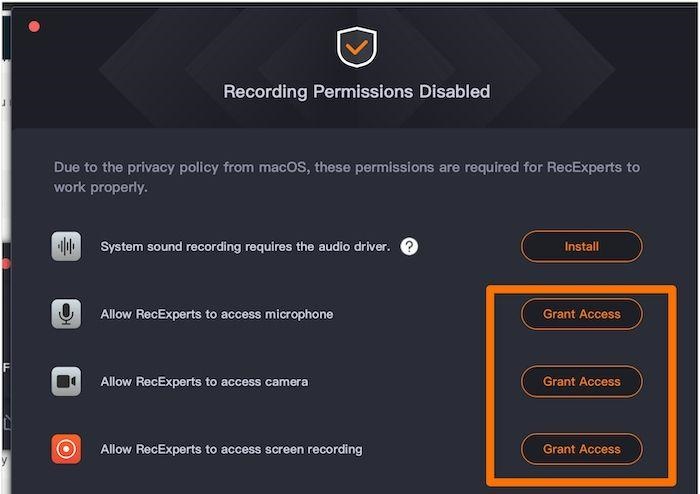
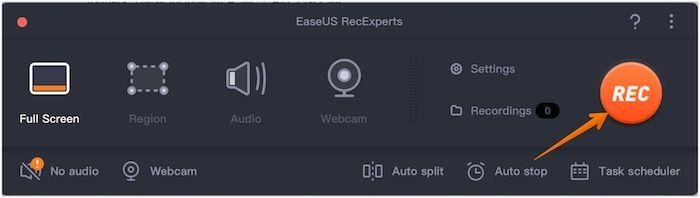
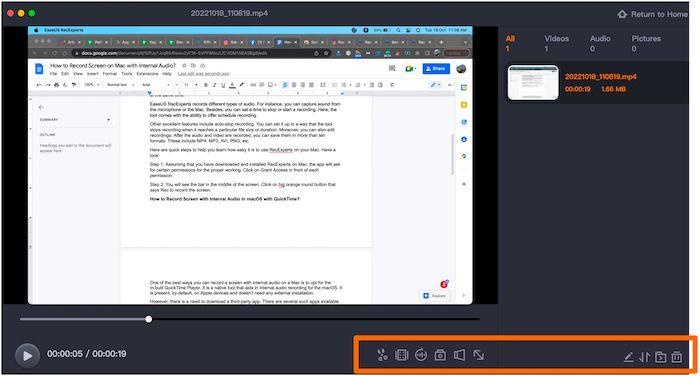
Step 1: Assuming that you have downloaded and installed RecExperts on Mac, the app will ask for certain permissions for the proper working. Click on Grant Access in front of each permission. Step 2: You will see the bar in the middle of the screen. Click on the big orange round button that says Rec to record the screen. Step 3: Click the Stop button from the Menu bar to stop recording. The app will show you the current recording. You have the option to trim, extract audio, add opening/closing titles, screenshots, etc., right there. That’s a neat option, right? You can also click on Settings to change the default settings, including the path where you want to save the recordings.
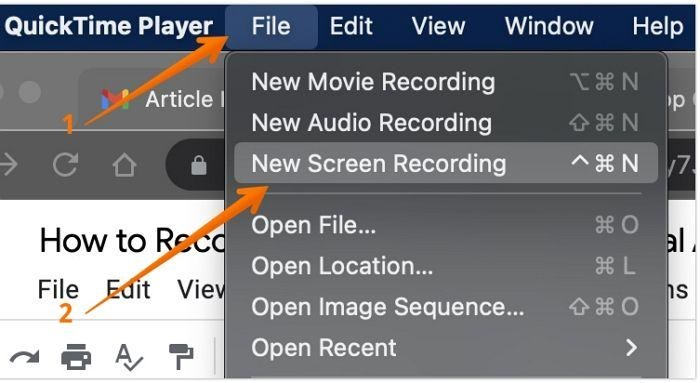
One of the best ways you can record a screen with internal audio on a Mac is to opt for the in-built QuickTime Player. It is a native tool that aids in internal audio recording for the macOS. It is present, by default, on Apple devices and doesn’t need any external installation. However, there is a need to download a third-party app. There are several such apps available in the market. You need to choose the one that suits your needs the best. That is the only way you can use QuickTime Player. Besides, it would help if you remembered that the app has several limitations. For instance, you can’t edit anything, or you can’t opt for the recording of video and audio simultaneously. Mac users opt for QuickTime Player as it is easy to use. No effort must be made to search the app and download it as it is already present. Take a look at these steps: Step 1: Go to QuickTime Player on the Mac. For this, you can opt for either of the two ways: Step 2: Now, click on File present in the upper-left part of the menu bar. Step 3: Press New Screen Recording. A screen recording window will pop up. Step 4: Select the red button present on the window. It will start the recording. Here, you have the option to record a part or the whole screen. Step 5: If you want to record the entire screen, you can click anywhere you want to start the recording. Step 6: If you only want to record part of the screen, you must drag the area to adjust the size. After that, click within that particular area to start the recording. Step 7: When you want to stop the recording, click the stop button. It is present in the upper-right part of the menu bar.
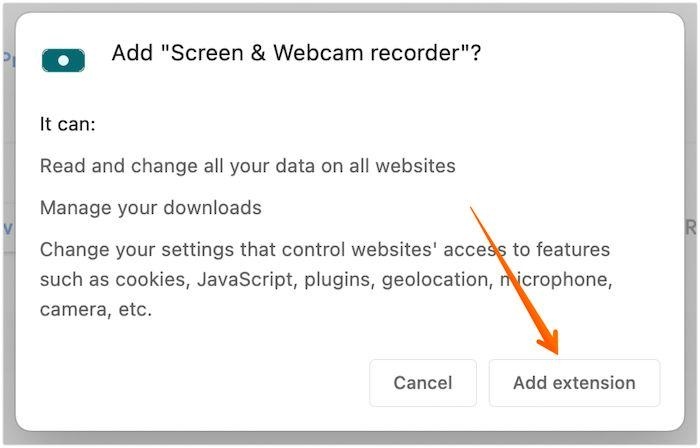
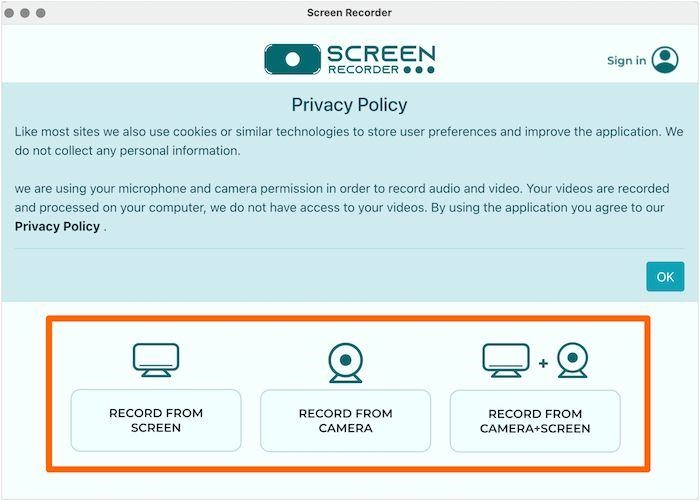
The third way to record audio and video on Mac is to use the Chrome Extension. It is an excellent choice if your recordings are particularly associated with a web browser like Chrome. Here, you don’t need to download and install a third-party app. Instead, opt for a reliable and efficient Chrome extension. The Chrome Extension works flawlessly to record the internal audio and screen on the Mac. You do not have to invest too much effort or time in this. Also, there is no need to worry about the watermark while recording. Various Chrome extensions are available in the market, such as Screen & Webcam Recorder. Choose the one you want by taking a look at the features. These are the general steps you need to follow: Step 1: Firstly, visit the Chrome store of the Extension you want. Search for the extension you want to add. In our case, we will search for Screen & Webcam Recorder. Step 2: Once you find the extension, click Add to Chrome. Step 3: A confirmation pop-up will appear mentioning what permissions extension needs. If you are Okay with that, click on Add Extension. It will add the extension to your browser. Step 4: You can start using the extension by following the instructions. You need to click on the extension icon. Step 5: Once the program is launched, it will give you three options: Record from Screen, Record from Camera, and Record from Camera + Screen. Choose the one appropriate for your task.
Even though Apple strives to offer the best user experience, there are some limitations. It is incredibly upsetting that setting up the recording of the screen with internal audio on a Mac is so challenging. That is why we have elaborated on how you can proceed with recording the internal audio. One of the best ways to proceed is to use the EaseUS RecExperts. It is a multipurpose yet reliable screen recording software to record audio, video, image, webcam, etc. The wide range of features makes the app even more appealing.
=============
Disclaimer: This is a sponsored post, made possible in association with EaseUS. PiunikaWeb doesn’t take any responsibility of the product being advertised here. About EaseUS: The company was founded in 2004 and offers software solutions to solve data loss, downtime and transfer with simplicity. EaseUS claims to have served over 5 million happy customers.
=============
PiunikaWeb started as purely an investigative tech journalism website with a main focus on ‘breaking’ or ‘exclusive’ news. In no time, our stories got picked up by the likes of Forbes, Foxnews, Gizmodo, TechCrunch, Engadget, The Verge, Macrumors, and many others. Want to know more about us? Head here. Previous article
PiunikaWeb.com is owned and operated by DeepSeaGem Technologies India. Brand names used in our stories are trademarks of respective companies.
Hyperallergic Sensitive to Art & its Discontents To properly discuss the “Loophole of Retreat” symposium organized by Rashida Bumbray and Simone Leigh, which took place in Venice, Italy, a few weeks ago, it is only right to discuss the origin of this title. It is the heading of one chapter in the autobiographical narrative of a formerly enslaved Black woman, Harriet Jacobs, Incidents in the Life of a Slave Girl, published in 1861. In it Jacobs describes a crawlspace she lived in for seven years after her escape as a “loophole of retreat.” This is a paradoxical position to be in: on one hand having escaped the crushingly brutal conditions of slavery, yet on the other hand being constrained in this space for seven years, limited in movement, voice, and almost all possible expressions of her will. However, Jacobs’s predicament didn’t, and couldn’t, indicate the breadth and depth that the gathered artists, activists, curators, academics, performers, and researchers would reach in exploring the idea of freedom. Jacobs’s loophole was only a philosophical and rhetorical launching point for a series of conversations and presentations organized around the production of aesthetic, historical, and well-researched knowledge about, and pertaining to, Black women. That’s the back story. What it felt like to be there was almost as profound as the premise of the symposium. The events all took place from October 7 to 9 at the Fondazione Giorgio Cini on the island of San Giorgio Maggiore in the Venetian lagoon, about an eight-minute boat ride via the shuttles provided. Most of the observers and participants stayed in hotels in the neighborhood of San Marco, from which these shuttles launched each morning. I didn’t know — and indeed didn’t need to know — exactly where to find the Loophole taxis along a very long wharf, with many berths for public transportation, because I could see the long line of Black women making their way to the proper place, dressed in vivid and flamboyant colors and chatting amiably with each other. The cavalcade of Black women visually transformed the Venetian island. Rather than primarily constituting a space of touristic flânerie and transactional consumption, an atmosphere of real delight and enthusiasm filledthose mornings and afternoons, as the women made their way to and from Cini, and as people discovered colleagues who were also present and engaged in excited conversation with them. Every day I was surprised and gratified to find people I had worked with, written about, or corresponded with through social media platforms. That convivial spirit was made even more manifest that first morning (and each subsequent one) when we gathered in the main hall and Bumbray opened the proceedings by welcoming us with a tambourine. Keeping time at her side, she sang, “I’ve been to the river and I’ve been baptized.” During her welcoming address Bumbray relayed the themes (or, according to the written program, “directives”) around which the presentations were organized. There were five: “maroonage,” which had to do with Maroons in the Caribbean who escaped slavery and created independent communities; “manual,” dealing with the work of hands; “magical realism,” understood to constitute not just a literary genre, but an entire movement; “medicine,” about interactions with both the natural and supernatural world to address differing ailments; and “sovereignty,” the title of the US pavilion in which Leigh’s work is installed, and aterm associated with self-governance and independence. It seemed to me that these directives were capacious enough to encompass the majority of work presented without being prescriptive. I was initially fascinated by the work of the first presenter, Vanessa Agard-Jones, who startedthesymposiumon the right note by talking about Harriet Jacobs and the idea of being “gone to ground,” that is, hidden or inaccessible. From there, Agard-Jones wove in bits and pieces of her own family and personal experience to imagine that from such a place of hiding one might cultivate a kind of “vegetal growth” and “brown thoughts” that could move someone from a place of mere survival to one of thriving. The subsequent presentations that most profoundly moved me and, from what I could tell, the others in attendance were those that did precisely this magic of interweaving the personal with the theoretical, looking at real-life circumstances informed by academic study and careful observation. Several art-scene stars were on the presentation panels: Saidiya Hartman, Christina Sharpe, Tarana Burke, Legacy Russell, Ja’Tovia Gary, and others. Their presence I’m sure enticed many of the attendees, but the room felt different when Sandra Jackson-Dumont spoke about the “gimlet,” a tool that Jacobs used to poke holes in her tiny crawlspace to allow in light and air — a tool, as she said, that was “just for those times and conditions that feel unsafe.” Jackson-Dumont talked about wanting to have a gimlet, imagining it tucked into her bra or up a sleeve, and then shifted to discuss her aging mother’s slow slide into dementia. Having had a mother who also suffered from that ailment, I felt a kinship with her experience. Jackson-Dumont described her mother’s daily rituals of applying makeup in a mirror, looking at herself, and saying in a lower register, though still audible, “You a bad bitch” and, in the next breath, “Look at God.” These snippets of real life drew laughter from us and gave her story heft, letting the audience understand how profoundly it hurt when she heard her mother say, “I don’t feel free.” The room audibly sighed at that line. Jackson-Dumont said that she wanted to give her mother a gimlet, but didn’t have one to give. Then, when she started to personally care for her mother, and looked at all the collaged images of famous Black people and members of her family she had put up on several walls in her apartment, she realized that these installations were her mother’s loophole of retreat and that each of these images were gimlets that let in air and light. More, Jackson-Dumont connected this realization to her own work as a museum director whose core concern is “how to make life relevant through things.” While she was speaking, many around me were openly crying, and when she was done almost every person rose to give her a standing ovation. Jackson-Dumont gave us a piece of herself as she came into the knowledge of who her mother is and how she is very much her mother’s daughter, carrying on a life-giving tradition that Jackson-Dumont to an extent inherited from her. Several presentations were beautiful, and beautifully moving as well. Negarra A. Kudumu began her talk in a state of heightened emotion. She attempted to discuss how freedom, examined historically in the African continent among colonized people, was intimately connected with love and self-regard. She recounted in a halting voice, often on the verge of breaking into tears, how a certain branch of Catholic thought — the Antonian ministry — took hold in the Congo, and within it indigenous people could come to understand what Toni Morrison had defined as the essence of freedom: You are made free in order to make others free. At one point in the presentation, when it seemed like she was having difficulty continuing, a friend in the audience went onstage and put her hands on Kudumu’s back and shoulders, supporting her emotionally and physically, demonstrating what the work of hands can do. Conversely some presentations made me recall — I had come to this realization before — that offering academic papers at symposia is not generally helpful to the audience, at least not as helpful as it is presumed to be. Listeners have too little time to parse dense writing, thus oftentimes these presentations feel like job auditions, anxious claims to authority, or appeals to recognize their eligibility to be on the dais, rather than avenues to deep discussion. For example, Rizvana Bradley, an assistant professor at the University of California, Berkeley, delivered a paper titled “Awaiting Her Verb” in which she rapid-fire referenced Hortense Spillers, Stuart Hall, Tina Campt, Franz Fanon, and other stalwarts in the Black liberation canon. In one instance she quoted Saidiya Hartman, saying something about bridging “the gulf between the sovereign and the fungible.” Bradley I’m sure is a fine researcher, but I needed a few minutes to wrap my head around what that phrase meant, and by then I had lost the plot to the rest of her paper. (Bradley was helpful after the fact though, by providing the source of that particular phrase when I emailed her.) Other kinds of narratives and research-oriented explorations need to be made regularly at public symposia. The personal is not only political; it’s also where most of humanity lives. The symposium was very well organized. We had a legion of guides and others all around the Fondazione Giorgio Cini who helped us get to performance venues, lunch spaces, and a break area with couches and chairs to view the proceedings in a space more comfortable than the main meeting hall. With few impediments to enjoying the presentations, interviews, and performances, my main dilemma was having to make ruthless choices about what to see (while also running back across the lagoon to see some of the biennale’s international pavilions). Thankfully, I made the choice to attend the back-to-back performances of Tsedaye Makonnen and Ayana Evans. Makonnen began her performance at one end of the stage covered almost completely by a glossy royal blue caftan or abaya adorned with appliquéd plastic or acrylic runic symbols. She strode onto the stage and then prostrated herself, manipulating the fabric to billow out in front of her as she rhythmically raised it into the air and hurled it down onto the hard surface of the ground. She repeated this action, at times with such force that some of the ornaments broke off. As she made her way around the space on hands and knees an audio recording of her intervention during the previous Venice Biennale at the site of Christoph Büchel’s “Barca Nostra (Our Boat)” (2019) played. Büchel’s piece was essentially a reclaimed barge that had sunk in the Mediterranean in 2015, taking the lives of over 1,000 migrants fleeing North Africa with it. In the 2019 recording I heard Makonnen saying “This is not a performance,” as the police and biennale representatives tried to prevent her from spreading rose petals and lying on the ground to commemorate those who had died, while the gravestone was trivialized as a tourist gewgaw. Indeed, it was more than performative: it was an act of mourning for children of the continent who, like Harriet Jacobs, were attempting to leave their dreadful circumstances behind. It was fitting that Makonnen reprised and extended that memorialization during the retreat. Makonnen was followed immediately by her friend and frequent collaborator Ayana Evans, who turned the space into a colorful bacchanal. After posing playfully and flirtatiously in her signature neon catsuit (herewith her midriff exposed), Evans began using a length of sheer, green fabric as a rope for an impromptu tug-of-war contest between her and Makonnen. Following that, Evans stretched out the fabric to create a canopy and then invited people to come and join her onstage, holding it up to create a dance space. As hip-hop music blared, Evans asked for a ladder to be brought to her, stepped onto it holding a microphone, and became the MC of an ad hoc party. People shimmied and boogied as she related that she had recently had a miscarriage, and thus needed a reason to celebrate with her friends, colleagues, and anyone else yearning to leave their troubles behind for the moment. I found myself appreciating the way that Makonnen and Evans together demonstrated that seemingly opposite emotional responses to calamity are both right and reasonable, and one has as much to do with healing as the other. On the final day of the symposium a video of Lorraine O’Grady’s film Greetings & Theses was screened before Simone Leigh engaged the artist in an interview. During this unconstrained conversation O’Grady described the sum total of her artistic work up until this point as “self-exploration, putting myself together.” Because I believe very much in the public and transparent discussion of the problems of our politics, her understanding that this work needed to be done in communal spaces resonated with me. An understanding of the importance of her relationship to those afforded less power and authority also came through as she discussed the Decolonize Museums protests that took place outside the Brooklyn Museum during her retrospective there. As she was confronted by trans activists, O’Grady said she began to wonder: “Have I become part of what is keeping the door closed to them?” One of her final comments to Leigh was that in order not to be defeated in the cultural war that is being waged, one question we (I assume she meant Black women) need to ask is, “How imaginative are we going to be in creating allies.” This thought stayed with me days after returning from Venice as I recalled the work of Fred Hampton, who sought to cultivate a broad racial, gender, and ethnic coalition to address the root causes of poverty and alienation. And again, the words of Toni Morrison via Kudumu came back to me: that my freedom is gained in order to make others free. There is a rich vein of politicalthought in the United States that has long touted freedom as its central concern and the prime motivation of human life in general. But the last few years have made me aware that much of the public discussion of liberty in mainstream US culture — especially those arguments pertaining to mandated vaccination, gun ownership, the use of dark money to influence elections — tends to be selfish, myopic, and juvenile, distressed by having any limitations placed on people’s agency, rather than considering how one’s actions might inhibit or empower someone else. Depending on the context and the speaker, “freedom” might mean radically different things. I am buoyed by the freedom song of Rashida Bumbray, of Simone Leigh, of Lorraine O’Grady, of Sandra Jackson-Dumont. It is a song that invites me to join in, and it lets in enough light and air for all of us. Loophole of Retreat took place from Friday through Sunday October 7-9 at the Fondazione Giorgio Cini on the island of San Giorgio Maggiore in Venice, Italy. Editor’s Note: Hotel accommodations and meals were provided to the author by the ICA Boston. Voice a Wild Dream dismantles the idea that activism is driven by individual charismatic figures; in reality, social change is possible because many hands come together. Capturing an urban ecosystem of animals and humans, Shaunak Sen’s second feature sits somewhere between a nature doc, political drama, and touching family portrait. For Native American Heritage Month, the Native Cinema Showcase includes over 35 free online screenings representing 30 Indigenous Nations in eight different countries. The university said it will return the samples, some of which were used in research that directly or indirectly supported scientific racism. Applications for NPAF’s February 2023 residency at Chaco Culture National Historical Park are being accepted through November 15, 2022. Edelheit, whose painting “Tattooed Lady” is featured in the exhibition New York: 1962–1964, will discuss her life, work, and artistic vision at this in-person event in NYC. Several other institutions are tightening security measures even though damage to artworks remains rare. Prominent museum directors declaring that they are “deeply shaken” by climate activists is a resounding failure of leadership. With 10 core faculty members committed to a small cohort of up to 10 candidates, this program in Indianapolis fosters close mentorship and a strong sense of community. The deputy mayor of New Paltz, New York, tweeted that she would get a 14-year-old’s design tattooed if it won Ulster County’s “I Voted” sticker contest. She actually did it The three medallions by James “Yaya” Hough, who served 27 years in prison upon being handed a life sentence as a minor, are now on display in Battery Park City. With field-based residency sites across the Americas and generous scholarship support, students can live anywhere in the world while working on their degree. Art Fair 14C, which returns to Jersey City for its fourth year this weekend, has become a destination for locals seeking community and affordability. The performance marked 40 days since the Zahedan Massacre, when Iranian security forces opened fire into a crowd and killed almost 100 people. Seph Rodney, PhD, is a senior critic for Hyperallergic and has written for the New York Times, CNN, MSNBC, and other publications. He is featured on the podcast The American Age. His book… More by Seph Rodney Your email address will not be published.Required fields are marked *
{{#message}}{{{message}}}{{/message}}{{^message}}Your submission failed. The server responded with {{status_text}} (code {{status_code}}). Please contact the developer of this form processor to improve this message. Learn More{{/message}} {{#message}}{{{message}}}{{/message}}{{^message}}It appears your submission was successful. Even though the server responded OK, it is possible the submission was not processed. Please contact the developer of this form processor to improve this message. Learn More{{/message}} Submitting… Hyperallergic is a forum for serious, playful, and radical thinking about art in the world today. Founded in 2009, Hyperallergic is headquartered in Brooklyn, New York.
‘Significant editorial failings’ in news coverage of abuse of about 40 Jewish people by group of men in London The BBC committed “significant editorial failings” in its TV and online reporting of an antisemitic attack on Jewish students travelling on a bus in London, according to an investigation by Ofcom. The UK media regulator said that its investigation into the BBC’s coverage, which drew complaints from parties including the Board of Deputies of British Jews and the chief rabbi, found that the corporation failed to follow its own editorial guidelines to report news with “due accuracy and due impartiality”. The incident, which occurred on 29 November last year, involved a group of about 40 young Jewish people aboard a Hanukkah party bus travelling along London’s Oxford Street that was attacked by a group of men who swore, made obscene gestures and threw a shopping basket at them. In its coverage, the BBC said that an audio recording made during the incident included an anti-Muslim slur made from inside the bus. “Our investigation uncovered significant editorial failings in the BBC’s reporting of an antisemitic attack on Jewish students travelling on board a bus in London,” said Ofcom in a statement. “The BBC’s reports claimed that an audio recording made during the incident included anti-Muslim slurs – which it later changed to the singular ‘slur’ – which came from inside the bus. Shortly afterwards, it received evidence which disputed this interpretation of the audio.” Ofcom said that the BBC failed to “promptly acknowledge” that the audio recording was disputed and did not update its online news article to reflect this for almost eight weeks. The media regulator said that during this time the BBC was aware that the content of the article was causing “significant distress and anxiety” to the victims of the attack and wider Jewish community. “This, in our opinion, was a significant failure to observe its editorial guidelines to report news with due accuracy and due impartiality,” said Ofcom. Ofcom also investigated a news report on the incident, which aired on BBC London News. The regulator said that given the information available at the time of broadcast the programme did not breach the UK broadcasting code. However, Ofcom added: “The BBC made a serious editorial misjudgment by not reporting on air, at any point, that the claim it had made about anti-Muslim slurs was disputed, once new evidence emerged. This failure to respond promptly and transparently created an impression of defensiveness by the BBC among the Jewish community.” Sign up to First Edition Archie Bland and Nimo Omer take you through the top stories and what they mean, free every weekday morning Ofcom said it would also review how the broadcaster addressed the complaint, handling and transparency issues raised by the incident. The media regulator’s investigation followed an investigation by the BBC’s executive complaints unit, which concluded both the online and TV story “did not meet the BBC’s standards of due accuracy”. In January, the BBC issued an apology and confirmed it had amended the story on its website, and also issued a clarification of the TV report. “While Ofcom has found that our reporting was not in breach of the broadcasting code, the BBC’s executive complaints unit ruled in January this year that more could have been done sooner to acknowledge the differing views about what could be heard on the recording of the attack,” a spokesman for the BBC said. “The BBC apologised at the time for not acting sooner to highlight that the content of the recording was contested.”
New Jersey, US – during a recently printed report by Market Research Intellect, titled, “Global Audio-recording Software Report 2022“, the Analysts have provided an in-depth summary of world Audio-recording Software . The report is AN comprehensive analysis study of the world Audio-recording Software taking under consideration the expansion factors, recent trends, developments, opportunities, and competitive landscape. The market analysts and analysers have done in depth analysis of the world Audio-recording Software with the assistance of research methodologies like PESTLE and Porter’s 5 Forces analysis. they need provided correct and reliable market information and helpful recommendations with an aim to assist the players gain an insight into the gift and future market situation. The report includes in-depth study of the potential segments together with product sort, application, and user and their contribution to the market size. In addition, market revenues supported region and country ar provided within the report. The authors of the report have conjointly shed light-weight on the common business ways adopted by players. The leading players of the world Audio-recording Software and their complete profiles are enclosed within the report. Besides that, investment opportunities, recommendations, and trends that are trending at the present within the international Audio-recording Software are mapped by the report. With the assistance of this report, the key players of the world Audio-recording Software are going to be able to create sound selections and set up their ways consequently to remain earlier than the curve. Get a Sample PDF Copy of Latest analysis on Audio-recording Software Market 2022 before purchase: https://www.marketresearchintellect.com/download-sample/?rid=194037 Along with the market outline, that has market dynamics, the chapter includes a Porter’s 5 Forces analysis, that explains the five forces at add the planet Audio-recording Software Market, furthermore as consumers’ dialogue power, suppliers’ dialogue power, risk of recent entrants, risk of substitutes, and competitors’ degree of competition. It describes the various participants at intervals the market system, like system integrators, intermediaries, and end-users. The report in addition look at the competitive landscape of the planet Audio-recording Software Market. Some of the key players profiled within the study are: Most important styles of Audio-recording Software lined during this report are: Most important Application of Audio-recording Software market lined during this report are: Click here to avail profitable discounts on our latest report: https://www.marketresearchintellect.com/ask-for-discount/?rid=194037 Region enclosed are: North America, Europe, Asia Pacific, Oceania, South America, geographical region & continent Country Level Break-Up: u. s., Canada, Mexico, Brazil, Argentina, Colombia, Chile, South Africa, Nigeria, Tunisia, Morocco, Germany, uk (UK), Holland, Spain, Italy, Belgium, Austria, Turkey, Russia, France, Poland, Israel, United Arab Emirates, Qatar, Kingdom of Saudi Arabia, China, Japan, Taiwan, South Korea, Singapore, India, Australia and New Sjaelland etc. Impact of the Audio-recording Software Market report: –Comprehensive assessment of all opportunities and risk within the Audio-recording Software Market. –Audio-recording Software Market recent innovations and major events. –Detailed study of business ways for growth of the Audio-recording Software Market market-leading players. –Conclusive study concerning the expansion plot of Audio-recording Software marketplace for forthcoming years. –In-depth understanding of Audio-recording Software Market market-particular drivers, constraints and major small markets. –Favorable impression within important technological and market latest trends placing the Audio-recording Software Market. Direct Purchase of Audio-recording Software Market Report, Click Here @https://www.marketresearchintellect.com/select-licence/?rid=194037 Strategic Points lined in Table of Content of Audio-recording Software Market: – Chapter 1: Introduction, market actuation product Objective of Study and analysis Scope the world Audio-recording Software market (2022-2028). – Chapter 2: Exclusive outline – the fundamental info of the world Audio-recording Software Market. – Chapter 3: ever-changing Impact on Market Dynamics- Drivers, Trends and Challenges & Opportunities of the world Audio-recording Software ; Post COVID Analysis. – Chapter 4: Presenting the world Audio-recording Software Market correlational analysis, Post COVID Impact Analysis, Porters 5 Forces, Supply/Value Chain, PESTEL analysis, Market Entropy, Patent/Trademark Analysis. – Chapter 5: Displaying the by kind, user and Region/Country 2018-2022. – Chapter 6: Evaluating the leading makers of the world Audio-recording Software Market that consists of its Competitive Landscape, generation Analysis, BCG Matrix & Company Profile. – Chapter 7: to guage the market by segments, by countries and by Manufacturers/Company with revenue share and sales by key countries in these numerous regions (2022-2028). … To be continued Top Trending Reports: Sports Turf Equipment Market Size And Forecast Marine Lng Engine Market Size And Forecast Ski Gloves Market Size And Forecast Maternity Outerwear Market Size And Forecast Clay Mask Market Size And Forecast Climbing Shoes Market Size And Forecast Gas Tank Container Market Size And Forecast Dry Iron Market Size And Forecast Compact Inverter Technology Market Size And Forecast Medical Lighting Technology Market Size And Forecast
About Us: Market Research Intellect Market Research Intellect provides syndicated and customized research reports to clients from various industries and organizations with the aim of delivering functional expertise. We provide reports for all industries including Energy, Technology, Manufacturing and Construction, Chemicals and Materials, Food and Beverage, and more. These reports deliver an in-depth study of the with industry analysis, the value for regions and countries, and trends that are pertinent to the industry. Contact Us: Mr. Steven Fernandes Market Research Intellect New Jersey (USA) Tel: +1-650-781-4080 Website: -https://www.marketresearchintellect.com/
Sales soar, spurring artists to release new music on records TOKYO — As “city pop,” a type of Japanese pop music produced in the 1970s and ’80s, wins a new generation of fans around the world, production of phonograph records, the principal medium for recorded music at the time, has more than quadrupled over the past decade in Japan. As city pop gains more exposure through TikTok and other video hosting apps, it has drawn young people to vinyl records, which offer a listening experience that differs from digital music. More artists these days are also releasing new music on records. Discover the all new Nikkei Asia app Nikkei Asian Review, now known as Nikkei Asia, will be the voice of the Asian Century. By continuing to browse this website, you accept cookies which are used for several reasons such as personalizing content/ads and analyzing how this website is used. Please review our Cookie Policy to learn how you can update your cookie settings.
Play Now Football Pick’em Play Now College Football Pick’em Start or Sit (NFC Home Games) U.S. Soccer Podcast Appalachian State @ Marshall Current Records: Appalachian State 5-4; Marshall 5-4 The Appalachian State Mountaineers and the Marshall Thundering Herd will face off in a Sun Belt clash at 3:30 p.m. ET Nov. 12 at Joan C. Edwards Stadium. Marshall will be strutting in after a victory while the Mountaineers will be stumbling in from a defeat. Appalachian State came up short against the Coastal Carolina Chanticleers last week, falling 35-28. QB Chase Brice put forth a good effort for the losing side as he passed for two TDs and 279 yards on 28 attempts in addition to punching in one rushing touchdown. Meanwhile, the Thundering Herd were able to grind out a solid win over the Old Dominion Monarchs last week, winning 12 to nothing. For the second time this season, Marshall couldn’t find the end zone, and they got their points from four field goals. Special teams was responsible for all of the team’s points. K Rece Verhoff delivered a perfect 4-for-4 game. This next game is expected to be close, with Appalachian State going off at just a 2-point favorite. But bettors beware: they are only 2-5 against the spread when favored. Appalachian State’s loss took them down to 5-4 while Marshall’s victory pulled them up to 5-4. Marshall caused 5 turnovers against Old Dominion, so the Mountaineers will need to take especially good care of the ball.
Photo credit: Frank Piercy Together with his 10,000 Light Years Band, will perform The Moody Blues’ iconic ‘Days of Future Passed’ album in its entirety JOHN LODGE, legendary bass player, songwriter and vocalist of The Moody Blues and Rock and Roll Hall of Famer, will bring his new show “Performs Days of Future Passed” to America. JOHN, together with his 10,000 Light Years Band, will perform The Moody Blues’ iconic Days of Future Passedalbum in its entirety, with a special recording by the late Graeme Edge and performances by Jon Davison of YES. The show will also feature a set of the pioneering classic hits “Ride My See-Saw,” “I’m Just a Singer (in a Rock and Roll Band),” “Isn’t Life Strange,” “Legend of a Mind” and “Nights in White Satin” in what promises to be a truly spectacular evening. Below are the tour dates and JOHN’s quotes about the show. For tickets, VIP packages –which include a great seat, a personalized video message from John, exclusive merchandise, and more–please visit: https://johnlodge.com/tour. On November 10, 2022, Days of Future Passed will celebrate its 55thAnniversary, and JOHN wanted to do something special to celebrate the album. The Moodies had embarked on a US tour in 2017 to celebrate the 50th, but regrettably stopped touring shortly after, and then, very sadly, Graeme Edge passed away in 2021. However, shortly before his passing, John and Graeme met and spent some special time together, and at that meeting Graeme told John how he hoped John would continue on with the music and keep the Moody Blues’ music alive. JOHN returned home and realised that what he really wanted to do was revisit this iconic album, honor his lost friends Ray Thomas and Graeme Edge, and his other bandmates Justin Hayward and Mike Pinder, but also reimagine it for today. How would he do it differently? Graeme had already recorded a special version of “Late Lament” for John, and John’s great friend (and future son-in-law) Jon Davison (of YES) had recorded “Nights in White Satin” for him, and so the stage was set; John went into the studio and began work with his Musical Director, Alan Hewitt, on both a new show and a new album, details of which are TBA. The new show, based around the simple tale of “a day in the life of an everyday man,” will highlight all that made Days of Future Passed the ground-breaking album that it was–arguably the start of Progressive Rock. It retains the core emotion of the original album and recreates its incredible orchestration, but at the same time it also brings in a modern feel thanks to the great strides in modern fidelity, and the maturity that comes with the passing of the years. Listen to “Nights in White Satin,” “Tuesday Afternoon,” “Peak Hour,” and more fill the room, and you’ll be taken back to 1967, but at the same time, you’ll hear what John has brought to this new version in his vocals, bass and harmonies, and how he sees the album 55 years later. In its own way, it can also be said to be a reflection of John’s own life. The electrifying show will also feature a selection of JOHN’s classic self-written hits, including the above-mentioned “Ride My See-Saw,” “Isn’t Life Strange,” and “I’m Just a Singer (in a Rock and Roll Band).” The latter two were hit singles on the Moody Blues' album Seventh Sojourn which spent 5 weeks at Number 1 on Billboard and is currently celebrating its 50th Anniversary. Come and be taken back to the Moody Blues’ shows of the past, featuring JOHN LODGE, and including tributes to all his bandmates. Joining JOHN on stage is his 10,000 Light Years Band, long term collaborator Alan Hewitt (Music Director and Keyboards) and Billy Ashbaugh (Drums) from the Moody Blues touring band, together with Duffy King (Guitars) and Jason Charboneau (Cello). Jon Davison of YES will also be joining them for his special renditions of “Nights in White Satin” and “Tuesday Afternoon” plus the magical voice of Graeme Edge will be heard via a special recording. “November 2022 sees me looking back 55 years to that week in 1967,” says JOHN LODGE. “As I said at the Rock and Roll Hall of Fame, Graeme, Mike, Ray, Justin, and I, together with Tony, went into a studio, and seven days later we came out with an album that changed our lives forever.” He adds: “I’m sorry that the Moodies are no longer touring, and I miss my friends Ray and Graeme deeply, but as I looked back to the past, I realised that I also wanted to look forwards to the Future. My hope is that in this show, and album, you will get to revisit 1967, but at the same time, see how this album has grown with me, and with you. Thank to you the 10,000 Light Years Band, Jon Davison and, of course, Graeme, for their belief in this project and helping bring my vision to life. And thank you to all the fans for Keeping the Faith.” Here are the tour dates for JOHN LODGE’s“Performs Days of Future Passed”: Saturday, February 18–Cary Hall, Lexington, MA Sunday, February 19–Flying Monkey, Plymouth, NH Tuesday, February 21–TBC Wednesday, February 22–The Warehouse, Fairfield, CT Friday, February 24–The Cabot, Beverly, MA Saturday, February 25–Infinity Hall, Hartford, CT Sunday, February 26–Jane Pickens Theatre, Newport, RI Tuesday, February 28–Patchogue Theatre, Patchogue, NY Wednesday, March 1–Sony Hall, New York. NY Friday, March 3–Newton Theatre, Newton, NJ Saturday, March 4–Keswick Theater, Glenside, PA Monday, March 6–Sandler Center, Virginia Beach, VA Tuesday, March 7–Rams Head On Stage, Annapolis, MD Thursday, March 9–Variety Playhouse, Atlanta, GA Friday, March 10–Ponte Vedra Concert Hall, Ponte Verde, FL Saturday, March 11–The Lyric Theatre, Stuart, FL Tuesday, March 14–Capitol Theatre, Clearwater, FL Wednesday, March 15–Amaturo Theater, Fort Lauderdale, FL Thursday, March 16–Rock and Romance Cruise ABOUT JOHN LODGE: John Lodge is bass guitarist, vocalist, and songwriter for the iconic Rock & Roll Hall Of Fame 2018 inductees, The Moody Blues. Songwriter of such mega Moody Blues hits from “Ride My See-Saw,” to “I’m Just A Singer (In A Rock and Roll Band),” “Isn’t Life Strange” and many more. Lodge has been performing and recording with The Moody Blues for more than five decades, selling in excess of 70 million albums, as well as releasing his three solo albums ‘Natural Avenue’, ’10,000 Light Years Ago’ and ‘B Yond’. Lodge has been voted one of the “10 most influential bass players on the planet,” and has been the recipient of many awards, including ASCAP (American Society of Composers and Publishers), an Ivor Novello Award, a Lifetime Achievement Award from Prog Magazine, to name just a few. For further information about John Lodge: https://www.johnlodge.com/ https://www.facebook.com/johnlodgemusic/ https://twitter.com/johnlodgemusic https://www.instagram.com/johnlodgemusic/ https://www.youtube.com/c/johnlodgemusic
Music has always been a part of lullaboy’s life ever since he was a child. He recalled taking vocal lessons at the age of 5, but halfway through early adolescence, he got lost and was very unsure of what he wanted to do. However, things turned around when he joined the army at 18, which was the place he least expected to rekindle his love for music. Despite being born in America, the now 27-year-old artist (and yes, lullaboy is styled as lowercase) is a permanent resident at Singapore, which required him to render a few years of service to the army. He was in the army for two years. Just a few months after their basic training in the army, he auditioned in the music department. He narrated the experience, “For the next two years, I get to do music in Singapore and it was life-changing.” He enumerated some of his memorable experiences doing music in the army such as performing for the President and being sent overseas to represent Singapore in international music events He added, “Getting to do music every day has really changed my life because it was exactly what I wanted to do and I got to be around people who are really great at what they do and they taught me different tricks.” He attributes his artistry to the experience, saying that his stay in the army “prepared [him] to become a future artist.” Aside from music, he also said that being in the army also trained his mental and physical state. In the end, lullaboy reflects, “I’m really glad that I did it and I wouldn’t have changed a thing. It really changed everything.” Once his time was up in the army, he went back to America to fully pursue music by enrolling in Berklee College of Music. Describing the events following the decision, he said, “My life changed after that.” He took up “Professional Music” at Berklee while focusing on songwriting and music production, carrying with him the desire to create and produce music on his own. But prior to attending Berklee, he had a hard time convincing his mother of his chosen path. Fortunately, his father was supportive of his decision to pursue his passion since they both share a love for music. Meanwhile, his mother initially wanted him to go to business school for practical reasons. “It was hard to convince her,” he recalled. However, his mother had a change of heart when she saw him perform in front of thousands of people. He narrated, “She was there in the audience and she saw me performing, and she saw the looks on everybody’s faces…. She felt a sense of pride and that made her accept my path.” Thinking of his mother, lullaboy describes, “She’s somebody who feels like… we have to leave something good in this world and spread some positivity. She knows that music can do that and that’s when she started supporting me.” This completely echoes his “mission” as an artist as, in an interview with Soundstrip, lullaboy said earlier, “I just care about my music reaching as many people as possible because I want to leave something good in this world and actually leave a mark that benefits people’s lives.” Stories to tell lullaboy admitted that the inspiration behind his music comes from around “75%” of his personal life. He said, “All the different experiences that I go through, even in the past few years, [has] been so crazy. Every single year, something happens that changes me and I learn so much about the world, and that’s what my music is about—it’s about exploring love and life.” He added that the remaining 25% comes from the people he encounters. He believes that everybody has a story to tell, and making music out of it is “sharing a new perspective of their stories and giving it back to them sometimes.” On his latest release “Shortcut To Heaven,” he shared, “The meaning of the song… is how we’re all going through a hard time like the past couple years and now things are starting to get better again… and you’ll find love at the end of the tunnel.” “Shortcut To Heaven,” according to lullaboy, is the best-performing song he has done so far. As of writing, the Singaporean artist’s new song has around 1 million streams on Spotify since its release last September. But the wide reach of listeners is not really new to lullaboy as “someone like u,” released earlier this year, currently has around 26 million streams on Spotify. lullaboy shared he constantly gets messages from his fans, expressing how his songs have helped them individually get through a hard time. In describing the overwhelming feeling, he enthused, “Those are the moments I live for.” “Shortcut To Heaven” is now available on all music-streaming platforms. Your email address will not be published.Required fields are marked *
This site uses Akismet to reduce spam. Learn how your comment data is processed. BLASTER SILONGA, My Kosmik Island Disk Jace Roque remains on a hot streak. The EDM artist turned P-Pop soloist now has five singles (“Forever,” “Di Para Sa Yo,” “Be Someone,” “Trust” and his latest, “Back To The Beginning”) which have garnered over a million views on Facebook. The Wish Date 4 concert last November 6, 2022 at The Theatre at Solaire delivered what it promised to be: a spectacular medley of OPM artists and a blend of film, radio, and live music. In between scenes of the short film “My Sweet Lady,” which starred Ritz Azul and Arnold Reyes and debuted exclusively throughout the concert, OPM artists performed their renditions from an extensive discography. Among the performers are December Avenue, Nyoy Volante, Mark Michael Garcia, Kimberly Baluzo, Plethora, Bradz, and Peniel. Reinvigorated by their well-received Then and Now concert last September at Newport World Resorts, SIDE A has returned to the recording studio to record a brand-new song under Icons Music, a division of Widescope Entertainment.
Sung and composed by the music group (K)NoW_NAME, a new insert song called “Breeze” accompanies Yor as she embarks on an important mission for Anya. The following contains spoilers for Spy x Family Season 1, Episode 19, "A Revenge Plot Against Desmond/Mama Becomes the Wind," now streaming on Crunchyroll. Accompanying some anime-original material in Episode 19 of Spy x Family is a new insert song. As revealed by Crunchyroll, multi-media musical unit (K)NoW_NAME's NIKIIE and Makoto Miyazaki released a new song "Breeze" for Spy x Family. NIKIIE wrote the lyrics and was in charge of the vocals while Miyazaki composed and arranged the song. The song can be heard in the latter half of the episode which features brand-new material focusing on Yor's latest mission: make sure Anya gets her gym clothes in time for class. NIKIIE's voice adds a bright backdrop as Yor executes a bevy of impressive acrobatic moves to travel to Eden Academy. RELATED: Spy x Family: Loid Forger's Fatherly Role Outranks His Spy Mission in Episode 18 (K)NoW_NAME is in charge of the music production for both cours of Spy x Family. The first insert song they sang was in Episode 5. Sung by Ayaka Tachibana with lyrics by AIJ, and composed by Miyazaki, "TBD" can be heard when Loid turned into Loidman to save his daughter Princess Anya from the clutches of the evil Franky and the witch Yorticia. The group also composed and sang Anya's character song "GOOD DAY," with vocals and lyrics by NIKIIE and music by Shuhei Mutsuki. As a multi-media group, (K)NoW_NAME consists of vocalists, music creators and an illustrator. In charge of vocals are Ayaka Tachibana, NIKIIE and AIJ. Aside from Miyazaki, the other composers include R·O·N, Shuhei Mutsuki, Hiromitsu Kawashima, Kohei by SIMONSAYZ, eNu and Genki Mizuno. The illustrator is so-bin. (K)NoW_NAME has lent their talents to some anime series including Dorehedoro, Fairy Gone and Sakura Quest. Spy x Family is their latest work. RELATED: Doraemon Teases Attack on Titan, Spy x Family Crossover Tatsuya Endo's Spy x Family follows a suave spy named Twilight, an accomplished assassin named Thorn Princess and a child telepath who was formerly trapped in an experimental facility and known as Test Subject 007. Spy x Family follows the trials and tribulations that come with being a family, even if it was formed for the sake of world peace. Produced by Wit Studio and CloverWorks, the first cour focused on Loid adopting Anya and marrying Yor and Anya's adventures at school. The second cour opened with a dangerous rescue mission involving a terrorist bombing and a dog who can see the future. Spy x Family fans can hear the new song in the latest episode, now streaming on Crunchyroll and Hulu. "Breeze" is downloadable on major platforms including Apple Music, Spotify and Amazon Music. Source: Crunchyroll, Twitter Anime Features Writer for CBR. Loves anything with a good anime OST. Always eager to chat about anything anime/manga/donghua-related.
Add WBUR to your morning routine Advertisement The work of preserving and restoring old masterpieces is laborious, scientific and often done behind closed doors. The Museum of Fine Arts, Boston wanted to change that. With the opening of their new Conservation Center, visitors will have the opportunity to learn more about the conservation process and the specifics of what sets art movements apart from one another. “It seemed that people were very interested in getting the opportunity to see what conservators do and to talk to the conservation staff,” said Rhona MacBeth, the director of conservation and scientific research. For over two decades, teams at the MFA thought about how to incorporate conservation work into the public’s museum interactions. Engagements with the public, especially through their “Conservation in Action” program, helped guide the building plans. The newly constructed center is 22,000 square feet and includes six laboratories for paintings, frames, furniture and other objects. There is space for workshops and mount making, which will be available for the general public, and for training and tutorials. The Pamela and Peter Voss Conservation Seminar Room, a learning area, was built into the Conservation Center and is fully accessible to all visitors at the museum. The MFA hopes this will bring the public closer to the inner workings of the museum. “The number of people who’ve said to me, ‘If only I had known that this profession even existed,’” said MacBeth. The museum hopes that this initiative will play a role in ushering in a new generation of museum workers. Beyond fostering visitors’ relationships with the institution and inspiring future museum workers, the MFA wants people to have the intimate experience of looking at artwork with a conservator. Learning details about how a piece is made, why it was made, and the context within its making can change the way viewers look at and understand art, and art history, in general. Part of a conservator’s job is to look at the clues within an object to learn about the aims of an artist, and the MFA wants to share that process with its visitors. The hope is that people will walk away looking at the artwork installed in the galleries a little bit differently, with newfound connection and insight. To celebrate the Conservation Center’s opening this week, the MFA is offering a wide range of talks and tutorials covering the basics of conservation. Among a host of workshops on Friday, Nov. 11, visitors can learn about the yearslong effort to prepare and conserve the 1485 Bartolomeo Vivarini altarpiece, “Virgin and the Dead Christ with the Ascension and Saints,” from conservator Lydia Vagts. And on Saturday, Richard Newman, the museum’s head of scientific research, will lead a talk on the importance of science in art museums. More tours will be planned in the following months. But from this point on, visitors are invited to stop by the Robert and Carol Henderson Conservation Learning Center to see conservators and staff at work in the Furniture and Frame Conservation Laboratory and mount-making studio. “One of the things that the museum is really committed to is opening up the museum to a whole new audience who, hopefully, will see themselves as part of this institution,” said MacBeth. Lauren WilliamsArts Reporting Fellow Lauren Williams is the arts reporting fellow at WBUR. More… Advertisement Add WBUR to your morning routine
Advertisement Supported by A leader of the United Auto Workers and a Kennedy confidant, he remained convinced that a second gunman had been involved in the assassination. Send any friend a story As a subscriber, you have 10 gift articles to give each month. Anyone can read what you share. By Richard Sandomir Paul Schrade, a prominent union official who was wounded in the fusillade of bullets that killed Senator Robert F. Kennedy in 1968, and who believed that a second gunman, in addition to the convicted assassin, Sirhan B. Sirhan, fired shots that day at the Ambassador Hotel, died on Wednesday at his home in Los Angeles. He was 97. Martin Weil, his brother-in-law, confirmed the death. Senator Kennedy was shot on June 5, shortly after he thanked his supporters in the hotel ballroom for helping him win the California Democratic presidential primary and headed into the hotel pantry to meet reporters. It was a joyful moment for the campaign — a critical step before the party was to meet in Chicago that summer to nominate a candidate for president. Mr. Schrade was the Western regional director of the United Auto Workers and a confidant to Senator Kennedy who had introduced the senator to two other invaluable allies, Cesar Chavez and Dolores Huerta of the United Farm Workers. He walked about six feet behind Senator Kennedy as they entered the pantry. Mr. Sirhan began firing. The authorities said his bullets hit Senator Kennedy, Mr. Schrade and four other people before a crowd of supporters subdued him. “I was shaking violently and I fell,” Mr. Schrade told The Washington Post in 2018. “Then Bob fell. I saw flashes and heard crackling. The crackling actually was all the other bullets being fired.” It was reported that some witnesses heard Senator Kennedy ask: “Is everybody OK? Is Paul all right?” A bullet entered Mr. Schrade’s head just above his forehead. He fell into the arms of a waiter. “I remember looking down and seeing Paul Schrade,” Dick Tuck, an aide to Senator Kennedy, told The Los Angeles Times in 1988, “and if I ever saw a dead man, it was him.” Someone placed a straw hat over Mr. Schrade’s head, believing he was dead, then felt his pulse. He was still alive. His skull had been fractured, but the bullet had not entered his brain. Several days after surgery to remove the bullet (some fragments remained), he met with reporters at Kaiser Foundation Hospital in Los Angeles. “I didn’t see the gunman,” he told them, his head wrapped in bandages. “There could have been one or 10.” In fact, Mr. Schrade came to believe that there were two gunmen: Mr. Sirhan, who shot him and the other four people, and another, who shot Senator Kennedy. He claimed that the Los Angeles police did not do their best to find the second gunman, and that more than the eight bullets in Mr. Sirhan’s .22-caliber revolver had been fired in the pantry. “Yes, he did shoot me. Yes, he shot four other people and aimed at Kennedy,” Mr. Schrade told The Post in 2018, on the 50th anniversary of the assassination. “The important thing is he did not shoot Robert Kennedy. Why didn’t they go after the second gunman?” No official investigation ever found a second gunman. Mr. Schrade never got what he wanted, a full reinvestigation of the assassination, despite his legal efforts to force the Los Angeles Police Department to disclose its so-called confidential 10-volume summary of its investigation of the assassination (which was made public when it was turned over to the state of California in 1987) and to greatly expand ballistics testing of Mr. Sirhan’s gun. Mr. Schrade pointed to, among other things, the findings of an acoustics expert, Philip Van Praag, who examined an audio recording made by a journalist in the pantry and determined that 13 shots were fired, and the autopsy report that said Senator Kennedy was shot from behind, at point-blank range, and Mr. Sirhan stood in front of him. “There are voluminous piles of paper that are strewn everywhere in his house,” Mr. Weil, Mr. Schrade’s brother-in-law, said in a phone interview. “L.A.P.D. archives. Other people’s work.” Louise Stone Duff, Mr. Schrade’s sister, said: “It was such a quest for him. It consumed him. We had Zoom calls every few weeks with my kids and Uncle Paul, and it always came up.” Mr. Schrade’s belief that while Mr. Sirhan had shot him, he did not kill Senator Kennedy led him to attend Mr. Sirhan’s 15th parole hearing, in 2016, where he apologized to him for not attending previous hearings and not fighting harder for his release. “I should have been here long ago, and that’s why I feel guilty for not being here to help you and to help me,” Mr. Schrade was quoted as saying by The Associated Press. As Mr. Sirhan left the hearing, Mr. Schrade shouted: “I’m so sorry this is happening to you! It’s my fault!” Mrs. Duff said that her brother never sought counseling after the shooting. “I think his intense involvement with Sirhan was his way of helping himself,” she said. Mr. Schrade recorded a video in support of Mr. Sirhan’s bid for parole in 2021. Senator Kennedy’s son Douglas attended the virtual hearing and urged his release; another son, Robert Jr., wrote a letter supporting his release. Although the parole board recommended Mr. Sirhan’s release, Gov. Gavin Newsom of California denied it. Paul Hermann Schrade was born on Dec. 17, 1924, in Saratoga Springs, N.Y. His father, William, was a florist, and his mother, Florence (Keil) Schrade, was a homemaker. After dropping out of Yale University in his junior year, Mr. Schrade headed to Southern California, where he got a job at North American Aviation, an aerospace company that was later known as North American Rockwell and Rockwell International. He quickly became a union activist. He rose within the ranks of the United Auto Workers to become president of the union local at the Rockwell plant in Los Angeles before moving to Detroit in the mid-1950s as the assistant to Walter Reuther, the union’s president. In a speech to college students in Ohio in 1959, Mr. Schrade pointed to labor’s role in fighting Communism and building the American dream: “We have the brains, we have manpower and we have the natural resources and scientific ability to provide ourselves with both plenty and freedom.” In 1962, he was chosen the union’s Western regional director. After the riots in the Watts section of Los Angeles in 1965, he was involved in starting the Watts Labor Community Action Council and the East Los Angeles Community Union. But after Senator Kennedy's assassination, his fortunes at the union began to sour. His patron, Mr. Reuther, died in a plane crash in 1970, and he was replaced by Leonard Woodcock, who did not approve of Mr. Schrade’s liberal activism. In 1972, he lost a bitter re-election campaign as regional director, and Mr. Woodcock ousted him from the union’s executive board. He returned to work on the factory floor at North American until his retirement. Mrs. Duff is Mr. Schrade’s only immediate survivor. His wife, Monica Weil, died in 2019. Mr. Schrade never lost his passion for the causes espoused by Senator Kennedy. He was part of a successful campaign to build a school honoring him on the site of the Ambassador Hotel. (Among the other options that had been considered for the site was the world’s tallest building, proposed by Donald J. Trump in the 1990s.) In 2010, the Robert F. Kennedy Community Schools complex opened, at a price tag of $600 million, the most expensive school built in the United States. The library is named for Mr. Schrade. “This is a wonderful tribute to him,” Mr. Schrade told The New York Times. “This is what he wanted. He saw that kids were suffering as a result of poor education, poor schools and low income, and wanted to do something about it.” Advertisement
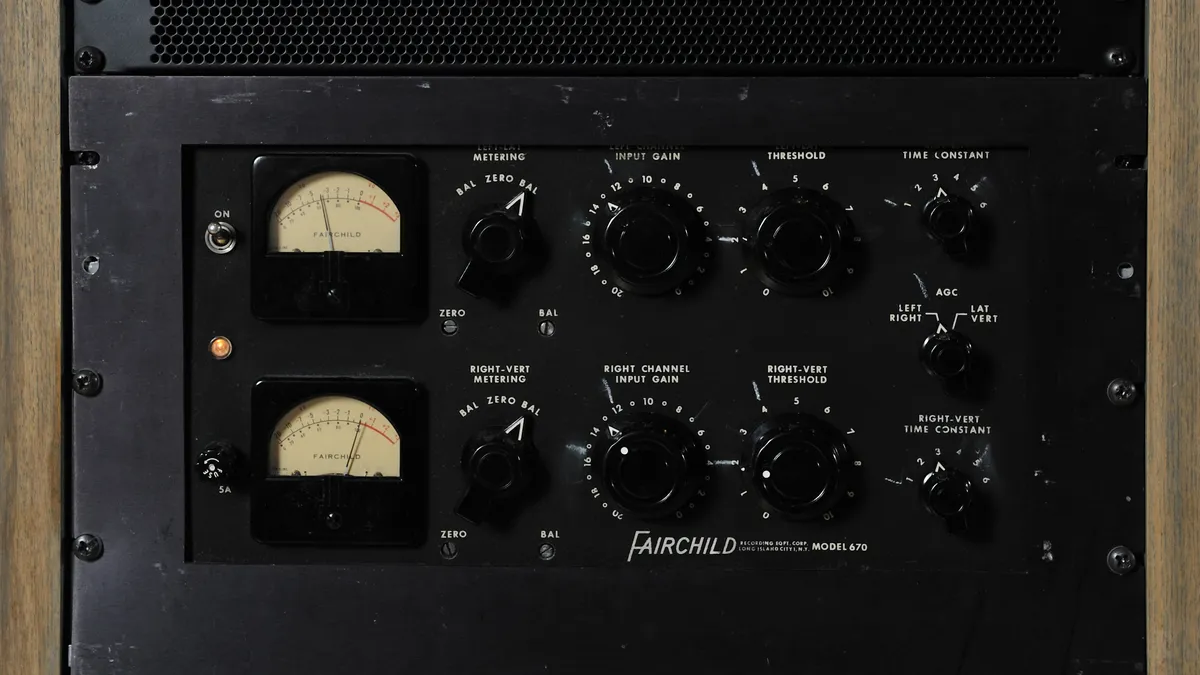
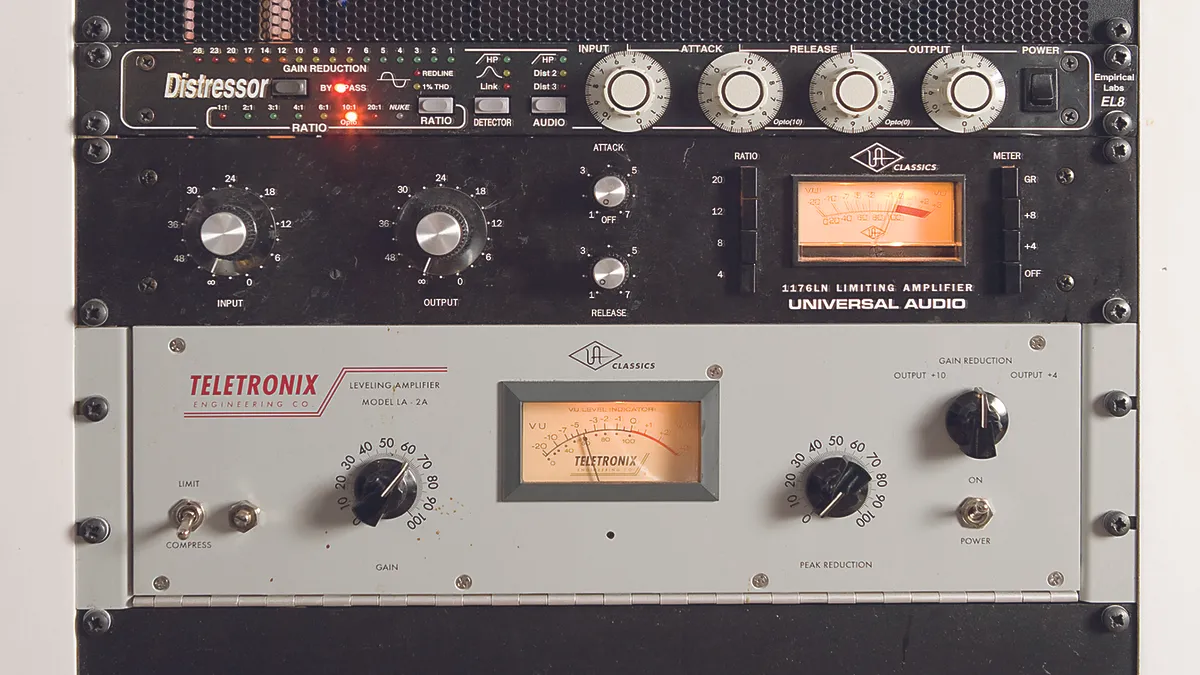
MusicRadar is supported by its audience. When you purchase through links on our site, we may earn an affiliate commission. Here’s why you can trust us. The Grammy-winning engineer and producer talks us through the art and science of compression Compression is the most complex of all audio effects or processes available to the modern audio engineer, even more so than EQ, reverb, or delay. The choices available when designing a compressor (the topology, signal flow, gain computer, etc.) provide near-infinite permutations, which is why every compressor behaves and sounds distinctive from one to another, and why specific compressors have become time-tested favorites for their unique controls and desirable sonic characteristics. There is a common misconception that compressors are automatic volume faders. This notion is entirely wrong. Compressors change the frequency content of an audio signal due to the fundamental parameters at the heart of a compressor’s circuit (e.g., ratio, attack, release, etc.) In short: compressors alter the sound. Faders do not change the sound, just the volume. I’ve had the pleasure (and pain) of listening to (and applying) compression in a wide variety of recording studios and concert venues. After decades of dialling, I can attest there is no single, definitive way to approach compression. In this article, I’ll share some concepts that you can use as a starting point for exploring the world of compression for yourself. If you’d like to find out more, I’ve published a book called Audio Dynamics: Compression Techniques for Modern Mixing and Mastering (opens in new tab), that explains in detail the art, science and history of compression, and shares time-tested settings for mixing drums, vocals, instruments, stereo groups, and mastering.Dynamic range compression is achieved by reducing the volume of loud sounds, or increasing the volume of quiet sounds, thereby “compressing” the dynamic range of an audio signal. The process of compression has many applications in audio recording, mixing, and mastering. Audio compression is accomplished by utilizing hardware or software signal processors. The hardware or software designed for compressing audio signals is called a compressor. Essentially, compression adjusts the volume of audio relative to a threshold level set by a control on the compressor. Audio signals louder than the threshold are attenuated, while sounds below the threshold level are unaffected. Compressors can improve an audio signal’s perceived quality by taming irregular volumes and improving vocal intelligibility. Harmonics and tone can also be enhanced. When audio is compressed correctly, the result should be free from noticeable fluctuations and sound “clearer” with more depth and dimension. If compression is not applied correctly (or at all), the listener might be distracted by variations in volume and need to adjust the loudness of their playback system. Compared to other audio effects (such as reverb), it can be challenging to set up compressors effectively, especially for beginners, because the impact of the compressor’s settings is not apparent to the untrained ear. A wrongly configured compressor will introduce numerous unpleasant artifacts to an audio signal. A compressor has four primary settings. Threshold determines at what volume level the compression circuit becomes active and ultimately controls the gain reduction applied to the audio signal. The threshold is one of the most important settings on a compressor as it determines the audio signal level when the compression process activates. The threshold of a compressor is set in decibels (dB) and usually relative to 0 decibels Full Scale (dBFS). If a low threshold is set (e.g., -30 dBFS), then a large portion of the signal undergoes compression as compared to a higher threshold (e.g., -10 dBFS). Ratio controls the amount of compression applied once the audio signal reaches the threshold, ranging from 1:1 (no compression) to infinity:1 (maximum compression). The amount of compression applied to an audio signal is expressed as a ratio. For example, if the ratio is set to 4:1, an input of 4 dB above the threshold will result in an output of 1 dB above the threshold. This translates into a 3 dB reduction in volume level. The ultimate beginner’s guide to compression Higher compression ratios such as 10:1 and 20:1 are known as limiting. Here the compression amount is noticeably higher, dramatically reducing the audio signal’s dynamic range. Limiters are a subset of compressors. The highest compression ratio possible is infinity:1 (or ∞:1), also known as brickwall limiting, which attenuates the audio signal to an exact threshold level (see Fig. 7). Attack determines the time it takes for the compressor to react once audio exceeds the threshold. Release is the time it takes for the compressor to bring the level back to normal once the signal is below the threshold. Compression is applied gradually instead of instantaneously, and there are controls for attack and release times— also known as the time constants of a compressor. When a compressor is described as “fast” or “slow” it’s in reference to the fastest attack times possible. With most compressors, the attack and release times can be adjusted and are typically set in milliseconds. However, in some designs, especially older compressors, the attack and release times are determined automatically. For example, with an optical compressor such as the popular LA-2A, the input signal sets both time constants automatically, making the at- tack and release program-dependent. Additional, optional compressor parameters include make-up gain, knee, sensing algorithm, and stereo linking. A compressor allows a user to manually add gain to the output to compensate for the level reduction caused by compression. This is called make-up gain. Some modern compressors have auto make-up gain. The knee setting refers to how a compressor transitions between non-compressed and compressed states, with soft or hard as the usual settings. A soft knee setting allows for more gradual compression than a hard knee (i.e., the harder the knee, the more quickly the compression will occur). Many tube and optical compressors do not offer a knee setting, as most are soft knee only by design. Some compressors respond to instantaneous levels of an input signal, also known as peak-sensing. Although they offer better peak control, peak-sensing compressors can cause rapid variations in gain reduction. Most compressors utilize RMS-sensing (root mean square), an averaging function, before the input signal is compared with the threshold. A compressor can apply equal amounts of gain reduction to both the left and right channels of a stereo signal if set to operate in stereo-linked mode. For many stereo compressors, this is the default setting (as opposed to dual-mono mode) and is calculated by combining (or averaging) the gain of the left and right channels. Stereo linking helps to avoid image shifting in stereo mixes with wide stereo content (e.g., dense reverb, ping pong delays, or hard panning). Vacuum tube compressors are the oldest type, with slower attack and release times than their more modern descendants. Consequently, tube compressors offer a distinctly “vintage” sound. Their slower time constants and feedback topology are most suitable for quieter sources. While tube compressors often produce soft, round, and euphonious-sounding compression, a tube compressor’s ratio will increase as the gain reduction increases (i.e., the sharper a transient is, the more it will be compressed), resulting in non-linear transfer curves. This may or may not be ideal, depending on the source content and intended result. Tube compressor examples include the Fairchild 670 and Manley Variable Mu. Optical compressors utilize a photocell arrangement (i.e., a light source and a light detector) to generate a CV. An increase in the amplitude of an audio signal causes the light source to increase in brightness. This increase in detectable light triggers the compressor to attenuate the audio signal.
Tesla Tesla is a transnational American automotive and clean energy company. The company develops and produces electric vehicles (cars and trucks), residential and grid-scale battery energy storage, solar panels, solar roof tiles, and other goods and services. With a market value of more than $840 billion, Tesla is one of the most valuable companies in the world. Tesla The firm sold the most battery-electric and plug-in electric vehicles globally in 2021, accounting for 21 percent of the battery-electric (purely electric) market and 14 percent of the plug-in market (which includes plug-in hybrids) that year. (China's BYD Auto overtook Tesla in Q2 of 2022 to become the top-selling EV brand globally.) Tesla also creates and installs a significant amount of photovoltaic systems in the U.S. through its subsidiary Tesla Energy. With 3.99 gigawatt-hours (GWh) of deployed battery energy storage systems in 2021, Tesla Energy is also among the biggest suppliers of such systems globally. Martin Eberhard and Marc Tarpenning established Tesla Motors in July 2003. Nikola Tesla, an inventor and electrical engineer is honored in the corporate name. With a $6.5 million investment in February 2004, Elon Musk rose to become the company's largest shareholder. He assumed the position of CEO in 2008. Musk claims that Tesla's goal is to hasten the transition to environmentally friendly energy and transportation, using solar energy and electric vehicles as the primary sources. The Roadster sports car, Tesla's first vehicle model, was released in 2008. The Model S sedan arrived in 2012, the Model X SUV appeared in 2015, the Model 3 sedan appeared in 2017, and the Model Y crossover appeared in 2020. The Model 3 was the first electric vehicle to sell one million units globally, becoming the all-time best-selling plug-in electric vehicle in June 2021. Tesla sold 936,222 vehicles globally in 2021, a growth of 87 percent over the previous year. As of August 2022, the company has sold a total of 3 million vehicles. In October 2021, Tesla became the sixth corporation in American history to have a market valuation of $1 trillion and the second fastest company to hit the $1 trillion mark. Tesla has been the subject of many lawsuits, recalls, government scrutiny, and public controversies arising from statements and actions of CEO Elon Musk and allegations of creative accounting, whistleblower retaliation, worker rights violations, and unresolved and dangerous technical problems with their products. Tesla currently operates 19 factories, including five Gigafactories, with one in China and another in Germany. The Tesla Fremont Factory, formerly the NUMMI facility in Fremont, California, is now home to a Tesla assembly facility. General Motors initially opened the facility in 1962, and from 1984 GM and Toyota jointly controlled it. Tesla bought the old factory the same year it shuttered its doors, in 2010. Nevada saw the opening of its first significant battery manufacturing facility in 2016. Powerwalls, Powerpacks, and Megapacks, battery cells made in collaboration with Panasonic, and Model 3 battery packs and drivetrains are all produced at the Gigafactory Nevada (formerly known as Gigafactory 1). In exchange for opening in their territory, the municipal and state governments provided the factory with large subsidies that made it tax-free for Tesla to operate for ten years. Tesla chose Austin, Texas, on July 23, 2020, as the location for Gigafactory 5, currently known as Gigafactory Texas. Giga Texas will serve as the primary factory for the Tesla Cybertruck and Tesla Semi and the production of Model 3 and Model Y vehicles for the Eastern United States. Tesla held its Cyber Rodeo event on April 7, 2022, to commemorate the official launch of the Giga Texas project, which around 15,000 guests attended. In 2021, Tesla purchased a former JC Penney distribution facility close to Lathrop, California, with plans to construct a Megafactory to produce Megapacks. The facility, which started operations in 2022, manufactures next-generation Megapacks that use prismatic lithium iron phosphate batteries. Tesla announced its plans to build a car and battery factory in Europe in 2016. Several countries campaigned to be the host, and eventually, Germany was chosen in November 2019. On March 22, 2022, Tesla's first European Gigafactory, named Gigafactory Berlin-Brandenburg, opened with a planned capacity to produce 500,000 electric vehicles annually, along with car batteries. In July 2018, Tesla signed an agreement with Chinese authorities to build a factory in Shanghai, China, which was Tesla's first Gigafactory outside the United States. The factory building was finished in August 2019, and the initial Tesla Model 3s were in production from Giga Shanghai in October 2019. Tesla In 2021, China accounted for 26 percent of Tesla's sales revenue and was the second largest market for Tesla after the United States, which accounted for 45 percent of its sales. Like all other electric vehicles (EV), Tesla vehicles use rechargeable batteries to store electricity pulled from the grid and drive an electric motor that moves the wheels. Electric automobiles can feel very responsive to drive because they generally accelerate faster than conventional fuel engines. There are several distinct types of EVs. Pure electric vehicles are those that use only electricity to operate. Additionally, hybrid electric vehicles can also be powered using gasoline or diesel to charge the battery. Plug-in electric vehicles use only electricity and obtain all their power from being charged from the grid. This type of vehicle doesn't emit pollution like typical cars because it doesn't require gasoline or diesel —although the electricity itself may be generated from non-renewable sources, leading to carbon emissions. Plug-in hybrids: These vehicles primarily run on electricity but also contain a conventional fuel engine, allowing you to switch to gasoline or diesel if the battery runs out. The difference with hybrids is that they only switch to the engine if the battery is low, whereas hybrids constantly switch back and forth. These vehicles emit emissions when they are running on fuel but not when they are running on electricity. Plug-in hybrids can be plugged into the grid to recharge their battery. Tesla has established itself as a household name by providing luxury, cutting-edge technology, exceptional range, and a secure charging network. Tesla makes up about two out of every three electric automobiles sold in the U.S. With more EVs coming onto the market every year, why should you get one? Technology is a hallmark of Tesla vehicles. One of the first things you'll notice when you step into a Tesla is the sizable touchscreen on the dashboard. In fact, the vehicle is designed so that everything can be operated from this screen. You may operate the HVAC infotainment system and even browse the internet or stream your preferred music and television programs from this screen. The absence of buttons and knobs gives Tesla interiors a sleek appearance. Additionally, many features, including the windows, horn, valet mode, lock, and car tracking, can be managed from your smartphone. New Teslas also come equipped with Autopilot — "an advanced driver assistance system that enhances safety and convenience behind the wheel." The system is intended to reduce the overall workload for drivers. Autopilot can also come with full self-driving capabilities, but using the full self-driving feature is currently illegal in many places, and all drivers are reminded that they need to keep their hands on the wheel and maintain control of the vehicle at all times. A new study joins the body of research showing that being bilingual, knowing more than one language, slows down the negative effects of aging on the brain.
By Peter White Television Editor Netflix is utilizing its move into live streaming technology with Chris Rock becoming the first person to test it out. Rock will perform live in a global streaming event in 2023. It comes after Deadline revealed in May that the streamer was experimenting with the technology. It was noted upon that Rock had another Netflix special to come after the infamous slap incident from Will Smith at the Oscars. Rock has been out on his Ego Death tour over the last few months and during a show in London promised that he would discuss more about his Oscars experience on Netflix. “People expect me to talk about the bullshit, I’m not going to talk about it right now, I’ll get to it eventually, on Netflix,” he said.
Roland have made a habit of changing the game- they’ve left their mark on the industry with countless pieces of excellent equipment, and their TR-808 and 909 modules are so legendary as to need no introduction. One of their greatest innovations in recent years calls back to these two titans with style and aplomb, making for a “rhythm performer” that does so much more than its tagline might make you think. The Roland TR-8, blending vintage feel and sound with modern power and versatility, is a more than worthy successor to two of the most iconic pieces of music gear ever made.
Featuring a full reproduction of both the TR-808 and TR-909 modules, the TR-8 does everything those two can and then some. It builds on the original formula by maintaining the tone and behavior of the 80s classics with Analog Circuit Behavior (ACB) technology while adding plenty of new bells and whistles. 16 built-in kits made from 11 different instrument types give you a variety of amazing presets, while the ability to custom-build your own kits from 808 and 909 sounds put near-limitless options in your hands. Tune and decay controls are now present on every instrument available, and the bass and snare drums now let you tweak additional controls such as Attack, Snappy, and Comp. You can create patterns of up to 32 steps with real-time count adjustment, and the elimination of re/play modes makes for smoother transition between step input and real-time performance and beat-making. The unique “Scatter” function brings an exciting level of real-time control to help you mix things up, enabling you to reverse, glitch, gate, truncate, stutter, and make a wide range of rhythmic variations in perfect sync. It even lets you adjust the intensity and seamlessly cycle through Scatter patterns, allowing you to shake things up with the simple turn of a dial. The TR-8 lets you save up to 16 user drum kits and patterns. It comes with dedicated controls for bass and snare drums, toms, rim shot, hand clap, hi-hats, and crash and ride cymbals, as well as accent, reverb, delay, and external effects. It’s a gorgeous black and green unit complete with a 7 segment, 4 character LED display and 16 per-step, full-color LED pads.
Read more about the Roland TR-8 here on the official Roland website, or watch the video below to see it in action!
Warzone 2’s new extraction mode, DMZ, arrives next week. Alongside the release of Call of Duty: Warzone 2, next week will bring the debut of a brand-new extraction game mode, DMZ, that is unlike any other mode in the history of Call of Duty. Featuring an open world populated with different factions, AI strongholds, and other enemy squads with their own goals, the new DMZ mode brings a fresh take on the traditional Warzone gameplay. To show off the new mode in action, Infinity Ward brought Call of Duty content creators out to a special event at its Los Angeles studio. One of the creator channels, MrDalekJD, shared an official video providing commentary on the event's proceedings. Infinity Ward has already shared details of the DMZ mode, but this video from the content creator reveal event this past Wednesday shows what the changes and updates look like with live gameplay. One of the small details immediately noticeable watching the video is the train that goes through the new DMZ map. Players can get on top of the train and ride around the level, either trying to stay safe or taking out opposing squads from the moving train cars. RELATED: Warzone 2 Will Reportedly Receive New Resurgence Map In 2023 Content creators taking part in the event had noticed gameplay changes that had not been previously announced, such as the ability to revive dead squad mates at any time while they are waiting for the respawn timer. Previously, in the first Warzone, squad mates could only be revived during a limited "down but not out" window of time before the respawn timer turned on. This can be seen for the first time at the 20-minute mark of the video, amid a discussion about ammo being scarce. The new amphibious options make an appearance at the 40-minute mark, with the squad piling into a boat to navigate a river. The ability to swim underwater and fight using sidearms, melee weapons, and throwing knives is one of the many new changes coming with Warzone 2. The fuel gauge, located to the left of the seating display, is also new as vehicles now will cease to operate without fuel. During the 2 hours of gameplay shown in the video, the participating content creators appear to be having a great time experimenting with all the new gameplay mechanics that make up the DMZ mode. New missions, such as collecting enemy intel, break up the standard Warzone missions asking you to protect/eliminate certain players or to reach objective markers. The inclusion of AI combatants that will attack anyone nearby spices up gunfights by introducing a more random element. Warzone players worldwide will get to experience the changes brought to standard Warzone gameplay and the new DMZ mode when Warzone 2 releases next week on November 16. NEXT: Modern Warfare 2: Best Guns, Ranked Jonathan has been writing news and running gaming websites for the past 15 years after starting gaming with the original NES. Final Fantasy 6 is his favorite game of all time and he'll argue for hours why Setzer is the best character of all time.