Blog

Ideon Audio Ayazi mk2 D/A processor & 3R Master Time Black Star USB clock – Stereophile Magazine


I learned about music in places like this one, having figured out that the occasional eye roll was worth putting up with for the information and knowledge on offer. I grew up at a time when music was obtainable mostly on physical media: records, CDs, cassettes. It was usually necessary to buy a recording in order to hear it, so one’s budget had to be apportioned impactfully. Reliable insider dope was crucial.
Today, the internet and streaming have revolutionized access to music in ways that are frankly thrilling (if not for musicians, then definitely for listeners). I teach college classes, and my music-loving students know more about a broader array of music than I did at their age, thanks partly to YouTube and Spotify. During the most isolating months of the pandemic, Roon, Tidal, and Qobuz allowed me to spend many happy hours learning about Indian classical music, the pop traditions of Ethiopia, Mali, and Senegal, and some obscure corners of lover’s rock and classic reggae, propelled record by record through the Tidal and Qobuz catalogs by Roon’s machine-learning algorithms.
What I’m getting around to saying is that, for many of us, streaming has become a crucial part of our musical diets, more indispensable than CDs ever were. For me though, this musically exciting fact is sonically challenging, because I have a strong preference for music pressed on vinyl. I’ve listened to, and reviewed, plenty of nice-sounding digital gear, but I cannot remember many times I thought, “wow, this sounds incredible!” the way I sometimes do when I listen to a system organized around a well–set-up turntable.
Many digital sources excel at reproducing the contours of music, including the tiny sonic minutiae some listeners call “plankton.” What they struggle with is filling in those contours with realistic information that registers as texture, color, impact, physicality, presence, and, most importantly, a sense of tonal density—of music pressurizing the air. I tend to think of these qualities as reproduced music’s third dimension; for me, they are essential to the illusion of a musical event happening in my listening room. Unfortunately, these qualities do not show up on an oscilloscope (footnote 1). Engineering a digital source that is able to engage and hold your attention is not addressed by simple strategies like lowering distortion or minimizing jitter. It requires a more complex and multilateral approach.
The Ideon D/A System
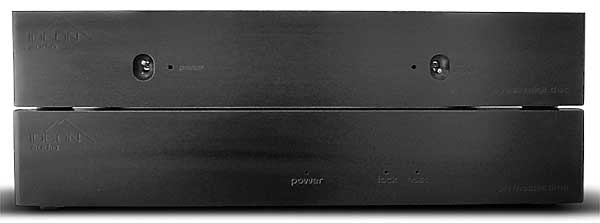
Which brings me to the Ideon Ayazi mk2 DAC ($3950) and 3R Master Time Black Star USB reclocker (also $3950), a two-box digital source that made me think about the ways a component can encourage us to seek out certain musical experiences. Founded in Athens in 2016 by George Ligerakis and Vasilis Tounas, Ideon Audio manufactures only digital gear and takes some unorthodox approaches to getting it to sound good. Consider the Ayazi mk2, which is designed around the ESS9023 DAC chip. These days, some perfectionist DACs in a similar price bracket convert data using R-2R resistor networks, while others rely on many lines of custom code. In contrast, the Ayazi relies on the ESS chip and its onboard filters; according to Ligerakis, the special sauce lies in the way it’s optimized and used. Ideon emphasizes regulated, stable linear power supplies and “persistent” reclocking. If I had assumed that the inexpensive integrated DAC chip told me something about how the Ideon stack would sound, I would have been completely wrong.
722ideon.bac
In the metal, the Ideon components are as spare as they are elegant. Their petite yet reassuringly heavy battleship-gray cases, which measure roughly 11″ × 7″ × 3″, reflect their streamlined purpose; the front panel of the Ayazi contains only a power switch and an input selector offering a choice of USB and S/PDIF. The 3R Master Time Black Star (typing the full name of this product makes me feel a little silly, so I will refer to it henceforth as the Master Time) greets the listener only with tastefully dim LEDs marked “power,” “lock,” and “host.” On the back of the Ayazi you will find the two aforementioned inputs, a pair of RCA analog outputs, and an IEC power receptacle. The rear of the Master Time offers a USB input and output, a switch for the 5V power rail, and, of course, another power cord input. That’s it. The Ideon components boast no selectable filters or oversampling options, no network inputs, no I2S or MQA. They don’t even decode DSD. The choices reflect what Ligerakis described to me as the “particularly Spartan approach” he took to maximizing the listening experience; this reference from Ideon’s Greek CEO delighted the geek in me.
In use, the Ideon stack is simplicity itself: I connected the Sonore opticalRendu streamer to the Master Time using an AudioQuest Diamond USB cable, then routed another Diamond USB cable from the Master Time to the Ayazi. Then I set Roon to convert DSD files to PCM. Game on.
Listening
To get an obvious question out of the way: Yes, I did listen to the Ayazi without the Master Time. By its lonesome, the Ayazi reproduced music with less resolution and timbral accuracy and created a spatially smaller, less lifelike sound. Music sounded duller and less compelling. After checking this experiment off my list, I left the two components connected. This review is of the Master Time and Ayazi together.
The most obvious aspect of listening through the Ideon stack was how well it organized the recordings played through it. Nothing was exaggerated or missing, including deep bass and the high highs; nothing sounded strident or splashy. This sense of order was heightened by a profound silence. Digital components aren’t generally known for being noisy, but the Master Time/Ayazi created a musically significant silence, in part because of the remarkable resolution on hand.
722ideon.talk
The Ideon components presented recordings as though bathed in brilliant light, with every speck of information illuminated in high contrast. In particular, they portrayed decay and reverberant trails with more precision and sustain than any source I’ve heard at home. On “I Believe in You,” from Talk Talk’s otherworldly Spirit of Eden (16/44.1 FLAC, Parlophone/Qobuz), a record that has become deservedly recognized as a key precursor to post-rock and an unclassifiable masterpiece in its own right, the low-level notes from Tim Friese-Greene’s electric guitar were rendered with such shimmering vividness that they seemed less like sounds and more like tumbleweeds blowing across the soundstage.
The Master Time/Ayazi rendered music with none of the artifacts of early digital reproduction, which boil down to the sense of hollowness I touched on earlier: the impression that the music is a flickering hologram with little inside it. Best of all, the Ideon stack’s minutely detailed presentation didn’t detract from the music’s weight. Here, I’m not talking about the weight of low bass tones but rather the realistic sense of weight possessed by actual instruments and voices. And it imbued recordings with remarkable solidity, a genuinely lovely effect.
Over the weeks I spent listening to these Greek components, a funny thing happened. As much as I admired them, their way with texture, presence, and color saturation—the tonal juiciness of a recording—was no match for the turntable and handful of low-output moving coil cartridges that lived on the shelf above them. I’m not sure any digital source can surpass a good turntable in this regard. But it became increasingly clear that the Master Time/Ayazi accomplished something that the analog source couldn’t: It created a pristine, spectrally quiet sonic world in which I could enjoy the unfolding of the most delicate musical events. After a while, I realized that the Ideon stack was subtly altering my listening habits, encouraging me to reach more often for music filled with these kind of diaphanous moments, which tend to be present most reliably on classical recordings.
722ideon.richter
Sviatoslav Richter’s 1960 performance of Beethoven’s “Appassionata” (16/44.1 rip of BMG 07863-56518-2) is one of the marvels of recorded piano. It was committed to tape during his first visit to the West, belated because the Ukraine-born pianist—a closeted gay man whose father was murdered during Stalin’s purges—was politically suspect in his native Soviet Union. Richter turned the stately, flowing first movement into a harrowing statement; he dramatically extended the composition’s dynamics and took such liberties with the tempo that listening to it can constrict the throat with suspense. Weeks earlier, he had closed his first appearance at Carnegie Hall with a similarly radical performance of the Beethoven sonata, shocking the audience.
The Master Time/Ayazi reproduced the acoustic of New York’s Webster Hall, where RCA engineer Lewis Layton recorded him, in all of its cavernous vastness; hearing the hall reverberate with Richter’s violent attack on the keyboard made the performance disturbing and powerful. The Ideon stack also allowed me to hear that no matter how forcefully Richter struck the keys, his playing remained in perfect control, a testament to his unearthly technique.
722ideon.Jansch
A Comparison
I compared the Master Time/Ayazi combination to my Sonnet Morpheus, another highly resolving DAC, which uses an R-2R conversion scheme. Listening to the beguiling title track from Bert Jansch’s Rosemary Lane (16/44.1 FLAC, Transatlantic/Qobuz) through the Morpheus, Jansch’s John Bailey–built acoustic guitar and quiet yet expressive singing sounded just as detailed but notably less coherent, both musically and sonically, than through the Ideon stack. The recording sounded splashier, with somewhat less weight, and didn’t hold my attention as reliably as it did when played through the Master Time/Ayazi. The Ideon rendition also sounded meaningfully quieter and slightly more dynamic. But then, even when I factor in the Denafrips Iris digital-to-digital converter I use to feed the Morpheus’s I2S input, the Dutch DAC costs about half as much as the Ideon stack.
722ideon.dac
Summing Up
During my time with it, the Master Time/Ayazi offered me something I didn’t know I wanted. No audio component offers every desirable aspect of sound reproduction, which means we have to settle for acceptable compromises. My version of audio heaven is the world’s best jukebox playing endless 45s; my choices in gear tend to prioritize dynamics, unambiguous bass, vast soundstages, and plentiful helpings of tone color, drive, and physicality. Of course, that is not the only path to paradise, and the Ideon components provide the kind of musical thrills one might hear through the original Quad electrostatic speakers: a crystal-clear, essentially neutral, hyperdetailed window onto the music that captures every nuance without sacrificing music’s weight and body.
During my time with it, the Ideon stack operated flawlessly, offering no intrusions on my enjoyment. With a combined price of $7800, it is by no means inexpensive, but it provides good value for the refined musical spectacle it creates. That it inspired me to explore music that usually forms a relatively small portion of my musical diet is a testament to how compelling the Ideon stack makes the files played through it, and it is by no means a one-trick pony: It can play every kind of music with all of its strengths intact. I simply found listening to certain genres on it to be a revelation. If I were a listener of primarily classical and acoustic music, I would travel far to hear one.


Footnote 1: Maybe they do if you know what to look for.—Jim Austin

COMMENTS

MZKM's picture

Why do so many Hi-Fi brands forgo balanced connections? This unit is $4000. Many amps have an input sensitivity >2V, so you’d thus have to deal with lower wattage or use an active preamp.

Kursun's picture

I for one, can’t understand usage of balanced lines.
Balanced lines, separate neutral and ground wires are required in instances where there is great distance between mikes for example and pre inputs, as in stagework and large recording studios.

As you mention at homes, average source signal levels are as high as 2Vs and average distance between source and other components are usually less than 0.5 m.

There shouldn’t any use for balanced lines or connections at home. Yet they are often used on high priced equipment to give the illusion of high-end.

On the other hand, phono cartridges could benefit as their outputs are extremely low and susceptible to picking up hum.This is the only component in home audio where balanced lines could really help. Yet this fact is easily ignored by the high end crowd.

MZKM's picture

I’m not talking about balanced for increase performance, I’m talking about balanced as it 2x the output, 4Vrms being standard.

If this unit put out 4Vrms via RCA, I’d have no complaints. But it doesn’t, which leads to a smaller pool of amplifiers that can be paired with it without limiting the wattage.

Do note that even 4Vrms isn’t enough sometimes; the Purifi amp for instance, if you forgo any input buffer (for max performance), it requires something along the lines of 11Vrms!

georgehifi's picture

MZKM: “Many amps have an input sensitivity >2V, so you’d thus have to deal with lower wattage or use an active preamp.”

Yes, it’s so easy to have far higher output gain from sources today with volume control and go direct without any negatives. (And as a bonus also have less distortion/colouration, than having an active preamp and another set of interconnects in line)
These manufacturers that refuse to give it, probably also sell active preamps, or have a buddy that does.

Cheers George

cognoscente's picture

Streaming a song costs the same amount of power as (buying and) downloading it once. Streaming (and data sharing in general such as on social media, the internet is one of the biggest polluters), eating meat, traveling and having a fireplace and bbq is not the future

MhtLion's picture

Based on what I read here, you seem to have a limited experience with a DAC. Sure, you may have a ton of experience just not written here, but what I am picking up personally from your review is that you are not a DAC fanatic and you may not have an experience with other more established DACs around its price point. The question is – why is your review worth anything? Are you a professional reviewer knowing in and out of a DAC and its industry? Or, is your review just as good as any personal review on Amazon? You may be the former, but I’m leaning toward the latter.

MZKM's picture

All I care about is wether they know what to talk about. I don’t care if the person doesn’t even like music, as long as they are able to hear subtle changes and able to identify the changes occurred that resulted in that change (maybe the volume control is analog which has a large channel imbalance, altering the imaging/soundstage as the volume control is changed).

MhtLion's picture

For me, I do not care if a $20,000 DAC sounds heavenly when it actually sounds similar to a $2,000 DAC. I read 3 DAC reviews from Alex. Every time, I cannot stop thinking ‘no.. I don’t think he knows a DAC. He does not sound like a DAC guy’. There are many products that sound wonderful. But, when a reviewer recommends a product, he must know how it compares to the competition. I have no idea who Alex is. Maybe he is/used to be a musician. Perhaps he can dive into the music deeper than most. But, say a grammy winning musician goes to an audio shop and listens to a DAC and loves it to death – it does not matter if he only heard 3 DACs in his lifetime. I personally find that’s not much different from a five-year-old finding the next greatest toy of all time every time he steps into the target.

Why do so many Hi-Fi brands forgo balanced connections? This unit is $4000. Many amps have an input sensitivity >2V, so you’d thus have to deal with lower wattage or use an active preamp.
I for one, can’t understand usage of balanced lines.
Balanced lines, separate neutral and ground wires are required in instances where there is great distance between mikes for example and pre inputs, as in stagework and large recording studios.
As you mention at homes, average source signal levels are as high as 2Vs and average distance between source and other components are usually less than 0.5 m.
There shouldn’t any use for balanced lines or connections at home. Yet they are often used on high priced equipment to give the illusion of high-end.
On the other hand, phono cartridges could benefit as their outputs are extremely low and susceptible to picking up hum.This is the only component in home audio where balanced lines could really help. Yet this fact is easily ignored by the high end crowd.
I’m not talking about balanced for increase performance, I’m talking about balanced as it 2x the output, 4Vrms being standard.
If this unit put out 4Vrms via RCA, I’d have no complaints. But it doesn’t, which leads to a smaller pool of amplifiers that can be paired with it without limiting the wattage.
Do note that even 4Vrms isn’t enough sometimes; the Purifi amp for instance, if you forgo any input buffer (for max performance), it requires something along the lines of 11Vrms!
MZKM: “Many amps have an input sensitivity >2V, so you’d thus have to deal with lower wattage or use an active preamp.”
Yes, it’s so easy to have far higher output gain from sources today with volume control and go direct without any negatives. (And as a bonus also have less distortion/colouration, than having an active preamp and another set of interconnects in line)
These manufacturers that refuse to give it, probably also sell active preamps, or have a buddy that does.
Cheers George
Streaming a song costs the same amount of power as (buying and) downloading it once. Streaming (and data sharing in general such as on social media, the internet is one of the biggest polluters), eating meat, traveling and having a fireplace and bbq is not the future
Based on what I read here, you seem to have a limited experience with a DAC. Sure, you may have a ton of experience just not written here, but what I am picking up personally from your review is that you are not a DAC fanatic and you may not have an experience with other more established DACs around its price point. The question is – why is your review worth anything? Are you a professional reviewer knowing in and out of a DAC and its industry? Or, is your review just as good as any personal review on Amazon? You may be the former, but I’m leaning toward the latter.
All I care about is wether they know what to talk about. I don’t care if the person doesn’t even like music, as long as they are able to hear subtle changes and able to identify the changes occurred that resulted in that change (maybe the volume control is analog which has a large channel imbalance, altering the imaging/soundstage as the volume control is changed).
For me, I do not care if a $20,000 DAC sounds heavenly when it actually sounds similar to a $2,000 DAC. I read 3 DAC reviews from Alex. Every time, I cannot stop thinking ‘no.. I don’t think he knows a DAC. He does not sound like a DAC guy’. There are many products that sound wonderful. But, when a reviewer recommends a product, he must know how it compares to the competition. I have no idea who Alex is. Maybe he is/used to be a musician. Perhaps he can dive into the music deeper than most. But, say a grammy winning musician goes to an audio shop and listens to a DAC and loves it to death – it does not matter if he only heard 3 DACs in his lifetime. I personally find that’s not much different from a five-year-old finding the next greatest toy of all time every time he steps into the target.

source

Paul Sorvino, Master of the Mild-Mannered Mobster, Dies at 83 – The New York Times

Advertisement
Supported by
A would-be singing star, he found success in Hollywood playing a variety of roles, but they were often quiet, dangerous men, like Paulie Cicero in “Goodfellas.”
Send any friend a story
As a subscriber, you have 10 gift articles to give each month. Anyone can read what you share.

Paul Sorvino, the tough-guy actor — and operatic tenor and figurative sculptor — known for his roles as calm and often courteously quiet but dangerous men in films like “Goodfellas” and television shows like “Law & Order,” died on Monday. He was 83.
His publicist, Roger Neal, confirmed the death, at the Mayo Clinic in Jacksonville, Fla. No specific cause was given, but Mr. Neal said that Mr. Sorvino “had dealt with health issues over the past few years.”
Mr. Sorvino was the father of Mira Sorvino, who won a best supporting actress Oscar for Woody Allen’s “Mighty Aphrodite” (1995). In her acceptance speech, she said her father had “taught me everything I know about acting.”
“Goodfellas” (1990), Martin Scorsese’s acclaimed Mafia epic, came along when Mr. Sorvino was 50 and decades into his film career. His character, Paulie Cicero, was a local mob boss — lumbering, soft-spoken and ice-cold.
“Paulie might have moved slow,” says Henry Hill, played by Ray Liotta, his neighborhood protégé in the film, “but it was only because he didn’t have to move for nobody.” (Mr. Liotta died in May at 67.)
Mr. Sorvino almost abandoned the role because he couldn’t fully connect emotionally, he told the comedian Jon Stewart, who interviewed a panel of “Goodfellas” alumni at the 2015 Tribeca Film Festival. When you “find the spine” of a character, Mr. Sorvino said, “it makes all the decisions for you.”
That didn’t happen, he recalled, until one day when he was adjusting his necktie, looked in the mirror and saw something in his own eyes. When he saw what he called “that lethal Paulie look,” Mr. Sorvino told The Lowcountry Weekly, a South Carolina publication, in 2019, “I knew at that moment I had embraced my inner mob boss.”
He had made his mark onstage as a very different but perhaps equally soulless character in “That Championship Season” (1972), Jason Miller’s Pulitzer Prize-winning tragicomedy about the sad reunion of high school basketball players whose glory days are decades past. In the original Broadway production, Mr. Sorvino played Phil Romano, a small-town strip-mining millionaire arrogantly having an affair with the mayor’s wife.
Mr. Sorvino received a Tony Award nomination for best actor in a play and reprised the role in a 1982 film adaptation.
Paul Anthony Sorvino was born on April 13, 1939, in Brooklyn, the youngest of three sons of Fortunato Sorvino, known as Ford, and Marietta (Renzi) Sorvino, a homemaker and piano teacher. The elder Mr. Sorvino, a robe-factory foreman, was born in Naples, Italy, and emigrated to New York with his parents in 1907.
Paul grew up in the Bensonhurst section of Brooklyn and attended Lafayette High School. His original career dream was to sing — he idolized the Italian American tenor and actor Mario Lanza — and he began taking voice lessons when he was 8 years old or so.
In the late 1950s, he began performing at Catskills resorts and charity events. In 1963, he received his Actors Equity card as a chorus member in “South Pacific” and “The Student Prince” at the Theater at Westbury on Long Island. That same year, he began studying drama at the American Musical and Dramatic Academy in New York.
Acting jobs were elusive. Mr. Sorvino’s Broadway debut, in the chorus of the musical “Bajour” (1964), lasted almost seven months, but his next show, the comedy “Mating Dance” (1965), starring Van Johnson, closed on opening night.
Mr. Sorvino worked as a waiter and a bartender, sold cars, taught acting to children and appeared in commercials for deodorant and tomato sauce. After his first child, Mira, was born, he wrote advertising copy for nine months, but the office job gave him an ulcer.
“Most of the time I was just another out-of-work actor who couldn’t get arrested,” he told The New York Times in 1972. “I had confidence in my ability, and I was angry as hell when other people didn’t recognize it.”
Then his luck changed. He made his film debut in “Where’s Poppa?” (1970), a dark comedy directed by Carl Reiner, in a small role as a retirement-home owner. Then “That Championship Season” came along, starting with the Off Broadway production at the Public Theater.
The film role that first won him major attention was as Joseph Bologna’s grouchy Italian American father in “Made for Each Other” (1971). Mr. Sorvino, almost five years younger than Mr. Bologna, wore old-age makeup for the role.
He appeared next as a New Yorker robbed by a prostitute in “The Panic in Needle Park” (1972) but did not fall victim to the cops-and-gangsters stereotype right away. In 1973, he was George Segal’s movie-producer friend in “A Touch of Class” and a mysterious government agent in “The Day of the Dolphin.”
Mr. Sorvino later played an egotistic, money-hungry evangelist with a Southern accent in the comedy “Oh, God!” (1977) and God Himself in “The Devil’s Carnival” (2012) and its 2015 sequel. He was a down-to-earth newspaper reporter in love with a ballerina in “Slow Dancing in the Big City” (1978). In “Reds” (1981), he was a passionate Italian American Communist leader just before the Bolshevik Revolution.
He was Secretary of State Henry Kissinger, complete with German accent, in Oliver Stone’s “Nixon” (1995). And he played Fulgencio Capulet, Juliet’s intense father with an ancient grudge, in Baz Luhrmann’s “Romeo + Juliet” (1996).
But in a half-century screen career, Mr. Sorvino’s characters were often on the wrong side of the law. He played, among others, Chubby de Coco (“Bloodbrothers,” 1978), Lips Manlis (“Dick Tracy,” 1990), Big Mike Cicero (“How Sweet It Is,” 2013), Jimmy Scambino (“Sicilian Vampire,” 2015) and Fat Tony Salerno (“Kill the Irishman,” 2011).
And in at least 20 roles, he played law officers with titles like detective, captain or chief. For one season (1991-92), he was Sgt. Phil Cerreta on NBC’s “Law & Order,” but he found the shooting schedule too demanding — and difficult on his voice.
Mr. Sorvino continued to sing professionally, making his City Opera debut in Frank Loesser’s “The Most Happy Fella” in 2006.
His personal life sometimes reinforced his tough-guy image. Most recently, in 2018, when the movie mogul Harvey Weinstein was on trial for criminal sexual acts — and Mira Sorvino had accused him of harassment — Mr. Sorvino predicted that Mr. Weinstein would die in jail. “Because if not, he has to meet me, and I will kill the [expletive deleted] — real simple,” Mr. Sorvino said in a widely aired video interview.
Four months later, Mr. Weinstein was sentenced to 23 years in prison.
Mr. Sorvino’s final screen roles were in 2019. He played a corrupt senator in “Welcome to Acapulco,” a spy-comedy film, and the crime boss Frank Costello in the Epix series “Godfather of Harlem.”
He married Lorraine Davis, an actress, in 1966, and they had three children before divorcing in 1988. Mr. Sorvino’s second wife, from 1991 until their 1996 divorce, was Vanessa Arico, a real estate agent. He married Dee Dee Benkie, a Republican political strategist, in 2014.
Mr. Sorvino began making bronze sculpture in the 1970s and considered his nonperforming arts work particularly satisfying. “That’s why I prefer it,” he told The Sun-Sentinel, a Florida newspaper, in 2005. “No one really tells you how to finish something.”
“Acting onstage is like doing sculpture,” he said. “Acting in movies is like being an assistant to the sculptor.”
Mr. Sorvino is survived by his wife, Dee Dee Sorvino; three children, Mira, Amanda, and Michael; and five grandchildren.
Johnny Diaz contributed reporting.
Advertisement

source

Sylvania musician co-produced two tracks on Beyoncé's 'Renaissance' – Toledo Blade

source

Piano Market: 37% of Growth to Originate from APAC, Market Driven by Inclusion of Music – Technavio – Ben – Benzinga

Piano Market: 37% of Growth to Originate from APAC, Market Driven by Inclusion of Music – Technavio – Ben  Benzinga
source

MY YOUNGER BROTHER MADE AN INSANE BEAT *He's Better Than Me?*

Jan. 6 committee reveals Trump's Orwellian attempt to win the election • Missouri Independent – Missouri Independent

A man carrying zip ties climbs over steps in the U.S. Senate chamber on Jan. 6, 2021 (Win McNamee/Getty Images).
Anyone who’s read George Orwell’s “1984,” the dystopian novel about life in the U.S. under an authoritarian regime, knows that to survive, one had to accept whatever Big Brother said no matter how big the lie. Proof you’d come to fully embrace the all-controlling Party was to believe without question that two plus two never equaled four but always the number five. Anyone who claimed otherwise was considered a traitor and treated as such.
I think of that now knowing that despite the hours of testimony and truckloads of evidence of President Donald Trump’s attempt to overthrow the election, much of it coming from Trump loyalists, the majority of House and Senate Republicans and many Republican voters, including 50% of them here in Oregon, still swallow and spew Trump’s lie, and consider those who do not parrot his prattle like Republican Reps. Liz Cheney and Adam Kinzinger, traitors. Both of these conservatives are central to the committee’s investigation and both were censured by Republican party brass for having the temerity to doubt Trump’s math.
Yet doubt is exactly what most Americans have.
One of the more damning pieces of evidence that has come out in the investigation is an audio recording of Steve Bannon, one of Trump’s closest advisers, telling a group of associates three days before the election that Trump would declare victory on election night no matter how the election was trending. “That doesn’t mean he’s a winner, but he is just gonna to say he is,” Bannon said. “That’s our strategy.” He explained to the group that Republicans generally vote on the day of election while Democrats favored mail-in ballots that are tallied later. Trump, said Bannon, would grab the momentum of the early tally and simply claim victory. “If Trump is losing by 10 or 11 o’clock, it’s going to be even crazier because he’s going to sit right there and say they stole it,” Bannon said. “Trump is going to do some crazy shit.”
He was right.
Around 2:30 a.m. on Nov. 4, with a blue wave starting to gain steam and millions of votes yet to be counted, Trump took to the podium in the East Wing of the White House and declared himself the winner of the election.
Attempting to overthrow an election is not a justifiable act; it’s treasonous. A violent attack on the Capitol is not heroic; it’s criminal. And refusing to accept an election loss is not patriotic; it’s pathetic.
In 2016, Trump once told a crowd that he “could stand in the middle of Fifth Avenue and shoot somebody and I wouldn’t lose any voters.” What he was saying was that as long as he convinced enough people that he was the only candidate with the chutzpah to return the American Dream back to its “rightful owners,” he would be forgiven for any behavior, whether it was shooting someone or killing a democracy.
I don’t fault Trump supporters for their commitment to the man. History is littered with the debris of people who had fallen under the spell of charlatans. And, quite frankly, I don’t even fault Trump for his mercenary attacks on our democracy. The man is exactly what he’s always been, a megalomaniac, obsessed with power. He even warned us back in 2016 that he would never accept a loss. He was a cheater and a liar as a businessman, and he is a cheater and a liar as a politician.
Who I find fault with are those in leadership who lack the spine to say “Trump is dead wrong.” Sycophants such as Sens. Mitch McConnell, Lindsey Graham and Ted Cruz, people joined at the hip to Trump and his lies because of their own selfish desires for power and their fear of retribution by the very voters they and Trump have cultivated.
The Jan. 6 committee has shown that Trump planned to retain the presidency no matter what. It showed how he used his office to intimidate election workers and politicians who would not do his bidding, and how he brokered his grand lie into a money-making scheme, collecting almost a quarter of a billion dollars in donations to “Stop the Steal.” They showed how Trump intentionally riled armed supporters into a frenzy, urging them to go to the Capitol to give his vice president and others the “courage to do the right thing.” And they showed that while lawmakers and staff were running for their lives in our nation’s Capitol building, Trump sat comfortably in his private dining room watching Fox News and choosing to do nothing to stop the attack. Yet those very people who were escaping Trump’s armed insurrection are now trying to punish those Republicans who’ve provided evidence of the president’s seditious acts.
In Orwell’s fictionalized world, an all-controlling Party successfully chiseled away truth, and as a result dignity and personal autonomy were lost.
In our world today, the truth continues to be chiseled away by Trump and his lackeys. Attempting to overthrow an election is not a justifiable act; it’s treasonous. A violent attack on the Capitol is not heroic; it’s criminal. And refusing to accept an election loss is not patriotic; it’s pathetic.
Trump lost the election. I’m thankful the Jan. 6 committee is showing the world there are truths to be spoken, and that real patriots know two plus two will always equal four.
by Naseem Rakha, Missouri Independent
July 27, 2022
by Naseem Rakha, Missouri Independent
July 27, 2022
Anyone who’s read George Orwell’s “1984,” the dystopian novel about life in the U.S. under an authoritarian regime, knows that to survive, one had to accept whatever Big Brother said no matter how big the lie. Proof you’d come to fully embrace the all-controlling Party was to believe without question that two plus two never equaled four but always the number five. Anyone who claimed otherwise was considered a traitor and treated as such.
I think of that now knowing that despite the hours of testimony and truckloads of evidence of President Donald Trump’s attempt to overthrow the election, much of it coming from Trump loyalists, the majority of House and Senate Republicans and many Republican voters, including 50% of them here in Oregon, still swallow and spew Trump’s lie, and consider those who do not parrot his prattle like Republican Reps. Liz Cheney and Adam Kinzinger, traitors. Both of these conservatives are central to the committee’s investigation and both were censured by Republican party brass for having the temerity to doubt Trump’s math.
Yet doubt is exactly what most Americans have.
One of the more damning pieces of evidence that has come out in the investigation is an audio recording of Steve Bannon, one of Trump’s closest advisers, telling a group of associates three days before the election that Trump would declare victory on election night no matter how the election was trending. “That doesn’t mean he’s a winner, but he is just gonna to say he is,” Bannon said. “That’s our strategy.” He explained to the group that Republicans generally vote on the day of election while Democrats favored mail-in ballots that are tallied later. Trump, said Bannon, would grab the momentum of the early tally and simply claim victory. “If Trump is losing by 10 or 11 o’clock, it’s going to be even crazier because he’s going to sit right there and say they stole it,” Bannon said. “Trump is going to do some crazy shit.”
He was right.
Around 2:30 a.m. on Nov. 4, with a blue wave starting to gain steam and millions of votes yet to be counted, Trump took to the podium in the East Wing of the White House and declared himself the winner of the election.
In 2016, Trump once told a crowd that he “could stand in the middle of Fifth Avenue and shoot somebody and I wouldn’t lose any voters.” What he was saying was that as long as he convinced enough people that he was the only candidate with the chutzpah to return the American Dream back to its “rightful owners,” he would be forgiven for any behavior, whether it was shooting someone or killing a democracy.
I don’t fault Trump supporters for their commitment to the man. History is littered with the debris of people who had fallen under the spell of charlatans. And, quite frankly, I don’t even fault Trump for his mercenary attacks on our democracy. The man is exactly what he’s always been, a megalomaniac, obsessed with power. He even warned us back in 2016 that he would never accept a loss. He was a cheater and a liar as a businessman, and he is a cheater and a liar as a politician.
Who I find fault with are those in leadership who lack the spine to say “Trump is dead wrong.” Sycophants such as Sens. Mitch McConnell, Lindsey Graham and Ted Cruz, people joined at the hip to Trump and his lies because of their own selfish desires for power and their fear of retribution by the very voters they and Trump have cultivated.
The Jan. 6 committee has shown that Trump planned to retain the presidency no matter what. It showed how he used his office to intimidate election workers and politicians who would not do his bidding, and how he brokered his grand lie into a money-making scheme, collecting almost a quarter of a billion dollars in donations to “Stop the Steal.” They showed how Trump intentionally riled armed supporters into a frenzy, urging them to go to the Capitol to give his vice president and others the “courage to do the right thing.” And they showed that while lawmakers and staff were running for their lives in our nation’s Capitol building, Trump sat comfortably in his private dining room watching Fox News and choosing to do nothing to stop the attack. Yet those very people who were escaping Trump’s armed insurrection are now trying to punish those Republicans who’ve provided evidence of the president’s seditious acts.
In Orwell’s fictionalized world, an all-controlling Party successfully chiseled away truth, and as a result dignity and personal autonomy were lost.
In our world today, the truth continues to be chiseled away by Trump and his lackeys. Attempting to overthrow an election is not a justifiable act; it’s treasonous. A violent attack on the Capitol is not heroic; it’s criminal. And refusing to accept an election loss is not patriotic; it’s pathetic.
Trump lost the election. I’m thankful the Jan. 6 committee is showing the world there are truths to be spoken, and that real patriots know two plus two will always equal four.
Missouri Independent is part of States Newsroom, a network of news bureaus supported by grants and a coalition of donors as a 501c(3) public charity. Missouri Independent maintains editorial independence. Contact Editor Jason Hancock for questions: [email protected]. Follow Missouri Independent on Facebook and Twitter.
Our stories may be republished online or in print under Creative Commons license CC BY-NC-ND 4.0. We ask that you edit only for style or to shorten, provide proper attribution and link to our web site. Please see our republishing guidelines for use of photos and graphics.
Naseem Rakha is a former public radio reporter, news show host and commentator. She is an author of the novel “The Crying Tree,” which was inspired by her time covering two executions in Oregon. Naseem spends her time hiking, climbing, rafting and photographing areas throughout the American West.
DEMOCRACY TOOLKIT
© Missouri Independent, 2022
The Missouri Independent is a nonprofit, nonpartisan news organization dedicated to relentless investigative journalism and daily reporting that sheds light on state government and its impact on the lives of Missourians. This service is free to readers and other news outlets.
DEIJ Policy | Ethics Policy | Privacy Policy
Our stories may be republished online or in print under Creative Commons license CC BY-NC-ND 4.0. We ask that you edit only for style or to shorten, provide proper attribution and link to our web site.

source

Residents voice opposition to Madison affordable housing project – Kennebec Journal and Morning Sentinel

Sign in or Subscribe See Offers

A majority of people who attended a public hearing Tuesday were critical of the housing plans because they believe the project will erode their quality of life.
MADISON — Developers are hoping to move forward with an affordable housing project near the center of town, but at a public hearing this week residents said they were concerned the development would erode the quality of life in the neighborhood.
The hearing was held Tuesday by the Planning Board as part of its review of the application for the project on Weston Avenue. Nearly two-dozen people turned out to express a variety of concerns, such as whether all the units will be rented and to argue that the housing could disrupt the quiet nature of the area. They also said they were worried the development could turn into Section 8 housing, which is a program administered by the state for low-income families, the elderly and disabled, so they can receive financial aid to acquire affordable and sanitary housing.
The board is tasked with reviewing the application to ensure the project meets the town’s regulations. The land on Weston Avenue once housed a school and now serves as a play area for the neighborhood.
The developers are Sam Hight of the Hight Family of Dealerships, based in Skowhegan; Kara Wilbur, a developer based in New Portland and Portland; and Brian End, a developer in Portland. Hight said the project came about after a housing study released last year identified a housing shortage in the area.
With interest rates and the cost of materials on the rise, “it was virtually impossible” to provide housing opportunities in the area without specialized financing and subsidies, Hight said.
“We really want to provide an area that is attractive not only for people to stay but to move into this area,” he said. “I believe housing is going to be a target here over the next two years.”

Advertisement

The developers are planning to submit an application this month to MaineHousing for financing and hope to receive all the necessary approvals in August. The project would be split into phases.
Under the first phase, two buildings are planned offering 18 apartments, at a cost of around $5 million to build. The second part of the development calls for three buildings with 24 apartments, all priced at market rate. Each building would contain eight to 10 units and a mix of studio, one-bedroom and two-bedroom apartments.
The homes would not be available for Section 8 vouchers and also not qualify as subsidized affordable housing.
Scott Dionne, chief marketing officer at GO Lab Inc., spoke in favor of adding housing in the area, especially as the wood fiber insulation company prepares to grow its work force.
“We will be hiring 120 employees over the next three to five years, we’re currently at 25,” Dionne said. “Our employees are professionals who are going to have to work two to three days a week out of Madison, and they have nowhere to stay, so they’re looking for opportunities. We don’t really want people commuting in and out of here; we want to have people living here, so they can add to the services of the community.”
But Megan Caudill was one resident who spoke Tuesday in opposition to the plans.

Advertisement

“My kids play in the area all the time, all the kids in the neighborhood play there. It’s just a really good place for the kids to play,” said Caudill, who lives across from the proposed site.

“If things change (and it turns into Section 8 housing), now we have low-income housing all across the street from where my kids are growing up, and they have to deal with more crime, more drugs, more alcohol, more trouble, more everything,” she said.
The housing assessment that Hight cited identified a few different sites in Madison for new housing, including Weston Avenue, Winter Street and Old Point Avenue. Weston Avenue was considered the best option.
The developers hope to begin construction in the fall, with two two-bedroom units, four one-bedroom units and two studio apartments.
Success. Please wait for the page to reload. If the page does not reload within 5 seconds, please refresh the page.
Enter your email and password to access comments.
Forgot Password?
Don’t have a commenting profile?
Hi, to comment on stories you must . This profile is in addition to your subscription and website login.
Already have a commenting profile? .
Invalid username/password.
Please check your email to confirm and complete your registration.
Create a commenting profile by providing an email address, password and display name. You will receive an email to complete the registration. Please note the display name will appear on screen when you participate.
Already registered? to join the discussion.
Only subscribers are eligible to post comments. Please subscribe or login first for digital access. Here’s why.
Use the form below to reset your password. When you’ve submitted your account email, we will send an email with a reset code.
Send questions/comments to the editors.

source

VCT Masters Copenhagen 2022 full schedule – Dot Esports

Sixteen teams will battle it out to see who is the best in the world.
VALORANT teams are arriving in Copenhagen, Denmark, where the next international VCT event is set to take place, and the action begins in just a few days. The schedule is set and teams are getting ready to fight their way to the title of the top team in the world.
VCT Masters Copenhagen begins on July 10 and will start with the group stage. The group stage ends on July 13, where four teams will be eliminated and the rest will move on to the playoff bracket. The eight teams that make it into the playoff bracket will then have a shot at the grand prize. The tournament’s grand final is on July 24.
In the group stage, eight teams will need to fight to stay alive in the tournament. The top two teams from group play will move on and the bottom two teams will head home. OpTic Gaming, Guild Esports, LOUD, KRÜ Esports, DRX, FunPlus Phoenix, Northeption, and XERXIA will all start in the group stage while Fnatic, XSET, PaperRex, and Leviatán start in the playoff bracket.
Here is the full schedule for VCT Masters Copenhagen 2022:
Northeption vs. DRX – 6am PT/8am CT/9am ET
KRÜ Esports vs. LOUD – 9am PT/11am CT/12pm ET
Guild Esports vs. OpTic – 12pm PT/2pm CT/3pm ET
XERXIA vs. FunPlus Phoenix – 8am PT/10am CT/11am ET
Guild Esports vs. KRÜ Esports – 11am PT/1pm CT/2pm ET
DRX vs. FunPlus Phoenix – 6am PT/8am CT/9am ET
Northeption vs. XERXIA – 9am PT/11am CT/12pm ET
OpTic vs. LOUD – 12pm PT/2pm CT/3pm ET
Northeption vs. FunPlus Phoenix – 8am PT/10am CT/11am ET
OpTic vs. KRÜ Esports – 11am PT/1pm CT/2pm ET
Guild Esports vs. Paper Rex – 8am PT/10am CT/11am ET
FunPlus Phoenix vs. Fnatic – 11am PT/1pm CT/2pm ET
Leviatán vs. DRX – 8am PT/10am CT/11am ET
OpTic vs. XSET – 11am PT/1pm CT/2pm ET
FunPlus Phoenix vs. Guild Esports – 8am PT/10am CT/11am ET
Leviatán vs. XSET – 11am PT/1pm CT/2pm ET
Fnatic vs. Paper Rex – 8am PT/10am CT/11am ET
DRX vs. OpTic – 11am PT/1pm CT/2pm ET
DRX vs. FunPlus Phoenix – 8am PT/10am CT/11am ET
Fnatic vs. Leviatán – 11am PT/1pm CT/2pm ET
Paper Rex vs. OpTic – 8am PT/10am CT/11am ET
FunPlus Phoenix vs. Fnatic – 11am PT/1pm CT/2pm ET
OpTic vs. FunPlus Phoenix – 8am PT/10am CT/11am ET
Paper Rex vs TBA – 8am PT/10am CT/11am ET
© 2021 Dot Esports

source

Construction Begins On Mayfair Road Luxury Apartment Building – Patch

WAUWATOSA, WI — Construction has begun on a new 258-unit luxury apartment building on Mayfair Road in Wauwatosa, developers announced Wednesday.
Called 2929 on Mayfair, the five-story building will boast a clubhouse, pickleball court, outdoor pool, coffee bar, fitness center and more. A combination of studio, one-, two- and three-bedroom apartments will make up the building. The first residents are expected to move in by August of 2023, developers said in a news release
Most apartments will have a balcony, some will have walk-in closets, and each will feature an upgraded kitchen with stainless steel appliances, subway tiled showers, smart thermostats, 9-foot ceilings, developers said in a news release. M&R Development and Campbell Capital Group are leading the project.
“The Wauwatosa area is a thriving major center for commercial, medical, biotech and retail development, and strong future job growth is expected over the next decade, so there is a definite need for new upscale rental housing,” said Anthony Rossi Sr., the managing partner of M&R Development.
Rossi Sr. said the apartment’s proximity to the Mayfair shopping center will also be a bonus for residents. The building will be located across from Blue Mount Golf and Country Club, providing green views, Rossi said.

The building will also include a business center with private workstations and conference rooms, a pet washing station with a grooming table and dryer, a package room, a bike sharing station, and a three-level parking garage with a car wash and vehicle charging stations, according to the news release.
RELATED: Apartment Developments Proposed For Wauwatosa


Get more local news delivered straight to your inbox. Sign up for free Patch newsletters and alerts.

source

The secret to managing a hybrid workforce: Understanding emotional and social intelligence – The Business Journals

Pre-pandemic, your fully in-person workforce went to casual lunches and gathered in formal meetings. As an owner or manager, you had plenty of chances to see how they interacted with each other (and with you).
Now that workforce is likely some combination of remote and hybrid, with online meetings the norm and in-person lunches a hit-or-miss affair. In fact, only 9% of offices anticipate being fully on-site for the future, versus 60% in 2020, while the number of hybrid workplaces has grown from 32% to 59%.
That shift means more than empty meeting rooms. With little or no face time, it’s harder to notice burnout, productivity challenges, and fraying teamwork. If you aren’t talking over a cup of coffee, how do you support and manage what could be a far-flung workforce with tangled-up grievances?
Leaning into your own emotional and social strengths — and those of your employees — can help. While workplaces used to focus on intelligence quotient, or IQ, many small business owners are harnessing the power of emotional quotient, or EQ, and social intelligence to recruit, retain, and grow.
What are EQ, IQ, and social intelligence?
All people have some level of EQ, IQ, and social intelligence. You probably know that people with higher IQ tend to demonstrate ability with topics such as spatial reasoning and mathematics.
But “people often confuse EQ and social intelligence,” says Ina Purvanova, Ph.D, professor of leadership and management, and department chair at Drake University’s College of Business and Public Administration. “Think of EQ as knowing yourself — being in touch with your values, emotions, and reactions, and being able to control them. Social intelligence is being able to read others, which helps you build relationships.”
All three can be measured by widely available tests such as the MESI Methodology, Mayer-Salovey-Caruso Emotional Intelligence Tests and the Stanford-Binet Intelligence Scale.
“Leadership on steroids”
So why the focus on EQ and social intelligence while managing a workforce? Well, the pandemic, of course.
“The shift to work-from-home brought employees’ work and home lives together and we found ourselves in each other’s homes — virtually,” says Amy Hunold-Van Gundy, vice president of talent management at Principal®. “We met pets, children, spouses, and partners. We were in bedrooms, living rooms, at kitchen tables. We learned more about the personal side of each other’s lives. That has allowed us to connect more fully as ourselves.”
It’s also put a laser focus on leadership, says Purvanova. “We’ve always known good leadership is important, but in this shift to virtual and hybrid, it’s now leadership on steroids: You have to be an even greater leader in this new work culture,” she says. “Effective leadership is about bringing people together and making them feel like they’re working together and contributing to a common cause, and that can be more difficult in hybrid or remote. It requires much more purposefulness and intentionality.”
In other words, you’ll have to know how to tap into your social and emotional intelligence, and you’ll also have to understand those attributes in your employees, too.
The role of social and emotional intelligence in managing a hybrid workforce
If your business has shifted any part of its workforce to virtual or hybrid, you’ve probably already started using both social and emotional intelligence more than you would have in the past. You can keep fostering it in yourself, and figure out how it helps employees, too. “It’s asking a lot of leaders,” Purvanova says, “but you cannot be successful as a virtual or hybrid leader without it.”
Here’s how:
How you lead and foster your own social and emotional intelligence may change from year to year; after all, the new hybrid work culture is just that — new.
“Connecting only comes through ongoing, intentional connection and conversations,” Hunold-Van Gundy says. “And that takes time, something leaders and owners never have enough of. But prioritizing the relationships with employees and teams so they’re set up to do their best work brings the highest level of engagement and performance.”
How can you support your employees, from benefits to well-being? Principal can help, with tools and tips to support employees whether they’re in the office or across the country.
A version of this article originally appeared on Entrepreneur.com.
Disclosures
Ina Purvanova as a guest is not an affiliate of any company of the Principal Financial Group®
Links provided as a courtesy only and not an endorsement of the service or testing methodology.
The subject matter in this communication is educational only and provided with the understanding that Principal® is not rendering legal, accounting, investment or tax advice. You should consult with appropriate counsel, financial professionals, and other advisors on all matters pertaining to legal, tax, investment or accounting obligations and requirements. Insurance products and plan administrative services provided through Principal Life Insurance Company®, a member of the Principal Financial Group®, Des Moines, IA 50392.
© 2022 Principal Financial Services, Inc.
2288732-072022
© 2022 American City Business Journals. All rights reserved. Use of and/or registration on any portion of this site constitutes acceptance of our User Agreement (updated January 1, 2021) and Privacy Policy and Cookie Statement (updated July 1, 2022). The material on this site may not be reproduced, distributed, transmitted, cached or otherwise used, except with the prior written permission of American City Business Journals.

source

G.D.P. Report Shows U.S. Economy Shrank Again – The New York Times

G.D.P. Report Shows U.S. Economy Shrank Again  The New York Times
source

Best tablets for music production 2022 – MusicRadar

MusicRadar is supported by its audience. When you purchase through links on our site, we may earn an affiliate commission. Here’s why you can trust us.
By published
Make touch-screen music on the move, with devices from Apple, Microsoft and Samsung compared and contrasted
If you want to make music on the move, then buying one of the best tablets for music production could be the way to go. There are many options, at just as many price points, so there should be something for you no matter what your budget. Most music production tablets for can run the best music applications out there, including complete sequencers to arrange music, synths and other instruments like guitar and piano emulations. They are also powerful enough to handle software from some of the biggest names in the music production business, including Korg, Steinberg, Arturia, IK Multimedia, Moog and Fabfilter.
Tablets utilise touch-screen interfaces, so you can drag, drop and create sounds with the touch and swipe of a finger. They also offer much more screen real estate compared to your phone, and so make the whole music creation experience that much more fun and intuitive.
However, entering the tablet world for music production can be a slightly daunting experience, so we have created this buyer’s guide with all the advice you need, plus reviews of the latest and best tablets for music production.
There are two main tablet types – Android and iOS – that run music production apps. A third type runs the full version of Windows. These devices are not always included in tablet round-ups as they are essentially laptops with touch screens – known often as 2-in-1 devices. However, as they deliver all the PC music making software power you need, and all within a touch-screen environment, we have included them in our round-up here. 
Below, we discuss all three operating systems and which you should choose for music making. We have also listed our top music production tablet picks across all categories, alongside advice on using a tablet versus a laptop and desktop computer. 
As we explain in the buying advice section below, you should choose a tablet on portability versus power – the music making functionality you can expect compared to the weight and size of the tablet. However there’s also the operating system the tablet uses to consider. This can be a divisive subject with many die-hard advocates lauding each system, so we’ll divide our advice up accordingly. 
The Windows systems – aka touch screens that effectively double as PC laptops – have been dominated by Microsoft’s Surface Pro, which is certainly an expensive option if you just want to use a tablet. The latest Surface Pro 8 (opens in new tab) looks set to maintain that trend, with lovely design tweaks and new functionality. If you have the budget then you can spend a lot on the top end version of this, or you could opt for the cheaper tablet-only option (minus the keyboard) and upgrade later. 
For iOS devices, Apple’s iPad Pros really shook things up in the world of mobile music making when they were released a year ago. As ever, things change fast in the world of iPad releases, but we’re still going to recommend the larger 12.9 Pro (opens in new tab) as our iPad of choice for music producers. It is not only (joint equally) the most powerful iPad you can buy, but also boasts the sharpest screen. 
However rather than the equally powerful iPad Pro 11-inch getting second place, the new iPad Air is stealing its thunder. This has all the M1 power within a super compact design, so is probably the best iPad for musicians in terms of portability versus power. It has a lovely, compact design with an M1 chip to deliver the music muscle you need.
That leaves Android devices, and they simply don’t come much better than the Samsung Galaxy Tab S8 Ultra (opens in new tab). Its massive 14-inch screen will wow you and is perfect for touch music making, if not portability. If you are an Android fan and have deep pockets to empty of cash and fill with one of the bigger tablets in our tests, then look no further. Best tablet for music production: Apple iPad Pro 12.9-inchApple’s M1-based iPad Pros have been with us a year but are still the most ‘pro’ tablet around. You can easily equate the power and experience of using the iPad Pro 12.9-inch to that of the 13-inch MacBook Pro, all packed into a ridiculously thin tablet device with a stunning XDR touchscreen. 
And it’s the M1 chip that makes this and the new iPad Air our top choices for music making. The M1 chip has been causing a stir within Apple’s computers, including the new Mac Studio, aforementioned MacBook Pro, iMac and Mac Mini, with even a base-model 8GB of RAM proving to be very decent for music making. 
With the iPad Pro you get this 8GB as standard and it doubles to 16GB if you choose the 1TB or 2TB options. However, all this power doesn’t come cheap. Go for the top-dollar 2TB option and you’re looking at a couple of thousand all in, the same price as a fully-loaded 1TB 16GB iMac, also with an M1 chip. 
You want a beautiful, static 24-inch screen or a beautiful, mobile 13-inch touchscreen? Apple doesn’t make it easy to choose between desktop and iPad, no, but if you are in the market for a tablet for music making, there’s nothing slicker and more powerful out there than the 12.9-inch Pro. Best tablet for music production: Apple iPad AirThe latest iPad shunts others out of the way into a very commendable second place behind Apple’s top machine. We’d recommend this iPad Air to people who were interested in the iPad Pro, but perhaps don’t need all of its bells and whistles. 
The Air has the same Apple M1 chipset as the Pro, so it’s just as powerful – the 8-core CPU promises a speed boost of up to 60 percent in comparison to the previous model. In fact there was little that we could throw at the Air that challenged it. This makes it vastly superior to the previous model and it’s rare to see such a step change between versions.
iPad Air’s two key differences over the Pro are that it doesn’t have as much storage space and its screen is smaller (and uses a slightly different technology, though this is not that noticeable in use). However, that smaller screen also makes it a more portable option for mobile music making – and remember that is what we’re here for – so you could easily argue that the iPad Air strikes the perfect balance between power and portability.Best tablet for music production: Samsung Galaxy Tab S8 UltraThe Samsung Galaxy Tab S8 Ultra clearly has Apple’s top machine in its sites, not just in terms of sheer power but also screen real estate. In some ways it supersedes Apple’s finest (in screen size at least) and it is certainly the top of our Android tablet picks for music production. 
The Samsung Galaxy Tab S8 Ultra has the biggest screen of any tablet in our buyer’s guide, at a massive 14.6-inches. This makes it a dream to make music on – you really feel like you can touch those notes. However, you really should consider the point of buying a tablet for music production in the first place, and that is that you probably want to make music anywhere and everywhere, so such a large screen – not to mention its weight – could be less practical to take out and about. One nice touch, though, is that you get an S Pen stylus included – while with most iPads you have to buy an Apple Pencil separately.
What the Samsung Galaxy Tab S8 Ultra also delivers is power, thanks in no small part to the top-end Snapdragon 8 Gen 1 chipset. We also have to mention the great speakers – you’ll want to listen back to your music, and these really do deliver a great sound considering the compact size.
In some ways, the Samsung Galaxy Tab S8 can be seen as an even bigger iPad Pro – it’s just that it runs the Android OS. Whether that suits you is, of course, a personal choice, but we’ve put it beneath the iPad Pro and Air simply because Apple’s OS is that bit slicker and does offer more apps for music producers. But for Android fans who want the best available option and aren’t on a budget, this is the tablet to buy.Best tablet for music production: Microsoft Surface Pro 8If you are a Windows fan and music software user then tablets don’t come much more refined than the daddy of them all, the Microsoft Surface Pro. Like the Lenovo below, this is more laptop than tablet, a 2-in-1 device that doubles as both. You can buy it without the keyboard, although we consider that a must-have accessory. It will therefore be weightier on both your pockets and wallet but, as the keyboard is detachable, you can run the device just as a tablet while out and about.
With the eighth incarnation, we get some much needed improvements and a completely modernised design. The biggest feature for musicians is the inclusion of Thunderbolt 4 which should keep it relatively future proof in terms of adding music production peripherals. This comes at the expense of USB-A though, so check your connectivity needs before buying
Even with its design changes – like thin bezels and rounded edges – Surface Pro 8 is still very much recognisable as part of Microsoft’s famous line of tablets. Yet it also acts and feels like a new generation, with some of the fastest hardware that’s ever been seen in a Windows tablet. This all makes it the best Surface Pro we’ve ever seen, despite losing some legacy ports. 
Of course, all of these additions and enhancements come at a price – a lot more than its predecessor, the Surface Pro 7, and you can expect to pay well over £2k if you really up the specs. Yet Surface Pro 8 really is the update we’ve been waiting for and a truly powerful Windows tablet for musicians.Best tablet for music production: Apple iPad MiniThe iPad Mini utilises the same 6-core A15 bionic chip as found in much of the iPhone 13 range. It also makes sense that this chip is the main focus of the iPad Mini as it’s Apple’s ‘phone chip’ and of course the Mini is closest in size to an iPhone you can get. (In a similar way the M1 chips are Apple’s ‘computer’ chips, so it makes sense they go in the iPad Pros.)
Comparing the two performance-wise is, according to some, like comparing chalk and cheese. The M1 definitely wins out in the power stakes, but this iPad Mini will still be powered up long after a Pro’s battery life dwindles away. Either way the A15 will outperform the chips in the rest of the non-Pro iPad range, so the new Mini is the most powerful non-M1 iPad available. We can certainly recommend it for music making on that score alone.
It will also suit pockets, both financially and physically, more than the Pro – and you’ll be tempted, as we were, to upgrade to the new 256GB version for a reasonable extra $150/£150. The USB-C connectivity will also help add music peripherals, so this is a fantastic music producer’s entry into the iPad family. Best tablet for music production: Apple iPad Pro 11-inchHere we get an iPad that delivers all the power but perhaps not the glory of our top rated Apple, and it’s really up to you whether that bothers you. Some might say that the close-to-13 inches that the full-on iPad Pro offers is too much, especially if you want to make music on the move. And if that’s you, you’ll get all of the best bits of the iPad Pro world here at a much more down to earth price. 
That said, you can easily add another grand to the asking price by spec’ing up the 11-inch iMac Pro to the 2TB option (which also doubles the RAM to 16GB). You’ll end up with the most powerful compact iPad there is, albeit for more than you’d pay for a basic 13-inch MacBook Pro. 
So as we’ve hinted at in the buying advice below, it’s all about the screen size. If you don’t need it, go for the Mini, the newer Air or this smaller iPad Pro. You will get all the power you need for music making, without showing off about it with 12.9 inches.Best tablet for music production: Lenovo Yoga Tab 13Lenovo is the only brand here to have a foot in two different OS camps – Windows and Android – not surprising as this model is a tablet straight from the company’s Yoga line of laptops (we look at one such Windows model below). 
As you might have guessed from the name, the Lenovo Yoga Tab 13 has a 13-inch screen, so just a tiny bit bigger than the largest Apple iPad Pro. It’s a display that’s big and bold and one that makes using music apps (and others) a breeze. But like all the larger screen tablets here, you’ll have to decide whether bigger is better when it comes to mobile music making.
Lenovo Yoga Tab 13 has one or two standout features including a built-in kickstand for propping it up without needing a case. You can also use it as a second screen for a computer or laptop, but perhaps its standout feature for musicians is its large speaker which delivers a great sound.
Power is decent, although you might want to upgrade to the larger storage option. Because of those extra features, the Yoga Tab 13 isn’t the cheapest tablet, but is much more affordable than many of the other devices here. It is therefore a good proposition if you’re after a solid Android device with some useful extras.Best tablet for music production: Apple iPadTo say that the standard iPad is languishing in last place for Apple music producers is not really the true picture as it still represents a great buy – it’s just the others have had their power souped up or other specs tweaked. With the 9th gen iPad, though, cost is undeniably a key target for Apple to keep down, so it’s the best value iPad – by some way – but also the least powerful.
Nevertheless there are good points. It comes with 64GB capacity as a base level – the 32GB on the previous generation had been looking too weedy for too long – which should be enough for most musicians to own a decent suite of apps. The 10.2-inch screen is neither the biggest nor smallest either. And the price? Well next to the Pro this is obviously a steal, but in the world of Apple and music making, you want the biggest and best, and even though this is a third of the price of the Pro, we know which we’re saving for. Best tablet for music production: Lenovo ThinkPad X1 YogaLenovo’s ThinkPad X1 Yoga is the latest refresh for the company’s flagship laptop and is the most expensive, although we also rate cheaper machines in the X1 Yoga range, and the Android Yoga Tab 13 above. As it features a touch-screen in its 2-in-1 design it is also a tablet, albeit heavier and more expensive than others in this round-up. It runs Windows so will take on the most advanced music production applications, and the addition of Intel’s 11th-gen Tiger Lake processors means it will run them with ease.
ThinkPad X1 Yoga comes loaded with connectivity for additional music peripherals. You get two USB Type-A ports in addition to the two Thunderbolt 4 USB Type-Cs, as well as an HDMI 2.0. The display is outstanding, a 16:10 touch screen – great for software that is optimised for touch. You might want to up the memory to 16GB and storage to 512GB from the standard spec (which is half this), but then you are adding to an already high price tag. 
We’ll make no bones about this being more laptop than tablet, but if you want the touch screen portability of tablet music making on top of a Windows OS, they don’t come much more powerful. Just be prepared to lay out some cash. A pair of 12.9-inch iPad Pros back to backChoosing a the best tablet for music production gives you all the advantages of making music anywhere, alongside the latest touch operating experiences. However, before you buy, do consider that some tablet options – particularly highly spec’d options from Apple and Microsoft – can cost the same as a laptop or even desktop machine. So weigh up whether that touch experience and a few grams saved in weight are really what you want for music production. You may find, for example, that the initial thrill of being able to ‘touch your music’ is outweighed by clunky touch interfaces and your music making fingers being too big, so do try out the experience before you buy. 
If you have decided that the tablet experience is the one you want, the main things to consider are how much you want to spend, and what operating system you want – with Apple’s iPadOS, Android and Windows being the main options. Then choose according to what matters to you – the screen size, weight, or power for example. 
For music production, the screen size is perhaps the most crucial consideration and of course you should choose this according to what you are happy working with – and can afford. Obviously most of us would choose the bigger options, but remember to balance out portability here, as the whole point of choosing a tablet over a desktop machine is the ease of music production away from home. Bigger screens usually also mean more weight – all things to ruminate over when you are making music on the go.
This is the big choice you will have to make when it comes to buying a tablet for music making. While we can’t make this one for you, it may be that your existing music production set-up – if you already have one – or indeed the phone you use have already made the decision for you. If you have a Mac for music making then the iOS route is obvious; use a PC then Windows might be your choice. And Android phone users might consider Android tablets, for familiarity if nothing else.
Taking each of the three on its merits, Windows tablets give you the full desktop PC experience in a mobile, laptop-like environment – in fact the 2-in-1 tablet options are essentially laptops with touch screens. These are considered more ‘pro’ than Android devices but usually cost considerably more, not to mention weighing as much as a laptop. Windows tablets certainly run a gamut of music production software titles – all of the big ones – but the applications aren’t always optimised for the touch experience.
Android, like iOS, is all about touch and mobility. These are optimised for use on the move, and there are many great music making applications – from fun to full-on and professional – that will give you all the tools you need for mobile music production. While we’re talking Android, Amazon’s slates use a version of this OS and are great for entertainment, but not so powerful for work or creativity, which is why we’ve not included any in this roundup.
Apple’s iPads give you the best of the Apple desktop experience in a mobile, touch environment, and have probably the greatest line-up of more professional music making applications out there. That said, you are paying more for them – the iPad range is the most expensive – and it doesn’t yet run the daddy of DAW packages, Logic. Yet. We say ‘yet’ because with many iPads in the range utilising M1 chips, there are rumours that Logic on an iPad could be around the corner which, in many producer’s eyes, would make the iPad the number one choice for music making, end of.
If you’re hoping to get serious work done on a tablet then an iPad Pro, such as the iPad Pro 12.9 (2021), would be a good option. This has a big screen, lots of power, and supports a keyboard add on. For an Android alternative, consider the Samsung Galaxy Tab S8 Plus, which has similar selling points. And for PC users, the Microsoft Surface Pro is essentially a laptop PC.
Find out more about how we test music gear and services at MusicRadar.
Andy has been writing about music production and technology for 30 years having started out on Music Technology magazine back in 1992. He has edited Future Music, Keyboard Review, MusicTech magazines and currently runs Computer Music which he helped launch back in 1998. He owns way too many synthesizers.
Don’t miss the latest deals, news, reviews, features and tutorials
Thank you for signing up to Musicradar. You will receive a verification email shortly.
There was a problem. Please refresh the page and try again.
MusicRadar is part of Future plc, an international media group and leading digital publisher. Visit our corporate site (opens in new tab).
© Future Publishing Limited Quay House, The Ambury, Bath BA1 1UA. All rights reserved. England and Wales company registration number 2008885.

source

Avanti Residential Completes $181 Million Acquisition of 360-Unit Soleste Grand Central Luxury Apartment Community in Miami – MultifamilyBiz.com

MIAMI, FL – Denver-based Avanti Residential has acquired Soleste Grand Central, a newly built luxury 360-unit apartment community in downtown Miami. Avanti purchased the Class A multifamily community for $181 million from The Estate Companies, who developed the project in 2021 and achieved 95% occupancy in six months amid ongoing strong demand for high quality lifestyle apartments in South Florida.
“We continue to see strong fundamentals in several South Florida multifamily markets, where employment growth and migratory trends remain impactful demand generators in an already supply constrained apartment sector,” said Christian Garner, president and CEO of Avanti Residential. “Soleste Grand Central fits perfectly with our investment strategy of acquiring premier lifestyle-forward multifamily communities in prime locations.”
Soleste Grand Central is located at 218 NW 8th Street, with excellent walkable access to a wide array of retail and dining options and immediate ingress/egress access to I-95. The project is within a two-mile radius of a sizable and growing employment base currently boasting 170,000 jobs.
Soleste Grand Central features an eclectic mix of studio, one-, two-, and three-bedroom apartments appointed with top-of-the-line finishes, full-size washers and dryers, Nest thermostats and keyless entry systems.
Onsite amenities include a fourth-floor resort-style pool and pool deck with shaded cabanas, a fitness center, yoga and spin studios, and a salon. The project also meets the needs of a young professional demographic with a stylish business center that includes individual co-working spaces and a conference room. Other amenities include bike storage and repair, a Bark Park and pet washing station, a curated clubroom, a café and a gaming lounge.
This acquisition is Avanti’s fourth South Florida investment in the past year, following major purchases in Boynton Beach, Doral, and St. Petersburg. Avanti has now invested nearly $500 million in Florida and continues to actively seek select Class A apartments in this and other key target markets nationwide.
“This acquisition extends our deep industry experience in the multifamily sector as we continue to source and acquire institutional quality apartments in strong markets and locales,” added Jason Wine, vice president of acquisitions for Avanti. “Our nationwide investment strategy relies equally on the strong working relationships we maintain with local market real estate professionals.”
Avanti Residential Completes $181 Million Acquisition of 360-Unit Soleste Grand Central Luxury Apartment Community in Miami
District of Columbia Housing Finance Agency Expands Affordable Housing Investments With Shepherd Park in Ward 4 Neighborhood
Hamilton Zanze Completes Acquisition of 244-Unit Echelon at Odenton Apartment Community in Baltimore Metropolitan Area of Odenton
Middleburg Communities and Stockbridge Acquire 300-Unit Indigo Champions Ridge Apartment Community in Orlando Suburb
The latest multifamily industry news
delivered to your inbox
MIAMI, FL – Denver-based Avanti Residential has acquired Soleste Grand Central, a newly built…
WASHINGTON, DC – The District of Columbia Housing Finance Agency (DCHFA) closed out the month of…
BALTIMORE, MD – San Francisco-based real estate investment firm Hamilton Zanze announced the…
DAVENPORT, FL – Middleburg Communities, a fully integrated multifamily development, investment,…
MORRISVILLE, NC – TerraCap Management, a privately held investment firm with its headquarters in…
DALLAS, TX – S2 Capital announced it has acquired a 14-property portfolio across Dallas-Fort Worth…
DAVIE, FL – Mill Creek Residential, a leading developer, owner-operator and investment manager…
MANASSAS, VA – TGM announced the acquisition of TGM Bull Run, a garden style apartment community…
The latest multifamily industry news delivered to your inbox.
MultifamilyBiz.com is an information, advertising, and content display platform focused on the multifamily housing industry. This Website features information, materials,products, content, images, links,and services provided by third parties, and we are not responsible for such. We do not own or manage any properties featured on this website, are not a party to, and are not liable for, any transactions with any party featured on this website. Your use of this website is subject to our Terms of Use Agreement.
© 2022 – MULTIFAMILYBIZ.COM – ALL RIGHTS RESERVED

source

Arsenal transfer news LIVE: Paqueta issue, Bowen boost as Tielemans stalls and Leno pushes for exit – The Mirror

Arsenal transfer news LIVE: Paqueta issue, Bowen boost as Tielemans stalls and Leno pushes for exit  The Mirror
source

FREESTYLE TYPE BEAT – ''FLOW KILLED'' | Trap/Rap Instrumental Beat Freestyle | Pista De Trap

Upscale Apartment Complex In Parsippany Sells For $82.5M – Patch

PARSIPPANY, NJ — An upscale apartment complex in Parsippany sold for $82.5 million, according to JLL Capital Markets, which represented the seller.
The Mark Parsippany is a 212-unit, four-story apartment community at 1715 Route 46. Rent isn’t cheap — one listing shows a 451-square-foot studio apartment at $2,100 a month. But the complex touts luxury for its tenants.
“Each unit offers stainless steel appliance packages, wood-look plank flooring, luxurious walk-in showers, chef-inspired kitchens outfitted with quartz countertops and elegant islands, high-end custom cabinetry, keyless entry and full-size washers and dryers,” said Tuesday’s announcement from JLL Capital Markets.
Harbor Group International sold the property to another real estate-investment giant — The DSF Group. The Mark features studio, one-bedroom and two-bedroom apartments. The units average 911 square feet but range between 463 and 1,136.


Get more local news delivered straight to your inbox. Sign up for free Patch newsletters and alerts.

source

Toro Expands Multifamily Development Pipeline – Multifamily Real Estate News – Multi-Housing News

Toro Development Co. (TDC) has announced its plans to develop a multifamily community in the Atlanta-area. After closing on 1.6 acres of land in Reynoldstown, Ga., TDC plans on beginning construction for The Reid in the first quarter of 2023.
The community is set to have 186 studio, one- and two-bedroom apartments. The Reid will also feature a rooftop pool, as well as ground-level units designed to integrate with pedestrian activity.
“While this team has deep experience in multifamily development, The Reid represents an exciting milestone for Toro Development Co. because it is the first apartment community in our newly formed portfolio,” Richard Munger, partner at Toro Development Co., told Multi-Housing News.
Founded in 2021 by Mark Toro, TDC currently has three other multifamily projects along the Atlanta BeltLine. The Reid marks their first multifamily development, with first units slated to come on the market in the third quarter of 2024.
Approximately 28 units, or 15 percent of the total 186 apartments, will be designated as affordable for residents at 80 percent of the area median income. According to the US Census Bureau, the Atlanta median household income from 2016 to 2020 was $64,179. Affordable and workforce housing demand is increasing in Atlanta, with new developments on the rise.
The Reid, located at 952 Memorial Drive SE., will be built upon land that formerly housed Reid’s Body Shop. Owned by the Reid family, the building was put on the market in 2021 after more than 60 years of family-run operations. As a tribute to the Reid family’s impact on the Atlanta community, TDC has named the new development after them, as well as plans to incorporate memorabilia from the shop as part of the project design.
Located next to Atlanta’s Eastside Trail on the BeltLine, as well as a popular diner called Home Grown, The Reid is in a culturally populous location. Home Grown was not part of the initial land purchase, and TDC has stated in prepared remarks that they hope to see the diner remain in the location for a long time. Other nearby locations include Madison Yards, the Atlanta Dairies and retail spots.
The latest multifamily news, delivered every morning.

Like what you’re reading? Subscribe for free.
© 2022 – Multi-Housing News Online
You must be to post a comment.

source

Pixel Buds Pro will get an EQ slider this year, scrap ‘Adaptive Sound’ and ‘Attention Alerts’ – 9to5Google

Yesterday
Ben Schoon
– Jul. 28th 2022 10:05 am PT


The Pixel Buds Pro arrive with easily the best hardware package we’ve seen to date on an audio product from Google, but it also makes some changes to software, removing “Adaptive Sound” and “Attention Alerts” in the process. But on the other hand, Google is also working to deliver a full EQ to Pixel Buds Pro later this year.

If you pick up a pair of Pixel Buds Pro today – check out our full review here – you might be surprised to find out that, on a software level, there are actually fewer features compared to the Pixel Buds (2020).
Like those original earbuds, the Pro model still supports integration with Google Assistant, which enables speedy “Hey Google” commands and notifications that can be read aloud as they arrive. There’s also integration with Google Translate, with a special “Conversation Mode” that can translate foreign languages directly through the earbuds for easy conversion.
But, there are three features you won’t find on Pixel Buds Pro at this time.
First, “Bass Boost” has been removed. This feature would have been fairly redundant on Pixel Buds Pro anyway, given the earbuds already feature the best performance on lows we’ve seen to date from Google’s earbud lineup.
Another feature you’ll find missing is “Adaptive Sound.” This first debuted with the Pixel Buds (2020) to boost volume in the earbuds in reaction to your ambient environment and, in practice, worked rather well. The feature lived on through Pixel Buds A-Series as well but has been scrapped for the Pixel Buds Pro. Why? Well, there’s a reasonable explanation. Google tells us that Adaptive Sound was scrapped because it isn’t really necessary thanks to the arrival of Active Noise Cancellation (ANC) on the Pixel Buds Pro – fair enough.
Beyond that, “Attention Alerts” are also missing on Pixel Buds Pro. This was an experimental feature that arrived as a part of the first Feature Drop for Pixel Buds (2020). When the earbuds detected sounds such as a dog barking, baby crying, or a passing siren, it would lower the volume of music and make an audible alert. Google didn’t offer an explanation for why this feature was removed, only citing that it also wasn’t available on the lower-price Pixel Buds A-Series. As we noted in our review, it seems like an odd removal.
These features are completely gone on Pixel Buds Pro, and I can’t fathom why. With Active Noise Cancellation and longer battery life in the mix, Attention Alerts feel even more useful, and I actively miss them.
Thankfully, though, it seems as though Google isn’t done with Attention Alerts entirely, saying that the company is working “to further improve the experience.”
But, with these few things going away, something new is arriving.
Google tells us that Pixel Buds Pro will get a “full 5-band EQ” later this year, citing a “Fall” 2022 timeline. This is certainly exciting, as Google has yet to support an equalizer with any of its wearable audio products, and third-party options are slim and usually less effective.
Notably, a “5-band EQ” is a bit slim compared to some other options – our Kyle Bradshaw quickly pointed to the 10-band EQ found on JBL Tour Pro. But still, this is a huge jump forward, and we’re excited to see the arrival. Google is also slated to add Spatial Audio support to Pixel Buds Pro in a future update.
FTC: We use income earning auto affiliate links. More.
Check out 9to5Google on YouTube for more news:


Ben is a writer and video producer for 9to5Google.
Find him on Twitter @NexusBen. Send tips to [email protected] or encrypted to [email protected].
Pixel Buds Pro Review: What you've been waiting for
Pixel Buds Pro vs Pixel Buds (2020)
Gmail's Material You redesign more widely rolling out
Google Camera 8.6 preps for Pixel foldable, more

source

Google Pixel Buds Pro Review – PCMag

Google's high-end wireless earbuds offer strong sound but are missing a key feature for Android users
I’ve been a contributing editor for PCMag since 2011. Before that, I was PCMag’s lead audio analyst from 2006 to 2011. Even though I’m a freelancer now, PCMag has been my home for well over a decade, and audio gear reviews are still my primary focus. Prior to my career in reviewing tech, I worked as an audio engineer—my love of recording audio eventually led me to writing about audio gear.
The Google Pixel Buds Pro deliver satisfying audio, effective noise cancellation, and some unique Android-only features, but lack the codec support to deliver the best sound quality on Android devices.
The Pixel Buds Pro ($199.99) are Google’s answer to Apple’s AirPods Pro ($249). In their favor, the Pixel Buds Pro offer very good active noise cancellation (ANC), a bass-forward and bright music experience, and responsive on-ear controls. You even get helpful Google Translate features and hands-free Google Assistant access. But oddly, the pair doesn’t support the AptX codec, which means you’re stuck with either the inefficient (on Android) AAC or standard SBC codecs. Furthermore, the app doesn’t include a customizable EQ, which is something we expect at this price. Ultimately, the Pixel Buds Pro offer better ANC and are just as seamless to use as the AirPods Pro (which are due for a refresh), but the best noise-cancelling true wireless earphones, including the Bose QuietComfort Earbuds and the Sony WF-1000XM4 (both $279), offer superior sound quality and ANC all around.
You can choose between Charcoal, Coral, Fog, or Lemongrass earpieces, but all models ship with a white charging case. The earbuds are somewhat chunky, but that allows them to stay in place securely without additional accessories. The pair arrives with only three sets of silicone eartips (S, M, L), but we still found them comfortable to use for long listening sessions.
Internally, 11mm dynamic drivers handle the audio. The Pixel Buds Pro are compatible with Bluetooth 5.0 (not the more recent 5.1, 5.2, or 5.3 versions), and support the AAC and SBC Bluetooth codecs, but not AptX. This is an odd omission because the pair is designed for Android devices, which typically don’t handle the processor-heavy AAC codec very well. And SBC is the very least capable codec of them all. Strangely then, iOS users can get a higher-quality listening experience with the Pixel Buds Pro than most Android users. For testing their audio quality, we thus stuck with an iOS device to get access to the AAC codec.
Meanwhile, the capacitive touch controls on the outside of each earpiece are intuitive—that’s a particularly good thing, because the app doesn’t offer many customization options (you can adjust only the tap-and-hold gesture). Tap once to handle playback and call management, tap twice to skip forward a track (or reject a call), and tap three times to go one track backward. Swipe forward on either bud to raise the volume or backward to lower it. This gesture worked reliably in testing, which isn’t always the case for capacitive gestures on such small surfaces.
Touch and hold either bud to switch between the various ANC and Ambient modes. You can optionally add an Off option for the ANC and Ambient modes to the on-ear controls via the app, as well as assign this gesture to summon Google Assistant on one or both earpieces. We didn’t have any issue with the touch controls in testing, but would still prefer the option to customize the controls more extensively via the app.
The earphones carry an unimpressive IPX4 water-resistance rating, but that’s a standard rating for true wireless in-ears with ANC. This rating means the earpieces can withstand light splashes or misting from any direction; neither sweaty workouts nor light rain should pose an issue, just don’t dunk the earbuds or rinse them off under a faucet. Meanwhile, the case has an exceptionally modest IPX2 rating—most manufacturers don’t bother to share such a stat, but then again, most cases aren’t water resistant at all. This rating isn’t overly reassuring, though, because it simply means the case can withstand dripping water as long as it stays within 15 degrees of its upright position and its lid remains shut. The interior isn’t protected from water at all, so make sure to carefully dry the earpieces before you dock them for charging. If you need a pair of ANC true wireless earbuds for extra sweaty or rainy exercise, check out the IP57-rated Jabra Elite 7 Active ($179.99) instead.
The oval-shaped charging case has a matte surface and the top flips open to reveal the internal charging docks. Despite the lid’s smooth surface, it’s still easy to open and close without losing your grip. A USB-C port sits on the bottom for wired charging, though the box doesn’t include a cable. We’re on board with reducing waste from an eco-friendly perspective, but it’s rare for in-ears to ship without a charging cable and this might annoy some users. Alternately, the case supports Qi wireless charging, which means it’s compatible with most modern wireless charging pads.
Google estimates that the Pixel Buds Pro can last roughly 7 or 11 hours per charge (respectively, with ANC on and off). The company says the case should provide 20 or 31 hours of additional charge (respectively, with ANC on and off). Your typical listening volume, of course, affects these estimates. A 5-minute charge nets an hour of listening with ANC on, while a 15-minute charge nets three hours.
We tested a beta version of the companion app for the Google Pixel Buds on a Samsung Galaxy S21 smartphone. The full range of features is available on devices running Android 6.0 and newer. Note that Google Pixel phone owners get a system-level app that lets you adjust all settings and features via the Connected Devices menu in Settings. On iOS devices, the Pixel Buds function as a simple pair of earbuds, without any special functionality.
The Pixel Buds Pro fast-paired with our Android phone in testing; a pop-up notification appears on-screen when you open the charging case near the phone. The app then walks you through an earbud fit test to ensure you have an ideal in-ear seal for ANC and audio performance. You can skip this test, but it takes only about 20 seconds to complete.
After a tutorial on the controls, the app allows you to enable the Find My Device feature for missing earpieces. Then, you get the chance to set up Google Assistant to work with hands-free commands. Finally, the app offers to install a firmware update, which should take only a few minutes. You might also need to update the charging case via the earpieces after you dock them.
The app’s main menu has several sections: Google Assistant (to manage settings related to the voice assistant), Find Device (which allows you to set either earbud to “ring” to make finding them easier or opt to rely on location services), Touch Controls (to adjust the tap-and-hold function), Sound (to toggle between ANC On/Off/Transparency as well as the Volume EQ), Eartip Seal Check (which runs the ear fit test), and Settings (to toggle the in-ear detection for auto-play/pause, check for firmware updates, and more). Below the main menu, you can enable Audio Switching (which automatically switches between sound sources) and Multipoint pairing.
The app exudes the grace and simplicity of Google’s best software—it’s clean, simple, and functional. Unfortunately, part of the simplicity is due to the paucity of basic features we like to see for earphones at this price. For instance, instead of a typical five-band EQ, you get a switch for Volume EQ, which functions like a loudness button on a stereo. In essence, it just enhances the bass and treble at lower volumes so that the audio still sounds full and crisp. Volume EQ works well enough, but it’s unnecessary at moderate to high volumes. Google claims that a spatial audio feature should arrive in the fall of 2022, though we don’t have any further details about it.
Outside of the Pixel app (but still for Android devices only), the Buds Pro can use the Google Translate app to help you converse with someone in a different language. Set the press-and-hold function to Google Assistant in the Pixel Buds Pro app first, then share one earphone with your conversation partner. Once you press and hold to speak, Google Translate will translate your words into whatever language you select in the app. The words appear on-screen and the earbuds also translate whatever your partner says back to you into English (or whatever language you want). We didn’t have a way to test this specific feature, but communicating with Google Assistant through the mics was seamless and we were able to get the pair to translate English phrases into a variety of languages quickly. Additionally, with the touch-and-hold Assistant feature, Google Assistant can read your messages and various notifications aloud.
The Pixel Buds Pro deliver good noise cancellation for the price. They dramatically dialed back powerful low-frequency rumble (like you hear on an airplane). The pair cancelled out the lows as well as the top-tier Sony WF-1000XM4 in this test, though a masking high-frequency hiss is audible. A recording of a busy restaurant with clanging dishes and boisterous conversation proved more difficult for the Pixel Buds. They largely cut back the lows and mids here, though the higher frequencies made it past the ANC circuitry and the hiss was again present. The Sony earphones more effectively reduce the lows and low-mids, plus allow fewer high frequencies through in this test.
The hiss we note here is a common pitfall of many ANC earphones, and it’s faint enough to not be an issue—especially if your priority is dialing back low-frequency rumble. The ANC doesn’t seem to affect the sound signature either, which is a good sign.
Meanwhile, the transparent listening mode offers crisp and clear audio; it makes it easy to conduct conversations without removing the earpieces. Cycling through the ANC modes is easy enough with a press-and-hold action, though again, non-Android users can’t adjust which modes are available via these on-ear controls.
On tracks with intense sub-bass content, like The Knife’s “Silent Shout,” the Pixel Buds Pro deliver a powerful low-frequency response. The lows don’t distort at top volume levels and still sound full at more moderate ones. The Volume EQ setting also keeps these frequencies in play at lower volumes.
Bill Callahan’s “Drover,” a track with far less deep bass in the mix, gives us a better sense of the sound signature. The drums on this track get some low-end emphasis that makes them sound good, though not by any means accurate. Crisp, well-defined highs balance out the lows here. Callahan’s baritone vocals receive an ideal blend of low-mid richness and high-mid detail, while the acoustic strums and higher-definition percussive hits sound pleasantly bright. Although it is sculpted and a bit light on the mids, this sound signature works quite well with modern mixes.
On Jay-Z and Kanye West’s “No Church in the Wild,” the kick drum loop receives plenty of high-mid presence and retains its punchy attack. The vinyl crackle and hiss that usually sit in the background step forward in the mix slightly. The sub-bass synth hits that punctuate the beat come across with powerful depth—the earphones almost sound as if they have a subwoofer inside. Thankfully, the bass depth doesn’t overshadow the vocals, which have plenty of space to shine clearly and crisply in the mix, though with perhaps a slight amount of additional sibilance.
Orchestral tracks, like the opening scene from John Adams’ The Gospel According to the Other Mary, exhibit a solid balance between the lower-register instrumentation and the bright brass, strings, and vocals. The lows play a slightly exaggerated anchoring role here, but not to a wildly unnatural degree.
The beam-forming mic array (each earpiece includes three mics) works fine. We had no trouble understanding every word in a test recording from an iPhone. The signal sounds relatively strong and doesn’t suffer from Bluetooth audio artifacts, while the noise-reduction technology helps the focus to stay on your voice.
The Google Pixel Buds Pro deliver a balanced audio experience and surprisingly strong ANC for the price. We also like how they fit and their intuitive on-ear controls, even if we would prefer more customization options. The extra features for Android users are welcome, too. All of these positive qualities make it difficult to write them off solely because of a missing Bluetooth codec, but it’s a notable flaw for Android users. As for alternatives, the aforementioned Sony WF-1000XM4 and the Bose QuietComfort Earbuds are the current segment leaders for true wireless noise cancellation. And for working out, the Jabra Elite 7 Pro ($199.99) and the Jabra Elite 7 Active offer solid ANC along with a superior water-resistance rating and an app with a customizable EQ.
The Google Pixel Buds Pro deliver satisfying audio, effective noise cancellation, and some unique Android-only features, but lack the codec support to deliver the best sound quality on Android devices.
Sign up for Lab Report to get the latest reviews and top product advice delivered right to your inbox.

This newsletter may contain advertising, deals, or affiliate links. Subscribing to a newsletter indicates your consent to our Terms of Use and Privacy Policy. You may unsubscribe from the newsletters at any time.
Your subscription has been confirmed. Keep an eye on your inbox!
Advertisement
I’ve been a contributing editor for PCMag since 2011. Before that, I was PCMag’s lead audio analyst from 2006 to 2011. Even though I’m a freelancer now, PCMag has been my home for well over a decade, and audio gear reviews are still my primary focus. Prior to my career in reviewing tech, I worked as an audio engineer—my love of recording audio eventually led me to writing about audio gear.
Read Tim’s full bio
PCMag.com is a leading authority on technology, delivering lab-based, independent reviews of the latest products and services. Our expert industry analysis and practical solutions help you make better buying decisions and get more from technology.
© 1996-2022 Ziff Davis. PCMag Digital Group
PCMag, PCMag.com and PC Magazine are among the federally registered trademarks of Ziff Davis and may not be used by third parties without explicit permission. The display of third-party trademarks and trade names on this site does not necessarily indicate any affiliation or the endorsement of PCMag. If you click an affiliate link and buy a product or service, we may be paid a fee by that merchant.

source

New project to assess the effectiveness of visit information provided to older patients – News-Medical.Net

New project to assess the effectiveness of visit information provided to older patients  News-Medical.Net
source

‹ Previous Next ›