
New Local Business Cook Restoration Allows You To Restore Meaningful Artwork – Osprey Observer

By Ella Martin
Is your old artwork in bad condition, causing you to want to throw it away? Well, now there is a solution that allows you to restore and preserve your artwork. Tracy Riggio runs Cook Restoration in Valrico, offering museum-quality fine art conservation and restoration services.
Cook Restoration can preserve your canvas as well as frames and offers original fine art for collectors or interior designers. Cook Restoration started in 2013, when Riggio had to leave her job as a conservator when she relocated from Atlanta to Augusta, Georgia. Riggio explained that she started the business “out of necessity because the area had zero art restoration businesses, so if I wanted to stay in that field, I had to start my own.”
When Riggio moved to Florida, she brought her business with her, allowing the Valrico area to have access to her talent. Riggio graduated from the Atlanta College of Art with a BFA. However, she gained most of her knowledge on conservation by “learning from people who had come before us in this business, and they had learned the same way.”
Once Riggio graduated college, she had a variety of art related jobs, but when she was offered a job at Durrett Studio & Gallery, a fine art restoration studio in Marietta, Georgia, she gained a passion for restoration. The women who owned the studio trained her; Riggio ended up working for her for several years, expanding her skills and knowledge of restoration.
While working there, she was given the opportunity to manage the frame restoration side of the business. Even at just 24 years old, Riggio gained a name for herself in the restoration art industry. All these opportunities led to Riggio opening her own business in 2013.
For the conservation and restoration process to be done, there are a series of steps. First, all artwork starts with a consultation to assess the needs. Next, a service is decided on for the artwork. These services include cleaning, canvas stretching to inpainting and more for canvas. For frames, services include structural repair, regilding and more. This process takes between two to four weeks.
Overall, Cook Restoration is an amazing way to restore any artwork ranging from museum art to artwork with a sentimental value, such as a gift from a spouse.
For more information about Cook Restoration and how to book its service, visit www.cookrestoration.com.

The New 2022 MacBook Air: One Photographer's View After 3 Days – Fstoppers
The 2022 MacBook Air is a major departure from models of the past, with a complete redesign, a bigger screen, new color options, and a lot more. Is it the laptop for you? Read on for my review.
The reveal of the original MacBook Air was one of the most iconic moments in tech history, and as someone whose first Mac was that original design, I can attest to just how thin and portable it was and what a joy it was to use. That wedge design stayed with the line for over a decade. It wasn’t until the 2022 release that we received a significant external redesign, but I think Apple has made a lot of good decisions here. 
Gone is the wedge, replaced with a uniform slab that is still extremely thin, only 0.44 inches thick. The screen received a bump in size from 13.3 inches to 13.6 inches, and yet, the new model is 20% smaller in overall volume than its predecessor. New colors are available (Silver, Starlight, Space Gray, and Midnight). I went with Midnight, which is an elegant, very dark blue that looks stunning in person. The 2.7-pound aluminum chassis is solid yet very light, and the shape it cuts is both understated and modern. Along the left side are the MagSafe port and two Thunderbolt/USB 4 ports, and on the right side is the headphone jack. Altogether, it’s a very clean exterior.


What helps that further is the fact that the 2022 MacBook Air is completely passively cooled; that means there’s no fan. The machine runs completely silently. More on that later.
Of course, it is not just the chassis that received a redesign; the 2022 model comes with a variety of new features and specs upgrades.
The 2022 model comes with Apple’s new M2 chip, which features an 8-core CPU with 4 performance and 4 efficiency cores, 8- or 10-core GPU, 16-core Neural Engine, and 100 GB/s memory bandwidth. The media engine offers hardware-accelerated H.264, HEVC, ProRes, and ProRes RAW, and a video decode and encode engine. You can pair that with 8, 16, or 24 GB of RAM. I chose the 10-core GPU chip with 24 GB of RAM to help keep up with some of my more demanding photo and music production tasks.
The Air flies through tasks. For reference, my main workhorse at the moment is a tricked-out 2018 Mac mini, the last generation of that model with an Intel chip. Mine features a 6-core i7-8700b running a 3.2 GHz and 64 GB of RAM, the maximum of both specs. If you like benchmarks, its Cinebench R23 single-core is 1,146, while its multi-core score is 7,969. By comparison, the new Air with the 10-core GPU scores 1,695 on the single-core test and 8,714 on the multi-core, handily competing my not-so-old desktop, which still performs perfectly well, by the way.
In practice, this translates to the ability to keep up with both my daily usage and more power-hungry demands. I normally keep an embarrassingly large number of tabs open (40-60 across three windows), have Photoshop open, along with Outlook, Discord, and a few other miscellaneous apps running in the background. Working on 45-megapixel Canon EOS R5 files in Lightroom, slider movements and other adjustments registered instantly. More complex Photoshop filters worked a treat, handily beating my aforementioned Mac mini.
All Air models come with an SSD configurable in four capacities: 256 GB, 512 GB, 1 TB, or 2 TB. I would recommend most people opt for one of the middle two options. I opted for 512 GB. Even though I have a lot of bulky applications, I store most of my documents and files in the cloud, and my hard drive normally has 350-400 GB free.
Storage speed is plenty quick too, generally giving read and write speeds just a shade under 3,000 MBps. You should note that if you opt for the 256 GB model, the SSD only occupies one NAND chip instead of two, meaning you’ll experience read and write speeds about half those quoted above.
As mentioned, the new Air is entirely passively cooled, meaning it’s totally silent. It’s the sort of thing you don’t realize how much you appreciate until you have it. Never hearing a fan spin up is really nice, and it keeps you more focused. I find this particularly important on laptops, where you can’t put physical distance between the fans and the speakers, meaning the latter is often competing with the former to be heard. It contributes a lot to the clarity of the computer’s audio. Not having a fan also means the case is entirely sealed, meaning it’ll never get dust in it.
The downside to passive cooling is that it is not as effective as active cooling (a fan). This means that despite having the same chip, the M2 MacBook Pro will be faster for sustained heavy tasks. The key point there, though, is “sustained.” There’s been a lot said about this issue, but in day-to-day usage, I’ve yet to notice a slowdown. It seems to take the computer 5-6 minutes at maximum demand to begin to throttle. This means that at least for my purposes, throttling will only ever be an issue for something like a video export. Even things like working in Photoshop are generally short bursts of demand that never push it to that point. When the chip does throttle, I’ve found I lose 10-15% of performance, and to get it to throttle, I have to do things that no one using an ultraportable asks the computer to do on a regular basis. In short, throttling is not an issue.
Though the new M2 chip gets most of the attention, the display really deserves a close look. As mentioned, it’s now bigger, and the difference between 13.3 inches and 13.6 inches is both noticeable and appreciated. The Liquid Retina panel, with 2,560 by 1,664 resolution and 224 pixels per inch, supports 1 billion colors and wide color (P3). It received a bump in brightness to 500 nits maximum, making it easier to work in direct light. Also featured is Apple’s True Tone technology, which automatically measures ambient color and light to adjust the white balance and brightness of the display. You can turn this off for things like editing photos, but otherwise, it’s a nice feature. I’ve had it on my iPad Pro for several years, and it does a good job of ensuring a consistent experience regardless of the ambient conditions. Altogether, the display is a joy to look at, with vibrant, accurate colors and plenty of brightness for whatever situation you’re working in, excellent uniformity, and wide viewing angles. I felt perfectly comfortable doing professional-level work on the computer.
The webcam has been updated to 1080p, and the difference is noticeable. On the other hand, the Air model has gained the notch for the first time. As someone who is overly sensitive to things in their visual field, I was worried it would bother me, but since it is surrounded by the menu bar on either side and not in the active working area, it disappeared from my mind after a few minutes of usage. If you are worried about it, it’s worth noting that the space below the notch is the traditional 16:10 aspect ratio, so, in essence, you have a normal Mac screen with a bit extra for the menu bar up top.
One of the biggest benefits of Apple Silicon is the insane battery life, and that is in abundance here. The battery gets a slight bump in capacity to 52.6 watt-hours, which Apple rates for up to 18 hours of video playback or 15 hours or web browsing. In practice, I found those figures to be in line with normal usage, which is fantastic. In the three hours I spent setting up my Air, installing programs, browsing the web while apps unpacked and data transferred, watching YouTube, and the like, I dropped from 100% to 78%. That’s mightily impressive, and it’s nice to know I can leave the charger at home.
That being said, the new Air comes with three charging options: a 30-watt USB-C adapter, 35-watt dual USB-C compact adapter, and 67-watt fast-charge USB-C adapter. I opted for the fast-charge option, and it has been nice to have. Being able to add 50% battery in 30 minutes is great, especially when that translates to 8-9 hours of usage. This is really a laptop you don’t need to constantly worry about charging.
And, of course, you can rejoice, because MagSafe is back! The Air comes with MagSafe 3, and as someone who lives in a house with two dogs and two cats who all like to create a metric ton of ruckus, it’s a welcome addition. Apple matches the color of the cable to your laptop, which is a nice touch. That being said, if you are traveling light, the Air can still be charged over USB-C as well.
The 2022 MacBook Air comes with two Thunderbolt/USB 4 ports on the left side, offering up to 40 Gbps of throughput per port. On the right side is a 3.5mm headphone jack. Being that Thunderbolt is a relatively versatile port that allows for plenty of expansion and this is an ultraportable computer, I don’t mind having only two options. I do wish, however, that there was one on each side of the laptop instead of placing them right next to each other on the left side. Unfortunately, there is only support for one external display (used simultaneously with the built-in display) at 6K and 60 Hz, so if you plan to work in clamshell mode with multiple monitors, you’ll need to upgrade to the MacBook Pro. For wireless connectivity, you have Wi-Fi 6 and Bluetooth 5.0 available, both of which are speedy and reliable. I had no problem maxing out my 1 Gbps symmetrical fiber connection.
Coming from my 15.6-inch 2015 MacBook Pro, I was blown away just by the size of the Air’s trackpad. I expected it to be smaller simply because this is a smaller computer, but it’s bigger — notably so. There’s plenty of room to work here, and tracking, multi-touch recognition, pressure-sensing, and palm rejection are all excellent. 
The 2022 model gains full-height function keys, which are nice to have. On top of that, the ambient light sensor does a great job of controlling keyboard backlight brightness automatically. And lastly, Touch ID is available. It isn’t something I thought I would ever care that much about in a laptop, but being able to just quickly press my finger to the button for anything from logging in to purchases is actually really nice. Key travel is good, and typing for extended periods is quite comfortable.
The 2022 Air comes with four speakers, but you won’t see any of them. They’re all hidden between the display and the keyboard. I was quite impressed by how good they still sound and just how loud they can get. Being a musician, I’ll still opt for purpose-built speakers or headphones, but that’s not a knock on the Air; I wouldn’t use any laptop’s speakers for critical listening. That being said, bass, mids, and trebles are all present and well articulated, and stereo separation is good. This means in practice that Zoom calls have clear, easily understood voices, watching videos on YouTube is fun and immersive, and you can easily fill a room with audio if you’re watching a movie with friends. Much like camera sensors, when it comes to speakers, bigger is always better, so don’t expect miracles, but for normal usage, the Air’s speakers do impressively well. The speaker system also brings support for Spatial Audio and Dolby Atmos, as well as dynamic head tracking when using AirPods (3rd generation), AirPods Pro, and AirPods Max. If you decide to use wired headphones, the headphone jack supports high-impedance options.
For speaking, the 2022 Air features a three-microphone array with directional beamforming. In practice, this translates to the ability to be heard clearly, even in loud environments. It’s a nice system that handles well, particularly in the age of the video call.
Simply put: the 2022 MacBook Air is a top-notch laptop in a very portable design. Whereas ultraportables used to sacrifice the ability to tackle power-hungry tasks for the sake of portability, the 2022 MacBook Air can handle even heavy-duty tasks typical of a creative’s work. You can get yours here.
Alex Cooke is a Cleveland-based portrait, events, and landscape photographer. He holds an M.S. in Applied Mathematics and a doctorate in Music Composition. He is also an avid equestrian.
I’m still rocking a 15″ 2015 MBP as well and thinking about upgrading. However, I’d like to know what made you choose the M2 Air over the 14″ M1 MBP?
By the time you’ve upgraded the M2 ram, GPU and storage, I’m finding it difficult to reconcile the cost compared to the base 14″ M1 Pro.
For example, the M2 with the 10 Core GPU, 16GB ram, 512GB SSD comes to £1,749 (yours with 24GB ram is £1,949)
The base model 14″ M1 MPB has 14 Core GPU, 16GB ram, 512 GB SSD is £1,899.
For £150 more you get a better GPU, better screen, better audio, more ports (inc SD card slot), better multiple monitor support and no thermal throttling. And it’s less than 1lb heavier.
I really am drawn to the M2 Air for my uses (photography and graphic design) but I just feel it’s ever so slightly overpriced compared to the 14″ M1 pro which other than a slight portability difference, seems to be an all round superior machine.
This seems to be the conscensus amonst most tech review sites. The M1 MBP is being called the better choice.
Indeed. I’ve noticed this elsewhere too. Not to say the M2 Air is a bad machine. It’s not at all. But there used to be a clearer divide between the hardware and pricing of Macbooks, Macbook Airs and Macbook Pros. The distinction is getting increasingly blurred. The only way the M2 Air seems to be worth it is if you stick with the base model configurations.
I too am still using a Mid’15 MBP and will be interested in the next MBP specs, I bought mine refurbished in ’16 and think I’ve got my money out of it.
Indeed. I bought mine used but in great condition sometime around 2016. It’s been a great machine but it’s showing its age now. I had the battery replaced a year or so ago by a local apple repair business, but the new battery isn’t great and is already telling me to get it serviced after only 50 or so cycles. I’ve replaced the thermal paste to try and help the ridiculous high fan usage and was tempted to install a new SSD. But quite frankly, it’s really not worth throwing any more money at it. I think I might hold off until new M2 MBPs are released then try and pick up a discounted M1 Pro.
The greatest music producers of all time – Yardbarker

The role of the music producer has never been static. While many think that a producer walks into the studio and hits the big red “record” button, their role is much more dynamic than that. Over the years, the producer doesn’t just set up the mics but also counsels the artist in front of the mic. They cut songs, make certain instruments pop in the mix, and in the modern pop and hip-hop era, may very well be responsible for every instrument on the track.
There is a litany of amazing producers who didn’t make this cut (so apologies to John Hammond, Conny Plank, Jeff Lynne, Linda Perry, No I.D., and many others), but this is a list for legends only. So let’s celebrate people responsible for bringing your favorite albums to life by presenting the greatest music producers of all time in random order.
Of all the producers on this list, none have a resume wilder than that of Brian Eno. The one-time Roxy Music keyboardist would later spend years in the studio cranking out his own avant-pop and genre-defining ambient albums while also lending his skills to some of the world’s most innovative rock acts. He played with David Bowie during his famed “Berlin Trilogy” of albums, frequently collaborated with King Crimson guitarist Robert Fripp, and perhaps most famously helped acts like Talking Heads and U2 find their true artistic voice in the studio.
Notoriously prickly towards the press, Brian Eno pays his bills helping acts like Coldplay make the best albums of their career and then turns around to make any number of boundary-pushing solo records. He even sells a box of cards called “Oblique Strategies” that he frequently uses in the studio to flip or alter the recording process, challenging artists to stay on their toes (i.e., suggestions like “do it backward” or “make it more sensual”). Still active to this day, Brian Eno’s influence is unmatched.
Before dropping her legendary debut album Supa Dupa Fly in 1997, Missy “Misdemeanor” Elliott formed her own girl group and ended up forming a beautiful songwriter/producer relationship with her friend Timothy “Timbaland” Mosley. Before branching out independently, the two worked on tracks for the likes of Jodeci, SWV, and especially their friend Aaliyah. Yet once her debut album as a rap solo artist arrived, it was over for everyone else. Elliott and Timbaland were creating next-generation beats and productions that were weirder, wilder, and more memorable than almost every other song on the radio. Their beats featured unusual samples and bizarre instrumentation, sounding out of step with whatever trends were happening at the time, thereby ending up as timeless classics.
While the duo remained inseparable for years, Elliott was a production dynamo all on her own, producing great tracks like “Where My Girls At?” for 702, “My Love Is Like…Wo” for Mýa, and the star-studded “Lady Marmalade” remake for the Moulin Rouge! soundtrack. While a battle with Graves’ disease kept her out of the spotlight for several years, a guest spot during Katy Perry’s 2015 Super Bowl Halftime Show helped renew interest in her work, soon leading to her releasing an EP of new material in 2019. While she’s had a litany of hits, they’ve always been on her own terms, and Missy Elliott’s entire producer mindset can be summed up in one word: uncompromising.
There’s a reason that George Martin was often referred to as “The Fifth Beatle.” In his mid-30s when the Liverpool lads’ demo was brought to his attention, Martin had been looking to get EMI/Parlophone involved in rock music, having previously specialized in conducting and producing a series of comedy albums with Peter Sellers. Initially wanting to pass on the lads despite their incredible vocal harmonies, they eventually formed a close connection, soon leading to one of the most innovative creative partnerships in music history.
Martin produced every single Beatles album (including their final record, Let It Be, despite the Phil Spector overdubs giving Spector the “listed” producer credit by default). He taught the Fab Four about orchestration, often able to call up one of his friends at the BBC music department to play a French horn line or assemble some cellos — whatever the moment needed. As the Beatles’ songwriting got more ambitious, Martin used every studio recording trick in the book to bring their visions to life, leading to some of the most experimental recordings to ever go mega-platinum. While Martin produced several other acts in his heyday, The Beatles wouldn’t have been The Beatles had George Martin not played that vital role of music svengali.
There had been West Coast hip-hop producers before the arrival of Dr. Dre, but Dre almost single-handedly rewrote the West Coast sound by himself — becoming a billion-dollar icon in the process. Initially a part of the World Class Wreckin’ Cru, he and DJ Yella left to make their mark with N.W.A., whose in-your-face, envelope-destroying singles challenged every conceivable norm of rap music and radio play. They were confrontational as they were motivational, armed with Dre’s knack for a knockout sonic punch.
Raised on classic soul and especially funk records, Dre knew the power of a groove, and his musicality helped push his productions into the ears of audiences that didn’t normally listen to gangster rap. Yet as legacy-defining as his time with N.W.A. was, Dre didn’t stop there. He made music for his own records while also hunting down hot new talent, helping jumpstart the careers of Snoop Dogg, Eminem, and Anderson .Paak. Mix that with all-time rap classic productions on 2Pac’s “California Love” and 50 Cent’s “In da Club,” and you have the makings of one of hip-hop’s all-time beatmakers and kingmakers.
Looking through the photos in the imaginary Big Book of Rock History, you can probably spot Chris Thomas in the background of numerous shots. Yep, that’s Chris there helping with the mixing of The White Album. Here’s one of him mediating production conversations with Pink Floyd. Here he is producing albums by Procol Harum, Badfinger, and Roxy Music. He was a colorful, consistent producer, but when it came to Never Mind the Bollȯcks, the breakthrough album by snotty British innovators the Sex Pistols, all bets were off.
That record became a defining document in the history of punk music, but Thomas didn’t slow down. Notoriously picky with which projects he picks up, he went on to man the boards for the first two Pretenders records, the star-making Kick by INXS, the heralded classic Different Class by Pulp, and numerous latter-day Elton John and Paul McCartney projects. While he’s been in legacy caretaker mode over the last few years, overseeing numerous reissues and remasters of records he’s worked on, Chris Thomas’ daring insights have ensured that only the rarest acts could hope to “Kick” it with him.
One of reggae music’s greatest innovators and true eccentrics, Lee “Scratch” Perry is largely credited with popularizing the reggae “dub” style, which often overlapped new samples on existing recordings and then gave them a hallucinatory echo effect. He was an aide in helping shape the sound of Bob Marley & the Wailers, but his influence on the increasingly reggae-curious U.K. rockers The Clash helped boost his profile significantly.
While his work with his own band, the Upsetters, was powerful in its own right, he was beloved by rock musicians the world over. Paul & Linda McCartney recorded some songs at his legendary Black Ark studios, and The Rolling Stones’ Keith Richards once referred to him as “the Salvador Dalí of music.” While his curious habits like blowing marijuana smoke on the master tapes to “enhance” the sound only added to his legend, his passing in 2021 stunned the world. Even at age 85, Perry seemed like the kind of guy who would just be recording music forever. Thankfully, his incredible body of work will last for eons.
Following Psy’s breakthrough 2012 single “Gangnam Style”, K-pop found greater acceptance in the Western world. Before long, groups like BTS and Blackpink would be topping charts, selling out stadiums, and getting honest-to-goodness radio play in the United States. While there are numerous production icons of the contemporary K-pop world like Yoo Young-jin, J. Y. Park, and Yoo Gun-Hyung, Teddy Park has lived through numerous waves of K-pop culture, from serving as the chief songwriter/producer of his rap group 1TYM to becoming the official in-house producer of the massive YG Entertainment label.
Since 1TYM folded, the notoriously camera-shy Teddy Park has served as one of the guiding forces of contemporary pop music, working on era-defining tracks for the likes of Big Bang, Sunmi, and G-Dragon. Yet his work with girl groups is nothing short of iconic, having produced all-timer hit “I Am the Best” for 2NE1 and virtually every major single by the record-breaking outfit Blackpink. He can do everything from acoustic ballads to frilly synthpop to stadium trap anthems, and his meticulous attention to structure and style has placed him on the cutting edge of pop music, even after decades in the game. YG Entertainment is often criticized for waiting too long between single releases, but given that virtually every song Teddy Park has touched in the last few years has gone on to net over a billion streams, Park is responsible for the current course of not just K-pop but the whole of pop music as we know it. He really is the best.
Max Martin is unstoppable. The Swedish producer-songwriter who started under the great pop songwriting tutelage of the late, great Denniz Pop got his start working on Ace of Base’s sophomore album The Bridge. Yet the real surprise came when Martin was asked to work on the debut recording of an unknown singer going by the name Britney Spears, and their first collaboration, “…Baby One More Time” kicked off the teen pop explosion of the late-’90s and early 2000s. “As Long As You Love Me” by the Backstreet Boys? “I Want You Back” by *NSYNC? This was just the start of Max Martin’s legacy, which would go on to him becoming arguably the most successful songwriter/producer of all time.
The secret to Martin’s success was that he was always willing to change with the time, adding his spice and advice to any number of upstart artists. He has more hooks than a tackle shop and knows that simple and offbeat phrases are always better than wordy treatises when it comes to lyrics. This is why his legacy has endured through the decades, giving us iconic hits like “Since U Been Gone” by Kelly Clarkson, “I Kissed a Girl” by Katy Perry, “So What” by Pink, “Can’t Stop the Feeling!” by Justin Timberlake, “Shake It Off” by Taylor Swift, “Blinding Lights” by The Weeknd, and too many other hits to count. Notoriously fame-adverse, Martin rarely gives out interviews or makes public appearances, but if your record needs a chart-topping, generation-defining single, hopefully, he can fit you into his busy schedule.
A multi-instrumentalist singer-songwriter with a knack for bringing other artists to their full potential? Jon Brion, at one point, seemed to be the busiest man in music. After all, when not composing film scores (Eternal Sunshine of the Spotless Mind, Lady Bird) or working as a producer/collaborator in studio, Brion could be found as an in-demand session musician, laying trombone for one artist then tracking cello for another, and then being called in to play the marimba.
Yet when manning the boards, Jon Brion was best at bringing artists into their most classic eras, whether it be the first two albums by Fiona Apple or Aimee Mann’s commercial peak era with the Magnolia soundtrack and Mann’s critically lauded Bachelor No. 2. With Apple and Mann in particular, they developed a unique sonic language with Brion that other producers haven’t been able to replicate or even imitate. When Brion was brought on to help co-produce and orchestrate Kanye West’s epic sophomore album Late Registration (rife with Brion’s unique orchestrations), his name shot into the stratosphere, earning critical laurels while securing his legacy. Add on his production work for Rufus Wainright, Frank Ocean, and dozens more, and Brion’s status as one of the modern era’s most eclectic producers is secured.
Some producers are simply there to bring an artist’s sonic vision to light. Others are brought in specifically to challenge the artist, push back against an artist’s ideas, and make them change their sonic in radical new ways. Working as an engineer and sometimes producer for Radiohead during their The Bends era, Godrich’s first proper full-length album produced was the band’s landmark masterpiece OK Computer, which pulled off the tricky balancing act of making techno-paranoia sound like a classic rock record. And Godrich managed to do it in style.
He produced every Radiohead record since, and even when the group tried to get outside of their “comfort zone” and try a non-Godrich producer, the resulting sessions didn’t click, forcing the group to bring Godrich back. The result? The legendary In Rainbows sessions. As Radiohead racked up critical hosannas, Godrich tried his hand working for other artists, forcing Paul McCartney to play all his own instruments again for 2005’s brilliant Chaos and Creation in the Backyard and bringing Beck’s lush heartbreak classic Sea Change to life. While Godrich has also manned the boards for Roger Waters, Arcade Fire, and every Thom Yorke side-project (The Smile, Atoms for Peace), Radiohead will always be his calling card — and for good reason. He’s only one of the best rock producers ever to live.
While Quincy Jones is likely best known for his collaborations with Michael Jackson, his career as a performer and producer stretches to unfathomable lengths. A jazz trumpeter and conductor in the 1950s, Jones played on all ends of the spectrum. He produced records for Dizzy Gillespie one moment and Brill Building pop artists like Lesley Gore the next. While he was booked solid as an arranger for the likes of Ray Charles, Dinah Washington, and the Count Basie Orchestra, it was his game-changing work on Michael Jackson’s grown-up solo album Off the Wall from 1979 that started one of the most successful producer-artist collaborations in the history of pop music.
With his extensive background, Jones could make the string sections in “Don’t Stop ‘Til You Get Enough” leap out the speakers while also milking the melodrama out of “She’s Out of My Life” for all its worth. Polishing melodies until they are at their absolute brightest and catchiest, Jones brought Jackson’s pop-disco sound to the forefront of the mainstream, as the duo’s next two albums, 1982’s Thriller and 1987’s Bad, served as the template that all pop music was modeled after for the years that followed. Following Bad, Jones focused on signing acts for his own record label (Qwest) but largely remained out of the spotlight, content with having ushered some of the biggest pop songs to ever exist into this world.
Paranoid, overstuffed, and even borderline atonal at times, the music of The Bomb Squad changed the game in terms of rap music production. That’s because it was designed to. Featuring a plethora of members (including Public Enemy leader Chuck D himself) and led by Hank Shocklee, The Bomb Squad was conceived as a way to make Public Enemy stand out from their peers, upping the tempos and adding layers upon layers of samples to their soundscapes.
Is that a tea kettle being looped over pounding, gritty drum breaks, or a saxophone out of tune on Public Enemy’s 1988 single “Rebel Without a Pause”? Love it or hate it, their unique creations stayed in your brain. The Bomb Squad sought to disrupt the rap landscape and did so in record time, making the debut albums of both Public Enemy and Ice Cube pop on the radio in a way few artists have since. While The Bomb Squad would later create tracks for Slick Rick, Bell Biv Devoe, and Run-D.M.C., they will forever be synonymous with Public Enemy, inspiring production outfits in their wake like OutKast’s innovative collaborators Organized Noize.
Sometimes a music producer is a studio magician, pushing recording techniques to their limit to create sounds never heard before. Sometimes, a producer’s might is established just by their power and bravery. Andy Warhol is the credited “producer” of The Velvet Underground’s debut album, but all he did was cut the check for the studio time and used his influence to usher in this experimental art-rock outfit to the mainstream. In truth, Warhol is following in the footsteps of Sam Phillips, the man arguably responsible for the way rock music unfolded in history.
A former DJ who later opened up his own recording studio, Phillips knew his way around recording equipment but was best known for his anyone-welcome concept: he worked on stations that played both white and Black artists, later opened up his own female-run radio station, and had an open-door policy for amateurs who wanted to try their busking in front of a mic. Those newcomer acetates he pressed sometimes were sold to larger labels, and it’s through Phillips’ recording work and gumption that the world got to hear the sounds of Carl Perkins, Roy Orbison, Howlin’ Wolf, and Jerry Lee Lewis. Yet his two biggest discoveries were a young upstart country singer named Johnny Cash and a teenager named Elvis Presley, both of whom had recordings that Phillips personally oversaw. It was from his to-the-point production style and ear for talent that pop music as we know it became what it is today.
The classic “Philly Soul Sound”? Yeah, that’s Gamble & Huff we’re talking about. Kenny Gamble was born in Philadelphia, while Leon Huff was born in New Jersey. The two came together as musicians for a long-forgotten group called Candy & The Kisses. While Gamble was originally signed to Columbia Records as a solo artist, it soon became apparent that he and Huff had a natural chemistry for songwriting and producing, soon racking up enough hits for acts like The Intruders and The Soul Survivors to secure financing for their own label, Philadelphia International. Established in 1971. Gamble & Huff took over the ’70s with their lush, orchestral sound, defining and playing into the emerging disco genre with perfect timing.
Their songcraft was peerless: “Love Train,” “If You Don’t Know Me By Now,” and “Me and Mrs. Jones” all came out in 1972 alone. While The Jacksons were happy to borrow some of their cool (like with their 1976 single “Enjoy Yourself”), Philadelphia International spent a lot of time working on numerous albums for Lou Rawls, the O’Jays, and the great Teddy Pendergrass. While a payola scandal sidetracked them for a short spell, it was Teddy Pendergrass’ 1982 car accident that left him paralyzed from the chest down, halting his career and putting Philadelphia International’s future in doubt. Gamble and Huff kept recording, but the ’80s were not as kind towards the Philly Soul Sound as the ’70s were. Yet as the decades have passed, appreciation for Gamble & Huff has only increased, culminating with their 2008 induction into The Rock & Roll Hall of Fame.
Before the arrival of Owen Bradley and Chet Atkins, country music recordings were largely considered “unsophisticated.” While there could be dynamic banjo work on some barn-storming upbeat tracks, the production of these early country tracks did little to entice listeners unfamiliar with the sound or format. Bradley, Atkins, Don Law, and Bill Porter all arrived around the same time and brought some pop nuance to country recordings. As critic Stephen Thomas Erlewine put it, they were “using steel guitars and fiddles as flourishes instead of a foundation.”
Bradley, born in Tennessee, quickly rose through the ranks to become the Vice President of Decca Records’ own Nashville contingent, and if it was honky tonk or more traditional bluegrass, Bradley was happy to step in and man the boards. While his works with the likes of Conway Twitty was notable, it was his multi-year collaborations with artists like Patsy Cline and Loretta Lynn that showed how adept he was at bringing a pop influence to the country format. Tireless, Bradley was Loretta Lynn’s chief music collaborator from 1963 to 1979, producing every single one of her albums, along with other crossover artists like Brenda Lee (and yes, that’s Bradley bringing “Rockin’ Around the Christmas Tree” to life). While some have decried Bradley’s sophisticated pop approach as “countrypolitan,” there’s no denying that he helped bring giant new audiences into country music — altering the genre’s trajectory forever.
For a short spell, Teo Macreo tried to make it as a jazz musician. Having learned to play both the tenor and baritone saxophone, he would often be found jamming with his bass buddy Charles Mingus at the avant-garde Jazz Composers Workshop they helped set up in New York City. Initially brought in as a performer and arranger for Columbia Records, it wasn’t long before he became involved in the jazz roster, lending his crisp ear to The Dave Brubeck Quartet’s best-selling Time Out and producing the Columbia debuts for Thelonious Monk and his good pal Mingus.
While he would later go on to work in some folk and pop-rock contexts (notably recording Simon & Garfunkel’s soundtrack album for 1968’s The Graduate), it was his work with Miles Davis that changed history. Initially collaborating on 1959’s Jazz Track, it was Macero who helped Davis come around to the “Third Stream” movement, which effectively tried to mix jazz and classical stylings. While their Sketches of Spain album is a landmark, their later jazz-fusion efforts garnered the most attention, with Macero editing the sessions of 1969’s In a Silent Way into different forms, which at the time was considered jazz blasphemy. With 1970’s legendary Bıtches Brew, Macero worked with Davis to cut, splice, loop, and add echo and reverb to the recording sessions — often taking the performance tape and manipulating it by hand to achieve certain effects. Their efforts helped push the envelope on what jazz could do as a genre, and in the half-century since its release, jazz music has never been the same.
When Brooklyn’s Gang Starr arrived in the late ’80s, they sounded like no other East Coast rap outfit before. While rapper Guru managed to be conscious and sly at the same time, it was the beats of DJ Premier that elevated them above their contemporaries. Helping pioneer the emerging jazz-rap beat movement around the same that A Tribe Called Quest was making inroads, Premier laced his productions with the immediacy of a live DJ set — cutting from one piano sample to a delectable bassline with expert precision. It made the songs dynamic but also immediately and powerfully accessible. Their second and third albums, 1991’s Step in the Arena and 1992’s Daily Operation, became instant classics, and while the group never made the hugest commercial inroads, they commanded respect.
Premier soon started picking up other gigs, producing beats for legendary albums by Nas, The Notorious B.I.G., The Lady of Rage, Jay-Z, Rakim, and Mos Def. When he was asked to work on Christina Aguilera’s 2006 “comeback” album Back to Basics, he was told by his hip-hop friends not to take the obvious paycheck gig. Ever the explorer, Premier pushed through, netting the biggest chart hit of his career while introducing himself to a whole new audience. As of this writing, he’s still going at it, adding to his legacy with each new studio epic.
In the ’80s, Prince emerged as a part of “the Minneapolis sound,” where crisp drum machines laid the groundwork for a party in which funk, new wave, pop, and rock all intermingled into delicious, accessible, and sometimes experimental new forms. So while Prince had his band The Revolution, there were also girl groups like Vanity 6, funk-jazz outfits like The Family, exciting party-soul dynamos The Time, and the emerging rock percussionist virtuoso Sheila E. — all of whom had their albums and songs by and large written and produced by Prince.
One of the most prolific pop stars to ever exist, Prince Rogers Nelson was an ambitious multi-instrumentalist who apprenticed under local Minneapolis producer Chris Moon to make his debut album For You in 1978. Since then, he took over the boards and created thousands of songs, produced dozens of albums, and won Grammy Awards — and even an Oscar. His daring move to delete the bassline on his signature song “When Doves Cry” rewrote the way pop radio sounded, but that was only one of several experiments Prince did throughout his decades of dominance. An eccentric to some but beloved by many, few producers will ever match up to Prince’s creativity, curiosity, or stunning instincts. He changed how music was made in the studio and on the stage.
Tommy LiPuma’s bone infection saved his life. Not that anyone wants to have a bone infection, but as a child, his recovery from the ailment required him to be bedridden. To pass the time, he listened to the radio, wherein he fell deeply in love with jazz. He eventually learned to play the saxophone. Working in small-time label shipping departments at first, he soon moved into publishing, where he listened to many demos, including some early work by future stars like Randy Newman and Jackie DeShannon.
Soon, he took to producing, working on early hits for The O’Jays and the one-off smash “Guantanamera” for the Sandpipers. At that point, Tommy LiPuma went on a journey that led him to almost every major label and working with a galaxy of stars. Known for giving his warm touch to jazzy records, LiPuma made a name for himself working on classics like Barbra Streisand’s The Way We Were, George Benson’s acclaimed Breezin’, and long-players from João Gilberto, Dr. John, Bill Evans, Al Jarreau, Miles Davis, Paul McCartney, and (curiously) Everything But the Girl. Yet his late-era was defined by his work with an aspiring jazz vocalist named Diana Krall, and he produced all of her full-lengths from 1995 to 2009. LiPuma wasn’t one for much showboating or spotlight-hogging, but his work speaks for itself. LiPuma passed away in early 2017 at the age of 80.
Sylvia Robinson is often credited for being “The Mother of Hip-Hop.” The label she co-founded with her husband, Sugar Hill Records, released both The Sugarhill Gang’s “Rapper’s Delight” as well as Grandmaster Flash and The Furious Five’s “The Message,” two songs often cited as being the foundation that rap music was built upon. Yet Robinson was so much more than just a label head: she was also a performer, guitarist, and producer all her own.
In the 1950s, she was a part of the duo Mickey & Sylvia, with their fluke hit “Love Is Strange” featured on the best-selling Dirty Dancing soundtrack from 1987. She played guitar on “It’s Gonna Work Out Fine” by Ike & Tina Turner, released her own solo hit “Pillow Talk” (which she co-wrote and co-produced), and wrote and produced for other artists, including the 1970 hit “Love on a Two-Way Street” by The Moments. She had seen the music industry from just about every angle, but her willingness to take a chance on the emerging rap scene was a bold move that opened many doors for many people. She was a fearless leader, a knowing producer, and is rightly revered as a hip-hop pioneer.
Mike Dean can play the saxophone. Also the bassoon. Also the keyboards, which came in handy when the teenage Dean became the musical director for Selena. When the young Tejano star’s fame started to explode, disagreements with her manager-father led Dean to split and look into a new direction for his sound: beatmaking. Before long, he was in the Def Squad and later with Rap-A-Lot Records, helping guide the direction of Scarface’s big ’90s cuts. Dean then entered into a collaborative relationship with an upstart rapper-producer named Kanye West, playing on and co-producing tracks throughout the entirety of West’s career. While he helped make songs like “Good Life” and “Stronger” turn into crossover smashes, it was Dean’s work on a majority of the tracks off of West’s opus My Beautiful Dark Twisted Fantasy that helped establish him as a generational talent. Also adept at mixing and mastering, Dean’s fingerprints are over incredible records like West and Jay-Z’s collaborative Watch the Throne, Frank Ocean’s Blonde, Beyoncé’s Lemonade, and even some latter-day Madonna LPs. It seems that with all of his iconic work, Mike Dean still has more peaks to climb, but only after he’s done releasing his delightful series of marijuana-themed mixtapes.
Nile Rodgers is one of the greatest disco musicians, but his brilliance as a creator extends far beyond the era of the mirrorball. While he produced his albums with his legendary disco outfit Chic, his distinct sense of separation and harmony, integrating string sections to his chugging rhythm guitar work and brisk percussion, was notable. (To say nothing of the gorgeous way he makes pianos and keyboards sound.) When Chic started turning out hits on the regular, Atlantic Records opened up their roster to him — allowing him to produce whomever he had an interest in. One of his first hits as a producer was “We Are Family” by Sister Sledge, and after that, it was off to the races: “Upside Down” and the legendary “I’m Coming Out” by Diana Ross, the plastic funk heel-turn that was “Let’s Dance” by David Bowie, and then a vast majority of Madonna’s breakthrough 1984 record Like a Virgin, leaving his mark on hits like “Material Girl” and the immortal title track.
He was a producer recognized not just for his guitar-playing but also for the “sound” of his productions, which was always notably distinct shine and always went down smooth. While his credit as a guest on Daft Punk’s immortal “Get Lucky” helped bring him back into the world spotlight, a quick shoutout needs to go to some of his more underappreciated productions for The B-52’s, giving singles like the stunning “Deadbeat Club” some real studio wow factor.
While Gary Katz played all angles of the music industry, from mastering to A&R to even some vocal assists now and then, he is best known for producing one band: Steely Dan. While Katz also has credits with the likes of Laura Nyro, Joe Cocker, and had a mismatched collaboration with Diana Ross, Katz is forever synonymous with the jazz-rock duo of Walter Becker and Donald Fagen.
Serving as the producer on every album from the Dan’s classic era (see: 1972’s Can’t Buy a Thrill through 1980’s Gaucho), Katz helped polish the group’s sound to perfection, splicing in cuts from numerous contributing musicians to Becker and Fagen’s complex arrangements. Yet Steely Dan albums are a rare breed, fetishized by audiophiles worldwide for just how immaculate the studio craft is. Every instrument is given a warm glow, not a single sound out of place. Some people even use Steely Dan albums to test sound systems, ensuring speakers can capture every range of sound possible, as so expertly showcased by Katz and engineer Roger Nichols. Katz was even nominated for the Producer of the Year Grammy in 1983. While Katz has done much for the music industry outside of his production, his meticulous precision has enshrined him as one of the most distinctive producers ever.
In the world of hardcore hip-hop, few groups stood out like the Wu-Tang Clan. While the group is stacked with all-time great rappers like Raekwon, Method Man, Ol’ Dirty Bāstard, Ghostface Killah, and Inspectah Deck, Wu-Tang managed to cut through the rap radio soundscape due to Bobby Digital’s (a.k.a. RZA) dynamic productions. Never one to turn down a sample he didn’t like, RZA became notorious for speeding up and pitch-shifting old recordings to get a new emotional timbre over his booming snare thuds. Before long, a new generation of producers like Kanye West and Just Blaze were making their own variants of his style.
While RZA continues to produce to this day, it’s his run in the mid-’90s that saw him hungry, creating unnerving, beautiful, and downright cinematic beats that helped define the careers of his many collaborators. Interspersing his dark melodies with dialogue clips from films, his early work with Wu-Tang is perhaps only rivaled by his production with the horrorcore fantasies of the Gravediggaz, Method Man’s Tical, and of course, the debut solo outings from both GZA and Raekwon, which are often in the discussion of not just the most beloved Wu-Tang offshoot records, but some of the best rap albums ever made.
In the late ’70s, the Madison, Wisconsin-based Butch Vig passed his time absorbing everything rock music had to offer him. He formed the band Spooner, did scores for small-time shlock films, and started dabbling in music production after one of his many side-projects landed a major label deal that ultimately didn’t go anywhere. Lending his talents to many hard rock and post-hardcore acts throughout the ’80s, he started honing in on how to make even the harshest guitar tones sound inviting and accessible. This was all good practice because when he produced the debut album by The Smashing Pumpkins and the sophomore record for an upcoming grunge outfit called Nirvana, little did he know that he’d be standing on the precipice of rock history.
The Pumpkins’ Gish became a generational goth-rock classic, while Nirvana’s Nevermind went supernova, effectively killing the entirety of ’80s hair metal and changing the direction of pop music forever. Vig could’ve easily retired at that point and still ended up on this list, but his ongoing work with the Foo Fighters, AFI, Green Day, and Against Me! has proven his relevance, to say nothing of his own successful band, Garbage. Even the most casual rock music fans have unquestionably heard at least one song produced by Butch Vig. In reality, they’ve probably heard several.
You know you’ve achieved producer-god status when your name becomes the title of one of the most popular bootlegs of all time. Steve Lillywhite, regarded as one of the finest British new wave and rock producers of his generation, ran into that exact issue when it came to Dave Matthews Band’s The Lillywhite Sessions. Having produced some of DMB’s most heralded and popular albums throughout the ’90s, a collection of sadder songs was percolating in the new sessions, which the band later scrapped in favor of working with Alanis Morissette confidant Glen Ballard, resulting in the widely derided pop detour that was 2001’s Everyday. The lead of The Lillywhite Sessions became fan favorites of the early file-sharing era (and were later re-recorded for the Matthews album Busted Stuff), but Lillywhite’s legacy was secure far before that.
Initially a signed producer to Island Records, Lillywhite managed to helm the debut recordings for iconic acts like Ultravox, Siouxsie & the Banshees, and the Psychedelic Furs. Transforming the quirky art-rock of XTC into U.K. radio hits upped his profile, soon leading to him producing albums for Peter Gabriel, the Rolling Stones, Talking Heads, and the first three records by a little upstart Irish act called U2. Toss in some work for the Pogues, Kirsty MacColl, and Phish, and you have one of the most eclectic discographies of any working producer today.
Jimmy Page is very selfish. He couldn’t simply be regarded as one of the finest rock guitarists ever to live, no: he also had to be a heralded songwriter and acclaimed producer to boot, hogging all the acclaim for himself! All joking aside, former skiffle-bred guitarist Jimmy Page had seen so much of the music industry well before forming Led Zeppelin, having honed his craft being an in-demand session musician, having played on tracks for groups like The Who and The Kinks. With his reputation on the rise after performing on de facto hits like Petula Clark’s “Downtown” and Shirley Bassey’s “Goldfinger,” he became both a producer and an A&R man for Immediate Records, testing out some production experiments with The Yardbirds that would later come in useful when it came to the Zep.
Changing engineers between albums (as Page said he wanted credit for his sounds), Page bucked tradition by refusing to do expected things like putting guitar mics directly in front of guitar amps, instead setting them far away to capture the delay and tones of the room he was recording in. He would flip over tapes and re-record over them to get certain echo effects, adding that extra bit of weirdness and psych-effect nuance when needed. The technique was something he got even more comfortable with over time, bringing in string sections and some unexpected instruments. An obsessive who ultimately spent so much time on Zep’s output and legacy he barely produced others after his reign, being a part of one of the most iconic rock bands ever to exist was in no small part due to his incredible ear for how a rock record should breathe.
Teddy Riley may not have invented New Jack Swing, but he certainly popularized it. That hard-hitting pop-R&B sound of metallic drum machines and orchestral hit synths became the template that much of late-’80s pop music became based on, largely due to Riley’s heavy involvement with many rap greats in the era. Having churned out platinum hits with his vocal group Guy, Riley honed on his signature sound by working on albums for the likes of Keith Sweat, Bobby Brown, Kool Moe Dee, and the legendary Heavy D & The Boyz.
It was enough to net him the attention of Michael Jackson, who had Riley work on several tracks on his 1991 blockbuster Dangerous, including singles “Remember the Time,” “In the Closet,” and “Jam.” Soon thereafter, Riley would form Blackstreet, who broke through in a big way with 1996’s massive chart-topper “No Diggity” featuring Dr. Dre and Queen Pen. Since then, Riley has evolved his signature sound to fit with K-pop, penning songs for groups like SHINee, EXO, and the legendary Girls’ Generation hit “The Boys.” His output has slowed considerably in the 2010s and 2020s, but a one-off Lady Gaga credit and hanging around for some production work on Mary J. Blige albums feels more like true and proper victory lap behavior than anything else.
Kanye West entered the 2000s as a complete unknown, started the 2010s as one of the defining artists of his generation, and began the 2020s as a pop culture pariah. Yet when he was in his prime, Kanye delivered maximalism to rap production, flipping creative samples and introducing a new degree or ornate musicality to a genre always thirsty for innovation. Launching himself with his beat for Jay-Z’s “Izzo (H.O.V.A.),” which featured a cut-up and invigorating portion of the Jackson 5’s “I Want You Back,” West quickly established himself as a hot new producer. He soon linked up for hot new tracks by Mos Def, Talib Kweli, and his good friend Common.
His 2003 solo single “Through the Wire” was clever, but his albums were striking pieces of ambition, growing bolder and daring with each iteration. While his 2010 effort My Beautiful Dark Twisted Fantasy was heralded as one of the greatest rap albums of the decade, his efforts since then have been bracing, unwieldy, and clearly unfinished. Even through his many controversies, he continues to produce for a select few non-Kanye artists, such as Nas and Pusha T, while still tinkering on whatever strange new thing his muse has guided him to. While Kanye West is unquestionably a polarizing figure, his game-changing approach to rap production has ensured his legacy will continue to endure almost in spite of himself.
Todd “The God” Rundgren has been playing by his own rules for years. Recording an album where his voice is used as every single instrument (1985’s A Cappella)? Sure! Forming a prog-rock group with three synth players (Utopia)? Why not! The Philadelphia-born polymath could play a seemingly infinite number of instruments, and with his ability to conjure any sonic wish he wants as his own producer, it’s no surprise his solo albums remain strange, often insular affairs.
Yet Rundgren always had a knack for a pop song, and tracks like “I Saw the Light” and “Hello It’s Me” (both from his 1972 masterpiece Something/Anything?) danced with Carole King-styled piano-pop sensibilities. Refusing to be cornered into one box, Rundgren lent out his sharp sonic skills to like-minded friends, working on quirk-rock outfit Sparks’ “pre-” debut album Halfnelson, letting Meat Loaf hit operatic heights on his seminal Bat Out of Hell, and even pushing English art-rockers XTC to their critical zenith with 1986’s Skylarking. In his later years, Rundgren keeps being unabashedly himself, trying his hand at techno music and collaborating with everyone from Weezer’s Rivers Cuomo to Trent Reznor to Robyn. In the studio, he really is a wizard.
Not every day does a ska band member become one of the most heralded musicians of his generation, but not everyone can be Ariel Rechtshaid. Forming the ska group The Hippos in 1995, his band was just a little too late to ride the ska wave, which soon led to Rechtshaid quitting and focusing on producing and writing for commercials. His production on a fluke acoustic chart-topper (Plain White T’s “Hey There Delilah” from 2006) got the industry’s attention, and before long, he became the indie producer du jour.
“Everything Is Embarrassing” by Sky Ferreira was a blog-house smash, Haim’s debut album was a breakthrough success, and his deft handling of the wild sounds of prime Vampire Weekend has netted him Grammy Awards. Nowadays, Rechsthaid is working with Beyoncé, Charli XCX, U2, and Adele — already in the upper crust of the production world, simply because he can take either a simple melody or total instrumental chaos and streamline it into a sleek, bright package the way that few producers can. Even as one of the younger producers on this list, it’s clear that Rechtshaid will only hit higher heights from here on out.
As influential as he was infamous, no list of the all-time greatest producers could exist without the inclusion of Phil Spector. An ambitious young man who owned his first record label when he turned 21, Phil Spector became famous for his “Wall of Sound” production approach, condensing waves of instruments and orchestrations into an overwhelming swarm of pure sonic. The effect was dramatic, cathartic, and arguably even operatic. A vocalist, arranger, songwriter, and producer, Spector quickly became known for his inflated ego and hot temper as much as his indisputable hit-making track record.
The Crystals, The Ronettes, The Righteous Brothers, Ike & Tina Turner — these were just a few of the musicians that became a part of Phil Spector’s ever-increasing money-making machine. Sometimes even songs that didn’t become hits, like Ike & Tina Turner’s revolutionary “River Deep – Mountain High,” would later become heralded as some of the finest pop recordings ever made. While his orchestral overdubs to The Beatles’ final album Let It Be remains the topic of much debate, Spector managed to ingratiate himself with enough of the Fab Four to become a go-to collaborator for the early solo recordings of both George Harrison and John Lennon. Becoming largely inactive from the ’80s onwards and later tried and convicted for murder, Spector’s legacy has largely been in flux, even as his pioneering work in the ’60s is nothing short of undeniable.
A fun bit of bar trivia is knowing what the first music video ever shown on MTV was. The answer, of course, is the one-hit-wonder single “Video Killed the Radio Star” by The Buggles -— a perfect song for a generational moment. Whatever happened to that group? As it turns out, one of those band members, Trevor Horn, had a real knack for recording, even calling The Buggles’ overambitious sophomore album Adventures in Modern Recording. The band didn’t work out, but Horn did, soon joining prog-rock outfit Yes as their singer before later stepping back to a producer role when Jon Anderson returned.
Horn’s work on their seminal record 90125 resulted in the band scoring their only chart-topper: “Owner of a Lonely Heart,” a tune which lives and dies by its colorful, multi-layered production. After that, Horn became so in-demand that he gave his talents to anyone who interested him: Frankie Goes to Hollywood (during which Horn helped make “Relax,” a planet-swallowing hit), Grace Jones, Pet Shop Boys, Seal, Rod Stewart, LeAnn Rimes, Belle and Sebastian, and even one-off hitmakers t.A.T.u. (“All the Things She Said”). His ever-eclectic love of sound has informed decades of rock and pop music, so it’s no wonder that when U.K. pop megastar Robbie Williams had him produce his 2009 full-length, the resulting record was titled in Horn’s honor: Reality Killed the Video Star.
When the talented young musician Kenneth Edmonds got to meet one of his idols in Bootsy Collins, it was Collins who said he had a “Babyface” — and the name stuck. When Edmonds met up with Antonio “L.A.” Reid for their pop-R&B group The Deele, a songwriting partnership was formed, and before long, the duo was producing for acts like Bobby Brown and Sheena Easton. While Babyface tried his hand at a solo career, his cool soul sound got noticed by Whitney Houston’s team, who at the time was facing a credibility crisis. The more New Jack Swing-centered “I’m Your Baby Tonight” went to No. 1, as did his collaboration with Madonna, “Take a Bow.”
While Babyface would continue working with Houston (his “Queen of the Night” appeared on The Bodyguard soundtrack), it was his blockbuster success writing and producing Boyz II Men that shot his profile into the upper echelon of music makers. Around this time, Babyface and Reid made their own LaFace Records imprint, which quickly found success with newly signed acts TLC, Toni Braxton, Pink, and Ciara. Babyface’s strength has always been letting his sound evolve with the times, even while being true to himself. His ear for a smooth track rivals his ear for new talent, and while he’s spending more time working on his solo albums than producing for others, it’s clear that Babyface’s reign as an all-time producer is far from the end of the road.
For a while, Jimmy Miller had a plum gig as Steve Winwood’s co-conspirator. A songwriter who turned into a producer, it was Steve Winwood’s remix of the Spencer Davis Group single “Gimme Some Lovin'” that earned him his initial notices, soon taking helm at the booth for Winwood’s band Traffic and the one-off supergroup that was Blind Faith. It became clear that Miller had a knack for recording percussion, making snare hits, tom thuds, and bongos pop out in the final mix in a way few producers were able to before.
This work helped Miller land in the orbit of The Rolling Stones, and his run with the group, from 1968’s Beggars Banquet to 1973’s Goats Head Soup, is arguably the most acclaimed period of the band’s career. Miller helped bring the bongos on “Sympathy for the Devil” to the foreground, cementing the song as an instant classic. Miller was there right as the group was starting to expand their sound, and it was Miller who guided them from kitschy country numbers to serious ones, as the dramatic sweep of “Wild Horses” is what helps make it an all-timer. Miller worked with other acts like Motörhead in his post-Stones era, capping his career with Primal Scream’s deeply Stones-indebted 1991 classic Screamadelica before his passing in 1994.
If you need an easy way to remember how to pronounce Daniel Lanois’ last name, simply recall the album title that Neil Young came up with when they collaborated in 2010: Le Noise. The Quebec native has come a long way since offering to produce his friends’ albums for $60 in the laundry room of his house. Initially working as a songwriting/producing duo with his brother Robert, those laundry sessions soon led the duo to upgrade to larger studios, wherein they held sessions with the likes of Raffi and eventually met up with a guy named Brian Eno. Lanois and Eno immediately hit it off, soon forming a nearly unstoppable partnership that included numerous forays into ambient music.
It was Eno who insisted Lanois help man the boards for U2’s album The Unforgettable Fire, which became a massive hit. This soon led to Lanois falling in with Peter Gabriel, and Lanois’ genre-bending work on the record So launched Gabriel into the spotlight with hits like “Sledgehammer” and “In Your Eyes.” Lanois was never a studio perfectionist, often enjoying the warm tone of a room sound over records with so much studio polish there was no emotion left. It’s this attention to performance that also got him involved with Bob Dylan, and their collaborative “comeback” album Time Out of Mind earned an Album of the Year statue at the Grammys — one of three Lanois owns. Never taking a linear path with his career, Lanois also did the soundtrack for the video game blockbuster Red Dead Redemption II, introducing his songwriting and aesthetics to a whole new generation of listeners.
When Garth Brooks and Shania Twain helped push country music into the arena-pop realm during the ’90s, little did they know that they would accidentally create “Nash Vegas,” a very boorish, obvious, and pop-friendly variant of country that ushered in superstars like Luke Bryan, Florida-Georgia Line, and Morgan Wallen. They all sold in the millions, but country purists craved something more: something modern that wasn’t necessarily rooted in reverent traditionalism. Enter Dave Cobb: a Georgia boy raised in a Pentecostal church who learned how to play all his instruments during Sunday services. A rough stint in a band allowed him to at least learn how to produce records, and a handy connection to Shooter Jennings soon led him to work with the legendary Oak Ridge Boys. Cobb endeared himself to outlaw artists like Jamey Johnson and acclaimed songwriters like Jason Isbell, soon leading him to work with up-and-coming talents like Sturgill Simpson, whose notably unconventional Metamodern Sounds in Country Music broke through in a big way.
Often shying away from the latest studio technology in favor of analog equipment, Cobb quickly became associated not only with a raw, urgent sound in country music. His mere presence served as a stamp of approval, signifying the defiant and beautiful alternative to the Nash Vegas conveyor belt. When Chris Stapleton’s Traveller proved a crossover success, it was partly due to the behind-the-scenes songwriter finally unleashing great songs he was hoarding in tandem with Cobb’s acute ear to bring that outlaw sound to glorious life. Nowadays, Cobb is manning the boards for Lake Street Dive, Brandi Carlile, and even Lady Gaga’s “Always Remember Us This Way” from her A Star is Born soundtrack. Cobb truly is the meta-modern sound of country music right now.
The Manchester-born-and-bred Martin Hannett died at the too-young age of 42, succumbing to substance abuse issues following a wild run through the indie music scene. Playing bass in his own bands and having worked the soundboard of numerous live gigs, it wasn’t long before Hannett found himself in the studio. After producing Buzzcock’s seminal 1977 Spiral Scratch EP, he became a founding member of the legendary independent label Factory Records, following ho-hum success with his punk imprint Rabid Records. His first big assignment was working with Joy Division, a deeply dark post-rock outfit that was aiming for a gritty and alienating sound. Hannett was a taskmaster in the studio, initially thinking a drum machine could be tighter than any actual working drummer until Stephen Morris proved the notion wrong. Their first collaboration together, the debut full-length Unknown Pleasures became one of the most essential rock albums in history, as Hannett managed to take the band’s dexterous musicianship and Ian Curtis’ paranoid vocals in a staggering, stark, and beautiful context.
Hannett’s run with Joy Division was legendary, but after Curtis took his own life, Hannett had to pull out of several gigs, including producing U2’s debut album. (He did manage to work on their first international single, however, which sounds so angular and Factory-inspired in retrospect.) Hannett continued to work with acts like The Happy Mondays and Magazines in his later years, but even with his tragic passing, his sense of sonic helped alter the course of rock music, showing the world the real beauty that could be found in the dark, the gritty, and the grim.
For about two decades, Timbaland defied the very notion of what pop music could do. While his work on Ginuwine’s debut album led to the breakthrough success of the song “Pony,” his frequent collaborations with Missy Elliott had the two unraveling every preconceived notion of what rap music could even sound like. Elliott’s 2001 single “Get Ur Freak On” was like nothing else on the radio, and around that time, his beat for Aaliyah’s “We Need a Resolution” used its sax sample and stuttering production to create R&B that got called “futuristic” (a frequent descriptor of Tim Mosley’s envelope-pushing creations).
Following his work with Justin Timberlake on defining singles like “Cry Me a River” and “SexyBack,” it felt like Timbaland had found an incredible sweet spot between top-40 acceptance and pure experimental insanity. After using his clout to change the career trajectory of Nelly Furtado and give OneRepublic their big break, Timbaland spent most of the late 2010s as more of an elder statesman of pop music, forming the Verzuz performance show and working with new up-and-coming talent, but no matter: rap, pop, and soul music got a whole lot weirder due to Timbaland’s involvement. (For our money? The ping-pong table beat to the 50 Cent single “Ayo Technology” is one of his best.)
The best part about a Madlib production is that his work will surprise you no matter what part of his discography you’re exploring. An adept DJ and sampler who can reorient the most obscure clips into strange new shapes, he’s tried his hand at beat-driven jazz, commercial rap numbers, and collaborations with a shortlist of the finest backpack rappers and DJs to ever record. While the Oxnard-born Otis Jackson Jr. got his start working with the rap group Tha Alkaholiks, it was when he got signed to the legendary crate-digging record label Stones Throw that he found his calling, crafting jazz albums, rap albums, and anything else his mind could think of. Samples would appear one moment and then drop the next, beats would change on a dime to match a dexterous flow, and instruments would sometimes deliberately not stay on rhythm. These were the types of always-engaging soundscapes Madlib could muster.
Madvillain, his collaborative act with MF Doom, unleashed one of the most humorous, revered, and analyzed rap albums of the young century with 2004’s Madvillainy, showing Madlib just how large an audience he could reach. He’s the rare producer who never really has a slow period, largely because all of his efforts were put into projects that he loved regardless of their commercial potential, even if he’s ended up with credits for Erykah Badu, Kanye West, and Snoop Dogg. Yet even when he’s called in to work on a Black Star record, Madlib’s more eccentric projects (and personas) are where he shines. Despite not being one to find his songs in the Top 40, Madlib’s influence on rap music is immense. No one has even tried to copy his style. A Madlib beat sounds only like Madlib.
Timbaland and Teddy Riley, other famed sonic titans on this list, were on the ground with Virginia Beach native Pharrell Williams when he was getting his start with his production duo The Neptunes. Along with Chad Hugo, the two had a specific brand of sparse, alien funk that they would use to create some daring, impossibly catchy rap productions. While Wreckx-N-Effect’s “Rump Shaker” and Ol’ Dirty Bāstard’s “Got Your Money” got attention, their work on Mystikal’s “Shake Ya A–” was when they started developing a signature sound — soon being booked to work with Jay-Z, Britney Spears, and Kelis.
Creating the band N.E.R.D. to make their own hits, Pharrell’s funky, sometimes astonishingly stripped-down style created an immediacy that most other producers would overcomplicate. When asked to do the music for the Despicable Me 2 soundtrack, Pharrell scored a global smash with the lithe and bubbly “Happy,” proving he could do straight-ahead pop just as easily as he could create next-generation rap beats. Pharrell is so prolific that his reputation can take a hit even after a few, let’s say, “controversial” productions, but in 2022, he proved that over two decades into the game, he’s still got the sauce. He cracked the Top 40 with “Cash In, Cash Out,” a stunning number that uses a drum machine, bass synth, and single sample to create one of the hardest rap tracks of that year. He’s got to be “Happy” about that.
Smash-cut to any decade of Rick Rubin’s life, and he’s probably wandering close to the cultural zeitgeist. In the ’80s, he and his friend Russell Simmons founded Def Jam Records, which famously operated out of Rubin’s dorm room. His fuzzy, often rock-oriented production changed rap music’s sonic lexicon, and his productions for LL Cool J, Run-DMC, and a new group of New York City white boys named the Beastie Boys made Rubin a star. In the ’90s, he helped the Red Hot Chili Peppers find their half-party/half-journeyman sound and hung out with Mick Jagger. He formed another label, American Recordings, and became obsessed with giving washed-up legends another shot at success, working on serious comebacks for Donovan, Neil Diamond, and Johnny Cash.
In the 2000s, Cash’s cover of Nine Inch Nails’ “Hurt” became a cultural moment, and his work on Jay-Z’s single “99 Problems” was legendary. Rubin was less known for his specific production techniques so much as for his iconography, taking on a svengali role and challenging artists to push beyond their limits. He helped the Dixie Chicks — now known as The Chicks — stage their critical comeback with 2006’s Taking the Long Way and gave Metallica new life with 2008’s Death Magnetic. He started the 2010s by working on several tracks off of Adele’s 21, and only continued to maintain his relevance by working with Linkin Park, Eminem, and Ed Sheeran. While some have characterized his latter-day productions as “colorless,” especially when it comes to his rock albums, Rubin has redefined what it means to be a super-producer time and time again.
For the longest time, T-Bone Burnett wanted to be a solo artist. Born in St. Louis, he loved jazz, blues, and country music as a youth and even managed to self-produce his first solo album before getting wrapped up as a touring guitarist for Bob Dylan in the ’70s. After a few more failed stabs at stardom, he pivoted to being an in-house producer and quickly earned a name for honing in on the signature sound for roots-based acts. He was at ground zero for the careers of Los Lobos and the BoDeans, and quickly became a confidant for Elvis Costello and Sam Phillips.
Working on breakthrough albums for the Counting Crows and The Wallflowers boosted his commercial prospects, while the pitch-perfect tones he achieved for Gillian Welch’s solo career helped her quickly become a critical favorite. Yet when the Coen brothers approached Burnett to help develop the soundtrack for O Brother, Where Art Thou?, which had a heavy bluegrass and Americana slant, he took the task to heart, mining the Alan Lomax archives while also recording new songs with a plethora of genre artists — resulting in not only a surprise mega-hit but also a record that would win the Grammy for Album of the Year. Following another win in the same category for his Robert Plant and Alison Krauss collaboration Raising Sand, Burnett could write his own check, pumping out solo albums and working with any artist he chose. While many peg Burnett as the go-to helmer of rustic sounds, his body of work is warmer and wilder than most people think.
When T. Rex first started making music, they were as hippy-dippy a psych-rock outfit as you could imagine. Yet over time, with the help of New York City-born producer Tony Visconti, the group would become glam rock kingpins, with Visconti aiding their transition and ultimately helping songs like “Bang a Gong (Get It On)” and “20th Century Boy” become radio staples. As T. Rex evolved, so did another collaborator of Visconti’s: David Bowie. The Thin White Duke didn’t even go by that name when Visconti helped produce early hits like “The Man Who Sold the World,” but Visconti stayed with Bowie for several years, adapting his production techniques to match whatever genre experiments Ziggy Stardust wanted to try next. This led to breakthrough albums like the “plastic soul” sound of Young Americans and the famously experimental “Berlin trilogy” of albums.
To make the vision of an auteur like Bowie come to life requires real skill, and before long, acts like Badfinger, Thin Lizzy, Sparks, Morrissey, and the Moody Blues all hired Visconti, often with the specific aim of formulating big comebacks after years of subpar material sunk their fortunes. Although Bowie cut ties with Visconti in the ’80s, they reunited in the 2000s, leading to some surprisingly spry late-period material. Their final collaboration ended up being Bowie’s final album, as Bowie passed away two days after the release of 2016’s Blackstar. Suddenly seen as a secretly constructed final farewell as he privately struggled with liver cancer, the jazzy, arty, experimental, and ultimately heart-rendering Blackstar was considered a masterpiece and became Bowie’s first album to top the charts in America. No wonder he trusted his confidant Visconti with such a delicate task.
When the legendary U.K. dance duo The Chemical Brothers started making music in the early ’90s, they called themselves The Dust Brothers in tribute to the American production duo they revered so much. Of course, as they became popular, they had to legally change their name, but they adored Mike Simpson and John King because few artists sounded remotely like them. While early production for rappers like Tone Lōc and Young MC got the Dust Brothers noticed for their colorful sound and unusual use of space in their beats, it was the Beastie Boys, at the time an extremely hot commodity, who became deeply attracted to their sound.
While their collaborative record Paul’s Boutique flopped for sounding nothing like the Beastie’s frat-rap debut, the album was a slow-burn discovery; the dense rhymes and wild use of samples (then cleared for minuscule rates) redefined the possibilities of rap music, influencing an entire generation of rap producers like Prince Paul and J Dilla. The Dust Brothers then got involved with Beck, helping shape the eclectic, shifting sounds of iconic records like Odelay and Midnight Vultures. Ever-selective with who they work with, they surprised many by helming the debut single for the brotherly pop-rock trio Hanson (“MMMBop”), and then crafted the wild and atypical score for David Fincher’s film Fight Club. The duo often produced solo in the 2000s, but came together to work on songs by Linkin Park and albums by They Might Be Giants and Tenacious D, showing that for being as genre-busting as they were, they truly didn’t have any limits.
Being fired by Prince was the best thing to happen to Jimmy Jam & Terry Lewis. While the songwriting/production duo were doing just fine performing in the Prince-dictated band The Time, Jam & Lewis being late to a gig forced Prince to let them go, thereby freeing them up to continue work with artists like the S.O.S. Band and Cheryl Lynn. While their sound was somewhat similar to Prince’s, they refined their style into a distinct shape: lively drum machines, hard-hitting synths, and a dynamic sense of melody were all hallmarks of a great Jam & Lewis production. While the duo was successful, their skills were a custom fit for Janet Jackson, the youngest Jackson sibling who wanted to make a career after releasing two paltry albums made under her name with no artistic input.
Starting with 1986’s Control, Jam & Lewis build bridges between urban radio and the Top 40, experimenting with Janet to deliver all-time hits like “What Have You Done For Me Lately?”, “Rhythm Nation,” “Miss You Much,” “That’s the Way Love Goes,” and so many more. While the duo was happy to flex their muscles with other artists in other genres (scoring chart-toppers with The Human League’s “Human,” George Michael’s “Monkey,” Boyz II Men’s “On Bended Knee,” and Usher’s “U Remind Me”), it is their close ties to Janet that they will always be synonymous with, even producing her collaborative track with brother Michael “Scream.” When the duo reunited with Janet for a new album in 2015, Jam & Lewis showed that they were unafraid to change their sound to match the musical moment, making a “classic” Janet album that didn’t sound remotely dated. They will always be responsible for one of history’s most successful producer-artist relationships.
Wexler was a music journalist who coined the term "Rhythm & Blues," which his employer Billboard used to update some deeply-dated names for Black music charts. Mardin was born in Turkey and had a deep love of jazz music following a chance encounter with Dizzy Gillespie and Quincy Jones. Mardin was a hell of a hustler, starting at Atlantic Records in 1963 and becoming Vice President in 1969. He held that title until 2001, when he was then promoted to Senior Vice President, all while working under Atlantic's Wexler, then known as a keen eye for talent. Working closely with Wexler and celebrated engineer Tom Dowd, the "Atlantic sound" started to take shape, with Mardin and Wexler being responsible for a heavy amount of it.
Wexler knew talent when he saw it, and "In the Midnight Hour" by Wilson Pickett and Percy Sledge's "When a Man Loves a Woman" came out under his reign. Wexler curated carefully and could be found using a heavy hand in all of Ray Charles' early work and was a key collaborator for Aretha Franklin. Mardin, meanwhile, produced the first two Hall & Oates records, became the go-to studio collaborator for Chaka Khan, Bette Midler, and Norah Jones, worked on the Labyrinth soundtrack, and even helped Willie Nelson enter his "outlaw era" by manning the boards for classics like Shotgun Willie. Mardin's deft touch helped bring numerous artists to their commercial and critical heights, even winning an Album of the Year Grammy for producing "Jive Talkin'" from the Saturday Night Fever soundtrack. In short, Wexler shepherded numerous soul classics into fruition, while Mardin was an unstoppable force who changed with the times and never showed off (even as his artists did). Both men make sure the artist met the moment, and that's why their body of work continues to be heralded on both sides of the Atlantic.
When the electro-quirk indie rockers MGMT got signed, they were asked for a dream list of producers, and they wrote down names like Prince, Nigel Godrich, and Barack Obama. Sensing the sarcasm, the label got them in touch with Dave Fridmann, one of the most ambitious producers working today. Having got his start playing in and helping produce the neo-psych outfit Mercury Rev, the Buffalo, New York, native soon fell in with the Oklahoma City oddballs The Flaming Lips, helming albums like the heralded quirk-pop masterwork The Soft Bulletin. He also helped the band bring Zaireeka into fruition: an album where the eight songs were split across four CDs, encouraging fans to try and sync them together, thereby creating wild new forms through timing or, should only three CD players be available, unexpected sonic configurations.
Fridmann could make impossible things happen in the studio, but always managed to harness an artist's weirdness in the most authentic and accessible way possible. Fridmann quickly became a go-to for eccentric rock acts and was soon helping out Mogwai, Sleater-Kinney, Thursday, Low, Interpol, Baroness, and Spoon find their most distinct sonic angles. Still going strong over three decades after he started, Fridmann is a go-to sonic visionary willing to tackle any challenge.
Steve Albini is known for several things, but he is most notorious for being absolutely uncompromising. He's penned essays decrying what he feels is exploitation by major labels of their artists, scoffs at pop music, and continues to this day to record small acts on even smaller labels, all on his famously analog recording setups. While some may bristle at his assertive statements, few can argue with his results, which include a litany of acclaimed albums from acts like The Breeders, Low, and The Jesus Lizard. His game-changing work on The Pixies' debut album Surfer Rosa felt alien to known rock album aesthetics: the drums were on the other side of the room, the guitars were way too loud, and the vocals reflected off the studio walls. It struck some people's ears as odd, but Albini's techniques often captured songs in their rawest state.
When he was paired with Nirvana to do the impossible task of following up one of the biggest rock albums of all time, he got in thick with Kurt Cobain and company, producing a raw, unwieldy album that is still considered controversial to this day (the vocals and basslines were originally much lower in the original masters, which Albini refused to remix, forcing the label to hire others to make the album sound even vaguely commercial). He's even contentious towards the music press, so he likely won't even see his mention on this list. Even if he did, he'd probably utter some curse word at it, but that's fine: after adhering to his philosophies and delivering the kind of work he's done after so many decades, he's more than earned his right to.
Few people love pop music as much as Giorgio Moroder does. An Italian-born music fan who experimented with many synthesizer recording techniques, Moroder spent many years as a small-time solo artist before finding kinship with powerhouse vocalist Donna Summer. The arpeggiated synth rolls he came up with for breakthrough song "I Feel Love" were as futuristic as they were funky, hypnotizing an entire generation of club-goers. While Moroder also helped bring Summer's Bad Girls era to life, he would never stop tinkering with synths and sounds, working with artists from across the spectrum including Blondie, Sparks, and Berlin.
Always adept at changing his sound to fit different tones and moods, Moroder found immense success working on Hollywood soundtracks, doing everything from the scores for Midnight Express and Scarface to winning Oscars for his collaborations on the songs from Flashdance and Top Gun. While he hasn't been as active a songwriter in recent years, a hip collaboration with Daft Punk landed him a whole new audience, while the third season of the series Stranger Things exposed a whole new generation to his theme from The NeverEnding Story. Even in his 80s, he'll always be the coolest guy in any room.
Evan Sawdey is the Interviews Editor at PopMatters and is the host of , a music-ranking podcast for pop music nerds. He lives in Chicago with his wonderful husband and can be found on Twitter at @SawdEye.
More must-reads:
Get the latest news and rumors, customized to your favorite sports and teams. Emailed daily. Always free!
6th Chief Master Sgt. of the Air Force laid to rest – acc.af.mil

U.S. Air Force Honor Guard members lower the casket of the sixth Chief Master Sgt. of the Air Force, James M. McCoy, during his homegoing celebration at the Omaha National Cemetery in Omaha, Nebraska, July 29, 2022. McCoy passed away July 13, 2022, at the age of 91. (U.S. Air Force photo by Charles J. Haymond)
U.S. Air Force Honor Guard members lower the casket of the sixth Chief Master Sgt. of the Air Force, James M. McCoy, during his homegoing celebration at the Omaha National Cemetery in Omaha, Nebraska, July 29, 2022. McCoy passed away July 13, 2022, at the age of 91. (U.S. Air Force photo by Charles J. Haymond)
The 6th Chief Master Sgt. of the Air Force, James M. McCoy, was laid to rest during an interment ceremony at the Omaha National Cemetery July 29, 2022.
McCoy, who served as the first senior enlisted advisor of Strategic Air Command and was selected as one of the 12 Outstanding Airmen of the Year in 1974, passed away July 13, 2022, at the age of 91.
In attendance were multiple dignitaries, including Chief Master Sgt. of the Air Force JoAnne S. Bass and five former Chief Master Sergeants of the Air Force.
“He dedicated his life to service,” Bass said. “Service to his nation, service to our Air Force, and most importantly, service to our Airmen and their families.”
The Air Force Honor Guard performed the military honors while two B-52H Stratofortress’ from Barksdale Air Force Base, Louisiana, provided a flyover.
“He wore the uniform for over 30 years, but his impact extends to our Airmen still serving today,” Bass said. “Our Airmen and our Air Force are no doubt better off because of him.”
As the 6th Chief Master Sergeant of the Air Force, McCoy set out to improve the enlisted retention rate that had dropped to as low as 25% in the late 1970s. He also created the Stripes for Exceptional Performers program and expanded professional military education options. McCoy also worked to introduce maternity uniforms for female Airmen.
One of the unique aspects of McCoy's career lay in his time at Noncommissioned Officer Leadership School, now Airman Leadership School, where he instructed the 5th Chief Master Sgt. of the Air Force and his friend Robert Gaylor.
“I am filled with mixed emotions,” Gaylor said. “I am saddened by the loss I feel of my very dear friend and at the same time, I am uplifted having the many years I’ve spent serving with him. We were like brothers.”
He died 17 days short of his birthday and is survived by his wife, Kathy McCoy, and seven of his eight children: Debbie Paxton, Jim McCoy, Teresa Cloughesy, Barb Branco, Steve McCoy, Matt McCoy and Tom McCoy. One son, Mike McCoy, preceded him in death.
More photos from the ceremony can be viewed here: https://www.flickr.com/photos/offutt_afb/albums/72177720300977565

IT Leasing and Financing Market Size and Growth Opportunity 2022 Latest Technologies, Recent Trends, Global Share, Recent Trends and Top Key Players Forecast by Regions till 2026 – Digital Journal

Hi, what are you looking for?
By
Published
The IT Leasing and Financing Market report 2022 offers a comprehensive scenario that is bifurcated by producers, product type, software, and technological progress. The international market study shows that the industry will increase at a substantial CAGR during the forecast interval. The market experts gave an overview of major players – Cakewalk, Magix, Apple, PreSonus Audio Electronics, FL Studio.
The “IT Leasing and Financing Market” Report provides insightful data on business strategies, top industry trends, growth opportunities, and challenges of top key players. The IT Leasing and Financing market report covers market size, share, and growth outlook in terms of CAGR status and revenue estimations. This 98 Pages report delivers competitive landscape analysis (business profiles, investments opportunity, new plans, technological advancements) and segmentation details (mainly type and applications) with geographical representation. Furthermore, the research report gives details on the import-export scenario, supply-demand scenario, and SWOT analysis over the forecast period.
Get a Sample PDF of report @ https://www.industryresearch.biz/enquiry/request-sample/19520665
About IT Leasing and Financing Market:
IT leases typically require a fixed monthly fee during the lease agreement. IT finance departments use IT equipment or other equipment for lease or lease. This avoids the need to invest in equipment, but still allows the company to operate effectively in a short period of time.
The IT Leasing and Financing market growth will have significant change from previous year, as per the research study conducted by our analysts. Over the next five years the Market will register a magnificent spike in CAGR in terms of revenue.
Considering the influence of COVID-19 on the global IT Leasing and Financing market, this report analyzed the impact from both global and regional perspectives. From production end to consumption end in regions such as North America, Europe, China, and Japan, the report put emphasis on analysis of market under COVID-19 and corresponding response policy in different regions.
This report also analyzes the strategies for different companies to deal with the impact of COVID-19 in detail to seek a path to recovery.
Under COVID-19 Outbreak, how the IT Leasing and Financing Industry will develop is also analyzed in detail in Chapter 1.8 of this report.
The Global IT Leasing and Financing Market forecast is based on an analysis of key player’s past and current performance. The report also takes into account various economic conditions prevailing in the key markets that have the potential to impact the market in the future. Thereby considering all the relevant factors market size of the IT Leasing and Financing market has been forecasted in the report.
IT Leasing and Financing Market Top Manufacturers: The report covers an extensive analysis of the key market players along with their business overview, expansion plans, and strategies. Top Key Players covered in the report are:
Get A Sample Copy Of The IT Leasing and Financing Market Report 2022-2026
The IT Leasing and Financing market research report fully covers the major statistics of the production, value, profitability, capacity, supply/demand ratio, volume, and much more. The best possible updated information is showcased in figures, pie charts, tables, and graphs. These statistical representations offer predictive information regarding the upcoming estimations for convincing the growth of the IT Leasing and Financing market.
On the basis of Product Type, this report displays the production, revenue, price, market share, and growth rate of each type, primarily split into:
On the basis of the End Users/Applications, this report focuses on the status and outlook for major applications/end users, consumption (sales), market share, and growth rate for each application, including:
Geographically, the Detailed Analysis of Consumption, revenue, market share and growth rate, historic and forecast (2016-2026) of the following regions are covered:
North America
Europe
China
Japan
Middle East and Africa
South America
India
South Korea
Southeast Asia
Others
Enquire before purchasing this report – https://www.industryresearch.biz/enquiry/pre-order-enquiry/19520665
IT Leasing and Financing market while propounding historical intelligence, actionable insights, and industry-validated and statistically-upheld market forecast. A verified and suitable set of assumptions and methodology has been leveraged for developing this comprehensive study. Information and analysis of key market segments incorporated in the report have been delivered in weighted chapters.
Highlighted Key Points Covered in this Updated Research Reports Include:
What IT Leasing and Financing Market Report Is Going to Offers:
“Final Report will add the Analysis of the Impact of COVID-19 on this Industry.”
– In Chapter 3.4, the report provides an analysis of the reasons behind price fluctuations.
– In chapters 5, 6, and 7, the impact of COVID-19 on the different regions in both production and consumption end and SWOT analysis are pointed out.
– In Chapter 8, the report presents company’s recent development and strategies to deal with the impact of COVID-19.
TO KNOW HOW COVID-19 PANDEMIC AND RUSSIA UKRAINE WAR WILL IMPACT THIS MARKET – REQUEST SAMPLE
This IT Leasing and Financing Market Research/Analysis Report Contains Answers to your following Questions
Reasons for buying this report:
Purchase this report (Price 3000 USD for a single-user license) – https://www.industryresearch.biz/purchase/19520665
With tables and figures helping analyze worldwide Global IT Leasing and Financing market trends, this research provides key statistics on the state of the industry and is a valuable source of guidance and direction for companies and individuals interested in the market.
Key Points From Table of Content:
1 IT Leasing and Financing Introduction and Market Overview
1.1 Objectives of the Study
1.2 Overview of IT Leasing and Financing
1.3 IT Leasing and Financing Market Scope and Market Size Estimation
1.3.1 Market Concentration Ratio and Market Maturity Analysis
1.3.2 Global IT Leasing and Financing Revenue and Growth Rate from 2016-2026
1.4 Market Segmentation
1.4.1 Types of IT Leasing and Financing
1.4.2 Applications of IT Leasing and Financing
1.4.3 Research Regions
1.5 Market Dynamics
1.5.1 IT Leasing and Financing Industry Trends
1.5.2 IT Leasing and Financing Drivers
1.5.3 IT Leasing and Financing Market Challenges
1.5.4 IT Leasing and Financing Market Restraints
1.6 Industry News and Policies by Regions
1.6.1 Industry News
1.6.2 Industry Policies
1.7 Mergers and Acquisitions, Expansion Plans
1.8 IT Leasing and Financing Industry Development Trends under COVID-19 Outbreak
1.8.1 Global COVID-19 Status Overview
1.8.2 Influence of COVID-19 Outbreak on IT Leasing and Financing Industry Development
2 Industry Chain Analysis
2.1 Upstream Raw Material Supply and Demand Analysis
2.1.1 Global IT Leasing and Financing Major Upstream Raw Material and Suppliers
2.1.2 Raw Material Source Analysis
2.2 Major Players of IT Leasing and Financing
2.2.1 Major Players Manufacturing Base of IT Leasing and Financing in 2020
2.2.2 Major Players Market Distribution in 2020
2.3 IT Leasing and Financing Manufacturing Cost Structure Analysis
2.3.1 Production Process Analysis
2.3.2 Manufacturing Cost Structure of IT Leasing and Financing
2.3.3 Labor Cost of IT Leasing and Financing
2.4 Market Channel Analysis of IT Leasing and Financing
2.5 Major Down Stream Customers by Application
3 Global IT Leasing and Financing Market, by Type
3.1 Global IT Leasing and Financing Revenue and Market Share by Type (2016-2021)
3.2 Global IT Leasing and Financing Production and Market Share by Type (2016-2021)
3.3 Global IT Leasing and Financing Revenue and Growth Rate by Type (2016-2021)
3.3.1 Global IT Leasing and Financing Revenue and Growth Rate of Type 1
3.3.2 Global IT Leasing and Financing Revenue and Growth Rate of Type 2
3.3.3 Global IT Leasing and Financing Revenue and Growth Rate of Type 3
3.4 Global IT Leasing and Financing Price Analysis by Type (2016-2021)
3.4.1 Explanation of Different Type Product Price Trends
4 IT Leasing and Financing Market, by Application
4.1 Downstream Market Overview
4.2 Global IT Leasing and Financing Consumption and Market Share by Application (2016-2021)
4.3 Global IT Leasing and Financing Consumption and Growth Rate by Application (2016-2021)
4.3.1 Global IT Leasing and Financing Consumption and Growth Rate of Application 1 (2016-2021)
4.3.2 Global IT Leasing and Financing Consumption and Growth Rate of Application 2 (2016-2021)
5 Global IT Leasing and Financing Consumption, Revenue (USD) by Region (2016-2021)
5.1 Global IT Leasing and Financing Revenue and Market Share by Region (2016-2021)
5.2 Global IT Leasing and Financing Consumption and Market Share by Region (2016-2021)
5.3 Global IT Leasing and Financing Consumption, Revenue, Price and Gross Margin (2016-2021)
5.4 North America IT Leasing and Financing Consumption, Revenue, Price and Gross Margin (2016-2021)
5.4.1 North America IT Leasing and Financing Market Under COVID-19
5.4.2 North America IT Leasing and Financing SWOT Analysis
5.5 Europe IT Leasing and Financing Consumption, Revenue, Price and Gross Margin (2016-2021)
5.5.1 Europe IT Leasing and Financing Market Under COVID-19
5.5.2 Europe IT Leasing and Financing SWOT Analysis
5.6 China IT Leasing and Financing Consumption, Revenue, Price and Gross Margin (2016-2021)
5.6.1 China IT Leasing and Financing Market Under COVID-19
5.6.2 China IT Leasing and Financing SWOT Analysis
5.7 Japan IT Leasing and Financing Consumption, Revenue, Price and Gross Margin (2016-2021)
5.7.1 Japan IT Leasing and Financing Market Under COVID-19
5.7.2 Japan IT Leasing and Financing SWOT Analysis
5.8 Middle East and Africa IT Leasing and Financing Consumption, Revenue, Price and Gross Margin (2016-2021)
5.8.1 Middle East and Africa IT Leasing and Financing Market Under COVID-19
5.8.2 Middle East and Africa IT Leasing and Financing SWOT Analysis
5.9 India IT Leasing and Financing Consumption, Revenue, Price and Gross Margin (2016-2021)
5.9.1 India IT Leasing and Financing Market Under COVID-19
5.9.2 India IT Leasing and Financing SWOT Analysis
5.10 South America IT Leasing and Financing Consumption, Revenue, Price and Gross Margin (2016-2021)
5.10.1 South America IT Leasing and Financing Market Under COVID-19
5.10.2 South America IT Leasing and Financing SWOT Analysis
5.11 South Korea IT Leasing and Financing Consumption, Revenue, Price and Gross Margin (2016-2021)
5.11.1 South Korea IT Leasing and Financing Market Under COVID-19
5.11.2 South Korea IT Leasing and Financing SWOT Analysis
5.12 Southeast Asia IT Leasing and Financing Consumption, Revenue, Price and Gross Margin (2016-2021)
5.12.1 Southeast Asia IT Leasing and Financing Market Under COVID-19
5.12.2 Southeast Asia IT Leasing and Financing SWOT Analysis
6 Global IT Leasing and Financing Production by Top Regions (2016-2021)
6.1 Global IT Leasing and Financing Production by Top Regions (2016-2021)
6.2 North America IT Leasing and Financing Production and Growth Rate
6.3 Europe IT Leasing and Financing Production and Growth Rate
6.4 China IT Leasing and Financing Production and Growth Rate
6.5 Japan IT Leasing and Financing Production and Growth Rate
6.6 India IT Leasing and Financing Production and Growth Rate
7 Global IT Leasing and Financing Consumption by Regions (2016-2021)
7.1 Global IT Leasing and Financing Consumption by Regions (2016-2021)
7.2 North America IT Leasing and Financing Consumption and Growth Rate
7.3 Europe IT Leasing and Financing Consumption and Growth Rate
7.4 China IT Leasing and Financing Consumption and Growth Rate
7.5 Japan IT Leasing and Financing Consumption and Growth Rate
7.6 Middle East and Africa IT Leasing and Financing Consumption and Growth Rate
7.7 India IT Leasing and Financing Consumption and Growth Rate
7.8 South America IT Leasing and Financing Consumption and Growth Rate
7.9 South Korea IT Leasing and Financing Consumption and Growth Rate
7.10 Southeast Asia IT Leasing and Financing Consumption and Growth Rate
Continued……………….
Detailed TOC of Global IT Leasing and Financing Market @ https://www.industryresearch.biz/TOC/19520665
About Us:
Market is changing rapidly with the ongoing expansion of the industry. Advancement in technology has provided today’s businesses with multifaceted advantages resulting in daily economic shifts. Thus, it is very important for a company to comprehend the patterns of the market movements in order to strategize better. An efficient strategy offers the companies a head start in planning and an edge over the competitors. Industry Research is a credible source for gaining the market reports that will provide you with the lead your business needs.
Contact Us:
Industry Research Biz
Phone: US +1 424 253 0807
UK +44 203 239 8187
Email: [email protected]
Web: https://www.industryresearch.biz
Press Release Distributed by The Express Wire
To view the original version on The Express Wire visit IT Leasing and Financing Market Size and Growth Opportunity 2022 Latest Technologies, Recent Trends, Global Share, Recent Trends and Top Key Players Forecast by Regions till 2026
Be careful what you wish for. You might have to live with it.
China has launched a volley of trade curbs against Taiwan in addition to live-fire military drills, as US House Speaker Pelosi visited the island.
Pope Francis likened the abuse to ‘genocide’ – Copyright AFP Ishara S. KODIKARAPope Francis on Wednesday likened hearing first-hand tales of abuse at Catholic-run…
When Russia invaded Ukraine, Anton Zaika switched from making furniture to anti-tank barriers – Copyright AFP Ishara S. KODIKARAFrankie TAGGARTHe’d hardly know a Beretta…
COPYRIGHT © 1998 – 2022 DIGITAL JOURNAL INC. Digital Journal is not responsible for the content of external sites. Read more about our external linking.
Legacy Partners Lands $92M for Seattle-Area Development – Multi-Housing News

Legacy Partners is planning on breaking ground on its transit-oriented apartment development in Bellevue, Wash., after securing construction financing. JPMorgan Chase provided the nearly $91.9 construction loan to the firm and its joint venture partner New York Life Real Estate Investors to build Bellevue Station. Cushman & Wakefield represented the borrower in the transaction.
With financing in place, construction for Bellevue Station is expected to start in early September but is subject to the City of Bellevue’s permitting process. The developer is expecting to complete the Encore Architects-designed community in the first quarter of 2025, tapping Compass Construction as the project’s general contractor.
When completed, Bellevue Station will offer 288 units in studio, one-, two- and three-bed units that range from 460 to 1,636 square feet. The community will have 230 of its units set at market rate, while the remaining 58 units will be designated as Multifamily Tax Exemption units and reserved for those making 80 percent of the area’s median income.
The units will be built with stainless steel appliances, quartz countertops, in-unit washer/dryers, air conditioning and gas ranges in most units. Bellevue Station’s common amenities will include a gym, coffee bar, rooftop clubroom, games room and a coworking space. Located at 1525 132nd Ave. NE in the Bel-Red submarket of Bellevue, the community is next to Sound Transit’s new light rail station for its East Link line.
Prior to the construction loan, the same Cushman & Wakefield team of Dave Karson, Chris Moyer and Keith Padien arranged the joint venture equity for the Bellevue Station project. New York Life Real Estate Investors joined onto the project as joint venture partners in March, providing an undisclosed amount of financing.
On its own, Legacy Partners has several other multifamily communities in Washington, including in Seattle, Redmond and Renton. In November 2021, the firm and its project partner Lionstone Investments broke ground on the redevelopment of a former shopping center in Redmond into a 632-unit community.
The latest multifamily news, delivered every morning.
Like what you’re reading? Subscribe for free. Subscribe
© 2022 – Multi-Housing News Online
You must be logged in to post a comment.
Georgia Film And TV Productions Spent $4.4 Billion In Fiscal 2022 – Deadline
By Jill Goldsmith
Co-Business Editor
Film and TV productions spent $4.4 billion in Georgia in fiscal 2022, a new record for the industry, according to The Georgia Film Office.
The Office, which sits within the Georgia Department of Economic Development, said the state hosted 412 productions — 32 feature films, 36 independent films, 269 television and episodic productions, 42 commercials and 33 music videos between July 1, 2021 and June 30, 2022, when its fiscal year ended.
“When the pandemic struck, we worked hard in Georgia to communicate with our partners in the Georgia film, TV, and streaming industries,” said Governor Brian Kemp. “Together, we forged a safe and appropriate path to allow the film industry to return to operations and deliver Georgia Made productions to eager consumers all around the world – even when some states continued to stay shut down and stifle the industry’s return to normalcy. Because of this partnership approach and the resiliency of our state’s film and television infrastructure, which state and local economic development officials have been working for almost fifty years to build, we are once again celebrating incredible growth and investment from industry leaders.”
Studios and support service companies provide additional infrastructure and jobs not included in productions’ direct spends.
“In addition to providing production jobs that range across a variety of skills from accounting to carpentry to engineering and graphic design, productions are using local vendors, eating at Georgia restaurants, and staying in our hotels,” Kemp said. “We’re proud to be training more Georgians to be decision-makers in film and television production, keeping their talents in our state, and we look forward to this industry’s continued success in the Peach State!”
Georgia production and the infrastructure to support it has surged over the last 15 years to due generous tax credits. Georgia-lensed productions include top grossing Spider-Man: No Way Home, Avengers: Endgame, Black Panther and Avengers: Infinity War. Streaming episodic and limited-series programming including Season Four of Netflix’s Stranger Things and Ozark, HBO Max’s The Staircase, Disney+’s Loki and FX’ Atlanta, as well as The Underground Railroad on Amazon Prime and The Wonder Years on ABC.
Studio space has been expanding, including Trilith Studios (the former Pinewood Atlanta Studios) in Fayetteville. During the year, Cinelease Studios-Three Ring broke ground on a $144-million studio expansion in Covington and Electric Owl Studios broke ground on a 17-acre site in the city of Stone Mountain with Capstone South Properties and Domain Capital Group. Soundstage operator Shadowbox Studios (formerly Blackhall Studios) announced a strategic $500 million investment from tech investor Silver Lake to help fund existing development projects in Atlanta (and elsewhere).
Film and TV production jobs and tax incentives are significant in the state. In March, a legislative proposal to cap tax credits at $900 million a year and ban film companies from selling the credits to third parties was backed by Georgia’s Senate Finance Committee one day and off the table the next.
One cloud: a federal appeals court ruled last month that Georgia’s restrictive 2019 abortion law should be allowed to take effect, overruling a lower court. The three-judge panel of the 11th U.S. Circuit Court of Appeals said the recent U.S. Supreme Court ruling in a Mississippi case that overturned Roe v. Wade and returned abortion law to the states, “makes clear no right to abortion exists under the Constitution, so Georgia may prohibit them.”
The law in Georgia bans most abortions when there’s a detectable human heartbeat, which can be as early as six weeks, before women know they are pregnant. It has exceptions for rape and incest if a police report is filed, if the mother’s life is at risk, or the fetus is medically unviable. When it was first passed the industry protested mightily, including threats by top producers to walk away if it was ever enacted.
Similar laws are sweeping the country — either in place, pending or being considered in about half U.S. states. Studios and media companies have refrained from public comment thus far but shored up their health plans to cover employees who need to seek care out of state if needed.
The American Civil Liberties Union, the ACLU of Georgia, the Center for Reproductive Rights, Planned Parenthood Federation of America, and Georgia-based law firms Caplan Cobb and Bondurant Mixson & Elmore filed a lawsuit in state court challenging the law, asking that it be blocked as it proceeds to litigation.
They argue that the law was void under Georgia judicial precedent in 2019 because it clearly violated federal constitutional precedent, and that a subsequent change in federal law cannot revive it. Meaning a new law would have to proposed and passed. That would put pressure on Gov. Kemp and lawmakers. Kemp is approaching a bellwether election against Democrat Stacey Abrams.
The law violates the Georgia constitution’s protection for the fundamental right to privacy, the suit contends. It also notes the law violates Georgians’ privacy rights by giving prosecutors unfettered access to abortion patients’ private medical records without any due process.
The suit was filed on behalf of SisterSong Women of Color Reproductive Justice Collective, Feminist Women’s Health Center, Planned Parenthood Southeast, Atlanta Comprehensive Wellness Clinic, Atlanta Women’s Medical Center and a handful of other reproductive rights groups and physicians.
Subscribe to Deadline Breaking News Alerts and keep your inbox happy.
Broadcast networks’ fall lineups and schedules
New and returning series on broadcast, cable and streaming
Series that made it or didn’t make it in 2021-22
Signup for Breaking News Alerts & Newsletters
Get our latest storiesin the feed of your favorite networks
We want to hear from you! Send us a tip using our annonymous form.
Sign up for our breaking news alerts
Deadline is a part of Penske Media Corporation. © 2022 Deadline Hollywood, LLC. All Rights Reserved.
Mill Creek Announces Groundbreaking of Modera LoSo – PR Newswire

Searching for your content…
In-Language News
Contact Us
888-776-0942
from 8 AM – 10 PM ET
News provided by
Aug 02, 2022, 07:00 ET
Share this article
Midrise Community Will Add 351 Homes to Vibrant Charlotte Neighborhood
CHARLOTTE, N.C., Aug. 2, 2022 /PRNewswire/ — Mill Creek Residential, a leading developer, owner-operator and investment manager specializing in premier rental housing across the U.S., today announced it has broken ground on Modera LoSo, a luxury apartment community located in Lower South End.
The midrise community, which will feature 351 apartment homes, will be located within walking distance of the LYNX Blue Line Scaleybark Station and an abundance of office, retail and popular entertainment destinations. First move-ins are anticipated for late 2024.
"LoSo has quickly become one of the most attractive submarkets in Charlotte, and brisk demand for quality housing is following suit," said Alex Eyssen, senior managing director for Mill Creek Residential. "With its thoughtful design and attention to detail, we believe Modera LoSo will quickly become one of the most desirable living options in the market. We’re eager to get started on this unique development and excited to become a part of the neighborhood."
Situated at 3405 South Tryon Street near Clanton Road, the community has unparalleled connectivity to South End, Uptown and Interstate 77. Within Lower South End, future residents will have access to a growing contingent of craft breweries, eclectic coffee shops and a wide variety of restaurants. The neighborhood is adjacent so South End and three miles south of Uptown Charlotte, putting an abundance of additional employment and entertainment options within a short commute.
Modera LoSo is seeking NGBS Green certification at the Silver level, and will offer studio, one-, two- and three-bedroom homes with a sizable average square footage of 950 and various layouts available. Community amenities will include a club-quality fitness center, multiple clubrooms, resort-style pool, four distinct outdoor courtyards, sky lounge overlooking the Uptown skyline and a secured parking garage with electric vehicle charging stations.
Apartment interiors will include a choice of designer kitchen finishes, stainless steel appliances, quartz countertops, tile backsplashes, hardwood-inspired flooring, upgraded fixtures and cabinet pulls, designer lighting, keyless entry system, spacious bedrooms and oversized chef-inspired kitchen islands. The community will also offer ample private storage, shared co-working areas, private furnished offices and community-wide WiFi.
Modera LoSo will mark Mill Creek’s second ground-up multifamily development in Charlotte and third multifamily community overall. It will join Alister Uptown, a boutique community located at 810 E. 7th Street, and Modera SouthPark, which will welcome its first residents in 2024.
Mill Creek Residential Trust LLC is a national rental housing company focused on the development, acquisition and operation of rental communities in targeted markets nationwide. The national company, headquartered in Boca Raton, Florida proactively develops, acquires, constructs and operates communities through its seasoned team of real estate professionals in offices across the United States. Mill Creek is building its portfolio in many of the nation’s most desirable markets in Seattle, Portland, the San Francisco Bay area, Southern California, Phoenix, Denver, Dallas, Austin, Houston, South Florida, Tampa, Orlando, Atlanta, Nashville, Charlotte, Raleigh, Washington, D.C., New Jersey, New York, and Boston. As of March 31, 2022, the company’s portfolio is comprised of 117 communities representing over 31,427 rental homes that are operating and/or under construction. For more information, please visit www.MillCreekPlaces.com.
Media Contact
Stephen Ursery
LinnellTaylor Marketing
[email protected]
303.682.3945
SOURCE Mill Creek Residential
Cision Distribution 888-776-0942
from 8 AM – 9 PM ET
On Mideast Trip, Biden Reassures Israelis on Iran Nuclear Talks – The New York Times

On Mideast Trip, Biden Reassures Israelis on Iran Nuclear Talks The New York Times
source
Brush and Glaze Learning Studio approaching one year of sharing art with the community – Mat-Su Valley Frontiersman

Have any questions? Please give us a call at 907-352-2250
Copyright © • Wick Communications
Terms of Use | Privacy Policy
Brush and Glaze Learning Studio owner Rachel Skinner stands in front of various works of art made by her students.
Brush and Glaze Learning Studio offers a wide range of classes such as drawing, painting, and pottery.
Brush and Glaze Learning Studio owner Rachel Skinner stands in front of various works of art made by her students.
Brush and Glaze Learning Studio offers a wide range of classes such as drawing, painting, and pottery.
Secure & Encrypted
Secure transaction. Cancel anytime.
Thank you.
Your purchase was successful, and you are now logged in.
A receipt was sent to your email.
WASILLA — Brush and Glaze Learning Studio owner Rachel Skinner is approaching the first full year of running an educational hub designed to foster creativity among all ages.
Brush and Glaze offers a wide range of classes for group settings and private lessons like classical art styles for drawing and painting, pen and ink, pottery, sculpture, and pyrography. Skinner said that she plans to add a Manga class and other types of courses in the future.
“It’s pretty multimedia,” Skinner said with a laugh.
While the focus is largely on youth classes, Skinner offers adult classes with the intent of expanding her range of options so every local has the opportunity to learn something new and express creativity.
“My overarching philosophy is that everybody can do art,” Skinner said. “It’s just this thing we’re creating and pouring ourselves into and it’s just a moment of peace, and I love that.”
Skinner spent over eight years teaching at public schools in Kansas before moving to Alaska. She said that she’s always wanted to combine her passion for education with her adoration for art and leaped headfirst at the opportunity to do so.
“I’ve done art since I could walk,” Skinner said. “I just love teaching and art is a great avenue for kids to explore their own originality,” Skinner said. “It was just kind of the perfect storm I think. It all came together.”
Brush and Glaze offer courses throughout the year. With the summer classes wrapping up, the big focus will be on homeschool and charter schools. Skinner is busy gearing up for the upcoming school year.
“Once it’s September, it’s game on,” Skinner said. “It’s really nice to partner with those schools. I like collaboration… I think it’s so so pivotal. Kids just figure out things that they never thought they could do, and that’s just great.”
Skinner said that she aims to hire an additional teacher to help her expand the studio hours and range of services. She said that she hopes to have the opportunity to expand to Anchorage one day. For now, she’s focusing on serving the community she’s taken root in with her family. She said that she’s had a lot of positive feedback and interest in adding different types of classes.
“It’s been so beautiful for the community to crave just another artistic venue,” Skinner said. “It’s been such a joy.”
For more information about Brush and Glaze Learning Studio, call 907-631-8948 or visit brushandglaze.com.
Contact Mat-Su Valley Frontiersman reporter Jacob Mann at [email protected]
Your comment has been submitted.
Reported
There was a problem reporting this.
Log In
Keep it Clean. Please avoid obscene, vulgar, lewd, racist or sexually-oriented language.
PLEASE TURN OFF YOUR CAPS LOCK.
Don't Threaten. Threats of harming another person will not be tolerated.
Be Truthful. Don't knowingly lie about anyone or anything.
Be Nice. No racism, sexism or any sort of -ism that is degrading to another person.
Be Proactive. Use the 'Report' link on each comment to let us know of abusive posts.
Share with Us. We'd love to hear eyewitness accounts, the history behind an article.
Copyright © 1998- • Mat-Su Valley Frontiersman • 5751 E Mayflower Ct, Wasilla, AK 99654 | Terms of Use | Privacy Policy | The MAT-SU FRONTIERSMAN is owned by Wick Communications. | Contact Us
Get up-to-the-minute news sent straight to your device.
Sorry, an error occurred.
Sign up with
Thank you .
Your account has been registered, and you are now logged in.
Check your email for details.
Invalid password or account does not exist
Sign in with
Submitting this form below will send a message to your email with a link to change your password.
An email message containing instructions on how to reset your password has been sent to the e-mail address listed on your account.
Secure & Encrypted
Secure transaction. Cancel anytime.
Thank you.
Your purchase was successful, and you are now logged in.
A receipt was sent to your email.
Leaked audio sheds light on "election integrity" events tied to Trump, RNC – NPR

ARI SHAPIRO, HOST:
Ahead of this year’s midterms, a lawyer who worked on former President Trump’s efforts to overturn the 2020 election is now trying to mobilize a volunteer army of poll watchers. Her summits have included top officials from the Republican Party, alongside at least one activist who’s promoted the QAnon conspiracy theory. As NPR investigative correspondent Tom Dreisbach reports, hours of leaked audio are shedding light on their efforts.
(SOUNDBITE OF ARCHIVED RECORDING)
UNIDENTIFIED PERSON #1: Everybody in the back, take your seats.
TOM DREISBACH, BYLINE: Back in March of this year in a hotel just outside Harrisburg, Pa., people gathered for what was billed as an election integrity summit. It was officially nonpartisan, but the audience seemed clearly pro-Trump.
(SOUNDBITE OF ARCHIVED RECORDING)
DOUG MCLINKO: OK, I got some good news. Donald Trump did not lose Pennsylvania. He did not lose Pennsylvania.
DREISBACH: That’s Doug McLinko, a county commissioner from Pennsylvania who wants to eliminate mail-in voting in the state. He said proudly that he voted against certifying the 2020 election. This event was put on by a longtime conservative election lawyer named Cleta Mitchell.
(SOUNDBITE OF ARCHIVED RECORDING)
CLETA MITCHELL: We are taking the lessons we learned in 2020, and we are going forward to make sure they never happen again, ever.
(APPLAUSE)
DREISBACH: If the name Cleta Mitchell sounds familiar, it’s probably because of this phone call.
(SOUNDBITE OF ARCHIVED RECORDING)
DONALD TRUMP: So what are we going to do here folks? I only need 11,000 votes. Fellas, I need 11,000 votes. Give me a break.
DREISBACH: This is from January 2, 2021. President Trump pressured Georgia election officials to overturn the state’s election results. Trump brought Cleta Mitchell as backup.
(SOUNDBITE OF ARCHIVED RECORDING)
MITCHELL: What I don’t understand is, why wouldn’t it be in everyone’s best interest to try to get to the bottom, compare the numbers, to try to be able to get to the truth?
DREISBACH: According to the congressional committee investigating January 6, Mitchell had also suggested a plan to submit alternate slates of pro-Trump electors. Since then, a prosecutor in Georgia has subpoenaed her as part of a criminal investigation into Trump’s efforts to overturn the election. While those investigations have been pushing ahead, Mitchell has a new position with a D.C. nonprofit led in part by Mark Meadows, Trump’s last White House chief of staff. It’s called the Conservative Partnership Institute.
(SOUNDBITE OF ARCHIVED RECORDING)
MITCHELL: And now I get to work on election integrity every single day.
(APPLAUSE)
DREISBACH: Trump’s political action committee donated $1,000,000 to the Conservative Partnership Institute, and the group appears to keep close ties with Trump campaign staffers like Mike Roman.
(SOUNDBITE OF ARCHIVED RECORDING)
MIKE ROMAN: I was on Trump’s campaign. I was on in ’16. I was on in ’20. Hopefully I’ll be on in ’24, if he hires me.
(APPLAUSE)
DREISBACH: Like Mitchell, the House Select Committee investigating January 6 has subpoenaed Roman. In his case, congressional investigators said he was part of a coordinated strategy to send fake slates of pro-Trump electors to the Electoral College, a strategy that was not discussed at the event. The summit also featured figures closer to the far right.
(SOUNDBITE OF ARCHIVED RECORDING)
MITCHELL: With that, I would like to recognize Toni Shuppe, who is CEO of Audit Pennsylvania.
(APPLAUSE)
DREISBACH: Toni Shuppe of Audit the Vote Pennsylvania was introduced as the leader of the state’s conservative election integrity coalition. She attended the pro-Trump Stop the Steal rally in Washington on January 6 and was outside the Capitol during the riot. At this event, she led the group in a Pledge of Allegiance and a Christian prayer.
(SOUNDBITE OF ARCHIVED RECORDING)
TONI SHUPPE: …That you will guide the leadership that is in this room to restore integrity, liberty and freedom to this great country so that you can get all the glory. In Jesus’ name, we pray.
UNIDENTIFIED GROUP: Amen.
DREISBACH: Shuppe has said that her path to activism started with a 10-part, three-hour online video that promoted conspiracy theories from 9/11 to QAnon and the bizarre theory called Pizzagate.
(SOUNDBITE OF ARCHIVED RECORDING)
UNIDENTIFIED PERSON #2: Pizzagate is real.
DREISBACH: In an email, Shuppe said that she did not believe everything in the video but that it was a compelling argument that opened her eyes. I asked her about this startling moment.
(SOUNDBITE OF ARCHIVED RECORDING)
UNIDENTIFIED PERSON #2: Worldwide, children are stolen and sold to elite pedophile rings. The murderers then drink the children’s blood, and they eat their flesh.
DREISBACH: Shuppe told me she did not know if those specific claims were true but called it a great question. She suggested that NPR should spend some time digging into it.
(SOUNDBITE OF ARCHIVED RECORDING)
NED JONES: Well, good morning, everyone.
DREISBACH: Back at the event, the real focus was on the next election. Volunteers heard from Ned Jones, who works with Cleta Mitchell at the Conservative Partnership Institute, and he walked through part of a step-by-step guide to monitoring elections. Jones said one step involved filing Freedom of Information Act requests to local election offices.
(SOUNDBITE OF ARCHIVED RECORDING)
JONES: It does two things. It gets you information that otherwise you wouldn’t get, but it puts all of them on notice that you’re watching, that…
DREISBACH: Jones is active on social media. On January 6, Jones saw a tweet about the breach of the Capitol building and responded, quote, “it’s our turn – about time.” He’s tweeted several times about a coming civil war. At this event, Jones’ rhetoric was more muted.
(SOUNDBITE OF ARCHIVED RECORDING)
JONES: Scrutiny and exposure are the tools that we have.
DREISBACH: Keeping up the pressure on election officials was a theme throughout, though Mitchell herself stressed the importance of remaining polite, not losing your cool. A conservative activist named Christine Brim said it was important for volunteers to concentrate on heavily blue areas like her home in Fairfax County, Va.
(SOUNDBITE OF ARCHIVED RECORDING)
CHRISTINE BRIM: Our job is not to win. Our job is to lose less badly. And when you’re the blue county that can ruin a statewide vote, that really focuses what you’re doing.
DREISBACH: Now, alongside these activists at the event and drawing on this volunteer energy, there were also two officials with the Republican National Committee, including the party’s national director for, quote, “election integrity.” They praised Mitchell as the best election law expert out here and emphasized that these volunteer poll watchers and election workers would help provide intelligence to the party war room by identifying issues that the party could include in legal challenges. Here’s Andrea Raffle, the RNC’s director of election integrity for Pennsylvania.
(SOUNDBITE OF ARCHIVED RECORDING)
ANDREA RAFFLE: If we can even get one Republican in every precinct, that means we have eyes in every precinct automatically. And you’re there doing those official duties, making sure that everything is running smoothly in that precinct.
DREISBACH: This event in Pennsylvania is one of several across the country, including Wisconsin, North Carolina, Michigan. Mitchell said they’re building an army of patriots to monitor elections.
(SOUNDBITE OF ARCHIVED RECORDING)
MITCHELL: And with that, thank you, and God bless you, and God bless America.
(APPLAUSE)
DREISBACH: It’s not concerning or even really unusual for political groups to mobilize volunteers to help watch the polls or ask questions of election officials. That’s democracy. But experts say it is concerning when people behind the mobilization believe conspiracy theories about the last election. Brendan Fischer is the deputy executive director of a group called Documented, which investigates the influence of corporations and wealthy people in politics. They obtained the tape of this event and shared it with NPR.
BRENDAN FISCHER: The concern is that the conspiracy theorists who see fraud around every corner are going to disrupt voting and the administration of elections.
DREISBACH: Some longtime Republicans, like David Hoppe, have also been raising the alarm about the spread of the big lie. Hoppe is a former chief of staff for House Speaker Paul Ryan and part of a group of conservatives behind a report called “Lost, Not Stolen,” which debunks false election fraud claims.
DAVID HOPPE: If you start saying, gee, I was cheated, just because you don’t like to lose, that undermines the system. It really does go to the heart of a representative democracy.
DREISBACH: The Conservative Partnership Institute did not respond to NPR’s requests for comment. A spokesperson for the RNC said that the party works with other groups who have an interest in promoting election integrity, but they are not part of any formal coalition and are, quote, “independent of outside groups.” Tom Dreisbach, NPR News.
(SOUNDBITE OF BADBADNOTGOOD AND GHOSTFACE KILLAH’S “EXPERIENCE”)
Copyright © 2022 NPR. All rights reserved. Visit our website terms of use and permissions pages at www.npr.org for further information.
NPR transcripts are created on a rush deadline by an NPR contractor. This text may not be in its final form and may be updated or revised in the future. Accuracy and availability may vary. The authoritative record of NPR’s programming is the audio record.
Sponsor Message
Become an NPR sponsor
Austin’s 512 Audio Launches Tempest USB Mic For Podcasters – Forbes

Tempest is the new USB condenser microphone from 512 Audio, part of the Warm Audio family. Tempest … [+]
Austin-based boutique microphone brand 512 Audio has just announced the launch of a brand-new USB studio microphone. Tempest is a large-diaphragm microphone that offers the convenience of USB-C connectivity and studio-quality sound.
Tempest draws its design inspiration from Warm Audio’s WA-47jr studio condenser microphone. The new model is vintage-inspired and features a large-diaphragm condenser capsule along with 24-bit / 48kHz resolution.
The audio engineers at 512 Audio have designed Tempest to capture polished and detailed audio suitable for podcasts, live streams, acoustic instruments and vocal performances. The brand says Tempest is the easiest way to get authentic studio sound directly to a computer.
Tempest has volume and gain controls, plus zero-latency monitoring and a mute button.
“Tempest is not your typical USB microphone,” claims Bryce Young, the founder and CEO of Warm Audio and 512 Audio. “We’re very excited to offer a true, large-diaphragm studio mic that can easily connect to any creator’s setup without requiring additional hardware & cables. Tempest bridges our experience in creating high-end studio microphones with the convenience of today’s digital setups.”
At the center of the Tempest’s design is a large-diaphragm and vintage-inspired 34mm gold-plated condenser capsule that shares much of the same design DNA as Warm Audio’s best-selling WA-47jr studio microphone. As a result, Tempest has tight lows, nuanced midrange and a clear high end with a full 20Hz – 20kHz frequency response.
The fixed cardioid pickup pattern of the microphone captures what’s in front of it and rejects surrounding ambient noise, enabling any audio source to cut through loud and clear. Tempest has a suitably wide frequency response to allow it to be used to capture high-fidelity audio for modern hi-res recording.
Tempest is supplied with a mount and a shock-mount for mounting on a boom arm or stand.
Tempest is ideal for creators who need to professionally record and stream to a PC or Mac, thanks to its use of a USB-C port. There’s no need for any additional audio interface or studio hardware. The microphone features controls for gain and zero-latency headphone volume monitoring.
Additionally, there’s a mute button for total control over live sound and no software is required. Tempest also has a desktop stand and low-profile shock-mount to reduce unwanted vibrations and rumble from a microphone stand or boom arm.
Pricing & Availability: 512 Audio’s Tempest USB microphone is available now from Amazon and authorized retailers worldwide and costs $159.99.
More info: www.512audio.com/tempest
Tech Specs:
Cleve Francis, still an inspiration to Black country music artists – The Washington Post – The Washington Post
Even with a recording contract in hand, Cleveland Francis still wasn’t certain he wanted to move to Nashville.
It was the early 1990s, and Francis was an Alexandria, Va.-based cardiologist who happened to have a singing voice that stopped listeners in their tracks. Even though he thought of music mostly as an enjoyable side project, releasing songs when he could and performing at local venues, he caught the attention of country music industry executives who urged him to move to Music City and take a real shot at becoming a full-time recording artist.
Francis had doubts, so he called his music producer friend, Moses Dillard. “I said, ‘I’m in my 40s now. I’ve got a cardiology practice,’ ” Francis recalled in an interview.
But Dillard was insistent: “He said, ‘You are the only Black person on the face of the Earth who has this opportunity. You need to go. … You have to hold this spot. You weren’t given all these talents for nothing.’ ”
So he went. Francis signed with Liberty Records (now Capitol Records Nashville), becoming one of a small group of Black artists to have a major-label recording contract since Charley Pride signed with RCA in the mid-1960s. Francis released his debut major-label album, “Tourist in Paradise,” in the spring of 1992.
From 1992 to 1995, he would release three albums and had a handful of singles (“Love Light”; “You Do My Heart Good”; “Walkin’ ”) that appeared ever so briefly on the Billboard Hot Country Songs chart.
His story could pretty much end there, like so many others: A talented singer follows his dreams to Nashville, experiences both the brief highs and disappointing lows of a fickle industry, and eventually returns home to the carry on with his life. Francis’s story, however, remains fascinating to country music historians, admirers, the occasional journalist or anyone who wonders what might have been: Would he be more famous today if Nashville didn’t have a long-acknowledged (yet never remedied) lack of diversity?
“Growing up and learning about all the different country artists, especially the ones that look like me — from Charley Pride to DeFord Bailey before him — I heard about Cleve Francis. A doctor that got into country music,” country star Jimmie Allen said recently, by email. “He was definitely one of those artists I wish would have gotten the recognition he deserved, but he touched many people’s lives that he probably didn’t realize, including mine. Cleve’s definitely one of my inspirations.”
Francis, who is now 77 and lives in Alexandria with his wife, Hardeep, has been awarded with multiple honors in the past year for his contributions to country music. During his time in Nashville, he also came up with the idea for the Black Country Music Association, which he envisioned representing Black country artists, offering them the support the industry wouldn’t give.
He got that idea because he saw the same patterns in Nashville that he did when he finished medical school and found it difficult to get a job as a Black doctor — so he started his own practice. “I said, ‘Well, maybe Black people need to start their own organization,’ … and the industry should support this,” Francis said.
Black singer-songwriters were routinely sidelined in the majority-White genre, and Francis saw that they needed advocacy at every level, including promotion, artist development, publishing, record labels and radio, as well as support from leaders within the billion-dollar Nashville machine. Early in the 20th century, Black singers were filtered out of country genre as gatekeepers labeled their music as “race records,” as opposed to “hillbilly” or “country and western” categories for White artists.
“Cleve is a visionary — he could see the bigger picture,” said Nashville consultant MaryAnne Howland, founder and chief executive of Ibis Communications, who worked with Francis on marketing the initial idea. The Black Country Music Association, led by singer Frankie Staton after Francis left Nashville, lasted for about a decade. “He wanted to ensure that we were at the table in conversations, that we were part of the industry.”
Staton agreed, calling Francis a part of an “unsung” history who set the “gold standard” for balladeers: “I just hope that this group of people from my generation are not lost and forgotten, because there’s some real talent that’s never been heard by the world,” she said. “And Cleve is the leader of the pack.”
Growing up in Southwest Louisiana in the 1950s, Francis was so fascinated by the guitar that he attempted to cobble one together out of a cigar box and a piece of wood. His mother started putting away quarters to save enough to buy him a real one, though she warned him, “If your grades fall, it goes in the attic.”
Inspired by such legends as Sam Cooke, Otis Redding, Nat King Cole and Hank Williams, he started writing songs, and those who heard them told him to keep singing. A professor at Southern University in Baton Rouge canceled all his appointments one day, inviting members of the music department to listen to Francis play guitar in his office. At graduate school at William & Mary in Williamsburg, Va., in the late 1960s, Francis would perform at a coffee shop and people immediately asked if he could return again the next day.
“It was a combination of all different styles into my own style,” Francis said. “I was singing about Black life. This folk music was from my own background.”
He recorded music on his own and played shows as he graduated from the Medical College of Virginia and started Mount Vernon Cardiology Associates in 1978. When The Washington Post wrote about him in the mid-1980s, the paper reported Francis was one of only 100 Black cardiologists in the United States. (The practice was acquired by the Inova Medical Group in 2015; he’s now the diversity adviser at the Inova Heart and Vascular Institute.)
One day, he was treating a patient who had a brother in the music industry; the patient asked Francis for a tape, and suddenly Francis was recording “Love Light,” an upbeat track that is actually about a couple that breaks up. Francis self-financed the music video, which became popular on CMT and caught the attention of Liberty Records label head Jimmy Bowen, who persuaded Francis to sign a record deal around 1991.
“I didn’t have my pager anymore, I was on a tour bus, and I was all excited,” Francis said. His band members, jaded from years in uncomfortable buses, were amused by how thrilled he was to be on the road.
The “country music doctor” was an irresistible marketing hook, especially at a time when country music was experiencing a cultural renaissance with the success of Garth Brooks, Reba McEntire, Alan Jackson and more. The label sent him on a promotional blitz, and Francis recalls he was a “darling of the press.” (USA Today: “His heart is in country: Cleve Francis is feeling his musical pulse”; The Tennessean: “A heart doc with a voice.”) He was a guest on talk shows and appeared in People and Jet magazine.
Nearly every story about him brought up the rarity of a Black country singer on a major label, but executives tended to downplay it, saying that fans would simply love the music. Francis remembers the near-zero diversity in Nashville just wasn’t something industry staffers talked about in public. He didn’t really talk about it, either. “You get in and you really need to shut up because you’re there, you know, for the grace of whoever,” he said.
In a lot of ways, Francis remembers those three years in Nashville as “heaven.” He shared a label with Brooks and ran into him and other stars around town and at industry events, and recalls them always being kind. Fans adored him and he enjoyed meeting listeners as he played shows and festivals around the country and at the Grand Ole Opry.
But he also had a sense he was “doomed from the start,” he said, primarily because he didn’t find support from country radio, despite going on a countrywide radio tour. “Unless you were coming out of those pickup trucks on the radio, you weren’t going anywhere.”
Even with the marketing push, “Tourist in Paradise,” which Billboard described as being “in the smooth, warm ballad tradition, backed by tasteful and restrained instrumentation,” didn’t sell enough copies to satisfy his label. His second single, a peppy love song titled “You Do My Heart Good,” (“You do my heart good, you make love feel like it should”) charted at No. 47 but couldn’t climb higher. He released “Walkin’ ” in 1993 and “You’ve Got Me Now” in 1994, but they didn’t chart.
“He has such a beautiful voice; a really pure country voice, almost Vince Gill-ish,” said singer-songwriter Rissi Palmer, who hosts Apple Music’s “Color Me Country,” focusing on the Black, Indigenous and Latino roots of country music. “It boggles my mind, but it’s a very common story from the time that if you didn’t hit right away, it wasn’t, ‘Let’s keep trying, let’s keep working with the artist.’ It was, ‘Okay, let’s move on to the next thing.’ ”
Some executives thought his age might be an issue, given that he was, by then, in his mid-40s, and the industry was fixated on youth. But Francis recalled that he went on tour around the time of the 1992 Los Angeles riots after the acquittal of four police officers for beating Black motorist Rodney King, and when O.J. Simpson was charged with murder in 1994.
“The timing was not the best,” he said. “The country was totally polarized at that point.”
He wasn’t able to find opening-act gigs on other country stars’ tours. He heard from his booker that certain clubs owners didn’t want him to play in their venues, telling him, “We’re having a lot of trouble because we can’t book you, there are some really prejudiced people.” He was told he didn’t have the “right” material for a breakout hit, yet he could only record what was given to him, written by outside songwriters. His singles tended to have a gentle, “Kumbaya” vibe, he said, and didn’t make a splash.
“I didn’t have everything I needed,” he said. “That’s why I had to make the best of it for myself. I didn’t want to quit and run. I did three beautiful CDs and five music videos.”
Francis wants people to understand this: When he tells the story of his time in country music, he’s not telling it from a place of anger. He calls it the best time of his life. “I always hesitate to say I didn’t make it because I was Black — because that’s too low-hanging of fruit to go after,” he said.
Instead, he prefers to look toward the future and what can change: “I like to look at the positive aspect of it. Like, what can this industry do differently?”
Francis returned to Alexandria in the mid-’90s, resumed his medical practice and still wrote songs, which he does even now. He recently penned one titled “Buffalo” about the shooting massacre in a mostly Black neighborhood in Buffalo.
His 1970 self-released soul-folk album, “Follow Me,” was recently rereleased and transformed into a 21-track double LP called “Beyond the Willow Tree,” a soothing, melodic collection that captures stories of his life. (“A lost folk treasure,” said Matthew Bruce, owner of Forager Records, which remastered the album.)
But as Francis kept performing concerts over the years (before the pandemic, he was a staple at the Birchmere), he has kept a close eye on Nashville.
He’s gratified to see some in the industry are taking steps to try to correct its racial inequity — although there is a long way to go — and is simultaneously wary that with the few Black singers such as Allen and Mickey Guyton becoming stars, along with Darius Rucker and Kane Brown, labels can point to a handful of success stories like they did decades ago and essentially say, “We’re not prejudiced — look at Charley Pride.”
“The thing we have to look at to make sure that those stars that are out there now doing well as individuals do not preclude anybody else,” he said.
Toward the end of his time in Music City, he became more outspoken, writing a Billboard editorial about how the industry was hurting itself by not marketing country music to Black audiences. “I challenge the industry to do the marketing research necessary to take full economic and artistic advantage of this growing group of country music lovers,” he wrote.
Around the same time, he met with the Country Music Hall of Fame and Museum and showed staffers a poll that said 24 percent of Black adult radio audiences listened to country music. This meeting helped spur the creation of “From Where I Stand: The Black Experience in Country Music,” a three-disc box set of songs released in 1998 that showed how the genre had its roots in Black history, with contributions from a variety of Black country singers.
The project made waves at the time and is still frequently referenced today, particularly by other country artists. Palmer, the host of “Color Me Country,” recalls someone giving her the CDs early in her career when Pride was one of the only other Black singers she knew. “It was just revelatory,” she said.
That has always been one of Francis’s goals, to help create a path for others. While people are still learning about the Black Country Music Association and the work that he and Staton did, Francis is excited to see organizations such as the Black Opry, created in spring 2021 by writer Holly G. Last summer, the organization named Francis and Staton as recipients of the Black Opry Icon Award.
“I think the ultimate goal is not to reinvent the wheel,” Francis said, but for Black singers to be able to “come inside a known entity that has all of the means of production and promotion and be part of that.”
Last fall, the Rosedale Collective, a country music label and foundation dedicated to amplifying artists of color, honored Francis with its inaugural Hazelhurst Award for his impact and idea for the Black Country Music Association.
“He has really made it possible for a lot of artists of color in country music, and in particular Black artists, to do the work they do today,” said Rosedale Collective co-founder Samantha Viotty. “What this has been about is building a community and looking back to people who paved the way. Unfortunately, so few [Black country artists] even made it to that point.”
While there has been some momentum in Nashville in recent years to give a platform to singers of color — such as a record number of Black singers being recognized at award shows or televised performances — many are cautious not to celebrate too soon, given the genre’s tendency to fall back into old patterns. Francis believes that actual progress won’t happen until certain structural changes occur at every level of the industry.
“My hope is that soon, if not already, the leadership of these major bottlenecks to racial progress in the country music industry are undergoing a changing of the guard to a younger, more socially progressive group of men and women who see no future in this industry on the racial path it has taken since the 1920s,” he wrote in an email.
Those who have known Francis for decades are glad that he is starting to get the recognition he deserves. “It’s as if a seed that was planted deep down somehow is beginning to take root,” Howland said. “So that’s why he’s earned his roses, if you will, and folks are honoring him. He’s the one who came in and saw and dreamed of this incredible future that we’re just now seeing begin to possibly happen.”
And as an increasing number of people share what Francis’s journey in Nashville meant to them, he doesn’t have regrets.
“I would have loved to have been a major star and travel the world,” he said. “But taking care of people with heart disease and saving lives is pretty impressive.”
Perspective•
News•
News•
FiXT – A&R Manager (Remote, US) – Music Business Worldwide

FiXT is seeking a forward thinking A&R Manager who is passionate about discovering and developing artists, to join our A&R team.
We are a mission-driving artist-owned record label, setting out to empower top talent artists (musicians/bands) to build sustainable careers in ways not previously possible to them, by putting a world class team around them, providing industry leading label services, and fostering lifelong fan relationships with a global audience.
This position’s responsibilities include support for our current roster as well as scouting for new signings, managing production projects, budgets and deadlines, finding collaborators, delivering masters with supporting credits and documentation, researching emerging trends, and championing the label’s music with internal and external teams. The position will report to FiXT’s President / Founder and A&R Director, Klayton (Celldweller), and work closely with FiXT’s Vice President & Co-Founder (James Rhodes), along with FiXT’s Label Manager (Heather Johnson), and Operations Manager (Kurtis Redden).
Job Type: Full-time / Salary
FiXT is an internationally recognized, independent, artist-owned record label with a roster of 25+ innovative, genre-bending rock, metal, synthwave and EDM artists, including Celldweller, Scandroid, Fight The Fade, Essenger, The Anix, Fury Weekend, Voicians, Circle of Dust, LeBrock, The Algorithm, Young Medicine and more. The FiXT catalog of 3,000 tracks has garnered billions of online streams connecting with a core audience of gamers, sci-fi enthusiasts and comic book fans. Founded in 2006 by Klayton (Celldweller / Scandroid), FiXT serves a global fanbase of customers in over 130 countries.
FiXT’s music has received over 1,000 Film/TV/Video Game placements, including titles such as: Avengers: Endgame, Blade Runner 2049, Kingsman: The Golden Circle, Westworld, Power Rangers, Lexus, Suicide Squad, Iron Man, Alien Covenant, Robocop, Jack Reacher, Deadpool, Lucy, Pacific Rim, PubG, Call of Duty, Assassin’s Creed, Dead Rising, UFC, NFL, MLB and more
Company Core Values
Integrity • Passion • Ambition • Excellence • Innovation • Empathy • Humility
Music Business Jobs is the most effective way for the global music industry to find the best candidates for their open positions.
In addition to being seen by over 300,000 monthly unique readers online, our listings are also emailed direct to more than 50,000 professional subscribers every week – across the US, UK, Europe, Asia-Pacific and beyond.
Click through below for details on how to submit a Music Business Jobs listing – and learn why our advertisers ‘strongly recommend’ us to their peers…
Best pitch correction plugins and apps 2022: software to improve or enhance your vocal recordings – MusicRadar

MusicRadar is supported by its audience. When you purchase through links on our site, we may earn an affiliate commission. Here’s why you can trust us.
By published
Get your vocals in tune or nail that incredibly popular Auto-Tune® sound with 13 free and paid-for plugins from Antares, iZotope, Waves and more – includes PC, Mac and mobile options
If singing is at the heart of your music production, then you’ve probably considered using the best pitch correction plugins and apps to either tweak your vocals so they are in tune, or to produce the synthetic vocal effect made famous by Cher on the track ‘Believe’ back in 1998.
Tuning vocals is now easy with software and many tuning apps are also capable of that Auto-Tune effect which is still incredibly popular across many music genres. In this round-up we have the best pitch correction plugins and apps, all capable of both naturally tuning your vocals to perfection or for creating that distinctive synthetic vocal sound.
The Auto-Tune effect was originally produced on the aptly-named Auto-Tune plugin by Antares. With well over two decades of popularity, it’s not surprising that the effect can now be produced by a host of other plugins and apps from many other developers. Where the original Auto-Tune is still right up there in terms of features and slick workflow, the growing list of similar plugins can massively range in price and feature set; some are dedicated to just that effect while with others it is just one of many audio processing features.
In this best vocal tuning plugins and apps buyer’s guide we’ll be looking at plugins for both types of automatic tuning scenarios: those which excel at natural, invisible vocal tuning, and those that can produce the more robotic effect.
Some DAWs come with these kinds of plugins built-in. Logic has Flex Pitch, for example, which delivers great results. Steinberg’s Cubase also has its own plugin, VariAudio, which can easily handle all your tuning needs. However, in our buyer’s guide we are only including third-party plugins that are available for every DAW or those which can run as mobile tuning apps.
If you want that Auto-Tune effect then the original is still, in many ways, the best, with Antares Auto-Tune (opens in new tab) still doing its thing in an even more slick environment some 24 years after Cher made it famous. The Pro version gets you all the bells and whistles and ‘live’ tuning for onstage, and instant tuning on vocal recordings.
Brainworx bx_crispytuner (opens in new tab) and Waves Tune Real Time (opens in new tab) are the best of the rest when it comes to Auto-Tune pretenders, the latter often on sale for silly money.
For another cheap route to robotic vocals – and some other neat effects along the way – Soundtoys Little AlterBoy (opens in new tab) impresses us with its simplistic but beautiful approach to not only Auto-Tune style effects, but brilliant male to female and female to male formant editing and more.
For more refined pitch editing, Celemony’s Melodyne (opens in new tab) will always be the black magic plugin that impresses with its abilities. But it does cost, so if you are after its basic functionality and a whole lot more, we have to throw iZotope’s Nectar 3 Plus (opens in new tab) in as a great option, which gives you module upon module of vocal editing options, the miraculous Vocal Assistant feature and even a version of Melodyne!
For mobile voice manipulation, one of the best to audition – and it’s free to start with – is Voloco (opens in new tab). It offers a lot of mobile fun and is cross platform so is available for desktop music production too.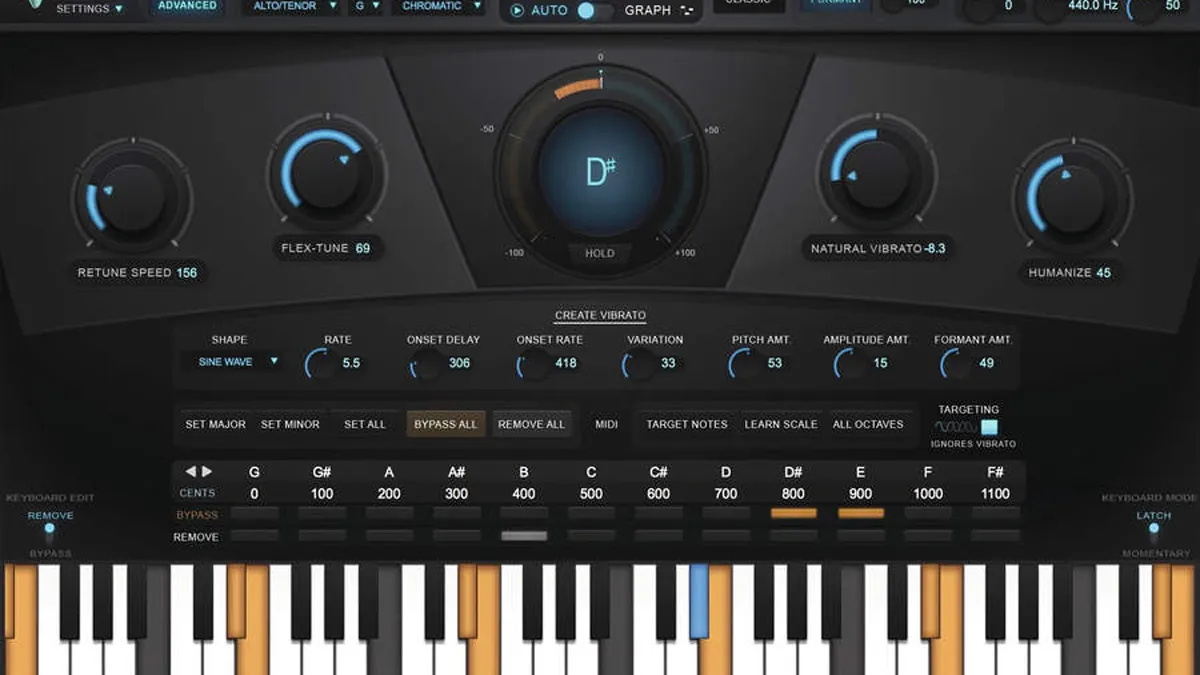
It’s operated in either of two modes: Auto and Graph, the first enabling real-time automatic re-pitching, the latter for detailed manual editing. You also get two views: Basic and Advanced. With Basic, choose a voice type, select the target key and scale, set specific pitches for removal (or leave unchanged). You can also use the Auto-Key plugin to detect the key and scale of the audio in your track, and transmit the results to all running instances of Auto-Tune.
Advanced view has a few extras like Create Vibrato, ideal for adding a bit of wobble via an LFO, plus options to set minor and major modes, edit across multiple octaves, and MIDI input editing features.
Auto-Tune Pro is the most powerful, usable incarnation of this standard yet, and easily maintains the software’s position as one of the best retuning solutions available, and may well prove to be the ultimate pitch-manipulating toolbox.
Read the full Antares Auto-Tune review
bx_crispytuner works best with bx_crispyscale (included free of charge), the latter allowing you to determine and apply a scale to the former, although crispyscale is by no means essential. Using the two in tandem, however, will allow you to apply a scale to multiple instances of crispytuner, which is great for large vocal sessions.
bx_crispytuner is very similar to Auto-Tune in that it has similar timing controls to make your tuning more natural or more synthetic. They even retail for the same price, although crispytuner is perhaps the slicker looking plugin of the two. And in terms of creating that synthetic vocal effect, it almost outdoes Auto-Tune. Subtle it isn’t, but that might be just what you are aiming for.
In order to perform this live tuning, the plugin operates with ultra low latency, so that even though the audio needs to go through your DAW and computer’s routing, it can still be monitored in real time. This means you as the singer, or your monitoring engineer, can hear what is happening as it happens and can make adjustments accordingly.
While some of the UI features are shared with Waves Tune, which is its non real-time sister plugin, the interface is somewhat more modern and slicker. It features a live tuning meter which shows the pitch as the vocal passes through, and as with Waves Tune, there are controls for Speed, Transition Tolerance and vocal Range. The central keyboard also indicates the notes of the audio passing into the plugin and here you can set the range of ‘allowed’ notes.
The Speed dial can, as with so many plugins of this ilk, be set to fast (zero) for the robotic Cher effect should you wish. Used in conjunction with the Transition dial, both can easily be used to create that effect, only this time you are doing it on live vocals. Waves Tune Real Time is therefore probably the first choice of the Waves Tune plugin range for that more unnatural effect, whereas the standard Tune will get you more natural results with ease.
You get three main modes from left to right: the main controls for Pitch and Formant, three Mode options (Transpose, Quantize and Robot) and then a Drive and Mix area. The Pitch control alters the incoming audio by semitones but the beauty of AlterBoy is that you don’t get the kind of high-pitch chipmunk effects you get with some pitch shifters – it’s a far more natural shift (unless you want to make it more extreme).
The Formant option can, again very naturally, sweep a male vocal into a female, or vice versa. It’s pretty incredible to hear it in operation because one of AlterBoy’s main attractions is the fact that it does it with no nonsense, one dial with all the science bits hidden away. It just gets on with it, with brilliant results.
The central Modes are where things get even more interesting. After a simple Transpose option, you get Quantize, where notes are forced to the nearest semi-tone for that Auto-Tune like effect. It works well and incredibly simply, although you’ll probably get more finesse and tweakability out of the real-deal Auto-Tune.
However, for no nonsense results, this is great. Finally here you also get Robot Mode, where the pitch is frozen to one note, no matter what the original input is singing. This pitch, and indeed the formant, can still be changed with the left hand dials.
Add in saturation via a Drive option and AlterBoy is a wonderful, diverse vocal tuning plugin that does the job and does it very well. Great for beginners and superb value.
Recent additions include a Melodic algorithm that allows editing of noise-based sibilants to be carried out separately from pitch-based parts. Vocal pitch editing is also now incredibly natural due to features like a Levelling Macro that balances quiet and loud elements, and even the tiniest of pitch deviations can be tweaked.
Melodyne 5 Studio offers the full panoply of multitrack polyphonic editing options, but, if you mainly work with monophonic material, the more affordable Melodyne 5 Assistant still delivers many of the essential features. Whatever version, Melodyne is powerful and remains an exceptional tool for manipulating vocals and other audio in functional and creative ways.
Read the full Melodyne 5.1 review
One of Nectar 3’s many highlights is a machine-learning driven system for automatically setting the plugin up based on analysis of the input signal. Called Vocal Assistant, it creates a custom preset to make your vocal sound objectively ‘better’ and more mix-ready.
Select Assist mode, point the algorithm in the right direction by choosing Vintage, Modern or Dialogue as the source ‘Vibes’, and Light, Moderate or Aggressive as the processing ‘Intensity’. The input signal is analysed for a few seconds, during which the modules are set up in the background to correct for dynamic fluctuations, resonant peaks, sibilance, and even adjust pitch correction and reverb mix.
In Unmask mode, Vocal Assistant clears space for the vocal by applying equalisation to any other track that’s fighting with it for space. The results are invariably well- judged and thoroughly effective, giving the vocals a perceived lift that’s almost always beneficial. This feature has also been enhanced for Nectar 3 Plus, the latest incarnation of Nectar.
With many other great features and modules plus a souped up EQ, Nectar 3 sounds incredible and flows beautifully, and we can’t recommend it highly enough to any vocal-wrangling producer. However, if you are just after simple tuning or that robotic vocal tuning effect, it may deliver much more than you need and there are cheaper alternatives out there.
Read the full iZotope Nectar 3 review
You can go from simple noise removal through harmonisers and alien effects to some of the most famous vocal tuning styles. Here you get everything from Daft Punk to T-Pain, although artists are not named directly (Bon Hiver, Duft Pank and P-Tain anyone?). Once done you can then apply some decent effects – compression, reverb and EQ – to the results for extra polish.
On top of this you get a free beat library, rudimentary multi-track recorder and the ability to import your own beats and export any creations you produce as WAV or AAC files, or share your efforts with other users.
Voloco is a huge amount of fun and also yields impressive results. It’s free but various subscriptions – up to $50 (£35 approx) a year – unlock extra import, multitrack and effect features, although what you get for free is still impressive.
APT (Automatic Performance Transfer) lies at the heart of what makes Revoice Pro so special. Having done your tuning work on the selected tracks, you simply call up the APT dialogue and select one of the presets (you can also make your own), tell it which is the guide and apply it to any track you wish to edit. This is great for backing vocals, for example, where you can add tracks and align not just the pitch and timing but also the dynamic.
Compared to the simpler plugins here, both VocAlign and Revoice Pro are perhaps aimed at the more professional user; pro producers and mixers will save countless hours in the studio with both tools. They do cost that bit more than other plugins here, so if you are just after simple tuning and the Auto-Tune effect, you will find simpler and less expensive alternatives in this guide.
The software has three core processors – Match Timing, Match Pitch and Formant Shift – each accompanied by a parameter control to determine how loose or tight the matching processing is. It has great visual feedback with the three zoomable views – waveform, pitch and signal energy – allowing you to see timing and pitch both before and after processing. The display can be used to add manual Guide/Dub sync points or establish protected areas that won’t be processed – handy for more creative applications.
You can use VocAlign Ultra without delving too deeply into the advanced features. In that respect, we managed to tighten all manner of doubled and layered vocals. The results are very impressive and in many cases pleasantly transparent. It’s also very easy to adjust the amount of timing and pitch correction, and loosening things a bit is often the key to getting the most natural results.
VocAlign Ultra is a great vocal and audio processor. It’s a bit pricey but if you do a lot of editing and aligning it will improve your productivity considerably.
Read the full Synchro Arts VocAlign Ultra review
You insert the plugin on an audio channel just like any other effect, play your audio and it will map it across a piano keyboard after scanning it. (This is as opposed to the real-time processing of Waves Tune Real Time – see above.) An orange line shows the original recording and you can then drag and drop the constituent parts onto the correct notes. Once done, a green line shows the corrected notes.
Controls allow you to select vocal type, root of the scale and scale type. There are also a couple of speed controls that determine how quickly the plugin takes effect so you can go natural or robotic, your choice.
There’s also an LT version of Waves Tune that greys out some of the features of the main plugin. It retails for less (often around £30/$37), but since the full version is usually on sale (at the time of writing just $36/£29), we’d recommend shelling out the extra on it. It does the job of tuning without any fuss and very accurately, and focusses well on natural vocal tuning – although you can get more extreme effects should you wish.
There are two knobs, Pitch and Formant, controlling the central tone of the human vocal and the resonant frequencies that shape the timbre of the vocal. A Flatten button allows you to force the input to snap to a predetermined note, a speedy tool for building up augmented choruses and harmonies.
Experiment with the modulation and automation options, and vast creative scope presents itself. Automation can be a superb way of introducing vocal effects (such as sudden pitch drops) that activate based on the volume of the input signal, so the intensity of your performance can be the triggering factor.
The aim of the game with Vocal Bender is really getting that professional-sounding vocal manipulation at speed and with no processing lag. It is certainly one of the slickest vocal plugins we’ve experimented with – best in class for quick-fire, modern pitch manipulation.
Read the full Waves Vocal Bender review
One of its big draws is that you can play the instrument with your voice, or if that is shaky, play within set pitch parameters with tuning set up for you with its Auto Pitch Tracking.
There are an incredible number of presets to get you going – over 250 covering harmonies, tuning effects, formant shifting, alien vocoder voices and more rhythmic effects. These all utilise Voice Synth’s more pro-end effects like a 24-band EQ, auto-gain compressor, 8-octave pitch shifter, arpeggiator and analogue modelling vocoders.
You certainly get a huge variation in sound and, even though it’s a decade old, Voice Synth still has a lot to say – or you can say it too with its integrated sampler. That all said, the iOS version scores much better than the full desktop Mac version on their respective App Stores, so this is a good mobile but less attractive desktop proposition.
You get 500 beats included with the app which will play in time with your vocals – yes it sorts both your timing and pitch out – and in this respect it delivers the goods fast. It’s a bit geared towards that one-trick synthetic style, with hip-hop and R&B being its focus, but it is free so well worth a download.
There is a Pro version, but at just $3.99/£3.59 it’s not much of an outlay for extra multitrack recording features, more effects and, of course, less ads.
Some of our buying choices, particularly the mobile entries, also focus on other more out-there effects. Some of the other vocal processes you will come across in these include formant shifting, where you might turn a male voice into a female (or vice versa); harmonising or doubling, where a single voice is doubled or more to produce a group of voices singing together; and vocoding, where a standard voice becomes a more robotic voice not dissimilar to the extreme pitch and time settings in automatic tuning software.
However, aside from these more extreme vocal effects, it’s more likely that you will have tuning issues with your singing and that’s where this buyer’s guide really comes into its own. Vocal tuning is, of course, an essential application. Even if you are – or are recording – the world’s best vocalist, you or they will always have an off day, and it might not be possible to do a vocal retake. Vocal tuning applications to help tweak the vocal into tune post-recording are therefore incredibly popular, and this process can be very straightforward and transparent. You, your vocalist and audience need never know such processing has taken place.
Or you might want the opposite! You might want everyone to know just how much processing you’ve done by utilising the famous and much more obvious automatic tuning effect. The effect, made famous by Cher in the late ’90s and the producer T-Pain the 2000s, is essentially derived from the mother of all tuning plugins, Antares’ aptly named Auto-Tune. This software was originally intended simply to help vocalists or producers get voice recordings in tune.
The almost robotic-like vocal effect is produced when that (or a similar) plugin is used in a more extreme setting. Here its tuning effect – produced in Auto-Tune’s case by way of the Return Speed parameter – is at its quickest setting. It therefore retunes any incoming vocal signal at the fastest speed resulting in an inhuman effects where you can hear the jolt as it knocks the vocals in tune. You suspect that Auto-Tune was never really intended to be used at this setting on purpose but, as with many music production principles, if used at an extreme setting, happy accidents occur!
So when buying your pitch correction plugin, you simply need to decide whether you want to go natural or robotic, or would prefer a plugin that is capable of both. In our best pitch correction plugins buyer’s guide we have plugins capable of both, and some like iZotope’s Nectar that are capable of much more.
Finally, of course, decide on your desktop or mobile needs. Most of our recommendations run as third party plugins within standard Mac and PC DAWs, although we have also included app options for the mobile Android and iOS platforms. Only one, Voloco, sits in both mobile and desktop camps so could be used to transfer your mobile vocal experiments to desktop with ease.
Andy has been writing about music production and technology for 30 years having started out on Music Technology magazine back in 1992. He has edited Future Music, Keyboard Review, MusicTech magazines and currently runs Computer Music which he helped launch back in 1998. He owns way too many synthesizers.
Don’t miss the latest deals, news, reviews, features and tutorials
Thank you for signing up to Musicradar. You will receive a verification email shortly.
There was a problem. Please refresh the page and try again.
MusicRadar is part of Future plc, an international media group and leading digital publisher. Visit our corporate site (opens in new tab).
© Future Publishing Limited Quay House, The Ambury, Bath BA1 1UA. All rights reserved. England and Wales company registration number 2008885.
Redken Announces First Annual National Hair Gloss Day – Yahoo Finance

The Industry Leader in Professional Hair Color Celebrates the Power of Hair Gloss and its Best-Selling Shades EQ Gloss Collection with Hair Holiday
NEW YORK, Aug. 2, 2022 /PRNewswire/ — Redken, the No.1 professional hair brand in the US* and pioneer in professional haircare and color since 1960, is officially celebrating the self-identity, creativity, expression and confidence that comes from vibrant hair color. Having launched its ever-popular Shades EQ Gloss in 1980 – now the No.1 demi-permanent color in the US – Redken is establishing its annual National Hair Gloss Day on August 3rd to raise awareness around the benefits of Redken’s Shades EQ Hair Gloss salon service and honor the power of healthy colored hair created by professionals and loved by consumers.
Kicking off the first National Hair Gloss Day, Redken is excited to spotlight its revolutionary Shades EQ Gloss service – an in-salon hair color service for shiny, healthy-looking hair. The gloss service is powered by the professional and Shades EQ Gloss – a professional-only product that features an innovative formulation backed by science and prescribed by pros. At the root of beautiful, healthy hair is a partnership with a hair professional that knows what’s best for your mane—from color and cut to ongoing maintenance. In fact, in an industry inundated with new trends and products, Redken Shades EQ Gloss is the hair gloss of choice for over 400,000 professional stylists, allowing them to easily create personalized, professional results that leave clients with beautiful, healthy-looking hair.
“We are thrilled to highlight the power of Shades EQ gloss service by launching Redken Hair Gloss Day to celebrate our loyal pros, fabulous consumers and Redken team that have worked to create the most popular demi-permanent color in the country, Shades EQ Gloss!” said Candy Gebhart, Redken General Manager. “After years of incredible color creations and well-deserved hype, we are excited to use this new hair holiday as a chance to educate consumers on what exactly a hair gloss is and why it is such an important step in achieving healthy hair.”
With a Redken Shades EQ Gloss Service, it just takes 20 minutes to refresh your color for healthy-looking hair! Quicker than most manicures, getting a Redken Shades EQ Gloss service leaves you with healthier looking and feeling hair, ultimate shine and refreshed color. This professional hair gloss service is offered in salons and provides a subtle touch of color while leaving hair super shiny and conditioned. A gloss can be used to tone brassy hair, color-correct and even add more dimension to your color.
Since professional stylists can easily create customized colors with a Redken Shades EQ Gloss, the service delivers beautiful shades that are nuanced to each client’s preferences. Redken Shades EQ Gloss Service is the perfect avenue to flirt with a new color without the commitment. As a form of demi-permanent hair color, results will last four to six weeks, making a hair gloss service the perfect way to try a new shade. For those not looking to switch up their color and just for healthier looking and feeling hair, Shades EQ Gloss is available in a clear shade, which adds shine and conditions hair without changing its shade. The Shades EQ Gloss Family offers over 100 shades to the salon professional, so they can create the perfect results with a Shades EQ Gloss Service.
Redken Shades EQ Gloss is unlike other hair glosses on the market – it is the hair color that thinks it is a conditioner and delivers fast, professional color results. It is formulated without ammonia, so you can relax and enjoy your gloss service without being bothered by the overpowering smell of color. The formula is also infused with amino acids that help condition the hair and leave it looking super shiny.
“As a colorist, I’m constantly doing a Shades EQ gloss service on my clients because it’s so versatile! It’s great for toning, color correcting, creating new color or even just adding shine and moisturization,” explained Tracey Cunningham, celebrity hairstylist and Redken Brand Ambassador. “Redken Shades EQ Gloss is my favorite hair gloss because it’s easy to use and allows me to create personalized color for each client, so they always leave my chair happy with beautiful, healthy hair.”
In honor on Redken Hair Gloss Day, Redken and Maybelline are teaming up to gift 3 consumers each a prize pack, including $200 Amex Cards for a Hair Gloss Service, ABC Intensive Treatment, Color Extend Magnetics and five shades of Maybelline Lifter Gloss Quartz valued at $50. Enter here for a chance to win. Sweepstakes valid 8/1-8/31.
Join the fun this National Hair Gloss Day! Head to Redken.com to learn more about Shades EQ and find a salon near you with Redken’s salon finder feature.
*Based on 2021 edition of Kline’s Salon Hair Care Global Series, among brands selling shampoos, conditioners, hair color, hair styling and hair texturizing products
ABOUT REDKEN 5th AVENUE NYC
For over 60 years, Redken has been a leader in the professional salon industry, empowering professionals and consumers to achieve healthy hair transformations with confidence. Founded by Paula Kent, a woman who believed in the power of science, Redken was the first company to take a scientific approach to hair, defined as the right balance of protein, moisture and supported by an acidic pH, which remains the alpha and omega of haircare to this very day. All Redken products are made with the highest quality ingredients, and tested by salon professionals to ensure maximum efficacy, for every hair type and texture and every hair need. Based in New York City, Redken supports the expertise of salon professionals with principle-based education, cutting edge technologies rooted in protein-science, and a portfolio of products including Shades EQ – the #1 demi-permanent hair color on the market – for maximum versatility and flexibility for clients of all hair types and hair textures.
To learn more, visit Redken.com or Instagram.com/Redken.
View original content to download multimedia:https://www.prnewswire.com/news-releases/redken-announces-first-annual-national-hair-gloss-day-301596318.html
SOURCE Redken
It helped restore her skin during the pandemic.
The results were surprising.View Entire Post ›
Plus, Adidas collaborates with Thebe Magugu.
Addison Rae is the summer queen, so who better to look to for swimsuit advice? In her latest Instagram, Rae showed us how to get the playful, mismatched look.
The latest price moves in bitcoin (BTC) and crypto markets in context for August 2, 2022.
As of Tuesday, the average 30-year fixed mortgage rate sits at 5.05%. That's down from June, when mortgage rates peaked at 6.28%.
Beyond Meat is set to report its second quarter earnings on Thursday after the bell. Here's what to expect.
Investing in certain stocks can pay off in the long run, especially if you hold on for a decade or more.
* U.S. 10-year rises from four-month low * Fed officials walk back dovish Powell comments post-FOMC * U.S. 2/10-year yield curve hits deepest inversion since 2000 * U.S. 3-month/10-year briefly inverts, last steeper on the day (Recasts; adds analyst comment, Fed officials' remarks;updates prices, Pelosi's Taiwan visit) By Gertrude Chavez-Dreyfuss NEW YORK, Aug 2 (Reuters) – U.S. Treasury yields rose across the board on Tuesday in volatile trading, lifted by hawkish comments from Federal Reserve officials that suggested more rate hikes are coming in the near term, as inflation has yet to hit its peak. Worries about global tension arising from U.S. House of Representatives Speaker Nancy Pelosi's visit to Taiwan eased a bit, with the U.S. official landing safely in its capital Taipei, analysts said.
U.S. House Speaker Nancy Pelosi landed in Taiwan on Tuesday, raising geopolitical tensions in China and zapping investor risk appetite. Race Capital General Partner Edith Yeung discusses her take on Pelosi's "truly reckless and really dangerous" visit and why "nothing good [will] come out of it." Plus, her analysis and outlook of the "warm" crypto winter.
The ride-share company’s strong second-quarter commentary drove up competitors’ stocks on Tuesday, perhaps prematurely.
Zebra Technologies early Tuesday beat Wall Street's targets for the second quarter but guided below views for the current period.
Stock indexes ended lower as the U.S. House Speaker arrived for a visit to Taiwan amid heightened tensions between Beijing and Washington.
Overall delinquency rates rose modestly too for all debt types, with delinquencies for credit cards and auto loans "creeping up," particularly in lower-income areas, the New York Fed's quarterly household debt report said. Mortgage debt increased to $11.39 trillion at the end of June, according to the report.
PayPal Holdings Inc. shares have fallen out of favor with investors this year after a string of resets, but the payment giant's management team is looking to flip the script with a series of moves intended to drive changes at the business.
The cash-secured put is a way to use options to gain income on a strong stock or potentially buy it at a discount if it falls.
South Korea’s non-fungible token (NFT) collection MetaKongz’ price on OpenSea NFT exchange has fallen over 17% on average after alleged in-house problems such as hacking and differences among its executives. See related article: Hyundai Card building its first NFT marketplace and wallet service Fast facts The price of MetaKongz NFTs on OpenSea in the last […]
Companies with rising cash flows like SBLK, WIRE, SNEX and FC are worth buying.
British Airways has stopped short-haul bookings from Heathrow for another week, amid warnings they may be halted for the rest of the summer.
The New York Department of Financial Services (NYDFS) slapped a US$30 million fine on the crypto arm of trading app Robinhood on Tuesday for allegedly violating the bank secrecy act, anti-money laundering, and cybersecurity regulations. See related article: Sam Bankman-Fried buys 7.6% of Robinhood; stock jumps Fast facts The financial regulator also asked the firm […]
Get to know NikNak, the creative turntablist making waves in electronic music – Mixmag
Aneesa Ahmed speaks to NikNak, the multi-talented DJ, producer, composer, turntablist, sound designer and podcast host making game-changing experimental music
NikNak is a force to be reckoned with. With skills spanning DJing, producing, composing, turntablism, sound design, and podcast hosting, the London-raised, Leeds-based creative started out making beats from video game software as a child and now counts winning a prestigious Oram Award and opening for turntablist pioneer Grandmaster Flash among her achievements.
When mixing, NikNak’s taste is as varied as it is carefully curated, seamlessly merging dubstep, hip hop, drum ‘n’ bass, garage and more. Her own music takes a more ambient and poignant route, transforming her inspirations into a production style that is raw, experimental, eerie and at times cinematic. “At the end of the day, I’m here for myself. So I’m gonna keep doing my own thing,” she states proudly.
NikNak, known by her friends and family as Nicole Raymond, first became intrigued by sound when still in primary schools. “I’d just make beats whenever I could after school, it was literally my favourite thing to do!” she exclaims, referencing the beat-making software she would download from the backs of gaming packets. She would also call herself a curator from a young age, burning CDs for her mum and other loved ones and putting together playlists she thought were fitting to a person or mood, and knew this is something she wanted to foster and grow.
Read this next: Video games are influencing a generation of electronic music innovators
As she grew older, that commitment stayed in clear focus as Nicole studied music at college then carried her learning on to higher education – now holding a Master’s degree in Electronic and Computer Music. “I knew I didn’t want to be a singer or whatever. That’s what families normally think of when you tell them you want a career in music – but I knew I was interested in pressing buttons and playing with sounds, which was interesting to tell them about!”
The references she pours into creativity are taken from observing the world at large and her own inner emotions. One of her greatest inspirations is Burial, who she was first exposed to at around the age of 16 while in college. The rawness of the sound showed her that anything can sound exactly how you imagine it to be, and that resulted in her challenging her own perception of what music meant to her. “At the time I discovered Burial, I was going through a lot, emotionally and personally. And this [raw] sound made me feel genuinely refreshed.
“At this point, everything was really clean and polished, so it just felt so good to hear some noises that weren’t over-saturated, and they sounded raw. This guy was just sampling Metal Gear Solid – and I was blown away. People try and emulate it now, but you really can’t. It’s so him. His first two albums were very poignant for me, you know, I really just felt inspired.”
After leaving college and going to university, Nicole started working at clubs and venues and fell in love with the culture that came along with it. Other than DJing at her own birthday party and doing a small gig as part of her music course, NikNak hadn’t played in front of a crowd until she befriended the Bug Out collective at Basement Club, Leicester. “[Bug Out] would host nights and would spin funk, bass, breaks, hip hop – that kind of thing. They could scratch! So I became friends with them, and every Friday they did their residency…and one day I just asked if I could play too. They agreed, and my first night was a six-hour b2b – it felt great to play in a club!”
Since then, she has gone on to play at some of the best dance music, community and family festivals around, including Leeds International Festival, Wilderness and We Out Here, and hosts a monthly show on Worldwide FM. Her DJing has grown into a more precise practice of turntablism, as she incorporated physical skill into the act of playing out and interpreting music. This earned bookings alongside icons such as Grandmaster Flash, Princess Nokia, Akala and Madlib. She opened for Grandmaster Flash in 2018 at Leeds’ Belgrave Music Hall, something that she cherishes as a “real career highlight”.
“First of all, who authorised that? Like seriously, who let me do that!” she exclaims excitedly. “But also, thank you. I remember distinctly going to the venue and he was just so nice and we had a really good conversation – but I was trying too hard not to fangirl – I mean I literally wrote an essay about him! Then after I was finished, I thought I wouldn’t see him again, but he said that his team will be in touch for me to open for him again soon.”
Read this next: The 10 best DJ scratch battles of all time
Nicole is always learning and feels as though there is no limit on music education and one’s own musical journey – and that she can always push herself to try new things.
“I have ADHD and dyslexia, and a lot of the time figuring out certain techniques takes me longer than it takes a lot of other people. And not because I don’t understand or whatever – but just because of the way my brain is wired,” she explains. She notes that one key example of this is when she was showcasing the turntablism technique ‘beat juggling’ – where two records are used to extend a beat or create a brand new one. “That moment was literally captured on a stream, and I got so many comments hating. Why can’t you just let me be happy and do my thing? It’s funny how people think I don’t know what I’m doing – but I’ve been working at this my whole life!” she laughs.
Alongside DJing other people’s music, Nicole has turned to turntablism to create some of her own tracks and remixes which have been released through labels such as Reel Long Overdub, Come Play With Me, Kynant Records, and OTONO. This includes her 2020 debut album ‘Bashi’, which explored the concept of peace through the manipulation of sounds recorded during a trip to Turkey, and sophomore albums ‘Bashi X2’, released in 2021, as well as tracks such as ‘Timeline’ and ‘Whispers’.
Her newest album ‘Sankofa’ is as personal as ‘Bashi’, albeit in a different way. ‘Sankofa’ sees NikNak explore themes of Black femininity, agency, and authority and lets her indulge in her “nerdy side”. “It’s a way to show off my nerdy side a bit more than just going on my Instagram and just talking about Doctor Strange or something!” she jokes.
“It’s an unapologetic presentation of my likes, desires and needs – because a lot of the time electronic music can’t quite capture it all.” Nicole shows that Black women are too harshly stereotyped and often these tropes override the nuanced experiences Black women actually have. “We shouldn’t have to subscribe ourselves to fit into a certain box just because it’s quote-unquote mainstream or accepted or whatever. I’m allowed to be soft and have a normal life, I’m allowed to eat pringles and watch anime all day if I want!”
Stylistically, ‘Sankofa’ combines turntablism with orchestral-style sonics to create a sound landscape which is representative of Nicole’s wide-ranging personality. The tracks have a gentle and spectral tone, and each track is uniquely complex. Heavily inspired by the spirituality, practices and traditions of the Akan people of Ghana – this album incorporates storytelling and sonification in a similar way to the traditional art forms created by the Ghanaian ethnic group.
Read this next: “Special place”: Ayaata Corner is the epicentre of Ghana’s fight for LGTBQIA+ rights
A central component of this album is Marvel’s superhero Storm, a character that Nicole has both looked up to and felt inspired by at times. Storm’s energy and spirit are central to the album, as she is a characterisation of the versatility of Black women. “She’s just a badass!” she proclaims. “I just love her and what she represents, she’s a dark-skinned superhero with some amazing powers. I need Marvel to hire me as a consultant at least, or at least come to me if they want a decent adaptation of Storm!”
‘Sanfoka’ drew inspiration from her surroundings and those around her – especially the many women she has been mentored by and looks up to. She credits the long line of women and marginalised people who have paved the way for her, and have shown her the power of resilience and talent. They were not just the inspiration for her latest album, but also for much of her musical education and career. “I want to shout out to women, especially women of colour, who are making waves in the electronic music scene. Shout out to Loraine James, shoutout to Shiva Feshareki, Anna Meredith and Supriya Nagarajan and so many more.” She now champions women, especially Black women, through her podcast The Narrative which spotlights creative Black women who are working in music, photography, fine art or other creative fields.
Moving forward, NikNak is primed to keep making her own waves in electronic music — with plenty of plans, experiments and game-changing output to come. “I can’t say too much about what’s next – but just know I’m cooking.”
‘Sanfoka’ is out now via Inventing Waves, get it here
Aneesa Ahmed is Mixmag’s Digital Intern, follow her on Twitter
A weekly rundown of everything you need to know in music and culture
Mixmag will use the information you provide to send you the Mixmag newsletter using Mailchimp as our marketing platform. You can change your mind at any time by clicking the unsubscribe link in the footer of any email you receive from us. By clicking sign me up you agree that we may process your information in accordance with our privacy policy. Learn more about Mailchimp’s privacy practices here.