Even with a recording contract in hand, Cleveland Francis still wasn’t certain he wanted to move to Nashville.
It was the early 1990s, and Francis was an Alexandria, Va.-based cardiologist who happened to have a singing voice that stopped listeners in their tracks. Even though he thought of music mostly as an enjoyable side project, releasing songs when he could and performing at local venues, he caught the attention of country music industry executives who urged him to move to Music City and take a real shot at becoming a full-time recording artist.
Francis had doubts, so he called his music producer friend, Moses Dillard. “I said, ‘I’m in my 40s now. I’ve got a cardiology practice,’ ” Francis recalled in an interview.
But Dillard was insistent: “He said, ‘You are the only Black person on the face of the Earth who has this opportunity. You need to go. … You have to hold this spot. You weren’t given all these talents for nothing.’ ”
So he went. Francis signed with Liberty Records (now Capitol Records Nashville), becoming one of a small group of Black artists to have a major-label recording contract since Charley Pride signed with RCA in the mid-1960s. Francis released his debut major-label album, “Tourist in Paradise,” in the spring of 1992.
From 1992 to 1995, he would release three albums and had a handful of singles (“Love Light”; “You Do My Heart Good”; “Walkin’ ”) that appeared ever so briefly on the Billboard Hot Country Songs chart.
His story could pretty much end there, like so many others: A talented singer follows his dreams to Nashville, experiences both the brief highs and disappointing lows of a fickle industry, and eventually returns home to the carry on with his life. Francis’s story, however, remains fascinating to country music historians, admirers, the occasional journalist or anyone who wonders what might have been: Would he be more famous today if Nashville didn’t have a long-acknowledged (yet never remedied) lack of diversity?
“Growing up and learning about all the different country artists, especially the ones that look like me — from Charley Pride to DeFord Bailey before him — I heard about Cleve Francis. A doctor that got into country music,” country star Jimmie Allen said recently, by email. “He was definitely one of those artists I wish would have gotten the recognition he deserved, but he touched many people’s lives that he probably didn’t realize, including mine. Cleve’s definitely one of my inspirations.”
Francis, who is now 77 and lives in Alexandria with his wife, Hardeep, has been awarded with multiple honors in the past year for his contributions to country music. During his time in Nashville, he also came up with the idea for the Black Country Music Association, which he envisioned representing Black country artists, offering them the support the industry wouldn’t give.
He got that idea because he saw the same patterns in Nashville that he did when he finished medical school and found it difficult to get a job as a Black doctor — so he started his own practice. “I said, ‘Well, maybe Black people need to start their own organization,’ … and the industry should support this,” Francis said.
Black singer-songwriters were routinely sidelined in the majority-White genre, and Francis saw that they needed advocacy at every level, including promotion, artist development, publishing, record labels and radio, as well as support from leaders within the billion-dollar Nashville machine. Early in the 20th century, Black singers were filtered out of country genre as gatekeepers labeled their music as “race records,” as opposed to “hillbilly” or “country and western” categories for White artists.
“Cleve is a visionary — he could see the bigger picture,” said Nashville consultant MaryAnne Howland, founder and chief executive of Ibis Communications, who worked with Francis on marketing the initial idea. The Black Country Music Association, led by singer Frankie Staton after Francis left Nashville, lasted for about a decade. “He wanted to ensure that we were at the table in conversations, that we were part of the industry.”
Staton agreed, calling Francis a part of an “unsung” history who set the “gold standard” for balladeers: “I just hope that this group of people from my generation are not lost and forgotten, because there’s some real talent that’s never been heard by the world,” she said. “And Cleve is the leader of the pack.”
Growing up in Southwest Louisiana in the 1950s, Francis was so fascinated by the guitar that he attempted to cobble one together out of a cigar box and a piece of wood. His mother started putting away quarters to save enough to buy him a real one, though she warned him, “If your grades fall, it goes in the attic.”
Inspired by such legends as Sam Cooke, Otis Redding, Nat King Cole and Hank Williams, he started writing songs, and those who heard them told him to keep singing. A professor at Southern University in Baton Rouge canceled all his appointments one day, inviting members of the music department to listen to Francis play guitar in his office. At graduate school at William & Mary in Williamsburg, Va., in the late 1960s, Francis would perform at a coffee shop and people immediately asked if he could return again the next day.
“It was a combination of all different styles into my own style,” Francis said. “I was singing about Black life. This folk music was from my own background.”
He recorded music on his own and played shows as he graduated from the Medical College of Virginia and started Mount Vernon Cardiology Associates in 1978. When The Washington Post wrote about him in the mid-1980s, the paper reported Francis was one of only 100 Black cardiologists in the United States. (The practice was acquired by the Inova Medical Group in 2015; he’s now the diversity adviser at the Inova Heart and Vascular Institute.)
One day, he was treating a patient who had a brother in the music industry; the patient asked Francis for a tape, and suddenly Francis was recording “Love Light,” an upbeat track that is actually about a couple that breaks up. Francis self-financed the music video, which became popular on CMT and caught the attention of Liberty Records label head Jimmy Bowen, who persuaded Francis to sign a record deal around 1991.
“I didn’t have my pager anymore, I was on a tour bus, and I was all excited,” Francis said. His band members, jaded from years in uncomfortable buses, were amused by how thrilled he was to be on the road.
The “country music doctor” was an irresistible marketing hook, especially at a time when country music was experiencing a cultural renaissance with the success of Garth Brooks, Reba McEntire, Alan Jackson and more. The label sent him on a promotional blitz, and Francis recalls he was a “darling of the press.” (USA Today: “His heart is in country: Cleve Francis is feeling his musical pulse”; The Tennessean: “A heart doc with a voice.”) He was a guest on talk shows and appeared in People and Jet magazine.
Nearly every story about him brought up the rarity of a Black country singer on a major label, but executives tended to downplay it, saying that fans would simply love the music. Francis remembers the near-zero diversity in Nashville just wasn’t something industry staffers talked about in public. He didn’t really talk about it, either. “You get in and you really need to shut up because you’re there, you know, for the grace of whoever,” he said.
In a lot of ways, Francis remembers those three years in Nashville as “heaven.” He shared a label with Brooks and ran into him and other stars around town and at industry events, and recalls them always being kind. Fans adored him and he enjoyed meeting listeners as he played shows and festivals around the country and at the Grand Ole Opry.
But he also had a sense he was “doomed from the start,” he said, primarily because he didn’t find support from country radio, despite going on a countrywide radio tour. “Unless you were coming out of those pickup trucks on the radio, you weren’t going anywhere.”
Even with the marketing push, “Tourist in Paradise,” which Billboard described as being “in the smooth, warm ballad tradition, backed by tasteful and restrained instrumentation,” didn’t sell enough copies to satisfy his label. His second single, a peppy love song titled “You Do My Heart Good,” (“You do my heart good, you make love feel like it should”) charted at No. 47 but couldn’t climb higher. He released “Walkin’ ” in 1993 and “You’ve Got Me Now” in 1994, but they didn’t chart.
“He has such a beautiful voice; a really pure country voice, almost Vince Gill-ish,” said singer-songwriter Rissi Palmer, who hosts Apple Music’s “Color Me Country,” focusing on the Black, Indigenous and Latino roots of country music. “It boggles my mind, but it’s a very common story from the time that if you didn’t hit right away, it wasn’t, ‘Let’s keep trying, let’s keep working with the artist.’ It was, ‘Okay, let’s move on to the next thing.’ ”
Some executives thought his age might be an issue, given that he was, by then, in his mid-40s, and the industry was fixated on youth. But Francis recalled that he went on tour around the time of the 1992 Los Angeles riots after the acquittal of four police officers for beating Black motorist Rodney King, and when O.J. Simpson was charged with murder in 1994.
“The timing was not the best,” he said. “The country was totally polarized at that point.”
He wasn’t able to find opening-act gigs on other country stars’ tours. He heard from his booker that certain clubs owners didn’t want him to play in their venues, telling him, “We’re having a lot of trouble because we can’t book you, there are some really prejudiced people.” He was told he didn’t have the “right” material for a breakout hit, yet he could only record what was given to him, written by outside songwriters. His singles tended to have a gentle, “Kumbaya” vibe, he said, and didn’t make a splash.
“I didn’t have everything I needed,” he said. “That’s why I had to make the best of it for myself. I didn’t want to quit and run. I did three beautiful CDs and five music videos.”
Francis wants people to understand this: When he tells the story of his time in country music, he’s not telling it from a place of anger. He calls it the best time of his life. “I always hesitate to say I didn’t make it because I was Black — because that’s too low-hanging of fruit to go after,” he said.
Instead, he prefers to look toward the future and what can change: “I like to look at the positive aspect of it. Like, what can this industry do differently?”
Francis returned to Alexandria in the mid-’90s, resumed his medical practice and still wrote songs, which he does even now. He recently penned one titled “Buffalo” about the shooting massacre in a mostly Black neighborhood in Buffalo.
His 1970 self-released soul-folk album, “Follow Me,” was recently rereleased and transformed into a 21-track double LP called “Beyond the Willow Tree,” a soothing, melodic collection that captures stories of his life. (“A lost folk treasure,” said Matthew Bruce, owner of Forager Records, which remastered the album.)
But as Francis kept performing concerts over the years (before the pandemic, he was a staple at the Birchmere), he has kept a close eye on Nashville.
He’s gratified to see some in the industry are taking steps to try to correct its racial inequity — although there is a long way to go — and is simultaneously wary that with the few Black singers such as Allen and Mickey Guyton becoming stars, along with Darius Rucker and Kane Brown, labels can point to a handful of success stories like they did decades ago and essentially say, “We’re not prejudiced — look at Charley Pride.”
“The thing we have to look at to make sure that those stars that are out there now doing well as individuals do not preclude anybody else,” he said.
Toward the end of his time in Music City, he became more outspoken, writing a Billboard editorial about how the industry was hurting itself by not marketing country music to Black audiences. “I challenge the industry to do the marketing research necessary to take full economic and artistic advantage of this growing group of country music lovers,” he wrote.
Around the same time, he met with the Country Music Hall of Fame and Museum and showed staffers a poll that said 24 percent of Black adult radio audiences listened to country music. This meeting helped spur the creation of “From Where I Stand: The Black Experience in Country Music,” a three-disc box set of songs released in 1998 that showed how the genre had its roots in Black history, with contributions from a variety of Black country singers.
The project made waves at the time and is still frequently referenced today, particularly by other country artists. Palmer, the host of “Color Me Country,” recalls someone giving her the CDs early in her career when Pride was one of the only other Black singers she knew. “It was just revelatory,” she said.
That has always been one of Francis’s goals, to help create a path for others. While people are still learning about the Black Country Music Association and the work that he and Staton did, Francis is excited to see organizations such as the Black Opry, created in spring 2021 by writer Holly G. Last summer, the organization named Francis and Staton as recipients of the Black Opry Icon Award.
“I think the ultimate goal is not to reinvent the wheel,” Francis said, but for Black singers to be able to “come inside a known entity that has all of the means of production and promotion and be part of that.”
Last fall, the Rosedale Collective, a country music label and foundation dedicated to amplifying artists of color, honored Francis with its inaugural Hazelhurst Award for his impact and idea for the Black Country Music Association.
“He has really made it possible for a lot of artists of color in country music, and in particular Black artists, to do the work they do today,” said Rosedale Collective co-founder Samantha Viotty. “What this has been about is building a community and looking back to people who paved the way. Unfortunately, so few [Black country artists] even made it to that point.”
While there has been some momentum in Nashville in recent years to give a platform to singers of color — such as a record number of Black singers being recognized at award shows or televised performances — many are cautious not to celebrate too soon, given the genre’s tendency to fall back into old patterns. Francis believes that actual progress won’t happen until certain structural changes occur at every level of the industry.
“My hope is that soon, if not already, the leadership of these major bottlenecks to racial progress in the country music industry are undergoing a changing of the guard to a younger, more socially progressive group of men and women who see no future in this industry on the racial path it has taken since the 1920s,” he wrote in an email.
Those who have known Francis for decades are glad that he is starting to get the recognition he deserves. “It’s as if a seed that was planted deep down somehow is beginning to take root,” Howland said. “So that’s why he’s earned his roses, if you will, and folks are honoring him. He’s the one who came in and saw and dreamed of this incredible future that we’re just now seeing begin to possibly happen.”
And as an increasing number of people share what Francis’s journey in Nashville meant to them, he doesn’t have regrets.
“I would have loved to have been a major star and travel the world,” he said. “But taking care of people with heart disease and saving lives is pretty impressive.”
Perspective•
News•
News•
Cleve Francis, still an inspiration to Black country music artists – The Washington Post – The Washington Post
FiXT – A&R Manager (Remote, US) – Music Business Worldwide

FiXT is seeking a forward thinking A&R Manager who is passionate about discovering and developing artists, to join our A&R team.
We are a mission-driving artist-owned record label, setting out to empower top talent artists (musicians/bands) to build sustainable careers in ways not previously possible to them, by putting a world class team around them, providing industry leading label services, and fostering lifelong fan relationships with a global audience.
This position’s responsibilities include support for our current roster as well as scouting for new signings, managing production projects, budgets and deadlines, finding collaborators, delivering masters with supporting credits and documentation, researching emerging trends, and championing the label’s music with internal and external teams. The position will report to FiXT’s President / Founder and A&R Director, Klayton (Celldweller), and work closely with FiXT’s Vice President & Co-Founder (James Rhodes), along with FiXT’s Label Manager (Heather Johnson), and Operations Manager (Kurtis Redden).
Job Type: Full-time / Salary
FiXT is an internationally recognized, independent, artist-owned record label with a roster of 25+ innovative, genre-bending rock, metal, synthwave and EDM artists, including Celldweller, Scandroid, Fight The Fade, Essenger, The Anix, Fury Weekend, Voicians, Circle of Dust, LeBrock, The Algorithm, Young Medicine and more. The FiXT catalog of 3,000 tracks has garnered billions of online streams connecting with a core audience of gamers, sci-fi enthusiasts and comic book fans. Founded in 2006 by Klayton (Celldweller / Scandroid), FiXT serves a global fanbase of customers in over 130 countries.
FiXT’s music has received over 1,000 Film/TV/Video Game placements, including titles such as: Avengers: Endgame, Blade Runner 2049, Kingsman: The Golden Circle, Westworld, Power Rangers, Lexus, Suicide Squad, Iron Man, Alien Covenant, Robocop, Jack Reacher, Deadpool, Lucy, Pacific Rim, PubG, Call of Duty, Assassin’s Creed, Dead Rising, UFC, NFL, MLB and more
Company Core Values
Integrity • Passion • Ambition • Excellence • Innovation • Empathy • Humility
Music Business Jobs is the most effective way for the global music industry to find the best candidates for their open positions.
In addition to being seen by over 300,000 monthly unique readers online, our listings are also emailed direct to more than 50,000 professional subscribers every week – across the US, UK, Europe, Asia-Pacific and beyond.
Click through below for details on how to submit a Music Business Jobs listing – and learn why our advertisers ‘strongly recommend’ us to their peers…
Best pitch correction plugins and apps 2022: software to improve or enhance your vocal recordings – MusicRadar

MusicRadar is supported by its audience. When you purchase through links on our site, we may earn an affiliate commission. Here’s why you can trust us.
By published
Get your vocals in tune or nail that incredibly popular Auto-Tune® sound with 13 free and paid-for plugins from Antares, iZotope, Waves and more – includes PC, Mac and mobile options
If singing is at the heart of your music production, then you’ve probably considered using the best pitch correction plugins and apps to either tweak your vocals so they are in tune, or to produce the synthetic vocal effect made famous by Cher on the track ‘Believe’ back in 1998.
Tuning vocals is now easy with software and many tuning apps are also capable of that Auto-Tune effect which is still incredibly popular across many music genres. In this round-up we have the best pitch correction plugins and apps, all capable of both naturally tuning your vocals to perfection or for creating that distinctive synthetic vocal sound.
The Auto-Tune effect was originally produced on the aptly-named Auto-Tune plugin by Antares. With well over two decades of popularity, it’s not surprising that the effect can now be produced by a host of other plugins and apps from many other developers. Where the original Auto-Tune is still right up there in terms of features and slick workflow, the growing list of similar plugins can massively range in price and feature set; some are dedicated to just that effect while with others it is just one of many audio processing features.
In this best vocal tuning plugins and apps buyer’s guide we’ll be looking at plugins for both types of automatic tuning scenarios: those which excel at natural, invisible vocal tuning, and those that can produce the more robotic effect.
Some DAWs come with these kinds of plugins built-in. Logic has Flex Pitch, for example, which delivers great results. Steinberg’s Cubase also has its own plugin, VariAudio, which can easily handle all your tuning needs. However, in our buyer’s guide we are only including third-party plugins that are available for every DAW or those which can run as mobile tuning apps.
If you want that Auto-Tune effect then the original is still, in many ways, the best, with Antares Auto-Tune (opens in new tab) still doing its thing in an even more slick environment some 24 years after Cher made it famous. The Pro version gets you all the bells and whistles and ‘live’ tuning for onstage, and instant tuning on vocal recordings.
Brainworx bx_crispytuner (opens in new tab) and Waves Tune Real Time (opens in new tab) are the best of the rest when it comes to Auto-Tune pretenders, the latter often on sale for silly money.
For another cheap route to robotic vocals – and some other neat effects along the way – Soundtoys Little AlterBoy (opens in new tab) impresses us with its simplistic but beautiful approach to not only Auto-Tune style effects, but brilliant male to female and female to male formant editing and more.
For more refined pitch editing, Celemony’s Melodyne (opens in new tab) will always be the black magic plugin that impresses with its abilities. But it does cost, so if you are after its basic functionality and a whole lot more, we have to throw iZotope’s Nectar 3 Plus (opens in new tab) in as a great option, which gives you module upon module of vocal editing options, the miraculous Vocal Assistant feature and even a version of Melodyne!
For mobile voice manipulation, one of the best to audition – and it’s free to start with – is Voloco (opens in new tab). It offers a lot of mobile fun and is cross platform so is available for desktop music production too.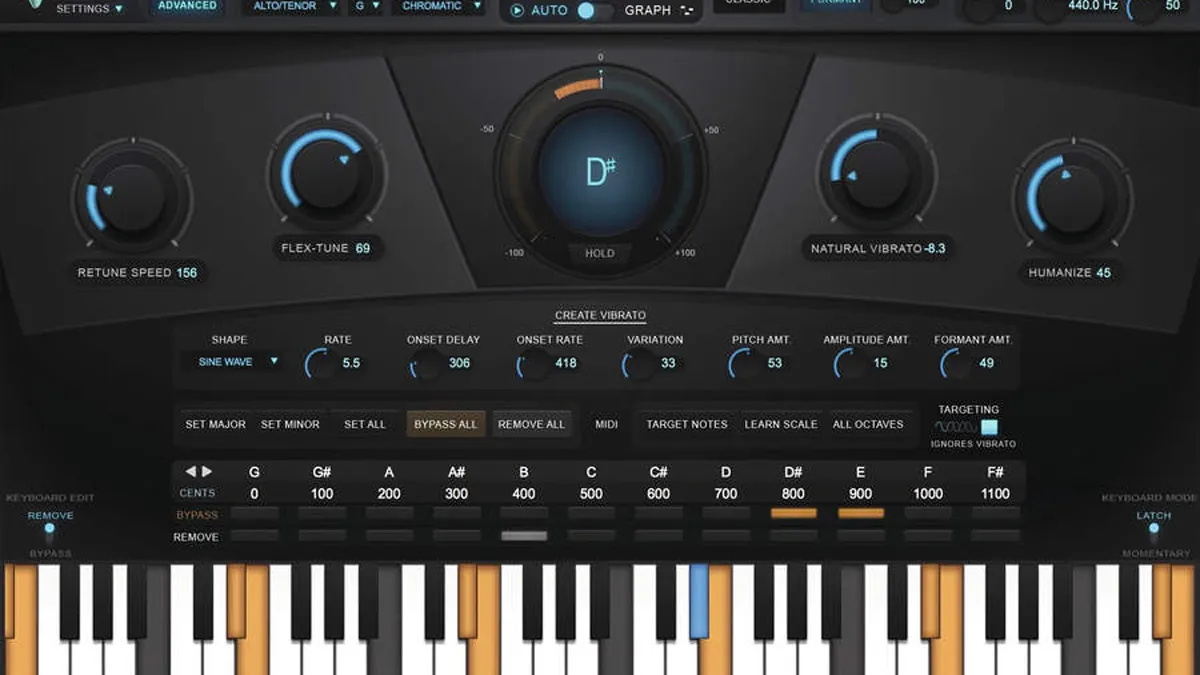
It’s operated in either of two modes: Auto and Graph, the first enabling real-time automatic re-pitching, the latter for detailed manual editing. You also get two views: Basic and Advanced. With Basic, choose a voice type, select the target key and scale, set specific pitches for removal (or leave unchanged). You can also use the Auto-Key plugin to detect the key and scale of the audio in your track, and transmit the results to all running instances of Auto-Tune.
Advanced view has a few extras like Create Vibrato, ideal for adding a bit of wobble via an LFO, plus options to set minor and major modes, edit across multiple octaves, and MIDI input editing features.
Auto-Tune Pro is the most powerful, usable incarnation of this standard yet, and easily maintains the software’s position as one of the best retuning solutions available, and may well prove to be the ultimate pitch-manipulating toolbox.
Read the full Antares Auto-Tune review
bx_crispytuner works best with bx_crispyscale (included free of charge), the latter allowing you to determine and apply a scale to the former, although crispyscale is by no means essential. Using the two in tandem, however, will allow you to apply a scale to multiple instances of crispytuner, which is great for large vocal sessions.
bx_crispytuner is very similar to Auto-Tune in that it has similar timing controls to make your tuning more natural or more synthetic. They even retail for the same price, although crispytuner is perhaps the slicker looking plugin of the two. And in terms of creating that synthetic vocal effect, it almost outdoes Auto-Tune. Subtle it isn’t, but that might be just what you are aiming for.
In order to perform this live tuning, the plugin operates with ultra low latency, so that even though the audio needs to go through your DAW and computer’s routing, it can still be monitored in real time. This means you as the singer, or your monitoring engineer, can hear what is happening as it happens and can make adjustments accordingly.
While some of the UI features are shared with Waves Tune, which is its non real-time sister plugin, the interface is somewhat more modern and slicker. It features a live tuning meter which shows the pitch as the vocal passes through, and as with Waves Tune, there are controls for Speed, Transition Tolerance and vocal Range. The central keyboard also indicates the notes of the audio passing into the plugin and here you can set the range of ‘allowed’ notes.
The Speed dial can, as with so many plugins of this ilk, be set to fast (zero) for the robotic Cher effect should you wish. Used in conjunction with the Transition dial, both can easily be used to create that effect, only this time you are doing it on live vocals. Waves Tune Real Time is therefore probably the first choice of the Waves Tune plugin range for that more unnatural effect, whereas the standard Tune will get you more natural results with ease.
You get three main modes from left to right: the main controls for Pitch and Formant, three Mode options (Transpose, Quantize and Robot) and then a Drive and Mix area. The Pitch control alters the incoming audio by semitones but the beauty of AlterBoy is that you don’t get the kind of high-pitch chipmunk effects you get with some pitch shifters – it’s a far more natural shift (unless you want to make it more extreme).
The Formant option can, again very naturally, sweep a male vocal into a female, or vice versa. It’s pretty incredible to hear it in operation because one of AlterBoy’s main attractions is the fact that it does it with no nonsense, one dial with all the science bits hidden away. It just gets on with it, with brilliant results.
The central Modes are where things get even more interesting. After a simple Transpose option, you get Quantize, where notes are forced to the nearest semi-tone for that Auto-Tune like effect. It works well and incredibly simply, although you’ll probably get more finesse and tweakability out of the real-deal Auto-Tune.
However, for no nonsense results, this is great. Finally here you also get Robot Mode, where the pitch is frozen to one note, no matter what the original input is singing. This pitch, and indeed the formant, can still be changed with the left hand dials.
Add in saturation via a Drive option and AlterBoy is a wonderful, diverse vocal tuning plugin that does the job and does it very well. Great for beginners and superb value.
Recent additions include a Melodic algorithm that allows editing of noise-based sibilants to be carried out separately from pitch-based parts. Vocal pitch editing is also now incredibly natural due to features like a Levelling Macro that balances quiet and loud elements, and even the tiniest of pitch deviations can be tweaked.
Melodyne 5 Studio offers the full panoply of multitrack polyphonic editing options, but, if you mainly work with monophonic material, the more affordable Melodyne 5 Assistant still delivers many of the essential features. Whatever version, Melodyne is powerful and remains an exceptional tool for manipulating vocals and other audio in functional and creative ways.
Read the full Melodyne 5.1 review
One of Nectar 3’s many highlights is a machine-learning driven system for automatically setting the plugin up based on analysis of the input signal. Called Vocal Assistant, it creates a custom preset to make your vocal sound objectively ‘better’ and more mix-ready.
Select Assist mode, point the algorithm in the right direction by choosing Vintage, Modern or Dialogue as the source ‘Vibes’, and Light, Moderate or Aggressive as the processing ‘Intensity’. The input signal is analysed for a few seconds, during which the modules are set up in the background to correct for dynamic fluctuations, resonant peaks, sibilance, and even adjust pitch correction and reverb mix.
In Unmask mode, Vocal Assistant clears space for the vocal by applying equalisation to any other track that’s fighting with it for space. The results are invariably well- judged and thoroughly effective, giving the vocals a perceived lift that’s almost always beneficial. This feature has also been enhanced for Nectar 3 Plus, the latest incarnation of Nectar.
With many other great features and modules plus a souped up EQ, Nectar 3 sounds incredible and flows beautifully, and we can’t recommend it highly enough to any vocal-wrangling producer. However, if you are just after simple tuning or that robotic vocal tuning effect, it may deliver much more than you need and there are cheaper alternatives out there.
Read the full iZotope Nectar 3 review
You can go from simple noise removal through harmonisers and alien effects to some of the most famous vocal tuning styles. Here you get everything from Daft Punk to T-Pain, although artists are not named directly (Bon Hiver, Duft Pank and P-Tain anyone?). Once done you can then apply some decent effects – compression, reverb and EQ – to the results for extra polish.
On top of this you get a free beat library, rudimentary multi-track recorder and the ability to import your own beats and export any creations you produce as WAV or AAC files, or share your efforts with other users.
Voloco is a huge amount of fun and also yields impressive results. It’s free but various subscriptions – up to $50 (£35 approx) a year – unlock extra import, multitrack and effect features, although what you get for free is still impressive.
APT (Automatic Performance Transfer) lies at the heart of what makes Revoice Pro so special. Having done your tuning work on the selected tracks, you simply call up the APT dialogue and select one of the presets (you can also make your own), tell it which is the guide and apply it to any track you wish to edit. This is great for backing vocals, for example, where you can add tracks and align not just the pitch and timing but also the dynamic.
Compared to the simpler plugins here, both VocAlign and Revoice Pro are perhaps aimed at the more professional user; pro producers and mixers will save countless hours in the studio with both tools. They do cost that bit more than other plugins here, so if you are just after simple tuning and the Auto-Tune effect, you will find simpler and less expensive alternatives in this guide.
The software has three core processors – Match Timing, Match Pitch and Formant Shift – each accompanied by a parameter control to determine how loose or tight the matching processing is. It has great visual feedback with the three zoomable views – waveform, pitch and signal energy – allowing you to see timing and pitch both before and after processing. The display can be used to add manual Guide/Dub sync points or establish protected areas that won’t be processed – handy for more creative applications.
You can use VocAlign Ultra without delving too deeply into the advanced features. In that respect, we managed to tighten all manner of doubled and layered vocals. The results are very impressive and in many cases pleasantly transparent. It’s also very easy to adjust the amount of timing and pitch correction, and loosening things a bit is often the key to getting the most natural results.
VocAlign Ultra is a great vocal and audio processor. It’s a bit pricey but if you do a lot of editing and aligning it will improve your productivity considerably.
Read the full Synchro Arts VocAlign Ultra review
You insert the plugin on an audio channel just like any other effect, play your audio and it will map it across a piano keyboard after scanning it. (This is as opposed to the real-time processing of Waves Tune Real Time – see above.) An orange line shows the original recording and you can then drag and drop the constituent parts onto the correct notes. Once done, a green line shows the corrected notes.
Controls allow you to select vocal type, root of the scale and scale type. There are also a couple of speed controls that determine how quickly the plugin takes effect so you can go natural or robotic, your choice.
There’s also an LT version of Waves Tune that greys out some of the features of the main plugin. It retails for less (often around £30/$37), but since the full version is usually on sale (at the time of writing just $36/£29), we’d recommend shelling out the extra on it. It does the job of tuning without any fuss and very accurately, and focusses well on natural vocal tuning – although you can get more extreme effects should you wish.
There are two knobs, Pitch and Formant, controlling the central tone of the human vocal and the resonant frequencies that shape the timbre of the vocal. A Flatten button allows you to force the input to snap to a predetermined note, a speedy tool for building up augmented choruses and harmonies.
Experiment with the modulation and automation options, and vast creative scope presents itself. Automation can be a superb way of introducing vocal effects (such as sudden pitch drops) that activate based on the volume of the input signal, so the intensity of your performance can be the triggering factor.
The aim of the game with Vocal Bender is really getting that professional-sounding vocal manipulation at speed and with no processing lag. It is certainly one of the slickest vocal plugins we’ve experimented with – best in class for quick-fire, modern pitch manipulation.
Read the full Waves Vocal Bender review
One of its big draws is that you can play the instrument with your voice, or if that is shaky, play within set pitch parameters with tuning set up for you with its Auto Pitch Tracking.
There are an incredible number of presets to get you going – over 250 covering harmonies, tuning effects, formant shifting, alien vocoder voices and more rhythmic effects. These all utilise Voice Synth’s more pro-end effects like a 24-band EQ, auto-gain compressor, 8-octave pitch shifter, arpeggiator and analogue modelling vocoders.
You certainly get a huge variation in sound and, even though it’s a decade old, Voice Synth still has a lot to say – or you can say it too with its integrated sampler. That all said, the iOS version scores much better than the full desktop Mac version on their respective App Stores, so this is a good mobile but less attractive desktop proposition.
You get 500 beats included with the app which will play in time with your vocals – yes it sorts both your timing and pitch out – and in this respect it delivers the goods fast. It’s a bit geared towards that one-trick synthetic style, with hip-hop and R&B being its focus, but it is free so well worth a download.
There is a Pro version, but at just $3.99/£3.59 it’s not much of an outlay for extra multitrack recording features, more effects and, of course, less ads.
Some of our buying choices, particularly the mobile entries, also focus on other more out-there effects. Some of the other vocal processes you will come across in these include formant shifting, where you might turn a male voice into a female (or vice versa); harmonising or doubling, where a single voice is doubled or more to produce a group of voices singing together; and vocoding, where a standard voice becomes a more robotic voice not dissimilar to the extreme pitch and time settings in automatic tuning software.
However, aside from these more extreme vocal effects, it’s more likely that you will have tuning issues with your singing and that’s where this buyer’s guide really comes into its own. Vocal tuning is, of course, an essential application. Even if you are – or are recording – the world’s best vocalist, you or they will always have an off day, and it might not be possible to do a vocal retake. Vocal tuning applications to help tweak the vocal into tune post-recording are therefore incredibly popular, and this process can be very straightforward and transparent. You, your vocalist and audience need never know such processing has taken place.
Or you might want the opposite! You might want everyone to know just how much processing you’ve done by utilising the famous and much more obvious automatic tuning effect. The effect, made famous by Cher in the late ’90s and the producer T-Pain the 2000s, is essentially derived from the mother of all tuning plugins, Antares’ aptly named Auto-Tune. This software was originally intended simply to help vocalists or producers get voice recordings in tune.
The almost robotic-like vocal effect is produced when that (or a similar) plugin is used in a more extreme setting. Here its tuning effect – produced in Auto-Tune’s case by way of the Return Speed parameter – is at its quickest setting. It therefore retunes any incoming vocal signal at the fastest speed resulting in an inhuman effects where you can hear the jolt as it knocks the vocals in tune. You suspect that Auto-Tune was never really intended to be used at this setting on purpose but, as with many music production principles, if used at an extreme setting, happy accidents occur!
So when buying your pitch correction plugin, you simply need to decide whether you want to go natural or robotic, or would prefer a plugin that is capable of both. In our best pitch correction plugins buyer’s guide we have plugins capable of both, and some like iZotope’s Nectar that are capable of much more.
Finally, of course, decide on your desktop or mobile needs. Most of our recommendations run as third party plugins within standard Mac and PC DAWs, although we have also included app options for the mobile Android and iOS platforms. Only one, Voloco, sits in both mobile and desktop camps so could be used to transfer your mobile vocal experiments to desktop with ease.
Andy has been writing about music production and technology for 30 years having started out on Music Technology magazine back in 1992. He has edited Future Music, Keyboard Review, MusicTech magazines and currently runs Computer Music which he helped launch back in 1998. He owns way too many synthesizers.
Don’t miss the latest deals, news, reviews, features and tutorials
Thank you for signing up to Musicradar. You will receive a verification email shortly.
There was a problem. Please refresh the page and try again.
MusicRadar is part of Future plc, an international media group and leading digital publisher. Visit our corporate site (opens in new tab).
© Future Publishing Limited Quay House, The Ambury, Bath BA1 1UA. All rights reserved. England and Wales company registration number 2008885.
Redken Announces First Annual National Hair Gloss Day – Yahoo Finance

The Industry Leader in Professional Hair Color Celebrates the Power of Hair Gloss and its Best-Selling Shades EQ Gloss Collection with Hair Holiday
NEW YORK, Aug. 2, 2022 /PRNewswire/ — Redken, the No.1 professional hair brand in the US* and pioneer in professional haircare and color since 1960, is officially celebrating the self-identity, creativity, expression and confidence that comes from vibrant hair color. Having launched its ever-popular Shades EQ Gloss in 1980 – now the No.1 demi-permanent color in the US – Redken is establishing its annual National Hair Gloss Day on August 3rd to raise awareness around the benefits of Redken’s Shades EQ Hair Gloss salon service and honor the power of healthy colored hair created by professionals and loved by consumers.
Kicking off the first National Hair Gloss Day, Redken is excited to spotlight its revolutionary Shades EQ Gloss service – an in-salon hair color service for shiny, healthy-looking hair. The gloss service is powered by the professional and Shades EQ Gloss – a professional-only product that features an innovative formulation backed by science and prescribed by pros. At the root of beautiful, healthy hair is a partnership with a hair professional that knows what’s best for your mane—from color and cut to ongoing maintenance. In fact, in an industry inundated with new trends and products, Redken Shades EQ Gloss is the hair gloss of choice for over 400,000 professional stylists, allowing them to easily create personalized, professional results that leave clients with beautiful, healthy-looking hair.
“We are thrilled to highlight the power of Shades EQ gloss service by launching Redken Hair Gloss Day to celebrate our loyal pros, fabulous consumers and Redken team that have worked to create the most popular demi-permanent color in the country, Shades EQ Gloss!” said Candy Gebhart, Redken General Manager. “After years of incredible color creations and well-deserved hype, we are excited to use this new hair holiday as a chance to educate consumers on what exactly a hair gloss is and why it is such an important step in achieving healthy hair.”
With a Redken Shades EQ Gloss Service, it just takes 20 minutes to refresh your color for healthy-looking hair! Quicker than most manicures, getting a Redken Shades EQ Gloss service leaves you with healthier looking and feeling hair, ultimate shine and refreshed color. This professional hair gloss service is offered in salons and provides a subtle touch of color while leaving hair super shiny and conditioned. A gloss can be used to tone brassy hair, color-correct and even add more dimension to your color.
Since professional stylists can easily create customized colors with a Redken Shades EQ Gloss, the service delivers beautiful shades that are nuanced to each client’s preferences. Redken Shades EQ Gloss Service is the perfect avenue to flirt with a new color without the commitment. As a form of demi-permanent hair color, results will last four to six weeks, making a hair gloss service the perfect way to try a new shade. For those not looking to switch up their color and just for healthier looking and feeling hair, Shades EQ Gloss is available in a clear shade, which adds shine and conditions hair without changing its shade. The Shades EQ Gloss Family offers over 100 shades to the salon professional, so they can create the perfect results with a Shades EQ Gloss Service.
Redken Shades EQ Gloss is unlike other hair glosses on the market – it is the hair color that thinks it is a conditioner and delivers fast, professional color results. It is formulated without ammonia, so you can relax and enjoy your gloss service without being bothered by the overpowering smell of color. The formula is also infused with amino acids that help condition the hair and leave it looking super shiny.
“As a colorist, I’m constantly doing a Shades EQ gloss service on my clients because it’s so versatile! It’s great for toning, color correcting, creating new color or even just adding shine and moisturization,” explained Tracey Cunningham, celebrity hairstylist and Redken Brand Ambassador. “Redken Shades EQ Gloss is my favorite hair gloss because it’s easy to use and allows me to create personalized color for each client, so they always leave my chair happy with beautiful, healthy hair.”
In honor on Redken Hair Gloss Day, Redken and Maybelline are teaming up to gift 3 consumers each a prize pack, including $200 Amex Cards for a Hair Gloss Service, ABC Intensive Treatment, Color Extend Magnetics and five shades of Maybelline Lifter Gloss Quartz valued at $50. Enter here for a chance to win. Sweepstakes valid 8/1-8/31.
Join the fun this National Hair Gloss Day! Head to Redken.com to learn more about Shades EQ and find a salon near you with Redken’s salon finder feature.
*Based on 2021 edition of Kline’s Salon Hair Care Global Series, among brands selling shampoos, conditioners, hair color, hair styling and hair texturizing products
ABOUT REDKEN 5th AVENUE NYC
For over 60 years, Redken has been a leader in the professional salon industry, empowering professionals and consumers to achieve healthy hair transformations with confidence. Founded by Paula Kent, a woman who believed in the power of science, Redken was the first company to take a scientific approach to hair, defined as the right balance of protein, moisture and supported by an acidic pH, which remains the alpha and omega of haircare to this very day. All Redken products are made with the highest quality ingredients, and tested by salon professionals to ensure maximum efficacy, for every hair type and texture and every hair need. Based in New York City, Redken supports the expertise of salon professionals with principle-based education, cutting edge technologies rooted in protein-science, and a portfolio of products including Shades EQ – the #1 demi-permanent hair color on the market – for maximum versatility and flexibility for clients of all hair types and hair textures.
To learn more, visit Redken.com or Instagram.com/Redken.
View original content to download multimedia:https://www.prnewswire.com/news-releases/redken-announces-first-annual-national-hair-gloss-day-301596318.html
SOURCE Redken
It helped restore her skin during the pandemic.
The results were surprising.View Entire Post ›
Plus, Adidas collaborates with Thebe Magugu.
Addison Rae is the summer queen, so who better to look to for swimsuit advice? In her latest Instagram, Rae showed us how to get the playful, mismatched look.
The latest price moves in bitcoin (BTC) and crypto markets in context for August 2, 2022.
As of Tuesday, the average 30-year fixed mortgage rate sits at 5.05%. That's down from June, when mortgage rates peaked at 6.28%.
Beyond Meat is set to report its second quarter earnings on Thursday after the bell. Here's what to expect.
Investing in certain stocks can pay off in the long run, especially if you hold on for a decade or more.
* U.S. 10-year rises from four-month low * Fed officials walk back dovish Powell comments post-FOMC * U.S. 2/10-year yield curve hits deepest inversion since 2000 * U.S. 3-month/10-year briefly inverts, last steeper on the day (Recasts; adds analyst comment, Fed officials' remarks;updates prices, Pelosi's Taiwan visit) By Gertrude Chavez-Dreyfuss NEW YORK, Aug 2 (Reuters) – U.S. Treasury yields rose across the board on Tuesday in volatile trading, lifted by hawkish comments from Federal Reserve officials that suggested more rate hikes are coming in the near term, as inflation has yet to hit its peak. Worries about global tension arising from U.S. House of Representatives Speaker Nancy Pelosi's visit to Taiwan eased a bit, with the U.S. official landing safely in its capital Taipei, analysts said.
U.S. House Speaker Nancy Pelosi landed in Taiwan on Tuesday, raising geopolitical tensions in China and zapping investor risk appetite. Race Capital General Partner Edith Yeung discusses her take on Pelosi's "truly reckless and really dangerous" visit and why "nothing good [will] come out of it." Plus, her analysis and outlook of the "warm" crypto winter.
The ride-share company’s strong second-quarter commentary drove up competitors’ stocks on Tuesday, perhaps prematurely.
Zebra Technologies early Tuesday beat Wall Street's targets for the second quarter but guided below views for the current period.
Stock indexes ended lower as the U.S. House Speaker arrived for a visit to Taiwan amid heightened tensions between Beijing and Washington.
Overall delinquency rates rose modestly too for all debt types, with delinquencies for credit cards and auto loans "creeping up," particularly in lower-income areas, the New York Fed's quarterly household debt report said. Mortgage debt increased to $11.39 trillion at the end of June, according to the report.
PayPal Holdings Inc. shares have fallen out of favor with investors this year after a string of resets, but the payment giant's management team is looking to flip the script with a series of moves intended to drive changes at the business.
The cash-secured put is a way to use options to gain income on a strong stock or potentially buy it at a discount if it falls.
South Korea’s non-fungible token (NFT) collection MetaKongz’ price on OpenSea NFT exchange has fallen over 17% on average after alleged in-house problems such as hacking and differences among its executives. See related article: Hyundai Card building its first NFT marketplace and wallet service Fast facts The price of MetaKongz NFTs on OpenSea in the last […]
Companies with rising cash flows like SBLK, WIRE, SNEX and FC are worth buying.
British Airways has stopped short-haul bookings from Heathrow for another week, amid warnings they may be halted for the rest of the summer.
The New York Department of Financial Services (NYDFS) slapped a US$30 million fine on the crypto arm of trading app Robinhood on Tuesday for allegedly violating the bank secrecy act, anti-money laundering, and cybersecurity regulations. See related article: Sam Bankman-Fried buys 7.6% of Robinhood; stock jumps Fast facts The financial regulator also asked the firm […]
Get to know NikNak, the creative turntablist making waves in electronic music – Mixmag
Aneesa Ahmed speaks to NikNak, the multi-talented DJ, producer, composer, turntablist, sound designer and podcast host making game-changing experimental music
NikNak is a force to be reckoned with. With skills spanning DJing, producing, composing, turntablism, sound design, and podcast hosting, the London-raised, Leeds-based creative started out making beats from video game software as a child and now counts winning a prestigious Oram Award and opening for turntablist pioneer Grandmaster Flash among her achievements.
When mixing, NikNak’s taste is as varied as it is carefully curated, seamlessly merging dubstep, hip hop, drum ‘n’ bass, garage and more. Her own music takes a more ambient and poignant route, transforming her inspirations into a production style that is raw, experimental, eerie and at times cinematic. “At the end of the day, I’m here for myself. So I’m gonna keep doing my own thing,” she states proudly.
NikNak, known by her friends and family as Nicole Raymond, first became intrigued by sound when still in primary schools. “I’d just make beats whenever I could after school, it was literally my favourite thing to do!” she exclaims, referencing the beat-making software she would download from the backs of gaming packets. She would also call herself a curator from a young age, burning CDs for her mum and other loved ones and putting together playlists she thought were fitting to a person or mood, and knew this is something she wanted to foster and grow.
Read this next: Video games are influencing a generation of electronic music innovators
As she grew older, that commitment stayed in clear focus as Nicole studied music at college then carried her learning on to higher education – now holding a Master’s degree in Electronic and Computer Music. “I knew I didn’t want to be a singer or whatever. That’s what families normally think of when you tell them you want a career in music – but I knew I was interested in pressing buttons and playing with sounds, which was interesting to tell them about!”
The references she pours into creativity are taken from observing the world at large and her own inner emotions. One of her greatest inspirations is Burial, who she was first exposed to at around the age of 16 while in college. The rawness of the sound showed her that anything can sound exactly how you imagine it to be, and that resulted in her challenging her own perception of what music meant to her. “At the time I discovered Burial, I was going through a lot, emotionally and personally. And this [raw] sound made me feel genuinely refreshed.
“At this point, everything was really clean and polished, so it just felt so good to hear some noises that weren’t over-saturated, and they sounded raw. This guy was just sampling Metal Gear Solid – and I was blown away. People try and emulate it now, but you really can’t. It’s so him. His first two albums were very poignant for me, you know, I really just felt inspired.”
After leaving college and going to university, Nicole started working at clubs and venues and fell in love with the culture that came along with it. Other than DJing at her own birthday party and doing a small gig as part of her music course, NikNak hadn’t played in front of a crowd until she befriended the Bug Out collective at Basement Club, Leicester. “[Bug Out] would host nights and would spin funk, bass, breaks, hip hop – that kind of thing. They could scratch! So I became friends with them, and every Friday they did their residency…and one day I just asked if I could play too. They agreed, and my first night was a six-hour b2b – it felt great to play in a club!”
Since then, she has gone on to play at some of the best dance music, community and family festivals around, including Leeds International Festival, Wilderness and We Out Here, and hosts a monthly show on Worldwide FM. Her DJing has grown into a more precise practice of turntablism, as she incorporated physical skill into the act of playing out and interpreting music. This earned bookings alongside icons such as Grandmaster Flash, Princess Nokia, Akala and Madlib. She opened for Grandmaster Flash in 2018 at Leeds’ Belgrave Music Hall, something that she cherishes as a “real career highlight”.
“First of all, who authorised that? Like seriously, who let me do that!” she exclaims excitedly. “But also, thank you. I remember distinctly going to the venue and he was just so nice and we had a really good conversation – but I was trying too hard not to fangirl – I mean I literally wrote an essay about him! Then after I was finished, I thought I wouldn’t see him again, but he said that his team will be in touch for me to open for him again soon.”
Read this next: The 10 best DJ scratch battles of all time
Nicole is always learning and feels as though there is no limit on music education and one’s own musical journey – and that she can always push herself to try new things.
“I have ADHD and dyslexia, and a lot of the time figuring out certain techniques takes me longer than it takes a lot of other people. And not because I don’t understand or whatever – but just because of the way my brain is wired,” she explains. She notes that one key example of this is when she was showcasing the turntablism technique ‘beat juggling’ – where two records are used to extend a beat or create a brand new one. “That moment was literally captured on a stream, and I got so many comments hating. Why can’t you just let me be happy and do my thing? It’s funny how people think I don’t know what I’m doing – but I’ve been working at this my whole life!” she laughs.
Alongside DJing other people’s music, Nicole has turned to turntablism to create some of her own tracks and remixes which have been released through labels such as Reel Long Overdub, Come Play With Me, Kynant Records, and OTONO. This includes her 2020 debut album ‘Bashi’, which explored the concept of peace through the manipulation of sounds recorded during a trip to Turkey, and sophomore albums ‘Bashi X2’, released in 2021, as well as tracks such as ‘Timeline’ and ‘Whispers’.
Her newest album ‘Sankofa’ is as personal as ‘Bashi’, albeit in a different way. ‘Sankofa’ sees NikNak explore themes of Black femininity, agency, and authority and lets her indulge in her “nerdy side”. “It’s a way to show off my nerdy side a bit more than just going on my Instagram and just talking about Doctor Strange or something!” she jokes.
“It’s an unapologetic presentation of my likes, desires and needs – because a lot of the time electronic music can’t quite capture it all.” Nicole shows that Black women are too harshly stereotyped and often these tropes override the nuanced experiences Black women actually have. “We shouldn’t have to subscribe ourselves to fit into a certain box just because it’s quote-unquote mainstream or accepted or whatever. I’m allowed to be soft and have a normal life, I’m allowed to eat pringles and watch anime all day if I want!”
Stylistically, ‘Sankofa’ combines turntablism with orchestral-style sonics to create a sound landscape which is representative of Nicole’s wide-ranging personality. The tracks have a gentle and spectral tone, and each track is uniquely complex. Heavily inspired by the spirituality, practices and traditions of the Akan people of Ghana – this album incorporates storytelling and sonification in a similar way to the traditional art forms created by the Ghanaian ethnic group.
Read this next: “Special place”: Ayaata Corner is the epicentre of Ghana’s fight for LGTBQIA+ rights
A central component of this album is Marvel’s superhero Storm, a character that Nicole has both looked up to and felt inspired by at times. Storm’s energy and spirit are central to the album, as she is a characterisation of the versatility of Black women. “She’s just a badass!” she proclaims. “I just love her and what she represents, she’s a dark-skinned superhero with some amazing powers. I need Marvel to hire me as a consultant at least, or at least come to me if they want a decent adaptation of Storm!”
‘Sanfoka’ drew inspiration from her surroundings and those around her – especially the many women she has been mentored by and looks up to. She credits the long line of women and marginalised people who have paved the way for her, and have shown her the power of resilience and talent. They were not just the inspiration for her latest album, but also for much of her musical education and career. “I want to shout out to women, especially women of colour, who are making waves in the electronic music scene. Shout out to Loraine James, shoutout to Shiva Feshareki, Anna Meredith and Supriya Nagarajan and so many more.” She now champions women, especially Black women, through her podcast The Narrative which spotlights creative Black women who are working in music, photography, fine art or other creative fields.
Moving forward, NikNak is primed to keep making her own waves in electronic music — with plenty of plans, experiments and game-changing output to come. “I can’t say too much about what’s next – but just know I’m cooking.”
‘Sanfoka’ is out now via Inventing Waves, get it here
Aneesa Ahmed is Mixmag’s Digital Intern, follow her on Twitter
A weekly rundown of everything you need to know in music and culture
Mixmag will use the information you provide to send you the Mixmag newsletter using Mailchimp as our marketing platform. You can change your mind at any time by clicking the unsubscribe link in the footer of any email you receive from us. By clicking sign me up you agree that we may process your information in accordance with our privacy policy. Learn more about Mailchimp’s privacy practices here.
Metal Energy Assays Confirm High-Grade Nickel in All Drill Holes From Phase One Drill Program – Canada NewsWire

Searching for your content…
Phone
877-269-7890 from 8 AM – 10 PM ET
Contact Cision
877-269-7890
from 8 AM – 10 PM ET
News provided by
Aug 03, 2022, 06:00 ET
Share this article
TORONTO, Aug. 3, 2022 /CNW/ – Metal Energy Corp. (the "Company" or "Metal Energy") (TSXV: MERG) is pleased to announce assay results (Table 1) from the Phase One drill program (the "Program") completed in March and April on the high-grade nickel and copper-cobalt Manibridge project (the "Project" or "Manibridge") in the Thompson Nickel Belt, Manitoba. The Program successfully intersected high-grade nickel-sulphide mineralization over a one kilometre strike length within the shadow of the past-producing Manibridge mine that produced 1.3 million tonnes at 2.55% nickel and 0.27% copper from 1971 to 1977.
"The results from the Program are very encouraging and better than expected. They’ve answered many of our preliminary questions on Manbridge’s Phase 1. These six holes have;
We’re excited to continue exploring and developing Manibridge with our Phase Two and future drill programs," said James Sykes, CEO of Metal Energy.
The Program consisted of six diamond drill holes for a total of 2,350 metres. Drill hole collar locations are provided in Table 2. Figure 1 shows the locations of the drill hole results on a long-section of mineralization.
Drill holes MNB003 and MNB004 intersected thick accumulations of composite mineralization defined over 100 and 80 metres drill hole length with 40% and 55% of those intervals being mineralized, respectively. These results demonstrate the continuity and thickness potential of mineralization that exists at Manibridge.
The grade-thickness results (Ni eq% x metres) of the first reported interval from MNB004 is better than a number of historic drill hole intersections that were part of the mine workings, demonstrating significant quantities of nickel sulphide mineralization were left in the ground well-outside of the mined area.
Drill holes MNB001 and MNB003 both filled gaps in the mineralization model defined by historic drill hole results which indicates that mineralization is still open along strike and at depth. Both depth and strike length potential remain largely untested at Manibridge and will be the targets for future drill programs.
Drill holes MNB002, MNB004 and MNB005 all intersected mineralization starting shallower than approximately 200 m from surface. All drill holes (MNB001 to MNB006) remain open in the up-dip direction and it’s presumed that mineralization continues in this direction which provides potential for bulk tonnage open pit style of mining operations.
Drill hole MNB006 successfully defined the continuation of high-grade mineralization beneath the old mine workings indicating that mineralization controls of the Manibridge system are continuous down to at least 700 m depth and could continue deeper. All drill holes remain open in the down-dip direction.
Geochemical analysis was completed at Saskatchewan Research Council’s Geoanalytical Laboratories in Saskatoon, Saskatchewan. The samples were analyzed for whole rock and multi-element results using ICP1 Total 4 Acid Digestion methodologies.
Metal Energy is the operator of Manibridge and owns 49% of the Project. Metal Energy has surpassed the work commitments required to earn 70% ownership, with a short-term objective to achieve 100% ownership of Manibridge from CanAlaska Uranium Ltd.
TABLE 1 –Phase One Winter 2022 Diamond Drill Hole Nickel-Copper-Cobalt
Mineralization Assay Results
TABLE 2 –Phase One Winter 2022 Diamond Drill Hole Collar Location Information
FIGURE 1 – Manibridge Phase One Drill Hole Intersections on Long Section of
Mineralization
Manibridge encompasses 4,368 hectares within the world-class Thompson Nickel Belt. The Project is 20 kilometers southwest of Wabowden, which has significant infrastructure and capacity that has supported previous exploration programs and mine development, including year-round highway access via Highway 6.
Metal Energy is a well-funded nickel and battery metal exploration company with two projects, Manibridge and Strange, in the politically stable jurisdictions of Manitoba and Ontario, Canada, respectively. Both projects are subject to earn-in agreements where the Company can acquire 100% exploration rights to approximately 16,200 hectares.
The technical information contained in this news release has been reviewed and approved by Mike Sweeny, P.Geo., Vice-President, Exploration & Development for Metal Energy, and a Qualified Person as defined in "National Instrument 43-101, Standards of Disclosure for Mineral Projects."
Certain information set forth in this news release contains forward-looking statements or information ("forward-looking statements"), including details about the business of the Company. By their nature, forward-looking statements are subject to numerous risks and uncertainties, some of which are beyond the Company’s control, including the impact of general economic conditions, industry conditions, volatility of commodity prices, currency fluctuations, environmental risks, operational risks, competition from other industry participants, stock market volatility. Although the Company believes that the expectations in its forward-looking statements are reasonable, its forward-looking statements have been based on factors and assumptions concerning future events which may prove to be inaccurate. Those factors and assumptions are based upon currently available information. Such statements are subject to known and unknown risks, uncertainties and other factors that could influence actual results or events and cause actual results or events to differ materially from those stated, anticipated or implied in the forward-looking statements. Accordingly, readers are cautioned not to place undue reliance on the forward-looking statements, as no assurance can be provided as to future results, levels of activity or achievements. Risks, uncertainties, material assumptions and other factors that could affect actual results are discussed in our public disclosure documents available at www.sedar.com including the Filing Statement dated November 15, 2021. Furthermore, the forward-looking statements contained in this document are made as of the date of this document and, except as required by applicable law, the Company does not undertake any obligation to publicly update or to revise any of the included forward-looking statements, whether as a result of new information, future events or otherwise. The forward-looking statements contained in this document are expressly qualified by this cautionary statement.
Neither the TSX Venture Exchange Inc. nor its Regulation Services Provider (as that term is defined in the policies of the TSX Venture Exchange) accepts responsibility for the adequacy or accuracy of this release.
SOURCE Metal Energy
For further information: Metal Energy Corp., MERG on the TSXV, James Sykes, CEO, [email protected], 306-221-8717, www.metalenergy.ca
Also from this source
Metal Energy Being Showcased at ORE DAY: Today 9 am ET…
Metal Energy Starts 10,000 Metre Drill Program on its Manibridge…
Metal Energy Receives 100,000 Metre Drill Permit for 3-Years on …
877-269-7890
from 8 AM – 10 PM ET
Peak Drift Brewing Company – Packaging Department Supervisor – Brewbound.com Craft Beer Job Listing – Brewbound.com

Full-time Packaging Department Supervisor Position Available for Peak Drift Brewing Company – Columbia, South Carolina
Peak Drift Brewing Company in Columbia, South Carolina is looking for a full-time Packaging Department Supervisor. We want someone with a passion for brewing craft beer, diversifying the industry, and making the world a better place through thoughtful practices. Our Packaging Supervisor will report directly to our Master Brewer. The focus of this position is to oversee packaging of our craft beer, hard seltzer, and future products like hard cider and non-alcoholic beverages. The Packaging Supervisor will mainly operate our GEA -Vipoll ALL-IN-ONE Filler (combo canning/bottling line) and oversee packaging operations to ensure safety, quality, and efficiency of output. Other equipment includes but is not limited to case packer, tray former, date coder, keg washer/filler, and various conveyance of materials and finished products.
We are accepting either a traditional written resumes or a video or audio recording detailing your training and experience relevant to this position.
A Successful Applicant:
• Must be 21+ years old
• Should have two years of professional experience in a packaging department, preferably management or supervisory level
• Is ideally, but not required to be proficient in Forklift operations
• Can follow directions and protocol while adapting SOPs for non-standard circumstances
• Can work independently, but knows when to ask for assistance
• Able to work safely with all materials and equipment involved in operations
• Exhibits a strong knowledge of packaging theory and practice
• Has strong skills in communication, organization, record keeping, and time management
Responsibilities include, but are not limited to:
• Executing canning, bottling, and kegging operations to safety, quality, and efficiency standards
• Anticipating problem areas and troubleshooting solutions
• Assisting Maintenance Manager in evaluating, maintaining, repairing packaging equipment
• Finished Goods and Packaging Material inventory management and recordkeeping
• Meeting or beating deadlines for sales orders
• Continuously looking for areas of improvement for safety, quality, or efficiency
• Working with Quality department on issues and improvements
• Being a Peak Drift Brewing Company ambassador whether on or off the clock
Specific Physical Demands Required:
• The use and wear of personal protective equipment (PPE)
• Must be able to routinely lift and maneuver up to 55 lbs and slide, push, or roll up to 170 lbs
• Requires bending, squatting, pulling, pushing, grasping, standing for long periods of time
• Able to work in loud, wet, cold, hot, indoor and outdoor environments
• Involves long periods of varying conditions, from very hot and humid to very cold
YES! YOU SHOULD STILL APPLY IF…
• you don’t have a lot of formal education – the right skills and the desire to learn are more important than a piece of paper that says “you know this much stuff”
• you require flexible working hours – our ability to develop a production plan to accommodate your personal schedule ensures a proper work-life balance
• you think you are “sort of” qualified but not 100% qualified – you have nothing to lose! Your application gives us the opportunity to meet new people who may bring great things to the table above and beyond the day-to-day tasks of this position.
Please send Resume to [email protected]
This position includes a competitive salary $40k-$60k depending on Experience with a Full benefits package including Paid Holidays, 401k and more. Peak Drift Brewing Company is a new beer and beverage production facility opening in Columbia, SC. Our mission is to create world-class, innovative craft beers, seltzers, and more with our state-of-the-art brewing facility while building a stronger community around us. Through our work, we strive to bring diversity to the pool of industry personnel from the ground up to inspire a more inclusive consumer base everywhere.
Job Title:
Packaging Department Supervisor
Company:
Peak Drift Brewing Company
Employment Type:
Full Time
Compensation/Salary:
$40,000.00 – $60,000.00 per Year
Industry Sectors:
Beer – Brewing/Brewery Jobs
Date Posted:
8/2/2022
Get notified by email whenever new jobs that match your criteria become available.
©2010-2022 BevNET.com®, Inc. (Legal terms)
Mercedes-Benz USA Launches New Mercedes-EQ Experience Training Program – AiThority

 AiThority – Artificial Intelligence | News | Insights | AiThority
Mercedes-Benz USA (MBUSA) announced the launch of Mercedes-EQ Experience, an immersive training program for dealership and corporate employees to both deepen knowledge of electric vehicles and create unprecedented pride for Mercedes-EQ, the new sub-brand of electric vehicles. The program is hosted in Alabama and will provide a three-day training session designed to energize, educate, and electrify Mercedes-Benz team members nationwide.
Read More About ML News : How Machine Learning and First-party Data Work in Harmony for Performance Marketers
Mercedes-Benz aims to be a leader in both electric driving and vehicle software. To facilitate this development, the Mercedes-EQ Experience will provide specific training and education for MB dealership employees. As all OEMs embark on this Electric transformation in the U.S., this program will ensure that Mercedes-Benz dealerships are equipped with a deeper understanding of both Mercedes-Benz strategies and sustainability commitments, and will further build enthusiasm about brand values and culture throughout the network.
“The Mercedes EQ experience is a fully immersive learning event designed to leave participants not only energized about our brand’s electric future, but also confident explaining the benefits and technology to our EV customers – both present and future,” said Lisa Rosenfeld, General Manager of Mercedes-Benz Academy, MBUSA. “We are thrilled to invite our teammates to Alabama as we embark on an all-new, all electric learning experience.”
Daily AI Roundup: Biggest Machine Learning, Robotic And Automation Updates
DAS42 Achieves Select Services Partner Status with Tableau
Hiya and Grupo MASMOVIL Partner to Protect Pepephone Users from Spam and Fraud Calls
Top Artificial Intelligence Insights: Could Instances of NLP Bias Derail AI?
To reinforce the knowledge gained, participants will engage in three days of training with frequent gamified learning checks including team-based competitions, further igniting brand passion among team members who will become multipliers of the electrified luxury experience. At the conclusion of the program, dealership employees should feel inspired around Mercedes-EQ so that EV operations, sales, and efforts toward sustainability are as natural as refueling a car.
“Our mission for the Mercedes-EQ Experience is to energize each and every team member about our new products and technology and immerse them in our future of electrification and digitization,” said Dianna du Preez, Vice President of Customer Services, MBUSA. “We hope everyone leaves as inspired and excited about our future as we are.”
AI ML in Marketing: AI and Big Data Analysis Used to Find Brands’ Emotional Connection
[To share your insights with us, please write to [email protected]]
AIT News Desk is a trained group of web journalists and reporters who collect news from all over the technology landscape. The technical space includes advanced technologies related to AI, ML, ITops, Cloud Security, Privacy and Security, Cyberthreat intelligence, Space, Big data and Analytics, Blockchain and Crypto.
To connect, please write to AiT Analyst at [email protected].
Prev Post
Qumulo Reduces Complexity for Customers on AWS with New Transparent Pricing
Next Post
BackBox Announces Industry’s First Hybrid-SaaS Network Automation Platform
Daily AI Roundup: Biggest Machine Learning, Robotic And Automation Updates
DAS42 Achieves Select Services Partner Status with Tableau
Hiya and Grupo MASMOVIL Partner to Protect Pepephone Users from Spam and Fraud Calls
OneScreen.ai Launches Most Comprehensive Public Directory of Out-of-home (OOH)…
Comments are closed.
Natural Language
Chargebacks911 Launches Translation Automation Module for Multi-Lingual Merchants
Cresta Expands Vision for Real-Time Intelligence
Turning Chatbots From a Frustrating Failure to a Flourishing Business…
Fiddler Announces Giga-Scale Model Performance Management with Deeper…
AiThority.com covers AI technology news, editorial insights and digital marketing trends from around the globe. Updates on modern marketing tech adoption, AI interviews, tech articles and events.
Copyright © 2022 AiThority. All Rights Reserved. Privacy Policy
Euro Manganese Announces Results of Life Cycle Assessment for the Chvaletice Manganese Project – GlobeNewswire

| Source: Euro Manganese Inc.
Vancouver, British Columbia, CANADA
VANCOUVER, British Columbia, Aug. 02, 2022 (GLOBE NEWSWIRE) — Euro Manganese Inc. (TSX-V and ASX: EMN; OTCQX: EUMNF; Frankfurt: E06) (“Euro Manganese“, the “Company” or “EMN“) is pleased to release highlights of the Life Cycle Assessment (“LCA” or “Study“) recently completed for the Company’s Chvaletice Manganese Project (“CMP” or “Project“) located in the Czech Republic.
Euro Manganese engaged Minviro Ltd. (“Minviro“), a UK-based and globally recognized sustainability and life cycle assessment consultancy, and RCS Global Ltd. (“RCS Global“), a leading global auditor of battery material supply chains, to conduct a cradle-to-gate, critically reviewed study quantifying the environmental impacts, including the carbon footprint, of producing high-purity manganese products from manganese-rich historic mine tailings at the CMP.
The results of the LCA validate the environmental value proposition of the CMP and identify potential opportunities for further impact reduction. Delivery of the LCA is timely as Euro Manganese continues to engage with customers in the Electric Vehicle (“EV“) battery/automotive space, each of whom are testing and qualifying both the chemistry and environmental credentials of EMN’s high-purity manganese products.
Highlights
Dr. Matthew James, Euro Manganese’s President and CEO, said: “I am pleased the results of this Life Cycle Assessment confirm the environmental credentials of the Chvaletice Manganese Project, namely its low carbon footprint and the net positive benefits of remediating the historic tailings area, where the quality of soil and freshwater actually improve over the lifetime of our Project.
These LCA results are a crucial part of customer qualification, as transparency into the origin and environmental footprint of battery metal production is increasingly important as automotive manufacturers use strategic procurement to meet their targets of lower carbon emissions across their supply chains.
Euro Manganese’s plans to purchase 100% renewable electricity reduces the GWP to 2.3 kg CO2 eq. per kg high-purity manganese sulphate. To put this in context, the Nickel Institute reports1 a GWP of 5.4 kg CO2 eq. per kg of nickel sulphate. I am confident the use of renewable energy will show our results are favourable against similar operations producing high-purity manganese products, to be confirmed in the benchmarking study currently underway.
Euro Manganese has the only known supply of manganese ore in the European Union, making our high-purity manganese products fully traceable from mine to market, and it is our duty to develop that resource in the most environmentally responsible manner.”
Scope of the Life Cycle Assessment
The LCA evaluates the life cycle impact of the two high-purity manganese products that the CMP produces, HPEMM and HPMSM. The reported values are based on the production of 1 kg of HPEMM and 1 kg of HPMSM respectively from manganese-rich historic sulfidic mine tailings. The process assessed is from the point of tailings extraction (cradle) to HPMSM production (end gate) and is based on data and the production process outlined in EMN’s Definitive Feasibility Study (“DFS”), the results of which were released on July 27, 2022.
The Study assesses two scenarios, a baseline, where electricity demands of the Project are met by the Czech grid, and a target scenario, where electricity demands are met by renewable energy sources. The transport of reagents, sourced from within Europe, is included in the scope.
The LCA measures five impact categories: the CMP’s global warming potential, water scarcity footprint, land use, freshwater eutrophication potential and freshwater ecotoxicity potential. Results of these categories can be found in the Results Summary Table in Appendix I.
Global Warming Potential
The CMP’s GWP is expected to be 6.6 kg CO2 eq. per kg HPEMM and 2.3 kg CO2 eq. per kg HPMSM assuming 100% renewable electricity is used. Assuming electricity from the standard Czech grid is used, the Project’s GWP is expected to be 13.9 kg CO2 eq. per kg HPEMM and 4.8 kg CO2 eq. per kg HPMSM. The GWP can be subdivided into Scope 1, 2 and 3 GHG emissions, detailed in the Table below.
LCA Summary of Global Warming Potential Scope Emissions for HPEMM & HPMSM
Note: Totals may not add exactly due to rounding.
The contributors to GWP in the production of HPEMM are mostly associated with electricity use in the electrowinning stage and quicklime consumption in the Fe/P removal stage. The contributors to GWP in the production of HPMSM are mostly associated with the production of HPEMM, as HPEMM is a precursor product to the further-refined HPMSM product.
Water Scarcity Footprint
The CMP’s water scarcity footprint is expected to be 29.2 kg water eq. per kg HPEMM and 11.0 kg water eq. per kg HPMSM assuming the target scenario and 35.2 kg water eq. per kg HPEMM and 13.7 kg water eq. per kg HPMSM assuming the baseline scenario. For both products, direct water use is the largest contributing factor to the Project’s water scarcity footprint, while indirect water use stemming from water embodied in energy and reagents does not contribute much. The potential for water deprivation to humans or ecosystems is not considered significant as the Project is located in an area with a low water scarcity index and the water used in processing is intended to be from secondary sources.
Land Use Transformation
In four of the five categories evaluated to assess the CMP’s impacts on land use, results showed a benefit to the environment of remediating the historic tailings area.
Categories showing a benefit included biotic production, groundwater regeneration, mechanical filtration and physicochemical filtration. An exception was in the soil erosion category as compaction and textures of the tailings area, processing plant and storage area will be changed after land occupation and transformation over the life of the Project. The likelihood of erosion is not considered significant. The total transformation impact is 4.2E-4 kg of increased soil loss per kg HPEMM, or 2.1E-4 kg of increased soil loss per kg HPMSM.
Freshwater Eutrophication
The CMP’s freshwater eutrophication impact is expected to be 2.0E-3 kg P eq. HPEMM and -9.6E-4kg P eq. HPMSM assuming the target scenario and 9.7E-3 kg P eq. HPEMM and 3.5E-3 kg P eq. HPMSM assuming the baseline scenario. For both products, the main driver is the embodied impact of consuming material and energy inputs. Benefits to the environment were seen with the remediation of the historic tailings as further leaching of metals is avoided.
Eutrophication is the build-up of a concentration of chemical nutrients in an ecosystem which leads to abnormal productivity, such as excessive algae in rivers causing reductions in water quality and animal populations.
Freshwater Ecotoxicity
The CMP’s freshwater ecotoxicity impact is expected to be 15.1 Comparative Toxic Unit (“CTU“) eq. per kg HPEMM and 5.0 CTU eq. per kg HPMSM assuming the target scenario and 15.4 CTU eq. per kg HPEMM and 5.5 CTU eq. per kg HPMSM assuming the baseline scenario. The main driver for this is the use of chemicals in the purification process for HPEMM production, which has a large embodied upstream impact.
Ecotoxicity is the potential of a chemical substance to cause harm or damage to ecosystems, which, with respect to freshwater, is represented by the toxic effect on aquifer freshwater species in the water column.
APPENDIX I – LCA Results Summary for HPEMM & HPMSM
About Euro Manganese Inc.
Euro Manganese Inc. is a battery materials company focused on becoming a leading, competitive, and environmentally superior producer of high-purity manganese for the electric vehicle (EV) industry and other high-technology applications. The Company is advancing development of the Chvaletice Manganese Project in the Czech Republic, which is a unique waste-to-value recycling and remediation opportunity involving reprocessing old tailings from a decommissioned mine. The Chvaletice Project is the only sizable resource of manganese in the European Union, strategically positioning the Company to provide battery supply chains with critical raw materials to support the global shift to a circular, low-carbon economy.
About Minviro Ltd.
Minviro is a London-based and globally recognized consultancy and technology company specializing in carrying out life cycle assessments in the raw material sector and technology minerals and metals space. The company provides quantitative environmental and climate impact data for mineral resource projects and operations, battery manufacturers and the EV industry to make environmentally informed decisions. (www.minviro.com)
About RCS Global Ltd.
RCS Global is a world leading, vertically integrated ESG audit, consulting, and data solutions provider with a specialisation in battery material supply chains.
Authorized for release by the CEO of Euro Manganese Inc.
Neither TSX Venture Exchange nor its Regulation Services Provider (as that term is defined in the policies of the TSX Venture Exchange) or the ASX accepts responsibility for the adequacy or accuracy of this release.
Inquiries
Dr. Matthew James
President & CEO
+44 (0)747 229 6688
Louise Burgess
Senior Director Investor Relations & Communications
+1 (604) 312-7546
[email protected]
Company Address: #709 -700 West Pender St., Vancouver, British Columbia, Canada, V6C 1G8
Website: www.mn25.ca
Forward-Looking Statements
Certain statements in this news release constitute “forward-looking statements” or “forward-looking information” within the meaning of applicable securities laws. Such statements and information involve known and unknown risks, uncertainties and other factors that may cause the actual results, performance or achievements of the Company, its projects, or industry results, to be materially different from any future results, performance or achievements expressed or implied by such forward-looking statements or information. Such statements can be identified by the use of words such as “may”, “would”, “could”, “will”, “intend”, “expect”, “believe”, “plan”, “anticipate”, “estimate”, “scheduled”, “forecast”, “predict” and other similar terminology, or state that certain actions, events or results “may”, “could”, “would”, “might” or “will” be taken, occur or be achieved. Such forward-looking information or statements relate to future events or future performance about the Company and its business and operations. Further, it should be noted that no production decision has been made with respect to the Project and that such a decision will only be made based on permitting and financing having been secured.
Readers are cautioned not to place undue reliance on forward-looking information or statements. Forward-looking statements and information involve significant risks and uncertainties, should not be read as guarantees of future performance or results and will not necessarily be accurate indicators of whether or not such results will be achieved. A number of factors could cause actual results to differ materially from the results discussed in the forward-looking statements or information, including, but not limited to, the factors discussed under “Risks Notice” and elsewhere in the Company’s MD&A, as well as the inability to obtain regulatory approvals in a timely manner; the potential for unknown or unexpected events to cause contractual conditions to not be satisfied; unexpected changes in laws, rules or regulations, or their enforcement by applicable authorities; the failure of parties to contracts with the Company to perform as agreed; social or labour unrest; changes in commodity prices; and the failure of exploration programs or studies to deliver anticipated results or results that would justify and support continued exploration, studies, development or operations.
Although the forward-looking statements contained in this news release are based upon what management of the Company believes are reasonable assumptions, the Company cannot assure investors that actual results will be consistent with these forward-looking statements. These forward-looking statements are made as of the date of this news release and are expressly qualified in their entirety by this cautionary statement. Subject to applicable securities laws, the Company does not assume any obligation to update or revise the forward-looking statements contained herein to reflect events or circumstances occurring after the date of this news release. The Company’s actual results could differ materially from those anticipated in these forward-looking statements as a result of the factors set forth in the “Risks Notice” section and elsewhere in the Company’s MD&A for the year ended September 30, 2021 and its Annual Information Form.
After Mike Rhyner and Danny Balis' Departure, Dave Lane Finally Gets Hosting Gig at The Ticket – Dallas Observer
Dallas’ independent source of
local news and culture
account
Media
August 3, 2022 4:00AM
We Tried the New StretchLab in Dallas
By Alex Gonzalez
Soccer Continues Rising in Dallas With the Interactive Soccer Experience TOCA Social
By Danny Gallagher
Charles Smith II Wins Big Thanks to OnlyFans
By Kendall Morgan
Join the Observer community and help support independent local journalism in Dallas.
Get the latest updates in news, food, music and culture, and receive special offers direct to your inbox.
Become a member and go ad-free!
Objekt: "The world would be a boring place musically if everyone knew exactly what they're doing" – MusicRadar

MusicRadar is supported by its audience. When you purchase through links on our site, we may earn an affiliate commission. Here’s why you can trust us.
By published
Ingenious producer TJ Hertz resumes his longstanding white label series with Objekt #5. Danny Turner charts his innovative approach to tech
Berlin-based DJ/producer TJ Hertz began his musical life as a drummer prior to joining software manufacturer Native Instruments as a DSP engineer. Although already recording as Objekt, the role had a circular effect on his music-making process, enabling him to showcase an audacious production style that has mesmerised both club-goers and audiophiles alike.
Hertz’s struggle to record Objekt material on a consistent basis has, ironically, added a sense of renewed anticipation with each release. Since his debut white label Objekt #1 in 2011, it’s taken over a decade to reach a fifth instalment. However, Objekt #5 merely solidifies Hertz’s reputation as one of the most vital and progressive electronic artists.
“When I first started making electronic music I was mostly playing drums, bass and guitar in bands and recording amateur-hour stuff on the side. I had cracked copies of pretty much everything, but started with Sonar and Cool Edit Pro before moving on to Cubase and a bunch of other stuff.
“My mum was a professional composer in Manila for many years and did a couple of scores for Filipino films, some library music and a bunch of jingles, so before I started making electronic music I used to play around in her studio. I didn’t make anything particularly ground-breaking, but bearing in mind this was the ’90s and the studio was older than that, I was able to record stuff on the piano roll of her Atari ST and play back instruments on her sampler and a few sound modules. For a 16-year-old, I suppose I had a fairly advanced knowledge of how hardware and mixers worked.”
Your early releases seemed to gain quick recognition from your peers…
“The first few years of my artist career were quite bewildering in terms of how quickly the stuff I was making seemed to get an appreciative audience with some of the artists I admired the most. I remember my agent telling me that he’d passed my record on to Aphex Twin who liked it and began playing it out. Autechre were also one of my biggest inspirations. I met them a couple of years later and they were very supportive.”
“I picked up bits and pieces of information and was interested in trying to figure out how they made certain things, but I was never a super hardcore IDM production nerd. To be honest, I don’t listen to a huge amount of dance music. In fact, before lockdown I felt that my relationship with music was becoming increasingly functional and found it harder to listen to music for enjoyment’s sake, but by the end of 2020 I got better at switching off the part of the brain that wonders how something is made or how my own productions stack up to it.”
With so much technology available, do you think that it’s getting increasingly difficult to figure out how a piece of music was made?
“It’s something I’m always curious about when I hear a sound that’s unidentifiable to me, but recently I’ve grown increasingly comfortable with not knowing. There’s so many different ways of generating and processing sounds that even if you had the same tools at your disposal as the person that made a piece of music, the relationship between the sound that comes out of their signal chain and the various parameters they have at their fingertips is so wildly unstable that it doesn’t necessarily make sense to try to recreate it.
I’ve started to question the point of caring too much about how someone else’s record was made
“Personally, I’ve got so many wildly unexpected results from synths and effects that I wouldn’t have attributed to the sound in my head that I’ve started to question the point of caring too much about how someone else’s record was made. Right now, I’m more interested in what’s an interesting tool chain to play around with and seeing what comes out of that.”
How did you get a job working as a DSP engineer for Native Instruments?
“I studied information engineering with a specialisation in electronic engineering, stuff like signal processing, image analysis and a bit of machine-learning. Native Instruments was my first job out of university in 2009 and the role was for a DSP software developer but I didn’t really know what I was applying for at the time.
“I knew that NI were based in Berlin and I wanted to move to the city, so I looked at the jobs available on the website and applied for all of them [laughs]. I just think that they that saw a kid who was very passionate about wanting a job and didn’t really know if he’d be good at any of them, but were prepared to find out. It was a very different time.”
How has your role developed there?
“At the beginning I took a crash course in DSP engineering. I already understood a lot of mathematics and theoretical stuff, but didn’t really know how to code a plugin or write an audio algorithm. A lot of the effects that NI were developing at the time were prototyped in Reaktor, but they didn’t want to use Reaktor code in the products themselves so it was my job to port them to C++.
“That was a pretty good learning exercise because it gave me an inside look into what’s going on inside a plugin in terms of how it’s configured and initialised and the steps you have to take to avoid certain artefacts. Later on, I redeveloped the time code signal processing receiver for Traktor and implemented a bunch of drum synths for Maschine, but my role now has pivoted from mostly doing DSP work to machine learning research as applied to audio. I’m currently working on ML algorithms for audio processing and generation.” 
“Let’s say you want to emulate an analogue circuit by making a clone of an 808 or a certain guitar amp that runs completely natively as a VST, the more conventional approach would involve going through circuit diagrams and analysing the circuits in order to replicate their behaviour in the digital domain through a variety of mathematical tricks.
My working style is something I’ve gravitated towards because I like to have a high degree of control and understanding of the tools I use
“The process is extremely long-winded, error prone and doesn’t take into account idiosyncrasies in the circuit design and components that can’t always be accurately modelled by the equations that you would normally use to describe what’s happening in a certain filter circuit. For context, it would normally take a couple of months for one highly skilled person in the art of analysing a guitar amp to create a digital model of it, which may or may not sound that much like the original because that stuff is quite difficult to model analytically. ”
How does machine learning help simplify that process?
“For simplicity’s sake, the ML approach treats the circuit as a black box. Essentially, there’s a signal processing algorithm that sits in the middle trained as a machine learning model that’s given a lot of input and corresponding output data. For example, the input data might be a bunch of test signals that you’d send through an amp and the output data would be the signal that you’ve recorded coming from that input signal.
“You do a bunch of magic and the ML black box model ends up with an algorithm that will replicate the process that takes you from input to output. It’s a gross simplification but, theoretically, you send it off to the cloud and then it’s possible to get a decent model of a guitar amp trained within a few days. The latest version of Guitar Rig has amplifier models in there that were developed completely by machine learning.”
“I wouldn’t say it had an influence on the sound but it definitely had an influence on how I approached the tools I was using. I was pretty technically well-informed in terms of knowing what each plugin I used was actually doing, but working for NI not only instilled a healthy sense of technical good practice but also scepticism in what different bits of equipment could or couldn’t do. These days there’s a lot of gear fetishisation, so it helps when you’re trying to figure out how much of that is legit or marketing bullshit.”
For your Objekt productions, is it of vital importance to understand the inner workings of a piece of software?
“It’s absolutely not necessary. My working style is something I’ve gravitated towards because I like to have a high degree of control and understanding of the tools I use, but I don’t think by any means that it’s the be all and end all of how music should be made. Some of my favourite music has an immediacy to it that comes from an element of lack of control, abandonment and irreverence, and the world would be a boring place musically if everyone knew exactly what they’re doing.
The world would be a boring place musically if everyone knew exactly what they’re doing
“Some of the most exciting music that’s ever been made is by people winging it with a sense of youthful exuberance. The start of my creative process is often about generating unpredictable results and finessing them from there, whereas others get closer to where they want to be from a much earlier stage. For me, it’s becoming increasingly important to not have complete control over a situation; otherwise what comes out is going to sound really sterile.”
During the initial creative phase are you driven by concepts and projecting outwardly from there?
“Not explicitly. I have sometimes made music that way, but I don’t usually have an overarching top down vision or inspiration in mind. The creative process itself often throws up ideas and associations that connect. For example, if I’m working on a passage in a track and it’s evocative of a real-world scenario I might lean into that, but I don’t know if I’m aiming for anything specific from the outset. Hopefully, the music I make elicits some kind of emotional response. It might not be heartfelt or austere, but there needs to be an element of sincerity because that’s the thrust that gives a piece of music something worth listening to.”
If we take your Objekt #5 single Bad Apples/Ballast, how did you approach the design of those tracks?
“I don’t have any tried and tested workflow for churning out new ideas. Quite honestly, it’s different every time I go into the studio, which is probably why I take so long to release music. I also don’t have very much studio time because I either have the day job or I’m touring a lot, so I’m not going in several days a week, every week. So to answer your question, in those early stages I spend quite a lot of time just flailing [laughs], but I’ll try to begin with a sketch that I was trying to push in a particular direction where the only element that’s worth developing is one that takes the next stage of the track into a completely different creative zone.
I never actually throw anything away. I religiously save every incremented version of everything that I’m working on
“That was actually the case with Bad Apples, which started as a very melodic, almost poppy, dancefloor track. It had a bridge with a synth playing the arp that later became the bassline. I made the sketch one afternoon; it wasn’t very good, so I came back a week later and thought, this kind of sucks but that particular arp is kind of cool and I can imagine it being played on a bass guitar, so I went into my sample library and followed my nose from there.”
Do you have to rely on intuition to tell you when a track’s finished?
“Once I’m past the sketching stage and throwing ideas at the canvas I’ll always open up the bounce from the last session, listen to it – ideally in iTunes, make notes and timestamp whatever needs changing. That could be something as major as getting rid of a whole section to a new bassline or something minor like there’s a little bit too much frequency on the snare.
“Once I have half a page of notes on what I want to change, I’ll go into the DAW project and be pretty strict about only changing the stuff I’ve written down. Once that’s done, I’ll bounce another copy and start the whole process again until I get to a point where the notes are essentially negligible. Then I know the track is done.” 
“One of my problems is that a lot of the time I end up prematurely optimising a track and trying to make it sound good before I’ve got all the elements in there. At that point I won’t have any notes left but for some reason the track doesn’t feel very good, in which case I’ll usually discard it and come away from the session feeling pretty horrible.”
Either way, it sounds like taking time away from the track and returning with fresh ears is one of the most important things you can do?
“Coming back with fresh ears is absolutely critical, but I don’t think having limited studio time is. A better way to ensure you come back to a track with fresh ears is to work on several different ones at any given point and rotate them over the days that you spend in the studio. If you only have one studio day every two weeks then you don’t get into a flow and forget the tricks you learnt from previous sessions. When that happens, having slow output becomes a self-fulfilling prophecy.”
Is anything truly discarded or will you bank ideas that can potentially be repurposed later on?
“I never actually throw anything away. I religiously save every incremented version of everything that I’m working on, but I definitely burn out on tracks and don’t want to hear them again for months or years. Sometimes I go back to them and strip out a sound or think there’s a little mileage in it, but I wouldn’t say that my albums are an outlet for my more mediocre production stuff. I’d never think this track isn’t good enough for a single so I’ll stick it on the album towards the tail end and hope people don’t notice.”
You mentioned Ableton earlier. Are you using that to record from conception to completion?
I’m 95% in the box and Ableton is definitely my workhorse
“I’m 95% in the box and Ableton is definitely my workhorse. I do have a bunch of outboard synths and effects, which I don’t use very much, but when I do they’re quite important to the creative process. Sometimes it takes getting out of the box to trigger a certain improvisation that will propel my workflow forward, even if the sound itself doesn’t feature all that heavily on the finished product.”
So you feel it’s important to get out of the box once in a while to allow hardware to feed your creativity?
“Getting hands-on with stuff, recording the result and then resampling it, is a lesson that I often have to learn the hard way. Instead of drawing automation on super-long signal chains, I’m better served by keeping it simple and recording stuff by hand, bouncing the result to audio and loading it back into a sampler or playing around with a live warp engine. So many of my more interesting results come from processes like that, but I often forget to do them.”
“On my last album, I used a table top semi-modular synth called the Reon Drift Box a lot and recently bought a BugBrand PTDelay, which has a very well-known IC delay chip that was used in all sorts of iconic delay pedals. On the boutique version, the gain staging is set up in such a way that you can distort it in quite creative ways and get some extremely crunchy, weird and warped sounds, so I don’t use it much as a delay but more as a sound effects generator.
I’ve been playing around with a very old, cheap spring reverb unit. It cost about £20 and isn’t even really a spring reverb – it’s just the spring and an exposed pickup
“Recently, I’ve been playing around with a very old, cheap spring reverb unit. It cost about £20 and isn’t even really a spring reverb – it’s just the spring and an exposed pickup. I basically plug it into a preamp, scrape and tap on it and run it into the PTDelay to create these really unholy-sounding, clanging metallic sounds that are really gritty and resonant.”
“Ultimately, it all ends up in Ableton where I use stock plugins for dynamic processing, mostly the Eventide Omnipressor or Native Instruments’ Transient Master. Unsurprisingly, I use quite a lot of NI stuff like the Replika delay, Monark VST or Crush Pack, which is made up of three VSTs for distortion and mangling and the bitcrusher is really good. I like Freak as well because it has a really cool radio modulator that’s quite pretty sounding. I also use FM8, Razor and Omnisphere for a whole bunch of things and some of the Arturia stuff, like the DX7 emulator.”
Are you analysing sound as a visual spectrum and calculating how frequencies respond to each other?
“I try to maintain some sense of perspective. Ultimately, if you can’t hear the difference it’s not worth worrying about too much, but I do use a lot of visual cues and these days I’m exploring Max for Live sequencers more by modulating quite extreme parameter changes and introducing a lot of randomness when sketching new material.”
How much control are you allowing yourself over various generative or algorithmic tools?
“If I ever use generative tools then it’s really just for the first step of the music-making process and the results would be mangled so much that I’m not too concerned about whether I wrote it or the computer did. Ultimately, it’s just an extension of how people use hardware sequencers to get a happy accident.
I’m interested in using generative tools in a live performance environment
“I haven’t explored the possibilities of full spectrum generative composition in the sense of designing a patch that will produce a finished piece of music, but it’s something that I could be interested in at some point. Right now, I’m more interested in using generative tools in a live performance environment because I’ve yet to figure out how I can put together a workflow that allows me to perform live in a similar way to which a track was written.”
So you’re trying to figure out ways to control certain algorithmic processes in real time?
“The desire is to design some kind of generative patch or setup where I’m controlling high-level semantic parameters and letting the algorithm deal with the rest. For example, I could have a Max MSP patch that generates music with a preconfigured architecture of oscillators, filters and sequencers, in which case it’s reasonable to expect that the live performance would sound, not identical to an album, but a variation of the same sort of music. The only problem is that if I want an album to be generative rather than manually sculpted and pieced together it would take a bit of a shift in terms of how I approach the recording.”
Now that we have a single, is there a plan for a third studio album?
“At this point, I’m just happy to be releasing music again and don’t have much album material saved up so it’s likely to be a while yet. I did make a few tentative forays into producing for pop artists and that’s definitely something I’m interested in, but haven’t quite found the right collaborator yet.”
What would inspire you about working in that genre?
“Part of it is about constraints – in the same way that writing dancefloor music is interesting because you can experiment within a framework. When you have a set of rules it feels more subversive when you bend them and sometimes it’s easier to come up with ideas that are a little more unexpected. The same can apply to working with a pop vocalist where the constraint is that the song comes first and everything else has to fit around that.
“That’s an interesting challenge and because you’re not placing yourself front and centre your identity can take a bit of a back seat. It remains to be seen whether I’m suited to going into a studio, jamming something out and having a result within a few days, because that’s not really how I work, but I like the idea of it.”
Objekt #5 is out now via Objekt’s self-titled label. (opens in new tab)
Don’t miss the latest deals, news, reviews, features and tutorials
Thank you for signing up to Musicradar. You will receive a verification email shortly.
There was a problem. Please refresh the page and try again.
MusicRadar is part of Future plc, an international media group and leading digital publisher. Visit our corporate site (opens in new tab).
© Future Publishing Limited Quay House, The Ambury, Bath BA1 1UA. All rights reserved. England and Wales company registration number 2008885.
Music to the Gears: NVIDIA's Clément Farabet on Orchestrating AI Training for Autonomous Vehicles – Nvidia

Autonomous vehicles are one of the most complex AI challenges of our time. For AVs to operate safely in the real world, the networks running within them must come together as an intricate symphony, which requires intensive training, testing and validation on massive amounts of data.
Clément Farabet, vice president of AI infrastructure at NVIDIA, is a proverbial maestro behind the AV development orchestra. He’s applying nearly 15 years of experience in deep learning — including building Twitter’s AI machine — to teach neural networks how to perceive and react to the world around them.
Farabet sat down with NVIDIA’s Katie Burke Washabaugh on the latest episode of the AI Podcast to discuss how the early days of deep learning led to today’s flourishing AV industry, and how he’s approaching deep neural network development.
Tapping into the NVIDIA SaturnV supercomputer, Farabet is designing a highly scalable data factory to deliver intelligent transportation in the near term, while looking ahead to the next frontiers in AI.
Lucid Motors’ Mike Bell on Software-Defined Innovation for the Luxury EV Brand
AI and electric-vehicle technology breakthroughs are transforming the automotive industry. These developments pave the way for new innovators, attracting technical prowess and design philosophies from Silicon Valley. Hear how Lucid Motors is applying a tech-industry mindset to develop software-defined vehicles that are always at the cutting edge.
Driver’s Ed: How Waabi Uses AI, Simulation to Teach Autonomous Vehicles to Drive
Teaching the AI brains of autonomous vehicles to understand the world as humans do requires billions of miles of driving experience. The road to achieving this astronomical level of driving leads to the virtual world. Learn how Waabi uses powerful high-fidelity simulations to train and develop production-level autonomous vehicles.
Polestar’s Dennis Nobelius on the Sustainable Performance Brand’s Plans
Driving enjoyment and autonomous driving capabilities can complement one another in intelligent, sustainable vehicles. Learn about the automaker’s plans to unveil its third vehicle, the Polestar 3, the tech inside it, and what the company’s racing heritage brings to the intersection of smarts and sustainability.
The AI Podcast is now available through Amazon Music.
In addition, get the AI Podcast through iTunes, Google Podcasts, Google Play, Castbox, DoggCatcher, Overcast, PlayerFM, Pocket Casts, Podbay, PodBean, PodCruncher, PodKicker, Soundcloud, Spotify, Stitcher and TuneIn.
Make the AI Podcast better: Have a few minutes to spare? Fill out this listener survey.
NVIDIA Jetson AGX Orin 32GB Production Modules Now Available; Partner Ecosystem Appliances and Servers Arrive
Dawn of a New Stage: Versatile Media Expands Virtual Production With NVIDIA RTX
Sensational Surrealism Astonishes This Week ‘In the NVIDIA Studio’
Meet the Omnivore: Developer Builds Bots With NVIDIA Omniverse and Isaac Sim
What Is a QPU?
NVIDIA websites use cookies to deliver and improve the website experience. See our cookie policy for further details on how we use cookies and how to change your cookie settings.
If It’s Time For A Tesla Master Plan 3, What Should Be In It? – CleanTechnica

Hi, what are you looking for?
Solar Tariffs Under Threat All Over The US
Prepping For The 100% Renewable Energy Grid Of Tomorrow, Today
New Jersey School District Gets 390 kW of Solar Power on Two Schools
Solar Technical Assistance Grants Available in Maryland
Biden-Harris Admin: $26 Million Program From Bipartisan Infrastructure Law to Demonstrate How U.S. Power Grid Can Run on 100% Clean Energy
Prepping For The 100% Renewable Energy Grid Of Tomorrow, Today
Can Meteorological Models Correctly Characterize Daily Cycles in Wind Generation?
Biden-Harris Admin: $26 Million Program From Bipartisan Infrastructure Law to Demonstrate How U.S. Power Grid Can Run on 100% Clean Energy
Decarbonizing Data Centers — It’s Fun!
Landmark Deal In Congress A Great Renovation Of US Climate & Clean Energy Goals
Decarbonizing Data Centers — It’s Fun!
Most Renewables Now Cheaper Than Cheapest Coal
Kenya Elections: Electric Mobility, Utility Scale Battery Storage, Energy Efficiency & Green Hydrogen Feature Prominently
More Electricity from Wind & Solar than Nuclear for 1st Time in USA
Funding Notice: Community Geothermal Heating & Cooling Design & Deployment
Biden-Harris Admin: $26 Million Program From Bipartisan Infrastructure Law to Demonstrate How U.S. Power Grid Can Run on 100% Clean Energy
Tesla Files to Expand its Gigafactory in Texas as Production Ramps Up
Grid-Scale Battery Storage In US Tripled In 2021
Putting The EcoFlow DELTA Pro Power Station To A Hard Test
NIO Sales Up 27%, “Power Europe Plant” Launches
San Diego Electric School Bus Puts Electricity Into The Grid
Can Virtual Power Plants Provide Revenue for Householders?
ERCOT & Tesla: How Virtual Power Plants Can Help Texas Electricity Grid & Save Lives
Energy Security at the Edge of the Grid
Texan Tesla Powerwall Owners Can Help Change ERCOT’s Mind On VPPs
Decarbonizing Data Centers — It’s Fun!
Greener Air Conditioning for a Warmer World
Sensata Technologies Develops New Joystick & Controls For Urban Air Mobility
Ecoflow Wave Portable Air Conditioner Initial Review
President Biden Enlists Heat Pumps For Climate Emergency Action
Ford’s Maverick Tremor Is Cool, But Where’s The EV & PHEV?
VW China Unveils “Flying Tiger” eVTOL Passenger Drone
Solaris Hits A Milestone With Its 2000th Electric Bus
Atlanta Area Using SLOPE To Plan For Electric Vehicle Adoption So All Will Benefit
US Congress Considers 1st-Ever Purchase Incentive for Commercial EVs
Putting The EcoFlow DELTA Pro Power Station To A Hard Test
The Tesla App — Informing Driving & Having Fun
BioLite AlpenGlow Lanterns & Solar Charger — CleanTechnica Review
Ecoflow Wave Portable Air Conditioner Initial Review
CleanTechnica Tested: GoSun Chillest Review
Norway’s Plugin Market Share Drops, BEVs Still Growing
Sweden’s Plugin EV Revolution Continues To March Forward
Record EV Sales Month Globally! 12% Share For BEVs!
13% Of New Car Sales In Europe Electric (21% Plugins)
26% of New Car Sales in Germany Have a Plug, 14% Fully Electric
Putting The EcoFlow DELTA Pro Power Station To A Hard Test
The Tesla App — Informing Driving & Having Fun
BioLite AlpenGlow Lanterns & Solar Charger — CleanTechnica Review
Ecoflow Wave Portable Air Conditioner Initial Review
CleanTechnica Tested: GoSun Chillest Review
Tesla Q4 Shareholder Conference Call — Watch & Listen Here
Volkswagen Group — In-Depth Conference Call Highlights Company’s Focus On Transition
Bill McKibben On Unions, Tesla, & Elon Musk — CleanTechnica Interview
How To Watch & Listen To Tesla Q3 Earnings Call — Most Useful Livestream
Tesla Sales & Future of Tesla Discussion with Ride the Lightning, Starman, & EVANNEX
How have the two Tesla Master Plans held up to time and tech advances? What should be in a Tesla Master Plan 3?
By
Published
So many of us were inspired by the “Secret Tesla Motors Master Plan (just between you and me)” (2006) — the idea of being “energy positive” sparked a thrill for the future. “Master Plan, Part Deux” (2016) invoked the middle class hope of “accelerating the advent of sustainable energy.”
But much has changed since 2016 — and 2006, for that matter. Is it time for a new Master Plan that speaks to the pressures and reality of the climate crisis and Musk’s ability to lead the charge?
This week Bloomberg Hyperdrive revisited Tesla CEO Elon Musk’s two Master Plans, calling them “endearing and hugely effective in burnishing Musk’s reputation as a visionary.” The article was also relatively critical of Musk’s inability to pull off many of the original planned accomplishments while suggesting that cautious optimism is warranted for Tesla’s future plans.
Musk tweeted a few months back that he was working on a new master plan. What will his updated treatise say?
Working on Master Plan Part 3
— Elon Musk (@elonmusk) March 17, 2022
How successful were the two master plans in achieving their objectives? What updates should a Tesla Master Plan Mẹta* include to reflect our current era of technological promise, marketplace competition, and climate emergency?
The original Master Plan awakened us to reflect how important it is to lower global carbon emissions. We would have to alter our concept of what it meant to think about personal transportation — but most of us would join in someday, not immediately, as Musk outlined that it would only be the elite who’d be driving a Tesla in the short term.
We learned that Tesla had a long range plan that began with appealing to the high end of the auto market, where customers were prepared to pay a premium for a sporty all-electric vehicle. Musk explained that any new technology initially has high unit cost before it can be optimized, but he would drive down market as fast as possible to higher unit volume and lower prices with each successive model.
The Tesla Roadster was a niche sports car that cost more than $100,000. About 2,450 units of the vehicle were sold over 5 years. The realization of a sporty 4 door family car at roughly half the price point of the Tesla Roadster emerged in 2012 with the Tesla Model S. It sold for $57,400, at a time when the average price of a new car or light truck was just a bit over $30,000.
So, in essence, the plan to build a sports car and use that money to build a somewhat more affordable electric car and use that money to build an even more affordable car did happen. The ancillary concept to create zero-emission electric power generation options took a bit more time and appeared on the scene with a whole lot less fanfare — the Powerpack, Powerwall, and SolarCity.
Tesla seemed ready to integrate energy generation and storage in 2016. Acquiring SolarCity for $2.86 billion seemed to many investors to be a bailout (Musk’s cousins were the founders as well as CEO and CTO, while Musk was the company’s chairman), but Musk was convinced that Tesla needed to scale Powerwall and that buying SolarCity would break down the barriers inherent to separate companies. Since then, SolarCity’s promise has been stymied by problems ranging from manufacturing to installation. It still installs a lot of solar roofs, but not as many as it once did or as many as it was projected to install by now.
Musk outlined that, “with the Model 3, a future compact SUV, and a new kind of pickup truck, we plan to address most of the consumer market.”
The intro for the masses to Tesla came with the 2019 Model 3. It arrived at a price somewhere above the $35,000 promise, worked its way down to that goal, but then rose in price again. The SUV or crossover version of that, the Model Y, has become a huge success — it represented 1 out of 3 new EVs registered in the US in Q1 2022.
The promised Tesla Semi trucks, Cybertrucks, and buses have not come onto the vehicle scene. Heavy-duty trucks and high-passenger-density urban transport have not been prioritized as much as ramping up production and sales of the Model 3 and Model Y.
The decision to become a manufacturer “designing the machine that makes the machine” has become reality, however. A tour of Giga Texas reveals the robotic advances in Tesla manufacturing capability.
The idea of full self-driving autonomy to reduce automotive fatalities was noble. The beta program of extensive internal validation, which needed to meet a level in which Autopilot is approximately 10 times safer than the US vehicle average, has not been reached.
Summoning a Tesla from “pretty much anywhere” or having it “generate income for you while you’re at work or on vacation” isn’t yet being seen by vehicle owners. Musk and team will need to create a network if Tesla is to be a competitor to Uber or Lyft, but there’s no trial network running that would at least allow human drivers to give rides for a fee.
Thus, the goals to create solar roofs with seamlessly integrated battery storage, expand the Tesla EV product line to address all major segments, develop viable self-driving capability, and enable a Tesla to make money for its owners have only been partially achieved.
Can’t wait to hear #TSLA’s master plan 3. The optionality, verticality, & exponentials @elonmusk & team can take the company is truly mind boggling at this point. All for the greater good of humanity. Why would anyone not invest in this once in a lifetime company!? 🤷
— Doctor Jack (@DoctorJack16) March 20, 2022
It’s time for you, dear CleanTechnica reader, to create your Tesla wish list. What endeavors would you like to see Tesla undertake with a 5- or 10-year market implementation goal?
The Ford F-150 Lightning has won hearts and minds, not with messages of reduced emissions and pushing back climate change, but with a whole suite of capabilities that internal-combustion vehicles simply don’t offer. Should the Tesla Cybertruck be at the top of the Tesla to-do list? Is the Cybertruck, with its futuristic styling, an equivalent competitor to the Lightning, or would you prefer to see a Tesla pickup with more run-of-the-mill styling?
Musk stated that a “lower cost vehicle than the Model 3 is unlikely to be necessary.” Do you agree? Would Tesla valuation increase if middle and lower-middle class individuals could buy a Tesla?
Are the gaps in “Master Plan, Part Deux” of volume production of electric semi trucks and buses important to you to see realized? How about a configurable robovan?
What improvements would you like to see with over-the-air updates? With data privacy? With the Supercharger network?
Do you see yourself allowing your Tesla to take control with full-self driving?
Should Tesla set the global trend for sustainable material sourcing?
Is accessible, mainstream, and affordable solar something you feel is important to achieve energy freedom?
Would more in-house parts production enhance Tesla’s delivery capacity by detouring around supply chain blockages?
What about lithium mining and processing, or nickel mining?
What role do general-use robots or factory robots have in Tesla’s next master plan?
In essence, what messages do you have for Elon Musk and the Tesla board as they look to the future of all-electric transportation and renewable energy generation?
* Mẹta means “three” in Yoruba
Carolyn Fortuna (they, them), Ph.D., is a writer, researcher, and educator with a lifelong dedication to ecojustice. Carolyn has won awards from the Anti-Defamation League, The International Literacy Association, and The Leavy Foundation. Carolyn is a small-time investor in Tesla. Please follow Carolyn on Twitter and Facebook.

Advertise with CleanTechnica to get your company in front of millions of monthly readers.
The experience of one new Tesla owner epitomizes the excitement in the Tesla Model Y community in Australia as they track shiploads of Model…
Tesla is planning to expand the Gigafactory Texas general assembly area by 500,000 square feet, as revealed in a permit filed by the automaker…
Norway, the leading country in the electric transport transition, saw a rare annual drop in plugin electric vehicle share in July 2022, to 83.0%…
Let’s start with the ABCs: what are inertia services on an electricity grid? Even before that, what is inertia in a grid setting? Most…
Copyright © 2021 CleanTechnica. The content produced by this site is for entertainment purposes only. Opinions and comments published on this site may not be sanctioned by and do not necessarily represent the views of CleanTechnica, its owners, sponsors, affiliates, or subsidiaries.
Hidden ancient Roman 'Bridge of Nero' emerges from the Tiber during severe drought – Livescience.com

Regina video game studio lands $20000 development grant – Regina Leader Post

‘It’s exactly what I need to give this dream the best chance of succeeding,’ said studio founder Samantha Ramsay.
Regina video game studio Cheekynauts Entertainment is celebrating a much-needed boost, as one of several studios selected for a new grant aimed at bolstering indie developers in Canada.
CEO, founder and lead concept artist Samantha Ramsay is the driving force behind the small indie studio, one of several forging a path in Saskatchewan’s still-blooming game industry.
She’s excited to be part of the first round of the Baby Ghost grant and accelerator program, delivered by impact fund Weird Ghosts, in partnership with Toronto-based developer co-op Gamma Space.
“I’m thrilled to be given this opportunity, and excited to move forward with my studio,” Ramsay said in an email to the Leader-Post.
The grant will provide $20,000 in unrestricted dollars to further studio development, alongside a four-month program offering skill development and mentorship connections.
“I can’t stress enough how valuable that is when all you want to do is make a game and have no background in business,” said Ramsay.
Ramsay’s plans are already laid out, and the primarily focus will be on putting work into the studio’s current project, a dreamy action-adventure role-playing game titled Moonshell Island.
Preliminary development on the concept began in 2018, with a basic teaser of the game made available to funders in 2020.
Progress has slowed as of late, said Ramsay, as the studio’s three-person team is working only part-time on the passion project.
“The high-level concept is there, but many of the core game elements have not yet been implemented,” said Ramsay.
This injection of fresh funding will allow Ramsay to increase her time spent working on studio development each week, and offer mentorship on pitching publishers, creating marketing and furthering connections.
Plans also include bringing a new programmer onto the team, who will dive in to expand the current teaser into a polished, public demo.
“We’ll be picking up momentum very soon,” said Ramsay. “It’s going to be an intense four months, but it’s exactly what I need to give this dream the best chance of succeeding.”
Ramsay said the grant gives her “new-found confidence” to deliver a polished public demo of Moonshell Island very soon.
For Cheekynauts, a completed demo means mean more opportunity to draw interest from investors and publishers, to keep momentum moving toward the game’s current release target date of 2025.
“We’ll be better equipped to negotiate for full funding of the project with greater clarity and confidence,” said Ramsay.
While Ramsay is feeling lucky to be on the receiving end of a significant investment, she also agreed that seeing grants go to small studios like Cheekynauts shows that there are eyes on Saskatchewan game devs.
“I think it says there is talent here, but our opportunities have so much room for growth that many of us are spinning our wheels trying to get started,” said Ramsay.
Funding and mentorship opportunities can be difficult to land for small indie studios without a commercial presence or be restrictive in how they deliver funds.
She said a dedicated provincial grant that follows similar framing to the Baby Ghost program would be a huge helping hand to bolster Saskatchewan developers.
“With the right kind of funding and easier access to mentorship and the ‘how’ of the business side of things, some seriously good games could have a chance to exist,” said Ramsay. “And contribute to building a strong video game industry in Saskatchewan.”
The news seems to be flying at us faster all the time. From COVID-19 updates to politics and crime and everything in between, it can be hard to keep up. With that in mind, the Regina Leader-Post has created an Afternoon Headlines newsletter that can be delivered daily to your inbox to help make sure you are up to date with the most vital news of the day. Click here to subscribe.
Sign up to receive daily headline news from Regina Leader-Post, a division of Postmedia Network Inc.
A welcome email is on its way. If you don’t see it, please check your junk folder.
The next issue of Regina Leader Post Headline News will soon be in your inbox.
We encountered an issue signing you up. Please try again
Postmedia is committed to maintaining a lively but civil forum for discussion and encourage all readers to share their views on our articles. Comments may take up to an hour for moderation before appearing on the site. We ask you to keep your comments relevant and respectful. We have enabled email notifications—you will now receive an email if you receive a reply to your comment, there is an update to a comment thread you follow or if a user you follow comments. Visit our Community Guidelines for more information and details on how to adjust your email settings.
365 Bloor Street East, Toronto, Ontario, M4W 3L4
© 2022 Regina Leader Post, a division of Postmedia Network Inc. All rights reserved. Unauthorized distribution, transmission or republication strictly prohibited.
This website uses cookies to personalize your content (including ads), and allows us to analyze our traffic. Read more about cookies here. By continuing to use our site, you agree to our Terms of Service and Privacy Policy.
Calrec Interviews Televisa Univision's A1 Broadcast Audio Engineer Raul Felipe – Sports Video Group
By SVG Staff
Wednesday, August 3, 2022 – 9:22 am
Print This Story | Subscribe
Raul Felipe is a skilled audio engineer who began his audio career in music production. He first began working on a Calrec Artemis five years ago where he learned about signal flow and routing for audio broadcasting. He also uses the Calrec Summa; read on to find out more about his current role at Televisa Univision in Miami, Florida, and what he loves most about working in professional audio.
1. Tell us about your path to professional broadcast audio; how did you get started and what drew you to the field?
My path to broadcast audio began on the music production side. I attended Miami International University of Art & Design and earned a bachelor’s degree in audio engineering. While in school I interned at The Setai Recording studio run by Chief Engineer, Matthew Knoble. This is where I got my first bit of real-world experience working in a recording studio. I was able to assist sessions with major label artists and actually see how professional studio sessions are run.
After completing my degree, I landed a position at another well-known commercial studio in Miami, Circle House Studios. Here I began as an intern but quickly moved up to Assistant Engineer, then lead assistant engineer, then finally becoming a staff recording engineer. During this time, I gained a lot of experience in music production working on major label artist projects.
Along the way I got the opportunity to work on Grammy-nominated and winning albums. I was also awarded one 3X platinum plaque and a 2X platinum plaque for working on hip-hop artist Kevin Gates’ songs “Really Really” and “I Don’t Get Tired”. It was around this time that I wanted to learn about television and film and wanted to get my break in live TV.
2. How did you become an Audio Engineer at Televisa Univision?
An opportunity came up around 2017 when one of my friends who was working at Televisa Univision told me about a chance to work as a weekend A1 for the local affiliate news channel 23 Miami. I was hired for the position and had the chance to start learning the technical aspects of becoming an audio broadcast engineer.
3. When did you first start working with Calrec and for how long have you been using their technology? Why do you like using their audio consoles?
I first started working with Calrec technology around 2017, when I used an Artemis desk for my first audio broadcast position. The Artemis showed me all about signal flow and routing for audio broadcasting. Bringing knowledge of working on SSL consoles and Neve recording consoles, I noticed right away with the Artemis that the sound of the console mic pre’s EQ and compressors were very clean. I also found the signal routing and signal processing flexibility to be very adaptable on-the-fly when you are live on air.
4. We understand you’re using Calrec’s Artemis and Summa to mix Televisa
Univision Network News shows and lead on their new online Streaming Newscast. What exactly does this type of work involve?
I go through the rundown the director has created. Based on the show’s needs, I’ll then speak to my show’s floor manager to let them know which mics and IFB combinations I will need and what the show will require for each individual segment. I will base everything on how much movement we have and how many guests we have per segment. If I have a segment or breaking news with a translation, I will set up all requested mix-minus and ISO recording sends and fax out all levels. Then I will work with the technical production coordinator to discuss the live satellite feeds for any live reporter on the show. I then patch the live feeds into one of our Calrec consoles and process them with EQ and compression so that they are at the broadcast-quality level.
Also, since we do streaming-based programming, we get a lot of interviews via Skype and Zoom. If I have time, I check the source for any image/audio syncing issues and if I find anything, I will dial in the needed delay amount either by frames or time on the audio path. After that, I establish communication with our internal studio to do one last fax for microphone levels and fold-back mix levels for each anchor.
5. What features do you need from a broadcast audio desk? What differentiates Calrec from other console makers in the industry and what are your favorite things about using the Artemis and Summa?
One of the main features that I really value in an audio broadcast console is the ease of patching and routing on-the-fly. Due to the fast pace spontaneous nature of live network news, being able to route and patch live satellite feeds or incoming live translation on air within seconds is really handy.
What makes the Artemis so unique is that it allows me to do everything internally from the comfort of the mixed position. I don’t need to get up and go to any patch bay to start the routing signal. Because of the quick nature of the internal routing, I save a lot of time. I can adapt to the changes quickly without worrying that I’m sacrificing my attention to the live mix of the show. I’m also a fan of the Summa’s touchscreen parametric EQ and compressors.
6. What Calrec features do you love? Can you please give an example or two where the Artemis/Summa features stood out and really helped you get the job done?
In 2020, I was working on a live US House of Representative debate. One of the candidates was bi-lingual and spoke English and Spanish and the other candidate spoke only English. Due to Covid she was going to do the debate remotely from her home.
The bilingual candidate came into the studio for the debate. As with any debate, we had a moderator and also had two translators, one for on-air translation and the other for an in-ear translator for the English-speaking candidate. Both translators were remote; one was in Miami and the other was in Los Angeles. So, simultaneously I had three (pre-fade) mix-minus foldbacks and two regular foldback mixes to manage in addition to the on-air mix.
This is where the Artemis shined and showed me how flexible it is. For the in-studio candidate and moderator are each assigned a different mix program and on the I/O of the Artemis, I assigned an aux send (post fade) to each mix program. Then I assign my track send outputs to my mix-minus programs so that each one has an independent path. I assigned a track send for each with the split sends option. I selected A, B and C. Track send A was assigned to the candidate that was remote from home. Track send B was assigned to the in-ear translator and track send C was assigned to the on-air translator.
I was able to have three independent level sends to each mix-minus (pre fade). So, when the candidate assigned to track send A needed more gain of the in-ear translator, I would quickly go to that source and increase the A send, which would not change the level for B or C. I would do that for any level adjustment.
I condensed the sends to the mix-minus to just three level sends with one quick move. It granted me more time to focus on the on-air mix for the debate.
7. How is COVID-19 affecting your work at the moment? How has it significantly impacted a recent project that you’ve done?
COVID-19 affected our workflow tremendously, especially when we had lockdowns and fellow co-workers were quarantining. There was a point that all of our anchors and reporters were all remote from home. We had to do the newscasts via multiple LiveU field units transmitting to the studio. Once my technical production coordinator had all the signals routed into our PCR, I managed all the audio sources well with the Artemis and it was business as usual for me.
8. How do you see audio evolving in the next five years and where do you see yourself?
I see audio shifting over to AoIP as being the standard in audio and video system design and networking. I believe the recording studio profession will still maintain the analog consoles and analog outboard devices in the first steps of the signal chain. But once the signal enters the digital domain, many audio engineers will see the flexibility of AoIP. This is especially true when they are trying to combine and manage a multi room facility – it will save time and space.
At the moment, I’m working on obtaining my Dante certification. Eventually I would like to run my own A/V company where I facilitate audio and video system designs for broadcasting and entertainment events. I am also planning to study software engineering with a focus on audio programming and DSP. I would be interested in creating audio plug-ins for music production or to be a part of the immersive spatial audio for the Metaverse and gaming worlds.
© 2022 Sports Video Group. All rights reserved. Site by Brightgreen Design/Arturan/Sfera Interactive.
A lowercase letter
A capital (uppercase) letter
A number
Minimum 8 characters
How Blay Vision’s “Cammy Riddim” Is Reinvigorating Grime In 2022 – Complex

Terms
Terms of use
Privacy
Privacy Policy
CA Privacy
California Privacy
COMPLEX participates in various affiliate marketing programs, which means COMPLEX gets paid commissions on purchases made through our links to retailer sites. Our editorial content is not influenced by any commissions we receive.
© Complex Media, Inc. All Rights Reserved.
Complex.com is a part of
Editor-In-Chief | Twitter: @Jpizzledizzle
Share This Story
Video games have played as much of a vital role in the creation of grime as the sounds and styles of dancehall, UK garage, and jungle music. Most of the genre’s early hitmakers will tell you they used the Playstation game Music 2000 to make their icy, earth-splitting riddims on, while super-fans on forums such as reddit claim the very first grime instrumental was made all the way back in 1994, via Wolverine: Adamantium Rage—a game for Super Nintendo and the Sega Megadrive.
The jagged synths, square wave bass and sub-aquatic bleeps of games like Sonic The Hedgehog have inspired grime’s beats and bars throughout the years, too, as has Street Fighter—the iconic Japanese fighting game franchise from Capcom. From the legendary D Double E naming a whole track after the game, to Blay Vision naming his latest riddim, “Cammy”, after one of its characters, Street Fighter’s influence has been very much felt. “I was playing Street Fighter with Jme, Shorty and a few other mandem, and Shorty was brukkin’ everyone up with ‘Cammy’ at the time,” says Blay of a tune that has reinvigorated the grime scene after endless talk of the genre being “dead” by online-never-outside’rs.
A native of Tottenham, North London, Blay Vision—an MC/producer who has worked closely with the likes of Boy Better Know, producing for his heroes Jme and Skepta and helping to fly the flag for their borough—is someone who has been on the verge of a breakthrough for quite some time, but his time has finally come with the release of “Cammy Riddim”, an instrumental with enough low-end bass and intergalactic synths to take you to another realm. “I definitely want to solidify myself as a certified producer,” Blay tells me over the phone during his 9-5 lunch break. “Everyone always says the same thing when it comes to my music: ‘Blay, you’ve just got that sound.” So I’ve embraced that and tried to create a sound that people would have to come to me for.”
Get to know more of Blay Vision after the jump.
“I definitely know that our sound is rated because even before Skepta dropped the ‘Skepta Interlude’ on Drake’s More Life, me and Skep actually made a beat for Drake, and he went crazy for it.”
COMPLEX: “Cammy Riddim” is heating up the grime scene in a major way right now. How does it feel knowing how much of an impact it’s having?
Blay Vision: It feels great, to be honest. I grew up in a time where “Str8 Riddim” by DJ Mondie and “Ice Rink” by Wiley were the go-to tunes, the first two tunes I heard with all the big MCs on, so to be a part of that kind of conversation today is amazing to me. There’s been a few riddims in the meantime that’s done the same—like S-X’s “Wooo Riddim”—so to be in that line-up now just feels great.
Take me back to the moment you were in your production suite, putting this anthemic riddim together. Set the scene for us.
I was in my bedroom. I was actually playing Street Fighter with Jme, Shorty and a few other mandem, and Shorty was brukkin’ up everyone with [the character] ‘Cammy’ at the time. In the lobby, basically, if someone’s playing, you’ve got to wait for their game to finish and then it’s the next person. So I just thought, “Fuck it! While I’m waiting, let me just open FL Studio and cook something up.” I cooked this beat up while I was waiting, basically. The next day, I listened back to it and I was like, “Hold on! This tune’s kinda cold.” I was vibsing to it, posted a couple clips on my Instagram story, and then Manga [Saint Hilare] and Dapz On The Map shouted me about it. I didn’t know what to do because I wanted to keep the song for myself [laughs]. But then people kept on shouting me about it, like, literally non-stop. But when I saw that clip of Skepta, [DJ] Maximum and Frisco in New York with the crowd going mad to it while they were going ham, I was like: “Nah, this tune’s bigger than me now. I can’t just keep it for myself.”
Everyone from Renz and Cadell to Devlin and Flirta D have laced the instrumental, with new “Cammy Riddim” freestyles landing almost every day from MCs around the country. What, or who, was the initial spark that caused this domino effect?
When I saw how everyone was reacting to the tune, I had an idea to do a similar thing to what Jammz and Jack Dat did with “French Montana”. So I basically shouted Manga, shouted Dapz, shouted Mayhem, shouted Jammz, and was like: “We should all do a version and put it out, and then I’ll put the instrumental out and if anyone wants to do a version after that, they can just cop the instrumental and do it.” I posted clips on my socials and people were going crazy, so it got to a point where I said, “What if I made a huge Cammy EP?” But then I realised that the admin inside of that would’ve been too much. So I basically came up with the plan to put the instrumental out and whitelist it through my distribution so nobody could get any copyright strikes. This was gonna be one of those tunes that I wouldn’t monetise; I knew the impact would make up for it. I said to everyone, “You can keep your streams because studio and shooting videos, all these things cost money. So keep any money you make from it and be in control of your own business.” That took the stress off my head, having to keep a track of everyone, getting everyone’s PRS and working out who needs what payment.
Have any new doors opened for you off the back of “Cammy Riddim”? I’ve seen a few freestyles get on Spotify’s Grime Shutdown playlist, which some were saying hadn’t been updated for months.
Yeah, definitely. Through this, it put me in contact with a lot of MCs that I didn’t have contact with. I’ve had conversations in the past month with artists like Ghetts, Jaykae, Lethal Bizzle… They haven’t done versions yet, but I’ve been able to connect with them, so now, when I make something, I’m just gonna send it through to their email. A lot of MCs in the next year are going to get a lot of tunes from me in the email. It’s up to them if they use them—no pressure—but at least now I’ve got the chance to have that open dialogue. I’m trying to sort out some things on the business end right now, having a few conversations with publishers and stuff. I want to get the music in the best place possible because I make a lot of instrumentals, so there’s always music to use—whether that be for adverts, games, and things like that. I’m trying to head towards that field to see if I can maximise productivity.
Apart from yours, obviously, whose “Cammy Riddim” freestyle is your favourite? If that’s too tekky to answer, you can give me your Top 3.
Right now, as it stands, I’d say Flirta D is my number one. Number two would be Manga, and number three would be President T… Actually, I’ve got to say Prez T second because, I can’t lie: he absolutely merked it! There’s so many versions, it’s mad. But yeah, I’d say first is Flirta, second is Prez T, and third is Manga.
“For all of us who are doing our thing, we’re so confused about the ‘grime is dead’ talk because things are healthy for a lot of us.”
Join the conversation on Complex today!
Share This Story
Cummings: Opportunities for young people in agriculture – TT Newsday

YOUTH Development and National Service Minister Foster Cummings has said more opportunities will be created for young people to get involved in agriculture.
He spoke at the virtual launch of the National Entrepreneurship Development Company’s entrepreneurship week on Tuesday.
“The ministry, has within the past six months, initiated a series of programmes geared toward empowering our youth, retooling and reskilling them to become employable and, more so, employers.”
These programmes include Amplify (a structured music-production training programme for people wishing to start their own or work in a professional studio, operate digital multi-track recorders, or become skilled music producers and arrangers), Allset (to acquire skills to operate heavy equipment) and the Youth Agriculture Homestead Programme (YAHP).
Cummings reminded his audience that YAHP is “a comprehensive agricultural training programme to equip young people with the skills to become successful 21st-century agribusiness.”
He said other opportunities will be made available for young people to get involved in agriculture and possibly become agricultural entrepreneurs.One involves a collaboration between the ministry, the Agriculture Ministry, UWI and the Guyana government.
“We will be embarking on a Youth Agricultural Shade House Project that will support our youth in agriculture to expand their levels of production; increase the capacity of our local agriculture sector; and contribute to reducing our food export bill.”
The ministry is also looking to establish entrepreneurship hubs and a business park to create additional opportunities for young people to develop their entrepreneurial potential.
Cummings said this was part of the ministry’s steadfast commitment to expanding the youth development agenda .
“While this conference targets all entrepreneurs, it aims to assist those who have not yet started a business, help persons to develop their business ideas and offers measures that many of you small business owners can use to scale up for growth.”
Cummings acknowledged the continuing contributions made by Nedco over the last 20 years towards the sustainable development of micro and small enterprises (MSEs).
Cummings said Nedco, now under the remit of his ministry, has taken those contributions to another level.
It now offers “a comprehensive suite of business development services to existing start-ups and persons who are interested in starting a new business.”
These include small-business development loans and entrepreneurial training and business advisory services which are designed to provide direct support to MSEs.
Cummings said MSEs remain integral to the economy’s development and diversification.
He praised the MSEs which were able to survive the challenges posed by the covid19 pandemic, through their hard work and tenacity.
Entertainer Rodell “Rodey” Cumberbatch said in 2015, he decided to use his passion for photography and videography to become an entrpreneur.
“You are your own product.”
Cumberbatch has created a host of characters such as Fleecky, Wettty and Ro’dey, through his company Blumoon Productions, that have entertained people around the world on social media through comedic skits based on relationships.
Cumberbatch said his business model is dynamic and he continues to find ways to grow his audience.
“Comedy is serious business.” He advised young people who want to become entrepreneurs that they will need to take risks to succeed. Cumberbatch said an an entrepreneur plays the roles of boss, employer and employee simultaneously.
