
Weekly planner: Explore Red Wing one studio at a time – Republican Eagle

Lindsey Cherek Waller’s art and studio will be a part of the Red Wing Area Studio Tour.
Clay art by Layl McDill.
Ucheoma Onwutuebe (left) and Jordan Young are hosting “Dear World,” a memoir writing workshop for youth.
Seymour Krelborn, played by Derek Achen, holds Audrey II.
“Still Life with Silence,” by artist Agustín Castilla-Ávila.
{{description}}
Email notifications are only sent once a day, and only if there are new matching items.
Lindsey Cherek Waller’s art and studio will be a part of the Red Wing Area Studio Tour.
Red Wing Arts and the Anderson Center are partnering with area artists to present the Red Wing Area Studio Tour that will connect scores of visitors and buyers with 36 artists across 12 locations in and around the Red Wing area. The tour will be on Saturday, July 30, and Sunday, July 31.
This event aligns with both organizations’ vision of fostering connections between artists while presenting the public with a rare opportunity to explore the gateway to the Driftless Region by engaging and connecting with many of the incredibly talented creatives that help define the culture of our community.
Studios will be open from 10 a.m.-6 p.m. on Saturday and 10 a.m. to 5 p.m. on Sunday.
More information: For a list of participating artists, studio locations and more, visit redwingareastudiotour.org.
The Anderson Center and Red Wing Arts will host the Red Wing Area Studio Tour Rooftop Reception from 6-8:30 p.m. on Saturday, July 30, on the Anderson Center’s new rooftop deck.
Mingle with Red Wing Area Studio Tour artists and participants in a unique outdoor setting while enjoying live jazz, a cash bar and the Taqueria El Sueño food truck. Bring your dancing shoes as there’s space on the deck for both a dance floor and casual seating. Connect with the community and enjoy the summer night.
Music will be provided by Miss Myra and The Moonshiners and the Debbie Briggs Vintage Jazz Combo.
Tickets are free for Anderson Center members, Red Wing Arts members and youth under 18. General admission tickets are $10.
More information: redwingareastudiotour.org
Address: 163 Tower View Drive
Ucheoma Onwutuebe (left) and Jordan Young are hosting “Dear World,” a memoir writing workshop for youth.
Youth ages 13-15 are invited to join Anderson Center writers-in-residence Jordan Young and Ucheoma Onwutuebe for “Dear World,” a memoir workshop.
The workshop will be at 2 p.m. on Tuesday, July 26, in the Red Wing Public Library Foot Room. Students will read samples of letters from an array of writers. By the end of the hourlong workshop, participants will practice writing letters as a means of preserving their unique point of view. Drop-ins are welcome. Registration is necessary.
More information: contact Anderson Center Program Director Adam Wiltgren at [email protected]
Address: 225 East Ave.
Spend some time exploring the trails at Memorial Park and discovering many of the wild edible plants that grow there (and might also grow in your own backyard).
Participants will cover foraging ethics and safety, helpful equipment and plant identification. Lead by the Red Wing Park Naturalist, participants will sample some of their findings and learn ways to incorporate the “wild edibles” into recipes at home.
Trails are moderately difficult, with rocky terrain, and some steep inclines. Wear sturdy shoes and dress for the weather.
The event will be from 10-11 a.m. on Wednesday, July 27. The group will meet at the lower quarry at Memorial Park. The event is $15 for a family of four and $3 for every additional person.
More information: facebook.com/redwingparknaturalist
“Still Life with Silence,” by artist Agustín Castilla-Ávila.
The Anderson Center at Tower View presents “Still Life with Silence,” a collection of 18 graphic works by artist-in-residence Agustín Castilla-Ávila. The collection is intended to contemplate and focus on the graphic value of silence in music. Castilla-Ávila is participating in meet and greet events from 12-2 p.m., July 27 – July 29, in the Tower View Barn.
Castilla-Ávila is also offering a brief artist talk in the Anderson Center barn about the exhibition. The talk will be at 6:30 p.m. on Friday, July 29. A Nomads-Oasis concert will follow at 7 p.m.
The exhibition and the Nomads-Oasis concert serve as residency capstone events for interdisciplinary artist Agustín Castilla-Ávila, a July artist-in-residence at the Anderson Center.
More information: andersoncenter.org and 651-388-2009
Address: 163 Tower View Drive
Clay art by Layl McDill.
In this class, instructor Layl McDill will teach you several detailed millefiori techniques to make designs of butterflies and flowers in the clay. Polymer clay is an oven baked clay that makes fantastic, strong beads and buttons. When class is done you will take your creations home to bake in your own oven to harden.
The class is capped at 20 people. The participation fee is $35 and the materials fee is $10.
Address: Red Wing Arts Clay & Creative Center, 1920 Old West Main St.
More information: redwingarts.org or 651-388-7569
Patchouli and Terra Guitarra are the next installment of the Concert in the Park series. Zone Music Reporter calls Guitarra “one of the top nuevo-flamenco groups in the world.” Patchouli is a folk festival headliner and Public Radio favorite with pure, sparkling lead vocals and beautiful harmonies. Their sound, depth and virtuosity is described as “Simon and Garfunkel meets the Gipsy Kings.”
The concert will be from 7-9 p.m. on Wednesday, July 27, at the Central Park Bandshell in Red Wing.
Address: West 4th Street and West Avenue
More information: redwingarts.org or 651-388-7569
Seymour Krelborn, played by Derek Achen, holds Audrey II.
A deviously delicious Broadway and Hollywood sci-fi smash musical, Little Shop Of Horrors has devoured the hearts of theater goers for more than 30 years.
The meek floral assistant Seymour Krelborn stumbles across a new breed of plant he names “Audrey II” – after his coworker crush. This foul-mouthed, R&B-singing carnivore promises unending fame and fortune to the down and out Krelborn as long as he keeps feeding it blood. Over time, though, Seymour discovers Audrey II’s out of this world origins and intent towards global domination.
The show will be performed by the Phoenix Theatre. Performances are scheduled for 7:30 p.m. on July 28, 29 and 30; and 3 p.m. on July 31. Tickets are $20.
More information: sheldontheatre.org
Address: Sheldon Theatre, 443 West 3rd St.
Your comment has been submitted.
Reported
There was a problem reporting this.
Log In
Thank you for taking part in our commenting section. We want this platform to be a safe and inclusive community where you can freely share ideas and opinions. Comments that are racist, hateful, sexist or attack others won’t be allowed. Just keep it clean. Do these things or you could be banned:
• Don’t name-call and attack other commenters. If you’d be in hot water for saying it in public, then don’t say it here.
• Don’t spam us.
• Don’t attack our journalists.
Let’s make this a platform that is educational, enjoyable and insightful.
Email questions to [email protected].
Join the conversation
Our Daily Headlines newsletter will get you up to speed on news, events & more
Success! An email has been sent to with a link to confirm list signup.
Error! There was an error processing your request.
Have the latest local news delivered every morning so you don’t miss out on updates.
Currently in Cannon Falls
We’re always interested in hearing about news in our community. Let us know what’s going on!
The Republican Eagle is a weekly newspaper established in 1857 covering the city of Red Wing and surrounding communities. RepublicanEagle.com publishes new content daily. Our beat reporters are on the ground covering local government, schools, sports, business and culture.
Greystone Places $116 Million in Financing for 383-Unit The Carrington at Lincolnwood Senior Housing Community in Chicago Submarket | MultifamilyBiz.com – MultifamilyBiz.com

NEW YORK, NY – Greystone, a leading national commercial real estate finance company, placed a total of $116,000,000 in bank financing to refinance a 383-unit senior housing property in Lincolnwood, Illinois. The transaction was originated by Cary Tremper and Matt Miller of Greystone, on behalf of SBLP Senior Living Fund I.
The Carrington at Lincolnwood is a continuum of care facility in Cook County that offers 251 independent living, 88 assisted living and 44 memory care units. The Class A+ property opened in April 2018, and includes studio, one- and two-bedroom units. Amenities at the pet-friendly property include private dining, two libraries, game room, exercise room, indoor pool, activity room, sports bar, salon, and terraces and outdoor patios, courtyards and walking paths.
“Our team is committed to solving our clients’ capital needs, considering every available option across our extensive platform to find the right fit,” said Mr. Miller. “We are passionate about senior housing and were thrilled to work with sponsors that are dedicated to communities that can offer a superior quality of life and care to this demographic.”
“Greystone was a true partner on this transaction and crafted for us a solution that ensures the success and viability of this property for years to come,” said Patrick McGonigle, CEO of Harbert South Bay.
About Greystone: Greystone is a private national commercial real estate finance company with an established reputation as a leader in multifamily and healthcare finance, having ranked as a top FHA, Fannie Mae, and Freddie Mac lender in these sectors. Loans are offered through Greystone Servicing Company LLC, Greystone Funding Company LLC and/or other Greystone affiliates. For more information, visit www.greystone.com
Mill Creek Announces Groundbreaking of 793-Unit Modera Academical Village Mixed-Use Apartment Community in South Florida
TGM Acquires Third Multifamily Apartment Community in Northern Virginia Market With 576-Unit TGM Bull Run in Manassas
Landmark Properties and ACRE Complete 350-Unit The Cove at Covington Town Center Apartment Community in Atlanta Submarket
Continental Realty Group and GTIS Partners Complete Sale of Two Multifamily Communities Totaling 496-Units in Phoenix and Denver
The latest multifamily industry news
delivered to your inbox
DAVIE, FL – Mill Creek Residential, a leading developer, owner-operator and investment manager…
MANASSAS, VA – TGM announced the acquisition of TGM Bull Run, a garden style apartment community…
COVINGTON, GA – Landmark Properties announced it has started leasing The Cove at Covington Town…
DENVER, CO – Denver-based Continental Realty Assets, a subsidiary of Continental Realty Group, and…
AURORA, CO – FCP announces its third Colorado multifamily acquisition in less than two months with…
HOUSTON, TX – Stoneweg U.S., a real estate investment firm specializing in multifamily acquisitions…
PHOENIX, AZ – CIM Group, a community-focused real estate and infrastructure owner, operator, lender…
COLLEGE STATION, TX – Parallel, an Austin-based real estate development firm, has broken ground on…
The latest multifamily industry news delivered to your inbox.
MultifamilyBiz.com is an information, advertising, and content display platform focused on the multifamily housing industry. This Website features information, materials,products, content, images, links,and services provided by third parties, and we are not responsible for such. We do not own or manage any properties featured on this website, are not a party to, and are not liable for, any transactions with any party featured on this website. Your use of this website is subject to our Terms of Use Agreement.
© 2022 – MULTIFAMILYBIZ.COM – ALL RIGHTS RESERVED

Wheeling Aviator Recognized With Master Pilot Award – U.S. News & World Report

Wheeling Aviator Recognized With Master Pilot Award U.S. News & World Report
source
NUGEN Audio Presents Latest Plug-ins at IBC 2022 – Music Connection Magazine

NUGEN Audio will showcase its latest broadcast and film-focused plug-ins to IBC 2022 attendees at Stand 7.P11. Included among these is a preview of the new Halo Vision software, which is a customizable, real-time visual analysis suite designed for 3D, surround and immersive audio workflows. The company is also presenting the latest updates to its SigMod plug-in, which provides users with greater flexibility within the signal architecture, as well as Paragon, its 3D-compatible convolution reverb.
Operating in up to 7.1.2 channels for the AAX, VST3 and AU formats, Halo Vision features a variety of modules that provide audio professionals with a clearer understanding of every sound aspect. Among the available tools are a Correlation Matrix, Correlation Web and Spectrum, as well as expanded versions of NUGEN’s Frequency Haze and Location Haze functions, and a True Peak meter for each channel. These modules all support mix engineers in their decision-making and troubleshooting process, allowing them to pinpoint problem areas that might be missed using ears alone. Halo Vision can be customized, rearranged and resized to suit any specific workflow, making it perfect for a broad spectrum of immersive sound projects, from music to film.
NUGEN focused on creativity with the new version of its SigMod plug-in, which now includes mono and split-mono modes. There is also a new ‘Split’ module that allows users to switch between stereo and split-mono formats, providing them with greater flexibility within the signal architecture. NUGEN’s SigMod software provides custom, simple signal architecture with 13 single-process modules to enhance plug-in and DAW functionality. It offers creative ways to work by allowing users to easily insert, swap and move modules to fit to the correction, conversion and tweaking of audio. Included among the available modules are Split, Mid/Side, Protect, Tap, Crossover, Insert, Mute/Solo, Trim, Switch, DC Off-Set, Mono, Phase and Delay.
With purity of sound at the forefront of this plug-in, Paragon operates in up to 7.1.2 channels of audio, making it perfect for broadcast audio applications, as well as for producing reverb in mono and stereo formats. Using state-of-the-art technology, Paragon features spectral analysis and precise EQ of Impulse Responses (IR), which are analyzed, decomposed and re-synthesized to create new authentic spaces. This ensures a small digital footprint for the IR library and makes it possible to configure limitless combinations of spaces with just a few adjustments to the settings. Further, it features individually configurable crosstalk; unique technology for re-synthesis of authentic IRs, HPF and LPF; and switchable LFE. New presets and an improved browser, with “search,” “tagging” and “favorite” functions were recently added specifically for exterior scenes, which are found in nearly every movie or TV production.
For more information, visit www.nugenaudio.com.
Published since 1977, Music Connection magazine is a monthly music trade publication catering to musicians, industry pro’s, and support services. Music Connection exists to serve artists and music people, to offer connections to the unconnected and to provide exclusive information that can help our readers take their music to the next level.
Founded in 1977 on the principle of bridging the gap between “the street and the elite,” Music Connection has grown from a popular print publication into a spectrum of products and services that address the wants and needs of musicians, the music tech community and industry support services.
Richie Furay Announces New Studio Album ‘In The Country’ https://t.co/UWqKdXGHCN
Spotify to Host NABJ & NAHJ Convention & Career Fair https://t.co/1EkwcAmwx8 https://t.co/tyODcf0IbB
The ASI 3DME Gen2 Bluetooth Active Ambient In-Ear Monitoring System https://t.co/W410uvmA9r
NUGEN Audio Presents Latest Plug-ins at IBC 2022 https://t.co/TZqBX61cjK https://t.co/w1y9R43B80
HARMAN Debuts the JBL VTX A6 and B15 Subwoofer https://t.co/DHMZHUtWOs https://t.co/VOsdxglbJr
Village Promenade offers you luxury and fun! – Ball State Daily News

If you are looking for a luxurious place to live in walking distance from Ball State, with entertaining spots to hang with friends, then the Village Promenade is the perfect place for you! With modern amenities and many options for fun close by, you’ll never be stuck wondering what to do next.
Only a 10-minute walk from campus and located in the Village, the Village Promenade is the prime spot for nightlife for all Ball State students. The Village offers many restaurants and bars, coffee shops, live music and more. You can go downstairs to Brother’s Bar and Grill, walk across the street to The Cup for some coffee or The White Rabbit book store to shop for new novels.
Choosing us means you can spend time with your friends at our study lounge, clubhouse, courtyard pool, rooftop tanning deck, 24-hour fitness center and many more places. Don’t forget about your furry friends, they’re welcome too because we’re a pet friendly environment!
Along with fun amenities in our community, we also offer essential amenities in your interior living space. With a fully furnished apartment, including a queen-size memory foam bed, flat-screen HDTV, couches, desks, kitchen table, chairs and appliances, you don’t have to worry about bringing any of your own bulky furniture.
We offer multiple different floor plans for your unique style and needs. With a one bed studio, one bed deluxe, two-bedroom, three-bedroom and four bedroom, you’re sure to find your match. Along with these choices, you also have the decision on whether or not of renting furnished or unfurnished. With all of these choices, you won’t ever be disappointed.
Make sure to head over to our website or give us a call at (765) 287-1000 for more information or to schedule a tour! Rates are starting at just $525 for this luxurious and modern space!
Ukraine Live Briefing: Kyiv looks to retake occupied southern region; Russia cuts gas flows to Europe – The Washington Post

Ukrainian military leaders are increasingly focused on retaking Kherson, the southern region that has been under Russian control since the war’s early weeks, and Kyiv’s forces have begun laying the foundation for a major counteroffensive there, officials have said in recent days.
Here’s the latest on the Russian invasion of Ukraine and its ripple effects around the world.
A Virginia family’s push to give a Ukrainian orphan respite from war. Shortly after they met the energetic brown-haired, blue-eyed, 9-year-old girl from Ukraine, Jenny Bradshaw, her husband and their 17-year-old twin daughters were smitten, Dana Hedgpeth reports. The family had researched the possibility of adopting from overseas and realized after a month-long exchange program in December with Katya at their home in Centreville, Va., that it was the right time. She fit in well with their family.
However, since the Russian invasion of Ukraine this year, the family’s efforts to adopt her have stalled. More than 200 adoptions are completed every year from Ukraine to the United States, according to State Department statistics, but those have stopped amid the conflict.
Bradshaw and her husband, Holt, are part of a group of would-be adoptive parents in the United States lobbying Ukrainian adoption authorities and U.S. officials to raise awareness about their plight. As the families wait for normal adoptions to resume, they want the dozens of Ukrainian orphans who have gone through exchange programs in the United States to be able to come and stay a few months with them. “We’re not asking for a special exception or to skirt around the full adoption process,” Bradshaw said. “We just want to give [Katya] a break and respite from the war.”
Irynka Hromotska contributed to this report.
News•
News•
News•
🌱 Teen Driver Challenge + Beauty And The Beast + Declutter Workspace – Patch

Good morning, everybody! It’s Kristen, your host of the Dunedin Daily — here to let you in on everything happening in town these days.
📣 Our readers love to celebrate good news! You can now shout out your big announcement at the top of the Dunedin Daily newsletter. Whether it’s a grand opening, new product for sale, birthday, anniversary, engagement, wedding or new baby, let everyone celebrate alongside you! Submit your announcement here.
First, today’s weather:
An afternoon thunderstorm. High: 91 Low: 78.
Our local sponsors have some great stuff to offer:
Click here to get your business featured in this spot.
Here are the top four stories in Dunedin today:
Dunedin Daily Pic of the Day:
Want to see your Dunedin photo here? Submit it to [email protected] for consideration! Please confirm in the email that you own the rights to the photo, and that Patch has permission to republish it.
Today in Dunedin:
From my notebook:
More from our sponsors — thanks for supporting local news!
Events:
Gigs & services:
Thanks for following along and staying informed! I’ll see you around.
Get more local news delivered straight to your inbox. Sign up for free Patch newsletters and alerts.
Beatport Joins Growing Scramble For Platforms By Acquiring LabelRadar – CelebrityAccess – CelebrityAccess ENCORE

Find tour dates and live music events for all your favorite bands and artists in your city! Get concert tickets, news and more!
(Hypebot) — MIDiA has determined these days to be ‘the platform era,’ which has been proven Beatport’s latest attempt to expand their market reach.
by Tatiana Cirisano from MIDiA
This week, online music marketplace Beatport acquired LabelRadar, a service that streamlines the demo submission process for artists and labels. Following previous strategic acquisitions, the deal represents another step in Beatport’s path towards becoming a creative hub for creators and labels alike (which, in dance music, can often be the same thing). It is also the latest sign of what MIDiA has deemed the platforms era — but Beatport’s approach is slightly different from the rest.
Beatport reflects a new era of platform competition
A growing number of artists are seeking better remuneration beyond streaming, while fans are seeking more active, participatory experiences with music. These needs are leading both artists and consumers towards platforms, rather than traditional music industry players (such as labels and streaming services), to fulfill their needs. In turn, platforms are increasingly adding features that encroach on traditional players’ roles, such as marketing and distribution. This is the platforms era, as outlined in MIDiA’s recent report, ‘The future of music: The rise of a counterculture industry’.
Beatport’s LabelRadar acquisition reflects this trend, and, in fact, the company has been bolstering its services for quite some time. In 2020, it acquired Loopmasters, which includes both subscription-based sound packs platform Loopcloud and music plug-in marketplace Plugin Boutique. This February, it also added distribution and royalty management platform Ampsuite. Along with LabelRadar, these offerings are part of Beatport’s ‘music services’ division, which also includes LabelBase, a hub for independent labels to promote their music and receive publishing income. Beatport also has a web-based DJing application and an artist incubator program. All these features combine to form an ecosystem that supports artists from creation to release and beyond. The key difference between Beatport’s ecosystem and those of other platforms, however, is that it also explicitly supports labels. Beatport is thus building a two-sided marketplace for the electronic music industry.
‘Music services’ is the new label services
In the past, creator and audience platforms have expanded by adding label services, such as marketing and distribution. These services help artists take their music to the next level once it has already been created. Yet Beatport is expanding in both directions, giving itself a hand in the early stages (music creation) as well as later stages (label discovery) of an artist’s career. For example, an artist might find samples and plug-ins using Loopcloud and Plugin Boutique, distribute their music and manage their businesses through Ampsuite, use Beatport DJ to DJ from their web browser, and then upload their music to LabelRadar in the hopes of getting a record deal.
The acquisition of LabelRadar in particular positions Beatport as an asset to both artists and labels, willing to work with the established system rather than run up against it. Beatport can act as a funnel to the traditional music industry (and a significantly expanded one, thanks to LabelRadar), representing a version of the platforms era in which platforms and labels can work together rather than compete. LabelRadar will form the connective tissue between the two sides of Beatport’s marketplace.
Consumers are the final puzzle piece
The area where Beatport has not achieved as much is serving music fans, whom we know are interested in active relationships with music. And, of course, DJs and producers are music fans in their own right too, so have the same needs and wants as other fans. But LabelRadar offers two promising tools to do so: the ability for fans to help promote their favorite demos to be signed, and the ability to host remix challenges.
Right now, fans can act as A&R assistants on LabelRadar by endorsing their favorite demos. But, aside from a ‘scout score’, which LabelRadar says is coming soon, fans do not receive much by way of a reward for their scouting skills. LabelRadar could improve on this by, for example, creating a scout score leaderboard and giving the top scouter a prize, allowing fans to build fantasy rosters of unsigned artists and compete with friends, etc. Meanwhile, remix challenges can help reinvigorate this established music industry practice. As the barrier to entry for music creation lowers and the line between consumer and creator continues to blur, remix challenges are not only a way for aspiring DJs to get discovered, but also a form of fandom.
Get The Best Industry News, Data, Insider Commentary And More, Delivered Right To Your Inbox.
View New Artist Signings
Dailey & Vincent – Tony Conway
Magi Merlin – André Marmot
Priestgate – Ed Thompson
High Vis – Joe Price
Unwound – John Chavez
Nick Leng – Cassie Siegel (North America)
Orions Belte – David Limentani & Patrick McAuliff (North America)
Parson James – Peter Wiederlight, Ryan Owens & Jesse Rivelis (Worldwide)
Aeroplane – Martje Kremers
Classless Act – Ed Sellers
Future Palace – Dave Shapiro (Worldwide except UK & Europe)
RIVALS – Beth Keith (North America)
Cryalot – Avery McTaggart & Ryan Craven (North & South America)
Ashley Kutcher – Sara Bollwinkel & Lenore Kinder
Avalon Emerson – Latane Hughes
Big Boss Vette – Fred Zahedinia & Lee Anderson
Chloe Adams – Marty Diamond & Ryan Penty
Clarence & the Modern Life – Laura Brown & Chris Smyth (Worldwide except North America)
American Dance Ghosts – Jonas Schumann, Stephanie LaFera & Tim Meldman
Amelia Moore – Brian Washington
Brockhampton – Brian Washington (co-managed with 4 Strikes Inc.)
Kevin Abstract – Brian Washington (co-managed with 4 Strikes Inc.)
Ben Zaidi – Zael Ellenhorn
blackbear – Samantha Maners, TJ Musto & Zael Ellenhorn
Kina – Zael Ellenhorn
Oshi – Zael Ellenhorn
Phil Bentley – Zael Ellenhorn
My Morning Jacket – Michael McDonald
Kendell Marvel – Shelby Marvel
Leah Blevins – Shelby Marvel
Zingara – Brandon Ginsberg
Carly Pearce – Narvel Blackstock
SG5 – Milo Mitchum
Andrei Eremin – Justin Katerberg
Kaylin Roberson
tiLLie
Jonas Jeberg
Nicole Moudaber – Alex Greenberg
Korede Bello
Layto
Ben James
Corey Kent
Bimini
NNAMDÏ
Anberlin
Devon Cole
AUGUST 08
Post to Celebrity Access and 100+ Job Boards with One Submission
Search All Upcoming & Past Tour Dates!
CelebrityAccess provides unparalleled, detailed information on over 50,000 Entertainers, Speakers, Celebrities, and their representatives, as well as, hundreds of thousands of records for venues, agents and managers, including their direct phone numbers and email addresses. Members can also instantly access FREE Box Office Scores, dates of live bands on tour, artist avails and news archives.
ADVERTISE WITH US • ENTERTAINMENT MARKETING
PRIVACY POLICY • TERMS OF USE • ABOUT
Copyright 2019 CelebrityAccess. All Rights Reserved.
Bradenton photographer captures war zones throughout Ukraine – WWSB

SARASOTA, Fla. (WWSB) – A Bradenton photographer is keeping us focused on the humanitarian disaster that continues to worsen in Ukraine.
Allan Mestel, who has been photographing humanitarian disasters for years, spent two weeks traveling across the country with his cameras in tow to see the people behind the war.
ABC7 visited him in his studio where he showed us a sample of thousands of photos, each of them a raw look into the lives of those facing down the Russian invasion.
Mestel’s journey took him to cities throughout the country including Kyiv, Odessa, Lviv and Vinnytsia, alongside Renegade Relief Runners, a nonprofit based in Poland that’s been helping bring supplies inside the country.
Looking around, Mestel found that nowhere is safe. Bombings have decimated military and nonmilitary targets alike.
One day that sticks out in his mind was a visit to a local hospital where people were recovering from severe shrapnel injuries caused by explosions. Inside, a group of young adults lay in beds, some of them badly disfigured by the shrapnel digging into their legs, backs and faces.
To his surprise, Mestel found morale was high in spite of the serious injuries.
“What really shocked me about those kids was, … they were happy to be alive,” Mestel said. “They said we’re the lucky ones because their friends have been killed.”
The threat of bombings, ever present for every household Mestel visited. He showed cell phone video capturing an everyday moment inside his host family’s apartment, everyone calmly enjoying breakfast and easy conversation as air raid sirens wailed outside.
He explained bombings are so common, the daily sirens eventually fade into the background.
In the video, a woman comments how that siren in particular was lasting longer than usual; it turns out that was for good reason.
“A few seconds after I shut this video off we heard these three enormous blasts,” he said. “It was boom, boom, boom.”
Mestel described how he and the family took cover as the shells hit further away from their home, then before long went back to business as usual. So many Ukrainians, Mestel said, are operating this way because there’s no other way to move forward as the war drags on.
He said they’re all living courageously, still living their lives on their own terms despite the surrounding chaos. This attitude, he believes, signals the Russian efforts aren’t destroying the spirit of the people.
“Whatever the Russian army, the Russian military, Putin specifically is doing to try to demoralize the Ukrainian people,” Mestel said. “All I see is it having the exact opposite effect.”
Mestel isn’t done with is work just yet. Now that he’s back home on the Suncoast, he plans to host a fundraiser within the next month where he will sell photos to raise money that will be sent back overseas to help many of the families he met in his journey.
If you want to view Mestel’s full gallery, you can do so by clicking here.
Copyright 2022 WWSB. All rights reserved.
Best autotune plugins and apps 2022: software to improve or enhance your vocal recordings – MusicRadar

MusicRadar is supported by its audience. When you purchase through links on our site, we may earn an affiliate commission. Here’s why you can trust us.
By published
Get your vocals in tune or nail that incredibly popular ‘autotune’ sound with 13 free and paid-for plugins from Antares, iZotope, Waves and more – includes PC, Mac and mobile options
If singing is at the heart of your music production, then you’ve probably considered using the best autotune plugins to either tweak your vocals so they are in tune, or to produce the synthetic vocal effect made famous by Cher on the track ‘Believe’ back in 1998.
Tuning vocals is now easy with software and many tuning apps are also capable of that ‘autotune’ effect which is still incredibly popular across many music genres. In this round-up we have the best autotune plugins and apps, all capable of both naturally tuning your vocals to perfection or for creating that distinctive synthetic vocal sound.
The autotuning effect was originally produced on the aptly-name Auto-Tune plugin by Antares. With well over two decades of popularity, it’s not surprising that the effect can now be produced by a host of other plugins and apps from many other developers. Where the original Auto-Tune is still right up there in terms of features and slick workflow, the growing list of similar plugins can massively range in price and feature set; some are dedicated to just that effect while with others it is just one of many audio processing features.
In this best autotune plugins and apps buyer’s guide we’ll be looking at plugins for both types of automatic tuning scenarios: those which excel at natural, invisible vocal tuning, and those that can produce the more robotic effect.
Some DAWs come with these kinds of plugins built-in. Logic has Flex Pitch, for example, which delivers great results. Steinberg’s Cubase also has its own plugin, VariAudio, which can easily handle all your tuning needs. However, in our buyer’s guide we are only including third-party plugins that are available for every DAW or those which can run as mobile tuning apps.
If you want that ‘autotune’ effect then the original is still, in many ways, the best, with Antares Auto-Tune (opens in new tab) still doing its thing in an even more slick environment some 24 years after Cher made it famous. The Pro version gets you all the bells and whistles and ‘live’ tuning for onstage, and instant tuning on vocal recordings.
Brainworx bx_crispytuner (opens in new tab) and Waves Tune Real Time (opens in new tab) are the best of the rest when it comes to Auto-Tune pretenders, the latter often on sale for silly money.
For another cheap route to robotic vocals – and some other neat effects along the way – Soundtoys Little AlterBoy (opens in new tab) impresses us with its simplistic but beautiful approach to not only Auto-Tune style effects, but brilliant male to female and female to male formant editing and more.
For more refined pitch editing, Celemony’s Melodyne (opens in new tab) will always be the black magic plugin that impresses with its abilities. But it does cost, so if you are after its basic functionality and a whole lot more, we have to throw iZotope’s Nectar 3 Plus (opens in new tab) in as a great option, which gives you module upon module of vocal editing options, the miraculous Vocal Assistant feature and even a version of Melodyne!
For mobile voice manipulation, one of the best to audition – and it’s free to start with – is Voloco (opens in new tab). It offers a lot of mobile fun and is cross platform so is available for desktop music production too.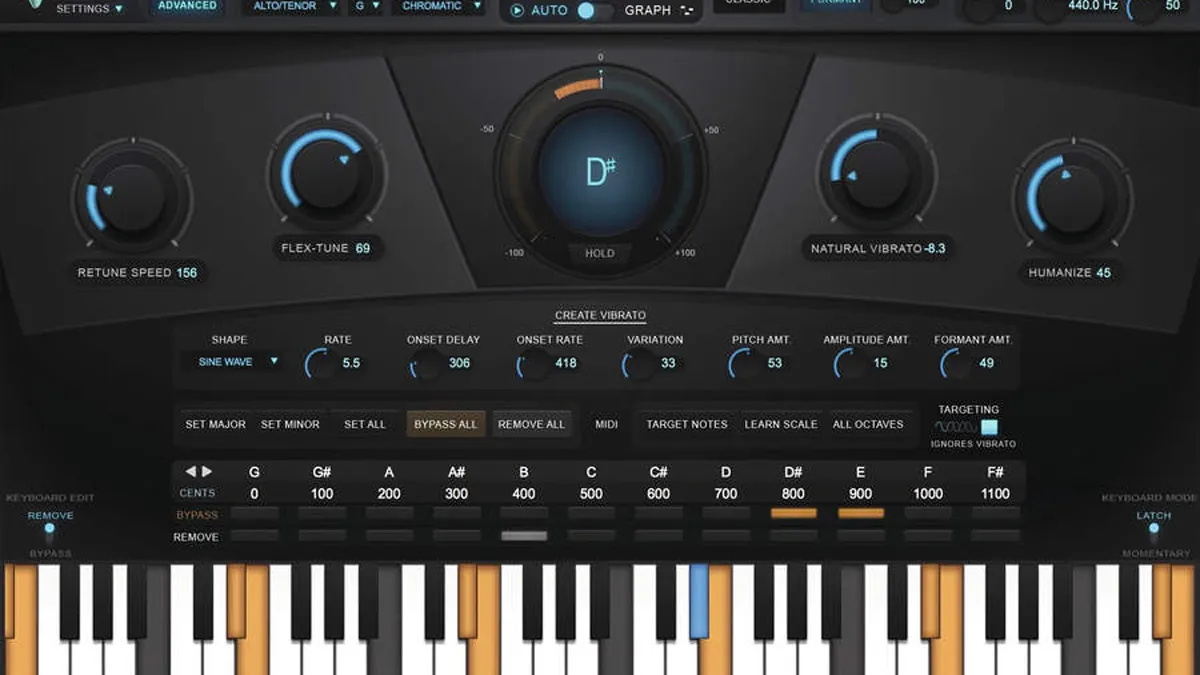
It’s operated in either of two modes: Auto and Graph, the first enabling real-time automatic re-pitching, the latter for detailed manual editing. You also get two views: Basic and Advanced. With Basic, choose a voice type, select the target key and scale, set specific pitches for removal (or leave unchanged). You can also use the Auto-Key plugin to detect the key and scale of the audio in your track, and transmit the results to all running instances of Auto-Tune.
Advanced view has a few extras like Create Vibrato, ideal for adding a bit of wobble via an LFO, plus options to set minor and major modes, edit across multiple octaves, and MIDI input editing features.
Auto-Tune Pro is the most powerful, usable incarnation of this standard yet, and easily maintains the software’s position as one of the best retuning solutions available, and may well prove to be the ultimate pitch-manipulating toolbox.
Read the full Antares Auto-Tune review
bx_crispytuner works best with bx_crispyscale (included free of charge), the latter allowing you to determine and apply a scale to the former, although crispyscale is by no means essential. Using the two in tandem, however, will allow you to apply a scale to multiple instances of crispytuner, which is great for large vocal sessions.
bx_crispytuner is very similar to Auto-Tune in that it has similar timing controls to make your tuning more natural or more synthetic. They even retail for the same price, although crispytuner is perhaps the slicker looking plugin of the two. And in terms of creating that synthetic vocal effect, it almost out-autotunes Auto-Tune. Subtle it isn’t, but that might be just what you are aiming for.
In order to perform this live tuning, the plugin operates with ultra low latency, so that even though the audio needs to go through your DAW and computer’s routing, it can still be monitored in real time. This means you as the singer, or your monitoring engineer, can hear what is happening as it happens and can make adjustments accordingly.
While some of the UI features are shared with Waves Tune, which is its non real-time sister plugin, the interface is somewhat more modern and slicker. It features a live tuning meter which shows the pitch as the vocal passes through, and as with Waves Tune, there are controls for Speed, Transition Tolerance and vocal Range. The central keyboard also indicates the notes of the audio passing into the plugin and here you can set the range of ‘allowed’ notes.
The Speed dial can, as with so many plugins of this ilk, be set to fast (zero) for the robotic Cher effect should you wish. Used in conjunction with the Transition dial, both can easily be used to create that effect, only this time you are doing it on live vocals. Waves Tune Real Time is therefore probably the first choice of the Waves Tune plugin range for that more unnatural effect, whereas the standard Tune will get you more natural results with ease.
You get three main modes from left to right: the main controls for Pitch and Formant, three Mode options (Transpose, Quantize and Robot) and then a Drive and Mix area. The Pitch control alters the incoming audio by semitones but the beauty of AlterBoy is that you don’t get the kind of high-pitch chipmunk effects you get with some pitch shifters – it’s a far more natural shift (unless you want to make it more extreme).
The Formant option can, again very naturally, sweep a male vocal into a female, or vice versa. It’s pretty incredible to hear it in operation because one of AlterBoy’s main attractions is the fact that it does it with no nonsense, one dial with all the science bits hidden away. It just gets on with it, with brilliant results.
The central Modes are where things get even more interesting. After a simple Transpose option, you get Quantize, where notes are forced to the nearest semi-tone for that Auto-Tune like effect. It works well and incredibly simply, although you’ll probably get more finesse and tweakability out of the real-deal Auto-Tune. However, for no nonsense results, this is great. Finally here you also get Robot Mode, where the pitch is frozen to one note, no matter what the original input is singing. This pitch, and indeed the formant, can still be changed with the left hand dials.
Add in saturation via a Drive option and AlterBoy is a wonderful, diverse plugin that does the job and does it very well. Great for beginners and superb value.
Recent additions include a Melodic algorithm that allows editing of noise-based sibilants to be carried out separately from pitch-based parts. Vocal pitch editing is also now incredibly natural due to features like a Levelling Macro that balances quiet and loud elements, and even the tiniest of pitch deviations can be tweaked.
Melodyne 5 Studio offers the full panoply of multitrack polyphonic editing options, but, if you mainly work with monophonic material, the more affordable Melodyne 5 Assistant still delivers many of the essential features. Whatever version, Melodyne is powerful and remains an exceptional tool for manipulating vocals and other audio in functional and creative ways.
Read the full Melodyne 5.1 review
One of Nectar 3’s many highlights is a machine-learning driven system for automatically setting the plugin up based on analysis of the input signal. Called Vocal Assistant, it creates a custom preset to make your vocal sound objectively ‘better’ and more mix-ready.
Select Assist mode, point the algorithm in the right direction by choosing Vintage, Modern or Dialogue as the source ‘Vibes’, and Light, Moderate or Aggressive as the processing ‘Intensity’. The input signal is analysed for a few seconds, during which the modules are set up in the background to correct for dynamic fluctuations, resonant peaks, sibilance, and even adjust pitch correction and reverb mix.
In Unmask mode, Vocal Assistant clears space for the vocal by applying equalisation to any other track that’s fighting with it for space. The results are invariably well- judged and thoroughly effective, giving the vocals a perceived lift that’s almost always beneficial. This feature has also been enhanced for Nectar 3 Plus, the latest incarnation of Nectar.
With many other great features and modules plus a souped up EQ, Nectar 3 sounds incredible and flows beautifully, and we can’t recommend it highly enough to any vocal-wrangling producer. However, if you are just after simple tuning or that robotic vocal tuning effect, it may deliver much more than you need and there are cheaper alternatives out there.
Read the full iZotope Nectar 3 review
You can go from simple noise removal through harmonisers and alien effects to some of the most famous autotune styles. Here you get everything from Daft Punk to T-Pain, although artists are not named directly (Bon Hiver, Duft Pank and P-Tain anyone?). Once done you can then apply some decent effects – compression, reverb and EQ – to the results for extra polish.
On top of this you get a free beat library, rudimentary multi-track recorder and the ability to import your own beats and export any creations you produce as WAV or AAC files, or share your efforts with other users.
Voloco is a huge amount of fun and also yields impressive results. It’s free but various subscriptions – up to $50 (£35 approx) a year – unlock extra import, multitrack and effect features, although what you get for free is still impressive.
APT (Automatic Performance Transfer) lies at the heart of what makes Revoice Pro so special. Having done your tuning work on the selected tracks, you simply call up the APT dialogue and select one of the presets (you can also make your own), tell it which is the guide and apply it to any track you wish to edit. This is great for backing vocals, for example, where you can add tracks and align not just the pitch and timing but also the dynamic.
Compared to the simpler plugins here, both VocAlign and Revoice Pro are perhaps aimed at the more professional user; pro producers and mixers will save countless hours in the studio with both tools. They do cost that bit more than other plugins here, so if you are just after simple tuning and the ‘autotune’ effect, you will find simpler and less expensive alternatives in this guide.
The software has three core processors – Match Timing, Match Pitch and Formant Shift – each accompanied by a parameter control to determine how loose or tight the matching processing is. It has great visual feedback with the three zoomable views – waveform, pitch and signal energy – allowing you to see timing and pitch both before and after processing. The display can be used to add manual Guide/Dub sync points or establish protected areas that won’t be processed – handy for more creative applications.
You can use VocAlign Ultra without delving too deeply into the advanced features. In that respect, we managed to tighten all manner of doubled and layered vocals. The results are very impressive and in many cases pleasantly transparent. It’s also very easy to adjust the amount of timing and pitch correction, and loosening things a bit is often the key to getting the most natural results.
VocAlign Ultra is a great vocal and audio processor. It’s a bit pricey but if you do a lot of editing and aligning it will improve your productivity considerably.
Read the full Synchro Arts VocAlign Ultra review
You insert the plugin on an audio channel just like any other effect, play your audio and it will map it across a piano keyboard after scanning it. (This is as opposed to the real-time processing of Waves Tune Real Time – see above.) An orange line shows the original recording and you can then drag and drop the constituent parts onto the correct notes. Once done, a green line shows the corrected notes.
Controls allow you to select vocal type, root of the scale and scale type. There are also a couple of speed controls that determine how quickly the plugin takes effect so you can go natural or robotic, your choice.
There’s also an LT version of Waves Tune that greys out some of the features of the main plugin. It retails for less (often around £30/$37), but since the full version is usually on sale (at the time of writing just $36/£29), we’d recommend shelling out the extra on it. It does the job of tuning without any fuss and very accurately, and focusses well on natural vocal tuning – although you can get more extreme effects should you wish.
There are two knobs, Pitch and Formant, controlling the central tone of the human vocal and the resonant frequencies that shape the timbre of the vocal. A Flatten button allows you to force the input to snap to a predetermined note, a speedy tool for building up augmented choruses and harmonies.
Experiment with the modulation and automation options, and vast creative scope presents itself. Automation can be a superb way of introducing vocal effects (such as sudden pitch drops) that activate based on the volume of the input signal, so the intensity of your performance can be the triggering factor.
The aim of the game with Vocal Bender is really getting that professional-sounding vocal manipulation at speed and with no processing lag. It is certainly one of the slickest vocal plugins we’ve experimented with – best in class for quick-fire, modern pitch manipulation.
Read the full Waves Vocal Bender review
One of its big draws is that you can play the instrument with your voice, or if that is shaky, play within set pitch parameters with tuning set up for you with its Auto Pitch Tracking.
There are an incredible number of presets to get you going – over 250 covering harmonies, autotuning effects, formant shifting, alien vocoder voices and more rhythmic effects. These all utilise Voice Synth’s more pro-end effects like a 24-band EQ, auto-gain compressor, 8-octave pitch shifter, arpeggiator and analogue modelling vocoders.
You certainly get a huge variation in sound and, even though it’s a decade old, Voice Synth still has a lot to say – or you can say it too with its integrated sampler. That all said, the iOS version scores much better than the full desktop Mac version on their respective App Stores, so this is a good mobile but less attractive desktop proposition.
You get 500 beats included with the app which will play in time with your vocals – yes it sorts both your timing and pitch out – and in this respect it delivers the goods fast. It’s a bit geared towards that one-trick synthetic style, with hip-hop and R&B being its focus, but it is free so well worth a download.
There is a Pro version, but at just $3.99/£3.59 it’s not much of an outlay for extra multitrack recording features, more effects and, of course, less ads.
Some of our buying choices, particularly the mobile entries, also focus on other more out-there effects. Some of the other vocal processes you will come across in these include formant shifting, where you might turn a male voice into a female (or vice versa); harmonising or doubling, where a single voice is doubled or more to produce a group of voices singing together; and vocoding, where a standard voice becomes a more robotic voice not dissimilar to the extreme pitch and time settings in automatic tuning software.
However, aside from these more extreme vocal effects, it’s more likely that you will have tuning issues with your singing and that’s where this buyer’s guide really comes into its own. Vocal tuning is, of course, an essential application. Even if you are – or are recording – the world’s best vocalist, you or they will always have an off day, and it might not be possible to do a vocal retake. Vocal tuning applications to help tweak the vocal into tune post-recording are therefore incredibly popular, and this process can be very straightforward and transparent. You, your vocalist and audience need never know such processing has taken place.
Or you might want the opposite! You might want everyone to know just how much processing you’ve done by utilising the famous and much more obvious ‘autotune’ effect. The effect, made famous by Cher in the late ’90s and the producer T-Pain the 2000s, is essentially derived from the mother of all automatic tuning plugins, Antares’ aptly named Auto-Tune. This software was originally intended simply to help vocalists or producers get voice recordings in tune.
The almost robotic-like vocal effect is produced when that (or a similar) plugin is used in a more extreme setting. Here its tuning effect – produced in Auto-Tune’s case by way of the Return Speed parameter – is at its quickest setting. It therefore retunes any incoming vocal signal at the fastest speed resulting in an inhuman effects where you can hear the jolt as it knocks the vocals in tune. You suspect that Auto-Tune was never really intended to be used at this setting on purpose but, as with many music production principles, if used at an extreme setting, happy accidents occur!
So when buying your automatic tuning plugin, you simply need to decide whether you want to go natural or robotic, or would prefer a plugin that is capable of both. In our best autotune plugins buyer’s guide we have plugins capable of both, and some like iZotope’s Nectar that are capable of much more.
Finally, of course, decide on your desktop or mobile needs. Most of our recommendations run as third party plugins within standard Mac and PC DAWs, although we have also included app options for the mobile Android and iOS platforms. Only one, Voloco, sits in both mobile and desktop camps so could be used to transfer your mobile vocal experiments to desktop with ease.
Andy has been writing about music production and technology for 30 years having started out on Music Technology magazine back in 1992. He has edited Future Music, Keyboard Review, MusicTech magazines and currently runs Computer Music which he helped launch back in 1998. He owns way too many synthesizers.
Don’t miss the latest deals, news, reviews, features and tutorials
Thank you for signing up to Musicradar. You will receive a verification email shortly.
There was a problem. Please refresh the page and try again.
MusicRadar is part of Future plc, an international media group and leading digital publisher. Visit our corporate site (opens in new tab).
© Future Publishing Limited Quay House, The Ambury, Bath BA1 1UA. All rights reserved. England and Wales company registration number 2008885.
Why F1's chess master isn't worried by self-doubt – Autosport

Mick Schumacher grabs a pair of pawns from the case, hides them behind his back, and a second later puts his two fists forward. GP Racing taps his left hand and he opens it… revealing a black piece nestling in his upturned palm. He gets to make the first move.
Mick’s interest in chess is no secret, as he’s often seen in the paddock playing against his physio. He’s got one of the world’s most popular chess apps installed on his phone but says he rarely plays against real people online, preferring computer bots. He also says it’s just a hobby, since a Formula 1 driver’s schedule leaves no room for proper chess study – but he definitely knows his way around the board.
The changing priorities that caused an F1 giant’s terminal decline
How Red Bull’s gateway F1 car overcame a baked-in disadvantage
How unshackled Albon is taking inspiration from Hamilton and Vettel
The key considerations Ricciardo must weigh up ahead of a crucial chapter
Has F1 already grown tired of spending constraints?
The pioneering pair who brought a new glory era to an F1 heavyweight
Why there was no case to answer in Aston’s latest F1 copycat saga
Verstappen exclusive: Why F1’s champion isn’t fazed by Silverstone return
Ferrari: No reason we cannot win final 10 races of F1 2022
Ferrari sees no reason why it cannot win the remaining 10 Formula 1 races this season to help save its world championship ambitions.
Sargeant’s bid for Williams F1 seat “a great headache” – Capito
Williams Formula 1 team boss Jost Capito says that Logan Sargeant putting himself into contention for a 2023 seat by winning the F2 title would be “a great headache” to have.
Red Bull F1 driver Perez to enter team in Agag’s E1 powerboat series
Red Bull Formula 1 driver Sergio Perez is to enter a squad in the electric powerboat series being established by Formula E co-founder Alejandro Agag.
Ferrari: Delayed France F1 radio messages made strategy look ‘nonsensical’
Ferrari says that delays by Formula 1 in broadcasting its radio messages to Carlos Sainz during the French Grand Prix were to blame for making its strategy calls look ‘nonsensical.’
The 2018 Vettel rut Leclerc must avoid in F1 2022’s title fight
OPINION: With a French Grand Prix crash that hampers Ferrari’s Formula 1 title credentials even further, Charles Leclerc revived uncomfortable memories for the Scuderia of Sebastian Vettel’s 2018 Hockenheim blunder. Leclerc’s immediate reaction was markedly different to the German’s, and that must continue to be the case going forward if he is to have any chance of toppling Max Verstappen in 2022
French Grand Prix Driver Ratings 2022
Despite the French Grand Prix at Paul Ricard often considered a low-key affair, there was action aplenty this weekend which has strongly shaped the ratings. Two maximums are given out and another driver just misses out on a perfect score
The knife-edge French GP Verstappen fight factors that led to Leclerc’s costly crash
The tussle for French Grand Prix victory was bubbling up nicely between Charles Leclerc and Max Verstappen, right up until the Ferrari driver made a critical error which handed his Formula 1 world title rival a straightforward path to win and cement his championship advantage. But even though Leclerc owned up to his mistake, how the race unfolded at the front set his costly crash in motion
Why F1’s chess master isn’t worried by self-doubt
“Chess is a war over the board – the object is to crush the opponent’s mind,” said chess world champion Bobby Fischer. GP Racing’s OLEG KARPOV recently challenged keen player Mick Schumacher to a more light-hearted match, and along the way got Mick to talk about pictures, his famous surname and how he’s coping in his second season in F1
The changing priorities that caused an F1 giant’s terminal decline
A return to world championship glory with BMW turbo power was the prelude to a catastrophic slump from which Brabham could not escape. In the final instalment of our four-part history of Brabham, DAMIEN SMITH examines the demise of the team after one last hurrah
The familiar Paul Ricard weakness that should worry Ferrari at the French GP
The Red Bull and Ferrari battle for supremacy takes to Formula 1’s next battleground at the Paul Ricard circuit. Although the Scuderia ended Friday’s running ahead of the French Grand Prix with an advantage in the timesheets, it has a clear weakness – displayed last year – that Red Bull has a chance to exploit
The driver who ended the curse of Red Bull’s second F1 seat
Being Max Verstappen’s team-mate has been the undoing of several drivers, but Sergio Perez has finally made the job his own. Here’s how the Mexican has succeeded where Pierre Gasly and Alex Albon before him stumbled
Why F1 drivers can’t have their cake and eat it over track limits
One of the biggest gripes over track limits in Formula 1 has been consistency, and thus new race director Niels Wittich has chosen to enforce track limits at every corner – with the white line the outer permissible extremity. The drivers aren’t exactly happy with that in practice, but it does afford the uniformity that they desired…
Alonso: F1 gap between McLaren and Alpine in France “worrying”
Latifi claims off-centre steering “extremely disturbing”, Williams downplays issue

Fight Between Karnataka Congress | Ticket Sell Audio Tape Goes Viral | Exclusive – Times Now

Dark Mode
Updated Jul 25, 2022 | 06:25 PM IST
Fight between two groups of Karnataka Congress leaders D K Shivkumar and Siddaramaiah has intensified. Youth Congress seems to be divided over whom to be supported in the elections next year. Supporters of the two camps were seen fighting with each other and beating each other by chairs. Youth Congress district president sacked 17 members including the secretary. Times Now also has access to audio between Youth Congress Secretary and workers discussing tickets. Three audio clips show the Youth Congress Secretary allegedly involved in a cash for tickets scandal. There are talks of RS 50000 to 1 lacs cash exchanging hands for tickets.#Karnataka #Youthcongress #Ticketforcash
home
videos
times now
india
Follow Us :
© 2022 Bennett, Coleman & Company Limited
Ask the Master Gardener: Warm, humid conditions can lead to septoria leaf spot on tomato plants – Brainerd Dispatch

ADVERTISEMENT
ADVERTISEMENT
Dear Master Gardener: I’ve been fighting a disease on my tomato plants all season. I keep cutting off diseased leaves until there are only a few remaining on the plant. The leaves are yellow with spots on them. I have two cherry tomato plants that hadn’t been affected but now they’re also getting diseased. I sprayed a fungicide, but it doesn’t seem to be helping. What can I do?
Answer: It sounds like the problem with your tomatoes could be septoria leaf spot, which is a common tomato disease found in Minnesota. The Brainerd lakes area has had warm, wet, humid conditions, which is conducive for septoria leaf spot. Most tomato leaf spot diseases overwinter in the soil and then splash onto the lower leaves of the plant, so symptoms usually appear on the lower leaves first. Then, the disease spreads upwards from the oldest to the newest growth. Typically, there are many spots per leaf, then leaves turn yellow, then brown, and then wither. Tomato plants can tolerate high levels of leaf loss from leaf spot diseases without affecting the tomatoes.
Before using a fungicide, it is imperative that the problem be diagnosed correctly. Is the problem just due to cultural practices or weather? Is it a virus, bacteria, or fungus? Which virus, bacteria, or fungus is it? What is causing it? Most home garden tomatoes do not need to be treated with a fungicide.
It’s very important to keep tomato leaves as dry as possible. Pinch off infected leaves to keep leaf spot diseases in check. It’s also important to rotate crops — plant tomatoes where no tomatoes, potatoes, peppers, or eggplants have been for the past 3-4 years. Do not save seed from infected plants.
Dear Master Gardener: I started seeds in small seed starting pots with partially finished compost. I also used partially finished compost when I direct-seeded in my garden. I’ve had poor results. Is it bad seed or bad compost?
ADVERTISEMENT
Answer: I’m betting on compost as the problem. First let’s address starting seeds in pots. The U of M recommends starting seeds in a commercial seed-starting mix, which is usually composed of vermiculite and peat, without any true soil. These mixes are sterile, lightweight, and free from weed seeds, with a texture and porosity especially formulated for germinating seeds and tiny seedlings. Partially decomposed compost doesn’t meet any of those requirements — it’s not sterile, lightweight or free of weed seeds. Composting is a process that allows naturally occurring microbes to convert yard waste such as leaves, grass clippings and plant material to a useful organic soil amendment or mulch. Incorporating compost into light, sandy soil (which is often found in this area) helps it hold moisture and nutrients. Incorporating it into heavy soil improves drainage. Finished compost is dark brown or black, crumbly, has an earthy smell, and the organic items that have been added to the compost pile are no longer recognizable. Unfinished compost is a mixture of organic materials that are still recognizable and drawing nitrogen to finish the breakdown process — potentially starving your seeds. Unfinished compost should only be used as a top-dressing/mulch during the growing season.
Dear Master Gardener: My sister and I live in different parts of Minnesota. She sees lots of grasshoppers in her gardens and I don’t. Are they good or bad insects? If they are bad, should pesticides be used to get rid of them?
Answer: Grasshoppers are one of the most familiar insects. There are over 550 species of grasshoppers in North America, but only a few damage gardens. There are four in the genus Melanoplus that are particularly harmful: Twostriped Grasshopper, Differential Grasshopper, Migratory Grasshopper and Redlegged Grasshopper. All four can be found in Minnesota. The Redlegged Grasshopper is the only one of the four that can be found in Crow Wing County but is quite abundant in southeastern Minnesota. The grasshopper population changes with rainy weather. You usually don’t see large grasshopper populations in areas that have received lots of rain because wet weather promotes a fungus that kills grasshoppers.
If grasshoppers do any damage in the garden, it is often insignificant. Grasses are particularly favored, but most garden plants can be damaged. The plants most commonly harmed by grasshoppers are beans, leafy vegetables, corn and iris. Most feeding occurs on foliage. Grasshoppers are usually not worth treating over a few holey leaves. They’re also large and very mobile, so using pesticides on them is usually ineffective. Most importantly, pesticides can have unintended effects on pollinators and other beneficial insects.
Dear Master Gardener: I planted some herbs this year but my basil is declining. Does basil get a particular disease?
Answer: First, check to see if the problem is aphids, as this is a common problem for basil plants. If your basil plants started out looking healthy, then at 6-12 inches the growth became stunted, you saw brown streaks on the stem, brown blotches on the leaves and the plant wilted, then it is most likely a disease called Fusarium wilt. Fusarium wilt is a fungal disease caused by a soil-borne pathogenic fungus that is found in basil only. Eventually the plant wilts and curls over and the infected leaves fall off.
There is no treatment for infected basil plants. Infected plants should be removed at once to prevent other nearby basil plants from contracting the disease. Prevention is the key to having healthy basil plants. Water early in the day and keep the foliage as dry as possible. If you plant your herbs in pots, make sure to use new soil each year and sterilize the pots. If you plant herbs in your garden, then rotate the herbs to different places and remove plant debris in the fall. The best plan of action is to buy a variety that is tolerant or resistant to Fusarium wilt. The varieties most susceptible to the disease are sweet basil and Spicy Globe. Some of the specialty basils like lemon basil and purple basil are more disease-tolerant. A variety of sweet basil that is resistant to Fusarium wilt is Nufar, which is available through several seed companies.
You may get your garden questions answered by calling the new Master Gardener Help Line at 218-824-1068 and leaving a message. A Master Gardener will return your call. Or, emailing me at [email protected] and I will answer you in the column if space allows.
ADVERTISEMENT
University of Minnesota Extension Master Gardeners are trained and certified volunteers for the University of Minnesota Extension. Information given in this column is based on university research.
ADVERTISEMENT
ADVERTISEMENT
Best Free Saturation VST Plugins in 2022 for Music Producers – We Rave You

When the first analog synthesizers, drum machines, and samplers entered the market we were intrigued by the harmonic distortion it adds to the sound source. Overdriving the built-in tubes and transistors is what adds warmth to the sounds. There are tons of high-end premium saturation plugins out there such as Decapitator, Saturn, etc. However, it’s tough to find good free alternatives. Down below you’ll find a list of the best free saturation VST plugins, re-built from the most iconic analog pieces of gear, that will color your sound source as desired.
Shattered Glass Audio took a single-channel vintage tube amplifier as an example while building this tool, and added some additional features on top of it. You have the ability to make the sound source stereo, choose between low or high CPU, choose 1x/2x/4x oversampling, choose whether you want to affect the bass & treble before or after the saturation, and get the right input/gain/output. One of the best free Saturation VST plugins out there.
Originally modeled after the analog tape machine, Sony TC-260, ChosDSP holds on to many more additional features. Started as a class project at Stanford University, and it developed into a great saturation plugin. Choose the right input and output gain, choose whether you want tape or tone & control how much drive you want to apply, choose loss, degrade or CHEW going from subtle to extreme, and add flutter and Wow to the sound source.
| Best VST Plugins of 2022 – Click here to checkout
MIA Fat is a one-knob plugin that will simply add subtle to extreme saturation. Dial in the right amount of saturation by using the large knob, enable clipping in order to destroy the sound, and make sure you use the volume knob to get the desired volume. This plugin is recommended for DnB, Reggae, Dub, and Techno.
The circuitry of the original tube saturator was re-built, combined with modern features, and developed into a digital version. Wave Arts implemented 2 cathode 12AX7 preamp stages, a 3-band EQ, EQ bypass, FAT mode, analog metering, mono/ stereo, and a drive control to achieve the right distortion.
This Microsoft VST plugin supports mono, stereo, Quadro, and 5.1 audio trackings. Get your hands on the separate adjustments of the drive and bias, a 1x/2x/4x/8x/12x/16x oversampling, a 3-band EQ with ±12dB range, 12 factory presets, and 8 user presets. Simply use the sliders to change the frequency spectrum and get the right amount of saturation.
Just like the MIA Fat plugin, you’ll only have 1 knob that will give you the desired amount of distortion. Choose how much of the distortion will emerge with the original sound by using the mix knob and choose the right output volume. Use the metering at the bottom to see how the signal is behaving. Use FreeAMP on single sound sources, stems, and full mixes.
Choose the right VU-mode: In, Out, Out-in, to have a graphic overview of what the plugin is doing to the incoming signal. Get the right amount of drive, output volume, ASYM mix, response, trim, and X-talk. IVGI can add subtle distortion up to extreme distortion effects.
This one-knob is commonly used within the music industry by many artists. Just like FL Studio’s Soundgoodizer, this plugin will add distinctive character to everything. Choose between 3 different saturation types: Keep high, Neutral, and Keep low in order to affect the desired frequency range. Use this on single tracks, and full mixes, and it can add some warmth to your master.
The TBProAudio CS5501V2 channel strip plugin has been scrutinized while developing this GSatPlus plugin. This plugin holds on to 3 different tube-based character modes, clip protection, 2x/4x oversampling, mono, stereo, left, right, mid, side, bypass feature, odd & even harmonic dials, and a preset manager including presets for a broad range of sounds.
Voxengo Tube Amp contains 2 processing modes, output saturation stage, stereo & multi-channel processing, internal channel routing, 2x/4x/8x oversampling, bias mix, LP frequency dial, dry mix, output gain, level meter, A/B comparison, and a range of different presets.
Next article: Plugins & Gear used by Petit Biscuit | The Essential Vol. 1 Catalog
Image Credits: Softube
– DJ/Producer from the Netherlands. – Graduated from the Conservatory in Amsterdam. – Currently working as the technical writer at We Rave You
[email protected]


How a near-death experience could change the way you live – NPR

Lee Hale
A man’s forehead and his eyes which are closed. Inside him a tunnel of light with floating iridescent particles, in the end a light. Raquel Aparicio for NPR hide caption
A man’s forehead and his eyes which are closed. Inside him a tunnel of light with floating iridescent particles, in the end a light.
Randy Schiefer remembers being woken up by his mother’s screams at four in the morning.
He was 16 years old at the time. It was 1969, and his family was staying at a hotel while on vacation in New Jersey.
He ran toward the screams and found his father having a heart attack. He had some CPR training so he began some mouth-to-mouth resuscitations. But it wasn’t working.
He ran out into the hallway, pounding on doors trying to get somebody to come out and help.
“But nobody did,” Schiefer says.
Schiefer’s father died that night. He was devastated. What’s worse is that every time he thought about his father, he would be consumed with feelings of guilt and fear. He’d think about him on that hotel floor and then inevitably he’d think about his own eventual death.
“I would go into panic attacks,” Schiefer says. “I’d get real tight in my chest and the only way that I could control it is just try to settle myself down and say, ‘Okay, get it out of your head, get it out of your head.'”
For Schiefer, death was a black wall, a question mark. That is, until he faced it himself.
He had what’s known as a near-death experience — which have been documented around the world and can lead people to change the way they live their lives.
In March 2020, Schiefer had what felt like a very persistent flu. His doctor had told him he just needed rest but as the days went on his symptoms got worse. He tested for COVID-19, and was positive.
Things deteriorated fast for Schiefer. He was rushed to a nearby hospital, where he was put into a medically-induced coma and placed on a heart-lung machine.
Randy Schiefer was put into a medically-induced coma as doctors scrambled to find ways to treat his severe case of COVID-19. Courtesy of the Schiefer family hide caption
Randy Schiefer was put into a medically-induced coma as doctors scrambled to find ways to treat his severe case of COVID-19.
He was unconscious for nearly a month. But he came through, after a convalescent plasma treatment that his daughter Lisa Schiefer pushed for. He received the blood transfusion on a Friday and by Sunday, the doctors were able to turn off the heart-lung machine that had been keeping him alive.
“My lungs had completely cleared by that Tuesday. My kidneys started to function fully again and so did my liver,” Schiefer says.
After the medication wore off and Schiefer was steadily improving, his daughter was permitted to keep him company in his hospital room.
“Only after I was allowed at his bedside did he start communicating with me about what he experienced,” she says.
Near-death experiences can occur when someone faces a life-threatening situation such as cardiac arrest or is under deep anesthesia.
Some people have reported the feeling of leaving their body and observing their surroundings. For Schiefer, his journey started with what looked like an airplane fuselage.
Schiefer says there was a moment while he was in a coma when he remembers his consciousness awakening. He was traveling through a kind of tunnel, with light streaming through like windows in an airplane.
“Beautiful, warm, loving light,” Schiefer says.
The tunnel brought him to a large room with arched windows and stained glass. It was also permeating with that same warm, loving light. Then Schiefer says a gentleman approached him and said he didn’t belong there — that he had to leave. He walked out through giant oak doors into an even more serene scene.
“I remember going through the doors and it took me out into a golden city, and it was absolutely stunning,” says Schiefer.
When he first described the city to his daughter Lisa, he said it was like Paris, but more beautiful, more pristine. He says the grass in the parks was a deeper green than anything on earth.
“And I’ve been to the highlands of Scotland,” Schiefer says.
But this awe-struck stroll took a turn when Schiefer realized he didn’t know where he was or how to get back. He felt lost.
“I remember sitting down and I started to panic, and I started to cry,” he says.
That feeling of warmth left him. He says he felt cold and scared.
“Suddenly I looked over my shoulder and saw this big white staircase that rose up in the sky as far as you could see,” says Schiefer.
He began climbing the staircase, crawling on his hands and knees, and then he says someone called him by name, grabbed him by the shirt and whisked him away.
“I remember it going black, back to my little dark sedated world,” Schiefer says.
His daughter listened to Schiefer’s story intently, but let him know that he hadn’t traveled to any cities lately. In fact, he’d been in a coma in a hospital room for nearly a month. But he insisted the experience was real.
When she offered up that it was probably a dream or hallucination from the heavy medication that didn’t sit right with Schiefer.
“My dreams were foggy. And my hallucinations were just stupid. I saw nine dancing panda bears on the ceiling,” Schiefer says. “But this was so real. I was there. I was involved with my environment and I felt so much peace and love and acceptance. More than I have ever felt before.”
Schiefer’s daughter Lisa started noticing differences in her dad almost immediately after he got home — like when he started opening up about that night he watched his father die from a heart attack.
“My mom and I sat at the kitchen island and he just spoke,” she says. “He was telling us about it.”
The sign that welcomed Randy Schiefer home after his brush with death. Courtesy of the Schiefer family hide caption
The sign that welcomed Randy Schiefer home after his brush with death.
As he was talking about that night in New Jersey, he asked his daughter to get an eyeglasses case from a closet.
He took the glasses out and stared at them. He looked a little stunned as he told her that the last person to take them out of their case was his father.
“My dad was 16 when his father died,” she says. “He’s almost 70 now. That tells you how long those glasses have just been sitting in their case.”
This wasn’t like Schiefer. He wasn’t one to divulge emotional details, especially when it involved the deaths of loved ones.
“Pre-COVID dad never talked about death. We didn’t talk about dying. We didn’t talk about god. We didn’t talk about the afterlife,” Lisa Schiefer says. “We didn’t talk about any of that.”
It was moments like this that caused her to think differently about what her dad had shared in the hospital. She began seeing his near-death experience as what it was for him — something real.
Experiences like Schiefer’s aren’t uncommon.
Researchers have found that between 10 and 20% of people who have a documented cardiac arrest — that is, when their hearts stop — will report a near-death experience, says Dr. Bruce Greyson, professor emeritus of psychiatry and neurobehavioral sciences at the University of Virginia.
Greyson has been studying first-hand accounts like Schiefer’s for about 50 years, looking for patterns.
“The best definition we have is that it’s a profound experience that many people have that includes enhanced thought processes,” Greyson explains. “Your thoughts are faster and clearer than usual. You have a sense of being in a timeless state. You often have a review of your entire lives.
“It includes strong emotions, like a sense of overwhelming peace and well-being, a sense of oneness with everything, an experience of unconditional love, a sense of being outside the physical body,” he adds.
Most surprising to Greyson is that people can see things in their near-death experiences that will later be corroborated as accurate. Like certain tools used during open heart surgery or conversations that happened when they were unconscious, or pronounced dead during.
But most significant to Greyson is what comes after a near-death experience.
“I’ve got story after story of people who couldn’t go back to the same profession, people who were, say, career police officers who couldn’t shoot after a near-death experience, of people who were in competitive businesses who no longer felt it was meaningful to get ahead at someone else’s expense.”
Greyson says these people often change their careers, or make other dramatic lifestyle changes.
That was Schiefer’s experience. Along with a willingness to discuss death freely he was open to talking about all sorts of existential questions. He also started to dig deeper into his family’s Christian faith and began praying regularly. As a result, he says he’s become a better version of himself.
“I’m much more open, much more welcoming, much more understanding than I was before, I think much more loving as a husband and father as I was before,” Schiefer says.
Randy Schiefer needed intensive physical therapy after nearly a month in a medically-induced coma. Courtesy of the Schiefer family hide caption
Randy Schiefer needed intensive physical therapy after nearly a month in a medically-induced coma.
Before his brush with death, Lisa Schiefer says her dad seemed a little lost. Just going through the motions. But now, he has newfound energy. He’s excited and optimistic. And he loves sharing his near-death experience with anyone who is curious.
“He loves talking about it, which is good for him. I’m glad he has a hobby,” she laughs.
But the adjustment for her hasn’t been easy.
For one, each time she hears her dad’s story it takes her back to the most terrifying few weeks of her life — sleepless nights spent worrying about whether she’d get the dreaded call from the hospital.
“It’s not exciting for me to sit back and listen and be reminded of how my dad almost died,” she says.
And she was so grateful they were one of the lucky ones whose family member came home, but there was still a period of mourning.
She says her dad has always been her best friend. So even though this transformation she was witnessing was a good thing, she missed that pre-COVID version of him. The one who was a little short-tempered and closed off at times.
Randy Schiefer’s daughter Lisa spent a lot of time with him in his hospital room as he recovered from a life-threatening case of COVID-19. Courtesy of the Schiefer family hide caption
Randy Schiefer’s daughter Lisa spent a lot of time with him in his hospital room as he recovered from a life-threatening case of COVID-19.
“Selfishly, I felt very alone,” Lisa Schiefer says. “I felt very hurt and frustrated. I would think, ‘I just want you to go back to pre-COVID. I want to have my dad here, and I want to pretend like these six weeks had never happened.'”
Schiefer came home more than two years ago, and the family has since found a new rhythm. His daughter moved to Florida permanently to be a short drive from her parents.
But Greyson says that some families don’t make it through an experience like this one.
“Often they can’t accept the changes,” Greyson says. “They feel they don’t have the same values in common anymore.”
Regardless of whether or not a loved one wants to validate a near-death experience as “real,” they often can’t ignore the real changes that come from them. Some of these changes have caused Greyson to rethink preconceived notions.
“I was raised in a scientific household, and I didn’t believe any of this stuff before I started encountering it,” Greyson says. “But after 50 years of studying thousands of cases, I can’t deny that they happen and that they profoundly affect people’s lives and present us with things that we don’t have materialistic explanations for.”
Greyson says that uncertainty didn’t always sit well with him, but he’s learned to embrace it.
“It becomes like an old friend,” Greyson says. “Probably because near-death experiencer after near-death experiencer has told me that the universe is a friendly place. It’s nothing to be frightened of. And the fact that you don’t know the answer doesn’t mean there isn’t one there. That there’s something that’s greater than us that is in control of things. I can’t say that I believe that, but I certainly have absorbed the feeling that this is a safe place to be.”
For Schiefer, his explanation is simple. He’s no longer afraid to talk about death because he’s no longer afraid of death.
The panic attacks that used to plague him have stopped.
And if you ask Schiefer why he’s no longer afraid of death, he puts it this way:
“I’ve been there. I’ve been there. I’ve experienced it.”
Sponsor Message
Become an NPR sponsor
Temperature-dependent optical properties of some mixtures nematic liquid crystal | Scientific Reports – Nature.com

Thank you for visiting nature.com. You are using a browser version with limited support for CSS. To obtain the best experience, we recommend you use a more up to date browser (or turn off compatibility mode in Internet Explorer). In the meantime, to ensure continued support, we are displaying the site without styles and JavaScript.
Advertisement
Scientific Reports volume 12, Article number: 12676 (2022)
Metrics details
The presence of optical anisotropy in liquid crystals (LCs) has caused these materials to have dual refractive indices: ordinary (no) and extra-ordinary (ne). Many fundamental information about LCs can be found by looking at these refractive indices. In this work, the refractive indices of four mixtures nematic liquid crystal (NLC) have been studied as a function of temperature, and the relevant functions were then calculated. Subsequently, the order parameter of mentioned LCs was determined using three methods: Vuks, Haller, and the effective geometry parameter method. It was concluded that the obtained values are not significantly different and exhibit the same temperature dependence. The obtained results were evaluated in relation to the approach utilized.
The last few decades have seen an enormous growth in the development of novel devices based on optics and photonics technologies1,2,3,4. Therefore, materials and designs are constantly required in emerging modern technologies to build compact, weightless, highly adaptable, and effective optical devices5,6,7. Liquid crystals (LCs) are one of the most well-known materials in this field8. LCs, an intermediate phase of matter between isotropic fluid and solid crystal, combine the optical anisotropy of crystals with the molecular mobility of liquids, which is a crucial property of these systems9,10. The operation of LCs is confined to the liquid crystalline state—within a specific temperature range11,12,13. Meanwhile, the great sensitivity of their anisotropic features to temperature has led to the development of LCs that operates over a wide temperature range14,15. This has sparked a lot of interest in eutectic LC mixtures, due to the wide LC application temperature range and controllable optical and electro-optical properties in these application regions15,16,17. Because of having two refractive indices; ordinary no and extraordinary ne,—govern the application context of LCs; thus investigation on the optical anisotropy of LCs is increasingly important9,10,18,19. Studies on the optical anisotropy of LCs help to find out the relationship between macroscopic and microscopic properties in the LCs.
The order parameter is one of the most important parameters in the characterization of LCs, which can be determined in both microscopic and macroscopic forms. This parameter controls all physical properties of LCs in addition to verifying their degree of intrinsic long-range order [18,19,20,21 (19–20, 20–21)]. There are various methods for determining the order parameter, with techniques based on optical anisotropy being the most popular due to their high accuracy22,23. Among these, the Vuks method is an extensively utilized method that concts the LC’s molecular polarizability to its macroscopic refractive indices and determines the order parameter at the microscopic level24. Haller’s model is another one that uses refractive indices data as bulk tensorial features to estimate the macroscopic order parameter25. Moreover, the other standard techniques based on refractive indices, can be used for the measurement of the effective geometry parameter (αeg) for determine the order parameter26,27,28. αeg, as a macroscopic parameter, describes how light travels through an LC compound. Due to symmetry breakdown at the phase transition in the LC phases, light can be diverted towards the director’s faulty orientation. Therefore, αeg defines the degree of light deflection. The arrangement of molecules in LC naturally affects how light is transmitted. The order parameter of many nematic liquid crystals was recently determined using mentioned above optical approaches12,22,29,30,31.
In this work, firstly the refractive indices of some mixtures NLC were measured and their temperature dependence was investigated. Then, related LCs’ order parameter is calculated by using three methods: Vuks, Haller, and effective geometry parameter equation, after advancing the appropriate calculations. All calculations were based on data acquired from refractive indices measurements. The obtained results were evaluated in relation to the approach utilized.
The dielectric constant (ε) of anisotropic media is related to molecular polarizability (α) and molecular packing density (N) according to the Clausius–Mossotti equation32:
In the optical frequencies, it can be substituted ε with n2 and obtain the Lorentz-Lorentz equation32:
Due to the anisotropic nature of LCs, these materials have two refractive indices, which Vuks proposed a semi-empirical equation that correlates microscopic molecular polarizabilities to macroscopic refractive indices for anisotropic medium considering an isotropic local field among various researches16,24:
In this, αe and αo represent extraordinary and ordinary molecular polarizabilities, respectively, where < n2 > is the mean value of the square of the refractive index which is defined as29:
Also, the refractive indices of LC can be expresses as a function of < n > and birefringence (Δn = ne − no) using this approach24,29:
In the following, the linear temperature dependency of (<mathrm{n}>) can be determined by evaluating the variation of the temperature-dependent effective molecular density using the experimental data of ne and no30,31:
The values of A and B are determined by fitting a curve that depicts the temperature dependence of (sqrt {leftlangle {text{n}} rightrangle }). In the next step, the Haller’s approximation is used to characterize the temperature dependency of birefringence20:
where (({Delta mathrm{n})}_{mathrm{o}}) is the LC birefringence in the crystalline state, β is the LC material’s characteristic constant, and TC is its clearing temperature. The values of ({(Delta mathrm{n})}_{mathrm{o}}) and β can be obtained by using the linear curve fitting approach. Subsequently, the temperature–dependent refractive indices of LCs can then be derived by inserting values of ∆n and (sqrt{<mathrm{n}>}) in Eqs. (5) and (6), resulting in the modified four-parameter model30,31:
So, Eqs. (9) and (10) can be utilized to directly compute the temperature variation rate of ne and no29,30:
In addition, using the modified-four parameter model, the cross-over temperature (Tco) can be calculated. In this regard, it should be noted that the intermediate stage has a cross-over temperature, which is the transition temperature when dno/dT = 0. Using this condition, it is possible to write22:
After completing the calculations above, the normalized polarizability can be derived using ({mathrm{n}}_{mathrm{e}}) and ({mathrm{n}}_{mathrm{o}}) values, as well as (<{mathrm{n}}^{2}>)29,30:
where:
is the molecular mean polarizability. The ratio of normalized polarizabilities can be expressed as:
Then, three different optical methods for determining the order parameter based on the temperature dependence of the refractive indices are utilized in this work. The Vuks’ model was employed as the first approach, where the order parameter can be expressed as24,30:
where (Delta {upalpha }left( { = {upalpha }_{{text{e}}} – {upalpha }_{{text{o}}} } right)) and ({upalpha }) are polarizability anisotropy and mean molecular polarizability, respectively. To determine (frac{{Delta {upalpha }}}{{upalpha }}), the linear part of ({text{ln}}left[ {frac{{3left( {{text{n}}_{{text{e}}}^{2} – {text{n}}_{{text{o}}}^{2} } right)}}{{{text{n}}_{{text{e}}}^{2} + 2{text{n}}_{{text{o}}}^{2} – 3}}} right]) against ln (left( {1 – frac{{text{T}}}{{{text{T}}_{{text{C}}} }}} right)) must be drawn and extrapolated to T = 0 K. By assuming that (frac{{Delta {upalpha }}}{{upalpha }}) remains constant at all temperatures and putting this value into Eq. (18) at various temperatures, the order parameter value is derived.
The Haller’s approximation method is used to define the order parameter in the second approach, which the birefringence is converted to be linearly proportional to the order parameter. By disregarding the internal field effect, it is possible to write30,31:
In the third approach, the order parameter is defined using the effective geometry parameter (αeg)14,27:
By dividing Eq. (6) by Eq. (5) and using Eqs. (8) and (19), the order parameter value is obtained as follows14,27:
In this work, four mixtures NLC (Merck Ltd.) have been selected as significant components in a variety of applications based on LC. Materials used are: MAT-131957 (LC-I), MAT-131958 (LC-II), ZKC-5102-LA (LC-III), ML-0682 (LC-IV). A set of desired physical properties is required depending on the application, not all of them are present in any single compound. As a result, research on liquid crystal mixtures of various shapes and structures has always proven to be lucrative from both a technological and basic standpoint. Two of selected LCs have positive dielectric anisotropy (∆ε) and the other two have negative. It is noteworthy that LCs with ∆ε > 0 have a dominant application in liquid crystal display (LCD) manufacturing. LCs with ∆ε < 0 are used to improve performance of LCDs, which in addition is highly regarded in optoelectronic applications33,34,35.
All investigated mixtures NLC are listed in Table 1 with relevant physical characteristics.
Abbe refractometer with an accuracy of ± 0.00004 and a measurement range of 1.2 to 1.74 was used to measuring the LCs’ refractive indices (Bellingham Stanley Abe 60ED). To improve the border line contrast, refractometer ocular was fitted with a polarizer sheet to block exceptional ray. Also, refractometer’s temperature was maintained by circulating water in a water bath temperature controller. The temperature was determined by placing a thermometer near the sample and measuring it with a precision of 0.01 °C.
Temperature dependences of the refractive indices are presented in Fig. 1. Symbols indicating experimental data and solid lines indicating fitting results using Eqs. (9) and (10). The birefringence for all studied LCs was calculated in room temperature using the measured refractive indices, which are roughly in conformity with the values provided in Table 1. All listed data in this table are extracted from LCs’ data sheets. This ensures that the refractometer is calibrated and that the measured data is accurate. The refractive indices of E7 were also measured, due to comparing our obtained results with a well-known LC36,37,38,39,40,41,42,43 which can be useful for analyzing the relevant results.
Temperature dependence of refractive indices: no, ne and niso (refractive index in isotropic state) for: (a) LC-I, (b) LC-II, (c) LC-III, (d) LC-IV. The experimental data are represented as symbols and the solid lines as individual fitting procedures.
It is worth mentioning that the unknown constants in the modified four-parameter model, which are all LC characteristic constants, were calculated using the two-step fitting approach previously discussed in order to reach the fitting findings. Table 2 contains the related values. LC-I and LC-IV have the highest and lowest values for constants A and B, respectively. This trend was predictable from Eqs. (4) and (7), as well as the measured values of refractive indices, that LC with a higher mean value of the refractive index will have higher A and B values, even though the measurements were taken at the same temperature condition. In addition, according to Eq. (8), the LC with high (Delta mathrm{n}) should have the highest value of ({(Delta mathrm{n})}_{mathrm{o}}) and the lowest value of β, respectively, which the values listed in Table 2 confirm this forecast. Also, when compared to the obtained results for E7 (see Table S1, supporting information), it can be seen that the values of A, B, and (∆n)o belong to this LC more than the all studied LCs, although the corresponding value of β is less than that of all LCs.
As shown in Fig. 1, for all LCs the extra-ordinary refractive index decline sharply as the temperature rises during the nematic phase, as the same as E7 (Fig. S1). The no decreases slowly at first and then increases as the temperature approaches the clearing temperature (TC). Due to the loss of anisotropy after the clearing temperature, no and ne can no longer be described. As a result, this state is assigned a refractive index termed niso, whose value decreases slowly as the temperature rises.
In the next step, the temperature dependence of birefringence ((Delta mathrm{n})) was determined, as shown in Fig. 2. The highest and lowest (Delta mathrm{n}) values are found in LC-I and LC-II, respectively. The (Delta mathrm{n}) of all studied LCs decreases with increasing temperature throughout the nematic phase, which is based on the effect of temperature variations on intermolecular interactions41,42 between constituent molecules. Due to the loss of anisotropy, the (Delta mathrm{n}) value approaches zero towards the clearing temperature. According to our results, during the nematic–isotropic phase transition, the refractive indices values change gradually as the temperature varies, but (Delta mathrm{n}) values decline quickly as the temperature rises. It means that a small temperature fluctuation in the range of nematic–isotropic phase transition causes a large change in (Delta mathrm{n}). By taking into account of the (Delta mathrm{n}) values as shown in Fig. 2, a significant difference can be seen between LC-III and LC-IV compared with that in LC-I and LC-II. The optical anisotropy of the LCs, which is related to intrinsic features of these materials, is known to cause birefringence. Based on Eq. (8), dependence of ∆n on the structural parameters (β and (∆n)o) is evident. As mentioned earlier, a large value of (∆n)o and a small value of β leads to a high amount of ∆n. According to Table 2, it can be seen that β value belong to LC-I and LC-II less than value belong to LC-III and LC-IV. Also, the value of (∆n)o is high for LC-I and LC-II compared to other LCs. Thus, the high values of ∆n of LC-I and LC-II compared to LC-III and LC-IV can be predicted. Also, the difference between the values obtained for parameters β and (∆n)o belonging to LC-III and LC-IV, in turn leads to a large difference between the birefringence of these materials.
Temperature dependence of birefringence (Δn). The experimental data are represented as symbols and the solid lines as individual fitting procedures.
Furthermore, in order to advance the comparison, E7’s birefringence was also measured, and its value was found to be higher than that of all the studied LCs. However, it exhibits the same temperature dependence as the birefringence of the all studied LCs investigated, as shown in Fig. S2 (supporting information).
Following that, the temperature gradient of ordinary (dno/dT) and extra-ordinary (dne/dT) refractive indices and cross-over temperature (TCO) of all studied LCs was determined. TCO is an important criterion for determining the suitability of LC material for a specific application, particularly in display devices and nonlinear optics43. The calculations reveal that the dne/dT for all LCs remains negative throughout their nematic range, (Fig. 3), whereas the dno/dT values at the TCO change sign as temperature rises. It means that the no decreases when temperature rises below TCO and rises as temperature increases over TC. Up to TCO, the values of dno/dT and dne/dT progressively change, but once the operating temperature surpasses TCO, they change sharply. This is due to the LC’s intermolecular arrangement being affected by temperature. Long-range orientational order (LRO) exists between molecules in the liquid crystalline phases. As the temperature approaches TC, LRO steadily decreases, laying the groundwork for the formation of short-range orientational order (SRO). The LRO reduces steadily until TCO, after which it drops abruptly due to the increase in molecular movement fluctuations with increasing temperature. In LC, the ability to have a high TCO and a small defference bwetween TCOand TC are critical. Because the lower TCO value indicates that the material shows a high light deflection43. It is worth mentioning that the TC effect is essential for reaching maximum TCO values. The TCO will be fairly high if the TC of an LC material is significantly greater than the ambient temperature. Table 2 lists the TCO values, with LC-II and LC-III exhibiting the maximum and minimum TCO, respectively, due to their highest and lowest TC. Our studied LCs have TCO higher than E7. Also, the difference between TCO and TC is the smallest in LC-III compared to other ones.
The temperature derivative of refractive indices (dno/dT and dne/dT) for: (a) LC-I, (b) LC-II, (c) LC-III, (d) LC-IV. The experimental data are displayed as symbols, and the solid lines obtained from the fitted curves.
It is feasible to comprehend the analysis as accurately as possible by studying molecular polarizability. Therefore, normalized polarizabilities of ordinary (αo/ < α >) and extra-ordinary (αe/ < α >) components of all studied LCs, were directly determined using their refractive indices data. These calculations were carried out by putting the refractive indices values into Eqs. (14) and (15), and the result is shown in Fig. 4. As can be seen, the variations of αo/ < α > and αe/ < α > with temperature are comparable to those of the no and ne which is seen in Fig. 1. As a result, as the temperature rises, the αe/ < α > and αo/ < α > values fall and increase, respectively. Because of the Lorentz-Lorentz equation (Eq. 2), which states a relationship between a molecule’s polarizability and the refractive index of a substance made up of molecules with this polarizability. Hendrik Lorentz and the Danish scientist Ludwig Valentin Lorenz independently developed it in 1880 using macroscopic electrostatics32. Furthermore, as shown in Fig. 5, the temperature dependence of the ratio of normalized polarizability (αe/αo) of all studied LCs has the same performance as their birefringence temperature dependency. As the temperature rises, the ratio of normalized polarizabilities falls as the temperature rises, until it approaches unity around the TC because the values for both αe and αo do not diverge in isotropic state. The results show that the LC-I and LC-IV have the highest and lowest normalized polarizability ratios, respectively. Thus, a minor change in refractive indices between the LC-I and LC-II results in a tiny difference in αe/αo values for these two LCs. The shift in the value of the αe/αo is mostly caused by temperature fluctuations in the no and ne of LC, which alter the intermolecular interaction.
The variation of ordinary and extraordinary normalized polarizabilities with temperature. The experimental data are displayed as symbols, and the solid lines obtained from the fitted curves.
The variation of ratio of normalized polarizabilities (αe/αo) with temperature. The experimental data are represented as symbols and the solid lines as individual fitting procedures.
To further the investigation, the effective geometry parameter of studied LCs, which is directly related to the LCs’ refractive indices values, was determined and the result of its temperature dependency is shown in Fig. 6. Because ne is more temperature-sensitive than no, αeg rises with increasing temperature. When αeg reaches unity, the equality of ne and no in the isotropic phase, there is no longer any molecular orientational order in the LC, indicating that there is less light deflection. The LC-I has the lowest αeg as compared to other studied LCs, according to statistics, because the difference between its ne and no values is greater than the other LCs. Furthermore, the αeg values of LC-I and LC-II are very similar. Because the difference between these LCs’ refractive indices is tiny.
Effective geometry parameter (αeg) according to temperature. The experimental data are represented as symbols and the solid lines as individual fitting procedures.
The order parameter and its temperature dependence are extremely important for studying LCs’ orientational behavior. As previously mentioned, the order parameter of all studied LCs was determined by three different methods including Vuks, Haller, and effective geometry based on Eqs. (18), (19) and (20), respectively. Figure 7a shows obtained order parameters by using Vuks model. As shown, order parameter values of all studied LC compounds decline sharply with temperature across the whole nematic phase and then become zero in the isotropic state. This is because when the temperature rises, the order of the molecules’ orientations decreases until they are completely disoriented in the isotropic state. As can be seen, the order parameter values of LC-I and LC-IV are greater and lower than the order parameter values of other studied LCs, respectively. Examining the procedure utilized can help to accurately investigate the rationale for the results. The scaling factor (∆α/α), as well as the refractive indices term (left( {frac{{{text{n}}_{{text{e}}}^{2} – {text{n}}_{{text{o}}}^{2} }}{{leftlangle {{text{n}}^{2} } rightrangle – 1}}} right)) based on Eq. (18) have an impact on the resulting values. A higher order parameter can be obtained on the lower ∆α/α with a greater value of (frac{{mathrm{n}}_{mathrm{e}}^{2}-{mathrm{n}}_{mathrm{o}}^{2}}{<{mathrm{n}}^{2}>-1}). The scaling factors of LC-I, LC-II, LC-III, and LC-IV are 0.327, 0.328, 0.2199, and 0.227, respectively. In contrast, the values of (frac{{mathrm{n}}_{mathrm{e}}^{2}-{mathrm{n}}_{mathrm{o}}^{2}}{<{mathrm{n}}^{2}>-1}) range from greater to less in LC-I, LC-II, LC-III, and LC-IV, as shown in Fig. S3 (supporting information), which represent the temperature dependency of (frac{{mathrm{n}}_{mathrm{e}}^{2}-{mathrm{n}}_{mathrm{o}}^{2}}{<{mathrm{n}}^{2}>-1}). As a result, it is clear that (frac{{mathrm{n}}_{mathrm{e}}^{2}-{mathrm{n}}_{mathrm{o}}^{2}}{<{mathrm{n}}^{2}>-1}) is the effective parameter in this model, the order of the order parameter is the same as (frac{{mathrm{n}}_{mathrm{e}}^{2}-{mathrm{n}}_{mathrm{o}}^{2}}{<{mathrm{n}}^{2}>-1}) values, as determined by the order parameter values of the studied LCs.
Temperature dependencies of order parameter obtained from different methods: (a) Vuks’ method, (b) Haller’s method and (c) effective geometry parameter technique. The experimental data are represented as symbols and the solid lines as individual fitting procedures.
Then, using Haller’s technique, plotted in Fig. 7b, the same performance obtained by the Vuks’ method is observed. Using linear curve fitting approach on logarithmic of Eq. (8), the values of β is achieved. Our results show that LC-I with the high Δn value shows the lowest value of β amongst the other studied LCs. However, this result has already reported before13,20. Based on the model’s equation, it can be deduced that β is the prominence parameter that determines the order parameter values. Therefore, the values listed in Table 2 can be used to sort the studied LCs’ order parameter values. Among them, LC-I and LC-IV have the greatest and lowest order parameter, respectively, due to having the lowest and highest values of β.
The order parameter determined using the effective geometry parameter model is then plotted against temperature in Fig. 7c. As can be seen, between the determined values the same behavior as previously indicated is observed. The temperature dependency of (frac{1-{mathrm{alpha }}_{mathrm{eg}}}{1+2{mathrm{alpha }}_{mathrm{eg}}}), a part of Eq. (21), is represented in Fig. S4 (supporting information), which the order of the obtained values for studied LCs is as follows: LC-I > LC-II > LC-III > LC-IV. Another part of Eq. (21), the temperature changes of (frac{sqrt{<{mathrm{n}}^{2}>}}{{(Delta mathrm{n})}_{mathrm{o}}}) is presented in Fig. S5 (supporting information), which demonstrates that the order between the values is not as indicated above order. By combining the foregoing findings with the results shown in Fig. 7c, it can be concluded that using this approach, (frac{1-{mathrm{alpha }}_{mathrm{eg}}}{1+2{mathrm{alpha }}_{mathrm{eg}}}) is effective in identifying order parameter values obtained by geometry parameter model. As a result, the greatest and lowest order parameter values are found in LC-I and LC-IV respectively, with a very tiny difference in values between LC-I and LC-II.
It is also worth noting that the order parameter’s values depending on the measurement method due to varying assumptions about the local field. As a result, the fluctuation of the order parameter with temperature for all three examined approaches was nearly equal, as shown in Fig. S4 (supporting information). The Vuks method is used to determine the microscopic order parameter, which is calculated using different quantities than the macroscopic one. Because the effect of the local field differs on different properties, the values calculated for the microscopic and macroscopic order parameters will differ. This microscopic order parameter is derived with refractive indices and molecular polarizability. While, Haller approach achieves macroscopic order parameter which structure parameters of LC are involved in the calculations. Also, effective geometry parameter model including the refractive indices in the relevant equation. All of the above approaches yield order parameter that temperature dependent. As a result, the main difference between the Vuks approach and the other two approaches is the simultaneous temperature dependence of molecular polarizability and refractive index, which results in a small and negligible difference in the values obtained when compared to the other mentioned two approaches at temperatures far from the TC (see Fig. S6).
However, in order to progress the stated comparisons, it is worth noting that, according to Fig. S7 (supporting information), the order parameter belonging to E7 is larger than LC-III and LC-IV, and less than LC-I and LC-II, respectively, for all used techniques of calculation.
We studied the temperature dependent refractive indices for several mixtures NLC. After calculating the birefringence and achieving the constants in the modified four-parameter model, the order parameter of the studied LCs was determined by following three methods: Vuks, Haller, and equation involving effective geometry parameter. The order parameter obtained using mentioned three approaches follows the same temperature dependence behavior. The order of the birefringence and order parameter values is the same in all LCs, confirming the refractive indices’ effective impact on the obtained values. The specified parameters’ values, from large to small, are assigned to LC-I, LC-II, LC-III, and LC-IV respectively. The relevant LC for the desired application can then be selected using these findings. When the TCO of the studied LCs is examined, the TCO pertaining to LC-II and LC-III are found to be the highest and lowest, respectively. The application temperature range of an LC with a modest difference between the TC and TCO, is greater. As a result, among the studied LCs, LC-III has the highest applied temperature range as well as the least amount of light deflection. As a result, it could be advantageous in LCD manufacturing. Also, apart from the methods used, it can also be seen that LC-I has the greatest value of the order parameter among the studied LCs by looking at the values of the determined order parameters. Therefore, it could be an excellent fit for applications that are sensitive to order parameter and require a lot of contrast.
The datasets used and/or analyzed during the current study available from the corresponding author on reasonable request. Supplementary Information is available from the Nature Publishing Online Library or from the authors.
Yang, Sh. et al. A serial digital-to-analog conversion based on photonic time-stretch technology. J. Opt. Commun. 510, 127949 (2022).
CAS Article Google Scholar
Ferhati, H., Djeffal, F., Saidi, A., Benhaya, A. & Bendjerad, A. Effects of annealing process on the structural and photodetection properties of new thin-film solar-blind UV sensor based on Si-photonics technology. J. Mater. Sci. Semicond. Process. 121, 105331 (2021).
CAS Article Google Scholar
Zhang, L., Tang, Y. & Tong, L. Micro-/nanofiber optics: Merging photonics and material science on nanoscale for advanced sensing technology. J. iScience. 23, 100810 (2020).
ADS Article Google Scholar
Zhou, J. & Jokerst, J. V. Photoacoustic imaging with fiber optic technology: A review. J. Photoacoustics 20, 100211 (2020).
Article Google Scholar
Yadav, A. et al. Controlled self-assembly of plasmon-based photonic nanocrystals for high performance photonic technologies. J. Nano Today. 37, 101072 (2021).
CAS Article Google Scholar
Herwaarden, J. A. et al. First in human clinical feasibility study of endovascular navigation with fiber optic realshape (FORS) technology. Eur. J. Vasc. Endovasc. Surg. 61, 317–325 (2021).
PubMed Article Google Scholar
Ji, H. & Li, D. A novel reaction wheel unloading method with stability analysis for solar sails utilizing liquid crystal devices. J. Aerosp. Sci. Technol. 119, 107188 (2021).
Article Google Scholar
Palto, S. P. et al. Photonics of liquid-crystal structures: A review. J. Crystallogr. Rep. 56, 622 (2011).
ADS CAS Article Google Scholar
Woltman, S., Jay, G. & Crawford, G. Liquid-crystal materials find a new order in biomedical applications. J. Nat. Mater. 6, 929–938 (2007).
ADS CAS Article Google Scholar
Eskalen, H., Okumus, M. & Ozgan, S. Electro-optical, thermal, and dielectric properties of ternary mixture of E7/6CB/6BA liquid crystal mixture complex. J. Optik. 187, 223–229 (2019).
ADS CAS Article Google Scholar
Basumatary, J., Nath, A. & Devi, T. K. Temperature effects on optical parameters of liquid crystal binary mixtures exhibiting induced smectics phases. J. Mol. Liq. 319, 11325 (2020).
Google Scholar
Ranjkesh, A., Kiani, S., Strzezysa, O., Zakerhamidi, M. S. & Yoon, T. H. Optical anisotropy, order parameter and its critical behavior in temperature-dependent refractive indices of nematic liquid crystals. J. Mol. Liq. 268, 536–544 (2018).
CAS Article Google Scholar
Agrahari, K. et al. Ferroelectric liquid crystal mixture dispersed with tin oxide nanoparticles: Study of morphology, thermal, dielectric and optical properties. J. Mater. Chem. Phys. 237, 121851 (2019).
CAS Article Google Scholar
Sai, D. V., Yoon, T. H. & Dhara, S. Studies on binary mixtures of nematic liquid crystals made of strongly polar molecules with identical cores and antagonistic orientation of permanent dipoles. J. Mol. Liq. 312, 113410 (2020).
CAS Article Google Scholar
Saint-Jalm, S., Miniewicz, A., Karpinski, P., Jarek-Mikulska, U. & Galewski, Z. Photo-induced birefringence in a nematic liquid crystal mixture doped with light switchable mesogenic azobenzene derivatives. J. Mol. Liq. 168, 21–27 (2012).
CAS Article Google Scholar
Ranjkesh, A., Alipanah, Zh., Kiani, S., Zakerhamidi, M. S. & Yoon, T. H. New method to find initial temperature range of short-range order in isotropic phase of nematic liquid crystal using electro-optical Kerr effect. J. Mol. Liq. 274, 646–652 (2019).
CAS Article Google Scholar
Dąbrowski, R., Kula, P. & Herman, J. High birefringence liquid crystals. Crystals 3, 443–482 (2013).
Article CAS Google Scholar
Khoo, I. C. Liquid Crystals 2nd edn. (Wiley, USA, 2007).
Book Google Scholar
Całus, S. et al. Paranematic-to-nematic ordering of a binary mixture of rodlike liquid crystals confined in cylindrical nanochannels. Phys. Rev. E 89, 062501 (2014).
ADS Article CAS Google Scholar
Balasubramanian, V., Ramya, A., Radjarejesri, S. & Vijayakumar, V. N. Optical and thermal characterization of thermotropic hydrogen bonded liquid crystal mixture. J. Mater. Today. Proc. 47, 1731–1735 (2021).
Article CAS Google Scholar
Zakerhamidi, M. S., Majles Ara, M. H. & Maleki, A. Dielectric anisotropy, refractive indices and order parameter of W-1680 nematic liquid crystal. J. Mol. Liq. 181, 77–81 (2013).
CAS Article Google Scholar
Ranjkesh, A. et al. Order parameter and crossover temperature from temperature dependent refractive indices for low birefringence liquid crystals. J. Mol. Liq. 230, 280–289 (2017).
CAS Article Google Scholar
Nesrullajev, A. Optical refracting properties, birefringence and order parameter in mixtures of liquid crystals: Direct smectic A—Isotropic and reverse isotropic—Smectic A phase transitions. J. Mol. Liq. 345, 117716 (2022).
CAS Article Google Scholar
Vuks, M. F. Determination of the optical anisotropy of aromatic molecules from the double refraction of crystals. J. Opt. Spectrosc. 20, 361–368 (1966).
ADS Google Scholar
Haller, I. Thermodynamic and static properties of liquid crystals. J. Solid State Chem. 10, 103–118 (1975).
Article Google Scholar
Li, J., Wen, C. H., Gauza, S., Lu, R. & Wu, S. T. Refractive indices of liquid crystals for display applications. J. Displ. Technol. 1, 51–61 (2005).
ADS CAS Article Google Scholar
Pisipati, V. G. K. M. Temperature variation of effective geometry parameter, αeg, refractive indices and the determination of orientational orders in three room temperature nematic liquid crystal mixtures. J. Mol. Cryst. Liq. Cryst. 625, 154–162 (2016).
CAS Article Google Scholar
Sastry, S. S. et al. Order parameter studies on EPAP alkanoatemesogens. J. Liq. Cryst. 39, 295–301 (2012).
CAS Article Google Scholar
Zakerhamidi, M. S. & Rahimzadeh, H. Order parameters and refractive indices of some cyanobenzoatenematic liquid crystals with high transition temperatures. J. Mol. Liq. 175, 41–45 (2012).
Article CAS Google Scholar
Kumar, A. The crossover temperature of nematic liquid crystals in the visible spectral range. J. Liq. Cryst. 40, 1422–1426 (2013).
CAS Article Google Scholar
Bhattacharjee, D., Devi, T. K., Dabrowski, R. & Bhattacharjee, A. Birefringence, polarizability order parameters and DFT calculations in the nematic phase of two bent-core liquid crystals and their correlation. J. Mol. Liq. 272, 239–252 (2018).
CAS Article Google Scholar
Jackson, J. D. Classical Electrodynamics (Wiley, USA, 1962).
MATH Google Scholar
Yakuphanoglu, F., Okutan, M., Koysal, O., Ahn, S. M. & Keum, S. R. Dielectric anisotropy, and diffraction efficiency properties of a doped nematic liquid crystal. J. Dyes Pig. 76, 721–725 (2008).
CAS Article Google Scholar
Madhusudana, N. V. Nematic liquid crystals: Molecular statistical theories and their applications. Encycl. Mater. Sci. Technol. 6094–6102 (2011).
Chen, Y., Peng, F., Yamaguchi, T., Song, X. & Wu, S. T. High performance negative dielectric anisotropy liquid crystals for display applications. Crystals 3, 483–503 (2013).
CAS Article Google Scholar
Bahadur, B., Sarna, R. K. & Bhide, V. G. Refractive indices, density and order parameter of some technologically important liquid crystalline mixtures. J. Mol. Cryst. Liq. Cryst. 72, 139–145 (1984).
Article Google Scholar
Jun, L. et al. Refractive-index matching between liquid crystals and photopolymers. J. Soc. Inf. Disp. 13, 1017–1026 (2005).
Article Google Scholar
Chan-Shan, Y. et al. The complex refractive indices of the liquid crystal mixture E7 in the terahertz frequency range. J. Opt. Soc. Am. B. 27, 1866–1873 (2010).
ADS Article CAS Google Scholar
Mingjian, M. et al. Refractive indices of liquid crystal E7 depending on temperature and wavelengths. J. Opt. Eng. 56, 117109 (2017).
ADS Google Scholar
Ozbek, H. et al. A simple method to determine high-accuracy refractive indices of liquid crystals and the temperature behavior of the related optical parameters via high-resolution birefringence data. J. Mol. Liq. 199, 275–286 (2014).
CAS Article Google Scholar
Dwivedi, K. K., Dwivedi, M. K. & Tiwari, S. N. Study of Intermolecular Interactions in Liquid Crystals: Para-butyl-p’-cyano-biphenyl. J. Cryst. Proc. Tech. 4, 31–38 (2014).
CAS Google Scholar
Thanuja, B., Kanagam, C. & Sreedevi, S. Studies on intermolecular interaction on binary mixtures of methyl orange–water system: Excess molar functions of ultrasonic parameters at different concentrations and at different temperatures. J. Ultrason Sonochem. 18, 1274–1278 (2011).
CAS Article Google Scholar
Latha, D. M., Pisipati, V. G. K. M., Pardhasaradhi, P., Prasad, P. V. D. & Rani, G. P. Cross over temperature (TCO) and temperature gradient of refractive indices of a number of homologous series of liquid crystal materials. J. Liq. Cryst. 39, 1113–1116 (2012).
Article CAS Google Scholar
Download references
Faculty of Physics, University of Tabriz, Tabriz, Iran
Zhila Alipanah & Mohammad Sadegh Zakerhamidi
Photonics Center of Excellence, University of Tabriz, Tabriz, Iran
Mohammad Sadegh Zakerhamidi
Condensed Matter Department, J. Stefan Institute, Jamova 39, Ljubljana, Slovenia
Amid Ranjkesh
You can also search for this author in PubMed Google Scholar
You can also search for this author in PubMed Google Scholar
You can also search for this author in PubMed Google Scholar
Z.A.: Data curation, Writing, Original draft preparation, Software and data analyzing. M.S.Z.: Conceptualization of this study, Methodology, Supervision. A.R.: Investigation, Review and Editing. All authors reviewed the manuscript.
Correspondence to Zhila Alipanah.
The authors declare no competing interests.
Springer Nature remains neutral with regard to jurisdictional claims in published maps and institutional affiliations.
Open Access This article is licensed under a Creative Commons Attribution 4.0 International License, which permits use, sharing, adaptation, distribution and reproduction in any medium or format, as long as you give appropriate credit to the original author(s) and the source, provide a link to the Creative Commons licence, and indicate if changes were made. The images or other third party material in this article are included in the article’s Creative Commons licence, unless indicated otherwise in a credit line to the material. If material is not included in the article’s Creative Commons licence and your intended use is not permitted by statutory regulation or exceeds the permitted use, you will need to obtain permission directly from the copyright holder. To view a copy of this licence, visit http://creativecommons.org/licenses/by/4.0/.
Reprints and Permissions
Alipanah, Z., Zakerhamidi, M.S. & Ranjkesh, A. Temperature-dependent optical properties of some mixtures nematic liquid crystal. Sci Rep 12, 12676 (2022). https://doi.org/10.1038/s41598-022-16750-x
Download citation
Received:
Accepted:
Published:
DOI: https://doi.org/10.1038/s41598-022-16750-x
Anyone you share the following link with will be able to read this content:
Sorry, a shareable link is not currently available for this article.
Provided by the Springer Nature SharedIt content-sharing initiative
By submitting a comment you agree to abide by our Terms and Community Guidelines. If you find something abusive or that does not comply with our terms or guidelines please flag it as inappropriate.
Advertisement
Advanced search
© 2022 Springer Nature Limited
Sign up for the Nature Briefing newsletter — what matters in science, free to your inbox daily.