In today’s episode of the Telos Press Podcast, David Pan talks with Georges Van Den Abbeele about his article “Can the Precariat Be Organized?: The Gig Economy, Worksite Dispersion, and the Challenge of Mutual Aid,” from Telos 198 (Spring 2022). An excerpt of the article appears here. In their conversation they discuss the history of the welfare state in the context of mutual aid, the idea of the “precariat” and how it relates to the idea of the working class and the question of mutual aid, and the new forms of mutual aid that are now possible with the rise of both the gig economy and new forms of social interaction. If your university has an online subscription to Telos, you can read the full article at the Telos Online website. For non-subscribers, learn how your university can begin a subscription to Telos at our library recommendation page. Print copies of Telos 198 are available for purchase in our online store.
From Telos 198 (Spring 2022):
Georges Van Den Abbeele 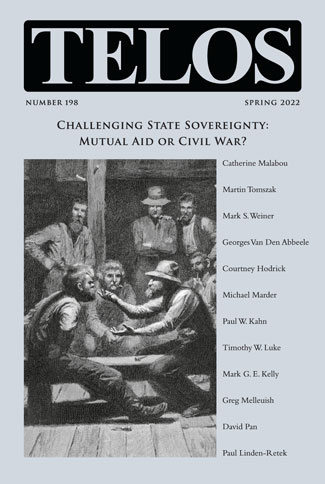 The development and success of the welfare state during the twentieth century coincides with the power of labor unions and their influence on the political process, both through the ballot box and by direct action in the form of strikes, boycotts, and protest marches. Already in the nineteenth century, however, and prior to the development of the modern welfare state, nascent labor unions modeled the concept of welfare as a function of mutual aid within the organized proletariat. Unions stockpiled supplies, for instance, in anticipation of strikes and work stoppages so that membership could survive management retaliations such as the suspension of pay or the denial of access to the workplace. Indeed, the history of trade unions, and before that of guilds and craftsmen corporations, is inextricably bound with that of mutual organizations, fraternities, and benevolent associations. Peter Kropotkin famously argued that robust forms of mutual aid are a necessary as well as species-beneficial result of evolution, defying classic Hobbesian and social Darwinist views that emphasize the fierceness of individual competition and the value of a model where only the “fittest” survive.[1] What we call the welfare state is perhaps most plausibly understood as the nationalization and homogenization of diverse organizations for mutual aid, amalgamated under the paternalistic aegis of the state.[2]
But this history of labor’s triumph, most especially in liberal democracies, can be interpreted in different ways. On the one hand, there is the triumphalist narrative of collective organizing to realize a progressive agenda of more equitable wages, safer working conditions, limited hours, and benefits ranging from paid vacations to pension plans. A widely posted bumper sticker from the early 2000s loudly proclaims this outcome: “Unions: The Folks Who Brought You the Weekend.” Under this scenario, the welfare state would again simply expand and incarnate at a national level and for its entire citizenry the “safety net” secured in local labor disputes between specific businesses and their workers, and embedded in various forms of mutual organizations associated with specific trade unions or local communities.
On the other hand, one could also understand the broad accession of benefits to workers by management less as corporate retreat than as an effective response. Giving some due to workers’ grievances also preserved the essence of the liberal state and its capitalist infrastructure at a time when these were seriously threatened by socialist and communist alternatives. The dramatic rise of the welfare state in Western Europe after the Second World War occurs in tandem with the U.S.-funded Marshall Plan, itself arguably a geopolitically interested form of mutual aid[3] and a corollary of the Cold War Truman Doctrine aimed at containing the spread of communism. The welfare state thus can be seen, from this perspective and has long been noted, to function as a small dose of reform that is worth the prevention of the more fearsome alternative of revolution. Better to give the workers a little bit of job protection than to let them run the show!
With the demise of the communist alternative in the late 1980s, however, the need (or excuse) for the protective bulwark of the welfare state disappeared. As communism receded, neoliberalism roared in, fueling the decline in support for state-based aid by viewing its beneficiaries as not only an irredeemable expense to the state but as increasingly demotivated citizens by dint of their very dependency on state support. At the same time, the political and financial power of labor unions was diminished as the self-designated representatives of the traditional working class. The functional end of communism also enabled the rise of globalization as the worldwide dominance of capital and its concomitant practices of circumventing uncooperative as well as overly generous nation-states (both rogue states and welfare states in good international standing). The ability for capital to move jobs, resources, and supply chains across borders and around the world radically transformed the relation between worksite and economy. The holistic production model of the traditional factory, for example, where everything was built on location from available raw materials, gave way to today’s manufacturing plants, which function merely as the final point of assembly for complex commodities (airplanes, automobiles, appliances) whose individual components are produced in multiple different locations around the world. In concert with the rise of telecommunication technologies and the World Wide Web, these developments further weakened the traditional proletariat and the kinds of labor practices and protections typically put in place at the local or national level. Not much in the way of labor negotiation or resistance could be mounted when whole industries could be readily moved to other locations or countries where wages were lower—and they are always lower somewhere.
Today, in the wake of a shrinking, stagnating proletariat, we see the concomitant growth of what has come to be called the precariat,[4] a term made popular by Guy Standing to describe that “precarious” labor force behind what has elsewhere been called the gig economy, which treats workers as contingent or “independent contractors” with few or no rights to claim traditional employee benefits, including standard hours, predictable income, health insurance, AD&D, or retirement plans. What the precariat would reveal instead is a world in which there is no longer proletarian wage labor (compensation based on time), nor fixed salary (managerial, professional), but only payments per individual service rendered. To the extent that the very term, precariat, is modeled directly on the preexisting category of the proletariat, its analysis all but requires a certain continuation of Marx’s materialist approach, but as we shall see the definitional challenges of the new term end up questioning some of those materialist assumptions, particularly as concerns work in the digital environment.
As for the suggestive term “gig economy,” that appears to have been coined by Tina Brown in a 2009 editorial in the Daily Beast, where she proclaimed, “No one I know has a job anymore. They’ve got gigs,” defined as “a bunch of free-floating projects, consultancies, and part-time bits and pieces they try and stitch together” to makes ends meet.[5] Although Brown nowhere mentions it, the expression “gig” betrays its origin in the arts, specifically in popular music (and especially jazz), where payment is issued per individual performance. This might mean a concert, a theatrical performance, or a stand-up act, which is treated as a service rendered by an independent agent, who is not otherwise dependent upon the payor of the gig and remunerated on a one-time contractual basis. Such service providers are also often referred to as “independent contractors,” a term that has come to bedevil discussions about the wider use of this “gig” metaphor to very different services and activities. In the actual functioning of the contemporary gig economy, however, a lot of time is spent on standby where the worker awaits assignment for gig work (a ride, a delivery, phone work, construction, or repair jobs, perhaps even an entire university course made available at the very last minute for a contingent lecturer) but is not paid until the gig itself is actually completed, or in some situations, at least undertaken. This differs dramatically, of course, from a traditional proletarian wage model where workers are steadily employed in tasks for a specified amount of time (eight hours per day, five days per week, in the classic version), or even in the competing model of payment by the piece, where one’s income could in principle be increased by completing more tasks within a specified time, or just by extending the allotted time. Beyond these material conditions, part of being in the precariat is to live, so Standing describes, with the insecurity of uncertain work, and work typically of a kind that bears little or no occupational satisfaction and leads nowhere, often with zero-hour contracts that nonetheless require one to be “on call” for immediate task completion for periods of time that may far exceed the traditional job shift, at least if one wants to make a livable wage.[6] But this “precarity,” it seems to me, is to be distinguished from traditional “gig” artists who stereotypically hold some “day job” that, while it may not be what they want to do (such as waiting tables or driving a cab), provides at least the basic income for them to pursue their real career aspirations as artists when not occupied by this work. The so-called gig economy turns this on end, since for gig or precariat workers, the day job, such as it is, is the gig itself, or at least indistinguishable from whatever other gig one might also be able to pick up beyond that one. To quote Brown again, “No one I know has a job anymore. They’ve got gigs.”
Continue reading this article at the Telos Online website. If your library does not yet subscribe to Telos, visit our library recommendation page to let them know how.
Notes
1. Peter Kropotkin, Mutual Aid: A Factor in Evolution (New York: McClure, Philipps & Company, 1902).
2. The so-called welfare state can also be seen as the overcoming of the historical tensions between the free establishment of mutual aid organizations, on the one hand, and their attempted eradication by Church and/or State, on the other hand, as in the infamous French Loi le Chapelet or the British Combination Act, both of which outlawed all professional or occupational organizations. While such anti-syndicalist legislation drove trade union mutual aid underground until their repeal in the later nineteenth century, they also allowed the growth of specifically charitable organizations during that same period, most especially faith-based associations such as the Salvation Army or the various Catholic relief agencies.
3. While debates about mutual aid and welfare turn around the differing potential roles of state and private organizations, how should one conceive of relations between states that mimic the function of mutual aid at the geopolitical level? Diplomatic programs like the Marshall Plan and its successor USAID, or more recently the Chinese “belt and road” initiative, borrow amply from the rhetoric of charitable aid and are proposed as gifts to other nations rather than loans that would require repayment. On the other hand, their intent is to assert economic and political influence by bringing the nations receiving the aid into the orbit of the nation providing the aid. And indeed, their domestic political support is acutely dependent upon the nationalistically self-serving underpinnings of such charity.
4. While the word remains most associated with the work of Guy Standing, he himself indicates the origin of the term with French sociologists as well as its early use in Italian alternative May Day demonstrations. See Guy Standing, The Precariat: The New Dangerous Class, rev. ed. (London: Bloomsbury, 2016), p. 10.
5. Tina Brown, “The Gig Economy,” Daily Beast, January 12, 2009, https://www.thedailybeast.com/the-gig-economy.
6. Guy Standing, A Precariat Charter: From Denizens to Citizens (London: Bloomsbury, 2014), pp. 72–74.
You can use these HTML tags<a href="" title=""> <abbr title=""> <acronym title=""> <b> <blockquote cite=""> <cite> <code> <del datetime=""> <em> <i> <q cite=""> <s> <strike> <strong>
The Telos Press Podcast: Georges Van Den Abbeele on the Precariat, the Gig Economy, and the Challenge of Mutual Aid – Telos Press
7 of Taylor Swift's Most Trusted Co-Writers – American Songwriter



You are here:
Swifties are raving over Taylor Swift’s newly released single, “Carolina,” for the upcoming film adaptation of Where The Crawdads Sing. But this is not the only news the Grammy-winning artist has been in recently. Swift also re-released her song “This Love,” off of her album 1989 for the new young adult film, The Summer I Turned Pretty. Of course, for Swifties, this leads to speculations over an upcoming re-release of 1989, her fifth studio album. Because if Swifties adore anything, it’s a (Taylor’s Version) added to her albums.
After all, if you are a fan of Swift, then you quickly master the art of speculation. Whatever the case, Swift never fails to find herself in the limelight of entertainment.
In honor of her music, whether it’s a new song or a re-release, we are celebrating Swift’s co-writers that have helped get her where she is today. Below is a list of just some of Swift’s best and beloved collaborators.
Grammy Award-winning producer and songwriter, Jack Antonoff has played a major role in building Swift’s career, from her Reputation (2017) era onward. First collaborating on her hit single “Look What You Made Me Do,” the two met at the MTV European Music Awards in 2012. They didn’t pay it much mind and continued to cross paths by happenstance for years until they finally decided to collaborate. And behold, the start of an unstoppable duo and an even stronger friendship. Antonoff also has his own band, Bleachers, and has worked with other “girlie pop” musicians like Lorde, Lana Del Ray, and St. Vincent. You could say that he is a powerhouse in music production and songwriting.
During the pandemic, Swift had reached out to guitarist Aaron Dessner of the indie-rock band The National, because she admired his work. The story goes that she texted Dessner out of the blue, “This is Taylor. Would you ever be up for collaborating remotely with me?” Together, the two created the 2021 Album of the Year, folklore. Dessner is also a member of the two-man band, Big Red Machine, with whom Swift wrote and performed duets with. Dessner, Antonoff, and Swift became a trio for both of the sister albums, folklore and evermore.
You might know Vernon better as his stage name, Bon Iver. The musician is the second member of Dessner’s band, Big Red Machine, so it’s no surprise that the two have collaborated together. Vernon has also played influential roles in folklore and evermore, writing the songs “Exile” and “Evermore” with Swift.
Swift has been with boyfriend and actor Joe Alwyn for as long as her Reputation (2017) era. During folklore, Alwyn co-wrote songs with Swift under the pseudonym “William Bowery.” For most of 2021, nobody could put a face to the name. Swift and her collaborators from folklore joked about the name, and thanked him on stage at awards shows when he wasn’t around. But the reality of it is that Alwyn played a phenomenal role in both the heart-wrenching folklore and evermore. He plays the piano in many of her songs, and has co-written “Betty,” “Exile,” “Champagne Problems,” and “Coney Island.”
The two Swedish icons have produced and written songs that brought American pop stars from Britney Spears to The Backstreet Boys to the surface of pop culture. It’s no surprise that they have had as much of an impact on Swift either. The two co-wrote Swift’s Red (2012). They’re most known for the record “We Are Never Getting Back Together,” among others, to which they wanted Swift to sound like a child jumping off of a swing whenever she belts, “we!”
So we’ve gone through a long list of influential men who have collaborated with Swift. Now it’s time for an unexpected turn. That’s right, St. Vincent, otherwise known as Annie Clark, helped Swift co-write songs for her record Lover (2019). One in particular that they worked on together is the funky pop song “Cruel Summer.” St. Vincent has also collaborated with Antonoff, which makes Swift no stranger to six degrees of separation.
Another Swedish superstar, Payomi supported Swift in producing and co-writing 1989 (2014). She first collaborated with Swift on the hit single “Style,” and continued to work with her throughout her albums 1989 and Reputation. Payami has also worked with The Weeknd, Katy Perry, and Ariana Grande in the past.
Photo by David M. Benett/Dave Benett/Getty Images
See more
Only members can comment. Become a member. Already a member? Log In.
For the latest songwriting tips, reviews, podcasts, and more.
© 2022 American Songwriter
Who Is Michelle Dockery's Fiancé, Jasper Waller-Bridge? – Cosmopolitan
We may earn commission from links on this page, but we only recommend products we love. Promise.
Yes, there’s a reason his name sounds so familiar.
Congratulations are in order for Michelle Dockery. ICYMI, the Downton Abbey star is officially engaged to her boyfriend of three years, Jasper Waller-Bridge. The pair started their low-key romance in 2019 and recently shared the news of their engagement in The Times.
“The engagement is announced between Jasper, son of Michael Waller-Bridge of King’s Lynn, Norfolk, and Teresa Waller-Bridge of Battersea, London, and Michelle, younger daughter of Michael and Lorraine Dockery of Gidea Park, Essex,” the announcement reads.
Now, because you clearly need to know more about the future Mr. Michelle Dockery, scroll down for a primer on all things Jasper.
Even if you had never heard of Jasper before, chance are, his name was instantly very familiar, thanks to his sister, Fleabag creator Phoebe Waller-Bridge.
While Jasper isn’t an actor like his famous sib, he is also in the entertainment industry. He works as a TV and film producer and music manager in London and, according to his LinkedIn profile, he also founded a music production company called Day One Pictures in 2020.
Michelle and Jasper started dating in 2019 after being introduced by friends, like a couple of normals. On a less relatable relationship note, they were first spotted together later that year at the Rome Film Festival, like a couple of famous people. Michelle walked the carpet solo at that event, but she and Jasper did eventually make their red carpet debut at the Anatomy Of A Scandal world premiere earlier this year. And they looked SO. IN. LOVE.
In addition to his famous sister and famous fiancée, Jasper has some famous work connections, too. He has a background in talent management (he was Creative Development Director of YMU Group) and music (he’s also worked as an executive at Island Records and Sony Music) and he put both skillsets to good use from 2017-2018 when he was Louis Tomlinson’s manager. We assume (/hope) this means Jasper and Michelle’s wedding will feature live music and that music will be performed by someone incredible.
Juneteenth Found Its Tune in Five Points – 303 Magazine
For advertising, event sponsorship, media kit, monthly specials:
[email protected]
303.888.5455
Five Points has been the home to the annual Juneteenth festival for the last seven decades. At this year’s festival held on June 18 and 19, as soon as you enter the block, the bass from the DJ’s monitors invites you into the proud culture. The festival embodies bringing together a community to celebrate their freedom. Neighborhoods come together to celebrate one another for who they have become. “Hug somebody today and tell them you love them.” the emcee said. Those who came to pay respect were enticed by the amount of love and devotion within the barricades.

Juneteenth is the celebration of the announcement of the emancipation of slavery in the United States. On June 19, 1865, two years after the signing of the emancipation proclamation, slaves in Texas were notified of their freedom. Beginning in Galveston, Texas, the celebration is held on the weekend of the 19 with food, parades, festivities, live events and more. Juneteenth gained mainstream attention in recent years but has been widely celebrated in Black communities since the 1960s. The festival is held every year in Five Points for the locals to come together in support of what Black people in the United States have been through and who they have become. This is where the Black community can be proud of their various cultures. Families come to teach the new generation about where they come from and how to embrace it with love and dignity. 
The festival opened with a parade filled with community projects like youth sports and bands. The aroma from the various food vendors awakened every taste bud. There were vendors to uphold every craving and appetite: food trucks with crisp fried catfish, local barbecue and even vegan caterers. The islands were shaking up their line with music and hilarious staff. Various vendors lined up to spread their message and share their talents with their community. 
On Saturday, live shows filled the neighborhood with music from full jazz bands to a keytar partnered with percussion, along with various DJs like DJ Fa Dorah and Colorado’s own DJ DopeWave. Sunday morning harmonies began with a beautiful service that was followed by star-studded talent like Kayla Rae on the main stage. Even down at “Vibes On 29th” families continued to jam out. The various genres held significance to the lives of everyone in attendance. Last weekend, New York rapper Dave East and Chicago rapper Twista graced the main stage as headliners. Saturday, Dave East stepped on stage repping the Colorado Avalanche hockey team. His inspiring words about celebrating life had the crowd bursting with love and energy. His top hits and freestyles had to crowd never missing a beat. On Sunday, Twista had the crowd falling in love. At one point he wanted all the fathers to be recognized in appreciation for their shared holiday. His energy was contagious and hits kept coming. Audiences found a stage, turkey legs under one arm and a drink in another. Numerous left with smiles and maybe a new purse.
All photography by Kiddest Metaferia
303 Magazine303 MusicAja MatthewsDenver Five Pointsfive pointsJuneteenthJuneteenth FestivalKiddest MetaferiaMusic
Aja is a recent graduate from The Ohio University with a B.A. She studied Music Production and Recording Industry with minors in Journalism and Music. She enjoys “playing with sound”, loud nights with her best friends, and quiet nights with her cat Ash. Aja is pursuing a career in the media industry where she can inspire more people to find their inner tune.
Your email address will not be published.
303magazine
Jun 23
For 12 years, the Boulder Airport has been home to the annual 1940s Ball, celebrating all things aviation. After a two-year hiatus due to the pandemic, the 1940s Ball on June 18 took attendees back in time while embracing the fashion, food, planes and style of the 40s.
We’ve compiled our favorite looks from the event, including fabulous dresses, matching couple outfits and more.
Link in bio to read more.
.
.
.
.
📝 @abbyschirmacher
📸 @vikki_wshoots
#denvercolorado #denver #denverfashion #fashion #model #runway #charity #fashionshow #303fashion #303magazine #milehighcity #milehighfashion
303magazine
Jun 23
What’s better than going to the dispensary? When the dispensary comes to you. Denver, meet @getlanternnow and a better way to get your goods. Shop multiple dispensaries at once, find your 🌿🌿🌿and get it delivered to your door for free. Hit the link in bio to learn more about Lantern and get free delivery on your first order. #sponsored
303magazine
Jun 20
Bobby Stuckey, Bryan Dayton, Steve Redzikowski, Amos Watts — these are names pretty much any culinarily-inclined person in Colorado is likely to know. Their restaurants — Frasca, OAK at Fourteenth, Acorn and now The Fifth String — fundamentally changed the local landscape, bringing the finest and most-lauded cuisine the state had ever seen.
Time marches forward and now the youngsters are running their own kitchens. In a six-month period in 2021, Rich Byers, Samuel McCandless and John Bissell took the helm at Jill’s, Corrida and OAK respectively and have been making food visibly impacted by their mentors while continuing to push the envelope in a gratifying way.
Link in bio to read more.
.
.
.
.
📝 @mister.wrenn
📸 Photos courtesy of Jill’s Restaurant and @nosferatune
#milehighfood #coloradofoodie #303food #303foodie #303magazine #303eats #denverfoodie #farmersmarket #market #localfood #localmarket #food #eat
303magazine
Jun 19
CADENZA music and fashion pop-up going to 3:30 am tonight!
303magazine
Jun 18
@Toptacofest is right around the corner! Your ticket gets you unlimited tacos, tequila samples, live entertainment and MORE! Vote for your favorite taco & cocktail from our 60 restaurant competitors! #sponsored #toptacofest #toptacodenver
303magazine
Jun 18
Pride Month has finally arrived and celebrations are already exploding across the Denver area. Wherever you feel called to party this month, our favorite festivals are back and ready to host all. Whether you are a fan of craft beer, sand volleyball or parades — there is an event for all this month in the Mile High City. Here is a glimpse of some of our favorites.
.
.
.
📸 @brynnapowell
📝 Photo courtesy of Number Thirty Eight via Facebook.
303magazine
Jun 17
Is this mic on? Larimer Sessions is a FREE 22-week music series taking place EVERY Saturday from 6-8pm on @ItsLarimerSquare! Make sure to explore the full lineup and stop by Denver’s favorite block to see some of the city’s top bands + DJs!
Link in bio to find out more!
#sponsored #itslarimersquare #larimersquare #downtowndenver #denverthingstodo #denver #larimersessions #visitdenver #denvermusicscene #denvertourist #explorecolorado #denverdrinks #303music #denverlifestyle
303magazine
Jun 15
THIS SATURDAY: Tickets Alert!
Only a few tickets are still available for CADENZA: A Pop-Up Music + Fashion Experience in a private studio. Use code: 303Music for 20% off and enjoy Denver's top DJ's playing till late night, circus entertainment, shopping experience , and more!
Link in bio.
#milehighfood #coloradofoodie #303food #303foodie #303magazine #303eats #denverfoodie #farmersmarket #market #localfood #localmarket #food #eat #milehighfood #coloradofoodie #303food #303foodie #303magazine #303eats #denverfoodie #farmersmarket #market #localfood #localmarket #food #eat
303magazine
Jun 15
This week could use a little whiskey. Book a tour at the Stranahan’s Distillery for behind-the-scenes access of what makes our @stranahans whiskey special — and taste for yourself with exclusive expressions to sample. Book now through the link in our bio! #sponsored
303magazine
Jun 14
It’s never too early to be thinking about the next Denver Fashion Week. DFW is returning November 12-20 and auditions are just around the corner!
Sign-ups for model auditions are now live and auditions will take place on Sunday, July 31. The location is to be announced soon.
Link in bio to find out more.
📝 @isabellabeamoses
📸 @fpgomes_
.
.
.
#dfw #denverfashionweek #denver #denvercolorado #denverfashion #fashionshow #model #runwaymodel #303fashion #303magazine
303magazine
Jun 9
Nestled in Edgewater Public Market on the outskirts of Denver lies KadyLuxe, a female-owned activewear brand slowly making its way into the big leagues with Nike and Lululemon. Creator and founder, Kady Zinke, with ample experience in dance and athletics, found that many fitness clothes designed for women didn’t do them justice. In response, she made her own.
Link in bio to read more.
.
.
.
📝 @leximriga
📸 @roxieeeee_
#denverfashion #fashion #denverfashionscene #milehighcity #303magazine #303fashion #runway #activewear #active #fitness #milehighfashion
303magazine
Jun 8
SAME (So All May Eat) Café was founded in 2006. The vegan/vegetarian restaurant runs its business on donations and fair exchange for a communal experience that takes on hunger in a dignified manner, and is set to host its fourth Annual SAME Table Celebration. The annual gala raises funds for the café’s mission of supporting the local community by giving access to fresh and healthy food that has been locally and sustainably sourced.
Link in bio to read more.
.
.
.
📝@jessicaengen33
📸 Photos Courtesy of SAME Café
#milewhighfood #coloradofoodie #303food #303foodie #303magazine #303eats #denverfoodie #restaurants #eat
Michael Diamond explores fractured identity through electronica on Third Culture – MusicRadar
MusicRadar is supported by its audience. When you purchase through links on our site, we may earn an affiliate commission. Here’s why you can trust us
By published
Third Culture channels the experiences of a ‘third culture kid’ into intricate, jazz-inflected dance music. Michael Diamond opens up about how it was made
Born in Kerala, India, producer and DJ Michael Diamond emigrated to the UK with his parents when he was a child. “Although I’ve loved and soaked up the culture of the UK growing up, I am still viewed by many as a foreigner”, he says. “On the other hand, when I return to India I am seen and treated as a Westerner. Over time, this has left me feeling that whilst I possess aspects of both cultures, I don’t truly belong to either one.”
This experience of dislocation is common among third culture kids (opens in new tab) like Michael, people who were raised in a culture different to that of their parents. It’s these feelings of disconnection that inspired the music that forms his debut LP, Third Culture, and the short story and film that accompanies its release. Channelling the trauma of fractured identity into dense, saturnine dance music, the record shrouds intricate, knotty drum patterns in moody synths and jazz-inflected atmospheres that recall the downcast vibes of classic Deep Medi dubstep as much as Floating Points’ vivid and cinematic electronica.
Collaborator Alex Wilson’s evocative saxophone solos bookend the record, while Áine Kim Kennedy’s words give context to the album’s concept, rendering the third culture experience as a restless insomniac’s fever dream. Arriving at a moment when the UK’s South Asian community is growing increasingly visible within the wider electronic music scene – Diamond references collectives such as No ID (opens in new tab) and Daytimers (opens in new tab) as instrumental in this shift – Third Culture brings a nuanced perspective to an experience that’s shared by many fans and fellow artists.
“I think that the world is becoming a more open place. People and cultures are becoming more and more intertwined,” Diamond tells us. “I think that through everything that’s been happening this year I have achieved a greater understanding of my own cultural roots and this album project is a big reason why.” It seems that through making a project that represents the struggle to discover a fixed identity, Diamond has arrived at a sound – a musical identity – that’s truly his own.
Could you tell us a little about the background to the new album and the themes of identity and ‘third culture’ that inspired it?
“I had found myself listening to way more long-players, and wanted to do one myself. It was a new challenge to create something that’s engaging over an extended period of time. I had about a hundred ideas and eventually settled on seven. They ended up being the tracks on the album, and I think they link together nicely. So, first and foremost, the album came purely from my desire to create some nice music.
“The whole third culture thing kinda happened by accident – or at least it wasn’t the aim when I set out with the project. Quite early on, I shared the work-in-progress with one of my best mates Áine Kim Kennedy. Anyone who knows her will tell you she’s a literary genius. We had actually collaborated a couple years back on my concept EP Silk Road on Salin – she wrote a poem to go alongside the tracks, inspired solely from listening to the EP.
I’ve learnt a lot about myself in the process and now the third culture element is intrinsic to the album itself for me
“For this album the process was similar – Áine listened to the album start to finish and from that alone she came up with the short story narrative centring around the topic of third culture – both of us being third culture kids, i.e, we share aspects of multiple different cultures without ever completely belonging to one. As a result it forced me to look back at my own life experiences in a new way, retrospectively identifying how the fact that I’m a third culture kid has influenced my relationships with people and the world in general. I’ve learnt a lot about myself in the process and now the third culture element is intrinsic to the album itself for me.”
Could you talk us through maybe one or two pieces of equipment – anything from synths and instruments to plugins and effects – that were fundamental to the making of the new project?
“There are quite a few that I could mention here but I’ll stick to two. The first is FLEX. It’s a stock plugin in FL Studio, and is a sort of synth/sound-bank with limited parameters. It has some really cool sounds, but it’s not really a true synth because you can’t really control the waveshape, etc. This limitation in functionality is somewhat constraining – it’s quite hard to create a truly evolving sound from one patch as a result. So what I did to circumvent this was load a few instances of it, all playing the same notes and then layer and compress them together, automating their relative volumes over time. It creates something a bit more evolving; sounds that morph into each other continuously – sort of emulating a wavetable synth.
“The second plugin I should mention here, I used on all the drums on the LP – the Arturia Rev PLATE-140. It gives the drums a nice presence and smooth tail. If you time it right, you can get it for free when Arturia do one of their random plugin giveaways (that’s how I got it).”
“I’m obliged to mention Floating Points here because I feel there’s a very clear influence in this album – if you’re a fan of his music you’ll definitely be able to hear the similarities in stylistic choices. I guess the other influences are quite varied, because I listen to a lot of different artists – other people and labels to shout out here would be Ishmael Ensemble, Tom VR, Aleksandir, Jon Hassell, Wisdom Teeth, Seb Wildblood and the music he releases through Church, Coastal Haze and all my thoughts, Rhythm Section, Mansur Brown, Yussef Dayes, Alfa Mist, Waldo’s Gift, to name a few.
“Speaking more generally though, this album was a product of a clear shift in my music taste that’s happened in the last few years. Before I was listening to a lot of upbeat jazzier house stuff like my first record on Salin (opens in new tab) back in 2018 – but nowadays I’m into the deeper, more sound-designy introspective stuff – ‘listening music’ if you will. It’s obviously hard to describe a music taste through words – luckily for you guys I made a mix for Ransom Note which answers this question exactly.”
Could you pick out an element of a track from the new project that you’re particularly proud of, and give us an insight into the creative process behind how you produced it?
“I like the intro to Emergence. I had loads of fun making that (but it also took me forever!) I wanted the album to flow continuously from one track to the next, so I knew I had to use some elements from the previous track. The bass sound you hear in the intro is the same as in Submerged. I rendered out the bassline from Submerged and then used a lot of automation, pitch-shifting, warping to create a new evolving ‘riser’ sound. Similarly the phone/walkie-talkie/static noises in the intro are taken from the same samples that the hats in the next track, Exodus, are made from. I made it a point to use as many of the same samples as possible across different tracks of the LP – albeit processed entirely differently each time.”
“The explosion was composed of several layers of sounds: dry kick drums, fully wet reverb-ed kick drums, glitches and ambiences – all sent to a single bus and compressed together to make them sound as one. Combining unprocessed kicks on top of reverb-ed ones gives you something that’s both punchy and has depth. I’m not an expert at pulling it off, but the general principle of combining sounds using bus compression is a solid one. I use it a lot.”
Did you experiment with any new studio techniques or processes on this album?
“I guess I did, albeit without actually realising. Any new techniques I learnt were usually a byproduct of me wanting to solve a certain issue or achieve a certain sound rather than the other way round (learning a new technique for the sake of it, followed by applying it). It’s a needs-driven approach to learning production – I personally like it this way, because it means I’m constantly working on actual music as opposed to just learning techniques for the sake of it without any definitive application.
Combining unprocessed kicks on top of reverb-ed ones gives you something that’s both punchy and has depth
“I don’t think I ever accessed any online tutorials or anything – I just sort of tried as many different things that I could conceive potentially working until one eventually did. I must have employed some new studio techniques and processes as a result of this way of working.”
Looking back a little bit now, how did you first get involved with music production and electronic music-making?
“I took a gap year and had nothing to do, so got my brother Martin to download a cracked version of FL Studio and absolutely rinsed it all day every day for the whole year. Most people do some travelling, soul-searching, voluntary work or something – but I literally just spent the year inside making shitty beats. It was sick.”
When you first started producing, what kind of set-up were you working with?
“Just a laptop with FL Studio on it and some crappy in-ear JBL headphones that were about 20 quid from PC World. I also had a nifty JBL Charge bluetooth speaker which I used, in my own words at the time, to ‘reference my mixes.’ [laughs]”
“Pretty much the same, to be honest. In terms of physical gear, I now have Adam A7Xs, a couple of turntables, and a guitar. The Adams have seriously unlocked a new way of hearing sound for me – they’ve accelerated my ear training in a way I never thought just some speakers could. I will however confess that I still use my beloved crappy £20 JBLs from time to time ‘cause they just get me in a certain mood.”
The Adams have seriously unlocked a new way of hearing sound for me – they’ve accelerated my ear training in a way I never thought just some speakers could
“I got a ridiculously good deal on a secondhand D’Angelico guitar, which I ended up playing 8+ hours per day and giving myself tendonitis. I’m still at uni and anyone who’s seen me in online lectures may have noticed a little guitar strap round my neck. But the main body of the studio has always been, and probably will for the foreseeable be my laptop with my plugins.”
What DAW are you using, and why do you use it?
“FL Studio. It’s the first one I used when Martin cracked me a version and I don’t see the need to change. I have a paid version now, though, so please don’t come at me Image-Line. I guess all DAWs do the same thing just with slightly different workflows, so you tend to make different decisions along the way – my current workflow is a product of the DAW I have used since the beginning. I wonder how different my music would be if Martin cracked me Ableton instead of FL. As I said before, I just wanna make music, not play around learning new software/DAWs, so for me I don’t see the point in changing – I’ve not hit a brick wall with FL yet!
“Having said all that, the good folks at Ableton did just hook me up with a licence so maybe I’ll try it out and see what I think. I’ll probably end up learning how to use it so I can get into live stuff…”
Are you more of a software-based producer or do you tend to favour hardware and outboard gear?
“Software, but that’s probably a product of my circumstances rather than an actual preference. I’m still at uni, without any income, so can’t really afford hardware. I’ve barely touched the surface on all the software synths and plugins available out there, so getting even more gear seems a waste of money for the stage I’m at currently. Who knows though, I may actually be a hardware man after all – I’ve just never properly tried. If MusicRadar ever wants to donate any gear for me to play with I would graciously accept. [laughs]”
Could you run us through a couple of plug-ins that are really fundamental to your workflow or your sound?
“For creative workflow I actually just use the stock Rhodes piano and bass in FL to get the notes down. Only once I’m happy with the notes do I start bothering with the sound. Obviously this changes depending on what I’m feeling in the moment, but generally this workflow is what I’ve noticed to be the case. Kinda boring I guess but I don’t feel like I use many plugins for “workflow” purposes. I do however rely on plugins for the “sound” aspect. Here are a couple that I’m really into right now.
I try to automate every parameter I possibly can (CPU-permitting)
“One is the free compressor TDR Kotelnikov – I find it easier to achieve the sound I’m after with it compared to other compressors out there. Especially good when I want to make drums sound snappier and increase their punch. An attack of 6-12ms with a longish release, not too aggressive a ratio is a good starting point – obviously, exact settings will depend on what the existing sound is like. I also use it on drum busses for that uniform sound.
“Synth-wise, one of the only plugins I’ve actually bothered to pay for is the Arturia V7 collection – if you didn’t know, it’s a plugin collection of loads of classic synth emulations. Loads of excellent sounds in there that allow me to just flick through and get going immediately and because they’re actual synths (in contrast with FLEX which is more of a sound-bank) they have lots of capacity for automation, and hence interestingness. I try to automate every parameter I possibly can (CPU-permitting).”
How often are you experimenting with new studio gear – are you constantly trying new things out or once you’ve found your groove do you tend to just stick with what you know?
“I haven’t really been in the game long enough to know the true answer to this question, but what I can say is that I am nowhere near exploring all the possibilities available with my current knowledge level so I don’t necessarily feel the need to be learning anything new right now. Anything new I learn is usually needs-driven – so when I want to overcome a specific problem or create a certain sound, only at that point will I start investigating the relevant techniques to achieve that. It’s a functional approach to production, but I like it because it means I’m constantly working on the music itself and not just learning techniques for the sake of it. It’s more fun this way.”
Is there anything that’s on your wishlist studio-wise?
“Yeah, I really want to start doing more live stuff – so an Ableton Push would be nice. Also want some cool FX pedals and sound-warping gear to feed my guitar into – it’s an instrument which already produces some cool sounds so I’d love to push it a bit further in my productions.”
“Above all though, if I could ask for one wish, it would be for the henchest most juiced-up beast computer to have ever existed – CPU issues are my arch nemesis and my life would be pretty much perfect if I didn’t have any.”
When you’re translating your tracks to a live setting, what kind of live set-up are you working with?
“This is something I’m still working out. I had some plans that were halted because of my tendonitis. When I play out, I usually just play records and tracks on CDJs – on occasion I’ll do a set with Alex Wilson. I’ll be on the decks, Alex improvising sax on top. It’s really fun and people go nuts for Alex. Makes me so happy to see. He’s also laid some absolutely sick sax lines on my album, and is just a very talented and lovely guy in general.”
What’s up next following the album’s release?
“Whilst I’m writing this now I am also desperately trying to revise for some Medicine exams that I’m massively underprepared for. In fact, I’ve had to ban myself from all music (even just listening) because it ends up being too much of a distraction. As soon as my exams are done the first thing I do will be firing up the Adams and making some tunes! I have a big folder of tracks that are brewing that I’m really excited to work on.
“I’ll also be playing gigs – still got a residency at Simple and we have some big bookings lined up for later this year. I’ll be working on that live setup I mentioned – got a little band together and writing new material for that. That’s more long-term though, so no clue when it’s actually gonna happen – need to sort my tendonitis out first!”
“It depends how you use them. I’m only beginning to truly realise just how much stuff you can do from a sample alone. Sometimes using samples as opposed to synths is seen as “cheating”, or somehow “less advanced” than synthesising the sound from scratch – but it really isn’t. Yes, a lot of parameters are no longer available for you to manipulate when you render something to a sample – but at the same time you’ve also just unlocked a whole range of tools and effects that you wouldn’t have been able to use otherwise.
“A good example of this is the intro to Emergence I mentioned earlier – I would have had absolutely no clue how to make that intro bass riser if I had used the original bass synth patch in Submerged – it was only because I rendered it out as a sample that I was able to get it to sound like that!”
“If you think about how a synth actually works, then you’ll realise that you can do a lot of its functionalities using an insert on a mixer channel and applying automation. You can control ADSR for any parameter, you can adjust the wet/dry levels of effects, you can automate parameters within each plugin you’ve loaded and so on. The possibilities are quite endless!
“I use this a lot – for example if I want a certain sound to have more attack or bite to it – I could try a compressor or transient-shaper but I could also try loading a volume plugin onto the mixer channel and creating an automation clip, drawing in the exact curve I want the volume to follow. You can use this general principle more creatively too.”
“You often hear mix engineers say “trust your ears”, but that’s just not helpful to a beginner ‘cause your ears are completely untrained. I was chatting to one of my mates Caleb about this recently and I think it’s worth discussing here (he DJs as Cable! – go check him out).
“One good hack we spoke about was isolating the frequency range you’re trying to mix so you eliminate other distracting frequencies. Kick and bass relationship is a good example – you can use a bandpass filter to fine-tune this. I always have one on my master channel that I can engage at any point when I want to listen to a frequency range in isolation.
“Once you get the kick and bass to sound right with the bandpass on, you can take the bandpass off and then reassess how the upper frequencies are affecting your sound. If it still sounds bad after you’ve taken the bandpass off, you at least know that the low end is good and that the source of the problem must be from the frequencies higher up! You may now go and apply some EQ changes to those higher frequencies to get it to sit right. You can apply this bandpass technique to any frequency range or any combination of instruments, of course.”
Michael Diamond’s Third Culture is out now on Vasuki Sound. (opens in new tab)
I’m the Tech Features Editor for MusicRadar, working on everything from artist interviews to tech tutorials. I’ve been writing about (and making) electronic music for over a decade, and when I’m not behind my laptop keyboard, you’ll find me behind a MIDI keyboard, or a synthesizer.
Don’t miss the latest deals, news, reviews, features and tutorials
Thank you for signing up to Musicradar. You will receive a verification email shortly.
There was a problem. Please refresh the page and try again.
MusicRadar is part of Future plc, an international media group and leading digital publisher. Visit our corporate site (opens in new tab).
© Future Publishing Limited Quay House, The Ambury, Bath BA1 1UA. All rights reserved. England and Wales company registration number 2008885.
So You Want My Arts Job: Audio Book Producer – ArtsHub
Writing and Publishing
Sarah Bacaller has produced many audiobooks for Australian authors. Image supplied.
Sarah Bacaller is co-director of Voices of Today, an Australian audiobook production company, and has narrated over 40 titles on Audible and beyond. She has produced audiobooks for Australian authors and regularly participates in full-cast audiobook productions with narrators from around the globe.
Sarah is currently producing a podcast series all about audiobooks, called The Audiobook Reader’s Review (landing later in 2022). She is the author of She Tenacity (2022) and The Fault Lines Founding Liberty (2020), and has written for The Conversation, Sydney Review of Books, Zee Feed and a range of academic journals.
As a narrator, I bring texts to life through the spoken word, recorded and distributed for your listening pleasure in the form of audiobooks! As a producer, I work with authors, rights holders (or public domain texts), along with narrators, proof listeners and audiobook distributors to get audiobooks out there into the world. My work is through a company I co-direct called Voices of Today.
In 2016 I was at home full-time with a baby and a three-year-old. Was so exhausted in the evenings that instead of reading books to my toddler, we used to listen to free audiobooks on Librivox instead, while I nursed the baby to sleep.
At the start and end of Librivox recordings, they say, ‘For more information or to volunteer, please visit Librivox.org’. So one day, I did.
Read: The pros and cons of recording audiobooks
My husband (who studied music at uni) set me up with a decent microphone and a recording space and I contributed to a few Librivox projects. Out of the blue in 2016, I received an email from Denis Daly inviting me to join his association of narrators, Voices of Today – and to contribute to an Audible project of Australian poems. I said no because I already felt overwhelmed. But he persisted and in 2020, he invited me to go halves in the company.
When my kids were smaller and I was feeling more isolated, narrating was a manageable way of working with others on a project bigger than myself. I could sneak off to record for half an hour here and there, and gradually, projects would come together. It’s really wonderful to collaborate with friendly, creative people from around the globe, whether narrators, producers, distributors or authors, and to work together on projects that will bring joy to others. For me, listening to audiobooks reminds me of a childhood where my Mum read to us every night and developed in us a deep love of words and stories.
For producing: good diplomacy and mediation skills. Audio editing skills or a willingness to delegate them! Attention to (audio) detail.
For narrating: Good literacy and fluent expression, and an ability to interpret text into communicative speech. Many narrators these days are also their own producers, proofers and editors – but even if they delegate these jobs, there is still a fair degree of capability with hardware and software needed for handling audio recording.
Last year I worked on Hazel Edward’s memoir, Not Just a Piece of Cake … Being an Author (narrated by Erin Marie White). That was amazing because I remember my school librarian reading There’s a Hippopotamus on our Roof to us in primary school, and my Mum reads the Hippo books to my own kids now! I proofed and edited Hazel’s audiobook as well as producing it, and I really identified with her anecdotes and encouragements around juggling responsibilities and navigating a long-term creative career. I also took comfort in Hazel’s drivenness and sense of adventurous aspiration.
Last year I also narrated The Historian’s Daughter by Rashida Murphy. That was challenging because of the mix of languages, characters and settings in the book. But I also learnt a lot about my own Anglo-Indian heritage because the protagonist in that story is Anglo-Indian.
There are other lovely, lovely authors I could mention, like Kate Constable and Susanne Gervay. We got the audiobook of Kate’s Crow Country out last year, which was really important to me because it’s a text that’s studied in a lot of schools. Accessibility is really important and there are so many ways to engage with text.
Massive year-on-year growth in audiobook sales (in the US at least). And for us at Voices of Today, a collaboration with Bolinda Audio which is now underway … Challenges in the sector however, include the growing incursion of AI technology into the narrating space, underpayment and low income for audio industry professionals, and the under-development of the industry in Australia. But we’ve got amazing stories to sustain and inspire us as we work towards a more inclusive and connected future, so that’s good news!
For more about Sarah Bacaller’s work, see her website or find sarah_bacaller on Instagram.
Thuy On is Reviews Editor of ArtsHub and an arts journalist, critic and poet who’s written for a range of publications including The Guardian, The Saturday Paper, Sydney Review of Books, The Australian, The Age/SMH and Australian Book Review. She’s the outgoing books editor of The Big issue. Her first book, a collection of poetry called Turbulence, came out in 2020 and was published by University of Western Australia Press. Her next collection, Decadence, will be published in July 2022. Twitter: @thuy_on
Jun 27, 2022
Jun 27, 2022
Jun 27, 2022
The phrase emerging is supposed to help identify early-career writers in need of support, but too often it is categorised…
Rather than taking a blanket approach, making each of your pitches count results in a better chance at media coverage.
What’s on, what’s in the headlines, and the latest program releases – to put you ahead of the game this…
Five authors compete for the nation’s most prestigious literary prize.
This tender story of family and relationships is also a coming-out tale that sees the protagonist wresting control of his…
Receive newsletters featuring leading industry job, news, opportunities and events
Thank You for Subscribing!!
We acknowledge Aboriginal and Torres Strait Islanders as the Traditional Owners of the land on which we produce ArtsHub, ScreenHub and GamesHub. We pay our respects to Elders, past, present and Emerging. Sovereignty has never been ceded
Copyright (C) 2022 ArtsHub & Screenhub
Jacksonville Symphony has big plans for 2022/'23 season – The Florida Times-Union
The Jacksonville Symphony has just concluded our glorious 2021-22 season, and we could not be happier. This was our first full season in two years that did not have physical distancing, and we did not have to cancel a single concert.
By now you are very familiar with the arduous journey we embarked on in March of 2020, when we had to cancel over 30 concerts through June 2020. Then, as one of only ten orchestras in North America to re-open, we entered the 2020-21 season under strict safety and physical distancing guidelines. This allowed us to offer 72 concerts to 37,802 patrons. However, for our 2021-22 season, we were able to offer 75 concerts to 778,582 patrons after fully opening. We continue to believe that the Jacksonville Symphony offers our beloved community the joy of symphonic music every year.
I also want to thank our very loyal patrons who continue to support us. Thanks to over 1,500 individual donors along with the support of corporations, foundations and our local, state and federal governments, the symphony continues to flourish. We also extend a special thank you to Mayor Lenny Curry and the City Council for their remarkable dedication to the symphony.
More:50 years of music, talk, news and change: Public radio’s Jacksonville-based WJCT celebrates milestone
More:Jacksonville Symphony to close season with Beethoven classic
The season that just concluded was, in so many ways, “a season of firsts.” We launched the David M. Hicks Mozart Piano Concerto Series, which featured five of the world’s finest pianists performing on our new David M. Hicks Steinway Concert Grand Piano. We also launched our first Concert Organ Series to grand success, and we held our first-ever Pride Night during the final Symphony in 60 concert. During our season, we also received our first-ever grant from the League of American Orchestras’ Catalyst Fund, in partnership with the prestigious Andrew W. Mellon Foundation from New York City, to help us advance our innovative work with new Diversity, Equity and Inclusion initiatives. After a gap of several years, we brought back opera with Giacomo Puccini’s “La Bohème” to critical acclaim.
Continuing with our “season of firsts,” our final classical concert in June featured the world premiere of eminent composer Tarik O’Regan’s work “Trances.” O’Regan’s piece, sponsored by Brenda and Gene Wolchok, was the first in a multi-year series of Jacksonville Symphony commissions from today’s most up-and-coming composers. During the same evening, our patrons heard our new concertmaster, Adelya Nartadjieva, showcase her phenomenal talent for the very first time.
Our season of firsts also included the symphony performing the Ukrainian National Anthem at the beginning of the first “Appalachian Spring” concert shortly after the terrible invasion of Ukraine began by Russian forces. Our audience responded with tears of joy and hope.
Our 2022-23 season is full of what we are calling “boundless possibilities” because we truly are reaching new heights of artistic excellence. Music Director Courtney Lewis has put together 11 masterful concerts under the banner of our Florida Blue Classical Series. Our season will open with Pyotr Ilyich Tchaikovsky’s masterpiece, Piano Concerto No. 1, played by acclaimed pianist Tianxu An. The program, conducted by Lewis, also includes Dmitri Shostakovich’s “Festive Overture” and Igor Stravinsky’s “Petrushka.” The rest of the season will include four dynamic guest conductors, the world premiere of Sean Shepherd’s Jacksonville Symphony commission, and the return of pianists Conrad Tao and Alessio Bax.
We are excited to announce that we will be presenting our unique version of symphonic opera with a presentation of Wolfgang Amadeus Mozart’s masterpiece, “The Magic Flute.” After producing “La Bohème” to grand success, we feel it is essential to continue presenting high-quality, professional opera for the Northeast Florida community. “The Magic Flute” will be conducted by Lewis with stage direction by Kristine McIntyre, who has directed operas for prestigious companies such as the San Francisco Opera, the Metropolitan Opera, the Pittsburgh Opera and the Houston Grand Opera. The opera will also feature the Jacksonville Symphony Chorus as well as students from the University of North Florida School of Music.
Our Pops Series will include 10 spectacular concerts featuring the music of Paul Simon, Duke Ellington, Tina Turner, Aretha Franklin, Dolly Parton, Kenny Rogers, the Beatles and many other artists. Our five Holiday Pops performances will also return with music that will celebrate the joy of the holiday season. Our Pops Series offers an exceptional experience for everyone and covers the vast range of American music ranging from traditional to jazz to rock to country and everything in between.
We will also be presenting three movies as part of the FIS Symphonic Night at the Movies Series. Three legendary movie scores will be performed live by the symphony for “Rocky,” “Jurassic Park” and “Harry Potter and the Order of the Phoenix.”
Our 2022-23 season also includes the PNC Symphony in 60 Series, which offers captivating music for 60 minutes and a fun, casual cocktail hour prior to each concert. The Raymond James Coffee Series will also showcase stirring selections from the Symphony’s various series. On top of it all, we will present our annual production of Handel’s masterpiece “Messiah” and two special concerts as part of our Family Series.
Finally, our season would not be complete without the Jacksonville Symphony’s First Coast Nutcracker. This year is special because this is the 50th Anniversary of the First Coast Nutcracker, and the production will feature refurbished scenery. This holiday classic has now become a part of what makes downtown Jacksonville a cherished tradition during the holiday season.
Our mission is to enrich the human spirit through symphonic music. We are deeply passionate about our mission to bring joy to the community through performances presented in Jacoby Symphony Hall, our robust music education programs and our ensembles that tour throughout the region. I invite you to join us as we celebrate our 73rd season, and I look forward to seeing you soon.
Steven Libman is president and CEO of the Jacksonville Symphony.
BAM Music – Director of Sync Licensing – USA (US) – Music Business Worldwide
BAM Music | Director of Sync Licensing – USA
BAM Music (www.bammusic.com) is a new generation, independent boutique music services company.
Since 2017, we have grown rapidly and today are 20 people with offices in Paris, London, Montreal, Los Angeles and Shanghai. Born out of Montreal’s hip Mile End in 2007 and headquartered in Paris’ artsy “9ème” neighborhood, we are an ever-expanding cooperative of indie labels, boutique catalogs and music architects from around the globe.
At BAM, we move fast, are consumed by music & media, and love challenging ideas while breaking boundaries. We push teams to be autonomous, agile, and creative. Our philosophy: from customer focus will come the truth. Our mantra: The good old days are now!
This role presents a unique opportunity for an innovative sales professional and team player who loves making an impact and is results-driven. You will play an active part in taking BAM’s US operations to the next level and contribute to the overall success of the global company. You will be responsible for building our growth strategy, leading the sales efforts, securing sync placements, and providing outstanding client support while helping increase BAM’s awareness in the industry.
This is an independent contractor role based in the Los Angeles or New York area with the possibility to travel to meet with clients in key markets.
Responsibilities may adjust as needed.
To apply, please send a cover letter and resume to [email protected]
Music Business Jobs is the most effective way for the global music industry to find the best candidates for their open positions.
In addition to being seen by over 300,000 monthly unique readers online, our listings are also emailed direct to more than 50,000 professional subscribers every week – across the US, UK, Europe, Asia-Pacific and beyond.
Click through below for details on how to submit a Music Business Jobs listing – and learn why our advertisers ‘strongly recommend’ us to their peers…
Check Out Production Photos of Olney Theatre Center's The Music Man, Starring Deaf Actor James Caverly – Playbill.com
The production, now scheduled to begin previews June 24, features a cast and creative team comprising Deaf, hard-of-hearing, and hearing artists.
Olney Theatre Center’s production of Meredith Willson’s The Music Man, featuring an ensemble and creative team of Deaf, hearing, and hard-of-hearing artists, is scheduled to begin previews June 24 prior to an official opening June 29. The Maryland production, originally due to begin previews June 17, was delayed due to multiple cases of COVID within the company.
Deaf actor James Caverly, who plays Theo Dimas in Hulu’s Only Murders in the Building, stars as Harold Hill. Deaf performer Sandra Mae Frank and Lyric Theatre of Oklahoma Artistic Director Michael Baron co-direct. All performances will be performed in ASL and spoken English and open-captioned.
Caverly was an aspiring actor—and a staff carpenter in Olney Theatre’s scene shop—when he saw Deaf West’s 2015 production of Spring Awakening on Broadway. He subsequently approached Artistic Director Jason Loewith about the prospect of a Deaf-centered musical at Olney, and in March 2019 a week-long workshop brought together a mix of 25 Deaf and hearing artists for a production of The Music Man.
Participants in that workshop returning to work on the summer production include music director Christopher Youstra, choreographer Karma Camp, and Director of Artistic Sign Language Michelle Banks. Banks has also translated the English script for The Music Man into ASL and gestural language and provides artistic contributions informed by their experience of Deaf Culture. Along with Frank and set designer Ethan Sinnott, Banks is one of three Deaf artists on the creative team, leading a company that is 50% Deaf or hard of hearing and 50% hearing actors. More than a dozen sign interpeters were employed for the rehearsal period.
The cast also features Adelina Mitchell (A.D. 16) as Marian, Vishal Vaidya (Groundhog Day) as Marcellus and also the vocalizations in the songs of Harold Hill, Florrie Bagel (Peter Pan) as Ethel Toffelmeier and the Marian understudy, Heather Marie Beck (Joseph…) as Alma Hicks, Amelia Hensley as Eulalie Shinn, Matthew August as Tommy, Gregor Lopes as Olinn Britt, Andrew Morrill as Mayor Shinn, Anjel Piñero as Woman #1, Mervin Primeaux-O’Bryant as Maude Dunlap, Nicki Runge as Mrs. Paroo, Christopher Tester as Oliver Hicks, and Dylan Toms as Ewart Dunlop with ensemble members Jay Frisby (Miss You Like Hell) and Sarah Anne Sillers (Singin’ in the Rain). Swings include Sophia Early, Aarron Loggins, Jane Enabore, and Stephen Russell Murray.
Youstra conducts a 10-piece orchestra that also joins in on the barbershop quartet for “Lida Rose.”
The creative team also includes costume designer Rosemary Pardee, lighting designer Jesse Belsky, Olney resident sound designer Matt Rowe, projections designer Sean Preston, and stage manager Ben Walsh.
A revival of The Music Man—starring Tony winners Hugh Jackman and Sutton Foster—currently plays Broadway’s Winter Garden Theatre.
For ticket information click here.
Check out new production photos below:
James Caverly
Adelina Mitchell and James Caverly
Adelina Mitchell and James Caverly
Adelina Mitchell
Jay Frisby, Christopher Tester, Dylan Toms, and Gregor Lopes as Barbershop Quartet in The Music Man
James Caverly and Adelina Mitchell
James Caverly and company of The Music Man
James Caverly
Florrie Bagel, James Caverly, and Vishal Vaidya in The Music Man
James Caverly and company of The Music Man
Sarah Anne Sillers and Adelina Mitchell in The Music Man
Adelina Mitchell and James Caverly
The company of The Music Man
James Caverly and company of The Music Man
The artist was the co-author of the seminal classic Hair.
The Funny Girl star is newly engaged to producer Bonnie Chance Roberts.
The production, now scheduled to begin previews June 24, features a cast and creative team comprising Deaf, hard-of-hearing, and hearing artists.
The 30th anniversary benefit burlesque performance will also feature the Queens of Broadway’s SIX: The Musical.
The event featured Broadway favorites Norm Lewis and Joshua Henry and was hosted by Amber Iman.
The Broadway veterans, who married June 19, announced their nuptials on Instagram.
The production reopened at Off-Broadway’s Theatre Row June 20 and continues through July 31.
The donations include $1 million gifts to create scholarships for theatre students at two historically Black institutions of higher learning, Spelman College and Morehouse College.
The Emmy and two-time Tony winner will produce new content through his production company Incognegro.
Sign up for reopening news, announcements, and exclusive discounts on tickets to your favorite shows!
Blocking belongs
on the stage,
not on websites.
Our website is made possible by
displaying online advertisements to our visitors.
Please consider supporting us by
whitelisting playbill.com with your ad blocker.
Thank you!
How to Add Sample Packs to FL Studio – MUO – MakeUseOf
Sample packs are a great addition to your music production. Here’s how to add them in FL Studio.
There are no limits to the number of sounds you can use when creating projects in FL Studio. While the DAW comes with an impressive number of stock plugins and sounds, you're likely to have your own idea about the sort of loops or samples you want to use in your music.
Fortunately, adding sample packs to FL Studio is extremely easy to do.
Sample packs are collections of sounds for producers to use. They can be free or cost a price, so it all depends on where you look and what sort of sounds you are after. Usually, sample pack files will use the WAV file type for the best quality and could be sounds such as a piano loop, drum beat, vocal line, or pretty much anything depending on what you've searched for.
Sample packs give you greater freedom over the sounds you have at your disposal when making music. While FL Studio is one of the best music production software, you'll probably find that their stock sounds don't match up to sample packs you can find and download.
To add a sample pack to FL Studio, you'll need to find and download one first. There are a plethora of places online that can help you in finding sample packs. Subreddits such as r/MakingHipHop, r/EDMProduction, and r/samplesforall amongst others are great for guiding you towards mostly free samples.
To add a sample pack to FL Studio once you've downloaded it, follow the steps below:
You should now be able to use your sample pack in FL Studio. While you can certainly pay online for certain sounds and plugins for FL Studio, using the best free VST plugins and sample packs will be more than enough for you to get by without compromising on your sound.
Using sample packs can be a great way to ensure that your music production is being complemented by the highest-quality sounds. FL Studio can be quite overwhelming to learn, but luckily this aspect of producing is quick and easy.
If you are finding learning FL Studio to be difficult, you may benefit from reading websites online or watching YouTube channels to help you learn faster.
iOS writer and Digital Marketing student.
Join our newsletter for tech tips, reviews, free ebooks, and exclusive deals!
Positive Vibes Only: Reggae Star Yaadcore Offers Spiritual Unity With A Full-Band Performance Of "The Calling" – The GRAMMYs
Be the first to find out about GRAMMY nominees, winners, important news, and events. Privacy Policy
video
In the latest episode of Positive Vibes Only, Yaadcore delivers a hopeful full-band performance of "The Calling," a song that opens its arms to all kinds of listeners, all over the world.
Released in 2020, Yaadcore’s "The Calling" is a wide-reaching boost of encouragement aimed towards anyone striving to achieve their goals or spiritual fulfillment. "I want people to connect with the song and realize their calling," the singer told World Reggae, which premiered the track. "To listen to the call — ignoring the discouraging talk and obstacles."
In a world full of doubt, social media negativity and pressure to conform, Yaadcore's message is as pressing today as ever. In this latest episode of Positive Vibes Only, GRAMMY.com’s performance series spotlighting uplifting musical voices, Yaadcore brings the song to a powerful, outdoor live setting.
Yaadcore’s new rendition of the song was filmed at Tree Top Studios in Jack’s Hill, Jamaica — an area on the outskirts of Kingston that is home to some of the island’s hottest artists and venues. With the city of Kingston in the distance, Yaadcore leads an eight-piece band in a raucous performance of "The Calling."
A large tree serves as a backdrop to the performance, underscoring the song’s message of unity and connection. A handful of signs are hung around the trunk of the tree, including one that reads "What About The Oneness?" and another stating "United We Stand."
It’s an impactful, positive message from one of Jamaica’s most impactful new artists: A DJ-turned-artist who blends elements of hip-hop, trap and jazz into his music, Yaadcore still keeps traditional reggae as the cornerstone of his musical identity.
Since he released "The Calling" two years ago, Yaadcore has only expanded on that unique musical brand. His latest album, Reggaeland, is a diverse, 14-track project with a bevy of guest artists and a powerful production crew, including GRAMMY-winning engineer Bonzai Caruso, and Yaadcore himself.
Positive Vibes Only: Kierra Sheard And Karen Clark-Sheard Deliver Striking Performance Of "Something Has To Break"
Hillsong Worship
news
Led off by a strengthening talk from TV personality and host Jason Carter, Hillsong Worship leads viewers in praise with a performance of "Hosanna"
Our family, friends, jobs and every other sector of life are bound to let us down now and again. But music may be the only component of our existence that always does us a solid. TV personality and host Jason Carter is keenly aware of this.
“It’s a safe space; it’s a solace; it’s a comfortable blanket that we all need from time to time,” Carter says in the latest episode of Positive Vibes Only. “Especially after everything we’ve been through in the last year, many are finding it hard to adjust to their new normal and what that looks like.”
That said, “You can always rely on music to put a smile on your face,” Carter says. He then introduces Hillsong Worship, a devout duo who performs its ascendant song, “Hosanna,” on voice and piano while shrouded in monochrome.
Check out Hillsong Worship’s tender performance above and watch more episodes of Positive Vibes Only.
Positive Vibes Only: DOE Finds Perspective With Heartening Version Of “Good Now”
Tabitha Brown
Photo: Phillip Faraone/FilmMagic via Getty Images
news
The series will include performances by Christian music artists Hannah Kerr and Wande, Latin GRAMMY-nominated group Miel San Marcos, GRAMMY-nominated singers Jekalyn Carr, Jonathan McReynolds, Kierra Sheard, and more
Motivation, affirmation, and uplifting energy are at the core of GRAMMY.com’s latest digital series Positive Vibes Only. Each installment will feature a performance by an artist or group that records gospel, Christian or inspirational music. As an added bonus, each episode will open with a message of encouragement from a diverse roster of spoken word artists, poets, motivational speakers, social media influencers, and spiritual leaders.
The premiere episode will feature founder of the OnPurpose Movement and creator of the International Day of Purpose Jovian Zayne, and a special performance by GRAMMY-nominated group Elevation Worship.
“With so much going on in the world around us, we can all use a little encouragement,” shared GRAMMY.com Editor in Chief Justin Dwayne Joseph. “This series is not about pushing a specific religious belief on anyone, but it is my hope that those in the music community and at large know that all is not lost. We individually and collectively have the power to help turn things around.”
The series will also feature performances by Christian music artists Hannah Kerr and Wande; Latin GRAMMY-nominated group Miel San Marcos; GRAMMY-nominated singers Jekalyn Carr, Jonathan McReynolds, Kierra Sheard, Koryn Hawthorne, Mali Music, and Natalie Grant, as well as GRAMMY-winning singers Kalani Pe’a and Lauren Daigle.
Spoken word artist J. Ivy, poet Sabrina Benaim, host of OWN’s #LoveGoals Spirit, and internet sensation and actress Tabitha Brown are among the speakers who will open each episode.
The series is produced and directed by Alina Vission and executive produced by Justin Dwayne Joseph and Paul Madeira.
Positive Vibes Only posts every Sunday at 12p PST | 3p EST starting August 30, 2020, on the Recording Academy’s official YouTube channel, Facebook and Instagram.
Chika Drops Stripped-Down Version Of “Balencies” For Press Play
Kierra Sheard
news
The two-time GRAMMY-nominated gospel singer-songwriter is joined by her mother, four-time GRAMMY-winning gospel icon Karen Clark-Sheard, in a heartwarming performance that speaks to the social justice movements happening across the U.S. today
Whether the last seven days went well or proved challenging, rest assured that you can now end your week on a high note with another blessed episode of Positive Vibes Only, GRAMMY.com’s new digital series offering motivation, affirmation and uplifting energy.
This week’s episode is a special double dose of love and worship.
Two-time GRAMMY-nominated gospel singer-songwriter Kierra Sheard delivers an emotionally powerful and visually stunning performance of her new single, “Something Has To Break,” a standout track off her newly released, chart-topping album, KIERRA. As an added bonus, Sheard’s mother—the four-time GRAMMY-winning gospel icon and The Clark Sisters founding member, Karen Clark-Sheard—elevates the heartwarming performance to sky-high levels.
Interwoven with striking images from the current nationwide Black Lives Matter protests, this unique performance captures the fervent energy and emotional spirit of the social justice movements happening across the U.S. today.
Ahead of the performance, Maria Menounos, a beloved media personality, actress and host of the “Better Together With Maria Menounos” series, offers some words of wisdom about the power of knowledge for achieving personal growth.
GRAMMY.com’s newly launched Positive Vibes Only series aims to affirm audiences everywhere as the country continues to face the COVID-19 pandemic and racial reckoning. The series will feature upcoming performances by Christian music artists Hannah Kerr and Wande; Latin GRAMMY-nominated group Miel San Marcos; GRAMMY-nominated singers Koryn Hawthorne, Mali Music and Natalie Grant; and GRAMMY-winning singers Kalani Pe’a and Lauren Daigle.
Spoken word artist J. Ivy, poet Sabrina Benaim and internet sensation and actress Tabitha Brown are among the speakers who will open each episode.
Positive Vibes Only posts every Sunday at noon PST/3 p.m. EST on GRAMMY.com and via the Recording Academy’s official YouTube channel, Facebook page and Instagram profile.
Jonathan McReynolds Takes You To Church With A Blissful Performance Of “God Is Good” | Positive Vibes Only
(L-R): Keith Ganz & Kate McGarry
Photo Courtesy of Artist
news
In the latest episode of Positive Vibes Only, let life partners/jazz performers Kate McGarry and Keith Ganz warm your heart with a performance of "It Happens All The Time In Heaven"
Music history is full of horror stories stemming from couples working together. So, when life partners shine on stage together on a romantic tune, the world just seems a little sweeter.
In the newest episode of Positive Vibes Only, jazz vocalist Kate McGarry and guitarist Keith Ganz deliver that magic on “It Happens All the Time In Heaven.” Framed by an ensemble of upright bass, drums and piano, the duo’s gentle interplay and sidelong glances perfectly showcase their nearly two decades working together, charmingly unfolding like an unspoken language of love and dazzling musicality in equal measure.
“My dear, my dear/ How can I be more loving to you?” McGarry repeats on the chorus, the bass strolling gently behind her — a clarion call for more love in the world.
Check out the endearing clip above and enjoy more episodes of Positive Vibes Only below.
Norah Jones On Her Two-Decade Evolution, Channeling Chris Cornell & Her First-Ever Live Album, Til We Meet Again
RECORDING ACADEMY
MEMBERSHIP
GRAMMYS
ADVOCACY
MUSICARES
LATIN GRAMMYS
GRAMMY MUSEUM
@ 2022 – Recording Academy. All rights reserved.
Some of the content on this site expresses viewpoints and opinions that are not those of the Recording Academy and its Affiliates. Responsibility for the accuracy of information provided in stories not written by or specifically prepared for the Academy and its Affiliates lies with the story's original source or writer. Content on this site does not reflect an endorsement or recommendation of any artist or music by the Recording Academy and its Affiliates.
The Backstory: Union-Tribune honored with national and regional awards – The San Diego Union-Tribune
The Union-Tribune was recently honored with a number of regional and national awards, including top honors from the Society for Features Journalism and from the California News Publishers Association for the best photo report in the state. Arts and Entertainment Editor Michael James Rocha and Photo and Video Director Sam Hodgson discuss their work with Editor and Publisher Jeff Light.
Jeff Light: Michael, let’s start with you and your group. You won a national award for your arts and entertainment section, I think for the second year in a row. And I think in a couple of the last four or five years you’ve also won the best entertainment coverage in the state of California. That’s pretty impressive stuff. Just give me a little bit of description of this year’s recognition.
Michael James Rocha: This year, we entered five different sections from 2021. Two of them were notable in that they were deep dives into the community where we looked at the arts community and how it was affected both by the pandemic and also by the equity debates in the arts.
One of them was in March, where we talked to musicians about their last gig right before the shutdown of 2020. What were they doing, and how have they weathered the storm since that shutdown?
And then the second one, a lot of the local arts groups, specifically theater groups, looked at how their organizations were dealing with equity. Many of them created equity and inclusion clauses and mission statements in the last year. So late last year, we looked at that to take a deeper dive into what each of those theaters are doing, how they’re doing it. And then we spoke to the people affected by those decisions.
Jeff Light: I think that the pandemic really challenged the arts community and the arts journalism community. And the response by your group, I thought, was really special in that we were able to move suddenly past coverage of arts events and performances to a discussion about the mission, the people, about the idea of being an artist. And I think that has really propelled your work to another level.
Michael James Rocha: You know, one of the things that I have tried to do with the arts group and the arts coverage is really pierce through that wall where we cover everything through the organization. There are people behind those organizations, people kind of on the street level, so to speak. So that was one of the goals that we started to work on several years ago, and it really came to fruition in 2020. When we did our series on how people are affected by the pandemic, we got down to the people aspect of the arts, looking at it from their perspective. And we were pleasantly surprised at how honest they were with what they were going through and how they were coping. We didn’t realize that they would be that open, that they would show us their pocketbooks, how much money they were not making, how their lives were affected. So that’s been an eye-opening experience. They will let us in if we knock on their doors.
Jeff Light: I feel like in the business as usual before the pandemic, particularly in the performing arts, the stakes are so high, and the level of commitment is so high, for the organization, for the actors, for the support cast, to make their production succeed that in their interactions with us the framework is all about, “Hey, we’ve got this, this performance, and we’re very focused on succeeding with this performance. And we are carrying an expectation, or expressing an expectation that your work will help our performance succeed.” Right? They’d all became about, “Could you do a feature on a performance?” “Could you review the performance?” And we don’t really have room for getting off that track because that’s what sustains the artists, right? And I feel like by throwing things up in the air, we discovered a new a new way of talking about things.
Michael James Rocha: Yeah, without performances happening in 2020, in early 2021, a lot of the people behind the scenes, it was up to them to continue their livelihood and figure out a way how they were going to continue their careers, and that’s when we found them at their most vulnerable, but also at their most honest. They were willing to really let us into their lives.
Jeff Light: A real turn in the journalism, I think. Sam, now let’s talk about your group. The photography report from the Union-Tribune was named the best among the large papers in California this year. Pretty remarkable achievement, I think, in particular because of the size of your group. I think you’ve got eight photojournalists on your staff.
Sam Hodgson: Yeah, so yes, around eight photojournalists on staff. It fluctuates a little as some of them take on other tasks throughout the day, and some of them work on video. Then we have about 20 other contributors that we use from around the county as well, and some of their work was featured in that portfolio that we entered. Ultimately, what we did is we distilled our entire year down to 20 pictures, which is no simple task, but it’s pretty remarkable when you look at it all at the end. And I actually think that the success of it, which comes entirely from the photographers out in the field, is just what Michael was talking about, which is we access real people. Nineteen of the 20 pictures have people in them. One of them was underwater, shot by a freelance, Sandy Huffaker, showing two seals appearing to give each other a little smooch under the water. But, but the other 19 have people in them, and I think the success of this group is that they, more than anyone, are the people pounding the pavement, out meeting the people of San Diego every day, and understanding their worlds, and painting the portrait for the rest of San Diego about what the community looks like. Ideally, when we are at our best, the front page of the newspaper of the Union-Tribune is holding a mirror up to San Diego, and the photojournalists play a really key role in that. So to see the judges recognize it, I think that it was a recognition that those photographers really were in touch with the community and in touch with the real people who make San Diego.
Jeff Light: The nature of photography is that you need to be on the spot and seeing it when it’s happening. So it’s all about understanding how things are going to play out, understanding what the right perspective is, where to be, where the opportunity is going to be. So just tell me a little bit, Sam, about this idea of excellence in journalism. The best photojournalism in California. What would be your criteria in making that judgment?
Sam Hodgson: I would want to see how in touch the newspaper seemed with the world around it, and I think that you can see that in the pictures. You can all see the time put into the pictures, because the pictures are just about what the photographer has accomplished that day. You can see the institution behind it as well. You can see all the work that’s gone into it. When I get out to an assignment, I tell people, “You don’t understand how much it took for me to be here taking this photo today.” It took reporters spending years developing their beats to understand why I should be here today. It took editors collaborating, and then it took me coming out here, and I’m going to bust my butt to get the pictures out, and get them in time for a newspaper to be printed tomorrow. So when you see the pictures, you can kind of see all of that work behind it, sort of the depth and the layers and the textures in the picture. You can tell that the photographer has been put in the right place at the right time.
Jeff Light: Yeah, it’s a good award to get because I do think it speaks to the ability to find the moments of greatest consequence in the community every day, to be there. That’s a pretty critical capability. Michael, your thoughts of excellence in arts journalism?
Michael James Rocha: When I first arrived in the arts area of the Union-Tribune, I did not see the San Diego that I see, that I experienced. So my goal has always been to really make the arts coverage, both in print and online, a reflection of what the arts community looks like. And that starts with diversity. So whenever we have a project, and we have several during the year, the filter that I use is: Is this really a reflection of the arts community in all its aspects? I often will step back and look at what we’re doing a few weeks before it’s published, just to make sure that we’re not missing something. Is it diverse enough in age? Is it diverse enough in gender and ethnicity? So for me, excellence is really making sure that how we cover it, and how we execute that coverage, is a true reflection of the arts community.
Jeff Light: We just heard Sam talk about his use of independent journalists. And I think your work is almost entirely working with independent journalists. Tell me about how you think about that. And how different that is than the way things worked 20 years ago, when almost everything would be done by staff critics.
Michael James Rocha: It’s a new definitely a new world for me, managing people who don’t work side by side with me. We have two people in house who cover their beats very well in the areas of theater and music. In the freelancing world, I basically have people in different genres or disciplines, but I’m the one making sure that I stay on top of all those beats. So I look at what’s happening in those respective areas. And then I work with those freelancers in executing the stories, because they’re not full timers. They’re not sitting there covering the beat for me. So I kind of have to drive the train a little bit and guide them. It takes a lot of planning and juggling. And we’re not the only newspaper that they write for. So yeah, so it’s a little bit of a juggling act to get it done. But somehow it’s been working the last few years. More and more, I think it’s probably where the industry is headed with regard to covering, especially in areas like arts where there are so many very different topics.
Jeff Light: Yeah, in some ways. I see power shifting from these big media organizations, away from the big organization and toward the individual creator. You know, where I can write for many publications. And Sam, I think you’re somebody who has been very good tapping into the creative talents that are outside the walls of the Union-Tribune. How do you think about that work?
Sam Hodgson: Prior to coming here I spent seven years as a freelancer myself, so I do feel like I can empathize with that world a little bit. It’s a pretty simple equation to me. If we don’t use those freelance journalists, there’s not a lot of turnover in in newspaper photojournalism staff jobs, because it’s a pretty cool job. It’s pretty fun job. So you’re looking at the potential of these seven or eight same people holding up the mirror to the community for 10, 20 years. And that’s all the community ever sees is those same people. So you can build as diverse of a staff as you’d like, with people with many backgrounds from all walks of life, but it’s still going to be the same seven or eight people. And so, we have been able to tap into a pretty incredible wealth of photojournalists around the county. The thing that we really sort of look for in them is like, it’s great to be a good photographer, but it’s even better to be a great journalist. So we’re looking for people who have the journalism chops, understand their communities as well, and can bring us unique visions of them. And those 20 or so freelancers that that work with the U-T day in, day out do an incredible job of that, and we’re always kind of looking out of the corner of our eye for who else has a vision that we should be sharing with the world. Who else has a perspective that we can we can share with our readers so that they’re seeing different perspectives of the world around them.
Jeff Light: So Michael, listening to Sam, it makes me think about something in the very beginning of your comments. You shared I guess an implicit criticism of the legacy of the U-T’s arts coverage. How much do you think the effect of that sort of establishmentarianism of the mainstream media came from having this installed staff, the same voices, for decades? Is that what you were getting at? Say a little more of what you meant.
Michael James: What I meant was, and I’ll be very blunt, there was an arts section that I looked at when I first arrived here in San Diego, and all the people in it were White male. And I said, “Why is it that those were the only kinds of people in that particular section?” Well, the leadership at most organizations in San Diego were White male, and we were covering them from their perspective at their level. So of course, that’s what we were going to see. It took several years for me to get the staff and the freelancers to really leave that perch. I needed them to be down on the street level, talking to the regular people, the artists, the creative people who make the arts community here in San Diego. Once we did that, we started to see the diversity that I see in my San Diego, in my San Diego arts community. So it took us a while to get there. Now, the industry did catch up. Most museums in San Diego are now led by females. So that changed. We’re going to start to see the diversity because things have changed at that level. But we really tried to be at the level where the people are.
Jeff Light: Listening to you as part of this conversation, I feel like there is a relationship between the community establishment, whether it be in the arts, or other areas, and the media establishment. These well installed, long-tenured journalists — there are many advantages to that model, by the way — but that relationship was not necessarily always the healthiest one for the bigger picture. So it’s interesting how out of industry disruption we have found some new ways forward that are turning out to be pretty important.
You know, I was sharing with both of you this conversation that I had years ago with creative director of a big magazine, where he was trying to explain to me, a newspaper person, how he saw my world as upside down. He said in the magazine world, the highest-status journalism jobs were the contributors — contributing editor is a title that you often see. And so those are the freelancers, and the staff was really there to facilitate for the freelancers. In the newspaper world historically, the freelancer was the lower-status job. The staff was the thing that people are really aiming for, to the point where it was almost seen as a defeat, I think, for newspapers to be relying on freelancers, like somehow this is lesser than.
I’ve just never forgotten the way he expressed it to me years ago, which was, “Jeff, do you think there is more talent within the staff of the Union-Tribune, or outside the staff of the Union-Tribune?” Meaning the rest of the world, right? His point was that I had a very narrow way of looking at what we are doing.
I think both of you have done an amazing job of networking, and I think it’s much more demanding from a manager’s point of view to work across the community. And you also see this in our opinion section, which for years was the voice of the staff, and now is exactly the opposite. It’s a platform to center the voices of the community, with some support and a small voice from the staff. So it’s a pretty big turnaround in journalism that’s going on. And sort of a surprising, good thing.
So to both of you, congratulations. Remarkable work. Best photo staff in California. It’s a pretty big statement. California is pretty big state. And the best arts and entertainment section in in the nation, right Michael? Your category was the best of the of the mid-sized metros, coming off of several years of being the best of all papers in California. So congratulations to you both.
Privacy Policy
Terms of Service
Sign Up For Our Newsletters
Follow Us
More than bell ringing: Salvation Army tunes into the community with free music classes – Rocky Mountain PBS
CENTENNIAL, Colo. — Red kettle bell ringing around the holidays is probably the most well-known sounds of the Salvation Army. The corps in Centennial is there to say it offers many more musical opportunities than that.
“Music always brings everyone together,” said Aden Buhl, a teen who participates in the free music programs at Salvation Army Centennial. With pre-pandemic times only having about eight kids consistently attend, Buhl is now one of 43 attending regularly, making it a key part of dealing with life’s stresses and more.
“With all this pressure from school, social pressure, just a pressure to conform, I think it’s good to express yourself and I think music allows yourself to do that,” said Buhl. “And it’s even better when you’re expressing yourself with others.”
One of the programs, Thrive Youth, which is free and open to kids aged 5-17, meets every Tuesday afternoon to learn music theory, beginners and intermediate brass, drumline, ukulele, band and choir – just to name a few.
“Music is just such a great way to just you know bring creativity out of the kids,” said Lt. Betty Vesikula of the Centennial Corps. “It’s a great way to watch them grow from not knowing anything and watching their journey and seeing them thrive and gain more confidence.”
The year-round program, taught by volunteers, also has goals for the kids to work towards. They hold four main performances each year including a fall and spring showcase which are free and hope to also provide awareness to the community about the full scope of the Salvation Army.
“We do provide social services, programs, you know, during the Christmas season, we give out toys during that season as well, but we wanted the community to know that we’re not just here during Christmas, we’re available for them,” said Vesikula.
For Buhl, this music program is something he finds integral to not only his own life but a main way to connect with his community.
“Without this, I would be lost community-wise. This is my community; this is my musical community. This is where I can share my progress in music. It’s where I can share all these different things,” said Buhl. “Without it, I wouldn’t just be able to kind of express myself.”
Brian Willie is the content production manager at Rocky Mountain PBS. You can reach him at [email protected].
Amanda Horvath is the managing producer at Rocky Mountain PBS. You can reach her at [email protected].
At El Sistema Colorado, young students receive free music education and instruments. It’s a continuation of a movement that started in the 1970s.
Could one prescription to help promote healing and resiliency be music?
Providing Support for RMPBS
Community stories from across Colorado and updates on your favorite PBS programs, in your inbox every Tuesday.
Sign up here!
Gin distillery, Wonderbird Spirits, looks to expand – Huron Daily Tribune
TAYLOR, Miss. (AP) — A Taylor-based grain-to-glass gin distillery is in the beginning stages of expansion.
The Lafayette County Board of Supervisors last week approved Wonderbird Spirits’ request for a conditional use permit for the expansion of its facility.
Wonderbird Spirits was formed in 2017 but didn’t begin to sell product until May 2019. The distillery sources jasmine rice from Two Brooks Rice Farm in Tallahatchie County to create an award-winning product.
In three years, the small business has grown exponentially and co-owners Thomas Alexander, Rob Forster and Chand Harlow are keeping that momentum.
“Our dream was to always need to expand because that means we’re growing, and the people want what we’re producing,” said Alexander. “Probably within the past 12 months or so, especially kind of in the— I hesitate to call it the post COVID world because we’re still in it— I think we have been encouraged by the growth that we’re seeing in our demand and the markets that we’ve entered. We feel like there are a lot of strategic markets that we haven’t tapped yet.”
Wonderbird Spirits distributes its product throughout most of the Southeast. It has entered Texas and recently Georgia, expanding its reach and gaining more customers in the market.
“I think as we go into new markets, and as we continue to get bands in our sort of anchor, local regions, we’re getting to a point where production capacity is something we can see being crunched down the road a little ways,” Alexander said. “So we’re trying to stay ahead of that demand and that growth trend, and that’s why we’re looking to this expansion at this time.”
“We’ve gotten a couple of placements in New York and we’ve gotten a couple of placements in California,” said Forster. “We’re definitely sort of ‘The Little Engine That Could’ is the way I like to describe it, and it feels very exciting.”
Their eyes are on the future, but Forster said it’s impossible to say how many jobs the expansion will create at this time. They are only in the beginning stages of their plans and are fortunate to have gotten approval so that they can start thinking about expansion in practical terms.
“What we hope, and what we have said in previous meetings, is that within five years, we would love to have 10 people working for us full time,” he said. “If we do our job right, that number could be higher.”
What sets Wonderbird Spirits apart from the majority of distilleries is that they generate their own alcohol.
“(Other distilleries) order it in mass quantities, from typically the Midwest, where corn and wheat are sort of overly plentiful, and they’re monster factories that refined the agricultural products into different fuels, essentially,” Forster. “We wanted to take that step back and do it ourselves.”
The distillery has a small crew, including the owners, churning out their gin in a labor-intensive process. Wonderbird Spirits ferments the rice sourced from Two Brooks Farm to create a very raw alcohol which is then refined into a purer form of alcohol called a base spirit. They then use that base spirit in a sake beer, a raw alcohol made out of rice, which is refined even more to make a base beer.
“The process of making gin is to take a very fine, refined base alcohol and heat it,” Forster. “When it’s heated to a sufficient degree, 173 to 174 degrees, it begins to vaporize and rise up. We direct the flow of that vapor through what’s called a gin basket which is just a mesh piece of metal into which we have placed a whole variety of chosen leaves, berries, fruit peels, etc.”
The vapor will rise through those chosen elements, taking on their essence and flavor, and will later condense into a distillate forming the gin.
“Tom and our third partner Chand does a great deal of the distilling and production here which I’m very grateful for,” said Forster. “I go out on the road and get the extraordinary pleasure of getting to tell our story and how we got here and why and then taste-testing people on our product. I was just telling Tom today I’ve never been more excited about what we have going on here. It’s really, really a great time for us.”
And Wonderbird Spirits is seeing much success.
The company recently won two gold medals at the 2020 San Francisco World Spirits Competition for its gin and its packaging design. It also won 2021 Made In the South Overall Award for its Artisinal Gin, distilled from magnolias.
“… We try to stay as humble about everything we do here as possible, but there’s some really cool stuff going on here and that makes us feel good,” said Forster.
Word of Wonderbird Spirits is spreading fast and the company is gaining recognition across the region. It’s becoming so great that, it’s even impacting local tourism.
Forster recounted a story about a couple who reached out to him for a tour and taste testing at Wonderbird Spirits.
“This really cool, interesting, intelligent couple had driven down from Memphis for a day trip because they heard about us through a bartender at one of those excellent bars in restaurants in Memphis called Hog & Hominy, which is a famous restaurant,” Forster said. “They drove down here because they heard about it. They were doing a tasting at Wonderbird and then they were going to have a really nice lunch on the Square and do a little bit of shopping… It feels exciting to kind of be a part of Oxford’s kind of hospitality and food scene in that way.”
This time is a turning point for Wonderbird Spirits. After a couple of years of creating a foundation and settling into the industry, Forster feels they will be ready to take the country by storm in the future.
“We have been at this trying to create this opportunity now for four years-five years, and it feels like we’re coming to a transition point where we’re through what they call the idea phase,” Forster said. “Like you’ve learned how to make some gin. Let’s see if we can go out into the world and gain a fan base, and do all the work to create a real brand that’s not only known in Mississippi and in the southeast, but hopefully, in due course, nationally.”
Things to do in July | News, Sports, Jobs – Warren Tribune Chronicle
Jun 26, 2022
1 — Altered Noir photography exhibition opens at Soap Gallery with reception from 5 to 9 p.m.
1 — River Rock at the Amp: Fins to the Left (Jimmy Buffett tribute) and My Drunk’n Uncle (rock) at Warren Community Amphitheatre at 5:30 p.m.
1 — Sharpies and Cardboard exhibition at Art on Park, Warren, from 6 to 9 p.m.
1-3 — 48th Mesopotamia Ox Roast, Antiques & Flea Market at Mesopotamia Commons
1-4 — Grateful Fest at Nelson Ledges Quarry Park
2-3 — Idora Park Experience, Canfield, open from 10 a.m. to 5 p.m.
2 — Fireworks festival at Canfield Fairgrounds starting at 5 p.m. with fireworks about 9:45 p.m.
2 — River Rock at the Amp: 7 Bridges (Eagles tribute) and Bobby Ocean (country) at Warren Community Amphitheatre at 5:30 p.m.
2 — Chardon Polka Band at Town Center at Firestone Farms, Columbiana, at 7 p.m.
3 — Harry Stevens Hot Dog Day in downtown Niles from noon to 6 p.m.
3 — Music at Madison at Harding Park, Hubbard Township, at 6 p.m.
3 — 2nd Avenue Project at Buhl Farm Park, Hermitage, Pa., at 6 p.m.
4 — Gustavus Centennial Homecoming and July 4 Celebration starting at 10 a.m.
4 — Canfield 4th of July Parade at 10:10 a.m.
4 — “4th of July Spectacular”: Brass Metropolis at 5 p.m. and the W.D. Packard Concert Band with Stephen L. Gage, conductor, and Helen Welch, vocalist, at 8 p.m. with fireworks immediately following the concert at Packard Music Hall south lawn, Warren
5 — Blakeman & Harrington at Austintown Township Park at 7 p.m.
6 — The Swingtime Band at Woodworth Park, Beaver, at 7 p.m.
6 — Blue Fish Jam at Buhl Farm Park, Hermitage, Pa., at 6:30 p.m.
7-10 — St. Nicholas Greek Orthodox Church Summerfest, Youngstown
7 — Random Strangers at McKinley Memorial Library, Niles, at 6:30 p.m.
7 — Phil Gonzalez at Roosevelt Park, Campbell, at 6:30 p.m.
7 — Youngstown Area Community Concert Band at Boardman Park at 7 p.m.
7 — Dixieland Dandies at Ramsay Memorial Pavilion, McDonald, at 7 p.m.
8 — Starset, Red and Oni at Packard Music Hall, Warren, at 7 p.m.
8 — The musical “Grease” opens at Trumbull New Theatre, Niles, at 7:30 p.m.
8 — Dave Mason at Robins Theatre, Warren, at 8 p.m.
9-10 — Youngstown State University Summer Festival of the Arts at Wean Park, Youngstown
9-10 — Mahoning Valley Comicon at Holiday Inn Boardman
9 — River Rock at the Amp: Draw the Line (Aerosmith tribute) and The Michael Weber Show (rock) at Warren Community Amphitheatre at 5:30 p.m.
9 — Out of Eden (Eagles tribute) at Town Center at Firestone Farms, Columbiana, at 6:30 p.m.
9 — Youngstown Wine and Jazz Fest featuring Four80East at Youngstown Foundation Amphitheatre at 7 p.m.
9-10 — Youth Valley Players Wickedly Good Showcase at Youngstown Playhouse at 7:30 p.m.
9 — Independence Day Celebration at Boardman Park with Salem Quaker City Band at 8 p.m., followed by fireworks
10 — Jazz in the Park with Dave Thomas Band at Wick Park, Youngstown, at 3 p.m.
10 — Full House at Howland Community Park at 6 p.m.
10 — Take II at Harding Park, Hubbard Township, at 6 p.m.
10 — Aftermath “Experience the Sixties” at Waterworth Memorial Park, Salem, at 6 p.m.
10 — Guys Without Ties at Bicentennial Gazebo, Vienna, at 6 p.m.
10 — “Big Band Bash”: Big Band Sound of Packard with Daniel Carioti, director, and Helen Welch, vocalist, at Packard Music Hall south lawn, Warren, at 7 p.m.
10 — The Four Kings & Queen at Buhl Farm Park, Hermitage, Pa., at 6 p.m.
11 — Rex Taneri Combo at Canfield Village Green at 7 p.m.
11 — Dixieland Dandies at Poland Village Green at 7 p.m.
11 — Youngstown Summer Movie Series: “The Karate Kid” (1984) at dusk
12-16 –Girard Mount Carmel Festival, Italian Fraternal Home
12-17 — Trumbull County Fair at Trumbull County Fairgrounds, Bazetta
12 — Trumbull County Historical Society Lunchtime Lectures: “Highlights of Howland History” at Sunrise Inn, Warren, at noon
12 — The Vegas Band at Austintown Township Park at 7 p.m.
13-16 — Lowellville Mount Carmel Society Italian Festival
13 — Justified at Judge Morley Pavilion, Wick Recreation Area, Youngstown, at 7 p.m.
13 — The Vegas Band at Woodworth Park, Beaver, at 7 p.m.
13 — Del Sinchak Band at Buhl Farm Park, Hermitage, Pa., at 6:30 p.m.
13 — Todd Rundgren at Robins Theatre, Warren, at 8 p.m.
14-16 — United Quilt Guild’s “Quilts in the Garden” at Salem CenterPlex from 10 a.m. to 5 p.m.
14-17 –Our Lady of Mount Carmel Festival, Niles
14 — John Reese Project at Mauthe Park, Struthers, at 6 p.m.
14 — Mahoning Valley Button Box at Roosevelt Park, Campbell, at 6:30 p.m.
14 — Decades at Boardman Park at 7 p.m.
14 — Jim Frank Combo at Ramsay Memorial Pavilion, McDonald, at 7 p.m.
15-17 — Dave and Ed’s Super Swap Meet at Canfield Fairgrounds
15 — Air Supply at Robins Theatre, Warren, at 8 p.m.
15-17 — Summer Hookah at Nelson Ledges Quarry Park
16 — River Rock at the Amp: Slippery When Wet (Bon Jovi tribute) and In the Heartland (Michael Stanley Band tribute) at Warren Community Amphitheatre at 5:30 p.m.
16 — Y-Live featuring Luke Bryan, Riley Green and Mitchell Tenpenny at Wean Park, Youngstown, at 7 p.m.
16 — Old Skool at Town Center at Firestone Farms, Columbiana, at 7 p.m.
17 — National Ice Cream Day open house at Tyler History Center, Youngstown, from noon to 4 p.m.
17 – Jazz in the Park with Forecast at Wick Park, Youngstown, at 3 p.m.
17 — Erie Brass Ensemble at Howland Community Park at 6 p.m.
17 — Bill Bevec at Harding Park, Hubbard Township, at 6 p.m.
17 — Youngstown Saxon Band at Waterworth Memorial Park, Salem, at 6 p.m.
17 — Rudy and the Professionals at Bicentennial Gazebo, Vienna, at 6 p.m.
17 — “Summer Night Music”: W.D. Packard Concert Band with Jeffrey D. Gershman, guest conductor, at Packard Music Hall south lawn, Warren, at 7 p.m.
17 — Mercer Community Band at Buhl Farm Park, Hermitage, Pa., at 6 p.m.
18 — Mickey Dee Combo at Canfield Village Green at 7 p.m.
18 — A Night of Jazz at Poland Village Green at 7 p.m.
19 — Youngstown Area Community Concert Band at Austintown Township Park at 7 p.m.
20-24 — Warren Greek Fest at Saint Demetrios Community Center, Warren
20 — Found Sounds at Kinsman Free Public Library garden at 5:45 p.m.
20 — Del Sinchak Band at Judge Morley Pavilion, Wick Recreation Area, Youngstown, at 7 p.m.
20 — Celebration at Woodworth Park, Beaver, at 7 p.m.
20 — County Mayo at Buhl Farm Park, Hermitage, Pa., at 6:30 p.m.
21-23 — Cortland Community Street Fair in downtown Cortland
21-24 — Basilica of Our Lady of Mount Carmel Italian Festival, Youngstown
21 — Full House Band at McKinley Memorial Library, Niles, at 6:30 p.m.
21 — Justified at Roosevelt Park, Campbell, at 6:30 p.m.
21 — Dueling Pianos at Boardman Park at 7 p.m.
21 — Rex Taneri Combo at Ramsay Memorial Pavilion, McDonald, at 7 p.m.
21 — The musical “Rent” opens at Kent State University at Trumbull, Champion, at 7:30 p.m.
22 — Lynyrd Skynyrd and Marshall Tucker Band at Covelli Centre, Youngstown, at 7 p.m.
22 — Drive-In Movie Night with “Space Jam” (1996) at Youngstown Foundation Amphitheatre at dusk
22-24 — Funk N Flow at Nelson Ledges Quarry Park
23 — Corvette & Classics Car Show at National Packard Museum, Warren, from 9:30 a.m. to 3 p.m.
23 — Waterfire 10th anniversary in downtown Sharon, Pa., from 2:30 to 11 p.m.
23 — River Rock at the Amp: King’s Highway (Tom Petty & the Heartbreakers tribute) and Brass Metropolis (Chicago tribute) at Warren Community Amphitheatre at 5:30 p.m.
23 — E5C4P3 (Journey tribute) at Town Center at Firestone Farms, Columbiana, at 6:30 p.m.
24 — Jazz in the Park with Willie Ross and His Jazz Disciples at Wick Park, Youngstown, at 3 p.m.
24 — Youngstown Area Community Concert Band and Geauga County Fair Band at Boardman Park at 4 p.m.
24 — Justified at Howland Community Park at 6 p.m.
24 — Jim Frank Combo at Harding Park, Hubbard Township, at 6 p.m.
24 — Frankie Scinta at Waterworth Memorial Park, Salem, at 6 p.m.
24 — Frank Worley “Elvis Lives” at Bicentennial Gazebo, Vienna, at 6 p.m.
24 — Wrangler Band at Buhl Farm Park, Hermitage, Pa., at 6 p.m.
24 — Mini Pop Kids at Robins Theatre, Warren, at 7 p.m.
25 — The Bill Bevec Combo at Canfield Village Green at 7 p.m.
25 — Jim Frank Combo at Poland Village Green at 7 p.m.
25 — Youngstown Summer Movie Series: “Scrooged” (1988) at dusk
26 — The Wrangler Band at Austintown Township Park at 7 p.m.
27 — Guys Without Ties at Woodworth Park, Beaver, at 7 p.m.
27 — Legends at Buhl Farm Park, Hermitage, Pa., at 6:30 p.m.
28 — Friends of Library Annual Picnic with Cin City & the Saints at McKinley Memorial Library, Niles, at 5 p.m.
28 — American Made at Mauthe Park, Struthers, at 6 p.m.
28 — Jim Frank at Roosevelt Park, Campbell, at 6:30 p.m.
28 — Celebration at Boardman Park at 7 p.m.
28 — Bill Bevec Combo at Ramsay Memorial Pavilion, McDonald, at 7 p.m.
29-30 — Mahoning Valley Irish Festival at Wean Park, Youngstown
29-31 — Mahoning Valley Players’ production of “The Tempest” at Mill Creek Metropark’s Wick Recreation Area, Youngstown, at 6 p.m.
29 — Salem Quaker City Band at Waterworth Memorial Park, Salem, at 7 p.m.
29 — Millennial Theatre Company’s production of “Grease” opens at Youngstown Playhouse at 7:30 p.m.
30 — River Rock at the Amp: Queen Nation (Queen tribute) and Bad JuJu (music from 1980s to 2000s) at Warren Community Amphitheatre at 5:30 p.m.
30 — Family Night in the Park with Backbeat at Boardman Park at 6:30 p.m.
30 — Conkle 15-piece Jamboree at Town Center at Firestone Farms, Columbiana, at 7 p.m.
30 — Wrestling Under the Stars at Eastwood Field, Niles, at 7:30 p.m.
31 — “Wake for the Lake” for Chrissy’s Lake Tavern at Southtown Smokehouse & Saloon, Bazetta, at noon
31 — Jazz in the Park with Arielle and Friends at Wick Park, Youngstown, at 3 p.m.
31 — Camelot Center benefit with The Syndicate at Camelot Center, Southington, from 5 to 9 p.m.
31 — Del Sinchak Band at Harding Park, Hubbard Township, at 6 p.m.
31 — Jukebox Saturday Night at Waterworth Memorial Park, Salem, at 6 p.m.
31 — Full House at Bicentennial Gazebo, Vienna, at 6 p.m.
31 — The Dorals at Buhl Farm Park, Hermitage, Pa., at 6 p.m.
Today’s breaking news and more in your inbox
1 — Altered Noir photography exhibition opens at Soap Gallery with reception from 5 to 9 p.m. 1 — River Rock …
HOSPITAL RETIREES TO MEET: St. Joseph Warren Hospital Retirees will meet 9:30 a.m. Monday at Wayside Restaurant in …
June 14 was the 28th birthday of our first-born daughter, Elizabeth. I wish her many more happy and healthy years. …
TCMHRB SCHEDULE: Trumbull County Mental Health and Recovery Board, 4076 Youngstown Road SE, Suite 201, Warren, has …
Wednesdays in the garden – fall veggie gardening When: 6 p.m. Wednesday What: June is time to start thinking …
GIRARD —Terry D. Pitts of Girard has published his first novel, “The Crosswalk.” Pitts, who studied English …
Today’s breaking news and more in your inbox
Copyright © Tribune Chronicle | https://www.tribtoday.com | 240 Franklin Street SE, Warren, OH 44483 | 330-841-1600
Five productions, including the world premiere of 'M. Butterfly,' will hit the high notes in Santa Fe – Albuquerque Journal
Albuquerque Journal
New Mexico and ABQ News, Sports, Business and more
 The Santa Fe Opera will serve fresh twists on classics by Bizet, Rossini, Verdi and Wagner, spiced with the world premiere of “M. Butterfly.”
Based on the Tony Award-winning play of the same name, “M. Butterfly” germinated when the composer Huang Ruo’s opera “Dr. Sun Yat-sen” opened at Santa Fe in 2014. “M. Butterfly” will open July 30.
“He saw the play when he was back in college at Oberlin,” SFO general director Robert K. Meya said.
“M. Butterfly” playwright David Henry Hwang said he’d always imagined his piece transformed into an opera.
Santa Fe commissioned the work from the two artists.
Hwang was inspired by the true story of a French diplomat (and Chinese spy) who carried on a 20-year love affair with a star of the Peking Opera who carried an astonishing secret. The story’s many parallels with Puccini’s classic “Madam Butterfly” echo in the new opera’s music. Baritone Mark Stone sings the role of René Gallimard. Countertenor Kangmin Justin Kim and mezzo-soprano Hongni Wu will make their company debuts.
“M. Butterfly” marks Santa Fe’s 18th world premiere. Newer operas tend to draw more first-time audiences, Meya said, citing “The (R)evolution of Steve Jobs” (2017) and “Cold Mountain” (2015).
Bizet’s most popular opera, “Carmen,” opens the season on July 1 in a new production starring three-time Grammy Award-winning mezzo-soprano Isabel Leonard. The opera marks her return to the Santa Fe stage after 2015’s “Cold Mountain.” Her defiant Carmen stands opposite tenors Matthew White and Michael Fabiano, who share the role of Don José. Santa Fe last staged the work in 2014.
“‘Carmen’ is an audience favorite,” Meya said. “This one will be set in an updated setting. The director refers to it as a fun fair or what we would call a carnival setting.”
Leonard sang the role at the Washington National Opera in May.
Bizet wrote “Carmen” for Paris’ Opéra-Comique and it premiered in 1875. But its unrestrained sexuality, immoral characters and on stage murder shocked the audience into silence.
Rossini’s “The Barber of Seville” opens on July 2 in a setting merging Seville with Santa Fe. The familiar sunbaked colors of southern Spain meld with the opera’s natural backdrop.
The classical retelling features a 20-foot-high bust of Rossini’s head which revolves to show the interior of a house.
SFO favorite Joshua Hopkins (“Die Fledermaus,” 2017) returns as Figaro. Former SFO apprentice singers Emily Fons and Jack Swanson play Rosina and Count Almaviva.
Opening on July 16, Verdi’s comic opera “Falstaff” is a co-production with the Scottish Opera. Sir David McVicar’s version plays as classic Shakespearean humor knotted in trickery and disguise.
McVicar’s version opened in Glasgow, then transferred to the Edinburgh Festival before moving to Santa Fe.
“Because of COVID restrictions, they couldn’t have a chorus,” Meya said, “So we had to build all the costumes (for the singers) here.”
Baritone Quinn Kelsey (“Rigoletto,” 2015) stars in the title role. Alexandra LoBianco and Elena Villalón make their company debuts as Alice and Nannetta.
Wagner’s “Tristan und Isolde” marks the first piece by the composer to make the Santa Fe stage in more than 30 years. The new version opens July 23 with tenor Simon O’Neill as Tristan and soprano Tamara Wilson as Isolde.
The SFO last staged a Wagner opera with 1988’s “The Flying Dutchman,” which will make its return as part of the 2023 season.
“Tristan” is a Meya favorite, and he began pushing for Santa Fe to produce it when he became general director four years ago.
“It’s one of the most beautiful pieces of music ever written,” he said. “It’s very, very hard to find a tenor and a soprano. It’s the stamina and the heft.”
The opera lasts four hours.
“It’s such an immersive experience, once you allow yourself to be taken in, you sort of lose track of time,” Meya explained.
Wagner wrote “Tristan und Isolde” under the twin influences of the gloomy philosopher Arthur Schopenhauer and of his married lover Mathilde Wesendonck. Both taught him about unfulfilled longing. He conveyed his musings on love, sex and death in intensely chromatic music of deferred resolution, with tidal waves of full-throated singing. The prelude’s opening with the famous yearning (“Tristan chord”) is often cited as the birth of modern music.
This year’s ticket prices range from $15 to $376. Audience members are encouraged to wear a mask. The company is monitoring the current wildfire situation and air quality. Should smoke levels reach a level of severity, the opera will be rescheduled.
“It’s going to be day by day,” Meya said. “We’re really praying that the efforts of the incredible firefighters and FEMA continue to manage the fire.”
“Carmen” – July 1-Aug. 27
“The Barber of Seville” – July 2-Aug. 26
“Falstaff” – July 16-Aug. 25
“Tristan und Isolde” – July 23-Aug. 23
“M. Butterfly” – July 30-Aug. 24
Santa Fe Opera is located at 301 Opera Drive. Tickets range from $44-$376; standing room $15. First time New Mexico residents 40% off, day-of ticket discounts for seniors, students and military personnel.
Visit santafeopera.org, 800-280-4654, 505-986-5900.
More Arts
Sharing
Baby Weight Opens Up About Being Trans and Pride Month – EDM Identity
As members of the scene, we’re here for the music first. As Above & Beyond put it, “Music Unites Us All.” Yet it’s nearly impossible to get into electronic music and not be swept away by the people, the love, and the joy in this community. So when we got to talk to Baby Weight, we were similarly swept up in her enthusiasm about the scene. And as the conversation took shape, we were truly moved by the vulnerability and truth she shared.
Baby Weight has never been shy about her emotions, very often using them as the thread to stitch together new tracks. Take this guest mix she whipped up for us last year as an example. And now, with the release of the two-track O Sweet Baby Jesus EP on HE.SHE.THEY, her emotions come together with superb production skills to both entertain and move us. These two tracks cut deep into emotional times over the last few years and how she ultimately came to fully embrace herself in the most beautiful way.
Like so many during the pandemic, things were challenging for Baby Weight, but rather than wallow in misery, she turned her melancholy into music. Banging (and “chunky”) house tunes seem to come naturally to Baby Weight and we get to enjoy the results. Here’s hoping we all get a chance to see Baby Weight throw down these tunes live sometime soon!
Listen to Baby Weight’s new EP, O Sweet Baby Jesus, on Spotify or your preferred platform, and read on below for the full interview!
Hi Cara! It’s great to talk to you today. How has 2022 been treating you?
It’s nice to hear from you, too. 2022 has been a whirlwind so far. Super surreal.
Despite some things “returning to normal,” we’re still very much dealing with a different time. In fact, I was planning to see you supporting VNSSA in NYC, but when she got covid, the event was postponed. How are you handling things in the industry during this still uncertain time?
I think it’s important to recognize that nothing is guaranteed anymore. For a long time, we took things for granted and got into a false sense of comfort. Recently, when people ask me about this, I immediately start thinking about how life changed post-9/11; I might have been really young, but I’m old enough to remember how the perspective really shifted. It impacted everything from how we travel to how we listen to music in venues. I think it’s important now more than ever to remember to be patient, empathetic, and above all else be kind.
You’ve described your musical style as “chunky” which seems apt. Did you aim for this style? Or did the term come to you later as your sound was taking shape?
That’s a great question. I think it’s layered. On a surface level, as a plus-size person, I’ve been very open with my involvement in the body positive and fat acceptance communities. I think it’s easy to link how people describe my music to my advocacy in those spaces and how I own my body. On a music production level, I’ve always been drawn to thicker sounds: large synths, big kicks, etc. Ultimately, I prefer my music to feel full and cinematic and ornate and expansive — “chunky” just feels right.
Your new EP, O Sweet Baby Jesus, is out now on HE.SHE.THEY. Before we talk about the music, can you tell us about the importance of releasing it on this label during Pride month?
HE.SHE.THEY works tirelessly to create inclusive spaces that celebrate marginalized communities across the dance music spectrum. Their manifesto is something I believe in and it’s a mindset I’ve preached for some time even before these conversations reached a fever pitch during the initial months of COVID. To be releasing an EP like this one during Pride month, on a label that is willing to take risks for the sake of the LGBTQ+ community, is a blessing I don’t take for granted.
You’ve been very honest and vulnerable about the origins and meaning of your music. The title track has had quite an emotional evolution from completion in 2020 to its release over two years later. How did you process the delay and pandemic isolation that resulted in this now triumphant release?
The title track was actually supposed to come out in January of 2020 but had to be delayed. And then COVID happened. As a result, I like to think that “O Sweet Baby Jesus” took on a layer of chaos where while it aged and became more insane, I followed suit. We both ripened. And now that it’s actually coming out, the track title I think has this feeling of catharsis. Hopefully, people sense the mental and emotional maelstrom when they hear it.
The second track is even more emotional and you’ve stated that when it was produced in 2019 you hadn’t come out publicly as transgender yet and that you were “crying to be let out of the closet.” How does it feel now to be out and how does this track acknowledge that journey?
You did your research! Yeah, “Maudlin Crüe” was a track I wrote over the course of several nights when I was incredibly melancholic. Things were dissolving with my now ex-partner for quite some time and I think she could sense a change in me. I was digging for samples late one night and I stumbled on this sample and it just felt like my inner voice calling out to soothe me.
It feels amazing to no longer be hiding my true self from people. It’s a shame I couldn’t get myself to do it sooner. I think now, though, “Maudlin Crüe” feels hopeful just as much as it feels melancholic now that time has passed.
Does Pride month have a different meaning to you now?
Pride used to be a casual thing for me. When the shooting happened at Pulse in Orlando, Pride became political. That shook me to my core: to have a mass shooting be at an LGBTQ+ nightclub destroyed my world. Keep in mind I was dancing at a club that same night at a Pride event in D.C.; all I could think was, “That could have been us.”
To some degree, with everything going on now with the onslaught of anti-LGBTQ+ legislation and demonization of trans people like me, I feel like every time I walk into a club I mentally check myself in case something similar happens. Every time I go back to my hotel room in another city or walk to my car. It’s really fucking scary, but to be queer is to live a political life. Your very existence is a revolutionary one. It’s radical. And that scares some people — but we can’t let those people deter us from being who we are or from having dignity, respect, or the right to love and be loved.
Do you seek to perform at LBGTQ+ events?
I love playing LGBTQ+ events. It’s important to bring communities together and remind ourselves that there are people like us. That we aren’t alone. That being said, I feel the music industry needs to work harder on celebrating queer artists in more mainstream spaces and on mainstream stages instead of writing some of us off as “underground” or niche.
The only way we are going to further normalize queer artists to some of these more casual participants in the house scene is by exposing artists like me, Octo Octa, Bored Lord, Longstocking, Mz Worthy, etc. to audiences who wouldn’t normally seek us out. There’s no reason why queer artists should be limited to predominantly queer or underground spaces. We’re all playing music to shake your ass to at the end of the day.
What’s up next for Baby Weight and Chub Rub? Where are you focusing your efforts for the rest of 2022?
I have some cool releases coming up and some shows I’m really excited to be a part of. As far as Chub Rub goes, we are planning on relaunching the label this year, but I want it to be done right and not be some haphazard, like, ego-stroking move. The music has to be right. It has to be singular, unique, and authentic; I don’t want whatever the flavor of the month is.
As far as my efforts go, I am focusing on making art that feels personal to me. Things that make me feel good. Whether that means getting more emotional or musical or what have you. I just want to keep generating positivity and see what happens.
Facebook | Twitter | Instagram | SoundCloud