Artists deserve clarity about the economics of music streaming. This site sheds light on the global streaming economy and royalty system.
When competition is fair, both consumers and companies win. Learn about our efforts to even the playing field for all developers.
During Stream On, we explored the power of audio for millions of creators and billions of fans around the world.
June 8, 2022
Today, Spotify hosted our second Investor Day, updating the financial community on the progress we’ve made since our direct listing. Additionally, we shared details about how we’ll continue to innovate and grow over the short and long term. The event, which was held at our New York City office, featured presentations by Spotify’s Chief Executive Officer Daniel Ek, Chief Financial Officer Paul Vogel, and members of the company’s global leadership team.
When Spotify went public in 2018, we were a music-streaming company, but we’ve evolved dramatically over the last four years—expanding beyond music to become the leading player in audio.
Throughout the event, Spotify executives highlighted the consistency of our financial performance, our strong momentum, and the potential we see ahead for driving meaningful user, revenue, and bottom-line growth. They also built the case for why our future extends beyond music and podcasting, describing a reality where 50 million artists, writers, labels, publishers, studios, and other creators will be able to manage their businesses and monetize and effectively promote their work to more than one billion users.
At the center is a set of software, services, products, and business models tailored for specific verticals and bundled into a single consumer experience: The Spotify Machine.
Read on for top takeaways from our speakers. 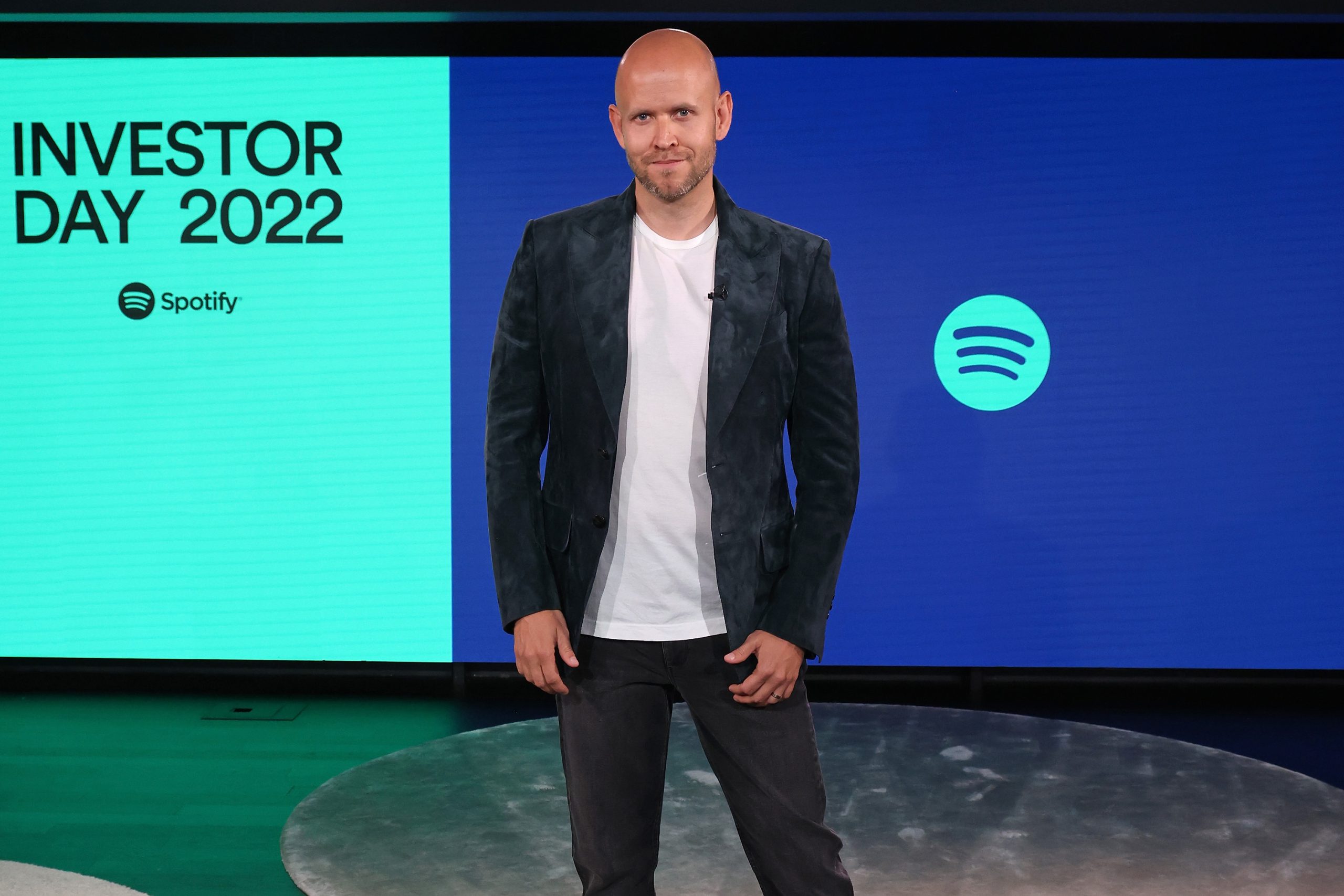
“We’re really investing in building a fantastic multisided platform that has all the ingredients to become one of the truly unique creative platforms in the world,” Daniel shared in his opening remarks. “And based on what we see, we are accelerating our moves to seize that opportunity in the near term. And the value creation opportunity is very high.”
He then outlined at a high level what Spotify has achieved since 2018 and revisited the three key foundations that continue to differentiate Spotify and drive our long-term strategy:
Ubiquity: It’s long been our goal to make Spotify available to anyone on any device. Over the last four years, we’ve gone from approximately 250 partners to more than 2,000 today, with integrations ranging from wearables like watches to all facets of the connected life—including cars and kitchen appliances. Ubiquity has proven to be a significant driver of new users to the platform, with 28% of all our new registrations coming from these partners, up from 14% in 2018.
Personalization: When you ask listeners what they love most about Spotify, more than 81% cite our personalization, or discoverability. That magic ability to introduce a user to their next favorite song and artist. Spotify listeners view this as the reason not only to sign up for our service, but also to stay.
Freemium: The combination of our free ad-supported tier and our premium subscription tier. It gives listeners a chance to try Spotify risk-free, enables Spotify to build a funnel toward establishing a larger and growing subscriber base, and has enabled our expansion into new markets due to our low price of entry—we’ve gone from 65 markets around the world to 183 in just four years.
“We see the opportunity to continue to imagine and explore new verticals across our platform—within audio, but also beyond.” Daniel noted. “And for each vertical, we will develop a unique set of software, services, and products and business models that’s going to be tailored for that specific ecosystem.” 
Joining the stage after Daniel, Gustav Söderström, Spotify’s Chief R&D Officer, provided a deeper look into that future from a product point of view.
While there’s much that goes on behind the scenes of the Spotify app, the end result is a single intuitive experience for listeners that brings the world’s audio content together in a relevant and personalized way. And that’s what we’ll continue to do as we add new format verticals, like audiobooks, to the Spotify app.
Gustav also shared how this strategy has been successful over the last few years in compounding our user base. He noted that in 2019 we integrated podcasts into the main app, making them available to over 200M potential listeners. In 2020, we did the same with video podcasts, in 2021 with Live, and in 2022, we’re integrating audiobooks into the main app, making them available to over 400M potential listeners.
Finally, Gustav explained Spotify’s personalization engine, which is shared among all of our content formats. “Investments in this space allow for the personalization engine to get better and better as new formats are added, ultimately giving us a better understanding of every user and how we recommend to them. To a large extent, the value of a service like Spotify is directly related to how much a consumer feels like that service helps them discover new things,” Gustav said. And that’s what Spotify enables. In 2018, we had 10 billion artist discoveries every month on Spotify. Today, there are 22 billion and we’re nowhere near done. 
“First and foremost, Spotify is a music company,” Charlie Hellman noted upon taking the mic. “All of our music teams’ strategies ladder up to two primary goals: making a unique and superior music experience for fans, and creating a more open and valuable ecosystem for artists.”
“We are by far the most global platform, the most tapped into local scenes, and the most capable of developing opportunities for artists at scale,” Sulinna Ong shared. “No other streaming service is better positioned to identify, amplify, and help shape culture than Spotify.”
“We are the preferred destination for artists, because we help to take an active role in achieving their dreams and partner with them on thinking outside the box, working together to help them succeed,” Madeleine Bennett said. “By unlocking the ability of any artist—from anywhere in the world—to connect with listeners everywhere, we are tapping into a potential market of billions of people everywhere.”
One of the reasons that we’re the go-to destination for artists is because we uniquely provide them with a core set of valuable free resources, useful for any stage of an artist’s career, that help them get their music in front of the right fans. In addition to these free tools, we’ve invested in building the most performant and effective commercial tools for promotion in the streaming era.
In 2020, we introduced our Discovery Mode program, which is powered by algorithmic promotion and is loved by those who have tried it. From Q121 through Q122, Discovery Mode had 98% customer retention. And in early testing, artists with tracks opted in to the program increased their listenership by an average of 40%. Almost half of that growth came from listeners who had never listened to the artist before.
With Marquee—our full-screen, visual, sponsored recommendation of artists’ new releases—we recently expanded access by rolling out a self-serve buying experience in the U.S. As a result, we doubled the number of new customers from Q4021 to Q122 while maintaining an 85% retention rate. And in Q122, revenue grew 224% year over year.
Charlie Hellman
In addition to helping artist teams promote and grow their audiences on an ongoing basis, we’re also focused on helping them earn in more ways. Beyond music, touring and merchandise are significant pieces of the equation. So we’re building solutions for both artists and fans, all while growing new lines of profit for artists and Spotify.
We’ve integrated listings from top ticketing platforms to sell concert tickets at scale within Spotify. We’ve also enabled artists to sell merch, vinyl, and other offerings directly to fans via their Spotify artist pages through a custom integration with Shopify. And we’ve continued to make great progress with our Fans First program, which uses Spotify data to identify and reward the most passionate fans with exclusive offers, like advance access to concert tickets, exclusive merchandise, or invite-only events. To date, the program has generated more than $300 million in revenue for the music industry.
We also want to open up ways for artists to directly interact with their audiences, creating meaningful engagement and monetization opportunities. One new experience is exclusive live audio rooms where artists host their top Spotify fans. Here, artists can celebrate a special musical moment like a new release and earn revenue by selling merch, promoting concert tickets, and receiving tips—all inside the live room.
“As we diversify revenue streams for artists and identify the best ways to increase spending from a user base that is on its way to 1 billion, we will further enrich artists—even outside of their rapidly growing streaming royalties—and deliver margin impact for Spotify,” Charlie concluded. 
In just under four years, Spotify went from having few podcasts on-platform to being a global leader in the market.
Consider the numbers: When Anchor joined Spotify in 2019, there were fewer than 500 thousand podcasts on the platform. Today, there are over 4 million, and Anchor powers more than 75% of them. Those millions of shows being published to Spotify from Anchor are often being made by first-time creators. And as those creators make their content, they share it with their friends and family off-platform. And the result? On average, every new Anchor show brings 2.5 additional monthly active users (MAUs) to Spotify.
“With that critical mass of both creators and consumption in the same ecosystem, we’re able to do something that has not been possible in nearly 20 years: actually innovating on the podcast format itself,” Maya shared.
We’re doing this in a few ways.
First is format innovation.
Next is interactivity.
Finally, monetization.
“This has opened up a new world of opportunity to add features and formats to the podcast-listening experience that have never been possible before—so Spotify is now not only differentiated by our catalog of content, but also by delivering a truly superior product for podcast listeners and creators,” she concluded. 
Spotify’s origins are rooted in music, but our future is supporting creators across audio—and we’ve taken the learnings from our success in music to propel our podcast business forward.
Dawn explained that our investments in top-tier exclusive and original content create real value for Spotify in four ways:
This strategy is proving to be successful: “Our original and exclusive shows account for 15 of the top 100 podcasts on Spotify—a significant achievement given that we produce or license only 1,000 of the more than 4 million podcasts currently on the platform,” shared Dawn. “And six of the top 10 shows are Spotify exclusives.”
To date, we have committed more than a billion dollars to podcasting in order to grow the podcast audience and transform the industry. And this investment brings with it significant long-term upside: In 2021, we generated close to €200 million in podcast revenue. We expect this to increase materially in 2022, and going forward, we believe podcasting in itself will be a multibillion-euro business for Spotify.
Thinking about the podcasting industry as a whole, before Spotify entered podcasting in 2018, the annual ad spend in the U.S. was approximately $480 million. At that time, it was projected to hit $1.1 billion in 2022. Today, podcasting is expected to exceed $2.1 billion in 2022—almost double the initial projections and over 300% growth since 2018. What’s more, the market is expected to double by 2024 to reach $4.2 billion.
And while the U.S. is a key market for podcast advertising, podcasting adoption is growing internationally, especially in markets such as the U.K., Germany, and Brazil.
The number of people engaging with podcasts is also growing. Since 2018, we’ve gone from less than 7% of listeners on Spotify spending time with podcasts to 30% of users monthly. Users who listen to both podcasts and music listen twice as much as users who only listen to music. And that extends beyond listeners: In the U.S., when we bundle music and podcast advertising, the average size of the spend on a campaign is four times that of a music-only campaign, so we’re driving bigger spend from advertisers and significantly growing our revenue.
By introducing streaming technology to podcasting, Spotify helped create audio experiences that were not possible before. Like with music and podcasting, we see an extraordinary opportunity to invest, innovate, and grow audiobooks. The vertical holds massive possibilities to build on our ambition to be the destination for a wide array of creators. The global book market is estimated to be around $140 billion, with audiobooks having only a 6%-7% market share.
At the end of 2021, we announced our plans to acquire Findaway and enter the audiobook space. Findaway works across the entire audiobook ecosystem, with a platform and offerings that serve authors, publishers, and consumers. We plan to build on its expertise and infrastructure to deliver tools and resources that will lower the barriers to entry and enable creators to find an audience—expanding the audiobooks market overall, just as we did with podcasting.
To achieve that scale, we’ll amplify the growth of Findaway’s platform offering, currently called Findaway Voices. This platform connects independent authors and publishers with independent voice actors and manages the production and distribution of their audiobooks. This creates an exciting new channel of scaled creation, with the potential to quickly grow the audiobooks market. 
Lifetime Value—or LTV—is a metric that many at Spotify spend much time considering, modeling, testing, and refining. We believe this is a metric that provides enormous insight into the true value that we provide to consumers, creators, and our business. We use this powerful instrument to predict which content yields longer-term retention, engagement, and happiness, with the goal being to maximize the lifetime value of all Spotify users.
Lifetime Value is simple in theory, but complex in practice. Think of it this way: All the future value that you expect a consumer to bring you, across their entire lifetime on the service, discounted to a net present value.
As an experimentation metric, the total LTV seeks to answer the question: If we do X today, what can we expect to be the profit that X will bring to the business and its creators in the future?
Our machine learning models now tell us which combination of user, content, and monetization gives the most consumer value—and the most creator value—at a certain time, enabling us to maximize the total value of the platform at each moment.
So, how do we keep on increasing LTV? We plan to repeat what we just did with podcasts by adding audiobooks to the platform. Audiobooks should grow our users’ lifetime multiplied by their value because it’s helping retain users and it’s increasing our gross profit.
We don’t want to increase lifetime at the expense of gross profit—for example, by dropping prices. And we don’t want to increase gross profit by doing something that a user might accept in the moment but not enjoy in the long term . . . like cranking up their ad load or recommending lower-cost content that isn’t right for them. Both could negatively impact their lifetime on the service. A well-instrumented LTV metric aligns you with your consumers and creator partners, and it “keeps you honest.”
While it’s still early days, we’re using LTV more and more in our business. Our vision is to have it be the primary driver of all of our business decisions as it allows those decisions to be automated, personalized, and scalable—something that wasn’t possible before.
Tony concluded that Lifetime Value:
All of these are essential to helping Spotify reach our goal of 50 million creators and 1 billion listeners globally while also ensuring our business grows. 
“Right now, we’re on track to more than double our reach to over 1 billion users,” Alex began. “And with our vertical platform strategy, over time our ambition is to build the business toward an annual ARPU of €100. This means, on average, looking at both free and paid, we can significantly increase the total revenue across our entire user base.”
But how do we do that? Alex laid out our existing structure.
We then go back to step one and bundle in a new vertical. We did this, for example, with podcasts in 2019.
With 422 million users worldwide, Spotify is by far the largest audio streaming subscription service in the world. Subscriptions, in particular, are our super strength. We have more than 182 million subscribers—meaning we have a recurring relationship with 2% of the world’s population.
We’ll continue to innovate across our propositions, tailoring our playbook to the needs of the regions to maximize our user- and revenue-growth opportunities. “As Free users convert, subscribers upgrade, and the ad business scales, the ARPU increases. So we see plenty of potential to further increase ARPU,” Alex said.
And just as Spotify continues to grow, so too do the industries we play in. We believe the music streaming market alone has room to expand from $30 billion to nearly $80 billion in the next 10 years. We also see the Live Experiences business as a natural extension of Spotify’s existing music business. Because of our scale, the data advantage we can offer to partners, artists, and venues is powerful.
In the decade ahead, we believe there are additional markets and verticals that are natural fits for our platform and audience. There is a golden opportunity for an audio-first platform like Spotify to add value in categories beyond music, podcasts, and audiobooks. “With our enormous user base, imagine the potential,” Alex said. “With our monetization modalities and LTV optimization, we can ensure that users get access to the right content, at the right price, at the right moment.”
Our current markets of music and podcasts coupled with our multiple modalities of monetization and our extension into Live will build revenue growth that will take us to a global ARPU of 2 times. And as we continue to expand into these new verticals, we’ll deploy our Spotify Machine to apply the same growth playbook. We believe this can unlock our full ARPU potential, creating the opportunity to reach €100—4 times where we are today, inclusive of all our new initiatives. “This,” said Alex, “is our future.”
Since 2018, we’ve tripled our ad revenue and established an entirely new business with podcasting, growing it tenfold since 2019 alone. So we not only have the ingredients to succeed in a competitive ad market, but we’re also already delivering return on our investment to advertisers by leveraging synergies between content formats.
There’s also a significant opportunity to further implement and improve ad monetization around the world. So as we fully realize our international investments over the next year, we expect to see higher margins and revenue growth. To do this, we’re focusing on three key product areas.
First, Streaming Ad Insertion (SAI), our game-changing ad tech, unlocks valuable first-party audience data and insights by delivering the most rigorous targeting and reporting available in podcasting today.
Next, Spotify Audience Network, our audio-first advertising marketplace, makes it possible for advertisers to connect with audiences listening across a broad range of Spotify Original & Exclusive podcasts as well as third-party podcasts, opted-in creators, and publishers. The Spotify Audience Network was born out of our acquisition of Megaphone and strengthened by our more recent acquisitions of Podsights, Chartable, and Whooshkaa—and is helping us lead the charge to revolutionize podcast ad buying.
“That flywheel of having more creators adding more content to our network means more listeners who will in turn attract even more advertisers,” said Dawn. “This is what makes the Spotify Audience Network so powerful—allowing us to grow our podcast advertising revenue by many multiples.”
Finally, we’re innovating on the audio ad experience itself to make it more interactive for users and more impactful for advertisers. One recent example of this is Call-to-Action cards. Powered by SAI, this format makes it easier for users to engage with promo codes as they listen—and offers advertisers an even more direct way to measure campaign success via clicks. We see this format as the foundation of future ad experiences in podcasting, music, and beyond.
Gone are the days of ads’ accounting for less than 10%of Spotify’s total revenue. Advertising is now poised to become a key growth driver. Over the long term, we expect ad revenue to be more than €10 billion annually.
“We’re seeing very strong user growth across the world, and Spotify’s ad machine stands ready to unlock huge value for creators, publishers, and advertisers,” Dawn noted. “In some of our largest markets, including the U.K., Germany, and Japan, we’ve just scratched the surface—and we see a significant opportunity to implement and improve monetization in growing markets across Latin America, Africa, and Southeast Asia.”
We’re also upleveling our measurement offerings, most notably through our acquisition of the leading podcast ad measurement service, Podsights. Podsights offers an advertising attribution solution that is built specifically for podcasting, and it allows advertisers to attribute podcast ad exposures to actions taken on an advertiser’s website or app—helping them to better understand their ROI. Long term, we also intend to extend Podsights’ capabilities beyond podcasts to the full scope of the Spotify platform.
Additionally, we’re preparing to launch a dynamically priced auction for a segment of audio ads by enhancing our self-serve manager, Ad Studio, which includes features that advertisers have grown accustomed to on other platforms, but with a unique Spotify spin.
Today we have tens of thousands of advertisers on Spotify, with the majority of our ad revenue coming from the larger brand enterprise category. By making it possible for advertisers to buy based on desired outcomes across music and podcasts, we’ll begin to increase our stable of small- and medium-sized advertisers. In turn, this will unlock massive lower-funnel media budgets, like direct response—a part of advertising currently missing from audio.
Long term, we’re exploring how to bring ad monetization into audiobooks and video podcasts, and how to unlock more ad-supported music listening as we continue to innovate across our Free tier.
Today Spotify has roughly 2.5 times more users than we had just four years ago. Our subscribers have grown at a similar rate, topping 180 million. And since going public, we have met or exceeded our guidance ranges for both users and subscribers over 90% of the time. Paul outlined our progress across a variety of metrics.
He then moved into our specific business performance, starting with music.
Spotify’s music business has been a real source of strength, driving strong revenue growth and gross margin expansion. Music revenues—which consist of Premium subscriptions, ad-supported music, and our Marketplace suite of artist tools—grew at a 24% CAGR. And, importantly, music gross margins have increased over the same time frame, reaching 28.3% in 2021.
Marketplace, too, is adding significant value to our music business. In 2018, our Marketplace contribution to gross profit was less than €20 million. In 2021, it grew to more than €160 million, eight times the amount in just four years. We expect Marketplace contributions to gross profit to increase another 30% or more in 2022. Marketplace is the quintessential example of our approach to capital allocation. While there was a significant upfront cost to build and launch these offerings, we saw compelling data, which gave us the confidence to double down and invest aggressively against our goals.
He then turned to podcasting. “We continue to invest in podcasting because we believe the long-term margin profile will be accretive to our consolidated margins,” Paul explained. And there are positive signs so far: Users who engage with both music and podcasts have a higher lifetime value than those who engage with only music. And in 2021, podcasting revenue grew more than 300% year over year to nearly €200 million.
We believe 2022 will be the peak in terms of the negative impact of our investments on gross margins, and we expect podcasting gross margin to turn profitable over the next one to two years and on a meaningful ramp from that point onward.
When it comes to monetizing podcast listening hours, we’re just getting started. Only a minority of podcast time spent was monetized by Spotify in 2021, whether through our O&E inventory or monetizable Spotify Audience Network impressions. Of the 7% of listening hours today coming from podcasts, approximately 14% are currently monetized by us on a global basis. Yet we believe we have a multibillion podcasting advertising opportunity, both on- and off-platform.
Next, Paul moved on to our goals and expectations over the immediate (three to five years) and long term (the next decade). Long term, our goal is to deliver more than 20% revenue growth.
We expect our consolidated gross margin to top 30% in the intermediate term. Favorable margin drivers such as Marketplace and improving international ads monetization should lead to further expansion of our music margin, first to 30% and then over time, to 35%. Over the next three to five years, we believe podcast margins should top 30%, and our long-term view is that this business could reach 40%-50%. Over the long term, our road map has a number of initiatives that we believe will yield even higher incremental margins.
Plus, we won’t hesitate to invest when we see something big to grow our business. This may create lumpiness in our margin progression—but growth isn’t always linear.
“We are excited about the business we are building at Spotify,” Paul concluded. “We have strong momentum with the potential for meaningful user, revenue, and bottom-line growth in both the short and long term. We have the team and the plan to deliver growth in users, subscribers, revenue, and margin, and doing so with positive and growing free cash flow. We have never been more enthusiastic about the opportunity ahead.”
“We are running faster and we are more focused than anyone else in audio. And as you could hear, audio and long-form content is a much bigger business than what many would have thought.”
“From everything I see, I believe that over the next decade, we will be a company that generates $100 billion in revenue annually and achieves a 40% gross margin and a 20% operating margin.”
And, among this, we’re accelerating our move from a one-size-fits-all to a far more dynamic and open platform. “A platform that will entertain, inspire, and educate more than 1 billion users around the world,” Daniel explained. “And as the world’s creator platform, we will provide the infrastructure and resources that will enable 50 million artists and creators to grow and manage their own businesses, monetize their work, and effectively promote it.”
Doing this well will make us more attractive as a home for top and emerging talent. And in turn, these services will also improve the gross margin across our portfolio: a total win.
Forward-Looking Statements
We would like to caution you that certain of the above statements represent “forward-looking statements” as defined in Section 27A of the United States Securities Act of 1933, as amended, and Section 21E of the United States Securities Exchange Act of 1934, as amended. The words “will,” “expect,” “believe,” and similar words are intended to identify forward-looking statements. Examples of forward-looking statements include, but are not limited to, those relating to projections or estimates about the future performance of our company. Such forward-looking statements involve significant risks, uncertainties, and assumptions that could cause actual results to differ materially from our historical experience and our present expectations or projections, including our ability to attract prospective users, retain existing users, and monetize our products and services; competition for users, user listening time, and advertisers; risks associated with our international operations and our ability to manage our growth; and other risks as set forth in our filings with the United States Securities and Exchange Commission. We undertake no obligation to update forward-looking statements to reflect events or circumstances occurring after the date hereof.
Non-IFRS Financial Measures
The discussion above includes non-IFRS financial measures that should not be construed as alternatives to financial measures determined in accordance with International Financial Reporting Standards, or IFRS. See the appendix to our CFO’s Investor Day presentation available on our website for a reconciliation of these non-IFRS financial measures to the most closely comparable IFRS measures.
© 2022 Spotify AB.
Spotify Shares Our Vision To Become the World's Creator Platform – spotify.com
OHIO and WOUB helped Bruce Figler find his passion – Ohio University
As the executive director of the Pleasantville Music Festival in New York City’s northern suburbs, Bruce Figler is preparing for the first in-person concert series in three years. The Pleasantville Music Festival is a single-day music festival that features major national performers alongside new up and coming artists and local artists from around the region. It annually attracts nearly 7,000 attendees to the small village which bears its name.
“2019 was the last music festival we were permitted to have due to the COVID pandemic.” said Figler. “We are excited to get things restarted.”
Figler grew up on Long Island, New York and chose Ohio University for college mainly because of the reputation of its broadcast program. But there were a few other reasons.
“My parents wanted me to go somewhere affordable,” said Figler with a laugh. “It couldn’t be Syracuse because my brother went there. I wanted to go somewhere not too close to home, but not too far, and I wanted the school to have a varsity hockey team. Ohio University checked all the boxes.”
However, shortly before Figler would arrive in Athens, Ohio University dropped the hockey team from varsity to club level. But he fell in love with the school anyway.
Figler was interested in sports and music. And Ohio University gave him the opportunity to explore both areas within the media industry.
“I worked in music on the radio at ACRN, and I did sports on the radio at WOUB,” said Figler. “For WOUB Sports, I covered the hockey and soccer beat. I loved those sports and since neither were considered high profile assignments, there wasn’t a long line of people wanting to take them, so that worked out great for me.”
Figler eventually gravitated more toward music, doing some work with WOUB AM music programming. “At some point I looked at my sports friends and saw what they were doing on Friday nights. They were essentially a bunch of guys huddled around a TV watching games. Then I looked at my rock ‘n’ roll music friends and what they were doing on Friday nights. They were out with girls. I chose music,” said Figler laughing.
While on campus, Figler used his music friends and connections to put together a music festival.
“As a sophomore, I had this idea to get a bunch of musicians together to play in the large courtyard on New South Green,” said Figler. “I knew a lot of musicians on campus. So, I organized the festival and a few hundred people turned out. Little did I know that would be what I would do in the future on a much larger scale.”
He also took a keen interest in audio production. As a senior, he and some friends collaborated on a children’s radio play called ‘Alix in Punderland’ that won a grand prize in the 1977 Alpha Epsilon Rho National Student Production Competition. This was prior to Ohio University having their own chapter of the broadcasting society.
After graduation in 1977, Figler started looking for jobs on the periphery of the New York City radio market. He delivered demo reels personally to radio stations and then followed up by phone a few weeks later to gauge their interest.
“I followed up with WRNW, a small station in Briarcliff Manor, New York and was told the new program director wanted another week with my reel. I ended up getting an interview with that new program director whose name happened to be Howard Stern,” said Figler with a chuckle. “I was his first hire as program director. Stern now jokes about that time in his career saying he hired any idiot he could find. I’m one of those idiots.”
After a few years there, serving as a full-time announcer and production director, Figler landed jobs in New York City, (first at WTFM, then at WAPP, neither of which exist anymore) which he thought was his dream, but found being an on-air personality in a major market wasn’t all it was cracked up to be.
“At the smaller station, you did what you wanted, said what you wanted and played what you wanted,” said Figler. “At the bigger station, you were told what to do and what to play. It was no longer quite as much fun or fulfilling.”
Figler decided to focus on audio production, putting together a recording studio at home and starting his own company, Creative Sound Works. He jokes, “I was a pioneer in working from home, long before it was considered fashionable.”
Eventually, the company grew too big for the first floor of his home and for nearly 30 years, his studios resided in office space in and around his hometown of Pleasantville, NY. During that time, he thought about a return to radio but waited for a station to emerge that he thought would allow him the creative freedom he craved. In 2005, Figler found that station, and took a weekend on-air job at WXPK, The Peak. Figler would both run his company during the week and work weekends on the air at the station for 15 years, right up until the pandemic. But that association eventually led to what he is doing now, serving as executive director of the Pleasantville Music Festival. Figler credits much of his career success to his time at WOUB and Ohio University.
“I was able to cut my teeth there, both on the air and in the studio, where I was able to work on my own stuff. The fact that there was that opportunity was crucial,” said Figler. “I learned how to do things by spending hours and hours in the WOUB studios. The fact that those studios were open to someone like me was huge.”
To learn more about WOUB, visit woub.org.
© 2022 Ohio University. All rights reserved.
Students Make Electronic Music with Minecraft – UMass Lowell
06/07/2022
By Katharine Webster
Sound recording technology (SRT) major Tess McCumber ’22 grew up playing Pokémon games on her Nintendo DS, and then also became obsessed with the massively popular game Minecraft.
So when she heard that students in the Music Department’s Contemporary Electronic Ensemble, led by Assoc. Teaching Prof. Ramon Castillo, were creating music videos using Minecraft, she joined up.
She says the practical experience of synchronizing sounds to video games built on what she had learned in classes required for her major – and gave her a better understanding of electric circuits that will help her in her new career as a sound technician at AudioLink, a company that provides voiceover recording and production services.
“We had to take electrical engineering courses about sound technology, but I didn’t really understand circuitry until we did this hands-on project in Minecraft,” McCumber says. “Seeing it visually, seeing how wiring and electronics and machines work, was the biggest takeaway.”
 Photo by Ramon Castillo
In her first semester in the ensemble, in fall 2021, she watched, learned and helped with a project. During her second and final semester, she created the video performance “Lavender Town,” which combines elements of her two favorite games – a Pokémon soundtrack linked within Minecraft to a mine cart traveling on rail tracks that trigger different game actions.
“Lavender Town” was among 18 UMass Lowell projects featured at the all-video, online 2022 Maker Music Festival, which drew participants from around the world. While most create their own instruments, both analog and electronic, organizer Sherry Huss was happy to accept digital performances this year because the festival was virtual, due to the COVID-19 pandemic.
Castillo encouraged students in his Contemporary Electronic Ensemble class to participate in the festival, which debuted the weekend of May 14-15. Nearly a dozen students did, and Castillo ended up organizing an entire virtual UML building. He spoke about several of the projects in a real-time session during the festival, and he will speak and perform live at A New HOPE hackers’ conference in New York City in July, as well.
In addition to the Minecraft videos, the UML building at the Maker Music Festival features a video about the EcoSonic Playground Project, a pair of live performances on original or reconstructed instruments, and two video projects by students from Prof. Gena Greher’s Technology in Music Education class, as well as several of Castillo’s original compositions and collaborations with his 8-year-old daughter, Luna.
Four of the UML projects won awards at the festival, including “Lavender Town” and the EcoSonic Playground.
 Photo by Kyle Kashiwabara and Matt Makuc
Castillo says he turned to Minecraft during the COVID-19 pandemic to bring an element of live play and performance back into the Contemporary Electronic Ensemble. He was inspired in part by a musical video game that guitar performance major Sean Lavigne ’21 created in fall 2020.
Castillo was also inspired by his daughter, who plays the educational, multiplayer version of Minecraft, and the depth of electronic music possibilities the game offers.
“You could see the other person and interact with them in real time, and that’s exactly what we lost during remote learning,” Castillo says. “So using Minecraft in the ensemble seemed like a way we could get that back, at least to a degree. Every project the students created had to have an element of live performance, too.”
The live performances took place at the end of every semester on the social media platform Twitch.
Castillo had already begun some musical Minecraft experiments of his own, a group of works he calls “void loop ().” In “Chicken Hero, Villager Hero, Cow Hero,” chickens, villagers and cows fall from different heights onto virtual pressure plates that respond to their “weight” by triggering in-game sounds and actions, via circuits constructed of “redstone,” an electrically conductive element within the game.
 Photo by Tristan Fruzzetti
Castillo’s ensemble students took a variety of approaches in their Minecraft musical works. Some, like McCumber, created visual accompaniments to existing music, while others created the music itself using different machines within Minecraft.
Vocal performance major Kyle Kashiwabara and composition for new media major Matt Makuc used stop-motion animation in “Motorbike,” another award winner, to simulate a motorcycle traveling along a road. As it travels, it activates layers of redstone-connected sound and command blocks. (Command blocks contain a line of code that can make a more complex sound or prompt another action within the game.)
Some students created both visual and musical accompaniments to live performance. In “Pillager Jam,” which also won an award, SRT major Tristan Fruzzetti created a video with an audio track and visuals from Minecraft and Logic digital recording software to accompany his solo performance on electric guitar.
The Minecraft musical projects have proved so popular that Castillo is starting a new ensemble in the fall, the Video Game Ensemble. The Music Department is funding a dedicated Minecraft server that Castillo and his students can use and modify. Castillo has already built a virtual replica of UML’s Durgin Hall inside it.
A good friend of Castillo’s, Alex Rigopulos, the co-founder and creative director of Harmonix Music Systems who helped design the original Guitar Hero and Rock Band games, has made a generous donation to fund some add-ons and other technology for the new ensemble.
 Photo by Ryan Katz
Meanwhile, now that ensembles are live again, the Contemporary Electronic Ensemble will return to its original purpose, Castillo says. Typically, students in the ensemble learn how to use electronic music software and synthesizers expressively in live performance. Some even create their own electronic instruments.
Ryan Katz, an SRT major and rising senior who has played in the ensemble for four semesters, stuck with creating and adapting electronic instruments and sound banks during the pandemic, rather than migrating to Minecraft.
One of his videos in the 2022 Maker Music Festival, “Interstellar Bone Collector,” features a live, improvised piece he performed with two friends, using a Yamaha keyboard he’d rewired to create new sounds, a practice known as “circuit bending.”
His other video features “The Meteorologist,” an instrument he invented to respond to the weather, using sensors that measure atmospheric and ground conditions including light, temperature and soil moisture. A human player adds more chaotic and percussive sounds by manipulating a joystick, knob and trackpad.
Although “The Meteorologist” starts by playing a simple chord progression, it never plays the same piece twice, Katz says, because it responds to the weather and human touch at that time and location.
“I wanted an intersection between what we’ve created and what the environment creates,” he says.
Lowell, MA 01854
978-934-4000
Map & Directions
Undergraduate Admissions
University Crossing
220 Pawtucket St., Suite 420
Lowell, MA 01854-2874
[email protected]
UMass System
Symphonic Distribution – Client Manager (US) – Music Business Worldwide
Symphonic Distribution is a 100% independent music distribution and marketing company headquartered in downtown Tampa, FL and with offices in Brooklyn, Nashville, Denver, and Bogota, Colombia. We focus on distributing, promoting, and developing great independent music from artists, record labels, and many more. Not only do we want to work with some great and prolific creators, we want to also work with creative, passionate, positive, and forward-thinking individuals. Maybe this is you? If so, then below you will find an opportunity to join Symphonic. As a company, we want to have an environment that is inclusive, diverse, and accepting so that everyone, regardless of their background, race, or sexual orientation, has a chance to do great things in the industries of music, tech, and marketing. The Client Manager will work full time along out of our Nashville office location with some cool perks as well as ensuring that as an individual you have the proper work/life balance.
The Client Manager will manage relationships with Symphonic’s prospective and existing artist and label clients across various genres and sub-genres, spearheading key signings, priority release development, and will act as the primary go-to for a key segment of our client base. This position will maintain a healthy balance of the job that must be done during the day with the connection to the artists and music that happens at night.
Symphonic Distribution enables content creators to fully maximize their music’s revenue and grow their global audience. The company focuses on working with: record labels, artists, managers, producers, social media influencers, and even distributors just like us to get their messages seen and heard. While our core business is to distribute music digitally and physically for the many talented creators that we have the honor of working with, we focus on a number of services, such as: Physical Distribution, User Generated Content Monetization on YouTube, Tik Tok, Triller, Instagram, Release Promotion such as Playlist pitching, marketing diagnostics, strategy and a number of other very important services to ensure that creators are maximizing and collecting on as many royalties as possible. Symphonic also showcases one of the largest partnership networks available, partnering with Spotify, Apple Music, Pandora, Amazon, and many other services where music can be consumed on. Check out more about us on our website at www.symdistro.com
Music Business Jobs is the most effective way for the global music industry to find the best candidates for their open positions.
In addition to being seen by over 300,000 monthly unique readers online, our listings are also emailed direct to more than 50,000 professional subscribers every week – across the US, UK, Europe, Asia-Pacific and beyond.
Click through below for details on how to submit a Music Business Jobs listing – and learn why our advertisers ‘strongly recommend’ us to their peers…
The Magic of Contains: Eggs – Daily Trojan Online
There is no one answer for what Contains: Eggs exactly is: a multimedia team, an innovative music video and concert hub or simply a passionate group of friends.
“[Contains: Eggs is] a group of people that believes in the quality of innovating what music videos can and should look like, and whenever we have an opportunity that gives us the potential to do that, we pursue it,” said William Higbie, a rising senior majoring in cinema and media studies and the group’s producer.
Contains: Eggs was originally founded in 2019 by rising seniors Shantanu Jhaveri and Joel Yoon, who said the group’s name was inspired by their friend and musician Sumit shaving his head bald, which “looked like an egg” and inclined them to “make something.”
At the time of the group’s creation, Jhaveri and Yoon were freshmen and excited to start projects but found it hard for people to take them seriously as first-year students. This passion, combined with their desire to collaborate on projects with other students, sparked what would become a space where anyone with an idea for a project had the ability to come and work on things together.
“[Yoon] came from a very traditional storytelling background, and I came from a traditional engineering background,” said Jhaveri, who is majoring in arts, technology and the business of innovation and computer science. “If you see any of our videos, we try to do some technically captivating things. If we do anything technical, we want to try to capture some element of storytelling, or some level of art behind it, so that’s how we kind of came up with this cool collaboration between us.”
With Yoon, who is majoring in arts, technology and the business of innovation, and Jhaveri, Sumit and Higbie make up the core of Contains: Eggs.
One of the major projects pursued by the team was TinyDorm, an event where musicians perform in an intimate college dorm room. All of the team members agree that TinyDorm has come a long way since its first rendition in 2020.
“That first one was so chaotic because we had never done it before. We were all running around,” Yoon said. “We did it in McCarthy [Residential College], and there was still a guest policy at McCarthy. You could only bring two people up. We were trying to put like around 90 people into that dorm that night. It was like three groups of 30, rotating out. It was very janky.” Since then, TinyDorm events are now filmed, and have evolved to include 3D printed tickets and a partnership with student-run traveling coffee shop Cup of Troy.
In addition to their work on music videos and putting on tiny concerts, Contains: Eggs also works on “bold tech,” such as projection mapping, a projection technique used to turn objects, often irregularly shaped, into display surfaces for video projection.
“We like introducing fun little concepts that people don’t really see before,” Sumit said. “For instance, projection mapping in a dorm room is something no one had ever seen. Then we have these [wooden] tickets that we would burn to mark people’s drinks. We had [3D printed] physical tickets for each person. We use the tools we have to make the experience a lot more engaging.”
As Contains: Eggs grows older, there is even more of an emphasis for projects to feel polished, a desire for things to look better than anyone else they are competing with.
“We want you to pay like $20 for a $100 experience. It should be done to the point where you’re surprised that college students were able to put this together with absolutely no budget or funding but simply because they want to do it,” Jhaveri said. “Anything we do, anything we build, we want it to feel like magic.”
An integral part of the magic are the musicians who Contains: Eggs work with, whether on their music videos or inviting them to perform.
“Very plainly, it was the creative control that they gave me, this vision they collaborated with me to help see through for the night, with the drinks and the lighting and the camera angles and what the idea was going to be behind it,” said Ethan Sak, a rising junior majoring in music production, of his performance last November.
Sak performed at TinyDorm after his friend, who ran sound for Contains: Eggs in the past, recommended him for the gig.
“As the people were shuffling in, you started to get a little bit more aware of just how close everybody was to each other, just how intimate it was. In my opinion, that or the biggest stage you can get are two of the best stages you can play. I finished my first song and I was looking at somebody in the eyes who was just crying, just bawling, and it was just me and my acoustic guitar.”
Moving into their final year at USC, the students working on Contains: Eggs have no intention of stopping anytime soon.
“We’re so excited about these ideas that we have taken a vow. None of us are allowed to talk about it outside of our group, just because we want people’s jaws on the floor when they walk into the show,” Yoon said.
With pushback from campus sustainability groups, USG voted 7-5 to approve a budget reallocating dollars from the Green Engagement Fund to the Legislative Fund.
The University is monitoring rising case counts but has no set plans for Fall 2022.
Faculty members discussed causes and solutions to the ongoing wildfire crisis.
The University will be temporarily required to provide certification letters on the accuracy of future submissions.
This site uses cookies. By continuing to browse the site, you are agreeing to our use of cookies.
We may request cookies to be set on your device. We use cookies to let us know when you visit our websites, how you interact with us, to enrich your user experience, and to customize your relationship with our website.
Click on the different category headings to find out more. You can also change some of your preferences. Note that blocking some types of cookies may impact your experience on our websites and the services we are able to offer.
These cookies are strictly necessary to provide you with services available through our website and to use some of its features.
Because these cookies are strictly necessary to deliver the website, refusing them will have impact how our site functions. You always can block or delete cookies by changing your browser settings and force blocking all cookies on this website. But this will always prompt you to accept/refuse cookies when revisiting our site.
We fully respect if you want to refuse cookies but to avoid asking you again and again kindly allow us to store a cookie for that. You are free to opt out any time or opt in for other cookies to get a better experience. If you refuse cookies we will remove all set cookies in our domain.
We provide you with a list of stored cookies on your computer in our domain so you can check what we stored. Due to security reasons we are not able to show or modify cookies from other domains. You can check these in your browser security settings.
These cookies collect information that is used either in aggregate form to help us understand how our website is being used or how effective our marketing campaigns are, or to help us customize our website and application for you in order to enhance your experience.
If you do not want that we track your visit to our site you can disable tracking in your browser here:
We also use different external services like Google Webfonts, Google Maps, and external Video providers. Since these providers may collect personal data like your IP address we allow you to block them here. Please be aware that this might heavily reduce the functionality and appearance of our site. Changes will take effect once you reload the page.
Google Webfont Settings:
Google Map Settings:
Google reCaptcha Settings:
Vimeo and Youtube video embeds:
The following cookies are also needed – You can choose if you want to allow them:
Kartel Music Group – Product Manager (UK) – Music Business Worldwide
Kartel Music Group is seeking an experience and passionate Product Manager to join our team. We are looking for an Electronic & Dance Music specialist. The role will head up the recently formed inhouse EMK (Electronic Music Kartel) label imprint as well as working across a number of priority Artist and Label Services clients across a range of genres with lean toward electronic and dance music.
The ideal candidate will have a strong instinct for the record label, distribution and label services environment and be passionate about supporting professional creators in todays’ evolving recorded music landscape. They will have hands-on product management expertise and a strong passion for administration, work-flow efficiency, digital and traditional marketing, digital and physical distribution and retail channels. They will have a proven track record working with release schedules, marketing budgets and be comfortable with metadata and be generally data literate and confident working on detailed excel spreadsheets.
The successful applicant must have a minimum of 3+ years experience in a similar Music Industry role in a Label or Services/Distribution company. They will be experienced in creating and disseminating marketing and promotions reports. Great communication, interpersonal skills and attention to detail are a prerequisite.
This is a unique and challenging opportunity to join an ambitious and versatile music business shaping the future of consumer music marketing.
Kartel Music Group is a modern music services agency. We provide integrated solutions for marketing, campaign management, distribution and business services. Our clients include some of the best emerging and established independent artists, managers and record labels. We are dedicated to reimagining the music industry for creative entrepreneurs in the digital age. For more information visit: www.kartelmusicgroup.com.
How to apply: Please send a covering letter with examples of your recent work, along with your CV and your salary expectations for the role to [email protected]. Please include the subject: “Product Manager 22”.
Music Business Jobs is the most effective way for the global music industry to find the best candidates for their open positions.
In addition to being seen by over 300,000 monthly unique readers online, our listings are also emailed direct to more than 50,000 professional subscribers every week – across the US, UK, Europe, Asia-Pacific and beyond.
Click through below for details on how to submit a Music Business Jobs listing – and learn why our advertisers ‘strongly recommend’ us to their peers…
From store room to studio booth – Kempton Express
Third-year IT student at Tshwane University of Technology (TUT) and Birch Acres resident Mpho Shaun Dibakoane realised his passion for music.
ALSO READ: Two musicians join forces to create an impressive ballad
Although he is not a performer, Dibakoane was always fascinated by music.
He was in high school when the idea of music production took hold of his heart.
“My friends used to rap and we would go to a recording studio not far from where I live.
“While we were there, the owner used to ask me if I was a producer and I laughed it off at the time and said no.
“A few years later I decided to give myself the challenge to produce beats because I love music and I love technology,” said Dibakoane.
The 21-year-old said creating the studio was not easy, however, with the help of friends they were able to turn what was a store room into a space where creatives can flourish.
His favourite part of the installations was the booth.
“A lot of the things you see in my studio were designed by my friends,” said the young producer.
ALSO READ: The power of music for wellbeing
Mpho installed studio monitors an audio interface, TRS cables, a microphone and studio headphones.
Although still a new studio, Mpho has managed to grab the attention of 10 artists from the neighbourhood recording a variety of genres.
“A lot of the work I’ve done hasn’t been released yet, some of the work that’s completed is available on a YouTube channel called The AfterEffect with Zhane.
“People can also expect some music from an amapiano group, The Heavy Joints Sessions, and there’s also a project we are working on with Jazzylee Mapiano,” said Dibakoane.
Also follow us on:


We use cookies to help improve your experience and to show you relevant advertising. To learn more about cookies, please read our Privacy Policy. 
Apple launches MacBook Pro & Air with new M2 chipset – RouteNote
Image Credit: Apple
Apple state that the new M2 chipset provides improved performance against the M1 chipset. So, is it fair to say the new M2 MacBooks will be bigger music production workhorses than previous models?
The M2 MacBook Air offers an 18% performance increase compared to the M1 chip in addition to the 24 GB of unified memory provided by the M2 chipset. As a result, the M2 MacBook Air is more capable than previous iterations to complete both simpler and heavy processing tasks.
Furthermore, the MagSafe charging is back as a standard. But now fast charge is available with an optional 67W USB-C power adapter. The M2 Air has up to 18 hours of battery life. Weighing in at just 1.24 kg and 1.13cm thin.
And a mini-jack output is also back too. In somewhat of a plot twist, this headphone jack supports high-impedance headphones too! The Air has a 13″ liquid retina display and comes in four colours: Midnight, Starlight, Space Grey, and Silver.
The 13-inch M2 MacBook Pro brings more power but doesn’t have a design that’s too bulky. It has a 10-core GPU, features a stylish touch bar and charges via USB-C. You’ll find you get a slightly longer battery life than the M2 air too.
The MacBook Pro with M2 chip provides 20 hours of battery life, and it has a 13.3-inch retina display.
The MBP Magic Keyboard “delivers a comfortable, quiet and responsive typing experience.” The featured Touch Bar empowers you as it hosts the commands you need most “right where you need them”. Finally, Touch ID allows you to access your computer faster with a secure login and make purchases faster too.
Two Thunderbolt ports allow for fast data transfer as you move samples around, faster charging in addition to video output for additional monitors too. Like the M2 Air, the MBP also has a 3.5mm headphone jack that supports high-impedance headphones.
The new M2 MacBook Air will be available in July from Apple next month – starting at $1199. Meanwhile, the M2 MacBook Pro is starting at $1299.
A direct injection (DI) box converts unbalanced instrument level signals with high impedance (electrical resistance) into balanced microphone-level signals with low impedance.
If you want to record music for a pass time or build a possible career, building a home studio is easier than ever. So, let’s talk about how you can build your own recording studio with what you’ll need to record music at home.
Sign up to our newsletter and make sure you don’t miss a thing !
Officially launched in 2007, RouteNote began as a digital music distribution platform for independent artists and labels to get their music online,
free!
Designed and built to take advantage of the shift towards independent and self-publication through online and mobile music or video outlets.
RouteNote is partnered with some of the biggest retailers on the web to give artists massive and immediate availability for their products.
RouteNote has since grown into a full digital media management service providing artists, labels and creators instant access to a large proportion of the online market.
Onsite, artists, labels and creators can upload content to the RouteNote catalogue and enter into a non-exclusive agreement permitting us to distribute their music to a worldwide audience.
Our rates for providing a distribution service are currently the best in the market and our ever expanding catalogue gives us increasing muscle with which to negotiate deals from which everyone, artists, clients and distribution partners included will all benefit.
Ableton offers 25 percent off all of its music production software – Engadget
If you’re looking for a new DAW (or digital workstation) for making music, it’s worth taking a look at Ableton’s latest sale. The company has temporarily dropped the price of all of its software by 25 percent, including Ableton Live 11, which is perhaps the most popular DAW around.
Live 11 Intro (which includes the essentials), is down from $99 to $74. Live 11 Standard, which unlocks all the DAW’s features and adds some extras, has dropped from $449 to $337. At the top end, there’s the complete integrated studio of Live 11 Suite. That currently costs $562, down from the regular price of $749. The same 25 percent discount applies to packs.
Ableton offers students and teachers up to 40 percent off Live, but it doesn’t hold sales like this all too often. If you’re not an educator or in school, these are likely among the best deals you’ll find on the company’s software. The sale runs until June 14th.
Earlier this year, Ableton rolled out the first major update for Live 11. Among the additions was native support for Apple Silicon-powered Macs. That should mean the DAW runs more efficiently on systems with an M1 or M2 chip, in case you have a recent Mac and were on the fence about snagging it.
Follow @EngadgetDeals on Twitter for the latest tech deals and buying advice.
Subscribe to our newsletter or check out the latest
Please enter a valid email address
Houston Summer Camps 2022 – Music Production Camp at KidzToPros – Houston On The Cheap
Select Page
« All Events
At KidzToPros’ Music Production Camp, kids will play with beat makers, fun and easy tools to create original mixes. Along the way, they’ll learn to digitally keep time and tempo and pitch, as they record, sample, and edit. Some of that music can be used during YouTube week, when kids study and practice techniques and tools to make a successful broadcast. They’ll script, record, and edit their own videos, and refine the tone and pacing to just maybe produce the next online star!
Benefits of this program
KidzToPros combine the latest STEM technology with arts and sports to keep kids challenged, inspired and moving. Challenging and fun STEM, arts and sports programs produce well-rounded students. We hear from parents all the time about how important this is to them. They want their kids engaged in top-notch enrichment activities that provide a solid foundation and lead to lifelong learning.
Stay on top of all the fun events and activities in Houston with our weekly updates to Things to do in Houston this Week, Things to do in Houston this Weekend, Things to do in Houston with Kids this Weekend and Things to do in Galveston this Weekend
And to get these updates directly delivered to your feed, give us a follow on Facebook by clicking on the …next to the search lens icon
An event every week that begins at 12:00 am on Monday, Tuesday, Wednesday, Thursday and Friday, repeating until August 19, 2022
An event every week that begins at 12:00 am on Monday, Tuesday, Wednesday, Thursday and Friday, repeating until August 19, 2022
Best Summer Camps In Houston for 2022: Cheap & Free Camp Options for Kids in STEM, Sports, Arts & More!
Join thousands of Houstonians. Sign up for FREE and keep up-to-date with all the best events, discounts, and deals in Houston!
You have successfully joined our subscriber list.
Designed by Elegant Themes | Powered by WordPress
Level 77 Music Signs Partnership Deal with Japanese Publisher Sakura Notes – PR Web
ATLANTA (PRWEB) June 02, 2022
Level 77 Music is pleased to announce a new partnership with Sakura Notes, the preeminent Japanese production music library. Sakura Notes is a leading representative of major U.S. brands in the Japanese territory, and their longstanding reputation is a natural fit for Level 77’s continued global positioning in the music licensing, video production, and stock music sectors.
Sakura Notes’ substantial library has included music from all genres for various licensing applications since 1992. Their 150,000-song catalog is highly regarded in the U.S., U.K., Italy, Australia, and many other regions. They release more than 10,000 new songs per year to their extensive audio arsenal, adding new songs to their collection each month. They have a wide range of specialties, including commercial/ad music, music for YouTube, sync licensing, and beyond. Sakura’s impressive library is also tapped by filmmakers for film scores, movie trailer music and sound effects.
"We are extremely happy and excited to start representing Level 77 Music in Japan,” says Mike Duer, Vice President of Sakura Notes. “It's a gem of a catalog and they’re a friendly bunch of indie-minded people, too. We’re looking forward to great days ahead of us!"
“I can’t express how thrilled we are to have a partner like Sakura Notes in Japan,” adds Patrick Avard, CEO of Level 77 Music. “They are an established, powerhouse brand in production music and we feel this sets us up for success in their territory.”
Level 77’s trend of making international headwinds has also yielded an expanded partnership with Israeli creative music solutions agency, Songs to Your Eyes. For over 15 years, Songs to Your Eyes has created a name for its own stellar catalog, placing music in national ads, theatrical trailers, extreme sports brands, and unscripted TV programming.
“When Level 77 Music acquired all the albums currently in The Vault Label from Kool Kat Music, we evaluated all the existing sub-publishing relationships,” says Avard. “Songs to Your Eyes was doing a fantastic job, so it only makes sense to expand our existing relationship with them.”
First launched by Patrick Avard in 2016, Level 77 Music was designed to help creators tell their story through the high-impact work that has earned many of its contributing artists, producers, and composers recognition in a variety of entertainment sectors.
A pioneering music producer, Patrick Avard’s music has been featured on Netflix’s Cheer, America’s Got Talent, and the Ellen DeGeneres Show. Level 77 Music’s Executive Producer Jason Rudd recently received the Mark Award for “Best Country Track” at the 2021 Production Music Awards. Other Level 77 Music producers have been featured in numerous television projects, including Fox Sports, ESPN, ABC, and more.
Share article on social media or email:
View article via:
Questions about a news article you’ve read?
Reach out to the author: contact and available social following information is listed in the top-right of all news releases.
Questions about your PRWeb account or interested in learning more about our news services?
Call PRWeb:1-866-640-6397
©Copyright 1997-2015, Vocus PRW Holdings, LLC. Vocus, PRWeb, and Publicity Wire are trademarks or registered trademarks of Vocus, Inc. or Vocus PRW Holdings, LLC.
Ten of the biggest things we learned at NAMM – Audio Media International
After literally years of anticipation, the return of NAMM did not disappoint. Here’s our rundown of the ten most important takeaways from this year’s spellbinding comeback
That’s NAMM 2022 then. The music technology, instrument manufacturer and retailer’s most central trade show firmament has, at long last, returned as an in-person show. Across the four days, countless astounding innovations sat among age-old designs, as a plethora of new speakers, instruments, software, synths and more took their first steps, and made a traditionally debut splash at NAMM.
Here then, are our immediate takeaways following the show, with an eye on the most impressive new gear, as well as a broader eye on NAMM’s heroic return itself…
10: Navigating the show was easier than ever…
Thanks to NAMM Show+. This new app addition enabled in-person attendees to organise their time at the show more effectively, while external viewers could also officially join in from afar. NAMM Show+ changed the game in a number of ways, with the ability to communicate directly with the exhibiting brands, reschedule meetings on the fly, check in on newly launched product details and expand your social network (via the app’s AI matchmaking algorithm), it gave an augmented experience for NAMM-goers.
9: Saturday night’s alright (for bestowing awards)
The 37th TEC Awards were held on Saturday, hosted by the ever-hilarious Fred Armisen. Genelec, PreSonus and Universal Audio were the big winners, scooping two awards apiece for an assortment of kit. Namely, the GLM V4.0, and Immersive Experience Center, the ATOM SQ and Electronics Sphere and UAFX Golden Reverberator and LUNA respectively. Other worthy gong recipients included Austrian Audio, bagging the award for Headphone/Earpiece Technology for their acclaimed Hi-X65. Neve scooped a worthy honour in the Large Format Console Technology department for their modern spin on a legend, the 8424 desk. Other plaudits went to the likes of software titans iZotope, receiving the honour for best Signal Processing Software for their top tier audio editing workstation RX 8, while in the monitoring department, EVE Audio’s SC4070 took home the award for Best Loudspeaker. Read more about the TEC Awards 2022 winners here.
Also, the She Rocks Awards marked its tenth anniversary by honouring the likes of Manley Laboratories President EveAnna Manley, the singer songwriter Meredith Brooks and six-time Grammy-winning legend Dionne Warwick. Meanwhile, over at the Top 100 Dealers Awards, the likes of Anderson’s, All County Music, Amro and Zeswitz Music were recognised for their exemplary work in helping the industry recover after the pandemic.
8: The future waits for nobody…
While we might have been patiently waiting for the chance to get back to roaming the stands and discovering the innovations of tomorrow in-person for the last couple of years, many of the industry’s forward-thinkers haven’t been resting on their laurels. At NAMM 2022, several products made us giddy for where the ’20s might lead us. Namely…
Eventide MISHA – A game changing interval-based Eurorack instrument and sequencer that creates music in a wholly original way.
Joué Music Instruments Play – Attending NAMM for the first time, Joué presented their future-proof Play and Play Pro modular instrument, designed to teach people the intricacies of music making via an expressive MIDI controller. Read more here
Artiphon Orba 2 – The tiny handheld music generating hub allows users to play pretty much any instrument conceivable, all within the palm of the hand. Orba 2’s four modes sport dozens of instrument presets.
iZotope Neutron 4 and Music Production Suite V5 – Combining two of its most advanced mixing tools into one superb package, the AI-powered Neutron 4 allows for smart mix interrogation, while Music Production Suite V5 presents a smorgasbord of creative effects, audio manipulation and intelligent balancing aids. Quite the duo.
Playtime Engineering Blipbox SK2 – A child-friendly synth you say? Don’t be deceived by its Toymaster-esque design, the Blipbox SK2 is a densely packed sound designer and synth that will undoubtedly provide many a musical youngster to begin their journey into synthesis. With a 5×5 grid of pads, MIDI support, multiple oscillator schemes and wavetables up the wazoo.
7: The guitar industry exemplified ‘transformation and tradition’ more than anyone

With a stellar array of guitars on show this year, it was abundantly clear was that while certain guitar builders were keen to mark anniversaries, accentuate their legacies and re-mould the classics, on a sonic level, there was much to be excited about, rethinking the types of sounds our axes are now able to explore…
Guild Surfliner – Guild’s brand new Surfliner model is visually stunning yet budget-conscious. Drawing from the style of classic Guild models of the 1960s and ‘70s. The pickups however, are an entirely 2022 affair, with its Rocker Pickup switching system providing up to seven pickup combinations.
Martin 2.5 Millionth Guitar – One of the world’s most respect guitar makers, Martin presented the 2.5 Millionth guitar that it has ever made. This gorgeous work of art, sported 436 diamonds, a palladium pick-guard and a hand engraved map of New York City. It’s an absolutely astonishing work of art, and will live in Martin’s bespoke museum in Nazareth, Pennsylvania.
Dreadbox Treminator and Raindrops – The former synth manufacturers have switched back to their original passion of making vivid and expressive guitar pedals, with Treminator and Raindrops brining a fresh spin on tremolo and stereo delay.
Aviate Multiverse – You can’t move for multiverses in 2022, and Aviate Audio have also got in on the act, with the Multiverse inviting users to craft their own realities of sound, and save them as new presets within the pedal. A linked app allows you to purchase pro-built presets, too.
Universal Audio Woodrow, Ruby and Dream – UA are the MVPs when it comes to software modelling, and now they’ve packed the distinctive mechanical oomph of vintage tube amps into three small stompboxes. With mobile app control and customisation bridging the old and the new.
6: Live sound is booming once again
It’s not just the show itself that’s back in force. Across the world, live music has returned to our venues – from stadiums to village halls, arenas to bars. With that revitalisation has come the demand for increasingly efficient live sound and monitoring solutions, some of which we saw at NAMM. The Loudspeaker System Showcase provided a round robin insight (or ‘insound’) into how the latest crop of speakers fared in a large environment. More specifically, speakers at the show such as the Eastern Acoustic Works AC6 column loudspeaker wowed many with its portability, while still delivering on frequency response. So too, did the ART 9 from RCF, which improved on the legendary build quality of the ART series with a host of modern bells and whistles, as well as an advanced waveguide. For those needing improved in-ear monitoring solutions, the 3000 series from Audio Technica proved enticing for those needing stable, uninterrupted connections and astounding room noise rejection.
5: Home studio kit is now indistinguishable from pro
The quality bar for the types of pro quality kit consumers can now purchase for their home and project studios has been continually rising over the last ten years. At NAMM 2022 the wares of some of the industry’s most trusted manufacturers wowed us with a combination of peerless sound, build quality, innovation and ease of use. Here’s a few of our fave picks of a verdant field…
AMS Neve 88M – Packing fully fledged console sound into a tiny desktop interface, Neve’s 10 in/10 out 88M gives you the same mic preamp as the famed 88RS, as well as transformer-coupled inputs.
Audient iD44 MK II – A studio classic for years, Audient’s second iteration of their beloved iD44 contains a a digital Audio Loopback feature to record playback from multiple sources, not to mention a 9dB increase in its frequency capturing capabilities.
Austrian Audio OC16 – Growing in stature over the last few years, Austrian Audio’s OC16 brings solid, high-end performance to a budget-priced microphone. Using their patented Open Acoustic Technology, this new cardioid large-diaphragm condenser looks set to be a new studio workhorse.
Focusrite Vocaster Range – Podcasting has exploded over the last decade, so it’s no surprise that more pro audio heavyweights are getting in on the act. Focusrite’s small Vocaster Range is suited for those needing to record their conversations as efficiently as possible, with slick Auto Gain and Voice Enhancement features.
4: Conventional keys will never die

Among the multitudes of weird and wonderful modular synths, patch bays and newfangled MPE devices, conventional keyboard synths (and keyboard-based MIDI controllers) show no signs of being supplanted any time soon. This year’s crop of new keyboards stemmed from those that blend next-level ideas with those that favour simplicity and immediacy. Some of the best were:
Gamechanger Audio Motor Synth MK II – Motor Synth – the crowdfunded electro-mechanical desktop synth – has been hotly anticipated for a while now, and this second pass at the design bolsters its moving motorised oscillators with MIDI and CV support.
Novation Launchkey 88 MIDI – Novation’s biggest entry in their Launchkey range, this 88-note heavyweight sports a sumptuous-feeling keybed, as well as built-in arpeggiator and new Scale mode
Melbourne Instruments Nina – A newcomer to the fierce world of synth design, Melbourne Instruments’ inaugural instrument is an impressive 12-voice analogue polysynth that allows users to morph between triangular and sawtooth waves, as well as futuristic encoders.
Casio CT-S1FH – More of a stylistic upgrade to Casio’s keyboard warrior, the gorgeous design of the CT-S1FH was added by artist Romero Britto, who freshens up the design of the 61-key MIDI keyboard with a vibrant application of colour.
3: Speakers are getting louder and more precise

A whole range of new monitors were loudly making their presence heard this year. Though volume and impact remain as important factors as ever, precision, ease of use and functionality are not being compromised. Focal’s ST6 upgrades the company’s Solo and Twin monitor series, with brand new drivers and 1.5mm Beryllium inverted dome tweeters for an optimised and dynamic sound. On the smaller end of the scale the Auratone 5C Super Active Sound Cube cements a studio legend with a modern age upgrade to make the tiny box speakers now Active as opposed to Passive. Fluid Audio rolled out their Image 2. These studio monitors are designed for near and midfield use, and effectively present two monitors in one, suited for both mixing and mastering purposes. The mighty Augspurger were present this year too, and we finally got chance to check out their recently launched immersive-sound producing MinimaX MX-65. This Atmos-ready design grants 70 x 110 degree dispersion for astoundingly accurate aural response On the more wider aural picture front, PMC’s twin cabinet, full-range PMC8-2XBD offers a staggering 6dB of bass headroom and class-D amplifiers.
2: Nothing beats face-to-face interaction with the industry
From casual booth-hopping, dashing from business meeting-to-meeting, enjoying the traditional breakfast of champions (or a few post-show bevvies), attending one of NAMM’s numerous educational seminars and learning from the collectively thousands of years of experience on offer, NAMM 2022 has reaffirmed our belief that while virtual conferencing has it’s place, to truly soak into a show like NAMM, getting into the heady social flow of the real-life tradeshow is unparalleled.
1: NAMM’s future looks promising
With NAMM 2023 set to take place between April 13-15th next year, and the 2024 show returning to its traditional January slot, it seems like NAMM’s immediate future is secured. As NAMM CEO Joe Lamond told us recently, NAMM belongs in the first month of the year. “It was aligned with a time of renewal” Joe told us, “Coming out of the Christmas holidays and looking ahead to a new year. This show belongs in January and it will return there.” While many might debate the importance of in-person shows in comparison to the immediacy of virtual experiences, the addition of NAMM Show+ to this year’s proceedings furthers NAMM’s ever-shifting evolution, adapting to change while still keeping the heart and spirit of the show intact.
All photos from NAMM.com or via respective company’s press releases
Live,News
Studios & Recording,News
Top Stories,Business,News
News
News
Top Stories,Business,News
News
News
Top Stories,News
Top Stories,News
Top Stories,News
New Gear,Studio,News
Studio,News
Top Stories,Interview,News
News
Top Stories,Business,News
New Gear,Studio,News
News
News
Business,Live,News
Get the latest News, Reviews and more in your inbox.
*indicates required fields
Please tick below to confirm you accept our Terms and Conditions >
This site is protected by reCAPTCHA and the Google Privacy Policy and Terms of Service apply.
© Copyright Audio Media International Limited. All rights reserved. Talk to our Partnerships Team > Talk to the Editorial Team >
By using this website you agree to our Terms and Conditions, Privacy and Cookie Policies.
A. Introduction
1. The privacy of our website visitors is very important to us, and we are committed to safeguarding it. This policy explains what we will do with your personal information.
2. Consenting to our use of cookies in accordance with the terms of this policy when you first visit our website permits us to use cookies every time you visit our website.
B. The following types of personal information may be collected, stored, and used:
1. information about your computer including your IP address, geographical location, browser type and version, and operating system;
2. information about your visits to and use of this website including the referral source, length of visit, page views, and website navigation paths;
3. information, such as your email address, that you enter when you register with our website;
4. information that you enter when you create a profile on our website—for example, your name, profile pictures, gender, birthday, relationship status, interests and hobbies, educational details, and employment details;
5. information, such as your name and email address, that you enter in order to set up subscriptions to our emails and/or newsletters;
6. information that you enter while using the services on our website;
7. information that is generated while using our website, including when, how often, and under what circumstances you use it;
8. information relating to anything you purchase, services you use, or transactions you make through our website, which includes your name, address, telephone number, email address, and credit card details;
9. information that you post to our website with the intention of publishing it on the internet, which includes your username, profile pictures, and the content of your posts;
10. information contained in any communications that you send to us by email or through our website, including its communication content and metadata;
11. any other personal information that you send to us.
Before you disclose to us the personal information of another person, you must obtain that person’s consent to both the disclosure and the processing of that personal information in accordance with this policy
D. Using your personal information
Personal information submitted to us through our website will be used for the purposes specified in this policy or on the relevant pages of the website. We may use your personal information for the following:
1. administering our website and business;
2. personalizing our website for you;
3. enabling your use of the services available on our website;
4. sending you goods purchased through our website;
5. supplying services purchased through our website;
6. sending statements, invoices, and payment reminders to you, and collecting payments from you;
7. sending you non-marketing commercial communications;
8. sending you email notifications that you have specifically requested;
9. sending you our email newsletter, if you have requested it (you can inform us at any time if you no longer require the newsletter);
10. sending you marketing communications relating to our business or the businesses of carefully-selected third parties which we think may be of interest to you, by post or, where you have specifically agreed to this, by email or similar technology (you can inform us at any time if you no longer require marketing communications);
11. providing third parties with statistical information about our users (but those third parties will not be able to identify any individual user from that information);
12. dealing with inquiries and complaints made by or about you relating to our website;
13. keeping our website secure and prevent fraud;
14. verifying compliance with the terms and conditions governing the use of our website (including monitoring private messages sent through our website private messaging service); and other uses.
15. Other Uses
If you submit personal information for publication on our website, we will publish and otherwise use that information in accordance with the license you grant to us.
Your privacy settings can be used to limit the publication of your information on our website and can be adjusted using privacy controls on the website.
We will not, without your express consent, supply your personal information to any third party for their or any other third party’s direct marketing.
E. Disclosing personal information
We may disclose your personal information to any of our employees, officers, insurers, professional advisers, agents, suppliers, or subcontractors as reasonably necessary for the purposes set out in this policy.
We may disclose your personal information to any member of our group of companies (this means our subsidiaries, our ultimate holding company and all its subsidiaries) as reasonably necessary for the purposes set out in this policy.
We may disclose your personal information:
1. to the extent that we are required to do so by law;
2. in connection with any ongoing or prospective legal proceedings;
3. in order to establish, exercise, or defend our legal rights (including providing information to others for the purposes of fraud prevention and reducing credit risk);
4. to the purchaser (or prospective purchaser) of any business or asset that we are (or are contemplating) selling; and
5. to any person who we reasonably believe may apply to a court or other competent authority for disclosure of that personal information where, in our reasonable opinion, such court or authority would be reasonably likely to order disclosure of that personal information.
Except as provided in this policy, we will not provide your personal information to third parties.
F. International data transfers
1. Information that we collect may be stored, processed in, and transferred between any of the countries in which we operate in order to enable us to use the information in accordance with this policy.
2. Information that we collect may be transferred to the following countries which do not have data protection laws equivalent to those in force in the European Economic Area: the United States of America, Russia, Japan, China, and India.
3. Personal information that you publish on our website or submit for publication on our website may be available, via the internet, around the world. We cannot prevent the use or misuse of such information by others.
4. You expressly agree to the transfers of personal information described in this Section F.
G. Retaining personal information
1. This Section G sets out our data retention policies and procedure, which are designed to help ensure that we comply with our legal obligations regarding the retention and deletion of personal information.
2. Personal information that we process for any purpose or purposes shall not be kept for longer than is necessary for that purpose or those purposes.
3. Notwithstanding the other provisions of this Section G, we will retain documents (including electronic documents) containing personal data:
1. to the extent that we are required to do so by law;
2. if we believe that the documents may be relevant to any ongoing or prospective legal proceedings; and
3. in order to establish, exercise, or defend our legal rights (including providing information to others for the purposes of fraud prevention and reducing credit risk).
H. Security of your personal information
1. We will take reasonable technical and organizational precautions to prevent the loss, misuse, or alteration of your personal information.
2. We will store all the personal information you provide on our secure (password- and firewall-protected) servers.
3. All electronic financial transactions entered into through our website will be protected by encryption technology.
4. You acknowledge that the transmission of information over the internet is inherently insecure, and we cannot guarantee the security of data sent over the internet.
5. You are responsible for keeping the password you use for accessing our website confidential; we will not ask you for your password (except when you log in to our website).
I. Amendments
We may update this policy from time to time by publishing a new version on our website. You should check this page occasionally to ensure you understand any changes to this policy. We may notify you of changes to this policy by email or through the private messaging system on our website.
J. Your rights
You may instruct us to provide you with any personal information we hold about you; provision of such information will be subject to the following:
1. the payment of a fee
We may withhold personal information that you request to the extent permitted by law.
You may instruct us at any time not to process your personal information for marketing purposes.
In practice, you will usually either expressly agree in advance to our use of your personal information for marketing purposes, or we will provide you with an opportunity to opt out of the use of your personal information for marketing purposes.
K. Third party websites
Our website includes hyperlinks to, and details of, third party websites. We have no control over, and are not responsible for, the privacy policies and practices of third parties. This text was provided by Website Planet.
L. Updating information
Please let us know if the personal information that we hold about you needs to be corrected or updated.
M. Cookies
Our website uses cookies. A cookie is a file containing an identifier (a string of letters and numbers) that is sent by a web server to a web browser and is stored by the browser. The identifier is then sent back to the server each time the browser requests a page from the server. Cookies may be either “persistent” cookies or “session” cookies: a persistent cookie will be stored by a web browser and will remain valid until its set expiry date, unless deleted by the user before the expiry date; a session cookie, on the other hand, will expire at the end of the user session, when the web browser is closed. Cookies do not typically contain any information that personally
identifies a user, but personal information that we store about you may be linked to the information stored in and obtained from cookies.
1. The names of the cookies that we use on our website, and the purposes for which they are used, are set out below:
1. we use Google Analytics and Adwords on our website to recognize a computer.
2. Most browsers allow you to refuse to accept cookies—for example:
1. in Internet Explorer (version 10) you can block cookies using the cookie handling override settings available by clicking “Tools,” “Internet Options,” “Privacy,” and then “Advanced”;
2. in Firefox (version 24) you can block all cookies by clicking “Tools,” “Options,” “Privacy,” selecting “Use custom settings for history” from the drop-down menu, and unticking “Accept cookies from sites”; and
3. in Chrome (version 29), you can block all cookies by accessing the “Customize and control” menu, and clicking “Settings,” “Show advanced settings,” and “Content settings,” and then selecting “Block sites from setting any data” under the “Cookies” heading.
Blocking all cookies will have a negative impact upon the usability of many websites. If you block cookies, you will not be able to use all the features on our website.
3. You can delete cookies already stored on your computer—for example:
1. in Internet Explorer (version 10), you must manually delete cookie files
2. in Firefox (version 24), you can delete cookies by clicking “Tools,” “Options,” and “Privacy”, then selecting “Use custom settings for history”, clicking “Show Cookies,” and then clicking “Remove All Cookies”; and
3. in Chrome (version 29), you can delete all cookies by accessing the “Customize and control” menu, and clicking “Settings,” “Show advanced settings,” and “Clear browsing data,” and then selecting “Delete cookies and other site and plug-in data” before clicking “Clear browsing data.”
Zora on Finding Hope and Joy in a Hostile World: ‘It’s Honestly What Saved My Life’ – Rolling Stone
Welcome,
Minneapolis-based singer, rapper, and producer on lifting up Black trans women, finding her community, and expressing herself to the fullest
Deputy Music Editor
Zora describes her remarkable debut album, 'Z1,' as "all the different parts of my identity — the sadness, the happiness, the craziness, the funniness… combined into one cohesive body of work"
Cameron Wittig for Rolling Stone
When Zora Grey was 16, she wanted to be a jazz singer. So she tried out at a vocal audition at her performing-arts high school in Los Angeles — only to be slotted instead into a music technology class where kids learned how to make beats using Ableton and Logic. “I was so annoyed,” says the Minneapolis-based musician, 23. “I was really not for it at all.”
But she got hooked on the feeling of freedom she got from constructing her own world from scratch, and soon she was on her way to becoming a rare triple-threat phenomenon. Today, Zora is an exceptionally talented singer, rapper, and producer, with the ability to stand out instantly in a sea of new music from better-known artists. Her debut album, Z1 (out June 17 on Get Better Records), is one of 2022’s most thrilling first listens and most rewarding re-listens, packed with pummeling techno beats, irrepressible pop hooks, trippy club bangers, sharply pointed bars, and melancholy future-soul melodies. It’s the kind of album that makes you stop and say, “Who made this?”

Growing up in L.A., Zora was a shy kid surrounded by a family full of musical gifts: a grandmother who taught her to play piano, a dad who moved crowds as a hip-hop DJ, a cousin who plays in a progressive metal band. Zora herself was drawn to iconic pop and R&B voices like Britney Spears, Lauryn Hill, Ariana Grande, and Janet Jackson — artists whose music sparked something within her. “I was like, ‘I want to do that. I literally want to be like them,’” she says. “But I also didn’t know how to make my own music yet.”
After high school, she moved across the country to study the music business at Boston’s Berklee College of Music. Far from home, she struggled with insecurity about the path she was on. “All of my music was cookie-cutter love-song, straight-up R&B – very much, like, ‘Baby come back to me, I love you,’” she says. “I could not connect with it at all, but I could sing it so well. Everyone was like, ‘She’s amazing!’ But I was like, ‘I don’t even know what I wrote about.”
Searching for something realer, she listened closely to Sophie’s boundary-pushing electronic production and Kendrick Lamar’s defiantly individualistic rap. “To Pimp a Butterfly specifically inspired me to make anything that felt close to my heart,” she says. “It was like, you don’t have to do what’s trendy or what’s cool.”
Around the same time, she was coming to understand herself as a trans woman looking for her place in the world. “When I initially came out and started transitioning, I just wanted to find friends and a chosen family,” she says. “It got lonely sometimes.”
By the spring of 2020, Zora had dropped out of Berklee. She looks back on that period now as a key turning point in her quest for artistic truth. At the time, though, it felt more like a plunge into despair. “The death toll with the pandemic was rising,” she recalls, speaking softly. “There weren’t any vaccines. There was no hope in that time. There was a Black trans girl that had died almost every week or every two weeks. I just felt like I wanted to go into hiding, honestly. That was the biggest feeling: ‘I just want to stay inside for my own health and safety.’”
She ended up fighting through that fear and confusion to make “All Around the World!,” the joyful, catchy, uplifting pop anthem that is the first full song on Z1. “I was going through a bad depression, and I wanted a song that was just happy,” she continues. “Something that gave girls — Black girls, specifically; Black trans girls, even more specifically — a sense of hope… It was honestly what saved my life, to be real.”
That ability to turn painful, heavy feelings into complex yet rewarding music is one of Zora’s greatest strengths. You can hear it, too, in “Happiest I’ve Ever Been,” a rock-inflected slow-burner that she began writing after a difficult breakup sent her spiraling. “I had heard the song ‘1979’ by the Smashing Pumpkins, and I wanted something that felt like home,” she says. “It was supposed to be a party song — like, ‘I drink till I can’t no more, I smoke till I can’t no more, turn up,’ whatever. But then I ended up going into the mental hospital and the psych ward.”
The song, which Zora wrote while staying with her mom in Washington, D.C., after getting out of the hospital, dramatizes her mental-health scare with vivid lyrics about crashed cars and broken windows, and a snappy rap verse from Myia Thornton, a close friend she’d made in college. “I wrote it in a way that’s more how I was feeling than what actually happened,” Zora clarifies. “Like, ‘Crash my car into the subway station’ — that didn’t happen, but that’s what I felt I could potentially do. It was a bad time.”
Produced entirely by Zora herself, with just a few key contributions from Thornton and other friends on guest vocals and session parts, Z1 is a fearless expression of the person Zora truly is. “It’s all the different parts of my identity,” she says. “The sadness, the happiness, the craziness, the funniness — all of those different parts of myself, combined into one cohesive body of work.”
Zora posted Z1 online as a limited self-release in 2021, but she knew she had something that deserved a wider audience. She sent the music to a few major labels before coming across Get Better, the radical queer and trans artist-led label behind releases by Control Top, Empath, Evan Greer, and more. “I was like, ‘They seem so inclusive and their releases are dope,’” she says. “So I found their email. ‘My name’s Zora, I’m 22, and here’s my album. Have a great day,’ with a smiley face on the end. They ended up getting back to me: ‘Hey, we’re obsessed with your album. We’ve been showing it to everybody who will listen.’ I was not expecting it at all. They’re amazing.”
Zora says she’s found a sense of balance in Minneapolis, where she’s lived for the last two years, working as a case manager at an agency that helps find housing for people experiencing homelessness. She’s also found a treasured community in the city’s ballroom scene, where she walks regularly as part of the House of Escada (a storied mainstream ballroom house) as well as the House of Old Navy (in the more casual kiki scene).
“I love the competitive aspect of it, because in its true essence, that is a huge part of it,” she says. “But even bigger than that, it’s about feeling safe. Ballroom, for me, is being able to call my sister when I’m walking home just in case, or having someone go with me to get my nails done just in case anything happens. This is the safety net that we’ve created for ourselves, and regardless of any BS that’s going on in the world, we know that it will not get broken.”
The journey that began for her all those years ago has taken her somewhere she only dreamed about. She’s mindful of her platform as an artist, and she’s thought about the lessons she’d like to share with anyone reading this story who’s like her.
“It’s cheesy, but the biggest thing I would say is never give up,” Zora says. “That’s what I was always told, and what I always resented — but it’s true. Your community is out there, and they’re looking for you as hard as you’re looking for them.”
In This Article: Pride 2022, Zora
Want more Rolling Stone? Sign up for our newsletter.
Newsletter Signup
Have a Tip?
Welcome,
Follow Us
Alerts & Newsletters
Rolling Stone is a part of Penske Media Corporation. © 2022 Rolling Stone, LLC. All Rights Reserved.
The 200 Greatest Rap Albums of All Time – Rolling Stone
Welcome,
These are the albums that have defined hip-hop history — from Run-DMC to Playboi Carti, from G-funk to drill, from the Bronx to Houston, and beyond
Photo illustration by Sarah Rogers for Rolling Stone. Images in illustration by Michael Stewart/WireImage; Paras Griffin/Getty Images; Rich Fury/Getty Images; Rick Kern/Getty Images; Al Pereira/Michael Ochs Archives/Getty Images; John Shearer/Getty Images; Paras Griffin/WireImage
Two hundred seems like an almost luxuriantly expansive number when you’re making an albums list, and in any other genre, maybe it would be. But the history of rap LPs is so rich and varied, we were forced to make some painful choices — there are so many iconic artists with deep catalogs, so many constantly evolving sounds and regional scenes. That’s one reason we limited our scope to English language hip-hop. Relatedly, a list of hip-hop-adjacent albums from the worlds of dancehall or reggaeton or grime would be fun and fascinating, and something for us to revisit down the road.
When confronted with a choice between the third (or fourth or fifth) record by a classic artist (Outkast, for instance, or A Tribe Called Quest) and an album from an artist who would make the list more interesting (The Jacka or Saba or Camp Lo), we tended to go with the latter option. The result was a list that touches on every important moment in the genre’s evolution — from compilations that honor the music’s paleo old-school days, to its artistic flourishing in the late Eighties and early Nineties with Public Enemy, De La Soul, Eric B. and Rakim and others, through the gangsta era, the rise of the South, the ascendance of larger-than-life aughts superstars like Jay-Z and Kanye West and Nicki Minaj, and on and on into more recent moments like blog-rap, emo-rap, and drill, from New York to L.A. to Houston to Chicago, and beyond.
As we dug and listened, we found ourselves a little less swayed by “golden age” mystique than we might’ve been had we done this list 10 or 15 years ago. One of the incredible things about hip-hop is that it evolves and expands faster than any other genre in music history. To a fan coming up in the era of Cardi or Tyler or Polo G or Playboi Carti, the golden age is now.
In This Article: 50 Cent, A Tribe Called Quest, Beastie Boys, Cardi B, Chance the Rapper, Clipse, De La Soul, DMX, Doja Cat, Dr. Dre, Drake, Eminem, Future, Juice WRLD, Juvenile, Kanye West, Kendrick Lamar, Lauryn Hill, Lil Kim, Lil Wayne, Migos, Missy Elliott, Nicki Minaj, Pop Smoke, Public Enemy, Snoop Dogg, the Creator, The Notorious B.I.G., Tupac Shakur, Tyler, Wu-Tang Clan
Want more Rolling Stone? Sign up for our newsletter.
Newsletter Signup
Have a Tip?
Welcome,
Follow Us
Alerts & Newsletters
Rolling Stone is a part of Penske Media Corporation. © 2022 Rolling Stone, LLC. All Rights Reserved.
Sadie Sink Net Worth: How Much Fortune Does The Stranger Things Star Have Already Built? – EpicStream
Featured
Sections
Sadie Sink is now slowly making a name for herself in the acting world.
Sadie Sink is now gaining traction after showing her acting prowess in Stranger Things Season 4, especially in the fourth episode, Dear Billy.
She’s now proving her worth as an actress, and she definitely has a long way to go. With her talent and experience in acting in plays, Sadie Sink is now making a name for herself and slowly building her net worth.
So, how much is she worth today?
The 20-year-old is best known for her role as Max in the hit Netflix series Stranger Things.
But before she joined the show, she had honed her talents in theatre. According to her Wikipedia page, she started her professional acting career by doing plays at the Hobby Center for the Performing Arts in Houston during the 2011-2012 season.
She joined Irving Berlin’s White Christmas music production and starred in Annie. She then made her Broadway debut as part of the original cast of the Annie revival.
ALSO READ: Joe Keery Net Worth: Know More About The Fan-Favorite Stranger Things Star
At the same time, she played a role in the series The Americans. She then worked with Helen Mirren in The Audience as the young Queen Elizabeth II on Broadway in 2015.
She next did Chuck and The Glass Castle. Come 2017. Her biggest break came with Stranger Things.
She then worked with the big-name stars Rooney Mara, Sia, Joaquin Phoenix, and Kat von D to narrate Chris Delforce’s animal rights documentary Dominion in 2018.
YOU MIGHT ALSO LIKE: Gaten Matarazzo Net Worth: The Broadway Actor’s Stranger Things Success
Her next project was another Netflix horror movie Eli, followed by The Fear Street Trilogy, Fear Street Part Two: 1978, and Fear Street Part Three: 1666.
The other projects she did are Dear Zoe, The Whale, and Taylor Swift’s short film, All Too Well: The Short Film, with Dylan O’Brien.
With her great beauty and model-like features, Sadie Sink debuted on the catwalk at Paris Fashion Week in 2018.
She was only 15 at the time, though the youngest age to participate as a model is 16. She has also modeled for several known brands, like Kate Spade, Chanel, Givenchy Beauty, L’Officiel Paris, and Vogue.
Seventeen added her first fashion campaign was with Miu Miu in 2017, followed by being featured in Kate Spade’s Spring 2019 campaign. She then starred in a Givenchy campaign for the brand’s bestselling lipstick, Le Rouge Deep Velvet, in 2021.
READ MORE: Noah Schnapp Net Worth: How Much Fortune Does The Stranger Things Star Have Already Amassed?
Despite that, Daily Mail reported that the young actress revealed she avoids social media because of the negative comments and societal pressure about beauty standards.
She doesn’t use any social media platforms, not wanting to see any negative things that come with it.
Instead, she wants to focus on the real world than compare herself to others online.
Anyhow, her hard work and efforts have surely paid off as she’s now worth $1 million, per Celebrity Net Worth.
For more Sadie Sink news, stay tuned to EpicStream!
Bonanza Goldfields Corp. Issued Letter to Shareholders Covering New Business Initiatives with Blockchain and Metaverse Technologies in Media and Entertainment Distribution – PR Newswire
Searching for your content…
In-Language News
Contact Us
888-776-0942
from 8 AM – 10 PM ET
News provided by
Jun 07, 2022, 07:53 ET
Share this article
SINGAPORE, June 7, 2022 /PRNewswire/ — Letter to our shareholders
Dear fellow shareholders of BONZ;
With this first of what we hope to be many future shareholder letters, we want to start a direct communication with you as our shareholders and partners to give you insight into our strategic objectives and values, as well as sharing with you our vision for the future of the metaverse and digital assets, and Marvion’s place within it. On behalf of the management and all our team members, we welcome you and look forward to our journey together.
Business Overview
We are a Nevada holding company that through our subsidiaries are engaged in the media and entertainment distribution business. We believe that we are one of the most advanced blockchain and NFT technologies implementation companies in the media and entertainment world. By applying the best blockchain and NFT technologies available today, we have reinvented the NFT and created our proprietary DOT (digital ownership token) for media and entertainment assets.
Each of our DOTs represents a legally binding ownership in a media and entertainment asset (whether tangible or intangible) that exists in the real world (and not the virtual world). Tangible assets include physical records, discs and memorabilia, and intangible assets include intellectual property, licenses and contractual rights. Accordingly, our DOT is not a virtual asset and we are not in the business of distributing virtual assets.
Our mission is to disrupt the media and entertainment industry by introducing our proprietary DOTs. These DOTs will provide a trustworthy and transparent decentralised record of each asset and its transaction history and enhance the ownership experience. They are expected to reduce or even remove intermediaries and thereby increase efficiency and productivity in their distribution and transfer. And, finally, DOTs will be designed to greatly improve the audience’s experience when consuming media and entertainment and, hopefully, improve people’s lives in the process.
Our vision is to "DOT" every single tangible or intangible asset in the media and entertainment industry around the world. We believe this will bring the media and entertainment world closer together, which will lead to more creativity and diversity and better partnerships and productions.
Our commitment is to work tirelessly to improve the DOT through never ending iterations as we deploy resources to technology research and development and improving the technologies adopted in its implementation.
The Company accepts payment for services in the form of select and liquid digital assets (in addition to fiat currencies), but does not hold digital assets as an investment. Such digital assets are diligently converted into fiat currency after receipt, to minimise our risk against the fluctuations of the digital cryptocurrencies.
In providing our service solutions, we rely on third party blockchain platforms to complete our services. Our solutions, however, are blockchain independent in that we do not rely specific on a single blockchain provider to complete our service solutions but may switch our media to different blockchain services on an as needed basis. We currently have no plans to develop or maintain our own blockchain and intend to fully focus on providing business solutions.
On October 18, 2021, we acquired Marvion Holdings Limited, that is engaged in the business of management advisory services and DOT solution services. Our DOT solution services include:
(i) creating DOT’s for third party movie and music producers, including media authentication and access information; and
(ii) providing a website platform to host, access and consume (view or listen) their media.
Marvion charges a fee to create DOTs for the third party movie and music works, as well as charging a platform fee for each DOT sold. While their media is hosted on our media marketplace platform, user access to the media with the proper DOT will not incur additional charges.
With the acquisition of Marvion, we plan to build a more profitable entertainment ecosystem that provides more cost effective and autonomous solutions, with less middlemen and more direct access to the media distribution. We aim to integrate the two businesses to help prospective songwriters, producers, independent labels and performers navigate the potential issues in engaging their works with a wider audience through DOTs.
Engagement, engagement, engagement…
With the advent of blockchain technology and virtual environment in which individuals can engage freely and directly, many new possibilities and challenges exist for businesses. With our "picks and shovels" approach, we have created a back-to-back ecosystem for businesses to create digital assets and experiences, as well as creating a highly engaging metaverse environment where those assets and experiences can be marketed, sold and shared.
With this in mind, we focus on three specific areas in order to deliver value and achieve our mission.
Movie and TV Production
The global film and video service market has an estimated value of USD $252 billion (in 2021) and growing with a CAGR of approximately 6% over the next 5 years, with the APAC region representing the fastest growing segment in the global motion picture industry[1]. Put simply, the demand for motion picture content will continue to grow with consumers finding new and personalized ways to enjoy content.
In this regard, we believe that we will be able to assist production companies and rights holders in increasing revenue generating opportunities through the sale and purchase of DOTs with unique features and access towards events, features, and content, such as (i) Pre-Production (Cameo appearances, posters, and concepts), (ii) Production (Action photos and access to the scene), and (iii) Post- Production –(Scripts, premiere tickets, and meeting the actor(s).
A case in point is our collaboration with Phoenix Water Productions. In October 2021, we launched Asia’s first feature film DOT for the movie Lockdown. Holders of those DOTs were given VIP access to the movie’s gala premiere in London. This was followed by the world’s first cameo DOT for the television series Forensic Psychologist – whereby DOT holders could play a cameo role in the TV production. As it was for an exclusive movie premiere, only 5 such VIP tickets were minted and the total revenue generated was US$340.
In December 2021, Marvion minted and launched 2,000 DOTs at a price of 0.188BNB each. These DOTs gave holders the right of perpetual non-commercial private enjoyment to view, print on any memorabilia and use on any social media the still image(s) relating to the DOT. All the 2,000 DOTs were sold by Apr 2022 and generated more than US$169,200 for the Group. A portion of the revenue was shared with Phoenix Waters Productions – which was a new stream of income for the production company. We believe we can do the same for other companies in the same space.
During the year ended December 31, 2022, our Media and entertainment segment generated $95,955 in revenue for the year ended December 31, 2021, which was primarily driven by the sales of 2,006 Tokens on our h-DOT ecommerce website, while our consulting business segment generated $201,137, for total revenue of $297,092. Our cost of revenue for the same year was $87,823, resulting in a gross profit of $209,269. We incurred a net loss of $2,121,074 for the year ended December 31, 2021, with general and administrative expenses accounting for $1,334,066, corporate development costs of $680,000, sales and marketing costs of $4,185,363 and technology and development costs of $124, 148.
During the quarter ended March 31, 2022, our Media and entertainment segment generated $82,945 in revenue for the three months ended March 31, 2022, which was primarily driven by the sales of Forensic Psychologist Hybrid Digital Ownership Tokens on our h-DOT ecommerce website, while our consulting business segment generated $24,825, for total revenue of $107,770. Our cost of revenue for the same quarter was $37,780, resulting in a gross profit of $69,990. We incurred a net loss of $1,029,967 for the quarter ended March 31, 2022, with technology and development expenses accounting for $505,930 and general and administrative expenses accounting for $444,004.
Additional information regarding our annual and quarterly performances can be obtained through our annual and quarterly reports filed with the United States Securities and Exchange Commission on www.sec.gov.
Based on these experiences, we see a significant opportunity for production companies and rights holders to create deeper engagement and revenue opportunities (offset production costs) from their value chain starting at pre-production to the point of distribution. We believe that we have just scratched the surface of a potentially massive opportunity and we seek to work with more production companies to bring content-rich DOTs to market.
IP Remakes & Royalties
The Global Intellectual Property Rights and Royalty Management Market has an estimated value of USD $9 billion (in 2021) and growing with a CAGR of approximately 12% over the next 5 years, with the Media and Entertainment Segment expected to make up approximately 30% of the total value by 2026[2]. With this in mind, we believe that there is a significant opportunity to aid production companies and rights holders to monetize their legacy IP by creating DOTs to remake and re-sell the rights of these assets, such as comics, books, and movies. With quality and provenance being critical, we have decided to build out this functionality inhouse without any third-party dependencies (other than distributing via third-party platforms).
Marvion Metaverse
Perhaps most exciting is the global growth of the Metaverse Market, which is expected to grow with an approximated CAGR of 40% over the next 5 years (USD $67 billion value in 2021) with the all-time value of items sold, such as land, goods, and services topping USD $200 million in 2021[3]. We believe that the metaverse economy is in its infancy, still struggling with some fundamental technological and engineering-based challenges to reach its full potential.
However, at its current stage of technological development we believe that there are areas where companies and individuals can derive value from exchanges of products and experiences. With this in mind, we are focused on the metaverse as a means of personal expression, and for companies to distribute products and share experiences to form a low-friction, deeper engagement with its customers.
Specifically, the Marvion Metaverse will allow the sale and purchase of virtual land by way of DOTs. Architecturally, owners will be offered the ability to choose from a number of pre-designed options, or alternatively, work with an architect to design their own custom build. Beyond the acquisition and development of real estate, each DOT owner can create their own bespoke identity, as well as the development and interaction in communities.
In conclusion…
Following the successful collaborations we have experienced, we believe that Web3, which includes blockchain, NFT, metaverse, AI, autostereoscopic 3D, and more, and its adoption and responsible implementation will become essential to the media and entertainment industry in the future. We anticipate that a key future source of revenue growth will include providing Web3 as a Service (3aaS in short). While we work hard to develop such capabilities, let us not forget the "heartware" that drives it all – our values.
Our values are the foundational pillars we rely on in the operating of the business and in the establishing of its protocols, and they are:
We firmly believe that we are in the very early days of an exciting digital ownership revolution. With the continued support of shareholders and with our team’s hard work, we enthusiastically look to the future working hard to successfully navigate the rapid and encouraging industry developments under way, and contribute in a meaningful way to the new world economy bringing about new forms of ownership, new valuable experiences, and in doing so empowering people and companies across the globe. Towards that end, we on the Marvion team would like to thank you, our shareholders, for your continuous support.
Dr Chan Man Chung
CEO
Bonanza Goldfields Corp.
Remarks:
[1] Global Film and Video Services Market Report 2021 – Opportunities and Strategies to 2030 – ResearchAndMarkets.com, Motion Picture Industry Market Research Report – Segmentation by Genre (Action, Comedy, Drama, Fantasy, Horror, Romance, and Others); By Demography (Children and Adults); By Dimension (2D and 3D & above) – Demand Analysis & Opportunity Outlook 2027 – marketdataforecast.com
[2] Intellectual Property Rights and Royalty Management – Global Market Trajectory & Analytics to 2026 – ResearchAndMarkets.com
[3] Metaverse Market, By Component (Hardware, Software), By Platform (Desktop, Mobile), By Offerings (Virtual Platforms, Asset Marketplaces, and Others) By Technology (Blockchain, VR & AR, Mixed Reality), By Application, By End-use, and By Region Forecast to 2028; Grayscale_Metaverse_Report_Nov2021
For more information on Marvion™️ and its DOT offerings, please visit www.marvion.media.
Forward Looking Statements
This press release contains forward-looking statements. All statements other than statements of historical fact are forward-looking statements, which are often indicated by terms such as "anticipate," "believe," "could," "estimate," "expect," "goal," "intend," "look forward to," "may," "plan," "potential," "predict," "project," "should," "will," "would" and similar expressions. These forward-looking statements may include, but are not limited to, statements regarding future business activities including the expansion into the decentralized financing space. These forward-looking statements are not promises or guarantees and involve substantial risks and uncertainties. Among the factors that could cause actual results to differ materially from those described or projected herein include uncertainties associated with operating a business in Singapore and Hong Kong, risk of interference by the PRC government, ability to compete, that financial resources do not last for as long as anticipated, and that BONZ is a holding company that may not realize the expected benefits of NFT’s offered by Marvion™️. A further list and description of these risks, uncertainties and other risks can be found in BONZ’s regulatory filings with the U.S. Securities and Exchange Commission, including in its current report on Form 10-K filed on March 31, 2022. Existing and prospective investors are cautioned not to place undue reliance on these forward-looking statements, which speak only as of the date hereof. BONZ undertakes no obligation to update or revise the information contained in this press release, whether as a result of new information, future events or circumstances or otherwise.
About BONZ
Bonanza Goldfields Corporation is a Las Vegas based mining and mineral exploration company, exploring gold and silver properties located in Goldfield, Tonopah and Comstock Mining Districts of Nevada, and the Chloride Mining District of Arizona.
The group is building an ecosystem and a metaverse for the media and entertainment industry that implements and adopts blockchain and NFT technologies, through mergers and acquisitions.
About Marvion™️
Marvion is a metaverse technology company in the media and entertainment industry, focusing on movies, drama, animation, comics, music and games that provide content and entertainment to adults and children alike. Although most media and entertainment content are digital in nature today, they exists in the real world as intangible assets, such as intellectual property, licenses and contractual rights, with intrinsic value.
Marvion applies blockchain and NFT technologies as tools to disrupt and improve the existing media and entertainment industry and its current practices. The technology underpinning NFTs (non-fungible tokens) has multiple functional use cases, some of which have the power to transform our societies, and some of which may be subject to regulations. Marvion uses NFT technology solely to create a legally-binding digital ownership token (DOT) to both tangible and intangible media and entertainment assets, which our analysis suggests would functionally fall outside any regulatory perimeter.
More Information about Marvion™️:
Website: marvion.media
Facebook: facebook.com/marvionmetaverse
Instagram: instagram.com/marvion.media
Twitter: twitter.com/marvion_media
LinkedIn: linkedin.com/company/marvion
Telegram: t.me/marvion_media
About Hybrid DOT (h-DOT)
A h-DOT is an integrated, best in class, digital ownership token (DOT) that contains a smart contract that can execute transactions and also contains the specific legal terms of the intellectual property ownership, license and/or rights. Each Hybrid DOT (h-DOT) contains the following:
For media queries, please contact:
Parkson Yip [email protected]
SOURCE Bonanza Goldfields Corp.
More news releases in similar topics
Cision Distribution 888-776-0942
from 8 AM – 9 PM ET
A Consortium of Eclectic Indie and R&B Music: Alex Parris Releases a Soulful and Electrifying New Album – EIN News
There were 813 press releases posted in the last 24 hours and 191,746 in the last 365 days.
Alex Parris Releases a Soulful and Electrifying New Album.
This New Album is a collection of inspirational, melodious music that reflects the soul and connects with the mind.
Alex Parris
Alex Parris
+1 800-983-1362
[email protected]
You just read:
EIN Presswire’s priority is source transparency. We do not allow opaque clients, and our editors try to be careful about weeding out false and misleading content. As a user, if you see something we have missed, please do bring it to our attention. Your help is welcome. EIN Presswire, Everyone’s Internet News Presswire™, tries to define some of the boundaries that are reasonable in today’s world. Please see our Editorial Guidelines for more information.
Follow EIN Presswire
© 1995-2022 Newsmatics Inc. dba EIN Presswire
All Right Reserved.
Metro Council to vote on bill to create entertainment commission – News Channel 5 Nashville
Menu
NASHVILLE, Tenn. (WTVF) — On Tuesday, a bill to create an entertainment commission in Nashville is up for its second reading at the Metro Council meeting at 6:30 p.m.
The bill will capitalize on Tennessee’s growing entertainment industry. If approved the commission would assist and support the entertainment sector in Music City.
In April, Mayor John Cooper announced he wanted to create an office of Music, Film and Entertainment, during the State of Metro conference.
The bill would establish a commission to promote the production of music, television, film, commercials, documentaries, music videos, and video games here in Nashville.
Supporters of the commission have already reached out to Mayor Cooper about the bill. A local producer in town is encouraging community members to write or email the mayor’s office to support the commission.
The bill says Tennessee’s entertainment sector includes more than 28,000 workers at 1,500 businesses. Over the last decade, motion picture and video production has grown by 57% and music production has grown by 37% in the Volunteer State.
If approved, this commission would be made of 15 members. Six would be appointed by council, four would be appointed by the mayor, and five will be nominated by members of the public, then selected by the council.
The commission’s goal would be to market Nashville for regional, national, and international opportunities to create jobs and drive the economy. Plans include to also promote gender and racial equity in the entertainment industry.
The bill is on its second reading this week. It must pass a third reading before it is officially approved.
Councilwoman Joy Styles has been working to establish an “Entertainment Commission” for over a year.
Other sponsors of the bill include Ginny Welsch, Kyonzte Toombs, Robert Swope, Nancy VanReece, Delishia Porterfield, Sandra Sepulveda, Gloria Hausser.
News
Valgeir Sigurðsson with Ondrej Veselý – The Brooklyn Rail – Brooklyn Rail
Find the RAIL in print
Subscribe now
A message from Phong Bui
Publisher and Artistic Director
Advertisement
Valgeir Sigurðsson is a cross-genre composer and producer from Iceland known for his mixture of contemporary classical writing and use of electronic production familiar from popular styles. Sigurðsson has composed music for film and visual media, stage, as well as concert works and operas. He is also one of the founding members of the Bedroom Community label, which is a global collective of artists active in contemporary classical, alternative, and experimental music.
Ondrej Veselý (Rail): You founded Greenhouse Studios in your twenties from which, a few years later, Bedroom Community was born with its internationally successful production. Could you speak a bit about the beginnings and the crucial moments? How do you see all those years nowadays?
Valgeir Sigurðsson: It was a humble beginning, like many with no other major plan than to create the opportunity to make music. The idea, and the reason, that I decided to form Greenhouse Studios was to have my own space so I could be in charge of deciding what sort of projects I’d work on, who I invited into the studio, and what kind of environment I was setting up. From there, it has developed quickly. I was working with some local artists and friends that I had previously played with in different bands. Those connections came strongly into the studio.
To put it in context, it was in the late nineties, before computers were a big part of the production workflow. They were used as sequencers, as basic audio editors. People were gradually starting to do whole projects inside the computer, and I was still mostly working on tape back then. And that, I think, means something for people today. I did go to recording college to learn about music production and to get the opportunity to work in bigger studios than I had access to in Reykjavík. I spent some time in London and came back home, and that is when I started Greenhouse Studios. The early 2000s was also a time when people were looking into new locations to go and record, and Iceland was starting to be on the map. So, with a studio like Greenhouse we started to attract a lot of people coming from Europe, America, Australia, Japan…
The first major international project that I worked on was the Lars Von Trier film Dancer in the Dark. From there, many other records and projects happened with different artists coming from all over the world to record here. I think the reputation of my work in the studio has radiated from that starting point, I guess. At that point in time, I was also dividing my time between Iceland and New York where I got to know Nico Muhly, who is one of the founding members of the label that became Bedroom Community.
Simultaneously, Ben Frost was moving to Iceland from Australia. We had met through mutual friends a few years earlier when I visited there. Between the three of us, this idea of a label collective came very strongly. Bedroom Community was born out of that. The idea then was that it would just be a platform for us to have our projects released on, almost like the secondary thing. Because I’m not someone who likes to do things by halves, I went all in to set up the label and focused on that for months in 2005–06. Then the first album, Nico Muhly’s Speaks Volumes was released at the end of 2006. And things sort of started taking more shape from then. We gradually added people. Sam Amidon came on board, Daníel Bjarnason came on board. With them, I had projects that I was super interested in nurturing, both from a recording perspective and to share with the world and let the people hear them.
All of this came naturally, there was never a big meeting about like, “this is how we’re going to do this and this is the business plan.” It was very organic, and it still is today. Of course, along the way, we react to whatever has to do with streaming or pressing vinyl and all those external things that we just have to be responsive to. But the main focus is always on creating the music and getting it out there, that is always the drive. We obviously curated very carefully what we were doing and still do, and we realize the importance of telling a specific story of a composer.
Rail: You are successful also as a film music composer and composer of orchestral music.
Sigurðsson: I studied electric guitar before I studied classical guitar, and I was into electronic music before I got into classical composition, if we can call it that. The important thing for me was to push myself into learning new things because I have not been trained as a composer. My background in notation and writing music comes from studying the classical guitar. My foundation is there. I always liked doing small scores and experimenting with writing for different instruments, just as a way of both expressing an idea and learning more about how to do that. It’s similar to the path I took with the studio. I just throw myself into a project and try to learn as much as I can while doing it, drawing from the knowledge that I have acquired before.
I always wanted to write for orchestras and, when I was about seventeen or eighteen, I planned to study composition. But then the studio work took over along with the production stuff, electronic composition and playing in bands. My jumping-off point was when I created the score for the film Dreamland on which Nico Muhly helped me with the orchestration. Even though it was mostly recorded in smaller sections, much of the original score had an orchestral sound and was, in some places, mixed with electronics. So I was eventually invited by the Iceland Symphony Orchestra to make a version of that music for a full orchestra. Of course, it was quite new to me, so I asked Daníel Bjarnason and Petter Ekman (who was his student at the time) to help me with it. That was one big learning experience for me, and as soon as I had one piece for orchestra which got performed quite widely, I was asked to write a new piece for orchestra. That time I decided to do it by myself. I used whatever I had learned and started to write from the perspective that there is somebody waiting for a piece for orchestra written by me. It was a twelve-minute-long piece for full orchestra and electronics. That is kind of typical for me, I like to throw myself into these situations.
Rail: From your quite unique perspective, what does contemporary classical music embody nowadays?
Sigurðsson: I think there is a lot of exciting stuff happening in contemporary classical music, as there is in any type of music; I think that it is very much alive today! I feel like there is still a lot of room to experiment and opportunities to have a wider audience for that music than there ever was. I mean contemporary classical music has been a great partner for films, for example. It has exposed a lot of people who perhaps do not really go to the concert halls or attend experimental concerts to that sound world; they have heard Ligeti more times than they can count. It seeps into the common consciousness and that musical language is not alien to most people anymore. Of course, the institutions are always a little bit behind, it takes them a while, they are rarely the ones that push new stuff. There is always that problem of the new music program being somehow put in the corner. But I think that there are a lot of very good programmers, who cleverly put together new music with the old and expose the audience to new things that they appreciate and are curious about.
And I think that one of the great things about a label like Bedroom Community is to be able to have that sort of diversity in the roster. So people find out about one thing and gradually they discover five other things. It’s almost like a gallery, where you go into the main exhibition and then you go into all the different other rooms where you discover things that you would not maybe necessarily have had access to otherwise. I think the festivals, concert promoters, and programmers have that opportunity more than ever.
I realized during the pandemic how music-making is dependent on opportunities. I am constantly questioning if this pandemic situation, this tragedy, should be somehow reflected in music or if the music should be independent and autonomous from that…
Well, I think the purpose of music in a crisis like this is to distract people and to kind of bring light and hope to their lives. Maybe in ten years it will be interesting to see what it does, but it’s kind of tricky to say directly how it will or should affect what we are doing as creative people. I think that one of the great things about art is that it can give you a perspective on things. It can be a mirror of both some individual experience and of the past. For now, I just know personally that I would not necessarily walk into an exhibition about the pandemic unless it was from a very specific and interesting perspective.
Ondrej Veselý is is a classical guitarist, arranger, writer, and occasional composer. He is devoted mainly to contemporary music and collaborates with a broad selection of living composers. He is the author of the book Music in music, dealing with the topic of polystylism in Eastern European music.
Critical Perspectives on Art, Politics and Culture
© Copyright 2000-2022 The Brooklyn Rail
Find the RAIL in print
Subscribe now
A message from Phong Bui
Publisher and Artistic Director
Get notified about upcoming live conversations with artists and when the next issue of the Rail drops.
Styx's 2022 lineup has 'home run hitters at every position' – The Cincinnati Enquirer
After a half-century of rock stardom, Styx has become one of the most recognizable bands in the U.S. Distinguished primarily by their unmistakable layered harmonies and catchy synth melodies in hits like “Fooling Yourself” and “Come Sail Away,” the first band ever to release four multi-platinum albums in a row has become synonymous with the progressive-pop genre.
Despite past scruples, Styx persists, supporting their new album, “Crash of the Crown,” with a national tour that stops in Cincinnati in June. I was lucky enough to chat with guitarist and vocalist James “JY” Young recently about the new tunes, his experience growing up in Chicago and about persistence in the face of differences in creative vision that can make or break a band.
Question: You’re from Chicago. Do you still hang around up there?
Answer: I live in a suburb of Chicago. Like all large cities, it’s evolved and changed in a variety of different ways. I went to Calumet High School on the South Side. Shaka Khan went there a few years after I did. The children of Bo Diddley and Willie Dixon went to school there. The first vinyl LP I ever bought was “Bo Diddley is a Gunslinger.”
Q: Do you think there was something particular to Chicago that made your sound?
A: Chicago is a multicultural thing. It’s a center of jazz going back 100 years, and it’s known for having a great symphony orchestra. The bands that came out of Chicago in the ’50s were like the Buckinghams and the Cryan’ Shames and the American Breed. The lead singer in the American Breed, Gary Loizzo, became a recording engineer and recorded a number of our albums. Then there’s the guys in Chicago. We did a couple of shows with them way back when. But ultimately we had our own path.
Q: You have an engineering degree. Was there a choice that you had to make between “normal” life and music?
A: I come from a musical family. My aunt was a church organist. My dad heard a song and would sit down and bang it out on the piano. My older sister was also quite gifted. We all started on piano at age 5 in our family, and then were all encouraged to play an instrument in grade school and high school band.
There was a family construction business my grandfather started, and I was in line to take it over if I so desired. That’s why the engineering degree seemed right. Back then, it was mechanical and aerospace, but there was virtually no space program when I started college in ‘63. Manned travel into space didn’t happen until towards the end of my time there. I really wanted to quit college and just do music. Dad said, “Just get your degree, and then I’ll stop bugging you.”
Q: Your new album, “Crash of the Crown,” is still ’70s prog rock, but also incorporates modern production. What influenced that production style?
A: This most recent record was probably the least involved in making a record that I’ve ever been. The pandemic was going on, and I spent time with my wife. Tommy called me up and said, “Hey, you need to come down here, play some guitar on this record, and do some singing.” So I went down and got all my parts done in a couple of days. God bless Tommy, because we have a new record and, if I was in charge, we wouldn’t have had that. There’s a good team spirit in the band. We’ve got home run hitters at every position in Styx at this point.
Q: You do seem to be a very collaborative band. Everybody works together to write. How does that process work?
A: In this instance, it was Will Evankovich, who has become a new member of the band and Tommy’s collaborator. Tommy had gone off to do Damn Yankees with Jack Blades and Ted Nugent. Will was part of that circle, and Tommy enjoyed working and writing with him. He paid to have Will move to Nashville, where Tommy lives. He has a studio in his basement and Will is an engineer and can write and sing. So they just started writing. And then Lawrence came down and joined them, and all of a sudden there’s a record. So they called me down to play and sing.
Q: Do you have any words of wisdom for how to successfully navigate band drama?
A: There’s an old Kenny Rogers song: “Know when to hold them, and know when to fold them.” Try and find the middle ground. And if you can’t find it, then figure out what has to happen next. Dennis (DeYoung) went off to do solo records, and that sort of pushed me to do solo records and Tommy to do solo records – that’s when he joined Damn Yankees. We’ve evolved, but what we do now still resonates with our first few records.
When: 6:45 p.m. Saturday, June 11.
Where: Riverbend Music Center, 6295 Kellogg Ave., Anderson Township.
Tickets: $29.50-$104.50.