No wonder Elon Musk apparently feels at home in the Austin area.
More electric vehicles are owned in Travis County than in any other county in Texas, according to state registration data compiled by clean-energy advocates — and the bulk of them are made by Tesla, the company Musk leads and relocated here from California.
Just over 18,000 electric vehicles of all types were registered in Travis County through April 12, the figures show, including vehicles powered solely by rechargeable batteries as well as plug-in hybrids that rely partly on gasoline.
That’s more than the 17,300 electric vehicles registered in Harris County, which encompasses Houston, and about 13,350 in Dallas County, even though both metro areas have significantly larger populations and total numbers of registered vehicles than does Travis County.
Tesla’s new factory in southeastern Travis County only recently went into production, so the vast majority of Tesla vehicles currently operating in the United States — including in Texas and the Austin area — were built at the company’s California plant. Tesla also has vehicle factories in Germany and China.
More:Inside Elon’s big, weird Austin party: Music, robots — and even a petting zoo
Statewide, about 121,500 electric vehicles have been registered — equating to just 0.5% of all 23.68 million vehicles in Texas. As with the raw numbers, Travis County leads the state in terms of its proportion of electric vehicles, at 1.8% of the total registered here.
While both percentages are small, demand for electric vehicles is expected to grow substantially because the technology is becoming less expensive and more charging stations are being put in place. As a result, conventional automakers have been attempting to catch up to Tesla and other electric-vehicle manufacturers by adding electric-powered models to their lineups — including pickups — and advertising them heavily.
In Texas, clean-energy proponents and Tesla enthusiasts say it’s no surprise that residents of the Austin area are on the vanguard of electric-vehicle adoption, given the region’s tradition of environmental advocacy and its big high-tech workforce that is supportive of innovation.
“All my clients moving here work in tech, (and) they either have a Tesla or have one on order,” said Matt Holm, a local real estate agent who heads the Tesla Owners Club of Austin. “It’s not a car — you are basically driving a computer that continues to get software updates and get better as you go.”
More:Seemingly an odd couple, Tesla and Texas becoming tightly entwined
In addition to Travis County, Williamson County has a notable level of electric-vehicle ownership as well, according to the data. Williamson County is No. 8 statewide, with nearly 6,000 registrations, and it’s No. 3 on a percentage basis, at 1.2% of its total registrations.
The Dallas-Fort Worth Clean Cities Coalition compiled the figures, using information from the Texas Department of Motor Vehicles.
According to the organization’s most-recent data, about 57% of the estimated 18,000 electric vehicles registered in Travis County — or about 10,300 — are various Tesla models. The percentage is about the same in Williamson County and statewide.
Registrations of electric-powered Chevrolets are in second place, both locally and statewide.
Musk announced late last year that he had moved Tesla’s headquarters to Austin, after the company began construction in the summer of 2020 on its $1.1 billion electric-vehicle factory in southeastern Travis County.
This month, Tesla held an invitation-only, grand-opening bash at the new factory, which the company calls a “Gigafactory.” Up to 15,000 people attended, with attractions that included live music, carnival games, a mechanical bull and even a petting zoo.
Welcome to Musklandia:Austin adjusts to life with Tesla and its eccentric billionaire boss Elon Musk
The local hoopla surrounding Tesla’s grand opening event was significant, but the most tangible evidence of the region’s support for the company and for other makers of electric vehicles is in demand for their products. Experts say ownership of electric vehicles is poised to rise substantially statewide, with the Austin area continuing to pave the way.
“It certainly fits our character,” said Luke Metzger, executive director of the advocacy group Environment Texas. “Austin is known for being green and for being a leader on clean energy.”
Metzger said the region’s receptiveness to clean-energy initiatives and new technology in general is probably one of the things that Musk liked about the area when he selected it for the new Tesla factory — in addition to the tax breaks the company received and the relatively low overall cost of doing business in Texas compared to many other states
“The whole reputation of Austin probably had a lot to do with it, including it being just a cool place to live and work and attract employees,” he said. “And it being cool is partly because of our leadership on the environment.”
Musk has previously said that one of the reasons he selected the Travis County site is because he asked some of his top employees where they would want to live aside from California, “and Austin was just the No. 1 choice.”
Since then, Musk — the wealthiest person in the world — has made the region a key location for many of his operations.
They include the Boring Co., Musk’s tunneling company, which has had a presence here since 2020 and has purchased land in Bastrop County. Neuralink, Musk’s neurotechnology company, has posted openings for Austin-area jobs, while his private Foundation, called the Musk Foundation, moved to Austin about two years ago.
Elon Musk's influence? Travis County tops Texas in electric vehicle ownership – Austin American-Statesman
A few beers and a phone call: How a band formed in Newport is back together decades later – newportri.com
A lot can happen in 21 years. Kids become adults, those adults get jobs, and the responsibilities and curveballs life can throw can pile up to unprecedented levels. To put in general terms, that’s pretty much what happened with Newport punk rock act Today Is Tomorrow.
Guitarist & vocalist Jarrod Pimentel, guitarist Chris Catalan, bassist Bill Medeiros and drummer Chris Correia started the band back in 2001, had a good run in the local scene until 2005 and then lessened their presence until 2010 when Catalan, nicknamed “Cat,” got married and went out to Colorado to start a family.
Back in 2020, the band got back together and they released their first record since 2004’s Delusions of Adequacy EP when their first full-length Second Guest came out via the Warren-based label 75orLess Records on April 15.
After Medeiros spearheaded the band to get back together to hash out ideas in Correia’s basement, the record was made at New Alliance Studio in Somerville, Massachusetts with producer Chris Johnson. Their fusion of ‘90s-era punk rock riffs with beatnik lyrics harks back to the band’s beginnings, but this installment includes a lot more commentary on life experiences.
“It’s just incredible to still be playing with your friends 21 years later,” Pimentel says. “Zero lineup changes, same basement, some better gear but some of the same. Correia and I were a few beers deep and he convinced me to reach out to Cat. I called, we bawled and started texting pretty much daily again while he was still in Colorado. It’s really our second go at it all, we’re boring middle-aged dudes now with houses, current and ex-wives, mortgages, real straight jobs and retirement plans. This is our second chance with the band to really do what we want after letting it go so many years ago.”
Happening in Newport:Spring has sprung at the Newport Art Museum as art and music come together
Highlights of the album include “Fire The Architect,” “Preoccupied,” “Hire Red” and “Parking Ticket.”. One element within the record I find interesting is how Pimentel’s vocals exhibit a slight lo-fi quality. It’s not at too low of a volume where it’s difficult to hear, but it also melds well with the guitars, drums and bass without having too big of a presence. From the first track to the last there’s an excellent cohesiveness, which can even be said for “Raspberry Handsoap” despite it leaning towards the more melodic, acoustic style. This is a testament to both Johnson’s production skills and the collective songwriting that this amplified quartet exhibits.
Today Is Tomorrow will be ringing in the release of Second Guest at Rejects Beer Co. in Middletown on May 27 with Boston garage rock act Salem Wolves. To stream and purchase the album, log on to the band’s Bandcamp page at today-is-tomorrow.bandcamp.com. To keep tabs on what Pimentel, Catalan, Medeiros and Correia will be up to in the future, follow and like the band’s Facebook page at facebook.com/TodayisTomorrowRI.
Logic Pro vs. Garageband: do I really need to upgrade? – MusicRadar
MusicRadar is supported by its audience. When you purchase through links on our site, we may earn an affiliate commission. Learn more
By published
As Garageband continues to improve, has upgrading to Logic Pro become unnecessary for some users? What are the benefits of making the step up?
GarageBand was originally released as part of Apple’s iLife software bundle in 2003, which also included iMovie and iPhoto.
This suite of software titles had one remit; to facilitate creativity for Apple’s ever-expanding ‘consumer’ base of users – interested individuals who wanted to spend time undertaking some photo editing, cutting together basic movies, or working up rudimentary music productions with each software application doing most of the grunt-work behind the scenes.
For ‘pro’ users, Aperture, Final Cut Pro and Logic Pro were the ‘big brother’ programs in each of these respective fields of creativity. Whilst Aperture is a thing of the past, those pathways continue to exist for music-makers and movie-creators alike. 
Focusing on music production, it’s fair to say that the feature sets between GarageBand and Logic Pro X have narrowed over the years, with some far more sophisticated options being ported down from Logic Pro to its little brother. So much so that it’s more than possible to build productions in GarageBand which are far less limited in scope and musical ambition than might have been true when comparing GarageBand’s original release with Logic’s feature set at that time.
So are we at a point where upgrading to Logic is unnecessary for GarageBand users? And if not, what are the benefits of ‘going pro’ and when might be the best time to consider stepping up?
Plenty of us want to be able to take great-looking photographs on our phones or DSLRs but fewer of us have the time to learn about Photoshop layering or extended retouching techniques. Similarly, we might want to be able to smooth transitions and control playback speed of our home movies, but we’re never going to set up a green screen to use as a shooting backdrop or want to be in full control of motion graphics.
So when you’re making music, maybe you want to be able to create MIDI sequences, call on a generous library of sounds and loops, plug-in a microphone and add some effects processing to the parts in your tracks. Maybe you even use Automation to draw volume or cutoff filter ramps to sculpt the individual parts of your mix.
Be in no doubt; Garageband is not a program which offers a ‘beginners-only’ collection of features
It’s entirely possible that you want a streamlined feature set to let you get at the most important parameters of a production without getting bogged down in extended options, to let you get to the heart of the musical idea in your head as quickly as possible. In which case, GarageBand will serve you well.
Be in no doubt; this is not a program which offers limited audio fidelity or a ‘beginners-only’ collection of features. It allows you to use a generous selection of Logic’s extensive factory library of sounds and loops as a front-end for productions of all kinds. It lets you tweak synth parameters, add chains of insert effects whose parameters can be manipulated and – better still – automated, to help you fashion comprehensive mixes.

A single GarageBand project can allow for a total of 255 audio lanes alongside multiple Software Instrument tracks
Indeed, a single GarageBand project can allow for a total of 255 audio lanes alongside multiple Software Instrument tracks, which will be enough (and then some) for projects with serious ambition. Some functions you might expect to have been removed from a free, consumer DAW, such as the capacity to import a movie file or work with Logic Pro’s innovative Drummer track, which crafts sophisticated drum patterns from a simple-to-use interface, are present in GarageBand.
But for some of us, that desire to spend time making music tips over into something more fundamental, where we find ourselves butting up against the limitations of a piece of software, no matter how far down the road they have allowed us to travel.
Simply put, we want more – more control, more sophistication and more tools to manage the marginal gains which come when we want to turn a really good feature set into an excellent one. Let’s take some specific examples.
GarageBand’s Mixer doesn’t really exist. Yes, you have a Volume level control in each instrument’s Track lane and yes, you have access to key parameters for the currently selected sound and ‘blue buttons’ which allow control over the parameters of an effects chain. But there isn’t a dedicated Mixer page which lets you see each of your tracks side-by-side. You can’t set up flexible Auxiliary tracks, or choose to assign sounds to anywhere other than to the main output. 


And they won’t just open, they’ll sound the same. Suddenly the synth sounds you’ve been using will have extended features and functions and you’ll be able to push your productions on. But the first time you press Play on your formerly-GarageBand-now-Logic Pro X project, it will sound just the same as where you left it. 
Put simply, Logic Pro X is there to take your workflow and production on to the next level. It’s needed when you’re ready to pop the boot and want to know how the engine works, so that you can tweak it for enhanced performance. If you’re happy just to get in the car and drive, complete with sat nav and parking guidance, GarageBand is a more than capable run-around which will comfortably get you from A to B.
Don’t miss the latest deals, news, reviews, features and tutorials
Thank you for signing up to Musicradar. You will receive a verification email shortly.
There was a problem. Please refresh the page and try again.
MusicRadar is part of Future plc, an international media group and leading digital publisher. Visit our corporate site.
© Future Publishing Limited Quay House, The Ambury, Bath BA1 1UA. All rights reserved. England and Wales company registration number 2008885.
Theater is an antidote to many things | News, Sports, Jobs – Alpena News
Apr 25, 2022
In a “Saturday Night Live” skit titled “Cast List,” Will Ferrell plays a theatrical, capricious, and inappropriate drama teacher.
“I just wanted to inform you all, we will be using ‘Hamilton’ casting rules for this show,” he tells his students. “So, any race for any part, unless of course it strikes me as weird.”
He leaves, closing a door decorated with the masks of comedy and tragedy. As his students, who await his posting of a cast list, begin to spiral, he presses his middle-aged eyes to holes drilled into the door and watches. Finally, he emerges to free them from their misery or to confirm them in it.
It’s an exaggeration, of course. “Saturday Night Live” is a comedy, not a documentary. But there’s a kernel of truth to the sketch.
If Alpena High School has been the stage for any cast-list-related meltdowns, it wasn’t during my time.
But I do seem to remember, during “Mousetrap” rehearsals, one cast member jotting down director Pat Jacques’ more florid encouragements, among them one that made reference to the goiter jutting from a fictional aunt’s posterior.
I was never quite a theater kid. I stumbled into it, looking for something to do. Thornton Wilder’s “The Matchmaker” saw me step into the role of Ambrose Kemper, an artist defined as young, energetic, awkward, and passionate. I had “young” and “awkward” down pat. Halfway there!
Next came “The Mousetrap,” in which I clumsily entered the stage through a window, and then … nothing, really.
I liked theater well enough, but was happy to retreat to the audience. I took in several showings of “Guys and Dolls,” loving the music and humor. I nursed a crush on the woman who played idealistic Sarah Brown until she used her real voice during a Q-and-A session and, fatally, removed her wig.
I still saw shows, occasionally, mostly when friends were in them. I saw “The Pirates of Penzance” at the invitation of my friend, Esther. Onstage, she was both herself and not, both the effortlessly cool girl I knew (clove cigarettes, silver jewelry) and an earnest singer and performer.
Then, for a long time, I watched nothing. Instead, I spent my evenings in bars. That was fun for a while, and sort of insane — twice, strangers asked me outside to fight, only one of whom had real justification. Once, a couple tried to lure me and my friend, Jessica, to his hotel, with promises of Red Bull and vodka, both of which the bar had in full supply. I risked karaoke occasionally, whether I had the microphone or not.
But that got old.
I started writing about art, music, and theater for Grand Rapids publications, and discovered something I’d neglected to notice before: The city had a robust and remarkable theater scene.
I sat in small theaters watching minimal productions by Pigeon Creek Shakespeare Co., in slightly larger theaters watching powerful productions by Jewish Theatre Grand Rapids or Actors’ Theatre, and in larger theaters watching broad, bright shows put on by Circle and by Civic. I’d had no idea.
In the meantime, movies, which had gotten more and more adept at taking us to other worlds, had mostly stopped taking us to interesting ones. I decided to let other people keep up with Marvel, instead spending my free evenings watching real people, free of CGI, pour their hearts out.
It was powerful, knowing the work that must have gone into these productions — the energy, time, and talent lavished by people I might have bumped into at the grocery store. I realized I wanted in.
I wrote a short play called “Alcina and the Would-Be Guest” and submitted it to a local theater’s contest. Strangely enough, it made it to the semi-finals round, and was read publicly by professional actors, as if it were good enough to be there. Even more strangely, it might have been.
This month, I started rehearsals for “Turandot,” which will be staged by Opera Grand Rapids. I’m not singing — God forbid. Instead, I play a guard. It’s a small, silent part in a large, gloriously loud production, produced by rigorous professionals and featuring some of the most beautiful music ever written. It’s enough to make you shiver in gratitude.
COVID-19 exacerbated a trend that was already prevalent: the retreat from each other and into our cell phones.
It’s wrong and we know that.
Theater, in all its myriad forms, is an antidote.
Drink heavily.
Today’s breaking news and more in your inbox
In a “Saturday Night Live” skit titled “Cast List,” Will Ferrell plays a theatrical, capricious, and …
We know many of our readers still have reservations about changing the official name of the bay along U.S.-23 south …
As a boy, I roamed my neighborhood from sunup to sundown all summer long. On my bike, on roller blades, or on …
Those who live in the Hillman Community Schools district have a big decision to make on May 3. That’s when the …
In this crazy-enough world in which we all live, along came snow that we all had to wrestle with earlier in the …
I don’t know where to begin, a product of not knowing what I was doing from the outset, having missed out from …
Today’s breaking news and more in your inbox
Copyright © The Alpena News | https://www.thealpenanews.com | 130 Park Place, Alpena, MI 49707 | 989-354-3111 | Ogden Newspapers | The Nutting Company
Student Allie Schulz finds voice with self-produced EP 'Flash Fiction' – Daily Bruin
Fourth-year ethnomusicology student Allie Schulz stands at the Mildred E. Mathias Botanical Garden. Schulz released her first self-produced EP, “Flash Fiction,” on Friday. (Jenny Xu/Daily Bruin)
Allie Schulz has found strength in her gentle sound.
After first gaining musical experience through musical theater, the fourth-year ethnomusicology student said her extended play, “Flash Fiction,” released Friday on Bandcamp, is her first time releasing self-produced music. Schulz said she previously released songs under the moniker LAE but would have other musicians produce her music. But she realized how overproduced her LAE projects were, she said she decided to take her music into her own hands.
“I said, ‘I don’t care how long it takes. I’m going learn how to produce my own stuff, and I’m going to write the next chapter of my music for me without meddling voices,’” Schulz said.
Growing up, Schulz said she lived in a musical family, joining choirs and playing piano in Nashville. She said she frequently came up with her melodies on bike rides and harmonized with her mom while she was singing around the house. Her mother’s former career as an actress in New York City motivated Schulz to move and perform on Broadway, but she said she decided to go to Los Angeles and release her own songs after becoming burnt out with musical theater.
[Related: UCLA student follows musical instincts, releases self-produced debut single]
Following the LAE project, Schulz said her decision to release songs under her own name reflects the intention to start centering her personal thoughts in her music. She said the EP is more meditative compared to LAE, inspired by folk artists such as Joni Mitchell and Suzanne Vega. Some of her more recent songs, for example, unpack what it means to have a child and the implications of motherhood on creative freedom, she said. The purpose of the record’s title “Flash Fiction,” a term Schulz said she learned from a poetry class at UCLA, is to show how each song functions as a story that is briefly lived yet complete.
Being behind the production board for the first time, Schulz said she viewed the EP’s creation as an opportunity for her to figure out her style as a producer. While recording vocals, she said she became more confident about her voice’s natural qualities, such as her tendency to scoop – or slide the pitch of a melody – like a country singer. The EP was also an opportunity to push her sound in a more gentle direction compared to the brash music of LAE, she said, drawing from ‘90s artists such as Portishead and Sade.
“Climbing into how powerful production can be as part of the storytelling and mood – it’s been fun, mostly challenging … but then really rewarding,” Schulz said.
As her husband and co-producer, Alex Lemire Pasternak said he was not surprised by Schulz’s decision to start producing her own work. The couple has produced music together before for her yoga classes and their collaborative project Florecer, he said. For “Flash Fiction,” specifically, Pasternak said Schulz created her own demos, recording the melody with guitar and piano before he added other instruments like bass.
During the EP’s conception, which started two years ago with Schulz’s songwriting, she said her husband introduced her to Balearic beat music, a subgenre of electronic dance music that then influenced the relaxing atmosphere of her songs. As the project developed, however, Pasternak said what makes Schulz’s music distinct is her eclectic blend of sound. With Schulz’s diverse musical history, he said she seems to draw from theater and country music for her sense of melody, while her production takes cues from their shared experience making ambient music.
“She reaches across all of her musical backgrounds from different textures and timbres without being too derivative of any specific style,” Pasternak said. “(It’s) a good amalgamation of her past.”
[Related: Student draws upon poetry background to inform lyricism as rapper Young Scotto]
Acting as a marketing advisor for the singer, Lauren Park said she enjoys the chameleonic qualities in Schulz’s music. To determine the artwork for singles such as “Water’s Rising,” Park said she discussed the personal significance of the songs with Schulz to figure out how to reflect those qualities visually. Schulz then collaborated with other designers and searched through past photos looking for single artwork, Park said, as she wanted to reflect the light and airy feeling of listening to the songs.
With “Flash Fiction,” Schulz said she hopes her songs put listeners in a blissful mood, as if they were taking a road trip. One of the main goals of making the EP was to create a space where any listener, specifically women, can be empowered by their tenderness and desires, she said. While her past was defined by the work of other producers and co-writers, Schulz said these songs mark a time when she is finally able to give voice to her thoughts and judgments.
“In the past, I was just so afraid to give voice to these things,” Schulz said. “Now, it’s like I can feel these, and it doesn’t need to be anybody else’s approved set of feelings.”
Creative journey continues for artist, SFX designer | News, Sports, Jobs – Altoona Mirror
Apr 25, 2022
Ryan Rader paints in the back of Sacred Keystone Tattoo in Altoona. Rader has been in the tattoo industry for 30 years, but his creative endeavors also include special effects artist and haunted house creator. Mirror photo by Patrick Waksmunski
Few people can be described as a true renaissance man, but local tattoo artist, oil painter, sculptor, special effects artist, beer tender and haunted house creator Ryan Rader definitely fits the bill.
The father of four started his creative journey by airbrushing in school — eventually working on T-shirts and motorcycles on Virginia Beach. Once airbrushing started to decline, Rader’s biker friends told him he should go into tattooing.
“Of course they were all ready for the free tattoos, so that’s how it all started,” Rader said, laughing.
To gain knowledge in the industry, he observed tattoo artists at various shops. Once he knew he was serious about tattooing full time, he moved to Seattle to learn under a master tattoo artist.
“When I first started out, it was pretty much trial and error to get it and kind of study what you could,” Rader said. “We didn’t have the internet like you have now.”
Now, the owner of Sacred Keystone Tattoo has been in the tattoo business for about 30 years. However, that’s far from the only thing in which he has been involved.
Making movie magic
Inspired early on by special effects artists and animators Jim Henson, Rick Baker, Ray Harryhausen and Tim Burton, Rader said that he has always wanted to be a creator. Over the years, he has managed to create a niche for himself doing special effects in indie horror films. He made a film called “Three” with Gypsy Cab Studios for Crypt TV, an entertainment company that produces horror-themed digital content with an emphasis on monsters.
For the film, Rader was tasked with creating a full-face prosthetic that was waterproof and had breathing gills. To simulate the gills breathing, he had breathing tubes running through the back of the prosthetic’s head.
Creating the prosthetic took close to three months because he had to make a cast of the actress’s face, sculpt a lifecast of the actress as the character and then cast that sculpture so that it would fit her face, he said. For each lifecast, the actress would have to sit still for hours at a time to be made up.
“Because it cures so fast, it is very claustrophobic,” Rader said of the sculpting material. “It’ll suck to your face really quick. But I leave the nose open the whole time and then at the last minute when it’s getting ready to dry, I pop it right over the nose.”
For the creature in “Three,” Rader used latex because it was easier to wear in the water than silicone, which created a lot more suction.
“Everything comes down to the sketching design process to the sculpting, the clay, casting the clay and then pressing it into whatever agent you’re gonna put it in, be it latex or silicone,” Rader said.
For his sketching design process, Rader is still old school, using pencil and paper.
“I told my wife I should get an iPad or something to start doing these sketch things,” Rader said. I do digital art, but I’m still just with a mouse, not with the CAD pen that they use nowadays.”
In the film and video world, Rader also did the special effects for “Jericho’s Bridge,” a film for Maryland project Appalachian Trail Night Hikes and worked on music videos for local musicians.
Taking the stage
Last year, Rader took a break from doing special effects for films and videos to try his hand in live theater.
When Tara Enedy, the director of operations with Altoona Community Theatre, needed special effects for the production of “Death Trap” in September 2021, a colleague recommended Rader.
“Working with Ryan is quite a bit of fun,” Enedy said. “He’s very creative, and he builds interesting special effects.”
Since “Death Trap” is a dark comedy about a washed-up playwright who is willing to kill for his former student’s play that’s guaranteed to be a Broadway hit, the show mainly needed blood effects.
As it was Rader’s first time doing theater, he had no idea what he was walking into. It was a whole different design, using makeup and practical effects and having to build everything out of his head, he said.
“I’d never done live theater — it’s easier to do movies because you can stop and take and hide things easily,” Rader said. “The Mishler gave me the greatest challenge of all, which was creating live magic.”
During a fight sequence, an actor was shot with a large crossbow and landed on his back with an arrow in his chest, Enedy said. While on his back, the actor pulled the arrow out, causing blood to spurt.
On the show’s test night, Rader said he had the blood bag on the actor’s chest air driven and he could have hit the whole front row in the audience with blood.
“I just loved everyone’s reaction when they saw it on test night,” Rader laughed. “The one lady said she’s never seen so much blood in the Mishler Theatre.”
However, Enedy said it was too over the top and that they couldn’t hit the audience with blood.
“He was more than willing to come up with some weird solutions,” Enedy said. “He was really creative and so easy to work with when I asked him to make adjustments.”
Working on “Death Trap” was fun but demanding, Rader said. During the show’s run, after he had everything set up for the first half, he would almost fall asleep backstage waiting for the second half. Rader described it as a “go, go, go process” with one actor having to walk around with an empty blood pack on after the first scene.
“He had to walk around on stage with that at all times just sweating like crazy,” Rader said.
Rader’s family was also able to get in on the action by helping out with the special effects.
“I taught my wife and my kids how to do blood effects,” Rader said. “Actually, my daughter made the best blood bag that came out of that whole show.”
Enedy said that the theater would love to work with him again if given the opportunity.
“I don’t know him really well, but when he was here with his kids, it was clear he was a great dad,” Enedy said. “He always had a smile on his face.”
He wanted to work on the Mishler Theatre’s upcoming production of “The Addams Family,” but was too busy working on a much bigger project, he said.
A haunted house in the making
“I’ve always wanted to be someone that created monsters and things like that,” Rader said. “So now it’s come full circle, and we’re doing a haunted house in the Cresson prison.”
Named the Imaginarium Sanitarium, Rader and his business partner Joe Pyzowski teamed up with Big House Produce, an on-site family-run farm that operates the abandoned Cresson State Correctional Institution.
They offer ghost hunting tours twice a month, owner Lauren Freeman said, but Big House Produce was looking to start a haunted house attraction.
“We know it’s something far out of our own expertise,” Freeman said. “We wanted to provide a good quality haunt because every year people expect something to happen for Halloween here.”
Therefore Freeman and her family met with four or five companies before deciding that Rader and Pyzowski were the best option for them.
“They care about the things we care about,” Freeman said. “They are incredibly passionate, customer focused and safety minded. Everything just gelled.”
When they initially met with Freeman, Rader and Pyzowski knew which building they wanted to use: the old Cresson Tuberculosis Sanatorium.
Freeman said that the pair are “gung-ho” preparing and have even started to move some props into the building.
“They scared the crap out of me,” Freeman said. “I drove by a window and saw stuff I didn’t expect to see in there yet.”
According to Rader, he and his core team of six people have 41,000 square feet to work with. First, they’re working on the safety aspects of the haunt by going over everything from fire escapes to crowd control.
“We have a pretty good team,” Rader said. “We even just sent one of our employees to Harrisburg to get his haunt inspection license so he’s now a haunt inspector.”
In the meantime, Rader continues to build props at his house before giving them to Pyzowski, who then makes them move.
“I have this walker stalker which we’re building a giant mother of the dolls on,” Rader said. “We’re going to build a gigantic 8-and-a-half-foot tall female creature that takes care of the city of the dolls.”
Since the building used to be a tuberculosis ward, it has a lot of hidden features. It even housed a serial killer at one point, which Rader didn’t know until the “Ghost Hunter” episode on the Cresson prison came out, he said.
The building’s backstory began to creep out the lifelong horror fan, who said he began sculpting a small boy before learning that a young boy had supposedly died there.
“I was like ‘Man, it’s creepy that I was sculpting a little boy that I had no intention of doing,’” Rader said. “I was supposed to be sculpting these little girls that are going to float around the house.”
Rader is hoping to make the haunt completely immersive for Halloween.
“My whole goal is to make it one of the biggest events ever on the East Coast for Halloween,” he said.
Running on the weekends from Sept. 30 to Nov. 5, the haunted house will also feature the food trucks Rebelz, Meatball Madness and Funnel Cake King.
“They’re so excited and passionate to have somewhere to call home for their own haunt,” Freeman said. “They’re getting to chase their own dreams. It’s a really cool thing.”
The Imaginarium Sanitarium’s first promotion will be at the Altoona Curve on Friday, May 13. Rader created a livecast of his own arm for a photo opportunity at the event, which will make it look like the participant is being strangled.
“We have a few surprises,” Rader said.
Eventually, Rader would love to use all of the property’s 1 million square feet for the haunt. The property has multiple buildings, including three jails, the sanitarium and various small utility houses.
Rader’s ultimate goals, however, are for the haunt to make it into the Guinness Book of World Records for the largest haunted house in the world.
“I want to be up there in about five years with the top rated haunters in the business,” he said. “Retiring as a haunter is my thing.”
The current largest haunted house in the world is Dragon’s House Of Horror in Albuquerque, N.M., which totaled a linear 7,183 feet 8.4 inches, according to the Guinness Book of World Records. It has held the title since November 2015.
Rader believes achieving this record will put the Imaginarium Sanitarium above everyone else in the business.
“Which, I mean I like tattooing, I’ve been doing this for so long so there’s kids coming into the scene and now it’s like I’m venturing into a new realm of art,” Rader said. “Which is more kind of how the Mishler is, more immersive, which I kind of like. I like that you can make a lot of people a part of your world.”
Both Freeman and Rader agree that having the haunted house will bring a lot to Cresson.
“If we get this off the ground like we want to, it’s going to completely rebuild Cresson,” Rader said. “We’re hoping to take the small little town of Cresson and put it on the map.”
Further community involvement
The Imaginarium Sanitarium won’t be the first haunted house Rader has been involved in. He has previously done them for charity, holding two in the U.S. Hotel in Hollidaysburg with one benefiting Habitat for Humanity and the other the Humane Society of Central Pennsylvania.
“I like seeing the community thrive, and I like being the guy that does it because I’m not necessarily the face that people expect to be behind stuff,” Rader said. “When they meet me and talk to me, they come to find out that I’m kind of like a big teddy bear and not the big scary ugly dude. It works well with my daughter, when she has boys coming around.”
Of Rader’s four children, two are still living at home. When it comes to his spooky side gigs, Rader said his 10-year-old son loves it while his 14-year-old daughter has started to grow out of it. As for his wife, who works as a nurse at Maybrook Hills Rehabilitation and Healthcare Center and also does the piercings at Sacred Keystone Tattoo, she’s all about Halloween, he said.
“My wife is the most supportive human I’ve ever met in my life,” Rader said. “She’s my rock. She’s even got her own little character that we’re going to unleash this year.”
In the little free time he has, Rader also writes, having co-written a short film called “Sin Eater” with Gypsy Cab Productions that went on to become a New York City Horror Film Festival Screenplay Competition Finalist in 2019.
Rader even taught himself how to oil paint and went on to paint the murals at both Slinger’s Axe Throwing and Iron Pint. When Levity Brewing opens back up, he’ll continue working as a beer-tender there and teach customers about independent brewing.
Before COVID-19 came to the region, Rader had been scheduled to teach full sculpting and casting classes for kids at ArtsAltoona.
“It’s something that these kids would be able to make money off of,” Rader said. “I think everybody teaches art, not really teaching them how like, ‘Hey you can make money off of this.’”
When asked why he chooses to be so involved in the community, Rader brought up his friend, Eddie Spencer, who passed away.
“I don’t want to cry on this, but he came up with these shirts that said Altoona Sucks Because of You,” Rader said. “It always resonated with us because people say that and they don’t really try to find things to do if that makes sense. And there’s just so much to do around here.”
“So we’ve always — ever since the beginning — have wanted to make Altoona a little bit more than what it is.”
Mirror Staff Writer Rachel Foor is at 814-946-7458
Today’s breaking news and more in your inbox
HOLLIDAYSBURG — The leader of a Blair County employees union has asked commissioners to increase a $300 retention …
HOLLIDAYSBURG — A Hollidaysburg man who last year seemed to be on the road to recovery from his drug addiction …
U.S. Attorney for Western Pennsylvania Cindy Chung said arrests and prosecutions are not enough to address the …
HOLLIDAYSBURG — An Altoona woman reported Friday to Blair County Prison to begin serving a sentence of two to …
Today’s breaking news and more in your inbox
Copyright © Altoona Mirror | https://www.altoonamirror.com | 301 Cayuga Ave., Altoona, PA 16602 | 814-946-7411 | Ogden Newspapers | The Nutting Company
What is NFT Music? – Small Business Trends
The proliferation of the world of Non-Fungible Tokens (NFTs) has grown beyond art, GIFs, video game items, virtual real estate, and collectibles to now include NFT music. Now musicians joining the fray are standing to make millions of dollars by selling digital versions of their art and music. When it comes to Non-Fungible Token music it falls under the domain of a rare collectible that is stored on a digital ledger. NFT music possesses lucrative opportunities for creatives to generate revenues as they help cut out middlemen such as record label companies through their sales as well as generate royalties for independent artists. NFT music offer artists and creatives an endless inventory of digital assets to sell and auction off to their fans.
What Exactly is NFT Music?
Music NFTs are the new frontier that has opened up for musicians and independent artists to make some serious dough. Simply put NFT music features a digital asset that incorporates a piece of music. It could include a tokenized version of a single song, an album, digital merchandise, an opportunity to meet artists, special tickets, or even a music video. The portfolio of NFT music will only depend on how the artist wants to structure and package the NFTs.
When compared to traditional digital music distribution NFTs offers unlimited opportunities. While music streaming platforms offer only licenses to listen to the paid tracks offering no ownership. Music NFTs unlike music streaming platforms offer buyers collective or sole ownership over that particular limited NFT file. NFT music by nature is unique and irreplaceable and is fast becoming highly sought-after collectibles. They empower musicians to create music NFTs themselves to auction off or sell directly to fans who pay using cryptocurrencies like Bitcoin, Ethereum, and others. This puts a lot of power back in the hands of artists who now have another way to monetize their art or other forms of digital merchandising without going through third parties or middlemen.
The NFT Music Industry in 2022
Ever since COVID-19 restrictions led to cancelations of live sports, concerts, and entertainment, non-fungible tokens (NFTs) have emerged as a means for fans to connect with their favorite artists and bands. NFT trading volume surged over $44.2 billion in 2021 and is continually breaking records and the NFT market cap is expected to reach $80 billion by 2025, with music NFTs standing to generate more revenues.
Music NFTs besides helping the music industry by bringing artists and fans closer are also helping bring artists additional revenues without the need for intermediaries. Artists too have taken notice Kings of Leon became the first band to release an album as NFT others including the likes of Snoop Dogg and Linkin Park’s Mike Shinoda have also gotten on board the NFT train.
Why You Should Create Your Own NFT Music
If you are musically inclined, creating you own NFT music can offer some benefits:
Create experiences for your fans: NFT music is a limited edition of your music and memorabilia. They have a high potential for fans to own these rare collectibles. In addition, you can use them to promote your upcoming album releases, offer unique experiences for fans, and even offer limited exclusive content.
The digital economy is the future: If you also want to be a part of this highly profitable and engaging marketplace, then today is the right time to take a step forward and invest in some digital merchandising.
Opportunity for generating more revenues: NFTs are the craze in the digital economy offering money-making opportunities when they get traded. Some NFTs have shown that their values can appreciate significantly over time.
Cut out the middlemen: NFTs offer you the unique opportunity to engage directly with buyers helping independent artists potentially earn 100% of the proceeds without the need to go through third parties such as streaming platforms.
Also, make sure to check out our article on how to create an NFT.
How to Turn Music into an NFT
Turning music into an NFT entails a process called minting. You can mint your NFT music through the following steps:
1. Select a digital asset: You will need to have an original piece of music art it may be an audio clip, video clip, 3D animation, GIFs, cover art or any other digital asset.
2. Get a Cryptocurrency Wallet: For you to start minting NFTs, you will need a place to mint and store them. They also are vital tools for buying, trading, and selling cryptocurrencies that are the mediums of exchanges for NFTs. Crypto wallets come in either as hardware or software.
3. Buy some cryptocurrency: You will need to buy some cryptocurrency to help you mint your NFT or convert your digital file into NFT music. Most NFT need gas which is a measure of the computational “fuel” needed for converting digital assets into NFTs.
4. Upload your NFT file to an NFT platform: Once you have converted your digital assets into NFTs you will be presented with the option to list them up for sale on the several available NFT marketplaces. You can use marketplaces like Ethereum blockchain, OpenSea, Rarible, or Axie Marketplace.
Music NFT creators can make money through the following:
Single Collectible: musicians can choose to create a single collectible that mints unique one-of-a-kind NFT.
Multiple Collectible: Musicians can release multiple copies of the same collectible.
Royalties: Creators can collect royalties from NFT when they are traded in a secondary market.
For more insights check out our previous article on how to make money with NFT.
Benefits of Buying and Selling in the NFT Music World
NFTs are causing a storm across the music industry by the simple fact that they cannot be replaced or traded for another identical thing they offer a niche market. As such NFTs artists, record labels, and investors, and fans alike stand to make some serious money by trading in NFTs.
Potential for lucrative revenues: Because the NFT market involves irreplaceable verifiable original digital items, it makes them much more valuable- just like collectible items in the real world.
Low production cost: NFTs can be made with relative ease and valuations are straightforward thanks to the existing NFT marketplaces that make it cheap to mint, sell, and bid for music NFTs.
Boost connections and engagement: NFTs are more than limited edition collectibles or pieces of art. They can be used by businesses to boost fan engagement, and create buzz for new projects by offering access to exclusive offers, and opportunities to earn rewards.
For more insights into NFT trading check out our articles on how to buy an NFT and how to sell an NFT.
Best Music NFT Marketplaces
There are several popular music NFT marketplaces that allow you to create your NFT game digital assets, mint, and trade in them, here are some of them:
Crypto
Crypto is a platform that allows buyers and sellers to easily trade with collectibles including NFTs. With it, users can also browse and purchase curated NFTs that were previously dropped, as well as a variety of other NFTs created by users in its open marketplace. Besides offering ease of use for novices it accepts multiple payment methods, including debit and credit cards payment.
OpenSea
OpenSea’s blockchain helps users collect, sell and trade music NFTs. This blockchain technology allows users to also mint their own music NFTs, with each NFT limited to be minted for a maximum of five times. When it comes to accepting payment, it accepts more than 150 cryptocurrencies that including Ethereum, Solana, USDC, DAI, and many others.
Rarible
Rarible is another popular music NFT marketplace. It offers a wide selection of music NFTs and offers support for multiple blockchains including Ethereum, Flow, Tezos, and Polygon. Besides offering free minting services and its royalty fees for creators can go as high as 10%.
Binance
Binance’s NFT marketplace lets users mint, buy, bid, and sell NFTs. Besides these users can trade in digital assets that include digital art, videos, website domains, and real-world objects. It comes with a large selection of music NFTs while offering low transaction fees. Payment methods available in this marketplace include credit cards, debit cards, cryptocurrencies, and bank transfers.
Mintable is a popular NFT marketplace for digital assets such as artwork, music, pictures, digital collectibles, and other in-game items. Through its gasless minting option users do not have to pay gas fees upfront to create their NFTs. This marketplace supports Ethereum, Immutable X, and Zilliqa blockchains.
Royal
Royal is an NFT marketplace that is created specifically for music NFTs. It helps users to own a piece of their favorite songs to earn royalties alongside the artist. With it, artists choose what percentage of the song’s royalties to put up for sale or even bundle fan experiences, special tracks, digital art, and more. Users can trade in NFT music through credit cards or cryptocurrencies.
NFT Music Vs. Art NFT
NFT music offers a certificate of digital ownership of a unique musical related work that can be sold to another party. The owner has the exclusive right to determine how the composition is used and can be in digital form such as a single song, an album, digital merchandise, an opportunity to meet artists, special tickets or even a music video. While NFT art which is basically electronic arts that could see NFT music as its subset which is mostly traded for personal collections and for speculation.
Image: Depositphotos
Your email address will not be published. Required fields are marked *
*
*
Small Business Trends is an award-winning online publication for small business owners, entrepreneurs and the people who interact with them. Our mission is to bring you “Small business success … delivered daily.”
© Copyright 2003 – 2022, Small Business Trends LLC. All rights reserved.
“Small Business Trends” is a registered trademark.
Local creators show off their skills in Digital Media Lab — Neuse News – Neuse News
Jerry Yourdon
At the Kinston-Lenoir County Public Library, a member of Neuse Regional Libraries, we are proud to offer a state of the art Digital Media Lab to our patrons, fitted with professional-level equipment that can be used by our patrons to create their own original content for their social media or personal use.
Over the past few months many of our patrons have discovered the powerful tools in the Digital Media Lab, including video editing/recording equipment, a green screen, professional lighting, audio equipment for recording/mixing music, musical instruments, and recording/mixing software. So far the lab has been used to create music, video, and digital art, and the lab has also been used by podcasters joining remotely recorded episodes hosted miles away. You can listen to some of the Digital Media Lab creations on Soundcloud through our webpage at https://www.neuselibrary.org/dml/.
One of the best things about our Digital Media Lab is that there is no experience required. Our staff provide hands-on assistance with the project you are working on. As patrons spend more and more time in the lab they learn new skills that will prepare them for future digital media creation activities..
The Digital Media Lab has been inspiring local artists to better develop their skills and passions. Greyson Smith, who is joining the Library this month as a specialist in the lab, previously used the Digital Media Lab as a patron and described the difference it has made in his digital media creation: “For years I’ve been trying to take my production and music to the next level. The digital media lab is perfect for me. It gives me the equipment I need to create my music and express myself on a whole other level that I wasn’t able to do before.”
The Digital Media Lab was made possible through a Library Services and Technology Act grant administered by the State Library of North Carolina. To learn more about the lab, email [email protected] or call us at 252-527-7066, Ext. 134. Slots are limited so be sure to book your spot well in advance of your visit.
Digital Media Specialist
Neuse regional Library
Digital Media Specialist
Neuse regional Library
Thank you for joining!
Thank you! Check your email.
Music Industry Moves: S10 Publishing Signs Shenseea; Sony Music Nashville PR Vet Allen Brown Announces Retirement – Variety
Variety Print Plus Subscriber
Variety Print Plus Subscriber
Variety Print Plus Subscriber
Variety Print Plus Subscriber
Variety Print Plus Subscriber
Artist and songwriter Shenseea has signed with S10 Publishing, a partnership between Brandon Silverstein’s music company and Avex USA. The worldwide publishing agreement covers all songs written by the Jamaica native, who has amassed over 600 million video views and 12 million social media followers.
Shenseea joins a roster that includes Harv, co-writer on Justin Bieber’s mega-hit “Peaches.” She has collaborated with such artists as Kanye West, Megan Thee Stallion, 21 Savage, Sean Paul, Rauw Alejandro and Young Thug, among others, and released her feature-heavy debut album, “ALPHA,” earlier this year.
“Shenseea is an incredible artist whose writing ability and freestyling is unparalleled,” said Silverstein, S10 founder and CEO. “In writing sessions and in the studio, she’s a dream collaborator because she’s having so much fun that it’s contagious. She first charmed her home of Jamaica before breaking into the U.S. market and now there’s no doubt that she’s going to break globally next. I am so thrilled to welcome her to the S10 family alongside my incredible partners at Avex and look forward to everything she’s about to do.”
Added Avex USA’s Naoki Osada and Lucas Thomashow (president and SVP, respectively): “When we heard Shenseea’s music for the first time, instantly we realized she was something really special, a once in a lifetime talent. Her and her whole team’s personalities are really great and a pleasure to work with. We are really excited to be partnering with S10 on such an exciting project, and supporting Shenseea in her career domestically and internationally.”
Shenseea is managed by Donny “Dizzy” Flores, CEO of We Good, in partnership with SALXCO.
Pictured (from left): Lucas Thomashow, Brandon Silverstein, Shenseea, Donny “Dizzy” Flores, Naoki Osada
+ Allen Brown announced that he is retiring from his role as senior VP of media and corporate communications at Sony Music Nashville after 43 years in the music business. He’d been bumped up to that SVP role in 2017 — in fact, he’d spent 38 years of his career working for Sony Nashville or with its artists, he noted in a retirement announcement. His last day in the Music Row offices will be June 30.
“Last evening, I had the opportunity to share this news with my Sony Music Nashville family at a dinner in the rotunda of the Country Music Hall of Fame and Museum,” he said, “It was a full circle moment for me since I was a Hall of Fame tour guide and also a Belmont intern for CBS Records Nashville (later renamed Sony Music Nashville) when I was 21.”
Added Brown: “I have had the pleasure of working with 18 of the artists inducted into the Country Music Hall of Fame. But as I said to my label family, the superstars in the rotunda I am most proud of working alongside of are my fellow team members. I could spend all my remaining time after retirement thanking everyone who has helped, encouraged, mentored and been there for me these past several years! I am so blessed to have worked with and known you.”
Artists he worked with during his decades-long Sony tenure included Brad Paisley, Kane Brown, Maren Morris, Tim McGraw, Faith Hill, Dolly Parton, Maren Morris, Alan Jackson, Brooks & Dunn, Johnny Cash, George Jones and Tammy Wynette.
Universal Production Music has appointed Jane Carter as president of production music, effective immediately. She will continue to be based in London and will report to Jody Gerson, chairman and CEO of Universal Music Publishing Group.
In her new role, Carter will oversee the entirety of Universal Production Music and its entities worldwide, focusing on music growth strategy. Previously, Carter served as managing director in the U.K. for the company where she led production music growth strategy, broadcast partnerships and client relations.
Gerson said, “Jane’s much-deserved promotion to President is an indication of my commitment to solidifying Universal Production Music as the premier production library in the world through improved technology, innovation and best-in-class music. I am thrilled for Jane and her global team and look forward to this new era of production music.”
Prior to joining Universal Production Music, Carter served as business manager and executive producer for film composer — George Fenton, managing his publishing catalog and live event portfolio. Carter has also held roles as general manager for BBC Worldwide Music Publishing, creative director for BBC Music and head of marketing for Warner Classics UK.
+ Universal Music Publishing Group has signed with Univision Network for an exclusive, global publishing administration agreement to represent the network’s music catalog.
Univision’s music catalog includes music from its programming spanning telenovelas and other drama series, sports, reality and variety shows, news programming, and imported Spanish-language feature films. Additionally, Univision is home to many awards shows including Premio Lo Nuestro, Premios Juventud, and the Latin Grammy Awards.
Alexandra Lioutikoff, president of Latin America and U.S. Latin, UMPG said: “Univision is home to a vast catalog of the most iconic themes and songs across the U.S. and Latin America. We are honored and excited to collaborate with Univision on a new level, and we look forward to building on their legacy.”
Ignacio Meyer, EVP, music and non-scripted entertainment, TelevisaUnivision said: “Universal Music Publishing Group has been an extraordinary partner for our shows and we are pleased to now work with them on the administration of our proud and growing music catalog of award-winning copyrights. We are looking forward to strengthening our publishing catalog by way of this partnership.”
+ Jam Productions has inked a new partnership agreement with the SaveLive network, Jam co-founder Jerry Mickelson and SaveLife co-founders, Marc Geiger and John Fogelman announced via Billboard.
SaveLive will cement its presence in Chicago, where Jam Productions is based, with the agreement serving as a starting point for investment and growth of the company in the Midwest. The company also shared it would be targeting small-to-mid-sized venues in the region.
“Jam 1.0 lasted 50 years, became a Midwest institution, and had a lot of success with my first partner,” Mickelson told Billboard. “It’s time to announce Jam 2.0 with my new partners, Marc Geiger, John Fogelman, and SaveLive.”
The announcement follows Jam Productions’ 50th anniversary as an independent promoter in North America with venues including The Riviera Theatre, The Vic Theatre, Park West, and the Palace in St Paul.
+ Bob Roback is hanging up his hat as CEO of Ingrooves Music Group after seven years with the distribution and services company, as reported by Music Business Worldwide.
During his time as CEO, Roback led Ingrooves through significant global expansion into territories including Australia, Brazil, Japan, India, South Africa, and Spain. Amongst his many accomplishments as the Ingrooves boss, Roback led the sale of the Los Angeles-headquartered company to Universal Music Group in 2019.
In a memo directed to his staff and provided by MBW, Roback stated: “[There] is no easy way to say that the time has come for me to pass the Ingrooves CEO torch and pursue new challenges. The same entrepreneurial spirit that brought me to Ingrooves is now drawing me to a new path.”
Continued Roback, “I have no doubt that Ingrooves will continue to succeed and innovate beyond expectations. I am proud of our team and grateful for all of the contributions you have each made.”
+ Toronto-based duo Majid Jordan has signed with Three Six Zero for management. Comprised of singer Majid Al Maskati and producer Jordan Ullman, the act signed to Drake’s OVO Sound and worked on the rapper’s “Hold On, We’re Going Home.” Majid Jordan’s latest album, “Wildest Dreams,” was released in Oct. 2021 and features such collaborators as Drake, Diddy and Swae Lee.
Wednesday, April 20
Legendary reggae singer-songwriter Jimmy Cliff has signed with ICM Partners for representation across all areas, the company announced Wednesday. ICM plans to market the Rock and Roll Hall of Famer’s sequel to his classic 1972 film “The Harder They Come,” a documentary and memoir as well as his global touring, according to the announcement.
A native of Jamaica, holds the country’s highest honor, The Order of Merit, and along with Bob Marley is one of two Jamaican Rock and Roll Hall of Fame. He has written such songs as “The Harder They Come” — and starred in the film of the same name — “Many Rivers to Cross,” “You Can Get It If You Really Want” and “Beautiful People, Beautiful World.” Over the years his songs have been covered by the Rolling Stones, Bruce Springsteen, Elvis Costello and Annie Lennox; Bob Dylan called his song “Vietnam” “the greatest protest song ever written.”
In August 2021, Cliff released his latest single, “Human Touch,” and earlier this month performed at the Grammy salute to Paul Simon in Los Angeles. He will release new material later this year.
+ Warner Recorded Music has named Mike Shinoda, co-founder of Linkin Park, as community innovation advisor. In this first-of-its-kind post, Shinoda, an early adapter of music tech whose efforts played a huge role in Linkin Park’s popularity and connection with its fan base, will work closely with Warner Music’s leadership and business development teams to help shape the company’s artist-centric approach to Web3.
Max Lousada, CEO of Warner Recorded Music, said: “Central to our DNA at Warner is that we start with the artist experience. A passionate creative who’s deeply embedded in the rapidly evolving world of Web3, Mike’s perspective here will be invaluable. As we continue to accelerate deals and build out our expertise across the company, together we’ll navigate the possibilities at the intersection of music and technology with thoughtfulness and authenticity – to the benefit of our entire musical community.”
“There’s no one-size-fits-all approach when it comes to Web3; every artist and community is unique,” added Shinoda. “Warner has made some strong first steps in this space, and I look forward to playing a role in further exploration—supporting artists in creating new opportunities, and connecting with fans in unimaginable new ways.”
+ Walter Kolm’s Miami-based WK Records has announced three promotions: Pierina Jatem will assume the role of director of artist strategy & marketing, Anita Tillero as creative director and Kearie Reyes as director of sales & digital marketing, effective immediately.
Horacio Rodriguez, who assumed the role of CEO of WK Records last year, said in a statement: “Providing best in class services to our artists and business partners is paramount for our company and I trust that Pierina, Kearie and Anita’s experience and leadership will be key to continue achieving our goals and driving our business forward. I’m very grateful that these three talented professionals have chosen WK Records as their second home.”
Republic Records has named Danielle Price executive vice president, based in the label’s New York headquarters. In this new role, Price will contribute to overall strategy, business development, and label expansion as well as serving as a member of the leadership team.
Most recently, Price was senior VP of business and legal affairs at 10K Projects, where she spearheaded business affairs for Trippie Redd, Iann Dior, Internet Money, Surfaces, and others. She also served as the interim head of operations, overseeing day-to-day company operations with direct oversight of business & legal affairs, A&R administration, human resources and finance.
Previously, she led the hip-hop music division of LaPolt Law, representing Nicki Minaj, 21 Savage, Megan Thee Stallion, Tinashe, and others alongside the firm’s team; and began her career as an attorney in the legal affairs department of Warner Music Group.
Republic CEO and co-founder Monte Lipman said, “Danielle’s business acumen, creative vision, and extensive legal background are proven ingredients for a brilliant executive. Her fresh perspective and unique talents will be a tremendous addition to our team of extraordinary executives.”
+ Capitol Christian Music Group has named Phil Thornton senior vice president, reporting to the company’s co-presidents — Brad O’Donnell and Hudson Plachy. Thorton will work out of the group’s headquarters in Nashville.
In his newly created position, Thornton will handle new business development — signing talent and managing media and touring partnerships on behalf of Capitol CMG artists.
According to O’Donnell and Plachy, “We are thrilled to welcome Phil to the Capitol CMG team. He has an amazing track record for finding, developing and breaking artists and an entrepreneurial approach that we know will benefit our entire roster.”
Prior to joining Capitol CMG, Thornton was senior VP/general manager of RCA Inspiration — the Nashville-based Gospel music label that operates under Sony Music’s Provident Music Group — a position he held since 2016. Among his many projects under RCA — Thornton signed a deal with Mariah Carey to release, “Fall In Love At Christmas” featuring Khalid and Kirk Franklin; he paired H.E.R. and Tauren Wells for the GRAMMY-nominated “Hold Us Together (Hope Mix)” and collaborated with The Orchard to sign Tribl Records.
+ Host of the nationally syndicated iHeartRadio program — “The Bobby Bones Show” — Bobby Bones will be receiving his honorary doctorate degree from the University of Arkansas on May 14 in Bud Walton Arena.
Bones started his career as a teen on Central Arkansas’ 105.9 KLAZ station — an experience that sprouted the Arkansas native’s dedication to his home state. Bones is a benefactor of The Razorback Foundation as a member of the “Cardinal and White,” an organization in support of student-athlete scholarships. Additionally, he provides annual awards scholarships to selected students and supplies shoes and uniforms to the athletic programs at his hometown high school.
His breakout TV series for National Geographic, “Breaking Bobby Bones,” is streaming now on Disney+. He has also served as the official in-house mentor on ABC’s “American Idol,” won season 27 of ABC’s “Dancing with the Stars,” and is the host and executive producer of Circle Network’s “Opry.”
Monday, April 18
Stem received a $20 million round of funding, led by QED Investors and supported by Block, Inc. — a technology and financial services company. Previous investors include Slow Ventures and Quality Control. According to the announcement, the investment will fund Stem’s launch of a range of tools to help artists, labels, songwriters, producers, and managers calculate royalties and process payments.
“It’s asinine that labels are still sending paper statements to artists a couple times each year,” said Milana Lewis, CEO of Stem in a statement. “We believe that labels should have a dashboard that tells them how much they’ve invested and shows their artists and collaborators when they can expect to get paid. We’ve brought this experience to life for our clients, and now we want to give everyone the experience they deserve.”
QED founding partner Frank Rotman added, “Milana’s vision for the future of payments in the music business promises to disrupt the status quo and empower artists, labels, and creators of all sizes. We’re thrilled to have Stem join our portfolio of fintech innovators and to offer our years of expertise supporting the growth of fintech businesses,”
+ Fonovisa, Universal Music Latino and Sinaloan group Enigma Norteño have renewed their decade-long partnership, the companies have announced. The quintet has collaborated with fellow artists in the industry including Pancho Barraza, Régulo Caro and more. Their song “El Flaquito,” reached #5 on the TikTok Mexico chart.
Antonio Silva, general director of Fonovisa Disa USA/Mexico, said, “We celebrate the confidence that Enigma Norteño endorses in this team, they are a group that any record company wants to have and they honor us by renewing their contract with Fonovisa. Enigma Norteño is a group who never stops surprising their audience and we are committed to working day by day on this project to continue growing together.”
+ SiriusXM announced several new members of its brand and consumer marketing organization: Rolanda Gaines joins as VP of experiential and partnership marketing, Tatiana Holifield as VP of digital content and audience engagement, and Joe Hanna as senior director of brand and platform partnerships. All three will report to SiriusXM’s senior VP of brand and consumer marketing, Kimberly K. Wilson.
“Coming off of a groundbreaking year we’re at a pivotal moment here at SiriusXM and the caliber of talent that we’re bringing in will surely help us expand our leadership position in the audio space,” Wilson said.
A Variety and iHeartRadio Podcast
The Business of Entertainment
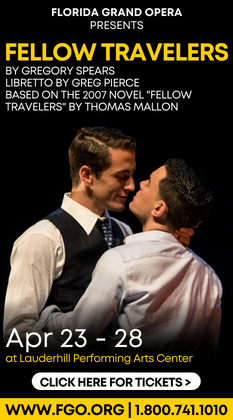
South Florida Classical Review » » FGO's compelling “Fellow Travelers” illuminates dark days of McCarthy era – South Florida Classical Review
By Lawrence Budmen
Andres Acosta (front) and Hadleigh Adams in Gregory Spears’ Fellow Travelers at Florida Grand Opera. Photo: Jorge Parra
Gregory Spears’ opera Fellow Travelers recalls one of the darkest eras of 20th-century American history. The witch-hunts of Senator Joseph McCarthy during the 1950’s encompassed both the Red and Lavender scares. In the latter, hundreds of gay State Department and government employees were hounded, persecuted and removed from their jobs as alleged “deviants” and security risks.
That is the historic backdrop for Spears’ work. Florida Grand Opera’s superb staging at the Lauderhill Performing Arts Center on Saturday night made for a compelling two hour musico-dramatic essay that pulsated with joy and sadness. The first-night audience awarded the cast and composer a prolonged standing ovation.
Based on a novel by Thomas Mallon, the tale tells of a forbidden relationship between State Department official Hawkins Fuller and former journalist Timothy Laughlin who works for Senator Potter (an ally of McCarthy). Fuller is a reckless bon vivant while Laughlin is devoutly Catholic and politically conservative. Their accidental meeting results in the two men becoming close and intimate. In the climate of fear while wishing to move on to his next conquest, Fuller eventually betrays his partner, reporting him to the FBI and ruining his ambitions for public service. Yet, instead of hating him as Fuller hopes, Laughlin is forgiving as he bids his onetime companion a farewell.
From the atmospheric opening bars, Spears paints this saga of love, political oppression and betrayal in elegantly crafted strokes. Minimalist figures calibrated with harmonic depth become expansive and lyrical in key emotional moments. Instrumental interludes between the sixteen scenes ring forth with an almost neo-Baroque sensibility. The ensemble in the Christmas party scene is masterfully constructed and arias and set pieces take potent wing while keeping the protagonists’ conflicted yearnings front and center. Ultimately Spears’ score resounds with potent drama and humanity, the final scene deeply moving.
Greg Pierce’s compact libretto avoids didactic ideological speeches while framing the characters’ desires, traumas and actions sympathetically. Pierce even manages to inject humor into the swirling political backdrop, the one-liners about McCarthy and his henchman counsel Roy Cohn drawing laughter from the first night audience.
FGO has given this saga a fast-paced, riveting production. Peter Rothstein’s fluid direction moves with the suspense and directness of gripping cinema. An intimate bedroom scene between the two lovers that could have been gratuitous is staged so tastefully that it seems a natural progression in their relationship. Columns dominate the stage in designer Sara Brown’s unit set from Minnesota Opera but Mary Shabatura’s lighting makes them look different for each scene, capturing the varied locales effectively. Trevor Brown’s dizzying array of period costumes match the drama’s milieu and undercurrents.
This opera depends heavily on the performances of the two male leads and Hadleigh Adams and Andres Acosta meet the vocal and dramatic demands triumphantly. Adams stepped in on short notice as Stanley Kowalski in FGO’s January production of Andre Previn’s A Streetcar Named Desire and it was astonishing how different his characterization was as Fuller. As Kowalski, Adams’ baritone boomed and he projected a larger-than-life stage persona. Almost like a method actor, he beamed Fuller’s cosmopolitan sophistication and snobbishness. Adams sang with subtlety, his clear diction inflecting the text with insinuating irony. In the aria “Our very own home,” his dark sound caressed and wove the long vocal lines as Hawkins resolves to end the relationship. Both Fuller’s tenderness and fickle heartlessness were encompassed in Adams’ portrayal.
Acosta was no less remarkable, his vibrant light tenor and scene stealing presence capturing Laughlin’s dilemma between his feelings of love and abiding faith. He made “How many kisses” into a compelling psychodrama as he confessed his sin after a night with Fuller but thanked God for bringing them together. In duo Acosta and Adams’ voices blended vociferously and their scenes together were marked by expressive volatility and sexual tension.
The other clear star of the uniformly excellent cast was Adelaide Boedecker as Mary Johnson, a colleague of Fuller at the State Department office and friend of Laughlin. Her soprano soared in the aria “I worry, that’s all,” a lyrical outpouring worthy of Carlisle Floyd. Boedecker’s spectacular high register rode the big ensemble number in the party episode and, when Mary realizes Fuller’s treachery, her rage and compassion for Laughlin turned tragic and powerful. This young singer is an artist with tremendous potential and one looks forward to her future performances.
Amanda Olea brought a bright soprano timbre and gossipy personality to Miss Lightfoot who reports Fuller to the FBI. In the absurd interrogation scene (in which Fuller’s walk is studied as evidence of possible deviance), Erik Danielson’s low bass register and haughty bearing commanded attention as the interrogating agent and he did double duty as a starchy Senator Potter.
Charles Calotta’s rapid-fire declamation personified the scheming Timothy McIntyre who is blackmailing the saintly Potter over his illegitimate child. Michael Pandolfo hectored appropriately as McCarthy but offered a softer baritonal side as Estonian Frank (who has a one-night fling with Mary, making her pregnant). Page Michels made the most out of the limited opportunities afforded Lucy, the office worker Fuller marries out of convenience. Christopher Humbert, Jr. impressed with firm low tones as Potter’s assistant and a French priest who ministers to Laughlin.
Emily Senturia conducted a taut, flowing reading of the score, making the 17-piece orchestra sound considerably fuller and richer beyond its numbers. She was especially effective at capturing the transparency and John Adams-like verve of Spears’ wind writing. Her balancing kept the voices forward while ensuring that orchestral detail remained clear and audible.
The Lauderhill hall is a fine venue with plenty of free parking—unlike downtown Miami or Miami Beach. Sight lines are clear and unimpeded and the acoustic flatters voices, bringing clarity to the English text.
Spears’ opera is an engaging, relevant addition to the 21st-century musical theater repertoire. Music lovers who care about the future of the art form should not miss one of the three remaining performances of this outstanding production.
Florida Grand Opera repeats Fellow Travelers 2 p.m. Sunday and 7:30 p.m. Tuesday and Thursday at the Lauderhill Performing Arts Center, 3800 NW 11th Place in Lauderhill. fgo.org
Posted in Performances
Sun Apr 24, 2022
at 12:21 pm
No Comments





Free Music-making Software Market Size 2022-2030| Key Players – Ableton, Adobe, Apple, Avid – Ripon College Days – Ripon College Days
As part of the Global economic outlook,this report illuminates current and future market scenarios for Free Music-making Software products to consider when planning business strategies. In addition, the manufacturer's pricing strategy is analyzed, raw materials and other costs are thoroughly analyzed. The regional assessment of the global Free Music-making Software products market includes a wide range of assessments of top markets such as North America,Europe,China,India and India. All of the segments,applications,products,or geographical categories are analyzed on the basis of important factors, that is, the number of them. Free Music-making Software products market share,consumption,revenue,volume, market size and average pa.
Get | Download Sample Copy with TOC, Graphs & List of Figures@ https://www.marketresearchintellect.com/download-sample/?rid=180616
In addition to a dashboard view of the vendor landscape and important company profiles,medical disposable market competition analysis provides an encyclopedic examination of the market structure. The company's stock analysis included in the study helps players improve their business tactics and compete well with key market participants in the medical disposable industry. The strength map prepared by our analysts allows you to get a quick view of the presence of several players in the global medical disposable market. The report also provides a footprint matrix of key players in the global medical disposable market. It dives deep into growth strategies,sales footprints,production footprints,product and application portfolios of prominent names in the medical disposable industry.
The major players covered in Free Music-making Software Markets:
Free Music-making Software Market Breakdown by Type:
Free Music-making Software Market breakdown by application:
As part of our quantitative analysis, we have provided regional market forecasts by type and application, market sales forecasts and estimates by type, application and region by 2030, and global sales and production forecasts and estimates for Free Music-making Software by 2030. For the qualitative analysis, we focused on political and regulatory scenarios, component benchmarking, technology landscape, important market topics as well as industry landscape and trends.
We have also focused on technological lead, profitability, company size, company valuation in relation to the industry and analysis of products and applications in relation to market growth and market share.
Get | Discount On The Purchase Of This Report @ https://www.marketresearchintellect.com/ask-for-discount/?rid=180616 Free Music-making Software Market Report Scope
Regional market analysis Free Music-making Software can be represented as follows: This part of the report assesses key regional and country-level markets on the basis of market size by type and application, key players, and market forecast.
The base of geography, the world market of Free Music-making Software has segmented as follows:
For More Information or Query or Customization Before Buying, Visit @ https://www.marketresearchintellect.com/product/global-free-music-making-software-market-size-forecast/
About Us: Market Research Intellect
Market Research Intellect provides syndicated and customized research reports to clients from various industries and organizations with the aim of delivering customized and in-depth research studies.
Our advanced analytical research solutions, custom consulting and in-depth data analysis cover a range of industries including Energy, Technology, Manufacturing and Construction, Chemicals and Materials, Food and Beverages. Etc
Our research studies help our clients to make superior data-driven decisions, understand market forecast, capitalize on future opportunities and optimize efficiency by working as their partner to deliver accurate and valuable information without compromise.
Having serviced over 5000+ clients, we have provided reliable market research services to more than 100 Global Fortune 500 companies such as Amazon, Dell, IBM, Shell, Exxon Mobil, General Electric, Siemens, Microsoft, Sony and Hitachi.
Contact us:
Mr. Edwyne Fernandes
US: +1 (650)-781-4080
UK: +44 (753)-715-0008
APAC: +61 (488)-85-9400
US Toll-Free: +1 (800)-782-1768
Website: –https://www.marketresearchintellect.com/
source
Baseball song changed this fan’s life – MassLive.com
Singer-songwriter Willy Welch of Egremont wrote the baseball song “Right Field” nearly 40 years ago. It was a hit for the folk trio Peter, Paul & Mary in 1987. (Photo by David Davis)
As the “boys of summer” return to Major League Baseball diamonds this month, singer-songwriter Willy Welch comes to mind.
Welch’s song “Right Field” isn’t about the stunning on-field acrobatics of Jackie Bradley Jr., who once again patrols the position for the Boston Red Sox. It is the story of an “awkward and slow” kid who does not question his fate. Always picked last for a team, he takes his place in right field, “watching the dandelions grow.”
It is a safe but boring position because, as the catchy and insightful lyric is phrased, “little leagues never have lefties that pull.” Caught daydreaming, the kid makes a game-saving catch and, for that moment, he is a star.
As a kid, Welch played right field, so he knows of what he sings.
Thirty-five years ago, Welch’s fortunes were altered when the folk group Peter, Paul & Mary recorded his song for their 1987 album “No Easy Walk to Freedom.”
“My life actually changed radically,” Welch said from his home in South Egremont. Songwriting royalties allowed Welch “to quit my day job and to have a downpayment on a house.” At the time, his day job involved “typing briefs and trying to write computer programs” for a law firm.
But he still worked, mostly in jobs that he found interesting and in which he could use his acting and singing talents. For a time, he delivered singing telegrams while dressed as a “good ol’ boy,” rooster, beaver, leprechaun, etc.,” and worked as a Starbucks barista for two years “when we needed medical insurance.”
“The biggest factor,” Welch said, “was when Peter, Paul & Mary performed (the song) at the Little League World Series. Little League was being sponsored by Pizza Hut that year. The ad agency heard the song and made it into a Clio-winning commercial.” The song was also released as a single, “so (it) got lots of attention.”
“Right Field” was also included on three other albums recorded by the folk trio between 1993 and 2011. Noel Paul Stookey – the Paul of Peter, Paul & Mary – has called Welch “a great songwriter with an engaging voice and masterful guitar playing but it’s Wily Welch’s authenticity of spirit that sells me; his music arrives in your heart with warmth, charm and gracious wit.”
Welch “wrote the song one afternoon in 1982 or ‘83.” He said he had no idea anyone would like it until he performed it at a New York City cafe in 1983. “I played it and the crowd went nuts,” he said; “You never know, really, it turns out.” He recorded the song in 1987; in performances today he refers to “Right Field” as a “medley of my hit.”
Welch grew up a Red Sox fan while his family was living in Natick. “The only tattoo I have is a Red Sox logo on my arm,” he said. When attending Boston University he lived near Fenway Park and recalls spending “many, many days and nights in the bleachers and had a sort of spiritual awakening about the beauty of baseball.”
Welch’s career as a singer began when he and boyhood friend William Finn performed “Sunrise, Sunset” for a women’s group at Temple Israel in Natick. It was an auspicious start: Finn went on to write the Tony Award-winning musical “Falsettos” and several other theater productions. Finn lives in Williamstown and is co-founder and artistic producer of the Musical Theatre Lab of Barrington Stage Company in Pittsfield.
Welch took his guitar and performed at Boston folk-music venues, then moved on to clubs in New York City. It was there he met and began to harmonize with the woman he calls “the golden-voiced Texan Wendy Jackson,” who is now his wife. “Wendy & Willy” recorded three albums of their songs and performed regularly at New York “clubs, camps, churches, old-folks homes, house concerts, neighborhood-association parties … you name it,” Welch said.
Welch also “penned three-dozen tunes” as a staff songwriter for the PBS children’s series “Barney & Friends.” Other Welch songs have been recorded by RSVP, David Roth, The Limeliters and Jason Alexander (George Costanza of “Seinfeld”).
“Somewhere in there,” Welch said, he and Wendy moved to the Dallas area where they spent three decades making music and “several amazing children.” He also concentrated on writing and performing children’s music and acted in musicals produced in Dallas, Fort Worth, New York and Oklahoma cities. He also acted in and was commissioned by the Dallas Shakespeare Festival to compose for the musical “Two Gentlemen of Verona.” His most-recent acting job in Texas was playing the part of the king at the Medieval Times dinner theater in Dallas.
Welch also won roles in several off-Broadway productions. He portrayed the father of singer Patti Page, performed with Tony-Award winner Lilias White in “Texas in Paris, " and did a two-person musical about the life of abolitionist Harriet Tubman. He said that production was featured in Dallas-Fort Worth schools “for about 20 years,” usually during Black History Month.
And he’s also a writer. Welch turned his baseball song into a children’s book, “Playing Right Field,” which was published by Scholastic. He also wrote “Grumpy Bunnies,” published the same year; “Dancing with Daddy” was published in 2009. When “Playing Right Field” became a book in 1995, Welch was sent on a national tour by the publisher, “playing at bookstores, reading conferences and schools … oh, and Major League Baseball parks.”
Willy and Wendy visited Massachusetts several times to reconnect with friends who relocated to the Berkshires. “I was sick of the heat in Texas and the kids were grown and gone, so” in the summer of 2019 they bought a farmhouse in South Egremont.
Why the Berkshires? “The short answer, basically, is old and deep friendships,” Welch said, adding that “Wendy fell in love with the area.” For him: “After 30 years in Texas, living in Western Massachusetts is a wild treat.”
These days, Wendy & Willy occasionally perform together but Wendy, Welch said, “has been mostly working as an actress and voice teacher.”
Welch now works as “Mister Willy,” a solo act, and is seeking venues at which to share his music and stories. “I’m always excited to travel wherever the music calls,” Welch said; “I’m available for gigs.”
Norm Roy, a retired copy editor for The Republican, lives in Florida and travels in an RV. He is eager to hear from readers about their own travel adventures. His e-mail address is: [email protected]
Note to readers: if you purchase something through one of our affiliate links we may earn a commission.
Registration on or use of this site constitutes acceptance of our User Agreement, Privacy Policy and Cookie Statement, and Your California Privacy Rights (User Agreement updated 1/1/21. Privacy Policy and Cookie Statement updated 5/1/2021).
Cookie Settings
© 2022 Advance Local Media LLC. All rights reserved (About Us).
The material on this site may not be reproduced, distributed, transmitted, cached or otherwise used, except with the prior written permission of Advance Local.
Community Rules apply to all content you upload or otherwise submit to this site. Ad Choices
Arif Mir: A self learned audio engineer – Rising Kashmir
From a few years, a collection of new songs released by various artists of Kashmir have not only won the hearts of audiences but has also contributed to the music sphere of Kashmir.
From North Kashmir’s Bandipora district, Arif Mir has been the audio engineer of many of these songs. 23 years old Arif of Rakhi Hajin, started audio engineering and fixing audio with his own songs when he was 17.
He has done the audio engineering for almost all the hit songs sung by the Kashmiri artists, which include Lolan, Jingle, MBA, One Side Up, One Side Downand and several other songs.
Having learnt all the audio mixing from YouTube, he considers AR Rehman as his greatest inspiration. “If I am a sound technician today, it is because of Rahman, sir. It was only after hearing his songs on cassettes that I developed an ear for sound.Every time I heard his sound, it was incredible and pulled me in towards this field, "he says.
The songs for which he has worked were also released on Zee Music, Aazadi Records, and local platforms.
‘Lolan’ was his first song, which gave him name and fame, and he spent nearly five years working on it.This song was written by his father, Ghulam Mohammed Mir, who runs a medical shop in Hajin Locality.
The song was produced by RJ Umar Nisar and Danish Tak. Both producers got in touch with the audio engineer after watching his videos on YouTube.
“They approached me to fix the audio in this song. Because audio is the only thing that is difficult and not everyone is capable of doing the same. Within a short time offinishing this project, the people’s response was overwhelming,” he said.
The huge response from people encouraged him and within no time, opportunities started finding the way to Arif.
“I am still spending the whole night preparing the music. And I am glad to learn this on my own because there was no one who could teach me music engineering. What I have learned so far, I have learned from YouTube, and I am continuously learning new and modern things,” he said.
Mir set up a makeshift studio in a single room on his home’s patio. He thinks the trust of the artists is the best thing that he has created. Despite not having any professional set-up or a degree in the field of audio engineering, the artists have been showing faith in his work.
“Some artists gave me their album the moment I put up a temporary studio. It was Down Town – the first hit record I created in the studio. When musicians heard the recordings, they began requesting me to record their music,” he said.
He has done his schooling in his home town of – Hajin and later moved to Srinagar, where he is pursuing a Bachelor in Computer Applications (BCA) from Cluster University. Apart from possessing skills of audio engineering, he has been principal Tabla player.
“I didn’t study Tabla and Piano instead, I followed my love. My passion was the only thing that kept me going. I didn’t resist what creativity was putting me into, even though I wanted to get into music composition," he explains.
Talking about the common notion of getting a government job to earn livelihood, he said, “In Kashmir, people are running after government jobs, and no one is willing to identify their creative side and try to make their livelihood in other ways.”
For most people, making a career in the world of music is still alien. Arif had to face the same resentment initially from the people around but he believed that with passion and hardwork, one can create a space and earn his livelihood.
“When I first started doing audio engineering, some people told me that I was wasting my time but God had a better plan for me. By doing this work, I am earning a handsome amount. And I am pretty hopeful that the more time I devote to it, the more I will earn,” he said.
Currently, he receives full support from his family and is learning new skills to make himself better which will further advance him in his career.
He said, “All I need to do now is invest time in learning new skills. I have worked hard on these songs. It took me weeks to complete the projects. At present, I am not facing any issues with my work.”
Having high faith that one day his struggles and hardwork will pay off and he will get an opportunity to work with the top music organizations in the country, he said “When I started this audio engineering, I didn’t know the ABC of this, but I was dedicated towards this thing that I would become a reputed audio engineer in the future.”
In the realm of audio engineering, there are five specialized roles: recording engineer, mixing engineer, mastering engineer, live sound engineer, and multimedia sound engineer. Each has a distinct function to play in the music industry, and the path to each career is distinct as well.
He believes there are thousands of opportunities available in the market and one can earn his livelihood easily, but needs dedication and patience.
“Parents spend a huge amount of money on their children’s education and to make them doctors and engineers but there are very few people who think beyond these professions,” he said.
Talking about music production, he said that audio engineers play a crucial role. A work in audio engineering impacts each part of the music industry, from capturing live sound to mixing music recordings to managing the technical aspects of audio equipment.
“A music producer’s major duty is to provide artistic direction for a recording session, but an audio engineer’s role is substantially different. Audio engineers can also be producers, but they must first grasp the principles of audio creation,” he said.
While concluding he said, “In every field, people are facing problems, and most of them give up early, which is not good. If people will give everything to their passion, they will get good results sooner or later.
Pearland High thrilled at 7 Tune nods for ‘Leader of the Pack’ – Houston Chronicle
Cast members of Pearland High School’s production of “Leader of the Pack: The Ellie Greenwich Musical” are excited at their show getting nominations in seven categories in the Tommy Tune Awards including outstanding musical.
Crew members for Pearland High School’s “Leader of the Pack” worked a show that has won seven 2022 Tommy Tune Awards nominations including for outstanding musical. The set for the PHS production featured rectangular patterns and three staircases that were rounded to form the shape of a vinyl record.
Pearland High School senior Shelby Garrett is nominated in the Tommy Tune Awards for outstanding performance in a lead role for her part as Ellie Greenwich in the school’s production of “Leader of the Pack: The Ellie Greenwich Musical.”
Pearland High School student Granger Lusk is nominated in the Tommy Tune Awards for outstanding performance in a supporting role for his part as Gus Sharkey in the school’s production of “Leader of the Pack: The Ellie Greenwich Musical.”
Students and teachers at Pearland High School share nominations in seven categories of the 2022 Tommy Tune Awards, including outstanding musical, for Pearland Theatre’s production of “Leader of the Pack: The Ellie Greenwich Musical,” which was performed in January.
“Outstanding musical — oh my gosh, I almost teared up on that one,” said PHS head theater director David Barker.
The Tommy Tunes are an annual program of Theatre Under the Stars (TUTS) and recognize excellence in high school musical theater productions throughout the greater Houston area.
Winners in all 13 categories will be announced during a Tony Awards-style ceremony that will be streamed live beginning at 7 p.m. May 27. It will be available for viewing on the TUTS Facebook page and YouTube channel.
As the technical theater director at PHS, Barker worked with seniors Simeon Love and Granger Lusk on designing the show’s set, and he supervised Love, Lusk and sophomore Daniella Fink on lighting the musical.
The production also scored Tommy Tune nods for outstanding performance in a lead role (senior Shelby Garrett as Ellie Greenwich), outstanding performance in a supporting role (Lusk as Gus Sharkey, whose character was based on music producer Phil Spector), outstanding music director (PHS head choir director Michael Kessler) and outstanding director (PHS assistant theater director Cheramie Hopper).
Seniors who participate in Tommy Tune entries can apply for college scholarships from TUTS that will be announced at the ceremony.
Love plans to seek a degree in live entertainment technology at Lone Star College, while Lusk recently received his acceptance from the theater department at the University of Oklahoma, said Barker.
“Leader of the Pack” was a pioneer in jukebox musicals when it debuted on Broadway in 1985. It employs many popular songs from the 1950s and ’60s, including “Be My Baby,” “Chapel of Love” and “Da Do Ron Ron,” to trace the personal and professional life of singer/songwriter Ellie Greenwich.
The set for the PHS production featured rectangular patterns and three staircases that were rounded to form the shape of a vinyl record.
The lighting designers assigned a color to each prominent character, and that color followed the character “throughout the whole play,” said Barker.
As nominated performers, Garrett and Lusk are taping performances that will be shown during the streaming of the Tommy Tunes, and a musical number from “Leader of the Pack,” which was filmed during the show’s run, will be showcased as one of the nine nominees for outstanding musical, from a total of 42 entries presented during the 2021-2022 school year.
The other finalists are “SpongeBob, The Musical” from Clear Springs High School, “Sweeney Todd, School Edition” (Bridgeland High School), “Pippin” (Cypress Ranch High School), “Newsies” (Houston Christian High School), “Anastasia” (Kingwood High School), “Seussical” (Obra D. Tompkins High School), “Legally Blonde” (Stratford High School) and “Carrie” (The Kinkaid School).
Don Maines is a freelance writer who can be reached at [email protected]
Sanger ISD Challenge Program kids are the so-called worst of the worst behaved. And it’s here that they find a home. A place where they are listened to and respected.
BWW Review: Dallas Theater Center's THE SOUND OF MUSIC Modernizes a Beloved Classic – Broadway World
 You know that feeling of sitting on your couch after a long day of work, or taking your first sip of coffee from your favorite roastery, or feeling a ray of sunshine touch your face on the first warm day of spring? That feeling-that desirable, delightful feeling-is how I felt when hearing that Dallas Theater Center would be producing The Sound of Music. Not only are they recreating a story that is well-known and incredibly loved, but they are doing so with a multicultural cast, reflecting the true makeup of our Dallas community. Dallas Theater Center has done it again and delivered a few of my favorite things: a beautiful set, a skilled cast, and a magical evening at Wyly Theatre.
The performance began in an ominous way, a man standing and smoking a cigarette in an elevated window and multiple nuns standing in the shadows. It didn’t take long until we were transported to a funeral where a grieving man was struggling to interact with his children. This brief, yet heartbreaking moment forced the audience to witness and take part in the vulnerability in the show, asking us to open our hearts to the characters, their losses, and eventually their triumphs. Despite the dim, emotional beginning, our attention was quickly redirected to the bright, colorful canvas, painted by Laurence Boyles, that acted as the floor for the performance. As nuns began to sing upbeat tunes, they danced atop the gorgeous hills and sky that were painted below their feet. This was a unique way to present the hills as a backdrop for the musical; I thought it was brilliant and beautiful, and it constantly reminded me that regardless of the hardships these characters were facing, they were still among those joyous hills.
Something I admired about the performance space, designed by Beowulf Boritt, was its simple beauty. The artistic flooring, gorgeous stained-glass window, and the use of only a few scenic properties lent themselves to the actors’ abilities. This became apparent in the first solo scene, when Maria, in this performance brilliantly played by Arianna Hardaway, was singing “The Sound of Music” in the abbey. The air in the theater changed as soon as she started singing; we were all immediately invested in this song that we all so desperately wanted to hear, and it felt like we were taking part in an intimate moment between Maria and her beloved hills. This was the first of many fan-favorite musical numbers, and thanks to the hard work of Music Director Samuel Bagala and Twi McCallum‘s sound design, not one of them fell short of perfection. As soon as Hardaway finished singing this song, we knew that we were on the outside of a fishbowl, watching these characters and learning their beliefs, struggles, hopes, and desires.
What made this fishbowl setup clear and believable was the acting. The presence of the cast members, their reactions to nonexistent furniture, and their convincing gazes beyond the audience were what truly developed the setting of each scene. Because of their believable acting, my brain was constantly filling the stage with the furniture they were dancing around. It was incredible! There were some props throughout the performance, like pillows, a beautiful rose bouquet, glassware, and eventually a flashlight, all of which contributed to our understanding of meaningful events. Although the supplemental props were helpful, the acting and beauty of the set itself were enough to know exactly when an event was occurring and where the characters were in each scene. There was one significant moment when Maria stood upstage, centered between Captain Georg von Trapp and Elsa Schraeder, who were standing opposite one another downstage. The powerful emotion of this moment was tangible, and the intentional spacing of the actors spanned across the entire stage; it was a perfect example of intentional staging.
Dallas Theater Center did a spectacular job casting for this production. We had the privilege of watching Arianna Hardaway, Understudy for Maria, play this famous, feel-good role, and she was nothing short of a leading actress. Her grace and kindness shone through her soft yet passionate voice and nurturing actions. The way she interacted with the children felt completely authentic. The von Trapp children themselves were a joy to watch. In their debut on stage, they lined up like soldiers, but as soon as their father left the room, they instantly snapped back into their true personalities; it was both adorable and amusing. All of these cast members-Christina Austin Lopez as Liesl, Wyatt Hartz as Friedrich, Mckenzy Dodson as Louisa, Patrick Bilbow as Kurt, Sophie Rose Kirkham as Brigitta, Kenzie Rees as Marta, Understudy Jaelle Duff as Gretl-did wonderful jobs acting individually as children and siblings while simultaneously contributing to how we understood the dynamics of the family as a whole.
Let’s be honest, The Sound of Music would still be fun and entertaining if it solely told the story of Maria and the children, but every other character adds to the nuance of the story, which was especially true in DTC’s production. There is a common archetype of the funny or occasionally mischievous nun, and sometimes this archetype can be overplayed; that was not the case in this performance. The nuns were the perfect balance of religious leaders, caregivers, motherly advice providers, and friends. Their voices were harmonious and heavenly. I truly felt like I could’ve been in church when they sang in unison. However, Angela Turner Wilson, portraying The Mother Abbess, had a voice that shook the theater at the end of Act I. We could feel the power in her voice as she sang “Climb Ev’ry Mountain” at the end of Act I. The light was hitting her just right, as designed by Jason Lyons, and just as the music stopped and her crescendo reached its peak, she lifted her arms one inch higher and the lights shut off. It was electric.
The nuns may have had the most heavenly voices, but they weren’t the only caregivers; the von Trapp family had a butler and housekeeper who were helpful and hilarious throughout the entire performance. Bob Hess, playing the butler, Franz, and Sally Nystuen Vahle, playing the housekeeper, Frau Schmidt, had clear chemistry when on stage together. Their characters ran the house like clockwork while engaging in plenty of friendly banter; they were a joy to watch, and they often offered a brief moment of hilarity in the midst of emotional moments.
Paolo Montalban perfectly played the esteemed Captain Georg von Trapp, starting as a grieving father who runs his home like a Navy ship and later shedding his demanding whistle and trading it for tenderness. Montalban’s performance felt vulnerable and honest, solidifying why he was chosen for this role. Although we all could feel the love building between Captain von Trapp and Maria, I couldn’t help but get excited when Captain von Trapp’s short-lived girlfriend was on stage. Sarah Gay played the poised, sometimes pompous Elsa Schraeder, and she was incredibly fun to watch. Gay did a fabulous job being, well, fabulous! Her character fit into the story similarly to Captain Georg von Trapp’s buddy, Max Detweller, charmingly played by Alex Organ. Both characters appreciated the von Trapp family but also had motives to serve themselves. Gay and Organ effectively revealed the nuances of friendships during these times, belieavably portraying moments of lighthearted teasing, professional triumphs, political differences, and making sacrifies to protect one another.
The historical context of this tale is intertwined in the action but doesn’t become the focus until Act II. Multiple characters-Brian Mathis as the ruthless Lieutenant, Oscar Seung as the demanding Admiral von Schreiber, and Lance Jewett as Rolf Gruber, a neighborhood boy who later returns in Nazi garb and warns Leisl, played by the always impressive Christina Austin Lopez, to leave before it’s too late-make appearances and signify the arrival of the Nazis in Austria. Thinking back to watching this movie as a young girl, I was so in love with the music, I didn’t internalize the horrific events that were creeping closer and closer to the von Trapp family, eventually landing on their doorstep and trying to take them away. The skilled acting of the cast allowed the mood to shift back and forth between happy and grim, and Alejo Vietti‘s costume design made it that much easier for the audience to grasp an understanding of that mood. The various outfits of the von Trapp children, from uniforms to beautiful matching sets, demonstrated the father’s military background and the family’s wealth. Elsa Schraeder’s elegant outfits showed the audience her priorities and economic status based on her professional success. When Rolf Gruber traded his street clothing for a Nazi uniform, he shocked the audience and confronted us with the truth that almost anyone could have been on the wrong side of history. All of these costume decisions contributed to our understanding of the characters and the historical and social contexts they were operating within.
An artistic, unique break from the plot were the dancing numbers that appeared throughout the performance. There were multiple moments when characters were dancing to the music without speaking or singing. I was mesmerized each time this occurred. In these moments, the choreography was telling the story; there was no need for words. Choreographer Bridget L. Moore did a fantastic job crafting the movements to keep the action of the production moving forward without the use of verbal messages.
I’m sure the feeling of directing such a beloved production can come with a lot of pressure, but Kevin Moriarty was incredibly successful. The casting alone modernized this story that has been told over and over again, making it accessible and recognizable to our Dallas community. Dallas Theater Center repeatedly does an impeccable job producing shows that are entertaining and meaningful. Whether the show is an original or a modernized classic, you can always count on Dallas Theater Center to deliver an incredible performance. Liz Mikel once labeled Dallas Theater Center as “Broadway caliber theater in your hometown,” and after watching this cast reimagine the songs and story of The Sound of Music, I couldn’t agree more.
Wyly Theatre March 26-April 24. Purchase tickets through the Dallas Theater Center website. Run time: 2 hours and 45 minutes including one 10-minute intermission. To learn more about the amazing talent behind the scenes, read the digital playbill here.
Photo Credit: Karen Almond
Actors & Production Team Members Wanted For THE HUNCHBACK OF NOTRE DAME & A DOLL’S HOUSE at the Wallace
BWW Review: МАРНІ ТРОЯНДИ (FUTILE ROSES) Bears Witness to War
SIX, TOOTSIE & More Announced for 2022/23 Broadway at the Center Series
Tickets for FROZEN National Tour at the Music Hall at Fair Park to Go On Sale Tomorrow
Hot stories


Photos: Get A First Look At SIX on Tour
Photos: First Look At MOULIN ROUGE! on Tour
BWW Review: STEDE BONNET: A F*CKING PIRATE MUSICAL Steals the Show with Silliness and Sorrow
BWW Review: Dallas Theater Center’s THE SOUND OF MUSIC Modernizes a Beloved Classic
BroadwayWorld TV
News + special offers for Broadway Shows
Dallas SHOWS
Recommended for You
Get Dallas News
Follow Us
BWW Sister Sites
Apps
Medici XD, production studio founded by animatronics theme-park and multimedia veterans, announces headquarters in Nashville – Nashville Business Journal – The Business Journals
A production company co-founded by a Nashville veteran of the animatronics industry is making Music City its corporate headquarters.
Executives of Medici XD will detail their plans at a Monday event at that new headquarters, 2200 Eighth Ave. S. Medici XD will create 30 jobs, according to a media advisory for the 1 p.m. event.
Nashville has had a notable “creative class” for a number of years, stemming primarily from the music and tech industries. Medici XD now joins a crop of new arrivals, including this video game developer, that are adding variety to the kinds of entertainment and tech jobs in the area.
The LinkedIn page for Medici XD describes the business as “an integrated software, ride manufacturing, and media production group able to develop venue concepts across physical, visual, and interactive disciplines, making a unified live experience that captivates an audience.”
Its co-founder and chairman, Chuck Fawcett, is a well-known figure in animatronics as a result of the profile he achieved with Nashville’s Animax Designs Inc.
Fawcett started the company in 1989, during his senior year at Vanderbilt University. Thirty years later, Animax employed more than 150 people designing and making elaborate animatronic figures and puppets for many of the world’s largest theme-park, entertainment and film companies — such as The Walt Disney Co. (NYSE: DIS), Nickelodeon, DreamWorks, Warner Bros., Sesame Workshop, Nintendo and SeaWorld Parks and Entertainment.
At the start of 2020, Fawcett sold Animax to another customer, Singapore-based Cityneon Holdings, for about $37 million, according to PitchBook and Mergerstat. Animax remains operational today.
“It is now time for me to build something new and bigger,” Fawcett said in a late-2021 press release announcing the Medici XD venture.
Medici XD’s existing office in Los Angeles will remain open, a company spokesman said. The Nashville headquarters will house all executives as well as engineers, designers, finance, accounting, and human resources, as well as research and development jobs.
Fawcett founded Medici XD with Daren Ulmer, who spent a decade at Disney and then started his own media design and production studio, Mousetrappe.
Meet our 2022 40 Under 40 honorees!
© 2022 American City Business Journals. All rights reserved. Use of and/or registration on any portion of this site constitutes acceptance of our User Agreement (updated 1/1/21) and Privacy Policy and Cookie Statement (updated 7/20/21). The material on this site may not be reproduced, distributed, transmitted, cached or otherwise used, except with the prior written permission of American City Business Journals.