The Hit Academy Asia will offer a six-week course for both aspiring and established musicians
Singaporean singer-songwriter Charlie Lim has partnered with UK musician/producer Sister Bliss of Faithless fame and music publishing company Prolific Songs and Tileyard Education to launch The Hit Academy Asia.
The Hit Academy Asia is set to be an international songwriter and music production programme for both emerging and established musicians alike and will launch in August this year.
The Hit Academy Asia will offer weekly online songwriting, production and business classes as well as “one to one” music industry mentoring. There will also be an in-person, three-day “songwriting camp” at Singapore’s Noivil Studios.
The six-week course will also cover subjects such as “vocal development”, “writing to brief”, “the A&R process”, “image branding” and “resilience and personal creative development”.
The total cost of the course is priced at SGD $5,888, which gives students access to all class materials, live interactive classes, workshops, tutorials, mentoring, A&R surgeries and the aforementioned songwriting camp.
In a press statement, Lim shared: “I’m excited and grateful to be part of Hit Academy Asia, which has put together a great team and a grounded, practical curriculum that I wish was available when I was starting out in my career!”
“Am really looking forward to help contribute where I can and help budding artists find their voice in the process.”
Interested participants can sign up for the course here.
Earlier this month, Lim released the single ‘Trade My Heart’ with Singaporean R&B artist KEYANA. The track was released via The Great Wave, a DAO (decentralised autonomous organisation) made by Lim to help artists in navigating the Web3 space.
Speaking about the track, he said: “We want to help fund projects, incentivise collaboration and build a more flexible, sustainable and transparent model for artists and our fans – where having a stake in the collective means sharing in its success together”.
The world’s defining voice in music and pop culture: breaking what’s new and what’s next since 1952.
When you purchase through links on our site, we may earn an affiliate commission.
© 2022 NME is part of NME Networks.
Charlie Lim and Faithless' Sister Bliss launch online music programme, The Hit Academy Asia – NME
Who is the richest BTS member and what is their net worth? – Lifestyle Asia Bangkok
In May 2019, BTS, short for Bangtan Boys, became the world’s biggest boy band. A CNN report noted the similarities between the Korean pop group and the English rock boy band The Beatles when the latter debuted on US television in 1964. BTS, too, appeared on The Late Show With Stephen Colbert sporting slim-fit suits and bowl-cut hairstyles, which, however, was intentional.
Today, the seven-member Korean pop group, comprising JungKook, V, Jimin, Suga, J-Hope, Jin and RM, are reigning on Billboard charts, has been performing worldwide and even has a fanbase who identifies themselves as the A.R.M.Y.
The band debuted in 2013 under the South Korean entertainment label HYBE (formerly Big Hit Entertainment) and has multiple hits, like “Butter” and “Dynamite,” to their name. In 2019, BTS ranked number 4 on the list of ‘25 Most Influential People On The Internet’ by Time magazine.
This further vocalised the group’s success in the global entertainment industry. Owing to their international fame, the Seoul band became the global brand ambassador for Louis Vuitton in 2021. Its members have also fronted other renowned names in the world of fashion, technology and Formula E.
However, doesn’t all this make you wonder what could be the net worth of the South Korean boy band who has also performed at the United Nations and are UNICEF supporters?
According to a 2020 Forbes report, all accolades, performances, royalties, world tours and ads earned by BTS add up to a combined net worth of USD 50 million.
Apart from their 68,385 shares of the talent agency stocks, BTS makes a sizable amount of revenue from album sales (digital and physical), world tours, streams, merchandise and commercials.
With Map of the Soul: 7 (2020), BTS also set a record for the best-selling album in South Korea, selling over 4,440,800 copies as of March 2021. They have also dominated the global charts for music and have two Grammy nominations for Best Pop Duo/Group Performance (2022) and Best Pop Duo/Group Performance (2021). The boy band became the first Asian act to win the Artist of the Year award at the American Music Awards 2021 and performed alongside British rock band Coldplay.
However, in June 2022, BTS announced they will be pursuing their respective solo careers while rejecting claims of going on a hiatus or splitting up. This only means that individual members’ net worth is going to rise.
Jung Ho-seok, better known by his stage name J-Hope, is currently the richest BTS member, whose net worth is estimated at around USD 26 million, according to reports.
The K-pop idol has amassed his wealth through BTS music production, album sales and songwriting. The group’s main dancer is also a soloist with several records written to his name. In 2018, he released his first solo mixtape, “Hope World”.
Apart from music production, J-Hope has been featured in many commercials with national and international brands, such as PUMA’s Blaze of Glory (BOG) Sock sneaker campaign, LG and Samsung.
The group’s lead rapper was involved in music production before joining BTS. He has worked with many international artists, such as Halsey for “SUGA’s Interlude” in 2019, and participated in solo projects with his alias Agust D.
Being the second-richest BTS member, Suga has an estimated net worth of around USD 25 million, as per reports. The rapper has written and produced over 70 songs for BTS, IU, Psy and other musicians. He has collaborated with Korean artists like Heize, Epik High and Reflow as well.
Suga’s earliest collaborations with international musicians are Halsey, Juice WRLD and ØMI. Other than music, he is the face of Korean brands like FILA, Samsung, Hyundai and LG.
Born Kim Namjoon, RM (Rap Monster) is the frontman, songwriter and rapper in the boy band. He produces his solo music as well. According to the South China Morning Post, RM has been credited with over 170 songs, including the 2021 BTS hit “Butter,” of which he is the co-writer.
He has worked with musicians such as American rapper Warren G for the 2015 hit single “P.D.D” and the South Korean hip hop group MFBTY for the 2015 song “Buckubucku”.
Besides royalties, stocks and solo music projects, RM has appeared in ads for multinational businesses like the Florida-based K’hawah Coffee and travel retail company Lotte Duty Free.
RM’s net worth is estimated to be around USD 22 million.
Park Ji-min, popular as Jimin of BTS, is the group’s lead vocalist and dancer. The heartthrob has many records to his name, including the singles “Filter,” “Lie” and “Promise,” and he is one of the group’s most sought-after members.
With his fashion sense and melodic voice, Jimin has created a separate fanbase for himself in the A.R.M.Y.
Reports suggest that his net worth is estimated at USD 20 million, including his share in HYBE stocks, apartments in the prestigious Nine One Hannam complex in Seoul, and royalties from BTS music as well as solo projects.
Jimin also receives his due from advertising revenue, as he has worked with companies such as FILA, Coway and Samsung.
The group’s maknae (Korean for the ‘youngest person in a group’) is among the most searched members of BTS alongside V. Recently, he collaborated with American singer-record producer Charlie Puth for “Left And Right”.
According to the South China Morning Post, the multi-talented South Korean celebrity has a net worth of USD 20 million. Jungkook has co-produced BTS music and has been involved in making hit songs like “Love is Not Over” and “Magic Shop.”
The group’s main vocalist has also appeared in South Korean TV shows like Flower Crew (2016) and Celebrity Bromance (2016).
Kim Taehyung is the second-youngest member and songwriter of BTS. A Times Now report stated that V holds the record for being the most searched Asian celebrity on Google for the first half of 2022.
Like all the members, V also owns shares in HYBE and has a diverse portfolio spanning acting, dancing, modelling and playback singing.
The BTS member has several accolades to his name. He has released solo music projects, such as “Singularity,” “Sweet Night” and “Winter Bear”, and starred in the 2016 period drama Hwarang: The Poet Warrior Youth.
According to South China Morning Post, V’s net worth is estimated to be around USD 20 million.
The boy band’s oldest member, Kim Seok-jin, aka Jin, has made his fortune through business projects and music.
South China Morning Post reported that the K-pop idol started his Japanese restaurant venture alongside his brother in 2018 and owns several buildings and apartments in Seoul, South Korea.
Jin is also active as a soloist with “Awake”, “Epiphany” and “Tonight.” His net worth is reported to be approximately USD 20 million, and he hails from a wealthy family. He also owns HYBE shares and receives royalties from song credits.
(Net worth of the richest BTS members as of June 2022.)
(Hero Image and Featured Image Credit: BTS_official/Twitter)
Yes, I agree to the Privacy Policy
Follow our daily snapshots at @lifestyleasiabk
Yes, I agree to the Privacy Policy
Subscribe to our newsletter to get the latest updates.
Thank you for your subscription.
Dopestiks duets Bella Shmurda on Chop Life The Nation Newspaper – The Nation Newspaper
 Nigeria news – Nigeria's breaking news website
Andrew Kabo aka Dopesticks is billed to release his duet with Bella Shmurda entitled ‘Chop Life’ on July 15.
The name, Andrew Kabo may not readily ring a bell in the general entertainment world but in the professional music circle, Kabo’s stage name, Dopestiks raises eyebrows as long as music production is concerned.
His odyssey in his musical journey began in his second grade in high school in Ibadan when he transmuted his dream into fruition when with the help of Youtube tutorials, he learned music production between the years 2013 and 2015.
Odunlade Adekola kneels with awestruck fan
How to know a focused man, by Alexx Ekubo
Those without PVCs part of Nigeria problem – Kanayo O…
Armed with his skill, Dopestics hit Lagos in 2016 and professionally started music production with the likes of Zinoleesky, Mohbad, Oladips, Zlatan, Bella Shmurda among many others.
In 2020, his hard work got critical attention as his biggest hit, Cashapp by Bella Shmurda got him nominated for several awards like BeatsAwards, among others.
In 2021, he landed a record deal with Ftune Records UK and since then, he has been recording his songs.
Prev Post
Strengthening the food system
Next Post
Ibereko youths hold peace parley
This website uses cookies to improve your experience. We’ll assume you’re ok with this, but you can opt-out if you wish. Accept Read More
Is Apple Really Making a Car? Or is CarPlay the Future of Every Vehicle? – InvestorsObserver
An Apple Car has been rumored for many years with recent updates announced for CarPlay last month during the 2022 Apple Worldwide Developers Conference reigniting rumors for a full-fledged vehicle from Apple. However, the updates coming to CarPlay point to it becoming an operating system in vehicles that could negate any need for Apple (AAPL) to design its own vehicle.
What is the New CarPlay?
The new Apple CarPlay is designed to act as a full dashboard in new vehicles that wouldn’t just display music, maps, and phone information but would also include the speedometer, odometer, tire pressure, fuel level, and other fundamental features that are usually designed by the original automotive manufacturer. This would help provide a seamless design completely made by Apple that would result in one ecosystem being used.
Most importantly, perhaps the single best advantage that Apple provides over competitors in all of its fields is user interface and design that cleanly displays important information to its consumers. Apple users will often cite how devices communicate with each other with seamless integration as one of the strongest selling points such as iMessage carrying messages between a Macbook, iPad, and iPhone.
So if Apple CarPlay takes up the entire user interface of the vehicle and is used for interacting with pretty much anything from navigation to air conditioning, why bother designing the rest of the car?
Will There Be an Apple Car?
Automotive manufacturers don’t make their money selling base vehicles but instead the majority of profits come from the top-line models, parts, and services. There is very little incentive or reason for Apple to get in the car game and try to make their own vehicle or own branded car that is manufactured from another company such as Hyundai or Nissan. Some kind of licensing and branding deal could work but are there really that many people that want to buy an Apple Car? Would Apple try to reach all the various niches of the car market? Apple SUV? Apple pickup truck? Apple minivan?
The real value comes in an optional tech package that could be added to any new vehicle from all automotive manufacturers. Plenty of consumers would likely opt for a tech package that comes with an Apple-designed dashboard where people wouldn’t even need their phones to use Apple Maps or Music in the car. Apple should want as many people using its CarPlay as possible to continue building its ecosystem and giving additional advantages to joining the Apple family. Apple’s core business is its technology hardware and software that CarPlay would almost act as another marketing piece to be on Apple’s software. Making CarPlay exclusive to select vehicles wouldn’t go along with this business model and would force Apple to compete with established auto-brand loyalties from many drivers.
Apple doesn’t need to produce the tires or engine of a vehicle, it just needs people to use Apple software to interact with the car.
Who Wins with Advanced CarPlay?
Apple having CarPlay installed in millions of vehicles is a clear win for the company but it could also strongly benefit automotive companies that wouldn’t have to worry about software in their cars anymore. Dashboard designs are an expensive piece for many manufacturers that could be cut if they opted to use CarPlay instead. Also, frankly most user interfaces designed by automotive companies are lacking and there is a good reason why most people use Apple or Google Maps for navigation instead of whatever is installed in their vehicle. Apple will design a far cleaner experience than most offer, leaving the focus back on the physical production of cars.
In the bigger picture, the more important development from CarPlay could be increased data collection by Apple. Now the tech company could track where people go to and from without even needing users to have their phone on them. Average speed, time of driving, and styles of driving could be collected and used for many good (and bad) reasons.
Data collection is becoming increasingly scary to many people as these big companies know almost everything about its users and can use that against them. Without further regulation though, it will continue to be collected and be very profitable for big tech. This kind of data could be especially relevant to insurance companies looking to track driving trends and change quotes based on performance that is calculated and not just assumed by age, gender, location, and other variables.
Wrapping Up
Large updates to Apple CarPlay will further enhance the driving experience for millions of people that use Apple products while also possibly negating the need for any Apple Car in the future. It’s a potentially positive advancement in many ways that could even lead to increased safety and improved self-driving technology with advanced data collection. However, the technology could come at a cost that isn’t immediately seen in dollars and cents.
Subscribe to our daily morning update newsletter and never miss out on the need-to-know market news, movements, and more.
Thank you for signing up! You’re all set to receive the Morning Update newsletter
Stock Price data may be delayed up to 15 minutes.
Copyright © 2022. Portions of this content may be copyrighted by Fresh Brewed Media, Investors Observer, and/or O2 Media LLC. All Rights Reserved. Portions of this content protected by US Patent numbers 7,865,496, 7,856,390, and 7,716,116. Investing in stocks, bonds, option and other financial instruments involve risks and may not be suitable for everyone. Portfolio results are unaudited and based on varying investment expiration dates. Terms of Service | Privacy Policy
Journey of The Beats Ep 3: 2000s The Era of Hip-Hop – Nigerian Entertainment Today
Join Netng Connect
BEST OF AFRICAN ENTERTAINMENT, POP CULTURE NEWS AND UPDATES DELIVERED RIGHT TO YOUR INBOX
© 2021. All rights reserved. Reproduction in whole or in part is strictly prohibited. Netng is a registered trademark of Info Digital Africa Limited.
No account yet? Register
Coming off the heels of the 90s Nigerian music scene dominated by Juju, Fuji, Afrobeat, and Reggae, the Nigerian music scene in the early 2000s was invaded by Hip hop. The genre didn’t only dominate the Nigerian music scene, it also brought along its culture including break-dancing, graffiti, fashion, dj-ing, dance steps, and “attitude”.
It was a whole lifestyle and the third episode of Showmax’s Journey of the Beats explores the “Hip-Hop” decade/era. Supported by a Spotify playlist containing hit songs from the decade, here are five interesting things learnt from the third episode of Journey of The Beats.
The early men of Hip Hop or the “millennia men” as they were called, expressed themselves through the genre. Their medallions, fashion, samples, and song lyrics reflected their personalities. The artists infused their Africanness as their songs reflected their background, stories, and current situation, adding the African quality to the genre.
While it was a form of expression for them, it was also a form of voice for the artists. The genre served as a form of voice to tackle societal and political issues. They passed their messages to one another and the audience through the songs’ lyrics and tone.
Technology has always been a big part of the evolution of music and its advancement has helped ease music production through software.
While some musical experts argue that the technology’s advancement has watered down music quality over the years, it was a saviour in the Hip-hop era. It helped artists in the early 2000s simplify the workflow and capture organic sounds with better microphones, mixing consoles, and smaller and portable units.
Born 45 years ago with the commemoration of the Second World Black and African Festival of Arts tagged FESTAC’77, it’s no surprise that Festac birthed the most prominent artists of the 2000s decade with its musical history. Legends such as Black Tribe, Hazardous, W4, and most notably The Plantashun Boiz and the late Sound Sultan ruled the Nigerian music scene – and continue to.
Lagos is the largest black city in the world and while the do-or-die attitude helped the city boys boost the game, there were the underdogs who came out of Abuja. The capital city birthed some of the biggest hits and acts of the millennium namely Six Foot Plus, Mode 9, Terry The Rapman, SoloDee, and Brooklyn.
The Journey of The Beats explores many rich and different facets of the Afrobeats genre, and the story continues in the next episode of Journey of The Beats dropping on Thursday 14, July 2022. Visit www.showmax.com and subscribe for as low as #1,200. You can also follow the conversation with the hashtag #JOTBShowmax on social media.
Your email address will not be published.

Input your search keywords and press Enter.
NW Arkansas Jobs – Axios
Hiring? We can spread the word.
Morning Show Producer
Westwood One
Area Supervisor
Ross Stores, Inc
Team Lead
HFA
Omni Marketing Media Manager
Kuerig Dr. Pepper
Broadcast Producer
University of Arkansas
Front of House Manager (Hospitality Manager)
Topgolf
Creative Services Producer
Nexstar Media Group, Inc.
FT-Fulfillment Associate-Day
Lowe's
Project Coordinator
BIC
Contact us with any questions.
Check out Terms and Conditions for more information.
Talent House opens in east London to nurture diverse talent in the arts – Wallpaper*
The Talent House is an enclave for London’s future arts talent
Sugar House Island is a work in progress, the construction workers are not expected to leave until 2024, but a sense of the future atmosphere is already starting to emerge. A short distance from Stratford and the Olympic Park, a series of staid mid-rise structures will sit alongside a number of the area’s old warehouses and factories. It is in one of these older buildings, formerly owned by an ink manufacturing outfit, that The Talent House will be established. The Talent House offers a base to two organisations: UD Music – which was established in 2000 to create a platform for the next generation of artists, entrepreneurs and creatives in Black music; and East London Dance – which champions dancers and producers emerging within the contemporary and street dance genres.
The shared building has a sense of vibrancy, with a natural interplay between the architecture and the passionate people working within. Entering from the street into a glazed atrium, one is as likely to find a troupe of dancers running through an impromptu performance as a group of producers wrapping up the final plans for a gig later that day. This is a recurring theme within the building; every space is appropriated for gathering, creating and exchange.
The extension to the original factory building was completed by Waugh Thistleton Architects, but the spatial planning and design detail were executed by Citizens Design Bureau. Though the new wing is solely for UD Music members, the shared facilities, wayfinding signage by Templo and the communal staircase allow the two organisations to neatly interlink. The staircase and the gangways that connect the two parts of the building are the only places where the building’s cross-laminated timber structure is evident. Elsewhere, it has been encased in linings that serve to improve the aesthetics and acoustics.
On the ground floor, a shared social hub is illuminated by natural light streaming in through the original large openings – offering a place to debrief and socialise. Across in the new wing, there are a series of teaching spaces; a 21-desk tech lab for entry-level music education and production; a library; and a lecture theatre, which doubles as a flexible events space. On the level above, a warren of vocal booths and music production rooms sits alongside a large live room. All of these spaces have been finished to the highest acoustic standards and come complete with the consoles and audio equipment to make musical wizardry happen. These spaces are all part of the viability strategy for the building – ensuring it is a key part of making and engaging with Black culture in London.
Also on the first floor are the shared offices for the two organisations, featuring a dot-grid plywood wall lining that reappears throughout the building. Citizens Design Bureau has clearly thought through the needs of the end users, with a range of workspaces: meeting booths, open hot-desking space and quiet pods for focused work. The bespoke ply-cardboard desks that are dotted around the offices and throughout the whole building have a refined ‘rough-and-ready’ look, specially designed for The Talent House by architect Katy Marks.
At the top of the original building, East London Dance has its largest dance studio, a vaulted space top-lit by a large circular opening in the north wall. It is a clean, and crisply finished space ready for inhabitation. This space typifies the approach across the whole of the building. Here, ‘all are welcome’, says Pamela McCormick, director at UD music.
Between UD Music and East London Dance, roughly 65 per cent of end users are from BAME backgrounds in some of London’s poorest boroughs, yet the design doesn’t appropriate cliché motifs to make a symbol out of that fact. The £4.1m budget has clearly worked hard and produced a sophisticated building that befits the sophisticated talent development platform. §
citizensdesignbureau.net
waughthistleton.com
Share your email to receive our daily digest of inspiration, escapism and design stories from around the world
This site is protected by reCAPTCHA and the Google Privacy Policy and Terms of Service apply.
By submitting your information, you agree to the Terms & Conditions and Privacy & Cookies Policy.
Wallpaper* is supported by its audience. When you purchase through links on our site, we may earn an affiliate commission. Learn more.
© Future Publishing Limited Quay House, The Ambury, Bath BA1 1UA. All rights reserved. England and Wales company registration number 2008885.
'Grease' is the word: Opera House's latest production runs two more weekends at Thalian – Port City Daily
WILMINGTON — As theatergoers entered Thalian Hall over the weekend, they were greeted with signs and balloons directing them to the Rydell High School prom. The historic downtown theater was transformed by Opera House Theater Company’s opening of “Grease,” which continues through July 24.
The 1971 Broadway musical by Jim Jacobs and Warren Casey follows 10 teenagers — five greasers of the T-Birds gang and five Pink Ladies — as they face peer pressure, rebellion and all the growing pains that come in high school, including heartache, a pregnancy scare, and bullying.
READ MORE: Opera House Theater Company announces ‘Footloose,’ ‘Grease,’ ‘Newsies,’ for 2022 season
It is Opera House veteran actor and director Jason Aycock’s first time taking the helm of the production.
“It was 17 years in the making,” he said.
Aycock acted in “Grease” in 2005 and choreographed two high school productions. He almost took a seat in the director’s chair as part of Opera House’s 2015 season but the show didn’t make it onto the roster.
“The music, the characters, the teen melodrama and camp — it’s just so much fun,” Aycock said.
The Drama Desk and Theater World award-winning show is best known for its transformation onscreen in 1978. The smash film sent “Grease” — and lead actors John Travolta and Olivia Newton-John — into mainstream popularity. But the original play, based on playwright Jacobs’ high school experience in Chicago, was actually darker.
Assistant director Erin Sullivan learned as much from Jacobs firsthand while doing the 2010 national Broadway tour of “Grease.”
“Jim told me part of Rizzo was actually based on a person who went to prison for murder,” Sullivan said.
What audiences see come to life, though, is a girl ridiculed for promiscuity, who instead puts on a strong face to get through daily life at high school.
“When you really dissect the show, it’s about a bunch of kids just trying to fit in with each other in different frames of their adolescence,” Sullivan said, who is taking on the show for the ninth time (she also acted in Opera House’s 2000 production).
The Opera House cast consists of Mathis Turner (Danny Zuko), Ethan Hall (Kenickie), Jakob Gruntfest (Doody), Adam Compton (Sonny), Bradley Barefoot (Roger), Stephanie Prestage (Sandy), Sydney Short (Rizzo), Lily Zukerman (Frenchie), Katie Mahn (Jan), and Kaitlin Baden (Marty).
Baden is a first-timer cast in the production. As Marty Maraschino — “you know, like in the cherry” — she is pegged as the most sophisticated and worldly of the Pink Ladies. Marty has penpals across the globe and tends to fall for older guys. She is also the sex symbol of the bunch.
“One of the girls asked me early on in the process if I thought Marty was actually smart,” Baden said. “Absolutely. I think she’s intelligent and witty, but the guys won’t like her that way, so she chooses to be pretty because that’s where she thinks her value lies.”
The production showcases a different time and place in society; 1959 gender roles come with heavy doses of misogyny and sexism. However, Sullivan said Marty is an early view of empowerment of female sexuality.
“She stays single and she’s very confident in her presence,” Sullivan described. “Not much of her story changed from the original script to the nowadays script.”
“For Marty, she’s looking for something, some sort of connection, but is also just very secure in who she is,” Baden added. “She sees people, watches them, and I think she sees through their BS and façades — who they really are: their hurt, their worth, their true value.”
Sullivan said she told the cast, especially the women, as they approached the show to “flip the script” on how they view their characters. This was especially true for Sandy — the lead and love interest of bad boy Danny Zuko. Sandy is an archetype of innocence and do-goodness, who, by the end of the production, crosses over to the tough side, changing her demeanor and looks to please her man.
“Stephanie plays Sandy very strong and I love it,” Sullivan said. “I told all the girls: Make these women who they are on your terms — where you’re not necessarily changing for a guy but making a choice to put in effort and compromise what you want. It opened up the show in a whole different way for many.”
To do so, Sullivan said she advised the actors and actresses — ”a cast who is actually closer in age to real high schoolers than I’ve ever worked with on ‘Grease’” — to find their character’s backstory. Kenickie stands out; at face value, he is surly and tough.
“I told [Ethan], Kenickie might be the only one in his family who has a job, for all we know,” Sullivan explained. “What if his dad is a deadbeat and he supports his mom and siblings. Actors should give their characters diversity beyond what’s on the page; subtext is an amazing tool for an actor, even if the audience doesn’t necessarily see it onstage.”
“Grease” is the third show in Opera House’s current season. Aycock said the production includes additional songs seen on the big screen — ”Grease is the Word,” “Hopelessly Devoted to You,” “Sandy,” and “You’re the One that I Want.”
“We’re actually the first ones in town to do the show and include the four songs that were written for the movie,” Aycock said.
Brian Whitted is the music director, joined on Terry Collins’ Bandstand-designed stage by Wade Smith (bass), Cameron Perry (guitar), Justin Lacy (guitar), Shelia Hardison and Laura York (sax), and Mitch Herbert (drums).
“I love playing this music because people love this music,” Whitted said. “And I play to make people happy.”
The “Grease” score has sold 38 million copies worldwide, making it one of the best-selling movie soundtracks of all time.
Aycock’s favorite song is an often overlooked cut, “Those Magic Changes.” It doesn’t appear in the film version, except briefly in a prom scene.
“It just captures that great 1950’s doo-wop sound,” he said.
For Whitted, the most fun highlight of the production comes with the daydream sequence “Beauty School Dropout.” He makes a special appearance as Frenchy’s guardian angel.
“Brian is a Wilmington legend,” Sullivan said of the musician, “but he’s never stepped away from the piano. Until now — and he knocks it out of the park.”
“Grease” continues for two more weekends at Thalian Hall at 7:30 p.m. on July 14-16 and 21-23, and at 2 p.m. July 10, 17 and 24. Tickets are $32.
Have comments or tips? Email [email protected].
Want to read more from PCD? Subscribe now and then sign up for our newsletter, Wilmington Wire, and get the headlines delivered to your inbox every morning.
This page is available to subscribers. Click here to sign in or get access.
Port City Daily is your online newspaper dedicated to the Cape Fear region.
Contact Us: We want to hear from you! Please send us an email at: [email protected]
© 2022 PortCity Daily | Website by Web Publisher PRO
Netflix to produce its first music reality show 'Take 1' – The Korea JoongAng Daily
Monday
January 20, 2020
Monday
Gangnam-gu, South Korea
Fine Dust :
Logo for upcoming music reality show ″Take One″ [NETFLIX]
‘Squid Game’ sweeps Emmy nominations with 14 nods in 13 categories
Netflix Korea to add four original variety shows to its repertoire this year
‘Remarriage & Desires’ cast hopes new Netflix Korea drama brings something new
‘Squid Game’ receives Emmy nomination for outstanding drama series
Netflix to produce its first music reality show ‘Take 1’
Girl group Mamamoo’s documentary to drop on March 25
Mamamoo has big plans to mark seven years as a group
Solar’s agency releases concept photo ahead of EP drop
AKMU to tease ‘Happening’ during #OUTNOW on Nov. 16
RBW Entertainment apologizes pro ‘One China’ posts
To write comments, please log in to one of the accounts.
Standards Board Policy (0/250자)
Korea JoongAng Daily Sitemap 

All materials contained on this site are protected by Korean copyright law and may not be reproduced, distributed, transmitted, displayed, published or broadcast without the prior consent of Joins.com | Tel: 1577-0510
Music composer A-Zal on working in ‘Ms Marvel’ – The Hindu
A-Zal | Photo Credit: Special Arrangement
Ms Marvel has been turning quite a few heads since its premiere, especially for how it uses Iman Vellani’s Kamala Khan/Ms Marvel, Marvel Cinematic Universe’s firstSouth Asian superhero. Like the series’ depiction of culture, its diverse music has been a major talking point as well. Indian-origin music composer A-Zal found two of his compositions — Aye Khuda and Dheemi Dheemi — finding their way to the credits of the show.
A-Zal, who notably also worked in Marvel’s Loki, speaks about his association with the studio, working in a heavily competitive industry, and more. Excerpts:
My association with Marvel started even before Loki, and for a project that is yet to be released. We spoke for over six months back then. Big Hollywood production houses like Marvel use code words to describe projects to maintain confidentiality. So I still don’t know what that project was about and when it is happening. Then all of a sudden I got a call from Marvel for Loki, and from there it picked up and lead to Ms Marvel eventually.
I was detailed about the character, backdrop and where the song will come in, etc. So, they were looking for a track that has innocence. They wanted it to reflect one’s first love, which is the most innocent of all. At the same time, it shouldn’t feel like a 16-year-old playing a guitar solo. They wanted more soul, something more mature, and hence we gave it a Sufi touch as well.
There are no rough edges in Hollywood production. For instance, in many Indian films, composers use VST instruments to score the music. However, in Hollywood, technology is used only for layering the track. The instruments and voices have to be real. That is another reason for Hollywood’s superior music quality.
Cultural representation is not new anymore. With all the diversity push and movements like Black Lives Matter, we have representation even in advertisements now and that’s cool. In Ms Marvel, they’ve done a great job with cultural representation. I have seen projects in the past that get it completely wrong.
Talent isn’t enough here. Your tracks need to be on top. So my production quality cannot afford to be at 99 and it needs to be 100. On the flip side, contacts don’t matter much. In Bollywood, for example, once you are in Anurag Kashyap’s gang, you will continue to do his movies. Over here, you will get opportunities if you are good.
Who isn’t? It is a sin not to be his fan. He is one composer I look up to. When I was honing my skills as a composer, I had a diary to write notes from movies and I learnt a lot from Rahman’s film compositions.
I keep it simple, so life hasn’t changed much. In terms of work, the reactions I am getting after Ms Marvel is something else. Some magic is happening right now and I am still absorbing it all. After the long, tough journey that I had, after all the sacrifices I have made, when something like this happens, I feel rewarded. I just feel positive and I am in the moment.
I am involved in another Marvel project. However, I don’t even know if it’s a movie or a series. It’s in an early stage now. Also, I have my album ‘17 and 11 Nights’ coming up later this year and I am very excited. I identify more as a singer-songwriter and this album is all about me and my journey. It will be out in the form of singles during the last quarter of this year.
Our code of editorial values
Printable version | Jul 13, 2022 3:59:52 pm | https://www.thehindu.com/entertainment/movies/music-composer-a-zal-on-working-in-ms-marvel/article65626849.ece
© THG PUBLISHING PVT LTD.
22 Best Free Kick VST Plugins

Here are the best fr
https://distrokid.com/vip/seven/584756
ITZY are royalty in stunning music video teaser for 'Sneakers' – NME
Their fifth mini-album ‘Checkmate’ is out later this week
K-pop girl group ITZY have unveiled a regal new teaser clip for their forthcoming single ‘Sneakers’.
In the new clip, the five-member act are dressed as royalty and decked out in jewels as they lounge in a luxurious palace, sitting on thrones, statues and chandeliers. “You better put your sneakers on!” they shout in a snippet of the track, as leader Yeji presents a pair of bejewelled sneakers atop a red pillow on her lap.
ITZY’s fifth mini-album ‘Checkmate’ and the music video for ‘Sneakers’ are due out on Friday July 15 at 1PM KST (midnight EST).
The forthcoming title track is notably co-written by friday. and OGI of music production group GALACTIKA, who produced several of ITZY’s previous hits, including ‘Dalla Dalla’, ‘Wannabe’ and ‘Loco’.
In addition to the ‘Sneakers’ music video teaser, the quintet have shared an album spoiler clip previewing snippets of tracks from the mini-album. Apart from the title track, ‘Checkmate’ is set to include the songs ‘Rac3r’, ‘What I Want’, ‘Free Fall’, ’365’ and ‘Domino’. The album will also feature an English-language version of ‘Sneakers’.
In support of the forthcoming release, ITZY will embark on their first-ever world tour, also titled ‘Checkmate’ later this year. The tour will kick off with a two-night residency in Seoul this August, after which the girl group will head to North America in October and November.
ITZY’s last domestic release was their debut studio album ‘Crazy In Love’, which dropped alongside its lead single ‘Loco’ last September. That record featured 10 new songs from ITZY, including the Korean and English-language versions of its title track. In a three-star review, NME’s Tanu I. Raj described the record as “conceptually and logically sound in ushering in an era of maturity for ITZY”.
The world’s defining voice in music and pop culture: breaking what’s new and what’s next since 1952.
When you purchase through links on our site, we may earn an affiliate commission.
© 2022 NME is part of NME Networks.
Mr Eazi, Black Coffee and Ajebutter22: The African music artists backing startups – TechCrunch
This April, Black Coffee, the famed South African DJ and record producer whose real name is Nkosinathi Maphumulo, made history at the Grammys. With his seventh studio album “Subconsciously,” he became the first African act to win an award in the Best Dance/Electronic Album category.
His win came when the global appetite for Amapiano, a style of house music that emerged in South Africa, and Afrobeats, a popular music genre that originated from Western Africa, had increased exponentially. It was a much-needed success for the African music scene, and though it didn’t appear so, it was a boost for its tech scene.
Over the past couple of years, there’s been an overlap between tech and art, fueling a growing interest of movie, music and sports stars investing in tech startups. Some of them — including Grammy Award-winning artists such as Jay-Z, The Chainsmokers, Nas and others like Snoop Dogg — have launched various funds to invest in startups in the U.S., Europe and globally.
Thus, for Black Coffee, who backed Andela, a tech talent incubator and unicorn launched from Lagos in 2015, his win meant Africa’s tech scene could, for the first time, brag about having a homegrown Grammy Award-winning artist as an investor in its startups.
Before Jay-Z (Shawn Carter) co-founded Marcy Ventures in 2018, he was involved with other businesses such as the legacy entertainment company Roc Nation and champagne brand Armand de Brignac. His music career gave him the resources and access to diversify his financial interests, including in startups, despite the lifestyle contrasts between the tech and entertainment worlds.
One African artist that hasn’t hidden his love for Jay-Z’s entrepreneurial moves, and seems to be adopting the billionaire’s playbook, is Mr. Eazi (real name Oluwatosin Ajibade).
“The main driver for me to go into music was reading a book called ‘Empire State of Mind’ about Jay-Z,” Mr. Eazi told TechCrunch on a call. “I had a passion for music and realized early that the music business would give me access to where I wanted to be. It’s like a way for me to have all the freedom I wanted and still get to the destination of financial independence by making several investments.”
Last August, the popular Afrobeats singer and songwriter made headlines in Africa’s tech circles following his investment in pawaPay, a U.K.-based and Africa-focused mobile payments company through Zagadat Capital. But unlike Jay-Z, Mr Eazi had a tech background before captivating audiences with hit songs like “Skin Tight,” “Hollup,” and “Leg Over” and producing three mixtapes and two EPs during his long music career.
In 2014, Mr. Eazi launched Phonetrader, an online used phone marketplace backed by a now-defunct startup incubator, 440NG, which was run by two investment firms, L5Lab and 88mph. While Mr Eazi learned the ropes of starting a company and scaling products during his time at Phonetrader, he also got to understand investment dynamics from Chika Nwobi, the founder of L5Lab and current chief executive of Decagon, an engineering talent recruitment platform, after attending several investor meetings.
These lessons would prove helpful in 2019 as Mr. Eazi — after building his presence overseas and connections in the U.S., the U.K. and Europe — launched EmPawa Africa, an outfit to accelerate the music careers of young artists. “When I started emPawa Africa, I wanted to experiment with the VC model by investing in many artists,” said the artist who recently completed a program at Harvard Business School.
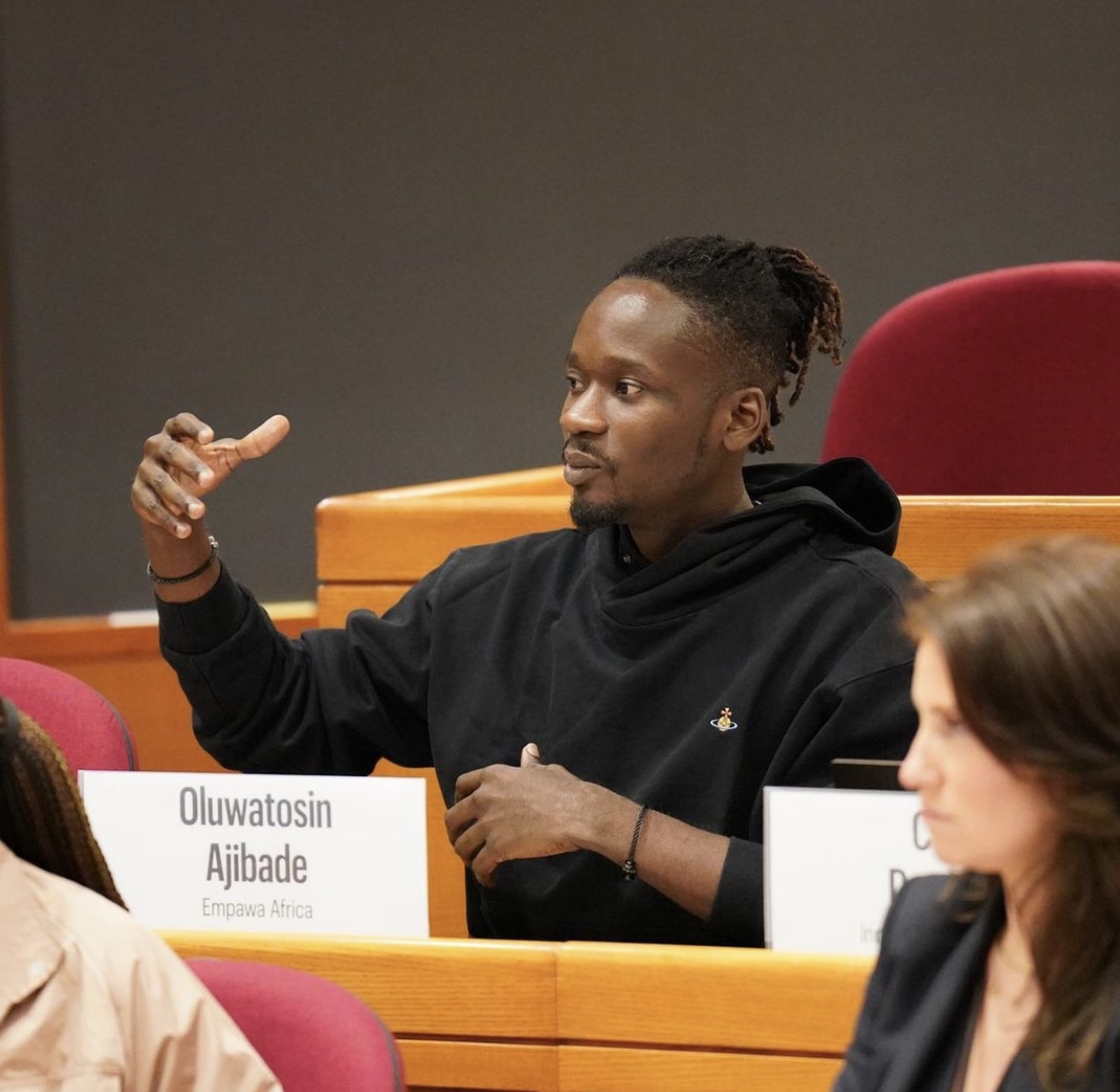
Mr. Eazi (founder of Empawa Africa and investor in PawaPay). Image Credits: Mr. Eazi
Mr. Eazi (founder of Empawa Africa and investor in PawaPay). Image Credits: Mr. Eazi
The agency — which has spun out the likes of Nigerian artiste Joeboy and Ghanaian artiste Kwesi Arthur — now has its tentacles spread in marketing, distribution, publishing, management and finance services for independent artists and record labels. It also white-labels its platform for interested parties that want to invest in African music; for instance, the $20 million African Music Fund (AMF) project in 2020.
Ajebutter22, a Nigerian-based music artist and rapper whose real name is Akitoye Balogun, agrees with Mr Eazi’s philosophy of investing in creatives. According to him, powering artists and people in the creative space should be done in a startup/VC manner. “Some of the investments I’ve made in the music space have been through that mentality of seeing an artist or project as a fast-growing vehicle,” said Ajebutter22 in an interview with TechCrunch.
Like Mr Eazi, the songwriter, well known within the Lagos party scene with hit singles like “Tungba,” grew up interested in tech. In 2013, he flirted with an idea for a platform that could help people pay for songs on their phones. Though it never took off due to lack of funding, the process of getting the project off the ground and reading books like “Zero to One” and “Hard Things About Hard Things” opened the artiste’s mind to the possibilities around tech.
Ajebutter22 would work at Gamsole, a gaming startup, and Cisco before venturing into angel investments in 2020. “It was about owning something bigger than myself, which can be great someday. That was behind deciding to invest in tech,” said the artist who has invested in AltSchool, a talent-matching platform, and Nestcoin, an Africa-focused web3 startup.
Personal relationships built over the years have been vital to how Ajebutter22 has made investments, a method ideal for a very early angel investor. For instance, he is a longtime friend of Nestcoin chief executive Yele Bademosi, and he knew Adewale Yusuf, the co-founder and CEO of AltSchool, from his time at Gamsole. The AltSchool investment also recorded participation from another music artist and collaborator, Falz (real name Folarin Falana).
“I think the most important thing when you want to invest is to know the team you’re backing because anything can change at any time. The market size, of course, is extremely important too, but for me, who you’re backing is key,” he said.
If Ajebutter22 plans to change his strategy as he makes more angel investments, setting up a formal structure like Zagadat Capital — which Mr Eazi references as a collective — will be essential.
Super excited to announce that I have invested in @AltSchoolAfrica after one meeting with @AdewaleYusuf_ I was sold! The team is doing a great job skilling-up Africans for the future of work. Big up to @hackSultan @opeawo and the rest of the team! Let’s make magic! pic.twitter.com/emzPQXZxA3
— yoruba shakespeare (@ajebutter22) January 28, 2022
As a collective, Zagadat Capital comprises “like-minded people who are young, African and see investing in African tech companies as exciting,” said Mr Eazi. Family offices are part of this collective in addition to founders like Shola Akinlade, the co-founder and CEO of Stripe-owned Paystack, and Iyinoluwa Aboyeji, co-founder of Talent City.
Talent City, the urban development startup that plans to create charter cities across Africa, is one of the most audacious projects on the continent and is a portfolio company of Zagadat Capital. Others are not as complicated: Eden Life, a concierge startup, and betPawa, an online betting company. This deal coverage shows variety in Mr Eazi’s picks; the artist also points out that his collective provides a unique advantage for portfolio companies in that its members, consisting of a few celebrities, can double as shareholders and influencers.
“It’s not just money or to get some meetings. We can also help the team to scale when we advertise. You’d see me advertising betPawa, for instance. I’m getting paid, but I’m an investor and a shareholder,” he said. “At the end of the day, we have more leaning toward investing in companies where the flywheel can be enhanced. It’s an ecosystem that keeps feeding itself and growing to the point where it’s sustainable.”
Outside Africa, Mr Eazi has cut checks in Mexican fintech Paisa and Irish-based fraud prevention provider Apata. He also has other entertainment investments aside from EmPawa Africa: YC events company Shoobs and U.S.-based music startup Vydia. These two investments emphasize the artists’ play to expand the interest of Africans in global entertainment spheres, particularly as music from the continent gets popularized. “The reason I’m investing in music tech is to make sure we have African equity in the structures that are integral to the ecosystem because that’s where the real power and value lies,” remarked Mr. Eazi.
Overall, it’s a sizable portfolio for an artiste-cum-investor with only one year of active investment history under his belt. With time, Mr Eazi acknowledges that he’ll go all out to raise a fund and invest more extensive checks, just like his mentor, Jay-Z, did in 2018. “For now, we’re going to still stay at a collective. But when it’s time to grow, I’ll need nobody to tell me. It’s going to be a gradual process.”
Black Coffee handles his deals through Flightmode Digital, a venture capital firm he set up in 2017, according to PitchBook. The firm — which says it seeks to invest in early-stage businesses operating in video content creation and production and software development — has backed several startups, including Yoco, a South African payments startup that has raised over $100 million in VC funding; SweepSouth, a cleaning and home service startup; and Rensource, a renewable energy company.
Go team @Yoco_ZA go 👏🏿👏🏿👏🏿👏🏿👏🏿 https://t.co/SSU8PKAIOs
— Black Coffee (@RealBlackCoffee) July 27, 2021
It’s unclear whether Black Coffee raised a set capital to invest through Flightmode Digital because, judging by its online presence, it appears more like an investment holding company than a traditional VC firm. However, the effort displayed by Ajebutter22, Black Coffee, Mr Eazi, Falz and a few under the radar suggests that it’s only a matter of time before local artists, regardless of their technical backgrounds, launch VC firms and funds like their global counterparts as the continent’s tech scene — which has received $3 billion worth of venture capital funding in the first half of this year — continues to explode and more exits happen.
“Why it seems artists aren’t interested in startup investing is because some still need to take care of their immediate needs; some people might not understand some of the problems being solved,” Ajebutter22 said. “But I also think that more and more artists will be in that space over time. I think African artists are becoming more evolved and exposed, and if one or two success stories happen, it will inspire them to go all in.”
Nestcoin raises $6.45M pre-seed to accelerate crypto and web3 adoption in Africa and frontier markets
Nigeria’s AltSchool raises $1M pre-seed to build an alternative school for Africans
PawaPay raises $9M seed backed by MSA, 88mph and Mr Eazi’s Zagadat Capital
Jackson Youth Film Camp Introduces Teens to Career Opportunities in the Industry – Mississippi Free Press
FOCUS: Abortion • JFP Acquisition • 2022 Elections • LGBTQ • Medicaid • Immigration • COVID-19 • Race & Racism • Food Security • Voting • Policing • Prisons
Karley Newell held her director’s notes, reading lines from the infamous throne-room scene in Marvel’s 2018 superhero film “Black Panther.” In the scene, Wakandan soldiers escorted Eric Killmonger into the throne room, with the antagonist revealing his ancestry and the fact that he and T’Challa, Black Panther, are cousins with the line, “Hey Auntie.”
An hour had already passed since the rehearsal began at 9 a.m. in the Smith Robertson Museum and Cultural Center in downtown Jackson.
“Tell me what the scene says,” Camp Facilitator Maximus Wright asked Newell, the student directing her fellow campers during the inaugural Jackson Youth Film Camp.
The camp introduced 20 students ages 13 to 18 to creative and technical career opportunities in the film industry. Campers learned various aspects of the filmmaking process from experts in the industry. Classes ran from June 13 to July 8, 2022, Monday through Friday, and sometimes Saturday, from 9 a.m. to 2 p.m. inside the Smith Robertson Museum and Cultural Center (528 Bloom St., Jackson).
Do you think our journalism is essential? Give today and support our work.
As part of the program, the students adopted a number of roles including actor, director, wardrobe, hair and makeup, and more. They set to work on preparing for the filming that began in early July 2022, wherein they recreated scenes from popular movies. The culmination of their efforts will be screened at the Jackson Film Festival on July 27 and July 28, 2022.
“So like you said, T’Challa sits on his throne surrounded by tribal elders: Romanda, Shuri, Okeye and the Dora (Milaje),” Newell said in reply to Wright’s instruction.
“OK, so what does that tell you? If he’s sitting here, what does that tell you? He’s surrounded by tribal elders, so what does that mean?” Wright prodded.
“That means that they should be surrounding him,” Newell answered.
This part of the filmmaking process is what the industry calls “blocking,” the placement and movement of actors in relation to the camera. In simpler terms, the practice is the scene choreography. Intentional placement and movement tell the story by staging a character’s actions to mirror the subtext of what occurs on screen.
Actor Malcolm Butler sat on the steps of a mini stage, the lights above honing in on him in his role as the pretend T’Challa. Wright pulled chairs from the audience and positioned them in a semicircle around Butler, simulating the original version.
“Alright, what happens next?” Wright asked.
“Kilmonger and W’kabi walk in,” Newell said.
“Show me what happens,” Wright asked her.
Newell walked to the middle aisle, explaining how she would like the actors to proceed from this direction in a replica of Kilmonger and W’kabi walking into the throne room. She wanted the actor playing W’kabi to walk behind Kilmonger as he escorted him into the room, she explained.
“So, they should be talking, and when this person comes in the room, what is that going to do to the room?” the facilitator asked Newell.
“Silence,” Butler whispered, while Newell echoed, “It’s gonna be silent.”
“It’s going to interrupt the room, right?” Wright confirmed. “So when they come in, they’re going to all be talking amongst themselves and then they open this door at this strange presence that’s being brought in in chains, right? Alright, what else do we see?”
Last year, the Jackson Film Festival engaged students from Canton 9th Grade Academy and the Mississippi School of the Arts to commemorate and discuss the 25th anniversary of “A Time To Kill,” which was filmed in Canton, Miss.
The Jackson Film Festival celebrates independent filmmaking and provides educational training and master classes with industry professionals, in addition to its community-outreach efforts, the festival’s website says.
“We always wanted to make sure that we are engaging young people in this process because (for) Mr. Wright, myself and others, this is our second life,” Program Director Candice Jackson told the Mississippi Free Press. “We don’t want these young people to think that they can’t achieve those dreams, even have those dreams or know what those dreams are because Hollywood happens ‘out there’ (and) not here.”
Jackson said the organization wants young people to feel like they can start now and get workforce training that is not limited to just acting. The program also covers craft services, wardrobe, set design, lighting and other behind-the-scenes careers in the industry, she explained.
“If you are pursuing a trade as an electrician, you can do set design, and you can light a set,” the director said. “The possibility is there for young people much earlier to have that training, so that as these productions pick up, we have a new generation of filmmakers, of tradesmen, craftsmen ready for this new challenge.”
During the commemoration of “A Time to Kill”, the organization gave students the opportunity to write their own scripts. Students from the Mississippi School of the Arts created a short film titled “A Time to Heal,” which focused on a character named Tonya Hailey and her response in the wake of her assault.
Last year’s experience led to this year’s youth film camp in Jackson, which was made possible through a collaborative effort between the City of Jackson’s Human and Cultural Services and PEG Network, in partnership with Maximus Wright Productions and Mighty Mississippi Films.
“We said, ‘Let’s see about doing a film camp and bringing these students from Jackson to get them engaged in all aspects of filmmaking,’” Jackson said. “Some (are) on camera, director, wardrobe and styling, so all of those aspects, not just in front of the camera. They had to do location scouting.”
“We had about 50 to 60 applications. We were limited to students in the city of Jackson for the most part because this is a city partnership, but that also lets us know that there are kids in this tri-county area who are interested in film and production,” Jackson said.
On the first day of camp, everyone got a chance to mingle and get to know one another, she said, but afterward, the real training began. The program brought in teachers to have what they call masterclasses that offered hands-on experience. Phil Washington, a camera operator, editor and actor, taught the students about camera work. Director of Photography Dreka Shevon of Prime Stone Media talked to students about lighting.
Chirvona Frank covered hair and makeup, and Ashiunna Ingram, who is self-taught, came in to teach the campers how to do special-effects make-up. Campers were in the pre-production stage when the Mississippi Free Press visited the program. Last week was the filming stage.
“They get these opportunities to meet people who are actually doing this in their fields and having good lives,” the program director said. “These are people who are living in their becoming (finding their passion), and that’s what’s important.”
The Jackson Film Festival, which will take place from July 24 to July 29, 2022, this year, will screen the campers’ project along with other independent projects at the Malco Grandview movie theater in Madison, Miss. Film screenings will span two days: Wednesday, July 27, and Thursday, July 28, both from 6 p.m. to 8 p.m.
At the time the Mississippi Free Press visited the program, campers were working on a new scene—one from the film, “Hidden Figures,” where Katherine Johnson stands face-to-face with her white supervisor, who confronts her for being gone for long periods of time. She had been leaving the building to use the restroom, but with no bathrooms for “colored” folks in the building, Johnson had to walk half a mile to use one.
Karley Newell, the student director, went over the scene with actress Kennita Littleton before she and her acting partner, Khai Hart, rehearsed.
“So you’re going to walk in down here and then–”
“Hold up. Trust your instincts, you hear me?” Wright interjected. “The worst thing you can do by being the director is not being sure of yourself and your commands. Because if the crew starts to see that there’s insecurity in you or seeing that you’re not sure, it’s going to make them feel like they need to talk. (There) only needs to be one voice on set. One voice. That’s yours. Trust your power. Trust your instincts.”
They began again, and Newell seemed more sure of herself than beforehand. Her voice resounded with more authority as she told her fellow actress how she wanted her to enter the room, the emotions she wanted her to convey in the scene.
“You’re going to walk in, and then, obviously, you’re frustrated because you have to walk for so long,” Newell explained to Littleton. “So he’s going to be mad and say his first line, and then you’re already going to be irritated because he’s getting mad at you, but he doesn’t know what you had to go through to get here.”
“OK, let me tell you this,” Wright interjected again. “Your job is to give an overview, not give them every detail because you’ve got to give them space to interpret and deliver the lines themselves. You want to give them an overview of the direction, not all the acting cues they want to do. It’s only when they do something that you don’t want them to do, you come back and give notes,” he advised.
“You’re trying to over-explain,” he continued. “You want to know why you’re trying to over-explain?”
“Why?”
“Why do you think?”
“Maybe I’m not as confident.”
“Because you don’t want to make a mistake, right? Trust yourself,” Wright repeated.
“You got this. You’re a great director,” Littleton complimented her.
“This is what your crewmate is saying. Stop trying to over-explain. Trust. This is all image. You are here to calm this set, to let them know I got y’all,” the facilitator assured.
At the new boost of confidence from her crew and the instructor, Newell adjusted her approach and tried again. She told Littleton what she wanted from the scene, succinctly, and moved aside to let the scene play out.
“And ACTION!” Newell yelled.
Camp Facilitator Maximus Wright is an director, writer, producer and owner of Maximus Wright Productions. His daughter, Jamie Wright, told him she wanted to leave the state to become an actress. So he bought some equipment to film for promos that involved his daughter and discovered a love for filmmaking, he told the Mississippi Free Press.
“It was a blessing because I found my passion,” he said. “It just kind of started encouraging people my age to say, ‘Well, what can I do? To see you doing this, what can I do?’” he said.
Under his film company, he has written, directed and produced two films, “Soul Damage” in 2017 and a short film, “My Name is Lola,” in 2018. Wright said the campers didn’t surprise him with the talent they showcased and that he is grateful the program was able to help them find some passion in their chosen roles.
Wright said he found out one of the students liked music and suggested he work on the film’s score, original music that accompanies a film. The student told him he couldn’t hear.
“There’s not much music here,” the student told him.
“But are you listening for the other sounds?” Wright asked in return.
“He’s talking about listening for the ambient sounds. I (thought), ‘Did he say ambient sound?’ And I realized then, ‘(He’s) just bored,’” Wright later told the Mississippi Free Press. “(He’s) smart. (He was) just bored. So, I immediately said, ‘You’re my AD (assistant director), so you check on everybody’s department and tell them what’s wrong,’ and everything changed.”
Another young camper admitted that he only attended camp because his mother made him attend. However, once Wright found out he was interested in clothes, he assigned the student to the wardrobe department as the head stylist, and it changed his outlook, Wright said.
“I’ve always said the greatest amount of talent comes from Mississippi. I have never seen any greater talent than ours,” the camp facilitator said. “What we are trying to do is bring the opportunity and the resources and give them a chance to just compete against everyone else and realize they don’t have to leave here to do it.”
“How has your experience been so far throughout this week’s long process?” this reporter asked the group of middle and high schoolers.
“It’s been very informative,” director and actress Karley Newell answered.
“Elaborate.”
“I’ve been learning the different aspects of different actors and actresses,” she said. “Certain people can only do so much, so you have to be willing to work with them differently.”
Kennita Littleton, who works in the wardrobe department and is also an actress, said it has not been difficult for her to balance both roles, as doing so is something she really likes putting her effort into.
“I like to style them, especially when we went to the African shop. We did it for ‘Black Panther.’ It was really fun,” she said. “I can just tell how the characters would match with how their personality came out with their clothing. Acting, for me, is just something I’m willing to do for my career.”
“I agree with what she said. It’s like when you’re really passionate about something, you really go for it and give it your all,” Aaliyah Omari, who works in the hair department and also acts, said.
The campers at large explained that they learned of the camp either through Facebook or the news and were immediately interested in applying. Most of their summers entail hanging with friends, working or playing sports. The camp gave them an opportunity to do something different than what they normally would, they answered.
“I like it better because I’m actually doing something instead of staying at home,” Bianca Omari, an actress and location scout, said.
The campers were in the pre-production phase, which includes memorizing lines, running through scenes off script, blocking, and finalizing wardrobe, makeup and hair. They were one week away from filming at the time, and though the campers were excited, they were also nervous.
“It’s a lot to think about. It’s not the process; it’s more of the result, of what I want the result to be. Top tier,” Newell expressed.
“What do you think about your facilitators and the people that have been teaching you so far?” this reporter asked them.
“They taught us a lot. They tell us more than what we knew before,” Bianca Omari answered.
“They push us to go ahead and get it out the way. Don’t be procrastinating and just go ahead and learn your lines and strive to do your best in whatever you’ve done,” Littleton said.
“They want the best for us. During work, it’s more like ‘Work now, talk and play later,’ and I like how that is. If you’re not (working) hard and you don’t come through from the beginning, then we’re gonna lose a lot of people. It’s good to just come hard from the jump,” Newell, the director, added.
“What has been your favorite aspect about filmmaking that you’ve learned so far?”
“I really like the behind-the-scenes (elements) because I didn’t know that there were so many different aspects of it before coming to this,” Tierra Kelly, who works in wardrobe and as an actress, said. “Through the master classes, like last week, we got to learn about different things we didn’t before, so I think that’s really cool.”
“Like we learned about makeup, sound, lighting, how the camera works, zooming in, zooming out, the close-ups,” Kelly added.
“Each of us got to actually do some of that. Someone would be camera opps (operator), someone would be a gaffer, someone would be a director, all of that,” Newell added.
Most of the day was spent with the characters learning their lines, which is not as difficult as the task may sound, Breanna Omari said. “It’s really about practicing it a lot. But when you practice them and get to know them, then it’s not as hard as you thought it was going to be,” the actress, makeup artist and hair stylist said.
Newell said the hardest part for her is not learning the lines, but rather putting the character into the lines and making the role your own.
“As well as leaving yourself outside of the room,” Aaliyah Omari added. “You have to step into that character.”
“Make that character feel like it’s you now. Be in that body. Even when you’re off set, you still need to be inside that character, so you can really know how this character is emotionally feeling, so that’s really good too,” Littleton chimed in.
When Karley Newell felt pressure from serving in the role of director for the student film, she said she just had to get out of her own head. She has always wanted to be in the entertainment industry as an actress, but her interests switched to more behind-the-scenes aspects once camp began, she said.
“You have to be that person to be mentally prepared for it,” Newell added. “You have to be willing to take extra steps.”
Mighty Mississippi Films owner and camp manager Sekou McGlothin said his experience in film has shown him that people from all endeavors and skill work on the production of a film.
“You’ve never seen one name at the end of a credit roll. You see multiple names,” McGlothin told the Mississippi Free Press. “You have painters, carpenters, makeup artists, hair stylists, electricians—all these people are on the crew, and all those people are in my community.”
If he can help build a film industry in the state, then Mississippi will have an opportunity to build a lot of revenue for the state through the arts, he said. He pointed to Atlanta and Tyler Perry’s studio there and the impact it has had on telling African American stories and reworking the narrative that aspiring creatives have to fly to Los Angeles to make it in the industry.
“You don’t have to leave the South now in order to be a part of Hollywood. There are no stories in the United States like the Mississippi stories,” McGlothin said.
As a producer, McGlothin said he wants to create jobs for other people and that nothing fulfills him more than seeing young people who are shy come out of their shells.
“And now they’re just independent thinkers. They’re ambitious. They have a professional focus on how to structure their thoughts to make films, so this camp was designed for that purpose,” the camp manager said.
McGlothin and his partner had a project through Mississippi Public Broadcasting that was similar to the Jackson Film Youth Camp around 10 years ago called “Can I Kick It?.” The Black Caucus asked them to create a program for dropout prevention, and the success stories that came from that program were phenomenal, he reflected.
“My little brother is one of the success stories,” he said. “(He) was a part of a 48-hour challenge that our students did. The hosting city was (Washington), D.C., and it was basically a national competition, and they created the topics. Our students chose the topics and did films in 48 “hours based on those topics.”
The Jackson students placed second and third, and they were able to attend the award ceremony in Washington, D.C. For a lot of the youths, the experience was their first time flying, and they were flying because of their own talents and minds, McGlothin said.
“And for a lot of them, their testimonies were, ‘I didn’t know that people would pay you to be smart. I didn’t know that my mind could get me out of my community to see another place,’” he added.
The City of Jackson does not have enough opportunities for the youth, McGlothin says, so his hope is that the Jackson film program will continue for as long as the City allows. In the future, he also wants to bring incentives to the young people, such as compensation for their work, and produce a film out of the program.
“We hope to have an incentive for them because that’s my main belief,” the producer said. “I look at the young people; they outnumber us, so they’re the mob. And if you don’t want the mob to hurt you, you pay the mob. I believe that I never made honor roll until my grandmother started paying me for my grades. Personally and professionally, I believe in incentivizing,” the producer said.
McGlothin said young people are more brilliant than the credit adults often afford them reflects. Taking students out of a lecture situation and giving them authority over themselves can lead them to surpass the expectations placed on them, he explained.
“We want the next Tyler Perry, the next Spike Lee, the next John Singleton, the next Taraji (P. Henson). We want these leaders. The next Denzel is in there,” he said.
The Jackson Film Festival will include pitch camps, masterclasses, film screenings and a gala at the Jackson Convention Complex (105 E. Pascagoula St., Jackson) from July 24 to July 29, 2022. To learn more about the festival and the event schedule, visit jxnfilmfestival.com.
The Mississippi Free Press is nonprofit, solutions-driven journalism for Mississippians and others who care about the state.
Mississippi Journalism and Education Group is a a 501(c)(3) nonprofit media organization (EIN 85-1403937) for the state, devoted to going beyond partisanship and publishing solutions journalism for the Magnolia State and all of its people.
125 S. Congress Street #1324A Jackson, MS 39201 [email protected] [email protected]
(601) 301-2021
The Mississippi Free Press is a project of the Mississippi Journalism and Education Group, a 501(c)(3) nonprofit journalism organization (EIN 85-1403937).
'Jane the Virgin' writer recounts growing up undocumented in 'Illegally Yours' – NPR
DAVE DAVIES, HOST:
This is FRESH AIR. I’m Dave Davies in today for Terry Gross. Our guest, Rafael Agustin, is a successful TV writer and producer, but that’s not the subject of his new memoir. It’s about his experience growing up as an undocumented immigrant in the United States. Agustin was born in Ecuador, and when he came to the United States with his parents as a 7-year-old, he was so young and naive that he thought the Fourth of July fireworks over the Los Angeles airport were there to herald his family’s arrival.
His book tells the story of his parents leaving their middle-class existence in Ecuador and working for menial jobs in America and his life of learning English, constantly moving from school to school and figuring out how to apply to college with a strong high school record but no Social Security number. There are moments of heartbreak and humor, like his dad’s exhilaration upon getting a Publishers Clearing House notice from a man named Ed McMahon that he may have won a million dollars. Rafael Agustin was a writer for the CW network show “Jane The Virgin” and is now CEO of the Latino Film Institute, where he oversees the Youth Cinema Project and the Los Angeles Latino International Film Festival. He co-created and co-starred in an autobiographical comedy stage show which toured nationally for three years. His new book is “Illegally Yours: A Memoir.”
Well, Rafael Agustin, welcome to FRESH AIR.
RAFAEL AGUSTIN: Thank you so much for having me.
DAVIES: You know, a lot of immigrants come to the United States these days from pretty desperate circumstances, you know, driven by poverty or violence or persecution. Your story is different. Tell us about your life in Ecuador.
AGUSTIN: Yeah. You know, it is different but not too different. So I had a little privileged upbringing, right? My grandfather was well known in his city of Guayaquil, Ecuador. I come from a long line of lawyers and politicians. But my mom and my dad were doctors, you know, a pediatric surgeon and an anesthesiologist who came to this country to work at a car wash and work at a Kmart. I didn’t understand why we would leave, like, our cushy existence for the hardships of Los Angeles, Calif. But when I look back, you know, as an older man and try to understand why they would make this crazy, insane journey – why would they sacrifice so much, why would they leave their livelihoods behind – I look back at, you know, when I was born, like, the democratically elected socialist president of Ecuador, his plane just miraculously blew up midair when he was trying to nationalize the country’s petroleum.
Again, this is a comedic book, but I had to really look into the hardships of what has U.S. foreign policy been doing all over Latin America that has forced these immigrants to come to this country? And while I barely touch on it in the book, conversely we get asked, like, you know, what was Eisenhower doing in Guatemala or Nixon doing in Chile or even, you know, Reagan all over Central America? I hear a lot of Americans say things like, you know, we don’t like refugees, and we don’t like undocumented workers. But, I mean, the truth is that we need to stop creating them.
DAVIES: Yeah, there’s certainly at least a 150-year history of intervention in Latin America. I mean, I’m sure you talked a lot to your parents in researching this book. Did they cite those issues as part of what made them think of coming to the United States? Were they troubled by the instability of the country?
AGUSTIN: They did, and it is the political and economic turmoil. So they came here thinking that things would be calmer, would be better, that their work can get them ahead in life. But little did they know that they would be cut up and the menial jobs and try to learn the language and the hard realization that medical licenses don’t transfer from country to country.
DAVIES: Tell us a little more about your parents’ medical careers in Ecuador, what they did.
AGUSTIN: Yeah, so my father was a pediatric surgeon, and my mother was an anesthesiologist. And one of the earliest memories I have – I must have been, like, 6 years old, 7 at most. And my mom was at the hospital operating, and my dad gets a call, like, close to midnight. And, you know, they didn’t have money for a babysitter, so my dad just took me with him to the hospital. And I remember one of the nurses put me in, like, medical scrubs and put covers on my feet, gave me a surgical mask, walked me down a long corridor and shoved me inside an operating room. And there I was watching my dad operating on a little girl my age. Her chest was completely opened by metal tongs. And she had been shot in the back with a rifle, and my dad was the only surgeon that could operate in – this very complicated surgery and hopefully save this child’s life.
And I noticed just by her kind eyes that my mom was the doctor applying the anesthesiology in the surgery. So there I was, like 6, 7 years old, watching my parents save a child’s life, which they did. And to me, it felt like 20 minutes. But when we – when my mom talks to me about it today, she’s like, I can’t believe you stood there for seven hours during one of the most complicated surgeries we ever had. That is so crazy to me.
DAVIES: Yeah. And you remember that?
AGUSTIN: Vividly. Yeah, you don’t forget something like that.
DAVIES: So when you left, as you tell the story in the book, your parents didn’t even tell you that you were moving to stay. It was just kind of for a vacation. You get there, and, you know, things are different. I mean, there’s no maid to make your lunch. I mean, you’re living in the garage apartment of some relatives who were there. You had relatives in the States already. Did you resent it? Did you – I don’t know. What was it like?
AGUSTIN: Well, you know, they did lie to me. They said we were going on vacation. And after several months, going into a year, I was like, wait, when are we – (laughter) how long is this vacation lasting? And, you know, when you pointed out at the top, I did grow up in this, you know, cushiony existence with, like, maids and chauffeurs, and then we come to the United States, and I’m like, oh, wait a minute – here, we’re the maids and chauffeurs. What’s happening?
DAVIES: Well, you know, one of the things that occurred to me was that it was clearly, you know, a different standard of living for you and a loss of income. But it’s also a loss of status. I mean, your parents were people who – you know, they saved lives in hospitals and were treated with respect as doctors. And, I mean, I certainly hold no disrespect for anybody that works in a car wash. I mean, I come from a working-class family and honor hourly work. But for them, it must have been so different to gone – to being sort of an anonymous sort of helper at so many jobs. Were you aware of that, or did they talk about it at all?
AGUSTIN: I did carry their sacrifice close to my heart ’cause I did see them be doctors, you know, one week and then work these menial jobs the next week. But the beauty of our story is how – no matter how hard things got, they tried to shield the reality of our documentation from me so that I wouldn’t have to experience that. Yeah, it was hard to come to a new country and make new friends, learn a new language. And we moved a lot, right? I didn’t know why we moved so much – because, you know, every time someone discovered their immigration problems, we had to pack up and leave and go to a different town to try to find a different job. But all of that, they withheld from me. So I was able to grow up an oblivious, stupid American kid.
And I loved my life. I loved the United States. And it was in those late nights, after my parents got from – home from work, from long days of work, and you’re just so exhausted and want to disconnect that we would start watching, like, American TV shows and American movies together. That’s where my love for the entertainment industry began. I was wow, this is the one thing I can share with my parents in this country. We didn’t have time for each other in this country. They were too busy working all the time. But we always connected late at night watching a movie or a TV show to escape our realities. And that’s when I was like, oh, I think I want to do this for a living.
DAVIES: Yeah. It’s interesting how a kid, you know, kind of takes their surroundings for granted most of the time, and you can kind of sell them for a while on a different idea. Like, your dad…
AGUSTIN: (Laughter) Only for a while though.
DAVIES: …Your dad’s special meals on Sunday – tell us about that.
AGUSTIN: OK. So my parents worked, like, seven days a week. We really didn’t see each other. They worked through holidays, too. But every Sunday, we would get together to go to ampm, which is like a convenience store attached to, like, a gas station here in the West Coast in Southern California. And it’s kind of like a 7-Eleven. And so we would go into the ampm, and it would always be the three of us – my mom and dad and me – and we would get burgers together.
And I was in love with, like, American burgers. I mean, ketchup? I had never tasted anything as good in my life. There’s no ketchup this good outside of the United States, let me tell you. They have to put some kind of drugs or crack in it ’cause it’s so freaking amazing. And then, we would go to ampm, and I would eat these burgers. And it was, like, the time of my life.
And then, a few years later – not a few years later, many years later, I asked my dad, what were your lowest points in the United States? And he said, when I had to take you and your mom to ampm ’cause I had no money then, and all I could afford was that special that they had – two burgers for 99 cents. And that nearly broke my heart. I was like, that’s, like, the highlight of my childhood. And those were his worst moments in this country.
DAVIES: We talked about how, when your parents came to the United States, they lost that status they had as medical professionals and worked other jobs. I wonder if they would offer medical advice or treatment just to friends and family. And that was a way to sort of get some of that feeling and stature back.
AGUSTIN: Well, the – because everyone in the family knew who they were, my parents became the family doctors. Everyone came to my parents for a diagnosis. Or if one of my cousins broke their arms, my dad would put a cast on them. I mean, it’s what immigrant families have to do in – when we have a health care system that doesn’t take care of everybody. I remember one of my cousins. He got injured in a snowboarding accident – snapped his arm in half and had to get a metal plate to keep his arm together. He didn’t have insurance, so he came to live with us so that my parents could heal him back to health.
That’s how my parents gave back, at least to the family and to close friends who knew them, trusted them, and searched for their medical guidance when they didn’t have money to go to the hospital. I mean, I remember one job – my dad got fired for giving a janitor’s wife a flu shot ’cause he wasn’t allowed to be giving shots.
DAVIES: Let me reintroduce you. We’re going to take a break here. We are speaking with Rafael Agustin. He is a television writer and producer. His new memoir is called “Illegally Yours.” We’ll continue our conversation in just a moment. This is FRESH AIR.
(SOUNDBITE OF DANILO PEREZ AND CLAUS OGERMAN’S “RAYS AND SHADOWS”)
DAVIES: This is FRESH AIR, and we’re speaking with Rafael Agustin, a TV producer and writer and CEO of the Latino Film Institute. He has a new memoir about growing up undocumented in the United States after emigrating with his parents from Ecuador. The book is called “Illegally Yours.”
You know, it’s interesting that you write that you never thought of yourself as having an ethnic identity. You were a white kid in Ecuador like so many others.
AGUSTIN: A white kid with a beautiful olive tan.
DAVIES: Oh, with an olive tan.
AGUSTIN: (Laughter).
DAVIES: Yeah. Yeah. So when you got to the States – I don’t know – did you become aware of ethnic and racial differences among the students? Did that kind of hit you at all?
AGUSTIN: Immediately. Immediately. And that’s, to me, more shocking than discovering that I was undocumented. It was discovering that I wasn’t white. I internalized so much of the film and TV shows that I saw from the United States as a child that I thought I looked like the people on the TV screens.
But when I get to public school here in the United States, I was surrounded by the great American diversity, right? I see the Asian American students, the African American students, and I’m like, what is this? I’ve never seen this in film and TV before. And then I saw them, the Mexican American and Central American students. That’s when I realized, oh, my God, I look more like them than the white students. So I guess I’m not white. And I’m, like, in third grade trying to figure all this out in my head.
DAVIES: You know, you write that you didn’t know it, but your parents had come on tourist visas and overstayed, which is a common experience for immigrants who end up undocumented. But they had kept this from you. They didn’t want you worrying about it. Looking back on it, I mean, did you see them behaving with exaggerated caution, that their lives were, in some ways, circumscribed because of their status?
AGUSTIN: Yeah. I mean, my dad went out of his way to make sure that he always paid his taxes ’cause he wanted to make sure that this country knew that he was a patriot, that he loved it, and he gave back. He never took, and he always gave back. And I know this because he would (laughter) – my mom and dad were always happiest when we got our tax refund checks in the mail.
And for them to hide this from me and to live a normal American existence minus one thing – and that’s our documentation and our legality – that’s what made me realize, oh, my God, like, we are American. No matter what, we are American. Like, we make our economy stronger, our workforce younger. And you can’t deny that we make our food taste better.
(LAUGHTER)
DAVIES: Right. But then there were moments that you saw things. I mean, your dad was going to get a job once. And there was an immigration raid at the place where he was going to work, which he ended up, actually, eventually working at. And then there was a moment where, I think, you were with him, and you saw some agents chase down a guy and tackle him. And your dad – you asked her dad in Spanish, you know, what’s happening here? And he said, hey, hey, don’t speak Spanish, right?
AGUSTIN: Oof. Yeah, the first story was actually a federal raid. It wasn’t even an immigration raid. It was, someone had tried to hire my dad to do some medical insurance claims but wasn’t being legit about it. And then he held my dad’s undocumented status against him so he wouldn’t say anything. But then the second story, the immigration raid at the beach, I must have been, like, fourth-grade or fifth-grade at most. And I’m walking down the beach with my parents in San Clemente, Calif., which San Clemente, by the way, has an immigration checkpoint. I don’t know how smart it was for us to go move over there. But that’s where the work was, so that’s where we went.
And when – I remember what appeared to be an undocumented worker ran past us. And then immigration officers chased him and tackled him. I turned to my dad. And in Spanish I said, (speaking Spanish) – like, what’s happening? And he turned to me with, like, fear in his eyes. And he said, don’t speak Spanish. And I had never seen my dad afraid before. So this moment really shook me to my core. And because whatever was happening put this much fear in my dad, I internalized it and thought he meant, don’t speak Spanish ever again. Looking back, I know he said, don’t speak Spanish for that moment in time until the immigration officials went away. But I didn’t speak Spanish again for several years. Like, even my parents would speak to me in Spanish, but I would reply in English. And I didn’t realize this for – until I got to, like, late in high school. And my mom told me what happened. And I was like, oh, wow. I had no idea that that was, like, the inciting incident for the fact that I was turning my back on my native tongue.
DAVIES: You got a little older and you got to high school. West Covina High, I think, right?
AGUSTIN: Correct.
DAVIES: There was diversity in the school, you say. I don’t know. What were the different cliques or crews and how did you find yours?
AGUSTIN: (Laughter) Well, the wonderful thing about growing up in San Gabriel Valley is that it is truly one of the most diverse regions in the entire United States. So I like to point out that the Asian American kids were the cool kids. And the African American kids were the nerds. And the Latin American kids were the surfers. And I was always looking for my group. I didn’t know where I belonged. I was previous – you know, I was an immigrant boy that was a wannabe little gangster. But I was studious. And I loved my mother (laughter). And I loved listening to punk rock and Spanish music. There wasn’t, like, a clique for me. And for a while, I – not knowing my place, the way that changes is when I discover that I was undocumented because when that news hits me, I mean, first, I get depressed. But then I realize, I want to become the most popular kid at school.
DAVIES: Well, now, how did you find out?
AGUSTIN: Well, all of my friends are starting to drive. And they’re starting to apply to go to colleges. So I do the same thing. And I, you know, filled out my DMV driver’s permit paperwork without telling my parents. And then I was told I needed them to sign off on it. So I come home. And I’m like, hey, I need you to sign this. And that’s when they looked at each other. And they were like, well, you need to sit down. And we had the talk. It wasn’t about the birds and the bees. It was about Uncle Sam and the United States.
Essentially, they told me that I was undocumented. They told me that they had Social Security numbers, but I didn’t. And, you know, I write that it’s like – it was, essentially, an end-of-the-world comet hitting my frosted-tipped head because I grew up watching and admiring, like, Zack Morris. I know it sounds dumb. But as a first-generation American, I felt I had no guide in the United States. So I started watching “Saved By The Bell.” And I was like, huh, that’s what I want. I don’t want to live in this broke, poor, little Hispanic barrio. I want to turn West Covina High into Bayside High.
DAVIES: Yeah. So Zack Morris is this totally cool, handsome star of the show, right? “Saved By The Bell,” right?
AGUSTIN: He is, like, not just cool, but he has that ease that white privilege gives you and that charm. And he has, like, bleached blonde hair. I mean, so I bleached my hair blond. I joined the band so I can have my own hit – “Friends Forever,” Zack Attack, if anyone remembers that. But when I discover I’m undocumented, I don’t know how to deal with it because there’s no episode of “Saved By The Bell” where Zack gets deported. So I feel all alone and completely confused by my new reality. I jokingly say that I told my parents, like, how am I supposed to join the campus Republicans now if I’m undocumented?
DAVIES: (Laughter) Let me reintroduce you. We’re going to take another break here. We are speaking with Rafael Agustin. He is a television writer and producer and CEO of the Latino Film Institute. His new memoir is titled “Illegally Yours.” He’ll be back to talk more after this short break. I’m Dave Davies, and this is FRESH AIR.
(SOUNDBITE OF DAVE HOLLAND AND PEPE HABICHUELA’S “JOYRIDE”)
DAVIES: This is FRESH AIR. I’m Dave Davies in for Terry Gross. Our guest is Rafael Agustin, a TV producer and writer and CEO of the Latino Film Institute. He has a new memoir about growing up undocumented in the United States after emigrating with his parents from Ecuador as a child. The book is called “Illegally Yours.”
You know, it’s interesting. At the end of your book, in the acknowledgements, you make the point – you tell us some interesting stories about your romantic encounters with girls in junior high and high school. But – and you’ve changed the names – because why bring them into this stuff? But in the acknowledgments, you thank a woman who you say was willing to marry you after high school to help with your immigration problem. I assume this marriage did not actually happen, right?
AGUSTIN: The marriage didn’t happen. And I – man, I’m getting teary-eyed just listening to you talk to me about it. Yeah, Jane Besara (ph) was a girlfriend at the time, and she knew – I mean, I told her my secret, and she was willing to marry me to help me. But we didn’t because it was around this time that we finally received our permanent residency paperwork. And it took nearly 13, 14 years to process. But we applied. We were just waiting. My parents had hoped that all of this would have been taken care of before I got out of high school, but it took longer than that.
DAVIES: Right. I was going to mention this, that they had, without telling you, applied for permanent residency. And so that happens. Were it not for that, you might have married her, huh?
AGUSTIN: Yes.
(LAUGHTER)
DAVIES: So you went to college, and you were in forensics debate, did really well at this. But you also got the acting bug. You – you know, you started doing plays and eventually applied to and were accepted to the UCLA School of Theater, Film and Television, majoring in theater. And when you tried out for class plays, I’m wondering what kind of roles you got and whether you felt that there was – you know, were there ethnic profiles that people were looking for for roles?
AGUSTIN: Well, it’s funny that you mention the acting part of my life because I had been acting like an American for most of it. So being on stage felt natural to me. I had been – I felt like I’ve been playing a role my whole life. And again, you can’t make this stuff up because if I write this in the script, turn it in, my producer or showrunner would be like, that’s not realistic. But I received my acceptance to UCLA and my acceptance from my permanent residency on the same day.
DAVIES: Wow.
AGUSTIN: Oh, my God. When we opened those (laughter) – that mail together, my mom, dad and I just hugged each other and cried on the floor. It was, like, 14 years of pain all gone and the promise of a new American future. So I end up at UCLA, like, on an acting scholarship. And I think, OK, this is going to be – this is it. This is my path. This is my career. But I quickly realized that there are no roles for people of color, you know, let alone, like, Latinos and Latinas. So I quickly realized that for me to have a career doing this, I had to write myself into existence. And that’s how I became – begrudgingly, became a writer.
DAVIES: So even though you, as you say, were acting white (laughter) for years and years and had dyed your hair blonde at times, you still didn’t get roles that were thought of as mainstream, slash – you know, “white,” quote-unquote, roles.
AGUSTIN: No. And I thought it was me. I was like, I’m terrible. I should switch my major to sociology or something. But then there was a production of a play called “Short Eyes,” which was a prison drama, and I got the lead role. And I was like, wait, hold on (laughter). Wait, what’s happening right now? Because I didn’t want to play stereotypical roles. I didn’t want to buy into, like, negative stereotypes just to make a paycheck. That’s why I wrote the show that I wrote, which I can’t really say the title of it, but it stands for three derogatory terms. It’s called “NWC,” and it starred my best friend, Miles Gregley, who’s African American, my other best friend, Allan Axibal, who’s Asian American, and myself.
And this little show, which was simply supposed to be a showcase for our talents because as Black and Asian American, they were feeling the same problem – they weren’t being seen, and they couldn’t get roles that can fully highlight the complexity of their existence. So we create the show. It’s supposed to be simply a showcase. And it catches fire. It becomes, like, this cult phenomenon at UCLA. Even the LA Times came and wrote about it. So we became, like, campus famous real quick. And we go from a student show to a professional run in downtown Los Angeles, thanks to the Latino Theater Company at the Los Angeles Theater Center, to a national tour in just three months. It was a crazy trajectory.
And we were selling out every night in downtown. And the only reason we put an end to the run was because we had a finals, and we were going to be, like, the first in our families to graduate from college in this country, and that meant a lot to us.
DAVIES: You know, let’s just talk a little bit more about the show. I mean, as you mentioned, it’s not a title we can say because it’s three words – the N-word and then a word – a derogatory term for Asian Americans and a derogatory term for Hispanics. And people can find this on YouTube. It’s – as you said, the abbreviation of it is “NWC.” You want to just tell us a little bit about it – about kind of what happens, what’s the feel of it, what’s the message?
AGUSTIN: Yeah. So because Miles was so big into stand-up and Allan was so big into slam poetry and I was the theater nerd, it became, like, this hybrid of a show that felt like a sketch comedy show. But because we were working with Steve and Liesel, who were professional writers, it was a three-act structured play. But the comedy of it – and because we’re such great friends, and we’re – there’s a familiarity on stage – it felt like a fresh improv every night. The LA Times compared it to the comedy of, like, Chris Rock and early Culture Clash. It was slash political statement, slash social satire, but full-on comedy.
So in the – in LA, where we first premiered, it’s strictly a comedy. But when we started performing in Ohio, in Kentucky, in Pennsylvania, it becomes so much more than just a comedy. It became known as the race show because whenever there was social unrest or a racist incident, people would pick up the phone and call us, and we would have to show up like racial superheroes and be like, OK, what’s the problem here? We’re here to clean up the mess.
DAVIES: So you would perform the show and then hold a discussion? Or is that – what…
AGUSTIN: So, well, that was it. People would bring us in not just for the show, but for the Q&A’s that we would have and for the residencies that we would do with the community, which was, at times, more powerful than the show. It was being able to bring people together through comedy – right? – ’cause laughter builds community. So we toured the show for five to six years. We went to, like, 44 states. We were famous in, like, Casper, Wyo., but in LA, no one knew who we were.
AGUSTIN: You said sometimes people would bring you and the show in when there had been an incident of racial conflict – right? – ’cause they needed to have something to address it in a hopefully constructive way. And while it’s true – comedy can bring people together – often, circumstances like that, you know, are filled with a lot of tension and sometimes hatred. And I wonder if you found situations where people weren’t ready to reconcile or really see each other and it was tense.
AGUSTIN: It – you know, I’m sorry to say that it wasn’t at first, but it got – you know when it changed, if I can be so blunt? When Obama became president. The hatred was different. The white students we dealt with were starting to feel oppressed, but they didn’t understand why they were feeling that way. To me, that was – during our tour, the first Black president of the United States in addressing the original sin of slavery in this country, that’s when things changed.
DAVIES: You know, you spent years writing for the CW series “Jane The Virgin.” What was the experience like for you? Did you feel like your experience was valued?
AGUSTIN: On “Jane The Virgin,” what I will say is that the showrunner, Jennie Snyder Urman, was really forward-thinking. I mean, she had no business embracing (laughter) a writer with no TV credits from a marginalized community. She really mentored me and took a chance on me, and I hope that I added as much authenticity to the show as she wanted. There’s a big sense of imposter syndrome for me in that room, feeling like I didn’t belong, like I didn’t fight hard enough, that I knew many other people that were more worthy to be in there than I was.
I’m in the room with these TV writers that had been doing it for 10, 20 – some even 30 years. What can I do that’s going to beat them at any TV pitch or TV idea? That’s when I had to lean in towards my cultural identity, my background. Then, when I started pitching stories about, you know, Catholic guilt or my immigration problems that I had, that’s when I started getting stories on the board, and that’s when I started feeling like I was making an impact or contributing to the show itself. But it took me a minute to get there because I still had this sense of imposter syndrome.
DAVIES: Let me reintroduce you. We’re going to take a break here. Then, we’ll talk some more. We are speaking with Rafael Agustin. He’s a television writer and producer and CEO of the Latino Film Institute. His new memoir is titled “Illegally Yours.” We’ll talk more after this break. This is FRESH AIR.
(SOUNDBITE OF ALLEN TOUSSAINT’S “EGYPTIAN FANTASY”)
DAVIES: This is FRESH AIR, and we’re speaking with Rafael Agustin. He is a television writer and producer, also CEO of the Latino Film Institute. He has a new memoir titled “Illegally Yours.”
You know, I want to bring the story back around to your parents before we say goodbye. You know, they came to the States hoping to build bright futures and eventually practice medicine. How do you think they came to view the experience? And tell us what happened later after you went to college.
AGUSTIN: My parents are a tale of two different people. My dad was a little resentful of me because I was able to dream freely and wildly while he wasn’t. And he was so prepared and so educated and so brilliant, but he could not overcome the immigration problems that we had in this country. My mom was just an optimist who always wanted to do what was best for the family. And she wanted to support my dad, and she wanted to support me.
And I didn’t know, but there were several times when my dad was like, OK, this American experiment is not working. Let’s go back. And my mom put her foot down, and she said, we’re not. We’re not going to go back until Rafa graduates. We’re not going to go back until he has accomplished everything he started here. And once I did, once they saw me become a small business owner, have a successful touring company, that – they both turned to me and said, we’re going back to Ecuador. We’re going to go back to do what God put us on this world to do, and that’s to save children’s lives.
And when they left, I like to think that they left still searching for their American dream just in a different part of America – right? – in South America. And I stayed behind to accomplish everything they set out to do. That’s how I became the American citizen that I am today.
DAVIES: You also tell us in the book that, you know, they eventually separated, and your mom returned to LA. Is that right? Are you all in touch and…
AGUSTIN: Yeah. The big secret was that I sold this book, and I got the book deal, and then, my parents got a divorce. And it just crushed me. So my mom, you know, (laughter) separated from her husband of 35 years, got COVID-19 at the start of the pandemic. And this – and Ecuador was ground zero for COVID-19 in South America. I mean, we were literally leaving our dead relatives on the street because the hospital and the morgues were overran. And my mom was fired from her work at the American consulate of over 10 years, all within three-month period. And I told my mom, no. No, no, no, no. It’s over. There’s a global pandemic happening. We cannot be separated by a continent still. I need you to come back. I’m in a good place in my life, and I want to be able to achieve this one dream I’ve had since we came to this country. And that was buying my mom a house. Oh, man, you’re getting me emotional. So I bought my mom a house, and I was able to move her back to California.
DAVIES: You know, maybe we could end with a smile here.
AGUSTIN: (Laughter).
DAVIES: You want to tell me the story of your grandmother’s ointment from Ecuador that had such healing properties?
AGUSTIN: (Laughter) Yes, yes. When my parents moved back, I realized, OK, I’m going to go back and be at the childhood home I grew up in. I’m going to see my grandparents home again. And when I get there, I have this memory of my mom and my grandmother, essentially, bringing me back to health, like, carrying me back to health. My mom was a young doctor, so she was about, like, what medicine I should take, what shots she should give me. But my grandmother, she’s a traditionalist, right? She grabbed this little container with this clear, magical ointment and started rubbing it on my chest. And I remember it so vividly as a little kid. And all my life, I was like, what was that ointment that she rubbed on me? It must be like Inca or Indigenous somehow. Maybe it was, like, somewhere in the Quechua language. I can find, like, what this magical word of Vivaporu (ph) meant because I remember she said it was Vivaporu.
So fast-forward, I’m an adult. I’m going to go get some Vivaporu in Ecuador, South America, again. And when I asked my grandma to take me on this journey to – I didn’t know if we had to go to the mountains or to some local shaman or is, like, some close friend of hers was doing brujeria in the neighborhood? But I needed to get some Vivaporu. My grandma and I leave her house. We walk down the street. We go to the local pharmacy. So I was like, OK, maybe she’s getting, like, some calcium pills or something. She waves me down the aisle and gives me the container, the same container I remember from my childhood. And when I look at it, my life came to a complete stop. When I look at this ointment and realize that Vivaporu was really Vicks VapoRub.
DAVIES: (Laughter).
AGUSTIN: And I just couldn’t believe it. I never hated my people’s lack of enunciation and pronunciation more in my life. I was like, Vicks VapoRub is Vivaporu. I had it down the street from me for nearly 20 years, and I never got it because I didn’t know it was the same thing.
DAVIES: Well, Rafael Agustin, thank you so much for speaking with us.
AGUSTIN: Thank you so much for having me. This was amazing.
DAVIES: Rafael Agustin is a television writer and producer and CEO of the Latino Film Institute. His memoir is titled “Illegally Yours.” After we take a short break, rock critic Ken Tucker will review the new album “Beatopia” by beabadoobee. This is FRESH AIR.
(SOUNDBITE OF CHARLIE HUNTER QUINTET’S “MESTRE TATA”)
Copyright © 2022 NPR. All rights reserved. Visit our website terms of use and permissions pages at www.npr.org for further information.
NPR transcripts are created on a rush deadline by an NPR contractor. This text may not be in its final form and may be updated or revised in the future. Accuracy and availability may vary. The authoritative record of NPR’s programming is the audio record.
Sponsor Message
Become an NPR sponsor
PREMIERE: Florian Gasperini – Way To The Other World (Erdi Irmak Remix) – Magnetic Magazine
As we start the later half of the year, we've seen Erdi Irmak's already sizable discography grow by leaps and bounds in 2022–releasing with XYZ, Where The Heart Is, The Soundgarden, and others–showing no signs of stopping.
Taking inspiration at an early age by the sounds of his Turkish homeland of Istanbul, the hubbub of cosmopolitan where Asia meets Europe across the vast Bosphorous River. His cross-cultural sounds and influences are a combination of "chilled out west and far east sounds" that have become the fundamental pillars of his musical ideology that have led signings across a large swath of labels and genres.
The 15 Best Organic House Tracks of June 2022 <<<
On remix duties for his next production, Erdi makes his mastery of the groove evident with the stems from French producer Florian Gasperini's new EP titled Way To The Other World, who returns to Univack with the follow-up to the successful 'A Man Said EP'. The EP, which also contains two originals from Florian as well, centers around the Organic House and Melodic Techno genres and exhibits the emotional and deep style of this artist.
Erdi Irmak takes the original elements of "Way To The Other World" and makes his music production knowledge evident. Bumping the BPM from the original 120 to 122, the difference in the kit is immediately recognizable with a full kick drum (even on these laptop speakers) leading the charge plus more upbeat and brighter snare, hat, and clap samples. The atmosphere nestles perfectly into the groove as the occasional vocal sample pops through, accompanied by the most tantalizing hook. Check it out below.