Blog Archives

Blasphemous band in the Holy Land – The Jerusalem Post

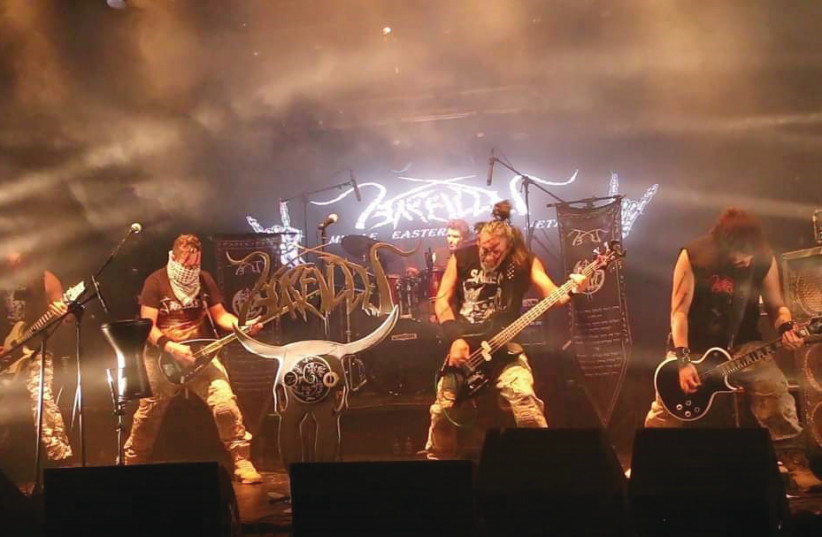
Who would have thought that one of Israel’s most prolific extreme black metal bands would emerge from the decidedly suburban Pleasantville of Ma’aleh Adumim and be fronted, no less, by a border policeman?

Welcome to the world of Arallu and its frontman, Moti “Butchered” Daniel. You’ll never hear them on the radio dial, but the band performs regularly, both locally and abroad. They just played at the Garasjefestival in Norway and are an integral part of the Israeli extreme metal scene, alongside other acts such as Winterhorde, Ma’anish and Shredhead. 

They have released seven albums to date, including The War on the Wailing Wall, Satanic War in Jerusalem and The Demon from the Ancient World; their upcoming album is called Death Covenant. 

Google “black metal” and you’ll find that it’s a subgenre of heavy metal music that typically takes on anti-Christian, satanic and pagan themes. 

Patient and thoughtful, Daniel explained how he became an aficionado and practitioner of the underground genre. 

 ARALLU IN ACTION. (credit: ARIEL IFARGEN) ARALLU IN ACTION. (credit: ARIEL IFARGEN)

“It all started in the late ’90s when I was in the army and began listening to Norwegian black metal,” he said.

“During this time, a wave of terrorist attacks swept our nation. The bloodshed was horrifying and I experienced it firsthand. This combination sparked within me a deep resentment toward religion. It made me realize that all the wars going on here are rooted in religious beliefs, which resonated especially well with me, seeing how black metal as a genre criticizes religion, as well. 

“As a result, I was motivated to pick up my guitar and start writing songs. The riffs and lyrics just came naturally. 

“If you take a listen to the first two Arallu albums, The War on the Wailing Wall and Satanic War in Jerusalem, you’ll notice the songs and lyrics are more extreme there than in any of our other releases. Everything was about the terrorism and relentless bloodshed going on in Jerusalem back then. From that hardship and the music I was listening to, I created Arallu and the first two albums as a one-man black metal project. I only acquired new members a few years later, turning Arallu into a fully fledged band.”

Black metal is by no means a music genre that’s easy for the casual listener to get into. However, if there’s anything Arallu proves, it’s that even in some of the most extreme, aggressive music one can come across, profound philosophies and underlying meanings lay hidden for those willing to look deep enough. 

Are your album titles meant to be symbolic or are you just trying to be provocative?

We’ve never aimed to be provocative, nor are we a political band, but reality led us to give our works such shocking titles. The second album, Satanic War in Jerusalem, came out while Jerusalem bled…. That’s why the album is called Satanic War in Jerusalem; there was a satanic war of religions in Jerusalem at the time and the album title symbolized that. The “Satanic” part is a metaphor for religions slaughtering each other. The same goes for the song, “Religions Are Dead,” the meaning behind its title is that once religions die, so will wars.” 

It’s been reported that you have gotten along well with some other metal bands from countries like Lebanon and Iran. After connecting with these bands from countries that oppose Israel, do you think metal can help bring an era of peace and understanding to the Middle East?

I wish, but sadly, no. There’s only so much we have control over. We don’t hate Arabs, Iranians or Lebanese folk. We hate terrorists, the extremists who use religion in a cynical way to further their own twisted agendas. We flew to Turkey and met people from Iran and Lebanon. We sat down over a beer and even published a famous photo of our three passports together; one Israeli, one Iranian and one Lebanese. 

If our work leads someone to become more tolerant or wish for peace, great. But understand that as a black metal band, our goal isn’t to create world peace with our music or anything of the sort. We create extreme music about topics that make us angry. I truly hope peace will come to the Middle East one day, but unfortunately, mankind is unable to reach such a goal.”

Some of Arallu’s songs feature what sounds like dialogue among Israeli soldiers on the battlefield. Were those segments inspired by your army service?

Those samples you hear of soldiers at war are used in our fifth album, Geniewar. It’s a concept album about wars in Israel, and even includes covers of two old Israeli folk songs about the topic; “Hayalim Almonim” and “Giv’at Ha’tachmoshet.” The samples are taken from documentaries about these wars, and we included them to make the listener feel as though they’re in the middle of a war zone. Thematically, Geniewar goes over the history of wars here, from resistance against the British Mandate, to the founding of Israel, to every war Israel fought. It’s a very interesting concept album full of both clear and hidden meanings, fascinating both musically and thematically.

Unfortunately, most black metal bands don’t make much money off their work. What other jobs do you have besides being in Arallu?

Now, I’m a border policeman, but I was a soldier when the first album came out, and by the time the second one was released, I finished my military service and didn’t have any money. At the time, I got a bunch of offers from promoters in Europe to tour and give concerts there. I’m almost certain that had I taken up the offer, I would have earned a lot of money off my music and moved to Europe, like what Melechesh [another Israeli black metal band] did. Instead, I chose to find a serious job here in Israel and keep creating music as a hobby. 

In other words, I’m in Arallu for the sake of music, not profit. If I end up making some good money through the music, great, but that’s not my top priority with the band. The rest of Arallu’s members are with me on this, each one has their own separate job as a main source of income. Sure, we make some money off our albums, merchandise and live shows, but that income goes to the band so we can up the budget on music production, make higher quality products and perform more concerts. Even if we were to sign onto a large record label, I doubt we’d earn enough money to a point where we could ditch our main jobs, but we’re perfectly fine with that.”

For more information on Arallu go to https://www.facebook.com/ARALLU666/ 

By subscribing I accept the terms of use and privacy policy

source

Rode PodMic review: "Excellent sound quality at an aggressive price point" – Gamesradar

GamesRadar+ is supported by its audience. When you purchase through links on our site, we may earn an affiliate commission. Here’s why you can trust us.
By published
Rode continues to craft some of the best microphones for streaming, and the PodMic is certainly no exception to the rule. If you’ve got an audio interface, and are after a great-sounding model that won’t break the bank, then there’s little more you can ask for here.
I’ll cut right to the chase and tell you that the Rode Podmic is easily one of the best microphones for streaming that you can get your hands on in 2022. What’s more, priced at just $99 / £99, it’s one of the more aggressively priced models on the market, and ideal for any professional-grade streaming setup for less, especially if you’re already integrated into the brand’s current hardware ecosystem. 
The Rode Podmic is distinctly retro in its physical appearance, with an overall classic aesthetic, which is evident in its all-metal cylindrical silver body wrapped in thick black guards. It’s definitely a case of substance over style here, as while I personally think this is a great-looking piece of kit, it doesn’t stand out much when compared to some other XLR microphones; clean and straightforward is certainly the name of the game. 
What you will notice with the Rode Podmic over some other similarly priced XLR microphones is just how well built the brand’s model is here. Simply put, I’ve never had my hands on a microphone that was this premium or durable feeling in all my years of recording music and streaming. There’s a definite weight to this mic, too, adding to the high-quality feel and design of this unit. Rode PodMic designThat weight isn’t for nothing, though. The Rode Podmic features an internal pop filter as well as a shock mount, too. This means there’s no explicit need to rush out and clip anything to the front of your mic, which is something I’ve personally struggled with before with XLR microphones when streaming and recording music. Perhaps the strongest addition here though is the integrated swing mount, meaning that this model is the perfect fit for any boom arms or stands you may have, especially those made by Rode itself.
As potentially expected from a $99 XLR microphone, no stand or boom arm is included out of the box. Our review unit came equipped with the brand’s Rode PSA1+ mic boom arm, which is easily the best of its class that I’ve ever had my hands on. If you’re in need of a sturdy and adaptable swing arm for your setup, then I can personally recommend the Rode PSA1+ as you get multiple different mounts, integrated cable management, and a level of movement and flexibility that just isn’t seen in boom arms at its price point.Rode PodMic with PSA1+ Boom ArmSimply put, the Rode PodMic is the best-sounding microphone I’ve ever used. Whether I’ve tasked the microphone with live streams, recording music, or tracking commentary tracks for VOD content, the accuracy and clarity that comes out of this punchy piece of kit cannot be overstated. This is due to its dynamic cardioid nature, which has a frequency range between 20Hz and 20kHz, meaning it can be easily fine-tuned through your audio interface of choice for optimum output settings. 
Whether it was my tried-and-true Behringer U-PHORIA UMC202HD, my previous daily-driver audio interface for streaming and recording music, or the brand’s recently released RodeCaster Pro II, nothing has come close to matching the sound quality on offer here. The responsiveness of the Rode PodMic is very precise, which meant that I was able to comfortably talk at a regular level without feeling the urge to speak louder to pick up properly, a problem that I’ve had with some USB microphones I’ve used in the past. 
While the Rode PodMic is certainly best suited to podcasting and streaming, it’s also proved formidable for recording vocals, too. In my testing, I’ve found that this model was easily able to track both clean and harsh singing with only slight adjustments needed in the gain settings to prevent clipping. If you’re after a microphone that can do it all to a professional standard then this model certainly lives up to expectations. Rode Podmic promoFor $99, the Rode PodMic is one of the best value propositions you can get right now, especially when compared to the likes of the far more expensive Shure MV7 ($250 MSRP) while offering similar performance. Keep in mind, though, that you’ll need to shell out a little extra for a decent stand or boom arm to get the most out of this model, but I think this microphone more than justifies that extra cost at a very competitive rate. 
Whether you’re intending on becoming a streamer for the likes of Twitch or YouTube Gaming, or you’ve got your sights set on podcasting to a professional standard, the Rode PodMic is an easy recommendation for the money. You just don’t see such well-constructed microphones from premium brands with these features at under $100, meaning you can get great sound without breaking the bank here. 
For the past two weeks, I’ve used the Rode Podmic on a near-daily basis to talk with friends, have conference calls with my colleagues, track vocals for a new album I’ve been working on, and record commentary tracks for VOD content. Such programs I’ve used include Cyberlink PowerDirector 18, Nvidia Shadowplay, and OBS for the streaming side of things, Cockos Reaper and Audacity for music production, and Google Meet and Discord for daily conversations. 
Gear up for streaming with the best ring lights, best green screens, and best webcams.
4.5 out of 5
Rode continues to craft some of the best microphones for streaming, and the PodMic is certainly no exception to the rule. If you’ve got an audio interface, and are after a great-sounding model that won’t break the bank, then there’s little more you can ask for here.
I’m responsible for most of the PC gaming coverage across GamesRadar on everything from the latest graphics card launches (as well as RTX 30 series restocks), to the fastest NVMe SSDs, and more key components to building and maintaining a stellar rig. When I’m not obsessing over CUDA cores and clock speeds, you can find me building and testing gaming chairs, too. Before landing here, I previously worked with the BBC, and have also written for the likes of Expert Reviews, The Rory Peck Trust, Tech Spark, and No Clean Singing. 
Get the best gaming deals, reviews, product advice, competitions, unmissable gaming news and more!
Thank you for signing up to GamesRadar+. You will receive a verification email shortly.
There was a problem. Please refresh the page and try again.
GamesRadar+ is part of Future US Inc, an international media group and leading digital publisher. Visit our corporate site (opens in new tab).
© Future US, Inc. Full 7th Floor, 130 West 42nd Street, New York, NY 10036.

source

13 Best Free Chord Generator VST Plugins

Here are the best fr
https://distrokid.com/vip/seven/584756

Zimbabwe’s Young DLC signs record deal with South Africa’s Next Music – Chronicle

The Chronicle


Mbulelo Mpofu, Showbiz Reporter
 ASAPH has done it. ShaSha has done it and the latest Zimbabwean to join the elite group of Zimbos signing with big record labels beyond our borders is Young DCL (real name Darlington Chikwewo).
 The super-talented producer and artiste, has put pen to paper on a record deal with the South African label, Next Music which will release his music internationally from now on.
Young DCL
 He joins a stellar roster of talent which includes Nakhane, Mathew Cole, Kanen Zoid and Miriam Makeba just to name a few. His first single is set to be released at the end of this month.
 Born and bred in Harare, the Hatfield-based versatile electronic dance music artiste, producer, songwriter, and DJ is well-known for his Coke Studio Africa gig, as a two-time resident producer (2017 and 2019), where he produced all remixes, covers and Christmas songs from Nairobi, Kenya.
As Young DCL committed his creativity to Next Music, Matthew Fink (Next Music producer), Dave Penhale (Sony Music Publishing Creative Manager) and Charles Kuhn Next Music CEO) played witness to the signing of the deal.
From right Matthew Fink – Producer Next Music, Dave Penhale Creative Manager Sony Music Publishing, Charles Kuhn CEO Next Music and producer Young DCL
The young producer told Saturday Leisure that his new journey with Next Music filled him with excitement.
“I’m excited and energised by this deal with Next Music. I’m looking forward to releasing music with an international focus,” simply said Young DLC.
He has his own label, Wewo Music, and has worked with top Zimbabwean artiste, Jah Prayzah.
Out of the five songs they have done together, two of them, Porovhoka and Svovi already have over a million views on YouTube.
In terms of sound, Young DLC, is quiet versatile, but lovers of Major Lazor, Metrobooming, DJ Maphorisa, or DJ Snake are more likely to fall in love with his Afro-flavoured electronic beats ranging from Afrobeats, EDM, House, and Pop to Gqom.
Young DCL is also part of the electronic music production duo called Matta Motto (Young DLC and Tristan Coetzee) and they have released two projects with Gigi Lamayne and Nigerian artiste Praiz.
The talented artiste also co-produced Mlindo’s Ngi Thanda Wena with Maphorisa, featuring ShaSha, a song that generated more than three million streams on YouTube without an official video.
Young DCL signing the Next Music deal (Photo by Wewo Music)
This year, the 25-year-old collaborated on an EP with Bryan K (Zim) with two songs that made it to the Zim radio charts.
 He also collaborated with the former National Arts Merit Awards (Nama) Outstanding Male Musician TiGonzi on a project called “Mufaro” which is also on Zimbabwean radio charts.
 Young DLC is credited as the producer of the BET Africa Isono opening sequence, a project he undertook in 2020.
 Through Coke Studio Africa, the biggest music TV show on the continent, Young DLC staked a claim on fame, having worked with African music heavyweights.
 A statistical smorgasbord has seen him working with more than 20 acts including the likes of Patoranking (Nigeria), Olamide (Nigeria), AKA (South Africa), Shekinah (South Africa), Yemi Alade (Nigeria), Kiff No Beat (Côte d’Ivoire), Rayvanny (Tanzania), Kaligraph Jones (Kenya), Nasty C (South Africa), Runtown (Nigeria), Mr Bow (Mozambique), Liloca, Jami Band (Ethiopia), Sami Dan, Laura Beg, Eddy Kenzo (Uganda), and many more artistes featured on the show.
 Young DCL is no stranger to the grandest of stages as his works have enjoyed attention in the past. In 2016, he collaborated with Sylent Nqoe and they released their single in February 2017.
The upbeat house single called “Be My Girl” enjoyed massive airplay on Algoa FM and peaked at number 5, spending 15 weeks on the charts.
 His big break was when he was cast as a guest producer on Coke Studio SA 2016 where he produced for hip hop artiste, Aewon Wolf and pop artiste, Jade McDonalds, on a song titled “Run Away” which was playlisted on many local commercial radio stations.
 Young DLC pursued his music studies at Soul Candi Music Institute in South Africa where he studied Electronic Sound Production and ended up getting signed to Sony Publishing South Africa as a producer and songwriter in 2017.
 His work ethic has seen him working on Mnet TV shows, The Voice SA and Celebrity Nights.
 – @eMKlass_49
Receive news headlines directly to your inbox, daily!


George Silundika & 9th Ave
Bulawayo
Phone: +263292888871
Email Us: Contact US
© 2022 The Chronicle | Disclaimer | Copyright
Site & Hosting by Webdev

source

Interdimensional Transmissions Explores Electronic Music's Outer Limits – bandcamp.com

No matching results
Try a different filter or a new search keyword.
Search all Bandcamp artists, tracks, and albums
Brendan Gillen (aka BMG) grew up listening to Detroit techno as it evolved on the radio. He was entranced as a child by the prosody and mythology of Detroit radio legend The Electrifying Mojo and the fast, wild mixes of Underground Resistance co-founder Jeff Mills when he was “The Wizard,” before techno and house had even begun to creep into his mixes. By the late 80s, mix shows by Juan Atkins, Derrick May, and Kevin Saunderson—the Belleville Three credited with pioneering techno—made it enormously clear to Gillen that another world was possible. When he made it to the world’s first techno club The Music Institute in 1989, his life was changed forever.
“There were people there who had a dance that included running up the wall: the participation with the music was another level,” Gillen recalls. “When I heard Parliament’s ‘Flashlight’ deconstructed on that system within the context of advanced techno, everything clicked. I had another similar experience in Berlin in 1991 on the dance floor of Tresor, when I realized this was the new global music. The wall had fallen, and to escape the Tower of Babel, we had this instrumental music with short English (common language) samples. The magic of seeing Detroit techno evolve in 1989-1992 was astonishing: there were so many incredible characters, some still barely known. The ideas were so fresh, such a unique response to the world.”
Gillen’s love for and belief in the future of music activated here led him to Ann Arbor’s WCBN, where he became a Music Director and ran a show called Crush Collision. Future Interdimensional Transmissions co-founder Erika Sherman met him there as a student and later became Program Director. Immersive installation artist and visual artistic director at Interdimensional Transmissions Amber Gillen (who Gillen would marry) met both of them when she came to WCBN to visit her older sister, a good friend of Sherman’s. When she later came to the University of Michigan as a student, she also volunteered at WCBN and had her own show; her future husband called in when she played one of his favorite Liquid Liquid songs. Between working at WCBN, buying imports and indie 45s for the Dance Room at Record Time with Mike Huckaby, and attending parties around Detroit, Gillen organically developed friendships with almost everyone who would be involved with his distro Star 67 and the Interdimensional Transmissions label.
“When I joined WCBN, I was immediately around people with deep knowledge of jazz, people in space rock bands, making noise art, who loved country music and klezmer and reggae and classical and everything in between,” Sherman says. “I had unlimited access to explore everything myself through the station’s massive library collection. My experience at WCBN taught me that genre is a mythical construct, something that journalists and marketers invented to commodify music. It’s not about genre. All of these expressions, all of this art and music is a continuum that we feel a myriad of different connections to. Because we all met and came from this time period of WCBN, we all feel this, and strive to bring many sides of genre together in the events.”
While it’s not all Detroit music or all of the city’s parties and promoters, there has always been a strain within Detroit music that is unbound to genre, going back to bands like the Dirtbombs and Parliament-Funkadelic. It can be hard for Detroit artists to be fully understood by a world that is accustomed to perceiving music through narrow genres and definitions, but it’s very normal in Detroit for music heads to be open-minded: rock kids going to raves, synth nerds hitting up the jazz festival. Interdimensional Transmissions exists to preserve and expand that spirit: the label was inspired equally by Sun Ra’s El Saturn Records, independent rock labels of the ‘80s and early ‘90s, and underground European electronic records, especially from the UK, Germany, Holland, and Belgium.
As Detroit techno began to see success in the outside world, however, its futuristic vision appeared to have gotten hijacked by the American dream. The original innovators and hometown heroes shifted focus to making music for Europe, were perpetually on tour, and were essentially “leaving Detroit to rot,” according to Gillen. “I felt the most important thing was to take the inspiration of this revolution and infuse it with the true underground ideals I saw in things like Liquid Liquid or Dischord [Records] or Underground Resistance and take my own lens that incorporated experimental music like [Iannis] Xenakis and [Karlheinz] Stockhausen and the music of Mika Vainio, Dan Bell, Drexciya, and share this new fusion with Detroit. Detroit music for Detroit, but respecting its incredibly advanced and high-concept history, adding to that history by offering a more fascinating, mysterious future, a new place to go with your mind,” he says. “Our early records show this with the lock grooves, backwards mastering, groove notes, and unique vinyl colors. The records themselves were a statement.”
As the Kraftwerkian vision of the future died, Interdimensional Transmissions charted out a new future in the mid-’90s guided by dreams, allowing the subconscious mind to direct us where we need to go and beyond where the prevailing rules tell us to go. “This is not the music of the world you are in, that dying world subject to cruel crony capitalism, destroying itself before your very eyes,” Gillen says. “This is the music of other tangential dimensions, where the higher planes of consciousness are valued, where the mind and pure thought come together to take the body to another plane. These are interdimensional transmissions received with the intention of allowing your spirit to be truly free, to enjoy things that aren’t supposed to collide, where we can enjoy the aural moire patterns of where things overlap and connect and take new form.”
Eventually, it became clear that they needed to throw events if they wanted people to truly understand their vision: to not just sow the seeds of concepts through the albums they released, but give those seeds a fertile place to gather and grow. Between 1998 and 2000, they began experimenting with events in different contexts and venues. This eventually evolved into their annual Samhain events, first held at the Blind Pig in Ann Arbor. Ectomorph performed live as the central event with performance art and full space transformation: the need to cover all the beer mirrors there led to an on-going practice of wrapping spaces. Gillen made it clear in the beginning they would keep having these parties until everyone in the crew was a household name getting regular gigs, but it took repeated attempts over many years in various venues for it to finally come together and be fully realized.
“The first No Way Back was thrown in a dilapidated leaky bank building on December 1, 2007,” Sherman recalls. “It was a snowy cold winter night, with about 150 Detroiters. The event was conceived to be a 12-hour party, an immersive experience like the warehouse and loft parties we’d enjoyed 10-plus years ago, that were no longer happening in the city, with long sets from Derek Plaslaiko, Carlos Souffront, Patrick Russell, and Gillen, who became the party’s first residents. That venue was a one-off, and No Way Back returned the following May, becoming a part of [Detroit’s annual dance music celebration] Memorial Day weekend.” The party moved around Detroit for the next few years, with evolving lineups designed to fit into many different spaces: Tangent Gallery, Oslo, Bohemian National Home, and eventually to 1515 Broadway, where it seemed to catch on the most. 1515 Broadway had hosted events in the ‘80s and approximated well the unfettered and unfancy vibe of warehouse parties, but after a few years, it was so packed and dangerously hot, they had to find a new home in a new incarnation of the Tangent Gallery. “The full vision for No Way Back has always been about long events, a full exploration of music, and an immersive environment. Tangent has allowed us to take this concept and expand it into a full weekend,” Sherman explains. “We can now realize the concept of Return to the Source, not just as one party or event, but as a full statement.”
It’s clear that their decades of work haven’t been in vain. Detroit’s scene is enormously vibrant, fresh, and thriving in a way that is inspiring and truly diverse by any metric. The work has gone far beyond creating periodic events that captivate locals to national and international recognition as one of the greatest scenes for proper underground dance music, but more importantly: it’s now an incredible time to experience Detroit any time of the year, with consistently magical crowds and more local event crews taking inspiration from Amber Gillen’s immersive space transformations at International Transmissions events. Visual art has become a major part of nightlife.
“Some of the stranger sides of what we’ve presented have also made a major impact, like the Scott Zacharias set that happens at dawn in the Outer Space Room at No Way Back has affected our scene for the positive,” Gillen says. “And Scott is touring now, which is so great to see, and good for the world, because there is nobody else like him.”
Here are 10 releases to get you acquainted with this home for deep-listening and forward-thinking sonic voyagers, those who are always pushing the culture and the music forward with what Gillen dubs “the pure and sometimes nasty essence of raw creativity.”
This is the record that launched both the Ectomorph project and the International Transmissions label in 1995. In 2018, it was re-pressed for the first time in over a decade using the original masters complete with three lock grooves cut by Ron Murphy.
“The first song on the B side was the first thing we ever did, the beginning of the collaboration, with my 606 for drums. In this era, there is borrowed equipment on every song,” Gillen says. “The lock grooves were inspired by Cycle 30 by Jeff Mills. Ron Murphy told us the math. I applied that in the studio and we did multiple takes in mastering to get them just right. Ron was really sweating, but got it just right with the overcut of the loop, making that crazy bass whoomp. The rhythm lock groove became a Detroit street jock and radio staple, often mixed with the acapellas.” It was an early milestone: when the title track was used for the top “urban” station in Detroit WJLB’s own NYE show advertisement, Gillen really felt like they had made it. The record was popular at Record Time and all around Detroit, introducing a sound both abstract and experimental, yet into the groove enough to become a major street jam and part of a sound that was to become popular later through the stylistic developments of DJ Assault and DJ Godfather.
Making this EP was a dream for Gillen, as Liquid Liquid are one of his all-time favorite groups. They first met performing on the same stage at Detroit Electronic Music Festival in 2003 and Gillen even got to write about them for the MetroTimes; Sal P told him it was the first article on the group he wanted to keep a copy of. A chance second encounter at the Red Bull Music Academy in CapeTown, South Africa where Gillen was teaching about creating computer music led to an impromptu performance with Sal P and Patrick Pulsinger. From that evolved this project, which Gillen describes as “coming out of thin air, from parts Sal and Crispy [Christopher Fachini] had written separately, and it worked like magic.”
They toured and did shows as Electric Skin and then BMG & Sal P, plus a collaborative Electric Skin tour that brought Ectomorph and Sal P together in the mid-’00s, featuring “fascinating fusions on stage with Sal’s live percussion and voices and the electronics from Erika and myself,” Gillen says. “This project took years to complete, because as an electronic musician, I had no idea how to use a recording studio. Crispy helped bridge that gap, and we got to do the final mix down on a desk that Pete Townshend and Billy Corgan were bidding for, that had been used by Led Zeppelin. I learned so much in the production of this: it didn’t come out when it should have, but I learned techniques that I use to this day.”
Erika [Sherman] had been a member of Ectomorph for a long time, touring with the group and performing as a synthesist, before her debut solo album came out. When she showed Gillen the demos for this material, they had been planning to make an EP, but the sheer volume of great tunes demanded a full-length.
“Technically we aligned using the same mixer, monitors, sound card, and software,” Gillen says. “She recorded all these keyboard lines at her house, recorded demo arrangements and drums. I produced the record: arranging the songs, mixing the whole thing, re-recording the drums, and in some cases, writing new rhythms in the spirit of her music. Her music is so cosmic, so pure sci-fi, but also deeply like an Audubon Society book, or Darwin’s field drawings, very free and organic. So I did my best to highlight how she thinks and back it up with tones and rhythm that would push her ideas to the fore. I still mix her records–classic audio engineer mixing, not remixing.”
They screened the covers by hand at a place that was so toxic the environment was negatively affecting the person who ran it so only the front cover was printed, and even that was a miraculous feat. The art was hand drawn by Sherman, and the associated remix record has the color versions of the art, part of a series she was doing. As a result, this release communicates many aspects of Sherman’s process in addition to her unique sound.
The Interdimensional Transmissions crew has known Andy Toth since even before his days in the Detroit Grand Pubahs, but this connection came together at the wake of Greg Mudge, a pillar of the techno community and mutual friend who helped with leads on the original No Way Back location and who was also constantly bugging Toth to release his solo tracks.
“We heard these tracks after Andy had been working on them for a very long time. He DJed the wake and it turned out that every song he played was his own production,” Gillen says. “Erika and I had our jaws on the ground, just blown away by how incredible the music was. Derek Plaslaiko was there too. We were all losing it to just what an original blend of electro, techno, and acid these were—and then all the Star Trek references. But just how mature the music was: it was such a refined vision of the original Detroit rave spirit, a new form of flawlessly perfect No Way Back music produced by someone who masters, mixes, and engineers audio professionally, which put these in a new sonic realm. The kind of deep thought that goes into these dense, multi-layered, but ultimately hypnotic tunes just blows my mind. You can listen so many times and always keep discovering new things.”
After seeing Jamal Moss perform live and enjoying the “history of house he was referencing, but with such an avant-garde angle,” Gillen says the crew started talking about a release on Interdimensional Transmissions. Gillen and Carlos Souffront were obsessed with one song he played that they were never able to locate in Moss’s archive, as well as a few others that they were able to find. Thus began many years searching through his archives, Moss coming to Gillen’s house with shoeboxes full of cassette tapes, minidiscs, CDs, and videotapes of sound recordings.
“Carlos was so fast on the cassette deck: identifying songs, marking the spots on the tape externally so we could find them again… and I spent time carefully recording them all in and then getting them mastered. It was a long, arduous process that took me many years to complete,” Gillen says. “We went through a few mastering guys to get the oldest, rawest ones to be of a sound that not just pure freaks could listen to. Melvin Oliphant [Traxx] once played a raw original of one of these at a party in Montreal and they kicked him off the decks, which is beyond insulting, but I wanted to make sure this music had the effect it should—taking the mind into new dimensions. Jamal kept delivering more and more tracks and we finally ended up with Kill Bill, which was kind of the apex of this sound, a jacking apocalypse complete with Gabriel’s trumpets.”
Gillen first met Armando Martinez through some friends in Miami, when he would go to the Winter Music Conference and related gatherings. They organized some parties down there, and Martinez played alongside Patrick Russell and Sal Principato.
“Alpha 606 was originally three people but ended up with just Armando, kind of a reclusive genius. Starting with the original EP, we expanded to this album, full of amazing concepts,” Gillen says. “I worked hard on engineering it so that it could work on more sound systems around the world, and I’m really happy with the edit/remix I did of ‘Armambo’ that killed in sets for years. Cuban music is a huge influence on the development of funk, which is one of my main influences, so it was wonderful to show this from another perspective.”
The late Jasen Loveland (born Andrew Smith) met Gillen on the dance floor at No Way Back. “He created so much music, so fast—it just kept multiplying to the point where I created a sub-label for him called Infinite Refractions, named after the way I saw his music,” Gillen says. This EP was created and recorded by Loveland in his home studio in different places around the world, which he then brought to the Interdimensional Transmissions studio to mix. They mixed eight songs in two days, deciding ultimately on these four and having a real blast doing it. Infusing his tracks with production techniques to help the sounds stand out and have compelling emotional textures was an extremely fast, pleasurable, and easy process. “It was a high we never came down from, the sharing of these ideas and really fleshing them out and finishing them in this way: we were meant to do this many more times,” Gillen says.
The Interdimensional Transmissions crew came to know Eris Drew through her work with Hugo Ball, a Chicago collective with a similar mission in the last decade [full disclosure: this author was also involved with this collective].  They started having her perform in Detroit at their parties: initially as a giant home studio live show “featuring so many layers of sound, with influences ranging from synth-pop to Sun Records,” Gillen says. “As her [gender] transition continued, a new DJ style emerged and the energy coming from it just blew me away.” Gillen started booking her in Detroit as much as possible and asking her for demos, specifically of songs that referenced her DJ style more, and Interdimensional Transmissions had the great fortune of developing her debut record.
Once they’d selected the songs, the label had her stay another week after a New Year’s Eve show to mix these songs down together in Gillen’s studio. “I wanted to share some of what I’d learned about engineering, so her future productions would elevate, and really I wanted her to understand how to create this bass weight that her DJ style implies,” he explains. “I think it really clicked: we went through her music in such close detail, and I’m so proud of what emerged since it still retains its gentleness, raw details, imperfections, sonic power, and emotional purity.”
Gillen and Arthur also met on the dancefloor at No Way Back; Arthur was dancing right in front of Gillen during his set. Arthur then invited Gillen to play his house in Memphis on his Funktion One sound system. When he played that set at Arthur’s house, Gillen noticed house pioneer Larry Heard [Mr. Fingers] and Chad White [Mr. White] dancing in the crowd. Arthur built a huge Buchla system to create his own music, resulting in these tracks that feel somewhere between dreaming and waking—a space he deals in professionally as an anesthesiologist. “We talked about sound cards, monitors, hardware compressors, and what it takes to get your music to where it needs to be,” BMG says. “He did all of that and more, a truly unique character now living in rural Arkansas.” He continues to record music with his massive Buchla, like his stunning ambient performance following Suzanne Ciani at No Way Back 2021.
Israel Vines is one of the most formidable but slept-on artists in the game. Gillen describes him as being “somewhere in the future with this brilliant fusion of Detroit electro, Birmingham techno, and post-jungle Bristol sounds.” Following a series of extraordinary 12” records on Interdimensional Transmissions’ Eye Teeth imprint (devoted to pure, experimental, and entirely contemporary techno explorations), Vines put out this powerful double LP in late 2020. This album developed with a great focus and is a rare release on the label designed by a graphic artist besides Gillen—Ken Meier, the brother of Karl Meier (Talker), another criminally underrated “underdog lifer ultrahead” who Vines’s debut track on Eye Teeth was named after—“WWKD.” This was the final release from Eye Teeth. Now Interdimensional Transmissions feel the separate imprint is no longer necessary. It is natural in the outer limits for boundaries to dissolve.

source
Neptunes producer Chad Hugo lets his music do the talking – SFGATE

This is a carousel. Use Next and Previous buttons to navigate
NEW YORK (AP) — Chad Hugo is a man of very few words. But helping craft some of the biggest songs of the early 2000s, his music may have spoken louder than he ever could.
“It’s always just been gratifying to see people enjoy the music when it’s played out loud and you’re cultivating moments or opportunities for moments to share,” said the two-time Grammy winner. “When music is playing out, it’s a sound. And if we can share that understanding with what we hear, then hopefully we’ll be able to understand each other’s soul and our intents in this world.”
The legendary producing duo The Neptunes, comprised of Hugo and Pharrell Williams, will be formally inducted into the Songwriters Hall of Fame on Thursday. The hit-makers are part of the pandemic-delayed 2020 class which includes other icons like The Isley Brothers, Annie Lennox and Mariah Carey.
A songwriter becomes eligible for selection 20 years after the first commercial release of a song and must have a notable catalog. According to the Hall, out of the tens of thousands of songwriters of this era, there are only around 400 who have been inducted into this prestigious group which boasts names like Bob Dylan, Joni Mitchell, Jay-Z, Marvin Gaye, Burt Bacharach, Bruce Springsteen and Curtis Mayfield. Lil Nas X will get a special award.
“Never thought I (would) be considered a songwriter. You know, sometimes it’s just cranking up the reverb,” the 48-year-old joked. “It’s awesome to be a part of making records and being an instrumental part in creating music.”
Much like his personality, the genius producer undersells his musical impact. The production pair’s futuristic sound became so recognizable that it earned the moniker “The Neptunes Sound.” Their sonic creations dominated radio during the early part of the millennium with megahits like Britney Spears’ “I’m a Slave 4 U,” Nelly’s “Hot in Herre,” Snoop Dogg’s “Drop It Like It’s Hot,” Gwen Stefani’s “Hollaback Girl” and “Rock Your Body” by Justin Timberlake. They also crafted the Jay-Z-Pharrell collaborations “Excuse Me Miss” and “Frontin’,” as well as were architects of the iconic beat for The Clipse’s “Grindin’.”
Hugo, whose parents immigrated from the Philippines, met Pharrell at band camp as young students, forming a tight friendship through music. The Virginia Beach natives eventually caught the eye of R&B legend and New Jack Swing innovator Teddy Riley who signed them as a band before they morphed to a production team. They’d also eventually form the popular rock band N.E.R.D. with high school friend Shay Haley.
The ying to Pharrell’s flamboyant, media-savvy yang, it’s easy for the soft-spoken producer be overlooked. But when asked if the public properly acknowledges his contributions, Hugo deflects the praise.
“I learned a lot from Pharrell and his music. He would bring records over, and we would go through the records and be inspired by the records,” said Hugo, who along with Pharrell won the 2003 Grammy non-classical producer of the year award. But when pushed on if he specifically gets the credit he deserves, he says that’s not why he creates. “This is about the records and the experience when people hear the records.”
Although they don’t collaborate as frequently, The Neptunes have maintained a foothold in the current era by working with some of today’s stars such as Rosalia, Summer Walker, Snoh Alegra, Brent Faiyaz and the late Pop Smoke. Independently, Hugo has been in the studio with M.I.A., rising artist The BLSSM, and he’s working with fellow Filipino American Jo Koy on the soundtrack for the comic’s upcoming “Easter Sunday” special.
Hugo is also currently deep-diving into jazz which he grew up playing. He says he wants to be a constant learner of music — the same type of attitude that has led him to one of songwriting’s most exclusive clubs.
“It’s just awesome that we were able to come up with those records and DJs taking note of it and playing the songs,” said Hugo. “I’m just really thankful that we’re able to move people and be a part of people’s lives and be inspiring at the same time for the next generation or other musicians alike.” ___
Follow Associated Press entertainment journalist Gary Gerard Hamilton with his handle @GaryGHamilton on social media.

source

Jobs Friday: Gen Z and the scars of recessions past : The Indicator from Planet Money – NPR

The Indicator NPR hide caption
SYLVIE DOUGLIS, BYLINE: NPR.
(SOUNDBITE OF DROP ELECTRIC SONG, “WAKING UP TO THE FIRE”)
WAILIN WONG, HOST:
This is THE INDICATOR FROM PLANET MONEY. I’m Wailin Wong. And it is Jobs Friday. New employment numbers are out today, and the U.S. economy added 372,000 jobs in June, significantly more than expected. And the unemployment rate is 3.6%, holding steady from May.
Now in other months, this might be cause for the Jobs Friday air horn. But things don’t feel so great in other parts of the economy. Inflation is still high, which is prompting the Federal Reserve to hike interest rates, which is raising fears that a recession could be on the way. It’s an anxious time, especially for people who haven’t been through an economic downturn as working adults – people like Jade Walters, who is 22 years old and graduated from Howard University last year.
JADE WALTERS: This is just so interesting for me as a new adult that this is all the things that I’m dealing with. And I’m confused, too. And I’m still learning alongside everyone else.
(SOUNDBITE OF MUSIC)
WONG: Jade is a Gen Z career coach. She shares advice with 29,000 followers on TikTok. Her generation is entering the workforce just as the recession talk is ramping up. And there’s good reason for Jade and her peers to be worried. The generation before theirs still bears the scars of the last big downturn. After the break, we talk to an economist who studied the lasting effects of the Great Recession on that era’s youngest workers, and we see what their experience might mean for Gen Z.
(SOUNDBITE OF MUSIC)
WONG: One of the hallmarks of a recession is a large proportion of people who are available to work but can’t find jobs. During the Great Recession just over a decade ago, the unemployment rate in the U.S. climbed all the way to 10%.
JESSE ROTHSTEIN: I just saw the Great Recession as this really cataclysmic event in the labor market.
WONG: Jesse Rothstein is a professor of policy and economics at the University of California, Berkeley. He says the Great Recession stood out for its long duration and slow recovery. These factors meant that young people in particular were still in bad shape even years after the recession officially ended. There’s actually a term that describes longer lasting economic damage – scarring effects. Jesse has studied the Great Recession’s scarring effects on people who entered the workforce during the downturn.
ROTHSTEIN: It was a bigger deal than the other recent recessions in a way that we didn’t fully understand. You’re carrying around these scars from having entered in a bad time that maybe affected how much you learned in your first job, maybe affected your ability to get a foot on the career ladder, but one way or another are affecting your ability to get a good job even once the economy has recovered.
WONG: It’s such a visceral term.
ROTHSTEIN: I think it – yeah, I think it is. Economists aren’t always that good at that, but I think it does do a good job of capturing what we’re after.
WONG: Jesse focused on college graduates entering the labor market. And he wanted to look not just at young people who were trying to get jobs during the thick of the Great Recession, but also those who were jumping in while the economy was recovering in the 2010s. Jesse looked at two broad measures of the labor market – wages and the employment rate. When it came to wages, the data showed that, as you might expect, people entering the labor market during the recession made less than previous cohorts. But then, wages recovered. It was the second measure, the employment rate for new graduates entering the job market, that showed an alarming pattern.
ROTHSTEIN: There did seem to be people who started later who just never seemed to break into the labor market. It seems like it was harder than it was prior to the Great Recession.
WONG: Bottom line, it was more difficult for newcomers to get jobs even though the economy had been in recovery mode for several years.
ROTHSTEIN: I think one way to make sense of that is that there was a big queue of people who finished school during the Great Recession, during the years when the unemployment rate was just taking a really long time to recover. And they were all waiting to get into the labor market. They had maybe built up a little bit of experience. Then the labor market starts to recover. There do start to be jobs, but now employers can choose between the new graduates or somebody with several years of experience who’s willing to take an entry-level job.
WONG: Jesse says once this dynamic gets established, where new graduates are losing entry-level jobs to older or more experienced workers, it becomes increasingly hard for those young workers to start their careers. And when they do get going, they’re starting from behind. It’s really hard to shake this recession hangover.
ROTHSTEIN: Those younger workers will soon be the older workers. And if they are continuing to kind of carry the scars of a really historically bad labor market when they entered, that’s going to make us poorer for decades to come.
WONG: Jade Walters, our Gen Z career coach from earlier, she landed her first job out of college last year. She works at advertising at a tech company. Her degree is actually in health education, but she had decided close to graduation that she wanted to pursue a different career entirely.
WALTERS: I felt really lucky as just being someone in Gen Z where I can, you know, just change my career as much as I want and use this time now to figure out what I want to do. Because I always hear a lot about sometimes, some people, they’ll be in a field from, like, straight out of college, and then they realize, like, 10 years later that this isn’t what they wanted to do.
WONG: Jade’s advertising job is her nine-to-five. And then her five-to-nine, as she calls it, is the Ninth Semester. That’s her Gen Z career coaching brand. One of her most popular tips is submit your application on a Sunday so that it’ll be at the top of the pile on Monday morning. Another tip – when hiring managers ask at the end of interviews, so do you have any questions for me, ask things like, what is a typical day or what does your company do to help employees on their growth journeys?
WALTERS: For Gen Z, one thing I really love about us is that when we don’t feel welcomed in a space, where we’d feel like we’re not growing, we leave. Like, we do not care. We will job hunt. We will find a place where we feel appreciated. Like, another big thing I realized once I started working, I’m like, oh, my gosh, I’m about to be working for, like, 40 years. This is a large chunk of my life. I want to be somewhere where I’m happy.
WONG: But this current economic moment is where the ambition of Jade’s generation could really clash with the harsh realities of what economists like Jesse Rothstein are already seeing.
ROTHSTEIN: I don’t think people feel like, I’m graduating in the best of all possible worlds. You know, the COVID period was a roller coaster. I don’t blame people for being scared. A few months of a very low unemployment rate doesn’t make it feel like it’s a super secure world out there right now.
WONG: Gen Z’s formative young adult years were ones of relative prosperity, an era where it was possible to job hunt and go in search of more fulfilling work experiences. That period might be drawing to an end, replaced by one where jobs get a lot scarcer. Jesse worries that if the economy does head into a recession and unemployment climbs to something like 9%, that’s where today’s youngest workers will face the same kind of long-term damage as their predecessors.
(SOUNDBITE OF MUSIC)
WONG: Quick reminder – THE INDICATOR and Planet Money are looking for our fall and winter intern. If you are a Jobs Friday fanatic, you woke up at 8:30 Eastern this morning to check the numbers, this could be you. The internship is paid, and we would love to have you. Go to npr.org/internships. The deadline is July 17. Again, that’s npr.org/internships.
(SOUNDBITE OF MUSIC)
WONG: This episode was produced by Brittany Cronin and Jamila Huxtable, with engineering support from Debbie Daughtry. It was fact-checked by Kathryn Yang. Viet Le is our senior producer. Kate Concannon edits the show. And THE INDICATOR is a production of NPR.
Copyright © 2022 NPR. All rights reserved. Visit our website terms of use and permissions pages at www.npr.org for further information.
NPR transcripts are created on a rush deadline by an NPR contractor. This text may not be in its final form and may be updated or revised in the future. Accuracy and availability may vary. The authoritative record of NPR’s programming is the audio record.
Sponsor Message
Become an NPR sponsor

source

'An erasure of Black voices and whitewashing:' Unpacking the ethics around white producers sampling Black music · News RA – Resident Advisor

‘An erasure of Black voices and whitewashing:’ Unpacking the ethics around white producers sampling Black music · News RA  Resident Advisor
source

Josh Music Artist Roshan Sebastian Is Making Waves With His Music Talent – Filmibeat

Dailyhunt’s short video app Josh has hit the ball out of the park with its out of the box approach in the space of content creation. Within a short period of time, the app has become the go-to place for the audience to quench their thirst for viral, entertaining videos in different languages and genres.
From teaming up with some of the most popular brands in the country to hosting smashing events for its users, Josh has been winning hearts like no one else.
Besides content creators, Josh is also encouraging music artists to weave magic in their own way. When it comes to the pool of talent on this homegrown app, one name which has been generating a lot of buzz is that of famous music artist Roshan Sebastian, who recently joined the Josh family.
Roshan whose birthplace is Kerala, has spent most of his time in Tamil Nadu, first in Coimbatore and now in Chennai. After finishing his graduation from Loyola College, the music genius completed his course in music production under Shri Hentry Kuruvila who is one of the programmers of AR Rahman.
Roshan has been learning Hindustani vocals from Shri Kuldeep Sagar and has completed his senior degree. He has learnt piano from Shri Sadanandam who is a part of esteemed music director Ilayaraja’s troupe. Currently, Roshan is working as a music producer, and mixing and mastering engineer in the film industry.
Have a look at Roshan’s most played song-
Speaking about the talented lad’s achievements, Roshan was a semi-finalist in Airtel Super Singer Junior Singer Season 1 in 2007 where he was also awarded as the ‘Best Expressive Singer’. The following year, he participated in the Malayalam TV show Gandharva Sangeetham on Kairali TV where he emerged as the first runner-up. He received ‘Yesudas Award’ from the music legend Dr KJ Yesudas. In 2019, Roshan took part in Vijay TV’s Airtel Super Singer Junior Season 2 where he was among the top 3 finalists.
Roshan is also nicknamed as ‘Paadum Illaya Nila’, the senior ‘Paadum Nila’ being none other than legendary SP Balasubrahmanyam. The musician has delivered performances in the front of legendary celebrities like AR Rahman, Asha Bhosle, Usha Uthup, SP Balasubrahmanyam, S Janaki and Kamal Haasan to name a few.
See Roshan’s amazing videos on Josh app-
https://share.myjosh.in/profile/fdca55b5-ae69-4831-80ae-b96f2e30710e
Roshan is slowly making his way towards stardom and Josh is making sure that his magical music reaches every nook and corner.
Check out the talented youngster’s Instagram page.

source

Find Singing Jobs + Casting Calls – Backstage

Find Singing Jobs + Casting Calls  Backstage
source

The Music Man tickets go on sale Monday, July 11 – Valley Voice

TCOE Theatre Company is excited to present its Summer 2022 production of Meredith Willson’s The Music Man. Tickets for the production go on sale Monday, July 11.
The terms wicked, funny, warm, romantic, and touching come to mind when describing this beloved classic. The Music Man is family entertainment at its best! Meredith Willson’s six-time, Tony Award-winning musical comedy has been entertaining audiences since 1957 and is a family-friendly story to be shared with every generation.
The Music Man follows fast-talking traveling salesman Harold Hill as he cons the people of River City, Iowa, into buying instruments and uniforms for a boys’ band that he vows to organize – this, despite the fact that he doesn’t know a trombone from a treble clef. His plans to skip town with the cash are foiled when he falls for Marian, the librarian, who transforms him into a respectable citizen by curtain’s fall.
For more information about The Music Man, call the Theatre Company at (559) 651-1482 or visit tcoe.org/TheatreCo/CurrentProductions.
SCHEDULE OF PERFORMANCES
L.J. Williams Community Theater
1001 W. Main Street in Visalia
Show Times
Evening shows (7:30 p.m.): July 22, 23, 28, 29, 30
Matinee shows (2:00 p.m.): July 23, 30
Show Ticket Information
$15 general admission / $25 preferred seating
Available July 11 at Visalia TCOE locations:
6200 S. Mooney Blvd. and 7000 Doe Ave.
Monday through Friday during 9 a.m. to 4 p.m.
Cash, check, or credit cards accepted
Tickets may also be purchased by phone by calling (559) 651-3041
Your email address will not be published.


© 1979-2022 Valley Voice, all rights reserved. To learn more about the Voice, click here. Staff, login here.

source

How 13 women helped bring this year's Sad Summer Fest to life – Alternative Press

This year's Sad Summer Fest kicks off today, boasting an exciting lineup ranging from Waterparks and State Champs to Mayday Parade and Hot Milk. But before you head out to join the fun, get to know the women behind the scenes. From tour managers to photographers, see how these women make magic happen all summer long.
LISA BROWNLEE (Tour Manager)
What does your role at Sad Summer involve?: I advance the tour package covering all backstage logistics, catering, finance, merchandise, security, etc. with both artists and venues. I handle day-to-day road management of the tour, making sure we have a seamless show from load in to load out and everything in between. There are endless moving parts to a tour this large, and it takes an entire team to make it happen. I simply help provide the tools everyone needs to get their jobs done safely and efficiently.
What was your career path to get to where you are today?: I started touring about 25-plus years ago. My roots have always been in touring festivals. I started at Lollapalooza in the beginning and then did 24 years of the Vans Warped Tour in many roles, including tour manager. There have been plenty of festivals in between, but I cut my teeth a long time ago and have learned a lot since then.
What are the most challenging and the most rewarding aspects of your role at the festival?: When you’re moving a large group of people and things from venue to venue each day and doing 12 to 14 hours of work on show days, it can be very tiring yet very rewarding. When you are the tour manager, there are no “off days.” There are only “non-show days.” Even on “non-show" days, you are still advancing shows, still handling hotels and still taking care of the crew. Sad Summer Fest is also a passion project for me, so I love being a part of a strong professional team and continuing to grow the brand. I hope it will be around as long as the Vans Warped Tour was. 
What do you love most about Sad Summer?: The team I work with and the kitschy assets like DJ Bear and The Barbie Photo Box.
What advice would you give to someone wanting to work for an event like Sad Summer?: Anything is possible if you want it badly enough. Never be deterred and follow your passion. Align yourself with your future and then manifest it! Find a good mentor and ask lots of questions.
Who are you personally most excited about seeing at the festival this summer?: Everyone, everything and all the smiling faces coming and going at every single show.
[Photo courtesy of Lisa Brownlee]
BLAIR ADOUR (Head Administrator) 
What does your role at Sad Summer involve?: Oh jeez, we all wear so many hats! Being a small team keeps us humble. We’re just trying to make this fest run. I assist in the agency side of the fest, which means I spend a great deal of time routing the tour. We start by finding the best places to put the fest in each city. From there, we work on deals for the shows, artists and then contracting all these deals. Once we lock everything in, we start on marketing. I help set the tour up with each promoter; we prepare ticket links, artwork, marketing plans and so much more. We’re lucky to work with great promoters who grind on the tour to make it an amazing experience. I like to say I bring the good vibes, give input on our sick merch before it goes off to be printed and I’m a meme creator, but the team would roll their eyes at this statement.
What was your career path to get to where you are today?: I graduated undergrad with a degree in audio production. I quickly realized that although I loved doing sound for shows, it wasn’t exactly what I wanted to do in live music. So, I pivoted and applied for a job at a talent agency. I had no idea what I was getting into, but I started to realize this job was exactly what I was looking for. I started out as an intern in the music department and moved my way up over the years. My boss Mike and the two other partners of Sad Summer, Tim and Josh, had me come on board and work on this festival, and I’m so glad they did. 
What are the most challenging and the most rewarding aspects of your role at the festival?: Before the festival even ends, we are thinking about the next year. You have to get ahead of routing the tour to make sure it logistically makes sense. It’s mentally exhausting trying to focus on the current year but also planning ahead so early on. The most rewarding part of the job is going to the shows and seeing all of our hard work pay off. We have a small team and watching fans have a great time makes all the long days worth it.
What do you love most about Sad Summer?: I grew up in the scene in Syracuse, New York. I went to Warped Tour and so many shows throughout upstate New York. I look back fondly on those times. Working on Sad Summer makes younger me so proud. Building this festival each year with such an amazing team is special. We pour everything we have into it. 
What advice would you give to someone wanting to work for an event like Sad Summer?: The first thing I would say is to understand that finding your path is fluid and not linear. Your first job or gig will most likely not be perfect, but take what you can from each opportunity and keep pushing. It’s a hard industry, but stay true to who you are and you’ll find your place — it just may take some time.
Who are you personally most excited about seeing at the festival this summer?: I’m very excited to see Waterparks. It’s been a long time since I’ve seen them perform.
[Photo courtesy of Blair Adour]
CHELSEA DUNSTALL (Publicist, Logistics Support, Nonprofit Partnerships Manager)
What does your role at Sad Summer involve?: Every day is a little bit different! I’m the tour’s publicist, so I oversee press for Sad Summer. I also handle all nonprofit partnerships, sustainability efforts, our Safer Spaces initiatives, daily volunteers, logistics support, which includes things like crew travel, and whatever else is tossed my way.
What was your career path to get to where you are today?: My first ever experience in the music industry was volunteering as a member of street teams for labels and artists. From there, I had my first paid gig as crew at a local venue. I then went on to work in publicity for a PR company. Fast forward to now, and I’ve been working for 8123 as a day-to-day manager for around nine years now. Sad Summer Fest was co-founded by Tim [Kirch], who I work with 8123, so I came along as a packaged deal.  
What are the most challenging and the most rewarding aspects of your role at the festival?: The most challenging for me is that we take on the tour in addition to everything we did before the tour was developed. So it is a lot of extra work — especially as a small team. The most rewarding thing for me is being able to combine my passions of environmentalism and philanthropy with music to create something much bigger than just a show. I love to seek out opportunities where I feel like we can use this platform that’s been built to elevate important messages or support nonprofit work.
What do you love most about Sad Summer?: I love being able to contribute to creating a space where people are going to make lasting memories with their friends. We all have memories growing up of shows that we won’t forget, and I hope we can now put that together for others. 
What advice would you give to someone wanting to work for an event like Sad Summer?: To get involved, in any way you can, to start! Work for a local venue to see how an event like this is run, volunteer for a festival in your area and ask lots of questions along the way. Learn as much as you can and build an idea of what you want to do. This industry is so heavily reliant on networking, so getting out there to get your feet wet really is important.
Who are you personally most excited about seeing at the festival this summer?: The whole Sad Summer Fest crew and team! We have a few new faces who I’m looking forward to meeting, but since we all live in different places, I’m also excited to see everyone in person again!
[Photo by Glenn Cummings]
STACIE GEORGE (Senior Vice President, Booking for Live Nation Northeast)
What does your role involve?: I currently lead a team of 10 people that books, schedules and promotes live performances of artists and comedians from all genres across New York, New Jersey and Pennsylvania. We execute a concert strategy from start to finish. Our team starts by researching an artist and then booking the artist in the right capacity club or theater, ensuring they perform to the right audience size. Once booked, we oversee the marketing, advertising, show announce, ticket on sale and production.
What was your career path to get to where you are today?: I started as a DJ at WKDU 91.7 FM in Philadelphia at Drexel University. I only went to Drexel because I wanted to be on the punk-rock radio station. I started promoting my DJ nights with friends around the city. When I graduated, a small club called The Khyber, which was 220 capacity, asked me if I wanted to book bands there.
At the time, I didn’t know anything about booking bands, but I grew up going to punk shows my friends put on in VFW halls and basements, so I already had the DIY mentality. I accepted the position and was so successful that I picked up three more small clubs in two years. From there, Live Nation recruited me to be a talent buyer in Washington, D.C. and Baltimore, Maryland. After a few years in D.C., I moved up the East Coast to Philadelphia, Pennsylvania, to book shows across the Philadelphia DMA for five years. Currently, I am based out of the New York City office, still living my childhood dream job of booking punk bands, as well as all other genres of music and comedy. 
What are the most challenging and the most rewarding aspects of putting on a show like Sad Summer?: With a huge team working behind the scenes to produce a festival like Sad Summer, making sure the day runs smoothly, managing the logistics and ensuring each band hits the stage on time can be challenging. But seeing the fans connect with their favorite artists in the live setting is the most rewarding, and we get to take part in watching that fan-to-artist reaction every day. 
What do you love most about Sad Summer?: The curation of the lineup each year. I love all the bands that play the festival.
What advice would you give to someone wanting to work in a role like yours one day?: Treat everyone you meet with the same respect you would want for yourself and be ready to work hard. This job is 24/7. We are booking bands, handling logistics all day and then going to the concerts at night. You have to love music to do this job. I also serve as a mentor with Femme It Forward Next Gen Mentorship Program, offering one-on-one coaching and sharing my expertise and knowledge in helping groom future business leaders, particularly young women of color. 
Who are you personally most excited about seeing at the festival this summer?: LØLØ
[Photo courtesy of Stacie George]
MONA WHETZEL (Assistant Tour Manager)
What does your role at Sad Summer involve?: Assist with day-to-day operations such as event setup, maintaining the production office, overseeing production runners, etc. Managing festival merchandise and reconciliation with promoters. Supporting management, bands and crew as needed. 
What was your career path to get to where you are today?: I graduated from the Art Institute of Seattle with a music business degree. For several years I freelanced as a bookkeeper and business consultant; these skills come in very handy when doing many of the organizational and financial parts of working in music and event production. I have worked many different jobs related to music and event production, learning from each one, and slowly growing contacts and connections.
What are the most challenging and the most rewarding aspects of your role at the festival?: The most challenging thing for me is the lack of sleep! Working on a touring festival means you are up early and get to bed late, and you just keep moving the entire day. On the plus side, it is so rewarding to help build such a special experience for so many people to enjoy. Walking through the crowd and seeing people having the best day of their summer is incredible.
What do you love most about Sad Summer?: The people. The SSF crew and bands have such a great vibe and positive attitude that the long days fly by! Saying goodbye to everyone at the end of the tour is the only thing that makes the Summer truly Sad.
What advice would you give to someone wanting to work for an event like Sad Summer?: Start where you can and learn everything you can. Volunteer, take any small jobs, find a professional to apprentice with or look for an internship at a company you admire. No matter what role you are working in, show up with a good attitude, work hard and be truly helpful and kind. 
Who are you personally most excited about seeing at the festival this summer?: I am excited to see Neck Deep and the Summer Set live again.
[Photo courtesy of Mona Whetzel]
KELLIE McCARTHY (Journeys Rep)
What does your role with Sad Summer involve?: This year I am running the Journeys activation which includes a photo op, scavenger hunt, handle guest list and employee hang-out area. Last year I helped with setting up VIP, building the props, helping at merch and other daily tasks that the tour managers needed assistance with.
What was your career path to get to where you are today?: I started working music festivals in 2016 by chance. A friend I volunteered with at Warped Tour got me my first “music industry” job at Coachella, and from there I jumped on to my first Warped Tour. Then I networked and made connections for future opportunities! 
What are the most challenging and the most rewarding aspects of your role at the festival?: This will be my first year doing this role, so I’m sure the learning curve will be the most challenging. The most rewarding aspect will be being surrounded by many music industry professionals and getting to learn more from them! 
What do you love most about Sad Summer?: I love the edgy pink aesthetic they have going on. They do a great job of making everything feel inclusive and exciting. The photo ops are super cute, and they make for great memories. Of course, seeing my favorite bands every day doesn’t hurt either!
What advice would you give to someone wanting to work for an event like Sad Summer?: Volunteer! That’s how I got my start. I also recommend picking up local VIP and merch gigs. People will notice hard workers and will remember your name for the next time they come around or may be a good connection to have for a future job opportunity.
Who are you personally most excited about seeing at the festival this summer?: I may or may not have seen them well over 100 times now… but State Champs! See all of you in the pit!
[Photo courtesy of Kellie McCarthy]
BRIDGET CRAIG (Mayday Parade’s photographer)
What does your role at Sad Summer involve?: I create content for Mayday Parade's social platforms.
What was your career path to get to where you are today?: I started photography in high school and fell in love with it. I started photographing shows at local venues of friends until I got my first tour in 2018. I’ve been touring full time ever since. 
What are the most challenging and the most rewarding aspects of a festival tour?: The most challenging is how many moving parts are involved at all times, but the most rewarding is seeing all of those parts come together.
What do you love most about Sad Summer?: I love how the festival brings everyone together and gives people a space to be who they are. 
What advice would you give to someone wanting to get into a role like yours?: Photograph anything and everything all the time. Practice, practice, practice. People will take notice!
Who are you personally most excited about seeing at the festival this summer?: The Summer Set!
[Photo by Glenn Cummings]
SALMA BUSTOS (Content Manager, Photographer, Videographer)
What does your role at Sad Summer involve?: My role at Sad Summer is the content manager. I will be documenting the entire festival, performances and its attendees all summer long!
What was your career path to get to where you are today?: I started by shooting local shows through a publication and started to create my digital portfolio that way. 
What are the most challenging and the most rewarding aspects of your role at the festival?: The most challenging aspects of my role at the festival is managing getting content out efficiently, and the most rewarding is getting to cover festivals again.
What do you love most about Sad Summer?: Getting to watch live music all day!
What advice would you give to someone wanting to work for an event like Sad Summer?: Some advice I would give is to start shooting local shows through a publication in your area and to start making friends with the people in the same community as you.  
Who are you personally most excited about seeing at the festival this summer?: Neck Deep!
[Photo courtesy of Salma Bustos]
GAYLE ALQUIZAR (Tour Manager, State Champs)
What does your role at Sad Summer involve?: I make sure the show happens! I handle the logistics of travel, the show itself and, most importantly, the comfort and safety of the band and crew.
What was your career path to get to where you are today?: I have truly always had a passion for music, but it's been a winding road. I went to college on a music performance scholarship and quit halfway through the first semester. I didn't feel like that was where I belonged, so I went to nursing school. During this time, I was still attending shows and touring with friends when I could. I spent five years as a bedside nurse and loved it, but eventually felt burnt out. During fall 2021, I was so happy to have live music back. I thank bands like Northbound, Glazed and Intervention for taking me out and helping me begin working in music full time as a merch manager, TM, really any hat I could fit in the DIY realm. I started touring more and losing money on those tours, but gaining so much experience and unforgettable memories. I wouldn't trade that for any amount of money. Fate had it that my good friends in State Champs were searching for a TM for the summer. I started working for them in May after their European tour, and I've been busy, ecstatic and ready for more ever since.
What are the most challenging and the most rewarding aspects of touring on a festival run?: Challenging aspects definitely involve comfort and logistics. There are always logistical nightmares to overcome, which can create a really stressful environment. However, with a festival run, you know so many of the crew and other bands that it feels like everyone is on the same team and things begin to work out. The support and help from the touring crew on top of when you see the fans enjoying themselves make everything worth it.
What do you love most about Sad Summer?: Live music. I am a fan of live music before I am anything else. Always a cool lineup with great bands.
What advice would you give to someone wanting to get into a position like yours?: Sometimes you're going to have to do the things you don’t want to do to be able to do the things you do want. There will be opportunities you think will be perfect and they turn out to be way less exciting or rewarding than you thought. Sometimes you'll think you found your place, but you grow out of it, and you feel lost. Keep pushing through and working hard, but most importantly, know your worth. The right people will see it one day, and that perfect opportunity is coming.
Who are you personally most excited about seeing at the festival this summer?: Neck Deep, for sure. Also, not to be biased, but of course the kings of the new age, State Champs.
[Photo courtesy of Gayle Alquizar]
CAITLYN WILLARD (Merchandise Manager for Waterparks)
What does your role at Sad Summer involve?: I handle all things related to Waterparks merch — shipments, tent set up, selling, settlements, etc.
What was your career path to get to where you are today?: My first experience working in the music industry was taking photos for a music blog, and through that, I met a local band who asked me to join them on tour doing photos and merch. From there, I began to network with my peers on tour, which led me to working bigger gigs.
What are the most challenging and the most rewarding aspects of touring on a festival run?: The hardest part is definitely the long days, especially in the heat, but the hangs after load out are the best part.
What do you love most about Sad Summer?: This will be my first time working this festival, so I’ll have to wait and see!
What advice would you give to someone wanting to get into a position like yours?: Working at a venue can be a great place to start. Even if you don’t start in the position you eventually want to end up in, it’s still a great way to get your foot in the door and start making connections.
Who are you personally most excited about seeing at the festival this summer?: I’m most excited to see the catering staff every day. They are the true champions of festivals.
[Photo by Ben Zucker]
LØLØ (Singer-songwriter)
What was your career path to get to where you are today?: I only started writing songs in high school, but once I started I couldn’t stop. I started putting out original music a few years ago, and I’ve been doing that until now! 
What are the most challenging and the most rewarding aspects of a festival tour?: I’ve actually never done a festival tour — in fact, this will only be my second tour ever! Touring in general is challenging in the sense that it is very mentally and physically draining, but the rewarding part is you get to see so many places, meet so many amazing people, all at the same time as doing what you really love to do. There is really nothing like having a room full of people jumping and singing along to music you’ve worked really hard on.
What do you love most about Sad Summer?: I love that there are so many different bands performing! I can’t wait to see everyone and get to know everyone. I also love that it’s called Sad Summer because that’s very cute and emo.
What advice would you give to someone in a band wanting to be on a tour like Sad Summer?: Work your ass off. Write a million songs, play a million open mic nights and put yourself out there as much as possible. Hard work pays off, and if you keep going, you will eventually get there!
Who are you personally most excited about seeing at the festival this summer?: Hot Mulligan! I am their biggest fan.
[Photo courtesy of LØLØ]
JESS BOWEN (Drums, The Summer Set)
What was your career path to get to where you are today?: I started playing drums at the age of 11 in my school jazz band, which then led me to playing in a blink-182 cover band with Stephen and John Gomez.  After several years of playing together with different band names and member changes, we started the Summer Set in 2007.  Stephen and I started our freshman years in college, only to have our band signed to its first record label soon after, so we dropped out to start touring and recording our first album immediately. Since then, I've been touring nonstop and even started playing with other artists such as 3OH!3, Lights, Alice Glass, Tessa Violet and more.  
What are the most challenging and the most rewarding aspects of a festival tour?: I think there are a ton of rewarding aspects to being on a festival tour, but to me, the most rewarding aspect is being able to play in front of audiences that you get a chance to win over because there's so many different types of bands on the tour that draw crowds you might not have ever played in front of otherwise. The most challenging aspect would probably be trying to pick which songs to fit into a 30-35 minute setlist, considering our band is going on five albums now!
What do you love most about Sad Summer?: Well, I haven't done the tour yet, but I can imagine I'm gonna love every part of it! I love the feeling of being in a punk-rock summer camp, meeting and hanging with new and old friends, and I absolutely love having a routine every day.
What advice would you give to someone in a band wanting to be on a tour like Sad Summer?: Just keep working toward it! Our band started by playing as many shows locally in Arizona as possible, which led us to playing more shows regionally, which led to touring nationally. You just gotta keep working toward it and making those connections!
Who are you personally most excited about seeing at the festival this summer?: Lisa Brownlee, Hot Milk, LØLØ and all the women on the tour!
[Photo by Yising Kao]
HAN MEE (Vocals/guitar, Hot Milk)
What does your role with Sad Summer involve?: Throwin’ a massive party, that’s my role!
What was your career path to get to where you are today?: Me and Jim [Shaw, vocals/guitar] have been in shit loads of crap bands. We’ve put on shows in Manchester, England for years, and had every band and his dog stay at our house. Gradually, we built a name for ourselves in our city. We started Hot Milk 'cause we wanted a vessel to be ourselves and show others they can be whoever they want to be, unapologetically. It’s always about the show being a full-on expression of energy.
What are the most challenging and the most rewarding aspects of a festival tour?: I love people. I love the variety and exciting and interesting people. I love the mad, the weird and the downright strange, so I can’t wait to meet absolutely everyone I can and learn from every person I meet. I’m from a working-class town in the north of England, so it’s so interesting to me to grow and experience life through the eyes of people on the opposite side of the world. I wanna connect soul to soul. That’s the reward; the challenge is actually looking after myself. I forget to eat most days and drink too much pretty often, but I got my boys, and we are a fuckin’ family who argue like hell but love even harder.
What do you love most about Sad Summer?: I’ll let ya know after week one, but I’ve heard some good shit. Ya better not let me down!
What advice would you give to someone in a band wanting to be on a tour like Sad Summer?: Just find who you are 'cause fake don’t fuckin’ last. If you’re in a band that wants to take it seriously, then take it seriously, but don’t forget it’s gotta be fun. Find people who will end up as your family — it’s hard, but they’re out there. You spend more time with them than your actual family. You gotta trust everyone around you 'cause when shit hits the fan, you only have each other. To be on a long tour like Sad Summer, you gotta have some resilience.
Who are you personally most excited about seeing at the festival this summer?: I’m just buzzin’ to be there and show the people what Hot Milk are made of! I’m excited to make friends with anyone that’s got kind and good intentions running through their veins. 
[Photo courtesy of Hot Milk]

source

5 Reasons Why You Should Upgrade From GarageBand to Logic Pro X – MUO – MakeUseOf

Logic Pro X has a host of features that make it superior to GarageBand, but is the price tag worth it? Here’s why we think it is.
Many people recommend upgrading from GarageBand to Logic Pro X, but with a price tag of $199, is it worth it? While both DAWs share a lot in common, Logic Pro X has some incredibly powerful features that are guaranteed to make you want to switch. If you're not convinced just yet, take a look at our top reasons for upgrading.
If you are ready to take your music, podcasting, or songwriting to the next level, it's time to graduate from GarageBand and make the move to Logic Pro X.
GarageBand and Logic Pro X are both owned and maintained by Apple. Over time, many of the features from the more advanced Logic Pro software have been ported down to GarageBand, which is why they are often referred to as siblings.
Both DAWs have a lot in common, including a near-identical interface. But what helps most people seamlessly transition from one to the other is a familiar interface design and file compatibility. You can easily take any GarageBand project and open it in Logic without a hitch.
Logic Pro comes with an expansive set of professional features that can take years to fully master, but if you are familiar with GarageBand, that learning curve is significantly reduced. In return, you'll be in audio production heaven with all the extra creative tools and controls that Logic has to offer.
Here's why you should consider making the switch…
You don't have to be an expert to take advantage of a full audio mixer like the one you get in Logic. If you already play with things like volume and effects in GarageBand, then a mixer simply brings all those processes together in one place.
Audio tracks are displayed side by side in a dedicated mix window, and on each channel strip, you can change the volume and add effects, plus much more. With a mixer, it's far quicker to make changes on the go while listening to your audio in real-time.
Automation also becomes easier with the ability to record effect changes as the audio is playing using the "write" and "latch" functions that can be accessed in the mixer. Furthermore, once you learn how to navigate Logic's mixer, then you can essentially navigate any other mixer in a professional DAW.
Besides gaining more control over your audio, learning to use a mixer is essential to becoming an audio engineer or producer.
As you get better at recording and editing music in GarageBand, there will come a time when you want to make more precise and detailed changes. Vocal recordings are the perfect example. No matter how good a singer is, there are always going to be moments when they sing out of tune.
Of course, there are third-party tools available to fix this, but they can be expensive, which is why it's incredible that Logic offers a tool like this as part of its native controls. Because it also uses the familiar midi piano roll display, Flex Time is intuitive to understand and easy to navigate.
Making changes to the tuning, the vocal quality, and vibrato is really simple; just grab any of the nodes attached to a vocal line/block and move them up or down.
You won't find any tool like this in GarageBand, so if you want to make high-quality music, then it's worth upgrading to Logic.
If you love using Apple loops in GarageBand to create your own tracks, then Live Loops will open up a whole new world of creative possibilities. In fact, it's more than just a sample library, it's a new way of playing loops using a modular interface.
With Live Loops, you can record audio, software instruments, or drummer loops directly into a block anywhere on the display grid. The beauty of this feature is that you can play back each loop on its own, or as a whole section, and move between blocks in a non-linear way.
In other words, Live Loops lets you play snippets of audio like an instrument. You can test out new ideas, or have fun mixing up the arrangement of sounds. Then, when you are ready, you can record your song directly into the timeline window in the traditional linear way.
Live Loops is not a feature that every professional DAW has either, making it a compelling reason why you should upgrade to Logic.
Alchemy is an amazingly creative, fun, and powerful software synthesizer, and when upgrading to Logic Pro, you get to unlock the full set of features.
A lot of people may not even realize that they are using a stripped-down version of this synth in GarageBand because there isn't an option to use Alchemy as a stand-alone instrument. Instead, the Alchemy control panel only appears once you've selected one of GarageBand's software instruments.
It's only when you open the midi editor window that the Alchemy controls become visible. Here you will see a curated selection of effects, EQ controls, and sound presets which change depending on the instrument you are using.
The full version of Alchemy in Logic allows you to create completely original synth sounds because almost every kind of parameter is available to change—nothing is off-limits. While overwhelming at first, there is an option to hide advanced features, so you can get up to speed quickly.
If you could only have one synth in your toolbox, Alchemy would be it. With four separate sound layers, a complete set of effects options, and performance features, it's well worth upgrading to Logic to gain the full set of features that Alchemy has to offer.
Track Stacks in Logic Pro is a feature that lets you select different tracks and place them together in a container—or a stack, as Apple has called it.
Once grouped together, you can apply effects to the stack that in turn apply to each individual track. The old way to do this involved creating a bus track and individually routing tracks to it. Now, you can simply right-click on selected tracks to create a stack.
Another trick of Track Stacks is controlling multiple software instruments at the same time. That means you can layer, for example, electric bass with an electric guitar, and play both at the same time. If you write instrument parts that double each other, then this speeds up the process a lot.
It's a serious tool for organizing lots of different instruments together, making your session easier to navigate and boosting your workflow. Once you start using more and more tracks in your GarageBand project, you might find that Logic's Track Stack feature is essential.
If you want to organize your Logic Pro session like a pro, this feature seems like a no-brainer. But it's taken decades before a function like this was made available, and furthermore, it's not a feature that all professional DAWs have.
While many parts of Logic are often handed down to GarageBand over time, the best is still reserved for Logic. Any of these features would be reason enough to upgrade, from fixing vocals with Flex Pitch to composing new songs with Live Loops. Add in a familiar interface and options for simplified controls, and transitioning to Logic is well worth the price.
Garling loves exploring creative uses for technology. With a background in music, she spent many years hacking computers to make weird and wonderful sounds. When not making music, she writes about the best DIY electronic projects.
Join our newsletter for tech tips, reviews, free ebooks, and exclusive deals!

source

A-ha! Halsey Made a Coca-Cola Ad Channeling 'Take On Me' – Muse by Clio

Back in 1985, director Steve Barron’s video for A-ha’s peppy synth-pop hit “Take On Me” ran on MTV about 20 times a day. Its distinctive fusion of colorful live action and monochrome rotoscope animation tells the tale of a flesh-and-blood woman drawn to a new-wave motorcycle-racing dude who lives in a comic-book world.
It’s one of the most iconic music videos of all time, with 1.5 billion views on YouTube alone, plus countless homages and imitations—including a Volkswagen commercial—to its credit.
Now, Halsey channels that Reagan-era vibe in a 40-second teaser for her latest single, “So Good.” Directed by Matthew Dillon Cohen and developed with VMLY&R, the film premiered last week exclusively on Coca-Cola’s Coke Studio digital platform.
Mirroring the look and feel of “Take On Me,” the narrative finds Halsey decorating a canvas that might serve as a portal to an alternate universe:
To view this video please enable JavaScript, and consider upgrading to a web browser that supports HTML5 video
So, it’s a cute comment on art and life inextricably entwined. Viva creativity! (Fueled by an icy-cold Coke, of course.) The short features the last chorus from “So Good.” Here us Halsey’s full-length video for the track, sans callouts to soft drinks or ’80s pop bands:
Coca-Cola has a long history in the music space, dating back to its “I’d Like to Buy the World a Coke” jingle from the ’70s through its recent efforts with Tyler the Creator and Marshmello.
Relaunched in expanded form a few months back, Coke Studio seeks to build a “more deliberate and sustained presence,” providing a hub “for experiences and content to live and be enjoyed by fans at any time,” Coca-Cola brand director Brandan Strickland tells Muse.
Coke tapped Halsey because “her massive, diverse, primarily Gen Z fanbase—as well as her passion for inclusion and togetherness in music—align perfectly with the purpose of Coke Studio: uniting young people through a shared love of music,” Strickland says. “On top of that, she’s an authentic Coke fan and fully understands the feeling of ‘Real Magic’ the brand is striving for.”
The company launched that global positioning last year in a splashy film aimed at gamers that garnered mixed reviews, though a subsequent “Real Magic” holiday spot drew considerable praise.
In addition to the Halsey video drop, Coke Studio will present summer content from Khalid, The Kid LAROI, BIA and Ari Lennox, and offer concert tickets, artist meet-and-greets, autographed albums and more.
In addition, Coke will provide OOH support for Halsey’s “Move On,” and she’s hyping the collab across social.
Coca-Cola
Brandan Strickland – Brand Director, Coke Trademark
Ali Cascino – Director, Content and Shopper Programs
Morgan Bullock – Brand Manager, Coke Trademark
Michael Hughes – Sr. Manager, End to End Connections and Media
Aly Hite – Sr. Manager, Strategic Communications
Richard Toranzo – Director, Social Center
Chelsey Wilkins – Media and Influencer Lead
Jennifer Spillers Kramer – Sr. Manager, Creative Production
VMLY&R (Creative Lead)
Debbi Vandeven – Global Chief Creative Officer
John Godsey, Chief Creative Officer
Nick Allegri – Group Creative Director
Megan Steidl – Group Creative Director
Jessica Walden Morden – Creative Director
Jennifer Farquharson – Creative Director
Pedro Assis – Sr. Art Director
Breno Oliveira – Sr. Copywriter
Shaun Campbell – Group Executive Producer
Mary Anthony – Director, Strategy & Insights
Damian Dawson – Associate Connections Director, Social
Megan Mills – Group Director, Client Engagement
Andrea McDowell – Director, Client Engagement
Devin Rote – Supervisor, Client Engagement
Camille Lewis – Sr. Program Manager
Michelle Sanchez – Talent Director, North America
Theresa Notartomaso – Executive Music Producer
LFR (Production Company)
Matthew Dillon Cohen – Director                                                                                    
Luigi Rossi – Executive Producer               
Gianfranco Svagelj – Line Producer
Attaboy (Editorial)
Vikkal Parikh – Creative Director 
Rasha Clark -Head of Production
Meghana Murthy – Producer 
Cameron Gray – Executive Producer 
John Marinis – Editor 
Jeremy Baumann – Editor 
Dess Quiñones – Designer
Daniel Cordero – Animator
Adam VanDine – Animator/Compositor 
Alex Wood – Junior Animator 
Halsey Management
Sara Scooch – Music Brand Partnerships, United Talent Agency
Alisann Blood – Music Brand Partnerships, United Talent Agency
Anthony Li – Artist Management
Jason Aron – Artist Management
The best in creativity delivered to your inbox every morning.
Sign up for the daily Museletter for the latest ad campaigns and the stories behind them.
MUSE by Clio © 2022

source

Small Business Size Standard – ExecutiveBiz

Sign Up Now! ExecutiveBiz provides you with Daily Updates and News Briefings
*By clicking “Join us now” you agree to receive email, promotions and general messages from ExecutiveBiz, In addition, you also agree to ExecutiveBiz Privacy Policy and Terms & Conditions.

Latest Federal & Government Contracting Companies' News Coverage

Latest Federal & Government Contracting Companies' News Coverage
You are here:

When you think of small businesses, size standards are generally the first things that come to mind. The Small Business Administration (SBA) has been defining them since 1977 as authorized by the Small Business Act. These standards help the government determine small businesses’ federal assistance eligibility, strengthen competitive advantage, and increase federal procurement opportunities against large corporations.
Currently, the SBA has classified over 97% of all firms as small, constituting about 30% of industry receipts. Keep reading to know more about what qualifies as a small business!
Table of Contents
The SBA is a federal agency committed to helping small businesses grow and prosper. Here are ways it developed small business size definitions:
Generally, the Small Business Administration qualifies small businesses with a maximum of 500 employees, according to the table of size standards. However, it may depend on the industry. A company can have up to 1,500 employees and still be counted as a small business because there are other relevant factors to consider, like annual receipts, which apply to music production and print publication industries. Here are other examples:
Wholesale trade
Employees – should be from 0 to 500
Manufacturing
Employees – should range from 500 to 1250
Warehousing and transportation
Employees – should range from 500 to 1500 depending on the subsector.
But how does the SBA count every employee as an individual worker? It does this by counting the number by these categories:
The employee count is averaged on an annual basis. In the case of new businesses, the total number of payroll periods is available.
The maximum annual receipt of a “small business” with less than 1500 employees is $41.5 million on average. The SBA measures the average annual receipts over the past three fiscal years. The typical industries generally sized by this are construction, farming, and retail. In the case of new car dealerships, the main standard is still the number of employees.
Insurance and finance
Annual average receipts – should be at a maximum of $32.5 to 38.5 million
Retail trade
Annual receipts – the average should be from $7.5 to 38.5 million
Information service
Annual average receipts – should range from $7.5 to 38.5 million.
Warehousing and transportation
Annual receipts – should be $30 million and below
Also, the SBA aims to expand its receipts-based size standards for North American Industry Classification System (NAICS) sectors associated with:
Take your average total income in the prior three fiscal years and divide it by 3 to sum up your average annual receipt. For example, the yearly maximum receipt of architectural and engineering services should be $4,500,000 (except for landscape architectural services) to be considered a small business enterprise.
New businesses should calculate these by multiplying their average weekly revenue by 52. Keep in mind that the following are not to include in the calculation:
Small businesses with affiliates should use their receipts and employees when determining business size. Affiliates have the right to 50% ownership or more. Companies that did not reach the 50% ownership can still earn the affiliate status depending on the contractual agreements. Further, the SBA determines affiliations based on 13 CFR 121.103 with ten exemptions.
The six-digit NAICS code is another standard the SBA uses to determine small business qualifications. You can view the full breakdown for other industries in the Electronic Code of Federal Regulations. Also, businesses outside the country can still qualify as small if they have significant ongoing contributions to the American economy through paying taxes and purchasing local products, labor, and materials.
The SBA comprehensively reviewed the size standards in 2007. Three years after, Congress enacted the Jobs Act (2010), which requires the SBA to run a thorough review and make the necessary changes to reflect federal market conditions. This made the SBA review almost half of the size standards after every 18 months from its enactment date and review the whole standards at least once every five years.
The SBA is an excellent source of funding for small businesses. However, some larger firms use the SBA to keep staying competitive in the industry. It issued the four final rules to increase the small business standards in four industry sectors. This will result in:
The SBA has several federal contracting programs to help small enterprises win 23% of federal contracting dollars annually.
The women-owned small business program is available to female entrepreneurs. The SBA designed it to help women compete for federal contracts in industries where women-owned small businesses (WOSBs) are usually underrepresented. The program offers counseling, training, and financial advice from SBA partners. Also, the federal government’s goal is to award 5% of the contracting dollars to WOSBs yearly.
Program eligibility requirements
The HUBZone program helps businesses grow in historically underutilized areas in 900 rural and 7000 urban communities. It aims to award at least 3% of the contracting dollars to certified HUBZone businesses yearly.
Program eligibility requirements
The 8(a) business development program provides small businesses with training, counseling, and technical assistance to be effectively competent in the U.S. economy. It’s managed by the SBA together with federal agencies and minority business development agencies (MBDA) to help small business owners with their application process.
Program eligibility requirements
The SBA’s service-disabled veteran-owned small business program provides financial assistance to qualified service-disabled veterans and their spouses who own and operate small businesses in low-income areas. This program aims to help the federal government meet its yearly goal of awarding at least 3% of federal contracting dollars to this type of small business.
Program eligibility requirements
Title 13 Part 125 Subpart B of the Code of Federal Regulations lists the complete eligibility requirements.
What is the small business size protest?
SBA’s protest regulations are stated in subpart D “Protests” at 13 CFR 125.24 to 125.28. It happens when firms eligible think that the chosen candidate of business set-aside opportunities or federal government contracts is actually a large company pretending to be a small business concern.
They can do this by submitting protests to the SBA. This is important because the federal government reserves procurement dollars specifically for small companies. The protestor can then challenge the awardee’s business size by presenting factual and legal evidence for the size protest.
In addition, the regulatory flexibility act of 1980 is a United States federal law that requires the preparation of a regulatory flexibility analysis by federal agencies prior to the issuance of a final rule. It also requires federal agencies to explain, in general terms, how they believe the proposed size standards rules will affect small firms and other entities.
Earning the small business status comes with lots of advantages. According to the SBA, being “certified” means that a business has met certain qualifications and standards. Here is a list of benefits of being one:
The certificate and seal help to reinforce a small business’s brand. The more credible your brand is, the better you will be able to attract sales and customers.
The SBA works with their certified lenders to act as a co-signer for small businesses needing extra money for their business. Also, it gives lenders a money-back guarantee, giving them more access to greater borrowing rates.
Government contracting allows small businesses to get involved with the federal government at all levels. The SBA also helps small firms obtain government contracts to compete with larger businesses in their industry through contracting assistance programs. The participants of these programs can enjoy the following benefits:
Unlike loans, small businesses receive competitive grant awards from state and federal governments that don’t need to be paid back. The amount of funding available to small business awardees is often enough for them to expand, hire new employees, and purchase new equipment.
Sign Up Now! ExecutiveBiz provides you with Daily Updates and News Briefings about Articles
See more
She is a content writer at Govcon who writes relevant and informative articles to let the target audience learn more about the government. She loves communicating complex ideas in simple ways and enjoys learning about new things.
Receive Daily News Briefing And Event Updates Straight to Your Inbox
ExecutiveBiz follows the executive-level business activity that drives the government contracting industry.
Through executive interviews, policy spotlights and news stories on corporate activity, ExecutiveBiz stays on top of what’s shaping the industry and how GovCon leaders are positioning their businesses to win the federal business of tomorrow.
Staying in line with Executive Mosaic’s dedication to covering all angles of GovCon, ExecutiveBiz also helps paint a more complete picture of the government contracting industry by featuring medium-sized business news and significant state and foreign contracting developments.
If it involves business activity that impacts contracting operations and success, ExecutiveBiz has you covered.
Important URLs:
About us
Articles & Insights
Guest Contributions
Submit your news
Contact Us
© 2022 All rights reserved


Enter your account data and we will send you a link to reset your password.


To use social login you have to agree with the storage and handling of your data by this website.

source

Beyerdynamic launches Free BYRD True wireless earbuds with ANC – RouteNote

Image Credit: Review Geek
They’ve been around for so long, and now Beyerdrynamic is entering the wireless earbud market. The shape of a guitar pick inspires the Free BYRD design, and the earbuds are built for optimum acoustics and sound quality
Beyerdynamic is targeting the Free BYRD True wireless earbuds towards daily use with mobile devices.
The earbuds carry active noise cancellation and transparency modes. Additional settings include Google Fast Pair on Android devices, meaning you won’t need to visit your Bluetooth settings on your first pairing. And Amazon Alexa is built-in, providing you with hands-free voice assistance too.
The Free BYRD earbuds include a two-mic setup and Qualcomm’s cVc technology for voice clarity. Meanwhile, Beyerdynamic’s accompanying app – MIY (Make It Yours) – provides customisation options over various noise-cancelling and low-latency modes too. The latter of which allows you to adjust settings while gaming and firmware updates are also made available through the app.
We are the first to release true SOUND wireless earbuds with the MOSAYC – Attention to Detail with Mimi Sound Personalization. We’re proud to have prioritized sound quality over market pressures, and with this time taken, have successfully achieved a new level of development in sound performance, offering audio enthusiasts the perfect pair of in-ear TWS earbuds that look and feel as great as they sound.
You can get your hands on the Free BYRD earbuds now for €229.00.
NuraTrue Pro are the first pair of lossless and spatial audio pair of wireless Bluetooth headphones.
Movement is a multi-effects plugin that distinguished Output has a major plugin developer. Now you can get it for just £41!
Sign up to our newsletter and make sure you don’t miss a thing !
Officially launched in 2007, RouteNote began as a digital music distribution platform for independent artists and labels to get their music online,
free!
Designed and built to take advantage of the shift towards independent and self-publication through online and mobile music or video outlets.
RouteNote is partnered with some of the biggest retailers on the web to give artists massive and immediate availability for their products.
RouteNote has since grown into a full digital media management service providing artists, labels and creators instant access to a large proportion of the online market.
Onsite, artists, labels and creators can upload content to the RouteNote catalogue and enter into a non-exclusive agreement permitting us to distribute their music to a worldwide audience.
Our rates for providing a distribution service are currently the best in the market and our ever expanding catalogue gives us increasing muscle with which to negotiate deals from which everyone, artists, clients and distribution partners included will all benefit.

source

Music Production Software Market Size, Shares, Companies, Developments, and Innovations Analysis During 2022 to 2028 | Avid Technology, FL Studio, PreSonus Audio Electronics – Digital Journal

Hi, what are you looking for?
By
Published

Stratagem Market Insights (SMI) published new research on the Global Music Production Software Market report covering the micro-level of analysis by competitors and key business segments (2022-2028). The report discusses everything a marketer requires before investing in the global Music Production Software market during the forecast period. It provides detailed insight into current trends, market shares, market size, and sales value and volume. The data used for this report is obtained from reliable industry sources, paid resources, and validated sources. This research works as a systematic guideline for marketers to make well-informed decisions.
Request for Exclusive Sample PDF along with a few company profiles (Use Corporate eMail ID to Get Higher Priority): https://www.stratagemmarketinsights.com/sample/147233
Key players in the global Music Production Software market are profiled with detailed insights into company profile, product portfolio, geographical presence, statistical analysis, key developments, and growth strategies. Furthermore, the global Music Production Software Market report provides a comprehensive analysis of the COVID-19 pandemic and how it has affected the market in the discussion. The study lays out how the pandemic affected the dynamics of the market and what are the future opportunities for market players.
The following Key Players are Mentioned in this Document:
Avid Technology, FL Studio, PreSonus Audio Electronics, Ableton, Steinberg Media Technologies, Magix, Cakewalk, Adobe, Propellerhead Software, Apple, NCH Software, Cockos, Acon Digital
Analysis of Music Production Software Market by Type
Editing, Mixing, Recording
Analysis of Music Production Software Market by Application
Artists, Musicians, Entertainment, Educatio
Get a Sample to Understand More Details on Music Production Software Market Segments: https://www.stratagemmarketinsights.com/sample/147233
Regional Landscape:
Geographically, the Music Production Software market size by revenue is broken down into 18+ countries from North America, LATAM, the Middle East, Asia Pacific, Africa, and Europe based on various characteristics such as geographic footprints and business operation locations of players.
Our analysts shed light on Music Production Software market data by Country –
North America (U.S., Canada)
Europe (U.K., Italy, Germany, France, Rest of EU)
Asia-Pacific (India, Japan, China, South Korea, Australia, Rest of APAC)
Latin America (Chile, Brazil, Argentina, Rest of Latin America)
Middle East & Africa (Saudi Arabia, U.A.E., South Africa, Rest of MEA)
IMPACTS OF COVID-19 ON THIS MARKET:
The ongoing pandemic has overhauled various facets of the market. This research report provides financial impacts and market disturbance in the Music Production Software market. It also includes an analysis of the potentially lucrative opportunities and challenges in the foreseeable future. They interviewed various delegates of the industry and got involved in the primary and secondary research to confer the clients with information and strategies to fight against the market challenges amidst and after the COVID-19 pandemic.
What are the report’s objectives?
👉 This market report shows the estimated market size for the Music Production Software Industry at the end of the forecast period.
👉 The research also looks at historical and current market sizes.
👉 Based on a range of variables, the charts depict year-over-year growth (percent) and compound annual growth rate (CAGR) over the specified anticipated time.
👉 The study includes a market overview, geographical scope, segmentation, and financial performance of the major competitors.
👉 For the forecast period, the study examines the growth rate, market size, and market valuation.
Do You Have Any Query Or Specific Requirements? Ask Our Industry Expert @ https://www.stratagemmarketinsights.com/quiry/147233
[FAQ] Frequently Asked Questions:
1. What is the scope of this report?
⇨ The report efficiently evaluates the market from various dimensions to deliver an end-product that is informative, elaborate, and accurate and includes detailed market segmentation, regional analysis, and competitive landscape of the industry.
2. Does this report estimate the current market size?
⇨ The report efficiently evaluates the current market size and provides an industry forecast. The market was valued at xx Million US$ in 2021 and is expected to grow at a CAGR of xx% during the period 2022-2028.
3. Does the report provides Market Size in terms of – Value (US$ Mn) and Volume (thousand ton / metric ton / cubic meter) – of the market?
⇨ The report efficiently evaluates the current market size and provides a forecast for the industry in terms of Value (US$ Mn) and Volume (thousand ton / metric ton / cubic meter).
4. Which segments are covered in this report?
⇨ The market is segmented by Product Types, Applications, Technology, End-use Industries, Distribution channel, and Regions.
5. What are the key factors covered in this report?
⇨ The report presents the current market size, and market forecast, market opportunities, key drivers and restraints, regulatory scenario, industry trend, PESTLE analysis, PORTER’s analysis, new product approvals/launch, promotion and marketing initiatives, pricing analysis, export-import analysis, trade analysis, a competitive landscape which help businesses in decision making. The analysis data is based on current and historical market trends which help in investment-related decisions.
6. Does this report offer customization?
⇨ Custom research is a crucial component of the business strategy which helps any organization gain insight into the specific business sectors, aligned with a specific area of interest. Thus, SMI offers more accurate, pragmatic, and actionable information specifically tailored to suit your business needs.
You Can Purchase the Music Production Software Market report at Discounted Price: https://www.stratagemmarketinsights.com/cart/147233
Contact Us:
Stratagem Market Insights
USA: +1-415-871-0703 | UK: +44-203-289-4040 | JAPAN: +81-50-5539-1737
Email: [email protected]
Website: https://www.stratagemmarketinsights.com/
SJ
The post Music Production Software Market Size, Shares, Companies, Developments, and Innovations Analysis During 2022 to 2028 | Avid Technology, FL Studio, PreSonus Audio Electronics appeared first on Gatorledger.

Rampant exploitation of nature is a threat to the billions of people across the world who rely on wild species for food, energy and…
President Biden said that federal legislation offered the fastest route to restoring abortion rights and urged voters to elect pro-choice legislators.
A fourth person has been arrested as part of the investigation into the killings of British journalist and Brazilian Indigenous expert.
The colours of the Ukrainian flag — and streaked with blood-red paint is among 300 pictures by Ukrainian children displayed in a Kyiv.
COPYRIGHT © 1998 – 2022 DIGITAL JOURNAL INC. Digital Journal is not responsible for the content of external sites. Read more about our external linking.

source

D&E student performing with Shakespeare troupe | News, Sports, Jobs – The Inter-Mountain

Jul 8, 2022
McGill
ELKINS — Davis & Elkins College junior and theatre major Kyia McGill will take to the stage with The Rustic Mechanicals Shakespeare Troupe at 7 p.m. Saturday at the Augusta Dance Pavilion on the College campus.
The performance of “Love’s Labour’s Lost” will be hosted by the Davis & Elkins Theatre and Film Department.
“Love’s Labour’s Lost” starts when the King of Navarre and his three courtiers forswear all pleasure — particularly of the female variety — in favor of a life of study. The arrival of the Princess of France and her ladies plays havoc with their intentions. Using every kind of verbal gymnastics to poke fun, “Love’s Labour’s Lost” proves to be Shakespeare’s most intellectual comedy. The Rustic Mechanicals production is filled with music, romance, charm and a healthy dose of laugh-out-loud hilarity.
“Being in The Rustic Mechanicals’ production of ‘Love’s Labour’s Lost’ is truly an amazing experience, and I couldn’t have done it without the training I’ve received at Davis & Elkins College,” McGill said. “As a major there, I have been utterly immersed into all sides of theatre, from acting to even stage makeup, and it has only strengthened the skills I had previously and made me capable of taking on this production over the summer. I have absolutely no doubt that in the same way D&E has helped me grow, The Rustic Mechanicals will do the same thing for me.”
A resident of Buckhannon, McGill is the daughter of Jeremy and Elaine McGill.
The Rustic Mechanicals is West Virginia’s only Shakespeare Troupe. The troupe produces three tours a year, hosts several special events and runs a high school Apprentice Troupe.
The performance is directed by Jim Warren, alongside Intimacy Director Jessica Morgan with technical direction by David Byard, costume design by Jason A Young, hair and make-up design by Samantha Huffman, production management by Haley Wilson, and dramaturgy by John Shirley. Along with McGill, the Mechanicals featured in this production include newcomers Erica Cottrill, M. Eric Jett, Jackson Johnson, Jordan Kennedy Rea, Ben Long, Kyra McKillip, Tim Walker and troupe veterans Derek Hess, Samantha Huffman, Jason A Young and Sarah Young.
Tickets can be ordered online at: www.eventbrite.com/e/the-rustic-mechanicals-loves-labours-lost-at-davis-elkins-college-tickets-344885571027.
Today’s breaking news and more in your inbox
ELKINS — Meeting next week are council’s Public Safety Committee, ad hoc ARPA Advisory Committee, Rules & …
POE: The descendants of Tom and Minnie (Koon) Poe will hold their reunion today at the small pavilion at Elkins …
The following property transfers were recorded in the Randolph County Clerk’s office: Steven M. Clemens to …
POE: The descendants of Tom and Minnie (Koon) Poe will hold their reunion Saturday at the small pavilion at Elkins …
EDITOR’S NOTE: The Datebook is reserved for nonprofit, civic organizations. Unless otherwise noted, events listed …
Today’s breaking news and more in your inbox

Copyright © The Intermountain | https://www.theintermountain.com | 520 Railroad Ave., Elkins, WV 26241 | 304-636-2121

source

Torrey Holliday Is 'King' of St. Louis Hip-Hop Videos – Riverfront Times

By on Thu, Jul 7, 2022 at 1:31 pm
A post shared by Torrey (@torreyproduction)
Karen’s Diner, Where Rude Staff Reign, Is Coming Soon to St. Louis
By Jenna Jones
Highway 44 Shut Down in Both Directions at Big Bend Starting Tonight
By Jaime Lees
Subscribe now to get the latest news delivered right to your inbox.
The Best Concerts in St. Louis This Week: July 7 to 13
By Riverfront Times Staff
Newly Announced: Moneybagg Yo, Amanda Shires, Murphy’s Law and More
By Daniel Hill
St. Louis Band Boreal Hills’ New Ep Is Going To Make Them Rich — Or Not
By Benjamin Simon
St. Louis Jazz Musician Conquers Demons for New Album
By Jessica Rogen
View more issues
Read our sister publications
PO Box 179456
St. Louis, MO 63117

source

🌱 Judge Upholds Subpoenas + Possible End To Glass Recycling – Patch

Hi there, Alpharetta-Milton. I’m here in your inbox this morning to get you caught up on everything you need to know about what’s going on in town. Here’s the lowdown…
First, today’s weather:
Mostly cloudy with a t-storm. High: 93 Low: 76.
Here are the top five stories in Alpharetta-Milton today:
From our sponsor:
Are you an Alpharetta-Milton resident looking for an investment alternative to the stock market?
Bloomberg recently asked experts where they’d invest $100,000 right now, and many of them had the same answer: fine art.
Thinking you can’t afford a Picasso? Well in 2012, Congress passed the JOBS Act, which allowed for the securitization of artwork. A company called built the largest platform for buying and selling art securities. In the past, you could only buy shares of companies like Apple, but with this investing app, you can unlock this powerful investment.
Meaning, you can invest in shares of million-dollar artwork. And in uncertain times, it turns out, fine art may be a wise investment. Here’s why:
To learn more, visit , where Alpharetta-Milton Daily readers can skip the waitlist.
See important Reg A Disclosures
Today in Alpharetta-Milton:
From my notebook:
More from our sponsors — thanks for supporting local news!
Featured businesses:
Events:
Gigs & services:
Now you’re in the loop and ready to start this Friday off right! See you all tomorrow morning for your next update.
— Sean Peek
About me: Sean Peek is a writer and entrepreneur with a degree in English Literature from Weber State University. Over the years, he has worked as a copywriter, editor, SEO specialist, and marketing director for various digital media companies. He currently co-owns and operates content creation agency Lightning Media Partners.


Get more local news delivered straight to your inbox. Sign up for free Patch newsletters and alerts.

source

‹ Previous Next ›