MusicRadar is supported by its audience. When you purchase through links on our site, we may earn an affiliate commission. Here’s why you can trust us
By published
Our history of the synth continues with the decade that brought us the Jupiter-8, the 303 and the DX7
SYNTH WEEK 2022: After the incredible leaps in synthesiser technology that were made in the late 70s, 1980 could be regarded as the year that was the calm before the beautiful storm.
There weren’t many influential product releases in this year, the most notable being the Sequential Prophet-10. This instrument has an interesting history, as the original goal was to create a 10-note polyphonic Prophet. The problem was that there were various issues, particularly with the synth overheating, so the solution was to create another behemoth of a synthesiser, which was essentially two Prophet-5s stacked on top of each other! There was a little more to it than that, largely centred around additional controls, but it was pricey and early models had technical issues. This meant that it did not sell in vast numbers, making it a particularly collectible synthesiser. 
An 8-note polyphonic synthesiser, with a split and layer function, and two oscillators per voice, it was also under microprocessor control, meaning that it offered a full 64 patch memory locations, with the additional ability to dump the patches to a data cassette. It could sound huge, by placing it in unison mode, which would allow the stacking of 16 oscillators on a single note, or it could sound brassy and beautiful, with synthetic string sounds and pads that have since become a part of the production psyche.
It was also reliable, well made, and despite its relative complexity, pretty easy to use, thanks to a very obvious signal path which was laid out on a stunning metal panel. It also employed an on-board arpeggiator, which could be synchronised to a Clock pulse. The Jupiter underwent a revision, a couple of years later, to become the model often described as the Jupiter-8A.
Apart from some subtle changes under the hood, it’s all about the introduction of the Roland proprietary format called DCB (Digital Communication Buss). This allowed extensive communication with a number of other Roland products, for the purposes of sequencing and synchronising across units, such as drum machines. 
Where polyphonic synthesisers were aimed at the musical mainstream, the MonoPoly offered capacity for all sorts of experimentation. However, if you only wanted a more modest polysynth, help was also at hand from Korg, in the shape of their Polysix. Originally priced at just over £1000, the Polysix provided some exceptionally good oscillators, albeit limited to one per voice. No surprise that it became a big hit with many keyboard players in bands, as it was deemed to be an affordable polysynth option. 
Hence, it was a huge hit for fast basses and percussive sounds. It also featured a very creative modulation section, allowing for numerous routings between sections on the synth. It was favourably affordable (if compared to a Minimoog that is). 
Moog had also been tinkering around with various other synthesisers, but a notable machine also appeared in 1981 in the shape of the Moog Source. While the Source did not match the Minimoog sonically, or aesthetically for that matter, in an attempt to move the technology forward and bring the price of the product down, the Source introduced the feature of digital parameter access.
What this means from the user’s perspective is that you’d select a parameter, and then use an encoder dial to apply the amount to that parameter. There is no doubt that as a consequence, the Source looked far less like a synthesiser than its counterparts, but it set a precedent for future machines, which is still very firmly a principle which is in play today.
Pretty much all of the synthesisers that appeared in the commercial marketplace, up until this point, relied heavily on the principle of subtractive synthesis, set out in the 60s. This was an age of synthesiser development, and the time was ripe for something new.
Wolfgang Palm started his own company called Palm Products GmbH, in the late 70s. He spent much of his time working on a new form of synthesis, which involved the use of microprocessors, with an audio output fed through conventional analogue filters and amplifiers. After some relatively unsuccessful attempts in the late 70s, 1981 saw the release of his first major synthesiser, the PPG Wave 2.
The principle of wavetable synthesis involves the use of a complex waveform, known as a wavetable. This replaces the conventional oscillator wave form, in subtractive terms, and allows for movement across the wave, to create evolving textures, the like of which had not been heard before, at least in the mainstream. This initial release was a large 8-voice synthesiser, with two further revisions increasing the voice count to 16.
It was quite an extraordinary concept, and one that could be considered to be ahead of its time. It was popular with numerous artists, including the one and only Thomas Dolby, who was a self-proclaimed PPG fan. It also offered connectivity to its larger computer-based brother, the Wave Term. This allowed easier editing through a larger display, as well as the ability to save wavetables to disk. 
OK, it did not ship with patch memories, but it was a very powerful single oscillator per voice machine, with a wonderful thickening agent on the backend of the signal chain, thanks to a now legendary chorus circuit. Its relatively simplistic layout, coupled with wonderful performance controls and an arpeggiator, meant that the machine was an instant hit with cash-strapped keyboardists.
A mere matter of months later, Roland updated the original Juno to the Juno-60. While the list price was £300 more, it was seen as an update to compete with Korg’s excellent PolySix, which offered patch memories. You did get some very tasty updates to the original; firstly, there were patch memories, for saving 56 of your own sounds in non-volatile RAM.
This could also be offloaded to data cassette if desired, but the most useful inclusion resided around the back, in the shape of the DCB interface. Just like its Jupiter big brother, this opened up all sorts of connectivity to sequences and the like, which included a matching sequencer called a JSQ-60. Armed with one of these, you could sequence and record up to 2000 note events! This year also saw the release of Roland’s much loved mono-relative, the SH-101. Thick DCOs, a wicked filter and a built-in step sequencer made it an affordable classic, which has lived way beyond its time.
The TB-303 was a small synthesiser and sequencer in one, designed to offer gigging guitarists an easy way to add bass to a one-man-band. If you needed drums, there was a matching device called a TR-606, and the two were capable of synchronising together, to provide your backing. Given Japan’s preoccupation with karaoke, there was a persuasion in this direction too, for those who were looking to program their own tracks. 
It all sounded like such a great idea at the planning stage, except that the TB-303 sounded nothing like a bass, and the TR-606 didn’t sound a whole lot like a drum kit! These items became relics within a matter of months, as their popularity didn’t materialise. Consigned to the bargain bins in the music shops, it was left to the younger generation of artists, beginning to make records in their bedrooms a few years later, to buy up these machines, and start a creative experience that led to new styles and genres of music being born. The TB-303 now sells on the secondhand market for exorbitant prices reaching into many thousands. The accompanying TR-606, is also popular, but has not attracted secondhand pricing to that extreme (yet).
Korg were in no mood for sleeping during all of those Roland launches. They introduced the Poly 61, which was considered a little bit of an upgrade to the PolySix. Gone was the panel laden with pots, and in came a Digital Parameter Access arrangement, much like the Moog Source. It offered two oscillators per voice, but the control of parameters was considered to be severely lacking, due to a lack of resolution. Ultimately, it was regarded as a poor update, with most still preferring the original PolySix.
Dave Smith of Sequential had also been busy, with a number of products, none of which seemed to capture the public’s imagination like the Prophet-5 did. The Prophet-600 was seen as a contender for the Prophet crown, particularly as it’s thought to be the first synth to have fully embraced the then-new protocol called MIDI.
Being an acronym for Musical Instrument Digital Interface, MIDI was the result of many meetings between different manufacturers, in an effort to create a protocol that would allow one MIDI-based machine to talk to another (see the box for more). While this protocol was basic at this stage, it did work adequately, but despite the Prophet-600 boasting two oscillators per voice, and a number of similarities with the Prophet-5, its slightly tardy build quality made it feel like the poor cousin. 
MIDI was a protocol that changed production forever. For the first time, different flavours of machine could speak to each other, and synchronise in tempo. The identifiable round DIN socket, equipped with five pins, is still largely present on many hardware devices today.
But even if you’re not using these connectors, the chances are you may be using the equivalent in today’s terms, via a USB cable. While the shape of the connector has changed, the protocol that connects to your computer, allowing a keyboard to interface with your music software, is still the same MIDI language.
There have been many attempts to update MIDI, but somehow these flights of fancy have never caught on. A classic case of, ‘if it ain’t broke, don’t fix it!’. That said MIDI 2.0 is upon us, promising big things…
1983 saw a continuation of the development of synthesisers: the launch of the Roland Jupiter-6; at close to half the price of a Jupiter-8, the 6 offered an apparent upgrade through the inclusion of MIDI. Alongside the Prophet-600, the Jupiter-6 shares the MIDI crown with Dave Smith and Sequential, being right at the beginning of the MIDI era. You might have lost two voices, but the architecture of the Jupiter-6 was largely the same as the Jupiter-8. This made it appear like quite the bargain.
The Oberheim OB-8 was another 8-voice poly, but unlike SEM-based Oberheim models, was more of an all-in-one affair. Like its Japanese counterparts, it was a heavyweight sonically, and proved to be more reliable than some other Oberheims which developed a reputation for breaking down.
As part of studies at Stanford University in the 60s, developer John Chowning was able to imitate acoustic sounds using FM technology. It was this technology that made it into the Yamaha DX series of synthesisers. Unlike the analogue forefathers, the DX7 synthesiser sounded clean and sharp, but with an amazing ability to emulate certain acoustic sounds incredibly well. 
The DX7 was deemed to be the flagbearer for the new range, but Yamaha released several other models in the same year, and in years to come. The most prestigious of these was also released in 1983. The DX1 was huge, expensive, and is actually quite rare by today’s standards. If the DX7 was complicated, the DX1 was like a nuclear power station!
It is no surprise that after this point, many synthesiser companies were found clambering to create their own DX-style synth. The Yamaha FM-based machines had really shaken up the industry, providing quality synthesisers at a price point that seemed to fit many budgets. If you could not afford a DX7, the DX9 was a slightly cheaper but still full-sized version. If the price was still too high, there were alternative versions of the DX keyboards with mini keys.
While strictly not a synth in the conventional sense, the Fairlight CMI became something of a must-have in music production, from the mid 80s onwards. Armed with a powerful computer (for the time), a large music keyboard and a light pen attached to a computer monitor (or VDU – Visual Display Unit – as they were known), the Fairlight enabled users to sample sounds, edit them comprehensively, and then sequence them with a screen known as Page R.
A Fairlight CMI did admittedly cost about the same as a house, but its influence was everywhere. Famous users included Peter Gabriel, Jean-Michel Jarre, Trevor Horn via his programmer JJ Jeczalik, and Stevie Wonder, and if that’s piqued your interest, check out the Peter Vogel CMI app for iOS. It’s a Fairlight for a few pounds, developed by the inventor of the instrument. 
The Atari ST computer was a machine that not only infiltrated the music industry to a large degree, but also saved the company Atari from bankruptcy. The Atari had two ports as standard, with the acronym MIDI typed alongside them: an open invitation to software companies to develop music software specifically for music production.
Steinberg and C-Lab (later Emagic) produced packages like Pro-24, Cubase and Notator. Thanks to the MIDI protocol, you could connect synths, samplers, modules and drum machines, and get them to all play nicely together. The bedroom producer was born.
In 1981, Roland produced a drum machine called the TR-808. Subtitled as “Rhythm Composers”, a younger us conjured up images of the machine actually composing rhythms. Regrettably, nothing could have been further from the truth! The TR-808 was an all-analogue powerhouse, which didn’t sound very much like a conventional drum kit.
Its snare used predominantly white noise, while the bass drum was sinusoidal. The toms and bongos were not really representative! Consequently, it was a bit of a commercial flop, though it did get some commercial outings of note, such as Sexual Healing by Marvin Gaye. 
However, and yet again in a case of history repeating itself, the 808 and 909 became secondhand bargains, and fair game for bedroom producers working to a budget. Hence, the 808 became the bonafide sound of electronic music, with a 909 becoming, more specifically, the sound of techno, and their influence remains consistent today. 
It was not a million miles away from the Yamaha DX7, but used a method of synthesis called phase distortion. Vince Clarke was a huge fan, but their take on synthesis never really stood the test of time, although they were cheap, cheerful, and provided an entry-level synthesiser for people working on tight budgets, and for that we have to love Casio. 
It took until 1987 for Roland to answer the Yamaha onslaught, and it did so with the D-50. Its design was similar to the Yamahas, but it did not use FM synthesis, in favour of Linear Arithmetic Synthesis. It offered similar sonic attributes to FM, with clean and sharp sounds. Toward the end of the 80s, technologies moved further toward sampling technologies and re-synthesis of samples, with a greater emphasis around acoustic instrument replication. And then there was the all-in-one synth…
While late 80s synths have often been described as feeling quite cold, there was also a new breed of machine that appeared at the same time, with a concept of being all things to all people. One of the first of these new workstations, as they were called, was the Korg M1. Apart from being named after a British motorway, for which nobody could understand Korg’s reasoning, it was actually a sonic powerhouse for the purposes of production. 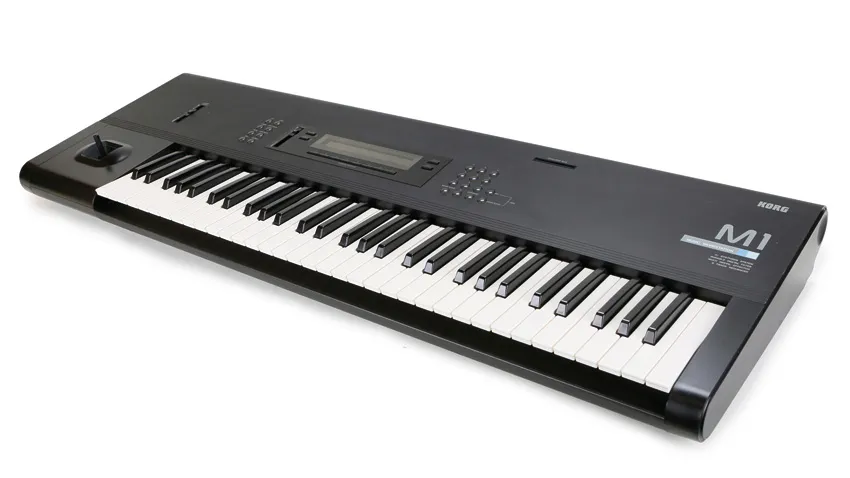
Taking the concept further, the Roland W-30 was a sampling workstation, that catered for on-board samples as well as sequencing duties, which could also be stored on floppy disks, or in some instances, several floppy disks!
The combination of synths and samplers both emulating ‘real’ instruments and a more digital approach to synthesis in general somewhat tarnished the late 80s, but the end of the decade should not just be remembered for the resulting digital ‘SAW-style’ music, because out of this major shift to digital came two new musical movements in the form of computer music making and dance music.
The Atari was the first computer to embrace MIDI and multitimbral synths, and the all-new dance music producers wrestled the failing analogue Rolands back into life to start a raveolution. More, much more, on that tomorrow, as we enter the ’90s…
Computer Music magazine is the world’s best selling publication dedicated solely to making great music with your Mac or PC computer. Each issue it brings its lucky readers the best in cutting-edge tutorials, need-to-know, expert software reviews and even all the tools you actually need to make great music today, courtesy of our legendary CM Plugin Suite.
Don’t miss the latest deals, news, reviews, features and tutorials
Thank you for signing up to Musicradar. You will receive a verification email shortly.
There was a problem. Please refresh the page and try again.
MusicRadar is part of Future plc, an international media group and leading digital publisher. Visit our corporate site (opens in new tab).
© Future Publishing Limited Quay House, The Ambury, Bath BA1 1UA. All rights reserved. England and Wales company registration number 2008885.
May 26, 2022 by The Beat Maker - 0 Comments