Live Science is supported by its audience. When you purchase through links on our site, we may earn an affiliate commission. Here’s why you can trust us
By published
The ancient city was part of the Mittani Empire.
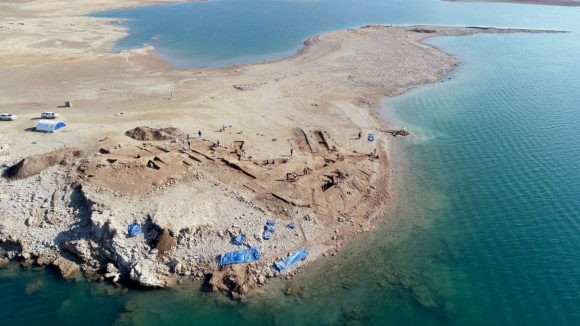
When an extreme drought caused a 3,400-year-old city to reemerge from a reservoir on the Tigris River in northern Iraq, archaeologists raced to excavate it before the water returned.
The Bronze Age city, at an archaeological site called Kemune, is a relic of the Mittani Empire (also spelled Mitanni Empire), an ancient kingdom that ruled parts of northern Mesopotamia from around 1500 B.C. to 1350 B.C. Researchers have long known of the remains of the city, but they can only investigate them during droughts.
Archaeologists partly excavated Kemune in 2018 and discovered a lost palace with 22-foot-high (7 meters) walls and chambers decorated in painted murals, Live Science previously reported. This time, researchers mapped most of the city, including an industrial complex and a multistory storage facility that likely held goods from all over the region, according to a statement (opens in new tab) released by the University of Tübingen in Germany.
“The excavation results show that the site was an important center in the Mittani Empire,” Hasan Qasim, an archaeologist who worked on the site and chairman of the Kurdistan Archaeology Organization, said in the statement.
Related: US to return ‘priceless’ 3,500-year-old Epic of Gilgamesh tablet to Iraq 30 years after it was stolen
Kemune is the only known urban center from the Mittani Empire located directly on the Tigris River, suggesting the city controlled crossings at this part of the waterway and may have also been an important connecting point for the empire, Ivana Puljiz, a junior professor of ancient Near Eastern archaeology at the University of Freiburg in Germany who also worked on the excavation, told Live Science in an email.
An earthquake likely destroyed much of the city in around 1350 B.C., but some of its ruins are preserved underneath collapsed walls. Humans flooded the site with water during the construction of the Mosul Dam in the 1980s — archaeologists knew about Kemune by then, but they hadn’t investigated the site, according to Puljiz.
Researchers rediscovered Kemune in 2010, but they weren’t able to excavate until the reservoir’s water level was low enough during a major drought in 2018. They had a second opportunity to analyze the city in 2022, because Iraq needed to use the reservoir’s water to prevent crops from drying out and failing during another severe drought — Iraq is heavily impacted by climate change — so the water level was low enough again, according to the statement
Kurdish and German archaeologists put together a team within days of deciding to investigate Kemune and worked quickly at the site in January and February, unsure of when the water would return. Among the Mittani ruins, the team uncovered more than 100 clay tablets from the middle Assyrian period (from around 1365 B.C.).
After the Mittani Empire came to an end, the Assyrians built a new settlement at Kemune and their tablets may contain writings about this change of empires. “We do not yet know what is written in the texts,” Puljiz said. “But we hope that they provide information about the beginning of Assyrian rule in the region.”
—30 of the world’s most valuable treasures that are still missing
—Ancient Assyrian rock carvings in Iraq show procession of gods riding mythical animals
—10 signs that Earth’s climate is off the rails
Some of the archaeologists’ trenches filled with water as the reservoir rose in February. They placed plastic sheets on the buildings and covered the sheets in gravel to protect the city from further deterioration. Kemune is now once again completely underwater and researchers don’t know when they’ll be able to return.
“It is completely unpredictable when the site will reappear,” Puljiz said. “It could emerge as early as this summer or as late as a few years from now.”
Originally published on Live Science.
Patrick Pester is a staff writer for Live Science. His background is in wildlife conservation and he has worked with endangered species around the world. Patrick holds a master’s degree in international journalism from Cardiff University in the U.K. and is currently finishing a second master’s degree in biodiversity, evolution and conservation in action at Middlesex University London.
Stay up to date on the latest science news by signing up for our Essentials newsletter.
Thank you for signing up to Live Science. You will receive a verification email shortly.
There was a problem. Please refresh the page and try again.
Live Science is part of Future US Inc, an international media group and leading digital publisher. Visit our corporate site (opens in new tab).
© Future US, Inc. Full 7th Floor, 130 West 42nd Street, New York, NY 10036.