Live Science is supported by its audience. When you purchase through links on our site, we may earn an affiliate commission. Here’s why you can trust us.
By published
This will be the fourth supermoon in a row, and the last one of 2022.
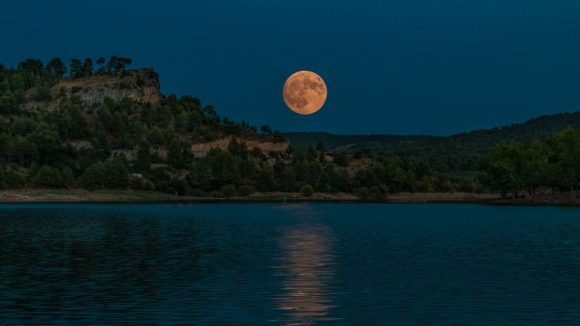
As summer slips into autumn and nights begin to grow longer, the final supermoon of the year will make a big splash Thursday (Aug.t 11).
Nicknamed the “Sturgeon Moon,” August’s full moon peaks around 9:36 p.m. EDT on Thursday (0136 a.m. GMT on Friday), – although the moon will appear bright and full on Wednesday and Friday night (Aug. 10 and Aug. 12) as well.
Most publications consider this a supermoon, meaning the full moon occurs while the moon is nearest its closest point to Earth, also known as perigee, during the current orbit. The Sturgeon Moon will appear within 90% of perigee, making it a supermoon by most scientific definitions. (Some publications put specific distance or time constraints on supermoons, meaning the Sturgeon Moon may not fit the bill for every publication.) Supermoons can appear larger and up to 16% brighter in the sky than the average full moon, according to timeanddate.com.
Related: Blood Supermoon Lunar Eclipse wows skywatchers around the world (photos)
The Sturgeon Moon will be the fourth supermoon in a row, following the Buck Moon in July, the Strawberry Moon in June and the Flower Moon (which also featured a total lunar eclipse) in May. August’s full moon will be the final supermoon of the year, according to the Farmer’s Almanac.
—Photos: Super Blood Wolf Moon eclipse stuns viewers
—See spectacular lunar mission images in 3D (Photos)
—Photos from the moon’s far side! China’s Chang’e 4 lunar landing in pictures
Why the fishy nickname? The Maine Farmer’s Almanac began printing Native American names for full moons in the 1930s, according to NASA, and these names have become commonplace today. The Sturgeon Moon’s name comes to us from the Algonquin tribes of what is now eastern North America, as large sturgeon fish were more easily caught in the Great Lakes at this time of year.
The full moon occurs about once a month when the sun, Earth and moon align on an invisible 180-degree line. The moon’s orbit is about 5 degrees different from Earth’s, so it is usually a little higher or lower than Earth’s shadow, enabling the sun’s rays to illuminate the side facing Earth.
The next full moon peaks on Saturday, Sept. 10. That moon is typically called the Harvest Moon.
Originally published on Live Science.
Brandon has been a senior writer at Live Science since 2017, and was formerly a staff writer and editor at Reader’s Digest magazine. His writing has appeared in The Washington Post, CBS.com, the Richard Dawkins Foundation website and other outlets. He holds a bachelor’s degree in creative writing from the University of Arizona, with minors in journalism and media arts. He enjoys writing most about space, geoscience and the mysteries of the universe.
Stay up to date on the latest science news by signing up for our Essentials newsletter.
Thank you for signing up to Live Science. You will receive a verification email shortly.
There was a problem. Please refresh the page and try again.
Live Science is part of Future US Inc, an international media group and leading digital publisher. Visit our corporate site (opens in new tab).
© Future US, Inc. Full 7th Floor, 130 West 42nd Street, New York, NY 10036.