June 29, 2022Music » Sound Stories & Interviews In 2015, Peter Sumic and his friend Robby Porovich started a new project called Forest Ray. The two were in college at Cal Poly in San Luis Obispo, California, writing and recording at the time, without doing live shows. After graduating and recording their first album, they moved to Seattle, which Sumic calls home, to build a live band. Since then, there have been plenty of changes in faces over the years, but Sumic has kept the heart and soul of Forest Ray consistent. “The current iteration is probably one of my favorite lineups so far. And the band has put a lot of work into it,” says Sumic. Forest Ray creates a mix of psychedelic rock that features doses of influence from Americana, post-punk, country, lo-fi, garage rock and, most recently, hints of folk. They record in analog and go even further with that aesthetic, shooting the band’s music videos with a Super 8 camera. Read our Q&A with Sumic below to learn more about Forest Ray and their upcoming album, “Always.” Source Weekly: What are some of the biggest musical influences that you think have had the largest impact on yourself as a musician and songwriter? Peter Sumic: Originally I was listening to a lot of ’60s garage rock comps, and there’s one in particular called “Pebbles.” I was really interested in making a song sound like it was from a certain era. So I kind of got into analog recording from that and that sound. In general, that whole movement and era of mid-1960s psychedelic rock was a big influence on me. The sound has kind of evolved, and we’ve incorporated more folk instruments into our newer stuff. SW: Forest Ray is a band, but then you also operate Forest Ray Records and recording studio. For people unaware, can you share some of the other work you do with the label? PS: Forest Ray Records is essentially an outlet for me to release vinyl, both for Forest Ray or other bands who have recorded at the studio. One shoegaze band we’ve worked with in the past is Vlly. Our primary focus at the studio is analog, but we do both. That’s the way the studio is geared and set-up. It’s been in operation as a studio since right before COVID. It wasn’t even meant to be a studio when it first started, just a place for me to record and create. Luckily, for that reason, the pandemic wasn’t a huge blow. The studio was just a way for me to pivot from live shows. SW: You guys have an album coming out this year called “Always.” How does this release stand out to you in comparison with the other Forest Ray records? What makes it special to you? PS: I think one thing in particular is, we incorporated more instruments. We bought a Rhodes electric piano. There’s more slide guitar. I was listening to a lot of George Harrison at the time. So it’s a lot of electric guitar mixed with George Harrison. There’s a track on there with banjo, a lot of acoustic guitars. That was kind of a new approach for a record. There’s pedal steel as well. We focused more on some folk and Americana influences, and blending that with the psychedelic stuff. SW: The band has put out three really awesome single releases in preparation for the album, and “Make Some Time” is probably my favorite so far. What inspirations went into making that track, both musically and in its material? PS: That’s actually the song that featured the banjo! Which was something we’ve never done for a tune. I was just messing around with banjo a lot during the pandemic. There’s also a cowbell that comes in during the guitar solo that started as a joke but we kept it in. And it’s only in the guitar solo [laughs]. That song was really fun to make. My friend Ashlyn is featured on vocal harmonies. It’s basically just a tune about procrastination and the afterlife. SW: You’re about to take off on a tour that will take you through the Northwest, the Rockies and the Midwest. What does the travel situation look like and what’s life on the road like for Forest Ray? PS: Right now we’re doing it in a sprinter van, and I just have like a really simple bunk. We’re doing a pretty long trip, and we’ll be pretty much in a new state every day. The gas prices are a little bit of a concern, but we always have a good time. Just listen to music and talk, meet new people and play music for them. We actually only have two days off for 25 days. We have like 23 shows. I think our two days off are in Bend and Redmond. So we’ll spend the most time there. Stay tuned for Forest Ray’s “Always,” dropping toward the end of August or early September. And be on the lookout for the band’s single. As Sumic notes, we’ll be getting a fourth around mid-tour. Forest Ray Tue., July 5, 8-11 pm High Desert Music Hall 818 SW Forest Ave., Redmond $10 We are committed to providing the Central Oregon community with well-researched news and impactful stories on local events. Your financial contribution ensures our work stays free for all. Contribute today! Khruangbin’s Global Sound Happens Naturally Gov’t Mule Goes Full Blues Lyle Lovett’s “12th of June” is Worth the Wait More Sound Stories & Interviews »
Mr. Alberto Orozco reports: Vancouver, British Columbia–(Newsfile Corp. – June 29, 2022) – Capitan Mining Inc. (TSXV: CAPT) (“Capitan” or the “Company”) is pleased to report continued exploration results from three (3) reverse circulation (RC) drillholes, as well provide an exploration update on the progress to date at its 100% owned Jesús María Silver Zone, at the Cruz de Plata Project (Formerly referred to as Peñoles), Durango, Mexico. Highlights: Step-out andInfill holes Continue to Confirm Continuity of High-grade Mineralization The drill holes reported herein consist of both infill and step-out holes targeting the continuity of high-grade mineralization and the expansion of Jesus Maria style mineralization at depth. Drillholes 22-JMRC-11 and 12 were both infill holes, targeting the eastern and western extents of high-grade mineralization associated with the Gully Fault, as shown on the long section below (Figure 1). 22-JMRC-11 intersected mine workings at the interpreted depth of high-grade mineralization associated with the Gully Fault and returned several zones of generally narrow mineralization thereafter at depth. Hole 22-JMRC-12 returned a stronger zone of high-grade mineralization near surface consisting of 21.3m of 143.59 g/t AgEq, including 1.5m of 488.97 g/t AgEq and 1.5 of 328.25 g/t AgEq. Of note, the high-grade intersections in hole 22-JMRC-12 extended the boundary of high-grade mineralization northeast along the Gully Fault structure and not along the Main Jesus Maria Vein (long section below), which trends east-west. The technical team is in the process of generating a long-section for the Gully Fault, as well as other sub-parallel zones at Jesus Maria. Figure 5 shows a 3D perspective view showing the relationship between the Jesus María Vein and the Gully Fault Zone. Drillhole 22-JMRC-07 was a step-out hole that was designed to extend the Jesus Maria zone to depth, along section. The hole successfully intersected the Jesus Maria zone at 112.8m downhole, returning 22.9m of 76.98 g/t AgEq including 1.5m 427.62 g/t AgEq and extending the zone down-dip approximately 25m, (see long-section and cross section below). Exploration Update: Drilling at Jesus María Continues to Define High-Grade Silver Mineralization and Extend Zone at Depth The Jesus María vein is part of a larger trend of silver-mineralized veins that occur on a 3-km east-northeast trend, between the zones of Jesus Maria and San Rafael, with most of that trend covered by the Capitan Mining mineral concessions. The Jesus Maria vein has been drill tested over a strike length of 800m, including new drilling, with most of this drilling focused over a 475m strike length, from the Gully Fault structure eastward, with the remaining 325m to the west remaining shallowly drilled. The entire zone remains open at depth. The current drill program has focused on two objectives: The long section shown below in Figure 1, illustrates the distribution of high-grade mineralization along the main Jesus Maria Vein, indicated by the red, magenta, and purple shading. Of note, is the clustering of high-grade mineralization coincident with and adjacent to, the trace of the Gully Fault. Recent infill drilling within this corridor has confirmed that the Gully Fault exhibits a strong control on the distribution of high-grade mineralization along Jesus Maria vein, with additional high-grade mineralization hosted along the Gully Fault structure itself. The current drill program has been successful in showing that the high-grade mineralization at surface continues at depth, forming a continuous zone of high-grade Ag-mineralization along the central and eastern portions of the Jesus Maria Vein. In addition, high-grade mineralization has been expanded to the south and east through recent step-out drilling, indicating that mineralization continues to remain strong and open at depth. Going forward, an additional 9 holes are pending assays, with their respective locations shown on the long section below. Most of these holes are step-outs down-dip, with only two designated as infill. In addition, the long-section presented below in Figure 1 represents one of two main zones currently being targeted in the current drill program. A long-section for the Gully Fault target is currently in process and should be ready in the coming weeks. Figure 1. Long section along Main Jesus María Vein: Image is oriented 270o, looking 0o degrees. Zone has a dip of -45o to the south. Capitan’s CEO, Alberto Orozco, stated: “Our understanding of the silver potential at the Cruz de Plata has grown greatly since our drilling started in the Jesus Maria vein last year. We have not only demonstrated the scale potential for that vein by expanding on the main mineralized plunges within it, but have also identified additional structures or veins that hold further potential. This includes the Gully-Fault Zone, the Upper Jesus María vein, Jesus-Maria stye mineralization underneath the Capitan oxide gold deposited (as reported in hole 21-CARC-29) and new mineralization and alteration zones in the footwall of the Jesus Maria vein. We are excited to see results for upcoming holes testing the down-dip component of Jesus Maria, as well as to continue our drill program testing further targets.” Figure 2. Plan map of Jesus Maria Silver Zone showing drillhole and long section location at the Jesus Maria Zone. Figure 3. Cross section of hole 21-JMRC-07 Figure 4. Cross section of hole 22-JMRC-12 Figure 5. 3D view of Jesus María vein (red) and the intersecting, mineralized Gully Fault zone (yellow). Mineralized intercepts shown for the Gully Fault mineralized zone are drilled length and not true width. Table 1. Table of drill results for hole 21-JMRC-07, 22-JMRC-11 and 22-JMRC-12 Note: Only drill intercept lengths are reported in the table. Drill holes are designed to cut the mineralized zones as close to true width as possible, with true widths ranging from 70-95% of the reported drilled length. * Silver equivalent calculated using the following equation AgEq = Ag g/t + (80 x Au g/t) + (0.003 x Pb g/t) + (0.0037 x Zn g/t). About the Jesus María Silver Project The Jesus Maria (JM) Silver Project is located approximately 280m to the northeast of the Capitan’s Oxide Gold deposit on its 100% owned Cruz de Plata property. It has been traced by surface trenching and diamond drilling over a strike length of 800m and to a depth of 200m, with the majority of drilling focused over 475m of strike length and less than 150m below surface. The Jesus Maria Silver Project has a long mining history going back to the late 1800’s, when the Penoles Mining company constructed several shafts and drifts to exploit the high-grade silver veins in the area. In recent years, work programs conducted by previous operators has demonstrated significant potential at the Jesus Maria silver deposit. The work to date has identified Two (2) distinct styles of silver mineralization: Highlights of trenching and diamond drilling by previous operators are presented below: Prior Trenching Highlights – Jesus Maria (2011-2013) Prior Diamond Drill Highlights – Jesus Maria (2013-2014) High-grade Silver Polymetallic veins High Grade Silver & Gold Veins Approximately 3,100m of diamond drilling were completed by previous operators at the Jesus Maria silver deposit (2011-2014), which were used to complete an initial 43-101 compliant, Inferred resource in 2015 consisting of 7.5 million tonnes at an average grade of 62 g/t Ag (15 million contained ounces) and 0.1 g/t Au (26,000 contained ounces). Capitan has submitted an updated 43-101 report on the Cruz de Plata project inferred resource (formerly called Peñoles project), with an effective date of January 12, 2020. The report was authored by Derrick Strickland, P. Geo. And Robert Sim, P. Geo. The report can be found in SEDAR. Qualified Person & QA/QC: The scientific and technical data contained in this news release pertaining to the Peñoles Project was reviewed and approved by Marc Idziszek, P.Geo, a non-independent qualified person to Capitan Mining, who is responsible for ensuring that the technical information provided in this news release is accurate and who acts as a “qualified person” under National Instrument 43-101 Standards of Disclosure for Mineral Projects. Capitan Mining Inc. has a Quality Assurance/Quality Control program that includes insertion and verification of control samples including standard reference material, blanks and duplicates consistent with industry standards. RC drill samples from the Peñoles Project are collected and split at the drill site using a Gilson Universal Splitter. The samples are stored in either plastic bags (dry) or micropore bags (wet) and secured with plastic zip-ties and then transported to the preparation laboratory of Bureau Veritas in Hermosillo, Sonora. The sample pulps are then transported to the Bureau Veritas’ laboratory in Vancouver, where they are assayed for gold by fire assay with atomic absorption finish (FA430 assay method code; 0.005 to 10 ppm detection limit). Samples over 10 ppm Au and over 100 ppm Ag are assayed with gravimetric finish (Assay code FA530). All samples are also assayed by ICP-ES (code AQ300) for a suite of 33 elements. Samples over 1%Pb and Zn are assayed by Aqua regia Ore Grade ICP-ES (AQ 370). All summarized intervals reported in this press release were calculated using a 25 ppm Ag equivalent (AgEq) cut-off grade with AgEq including Ag, Au, Pb and Zn and calculated as follows: AgEq = Ag g/t + (80x Au g/t) + (0.003 x Pb g/t) + (0.0037 x Zn g/t). Intervals contain no more than 3 metres of internal dilution. High grades have not been capped. 100% recovery for all metals is assumed. About Capitan Mining Inc.: Capitan Mining is a well-funded junior exploration company focused on its 100% owned gold and silver Peñoles Project in Durango, Mexico. The company is led by a management team that has successfully advanced and developed several heap leach operations in Mexico over the past 16 years. More information for the Company can be found at www.capitanmining.com. ON BEHALF OF CAPITAN MINING INC. “Alberto Orozco”
Alberto Orozco, CEO For additional information contact: Alberto Orozco CEO Capitan Mining Inc. This email address is being protected from spambots. You need JavaScript enabled to view it. Phone: (778) 327-6671 Fax: (778) 327-6675 Web: www.capitanmining.com Raffi Elmajian Corporate Communications Capitan Mining Inc. This email address is being protected from spambots. You need JavaScript enabled to view it. Phone: (604) 358-2601 Web: www.capitanmining.com Certain statements in this press release may be considered forward-looking information. These statements can be identified by the use of forward-looking terminology (e.g., “expect”,” estimates”, “intends”, “anticipates”, “believes”, “plans”). Such information involves known and unknown risks — including the availability of funds, the results of financing and exploration activities, the interpretation of exploration results and other geological data, or unanticipated costs and expenses and other risks identified by Capitan in its public securities filings that may cause actual events to differ materially from current expectations. Readers are cautioned not to place undue reliance on these forward-looking statements, which speak only as of the date of this press release. Neither the TSX Venture Exchange nor its Regulation Services Provider (as that term is defined in the policies of the TSX Venture Exchange) accepts responsibility for the adequacy or accuracy of this release.
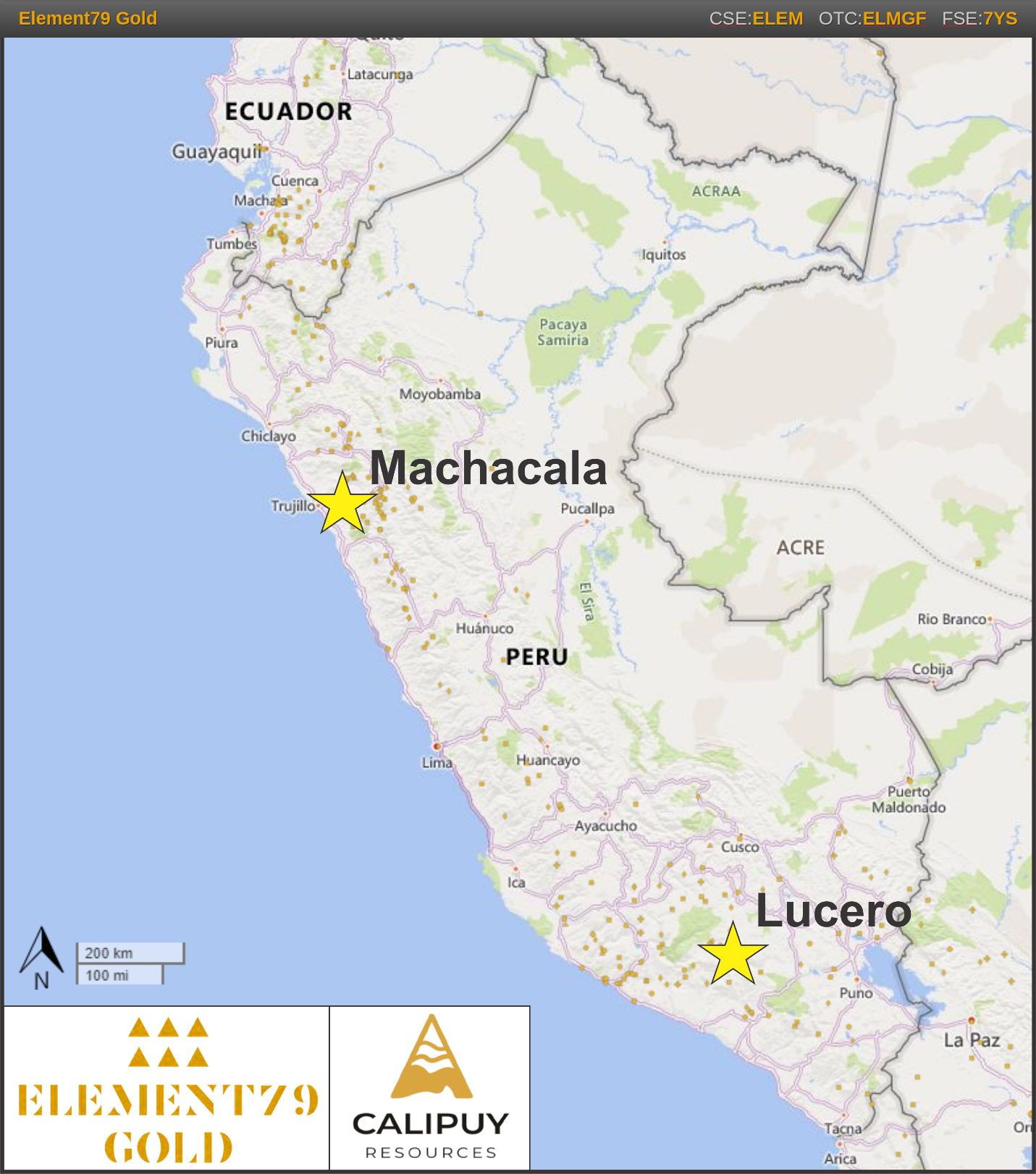
Mr. James Tworek reports: Historic production averaging up to 19 g/t Au Equivalent, Recent sampling returned up to 116 g/t Au Equivalent, Includes one of the highest-grade underground mines in Peru’s history VANCOUVER, BC / ACCESSWIRE / June 29, 2022 / Element79 Gold Corp. (CSE:ELEM)(OTC PINK:ELMGF)(FSE:7YS) (“Element79 Gold”, the “Company“) announces that pursuant to the definitive share purchase agreement dated June 19, 2022 (the “Agreement“), it has closed the acquisition of all of the issued and outstanding common shares of Calipuy Resources Inc. (“Calipuy”) from the shareholders of Calipuy (the “Calipuy Shareholders“). Calipuy, through its subsidiaries, holds 100% interest in two past producing gold-silver mines: the Lucero mine (“Lucero”), one of the highest-grade underground mines in Peru’s history(1) at grades averaging 19.0 g/t Au Equivalent (“Au Eq”) (14.0 g/t gold and 373 g/t silver),(1,2) as well as the Machacala Project (“Machacala” and, together with Lucero, the “Properties“) which averaged production grades of 10.5 g/t Au Eq (6.0 g/t gold and 340 g/t silver).(3) Operations were suspended in 2005 at Lucero and 1991 at Machacala due to the persistence of low gold and silver prices at the time. Element79 Gold has previously disclosed the terms of the Agreement (see news release dated June 20, 2022, available on SEDAR). Highlights of the High-Grade Peruvian Gold Portfolio: “The closing of the Calipuy transaction delivers high-grade assets, potentially capable of operating in the near-term, to Element79 Gold’s growing portfolio, offering an expedited route toward cash-flow generation through these significant production-stage properties,” commented James Tworek, President and CEO of the Company. “With the on-site team being assembled and planning is underway for both sites, Element79 Gold’s focus is to accelerate the timeline to operations at these properties by expanding on current datasets and exploration at each asset.” Peru has a mining-friendly legislation that allows up to 350 tpd production while larger scale production permitting is underway. Element79 Gold has previously stated that it intends to pursue the opportunities aggressively (see news releases dated March 10, 2022, March 17, 2022, and June 20, 2022, available on SEDAR). Lucero Project Formerly operated as the Shila mine from 1989 to 2005, Lucero consists of 10,805 hectares located in the Shila range of southern Peru, which contains several historic high grade gold-silver mines.(1) Lucero consistently delivered high grades during 16 years of operations, and between 1998 and 2004 reported production averaging approximately 18,800 ounces of gold and 435,000 ounces of silver per year at grades of 19.0 g/t Au Eq (14.0 g/t Au and 373 g/t Ag),(2) with recoveries at the ore processing facility averaging 94.5% for gold and 85.5% for silver.(1) A recent NI 43-101 technical report on Lucero has been prepared for Calipuy by Mining Plus. Samples collected by the technical report’s Qualified Person (the “QP“) returned up to 116.8 g/t Au Eq (78.7g/t Au and 2,856 g/t Ag)(9). Due to a lack of historical data, the project does not host any resources. However, access to the historic workings is available, and the QP states Lucero is underexplored and has significant exploration potential for extension of known veins, and to discover additional veins.(9) Lucero is one of many low-sulphidation epithermal Au-Ag deposits hosted in tertiary volcanics of the Central Andes Cordillera of southern Peru. The project hosts 74 recognized epithermal veins, 14 of which have been partially exploited. High grade ‘bonanza-style’ direct shipping ore was mined in the past from low-to-intermediate-sulphidation quartz-carbonate massive sulphide veins. Prospecting by previous operator Condor Resources Inc. from 2012 to 2020 identified the high-sulphidation epithermal alteration zone with structures that returned peak sample values of 80.1 g/t Au Eq (33.4 g/t Au and 3,500 g/t Ag)(11). This alteration zone, measuring approximately 1,300 metres by 1,400 metres, exhibited no evidence of prior sampling or drilling and is believed to host potential for a bulk tonnage disseminated gold-silver deposit.(1) “Lucero offers a rare opportunity to explore for not only an underground high-grade low sulphidation system but potentially an open pit-able high sulphidation system as well,” stated Neil Pettigrew, M.Sc., P.Geo, Director of Element79 Gold “This project has never experienced modern exploration techniques and I am very confident that significant gold-silver resources are to be found.” A 0.5% Net Smelter Returns royalty is retained by Sandstorm Gold Ltd., one of the largest gold royalty companies in the world.(2) Figure. 1 Location Map of the Lucero and Machacala Projects. Machacala Project Machacala consists of over 4,000 hectares located in the District of Carabamba, Province of Julcan, Department of La Libertad. In 2004, Gold Hawk Resources, Inc. (“GoldHawk“) estimated a total inferred resource of 420,000 Au Eq ounces hosted within 1,560,000 tonnes, which equates to a gold equivalent grade of 8.4g/t, however individual gold and silver grades were not reported.(4) This historic estimate is the most recent historic resource estimate relevant to Machacala. In additional Machacala also includes approximately 200,000 tonnes of tailings, which have historically been estimated in 2004 to grade 1.26 g/t gold and 74 g/t silver(6). This historical tailings estimate is historic in nature, and non-43-101 compliant. Historical metallurgical studies by Gold Hawk show 87% recoveries of gold and 50%+ recovery of silver in 24 hours of leaching un-milled tailings, with re-milling able to increase recoveries to 90% of gold and 73% of silver in 24 hours of leaching.(7). A qualified person has not conducted sufficient work on either the historical Gold Hawk or Tailings estimates required to categorize these resources to the CIM definition of a current mineral resources, which may include the preparation of a new NI 43-101 Technical Report. Element79 Gold is not treating these historic estimates as current mineral resources and a qualified person has not reviewed the work to define the quality of work associated with this historic estimate.While these historical estimates are considered to be relevant to future exploration of the Machacala property they should not be relied upon and there can be no assurance that any of the historical resources, in whole or in part, will ever become economically viable. Machacala was first commercially mined in the 1950s before being acquired and operated by Minera Santa Isabel, S.A. from 1979 to 1991 which mined 230,000 metric tonnes averaging 10.5 g/t Au Eq (6.0 g/t Au and 340 g/t Ag) representing 78,000 Au Eq ounces.(4) Operations were suspended in 1991 due to the persistence of a low gold ($360/oz) and silver ($3.81/oz) price. Neighboring concessions include those owned by Fortescue Metals Group (ASX Listed) and by Fresnillo Peru S.A.C., a subsidiary of Fresnillo plc (LSE Listed).(3,5) The project was most recently explored by Gold Hawk and Meridian Gold between 1997 and 2004, with a total of 8,500m in 45 core and RC drill holes completed. Highlights of this drilling include 11.6 g/t Au Eq (11.32 g/t Au and 23.6 g/t Ag) over 3.7m in the Casa Fuerza vein, and 15.7 g/t Au Eq over 3.15 m (13.55 g/t Au and 164 g/t Ag) in the Fragua vein10). Machacala hosts multiple low-sulphidation epithermal Au-Ag veins, of which only four have been only modestly exploited.(5) A 1.5% Net Smelter Returns royalty is retained by previous owners of the property. “Machacala possesses significant historical data, as well as 8,500 meters of recent drilling, which we hope will assist in the definition of NI 43-101 compliant resources,” commented Neil Pettigrew, M.Sc., P.Geo, Director of Element79 Gold. “The project is also at a low elevation and has excellent infrastructure which will facilitate returning the project to production.” Terms of the Acquisition Pursuant to the Agreement, the Company acquired all of the issued and outstanding securities of Calipuy from the Calipuy Shareholders (the “Acquisition“). As consideration for the Acquisition, the Company paid USD$15 million by the issuance, on a pro rata basis to the Calipuy Shareholders, of (i) an aggregate of 19,165,484 common shares of the Company at deemed issue price of CAD$1.00 per share (the “ConsiderationShares“) and (ii) performance bonus warrants to acquire an aggregate of 3,833,085 common shares of the Company (the “PerformanceBonusWarrants“). Each Performance Bonus Warrant is exercisable into one common share of the Company at an exercise price of CAD$2.00 per share for a period of three years from Exercise Eligibility Date (as defined herein), subject to achievement of the Bonus Performance Target (as defined herein), the policies of the Canadian Securities Exchange (the “Exchange“) and the terms of warrant certificates to be issued to the Calipuy Shareholders in respect thereof. The Company may accelerate expiry of the Performance Bonus Warrants if the common shares of the Company have a closing price greater than CAD$3.50 per share for a period of ten consecutive trading days on the Exchange at any time after the closing of the Acquisition (the “Closing“). The holders of the Performance Bonus Warrants will not have the right to exercise the Performance Bonus Warrants until projects carried out on the Properties have cumulatively reached a minimum production target of 9,000 tons of ore yielding a minimum of 1,500 oz Au within a 30-day production period (the “BonusPerformanceTarget“) and the Company provides notice of achievement of the Bonus Performance Target via news release (the “ExerciseEligibilityDate“). All issuances of Consideration Shares were paid in CAD denominated shares at the agreed exchange rate of CAD$1.2777 to USD$1.00. An aggregate of 12,971,503 Consideration Shares and 2,594,298 Performance Bonus Warrants are subject to a lock-up agreement, whereby 50% will be released from lock-up 6 months from Closing and the remaining 50% will be released 12 months from Closing. The balance of the Consideration Shares and Performance Bonus Warrants, other than those held by U.S. persons, are not subject to any resale restrictions under applicable securities laws. The Acquisition is a related party transaction pursuant to Multilateral Instrument 61-101 Protection of Minority Shareholders in Special Transactions (“MI 61-101“). Antonios Maragakis, who is the CEO and a director of Calipuy, is also a director and the COO of the Company. Shane Williams, who was a director of Calipuy immediately prior to the Closing, was recently elected as a director of the Company at its Annual General Meeting on June 22, 2022 (together, the “Related Parties“). Each of the Related Parties have disclosed their interest in the Acquisition to the board of directors of each of the Company and Calipuy, and abstained from voting on approval of the Agreement, the Acquisition and the Closing. Prior to Closing, neither of the Related Parties held any common shares of the Company, and following Closing their beneficial direct and indirect shareholdings increased to 97,688 common shares and 292,509 common shares, respectively. The Acquisition, the Agreement and the Closing were reviewed and considered by the disinterested members of the board of directors of the Company with each of the Related Parties recusing themselves from discussions relating to the same, and the disinterested members of the board unanimously approved entry into the Agreement and completion of the Acquisition on the terms of the Agreement. The Company believes that the Acquisition provides an opportunity to advance the Properties and deliver value to Element79 shareholders. A special committee was not formed for the purpose of reviewing the Acquisition and an independent valuation was not obtained in connection with the Acquisition. On Closing, each of the Related Parties terminated any and all compensation agreements they had with Calipuy and waived any entitlement to severance or change of control payments by Calipuy that would have otherwise been triggered as a result of the Acquisition. In connection with the Acquisition, the Company relied on (i) the exemption at paragraph 5.5(b) of MI 61-101 from the valuation requirements since the Company is not listed on any of the markets specified therein; and (ii) the exemption at paragraph 5.7(a) of MI 61-101 from the minority approval requirements as the fair market value of the 97,688 Consideration Shares and 19,537 Performance Bonus Warrants issued to Mr. Maragakis, and the 292,509 Consideration Shares and 58,501 Performance Bonus Warrants issued to a company controlled by Mr. Williams, on Closing is less than 25% of the market capitalization of the Company. All Au Equivalent calculations were performed using $1,650/oz gold, and $22/oz silver in line with the Company’s Maverick Springs 43-101 resource estimate (see news release January 31st, 2022, available on SEDAR). Qualified Person The technical information in this release has been reviewed and verified by Neil Pettigrew, M.Sc., P. Geo., Director of Element79 Gold and a “qualified person” as defined by National Instrument 43-101. About Element79 Gold Element79 Gold is a mineral exploration company focused on the acquisition, exploration and development of mining properties for gold and associated metals. Element79 Gold has acquired its flagship Maverick Springs Project located in the well-known gold mining district of northeastern Nevada, USA, between the Elko and White Pine Counties, where it has recently completed a technical report, pit-constrained mineral resource estimate reflecting an Inferred resource of 3.71 million ounces of gold equivalent* “AuEq” at a grade of 0.92 g/t AuEq (0.34 g/t Au and 43.4 g/t Ag)) with an effective date of Feb. 4, 2022. The acquisition of the Maverick Springs Project also included a portfolio of 15 properties along the Battle Mountain trend in Nevada, which the Company is analyzing for further merit of exploration, along with the potential for sale or spin-out. In British Columbia, Element79 Gold has executed a Letter of Intent to acquire a private company which holds the option to 100% interest of the Snowbird High-Grade Gold Project, which consists of 10 mineral claims located in Central British Columbia, approximately 20km west of Fort St. James. In Peru, Element79 Gold holds 100% interest in the past producing Lucero Mine, one of the highest-grade underground mines to be commercially mined in Peru’s history, as well as the past producing Machacala Mine, subject to the royalties and encumbrances detailed in the Agreement. The Company also has an option to acquire 100% interest in the Dale Property which consists of 90 unpatented mining claims located approximately 100 km southwest of Timmins, Ontario, Canada in the Timmins Mining Division, Dale Township. For more information about the Company, please visit www.element79.gold or www.element79gold.com Contact Information For corporate matters, please contact: James C. Tworek, Chief Executive Officer E-mail: This email address is being protected from spambots. You need JavaScript enabled to view it. For investor relations inquiries, please contact: Investor Relations Department Phone: +1 (604) 200-3608 E-mail: This email address is being protected from spambots. You need JavaScript enabled to view it. Technical Disclaimer This news release and related maps contain information about adjacent properties and properties with similar characteristics on which the Company has no right to explore or mine. Readers are cautioned that mineral deposits on adjacent properties or properties that share similar characteristics are not indicative of mineral deposits on the Company’s properties. Readers are also cautioned that this news release contains historical technical information which is based on prior data prepared by previous property owners. A qualified person has not done sufficient work to confirm such information; significant data compilation, re-drilling, re-sampling and data verification may be required to do so. Cautionary Note Regarding Forward Looking Statements This press contains “forward‐looking information” and “forward-looking statements” under applicable securities laws (collectively, “forward‐looking statements“). These statements relate to future events or the Company’s future performance, business prospects or opportunities that are based on forecasts of future results, estimates of amounts not yet determinable and assumptions of management made in light of management’s experience and perception of historical trends, current conditions and expected future developments. Forward-looking statements include, but are not limited to, statements with respect to: the Company’s business strategy; future planning processes; exploration activities; the timing and result of exploration activities; capital projects and exploration activities and the possible results thereof; acquisition opportunities; and the impact of acquisitions, if any, on the Company. Assumptions may prove to be incorrect and actual results may differ materially from those anticipated. Consequently, forward-looking statements cannot be guaranteed. As such, investors are cautioned not to place undue reliance upon forward-looking statements as there can be no assurance that the plans, assumptions or expectations upon which they are placed will occur. All statements other than statements of historical fact may be forward‐looking statements. Any statements that express or involve discussions with respect to predictions, expectations, beliefs, plans, projections, objectives or future events or performance (often, but not always, using words or phrases such as “seek”, “anticipate”, “plan”, “continue”, “estimate”, “expect”, “may”, “will”, “project”, “predict”, “forecast”, “potential”, “target”, “intend”, “could”, “might”, “should”, “believe” and similar expressions) are not statements of historical fact and may be “forward‐looking statements”. Actual results may vary from forward-looking statements. Forward-looking statements are subject to known and unknown risks, uncertainties and other factors that may cause actual results to materially differ from those expressed or implied by such forward-looking statements, including but not limited to: the duration and effects of the coronavirus and COVID-19; risks related to the integration of acquisitions; actual results of exploration activities; conclusions of economic evaluations; changes in project parameters as plans continue to be refined; commodity prices; variations in ore reserves, grade or recovery rates; actual performance of plant, equipment or processes relative to specifications and expectations; accidents; labour relations; relations with local communities; changes in national or local governments; changes in applicable legislation or application thereof; delays in obtaining approvals or financing or in the completion of development or construction activities; exchange rate fluctuations; requirements for additional capital; government regulation; environmental risks; reclamation expenses; outcomes of pending litigation; limitations on insurance coverage as well as those factors discussed in the Company’s other public disclosure documents, available on www.sedar.com. Although the Company has attempted to identify important factors that could cause actual results to differ materially from those contained in forward-looking statements, there may be other factors that cause results not to be as anticipated, estimated or intended. The Company believes that the expectations reflected in these forward‐looking statements are reasonable, but no assurance can be given that these expectations will prove to be correct and such forward‐looking statements included herein should not be unduly relied upon. These statements speak only as of the date hereof. The Company does not intend, and does not assume any obligation, to update these forward-looking statements, except as required by applicable laws. Element 79 Gold makes no warranty as to the completeness, accuracy, verifiability, or suitableness of any of the information contained on the following third-party links and expressly undertakes no obligation to update the following links. 1. https://web.archive.org/web/20220308020414/https://condorresources.com/portfolio/lucero/ 2. https://web.archive.org/web/20220308020532/https://www.sandstormgold.com/our-royalties/lucero/ 3. https://www.bnamericas.com/en/news/Gold_Hawk_Buys_Machala_Project 4. Gold Hawk Resources Inc News Release, 2004-04-26 5. https://web.archive.org/web/20220308020657/https://www.affinitygold.com/machacala-highlights 6. Gold Hawk Resources Inc News Release, 2004-06-28 7. Affinity Gold Corp. Corporate Presentation March 2013 8. https://web.archive.org/web/20220308020649/https://www.sec.gov/Archives/edgar/data/1397970/000118374013000409/f8k08162013ex99-2.htm 9. Draft NI 43-101 technical Report, Lucero Property, Arequipa Region, Peru, prepared by Esteban Manrique Zuniga of Mining Plus with and effective date of September 4th 2021. Prepared for Calipuy Resources Inc. 10. Gold Hawk Resources Inc. News Release, 2000-09-19 11. Condor Resources Inc. December 6, 2012 news release https://condorresources.com/news/archive/2012/condor-acquires-former-producing-gold-silver-concessions-near-arequipa-in-southern-peru/ Neither the Canadian Securities Exchange nor the Market Regulator (as that term is defined in the policies of the Canadian Securities Exchange) accepts responsibility for the adequacy or accuracy of this release.
We may earn a commission for purchases using our links. Learn more. Source: Apple When your youngster runs home from school, dumps their school bag on the sofa and announces proudly, ‘I need a MacBook!’ it can be easy to be taken aback and make you wonder – ‘do they really need a MacBook?’. Education is becoming increasingly reliant on technology, and kids without access are being left behind. While many schools these days have computer labs or are provided easy access to laptops, it’s still a good idea for students to have access to their own laptops or computers at home. If nothing else, it makes it far easier for high school students to take notes in class, work on assignments, study for tests, or even stay in touch with friends. When I was at school, for the longest time I relied on a single desktop shared amongst the rest of the family, so I can say with certainty a laptop is a great option for students to do work at home. They can choose where to work comfortably, whether that’s in their space or in family-shared areas like the kitchen. So a student needs a laptop, but that still begs the question – why a MacBook? MacBooks are a very good option for students. They’re well built, and the lineup, from the $1,100 MacBook Air to the incredible powerhouse that is the 16-inch MacBook, will be extremely capable of completing any academic task. Source: Gerald Lynch / iMore One of the biggest reasons to opt for a Mac for students is the operating system – macOS. Apple makes sure that its operating system runs well on all the machines that it sends updates to, so you can be sure that it’ll be supported for a reasonably long time. In fact, MacBooks are well known for their longevity – our own editor-in-chief has been using his MacBook Pro Retina model since 2012. Software support on macOS is also excellent. You’ll be able to use Microsoft’s line of productivity software in Office 365, but in many cases, you might not want to. Apple’s suite of productivity apps, known as ‘iWork’, is stellar, containing the personal favorite word processor of this writer, Pages, and her lesser-used but equally brilliant sister programs, Keynote, and Numbers. Apple’s suite of productivity apps, known as ‘iWork’, is stellar There’s also a host of third-party apps available for any need – there’s Ulysses for creative writers, note-taking apps like Agenda, and unique calculators like Soulver. The built-in web browser, Safari, is a fast and solid option, but you can always install Google Chrome or Firefox if you’re so inclined. Even Microsoft make a browser for Mac, Edge. For those who need more niche app support, macOS is the platform of choice for some of the top music, video, and photo editing software. For budding music producers, Apple’s Logic Pro is an industry-standard Digital Audio Workstation (you may hear it being called a DAW), and, of course, works brilliantly on Mac. Video editors can opt for Apple-made Final Cut Pro, but support for other powerful editors like Adobe Premiere Pro and DaVinci Resolve is also strong. Photo editors will love the more powerful version of Adobe Photoshop that Mac gets, although free options like GIMP run well too. Mac is the platform of choice for many in the creative space, and if your young student is looking to start their journeys in this sector, then a Mac is, without a shadow of a doubt, the best option. Source: iMore Another key strength of Mac is its interconnectivity with the rest of the Apple ecosystem, called Continuity. For students who have an iPhone, they’ll find they’re able to work on their papers with mobile versions on Pages, and then pick up where they left off on their MacBook. You can receive messages from iMessage on your MacBook, so you don’t have to keep your iPhone close by. Remember as well that MacBooks can be bought with an education discount, so students and teachers can get a nice 10% off their purchase. On top of this, there’s also the Apple back-to-school deal, which this year gives you a $150 gift voucher to spend on whatever you want on Apple’s website. It’s worth first making some ground rules as to what a student needs in a laptop, and how it fits with their needs. First off, it needs to be light and slim, so that it fits into one of the best laptop bags for back to school. It’ll need to be sturdy so that it survives being tossed into said school bag. The screen should be at least 13-inches (diagonal), so there’s ample space for research on multiple Chrome tabs and writing papers. As long as the MacBook fits these criteria, it’ll be a great option for a student. Source: Daniel Bader / Android Central The first MacBook that fits these criteria almost perfectly is the now outgoing MacBook Air, which will be more than adequate for most students. 2020’s MacBook Air blends power and portability in a lovely aluminum chassis, bringing a nicely sized 13-inch screen and solid keyboard to the table. In addition, it only weighs 2.75 pounds and is 0.63-inches at its thinnest – it’s a laptop that will easily slip into any backpack. MacBook Air blends power and portability in a lovely aluminum chassis While by no means the most powerful MacBook in Apple’s lineup, it’s plenty for most tasks students will encounter. The dual-core M1 processor is more than enough for writing papers, researching on the web, and messaging with friends. The 8GB of RAM in the base model is almost enough but to future-proof your student’s computer that little bit more, it’s well worth upgrading to 16GB to make all those chrome tabs run better. Source: iMore It’s worth bearing in mind that there’s a new MacBook Air on the way, replacing the MacBook Pro 2020. The MacBook Air 2022 will feature Apple’s latest silicon, the M2 chip. This chip looks to be even more powerful than the previous generation and completely redesigns the body. While the MacBook Air 2020 is a very proficient machine, there are a huge number of reasons that you may want to wait for the new version. In fact, we’ve already got a MacBook Air 2022 vs MacBook Air 2020 to give you an idea of which machine might be best for your student. The MacBook Air 2020 is an excellent machine in a very svelte package. It’s slim, light, and powerful enough for most students, filling their needs as a portable computer. It is worth upgrading to 16GB of RAM, if not only for smooth Chrome browsing with multiple tabs. For some students, the MacBook Air might not be enough. Students studying video production, music creation, or photography will need a more powerful laptop and one that can take them to higher education. We should mention that we’re going to get a little techy here, so feel free to jump ahead if you just want to know what kind of laptops these disciplines should go for. Why do these subjects need more power? It’s simple – the programs you need to edit photos and videos and create music are power-hungry apps. Let’s look at the most demanding of these subjects – video production. One of the most used video editors in the industry is Adobe Premiere Pro, and its system requirements make the MacBook Air shake a little. At a minimum, it needs 8GB of RAM and, more importantly, 2GB of GPU RAM. In its simplest terms, GPU RAM (or Graphics RAM) is what the MacBook uses to process video. Even then, minimum requirements are just that – a minimum. For a smooth experience that will make working easier, a student will need more RAM and GPU RAM in their MacBook. The programs you need to edit photos and video and create music are power-hungry apps In this case, it is worth explaining the current Apple chip lineup – because looking at the recommended specs of the programs your student will be using and then lining them up with the specs of the MacBook lineup can be confusing. At the moment, MacBooks use Apple’s in-house silicon, such as the M1, the M1 Pro, Max and Ultra, and the M2. These chips share the role of a traditional processor and graphics processor and the MacBook’s RAM. So, at a minimum, a student studying video editing will need a MacBook with 16GB of RAM. Students studying video editing will need the most power they can get their hands on, and thankfully, there are some great options available. The MacBook Pro M2 is a great entry-level option, featuring Apple’s latest M2 chip. It’s a very powerful machine, and when equipped with 16GB of RAM will be more than capable of running all the video editing software that a student might need. In addition, if a student course needs the Final Cut Pro app, you can add that when configuring the laptop at Apple’s website for a little extra. Source: Adobe College students majoring in video editing may need more power. In this case, the more expensive MacBook 2021 will be more than enough. The M1 Pro chip will handle video editing exceptionally well, the base model comes with 16GB of RAM. Upgrading to 32GB may be a good idea for students who know they’ll also be doing 3D work, but the base model should suffice for most. Video editing high schoolers need more than the Air, but not as much as some of Apple’s more expensive MacBooks. The MacBook Pro M2 offers incredible performance and some great RAM options. 16GB would likely be the best option for a MacBook that will last. In college or university, you will want an even more powerful MacBook. In this case, the MacBook Pro 2021 is a great choice. The M1 Pro is super powerful and comes with 16GB of RAM in its base configuration. The 14-inch is great for portability, but the 16-inch will give you the better screen – for a little extra cost. Source: Adobe Photo editors won’t need as much power as video editing students, but they’ll still likely need more than the Air. These students will be editing large image files with adobe Photoshop which doesn’t need as much graphics power, but Adobe recommends at least 16GB of RAM. Much like the video editing student, the photo editor will need the MacBook Pro M2. It’s also worth grabbing an extra monitor on the side as well – especially one of the best USB C monitors, or even an option from the best 4K monitors for Mac. An extra monitor will give you some extra screen real estate over the 13-inch screen in the MacBook, making close-up photo editing that much easier. We’d go with 27-inch for the best mix of screen size and space efficiency. The M2 MacBook Pro is an excellent option, but for a different reason to the video editors. Again, you’ll need the extra oomph of the M2 chip, and it’s worth opting for 16GB of RAM. If you’re editing massive files, then going for the 24GB RAM may be an idea – but you’ll also have to pay for it. Source: iMore Music-producing students will unlikely need much graphics processing but will need more on the RAM front. For high school students editing music, 16GB of RAM will suffice, but college students and their multi-layered production numbers will need even more. For both, the M2 MacBook Pro will more than suffice, although college students will want to max out the RAM option to 24GB. To run your DAW (or Digital Audio Workstation), you will need a mighty amount of RAM. For most, the M2 MacBook pro with 16GB should be enough, but if your music timeline looks a lot busier, then a jump-up to the 24GB option might be better. My high school MacBook lasted me through three years of high school and then four at university MacBooks last a long time – I am currently typing this out on my five-year-old MacBook Pro, which I am only now considering upgrading. Apple has supported its machines for a long time with software updates, and the excellent build quality of these machines means they stick around longer than something made of plastic. So a MacBook will not only last a student through years of high school but likely long into the rest of their academic career. To discuss my MacBook experience again, my high school MacBook Pro from 2011 lasted me through three years of high school and then a further four at university. So while a MacBook is not for life, they stay beyond the wildest dreams of its competitors. Ah, so you’ve just looked up the prices of the MacBook lineup. There is no getting around the issue – MacBooks are expensive. If you’re looking to get a MacBook for a student and want to save a little money, it may be worth looking at an Apple refurbished machine. They may not be the most recent models, but they are slightly less expensive than something newer. So while you might be able to save some more by going on eBay and buying a second-hand laptop, when you buy from Apple, you’re going to get a ‘like new’ experience at a bit of a discount. Refurbished items arrive with complete documentation, and every unit has been rigorously inspected to meet Apple’s quality standards. Getting a refurbished Mac is a lot like getting one brand new. If you’re so inclined, you can get an AppleCare protection plan with an extended warranty, just as you can with a new Mac. You might not get the latest and greatest machine, but you’ll save some money and still get the same ‘as new’ experience as a brand-new model. You can also rest easy knowing that it’s been looked over by Apple, so there won’t be any issues with your laptop. Hopefully, we’ve answered all your questions and you can make an informed decision on whether to buy a Mac. If you’re looking to create a comfortable space for your student, then make sure you take a look at our best dorm room desks and grab them a chair from our budget chairs and where to buy them list. We may earn a commission for purchases using our links. Learn more. Macs aren’t cheap but that doesn’t mean you can’t accessorize them on a budget. Let’s take a look at some of the best Mac accessories on a budget. Dorm rooms can be plain, so you’re going to want to deck it out with as much cool stuff as you possibly can – here are our picks for the essentials! There is something about a new backpack that brings on the back-to-school excitement. If you’re carrying a laptop to school, you’ll need a backpack with a padded compartment to keep it safe as well as room for your other essentials.
JCMR published a new industry research that focuses on Global Enterprise Content Management (Ecm) Software Market and delivers in-depth market analysis and future prospects of Global Enterprise Content Management (Ecm) Software Market . The study covers significant data which makes the research document a handy resource for managers, analysts, industry experts and other key people get ready-to-access and self-analyzed study along with graphs and tables to help understand market trends, drivers and market challenges. The Enterprise Content Management (Ecm) Software study is segmented by Application, end users, products types and various important geographies like North America, Europe, Asia-Pacific, MEA etc]. [Segments] Free Enterprise Content Management (Ecm) Software Sample PDF Copy Here @:jcmarketresearch.com/report-details/1114860/sample The research covers the current market size of the Global Enterprise Content Management (Ecm) Software Market and its growth rates based on 8 year history data along with company profile of Enterprise Content Management (Ecm) Software key players/manufacturers. The in-depth information by segments of Enterprise Content Management (Ecm) Software market helps monitor future profitability & to make critical decisions for growth. The Enterprise Content Management (Ecm) Software information on trends and developments, focuses on markets and materials, capacities, technologies, CAPEX cycle and the changing structure of the Enterprise Content Management (Ecm) Software Market. For more information or any query related to the Enterprise Content Management (Ecm) Software industry then mail us at [email protected] The Enterprise Content Management (Ecm) Software study provides company profiling, product picture and specifications, sales, market share and contact information of key manufacturers of Enterprise Content Management (Ecm) Software Market, some of them listed here are EMC, IBM, Microsoft, Open Text, Oracle, Adobe, Alfresco, EPiServer, Ever Team, Fabasoft. The Enterprise Content Management (Ecm) Software market is growing at a very rapid pace and with rise in technological innovation, competition and M&A activities in the industry many local and regional vendors are offering specific application products for varied end-users. The Enterprise Content Management (Ecm) Software new manufacturer entrants in the market are finding it hard to compete with the international vendors based on quality, reliability, and innovations in Enterprise Content Management (Ecm) Software technology. Global Enterprise Content Management (Ecm) Software Market (Thousands Units) and Revenue (Million USD) Market Split by Product Type such as [Type]. Further the research study is segmented by Application such as [Application] with historical and projected market share and compounded annual growth rate. Geographically, this report is segmented into several key Regions, with production, consumption, revenue (million USD), and market share and growth rate of Enterprise Content Management (Ecm) Software in these regions, from 2015 to 2030 (forecast), covering North America, Europe, Asia-Pacific etc and its Share (%) and CAGR for the forecasted period 2022 to 2030. Read Detailed Index of full Research Study at @ jcmarketresearch.com/report-details/1114860/Global-Enterprise-Content-Management–Ecm–Software-Market Following would be the Chapters to display the Global Enterprise Content Management (Ecm) Software Market. Chapter 1, to describe Definition, Specifications and Classification of Enterprise Content Management (Ecm) Software, Applications of Enterprise Content Management (Ecm) Software, Market Segment by Regions; Chapter 2, to analyze the Manufacturing Cost Structure, Raw Material and Suppliers, Manufacturing Process, Industry Chain Structure; Chapter 3, to display the Technical Data and Manufacturing Plants Analysis of Enterprise Content Management (Ecm) Software, Capacity and Commercial Production Date, Manufacturing Plants Distribution, R&D Status and Technology Source, Raw Materials Sources Analysis; Chapter 4, to show the Overall Market Analysis, Capacity Analysis (Company Segment), Sales Analysis (Company Segment), Sales Price Analysis (Company Segment); Chapter 5 and 6, to show the Regional Market Analysis that includes North America, Europe, Asia-Pacific etc, Enterprise Content Management (Ecm) SoftwareSegment Market Analysis; Chapter 7 and 8, to analyze the Enterprise Content Management (Ecm) Software Market Analysis (by Application) Major Manufacturers Analysis of Enterprise Content Management (Ecm) Software; Chapter 9, Market Trend Analysis, Regional Market Trend, Market Trend by Product Types, Market Trend by Application; Chapter 10, Regional Enterprise Content Management (Ecm) Software Marketing Type Analysis, International Trade Type Analysis, Supply Chain Analysis; Chapter 11, to analyze the Consumers Analysis of Enterprise Content Management (Ecm) Software; Chapter 12,13, 14 and 15, to describe Enterprise Content Management (Ecm) Software sales channel, distributors, traders, dealers, Research Findings and Conclusion, appendix and data source. Enquire for customization in Enterprise Content Management (Ecm) Software Report @ jcmarketresearch.com/report-details/1114860/enquiry What this Enterprise Content Management (Ecm) Software Research Study Offers: Enterprise Content Management (Ecm) Software Market share assessments for the regional and country level segments; Enterprise Content Management (Ecm) Software Market share analysis of the top industry players; Enterprise Content Management (Ecm) Software Strategic recommendations for the new entrants; Enterprise Content Management (Ecm) Software Market forecasts for a minimum of 8 years of all the mentioned segments, sub segments and the regional markets; Enterprise Content Management (Ecm) Software Market Trends (Drivers, Constraints, Opportunities, Threats, Challenges, Investment Opportunities, and recommendations) Enterprise Content Management (Ecm) Software Strategic recommendations in key business segments based on the market estimations Enterprise Content Management (Ecm) Software Competitive landscaping mapping the key common trends Enterprise Content Management (Ecm) Software Company profiling with detailed strategies, financials, and recent developments Enterprise Content Management (Ecm) Software Supply chain trends mapping the latest technological advancements Buy Full Enterprise Content Management (Ecm) Software Report @ jcmarketresearch.com/checkout/1114860 Reasons for Buying Enterprise Content Management (Ecm) Software Report Enterprise Content Management (Ecm) Software report provides pin-point analysis for changing competitive dynamics Enterprise Content Management (Ecm) Software report provides a forward looking perspective on different factors driving or restraining market growth Enterprise Content Management (Ecm) Software report provides a Eight-year forecast assessed on the basis of how the market is predicted to grow Enterprise Content Management (Ecm) Software report helps in understanding the key product segments and their future Enterprise Content Management (Ecm) Software report provides pin point analysis of changing competition dynamics and keeps you ahead of competitors Enterprise Content Management (Ecm) Software report helps in making informed business decisions by having complete insights of market and by making in-depth analysis of market segments Thanks for reading Enterprise Content Management (Ecm) Software report article; you can also get individual chapter wise section or region wise report version like Enterprise Content Management (Ecm) Software North America industry, Enterprise Content Management (Ecm) Software Europe industry or Asia as per your choice. Find more research reports on Enterprise Content Management (Ecm) Software Industry. By JC Market Research. About Author: JCMR global research and market intelligence consulting organization is uniquely positioned to not only identify growth opportunities but to also empower and inspire you to create visionary growth strategies for futures, enabled by our extraordinary depth and breadth of thought leadership, research, tools, events and experience that assist you for making goals into a reality. Our understanding of the interplay between industry convergence, Mega Trends, technologies and market trends provides our clients with new business models and expansion opportunities. We are focused on identifying the “Accurate Forecast” in every industry we cover so our clients can reap the benefits of being early market entrants and can accomplish their “Goals & Objectives”. Contact Us: https://jcmarketresearch.com/contact-us JC MARKET RESEARCH Mark Baxter (Head of Business Development) Phone: +1 (925) 478-7203 Email: [email protected] Connect with us at – LinkedIn www.jcmarketresearch.com
Your email address will not be published.Required fields are marked *
Akai has introduced the Professional MPC Key 61 to make sampling and sequencing more expressive and powerful with all the MPC capabilities packaged with 61 keys. Read all the latest product news here. In addition to the 61-key semi-weighted keybed with aftertouch, the Professional MPC Key 61 boasts 16 RGB velocity-sensitive MPC drum pads with aftertouch and note repeat to be the ultimate music-making machine to go with the powerful 128-track MIDI sequencer and eight audio tracks. The latter can be controlled via the assignable touch strip controller which can also control effects, filter, and automation. Speaking of control, the seven-inch multi-gesture colour touch screen is incredibly responsive, as 25 instrument plugins can create more than six thousand sounds. Also assisting with controls are four assignable Q-LINK controller knobs, a pitch/modulation wheel, and a dedicated transport section. Onboard is Wi-Fi and Bluetooth, as well as an audio interface with premium AD/DA converters and the MPC2 desktop software DAW for Mac/PC. There is also no need for a computer with 4GB of RAM and a Quad Core Arm Processor, but should you need some connectivity options, they are a plenty. Class-compliant audio interfaces and MIDI devices are accepted, to go with eight CV/Gate output jacks for modular integration, four discrete line outputs, and two mic/line/instrument inputs with high-end mic preamps. “Building on the history of powerful sequencing and revolutionary sampling, MPC Key 61 adds the most advanced next-generation virtual instruments and effects to MPC, adding to its arsenal of industry-leading music production tools,” Akai said. “And now, with the addition of a 61-key semi-weighted keybed with aftertouch, the MPC experience ascends to an unprecedented level of creative interaction and expression, delivering the world’s most powerful and complete standalone workflow.” The Professional MPC Key 61 is available for preorder now.
Head to Akai for more information. For local enquiries, reach out to Electric Factory.
Tom Wolfe tells us that since he launched Synth Vault – a free monthly preset club, giving away brand new synth presets every month to members – it has grown to over 4000 members, and he has given away 240 presets for a range of software synthesisers. With July 1st marking one year since it was first launched, he says he has teamed up with legendary sound designer Francis Preve (Roland, Korg, Ableton, Sequential) to create an extra large pack of free presets for Xfer Serum. On top of this, he is also launching a brand new feature – the Synth Vault Community. Here’s his press release with all of the details… To celebrate one year of the free monthly preset club Synth Vault, Tom Wolfe has released a collaboration with legendary sound designer Francis Preve, as well as launching a brand new feature for members – the Synth Vault Community. The Synth Vault is a free monthly preset club, with 20 brand new presets available to download for free every month. Users of Arturia Pigments, Spectrasonics Omnisphere, U-he synths and more can enhance their sonic palette each and every month – and all without spending a cent. Preve x Wolfe – a pack of free presets for Serum To kickstart the celebrations, Tom Wolfe collaborated with legendary sound designer Francis Preve on a unique, free preset pack. Featuring 10 presets for Xfer’s Serum, this soundbank is available to download exclusively from the Synth Vault until 31st July – and for completely free! The presets include a serene digital pad, a robotic lead synth, a powerful bass synth and more. “Working with Francis has been an incredible experience. To collaborate with someone who has such a vast range of experience, and with such a different musical background, has been a valuable opportunity to learn and push the boundaries. The presets we’ve made represent something truly unique that could only be created when two worlds collide.” Tom Wolfe “I’ve wanted to collaborate with Tom Wolfe for some time now. His approach to cinematic sounds seems like a perfect complement to my own design aesthetics and this pack represents our blend of skills. I’m delighted with the way this collection turned out and am hoping our Serum fans agree.”Francis Preve A brand new community for members This month also sees the launch of the brand new Synth Vault Community. After reaching out to the Synth Vault members to ask what features they’d like to be introduced, an overwhelming number of users responded requesting a community where members could chat. The Synth Vault Community is available exclusively to members, and aims to provide a safe place for users of all skill and experience levels to discuss synthesis, sound design and music production, and share tips and tricks with others. The community is now live, and can be accessed via the Members Area. Synth Vault – the free monthly preset club Launched in July 2021, Tom Wolfe’s Synth Vault is a free membership-based preset club. Every month, members can download 20 brand new presets – 5 for Arturia Pigments, 5 for Spectrasonics Omnisphere, 5 for a different U-he synth each month, and 5 for a different Wildcard synth each month. Past Wildcard synths have included Vital, Serum, Absynth, Pendulate and more. Since launching, the Synth Vault has grown to over 4,000 members, with 240 presets given away so far. The best part is, it’s all completely free – there’s no cost to become a member, and every month the presets are available for members to download without charge. What do Synth Vault members get for free?
ABOUT TOM WOLFE Tom Wolfe is a British sound designer. Also an award-winning independent film composer, Tom is a prolific voice in the synthesizer preset world and, through his store tomwolfe.co.uk, has released soundbanks for some of the biggest and most popular software synthesisers and effects plugins on the market. With his presets being celebrated for their uniqueness, creativity and usability by users and critics alike, Tom has worked with a number of industry-leading companies including Arturia, Kilohearts and GForce Software. His sounds have been used by Oscar-winning film composers, Grammy-winning record producers and AAA game composers. ABOUT FRANCIS PREVE Since 2004, Francis Preve has been among the world’s most in-demand sound designers. His essential and timeless presets are included in products from Ableton, Xfer, Kilohearts, Roland, Korg, and Sequential, among others. Preve’s critically acclaimed soundware consultancy– Symplesound–has received accolades from Music Radar, Create Digital Music, Vice, and Fact Mag, in addition to developing factory data for a wide range of popular synthesizers. As a synthesizer expert, Francis has been a featured speaker at conferences including Ableton Loop and SXSW, as well as interviews on NPR and numerous podcasts. He also shares this deep experience as a college professor at Austin Community College and has authored four books on sound design. His latest is AudioKit Synth One: The Ultimate Guide, which is available as a free download at Apple Books. More information:
The Karnataka High Court has asked the Karnataka police to make efforts to provide body cameras to police personnel involved in carrying out arrests, in order to maintain records for the arrest process. The high court order comes in the context of a case where a petitioner, a law student, claimed Rs 25 lakh compensation from the state after the police allegedly subjected him to humiliation by handcuffing him during his transportation for production in court in a public bus after arrest in a cheque bounce case filed in the Belagavi region of Karnataka in 2019. The high court rejected the plea of the Karnataka government that the petitioner Suprit Ishwar Divate was handcuffed while being taken to court on account of the lack of sufficient police staff for court duties at the Ankali police station in Chikkodi where he was detained. The high court has directed the state “to pay a sum of Rs 2 lakh as compensation to the petitioner within a period of six weeks” on receipt of the June 10 court order. The government’s contention that “the handcuffing of the petitioner was resorted to since there were not enough police personnel to safeguard and prevent the escape, if any, is no excuse at all”, the high court said. “It is for the state to equip all police stations with adequate and necessary police personnel required for the purpose of discharge of duties and obligations of the state,” the single judge of the Dharwad bench of the high court noted in his order. The high court has directed the government pleader to bring the court’s observations to the notice of the director general of police and the principal secretary of home department “so as to prepare a plan and complete the recruitment in a time-bound manner”. The high court has also asked the state police chief to make efforts to provide body cameras to all officers carrying out arrests in order to have a record of the arrest. “The director general of police shall also endeavour to make available body cameras to all the police officers entitled to arrest a person so that the manner of arrest is recorded by such body cameras,” the high court has stated in its order. “The camera shall also be equipped with a microphone to record the conversations that take place at that time. The video recording as also audio recording shall be retained at least for a period of one year from the date of recording. A standard operating procedure shall be prepared by the director general of police in this regard and suitable training to be provided to such officers,” the high court observed. The high court has said that as far as possible, policemen carrying out arrests must obtain permission from the courts to handcuff the arrested individuals. “As far as possible, permission to handcuff an undertrial prisoner would have to be taken prior to the production of the undertrial prisoner before the court and obtain an order for handcuffing from the said court. If no such permission is applied for and the undertrial prisoners were to be handcuffed, the concerned police officer would be taking a risk of such handcuffing being declared illegal and action being taken against them,” the high court noted. 📣 Join our Telegram channel (The Indian Express) for the latest news and updates For all the latest Bangalore News, download Indian Express App.
Thank you for visiting nature.com. You are using a browser version with limited support for CSS. To obtain the best experience, we recommend you use a more up to date browser (or turn off compatibility mode in Internet Explorer). In the meantime, to ensure continued support, we are displaying the site without styles and JavaScript. Advertisement Scientific Reportsvolume 12, Article number: 10868 (2022) Cite this article 184 Accesses 1 Altmetric Metrics details The magnetic actuation of ferrofluid droplets offers an inspiring tool in widespread engineering and biological applications. In this study, the dynamics of ferrofluid droplet generation with a Drop-on-Demand feature under a non-uniform magnetic field is investigated by multiscale numerical modeling. Langevin equation is assumed for ferrofluid magnetic susceptibility due to the strong applied magnetic field. Large and small computational domains are considered. In the larger domain, the magnetic field is obtained by solving Maxwell equations. In the smaller domain, a coupling of continuity, Navier Stokes, two-phase flow, and Maxwell equations are solved by utilizing the magnetic field achieved by the larger domain for the boundary condition. The Finite volume method and coupling of level-set and Volume of Fluid methods are used for solving equations. The droplet formation is simulated in a two-dimensional axisymmetric domain. The method of solving fluid and magnetic equations is validated using a benchmark. Then, ferrofluid droplet formation is investigated experimentally, and the numerical results showed good agreement with the experimental data. The effect of 12 dimensionless parameters, including the ratio of magnetic, gravitational, and surface tension forces, the ratio of the nozzle and magnetic coil dimensions, and ferrofluid to continuous-phase properties ratios are studied. The results showed that by increasing the magnetic Bond number, gravitational Bond number, Ohnesorge number, dimensionless saturation magnetization, initial magnetic susceptibility of ferrofluid, the generated droplet diameter reduces, whereas the formation frequency increases. The same results were observed when decreasing the ferrite core diameter to outer nozzle diameter, density, and viscosity ratios. Many studies have focused on droplet deformation, breakup, and generation for about a century due to their widespread applications and rich underlying physics. The dynamics of droplet formation has been investigated numerically, experimentally, and theoretically in different geometries, including nozzles1 and lab-on-a-chip systems2. Droplet generation has been utilized in various applications, such as 3D printing3, electrosprays4, and bioengineering5. Droplet formation is performed by passive6 or active7 methods, which differ in the absence or presence of an external force. Electrical8, magnetic9, and acoustic10 forces have been the most external stimuli in the active methods. Among different active methods, magnetic field actuation offers an inspiring and promising tool that provides wireless control of droplets, independent of their temperature and ion concentration11. Ferrofluid droplets are usually used in magnetic excitation. Ferrofluids are colloidal suspensions of magnetic nanoparticles (usually Fe3O4) with a diameter of less than 10 nm in a carrier fluid which can be oil or water12. Surfactants are coated around the nanoparticles to increase the stability of the suspension. Ferrofluids simultaneously have the magnetic properties of nanoparticles and the fluidity of carrier fluid. They have found various applications such as heat transfer enhancement13,14, mixing15, droplet generation from the nozzles and microfluidics16,17, droplet splitting18,19, merging20, and manipulation in magnetic digital microfluidics21,22. Mefford et al.23 showed the application of utilizing ferrofluid droplets for restorative treatment of retinal detachment by investigating the ferrofluid droplet movement in a viscous medium using a small magnet. Fan et al.24 showed on-demand merging and splitting multiple functionalities of ferrofluid droplets as soft robots in magnetic digital microfluidics. Numerical methods have been utilized for simulating the ferrofluid droplet deformation and generation since the branch of ferrohydrodynamics introduced by Rosenweig25. Researchers have numerically studied the deformation of a ferrofluid droplet under external flows and uniform or non-uniform magnetic fields. Afkhami et al.26 investigated the effects of magnetic fields on deformations of a biocompatible ferrofluid droplet immersed in a highly viscous material. They focused their numerical simulations on an axisymmetric droplet under a uniform magnetic field. Their results strongly suggest that magnetic particle arrangement at the surface varies at different magnetic fields leading to a change in the surface tension. The simultaneous effect of applying magnetic and shear forces on ferrofluid droplets attracted researchers’ attention in recent years27,28,29,30. The droplet breakup and deformation have been investigated in these studies considering the balance between the magnetic and shear forces by capillary and magnetic Bond numbers. Afkhami et al.31 investigated droplet deformation and velocity in non-uniform magnetic fields. In the presence of a magnetic field gradient, the droplet moves faster and deforms drastically near the magnet. As the droplet size decreases, the deformation and droplet velocity reduce due to the surface tension effect. By studying the non-uniform magnetic field, they found that magnetic and inertial forces have an essential effect on droplet deformation compared to the uniform magnetic field. However, the droplet elongates in the magnetic field direction similar to the uniform magnetic field. In addition, some studies focused on the deformation of a single falling ferrofluid droplet under gravity in uniform32 and non-uniform magnetic fields33. Numerical methods used in droplet deformation have also been utilized in ferrofluid droplet formation. Droplet formation from a linearly magnetizable ferrofluid under a uniform magnetic field is studied numerically and experimentally in a T-junction droplet generator34,35. Magnetic force, in their design, elongates the growing tip of the ferrofluid and results in a larger thread and formation time. Ray et al.36 used an external magnetic field after a T-junction droplet generator to manipulate the ferrofluid droplets’ size by merging them. Using this method, they were able to increase the diameter of the droplets up to 3 times only by tuning the magnetic field intensity. Varma et al.37 has also studied ferrofluid droplets generated in a T-junction under a uniform magnetic field. They showed that droplet shape, velocity, size, and inter droplet spacing could be controlled by flow rates, ferrofluid magnetic susceptibility, and continuous-phase viscosity. The effect of uniform magnetic fields on the droplet formation in a co-flowing microchannel is investigated numerically using hybrid lattice Boltzmann and finite volume method by Ghaderi et al.38. They confirmed that by increasing magnetic Bond number, the formation frequency and the length of droplet increase whereas the inter droplet spacing decreases. Also, the same pattern is achieved with increasing magnetic susceptibility. Other studies focused on magnetic and hydrodynamic force balance to predict ferrofluid droplet trajectories. These studies assume droplets as magnetic point dipoles39,40. Therefore, the effects of droplet deformation are neglected. Droplet generation by passive methods produces continuous droplet streams. Droplet size and frequency are not tunable in real-time and cannot be controlled independently. Therefore, on-demand droplet formation has been proposed as a solution. The wireless control of on-demand droplet generation by magnetic field has the potential to be used in industrial applications like 3d-printing, inkjet printing, and biomedicine. Precise control of the droplet size and frequency and monodispersity is very crucial in these applications and is dependent on many different parameters. A higher magnetic induction for Drop-on-Demand (DoD) is required compared to the previously mentioned studies in which the droplet size is manipulated by a magnetic field in a continuous droplet stream generated by a syringe pump. Consequently, ferrofluid magnetic susceptibility cannot be assumed constant and show a nonlinear behavior that has not been considered. In this study, the ferrofluid droplet formation from a nozzle with a non-linear magnetic susceptibility in the presence of a non-uniform magnetic field and gravity is investigated using a multi-scale approach. Studying the dynamics of this phenomenon is interesting due to its rich underlying physics. The interaction of surface tension, gravity, and magnetic force is investigated. The ferrofluid magnetic susceptibility is approximated by the Langevin equation due to high applied magnetic induction values. The gradient of magnetic induction in a non-uniform magnetic field leads to a higher applied force to the ferrofluid relative to a uniform magnetic field. Multi-scale modeling is utilized to incorporate a non-uniform magnetic field effect induced by a relatively large magnetic coil compared to the nozzle size. The ferrofluid droplet generation is investigated experimentally, and the droplet formation process of numerical results is validated against our experimental data. Although the effect of magnetic Bond number has been commonly studied in the literature, gravitational Bond number, Ohnesorge, fluid properties, and geometrical dimensions are left out. Understanding the effect of each parameter could help to improve the performance of the on-demand droplet formation. A comprehensive study is performed to investigate the sensitivity of droplet size and frequency to all dimensionless parameters included in the physics of this problem. In this study, ferrofluid droplet formation is investigated numerically and experimentally, and subsequently, the results are compared. Then, the effects of all dimensionless parameters of the problem, which are impossible to study experimentally, are studied numerically. In fact, by changing the material in the experimental method, all the fluid properties, including density, viscosity, and magnetic susceptibility, change simultaneously. Therefore, considering the effect of only one variable without changing others on the droplet diameter and formation frequency is impossible in experimental approaches. Figure 1a shows the experimental setup. A magnetic coil with a cylindrical ferrite core with a diameter of 2.2 cm and a height of 6.2 cm is used for magnetic field generation (540 rounds of copper wire with a diameter of 1 mm wrapped around a ferrite core with a thickness of 1.75 cm). The strength of the magnetic field generated by the coil can be controlled by an adjustable direct current induced by a DC power supply (MICRO, PW-4053S). The magnetic flux density at the nozzle tip ((B_{N})) is measured by a gauss meter (MG3002-LUTRON). (a) Experimental setup, (b) magnetization versus magnetic field strength for ferrofluid. The ferrofluid droplet is generated from a glass capillary tube (World Precision Instrument capillary 1B 100-6) with a length of (L_{nozzle}) = 7.9 cm and inner and outer diameters of (D_{N,i}) = 0.58 mm and (D_{N}) = 1 mm. As shown in Fig. 1a, the ferrofluid is connected to a reservoir via a polyethylene tube (Scientific Commodities, Inc) with an inner diameter of (D_{tube}) = 0.8 mm and length of (L_{tube}) = 42 cm. Both the capillary tube (nozzle) and reservoir are fixed in a holder board in a way that the tip of the nozzle is at the same height as the ferrofluid-free surface inside the reservoir. In this condition, no ferrofluid droplet is generated in the lack of the magnetic field due to the zero-gauge pressure. Hence, the droplet starts to generate once the magnetic field is turned on. As a result, this setup provides the DoD feature. The ferrofluid inside the reservoir is exposed to the atmosphere, and the reservoir diameter is relatively large compared to that of the nozzle. Hence, the ferrofluid height reduction in the reservoir during the drop formation is negligible, and it can be assumed constant. The reservoir is sufficiently distant from the nozzle, so the magnetic field that arises from the coil has a negligible effect on the ferrofluid inside the reservoir. The vertical and horizontal positions of the nozzle relative to the magnetic coil can be adjusted by two translational stages (Mahfanavar, one dimensional). In this regard, the nozzle axis and the coil are aligned. Therefore, according to the axisymmetric geometries of the nozzle and cylindrical coil, the problem is solved in two dimensions with the axisymmetric boundary condition. The droplet formation process is recorded by a high-speed camera (Nikon1, J4) with 1200 frames per second, equipped with micro-lens. The subsequent pictures are analyzed by an image processing software41 to obtain the diameter and frequency of generated droplets. An oil-based ferrofluid (EFH1, Ferrotec, USA) is used in experiments consisting of nanoparticles with a nominal diameter of 10 nm in light hydrocarbon oil as a carrier fluid and a volume concentration of 7.9%. The ferrofluid density, viscosity, and initial magnetic susceptibility are equal to (rho_{f}) = 1210 kg/m3, (mu_{f}) = 6 mPa s, and (chi_{0,f}) = 2.64, respectively. The saturation magnetization of ferrofluid is 35 kA/m. The surface of the nozzle is hydrophilic, and the contact angle between the ferrofluid and the nozzle surface is measured to be 3° with a surface tension coefficient of 29 mN/m. The magnetization versus magnetic field strength of this ferrofluid is shown in Fig. 1b. Considering the large dimensions of the magnetic coil relative to the nozzle and the generated drop, it is not possible to consider the coil and its surrounding environment in the computational domain of fluids. A large domain will make the simulation unnecessarily time-consuming and waste computational resources. Therefore, the problem is not solvable in a single computational domain at once; in other words, the computational domain of fluids must be considered small enough to simulate drop formation with high accuracy by numerical methods (multiscale modeling). As shown in the bottom side of Fig. 2, first, a computational domain with dimensions ten times the magnetic coil from the top, right, and bottom of the coil is considered to solve the magnetic equations. This computational domain is shown in light blue as the first computational domain. It is worth mentioning that no fluid flow equations are solved in this domain. The magnetic and fluid boundary conditions assumed for the two assumed computational domains. In the next step, after solving the magnetic equations in the first computational domain, a smaller domain as the second computational domain, shown at the top side of Fig. 2, is considered to obtain the drop formation process by solving the Navier–Stokes equations. After solving the fluid flow equations and determining the drop interface in each iteration in this computational domain, the magnetic equation is solved to update the magnetic potential and the magnetic field to calculate the force applied to the drop. Therefore, the coupling of magnetic and fluid flow equations is solved in this computational domain. The magnetic field strength at the lower boundary of the second domain is obtained from the magnetic field solved by the first domain. The lower boundary of the second domain is considered with a distance of 2 mm away from the top surface of the magnetic coil. Therefore, the singularity at the top surface of the coil on the core and coil boundary does not cause an error in the second computational domain. Since the boundaries are sufficiently far from the drop formation region, their effect on the drop is negligible. The axisymmetric boundary condition on the nozzle axis is considered. To simulate the DoD conditions, the boundary condition (p = P_{0} – rho_{f} gh – P_{HP}) is used at the inlet of the ferrofluid into the nozzle. Where h = 2.5 cm is chosen to be a portion of the total length of the nozzle (7.9 cm) in the second computational domain. The important point in this simulation is that the nozzle length is 7.9 cm, and the length of the tube that connects the tank to the nozzle is 42 cm, not all of which can be simulated in the second computational domain. To consider their effect, the flow inside the tube is assumed to be a Hagen–Poiseuille flow after the flow is established, and their pressure difference is calculated with this assumption ({P_{HP} = frac{{128mu_{f} Q}}{pi }left( {frac{{L_{tube} }}{{D_{tube}^{4} }} + frac{{L_{nozzle} – h}}{{D_{N,i}^{4} }}} right)}). Where (D_{N,i}) and (D_{tube}) are the inner diameters of the nozzle and the tube, which are 580 and 800 µm, respectively. The state that there is no flow in the tube is (P_{HP} = 0), and the pressure value (P_{0} – rho_{f} gh) is assumed to be equal to the atmospheric pressure by considering the static pressure inside the tube. As a result, no drops form when magnetic force is applied to the ferrofluid, and the DoD condition is simulated. First, the magnetic field is solved in the larger computational domain by the following equations: where (vec{B}) and (vec{H}) are the vectors of magnetic flux density and magnetic field strength, respectively. These quantities are proportional ((vec{B} = mu vec{H})) via magnetic permeability ((mu)). (vec{J}) is total electric current density, (sigma) is electrical conductivity, and (vec{E}) is the electric field vector. (left| {overrightarrow {{J_{e} }} } right| = frac{{NI_{coil} }}{a}), in which (N) is the number of turns, (I_{coil}) is the coil current, and (a) is the cross-section of coil wires shown in Fig. 2. If (vec{B}) is considered as a curl of a vector ((vec{B} = nabla times vec{A})), in which (vec{A}) is the magnetic vector potential, Eq. (1) is satisfied, and Eqs. (2) and (3) can be rearranged into Eq. (4): Note that (vec{E}) equals zero in the domain due to net-zero charge, and (A) is the magnitude of (vec{A}) in the tangential direction ((A_{r} = 0) and (A_{z} = 0)). As shown in Fig. 2, the larger computational domain consists of three zones, including surrounding air, ferrite core, and coil wires. Equation (4) is solved in each zone by considering the continuity of (A) on the boundaries between these three zones. (A = 0) is considered at all boundaries. Then, to calculate the magnetic field in the smaller domain, the Maxwell equations without any source term must be solved [(vec{J} = 0) in Eq. (2)]. In this domain, (vec{H}) is considered as a gradient of a potential quantity ((vec{H} = nabla psi), in which (psi) is the magnetic scalar potential), Eq. (2) is satisfied, and Eq. (1) is obtained as follows: Therefore, Eqs. (1) and (2) can be modified as Eq. (5). Magnetic permeability is a property of a substance that can be denoted by (mu = mu_{0} left( {1 + chi } right)), in which (chi) is the magnetic susceptibility. Hence, Eq. (5) becomes: When the magnetic field is calculated, the magnetic force exerted on the ferrofluid can be obtained accurately using the magnetic force ((vec{F}_{m} = nabla .{varvec{tau}}_{m}), where ({varvec{tau}}_{m} = – frac{mu }{2}left| {vec{H}} right|^{2} {varvec{I}} + mu vec{H}vec{H}^{T}))25,26. However, to reduce the computational cost and complexity, a simpler form of the equation which is valid for linear magnetic susceptibility has been used. (nabla chi) in this equation has been modified by considering nonlinear magnetic permeability through Eqs. (11) to (14). Also, the numerical results obtained by this magnetic force has been validated against experimental data for non-linear magnetic susceptibility in the literature42,43. The magnetic force acts only at the regions where the gradient of magnetic susceptibility is nonzero. Calculating the magnetic susceptibility gradient in Eq. (7) requires special considerations because estimating these gradients with a numerical difference between cell values can lead to incorrect calculations at singular points (points on the interface). The magnetic susceptibility changes abruptly across the interface from continuous phase ((chi_{c})) to discrete phase ((chi_{d})). Therefore, to avoid any discontinuities at the ferrofluid-air interface, the harmonic mean is used for magnetic susceptibility34,35: where ({Omega }) is the Heaviside smooth function, which is a function of the distance from the droplet interface. This function is zero in the continuous phase and one in the discrete phase, and it smoothly increases from zero to one at the boundary by the following equation: In this equation, ε is 1.5 times the size of the smallest mesh in the droplet formation region, and (phi) is the level set function, which is obtained from the following equation: The coupling of the level set and VOF methods44 is used to solve the two-phase flow. Although the ferrofluid magnetic susceptibility ((chi_{d})) at low magnetic field strength can be assumed constant, it is a function of applied magnetic field strength at high values. As the magnetic field strength increases, the magnetic nanoparticles orient in the direction of the field, so the ferrofluid magnetization becomes saturated, and the magnetic susceptibility decreases. Magnetic susceptibility can be expressed by the Langevin function42: where (M_{s}) and (chi_{0}) are the saturation magnetization and initial magnetic susceptibility, respectively. More detail for deriving Eq. (11) could be found in Supplementary information. Although the ferrofluid consists of magnetic nanoparticles with surfactant in a carrier fluid, in the numerical method the ferrofluid is assumed as a uniform material. Chain formation and phase separation may occur under a strong magnetic field26. However, these effects are taken into account by considering the Langevin equation for the experimental value of ferrofluid magnetic susceptibility. The magnetic susceptibility in Eq. (11) depends on H and makes a nonlinear system. Therefore, (chi_{d}) is calculated explicitly based on the magnetic field strength in the previous time step. By rearranging Eq. (8), the following equation is obtained: Using the chain rule and assuming that the air as a continuous phase is non-magnetic ((chi _{c}) = 0), the magnetic susceptibility gradient becomes (nabla chi = frac{partial chi }{{partial {Omega }}} times frac{{d{Omega }}}{dphi }nabla phi + frac{partial chi }{{partial chi_{d} }} times frac{{dchi_{d} }}{dH}nabla H). By rearranging this equation, the magnetic susceptibility is calculated via Eq. (13). In the first term of Eq. (13), (nabla phi) is zero everywhere except when (left| phi right| < varepsilon).(frac{{d{Omega }}}{dphi }) and (frac{{dchi_{d} }}{dH}) are obtained using Eqs. (9) and (11), respectively. If the applied magnetic field is uniform and the magnetic susceptibility is constant (in small applied magnetic field strength), then the second term in Eq. (13) becomes zero, and the magnetic force is applied only on the droplet interface. However, in the case of non-uniform magnetic fields, if a strong magnetic field is applied (the magnetic susceptibility is not constant and obeys the Langevin functions), the second term of Eq. (13) results in a body force on the ferrofluid droplet. (nabla phi) and (nabla H) are obtained after solving the fields (phi) and (H), respectively. Considering (coth left( {frac{{3chi_{0} H}}{{M_{s} }}} right) = alpha) to simplify the equations, the following equation is obtained for calculating (frac{{dchi_{d} }}{dH}) based on Eq. (11): Navier–Stokes equations are used to solve the flow in both discrete and continuous phases: where the gravity is applied by (vec{F}_{g}) and (vec{F}_{s}) is the surface tension force and is calculated as follows: where (k) is the curvature, (hat{n}_{f}) is the vector perpendicular to the boundary45, and (Dleft( phi right)) is a delta function that is 0 except near the interface of the droplet and is defined as follows. Delta function is a derivative of the ({Omega }) function ((frac{{d{Omega }}}{dphi }) in Eq. (13)). In addition, the continuity equation is solved by the following equation: The normal magnetic potential gradient ((frac{partial psi }{{partial z}})) assigned to the bottom boundary condition of the small computational domain is derived from the solution of the large computational domain ((H_{z} = – frac{1}{{mu_{0} }}frac{partial A}{{partial r}})). Also, the magnetic scalar potential at the upper and right boundaries of the small computational domain is set to zero, which is sufficiently far from the coil. The atmospheric pressure boundary condition is used for all boundaries containing air, and the velocity is extrapolated from the interior in these boundaries. Governing equations including continuity, momentum, and magnetic equations were solved using a finite-volume-based CFD package. The pressure–velocity coupling has been done using the SIMPLE method46. The pressure gradient, momentum, and two-phase VOF-level set equations are calculated by first-order upwind, second-order upwind, and Geo-Reconstruct methods47, respectively. The magnetic equations (Eqs. (4) and (6)) are solved by first-order upwind discretization. The numerical analysis in this study investigates the effect of the parameters affecting the diameter and formation frequency of droplet formation. For this purpose, first, all 16 parameters involved in this problem are determined as follows: Applied forces: magnetic flux density at the nozzle tip (({B}_{N})), surface tension ((sigma)), contact angle ((theta)), gravitational acceleration (g) Geometric parameters of the nozzle and magnetic coil: inner diameter of the nozzle (({D}_{N,i})), the outer diameter of the nozzle (({D}_{N})), ferrite core diameter (({D}_{core})), the winding thickness of the magnetic coil (({t}_{coil})), the distance between the nozzle and the center of the upper surface of the coil ((L)) Properties of ferrofluid and air as the continuous phase: density of ferrofluid (({rho }_{f})), the viscosity of ferrofluid (({mu }_{f})), initial magnetic susceptibility of ferrofluid ((chi_{0,f})), the saturation magnetization of ferrofluid ((M_{s,f})), density ((rho_{c})) and viscosity ((mu_{c})) of the continuous phase, and vacuum magnetic permeability coefficient ((mu_{0})). Using Buckingham π theorem and considering the four main dimensions (mass, length, time, and electric charge), the number of parameters can be reduced to 12 dimensionless numbers as follows: Force ratios: magnetic Bond number (({text{Bo}}_{{text{m}}} = frac{{B_{N}^{2} L}}{{2sigma mu_{0} }})), gravitational Bond number (({text{Bo}}_{{text{g}}} = frac{{left( {rho_{f} – rho_{c} } right)gD_{N}^{2} }}{sigma })), Ohnesorge number (({text{Oh}} = frac{{sqrt {{text{We}}} }}{{{text{Re}}}} = frac{{mu_{f} }}{{sqrt {rho_{f} sigma D_{N} } }})) Geometric parameters ratio: nozzle’s inner to the outer diameter ratio ((frac{{D_{N,i} }}{{D_{N} }})), the ratio of the distance between the nozzle and the center of the top surface of the coil to the outer diameter of the nozzle ((frac{L}{{D_{N} }})), the ratio of ferrite core diameter to outer nozzle diameter ((frac{{D_{core} }}{{D_{N} }})), and the ratio of the winding thickness of the magnetic coil to the outer diameter of the nozzle ((frac{{t_{ coil} }}{{D_{N} }})) and the contact angle ((theta)). Ferrofluid to the continuous phase properties ratio: dimensionless saturation magnetization (({overline{text{M}}}_{{{text{s}},{text{f}}}} = M_{s,f} sqrt {frac{{mu_{0} D_{N} }}{sigma }})), initial magnetic susceptibility of ferrofluid ((chi_{0, f})), viscosity ratio ((frac{{mu_{c} }}{{mu_{f} }})) and density ratio ((frac{{rho_{c} }}{{rho_{f} }})). Also, the dimensionless droplet diameter and formation frequency are expressed by (frac{d}{{D_{N} }}) and (F_{f} = frac{f}{{sqrt {frac{sigma }{{rho_{f} D_{N}^{3} }}} }}), respectively. First, the numerical results are verified with a benchmark. Then, they are validated with experimental results of the ferrofluid droplets formation from the nozzle. A well-known benchmark48 is opted to verify the solution results of both magnetic and two-phase flow equations. In this problem, a drop of ferrofluid is suspended in an environment with a uniform magnetic field. Due to the applied magnetic force, the drop begins to stretch until it reaches its equilibrium state. Hence, the drop transfigures from a sphere to an elliptical shape in the direction of the magnetic field. In fact, at this stage, the magnetic field and the surface tension are balanced. As the magnetic field strength ((H)) increases, the magnetic force applied on the droplet increases, resulting in more elongation of the droplet, which is expressed by shape factor, e, (the ratio of the major to the minor axis) at equilibrium state. In this verification process, a two-dimensional domain with an axisymmetric boundary condition is utilized to simulate the 3D droplet in the benchmark48. A ferrofluid droplet with a diameter of 1.5 cm, magnetic susceptibility of 5, and a surface tension of 26.5 mN/m is exposed to a uniform magnetic field. The final shapes of the drop in the steady-state condition for the three magnetic field strengths of 837, 2043, and 2641 A/m are shown in Fig. 3 from left to right, respectively. In this figure, the red line shows the droplet interface. On the right-hand side of each part, the applied magnetic force vectors are indicated with a color map, which shows the magnetic force magnitude in N/m3. On the left-hand side, the magnetic field vectors (in blue) are shown along with the constant magnetic potential lines (in black), and the red line shows the droplet interface. The final shape of the droplet in the steady-state from left to right for three magnetic field strengths of 837, 2043, and 2641 A/m, respectively. In each figure, on the right-hand side, the force vectors with a color map showing the magnetic force magnitude in N/m3, and on the left-hand side, the magnetic field vectors with constant magnetic potential lines are shown. It is shown that the constant magnetic field lines are affected in the presence of a ferrofluid droplet due to its magnetic susceptibility, while it is illustrated that the magnetic force applies to the droplet only at the interface. Also, with increasing magnetic field strength, the droplet elongation increases. Figure 4 illustrates the variation of shape factor (e) in terms of magnetic Bond number (({text{Bo}}_{{text{m}}} = frac{{mu_{0} V^{1/3} chi H_{0}^{2} }}{2sigma })) in the range of 1 to 8, obtained by the present numerical method and compared with those reported by Lavrova48. The shapes of the droplets at the equilibrium state are also shown in this figure using the present numerical solution for different magnetic Bond numbers. Bom indicates the ratio of magnetic to the surface tension force, and as it increases, the magnetic force can more easily overcome the surface tension. As a result, the ferrofluid droplet is more stretched, and the ratio e increases. As shown, the present results are in good agreement with those of the benchmark. Numerical results have a maximum relative error of 10% occurring Bom = 3. Variations of shape factor (the ratio of the major to the minor axis), e, in terms of the magnetic Bond number using the present numerical method and Lavrova results48. The shapes of the droplet in the equilibrium state are shown using the present numerical solution for different magnetic Bond numbers. In this study, the ferrofluid droplet formation is experimentally investigated to validate the numerical method. For this purpose, a current of 3.85 A is applied to the magnetic coil, which creates a magnetic flux density of 58.9 mT at the nozzle tip. The distance between the nozzle and the center of the top surface of the coil is 8 mm. Experimental results of the magnetic flux density on the axis and the top surface of the coil are depicted in Fig. 5a,b, respectively. Magnetic flux density in terms of (a) the vertical distance on the axis of the magnetic coil and (b) the radial distance on the top surface of the magnetic coil. The magnetic field simulation around the magnetic coil is performed in the first computational domain (magnetic domain) shown in Fig. 2. The results are validated by those illustrated in Fig. 5. Then, as mentioned before, the magnetic induction 2 mm away from the magnetic coil surface obtained from the first domain is assigned to the lower boundary condition of the second domain. Accordingly, solving the magnetic field in the second domain, the values on the coil axis are compared with those of the first domain and the experimental data. Figure 6 shows that there is a good agreement between these three results. The comparison between the magnetic flux densities of the experimental measurement and the first and second computational domains on the coil axis in terms of vertical distance from the top surface of the magnetic coil. The droplet diameter and time of the first generated droplet are ignored in the numerical simulation due to their dependence on the initial values. Then, the process of the second droplet formation is reported. In fact, the diameter of the second droplet is considered as diameter of the generated droplet and the time interval between the formation of the first and second droplets is considered as the period. Mesh-independency is investigated for six cases with 16,290, 20,080, 24,320, 55,383, 66,992, and 257,757 cells. Finally, the case with 55,383 cells is selected for the calculation having an error of less than 2% compared to the smallest mesh size (maximum number of cells). The minimum grid size, in this case, is equal to 0.015 mm. Also, the ratio of nozzle diameter to minimum grid size is 38. In addition, the Courant number is chosen to be 1 in the simulations. Figure 7 shows the process of ferrofluid droplet formation, in which the right and left sides of each part are the experimental and numerical results. The results are presented for L = 8 mm and the magnetic Bond number (({text{Bo}}_{{text{m}}} = frac{{B_{N}^{2} L}}{{2sigma mu_{0} }})) of 380.9. As can be seen, the numerical results for the process of droplet formation are validated by that of the experimental data. In this figure, (tau = t_{breakup} – t) is the remaining time until droplet formation, which is expressed in terms of period (T) of droplet formation for the experimental and numerical methods. (tau = 0) represents the moment of droplet formation. As can be seen, in both cases the pendant ferrofluid is attracted toward the magnetic coil until the droplet pinch-off. The emergence of necking has started from (tau = frac{T}{5}) until the droplet breakup in both experimental and numerical methods. In addition, the variation of the pendant ferrofluid height versus time is almost identical for both cases, and the rate of this variation increases dramatically near droplet breakup. In this figure, using the numerical method, the diameter and period of the generated droplet are calculated as 797.3 μm and 0.14 s, respectively. However, those of the experimental are measured to be 801.8 μm and 0.17 s, respectively. It is observed that the numerical method can predict the droplet volume of the experiment with an acceptable relative error of 1.7%. Also, the generation of satellite droplet is predicted by numerical method. The relative error of 15.9% is obtained for the time period, in which the error arises from the magnetic field effect on the ferrofluid properties such as viscosity, density, and magnetic permeability at the nozzle tip. However, in the numerical model, the properties of ferrofluid droplets are assumed to be constant and the nanoparticles are considered to be evenly distributed. This condition leads to a delay in droplet formation in the experimental setup compared to the numerical method. The process of ferrofluid droplet formation under a magnetic field obtained by numerical (left side) and experimental (right side) methods with Bom = 380.9 and L = 8 mm. (tau = t_{breakup} – t) represents the remaining time until the droplet formation, which is expressed in terms of the time period (T) of droplet formation. In Fig. 7, the validation between numerical and experimental results has been examined in one case with a specific magnetic Bond number. By changing the input current to the magnetic coil, various magnetic flux densities (Bom) are generated at the nozzle tip. The resulting dimensionless droplet diameters and formation frequencies are compared with those of the numerical results in Fig. 8. The numerical results have an average relative error of 13.1% in estimating the droplet volume compared to the experimental data. The average relative error is 14.4% for drop formation frequency. A numerical animation of droplet generation obtained by the present numerical model is found in the supplementary information, Movie S1. In this movie, on the left side, the magnetic force applied to the ferrofluid droplet is shown. On the right side, the deviation of magnetic field lines in the presence of ferrofluid as well as magnetic field strength contour is illustrated. Variations of (a) the dimensionless droplet diameter and (b) the dimensionless formation frequency in terms of the magnetic Bond number. To show the possibility of on-demand droplet generation, the magnetic field is turned on and turned off after a time interval equal to 1.7 times of the droplet formation period (tbreakup = 0.15 s and tturn-off = 0.25 s). Figure 9 shows the mass flow rate of the ferrofluid from the nozzle during the droplet formation evolution. The forces shown in this figure illustrate that the magnetic and gravitational forces are higher than the surface tension, so the ferrofluid thread is attracted to the magnetic coil, and the flow rate increases until the first droplet is generated. The flow rate during the first droplet generation increases because the magnetic force increase as the volume of pendant ferrofluid increases. An abrupt reduction in the flow rate occurs after the detachment of the first droplet. Again, the mass flow rate increases to generate the second droplet, but once the magnetic field is turned off at 0.25 s, the magnetic force vanishes, and due to the higher magnitude of the surface tension force, the ferrofluid thread retreats to the nozzle, and the flow stops, showing the DoD feature. Consequently, by turning on the magnetic field again, the ferrofluid droplet generation starts. The possibility of on-demand ferrofluid droplet generation by the experimental method is shown in the supplementary information. Mass flow rate of ferrofluid from the nozzle versus time showing DoD feature when the magnetic field is turned off at 0.25 s. In this section, the effect of all 12 dimensionless parameters on the droplet diameter and formation frequency is studied numerically, which cannot be accurately investigated experimentally. For this purpose, dimensionless parameters are examined according to Table 1. These parameters are investigated by 9 cases (case A to I), and corresponding values of fixed dimensionless parameters and the variation range of parameters under investigation are listed in each column. First, the effect of dimensionless numbers representing the ratio of main forces in droplet formation is investigated (case A to C). Then, the effect of geometric variables is studied (case D to F). Finally, the effect of ferrofluid properties is studied (case G to I). The changes in dimensionless diameter and formation frequency in terms of contact angle for different magnetic Bond numbers are investigated in Fig. 10. The values of the fixed dimensionless parameters and the range of variations of the contact angle and the magnetic Bond number are listed in the column determined by case A in Table 1. As reported in the literature49,50, the surface tension force increases with increasing the wetted diameter of the nozzle; therefore, by increasing contact angle (nozzle hydrophobicity), the surface tension force decreases. By reducing this force, which resists the formation of the droplet, the droplet becomes smaller and forms faster. As a result, in theory, it is expected that as the contact angle increases, the droplet diameter decreases, and its formation frequency increases. However, as seen in Fig. 10, the diameter of the droplet decreases up to θ = 90° and then increases for θ > 120°. The droplet diameter has a local minimum with respect to contact angle. For a more detailed investigation of this phenomenon, the processes of droplet formation at angles of 3°, 45°, 90° and 120° degrees are shown in Fig. 10 at Bom = 220.9. Changes of (a) the dimensionless droplet diameter and (b) the dimensionless drop formation frequency in terms of contact angle for different magnetic Bond numbers. As shown in Fig. 11a, four stages are observed in the process of drop formation for the contact angle of 3° (hydrophilic nozzle). In the first stage (expanding), ferrofluid grows in the radial direction due to the hydrophilicity of the nozzle and wets the surface of the nozzle. At this stage, the surface tension force dominates the magnetic force. It is worth noting that in this case, the gravitational Bond number is very low, and the gravity can be neglected compared to surface tension and magnetic forces. It is observed that the ferrofluid entirely wets the outer diameter of the nozzle (blue dashed line) due to the small contact angle. In the next stage (stretching), with a further increase in the volume of the suspended ferrofluid, the magnetic force increases and becomes of the same order of magnitude as the surface tension force. Meanwhile, the surface tension holds the suspended ferrofluid at the maximum wetted diameter (outer nozzle diameter at the exit), the magnetic force pulls the ferrofluid towards the magnetic coil. At this stage, the ferrofluid does not grow or shrink in the nozzle’s radial direction while being pulled in the axial direction. Then, the magnetic force dominates the surface tension force (dewetting stage). As the ferrofluid is pulled axially towards the coil, it dewets the nozzle’s outer surface (Ferrofluid contact point moves from the outer diameter of the nozzle towards the inner diameter at the exit). Eventually, due to surface instabilities, necking occurs in the elongated thread, and the droplet pinches off (breakup stage). During the ferrofluid droplet generation, the instantaneous wetted diameter ((D_{wet})) is calculated using the numerical method and the result is presented in Fig. 11b. It is illustrated that for the contact angle of 3°, the wetted diameter starts from the inner nozzle diameter ((D_{N,i})) and rapidly increases to reach its maximum (expanding stage). Then, the wetted diameter remains at its maximum value for a long-time-interval (stretching stage) until it promptly decreases at the dewetting stage. (a) Comparison of the droplet formation process and wetted diameter of the nozzle for various contact angles of 3°, 45°, 90°, and 150°. The four mentioned stages are only valid for the contact angles of 3° and 45°. Ferrofluid contact points with the nozzle’s surface are depicted by blue points, and the blue dashed lines show the process of expanding and dewetting. (b) Instantaneous dimensionless wetted diameter for contact angles of 3°, 45°, 90°, and 150°. The same process is observed in the drop formation process for θ = 45°, and the ferrofluid grows in the radial direction during expanding stage. As the hydrophobicity in the case of the θ = 45° is greater than that of θ = 3°, the ferrofluid does not wet up to the nozzle’s outer diameter, and the maximum wetted diameter falls within the inner and outer diameters of the nozzle (marked with a blue dashed line) at the exit. The ferrofluid then grows axially as the wetted diameter remains constant, and after a while, the wetted contact point diameter begins to decrease until a drop is generated. Due to the reduction in the maximum wetted diameter at θ = 45°, a drop is formed with a smaller volume and higher formation frequency than those of θ = 3°. In Fig. 11b, the wetted droplet diameter versus time for contact angle of 45° is shown. Similar to the contact angle of 3°, the wetted diameter increases, remains constant, and finally decreases in the expanding, stretching, and dewetting stages, respectively. The maximum wetted diameter for θ = 45° is smaller than that of θ = 3°. For θ = 90°, ferrofluid can no longer wet the nozzle thickness at the exit. Hence, the four mentioned stages (expanding, stretching, dewetting, and breakup) observed at θ = 3° and 45° are not seen for this contact angle. Therefore, the expansion and dewetting steps are eliminated, and the drop is pulled axially towards the magnetic coil (stretching) until a drop is generated (breakup). At this contact angle, since the ferrofluid does not wet the nozzle thickness at all, the drop diameter decreases relative to that of θ = 45°, and the formation frequency increases. As shown in Fig. 11b, the wetted diameter remains almost constant and equal to the inner nozzle diameter. For θ = 150°, the same as 90°, the ferrofluid does not wet the nozzle thickness and is only pulled axially towards the magnetic coil. However, interestingly, it is observed that the wetted surface position )the suspended ferrofluid contact point( moves upward inside the nozzle before the droplet formation occurs due to the high hydrophobicity of the nozzle surface at θ = 150°. Hence, some fluid inside the nozzle is added to the volume of the generated droplet. That results in a larger droplet at the contact angle of 150° than that of 90°. Figure 11b shows that the wetted diameter for θ = 150° is equal to the inner nozzle diameter but at the final stage before the droplet breakup, the ferrofluid moves upward inside the nozzle and the dimensionless wetted diameter becomes negative (the wetted diameter becomes smaller than the inner diameter). The effect of magnetic Bond number on the dimensionless droplet diameter and formation frequency for different Ohnesorge numbers (the ratio of viscous force to inertial and surface tension forces) is shown in Fig. 12a,b, respectively. The constant dimensionless numbers used in this section are presented in the column denoted by case B in Table 1. It is observed that with increasing the magnetic Bond number, the magnetic force increases relative to the surface tension force and so, the droplets are generated with a smaller volume and faster rate. Also, it is shown that by tripling the Ohnesorge number from 0.016 to 0.048, the variations of dimensionless droplet diameter are very small (maximum variation is equal to 4.1%). The drag force applied by continuous phase on the droplet is very low against other forces, and even by tripling this force, no significant effect on the diameter of the drop is observed. Also, the viscosity of ferrofluid affects droplet formation frequency due to the flow inside the connecting tube between the nozzle and reservoir. Figure 12b shows that by increasing the Ohnesorge number, the viscosity of the fluid increases compared to other parameters, causing the drop to generate slower and drop formation frequency increases. Changes in (a) the dimensionless diameter of the drop and (b) the dimensionless drop formation frequency in terms of the magnetic Bond number and various Ohnesorge numbers. Magnetic field contours (rainbow color) and vectors of magnetic force (black) for (c) Bom = 380.9, (d) Bom = 220.9, (e) Bom = 138. By decreasing Bom, larger droplets are generated. Note that the maximum values in the color map of magnetic field contours are (c) 65,000 A/m, (d) 47,000 A/m, (e) 38,000 A/m. The magnetic field strength contours, as well as the magnetic force vectors, are illustrated for three different magnetic Bond numbers in Fig. 12c–e. As shown, with decreasing magnetic Bond number, the maximum magnetic field strength reduces, and the magnetic vectors’ length representing the magnitude of applied force decreases. The figures illustrate that the main magnetic forces are applied to the droplet interface. Also, small forces are exerted on the whole droplet volume due to the Langevin model and are negligible relative to those applied to the interface. In this study, gravitational, surface tension, and magnetic forces are the most important forces in the formation of ferrofluid drops from the nozzle. The ratio of these three forces is expressed by two well-known dimensionless numbers, including the gravitational and magnetic Bond numbers. The simultaneous effect of changes in gravitational and magnetic Bond numbers on the dimensional diameter and its formation frequency is investigated in Fig. 13. The values of the constant dimensionless parameters and the range of variations of the gravitational and magnetic Bond numbers are listed in Table 1, case C. Variations in (a) the dimensionless droplet diameter and (b) the dimensionless formation frequency in terms of the gravitational Bond number and different magnetic Bond numbers. In the experimental method, independently changing the gravitational Bond number was impossible, and the gravitational force was small compared to the magnetic and surface tension forces. Therefore, the effect of this variable can be investigated by numerical method. It is observed that with increasing the gravitational Bond number, the ratio of gravitational force to surface tension force increases, and the droplet is generated faster with a smaller volume. Figure 13a shows that gravity is predominant at high gravitational Bond numbers (Bog), and the change in the magnetic Bond number (Bom) has little effect on the generated droplet diameter. At low gravitational Bond numbers, the gravitational force decreases and so, the sensitivity of drop diameter to magnetic Bond number increases. For example, at Bog = 15, increasing Bom from 60.7 to 380.9, reduces the dimensionless diameter by 3.6%, whereas at Bog = 0.4, with a similar increase in the Bom, the dimensionless diameter decreases by 30%. In addition, it is observed that at low magnetic Bond numbers, the sensitivity of the dimensionless droplet diameter to changes in Bog is higher, and the effect of gravitational force is more pronounced due to the low magnetic force. For example, by decreasing the gravitational Bond number from 15 to 0.4, the dimensionless droplet diameter at Bom = 60.7 increases by a factor of 2.25, while at Bom = 380.9, it increases by a factor of 1.64. In this section, the effect of coil dimensions, including ferrite core diameter and winding area thickness of the magnetic coil on drop diameter and formation frequency, is investigated. The constant dimensionless numbers considered in case D are listed in Table 1. It is worth mentioning that by changing the core diameter of the coil or the thickness of the winding area, the magnetic field strength lines distribution as well as its magnitude at the nozzle tip changes, and so does Bom. To only examine the effect of geometric dimensions of the magnetic coil, the current inside the magnetic coil is adjusted in a way that the magnetic induction at the nozzle tip (and so Bom) remains constant by changing the coil dimensions. The effect of ferrite core diameter is investigated in section I of Table 2. Figure 14 shows the magnetic field contours and lines for small and large values of (frac{{D_{core} }}{{D_{N} }}) obtained by numerical simulation. As (D_{core}) increases relative to (D_{N}), the magnetic field created around the nozzle and the drop formation areas becomes more uniform, and magnetic lines become parallel. Hence, the magnetic field gradient reduces, which leads to a reduction in magnetic force. As the magnetic force decreases, the droplet generates at a slower rate and in a larger volume. Numerical results in Table 2 show that by quadrupling the ratio of the ferrite core to nozzle diameter, the dimensionless droplet diameter increases by 59.3%, and the formation frequency decreases by 83.1%. Magnetic field strength contours and magnetic lines for (a) (frac{{D_{core} }}{{D_{N} }} = 11) and (b) (frac{{D_{core} }}{{D_{N} }} = 44) for constant (frac{{t_{core} }}{{D_{N} }} = 17.75). As the ferrite core diameter increases, the magnetic field around the nozzle tip is more uniform, and the magnetic field lines become parallel. The second section in Table 2 illustrates the effect of the magnetic coil winding area thickness. The magnetic field lines initiate from the ferrite core of the magnetic coil and return to it. So, only the ferrite core size variation has an impact on the magnetic field distribution around the magnetic coil, and the winding area thickness does not affect the magnetic field. Thus, as listed in Table 2, with increasing (t_{coil}), the drop diameter does not change at all, and the dimensionless formation frequency variation is negligible. The variations of dimensionless diameter and formation frequency in terms of the nozzle’s inner to outer diameter ratio are shown in Fig. 15. Other dimensionless parameters are assumed constant, as indicated in Table 1 in a column related to case E. It is observed that by reducing the nozzle’s diameter ratio (e.g., by decreasing the nozzle’s inner diameter and assuming a constant nozzle’s outer diameter), the drop diameter decreases. In previous experimental studies, similar dependence of generated droplet relative to nozzle diameter, including the ferrofluid droplet generation in the presence of a magnet51 and water drop by injection through a syringe pump52, has also been reported. These results show that the generated drop diameter is easily scalable using nozzles and a wide range of drop sizes can be obtained only by changing the nozzle diameter. In all previous studies, by changing some parameters, it was observed that changes in diameter size are inversely related to changes in the formation frequency. However, Fig. 15 shows that as the nozzle’s inner to outer diameter ratio decreases, not only does the generated drop diameter become smaller, but also its formation frequency decreases. In fact, as the nozzle’s inner diameter decreases, the fluid friction inside the nozzle increases. Thus, reducing the nozzle’s inner to outer diameter ratio leads to slower ferrofluid motion in the nozzle and results in a reduction of formation frequency. Variations of (a) the dimensionless diameter and (b) the dimensionless formation frequency in terms of the nozzle’s inner to the outer diameter ratio. In this section, the variation of dimensionless drop diameter and formation frequency are respectively shown in Fig. 16a,b (case F of Table 1). This analysis concerns the ratio of the distance between the nozzle and the center of the top surface of the coil to the outer nozzle diameter. By increasing the distance between the nozzle and coil, the magnetic flux density at the nozzle tip, as well as the magnetic Bond number, decreases. Hence, both the ({text{Bo}}_{{text{m}}}) and (frac{L}{{D_{N} }}) change because of a change in L. To only examine the effect of (frac{L}{{D_{N} }}), the current inside the magnetic coil is increased to keep ({text{Bo}}_{{text{m}}}) constant while increasing (frac{L}{{D_{N} }}). As the distance of the nozzle from the magnetic coil increases, the ferrofluid droplets generate at a further distance from the coil. Therefore, the magnetic field gradient decreases, and the magnetic force reduces. Thus, the ferrofluid droplet is generated with a slower rate (smaller formation frequency) and larger diameter. The magnetic field strength contours and magnetic lines for (frac{L}{{D_{N} }} = 10) and (frac{L}{{D_{N} }} = 20) are sown in Fig. 16c,d, respectively. It is seen that the magnetic field gradient for a higher distance ratio is smaller. Effect of the ratio of the distance between the nozzle and the center of the top surface of the coil to the outer nozzle diameter on the (a) the dimensionless diameter and (b) the dimensionless formation frequency. (c) Magnetic field strength contours and magnetic lines for (a) (frac{L}{{D_{N} }} = 10) and (b) (frac{L}{{D_{N} }} = 20). Figure 17 shows the ferrofluid initial magnetic susceptibility and saturation magnetization effects on the dimensionless drop diameter and formation frequency. The other dimensionless parameters are assumed constant and listed in a column related to case G in Table 1. It is observed that with increasing initial magnetic susceptibility ((chi_{0,f})) or dimensionless saturation magnetization (({overline{text{M}}}_{{{text{s}},{text{f}}}})), the dimensionless drop diameter decreases, whereas its formation frequency increases. As stated in this study, high magnetic flux densities are applied to the ferrofluid. Hence, its magnetic susceptibility cannot be assumed to be constant. Therefore, (chi_{f}) is considered to follow the Langevin equation determined by Eq. (11). To understand the physics of this phenomenon, the variations of the ferrofluid magnetization and magnetic susceptibility in terms of magnetic flux density are depicted in Fig. 18a,b, respectively, for various (chi_{0,f}) at ({overline{text{M}}}_{{{text{s}},{text{f}}}} = 7.3). Variation of (a) the dimensionless drop diameter and (b) dimensionless formation frequency in terms of the initial magnetic susceptibility and various dimensionless saturation magnetizations. Variations of (a) ferrofluid magnetization and (b) its magnetic susceptibility in terms of magnetic flux density for various initial magnetic susceptibilities and dimensionless saturation magnetization equal to 7.3. The contours of magnetic field strength and magnetic field lines are obtained numerically for initial magnetic susceptibilities of (a) 0.5 and (b) 2. Figure 18a illustrates that as the initial magnetic susceptibility increases, the slope of the graph enhances at zero magnetic flux density. The dimensionless saturation magnetization is assumed constant so, all diagrams converge to the same value of saturation magnetization. The magnetic flux density applied by the magnetic coil at the nozzle tip is 59 mT, which is specified in Fig. 18b. It is observed that with increasing (chi_{0,f}), the ferrofluid magnetic susceptibility at this magnetic flux density becomes greater. With increasing magnetic susceptibility, the gradient created at the ferrofluid-air interface enhances, and according to Eq. (7), greater values of magnetic force are obtained. Therefore, the drop is generated faster with a smaller volume. For (chi_{0,f} = 0.5) and 2, the magnetic field strength contours and magnetic field lines obtained by the numerical method are illustrated in Fig. 18c,d, respectively. As shown, higher (chi_{0,f}) leads to more deviation in magnetic field lines and higher magnetic field gradients resulting in a stronger applied magnetic force. Thereby, for a constant dimensionless saturation magnetization, as the ferrofluid initial magnetic susceptibility increases, the dimensionless diameter of the droplet reduces, whereas the formation frequency increases. The interesting point that can be seen in Fig. 17a is that the droplet diameter converges to a constant value as (chi_{0,f}) increases from 1.5 onwards. For high values of (chi_{0,f}), the dimensionless drop diameter converges to 0.81 for ({overline{text{M}}}_{{{text{s}},{text{f}}}} = 7.3) and 0.65 for ({overline{text{M}}}_{{{text{s}},{text{f}}}} = 20.8). To better understand this issue, the magnetic susceptibility values at the nozzle tip ((B_{N} = 59 mT)) are provided in Table 3, section I. It is observed that by changing (chi_{0,f}) from 0.5 to 1.5, the magnetic susceptibility increases by 54.8%, while by elevating (chi_{0,f}) from 1.5 to 4, the magnetic susceptibility enhances by only 12.4%. Hence, the variation of (chi_{f}) is almost insensitive to changes in (chi_{0,f}) for (chi_{0,f} > 1.5). Consequently, the dimensionless diameter changes in this interval will be negligible. To examine the effect of saturation magnetization, the ferrofluid magnetization and the magnetic susceptibility variations in terms of magnetic flux density are shown in Fig. 19a,b, respectively. It is observed that by increasing the saturation magnetization at a constant initial magnetic susceptibility, the magnetization converges to a greater extent, while the slopes of the diagrams at zero magnetic flux density are equal. Figure 19b shows that for a constant magnetic flux density applied to the nozzle tip (59 mT) and a constant (chi_{0,f}), the magnetic susceptibility increases with increasing ({overline{text{M}}}_{{{text{s}},{text{f}}}}). Thus, (nabla chi_{f}) at the droplet’s interface enhances, and the magnetic force increases. As a result, increasing the ferrofluid dimensionless saturation magnetization leads to a reduction in dimensionless droplet diameter and formation frequency enhancement. Variations of (a) ferrofluid magnetization and (b) magnetic susceptibility in terms of magnetic flux density for different initial magnetic sensitivities and dimensionless saturation magnetizations. Another interesting point observed in Fig. 17a is that at low values of the initial ferrofluid magnetic susceptibility ((chi_{0,f} = 0.5)), the droplet diameters for both saturation magnetizations are almost equal. To better understand this issue, the magnetic susceptibility for two saturation magnetizations (({overline{text{M}}}_{{{text{s}},{text{f}}}} =) 7.3 and 20.8) and high ((chi_{0,f} = 0.5)) and low ((chi_{0,f} = 0.5)) initial magnetic susceptibilities are compared in Fig. 19b. Figure 19b shows the magnetic susceptibility at the nozzle tip ((B_{N} = 59 mT)), and the values of (chi_{f}) are listed in Table 3 (section II). It is observed that at high initial magnetic susceptibility ((chi_{0,f} = 4)) with increasing dimensionless saturation magnetization, the magnetic susceptibility increases by a factor of 2.5. However, this enhancement is a factor of 1.2 for low initial magnetic susceptibility ((chi_{0,f} = 0.5)). Thus, considering the changes in magnetic susceptibility, the variation of drop diameter is sensitive to the changes in ({overline{text{M}}}_{{{text{s}},{text{f}}}}) at high values of (chi_{0,f}). However, as (chi_{0,f}) decreases, its sensitivity decreases. The variations of dimensionless diameter and formation frequency in terms of continuous phase to ferrofluid viscosity ratio are depicted in Fig. 20a, b, respectively. The other dimensionless parameters are considered constant and listed in Table 1 (case H). By increasing continuous phase viscosity relative to ferrofluid viscosity, the magnetic, gravitational, and surface tension forces remain constant, and only the drag force ((F_{D} = frac{1}{2}rho_{c} AC_{D} v^{2})) changes. To understand the physics of this phenomenon, by assuming the droplet as a sphere, the Schiller and Naumann correlation53 can be used to obtain the drag coefficient for Re < 1000, as follows: Variation of (a) the dimensionless droplet diameter and (b) the formation frequency in terms of the continuous phase to ferrofluid viscosity ratio (the x-axis is plotted in a logarithmic scale). Because the droplet velocity is very low, the condition of Re < 1000 is satisfied, and Eq. (19) is used. The variation of (C_{D}) relative to ({text{Re}}) in this equation is descending, so with increasing the continuous phase viscosity, ({text{Re}} = frac{{rho_{c} vD}}{{mu_{c} }}) decreases, and (C_{D}) increases. Since other parameters in the drag force equation are constant, increasing (C_{D}) leads to an increase in drag force (which, like surface tension force, resists ferrofluid separation from the nozzle and the formation of droplets). Therefore, the droplets are generated at a slower rate with a larger volume. As a result, by increasing the viscosity ratio of the continuous phase to ferrofluid, the formation frequency decreases, and the droplet diameter increases. Figure 21 shows the effect of continuous phase to ferrofluid density ratio on the dimensionless droplet diameter and its formation frequency. As the density of the continuous phase changes, the density difference and the applied buoyancy force to the drop varies, followed by a change in the gravitational Bond number (({text{Bo}}_{{text{g}}} = frac{{left( {rho_{f} – rho_{c} } right)gD_{N}^{2} }}{sigma })). In the numerical simulations, the gravitational acceleration is set so that the buoyancy force applied to the drop and the gravitational Bond number are kept constant. Hence, only the effect of the density ratio is investigated. The constant parameters assumed in this section are given in the column related to the case I in Table 1. In this case, by changing the density ratio, all forces remain constant except the drag force (similar to the previous section). With increasing continuous phase density, the Reynolds number becomes greater and so, the drag coefficient decreases according to Eq. (19). Although (C_{D}) decreases with (rho_{c}) , the drag force is proportional to the density factor in the drag coefficient ((F_{D} propto rho_{c} C_{D})), and the variation of (F_{D}) becomes ascending in terms of continuous phase density. Therefore, as the continuous phase density increases, (F_{D}) becomes stronger. Increasing this force, which resists the formation of droplets, causes larger droplets to be generated at lower frequencies. The experimental study of ferrofluid droplet generation in the air is compared with that of in the water and could be found in the supplementary information. Variation of (a) the dimensionless droplet diameter and (b) formation frequency versus the continuous phase to ferrofluid density ratio. In this study, the formation of ferrofluid droplets with a non-linear magnetic susceptibility under a non-uniform magnetic field is numerically and experimentally investigated. Unlike previous studies in which a syringe pump has been used for injecting fluid (constant velocity boundary condition), in this investigation, a zero gradient pressure boundary condition is utilized. Accordingly, the DoD feature is simulated. The problem is solved in two dimensions with an axisymmetric boundary condition. Due to the large size of the magnetic coil relative to the nozzle, the problem is solved by multiscale modeling. First, the Maxwell equations are solved to obtain the magnetic field in a large computational domain around the magnetic coil. Second, the magnetic boundary conditions are assigned to the smaller computational domain using the magnetic field data achieved from the larger domain. The fluid equations (including the continuity, the Navier–Stokes in both discrete and continuous phases, and the two-phase flow equations), as well as the Maxwell equations, are solved for the smaller domain. The finite volume method is utilized for discretization, and coupling of the level set and VOF methods is used to solve the two-phase flow. Magnetic susceptibility is expressed by the Langevin function. In this study, a simpler equation for calculating magnetic field has been used to reduce the complexity and computational cost. However, this equation is modified by considering nonlinear magnetic permeability in the gradient of magnetic susceptibility. Also, numerical results are validated and are in good agreement with a benchmark and experimental data. In the future studies, the upper range of magnetic fields should be explored below which this equation for magnetic force can predict the experimental results, precisely. The effect of 12 dimensionless parameters on droplet diameter and formation frequency are investigated. The important results can be summarized as follows: A minimum in droplet diameter variation versus the contact angle is observed at a contact angle of 90˚ to 120˚. As the magnetic and gravitational Bond numbers increase, the magnetic and gravitational forces become greater relative to the surface tension force, respectively, and droplets are generated with a smaller volume and higher formation frequency. By increasing the Ohnesorge number, the generated drop diameter variation in the range of studied parameters is negligible because of the low drag force relative to other forces. While, due to the high friction of Poiseuille flow inside the nozzle, the droplet formation frequency decreases. As the diameter of the ferrite core increases with respect to the outer nozzle diameter, the magnetic field generated around the nozzle tip and the droplet formation region becomes more uniform, resulting in a reduction of magnetic field gradient and magnetic force. Hence, drops with a larger volume and a lower frequency are generated. The winding thickness of the magnetic coil area has no effect on the magnetic field distribution, and its variation does not affect the droplet size and formation frequency. As the nozzle’s inner to outer diameter ratio reduces, the droplet diameter and its formation frequency decrease. Increasing the distance between the nozzle and the center of the top surface of the coil, makes the magnetic field lines more uniform and parallel. Therefore, both the magnetic field gradient and magnetic force reduces, and the droplet diameter increases, whereas the formation frequency decreases. Increasing the initial magnetic susceptibility or the dimensionless saturation magnetization increases the magnetic susceptibility gradient on the ferrofluid interface. Consequently, the magnetic force increases, which leads to a decrease in the diameter of the drop and an increase in its formation frequency. By increasing initial magnetic susceptibility, the drop diameter converges to a constant value. In addition, at low initial ferrofluid magnetic susceptibility values, the droplet diameter for different saturation magnetizations almost remains constant. As the viscosity and density ratios of the continuous phase to ferrofluid increase, the magnetic, gravitational, and surface tension forces remain constant, while the drag force applied to the suspended ferrofluid becomes greater in value. This fact causes the generation of larger droplets with lower formation frequencies. Bijarchi, M. A., Favakeh, A., Mohammadi, K., Akbari, A. & Shafii, M. B. Ferrofluid droplet breakup process and neck evolution under steady and pulse-width modulated magnetic fields. J. Mol. Liq.343, 117536 (2021). CAS Google Scholar Yaghoobi, M., Saidi, M. S., Ghadami, S. & Kashaninejad, N. An interface–particle interaction approach for evaluation of the co-encapsulation efficiency of cells in a flow-focusing droplet generator. Sensors20(13), 3774 (2020). ADSPubMed Central Google Scholar Graham, A. D. et al. High-resolution patterned cellular constructs by droplet-based 3D printing. Sci. Rep.7(1), 1–11 (2017). Google Scholar Song, J. Y., Oh, J. H., Choi, D. & Park, S. M. Highly efficient patterning technique for silver nanowire electrodes by electrospray deposition and its application to self-powered triboelectric tactile sensor. Sci. Rep.11(1), 1–12 (2021). ADS Google Scholar Deiana, M. et al. Assessment of the direct quantitation of SARS-CoV-2 by droplet digital PCR. Sci. Rep.10(1), 1–7 (2020). Google Scholar Sedighi, E. et al. Capillary-driven rise of well-wetting liquid on the outer surface of cylindrical nozzles. Langmuir37(35), 10413–10423 (2021). CASPubMed Google Scholar Saadat, M., Shafii, M. B. & Ghassemi, M. Numerical investigation on mixing intensification of ferrofluid and deionized water inside a microchannel using magnetic actuation generated by embedded microcoils for lab-on-chip systems. Chem. Eng. Process. Process Intensif.147, 107727 (2020). CAS Google Scholar Wang, D. et al. Experimental study on electric-field-induced droplet generation and breakup in an immiscible medium. Exp. Fluids61(3), 1–12 (2020). Google Scholar Bijarchi, M. A., Favakeh, A. & Shafii, M. B. The effect of a non-uniform pulse-width modulated magnetic field with different angles on the swinging ferrofluid droplet formation. J. Ind. Eng. Chem.84, 106–119 (2020). CAS Google Scholar Collins, D. J., Alan, T., Helmerson, K. & Neild, A. Surface acoustic waves for on-demand production of picoliter droplets and particle encapsulation. Lab Chip13(16), 3225–3231 (2013). CASPubMed Google Scholar Zhang, Y. & Nguyen, N.-T. Magnetic digital microfluidics–a review. Lab Chip17(6), 994–1008 (2017). CASPubMed Google Scholar Socoliuc, V. et al. Ferrofluids and bio-ferrofluids: Looking back and stepping forward. Nanoscale14, 4786-4886 (2022). CASPubMed Google Scholar Zarei Saleh Abad, M., Ebrahimi-Dehshali, M., Bijarchi, M. A., Shafii, M. B. & Moosavi, A. Visualization of pool boiling heat transfer of magnetic nanofluid. Heat Transf. Asian Res.48(7), 2700–2713 (2019). Google Scholar Tlili, I., Mustafa, M., Kumar, K. A. & Sandeep, N. Effect of asymmetrical heat rise/fall on the film flow of magnetohydrodynamic hybrid ferrofluid. Sci. Rep.10(1), 1–11 (2020). Google Scholar Song, L. et al. Electrokinetic instability in microchannel ferrofluid/water co-flows. Sci. Rep.7(1), 1–9 (2017). Google Scholar Bijarchi, M. A., Favakeh, A., Alborzi, S. & Shafii, M. B. Experimental investigation of on-demand ferrofluid droplet generation in microfluidics using a pulse-width modulation magnetic field with proposed correlation. Sens. Actuators B Chem329, 129274 (2021). CAS Google Scholar Favakeh, A., Bijarchi, M. A. & Shafii, M. B. Ferrofluid droplet formation from a nozzle using alternating magnetic field with different magnetic coil positions. J. Magn. Magn. Mater.498, 166134 (2020). CAS Google Scholar Aboutalebi, M., Bijarchi, M. A., Shafii, M. B. & Hannani, S. K. Numerical investigation on splitting of ferrofluid microdroplets in T-junctions using an asymmetric magnetic field with proposed correlation. J. Magn. Magn. Mater.447, 139–149 (2018). ADSCAS Google Scholar Bijarchi, M. A., Dizani, M., Honarmand, M. & Shafii, M. B. Splitting dynamics of ferrofluid droplets inside a microfluidic T-junction using a pulse-width modulated magnetic field in micro-magnetofluidics. Soft Matter17(5), 1317–1329 (2021). ADSCASPubMed Google Scholar Varma, V., Ray, A., Wang, Z., Wang, Z. & Ramanujan, R. Droplet merging on a lab-on-a-chip platform by uniform magnetic fields. Sci. Rep.6(1), 1–12 (2016). Google Scholar Bijarchi, M. A., Favakeh, A., Sedighi, E. & Shafii, M. B. Ferrofluid droplet manipulation using an adjustable alternating magnetic field. Sens. Actuators, A301, 111753 (2020). CAS Google Scholar Yang, C. & Li, G. A novel magnet-actuated droplet manipulation platform using a floating ferrofluid film. Sci. Rep.7(1), 1–9 (2017). ADS Google Scholar Mefford, O. T. et al. Field-induced motion of ferrofluids through immiscible viscous media: Testbed for restorative treatment of retinal detachment. J. Magn. Magn. Mater.311(1), 347–353 (2007). ADSCAS Google Scholar Fan, X., Dong, X., Karacakol, A. C., Xie, H. & Sitti, M. Reconfigurable multifunctional ferrofluid droplet robots. Proc. Natl. Acad. Sci.117(45), 27916–27926 (2020). ADSCASPubMedPubMed Central Google Scholar Rosensweig, R. E. Ferrohydrodynamics (Courier Corporation, 2013). Afkhami, S. A., et al., Deformation of a hydrophobic ferrofluid droplet suspended in a viscous medium under uniform magnetic fields. J. Fluid Mech.663, 358–384 (2010). ADSMathSciNetCASMATH Google Scholar Cunha, L., Siqueira, I., Cunha, F. & Oliveira, T. Effects of external magnetic fields on the rheology and magnetization of dilute emulsions of ferrofluid droplets in shear flows. Phys. Fluids32(7), 073306 (2020). ADSCAS Google Scholar Hassan, M. R., Zhang, J. & Wang, C. Deformation of a ferrofluid droplet in simple shear flows under uniform magnetic fields. Phys. Fluids30(9), 092002 (2018). ADS Google Scholar Zhang, J., Hassan, M. R., Rallabandi, B. & Wang, C. Migration of ferrofluid droplets in shear flow under a uniform magnetic field. Soft Matter15(11), 2439–2446 (2019). ADSCASPubMed Google Scholar Majidi, M., Bijarchi, M. A., Arani, A. G., Rahimian, M. H. & Shafii, M. B. Magnetic field-induced control of a compound ferrofluid droplet deformation and breakup in shear flow using a hybrid lattice Boltzmann-finite difference method. Int. J. Multiphase Flow146, 103846 (2021). MathSciNet Google Scholar Afkhami, S., Renardy, Y. Y., Renardy, M. J., Riffle, J. S. & St Pierre, T. Field-induced motion of ferrofluid droplets through immiscible viscous media. J. Fluid Mechan.610, 363–380 (2008). ADSMathSciNetCASMATH Google Scholar Shi, D., Bi, Q. & Zhou, R. Numerical simulation of a falling ferrofluid droplet in a uniform magnetic field by the VOSET method. Numer. Heat Transf. Part A Appl.66(2), 144–164 (2014). ADSCAS Google Scholar Ling, K., Guo, K.-K., Zhang, S. & Tao, W.-Q. A numerical investigation on dynamics of ferrofluid droplet in nonuniform magnetic field. Numer. Heat Transf. Part A Appl.75(10), 690–707 (2019). ADS Google Scholar Liu, J., Tan, S.-H., Yap, Y. F., Ng, M. Y. & Nguyen, N.-T. Numerical and experimental investigations of the formation process of ferrofluid droplets. Microfluid. Nanofluid.11(2), 177–187 (2011). Google Scholar Liu, J., Yap, Y. F. & Nguyen, N.-T. Numerical study of the formation process of ferrofluid droplets. Phys. Fluids23(7), 072008 (2011). ADS Google Scholar Ray, A. et al. On demand manipulation of ferrofluid droplets by magnetic fields. Sens. Actuators B Chem.242, 760–768 (2017). CAS Google Scholar Varma, V. B. et al. Control of ferrofluid droplets in microchannels by uniform magnetic fields. IEEE Magn. Lett.7, 1–5 (2016). Google Scholar Ghaderi, A., Kayhani, M. H., Nazari, M. & Fallah, K. Drop formation of ferrofluid at co-flowing microcahnnel under uniform magnetic field. Eur. J. Mech. B/Fluids67, 87–96 (2018). ADSMathSciNetMATH Google Scholar Gómez-Pastora, J. et al. Two-step numerical approach to predict ferrofluid droplet generation and manipulation inside multilaminar flow chambers. J. Phys. Chem. C123(15), 10065–10080 (2019). Google Scholar Roodan, V. A. et al. Formation and manipulation of ferrofluid droplets with magnetic fields in a microdevice: A numerical parametric study. Soft Matter16(41), 9506–9518 (2020). ADS Google Scholar Basu, A. S. Droplet morphometry and velocimetry (DMV): A video processing software for time-resolved, label-free tracking of droplet parameters. Lab Chip13(10), 1892–1901 (2013). CASPubMed Google Scholar Zhu, G.-P., Nguyen, N.-T., Ramanujan, R. V. & Huang, X.-Y. Nonlinear deformation of a ferrofluid droplet in a uniform magnetic field. Langmuir27(24), 14834–14841 (2011). CASPubMed Google Scholar Maleki, M. A., Soltani, M., Kashaninejad, N. & Nguyen, N.-T. Effects of magnetic nanoparticles on mixing in droplet-based microfluidics. Phys. Fluids31(3), 032001 (2019). ADS Google Scholar Sussman, M. & Puckett, E. G. A coupled level set and volume-of-fluid method for computing 3D and axisymmetric incompressible two-phase flows. J. Comput. Phys.162(2), 301–337 (2000). ADSMathSciNetCASMATH Google Scholar Yap, Y., Chai, J., Wong, T., Toh, K. & Zhang, H. A global mass correction scheme for the level-set method. Numer. Heat Transf. Part B Fundam.50(5), 455–472 (2006). ADS Google Scholar Patankar, S. V. Numerical Heat Transfer and Fluid Flow (CRC Press, 2018). Youngs, D. L. Time-dependent multi-material flow with large fluid distortion. In Numerical Methods for Fluid Dynamics (1982). Lavrova, O. Numerical methods for axisymmetric equilibrium magnetic-fluid shapes, University Magdeburg (2006). Bijarchi, M. A. & Shafii, M. B. Experimental investigation on the dynamics of on-demand ferrofluid drop formation under a pulse-width-modulated nonuniform magnetic field. Langmuir36(26), 7724–7740 (2020). CASPubMed Google Scholar Wang, W., Ngan, K. H., Gong, J. & Angeli, P. Observations on single drop formation from a capillary tube at low flow rates. Colloids Surf. A334(1–3), 197–202 (2009). CAS Google Scholar Jiang, X. F., Wu, Y. N., Ma, Y. & Li, H. Z. Formation and breakup dynamics of ferrofluid drops. Chem. Eng. Res. Des.115, 262–269 (2016). CAS Google Scholar Tsai, P.-H. & Wang, A.-B. Classification and prediction of dripping drop size for a wide range of nozzles by wetting diameter. Langmuir35(13), 4763–4775 (2019). CASPubMed Google Scholar Schiller, L. & Naumann, Z. Drag coefficient correlation. VDI Zeitung77, 318–320 (1935). Google Scholar Download references The authors want to express their gratitude to the Deputy of Research and Technology of Sharif University of Technology and Sharif Energy, Water and Environment Institute (SEWEI) for providing a suitable working environment to carry out the experiments. These authors contributed equally: Mohamad Ali Bijarchi and Mohammad Yaghoobi. Department of Mechanical Engineering, Sharif University of Technology, Tehran, Iran Mohamad Ali Bijarchi, Mohammad Yaghoobi, Amirhossein Favakeh & Mohammad Behshad Shafii Sharif Energy, Water and Environment Institute (SEWEI), Tehran, Iran Mohammad Behshad Shafii You can also search for this author in PubMedGoogle Scholar You can also search for this author in PubMedGoogle Scholar You can also search for this author in PubMedGoogle Scholar You can also search for this author in PubMedGoogle Scholar M.A.B. and M.Y. set the theoretical frame work and designed the research. M.Y. validated the numerical model and established the numerical model. M.A.B. and A.F. performed the simulations and prepared the results. M. A. B., M.Y., and A.F. analyzed the data. A.F. and M.A.B. conducted all experiments. M. A. B. wrote the manuscript with help from all co-authors. M. B. S. critically reviewed and edited the manuscript and supervisd the project. Correspondence to Mohamad Ali Bijarchi or Mohammad Behshad Shafii. The authors declare no competing interests. Springer Nature remains neutral with regard to jurisdictional claims in published maps and institutional affiliations. Supplementary Video 1. Open Access This article is licensed under a Creative Commons Attribution 4.0 International License, which permits use, sharing, adaptation, distribution and reproduction in any medium or format, as long as you give appropriate credit to the original author(s) and the source, provide a link to the Creative Commons licence, and indicate if changes were made. The images or other third party material in this article are included in the article’s Creative Commons licence, unless indicated otherwise in a credit line to the material. If material is not included in the article’s Creative Commons licence and your intended use is not permitted by statutory regulation or exceeds the permitted use, you will need to obtain permission directly from the copyright holder. To view a copy of this licence, visit http://creativecommons.org/licenses/by/4.0/. Reprints and Permissions Bijarchi, M.A., Yaghoobi, M., Favakeh, A. et al. On-demand ferrofluid droplet formation with non-linear magnetic permeability in the presence of high non-uniform magnetic fields. Sci Rep12, 10868 (2022). https://doi.org/10.1038/s41598-022-14624-w Download citation Received: Accepted: Published: DOI: https://doi.org/10.1038/s41598-022-14624-w Anyone you share the following link with will be able to read this content: Sorry, a shareable link is not currently available for this article.
The Arena Media Brands, LLC and its partners may receive compensation for links to products and services on this website. The Sports Illustrated editorial team is not involved in the creation of this content. Amazon has officially announced that Prime Day will be on Tuesday, July 12, and Wednesday, July 13. And if you’re one of those shoppers that takes advantage of huge discounts on Prime Day, you don’t have to wait until the day of for an incredible one. Right now, you can score up to 37% off the entire family of AirPods on Amazon during these early deals. Apple’s over-ear headphones don’t come cheap with an MSRP of $549, but right now they’re just $430. Your elevated listening experience starts with your head and ears wrapped in total comfort. AirPods Max feature a breathable knit-mesh canopy and memory foam ear cushions that don’t add extra pressure and allows your head to stay cool so you can focus on the music. Each ear cup contains a custom driver and a dedicated processor to let you get the most out of whatever you’re listening to. Apple AirPods Pro lead the way in the earbud space with rich audio and an immersive spatial sound experience. The latter is powered by dynamic head tracking technology which creates a personal surround sound experience. AirPods Pro also boast active noise cancellation and transparency modes to block out your surroundings or let them in. Amazon has these earbuds for just $175 now. Apple Third generation AirPods will elevate your audio experience with real-time mixing for your ears from adaptive EQ. This automatic EQ adjusts the frequencies to bring out every instrument and vocal, while the spatial audio immerses you in sound. You also don’t need to worry about recharging since they last for over five hours on a full charge. amazon.com Apple’s second generation AirPods sport the classic iconic look, but also deliver the key features. You’ll get fast pairing with your iPhone and quick switching between all your Apple devices thanks to the custom H1-chip inside. And this helps to deliver rich, clear audio as well. You’ll also get up to five hours of listening time on a single charge and up to 24 hours with the included case which doubles as a charger. Right now, these are the cheapest out of the AirPods family at just $99 as well. Prices are accurate and items in stock at time of publishing. Isaias Degollado is a graduate of the University of Houston. He resides in Houston, TX, with his family and two dogs.
Share Emerging EDM DJ and music producer Shradan based in Los Angeles presents his finest remix, ‘VASSY x Vinny Vibe –Don’t Wanna Be Right (Shradan Extended Remix)’ winning hearts everywhere. He participated in a remix competition on Label Radar where Multi-platinum award-winning Australian artist VASSY offered the contestants an opportunity to remix her single, ‘Don’t Wanna Be Right’ featuring Vinny Vibe to showcase their talent and music production skills. The multi-talented artist impressed everyone with his creative artistry and managed to secure the runner-up position in the contest. The remixed track features a future rave style that is popular at festivals and concerts. Originally from Mumbai, the gifted artist has now settled in Los Angeles to fulfill his dream of becoming a successful music producer and DJ. He started his career by performing at the finest clubs and bars in India. He worked with DJ Suketu, India’s one of the most popular DJs and music producers. He also had played for major Indian celebrities such as Akshay Kumar, Mukesh Ambani, Anil Kapoor, and Esha Deol. After moving to the US, he started playing at venues of all scales all over Hollywood and Downtown LA. He has performed at several major events in Los Angeles as well. He has proved his brilliance on the world platform, gaining recognition from fans all over the world.
Media The Global Online Banking Market: 2022 has been recently published by the Mr Accuracy Reports. The report offers a cutting edge about the Online Banking market, which helps the business strategists to make the best investment evaluation. The Online Banking market industry report includes details about the historical analysis of the Online Banking market, which has the timeline from 2017 to 2020. The current status of the Online Banking market is also well discussed in the report along with the forecast market analysis till 2030. The report begins with the basic Online Banking market overview, which includes the market definition, market scope, and the target audience. In the later section, the market dynamics is defined extensively, which includes market drivers, restraints, opportunities, challenges, market advancements in terms of technology and others. Some of the Major Key players profiled in the study are ACI, Microsoft, Fiserv, Tata Consultancy Services, Cor Financial Solutions, Oracle, Temenos, Rockall Technologies, EdgeVerve Systems, Capital Banking, CGI Get Free Sample Report + All Related Graphs & Charts (with COVID 19 Impact Analysis): https://www.mraccuracyreports.com/report-sample/400959 Asia-Pacific region is expected to dominate the market over the forecast period owing to the increasing focus on the research, development, and manufacturing of Online Banking in countries including China, Japan, India, and South Korea. Report Objectives: Furthermore, the report includes the Online Banking market segments types. The product type and the application segments are extensively explained with the help of year wise numerical and growth rate. The data is represented in tabular and pictorial formats thus enabling clear understanding about the market scenario. Regional analysis includes data for regions such as North America, Europe, Asia Pacific, Latin America, and the Middle East and Africa. Online Banking Market Taxonomy Online Banking Segmentation by Type: Retail Banking, Corporate Banking, Investment Banking. Online Banking Segmentation by Application: Payments, Processing Services, Customer and Channel Management, Risk Management, Others We are currently offering Quarter-end Discount to all our high potential clients and would really like you to avail the benefits and leverage your analysis based on our report. Market Analysis and Insights Related to COVID-19 How the Online Banking Market Report will prove useful? Please click here today to buy full report @https://www.mraccuracyreports.com/checkout/400959 Why should you purchase this report? If you have any special requirements, please let us know and we will offer you the report at a customized price.
SUBSCRIBE TODAY Get fresh stories about our hometown in your inbox. Every day, we'll send you the latest local news, restaurants, philanthropy, shopping, recreation, community events, business and more. Perfect to enjoy over your morning coffee! « Back To SRQ Daily Archive “This partnership project will benefit two major youth sports organizations and hundreds of families in our community.”
This past Wednesday, Maytag Virgin began play at Florida Studio Theatre’s Keating Theatre, as a part of the company’s Summer Mainstage season. The play, written by Audrey Cefaly and directed by Kate Alexander, FST’s Associate Director at-large, is a southern love story that focuses on Lizzy Nash, a spunky high school English teacher and her new next-door neighbor Jack Key, a high school physics teacher. Both Lizzy and Jack have lost their spouses and although they seem to have nothing in common, their close proximity forces them to reconcile with their growing feelings for one another.
The stage is bookended by Lizzy and Jack’s houses and takes place in the character’s adjoined back yard – the character’s only real common ground. “The houses are very much meant to be a reflection of the characters. Lizzy’s house and backyard are a lot more livelier than Jack’s and much more lived-in versus Jack’s is more subdued and closed off – a lot of the stuff with him resembles that of a man still moving in whereas Lizzy’s is someone who has made the space her own,” says scenic designer Pedro L. Guevara.
The challenge of creating a space embodied a modern, southern town, but also personified two distinct characters was no easy task. “The only stage direction was: ‘set in a fictional town in the South’. I wanted to emulate the architecture of these southern towns, which seemed to be a mix of Craftsman and old Gothic-Victorian – creating the sense that these houses have definitely been lived in,” says Guevara.
Guevara, who’s based in Louisiana, began the process by creating a model of what the set might look like to show Kate Alexander. “We as set designers have the tools and abilities to bring the director’s vision to life. For this production I used a combination of model-building and Photoshop – it was the easiest way to show Kate the two houses and then digitally overlay the strategic clutter that was going to live on stage overtop the model,” attests Guevara.
Florida Studio Theatre, 1241 N Palm Ave, Sarasota, 941- 366-9000
[SRQ Book Club]Classic Southern Gothic Novel Review of Wise Blood by Flannery O’Connor Bookseller Roxanne Baker, BookStoreOne Sarasota
The lazy crazy hazy days of summer seemed like the perfect time to read a classic, and being a 6 year Southern belle brought me to read Flannery O’Connor’s Wise Blood from 1952. O’Connor fashioned this novel based on four previously published short stories which takes a sardonic look at the inhumanity of war, hypocrisy of religion, and the inability of humans to connect.
O’Connor, tragically, only lived to the young age of 39 due to lupus, and while her name was familiar to me, due to the restrictive nature of my college concentration being British Literature and subsequent 30 year teaching career, where outside reading wasn’t possible, I’d never read her. Wow, I’ve been missing out!
Wise Blood was provocative, profound and engrossing. Depressing as all get out, but the life truths doled out in southern gothic style were impactful. Try reading page 150 and not think about the broken lives of any suicide or mass murderer. Some lives have been broken beyond repair.
Not for the faint of heart, but worth the read. A true classic!
Wise Blood is currently available at BookStore1 Sarasota 117 S. Pineapple Ave. Sarasota, FL 34236 or at their online store at www.sarasotabooks.com. Originally Published 1952 ISBN: 9780374530631.
[Art Series]Arts Advocates Launches Art Talk Series
Arts Advocates is pleased to announce a new art talk series that will take place in the Arts Advocates Gallery, The Crossings at Siesta Key mall, 3501 S. Tamiami Trail in Sarasota. The first talk on July 21 features members of the Petticoat Painters, a group formed in 1953 to showcase the talents of female artists at a time when women had difficulty finding venues to exhibit their work. Mark Ormond, an independent curator, author, lecturer, and consultant, will present the second talk on August 18. Cost for each art talk is $10 for Arts Advocates members, $12 for non-members. Registration is required at ArtsAdvocates.org. “Art Talk with the Petticoat Painters” kicks off the series on July 21 from 11:00 a.m. to 12:30 p.m. Artists Lucy Barber, Susan J. Klein, Judy Lyons Schneider, Jana Millstone, and Diane Schmidt are members of the Petticoat Painters, one of the oldest continuously exhibiting arts groups in the United States. These five women artists have their own distinct style and approach, which participants will see along with hearing about their processes and inspirations and what it has meant to be a member of this distinguished group. Cost is $10 for Arts Advocates members, $12 for non-members. Registration is required at ArtsAdvocates.org. “Art Talk – A Week in the Life of a Curator” on August 18 from 4:00 to 6:00 p.m. features curator Mark Ormond. With over 25 years of experience in the art world, Ormond has organized dozens of museum exhibitions, and authored, edited, and contributed to numerous brochures, catalogs, and publications on artists. During his 10-year association with the Ringling Museum of Art in Sarasota, he was senior curator and deputy director for collections and programs. Ormond, who is the curator of the Arts Advocates’ collection, will explain the complexity of planning, fundraising, acquiring, and transporting art …everything involved in creating a successful show. He will also discuss how the role of a curator has changed in today’s art world with new forms of emerging art, such as videos, NFTs, and performance art. Cost is $10 for Arts Advocates members, $12 for non-members. Registration is required at ArtsAdvocates.org. To learn more about Arts Advocates, visit artsadvocates.org.
[Grant Given]Solutions to Avoid Red Tide (START) Expands Healthy Ponds Collaborative into Manatee County
Building on a successful program that helped more than two dozen Sarasota County communities bolster (and beautify) their stormwater retention ponds, Solutions to Avoid Red Tide (START) has secured a $100,000 grant from Charles & Margery Barancik Foundation to expand a regional “Healthy Pond Collaborative” (HPC) initiative into Manatee County. The Manatee version will be a partnership with START and the Manatee County Department of Parks and Natural Resources that will in combination with the Sarasota County effort now cover all ponds flowing into the Sarasota Bay Watershed. This is a major step forward in the attempt to reduce the flow of excess nutrients in stormwater into our waterways that lower water clarity needed to restore the health of our seagrass beds and feed harmful algal blooms like red tide. According to START, stormwater contributes 65% of the nitrogen into local waterways, which feeds red tide and causes other damage to water quality and wildlife. You may call them lakes, but the more than 6,000 bodies of water in Sarasota County are all manmade and only operate at 40% to 60% efficiency in removing the excess nutrients that contribute to water pollution. This new collaboration will help more neighborhoods upgrade their ponds and cost-share the improvements. It also will create and distribute a step-by-step pond enhancement guide, host educational focus groups, and do follow-up monitoring of pond enhancements. A very successful pilot pond program funded by a grant from philanthropists Ed Chiles and Elizabeth Moore helped enhance over a half-mile of pond shoreline in Manatee County communities last year. This unique effort and collaboration is helping to establish state-wide and national models that can be recreated in other communities.
[Grant]Gulf Coast Community Foundation Supports Project Partnership for Wellfield Park
Gulf Coast Community Foundation’s Board of Directors approved a $60,000 grant from the Venice Endowment Fund to support field renovations at Wellfield Park in Venice. This partnership between the City of Venice, Sarasota County Government, and Gulf Coast Community Foundation will allow for the restoration of both Soccer Field #2 and the Letson Stadium Football Field. At their June 28 regular meeting, Venice City Council members supported moving forward with this important project, approving a $142,200 budget amendment to appropriate funds for the City’s portion of the work. This amount includes Gulf Coast Community Foundation’s grant. In the partnership, the City will be responsible for turf replacement and pest control treatment. “The City of Venice is very grateful for the opportunity to partner with Gulf Coast Community Foundation and Sarasota County on the soccer and football field restoration project at Wellfield Park,” said Assistant City Manager James Clinch. “This partnership project will benefit two major youth sports organizations and hundreds of families in our community.” Sarasota County is responsible for sand, soil, laser grading, and all labor and onsite supervision and coordination of the projects. Total project cost is $162,200. “We are thrilled to partner with Gulf Coast Community Foundation and the City of Venice on this exciting project and continue enhancing athletic fields in south county. This important collaboration will support generations to come and benefit kids in our community,” said Sarasota County Parks, Recreation and Natural Resources Director Nicole Rissler.
[Retail]Naples Soap Company is Downtown Wellen’s Newest Specialty Boutique
Naples Soap Company, known for its high-quality skin and hair care products made with natural and organic ingredients, is coming to Downtown Wellen. The publicly traded company, created by former nurse Deanna Wallin, joins a growing number of retail boutiques, restaurants, beauty services, and medical and professional offices in the developing downtown, the vibrant central hub and gathering place for Wellen Park and the region. With stores stretching from Naples to Destin, Naples Soap Company’s Downtown Wellen boutique is its 12th Florida location. It will feature a fun, inviting coastal design, tester products and a sink for customers to sample products.Naples Soap Company offers hundreds of products for body, face and hair free of parabens, phthalates, propylene glycol and other chemicals. Natural ingredients provide therapeutic and healing benefits, including CBD oil and hemp for pain relief. Its collection includes colorful soaps, bath and shower bombs, lotions, body butters, muscle balms, sea salt and sugar scrubs, and popular shampoo and conditioning bars that last longer than a bottle and reduce waste. Products feature hypoallergenic fragrances in Florida-inspired scents – juicy citruses, lime, coconut and ocean breezes. All Naples Soap Company skin and hair care products are made in the U.S., many of them handcrafted in Florida. Color is derived from natural sources like micas and clays or food-grade dyes. Loofahs are organic and sponges are sourced from Tarpon Springs. Packaging is kept to a minimum, with soaps, shower bombs, and shampoo bars displayed unwrapped. The company uses plastic-free or low-waste packaging that willdegrade whenever possible. To learn more about living at Wellen Park, call 941-960-7805, go to wellenpark.com or visit the Welcome Center at 12275 Mercado Drive in Venice, Fla. The Welcome Center is open daily 9 a.m. to 5 p.m.
Pictured: With stores stretching from Naples to Destin Naples Soap Companys Downtown Wellen boutique is its 12th Florida location.
Johnny Cash was one of the most revered storytellers in American music. Now, his remarkable life story is told through his iconic songbook—from “I Walk the Line” and “Folsom Prison Blues” to “Country Boy” and “A Boy Named Sue.” With a cast of performers playing their own instruments, Ring of Fire takes audiences on a rousing adventure of love, faith, and struggle—told with the strength, humor, and authenticity that made Cash a music legend. Ring of Fire: The Music of Johnny Cash, created by Richard Maltby, Jr., conceived by William Meade, and adapted from the Broadway production by Richard Maltby Jr. and Jason Edwards, will play June 1 – July 2, 2022 in FST’s Gompertz Theatre. Run Time is 2 hours with a 15-minute intermission.
FST Improv Presents: When X Meets Y: American Revolution on Saturday, July 2 at 7:30pm. Inspired by one location and three random notes on the keyboard, the cast of FST Improv’s When X Meets Y weaves a story of love during the American Revolution. In the style of Hamilton, our cast of musical improvisers follows a band of colonialists as they try to fight the British… while falling in love at the same time.
The Siesta Key Chamber of Commerce is proud to announce the 31st Annual 4th of July Community Fireworks Celebration, will be held Monday, July 4th, at Siesta Beach. The fireworks show will launch at dusk at the Siesta Public Beach (948 Beach Road) and is free and open to the public. The event is held in partnership with Sarasota County and supported by many generous community sponsors. Fundraising efforts are now underway. All sponsorship packages of $500 and greater include reserved parking, VIP seating, complimentary beverages, light bites, and the best view on the beach! VIP area opens at 6:00 p.m. Patriotic music will be choreographed along with the display!
Celebrate the July 4th holiday along the Sarasota bayfront by watching one of the best fireworks displays in Southwest Florida. This fireworks display over Sarasota Bay is organized by Suncoast Charities for Children in partnership with Marina Jack and produced by Pyrotecnico. Best viewing is from Bayfront Park near Marina Jack. For more information or to make your dinner reservation, contact Marina Jack at (941) 365-4232.
Suncoast Summer Fest presents the Waves and Wheels Party on Saturday, July 9 at Robarts Arena from 6pm to 10pm for $100 per person. The party will feature live music from Tampa Bay’s ultimate party band, Hurricane Shane Band, as well as an open bar, food stations, raffle prizes, and casino style gaming tables. For more information and registration, visit suncoastsummerfest.org.
[SOON]PERFORMANCE: Florida Studio Theatre Free Family-Friendly Musical Performances , June 25 – August 26
This Summer Florida Studio Theatre is hitting the road with it’s latest free family-friendly musical revue, Off the Charts! touring throughout Sarasota and Manatee Counties. Journey with FST from the jukebox to the iPod as they celebrate the universal language of music. This energetic music revue features family friendly versions of some of pop music’s greatest hits from Hound Dog and I Want to Hold Your Hand to Shake it Off. With more than a dozen chart topping songs from the past eight decades, Off the Charts! explores music’s ability to make us think, feel, and connect across generations. Bring a chair, some snacks and the family for this outdoor summer concert series. Registration recommended. Audiences are encouraged to register for these free events at floridastudiotheatre.org.
FST Improv Presents: Comedy Lottery Playing Through July 30 on Saturdays at 7:30pm. It’s the lottery where everyone wins! Twelve lucky audience members determine the fate of our team of highly adaptable improvisers by selecting the night’s lineup from FST’s bucket of over 50 different improv games. Once the night’s games are chosen, our cast of funny people will be off to the races, spinning scenes, sketches, and songs to win your laughter. What will they come up with next? We have absolutely no idea. But one thing is for sure: every Saturday night, their destiny is in your hands.
A classic Southern love story. When the unflappable Jack Key moves in next door to the endearingly neurotic Lizzy Nash, sparks fly. Over time, neighborly nagging softens and a deeper connection emerges between the two high school teachers. As the leaves turn yellow and the months march on, kept secrets shake loose and the pair finds themselves facing the same question: how do you know when you’re ready to live, and love, again? Maytag Virgin by Audrey Cefaly will play beginning June 29, 2022 in FST’s Keating Theatre. Run Time is 2 hours with a 15-minute intermission.
The Charity Poker Tournament will take place on Thursday, July 14 at One-Eyed Jacks Poker Room, 4404 Bee Ridge Road. There will be a welcome reception at 6pm with complimentary appetizers, tournament welcome gift, and full cash bar. The tournament will begin at 6:30pm. The entry fee is $115 and all participants must pre-register. $500 will go to each top 5 winner.
The Farmers’ Market at Lakewood Ranch is home to more than 90 curated vendors of the region’s best food and flavors, located at Waterside Place in Lakewood Ranch. It takes place every Sunday from 10am to 2pm at Waterside Place. It’s your weekend destination for organic produce, meat, poultry, seafood, bread, pasta, juices and prepared foods. Stay up to date on vendors and events by visiting TheMarketLWR.com.
Every 3rd Saturday from 10-3 The Bazaar on Apricot & Lime opens their outdoor space for guest vendors, dog rescues, and live music. Check out the 40 local creators and curators inside The Bazaar every Thursday – Saturday. Enjoy a delicious lunch and support local. Free, until you buy something amazing!
[SOON]PERFORMANCE: Circus Arts Conservatory & The Ringling: Summer Circus Spectacular , June 10 – August 13, Varies.
Circus fans of all ages, from near and far, can beat the heat at reasonable prices while experiencing the best of the circus arts. Some of the circus world’s most exciting acts have signed on for the annual show – a longtime partnership of the Circus Arts Academy and The Ringling – with performances presented over nine weeks this summer. The lineup for the Summer Circus Spectacular includes a wide range of acts, including duo lyra, adagio, hand balancing/contortion, rolla bolla, and more. Show times are 11 a.m. and 2 p.m. Tuesdays through Fridays, and 2 p.m. and 5 p.m. on Saturdays. Tickets are $18/adults, $12/children 12 and under. To complete their circus experience, Summer Circus Spectacular patrons can enjoy access to the Circus Museum on the day they attend a show for just an additional $5 – an incredible value for a full day’s entertainment. Go to Ringling.org or call the Box Office at 941-360-7399.
Historic Asolo Theater at The Ringling, 5401 Bay Shore Rd, Sarasota
[SOON]FOOD: Free Beer for National Hot Dog Day , June 27 – July 2, 12pm-3pm
Hamlet’s Eatery wants you to celebrate their 2nd birthday with them on Saturday, July 2 from 12-3. It’s also National Hot Dog Day so they will have an array of specialty dogs available in regular and vegan hot dogs. Speaking of beer, it’s free! Live music by JSanti and you can visit the 40 creators and curators inside The Bazaar on Apricot & Lime. Located at 821 Apricot Ave in Sarasota. For more info call 941-445-1938 or visit hamletseatery.com
This past Wednesday, Maytag Virgin began play at Florida Studio Theatre’s Keating Theatre, as a part of the company’s Summer Mainstage season. The play, written by Audrey Cefaly and directed by Kate Alexander, FST’s Associate Director at-large, is a southern love story that focuses on Lizzy Nash, a spunky high school English teacher and her new next-door neighbor Jack Key, a high school physics teacher. Both Lizzy and Jack have lost their spouses and although they seem to have nothing in common, their close proximity forces them to reconcile with their growing feelings for one another. The stage is bookended by Lizzy and Jack’s houses and takes place in the character’s adjoined back yard – the character’s only real common ground. “The houses are very much meant to be a reflection of the characters. Lizzy’s house and backyard are a lot more livelier than Jack’s and much more lived-in versus Jack’s is more subdued and closed off – a lot of the stuff with him resembles that of a man still moving in whereas Lizzy’s is someone who has made the space her own,” says scenic designer Pedro L. Guevara. The challenge of creating a space embodied a modern, southern town, but also personified two distinct characters was no easy task. “The only stage direction was: ‘set in a fictional town in the South’. I wanted to emulate the architecture of these southern towns, which seemed to be a mix of Craftsman and old Gothic-Victorian – creating the sense that these houses have definitely been lived in,” says Guevara. Guevara, who’s based in Louisiana, began the process by creating a model of what the set might look like to show Kate Alexander. “We as set designers have the tools and abilities to bring the director’s vision to life. For this production I used a combination of model-building and Photoshop – it was the easiest way to show Kate the two houses and then digitally overlay the strategic clutter that was going to live on stage overtop the model,” attests Guevara. Florida Studio Theatre, 1241 N Palm Ave, Sarasota, 941- 366-9000 To learn more, visit. The lazy crazy hazy days of summer seemed like the perfect time to read a classic, and being a 6 year Southern belle brought me to read Flannery O’Connor’s Wise Blood from 1952. O’Connor fashioned this novel based on four previously published short stories which takes a sardonic look at the inhumanity of war, hypocrisy of religion, and the inability of humans to connect. O’Connor, tragically, only lived to the young age of 39 due to lupus, and while her name was familiar to me, due to the restrictive nature of my college concentration being British Literature and subsequent 30 year teaching career, where outside reading wasn’t possible, I’d never read her. Wow, I’ve been missing out! Wise Blood was provocative, profound and engrossing. Depressing as all get out, but the life truths doled out in southern gothic style were impactful. Try reading page 150 and not think about the broken lives of any suicide or mass murderer. Some lives have been broken beyond repair. Not for the faint of heart, but worth the read. A true classic! Wise Blood is currently available at BookStore1 Sarasota 117 S. Pineapple Ave. Sarasota, FL 34236 or at their online store at www.sarasotabooks.com. Originally Published 1952 ISBN: 9780374530631. Arts Advocates is pleased to announce a new art talk series that will take place in the Arts Advocates Gallery, The Crossings at Siesta Key mall, 3501 S. Tamiami Trail in Sarasota. The first talk on July 21 features members of the Petticoat Painters, a group formed in 1953 to showcase the talents of female artists at a time when women had difficulty finding venues to exhibit their work. Mark Ormond, an independent curator, author, lecturer, and consultant, will present the second talk on August 18. Cost for each art talk is $10 for Arts Advocates members, $12 for non-members. Registration is required at ArtsAdvocates.org. “Art Talk with the Petticoat Painters” kicks off the series on July 21 from 11:00 a.m. to 12:30 p.m. Artists Lucy Barber, Susan J. Klein, Judy Lyons Schneider, Jana Millstone, and Diane Schmidt are members of the Petticoat Painters, one of the oldest continuously exhibiting arts groups in the United States. These five women artists have their own distinct style and approach, which participants will see along with hearing about their processes and inspirations and what it has meant to be a member of this distinguished group. Cost is $10 for Arts Advocates members, $12 for non-members. Registration is required at ArtsAdvocates.org. “Art Talk – A Week in the Life of a Curator” on August 18 from 4:00 to 6:00 p.m. features curator Mark Ormond. With over 25 years of experience in the art world, Ormond has organized dozens of museum exhibitions, and authored, edited, and contributed to numerous brochures, catalogs, and publications on artists. During his 10-year association with the Ringling Museum of Art in Sarasota, he was senior curator and deputy director for collections and programs. Ormond, who is the curator of the Arts Advocates’ collection, will explain the complexity of planning, fundraising, acquiring, and transporting art …everything involved in creating a successful show. He will also discuss how the role of a curator has changed in today’s art world with new forms of emerging art, such as videos, NFTs, and performance art. Cost is $10 for Arts Advocates members, $12 for non-members. Registration is required at ArtsAdvocates.org. To learn more about Arts Advocates, visit artsadvocates.org. To learn more, visit. Building on a successful program that helped more than two dozen Sarasota County communities bolster (and beautify) their stormwater retention ponds, Solutions to Avoid Red Tide (START) has secured a $100,000 grant from Charles & Margery Barancik Foundation to expand a regional “Healthy Pond Collaborative” (HPC) initiative into Manatee County. The Manatee version will be a partnership with START and the Manatee County Department of Parks and Natural Resources that will in combination with the Sarasota County effort now cover all ponds flowing into the Sarasota Bay Watershed. This is a major step forward in the attempt to reduce the flow of excess nutrients in stormwater into our waterways that lower water clarity needed to restore the health of our seagrass beds and feed harmful algal blooms like red tide. According to START, stormwater contributes 65% of the nitrogen into local waterways, which feeds red tide and causes other damage to water quality and wildlife. You may call them lakes, but the more than 6,000 bodies of water in Sarasota County are all manmade and only operate at 40% to 60% efficiency in removing the excess nutrients that contribute to water pollution. This new collaboration will help more neighborhoods upgrade their ponds and cost-share the improvements. It also will create and distribute a step-by-step pond enhancement guide, host educational focus groups, and do follow-up monitoring of pond enhancements. A very successful pilot pond program funded by a grant from philanthropists Ed Chiles and Elizabeth Moore helped enhance over a half-mile of pond shoreline in Manatee County communities last year. This unique effort and collaboration is helping to establish state-wide and national models that can be recreated in other communities. To learn more, visit. Gulf Coast Community Foundation’s Board of Directors approved a $60,000 grant from the Venice Endowment Fund to support field renovations at Wellfield Park in Venice. This partnership between the City of Venice, Sarasota County Government, and Gulf Coast Community Foundation will allow for the restoration of both Soccer Field #2 and the Letson Stadium Football Field. At their June 28 regular meeting, Venice City Council members supported moving forward with this important project, approving a $142,200 budget amendment to appropriate funds for the City’s portion of the work. This amount includes Gulf Coast Community Foundation’s grant. In the partnership, the City will be responsible for turf replacement and pest control treatment. “The City of Venice is very grateful for the opportunity to partner with Gulf Coast Community Foundation and Sarasota County on the soccer and football field restoration project at Wellfield Park,” said Assistant City Manager James Clinch. “This partnership project will benefit two major youth sports organizations and hundreds of families in our community.” Sarasota County is responsible for sand, soil, laser grading, and all labor and onsite supervision and coordination of the projects. Total project cost is $162,200. “We are thrilled to partner with Gulf Coast Community Foundation and the City of Venice on this exciting project and continue enhancing athletic fields in south county. This important collaboration will support generations to come and benefit kids in our community,” said Sarasota County Parks, Recreation and Natural Resources Director Nicole Rissler. To learn more, visit. Naples Soap Company, known for its high-quality skin and hair care products made with natural and organic ingredients, is coming to Downtown Wellen. The publicly traded company, created by former nurse Deanna Wallin, joins a growing number of retail boutiques, restaurants, beauty services, and medical and professional offices in the developing downtown, the vibrant central hub and gathering place for Wellen Park and the region. With stores stretching from Naples to Destin, Naples Soap Company’s Downtown Wellen boutique is its 12th Florida location. It will feature a fun, inviting coastal design, tester products and a sink for customers to sample products.Naples Soap Company offers hundreds of products for body, face and hair free of parabens, phthalates, propylene glycol and other chemicals. Natural ingredients provide therapeutic and healing benefits, including CBD oil and hemp for pain relief. Its collection includes colorful soaps, bath and shower bombs, lotions, body butters, muscle balms, sea salt and sugar scrubs, and popular shampoo and conditioning bars that last longer than a bottle and reduce waste. Products feature hypoallergenic fragrances in Florida-inspired scents – juicy citruses, lime, coconut and ocean breezes. All Naples Soap Company skin and hair care products are made in the U.S., many of them handcrafted in Florida. Color is derived from natural sources like micas and clays or food-grade dyes. Loofahs are organic and sponges are sourced from Tarpon Springs. Packaging is kept to a minimum, with soaps, shower bombs, and shampoo bars displayed unwrapped. The company uses plastic-free or low-waste packaging that willdegrade whenever possible. To learn more about living at Wellen Park, call 941-960-7805, go to wellenpark.com or visit the Welcome Center at 12275 Mercado Drive in Venice, Fla. The Welcome Center is open daily 9 a.m. to 5 p.m. Pictured: With stores stretching from Naples to Destin Naples Soap Companys Downtown Wellen boutique is its 12th Florida location. To learn more, visit.
Johnny Cash was one of the most revered storytellers in American music. Now, his remarkable life story is told through his iconic songbook—from “I Walk the Line” and “Folsom Prison Blues” to “Country Boy” and “A Boy Named Sue.” With a cast of performers playing their own instruments, Ring of Fire takes audiences on a rousing adventure of love, faith, and struggle—told with the strength, humor, and authenticity that made Cash a music legend. Ring of Fire: The Music of Johnny Cash, created by Richard Maltby, Jr., conceived by William Meade, and adapted from the Broadway production by Richard Maltby Jr. and Jason Edwards, will play June 1 – July 2, 2022 in FST’s Gompertz Theatre. Run Time is 2 hours with a 15-minute intermission.
FST Improv Presents: When X Meets Y: American Revolution on Saturday, July 2 at 7:30pm. Inspired by one location and three random notes on the keyboard, the cast of FST Improv’s When X Meets Y weaves a story of love during the American Revolution. In the style of Hamilton, our cast of musical improvisers follows a band of colonialists as they try to fight the British… while falling in love at the same time.
The Siesta Key Chamber of Commerce is proud to announce the 31st Annual 4th of July Community Fireworks Celebration, will be held Monday, July 4th, at Siesta Beach. The fireworks show will launch at dusk at the Siesta Public Beach (948 Beach Road) and is free and open to the public. The event is held in partnership with Sarasota County and supported by many generous community sponsors. Fundraising efforts are now underway. All sponsorship packages of $500 and greater include reserved parking, VIP seating, complimentary beverages, light bites, and the best view on the beach! VIP area opens at 6:00 p.m. Patriotic music will be choreographed along with the display!
Celebrate the July 4th holiday along the Sarasota bayfront by watching one of the best fireworks displays in Southwest Florida. This fireworks display over Sarasota Bay is organized by Suncoast Charities for Children in partnership with Marina Jack and produced by Pyrotecnico. Best viewing is from Bayfront Park near Marina Jack. For more information or to make your dinner reservation, contact Marina Jack at (941) 365-4232.
Suncoast Summer Fest presents the Waves and Wheels Party on Saturday, July 9 at Robarts Arena from 6pm to 10pm for $100 per person. The party will feature live music from Tampa Bay’s ultimate party band, Hurricane Shane Band, as well as an open bar, food stations, raffle prizes, and casino style gaming tables. For more information and registration, visit suncoastsummerfest.org.
[SOON]PERFORMANCE: Florida Studio Theatre Free Family-Friendly Musical Performances , June 25 – August 26
This Summer Florida Studio Theatre is hitting the road with it’s latest free family-friendly musical revue, Off the Charts! touring throughout Sarasota and Manatee Counties. Journey with FST from the jukebox to the iPod as they celebrate the universal language of music. This energetic music revue features family friendly versions of some of pop music’s greatest hits from Hound Dog and I Want to Hold Your Hand to Shake it Off. With more than a dozen chart topping songs from the past eight decades, Off the Charts! explores music’s ability to make us think, feel, and connect across generations. Bring a chair, some snacks and the family for this outdoor summer concert series. Registration recommended. Audiences are encouraged to register for these free events at floridastudiotheatre.org.
FST Improv Presents: Comedy Lottery Playing Through July 30 on Saturdays at 7:30pm. It’s the lottery where everyone wins! Twelve lucky audience members determine the fate of our team of highly adaptable improvisers by selecting the night’s lineup from FST’s bucket of over 50 different improv games. Once the night’s games are chosen, our cast of funny people will be off to the races, spinning scenes, sketches, and songs to win your laughter. What will they come up with next? We have absolutely no idea. But one thing is for sure: every Saturday night, their destiny is in your hands.
A classic Southern love story. When the unflappable Jack Key moves in next door to the endearingly neurotic Lizzy Nash, sparks fly. Over time, neighborly nagging softens and a deeper connection emerges between the two high school teachers. As the leaves turn yellow and the months march on, kept secrets shake loose and the pair finds themselves facing the same question: how do you know when you’re ready to live, and love, again? Maytag Virgin by Audrey Cefaly will play beginning June 29, 2022 in FST’s Keating Theatre. Run Time is 2 hours with a 15-minute intermission.
The Charity Poker Tournament will take place on Thursday, July 14 at One-Eyed Jacks Poker Room, 4404 Bee Ridge Road. There will be a welcome reception at 6pm with complimentary appetizers, tournament welcome gift, and full cash bar. The tournament will begin at 6:30pm. The entry fee is $115 and all participants must pre-register. $500 will go to each top 5 winner.
The Farmers’ Market at Lakewood Ranch is home to more than 90 curated vendors of the region’s best food and flavors, located at Waterside Place in Lakewood Ranch. It takes place every Sunday from 10am to 2pm at Waterside Place. It’s your weekend destination for organic produce, meat, poultry, seafood, bread, pasta, juices and prepared foods. Stay up to date on vendors and events by visiting TheMarketLWR.com.
Every 3rd Saturday from 10-3 The Bazaar on Apricot & Lime opens their outdoor space for guest vendors, dog rescues, and live music. Check out the 40 local creators and curators inside The Bazaar every Thursday – Saturday. Enjoy a delicious lunch and support local. Free, until you buy something amazing!
[SOON]PERFORMANCE: Circus Arts Conservatory & The Ringling: Summer Circus Spectacular , June 10 – August 13, Varies.
Circus fans of all ages, from near and far, can beat the heat at reasonable prices while experiencing the best of the circus arts. Some of the circus world’s most exciting acts have signed on for the annual show – a longtime partnership of the Circus Arts Academy and The Ringling – with performances presented over nine weeks this summer. The lineup for the Summer Circus Spectacular includes a wide range of acts, including duo lyra, adagio, hand balancing/contortion, rolla bolla, and more. Show times are 11 a.m. and 2 p.m. Tuesdays through Fridays, and 2 p.m. and 5 p.m. on Saturdays. Tickets are $18/adults, $12/children 12 and under. To complete their circus experience, Summer Circus Spectacular patrons can enjoy access to the Circus Museum on the day they attend a show for just an additional $5 – an incredible value for a full day’s entertainment. Go to Ringling.org or call the Box Office at 941-360-7399.
Historic Asolo Theater at The Ringling, 5401 Bay Shore Rd, Sarasota
[SOON]FOOD: Free Beer for National Hot Dog Day , June 27 – July 2, 12pm-3pm
Hamlet’s Eatery wants you to celebrate their 2nd birthday with them on Saturday, July 2 from 12-3. It’s also National Hot Dog Day so they will have an array of specialty dogs available in regular and vegan hot dogs. Speaking of beer, it’s free! Live music by JSanti and you can visit the 40 creators and curators inside The Bazaar on Apricot & Lime. Located at 821 Apricot Ave in Sarasota. For more info call 941-445-1938 or visit hamletseatery.com
Media “ New Jersey (United States) – A2Z Market Research published new research on Global Making Movie App for Phone covering the micro-level of analysis by competitors and key business segments (2022-2029). The Global Making Movie App for Phone explores a comprehensive study on various segments like opportunities, size, development, innovation, sales, and overall growth of major players. The research is carried out on primary and secondary statistics sources and it consists of both qualitative and quantitative detailing. Some of the Major Key players profiled in the study are Mixcord, Apple, Adobe, Corel, Facebook, Celtx, Cinemek, Boinx Software, CollabraCam, Global Delight Get PDF Sample Report + All Related Table and Graphs @: https://www.a2zmarketresearch.com/sample-request/604564 The global Making Movie App for Phone Market research report delivers a comprehensive analysis of market size, market trends, and market growth prospects. This report also delivers extensive information on the technology expenditure for the forecast period, which gives a unique view of the global Making Movie App for Phone Market across numerous segments. The global Making Movie App for Phone market report also allows consumers recognize market prospects and challenges. Various factors are responsible for the market’s growth trajectory, which are studied at length in the report. In addition, the report lists down the restraints that are posing threat to the global Making Movie App for Phone market. This report is a consolidation of primary and secondary research, which provides market size, share, dynamics, and forecast for various segments and sub-segments considering the macro and micro environmental factors. It also gauges the bargaining power of suppliers and buyers, threat from new entrants and product substitutes, and the degree of competition prevailing in the market. Global Making Movie App for Phone Market Segmentation: Market Segmentation: By Type Video Editing Software Nonlinear Editing Software Graphics Video Processing Software Other Market Segmentation: By Application iOS System Phone Android System Phone Windows System Phone Mac System Phone Others Key market aspects are illuminated in the report: Executive Summary: It covers a summary of the most vital studies, the Global Making Movie App for Phone market increasing rate, modest circumstances, market trends, drivers and problems as well as macroscopic pointers. Study Analysis: Covers major companies, vital market segments, the scope of the products offered in the Global Making Movie App for Phone market, the years measured, and the study points. Company Profile: Each Firm well-defined in this segment is screened based on a products, value, SWOT analysis, their ability and other significant features. Manufacture by region: This Global Making Movie App for Phone report offers data on imports and exports, sales, production and key companies in all studied regional markets Get Special pricing with up to 30% Discount on the first purchase of this report @: https://www.a2zmarketresearch.com/discount/604564 The cost analysis of the Global Making Movie App for Phone Market has been performed while keeping in view manufacturing expenses, labor cost, and raw materials and their market concentration rate, suppliers, and price trend. Other factors such as Supply chain, downstream buyers, and sourcing strategy have been assessed to provide a complete and in-depth view of the market. Buyers of the report will also be exposed to a study on market positioning with factors such as target client, brand strategy, and price strategy taken into consideration. Highlighting points of Global Making Movie App for Phone Market Report: Table of Contents Global Making Movie App for Phone Market Research Report 2022 – 2029 Chapter 1 Making Movie App for Phone Market Overview Chapter 2 Global Economic Impact on Industry Chapter 3 Global Market Competition by Manufacturers Chapter 4 Global Production, Revenue (Value) by Region Chapter 5 Global Supply (Production), Consumption, Export, Import by Regions Chapter 6 Global Production, Revenue (Value), Price Trend by Type Chapter 7 Global Market Analysis by Application Chapter 8 Manufacturing Cost Analysis Chapter 9 Industrial Chain, Sourcing Strategy and Downstream Buyers Chapter 10 Marketing Strategy Analysis, Distributors/Traders Chapter 11 Market Effect Factors Analysis Chapter 12 Global Making Movie App for Phone Market Forecast Buy the Full Research Report of Global Making Movie App for Phone Market @: : https://www.a2zmarketresearch.com/checkout Contact Us: Roger Smith 1887 WHITNEY MESA DR HENDERSON, NV 89014 [email protected] +1 775 237 4147
YTStealer is a new info-stealer on the block targeting YouTube content creators to steal authentication tokens and take over their channels.
Automated security intelligence solutions provider Intezer reported that new information-stealing malware, dubbed YTStealer, targets YouTube channels. The malware can steal authentication cookies and entirely focuses on hijacking YouTube channels, whether it is an influencer or a newbie channel, small or large. After harvesting credentials, the attacker can do whatever they want to. Resultantly, high-value accounts are usually put out for sale or compromised further to distribute malware to other users. Surprisingly, YTStealer has such a narrow focus as it only tries to steal YouTuber channel tokens, making this operation so effective. Intezer researchers explained that YTStealer is bundled with other info-stealers like Vidar or RedLine as a bonus. The additional malware is dropped with YTStealer to broaden its scope. The malware first performs anti-sandbox checks using the Chacal open-source tool before executing in the host. If the infected device is deemed appropriate, YTStealer inspects the browser database files for locating YouTube channels’ authentication tokens. For validating them, the malware launches the web browser in headless mode to keep the entire operation hidden from the victim and adds the stolen cookie to its store.
If found valid, the malware collects more data, including the channel name, creation date, subscriber count, official artist channel status, and monetization details. The malware uses the Rod library to control the browser. This shows how the attackers exfiltrate information from YouTube channels without manual intervention. According to Intezer’s blog post, YTStealer malware only targets YouTube content creators; therefore, its primary lure is impersonating video editing software or content provider for new videos, such as OBS Studio, FL Studio, Adobe Premiere Pro, Ableton Live, Filmora, and Antares Auto-Tune Pro. In other cases, where YTStealer specifically targets gaming content creators, it impersonates Grand Theft Auto V mods, the game Valorant, Counter-Strike Go and Call of Duty cheats, or Roblox hacks. Furthermore, the researchers detected token generators and cracks for Spotify Premium and Discord Nitro infected with malware. This malware is fully automated, and the stolen YouTube accounts are sold on the Dark Web. Prices are determined per the channel’s size, so the larger and more influential channels are more expensive. Furthermore, buyers of these channels use the stolen authentication cookies to hijack the channel and demand ransom from the original owners or launch cryptocurrency scams. Even if the account is MFA protected, the authentication tokens can bypass that, and the attackers can easily log in to the account. It is suggested that YouTube content creators periodically log out of their accounts to invalidate the authentication tokens.
Your email address will not be published.Required fields are marked *
Super secure VPN Minimal data logging Favorable privacy policy Visit IPVanish ‣ HACKREAD is a News Platform that centers on InfoSec, Cyber Crime, Privacy, Surveillance and Hacking News with full-scale reviews on Social Media Platforms & Technology trends. Founded in 2011, HackRead is based in the United Kingdom. Hackread.com is among the registered trademarks of Gray Dot Media Group Ltd. Company registration number 12903776 in regulation with the United Kingdom Companies House. The registered address is 85 Great Portland Street, London, England, W1W 7LT The display of third-party trademarks and trade names on the site do not necessarily indicate any affiliation or endorsement of Hackread.com. If you click an affiliate link and buy a product or service, we may be paid a fee by that merchant.
Image Credit: Wampler Developer Brian Wampler has recently revealed his latest pedal – Metaverse – a multi-delay pedal. Metaverse includes a plethora of features with a hands-on design, as well as eleven free plug-ins. The Wampler Metaverse multi-delay pedal is for you, if you’re in search of a range of delay effects and not looking to search through a big menu of options. With eleven programmable types of delay, the Metaverse pedal allows you to mould each algorithm via the switch at its top. Now you can take charge of your sound and adjust it with five parameters: delay, feedback, mod, mix and tone. You can access the eleven delay algorithms with the knob in the top left corner to incorporate analog-style delay, modulated delay, bucket brigade delay and an analog-style flanger delay listed under JET. The pedal offers signature Wampler sounds such as The Doctor (DOC), the Faux Tape Echo (FTE) and the Ethereal Delay (ETH), in addition to digital flanger delay, Space Echo Delay, multi-head delay and a digital delay. Metaverse comes with eight presets but it has space for a total of 128 presets. And if you do buy the multi-delay pedal then You’ll have access to eleven effect plugins for free! Therefore, all of the hardware algorithms to be accessed on a DAW. Other features include: Finally, the digital Metaverse pedal has a sample rate of 48 kHz and boasts to transmit the signal from 20 Hz to 20 kHz. The Wampler Metaverse pedal is now available for $349. Alternatively, you can buy the additional plugins without the pedal for $49.99. Cherry Audio’s Galactic Reverb is an AI-powered reverb effect plugin. Cherry Audio state it “captures the expansive sound of coveted classic hardware digital reverbs”. Plugin developer Yum Audio and Glitch Hop legend Mr Bill have teamed up to create a powerful drum processing plugin, adequately named Slap. Sign up to our newsletter and make sure you don’t miss a thing ! Officially launched in 2007, RouteNote began as a digital music distribution platform for independent artists and labels to get their music online, free! Designed and built to take advantage of the shift towards independent and self-publication through online and mobile music or video outlets. RouteNote is partnered with some of the biggest retailers on the web to give artists massive and immediate availability for their products. RouteNote has since grown into a full digital media management service providing artists, labels and creators instant access to a large proportion of the online market. Onsite, artists, labels and creators can upload content to the RouteNote catalogue and enter into a non-exclusive agreement permitting us to distribute their music to a worldwide audience. Our rates for providing a distribution service are currently the best in the market and our ever expanding catalogue gives us increasing muscle with which to negotiate deals from which everyone, artists, clients and distribution partners included will all benefit.
| Source: RAD IntelligenceRAD Intelligence Los Angeles, UNITED STATES LOS ANGELES, June 07, 2022 (GLOBE NEWSWIRE) — RAD AI today released client due diligence designed to test the veracity and effectiveness of its AI EQ optimization platform. Jeremy Barnett, RAD AI CEO, said, “Countless companies in the marketing industry use AI as a marketing buzzword to differentiate themselves from their competition. It was because of this justified skepticism that we welcomed one client’s technical challenge. We’re proud to release the results.” The following questions were asked and answered as part of the process: Q: “Objective function for the more ‘nuanced’ types of model — e.g., for something like an NLP (natural language processing) sentiment model, are you using something off-the-shelf, and fine-tuning with your own labeled data to ensure it captures the type of language you intend?” A: Choosing a single model for sentiment analysis is challenging due to the nature of the research, the data involved, the labeling methodology, the models applied and, lastly, the results from the analysis. Plutchik’s wheel of emotion was found to be the most expressive and descriptive, with eight different emotions and “levels” within each emotion. Using an off-the-shelf solution, the dataset from social media was trained via classification to give a distributed probability of results very close to human judgment. Due to concerns about the labeling methodology being automated (distant supervision), RAD AI did not want to fine-tune the model to its specific dataset as it had intended to keep the “knowledge” of the model as “generalized” as possible. In some cases, it has built proprietary solutions since limited to no research exists for this specific NLP question. For example, the RAD AI EQ writing style model is a unique solution. For content teams that use uncommon data sets (i.e., email, ads, blogs), the ability to fine-tune performance models based on channel and objective is critical — this is not an “out-of-the-box” solution, as content performance models need customization based on their optimization requirements. Q: “Regarding objective functions — are you typically making recommendations based on a single objective (e.g., engagement)? Or are you optimizing models for a set of outcomes?” A: The solutions are capable of optimizing toward multiple outcomes (improved KPIs relevant to the provided data type) based on the client’s request, however, adding too many outcomes causes limitations on the number of proposed optimizations that it can provide. In general, this analysis is performed during the optimization stage of post-processing and is based on the RAD AI EQ proprietary ranking methodology. RAD AI has found that there are many different variables that impact performance on social posts, articles, emails, and paid ads. It uses a proprietary RAD AI EQ engagement analysis as a catalyst for a scoring engine that weights optimizations for audience type. Depending on the client’s “engagement objectives,” it reveals the “best” suggestion mapped to that “engagement objective” (ex: a client wants to optimize towards page views; it then suggests the result most likely to give the most page views). Q: “For individual models trying to optimize a certain outcome (e.g., impressions), how do you think about your training set? For example, with computer vision, and determining what types of photos create better engagement for a given influencer, how do you think about the ‘right’ set of images to train that model?” A: The models for computer vision problems are based on large datasets of mixed data from the identified social media channels (outliers are filtered out). This data is used for the initial training of the DNN (Deep Neural Networks) model, then fine-tuned by each influencer. At this stage, variation analysis between the original dataset and new incoming data is performed to eliminate the model being overtrained. RAD AI recognizes that there are common ways to describe popular images as a group, however, when applied to a certain audience — such descriptions can and should be modified to achieve the best possible outcome. The methodology is designed with this flexibility in mind. Q: “For ongoing campaigns, using RAD AI EQ insights, what is the baseline comparison for performance tracking? Previous campaigns for the same client? Are you rolling any of that data back into the models for retraining? Any types of experiments you run (A/B tests or multi-arm bandits) within that campaign to ensure you’re right?” A: RAD AI EQ breaks down and baselines the historical performance on the actual digital channels the client plans to distribute the influencer-created content on. The metrics it benchmarks are ultimately dictated by the client, but the models allow for data variability. RAD AI EQ establishes a client’s KPIs through their performance analytics (i.e., Google Analytics, Adobe for click-through rates, conversion rates, time on site, etc.). From there, it creates AI EQ-informed content that its technology compares to content that is not AI EQ-informed. The client always knows the performance delta between AI EQ-informed content and content that is not using the AI EQ suggestion. To further validate the efficacy of its models, RAD AI EQ uses statistical methods that measure the positive impact and significance (a null hypothesis that the model has 0 weight). It generally optimizes any media its clients provide alongside any new media created. Additionally, any new media created that goes live is also used to further fine-tune the model, thus creating an AI EQ feedback loop endemic to the needs of the client. Q. “How does RAD’s AI EQ understand each client’s audience?” To understand the client’s audience, data is collected from their respective user channels. The customer’s audience is then categorized using their interests, interest levels, emotion, and sentiment analysis. As part of the extraction process, it uses off-the-shelf pre-trained models to perform interest extraction and sentence embedding. This information is then fed into the RAD AI EQ proprietary software to be optimized using a combination of dimension reduction and clustering for segments of each audience. Once analyzed, it is able to provide the most important interests per group segment and label them. The compilation of relevant interests for each segment of the audience can be scaled across millions of users. Each group has relevance with correlating user engagement to provide priority to different audience interests. Additionally, it connects sentiment analysis components to help marketers better understand which audience should be targeted and why. Barnett concludes, “In a perfect marketing world, millions of individual and diverse personas need to be communicated with in effective and customized ways at scale. Our AI EQ helps us create authentic organic marketing, then slices it and dices it across the marketing mix to help our clients create economies of scale, unify and integrate their brands and, most importantly of all, capture their customers’ hearts.” About Rad Intelligence (RAD AI) Rad Intelligence (RAD AI) specializes in diversity and inclusion and has developed a marketing AI with emotional intelligence (EQ) that delivers a better way to create authentic, highly engaging, and inclusive influencer marketing programs. This results in unified and integrated marketing at economies of scale that help strengthen brands while generating the frequency needed to crush KPIs. Brands use RAD AI-informed content across the entire marketing mix, including paid advertising, blogs, emails, and brand-owned properties. Media Contact RAD Intelligence Jennifer Truong [email protected] Related Images