OBJECTIVE:
Saban Music Group is seeking a Director, Business & Legal Affairs with excellent judgment to draft, review, and negotiate contracts relating to the production, acquisition, and exploitation of intellectual property rights, and design and drive contract management processes for the Legal Department.
We are looking for a talented, entrepreneurial, charismatic individual who is eager to play a significant role in the next phase of our company.
Saban Music Group is a Los Angeles‐based recorded, publishing and all‐around music rights entertainment company with a worldwide view of the industry. The company embraces the globalization of music and works with artists with international appeal. Saban Music Group focuses on signing and breaking new acts by building bridges where artists and business partners can efficiently reach their target audiences. Operationally, the company has three main pillars: artists signed as partners to 360 models, a music publishing entity, and an acquisitions arm, working together with the agility and flexibility of an independent startup and the resources of a major label, music publisher and investor.
For more information please contact Kristine Bohrer, Recruiter at [email protected] or 646.725.4685.
We are committed to creating a diverse environment and are proud to be an equal opportunity employer. All qualified applicants will receive consideration for employment without regard to race, color, religion, gender, gender identity or expression, sexual orientation, national origin, genetics, disability, age, or veteran status.
Music Business Jobs is the most effective way for the global music industry to find the best candidates for their open positions.
In addition to being seen by over 300,000 monthly unique readers online, our listings are also emailed direct to more than 50,000 professional subscribers every week – across the US, UK, Europe, Asia-Pacific and beyond.
Click through below for details on how to submit a Music Business Jobs listing – and learn why our advertisers ‘strongly recommend’ us to their peers…
Saban Music – Director, Business & Legal Affairs (US) – Music Business Worldwide
‘Masters Of the Universe: Revelation’ Gets He-Man Vs. Skeletor Season 2 On Netflix Titled ‘Revolution’ – Deadline

By Nellie Andreeva
Co-Editor-in-Chief, TV
Masters of the Universe: Revelation, Kevin Smith’s successor to the cult 1983–1985 animated series He-Man and the Masters of the Universe, is getting a second season. At its Geeked Week event Wednesday, Netflix announced the followup installment of the animated series, Masters of the Universe: Revolution, from Mattel Television and Powerhouse Animation.
Masters of the Universe: Revolution is described as the next epic chapter in the battle for Eternia. It is a standalone story that takes place after the events in Revelation. Masters of the Universe: Revolution is an all-new story that brings the focus to He-Man vs. Skeletor “like you’ve never seen them before,” per Netflix. It’s technology versus magic as He-Man and the heroic warriors face the forces of Skeletor and a deadly threat to the Planet. (You can see a poster for the new season below.)
Cancellations/Renewals Scorecard: TV Shows Ended Or Continuing In 2021-22 Season
No cast is being announced yet. Mark Hamill, who voiced Skeletor in Revelation, already teased his involvement in Season 2. Chris Wood voices He-Man.
Smith executive produces with Rob David, Ted Biaselli, Christopher Keenan and Frederic Soulie. Mattel Television is producing, with Powerhouse Animation as the animation studio.
Subscribe to Deadline Breaking News Alerts and keep your inbox happy.
Broadcast networks’ fall lineups and schedules
New and returning series on broadcast, cable and streaming
Series that made it or didn’t make it in 2021-22
Signup for Breaking News Alerts & Newsletters
Get our latest storiesin the feed of your favorite networks
We want to hear from you! Send us a tip using our annonymous form.
Sign up for our breaking news alerts
Deadline is a part of Penske Media Corporation. © 2022 Deadline Hollywood, LLC. All Rights Reserved.
In-situ γ-ray analysis of ground surface radioactivity using portable HPGe γ spectrometer | Scientific Reports – Nature.com
Thank you for visiting nature.com. You are using a browser version with limited support for CSS. To obtain the best experience, we recommend you use a more up to date browser (or turn off compatibility mode in Internet Explorer). In the meantime, to ensure continued support, we are displaying the site without styles and JavaScript.
Advertisement
Scientific Reports volume 12, Article number: 9418 (2022)
Metrics details
As essential high-end equipment for nuclear emergency monitoring, the portable HPGe γ spectrometer currently lacks supporting in-situ measurement methods, limiting its role and value in emergency missions. For this practical problem, this paper studies the measurement of ground surface radioactivity by portable HPGe γ spectrometer in nuclear emergency monitoring in view of the particularity of nuclear emergency source items. Firstly, the detection efficiency of point sources at different horizontal distances when the spectrometer is installed at the height of 1 m from the center of the detector to the ground is calculated. Secondly, the concept of effective contribution distance is defined and analyzed. Thirdly, the point source detection efficiency is obtained using the numerical integration method of calculation. Integrate to calculate the detection efficiency of the surface source, and then calculate the radioactive surface activity of the surface. Finally, the effectiveness of the method is verified through experiments.
With the development of science and technology, nuclear energy and nuclear technology have gradually embarked on a large-scale platform for human life. As nuclear power plants are widely used, they also bring some risks. As the last barrier to protect public safety, a nuclear emergency is worthy of attention and related technical research. Emergency radiation monitoring is an integral part of a nuclear accident emergency. The International Atomic Energy Agency (IAEA) proposes that one of nuclear accident emergency monitoring purposes is to provide accurate and timely information to the degree of radiation hazards1. The International Commission on Radiological Protection (ICRP), IAEA, and other organizations2,3,4 have put forward the concept of Operational Intervention Level (OIL) to make correct decisions in response to nuclear reactor accidents. An effective γ-ray radioactivity monitoring method is used to compute these values.
There are two main methods for measuring surface activity after a nuclear accident: laboratory analysis and in-situ measurement. The former focuses on on-site sampling and returns to the laboratory for more accurate analysis. At the same time, in-situ measurement refers to the collection and processing of data on the spot and directly gives the value of the physical measurement concerned, which has the advantages of convenience and speed.
At present, the primary method used for in-situ measurement is the Beck method, but the calibration process of the Beck method is complicated and time-consuming5. Some subsequent studies have optimized the in-situ measurement methods6,7,8,9,10,11,12,13,14,15,16,17,18,19, including a lot of work applied to geological surveys, some applied to accident emergency conditions, and some studies on in-situ measurements on the seabed. The radioactivity of the monitored objects is low in geological surveys, and the depth distribution of radionuclides has an essential impact on the measurement results. For in-situ measurements in seawater, there is a large difference in the attenuation coefficient of the medium for γ-rays, which will affect the scaling process of detection efficiency. However, when applied to nuclear emergency monitoring, the radioactivity of the monitored object is relatively high. In the early stage of the nuclear accident, the radionuclides settled on the surface have not penetrated the ground.
So it is necessary to simplify and improve it according to the characteristics of different usage scenarios. The basic premise and scope of application of this method are that in the early stage of a nuclear accident, the radioactive pollution that settles on the ground surface can be regarded as a surface source. It can be considered that there is no radioactive material in the air. Based on this, an effective and convenient in-situ measurement method of surface activity is established.
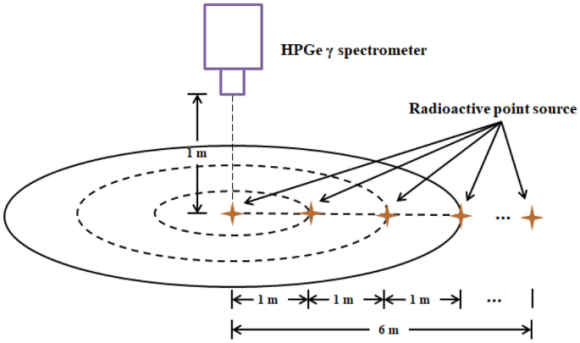
The HPGe γ spectrometer has different detection efficiency for γ-ray with different energies. Therefore, to obtain the detection efficiency of low-, medium-, and high-level energy γ-ray, experiments with different energy rays need to be performed. The Monte Carlo Simulation is adopted to simulate the point source detection efficiency at different energies and locations. The horizontal distance between the radiation source and the center of the detector extends from 0 to 6 m, as is shown in Fig. 1.
Schematic diagram of the detection model. The HPGe γ spectrometer was erected at a height of 1 m from the ground using a tripod, and the γ radiation source is placed at a horizontal distance of 0–6 m from the detector, and the interval is 1 m.
The Monte Carlo simulation relies on the accurate characterization of the structure of the portable HPGe γ spectrometer. Figure 2 describes the structure of the detector used in Monte Carlo simulation.
Structure of the characterized HPGe detector used for modeling in Monte Carlo simulations.
The calculated detection efficiency and relative uncertainty for different energy gamma rays at different positions are shown in Table 1.
Adopt the least square method to fit the above detection efficiency value according to Eq. (1),
where εE(r) is the characteristic γ-ray with energy E, the point source detection efficiency at a horizontal distance of r meters; r represents the horizontal distance between the point source position and the center of the detector, m; a and b represents fitting coefficient. The calculation result is shown in Table 2.
The detection efficiency curve is reverted to exponential form, and the fitting result is shown in Fig. 3.
The HPGe γ spectrometer has different detection efficiency for characteristic γ-ray of different energy, and it decreases rapidly as the horizontal distance increases. The characteristic γ-ray of different energy is shown in different colors in the picture.
It can be observed that the fitting effect is good. As the energy increases, the detection efficiency curve moves downwards overall, indicating that in this detection model, the higher the ray energy, the lower the detection efficiency of the point source at the exact location.
When the detector is placed in a flat and open area and 1 m away from the ground, its detection object can be regarded as a significant and uniformly distributed radioactive surface source. The practical contribution distance of HPGe γ spectrometer to γ-ray is of great significance for radioactivity measurement of significant surface sources.
The practical contribution distance of the surface source to the spectrometer can be determined by setting the threshold for the contribution of artificial radionuclides to the spectrometer. The contribution of the radioactive point source to the spectrometer can be expressed by the spectrometer’s counting rate of γ-ray, and the calculation equation of the counting rate is shown in Eq. (2),
where n represents the spectrometer’s counting rate of a certain γ-ray, cps; A represents the activity of the point source, Bq; p represents the branching ratio of the characteristic gamma-ray; εE(r) represents detection efficiency of the point source at a horizontal distance r; K represents decay correction factor during measurement.
Because the measurement object is approximately a surface source and the spectrometer is set up at the height of 1 m from the ground, the effects of self-absorption correction and pulse coincidence correction can be ignored. However, due to the short half-life of some key radionuclides, the change of its activity needs to be taken into account in the actual measurement process. Therefore, the decay correction coefficient K during the measurement is introduced. The calculation equation is shown in Eq. (3) 20,
where T1/2 represents the half-life of the nuclide to be tested, s; t represents measurement time, s. The surface radioactivity after a nuclear accident can be regarded as a surface source, and it can be considered that there is no radioactive contamination in the air. Since the detection model is center symmetric, the contribution of the surface source to the spectrometer’s counting rate can be calculated by double integration based on the fitting equation of the point source detection efficiency with horizontal distance
where ns represents the contribution of the surface source to spectrometer counting rate, cps; r represents the radius of the surface source, m. The farther away the source is from the spectrometer, the smaller the contribution to the spectrometer’s count rate. The integration converges as the integration distance approaches infinity, which means that when the detection distance gradually increases to infinity, the contribution of the counting rate gradually approaches a specific value, that is, Eq. (5)
where r represents radius of the area source under consideration, m; a, b represents coefficients of the fitting equation. When the detection radius reaches a certain value, the contribution to the spectrometer’s count rate within this detection range will reach a part of the maximum contribution value. Calculate the horizontal distances at the 90% and 95% of the contribution of the maximum counting rate of the γ-ray of different energy, and establish the equation relationship,
where ns_0.90 represents 90% of the characteristic γ-ray’s contribution to the maximum counting rate, cps; ns_0.95 represents 95% of the characteristic γ-ray’s contribution to the maximum counting rate, cps. It is an integral equation. Calculate the detection distances at 90% and 95% of the maximum count rate contribution to γ-ray of different energy, as is shown in Table 3.
Since the theoretical corresponding detection area is infinite when 100% of the maximum count rate is reached, this is unrealistic and cannot be calculated quantitatively. We usually consider the detector’s detection capability and measurement time to be limited. For areas beyond a certain range, the contribution to the count rate of the detector is negligible. In this paper, the horizontal distance at 95% of the maximum count rate contribution of the spectrometer is defined as the effective contribution distance of the spectrometer, and the practical contribution distance is used to calculate the spectrometer’s detection efficiency of characteristic gamma rays with different energy from surface sources. The error thus introduced is acceptable in an in-situ measurement scenario in a nuclear emergency. This is because more accurate measurements are often achieved not by in-situ measurements but by sampling.
The detection efficiency of the spectrometer for the surface source should be the average of the point source detection efficiency in the detection area. According to the definition of the mean in probability theory,
where (overline{varepsilon })E represents detection efficiency of surface source with characteristic γ-ray with energy E; εE(r) represents point source detection efficiency of characteristic γ-ray with energy E at a horizontal distance of r meters; D represents a circular area with the center of the detector’s vertical projection on the ground as the center and the effective contribution distance as the radius. Bringing the fitting Eq. (1) of point source detection efficiency into Eq. (8), we can get
where a, b represents the fitting coefficient of point source detection efficiency as a function of distance; d represents the effective contribution distance of the characteristic γ-ray with energy E, m; (overline{varepsilon })E represents the detection efficiency of the surface source with characteristic γ-ray with energy E. The characteristic γ-ray with different energies correspond to different adequate contribution distances, which are brought into the Eq. (10) for calculation, and the detection efficiency of the uniformly distributed surface sources can be obtained, as is shown in Table 4.
The detection efficiency and energy of the spectrometer for surface source are fitted by least squares, and the fitting equation is selected as follows,
where (overline{varepsilon }) represents detection efficiency of surface source; E represents the energy of characteristic γ-ray, keV; k1, k2—fitting coefficient. The values of the fitted parameters are k1 = 0.001327, k2 = − 0.8261, and the fitted regression coefficient R2 = 0.9992. The relationship between the spectrometer’s detection efficiency of uniformly distributed surface sources and the energy of characteristic γ-ray is shown in Fig. 4.
Fitting curve of HPGe γ spectrometer’s detection efficiency of radioactive surface source with characteristic γ-ray energy.
Observing the relationship between the detection efficiency and the energy, we can find that the detection efficiency of the surface source approximately follows the power function distribution and decreases monotonically with the increase of the energy. The greater the energy of γ-ray, the lower the detection efficiency in the effective contribution area is. It is consistent with the tendency of the detection efficiency of point sources to change with energy at the same position.
Due to the background count, the detection capabilities of different detection models are different. In the case of low activity, it is more difficult to determine whether the measured counts are due to pollutants or background. Only when the activity of a pollutant exceeds a certain threshold can it be judged as a pollutant.
The meaning of the lower detection limit is the limit at which the radioactivity can be detected by the detector, see Eq. (11)
where Kα represents the probability of false conclusions that there is radioactivity above the background in the sample and that there is no radioactivity above the background; Kβ represents the probability of false conclusions that there is no radioactivity above the background in the sample to judge that there is radioactivity above the background; nb represents background count rate, cps; ns represents total count rate, cps. For low-level measurements, the total count rate can be approximately equal to the background count rate, that is
Let the probability α and β of both types of errors be 5%
The DL can be expressed as the minimum detectable activity concentration (MDAC) 21, which is related to the parameters of the detection model. The calculation method for the MDAC is
where t represents measurement time, s; nb represents the background count rate of the nuclide’s region of interest, cps; p represents emissivity of γ-ray; ε represents detection efficiency of surface source in effective contribution area; S represents the area of effective contribution area, m2; K represents decay correction factor during measurement.
In order to obtain the background count rate as accurately as possible, the spectrometer is used to measure the outdoor background 15,000 s. The energy spectrum is shown in Fig. 5.
Background energy spectrum obtained from outdoor measurement at 15000 s. The characteristic γ-rays of various natural radioactive backgrounds are marked with arrows.
For characteristic γ-ray of different energy, the corresponding region of interest should be selected, and the background count within it calculated. Table 5 shows the count rate of the background in the region of interest of different energy γ-ray.
In order to correct the decay of radionuclides during the measurement, according to the half-life of different nuclides, Eq. (3) was adopted to calculate the decay correction factors of different nuclides at different measurement times, as is shown in Table 6.
It can be seen that the decay of the radionuclide during the measurement has little effect on the measurement results. When measuring 7200 s for 133I with a half-life of 20.8 h, the minimum K is 0.967.
According to the calculation equation of the minimum detectable surface activity MDAC, the relationship between the value of MDAC and the types of radionuclides, the energy of γ-ray, and measurement time is shown in Table 7.
In order to verify the rationality and validity of the simulation results, it is necessary to conduct experiments using a surface radioactive source. The effective contribution distance of the spectrometer to γ-rays with different energies is approximately 6 m. Under non-nuclear emergency conditions, it is difficult to measure the surface source of uniformly distributed artificial radionuclides with a radius greater than 6 m. Therefore, the grid point method is used to approximate the radioactive surface source. The schematic is shown in Fig. 6.
Simulation of uniformly distributed surface sources using the grid layout method. (a) shows the meshing principle, and the part enclosed by the arc in (b) is the area of interest.
As shown in Fig. 6, a square grid with a side length of 8 m and an interval of 0.5 m is established, and the spectrometer is set up at the apex of the square, as shown in Fig. 6a. At the same time, with the spectrometer position as the center of the circle and 8 m as the radius to make the arc, only the area inside the arc is considered, as shown in Fig. 6b. If the same radioactive source is sequentially placed at the intersection of the grids at this time, and the measurement time is the same, it can be approximately equivalent to measuring a uniformly distributed quarter-surface radioactive surface source with a radius of 8 m. Its activity is the surface activity of the micro-elements represented by the radioactive point source, and the simulated measurement time is 1/215 of the actual measurement time. According to the symmetry, the energy spectrum of the spectrometer for a uniformly distributed surface source with a radius of 8 m can be calculated. The activities of the standard radioactive point sources used are shown in Table 8.
There are 215 intersections and vertices, and each point measures the 1200 s, and the total measurement time is 258,000 s. The experimental site is shown in Fig. 7, and the energy spectrum is shown in Fig. 8.
The experimental site was chosen to be in a flat and open area, and the HPGe γ spectrometer was set up at the height of 1 m from the ground and connected to a computer. Place the radioactive sources in sequence according to the grid division method described in Fig. 6 to complete the experiment.
Energy spectrum of a uniformly distributed surface source experiment using the grid method.
The experimental results are shown in Table 9.
Since the detector is placed at the apex of the grid, the experimentally measured part is a quarter of the actual detection object. In order to transform the experimental results into the measurement results of the uniformly distributed radioactive surface source by the spectrometer, according to the symmetry, the net count rate, surface activity, and other values need to be expanded four times.
The surface activity of a uniformly distributed surface source simulated by the grid method can be calculated by the Eq. (15)
where AS represents the surface activity of uniformly distributed surface source, Bq/m2; Ap represents the activity of the point source used in the experiment, Bq; R represents the radius of uniformly distributed area source simulated by grid method, m, here is 8 m. The calculation of the net count rate of the simulated surface source is shown in the Eq. (16)
where nS_tr represents the net count rate of simulated surface source, cps; nS_or represents the actual net count rate measured, cps.
According to the measurement results of the net count rate, the detection efficiency of surface source, and effective contribution distance, the surface activity can be calculated by the Eq. (17)
where AS_MC represents surface activity derived from Monte Carlo simulation of point source detection efficiency, Bq/m2; εS_MC represents detection efficiency of surface source; dMC represents effective contribution distance derived by Monte Carlo simulation of point source detection efficiency, m; Pr represents emissivity of characteristic γ-ray.
Compare the derived activity with the activity calculated by the Eq. (17), and the validity of the calibration method is tested. Substituting the effective contribution distance and surface source detection efficiency in Table 1 into the calculation, the comparison results between the theoretical and integral calculations of surface source activity are shown in Table 10.
It can be seen that the relative error of the measurement of uniformly distributed radioactive surface sources using the numerical integration method is relatively small, all of which do not exceed 14.6%. The results of surface source detection efficiency obtained by this method are relatively accurate.
In this paper, a method for rapid surface activity measurement of radioactive surface sources settled on the surface under nuclear emergency conditions is studied. Innovatively introduce the numerical integration method into the process of calibration of surface source detection efficiency. The area of numerical integration is a circular area enclosed within the effective contribution distance. Since the detection efficiency of point sources is simulated by Monte Carlo method, and the detection efficiency of surface sources is calculated by the numerical integration, this method is reproducible. The calculation of point source detection efficiency uses the Monte Carlo simulation method, which has the advantage that: (1) the results are obtained quickly; (2) no natural radioactive source is required for calibration. The disadvantages are: (1) the spectrometer needs to be characterized before use because the HPGe γ spectrometer will change its dead layer thickness and size the hole with the use of time, which will cause errors in the simulation results; (2) There are some differences between the simulation model and the real situation, such as a spectrometer tripod, air humidity, etc., which will cause certain errors.
After the point source detection efficiency is calculated, the horizontal distance corresponding to 95% of the maximum contribution rate extending outward from the projection point of the detector is defined as the effective contribution distance, and the numerical integration method is used to calculate the detection efficiency of the surface source. Finally, the grid point method is used to simulate the radioactive surface source for experiments. The maximum relative error between the theoretical calculation and the experiment is 14.6%, which verifies the effectiveness of this method.
Since radioactive contamination may exist not only on the surface but also in seawater under nuclear emergency conditions, an effective in situ measurement means is needed. Since the attenuation coefficient of γ-rays in seawater is different from that in air, and the spatial distribution of radioactive substances in seawater is unknown, the method cannot be directly applied to measurements in seawater, and further relevant studies are worthwhile in the future.
The datasets generated and analysed during the current study are available in the Mendeley Data repository, https://doi.org/10.17632/h59f2wnc5x.1.
Martinčič, R. Generic Procedures for Monitoring in a Nuclear or Radiological Emergency (IAEA, 1999).
Google Scholar
Generic assessment procedures for determining protective actions during a reactor accident (IAEA Vienna, 1997).
Method for the development of emergency response preparedness for nuclear or radiological accidents. (IAEA Vienna, 1997).
Valentin, J. Protecting people against radiation exposure in the event of a radiological attack. J. Ann. ICRP 35, 3–4 (2005).
Google Scholar
Beck, H. L., DeCampo, J. & Gogolak, C. In situ Ge(Li) and NaI(Tl) gamma-ray spectrometry (1972).
Boson, J., Plamboeck, A. H., Ramebäck, H., Ågren, G. & Johansson, L. Evaluation of Monte Carlo-based calibrations of HPGe detectors for in situ gamma-ray spectrometry. J. Environ. Radioact. 100, 935–940 (2009).
CAS Article Google Scholar
Caciolli, A. et al. A new FSA approach for in situ γ ray spectroscopy. J. Sci. Total Environ. 414, 639–645 (2012).
ADS CAS Article Google Scholar
Rostron, P. D., Heathcote, J. A. & Ramsey, M. H. Optimising in situ gamma measurements to identify the presence of radioactive particles in land areas. J. Environ. Radioact. 138, 162–169 (2014).
CAS Article Google Scholar
Hassan, N. M., Kim, Y. J., Jang, J., Chang, B. U. & Chae, J. S. Comparative study of precise measurements of natural radionuclides and radiation dose using in-situ and laboratory γ-ray spectroscopy techniques. J. Sci. Rep. 8, 1–11 (2018).
ADS Google Scholar
Ji, Y. Y. et al. Performance of in situ gamma-ray spectrometry in the assessment of radioactive cesium deposition around the Fukushima Daiichi nuclear power plant. Radiat. Phys. Chem. 179, 109205. https://doi.org/10.1016/j.radphyschem.2020.109205 (2021).
CAS Article Google Scholar
Rašeta, D., Petrinec, B., Babić, D. & Šoštarić, M. Application of a new in situ calibration technique for gamma spectrometry and comparison of in situ and laboratory measurements. Arhiv za Higijenu Rada i Toksikologiju 72, 29–35 (2021).
PubMed PubMed Central Google Scholar
Lee, C., Park, S.-W. & Kim, H. R. Development of mobile scanning system for effective in-situ spatial prediction of radioactive contamination at decommissioning sites. Nucl. Instrum. Methods Phys. Res. Sect. A Accel. Spectrom. Detect. Assoc. Equip. J. 966, 29–35 (2020).
Google Scholar
Chao, J. H. & Chung, C. Optimization of in situ prompt gamma-ray analysis of lake water using a HPGe-252Cf probe. J. Nucl. Instrum. Methods Phys. Res. Sect. A Accel. Spectrom. Detect. Assoc. Equip. 299, 651–655 (1990).
ADS Article Google Scholar
Feng, T. C. et al. Delaminated method to determine the depth distribution of 152Eu in soil by in-situ HPGe нЁ spectrometry. J. Nucl. Instrum. Methods Phys. Res. Sect. A Accel. Spectrom. Detect. Assoc. Equip. 597, 192–197 (2008).
ADS CAS Article Google Scholar
Rašeta, D., Petrinec, B., Babić, D. & Šoštarić, M. Application of a new calibration technique for gamma spectrometry and comparison of and laboratory measurements. J. Arch. Ind. Hygiene Toxicol. 72, 29–35 (2021).
Article Google Scholar
Androulakaki, E. G. et al. Efficiency calibration for in situ γ-ray measurements on the seabed using Monte Carlo simulations: application in two different marine environments. J. Environ. Radioact. 164, 47–59 (2016).
CAS Article Google Scholar
Zhang, Y., Li, C., Liu, D., Zhang, Y. & Liu, Y. Monte Carlo simulation of a NaI(Tl) detector for in situ radioactivity measurements in the marine environment. J. Appl. Radiat. Isot. 98, 44–48 (2015).
CAS Article Google Scholar
Thornton, B., Ohnishi, S., Ura, T., Odano, N. & Fujita, T. Continuous measurement of radionuclide distribution off Fukushima using a towed sea-bed gamma ray spectrometer. J. Deep Sea Res. Part I Oceanogr. Res. Pap. 79, 10–19 (2013).
ADS CAS Article Google Scholar
Mauring, A., Vidmar, T., Gäfvert, T., Drefvelin, J. & Fazio, A. InSiCal—A tool for calculating calibration factors and activity concentrations in in situ gamma spectrometry. J. Environ. Radioact. 188, 58–66 (2018).
CAS Article Google Scholar
Junli, L. Laboratory Gamma Spectrum Measurement and Analysis (People’s Communications Press Co., 2014).
Google Scholar
Genghua, S. Research on In-situ Labr γ-ray Spectrometer of Seawater Radiation Monitoring (Tsinghua University, 2010).
Google Scholar
Download references
This work was financially supported by the Fund for Strengthening Technical Fields of Basic Plan (2021-JCJQ-JJ-0128), and the Scientific Research Foundation of China Agricultural University (2021RC022). The authors would like to thank the Institute of NBC defence and China Institute of Atomic Energy for providing some experimental sites. Thanks for some language help provided by Tianbo Zhang. Moreover, express gratitude to others who helped us with this work.
Institute of NBC Defence, Changping District, Beijing, 102205, China
Zeqian Wu, Bairong Wang & Jian Sun
College of Resources and Environmental Sciences, China Agricultural University, Haidian District, Beijing, 100193, China
Yuqi Wang & Changwei Zhao
You can also search for this author in PubMed Google Scholar
You can also search for this author in PubMed Google Scholar
You can also search for this author in PubMed Google Scholar
You can also search for this author in PubMed Google Scholar
You can also search for this author in PubMed Google Scholar
B.W. and C.Z. proposed the research idea of the study and reviewed the manuscript. Z.W., C.Z. and Y.W. contributed to the algorithm design, simulation, experimental manipulation, and manuscript writing. J.S. analyzed the data from simulations and experiments.
Correspondence to Bairong Wang or Changwei Zhao.
The authors declare no competing interests.
Springer Nature remains neutral with regard to jurisdictional claims in published maps and institutional affiliations.
Open Access This article is licensed under a Creative Commons Attribution 4.0 International License, which permits use, sharing, adaptation, distribution and reproduction in any medium or format, as long as you give appropriate credit to the original author(s) and the source, provide a link to the Creative Commons licence, and indicate if changes were made. The images or other third party material in this article are included in the article’s Creative Commons licence, unless indicated otherwise in a credit line to the material. If material is not included in the article’s Creative Commons licence and your intended use is not permitted by statutory regulation or exceeds the permitted use, you will need to obtain permission directly from the copyright holder. To view a copy of this licence, visit http://creativecommons.org/licenses/by/4.0/.
Reprints and Permissions
Wu, Z., Wang, B., Sun, J. et al. In-situ γ-ray analysis of ground surface radioactivity using portable HPGe γ spectrometer. Sci Rep 12, 9418 (2022). https://doi.org/10.1038/s41598-022-13770-5
Download citation
Received:
Accepted:
Published:
DOI: https://doi.org/10.1038/s41598-022-13770-5
Anyone you share the following link with will be able to read this content:
Sorry, a shareable link is not currently available for this article.
Provided by the Springer Nature SharedIt content-sharing initiative
By submitting a comment you agree to abide by our Terms and Community Guidelines. If you find something abusive or that does not comply with our terms or guidelines please flag it as inappropriate.
Advertisement
Advanced search
© 2022 Springer Nature Limited
Sign up for the Nature Briefing newsletter — what matters in science, free to your inbox daily.

County Briefing | News, Sports, Jobs – Morning Journal News
Jun 7, 2022
Fun Fly
The Mahoning County Model Aircraft Club will sponsor a Radio Controlled Aircraft Fun Fly and Exhibition from 10 a.m. to 3 p.m. Saturday at Shaker Woods Field, 44337 County Line Road, Columbiana. Rain date is Sunday. The event is free and open to the public. Food and beverages will be available for purchase and there will be a 50/50 drawing. No drones are permitted at Shaker Woods. New members are welcome to join the club. For information visit www.MCmodelClub.org.
Park workshop
The Columbiana County Park District will hold a special workshop “What Makes Beaver Creek Wild and Scenic” at 10 a.m. Sunday at the north side of Hellbender Bluff Park. Ohio Department of Natural Resources Staffers Matthew Smith and Ryan Moss will lead participants to the West Fork of the Little Beaver Creek, pinpointing the unique features of the waterway. The hike is moderately difficult, and participants are asked to meet at the Lones Road parking lot.
Golf Scramble
Leetonia Ruritans will have a Scholarship Golf Scramble Saturday at Valley Golf Club, 41784 Cherry Fork Road, Columbiana. It is a four-person, nine-hole scramble. The cost is $31.25 per person or $125 per four-person team. This includes green fees, lunch, beverages and two riding carts per four-person team, door prizes and 50/50 drawing. Holloway Insurance Co. has sponsored a $5,000 cash for a hole in one.
Book Sale
The Friends of the Library of the East Palestine Memorial Public Library are holding their annual Book Sale and Silent Auction Thursday from 10 a.m. to 8 p.m., Friday from 10 a.m. to 5 p.m. and Saturday from 10 am. to 4 p.m. A preview for the book sale will be held Wednesday from 4 to 7 p.m. The charge will be $5 for admission to the preview book sale. Books are $4 per bag (the Friends of the Library will supply the bag). The Friends will also be selling DVDs, puzzles, and games for 50 cents each. There will be a silent auction with items donated from businesses and individuals in the area. The book sale is in the basement of the library and the silent auction is held in the Community Room of the library. All proceeds from the book sale and silent auction go to the library.
Rodman Public Library
Rodman Public Library will mark Juneteenth with a special presentation by Dr. William “Ted” McDaniel, a professor of African-American studies and professor of music at the Ohio State University. A specialist in African-American music and jazz performance, McDaniel will speak on the topic of “Understanding Black History Through Black Music” inside Rodman Auditorium June 20 at 7 p.m. Black music has often served as a barometer of the times and lives of Black people. The program, utilizing recorded music, explores various aspects and periods of Black history by examining the music of each era. It ranges from the worksongs and spirituals of slavery through the rap of modern urban times. McDaniel is noted for his analysis of the music of John Coltrane and Charlie Parker. He has published several works on Black music and more than 300 music arrangements. Registration is required to attend the program. To register, visit rodmanlibrary.evanced.info/signup, or call 300-821-2665, ext. 107.
Ohio Justice Bus
The Ohio Justice Bus, a mobile legal aid office and technology hotspot, will visit the Rodman Public Library June 17. From 9 a.m. to 1 p.m., the bus, which is partnering with OhioKAN, will be parked in the Main Library parking lot to offer free brief advice clinics to Alliance-area residents. Those who visit will have the opportunity to talk privately to an attorney about family law issues related to adoption and kinship care. Services will be provided on a first-come, first-served basis. Patrons wishing to receive advice are asked to bring any relevant documents. For information visit www.ohiojusticebus.org or email [email protected].
Summer Arts Camp
Stambaugh Auditorium will host the Children’s Summer Arts Camp July 11 to 15. The purpose of the Arts Camp is to increase children’s access to, knowledge of, and appreciation for performing arts. The five-day camp will star up to 70 local school-age children culminating in the production of a full-scale musical production of Johnny Appleseed. The camp will feature local arts organizations as well as the world-renowned Missoula Children’s Theatre. Stambaugh Auditorium will also be partnering with the City of Youngstown Department of Parks and Recreation, Boys and Girls Club, and Jewish Community Center to make the Summer Arts Camp available to interested students who are already enrolled in one of Youngstown’s Summer Day Camp programs. Local art organizations include Ballet Western Reserve, The Butler Institute of American Art, Opera Western Reserve, The Youngstown Symphony Orchestra, OH Wow! and The Youngstown Playhouse. With the support of sponsors and underwriters, Stambaugh Auditorium’s goal is to provide the camp at no cost to the children who participate. Contact JoAnn Stock, Chief Development Officer, 330-747-5175 or [email protected] for more information and sponsorship opportunities.
Today’s breaking news and more in your inbox
ELIZABETHTOWN, Pa. (AP) — Two people were rescued after they somehow fell into a partially filled chocolate tank …
Arts and Health 6 p.m. – June 11, 2022 Lincoln Center, in collaboration with Healing Arts, is proud to host the …
Today’s breaking news and more in your inbox
Copyright © Morning Journal | https://www.morningjournalnews.com | 308 Maple Street, Lisbon, OH 44432 | 330-424-9541
Democratic nominee for Montgomery family court lost custody of six children due to excessive corporal punishment – Alabama Political Reporter

Hi, what are you looking for?
Legislature addresses primary issues, League of Municipalities says
Longtime Alabama Rep. Steve McMillan has died
Alabama 2022 Legislative Report: Final report
Law clears driver’s license fees for homeless youth
Expansion of Alabama G.I. Dependent Scholarship Program takes effect June 1
Opinion | Mo Brooks, the jilted bride
Opinion | A profile of Caroline Bundy and the Way Station
Opinion | Very impressive, high steppin’ victory for Governor Ivey
Opinion | In the gun debate, what about Chicago?
Opinion | Political money, moxie and muscle
Shelby criticizes Biden border policy for placing burden on National Guard
Rep. Sewell to host virtual discussion on gun violence Thursday
Shelby reiterates unease over 2023 defense appropriations
Limestone County NAACP condemns Buffalo attack, white supremacy
Sewell votes to improve families’ access to baby formula
Former Athens principal convicted of multiple felonies still employed
Opinion | Alabama’s FAFSA completion policy is yielding success
Parent: Magic City Acceptance Academy says school is helping his child
Alabama Arise urges ALSDE to extend summer lunch program through the summer
ASU Board of Trustees elects new leadership at May 5 meeting
Alabama’s COVID hospitalizations, positivity rate rising
Lawsuit alleges teen girl abused in Alabama psychiatric residential center
More than 15 million in U.S. could lose Medicaid coverage without action
White House warned against Alabama’s law criminalizing transgender care
Yale report finds flawed science in Alabama’s law criminalizing care for transgender youth
Court documents show Martin lost custody of six children due to excessive corporal punishment in her Montgomery home in July 2013.
By
Published
The Alabama Democratic Party certified Sebrina Martin as its nominee last Tuesday for one of three family court judge positions in Montgomery’s 15th judicial circuit following her primary win over Fernando Morgan. With no Republican challenger, Martin stands to be elected to the position following the general election in November.
But according to a court document obtained by APR, Martin herself lost custody of six former children due to excessive corporal punishment in her Montgomery home in July 2013.
The court order, issued by Judge Robert A. Tomatta of the Vanderburgh Superior Court in Vanderburgh County, Indiana, found that the children’s “perception of the environment within the mother’s home was deeply concerning.”
Numerous efforts to reach Martin seeking comment for this story were unanswered.
According to the order, at least one child, Jonathan, suffered bruising related to corporal punishment by Martin’s then-boyfriend and now-husband Jesse Heifner, who also works alongside Martin as an attorney at her firm, Montgomery Divorce Law.
Three of Martin’s children, all minors at the time, spoke with the judge in chambers, and “although the Court does not itemize the entirety of the testimony, there is significant evidence of a substantial and continuing change in circumstance.” Much of the evidence in the case, provided by Indiana’s Department of Human Services, is sealed. The court further found that the excessive physical discipline of Jonathan is “evidence of a pattern of domestic violence.”
Of the six children referenced in the document, all but one were adopted by Martin and her then-husband, Michael Martin. Jasmine is the lone biological child of Michael and Sebrina.
After reviewing the court order, APR reached out to Jasmine, Sydney and Michael Martin to talk about their experiences.
Jasmine, now 21, said seeing her mother succeeding in an election as a family judge makes her feel sick.
“It honestly makes me sick to think about how she can put on this mask each day and tell people that she loves kids and she’s a child advocate,” Jasmine said.
The document describes Jasmine and Sydney, Sebrina Martin’s oldest daughters, as being particularly adamant about leaving their mother and living with their father.
“The Court has heard hundreds of custody cases and Jasmine and Sydney were some of the most adamant about moving to live with their father,” the order states. “In fact, Sydney wanted the opportunity to talk with the court and wanted an immediate decision.”
Sydney told APR Wednesday that she felt like a mom to her five younger siblings and felt responsible to get her siblings out of the home.
“We weren’t blood, but we came together,” Sydney said. “When it is not just blood, it’s real true love. When you see someone you love in the other room screaming because they’re getting beat, it can give you nightmares. It makes you want to be an advocate for people in these situations.”
Although the court did not record the testimony of the minor children in the court order, Jasmine and Sydney recounted their living situation that led to the custody change, some of which was told to the judge in the sealed testimony.
Jasmine said the two years prior to the court order, after Sebrina Martin had moved from Indiana to Montgomery to pursue a law degree at Faulkner’s Jones School of Law, were when the excessive punishments got out of control.
“Things were going downhill before, but they were really not good in Alabama,” Jasmine said.
Sebrina Martin had divorced Michael Martin and was granted primary custody of the six children, while sharing joint legal custody with their father. His parenting time was limited to the long breaks during the academic year and split custody in the summer.
Jasmine said that corporal punishment was a daily occurrence in the household, from her mother, Heifner and a nanny, Brenda Harvey, who is also named in the court order.
“Somebody was getting it daily,” Jasmine said. “There was no escape and our dad was like 13 hours away; when we finally did get to go to dad’s house, it was like heaven.”
Sydney told APR that the whippings could come for any number of reasons, or no reason at all.
“(Sebrina) started doing it for punishment, but it could be ‘If I’m pissed off and you’re the person who is here, you’re going to get it today.’ There didn’t have to be a reason,” Sydney said. “They could just be in a bad mood.”
According to Sydney, it went beyond just the whippings, she said the children were underfed and neglected in their time in the home.
“Sometimes we would have a loaf of bread for dinner,” Sydney recalled. “They didn’t feed us or take care of us. The money she got (from the state to aid in the care of the adopted children) went to what she needed for school. We were just there to be there. We were income for her, basically. Income she used for herself. There was never ever enough food for all of us kids continuously. She never did anything to make the situation better.”
Sydney said the only time Sebrina Martin would buy them things is right before and after a visit with their father, which she perceived as an attempt to manipulate the children while fighting out custody with Michael Martin.
Jasmine singled out one particular memory of her mother punishing her youngest sibling, who would have been between 5 and 6 years old at the time of the incident. Because this child is still a minor, she will be referred to as “Sarah” for the purposes of this article.
“(Sebrina) sat on top of Sarah’s head with a pillow trying to get her to stop crying,” Jasmine said. “Her outrageous solution was to sit on top of her until she stopped screaming with a pillow over Sarah’s face.”
Sydney also described ice-cold showers as a continuous form of punishment for Sarah.
“Sarah would be asleep, she was around 5 years old at the time, and if she didn’t do something she was supposed to do, they pulled here out of bed and threw her in a cold ass shower,” Sydney said. “Not one time or two times— this was Sarah’s form of punishment. They knew she hated it.”
Michael Martin told APR he has struggled for years since gaining custody to get Sarah in the shower and only found out why about a year ago, when Sarah told a counselor about her experiences with the punishment.
Sarah is one of the two Martin children born addicted to meth, causing a number of special needs. Her biological brother, who will be referred to as “Tommy,” was so addicted to meth at birth that doctors did not expect him to live past the age of 1, and if he did, said he would probably never walk or run, but Tommy defied these odds and even runs track now and loves basketball.
“Jesse absolutely terrified me,” Jasmine said. “I did not want to be in the room with him. His presence terrified me.”
Sydney said Sebrina Martin changed when Heifner entered the picture.
“Sebrina completely changed who she was,” Sydney said. “He showed her ‘the way they do it in the South,’ how they discipline. Belts, kitchen utensils, whatever they could grab. They wouldn’t use their hands, they always had to have something.
Jasmine said Heifner especially hated Jon (Jonathan); the court found Heifner had committed the excessive punishment leading to Jon’s bruising.
The court order prohibits Heifner from being in the presence of the children unless accompanied by Sebrina Martin, from disciplining them in any way and from being present when the children are being exchanged from Michael Martin to Sebrina Martin.
This last point has been moot since the court order, as the family said that is the last time the children have seen her and have barely heard from her.
Sebrina Martin gave testimony during the hearing that conflicted with that of the children and even Heifner. She told the court that Heifner had only punished one of the children once or twice, at her direction. Heifner himself testified that he had disciplined three or four of the children a number of times.
On one occasion, Jasmine took the extra step of taking an audio recording of Jesse beating Jonathan, which she turned over to her father.
Michael Martin said the audio recording was a key piece of evidence.
“It was not until Jasmine got that recording that the judge said ‘We’ve got to do something now,’” Michael Martin told APR. “She was in sixth grade I think. It was extremely brave.”
Michael recalled the audio being played while Heifner was on the stand, and was asked whether he did this. Michael said Heifner responded “Yes.” Michael said he remembers Heifner then remarking “How do you think Alabama builds championship football teams?”
The Martin girls also said Heifner liked to pick on Tommy.
Tommy had an eating disorder that caused him to eat almost obsessively, the girls said.
“Tommy was skin and bones when we got him, but he ate a lot; whenever there was food he was eating and eating and eating,” Sydney said. “Jesse loved to pick on Tommy for it.”
Jasmine said Heifner would hide honeybuns and other treats outside in the middle of the night and have Tommy seek them out while Heifner laughed at him and called him “Fattie.”
“He would sit there and laugh at him and think it was a joke,” Sydney said. “Tommy had the mindset of a 4-year-old treating and (Heifner) was treating him like not even a human. That’s what you do with a dog.”
Jasmine said she was Sebrina Martin’s favorite as the biological child, as well as being the “mature, responsible one” and that her mother did not physically discipline her as much as the other kids. But she said the nanny, Harvey, filled that role, describing an environment in which each of the three adults compensated in delivering physical discipline where the other two fell short.
According to Jasmine, Sebrina Martin viewed Harvey as a motherly figure that she would run to in her own childhood, making Harvey out to be a grandmotherly figure in the household.
However, Jasmine said the children didn’t see her that way.
“She was very, very gross,” Jasmine said. “I know that’s not illegal but… She really liked to send us out to pick switches from those willow trees, whatever those trees are that grow in the South. She got real creative with what she was using to hit us with. To us, she was really like a stranger that just showed up one day.”
While these incidents were occurring in Sebrina Martin’s Montgomery home, Michael Martin could only sit helplessly in Indiana, bound by the prior custody order to only see his children on those rare three-day weekends and school breaks.
When he did pick them up, he had to make the long drive from Indiana to Decatur.
But every time he got the children, he was working to document what he considers abuse.
“Clearly it was child abuse,” Michael Martin said. “They clearly had markings on their bodies, on their backs or their legs or arms. Most states have laws that parents are allowed to spank children, but you cross the line when you have left evidence that you’ve done that. When the kids still have a mark from discipline three days ago, it clearly means it was excessive at the time.
“There was never an instance of a fresh wound. This was not one of those red handprints that goes away after an hour. That was never the case, these were bruises and wounds. One of the doctors’ noted that you could clearly see a belt had come across the kid’s back and see the edge of the band marks. That was days later after an eight-hour hour trip to the emergency room.”
So Michael Martin began taking his children to the Emergency Room to video and document their injuries.
But he said he could not take them to the local emergency room due to the custody situation, so he instead had to immediately drive them the eight hours back to Indiana and admit them to the ER there, to show that the harm to the children was urgent and that he had picked them up in that condition.
Michael was facing an uphill legal battle, he told APR, with the relevant jurisdictions spanning five different counties in three states.
“It was horrible,” he said. “Nobody wanted to mess with this. Each person was like ‘That’s this county’s problem. I had to document all this stuff and go to these great lengths.”
As he understands it, Sebrina Martin only escaped criminal charges due to being in another state.
“Since it happened in another state, nobody had jurisdiction,” Michael said. “Indiana could not press child abuse charges in Alabama, and since she wasn’t an Indiana resident, she couldn’t be charged here in Indiana.”
He also recalled the judge telling Sebrina, “Ma’am, had this happened in Indiana, all of y’all would be in jail.”
APR has not yet obtained the transcripts of the two-day trial.
At the time of the 2013 court order, Sebrina Martin was still a student at Jones School of Law and the court therefore ordered no child support from her at the time, while terminating the child support payments from Michael Martin. The court ordered that her child support obligation be “immediately recalculated upon employment” but Michael Martin said he has never received a dime of child support from his ex-wife.
“Not a dime,” Michael said. He explained that he decided not to pursue the matter. “I wasn’t going to get it anyway. I hadn’t talked to her or seen her. It’s one of those things, do you really want to mess with it or not?”
The court also noted that Sebrina Martin was receiving subsidies and other benefits for the minor children and ordered her to “immediately transfer all such funds should she continue to receive them.” Michael confirmed he does get those benefits now.
Michael and the girls told APR that the trial was the last time they ever saw Sebrina, at least in person. Since 2013, Sebrina Martin attained her juris doctorate degree and began practicing as a family attorney in Montgomery.
“After law school I opened my firm with the intentions of serving families,” Sebrina Martin states on her campaign page. “My practice of law has centered on adoptions, custody, juvenile issues, and yes, divorce. I believe that divorce does not have to be messy, every family has a unique story and I understand that. I am passionate about fair and timely access to the justice system. With my combined experience as a parent, foster parent, and attorney I have and will continue to advocate for families.”
On her Montgomery Divorce Law website, her bio touts her “personal experience with family law matters” and her involvement with numerous organizations including the domestic violence task force and the Montgomery County Department of Human Resources, where she serves as a quality assurance board member.
Neither site details any information about her family or children, although her campaign’s about page does feature a prominent photo of Sebrina Martin with her two current children.
But Sebrina Martin responded on her Statement of Economic Interest form that she has no adult children despite Sydney, Jasmine and Jonathan all being over the age of majority in both Indiana and Alabama. Michael Martin said there have been no changes to custody since the 2013 order and that Sebrina Martin is still legally the children’s mother, in addition to being Jasmine’s biological mother. She also has a biological son with her first husband, who is also well above the age of majority.
According to ethics statutes, a candidate would be given the opportunity to “cure” the statement of economic interest to rectify the error. Intentionally misrepresenting information on the filing is a Class A misdemeanor.
“Honestly, I’m not surprised,” Jasmine said when informed of the filing. “It goes to show even more that she wants to erase this chapter of her life like it didn’t exist. To abandon all those kids and sit there and say ‘I’m an advocate for children and want the best for them and I love them…’”
Michael Martin said the denial follows a pattern of her abandoning her firstborn son.
“During court, she denied his existence,” Michael said. “So we asked, ‘What about him, who is this?’ She said that it was her son and that she sees him all the time. But she had just said she didn’t have another son … She just washed her hands completely of everybody.”
Michael said that is what once again happened when he attempted to follow the custody order and give her parental time.
“I never blocked Sebrina or said she couldn’t see her kids,” Michael said. “Multiple times we showed up in Nashville for the exchange. She never showed up. We waited hours in the parking lot; we had to give her the benefit of the doubt. She never answered a call.”
Eventually, Michael and his attorney decided to stop attempting the custody exchanges until receiving a response from Sebrina or her attorney, a response they say never came.
“It kind of hurts that she is still acting like she doesn’t have kids,” Sydney said. “It’s going to hurt for a lifetime.”
Now, Sebrina Martin is all but assured under typical conditions to be the next family court judge for place three on the 15th Judicial Circuit in Montgomery.
Michael and the girls said they were sickened to see her not just working as a family attorney, but now possibly sitting in judgment on family law cases.
“Her ad for judge makes me sick,” Michael said. “She calls herself an award-winning foster parent. That was me too. We were in that together. We won foster parent of the year during that time period. Also, she’s ‘God this, God that’ and ‘all for the children.’ All for the children, huh? What about these seven you just crapped on because it didn’t fit your career? What does that say?”
The ad calls Sebrina Martin “a longtime advocate for victims of domestic violence.”
“Sebrina knows how to help children at their most vulnerable, desperate for someone, anyone to show they care,” a female narrator says during the ad.
“It’s so irritating seeing her being an advocate and judge for people in these situations,” Sydney said. “It’s ironic, the reason she knows firsthand is because she put her kids through it. She is (expletive) up. That’s the shit you did to your kids.
“We kind of hoped she would reach out and apologize, but it never happened. Over the years, we went through emotional phases, we had resentment. Now we just want this to be heard. It’s shitty. Nobody’s ever listened to us. She went about her life and has a happy life and career now. We want to raise awareness of this person being put in a position of power. She’s done a good job covering this up, she never did any time, never paid anything. She’s better off now somehow; it’s not supposed to be like that.”
Sebrina Martin won the Democratic nomination in a majority Black district, and she had posted on her campaign page about race relations.
“Will you choose hope for our children? Or will you choose the days of segregation where black people must only affiliate with other black people?” Sebrina posted the day prior to the primary race.
One Facebook user tagged her in a post, claiming that critics said “she was the wrong color” for the seat.
But the children recount Sebrina Martin, as well as Heifner and Harvey, exhibiting racism.
“Where we were living in Montgomery was primarily Black,” Sydney said. “We were the only white kids in the school.”
Sydney said Sebrina sometimes referred to Black people as “porch monkeys” and the “N word.” Sydney and Jasmine also saw the targeted abuse of Sarah and Tommy, who are biracial, as an extension of the adults’ racism.
“She’s advocating for Black people but has this history,” Sydney said.
Sydney and Jasmine still remember sitting in court awaiting the verdict.
“We were sitting in some holding room and they came in all quiet,” Sydney said. “We kept asking what was going on. We thought we had lost the court case. But they knew we were going to freak out, so they waited until we were outside to say we were going to Castle (Indiana). We immediately burst into tears and cried and hugged each other. We knew we were finally safe, we didn’t have to fight for our next meal, nobody was going to chase us out of the room with a flyswatter — so many things other people didn’t have to worry about. It was Heaven on Earth. Of course, life comes in, but for that moment it was a second of Heaven.”
Michael said it was both a relief and a tragedy when it became clear that Sebrina was not attempting to exert her right to parenting time with the children.
“You know they’re safe and you’re able to raise them according to your standards,” Michael said. “But that’s also where the damage is done. For the adopted kids, their biological mom did them wrong, the foster mothers did them wrong and then the adoptive mom did them wrong. So I’ve got five kids who have no idea what it genuinely means to be loved unconditionally by a mom. And that is horrible. Probably some of your best memories are how your mom used to make your special little meal or something like that. My kids don’t know that. They know what it’s like to have a dad that will go to war for them. I’ve been a damn good dad, but I’m a man. While I love my kids and I’ve done everything under the sun to make their life as normal as possible, and my sister did a great job loving on them when she was alive, and my mom does great job loving on them — they still don’t have that mom love.”
It hasn’t been an easy road for the family since 2013. Michael said he works as a bus driver, making just $13,000 a year.
“I have five kids that need a dad and a mom, two are special needs — someone has to be home,” Michael said. “I have to have a schedule where I’m home to take care of these kids. Meanwhile they see their mom is a big shot making possibly six figures. It’s messing with them.”
Michael said he had open heart surgery shortly after gaining custody, which he attributed to the stress of the custody battle. He had also lost his lawnscaping business following the 2008 economic collapse and had “lost about everything.”
“It’s not been easy. It’s been a very hard road for our family, but we’re better people for it.”
Sydney said it has taken years for her to get out of that “mom mode” she had developed in her home situation when living with Sebrina Martin and Heifner.
“I almost didn’t want to let that role go,” Sydney said. “I felt like I needed to be there for them. It took me so long not have to be that for them anymore. This stuff is still coming back up, stuff I need to deal with.”
Sydney said she briefly felt like she did not want to speak to APR about her past, but decided she needed to go through with it.
“This shit happened and you’ve got to address it and move forward,” Sydney said. “I’m not going to just push things to the side like she has.”
The family expressed some of the questions they still face seeing Sebrina Martin’s journey from abandoning them in 2013 to becoming the unopposed candidate to serve as a family court judge.
“My question is wouldn’t all of this information bring into question every case or anything she’s ever done?” Michael said. “She shouldn’t have even been a lawyer with this. Think about the number of families turned upside down because she was involved, but should have never been a lawyer in the first place. Now she’s going to be a judge of 225,000 people in Montgomery? I would have never believed it. I didn’t think she would get this far. I would have never imagined. I couldn’t have written this story, there’s no way.”
Jacob Holmes is a reporter at the Alabama Political Reporter. You can reach him at [email protected]
Officials said that Dean passed “peacefully with his family at his side” Tuesday morning.
The 16-year-old girl suffered from abuse from staff and residents at Sequel Owens Cross Roads, according to the lawsuit, resulting in a broken jaw.
Perry has served as executive director since 2020 — his second stint in the role.
So, supporters of reproductive freedom for women, for asylum in the United States, for treating marginalized citizens anywhere near equal to our wealthiest and…
Copyright © Alabama Political Reporter
RXR Secures $105M Refi for New York Tower – Multi-Housing News

RXR Realty has received a $105 million loan from Rialto Capital Management to refinance 360 Huguenot, a 28-story, 280-unit, mixed-use high-rise building in downtown New Rochelle, N.Y.
Details about the loan were not disclosed. JLL Capital Markets worked on behalf of RXR to arrange the refinancing. The team was led by Executive Managing Director Mike Tepedino, Senior Managing Directors Michael Gigliotti and Kelly Gaines, Senior Director Jillian Mariutti, Associate Phil Cadorette and Analyst Joy Dracos.
The property was completed in July 2019 and was the first high-rise residential tower delivered in New Rochelle, a city in Westchester County, N.Y., just north of New York City, since 2007. RXR was designated by New Rochelle as master developer for the downtown in July 2014. Since then, the firm has worked with the city to construct three separately phased residential projects. RXR recently completed One Clinton Park, a 28-story, mixed-use tower that includes 352 market-rate apartments and more than 13,000 square feet of retail space. RXR, in partnership with Greystar Real Estate Partners, launched leasing for the property in January. The firm is expected to deliver Two Clinton Park, another 28-story, mixed-use building, in 2024. Two Clinton Park will feature 390 market-rate apartments. The location of the development is minutes from the New Rochelle train station, which delivers direct access to Midtown Manhattan in 30 minutes.
360 Huguenot is also near the train station and residents can walk there in about 8 minutes. The building has 294 parking spaces and 13,539 square feet of Class A retail space in five ground-floor suites fronting New Rochelle’s busy downtown district. 360 Huguenot has 252 market-rate apartments and 28 affordable units for residents earning up to 80 percent of the area’s median income.
The property has a mix of studio, one- and two-bedroom units in a variety of layouts with premium features for higher-floor units. Features in the residences include stainless steel appliances, hardwood floors, smart-door locks and expansive windows. Community amenities include a 24/7 concierge, state-of-the-art fitness center with a yoga studio, private indoor/outdoor lounge for residents, a valet parking garage and regular events for residents.
Gaines said in a prepared statement the building is an example of a high-quality, best-in-class property with spectacular views that draws in prospective residents from all over Westchester County.
Gigliotti noted in prepared remarks the building had a fast lease-up and has market-leading rental rates. He said the property has capitalized on years of pent-up demand for affordable and market-rate housing in the area and has proven to be an exceptionally attractive investment opportunity.
The latest multifamily news, delivered every morning.
Like what you’re reading? Subscribe for free. Subscribe
© 2022 – Multi-Housing News Online
You must be logged in to post a comment.

Best piano VSTs 2022: the best plugins to get the most authentic sound – MusicRadar

MusicRadar is supported by its audience. When you purchase through links on our site, we may earn an affiliate commission. Here’s why you can trust us
By published
Get the best piano sound without shelling out thousands for the real thing – options from Native Instruments, Spitfire Audio and more
The piano is one of the most popular instruments in the world, so creating the best piano VSTs, for realistic software virtual piano emulation, has been the number one priority for software and DAW developers for the last couple of decades. As such, most DAWs already ship with decent enough software pianos, but they don’t usually offer quite the nuanced character and breadth of dynamic sound you can expect from a real upright or concert grand. Third-party software developers have therefore been falling over themselves to create even better software virtual pianos so there are now loads of options out there.
Software virtual pianos use either modelling algorithms or samples of real instruments to create beautiful emulations. We’ll discuss more on these in our buying advice section. Many piano instruments – modelled or sampled – feature effects and can have a number of tweakable parameters like other virtual instruments. What you can expect from both kinds of instrument are exceptional piano sounds as developers have been perfecting these instruments for many years. But the best thing is that you have access to models of pianos that can costs tens of thousands of dollars/pounds at a tiny fraction of the price. And with your DAW as a host, you don’t even need to play like a concert pianist to sound like one.
If you’d like to read some in depth buying advice about the best piano VSTs, it’s included at the bottom of this guide. You can click the link to go there. If you’d rather get to the products, then keep scrolling.
Your choice of piano really comes down to the music you make. If you are a singer/songwriter with the piano as your main song focus, go for one of the larger multisampled instruments that focus on all of the detail of famous – and expensive – grand pianos. In this respect, it’s hard to overlook Spitfire Audio’s Hans Zimmer Grand Piano (opens in new tab) that delivers all the sound of the super-composer’s favourite grand, with meticulous recordings at many different microphone positions. Similarly, Garritan’s Abbey Road Studios CFX Concert Grand delivers a legendary grand in a legendary setting – an older title but one that still delivers an amazing sound. We also have to mention Synthogy Ivory II Studio Grands (opens in new tab) here as you get two pianos for the price of many other options, both of which sound incredible.
If you aren’t focussed on grand pianos, but the keyboard being your main instrument, then there are two other options that deliver great piano sounds alongside all sorts of other key-based instruments. Spectrasonics Keyscape (opens in new tab) is just about every keyboard instrument you can imagine in one package. Expensive, yes, but its quality emulations and effects are right up there with the best software instruments available. Finally, one of the few modelled instruments that scores well whenever a new version is released is Modartt’s Pianoteq, an instrument that will run light on any system but sounds anything but light, and with loads of purchasing options for any budget level. 
Spectrasonics endeavoured to capture all the noise, imperfection and quirks of the original keyboards, as well as the full spread of their tonality. Each instrument has been sampled with up to 32 velocity layers, and uses multiple round-robins per layer for ‘human’ variation between notes.
Keyscape’s interface is clean and straightforward. The browser lets you select from the ten top-level instrument types (Acoustic Pianos, Clavinets, Electric Pianos, etc), or head straight to one of the 36 specific models. The presets are listed in the bottom pane, and with over 500 included, most of them come in related sets.
Heading up the Acoustic Pianos category is the LA Custom C7, an ‘enhanced’ Yamaha C7 that uses “rare long-fiber virgin wool felt” on its hammers. It’s joined by a Wing upright piano from 1900 in two configurations.
All the instruments sound phenomenal, serving up a versatile melange of flavours, from the super clean LA Custom C7, through the funky, evocative electric pianos and clavs, to the pretty Celeste and other Belltones, and the crusty finish and grit of the toy and tacked pianos.
Keyscape is almost impossible not to fall in love with. The care, attention to sonic detail and passion that have been poured into it are palpable at every turn, the huge preset library is an absolute pleasure to wander through, and the deep multisampling employed results in a very high level of playability and stunning sound.
Read the full Spectrasonics Keyscape review
The collection is set out with folders with different sounds – Warm And Rounded, or Low And Weighted, for example. You also get microphone positions to also help guide you through the surprisingly varied sound and an amazing 60 different ones were employed during the recording. There are, for example, close, mid, room and surround options with the close and mid options giving you a slightly brighter sound. The further you move out, the more you get of the wonderful room where the piano was recorded mixed in. You get all sorts of blending options to get a more detailed sound that mixes all of the different positions, or home in on a very specific sound, tailored to your mix.
While HZP only features one piano, the detail and the amazingly balanced sound is second to none. With multiple velocity options, and an incredible 88,000 samples capturing every nuance of the piano in question, you can expect to be able to reproduce just about every aspect of a Steinway Model D – and there’s even a folder of piano effects to take things off-road should you wish. While expensive compared to other options here, you won’t find a much more detailed grand piano, without spending well into six figures on the real thing. 
Adjustments include Lid Position, Sympathetic and Sustain Resonance, Pedal Noise, mic levels, stereo width and more, with onboard effects comprising EQ, reverb and saturation, as employed to great effect by the small but rather lovely collection of presets.
With the full install weighing in at a drive-busting 132GB, it’ll come as no surprise to learn that CFX can take time to load its samples, but it sounds absolutely beautiful. It has exquisite tonal detail, powerful lows, glassy highs and a level of expressiveness that has to be felt to be believed.
The Ivory II interface, while not the most contemporary in design, gives plenty of sound-shaping control. You get everything from editable resonance and lid position to key and pedal noise, dynamic range and stereo width, and there’s even a simple onboard synth should you, for some reason, fancy layering in a cheesy pad sound.
EQ, chorus and reverb are on tap in the Effects page, while the Session page grants access to a similarly comprehensive range of performance-related parameters, including pitching, velocity response and the aforementioned Half Pedalling controls.
Both pianos sound absolutely magnificent, and contrast well with each other – the raw Bösendorfer being the weightier of the two, the Steinway having the brighter sound. Studio Grands is another fine addition to the Ivory II line-up.
Pianoteq is a veritable cornucopia of pianistic possibilities – from Steinway B and D grands (approved by the instrument manufacturer itself) to more esoteric models by Grotrian, Steingraeber and others. Each instrument has variations, as well; some of the Steinway B varieties include those named Recording, Close Mic, and Cosmic, each with its own character and sonic imprint.
Despite many editing options and other features, Pianoteq is surprisingly easy and nimble to navigate. Modartt’s modelled instruments have an organic, acoustic shimmer to them that will keep you playing. The Steinway models are detailed and rich, just like their acoustic inspirations. Other models shine as well – especially the Upright U4 and the J. Donhal “Close Mic” – and Pianoteq’s acoustic pianos exhibit incredible personality.
Pianoteq, with its lean CPU requirements, stunning sound, and near-infinite editing capabilities is a breath of fresh air. Even if you have a go-to hardware or software piano instrument or library, Pianoteq is worth a look and listen; it sounds that good.
Read the full Modartt Pianoteq 7 review
Each can be switched between ‘Concert’ and ‘Studio’ mode, the latter recorded with the lid removed and the mics closer for a drier, more contemporary tone.
The Pentamorph controller morphs between five preset combinations of forward and reverse samples, and mechanical noise, while the Tonality editor facilitates noise, resonance and envelope shaping.
A useful collection of effects has been scripted in, and the superb Smart Chord and Animator systems enable automatic chord generation combined with configurable playback of a sizeable (but preset-only) library of performance-controllable phrases.
These are excellent instruments and the Grand Bundle delivers both with aplomb and a decent saving. E-instruments’ Acoustic bundle is also great, adding an upright to the collection – but if it’s just the bigger sound you want, then Grand delivers.
Read the full e-instruments Grand Bundle review
You get MIDI files and chordal features thrown in with each of these titles to help your playing and composing plus effects for a varied sound. There are also additional MIDI packs to help you home in on more specific playing styles, more than 70 titles covering genres like Prog, Synth Pop and even (our personal favourite) Goth Rock.
Some of the sound pack highlights include Studio Grand (a sampled Steinway B-211 recorded at OAL Studio, Sweden); the Grand Piano (a Steinway Model D which we described as “flexible enough to bend to your creative will”); Upright Piano (sampled from an Östlind & Almquist); and one of our favourites, Dream Machines (a Rhodes Mk 7 and a celeste we described thus: “Effortless sound shaping, great playability and silky sonics has us beaming.”)
To be honest there’s a vast choice here but with Toontrack’s rep you can be assured that the sampling is right up there – although perhaps not as meticulous as other piano emulations here – and the MIDI side of things is amply covered. Not only is your instrument taken care of, then, but so is your playing style and composing thanks to DAW integration. You’ll also want to take advantage of the ecosphere vibe where once you buy in, you get other titles at heavy (usually half price) discounts. 
The aim is to provide excellent source sounds with plenty of customisation (EQ, dynamics, effects and so on), but with a small disk footprint (under 8GB for the whole lot). Each instrument has been captured using a number of mics in a number of positions, enabling you to mix and match three stereo channels, complete with combined panning and width controls.
You get a decent number of edit features including pitch, filter and volume envelopes, as well as per-mic insert processing (EQ, chorus, compression) and two ‘Delerb’ (delay plus reverb) effects. Other effects include seven flavours of noise (e.g. tape and vinyl), five types of distortion and three modulation effects (chorus, phaser and tremolo).
AK’s core sounds tick all the right boxes, and although you’re limited to the tonality of the source instruments, the mic options provide an enormous palette even before you touch the EQ. XLN have put a lot of work into creative patch design. The likes of Prepared Horror (grand), Reverse Attacks (upright), and Glow Sticks (electric piano) show off the insert effects, as much as the source samples, to great effect.
Addictive Keys successfully sidesteps the complexity of more detailed piano libraries, delivering a genuinely useful palette of core sounds and excellent processing.
Read the full XLN Audio Addictive Keys review
Developed in collaboration with Alicia Keys and her engineer Ann Mincieli (and with Thomas Skarbye programming) the result is an instrument based on her own Yamaha C3 Neo, one she has used for most of her work in the studio and live.
There is just one main piano instrument here, but it’s accompanied by six tabbed pages with features ranging from algorithmic and convolution reverbs to attack/release behaviour and sympathetic resonance settings. Both sustain and sostenuto pedals are catered for and, if you have a continuous sustain pedal, there’s a simulated half-pedalling option. One of the nicest features is a simple fader control for mechanical noise, including pedal, key and even microphone hiss.
The pink interface may not appeal to everyone, and the sound lacks some of the natural room character associated with classical piano instruments; however, that clearly wasn’t the remit. Alicia’s Keys delivers an excellently ‘produced’ piano sound, with plenty of tone and behaviour-shaping flexibility, all from a fairly compact 7GB drive footprint.
The Yamaha C3 is probably the one grand piano you are likely to find in more pro studios than any other grand, and on using Vivid Keys it’s easy to hear why. It has a beautiful, mellow yet full sound, and this title captures it perfectly.
It is played as a sample-based instrument within OT’s Sine Player – a Kontakt-like host and freely available. While only based on the C3 piano, you do get three different mixes for a versatile sound. The ‘natural mix’ is a more upfront sound with optional reverb; a ‘cinematic mix’ focusses on the softer dynamics of the piano but also adds an evocative pad; finally the ‘pop mix’ delivers a tight and punchy sound suitable for more contemporary action.
All in all this is a great and surprisingly varied title, delivering atmosphere in spades and all for a very decent price, and one of the most cost-effective ways to get a grand sound. You can also buy Vivid Keys as part of OT’s Organic Samples bundle which gets you six other collections, including strings, vocals and a Bösendorfer piano, all for €300 (£255 / $321 approx), a saving of €200 (£170 /$200 approx) over buying them individually. 
Modelled instruments use a synthesis engine to model the sound of a piano. As they don’t use samples, they are often that much smaller in terms of how much hard-drive space they take up. With hard-drive storage now relatively cheap, you might think there’s not so much advantage to using a modelled instrument. However, some multisampled instruments will take time to load up their various sounds – in Kontakt, for example – so you might have to expect some long load times, especially with instruments that require a lot of RAM. Modelled pianos take less time to load presets.
In truth, both types of pianos deliver amazing results, but multisampled instruments that focus on perhaps one or two models will deliver all of the character of the originals. These are the ones to choose if you want exacting detail, and perhaps if you are using the piano as a solo instrument, or the main focus of your music. Otherwise, every other instrument here will deliver a great piano sound for any kind of mix. Check our overall recommendations in the MusicRadar Choice section above.
Andy has been writing about music production and technology for 30 years having started out on Music Technology magazine back in 1992. He has edited Future Music, Keyboard Review, MusicTech magazines and currently runs Computer Music which he helped launch back in 1998. He owns way too many synthesizers.
Don’t miss the latest deals, news, reviews, features and tutorials
Thank you for signing up to Musicradar. You will receive a verification email shortly.
There was a problem. Please refresh the page and try again.
MusicRadar is part of Future plc, an international media group and leading digital publisher. Visit our corporate site (opens in new tab).
© Future Publishing Limited Quay House, The Ambury, Bath BA1 1UA. All rights reserved. England and Wales company registration number 2008885.
An equilibrium optimizer slime mould algorithm for inverse kinematics of the 7-DOF robotic manipulator | Scientific Reports – Nature.com
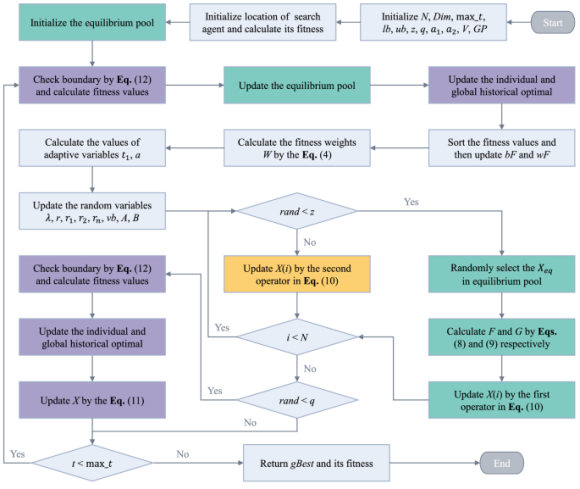
Thank you for visiting nature.com. You are using a browser version with limited support for CSS. To obtain the best experience, we recommend you use a more up to date browser (or turn off compatibility mode in Internet Explorer). In the meantime, to ensure continued support, we are displaying the site without styles and JavaScript.
Advertisement
Scientific Reports volume 12, Article number: 9421 (2022)
21
Metrics details
In order to solve the inverse kinematics (IK) of complex manipulators efficiently, a hybrid equilibrium optimizer slime mould algorithm (EOSMA) is proposed. Firstly, the concentration update operator of the equilibrium optimizer is used to guide the anisotropic search of the slime mould algorithm to improve the search efficiency. Then, the greedy strategy is used to update the individual and global historical optimal to accelerate the algorithm’s convergence. Finally, the random difference mutation operator is added to EOSMA to increase the probability of escaping from the local optimum. On this basis, a multi-objective EOSMA (MOEOSMA) is proposed. Then, EOSMA and MOEOSMA are applied to the IK of the 7 degrees of freedom manipulator in two scenarios and compared with 15 single-objective and 9 multi-objective algorithms. The results show that EOSMA has higher accuracy and shorter computation time than previous studies. In two scenarios, the average convergence accuracy of EOSMA is 10e−17 and 10e−18, and the average solution time is 0.05 s and 0.36 s, respectively.
The inverse kinematics (IK) problem is to determine the joint angle based on the position and posture of the manipulator’s end-effector1. That is, the purpose is to accurately transfer the end-effector to the desired position and posture2. It is one of the most fundamental problems in robot technology and plays an essential role in robot motion control, trajectory planning, and dynamic analysis3. However, the IK of redundant manipulators is a complex problem due to nonlinear Equations4. The traditional methods for solving inverse kinematics mainly include the analytic method and numerical iteration method5,6. The IK problem has an analytical solution for a manipulator that conforms to the Pieper standard. However, with the increase of the types of manipulators, many manipulators do not meet the Pieper standard, such as serial-parallel manipulators driven by cable7 and super-redundant serial manipulators8. The IK of redundant manipulators may have many group solutions. Still, it is difficult to obtain satisfactory solutions by traditional methods, and the real-time performance is poor. As a result, it is preferable to solve the IK of the complex manipulator using a metaheuristic approach9. Metaheuristic algorithm is a random method that is a successful alternative to the precise methods for solving practical optimization problems10,11. The advantages of metaheuristics include simplicity of principle, ease of implementation, independence form the problem, and gradient-free characteristics12. Many metaheuristic algorithms, which including particle swarm optimization (PSO)9, firefly algorithm (FA)13, artificial bee colony algorithm (ABC)14, and others, have been effectively applied to the IK of robotic manipulators. Although these algorithms have achieved excellent convergence accuracy, they often do not take into account the end-effector’s posture, which reduces the complexity of the IK problem and is inconsistent with most practical applications.
Slime mould algorithm (SMA) is an unique metaheuristic algorithm developed by Li et al.15 in 2020. Due to its capacity to imitate the peculiar oscillatory foraging behavior of slime mould and its remarkable performance, SMA has been effectively applied in a wide variety of fields in less than two years. For example, Abdel-Basset et al.16 and Ewees et al.17 applied the improved SMA to feature selection problems; Abdel-Basset et al.18, Naik et al.19 and Zhao et al.20 used hybrid and improved SMA to solve image segmentation problem (ISP); El-Fergany21, Kumar et al.22, Liu et al.23, Mostafa et al.24 and Yousri et al.25 used hybrid and improved SMA to estimate parameters of solar photovoltaic cells, respectively; Agarwal and Bharti26 applied improved SMA to the collision-free shortest time path planning of mobile robots; Rizk-Allah et al.27 proposed a chaos-opposition-enhanced SMA (CO-SMA) to minimize the energy costs of wind turbines at high-altitude sites; Hassan et al.28 applied improved SMA (ISMA) to efficiently solve economic and emission dispatch (EED) problem with single and dual objectives; Abdollahzadeh et al.29 proposed a binary SMA to solve the 0–1 knapsack problem; Zubaidi et al.30 combined SMA and artificial neural network (ANN) for urban water demand prediction; Chen and Liu31 combined K-means clustering and chaotic SMA with support vector regression to obtain higher prediction accuracy; Ekinci et al.32 applied SMA to the power system stabilizer design (PSSD); Wazery et al.33 combined SMA and K-nearest neighbor for disease classification and diagnosis system; Wei et al.34 proposed an enhanced SMA in power systems for optimal reactive power dispatch; Premkumar et al.35 and Houssein et al.36 developed multi-objective SMA (MOSMA) for solving complicated multi-objective engineering design problems in the real world; Yu et al.37 proposed an improved SMA (WQSMA) that enhanced the original SMA’s robustness by using a quantum rotation gate (QRG) and a water cycle operator. Houssein et al.38 proposed a hybrid SMA and adaptive guided differential evolution (AGDE) algorithm, which makes a good combination of SMA’s exploitation ability and AGDE’s exploration ability.
Although SMA has been used in many fields, it has not been applied to the IK problem. SMA, like most metaheuristic algorithms, suffers from diversity loss and premature convergence as a result of an improper balance between exploration and exploitation (weak exploration ability) during the iterative process of addressing difficult optimization problems. In order to improve the searching ability of SMA, the update strategy of equilibrium optimizer (EO) is used to replace the anisotropic operator of SMA to guide the search of slime mould more efficiently. Secondly, the greedy selection strategy is used to preserve the individual historical optimal location and search based on the information of the individual historical optimal to accelerate the algorithm’s convergence. Finally, to increase the possibility of escaping from the local optimal and avoid overcrowding, a random difference mutation operator is added to the algorithm. In EOSMA, the update operator of EO benefits from an appropriate balance of exploration and exploitation, the search operator of SMA is in charge of the main exploitation, and the random difference mutation operator expands the search range of the search agents during iteration while maintaining population diversity. To verify the efficiency of EOSMA in solving the IK problem of complex manipulator, it is compared with slime mould algorithm (SMA)15, equilibrium optimizer (EO)39, manta ray foraging optimization (MRFO)40, marine predators algorithm (MPA)41, pathfinder algorithm (PFA)42, flower pollination algorithm (FPA)43, differential evolution (DE)44, gradient-based optimizer (GBO)45, teaching–learning-based optimization (TLBO)46, Harris hawks optimization (HHO)47, improved grey wolf optimizer (IGWO)48, hybrid PSO and gravitational search algorithm (PSOGSA)49, centroid opposition-based differential evolution (CODE)50, multi-trial vector-based differential evolution (MTDE)51, self-adaptive spherical search algorithm (SASS)52 and the results of previous studies. Then, a multi-objective EOSMA (MOEOSMA) is proposed and compared with MOSMA35, multi-objective PSO (MOPSO)53, multi-objective MPA (MOMPA)54, multi-objective ant lion optimizer (MOALO)55, multi-objective dragonfly algorithm (MODA)56, multi-objective grey wolf optimizer (MOGWO)57, multi-objective multi-verse optimization (MOMVO)58, multi-objective salp swarm algorithm (MSSA)59, multi-objective evolutionary algorithm based on decomposition (MOEA/D)60 on the IK problem of a 7 degrees of freedom (DOF) manipulator. This paper’s primary contributions are as follows:
A hybrid EOSMA was developed to enhance the algorithm’s search capability and balance exploration and exploitation;
By introducing the archiving mechanism of non-dominated solutions, a multi-objective variant of EOSMA (MOEOSMA) was developed;
EOSMA and MOEOSMA were applied to the IK of the redundant manipulator to validate the algorithm’s performance and broaden its application range;
The influence of end-effector posture on the IK problem was investigated in order to provide a reference for relevant researchers.
The remainder of this work is structured as follows. Section “Related works” provides a synopsis of relevant works in the literature. Section “Preliminaries” introduces the SMA and EO algorithms, as well as the basic notions of multi-objective optimization. Section “The proposed EOSMA algorithm” describes the implementation steps of the EOSMA and MOEOSMA in detail. Section “Kinematics analysis of manipulator” presents the manipulator’s kinematics equation. The fitness function for the IK problem is defined in Sect. “EOSMA for inverse kinematics”. Section “Experimental results and discussions” reports and discusses the experimental results. Finally, Sect. “Conclusions and future directions” concludes the paper.
Inverse kinematics is a fundamental problem of robot technology, which plays a crucial role in robot trajectory planning, motion control, and dynamics analysis61. Due to the inverse kinematics equation being highly nonlinear, the traditional algorithm takes a long time to solve, and it is difficult to obtain ideal results. Therefore, previous researchers developed a variety of metaheuristic algorithms to address the IK problem of robotic manipulators. Huang et al.62 employed PSO to tackle the IK problem of a 7-DOF robotic manipulator; Ram et al.63 used a bidirectional PSO approach to address the IK problem caused by manipulator position shift; Adly et al.64 proposed single-objective and multi-objective versions of improved PSO, and verified the performance of the algorithm on 5-DOF and 7-DOF robotic manipulators; Ayyıldız and Çetinkaya65 solved IK of a 4-DOF serial robotic manipulator using GA, PSO, QPSO, and GSA. According to the results, QPSO has the best problem-solving performance; Dereli and Köker9 applied QPSO to solve the IK of 7-DOF serial manipulator and compared it with FA, PSO, and ABC. The results show that QPSO has higher solving accuracy and shorter calculation time than the contrast algorithm; Liu et al.66 proposed a parallel learning PSO (PLPSO) to solve the IK problem and verified the practicability and feasibility of the algorithm on UR5 manipulator; Dereli and Köker67 proposed a RDV-PSO that combines golf ball movements and PSO, and applied it to the IK solution of 7-DOF manipulator; Momani et al.68 applied the traditional GA and the continuous GA to the IK problem respectively, and the results showed that the continuous GA was superior to the traditional GA in all aspects; López-Franco et al.69 applied DE to the IK of the manipulator. Simulation and experimental results show the applicability of this method; Rokbani et al.70 applied FA to the IK problem and tested it on a three-link articulated planar system, and conducted a statistical analysis on the convergence and solution quality of 100 tests; Dereli and Köker13 applied FA to the IK problem of a 7-DOF redundant manipulator and compared it with PSO and ABC; Çavdar and Milani71 proposed a method for solving IK of a robot manipulator based on improved ABC, and the results illustrate that the proposed algorithm outperforms PSO and HS in positioning accuracy and solving time; El-Sherbiny et al.72 proposed K-ABC, which used different parameters in the process of updating food sources, and then used K-ABC to calculate the IK of a 5-DOF manipulator. Dereli and Köker73 proposed an ABC for solving the IK of the 7-DOF manipulator; Zhang and Xiao14 proposed a CPABC algorithm based on ABC to solve the IK of 7-DOF manipulator. The CPABC utilized chaotic mapping to optimize the population distribution of the initial food source and avoided local optimum; Dereli74 used the modified GWO, FPD-GWO, to solve the IK problem and compared it with GWO. The results reveal that FPD-GWO has a significantly higher convergence accuracy than GWO; Dereli75 proposed an modified WOA, ASI-WOA, which avoided the problems of sluggish convergence speed and frequent falling into local optimum, and evaluated the performance of ASI-WOA on the IK problem; Toz76 proposed a vortex search algorithm based on chaotic mapping (CVS), and verified the performance of CVS on a 6-DOF series manipulator; Wu et al.77 proposed an algorithm that combines the parameterization method with the T-IK method to address the IK problem in the position domain of redundant manipulators, and they tested the T-IK algorithm on an 8-DOF tunnel shotcrete robot. However, the posture of the end-effector is usually not considered in previous studies when solving IK problems, and the performance of solving accuracy, stability, and real-time performance of algorithms need to be further improved.
Slime mould algorithm (SMA) is a metaheuristic algorithm developed by Li et al.15 that is inspired by slime mould’s peculiar oscillatory foraging behavior. Slime mould can explore for food sources based on the odor concentration of food in the air during foraging. In this process, SMA mainly simulates three different morphologies of slime mould foraging: (1) When (rand < z), the contraction pattern of slime mould is unstable and becomes anisotropic, which can be searched anywhere in the search space; (2) When (r < p), slime mould begins to form thick vein-like tube along the radius; (3) When (r ge p), the contractile morphology of slime mould no longer changes over time, and the vascular structure disappears, as shown in Eq. (1).
where (overrightarrow {W}) is the search agent’s fitness weight, (overrightarrow {vb}) is a random number vector in ([ – a,a]), and (overrightarrow {vc}) declines linearly from 1 to 0, and (overrightarrow {{X_{b} }}) is the best location of the current iteration. (overrightarrow {{X_{A} }}) and (overrightarrow {{X_{B} }}) are two locations selected at random from the population. The value of (p) is calculated as Eq. (2).
where (S) signifies the fitness of the search agents and (DF) denotes the best fitness of all iterations. The value of (a) in the range of (overrightarrow {vb}) is calculated as Eq. (3).
The (overrightarrow {W}) is calculated as Eq. (4).
where (N) represents the population size, (r) is a random number vector in the range [0, 1], (bF) is the best fitness in the current iteration, and (wF) is the poorest fitness, (SIdx) represents the result of the ascending order of fitness.
SMA has the advantages of simple principle, low time complexity, and fast convergence speed. The elite strategy, ranking mechanism, and archiving mechanism are not adopted. All search individuals simply and equally choose to be close to or away from the best food source (overrightarrow {{X_{b} }}). The location (overrightarrow {X}) is updated based on the currently obtained optimal location (overrightarrow {{X_{b} }}), and the population of slime mould is continuously guided to converge to the optimal location rapidly. As a result, SMA’s exploitation ability outperforms that of exploration, and it is easy to fall into a local optimum. In addition, from Eq. (1), it can be seen that the performance of SMA mainly comes from the oscillatory foraging process of simulating slime mould to form vein-like tubes. In fact, for most real-world application problems, the first operator and the third operator of Eq. (1) are inefficient. The first operator only searches randomly, and the third operator will guide the slime mould to converge to the origin, which reduces the search efficiency. Therefore, the update operator of SMA will be simplified and improved in this paper. Please refer to15 for the detailed steps and pseudo code of the SMA.
The equilibrium optimizer (EO) is a physically-based metaheuristic algorithm developed by Faramarzi et al. in 2020 that is inspired by mass balance of controlled volume and can estimate dynamic and equilibrium states simultaneously39. The mass balance equation describes the physical process of mass entering, exiting, and generating in the control volume78. In EO, search agents update their concentration (location) at random in order to find some genius particles known as equilibrium candidates in order to attain the final equilibrium state as the global optimal. Equation (6) shows the updating formula.
where (overrightarrow {C}) is the current solution, (overrightarrow {{C_{eq} }}) is a randomly selected solution from the equilibrium pool, (overrightarrow {F}) is an adaptive parameter, (overrightarrow {G}) is the mass generation rate, (overrightarrow {lambda }) is a random number vector in [0, 1], and (V = 1) signifies the unit volume. There are five candidate solutions in the equilibrium pool. Four are the best candidate solutions found so far, and another is the average concentration (center location) of these four candidate solutions, as shown in Eq. (7).
The (overrightarrow {F}) is adaptively adjusted according to Eq. (8).
where (a_{1} in [1,2]) and (a_{2} in [1,2]) control the exploration and exploitation, respectively. The larger (a_{1}) is, the stronger the exploration ability is, and the larger (a_{2}) is, the stronger the development ability is, and vice versa. (sign) represents the symbolic function. (overrightarrow {r}) and (overrightarrow {lambda }) are vectors of random numbers in [0, 1]. The (overrightarrow {G}) is calculated by Eq. (9).
where (r_{1}) and (r_{2}) are random numbers in [0, 1] and (GP = 0.5) is the generation probability. More detailed steps and pseudo-code for EO are given in39.
Multi-objective optimization needs to optimize two or more objective functions simultaneously and cannot balance them explicitly; that is, there is no optimal solution that meets all objectives at once. Without loss of generality, multi-objective optimization can be expressed as the following optimization problem79:
where (M) represents the number of sub-objectives, (m) denotes the number of inequality constraints, and (n) denotes the number of equality constraints, (Dim) represents the dimension of decision variables, ([L,U]) represents the search range of decision variables.
There is usually no optimal solution for multi-objective optimization problems that minimizes all sub-objectives simultaneously. In this scenario, utilizing arithmetic relation operators to compare different solutions is not possible. In the multi-objective search space, we can compare the two search agents using Pareto optimal dominance56. The following are the definitions of Pareto dominance and Pareto optimality:
(Pareto dominance). Assume there are two vectors, (vec{x}) and (vec{y}). If and only if the following criteria are met, vector (vec{x}) dominates (vec{y}) (expressed as (vec{x} succ vec{y})):
according to Eq. (11), a solution vector (vec{x}) is superior to another (vec{y}) if it has better or equal values on all objectives and better values on at least one of them.
(Pareto optimality). If and only if the following criteria are met, a solution vector (vec{x} in D) is said to be Pareto optimal:
where (D) denotes the decision space. According to Eq. (12), if no other solution vector in decision space (D) is superior to (vec{x}), then (vec{x}) is considered the Pareto optimal solution.
(Pareto optimal set). The Pareto optimal set (PS) is a set that contains all non-dominated solutions to a given problem:
(Pareto optimal front). The Pareto optimal front (PF) is the mapping set of the PS on the objective space, and its expression is as follows:
In EOSMA, the following improvement strategies are mainly adopted: (1) The individual and global historical optimal of PSO are introduced81. The individual historical optimal is preserved by greedy selection and memory mechanism. In the update operator of SMA, the individual and global historical optimal are used to update, to accelerate the algorithm’s convergence; (2) The concentration update operator of EO is used to replace the less efficient anisotropic search operator in SMA to balance the concentration of slime mould in all directions and improve the search efficiency of the algorithm; (3) The random difference mutation operator is introduced. After the location update, the mutation mechanism is employed to improve the algorithm’s exploration ability, helping it to escape from the local optimum and avoid premature convergence; (4) The boundary checking of the algorithm is improved, and the solution vector beyond the search boundary is updated to the midpoint of the current solution to the search boundary to avoid the invalid search. Therefore, the location update formula of EOSMA is shown in Eq. (15).
where (overrightarrow {{X_{eq} }}) is a randomly selected solution from the equilibrium pool, (overrightarrow {X}) is the location of the search agents, (overrightarrow {gBest}) is the best location found so far, (overrightarrow {{pBest_{A} }}) and (overrightarrow {{pBest_{B} }}) are two location vectors randomly selected from the individual historical optimal, (z = 0.5) is the parameter of the hybrid algorithm obtained by experiments, and the meaning of the remaining parameters are the same as in EO and SMA.
In order to improve the exploration ability of the algorithm and the probability of escaping from the local optimum, the search agents execute the random difference mutation strategy after updating by Eq. (15). The mathematical model of the mutation operator is shown in Eq. (16).
where (SF) is a random number taking value in [0.3, 0.6], (R1,R2,R3) are three random integer vectors, the element takes value in [1, N], and N represents the population size.
After the search agent location is updated, check the solution to ensure it is within the search range. For the solution vector beyond the search range, the usual practice is to pull it back to the boundary. In this way, it is easy to produce invalid searches and reduce search efficiency. In EOSMA, the boundaries are checked by Eq. (17).
Finally, after each fitness evaluation, the individual historical optimal location is updated using the greedy strategy, as shown in Eq. (18).
In EOSMA, using the (overrightarrow {{X_{eq} }}) randomly selected in the equilibrium pool to update the location is equivalent to introducing a GWO-like hierarchical mechanism12. Therefore, compared with SMA, EOSMA introduces a greedy selection strategy, hierarchical partitioning mechanism, differential mutation mechanism, and boundary checking strategy. Greedy selection and boundary checking strategy enhance the exploitation ability, and hierarchical partitioning and differential mutation mechanism enhance the exploration ability. As a result, the exploration and exploitation abilities of EOSMA are improved compared with EO and SMA. Figure 1 shows the flowchart of EOSMA, and Algorithm 1 presents its pseudo-code.
Flow chart of the EOSMA.
Two components were added to EOSMA to transform it to a multi-objective version. The first component is an archive that retains all of the Pareto optimal solutions discovered that so far. The second component is a technique for ranking Pareto optimal solutions based on congestion metrics, which updates the equilibrium pool.
The archive is used to store and retrieve PS and PF found so far, and its capacity is the same as the population size. The location update operator of the search agent is the same as EOSMA, but the food source (optimal location) is selected from the archive. An archive updating approach similar to that employed in MOPSO82 is used to obtain a well-distributed PF. The archive always collects Pareto optimal solutions from the current population and updates them through the following steps:
Combine the new solutions from each iteration with the previous Pareto optimal solutions from the archive, and then check the combined solutions If a solution is not dominated by other solutions, added it to the archive; Otherwise, discard it;
Check whether the same solution still exists in the archive, and then remove it;
The solutions in the archives are graded based on congestion. The less congested the area, the more important the solutions, and vice versa.
If the number of solutions in the archive exceeds the capacity of the archive, the roulette selection method is used to remove the solution with higher congestion;
Re-rank the solutions in the archive based on congestion.
All solutions stored in the archive obtained according to the above update rules will dominate other solutions in the population. The conceptual model of congestion level is shown in Fig. 2. A hypersphere with a radius of (overrightarrow {dr}) is defined, and the number of solutions in the hypersphere is taken as the congestion level of the solutions, centering on the fitness of each solution. The calculation formula of distance radius (overrightarrow {dr}) is Eq. (19).
where (overrightarrow {max}) and (overrightarrow {min}) are two vectors that store the maximum and minimum fitness of each objective, respectively, and (Archivesize) is the archive size54.
Model of selecting a food source or eliminating a solution from the archive.
The multi-objective optimization approach relies on convergence and coverage to obtain the Pareto optimal solution. The convergence is mainly determined by the performance of EOSMA, and the coverage is mainly determined by the archive update rules. As can be seen from Fig. 2, there are more non-dominant solutions near the solutions with higher congestion levels. In order to improve coverage of PF, the solutions with higher congestion levels should be removed preferentially, while the solutions with lower congestion levels need to be preserved vigorously. If the number of non-dominant solutions exceeds the archive capacity, the probability that each solution is removed is calculated using Eq. (20).
where (P_{i}) defines the probability of selecting the i-th non-dominated solution, (C) means the cumulative sum of the congestion levels of all non-dominated solutions, and (N_{i}) denotes the congestion level of the i-th non-dominated solution.
The equilibrium pool maintains multiple optimal solutions discovered thus far, which broadens the algorithm’s search range and improves EOSMA’s global search capability. The fitness of search agents can be directly compared for single-objective optimization, and the search agent with the best fitness can be selected and put into the equilibrium pool. For multi-objective optimization, MOEOSMA’s archive stores the non-dominant solutions of the current iteration. The solutions with the lowest congestion level can be regarded as the best food source. Therefore, the solution with the lowest congestion level in the archive is put into the equilibrium pool. Each iteration randomly selects a solution in the equilibrium pool as the global optimal location (overrightarrow {gBest}) in Eq. (15). It is worth noting that there are 5 solutions in the equilibrium pool of EOSMA, while the number of solutions in the equilibrium pool of MOEOSMA varies. In addition, unlike many heuristic algorithms, SMA needs to sort the fitness during each iteration to evaluate individual fitness weight. Due to the individual fitness of several objectives cannot be compared simultaneously in multi-objective optimization, this work used a rotation sorting approach to estimate the individual fitness weight of slime mould, as shown in Eq. (21).
where (O_{i}) signifies the fitness of the i-th objective function selected for sorting, (t) signifies the number of current iterations, and (M) signifies the number of problem objectives. Figure 3 shows MOEOSMA’s flow chart, and Algorithm 2 presents the pseudo-code.
Flow chart of the MOEOSMA.
EOSMA comprises sub-components: population initialization, fitness evaluation, greedy selection, fitness sorting, fitness weight update, equilibrium pool update, search agent location update, and mutation operator. The computational complexity of initialization is (O(N * Dim)), the time complexity of greedy selection and equilibrium pool update are (O(N)), the computational complexity of fitness weight update, location update, and mutation operation are all (O(N * Dim)), and the computational complexity of fitness sorting is (O(N * log N)). Assuming that the time complexity of the fitness evaluation function is (O(F)), the time complexity of EOSMA is (Oleft( {max _t * left( {N * Dim + N * log N + F} right)} right)), where (N) denotes population size, (Dim) denotes problem dimensionality, (F) denotes the time to compute the fitness function once, and (max _t) denotes the maximum number of iterations of the algorithm. EOSMA’s space complexity is (O(N * Dim)).
MOEOSMA extends EOSMA components with the archive update operator. It has a time complexity of (O(N_{A}^{2} * M)), where (N_{A}) is the archive capacity and (M) is the number of targets. As a result, MOEOSMA’s time complexity is (Oleft( {max _t * left( {N_{A}^{2} * M + N * Dim + N * log N + F} right)} right)). MOEOSMA has the same space complexity as EOSMA, which is (O(N * Dim)).
As illustrated in Fig. 4, the robotic manipulator’s kinematics analysis includes forward kinematics (FK) analysis and inverse kinematics (IK) analysis. FK calculates the end-effector’s position and posture based on the joint angle vector, and IK calculates the matching joint angle vector based on the position and posture.
Kinematics analysis of the robotic manipulator.
IK is a fundamental problem in robotics, which plays an important role in motion control, and trajectory planning61. For the manipulator that meets the Pieper standard, the analytical method can be used to solve it. Still, for the more general manipulator, the analytical method cannot be used to solve it, especially for the manipulator with the offset wrist66. The manipulator with 7-DOF has been widely used in industry because of its easy obstacle avoidance, flexible movement, and working in a large space9. This work uses the previously studied 7-DOF series robotic manipulator9,74,75 as a test instance to validate the effectiveness and efficiency of the proposed EOSMA. The structure of the manipulator is shown in Fig. 5, which is composed of 7 rotating joints and 6 connecting rods in series, and the end-effector has an offset of 5 cm. Therefore, the structure of the manipulator does not meet the Pieper standard, and it is difficult to obtain its IK equation by the analytical method.
The structure of the 7-DOF robotic manipulator.
The forward kinematics model needs to be established before studying the inverse kinematics of the manipulator. Denavit-Hartenberg (DH) parameters can uniquely determine the structure of manipulator and are widely used in FK modeling of robotic manipulator66. Table 1 lists the DH parameters of the manipulator studied in this paper, where (a_{i} ,alpha_{i} ,d_{i} ,theta_{i}) represent the length of the connecting rod, the torsion angle of the connecting rod, the offset of the connecting rod, and the joint angle, respectively.
The FK model of the manipulator is established using the standard DH parameter method, and the homogeneous transformation matrix of the single joint is presented in Eq. (22)5.
where ({}_{i – 1}^{i} T) is the homogeneous transformation matrix of joint (i – 1) to (i), (stheta_{i}) and (ctheta_{i}) stand in for (sin (theta_{i} )) and (cos (theta_{i} )), respectively.
By substituting each row of data in Table 1 into Eq. (22), the homogeneous transformation matrix of each joint can be obtained, as shown in Eq. (23).
The FK equation of the end-effector relative to the base is produced by multiplying all homogeneous transformation matrices, as shown in Eq. (24).
where (T_{{text{End – Effector}}}) represents the end-effector’s homogeneous transformation matrix with regard to the base coordinate system. When the value of a given joint variable is in Eq. (24), the alternative representation of (T_{{text{End – Effector}}}) can be written as Eq. (25).
where ((p_{x} ,p_{y} ,p_{z} )^{{text{T}}}) represents the end-effector’s position element in the base coordinate system, and (({vec{mathbf{n}}},{vec{mathbf{s}}},{vec{mathbf{a}}})) represents the posture element, that is, the rotation element.
Although the rotation matrix (({vec{mathbf{n}}},{vec{mathbf{s}}},{vec{mathbf{a}}})) has nine elements, it has only three degrees of freedom and is a unit orthogonal matrix with redundancy. Therefore, the Euler angle is used to describe the posture of the end-effector, and its calculation formula is shown in Eq. (26)66.
Thus, the position and posture can be expressed as (P = (p_{x} ,p_{y} ,p_{z} ,alpha ,beta ,gamma )), where ((p_{x} ,p_{y} ,p_{z} )) is the position vector and ((alpha ,beta ,gamma )) is the posture vector expressed by Euler angle. The FK equation of the simplified 7-DOF robotic manipulator is shown in Eq. (27).
where (s_{i}) and (c_{i}) stand in for (sin (theta_{i} )) and (cos (theta_{i} )), (s_{ij}) and (c_{ij}) stand in for (sin (theta_{i} ) cdot sin (theta_{j} )) and (cos (theta_{i} ) cdot cos (theta_{j} )), respectively.
As mentioned above, the FK equation of the 7-DOF robotic manipulator can be easily obtained by using DH coordinate method. Given the joint angle vector (left( {theta_{1} ,theta_{2} ,theta_{3} ,theta_{4} ,theta_{5} ,theta_{6} ,theta_{7} } right)), the position and posture ((p_{x} ,p_{y} ,p_{z} ,alpha ,beta ,gamma )) of the manipulator can be directly calculated by Eq. (27). However, given the position and posture ((p_{x} ,p_{y} ,p_{z} ,alpha ,beta ,gamma )) of the manipulator, the IK equation used to obtain the joint angle vector (left( {theta_{1} ,theta_{2} ,theta_{3} ,theta_{4} ,theta_{5} ,theta_{6} ,theta_{7} } right)) is highly nonlinear, which is considered to be a very challenging optimization problem76.
The manipulator’s IK problem is defined as determining the corresponding joint angle based on the position and posture of the end-effector. The IK problem of complex structure manipulator belongs to the NP problem group83. Due to the analytical method is extremely difficult to use, this research employs the developed EOSMA to address the IK problem. The relationship between the EOSMA algorithm and the IK problem is shown in Table 2.
The purpose of this study is to optimize the joint angle vector (overrightarrow {{theta_{i} }} = (theta_{1} ,theta_{2} ,theta_{3} ,theta_{4} ,theta_{5} ,theta_{6} ,theta_{7} )) of the manipulator to eliminate position and posture errors. The FK formula is used to calculate the end-effector’s position and posture corresponding to the joint angle vector. For the desired pose (P_{0} = (p_{x0} ,p_{y0} ,p_{z0} ,alpha_{0} ,beta_{0} ,gamma_{0} )), the fitness of the candidate joint angle vector (overrightarrow {{theta_{i} }}) is defined as Eq. (28).
where (w_{1} + w_{2} = 1) represents the weight of position and posture error, and (P_{i} = (p_{xi} ,p_{yi} ,p_{zi} ,alpha_{i} ,beta_{i} ,gamma_{i} )) denotes the end-effector’s position and posture corresponding to the joint angle vector (overrightarrow {{theta_{i} }}), which can be obtained from Eq. (27).
The fitness function defined by Eq. (28) consists of position and posture error. It should be noted that in previous studies, many researchers only considered position without considering posture, reducing the complexity of the IK problem. Although those algorithms have obtained high accuracy, they are inconsistent with many real-world applications. The end-effector’s position and posture are considered comprehensively in this study, and the complete pose of the manipulator is obtained. For EOSMA, the location of the search agents is the joint angle vector, i.e., (overrightarrow {{pBest_{i} }} = overrightarrow {{theta_{i} }}). The search range of joint angles is presented in Table 1.
Due to the randomness of the metaheuristic algorithm, poor outliers may appear in a single run, which will affect the average solution accuracy of the algorithm. In this study, the threshold for judging whether the algorithm has been solved successfully is set as 10e−6. If the solution result is less than 10e−6, the algorithm is considered to have been solved successfully, and the solution result of the algorithm is retained; Otherwise, the algorithm is employed to solve again until the algorithm’s maximum number of failures is reached. The maximum number of failures of all comparison algorithms is set to 10. Figure 6 explains the flow chart of EOSMA for the IK problem.
Flow chart of the EOSMA implementation for the IK problem.
The effectiveness and efficiency of the EOSMA in handling the IK problem were validated in two scenarios in this section. Firstly, EOSMA was compared with 15 well-known algorithms without considering posture and then compared with the results of existing studies. Then, the proposed method was compared with 15 well-known single-objective algorithms and 9 multi-objective algorithms in the scenario of comprehensively considering position and posture. Finally, according to the calculated joint angle vector and the current angles of the manipulator, the joint change of the manipulator was simulated, and the motion trajectory of the end-effector was drawn. All algorithm codes were run in MATLAB R2020b, and the hardware details were Intel(R) Core (TM) i7-9700 CPU (3.00 GHz) and 16 GB RAM. In the experiment, the pose error and calculation time are given priority, and the best, worst, mean, and standard deviation are employed as the algorithm’s performance metrics.
To fully demonstrate the effectiveness and efficiency of EOSMA in solving the IK problem, it is compared with 15 single-objective algorithms and 9 multi-objective algorithms. These algorithms include SMA15, EO39, DE44, TLBO46, FPA43, MRFO40, MPA42, PFA42, GBO45, HHO47, IGWO48, PSOGSA49, CODE50, MTDE51, SASS52, MOSMA35, MOPSO53, MOMPA54, MOALO55, MODA56, MOGWO57, MOMVO58, MSSA59, MOEA/D60. All algorithms use the same common parameters for a fair comparison, and other parameters are taken from the values suggested in the original paper, as shown in Tables 3 and 4. In scenario 1, the mutation probability (q) of EOSMA is set as 0, and the exploration factor (a_{1}) is set as 1. In scenario 2, the mutation probability (q) is set as 1, and the exploration factor (a_{1}) is set as 2.
In this part, EOSMA is compared against 15 well-known algorithms for the IK problem that do not take posture into account. Due to the metaheuristic algorithms run at random, each run will have a higher or lower value than the preceding one. To avoid the influence of randomness in the selection of position points, 100 different position points were generated at random in the workspace of the manipulator, as shown in Fig. 7, where the color represent the position’s height.
Randomly selected position points in the workspace of the manipulator.
The results obtained by the comparison algorithm are shown in Table 5. It can be seen that EOSMA, EO, MRFO, PFA, and GBO can all obtain theoretical optimal solutions with zero error without considering the posture, but EOSMA has the best robustness and the shortest solution time. The average convergence accuracy of EOSMA is 9 orders of magnitude higher than EO and 13 orders of magnitude higher than SMA, which verifies the effectiveness and efficiency of EOSMA in the IK problem.
Convergence curves of EOSMA and 14 comparison algorithms are shown in Fig. 8. Since the population size of SASS decreases linearly with the number of iterations, its convergence curves are not comparable. The results show that EOSMA can quickly obtain high-precision solutions, far superior to other comparison algorithms, followed by GBO and PSOGSA, indicating that EOSMA is suitable for solving IK problem without considering posture.
Average convergence curve of randomly selected position points.
The solution time of EOSMA and 15 comparison algorithms at 100 randomly selected positions is shown in Fig. 9. It can be seen that EOSMA takes the least amount of time, followed by EO and PFA, and IGWO takes the most time. Since the manipulator is a real-time control system, the algorithm with a short solution time is preferred when the solution accuracy is satisfied. Therefore, although PSOGSA and GBO have high convergence accuracy, they are not suitable for solving the IK of the manipulator. EOSMA, EO, and PFA are highly competitive in the IK problem.
Solution time of comparison algorithms at randomly selected position points.
Figure 10 shows the distribution of the solution results of the algorithm in the form of the box plot. For the convenience of observation, set results less than 10e−18 to 10e−18. It is clear that EOSMA has a lower median and a narrower box plot with fewer outliers than most algorithms. EOSMA is superior to SMA in convergence accuracy and EO in robustness.
Box plot of optimization results of randomly selected position points.
To verify whether there is a significant difference between the solution results of EOSMA and each comparison algorithm, the Wilcoxon rank-sum test of two paired samples was utilized84. Figure 11 illustrates the p-value of the Wilcoxon rank-sum test as a bar graph. If p < 0.05, it is believed that there is a substantial difference between the two algorithms. As can be seen, EOSMA differs greatly from all comparison algorithms, particularly SMA, indicating that the improvement is effective.
Wilcoxon rank-sum test results of randomly selected position points.
Many metaheuristic algorithms, such as quantum particle swarm optimization (QPSO)9, GWO74, and WOA75, have been effectively applied to the IK of 7-DOF robotic manipulators. Table 6 shows the results of EOSMA, SMA, and EO in the IK of 7-DOF manipulator with other comparable metaheuristic algorithms used in existing studies. It is clear from the results that the solution accuracy of EOSMA is 4 orders of magnitude higher than that of QPSO.
The IK of redundant manipulators is considered a challenging optimization problem83. Many previous studies did not consider the end-effector’s posture, which simplifies the problem but is inconsistent with most practical applications. Considering that the posture makes the IK problem more complex, so it is necessary to verify EOSMA’s optimization performance further. The linear weighting method is utilized in this section to handle the IK problem while keeping posture in consideration. The fitness value of the candidate joint angle vector (overrightarrow {{theta_{i} }}) is calculated by Eq. (28), where (w_{1}) and (w_{2}) are set to 0.5, indicating that position and posture are equally important. A total of 100 different pose points were randomly generated in the workspace of the 7-DOF manipulator, as shown in Fig. 12. In the figure, solid dots represent the position of the end-effector, and straight lines represent the posture.
Randomly generated pose points in the workspace of the manipulator.
Table 7 presents the results of EOSMA and 15 comparison algorithms. When considering the end-effector’s position and posture, it can be seen that only EOSMA, MPA, DE, and SASS can effectively solve the IK problem. EOSMA and SASS produced acceptable results, with an average solution accuracy of 10e-18. Although EOSMA’s solution accuracy is not as good as SASS’s, its solution time is shorter, making it more suitable for manipulator real-time control. As a result, EOSMA is a viable alternative method for solving the IK problem of complicated manipulators.
Figure 13 presents the convergence curves of EOSMA and various comparison algorithms. As can be seen, EOSMA has the fastest convergence speed and the highest convergence accuracy, considerably outperforming EO and SMA. Furthermore, the convergence curve of EOSMA is remarkably smooth, indicating that the algorithm has achieved a reasonable balance between exploration and exploitation. The random difference mutation operator is used in EOSMA to expand the search space of search agents during the iterative process, avoid overcrowding of search agents, and increase the probability of finding the optimal solution. As shown in Fig. 13, the average solution accuracy of most algorithms is less than 10e-7, indicating that the proposed EOSMA improves the average solution accuracy by 10 orders of magnitude.
Average convergence curve of randomly generated pose points.
The solution time of each algorithm at 100 pose points is shown in Fig. 14. It can be seen that the solution time of EOSMA fluctuates little when solving different pose points. The average solution time of EOSMA is the shortest, about 0.36 s, followed by MPA, about 0.42 s. This may not be an entirely satisfactory result, but it shows that EOSMA can still be used for some robotic manipulators with low real-time performance, such as in the service industry and offline computing online operations66.
Solution time of comparison algorithms at randomly generated pose points.
The box plot in Fig. 15 displays the solution outcomes of EOSMA and other comparison algorithms at 100 pose points. EOSMA and SASS have the lowest median and few outliers, making them considerably superior to other comparison algorithms. Overall, EOSMA and SASS performed well on the IK problem, with little difference in performance between the two. However, EOSMA has a lower time complexity than SASS.
Box plot of optimization results of randomly generated pose points.
Figure 16 shows the Wilcoxon p-value test results of EOSMA and each comparison algorithm. It can be seen that, except for SASS, there are significant differences between the optimization results of EOSMA and comparison algorithms at the confidence level of 0.05. It shows that the search principle of EOSMA is different from other algorithms and can solve the IK more effectively.
Wilcoxon rank-sum test results of randomly generated pose points.
If the desired position and posture of the end-effector are considered comprehensively, there may be no inverse kinematics solution due to the structural restrictions of the manipulator, that is, the position and posture errors cannot be optimized simultaneously. As a result, the manipulator’s IK can be regarded as a multi-objective optimization problem. Obviously, the closer to the workspace boundary, the less selectable posture of the end-effector. In this case, it is difficult to obtain a satisfactory solution using the single-objective algorithm. In this study, MOEOSMA was proposed to solve IK problems. The desired pose (P_{1} = ( – 25,100,50,0,0,0)) and (P_{2} = (50, – 25,75,0,0,0)) were selected as test cases. It was verified that (P_{1}) did not have inverse kinematic solutions while (P_{2}) had inverse kinematic solutions through the Robotics Toolbox for MATLAB. Due to the IK problem of the 7-DOF manipulator has not been studied using the multi-objective method in the previous literature, MOEOSMA is compared with MOSMA35, MOPSO53, MOMPA54, MOALO55, MODA56, MOGWO57, MOMVO58, MSSA59, and MOEA/D60. For a fair comparison, the population size of all algorithms was set to 100, the maximum number of iterations was set to 1000, the archive size was set to 100, and each example was independently run 20 times. Since the true PF is unknown, the hypervolume (HV) metric85,86 was used to evaluate the performance difference of the algorithms. The HV metric can evaluate both the advancement and distribution of the obtained PF simultaneously87. The larger HV value, the better convergence and distribution of the algorithm. The reference points for the test cases used in this study were 1.1 times the maximum objective function value found in all algorithms and all optimization runs. The reference points for calculating the HV values of the desired poses P1 and P2 are (2.088567, 2.466816) and (1.695669, 2.524178), respectively. Table 8 provides the statistical data of the HV results obtained by each algorithm. The PF obtained by the algorithms under the two desired poses is shown in Figs. 17 and 18, respectively.
The PF obtained by multi-objective algorithms at desired pose P1.
The PF obtained by multi-objective algorithms at desired pose P2.
The data provided in Table 8 show that MOEOSMA obtains the best mean and standard deviation in the two scenarios, while MOMPA and MOMVO also show strong competition. For the pose without inverse kinematic solution, MOEOSMA has a longer solution time than MOMPA, MOMVO and MSSA, but the quality of PF obtained is better. For the pose with inverse kinematic solution, MOEOSMA is much better than the other comparison algorithms in both accuracy and speed. As can be seen from Fig. 17, the PF obtained by MOEOSMA is closer to the true PF, and extreme Pareto solutions are more widely distributed. As can be seen from Fig. 18, the PF of MOEOSMA is convex, and the rest is concave, indicating that the proposed algorithm can minimize both position and posture errors, while the other algorithms tend to optimize one of the objectives. This fully reveals that MOEOSMA is a good optimization tool for solving the IK problem of redundant manipulators.
The motion state of the 7-DOF robotic manipulator was simulated in this section by using the Robotics Toolbox for MATLAB. Assume the beginning joint angle vector of the manipulator is (overrightarrow {{theta_{1} }} = (45^circ ,0^circ ,45^circ ,0^circ ,45^circ ,0^circ ,0^circ )), the position and posture of the end-effector corresponding to the joint angle vector (overrightarrow {{theta_{1} }}) is (P_{1} = ( – 24.748737,100.961941,50.000000,90, – 45,0)), and the desired end-effector pose is (P_{2} = (50, – 75,75,0,0,0)). According to the desired pose, many joint angle vectors can be obtained through EOSMA. For the current state of the manipulator, the cost of changing to those joint angles is different. In this study, the joint angle vector with the slightest overall angle change is the best candidate joint angle vector, which can minimize the movement time of the manipulator. The penalty function of joint angles difference was added into the fitness function to evaluate the pose error, as shown in Eq. (31).
where (O(vec{theta }_{i} )) represents the objective function, (vec{theta }_{i}) represents the i-th candidate joint angle vector, (vec{theta }_{1}) represents the joint angle vector in the starting state, (w) is the penalty coefficient, the value in this paper is 10e−15, and (left| cdot right|) represents the calculated Euclidean distance.
The joint angles of the manipulator obtained by EOSMA, SMA, and EO are shown in Table 9. The manipulator can read the starting and the ending joint angles from Table 9 to control the rotation of each joint angle and move the end-effector to the desired position and posture.
Figure 19 shows the optimization process of EOSMA, Fig. 20 shows the trajectory of the end-effector and the curve of the joint angle change with time. The simulation results show that the three algorithms can reach the desired position and posture, and in which the angle change of SMA is the least, but the solution accuracy is the lowest. The angle change of EOSMA is very close to that of SMA, but the pose error is reduced by 8 orders of magnitude, as shown in Table 9 and Fig. 19b. EO has the largest angle variation, and its accuracy is between SMA and EOSMA. As shown in Fig. 19b, the optimal candidate joint angle does not exceed the search range of each joint angle during iteration. At the beginning of the iteration, the angle of each joint changed obviously, indicating that EOSMA has a strong exploration ability. After 200 generations, the optimal candidate joint angle did not change significantly. EOSMA used the SMA search operator to fine-adjust the optimal candidate joint angle found so far, achieving high convergence accuracy. As can be seen from Fig. 20a, all three algorithms obtain a very smooth trajectory, but EOSMA has the highest accuracy in reaching the desired pose. It can be seen from Fig. 20b–d that the angle, velocity, and acceleration curves of each joint are continuous and smooth, and the angle change of each joint is evenly distributed. It indicates that there is no obvious jitter during the movement of the manipulator, and the overall change range of the manipulator is small.
Optimization process of the algorithm. (a) Optimal candidate joint angle of EOSMA varies with the number of iterations. (b) Convergence curve of the algorithms.
Simulation test results. (a) The trajectory of end-effector of the 7-DOF manipulator. (b) Curves of joint angle with time. (c) Curves of joint angular velocity with time. (d) Curves of joint angular acceleration with time.
The EOSMA proposed in this study enhances the search ability of EO and SMA, increases population variety, and reduces the probability of falling into the local optimum. In fact, the most important obstacle in many metaheuristic algorithms is frequently falling into local optimum, which dramatically limits the optimization performance. When evaluated from this perspective, EOSMA is ahead of many heuristic algorithms (Figs. 8 and 13). By comparing the convergence curves of the two scenarios, it can be found that many algorithms can obtain high precision solutions in the scenario without considering the posture. Only EOSMA, DE, and MPA can effectively solve the scenarios comprehensively considering the position and posture. It shows that it is difficult to solve the scenario considering posture, and many algorithms will fall into local optimum. On the contrary, DE obtains higher convergence accuracy in the scenario considering posture, which indicates that the IK problem considering posture requires the algorithm to have strong exploration ability. In contrast, the IK problem not considering posture requires the algorithm to have strong exploitation ability. Therefore, in scenario 1, the parameters of EOSMA were set as follows: exploration coefficient (a_{1} = 1), exploitation coefficient (a_{2} = 2), and mutation probability (q = 0); In scenario 2, the parameters of EOSMA were set as: exploration coefficient (a_{1} = 2), exploitation coefficient (a_{2} = 2), and mutation probability (q = 1).
Due to the performance of many algorithms in these two scenarios differing greatly, previous studies did not compare the two scenarios. EOSMA can be well adapted to the IK problem in different scenarios by simply adjusting the parameters that control exploration and exploitation abilities, demonstrating the hybrid EOSMA has a strong generalization ability. The excellent performance of EOSMA can be summed up as follows.
SMA has strong exploitation ability and EO exploration ability. The concentration update operator of EO was used to guide the global search of SMA to keep the balance between exploration and exploitation, increase population diversity and enhance the robustness and generalization ability.
The update operator of SMA in the exploitation stage is defective, and it is easy to guide the search agents to converge to the origin in the late iteration, resulting in an invalid search. The structure of SMA was simplified, the parameters and calculation time were reduced.
The greedy selection strategy was used to retain the individual historical optimal and global historical optimal locations and then update them based on the individual historical optimal and global historical optimal, which improves the search efficiency.
The random difference mutation strategy was included after upgrading the location of EOSMA to widen the search range of the search agents, enhance the possibility of search agents escaping from the local optimum, and avoid premature convergence.
Although the results of this study show that EOSMA and its multi-objective version outperform majority of comparison algorithms, it still has some limitations. There are many adjustable parameters in EOSMA. It may be difficult to set the parameters for different applications. It is necessary not only to know the influence of different parameters on the algorithm’s exploration and exploitation but also some properties of the problem. In addition, the EOSMA proposed in this paper is designed for the IK problem and its effectiveness in other real-world problems needs to be further tested.
In this paper, an EO-guided SMA was developed to improve search efficiency by widening the search range of slime mould in order to tackle the IK problem of redundant manipulators efficiently. The performance of EOSMA for the IK problem is verified by comparison with 15 single-objective and 9 multi-objective algorithms, and comparable algorithms used in previous studies. Without considering the posture, EOSMA is superior to 15 comparison algorithms in terms of best, worst, mean, standard deviation, and average solution time. EOSMA can converge to the global optimal with an average convergence accuracy of 10e−17 m, which is 4 orders of magnitude higher than the best comparison algorithm PSOGSA. The average solution time is about 0.05 s, and the robustness is the best. When considering position and posture, the performance of EOSMA is similar to SASS, but EOSMA has a shorter solution time. The average solution accuracy of EOSMA can reach 10e-18, and the average solution time is about 0.36 s. Compared with the 9 multi-objective optimization algorithms, EOSMA’s multi-objective version obtains higher accuracy, more comprehensive coverage, and more uniform distribution of PF. Simulation results show that the overall change of joint angle obtained by EOSMA is small, and the motion trajectory is smooth without obvious jitter. Statistical results show that EOSMA has better performance for the IK problem, which is significantly different from other algorithms. For some desired poses, the position and posture errors cannot be eliminated synchronously and must be compromised between the two. MOEOSMA can provide users with a well-distributed PF to pick from, and it is an efficient alternative method for solving the IK problem of complicated manipulators. Although promising results have been achieved, there are still some problems that need to be studied in the future. EOSMA has many parameters and depending on the problem to be solved, parameter adaptive selection methods can be considered for the algorithm, such as parameter adaptive mechanism based on success history88 or parameter adaptive mechanism based on reinforcement learning89. In addition, EOSMA can be applied to other fields, such as photovoltaic parameter extraction and satellite posture adjustment.
All data, models, and code generated or used during the study appear in the submitted article.
Vosniakos, G.-C. & Kannas, Z. Motion coordination for industrial robotic systems with redundant degrees of freedom. Robot. Comput. Integr. Manuf. 25, 417–431 (2009).
Article Google Scholar
Iliukhin, V. N., Mitkovskii, K. B., Bizyanova, D. A. & Akopyan, A. A. The modeling of inverse kinematics for 5 DOF manipulator. Procedia Eng. 176, 498–505 (2017).
Article Google Scholar
Kucuk, S. & Bingul, Z. Inverse kinematics solutions for industrial robot manipulators with offset wrists. Appl. Math. Model. 38, 1983–1999 (2014).
MathSciNet MATH Article Google Scholar
Almusawi, A. R. J., Dülger, L. C. & Kapucu, S. A new artificial neural network approach in solving inverse kinematics of robotic arm (Denso VP6242). Comput. Intell. Neurosci. 2016, 1–10 (2016).
Article Google Scholar
Xiao, F. et al. An effective and unified method to derive the inverse kinematics formulas of general six-DOF manipulator with simple geometry. Mech. Mach. Theory 159, 104265 (2021).
Article Google Scholar
Miyata, S., Miyahara, S. & Nenchev, D. Analytical formula for the pseudoinverse and its application for singular path tracking with a class of redundant robotic limbs. Adv. Robot. 31, 509–518 (2017).
Article Google Scholar
Liu, F., Xu, W., Huang, H., Ning, Y. & Li, B. Design and analysis of a high-payload manipulator based on a cable-driven serial-parallel mechanism. J. Mech. Robot. 11, 051006 (2019).
Article Google Scholar
Xu, W., Liu, T. & Li, Y. Kinematics, dynamics, and control of a cable-driven hyper-redundant manipulator. IEEEASME Trans. Mechatron. 23, 1693–1704 (2018).
Article Google Scholar
Dereli, S. & Köker, R. A meta-heuristic proposal for inverse kinematics solution of 7-DOF serial robotic manipulator: Quantum behaved particle swarm algorithm. Artif. Intell. Rev. 53, 949–964 (2020).
Article Google Scholar
Mohamed, A. W., Hadi, A. A. & Mohamed, A. K. Gaining-sharing knowledge based algorithm for solving optimization problems: A novel nature-inspired algorithm. Int. J. Mach. Learn. Cybern. 11, 1501–1529 (2020).
Article Google Scholar
Ma, L., Cheng, S. & Shi, Y. Enhancing learning efficiency of brain storm optimization via orthogonal learning design. IEEE Trans. Syst. Man Cybern. Syst. 51, 6723–6742 (2021).
Article Google Scholar
Mirjalili, S., Mirjalili, S. M. & Lewis, A. Grey wolf optimizer. Adv. Eng. Softw. 69, 46–61 (2014).
Article Google Scholar
Dereli, S. & Köker, R. Calculation of the inverse kinematics solution of the 7-DOF redundant robot manipulator by the firefly algorithm and statistical analysis of the results in terms of speed and accuracy. Inverse Probl. Sci. Eng. 28, 601–613 (2020).
MathSciNet MATH Article CAS Google Scholar
Zhang, L. & Xiao, N. A novel artificial bee colony algorithm for inverse kinematics calculation of 7-DOF serial manipulators. Soft Comput. 23, 3269–3277 (2019).
Article Google Scholar
Li, S., Chen, H., Wang, M., Heidari, A. A. & Mirjalili, S. Slime mould algorithm: A new method for stochastic optimization. Future Gener. Comput. Syst. 111, 300–323 (2020).
Article Google Scholar
Abdel-Basset, M., Mohamed, R., Chakrabortty, R. K., Ryan, M. J. & Mirjalili, S. An efficient binary slime mould algorithm integrated with a novel attacking-feeding strategy for feature selection. Comput. Ind. Eng. 153, 107078 (2021).
Article Google Scholar
Ewees, A. A. et al. Improved slime mould algorithm based on firefly algorithm for feature selection: A case study on QSAR model. Eng. Comput. https://doi.org/10.1007/s00366-021-01342-6 (2021).
Article Google Scholar
Abdel-Basset, M., Chang, V. & Mohamed, R. HSMA_WOA: A hybrid novel Slime mould algorithm with whale optimization algorithm for tackling the image segmentation problem of chest X-ray images. Appl. Soft Comput. 95, 106642 (2020).
PubMed PubMed Central Article Google Scholar
Naik, M. K., Panda, R. & Abraham, A. Normalized square difference based multilevel thresholding technique for multispectral images using leader slime mould algorithm. J. King Saud Univ. Comput. Inf. Sci. https://doi.org/10.1016/j.jksuci.2020.10.030 (2020).
Article Google Scholar
Zhao, S. et al. Multilevel threshold image segmentation with diffusion association slime mould algorithm and Renyi’s entropy for chronic obstructive pulmonary disease. Comput. Biol. Med. 134, 104427 (2021).
PubMed Article Google Scholar
El-Fergany, A. A. Parameters identification of PV model using improved slime mould optimizer and Lambert W-function. Energy Rep. 7, 875–887 (2021).
Article Google Scholar
Kumar, C., Raj, T. D., Premkumar, M. & Raj, T. D. A new stochastic slime mould optimization algorithm for the estimation of solar photovoltaic cell parameters. Optik 223, 165277 (2020).
ADS CAS Article Google Scholar
Liu, Y. et al. Boosting slime mould algorithm for parameter identification of photovoltaic models. Energy 234, 121164 (2021).
CAS Article Google Scholar
Mostafa, M., Rezk, H., Aly, M. & Ahmed, E. M. A new strategy based on slime mould algorithm to extract the optimal model parameters of solar PV panel. Sustain. Energy Technol. Assess. 42, 100849 (2020).
Google Scholar
Yousri, D., Fathy, A., Rezk, H., Babu, T. S. & Berber, M. R. A reliable approach for modeling the photovoltaic system under partial shading conditions using three diode model and hybrid marine predators-slime mould algorithm. Energy Convers. Manag. 243, 114269 (2021).
Article Google Scholar
Agarwal, D. & Bharti, P. S. Implementing modified swarm intelligence algorithm based on Slime moulds for path planning and obstacle avoidance problem in mobile robots. Appl. Soft Comput. 107, 107372 (2021).
Article Google Scholar
Rizk-Allah, R. M., Hassanien, A. E. & Song, D. Chaos-opposition-enhanced slime mould algorithm for minimizing the cost of energy for the wind turbines on high-altitude sites. ISA Trans. https://doi.org/10.1016/j.isatra.2021.04.011 (2021).
Article PubMed Google Scholar
Hassan, M. H., Kamel, S., Abualigah, L. & Eid, A. Development and application of slime mould algorithm for optimal economic emission dispatch. Expert Syst. Appl. 182, 115205 (2021).
Article Google Scholar
Abdollahzadeh, B., Barshandeh, S., Javadi, H. & Epicoco, N. An enhanced binary slime mould algorithm for solving the 0–1 knapsack problem. Eng. Comput. https://doi.org/10.1007/s00366-021-01470-z (2021).
Article Google Scholar
Zubaidi, S. L. et al. Hybridised artificial neural network model with slime mould algorithm: A novel methodology for prediction of urban stochastic water demand. Water 12, 2692 (2020).
Article Google Scholar
Chen, Z. & Liu, W. An efficient parameter adaptive support vector regression using K-means clustering and chaotic slime mould algorithm. IEEE Access 8, 156851–156862 (2020).
Article Google Scholar
Ekinci, S., Izci, D., Zeynelgil, H. L. & Orenc, S. An application of slime mould algorithm for optimizing parameters of power system stabilizer. In 2020 4th International Symposium on Multidisciplinary Studies and Innovative Technologies (ISMSIT) 1–5 (IEEE, 2020). https://doi.org/10.1109/ISMSIT50672.2020.9254597.
Wazery, Y. M., Saber, E., Houssein, E. H., Ali, A. A. & Amer, E. An efficient slime mould algorithm combined with K-nearest neighbor for medical classification tasks. IEEE Access 9, 113666–113682 (2021).
Article Google Scholar
Wei, Y., Zhou, Y., Luo, Q. & Deng, W. Optimal reactive power dispatch using an improved slime mould algorithm. Energy Rep. 7, 8742–8759 (2021).
Article Google Scholar
Premkumar, M. et al. MOSMA: Multi-objective slime mould algorithm based on elitist non-dominated sorting. IEEE Access 9, 3229–3248 (2021).
Article Google Scholar
Houssein, E. H. et al. An efficient slime mould algorithm for solving multi-objective optimization problems. Expert Syst. Appl. 187, 115870 (2022).
Article Google Scholar
Yu, C. et al. Boosting quantum rotation gate embedded slime mould algorithm. Expert Syst. Appl. 181, 115082 (2021).
Article Google Scholar
Houssein, E. H., Mahdy, M. A., Blondin, M. J., Shebl, D. & Mohamed, W. M. Hybrid slime mould algorithm with adaptive guided differential evolution algorithm for combinatorial and global optimization problems. Expert Syst. Appl. 174, 114689 (2021).
Article Google Scholar
Faramarzi, A., Heidarinejad, M., Stephens, B. & Mirjalili, S. Equilibrium optimizer: A novel optimization algorithm. Knowl. Based Syst. 191, 105190 (2020).
Article Google Scholar
Zhao, W., Zhang, Z. & Wang, L. Manta ray foraging optimization: An effective bio-inspired optimizer for engineering applications. Eng. Appl. Artif. Intell. 87, 103300 (2020).
Article Google Scholar
Faramarzi, A., Heidarinejad, M., Mirjalili, S. & Gandomi, A. H. Marine predators algorithm: A nature-inspired metaheuristic. Expert Syst. Appl. 152, 113377 (2020).
Article Google Scholar
Yapici, H. & Cetinkaya, N. A new meta-heuristic optimizer: Pathfinder algorithm. Appl. Soft Comput. 78, 545–568 (2019).
Article Google Scholar
Yang, X. S. Flower pollination algorithm for global optimization. In Unconventional Computation and Natural Computation (eds Durand-Lose, J. & Jonoska, N.) 240–249 (Springer, Berlin Heidelberg, 2012).
Chapter Google Scholar
Storn, R. & Price, K. Differential evolution – a simple and efficient heuristic for global optimization over continuous spaces. J. Glob. Optim. 11, 341–359 (1997).
MathSciNet MATH Article Google Scholar
Ahmadianfar, I., Bozorg-Haddad, O. & Chu, X. Gradient-based optimizer: A new metaheuristic optimization algorithm. Inf. Sci. 540, 131–159 (2020).
MathSciNet MATH Article Google Scholar
Rao, R. V., Savsani, V. J. & Vakharia, D. P. Teaching–learning-based optimization: A novel method for constrained mechanical design optimization problems. Comput. Aided Des. 43, 303–315 (2011).
Article Google Scholar
Heidari, A. A. et al. Harris hawks optimization: Algorithm and applications. Future Gener. Comput. Syst. 97, 849–872 (2019).
Article Google Scholar
Nadimi-Shahraki, M. H., Taghian, S. & Mirjalili, S. An improved grey wolf optimizer for solving engineering problems. Expert Syst. Appl. 166, 113917 (2021).
Article Google Scholar
Mirjalili, S. & Hashim, S. Z. M. A new hybrid PSOGSA algorithm for function optimization. In 2010 International Conference on Computer and Information Application 374–377 (IEEE, 2010). https://doi.org/10.1109/ICCIA.2010.6141614.
Rahnamayan, S., Jesuthasan, J., Bourennani, F., Salehinejad, H. & Naterer, G. F. Computing opposition by involving entire population. In 2014 IEEE Congress on Evolutionary Computation (CEC) 1800–1807 (IEEE, 2014). https://doi.org/10.1109/CEC.2014.6900329.
Nadimi-Shahraki, M. H., Taghian, S., Mirjalili, S. & Faris, H. MTDE: An effective multi-trial vector-based differential evolution algorithm and its applications for engineering design problems. Appl. Soft Comput. 97, 106761 (2020).
Article Google Scholar
Kumar, A., Das, S. & Zelinka, I. A self-adaptive spherical search algorithm for real-world constrained optimization problems. In Proceedings of the 2020 Genetic and Evolutionary Computation Conference Companion 13–14 (ACM, 2020). https://doi.org/10.1145/3377929.3398186.
Coello, C. A. C., Pulido, G. T. & Lechuga, M. S. Handling multiple objectives with particle swarm optimization. IEEE Trans. Evol. Comput. 8, 256–279 (2004).
Article Google Scholar
Zhong, K., Zhou, G., Deng, W., Zhou, Y. & Luo, Q. MOMPA: Multi-objective marine predator algorithm. Comput. Methods Appl. Mech. Eng. 385, 114029 (2021).
ADS MathSciNet MATH Article Google Scholar
Mirjalili, S., Jangir, P. & Saremi, S. Multi-objective ant lion optimizer: A multi-objective optimization algorithm for solving engineering problems. Appl. Intell. 46, 79–95 (2017).
Article Google Scholar
Mirjalili, S. Dragonfly algorithm: A new meta-heuristic optimization technique for solving single-objective, discrete, and multi-objective problems. Neural Comput. Appl. 27, 1053–1073 (2016).
Article Google Scholar
Mirjalili, S., Saremi, S., Mirjalili, S. M., Coelho, L. & Dos, S. Multi-objective grey wolf optimizer: A novel algorithm for multi-criterion optimization. Expert Syst. Appl. 47, 106–119 (2016).
Article Google Scholar
Mirjalili, S., Jangir, P., Mirjalili, S. Z., Saremi, S. & Trivedi, I. N. Optimization of problems with multiple objectives using the multi-verse optimization algorithm. Knowl. Based Syst. 134, 50–71 (2017).
Article Google Scholar
Mirjalili, S. et al. Salp swarm algorithm: A bio-inspired optimizer for engineering design problems. Adv. Eng. Softw. 114, 163–191 (2017).
Article Google Scholar
Zhang, Q. & Li, H. MOEA/D: A multiobjective evolutionary algorithm based on decomposition. IEEE Trans. Evol. Comput. 11, 712–731 (2007).
Article Google Scholar
Reiter, A., Muller, A. & Gattringer, H. On higher order inverse kinematics methods in time-optimal trajectory planning for kinematically redundant manipulators. IEEE Trans. Ind. Inform. 14, 1681–1690 (2018).
Article Google Scholar
Huang, H.-C., Chen, C.-P. & Wang, P.-R. Particle swarm optimization for solving the inverse kinematics of 7-DOF robotic manipulators. In 2012 IEEE International Conference on Systems, Man, and Cybernetics (SMC) 3105–3110 (IEEE, 2012). https://doi.org/10.1109/ICSMC.2012.6378268.
Ram, R. V., Pathak, P. M. & Junco, S. J. Inverse kinematics of mobile manipulator using bidirectional particle swarm optimization by manipulator decoupling. Mech. Mach. Theory 131, 385–405 (2019).
Article Google Scholar
Adly, M. A. & Abd-El-Hafiz, S. K. Inverse kinematics using single- and multi-objective particle swarm optimization. In 2016 28th International Conference on Microelectronics (ICM) 269–272 (IEEE, 2016). https://doi.org/10.1109/ICM.2016.7847867.
Ayyıldız, M. & Çetinkaya, K. Comparison of four different heuristic optimization algorithms for the inverse kinematics solution of a real 4-DOF serial robot manipulator. Neural Comput. Appl. 27, 825–836 (2016).
Article Google Scholar
Liu, F., Huang, H., Li, B. & Xi, F. A parallel learning particle swarm optimizer for inverse kinematics of robotic manipulator. Int. J. Intell. Syst. 36, 6101–6132 (2021).
Article Google Scholar
Dereli, S. & Köker, R. Strengthening the PSO algorithm with a new technique inspired by the golf game and solving the complex engineering problem. Complex Intell. Syst. 7, 1515–1526 (2021).
Article Google Scholar
Momani, S., Abo-Hammour, Z. S. & Alsmadi, O. M. Solution of inverse kinematics problem using genetic algorithms. Appl. Math. Inf. Sci. 10(1), 225 (2016).
Article Google Scholar
López-Franco, C., Hernández-Barragán, J., Alanis, A. Y., Arana-Daniel, N. & López-Franco, M. Inverse kinematics of mobile manipulators based on differential evolution. Int. J. Adv. Robot. Syst. 15, 1–22 (2018).
Article Google Scholar
Rokbani, N., Casals, A. & Alimi, A. M. IK-FA, A new heuristic inverse kinematics solver using firefly algorithm. In Computational Intelligence Applications in Modeling and Control (eds. Azar, A. T. & Vaidyanathan, S.) vol. 575 369–395 (Springer International Publishing, 2015).
Çavdar, T. & Milani, M. M. R. A. A new heuristic approach for inverse kinematics of robot arms. Adv. Sci. Lett. 19, 329–333 (2013).
Article Google Scholar
El-Sherbiny, A., Elhosseini, M. A. & Haikal, A. Y. A new ABC variant for solving inverse kinematics problem in 5 DOF robot arm. Appl. Soft Comput. 73, 24–38 (2018).
Article Google Scholar
Dereli, S. & Köker, R. Simulation based calculation of the inverse kinematics solution of 7-DOF robot manipulator using artificial bee colony algorithm. SN Appl. Sci. 2, 27 (2020).
MATH Article Google Scholar
Dereli, S. A new modified grey wolf optimization algorithm proposal for a fundamental engineering problem in robotics. Neural Comput. Appl. 33, 14119–14131 (2021).
Article Google Scholar
Dereli, S. A novel approach based on average swarm intelligence to improve the whale optimization algorithm. Arab. J. Sci. Eng. https://doi.org/10.1007/s13369-021-06042-3 (2021).
Article Google Scholar
Toz, M. Chaos-based Vortex Search algorithm for solving inverse kinematics problem of serial robot manipulators with offset wrist. Appl. Soft Comput. 89, 106074 (2020).
Article Google Scholar
Wu, D., Hou, G., Qiu, W. & Xie, B. T-IK: An efficient multi-objective evolutionary algorithm for analytical inverse kinematics of redundant manipulator. IEEE Robot. Autom. Lett. 6, 8474–8481 (2021).
Article Google Scholar
Micev, M., Ćalasan, M. & Oliva, D. Design and robustness analysis of an Automatic Voltage Regulator system controller by using Equilibrium Optimizer algorithm. Comput. Electr. Eng. 89, 106930 (2021).
Article Google Scholar
Ma, L., Huang, M., Yang, S., Wang, R. & Wang, X. An adaptive localized decision variable analysis approach to large-scale multiobjective and many-objective optimization. IEEE Trans. Cybern. https://doi.org/10.1109/TCYB.2020.3041212 (2021).
Article PubMed Google Scholar
Kaur, S., Awasthi, L. K. & Sangal, A. L. A brief review on multi-objective software refactoring and a new method for its recommendation. Arch. Comput. Methods Eng. 28, 3087–3111 (2021).
MathSciNet Article Google Scholar
Eberhart, R. & Kennedy, J. A new optimizer using particle swarm theory. In MHS’95. Proceedings of the Sixth International Symposium on Micro Machine and Human Science 39–43 (IEEE, 1995). https://doi.org/10.1109/MHS.1995.494215.
Coello, C. A. C. & Lechuga, M. S. MOPSO: A proposal for multiple objective particle swarm optimization. In Proceedings of the 2002 Congress on Evolutionary Computation. CEC’02 (Cat. No.02TH8600) vol. 2 1051–1056 (IEEE, 2002).
Köker, R. Reliability-based approach to the inverse kinematics solution of robots using Elman’s networks. Eng. Appl. Artif. Intell. 18, 685–693 (2005).
Article Google Scholar
Yin, S., Luo, Q., Du, Y. & Zhou, Y. DTSMA: Dominant swarm with adaptive t-distribution mutation-based slime mould algorithm. Math. Biosci. Eng. 19, 2240–2285 (2022).
PubMed MATH Article Google Scholar
Wansasueb, K., Pholdee, N., Panagant, N. & Bureerat, S. Multiobjective meta-heuristic with iterative parameter distribution estimation for aeroelastic design of an aircraft wing. Eng. Comput. 38, 695–713 (2022).
Article Google Scholar
Panagant, N., Pholdee, N., Bureerat, S., Yildiz, A. R. & Mirjalili, S. A comparative study of recent multi-objective metaheuristics for solving constrained truss optimisation problems. Arch. Comput. Methods Eng. 28, 4031–4047 (2021).
Article Google Scholar
Techasen, T., Wansasueb, K., Panagant, N., Pholdee, N. & Bureerat, S. Simultaneous topology, shape, and size optimization of trusses, taking account of uncertainties using multi-objective evolutionary algorithms. Eng. Comput. 35, 721–740 (2019).
Article Google Scholar
Tanabe, R. & Fukunaga, A. Success-history based parameter adaptation for Differential Evolution. In 2013 IEEE Congress on Evolutionary Computation 71–78 (IEEE, 2013). https://doi.org/10.1109/CEC.2013.6557555.
Kizilay, D., Tasgetiren, M. F., Oztop, H., Kandiller, L. & Suganthan, P. N. A Differential Evolution Algorithm with Q-Learning for Solving Engineering Design Problems. In 2020 IEEE Congress on Evolutionary Computation (CEC) 1–8 (IEEE, 2020). https://doi.org/10.1109/CEC48606.2020.9185743.
Download references
This work was supported by the National Science Foundation of China under Grant No.s U21A20464, 62066005, and Supported by Program for Young Innovative Research Team in China University of Political Science and Law, under Grant No. 21CXTD02.
College of Artificial Intelligence, Guangxi University for Nationalities, Nanning, 530006, China
Shihong Yin, Qifang Luo, Yongquan Zhou & Binwen Zhu
Department of Science and Technology Teaching, China University of Political Science and Law, Beijing, 102249, China
Guo Zhou
Guangxi Key Laboratories of Hybrid Computation and IC Design Analysis, Nanning, 530006, China
Qifang Luo & Yongquan Zhou
You can also search for this author in PubMed Google Scholar
You can also search for this author in PubMed Google Scholar
You can also search for this author in PubMed Google Scholar
You can also search for this author in PubMed Google Scholar
You can also search for this author in PubMed Google Scholar
S.Y. carried out the EOSMA algorithm studies, participated in the drafted the manuscript. Q.L. carried out the original draft and review & editing; G.Z. carried out the design algorithm model; Y.Z. carried out the review & editing. Z.Z. carried out the algorithm analysis. All authors read and approved the final manuscript.
Correspondence to Qifang Luo or Yongquan Zhou.
The authors declare no competing interests.
Springer Nature remains neutral with regard to jurisdictional claims in published maps and institutional affiliations.
Open Access This article is licensed under a Creative Commons Attribution 4.0 International License, which permits use, sharing, adaptation, distribution and reproduction in any medium or format, as long as you give appropriate credit to the original author(s) and the source, provide a link to the Creative Commons licence, and indicate if changes were made. The images or other third party material in this article are included in the article’s Creative Commons licence, unless indicated otherwise in a credit line to the material. If material is not included in the article’s Creative Commons licence and your intended use is not permitted by statutory regulation or exceeds the permitted use, you will need to obtain permission directly from the copyright holder. To view a copy of this licence, visit http://creativecommons.org/licenses/by/4.0/.
Reprints and Permissions
Yin, S., Luo, Q., Zhou, G. et al. An equilibrium optimizer slime mould algorithm for inverse kinematics of the 7-DOF robotic manipulator. Sci Rep 12, 9421 (2022). https://doi.org/10.1038/s41598-022-13516-3
Download citation
Received:
Accepted:
Published:
DOI: https://doi.org/10.1038/s41598-022-13516-3
Anyone you share the following link with will be able to read this content:
Sorry, a shareable link is not currently available for this article.
Provided by the Springer Nature SharedIt content-sharing initiative
By submitting a comment you agree to abide by our Terms and Community Guidelines. If you find something abusive or that does not comply with our terms or guidelines please flag it as inappropriate.
Advertisement
Advanced search
© 2022 Springer Nature Limited
Sign up for the Nature Briefing newsletter — what matters in science, free to your inbox daily.
Pokémon: Why Ash Is the Masters Eight’s Most OP Trainer – CBR – Comic Book Resources

Pokémon’s Masters Eight has some pretty powerful trainers, but one noteworthy trainer is far more OP than the rest of them.
The World Coronation Series in the Pokémon Journeys anime is culminating in the Masters Eight Tournament, which has become a gathering of the most powerful trainers in Pokémon’s main series canon. Consisting of every known Regional Champion — as well as the winner of the Lumiose Conference during Ash’s Kalos adventures — OP (overpowered) doesn’t even begin to describe some of the trainers who’ve reached the Masters Eight. While some, like Iris, feel destined to be cannon fodder, the participation of trainers like Leon and Cynthia may leave fans scratching their heads over how Ash Ketchum could possibly win this tournament.
Leon is the Champion of the Galar Region and the reigning Monarch of the World Coronation Series. It’s said that he has never lost an official battle and his Gigantamax Charizard even defeated Lance’s Dynamax Gyarados, despite a Type disadvantage, in the previous WCS Finals. In the pre-Leon days, Cynthia was the fan-consensus strongest trainer in Pokémon. Her Garchomp has never lost an onscreen battle, and unlike almost every other member of the Masters Eight, they fight with straight hands. Cynthia has never been seen using the battle gimmicks that have become so prevalent, though some interesting shots in trailers have prompted speculation she’ll Mega Evolve her Garchomp in this Tournament – which would make her even more formidable.
As Pokémon has evolved (no pun intended) several powerful “gimmicks,” – for lack of a better term – have been created to take battles to the next level. The Masters Eight contains four known users of Mega Evolution (Ash, Alain, Steven and Diantha), three known users of Gigantamaxing/Dynamaxing (Ash, Lance and Leon), and Ash as the sole known user of Z-Moves. However, Ash is the only trainer in the Masters Eight – or the entire anime – who is capable of wielding all three, making him the most OP trainer in this tournament. Not even trainers as powerful as Leon and Cynthia are capable of using even two of the three gimmicks.
Mega Evolution, Gigantamaxing/Dynamaxing, and Z-Moves are all permissible in World Coronation Series battles. However, thanks to Ash’s ability to use all three, it has been ruled that trainers may only use one of these gimmicks per match. While this restriction reigns in Ash’s OP-ness significantly, he’s still going to be the toughest matchup for whomever he's paired against in the Masters Eight. Ash has become famous in the WCS for his unpredictable battle style, and on top of that, his opponents must now be prepared to face any one of the three ultra-powerful battle gimmicks at any time during a battle against Ash.
During Ash’s final Ultra Class battle against Raihan — the Dragon Gym Leader of Galar — he planned to Mega Evolve his Lucario, but mid-battle opted to Gigantamax his Gengar instead. This pivot confirmed that Ash doesn’t have to specify which gimmick he is going to use beforehand, making him harder to prep for and giving him more options than anyone else in the Masters Eight. Throughout the WCS, Ash has defeated multiple Mega Evolved and Gigantamaxed Pokémon without Mega Evolving or Gigantamaxing his own, and Pikachu’s Electric-Type Z-Move can even defeat other Electric-Types, creating endless possibilities for how Ash can handle this overpowered field of competitors with his own OP weaponry.
It's been known for a while that Cynthia was also taking part in the World Coronation Series alongside fellow Champions Iris, Lance and Leon. Now that Champions Steven and Diantha have joined the party, Ash has his work cut for him with six other Region Champions and his strongest rival to date, Alain, standing between him and the title of Monarch.
If ever there were a moment for Ash to genuinely be OP for the first time, it definitely needed to be the Masters Eight Tournament – and even now there’s still a high probability that Ash is not going to come out on top. It’s Pokémon, after all; this would hardly be the first time the series hyped him up just to tear him down.
Ryan is an enthusiastic fan of the film and television industry, particularly interested in the creative process. Some people need a white noise machine to relax at night, but Ryan needs an audio commentary. Making a living by talking about the movies and shows he loves is his dream. You can find him complaining about Rise of Skywalker on Twitter as @RickeySpanish because even his Twitter handle is an American Dad reference.
3 Powerful Reverb Tutorials To Level Up Your Techno Productions – Magnetic Magazine

Adam Beyer Has Defined The Sound Of Modern Techno
There is a reason why techno has slowly been growing to be the world's most popular genre of dance music. It's driving beats, pulsating rhythms, and complex sound palettes give the art of techno production far more depth than almost any other genre.
At least when done correctly by the top producers of the genre.
And trick to getting similar results to artists like Amelie Lens and Adam Beyer all comes down to having tight, impactful arrangements that are filled with details and nuances.
To do this, reverb has to be your go-to tool. So let's dive into some powerful tricks and tutorials you can start utilizing in your own productions right now to get professional results.
Open This Article Here In A New Tab, Because You Can't Miss Hannes Bieger's 20 Techno Production Tips
The difference between a good track and a phenomenal song is attention to detail. And nothing helps fill out the space and create nuances in your tracks than by using atmospheres.
But do you know what you DON'T want?
Stock atmosphere loops from Splice or generic sample libraries rarely do the trick. Sure, you might get some decently cool results but you'll never achieve the professional sound of your favorite artists.
Because good atmospheres are all about context, which means creating atmospheres out of elements inherent to the mix will ALWAYS yield the best results. And that's exactly what you'll learn in this tutorial by your friends over at Point Blank.
Loud, pounding kicks are a staple of the modern techno sound. Much thanks for labels like Drum Code and artists like Amelie Lens, this sound is here to stay.
And lucky for you, it's easier to create than most producers assume.
Well, at least when you follow Zen World's breakdown. So let's dive in…
Techno is all about creating complex grooves compiled of unique, compelling sounds.
Which is why techno producers are constantly pushing the boundaries of sound design and selection, finding clever ways to use noise to create powerful tracks.
The latest tip comes from Audiotent, who have found a clever way of using reverb to create basslines in your next techno track. Think of this production technique as the ying to the aforementioned trick's yang!
Need More Production Tips? Check This Out
Managing Editor at Magnetic Magazine – Former Marketing Manager at the Hyperbits Masterclass – Writer, Content Strategist, Music Producer, and Record Label Manager
Peter Thiel puts another $3.5 million behind Blake Masters in Arizona – The Washington Post

Peter Thiel, the billionaire venture capitalist and tech entrepreneur, put another $3.5 million this month into a super PAC supporting Blake Masters in the highly competitive Republican primary for U.S. Senate in Arizona, according to a person familiar with the contribution.
The previously unreported donation is Thiel’s first new investment in the super PAC, Saving Arizona, since he seeded it with $10 million more than a year ago. It brings his investment in Masters — a friend and former employee who recently resigned his leadership positions at Thiel’s foundation and hedge fund — to $13.5 million.
Thiel increased his outlay for Masters after the May 3 primary victory in Ohio of J.D. Vance, another friend and former employee, reflecting Thiel’s decision to go all-in on the two populist firebrands and first-time candidates.
Thiel similarly funded a pro-Vance super PAC to the tune of $10 million. He invested another $3.5 million after the “Hillbilly Elegy” author secured former president Donald Trump’s endorsement last month and, in the final days of the Senate primary, put in an additional $1.5 million. Thiel and Trump spoke by phone in the days after Vance’s win, with the former president enthusing about the outcome of the race, according to a person with knowledge of the conversation who, like others in this article, spoke on the condition of anonymity to share private details.
Thiel has accompanied both candidates to meet with Trump, whose endorsement Masters is still aggressively seeking — a potential game changer in a race where there has been little independent polling, and no clear front-runner. People close to Masters say the money helps make him viable, and provides a symbolic boost, but is nowhere near as consequential as what Trump decides to do.
In a question-and-answer session Sunday evening on Spaces, a live chat feature on Twitter, Masters shrugged off reports that Trump might hold back endorsements in future contests following a spotty record in spring primaries, and he expressed confidence that he would gain the former president’s favor before the August primary. The winner will face Sen. Mark Kelly (D-Ariz.) in what could be among the closest Senate contests nationwide at a time when the chamber is split 50-50.
Thiel’s expenditures on Masters and Vance, both millennials seeking to push their party in a more nationalist direction, are among the largest sums ever contributed to individual Senate candidates. If elected, they would help fulfill the libertarian’s vision of empowering Republicans who want to curtail the U.S. role globally, roll back regulation and rupture norms of speech and “political correctness.”
Thiel, said Masters last year, “sees some promise in me, but he knows I’ll be an independent-minded senator.”
Masters, 35, has promoted tougher immigration rules and more advanced technology to secure the southern U.S. border. He has said that families should be able to rely on a single income, opining that the alternative “makes us more controllable and undermines the nuclear family.” He has embraced the former president’s revisionism about the last election, saying in a campaign video, “I think Trump won in 2020.”
Saving Arizona has spent about $3.5 million so far on advertising boosting Masters, according to filings with the Federal Election Commission. It has also funded advertising opposing Mark Brnovich, the attorney general and rival Senate primary candidate, whom Trump has criticized for failing to act on unproved claims of voter fraud. The other leading contender, businessman Jim Lamon, has put at least $13 million of his money into his campaign.
Thiel is a co-founder of the payment processor PayPal and the data-mining company Palantir, and he was the first outside investor in Facebook. He has been a Republican donor for more than two decades. He has donated broadly to Republican candidates and committees, including to long-shot libertarian candidates, such as former congressman Ron Paul (Tex.), and immigration hard-liners such as Kris Kobach, a former Kansas secretary of state.
Thiel’s political investments have grown more shrewd over time, say people who have worked with him. “Peter is not a ‘fight the good fight’ kind of guy,” said a Republican operative who helped broker a 2012 meeting between the venture capitalist and Paul’s son, Sen. Rand Paul (R-Ky.). “Peter wants to win. He places a high value on political viability. He was starting to question Rand’s electability and backed away.”
Thiel bucked left-leaning Silicon Valley by betting big on Trump in 2016. During the presidential transition, he and his associates, including Masters, helped staff key government roles. Last summer and fall, the tech entrepreneur sent several thousand dollars apiece to a wide range of pro-Trump congressional candidates, igniting hopes among some Republicans that he was positioning himself to become a megadonor on the scale of libertarian brothers David and Charles Koch, or former New York mayor Mike Bloomberg, who has given millions in recent years to Democratic candidates and causes.
But Thiel, who steps down this week from the board of Meta, Facebook’s parent company, has told associates he plans to focus this election cycle on Masters and Vance, with whom he has personal ties, and mostly stay out of other races, according to people who have spoken to him.
“I have friends who would like to see him writing more checks,” said a business associate who shares Thiel’s politics. “But I don’t see him becoming much more expansive in his activities, not like a Bloomberg or a Koch.”
November’s midterm elections are likely to shift the political landscape and impact what President Biden can accomplish during the remainder of his first term. Here’s what to know.
When are the midterm elections? The general election is Nov. 8, but the primary season is already underway. Here’s a complete calendar of all the primaries in 2022.
Today’s primaries: California, Iowa, Mississippi, Montana, New Jersey, New Mexico and South Dakota. Follow along for live updates.
Why are the midterms important? The midterm elections determine control of Congress: The party that has the House or Senate majority gets to organize the chamber and decide what legislation Congress considers. Thirty six governors and thousands of state legislators are also on the ballot. Here’s a complete guide to the midterms.
Which seats are up for election? Every seat in the House and a third of the seats in the 100-member Senate are up for election. Dozens of House members have already announced they will be retiring from Congress instead of seeking reelection.
What is redistricting? Redistricting is the process of drawing congressional and state legislative maps to ensure everyone’s vote counts equally. As of April 25, 46 of the 50 states had settled on the boundaries for 395 of 435 U.S. House districts.
Which primaries are the most competitive? Here are the most interesting Democratic primaries and Republican primaries to watch as Republicans and Democrats try to nominate their most electable candidates.
News•
News•
News•
Meet Fred Burke, who provided the Oval Office tapes that helped to sink Nixon – The Washington Post

On the 50th anniversary of the Watergate break-in, it’s time to meet the man who sold all that blank reel-to-reel tape to the White House, 18½ minutes of which became famous for what wasn’t on it, not what was. His name is Fred Burke. He’s 89 and he keeps the subpoena he received from Watergate investigators framed on the wall of his Florida home.
“I started with Kennedy,” Fred said. “When Johnson took over, we did a lot of things for him.”
And Nixon? We’ll get to him.
Fred was born in Washington. His father worked at a poultry market on M Street. The family was very poor.
“I never actually had a bed until I was almost 13,” Fred said over the phone from Palm Beach Gardens, where he lives with his wife, Iris. “I slept on the couch.”
But Fred had a couple of things going for him.
“The thing that my father said to me when I was growing up was, ‘We don’t have anything, but there’s one thing you have that nobody can ever take away from you.’ That was my word.”
Fred was honest and he was a good salesman. In 1958, he co-founded a consumer stereo store called Audio Center. From his store on Fairmount Avenue in Bethesda he would eventually count among his customers Jack Kent Cooke, Abe Pollin and assorted politicians.
Audio Center was half of Fred’s work life. His other half was Professional Products, the firm he founded in the late ’60s with partners Charles Faulkner and Carter Kaufmann to focus on government clients. Professional Products became a preferred supplier for the technical department of the Secret Service, run by a man named Al Wong.
Fred sold the Secret Service cassette recorders that could be installed inside briefcases. He sold them Sennheiser microphones the size of a dime. He sold the White House three televisions that were installed side by side in a console so Lyndon B. Johnson could watch various newscasts simultaneously.
“He wanted to see everything going on at the same time,” Fred said. “He had a switcher so he could switch the audio.”
Fred’s company sold the White House the eight-track tape player that was installed on Air Force One. And when LBJ wanted to listen to country music on a flight to his Texas ranch, it was Fred whom the Secret Service woke up with a 2 a.m. phone call to find out where they could get the albums. Fred told them to contact the record distributor at 7 a.m., provide the list of albums, then send someone over to pick them up.
By the time the eight-tracks were delivered to Andrews Air Force Base, Air Force One had taken off. Fred said they were flown to Texas on Air Force Two.
“To me, that was the biggest waste of money ever,” he said.
At the same time that Fred was selling equipment to the Secret Service, he was selling stereo gear to customers from the Soviet Embassy. The CIA asked him to report what they bought.
As for that reel-to-reel audiotape, what the Nixon White House wanted was the tape in blank white boxes, without the manufacturer’s name on the outside. And they wanted it in massive quantities, from 200 to 300 reels per order. “For the archives,” Fred said he was told.
“I knew they were recording everything, but obviously that’s not my business,” he said. “Then I get a call: ‘Rose Mary Woods needs a tape recorder.’ They want a real good one, not a normal tape recorder. They order a Uher tape recorder.”
This was so Woods, Nixon’s secretary, could transcribe all conversations recorded in the Oval Office.
As you will have heard, Republican operatives were caught breaking in to the Democratic National Committee headquarters. What did Nixon know and when did he know it? Well, one tape had 18½ minutes of silence, a gap that Woods described as “accidental.” The Secret Service asked Fred if that was possible.
“My response to the Secret Service was ‘bull—-. There’s no accident with what happened there.’ ”
Some 18½ minutes may have been missing, but what remained was pretty bad: “What I meant is, you could get a million dollars,” Nixon had said. “And you could get it in cash. I know where it could be gotten.”
When Fred was subpoenaed in 1974, he supplied all the business records he was asked for. Investigators were especially interested in whether Nixon friend Bebe Rebozo had bought anything. (He hadn’t.)
“I always felt privileged to be part of whatever I did,” said Fred, who retired to Florida in 2000. “I was just very proud — based on my upbringing and so forth — that I had the opportunity to do that.”
And Fred played his small part in America’s history.
“Once he turned over the tapes, it was all over.”
Perspective•
Perspective•
Perspective•
Woodward and Bernstein reflect on parallels of Nixon, Trump – PBS NewsHour

Leave your feedback
Watch Next
Woodward and Bernstein reflect on the parallels between Watergate and the Capitol attack
Next week is the 50th anniversary of the break-in at Democratic National Committee headquarters in Washington, an event that would bring down a U.S. president. The reporters at the heart of uncovering the Watergate scandal have reissued their book “All the President’s Men” with a new forward drawing parallels to former President Trump. Bob Woodward and Carl Bernstein join Judy Woodruff to discuss.
Judy Woodruff:
Next week marks the 50th anniversary of the break-in at Democratic national party headquarters here in Washington.
That event in 1972 would eventually trigger congressional hearings and bring down a U.S. president.
The two reporters at the heart of uncovering what came to be known as the Watergate scandal have reissued their book “All the President’s Men” this week, with a new foreword drawing parallels to the actions of former President Trump.
On the eve of the first public hearings on January 6, Bob Woodward and Carl Bernstein join us now.
And we welcome both of you back to the “NewsHour,” Carl and Bob.
Bob Woodward, Co-Author, “All the President’s Men”: Thank you.
Judy Woodruff:
And, Bob, I want to start with you.
Carl Bernstein, Co-Author, “All the President’s Men”: Good to be with you.
Judy Woodruff:
Over the years — thank you both — there have been many narratives about what Watergate was about.
It has been called all about a third-rate burglary, that the cover-up was worse than the crime. You have had plenty of time to reflect on it. What was it about?
Bob Woodward:
Well, it was really an effort to destroy the process of nominating candidates for the Democratic Party, I mean, extraordinary.
Nixon came along and said, gee, I’d like to run against this person, George McGovern. And he launched a covert campaign of espionage and sabotage and cover-up. And it worked. In the end, he got a weaker candidate, George McGovern, and he won 49 states.
It was one of the great crimes of not just politics, but never seen anything like this, until recently.
Judy Woodruff:
Yes. And that’s what I want to ask you about.
As we think back, though, to President Nixon, Carl, one of the just enduring memories was from the Senate hearings, the late Senator Sam Ervin, and in one of those hearings, that famous moment when we heard the actual audio recording from inside the White House.
Would Richard Nixon have been brought down if that hadn’t happened?
Carl Bernstein:
It was the so-called smoking gun tape.
It’s very possible he would not have been brought down. We don’t know. It’s if history. But it’s very important to understand the progression from Richard Nixon’s criminality to Donald Trump’s criminality. They are both criminal presidents of the United States.
But then Trump went further. He is the first seditious president in our history. How did that happen? He decided he would not abide by the election, the duly constituted, free election of Joe Biden as the president of the United States, and staged a coup to keep Biden from taking office.
The law calls for the election of the president of the United States to take place at 1:00 p.m. on January 6. And there was a great effort, a conspiracy extending to the president, to keep that 1:00 p.m. appointment from happening. And the object of all of this, including the demonstrations and breaking into the Capitol of the United States by the insurrectionists, was to keep this election of the president from happening, so Trump could stay in office, and Biden could not.
But the idea of the president of the United States trying to stage a coup such as this is extraordinary, insidious, and we have never seen anything like it in our history.
Judy Woodruff:
And never seen anything like it.
And yet, Bob, the two of you write in this new forward about the parallels between the two. You write they were both insecure, you say paranoid. You say each view of the world through the prism of hate.
Bob Woodward:
Yes.
I mean, there’s so much hate in the politics of Nixon and of Trump. But what really struck us, when you look at all of this, Trump is staking his claim now that the election was stolen. Well, he lost. He did not win. And Carl and I and Bob Costa, who I worked with on “Peril,” spent a lot of time looking for evidence to suggest or show that this was — the 2020 election was fraudulent and stolen.
There is zero evidence. It just doesn’t pass the commonsense test. But I agree with Carl. It really was sedition, sedition, action by Trump trying to overturn it. And he failed.
Judy Woodruff:
I mean, that…
Bob Woodward:
Now maybe he will run again.
(LAUGHTER)
Judy Woodruff:
I mean, that word stops us cold.
Carl, you used it a minute ago. You said seditious. Bob just said sedition. I mean, that’s — that is something that the two of you did not accuse Richard Nixon. This is something — this is a different level.
Carl Bernstein:
It certainly is, because Richard Nixon resigned.
He went to the South Lawn, got on a helicopter, and went into private life. Donald Trump was trying to attempt to not leave the White House, to continue illegally as the president of the United States.
I think there’s another really important thing to look at and consider here, that what made Nixon go were courageous Republicans.
Judy Woodruff:
When it comes to Republicans, Bob, being willing to stand up to a president, there were a number who stood up to President Nixon. It’s different today.
Bob Woodward:
Well, in the end, all the Republicans stood up against Nixon, and Goldwater carried that message.
But what’s going to happen tomorrow night in these prime-time hearings, is, I think, a seminal moment, political moment, a teaching moment for the country. And even people who support Trump really ought to look at it, because they have — they’re making a case. And people may accept it or not, but they ought to listen.
They may not like it, but it is critical that — what I know about what’s going to happen tomorrow night, a lot of it’s going to be visual. A lot of it’s going to be seen…
Judy Woodruff:
Right.
Bob Woodward:
… the anger and the ugliness of breaking into the Capitol of the United — an unheard-of action, not by 10 people…
Judy Woodruff:
Right.
Bob Woodward:
… or 100, 1,000 people, astonishing moment.
And people ought to be cool about it and ponder it and look at this data and look at the violence. I couldn’t believe that — what was happening that day.
Judy Woodruff:
That’s right.
Bob Woodward:
It was so out of the normal civility of American politics, the nonviolent tradition.
Judy Woodruff:
Well, we will see how many are watching. The country is much more divided politically even than it was back in the day — days of Richard Nixon.
I think you already have answered this question. I’m going to finally ask the two of you, which of these two presidents posed a greater threat to our democracy?
Carl Bernstein?
Carl Bernstein:
Trump, because he is willing to push things to the point where there can be no peaceful transfer of power, such as happens in the most authoritarian countries in the world. That goes farther than Richard Nixon.
Bob Woodward:
But I think the answer is Trump, because he’s thinking of running.
I actually think he is going to run. I think he is going to be recruited by lots of moneyed Republicans. And he’s going to say, look, I have — the people are calling. I have got to run.
And he’s running again. And in the four years he held office, he learned, in a somewhat haphazard way, but he learned where the levers of power are. And if he gets that power, the power of the presidency, the extraordinary concentration of power, again, this country will never be the same.
Judy Woodruff:
Bob Woodward, Carl Bernstein, who broke the story of Watergate 50 years ago and who are here to watch what we’re witnessing in 2022, thank you both.
Bob Woodward:
Thanks.
Carl Bernstein:
Thanks, Judy.
Watch the Full Episode
Sep 14
By Jonathan Lemire, Associated Press
Jun 30
By Mary Clare Jalonick, Associated Press
Mar 05
By Martha Mendoza, Juliet Linderman, Associated Press
Sep 17
By Judy Woodruff, Justin Stabley
Sep 04
By Zeke Miller, Associated Press
Support Provided By: Learn more
Subscribe to Here’s the Deal, our politics newsletter for analysis you won’t find anywhere else.
Thank you. Please check your inbox to confirm.
Additional Support Provided By:
© 1996 – 2022 NewsHour Productions LLC. All Rights Reserved.
Sections
About
Stay Connected
Subscribe to ‘Here’s the Deal,’ our politics newsletter
Thank you. Please check your inbox to confirm.
Learn more about Friends of the NewsHour.
Support for NewsHour Provided By
ABC to abolish 58 librarian and archivist jobs with journalists to do archival work – The Guardian
A further 17 contract positions will also be axed with many of the staff affected based outside Sydney and Melbourne
Archivists and librarians at the ABC are in shock after management unveiled plans to abolish 58 positions and make journalists research and archive their own stories.
Reporters and producers working on breaking news, news programs and daily programs like 7.30 will have to search for archival material themselves and will be expected to log the metadata of any new material into the system.
Sources told Guardian Australia a further 17 contract positions in archives would be abolished and that some of the archive staff affected are based outside Sydney and Melbourne, including three in Western Australia, Tasmania, Queensland and the Northern Territory, four in South Australia and five in the ACT.
The research library staff will continue to help investigative programs like Four Corners and Background Briefing, but will not be available to assist daily news or ABC co-productions.
Sound libraries will no longer add new commercial music releases to the music bank and producers must access music for programs themselves.
“After thoroughly assessing and considering all aspects of this organisational change, we have determined that work being performed by some of our ABC archives team members is no longer required, has evolved, or can be combined with other roles that fit into our plans for the future state of ABC archives,” staff were told.
The ABC section of the Community and Public Sector Union (CPSU), which held meetings for affected staff on Wednesday, said the move was “devastating news for many ABC staff and has come as a shock to teams across the country”.
A further four positions will be made redundant in TV post-production as the roles are being replaced with automatic services.
Sign up to receive an email with the top stories from Guardian Australia every morning
The proposal for post-production says that manual quality checking of a program by ABC specialists “to ensure it meets ABC broadcast standards” will now be automated.
“The proposal suggests that the [automated] system will also improve workflows across broadcast channels, ABC iview and ABC Archives and across teams including ABC Audiences and the classification team”, the change proposal says.
The ABC said the redundancies came about as a part of the broadcaster’s transition to digital and on-demand services, and to improve workflow and efficiency.
“These proposed changes are the result of the extensive digitisation of the ABC Archive collection and the introduction of new tools and systems which enables different, more efficient work practices,” a spokesperson said.
“In 2021, approximately 90% of our audio and 35% of our video tape collection was converted into digital files. More than two million content assets are now available to content makers at their desktops via the ABC’s Content Digital Archive (CoDA).”
The ABC is proposing to introduce 30 new roles, including “content navigators” who will work in newsrooms to assist journalists with using the digitised ABC archives.
The gutting of the archive staff follows the dismantling of the ABC’s historic sound and reference libraries in 2018.
The librarians knew the collection intimately and suggested music for documentaries and other programs.
Vandoorne still confident of good result despite quali knock-out in Jakarta – Formula E

Immerse yourself in Formula E’s dedicated fan festival – Enter the Driver Q&A, get virtual autographs and join in on the fan wall.
Master the unpredictable. Play Formula E Predictor
Change the race. Boost your favourite driver
DHL + Formula E Together Green Award. Enter for the chance to win a €10,000 grant and more…
Despite qualifying eighth for the third consecutive time in Jakarta, Mercedes-EQ driver Stoffel Vandoorne remains confident that he and team can race well when the time comes later this afternoon Indonesia’s capital, Jakarta.
"It has not been straightforward," admits the Mercedes-EQ driver immediately after stepping out of the car following his knock-out in the quarter-finals of the Duels. "I had a really good lap into the Groups but then I didn’t seem to be able to put it together into Duels afterwards. I haven’t been able to do that recently, actually, so there’s a little bit of work to do from from our side there." 
Despite the Belgian’s battle with qualifying ahead of the last three races – including Jakarta – where’s he’s placed no higher than eighth, Vandoorne has managed to turn it around in the heat of the moment and finish on the podium in the past three races, including a win from fourth in Monaco, and two third-placed finishes in Berlin.
RESULTS: The full qualifying classification in Jakarta
"I’m confident we can race well although it’s an unknown track for everyone with very hot conditions, and a lot to manage," he admits. "I think we have a good race car.
"I feel comfortable in the race as well, so I feel like I can do a really good job from from where I’m starting. I would have preferred to start a bit higher up – I think it would have been would have made my life a little bit easier, but it is what it is and we’re going to try and make the most of it." 
After his run of success in Monaco and Berlin, the Belgian driver sits at the top of the Championship standings with 111 points – 12 points ahead of ROKiT Venturi Racing’s Edoardo Mortara in second and 16 points ahead of DS TECHEETAH and Jakarta pole-sitter Jean-Eric Vergne in third.
Further down the order sits Vandoorne’s teammate and reigning champion Nyck de Vries in sixth with 65 points, as the Mercedes drivers trade places at the top following de Vries’ title win last year.
Despite the shuffle, Mercedes’ pace has been a key theme and has enabled Mortara to gain a firm foothold in the championship behind the wheel of his Mercedes-powered Venturi.
Factor in the competition in the form of Mortara, DS TECHEETAH’s Vergne and Jaguar frontman Mitch Evans and it’s starting to look very tight at the top as the championship hots up heading into its second half.
With the race in Jakarta starting at 15:00 local time, follow all the action live at www.fiaformulae.com/live and find out how to watch the race where you are at www.fiaformulae.com/watch.
Published on 4th June 2022
Get yourself up to-date with the action and the inside track from the 2022 Jakarta E-Prix via the Live Hub