Blog

Island Records founder Chris Blackwell looks back on his life in music – Capital Public Radio News

CapRadio
By Terry Gross | FA
Wednesday, June 8, 2022

Copyright 2022 Fresh Air. To see more, visit Fresh Air.

Blackwell grew up in Jamaica, and, as the head of Island Records, helped launch the careers of reggae stars like Bob Marley and Jimmy Cliff, as well as rock bands like U2. His memoir is The Islander.
TERRY GROSS, HOST:
This is FRESH AIR. I’m Terry Gross. The album that introduced Bob Marley and the Wailers to the U.S. and the U.K. “Catch A Fire” was produced by my guest, Chris Blackwell, for his record label, Island Records. The second Wailers album Blackwell released, “Burnin’,” included this anthem.
(SOUNDBITE OF SONG, “GET UP, STAND UP”)
BOB MARLEY: (Singing) Get up, stand up. Stand up for your right. Get up, stand up. Stand up for your right. Get up, stand up.
GROSS: Blackwell and Marley continued to work together until Marley’s death. Chris Blackwell was an executive producer of the film “The Harder They Come” and released the soundtrack with the now-classic title song by the film’s star, Jimmy Cliff. But that’s just one side of the music Blackwell was behind. His label recorded U2, Grace Jones, Tom Waits, Roxy Music, Steve Winwood, Cat Stevens, The B-52s and many more. He also founded the film production company Island Alive, which made the films “Koyaanisqatsi,” “Mona Lisa,” “Kiss Of The Spider Woman” and the Talking Heads concert film, “Stop Making Sense.”
Even before he got into the music business, Blackwell had a fascinating life. He grew up in Jamaica, where his mother was close friends with Ian Fleming, who wrote the James Bond books, the great songwriter Noel Coward and the movie star Errol Flynn. Blackwell knew these men and worked as a scout and production assistant on the early Bond film “Dr. No.”
Chris Blackwell has written a new memoir called “The Islander: My Life In Music And Beyond.” Chris Blackwell, welcome to FRESH AIR. It’s a pleasure to have you on our show, and thank you for all the wonderful music that you’ve released over the decades. You grew up in Jamaica. You scouted island music. How did you first hear Bob Marley and the Wailers?
CHRIS BLACKWELL: It was in the early ’60s. He had started and was produced by a well-known Jamaican producer called Lee Perry, who’s really a brilliant guy. And that’s the person who first started recording him. And then Bob joined up with two other guys, Peter Tosh and Bunny Wailer, and that was the Wailers.
GROSS: So when you first heard Bob Marley. You were unimpressed. And then about 10 years later, you heard Bob Marley and the Wailers, and you signed them. So when you heard them 10 years later, what impressed you?
BLACKWELL: I started to hear them really quite a bit because they started to build up their own following. In Jamaica, they were very popular. But was – I actually met them in London, when they were stranded in London, because they had been doing some work in Scandinavia, but they hadn’t been given the funds to go back to Jamaica. And they asked if – could I meet with them and see if there’s a deal I could give them in some way which could get them back to Jamaica? And so I said yes, and they came in to meet me in the office. And I was impressed the moment they walked in, that for people who were stranded, they didn’t look stranded. They didn’t feel stranded. They were powerful. They were strong. And so, you know, I chatted with them for a bit, and that’s really where it built off.
GROSS: So you decided you wanted to make them more internationally famous and really get them to an American audience and a British audience. So you tried to bridge the gap between reggae, which most Americans and Brits weren’t yet familiar with, and rock, which they were. So on “Concrete Jungle,” which they had already recorded, you decided for the first album that you produced with them to add guitar on that track. And it was a session guitarist from Muscle Shoals, from the famous Muscle Shoals Studio in Alabama. So tell us a little bit more about deciding to add the guitar.
BLACKWELL: Well, I really wanted them to have a record which would appeal to people who liked rock music. And guitar is a key thing in rock music. And this guitarist I knew because I’d worked with him in Muscle Shoals. And I brought him in and asked him to play on the record. And he had a little difficulty initially because the rhythm was very different to the normal rhythms that he was playing, which was in rock music, etc. And this had a kind of Jamaican rhythm to it. But he played, and he played absolutely brilliantly. And he just – he opened everything, really. He’s really responsible a lot for Bob Marley and the Wailers really taking life on record.
GROSS: Well, let’s hear the version that you produced with Wayne Perkins on guitar. And this is Bob Marley and the Wailers, “Concrete Jungle.”
(SOUNDBITE OF SONG, “CONCRETE JUNGLE”)
MARLEY: (Singing) No sun will shine in my day today.
THE WAILERS: (Singing) No sun will shine.
MARLEY: (Singing) The high yellow moon won’t come out to play.
THE WAILERS: (Singing) Won’t come out to play.
MARLEY: (Singing) I said, darkness has covered my light.
THE WAILERS: (Singing) Darkness has covered my light.
MARLEY: (Singing) And has changed my day into night.
THE WAILERS: (Singing) And has changed my day into night.
MARLEY: (Singing) Yeah. Where is this love to be found? Won’t someone tell me? ‘Cause life…
THE WAILERS: (Singing) Sweet life.
MARLEY: (Singing) …Must be somewhere to be found…
THE WAILERS: (Singing) Out there somewhere for me.
MARLEY: (Singing) …Instead of concrete jungle.
GROSS: That was the Wailers, “Concrete Jungle,” which was released on the Island record label, the record label created by my guest, Chris Blackwell. And Blackwell has a new memoir called “The Islander.”
So, Chris Blackwell, what did Bob Marley think of the guitar opening that we just heard?
BLACKWELL: I think he was a little unsure about it at first, but he ended up loving it. And when I say he ended up loving it – a few hours later. He loved it after it was played – we played it back a few times. And he just got a feel of it and everything. And he saw how it fit, and it didn’t sort of bury the reggae feel at all or the Jamaican feel at all, that it added something fresh, which he hadn’t worked with before, hadn’t sung with before.
GROSS: You were close with Bob Marley until he died of cancer in the early ’80s. And he had written a song toward the end called “Redemption Song” that he played for you. And you convinced him to just do it solo, just voice and his guitar. Why did you want him to record it that way?
BLACKWELL: Because I thought it was a very moving song, a very important song, something which really would touch the soul. And I wanted it to be just very clear – just his voice and guitar. I didn’t want to have a bass, drums, you know, any other musical instruments. I felt it should just be something which you just heard. It was very clear, and it would move you.
GROSS: Well, why don’t we hear this version of “Redemption Song,” where it’s just Bob Marley and his guitar.
(SOUNDBITE OF SONG, “REDEMPTION SONG”)
MARLEY: (Singing) Old pirates, yes, they rob I, sold I to the merchant ships minutes after they took I from the bottomless pits. But my hand was made strong by the hand of the Almighty. We forward in this generation triumphantly. Won’t you help to sing these songs of freedom? ‘Cause all I ever have – redemption songs, redemption songs. Emancipate yourselves…
GROSS: That was Bob Marley, vocals and guitar, singing his song, “Redemption Song” from his final album, “Uprising.” And that’s the last track on that album…
BLACKWELL: That’s the last track he recorded.
GROSS: …And the last track he recorded.
BLACKWELL: Yes.
GROSS: It seems like a fitting last track, doesn’t it?
BLACKWELL: It really does. It really does.
GROSS: Let’s take a short break here, and then we’ll talk some more. If you’re just joining us, my guest is Chris Blackwell, the founder of Island Records and the Island Alive film production company. He has a new memoir, which is called “The Islander: My Life In Music And Beyond.” We’ll be right back. This is FRESH AIR.
(SOUNDBITE OF MUSIC)
GROSS: This is FRESH AIR. Let’s get back to my interview with Chris Blackwell, the founder of Island Records, which produced Bob Marley and the Wailers, U2, Grace Jones, Traffic, Roxy Music, Eno. He was an executive producer on the film “The Harder They Come” and also of the soundtrack, which produced the now-classic title song, “The Harder They Come,” sung by the film’s star, Jimmy Cliff. He released albums by Tom Waits, Tom Tom Club, Cat Stevens and more – an incredible career. So you grew up in Jamaica. Your mother’s family had been the banana kings of Costa Rica when she was born in 1912. The family relocated to Jamaica after she was born and developed sugarcane fields and then bought rum manufacturing companies. Your father was born in England. His father was Irish and was a descendant of the founders of the Crosse and Blackwell Food Company. So it sounds like, yeah, you came from, you know, a very privileged background in Jamaica. Your mother was friends with Ian Fleming, who wrote the James Bond novels. And a couple of the characters in his stories were inspired by your mother – which characters?
BLACKWELL: One was called Pussy Galore, and the other one was called – gosh, I can’t remember. I can’t remember the other one, but that was the main one.
GROSS: But it was the character Ursula Andress played.
BLACKWELL: That’s right, Ursula. Yes, that’s right.
GROSS: So you got your start in music scouting records for jukeboxes, and at one time you were responsible for 63 jukeboxes in Jamaica. And for people who are too young to remember jukeboxes, you’d put in a coin or two and choose the record you wanted to hear, and the record would play. What was the importance of jukeboxes in Jamaica at the time you were filling the jukeboxes?
BLACKWELL: Well, if you were making a record, your best opportunity to get it played by people would be in jukeboxes because the radio station would play usually English recordings. Winifred Atwell, who was a hugely popular piano player in England, or American music would be mainly played on the radio, and Jamaican music wasn’t played that much.
GROSS: You also scouted records for sound systems, and these were the sound systems, you know, that basically DJs would use at parties. Why were sound systems so important in Jamaica and spreading new music?
BLACKWELL: Well, they made these speakers, massive speakers, I mean, really would be, like, 15-foot high, you know, with huge, huge speakers in them. And you could hear them four or five miles away, literally, when they were blasting in the country. And it was great. I mean, it was really exciting. And then the closer you got there, the more people there were there. And that’s really where all the action was. And the people who did those sound systems, you know, they carried liquor there and played the music there. And the people would pay an entry fee there. And what I did was look for recordings which I thought they would really like and bring them to Jamaica and sold it to them.
GROSS: Oh, and you describe it – that it was, like, very competitive because each person who had a sound system wanted to have great music that no one else had. So you’d scout records, including in the U.S., and then scrape off the label so that no one could figure out what it was so that they couldn’t find it.
BLACKWELL: That’s right.
GROSS: Yeah, it sounds like it was quite a time. It sounds, like, very unique to Jamaica.
BLACKWELL: Well, it was really great. Thinking back on that period in time, it was great fun, and it was really exciting when those sound systems would be blasting. You couldn’t believe how loud they’d be. And you’d find people sometimes sleeping on the speakers, and you’d think, how can they be sleeping on those speakers? You can hear the music three miles away, but they would be sleeping on the speakers because they’d been up for one or two days, probably, playing the recordings. It was hilarious.
GROSS: You decided to start your own record company. You’d been hunting for records and for jukeboxes and for sound systems, and it was an exciting way to learn – to earn a living. And you were also very excited by the music you were finding and loved scouting music. So you decided to start your own record company, which was Island Records. Did you have a creed when you started the company of, like, how you wanted to define yourself and Island?
BLACKWELL: I just wanted to find and look for and meet talent, you know? And when there was somebody who I thought I could do something with, some way I could help them or guide them, then I would look to sign them and then, you know, go in the studio with them and work on the recording with them and release it. And, you know, I’d go around the stores to get it sold. I’d put them in the jukeboxes, etc. And that’s really what I was doing. And I was doing that all the time because after the first few recordings, all of which were successful – mainly because they hadn’t been that kind of music around before.
GROSS: You know, in your book, you write that one of the reasons why you left Jamaica and went to England is that when Jamaica was getting its independence, you felt like you were on the wrong side of history in Jamaica. And, you know, your parents – or your mother’s family had a banana plantation in Jamaica. So I’m wondering what it was like for you to work with artists. How did you bridge that gap? Did they see you as, you know, representing the colonizers?
BLACKWELL: I don’t think so, really, because, you know, I didn’t sort of live that kind of way. I was very close with Jamaicans, you know? I really was. I cared a lot for them. I loved them a lot and still do. They’re wonderful people. And I went to England, really, because I felt that the music that I was doing could really start to work in England, and I could open it up to a much wider audience than just Jamaica.
GROSS: The first big hit that you had after starting Island was a song called “My Boy Lollipop” by Millie Small. Now, she was – what? – 15 when you recorded her?
BLACKWELL: Sixteen, maybe 17.
GROSS: So you wanted to bring her over to England to record her, but you needed her mother’s permission. And she had a very unusual sound, a really kind of high-pitched voice. What attracted you to her? And how did you match up the song “My Boy Lollipop” to her? The song was written by Robert Spencer of the doo-wop group The Cadillacs.
BLACKWELL: Well, I first heard her singing a song called “We’ll Meet,” and that was produced by, really, the top Jamaican producer in those days called Coxsone Dodd. And whenever I played it for anybody in England, they would insist that I give them – I let them take the record. They wouldn’t leave my house unless I would let them take the record. And I thought to myself, well, that (ph) – and I thought, if everybody loves this that much, I should really go and check out and see if I could maybe bring her over to England and find a hit for in England.
So that’s what I did. I went to Jamaica, and I brought her back to England. And I also brought a guitarist, a Jamaican jazz guitarist, a brilliant musician. I brought him over, too. And Ernest Ranglin was the guitarist. And we went in the studio. And when we produced that record, it was only one minute and 58 seconds. And when I heard it, I knew it was going to be a hit. I just knew it. I don’t know how to tell you why I knew it, but I just knew it because it just felt perfect.
GROSS: Well, I will tell you before we hear this record that I used to do, I think, a not half-bad Millie Small impression.
(LAUGHTER)
BLACKWELL: Really?
GROSS: Yes. I would do that for my friends. And they – I think it’s fair to say they thought it was, like, not bad.
(LAUGHTER)
GROSS: So…
BLACKWELL: That’s good.
GROSS: So let’s hear “My Boy Lollipop.” This is Millie Small.
(SOUNDBITE OF SONG, “MY BOY LOLLIPOP”)
MILLIE SMALL: (Singing) My boy Lollipop, you make my heart go giddyup. You are as sweet as candy. You’re my sugar dandy. Oh, my boy Lollipop, never ever leave me because it would grieve me. My heart, she told me so. I love you. I love you. I love you so. But I don’t want you to know. I need you. I need you. I need you so. And I’ll never let you go. My boy Lollipop, you make my heart go giddyup. You set the world on fire. You are my one desire. Oh, you’re my Lollipop.
GROSS: That was Millie Small’s recording “My Boy Lollipop,” the first really big hit that Chris Blackwell had on his record label, Island Records. Well, let’s take another break here. If you’re just joining us, my guest is Chris Blackwell, the founder of Island Records. He has a new memoir, which is called “The Islander.” We’ll be right back. I’m Terry Gross, and this is FRESH AIR.
(SOUNDBITE OF SONG, “GENIUS OF LOVE”)
TOM TOM CLUB: What you going to do when you get out of jail? I’m going to have some fun. What do you consider fun? Fun, natural fun.
GROSS: This is FRESH AIR. I’m Terry Gross. Let’s get back to my interview with Chris Blackwell, the founder of Island Records, which recorded such diverse performers as Bob Marley and the Wailers, Jimmy Cliff, U2, Grace Jones, Tom Waits, Roxy Music, Steve Winwood, Cat Stevens, the B-52s and many more. He grew up in Jamaica, which is where he started his career in the music business. That’s how he got a head start on reggae music and helped popularize it in the U.S. and U.K. He’s written a new memoir called “The Islander.” When we left off, we were talking about the first big hit for Island Records, the 1964 recording “My Boy Lollipop” by Jamaican singer Millie Small.
Well, success certainly changed Millie Small’s life. How did it change your life?
BLACKWELL: Well, it really changed my life because I went from – normally, I’d been driving around London, going to all the record stores and selling to the – in the Jamaican areas. And I loved doing it. I was really enjoying it. And when this record came out, suddenly, I was in studios, you know, with, you know, the Beatles, the Stones, the Who, the – you know? So I went from nowhere to being right up at that kind of top level in terms of connections. It wasn’t that I didn’t become personally top. It was just that I was around them. And it changed – you know, changed my life. And suddenly, you know, you’re somebody that people will call you and say, oh, they’d like you to do a record, which is, in fact, what happened. And that’s how the Spencer Davis Group happened because somebody rang me and told me, in Birmingham, there’s a group you should come and see. And I went to see them. And they were incredible and became a huge band. And I went to Birmingham one weekend. And I heard a band playing. And they sounded really, really good. And I was walking up some steps because the band were playing on the third floor. And that was quite unusual. Then on my way up the steps, I was hearing this voice, which was incredible, who’s sounding like Ray Charles on helium, you know, which helium changes the pitch of your voice. And when I finally got there, it was this very young lad, I would think 16 or 17. And it was Steve Winwood. And that started the band, Spencer Davis Group.
GROSS: What’s the Spencer Davis Group song that you feel like you had the most influence on?
BLACKWELL: Well, the first one was called “Keep On Running.” And that was actually written by one of the Jamaican artists that I recorded right at the beginning. That was the first one, “Keep On Running.” And then they went on to make some really great recordings, wonderful recordings. Steve Winwood was a masterpiece as a singer, songwriter and musician, you know? He could play guitar, keyboard, piano. He was just a master. And I’m sure he still his.
GROSS: Well, the Spencer Davis Group’s big hits were “I’m A Man” and “Gimme Some Lovin’.” But you mentioned “Keep On Running.” And it’s interesting that you mentioned that because that song was written by a Jamaican musician. And so it, again, just leaps back to your Jamaican roots and your interest in reggae music and how that kind of continued to influence your career and your music choices.
BLACKWELL: Absolutely did. And that was what was so great. That was such a joy for me, the fact that that was happening, you know? The fact that I was able to get that to happen was great, and whether it was Jimmy Cliff or Wilfred Edwards, who was the person who wrote that first song, “Keep On Running.”
GROSS: It wasn’t Jackie Edwards?
BLACKWELL: Well, Wilfred is his real name. And I thought Wilfred was a little difficult, so I changed it to Jackie – or I got him to change it to Jackie.
GROSS: Oh, you changed his name (laughter)?
BLACKWELL: Yeah.
GROSS: Oh, that’s funny. OK. So let’s hear the Spencer Davis Group, “Keep On Running.”
(SOUNDBITE OF SONG, “KEEP ON RUNNING”)
THE SPENCER DAVIS GROUP: (Singing) Keep on running. Keep on hiding. One fine day, I’m gonna be the one to make you understand. Oh, yeah. I’m gonna be your man. Keep on running, running from my arms. One fine day, I’m gonna be the one to make you understand. Oh, yeah. I’m gonna be your man. Hey, hey, hey. Everyone is talking about me. It makes me feel so bad. Hey, hey, hey. Everyone is laughing at me. It makes me feel so sad. So keep on running…
GROSS: That’s the Spencer Davis Group, “Keep On Running,” which was released on the label Island Records, which was founded by my guest, Chris Blackwell, who has a new memoir called “The Islander.” You were an executive producer on the film “The Harder They Come,” which is set in the Jamaican music industry and starred Jimmy Cliff, the singer and songwriter who recorded the title song, “The Harder They Come.” And the film came out in 1972. This was, like, a really important reggae song. So I want to play it. But do you want to say a few words about “The Harder They Come,” the film and the song, or about Jimmy Cliff before we hear the song?
BLACKWELL: Sure. Jimmy Cliff is one of the best artists ever out of Jamaica. He was super talented from very young. He had a strange sort of beginning in life because he was not in touch with his mother at all or – nor his father. He was really, like, a loner. I saw him doing a show one time. And I spoke to him and persuaded him to come over to England and come work with me in England. And he came over to England. And right at the beginning, he actually was in the studio when I was recording the Spencer Davis Group’s “Keep On Running.” And if you listen to it, you’ll hear the kind of clapping and things. And that was Jimmy Cliff in the studio. And then from there, he advanced. And he started to form his own band and everything. And he was doing really well. But we just couldn’t get it, because he was doing well, like, he would do shows and things. People would like the shows. But we never really had a hit, which could get him on the radio and get him famous, as it were. And when the opportunity came for him to play a part in a movie, I said, you should definitely do that. And he did that. And he also wrote a lot of the songs for the movie, and he was the star of the movie. And that movie really had a tremendous effect on bringing the Jamaican world, music and culture and everything, to the forefront.
GROSS: Well, let’s hear “The Harder They Come.” And this is Jimmy Cliff, recorded in – was it 1972?
BLACKWELL: About then.
GROSS: OK.
(SOUNDBITE OF SONG, “THE HARDER THEY COME”)
JIMMY CLIFF: (Singing) Oh, yeah. Oh, yeah. Oh, yeah. All right. Well, they tell me of a pie up in the sky waiting for me when I die. But between the day you’re born and when you die, they never seem to hear even your cry. So as sure as the sun will shine, I’m gonna get my share now, what’s mine. And then the harder they come, the harder they fall, one and all. Ooh, the harder they come, the harder they fall, one and all.
GROSS: That was Jimmy Cliff, “The Harder They Come,” and the album was released on Island Records, the record label created and owned by my guest, Chris Blackwell. Well, let’s take a short break here, and then we’ll talk some more. If you’re just joining us, my guest is Chris Blackwell. He was the founder of Island Records and the movie production company Island Alive. Now he has a new memoir called “The Islander.” And the Island refers to Jamaica, where he is from. We’ll be right back after we take a short break. This is FRESH AIR.
(SOUNDBITE OF AMY WINEHOUSE SONG, “YOU KNOW I’M NO GOOD”)
GROSS: This is FRESH AIR. Let’s get back to my interview with Chris Blackwell, the founder of Island Records, which released records by people like Bob Marley and the Wailers, Jimmy Cliff, U2, Roxy Music, Tom Waits, Grace Jones, Steve Winwood, Cat Stevens, the B-52s, Tom Tom Club and many more.
So we’ve been talking mostly about the Jamaican music that you produced. But after moving to England, you produced a lot of British performers, and one of the groups you produced was U2. And you were unimpressed with them the first time you heard them on record – on a tape, and then you heard them in person and signed them. What made you so enthusiastic after being not so much?
BLACKWELL: Well because of their passion and because of their drive. I never produced U2, actually, never produced any records with U2. U2…
GROSS: You released them, but you didn’t produce them.
BLACKWELL: Yes, released them, right. But U2 ran their own show all the time. They were lucky in that they had a man who was a really good manager. And he recognized the talent in the band, and he did a great job for the band. And the band, you know, lived up to it and expanded it and became who they became, the biggest bands in the world.
GROSS: So “Joshua Tree” was a huge success. U2 was a huge success. But the success kind of led to some financial problem indirectly for Island Records because you had taken some money and invested it in your film company, and then you ended up owing U2 an enormous amount of money in royalties ’cause their music was doing so well. So it’s like an example in the music industry or in the entertainment industry how success can sometimes cause problems (laughter) for the label. So how did you end up working that out? ‘Cause you didn’t have the money to pay the royalties.
BLACKWELL: Well, the best way to sort it out was to offer them an interest in the label itself. That was the best solution. I mean, there were no arguments about the whole process. What had happened is this film I did didn’t really work, so I didn’t really have the funds. I didn’t deliberately not pay them when it was due; I just didn’t have the funds. And when that happened, we were able to sit down and work out something because the relationship between myself and the band and the management of the band was always good, and it’s good to this day. And that was a way of solving a problem I had, was to give them some of the company. And I was very happy to do that, and I think they were happy to do that. And we went on from there.
GROSS: So let’s hear something from U2’s 1987 album “Joshua Tree,” which was a huge hit for them. Do you have a favorite song from that album?
BLACKWELL: Yeah, “Still Can’t Find What I’m Looking For” (ph).
GROSS: And what do you love about it?
BLACKWELL: I love it because it’s a good song. It’s beautifully sung, beautifully played, everything, you know? And it’s meaningful, you know? It’s a great song.
GROSS: OK, so let’s hear it. And this is U2 from their album “Joshua Tree.”
(SOUNDBITE OF SONG, “I STILL HAVEN’T FOUND WHAT I’M LOOKING FOR”)
U2: (Singing) I have climbed highest mountains. I have run through the fields only to be with you, only to be with you. I have run. I have crawled. I have scaled these city walls, these city walls, only to be with you. But I still haven’t found what I’m looking for. But I still haven’t found what I’m looking for.
GROSS: That was U2, “I Still Haven’t Found What I’m Looking For,” from their 1987 album, “The Joshua Tree,” and that was released on Island Records, the label, which was created by my guest, Chris Blackwell. And Chris Blackwell has a new memoir now called “The Islander.”
One of the things I think you really did was help nurture talent by giving them what they needed. And you weren’t very, like, hands-on as a producer. Your idea of your role was to make it happen and also to be one of the first listeners and to give some feedback. And sometimes the feedback was accepted, and sometimes, like, the band really knew or the performer really knew what they wanted. And you, you know, often just said that’s – you know, go ahead, do your thing. One of the people who you signed was Tom Waits, and he’d been around before you signed him. But I think it’s fair to say his music started to change after you signed him. Can you talk about what attracted you to his music and what you did that enabled him to expand musically?
BLACKWELL: Well, firstly, he’s just somewhat of a genius character. He’s an unusual person. You know, he’s – that’s the only way I can describe it. He’s really a unique character. And I met him, and I just loved the guy, you know? He was just totally different. But it wasn’t a music that I could help him with in any way at all. He was a songwriter. He was a singer. He was a performer. He had all those things. Well, he did his own thing as he wanted to do it, and that was it. And the best role I could do was to help as much as I could to get the record out and to get it marketed, etc. But I totally believed in him. He was a – he’s a unique character. Absolutely.
GROSS: Chris Blackwell, thank you so much for talking with us.
BLACKWELL: Thank you very much. I enjoyed it very much.
(SOUNDBITE OF SONG, “RAIN DOGS”)
TOM WAITS: Inside a broken clock, splashing the wine with all the rain dogs. Taxi – we’d rather walk. Huddle a doorway with the rain dogs for I am a rain dog too. Oh, how we danced and we swallowed the night for it was all right for dreaming. Oh, how we danced away all of the lights. We’ve always been out of our minds.
GROSS: Chris Blackwell is the founder of Island Records. His new memoir is called “The Islander.” After we take a short break, Maureen Corrigan will review a new book about the pioneering surgeon who led the team that reconstructed the faces of some of the men who suffered facial trauma during World War I. This is FRESH AIR.
(SOUNDBITE OF MUSIC) Transcript provided by NPR, Copyright NPR.
CapRadio provides a trusted source of news because of you.  As a nonprofit organization, donations from people like you sustain the journalism that allows us to discover stories that are important to our audience. If you believe in what we do and support our mission, please donate today.
Delivered to your inbox every Friday.
Check out a sample ReCap newsletter.
Thank you for signing up for the ReCap newsletter! We'll send you an email each Friday with the top stories from CapRadio.
Here's what we know about Sacramento primary election results
Sacramento County Sheriff election update: When can the race be called?
Here's what we know about California primary election results
Top California Democrats in a stalemate over gas rebates
Downtown Sacramento shooting: What we know and latest updates
7055 Folsom Boulevard
Sacramento, CA 95826-2625
CapRadio stations are licensed to California State University, Sacramento. © 2022, Capital Public Radio. All Rights Reserved. Privacy Policy | Website Feedback FCC Public Files: KXJZ KKTO KUOP KQNC KXPR KXSR KXJS. For assistance accessing our public files, please call 916-278-8900 or email us.

source

A preliminary study on the strand stress of transmission line in tension setting out | Scientific Reports – Nature.com

Thank you for visiting nature.com. You are using a browser version with limited support for CSS. To obtain the best experience, we recommend you use a more up to date browser (or turn off compatibility mode in Internet Explorer). In the meantime, to ensure continued support, we are displaying the site without styles and JavaScript.
Advertisement
Scientific Reports volume 12, Article number: 9473 (2022)
Metrics details
Transmission lines often suffer from conductor damage during operation, most of which are caused by excessive local stress of aluminum strands. However, one of the causes of conductor damage may be the tension paying off passing the pulley. At the same time, there are relatively few researches on the damage of conductor causing by passing pulley. Therefore, this paper studies the inter strand stress characteristics of aluminum strand when tension paying off passes through the pulley. The influence of envelope angle, tension load and friction on the stress characteristics between aluminum strands is studied by numerical simulation. The results show that the equivalent stress of the neutral layer of the aluminum strand is small, and the maximum equivalent stress appears at the contact position of the adjacent strand. The larger the envelope angle and tension load of the aluminum strands, the greater the equivalent stress in the cross section. Furthermore, the friction between aluminum strands has a certain effect on reducing the equivalent stress in the cross section. The equivalent stress of the aluminum strand increases from the outer layer to the inner layer, so the inner aluminum strand is more likely to be damaged than the outer layer. Finally, the experiment and the simulation have both been carried on, and then it is shown that the stress value in the corresponding section has a good consistency.
The normal and stable operation of overhead transmission lines is the most important part of the line engineering. It is fairly important to reduce the damage of conductor and the fault of transmission line in the safety protection of transmission line1,2,3,4,5. However, in the process of transmission line operation, conductor damage often occurs. Most of the cases show that the aluminum strand is under the action of multiple loads, which causes the local stress of the aluminum strand to be too large, resulting in the damage and fracture of the conductor6,7,8,9. However, the damage of the conductor may also be due to the large local stress that has been generated during the construction and setting out of the conductor, or even the partial damage of the aluminum strand. At present, most of the researches on conductor damage are focused on the conductor running under complex working conditions, while the researches on conductor damage in tension paying off construction, especially in the process of passing pulley, are less, and the researches on relevant conductor models and mechanical theories are relatively weak10,11. Therefore, it is very necessary to study the influence of tension setting out on the conductor. At the same time, this study is of great significance for power workers to protect the transmission conductor12.
Researchers all over the world have begun to study the construction technology of tension setting out and the stress characteristics of conductor for a long time13,14,15. At present, the relevant technology is relatively advanced. At the same time, there are many research methods, such as the theoretical reasoning proof, the finite element simulation analysis of mathematical model, and the comparison of the specific test verification, etc. Zhou et al.16 studied the relationship between the size of the bottom of the slot and the wear of the conductor, and put forward some useful suggestions for the size of the bottom of the slot of the stringing pulley. Raoof et al.17 proposed the main characteristics and some new progress of the real multi-layer structure steel strand analysis model. These results show the indirect contact forces among strands, layers and the relative displacements of strands in the spiral structure with fixed ends. Nawrocki et al.18 established the model of wire rope strand by using relevant finite element software, and applied axial force and axial and torsional combined load to study the stress characteristics of each layer of wire rope and between strands. Sarma et al.19 pointed out that the transmission line will generate corona, and will produce electric field effect, radio interference and other situations on the surrounding areas of the line, thus causing environmental damage. Papailiou et al.20 proposed a new type of conductor model to study the mechanical characteristics of overhead conductors. The model considered the friction and the slip between the strands in the bending process, derived the relevant calculation formula, and verified the correctness of the model through relevant tests. Kenta21 extended the research based on Papailiou K. et al. considering the transition process from adhesion state to slip state between stranding layers, the pure bending process of cable was simulated and tested without axial tension. In order to obtain the influencing factors of the variation of the bending stiffness of the conductor, Through the methods of finite element simulation, theoretical calculation and experimental measurement, the bending stiffness of the conductor under the tension load has been analyzed detailedly by Yang et al.22,23,24,25. Taking 1660mm2 large section carbon fiber composite core conductor as the research object, Wan et al.26,27 completed the theoretical calculation method of internal stress when the conductor passes through the pulley, and calculated the internal stress when the 1660mm2 large section carbon fiber composite core conductor passes through the pulley with different bottom diameters.
Based on the above researches, some extraordinary theoretical achievements and experience haced been achieved in transmission line construction, tension setting out technology and conductor stress characteristics obviously. However, the problem of conductor damage during the tension paying off construction is still unsolved perfectly. At the same time, investigation mostly on the stress characteristics of the conductor are based on the model of the whole conductor, which cannot clearly analyze the inter strand stress state inside the conductor. Therefore, through a relatively simplified conductor model, ABAQUS numerical simulation software is implemented perfectly to analyze the mechanical behavior of the conductor passing the pulley during the tension paying off process, and then studies the inter strand stress characteristics of the aluminum strand in the bending state. Then, the stress of the aluminum strand under the bending state is analyzed by use of simulating the situation of the conductor passing the pulley again through the test, so as to provide certain theoretical basis for the tension paying off construction.
In the tension paying off construction, the conductor will pass through the paying off block at each tower. As the pulley induces extrusion and bending of the conductor, bending deformation and local stress can be stimulated, so the conductor passing through the block is a relatively vulnerable process of aluminum strand in the tension paying off construction. Therefore, when focusing on the stress characteristics of the transmission line in tension setting out, it is necessary to analyze the stress process of the conductor passing the pulley firstly.
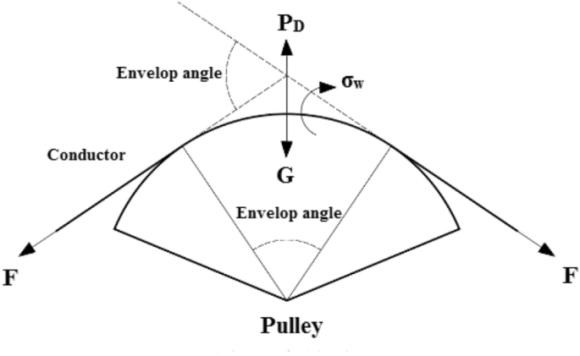
When the conductor is setting out in tension, the tension load will not exceed 16% RTS of the rated conductor and the envelope angle between the conductor and the pulley generally will not exceed by 30. According to this working condition, the mechanical analysis of the conductor passing the pulley is carried out, as shown in Fig. 1 below.
Force diagram of conductor passing through pulley.
In Fig. 1, the conductor will be exerted by three kinds of loads during tension paying off and passing the pulley:
PD is the pressure of pulley on conductor. The following formula can be used for calculation:
F is the load on the conductor in axial direction during tension setting out. The tensile stress in the axial direction can be obtained as follows:
σw is the bending stress of the strand when the conductor passes through the pulley. It can be expressed by Bach formula28:
In these equations, G(N) is the gravity of conductor on pulley; R(mm) describes the bottom radius of pulley; α(°) denotes the envelope angle of conductor passing through pulley; B(mm) expresses the contact width between conductor and pulley, and we usually take one third of the conductor diameter; σL(MPa) is the tensile stress of conductor in axial direction; The section area of aluminum strand is defined by A(mm2); δ(mm) is the diameter of single aluminum strand of conductor; K1 is the characteristic coefficient of bending stress and we could take the empirical coefficient K1 = 0.375; E is the elastic modulus of aluminum; DS(mm) is the calculated value of pulley groove bottom diameter.
It is assumed that there is no prestress on the strand section while the ACSR is not subjected to external force. As shown in Fig. 2, a micro element segment is cut from the beam subject to pure bending, and the coordinate axes y and x are respectively established along the longitudinal symmetry axis and neutral axis of the section. After the beam is bent, the straight line ab becomes the arc a’b’. If the relative angle between Sect. 1-1 and Sect. 2-2 is dθ, and the radius of curvature of the neutral layer is ρ, then the normal strain of straight line ab can be obtained.
Based on Hooke’s law, we can get the normal stress at the distance y from the neutral axis on the cross section
Similarly, supposing that the radius of curvature is known at the section of the strand when the strand is subjected to bending load, the corresponding normal stress can be calculated according to the above equation. Figure 3 describes the spatial model of a strand of conductor in bending state. where r is the radius of the stranding layer where the strand is located, D is the curvature diameter of the strand, φ is the angle between the line between the section center of the strand and the section center of the strand and the curvature radius of the strand, and θ is the angle between the curvature radius and the y-axis in the starting plane of the strand. Then we can get the parameter equation of the bobbin as follows:
with the increment dθ of the included angle θ of the strand section, the axis of the strand increases by dl, and the increment of the axis of the strand is dL, as shown in Fig. 4.
Diagram of pure bending geometric deformation of micro element beam.
Diagram of conductor bending.
Axis increment diagram of strand.
Then we can get some related formulas as follows:
From these equations, the following can be obtained:
Then, according to Eqs. (7)–(9), the following equation can be given:
So Eq. (11) can be obtained by integrating Eq. (10)
Combining Eqs. (6) and (11), we can obtain the first and second derivatives of the curvilinear parameter equation, which can be considered as the analytic equation for curvilinear motion of a point in space. Then, the first and the second derivatives of the curvilinear parameter equation are velocity and acceleration respectively. At the same time, Eq. (14) can be given from Eqs. (12) and (13) simultaneously.
Because the curvature expression is too complicated, it is appropriate to use numerical method to solve its corresponding value. The curvature at a certain point of any strand in a strand with a fixed radius of curvature can be obtained from Eq. (14), and the stress at any position on this section of the strand can be obtained according to Eq. (5).
Due to the special structure of ACSR, the internal stress of conductor is very complicated when it is suppressed to external load. As a result, when establishing the conductor model, we need to make necessary assumptions to get a relatively simplified conductor model. In this paper, the following assumptions are proposed for the conductor model29,30,31.
Symmetry hypothesis
The structure of ACSR determines the symmetry between strands and the similarity between adjacent layers. Therefore, it can be used to study a single strand so as to extend it to the same layer of strand, and then to study the adjacent layer of strand, so as to extend it to all layers of strand.
End hypothesis
For the study of a section of conductor, it can be considered that one end of the conductor is fixed, and the other end only has axial degrees of freedom. This assumption is mostly applied in line with the actual situation.
Conductor contact hypothesis
According to the geometric structure of ACSR, it can be considered that the contact type between the central strand and the adjacent strand is line contact, the contact type between the same strands is line contact, and the contact type between the adjacent strands is point contact.
Helix angle hypothesis
Under the action of load, the ACSR will have relatively small torsion, but the change of torsion angle is very small, so the small change of spiral angle can be ignored.
Cross section assumption
In the process of tension setting out, the conductor will stretch or bend because of the complex external load, but the radial dimension of the conductor changes relatively little, so it can be assumed that the cross-sectional dimension of ACSR does not change.
Based on the theoretical basis of this chapter, the influence of envelope angle, tension load and friction on the stress characteristics of aluminum strand can be discussed. Therefore, in order to conduct more in-depth research, it is necessary to establish a reasonably simplified conductor model and consider the following aspects:
Simplified treatment of inner steel core
Most of the damage of the conductor is the damage of the aluminum strand, so the stress characteristics of the aluminum strand should be considered in the study of the stress characteristics of the conductor. Based on this simplification, the inner steel core of the conductor can be simplified as a rigid cylinder, and then the inter strand stress characteristics of each layer of aluminum strand of the conductor can be studied.
Consideration of building model step by step
When the whole conductor model is used to study the stress characteristics of the conductor, it is not clear to analyze the stress characteristics of each layer of the aluminum strand. Therefore, it can be considered to construct the conductor model in two steps, that is, to establish the same layer of the strand model and the adjacent layer of the strand model for research. Then, the stress characteristics of the aluminum strand part of the whole conductor can be obtained by the way of induction and recursion.
Simplified treatment of the same layer strand model
The conductor has the symmetry of structure. When building the same layer strand model, the inner steel core can be simplified as a rigid cylinder, and three adjacent strand models of single layer can be built for researching. This model can directly indicate the stress state of the same ply in bending state.
Simplified treatment of adjacent layer strands model
Considering the contact, friction, extrusion and other factors between the layers of aluminum strands, the inner steel core can be simplified as a rigid cylinder, and then the inner aluminum strands can be built outside the steel core. At the same time, the single-layer three adjacent aluminum strands model can be built at the outermost layer for research. This model can better reflect that in the bending state, due to the extrusion of the inner conductor Distribution characteristics of stress state caused by contact.
Research process of stress characteristics of aluminum strand
After the conductor model is established, the stress characteristics of aluminum strand are investigated through numerical simulation analysis. Finally, the mechanical test and stress simulation analysis of the conductor passing the pulley can be carried out based on the test platform of the research group.
In order to study the stress characteristics of aluminum strand under different envelope angle, different tension load and different friction conditions when ACSR passes through the pulley. Taking the JL/G2A-400–45/7 ACSR as the research object and using the helix command in SolidWorks, we can establish the model of the same layer of strand and the model of the adjacent layer of strand for relevant research and analysis. The length of the conductor is taken as 200 mm, and the conductor model is shown in Fig. 5.
Step-by-step simplified diagram of conductor model (a) The same layer strand model; (b) Adjacent layer strands model.
After the construction of the conductor model, a suitable pulley model is established. The pulley adopts single R-groove type, and the groove bottom diameter is DC = 560 mm. It is then imported into ABAQUS for simulation analysis (as shown in Fig. 6). It can be seen that there are many interactions among the components of the model, so when setting the correlation, the dynamic method can be used to automatically generate the interaction between components. The tangent behavior of contact attribute is set as penalty function, and the normal behavior is selected by default. When the model is solved, c3d8r mesh is used to constrain all the degrees of freedom of one end of the conductor, and the other end only retains the degrees of freedom in the axial direction, and then the displacement load is applied to the conductor by the way of pulley extrusion.
Finite element model of the conductor passing through pulley (a) The model of the same layer strand passing through pulley; (b) The model of adjacent layer strands passing through pulley.
In order to study the stress characteristics of aluminum strand under different envelope angle, different tension load and different friction conditions when ACSR passes through the pulley. Taking JL/G2A-400–45/7 ACSR as the research object, the same layer strand model and the adjacent layer strands model are established for relevant research and analysis.
The JL/G2A-400–45/7 ACSR is composed of 7 steel strands and 45 aluminum strands, which are twisted in 5 layers, with an outer diameter of 26.88 mm. The relevant parameters of each layer of conductor are shown in Table 1.
When the conductor passes through the pulley, it will be bent and deformed, and the corresponding bending stress will be generated in the aluminum strand. In order to simplify the process of the conductor passing the pulley and facilitate the numerical simulation analysis, the conductor model can be established first, and then the stress characteristics of the aluminum strand in the bending state can be studied by gradually moving the pulley to extrude the conductor. The simplified analysis of the specific traverse pulley model is shown in Fig. 7.
Analysis of the process of the conductor passing the pulley.
In Fig. 7, the specific calculation method of each parameter is as follows (unit: mm):
where a describes half of the projection of the contact section of the pulley and the conductor in the horizontal direction; b expresses the horizontal projection from the tangent position of the pulley and the conductor to one end of the conductor; c denotes the horizontal distance from the center of the pulley to one end of the conductor; d is the distance from the tangent position of the pulley and the conductor to one end of the conductor; e is half of the arc length corresponding to the envelope angle; The moving distance of the pulley is defined by f; θ is half of the envelope angle; DC is the groove bottom of the pulley Diameter.
Because the stress of the aluminum strand is mainly affected by the envelope angle between the conductor and the pulley, the tension load and the friction between the strands when the conductor passes through the pulley, the influence of these three aspects on the stress of the aluminum strand should be studied in the simulation analysis of the stress state of the same layer strand.
Due to the influence of local stress caused by end face fixed constraint, in order to study the stress characteristics of aluminum strand, three sections of the same layer strand model are selected for stress analysis: the position of maximum stress, the position of 0.5 times pitch diameter and the position of 1 times pitch diameter. The friction coefficient is 0.1. The tension load is 20% of the rated tensile strength, the envelope angle of conductor and pulley is 15°, and the equivalent stress (von-Mises stress) cloud diagram is shown in Fig. 8.
Equivalent stress cloud diagram of aluminum strand at 20% RTS (a) Equivalent stress cloud diagram at maximum stress; (b) Equivalent stress cloud diagram at 1 times the pitch diameter; (c) Equivalent stress cloud diagram at 0.5 times the pitch diameter; (d) Overall equivalent stress cloud diagram of aluminum strand.
The envelope angle between the conductor and the pulley is changed for analysis and comparison, and the results are shown in Table 2.
According to the comparative analysis of the above simulation results, it can be seen that under the tension load of 20% RTS, the equivalent stress in the cross section of aluminum strand decreases from the edge position to the neutral layer, and the maximum equivalent stress is located at the contact position of aluminum strand and steel core. Therefore, there is a high possibility of aluminum strand damage and the larger the envelope angle between the conductor and the pulley, the greater the internal stress of aluminum strand.
Under the condition of a certain envelope angle, the influence of tension load on the stress characteristics of aluminum strands in bending state can be studied. In the same way, three sections of conductor model are selected for stress analysis: the position of maximum stress, the position of 0.5 times of pitch diameter and the position of 1 times of pitch diameter. The friction coefficient is 0.1. The tension load is 10% of the rated tensile strength, the envelope angle of conductor and pulley is 15°, and the equivalent stress cloud diagram is shown in Fig. 9.
Equivalent stress cloud diagram of aluminum strand at 10% RTS (a) Equivalent stress cloud diagram at maximum stress; (b) Equivalent stress cloud diagram at 1 times the pitch diameter; (c) Equivalent stress cloud diagram at 0.5 times the pitch diameter; (d) Overall equivalent stress cloud diagram of aluminum strand.
The tension load is changed for analysis and comparison, and the results are shown in Table 3.
According to the comparison and analysis of the above simulation results, under the condition of 15° envelope angle between the conductor and the pulley, the stress value in the cross section of aluminum strand decreases from the edge position to the neutral layer, and the larger the tension load on the aluminum strand, the greater the internal stress on the aluminum strand, but the influence of the tension load on the aluminum strand is relatively small compared with the envelope angle.
When the envelope angle and tension load of the conductor and pulley are fixed, the influence of friction on the stress characteristics of the aluminum strand in bending state can be studied. Three sections of the conductor model are selected for stress analysis: the position of the maximum stress, the position of 0.5 times the pitch diameter and the position of 1 times the pitch diameter. At this time, considering the situation of no friction. The tension load is 20% of the rated tensile strength, the envelope angle of conductor and pulley is 15°, and the equivalent stress cloud diagram is shown in Fig. 10.
Equivalent stress cloud diagram of aluminum strand without friction (a) Equivalent stress cloud diagram at maximum stress; (b) Equivalent stress cloud diagram at 1 times the pitch diameter; (c) Equivalent stress cloud diagram at 0.5 times the pitch diameter; (d) Overall equivalent stress cloud diagram of aluminum strand.
From Fig. 8, it shows the equivalent stress cloud diagram of aluminum strand with friction. Then comparing the equivalent stress cloud diagram of aluminum strand with friction to the case without friction, the results are shown in Table 4.
According to the comparison and analysis of the above simulation results, it can be known that when the conductor is subjected to a tension load of 20% RTS and when the friction is considered, the stress value of the aluminum strand is smaller compared to the case without considering the friction. At the same time, it is shown that the friction between the aluminum strands can weaken the equivalent stress in the cross section to a certain extent.
Under the influence of local stress caused by end face fixed constraint, in order to study the stress characteristics of aluminum strand, three sections of the adjacent layer strands model are selected for stress analysis: the position of maximum stress, the middle point and the 0.5 times pitch diameter. The friction coefficient is 0.1. The tension load is 20% of the rated tensile strength, the envelope angle of conductor and pulley is 15°, and the equivalent stress cloud diagram is shown in Fig. 11.
Equivalent stress cloud diagram of aluminum strand at 20% RTS (a) Equivalent stress cloud diagram at maximum stress; (b) Equivalent stress cloud diagram at the middle point section; (c) Equivalent stress cloud diagram at 0.5 times the pitch diameter; (d) Overall equivalent stress cloud diagram of aluminum strand.
The envelope angle between the conductor and the pulley is changed for analysis and comparison, and the results are shown in Table 5.
According to the comparative analysis of the above simulation results, it can be known that under the tension load of 20% RTS, the stress value in the cross section of aluminum strand decreases from the edge position to the neutral layer, and the maximum equivalent stress appears in the adjacent aluminum strand at the contact position and comparing the stress of the same layer of strands, it can be seen that the equivalent stress of the aluminum strands increases from the outer layer to the inner layer, that is, the equivalent stress value of the outer layer of aluminum strands is smaller, and the equivalent stress value of the inner layer is larger. Therefore, the possibility of damage to the aluminum strands at the contact position of the adjacent aluminum strands is greater, and the inner aluminum strands are more easily damaged than the outer aluminum strands. In addition, from Table 5, it can be seen that the larger the envelope angle between the conductor and the pulley, the greater the equivalent stress of the aluminum strand.
Under the condition of a certain envelope angle, the influence of tension load on the stress characteristics of aluminum strand in bending state can be studied. In the same way, three sections of the adjacent layer strands model are selected for stress analysis: the position of maximum stress, the middle point and the 0.5 times pitch diameter. The friction coefficient is 0.1. The tension load is 10% of the rated tensile strength, the envelope angle of the conductor and the pulley is 15°, and the equivalent stress cloud diagram is shown in Fig. 12.
Equivalent stress cloud diagram of aluminum strand at 10% RTS (a) Equivalent stress cloud diagram at maximum stress; (b) Equivalent stress cloud diagram at the middle point section; (c) Equivalent stress cloud diagram at 0.5 times the pitch diameter; (d) Overall equivalent stress cloud diagram of aluminum strand.
The tension load is changed for analysis and comparison, and the results are shown in Table 6.
According to the comparison and analysis of the above simulation results, it can be known that under the 15° envelope angle between the conductor and the pulley, the equivalent stress in the cross section of aluminum strand decreases from the edge position to the neutral layer, and the maximum equivalent stress appears in the adjacent aluminum strand at the contact position, and comparing the stress of the same layer of strands, it can be seen that the equivalent stress of the aluminum strands tends to increase from the outer layer to the inner layer. In addition, the larger the tension load on the aluminum strand, the greater the equivalent stress of the aluminum strand, but the effect of the tension load on the aluminum strand is relatively small compared to the envelope angle.
Under the condition that the envelope angle of the conductor and the pulley and the tension load are constant, the influence of friction on the stress characteristics of the aluminum strand in bending state can be studied. Three sections of the adjacent layer strands model are selected for stress analysis: the position of the maximum stress, the position of 0.5 times the pitch diameter and the position of 1 times the pitch diameter. In this time, considering the situation of no friction, the tension load is 20% of the rated tensile strength, the envelope angle of conductor and pulley is 15°, and the equivalent stress cloud diagram is shown in Fig. 13.
Equivalent stress cloud diagram of aluminum strand without friction (a) Equivalent stress cloud diagram at maximum stress; (b) Equivalent stress cloud diagram at the middle point section; (c) Equivalent stress cloud diagram at 0.5 times the pitch diameter; (d) Overall equivalent stress cloud diagram of aluminum strand.
From Fig. 11, it shows the equivalent stress cloud diagram of aluminum strand with friction. Then comparing the equivalent stress cloud diagram of aluminum strand with friction to the case without friction, the results are shown in Table 7.
According to the comparative analysis of the above simulation results, it can be known that under the condition that the conductor is subjected to a tension load of 20% and when the friction is considered, the stress value of the aluminum strand is smaller compared to the case without considering the friction. At the same time, it shows that the friction between the aluminum strands has a certain effect on reducing the equivalent stress in the cross section. Moreover, the equivalent stress in the cross section of aluminum strand decreases from the edge position to the neutral layer and the maximum equivalent stress appeared at the contact position of adjacent aluminum strands. Comparing the stress value of the same layer of strands, it can be seen that the equivalent stress value of aluminum strands tends to increase from the outer layer to the inner layer.
In order to further study the inter strand stress state of the conductor passing pulley, the JL/G1A-630–45/7 ACSR will be taken as the research object. Firstly, on the basis of the test platform of the research group, the test of the conductor passing pulley will be carried out, and the stress value of the aluminum strand under different working conditions will be measured to study the stress characteristics of the aluminum strand in the process. Then, according to the conductor model proposed in this paper, the numerical simulation analysis of the conductor passing through the pulley can be carried out to get the stress situation of the aluminum strand in the corresponding position under this state. Finally, the simulation and test are compared, which can preliminarily verify the same layer strand, as well as the preliminary study of the inter strand stress characteristics of the conductor under the bending state.
The test platform has a length of 4.3 m, a height of 2.3 m, and an area of about 9 m2. The schematic diagram of the test platform is shown in Fig. 14, which roughly includes four parts: fixing system, pulley system, tension load system, and signal acquisition system. The fixing system consists of fixed block, movable stand and rigid clamp, while the pulley system is composed of pulley and pull device. Then constant tension device is the main part of tension load system as well as the signal acquisition system is made up of tension sensor and fiber Bragg grating sensor.
Diagram of mechanical test platform.
When the conductor is continuously subjected to tension load, its internal molecular structure will produce permanent and irreversible creep lengthening. After the tension load is applied to the metal, the creep lengthening rate is relatively fast at the beginning, and then gradually slows down until it stops over time. For ACSR, after 48 h of tension load, the deformation reaches a stable state. In this test, the conductor is exerted 20% RTS by the constant tension device, and then the test was started after setting the conductor aside for two days. The test scheme is as follows:
At the first, ACSR should be fixed on the test platform, and then the test platform is adjusted to ensure that conductor is horizontal. Then, the wire rope is used to connect the pulley with the eyebolt. Finally, U-bolts are used to lock them tightly to prevent the pulley from falling off when the test is carried out.
The fiber Bragg grating sensor is pasted to the surface of the aluminum strand which can be found directly above the pulley groove. Then the signal is sent back to the demodulator so that the wavelength can be determined by computer software.
The tension load is imposed on the conductor by the constant tension device. In addition, the winding crank should be operated to make the pull device pull the pulley to rise vertically. Then it ought to stop operating the winding crank when the wavelength is going to change. Besides, the wavelength needs to be written down as the initial wavelength. At last, the constant tension device could be operated to satisfy the test.
Thorough the method of replacing the envelope angle with displacement, the displacement associated with different envelope angles can be calculated. Then turn the winding crank slowly to apply the vertical displacement to the conductor. It ought to be stopped until the envelope angle is satisfied to the test requirement, and then the wavelength needs to be taken down.
Repeat the test process and record the wavelength of the different envelope angles. Besides, change the tension load and repeat the test three times, after that, the final test figure is an average of the three sets of data.
Based on the principle of fiber Bragg grating sensor, the wavelength difference could be calculated, and then the micro-stain of the aluminum strand can be acquired through formula transformation. Therewithal, the stress value will be obtained based on the elastic modulus of aluminum.
In this test, the JL/G1A-630–45/7 ACSR and single R-groove type pulley with groove bottom diameter of 550 mm are used. Both of them are the real conductor and pulley used in the actual tension setting out, so the test has high authenticity and reliability, and the test results have strong persuasion, and can preliminarily verify the accuracy of the same layer model and carry out certain research on the stress characteristics of the aluminum strand when the conductor passes by the pulley. The mechanical test platform of the conductor passing through the pulley is shown in Fig. 15.
Mechanical test platform of conductor passing through pulley.
In the process of passing the pulley, the conductor will be squeezed by the wheel groove, resulting in bending deformation. From the actual situation, the internal stress of the aluminum strand in the upper half of the wheel groove is different from that in the lower half. However, it can be seen that the curvature of the aluminum strand in the lower half of the groove is larger, while the curvature of the aluminum strand in the upper half is smaller. Similarly, according to the principle of force transmission, the extrusion pressure of the two parts of aluminum strand is basically the same, so the different local stress produced by the two parts of aluminum strand under the same extrusion pressure is generally caused by the different curvature of the two parts of aluminum strand and the different shape variables.
Based on the above analysis, in the test, only the stress of the aluminum strand in the upper half of the wheel groove needs to be tested, while the stress state of the aluminum strand in the lower half can be equivalent to the stress state of the upper half with large curvature. In addition, according to the symmetry hypothesis of the conductor structure and the same layer strand model, when testing the upper part of the aluminum strand, we can find an aluminum strand directly above to test and study, which can meet the needs of this test and satisfy the purpose of the test. In the process of data acquisition, the fiber Bragg grating acquisition system is used. By finding the wavelength difference of the corresponding test condition, the corresponding micro strain is converted, and then the internal stress value of the aluminum strand under this condition is obtained. At the same time, when arranging the measurement points of the fiber Bragg grating, the fixed constraints at both ends of the test lead will cause local stress on the aluminum strand. Therefore, the measurement point should be located at the midpoint of the aluminum strand. In this way, it is possible to avoid the test error caused by the fixed constraint at both ends of the conductor, so that the test data is more reliable. The structural parameters of JL/G1A-630–45/7 steel core aluminum strand used in this test are shown in Table 8.
During this test, it is obvious that the main factors that affect the internal stress state of aluminum strand are the envelope angle of conductor and pulley and the tension load of conductor during tension paying off construction. Therefore, according to the needs and purposes of the test, the influence of different envelope angle and different tension load on the stress of aluminum strand can be studied under the condition of the same conductor span (the conductor span tested here is L = 1800 mm).
Due to the limitation of test conditions and unavoidable test errors, although this test cannot be consistent with the envelope angle of the conductor in the process of passing the pulley, this test has been relatively able to satisfy the research and analysis of related problems. Therefore, when studying the influence of the envelope angle of the conductor and the pulley on the stress state of the aluminum strand, you can choose a test condition where the envelope angle of the conductor and the pulley is a = 3°, a = 6°, a = 9°, a = 12° and a = 15°. Correspondingly, when studying the influence of the conductor on the stress state of aluminum strands under different tension loads, the test conditions can be selected for the tension load T = 0kN and T = 10kN.
In determining the envelope angle of the conductor and pulley, the displacement method which has been discussed is implemented to control the envelope angle. The envelope angle is transformed into the displacement load in the vertical direction. The different envelope angle of the conductor and pulley can be obtained by applying different displacement loads to the conductor through the pulley. The specific working conditions in the test are as follows.
Test condition 1: tension load of conductor is T = 0kN.
When the tension load of ACSR in the test is T = 0kN, the wavelength of optical fiber under different envelope angle measured in the test and the converted stress value of ACSR are shown in Table 9.
Test condition 2: tension load of conductor is T = 10kN.
When the tension load of ACSR in the test is T = 10kN, the wavelength of optical fiber under different envelope angle measured in the test and the converted stress value of ACSR are shown in Table 10.
Through the test of the stress value at the midpoint of the aluminum strand under different working conditions, Tables 9 and 10 are obtained. In order to more clearly find the influence of the envelope angle and the tension load of the conductor on the internal stress of aluminum strand, the curve diagram of the stress of the section at the midpoint of aluminum strand with the change of the envelope angle can be made, when the conductor is under the test condition 1 and the test condition 2, as shown in Fig. 16.
Curve diagram of the stress of the section at the midpoint of the aluminum strand with the change of the envelope angle under the test condition.
In Fig. 16, when the tension load in the test is T = 0kN, with the increase of the envelope angle between the conductor and the pulley, the equivalent stress at the midpoint of the aluminum strand also increases positively, and the same rule appears when the tension load is T = 10kN. In addition, it can be seen from the figure that the data line chart obtained under test condition 1 is generally below the data line chart obtained under test condition 2, which shows that under the same envelope angle, the stress of the section at the midpoint of the aluminum strand line increases with the increase of the tension load, but according to the numerical comparison analysis, it is known that the envelope angle of the conductor and the pulley and the tension load of the conductor are the two main factors affecting the internal stress of the aluminum strand. And then the influence of the envelope angle on the stress value of aluminum strands is more obvious than the tension load.
According to the conductor model proposed in this paper, combined with the type of pulley used in this test and the relevant structural parameters of JL/G1A-630–45/7 ACSR, the model of conductor passing through the pulley consistent with the test is established. For this model, in order to compare with the test situation and save the calculation time, the length of the conductor is taken as L = 180 mm. After the model is established, it is imported into ABAQUS for numerical simulation analysis (as shown in Fig. 17). The interaction among the parts of the model is still generated automatically by the general dynamics method. In the solution, all the degrees of freedom on one end face of the conductor are constrained, and the other end face only retains the degrees of freedom in the axial direction. Then the tension load is applied according to the test needs, and finally the displacement load is applied to the conductor by the way of the pulley squeezing the conductor.
Finite element model of the conductor passing through pulley in the test.
Based on the model, two working conditions of conductor passing through the pulley in the test are simulated, and then the equivalent stress cloud diagram of the conductor passing through pulley can be obtained through the post-processing of the simulation software. In the analysis of the comparative test results and the study of the stress state of the aluminum strand under this bending state, the aluminum strand at the corresponding position in the test should be selected for research. And in the process of simulation analysis, it is necessary to carry out specific analysis corresponding to the test conditions.
Simulation condition 1: tension load of conductor is T = 0kN.
Due to the influence of local stress caused by the fixed constraint of end face, when studying the stress characteristics of aluminum strand under the bending state of conductor, in order to be consistent with the test, the section at the midpoint of the aluminum strand is selected for stress analysis, and the tension load of conductor is taken as T = 0kN, and the equivalent stress cloud diagram of different envelope angles between the conductor and the pulley is shown in Fig. 18.
Equivalent stress cloud diagram of midpoint position of aluminum strand at tension load of 0kN (a) Equivalent stress cloud diagram of aluminum strand at an envelope angle of 3°; (b) Equivalent stress cloud diagram at an envelope angle of 6°; (c) Equivalent stress cloud diagram at an envelope angle of 9°; (d) Equivalent stress cloud diagram of aluminum strand at an envelope angle of 12°; (e) Equivalent stress cloud diagram of aluminum strand at an envelope angle of 15°.
According to the equivalent stress cloud diagram of the numerical simulation, it can be seen that the stress distribution state of the corresponding midpoint position of the aluminum strand at different envelope angles under the condition of simulation condition 1. Therefore, in order to better analyze and compare the equivalent stress in the cross section, and so as to more intuitively explain the problem, the results of this simulation can be shown in Table 11.
Simulation condition 2: tension load of conductor is T = 10kN.
Due to the influence of local stress caused by the fixed constraint of end face, when studying the stress characteristics of aluminum strand under the bending state of conductor, in order to be consistent with the test, the section at the midpoint of the aluminum strand is selected for stress analysis, and the tension load of conductor is taken as T = 0kN, and the equivalent stress cloud diagram of different envelope angles between the conductor and the pulley is shown in Fig. 19.
Equivalent stress cloud diagram of midpoint position of aluminum strand at tension load of 10kN (a) Equivalent stress cloud diagram of aluminum strand at an envelope angle of 3°; (b) Equivalent stress cloud diagram at an envelope angle of 6°; (c) Equivalent stress cloud diagram at an envelope angle of 9°; (d) Equivalent stress cloud diagram of aluminum strand at an envelope angle of 12°; (e) Equivalent stress cloud diagram of aluminum strand at an envelope angle of 15°.
According to the equivalent stress cloud diagram of the numerical simulation, it can be seen that the stress distribution state of the corresponding midpoint position of the aluminum strand is at different envelope angles under the condition of simulation condition 2. As with simulation condition 1, the results of this simulation can be shown in Table 12.
On the basis of the previous test, the numerical simulation of the conductor model proposed in this paper is used to simulate the stress state at the midpoint of the aluminum strand under different working conditions, and the equivalent stress cloud diagrams under different envelope angles are obtained, and the simulation results are shown in Table 11 and Table 12. In order to analyze the simulation results clearly, the same research method as the test results is used to make the curve diagram of the stress of the section at the midpoint of the aluminum strand with the change of the envelope angle when the conductor is under the simulation condition 1 and the simulation condition 2, as shown in Fig. 20.
Curve diagram of the stress of the section at the midpoint of the aluminum strand with the change of the envelope angle under the simulation condition.
It can be seen from the equivalent stress cloud diagram at the midpoint of the aluminum strand that the equivalent stress in the cross section of aluminum strand decreases from the outside to the center of the section, that is, the stress in the neutral layer of a single aluminum strand is smaller and the stress at the edge is larger. The law consistent with the test results is shown in Fig. 20: under the two simulation conditions, with the increase of the envelope angle between the conductor and the pulley, the equivalent stress at the midpoint of the aluminum strand increases positively; By comparing the data from simulation condition 1 and simulation condition 2, it can also be seen that with the same envelope angle, the stress of the section at the midpoint of the aluminum strand increases with the increase of the load on the axis of the conductor, and the influence of the envelope angle on the stress value of the aluminum strand is more obvious than that of the tension load.
In order to further study the stress characteristics of aluminum strand under different working conditions when the conductor passes the pulley, and preliminarily verify the correctness and rationality of the same layer strand model. Now, the data obtained from the simulation condition 1, the test condition 1, the simulation condition 2 and the test condition 2 is shown in Table 13 and Table 14, and the curve diagram of the section at the midpoint of the aluminum strand with the change of the envelope angle is shown in Fig. 21 under the test condition 1, the test condition 2, the simulation condition 1 and the simulation condition 2.
Comparison of stress data under different working conditions.
In Table 13, except for the condition of envelope angle of 3°, the error of simulation and test is more than 10%, the error of other conditions is within 10%. In Table 14, comparing the data of the simulation condition 2 and the test condition 2, all errors are about 5%. The reasons for this error may be due to the accuracy of the instrument itself, and some errors in the measurement, errors in the data acquisition process and the accuracy of the numerical simulation analysis. However, it can be known that such errors are within the acceptable range. Therefore, on the whole, the stress value of the section at the midpoint of the aluminum strand obtained by the numerical simulation is in good agreement with the value obtained by the test, which also shows that the conductor model used in the numerical simulation is relatively correct and reasonable. In Fig. 21, it can also be seen that the numerical simulation results are in good agreement with the test results under the two conditions. Whether it is the trend in the drawing or the comparative analysis of simulation and test, it can preliminarily prove that the same layer strand model proposed in this paper has better correctness and rationality, which also paves the way for our further research on the damage mechanism of the conductor in the future.
In addition, it can be seen from the tables and the curve diagram under the two working conditions that the envelope angle of the conductor and the pulley and the tension load of the conductor are the two main factors affecting the internal stress of the aluminum strand, and the influence of envelope angle on the stress value of aluminum strand is more obvious than that of tension load. Therefore, in the construction of tension setting out, it is necessary to take good protection measures for the conductor as a whole, and to minimize the envelope angle between the conductor and the pulley within the allowable range. In addition, considering the influence of the pulley on the aluminum strand, the reasonable type of paying off pulley and the elastic washer should be placed at the contact position between the conductor and the wheel groove to reduce the damage of the pulley on the aluminum strand.
In order to discuss the inter strand stress characteristics of the aluminum strands in the bending state when the conductor passes through the pulley, the same layer strand model and the adjacent layer strand model based on related theories and technologies are constructed. Then through the comparison and analysis of the test and the simulation, the stress characteristics of the conductor in the bending state are investigated and the rationality of the model is preliminarily verified.
The following conclusions can be drawn from this study:
The equivalent stress (von-Mises stress) in the cross section of aluminum strands shows a decreasing trend from the edge position to the neutral layer, and the maximum equivalent stress appears at the contact position of the adjacent layer strands.
The larger the envelope angle and tension load of the aluminum strands, the greater the equivalent stress in the cross section. Moreover, relative to the envelope angle, the tension load has an appropriately small effect on the aluminum strands. The friction between the aluminum strands has a certain effect on reducing the equivalent stress in the cross section.
The equivalent stress of aluminum strands increases from the outer layer to the inner layer. The inner aluminum strands are more likely to be damaged than the outer aluminum strands.
After comparing and analyzing the test results and the simulation results, it is found that the equivalent stress at the midpoint of the aluminum strand obtained by the numerical simulation is in good agreement with the equivalent stress obtained in the test, which proves that the same layer strand model used in the numerical simulation is more accurate and reasonable. In addition, the influence of the envelope angle on the equivalent stress of the aluminum strand is more obvious than that of the tension load. Therefore, during the construction of tension setting out, it is necessary to take protective measures for the conductor, and reduce the envelope angle between conductor and pulley as much as possible within the allowable range.
Lekhnitskii, S. G. Theory of Elasticity of an Anisotropic Elastic Body (Mir Publishers, 1981).
MATH  Google Scholar 
Lanteinge, J. Theoretical estimation of the response of helically armored cables to tension, torsion and bending. J. Appl. Mech. 52, 423–432 (1985).
ADS  Article  Google Scholar 
Claude, J. Comparative study of two semicontinuous models for wire strand analysis. J. Eng. Mech. 123, 792–799 (1997).
Article  Google Scholar 
Hong, K. J., Armen, D. K. & Jerome, L. S. Bending behavior of helically wrapped cables. J. Eng. Mech. 131, 500–511 (2005).
Article  Google Scholar 
Tapio, L. Lifetime estimation of a covered overhead line conductor. Wind Struct. 6, 307–324 (2003).
Article  Google Scholar 
Claren, R. & Diana, G. Mathematical analysis of transmission line vibration. IEEE Trans. Power Appar. Syst. 88, 1741–1771 (1969).
ADS  Article  Google Scholar 
Raoof, M. Free-bending fatigue life estimation of cables at point of fixity. J. Engrg. Mech. 118, 1747–1764 (1992).
Article  Google Scholar 
Costello, G. A. & Buston, G. J. A Simplified Bending Theory for Wire Rope. J. Energ. Mech. 108, 219–227 (1982).
Google Scholar 
Ma, X. C., He, D. H. & Zhu, R. Stress-state analysis on single strands of ACSR-720/50 high voltage transmission line. Electric Wire Cable. 03, 13–16 (2013).
Google Scholar 
Zhang, G. W., Wang, G. Z. & Gong, X. M. Discussion of the lay length and bend radius of overhead electric conductor. Science 6, 1148 (2021).
Google Scholar 
Zhao, X. Z., Gao, W. & Qin, H. L. Contact analysis of stranded conductor between adjacent layers. China Mech. Eng. 16, 1929–1933 (2011).
Google Scholar 
Jiang, W. G. A concise finite element model for pure bending analysis of simple strand. Int. J. Mech. Sci. 54, 69–73 (2012).
Article  Google Scholar 
Wang, J. C. & Xu, N. G. Fatigue test method for conductors under composite alternating stress conditions. Electric Power Constr. 22, 18–20 (2001).
CAS  Google Scholar 
Wan, J. C., Liu, Z. & Sun, B. D. Classification of expanded conductor and choice of expanded way. Electric Power Constr. 31, 113–118 (2010).
Google Scholar 
Gnanavel, B. K. and Parthasarathy, N. S. Effect of Interfacial Contact Forces in Lateral Contact Wire Strand. Proceedings of the World Congress on Engineering. London, U.K. (2011).
Zhou, H. Y., Jiang, M. & Bu, C. L. Study on slot bottom size of stringing pulley based on reducing conductor abrasion. Adv. Mater. Res. 753–755, 1851–1853 (2013).
Article  Google Scholar 
Raoof, M. & Hobbs, R. E. Analysis of multilayered structural strands. J. Eng. Mech. 114, 1166–1182 (1988).
Article  Google Scholar 
Nawrocki, A. & Labrosse, M. A finite element model for simple straight wire rope strands. Comput. Struct. 77, 345–359 (2000).
Article  Google Scholar 
Sarma, M. P. Corona Performance of High-voltage Transmission Lines (Research Studies Press Ltd, 2000).
Google Scholar 
Papailiou, K. On the bending stiffness of transmission line conductors. IEEE Trans. Power Delivery 12, 1576–1588 (1997).
Article  Google Scholar 
Kenta, I. Mechanical Models for Electrical Cables (Royal Institute of Technology KTH Mechanics, 2005).
Google Scholar 
Gong, X. L. Experimental Research on Bending Rigidity of Overhead Line (North China Electric Power University, 2013).
Google Scholar 
He, C., Xie, Q. & Yang, Z. Y. Flexural properties of bundled conductors in substations. Proc. CSEE. 38, 4585–4592 (2018).
Google Scholar 
Zhang, Q. H. The Study on Stress and Stiffness of Conductors under Tension Load (North China Electric Power University, 2013).
Google Scholar 
Yang, G. F. The Study on the Equivalent Bending Stiffness of ACSR (North China Electric Power University, 2013).
Google Scholar 
Wan, J. C., Li, D. L. & Jiang, M. Comparative study on the theoretical calculation and simulation analysis of the stress for conductor passing stringing blocks. Constr. Technol. 55, 1147 (2017).
Google Scholar 
Jiang, M., Wan, J. C. & Ma, Y. Optimization of stringing block diameter for 1660 mm2 aluminum conductor composite core. Smart Power. 11, 70–75 (2018).
Google Scholar 
Jiang, H. P. Effects of slot bottom size on stringing pulley friction coefficient and conductor abrasion. Electric Power Constr. 30, 8–11 (2009).
ADS  Google Scholar 
Zhao, X. Z., Zhou, Q. & Gao, W. Finite element analysis of contact problem between same layer strands in ACSR. J. China Three Gorges Univ. (Natural Sciences). 33, 69–72 (2011).
CAS  Google Scholar 
Lin, J. H. & Zeng, W. Research on aluminum conductor steel reinforced tension layered characteristics of overhead conductors. Electric Wire Cable. 4, 30–33 (2015).
Google Scholar 
Shao, T. X. Mechanical Calculation of Overhead Transmission Lines (China Electric Power Press, 2003).
Google Scholar 
Download references
This research was funded by National Key R&D Program of China, grant number 2018YFC0809400.
State Key Laboratory of Explosion Science and Technology, Beijing Institute of Technology, Beijing, 100081, China
Xin Hu, Qingming Zhang & Cheng Shang
School of Energy Power and Mechanical Engineering, North China Electric Power University, Beijing, 102206, China
Zezhong Zhao & Xiaoming Rui
You can also search for this author in PubMed Google Scholar
Data curation, Z.Z., C.S.; Methodology, X.H., Q.Z.; Software, X.H.; Validation, X.H.; Formal analysis, X.H., Z.Z.; Investigation, X.H., C.S.; Supervision, Q.Z., X.R.; Writing—original draft preparation, X.H.
Correspondence to Qingming Zhang.
The authors declare no competing interests.
Springer Nature remains neutral with regard to jurisdictional claims in published maps and institutional affiliations.
Open Access This article is licensed under a Creative Commons Attribution 4.0 International License, which permits use, sharing, adaptation, distribution and reproduction in any medium or format, as long as you give appropriate credit to the original author(s) and the source, provide a link to the Creative Commons licence, and indicate if changes were made. The images or other third party material in this article are included in the article’s Creative Commons licence, unless indicated otherwise in a credit line to the material. If material is not included in the article’s Creative Commons licence and your intended use is not permitted by statutory regulation or exceeds the permitted use, you will need to obtain permission directly from the copyright holder. To view a copy of this licence, visit http://creativecommons.org/licenses/by/4.0/.
Reprints and Permissions
Hu, X., Zhang, Q., Zhao, Z. et al. A preliminary study on the strand stress of transmission line in tension setting out. Sci Rep 12, 9473 (2022). https://doi.org/10.1038/s41598-022-13300-3
Download citation
Received:
Accepted:
Published:
DOI: https://doi.org/10.1038/s41598-022-13300-3
Anyone you share the following link with will be able to read this content:
Sorry, a shareable link is not currently available for this article.

Provided by the Springer Nature SharedIt content-sharing initiative
By submitting a comment you agree to abide by our Terms and Community Guidelines. If you find something abusive or that does not comply with our terms or guidelines please flag it as inappropriate.
Advertisement
Advanced search
Scientific Reports (Sci Rep) ISSN 2045-2322 (online)
© 2022 Springer Nature Limited
Sign up for the Nature Briefing newsletter — what matters in science, free to your inbox daily.

source

Bitcoin Bank Custodia Sues Federal Reserve, Demanding Decision On Master Account – Forbes

A gold plated seal outside inside the Eccles Building, the place of the Board of Governors of the Federal Reserve System and of the Federal Open Market Committee,
Bitcoin bank Custodia today sued the Federal Reserve Board of Governors and the Federal Reserve Bank of Kansas City charging they have “unlawfully” delayed for 19 months acting on its application for a master account with the Federal Reserve.
The bank, chartered in Wyoming under a crypto-friendly statute passed in 2019 allowing for “special purpose depository institutions,’’ says the master account would reduce its costs and is “vital” to its core mission of providing a bridge between digital assets and the U.S. dollar system.
According to the suit, the Federal Reserve has a legal obligation to act within a year and states on its own paperwork that it ordinarily takes just five to seven days to act on a master account application. Custodia’s suit alleges the Kansas City Fed’s processing of its application was moving along until the Spring of 2021, when the main Federal Reserve got involved. The suit seeks to force the Federal Reserve and the Kansas City branch to act on its application–and ultimately, to approve it.
Should Custodia win its suit or otherwise be granted a master account, it would be the first bitcoin bank to gain one. As Central Banks around the world seek to merge the best innovation that bitcoin and other blockchain-powered currencies offer, with the best of central management, the lawsuit–and the Fed’s reaction to it–could help define the very future of banking.
“Through this lawsuit, Custodia seeks to ensure that its Federal Reserve master account application receives the fair dealing and due process guaranteed to it by both federal statute and the U.S. Constitution,” said Custodia Bank’s spokesperson Nathan Miller in a statement. “Custodia has satisfied every rule applicable to it, and has gone beyond by applying to become a Fed member bank.”
Custodia Bank was founded by Morgan Stanley veteran Caitlin Long in 2020 under the name Avanti Financial Group. Unlike traditional banks that generate the lion’s share of their revenue from loans, Custodia was incorporated under Wyoming state regulations Long helped write that would require this new kind of bank to maintain custody of the cryptocurrency it holds. In March 2021 she raised a $37 million Series A from investors including Binance.US, Coinbase Ventures, Morgan Creek Digital, Slow Ventures, and Susquehanna, bringing the total raised to $44 million.
Long became a detractor of so-called rehypothecation, when banks lend money to others who lend that money to others in the aftermath of the Great Recession when a similar practice with subprime mortgages led to multiple claims of ownership over the same assets and obscured bad loans among bigger groups of loans. She was concerned similar behavior in crypto could undermine the value derived from bitcoin’s 21 million coins limit.
An early advocate of bitcoin Long became one of the first mainstream bankers to make blockchain her career in 2016 when she left her position as a managing director at Morgan Stanley to join New York-based Symbiont, an enterprise blockchain startup founded by fellow early adopters of bitcoin who wanted to capture the best of distributed ledger technology like blockchain, but in a way that respected privacy regulations and high volumes large enterprises served.
After helping onboard $7 trillion asset manager Vanguard among Symbiont’s first clients, Long branched out on her own to create financial products directly leveraging bitcoin. To fight the proliferation of rehypothecated bitcoin Long established Custodia to provide accounts for crypto businesses that would help them pay their employees and taxes, but would generate revenue by charging fees for services other than loans.
To do this her bank would need a master account with the Fed, like all federally chartered banks, that would in essence turn them into a direct line to the regulator. According to the statement, this was crucial to the bank’s business model as it would allow them to “sharply reduce its costs, and bring new products and options to users of financial services.”
“This delay in processing Custodia’s master account application is resulting in substantial, ongoing injury to Custodia,” according to the suit. “The immediate injury is that the delay has forced Custodia to defer its solo entry into the financial services market in favor of a decidedly second-best and far more expensive alternative: launching with a correspondent bank—which has a master account— while Custodia awaits a decision on its long-pending application.”
The filing further claims the Kansas City Fed received Custodia’s business plan in May 2020, and confirmed that Custodia’s master account application, submitted in late October 2020, was complete. In early 2021, a representative of the Kansas City Fed informed Custodia there were “no showstoppers” with the application, according to the filing.
Custodia’s 44-page suit lists eight claims for relief, or ways the Fed could potentially resolve the case. The first claim raises a broader issue regarding the functioning of the individual Federal Reserve banks and whether they are subject to rules for federal agencies, including the Administrative Procedure Act and requirements for due process. The suit says that if the Kansas City Federal Reserve is considered a private entity (its board is made up of a majority of private sector, non-presidentially appointed officials), it either can’t make final decisions on the issuing of master accounts without review by the Federal Reserve Board, or when it is exercising governmental powers, is subject to the higher level of scrutiny provided to governmental actors.
The Kansas City branch of the Federal Reserve declined to comment on the suit.
Initially slow to act on the innovations underlying bitcoin, which allow value to move without central authorities, the Federal Reserve has largely let other countries take the lead on incorporating the lessons learned. In 2020 China started public trials of its own Central Bank Digital Currency, and the Fed itself has expressed interest in letting the private sector innovate in the form of so-called stablecoins that are backed by assets like the U.S. dollar, but created by private companies. In 2020 Long revealed her own plans for what would amount to a stablecoin, but since she was planning on a Fed account it would be akin to a digital cashiers check, which could have resulted in a regulated digital dollar.
In May a stablecoin backed in part by bitcoin, a cryptocurrency called Luna, and stabilized using an algorithm that controlled supply, called TerraUSD, collapsed, erasing $60 billion worth of value, and leading to calls for more regulation of the space. Bipartisan regulation proposed this morning by U.S. Senators Kirsten Gillibrand (D-NY) and Cynthia Lummis (R-WY) would in part see to concerns in the suit if implemented. Among a number of sweeping requirements, the Responsible Financial Innovation Act would require that the Fed issue routing numbers to depository institutions, prohibits Federal banking agencies from delaying applications under existing law and requires that they decide on all applications within a year.
.

source

Highmark Interactive Inc. – Demonstrates Traction in the US Market Deploying its EQ Remote Physiologic Monitoring Platform with Large, Multi-Site Orthopedic Organization – Marketscreener.com

TORONTO – Highmark Interactive Inc. (TSXV:HMRK), a global leader in digital health technologies, is pleased to announce deployment of its EQ Remote Physiologic Monitoring (RPM) solution within a large multi-clinic orthopedic practice in the Greater Los Angeles area. Building on signing its recent partnership with the United States Orthopedic Alliance (USOA) earlier this year, Highmark is pleased to announce the direct sale of its RPM platform to Urgent Orthopedic Care Inc. demonstrating ongoing traction within the orthopedic surgery market segment.
Urgent Orthopedic Care (UOC), managing over 10,000 patients annually across two large facilities in the greater Los Angeles area, signed with Highmark last week and will begin deployment of Highmark’s EQ RPM platform immediately. Due to UOC’s size and influence in the management of workplace-injured workers, Highmark’s RPM SaaS platform will be priced at a discount to usual market rates generating USD$30/patient/month of monitoring. While practices will vary, after discussions with UOC, Highmark is expecting at least two months of patient monitoring per year across its 10,000 plus patient base generating between USD$60-90/patient/year.
The EQ Remote Monitoring platform enables the physician to monitor a patient’s balance before and after surgery and between clinical visits to inform and personalize the patient’s treatment plan. Remote physiologic monitoring (RPM) is a recently added reimbursement code by Medicare in the United States with many commercial insurers now also providing reimbursement. Reimbursement requires the use of a medical device and Highmark’s EQ Balance is FDA-cleared software as a Medical Device (SaMD) thereby meeting this requirement. Unlike other providers measuring balance, Highmark’s proprietary software does not require the patient to purchase any additional expensive or cumbersome hardware. The patient only requires access to a mobile smart device, such as a phone or tablet, and internet connectivity. Highmark’s EQ RPM solution is device agnostic and can be downloaded to both Android and Apple operating systems.
In adopting Highmark’s EQ Remote Monitoring platform, a typical orthopedic surgeon is anticipated to be able to generate an incremental average of USD$200,000 in revenue annually. Between the announced USOA partnership and direct sales activities, Highmark has built a robust pipeline of practices looking to deploy its RPM software solution and expects to continue signing and deploying across orthopedic clinics and ortho surgery centers over the balance of the year. Not only will this provide Highmark with a clear first mover advantage within this market segment, but it also enables clinics in other verticals (e.g., neurology, primary care) to begin introducing their patients to the concept of RPM without having to make large capital investments in the more traditional and expensive medical devices currently utilized within the RPM market.
‘Our remote monitoring platform is capturing critical physiologic parameters that empower both the patient and their clinicians to identify early signs of risk and enable proactive intervention that can materially reduce complications and the total cost of care for the patient.’ says Dr. Sanjeev Sharma, CEO of Highmark, and continues, ‘Highmark is well on its way to demonstrating outcome and cost benefits to providers, patients and payors, while delivering on its RPM strategy for growth. Despite significant headwinds within the broader macroeconomic environment, healthcare remains somewhat recession resistant, with its technology clearly supported by government and third-party payors within the world’s largest health care market.’
About Highmark Interactive
Highmark Interactive was created to change the paradigm of testing and management for brain and mental health. Highmark’s approach is focused on providing real-time data to health providers to support proactive, preventative interventions and targeted care planning to improve health outcomes.
In addition to a growing network of virtual clinics, Highmark Interactive offers the world’s first gamified, FDA cleared patient-led assessments as well as digital clinician-led assessments of neurofunction and balance. Together, the technology is used in more than 350 health organizations globally.
By unlocking insights, Highmark’s platform enables precision medicine and creates a more contemporary model for delivering better outcomes in medical, mental health and rehabilitation services. Learn more: https://www.highmark.tech/
Contact:
Highmark Interactive Inc.
Investor
E: [email protected]
Cautionary Note Regarding Forward-Looking Information
This News Release contains forward-looking statements that relate to the current expectations and views of future events of the Corporation.
In some cases, but not necessarily in all cases, forward-looking information can be identified by the use of forward-looking terminology such as ‘plans’, ‘targets’, ‘expects’ or ‘does not expect’, ‘is expected’, ‘an opportunity exists’, ‘is positioned’, ‘estimates’, ‘intends’, ‘assumes’, ‘anticipates’ or ‘does not anticipate’ or ‘believes’, or variations of such words and phrases or state that certain actions, events or results ‘may’, ‘could’, ‘would’, ‘might’, ‘will’ or ‘will be taken’, ‘occur’ or ‘be achieved’. In addition, any statements that refer to expectations, predictions, indications, projections or other characterizations of future events or circumstances contain forward-looking information. Statements containing forward-looking information are not historical facts but instead represent management’s expectations, estimates and projections regarding future events.
Forward-looking statements in this Filing Statement include, among other things, statements relating to anticipated revenues generated by the Corporation’s customers and the patients they serve, and the Corporation’s business generally. Actual revenues generated will be influenced by, among other things, the frequency of testing that is appropriate for each patient which will be dictated in part by each patient’s overall health status.
These statements and other forward-looking information are based on opinions, assumptions and estimates made by the Corporation in light of its experience and perception of historical trends, current conditions and expected future developments, as well as other factors that Highmark believes are appropriate and reasonable in the circumstances, as of the date of this press release, including, without limitation, assumptions with respect to the number of the Corporation’s customers’ patients who will be suitable candidates to use Highmark’s EQ Remote Monitoring platform and the frequency of the testing of those patients.
Forward-looking information is subject to known and unknown risks, uncertainties, assumptions and other factors that may cause the actual results that are the subject of any forward-looking statement to be materially different from those expressed or implied by such forward-looking information, including those referenced above. Although Highmark has attempted to identify important factors that could cause actual actions, events, conditions, results, performance or achievements to differ materially from those described in forward-looking information, there may
be other factors that cause actions, events, conditions, results, performance or achievements to differ from those anticipated, estimated or intended. Also see the section entitled ‘Risk Factors’ in the Corporation’s filing statement dated November 4, 2021 and the sections entitled ‘Financial Risk Management and ‘Risk Management’ in the Corporation’s most recent management discussion and analysis for a discussion of certain factors that could cause actual results to be materially different than any forward-looking statements presented herein.
The Corporation does not undertake, and assumes no obligation, to update or revise any such forward looking statements or forward-looking information contained herein to reflect new events or circumstances, except as may be required by law.
(C) 2022 Electronic News Publishing, source ENP Newswire

source

NMU Adds Outdoor Rec, Nature-Based Tourism Master's – Northern Today

Northern Michigan University’s College of Graduate Studies & Research has added a new master’s degree program titled Administration of Outdoor Recreation and Nature-Based Tourism, effective this fall. The program will be delivered largely online through NMU’s Global Campus, with two in-person summer seminar courses. It is designed for individuals currently working in the parks and recreation fields who wish to advance to administrative positions, as well as prospective students interested in entering these occupations.
“The outdoor recreation industry is one of the largest aspects of the U.S. economy,” said Professor and Program Director Scott Jordan of NMU’s School of Health and Human Performance. “The AORNBT degree has been designed to produce leaders in this field.”
Prospective students in the following fields could use this degree to advance in their careers: National Park Service; National Forest Service; federal, state or community recreation and land management agencies; nonprofit organizations; and private sector outdoor recreation and tourism managers.
“Outdoor recreation and nature-based tourism are among the fastest growing and most popular ways of spending leisure time, and the demand for qualified professionals to administer relevant programs and facilities is growing proportionately,” added Assistant Professor Ryan Hines.
Required courses address the history and philosophy of leisure; sustainability, current issues and legal and ethical aspects of outdoor recreation; and management and administration. There are also electives and research components, in addition to the summer seminar.
Professor Jacquie Medina added that the program “not only offers administrative and leadership preparation for career advancement, but also a foundation for pursuing doctoral studies.”
Examples of occupations for which people have completed similar degrees include federal land management agencies, community parks and recreation, the guiding service industry and community planners for areas wishing to develop a tourism economy or the knowledge to sustainably manage an outdoor recreation economy.
For more information on the 34-credit program, visit https://nmu.edu/hhp/administration-outdoor-recreation-and-nature-based-tourism
 
Kristi Evans
News Director
9062271015
1401 Presque Isle Ave. Marquette, MI 49855-5301 906–227–1015
© 2019 by the NMU Board of Trustees. NMU is an equal opportunity institution.

source

4 Channel Audio Mixer Sound Mixing Console w/ Bluetooth USB Recording 48V Phantom Power Effects EQ

After pandemic pause, Summer Shorts festival returns with 25th anniversary celebration – South Florida Sun Sentinel

Margot Moreland, Lindsey Corey and Stephon Duncan get tough in “Chronicles Simpkins Will Cut Your Ass.” (Morgan Sophia Photography/Courtesy)
Miami’s City Theatre was preparing to produce and party in 2020 with a splashy 25th-anniversary edition of Summer Shorts, its annual festival of short-form comedies, dramas and musicals.
After the COVID-19 pandemic hit hard that March, those plans were put on indefinite hold. The company did plenty of virtual programming, but returning to a full-fledged, in-person indoor event still looked risky in June 2021, so that festival was scratched too.
But cofounder/literary director Susan Westfall and artistic director Margaret M. Ledford are as tenacious as they are creative. And so, 27 years after Westfall, Stephanie Heller and Elena Wohl created City Theatre, the postponed 25th festival is finally here, running through July 2, 2022, in the Carnival Studio Theater at the Adrienne Arsht Center for the Performing Arts — on the Susan Westfall Playwrights Stage, no less.
Daniel Llaca, Lindsey Corey, Stephon Duncan and Diana Garle take a leap in City Theatre’s Summer Shorts, which runs through July 2 at the Adrienne Arsht Center. (Morgan Sophia Photography/Courtesy)
Ledford, who is directing the Lin-Manuel Miranda musica, “21 Chump Street,” (first presented in the 2017 festival) and the world premiere of “Tango, The Musical!” by Westfall and composer Joe Illick, is also overseeing the festival. This year’s Summer Shorts goes big with eight additional plays, four more directors, eight actors, a musical director and a choreographer.
“Being back started feeling normal around Day 2 of rehearsals,” says Ledford. “There’s been such anticipation about this. We’re ready and excited, but at the same time it’s a little unfamiliar, which allows it to be new, in a way.”
Playwright Steve Yockey, whose “Go Get ‘em, Tiger!” will have its world premiere at this year’s festival, has been commissioned by City Theatre more than any other playwright. (Among his resume highlights, he was a producer on “Supernatural” in 2017-2018, is executive producer and showrunner for “The Flight Attendant” on HBO Max, and has a pilot called “Dead Boy Detectives” filming.) He made his Summer Shorts debut with “Serendipity” in 2013. “Go Get ‘em, Tiger!” will be his ninth City-produced script.
“I don’t think you can overstate how important City is at a national level in finding new talent,” he says. “They bring thoughtfulness and care to how they select a slate of plays, how they bring playwrights in, how they do so many bookstore readings.”
Daniel Llaca and Diana Garle connect in Lin-Manuel Miranda’s “21 Chump Street,” first presented in 2017 and included in this year’s Summer Shorts festival. (Morgan Sophia Photography/Courtesy)
This year’s acting company, hired for the canceled 2020 festival, consists of Summer Shorts veterans and newbies. Of the eight actors, Tom Wahl holds the record for most Summer Shorts appearances — this is his 11th, plus two editions of “Winter Shorts.” Margot Moreland, Alex Alvarez, Lindsey Corey, Diana Garle and Jovon Jacobs have all done the festival before, while Stephon Duncan and Daniel Llaca (both of whom have appeared in other City Theatre productions) are Summer Shorts newcomers.
“I’m in five [pieces], including Susi’s musical. I don’t sing, but I do a little dancing,” says Wahl. “I like being in a room when all that creativity is happening — it’s miraculous.”
Fellow veteran Moreland cites varied roles as part of the appeal for an actor.
“You’re so easily pigeonholed in this business, but not in Summer Shorts,” says Moreland, who will also appear in five of the 10 plays. “This gets you back to your soul of being an actor. It’s electrifying, and the directors are great … It’s an extraordinary experience.”
Jacobs agrees. The St. Croix native appreciates the chances he gets to stretch in Summer Shorts — “different things you might not do in any other theater… and it brings together actors who otherwise might not work together. It’s a melting pot of different things, refreshing.”
Though theater itself went through a period of deep self-examination in terms of equity, diversity and inclusion during the pandemic, Jacobs thinks inclusive companies like City Theatre are still more the exception than the rule.
Stephon Duncan and Tom Wahl portray very different playwrights in “Winner.” (Morgan Sophia Photography/Courtesy)
“I wish I would be seen for more things, but I don’t think things will change so fast. I do see more Black plays inserted in seasons, and I have played non-traditional roles. But I’m usually seen for Black roles,” he says.
Four of the five festival directors have been at the helm of Summer Shorts productions before, including City Theatre’s founding artistic director Gail S. Garrisan, who’s directing the late Staci Swedeen’s “A Little Bit of Culture” and David Lindsay-Abaire’s “Misdial,” and Michael Yawney, who’s directing the world premiere of Yockey’s “Go Get ‘em, Tiger!” and Jacqueline Bircher’s “Webster’s Bitch.”
“The plays are so short that you can really be bold,” says Yawney, who teaches theater at Florida International University. “And if the audience hates it, don’t worry – there’s another 10-minute play coming up … It’s exciting. Like jumping out of a plane and hoping the ground will be there.”
WHAT: City Theatre’s 25th annual Summer Shorts Festival
WHEN: Regular performances 7:30 p.m. Thursdays-Fridays, 3 p.m. and 7:30 p.m. Saturdays, and 3 p.m. Sundays, through July 2, 2022
WHERE: Carnival Studio Theater in the Ziff Ballet Opera House at the Adrienne Arsht Center for the Performing Arts, 1300 Biscayne Blvd., Miami
TICKETS: $50 and $60 for general admission; $65 and $75 for VIP
INFORMATION: 305-949-6722; ArshtCenter.org
ArtburstMiami.com is a nonprofit source of dance, visual arts, music and performing arts news.
Copyright © 2021, Sun Sentinel

source

Dua Saleh Talks Music, Making Things Happen, and the Pain of Dysphoria – Complex

Terms
Terms of use
Privacy
Privacy Policy
CA Privacy
California Privacy
COMPLEX participates in various affiliate marketing programs, which means COMPLEX gets paid commissions on purchases made through our links to retailer sites. Our editorial content is not influenced by any commissions we receive.
© Complex Media, Inc. All Rights Reserved.
Complex.com is a part of
Share This Story
Dua Saleh fell into music by way of poetry, for the most practical reason you could imagine––they were a broke college student and poetry slam performances would pay. What they didn’t foresee was the hypervisibility they’d get as a result of sharing their intimate works on stage, many of which were largely inspired by some dark depressive moments after coming out as non-binary. While they were grappling with a heavy bout of dysphoria, melodies began flowing out of them at their poetry shows, and people started telling them they loved their voice. A voice we now know, from projects like their critically acclaimed Nūr, as a mix of siren’s song and a conversation in a smoky room, dimly lit, where you can’t help but lean in closer so you don’t miss a word.
The unexpected feedback led them to play with music production, in a lower pressure, more freeform way than poetry had allowed them in the past, during cathartic dysphoric moments––when the “wounds were still open and I was gushing,” they said. A few years into releasing music and continuing to write poetry, Saleh now gets to nurture a symbiotic relationship between the two mediums, which bring different gifts but also feed each other. “[Music] definitely feels more free, definitely feels like I’m floating in the wind and existing in a lot more emotions, allowing myself to exist in a lot more emotions. I feel like with poetry, I often use it to deal with trauma. So, sometimes there’s humor, but I feel like it’s more so intentionally about me working through the harder things that I’ve dealt with,” Saleh says. 
With those processes in mind Complex caught up with Saleh to talk about the relationship between body and art, how the world interacts with their identities, and more. Read on to see them share their thoughts below.
I feel like music has allowed me to tap into different ways to play with my voice. Oftentimes with dysphoria, I’ll sometimes go into the session and I’ll listen to my voice and I’ll be like, “I can’t do it today.” So I’ll lower my voice often when I’m singing, extremely, and it’s been weird. Or I’ll do it really high, I feel like I’ve been singing pretty high, it’s kinda funny. It does help with my dysphoria, which I still don’t understand why, [vocalizing] sounding like an alien like that does. Maybe it just reminds me of cartoons, and cartoons seem neutral to me.
I wasn’t trying to get into any of these art worlds that I was thrust into. And gender is a very personal journey for each person, we definitely understand how it’s complex. I’m only speaking for myself, but also probably for a lot of other non-binary and trans people. It was complicated because I’m in constant communication with my gender and I’m constantly trying to expand my understanding of my gender. And so having a platform out there and coming out with my pronouns, they/them pronouns, and then coming out with neopronouns, which is a whole different thing, because people––even in the trans community––aren’t really as used to it or don’t know the history and don’t know how they were the first pronouns that a lot of non-binary people were using to refer to themselves in literature and academia.
So it felt vulnerable––and it still feels vulnerable––having people constantly question my gender or just getting a lot of transphobic hate, but also all of my other identities that are in flux with one another at all points of time, me being Black and queer and Muslim, obviously trans, somebody who uses neopronouns, it feels like I’m always in this raw state where people are always hyper-fixated on those aspects of my existence, which is cool. But I feel like there’s more depth to each human and there’s more humor and joy and light and anger and fear, and there are more things to a person outside of just their gender identity, and similarly to people’s art. 
I’ve definitely been playing a lot more, with hair as well. But I feel like I have been trying to tap into expressions of self that are more rooted in creating friction within my own understanding of what my aesthetic ought to be, based off what people project or what people expect out of me. When they hear “non-binary,” I feel like people have a very white supremacist understanding of what that would be or like a diluted understanding of what that means for people who are Black and brown or not from the Western world. So it’s like me being like, “No, forget that. I can do whatever I want.”
Sometimes people have this kind of expectation of a non-binary person. I think for a lot of Black folks, having specific styles of hair, it’s very sacred and it’s tied to a lot of ritualistic kind of upkeep that’s also tied in with a lot of trauma from how people commoditize our hair and our understandings of our expression.
I feel like people expect me to have short hair and have green hair and for me to be super small, petite, or dressed in a very specific way. Granted, I still fit into a Western understanding of beauty standards in terms of body and I don’t deal with fatphobia, which is also tied in with anti-Blackness and a lot of respective cultures or respective understandings of bodies within the West.
But in relation to hair, in relation to adornment, rituals and in relation to the spectacality of transness and the spectacle of Blackness, I think there are a lot of expectations that I have to fit into, like a very specific mold of understanding of what that means. 
I just don’t like people telling me what to do or expecting me to be a certain way ever. 
I just have a deep-seated love for trans and queer history overall. I love reading about it. I love hearing about it. The letters of my neopronouns are used to write a love letter to the trans community, just to be like “I love y’all.” Because our history is sacred, our history is important and a lot of people don’t have access to certain knowledge about transness, so I think it’s also cool just to be public about it.
I think also I just like the neopronouns, I feel like they fit me better, not all the time, but they’re just fitting. There’s an element where I’m just like, “Oh, this sounds really nice.” Or it sounds nice coming out of my mouth or hearing other people saying it.
One thing is honesty. I feel like that’s something that just kind of spills out of me with music because I guess it’s the most instinctive thing for me in terms of art making. Oftentimes with poetry, I’m a little bit more meticulous or thoughtful when I’m in the beginning process, when it’s coming into fruition. And I think with music, oftentimes I will start by freestyling with the melodies, which is just feelings, letting things sit in the body, the diaphragm, chest, et cetera. And then the words will come later.
Share This Story

source

Ann Arbor District Library offers recording, consulting services to podcasters, musicians, and more – Second Wave Media

source

What Happened on Day 93 of the War in Ukraine – The New York Times

What Happened on Day 93 of the War in Ukraine  The New York Times
source

BUILDING ON THEIR LEGACY | News | daytonatimes.com – Daytona Times

Rain showers in the morning with scattered thunderstorms arriving in the afternoon. High 87F. Winds SW at 5 to 10 mph. Chance of rain 50%..
Cloudy skies early, then partly cloudy after midnight. Low 74F. Winds SW at 5 to 10 mph.
Updated: June 10, 2022 @ 1:40 am
Charles W. Cherry, Sr. and Julia T. Cherry

Charles W. Cherry, Sr. and Julia T. Cherry
The Daytona Beach City Commission voted unanimously on June 1 to rename the Midtown Cultural & Educational Center the Julia T. and Charles W. Cherry, Sr. Cultural & Educational Center.  
The center is located at 981 George W. Engram Blvd. in Daytona Beach. It features the T.R. Faircloth gymnasium, a music recording studio, a dance studio, meeting rooms, cultural and art room, a computer room and offices.
The center opened in 2012 and replaced the Cypress Street Recreation Center, also known as the PAL Center, which previously stood there for 50 years. The former facility held concerts for African American acts during segregation.
Mr. Cherry is the founder of the Daytona Times and its sister newspaper, the Florida Courier. The former Daytona city commissioner and civil rights activist died in 2004. 
Mrs. Cherry was a retired Volusia County educator who helped to run the family businesses. She died on April 24 in Daytona Beach. 
“The family of Julia and Charles Cherry, Sr. are thankful and humbled by the recognition of the contributions made by these two people to improving the cultural, educational and economy of Daytona Beach and the Black community,” said Dr. Glenn Cherry, president and CEO of the newspaper company, about his parents. 
“We will continue the mission that they started by moving to Daytona in the 1950s – which is to raise the standard of living for the communities that receive the least attention. “Let the work that we have done speak for itself ” was one of their favorite sayings, Dr. Cherry added.
Former city Leisure Services Director Percy Williamson now owns and operates a governmental relations firm, Summit Governmental Strategies. After speaking to the Cherry family and other supporters of the name change, Williamson approached Zone 3 Commissioner Quanita May and Zone 6 Commissioner Paula Reed, who gave their immediate support.
On May 13, Williamson sent a cover letter and biographical package to City Manager Deric Feacher and the entire commission, including the special Daytona Times issues that served as funeral programs for Cherry, Sr., in 2004 and Mrs. Cherry in April.
Also included was a music CD titled “Hungry Kids Can’t Eat Moon Rocks” by Charles A. Harper IV, known professionally as Atlanta-based hip-hop artist “Jawz of Life.” Harper is Julia Cherry’s grand-nephew. The CD describes the impact spending a summer vacation at the Cherry home at 623 Orange Ave. had on Harper as a youth.
Reed represents Zone 6, where the Midtown Center stands. Reed also holds the seat that Cherry once held. Cherry served as the city commissioner for Zone 6 for two terms.
At the June 1 meeting, Zone 2 Commissioner Ruth Trager moved the resolution for the name change forward, and it was seconded by Reed. The rest of the commission unanimously approved it.
“I am elated that the commission voted to support my resolution. We each recognized the significant contributions Mr. and Mrs. Cherry made individually and collectively to our community state and country,” Reed said.
“What better way to honor the philanthropy of this phenomenal couple who lived and worked to change the tapestry of our city and especially Zone 6? I will treasure serving in this capacity.”  
“Mr. and Mrs. Cherry were very important to the entire Daytona community for decades, especially the Black community. They were always very generous with their time. They were involved in the community and civic activity. They were in the forefront in the battle for civil rights. Mrs. Cherry was my third-grade teacher,” commented Williamson. 
He plans to meet with Feacher to set a date for the renaming event as well as the possibility of placing exhibits inside the building to showcase the Cherrys’ numerous achievements.
In addition to being an educator, Julia Troutman Cherry was an assistant counselor for women at then Bethune-Cookman College and a member of Hope Fellowship Church.
She was an active member of the Bethune-Cookman University Women’s Advisory Board and a charter member of the DeLand Alumnae Chapter of Delta Sigma Theta Sorority, Inc. Mrs. Cherry also was a Golden Heritage Life Member of the NAACP.
Charles W. Cherry, Sr. worked at Bethune-Cookman as a business professor.
He also was the leader of the Florida State NAACP Conference and local NAACP branch (1971-80 and 1995-2001).
In addition, he was one of the first Black Realtors in Daytona and the first Black admitted to the Daytona Beach Board of Realtors in 1967.
He also was a bail bondsman and taught at Campbell Street High School.
He was a graduate of Morehouse College (1949) and a U.S. Army veteran (1950-52), serving in the Korean War.
For his activism, Cherry often received death threats and had to employ body- guards.
He organized and unionized hotel maids and city garbage collectors. Cherry also helped free two Black on death row for 12 years for the murder of two White gas station attendants. In 1975, Florida Gov. Reuben Askew pardoned both men.
Your comment has been submitted.

Reported
There was a problem reporting this.
Log In
Keep it Clean. Please avoid obscene, vulgar, lewd, racist or sexually-oriented language.
PLEASE TURN OFF YOUR CAPS LOCK.
Don't Threaten. Threats of harming another person will not be tolerated.
Be Truthful. Don't knowingly lie about anyone or anything.
Be Nice. No racism, sexism or any sort of -ism that is degrading to another person.
Be Proactive. Use the 'Report' link on each comment to let us know of abusive posts.
Share with Us. We'd love to hear eyewitness accounts, the history behind an article.
Success! An email has been sent to with a link to confirm list signup.
Error! There was an error processing your request.
Have the latest local news delivered every week so you don’t miss out on updates.

Sorry, there are no recent results for popular videos.
Sorry, there are no recent results for popular commented articles.

source

All the DJ Gear We Wanted to Take Home at NAMM 2022 – EDM.com

Josh Gill
From cutting-edge gear to gadgets that’ll make you rubberneck, here’s what made DJs and Dance Music Producers geek out all weekend.
Road-weathered faces rubbed elbows and tilted hats scratched records in what may be the largest such expo on the continent. Even those in the music industry can tally up the music festivals and the international artist tours, and still there will be few learning experiences as prized as the NAMM Show.
It's here where roadies, live performance artists, back-of-house technicians, production experts and more exchange knowledge with representatives from prestigious tech providers like Pioneer DJ, Harman/JBL, Cerwin Vega, Technics, Guitar Center and AudioTechnica, among many others. Organized by the National Association of Music Merchants, the NAMM Show is the first opportunity for many to see and experiment with all the newest gizmos for live performance and studio recording.
From microphones and mini-amps to synthesizers and soundproofing, music-makers hoping to bulk up their home studio frequent the event. For those heading back into the office, some brands offered affordable solutions for collaboration. For recording artists heading back into the studio, the expo was a source of tools and resources unlike any they’re likely to find all year.
Josh Gill
Alongside the many groundbreaking tech innovators in the music industry who exhibit, the 2022 iteration of the NAMM Show hosted the 37th Annual Technical Excellence & Creativity Awards, a “Loud System Speaker Showcase” and workshops such as “The Future of The DAW: How AI, Blockchain, and the Cloud will change DAWs Forever“ and “Top 5 Streaming Growth Tactics in 2022."
Thought leaders like Tana Douglas, who is prevalently acknowledged as rock 'n' roll's first female roadie, were in attendance alongside fellow pathfinders such as Peter Asher, the Grammy-winning producer and performer who this year received TEC’s Hall of Fame award. Even Stevie Wonder was there.
Here are the top gadgets we saw that made NAMM 2022 such a memorable one for audiophiles.
The ultra-HD Lyra from AKG is one of the most easy-to-use USB mics on the market today. Between its low price and its versatility for podcasts, YouTube videos and studio-grade function for the home, it’s a must for any professional working out of their own studio.
Price: $99.00
Josh Gill
If budget is a factor, but you still want to train on something that looks, feels and plays just like Pioneer DJ's CDJ-3000, the XZ-W is a stellar option. As an all-in-one system, the controller offers four channels to connect additional gear, plus flexible media support so all you need is a USB.
Price: $2,499.00
Credit: Josh Gill
This six-channel beast is a cut above the common four-channel mixers you’re more likely to see on the market today. Those extra channels add a lot more horsepower to your mixes.
With more inputs, the V10 can integrate more gadgets and instruments into your soundscapes. And with a four-band equalizer you can better control the mix, and its compressor makes tuning the loudness of your tracks easy—even on the fly. With two-headphone jacks, it’s easier to be in the moment for back-to-back sets too.
Price: $3,499.00
For the L.A.-based ear protection company Ultimate Ears, their noise-cancelling earbuds are custom-fitted by laser scan so they create a more snug fit in the ear than putty-based alternatives.
Garrix appeared on Case Kenny's "New Mindset, Who Dis" podcast, teaming up with the host for a unique and meditative mix.
From cutting-edge gear to gadgets that’ll make you rubberneck, here’s what made DJs and electronic music producers geek out all weekend.
The track is the fifth single to arrive ahead of ODESZA's long-awaited fourth album, "The Last Goodbye."
Along with swappable faceplates, which can be branded or engraved, these pricey little gadgets can save your hearing in style. And they purport to be able to do that without limiting the quality of your listening experience the way conventional earplugs do.
Price: $499-$2,199
The successor to Artiphon’s ORBA boldly claims to “play any sound in the world."
The ORBA 2 records and imports samples, creates instruments, loops up to five minutes (with as many as 128 bars), and quantizes it all automatically. It’s small enough to dance with it while you’re writing music, and it even records your whole song directly onto the device so you can be creative on the go.
Price: $149.99
Designed to bridge the home studio with streetwise comfort, the M60x line has even appeared in broadcast television studios around the country. Boasting the same size aperture drivers as the ATH-M50x headphones, the comfort-centric design of the on-ear pads makes them ideal for daily use in personal and professional settings.
Price: $219.00
Credit: Josh Gill
One of the most intriguing tools we discovered at NAMM was a child’s toy.
Designed to make synth education accessible at all ages, the Blipblox offers a less serious approach to music-making. In addition to being useful in a studio for electronic dance music producers, the playfulness of the BlipBlox makes it a quick—and affordable—cure for writer’s block.
Price: $189.00
For a top-of-the-line Groovebox that you can pack with all your own recordings and sample packs, the Polyend Play is an arsenal at your fingertips.
It’s surprisingly affordable for what you get too, and it already has 30 sample packs to get you grooving fresh out of the box. Its raw sequencing power with eight-track audio, eight MIDI tracks and over 30,000 track variations gives it enough versatility to be a game-changer both in the studio and on the stage.
Price: $799.00
Graham Berry
Sign up for the latest news, exclusive giveaways & more.
Because everyone has to start somewhere.
Similarly to other tech industries, DJ gear prices are at an all-time high.
Pioneer DJ’s new headphones offer a lightweight yet extremely durable model for nimble performance mixing.
Do you have what it takes to become a career artist? Check out these 10 tips for Kicking off your music career!
Weighing in at a manageable nine pounds, the set comes complete with two turntables and a two-channel mixer.
Point Blank Music School shows you step-by-step how to optimize your first set-up.
Fender’s American Acoustasonic Jazzmaster Guitar offers electronic music producers and DJs an all-in-one solution for more creative guitar sounds.
The iconic dance music festival brand is also launching weeklong bootcamp experiences for adults.

source

Biden says Second Amendment 'not absolute' as more details of school shooting emerge – The Washington Post

Biden says Second Amendment ‘not absolute’ as more details of school shooting emerge  The Washington Post
source

Free plug-ins this week: SA60, EQ302 and FDN64Reverb – Gearnews

Best free plug-ins this week: SA60 Graphic Analyser, EQ302 Graphic EQ and FDN64Reverb  ·  Source: Red Rock Sound, Gearnews
This week’s collection of the best free plug-ins includes a classic spectrum analyzer and graphic EQ combo from Red Rock Sound. We also welcome developer Uhhyou back with the unique FDN64Reverb plug-in, which is based on a feedback delay network.
Can’t get enough free plug-ins? Check out our huge archive!
Free plug-ins Red Rock Sound SA60If you’ve visited any professional studio in the 80s or 90s, chances are that the Red Rock Sound SA 60 Spectrum Analyser plug-in looks familiar. It’s obviously based on the ubiquitous Klark Teknik DN60 developed in 1980, which remains a studio staple even today. Like the original, it offers a 1/3 octave resolution. You can adjust the reference level, switch between average and peak readings, and choose from three response times. A great way to keep an eye on your frequencies!
The SA60 Spectrum Analyser plug-in is available for Windows and macOS in VST and AUv3 formats. There’s als an AUv3 version for iOS. You can even get it as a Rack Extension for Reason, although that version isn’t free.
Get SA60 Spectrum Analyser here
SA60 Spectrum Analyser in the App Store
Free plug-ins Red Rock Sound EQ302Along with the Spectrum Analyser, Red Rock Sound has released the EQ302 Graphic Equaliser plug-in. It offers 32 bands spaced 1/3 of an octave apart, which correspond to the analyzer. You can switch between ±12 dB and ±6 dB cut and boost ranges. Furthermore, the plug-in offers a switchable low cut filter at 30 Hz to get rid of unwanted low-end rumble. There’s also an overall level knob and an overload LED. Use it for room compensation or any other graphic EQ application.
The EQ302 Graphic Equaliser plug-in is available for macOS and Windows in VST and AUv3 formats.
Get EQ302 Graphic Equaliser here
Free plug-ins Uhhyou FDN64ReverbJapanese developer Uuhyou is back with yet another unique plug-in. FDN64Reverb is a reverb based on a feedback delay network (FDN), similar to the excellent Valhalla Supermassive. You can adjust a bunch of delay parameters and apply modulation to the delay time. Moreover, there’s a pair of high and low cut filters, and even a rotation effect for extra movement. Don’t be put off by the technical-looking GUI – Uuhyou’s plug-ins are excellent sound design tools!
FDN64Reverb is currently available for Windows and Linux as a VST3 plug-in.
Get FDN64Reverb here
By loading the video, you agree to YouTube’s privacy policy.
Learn more
Load video

Your email address will not be published.


· Almost all interface works this way. It will be a problem only with ribbon mics. It will no mess with guitar input as the 48v signal is on 3rd pin
· I believe they have sold out now. As was a limited run.
· Apparently, that is the official MSRP. Though, I think the street price is usually a lot less with most brands.

source

Scripps Legacy: Hall of Fame Producer Ken Ehrlich – Ohio University

About this series: The Scripps College of Communication is recognizing prominent Scripps College of Communication alumni. Look for a new entry each day, June 6-10.
Scripps College of Communication Legacy Week highlights people who showcase the Scripps College’s impact on history, culture, and journalism. Already this week, #ScrippsLegacyWeek has celebrated athlete-turned-TV anchor Jericka Duncan and D-Day reporter John R. Wilhelm, the founding dean of Ohio University’s College of Communication.
Our next legacy leader is legendary music producer Ken Ehrlich (BSJ), who graduated from Ohio University with a journalism degree on June 7, 1964.
Ken Ehrlich is a Scripps Legacy because:
The next Scripps Legacy: Photographer Paul Fusco, who documented the Robert Kennedy funeral train from New York to Washington, DC, on June 8, 1968.
 
© 2022 Ohio University. All rights reserved.

source

Fight to save camp counselors from a deadly monster in this summer's best horror game – Iowa Public Radio

If you’re looking for a summer scare — look no further than The Quarry, a glossy new video game that offers scares as satisfying as any horror movie. It’s billed as a spiritual successor to Supermassive Games’ 2015 hit, Until Dawn. That game won over audiences with captivating monster lore, a fun cast of characters, and intense moments of terror. After its release, the studio put out several horror titles under its Dark Pictures Anthology series, but none quite hit the high bar that Until Dawn set. However, The Quarry comes incredibly close.
The Quarry follows a group of camp counselors together as they try to survive an extra night at Hackett’s Quarry. Ryan, Dylan, Emma, Abi, Nick, Kaitlyn, and Jacob are just getting ready to leave when their car breaks down (as is genre tradition).
Soon after, their manager, Chris Hackett, forcefully tells the counselors to stay inside the lodge until the next morning, when he’ll return with help. But since this is a horror game, it doesn’t take long for the counselors to disobey and try to make the most of their last night at Hackett’s Quarry. That decision has terrifying consequences.

As the night goes on, a mysterious monster bedevils and chases the hapless campers. The group first mistakes it for a bear, but it’s much deadlier and faster. As the player, your goal is to keep them alive until the sun comes up, and maybe even defeat the monster and discover its origins along the way.
Characters live or die based on your choices and your ability to react in time to button prompts. Consider this: a shortcut could get you closer to saving a character in trouble, but you might also encounter more of these quick-time events along the way, giving you more chances to mess up and meet an early demise. You’re never sure whether or not you’ve made the “right” choice until it’s too late. Should you shoot your shotgun at the rustling bush? What if it’s one of your friends there, hiding? What if it’s the monster instead?
You’ve also got to hold your breath. No, really. If the monster stalks near, the game forces you to press a button until it goes away. If you ease off the pressure, your character will exhale — and that breath may be their last. It’s just another way The Quarry does a great job at guilting you, making you feel that if a character dies, it’s your fault. Conversely, if you manage to slip out of a sticky situation, the relief is exquisite.

The game’s excellent presentation also enhances its appeal. The developers took care to render actors such as Brenda Song (Kaitlyn), David Arquette (Chris Hackett), and Ted Raimi (Travis) with uncanny detail. The whole cast delivers memorable performances — it really feels like a charming B-movie.
While The Quarry feels shorter than Until Dawn, the game’s pacing is immaculate — none of its 10 chapters overstay their welcome. Story twists toward the latter half of the game kept me invested in learning more about Hackett’s Quarry. That’s because the monster isn’t just scary — it’s also got an intriguing backstory. Throughout the game, you’ll find clues and evidence surrounding the history of the place. I was so fascinated by the lore that I scoured every area looking for evidence.

The collector’s itch doesn’t stop there. You can also gather hidden tarot cards to see snippets of possible futures, including how certain characters could die. That knowledge may help you avoid a grisly fate, but without context, it can also mislead you.
Depending on who manages to stay alive, each of the counselors gets relatively equal screen time and moments to shine. While they start out as mere work friends, you can steer them toward a real sense of camaraderie as they realize they need to work together to survive the night. If there’s anything I had to nitpick, it’s that The Quarry‘s finale doesn’t pack the same punch that Until Dawn‘s did. Regardless, the game’s narrative and pacing are remarkably consistent.
The Quarry also has settings that make the game more approachable and accessible. You can customize subtitle, text size, and colorblind options. You can set all breath-holding segments, quick-time events, and combat encounters to automatically succeed whenever they come up. You can also increase the amount of time you have to make difficult decisions to ease your anxiety. The game even sports a “death rewind” feature to allow you to redo a choice that killed off a beloved character.
After completing the game, Chapter Select opens up, giving you the chance to go back and pick up any collectibles and achievements you missed the first time around. However, it’s missing a scene skip or fast-forward feature. I had to grit my teeth and sit through scenes when I just wanted to hurry up and get to a certain section of the game.
Despite these minor gripes, I had a fantastic time with The Quarry. Its engaging story and lore captured my attention all the way up to the end. While horror protagonists specialize in annoying behavior, none of The Quarry’s really bothered me — I was shocked to find that I didn’t hate any of them! For those who wanted a proper successor to Until Dawn, The Quarry is about as good as it gets — the best horror game I’ve played all year.
Copyright 2022 NPR. To see more, visit https://www.npr.org.

source

The Daily Aubrey-Maturin: Master and Commander (Book 1), Chapters 10-12 (pg. 296-406) – We Ain't Got No History

Filed under:
Your daily dose of off-topic shenanigans
The showdown that’s been brewing for the past couple chapters, David vs. Goliath, that is Sophie vs. Cacafuego lives up to the prematch hype. It’s a scene evidently inspired by Thomas Cochrane’s real life engagement and capture of the 32-gun El Gamo with the 14-gun HMS Speedy.
In their first encounter, Aubrey used deception to get away form the much larger ship. This time, he does what all small fighters must do against bigger opponents: get in close and nullify their advantage in terms of reach. The Sophie charges head on, and briefly flies the American flag, creating confusion and hesitation long enough to pull up right next to the much bigger ship. The Sophie’s so small in fact that the Cacafuego’s guns can only fire over the deck, ripping the sails to shreds but causing very little if any loss of life. Meanwhile, the Sophie can fire straight into the bigger ship, delivering bodyblow after bodyblow.
And despite a massive disadvantage in terms of numbers, Aubrey & Dillon can lead the pincer charge across, kill the captain, and force the surrender of some 300 men with just 50. Unfortunately, Dillon is one of the three (3!) casualties suffered by the crew of the Sophie. Billy Bones, we hardly knew ya.
Success is short-lived, in part because Aubrey has been sleeping with his boss’s wife for a while, and while he’s not the only one to have an affair with her, Captain Harte doesn’t take too kindly to it. And so, not only does Aubrey get the clap (and not the applause kind), he also doesn’t get his expected promotion to “Post Captain”. And Harte sells off Aubrey’s prized capture of the Cacafuego, while also denying him a promised 37-day “cruise” (i.e. more harassing of shipping lines and the associated prize-taking).
Instead, after a brief but boring trip to Malta to get retrofitted, the Sophie’s charged with another escort mission, this time to Gibraltar. That’s way too boring for these adrenalin-junkies (even without Dillon there to be constantly looking for a fight), so on the way, Aubrey decides to blow up some enemy cargo ships that he spots in a harbor. They’re successful in that regard, but the massive fireball attracts the attention of a nearby French force, and a trio of frigates chase down and surround the Sophie.
Those are odds that not even Rocky Balboa could overcome, so Aubrey surrenders and taken prisoner (but he’s an officer, so it’s all very civilized and nice; he’s even allowed to keep his sword).
As it turns out, the French force whose attention Aubrey attracted were part of the force trying to link up with the Spanish and French fleet at Cádiz. But to get there, they have to get past Gibraltar, and the blockade of the British squadron under the command of Sir James Saumarez.
This is real life event, the Battle of Algeciras, and it’s in fact two battles. Aubrey & Co are on board the French ships as prisoners for the first one, then get to witness the second one a few days later while being on “parole” on shore in Algeciras (i.e. waiting to be exchanged for prisoners of equal rank but allowed to walk around, all on the honor system). Spoiler alert: it’s a famous win for the British fleet, solidifying their control of the Mediterranean.
Afterwards, Aubrey has to answer for his surrender of the Sophie in a “court-martial” but is obviously acquitted despite his own trepidations, and reinstated back into service awaiting his next command.
And thus, we come to the end of book 1: “Master and Commander”. Next up, book 2: “Post Captain”.
BREAKING
: Jose Mourinho is being strongly considered to become the new PSG manager.

– talkSPORT sources understand

Listen ☞ https://t.co/VJgUHnqdM1 pic.twitter.com/MICqlF2SLf
APPOINTED
Daniel Farke ist neuer Cheftrainer von Borussia Mönchengladbach. Der 45-Jährige unterschrieb heute einen bis 2025 laufenden Vertrag bei den Fohlen.

Herzlich willkommen bei Borussia pic.twitter.com/0snDWr0cex
HMM
1962 – Hungary have registered their first win over England since May 1962 at the FIFA World Cup – eight years and 95 days before manager Gareth Southgate was even born. Indeed, today’s victory ended a 15-match winless run against the Three Lions for the Hungarians. Unforeseen. pic.twitter.com/wnZdqyeyIz

source

Cathy Tuttle’s ‘Car Master Plan’ turns city mode shift plan on its head – BikePortland.org

One of Tuttle’s slides from her “Car Master Plan”.


“We can’t plan for a future without looking at where we are now. And where we are now is in a city of cars.” — Cathy Tuttle, PhD
The city of Portland ostensibly wants people to start driving cars a lot less, and fast. The Portland Bureau of Transportation’s Bicycle Plan for 2030, finalized in 2010, conceived of a future in which 25% of all trips around Portland were done by bicycle. With 8 years to go to reach this goal, we haven’t been doing very well.
Could part of the problem be that we’re making master plans for the wrong things?
In a recent Friday Transportation Seminar presentation hosted by Portland State University’s Transportation Research and Education Center, longtime urban planner and local bicycling advocate Cathy Tuttle, PhD spoke about the importance of a “Car Master Plan”: a.k.a., a plan for making cities less car-oriented that actually focuses on the subject in question: the cars themselves, and the people who drive them.
Tuttle said American cities, including Portland, have a plethora of master plans for things like walking, biking, transit and freight, and all of them are written in response to cars.
Advertisement

(More slides from Tuttle’s presentation.)
“Right now, the car is the default design vehicle and car drivers are the default road users of all transportation plans. We plan all transportation – whether it’s bike, pedestrian freight or transit – from a car perspective,” Tuttle said in the presentation.
In order to shift the paradigm, Tuttle said cities need to acknowledge the impact cars have on cities, focusing on them the same way they focus on other mode types. Tuttle has written a Car Master Plan for Downtown Portland, which she shared during the presentation Friday. It’s a very deep dive into the history and culture of car dominance in the United States and the Portland area specifically, presenting complex ideas in a uniquely accessible way and making concrete suggestions for giving cities a car detox.

Although Tuttle has decades of experience in urban planning, she said she was surprised by some of her findings while writing this plan. Some of these surprises include how much money people in Oregon spend on their cars (an astonishing $40 billion), the fact that so-called “entitled drivers” often receive little to no punishment even if they kill someone while driving a car and just how much carbon a single gallon of gas will emit into the atmosphere when burned in a car’s gas tank.
Tuttle’s exploration into the “four types of Portland drivers” (above) was an especially fascinating element of the presentation. This theory was inspired by Portland Bureau of Transportation Bike Coordinator Roger Geller’s theory of the four categories of Portland cyclists, which he developed in 2006.
The reason Tuttle’s description of these archetypal Portland drivers (illustrated below) is so interesting is because, unlike some other elements of urban and transportation planning, most people in the U.S. have likely formulated a strong opinion about this topic – if only subconsciously.
In Tuttle’s presentation, which you can watch here, she elaborates on these four car driver types, providing recognizable stories about who these people are. For instance, Tuttle said the “Habitual Driver,” a type of car driver who drives mostly because it’s convenient, makes up about 30% of the general population.
Advertisement
Tuttle says the “Habitual Driver” is the reason MAX stations, schools, parks, grocery stores, coffee shops, gyms, and churches are surrounded by acres of free parking, and why residential streets are lined with cars.
Tuttle’s plan also includes detailed information about Portland’s streets – the nitty-gritty engineering logistics of them, how much it costs to maintain them for cars and just how much space they take up.
She also talks about cars themselves – what they’re made of, how much they cost, their growing potential to kill as they’re manufactured larger and larger and their secured place the American status symbol.
“Cars are sex symbols, imbuing their owner with glamour. Cars are security devices, keeping families safe as they get to the next soccer practice. Cars are places to be alone, blasting music on the open road. Cars are cute, rugged, professional, menacing, powerful. Cars are just expensive metal boxes that dominate our shared public space,” Tuttle writes in her report.
Ultimately, Tuttle’s plan provides a roadmap for seeing Portland, and cities across the country, through a radically different lens than the car-dominant one most people are used to.
“Why make a Car Master Plan? So we can see cars. We don’t see what we don’t measure,” Tuttle writes. “We can’t plan for a future without looking at where we are now. And where we are now is in a city of cars.”
The presentation goes into more detail about the intricacies of car culture and how it affects Portland on every level, and she also has a set of recommendations (below). The slides are available here, and you can learn more about Tuttle by listening to our podcast interview with her from earlier this year.
Taylor has been BikePortland’s staff writer since November 2021. She has also written for Street Roots and Eugene Weekly. Contact her at [email protected]
The City of Portland has been trying to get people out of their cars since the early 1970s (maybe even earlier) and has had little to no success.
I wish Tuttle all the success, but I won’t hold my breath.
Why did you even bother to write this comment? It adds nothing to the discussion while detracting from a very informative and approachable presentation. It’s a net negative, a pessimistic waste of time and space that pushes more attention-worthy comments further down the page.
For this psychic vampirism, I nominate you for the Anti Comment of the Week.
Because when I read the article that was what came to mind.
Glad you got such a kick out of it. Enjoy your day.
I don’t know if I fully agree with #5. I think making driving, parking, etc more expensive could have a very minimal effect but people will pay whatever it takes in the end for the convenience of driving their car. It’ll only hurt those who already can’t afford it.
I believe the real key is to make driving a much bigger hassle than it would be to bike, walk, or take transit to your destination. Streets should be designed to be very narrow, lots of speed bumps, diverters, etc. The “illusion of safety” that wide streets in our city give allow people to drive way over the speed limit and get where they are going quickly (Notjustbikes on youtube has a good video about this).
We have to figure this out: it’s a dark, rainy, February day. Your destination is about 3 miles away. You have a choice between gearing up and getting on your bike, or getting into your nice warm car. What factors are going to make you want to choose the bike?
Some things that come to mind to me first are:
It is equally as safe to take my bike as it would be to take my car.
I can get there in less time by bike.
Biking would be enjoyable and less stressful thanks to full developed infrastructure.
Bike parking at my location would be very secure, covered, with minimal risk of theft.
Agreed.
Additionally I’ve found people always ask what I do if I break down when riding. Never had that question as a driver despite being much more able to “fix and continue” when on a bike than in a car. So I would add “What back up transit do I have should I break down catastrophically?” to your list of considerations.
Yes that one too. Especially for people who may worry about breaking down in an area of town where they might feel vulnerable.
Just to throw it out there, I bike 3 miles to work and 3 miles home every day, year round and I’ve never gotten a flat using Schwalbe Marathon tires. Full bike maintenance a few times a year and those Schwalbes should keep most people running without issue.
I would add “easy to navigate” to the list. I have become hesitant to go somewhere on a dark/rainy night if it is not on a regular route. So many of Portland’s bike routes are not simple and direct, and the bike signs/street signs are no illuminated by my generator hub/light with a cut-off so even if I memorize the streets to turn on instead of following the infrequent greenway signs, I often cannot read the street signs.
That’s a good one too. Like the 20’s north-south bikeway. It’s pretty convenient once you’ve got it down and memorized but sometimes the signage isn’t very clear and if I haven’t done it in a while I usually make a wrong turn. Or the Springwater trail connection from oaks bottom to the other side of Sellwood.
I second this. I’ve missed turns on the 20s bikeway more than a couple times. When I went back to investigate I noticed that one of the sharrows was mostly covered by a parked car. In my opinion there should be a giant sharrow with a right or left turn symbol right smack in the middle of every intersection where a turn is required.
Agreed, the first time I rode the 205 path south of Lents I got completely confused at 92nd. I ended up riding all the way down 92nd to Sunnyside as a result. In the dark & rain the signs just did not help me get back on the path under the overpass.
The price elasticity of gasoline consumption is very studied, and reviewing those studies tells us more than what we “think” from our gut.
A recent study found the price elasticity of gasoline is -0.25 to -0.37. That is, for
every % price goes up, demand decreases by 0.25 to 0.37%.
And focusing on the worst possible circumstance for biking (other than a very windy or icy day) isn’t very critical. Let’s focus on the 85% of the time it’s not rainy and want to get somewhere (Roger Geller once found he could shift the time of his commute a bit and almost never had to bike during medium/heavy rain – while it rains on many days, it’s sporadic and often pretty light).
I hope PBOT and electeds are paying close attention to Cathy’s valuable and innovative idea of a ‘car master plan’. Until we recognize the sheer scale of car dominance (as Cathy lays out) we will never be able to do the urgent working of reprioritizing our streets for people.
In Portland, any attempt to make driving more expensive or annoying is just an austerity measure. Given the current state of Portland, people are going to prefer moving about in a private armored bubble, and if you make that impossible, people will just leave to the burbs or smaller cities in the state, as they already have been doing since 2020. It’s not as if Portland adds much value over other towns within an hour radius, which now have all the Portlandia type restaurants and pubs that were once exclusive to the city proper.
Fewer people are biking in Portland now than in decades in spite significant buildout of new infrastructure. Portland’s current state is far less like Copenhagen than it is like…say, Mad Max or a zombie movie. In the actual existing version of Portland (as opposed to the utopian ideal), people are going to want to armor up. It’s not 2009 anymore. Downtown is now economically irrelevant (meaning transit doesn’t serve a common destination), and public space is far too dicey for people to want to either be trapped in a container with strangers or be vulnerable on a bike. That said, I’m sure Portland will continue down its present course and people will find increasingly fewer reasons to stay.
Sorry but this is ridiculous point of view. (Except for the fact that far too many people seem to share it.) Portland is still safe and pleasant. I know this because I bike all around the city for fun and it’s still just as enjoyable as ever. Yeah some things are a bit worse and could be improved. But the problems have been exaggerated so much that it’s like some people are living in an alternate reality.
That’s only because Portlanders build up a tolerance to it. It becomes very apparent, however, when you finally move away, and then make a return visit to take care of business, which I’ve unfortunately had to do repeatedly since I left. Hopefully less so in the future. I hate Portland.
Let me know where I can move to in the US to have a better urban street recreational biking experience. Seriously interested.
I moved to Bend. I think street biking is actually far less dicey here, but I’ve stopped doing it. After 20 years of bike commuting, I’m kind of over it, to be honest. It’s not that interesting or practical and it’s just easier to get stuff done with a truck. Off-road/mountain biking only for me from now on – it’s much more engaging and fun, and you don’t have to worry about getting hit by cars.
Agreed that commuting is not that fun (no matter how you do it, really) but for me, biking around on quiet semi-urban neighborhood streets is one of the things I enjoy most in life. And my 1yo baby loves it too. Less than 1% of the time I’m out biking can I even see a homeless tent, let alone anything worse. So I’m pretty sure this is the right place for us. And of course other places are the right places for other people.
I challenge readers of BikePortland to see if they and their households can achieve SOV use of less than 42.5 percent on a long-term basis. I probably did for a few weeks or a few months at a time when the weather was good; but I certainly backslid during the winter months. My work trips were by bike year round, but I wimped out on lots of other trips. The addition of children to the household changed the equation, too. Not only did that change the number of trips, but it changed the importance of time and schedule.
If the dedicated cyclists reading BikePortland can’t achieve the target mode share, I don’t think the community as a whole has any chance of dropping SOV use to less than 70 percent and even that would be a big lift.
Getting SOV trips to under 42.5% isn’t particularly difficult for most Portlanders. I walk for most trips, ride for trips that are close-ish and I need to do them quickly, and then drive for stuff that’s farther away or I need to haul something.
The biggest obstacle to biking more for me is that 1) Portland isn’t a safe or comfortable place to ride a bike and 2) I don’t want to ride a bar bike 8 miles one-way. I have nicer bikes but Portland is completely unsafe to leave any nice bike unattended for very long.
I think the bicycle trip aspiration is a little absurd. If we really want to move away from SOVs, public transportation should be our backbone and the accentuated with walking and biking on both ends of trips.
I see a huge correlation between number of cars in a household and bike mode share. Take someone who has lived car-free for years and suddenly give them a car; after that decision is made, they’ll start using the car, and consequently bike much less. The same argument can be made for one car vs two car households. Eliminate a car and the transportation choices change overnight. Maybe it means get an e-cargo bike, or maybe it means finding doctors and places of entertainment that are closer to home, but when we can’t drive we find a way to make biking, walking, and transit work.
Simple. Oh, wait – I haven’t been the sole occupant of a motor vehicle in at least …. 30 years (I rented a truck when we moved that time, and I was the sole occupant while I drove the stuff over).
You’re on, J_R! I’m going to keep a list of trips for the next month and see how they stack up. I own a car, two e-bikes, and two regular bikes, and I also walk and take the bus, so we’ll see if I can get under 42.5% for car use.
JM, it would be great if BP or Bike Loud (or someone) could organize a “25% challenge,” or what ever you want to call it.
This report is fantastic and anyone who commented in this thread without reading it should have their comments deleted until they atone.
I agree, Tony. These people should have to cycle up NW Newberry Rd to Skyline – TWICE – and then they can be allowed to comment again. 🙂
That’s a great plan, but there are so many difficult and expensive places the city needs to tackle outside the core to make bike trips more popular. I know my neighborhood in SW PDX is riddled with expensive gaps the city keeps avoiding, but they’re not going to reach these goals until they link these neighborhoods together.
I love this! Thanks Cathy for all of your hard work that went into this. I know this took extreme amount of time and dedication to get this plan together! Imagine how much money PBOT would spend to put something like this together on their own… I hope they take this any apply it into their programs and strategies.
As for some people’s comments about recommendation #5: we live in a capitalist economy. When we price services like roads, parking lots, and all other car based infrastructure specifically to car-users, we all win. We can’t let driving be the ‘catch all’ because we cant avoid paying for it as its subsidized by everything else we consume. Using these added fees can help fund alternatives we all scream we need before we give up our cars. More frequent transit, safer bike lanes, a complete network of both, etc.
With a focus on equitably applying these costs, we can make sure no one is losing mobility while we balance the scales to the mode split we desire and the mode split our climate needs.
TL;DR: the ‘101’ of PBOT’s Pricing Options for Equitable Mobility (POEM).
I didn’t watch Cathy’s presentation but I did read her ten recommendations and I think she has done a valuable service.
One recommendation – perhaps addressed elsewhere in her presentation (please let me know) – I would add is that political leaders CONSTANTLY should emphasize the ways in which automobile use is exacerbating the climate catastrophe.
Cathy’s handy graph shows the inexorable rise of automobile use from 1900 to the present day. The “Good Roads” movement was all about bringing better transportation to people, and it succeeded, but the cost was too high. We need political leaders who can start telling this story in a way that will resonate with people and motivate them to change their transportation choices.
I thought, for example, that when Putin’s army invaded Ukraine, political leaders would say, “Cut down on driving to undermine Putin and support Ukraine! (less demand for oil = less money for petrostates like Russia). But did anyone say that? Nope.
We need individuals to change their way of thinking about driving, so it’s ultimately a sociological challenge.
News that Moves
BikePortland is a production of PedalTown Media Inc. Original images and content owned by Pedaltown Media, Inc. Not to be used without permission.
© 2005 – 2022 BikePortland – Independent and reader supported since 2005.

source

How PinkPantheress Found The Perfect Formula RA Films – Resident Advisor

How PinkPantheress Found The Perfect Formula RA Films  Resident Advisor
source

May 24, 2022 — Deadly shooting at Texas elementary school – CNN

May 24, 2022 — Deadly shooting at Texas elementary school  CNN
source

‹ Previous Next ›