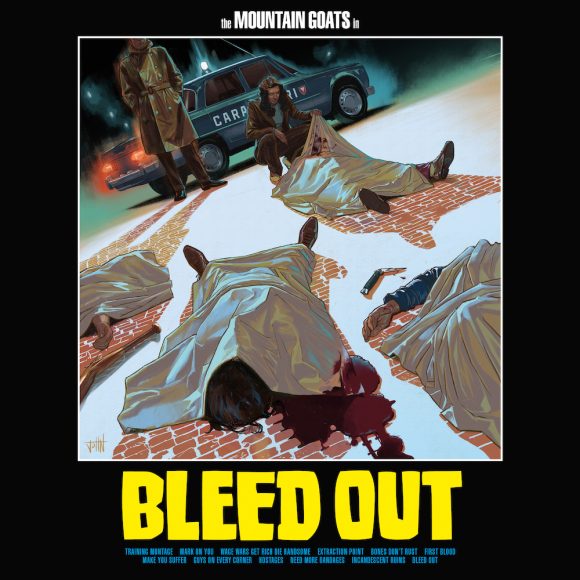
The Number Ones Footnotes Album Of The Week Counting Down Nearly one year after releasing their 20th studio album Dark In Here, the famously prolific Mountain Goats are back with a follow-up project, Bleed Out, arriving August 19 via Merge. Produced by Bully’s Alicia Bognanno and recorded in a studio near Chapel Hill, Bleed Out is inspired by “action movies from the ’60s, ’70s, and ’80s” and features an on-theme lead single titled “Training Montage.” Read More ›
• Gen3 Formula E Rollout at the Porsche Research and Development Center in Weissach
• Works driver Pascal Wehrlein turned the first laps in the Gen3 racer.
• With its third generation of vehicles, Formula E enters a new era in season 9.
A major step has been taken for the future of Formula E as the all-electric Gen3 race car from Porsche celebrated its eagerly awaited rollout at Weissach on Wednesday.
On the test track at Porsche’s Development Center, works driver Pascal Wehrlein turned the first laps in the vehicle, which the TAG Heuer Porsche Formula E Team will campaign in the ABB FIA Formula E World Championship from season 9 (2022/2023). With its third generation of vehicles, Formula E enters a new era.
Florian Modlinger Director Factory Motorsport Formula E: “We took the first step towards Gen3 today, with the successful rollout on our test track at the development centre. I want to thank the team for their huge effort in making this possible.
It was a lot of work technologically and operationally to get our new car out on the track for season 9 and to drive the first kilometres. We’re now looking forward to the next few days and weeks and to making further progress with the car. We’ll work on better aligning the systems and then the car’s performance.”
Pascal Wehrlein, Porsche works driver: “That was a very interesting day and an awesome experience to drive our new Gen3 car for the first time. It felt great and I’m excited to test it at full power soon. My initial impressions today were also very good and it made me hungry for more.”
The Gen3 sets new technological standards in Formula E
The Gen3 race cars are the fastest, lightest, most powerful and efficient electric race cars ever built. Designed specifically for Formula E street circuits, they also make a big step forward in sustainability. More than 40% of the energy used during a race is produced via regenerative braking.
The recycled carbon fibre used in the bodywork construction comes in part from this season’s Gen2 cars. Moreover, the Gen3 vehicle is the first formula race car with a front and rear powertrain.
The new front powertrain adds 250kW to the 350kW at the rear, more than doubling the regenerative capability of the current Gen2 car to a total of 600kW. The charging time has also decreased significantly. The new ultra-high-speed charging capacity of 600kW represents almost double the power of the world’s most advanced commercial chargers.
Live Oak Place in San Antonio totals 308 units. SAN ANTONIO — Chicago-based investment firm 29th Street Capital (29SC) has sold Live Oak Place, a 308-unit apartment community in Northeast San Antonio. The property features a mix of studio, one- and two-bedroom units with an average unit size of 668 square feet. Communal amenities include three pools, a clubhouse with a coffee bar and Wi-Fi, onsite laundry facilities and two dog parks. Jim Young, Matt Michelson and Chase Easley of Newmark represented 29SC in the sale. Matt Greer and Andrew Wilson, also with Newmark, arranged acquisition financing on behalf of the undisclosed buyer.
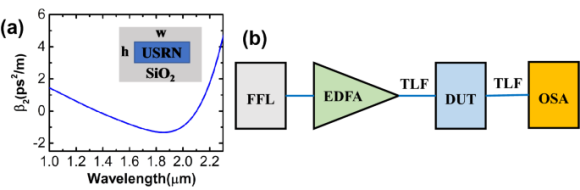
Thank you for visiting nature.com. You are using a browser version with limited support for CSS. To obtain the best experience, we recommend you use a more up to date browser (or turn off compatibility mode in Internet Explorer). In the meantime, to ensure continued support, we are displaying the site without styles and JavaScript. Advertisement Scientific Reportsvolume 12, Article number: 9487 (2022) Cite this article Metrics details Supercontinuum generation is demonstrated in a 3-mm-long ultra-silicon-rich nitride (USRN) waveguide by launching 500 fs pulses centered at 1555 nm with a pulse energy of 17 pJ. The generated supercontinuum is experimentally characterized to possess a high spectral coherence, with an average |g12| exceeding 0.90 across the wavelength range of the coherence measurement (1260 nm to 1700 nm). Numerical simulations further indicate a high coherence over the full spectrum. The experimentally measured supercontinuum agrees well with the theoretical simulations based on the generalized nonlinear Schrödinger equation. The generated broadband spectra using 500 fs pulses possessing high spectral coherence provide a promising route for CMOS-compatible light sources for self-referencing applications, metrology, and imaging. Supercontinuum is an ultrabroad band spectrum that has significant applications in many fields, including optical communications1, high-precision frequency metrology2, and optical coherence tomography3. It’s typically generated by injecting ultrashort and intense pulses into a nonlinear material where they experience an extreme spectral broadening caused by nonlinear mechanisms, for instance, self-phase modulation (SPM), high-order soliton fission, and dispersive wave generation. Supercontinuum generation (SCG) has been extensively investigated and made substantial progress in many on-chip platforms, including silica4,5, Si6,7,8,9, amorphous Si10,11, lithium niobate12, AlGaAs 13 and SiNx14,15,16,17. Amongst these, silicon was studied intensively as a promising platform because of its CMOS-compatibility, high Kerr nonlinearity (6 × 10–14 cm2 W–1), and large refractive index contrast with SiO2 cladding which enables strong mode confinement. However, the small bandgap of silicon (1.12 eV) leads to two-photon absorption (TPA) at telecommunication wavelengths. Silicon nitride (Si3N4) is another widely studied platform for supercontinuum generation, which has negligible TPA in the near-IR, but its low Kerr nonlinearity (2.5 × 10⁻¹⁵ cm2 W–1) limits the extent of spectral broadening at low pulse energies. USRN (Si7N3) is backend CMOS-compatible, with a linear refractive index of 3.1 and a Kerr nonlinearity of 2.8 × 10⁻¹³ cm2 W–118. Owing to its high silicon content, the Kerr nonlinearity of USRN is 100 times larger than that of silicon nitride 14,16 and silicon-rich nitride 17. In addition, USRN has a large bandgap (2.1 eV) allowing for nonlinear interactions free from TPA at telecommunication wavelengths19,20,21. All these benefits make USRN an ideal platform for on-chip SCG. SCG has been previously demonstrated in USRN devices18,22,23,24. For example, a 620 nm-spanning supercontinuum at the –30 dB level was observed using 500 fs pulses in a 7-mm-long USRN waveguide18. A spectral broadening with a 30 dB bandwidth of 340 nm was also demonstrated using 1.7 ps pulses in a two-stage USRN Bragg grating device, which consists of a 1-mm-long Bragg grating used to trigger Bragg soliton-effect compression and fission, followed by a 6-mm-long USRN channel waveguide where enhanced spectral broadening occurs24. Importantly, that work featured solitons of low soliton order, facilitating the attainment of high spectral coherence. In this work, we experimentally and numerically demonstrated a SCG with high coherence in a USRN waveguide. Compared with many other SCG demonstrations, this work relaxes the pulse width requirement from tens of femtoseconds to 500 fs, while requiring one of the lowest pulse energies. Waveguide dispersion is essential to SCG at a specific input pulse wavelength, which can be modulated by tailoring the width and height of waveguides. Based on the 1555 nm pulse wavelength, our USRN waveguide is designed to have a wide anomalous group-velocity dispersion (GVD) region near 1555 nm. Figure 1a shows the calculated GVD as a function of wavelength for the fundamental TE mode of a USRN channel waveguide, which is 600 nm wide and 400 nm high. As shown in Fig. 1a, anomalous dispersion occurs near 1555 nm, conducive to a broadband spectrum caused by self-phase modulation (SPM), soliton fission, and dispersive wave generation. (a) Calculated group velocity dispersion (GVD) curve for the fundamental TE mode of a USRN channel waveguide. The insert shows the cross section of the USRN waveguide with a width w = 600 nm and a height h = 400 nm. (b) Schematic of the experimental setup for supercontinuum generation in the USRN waveguide, where blue lines denote the polarization maintaining fibers, where FFL: femtosecond fiber laser, EDFA: erbium-doped fiber amplifier, DUT: device under test, TLF: tapered lensed fiber, OSA: optical spectrum analyzer. The schematic of the experimental setup for supercontinuum generation in the USRN waveguide is shown in Fig. 1b. In the experiment, a mode-locked femtosecond fiber laser is utilized to launch 500 fs pulses with a repetition rate of 20 MHz centred at 1555 nm, followed by an erbium-doped fiber amplifier (EDFA). The pulses are adjusted for quasi-TE polarization, and coupled into the 3-mm long USRN waveguide with tapered lensed fibers. The coupling losses are estimated to be 6–7 dB per facet, and the propagation loss is around 3 dB/cm extracted from cutback measurements. The output spectra from the waveguide are separately monitored utilizing two different optical spectrum analyzers (OSAs), one for the wavelength range from 800 to 1750 nm, and the other for the wavelength range from 1600 to 2400 nm. Figure 2a shows the measured output spectra at various pulse energies coupled into the USRN waveguide. As can be seen in Fig. 2a, the spectral broadening increases with the input pulse energy, and dispersive waves can be seen at both the short wavelength side (~ 1000 nm) and long wavelength side (~ 2200 nm) at higher pulse energies. These dispersive waves are important for extending the broadness of the SCG and originate from energy transfer from solitons generated during the process to the dispersive wave25,26,27,28. At the maximum pulse energy of 17 pJ, a supercontinuum with a lower edge of 1006 nm and an upper edge of 2240 nm at the –40 dB level is obtained, although some of the spectral components ranging from 1072 to 1344 nm are below this level. At the –20 dB and –30 dB levels, the generated supercontinuum has a bandwidth of 392 nm (1470 nm to 1862 nm) and 530 nm (1427 nm to 1957 nm), respectively. The experimentally measured 40 dB bandwidth at various pulse energies is plotted in Fig. 3a, where the blue data are obtained based on the SCG span within the –40 dB level edges, while the red data are obtained based on the SCG span after subtracting components below the –40 dB level. It can be seen in Fig. 3a that the 40 dB bandwidth increases with the pulse energies coupled into the USRN waveguide. Measured (a) and simulated (b) output spectra at various pulse energies coupled into the USRN waveguide. (a) Experimentally measured 40 dB bandwidth at various input pulse energies, where the blue data are obtained based on the SCG span within the –40 dB level edges, while the red data are obtained based on the SCG span after subtracting components below the –40 dB level. (b) Simulated pulse dynamics using 500 fs pulses in the USRN waveguide. (c) Simulated output spectra at various pulse energies coupled into the USRN waveguide. To better understand the pulse evolution dynamics in the USRN waveguide, we performed the numerical simulations using the Generalized Nonlinear Schrödinger Equation (GNLSE), as shown in Eq. (1) 29: This equation is solved using the split-step Fourier method. In Eq. (1), A (z, t) is the slowly varying pulse envelope, a good approximation in this regime. A (0, t), the initial input pulse, is assumed to be a hyperbolic-secant field, which has a peak power P = 34 W (corresponding to a pulse energy of 17 pJ used in the experiment), a temporal pulse width of 500 fs, and a center wavelength of 1555 nm. We used the same input pulse parameters in the simulations as that used in the experiment. In the simulations, we take dispersion, linear loss, self-phase modulation (SPM), and self-steepening effects into consideration. As shown on the right side of Eq. (1), the first term accounts for the dispersion effects in the USRN waveguide, where βk is the kth-order dispersion coefficient obtained by performing Taylor-series expansion of the propagation constant β(ω), where β(ω) = neff(ω)ω/c and neff(ω) is obtained with finite element algorithm. We used up to 7th order dispersion in the simulations, where β2 = –0.64 ps2/m, β3 = 2.4 × 10⁻³ ps3/m, β4 = –1 × 10⁻⁶ ps4/m, β5 = 1 × 10⁻⁷ ps5/m, β6 = –6.8 × 10⁻¹⁰ ps6/m, and β7 = 4.8 × 10⁻¹² ps7/m. The second term shows the effect of linear loss, where α is 3 dB/cm, a value obtained experimentally. The nonlinear parameter, γ = (ω0·n2)/(c·Aeff), where n2 is the nonlinear refractive index, c is the light speed in vacuum and Aeff is the effective mode area. The third term represents nonlinear effects, including the SPM effect and self-steepening effect, where τshock = 1/ω0 is the shock coefficient. Figure 2b shows the simulated output spectra at various input pulse energies. As can be seen in Fig. 2b, the spectral broadening increases with the input pulse energies. At low pulse energies, the nonlinear effects in the USRN waveguide get stronger with the increase in pulse energy, and the spectral broadening is mainly caused by self-phase modulation (SPM). When the pulse energy is further increased, greater spectral broadening occurs from soliton fission and dispersive wave generation. The simulated output spectra in Fig. 2b show similar broadening trends and dispersive wave positions to the experimental results shown in Fig. 2a. Figure 3b shows the simulated pulse dynamics using 500 fs pulses in the 3-mm-long USRN waveguide. As shown in Fig. 3b, the spectrum broadens symmetrically at the very beginning (less than 2 mm) due to SPM dominating the pulse dynamics. As the pulse propagates further along the waveguide, greater broadening occurs from soliton fission and dispersive wave generation. The dispersive waves generated at ~ 1000 nm and ~ 2200 nm play a role in the broadening of the SCG spectrum. To further elucidate the dynamics surrounding the onset and growth of the dispersive waves, we simulate the output spectra at different pulse energies coupled into the USRN waveguide. This is shown in Fig. 3c. It may be observed that at low pulse energy (less than 4 pJ), the spectrum broadens mainly due to the SPM effect. With increasing pulse energy, greater spectral broadening occurs from soliton fission and dispersive wave generation. As can be seen in Fig. 3c, the onset of soliton formation occurs when the pulse energy is larger than 12 pJ, where the spectrum broadens asymmetrically with pedestals characteristic of solitons forming. The dispersive wave at the short wavelength side (~ 1000 nm) begins to be significant when the pulse energy exceeds 13 pJ, while the dispersive wave at the long wavelength side (~ 2200 nm) begins to be significant when pulse energy exceeds 16.5 pJ. At this pulse energy, the dispersive waves on both the short and long wavelength side grow in amplitude beyond the –30 dB level, leading to considerable growth in SCG bandwidth. At 17 pJ, a soliton order of N = 43 is achieved, where (N = sqrt {L_{d} /L_{nl} }), (L_{d}) is the dispersion length obtained by (L_{d} = T_{0}^{2} /beta_{2}), and (L_{nl}) is the nonlinear length obtained by (L_{nl} = 1/gamma P)8. Here, (T_{{0{ }}}) is the temporal pulse width, (beta_{2}) is the group velocity dispersion at 1555 nm, (gamma) is the nonlinear parameter, and P is the peak power coupled into the waveguide. By calculation, (L_{nl} = 1/gamma P = { }) 0.067 mm, (L_{d} = T_{0}^{2} /beta_{2}) = 125.7 mm, and N(=) 43. The soliton fission length at a pulse energy of 17 pJ can be further obtained using (L_{fission} = L_{d} /N) = 2.9 mm, shorter than the SPM-induced modulation instability length, which is 4.1 mm calculated using (L approx sqrt {2L_{D} L_{nl} }). The shorter soliton fission length indicates that soliton fission plays a more dominant role in the spectral growth over modulation instability. In addition, the modulation instability length exceeds the length of the waveguide (3 mm), so it may further be inferred that modulation instability does not play a strong role in the spectral broadening process. The coherence of the output spectra from the USRN waveguide is further studied both numerically and experimentally. In the numerical study, we simulated the pulse dynamics in the USRN waveguide using Eq. (1), by adding one photon per mode (OPM) quantum noise into the input pulse. We did 100 times simulation in total, and divided them into 50 pairs, where each pair has two different simulated spectra, the same method as reported in Ref.26,30,31. The spectral coherence g12(λ) may be calculated using where E1,2 denote the individually simulated electric field, which is an averaged ensemble of the 50-pair simulations. Figure 4 shows the simulated SCG spectrum (blue line) and coherence |g12| (red line) by adding OPM noise using 500 fs pulses with a pulse energy of 17 pJ. From Fig. 4, the calculated coherence |g12| is close to 1 across most of the simulated wavelength range, indicating a high spectral coherence of the generated supercontinuum. Simulated SCG spectrum (blue) and spectral coherence |g12| (red) by adding one-photon-per-mode noise using 500 fs pulses with a pulse energy of 17 pJ. Next, we experimentally characterized the spectral coherence of the generated spectrum from the USRN waveguide using an asymmetric Michelson interferometer. The setup interferes two back to back SCG pulses. Figure 5a shows the schematic of the experimental setup for the coherence measurements, where the SC pulses generated in the USRN waveguide are firstly coupled into a 90:10 coupler and are split into two different arms. In one arm, 90% of the pulse power is coupled into a light collimator prior to Mirror 1, reflected by Mirror 1, travels to Mirror 2 and is then collected by a light collector. In this arm, Mirror 1 is position fixed, while Mirror 2 is fixed onto a motorized stage to provide the tunability of the time delay. In the other arm, 10% of the pulse power is coupled into a long fiber with a length of ~ 11 m, which is used to introduce an additional time delay. The two different pulses (back to back) in each arm are combined with a 50:50 coupler and interfere with each other. Finally, the output spectrum from the 50:50 coupler is measured using an optical spectrum analyzer (OSA). (a) Schematic of the experimental setup for the coherence measurements, where the blue lines donate PM fibers, and the red lines show the light propagating path in the air. (b) Experimentally measured spectral coherence (red circles) and fringes (blue line). Magnified fringe spectrum at 1.38 µm (c), 1.48 µm (d) and 1.68 µm (e), each with a 40 nm-span. Figure 5b shows the experimentally obtained spectral coherence (red circles) and fringes (blue line). The magnified fringe spectra at 1.38 µm, 1.48 µm, and 1.68 µm are respectively shown in Fig. 5c–e, each with a 40 nm-span. In Fig. 5b–e, we can see clear fringes with good fringe visibility that demonstrate the spectral coherence of the generated broadband spectrum. The degree of coherence can be quantified with a parameter |g12|, calculated using Eq. (3) In Eq. (3), I1(λ) and I2(λ) refer to the optical intensities of light propagating in the two different arms of the interferometer, while V(λ) denotes the fringe visibility calculated by V(λ) = (Imax—Imin)/ (Imax + Imin)11,13. Due to the low pump power, the high coupling losses when coupling from free space to fiber, and the limited bandwidth of components used in the asymmetric Michelson interferometer, the wavelength range where the coherence fringes could be observed utilizing the OSA is limited to 1260 nm to 1700 nm, as shown in Fig. 5b. Similar limitations regarding coherence measurements have also been described in Ref. 13. We note that the spectral coherence |g12| of the SCG here is characterized to have an average value larger than 0.90 across the measured wavelength span from 1260 to 1700 nm. Table 1 shows recent demonstrations of SCG in various on-chip platforms. As shown in Table 1, a considerably wider pulse width of 500 fs is used in this work compared with other SCG demonstrations, allowing the pulse width requirements for the generation of supercontinuum to be relaxed. In addition, the pulse energy used in this work is only 17 pJ, considerably smaller than those reported in Lithium niobate (800 pJ)12, Si3N4 (25.5 pJ, 1.4 nJ, and 87.4 pJ)14,15,16 and silicon rich nitride (105 pJ)17. Although SCG demonstration in Si7 required smaller pulse energy (4.5 pJ), no coherence characterization was shown. Comparing the various platforms, the SCG demonstrated in AlGaAs waveguides13 required the lowest pulse energy of 3.6 pJ. AlGaAs while not CMOS-compatible, also possesses similar favorable nonlinear optical properties as USRN, namely a high Kerr nonlinearity and absence of TPA at telecommunications wavelengths32. In addition, unlike that reported in Si7,9 and Si3N414,16 which utilized pump wavelengths of 2.5 µm, 1.9 µm, 1030 nm, and 795 nm, respectively, the pumping wavelength used in our USRN waveguide lies within telecommunications wavelengths where light sources are cheap and easily accessible. In conclusion, the SCG demonstrated in this work relaxes the pulse width requirement, requires low pulse energy, and shows good coherence, making it a favorable light source in various applications, including self-referencing, metrology, and imaging. Furthermore, due to its CMOS-compatibility, larger linear refractive index, and small device footprint, the USRN waveguide in this work may also be integrated with devices providing optical functions in other important domains, such as achromatic metadevices33, broadband, achromatic metalenses34 and high-sensitivity sensing35. In the spectral broadening experiment, a mode-locked femtosecond fiber laser is utilized to launch 500 fs pulses centred at 1555 nm, followed by an EDFA. The pulses are adjusted for quasi-TE polarization and coupled into the waveguide. The output spectra from the waveguide are separately monitored utilizing two different OSAs, one for the wavelength range from 800 to 1750 nm, and the other for the wavelength range from 1600 to 2400 nm. In the spectral coherence characterization experiment, we used an asymmetric Michelson interferometer, where two different SCG pulses in time interfere with each other. The output spectrum of the Michelson interferometer is coupled into a fiber and measured by an OSA. The USRN waveguide was implemented on a 10-μm SiO2 layer on a Si substrate. A 400 nm thick USRN film is deposited using inductively coupled chemical vapor deposition at a temperature of 250 °C. A channel waveguide structure is patterned using electron-beam lithography and transferred to the USRN layer via inductively coupled plasma etching. Finally, the deposition of a 2-µm SiO2 cladding was performed using plasma-enhanced chemical vapor deposition. Smirnov, S. V. et al. Optical spectral broadening and supercontinuum generation in telecom applications. Opt. Fiber Technol.12, 122–147 (2006). Article Google Scholar Jones, D. J. et al. Carrier-envelope phase control of femtosecond mode-locked lasers and direct optical frequency synthesis. Science288, 635–639 (2000). CASArticle Google Scholar Hartl, I. et al. Ultrahigh-resolution optical coherence tomography using continuum generation in an air–silica microstructure optical fiber. Opt. Lett.26, 608–610 (2001). CASArticle Google Scholar Oh, D. Y. et al. Supercontinuum generation in an on-chip silica waveguide. Opt. Lett.39, 1046–1048 (2014). CASArticle Google Scholar Duchesne, D. et al. Supercontinuum generation in a high index doped silica glass spiral waveguide. Opt. Express18, 923–930 (2010). CASArticle Google Scholar Leo, F. et al. Dispersive wave emission and supercontinuum generation in a silicon wire waveguide pumped around the 1550 nm telecommunication wavelength. Opt. Lett.39, 3623–3626 (2014). Article Google Scholar Lau, R. K. W. et al. Octave-spanning mid-infrared supercontinuum generation in silicon nanowaveguides. Opt. Lett.39, 4518–4521 (2014). CASArticle Google Scholar Yin, L., Lin, Q. & Agrawal, G. P. Soliton fission and supercontinuum generation in silicon waveguides. Opt. Lett.32, 391–393 (2007). Article Google Scholar Singh, N. et al. Octave-spanning coherent supercontinuum generation in silicon on insulator from 1.06 μm to beyond 2.4 μm. Light Sci Appl.7, 17131 (2018). CASArticle Google Scholar Safioui, J. et al. Supercontinuum generation in hydrogenated amorphous silicon waveguides at telecommunication wavelengths. Opt. Express22, 3089–3097 (2014). Article Google Scholar Leo, F., Safioui, J., Kuyken, B., Roelkens, G. & Gorza, S.-P. Generation of coherent supercontinuum in a-Si: H waveguides: experiment and modeling based on measured dispersion profile. Opt. Express22, 28997–29007 (2014). CASArticle Google Scholar Lu, J., Surya, J. B., Liu, X., Xu, Y. & Tang, H. X. Octave-spanning supercontinuum generation in nanoscale lithium niobate waveguides. Opt. Lett.44, 1492–1495 (2019). CASArticle Google Scholar Kuyken, B., Billet, M., Leo, F., Yvind, K. & Pu, M. Octave-spanning coherent supercontinuum generation in an AlGaAs-on-insulator waveguide. Opt. Lett.45, 603–606 (2020). CASArticle Google Scholar Johnson, A. R. et al. Octave-spanning coherent supercontinuum generation in a silicon nitride waveguide. Opt. Lett.40, 5117–5120 (2015). CASArticle Google Scholar Porcel, M. A. G. et al. Two-octave spanning supercontinuum generation in stoichiometric silicon nitride waveguides pumped at telecom wavelengths. Opt. Express25, 1542–1554 (2017). CASArticle Google Scholar Zhao, H. et al. Visible-to-near-infrared octave spanning supercontinuum generation in a silicon nitride waveguide. Opt. Lett.40, 2177–2180 (2015). CASArticle Google Scholar Liu, X. et al. Octave-spanning supercontinuum generation in a silicon-rich nitride waveguide. Opt. Lett.41, 2719–2722 (2016). CASArticle Google Scholar Wang, T. et al. Supercontinuum generation in bandgap engineered, back-end CMOS compatible silicon rich nitride waveguides. Laser Photonics Rev.9, 498 (2015). CASArticle Google Scholar Sohn, B.-U., Choi, J. W., Ng, D. K. T. & Tan, D. T. H. Optical nonlinearities in ultra-silicon-rich nitride characterized using z-scan measurements. Sci. Rep.9, 10364 (2019). Article Google Scholar Choi, J. W., Sohn, B.-U., Chen, G. F. R., Ng, D. K. T. & Tan, D. T. H. Soliton-effect optical pulse compression in CMOS-compatible ultra-silicon-rich nitride waveguides. APL Photon.4, 110804 (2019). Article Google Scholar Ooi, K. J. A. et al. Pushing the limits of CMOS optical parametric amplifiers with USRN: Si7N3 above the two-photon absorption edge. Nat. Commun.8, 13878 (2017). CASArticle Google Scholar Choi, J. W., Chen, G. F. R., Ng, D. K. T., Ooi, K. J. A. & Tan, D. T. H. Wideband nonlinear spectral broadening in ultra-short ultra—silicon rich nitride waveguides. Sci. Rep.6, 27120 (2016). CASArticle Google Scholar Cao, Y. et al. Thermo-optically tunable spectral broadening in a nonlinear ultra-silicon-rich nitride Bragg grating. Photon. Res.9, 596–604 (2021). Article Google Scholar Sahin, E. et al. Wideband spectral enhancement through on-chip Bragg-soliton dynamics. Adv. Photonics Res., 2100107 (2021). Cristiani, I., Tediosi, R., Tartara, L. & Degiorgio, V. Dispersive wave generation by solitons in microstructured optical fibers. Opt. Express12, 124–135 (2004). Article Google Scholar Dudley, J. M., Genty, G. & Coen, S. Supercontinuum generation in photonic crystal fiber. Rev. Mod. Phys.78, 1135–1184 (2006). CASArticle Google Scholar Roy, S., Bhadra, S. K. & Agrawal, G. P. Dispersive waves emitted by solitons perturbed by third-order dispersion inside optical fibers. Phys. Rev. A79, 023824 (2009). Article Google Scholar Kutz, J. N., Lyngå, C. & Eggleton, B. J. Enhanced Supercontinuum Generation through Dispersion-Management. Opt. Express13, 3989–3998 (2005). Article Google Scholar Agarwal, G. P. Nonlinear fiber optics (Elsevier, 2000). Google Scholar Dudley, J. M., Genty, G. & Eggleton, B. J. Harnessing and control of optical rogue waves in supercontinuum generation. Opt. Express16, 3644–3651 (2008). Article Google Scholar Frosz, M. H. Validation of input-noise model for simulations of supercontinuum generation and rogue waves. Opt. Express18, 14778–14787 (2010). CASArticle Google Scholar Pu, M. et al. Ultra-efficient and broadband nonlinear AlGaAs-on-insulator chip for low-power optical signal processing. Laser Photonics Rev.12, 1800111 (2018). Article Google Scholar Ou, K. et al. Mid-infrared polarization-controlled broadband achromatic metadevice. Sci. Adv.6, eabc0711 (2020). Ou, K. et al. Broadband achromatic metalens in mid-wavelength infrared. Laser Photonics Rev.15, 2100020 (2021). CASArticle Google Scholar Yan, D. et al. Tunable and high-sensitivity sensing based on Fano resonance with coupled plasmonic cavities. Sci. Rep.7, 10639 (2017). Article Google Scholar Download references Funding from the Ministry of Education ACRF Tier 2 grant, National Research Foundation Competitive Research Programme (NRF-CRP) Grant (NRF-CRP18-2017–03) and A*STAR IME grant is gratefully acknowledged. Photonics Devices and Systems Group, Singapore University of Technology and Design, 8 Somapah Road, Singapore, 487372, Singapore Yanmei Cao, Byoung-Uk Sohn, Hongwei Gao, Peng Xing, George F. R. Chen & Dawn T. H. Tan Institute of Microelectronics, A*STAR, 2 Fusionopolis Way, #08-02, Innovis Tower,, Singapore, 138634, Singapore Doris K. T. Ng & Dawn T. H. Tan You can also search for this author in PubMedGoogle Scholar You can also search for this author in PubMedGoogle Scholar You can also search for this author in PubMedGoogle Scholar You can also search for this author in PubMedGoogle Scholar You can also search for this author in PubMedGoogle Scholar You can also search for this author in PubMedGoogle Scholar You can also search for this author in PubMedGoogle Scholar Y.C. performed the simulations and spectral broadening experiment. Y.C. and B.-U.S. performed the spectral coherence characterization experiment. H.G., P.X., G.F.R.C. and D.K.T.N prepared the samples. Y.C. analyzed the data. Y. C. and D. T. H. T. wrote the manuscript. All authors reviewed the manuscript. D. T. H. T. supervised the project. Correspondence to Dawn T. H. Tan. The authors declare no competing interests. Springer Nature remains neutral with regard to jurisdictional claims in published maps and institutional affiliations. Open Access This article is licensed under a Creative Commons Attribution 4.0 International License, which permits use, sharing, adaptation, distribution and reproduction in any medium or format, as long as you give appropriate credit to the original author(s) and the source, provide a link to the Creative Commons licence, and indicate if changes were made. The images or other third party material in this article are included in the article’s Creative Commons licence, unless indicated otherwise in a credit line to the material. If material is not included in the article’s Creative Commons licence and your intended use is not permitted by statutory regulation or exceeds the permitted use, you will need to obtain permission directly from the copyright holder. To view a copy of this licence, visit http://creativecommons.org/licenses/by/4.0/. Reprints and Permissions Cao, Y., Sohn, BU., Gao, H. et al. Supercontinuum generation in a nonlinear ultra-silicon-rich nitride waveguide. Sci Rep12, 9487 (2022). https://doi.org/10.1038/s41598-022-13734-9 Download citation Received: Accepted: Published: DOI: https://doi.org/10.1038/s41598-022-13734-9 Anyone you share the following link with will be able to read this content: Sorry, a shareable link is not currently available for this article.
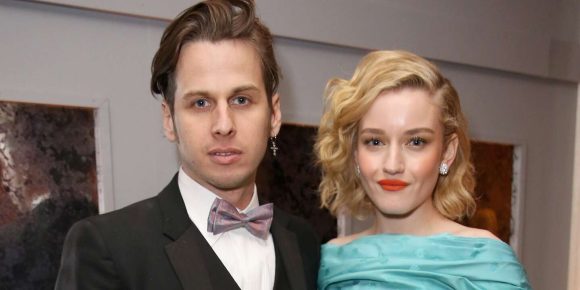
Julia Garner might be one of Hollywood's fastest rising stars, but the actress isn't the only famous face in her household. The Ozark star is married to Mark Foster, a Grammy-nominated musician and the frontman of the band Foster the People. The couple first crossed paths at the Sundance Film Festival nearly seven years before tying the knot in an intimate courthouse wedding in December 2019. "We went back and forth from having a big wedding to eloping in Vegas," Garner told Vogue. "We ultimately decided to get married at City Hall in New York City, just like my parents did 40 years ago." Months prior to their nuptials, the "Pumped Up Kicks" singer was by Garner's side as she took home her first Emmy for her role as Ruth Langmore on Netflix's Ozark. In her acceptance speech, the Inventing Anna star gave her then-future husband a special shoutout, calling Foster "the love of my life." RELATED: Julia Garner Chosen to Play Madonna in Biopic About Singer: Source Foster raved about Garner's big victory on Instagram, writing, "It took me time to process the last twenty four hours and find a quiet moment of thought after an incredibly surreal weekend. I'm beyond proud of this girl," alongside photos of the actress holding her trophy. He continued, "I consider myself the luckiest guy on the planet to be able to watch whatever you do from the front row, with a bag of popcorn and your hand wrapped in mine." Here's everything you need to know about Julia Garner's husband Mark Foster and their sweet relationship. Foster is behind the catchy tune "Pumped Up Kicks," which was released in 2010. "I wrote that song in eight hours, and for me it wasn't necessarily more special than any other song," he revealed to Billboard in 2019. "The thing that made that song special was the public, and the fact that people thought it was special, and it resonated and it created a conversation. And I'm proud of the conversation that it created." Foster grew up in Cleveland, per NPR. The singer is a graduate of Ohio's Nordonia High School. While Garner was born in New York, Ohio was a topic of conversation after she and Foster met outside of the Eccles Theater during Sundance in 2013. "In our first conversation, we realized that my grandmother lived in the same small town that his dad lives in, just outside of Cleveland," the actress revealed to Vogue. The magazine noted that "after that, they ended up seeing each other in Cleveland at Christmas time, year after year" before they were officially dating. Garner added, "It kind of became a tradition." Foster ended up leaving Ohio and moving to Los Angeles in 2002. Before his music hit the radio, Foster worked at the music production company Mophonics composing jingles for commercials, including Muscle Milk's "Spring Break It Down." While working there, Foster also wrote songs for his band. "Foster the People wouldn't exist without Mophonics," the songwriter previously told Bloomberg. "Mophonics is kind of a creative home for me." The aspiring artist would stay back to write after others went home. "For about eight months, I would just show up there every day. Stephan Altman, the head composer there, took me under his wing and kinda mentored me as a composer, but really, I was learning how to produce. When everybody else would go home at 6 p.m., I would stay back. That's really where I started writing Torches," he said in an interview with American Songwriter. In fact, Foster wrote and produced the band's hit tune "Pumped Up Kicks" in a "little writer's room at Mophonics." Reflecting on his commercial days, the composer told Interview Magazine, "When I wasn't composing for commercials, I would write. Four months later, I started the band, and eight months later, we were signed. I went from one of the lowest places that I have been in my life and within a year was in the best place I've ever been." Along with his band, Foster has scored multiple Grammy nominations. The group was nominated for Best Pop Duo/Group Performance and Best Alternative Music Album at the 54th annual Grammy Awards in February 2012. "We're up against some pretty stiff competition," Foster told The Plain Dealer ahead of the ceremony. "Just being there will be an honor. I'm not really worried about it." Although they didn't win that year, Foster the People was nominated again at the 55th Grammys for Best Short Form Music Video for "Houdini." Taylor Swift released a collaboration of hers and Foster's—"Forever Winter (Taylor's Version) (From The Vault)"— on her rerecorded album Red (Taylor's Version) in 2021. Back in 2012, Foster spoke about writing a song with Swift, whom he called "super talented." "It's a really cool song, you know?" he told Fuse. "We kind of just went into it casually, like 'Yeah, let's just jam and just like have fun,' and something really cool came out of it." While they met at Sundance in 2013, the couple did not start dating off the bat, according to The Hollywood Reporter. The pair, who had not exchanged contact information, reconnected via Instagram before Garner started working on Ozark. She told THR, "I was like, 'Who's this guy liking all my photos? Is this a stalker?' I clicked on him and I was like, 'Oh, Mark. Oh, he's cute. I'm going to follow him back.' Then he DM'd me." No surprise, the songwriter has a way with words. When it came to popping the question during a 2019 trip to Montana, Foster read the Netflix star a poem. Garner later revealed to Vogue, "He read me a poem he had written to me, and when he finished, he dropped to a knee and asked me to marry him." RELATED: Julia Garner Is Married! Actress Weds Foster the People Frontman Mark Foster The musician also wrote his bride a song, titled "Lovers in a Stream," for their first dance at their wedding celebration. "It was a surprise," Garner told Vogue. "Mark wrote, produced, and sang it. It was very surreal, and the most beautiful present I've ever received. It felt like I was floating up in the air — it was the most magical moment I've ever had."
The largest piece of undeveloped shoreline in the Finger Lakes, known as Bell Station in Lansing, New York, is the latest acquisition of the Finger Lakes Land Trust, founded by Andy Zepp, ’85, M.P.S. ’90. The project seemed doomed. For years, the Finger Lakes Land Trust had been working to preserve a 480-acre expanse of streams, waterfalls, mature forested hillsides and open fields alongside Cayuga Lake in Lansing, New York – the largest piece of undeveloped shoreline in the Finger Lakes. Now the land was up for auction to the highest bidder – and at risk for becoming clogged with private cottages. “A guy called me up who is a billionaire; he just wanted to possess this,” says Andy Zepp ’85, M.P.S. ’90, executive director of the land trust, which began as his Cornell master’s degree project in 1989. “We knew if the land trust went to auction, we would likely be outbid. After a decade of working on this project, we thought it was gone.” The Finger Lakes Land Trust manages more than 45 nature preserves in 12 counties, from Tioga County in the east to Ontario County in the west. Instead, Zepp and his colleagues led a campaign to partner with New York state and acquired the land from its owner, New York State Electric & Gas, on May 24. In 12 to 18 months, the land trust will sell the parcel, known as Bell Station, to the N.Y. Department of Environmental Conservation, which will manage it for hiking, cross country skiing, wildlife watching, hunting and fishing. About 200 acres may be used for solar energy production. “These last parcels are so important, because 90% of the shoreline on Cayuga Lake is developed and also inaccessible to the public,” Zepp says. “In the winter, you see bald eagles and waterfowl, flocks of migratory ducks. It’s really full of life.” With Bell Station, the land trust now protects 28,730 acres of forests, farmlands, gorges and shorelines in the Finger Lakes. It creates public nature preserves and helps conserve their properties in 12 counties, an area about the size of Vermont, making it among the state’s larger land trusts. Zepp’s motivation stems from a love of being outdoors – and his Westchester County upbringing. “It was a nice suburb, but nature was pretty much driven out,” Zepp says. “I saw we can do a much better job of balancing development and conservation. We have to.” Cornell provides crucial support to the land trust’s activities, Zepp says. Faculty members advise on issues from land management to climate change. Students intern and volunteer. Fred Van Sickle, vice president for Alumni Affairs and Development, is the incoming president of the board; John Fitzpatrick, former longtime director of the Lab of Ornithology, has served on the president’s council for several years. “There are just many, many ways that we benefit both from the expertise of the university and the commitment of folks in Ithaca,” Zepp says. “They’re very much committed to the work we’re doing.” A resounding yes Zepp’s interest in conservation bloomed at Cornell. “I came as an undergraduate to Ithaca and the Finger Lakes and fell in love with the landscape,” he says. After majoring in organizational behavior at the ILR School, he worked for The Nature Conservancy in Connecticut and Western New York. “I saw areas that were really suffering – not from development per se, but from poorly planned development,” he says. That motivated him to take a leave of absence from The Nature Conservancy and return to Cornell to pursue a master’s degree in natural resources at the College of Agriculture and Life Sciences. He helped create the land trust as his thesis project. Andy Zepp ’85, M.P.S. ’90, executive director of the Finger Lakes Land Trust, began the organization as his Cornell master’s degree project in 1989. He networked for several months to recruit members of the community who might serve as the first board of directors, while he took classes in environmental law, forest ecology and soil sciences. He invited key recruits to gather one evening in 1988 in a Fernow Hall lecture hall, where Zepp provided information on how land trusts work. “The question was, should they form a land trust? The answer was a resounding ‘Yes,’” Zepp says. The first project the land trust initiated was Sweedler Preserve at Lick Brook in Ithaca, providing public access to one of the area’s most notable waterfalls. “You’re standing there, at this beautiful spot that’s one mile from downtown – it was the awareness that if you didn’t actively conserve it, there’s no way it would stay that way,” Zepp says. After spending seven years as vice president for programs at the Land Trust Alliance, an umbrella organization for land conservation groups, Zepp returned to the Finger Lakes Land Trust in 2003 to serve as executive director. The land trust now manages more than 45 nature preserves, acquiring land and opening it to the public. The preserves range from Richford in Tioga County in the east to Naples in Ontario County, to the west. Ten more projects are nearing completion. A beautiful piece of woods The land trust also partners with local, state and federal governments and other nonprofits to be a catalyst for projects like Bell Station. And it uses a flexible tool called a conservation easement, to help private land owners limit development on their land in a way that is tailored to their needs. Bob Good added a conservation easement to his 55 acres of woodlands in Springwater, New York, so it can never be subdivided or developed. The easement gives him peace of mind because the land is so closely tied to his family’s traditions and history. “Running into the land trust was a real godsend for me,” Good says. He and his wife, Sue, now deceased, bought 12 acres in the early 1980s and added to it over time. They began camping on the land in a Boy Scout tent when their two daughters were babies. Eventually they built a cabin overlooking the valley. They named it Tommy’s Camp after Sue’s brother, who died as a young man in a motorcycle accident while studying to become a forester. Bob and Sue’s daughters and grandchildren visit the land frequently. Sue’s ashes are buried on the property, in an open field at the base of a red maple. Andy Zepp ’85, M.P.S. ’90, walks along the shore of Cayuga Lake at the Bell Station parcel. “I would hate the thought that someday this could all be divided up into 3-acre lots and turned into McMansions,” Good says. “We’re hoping that in 100 years or more, it’ll be a beautiful piece of woods still.” And the easement plays a significant role in protecting Rochester’s drinking water. The property includes a rapid stream known as Reynolds Gull, which drains into Hemlock Lake, the source of Rochester’s water supply. Water quality is the biggest challenge currently facing the Finger Lakes, Zepp says. “We’ve recently had outbreaks of toxic algae or cyanobacteria that are a huge concern, both for public drinking water supplies, but also for a region that has a $2 billion tourism economy that’s largely based on the lakes.” The land trust has begun prioritizing projects that not only conserve land but also water quality, through two strategies. It works with lake associations and local governments to restore wetlands and straightened streams. And it secures lands that, if developed, would profoundly compromise water quality – such as the waterfall near the Bell Station shoreline. “If you look up at the steep slopes, if these were cleared for development, they would likely lead to more nutrient inputs into the lake,” he said. Standing at the Bell Station shoreline, he points out mature oak, maple, elm and ash trees that shade the dappled water, and the invasive plants like privet and honeysuckle that have started to take over – another serious challenge facing the Finger Lakes. “I can’t get away from, ‘Oh my God, that shouldn’t be here,’” he says. “What I’m always thinking about is maintaining and enhancing diversity. “I visit preserves all the time and I’m always thinking about how can we up our game. I just can’t help thinking, ‘With a few more resources, what would we do next?’” Get Cornell news delivered right to your inbox.
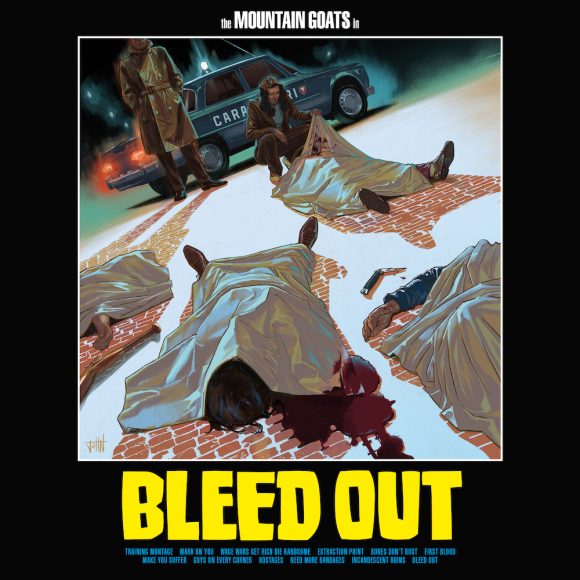
The Number Ones Footnotes Album Of The Week Counting Down Nearly one year after releasing their 20th studio album Dark In Here, the famously prolific Mountain Goats are back with a follow-up project, Bleed Out, arriving August 19 via Merge. Produced by Bully’s Alicia Bognanno and recorded in a studio near Chapel Hill, Bleed Out is inspired by “action movies from the ’60s, ’70s, and ’80s” and features an on-theme lead single titled “Training Montage.” Read More ›
The national tour features Courtney Reed as Satine and Conor Ryan as Christian. The North American tour of Moulin Rouge! The Musical released a new trailer. Set to the backdrop of the musical’s “Lady Marmalade,” the short video shows a montage of clips from the production. Watch the full trailer above. The Tony Award-winning Best Musical’s next stop is the Buell Theatre in Denver for a three-week engagement which will play June 9-26. The show began its tour March 19 at Chicago’s James M. Nederlander Theatre. Leading the cast are Courtney Reed and Conor Ryan as Satine and Christian, respectively. The cast continues with Austin Durant as Harold Zidler, André Ward as Toulouse-Lautrec, David Harris as The Duke of Monroth, Gabe Martínez as Santiago, and Libby Lloyd as Nini. Yvette Gonzalez-Nacer is the Satine Alternate.
Rounding out the cast is Nicci Claspell, Harper Miles, Andres Quintero, Adrienne Balducci, Andrew Brewer, Jack Cahill-Lemme, Sam J. Cahn, Darius Crenshaw, Alexander Cruz, Alexis Hasbrouck, Tyler John Logan, Tanisha Moore, Brayden Newby, Kent Overshown, Adéa Michelle Sessoms, Jenn Strafford, Sharrod Williams, Jennifer Wolfe, and Ricardo A. Zayas as ensemble members. Alexa De Barr, Tamrin Goldberg, Jordan Fife Hunt, Justin Keats, and Travis Ward-Osborne serve as swings. Amy Quanbeck joins as dance captain and swing, and Denzel Tsopnang as principal standby. The tour will continue to Los Angeles, California at The Pantages Theatre June 30-September 4; San Francisco, California at Orpheum Theatre September 7-November 6; Costa Mesa, California at Segerstrom Center For The Arts November 9-November 27; Salt Lake City at Eccles Theater November 30-December 11; Seattle, Washington at Paramount Theatre December 14-January 1, 2023; Portland, Oregon at Keller Auditorium January 4-15, 2023; Las Vegas, Nevada at The Smith Center January 19-February 5, 2023; Fayetteville, Arkansa at Walton Arts Center February 8-19, 2023; Houston, Texas at The Hobby Center February 22-March 12; Dallas, Texas at Musical Hall at Fair Park March 15-April 2, 2023; New Orleans, Louisiana at Sanger Theatre April 5-16, 2023; Atlanta, Georgia at Fox theatre April 19-30, 2023; Durham, North Carolina at Durham Performing Arts Center May 3-24, 2023; Cincinnati, Ohio at Aronoff Center Mary 17-June 4, 2023; Cleveland, Ohio at Playhouse Square June 7-July 2, 2023; Philadelphia, PA at Kimmel Culture Center July 5-July 30, 2023; and Washington, D.C. at The Kennedy Center August 2-September 24, 2023. Directed by Alex Timbers with a book by John Logan and choreography by Sonya Tayeh, Moulin Rouge! first opened on Broadway in 2019 following a Boston try-out. Based on the Baz Luhrmann-directed movie of the same name, the score features covers of “Fireworks” by Katy Perry, “Your Song” by Elton John, and “Chandelier” by Sia, among many others. The story takes place at Paris’s famed Moulin Rouge and follows the tragic love story between performer Satine and composer Christian.
The production’s music team includes Justin Levine and Ted Arthur as musical supervisors, Matt Stone as music producer, and Andrew Graham as music director. Orchestrations are by Levine, Stone, Katie Kresek, and Charlie Rosen, with dance arrangements by Levine and Stein and Michael Aarons as music coordinator. Also in the creative team are Derek McLane as scenic designer, Catherine Zuber as costume designer, Justin Townsend as lighting designer, Peter Hylenski as sound designer, David Brian Brown as hair designer, Sarah Cimino as makeup designer, and creative services by Luhrmann and Catherine Martin. Casting is led by Jim Carnahan and Stephen Kopel, with Jeff Norman as stage manager. The creative team swept the 2020 Tony Awards, winning for Best Direction (Timbers), Choreography (Tayeh), Orchestrations (Levine, Stine, Kresek, and Rosen), Scenic Design (McLane), Costumes (Catherine Zuber), Lighting (Townsend), and Sound (Hylenski). The tour is produced by Carmen Pavlovic, Gerry Ryan, and Bill Damaschke.
Conor Ryan and Courtney Reed Courtney Reed Adéa Michelle Sessoms and Jennifer Wolfe Gabe MartÍnez, André Ward, Conor Ryan, and the Company of Moulin Rouge! The Musical Connor Ryan and the Cast of Moulin Rouge! The Musical Conor Ryan and Courtney Reed André Ward, Courtney Reed, Conor Ryan, David Harris, Austin Durant, and Gabe MartÍnez The Cast of Moulin Rouge! The Musical Gabe Mart Ínez and Libby Lloyd David Harris Conor Ryan, Gabe MartÍnez, André Ward, and Austin Durant The national tour features Courtney Reed as Satine and Conor Ryan as Christian. A look at the touring musicals and plays that may soon be coming to a city near you. Sam Scalamoni will direct the production based on the 2003 film. The jukebox biomusical is inspired by the life and music of Emilio and Gloria Estefan. The Tony winner will star as a special guest at one performance. The national tour of the Tony-winning musical kicks off its fourth year June 21 in Boise, Idaho. Three Asian American artists unite to celebrate AAPI Heritage Month through music and dance. Ensemble member Chibueze Ihuoma will take over as Orpheus. The cast made an appearance on The Late Late Show with James Corden. The Tony winner will perform at select performances in June. The touring production of the Temptations bio-musical is playing at Shea’s Performing Arts Center through May 15. The Conor McPherson-Bob Dylan musical, which returned to Broadway in April, recently received seven Tony nominations. The producers and licensor are accused of profiting from union and non-union workers at the same time. The jukebox musical featuring Meat Loaf and Jim Steinman’s greatest hits has also announced a Las Vegas residency. The tour has also announced replacements English Bernhardt, Morgan Ashley Bryant, and Jasmine Rogers. The original and current Mufasas, Simbas, and Nalas talk about the show and life on the road. The touring production of Daniel Fish’s Tony-winning revival launched in November starring Sasha Hutchings, Sean Grandillo, Sis, Gabrielle Hamilton, and more. An alum of the Disney musical’s Broadway run, Chapman returns to the role after a stint as the Anna standby. The Tony-nominated musical is based on the 2007 film by Adrienne Shelly. The Netherworld is hitting the road with a launch planned in San Francisco. The Tony nominee will perform at select performances in May.
Citing lower pay and less safety precautions compared to the musical’s concurrent union tour, Actors’ Equity has filed with NLRB to represent the company. The national tour kicked off March 27 at Shea’s Performing Arts Center in Buffalo, New York. Khaila Wilcoxon, Storm Lever, Olivia Donalson, and more star in the traveling production. Melanie Moore, Jacqueline Williams, Justin Mark, Yaegel T. Welch, and Mockingbird Oscar nominee Mary Badham join the Emmy winner. A host of actors join the national tour of the international hit musical, now in Spokane. The biomusical is currently running at Broadway’s Neil Simon Theatre. The Tony- and Pulitzer–winning show is currently playing on Broadway and West End, and in Melbourne, Australia. The national tour features Courtney Reed as Satine and Conor Ryan as Christian. Jeff Calhoun will direct with choreography by Lisa Stevens.
The proposal happened at Rhode Island’s Providence Performing Arts Center. Kenny Leon will return to direct the Pulitzer-winning mystery by Charles Fuller. Kurtz, previously seen in the role on Broadway, is playing a limited run in the tour. Original Broadway cast member Stephanie Torns will lead the Sara Bareilles musical. The Heathers star will take over the role of Hans at select tour stops in Florida and South Carolina. The “Boelyn” North American tour will begin later this year following the “Aragon” tour’s spring launch. The upcoming tour of the Tony-winning musical will visit 25 cities that it has never played. The upcoming tour will premiere in Chicago in March. Kicking off in July, Broadway at the National will welcome the touring companies of SIX, Tina: The Tina Turner Musical, Aladdin, and more. Performances begin March 19 at the James M. Nederlander Theatre in Chicago. Carrillo will be touring North America as Catherine Parr in the pop musical. Often host to national tours, the venue has announced the musical will play Minneapolis this fall. The Tony-nominated musical continues on Broadway at the Lunt-Fontanne Theatre. The tour will play 36 cities during the 2022-2023 season. The beloved musical will play more than 60 cities over a two-year span. The Alanis Morissette jukebox musical ended its Broadway run in December 2021. The Tony-nominated musical is based on the 2007 film by Adrienne Shelly. The Tony-winning musical will be directed by Jenn Thompson, who appeared as an orphan in the original Broadway production of the family favorite. The company of the North American tour includes TikTok sensations Matthew and Michael Gardiner and Morgan Bullock. The tour of the international hit musical is currently playing Arizona’s Centennial Hall. Sign up for reopening news, announcements, and exclusive discounts on tickets to your favorite shows! Blocking belongs on the stage, not on websites. Our website is made possible by displaying online advertisements to our visitors. Please consider supporting us by whitelisting playbill.com with your ad blocker. Thank you!
When I first came to The Studio, the makerspace at the Greenwood Public Library, I came exclusively to the programs. It took a long time before I realized that there were also kits to check out at any time. When I discovered that, I started to put mental check marks by all the things I would like to try – needle felting (check), dry embossing (didn’t even know that was a thing – check!), quilling (check). I saw the equipment in the room, like the Cricut, but did not put a mental check mark to try any of those things out. Sure, it was cool to have access to, but what would I really do with it? Fast forward to now, when I work at the library and have had the opportunity to get up close and personal with every item in The Studio. And I get it now. There are definitely everyday uses for all of this stuff. That’s why this summer we are hosting open houses in The Studio. So that you, too, can get up close with all of our kits and equipment and see how it can be useful for you. We are hosting one specifically focused on how you can use The Studio to benefit your small business on June 21 at 1 p.m. – 5 p.m. Though the library is not technically a small business, I find that I use The Studio in many ways for work that I think would also be really beneficial for small businesses. When we needed t-shirts for a library program, I cut out the iron-on vinyl with the Cricut. When I needed well-lit photos of a project I made, I used the light box and camera. When I wanted to make a greeting card with the library logo on it so it would be branded, I designed it and cut it with the Cricut. And when we wanted to make promo videos for library programs, I popped my phone on the ring light and recorded a time lapse video in the A/V studio. Not to mention that our 3D printer can be used for prototypes or promotional materials. I’m not the only one using The Studio for things like these. I’ve had patrons come in to use our binder to create their own planners to keep track of their busy schedules. One patron came and laminated his advertisements for his business with our laminator so they could safely be adhered to doors and still be resistant to the elements. Yet another patron regularly visited the A/V room to film content for his YouTube channel, and other patrons came in to film instructional videos to use as part of their work. That’s the beauty of the makerspace. It can be as simple as just using our dedicated and quiet space to record on your own devices. Or it can involve coming in and using several different pieces of equipment to create a variety of materials for your business. How you use it is up to you, but we have so many choices and most of them are completely free to use. If you are not running a small business and are just interested in The Studio in general, please join us on July 9 at 1 p.m. – 5 p.m. to get a tour of the space and find out all of the fun stuff you can do – for free. Amber Parsons is Head of Adult Services at Greenwood Public Library. GPL staff members share in writing this bi-monthly column for the Daily Journal. Send comments to [email protected] Nobody covers Johnson County and the surrounding areas like the Daily Journal. 30 S. Water St., Second floor, Suite A, Franklin, IN 46131
The popular comedy-drama series “Eight is Enough,” which ran for five seasons on ABC between 1977 and 1981, is perhaps best remembered today for its sunny depiction of a large family, the Bradfords. Led by columnist Tom (Dick Van Patten), the family of eight lives in Sacramento, California. The series generated a quartet of teen idols: Grant Goodeve (eldest son David), Willie Aames (middle kid Tommy), Adam Rich (the youngest Nicholas), and Ralph Macchio (Abby’s nephew Jeremy). The series generated 112 episodes before falling to declining ratings, though two reunion TV movies (1987’s “Eight is Enough: A Family Reunion” and 1989’s “An Eight is Enough Wedding”) followed. Though the Bradfords were the focus of “Eight is Enough,” the series also introduced a host of recurring and supporting characters who orbited their adventures. Many of those performers — and indeed, most of the original cast — remain active today. Others have exited the business or passed away, which is not surprising given that the series ended four decades ago. These are the actors from “Eight is Enough” you might not know died.
The patriarch of the Bradford family, newspaper columnist Tom Bradford Sr. was based on real-life journalist and television host Tom Braden, whose autobiographical book “Eight is Enough” served as the inspiration for the ABC series. Tom Bradford presided over a chaotic but loving household for five seasons. His gentle hand with his sizable brood earned him a spot on TV Guide’s list of the 50 Greatest Dads of All Time in 2014 (via TV Week). Well-loved character actor Dick Van Patten played Tom Bradford on all five seasons of “Eight is Enough” and reprised the role for the two reunion TV movies in 1987 and 1989. Van Patten was a showbiz veteran: He made his debut on Broadway at the age of 7 and starred in several TV shows in the 1950s before earning his breakout role as Nels on the CBS series “Mama,” which ran from 1949 to 1957. Adept at both comedy and drama, Van Patten became a go-to guest star and supporting player in features and on television. His feature credits include “Charly,” “Westworld,” “Joe Kidd,” and several Disney live-action films, including the original “Freaky Friday.” He also forged a long-running collaborative relationship with Mel Brooks, which led to appearances in “Spaceballs” and “Robin Hood: Men in Tights.” Van Patten remained active in his later years as a performer on series like “Arrested Development” while also presiding over a successful holistic pet food company, Natural Balance Pet Foods. He published his autobiography, “Eighty is Not Enough,” in 2009. Van Patten died of complications from Type 2 diabetes at the age of 86 in June 2015.
Actor and educator Michael Thoma played Tom Bradford’s best friend Dr. Greg Maxwell in 23 episodes of “Eight is Enough.” Thoma was a graduate of the esteemed American Academy of Dramatic Acts — his classmates included Grace Kelly and Don Rickles — and he later taught at the Academy while also pursuing a career on Broadway. He served as production supervisor or stage manager for many major productions, including the original runs of “Bye Bye Birdie” and “Oh! Calcutta!” Thoma’s screen career kicked off in the 1970s while he served as administrator and later director of the Academy’s West Coast campus. A guest star on series like “The Rockford Files” and “The Bionic Woman,” Thoma came to “Eight is Enough” in its debut episode, “Never Try Eating Nectarines Since Juice May Disperse,” and returned to the show on multiple occasions. When “Eight is Enough” concluded its network run, Thoma enjoyed a recurring role on “Fame” as drama teacher Mr. Crandall. Thoma’s character was sent off from “Fame” in a moving episode that also generated a hit single, “Starmaker,” which reached the Top 40 in the United Kingdom in 1983. Thoma, who left the series during a two-year bout with cancer, died of the disease at the age of 55 on September 3, 1982.
Television viewers enjoyed performances by Virginia Vincent for decades prior to her first appearance as Greg Maxwell’s wife Daisy in Season 1 of “Eight is Enough.” Vincent reprised the role in eight additional episodes over the next three seasons, ending with Season 4’s “I Do, I Do, I Do,” and continued to appear on other episodic shows for the next decade. TV was Vincent’s primary showcase throughout her career, though she also appeared on Broadway in the 1950s and in supporting roles in several features, including the noir drama “I Want to Live,” “Change of Habit” with Elvis Presley and Mary Tyler Moore, Ted Post’s cult horror film “The Baby,” and Wes Craven’s harrowing hit “The Hills Have Eyes.” On the small screen, she played comic Joey Bishop’s sister on “The Joey Bishop Show,” and she enjoyed recurring roles on “Dragnet 1967,” “Peyton Place,” and “Perry Mason,” among many other guest appearances. After her “Eight is Enough” run concluded, Vincent reunited with Craven for his 1984 TV movie “Invitation to Hell” and guested on “Simon & Simon” and “Knots Landing.” The latter turned out to be her final screen credit: Vincent died of undisclosed causes at the age of 95 on October 3, 2013.
An irrepressible comic presence in dozens of TV shows and features, Larry Gelman played Officer Bernstein in six episodes of “Eight is Enough.” His arc on the series began with the Season 2 two-parter “Yes Nicholas, There is a Santa Claus,” and concluded with Season 5’s “Starting Over.” While logging time on “Eight is Enough,” Gelman also guest-starred on numerous other series, including “Maude,” “Quincy M.E.,” “The Love Boat,” and “One Day at a Time.” Gelman kept a similarly breathless schedule throughout his long career, which began in the mid-1960s with a turn as Sigmund Freud on the sitcom “I Dream of Jeannie.” Short in stature and gifted with both a pliable face and sharp comic timing, he played offbeat or streetwise roles on “The Monkees,” “Batman,” and “The Mary Tyler Moore Show,” as well as recurring appearances as Oscar Madison’s pal Vinnie on “The Odd Couple” and urologist Bernie Tupperman on “The Bob Newhart Show.” He also netted an Emmy nomination as a paranoid man who smashed security cameras in a grocery store in a 1977 episode of “Barney Miller.” Between these assignments, Gelman also turned up in an array of eclectic film projects, ranging from Disney features like “Superdad” and counterculture comedies like “Tunnel Vision” to studio movies like “Dreamscape” and “Mr. Saturday Night,” and even oddities like an adults-only musical version of “Alice in Wonderland.” He remained active well into the ’00s with guest turns on shows like “ER,” and he also worked on two entries in the video game franchise “Command & Conquer,” which cast him as Albert Einstein. The Brooklyn native died of complications from a fall at the age of 90 on June 7, 2021.
Most casual viewers of “Eight is Enough” remember Betty Buckley sharing the parental duties with Dick Van Patten, but another actor briefly played the mother of the Bradford clan. Diana Hyland, who began her screen career in the 1950s, played Joan Bradford in four episodes of Season 1, but her time on the series was cut tragically short when she died of breast cancer on March 27, 1977. Joan Bradford’s death was written into the series, and Tom remained a widower until meeting Abby in Season 2. Hyland was a star on Broadway and in numerous live television broadcasts during the 1950s before settling into regular rotation as a guest star on episodic programs like “Alfred Hitchcock Presents,” “The Twilight Zone,” and “The Fugitive.” She made occasional forays into features, most notably in 1966’s “The Chase” with Marlon Brando and Jane Fonda, but TV remained her most consistent showcase into the 1970s. Hyland remained active on the small screen throughout the decade, including repeat visits to “Marcus Welby, M.D.” and “The F.B.I.” She also co-starred as the mother of then-up-and-coming star John Travolta in the 1976 TV movie “The Boy in the Plastic Bubble.” The two actors became an off-screen couple until her death at the age of 41.
Lani O’Grady, who played Mary Bradford (the eldest of Tom and Joan Bradford’s daughters), hailed from a performing family — her brother was actor/musician Don Grady, who starred in the ’60s sitcom “My Three Sons.” O’Grady began appearing on episodic series like “The High Chaparral” in the late 1960s before landing her first work as a series regular with “Eight is Enough.” She remained with the series for its entire five-season run and reprised Mary in both TV movies. When “Eight is Enough” left the airwaves in 1981, O’Grady continued to work for a brief period, but she then left acting due to mounting health issues. Beginning in her late teens, O’Grady began experiencing severe panic attacks and anxiety, which she attempted to control with prescription drugs. She became addicted to the medication and checked into multiple treatment centers over the years. O’Grady opted to retire from acting for good and follow in the footsteps of her mother, Mary Grady, who was a Hollywood talent agent for young actors. She returned to treatment in the late 1990s and died in her home in California on September 25, 2001. An autopsy revealed that the 46-year-old had toxic levels of medication, including Vicodin and Prozac, in her system at the time of her death. If you or anyone you know is struggling with addiction issues, help is available. Visit theSubstance Abuse and Mental Health Services Administration websiteor contact SAMHSA’s National Helpline at 1-800-662-HELP (4357).
Character actor James Karen, who appeared in three episodes of “Eight is Enough” as Tom’s boss Elliot Randolph, was a familiar presence to film and TV viewers for more than a half-century. He began his career on Broadway as an understudy and later cast member of the original Broadway production of “A Streetcar Named Desire” with Marlon Brando. He moved into television and low-budget films — including the cult favorite “Frankenstein Meets the Spacemonster” — but soon graduated to studio features like “All the President’s Men” and “The China Syndrome.” During this period, he made his first appearance as Randolph in the “Eight is Enough” Season 3 episode “Just the Ten of Us,” and he also began his near-three-decade run as the bespectacled spokesman for the East Coast supermarket chain Pathmark. The 1980s saw Karen give some of his most memorable performances. He was the duplicitous developer who built the Freeling family’s haunted house in “Poltergeist,” the mean-spirited businessman who contributed to the destruction of Walnut Grove in “Little House on the Prairie,” and the foreman of the medical supply warehouse that launched a zombie apocalypse in “Return of the Living Dead.” Karen remained a staple of features and television throughout the 1990s and 2000s, including turns in “Nixon,” “Any Given Sunday,” “Mulholland Drive,” and “The Pursuit of Happyness.” Small screen work during this period included recurring roles on “First Monday,” “Ned & Stacy,” and “The Larry Sanders Show.” Karen, who was a close friend of the legendary silent film comedian Buster Keaton, died at his California home on October 23, 2018. He was 94 years old.
The two-parter “And Baby Makes Nine,” which kicked off Season 5 of “Eight is Enough,” is largely devoted to Susan’s pregnancy and the complications experienced prior to her delivery. Baby Sandy arrived prematurely and with respiratory problems, which lent some drama to the episodes. It also helped to balance out the episode’s curious padding, which consisted of flashbacks to Susan and Merle’s relationship culled from previous episodes. Victoria Racimo played Dr. Kuo in both parts of “And Baby Makes Nine,” which came during a very busy period in her career. The former Broadway dancer and Julliard graduate began appearing on television in the 1960s and graduated to features with the counterculture drama “The Magic Garden of Stanley Sweetheart” in 1970. Appearances on “The Mod Squad” and “Kung Fu” led to her most prominent feature film role as a Native American woman battling a giant, mutated bear in John Frankenheimer’s cult horror film “Prophecy.” She was Native American on her mother’s side, she said in 2015. Racimo continued to act throughout the 1980s, most notably in recurring roles on “The Chisholms” and “Falcon Crest,” but later moved behind the camera. She served as executive producer of the 2006 HBO feature “Casi Casi” and directed the 2015 documentary “One Day,” which concerned a retirement haven for thoroughbred horses. Racimo died at the age of 69 on November 29, 2020.
Film and TV actor Gregory Walcott turned up in Season 1’s “The Gipper Caper” as Tom’s dentist Dr. Hammer, who challenged the Bradfords to a touch football game. For Tom, the game is more than just a friendly competition: It’s a chance to get back at Hammer, whose defensive play in a college football game upended Tom’s chance for romance with a girlfriend who had wagered a kiss for the home team’s win. Naturally, things get out of hand once the Bradfords and Hammers hit the field. Though perhaps not a household name, Walcott had a long career in features and television. He worked with some of the most acclaimed filmmakers in Hollywood, including John Ford on “Mister Roberts,” Steven Spielberg on “The Sugarland Express,” and Martin Ritt on “Norma Rae.” He also co-starred with Clint Eastwood in several films, including “Joe Kidd” and “Every Which Way But Loose.” But to Walcott’s dismay (and eventual amusement), he was perhaps best known as the ramrod-straight hero of Ed Wood’s disastrous “Plan 9 from Outer Space.” In addition to his film career, Walcott was a frequent guest star on television series, including “Bonanza,” “CHiPs,” and “Alice.” For his final screen appearance, he made peace with his most notorious credit by playing an investor wooed by Johnny Depp’s Ed Wood in the Tim Burton biopic of the same name. Walcott died of natural causes at the age of 87 in his home in Canoga Park, California on March 20, 2015.
The arrival of Betty Buckley as Tom’s girlfriend and eventual second wife Sandra Sue “Abby” Abbott also brought actors Louise Latham and Dennis Patrick into the fold as her parents, Katherine and Harry. Both made their debut in the two-part Season 2 episode “Children of the Groom,” which focused on the emotions experienced by Tom’s kids when he decided to marry Abby. Katherine and Harry later returned for Season 3’s “All the Vice President’s Men,” which saw Nicholas invite the Vice President of the United States to the family’s Thanksgiving dinner. The couple made their final “Eight is Enough” appearance in Season 3’s “Inlaws and Outlaws,” in which Katherine arrived at the Bradfords after leaving Harry. Latham, a native of Hamilton, Texas, rose to fame in the early 1960s when Alfred Hitchcock cast her as the mother of star Tippi Hedren in “Marnie.” The fact that Latham was only seven years older than Hedren underscored her versatility, which she showcased in numerous features and on television for the next five decades. Her feature film output included Steven Spielberg’s “The Sugarland Express” (with Gregory Walcott) and Jonathan Kaplan’s “Love Field.” She was more prolific on television as both a guest star on series like “The Fugitive” (she appeared in the final ever episode) and as recurring characters on shows like “Family Affair” (Aunt Fran) and “Designing Women” (Perky). Latham’s turn as a 118-year-old woman on “The X-Files” in 2000 marked her final screen appearance — she died on February 12, 2018, at the age of 95.
Character actor Dennis Patrick appeared opposite Louise Latham as Harry Mitchell, Katherine’s husband and Abby’s father. Like his in-show wife, he first popped up in the Season 2 two-parter “Children of the Groom” and returned in Season 3’s “All the Vice President’s Men” and “Inlaws and Outlaws.” A familiar if not immediately identifiable face to TV viewers for decades, Patrick was perhaps best known as Paul Stoddard, who dabbled in demonic favors on the cult gothic soap opera “Dark Shadows.” But Patrick’s small screen credits reached back to the 1950s when, billed as Dennis Harrison, he appeared on live anthology series like “Studio One.” He went on to ply his trade on shows like “Gunsmoke” and “Lost in Space,” and would play recurring characters on “Laramie” and “Perry Mason.” Patrick remained active throughout the 1970s and 1980s with his recurring role as the Ewing family’s banker on “Dallas” and guest roles on “The Fall Guy,” “Simon & Simon,” and “Murder, She Wrote.” His final small screen appearance came with a 1991 episode of “Coach.” The 84-year-old actor died in October 2002 due to a house fire at his Hollywood Hills home.
Season 4 saw the Bradfords head to Hawaii for a family vacation in the two-part episode “Fathers and Other Strangers.” While much of the episodes were devoted to the various siblings enjoying fun in the sun, a significant portion also focused on dramatic material anchored by character actor David Wayne as Tom’s estranged dad. The arc relied greatly on the talents of Van Patten and Wayne to carry the weight of their troubled relationship. A two-time Tony winner whose Broadway career included the original run of “Mister Roberts” (for which he was replaced as Ensign Pulver by none other than Dick Van Patten), Wayne was a gifted and versatile player who tackled a diverse array of roles over the course of his long career. His resume includes classic comedies like “Adam’s Rib” (with Spencer Tracy and Katharine Hepburn), musicals like “How to Marry a Millionaire” (one of four films in which he co-starred with Marilyn Monroe), and classic dramas like “The Three Faces of Eve.” Between these efforts, he enjoyed a rare leading role as a child killer in a remake of “M” and a scientist battling a plague in Robert Wise’s “Andromeda Strain.” Wayne’s TV career produced an Emmy nomination for a 1957 episode of the anthology series “Suspicion.” He had guest turns on “The Twilight Zone,” “Hawaii Five-O,” “Family,” and “Batman,” in which he played The Mad Hatter. He co-starred in the critically praised medical sitcom “House Calls” from 1978 to 1982 and made his final screen appearance in “Poker Alice,” a Western TV movie with a rare turn by Elizabeth Taylor. Lung cancer claimed Wayne’s life at the age of 81 on February 9, 1995.
In the Season 3 two-parter “You Won’t Have Nicholas to Kick Around Anymore,” Adam Rich’s Nicholas accidentally caused a house fire which put him in the doghouse with his family. Convinced that the Bradfords would be better off without him, he set off to San Diego, where he ran into Joe Simons, a charismatic con man who attempted to use Nicholas as a charming distraction during his schemes. Joe eventually came to realize that Nicholas was better off with his family, though he reunited with the youngest Bradford for a new scheme in Season 4’s “The Return of Joe Simons.” Actor Jack Elam played Joe Simons, just one of the many characters he portrayed over the years. Frequently cast as tough guys in crime and Western films due to his burly frame and distinctive eye — the result of an accidental blinding in childhood — Elam was a menacing presence in numerous studio and B pictures, including such classics as “Rancho Notorious,” “Kiss Me Deadly,” and “Once Upon a Time in the West.” Television kept him busy throughout the 1960 and 1970s with multiple appearances on “Gunsmoke” and one-offs on “The Twilight Zone” and “The Untouchables.” Elam’s comic talents, which were on full display in his “Eight is Enough” episodes, came to the forefront as James Garner’s sidekick in the 1969 comedy Western “Support Your Local Sheriff.” The success of that film transformed Elam from dramatic heavy to comedy star, much in the same manner as Leslie Nielsen. He played crackpots and eccentrics for the majority of the next five decades, most notably in the “Cannonball Run” features, “The Apple Dumpling Gang Rides Again,” and episodes of “Simon & Simon,” “Webster,” and “Home Improvement.” Elam died of congestive heart failure on October 20, 2003. He was 82.
Billie Bird, who lent a touch of eccentric charm to feature films and television episodes for more than four decades, turned up briefly in the Season 2 episode “Dark Horse,” in which Mary made a bid for a city council chair with the Sacramento Board of Education. Bird’s character doesn’t even have a name, but her offbeat presence adds to the episode’s comic elements, which was her calling card and appeal to many filmmakers and producers. Bird began her career in vaudeville before segueing into musical comedy and burlesque in the late 1940s and 1950s. A popular fixture on the nightclub and Las Vegas circuits, she began appearing in features and on television in the ’50s, often in uncredited roles. By the 1960s and ’70s, Bird was appearing in character roles on series like “The Waltons” while also turning in brief but memorable appearances in features like “Max Dugan Returns.” A turn as one of Molly Ringwald’s many grandparents in “Sixteen Candles” led to more collaborations with John Hughes, including “Home Alone” and “Dennis the Menace.” During this period, Bird also worked extensively on TV, most notably as a series regular on “Benson” (as Rose Cassidy, the replacement chef) and “Dear John” (as the startlingly frank Margie Philbert). She remained in demand throughout the 1990s, popping up in the likes of “Ernest Saves Christmas” and “Police Academy 6: City Under Siege.” She died on November 27, 2002 at the age of 94.
Get the best experience and stay connected to your community with our Spectrum News app. Learn More Continue in Browser Get hyperlocal forecasts, radar and weather alerts. Please enter a valid zipcode. Save WASHINGTON (AP) — The head of the Federal Trade Commission says the agency is pushing a robust agenda of actions and policies to help safeguard children’s privacy online. The ongoing work will include toughened enforcement of a long-standing law governing kids’ online privacy and eyeing the algorithms used by social media platforms targeting young people. “Children’s privacy is enormously important and we want to make sure we’re doing everything we can … to vigorously protect children’s privacy and protect them from data abuses,” said Lina Khan, who has led the consumer-protection agency for a year. She spoke in an interview over Zoom with The Associated Press on Wednesday. Around the country, parents’ concern has deepened over the impact of social media on kids. Frances Haugen, a former Facebook data scientist, stunned Congress and the public last fall when she brought to light internal company research showing apparent serious harm to some teens from Facebook’s Instagram platform. Those revelations were followed by senators grilling executives from YouTube, TikTok and Snapchat about what they’re doing to ensure young users’ safety in the wake of suicides and other harms to teens attributed by their parents to their usage of the platforms. The recent tide of mass shootings has also highlighted the power of social media and its influence on young people. The FTC recently warned that it will crack down on education-technology companies if they illegally surveil children when they go online to learn. The agency noted that it is against the law for companies to force parents “to surrender their childrens’ privacy rights in order to do schoolwork online or attend class remotely.” Khan said Wednesday the FTC had heard complaints from parents who, when the pandemic struck in 2020, had to suddenly make that choice. The so-called edtech companies have apps and websites that are used by hundreds of thousands of students in school districts around the country. The children’s online privacy law prohibits companies from requiring that children provide more information than is needed, and restricts using students’ personal data for marketing purposes. Among a host of other enforcement actions, the FTC in March required WW International, formerly known as Weight Watchers, in a settlement to delete information illegally collected from children under 13 as well as algorithms developed by the company’s weight-loss app for children as young as eight. The company also paid a $1.5 million penalty. President Joe Biden stunned official Washington about a year ago when he installed Khan, an energetic critic of Big Tech then teaching law, as head of the FTC. That signaled a tough government stance toward giants Facebook (its parent now is called Meta Platforms), Google, Amazon and Apple, which already have been under pressure from Congress, state attorneys general and European regulators. At 33, Khan is the youngest chair in the 107-year history of the FTC, an independent agency with five commissioners and around 1,200 employees. The agency’s mandate is broad — it polices competition and consumer protection as well as digital privacy — and under Khan it has been active on every front. Khan was an unorthodox choice for Biden, with no administrative experience or knowledge of the agency other than a stint for part of 2018 as legal adviser to one of the five commissioners. She carried intellectual heft, though, that translated into political traction. Khan burst onto the antitrust scene in 2017 with her massive scholarly work as a Yale law student, “Amazon’s Antitrust Paradox.” She helped lay the foundation for a new way of looking at antitrust law beyond the impact of big-company market dominance on consumer prices. That school of thought appears to have had a heavy influence on Biden. During Khan’s tenure, the FTC has sharpened its antitrust attack against Facebook in federal court, accusing the social network giant of abusing its market dominance to quash competition, and is widely believed to be pursuing a competition investigation into e-commerce giant Amazon. Possible areas of focus, according to experts, are Amazon’s cloud-computing business and its recent $8.4 billion acquisition of movie studio MGM. Last year Amazon asked Khan to step aside from antitrust investigations into the company because of her past public criticism of its market power. The probe is reportedly being led by the agency’s deputy director of competition, John Newman. In the interview, Khan addressed the importance of Big Tech antitrust cases in general since she is neither confirming nor denying an investigation into Amazon. “These are products and services that Americans use and rely on in their day-to-day lives, and we want to be sure that incumbents are not stifling and crowding out competitors," she said. When the companies grow by buying up competitors and abuse their market position, she said, “They can in some ways become too big to care — and start imposing all kinds of terms and contractual conditions on consumers.” ___ Follow Marcy Gordon at https://twitter.com/mgordonap Copyright 2022 The Associated Press. All rights reserved. This material may not be published, broadcast, rewritten or redistributed without permission.