Blog

+Audio Unveils +Record Player Special Edition White System – ecoustics

Hi, what are you looking for?
The ultimate dorm room hi-fi system? The +Audio +Record Player Special Edition White delivers quite the punch and wireless connectivity.
By
Published
Flipboard
Reddit
Pinterest
Whatsapp
Whatsapp
Email
Audiophiles are likely to turn their collective noses up at the mere mention of a product like the +Audio +Record Player Special Edition White system, but that would be a huge mistake.
Could one assemble a better sounding system consisting of separates for $1,995.95 USD?
Absolutely.
But with everything in one very compact and well designed component which includes a Pro-Ject turntable and Ortofon 2M Red phono cartridge?

+Audio Record Player Special Edition White with lid open

Not so fast.
Space matters to people.
Being able to listen to vinyl and stream from Spotify, TIDAL, and Qobuz also matters. Not having to spend additional money on cables is a huge plus.
Andover Audio is another company that has done a great job in this category and they can barely keep up with demand. We’ve have advanced previews of what is coming next from them and it’s clear that there is a market for high performance lifestyle systems like this.
With the resurgence in vinyl record listening and collecting, not only have quality turntables made a comeback, but the “record player” concept has returned with several companies, such as Victrola, elevating this product category for more serious music listeners. 
At its core, the +Record Player Special Edition White is an all-in-one music system with a turntable and cartridge, additional source connectivity, bi-directional bluetooth, and a two-channel stereo system. However, there is more to the story. 

Design

The +Record Player Special Edition White features retro styling that includes an uncluttered front panel and a brushed aluminum finish with a fabric speaker grill that gives it a fresh contemporary look.

Advertisement. Scroll to continue reading.

Here are highlights of the turntable system incorporated into the +Record Player Special Edition White. 

  • Pro-Ject Belt-Drive Turntable with Aluminum tonearm  (specific model information not provided)
  • 24 Pole Synchronous Motor with Crystal Stabilized Digital Electronic Speed Controller
  • Electronic 33/45 RPM Speed Selection

Source Options 

Although the main feature is 33/45 rpm vinyl record playback, the +Record Player includes other source options including Bluetooth to stream music from smart devices, digital optical input for CD players, TVs, and other compatible playback devices, and a USB input/output play back music files to rip vinyl to a MAC or PC.   
Tip: A 5V USB output can power a Chromecast, Echo Dot, (or Airport Express if you still have one).

+Audio Record Player Front Controls

Audio System

The +Record player incorporates a 2-Way Bi-Amplified Speaker System with Feedback Cancelling Architecture. This system delivers the frequency range and clarity usually found only in separate, higher-end component systems.
Tip: The Audio system includes a Wide Mode that expands the soundstage beyond the built-in physical limitations of the built-in speaker system.

Front Panel Controls

+Audio Record Player Front Controls
  • Power Button
  • Input (USB, Optical, Phono, Aux, Line) and 33/45 RPM Select
  • Vol -/+  and Mute
  • Wide Mode On/Off 
  • Bluetooth Mode 

Tip: A wireless remote control is also provided. 

Connections

+Audio Record Player Rear Connections
  • Rear: USB-A (5V) Charge/Power Port, USB PC Input/Out, Digital Optical Input, Aux Input (RCA), AC Power Connector, and Line (Pre-Amp) Output.
  • Front: Aux Input, Headphone Jack

Tip: The Line (Pre-amp) output can be used to connect the +Record Player to a more powerful external two-channel amplifier, audio system, or a pair of powered speakers.. 

Specifications

  • Speakers: Two High-Excursion 3.5-inch Woofers and two 1-inch Soft-Dome Tweeters. As mentioned previously, the speaker system is bi-amplified.
  • Amplififier Type: Class D 
  • Power Output: 100W Maximum Power (2x35W) + (2x15W)
  • Audio Processing: Double-Precision DSP
  • Signal-To-Noise Ratio: >100dB 
  • Dimensions: 17.6 x 13.9 x 8.5 in (446 x 352 x 215 mm)
  • Weight: 33lbs/15Kgs 
+Audio Record Player Stand White

Availability and Pricing

The +Record Player Special Edition is available directly from +Audio in White and sells for $1,999 including tax and shipping. 
It can also be ordered as The +RP System Special Edition with a matching stand with vinyl storage that will position +The Record Player at the right height and space in the room for $2,300. 
There are also additional variations of the +Record Player available through +Audio.


Home > Latest > New Products > Hi-Fi Components > Turntables, Phono Cartridges and Tonearms > +Audio Unveils +Record Player Special Edition White System
ORT
September 22, 2022 at 11:46 am
As a cultured Philistine of Hi Fi, I already own two Spinbase setups in our home, have given one to our daughter and her family and have a fourth Spinbase I am bringing to my older brother and his wonderful winsome wife (a minor touch of alliteration!) another spinbase and a bunch of Denon stuff this October.
I received word of Andover’s newest setup and immediately wrote them with a tiny Word O’ Wisdom.
Automatic.
As for this setup by +Audio? Imitation is the SINcerest form of ripoff…Just ax Harley-Davidson. I am certain +Audio is a nice company but I have become quite enamored of Andover Audio and having exchanged more than a few emails with folk that work there, I have become if not friends, then at least no frenemies with them. I have a habit (no…Not the one that Nuns wear) of getting to know people that I purchase items from. Grace Digital is another such company that I have even been allowed out to visit!
Perhaps I will one day look into +Audio’s stuff. For now I will remain satisfied with what I have. Andover Audio. Thank you for this look at +Audio’s stuff. It is nice looking.
ORT The Totalitarian Terror of Tiny Town
Your email address will not be published.


Flipboard
Reddit
Pinterest
Whatsapp
Whatsapp
Email
Touraj Moghaddam has pulled back the curtain on the new Vertere DG-1S Turntable and we are more than just a little intrigued.
Looking for a space saving all-in-one turntable system with Bluetooth connectivity? The Andover-One E might be worth checking out.
Looking for a serious taste of moving coil phono magic? The Sumiko Blue Point No.3 might be the affordable cartridge you need.
The IKEA Obegränsad turntable is a collaboration with Swedish House Mafia and comes equipped with a MM cartridge from Audio-Technica.
How a chance encounter, Sam Cooke record, and vengeful ex-wife changed the course of my life. The bad sleep well.
If your budget stretches between $10,000 to $15,000 — you really need to consider the Rega Aethos Integrated Amplifier.
The Luxman L-507Z Integrated Amplifier & PD-151 MKII Turntable begin the 100th anniversary party slightly early.
Does the $250 Monoprice Monolith Turntable compete with Rega, Pro-Ject, and U-Turn Audio or is it just another turntable in a huge pool of…

ecoustics is a hi-fi and music magazine offering product reviews, podcasts, news and advice for aspiring audiophiles, home theater enthusiasts and headphone hipsters. Read more →
Copyright © 1999-2022 ecoustics | Disclaimer: We may earn a commission when you buy through links on our site.

source

Expert witness will testify in Roe vs. Purdue today – Purdue Exponent

Expert witness will testify in Roe vs. Purdue today  Purdue Exponent
source

Elk Live Bridge Review: Play Music Together Online – WIRED

To revisit this article, visit My Profile, then View saved stories.
To revisit this article, select My Account, then View saved stories

If you buy something using links in our stories, we may earn a commission. This helps support our journalism. Learn more. Please also consider subscribing to WIRED
8/10
Playing live music together is one of the most cathartic experiences humans can have. I know this fact intimately; one chorus of Jimi Hendrix’s “Fire” with a few cool older kids in fifth grade and I was hooked. Over the next two decades, playing drums with people became a cornerstone—not just of my education and professional life, but of my mental health. When I feel like crap, I go bang on something with my friends to feel better again. 
Then, the pandemic: no more shows to play, and I didn’t want to be within six feet of anyone indoors. As a musician whose instrument takes up a good chunk of a converted garage, I was particularly screwed. It’s pretty tough to lug a drum kit to the park for a jam session. The Elk Bridge, a new audio interface that allows you to play with up to five people at once within 620 miles in real time, would have really kept my friends and I closer together during a tough time. 
The Bridge wires into your router, pairs up with a musician on the other end, and allows you to play with no latency—as long as they’re in the aforementioned 620-mile circle and have a reasonably speedy internet connection. Can’t make the drive across town for a rehearsal? No problem. Global pandemic have people fearing for their lives and unwilling to leave the house? Hey, at least we can still jam.
Ever try to play music with someone over Zoom or Facebook? You’ve probably found a problem. Latency, or the delay between the time you play something and the time you hear it back on headphones or speakers, has been the enemy of recording digital audio for a while.
It’s basic physics. It takes time for a microphone to capture audio; for your interface to convert the waves to digital signal; and for your computer to play it back. Factor in network speed and computer processing for rebroadcasting instantly, and there’s never been an affordable way for musicians to play together over the internet live. 
Until now. The Elk Live solves this problem by joining each of its in-house interfaces directly via a peer-to-peer connection and using a proprietary operating system. Because the interfaces don’t actually hit your computer for processing—they instead act like standalone servers to broadcast your music to the other side in real time—it saves enough time that you can play with others without any audio delay at all. 
So long as you meet distance and internet speed criteria (620 miles, plus at least 10-Mbps up/down speed and less than 10 milliseconds of ping), you’ll hear the other musician as though they’re in the same room, which is truly a game changer for everything from practices to live remote performances.
The Elk Bridge (the name for the yellow brick that you plug your microphones and headphones into) looks mostly like any other audio interface. You’ll find two microphone/line inputs on the front, a 3.5-mm and ¼-inch jack. On the back, there’s MIDI in and out, optical in and out, a USB-C power input, and an Ethernet port to connect it to your router.
Unlike most audio interfaces, none of the Elk Live service’s software runs on your computer. Instead, you control the software via a web app (which requires a $15 per month subscription). While you mess with levels and a mixer inside the app, every bit of the audio processing is happening inside the yellow box and being transmitted directly to another person’s yellow box on the other side.
Elk Live Bridge
Rating: 8/10
If you buy something using links in our stories, we may earn a commission. This helps support our journalism. Learn more. Please also consider subscribing to WIRED
This physical, peer-to-peer solution is how Elk Live manages to work so well. In testing with a friend, I had no problem jamming out on bass and drums through our headphones on the Elk Live app. It’s a bit like a social network. You can find users and friends and add them to see when they’re online to jam, though I imagine that most people, like me, will buy these as a group and just text their friends to hop online.
The web app’s interface is simple and easy to use. You can tell it to use phantom power, and to set the levels of both your and your musical partners’ sound so you can each have your own mix, just like in a real studio. You can also download the app for iOS and use it on an iPad.
The audio quality is easily on par with what you’d expect from a consumer recording interface like the ever-popular Focusrite Scarlett. You get clear modern microphone preamps that don’t add much color. Still, they weren’t far off from the tone I typically get from my two overhead drum microphones through fancier gear (in this case, a pair of Cascade Vin-Jet ribbons with Lundahl transformers I usually put through a Focusrite ISA Two). As a tool for playing live music, the sound is more than adequate. You can also have a live videofeed going while you play, but it obviously won't be broadcast in totally real time (you'll hear the audio live and experience a slight delay in the video). It works to chat between takes.
As someone who has spent countless hours driving across town between rehearsals, I can see the Elk Live system being particularly enticing for bands that frequently get together for songwriting sessions or to just run over old songs. The Elk Live seems suited to situations where you don’t need full, studio quality sound, but do want to hear each other in some detail.
Elk Live Bridge
Rating: 8/10
If you buy something using links in our stories, we may earn a commission. This helps support our journalism. Learn more. Please also consider subscribing to WIRED
Members of the Elk team have told me that famous studio and touring musicians have started using these for songwriting and practice sessions in cities like LA, where time spent driving across town can easily measure into the hours per day. More robust, commercial versions of the Elk Live system have even been used by the San Francisco Opera.
One downside is that you can’t use the Bridge as a standalone recording interface for offline use and recording, as far as I’m aware. This may be implemented via a software update down the line, and it would be a nice improvement to allow folks to record on the go, in addition to playing live. As a drummer, having just two inputs is also a bit limiting (I have 12 mics on my kit for recordings). Most folks who use this probably sing or play guitar, keyboards, or bass, in which case two inputs is probably plenty.
The Elk Live OS system is an extremely fun and useful tool, and one that I’d have considered buying for myself and friends during the pandemic had it been available. These days, it’s a bit less of an immediate need for me, but for those musicians who are so busy they can’t easily find the time to jam, or for those whose musical collaborators might have moved a bit far away, this could be a really cool solution. Elk Live sounds better than any PA or headphone system you’ll find in most practice spaces, and you don’t have to leave your house. Who knows, maybe it will enable a whole new future for musical collaboration.
Elk Live Bridge
Rating: 8/10
If you buy something using links in our stories, we may earn a commission. This helps support our journalism. Learn more. Please also consider subscribing to WIRED


© 2022 Condé Nast. All rights reserved. Use of this site constitutes acceptance of our User Agreement and Privacy Policy and Cookie Statement and Your California Privacy Rights. WIRED may earn a portion of sales from products that are purchased through our site as part of our Affiliate Partnerships with retailers. The material on this site may not be reproduced, distributed, transmitted, cached or otherwise used, except with the prior written permission of Condé Nast. Ad Choices

source

Blackpink and the Limits of K-Pop Maximalism – The New York Times

Advertisement
Supported by
Critic’s Notebook
The genre’s more-is-more moment might be coming to an end, and younger acts like Aespa and NewJeans point a way forward.
Send any friend a story
As a subscriber, you have 10 gift articles to give each month. Anyone can read what you share.

As K-pop was broadening its global ambitions in the late 2000s and early 2010s, it was also expanding its appetite, becoming the hungriest pop music scene on the planet. It feasted especially on American pop, hip-hop, R&B and dance music, alchemizing it all into a maximalist fantasia, creating an aesthetic of absurdist excess that became, for a while, that world’s most progressive and most popular approach.
Acts like the YG Entertainment girl group 2NE1 thrived in that environment (along with its boy band compatriots BigBang), and helped set the stage for the genre’s worldwide takeover. Here was music — largely masterminded by the producer Teddy Park — that was curious, chaotic and cocksure. Other pop scenes seemed to dematerialize in its wake.
Blackpink, the next-generation YG girl group that debuted in 2016, seemed poised to carry that torch with the early success of singles like “Whistle,” “Ddu-Du Ddu-Du” and “How You Like That.” But by the time of its first full-length release, “The Album,” in 2020, the group’s music had become somehow more bombastic and more brittle than that of its predecessors, and the blueprint was showing its seams.
“Born Pink,” the second full-length Blackpink album, is in theory an opportunity to innovate, both for the group and for the genre itself. And it finds Blackpink — Jennie, Jisoo, Lisa, Rosé — at a crossroads: whether to continue its high-energy sonic collision; whether to fully embrace the English-language market; whether to dismantle its own house.
The first single, “Pink Venom,” is classic Blackpink — which is to say, pandemonium stitched so tight it achieves its own internal logic, both caffeinated and fatiguing all at once. Jisoo’s singing is as rich and austere as ever, and Jennie’s rapping is flexible and dotted with clever little filigrees.
“Pink Venom” plays like a theme song, more a jingle for the group than a pure musical statement. And it is something of a relief that the album doesn’t over-index on this approach, which has become a genre default.
“Born Pink” is occasionally galvanic, and occasionally iterative. When the group does push into new territory — or more accurately, unshackles itself from familiar ground — it doesn’t leave much of an impact. “The Happiest Girl” is a brittle melodrama of a piano ballad, and “Yeah Yeah Yeah” is a cheerful ’80s pop simulacrum that also nods to the Weeknd and Daft Punk.
Four of the songs are wholly in English, including “Hard to Love,” performed in full by Rosé (Blackpink is far more effective in this idiom than, say, BTS). And there’s cursing as well — not new for the group, but still a pointed gesture.
Densely stacked production remains central to the group’s mission and positioning, especially on the songs Park worked on. And throughout the album, there is intense sonic layering, with G-funk swirls and classical music string samples and references that are so buried that they might not even be there at all. “Still Tippin’” on “Typa Girl”? “Mighty D-Block (2 Guns Up)” on “Pink Venom”? “My Baby Takes the Morning Train” on “Yeah Yeah Yeah”? Who can say?
The smorgasbord of Blackpink, or 2NE1 before it, was at least in part a reaction to an earlier wave of girl groups that helped establish K-pop’s ambitions and scale, but whose dalliances with Western influences were more glancing.
Last month, one of the crucial acts of that era, Girls’ Generation, released a new album, “Forever 1,” 15 years after its debut. More than a decade ago, Girls’ Generation was among the first, if not the first, K-pop acts to release an album on an American major label. But its ambitions aren’t as relentless as Blackpink’s.
“Forever 1” is a refreshing throwback to a less agitated moment in the genre. The production is largely mellifluous and bright, and the singing is sweet and uncomplicated. It is redolent of an era in which K-pop was still establishing its own grammar, before it voraciously consumed everyone else’s. There are light flickers of hip-hop and new jack swing, as on “Seventeen” and “You Better Run.”
But in the main, this is classicist music — the sheer brightness of the piano on “Closer,” the light sashay on “Summer Night.” It posits the music not as a world killer, but as a respite and a dream.
As compelling as “Forever 1” is, it doesn’t feel of the moment, more like a rediscovered memento. That’s especially clear when it’s contextualized not simply alongside Blackpink, but also the intriguing wave of girl groups that has arrived in that group’s wake, identifying the contours of its success and building upon them.
Of those acts, Aespa has been the most vital in recent years, and its recent EP, “Girls,” is one of the year’s most impressive K-pop releases precisely because of its dual mastery of the intricate and the elegant. That’s captured in its closing run: “Black Mamba,” a warrior stomp that channels flamboyant early 2000s pop, the throwback up-tempo ballad “Forever,” then “Dreams Come True,” which feels like a nod to K-pop’s earliest engagements with R&B.
By contrast, Itzy stands out for its resolute quirk. Its recent “Checkmate” EP continues the group’s boisterous mayhem, with vocals that are intensely alert and jubilant, and production that seems to be bubbling in real time. “365” recalls industrial or avant-garde club music, and “Racer” sounds like Disney theme park music run through a glitter factory.
Finally, and perhaps most promisingly, there’s NewJeans, which has just released a stellar self-titled debut EP that’s utterly cool and poised. The production is sensuous and restrained, and the singing is both lustrous and unhurried.
On the surface, NewJeans harks back to an earlier, pre-2NE1, unhectic moment in K-pop. But its submerged references are deeply modern, especially the detour into New Jersey club music on “Cookie.” NewJeans deploys its contemporary reference points in service of a throwback idea, though. Or perhaps more pointedly, it’s learned all of the lessons the world has to offer, and is bringing them back home.
Advertisement

source

What is your EQ? – I by IMD

23 September 2022 • by David Bach in Sustainability
Published 23 September 2022 in Brain circuits • 3 min read
We know from research that emotional intelligence is a key competency in effective leadership. Leaders with low IQs generally run the risk of becoming isolated. You may have witnessed this in your workplace, or even in yourself: the leader who is highly competent in the skills the job requires but takes on everything themselves, struggling to rely on the teams around them. This may be due to a gap between executives recognizing emotions at work, but not seeing the importance of working with those emotions.
For today’s brain circuit, consider the emotions that occur in your workday. Make a list of the emotions you have witnessed at work during the last week. If you struggle naming the exact emotion, explore if it’s a pleasant or unpleasant emotion and how much energy you felt.
Now, for each of the emotions reflect on how they matter in your current leadership context and why you believe that.
What did you discover?
Which emotions have you addressed and actively included in your thought process?
Which emotions occur frequently and are not actively addressed? Why do you consider some emotions less important than others? Is it easier to work with pleasant than unpleasant emotions? If so, why?
As a next step, make a list of emotions that you have considered in your decision-making process.
For what percentage of time do you include emotions in your decision-making?
Then take some time and really think about why you have answered the way you have so far. What is holding you back from increasing the percentage of time you include emotions in your decision making? How would including these emotions in your thought and decision-making process make you more effective?
Based on your answers to these questions, I would encourage you to define one concrete action to work more effectively with your emotions.
As a suggestion, you may want to keep an emotional journal and start noticing very consciously how you and others feel. You could write down two to three times per day how you feel and why, for about 21 days, and what you have learned. Doing it for 21 days might allow you to transform this into a meaningful leadership habit.
If you are struggling with this, you are not alone. During my research I asked 160 executives how often they included emotions in their decision-making process and only seven percent said they do it all the time. Roughly 70 percent were below average on this.
It is important for executives to understand that emotions allow them to put things in context and have a larger view of what is happening. It also helps build valuable connections with their colleagues and teams. Today’s leader needs to be a secure base, and a critical part of that is embracing the emotions that occur during a day and letting your teams see that emotions are a welcome part of the working day.
Leaders generally express fear about the vulnerability being seen as “emotional” at work may cause. But it is exactly this vulnerability that allows leaders to be strong, and their teams to build trust with them.
Further interest: 
For more information on EQ and how to build it, check out this book talk I had with Philip Holder, author of Discover Your Emotional Intelligence.
IECC Co-Program Director and Senior Executive Coach
She works as a leadership lecturer and senior executive coach. She holds a doctorate in business administration and a master’s degree in Cognitive Psychology. Silke is licensed to administer and interpret several instruments to illuminate individual and group preferences and growth potential. Her coaching and teaching activities cover work with teams and individuals from international organizations.
19 September 2022 • by Francesca Giulia Mereu in Brain circuits
As leaders we train ourselves in many ways, but it is often the small, overlooked skills, like resilience, that will serve us best….
13 September 2022 in Brain circuits
To take your leadership skills to the next level, try improving your communication skills, especially with competitors….
6 September 2022 • by Francesca Giulia Mereu in Brain circuits
If you train yourself to handle small stressors on a daily basis, you will be much better prepared to handle the big ones….
1 September 2022 • by Öykü Işık in Brain circuits
Are you guilty of making one of these cybersecurity blunders? Take the test to see if you are putting your data at risk….
I by IMD is produced by the Institute for Management Development
© 2022 IMD
You have 4 of 5 articles left to read.

source

Hard Rock Casino Rockford announces official groundbreaking – MyStateline.com

MyStateline.com
Please enter a search term.
by:
Posted:
Updated:
by:
Posted:
Updated:
ROCKFORD, Ill. (WTVO) — Officials with Hard Rock International announced on Wednesday that a formal groundbreaking ceremony will be held for the permanent casino next week.
The groundbreaking will take place on Wednesday, September 28th.
“The festivities are slated to begin at 1 p.m. where Hard Rock executives will be joined by local elected officials, business and community leaders, and Cheap Trick guitarist and Rockford legend Rick Nielsen. Given the current nature of the site, the ceremony is limited to invited guests and media only. The festivities will feature remarks by several key figures from Hard Rock and the Rockford community. Mayor McNamara, Hard Rock COO Jon Lucas, and others will be available for media interviews following the ceremony,” according to a press release.
The casino will be built on the site of the former Clock Tower Resort, on E. State Street and Lyford Road.
As part of Rockford’s plan to bring a Hard Rock Casino to the city, a temporary Rockford Casino: A Hard Rock Opening Act opened at the former Giovanni’s restaurant, 610 N Bell School Rd.
The Rockford City Council voted in favor of the plan from Hard Rock International in October 2019, after considering proposals from the downtown Rock River West Casino Group and Forest City Casino.
Governor J.B. Pritzker signed a gaming expansion bill into law on June 28, 2019, allowing a casino to be built in six areas in Illinois, including Rockford.
Hard Rock International Chairman Jim Allen said the $310 million casino project would create 1,200 permanent jobs and another 1,000 during construction.
The company has committed to incorporate a music production studio at Washington Park Community Center, build an outdoor amphitheater at Levings Lake, provide enhanced performance opportunities and make possible improvements to the Sinnisssippi Music Shell. Hard Rock has also agreed to provide support for neighborhood youth programs.
In development competition with a Rockford casino, the Ho-Chunk Nation announced plans to build a $405 million resort casino in Beloit.
Copyright 2022 Nexstar Media Inc. All rights reserved. This material may not be published, broadcast, rewritten, or redistributed.
Thanks for signing up!
Watch for us in your inbox.
Subscribe Now
Thanks for signing up!
Watch for us in your inbox.
Subscribe Now

source

Nearly half of investors are selling off stocks to cover rising bills – This is Money

By Tanya Jefferies for Thisismoney.co.uk
|

11
View
comments

Nearly half of private investors have cashed in shares to meet rising household bills over the past year, new research reveals.
Investors under 40 were more likely to offload shares than older people, and men showed a greater tendency to liquidate their investments than women.
People with between £500 and £10,000 of stocks were the most likely to bail out due to cost of living pressures, while those with under £500 or £10,000-plus were more inclined to hang on in the market, according to the survey by EQ.
Financial pressure: Investors are changing behaviour as everyday bills rise and markets plunge
Some 34 per cent of shareholders surveyed said they had divested from ethical stocks in favour of ones with greater predicted returns in the past year.
Younger people were more likely to do so, with 43 per cent of 18 to 40-year-olds adopting this strategy versus 23 per cent of 41 to 75-year-olds.
The rising inflation rate, which hit 9.9 per cent in August, and turbulent stock markets have influenced people’s financial behaviour as they struggle to make ends meet.
Older pension investors trying to protect their retirement pots are taking far smaller tax-free lump sums and at a later age, but their income withdrawals to fund everyday spending have risen.
And the number of people opting out of work pension schemes spiked by 29 per cent over the summer, other research showed.
>>>Tempted to cut your pension saving? Here’s why it can lead to long-term pain 
EQ, a provider of share registration and other technology services, found some 44 per cent of private investors have sold shares over the past year to help them pay their bills.
This rose to 56 per cent among people age 40 and under, but fell to 30 per cent in the 41-56 age group and 29 per cent among people aged 57-75.
Meanwhile, 46 per cent of men ditched some of their stocks, and 41 per cent of women.
‘Investors typically look to invest with a long-term horizon to build wealth but the current economic environment means a lot of people are being forced to rip up their plans,’ says Thera Prins, chief executive of UK shareholder services at EQ.
‘Inflation is at a 40-year high, which is putting immense pressure on household finances, therefore it’s no surprise that many people are looking to make up the shortfall by selling out of their investments.
‘There is nothing wrong with that, but it’s important that investors who dip into their pots to cover bills think of how they are going to replace those funds when that financial pressure subsides.
‘Ask any expert and they will say that the best strategy to build long-term wealth is leaving your money in the markets for the long term.’
Prins notes that private investing has boomed over the last two years as people looked to beat low interest rates and benefit from a market recovery after the pandemic, but enthusiasm now seems to be waning.
‘While we may see a contraction, especially among younger investors who may no longer have the extra funds to invest in equities, this doesn’t mean the end.
‘Once this cost-of-living crisis is over, we may well see more of an evolution of the retail investing landscape, and a continuation in younger, hungrier investors.’
EQ surveyed 2,000 people aged 18-plus who live in the UK and hold shares.
Some links in this article may be affiliate links. If you click on them we may earn a small commission. That helps us fund This Is Money, and keep it free to use. We do not write articles to promote products. We do not allow any commercial relationship to affect our editorial independence.
MORE HEADLINES
Work out how a lump sum or regular monthly savings would grow
Find the top deals in our independent best-buy tables
This is Money is part of the Daily Mail, Mail on Sunday & Metro media group

source

Fork, yeah! Cardano Vasil upgrade goes live – Cointelegraph

Cardano’s newest hard fork is the blockchain’s most significant update since adding smart contract functionality last September.
After several months of delays, the Cardano Vasil upgrade and hard fork has finally gone live as of Thursday at 9:44 pm UTC, bringing “significant performance and capability” enhancements to the blockchain.
The success of the Cardano mainnet hard fork was announced by blockchain company Input Output Hong Kong (IOHK) on Twitter on Thursday, while others also observed the hard fork tick over in a live Twitter Spaces with Cardano co-founder Charles Hoskinson.
#Vasil mainnet HFC event successful!

We’re happy to announce that today, at 21:44:00 UTC, the IOG team, in collaboration with the @CardanoStiftung, successfully hard forked the Cardano mainnet via a HFC event, thus deploying new #Vasil features to the chain.
1/5
IOHK previously stated the significant upgrades brought by the fork is block transmission without full validation, allowing for faster block creation. Upgrades to its Plutus smart contracts for increased efficiency also allow decentralized applications to deploy and run at lower costs.
Better buy some mouthwash. Vasil is live. Anyone have recommendations for Greg 🙂 https://t.co/RTehxad97Z
New capabilities brought by the Plutus script upgrades will become available for developers on the mainnet on Sept. 27, after one epoch, which currently lasts around five days.
Bill Barhydt, founder of crypto trading platform Abra, called the upgrade a “big win for developers” with decentralized finance (DeFi) platform Genius Yield, tweeting it was “one of the most complex and consequential updates to the Cardano network ever done.”
Congrats to Cardano ($ADA) team on Vasil hardfork. More hard work in crypto paying off.

Making UTXO’s and inputs accessible to scripts/Plutus without spending them is a big win for developers. Well done!

Congrats @IOHK_Charles @CardanoStiftung and teams!
The date for the upgrade was announced in early September by IOHK, while the “critical mass indicators” needed to trigger the hard fork were reached in the 24 hours leading up to the event.
Related: Ethereum post-Merge hard forks are here: Now what?
It comes after months of delays and reschedules, with the launch day originally slated for June, it was twice delayed due to issues on the testnet caused by bugs in a prior node version creating compatibility issues.
Following the Vasil upgrade, Cardano is continuing to develop its layer-2 scaling solution, the Hydra head protocol, which processes transactions off the Cardano blockchain whilst still using it as the security and settlement layer.
The latest update on Hydra from Sept. 16 detailed the team addressed a known issue with the Hydra nodes. The protocol has no set launch date, but it’s intended for some time in late 2022 or the first quarter of 2023.
The announcement of the successful launch sent the price of Cardano (ADA) upward by nearly 4% over the last 24 hours to $0.46, according to CoinGecko data, although it is still down over 4.5% on the week.

source

Elohim Teams Up With StemsDAO To Remix Her EP, “Braindead” – Wonderland Magazine

The web3 music platform teams up with the electro-pop recording artist to offer fans the chance to remix her mental health-focused EP.
Whilst the music industry submerses deeper within the digital realm, the distinction between an artist and their audience nestles further into existence — a notion that StemsDAO aims to obliterate, using technology as their tool to pave a path to a new future within music.
Creating a program that not only encourages more music production than ever before but also properly rewards music creators worldwide, StemsDAO catapults fans into the pockets of their favourite artists — delivering opportunity, creativity and reward in equal parts. In a game format that allows players to access music and stems specially chosen by their favourite artists, they are given the opportunity to make new music using the stems, of which the best are chosen by the DAO. Winners will then see their music songs and stems dropped onto the platform as NFTs, whereby all creators involved will receive benefit.
Leading the sixth instalment, the LA-based American electro-pop recording artist, DJ, producer and singer-songwriter Elohim takes to the platform to release six tracks from her EP, “Braindead” – an effort that turns mental health awareness into electrifying melodies and compelling narratives – for fans to remix and renew. Offering players the chance to create the first ever remix of the singles, the mental health-focused tracks not only drive forward the motivation to create and innovate, but also place Elohim right at their fingertips, with the winner being announced on Mental Health Day on October 10th.
To be in the chance to win, click here. To stream the EP now, head below…

Celebrated dance producer Felix Cartal, joins forces with singer Elohim on the energising party anthem “Nothing Good Comes Easy”.

source

Police release videos, chilling 911 call from man killed by officers in Utica; ‘I want them to kill me’ – syracuse.com

Utica, N.Y. – Utica police Wednesday released body camera videos and an audio recording of a 911 call from a suicidal man who was later killed by officers.
The 911 call recordings reveal that he told dispatchers he wanted police to kill him. The videos capture the confrontation of the man with a knife and the officers talking to him and then fatally shooting him when he moved toward them.
On Wednesday, police released the recording of the approximately six minute 911 call the man made before his death. They also released a 19-minute video produced by the department that included parts of the 911 calls and excerpts from the body cameras of officers. They also released to the media each officers’ body camera video.
Around 7:50 p.m. Sept., 12, police encountered David Litts, 61, during a mental health call at his home, 1601 Nielson St.
Litts was armed with a kitchen knife and was acting erratically, police said. During the confrontation, officers shot at Litts four times, according to the body camera footage released by Utica police. Litts was pronounced dead at a local hospital.
Utica Police Chief Mark Williams told Syracuse.com | The Post-Standard Sept. 13 that Litts told dispatchers he wanted police to kill him.
An officer trained in hostage negotiations and crisis intervention attempted to negotiate with Litts for five to 10 minutes, according to Williams. The officer told Litts they “just wanted to have a conversation” and that they didn’t want to hurt him.
In the video released, one officer can be heard requesting a less-lethal shot gun, containing bean bag rounds.
Litts can be seen yelling profanities and waving the knife before approaching the police.
Sgt. Tyler Mowers, a 7-year veteran of the force, and Police Officer Bryan Gil, a 2-year veteran of the force, were the two officers who shot Litts, according to a video made and released by the Utica Police Department. The officers were placed on administrative leave with pay after the shooting.
Litts called 911 to report he was feeling suicidal, according to the 911 recording.
At first, Litts is calmly speaking with the dispatcher and says that he has “been through a bad time.” Litts says he has been wanting to kill himself with a gun, according to the recording.
The dispatcher asks Litts if he has access to firearms and Litts confirms he has access to a .22 caliber gun.
Moments later, Litts’ tone switches from calmly explaining his situation to loudly pleading with the dispatcher.
As the dispatcher continues to try and get more information from Litts, the 61-year-old begins explaining why he is suicidal.
“I have long-term covid and it is killing me,” Litts said. “I need to get out of here because I threatened my wife with a gun.”
Litts begins telling the dispatcher that he doesn’t want to live anymore because his wife had left him and he was a veteran who never received any help when he retired.
As he gets increasingly upset, Litts’ threats to officers become more frequent and violent.
“You want to get me, get me, but I am going to kill somebody on the way out.” Litts said.
Litts made it clear to the dispatcher that his goal was suicide by cop.
“I am not going to cooperate,” Litts said “I want them to kill me.”
Dispatchers told responding officers that Litts was erratic and threatening both police and himself. Litts had also told dispatchers he had access to several guns including a handgun, shotgun and a M-16 rifle, according to the 911 call.
Despite threatening to shoot officers, Litts came out of his home with only a kitchen knife, according to the body camera footage.
After talking to officers, the video shows Litts quickly move toward police with the knife. Officers attempted to stop him, telling Litts to drop the knife, before shooting him.
In the video, police handcuffed Litts after he was shot. They removed the knife from Litts and began life-saving efforts before being taken to a local hospital where he later died, police said.
The shooting is under investigation by the Utica Police Department and the state Attorney General’s Office. The investigations could take several weeks or months to be completed.
The kitchen knife David Litts was holding during the mental health call to his home.
Staff writer Anne Hayes and Darian Stevenson cover breaking news, crime and public safety. Have a tip, a story idea, a question or a comment? You can reach Hayes at [email protected].You can reach Stevenson at [email protected]
Note to readers: if you purchase something through one of our affiliate links we may earn a commission.
Registration on or use of this site constitutes acceptance of our User Agreement, Privacy Policy and Cookie Statement, and Your California Privacy Rights (User Agreement updated 1/1/21. Privacy Policy and Cookie Statement updated 7/1/2022).
Cookie Settings
© 2022 Advance Local Media LLC. All rights reserved (About Us).
The material on this site may not be reproduced, distributed, transmitted, cached or otherwise used, except with the prior written permission of Advance Local.
Community Rules apply to all content you upload or otherwise submit to this site.
Ad ChoicesAd Choices

source

Healing Compositions: Audio Artist Kikù Hibino Pairs Memory With Sound – Newcity Art

Newcity Art
Visual Art Culture of Chicago and Beyond
at by
Kikù Hibino performing at the MCA on July 9.
To say Chicago-based audio artist Kikù Hibino is having a prolific year is an understatement. With residencies at Experimental Sound Studio (ESS) and Compound Yellow; performances and workshops at both of those venues plus the Museum of Contemporary Art, Chicago (MCA); and an installation at the Lincoln Park Conservatory, I had trouble keeping this profile to word count. His practice takes many forms—including community organizing—and is an ongoing attempt to “find the meeting points of ambient and beat-based music.”
Hibino debuted a new pair of sound works—a posthumous collaboration with his close friend Gregory Bae—at the MCA on July 9. (Bae passed away in 2021; I initially met Hibino researching his In Memoriam.) The performance coincided with the opening of Bae’s “Chicago Works” exhibition. Curator Nolan Jimbo’s moving remarks about Bae’s work and legacy included an anecdote about a mechanized piece malfunctioning until opening day—adding to the collective sense that Bae was spiritually present for the celebration that afternoon.
Hibino’s MCA set was conceived during his recent ESS Outer Ear residency in Bae’s hometown of Salt Lake City, Utah. In our interviews, the way he spoke about the experience made it clear that this was a residency in grief for Hibino; specifically while camping in Zion National Park, taking field recordings amidst the harsh landscape as he mourned the passing of his friend. These recordings were source material for the two performances: first, “Somatic Tracing” in collaboration with Mitsu Salmon (a Salt Lake City resident who hosted Hibino); and second, “Ex Radios” with Haruhi Kobayashi and Steven Hess.
Gregory Bae (b. 1986, Salt Lake City, UT; d. 2021, Chicago, IL), “Ex Radios” (detail), 2019. Collage in packaging tape and radio antennae, 10 × 720 inches, courtesy of the Bae Family
The latter movement was in response to Bae’s “Ex Radios,” a collage on view at the MCA. Between immersion in the topographical patterns of Zion and examination of the use of systems and lines in “Ex Radios,” Hibino began to see “patterns all over.” He was inspired by Bae’s meticulous collage technique to create a series of micro-beats and mini-loops. Shortly before his death, Bae told Hibino that the  “Ex” series—consisting of collages made out of mechanical instruction manuals meaningful to Bae—were his favorite. Bae said of the series: “Discernible language is removed.” Hibino honored this process of abstraction sonically by cutting and pasting tiny pieces of music, just as Bae did with bits of paper.
Installation view, “Chicago Works: Gregory Bae,” MCA Chicago. June 28-January 29, 2023 /Photo: Nathan Keay © MCA Chicago
Both movements are haunting but not sorrowful ambient works that reverberate throughout the atrium of the museum and into galleries beyond. The repetitive (but not redundant) soundtracks included calming spoken word elements, softly sung passages and grounding beats that sounded almost intentionally binaural. (Hibino confirmed they were not.) The performance ebbed and flowed, at times building momentum like an accelerating train and then gently receding. Standing in certain places, you could hear the mechanical whirr of Bae’s treadmill (“24-7, 365 [#5]”) mixing with Hibino’s audio; this element plus the murmurs of the large crowd gathered to remember and celebrate Bae created a remarkable hybrid aural experience: a soothing fusion of sound art plus mechanical noise punctuated by the din of hushed conversation.
A short distance from the MCA, the Lincoln Park Conservatory is hosting another brand-new work by Hibino: “Fell to Fern.” The composition is inspired by memories of his grandparent’s traditional tea garden in his birthplace of Japan as well as the healing power of plants. This vernal hymnal, presented as part of ESS’s Florasonic series, runs for twenty minutes and plays at the top of every hour. At 12:02, the subtle installation was initially so indistinguishable from the resonance of running waterfalls that I worried there was a malfunction. As with the MCA performance, the soundtrack eventually swelled: serenading the turtles and ferns and leaving me with the distinct impression that the plants were talking (and possibly listening) to me. Despite occasional moments of discord, there was something inherently tranquilizing about the work, compounded by the lulling heat and humidity of the fern room. As the early afternoon light changed in perfect sync with the sound, I fantasized about returning in the night and drifting off to sleep under the trees. Much like the performance at the MCA—I didn’t want it to end. (Erin Toale)
Hibino’s “Florasonic” installation in the Fern Room, 2430 North Cannon, closes September 25 (reservations are free but required). Hibino is organizing a virtual performance series as part of ESS’s Quarantine Concerts. 

Copyright Newcity Communications, Inc. © 2021

source

Ikea and supergroup Swedish House Mafia team up for 'music-making' collection – The Star Online

Ikea and supergroup Swedish House Mafia team up for ‘music-making’ collection  The Star Online
source

More magic in resolve? – BroadcastProME.com

Veteran DaVinci Resolve user Nina Sargsyan recently had the opportunity to test the just-launched version 18. She shares her experience with BroadcastPro ME.
I have been using DaVinci Resolve from Blackmagic Design for the last few years, and every time I try a new version, I come back with a feeling of satisfaction that Blackmagic has listened to user feedback and delivered – but does the newest iteration continue to meet that standard? Let’s find out.
There are some new upgrades within DaVinci Resolve 18 that surely elevate the software to a new level, making the workflow for editors, colourists and even audio engineers smooth and seamless. It has quite a few enhancements and upgrades to already existing features; overall, there is a performance upgrade, making the software run smoother with GPUs. The overall GPU acceleration allows brush strokes to be updated in real time, giving users speed in their workflow. Depending on your personal set-up, there is a smoother output in playback and overall software performance.
The one notable change is the renaming of Database. As DaVinci Resolve users know, when you open up the software, you have your Databases available to you. Blackmagic has renamed this Libraries, a more accurate description – a small change but a welcome one.
Blackmagic Cloud
Along with the new enhancements, this release also comes with a powerful new feature: Blackmagic Cloud. This new collaboration tool is a major game changer. In the new world of remote and hybrid working, it makes it super seamless and easy for people from all over the world to work together.
What’s so great is that this feature is free to sign up for, which means no subscription fees. Users create Project Libraries on the cloud, which can then be shared with others. There is so far no limit to the number of users that can join and work on a project.
To share a Project Library, there is a fee of $5 per library per month, but this is a one-time payment per library. So, for example, I make a library and share it with a teammate working in the UK. They pay $5 and download that project, and once we are both done with it, we close down that library so there’s no further fee to pay. It is important to note that there is no media within the cloud server, so users working together remotely on projects must have the media present within that project on all sides.
The collaboration goes one step further by allowing users to see who is on the project and what page they are on. The only lock on the timeline in collaboration mode is the Edit page; this is quite handy, as it prevents changes from happening to the other shared timelines, eliminating the risk of unwanted changes. But what is great is the fact that in one project I can be colour grading, while my teammate in the UK works on adding effects within the Fusion page, saving us both time through not having to do things individually. The chat feature makes fast communication easy, and when a change is made to a project, a small Refresh icon appears next to the collaborator’s name. I can then refresh, see the changes made and move on.
All in all, this new collaboration tool makes working within the software and projects so much faster. Add the free sign-up and the nominal fee of $5 per Project Library, and Blackmagic seems to have hit the nail on the head with this one.
Finer details
Some of the finer details added to the Edit page, Colour page and Audio page have made the software and projects smoother and easier. To start with, the Edit page includes a huge upgrade to the Multicam feature. Previously, users had a limit of nine angles. As an editor for so many years, I know the ability to view multiple angles at once is very important, especially in complex projects. In this release, users have the ability to view 25 angles, making editing any complex multi-cam project smoother.
The addition of Power Bin is also a major life saver. I have always used the Power Grade tool on the Colour page, but now the Power Bin on the Edit page makes editing across multiple projects a breeze. It works just like any other bin on the page, except that I have access to whatever I put in the Power Bin on every other project of mine.
For example, I have a text layer that I have animated with fade in and fade out, and I like my text size, settings, etc. I then want to use the layer in another project, but don’t want to go through the hassle of replicating everything. I simply put that text layer into my Power Bin, open up the other project – and voila, there it is. Now I simply drag and drop it onto my timeline and move on.
When I edit in Adobe Premiere Pro, I typically have to keep juggling between projects to get certain settings. This ends up eating into a lot of time. For someone like me who edits a lot of interviews, the Power Bin is perfect, as I don’t have to keep going back and forth when I want to add names, etc to my timelines. I just drag and drop, saving a lot of time.
The Colour page has also gotten a few enhancements worth taking note of, especially when it comes to masking. One of the major updates takes advantage of the Neural Network introduced way back in version 16 of DaVinci Resolve. The new Object Mask in the Magic Mask panel is a game changer. This little tool gives users the ability to select an individual object using the selector tool; the AI engine then calculates the similar-looking area and makes sure the selection is accurate. After that, you can use the handy forward/backward tracking button, then adjust the colours via your node tree – nothing else within the scene will be affected. This gives users the ability to be creative in so many ways and create interesting looks.
In a recent project, this came in handy. I wanted to make the colours of flowers pop out. Typically, I would select the Hue curve tool and enhance the colours within the flowers; however, this time I wanted to make sure nothing else in the background with slight blue in it would be affected. I simply used the Object Mask, selected the flower area, and was done. I was able to cleanly colour and enhance only the blue flowers.
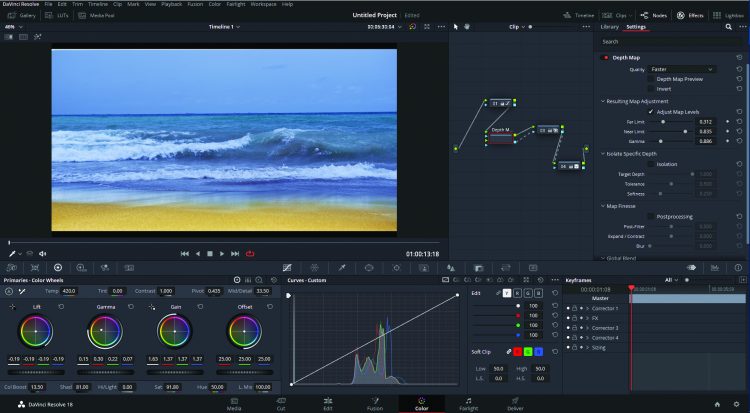
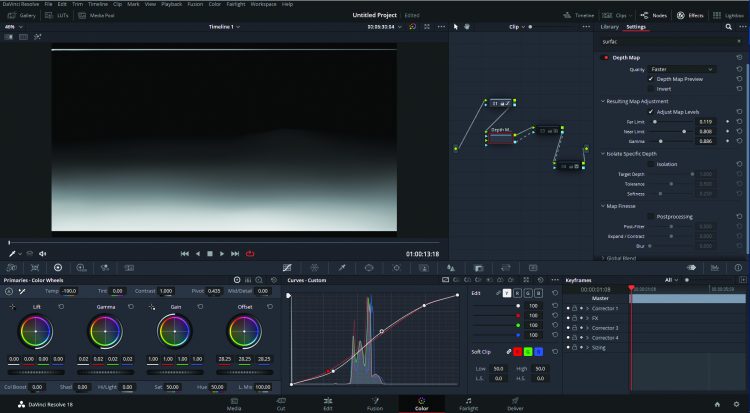
Another addition, the Depth Map, is a crucial tool we didn’t know we needed until it emerged. Taking full advantage of the neural network AI, it analyses the scene in 3D and creates a depth map showing the background, middle and foreground in the form of a greyscale map – the foreground will be bright white, the middle will be off-white, almost grey, and the background will be dark grey and black. If I want to colour grade something more intensely in the foreground, for example the sand in a beach scene, I apply the Depth Map, wait for it to be generated, then colour that foreground sand more intensely.
As you can see in the example, the beach sand is very saturated, and you can see that reflected in the depth map. Additionally, if I want to make the horizon more blurred, I can then choose to affect only the middle portion of the map, add a blur effect – and done. I have manipulated the scene with a few small steps.
This is a very powerful tool, as it gives users the ability to be more deliberate about their colour grading and saves quite a bit of time from no longer having to apply a window mask to that section, then grade it. The only caveat is that Depth Map is slightly more processor-intensive.
Surface Tracker brings a new world of possibility to the Colour page. Users can now easily add logos or graphics, and even cover up certain elements of a frame. The tracker works by analysing the depth within the scene, then creating a mesh with multiple tracker points. Using those, you can easily attach a logo to the side of a moving car, for example. This is a handy feature to have on the Colour page, as it saves you from switching to the Fusion page, or using other software applications such as Adobe After Effects to manually add a logo.
There are other small enhancements; for example, the Beauty effect now has an added Ultra Beauty option giving colourists more control over detail recovery, texture recovery and the strength of the beauty filter, with more room to finesse the effect. Previously, I had issues where sometimes the models within my scenes looked far too pasty and I kept having to adjust back and forth to find the right balance. Now, however, it’s easier for me to adjust the smaller details, creating a smoother finish to my look and grade.
Despill is another great addition. This tool makes cleaning up images faster and easier; working on the RGB colour scale, users can now remove any colour spill. When keying green/blue screens, the Keying panel prevously offered a despill section, but it wasn’t always that handy. With this tool, cleaning up the spillover of any colour is now super easy.
Another cool new feature is Fast Noise, a handy effect giving users the ability to create fractal noise effects, adding noise to a scene and even mimicking the movement of waves and heatwaves. Simply add the effect to your desired node and adjust the settings as required.
Every editor knows that audio can make or break an edit. Adding effects, music and even vocals is an essential part of bringing any scene to life. When working on multiple timelines, you come across some effects that can be used in multiple edits. Typically, we copy-and-paste them between timelines, or even re-add them into timelines and rework everything and the settings.
Now, however, Blackmagic has given us the ability to drag one audio timeline into another; this comes into your timeline as a precomposed file. When you decompose the file, all those effects are in your current timeline, with all its settings and placements. This is especially handy when working on projects that require similar audio; instead of getting lost in the world of copying, pasting and re-adding, just easily add in the timeline and continue with your work.
Overall, I think Blackmagic has really thought about how its users – colourists, editors, audio engineers or even VFX artists – perceive their workflows. Using that knowledge and insight, it has upgraded the software to make a tool that is truly all-in-one and a major contender in the world of production.

Login to your account below


Fill the forms bellow to register


Please enter your username or email address to reset your password.

source

Popcast Live! The New Faces of 2022 – The New York Times

Advertisement
Hosted by Jon Caramanica. Produced by Pedro Rosado.
Send any friend a story
As a subscriber, you have 10 gift articles to give each month. Anyone can read what you share.
For the first live taping of Popcast, held at Gertie in Brooklyn, members of The New York Times pop music team explored the ways music is evolving today by highlighting some of this year’s breakout stars. The conversation touched on the British rapper Central Cee, the Bronx drill rapper Ice Spice, the country-folk singer Zach Bryan, the alt-rock revivalist Blondshell, the haunted pop crooner Ethel Cain and more.
The conversation included debate about what makes for innovation in the crowded and confusing pop music marketplace in 2022, and an audience Q. and A. session touching on Taylor Swift, the persistence of physical media and much more.
Guests:
Joe Coscarelli, The New York Times’s pop music reporter
Caryn Ganz, The New York Times’s pop music editor
Connect With Popcast. Become a part of the Popcast community: Join the show’s Facebook group and Discord channel. We want to hear from you! Tune in, and tell us what you think at [email protected]. Follow our host, Jon Caramanica, on Twitter: @joncaramanica.
Advertisement

source

Acquisition financing arranged for new Joint Venture on Kansas City multihousing community – Yield PRO magazine

JLL Capital Markets secured the acquisition financing for the 180-unit Walnut Tower in downtown Kansas City, Missouri
JLL Capital Markets announced that it has arranged term acquisition financing for Walnut Tower, a 180-unit, high-rise multihousing community located in downtown Kansas City, Missouri.
JLL represented the borrower, a joint venture between Peakview Investments and Infinite Waters, to secure the seven-year, interest-only, fixed-rate loan through Freddie Mac Multifamily. The loan will be serviced by JLL Real Estate Capital, LLC, a Freddie Mac Optigo lender.
Built in 1963 and fully renovated in 2012, Walnut Tower features studio, one- and two-bedroom floorplans. Community amenities include a clubhouse, a roof terrace with cityscape views, fitness center, lounge, package service and controlled access, among others.
The property presents an opportunity for significant potential, as Walnut Tower is a Class B asset in an A+ location. The joint venture has programmed a comprehensive business plan to further position Walnut Tower as the premier attainable housing community in downtown Kansas City. The business plan includes renovations to unit interiors and common area activation, along with a change of management.
“We are ecstatic to launch our joint venture with Walnut Tower,” said Josh Simon, Principal of Infinite Waters. “The asset and its position in the market really resonated with our acquisition criteria and investors. We are eager to start executing our business plan and enhancing our resident’s home experience.”
“JLL provided us great financing options in a very turbulent time,” said Jonathan Polster, Founder & Principal of Peakview Investments. “JLL helped us navigate these choppy capital markets by laying out all our financing options to ensure we were in position to make calculated investment and financing decisions that aligned with our business plan on Walnut Tower. We had a tremendous experience with the JLL Capital Markets team lead by William Haass.”
Situated at 722 Walnut St., Walnut Tower is ideally located in the high-growth and revitalized Downtown Kansas City submarket. The Property is central to many of Kansas City’s largest employment centers, notable retailers and a vast array of entertainment amenities. Walnut Tower is walkable to the burgeoning Kansas City River Market, offering waterfront shopping and distinctive gourmet dining options, along with the Power and Light District, which is one of Kansas City’s top entertainment districts. Walnut Tower is also positioned directly adjacent to the coveted KC Streetcar Line, providing residents convenient access to sought-after Downtown destinations.
The JLL Capital Markets Debt Advisory team representing the borrower was led by Director William Haass.
“Walnut Tower is a great example of how buyers can still achieve accretive financing in the current environment,” said Haass, “The property’s natural affordability made it an exceptional candidate for agency financing, with both Fannie and Freddie offering numerous credit waivers on their initial quotes, allowing for Peakview Investments and Infinite Waters to take advantage of an accretive blend of interest-only term and proceeds.”
JLL delivers multihousing investors a full range of solutions through one diverse, integrated platform. The division employs approximately 400 professionals who provide comprehensive investment sales and disposition services with access to thousands of domestic and foreign investors. JLL is also one of the nation’s largest affordable and conventional multi-housing and seniors housing lenders with comprehensive loan underwriting, asset management and loan servicing capabilities. Agency/GSE lending and loan servicing are performed by JLL Real Estate Capital, LLC, a wholly owned indirect subsidiary of Jones Lang LaSalle Incorporated. Loans made or arranged in California are pursuant to a California Financing Law license.
JLL Capital Markets is a full-service global provider of capital solutions for real estate investors and occupiers. The firm’s in-depth local market and global investor knowledge delivers the best-in-class solutions for clients—whether investment and sales advisory, debt advisory, equity advisory or a recapitalization. The firm has more than 3,000 Capital Markets specialists worldwide with offices in nearly 50 countries.

source

University of Illinois Urbana-Champaign to Launch Professional Master of Computer Science Degree with the Discovery Partners Institute in Chicago – Illinois Computer Science News

Start Here
Start Here
Learn More
Gargi Balasubramaniam, Emmanuel Gallegos, Ryan Marten, Samraj Moorjani, and Xueqing Wu were named to the 22nd class of Siebel Scholars, recognizing their commitment to academics and influencing future society.
Read Full Story
News | September 23, 2022

New certificate program for college graduates who want a deeper understanding of computers, algorithms, and programming.
Learn More
Make a Gift
9/22/2022 11:00:53 AM Aaron Seidlitz, Illinois CS
The University of Illinois Urbana-Champaign is launching a new Professional Master of Computer Science degree in Chicago with the Discovery Partners Institute (DPI), designed as a path for CS students to continue their education and accelerate their careers.
The Grainger College of Engineering’s Computer Science graduate program, ranked 5th in the nation by U.S. News & World Report, has begun accepting applications for its first cohort of 20 students to start in the Chicago location in January. Among the program’s notable alumni include founders and leaders of C3.ai, Malwarebytes, Match.com, Netscape, Optimizely, PayPal, YouTube, and Yelp.
“The University of Illinois Urbana-Champaign CS program is growing strategically to meet the tremendous demand for a world class CS education,” said Nancy M. Amato, Abel Bliss Professor of Engineering and University of Illinois Computer Science Department Head. “By offering this Professional Master of Computer Science degree in Chicago, we are providing a unique opportunity for our students to make connections with and contribute to the Chicago tech community.”
Connections throughout the state understand the opportunity ahead and support the growth of computing education.
“Here in Illinois, we know that innovation is critical to economic prosperity,” said Governor JB Pritzker. “With this new Professional Master of Computer Science degree program at DPI in Chicago, the next generation of computer science students will be prepared for the jobs of the future—all while contributing to the economic sustainability of our great state. This first-rate program is also accessible, thanks to a hybrid model, and will greatly increase diversity in the tech world. This is what I call a partnership at its finest.”
“The University of Illinois Urbana-Champaign has produced some of the world’s brightest minds in the tech industry, and I am so excited that students right here in our city will be able to join their ranks,” said Chicago Mayor Lori E. Lightfoot. “I applaud the effort of this new program to tap into Chicago’s talent pool and look forward to seeing the incredible innovations the inaugural cohort will create.”
The program will be hosted at DPI, a unit of the University of Illinois System, which aims to propel Chicago into a pre-eminent and inclusive tech economy over the next decade.
“As a Grainger Engineer myself, I know that having a talent pipeline between Urbana-Champaign and Chicago  — for faculty and students alike — will only make our state stronger,” said Bill Jackson, executive director of the Discovery Partners Institute. “The labor market is at its tightest in recent memory, and demand for computer scientists is skyrocketing. The addition of this program creates a clear next step for UIUC graduates to stay in state and get another degree from one of the best computer science programs in the world.”
The Professional Master of Computer Science degree program, which does not require the GRE, includes 32 hours of graduate coursework led by world class CS faculty from UIUC. They will be teaching student cohorts in-person or through an online hybrid model at DPI. 
“Bringing our world-class CS program to Chicago is just one way Grainger Engineering is broadening participation in computing and attracting new talent to Chicago and the State of Illinois,” said Rashid Bashir, Dean of The Grainger College of Engineering. “Our drive and influential ideas will address the needs of diverse professional learners in Chicago and create a new pathway for them to forge their own commitment to excellence, teamwork and success in computing.”
International applicants are advised that the Spring 2023 MCS program in Chicago is available only to those who do not require a valid student visa. However, the program is expected to be available to all applicants at a future time. The application deadline is October 31, 2022.
“This new program connects two pieces of the University of Illinois System to help meet the growing need for top-flight computer scientists in Chicago and across the state,” U of I System President Tim Killeen said. “This partnership is a great example of just one way the system is working to develop the kind of sustainable economic future that will benefit all Illinoisans.”
Department of Computer Science

Thomas M. Siebel Center for Computer Science
201 North Goodwin Avenue MC 258
Urbana, IL 61801-2302

Illinois Computer Science in Chicago
200 South Wacker Drive, 7th Floor
Chicago, IL 60606

The Grainger College of Engineering
University of Illinois

ph: 217-333-3426 (general) | 217-333-4428 (advising)
fax: 217-333-3501

General email: [email protected]
Graduate Advising: [email protected]
Undergraduate Advising: [email protected]
Webmaster: [email protected]

Thomas M. Siebel Center for Computer Science
Illinois Computer Science in Chicago
200 South Wacker Drive, 7th Floor
Chicago, IL 60606
The Grainger College of Engineering
University of Illinois
ph: 217-333-3426 (general) | 217-333-4428 (advising)
fax: 217-333-3501
General email: [email protected]
Graduate Advising: [email protected]
Undergraduate Advising: [email protected]
Webmaster: [email protected]
Copyright
Privacy Policy
Powered by SiteManager | Contact Webmaster

source

Spirit of Sharon Jones lives on at Colemine Records' raucous return to the Bay – 48 hills – 48 Hills

Sponsored link

Crowd-pleasing funk and soul took the Independent, courtesy of Kendra Morris, GA-20, and the local Monophonics.
We are approaching the six-year anniversary of Sharon Lafaye Jones’ death, and her influence and ability to make quality blues, funk, and soul—sounds and genres from a previous era—relevant in a digitally-concentrated musical marketplace continues to grow. Her group Sharon Jones and the Dap-Kings established Brooklyn’s Daptone Records as a prime place of discovery for new sounds on high-quality vinyl from an independent label.
Terry Cole, founder, and owner of Loveland, Ohio’s Colemine Records credits Jones’ Dap-Dippin’ LP as the catalyst for his own imprint’s beginning.
“It’s sort of the LP that sent me down the path I’m currently on,” stated the label boss in a 2021 interview with VWMUSIC. “I heard it when Rob at Rama-Lama Records in Toledo, OH played it for me and it was like he opened Pandora’s box. I had no idea records could still be made like that. I already had a deep interest in music production and label operations, but hearing that record was the final kick for me to make a move.”
Fast forward to 2022, and Cole’s label makes nothing but records like the ones he heard that day.
Now home to numerous gospel, jazz, disco, blues, and R&B artists, Colemine Records is on tour this fall. The label’s acts Kendra Morris, GA-20, and the Bay-Area-based Monophonics made a sold-out crowd of 500 tattooed, tie-dyed, flannel-clad, Travis-Bickle-mohawked, flowers-in-their-hair young and not-so-young maidens at The Independent shout, sweat, and nearly pass out.
This was a party, I swear to you. All revelers enjoyed the low-key, semi-“white girl wasted” atmosphere.
Those mentioned above, the “long day in Golden Gate Park” pleasure-seekers, kept the joy meter at a spry 9.5 while the artists rolled out three hours of sublime jollification. Saturday, September 17 was a Colemine takeover, and everybody concerned was having all parts of it.
And why not? Live music these days, as a cause for excessive celebration, is pretty much all we got.
Every tax-deductible donation helps us grow to cover the issues that mean the most to our community. Become a 48 Hills Hero and support the only daily progressive news source in the Bay Area.
Morris opened the show, with a strong contingent of Kendra-heads talk-shouting “you sing-it girl” and “I know of what you speak,” in support (and in my ear), cheer-yapping along to many of the lyrics on her Nine Lives comeback/evolution record from this past February. The response caught the artist in such a humble and grateful way that she got pumped up, telling the audience, “San Francisco, you never let me down,” discarding her shawl, and dominating the anthemic “Who We Are.” It sent Morris and her adoring throng of devotees into fits as she unfurled that ginormous voice from such a deceptively minute frame.
Next, the blues.
The GA-20 Trio, named after a vintage Gibson amplifier, put the foot to the pedal and ripped through a firecracker set of tunes brimming with the spirit of Muddy Waters, Howlin’ Wolf, and, of course, Hound Dog Taylor. Don’t even think about comparing them to the Black Keys.
This self-described “Chicago blues band from Boston,” whose motto is “if you don’t like the blues then you are listening to the wrong shit,” kept it old-world marshy with a snarling gait.
The Monophonics hit the stage with horn line and multiple backup vocalists just after 11 p.m. Lead vocalist, producer, and vibe merchant Kelly Finnigan launched into “Sage Hotel” like an ex-paramour. Upon its no-introduction cold open, the band’s committed following erupted, reacquainting themselves with its onstage persona after a two-and-a-half year local performance lapse because of—well, you know.
With the full house straight-rocking to soul-tinged arrangements that begged legs and asses to move it, all came together and made sense. Of course, this is the band that features the guy who Al Bell, renowned boss of Stax Records, once described as, “One of the greatest live soul bands I have ever seen!” You can see why Cole, who first heard about Finnegan from a hip hop artist who was speaking on Finnegan’s superior production chops, eventually made the falsetto vocalist the label’s unofficial West Coast A&R.
Finnegan has the ability to read a room, address it by way of song, and march it in circles.
That isn’t sweat dripping from his brow onto his paisley shirt—it’s gravitas and showmanship, which erupt between a fender Rhodes, organ, and Mellotron.
The Monophonics came with the ’70s gritty horn charts, engaging call-and-response songwriting, and background vocalists who we’d all like to hear from more often. Performing the fetching ballads “Broken Boundaries” and heart-string-puller of a track “Suffocating,” it became clear: Sharon Jones’ endowment, her time-traveling soul, live on quite well with this imprint.
48 Hills welcomes comments in the form of letters to the editor, which you can submit here. We also invite you to join the conversation on our Facebook, Twitter, and Instagram. 

Sponsored link

48hills.org is the official publication of the non-profit San Francisco Progressive Media Center.
We are community supported journalism. Become a member.
Special Sections

Best of the Bay
Bay Guardian Archives
Cart

Connect

Become a Member
Newsletter
Advertise
Privacy Policy
Contact

source

GREAT PERFORMANCES: Intimate Apparel – KPBS

Friday, Sept. 23, 2022 at 9 p.m. on KPBS 2 / Sunday, Sept. 25 at 2 p.m. on KPBS 2 / On demand with PBS Video App
Set in Manhattan in 1905, GREAT PERFORMANCES “Intimate Apparel” tells the story of Esther Mills (Kearstin Piper Brown), a single African American seamstress who makes elaborate corsets and ladies’ undergarments. After beginning a letter-writing relationship with a mysterious laborer on the Panama Canal, she marries, but discovers the relationship is not what either of them expected. Through this romance and other interactions with friends, one of her clients, and the Orthodox Jewish man who sells fabrics to her, Esther realizes that only her self-reliance will see her through life’s challenges. Featuring music by Ricky Ian Gordon, a libretto by Pulitzer Prize winner Lynn Nottage based on her play, and direction by Tony winner Bartlett Sher,
Sung in English from Lincoln Center Theater’s Mitzi E. Newhouse Theater, the production was recorded in March 2022. The opera was developed by Lincoln Center Theater and the Metropolitan Opera as part of the Met/LCT New Works Program. GREAT PERFORMANCES “Intimate Apparel” cast also includes Justin Austin (George Armstrong), Adrienne Danrich (Mrs. Dickson), Arnold Livingston Geis (Mr. Marks), Naomi Louisa O’Connell (Mrs. Van Buren), and Krysty Swann (Mayme).
Watch On Your Schedule:
GREAT PERFORMANCES is available for streaming concurrent with broadcast on PBS.org and the PBS Video App, available on iOS, Android, Roku streaming devices, Apple TV, Android TV, Amazon Fire TV, Samsung Smart TV, Chromecast and VIZIO.
Credits:
A production of Lincoln Center Theater and the Metropolitan Opera in association with The WNET Group, GREAT PERFORMANCES “Intimate Apparel” is directed for television by Gary Halvorson and produced by Louisa Briccetti and Victoria Warivonchik; Tim Martyn is music producer, Mia Bongiovanni is supervising producer, and Peter Gelb and Adam Siegel are executive producers. The opera was developed by Lincoln Center Theater and the Metropolitan Opera as part of the Met/LCT New Works Program, a co-venture between the two institutions which is dedicated to developing new opera and music theater works. For GREAT PERFORMANCES, Stephanie Dawson is post-production producer, Bill O’Donnell is series producer and David Horn is executive producer.

source

UNIFIED Music Group – Production Coordinator (US/AU) – Music Business Worldwide

Where music’s future is unfolding with unlimited potential. UNIFIED Music Group is the soundtrack of good people working together to achieve extraordinary results.
We are a globally renowned multi-service music company, providing a range of services including artist management, recorded music, publishing, live events and merchandise to a diverse roster of local and international artists.
With offices in Sydney, Melbourne, Los Angeles, London and Toronto our team is global and so are the opportunities for new talent and seasoned executives within the business.
Career progression within UNIFIED isn’t rare, it’s expected. If you grow, we do too. At UNIFIED, you will work with some of the biggest Australian and international acts on the world stage. They partner with us to build their careers, while we help you build yours.
UNIFIED Music Group is seeking a Production Coordinator to be based in either our Melbourne or LA office. This role will assist the Recorded Music division in Production services across the board, facilitating the growth and expansion of a fast-growing Independent Label. This role reports to the General Manager, UNIFIED Recorded Music.
Guided by our deep passion for music, artists and the independent music community, we lead a professional, innovative and motivated team to achieve those extraordinary results.
Our culture is collaborative, flexible, inclusive and diverse. We care deeply about our people, and the legacy we are creating for the next generation.
We believe in building a workplace that works for you. Some of the benefits that our people enjoy are:
UNIFIED Music Group would like to acknowledge the Wurundjeri, Gadigal & Boon Wurrung people of the Kulin & Eora nations, and recognise their continuing connection to the Country on which we work from and are present on. We also pay our respects to First Nations Elders past and present, and continue to embrace the learnings and culture First Nations people so generously share.
We pride ourselves on being an equal opportunity employer, with a focus on ensuring that we are engaging with and supporting the local and international communities which are close to the heart of the UNIFIED Music Group Impact Committee.
Music Business Jobs is the most effective way for the global music industry to find the best candidates for their open positions.
In addition to being seen by over 300,000 monthly unique readers online, our listings are also emailed direct to more than 50,000 professional subscribers every week – across the US, UK, Europe, Asia-Pacific and beyond.
Click through below for details on how to submit a Music Business Jobs listing – and learn why our advertisers ‘strongly recommend’ us to their peers…

source

Gonzales approves 2022-23 master rate and fee schedule – Gonzales Inquirer


The Gonzales City Council approved the 2022 Master Rate and Fee schedule during the Thursday, Sept. 8 meeting.
The following rates will be increased and/or added for the 2022 schedule:
• Commercial Construction: Base permit fee increased to $100. Last year: $75.
• Plumbing: Base permit fee increased to $70. Last year: $50
• Other: additions: Certificate of occupancy ($82.50) and rectification that includes inspection ($10)
• Subdivision; addition: zoning verification letter ($100)
ELECTRIC:
• Residential Services: residential minimum monthly bill with no consumption increased to $7.61, residential customer charge increased to $7.61, along with residential energy charge per kwh increased to 0.05154.
• Residential – master metered multiple dwelling units: minimum monthly bill in increase to $7.61, customer charge increase to $7.61 and energy charge per kwh increase to 0.051554.
• Medium Commercial and Industrial – demand less than 20 kw and greater than 200 kw: Customer charge increase to $20.29, demand charge per KW increase $5.07 and Energy charge per kwh increase to 0.03480
• Large Commercial & Industrial – Demand less than 200 KW and greater than 3500 KW: Customer charge increase to $152.18 CP, demand charge per KW increase to $7.68 and Energy charge per kwh increase to 0.02191
• Large Commercial & Industrial Demand less than 3500 KW: Customer charge increase to $202.91 CP demand charge per KW increase to $7.36, and Energy charge per kwh increase 0.02019
• Security Light Installation: Led Lighting increase to $235
WATER:
• City Residential/Commercial/ Industry Monthly Minimum Bill (INCREASE ACROSS THE BOARD):
• Customer Charge for a 3/4″ Meter -City Base Rate $15.88
• Customer Charge for a 1″ Meter -City Base Rate $25.22
• Customer Charge for a 1.5″ Meter -City Base Rate $32.69
• Customer Charge for a 2″ Meter -City Base Rate $48.57
• Customer Charge for a 3″ Meter -City Base Rate $74.73
• Customer Charge for a 4″ Meter -City Base Rate $112.09
• Customer Charge for a 6″ Meter -City Base Rate $233.53
• Customer Charge for a 3/4″ Meter -Rural Base Rate $17.78
• Customer Charge for a 1″ Meter -Rural Base Rate $28.25
• Customer Charge for a 1.5″ Meter -Rural Base Rate $36.62
• Customer Charge for a 2″ Meter -Rural Base Rate $54.40
• Customer Charge for a 3″ Meter -Rural Base Rate $83.68
• Customer Charge for a 4″ Meter -Rural Base Rate $125.52
• Customer Charge for a 6″ Meter -Rural Base Rate $261.49
Tier Rates Non-Industrial (Increase across the board):
• 1 to 5,000 -City Rate per thousand $3.22
• 5,001 to 10,000 -City Rate per thousand $3.59
• 10,001 to 25,000 -City Rate per thousand $3.97
• 25,001 to 50,000 -City Rate per thousand $4.34
• Over 50,000 -City Rate per thousand $4.64
• 1 to 5,000 -Rural Rate per thousand $3.60
• 5,001 to 10,000 -Rural Rate per thousand $4.02
• 10,001 to 25,000 -Rural Rate per thousand $4.44
• 25,001 to 50,000 -Rural Rate per thousand $4.87
• Over 50,000 -Rural Rate per thousand $5.20
Tier Rates Industrial -Industrial defined as meter 2″ or greater:
• 1 to 5,000 -City Rate per thousand $3.22
• 5,001 to 10,000 -City Rate per thousand $3.59
• 10,001 to 100,000 -City Rate per thousand $3.96
• 100,001 to 1,000,000 -City Rate per thousand $3.21
• Over 1,000,000 -City Rate per thousand $2.99
• 1 to 5,000 -Rural Rate per thousand $3.60
• 5,001 to 10,000 -Rural Rate per thousand $4.02
• 10,001 to 100,000 -Rural Rate per thousand $4.44
• 100,001 to 1,000,000 -Rural Rate per thousand $3.61
• Over 1,000,000 -Rural Rate per thousand $3.35
• Bulk water: Bulk Water Rate per thousand gallons $14.36
–SEWER–
Dwelling Containing Only One Unit -Per Month:
• Residential (Winter Avg.) City Rate $13.46 per month, plus $1.73 per thousand gallons water used based on winter average with a $39.13 maximum monthly sewer charge
• Residential/Commercial (New) Dwelling City & Rural Rate $21.30 until such time a winter average can be established
• Water Meter Fee Schedule – Living Unit Equivalents (LUEs) per meter size meter installation fee – minimum/base fee – if actual cost (construction including labor) exceeds base fee, customer shall pay actual cost (construction including labor)
Dwelling Containing Two or More Units:
• City Base Rate $21.30 per month/per unit
Industrial -Industrial defined as meter 2″ or greater
• City Base Rate $24.66 per month, plus $2.70 for each 1,000 gallons of water used
Store/Commercial Establishment, Not Otherwise Classified
• City Base Rate $13.46 per month, plus $1.73 per thousand gallons water used based on
winter average with a $39.13 maximum monthly sewer charge Apartment City
• Minimum Charge Per Unit $24.66
• Volumetric Charge $0
School:
• City Base Rate $13.46 per month, plus $1.68 per thousand gallons water used
Rural Dwelling Containing Only One Unit
• City Base Rate $18.50 per month, plus $1.73 per thousand gallons water used based on
winter average with a $44.73 maximum monthly sewer charge
Rural Dwelling Containing Two or More Units
• City Base Rate $21.50 per month/per unit
Rural Industry:
• City Base Rate $30.27 per month, plus $2.92 for each 1,000 gallons of water used.
Rural Store/Commercial Establishment, Not Otherwise Classified
• City Base Rate $18.50 per month, plus $1.73 per thousand gallons water used based on winter
average with a $44.36 maximum monthly sewer charge.
Urban Commercial (Shopping Centers and Ice Plants)
• City Base Rate $21.30 per month/per unit
Housing Authority Units:
• City Base Rate $16.82 per month/per unit
SEWER LINE CAMERA INSPECTION
• $300 first hour, $150 for each additional
GARBAGE RATES
Residential Urban- Monthly Fee for 96 gallon cart
• Curbside Service once per week, includes one bulky a year $16.05
• Extra Trash Cart $7.13
Residential Rural- Monthly Fee for 96 gallon cart
• Curbside Service once per week $18.59
• Extra Trash Cart $7.13
• Recycle every other week $12.40
Commercial Hand Pickup- Monthly Fee for 96 gallon cart
• Curbside Service once per week $37.86
• Extra Trash Cart $37.86
• Recycle every other week $12.62
• Recycle every week $25.24
GOLF COURSE
• Water Sales $1.00 (NEW)
• Concession $0.92 (NEW)
• Gatorade $1.39(NEW)
• Monday – Thursday Green Fees (9 holes) for Veterans, military and seniors $10 (NEW)
• Friday – Sunday Green Fees (9 holes) for Veterans, military and seniors $12(NEW)
• Monday – Thursday Green Fees (18 holes) for Veterans, military and seniors $15 (NEW)
• Friday – Sunday Green Fees (18 holes) for Veterans, military and seniors $17(NEW)
• Cart Rental 9 holes $12 (NEW)
• Cart Rental shared by 2 golfers – each $6 (NEW)
• Cart Rental with 1 golfer $8.50 (NEW)
• Cart Rental with 1 golfer and 1 rider $12 (NEW)
• Cart Rental 18 holes $20 (NEW)
• Cart Rental shared by 2 golfers – each $10 (NEW)
• Cart Rental with 1 golfer $15.00 (NEW)
• Cart Rental with 1 golfer and 1 rider $20 (NEW)
• Scramble on Wednesday has twilight fee (NEW):
• Green fee $5
• Cart $5
Other items that may interest you

View this issue
Browse other issues
Recent additions enhance Brothers Memorial Library
Underground Water Conservation District extends permit hearing
GHS Foundation holds triumphant 5F Gala
Savay Sexton retires green jacket
Main Street discusses veteran banners
GISD speaks about Apache All STAAR initiative
Gonzales Chamber excited to promote heritage tourism, city’s bicentennial
Commissioners approve sheriff, constable fee changes
Gonzales City Council approves new tax rate
Gonzales approves 2022-23 master rate and fee schedule


622 St. Paul,
Gonzales, TX 78629
(830) 672-2861
gonzalesinquirer.com

source

‹ Previous Next ›