
Tampa International Airport holds second meeting outlining master plan WFLA
source

KIRCO has celebrated the completion of Monark Grove Clarkston, a 148-unit senior housing community in Clarkston, Mich. Beztak will operate the 189,000-square-foot community under the Monark Grove brand.
Monark Grove Clarkston features 77 independent living units, 22 memory care units and 49 assisted living units. The property encompasses studio, one- and two-bedroom floorplans ranging between 441 and 1,346 square feet.
Common-area amenities include an art studio, pickle ball and bocce courts, a state-of-the-art fitness center, a library, a salon and barbershop, a pub and a bistro, garden areas and an outdoor fireplace. In-unit amenities consist of high-end interior finishes, stainless-steel appliances, washer and dryers, large windows, as well as patios or balconies.
The community’s French-country inspired architectural style promotes social engagement, while providing live entertainment along with opportunities to attend classes and lectures.
Located at 7373 Sashabaw Road, the 17-acre site is near Interstate 75, which provides direct access to downtown Detroit. There are many dining options, retail spaces and entertainment venues in the property’s proximity. Green areas such as Independence Oaks County Park and Orion Oaks County Park are within a 5-mile radius from the community.
Oakland County Commissioner Karen Joliat and Executive Director of the Clarkston Area Chamber of Commerce Jennifer Fair Margraf attended the ribbon-cutting event.
A $72.5 million project for a mixed-residence senior living campus in Holland, Mich., is currently underway. Earlier this year, Resthaven broke ground on the property, which will feature single-family homes, duplexes and multifamily apartment buildings. Construction is expected to be complete in 2024.
The latest multifamily news, delivered every morning.
Like what you’re reading? Subscribe for free. Subscribe
© 2022 – Multi-Housing News Online

Credit: CONTRIBUTED PHOTO
Credit: CONTRIBUTED PHOTO
Music has been part of Issa Ali’s life since a young age but he continues to find ways to expand his skillset. The Yellow Springs-based rapper recently discussed his decision to add some new weapons to his creative arsenal on his new album, “Book of Issa: Verse III: Three Birds One Stone.”
Early induction: “My dad bought me a drum set when I was 7 or 8 years old. I used to play for the church choir. I used to have a little keyboard when I was 8 or 9 years old, and I’d be on it all day every day. I started writing rhymes in sixth grade and my friend got a little drum machine around that time. He had a little keyboard, so we learned how to manually program beats together. It’s been a natural evolution and progression of production since then.”
One-man operation: “What’s unique about this album, I actually recorded it myself in my own studio. Of course, I made the beats, wrote and mixed and mastered it myself. This album was a complete, 100 percent, Issa production. There are very few dope artists and producers who do both at a high level. That gives me a lane that’s unique. Plus, I love it. I love making beats. I love writing rhymes. I love performing. They came up simultaneously and all work together hand-in-hand.”
Fluid evolution: “I started watching these little YouTube tutorials on how to mix and master to learn more about the process. I just needed to know the technical things like what plug-ins, settings and knobs to use. Once I figured that out, it was pretty much all by ear. I feel like I already have a natural ear as a producer. It was just time for me to do that part of it and I just basically kept making songs. I cut 20 or 30 songs off of it. It’s just in me. I can’t help it. It just always runs through me.”
Embracing the process: “I found my ears in every part of making these songs and, for me, that gave it more life. That’s kind of the nerdy part of it, in a way, but I enjoy knowing how to do it. I feel like it gave me a level of freedom I’ve always wanted in my expression of art and music. Now, I don’t have to worry about anything. I can put music out anytime I want.”
Contact this contributing writer at 937-287-6139 or e-mail at [email protected].
About the Author
Don Thrasher, a native of Gadsden, Alabama, has been a weekly contributor for the Dayton Daily News since 2003. He covers national and international music, performance and art. Don is a versatile writer, who has interviewed ballet dancers, professional athletes, authors, comedians, filmmakers, rodeo clowns and other disparate figures.

EQ Resources (EQR) has appointed a drilling contractor for its upcoming phase two drilling program at its Mt Carbine project in North Queensland.
DDH1 Drilling will complete 23 planned holes for over 3000 metres to target the potential for the phase three pit extension following phase one drilling in the Dyke West Zone and a recently updated bankable feasibility study (BFS).
The BFS expanded the mine life to 14.5 years with “impressive” economics, including a net present value of $210 million and an internal rate of return of 397 per cent.
The BFS was also enhanced by a recently-announced 29.3 per cent upgrade in open pit ore reserves, resulting in a 15 per cent higher tungsten concentrate.
“We are now prioritising further resource drilling on the projected Western Extension of the Mt Carbine orebody with a view to expanding the near-pit mine reserves. Any successful results from the drill campaign could be quickly brought into life-of-mine planning,” EQ CEO Kevin MacNeill said earlier this month.
While drilling will primarily focus on the Western Extension of the project, the company will also follow up on discoveries from the phase one program.
A single hole will aim to determine the orientation of the high-grade zone found in a phase one drill hole which returned 5.95 metres at 0.94 per cent tungsten. The company believes the high-grade zone plunges west and has the potential to add to the future underground assessment.
More holes will be drilled at the Iron Duke system to investigate the outcropping Ruby Vein and the high-grade Crown Vein outcrops.
“All of the upcoming drilling has a strong value-add focus on life-of-mine, area definition and orebody extension,” Mr MacNeill concluded.
Field works will commence later this month and EQ Resources expects drilling will wrap up by the end of February next year.
EQR shares were trading at 4.5 cents at 11:01 am AEDT.

The award-winning BBC topical comedy, The Skewer, uses experimental digital audio mixing techniques to give a different slant on current events
The Alliance for IP Media Solutions has re-elected all members of the AIMS Board to serve throughout 2023
The event incudes a salute to the BBC’s centenary
The new features eliminate unnecessary manual data re-entry
The AV distributor says it is adopting a new way of helping broadcasters make the switch to digital infrastructures
The partnership with Sportradar allows real-time sporting data in audio ads
Latest News
Skewering the news with sound technology
Board of Directors AIMS high in 2023
Radio TechCon 2022 releases session program
Marketron adds new time-saving features to REV platform
AV Worx bridges the digital divide in South Africa
Adthos Creative Studio adds real-time sporting data
Australia metro ad revenue up again
Wheatstone adds folder sharing to VoxPro
WorldDAB ready to roll in London
Walking the talk
LONDON — When Douglas Adams created the original radio series of The Hitchhiker’s Guide to the Galaxy in 1978, he wanted it to sound like a rock album. Instead of the traditional “Door slam A, door slam B, footsteps on a gravel path and the odd comic boing,” Adams thought the voices, music and effects should seamlessly orchestrate to “create a coherent picture of a whole other world.”
BBC studio managers achieved this using analog recording and digital effects equipment of the time. Today, 44 years later, digital audio workstations such as Avid Pro Tools featuring the latest processing plug-ins allow writers and engineers to create imaginative and otherworldly soundscapes faster and far more easily. Audio program makers exploiting this technology include comedian and writer Jon Holmes. His dark topical comedy, The Skewer, has won awards for its unsettling, twisted manipulation of news clips, edited together with jarring juxtapositions over a montage of sound effects and music.
From its pilot episode in 2019 and first full series the following year, The Skewer has been recognized not only for its material — being nominated in the Chortle Awards 2019, winning second place for Best Radio Podcast at the British Podcast Awards 2020, silver at the New York Festival Radio Awards 2021 and gold two years running for Best Comedy at the Radio Academy Awards (2021 and 2022) — but also the audio production. Awards include Best Sound Designer (gold) for Holmes and his technical partner Tony Churnside in the Audio Production Awards 2020, the Sound Art award at the New York Festival Radio Awards 2020, and silver in 2021.
Churnside’s technical creative prowess emerged when he worked for BBC R&D at its MediaCityUK labs in Salford, where he was involved in developing object-based audio for radio production. After that, he went freelance.
Holmes’ company, Unusual Productions, produces The Skewer for BBC Radio 4 and now BBC Sounds as a podcast. Holmes has been a regular name and voice for the broadcaster since the late 1990s, appearing on another topical comedy, The Now Show, and creating and co-presenting Listen Against with newsreader Alice Arnold. That show took clips from news bulletins and re-edited them for satirical and comic effect, a technique now used in The Skewer. Holmes comments, “radio has always been my thing” and that he has “always played with sound.” This is reflected in his taking a degree in English with radio, film and television at Canterbury Christ Church University, where he also worked on student station C4 Radio (now part of CSR 97.4FM).
The Skewer has won awards for its unsettling, twisted manipulation of news clips, edited together with jarring juxtapositions over a montage of sound effects and music.
In coming up with The Skewer, Holmes wanted to take the style of Listen Against further. Gone is the linking material from a presenter, with the different items flowing into each other. The approach is similar to Chris Morris’ cult insert Blue Jam, broadcast on BBC Radio 1 during the late ’90s, which was a succession of sketches performed by actors mixed over a bed of ambient music. The Skewer has the same seamlessness style, but assembles the different segments using speech clips from other programs, playing complementary music and effects in between or behind.
“Jon’s pitch for The Skewer was a ‘satirical river of sound,’ but also a topical comedy,” comments Churnside, “which threw me a little.” Despite that, Churnside soon came up with a methodology for assembling and producing the program, which, as well as featuring Holmes’ material, encourages listeners to contribute segments, either as finished “soundscapes” or ideas that Churnside manipulates.
Another element of The Skewer that sets it apart from other radio comedy shows is that it features binaural techniques. Consequently, the show encourages people to listen on headphones as elements of the sound move or appear from different directions. “We use a mixture of stereo and binaural elements,” says Churnside.
“I mix the show using a pair of Sennheiser HD25 headphones; we gear the whole thing towards headphone listening. In general, I’m not a fan of pure binaural as that limits some of the phasing and doubling stereo effects I use in The Skewer. For example, I might take one or two of the keywords from a sound bite, pan them hard left and right and time stretch one slightly to introduce a weird but very wide ‘phasey’ effect. This can be overused, but stuff like this has become a signature of The Skewer’s sound.”
However, there are some instances where Churnside uses pure binaural elements, which are either recorded within the format or binaurally panned. An example of the former is from a few series ago, which featured a door knock that was a binaural dummy head recording. “Even after spending hours mixing it, whenever I heard the knock, I’d turn my head thinking someone was knocking on my studio window,” Churnside laughs. “Sometimes I use binaural panners too, but as our delivery format is a two-channel/stereo file, we can only work with static binaural without any clever head tracking. Until we can deliver in object-based audio, we are stuck to using sparing bits of static binaural.”
Holmes and Churnside mix and edit the show in Pro Tools. Contributions arrive in various formats, including Pro Tools sessions, GarageBand, Audacity and, sometimes, iMovie, either emailed with links to online clips or via Dropbox or WeTransfer. “One of the biggest challenges with The Skewer workflows is just how many formats we work with,” says Churnside. “We have to get everything into Pro Tools as a multitrack, then unpick a lot of it and stitch it back together. It’s from lots of different people, but the art is making it all feel like it belonged to the same program while keeping it immersive, flowing and funny.”
Holmes comments that the aim is to create a single long narrative. “Things have a rhythm and click together,” he says. “It’s about auditory illusions, with sounds going together. The actual news itself is almost secondary to the overall sound, but they still have to work hand-in-hand.” Finished shows are sent to the BBC as WAV files using Signiant Media Shuttle, after which the broadcaster loads them into its playout system.
The author trained as a radio journalist, worked for BFBS Radio as a technical operator, producer and presenter before moving into magazine writing during the late 1980s. In recent years he has got back into radio through his involvement in an RSL station where he lives on the south coast of England.
author
17 Nov. 2022 – How to Sell Your Podcast | Walking the Talk | Bauer Media Sees Red
10 Nov. 2022 – Sound Quality in a Spin? | WorldDAB Summit Speakers | AIMS Casts its Net
3 Nov. 2022 – Why Beasley is Booming | Radio Attention Study Results | DAB+ Growth in Czech Republic
27 Nov. 2022 – North Korea Doubles DRM Output | WorldDAB Announces Summit Host | Radio TechCon Bursaries
20 Oct. 2022 – Self Regulation in Africa | DTS Autostage Adds Insights | Genelec’s Charity Auction
13 Oct. 2022 – VivaCité’s Visual Revamp | Sunshine Coast’s Trusted Tech | ‘Best in Show’ Awards Guide
6 Oct. 2022 – The People’s Podcast | Why Australian Radio Thrives | The DRM Receiver Riddle
29 Sept. 2022 – Rádio Renascença’s Creative Approach | Rethinking Radio | International Podcast Day
22 Sept. 2022 – Accomplished Acoustics | Partners in AI | Women in Music Production
15 Sept. 2022 – RTL Deutschland’s Balancing Act | Reconnecting at IBC2022 | RedTech Award Winners
8 Sept. 2022 – Preserving Culture in War | RNZ Resumes Shortwave | Aussie Youth Listenership Up
1 Sept. 2022 – IBC’s Welcome Return | Aussie Commercial Radio Grows | Johan Boqvist on Simplifying Broadcast Workflows
25 Aug. 2022 – Wellness Radio | Simplifying Broadcast Operations | NZSO Lawo Refit
11 Aug. 2022 – TOPRadio’s Overhaul | The Digital Audio-First Strategy | UK Radio Audiences Embrace Digital
11 Aug. 2022 – TOPRadio’s Overhaul | The Digital Audio-First Strategy | UK Radio Audiences Embrace Digital
4 Aug. 2022 – Tiny Island FM Goes Global | TV Guides Radio Compliance | Barber Takes Helm of Inovonics
The acquisition of Red FM strengthens the operator’s position in the country
After almost 40 years, the vinyl LP is returning to radio, bringing its supposed “warmer” sound. But are vinyl’s audio benefits inflated?
For Caroline Beasley, declining radio audiences are part of a natural shift
RedTech International SAS
250 bis boulevard Saint-Germain
75007 Paris, France
+33 5 55 18 03 61
[email protected]

Rachel Martin
Reena Advani
Kaity Kline
Barbra Streisand in 1963, one year after the recording of her performance at The Bon Soir. WWD/Penske Media via Getty Images hide caption
Barbra Streisand in 1963, one year after the recording of her performance at The Bon Soir.
Barbra Streisand was just 18 years old in 1960, the year that she started singing at a club in Manhattan called The Bon Soir. Recordings of her made there just a couple of years later were supposed to comprise her debut album; in the end, they were shelved in favor of studio recordings, an environment she says she prefers anyways.
Now, 60 years after Streisand’s unbridled performance there, we get to hear the exceptional young talent in a remastered collection of those 22 songs (and two interstitial tracks) titled Live at the Bon Soir.
“I remember, it was the first time I felt the warmth of a spotlight,” Streisand recalls in a conversation with Morning Edition‘s Rachel Martin. Singing though, she explains, was secondary to her acting ambitions. “I did it to pay the rent.”
This interview has been edited and condensed. To hear the broadcast version of this conversation, use the audio player at the top of this page.
Rachel Martin, Morning Edition: The rendition of “Cry Me a River” on this album – you brought things I’ve never felt or heard in that song before.
Barbra Streisand: Well because you heard anger. In other words, there was an exercise I learned in acting class about creating a face of someone that you had certain feelings for. So the exercise, at the beginning of the song, was creating this person’s face in my mind, so it was very specific. Like, now this person comes back in my life and says “I made a mistake and we never should have broken up,” well, you know, screw you! That’s what I decided to use, and that turned into my rendition of “Cry Me a River.”
So… where does the confidence to be that person come from?
I don’t know – my mother thought I would never make it, she tried to make me cut my nails and learn how to type. That’s when I was 13, 14. I grew my nails longer so I never could learn how to type.
She kept saying to me: “Well you’ll get a nice job, you’ll work in the school system.” My father was a teacher, you get summers off, you get Christmas off. It’s a great job!
But here’s what I don’t understand: You’re channeling your theater skills, you have all of this confidence, despite the fact that your mom sort of didn’t believe that you could do this. How does that make sense with your lifelong aversion to performing publicly?
That’s interesting, isn’t it? I don’t want to get nervous! I get nervous being judged – I didn’t have that when I was young and trying to prove that I could be somebody. And then all of a sudden it becomes now you’re being judged, you know, if you get older and your voice is not as pure or this and that. And I thought, maybe I was just proving something to myself. That I could be somebody.
In truth, I just don’t like performing. I had to do it to make something of myself, but I would much rather be in a recording studio just with my little team. You don’t have to worry about what gown you’re gonna wear, you don’t have to worry about your makeup, you don’t have to worry about your hair… you just sing. It’s me and the music.
What is your relationship to performing these days? Or just singing, does singing bring you joy still?
Singing brings me joy when I can – well when I sing with my granddaughter … she knows all the songs from Frozen.
Barbra, you could crush “Let It Go.” [Laughs] Are you pleased with how everything turned out? When you think about that version of you singing?
I have much gratitude. It’s so astounding, how we become a being, alive in this world to do what we can to make it a better place. [There is] a Jewish philosophy, called tikkun olam, it means to “repair the world.” In other words, we are indoctrinated with that purpose in life, to make the world a better place. I like repairing the world, if I can. In any small way I can.
Sponsor Message
Become an NPR sponsor

Issue 390 of Future Music is out now MusicRadar
source

15/11/2022
In the second quarter of 2022, EU economy greenhouse gas emissions totalled 905 million tonnes of CO2-equivalents (CO2-eq), a 3% increase compared with the same quarter of 2021. The documented increase is largely related to the effect of the economic rebound, which can be drawn from gross domestic product (GDP) growth, following the sharp decrease in activity due to the COVID-19 crisis.
This information comes from data on quarterly estimates for greenhouse gas emissions by economic activity published by Eurostat today. Quarterly estimates of greenhouse gas emissions complement quarterly socio-economic data, such as GDP or employment. This article presents a handful of findings from the more detailed Statistics Explained article on quarterly greenhouse gas emissions.
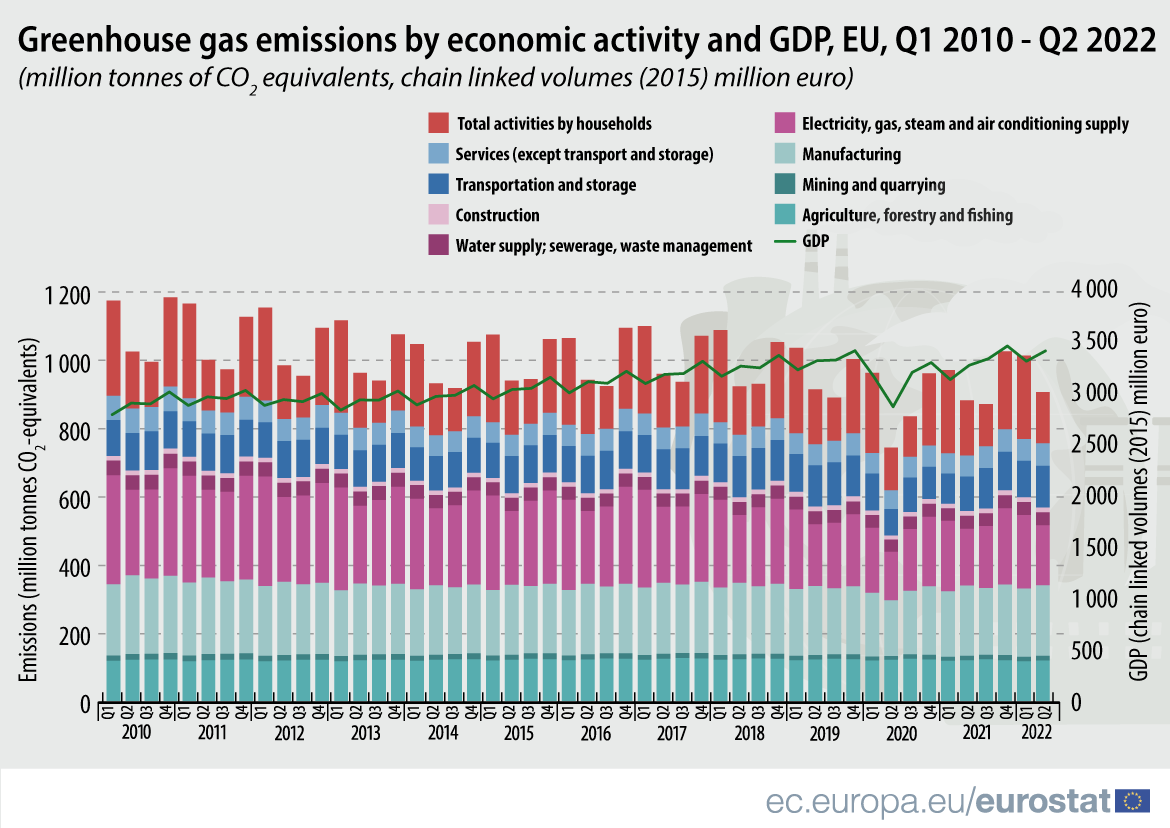
Source datasets: env_ac_aigg_q and namq_10_gdp
In the second quarter of 2022, the economic sectors responsible for the most emissions of greenhouse gases were ‘manufacturing’ (23%), ‘electricity, gas supply’ (19%) and ‘households’ (17%), followed by ‘transportation and storage’ (14%) and ‘agriculture’ (13%).
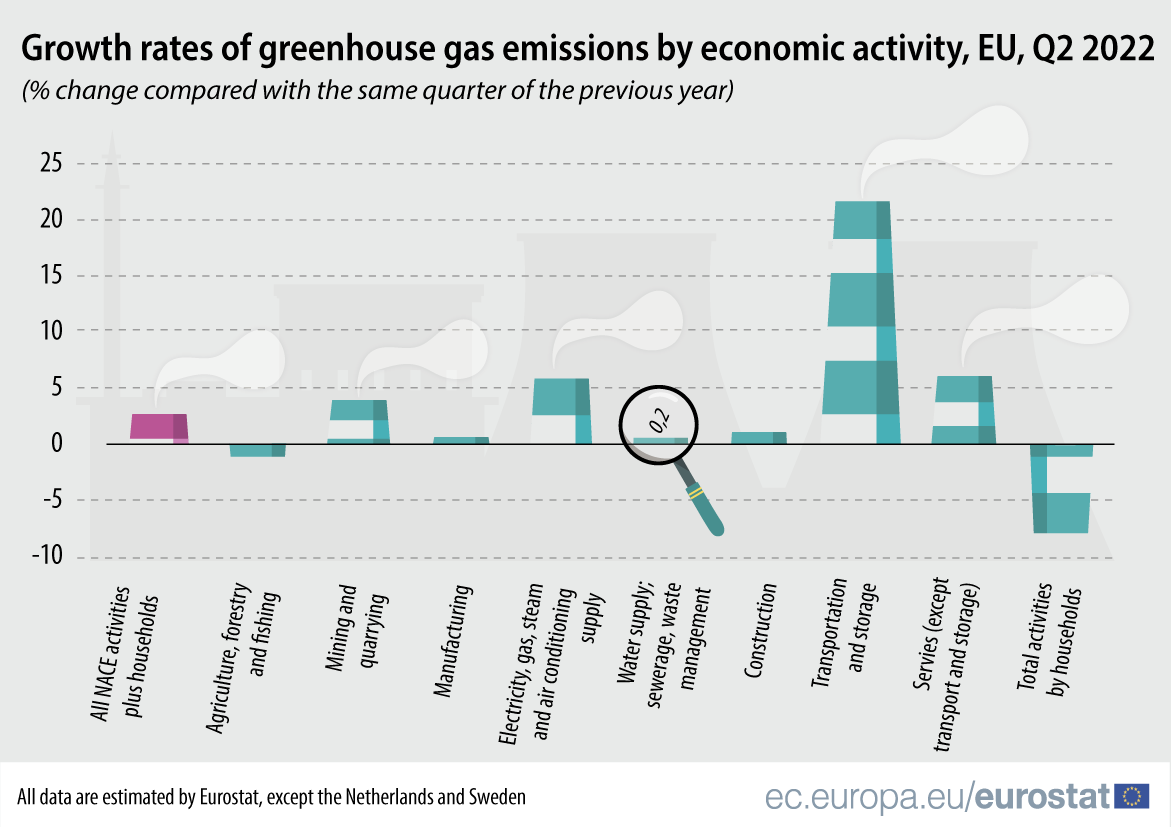
Source dataset: env_ac_aigg_q
Greenhouse gas emissions increased in most sectors compared with the same period of 2021, except for ‘households’ and ‘agriculture’, which decreased by 8% (-13 million tonnes of CO2-eq.) and 1% (-1 million tonnes of CO2-eq.), respectively. The highest increases were recorded in ‘transportation and storage’ (+22% or 22 million tonnes of CO2-eq.), ‘electricity, gas supply’ (+6% or 10 million tonnes of CO2-eq.) and ‘services’ (+6% or 4 million tonnes of CO2-eq.)
For more information:
Methodological notes:
To contact us, please visit our User Support page.
For press queries, please contact our Media Support.
Thank you for your feedback.
We are sorry to hear that. You can report the issue here.
Thank you for the information. We will investigate the issue.
Was this page useful?
News
Data
Publications
About us
Opportunities

Ivory Coast Caps Pasta, Meat, Milk Prices to Fight Inflation
Slow to the EV Game, Foreign Car JVs in China Face Bleak Future
California Strike by 48,000 Academic Workers Flexes UAW’s Muscle
Musk Starts Twitter Poll on Reinstating Ex-President Trump
Twitter Staff Wipeout Under Musk Spurs Fear Site Will Decay
Gamers Seek Fame, Riches in World’s Next Esports Hub India
Kamala Harris Announces San Francisco as 2023 APEC Host City
Kamala Harris Briefly Meets Xi Jinping as US-China Tensions Ease
Grindr’s Biggest Investors Are Billionaires on Stock Surge
Reselling Taylor Swift Tickets? You’re Going To Have To Pay Taxes
The US Is Unlikely to Score Many Goals in the World Cup — You Can Bet on It
These 10 Artworks Total $958 Million in Unprecedented November Sales
Whoever Tweets Last, Don’t Forget to Turn Off the Lights
Crypto’s Coffin Is Not Quite Nailed Shut Yet
The UK Already Has a Nasty Wealth Tax
Sears Limps Through What Could Be Its Final Holiday Season
Why Europe’s €2.75 Trillion Renovation Wave Is Falling Flat
A Nation in the Crosshairs of Climate Change Is Ready to Get Rich on Oil
Pay Gap at Nike Persisted After Changes, Lawsuit Alleges
Lawsuit Filed Against FDA to Block Access to Abortion Pill
California Utility Warns of Potential Shutoffs Due to Fire Risk
Slow to the EV Game, Foreign Car JVs in China Face Bleak Future
Maya Lin on Art, Architecture, Landscape and Memory
A New Gallery Hopes to Rival the Louvre, the Tate — and Sydney’s Beaches
New York Cannabis Farms Have $750 Million of Weed — and Nowhere to Sell It
GOP’s Hawley Wants Democrats’ Emails as FTX Collapse Turns Political
Crypto Traders in US Surged 149% to 2.3 Million as Pandemic Hit
Sam Bankman-Fried’s Island Haven Is Drawing Scrutiny After FTX Demise
Vildana Hajric and
Isabelle Lee
US stocks ended with a slight gain Friday after shrugging off Federal Reserve warnings that there was more policy tightening to come. Oil futures fell on signs that the market is currently awash in supply.
The S&P 500 Index added 0.5% Friday to finish the week down 0.7% and the Nasdaq 100 fell 1.2% in the five-day period. Trading volumes was muted throughout Friday’s $2.1 trillion options expiration, normally a day when volatility spikes as traders and dealers rebalance their big exposures.

Latest grants bring annual total of Opportunity Fund awards to more than $600,000
CHARLOTTE, N.C. (Nov. 17, 2022) — The City of Charlotte's Arts and Culture Advisory Board on Tuesday awarded more than $264,000 in grants to 16 projects by local artists and groups. The awards come from a portion of the Infusion Fund known as the Opportunity Fund, which supports local arts and culture projects, programs and initiatives that may fall outside existing grant cycles or structures in the Charlotte-Mecklenburg area or that need supplemental support.
Opportunity Fund grants have been available on a rolling basis through an open call and awarded monthly. The November round of awards brings the total amount of these grants awarded in the current fiscal year 2023 (July 2022 to June 2023) to more than $600,000.
"The Opportunity Fund is innovative, not only for the Charlotte-Mecklenburg area, but in the nation," said Priya Sircar, the city's arts and culture officer. "Local artists and organizations are developing and carrying out projects all the time — not just during established grant cycles. We are so pleased to use this unique tool to meet their needs in a timely manner so their good work can benefit our community."
Access to Move by Dance Artist Alliance CLT
Program to support local dancers through subsidized rehearsal studio space.
Grant amount: $6,000.
Arko & the Moon Immersive Exhibit by Arko and Luvly Moon
Fully immersive art installation that blends the imaginative worlds of local artists Arko and Luvly Moon to give viewers the opportunity to step into and explore the art in a different way.
Grant amount: $20,000.
BOOM Echoes: Engage by BOOM Charlotte
A series of engagements, workshops and classes, culminating in two festival-style events, that feature local artists and amplify the stories and voices of immigrants and refugees in east Charlotte.
Grant amount: $25,000.
BreatheINK Youth Poetry Slam Initiative
Initiative to establish poetry clubs and poetry curricula in six Charlotte-Mecklenburg high schools in the 2022-2023 school year.
Grant amount: $5,000 for project planning.
Collaboration by Charlotte Art League and Charlotte Lab School's Co Lab
School-based programs for students to create inclusive and uplifting creative experiences that strengthen their sense of identity, history and belonging.
Grant amount: $26,000.
Community Impact Film Series Pilot Program by the Charlotte Film Society and the Independent Picture House
Inaugural film screening for the series, showing "My Ascension," a documentary about a 16-year-old's suicide attempt and her subsequent mission of suicide prevention.
Grant amount: $9,000.
Craft Workshops by Craft & Trade Academy
Grant amount: $12,500.
Detention Center Poetry and Art Program by Guerilla Poets
Twice-a-week poetry workshops for adults at the Mecklenburg County Detention Center Central, and a monthly art workshop for teens in juvenile detention.
Grant amount: $11,564.
Durag Fest by Dammit Wesley and Lica Michelle
Juneteenth festival celebrating the creativity, ingenuity and diversity of Black communities through art, fashion, food and music.
Grant amount: $20,000.
Healing Through Art by the Social Justice Center
Community events to bring healing to local artists and marginalized people through yoga and meditation, music, visual arts and spoken word.
Grant amount: $5,000 for project planning.
Historic West End Partnership and Concert Performance by the Charlotte Symphony Orchestra
A full symphony performance in the historic West End in 2023 in collaboration with Johnson C. Smith University.
Grant amount: $20,000.
Music Everywhere CLT by Charlotte Center City Partners Community Trust
A new music conference to establish Charlotte as a regional hub for music and to inspire Charlotteans to value music as an essential element of the city's identity.
Grant amount: $10,000 now, and another $30,000 if matching funds are also raised.
Queen Charlotte Chorus
New competition costumes for the nonprofit educational chorus for women, which performs and promotes a cappella and barbershop music.
Grant amount: $2,500.
Recording Inclusivity Initiative by WDAV Classical Public Radio
Professional recordings and broadcasts of works by three community-nominated composers from underrepresented communities.
Grant amount: $22,000.
The "Afterschool" Audio Engineering Masterclass by Nigel Malone of Colorful Noise
Free introductory classes that teach people audio mixing and mastering, and music production, and to give aspiring engineers access to professional expertise and equipment.
Grant amount: $15,000.
The Arts Empowerment Project by Promoting Peace + Justice and Encounters Life Skills Seminar
Programs to help children who have experienced or been impacted by violence or trauma find their voices, learn social and emotional skills, and heal through art.
Grant amount: $25,000.
Advisory board members initially allocated roughly $400,000 for the Opportunity Fund in the current fiscal year. When the open call launched in early September, it met a strong response. The city and the advisory board received 82 grant requests in September and October. Most were deemed eligible and qualifying applicants were invited to submit full proposals for further evaluation.
The board awarded Opportunity Fund grants in September and October, leaving about $64,000 to award in November.
The board's vote on Tuesday awarded the remaining funds as well as another $200,000 to projects that were evaluated and recommended for funding by a smaller working group of the board. The full board felt comfortable with the additional awards because more than $350,000 would still be available in the Infusion Fund for the current fiscal year.
The board is now assessing the Opportunity Fund's progress to date and fine-tuning the grant request process to prepare for potential new funding opportunities in the remainder of fiscal year 2023.
The Infusion Fund is a partnership of the city, Foundation For The Carolinas and private donors to support arts and culture through June 2024.
Visit the city's arts and culture web pages to find the full list of past recipients of the Opportunity Fund and the larger Infusion Fund.

Play Now
Football Pick’em
Play Now
College Football Pick’em
Start or Sit (NFC Home Games)
U.S. Soccer Podcast
The top of the Pac-12 standings are a convoluted mess with just two weeks remaining in the 2022 college football regular season. Five teams with either one or two losses in league play still have a shot at reaching the conference title game. Two of those teams still alive, No. 10 Utah and No. 12 Oregon, will meet Saturday night in a pivotal game between teams with identical records of 8-2 and 6-1 in the Pac-12.
Two of the last three meetings between these teams have been in the Pac-12 Championship Game, and though a title is not on the line this time, it’s a big matchup nonetheless. Utah is seeking back-to-back Rose Bowl appearances, and Oregon is trying to finish strong under first-year coach Dan Lanning following last week’s heartbreaking loss to Washington.
The Utes dominated Oregon twice last season by a combined margin of 76-17, including a 38-10 beatdown in last year’s Pac-12 Championship Game. That turned out to be the last game for the Ducks under coach Mario Cristobal, who left for the Miami shortly thereafter. Utah has kept on chugging under 18th-year coach Kyle Whittingham, and this game will provide Oregon a chance to see if it has closed the gap in one season under Lanning.
Bo Nix’s health: The status of Oregon star quarterback Bo Nix is up in the air for this game after he appeared to suffer a knee injury late in last week’s loss. Nix missed a key series after the injury, though he did return for the Ducks’ final possession of the game. Lanning explained this week Nix is “preparing himself as if he can go,” but added that “we also got some other guys ready to go if needed.”
Nix has completed completed 72.8% of his passes for 2,774 yards, 24 touchdowns and just five interceptions while enjoying a renaissance season after three up-and-down years at Auburn. He’s also run for 512 yards and 14 touchdowns. If he can’t play, redshirt freshman Ty Thompson would likely step in. Thompson has completed 18 of 35 passes for 159 yards, two touchdowns and three interceptions in nine career appearances.
Win and you’re in: The Pac-12 scrapped division standings this season and for the first time will send the two teams with the best league record to its title game. For Oregon and Utah, it’s simple: Win your last two regular-season games and you’re in. That will be more challenging for the Ducks, however, as they must play at No. 23 Oregon State next week in a rivalry showdown. Utah is on the road next week as well, but it’s against a Colorado team that is just 1-9 entering Week 12 action.
Oregon’s poor pass defense: Oregon’s pass defense is a glaring weakness; the Ducks rank No. 127 nationally in passing yards allowed at 289.7 per game. Washington capitalized on Oregon’s weak secondary last week, but doing so may be more challenging for Utah. While 6-foot-4 receiver DeVaughn Vele and tight end Dalton Kincaid are excellent pass-catchers, the Utes aren’t known for airing it out. But if quarterback Cam Rising can hit some deep balls in this game and open up the box for Utah’s rushing attack, it would go a long way toward helping the Utes rack up points.
Date: Saturday, November 19 | Time: 10:30 p.m. ET
Location: Autzen Stadium — Eugene, Oregon
TV: ESPN | Live stream: fuboTV (Try for free)
Utah dominated Oregon in two meetings last season, and it’s not clear whether the gap has closed. While first-year Ducks’ coach Dan Lanning and offensive coordinator Kenny Dillingham have quarterback Bo Nix playing at an elite level, the Utes will be the most physical team Oregon has faced since a Week 1 loss to Georgia. Nix’s status is also uncertain after he suffered an injury in the fourth quarter of last week’s loss to Washington. That defeat eliminated Oregon from the College Football Playoff conversation, and it will be interesting to see if the Ducks remain highly motivated to play for a Pac-12 title. Prediction: Utah -2
Which college football picks can you make with confidence in Week 12, and which top-20 teams will go down hard? Visit SportsLine to see which teams will win and cover the spread — all from a proven computer model that has returned almost $3,000 in profit over the past six-plus seasons — and find out
© 2004-2022 CBS Interactive. All Rights Reserved.
CBS Sports is a registered trademark of CBS Broadcasting Inc. Commissioner.com is a registered trademark of CBS Interactive Inc.
Images by Getty Images and US Presswire
LEILA FADEL, HOST:
While world leaders have been talking about limiting global warming at the U.N. climate summit, Afghanistan has been moving in another direction and ramping up its production of coal. Mining for that coal is dangerous and sometimes deadly. And as NPR’s Arezou Rezvani reports, in Afghanistan, kids often do much of the work.
(SOUNDBITE OF MUSIC)
UNIDENTIFIED MUSICAL ARTIST: (Singing in non-English language).
AREZOU REZVANI, BYLINE: You don’t have to travel too far outside of Kabul to see signs that coal is king in Afghanistan’s economy these days.
So we left Kabul just a couple of hours ago. We’re about to make our way through the Hindu Kush mountains on these backbreaking roads built to buy the Soviets years ago. And already we’re passing truck after truck after truck, all of them full of coal. Some are carrying so much, it’s just spilling over the sides. When the old Afghan government collapsed last year, its economy collapsed with it. Foreign governments withdrew billions of dollars in economic assistance when the Taliban returned to power. Now, after a year of isolation, the cash-strapped Taliban government is increasing its coal production and exports to fill the void. And those bringing that coal to market aren’t who you’d expect.
(SOUNDBITE OF FOOTSTEPS ON GRAVEL)
REZVANI: We’ve driven through mountains, through riverbeds, and we’re now walking this final stretch to get to the coal mines. And headed in the other direction, headed down the mountain are a lot of miners with coal dust all over them. And some of these faces we see are quite young.
It’s not uncommon to see children work hard jobs in poor countries – in factories, farms or food stalls. But the scene atop this mountain is still astonishing. Inside a narrow tunnel, the distant, faint glow of headlamps appears first.
FAZEL: Be careful here.
REZVANI: OK.
As we go deeper, the young faces come into focus.
UNIDENTIFIED CHILD #1: (Speaking Dari).
REZVANI: Older boys are swinging pickaxes, digging for coal. Some are busy fixing wood beams for the crumbling tunnel walls.
(SOUNDBITE OF WOOD BEING SANDED)
REZVANI: The younger boys escort coal-laden donkeys out of the mines. Among them is 12-year-old Mansour. When he emerges from this mountain’s womb, the boys outside greet him with a tune from a toy flute. They take turns playing.
(SOUNDBITE OF FLUTE)
REZVANI: It’s a humble celebration for making it out alive, they say.
(SOUNDBITE OF FLUTE)
REZVANI: Like everyone here, little Mansour wears no helmet, no goggles, just a pair of cheap rubber shoes he sliced open to air out his little black toes peeking out.
MANSOUR: (Speaking Dari).
REZVANI: “My workday starts at dawn,” he tells me. He shepherds donkeys up and down this mountain for 10 hours a day.
MANSOUR: (Speaking Dari).
REZVANI: “The work’s not hard,” he says, but he looks bone tired. His delicate hands are black and calloused.
ABDUL: (Speaking Dari).
REZVANI: Much of the coal Mansour takes down is carried out of the earth by older boys, like Abdul Salaam. He’s 17 and already a veteran of these lands.
ABDUL: (Through interpreter) I’ve been working here most of my life. I started working in these mines when I was 9.
REZVANI: The child labor that existed under the old government has grown worse in the last year. The Taliban government wants to fix that. But with an economy in shambles, more families are sending younger kids here, says Jawad Jahed, the engineer who oversees this mine for the government.
JAWAD JAHED: (Through interpreter) Kids under 18 aren’t supposed to work here. But our people are so poor, families have no choice. They send their children to work because they need the money. And it’s hard for us to turn them away.
REZVANI: The boys earn a few dollars for a day’s work. It’s a strong, steady wage in these cruel economic times, even if it comes at great risk. Heavy rains last winter caused one of the tunnels here to collapse. A dozen workers were killed. When I asked 17-year-old Salaam if he’s worried about getting hurt, he shrugs.
ABDUL: (Through interpreter) It is the work of destiny. If it is my destiny to die in these mines, then so be it.
REZVANI: But that destiny may already be taking shape. As the sun sets, we head back down the mountain. A few young miners are sitting on a ledge overlooking this vast, blackened landscape. One of them pulls out the flute.
(SOUNDBITE OF FLUTE)
REZVANI: He plays it for a few seconds. Then he stops.
UNIDENTIFIED CHILD #2: (Speaking Dari).
UNIDENTIFIED CHILD #3: (Speaking Dari).
REZVANI: “Carry on,” the other boys say. But he can’t.
UNIDENTIFIED CHILD #4: (Speaking Dari).
REZVANI: After a long day at the mines, he doesn’t have the breath to go on.
Arezou Rezvani, NPR News, Nahrin, Afghanistan.
(SOUNDBITE OF HARIPRASAD CHAURASIA’S “RAAG BHUPALI”) Transcript provided by NPR, Copyright NPR.

MusicRadar is supported by its audience. When you purchase through links on our site, we may earn an affiliate commission. Here’s why you can trust us.
The Detroit duo making raw, punk-inspired dance music talk us through their studio set-up, synth secrets and “going knob-crazy in patch bay paradise”
Detroit natives Rickers and Ted Krisko are Ataxia, an electronic duo serving up a raw and unfiltered take on dance music that’s inspired by formative years spent in hardcore and punk bands.
The electrifying amalgam of house, techno, breakbeat and rave found on their latest release, Out of Step, is produced using a formidable arsenal of analogue machines, pedals and outboard gear, along with a few strategically deployed stock plugins from their DAW of choice, Ableton Live.
We caught up with the pair to delve deeper into the creative process and studio secrets behind their new album.
When did you start making music, and how did you first get started?
Ted: “Guitar in the early ‘90s was my initial swan dive into all the ruckus. Punk was the first route that had the most immediate gratification. Three chords, sometimes less, sometimes none. Early staples were Fugazi, Nirvana, Black Flag, Minor Threat, and loads of Beastie Boys jams. My cousin gave me an original ProCo RAT distortion fuzzbox – this set the pace early on. My bands recorded on Tascam 4-tracks relentlessly throughout my youth… oh how things come full circle.”
Rickers: “I started making music genuinely when I heard “The Vans Song” by Suicide Machines circa 2002, although I think the original was released in ‘95. They inspired me to make music that was fun, purposefully lacking a “seriousness” that would, by definition, destroy creativity. I played the bass guitar, that was the first instrument, and I was focused on making punk rock!”
Tell us about your studio/set-up.
“We have a couple of spaces we work out of. Our main studio is in Detroit, the My Baby Records HQ… a space we share with our brother till the end, Mister Joshooa. Our collective runs the label and studio. We did a lot of damage out of the past version, but the space is currently under renovation to improve some aspects of the acoustics, and also to build soffits for our mains. Our approach is very modular, in a sense that everything lives on a patch bay, including , and maybe most importantly, the I/Os from the front end and console.”
Our approach is very modular, in a sense that everything lives on a patch bay. It’s fucking amazing going knob-crazy in patch bay paradise
“We are constantly routing and re-routing pedals, rack effects, processing gear… it’s a mess! [laughs] It’s nice though, because we can introduce new equipment on the fly by patching into the console or soundcard on the bay, before making a full commitment as to how or if we will eventually include it in our setup.
“Although there’s no arguing the utility of plug-ins, most of the work is outboard. On one hand, there is no problem with anything in-the-box, it’s all about your ears and the decisions you make about what the sounds are like in your design. On the other hand, it’s fucking amazing going knob-crazy in patch bay paradise.”
“Our second space is a secret lair, stocked with a near carbon copy of the main studio, plus some extra processing and summing equipment, a full array of API outboard rack gear, and a dreamy boutique effects pedal setup: original Boss CH1 & BF2, Mu-Tron Phaser III, Ibanez AD9 Analog Delay with Robert Keeley Baked Mod, Fulltone OCD. Our guitar and bass rigs live here as well… jam station central!”
What DAW (or DAWs) do you use, and why did you choose it?
“Ableton Live. On first take, the processes seemed very user driven as far as depth and control in terms of where to take your experiments. It was more complex than previous DAWs we had early beginnings with, like Fruity Loops and Reason. Richie Hawtin was using Live as a standalone DAW to produce, and as a virtual outboard effects rack for his DJ sets, and does to this day. We took a lot of inspiration from seeing a very in-the-box program used in a very out of the box way.
“Ableton really does have it all – you can set up quick experiments with effects or processing either in line, or through sends/returns, just a few clicks away from your next weird sound! As far as what’s in the box, their instruments are quality stuff! Analog, for instance, is an incredible plug for making a big warm bass tone quickly. In addition to their stock EQs and compressors, plugins like Tension, Operator, and of course the basics like Sampler and Simpler, are all extremely useful and perfect for working on music without needing external instruments or outboard gear at all.”
“And for the noodlers, like us, Max 4 Live brings a whole modular world to the table that really gives users the power to design and deploy their own modules within Ableton’s ecosystem seamlessly. Live has been a steady, reliable beast for us from the earliest days of Ataxia.”
What one piece of gear in your studio could you not do without, and why?
“The Roland SH-101, tried and true. This is the building block of almost every Ataxia song since we first picked up this juggernaut. There is no oddity this synth can’t help you explore. We trigger the 101’s internal sequencer externally with an Elektron Analog Four’s gate out – see our tips section on this one.”
“Handsome Audio’s Zulu. It’s a passive tape emulator. Transformer magic. It’s kind of insane. We started by tracking with it, and quickly moved on to bussing and summing. The results have been extremely pleasing. It truly does what it says on the tin, tape flutter and wow without the hiss.
“We usually track on a Tascam 438 cassette machine, which is wonderfully fussy but sounds incredible. I can’t see tape getting replaced at our studios in any permanent capacity, but for now, it’s been nice running with something new that brings the music to life in a very similar way.
“The Zulu really does get the drums knocking, while smoothing out transients and getting the claps and hats to gel. Time will tell once and for all – will tape continue to reign supreme, or did Handsome Audio crack the code here?!”
What dream bit of gear would you love to have in your studio?
Ted: “A combo of the API 1608 loaded, along with the Studer A827 MCH 2-inch 24-track tape machine, all patched up and ready for controlled chaos in the best possible way.”
Rickers: “Fuck, lots of things, that most likely wouldn’t make music anymore fun. Honestly, my boy Chuck at Paxahau just got this Rigsmith Analog Dub Siren – it’s tight, so maybe one of those next.”
When approaching a new track or project, where do you start?
“Drums are the core of Ataxia’s vibe. Nearly all of our cuts circulate out of a drum machine riff. Our collection is pretty steep: Roland 909, 727, 707, 606, R8 and the Tanzbar MFB, Vermona DRM1, and Elektron’s Rytm MK1 and 2, so we have a good deal of options for how to express that we are both the drummer. Although, despite the machines, sometimes it’s just a good hip hop or breakbeat sample to get up and running… whatever works!”
Once things take too long they stop being fun. When the fun stops, the music usually sucks
“We tend something going on a monosynth next, usually the Roland SH-101. This is routed with a delay pedal in line, which generally helps the vibe for the notes to slap back a little. Polysynth-land usually involves the Sequential Prophet 6, another core Ataxia sound. From there it’s vocals and automation – really not a very long process from start to finish for us.”
“Once things take too long they stop being fun. When the fun stops, the music usually sucks. The music we make relies on translating an energy to people on the receiving end, the goal is to get people to loosen up and have fun. Our punk roots really come through in our process – move quick, or it’s dead in the water. Things that sit around never get finished.”
What are you currently working on?
“We have just dropped Out of Step, our debut album on Life and Death, an Italian label based in Miami, operated by our good friend DJ Tennis. It’s a gatefold, double LP – 12 cuts, clocking in just under 80 minutes. Despite making music together for 13 years, and dropping dozens of singles & EPs, this is Ataxia’s first venture into LP territory. It features good friends and fellow Detroiters Andrés, DJ Minx and Mister Joshooa. Give it a listen and leave a Yelp review.”
“Past this, we have a nice follow-up on deck for Life and Death, plus new material forming for a return to 20/20 Vision, finishing a record for Mike Shannon’s Cynosure. Cooking up something with Paul Woolford / Special Request as well. Honored to work with artists and labels that we hold in high esteem.”
Ataxia’s latest album, Out of Step, is out now on Life and Death.
“It doesn’t take much to get something nice cooking. When producing, don’t overthink “making a hit” or “writing a song” and paint yourself into some corner with expectations attached. For us, making dance cuts, it’s about getting a groove going with a bit of kick, hat, snare… then immediately starting experiments with a couple of pieces of gear until you get something that sounds and feels good. A quick riff on a monosynth, some lush pads on a multi-voice instrument, a triggered sequence lead to coast on top, a tight vocal sample to sprinkle in here or there, and boom, you’re off to the races.”
“Mathew Jonson did some lectures on his setup with the Cirklon triggering the internal sequencer on the Roland SH-101, and it changed the game for how we tackle the midi implementation throughout our studios’ jam stations. That lecture paved the way for a 3D approach to machinery in the Ataxia lab.
“In our studio, any device with a sequencer and a “Trigger Out” becomes a deadly weapon, however complex, reduced to a simple task of sending pulse information to step the internal sequencers on synths like the 101 and Prophet 6. The connection happens with a cable from the external device’s trig out, into “EXT CLK IN” (or something similarly named depending on the synth) you’ll be programming steps into.
“Sync your external device being used to send triggers to a midi clock from your session, and now you’re in the pocket with a completely jazzy approach to jamming your note picks. No longer bound to one dimension of a sequence, you now are at the helm of choosing when the trigger events as steps within the pattern.
“This changes our approach to both how synthesizers are used as modules, and as sequencers, but is a nice work around, as you can even be triggering additional synthesizers that perhaps may not even have an internal sequencer of its own, but can benefit from being downstream from a midi cabling path with a synth prior to it with it’s sequencer being triggered by the external device… because trust us, this style of sequencing is addictive.”
“Automation is crafty, but we as humans, in engineering mode, tend to organize information in some sort of logical, uniform fashion. We’ve found that it’s better to let a device make obscurities and let randomness bring the elements to life. LFOs are technology’s gift to us.
“A beautiful piece of kit to exemplify the LFO’s utility is Vermona’s Filter Lancet. A supreme distortion box melded with a hard-ass LFO, switchable LPF / HPF, pre-volume circuit gain that can quickly overdrive the most sterile of samples into something interesting. Another irreplaceable gem would be the Sherman Filterbank, a major wormhole of odd filtering, modulation and frequency manipulation.”
“Go the distance, see what the knob does, find out what the switch can do for you. These machines were made for us, simply put. If you don’t run experiments you won’t get results.”
I’m the Tech Features Editor for MusicRadar, working on everything from artist interviews to tech tutorials. I’ve been writing about (and making) electronic music for over a decade, and when I’m not behind my laptop keyboard, you’ll find me behind a MIDI keyboard or a synthesizer.
Sequential unveils the Trigon-6, Dave Smith’s final synth: “We believe it continues his legacy”
The iconic Moog Minimoog Model D synth is back in production and looking better than ever
What is the best new electric guitar of 2022?
Don’t miss the latest deals, news, reviews, features and tutorials
Thank you for signing up to Musicradar. You will receive a verification email shortly.
There was a problem. Please refresh the page and try again.
MusicRadar is part of Future plc, an international media group and leading digital publisher. Visit our corporate site (opens in new tab).
© Future Publishing Limited Quay House, The Ambury, Bath BA1 1UA. All rights reserved. England and Wales company registration number 2008885.

Anderson Cooper takes us on a deeply personal exploration of loss and grief. He starts recording while packing up the apartment of his late mother Gloria Vanderbilt. Going through her journals and keepsakes, as well as things left behind by his father and brother, Cooper begins a series of emotional and moving conversations about the people we lose, the things they leave behind, and how to live on – with loss, with laughter, and with love.
Back to episodes list
Anderson is pleased to present the first episode of Audie Cornish’s new podcast: The Assignment… but first a conversation on the intimacy of podcasting with Audie and Anderson.
Fiery Twitter threads and endless news notifications never capture the full story. Each week on The Assignment, host Audie Cornish pulls listeners out of their digital echo chambers to hear from the people who live the headlines. From the sex work economy to the battle over what’s taught in classrooms, no topic is off the table. You can find The Assignment wherever you get your podcasts.
© 2022 Cable News Network. A Warner Bros. Discovery Company. All Rights Reserved. CNN Audio’s transcripts are made available as soon as possible. They are not fully edited for grammar or spelling and may be revised in the future. The audio record represents the final version of CNN Audio.

Thank you for visiting nature.com. You are using a browser version with limited support for CSS. To obtain the best experience, we recommend you use a more up to date browser (or turn off compatibility mode in Internet Explorer). In the meantime, to ensure continued support, we are displaying the site without styles and JavaScript.
Advertisement
Scientific Reports volume 12, Article number: 19437 (2022)
308
1
Metrics details
We present a Brownian dynamics study of a 2D bath of active particles interacting among each other through usual steric interactions and, additionally, via non-reciprocal avoidant orientational interactions. We motivate them by the fact that the two flagella of the alga Chlamydomonas interact sterically with nearby surfaces such that a torque acts on the alga. As expected, in most cases such interactions disrupt the motility-induced particle clustering in active baths. Surprisingly, however, we find that the active particles can self-organize into collectively moving flocks if the range of non-reciprocal interactions is close to that of steric interactions. We observe that the flocking motion can manifest itself through a variety of structural forms, spanning from single dense bands to multiple moderately-dense stripes, which are highly dynamic. The flocking order parameter is found to be only weakly dependent on the underlying flock structure. Together with the variance of the local-density distribution, one can clearly group the flocking motion into the two separate band and dynamic-stripes states.
The interdisciplinary field of active matter1,2,3,4,5, situated at the crossroad of physics, chemistry, biology and engineering, examines individual and collective behavior of units capable of autonomous motion. The units can be diverse, including, for instance, bacteria that use body appendages to swim in viscous media, active colloids that exhibit propulsive motion by generating flow around their surfaces by means of self-phoresis, bird flocks and sheep herds. Many interesting properties of these systems can be captured already with simple models which do not account explicitly for the medium surrounding active units. Instead, on the coarse-grained level the medium serves as a source of fluctuations and drag forces acting on the units. Typically, active units are modeled as particles moving with a roughly constant speed along an orientation vector attached to them6, which can change its direction due to rotational diffusion and inter-particle interactions. On one side of the spectrum, there are models with pairwise interactions. Possibly the simplest example within this class of models involves isotropic active particles interacting with each other via steric interactions, which can lead to the phenomenon of motility-induced phase separation7,8,9,10 (MIPS) between dense particle clusters and dilute regions of freely moving particles. In a nutshell, MIPS takes place when active particles are sufficiently fast and numerous11,12, increasing chances that free particles join existing clusters compared to chances that particles within clusters escape them as a result of rotational diffusion. On the other side, there are models with social interactions13,14. The most notable example within this class is the Vicsek model15, incorporating alignment with average particle orientation of all neighbors situated within some fixed radial distance, which can result in coherent flocking motion16,17,18,19: particles spontaneously form traveling bands propagating along a common direction. Models fusing both type of interactions20 are also found in literature. Furthermore, different types of orientational interactions have been introduced21,22,23,24,25,26,27,28. In this article we introduce a specific form of orientational interactions, which are non-reciprocal and avoidant. We demonstrate how they influence the collective dynamics of our model active particles. The orientational interactions are motivated by the fact that the two flagella of the alga Chlamydomonas interact sterically with nearby surfaces such that the alga experiences a torque, which rotates it away from the surface.
If pairwise interactions stem from a potential, they are reciprocal due to Newton’s action-reaction principle. However, the reciprocity can be broken if the pairwise interaction originates in some non-equilibrium mechanism29. Numerous examples exist in literature, including carpets of microfluidic rotors30, droplets exhibiting predator-prey interactions driven by non-reciprocal oil exchange31, neural networks32,33 and many others34. An eminent example of non-reciprocal interactions from the realm of active matter is found in binary mixtures of active colloids with phoretic interactions35,36,37,38. In essence, colloids with two distinct hemispheres, immersed in a solution containing an appropriate chemical solute, can produce and maintain a local chemical concentration gradient by means of, for instance, self-diffusiophoresis or self-thermophoresis. The chemical gradient implies a hydrodynamic flow of the surrounding solvent, which in turn propels the colloid forward so that the entire system remains force free. Two populations of different active colloids will exhibit a different response to self-generated chemical gradients, leading in general to non-reciprocal interactions, the strength of which can be controlled by varying colloidal mobilities and activities. Interestingly, it has been reported that interplay of hydrodynamics and boundaries can also lead to non-reciprocal interactions30.
In this article we study the collective motion of a 2D low Reynolds number suspension of self-propelled particles displaying non-reciprocal pairwise interactions. The particles perform active Brownian motion with a constant swim speed v and translational and rotational diffusion constants D and (D_{mathrm {R}}). Two types of pairwise interactions are present in the system as we describe in more detail in the “Methods” section. Firstly, the particles interact with each other via repulsive steric forces with a typical interaction range (sigma), which can be interpreted as an effective particle diameter. In the absence of other kind of interactions, the active suspension would be described by two dimensionless parameters: the area fraction (Phi) of active particles and the Péclet number (text {Pe} = vsigma /D). The (text {Pe}) number is the ratio of characteristic times (sigma ^2/D) and (sigma /v) that the active particle needs to respectively diffuse and swim its own size (sigma). In this study we fix (Phi = 0.24) and (text {Pe} = 80) such that the system is in the regime where MIPS occurs.
In addition, the particles exhibit pairwise orientational interactions of short range R, which manifest themselves as torques acting on the particles. Motivated by the avoidant torque, the alga Chlamydomonas experiences close to a surface as explained below, we have formulated the orientational interaction of Eq. (5) in the “Methods” section. If the distance ({mathbf {r}}_{ij}) between the particles i and j is smaller than a cutoff distance R, they are subjected to torques of the amplitude ({mathscr {T}}_0). In the general case, the orientational interaction is non-reciprocal, meaning that the torques (pmb {{mathscr {T}}}_{ij}) and (pmb {{mathscr {T}}}_{ji}) acting on the particles are not equal and opposite, (pmb {{mathscr {T}}}_{ij} ne -pmb {{mathscr {T}}}_{ji}). This stems from the form of Eq. (5) where the torque exerted on particle i depends on its orientation ({mathbf {u}}_i) and the normalized separation vector ({mathbf {r}}_{ij}/|{mathbf {r}}_{ij}|), but not on the orientation of particle j. The interactions are predominantly avoidant in nature. For example, interaction of such form can be motivated by looking at the dynamics of alga Chlamydomonas reinhardtii39. Chlamydomonas propagates itself through the fluid by breaststroke beating of a pair of frontal flagella40 such that its far-field flow topology resembles that of a puller41: the flow is inward along the main body axis and outward in the perpendicular direction. Recent experiments have demonstrated that Chlamydomonas scatter off solid surfaces primarily due to contact interactions42 between their flagella and the surface, while later investigations reveal that hydrodynamic interactions are needed for a complete quantitative description of how algae interact with cylindrical obstacles43. The contact interactions, on which we concentrate here, generate torques44 that avert the algal body from a collision with the surface. To capture this type of interaction, we propose the model described by Eq. (5), in which case (pmb {{mathscr {T}}}_{ij} equiv pmb {{mathscr {T}}}_{i}) would stand for the torque exerted on the particle and ({mathbf {r}}_{ij} equiv {mathbf {r}}_i) for the distance vector of the particle i from the surface. It is now reasonable to suppose that an analog contact interaction through flagella exists among two algae situated close to each other. Since there are no useful experimental insights concerning such interactions between algae, we propose the torque of Eq. (5) as a first approach for describing these interactions, which certainly needs to be refined in future work for a quantitative description. Thus, as the flagellum of one Chlamydomonas touches the cell body of the other, and vice versa, the torques exerted on the algae will be non-reciprocal in the general case. Some typical examples of the encounter of two algae modeled by Eq. (5) are illustrated in Fig. 1, where the orientation of alga i is fixed and eight orientations of alga j are chosen. The directions of the torques acting on both algae and their strengths are indicated by curved red arrows. In particular, the avoidant torque on particle j is maximal if its orientation vector ({mathbf {u}}_j) is perpendicular to the distance vector to particle i (({mathbf {u}}_j perp {mathbf {r}}_{ij})) and, by symmetry, zero for ({mathbf {u}}_j Vert {mathbf {r}}_{ij}). The torque in Eq. (5) can be viewed as a simple and generic form of an avoidant non-reciprocal orientational interaction and, therefore, in the following we explore how it influences the collective motion of active Brownian particles.
A schematic of the encounter between two Chlamydomonas. Their current unit orientation vectors ({mathbf {u}}_i) are depicted in light black, while their directions of rotation upon interactions modeled by non-reciprocal torques from Eq. (5) are displayed in red. As an illustration eight different examples are shown. The torques are non-reciprocal in the general case (hinted by different thicknesses of the red arrows).
We describe active particle motion by a set of coupled overdamped stochastic equations, which are presented in the “Methods” section. Starting from an active suspension exhibiting MIPS as a reference state, we introduce non-reciprocal orientational interactions (5) and using the method of Brownian dynamics conduct a detailed parameter study of collective motion of the resulting active bath as a function of torque amplitude ({mathscr {T}}_0) and interaction range R. As the orientational interactions are predominantly avoidant, one expects disruption of MIPS for strong enough torques ({mathscr {T}}_0), because active particles at the edge of a cluster turn away from neighboring particles and leave the cluster. Even though the disordered state is indeed the most common outcome for strong torques, as the state diagram in Fig. 2 shows, surprisingly, we find that there exists a narrow region in the state diagram, characterized by short interaction range R and moderate torques ({mathscr {T}}_0), where a transition to ordered collective motion occurs. In the ordered state, the particles move in flocks which can take a variety of structures spanning from a compact dense band to a single very dynamic porous band and multiple bands. This is the main result of our study.
State diagram of the system as a function of the non-reciprocal interaction range R and interaction amplitude ({mathscr {T}}_0). The ({mathscr {T}}_0) axis is presented in the logarithmic scale and includes data over the range of five orders of magnitude. Apart from the dispersed state, three ordered states are observed, which we term MIPS, flocking (band) and flocking (dynamic). State boundaries have been sketched by using simulation data, represented by circles of different colors. The system is characterized by (Phi = 0.24) and (text {Pe} = 80). The states of the snapshots presented in Fig. 3 are indicated by enlarged circles.
The article is organized as follows. In the “Results” section we analyze different states appearing in our system and construct the corresponding state diagram in the parameter space of ({mathscr {T}}_0) and R. We elaborate the implications of our findings, suggest possible future experiments, and offer our conclusions in the “Discussion” section. Lastly, the equations of motion of active particles and details of Brownian dynamics simulations are presented in the “Methods” section.
Simulation snapshots of typical states appearing in the system for different interaction strength ({mathscr {T}}_0) and range (R/sigma) as indicated by enlarged circles in the state diagram of Fig. 2. Top left panel: MIPS (({mathscr {T}}_0/k_{mathrm {B}}T = 0.1) and (R/sigma = 2^{1/6})) and top right panel: dispersed state (({mathscr {T}}_0/k_{mathrm {B}}T = 1) and (R/sigma = 2^{1/6})). Middle panel: Flocking (band). Two snapshots of a coherently moving band of active particles (({mathscr {T}}_0/k_{mathrm {B}}T = 10) and (R/sigma = 2^{1/6})) are shown, with a time of (3D_{mathrm {R}}^{-1}) in between them. Bottom panel: Flocking (dynamic). Left: Motion of a moderately dense and dynamically varying stripe of particles (({mathscr {T}}_0/k_{mathrm {B}}T = 100) and (R/sigma = 1.15)). Right: Motion of several dynamically varying stripes (({mathscr {T}}_0/k_{mathrm {B}}T = 30) and (R/sigma = 2^{1/6})). Red arrows denote the direction of coherent motion. In all cases (Phi = 0.24) and (text {Pe} = 80).
The results of our Brownian dynamics simulations are summarized in a state diagram shown in Fig. 2. We observe four distinct states. First, for relatively weak torques, ({mathscr {T}}_0/k_{mathrm {B}}T lessapprox 0.5), non-reciprocal interactions play only a minor role and the active bath exhibits MIPS irrespective of their range R. This regime is illustrated in the top left panel of Fig. 3 and in Video 1. Second, for sufficiently strong torques, ({mathscr {T}}_0/k_{mathrm {B}}T gtrapprox 0.5), and large interaction range R the non-reciprocal interactions prevent motility-induced clustering. A typical snapshot of the resulting dispersed state is shown in the top right panel of Fig. 3. Smaller unstable clusters are visible (see Video 2).
The most interesting behavior occurs when the range of non-reciprocal interactions is close to the range of steric interactions, in our case (R/sigma lessapprox 1.3). For moderately large torques, ({mathscr {T}}_0/k_{mathrm {B}}T gtrapprox 5), one observes a transition to coherent flocking motion of active particles. Depending on the exact parameter choice from this domain, the system can display an assortment of different flocking structures, which we roughly classify into two groups, which we will justify quantitatively below. In the region displayed in orange in Fig. 2 a dense band of particles develops, cruising collectively in a common direction against a dilute background. This state is depicted in the middle panels of Fig. 3. There, a coherently moving band is shown at two time instances, (3D_{mathrm {R}}^{-1}) apart from each other; see also Video 3. In addition to ordered bands, other structurally diverse states displaying coherent motion are possible in the system. Some examples are shown in the bottom panels of Fig. 3, which include a moderately dense stripe and multiple stripes. The dynamics of multiple stripes is shown in Video 4. Other irregular structures are also possible. They share the property that in contrast to the moving band, which always keeps its integrity, the stripes are very dynamic. As we demonstrate now, they can be grouped into one state, which we term flocking (dynamic) and which we show as blue region in the state diagram in Fig. 2.
First, to quantify the degree of order in coherently moving states, we use the average normalized orientation (Psi) of active particles as the polar order parameter
where N is the number of particles in the system. If the individual particles point in random directions, the motion is disordered and the order parameter is approximately zero. On the other side, all particles pointing in roughly the same direction would correspond to (Psi approx 1). In Fig. 4 we plot the polar order parameter (Psi) as a function of torque amplitude ({mathscr {T}}_0) for several interaction ranges R. The highest order (Psi) is realized when the range R of non-reciprocal forces coincides with the range of steric forces (2^{1/6}sigma). Consistent with the findings of Fig. 2, the polar order is vanishingly small for ({mathscr {T}}_0/k_{mathrm {B}}T < 5) in the MIPS and dispersed state. Around this torque value, (Psi) abruptly increases over a narrow torque interval up to values (Psi gtrapprox 0.8). Interestingly, a structural change in the state of coherent motion from a flocking band to other flocking patterns around ({mathscr {T}}_0/k_{mathrm {B}}T = 20) is not accompanied with a change of (Psi), which stays approximately the same for a broad range of ({mathscr {T}}_0) values, see Fig. 4. Increase in the range R of orientational interactions leads to a reduction of order (Psi) in general. For sufficiently long interaction range (in our case (R/sigma gtrapprox 1.18)) we observe that the order (Psi) initially increases with ({mathscr {T}}_0) towards some maximum value, after which (Psi) decreases and eventually becomes vanishingly small with a further increase of torque amplitude in the reentrant dispersed state. Intriguingly, for all values of R in this domain, the maximum value of (Psi) is roughly attained for torques from the interval (15< {mathscr {T}}_0/k_{mathrm {B}}T < 20). Finally, let us note that the range of torque values for which the system displays coherent motion (finite (Psi)) decreases with an increase of R. For (R/sigma ge 1.28) the order disappears for all ({mathscr {T}}_0). In the inset of Fig. 4 we plot the decrease of the maximum of the order parameter, (Psi _{mathrm {max}}), with the increase of the interaction range R. Further work is needed to reveal if the decrease of (Psi _{mathrm {max}}) to zero in the vicinity of (R/sigma approx 1.28) is continuous or discontinuous.
The polar order parameter (Psi) as a function of non-reciprocal interaction amplitude ({mathscr {T}}_0) for selected values of interaction range R. The inset shows the maximum of the order parameter, (Psi _{mathrm {max}}), versus R. The measured values are shown in (colored) circles. Continuous and dashed lines are guides to the eye.
Second, for snapshots of the different states we perform a Voronoi tessellation of the particle configuration. From the local area (A_{mathrm {loc}}) assigned to each particle, we calculate a local packing fraction or density (phi = sigma ^2pi /(4A_{mathrm {loc}})). For the whole time series of such snapshots, we then determine the density distribution (p(phi )) for a specific parameter set. Examples for the different states are plotted in Fig. 5 for (R/sigma =1.18) and different interaction amplitudes ({mathscr {T}}_0). While the distribution for the MIPS state in plot (a) shows a low density peak and a very sharp peak at close-packing density (note, the close-packing peak is not at ca. 0.90 as expected for hard disks but rather at ca. 0.75 since we use the WCA potential of Eq. (4), with a potential value of (varepsilon = 100 k_{mathrm {B}}T) at a particle distance of (sigma); therefore, the effective particle diameter is larger than (sigma)), the dispersed state is characterized by a broad maximum of (p(phi )) at around (phi = 0.15) (b). The density distribution of the flocking (band) state again has two peaks as shown in plot (c). However, compared to the MIPS state the maximum at low densities is sharper and the second maximum, which belongs to the moving band, appears at a density smaller than the close-packing value and is broader. Finally, in the distribution for the flocking (dynamic) state in plot (d) the low-density peak is much less pronounced and the stripes are indicated by a broad shoulder or a very weak maximum (not shown).
Distribution of the local densities, (p(phi )), in the four different states for interaction range (R/sigma = 1.18) and interaction amplitudes ({mathscr {T}}_0) indicated in each plot. From left to right: MIPS (a), dispersed (b), flocking (band) (c), and flocking (dynamic) (d). The colors of the distributions are used in Fig. 6 to indicate the different states.
We can now justify our classification of states quantitatively. In Fig. 6 we plot the polar order parameter (Psi) versus the variance ({mathrm {Var}}(phi )) of the density distribution for constant interaction range (R/sigma = 1.18) and all the maximal torque values ({mathscr {T}}_0) from Fig. 2. The points clearly group into the four states, already introduced. The flocking states have a large polar order parameter, while the compact bands and the dynamic stripes distinguish themselves by the variance of the density distribution, which obviously is larger for the bands. There is only one system at the transition from dispersed to flocking (band) (({mathscr {T}}_0 = 7 k_{mathrm {B}}T)), which does not clearly fall into the latter state. The dispersed state and MIPS have nearly zero polar order, as already discussed, but MIPS has a larger variance due to the sharp peak at close-packing density.
Polar order parameter (Psi) versus variance ({mathrm {Var}}(phi )) of the density distributions for all values of ({mathscr {T}}_0) indicated in Fig. 2 with interaction range (R/sigma = 1.18). The dashed line connects points with increasing value ({mathscr {T}}_0) starting from the MIPS state.
Finally, we also checked the occurrence of the flocking states for two additional density values (phi = 0.15) and 0.35 and we also wanted to know if the interaction range, where flocking occurs, expands. Since a complete scan of the parameter space is very time consuming, we chose the specific torque amplitude ({mathscr {T}}_0 = 15 k_{mathrm {B}}T), where flocking occurs at the maximum interaction range of (R/sigma = 1.275). For the higher density flocking sets in around (R/sigma = 1.3) and for the lower density below (R/sigma = 1.25). So, there is not a very pronounced variation in the maximum interaction range.
To summarize, we studied a system of active particles interacting with each other via conventional steric interactions; besides, we introduced the additional non-reciprocal avoidant orientational interactions. The latter were motivated by an example of flagellum–body interactions which are present in an encounter of two algae (cf. Fig. 1). We showed that motility-induced active particle clustering is disturbed already for moderately low non-reciprocal interaction amplitudes ({mathscr {T}}_0) and that the active bath finds itself in most instances in a dispersed state, characterized by numerous and unstable smaller clusters. However, the dispersed state is not the only possible outcome. Remarkably, if the non-reciprocal interaction range R is close to the steric interaction range, we demonstrated that the active system displays coherent flocking motion for a finite range of amplitudes ({mathscr {T}}_0) (cf. Fig. 4). The polar order is found to decrease with increasing R, and is largely independent on the underlying flock structure. Together with the variance of the local-density distribution, we can group the flocking motion into band and dynamic stripe states.
The occurrence of a band of flocking particles can at least qualitatively be understood as follows. When they all move in the same direction, the torques acting on each particle from its neighbors cancel. Now, whenever a particle orientation deviates from the direction of the moving band, the particle moves towards its direct neighbor and experiences the avoidant torque back to the moving direction. The same happens when the close-by neighbor on the other side is approached. Thus the parallel orientations of all the particles are stabilized by the avoidant orientational interactions with the neighbors; however, only when the torque amplitude exceeds (k_{mathrm {B}}T) so that thermal orientational motion is irrelevant. If the interaction range R is too large, a particle experiences the avoidant torques from all the neighbors simultaneously. The torques cancel each other and the particle’s orientation is not turned back to the common direction. Thus, the band disintegrates. Interestingly, it is also not stable for large torques and the reason for this instability under increased “orientational tension” requires further explanation. Thus, fully uncovering the microscopic mechanisms of the observed behavior will be one direction of our future efforts.
Collective behavior of Chlamydomonas algae has recently been the focus of experimental studies45. Importantly, the flocking motion observed in our simulation work has not been reported in the experiments so far. We hope that our work may stimulate future investigations aimed at establishing a connection between our parameters ({mathscr {T}}_0) and R and interaction parameters of real systems. A possible experimental setup could be perhaps realized either through biological engineering (manipulating the length and mechanical properties of algal flagella) or by manufacturing artificial microswimmers following prescribed non-reciprocal interactions.
The non-reciprocal avoidant torque of Eq. (5) has a very generic form, which one can modify. In particular, there is a symmetry in the torque values for a particle oriented towards or away from its neighbor. One can break this symmetry and make the avoidant torque larger when the particle is oriented towards its neighbor. Such a modification might, for example, be interesting to describe the social interaction of a prey turning away from a predator (Supplementary Videos 1–4).
We consider a system consisting of N overdamped active particles propelling with a fixed speed v and variable orientations in two spatial dimensions. The time evolution of their positions ({mathbf {r}}_i = (x_i, y_i)) and orientations ({mathbf {u}}_i = (cos varphi _i, sin varphi _i)) is described by associated overdamped Langevin equations
The particles possess translational and rotational mobilities (mu) and (mu _{mathrm {R}}) and their translational and rotational diffusive motion is characterized by respective diffusion constants (D = mu k_{mathrm {B}}T) and (D_{mathrm {R}} = mu _{mathrm {R}} k_{mathrm {B}}T), with T being the ambient temperature. Here (varvec{xi }_i) and (eta _i) denote two zero-mean and unit-variance Gaussian white noises, (langle xi ^alpha _i(t) xi ^beta _j(t’) rangle = delta _{alpha beta }delta _{ij}delta (t-t’)) and (langle eta _i(t) eta _j(t’) rangle = delta _{ij} delta (t-t’)), where Greek letters denote Cartesian components. The particles interact with each other in two ways.
Firstly, the particles exhibit steric forces ({mathbf {F}}_{ij} = – nabla _{{mathbf {r}}_i} V_{varepsilon ,sigma }({mathbf {r}}_i – {mathbf {r}}_j)), originating from the Weeks–Chandler–Andersen potential (V_{varepsilon ,sigma }({mathbf {r}})), which has strength (varepsilon) at a characteristic distance (sigma):
Secondly, the particles located within a distance R from each other experience pairwise orientational interactions. These interactions are modeled by subjecting the particle i, when it is close to particle j, to the torque
with ({mathscr {T}}_0) being the torque amplitude, R the interaction range, ({mathbf {r}}_{ij} = {mathbf {r}}_i – {mathbf {r}}_j) and (theta (r)) the Heaviside step function. Note that the orientational interaction is non-reciprocal, (pmb {{mathscr {T}}}_{ij} ne -pmb {{mathscr {T}}}_{ji}), in the general case. Some representative examples of this interaction are sketched in Fig. 1.
We measure time in units of active particle reorientation time (D_{mathrm {R}}^{-1}), length in units of (sigma), and energy in units of (k_{mathrm {B}}T). Particle motion is simulated within a box of area A and is subjected to periodic boundary conditions. In the absence of orientational interactions, the state of the active bath is described by the area packing fraction of disks (Phi = Nsigma ^2pi /(4A)) and the Péclet number (text {Pe} = sigma v/D).
We simulate (N=10^4) particles, and set (varepsilon /k_{mathrm {B}}T=100) and (mu /mu _{mathrm {R}} = sigma ^2/3), derived from the Stokes friction coefficients of spherical particles. The dimensionless parameters (Phi = 0.24) and (text {Pe} = 80) are chosen such that the bath exhibits motility-induced phase separation in the absence of orientational interactions, ({mathscr{T}}_0 = 0). The amplitude, ({mathscr{T}}_0), and range, R of the orientational interaction are then varied to explore the state diagram for fixed (Phi) and (text {Pe}). The numerical integration of Eqs. (2)–(3) is carried out following an Euler scheme with a time step of (10^{-5} , D_{mathrm {R}}^{-1}). Upon reaching the steady-state, the data are averaged over 5 independent simulation runs, each of duration (1000 , D_{mathrm {R}}^{-1}).
The datasets used and/or analysed during the current study available from the corresponding author on reasonable request.
Ramaswamy, S. The mechanics and statistics of active matter. Annu. Rev. Condens. Matter Phys. 1, 323–345 (2010).
Article ADS Google Scholar
Vicsek, T. & Zafeiris, A. Collective motion. Phys. Rep. 517, 71–140 (2012).
Article ADS Google Scholar
Elgeti, J., Winkler, R. G. & Gompper, G. Physics of microswimmers—Single particle motion and collective behavior: A review. Rep. Prog. Phys. 78, 056601 (2015).
Article ADS MathSciNet CAS PubMed Google Scholar
Zöttl, A. & Stark, H. Emergent behavior in active colloids. J. Phys. Condens. Matter 28, 253001 (2016).
Article ADS Google Scholar
Bechinger, C., Di Leonardo, R., Löwen, H., Volpe, G. & Volpe, G. Active particles in complex and crowded environments. Rev. Mod. Phys. 88, 045006 (2016).
Article ADS MathSciNet Google Scholar
Romanczuk, P., Bär, M., Ebeling, W., Lindner, B. & Schimansky-Geier, L. Active Brownian particles. Eur. Phys. J. Spec. Top. 202, 1–162 (2012).
Article CAS Google Scholar
Tailleur, J. & Cates, M. E. Statistical mechanics of interacting run-and-tumble bacteria. Phys. Rev. Lett. 100, 218103 (2008).
Article ADS CAS PubMed Google Scholar
Filly, Y. & Marchetti, M. C. Athermal phase separation of self-propelled particles with no alignment. Phys. Rev. Lett. 108, 235702 (2012).
Article ADS Google Scholar
Redner, G. S., Hagan, M. F. & Baskaran, A. Structure and dynamics of a phase-separating active colloidal fluid. Phys. Rev. Lett. 110, 055701 (2013).
Article ADS PubMed Google Scholar
Cates, M. E. & Tailleur, J. Motility-induced phase separation. Annu. Rev. Condens. Matter Phys. 6, 219–244 (2015).
Article ADS CAS Google Scholar
Buttinoni, I. et al. Dynamical clustering and phase separation in suspensions of self-propelled colloidal particles. Phys. Rev. Lett. 110, 238301 (2013).
Article ADS PubMed Google Scholar
Speck, T. Collective behavior of active Brownian particles: From microscopic clustering to macroscopic phase separation. Eur. Phys. J. Spec. Top. 225, 2287–2299 (2016).
Article CAS Google Scholar
Lavergne, F. A., Wendehenne, H., Bäuerle, T. & Bechinger, C. Group formation and cohesion of active particles with visual perception-dependent motility. Science 364, 70–74 (2019).
Article ADS CAS PubMed Google Scholar
Bäuerle, T., Löffler, R. C. & Bechinger, C. Formation of stable and responsive collective states in suspensions of active colloids. Nat. Commun. 11, 2547 (2020).
Article ADS PubMed PubMed Central Google Scholar
Vicsek, T., Czirók, A., Ben-Jacob, E., Cohen, I. & Shochet, O. Novel type of phase transition in a system of self-driven particles. Phys. Rev. Lett. 75, 1226–1229 (1995).
Article ADS MathSciNet CAS PubMed Google Scholar
Toner, J. & Tu, Y. Long-range order in a two-dimensional dynamical XY model: How birds fly together. Phys. Rev. Lett. 75, 4326–4329 (1995).
Article ADS CAS PubMed Google Scholar
Czirók, A., Stanley, H. E. & Vicsek, T. Spontaneously ordered motion of self-propelled particles. J. Phys. A Math. Gen. 30, 1375–1385 (1997).
Article ADS Google Scholar
Toner, J. & Tu, Y. Flocks, herds, and schools: A quantitative theory of flocking. Phys. Rev. E 58, 4828–4858 (1998).
Article ADS MathSciNet CAS Google Scholar
Grégoire, G. & Chaté, H. Onset of collective and cohesive motion. Phys. Rev. Lett. 92, 025702 (2004).
Article ADS PubMed Google Scholar
Martín-Gómez, A., Levis, D., Díaz-Guilera, A. & Pagonabarraga, I. Collective motion of active Brownian particles with polar alignment. Soft Matter 14, 2610–2618 (2018).
Article ADS PubMed Google Scholar
Zhang, J., Alert, R., Yan, J., Wingreen, N. S. & Granick, S. Active phase separation by turning towards regions of higher density. Nat. Phys. 17, 961 (2021).
Article CAS Google Scholar
Van Der Linden, M. N., Alexander, L. C., Aarts, D. G. & Dauchot, O. Interrupted motility induced phase separation in aligning active colloids. Phys. Rev. Lett. 123, 098001 (2019).
Article ADS PubMed Google Scholar
Pu, M., Jiang, H. & Hou, Z. Reentrant phase separation behavior of active particles with anisotropic Janus interaction. Soft Matter 13, 4112 (2017).
Article ADS CAS PubMed Google Scholar
Liao, G.-J., Hall, C. K. & Klapp, S. H. Dynamical self-assembly of dipolar active Brownian particles in two dimensions. Soft Matter 16, 2208 (2020).
Article ADS CAS PubMed Google Scholar
Barré, J., Chétrite, R., Muratori, M. & Peruani, F. Motility-induced phase separation of active particles in the presence of velocity alignment. J. Stat. Phys. 158, 589 (2015).
Article ADS MathSciNet MATH Google Scholar
Sese-Sansa, E., Pagonabarraga, I. & Levis, D. Velocity alignment promotes motility-induced phase separation. EPL 124, 30004 (2018).
Article ADS Google Scholar
Bhattacherjee, B. & Chaudhuri, D. Re-entrant phase separation in nematically aligning active polar particles. Soft Matter 15, 8483 (2019).
Article ADS CAS PubMed Google Scholar
Mallory, S. A. & Cacciuto, A. Activity-enhanced self-assembly of a colloidal Kagome lattice. JACS 141, 2500 (2019).
Article CAS Google Scholar
Ivlev, A. V. et al. Statistical mechanics where Newton’s third law is broken. Phys. Rev. X 5, 011035 (2015).
Google Scholar
Uchida, N. & Golestanian, R. Synchronization and collective dynamics in a carpet of microfluidic rotors. Phys. Rev. Lett. 104, 178103 (2010).
Article ADS PubMed Google Scholar
Meredith, C. H. et al. Predator-prey interactions between droplets driven by non-reciprocal oil exchange. Nat. Chem. 12, 1136–1142 (2020).
Article CAS PubMed Google Scholar
Sompolinsky, H. & Kanter, I. Temporal association in asymmetric neural networks. Phys. Rev. Lett. 57, 2861–2864 (1986).
Article ADS CAS PubMed Google Scholar
Montbrió, E. & Pazó, D. Kuramoto model for excitation-inhibition-based oscillations. Phys. Rev. Lett. 120, 244101 (2018).
Article ADS PubMed Google Scholar
Fruchart, M., Hanai, R., Littlewood, P. B. & Vitelli, V. Non-reciprocal phase transitions. Nature 592, 363–369 (2021).
Article ADS CAS PubMed Google Scholar
Soto, R. & Golestanian, R. Self-assembly of catalytically active colloidal molecules: Tailoring activity through surface chemistry. Phys. Rev. Lett. 112, 068301 (2014).
Article ADS PubMed Google Scholar
Pohl, O. & Stark, H. Dynamic clustering and chemotactic collapse of self-phoretic active particles. Phys. Rev. Lett. 112, 238303 (2014).
Article ADS PubMed Google Scholar
Saha, S., Ramaswamy, S. & Golestanian, R. Pairing, waltzing and scattering of chemotactic active colloids. New J. Phys. 21, 063006 (2019).
Article ADS MathSciNet CAS Google Scholar
Stürmer, J., Seyrich, M. & Stark, H. Chemotaxis in a binary mixture of active and passive particles. J. Chem. Phys. 150, 214901 (2019).
Article ADS PubMed Google Scholar
Harris, E. H. The Chlamydomonas Sourcebook (Academic Press, Oxford, 2009).
Google Scholar
Polin, M., Tuval, I., Drescher, K., Gollub, J. P. & Goldstein, R. E. Chlamydomonas swims with two “Gears’’ in a Eukaryotic version of run-and-tumble locomotion. Science 325, 487–490 (2009).
Article ADS CAS PubMed Google Scholar
Drescher, K., Goldstein, R. E., Michel, N., Polin, M. & Tuval, I. Direct measurement of the flow field around swimming microorganisms. Phys. Rev. Lett. 105, 168101 (2010).
Article ADS PubMed Google Scholar
Kantsler, V., Dunkel, J., Polin, M. & Goldstein, R. E. Ciliary contact interactions dominate surface scattering of swimming eukaryotes. Proc. Natl. Acad. Sci. 110, 1187–1192 (2013).
Article ADS CAS PubMed PubMed Central Google Scholar
Contino, M., Lushi, E., Tuval, I., Kantsler, V. & Polin, M. Microalgae scatter off solid surfaces by hydrodynamic and contact forces. Phys. Rev. Lett. 115, 258102 (2015).
Article ADS PubMed Google Scholar
Ostapenko, T. et al. Curvature-guided motility of microalgae in geometric confinement. Phys. Rev. Lett. 120, 068002 (2018).
Article ADS CAS PubMed Google Scholar
Fragkopoulos, A. A. et al. Self-generated oxygen gradients control collective aggregation of photosynthetic microbes. J. R. Soc. Interface 18, 20210553 (2021).
Article CAS PubMed PubMed Central Google Scholar
Download references
We acknowledge helpful discussion with Oliver Bäumchen, Marco Mazza and Jérémy Vachier in the initial stage of the research project. M.K. acknowledges financial support from TU Berlin through a visiting lectureship.
Open Access funding enabled and organized by Projekt DEAL.
Institut für Theoretische Physik, Technische Universität Berlin, Hardenbergstraße 36, 10623, Berlin, Germany
Miloš Knežević, Till Welker & Holger Stark
You can also search for this author in PubMed Google Scholar
You can also search for this author in PubMed Google Scholar
You can also search for this author in PubMed Google Scholar
M.K. and H.S. designed research. M.K. and T.W. carried out numerical simulations and analyzed data. M.K. and H.S. wrote the article.
Correspondence to Miloš Knežević.
The authors declare no competing interests.
Springer Nature remains neutral with regard to jurisdictional claims in published maps and institutional affiliations.
Supplementary Video 1.
Supplementary Video 2.
Supplementary Video 3.
Supplementary Video 4.
Open Access This article is licensed under a Creative Commons Attribution 4.0 International License, which permits use, sharing, adaptation, distribution and reproduction in any medium or format, as long as you give appropriate credit to the original author(s) and the source, provide a link to the Creative Commons licence, and indicate if changes were made. The images or other third party material in this article are included in the article’s Creative Commons licence, unless indicated otherwise in a credit line to the material. If material is not included in the article’s Creative Commons licence and your intended use is not permitted by statutory regulation or exceeds the permitted use, you will need to obtain permission directly from the copyright holder. To view a copy of this licence, visit http://creativecommons.org/licenses/by/4.0/.
Reprints and Permissions
Knežević, M., Welker, T. & Stark, H. Collective motion of active particles exhibiting non-reciprocal orientational interactions. Sci Rep 12, 19437 (2022). https://doi.org/10.1038/s41598-022-23597-9
Download citation
Received:
Accepted:
Published:
DOI: https://doi.org/10.1038/s41598-022-23597-9
Anyone you share the following link with will be able to read this content:
Sorry, a shareable link is not currently available for this article.
Provided by the Springer Nature SharedIt content-sharing initiative
By submitting a comment you agree to abide by our Terms and Community Guidelines. If you find something abusive or that does not comply with our terms or guidelines please flag it as inappropriate.
Advertisement
© 2022 Springer Nature Limited
Sign up for the Nature Briefing newsletter — what matters in science, free to your inbox daily.

New Jersey, United States – The market research report offers an elaborate study of the Global Networked Audio Products Market to help players prepare themselves well to tackle future growth challenges and ensure continued business expansion. With flawless analysis, in-depth research, and accurate forecasts, it provides easy-to-understand and reliable studies on the Global Networked Audio Products market backed by statistics and calculations that have been finalized using a rigorous validation procedure. The report comes out as a comprehensive, all-embracing, and meticulously prepared resource that provides unique and deep information and data on the Global Networked Audio Products market. The authors of the report have shed light on unexplored and significant market dynamics, including growth factors, restraints, trends, and opportunities.
The vendor landscape and competitive scenarios of the Global Networked Audio Products market are broadly analyzed to help market players gain competitive advantage over their competitors. Readers are provided with detailed analysis of important competitive trends of the Global Networked Audio Products market. Market players can use the analysis to prepare themselves for any future challenges well in advance. They will also be able to identify opportunities to attain a position of strength in the Global Networked Audio Products market. Furthermore, the analysis will help them to effectively channelize their strategies, strengths, and resources to gain maximum advantage in the Global Networked Audio Products market.
Get Full PDF Sample Copy of Report: (Including Full TOC, List of Tables & Figures, Chart) @ https://www.verifiedmarketresearch.com/download-sample/?rid=19334
Key Players Mentioned in the Global Networked Audio Products Market Research Report:
Pioneer, SamsungElectronics, Sonos, Yamaha, CambridgeAudio, CirrusLogic, Denon, GraceDigital, Logitech, NaimAudio, On-HoldPlus, QSC, MarantzAmerica, Roku, Sherwood, Sony, TEAC, TOAElectronics
Global Networked Audio Products Market Segmentation:
Global Networked Audio Products Market, By Product
• AirPlay
• Bluetooth
• Digital Living Network Alliance (DLNA)
• Play-Fi
• Sonos
Global Networked Audio Products Market, By Application
• Household
• Commercial
• Office
The report comes out as an accurate and highly detailed resource for gaining significant insights into the growth of different product and application segments of the Global Networked Audio Products market. Each segment covered in the report is exhaustively researched about on the basis of market share, growth potential, drivers, and other crucial factors. The segmental analysis provided in the report will help market players to know when and where to invest in the Global Networked Audio Products market. Moreover, it will help them to identify key growth pockets of the Global Networked Audio Products market.
The geographical analysis of the Global Networked Audio Products market provided in the report is just the right tool that competitors can use to discover untapped sales and business expansion opportunities in different regions and countries. Each regional and country-wise Global Networked Audio Products market considered for research and analysis has been thoroughly studied based on market share, future growth potential, CAGR, market size, and other important parameters. Every regional market has a different trend or not all regional markets are impacted by the same trend. Taking this into consideration, the analysts authoring the report have provided an exhaustive analysis of specific trends of each regional Global Networked Audio Products market.
Inquire for a Discount on this Premium Report @ https://www.verifiedmarketresearch.com/ask-for-discount/?rid=19334
What to Expect in Our Report?
(1) A complete section of the Global Networked Audio Products market report is dedicated for market dynamics, which include influence factors, market drivers, challenges, opportunities, and trends.
(2) Another broad section of the research study is reserved for regional analysis of the Global Networked Audio Products market where important regions and countries are assessed for their growth potential, consumption, market share, and other vital factors indicating their market growth.
(3) Players can use the competitive analysis provided in the report to build new strategies or fine-tune their existing ones to rise above market challenges and increase their share of the Global Networked Audio Products market.
(4) The report also discusses competitive situation and trends and sheds light on company expansions and merger and acquisition taking place in the Global Networked Audio Products market. Moreover, it brings to light the market concentration rate and market shares of top three and five players.
(5) Readers are provided with findings and conclusion of the research study provided in the Global Networked Audio Products Market report.
Key Questions Answered in the Report:
(1) What are the growth opportunities for the new entrants in the Global Networked Audio Products industry?
(2) Who are the leading players functioning in the Global Networked Audio Products marketplace?
(3) What are the key strategies participants are likely to adopt to increase their share in the Global Networked Audio Products industry?
(4) What is the competitive situation in the Global Networked Audio Products market?
(5) What are the emerging trends that may influence the Global Networked Audio Products market growth?
(6) Which product type segment will exhibit high CAGR in future?
(7) Which application segment will grab a handsome share in the Global Networked Audio Products industry?
(8) Which region is lucrative for the manufacturers?
For More Information or Query or Customization Before Buying, Visit @ https://www.verifiedmarketresearch.com/product/networked-audio-products-market/
About Us: Verified Market Research®
Verified Market Research® is a leading Global Research and Consulting firm that has been providing advanced analytical research solutions, custom consulting and in-depth data analysis for 10+ years to individuals and companies alike that are looking for accurate, reliable and up to date research data and technical consulting. We offer insights into strategic and growth analyses, Data necessary to achieve corporate goals and help make critical revenue decisions.
Our research studies help our clients make superior data-driven decisions, understand market forecast, capitalize on future opportunities and optimize efficiency by working as their partner to deliver accurate and valuable information. The industries we cover span over a large spectrum including Technology, Chemicals, Manufacturing, Energy, Food and Beverages, Automotive, Robotics, Packaging, Construction, Mining & Gas. Etc.
We, at Verified Market Research, assist in understanding holistic market indicating factors and most current and future market trends. Our analysts, with their high expertise in data gathering and governance, utilize industry techniques to collate and examine data at all stages. They are trained to combine modern data collection techniques, superior research methodology, subject expertise and years of collective experience to produce informative and accurate research.
Having serviced over 5000+ clients, we have provided reliable market research services to more than 100 Global Fortune 500 companies such as Amazon, Dell, IBM, Shell, Exxon Mobil, General Electric, Siemens, Microsoft, Sony and Hitachi. We have co-consulted with some of the world’s leading consulting firms like McKinsey & Company, Boston Consulting Group, Bain and Company for custom research and consulting projects for businesses worldwide.
Contact us:
Mr. Edwyne Fernandes
Verified Market Research®
US: +1 (650)-781-4080
UK: +44 (753)-715-0008
APAC: +61 (488)-85-9400
US Toll-Free: +1 (800)-782-1768
Email: [email protected]
Website:- https://www.verifiedmarketresearch.com/


EQ Bank has launched a new platform that positions itself as a disruptor in the financial services category by showing Canadians how it will do more for them than their current institution.
Called “Make Bank,” the new platform is the first work for EQ Bank to be developed by The Hive, which was named its AOR in the spring. It is also an emotional sales pitch that looks to tap into the frustrations of Canadians who feel that everything in their day to day life simply takes from them, while positioning the bank as a partner that makes for them.
The effort was informed by consumer research conducted by The Hive.
“It was important for us to not just reflect back the tension we heard when people described how they currently feel towards their existing bank,” says Dustin Rideout, CSO and partner at The Hive. “‘Make Bank’ is about boldly declaring how EQ bank provides its customers a real solution to what they feel is missing.”
The campaign is a fully integrated push by the challenger bank, running nationally across video, OOH and digital and social media, with influencer support. While the hero video and various cutdowns speak directly to that tension between customers who want to make more and the parties that take from them, OOH executions feature portraits of Canadians paired with headlines inspired by the consumer research, says Mitch Duesling, ACD with the Hive. “Canadians are known for being fairly apathetic when it comes to their banking – many staying with the same institutions for life – but when you dig a little deeper, we heard a growing sense of resentment and impatience at the way their money is being handled,” he adds.
The goal is to depict how EQ Bank will “drive change in Canadian banking to enrich people’s lives,” says Caleb Rubin, VP of marketing for the institution.
“This next stage of our brand story is about boldly declaring that EQ bank is the next-gen bank empowering Canadians with the tools to maximize their potential,” he explains. “There’s a reason more than 250,000 Canadians are already making bank with EQ Bank. We’re challenging what’s been done before because we know Canadians deserve better. And this is just the start.”
The campaign will be in market through the fall, with future waves of this platform already in development. Epitaph handled media planning and buying for the effort.
Caleb Rubin, Dustin Rideout, Epitaph, EQ Bank, Mitch Duesling, the hive


 Master Sgt. Daniel F. Stanley, 73, of Hampton, Va., formerly of Belle Vernon, was born on March 12, 1949, in the Charleroi/Monessen Hospital. Daniel was a former member of Antioch Baptist Church and a board member of the Mamie Stanley Ash Memorial Scholarship Fund. He was retired from the U.S. Air Force, Air National Guard Reserve and CSX Railroad. He was preceded in death by his mother, Vra Mae; and father, Leroy Stanley; siblings, Leroy A. Stanley, E. Delance Stanley, Gwendolyn Stanley and Suzie E. Stanley. Daniel is survived by his loving sister, V. Larraine Stanley of Belle Vernon; sister-in-law, Sharon Stahl-Stanley of Scottsdale, Ariz., and a host of aunts and cousins. Memorial service will be held at 11 a.m. Saturday, Nov. 19, 2022, at Antioch Baptist Church, 945 Henry St., Belle Vernon, with Pastor Elect Jacquelyn Butler officiating and the Rev. Desire P. Grogan, eulogist. Memorial celebration service has been gently placed in the hands of HOUSE OF JACKSON MEMORIAL CHAPEL, 546 Thompson Ave., Donora, Karl Jackson funeral director, 724-379-5420.
Contact Information
Mon Valley Independent
monvalleyindependent.com
1719 Grand Bloulevard
Monessen, Pa 15062
Phone: 724-314-0030
Contact Information
The Mon Valley Independent
monvalleyindependent.com
1719 Grand Boulevard
Monessen, Pa 15062
Phone: 724-314-0030
Staff Directory
Stacy Wolford Managing Editor
724-314-0043 [email protected]
Jeremy Sellew Sports Editor
724-314-0040 [email protected]
Staff Directory
Lori Byron Advertising and Circulation 724-314-0019
[email protected]
Pete Kordistos Accounting
724-314-0023 [email protected]
Contact Information
McKeesport Office
monvalleyindependent.com
409 Walnut Avenue
McKeesport, Pa 15132
Phone: 412-896-8460
Copyright © 2022 | Mon Valley Independent