To apply please email both a resume and cover letter as attachments to [email protected]
Music Business Jobs is the most effective way for the global music industry to find the best candidates for their open positions.
In addition to being seen by over 300,000 monthly unique readers online, our listings are also emailed direct to more than 50,000 professional subscribers every week – across the US, UK, Europe, Asia-Pacific and beyond.
Click through below for details on how to submit a Music Business Jobs listing – and learn why our advertisers ‘strongly recommend’ us to their peers…
Hopeless Records – Product Manager/Marketing (US) – Music Business Worldwide
Berklee – Director of Industry and Employer Engagement (US) – Music Business Worldwide
Berklee seeks a Director of Industry and Employer Engagement who will provide the relationships, knowledge, experience, and skills necessary to further develop and align with innovative best practices for career and professional development. The Director of Industry and Employer Engagement will join a talented team of industry professionals who are implementing innovative and comprehensive approaches to career services that support and enhance the Berklee student experience, satisfaction, and success outcomes. In so doing, the Director will contribute to the advancement of Berklee’s vision to nurture the growth of the world’s most inspired artists so they may fully realize their artistic, creative, and career potential.
The Career Center’s mission is to advance student success by providing a robust Berklee network, coordinated career resources, and enriching practice based and experiential opportunities that help students develop an entrepreneurial mindset as they define, develop and realize their artistic, creative, and career potential with greater intention and success.
Under the direction and guidance of the Associate Vice President, Career and Digital Strategy, the Director of Industry and Employer Engagement will develop and lead the implementation of a comprehensive strategic plan that drives engagement with industry, including employers, recruiters and alumni in coordination with Academic Affairs, External industry Affairs, the International Career Center (ICC) and Alumni Affairs.
The Director of Industry and Employer Engagement will work with a community of talented professionals to advance the mission of the college, conservatory, and career center, inspiring professional development, engendering a spirit of career-mindedness and building engagement within the music, entertainment, technology and other industries, as well as within the Berklee community.
Successful candidates will have music and entertainment industry experience and relationships, possess excellent communication and organizational skills, remain on the cutting edge of advancements in the field, and be willing to collaborate extensively with a diverse community of students, faculty and staff.
This document does not create an employment contract, implied or otherwise, other than an “at will” employment relationship.
We support an inclusive workplace where everyone excels based on personal merit, qualifications, experience, ability, and job performance. Berklee affirms that inequality is detrimental to our faculty, staff, students, and the communities we serve. Our goal is to make lasting change through our actions. Berklee is committed to providing fair and equitable consideration of all employees and applicants without regard to race, color, religion, ancestry, age, national origin, place of birth, gender, sexual orientation, gender identity or expression, disability, genetic information, or status as a member of the armed forces or veteran of the armed forces, or any other category protected by federal, state, or local law.
As part of this commitment, Berklee will ensure that persons with disabilities are provided reasonable accommodations. If reasonable accommodation is needed to participate in the job application or interview process, to perform essential job functions, and/or to receive other benefits and privileges of employment, please contact the Human Resources Team at [email protected] or call 617-747-2375.
Berklee is committed to increasing the diversity of our institution, community, and the curriculum. Candidates who can contribute to that goal are encouraged to apply and to identify their strengths in this area.
*Currently enrolled Berklee students are not permitted to apply for staff or faculty positions.*
Music Business Jobs is the most effective way for the global music industry to find the best candidates for their open positions.
In addition to being seen by over 300,000 monthly unique readers online, our listings are also emailed direct to more than 50,000 professional subscribers every week – across the US, UK, Europe, Asia-Pacific and beyond.
Click through below for details on how to submit a Music Business Jobs listing – and learn why our advertisers ‘strongly recommend’ us to their peers…
How royalty payment data impacts creators on a personal level (Guest column) – Music Ally
The digital marketing guide: expert insight, case studies, fresh approaches, and overlooked opportunities.
The latest and best jobs in the global music industry
Brief, deep analysis of essential music business stuff: every week, in about 20 mins.
Essential international guides, packed with data, interviews, strategies, and local insight.
Twice-monthly reports on the newest platforms – to help you find a competitive edge.
Music Ally Ltd., Holborn Studios,
49-50 Eagle Wharf Rd, London, N1 7ED,
United Kingdom
Music Ally is a Registered Learning Provider 10029483
Dealing with digital rights, The Space | Arts Conferences, Training & Events – ArtsProfessional
Jump to navigation
The Space, in association with Arts Council England is hosting a webinar for arts organisations/artists about rights issues that need to be covered when producing digital projects.
Whether you are translating an existing offering to an online space, or creating something brand new for a digital audience, you’ll need to establish clearly defined permissions for how you are using the work of your own creative team, and those outside it.
In this session we’ll talk through what’s involved with securing digital rights, as well as sharing examples of how rights obstacles have prompted alternative creative paths, often to the benefit of the artwork.
Rob Lindsay, Head of Programmes for The Space, will be discussing this and more with the following industry experts:
Jamie Smith
Jamie is a Partner at leading media and technology law firm Sheridans, where he is Co-Head of the Interactive Group, focussing on digital content, gaming, animation, AR/VR and digital/interactive media.
Previous roles include in-house posts at The Mill and Sony Playstation, and he has great experience and insight in areas including Contract Law, new Start-up Advice, Game Development, IP/IT, Data Privacy and Software Licensing.
Jamie acts for a number of top creative industry clients across both Europe and the US.
Alex Hancock
Alex has been a Music Supervisor for over fifteen years. He has worked across TV and film projects including Skins, People Just Do Nothing, The Missing and Baptiste. He has advised The Space on a number of projects where specific soundtracks were sought by artists and creative teams.
Alex is the leader of two modules at Point Blank Music School (Intellectual Property and Music Licensing). He also spent ten years as an A&R scout at Warp Records and Publishing.
Lottie Gazzard
Lottie is a highly experienced Director, Producer and Production Manager with over 30 years’ experience working in all genres of television production in the UK and abroad. She has worked with a wealth of organisations to produce a wide variety of live and pre-recorded productions, ranging from the BBC Proms with a multi-million-pound budget, to online streams of performances with a budget of no more than £5k.
Through her vast back-catalogue of work, Lottie has a wealth of experience with the many ways in which rights can prove unique challenges when producing digital versions of arts experiences, and how the solutions to those challenges can often come from how we respond to them as artists ourselves.
See all upcoming events and resources at The Space
Register
Please review our T&Cs
Study shows women take fewer risks and innovate more as top executives : Planet Money : The Indicator from Planet Money – NPR
The Indicator NPR hide caption
SYLVIE DOUGLIS, BYLINE: NPR.
(SOUNDBITE OF DROP ELECTRIC’S “WAKING UP TO THE FIRE”)
SALLY HERSHIPS, HOST:
There are all these studies that show that companies with more women leaders perform better in some very specific ways. They’re more socially responsible, they provide higher-quality customer experiences, and they are more profitable. But there is this big gap.
CORINNE POST: What we don’t know is why.
ADRIAN MA, HOST:
Yeah, well, we haven’t really done a thorough job of looking at what happens over time to companies that add women as leaders.
(SOUNDBITE OF MUSIC)
MA: I’m Adrian Ma.
HERSHIPS: And I’m Sally Herships. Today on THE INDICATOR, we meet a professor who thinks she has solved that mystery – why having more women in top jobs leads to all these payoffs, and how companies with women leaders change in very specific ways.
Many of us have heard of Sheryl Sandberg at Facebook or Mary Barra at GM, but most of the other top executives of Fortune 500 companies are men.
MA: Yeah, but we know that when women step into executive roles – like CEO, CFO, director – that is associated with an increase in profitability. One study even found a 15% increase in profitability, which is not small potatoes. That could represent millions or even billions of dollars.
HERSHIPS: Those are some really big potatoes…
MA: (Laughter).
HERSHIPS: …But we don’t know why. It turns out we have just been doing a lot of guessing and assuming and just filling in these potato blanks, often with stereotypes, like the assumption that, by nature, women – we are more communal, maybe more risk averse. All of this was not good enough for Corinne Post. She’s a professor of management at the Villanova School of Business in Pennsylvania.
Just out of curiosity, what made you decide to look into this?
POST: Because I wasn’t satisfied with this idea that, you know, women were just, like, a magic ingredient that just brought this magical quality.
HERSHIPS: I am very sorry to tell you that women are not magical in this one particular way. Every woman is different. There is nothing inherently different or unique about women in general that makes them better leaders by default.
MA: And so Corinne did a study. She set out to scientifically answer the question of why companies with women in top jobs do better by taking a look at how these companies change their strategic approach to innovation. Basically, she looked at how much risk they were willing to take after appointing female executives. For example, like, were they more likely to use mergers and acquisitions to innovate? Because, in general, mergers and acquisitions – like, 70 to 90% of those actually fail, so they can be pretty risky.
HERSHIPS: Or would they try to innovate by spending more on research and development? That is also risky, but less so. Like, you could spend years trying to develop a new drug, and it could fail. But, generally speaking, Corinne says, with R&D, you have more control. If your new drug starts looking kind of sketchy, you can pull back on the investments. You could make changes. It’s just considered less risky.
POST: So to me, I was very curious about how other people change in the presence of women, right?
HERSHIPS: She knew that women who advance in the kind of giant multinational companies she studies often have this one set of experiences in common.
POST: So it could very well be that you have women come in, and everybody starts behaving in different ways. They’ve had to navigate some pretty treacherous path. They’ve had to, on the one hand, avoid any situations where they could be – you know, fail. Because we know that, when women fail, they get blamed much more. It’s much more detrimental to them.
MA: And let’s just pause here for a second because if you doubt what she is saying, there’s actually a ton of research backing this up. There are a lot of studies.
HERSHIPS: Oh, yes. There is a laundry list. Women executives know that they have to walk this tightrope. If they assert themselves with traits that are not stereotypically feminine – like dominance, aggressiveness, competitiveness – they can be penalized.
MA: But this one study from The Rockefeller Foundation sums the problem up pretty neatly. It looked at how CEOs are portrayed in the media. And it followed a bunch of companies through times of crisis or, you know, to put it politely, times of, quote, “transition.” It found men and women CEOs do their jobs almost equally in those times of crisis. But in the press, men got blamed for those crises about 30% of the time, while the women CEOs got blamed 80% of the time.
HERSHIPS: I mean, ladies, you do the math.
POST: So they’ve had to, on the one hand, you know, pay attention to just sort of challenges that they picked up, not take too risky ones. And at the same time, they’ve had to do things to make them stand out as competent, as innovative, as visionary, right?
MA: Just do that.
HERSHIPS: I mean, no problem. That sounds like riding a bike, boiling water.
MA: Right.
HERSHIPS: No. Corinne says, by the time women get these executive positions, it’s likely they’ve developed at least some capacity for thinking carefully about risk.
POST: And so we wanted to see if, as they entered, you know, the entire team would catch up on this.
MA: And the way Corinne measured this was by using software to go through thousands of pages of corporate documents and analyzing the language. And what they were doing was hunting for specific words – like, lists of words that indicate levels of risk.
POST: Risk is a good one, but venture or chance or betting – those are the sorts of words that connote risk-taking propensity.
HERSHIPS: So they went through letters to shareholders for 163 multinational companies for more than a decade. Shareholder letters are produced collectively by top executives, so they can show how top management teams think.
POST: So we weren’t actually very confident that we were going to find a lot of change. But in fact, there were real changes, where certain kinds of words just didn’t exist anymore the next year, and these new, other words were popping up. So it was surprising to us too, but it was quite clear and consistent.
HERSHIPS: When women were in, the more risky language was out. And it wasn’t just words on paper – this translated to real-world behavior. Corinne found that, after women were appointed to top executive positions, two things happened. A management team’s tendency to take risks dropped by between 13 to 14%, and then their willingness to become more innovative – their openness to new ideas – that increased by about 10%.
MA: OK, that might sound confusing because a lot of times we talk about risk and innovation going hand in hand, but they’re not necessarily the same thing. Like, you can do something that’s risky, but not especially innovative or original. And on the flip side, you can innovate in ways that are really risky or not risky at all.
HERSHIPS: Right. And in the years following the appointment of women to executive jobs, the way of thinking of the whole management team entirely changed. They became more open to new things, to innovation, but less inclined to take risks.
Would it be safe to assume that these findings would be different in a different culture?
POST: I am glad you asked because the sample for this particular study we’ve been talking about – it’s a sample of, I think, over 160 multinational firms that are also, you know, representing about 20 different OECD countries.
MA: Right – so countries that regard gender in a lot of different ways. Now, zooming out – when we’re talking about women in general, Corinne says there are some studies that show they are a little bit less likely to take risks, but that the differences aren’t that stark. You know, this is not like a men are from Mars and women are from Venus sort of thing, right?
HERSHIPS: Now, there are some exceptions to her findings. You can’t just pop one woman into top management and expect to see higher profits. Corinne says the change in top management team thought happens after the second or third woman is hired. One of the reasons is because the men in these circles do not necessarily have a lot of experience working with other female executives. It can take some adjustment.
MA: (Laughter).
HERSHIPS: But by the time the second or third one comes along, they have sort of figured it out.
MA: And, of course, sometimes there are big management shifts – right? – like, where half of the team gets replaced. And there can be friction. That can also make it harder for new executives to get integrated.
HERSHIPS: And there’s one more finding Corinne found that didn’t make it into her study.
POST: So we’re always interested in what happens when women join, but what happens when women leave? And there are, again, more men in the group. And what we did find is that all these things reverted back to the original sort of frame.
MA: In other words, as women left, there was a higher tendency for the company to take risks.
HERSHIPS: I’m out of here, Adrian. This ending is on you.
MA: Huh?
HERSHIPS: I’m expecting big and risky.
MA: (Laughter) OK, I’ll see if I can make that happen.
HERSHIPS: Most listeners ever.
MA: I cannot make any promises about profitability.
(SOUNDBITE OF SONG, “WHEN THE GIRLS GET TOGETHER”)
KENLEY SHEA: (Singing) When the girls get together, oh, you better watch out.
MA: This episode was produced by Nicky Ouellet and engineered by James Willetts. It was fact-checked by Corey Bridges. Viet Le is our senior producer. Kate Concannon edits the show, and THE INDICATOR is a production of NPR.
(SOUNDBITE OF JOSEPH MICHAEL MCGREGOR AND MARC FERRARI’S “WHEN THE GIRLS GET TOGETHER”)
Copyright © 2022 NPR. All rights reserved. Visit our website terms of use and permissions pages at www.npr.org for further information.
NPR transcripts are created on a rush deadline by an NPR contractor. This text may not be in its final form and may be updated or revised in the future. Accuracy and availability may vary. The authoritative record of NPR’s programming is the audio record.
Sponsor Message
Become an NPR sponsor
Zahra Daftar is Alive & Blessed, And More Music News and Gossip – Flagpole – Flagpole Magazine
EASY, BREEZY: I have no idea who Zahra Daftar is, nor do I have any insight into her connection to or participation in the Athens music scene. What I do know is she has just released a killer new album named Alive & Blessed. This seven-song release stands solidly at the intersection of indie electro-pop and trip hop. Indeed, a couple of these tracks (notably “Down To The Letter” and “Show Me”) could have easily experienced a past life as early Danger Mouse productions or even mixtape tracks from WesdaRuler. Daftar’s voice is smooth and relaxed but not exhausted, worn and put upon. Fans of, say, Sia, Sade or Portishead should find an easy home here. Find it at zahradaftar.bandcamp.com.
MY RULES: The irrepressible Foodeater has once again blessed classic hardcore fans. Right on the heels of seeing its album released on vinyl, the group has released Spring ’22 Tour Tape, the title of which should be entirely self-explanatory. The self-referential sample from River’s Edge right at the beginning of the spectacular “Badge Number” is a nice touch, too. At a certain point, there’s very little to actually say about this, because there’s only so many ways you can say “loud, fast, etc.” So, while I don’t believe anyone should be forced to listen to this, I honestly can’t imagine anyone so inclined to walk away disappointed at all. Find your bliss over at futileforce.bandcamp.com.
DON’T LOOK BACK IN ANGER: After working it, so to speak, since its release, musician and songwriter Drew Beskin will play his last set directly promoting his album Problematic for the People during the middle slot of the show happening Saturday, May 28 at the 40 Watt Club. Bookending Beskin and his band this night are Atlanta’s Quiet Hounds (formerly Trances Arc) headlining and new Athens group The Echolocations opening. Beskin describes the latter as “an awesome ‘50s/‘60s sounding band,” so consider yourself advised. Doors are at 8 p.m., and music starts at 9 p.m. He also reports that, after this show, he’s likely to lay low until around September, when he begins working on his new, upcoming album. Get up to speed at drewbeskin.bandcamp.com.
PLEASE HELP IF POSSIBLE: Possibly the hardest working man in Athens music—or at least the most consistently productive—needs our help. Mike Dyer, who writes and records under various monikers, including Cabbage Looper and Killa Cabbi, has suffered a house fire and lost all his possessions including his music production gear. Funds for his recovery are being raised as we speak, and you can contribute to a dedicated GoFundMe campaign via gofund.me/1be6342a or assist directly via Venmo at @Michael-Dyer-121. If you’re unfamiliar with his work, which absolutely zero regular readers of this column should be, please become familiar over at echobassrecords.bandcamp.com.
SUMMER SELECTION: Sebastian Marquez (Dead Neighbors) has released a charity single under his new-ish Slime Ring name, which is sometimes stylized as SLM_RNG. The track is named “SLM_RNG_Wrinkles, Creases, Grooves.” And it is, indeed, a groovy indie-pop tune that’s a little spacey but, melodically speaking, incredibly similar to old Athens group Masters Of The Hemisphere. Marquez reports that all proceeds from this song will go to Atlanta’s Feminist Women’s Health Center. So, check it out and drop a buck if ya want. Head to slimering.bandcamp.com to find what you seek.
PUT A LOAD ON YOUR FEET: The 2022 Athens Surf Stomp will happen at Southern Brewing Co. Saturday, May 28. Doors are at 2:30 p.m. and music starts at 3 p.m. The lineup for this year’s event is El Capitan & The Reluctant Sadists (3 p.m.), The Spectre of Surf (3:50 p.m.), The Mystery Men? (4:40 p.m.), Kinky Waikiki (5:30 p.m.), Genki Genki Panic (6:20 p.m.), Outersea (7:10 p.m.), The KBK (8 p.m.), and Trycoh (8:50 p.m.). In between bands DJs Nate Mitchell and Kurt Wood will spin records to keep your attention and enthusiasm. Tickets are a mere $7 in advance and only 10 bucks at the door. For more information and tickets, please see facebook.com/AubreyEntertainmentAthensGA.
Like what you just read? Support Flagpole by making a donation today. Every dollar you give helps fund our ongoing mission to provide Athens with quality, independent journalism.
Heavy Duty Projects' “Keep Walking” For Johnnie Walker Wins Ryan Barkan Award for Best in Show at 2022 AMP Awards – SHOOT Online
Heavy Duty Projects, the New York and Los Angeles-based music for picture studio, took home the Ryan Barkan Award for Best in Show at the ninth annual AMP Awards for Music & Sound. The company won for its work on “Keep Walking,” a lively, quick-cut pastiche of hip people moving to a mashup of songs that are all driven by the need to keep walking. The spot, created by Anomaly in London, was also a winner in the Outstanding Adaptation/Arrangement category.
In addition to taking home two trophies for “Keep Walking,” Heavy Duty Projects also won in the category of Best Use of Music in a Promo, Trailer or Title Sequence for Film, TV or Game for “Shillin,” created for the hit FX series “Atlanta.”
Joining Heavy Duty as a two-time winner at the AMP Awards this year was TBWAMedia Arts Lab, which won in the category of Best Use of a Licensed, Pre-Existing Recording for “Privacy on iPhone – Tracked,” for Apple, and in the Best Artist + Brand Collaboration category for “Start Up – 45 Years of Apple Sounds,” also for Apple.
:30 Source: YouTube | Credits: Brand: Johnnie Walker, Creator (Composer, Artist, Sound Designer): Sean Fitzgerald, Agency: Anomaly London, Music Production Company: Heavy Duty Projects, Music Producer: Zach Pollakoff
Other 2022 AMP Award winners include Antfood, BANG Music, Droga5, Human Worldwide, Light Post Sound, Made Music Studio, Racket Club, Townhouse, and Yessian Music.
Two categories saw ties this year: Best Artist + Brand Collaboration, where the winners were TBWAMedia Arts Lab and Townhouse Worldwide, and Outstanding Adaptation/Arrangement, where the winners were Heavy Duty Projects and Human. To view all the winners, go here.
The Ryan Barkan Best in Show award, named for the late music supervisor, was presented by AMP Awards Show Chair Julia Neumann, Chief Creative Officer of Johannes Leonardo in New York. Neumann led the awards’ curatorial committee as it reviewed all the category winners, certifying them as the best in their respective categories, and selected the Best in Show.
The full list of 2022 AMP Award winners includes:
Ryan Barkan Best in Show Award
Heavy Duty Projects
“Keep Walking”
Johnnie Walker
Best Original Song
BANG Music
“The Pube Song”
Venus
David & Jan Horowitz Award for Best Original Score
Antfood
“TNYF 2021”
The New Yorker
Outstanding Adaptation / Arrangement, Sponsored by Zync / Round Hill Music
Heavy Duty Projects
“Keep Walking”
Johnnie Walker
Human
“Teenage Dream”
Sandy Hook Promise
Best Use of a Licensed, Pre-Existing Recording, Sponsored by Reservoir
TBWAMedia Arts Lab
“Privacy on iPhone – Tracked”
Apple
Best Sound Design
Yessian Music
“Sony Soundbar”
Sony
Most Effective Use of Music in a Campaign
Droga5
“Meta Summer Olympics”
Meta
Best Use of Music in a Promo, Trailer or Title Sequence for Film, TV, or Game
Heavy Duty Projects
“Shillin”
Atlanta
Outstanding Mix
Racket Club
“Business As Usual”
Google
Outstanding Sonic Branding or Mnemonic
Made Music Studio
“Where Then Meets Now”
Turner Classic Movies
Most Innovative Process and Execution
Light Post Sound
“Korean and Vietnam War Gallery”
National Museum of Military Vehicles
Best Artist and Brand Collaboration, Sponsored by Concord Music Publishing
TBWAMedia Arts Lab
“Start Up – 45 Years of Apple Sounds”
Apple
Townhouse
“Fancy Like”
Applebee’s
Highlights of first live AMP Awards since 2019
Sponsored by the Association of Music Producers (AMP), the AMP Awards took the occasion of its first live presentation since 2019 to commemorate the life and achievements of the late composer David Horowitz and his widow Jan by renaming its Best Original Score category as the David & Jan Horowitz Award for Best Original Score. A highly awarded composer and jazz pianist, David passed away in April of 2020 at the age of 77 due to complications of the coronavirus.
Over his 32-year career, David composed thousands of pieces of music and supervised sessions and film shoots for highly prestigious clients, brands and agencies under the banner of his David Horowitz Music Associates. And Jan, David’s business partner and great love, was a founder of AMP and served as its President. Her leadership and insight was instrumental in guiding the creation of AMP’s bylaws and helping set the direction of the Association.
The AMP Awards also marked its ongoing support of the Musicians Foundation (www.musiciansfoundation.org), a nonprofit that provides emergency financial assistance to musicians, composers and educators in need. A portion of the proceeds from the AMP Awards are being donated to the Foundation. On hand to accept the honor was its Executive Director, B.C. Vermeersch.
Also on hand for the event was outgoing AMP National Board President Georg Bissen of MetaTechnik, who took the occasion to welcome incoming AMP National Board President Carol Dunn of Human Worldwide. Dunn will officially kick off her two-year term on June 1 of this year. As leader of AMP’s Diversity & Equity Committee, Dunn took part in announcing a new initiative, an AMP-funded scholarship that will provide support to young musicians via the Save the Music Foundation (https://www.savethemusic.org/). Further details on this exciting new program will be announced soon.
Voices Ringing Out for Ukraine
Long known as ‘the loudest show in the industry,’ the AMP Awards has always featured live performances, and this year was no different. The presentation kicked off with a somber performance by Ukrainian Village Voices, a New York City-based collective of Ukrainian and non-Ukrainian singers, whose mission is to preserve and revive the polyphonic singing style of Ukraine’s villages. Presented as a show of support for the democratic nation of Ukraine, the performance ended with an appeal for donations at www.Razomforukraine.org//donate, with AMP matching the first $500 donated, dollar for dollar.
Also performing was the brother-and-sister-led band known as Lawrence, which appeared courtesy of Beautiful Mind Records. Launched by siblings Clyde and Gracie Lawrence, the eight-piece soul-pop band’s most recent album, released on July 23, 2021, is titled “Hotel TV.” Its lead single, “Don’t Lose Sight,” was featured in a Microsoft commercial, which propelled it into the Top 20 on the USA Shazam Pop Chart and led it to the Top 40 Radio Chart.
Wrapping up the night’s entertainment were the industry insiders Charlie Davis and Francis Garcia, who perform under the tag Hang the DJ. Davis is a Brooklyn-based musician and DJ who’s worked in the New York City music industry since ’06. He’s currently the VP of Creative Synch at BMG. Garcia, an AMP Award winner in 2019, is the CCO of Academy Fight Songs, a creative shop based in Brooklyn, Los Angeles and Nashville. AFS merges the Rough Trade Publishing and Bank Robber Music roster with creative direction by Shout It Out Loud Music to create soundtracks for visual content and brands.
Sponsors of the 2022 AMP Awards represent leading companies from every aspect of the advertising music industry. Topping the list are Platinum Sponsors Concord Music Publishing, Reservoir and Zync/Round Hill Music. Gold Sponsors include BMG Production Music, FGMK Insurance, Manage Ad Music, Primary Wave Music and Wise Music Creative.
The cast of Supporting Sponsors includes ABKCO, Academy Fight Songs, APM Music, Concord Recorded Music, Crucial Music, DISCO, Hipgnosis Songs, Nettwerk Music Group, Pull Music and Sound, Secret Road, Spirit Music Group, Sugaroo! and Warner Recorded Music Visual Media Licensing. Production Sponsors include Lobster Studio and Human Worldwide.
For more information on AMP, visit www.ampnow.com. To view past winners of the AMP Awards, go to www.amp-awards.com.
About AMP
The Association of Music Producers (www.ampnow.com) was founded in 1997 for the purpose of educating its members, as well as the production, advertising and media communities, on all facets of music production, from creation to final use. A national organization, it has chapters in New York and Los Angeles and member representation in cities across the country. From business matters such as production guidelines, composer royalties and music rights agreements to educational seminars, fund-raising events and the industry’s most respected celebration of excellence – The AMP Awards – AMP has turned up the volume on the things that matter most.
The judges work is done, the Curatorial Committee has weighed in and now the finalists have been unveiled, as the 2022 AMP Awards for Music & Sound has today…
The 2022 AMP Awards has announced the lineup for its Curatorial Committee as the competition puts plans in place for its first live trophy presentation since 2019.…
Julia Neumann, Chief Creative Officer of the independent New York agency Johannes Leonardo, has been named as Chair of the 2022 AMP Awards for Music & Sound. Her…
It’s back! The unofficial ‘loudest show in the industry,’ better known as the AMP Awards for Music & Sound, has announced its return as a live, in-person event in 2022. The show will rock the stage in a triumphant return to Sony Hall in New…
As the sun rises over New Orleans, a lone trombone player surveys the sleeping city from a rooftop. It’s Trombone Shorty – aka Troy Andrews – and as the city slowly wakes up to another day under the oppression of the pandemic, he begins to play….
The Trusted Source For News, Information, Industry Trends, New ScreenWork, and The People Behind the Work in Film, TV, Commercial, Entertainment Production & Post Since 1960.
NAMM 2022 Exhibitors Focus – Audio Media International
Ahead of the show kicking off in glorious style on Friday June 3rd, we catch up with some NAMM 2022 exhibitors. With their wares ranging from microphones to guitars, keyboards to interfaces, and many other facets of one the greatest trade-shows on Earth.
As we discovered in our recent chat with NAMM’s outgoing president Joe Lamond, the watchwords for this year’s returning live show are both ‘transformation’ and ‘tradition’. Back after a two-year hiatus, the rescheduled winter (now technically summer) convention, kicks off on Friday June 3rd, and will welcome back multitudes of exhibitors from across the industry, spanning manufacturers, engineers, distributors, musicians and press, all of which will be competing to make the biggest splash at a show where, more than any previous year, trend-setters and tastemakers will be trying to gauge where the future of music technology might be heading, in the wake of one of the globe’s biggest public health emergencies.
NAMM has long been at the intersection of the sector’s numerous sub-industries. It’s where instruments, hardware, software, speakers, microphones, lighting, outboard gear, apps, synths and everything in-between collide. This makes NAMM an ideal place for new relationships to foster the innovations of tomorrow, and also where the media can get a handle on upcoming releases, as exhibitors finally reveal what they’ve been secretly squirrelling away on over the past few years.
A globally renowned manufacturer that have been attending NAMM for decades is the venerable Focusrite. Like the rest of the world, the respected makers of the world’s most popular interfaces – the Focusrite Scarlett, have been conducting their vital in-person NAMM-business remotely during the pandemic. Now, they are warming up for the opportunity to resume face-to-face meetings and exhibit their latest wares to the hungry eyes of the industry. “In an increasingly digitised and video-calling world, NAMM remains a unique and valuable opportunity to get some of the most interesting and exciting characters in the industry in one place at the same time” explains Focusrite’s Head of Brand, Nicholas Howlett. “You can have conversations that would often take weeks or months to pull together arranged within an hour, because everybody’s here and ready to talk. It’s a great opportunity to put your emails away for hours a day and be present with friends, peers and partners; past, present and future. Some great ideas are born at NAMM.”
As is customary with NAMM 2022 exhibitors, Howlett is understandably coy about what Focusrite are bringing to the table this year, but does explain that the brand is excited to bring some new ways for creators to get the best possible sound of their content: ‘We’re already a popular choice for content creators, but soon we’ll be able to serve their needs better than ever. You won’t want to miss it.”
While some NAMM 2022 exhibitors have been struggling with supply chain issues, and have re-arranged their product release schedules around the difficulties of the pandemic, others have been sitting on new tech, saving their releases for the show. Aside from the booth-packed halls, multinational heavyweights Yamaha will once again be taking over the nearby ballroom of the Marriott, turning it into, effectively, a bona fide hall of their own. “We are pumped to be back in person and look forward to creating a one-of-a-kind experience for attendees with an incredible lineup of musical performances and notable product launches.” Yamaha shares, before telling us some of what we can expect in what has become known as ‘the Yamaha Hall’, “Attendees will get to see in person for the first time and get hands on some of our latest products and technologies, such as our next generation, handcrafted CFX grand piano, the ultra-cool Revstar guitar line, which draws on our heritage in electric guitar design and is inspired by the Café Racer motorcycles. The DTX high-end electronic drum kit series, and more that will be revealed at the show…” Additionally, Yamaha are eagerly excited to reveal their live, in-person concert series. “This year’s Yamaha All-Star Concert will feature performances from remarkable artists such as Tank and the Bangas, Preservation Hall Jazz Band, and Kandace Springs on Saturday, June 4, at 6 p.m. We will also include the highly awaited Night of Worship showcasing Fred Hammond and Saddleback Worship performances on Friday, June 3, at 6 p.m.”.
Two of the world’s most revered microphone brands, the legendary Shure and the Danish micro-mic giants DPA Microphones are both carefully planning for a show that will once again allow them to present their latest voice-recording wonders to the world. “Shure is switching things up and heading outside to the plaza this year.” Explains Sean Bowman, Senior Director of Retail Sales, UCANZ at Shure Incorporated. “We will have several tents along the Shure branded plaza for attendees to test the latest products from Shure including the newly launched KSM11 Wireless Vocal Microphone.”
Bowman is positively evangelical about the importance of NAMM for exhibitors, particularly this year. “Shure has been a member of NAMM since 1965. The NAMM show allows us to reconnect with the industry and musicians who know and love Shure, while also introducing products to new customers around the world. It’s the perfect opportunity for the entire music technology industry to come together and inspire each other to create innovative products and plans that help move the industry forward. We are thrilled to be back in person and excited to see what is in store for this year.”
DPA’s Anne Berggrein also stresses NAMM’s importance to their globally respected lavalier and pro audio condenser microphone specialists. “[NAMM] is the place where we interact with the live community, get important feedback from the market, and get to introduce the DPA brand to new people as well as existing users or customers. We have a huge introduction this year and we have looked so much forward to sharing it with everyone at NAMM. It fits perfectly with the show and is a natural extension of our product offering to the live scene.”
This eager sense of anticipation, that this NAMM is going to be both different, familiar and more exciting than ever, is palpable amongst the numerous NAMM 2022 exhibitors we spoke to ahead of the show’s launch. While the technology side is typically more about driving the anticipation for long-term use of their new products as they become available, in the guitar-world, new instruments are often on display, and fully playable (and therefore judge-able!) on the day of launch. “We are ecstatic that the Anaheim show is in person this year after a two year hiatus. We always look forward to NAMM and wouldn’t miss it” Martin Guitars giddily explain, before teasing an exciting new artist signature model which they’ll be launching at the show. “We’ll also be unveiling serial #2.5 million. A major milestone for the 189-year-old, family-owned company.” The premiere guitar-makers divulge, “It is a work of art created for the Martin Museum which is a tribute to C. F. Martin, Sr.’s journey to America. We’ll have it on display at the booth and it is a must-see at the show for sure. It’s a time to celebrate our new models, connect with media and artists, build community, and share our knowledge.” This will undoubtedly be a port of call for guitar-scribes and enthusiasts. So too will be the likes of Barnes & Mullins, Taylor, Washburn, ESP and Faith, each of whom will be rocking up with fresh axes to grind.
Since its opening in 2018, the North Hall has become the go-to venue for music production-heads, and this year there’ll be a slew of software and plugin makers among the NAMM 2022 exhibitors, such as Leapwing Audio, Soundtoys, Antares and Sonarworks, each of which – via interactive booths, will be able to demonstrate how their latest software works in real-time. Also in this hall you’ll find headphones from the likes of Audeze, Austrian Audio and Audio Technica, microphones courtesy of Royer Labs, Cathedral Pipes and more. Over the promenade in Hall A is where you’ll find most of the hardware synths, including such luminaries as Oberheim, Dreadbox, UVI and Mellotron, sharing their latest analog and digital beasts at NAMM’s Synth Showcase. “The Synth Showcase is a dedicated environment focused on highlighting the latest products, trends and personalities shaping the modern synthesiser marketplace.” NAMM explain, “The showcase acts like a show within itself and places a sharp focus on the ever-popular synthesiser industry, celebrating the instrument, inspiring audiences, and powering sales.”
With thousands of excited NAMM 2022 exhibitors, companies, journalists and attendees starting to think about what to pack in their suitcases, one thing is clear, there’s going to be a lot to take in this year…
New Gear,Studio,News
Studio,News
Top Stories,Interview,News
News
Top Stories,Business,News
New Gear,Studio,News
News
News
Business,Live,News
Top Stories,Studios & Recording,News
Top Stories,Business,News
Studio,News
Top Stories,Business,Installation,Live,News
Top Stories,Interview,News
Top Stories,Studios & Recording,News
Top Stories,News,Music Industry
Studio,News
Studios & Recording,News
News
Top Stories,Studios & Recording,News,Home Audio
Get the latest News, Reviews and more in your inbox.
*indicates required fields
Please tick below to confirm you accept our Terms and Conditions >
This site is protected by reCAPTCHA and the Google Privacy Policy and Terms of Service apply.
© Copyright Audio Media International Limited. All rights reserved. Talk to our Partnerships Team > Talk to the Editorial Team >
By using this website you agree to our Terms and Conditions, Privacy and Cookie Policies.
A. Introduction
1. The privacy of our website visitors is very important to us, and we are committed to safeguarding it. This policy explains what we will do with your personal information.
2. Consenting to our use of cookies in accordance with the terms of this policy when you first visit our website permits us to use cookies every time you visit our website.
B. The following types of personal information may be collected, stored, and used:
1. information about your computer including your IP address, geographical location, browser type and version, and operating system;
2. information about your visits to and use of this website including the referral source, length of visit, page views, and website navigation paths;
3. information, such as your email address, that you enter when you register with our website;
4. information that you enter when you create a profile on our website—for example, your name, profile pictures, gender, birthday, relationship status, interests and hobbies, educational details, and employment details;
5. information, such as your name and email address, that you enter in order to set up subscriptions to our emails and/or newsletters;
6. information that you enter while using the services on our website;
7. information that is generated while using our website, including when, how often, and under what circumstances you use it;
8. information relating to anything you purchase, services you use, or transactions you make through our website, which includes your name, address, telephone number, email address, and credit card details;
9. information that you post to our website with the intention of publishing it on the internet, which includes your username, profile pictures, and the content of your posts;
10. information contained in any communications that you send to us by email or through our website, including its communication content and metadata;
11. any other personal information that you send to us.
Before you disclose to us the personal information of another person, you must obtain that person’s consent to both the disclosure and the processing of that personal information in accordance with this policy
D. Using your personal information
Personal information submitted to us through our website will be used for the purposes specified in this policy or on the relevant pages of the website. We may use your personal information for the following:
1. administering our website and business;
2. personalizing our website for you;
3. enabling your use of the services available on our website;
4. sending you goods purchased through our website;
5. supplying services purchased through our website;
6. sending statements, invoices, and payment reminders to you, and collecting payments from you;
7. sending you non-marketing commercial communications;
8. sending you email notifications that you have specifically requested;
9. sending you our email newsletter, if you have requested it (you can inform us at any time if you no longer require the newsletter);
10. sending you marketing communications relating to our business or the businesses of carefully-selected third parties which we think may be of interest to you, by post or, where you have specifically agreed to this, by email or similar technology (you can inform us at any time if you no longer require marketing communications);
11. providing third parties with statistical information about our users (but those third parties will not be able to identify any individual user from that information);
12. dealing with inquiries and complaints made by or about you relating to our website;
13. keeping our website secure and prevent fraud;
14. verifying compliance with the terms and conditions governing the use of our website (including monitoring private messages sent through our website private messaging service); and other uses.
15. Other Uses
If you submit personal information for publication on our website, we will publish and otherwise use that information in accordance with the license you grant to us.
Your privacy settings can be used to limit the publication of your information on our website and can be adjusted using privacy controls on the website.
We will not, without your express consent, supply your personal information to any third party for their or any other third party’s direct marketing.
E. Disclosing personal information
We may disclose your personal information to any of our employees, officers, insurers, professional advisers, agents, suppliers, or subcontractors as reasonably necessary for the purposes set out in this policy.
We may disclose your personal information to any member of our group of companies (this means our subsidiaries, our ultimate holding company and all its subsidiaries) as reasonably necessary for the purposes set out in this policy.
We may disclose your personal information:
1. to the extent that we are required to do so by law;
2. in connection with any ongoing or prospective legal proceedings;
3. in order to establish, exercise, or defend our legal rights (including providing information to others for the purposes of fraud prevention and reducing credit risk);
4. to the purchaser (or prospective purchaser) of any business or asset that we are (or are contemplating) selling; and
5. to any person who we reasonably believe may apply to a court or other competent authority for disclosure of that personal information where, in our reasonable opinion, such court or authority would be reasonably likely to order disclosure of that personal information.
Except as provided in this policy, we will not provide your personal information to third parties.
F. International data transfers
1. Information that we collect may be stored, processed in, and transferred between any of the countries in which we operate in order to enable us to use the information in accordance with this policy.
2. Information that we collect may be transferred to the following countries which do not have data protection laws equivalent to those in force in the European Economic Area: the United States of America, Russia, Japan, China, and India.
3. Personal information that you publish on our website or submit for publication on our website may be available, via the internet, around the world. We cannot prevent the use or misuse of such information by others.
4. You expressly agree to the transfers of personal information described in this Section F.
G. Retaining personal information
1. This Section G sets out our data retention policies and procedure, which are designed to help ensure that we comply with our legal obligations regarding the retention and deletion of personal information.
2. Personal information that we process for any purpose or purposes shall not be kept for longer than is necessary for that purpose or those purposes.
3. Notwithstanding the other provisions of this Section G, we will retain documents (including electronic documents) containing personal data:
1. to the extent that we are required to do so by law;
2. if we believe that the documents may be relevant to any ongoing or prospective legal proceedings; and
3. in order to establish, exercise, or defend our legal rights (including providing information to others for the purposes of fraud prevention and reducing credit risk).
H. Security of your personal information
1. We will take reasonable technical and organizational precautions to prevent the loss, misuse, or alteration of your personal information.
2. We will store all the personal information you provide on our secure (password- and firewall-protected) servers.
3. All electronic financial transactions entered into through our website will be protected by encryption technology.
4. You acknowledge that the transmission of information over the internet is inherently insecure, and we cannot guarantee the security of data sent over the internet.
5. You are responsible for keeping the password you use for accessing our website confidential; we will not ask you for your password (except when you log in to our website).
I. Amendments
We may update this policy from time to time by publishing a new version on our website. You should check this page occasionally to ensure you understand any changes to this policy. We may notify you of changes to this policy by email or through the private messaging system on our website.
J. Your rights
You may instruct us to provide you with any personal information we hold about you; provision of such information will be subject to the following:
1. the payment of a fee
We may withhold personal information that you request to the extent permitted by law.
You may instruct us at any time not to process your personal information for marketing purposes.
In practice, you will usually either expressly agree in advance to our use of your personal information for marketing purposes, or we will provide you with an opportunity to opt out of the use of your personal information for marketing purposes.
K. Third party websites
Our website includes hyperlinks to, and details of, third party websites. We have no control over, and are not responsible for, the privacy policies and practices of third parties. This text was provided by Website Planet.
L. Updating information
Please let us know if the personal information that we hold about you needs to be corrected or updated.
M. Cookies
Our website uses cookies. A cookie is a file containing an identifier (a string of letters and numbers) that is sent by a web server to a web browser and is stored by the browser. The identifier is then sent back to the server each time the browser requests a page from the server. Cookies may be either “persistent” cookies or “session” cookies: a persistent cookie will be stored by a web browser and will remain valid until its set expiry date, unless deleted by the user before the expiry date; a session cookie, on the other hand, will expire at the end of the user session, when the web browser is closed. Cookies do not typically contain any information that personally
identifies a user, but personal information that we store about you may be linked to the information stored in and obtained from cookies.
1. The names of the cookies that we use on our website, and the purposes for which they are used, are set out below:
1. we use Google Analytics and Adwords on our website to recognize a computer.
2. Most browsers allow you to refuse to accept cookies—for example:
1. in Internet Explorer (version 10) you can block cookies using the cookie handling override settings available by clicking “Tools,” “Internet Options,” “Privacy,” and then “Advanced”;
2. in Firefox (version 24) you can block all cookies by clicking “Tools,” “Options,” “Privacy,” selecting “Use custom settings for history” from the drop-down menu, and unticking “Accept cookies from sites”; and
3. in Chrome (version 29), you can block all cookies by accessing the “Customize and control” menu, and clicking “Settings,” “Show advanced settings,” and “Content settings,” and then selecting “Block sites from setting any data” under the “Cookies” heading.
Blocking all cookies will have a negative impact upon the usability of many websites. If you block cookies, you will not be able to use all the features on our website.
3. You can delete cookies already stored on your computer—for example:
1. in Internet Explorer (version 10), you must manually delete cookie files
2. in Firefox (version 24), you can delete cookies by clicking “Tools,” “Options,” and “Privacy”, then selecting “Use custom settings for history”, clicking “Show Cookies,” and then clicking “Remove All Cookies”; and
3. in Chrome (version 29), you can delete all cookies by accessing the “Customize and control” menu, and clicking “Settings,” “Show advanced settings,” and “Clear browsing data,” and then selecting “Delete cookies and other site and plug-in data” before clicking “Clear browsing data.”
Tencent Music and NetEase Cloud Music both added more paying music users than Spotify in Q1 – Music Business Worldwide
Some interesting news out of China: Both of the region’s biggest music streaming providers, Tencent Music Entertainment (TME) and NetEase Cloud Music (NCM) saw significant growth in paying online music users in the first three months of 2022.
That’s ‘paying online music users’ rather than ‘subscribers’ because this specifically-worded metric – particularly relevant to TME – is adopted by both companies in their financials.
According to newly-issued financial results analyzed by MBW, Tencent Music added 4.0 million paying music users quarter-on-quarter in Q1 2022, and added 19.3 million in comparison to the prior-year quarter.
TME’s official ‘paying online music’ user-base now stands at 80.2 million customers.
NetEase Cloud Music, meanwhile, added an impressive 7.8 million paying online music users to its platform quarter-on-quarter in Q1 2022, and 12.4 million in comparison to the prior-year quarter.
NCM’s official ‘paying online music’ user-base now stands at 36.7 million customers.
Where these figures become particularly intriguing is when we compare them to Spotify‘s performance in the same time period (Q1 2022).
Spotify, remember, owns a minority stake in TME, and TME – in conjunction with Tencent Holdings – owns a minority stake in Spotify.
Spotify also doesn’t operate as a service in China.
As MBW has previously reported, Spotify net-added 2 million paying customers to its service in Q1 2022, although this figure was suppressed by the fact that SPOT cut off billing from 1.5 million subscribers in Russia during the quarter.
Still, that result means that both Tencent Music and NetEase Cloud Music added more paying online music users in Q1 2022 (+4 million and +7.8 million, respectively) than Spotify (+2 million).
(See below graph. Because NetEase Cloud Music only floated on the Hong Kong stock exchange in Q4 last year, not all relevant figures at NCM are available for each quarter referenced.)
As things stood at the end of March 2022, Tencent Music and NetEase Cloud Music jointly counted 116.9 million paying online music customers in China alone.
Spotify, meanwhile, counted 182 million Premium subscribers outside of China, with an estimated 68% of these subs located in either North America or Europe.
The amount being paid by SPOT’s ‘online music users’ versus its rivals in China, however, is a rather less close contest.
One more interesting nugget from NetEase Cloud Music’s Q1 results announcement: The firm told its investors that in terms of its recent record label licensing deals, “[We] are pleased to see favourable industry trends with more reasonable copyright fees and cost structures, which provide us with the flexibility to optimise our investments in content using a more disciplined approach.”
Below, we dig deeper into both Tencent Music’s Q1 results (announced last week) and NetEase’s Q1 results (announced today, May 24).
Tencent Music Entertainment saw its quarterly revenues sink 15.1% YoY to RMB 6.64bn (USD $1.05bn) in the first quarter of 2022.
However, there was better news for the music business here than that percentage drop might initially suggest.
TME is split into two divisions: ‘online music services’ (QQ Music, Kugou and Kuwo) plus ‘social entertainment services’ (mainly covering live-streaming and online karaoke).
In Q1 2022, TME’s ‘social entertainment services’ saw a 20.6% YoY drop in revenues to RMB 4.03 billion (USD $635m).
As mentioned, the company’s ‘online music services’ division saw a softer decline, down 4.8% YoY to RMB 2.62bn (USD $413m).
TME’s total monthly active user (MAU) count for its three music streaming services stood at 604 million at the end of March 2022.
That was actually a bigger audience than Spotify’s total global MAUs (422m) at the same point – but Tencent’s MAU figure (see above) was down by 1.8% YoY.
Part of the reason for that dip was TME’s strategic focus on up-selling its existing users into paid music subscription. (TME’s paid music subscription revenues grew 17.8% YoY to USD $314m in the quarter.)
Music subscription revenues (USD $314m) made up 76.0% of TME’s total online music revenues (USD $413m) in Q1 2022.
That percentage figure was up on the equivalent number (61.4%) in the same quarter of 2021.

NetEase Cloud Music’s revenue increased by 38.6% YoY in Q1 2022, to RMB 2.1 billion (approx USD $331m).
Like TME, NCM also runs two separate business divisions: ‘online music services’ and ‘social entertainment services’.
NCM’s ‘social entertainment services’ (and other) revenue increased 61.6% YoY to RMB 731.7 million (USD $115m) in the quarter.
Overall monthly active users (MAUs) of NCM’s online music services stood at 181.7 million in Q1 2022, down slightly from 183.1 million in the prior year quarter.
That meant that NCM’s paying online music users (36.7m) accounted for 20.2% of all of its online music MAUs in the quarter.
That percentage figure increased from 13.4% in the equivalent quarter of 2021.
NetEase Cloud Music told investors that its results were lifted in Q1 by the performance of its UGC (user-generated content) endeavours in the quarter.
The firm said in a media release: “In the first quarter of 2022, we continued fostering our music-oriented community and UGC ecosystem through constant product improvement across multiple content formats.
“Meanwhile, we continued developing multiple assistant tools to facilitate further UGC creation on our platform, which will also enhance our vibrant UGC-oriented community and users’ engagement.
“Our UGC ecosystem is unparalleled in the market, aided by our strong and supportive community culture. By the end of the first quarter of 2022, we had accumulated 3.25 billion UGC playlists on our platform.”
Due to relatively recent regulation in the Chinese market, one of Tencent Music’s previous advantages in the territory – exclusive sub-licensing of major record company content to NetEase – is no longer permitted.
As a result, both TME and NetEase Cloud Music are in a race to sign up independent artists to their respective suites of tools and content.
In its Q1 announcement last week, TME referenced its own indie-artist platform – Tencent Musician Platform – which it said had paid out over RMB 200 million to musicians during the previous 12 months.
“By the end of March 2022, we were serving more than 450,000 registered independent artists on our platform, representing an approximately 70% year-over-year growth.”
NetEase Cloud Music
In addition, it said the Tencent Musician Platform saw more than 100,000 creators joining its ranks in Q1 2022. Those creators benefit from perks including a new online music production service that involves “more than 50 well-known industry professionals”.
Meanwhile, NetEase Cloud Music’s equivalent program now has over 450,000 artists signed up.
NCM said in its Q1 2022 fiscal announcement: “In addition to music labels, we have become a natural incubator of music talent looking for an audience, empowered by our massive community and large cohort of young users with diverse and personalised tastes.
“By the end of March 2022, we were serving more than 450,000 registered independent artists on our platform, representing an approximately 70% year-over-year growth.
“Meanwhile, within our content library, about 2.0 million music tracks came from our registered independent artists.”
All RMB to USD currency conversions in this analysis made at the prevailing quarterly rate used by Tencent Music EntertainmentMusic Business Worldwide
The best of MBW, plus the most important music biz stories on the web. Delivered for FREE, direct to your inbox each day.
SM Entertainment founder Lee Soo-man talks the metaverse and his 'Future Vision of K-Pop' – Music Business Worldwide
Lee Soo-man, founder and Chief Producer of K-Pop giant SM Entertainment, delivered a speech at Stanford University on Friday (May 20) at a conference celebrating the 20th anniversary of Stanford University’s Korea Program.
SM Entertainment artists include the likes of aespa, as well as NCT, Red Velvet, SUPER JUNIOR and EXO, who’s member Suho also gave a speech at the event.
Other attendees at the conference included former UN Secretary-General Ban Ki-moon, former UN Ambassador Kim Sook, and former EU Ambassador Park Joon-woo.
Lee’s speech centered on the “Future Vision of K-Pop,” in which he broke down the concepts of what he calls the “Play2Create (P2C)” ecosystem, in which he encourages fans, or ‘prosumers’, to create content using SM-related intellectual property (IP) to generate revenue.
He says that, within this blockchain-based ecosystem, which he says forms part of a “new” creator economy, “anyone can use the original content IPs to enjoy and create new [content] again through recreation, and generate revenue”.
Added SM’s founder: “Original content will be transformed back into Recreatable Contents [sic] that prosumers can newly create, and will become the foundation for many future artists, creators, and prosumers who strive to achieve their dreams of innovation and creation.”
He also elaborated on the ‘SM Culture Universe’ (SMCU).
SMCU is a character-led universe that resembles cinematic universes like those created by comic giants Marvel or D.C.
Back in June 2021, SM Entertainment CEO Sung Su Lee explained that it “can be thought of as SM’s metaverse, inviting K-pop fans around the world to appreciate our music and stories via various platforms”.
Elsewhere in the speech, Lee recounted his roots as “the first mover” in the K-pop sector, and how the music expanded globally. He also shared his predictions for the genre, and Korean popular culture as a whole, as it continues to grow in popularity around the world. He refers to K-Pop’s globalization as “Hallyu”.
SM’s founder told the audience that, “from the start, the goal of K-Pop was globalization” and that he established SM Entertainment in 1989, “with the belief that the past history of ‘Economy First, Culture Following Next’ can instead become ‘Culture First, Economy Next’.
He explained that he then developed what he calls a “systematic [production] and management system” for Sm Entertainment artists.
“If you dream alone, it’s just a dream but if we dream the same dream together, it’s the beginning of a new future. That’s how we began to expand overseas.”
Lee said that he then “discovered and produced global stars from individuals with potential and created content called SM Pop, known today as K-Pop, and told our SM employees in 1997 that, ‘Now, we’re going abroad’.”
Added Lee: “If you dream alone, it’s just a dream, but if we dream the same dream together, it’s the beginning of a new future. That’s how we began to expand overseas.
“In the process of expanding the spectrum of activities and territories from Asia to Europe to the United States, I focused on making Hallyu not just a simple form of export but a continuous, global movement that can accumulate national wealth. I worked to become the first mover.”
MBW listened to his entire speech. Here are a few things that stood out…
Lee Soo-man elaborated on, what he says is, SM’s “systematic [production] and management system”.
He says that he coined the term ‘CT’ to describe this system. It stands for ‘Culture Technology’ and he says that it allows his organization “to move in a systematic way”.
Lee explains further that he “decided to codify the entire process of producing culture into a form of technology by creating a formula and manualizing it, while continuously recording its development process along with the knowledge and skills involved”.
“SM’s [production method] has become a model for producing K-Pop.”
Lee added that he organized the system into four stages, of casting, training, content production, and marketing. “With this, I developed my own [production method] called Culture Technology, which systemized the management system,” he said.
He explained further that this so-called ‘CT’ system is the “growth engine of K-Pop” and is also “SM Entertainment’s fundamental operating system”. Through the process he developed, he claims that “K-Pop has become a multi-disciplinary form of art content that’s global”.
Added Lee: “Now, not only Korea’s artists and contents, but its [production] system has also been receiving high levels of attention globally.
“SM’s [production method] has become a model for producing K-Pop, and SM’s CT will expand to become [the] CT of the world. The Future of Culture Technology is the fundamental vision [of] SM Entertainment. And now, I am building a new cultural ecosystem by evolving CT from a culture-making technology to a cultural ecosystem-making technology.”
In October, we wrote about how the SM Culture Universe (SMCU), a character-led universe akin to cinematic multiverses like those created by comic giants Marvel or D.C., is at the centre of SM’s content strategy.
In his speech last week, Lee commented further on his vision for SMCU. He explained that within SM’s Culture Universe, “all the ‘worldviews’ of SM artists will combine”.
He added that this “worldview, vision, and blueprint” is one that SM has been preparing for, for a long time, “with the hopes that K-Pop and Hallyu will not just be a craze of one generation, but content that’s loved forever”.
“By combining blockchain and metaverse technology, SM’s contents will expand into content for everyone, and surpass time and space to bring to life this future entertainment era that’ll connect through culture.”
Lee claimed that he coined another term, ‘Metaversal Origin Story’ and has “been preparing the Origin Stories and worldviews of [SM’s] artists for quite a while”.
Added Lee: “All the worldviews of our SM artists will come together in a large-scale virtual worldview called ‘Metaversal Origin Story’.
“By combining blockchain and metaverse technology, SM’s contents will expand into content for everyone, and surpass time and space to bring to life this future entertainment era that’ll connect through culture.”
Lee spoke of what he calls the “Play2Create era” and the “Play2Earn” model. SM’s founder wants fans to create their own content inspired by SM content, and generate revenue in the process.
He said during his speech that “we are living in a metaverse where prosumers can voluntarily re-create and spread content” and argued that, “through the Recreation of [content] by these prosumers, who participate and create as creators, the value of [the] original content increases”.
“Just like how culture began and evolved as we shifted from an agricultural society to a more stable economy, play activities will soon become creative activities in a P2C era.”
In February, SM Brand Marketing (SMBM), a subsidiary of SM Entertainment, signed a Memorandum of Understanding with cryptocurrency exchange Binance to build a “comprehensive partnership” to establish, what they call, a global Play2Create (P2C) ecosystem.
The partnership will begin in the NFT sector, allowing fans to “recreate content and products in the forms of games, music, dance, and goods,” by using “the tools and IP provided within the e-commerce and metaverse platforms”.
SM explained in February that this will allow “users to earn profits while also gaining recognition for their [own] originality”.
In his speech at Stanford, Lee said: “The Play2Earn model – playing games and earning money – more common in blockchain, is a model that is only the beginning stages of the web and metaverse”.
He added: “Just like how culture began and evolved as we shifted from an agricultural society to a more stable economy, play activities will soon become creative activities in a P2C era.”Music Business Worldwide
The best of MBW, plus the most important music biz stories on the web. Delivered for FREE, direct to your inbox each day.
60 years of the synth: the '80s – MusicRadar
MusicRadar is supported by its audience. When you purchase through links on our site, we may earn an affiliate commission. Here’s why you can trust us
By published
Our history of the synth continues with the decade that brought us the Jupiter-8, the 303 and the DX7
SYNTH WEEK 2022: After the incredible leaps in synthesiser technology that were made in the late 70s, 1980 could be regarded as the year that was the calm before the beautiful storm.
There weren’t many influential product releases in this year, the most notable being the Sequential Prophet-10. This instrument has an interesting history, as the original goal was to create a 10-note polyphonic Prophet. The problem was that there were various issues, particularly with the synth overheating, so the solution was to create another behemoth of a synthesiser, which was essentially two Prophet-5s stacked on top of each other! There was a little more to it than that, largely centred around additional controls, but it was pricey and early models had technical issues. This meant that it did not sell in vast numbers, making it a particularly collectible synthesiser. 
An 8-note polyphonic synthesiser, with a split and layer function, and two oscillators per voice, it was also under microprocessor control, meaning that it offered a full 64 patch memory locations, with the additional ability to dump the patches to a data cassette. It could sound huge, by placing it in unison mode, which would allow the stacking of 16 oscillators on a single note, or it could sound brassy and beautiful, with synthetic string sounds and pads that have since become a part of the production psyche.
It was also reliable, well made, and despite its relative complexity, pretty easy to use, thanks to a very obvious signal path which was laid out on a stunning metal panel. It also employed an on-board arpeggiator, which could be synchronised to a Clock pulse. The Jupiter underwent a revision, a couple of years later, to become the model often described as the Jupiter-8A.
Apart from some subtle changes under the hood, it’s all about the introduction of the Roland proprietary format called DCB (Digital Communication Buss). This allowed extensive communication with a number of other Roland products, for the purposes of sequencing and synchronising across units, such as drum machines. 
Where polyphonic synthesisers were aimed at the musical mainstream, the MonoPoly offered capacity for all sorts of experimentation. However, if you only wanted a more modest polysynth, help was also at hand from Korg, in the shape of their Polysix. Originally priced at just over £1000, the Polysix provided some exceptionally good oscillators, albeit limited to one per voice. No surprise that it became a big hit with many keyboard players in bands, as it was deemed to be an affordable polysynth option. 
Hence, it was a huge hit for fast basses and percussive sounds. It also featured a very creative modulation section, allowing for numerous routings between sections on the synth. It was favourably affordable (if compared to a Minimoog that is). 
Moog had also been tinkering around with various other synthesisers, but a notable machine also appeared in 1981 in the shape of the Moog Source. While the Source did not match the Minimoog sonically, or aesthetically for that matter, in an attempt to move the technology forward and bring the price of the product down, the Source introduced the feature of digital parameter access.
What this means from the user’s perspective is that you’d select a parameter, and then use an encoder dial to apply the amount to that parameter. There is no doubt that as a consequence, the Source looked far less like a synthesiser than its counterparts, but it set a precedent for future machines, which is still very firmly a principle which is in play today.
Pretty much all of the synthesisers that appeared in the commercial marketplace, up until this point, relied heavily on the principle of subtractive synthesis, set out in the 60s. This was an age of synthesiser development, and the time was ripe for something new.
Wolfgang Palm started his own company called Palm Products GmbH, in the late 70s. He spent much of his time working on a new form of synthesis, which involved the use of microprocessors, with an audio output fed through conventional analogue filters and amplifiers. After some relatively unsuccessful attempts in the late 70s, 1981 saw the release of his first major synthesiser, the PPG Wave 2.
The principle of wavetable synthesis involves the use of a complex waveform, known as a wavetable. This replaces the conventional oscillator wave form, in subtractive terms, and allows for movement across the wave, to create evolving textures, the like of which had not been heard before, at least in the mainstream. This initial release was a large 8-voice synthesiser, with two further revisions increasing the voice count to 16.
It was quite an extraordinary concept, and one that could be considered to be ahead of its time. It was popular with numerous artists, including the one and only Thomas Dolby, who was a self-proclaimed PPG fan. It also offered connectivity to its larger computer-based brother, the Wave Term. This allowed easier editing through a larger display, as well as the ability to save wavetables to disk. 
OK, it did not ship with patch memories, but it was a very powerful single oscillator per voice machine, with a wonderful thickening agent on the backend of the signal chain, thanks to a now legendary chorus circuit. Its relatively simplistic layout, coupled with wonderful performance controls and an arpeggiator, meant that the machine was an instant hit with cash-strapped keyboardists.
A mere matter of months later, Roland updated the original Juno to the Juno-60. While the list price was £300 more, it was seen as an update to compete with Korg’s excellent PolySix, which offered patch memories. You did get some very tasty updates to the original; firstly, there were patch memories, for saving 56 of your own sounds in non-volatile RAM.
This could also be offloaded to data cassette if desired, but the most useful inclusion resided around the back, in the shape of the DCB interface. Just like its Jupiter big brother, this opened up all sorts of connectivity to sequences and the like, which included a matching sequencer called a JSQ-60. Armed with one of these, you could sequence and record up to 2000 note events! This year also saw the release of Roland’s much loved mono-relative, the SH-101. Thick DCOs, a wicked filter and a built-in step sequencer made it an affordable classic, which has lived way beyond its time.
The TB-303 was a small synthesiser and sequencer in one, designed to offer gigging guitarists an easy way to add bass to a one-man-band. If you needed drums, there was a matching device called a TR-606, and the two were capable of synchronising together, to provide your backing. Given Japan’s preoccupation with karaoke, there was a persuasion in this direction too, for those who were looking to program their own tracks. 
It all sounded like such a great idea at the planning stage, except that the TB-303 sounded nothing like a bass, and the TR-606 didn’t sound a whole lot like a drum kit! These items became relics within a matter of months, as their popularity didn’t materialise. Consigned to the bargain bins in the music shops, it was left to the younger generation of artists, beginning to make records in their bedrooms a few years later, to buy up these machines, and start a creative experience that led to new styles and genres of music being born. The TB-303 now sells on the secondhand market for exorbitant prices reaching into many thousands. The accompanying TR-606, is also popular, but has not attracted secondhand pricing to that extreme (yet).
Korg were in no mood for sleeping during all of those Roland launches. They introduced the Poly 61, which was considered a little bit of an upgrade to the PolySix. Gone was the panel laden with pots, and in came a Digital Parameter Access arrangement, much like the Moog Source. It offered two oscillators per voice, but the control of parameters was considered to be severely lacking, due to a lack of resolution. Ultimately, it was regarded as a poor update, with most still preferring the original PolySix.
Dave Smith of Sequential had also been busy, with a number of products, none of which seemed to capture the public’s imagination like the Prophet-5 did. The Prophet-600 was seen as a contender for the Prophet crown, particularly as it’s thought to be the first synth to have fully embraced the then-new protocol called MIDI.
Being an acronym for Musical Instrument Digital Interface, MIDI was the result of many meetings between different manufacturers, in an effort to create a protocol that would allow one MIDI-based machine to talk to another (see the box for more). While this protocol was basic at this stage, it did work adequately, but despite the Prophet-600 boasting two oscillators per voice, and a number of similarities with the Prophet-5, its slightly tardy build quality made it feel like the poor cousin. 
MIDI was a protocol that changed production forever. For the first time, different flavours of machine could speak to each other, and synchronise in tempo. The identifiable round DIN socket, equipped with five pins, is still largely present on many hardware devices today.
But even if you’re not using these connectors, the chances are you may be using the equivalent in today’s terms, via a USB cable. While the shape of the connector has changed, the protocol that connects to your computer, allowing a keyboard to interface with your music software, is still the same MIDI language.
There have been many attempts to update MIDI, but somehow these flights of fancy have never caught on. A classic case of, ‘if it ain’t broke, don’t fix it!’. That said MIDI 2.0 is upon us, promising big things…
1983 saw a continuation of the development of synthesisers: the launch of the Roland Jupiter-6; at close to half the price of a Jupiter-8, the 6 offered an apparent upgrade through the inclusion of MIDI. Alongside the Prophet-600, the Jupiter-6 shares the MIDI crown with Dave Smith and Sequential, being right at the beginning of the MIDI era. You might have lost two voices, but the architecture of the Jupiter-6 was largely the same as the Jupiter-8. This made it appear like quite the bargain.
The Oberheim OB-8 was another 8-voice poly, but unlike SEM-based Oberheim models, was more of an all-in-one affair. Like its Japanese counterparts, it was a heavyweight sonically, and proved to be more reliable than some other Oberheims which developed a reputation for breaking down.
As part of studies at Stanford University in the 60s, developer John Chowning was able to imitate acoustic sounds using FM technology. It was this technology that made it into the Yamaha DX series of synthesisers. Unlike the analogue forefathers, the DX7 synthesiser sounded clean and sharp, but with an amazing ability to emulate certain acoustic sounds incredibly well. 
The DX7 was deemed to be the flagbearer for the new range, but Yamaha released several other models in the same year, and in years to come. The most prestigious of these was also released in 1983. The DX1 was huge, expensive, and is actually quite rare by today’s standards. If the DX7 was complicated, the DX1 was like a nuclear power station!
It is no surprise that after this point, many synthesiser companies were found clambering to create their own DX-style synth. The Yamaha FM-based machines had really shaken up the industry, providing quality synthesisers at a price point that seemed to fit many budgets. If you could not afford a DX7, the DX9 was a slightly cheaper but still full-sized version. If the price was still too high, there were alternative versions of the DX keyboards with mini keys.
While strictly not a synth in the conventional sense, the Fairlight CMI became something of a must-have in music production, from the mid 80s onwards. Armed with a powerful computer (for the time), a large music keyboard and a light pen attached to a computer monitor (or VDU – Visual Display Unit – as they were known), the Fairlight enabled users to sample sounds, edit them comprehensively, and then sequence them with a screen known as Page R.
A Fairlight CMI did admittedly cost about the same as a house, but its influence was everywhere. Famous users included Peter Gabriel, Jean-Michel Jarre, Trevor Horn via his programmer JJ Jeczalik, and Stevie Wonder, and if that’s piqued your interest, check out the Peter Vogel CMI app for iOS. It’s a Fairlight for a few pounds, developed by the inventor of the instrument. 
The Atari ST computer was a machine that not only infiltrated the music industry to a large degree, but also saved the company Atari from bankruptcy. The Atari had two ports as standard, with the acronym MIDI typed alongside them: an open invitation to software companies to develop music software specifically for music production.
Steinberg and C-Lab (later Emagic) produced packages like Pro-24, Cubase and Notator. Thanks to the MIDI protocol, you could connect synths, samplers, modules and drum machines, and get them to all play nicely together. The bedroom producer was born.
In 1981, Roland produced a drum machine called the TR-808. Subtitled as “Rhythm Composers”, a younger us conjured up images of the machine actually composing rhythms. Regrettably, nothing could have been further from the truth! The TR-808 was an all-analogue powerhouse, which didn’t sound very much like a conventional drum kit.
Its snare used predominantly white noise, while the bass drum was sinusoidal. The toms and bongos were not really representative! Consequently, it was a bit of a commercial flop, though it did get some commercial outings of note, such as Sexual Healing by Marvin Gaye. 
However, and yet again in a case of history repeating itself, the 808 and 909 became secondhand bargains, and fair game for bedroom producers working to a budget. Hence, the 808 became the bonafide sound of electronic music, with a 909 becoming, more specifically, the sound of techno, and their influence remains consistent today. 
It was not a million miles away from the Yamaha DX7, but used a method of synthesis called phase distortion. Vince Clarke was a huge fan, but their take on synthesis never really stood the test of time, although they were cheap, cheerful, and provided an entry-level synthesiser for people working on tight budgets, and for that we have to love Casio. 
It took until 1987 for Roland to answer the Yamaha onslaught, and it did so with the D-50. Its design was similar to the Yamahas, but it did not use FM synthesis, in favour of Linear Arithmetic Synthesis. It offered similar sonic attributes to FM, with clean and sharp sounds. Toward the end of the 80s, technologies moved further toward sampling technologies and re-synthesis of samples, with a greater emphasis around acoustic instrument replication. And then there was the all-in-one synth…
While late 80s synths have often been described as feeling quite cold, there was also a new breed of machine that appeared at the same time, with a concept of being all things to all people. One of the first of these new workstations, as they were called, was the Korg M1. Apart from being named after a British motorway, for which nobody could understand Korg’s reasoning, it was actually a sonic powerhouse for the purposes of production. 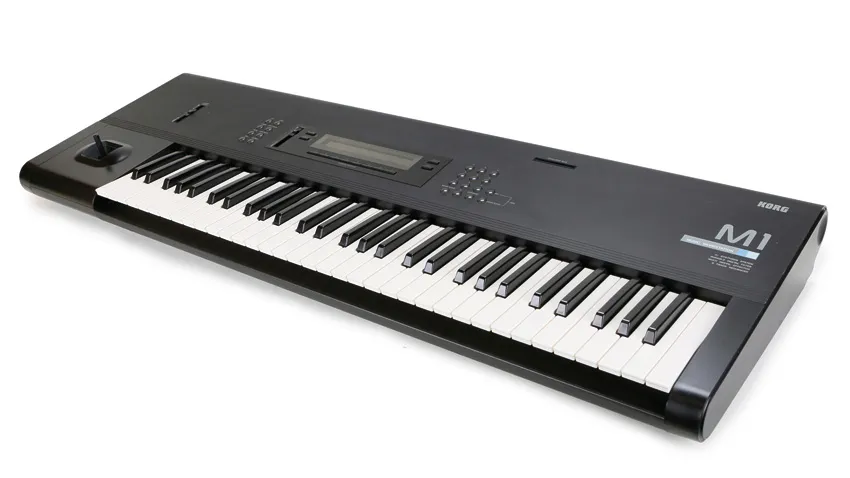
Taking the concept further, the Roland W-30 was a sampling workstation, that catered for on-board samples as well as sequencing duties, which could also be stored on floppy disks, or in some instances, several floppy disks!
The combination of synths and samplers both emulating ‘real’ instruments and a more digital approach to synthesis in general somewhat tarnished the late 80s, but the end of the decade should not just be remembered for the resulting digital ‘SAW-style’ music, because out of this major shift to digital came two new musical movements in the form of computer music making and dance music.
The Atari was the first computer to embrace MIDI and multitimbral synths, and the all-new dance music producers wrestled the failing analogue Rolands back into life to start a raveolution. More, much more, on that tomorrow, as we enter the ’90s…
Computer Music magazine is the world’s best selling publication dedicated solely to making great music with your Mac or PC computer. Each issue it brings its lucky readers the best in cutting-edge tutorials, need-to-know, expert software reviews and even all the tools you actually need to make great music today, courtesy of our legendary CM Plugin Suite.
Don’t miss the latest deals, news, reviews, features and tutorials
Thank you for signing up to Musicradar. You will receive a verification email shortly.
There was a problem. Please refresh the page and try again.
MusicRadar is part of Future plc, an international media group and leading digital publisher. Visit our corporate site (opens in new tab).
© Future Publishing Limited Quay House, The Ambury, Bath BA1 1UA. All rights reserved. England and Wales company registration number 2008885.
Def Leppard Guitarist Lists Benefits of Recording Album Remotely – Loudwire
Nearly all bands have been forced to adapt to new ways of working together since the onset of the COVID pandemic in March of 2020, and many of them missed the camaraderie of doing it in person. However, guitarist Phil Collen thinks recording an album remotely is one of the best things Def Leppard have ever done, and listed the benefits of doing so.
This Friday (May 27), Def Leppard will release their 11th full-length studio album and their first since 2015, Diamond Star Halos. Although the majority of COVID mandates have been lifted in the U.S. over the last few months, many albums slated for a 2022 release were recorded remotely because some artists simply found the process more convenient.
"[It was] the best thing we ever did. More creative, more creative control for the writing and even recording it. Plus, you don't have people waiting for each other in a studio," Collen explained to Loudwire Nights host Toni Gonzalez. "When we did it this way, it was like, everyone's doing their own part, everyone's doing their best. Everyone's a big boy, they can tune their own guitars, they can sing in tune, they can get it right and then you send your best to Ronan McHugh — our producer in Dublin."
Collen went on to say that the convenience of working remotely saved Def Leppard "so much energy," which is something they want to be mindful of and conserve at this stage in their career. And, as a result of having more expendable energy, it creates more inspiration.
Going forward, the guitarist is confident that Def Leppard will continue making records remotely because of how happy they were with the process. He had more time to spend with his family because all he had to do was record his guitar parts on his computer.
"I'd get back in and there'd be something in the inbox from Joe [Elliott], and we would just work on songs. He was in Dublin, I was in California, and before we knew it we had this amazing kind of thing going," he continued. "It was just inspired all the way along."
Diamond Star Halos will be out May 27 via UME (Universal Music Enterprises). To hear more about the album, tune into Loudwire Nights tonight at 7PM ET. Pre-order the record here, and check out the dates for Def Leppard's long-awaited 2022 Stadium Tour with Motley Crue, Poison and Joan Jett and the Blackhearts.
Loudwire Nights with Toni Gonzalez airs nightly starting at 7PM ET. You can tune in anytime, from anywhere right here or by downloading the Loudwire app.
Streetfest kicks off season of events | News, Sports, Jobs – Fairmont Sentinel
May 24, 2022
Sentinel file photo.
FAIRMONT– The Fairmont Opera House’s upcoming Memorial Weekend Streetfest kicks off a whole season of events hosted by the historic performing arts theatre.
Executive Director Blake Potthoff said that they’ve done some sort of Memorial Day block party since 2017. The first few years were in the lot south of the Opera House but the last few have been more toward downtown.
“It’s always been community focused,” Potthoff said.
The two-day event kicks off Friday night and includes a variety of live performances and kid-friendly activities. Potthoff said they spend about six months planning for the event which requires lining up artists, food vendors and getting sponsoring businesses on board.
The evening performances by Ron Keel Band and Mason Dixon Line are more geared toward adults, but there are certainly events and entertainment for families during the day from groups Koo Koo Kanga Roo and Squonk.
“Everything I do here at the Opera House, you could go somewhere else to see it, but we don’t want that to happen. We don’t want people to drive out of town to larger cities to see them. Sometimes the entertainment we have here on our stage is the same, if not better,” Potthoff said.
He said they’ve been advertising for the streetfest in cities like Albert Lea, Mankato and Spirit Lake, IA to draw people to Fairmont.
“We want them to visit our restaurants, see the lakes and visit downtown and see what a great community it is,” Potthoff said.
What’s very noteworthy is that the entire weekend event is free. This is thanks to a sizable grant from the Schmeeckle Foundation and funds from the Rosen family. The opera House is also investing money into the event.
At the Streetfest, an informational booth will be set up with info on all of the Opera House’s other upcoming events, which includes a lot.
Potthoff said they’ve seen an uptick in rentals, which is exciting for them. They’ve hosted bachelor parties, bridal showers and birthday parties.
“We’re here to make anything happen. We want people to dream big and when they dream, to think about the Opera House and how it fits into that,” Potthoff said.
They help with light and sound production for other events, including the Going Hog Wild unveiling this Thursday, and have also DJ’d at other community events.
“When people start thinking about us to host events and to help plan events, that’s fun for us,” Potthoff said.
After Memorial Day weekend, the Opera House will continue with a variety of events to be held over the summer months. Auditions for FACT (Fairmont Area Community Theater) are happening now for the summer production of “Shrek the Musical.”
“If you’re interested in being part of it in the ensemble, we’ll absolutely take you. My running joke is if you can or can’t dance, can or can’t sing or can or can’t speak, we’re looking for you,” Potthoff said with a laugh.
Show times for that are the week of July 21-24 and 28-31.
The Opera House’s youth theater camps are also coming up in June. Potthoff said they’re more of a fine arts camp, instead of a production as what’s been done in the past. Participants will learn about props, lights, costume design, music and dance.
“It’s a full experience. You can’t find a camp that covers the same amount of time and width of education until you go to the children’s theater camp in the Twin Cities,” Potthoff said.
There will be three youth theater camps. A camp for students grades K-2 will run from June 13 to June 17. A camp for students grades 3-5 will run June 13 to June 24 with a performance of “Princess and the Ogre” on June 25 and 26.
Finally, a camp for students grades 6-12 will run from June 27 to July 15 with a performance of “Shrek the Musical Jr.” on July 16 and 17.
Potthoff said for both the adult and children’s theater productions they try to be flexible with people’s schedule and try to make it low stress and low pressure.
Potthoff acknowledged that the Opera House has been doing a lot *more* lately. He said having FACT coordinator, Samantha Rosenberg, on board has helped a lot because it’s allowed them to expand offerings.
“We went from one community theater show a year to six and one children’s theater event per summer to three per year,” Potthoff said.
The Opera House has also been hosting a community event nearly every month. They’ve opened up their space around the holidays for Halloween and Christmas-themed events.
“On July 4 we’re doing a parking lot party. We’ll have grills set up and we’ll be playing
music. People can bring their own meat to grill and drinks to hang out,” Potthoff said.
The event will be $10, but the perk is that participants will be able to park in the Opera House parking lot for the fireworks that night.
Another exciting and new event for the Opera House this summer is that they’ll be hosting “Martin County Sings,” on Tuesday night of the Martin County Fair. Potthoff said it’s part of “Minnesota Sings,” which is an amateur music competition.
There will be two age groups, 13 to 20 and 21 and older. Two participants from each division will be sent to the statewide competition in New Ulm, which will take place Oct. 1 and 2. Prizes include $20,000 in cash, recording sessions and music gear.
“We’re looking forward to that. We just need people to participate,” Potthoff said.
Potthoff said they’ve really always been building up to offer this many events but everything was put on hold the last two years because of Covid.
“We were building to this and now we’re finally making it happen,” he said.
Today’s breaking news and more in your inbox
SHERBURN — Saturday is the last Saturday of the month, so there is a men’s breakfast meeting from 9-10:30 a.m. …
FAIRMONT— The Fairmont School Board heard from Dean of Students, Andy Walden, on Tuesday regarding some changes …
FAIRMONT— The Fairmont Police Department is asking community members to come together and help out their …
FAIRMONT—The Fairmont City Council on Monday discussed whether or not to change council member …
FAIRMONT— As May is Mental Health Awareness month, staff at Community Health and Human Services of Faribault and …
Today’s breaking news and more in your inbox
Copyright © Fairmont Sentinel | https://www.fairmontsentinel.com | 64 Downtown Plaza, Fairmont, MN 56031 | 507-235-3303 | Ogden Newspapers | The Nutting Company
Amazon donates $25,000 for CHS innovation studio | Nvdaily | nvdaily.com – Northern Virginia Daily
Lindsey Winter, head of Virginia Public Policy for Amazon, displays a check with Central High School graduate Jacob Walters, Central principal Lori Swortzel, and C. Todd Gilbert, speaker, Virginia House of Delegates, to the crowd during commencement ceremonies at Central High School on Saturday. Gilbert, a graduate of the school, was the commencement speaker.
Lindsey Winter, head of Virginia Public Policy for Amazon, displays a check with Central High School graduate Jacob Walters, Central principal Lori Swortzel, and C. Todd Gilbert, speaker, Virginia House of Delegates, to the crowd during commencement ceremonies at Central High School on Saturday. Gilbert, a graduate of the school, was the commencement speaker.
Central High School has received a $25,000 donation from Amazon to help set up its Central Innovation Studio, a space where students can create podcasts, TV programs, music and more.
Virginia’s Speaker of the House Todd Gilbert (R-Shenandoah), who graduated from Central in 1989, said during Saturday’s graduation ceremony that his office was notified that Amazon “wanted to make a financial contribution in our community and they wanted us to help identify a worthy cause.”
Jeff Walters, Gilbert’s legislative director, contacted principal Lori Swortzel about a potential donation for STEM-related uses at the school. Getting that call, Swortzel said, was a coincidence as she was in discussions about creating a “maker studio” at the school.
“I just had a meeting with two individuals that were working together to make this studio, so we had already been on it, and it was an easy transition to decide what to do with the donation,” Swortzel said.
The Central Innovation Studio will include TV broadcasting capabilities, a podcasting studio, music production, and graphic and media arts production. Swortzel explained that the idea is to allow students to “take what they’re doing in their general education classes…and then they can make hands-on experiences based on what they’re learning and take it a step further.”
CHS also has the “Central Shark Tank” competition that allows students to pitch ideas for products and services that supports students exploring their entrepreneurship skills. Swortzel explained that the Central Innovation studio will provide students a maker space type of environment to work on projects like the Central Shark Tank competition.
“We want to be able to empower students to create prototypes of inventions or to complete projects,” Swortzel said. “It’s almost kind of an extension moving forward from the Shark Tank, but it would empower students to be able to dream something and then create beyond that.”
Gilbert and Amazon representative Lindsey Winter presented the $25,000 from Amazon.
“Incredible things are happening here at CHS,” Gilbert said. “This stuff wasn’t going on when I was here.”
Your comment has been submitted.
Reported
There was a problem reporting this.
Log In
Keep it Clean. Please avoid obscene, vulgar, lewd, racist or sexually-oriented language.
PLEASE TURN OFF YOUR CAPS LOCK.
Don't Threaten. Threats of harming another person will not be tolerated.
Be Truthful. Don't knowingly lie about anyone or anything.
Be Nice. No racism, sexism or any sort of -ism that is degrading to another person.
Be Proactive. Use the 'Report' link on each comment to let us know of abusive posts.
Share with Us. We'd love to hear eyewitness accounts, the history behind an article.
Adobe’s Kakul Srivastava Named New CEO of Splice (EXCLUSIVE) – Variety
Variety Print Plus Subscriber
Variety Print Plus Subscriber
Variety Print Plus Subscriber
Variety Print Plus Subscriber
Variety Print Plus Subscriber
Founder Steve Martocci will transition to executive chairman and chief strategy officer.
By Thania Garcia
Splice, the online music marketplace for rights-cleared sounds and beats, has hired Adobe’s Kakul Srivastava as its new CEO. Founder and CEO Steve Martocci will transition to executive chairman and chief strategy officer.
Srivastava arrives from Adobe, where she helped lead Creative Cloud’s customer journey efforts, including the desktop app for downloads and the new user journeys.
Having served on the Splice board of directors since 2021, Srivastava will utilize her comprehensive understanding of the company’s ethos to oversee product strategy and business operations, alongside driving its growth and profitability.
Founded by Steve Martocci and Matt Aimonetti in 2013, Splice allows its users, for a monthly fee, to acquire the tools needed to make music — loops, drum beats, different instruments and sounds both synthetic and analog — and use them fully licensed and royalty-free.
Splice boasts more than 4 million users accessing its expansive catalog of sounds with a library of over 2 million pre-cleared samples. The company recently expanded its creator offerings with the release of CoSo By Splice, an intelligent musical sketch pad designed for music makers to harness sound discovery.
Prior to Adobe, Srivastava was the VP of product and marketing at Github, where she instituted significant pricing model changes for the company. She was also the general manager of the photo-sharing service Flickr, where she brought in an additional 100M users, and as VP of apps at Yahoo, she led the re-architecture of Yahoo Mail.
With deeply held beliefs surrounding the importance of human connections at work and creativity, Srivastava also launched the mobile app, Tomfoolery, Inc. — designed to help teams run better through more open communication. She was co-founder and CEO of the company which was later acquired by Yahoo.
“In a world where everyone is a creator, Splice is building the essential toolset to make music,” says Srivastava. “Human creativity is our most important resource and I’m excited to build on the remarkable foundation laid by Steve and the world-class Splice team, to empower music creators globally.”
Moving to executive chairman and chief strategy officer, Martocci has had long-lasting success in the entrepreneurial world. He was a co-founder of Blade, the helicopter ride-sharing service, and GroupMe, a group text messaging service that was acquired by Skype.
Martocci has welcomed Srivastava into her new role and emphasized Srivastava as “dynamic, operational and empathetic,” someone who “deeply understands building products for creators. Kakul’s leadership will be the key to Splice accelerating growth, expanding its footprint and becoming an iconic company.”
In an interview for Variety‘s Strictly Business podcast, Martocci detailed just how much Splice had expanded and defined itself over the pandemic, as more creatives spent time indoors tinkering with music production.
The company has made many new additions to its staff, rounding up to a total of over 200 employees — a third of which were hired during the pandemic.
“Artists, writers and producers; from the kids to the pros making hits — they need tech that understands how they work and allows them to be who they are and create the way they want to,” says Splice board member, Matt Pincus of investment firm Music. “Nobody is better at that than Kakul.”
A Variety and iHeartRadio Podcast
The Business of Entertainment
ONErpm – Project Manager (Urban) (US) – Music Business Worldwide
ONErpm is a redefining force in the new music economy and one of today’s fastest growing music companies in the global marketplace. With offices and studios in New York City, Nashville, Miami, Sao Paulo, Rio de Janeiro, Buenos Aires, Bogota, Mexico City, Moscow, Madrid, and Lagos – ONErpm occupies a unique space between traditional record label and distribution company and leverages proprietary technology, marketing, analytics, and localized support to deliver business solutions to over 100,000+ artists, music labels, and video creators worldwide. Home to over 2500 YouTube channels that collectively generate 7 billion + plays a month, ONErpm is one of the world’s largest YouTube Multi Channel Networks (MCN) specializing in music.
The Project Manager is responsible for handling marketing and distribution for ONErpm releases in the Hip-Hop/Rap, R&B genres and subgenres. This role requires comprehensive communication and coordination internally and externally as well as an in-depth understanding of digital streaming and social media platforms. This position will focus on creating and executing release and marketing strategy for emerging and established artists.
As part of the ONErpm team, you will have the opportunity to work with a talented group across A&R and marketing teams. You will master the creation of specialized campaigns. You’ll excel at collaborating with partners to meet objectives and provide functional support.
Application Link/Email: Please send all resumes (required) and cover letters (optional but preferred) to [email protected] with the job title in the subject line.
Location (office address): Atlanta, GA (950 Joseph E Lowery Blvd NW, Suite 17, Atlanta, GA 30318) OR New York, NY (180 Varick St New York, NY 10014)
ONErpm is an equal opportunity employer and makes employment decisions without regard to race, color, religion, sex, sexual orientation, gender identity, national origin, protected veteran status, disability status, age, or any other status protected by law. Further, the company strives to create a diverse, welcoming, equitable and inclusive environment for all applicants, employees, member companies and partners.
Music Business Jobs is the most effective way for the global music industry to find the best candidates for their open positions.
In addition to being seen by over 300,000 monthly unique readers online, our listings are also emailed direct to more than 50,000 professional subscribers every week – across the US, UK, Europe, Asia-Pacific and beyond.
Click through below for details on how to submit a Music Business Jobs listing – and learn why our advertisers ‘strongly recommend’ us to their peers…
Best Music and Audio Software for Windows 11/10 of 2022 May – BollyInside
This list is about the Best Music and Audio Software for Windows 11/10. We will try our best so that you understand this list Best Music and Audio Software for Windows 11/10. I hope you like this list Best Music and Audio Software for Windows 11/10. So lets begin:
Audio editing software gives you the digital tools to record, edit, and produce audio files. Audio editing software is sometimes called a DAW or digital audio workstation. Editing audio files can be time consuming and tedious, and the best audio editing software makes it easy for you. There are free and paid options that may influence your choice. The best audio editing software has an easy-to-use editing interface, extensive editing tools, effects, and additional features. Audio editing software allows users to edit and create audio files.
With these tools, audio editors and sound engineers can mix or remove sections of audio data, edit and rearrange audio regions, and record and create new audio components. Audio editing programs may also offer effects to manipulate the sound of audio files in various ways. Audio editing software generally supports a variety of file types, including MP3, WAVE, Windows Media, and MPEG-4. Audio editing software is commonly used by sound engineers and music producers for music, movies, and television shows, often in conjunction with video editing software and video production equipment. For musicians who are new to audio editing, there are also many free software solutions for music editing. Below is the list of the best music and audio software for Windows.
For users looking for a powerful program to manage their large media libraries, MediaMonkey offers a wide range of features that cover just about every imaginable media situation. Whether you have thousands or hundreds of thousands of files to manage, MediaMonkey can process and update all your files, then automatically organize them however you want.
Unfortunately, this level of control comes with a trade-off in terms of interface and usability. The basic tools are easy to use, but the more powerful features take some time to learn. However, once he sees that it turns a jumble of media files into a cohesively organized library, he’ll be glad he took the time to learn its little tricks.
The fastest way to get started with Spotify on your desktop is to sign in with your Facebook account. You can also become a Spotify member with your email address, but going this route requires you to fill out some fields with personal information. In any case, setting up the service takes almost no time. Once you sign up, the program will automatically import your music collection and playlists from iTunes and other music software, giving you a single hub from which to access the Spotify catalog or your personal stuff.
If there’s one constant in the vast ongoing war over streaming music, it’s this fact: Spotify is the big dog. Despite competition from feature-rich Apple Music and audiophile-friendly Tidal, Spotify remains king of the hill due to its huge catalog, collaborative playlists, podcasts, and many other enticing features.
Dopamine is a type of monoamine neurotransmitter. It is produced in the brain and acts as a chemical messenger that transmits messages between nerve cells in the brain and between the brain and the rest of the body. Dopamine also acts as a hormone. It supports the most popular audio file formats and is surprisingly simple, whether you use the full window player, the album art version, or the tiny micro or nano interface.
There are numerous advanced music players that are free to download and use. However, if you’re not interested in tweaking playback options and are simply looking for a smart alternative to Windows Media Player, Dopamine might be just what you need.
Winamp is a free media player from Nullsoft. Supports numerous audio and video formats. It also plays broadcast audio and video content, both live and recorded, created around the world. It has an extremely customizable media library and allows you to rip and burn your favorite music CDs. Winamp has thousands of skins and plugins that allow you to change the appearance of the player and add new features. The player also has access to thousands of songs, videos, and free online radio stations from shoutcast Radio and AOL Radio with XM.
It also has a built-in web browser, so you can browse your favorite websites whenever you need them without going anywhere. However, a big selling point of Winamp is its support for custom skins, which means you can configure this app the way you want by downloading skins. All of this makes Winamp a better contender for the best music player for Windows. In addition, the creators are also working on a completely revised version of Winamp, which could appear in the near future.
MusicBee is designed to take full advantage of your PC hardware, with support for high-end sound cards and 5.1 surround sound. MusicBee also supports streaming, is compatible with Last.fm and SoundCloud, and is a great choice for enjoying your favorite podcasts. MusicBee packs a lot of features into a highly customizable music player. It has all the standard features of a music player and many more to enrich the listening experience.
One of the best features is MusicBee’s tagging and organization system. It automatically imports album art and other information from iTunes and other sources, but also gives you options to change the information manually. The app is available for free on Windows 10 PCs. If you prefer to download it outside of the Microsoft Store or are on a system with an older version of Windows, you can download it from its website.
Foobar2000 is a free audio player for Windows. He is a player who is probably much more flexible and powerful than he seems to suggest. Behind its rather ordinary, if not unflattering, appearance lies a host of hidden features. As we mentioned earlier, Foobar2000’s appearance can be a bit off-putting. Initially, it appears to have a slightly dated look and it’s unclear exactly how things work.
However, that soon changes once you start loading the player with music and it starts to look a bit more conventional. Foobar2000 is modular and consists of many different components. Basically, this means that your design can be very simple or much more complex. While that sounds like you’re getting the best of both worlds, there is a downside. The downside is that making changes is not as easy as a less technical user might expect.
Audacity is an amazing free and open source audio editor that is as good as many premium paid apps. You can use it to make your own recordings, remove noise, cut and combine clips, apply special effects and much more, and achieve truly professional results.
If all of that isn’t enough, you can extend Audacity with plugins that add new effects or integration with other applications. There are no limits to the size or duration of your projects, and nothing is locked behind a paywall. Whether you’re creating music, podcasts, audiobooks, or any other project, Audacity is a truly amazing tool.
VLC Media Player is one of the most popular media players today. Not only is it free to use, but it also supports a variety of file formats without the need to purchase or download any additional components. You can use it to optimize audio and video for your preferred device. It can support DivC and MPEG streaming. Also, you can play videos while they are downloading. Now let us take a look at some of the pros and cons of VLC so that we can know whether it is really worth downloading or not.
If you are having trouble playing your favorite videos on media player due to some compatibility issues, you should try VLC. This free to use and open source software tool is capable of playing almost all popular video file formats, and all others can be easily converted to compatible formats using the same interface. When WinAmp and Windows Media Player crash, you can expect the right solution for VLC platform. It works perfectly on Linux, Macintosh, and Windows platforms, helping users to enjoy a wide range of features without investing a single penny of their hard-earned money.
Musixmatch is the world’s largest lyrics platform where you can search, enjoy and share lyrics from any track anywhere in the world. The Musixmatch text catalog is created, synchronized and translated by millions of contributors from the Musixmatch community. The final version of the texts will be edited and validated by a team of international curators.
Users can connect Musixmatch for Desktop to Spotify, Apple Music and dozens of other music services to enjoy lyrics in sync with music. Musix Match’s mission is to change the way people experience music and lyrics. Now Musix Match is a team that includes more than 40 international and talented people working on a product that reaches millions of music lovers.
I hope you understand and like this list Best Music and Audio Software for Windows 11/10, if your answer is no then you can ask anything via contact forum section related to this article. And if your answer is yes then please share this list with your family and friends.
Bollyinside.com provides you with the latest breaking articles. Learn how to do anything with Bollyinside, the world’s most popular how to tips and tutorials website. Easy, well-researched, and trustworthy instructions for everything you want to…
© 2021 Bollyinside.com | All rights reserved.
DITTO – COUNTRY MANAGER ARTIST & LABEL SERVICES (SP) – Music Business Worldwide
We have an exciting opportunity for a highly-motivated individual to lead the Ditto Plus Artist & Label Services Team in Spain.
The ideal candidate for this role will find & develop artists, manage relationships and create marketing initiatives with emerging & established talent, record labels and catalogue owners, while providing support, advice and strategy for Ditto clients.
As the country manager for Artist & Label Services, you will be required to approach new artists and labels to sign, whilst looking after the existing roster within the Ditto Plus system, overseeing and coordinating all aspects of their release campaigns including distribution, sales, promotion, sync, digital marketing, social media, and creative.
Please send applications to [email protected] with the subject line ‘Spain’. Applicants should include a CV and covering letter.
Music Business Jobs is the most effective way for the global music industry to find the best candidates for their open positions.
In addition to being seen by over 300,000 monthly unique readers online, our listings are also emailed direct to more than 50,000 professional subscribers every week – across the US, UK, Europe, Asia-Pacific and beyond.
Click through below for details on how to submit a Music Business Jobs listing – and learn why our advertisers ‘strongly recommend’ us to their peers…
A question of K-pop – The Korea JoongAng Daily
Monday
January 20, 2020
Monday
Gangnam-gu, South Korea
Fine Dust :
The Roh Moo-hyun spirit
A question of K-pop
How Biden put business first
Effective administrators, not little presidents
An ideological liberation
Min announces she will drop a new single this week
The fairness question
No one blames you (KOR)
‘Awesome grandpa’ Na Hoon-a goes viral after Chuseok concert
Paying through the nose
To write comments, please log in to one of the accounts.
Standards Board Policy (0/250자)
Korea JoongAng Daily Sitemap 

All materials contained on this site are protected by Korean copyright law and may not be reproduced, distributed, transmitted, displayed, published or broadcast without the prior consent of Joins.com | Tel: 1577-0510
Global Music Streaming Service Market Growth Statistics 2022 to 2028 | Competitive Landscape, Top Key Players (Spotify, Jamendo, Heartbeats International, SOUNDMACHINE) and Detailed Analysis of Market – Digital Journal
Hi, what are you looking for?
By
Published
Global Music Streaming Service Market Industry research report provides Segmentation, Types, Application, Size, Industry Growth, Share, Development Trends, Top Manufacturers (Spotify, Jamendo, Heartbeats International, SOUNDMACHINE). Music Streaming Service Market Report will add the analysis of the impact of COVID-19 on this industry.
Global “Music Streaming Service Market” research report offers the most up-to-date market data on the actual market situation, trends, demands, and future outlook for Music Streaming Service in different countries. The report aims to provide an overview of the global Music Streaming Service market with detailed market segmentation by component, deployment model, end-user, and geography. The global Music Streaming Service market offers a comprehensive analysis of the Music Streaming Service industry, standing from the readers’ perspective, delivering detailed market data in the Global major 20 countries and penetrating insights. No matter the client is an industry insider, potential entrant or investor, the report will provide useful data and information.
Request a sample copy of the report–https://www.precisionreports.co/enquiry/request-sample/20227584
The Music Streaming Service report offers an up-to-date analysis of the current global market scenario, future prospects, the latest trends, demands and drivers, and the overall market environment. The market is driven by growing residential and commercial construction market and rise in the disposable income of consumers in developing countries. In addition, growing residential and commercial construction market is anticipated to boost the growth of the market as well. The Music Streaming Service market analysis includes the distribution channel segment and geographic landscape. In a word, the report provides detailed statistics and analysis on the state of the industry; and is a valuable source of guidance and direction for companies and individuals interested in the market.
Streaming music, or more accurately streaming audio, is a way of delivering sound — including music — without requiring you to download files from the internet.
Market Analysis and Insights:Global Music Streaming Service Market
The global Music Streaming Service market size is projected to reach US$ 22610 million by 2028, from US$ 7565.5 million in 2021, at a CAGR of 16.6% during 2022-2028.
Fully considering the economic change by this health crisis, Software accounting for % of the Music Streaming Service global market in 2021, is projected to value USD million by 2028, growing at a revised % CAGR in the post-COVID-19 period. While Personal segment is altered to an % CAGR throughout this forecast period.
China Music Streaming Service market size is valued at USD million in 2021, while the North America and Europe Music Streaming Service are USD million and USD million, severally. The proportion of the North America is % in 2021, while China and Europe are % and % respectively, and it is predicted that China proportion will reach % in 2028, trailing a CAGR of % through the analysis period. Japan, South Korea, and Southeast Asia are noteworthy markets in Asia, with CAGR %, %, and % respectively for the next 6-year period. As for the Europe Music Streaming Service landscape, Germany is projected to reach USD million by 2028 trailing a CAGR of % over the forecast period.
With industry-standard accuracy in analysis and high data integrity, the report makes a brilliant attempt to unveil key opportunities available in the global Music Streaming Service market to help players in achieving a strong market position. Buyers of the report can access verified and reliable market forecasts, including those for the overall size of the global Music Streaming Service market in terms of revenue.
Overall, the report proves to be an effective tool that players can use to gain a competitive edge over their competitors and ensure lasting success in the global Music Streaming Service market. All of the findings, data, and information provided in the report are validated and revalidated with the help of trustworthy sources. The analysts who have authored the report took a unique and industry-best research and analysis approach for an in-depth study of the global Music Streaming Service market.
Global Music Streaming ServiceScope and Market Size
Music Streaming Service market is segmented by players, region (country), by Type and by Application. Players, stakeholders, and other participants in the global Music Streaming Service market will be able to gain the upper hand as they use the report as a powerful resource. The segmental analysis focuses on revenue and forecast by Type and by Application for the period 2017-2028.
Global Music Streaming Service Market:Manufacturers Segment Analysis(Company and Product introduction, Music Streaming Service Sales Volume, Revenue, Price and Gross Margin):
To Understand How Covid-19 Impact Is Covered In This Report –https://www.precisionreports.co/enquiry/request-covid19/20227584
COVID-19 Impact analysis:
We are continuously tracking the impact of the COVID-19 pandemic on various industries and verticals within all domains. Our research reports include the same and help you understand the drop and rise, owing to the impact of COVID-19 on the industries. Also, we help you to identify the gap between the demand and supply of your interested market. Moreover, the report helps you with the analysis, amended government regulations, and many other useful insights. As the market recovers from the pandemic, we forecast the growth trajectory to vary across regions with some countries offering huge growth potential while others reporting limited profit margins.
Global Music Streaming Service Market:Type Segment Analysis(Consumption Volume, Average Price, Revenue, Market Share and Trend):
Global Music Streaming Service Market:Application Segment Analysis(Consumption Volume and Market Share, Downstream Customers and Market Analysis)
Enquire before purchasing this report–https://www.precisionreports.co/enquiry/pre-order-enquiry/20227584
Scope of the Report
Purchase this report (Price 4900 USD for a single-user license) –https://www.precisionreports.co/purchase/20227584
Global Music Streaming Service Market:Regional Segment Analysis(Regional Production Volume, Consumption Volume, Revenue and Growth Rate):
Detailed TOC of Global Music Streaming Service Market Research Report:
1 Study Coverage
1.1 Music Streaming Service Product Introduction
1.2 Market by Type
1.3 Market by Application
1.4 Study Objectives
1.5 Years Considered
2 Global Music Streaming Service Production
2.1 Global Music Streaming Service Production Capacity (2017-2028)
2.2 Global Music Streaming Service Production by Region: 2017 VS 2021 VS 2028
2.3 Global Music Streaming Service Production by Region
2.3.1 Global Music Streaming Service Historic Production by Region (2017-2022)
2.3.2 Global Music Streaming Service Forecasted Production by Region (2023-2028)
2.4 North America
2.5 Europe
2.6 China
2.7 Japan
3 Global Music Streaming Service Sales in Volume and Value Estimates and Forecasts
3.1 Global Music Streaming Service Sales Estimates and Forecasts 2017-2028
3.2 Global Music Streaming Service Revenue Estimates and Forecasts 2017-2028
3.3 Global Music Streaming Service Revenue by Region: 2017 VS 2021 VS 2028
3.4 Global Music Streaming Service Sales by Region
3.4.1 Global Music Streaming Service Sales by Region (2017-2022)
3.4.2 Global Sales Music Streaming Service by Region (2023-2028)
3.5 Global Music Streaming Service Revenue by Region
3.5.1 Global Music Streaming Service Revenue by Region (2017-2022)
3.5.2 Global Music Streaming Service Revenue by Region (2023-2028)
3.6 North America
3.7 Europe
3.8 Asia-Pacific
3.9 Latin America
3.10 Middle East and Africa
4 Competition by Manufactures
4.1 Global Music Streaming Service Production Capacity by Manufacturers
4.2 Global Music Streaming Service Sales by Manufacturers
4.3 Global Music Streaming Service Revenue by Manufacturers
4.4 Global Music Streaming Service Sales Price by Manufacturers
4.5 Analysis of Competitive Landscape
4.6 Mergers and Acquisitions, Expansion Plans
5 Market Size by Type
5.1 Global Music Streaming Service Sales by Type
5.2 Global Music Streaming Service Revenue by Type
5.3 Global Music Streaming Service Price by Type
6 Market Size by Application
6.1 Global Music Streaming Service Sales by Application
6.2 Global Music Streaming Service Revenue by Application
6.3 Global Music Streaming Service Price by Application
7 North America
7.1 North America Music Streaming Service Market Size by Type
7.2 North America Music Streaming Service Market Size by Application
7.3 North America Music Streaming Service Sales by Country
8 Europe
8.1 Europe Music Streaming Service Market Size by Type
8.2 Europe Music Streaming Service Market Size by Application
8.3 Europe Music Streaming Service Sales by Country
9 Asia Pacific
9.1 Asia Pacific Music Streaming Service Market Size by Type
9.2 Asia Pacific Music Streaming Service Market Size by Application
9.3 Asia Pacific Music Streaming Service Sales by Region
10 Latin America
10.1 Latin America Music Streaming Service Market Size by Type
10.2 Latin America Music Streaming Service Market Size by Application
10.3 Latin America Music Streaming Service Sales by Country
11 Middle East and Africa
11.1 Middle East and Africa Music Streaming Service Market Size by Type
11.2 Middle East and Africa Music Streaming Service Market Size by Application
11.3 Middle East and Africa Music Streaming Service Sales by Country
12 Corporate Profiles
13 Industry Chain and Sales Channels Analysis
13.1 Music Streaming Service Industry Chain Analysis
13.2 Music Streaming Service Key Raw Materials
13.3 Music Streaming Service Production Mode and Process
13.4 Music Streaming Service Sales and Marketing
13.5 Music Streaming Service Customers
14 Market Drivers, Opportunities, Challenges and Risks Factors Analysis
14.1 Music Streaming Service Industry Trends
14.2 Music Streaming Service Market Drivers
14.3 Music Streaming Service Market Challenges
14.4 Music Streaming Service Market Restraints
15 Key Finding in The Global Music Streaming Service Study
16 Appendix
Continued…………
About Us:
Precision Reports is a unique organization that offers expert analysis and accurate data-based market intelligence, aiding companies of all shapes and sizes to make well-informed decisions. We tailor inventive solutions for our clients, helping them tackle any challenges that are likely to emerge from time to time and affect their businesses. At Precision Reports, our principal goal is to empower our customers with a granular market analysis while incorporating a panoramic overview of the market they are intending to enter and establish themselves.
Contact Info:
Precision Reports
Phone:US +1 424 253 0807
UK +44 203 239 8187
E-mail:[email protected]
Website:https://www.precisionreports.co
Our Other Reports:
Global Ultra High Speed Elevator Market Emerging Trends and Forecast 2022 to 2026 | Spread Across 121 Pages with Future Developments, Technological Advancements and Regional Growth Analysis
Digital Pills Market Size and Share 2022 Global Business Review, Key Findings, Company Profiles, Growth Strategy, Developing Technologies, Trends and Forecast by Regions
Global Plastic Action Figures Market Size 2022 to 2029 with Emerging Trends, Growth by New Techniques, Sales Channel and Distribution, Industry Trends and Investigation Growth Rate Spread Across 103 Pages
Industrial Distribution Software Market Share 2022 : Global Industry Size, Growth, Trend, Demand, Top Players, Opportunities with Leading Regions, Future Business Prospects, Forthcoming Developments and Future Investments
Global Recycled Polyester Fibers Market Size 2022 to 2026 with Emerging Trends, Growth by New Techniques, Sales Channel and Distribution, Industry Trends and Investigation Growth Rate Spread Across 107 Pages
Press Release Distributed by The Express Wire
To view the original version on The Express Wire visit Global Music Streaming Service Market Growth Statistics 2022 to 2028 | Competitive Landscape, Top Key Players (Spotify, Jamendo, Heartbeats International, SOUNDMACHINE) and Detailed Analysis of Market
A deafening stream of fighter jets land and take off from a US aircraft carrier, part of a long-planned NATO exercise in the Mediterranean.
Key developments since Russia’s invasion of Ukraine three months ago, which has claimed the lives of tens of thousands of people.
Home rental service Airbnb is shutting down its business in China as a pandemic lockdown shows no sign of ending there.
Top allies of Russian President Vladimir Putin say Moscow is ready for a prolonged conflict in Ukraine in order to achieve the Kremlin’s goals.
COPYRIGHT © 1998 – 2022 DIGITAL JOURNAL INC. Digital Journal is not responsible for the content of external sites. Read more about our external linking.