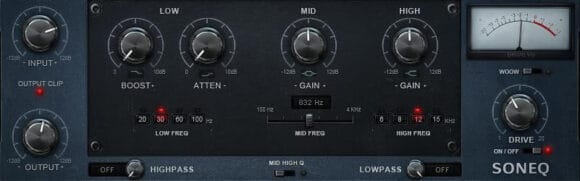
SonEQ from Sonimus is an free unique Antique Digital Equalizer
In Depth
SonEQ is a unique digital equalizer plug-in that integrates parts from a number of antique equalizers into a single unit. SonEQ provides musical tonal control with a number of unique curves available. This virtual EQ is intended for gentle sculpting of sound, not precise surgical correction as one obtains using a parametric EQ.
SonEQ contains three bands: bass, medium, and treble, as well as a preamp for enhanced color
Features:
Low, Mid, and High bands on a three-band equalizer.
High-Pass and Low-Pass Musical Filters
Bass booster and preamp stage
Floating point precision of 64 bits.
Sample rates of up to 192kHz are supported.
Input/Output
The input and output levels are controlled by these. These controls, in combination with the DRIVE control, are important for saturation control: a greater INPUT control level gives more saturation, while the OUTPUT control can be used to correct the output level.
Clip Output
This LED illuminates when SonEQ’s output reaches 0 dBfs. Note: Because SonEQ works at 64 bits internally, it does not clip at 0 dBfs, but the LED is handy for knowing when the signal has exceeded 0 dBfs, which may be beneficial if other plug-ins in the signal chain can’t accept inputs over 0 dBfs.
There are two types of passes: high-pass and low-pass.
These adjustments on the front panel’s bottom edge give very gentle and musical filters that provide a high level of sonorous quality. The displayed frequency is the -6dB point of the filter when these settings are set to a frequency value. The LOWPASS filter is of great quality: at the Nyquist frequency, it does not distort.
Lows: Boost/Attend/Attend/Attend/Attend
These are one-of-a-kind bass controllers that increase or dampen low frequencies. Because the frequency curves for BOOST and ATTEN aren’t precisely matched, it’s possible to create interesting and useful effects by combining the two knobs. When both the BOOST and ATTEN knobs are turned on, the LOW FREQ selection below them modifies how the boost and attenuation filters interact. When only one of the bass controls is utilized, the boost or attenuation frequency is shifted.
Mid-Gain Frequency
From -12dB to +12dB, the MID GAIN control knob sets the mid frequency gain. The GAIN knob’s MID FREQ slide control controls the frequency of the maximum peak or drop from 150 Hz to 4kHz. The MID HIGH Q switch on the front panel’s bottom edge controls the bandwidth of the mid-frequency peak or dip; when this switch is turned on (LED on), the filter’s bandwidth narrows.
Drive
adjusts saturation and the “bass exciter” feature, which adds harmonics to low and mid frequencies while avoiding unpleasant high-frequency harmonics. To operate SonEQ without generating harmonics (“clean” EQ mode), turn off the bass exciter (DRIVE ON/OFF switch set to off) or set the drive control to low values for slight “warmth” to low and mid frequencies.
When both controls are set to high levels, the DRIVE control interacts with the INPUT control to create extra harmonics (both controls set to full clockwise creates the most harmonics). Because the DRIVE control has no effect on the fundamental signal’s level, it can be adjusted after the INPUT and OUTPUT levels have been set.
The VU meter
gives a visual indicator of the amount of distortion. Soft saturation is indicated by readings between -20 and -10, which is great for buses or softening an entire mix. From -10 to -4, the effect becomes more “bold,” giving the sound more “edge.” Saturation is increased with greater high harmonic content at readings ranging from -3 to +1, yet “breaking up” is avoided. At your own peril, use readings more than +1!
Woow
The all-pass filter control creates a psycho-acoustic effect by generating phase distortion. This should only be used in a final mix and not on individual songs. Some sounds may be phase cancelled if this control is used incorrectly.
Supported platforms
Audio Unit, VST 2.4, VST 3, AAX, RTAS. All platforms support both 32 and 64 bit operation.
Supported Operating systems
- Mac OSX 10.6 or newer
- Windows XP or newer
Technical specifications
- Sample Rate Support: up to 192 khz.
- Bit Depth: 64 bits (floating point).
- Channels: Mono and Stereo.
- Latency: Zero.