Get in the KNOW
on LA Startups & Tech
Kristin Snyder is an editorial intern for dot.la. She previously interned with Tiger Oak Media and led the arts section for UCLA’s Daily Bruin.
TikTok is continuing its foray into the music industry by testing a new sound-editing app for musicians and creators called Mawf.
The Culver City-based video-sharing app and its Chinese parent company, ByteDance, are currently beta-testing the sound-editing tool throughout Europe and the U.K., Business Insider reported Wednesday.
Mawf transforms users’ vocals and other audio inputs into instrumental sounds like trumpets, saxophones and flutes. A series of levers allows users to modify the sounds, which are sourced from the machine-learned analysis of recordings by professional musicians, according to the app’s website. Music production platforms, such as Ableton Live and Logic Pro, can integrate Mawf’s features as a plugin, which allows users to incorporate the app’s audio into their projects.
TikTok’s experiment with Mawf comes after the social media firm launched its own music distribution platform, SoundOn, last month. The platform lets artists directly upload their music to TikTok and earn royalties when that music is used in videos.
TikTok has carved out an increasingly influential role in the music business, with the video-sharing platform popularizing music by new and established artists alike and launching several successful music projects. “The Unofficial Bridgerton Musical”—which originated as a TikTok passion project—won this year’s Grammy Award for Best Musical Theater Album, March, while pop star Olivia Rodrigo took home the Best New Artist award after her hit song “Drivers License” was featured in more than 1.4 million videos on the app. TikTok also recently backed its first musical theater production, “For You, Paige,” which premiered last week in New York.
Kristin Snyder is an editorial intern for dot.la. She previously interned with Tiger Oak Media and led the arts section for UCLA’s Daily Bruin.
After hitting the jackpot with hometown bets like shopping app Honey, Los Angeles venture capital firm Wonder Ventures is doubling down with a new early-stage fund focused exclusively on L.A. startups.
Santa Monica-based Wonder has raised $31 million for its new venture fund, founder and managing partner Dustin Rosen told dot.LA. The new fund is double the size of the $15 million pre-seed fund that Wonder raised in 2018, and like that one it will target fledgling L.A.-based startups that Rosen believes are too easily overlooked by larger VCs.
“The L.A. ecosystem is really mature as far as a place to build technology companies, and more capital than ever is coming into L.A. to fund our companies as they grow and scale toward an IPO,” Rosen said, noting that Wonder already deploys more than 90% of its capital in Southern California-based ventures. “We still believe that the earliest stage is underfunded—pre-traction and pre-seed. That stage is the hardest time to raise and get elite investors, and that explicitly is what Wonder does.”
Rosen pointed to an eclectic group of more than 60 L.A.-based founders and tech executives who have invested in its latest fund, including those from current and former Wonder portfolio companies like Clutter, Tala, and Honey. Other investors from local startup success stories like Snap, GoodRx, and Dollar Shave Club also pitched in.
 Fom left to right: Valentina Rodriguez, senior investor; Dustin Rosen, managing partner; and Taylor Bolhack, head of platform and community for Wonder Ventures. Courtesy of Wonder Ventures
Among the first companies to be funded by the new vehicle is RealAppeal, a Santa Monica-based startup that finds savings in homeowners’ property tax assessment bills through an appeals process. Rosen said he filed his own appeal on the company’s website as its founders made their pitch to him on the phone. “I hope to save thousands of dollars,” he noted.
Among Wonder’s most successful investments to date has been Honey, the ecommerce rewards app that PayPal acquired for $4 billion in 2019. The VC’s initial early-stage investment in the Arts District-based startup returned an exit worth more than Wonder’s entire $5 million first fund, according to Rosen.
The firm’s largest portfolio holding today is WhatNot, the Marina del Rey-based livestream auction marketplace that raised more than $220 million in venture capital last year on the way to reaching a unicorn valuation of $1.5 billion. That investment has proven even more lucrative than its bet on Honey; Rosen noted that the current value of Wonder’s stake in WhatNot is “worth more than the entire [$15 million] second fund.”
In addition to launching the new fund, Wonder has made two new hires to help oversee its portfolio of nearly 80 companies. Valentina Rodriguez, formerly an analyst and trader with Morgan Stanley, has joined the venture firm as a senior investor, while Taylor Bolhack, previously with Santa Monica-based micromobility operator Bird, has been named head of platform and community.
Wonder Ventures isn’t the only L.A-based VC firm targeting local seed and pre-seed startups. After five years with San Francisco-based Crosslink Capital, investor Joe Guzel has launched a fintech-focused early-stage fund with McLain Southworth called Haven Ventures, Guzel told the LA Venture podcast this week.
Tel Aviv-based Electreon specializes in wireless induction charging, similar to the technology that allows you to charge your cell phone on a wireless mat or dock without plugging it in. By embedding a system of coiled wires into the pavement, Electreon plans to turn the road itself into a charging station for vehicles—one that can be used even while cars are moving.
Founded in 2013, the company has already proven its technology can work via pilot programs in Sweden, Germany and Italy—as well as its homeland of Israel, where it’s a publicly traded company on the Tel Aviv Stock Exchange. But on Tuesday, Electreon announced a partnership with Michigan public authorities, as well as private stakeholders like Ford Motor Company, to install a one-mile-long stretch of electrified road in Detroit—the first time such a system would be used in public roads in the U.S. The system is expected to be operational by next year.
Electreon, which opened its U.S. headquarters in Los Angeles last month, is initially targeting fleet vehicles like taxis, buses and drayage trucks for its technology, but plans to eventually expand into the consumer EV market as well. Electric road systems would be especially attractive to fleet vehicles for a number of reasons, the most obvious being that they stop frequently. Time spent idling, especially in predictable locations, means it’s easier to know where to install electrified roads and make them cost-effective.
Stefan Tongur, Electreon’s L.A.-based vice president of business development, says the company’s induction charging technology will probably charge slower than the traditional plug-in station model. But if the pavement under every bus station was electrified, he told dot.LA, a small amount of charge would be added to the vehicle at every stop—meaning the bus would need to take fewer, if any, breaks to recharge its battery.
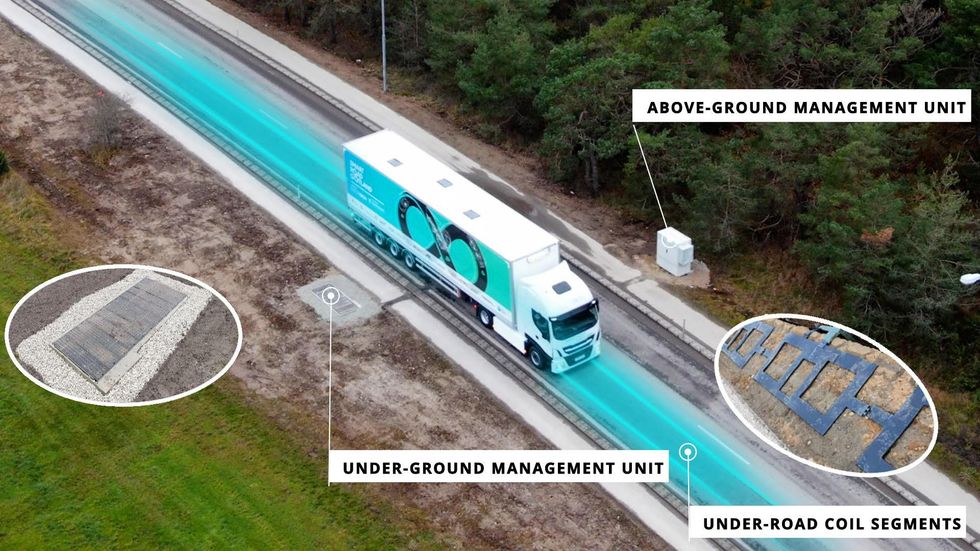 Image courtesy of Electreon
It’s easy to imagine similar use cases at ports, rail yards or airport taxi lanes, all of which could spell significant savings for companies that lose time and money when their electric fleet vehicles are plugged in and recharging. Many of these areas also fall under the purview of the private sector, which would make uptake and implementation easier, according to Tongur. He said Electreon is already eyeing a move into such spaces.
Electreon aims to have its wireless charging technology installed on public roads around the U.S. within “a couple of years,” Tongur added. While Detroit will host the pilot program, Los Angeles and New York will be the next targets.
“L.A. is obvious, right? It’s the Mecca of EVs,” he said. “You have air quality issues here; you have the port of L.A. and Long Beach; you have so much traffic. Moving to electrification is, I would say, a must.”
The goal of installing wireless charging for moving vehicles is “very courageous,” said Mehrdad Kazerani, a professor of electrical and computer engineering at the University of Waterloo in Ontario, Canada. Kazerani noted that researchers at the university had developed a similar concept for the sprawling Trans-Canada Highway. “Of course, we did not pursue this idea, but it seems Electreon has made good progress along this line,” he said.
Kazerani added that wireless charging technology may also allow the EVs of the future to use considerably smaller batteries, which would make the cars lighter, more energy-efficient and less expensive. Smaller batteries would also mean less mining for battery materials and less waste when a battery reaches the end of its life.
“This is kind of an invitation to the U.S. market: to policymakers, state agencies, fleet owners and original equipment manufacturers,” Tongur said. “This is an opportunity to do things together—join us on this path and journey.”
© dot.LA All rights reserved
Apr 23, 2022 by The Beat Maker - 0 Comments