Get in the KNOW
on LA Startups & Tech
Christian Hetrick is dot.LA’s Entertainment Tech Reporter. He was formerly a business reporter for the Philadelphia Inquirer and reported on New Jersey politics for the Observer and the Press of Atlantic City.
Shira Yevin’s lifelong crusade against a male-dominated music industry began with a pink RV.
After attending the Vans Warped Tour in 2004 and seeing far too few women on the bill, the punk rocker decided to take matters into her own hands: She crashed the tour by parking a pink RV on the campus of Cal State Fullerton and performing on a makeshift stage with her band, Shiragirl. The impromptu show was such a hit that Warped Tour welcomed Yevin back to run an official “Shiragirl Stage,” where female-fronted bands—including artists like Joan Jett and Paramore—performed in the following years.
Now, Yevin is taking an entrepreneurial approach to carve out more space for women in music. She’s the founder and CEO of Los Angeles-based startup Gritty In Pink, which runs an online “marketplace network” that connects music industry professionals with female talent—from musicians and songwriters to engineers and producers. Having launched in beta earlier this year, the startup’s InPink platform lets employers search for talent by skill and demographic.
“Businesses now know they need to find diverse women to hire—but they have no idea where to go to find them,” Yevin told dot.LA.
Whether Gritty In Pink can help solve that imbalance remains to be seen—but what’s clear is that there’s still a huge gender disparity in the music industry that needs addressing. A recent University of Southern California-sponsored study found that there’s been little to no improvement over the last decade in the number of women credited as artists, songwriters or producers on popular songs.
“Women’s contributions are often dismissed or devalued,” according to Katherine Pieper, program director at USC’s Annenberg Inclusion Initiative, which conducted the study on women in music. “They’re not given the opportunity to work on these songs, or when they are, their work is not being credited to them.”
The USC study examined credits for 1,000 songs that landed on the year-end Billboard Hot 100 chart over the last decade. Researchers found that just 23.3% of artists on the annual chart were women in 2021—a marginal improvement from 22.7% in 2012. The report’s authors blamed stereotypes around women and their abilities as well as the situations in which they must work, noting women in the music industry are often sexualized by their colleagues.
The music industry is not alone in these dynamics; the film industry has made little progress in addressing its own gender imbalance. Women made up only 25% of all directors, writers, producers, executive producers, editors and cinematographers working on top-grossing films in 2021, according to the latest study by the Center for the Study of Women in Television and Film at San Diego State University. That’s an improvement of just 6 percentage points from 19% in 2015, and up only 8 percentage points from 17% in 1998.
“The findings of my research suggest that progress will be slow—evolutionary as opposed to revolutionary,” Martha Lauzen, the center’s director, told dot.LA.
But just as Gritty In Pink is trying to diversify the music industry’s ranks, so are there startups now looking to bring more women into film production. Launched in 2018, L.A.-based Crewvie is a platform connecting film projects with production workers and vendors, with a focus on advancing diversity, equity and inclusion. Crewvie allows talent to create profiles that voluntarily self-identify their gender, race, sexual orientation or disabilities; productions can use Crewvie to hire such talent, track the composition of their crew and use demographic data to ensure they’re eligible for awards and tax incentives.
“We see Crewvie as a resource for women and other underserved people to be found,” co-founder and CEO Marcei Brown told dot.LA. “So there’s no more excuses [like] ‘I can’t find’—because they’re all collected here in one place.”
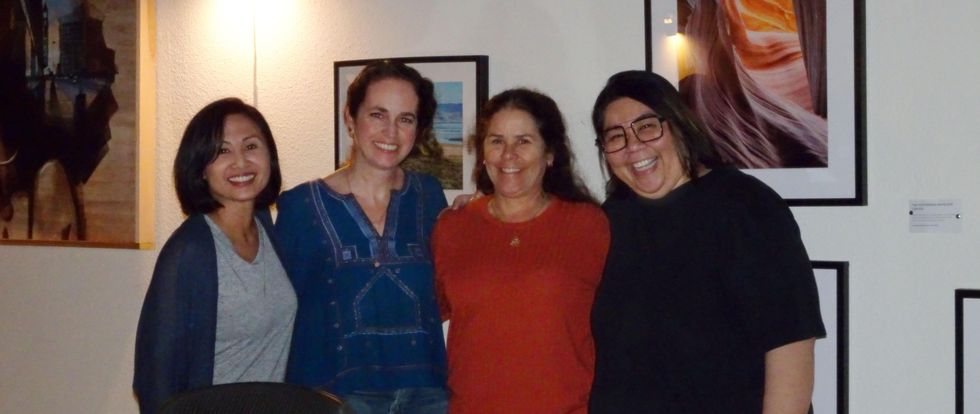 From left, Crewvie founders Sandra Jimenez, Jeanette Volturno, Marcei Brown and Camille Alcasid.Photo provided by Crewvie
Film studio Endeavor Content recently struck a deal with Crewvie to deploy the startup’s software across all of its productions. YouTube productions use the platform as well, according to co-founder Jeanette Volturno. Crewvie charges rates ranging from $200 to $1,500 for individual projects, while rates for enterprise clients (such as film studios) depend on the number of people and projects expected to use it.
With less than 10 employees, Crewvie is currently looking to close a seed funding round, with eyes on a larger future funding round to expand the platform into other territories and languages. Crewvie is also considering an expansion into live events like theater productions, as well as a foray into the music industry, Volturno said.
Likewise, Gritty In Pink is still in its “baby stages,” Yevin said, having raised $100,000 from Irvine-based Sunstone Management and the Long Beach Accelerator, with plans for a $1 million pre-seed round. The startup can count singer-songwriter Melissa Etheridge, of “Come to My Window” fame, among its supporters; Etheridge recently joined Gritty In Pink as a strategic advisor and has a stake in the company.
It also has dreams of expanding beyond the music industry, Yevin noted. “Our big vision is actually to become the global destination to hire female freelancers in every industry,” she said.
Christian Hetrick is dot.LA’s Entertainment Tech Reporter. He was formerly a business reporter for the Philadelphia Inquirer and reported on New Jersey politics for the Observer and the Press of Atlantic City.
Samson Amore is a reporter for dot.LA. He previously covered technology and entertainment for TheWrap and reported on the SoCal startup scene for the Los Angeles Business Journal. Samson is also a proud member of the Transgender Journalists Association. Send tips or pitches to [email protected] and find him on Twitter at @Samsonamore. Pronouns: he/him
Employees at Activision Blizzard are growing increasingly frustrated with the game publisher’s refusal to issue any guidance about how the potential repeal of federal abortion protections could impact workers in its offices across the nation.
Several current Activision Blizzard employees told dot.LA the Santa Monica-based game publisher has refused to communicate with staff about the issue. The employees asked to remain anonymous for fear of losing their jobs.
Activision’s dismal track record of preventing female employees from being discriminated against or sexually harassed at work has led to a bevy of lawsuits from shareholders, government watchdogs, current and former workers and the family of one former employee who died by suicide on a company outing five years ago. This is all being sorted out as the “Overwatch” publisher struggles to complete a $69 billion merger with Microsoft.
An Activision spokesperson shared the following statement with dot.LA Thursday: “We are committed to an inclusive environment that is supportive of all of our employees. As a company, providing fair and equitable health care is a top priority, and we will closely monitor developments in the coming weeks and months.”
In a May 5 Slack message shared with dot.LA by an Activision employee, Blizzard President Mike Ybarra did address some of his team’s concerns. “I realize we are late and I am sorry,” Ybarra wrote. “It has been incredibly stressful for Blizzard (and me personally) as we read the news.”
Ybarra added in his message that leadership at Blizzard met and discussed the leaked SCOTUS draft early last week and “outlined some actions and we are working with ABK to express our views and requested a path forward.”
“These are real time conversations and we’re part of a 10,000+ person company and I want to help the broader employees we value and have across organizations. I realize this isn’t very helpful but I’m being honest with where we are and what we are discussing across the company,” Ybarra’s message concluded.
Employees who received Ybarra’s message said they felt it was an underwhelming response given that Activision operates offices in several states where abortion is already under attack at the state level, including Arkansas and Texas – where it has a sizable presence of support staff, designers, engineers and producers. One worker said the response from Ybarra only came after employees began asking directly about the issue at work.
“There’s been no communication from the top down,” said Emily Knief, a senior motion graphics designer who’s worked for Activision Blizzard for over 15 years. Knief added there’s been “lots of support from within,” but nothing from executives yet.
“It’s completely irresponsible that they continue to remain silent, as the very lives of their employees hang in the balance,” Knief said.
Knief told dot.LA she’s seen a shift in messaging in her cumulative decade-plus at Activision Blizzard. She said in the past “we used to get communication internally, sometimes within hours” related to similar issues.
ABetterABK, the workers group that’s advocating for change and a company-wide union at Activision, issued a statement Wednesday: “We believe there’s never been a more urgent time to support those who rely on that care, not just with words, but actions, and that starts with us standing firm on our positions towards these issues,” the group tweeted.
Kate Anderson, a quality assurance tester for Activision working in Minnesota, told dot.LA employees are upset at a lack of communication.
Anderson, who uses gender neutral pronouns, said they’d feel supported if Activision offered to match donations to pro-abortion organizations that employees support, as it’s done with past issues. They also noted Activision could offer to cover the costs for going out of state for reproductive care, which Microsoft, Amazon and some smaller gaming firms have already promised.
Earlier this week, game producer Javiera Cordero began keeping a public running thread of studios that have publicly taken a stance on abortion, and the list so far is mostly indie developers – though Bungie, the gaming firm Sony bought for $3.6 billion earlier this year, issued its own statement in support of workers last week.
Two workers who requested to remain anonymous for fear of retaliation told dot.LA they speculated Activision’s silence could be a reflection of its conservative leadership.
Last year CEO Bobby Kotick donated at least half a million dollars to Republican super PACs through a secret side company called Norgate, including contributions to a political action committee run by Senate Minority Leader Mitch McConnell, who has said a nationwide ban on abortion “is possible.”
In a report last December, Activision said 26% of its executives are women. Still, it admitted that last year it lost nearly as many women as it hired because of retirement or resignation.
“The reality is that the C-suite is far divorced from the general ethos of the company at large,” Knief said. “There are two companies, really: The C-suite, with what’s allowed to be publicly stated, and everyone else, the people that make and support the games… and they are often at complete opposite ends of the spectrum on issues and how we should proceed.”
Samson Amore is a reporter for dot.LA. He previously covered technology and entertainment for TheWrap and reported on the SoCal startup scene for the Los Angeles Business Journal. Samson is also a proud member of the Transgender Journalists Association. Send tips or pitches to [email protected] and find him on Twitter at @Samsonamore. Pronouns: he/him
Christian Hetrick is dot.LA’s Entertainment Tech Reporter. He was formerly a business reporter for the Philadelphia Inquirer and reported on New Jersey politics for the Observer and the Press of Atlantic City.
Social media giant Snap has hired Colleen DeCourcy as chief creative officer, tapping an advertising veteran who spent nearly a decade at Wieden+Kennedy, one the world’s largest independent ad agencies.
DeCourcy, who was co-president and chief creative officer at the Portland, Oregon-based ad agency, joined Snap a few months ago and will lead the company’s global creative efforts, according to a Snap spokesperson. She will work to boost Snap’s brand and report to Chief Marketing Officer Kenny Mitchell.
Colleen DeCourcy, Snap CCO
Photo provided by Snap.
“At Snap I’ve met a thoughtful group of people with values and a mission that can make a difference. That’s 100% why I’m doing this,” DeCourcy said in a statement to dot.LA. “What I didn’t expect is how much fun it would be to take my advertising brain and do something completely different with it.”
At Wieden+Kennedy, DeCourcy oversaw Nike’s Emmy-winning “Dream Crazy” campaign that featured Colin Kapernick, the former San Francisco 49ers quarterback who protested police brutality by kneeling during the national anthem of NFL games. DeCourcy, who said she was retiring from advertising in December, also produced work for major brands such as McDonald’s, Ford, Visa and Airbnb.
DeCourcy recently helped Snap build its first Oscars commercial spot that was inspired by this year’s winner for Best Picture, “CODA,” which tells the story of the only hearing member of a deaf family. The ad highlighted how Snapchat users can learn American Sign Language using hand-tracking tech.
“We are so honored to have Colleen join our team at Snap,” Mitchell said in a statement. “Her exceptional strategic and creative leadership makes her the perfect person to help transform the way we bring the Snap brand to life around the world.”
Snap has been on a leadership hiring spree over the last year, adding Jacqueline Beauchere from Microsoft as to be global head of platform safety; Anne Laurenson from Google as managing director of global carrier partnerships; Rajni Jacques from Allure as global head of fashion & beauty partnerships; and Konstantinos ‘KP’ Papmilitiadis from Facebook to be vice president of platform Partnerships.
Christian Hetrick is dot.LA’s Entertainment Tech Reporter. He was formerly a business reporter for the Philadelphia Inquirer and reported on New Jersey politics for the Observer and the Press of Atlantic City.
On this episode of the LA Venture podcast, Kathryne Cooper introduces Jumpstart Nova, a new $55 million fund investing in seed and Series A companies led by Black founders who are focused on health care innovation.
Cooper, an L.A.-native, previously managed an accelerator that made over 150 investments into medical technology companies. She’s a graduate of Stanford and went to medical school at USC. Later, she would return to the school to get her MBA while working at health tech startups.
Jumpstart’s other partner, Marcus Whutney, works out of Nashville and created the fund in the aftermath of the George Floyd protests and the discussions about racial inequities they prompted. Cooper said the events made Whutney think about health inequities “and specifically his position of power as the only Black VC in Nashville.”
The pandemic was another wakeup call about the disparities in the health care system, especially for people of color, said Cooper.
“There are disparities in our health care system, in terms of health care outcomes affecting communities of color,” Cooper said. “And data has emerged as the disparities in health care outcomes for those who had COVID-19, adversely affecting Black and brown patients—even independent of comorbidities.”
Cooper said research has found that the health care industry, like many others, chronically under-invests in Black and brown leaders.
“Because health care is here to impact and improve patient lives, […] sometimes it can get a pass for other things—like not being particularly diverse, or having a lack of executives who are women and people of color at certain levels in health care organizations,” she said.
But Jumpstart doesn’t limit its focus to companies working on health care disparities. It also invests in founders focused on a range of health issues.
“Just because you are a founder of color, or woman, or in this case, let’s say Black founders, that doesn’t mean that your solution needs to solve a health equity issue. It can also solve issues for all patients,” Cooper said.
Jumpstart Nova looks at a wide range of opportunities within health care—everything from tech enabled services, biotech, health IT to diagnostic devices.
If she comes across a promising startup, Cooper said she will often reach out to their strategic limited partners, which are made up of some of the nation’s leading health care companies, including Cardinal Health, the American Hospital Association, Atrium Health and Eli Lilly, among others.
“When we’re looking at companies to invest in, we also want to see if there’s some way that they may also fit into an ecosystem related to our strategic limited partners,” she said.
Cooper hopes that Jumpstart Nova’s focus on under-invested founders can also help spur other investors and VCs to look at the type of founders they’re investing in.
“If they all kind of over-index in one area, [then they might] ask themselves why that is. Is it a network issue? Is it that you are tending to overlook these founders? You know, I don’t know what the answer is. But I encourage people to kind of look at the data and see what it says to you,” said Cooper.
Hear the full episode by clicking on the playhead above, and listen to LA Venture on Apple Podcasts, Stitcher, Spotify or wherever you get your podcasts.
dot.LA Engagement Fellow Joshua Letona contributed to this post.
© dot.LA All rights reserved